EP1155731A1 - NOx reduction using coal based reburning - Google Patents
NOx reduction using coal based reburning Download PDFInfo
- Publication number
- EP1155731A1 EP1155731A1 EP01112153A EP01112153A EP1155731A1 EP 1155731 A1 EP1155731 A1 EP 1155731A1 EP 01112153 A EP01112153 A EP 01112153A EP 01112153 A EP01112153 A EP 01112153A EP 1155731 A1 EP1155731 A1 EP 1155731A1
- Authority
- EP
- European Patent Office
- Prior art keywords
- fuel
- oxygen
- hot oxygen
- mixture
- combustion gases
- Prior art date
- Legal status (The legal status is an assumption and is not a legal conclusion. Google has not performed a legal analysis and makes no representation as to the accuracy of the status listed.)
- Withdrawn
Links
Images

Classifications
-
- F—MECHANICAL ENGINEERING; LIGHTING; HEATING; WEAPONS; BLASTING
- F23—COMBUSTION APPARATUS; COMBUSTION PROCESSES
- F23L—SUPPLYING AIR OR NON-COMBUSTIBLE LIQUIDS OR GASES TO COMBUSTION APPARATUS IN GENERAL ; VALVES OR DAMPERS SPECIALLY ADAPTED FOR CONTROLLING AIR SUPPLY OR DRAUGHT IN COMBUSTION APPARATUS; INDUCING DRAUGHT IN COMBUSTION APPARATUS; TOPS FOR CHIMNEYS OR VENTILATING SHAFTS; TERMINALS FOR FLUES
- F23L7/00—Supplying non-combustible liquids or gases, other than air, to the fire, e.g. oxygen, steam
- F23L7/007—Supplying oxygen or oxygen-enriched air
-
- F—MECHANICAL ENGINEERING; LIGHTING; HEATING; WEAPONS; BLASTING
- F23—COMBUSTION APPARATUS; COMBUSTION PROCESSES
- F23C—METHODS OR APPARATUS FOR COMBUSTION USING FLUID FUEL OR SOLID FUEL SUSPENDED IN A CARRIER GAS OR AIR
- F23C9/00—Combustion apparatus characterised by arrangements for returning combustion products or flue gases to the combustion chamber
- F23C9/06—Combustion apparatus characterised by arrangements for returning combustion products or flue gases to the combustion chamber for completing combustion
-
- B—PERFORMING OPERATIONS; TRANSPORTING
- B01—PHYSICAL OR CHEMICAL PROCESSES OR APPARATUS IN GENERAL
- B01D—SEPARATION
- B01D53/00—Separation of gases or vapours; Recovering vapours of volatile solvents from gases; Chemical or biological purification of waste gases, e.g. engine exhaust gases, smoke, fumes, flue gases, aerosols
- B01D53/34—Chemical or biological purification of waste gases
- B01D53/46—Removing components of defined structure
- B01D53/54—Nitrogen compounds
- B01D53/56—Nitrogen oxides
-
- C—CHEMISTRY; METALLURGY
- C21—METALLURGY OF IRON
- C21B—MANUFACTURE OF IRON OR STEEL
- C21B5/00—Making pig-iron in the blast furnace
- C21B5/001—Injecting additional fuel or reducing agents
-
- F—MECHANICAL ENGINEERING; LIGHTING; HEATING; WEAPONS; BLASTING
- F23—COMBUSTION APPARATUS; COMBUSTION PROCESSES
- F23C—METHODS OR APPARATUS FOR COMBUSTION USING FLUID FUEL OR SOLID FUEL SUSPENDED IN A CARRIER GAS OR AIR
- F23C9/00—Combustion apparatus characterised by arrangements for returning combustion products or flue gases to the combustion chamber
- F23C9/006—Combustion apparatus characterised by arrangements for returning combustion products or flue gases to the combustion chamber the recirculation taking place in the combustion chamber
-
- F—MECHANICAL ENGINEERING; LIGHTING; HEATING; WEAPONS; BLASTING
- F27—FURNACES; KILNS; OVENS; RETORTS
- F27D—DETAILS OR ACCESSORIES OF FURNACES, KILNS, OVENS OR RETORTS, IN SO FAR AS THEY ARE OF KINDS OCCURRING IN MORE THAN ONE KIND OF FURNACE
- F27D17/00—Arrangements for using waste heat; Arrangements for using, or disposing of, waste gases
- F27D17/20—Arrangements for treatment or cleaning of waste gases
-
- B—PERFORMING OPERATIONS; TRANSPORTING
- B01—PHYSICAL OR CHEMICAL PROCESSES OR APPARATUS IN GENERAL
- B01D—SEPARATION
- B01D2251/00—Reactants
- B01D2251/20—Reductants
-
- B—PERFORMING OPERATIONS; TRANSPORTING
- B01—PHYSICAL OR CHEMICAL PROCESSES OR APPARATUS IN GENERAL
- B01D—SEPARATION
- B01D2257/00—Components to be removed
- B01D2257/40—Nitrogen compounds
- B01D2257/404—Nitrogen oxides other than dinitrogen oxide
-
- F—MECHANICAL ENGINEERING; LIGHTING; HEATING; WEAPONS; BLASTING
- F23—COMBUSTION APPARATUS; COMBUSTION PROCESSES
- F23C—METHODS OR APPARATUS FOR COMBUSTION USING FLUID FUEL OR SOLID FUEL SUSPENDED IN A CARRIER GAS OR AIR
- F23C2900/00—Special features of, or arrangements for combustion apparatus using fluid fuels or solid fuels suspended in air; Combustion processes therefor
- F23C2900/99004—Combustion process using petroleum coke or any other fuel with a very low content in volatile matters
-
- Y—GENERAL TAGGING OF NEW TECHNOLOGICAL DEVELOPMENTS; GENERAL TAGGING OF CROSS-SECTIONAL TECHNOLOGIES SPANNING OVER SEVERAL SECTIONS OF THE IPC; TECHNICAL SUBJECTS COVERED BY FORMER USPC CROSS-REFERENCE ART COLLECTIONS [XRACs] AND DIGESTS
- Y02—TECHNOLOGIES OR APPLICATIONS FOR MITIGATION OR ADAPTATION AGAINST CLIMATE CHANGE
- Y02E—REDUCTION OF GREENHOUSE GAS [GHG] EMISSIONS, RELATED TO ENERGY GENERATION, TRANSMISSION OR DISTRIBUTION
- Y02E20/00—Combustion technologies with mitigation potential
- Y02E20/34—Indirect CO2mitigation, i.e. by acting on non CO2directly related matters of the process, e.g. pre-heating or heat recovery
-
- Y—GENERAL TAGGING OF NEW TECHNOLOGICAL DEVELOPMENTS; GENERAL TAGGING OF CROSS-SECTIONAL TECHNOLOGIES SPANNING OVER SEVERAL SECTIONS OF THE IPC; TECHNICAL SUBJECTS COVERED BY FORMER USPC CROSS-REFERENCE ART COLLECTIONS [XRACs] AND DIGESTS
- Y02—TECHNOLOGIES OR APPLICATIONS FOR MITIGATION OR ADAPTATION AGAINST CLIMATE CHANGE
- Y02P—CLIMATE CHANGE MITIGATION TECHNOLOGIES IN THE PRODUCTION OR PROCESSING OF GOODS
- Y02P10/00—Technologies related to metal processing
- Y02P10/32—Technologies related to metal processing using renewable energy sources
Definitions
- This invention relates generally to combustion and, more particularly, the reduction of nitrogen oxides (NOx) emissions stemming from the combustion.
- NOx nitrogen oxides
- the combustion of fuel and oxidant to provide heat is used in a large number of commercial furnaces in such industrial applications as the generation of electricity, the production of steel and other metals, the production of glass, and the treatment of wastes.
- the oxidant employed in the combustion process is air which contains a substantial amount of nitrogen.
- nitrogenous species in the fuel and nitrogen in the air are oxidized to form NOx.
- Other combustion gases which typically include carbon dioxide and water vapor are also formed.
- One approach to reducing NOx emissions from a combustion reaction is reburning wherein fuel is provided to the NOx-containing combustion gases to react with the NOx and form nitrogen gas.
- fuel employed for the reburning is methane or natural gas.
- a method for reducing the NOx content of combustion gases from a combustion reaction comprising:
- stoichiometric means the ratio of oxygen molecules to fuel for combustion purposes. A stoichiometric ratio less than 1.0 means there is less oxygen present than the amount necessary to completely combust the fuel present, i.e. fuel-rich conditions.
- oxygen means a gaseous fluid having an oxygen concentration of at least 30 mole percent. It may have an oxygen concentration exceeding 70 mole percent or may be commercially pure oxygen having an oxygen concentration of 99.5 mole percent or more.
- nitrogen oxides and “NOx” mean one or more of nitrous oxide (N 2 O), nitric oxide (NO), dinitrogen trioxide (N 2 O 3 ) nitrogen tetroxide (N 2 O 4 ), nitrogen dioxide (NO 2 ), trinitrogen tetraoxide (N 3 O 4 ) and nitrogen trioxide (NO 3 ).
- volatiles means organic compounds that are evolved from solid or liquid fuels when heated.
- the compounds include tars, methane and other organic compounds with moderate boiling points.
- devolatize means to cause volatiles to gasify from a solid or liquid.
- granular means finely divided material such as crushed or pulverized solid material or atomized liquid material.
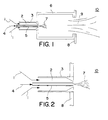
- Figure 1 is a cross-sectional representation of one preferred embodiment of the invention wherein the hot oxygen and the granular carbonaceous fuel are mixed in a gasifier compartment prior to being passed into a furnace for contact with combustion gases.
- Figure 2 is a cross-sectional representation of another preferred embodiment of the invention wherein the hot oxygen and the granular carbonaceous fuel are provided directly into a furnace for contact with combustion gases.
- Figure 3 is a cross-sectional representation of another preferred embodiment of the invention wherein the hot oxygen and the granular carbonaceous fuel are provided directly into a furnace using separate provision means.
- the hot oxygen and the granular carbonaceous fuel pass through injector 3 as coaxial streams and from injector 3 into gasifier 6 wherein they mix to form mixture 7.
- the nozzles through which the hot oxygen and the carbonaceous fuel pass from injector 3 into gasifier 6 have constricted apertures thereby serving to accelerate the hot oxygen and the carbonaceous fuel, thus enhancing the mixing action within gasifier 6 and forming a more uniform mixture 7.
- the hot oxygen and the carbonaceous fuel are provided at rates such that the stoichiometric ratio of mixture 7 is less than 1.0 and preferably is within the range of from 0.1 to 0.6.
- Heat from the hot oxygen causes some of the volatiles within the carbonaceous fuel to devolatize.
- the hot oxygen reacts with the volatiles and also with carbonaceous fuel to form a fuel-rich gas phase mixture which typically comprises carbon dioxide, carbon monoxide, methane, hydrogen and other unreacted hydrocarbons. Some granular carbonaceous fuel may also be present.
- the fuel-rich gas phase mixture Owing to the heat initially brought by the hot oxygen into the combustion reaction of the hot oxygen with the volatiles and the carbonaceous fuel, as well as the heat released by the combustion reaction itself, the fuel-rich gas phase mixture also contains hydrocarbon radicals.
- the fuel-rich gas phase mixture containing hydrocarbon radicals is passed from gasifier 6 through furnace wall 8 as shown by stream 9 into furnace zone 10.
- furnace zone 10 fuel and oxidant have been combusted to generate heat for industrial purposes.
- furnace zones useful in the practice of this invention include utility boilers, industrial furnaces and industrial boilers.
- the heat generating combustion reaction of fuel and oxidant within furnace zone 10 also forms combustion gases which include NOx.
- combustion gases are contacted with the fuel-rich gas phase mixture, and hydrocarbon radicals of the fuel-rich gas phase mixture react with NOx of the combustion gases to reduce the NOx to nitrogen gas.
- the nitrogen gas is then passed out of the furnace with the combustion gases thus markedly reducing the NOx content of the emissions from the furnace over that which would otherwise be the case without the reburning in the furnace zone.
- additional oxidant e.g. air, may be provided to the furnace zone to complete the combustion of the fuel-rich gas phase mixture prior to passage out from the furnace.
- FIG. 4 illustrates in graphical form the results of total burnout, volatile release (VM) and fixed carbon burnout (FC) for four cases for burning pulverized coal with air in a blast air stream: (1) Base, wherein no oxygen is provided to the blast air stream, (2) Enrich, wherein oxygen is provided at ambient temperature upstream of the blast air heater, (3) Cold Inj., wherein oxygen is provided into the blast air stream at ambient temperature, and (4) Hot Inj., wherein heated oxygen was used.
- Base wherein no oxygen is provided to the blast air stream
- Enrich wherein oxygen is provided at ambient temperature upstream of the blast air heater
- Cold Inj. wherein oxygen is provided into the blast air stream at ambient temperature
- Hot Inj. wherein heated oxygen was used.
- the fuel was high volatile pulverized coal of the kind typically used in commercial blast furnace operations and having the analysis shown in Table 1.
- the fuel was provided into the blast air stream at a flowrate of 9.5 kg/hr.
- Char was collected by quenching with water.
- Figure 4 compares the total burnout, volatile release, and fixed carbon burnout for each case for coal injection rates of 9.5 kg/hr. As can be seen from the results reported in Figure 4, the use of a small amount of oxygen significantly improves the volatile release compared to that attainable with only air as the oxidant, and the use of hot oxygen shows even higher performance resulting in even more volatiles available to generate even more hydrocarbon radicals for the reburning.
Landscapes
- Engineering & Computer Science (AREA)
- Chemical & Material Sciences (AREA)
- Mechanical Engineering (AREA)
- General Engineering & Computer Science (AREA)
- Combustion & Propulsion (AREA)
- Environmental & Geological Engineering (AREA)
- Organic Chemistry (AREA)
- Metallurgy (AREA)
- Materials Engineering (AREA)
- Manufacturing & Machinery (AREA)
- Health & Medical Sciences (AREA)
- Biomedical Technology (AREA)
- Analytical Chemistry (AREA)
- General Chemical & Material Sciences (AREA)
- Oil, Petroleum & Natural Gas (AREA)
- Chemical Kinetics & Catalysis (AREA)
Abstract
Description
- This invention relates generally to combustion and, more particularly, the reduction of nitrogen oxides (NOx) emissions stemming from the combustion.
- The combustion of fuel and oxidant to provide heat is used in a large number of commercial furnaces in such industrial applications as the generation of electricity, the production of steel and other metals, the production of glass, and the treatment of wastes. Typically the oxidant employed in the combustion process is air which contains a substantial amount of nitrogen. In the course of the combustion reaction, nitrogenous species in the fuel and nitrogen in the air are oxidized to form NOx. Other combustion gases, which typically include carbon dioxide and water vapor are also formed.
- The emission of NOx from industrial and other furnaces has been shown to have a serious impact on both environmental quality and human health. The compounds cause acid rain, are a factor in the formation of ground level ozone, and have been implicated in the formation of fine particulate.
- One approach to reducing NOx emissions from a combustion reaction is reburning wherein fuel is provided to the NOx-containing combustion gases to react with the NOx and form nitrogen gas. Typically the fuel employed for the reburning is methane or natural gas.
- It is desirable to use a less expensive fuel such as coal or other granular carbonaceous fuel for reburning to reduce NOx emissions. However, the use of such fuels can reduce the efficiency of the reburning because longer contact times are necessary, and can result in the ash having a high carbon content causing the need for further processing steps for the ash.
- Accordingly, it is an object of this invention to provide an improved method for reducing NOx emissions from a combustion reaction using reburning with a granular carbonaceous fuel.
- The above and other objects, which will become apparent to those skilled in the art upon a reading of this disclosure, are attained by the present invention which is:
- A method for reducing the NOx content of combustion gases from a combustion reaction comprising:
- (A) combusting fuel and oxidant to generate heat and to form combustion gases comprising NOx;
- (B) heating oxygen to a temperature within the range of from 1000°F to 3000°F to form hot oxygen;
- (C) mixing the hot oxygen with granular carbonaceous fuel containing volatiles to form a mixture having a stoichiometric ratio less than 1.0, devolatizing the granular carbonaceous fuel within the mixture, and reacting hot oxygen with volatiles and granular carbonaceous fuel within the mixture to form a fuel-rich gas phase mixture containing hydrocarbon radicals; and
- (D) contacting the combustion gases with the fuel-rich gas phase mixture and reacting hydrocarbon radicals of the fuel-rich gas phase mixture with NOx of the combustion gases to form nitrogen gas.
-
- As used herein the term "stoichiometric" means the ratio of oxygen molecules to fuel for combustion purposes. A stoichiometric ratio less than 1.0 means there is less oxygen present than the amount necessary to completely combust the fuel present, i.e. fuel-rich conditions.
- As used herein the term "oxygen" means a gaseous fluid having an oxygen concentration of at least 30 mole percent. It may have an oxygen concentration exceeding 70 mole percent or may be commercially pure oxygen having an oxygen concentration of 99.5 mole percent or more.
- As used herein the terms "nitrogen oxides" and "NOx" mean one or more of nitrous oxide (N2O), nitric oxide (NO), dinitrogen trioxide (N2O3) nitrogen tetroxide (N2O4), nitrogen dioxide (NO2), trinitrogen tetraoxide (N3O4) and nitrogen trioxide (NO3).
- As used herein the term "volatiles" means organic compounds that are evolved from solid or liquid fuels when heated. The compounds include tars, methane and other organic compounds with moderate boiling points.
- As used herein the term "devolatize" means to cause volatiles to gasify from a solid or liquid.
- As used herein the term "hydrocarbon radicals" means highly reactive species that are formed by dissociation of, or reaction with, hydrogen or carbon containing species. Examples of hydrocarbon radicals include NH, CH and CH2
- As used herein, the term "granular" means finely divided material such as crushed or pulverized solid material or atomized liquid material.
- Figure 1 is a cross-sectional representation of one preferred embodiment of the invention wherein the hot oxygen and the granular carbonaceous fuel are mixed in a gasifier compartment prior to being passed into a furnace for contact with combustion gases.
- Figure 2 is a cross-sectional representation of another preferred embodiment of the invention wherein the hot oxygen and the granular carbonaceous fuel are provided directly into a furnace for contact with combustion gases.
- Figure 3 is a cross-sectional representation of another preferred embodiment of the invention wherein the hot oxygen and the granular carbonaceous fuel are provided directly into a furnace using separate provision means.
- Figure 4 is a graphical representation illustrating advantages attainable with the practice of this invention.
- The invention will be described in detail with reference to the Drawings. Referring now to Figure 1, oxygen 1, which has been heated to a temperature within the range of from 1000°F to 3000°F, preferably within the range of from 2000°F to 3000°F, is provided to the
annular passage 2 ofinjector 3. The oxygen may be heated by any suitable means such as by heat exchange with a heat source. A particularly preferred method for heating the oxygen in the practice of this invention is the method disclosed in U.S. Patent No. 5,266,024 - Anderson. -
Carbonaceous fuel 4 is provided tocentral passage 5 ofinjector 3. Any solid or liquid carbonaceous fuel may be used in the practice of this invention. Preferablycarbonaceous fuel 4 comprises pulverized coal or petroleum coke. - The hot oxygen and the granular carbonaceous fuel pass through
injector 3 as coaxial streams and frominjector 3 intogasifier 6 wherein they mix to formmixture 7. Preferably, as illustrated in Figure 1, the nozzles through which the hot oxygen and the carbonaceous fuel pass frominjector 3 intogasifier 6 have constricted apertures thereby serving to accelerate the hot oxygen and the carbonaceous fuel, thus enhancing the mixing action withingasifier 6 and forming a moreuniform mixture 7. The hot oxygen and the carbonaceous fuel are provided at rates such that the stoichiometric ratio ofmixture 7 is less than 1.0 and preferably is within the range of from 0.1 to 0.6. - Heat from the hot oxygen causes some of the volatiles within the carbonaceous fuel to devolatize. Within
gasifier 6 the hot oxygen reacts with the volatiles and also with carbonaceous fuel to form a fuel-rich gas phase mixture which typically comprises carbon dioxide, carbon monoxide, methane, hydrogen and other unreacted hydrocarbons. Some granular carbonaceous fuel may also be present. Owing to the heat initially brought by the hot oxygen into the combustion reaction of the hot oxygen with the volatiles and the carbonaceous fuel, as well as the heat released by the combustion reaction itself, the fuel-rich gas phase mixture also contains hydrocarbon radicals. The fuel-rich gas phase mixture containing hydrocarbon radicals is passed fromgasifier 6 throughfurnace wall 8 as shown bystream 9 intofurnace zone 10. - Within
furnace zone 10 fuel and oxidant have been combusted to generate heat for industrial purposes. Examples of furnace zones useful in the practice of this invention include utility boilers, industrial furnaces and industrial boilers. The heat generating combustion reaction of fuel and oxidant withinfurnace zone 10 also forms combustion gases which include NOx. Withinfurnace zone 10 the combustion gases are contacted with the fuel-rich gas phase mixture, and hydrocarbon radicals of the fuel-rich gas phase mixture react with NOx of the combustion gases to reduce the NOx to nitrogen gas. The nitrogen gas is then passed out of the furnace with the combustion gases thus markedly reducing the NOx content of the emissions from the furnace over that which would otherwise be the case without the reburning in the furnace zone. If desired, additional oxidant, e.g. air, may be provided to the furnace zone to complete the combustion of the fuel-rich gas phase mixture prior to passage out from the furnace. - Figures 2 and 3 illustrate other embodiments of the invention wherein a gasifier compartment is not employed. In the embodiments of the invention illustrated in Figures 2 and 3 the hot oxygen and the granular carbonaceous fuel are provided directly into the furnace wherein they form the substoichiometric mixture. The numerals used in Figures 2 and 3 are the same as those of Figure 1 for the common elements and these common elements will not be described again in detail.
- In the embodiment illustrated in Figure 2 there is employed an injector device similar to that illustrated in Figure 1 except that the injector device is positioned at
furnace wall 8, andmixture 7 is formed withinfurnace zone 10. All other aspects of the embodiment of the invention illustrated in Figure 2 are substantially the same as those previously discussed in conjunction with the embodiment illustrated in Figure 1. As will be appreciated by those skilled in the art, the combustion of the fuel and the oxidant within the furnace zone, which is not illustrated in the Drawings, takes place at a distance from where the fuel-rich gas phase mixture is passed into or forms in the furnace zone. Generally, this combustion will take place below the level at which the fuel-rich gas phase mixture is passed into or forms in the furnace zone, and the combustion gases rise within the combustion zone to effect the contact with the fuel-rich gas phase mixture. - In the embodiment of the invention illustrated in Figure 3 the hot oxygen and the carbonaceous fuel are provided directly into the furnace zone through separate devices. The hot oxygen is provided through one or more hot oxygen lances 11 and the carbonaceous fuel is provided through
fuel lance 12. Preferably, as illustrated in Figure 3, the hot oxygen lance(s) are oriented so as to direct the stream(s) ofhot oxygen 13 injected intofurnace zone 10 toward the stream of granular carbonaceous fuel 14 injected intofurnace zone 10. Generally streams 13 and 14 will entrain some combustion gases prior to their mixing and formingsubstoichiometric mixture 7. Thereafter there is formed the fuel-rich gas phase mixture and there is effected the reduction of NOx to form nitrogen gas withinfurnace zone 10 in a manner similar to that previously described. - Applicants have found that only a small amount of heated oxygen is necessary to effectively devolatize the carbonaceous fuel which in turn enables the generation of a significant amount of hydrocarbon radicals to carry out the reburning of the invention to produce nitrogen gas. This is shown in Figure 4 which illustrates in graphical form the results of total burnout, volatile release (VM) and fixed carbon burnout (FC) for four cases for burning pulverized coal with air in a blast air stream: (1) Base, wherein no oxygen is provided to the blast air stream, (2) Enrich, wherein oxygen is provided at ambient temperature upstream of the blast air heater, (3) Cold Inj., wherein oxygen is provided into the blast air stream at ambient temperature, and (4) Hot Inj., wherein heated oxygen was used. In each case the fuel was high volatile pulverized coal of the kind typically used in commercial blast furnace operations and having the analysis shown in Table 1. The fuel was provided into the blast air stream at a flowrate of 9.5 kg/hr.
Coal Analysis Proximate Analysis Weight Percent Ultimate Analysis Weight Percent Moisture 1.19 Carbon 77.5 Ash 7.13 Hydrogen 5.1 Volatile Matter 34.94 Nitrogen 1.4 Fixed Carbon 56.75 Sulfur 1.0 Oxygen 6.7 - Char was collected by quenching with water. The fraction of total coal burnout, T, was determined by chemical analysis of the ash content of the original coal, Ao, and the ash content of the collected char, A1, according to the relation
- When oxygen was used, 3.7 Nm3/hr of the air flow was replaced with oxygen. For the enrichment test, the air and oxygen were mixed at ambient temperature and the mixture heated to 900°C, so that the total gas flow rate, velocity and temperature were the same as the base case. For the ambient injection test, 93.7 Nm3/hr of air was used for the blast at 900°C, and 3.7 Nm3/hr of oxygen was injected through the oxygen lance. The total gas flow rate was the same as in the base case, while the temperature was lower since the oxygen addition was not heated. The oxygen for the ambient injection test had a purity of about 99.99 percent. For the hot injection test, the oxygen had an oxygen concentration of about 80 mole percent and a temperature of 1565°C.
- Figure 4 compares the total burnout, volatile release, and fixed carbon burnout for each case for coal injection rates of 9.5 kg/hr. As can be seen from the results reported in Figure 4, the use of a small amount of oxygen significantly improves the volatile release compared to that attainable with only air as the oxidant, and the use of hot oxygen shows even higher performance resulting in even more volatiles available to generate even more hydrocarbon radicals for the reburning.
- Now by the use of this invention one may effectively use coal or other inexpensive fuel for reburning to reduce NOx emissions from a commercial furnace. Although the invention has been described in detail with reference to certain preferred embodiments, those skilled in the art will recognize that there are other embodiments of the invention within the spirit and the scope of the claims.
Claims (9)
- A method for reducing the NOx content of combustion gases from a combustion reaction comprising:(A) combusting fuel and oxidant to generate heat and to form combustion gases comprising NOx;(B) heating oxygen to a temperature within the range of from 1000°F to 3000°F to form hot oxygen;(C) mixing the hot oxygen with granular carbonaceous fuel containing volatiles to form a mixture having a stoichiometric ratio less than 1.0, devolatizing the granular carbonaceous fuel within the mixture, and reacting hot oxygen with volatiles and granular carbonaceous fuel within the mixture to form a fuel-rich gas phase mixture containing hydrocarbon radicals; and(D) contacting the combustion gases with the fuel-rich gas phase mixture and reacting hydrocarbon radicals of the fuel-rich gas phase mixture with NOx of the combustion gases to form nitrogen gas.
- The method of claim 1 wherein the hot oxygen has a temperature within the range of from 2000°F to 3000°F.
- The method of claim 1 wherein the granular carbonaceous fuel comprises coal.
- The method of claim 1 wherein the mixture has a stoichiometric ratio within the range of from 0.1 to 0.6.
- The method of claim 1 wherein the hot oxygen has an oxygen concentration of at least 70 mole percent.
- The method of claim 1 wherein the hot oxygen and the granular carbonaceous fuel are passed into a gasifier, and the fuel-rich gas phase mixture is passed from the gasifier into a furnace zone wherein it contacts the combustion gases.
- The method of claim 1 wherein the hot oxygen and the granular carbonaceous fuel are passed into a furnace zone which also contains the combustion gases comprising NOx.
- The method of claim 1 wherein the hot oxygen and the granular carbonaceous fuel are accelerated prior to forming the mixture having a stoichiometric ratio less than 1.0.
- The method of claim 1 wherein some combustion gases are entrained into the hot oxygen prior to the mixing of the hot oxygen with the granular carbonaceous fuel.
Applications Claiming Priority (2)
| Application Number | Priority Date | Filing Date | Title |
|---|---|---|---|
| US09/573,177 US6206949B1 (en) | 1997-10-29 | 2000-05-19 | NOx reduction using coal based reburning |
| US573177 | 2009-10-05 |
Publications (1)
| Publication Number | Publication Date |
|---|---|
| EP1155731A1 true EP1155731A1 (en) | 2001-11-21 |
Family
ID=24290947
Family Applications (1)
| Application Number | Title | Priority Date | Filing Date |
|---|---|---|---|
| EP01112153A Withdrawn EP1155731A1 (en) | 2000-05-19 | 2001-05-17 | NOx reduction using coal based reburning |
Country Status (6)
| Country | Link |
|---|---|
| US (1) | US6206949B1 (en) |
| EP (1) | EP1155731A1 (en) |
| KR (1) | KR100602766B1 (en) |
| CN (1) | CN1180197C (en) |
| BR (1) | BR0102032A (en) |
| CA (1) | CA2348061A1 (en) |
Cited By (4)
| Publication number | Priority date | Publication date | Assignee | Title |
|---|---|---|---|---|
| EP1508742A3 (en) * | 2003-08-21 | 2005-11-30 | Air Products And Chemicals, Inc. | Selective oxygen enrichment in slagging cyclone combustors |
| EP1508741A3 (en) * | 2003-08-21 | 2005-11-30 | Air Products And Chemicals, Inc. | Oxygen-enriched co-firing of secondary fuels in slagging cyclone combustors |
| WO2008048936A3 (en) * | 2006-10-16 | 2008-06-05 | Praxair Technology Inc | Stratified staging in kilns |
| ITUB20160520A1 (en) * | 2016-01-29 | 2017-07-29 | Rivoira Gas S R L | IMPROVED METHOD FOR THE COMBUSTION OF BIOMASS IN A BOILER WITH A LAUNCH FEED (SPREAD-STRIKER) AND ITS BOILER |
Families Citing this family (25)
| Publication number | Priority date | Publication date | Assignee | Title |
|---|---|---|---|---|
| US6699030B2 (en) | 2001-01-11 | 2004-03-02 | Praxair Technology, Inc. | Combustion in a multiburner furnace with selective flow of oxygen |
| US6699031B2 (en) | 2001-01-11 | 2004-03-02 | Praxair Technology, Inc. | NOx reduction in combustion with concentrated coal streams and oxygen injection |
| US6699029B2 (en) | 2001-01-11 | 2004-03-02 | Praxair Technology, Inc. | Oxygen enhanced switching to combustion of lower rank fuels |
| US20020127505A1 (en) | 2001-01-11 | 2002-09-12 | Hisashi Kobayashi | Oxygen enhanced low nox combustion |
| US6702569B2 (en) | 2001-01-11 | 2004-03-09 | Praxair Technology, Inc. | Enhancing SNCR-aided combustion with oxygen addition |
| DE60232346D1 (en) * | 2001-09-07 | 2009-06-25 | Air Prod & Chem | METHOD FOR THE COMPLETE UNSUPPORTED PETROLEUM COKE COMBUSTION |
| US6978726B2 (en) | 2002-05-15 | 2005-12-27 | Praxair Technology, Inc. | Combustion with reduced carbon in the ash |
| MXPA04011343A (en) * | 2002-05-15 | 2005-02-14 | Praxair Technology Inc | Low nox combustion. |
| JP3735594B2 (en) * | 2002-06-28 | 2006-01-18 | 株式会社東芝 | Optical disk device and standby method of optical disk device |
| US7199088B2 (en) | 2002-07-01 | 2007-04-03 | Shell Oil Company | Lubricating oil for a diesel powered engine and method of operating a diesel powered engine |
| WO2004065849A1 (en) | 2003-01-21 | 2004-08-05 | L'air Liquide - Societe Anonyme A Directoire Et Conseil De Surveillance Pour L'etude Et L'exploitation Des Procedes Georges Claude | Process and apparatus for oxigen enrichment in fuel conveying gases |
| US7028622B2 (en) | 2003-04-04 | 2006-04-18 | Maxon Corporation | Apparatus for burning pulverized solid fuels with oxygen |
| US6843185B1 (en) * | 2003-06-27 | 2005-01-18 | Maxon Corporation | Burner with oxygen and fuel mixing apparatus |
| US7168947B2 (en) * | 2004-07-06 | 2007-01-30 | General Electric Company | Methods and systems for operating combustion systems |
| CN2763701Y (en) * | 2005-02-25 | 2006-03-08 | 贾臻 | Preheating type coal dust burner |
| US20060204429A1 (en) * | 2005-03-14 | 2006-09-14 | Bool Lawrence E Iii | Production of activated char using hot gas |
| US20060205592A1 (en) * | 2005-03-14 | 2006-09-14 | Chien-Chung Chao | Catalytic adsorbents for mercury removal from flue gas and methods of manufacture therefor |
| SE531957C2 (en) * | 2006-06-09 | 2009-09-15 | Aga Ab | Method for launching oxygen in an industrial furnace with conventional burner |
| SE532338C2 (en) * | 2008-04-22 | 2009-12-15 | Aga Ab | Method and apparatus for combustion of solid phase fuel |
| US8689710B2 (en) * | 2008-09-26 | 2014-04-08 | Air Products And Chemicals, Inc. | Combustion system with precombustor |
| US8696774B2 (en) * | 2010-01-07 | 2014-04-15 | General Electric Company | Gasification system and method using fuel injectors |
| US9102882B2 (en) | 2012-09-04 | 2015-08-11 | General Electric Company | Gasification system and method |
| CN103528056A (en) * | 2013-10-11 | 2014-01-22 | 王龙陵 | Oxygen-enrichment pulverized coal combustion method and combustor |
| CN105987379B (en) * | 2015-03-06 | 2018-09-14 | 烟台龙源电力技术股份有限公司 | Boiler controller system |
| CN106322366A (en) * | 2015-07-01 | 2017-01-11 | 重庆市富燃科技有限责任公司 | Oxynitride reduction method applied to fuel coal opposed firing boiler |
Citations (6)
| Publication number | Priority date | Publication date | Assignee | Title |
|---|---|---|---|---|
| JPS577230A (en) * | 1980-06-13 | 1982-01-14 | Nippon Cement Co Ltd | Method and apparatus for denitrating waste gas of kiln |
| US4739713A (en) * | 1986-06-26 | 1988-04-26 | Henkel Kommanditgesellschaft Auf Aktien | Method and apparatus for reducing the NOx content of flue gas in coal-dust-fired combustion systems |
| US5562884A (en) * | 1990-04-17 | 1996-10-08 | A. Ahlstrom Corporation | Reducing N2 O emissions when burning nitrogen-containing fuels in fluidized bed reactors |
| WO1997025134A1 (en) * | 1996-01-11 | 1997-07-17 | Energy And Environmental Research Corporation | IMPROVED ADVANCED REBURNING METHODS FOR HIGH EFFICIENCY NOx CONTROL |
| EP0922772A1 (en) * | 1997-10-29 | 1999-06-16 | Praxair Technology, Inc. | Hot oxygen blast furnace injection system |
| US5967061A (en) * | 1997-01-14 | 1999-10-19 | Energy And Environmental Research Corporation | Method and system for reducing nitrogen oxide and sulfur oxide emissions from carbonaceous fuel combustion flue gases |
Family Cites Families (12)
| Publication number | Priority date | Publication date | Assignee | Title |
|---|---|---|---|---|
| US4324640A (en) * | 1980-08-26 | 1982-04-13 | Occidental Research Corporation | Pyrolysis process |
| US4783325A (en) * | 1985-05-14 | 1988-11-08 | Jones Dale G | Process and apparatus for removing oxides of nitrogen and sulfur from combustion gases |
| JPS6227509A (en) | 1985-07-26 | 1987-02-05 | Nippon Kokan Kk <Nkk> | Method for operating blast furnace |
| JPS62290841A (en) | 1986-06-10 | 1987-12-17 | Nippon Kokan Kk <Nkk> | Production method of chromium-containing pig iron |
| US4915619A (en) * | 1988-05-05 | 1990-04-10 | The Babcock & Wilcox Company | Burner for coal, oil or gas firing |
| ES2123018T3 (en) | 1992-07-01 | 1999-01-01 | Wurth Paul Sa | DEVICE FOR INJECTION OF SPRAYED COAL IN A HIGH-FURNACE POT. |
| US5266024A (en) | 1992-09-28 | 1993-11-30 | Praxair Technology, Inc. | Thermal nozzle combustion method |
| FR2702221B1 (en) | 1993-03-03 | 1995-04-28 | Air Liquide | Process for obtaining metal from the blast furnace or cupola. |
| US5582036A (en) | 1995-08-30 | 1996-12-10 | Praxair Technology, Inc. | Cryogenic air separation blast furnace system |
| US5795364A (en) * | 1995-11-01 | 1998-08-18 | Gas Research Institute | Reburning glass furnace for insuring adequate mixing of gases to reduce NOx emissions |
| US6048510A (en) * | 1997-09-30 | 2000-04-11 | Coal Tech Corporation | Method for reducing nitrogen oxides in combustion effluents |
| US6085674A (en) * | 1999-02-03 | 2000-07-11 | Clearstack Combustion Corp. | Low nitrogen oxides emissions from carbonaceous fuel combustion using three stages of oxidation |
-
2000
- 2000-05-19 US US09/573,177 patent/US6206949B1/en not_active Expired - Fee Related
-
2001
- 2001-05-17 CN CNB01119524XA patent/CN1180197C/en not_active Expired - Fee Related
- 2001-05-17 CA CA002348061A patent/CA2348061A1/en not_active Abandoned
- 2001-05-17 BR BR0102032-3A patent/BR0102032A/en not_active IP Right Cessation
- 2001-05-17 KR KR1020010026945A patent/KR100602766B1/en not_active Expired - Fee Related
- 2001-05-17 EP EP01112153A patent/EP1155731A1/en not_active Withdrawn
Patent Citations (6)
| Publication number | Priority date | Publication date | Assignee | Title |
|---|---|---|---|---|
| JPS577230A (en) * | 1980-06-13 | 1982-01-14 | Nippon Cement Co Ltd | Method and apparatus for denitrating waste gas of kiln |
| US4739713A (en) * | 1986-06-26 | 1988-04-26 | Henkel Kommanditgesellschaft Auf Aktien | Method and apparatus for reducing the NOx content of flue gas in coal-dust-fired combustion systems |
| US5562884A (en) * | 1990-04-17 | 1996-10-08 | A. Ahlstrom Corporation | Reducing N2 O emissions when burning nitrogen-containing fuels in fluidized bed reactors |
| WO1997025134A1 (en) * | 1996-01-11 | 1997-07-17 | Energy And Environmental Research Corporation | IMPROVED ADVANCED REBURNING METHODS FOR HIGH EFFICIENCY NOx CONTROL |
| US5967061A (en) * | 1997-01-14 | 1999-10-19 | Energy And Environmental Research Corporation | Method and system for reducing nitrogen oxide and sulfur oxide emissions from carbonaceous fuel combustion flue gases |
| EP0922772A1 (en) * | 1997-10-29 | 1999-06-16 | Praxair Technology, Inc. | Hot oxygen blast furnace injection system |
Non-Patent Citations (1)
| Title |
|---|
| PATENT ABSTRACTS OF JAPAN vol. 006, no. 068 (C - 100) 30 April 1982 (1982-04-30) * |
Cited By (5)
| Publication number | Priority date | Publication date | Assignee | Title |
|---|---|---|---|---|
| EP1508742A3 (en) * | 2003-08-21 | 2005-11-30 | Air Products And Chemicals, Inc. | Selective oxygen enrichment in slagging cyclone combustors |
| EP1508741A3 (en) * | 2003-08-21 | 2005-11-30 | Air Products And Chemicals, Inc. | Oxygen-enriched co-firing of secondary fuels in slagging cyclone combustors |
| WO2008048936A3 (en) * | 2006-10-16 | 2008-06-05 | Praxair Technology Inc | Stratified staging in kilns |
| US7452203B2 (en) | 2006-10-16 | 2008-11-18 | Praxair Technology, Inc. | Stratified staging in kilns |
| ITUB20160520A1 (en) * | 2016-01-29 | 2017-07-29 | Rivoira Gas S R L | IMPROVED METHOD FOR THE COMBUSTION OF BIOMASS IN A BOILER WITH A LAUNCH FEED (SPREAD-STRIKER) AND ITS BOILER |
Also Published As
| Publication number | Publication date |
|---|---|
| KR20010105244A (en) | 2001-11-28 |
| CN1324999A (en) | 2001-12-05 |
| CA2348061A1 (en) | 2001-11-19 |
| KR100602766B1 (en) | 2006-07-20 |
| CN1180197C (en) | 2004-12-15 |
| BR0102032A (en) | 2001-12-18 |
| US6206949B1 (en) | 2001-03-27 |
Similar Documents
| Publication | Publication Date | Title |
|---|---|---|
| US6206949B1 (en) | NOx reduction using coal based reburning | |
| CA2057221C (en) | Segregated zoning combustion | |
| US4427362A (en) | Combustion method | |
| US5242296A (en) | Hybrid oxidant combustion method | |
| JP2942711B2 (en) | Deep stage combustion method | |
| US8124561B2 (en) | Production of activated char using hot gas | |
| US5967061A (en) | Method and system for reducing nitrogen oxide and sulfur oxide emissions from carbonaceous fuel combustion flue gases | |
| KR19990023302A (en) | Combustion method to reduce nitrogen oxide production | |
| KR20030031909A (en) | Low nitrogen oxides emissions using three stages of fuel oxidation and in-situ furnace flue gas recirculation | |
| US5924858A (en) | Staged combustion method | |
| AU2001265303A1 (en) | Low nitrogen oxides emissions using three stages of fuel oxidation and in-situ furnace flue gas recirculation | |
| AU734732B2 (en) | Hot oxygen blast furnace injection system | |
| EP0581850A1 (en) | ADVANCED REBURN TO REDUCE NO X? EMISSIONS IN COMBUSTION SYSTEMS. | |
| Teng et al. | Control of NOx emissions through combustion modifications for reheating furnaces in steel plants | |
| JPH0377408B2 (en) | ||
| CN117781265B (en) | Recombustion of pulverized coal to reduce NO by using active gas to temperxApparatus and method of (a) | |
| Starley et al. | Nitric oxide destruction in the fuel-bed burning regime of spreader stokers | |
| Martin | Environmental considerations in the use of alternate clean fuels in stationary combustion processes | |
| Khan et al. | Zero test emissions of sulphur dioxide from large coal under staged fluidized bed combustion | |
| Li | 99lOO695 Process mechanisms of blast furnace fuel injection: what we know, and what we guess |
Legal Events
| Date | Code | Title | Description |
|---|---|---|---|
| PUAI | Public reference made under article 153(3) epc to a published international application that has entered the european phase |
Free format text: ORIGINAL CODE: 0009012 |
|
| AK | Designated contracting states |
Kind code of ref document: A1 Designated state(s): AT BE CH CY DE DK ES FI FR GB GR IE IT LI LU MC NL PT SE TR Kind code of ref document: A1 Designated state(s): DE ES FR GB IT |
|
| AX | Request for extension of the european patent |
Free format text: AL;LT;LV;MK;RO;SI |
|
| 17P | Request for examination filed |
Effective date: 20011130 |
|
| AKX | Designation fees paid |
Free format text: DE ES FR GB IT |
|
| 17Q | First examination report despatched |
Effective date: 20030403 |
|
| STAA | Information on the status of an ep patent application or granted ep patent |
Free format text: STATUS: THE APPLICATION HAS BEEN WITHDRAWN |
|
| 18W | Application withdrawn |
Effective date: 20051114 |