EP1155667A2 - Absorbent article with silicone compound layer - Google Patents
Absorbent article with silicone compound layer Download PDFInfo
- Publication number
- EP1155667A2 EP1155667A2 EP01304226A EP01304226A EP1155667A2 EP 1155667 A2 EP1155667 A2 EP 1155667A2 EP 01304226 A EP01304226 A EP 01304226A EP 01304226 A EP01304226 A EP 01304226A EP 1155667 A2 EP1155667 A2 EP 1155667A2
- Authority
- EP
- European Patent Office
- Prior art keywords
- silicone compound
- silicone
- layer
- sheet
- leak
- Prior art date
- Legal status (The legal status is an assumption and is not a legal conclusion. Google has not performed a legal analysis and makes no representation as to the accuracy of the status listed.)
- Granted
Links
- 150000001875 compounds Chemical class 0.000 title claims abstract description 166
- 229920001296 polysiloxane Polymers 0.000 title claims abstract description 162
- 230000002745 absorbent Effects 0.000 title claims abstract description 55
- 239000002250 absorbent Substances 0.000 title claims abstract description 55
- 229920002545 silicone oil Polymers 0.000 claims description 39
- -1 polysiloxane skeleton Polymers 0.000 claims description 25
- 239000000203 mixture Substances 0.000 claims description 13
- 229920002050 silicone resin Polymers 0.000 claims description 6
- 239000010410 layer Substances 0.000 description 79
- 230000029142 excretion Effects 0.000 description 27
- 239000004745 nonwoven fabric Substances 0.000 description 27
- 239000000835 fiber Substances 0.000 description 16
- 239000010408 film Substances 0.000 description 15
- 238000000034 method Methods 0.000 description 14
- 239000004698 Polyethylene Substances 0.000 description 12
- 229920000573 polyethylene Polymers 0.000 description 12
- 239000002966 varnish Substances 0.000 description 12
- 210000004914 menses Anatomy 0.000 description 10
- 239000008280 blood Substances 0.000 description 9
- 210000004369 blood Anatomy 0.000 description 9
- 210000003608 fece Anatomy 0.000 description 7
- 239000004743 Polypropylene Substances 0.000 description 6
- 229920001971 elastomer Polymers 0.000 description 6
- 229920001155 polypropylene Polymers 0.000 description 6
- 229920000139 polyethylene terephthalate Polymers 0.000 description 5
- 239000005020 polyethylene terephthalate Substances 0.000 description 5
- 239000005060 rubber Substances 0.000 description 5
- 230000000052 comparative effect Effects 0.000 description 3
- 238000004132 cross linking Methods 0.000 description 3
- 239000004744 fabric Substances 0.000 description 3
- 239000012530 fluid Substances 0.000 description 3
- 230000002209 hydrophobic effect Effects 0.000 description 3
- 229920002635 polyurethane Polymers 0.000 description 3
- 239000004814 polyurethane Substances 0.000 description 3
- 102000004169 proteins and genes Human genes 0.000 description 3
- 108090000623 proteins and genes Proteins 0.000 description 3
- 238000010526 radical polymerization reaction Methods 0.000 description 3
- 229920005989 resin Polymers 0.000 description 3
- 239000011347 resin Substances 0.000 description 3
- XLYOFNOQVPJJNP-UHFFFAOYSA-N water Substances O XLYOFNOQVPJJNP-UHFFFAOYSA-N 0.000 description 3
- 241000283073 Equus caballus Species 0.000 description 2
- 206010021639 Incontinence Diseases 0.000 description 2
- 229920000877 Melamine resin Polymers 0.000 description 2
- 239000012790 adhesive layer Substances 0.000 description 2
- 229920000180 alkyd Polymers 0.000 description 2
- 230000000740 bleeding effect Effects 0.000 description 2
- 150000001805 chlorine compounds Chemical class 0.000 description 2
- 235000014113 dietary fatty acids Nutrition 0.000 description 2
- 230000002708 enhancing effect Effects 0.000 description 2
- 239000000194 fatty acid Substances 0.000 description 2
- 229930195729 fatty acid Natural products 0.000 description 2
- 150000004665 fatty acids Chemical class 0.000 description 2
- 239000004750 melt-blown nonwoven Substances 0.000 description 2
- 229920003216 poly(methylphenylsiloxane) Polymers 0.000 description 2
- 229920000728 polyester Polymers 0.000 description 2
- 238000006116 polymerization reaction Methods 0.000 description 2
- 239000004810 polytetrafluoroethylene Substances 0.000 description 2
- 229940058401 polytetrafluoroethylene Drugs 0.000 description 2
- 229920000915 polyvinyl chloride Polymers 0.000 description 2
- 239000004800 polyvinyl chloride Substances 0.000 description 2
- 229920013730 reactive polymer Polymers 0.000 description 2
- 239000005871 repellent Substances 0.000 description 2
- 229920002379 silicone rubber Polymers 0.000 description 2
- 239000002904 solvent Substances 0.000 description 2
- 239000000758 substrate Substances 0.000 description 2
- 229920000247 superabsorbent polymer Polymers 0.000 description 2
- QTBSBXVTEAMEQO-UHFFFAOYSA-M Acetate Chemical compound CC([O-])=O QTBSBXVTEAMEQO-UHFFFAOYSA-M 0.000 description 1
- 244000025254 Cannabis sativa Species 0.000 description 1
- 235000012766 Cannabis sativa ssp. sativa var. sativa Nutrition 0.000 description 1
- 235000012765 Cannabis sativa ssp. sativa var. spontanea Nutrition 0.000 description 1
- 229920000742 Cotton Polymers 0.000 description 1
- 239000004593 Epoxy Substances 0.000 description 1
- YCKRFDGAMUMZLT-UHFFFAOYSA-N Fluorine atom Chemical compound [F] YCKRFDGAMUMZLT-UHFFFAOYSA-N 0.000 description 1
- 244000043261 Hevea brasiliensis Species 0.000 description 1
- 229920002292 Nylon 6 Polymers 0.000 description 1
- 229920002302 Nylon 6,6 Polymers 0.000 description 1
- 239000004952 Polyamide Substances 0.000 description 1
- 239000004372 Polyvinyl alcohol Substances 0.000 description 1
- 229920001328 Polyvinylidene chloride Polymers 0.000 description 1
- 229920000297 Rayon Polymers 0.000 description 1
- 229920002978 Vinylon Polymers 0.000 description 1
- 239000003463 adsorbent Substances 0.000 description 1
- 150000001298 alcohols Chemical class 0.000 description 1
- 229920003233 aromatic nylon Polymers 0.000 description 1
- 150000001558 benzoic acid derivatives Chemical class 0.000 description 1
- 230000017531 blood circulation Effects 0.000 description 1
- 235000009120 camo Nutrition 0.000 description 1
- 238000010538 cationic polymerization reaction Methods 0.000 description 1
- 229920002678 cellulose Polymers 0.000 description 1
- 239000001913 cellulose Substances 0.000 description 1
- 235000005607 chanvre indien Nutrition 0.000 description 1
- 239000011248 coating agent Substances 0.000 description 1
- 238000000576 coating method Methods 0.000 description 1
- 239000002131 composite material Substances 0.000 description 1
- 238000009833 condensation Methods 0.000 description 1
- 230000005494 condensation Effects 0.000 description 1
- 239000000806 elastomer Substances 0.000 description 1
- HIHIPCDUFKZOSL-UHFFFAOYSA-N ethenyl(methyl)silicon Chemical compound C[Si]C=C HIHIPCDUFKZOSL-UHFFFAOYSA-N 0.000 description 1
- 125000002573 ethenylidene group Chemical group [*]=C=C([H])[H] 0.000 description 1
- 238000001125 extrusion Methods 0.000 description 1
- 229910052731 fluorine Inorganic materials 0.000 description 1
- 239000011737 fluorine Substances 0.000 description 1
- 239000011487 hemp Substances 0.000 description 1
- 229920001903 high density polyethylene Polymers 0.000 description 1
- 239000004700 high-density polyethylene Substances 0.000 description 1
- 229920000092 linear low density polyethylene Polymers 0.000 description 1
- 239000004707 linear low-density polyethylene Substances 0.000 description 1
- 239000007788 liquid Substances 0.000 description 1
- 229920001684 low density polyethylene Polymers 0.000 description 1
- 239000004702 low-density polyethylene Substances 0.000 description 1
- 239000000463 material Substances 0.000 description 1
- 230000002175 menstrual effect Effects 0.000 description 1
- 238000012986 modification Methods 0.000 description 1
- 230000004048 modification Effects 0.000 description 1
- 229920003052 natural elastomer Polymers 0.000 description 1
- 229920001194 natural rubber Polymers 0.000 description 1
- 229920000058 polyacrylate Polymers 0.000 description 1
- 229920002239 polyacrylonitrile Polymers 0.000 description 1
- 229920002647 polyamide Polymers 0.000 description 1
- 229920001343 polytetrafluoroethylene Polymers 0.000 description 1
- 229920002451 polyvinyl alcohol Polymers 0.000 description 1
- 239000005033 polyvinylidene chloride Substances 0.000 description 1
- 239000002964 rayon Substances 0.000 description 1
- 230000002940 repellent Effects 0.000 description 1
- 239000004945 silicone rubber Substances 0.000 description 1
- 239000007921 spray Substances 0.000 description 1
- 229920003048 styrene butadiene rubber Polymers 0.000 description 1
- 229920003051 synthetic elastomer Polymers 0.000 description 1
- 239000005061 synthetic rubber Substances 0.000 description 1
- 238000010998 test method Methods 0.000 description 1
- 229920001169 thermoplastic Polymers 0.000 description 1
- 239000004416 thermosoftening plastic Substances 0.000 description 1
- 239000010409 thin film Substances 0.000 description 1
- 210000002700 urine Anatomy 0.000 description 1
- 230000000007 visual effect Effects 0.000 description 1
- 238000003466 welding Methods 0.000 description 1
Images



Classifications
-
- A—HUMAN NECESSITIES
- A61—MEDICAL OR VETERINARY SCIENCE; HYGIENE
- A61F—FILTERS IMPLANTABLE INTO BLOOD VESSELS; PROSTHESES; DEVICES PROVIDING PATENCY TO, OR PREVENTING COLLAPSING OF, TUBULAR STRUCTURES OF THE BODY, e.g. STENTS; ORTHOPAEDIC, NURSING OR CONTRACEPTIVE DEVICES; FOMENTATION; TREATMENT OR PROTECTION OF EYES OR EARS; BANDAGES, DRESSINGS OR ABSORBENT PADS; FIRST-AID KITS
- A61F13/00—Bandages or dressings; Absorbent pads
- A61F13/15—Absorbent pads, e.g. sanitary towels, swabs or tampons for external or internal application to the body; Supporting or fastening means therefor; Tampon applicators
- A61F13/45—Absorbent pads, e.g. sanitary towels, swabs or tampons for external or internal application to the body; Supporting or fastening means therefor; Tampon applicators characterised by the shape
- A61F13/47—Sanitary towels, incontinence pads or napkins
- A61F13/475—Sanitary towels, incontinence pads or napkins characterised by edge leakage prevention means
- A61F13/4751—Sanitary towels, incontinence pads or napkins characterised by edge leakage prevention means the means preventing fluid flow in a transversal direction
- A61F13/4752—Sanitary towels, incontinence pads or napkins characterised by edge leakage prevention means the means preventing fluid flow in a transversal direction the means being an upstanding barrier
- A61F13/4753—Sanitary towels, incontinence pads or napkins characterised by edge leakage prevention means the means preventing fluid flow in a transversal direction the means being an upstanding barrier the barrier being not integral with the topsheet or backsheet
-
- A—HUMAN NECESSITIES
- A61—MEDICAL OR VETERINARY SCIENCE; HYGIENE
- A61F—FILTERS IMPLANTABLE INTO BLOOD VESSELS; PROSTHESES; DEVICES PROVIDING PATENCY TO, OR PREVENTING COLLAPSING OF, TUBULAR STRUCTURES OF THE BODY, e.g. STENTS; ORTHOPAEDIC, NURSING OR CONTRACEPTIVE DEVICES; FOMENTATION; TREATMENT OR PROTECTION OF EYES OR EARS; BANDAGES, DRESSINGS OR ABSORBENT PADS; FIRST-AID KITS
- A61F13/00—Bandages or dressings; Absorbent pads
- A61F13/15—Absorbent pads, e.g. sanitary towels, swabs or tampons for external or internal application to the body; Supporting or fastening means therefor; Tampon applicators
- A61F13/84—Accessories, not otherwise provided for, for absorbent pads
- A61F13/8405—Additives, e.g. for odour, disinfectant or pH control
-
- A—HUMAN NECESSITIES
- A61—MEDICAL OR VETERINARY SCIENCE; HYGIENE
- A61L—METHODS OR APPARATUS FOR STERILISING MATERIALS OR OBJECTS IN GENERAL; DISINFECTION, STERILISATION OR DEODORISATION OF AIR; CHEMICAL ASPECTS OF BANDAGES, DRESSINGS, ABSORBENT PADS OR SURGICAL ARTICLES; MATERIALS FOR BANDAGES, DRESSINGS, ABSORBENT PADS OR SURGICAL ARTICLES
- A61L15/00—Chemical aspects of, or use of materials for, bandages, dressings or absorbent pads
- A61L15/16—Bandages, dressings or absorbent pads for physiological fluids such as urine or blood, e.g. sanitary towels, tampons
- A61L15/22—Bandages, dressings or absorbent pads for physiological fluids such as urine or blood, e.g. sanitary towels, tampons containing macromolecular materials
- A61L15/26—Macromolecular compounds obtained otherwise than by reactions only involving carbon-to-carbon unsaturated bonds; Derivatives thereof
Definitions
- the present invention generally relates to an absorbent article. More precisely, it relates to an absorbent article having leak-preventing cuffs or flap portions for surely leading wearer' s excretions to its top sheet and for preventing side leakage of the excretions through it. Further precisely, it relates to an absorbent article having such leak-preventing cuffs or flap portions coated with a silicone compound layer.
- absorbent articles for absorbing excretions are used, including, for example, sanitary napkins, pantiliners, disposable diapers, incontinence pads, etc.
- These absorbent articles comprise a liquid-pervious top sheet that is to be in contact with the skin of a wearer to pass the wearer' s excretions through it, a back sheet that is to face the wearer' s underwear, and an absorbent core sandwiched between the top sheet and the back sheet.
- the absorbent articles On both sides, the absorbent articles have leak-preventing cuffs for preventing side leakage of excretions outside them.
- the absorbent articles of this type are made of vapor-pervious material to prevent them from being too much humidified. In these, for example, the leak-preventing cuffs are made of non-woven fabric of hydrophobic fibers.
- the excretions having adhered to the leak-preventing cuffs made of non-woven fabric of hydrophobic fibers often stain them, even though a little.
- menses and other fluid discharges containing protein firmly adhere to the leak-preventing cuffs made of such non-woven fabric, and stain them. Accordingly, if the leak-preventing cuffs of the sanitary napkins and the like are stained with menses, they will give an uncomfortable feeling to users when they are discarded after use.
- An object of the present invention is to provide an absorbent article which effectively prevents side leakage of excretions through it, and in which excretions hardly adhere to other region except for the top sheet.
- an absorbent article may comprise a liquid-pervious top sheet to be in contact with the skin of a wearer, a back sheet, and an absorbent core sandwiched between the top sheet and the back sheet, wherein; a layer of silicone compound is formed on the surface of one of: a side sheet provided on each side of the absorbent core, and a side portion of the back sheet extending outwardly from each side of the absorbent core.
- the silicone compound layer is formed on the leak-preventing cuffs and/or flap portions provided on both sides of the absorbent core. Being so constituted, therefore, the absorbent article prevents excretions from leaking out through the leak-preventing cuffs and/or flap portions. Additionally, excretions hardly adhere to the surface of the silicone compound layer, and even protein-containing menses hardly adhere thereto. Therefore, menses hardly adhere to the leak-preventing cuffs and the flap portions in the absorbent article to avoid giving an uncomfortable feeling to the users when the absorbent article is exchanged for a new one after used.
- the absorbent article may have a leak-preventing cuff formed by the side sheet, and at least one surface of the leak-preventing cuff may be coated with the silicone compound layer.
- the absorbent article may have a flap portion formed at least by the side sheet, and the surface of the flap portion to be in contact with the skin of a wearer may be coated with the silicone compound layer.
- the silicone compound layer has a two-layered structure comprising a first layer of a first silicone compound ' and a second layer of a second silicone compound formed on the first layer to be in contact with the skin of a wearer.
- the silicone compound layer is formed of a mixture of a first silicone compound and a second silicone compound, and a larger amount of the second silicone compound than that of the first silicone compound appears on the surface of the silicone compound layer.
- the surface tension of the second silicone compound is lower than that of the first silicone compound.
- the surface tension of the second silicone compound is at most 30.0 mN/m.
- the first silicone compound is a silicone resin.
- the second silicone compound is a silicone oil. More preferably, the degree of polysiloxane skeleton introduction into the silicone oil falls between 30 and 100 %, and the degree of polymerization of the silicone oil is at most 100.
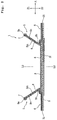
- Fig. 1 is a plan view of a sanitary napkin of the first embodiment of the invention
- Fig. 2 is a cross-sectional view of Fig. 1, cut along the line II-II;
- Fig. 3 is a cross-sectional view of a sanitary napkin of the second embodiment of the invention.
- Fig. 4 is a cross-sectional view of a sanitary napkin of the third embodiment of the invention.
- Fig. 5 is a cross-sectional view of a sanitary napkin of the fourth embodiment of the invention.
- Fig. 6 is a cross-sectional view of a sanitary napkin of the fifth embodiment of the invention.
- Fig. 7 is a cross-sectional view of a sanitary napkin of the sixth embodiment of the invention.
- Fig. 8 is a cross-sectional view of a disposable diaper of the seventh embodiment of the invention.
- Fig. 1 is a plan view of a sanitary napkin of the first embodiment of the invention
- Fig. 2 is a cross-sectional view of Fig. 1, cut along the line II-II.
- the lateral direction of the sanitary napkin is designated by X
- the longitudinal direction thereof is designated by Y
- the direction toward the skin of a wearer is designated by Z1; and the direction toward an external support such as wearer's underwear is designated by Z2.
- the sanitary napkin 1 comprises a liquid-pervious top sheet 4 to be in contact with the skin of a wearer, a back sheet 2 to face the wearer's underwear, and an absorbent core 3 sandwiched between the top sheet 4 and the back sheet 2.
- This is formed into an hourglass configuration.
- the hourglass-shaped top sheet 4 and back sheet 2 both one size larger than the absorbent core 3, are bonded to each other.
- the thus-bonded parts of the top sheet 4 and the back sheet 2 extend outwardly from both sides of the absorbent core 3 to form flap portions 6, 6.
- leak-preventing cuffs 5, 5 extend upwardly from the upper surface of the top sheet 4 disposed on the absorbent core 3, and these leak-preventing cuffs 5, 5 are extended in the longitudinal direction (Y direction) of the sanitary napkin 1.
- Each leak-preventing cuff 5 is made of a sheet (this sheet is also referred to as a side sheet), and the sheet extends toward each side edge 1R, 1L in the lateral direction of the sanitary napkin 1, and is bonded to the upper surface of the top sheet 4. With that, the sheets forming the leak-preventing cuffs 5, 5 further form the flap portions 6, 6 along with the top sheet 4 and the back sheet 2.
- the sheet is partly fixed to the top sheet 4 on the absorbent core 3 at a fixed end 5b, from which a free end 5a extends upwardly to form each leak-preventing cuff 5.
- An elastic member 7 which is stretched to extend in the direction Y, is fitted to the free end 5a.
- both ends of the leak-preventing cuffs 5, 5 in the longitudinal direction (direction Y) are bonded to both longitudinal ends 1e, 1e of the sanitary napkin 1 (i.e., both end edges thereof) so that each free end 5a falls over the top sheet 4.
- the elastic member 7 is contracted under the condition where the external force is not applied to the sanitary napkin 1 (i.e., in a free condition), so that the sanitary napkin 1 is curved and deformed into a concave configuration (i.e., the center portion of the sanitary napkin 1 is downwardly protruded) in a side elevation of the sanitary napkin 1.
- each leak-preventing cuff 5 extends upwardly in the direction Z1 from the fixed end 5b thereof, as shown in Fig. 2.
- the fixed end 5b is provided on the absorbent core 3, but it may be provided on the flap portion 6.
- each leak-preventing cuff 5 On an inner surface 5m of each leak-preventing cuff 5 that faces a longitudinal center line L0 of the absorbent article 1, a silicone compound layer 8 is formed from the fixed end 5b to the free end 5a.
- the silicone compound layer 8 has high water repellency. Accordingly, even when a large amount of the excretions such as menses not absorbed by the absorbent core 3 moves in the direction X, and further the body pressure of the user is applied to the contact portion of the layer 8 with the excretions, the excretions do not penetrate from the layer 8 to the outer surface 5n of the leak-preventing cuff 5. As a result, the cuff 5 can prevent side leakage of excretions.
- the silicone compound layer 8 may be disposed on both the inner surface 5m and the outer surface 5n of the leak-preventing cuff 5. On the other hand, the silicone compound layer 8 completely covers the free end 5a of the leak-preventing cuff 5 in Fig. 2. However, as the case may be, the free end 5a may not be covered with the silicone compound layer 8.
- the sheet to form the leak-preventing cuff 5 may be made of a non-woven fabric of fibers of at least one compound selected from the group consisting of cellulose compounds such as cupra, rayon, acetate, etc.; polyamide compounds such as nylon 6, nylon 66, aromatic nylons, etc.; polyvinyl alcohol compounds such as vinylon, etc.; polyvinylidene chloride compounds such as vinylidene, etc.; polyvinyl chloride compounds such as polyvinyl chloride, etc.; polyester compounds such as polyethylene terephthalate, polyacrylates, etc.; polyacrylonitrile compounds such as acryl, etc.; polyethylene compounds such as low-density polyethylene, high-density polyethylene, linear low-density polyethylene, etc.; polypropylene compounds such as polypropylene, etc.; polyurethane compounds such as polyurethane, etc.; polyalkylene-paraoxybenzoate compounds such as benzoates, etc., and/or natural fibers (of cotton, hemp, silk,
- the sheet is pervious to air. More preferably, it is made of a spun-laced non-woven fabric, spun-bonded non-woven fabric, air-through-bonded non-woven fabric or thermal-bonded non-woven fabric of polyethylene (PE) fibers, polypropylene (PP) fibers, polyethylene terephthalate (PET) fibers, or conjugated fibers (i.e., core/sheath fibers, side-by-side fibers) of PE/PP, PE/PET, etc. Also preferred are non-woven fabrics containing thermoplastic fibers, as they can be bonded to the sanitary napkin 1 by use of thermal welding to improve comfortable feeling to the skin of wearers.
- PE polyethylene
- PP polypropylene
- PET polyethylene terephthalate
- conjugated fibers i.e., core/sheath fibers, side-by-side fibers
- the surface of the sheet to form the leak-preventing cuff has a high degree of wettability in order that the leak-preventing cuff may be coated with a uniform and thin film of a silicone compound.
- the leak-preventing cuff 5 is formed of a polyethylene film sheet or the like, it may be processed with corona discharge to increase the wettability thereof prior to being coated with a silicone compound.
- silicone compound layer 8 one or more of known silicone compounds such as silicone oil, silicone resin, silicone varnish, silicone rubber and others may be used either singly or as combined.
- silicone compound preferred for the silicone compound is silicone oil having a degree of polysiloxane skeleton introduction of from 30 to 100 %. More preferably, the silicone oil has a degree of polymerization of at most 100.
- the silicone compound layer 8 may be formed of two different types of silicone compounds (a two-layered structure of silicone compounds). Concretely, it is desirable that the layer 8 is composed of a first layer of a first silicone compound formed directly on the surface of the leak-preventing cuff 5, and a second layer of a second silicone compound formed on the top surface of the first layer. Alternatively, the silicone compound layer 8 is a layer of a mixture of a first silicone compound and a second silicone compound, and a larger amount of the second silicone compound than that of the first silicone compound appears on the surface of the layer 8. In these cases, it is preferable that the surface tension of the second silicone compound is lower than that of the first silicone compound. As a result, the excretions such as menses hardly adhere to the surface of the layer 8.
- the surface tension of silicone compounds referred to herein is meant to indicate the surface tension thereof in liquid or melted form. Even after being fixed (solidified), however, it is still desirable that the surface tension of the first silicone compound is higher than that of the second silicone compound.
- the silicone compound layer 8 may be formed of two different types of silicone compounds, for example, according to any one of the following methods (1) to (3).
- the first silicone compound is applied to and fixed on the sheet, and then the second silicone compound is applied thereover to form a two-layered silicone compound layer.
- the first and second silicone compounds may be any one of reactive polymers and non-reactive compounds.
- the first silicone compound is a reactive polymer and the second silicone compound is a non-reactive compound.
- the first silicone compound moves toward the substrate sheet side and the second silicone compound moves toward the surface side of the silicone compound layer. In this condition, the silicone compounds are crosslinked and the resulting silicone compound layer is fixed on the surface of the leak-preventing cuff 5.
- the second silicone compound moves toward the surface side of the resulting silicone compound layer by bleeding. This phenomenon will occur because the surface tension of the non-reactive second silicone compound is smaller than that of the first silicone compound.
- the amount of the second silicone compound gradually increases from the surface of the leak-preventing cuff 5 toward the surface of the layer 8.
- the surface tension of the first silicone compound is at most 30.0 mN/m.
- the surface tension referred to herein is measured in a standard condition (at an atmospheric temperature of 20°C).
- the first silicone compound is a reactive silicone oil having a siloxane-structured basic skeleton.
- the first silicone compound is at least one selected from the group consisting of methylhydrogensilicone oil, polydimethylsiloxane-diol, epoxy-modified silicone oil, carboxyl-modified silicone oil, methacryl-modified silicone oil, alcohol-modified silicone oil, mercapto-modified silicone oil, vinyl-modified silicone oil, and amino-modified silicone oil.
- the silicone compound is firmly fixed on the surface of the leak-preventing cuff 5.
- a non-reactive silicone compound may also be used for the first silicone compound.
- the non-reactive silicone compound is applied to the sheet of the leak-preventing cuff 5, and crosslinked through UV or EB exposure for radical polymerization so that the crosslinked compound is firmly fixed on the surface of the cuff 5, and thereafter a second silicone compound is applied thereover.
- a non-reactive silicone compound usable is a non-reactive silicone oil.
- it is at least one compound selected from the group consisting of dimethylsilicone oil, methylphenylsilicone oil, alkyl-modified silicone oil, aralkyl-modified silicone oil, polyether-modified silicone oil, fluoroalkyl-modified silicone oil and fatty acid ester-modified silicone oil.
- the first silicone oil usable in the method (1) includes silicone varnishes such as polysiloxane, silicone-alkyd varnish, silicone-epoxy varnish, silicone-polyester vanish, silicone-acryl vanish, silicone-phenol varnish, silicone-urethane varnish, silicone-melamine varnish, etc.; silicone rubbers such as dimethylsilicone rubber, methylvinylsilicone rubber, methylphenylvinylsilicone rubber, methylfluoroalkylsilicone rubber, etc.
- silicone varnishes such as polysiloxane, silicone-alkyd varnish, silicone-epoxy varnish, silicone-polyester vanish, silicone-acryl vanish, silicone-phenol varnish, silicone-urethane varnish, silicone-melamine varnish, etc.
- silicone rubbers such as dimethylsilicone rubber, methylvinylsilicone rubber, methylphenylvinylsilicone rubber, methylfluoroalkylsilicone rubber, etc.
- the surface tension of the second silicone compound is lower than that of the first silicone compound.
- it is desirable that the surface tension of the second silicone compound is lower by at least 5.0 mN/m than that of the first silicone compound.
- the first silicone compound used for enhancing the ability of the layer 8 to prevent the adhesion of excretions thereto has a surface tension of at most 30.0 mN/m
- it is desirable that the surface tension of the second silicone compound to be combined with the first silicone compound is at most 21.0 mN/m.
- the second silicone compound is preferably a non-reactive silicone compound.
- the second silicone compound is at least one selected from the group consisting of polysiloxane, silicone-alkyd varnish, silicone-acryl varnish, silicone-phenol varnish, silicone-urethane varnish, silicone-melamine varnish, and dimethylsilicone rubber.
- the thickness of the undercoat layer of the first silicone compound is at least 0.1 ⁇ m, more preferably at least 0.3 ⁇ m, for enhancing the ability of the layer 8 to prevent the adhesion of excretions thereto.
- the thickness of the top layer of the second silicone compound is at least 0.1 ⁇ m, more preferably at least 0.2 ⁇ m. In case of the methods (2) and (3), it is also desirable that the thickness of each separated layer falls within the range as above.
- the silicone compounds may be crosslinked in any known manner.
- the mode of crosslinking the silicone compounds includes, for example, condensation crosslinking and addition crosslinking under heat; cationic polymerization and radical polymerization through UV exposure; and radical polymerization through EB exposure.
- the silicone compounds onto the sheet for the leak-preventing cuff 5 employable are any methods of using, for example, air doctor coaters, blade coaters, rod coaters, knife coaters, squeeze coaters, dip coaters, reverse roll coaters, transfer roll coaters, gravure coaters, kiss roll coaters, cast coaters, spray coaters, curtain coaters, calender coaters, extrusion coaters, etc.
- the kinematic viscosity of the silicone compounds is preferably at most 500 mm 2 /s in order that they can be spread uniformly on the surface of the sheet to form a thin and even layer thereon.
- the liquid-pervious top sheet 4 is made of a non-woven fabric of PE fibers, PP fibers, PET fibers or their conjugated fibers all being treated to be hydrophilic, and the non-woven fabric may be any of spun-bonded non-woven fabrics, spun-laced non-woven fabrics, air-through-bonded non-woven fabrics, thermal-bonded non-woven fabrics, etc.
- the top sheet 4 may be a perforated resin sheet.
- the back sheet 2 is made of a liquid-impervious sheet.
- the back sheet 2 is made of a vapor-pervious resin film; a spun-bonded non-woven fabric, a melt-blown non-woven fabric, or a composite non-woven fabric of two of them all being treated to be water repellent; or a laminate sheet of such a non-woven fabric and a vapor-pervious resin film.
- An adhesive layer 2f for fitting the sanitary napkin 1 to an external support such as underwear is disposed on the back surface of the back sheet 2 in the direction Z2.
- the adhesive layer 2f is covered with a release sheet for protecting it until the sanitary napkin is used.
- the absorbent core 3 is formed of powdery pulp or its mixture with super absorbent polymer, and the powdery pulp or its mixture with super absorbent polymer is wrapped with an absorbent sheet of tissue or the like.
- the elastic member 7 is formed of an elastomer of, for example, natural rubber, synthetic rubber, polyurethane or styrene-butadiene copolymer, and it may be in any form of strings, filaments, films, strips (belts) and the like.
- stretchable non-woven fabrics such as elastic spun-bonded non-woven fabrics, elastic melt-blown non-woven fabrics, etc. For this, the non-woven fabrics are cut into strips.
- the cuff 5 itself may be made of a stretchable sheet or non-woven fabric, or may be made of an ordinary sheet or non-woven fabric corrugated to have a stretchability.
- Fig. 3 is a cross-sectional view of a sanitary napkin of the second embodiment of the invention, and this corresponds to Fig. 2 showing the first embodiment set forth above.
- the sanitary napkin 1A of Fig. 3 differs from the sanitary napkin 1 of Fig. 2 in that the silicone compound layer 8 is not disposed on the surface of each leak-preventing cuff 5 but a silicone compound layer 8A is disposed on the surface of the flap portions 6, 6 that extend outwardly from both sides of the absorbent core 3 to both side edges 1R, 1L of the sanitary napkin 1A.
- the silicone compound layer 8A can prevent them from leaking outside the sanitary napkin 1A.
- the leak-preventing cuffs 5, 5 may be eliminated, and the flap portions 6, 6 coated with the layer 8A may be provided with elastic members extending in the direction Y at both side edges of the flap portions 6, 6 (that is, at both side edges 1R, 1L of the sanitary napkin 1A). Accordingly, the flap portions 6, 6 can rise toward the body facing side, thereby essentially serving as leak-preventing cuffs.
- the silicone compound layer may be formed both on the leak-preventing cuffs 5, 5 and on the flap portions 6, 6.
- the elastic member may be fitted both to the leak-preventing cuffs 5, 5 and to the flap portions 6, 6.
- Fig. 4 is a cross-sectional view of a sanitary napkin of the third embodiment of the invention.
- flap sheets 9, 9 are provided on the back sheet 2.
- the flap sheets 9,9 (this flap sheet is also referred to as a side sheet) extend from both side edges 1R, 1L of the sanitary napkin 1 B to both side edges of the absorbent core 3 (precisely, in the vicinity of both side edges thereof) and are bonded to the back sheet 2 to form flap portions 6B, 6B.
- the sanitary napkin 1B does not have leak-preventing cuffs 5, 5.
- each side edge of the flap portions 6B, 6B therefore rises toward the user's skin (in the direction Z1).
- a silicone compound layer 8B On the surface of each flap sheet 9, disposed is a silicone compound layer 8B.
- Fig. 5 is a cross-sectional view of a sanitary napkin of the fourth embodiment of the invention.
- the sanitary napkin 1C is an alternative embodiment of the sanitary napkin 1B of Fig. 4.
- the flap sheets 9C, 9C extend from both side edges 1R, 1L of the sanitary napkin 1C to the top sheet 4 under which the absorbent core 3 exists to overlap both side edges of the absorbent core 3.
- silicone compound layers 8C, 8C also extend from both side edges 1R, 1L to the top sheet 4 under which the absorbent core 3 exists to overlap both side edges of the absorbent core 3 in order to cover the entire surface of the flap sheets 9C, 9C.
- the surface of the sanitary napkin 1C to be in contact with the user's skin i.e., the body facing surface
- the silicone compound layer is entirely covered with the silicone compound layer, except for the region under which the absorbent core 3 exists. Therefore, the ability of the sanitary napkin 1C to prevent leakage of excretions is further improved.
- a flap portion 6D may be made of a flap sheet 9D only, and this may be coated with a silicone compound layer 8D, as shown in a sanitary napkin 1D of Fig. 6 which is the fifth embodiment of the invention.
- the back sheet 2E may be inwardly folded in the direction of the center line L0 at both side edges 1R, 1L of the sanitary napkin 1E to form flap portions 6E, 6E (i.e., this flap portion is formed by a side portion of the back sheet) as shown in a sanitary napkin 1E of Fig. 7 which is the sixth embodiment of the invention.
- the inner surface of the back sheet 2E for forming each flap portion 6E is coated with a silicone compound layer 8E.
- Fig. 8 is a cross-sectional view of the seventh embodiment of the invention.
- the absorbent article shown in Fig. 8 is a disposable diaper 1F.
- the outer surface 5n of each leak-preventing cuff 5, facing outwardly in the direction X is coated with a silicone compound layer 8F.
- urine and feces do not leak outside through the silicone compound layer 8F formed on the outer surface 5n of each leak-preventing cuff 5.
- the absorbent article of the invention is described hereinabove with reference to some examples of the sanitary napkin and the disposable diaper, but the invention is not limited to these examples.
- the invention may be applied to any other absorbent articles, including any other types of disposable diapers, incontinence pads, pantiliners and the like.
- Providing the silicone compound layer thereon is not limited to a pair of leak-preventing cuffs, but the layer may be provided on two pairs or three more pairs of leak-preventing cuffs.
- a UV-curable silicone diluted with a solvent was applied to the surface of a polyethylene film to form thereon a silicone layer having a thickness of 0.5 ⁇ m, then the solvent was dried up, and the thus-coated film was exposed to UV rays (350 nm, 120 W/cm) for 1 second.
- the sheet of Example 1 is obtained for forming leak-preventing cuffs.
- Dimethylsilicone oil (kinematic viscosity 20 mm 2 /s; surface tension 20.8 mN/m) was applied to a polyethylene film to form thereon a silicone layer having a thickness of 20 ⁇ m, thereby obtaining the sheet of Example 2.
- Example 2 The same dimethylsilicone oil as in Example 2 was applied in the same manner as in Example 2, over the silicone resin layer of the sheet prepared in the same manner as in Example 1 to obtain the sheet of Example 3.
- Examples 1 to 3 were tested to measure the contact angle to a blood drop and to evaluate the slip-adhesion of blood, according to the test methods mentioned below. Comparative samples of polyethylene film and polytetrafluoroethylene film were also tested in the same manner. The tests are to confirm the ability of the samples to prevent the adhesion of excretions. The test data are given in Table 1.
- Equine blood is dropped onto the surface of the silicone compound layer of each sample.
- the contact angle in equilibrium is measured with a contact angle meter, "CA-S Micro-2 Model” manufactured by Kyowa Interface Science Co., Ltd.
- the surface of the silicone compound layer of each sample having a size of 30 mm x 110 mm is rubbed 20 times with a cloth of spun-laced non-woven fabric. After having been thus rubbed, the sample is put on a horizontal table, and 0.2 g of equine blood is dropped thereon at 1 cm from its edge. With the sample thereon, the horizontal table is inclined at a rate of 1 degree/sec, and the angle of the horizontal table at the time when the blood has begun to flow down is measured. This angle is a slip angle. After the blood has flowed down completely, the amount of the blood having adhered to the sample is measured.
- Adhered g) Condition of Adhesion Amount Adhered (g) Condition of Adhesion Comp. Ex. 1 polyethylene film 89.8 30 0.035 stripes - - Comp. Ex. 2 poly-tetrafluoroethylene film 100.9 26 0.028 stripes - - Example 1 silicone resin 90.6 22 0.019 dots - - Example 2 silicone oil 86.8 3 0 not adhered 0.022 discontinuous stripes Example 3 silicone resin + silicone oil 87 3 0 not adhered 0 not adhered
- the leak-preventing cuffs and the flap portions are coated with a silicone compound layer, and excretions hardly pass through them. Therefore, the absorbent article of the invention effectively prevents leakage of excretions through it.
- the adsorbent article of the invention does not give an uncomfortable feeling to users and caregivers when it is exchanged for a new one after used.
- the silicone compound layer in the absorbent article has a two-layered structure or a substantially two-layered structure, it is resistant to friction and is hardly peeled off or broken under friction.
- the leak-preventing cuffs coated with such the two-layered silicone compound layer ensure higher water repellency and higher repellency to excretions.
Landscapes
- Health & Medical Sciences (AREA)
- Epidemiology (AREA)
- Engineering & Computer Science (AREA)
- Life Sciences & Earth Sciences (AREA)
- Animal Behavior & Ethology (AREA)
- General Health & Medical Sciences (AREA)
- Public Health (AREA)
- Veterinary Medicine (AREA)
- Biomedical Technology (AREA)
- Vascular Medicine (AREA)
- Heart & Thoracic Surgery (AREA)
- Chemical & Material Sciences (AREA)
- Materials Engineering (AREA)
- Hematology (AREA)
- Chemical Kinetics & Catalysis (AREA)
- Physics & Mathematics (AREA)
- Fluid Mechanics (AREA)
- Absorbent Articles And Supports Therefor (AREA)
- Orthopedics, Nursing, And Contraception (AREA)
- Laminated Bodies (AREA)
Abstract
Description
- The present invention generally relates to an absorbent article. More precisely, it relates to an absorbent article having leak-preventing cuffs or flap portions for surely leading wearer' s excretions to its top sheet and for preventing side leakage of the excretions through it. Further precisely, it relates to an absorbent article having such leak-preventing cuffs or flap portions coated with a silicone compound layer.
- Various absorbent articles for absorbing excretions are used, including, for example, sanitary napkins, pantiliners, disposable diapers, incontinence pads, etc. These absorbent articles comprise a liquid-pervious top sheet that is to be in contact with the skin of a wearer to pass the wearer' s excretions through it, a back sheet that is to face the wearer' s underwear, and an absorbent core sandwiched between the top sheet and the back sheet. On both sides, the absorbent articles have leak-preventing cuffs for preventing side leakage of excretions outside them. The absorbent articles of this type are made of vapor-pervious material to prevent them from being too much humidified. In these, for example, the leak-preventing cuffs are made of non-woven fabric of hydrophobic fibers.
- In the absorbent articles of this type, however, excretions tend to adhere to the leak-preventing cuffs made of such non-woven fabric of hydrophobic fibers, and leak out of the leak-preventing cuffs owing to the wearer's body pressure from the wearer's weight and motion.
- In addition, the excretions having adhered to the leak-preventing cuffs made of non-woven fabric of hydrophobic fibers often stain them, even though a little. In particular, menses and other fluid discharges containing protein firmly adhere to the leak-preventing cuffs made of such non-woven fabric, and stain them. Accordingly, if the leak-preventing cuffs of the sanitary napkins and the like are stained with menses, they will give an uncomfortable feeling to users when they are discarded after use.
- On the other hand, high-viscosity fluid excretions such as loose feces and watery feces easily adhere to non-woven fabric. Therefore, with the disposable diapers and the like, loose feces and watery feces adhered to the leak-preventing cuffs made of non-woven fabric will give an uncomfortable feeling to users.
- An object of the present invention is to provide an absorbent article which effectively prevents side leakage of excretions through it, and in which excretions hardly adhere to other region except for the top sheet.
- According to an aspect of the invention, an absorbent article may comprise a liquid-pervious top sheet to be in contact with the skin of a wearer, a back sheet, and an absorbent core sandwiched between the top sheet and the back sheet, wherein;
a layer of silicone compound is formed on the surface of one of: a side sheet provided on each side of the absorbent core, and a side portion of the back sheet extending outwardly from each side of the absorbent core. - In the absorbent article of the invention, the silicone compound layer is formed on the leak-preventing cuffs and/or flap portions provided on both sides of the absorbent core. Being so constituted, therefore, the absorbent article prevents excretions from leaking out through the leak-preventing cuffs and/or flap portions. Additionally, excretions hardly adhere to the surface of the silicone compound layer, and even protein-containing menses hardly adhere thereto. Therefore, menses hardly adhere to the leak-preventing cuffs and the flap portions in the absorbent article to avoid giving an uncomfortable feeling to the users when the absorbent article is exchanged for a new one after used.
- The absorbent article may have a leak-preventing cuff formed by the side sheet, and at least one surface of the leak-preventing cuff may be coated with the silicone compound layer.
- The absorbent article may have a flap portion formed at least by the side sheet, and the surface of the flap portion to be in contact with the skin of a wearer may be coated with the silicone compound layer.
- Preferably, the silicone compound layer has a two-layered structure comprising a first layer of a first silicone compound ' and a second layer of a second silicone compound formed on the first layer to be in contact with the skin of a wearer.
- Also preferably, the silicone compound layer is formed of a mixture of a first silicone compound and a second silicone compound, and a larger amount of the second silicone compound than that of the first silicone compound appears on the surface of the silicone compound layer.
- More preferably, the surface tension of the second silicone compound is lower than that of the first silicone compound.
- Still more preferably, the surface tension of the second silicone compound is at most 30.0 mN/m.
- Also preferably, the first silicone compound is a silicone resin.
- Also preferably, the second silicone compound is a silicone oil. More preferably, the degree of polysiloxane skeleton introduction into the silicone oil falls between 30 and 100 %, and the degree of polymerization of the silicone oil is at most 100.
- Fig. 1 is a plan view of a sanitary napkin of the first embodiment of the invention;
- Fig. 2 is a cross-sectional view of Fig. 1, cut along the line II-II;
- Fig. 3 is a cross-sectional view of a sanitary napkin of the second embodiment of the invention;
- Fig. 4 is a cross-sectional view of a sanitary napkin of the third embodiment of the invention;
- Fig. 5 is a cross-sectional view of a sanitary napkin of the fourth embodiment of the invention;
- Fig. 6 is a cross-sectional view of a sanitary napkin of the fifth embodiment of the invention;
- Fig. 7 is a cross-sectional view of a sanitary napkin of the sixth embodiment of the invention; and
- Fig. 8 is a cross-sectional view of a disposable diaper of the seventh embodiment of the invention.
- Fig. 1 is a plan view of a sanitary napkin of the first embodiment of the invention, and Fig. 2 is a cross-sectional view of Fig. 1, cut along the line II-II. In these drawings, the lateral direction of the sanitary napkin is designated by X, and the longitudinal direction thereof is designated by Y. The direction toward the skin of a wearer is designated by Z1; and the direction toward an external support such as wearer's underwear is designated by Z2.
- As shown in Fig. 1 and Fig. 2, the
sanitary napkin 1 comprises a liquid-pervious top sheet 4 to be in contact with the skin of a wearer, aback sheet 2 to face the wearer's underwear, and anabsorbent core 3 sandwiched between thetop sheet 4 and theback sheet 2. This is formed into an hourglass configuration. Precisely, around the hourglass-shapedabsorbent core 3, the hourglass-shapedtop sheet 4 andback sheet 2, both one size larger than theabsorbent core 3, are bonded to each other. The thus-bonded parts of thetop sheet 4 and theback sheet 2 extend outwardly from both sides of theabsorbent core 3 to formflap portions - On both sides in the lateral direction of the sanitary napkin 1 (i.e., both side edge portions of the sanitary napkin 1), leak-preventing
cuffs top sheet 4 disposed on theabsorbent core 3, and these leak-preventingcuffs sanitary napkin 1. - Each leak-preventing
cuff 5 is made of a sheet (this sheet is also referred to as a side sheet), and the sheet extends toward eachside edge sanitary napkin 1, and is bonded to the upper surface of thetop sheet 4. With that, the sheets forming the leak-preventingcuffs flap portions top sheet 4 and theback sheet 2. - The sheet is partly fixed to the
top sheet 4 on theabsorbent core 3 at a fixedend 5b, from which afree end 5a extends upwardly to form each leak-preventingcuff 5. Anelastic member 7 which is stretched to extend in the direction Y, is fitted to thefree end 5a. - On the body facing surface of the
sanitary napkin 1, both ends of the leak-preventingcuffs free end 5a falls over thetop sheet 4. As a result, theelastic member 7 is contracted under the condition where the external force is not applied to the sanitary napkin 1 (i.e., in a free condition), so that thesanitary napkin 1 is curved and deformed into a concave configuration (i.e., the center portion of thesanitary napkin 1 is downwardly protruded) in a side elevation of thesanitary napkin 1. Accordingly, thefree end 5a of each leak-preventingcuff 5 extends upwardly in the direction Z1 from the fixedend 5b thereof, as shown in Fig. 2. In Fig. 2, the fixedend 5b is provided on theabsorbent core 3, but it may be provided on theflap portion 6. - On an
inner surface 5m of each leak-preventingcuff 5 that faces a longitudinal center line L0 of theabsorbent article 1, asilicone compound layer 8 is formed from the fixedend 5b to thefree end 5a. Thesilicone compound layer 8 has high water repellency. Accordingly, even when a large amount of the excretions such as menses not absorbed by theabsorbent core 3 moves in the direction X, and further the body pressure of the user is applied to the contact portion of thelayer 8 with the excretions, the excretions do not penetrate from thelayer 8 to theouter surface 5n of the leak-preventingcuff 5. As a result, thecuff 5 can prevent side leakage of excretions. In addition, even when menses are contacted with the part coated with thesilicone compound layer 8, they do not adhere to the surface of thesilicone compound layer 8, but slip away from the surface of thelayer 8 in the direction Z2 and are absorbed by theabsorbent core 3. Therefore, when the usedsanitary napkin 1 is discarded, the leak-preventing cuffs stained with menses will not be recognized by the user to avoid giving a visual uncomfortable feeling to the user. - If desired, the
silicone compound layer 8 may be disposed on both theinner surface 5m and theouter surface 5n of the leak-preventingcuff 5. On the other hand, thesilicone compound layer 8 completely covers thefree end 5a of the leak-preventingcuff 5 in Fig. 2. However, as the case may be, thefree end 5a may not be covered with thesilicone compound layer 8. - The sheet to form the leak-preventing
cuff 5 may be made of a non-woven fabric of fibers of at least one compound selected from the group consisting of cellulose compounds such as cupra, rayon, acetate, etc.; polyamide compounds such asnylon 6, nylon 66, aromatic nylons, etc.; polyvinyl alcohol compounds such as vinylon, etc.; polyvinylidene chloride compounds such as vinylidene, etc.; polyvinyl chloride compounds such as polyvinyl chloride, etc.; polyester compounds such as polyethylene terephthalate, polyacrylates, etc.; polyacrylonitrile compounds such as acryl, etc.; polyethylene compounds such as low-density polyethylene, high-density polyethylene, linear low-density polyethylene, etc.; polypropylene compounds such as polypropylene, etc.; polyurethane compounds such as polyurethane, etc.; polyalkylene-paraoxybenzoate compounds such as benzoates, etc., and/or natural fibers (of cotton, hemp, silk, pulp, etc.), or may also be made of a film or a net of at least one such compound. Preferably, the sheet is pervious to air. More preferably, it is made of a spun-laced non-woven fabric, spun-bonded non-woven fabric, air-through-bonded non-woven fabric or thermal-bonded non-woven fabric of polyethylene (PE) fibers, polypropylene (PP) fibers, polyethylene terephthalate (PET) fibers, or conjugated fibers (i.e., core/sheath fibers, side-by-side fibers) of PE/PP, PE/PET, etc. Also preferred are non-woven fabrics containing thermoplastic fibers, as they can be bonded to thesanitary napkin 1 by use of thermal welding to improve comfortable feeling to the skin of wearers. - Preferably, the surface of the sheet to form the leak-preventing cuff has a high degree of wettability in order that the leak-preventing cuff may be coated with a uniform and thin film of a silicone compound. For example, in cases where the leak-preventing
cuff 5 is formed of a polyethylene film sheet or the like, it may be processed with corona discharge to increase the wettability thereof prior to being coated with a silicone compound. - To form the
silicone compound layer 8, one or more of known silicone compounds such as silicone oil, silicone resin, silicone varnish, silicone rubber and others may be used either singly or as combined. When thelayer 8 is formed of one type of a silicone compound, preferred for the silicone compound is silicone oil having a degree of polysiloxane skeleton introduction of from 30 to 100 %. More preferably, the silicone oil has a degree of polymerization of at most 100. - The
silicone compound layer 8 may be formed of two different types of silicone compounds (a two-layered structure of silicone compounds). Concretely, it is desirable that thelayer 8 is composed of a first layer of a first silicone compound formed directly on the surface of the leak-preventingcuff 5, and a second layer of a second silicone compound formed on the top surface of the first layer. Alternatively, thesilicone compound layer 8 is a layer of a mixture of a first silicone compound and a second silicone compound, and a larger amount of the second silicone compound than that of the first silicone compound appears on the surface of thelayer 8. In these cases, it is preferable that the surface tension of the second silicone compound is lower than that of the first silicone compound. As a result, the excretions such as menses hardly adhere to the surface of thelayer 8. The surface tension of silicone compounds referred to herein is meant to indicate the surface tension thereof in liquid or melted form. Even after being fixed (solidified), however, it is still desirable that the surface tension of the first silicone compound is higher than that of the second silicone compound. - The
silicone compound layer 8 may be formed of two different types of silicone compounds, for example, according to any one of the following methods (1) to (3). - (1) The first silicone compound is applied to the surface
of the sheet for forming the leak-preventing
cuff 5, and then crosslinked to form an undercoat layer thereon; and after the undercoat layer has been fixed on the surface of the sheet, the second silicone compound is applied thereover to form a top layer. - (2) A mixture of a first silicone compound and a second
silicone compound of which the surface tension is lower than
that of the first silicone compound, is applied to the surface
of the sheet for forming the leak-preventing
cuff 5 to form a silicone mixture layer thereon; and after the second silicone compound has moved to the surface side of the silicone mixture layer and the first silicone compound has moved to the substrate sheet side, the respective silicone compounds are crosslinked. - (3) A mixture of a first silicone compound and a second
silicone compound of which the surface tension is lower than
that of the first silicone compound is applied to the surface
of the sheet for forming the leak-preventing
cuff 5 to form a silicone mixture layer thereon, and then this is crosslinked as it is, whereupon the mixture layer is subject to bleeding so that the second silicone compound moves to appear essentially on the surface of the resultingsilicone compound layer 8. -
- In the method (1), the first silicone compound is applied to and fixed on the sheet, and then the second silicone compound is applied thereover to form a two-layered silicone compound layer. In this, therefore, the first and second silicone compounds may be any one of reactive polymers and non-reactive compounds.
- In the methods (2) and (3), it is desirable that the first silicone compound is a reactive polymer and the second silicone compound is a non-reactive compound. In the method (2), when the mixture of the first and second silicone compounds is applied to the sheet and then left as it is for a while, the first silicone compound moves toward the substrate sheet side and the second silicone compound moves toward the surface side of the silicone compound layer. In this condition, the silicone compounds are crosslinked and the resulting silicone compound layer is fixed on the surface of the leak-preventing
cuff 5. - In the method (3), immediately after the mixture of the first and second silicone compounds has been applied to the sheet, it is crosslinked under heat. With that, the second silicone compound moves toward the surface side of the resulting silicone compound layer by bleeding. This phenomenon will occur because the surface tension of the non-reactive second silicone compound is smaller than that of the first silicone compound. In case of the method (3), the amount of the second silicone compound gradually increases from the surface of the leak-preventing
cuff 5 toward the surface of thelayer 8. - Next, the first silicone compound will be described. Preferably, the surface tension of the first silicone compound is at most 30.0 mN/m. The surface tension referred to herein is measured in a standard condition (at an atmospheric temperature of 20°C).
- Preferably, the first silicone compound is a reactive silicone oil having a siloxane-structured basic skeleton. For example, it is desirable that the first silicone compound is at least one selected from the group consisting of methylhydrogensilicone oil, polydimethylsiloxane-diol, epoxy-modified silicone oil, carboxyl-modified silicone oil, methacryl-modified silicone oil, alcohol-modified silicone oil, mercapto-modified silicone oil, vinyl-modified silicone oil, and amino-modified silicone oil. By being dried under heat after coated, the silicone compound is firmly fixed on the surface of the leak-preventing
cuff 5. - In the method (1), a non-reactive silicone compound may also be used for the first silicone compound. In this case, the non-reactive silicone compound is applied to the sheet of the leak-preventing
cuff 5, and crosslinked through UV or EB exposure for radical polymerization so that the crosslinked compound is firmly fixed on the surface of thecuff 5, and thereafter a second silicone compound is applied thereover. For the non-reactive silicone compound, usable is a non-reactive silicone oil. Preferably, it is at least one compound selected from the group consisting of dimethylsilicone oil, methylphenylsilicone oil, alkyl-modified silicone oil, aralkyl-modified silicone oil, polyether-modified silicone oil, fluoroalkyl-modified silicone oil and fatty acid ester-modified silicone oil. - Apart from the above, the first silicone oil usable in the method (1) includes silicone varnishes such as polysiloxane, silicone-alkyd varnish, silicone-epoxy varnish, silicone-polyester vanish, silicone-acryl vanish, silicone-phenol varnish, silicone-urethane varnish, silicone-melamine varnish, etc.; silicone rubbers such as dimethylsilicone rubber, methylvinylsilicone rubber, methylphenylvinylsilicone rubber, methylfluoroalkylsilicone rubber, etc.
- Next, the second silicone compound will be described. Preferably, the surface tension of the second silicone compound is lower than that of the first silicone compound. Concretely, it is desirable that the surface tension of the second silicone compound is lower by at least 5.0 mN/m than that of the first silicone compound. When the first silicone compound used for enhancing the ability of the
layer 8 to prevent the adhesion of excretions thereto has a surface tension of at most 30.0 mN/m, it is desirable that the surface tension of the second silicone compound to be combined with the first silicone compound is at most 21.0 mN/m. - In the method (1), the second silicone compound is preferably a non-reactive silicone oil. For example, it is desirable that the second silicone compound is at least one selected from the group consisting of dimethylsilicone oil, methylphenylsilicone oil, methylhydrogensilicone oil, polydimethylsiloxane-diol, alkyl-modified silicone oil, aralkyl-modified silicone oil, polyether-modified silicone oil, fluoroalkyl-modified silicone oil, fatty acid ester-modified silicone oil, amino-modified silicone oil, epoxy-modified silicone oil, carboxyl-modified silicone oil, methacryl-modified silicone oil, alcohol-modified silicone oil, mercapto-modified silicone oil, and vinyl-modified silicone oil.
- In case of the methods (2) and (3), the second silicone compound is preferably a non-reactive silicone compound. Concretely, it is desirable that the second silicone compound is at least one selected from the group consisting of polysiloxane, silicone-alkyd varnish, silicone-acryl varnish, silicone-phenol varnish, silicone-urethane varnish, silicone-melamine varnish, and dimethylsilicone rubber.
- In the method (1), preferably, the thickness of the undercoat layer of the first silicone compound is at least 0.1 µm, more preferably at least 0.3 µm, for enhancing the ability of the
layer 8 to prevent the adhesion of excretions thereto. Also preferably, the thickness of the top layer of the second silicone compound is at least 0.1 µm, more preferably at least 0.2 µm. In case of the methods (2) and (3), it is also desirable that the thickness of each separated layer falls within the range as above. - To fix the silicone compounds on the sheet, the silicone compounds may be crosslinked in any known manner. The mode of crosslinking the silicone compounds includes, for example, condensation crosslinking and addition crosslinking under heat; cationic polymerization and radical polymerization through UV exposure; and radical polymerization through EB exposure.
- For applying the silicone compounds onto the sheet for the leak-preventing
cuff 5, employable are any methods of using, for example, air doctor coaters, blade coaters, rod coaters, knife coaters, squeeze coaters, dip coaters, reverse roll coaters, transfer roll coaters, gravure coaters, kiss roll coaters, cast coaters, spray coaters, curtain coaters, calender coaters, extrusion coaters, etc. In the methods of coating the silicone compounds by use of such coaters, the kinematic viscosity of the silicone compounds is preferably at most 500 mm2/s in order that they can be spread uniformly on the surface of the sheet to form a thin and even layer thereon. - In the
sanitary napkin 1, the liquid-pervious top sheet 4 is made of a non-woven fabric of PE fibers, PP fibers, PET fibers or their conjugated fibers all being treated to be hydrophilic, and the non-woven fabric may be any of spun-bonded non-woven fabrics, spun-laced non-woven fabrics, air-through-bonded non-woven fabrics, thermal-bonded non-woven fabrics, etc. As the case may be, thetop sheet 4 may be a perforated resin sheet. - Preferably, the
back sheet 2 is made of a liquid-impervious sheet. For example, theback sheet 2 is made of a vapor-pervious resin film; a spun-bonded non-woven fabric, a melt-blown non-woven fabric, or a composite non-woven fabric of two of them all being treated to be water repellent; or a laminate sheet of such a non-woven fabric and a vapor-pervious resin film. Anadhesive layer 2f for fitting thesanitary napkin 1 to an external support such as underwear is disposed on the back surface of theback sheet 2 in the direction Z2. Preferably, theadhesive layer 2f is covered with a release sheet for protecting it until the sanitary napkin is used. - The
absorbent core 3 is formed of powdery pulp or its mixture with super absorbent polymer, and the powdery pulp or its mixture with super absorbent polymer is wrapped with an absorbent sheet of tissue or the like. - The
elastic member 7 is formed of an elastomer of, for example, natural rubber, synthetic rubber, polyurethane or styrene-butadiene copolymer, and it may be in any form of strings, filaments, films, strips (belts) and the like. For theelastic member 7, also usable are stretchable non-woven fabrics such as elastic spun-bonded non-woven fabrics, elastic melt-blown non-woven fabrics, etc. For this, the non-woven fabrics are cut into strips. In place of fitting theelastic member 7 to thefree end 5a of the leak-preventingcuff 5, thecuff 5 itself may be made of a stretchable sheet or non-woven fabric, or may be made of an ordinary sheet or non-woven fabric corrugated to have a stretchability. - Fig. 3 is a cross-sectional view of a sanitary napkin of the second embodiment of the invention, and this corresponds to Fig. 2 showing the first embodiment set forth above. The
sanitary napkin 1A of Fig. 3 differs from thesanitary napkin 1 of Fig. 2 in that thesilicone compound layer 8 is not disposed on the surface of each leak-preventingcuff 5 but asilicone compound layer 8A is disposed on the surface of theflap portions absorbent core 3 to both side edges 1R, 1L of thesanitary napkin 1A. In thesanitary napkin 1A of this embodiment, even when excretions such as menses flow from the center area of thetop sheet 4 toward theflap portions silicone compound layer 8A can prevent them from leaking outside thesanitary napkin 1A. - In this embodiment, the leak-preventing
cuffs flap portions layer 8A may be provided with elastic members extending in the direction Y at both side edges of theflap portions 6, 6 (that is, at both side edges 1R, 1L of thesanitary napkin 1A). Accordingly, theflap portions - If desired, the silicone compound layer may be formed both on the leak-preventing
cuffs flap portions - Also if desired, the elastic member may be fitted both to the leak-preventing
cuffs flap portions - Fig. 4 is a cross-sectional view of a sanitary napkin of the third embodiment of the invention. On both side edge portions of a
sanitary napkin 1B of Fig. 4,flap sheets back sheet 2. Theflap sheets 9,9 (this flap sheet is also referred to as a side sheet) extend from both side edges 1R, 1L of thesanitary napkin 1 B to both side edges of the absorbent core 3 (precisely, in the vicinity of both side edges thereof) and are bonded to theback sheet 2 to formflap portions sanitary napkins sanitary napkin 1B does not have leak-preventingcuffs sanitary napkin 1B, however,elastic members 7 are fitted to both side edges of theflap portions sanitary napkin 1B), and each side edge of theflap portions flap sheet 9, disposed is asilicone compound layer 8B. - Fig. 5 is a cross-sectional view of a sanitary napkin of the fourth embodiment of the invention. The
sanitary napkin 1C is an alternative embodiment of thesanitary napkin 1B of Fig. 4. In thesanitary napkin 1C of Fig. 5, theflap sheets sanitary napkin 1C to thetop sheet 4 under which theabsorbent core 3 exists to overlap both side edges of theabsorbent core 3. In this, silicone compound layers 8C, 8C also extend from both side edges 1R, 1L to thetop sheet 4 under which theabsorbent core 3 exists to overlap both side edges of theabsorbent core 3 in order to cover the entire surface of theflap sheets sanitary napkin 1C to be in contact with the user's skin (i.e., the body facing surface) is entirely covered with the silicone compound layer, except for the region under which theabsorbent core 3 exists. Therefore, the ability of thesanitary napkin 1C to prevent leakage of excretions is further improved. - Any other various types of flap portions may apply to the sanitary napkins of the invention. For example, a
flap portion 6D may be made of aflap sheet 9D only, and this may be coated with asilicone compound layer 8D, as shown in a sanitary napkin 1D of Fig. 6 which is the fifth embodiment of the invention. Alternatively, theback sheet 2E may be inwardly folded in the direction of the center line L0 at both side edges 1R, 1L of thesanitary napkin 1E to formflap portions sanitary napkin 1E of Fig. 7 which is the sixth embodiment of the invention. In this embodiment, the inner surface of theback sheet 2E for forming eachflap portion 6E is coated with asilicone compound layer 8E. - Fig. 8 is a cross-sectional view of the seventh embodiment of the invention. The absorbent article shown in Fig. 8 is a
disposable diaper 1F. In thedisposable diaper 1F, theouter surface 5n of each leak-preventingcuff 5, facing outwardly in the direction X, is coated with asilicone compound layer 8F. As is the case with the embodiments set forth above, urine and feces do not leak outside through thesilicone compound layer 8F formed on theouter surface 5n of each leak-preventingcuff 5. - The absorbent article of the invention is described hereinabove with reference to some examples of the sanitary napkin and the disposable diaper, but the invention is not limited to these examples. The invention may be applied to any other absorbent articles, including any other types of disposable diapers, incontinence pads, pantiliners and the like. Providing the silicone compound layer thereon is not limited to a pair of leak-preventing cuffs, but the layer may be provided on two pairs or three more pairs of leak-preventing cuffs.
- The invention will be described in more detail with reference to the following Examples, which, however, are not intended to restrict the scope of the invention.
- A UV-curable silicone diluted with a solvent was applied to the surface of a polyethylene film to form thereon a silicone layer having a thickness of 0.5 µm, then the solvent was dried up, and the thus-coated film was exposed to UV rays (350 nm, 120 W/cm) for 1 second. The sheet of Example 1 is obtained for forming leak-preventing cuffs.
- Dimethylsilicone oil (kinematic viscosity 20 mm2/s; surface tension 20.8 mN/m) was applied to a polyethylene film to form thereon a silicone layer having a thickness of 20 µm, thereby obtaining the sheet of Example 2.
- The same dimethylsilicone oil as in Example 2 was applied in the same manner as in Example 2, over the silicone resin layer of the sheet prepared in the same manner as in Example 1 to obtain the sheet of Example 3.
- The sheets of Examples 1 to 3 were tested to measure the contact angle to a blood drop and to evaluate the slip-adhesion of blood, according to the test methods mentioned below. Comparative samples of polyethylene film and polytetrafluoroethylene film were also tested in the same manner. The tests are to confirm the ability of the samples to prevent the adhesion of excretions. The test data are given in Table 1.
- Equine blood is dropped onto the surface of the silicone compound layer of each sample. The contact angle in equilibrium is measured with a contact angle meter, "CA-S Micro-2 Model" manufactured by Kyowa Interface Science Co., Ltd.
- The surface of the silicone compound layer of each sample having a size of 30 mm x 110 mm is rubbed 20 times with a cloth of spun-laced non-woven fabric. After having been thus rubbed, the sample is put on a horizontal table, and 0.2 g of equine blood is dropped thereon at 1 cm from its edge. With the sample thereon, the horizontal table is inclined at a rate of 1 degree/sec, and the angle of the horizontal table at the time when the blood has begun to flow down is measured. This angle is a slip angle. After the blood has flowed down completely, the amount of the blood having adhered to the sample is measured.
Before Rubbed After Rubbed 20 times Contact Angle (°) Slip Angle (°) Amount Adhered (g) Condition of Adhesion Amount Adhered (g) Condition of Adhesion Comp. Ex. 1 polyethylene film 89.8 30 0.035 stripes - - Comp. Ex. 2 poly-tetrafluoroethylene film 100.9 26 0.028 stripes - - Example 1 silicone resin 90.6 22 0.019 dots - - Example 2 silicone oil 86.8 3 0 not adhered 0.022 discontinuous stripes Example 3 silicone resin + silicone oil 87 3 0 not adhered 0 not adhered - From the test results as above, it is understood that blood flows down at a smaller angle of inclination on the silicone compound layer-coated sheets of the invention than on the comparative samples such as polyethylene film and fluorine-containing water-repellent film, so that the blood adhesion onto the sheets of the invention is smaller than that onto the comparative films. In addition, it is understood that the two-layered silicone compound layer is more resistant to friction than the single layered silicone compound layer. Accordingly, by applying the sheets of the invention to the leak-preventing cuffs and the flap portions of the sanitary napkin, it is possible to form superior leak-preventing cuffs and flap portions to which menstrual discharges or the like hardly adhere.
- In the absorbent article of the invention, the leak-preventing cuffs and the flap portions are coated with a silicone compound layer, and excretions hardly pass through them. Therefore, the absorbent article of the invention effectively prevents leakage of excretions through it.
- In addition, excretions hardly adhere to the surface of the silicone compound layer. In particular, even protein-containing menses and high-viscosity fluid excretions such as loose feces and watery feces hardly adhere to the surface thereof. After used, the adsorbent article of the invention does not give an uncomfortable feeling to users and caregivers when it is exchanged for a new one after used. In particular, when the silicone compound layer in the absorbent article has a two-layered structure or a substantially two-layered structure, it is resistant to friction and is hardly peeled off or broken under friction. In particular, the leak-preventing cuffs coated with such the two-layered silicone compound layer ensure higher water repellency and higher repellency to excretions.
- While the invention has been described in detail and with reference to specific embodiments thereof, it will be apparent to one skilled in the art that various changes and modifications can be made therein without departing from the spirit and scope thereof.
Claims (11)
- An absorbent article comprising a liquid-pervious top sheet to be in contact with the skin of a wearer, a back sheet, and an absorbent core sandwiched between the top sheet and the back sheet, wherein;
a layer of silicone compound is formed on the surface of one of: a side sheet provided on each side of the absorbent core, and a side portion of the back sheet extending outwardly from each side of the absorbent core. - An article according to Claim 1, characterised by a leak-preventing cuff formed by the side sheet, and at least one surface of the leak-preventing cuff is coated with the silicone compound layer.
- An article according to Claim 1 or to Claim 2, characterised by a flap portion formed at least by the side sheet, and the surface of the flap portion to be in contact with the skin of a wearer is coated with the silicone compound layer.
- An article according to any one of Claims 1 to 3, characterised in that the silicone compound layer has a two-layered structure comprising a first layer of a first silicone compound and a second layer of a second silicone compound formed on the first layer to be in contact with the skin of a wearer.
- An article according to Claim 1, characterised in that the silicone compound layer is formed of a mixture of a first silicone compound and a second silicone compound, and a larger amount of the second silicone compound that that of the first silicone compound appears on the surface of the silicone compound layer.
- An article according to Claim 4 or to Claim 5, characterised in that the surface tension of the second silicone compound is lower than that of the first silicone compound.
- An article according to Claim 4 or to Claim 5, characterised in that the surface tension of the second silicone compound is at most 3.0 mN/m.
- An article according to Claim 4 or to Claim 5, characterised in that the first silicone compound is a silicone resin.
- An article according to Claim 4 or to Claim 5, characterised in that the second silicone compound is a silicone oil.
- An article according to Claim 9, characterised in that the degree of polysiloxane skeleton introduction into the silicone oil falls between 30 and 100%.
- An article according to Claim 9, characterised in that the degree of polymerisation of the silicone oil is at most 100.
Applications Claiming Priority (2)
| Application Number | Priority Date | Filing Date | Title |
|---|---|---|---|
| JP2000147826A JP3850629B2 (en) | 2000-05-19 | 2000-05-19 | Absorbent article having a layer of silicone compound |
| JP2000147826 | 2000-05-19 |
Publications (3)
| Publication Number | Publication Date |
|---|---|
| EP1155667A2 true EP1155667A2 (en) | 2001-11-21 |
| EP1155667A3 EP1155667A3 (en) | 2002-02-20 |
| EP1155667B1 EP1155667B1 (en) | 2013-06-19 |
Family
ID=18653961
Family Applications (1)
| Application Number | Title | Priority Date | Filing Date |
|---|---|---|---|
| EP01304226.2A Expired - Lifetime EP1155667B1 (en) | 2000-05-19 | 2001-05-11 | Absorbent article with silicone compound layer |
Country Status (12)
| Country | Link |
|---|---|
| US (1) | US6531643B2 (en) |
| EP (1) | EP1155667B1 (en) |
| JP (1) | JP3850629B2 (en) |
| KR (1) | KR100765216B1 (en) |
| CN (1) | CN1204862C (en) |
| AU (1) | AU775337B2 (en) |
| BR (1) | BR0102028B1 (en) |
| CA (1) | CA2348170C (en) |
| ID (1) | ID30295A (en) |
| MY (1) | MY127083A (en) |
| SG (1) | SG98028A1 (en) |
| TW (1) | TW499956U (en) |
Cited By (3)
| Publication number | Priority date | Publication date | Assignee | Title |
|---|---|---|---|---|
| US7122174B2 (en) | 2002-09-30 | 2006-10-17 | L'oreal S.A. | Compositions comprising at least one silicone compound and at least one amine compound, and methods for using the same |
| US8328782B2 (en) | 2005-02-18 | 2012-12-11 | The Procter & Gamble Company | Hydrophobic surface coated light-weight nonwoven laminates for use in absorbent articles |
| US9035123B2 (en) | 2002-10-01 | 2015-05-19 | The Procter & Gamble Company | Absorbent article having a lotioned topsheet |
Families Citing this family (18)
| Publication number | Priority date | Publication date | Assignee | Title |
|---|---|---|---|---|
| AU2001251024A1 (en) * | 2000-03-29 | 2001-10-08 | Oliver H. Bodine | Apparatus and methods for preventing and/or healing pressure ulcers |
| JP2004043814A (en) * | 2002-07-15 | 2004-02-12 | Dow Corning Toray Silicone Co Ltd | Silicone adhesive sheet, method for bonding semiconductor chip to chip mounting portion, and semiconductor device |
| JP4421222B2 (en) * | 2003-06-09 | 2010-02-24 | ユニ・チャーム株式会社 | Absorbent articles |
| US7332179B2 (en) * | 2003-12-12 | 2008-02-19 | Kimberly-Clark Worldwide, Inc. | Tissue products comprising a cleansing composition |
| JP2007526806A (en) * | 2004-02-11 | 2007-09-20 | ザ プロクター アンド ギャンブル カンパニー | Hydrophobic surface coated absorbent articles |
| US20070071797A1 (en) * | 2005-09-16 | 2007-03-29 | Hernandez-Munoa Diego A | Lotioned fibrous structures |
| USD558335S1 (en) * | 2007-03-14 | 2007-12-25 | The Procter & Gamble Company | Diaper |
| WO2009152021A2 (en) * | 2008-06-13 | 2009-12-17 | The Procter & Gamble Company | Absorbent article with absorbent polymer material, wetness indicator, and reduced migration of surfactant |
| US8313792B2 (en) * | 2009-02-27 | 2012-11-20 | The Procter & Gamble Company | Method for improving the barrier properties of a nonwoven |
| US20100305529A1 (en) * | 2009-06-02 | 2010-12-02 | Gregory Ashton | Absorbent Article With Absorbent Polymer Material, Wetness Indicator, And Reduced Migration Of Surfactant |
| US8956302B2 (en) * | 2010-07-19 | 2015-02-17 | Susan L. Pollyea | Triple layer protective liner for use with blood pressure cuff |
| GB2480118B (en) * | 2010-11-26 | 2012-04-11 | Unicharm Corp | Absorbent article |
| US20150182828A1 (en) * | 2014-01-01 | 2015-07-02 | John T. McElveen, JR. | Shock-attenuated sports racquet with shock damping sleeve |
| RU2664357C1 (en) * | 2015-01-14 | 2018-08-16 | Ска Хайджин Продактс Аб | Absorbent article comprising nonwoven material |
| JP6366640B2 (en) * | 2016-05-31 | 2018-08-01 | 花王株式会社 | Non-woven |
| JP6537658B1 (en) * | 2018-03-28 | 2019-07-03 | 大王製紙株式会社 | Absorbent articles |
| JP6740311B2 (en) * | 2018-09-27 | 2020-08-12 | 大王製紙株式会社 | Absorbent article |
| WO2024112844A1 (en) * | 2022-11-23 | 2024-05-30 | Berry Global, Inc. | Fabrics including a barrier coating and hygiene articles including the same |
Family Cites Families (9)
| Publication number | Priority date | Publication date | Assignee | Title |
|---|---|---|---|---|
| US5451442A (en) | 1991-12-17 | 1995-09-19 | Paragon Trade Brands, Inc. | Absorbent panel structure for a disposable garment |
| JP3259302B2 (en) * | 1992-01-28 | 2002-02-25 | 株式会社日立製作所 | Output signal decoding method and apparatus |
| US5292316A (en) | 1992-10-14 | 1994-03-08 | Paragon Trade Brands, Inc. | Disposable absorbent article having multi-component upstanding leg gathers |
| US5476458A (en) | 1993-12-22 | 1995-12-19 | Kimberly-Clark Corporation | Liquid-retaining absorbent garment and method of manufacture |
| HU222768B1 (en) | 1994-06-30 | 2003-10-28 | The Procter & Gamble Company | Liquid transport web with surface energy gradient, method for producing and absorbent article containing it |
| EP0747029A1 (en) * | 1995-06-09 | 1996-12-11 | The Procter & Gamble Company | Absorbent article comprising barrier cuffs and an anti-wicking topsheet region located inboard from the barrier cuffs |
| US6025535A (en) * | 1996-10-28 | 2000-02-15 | The Procter & Gamble Company | Topsheet for absorbent articles exhibiting improved masking properties |
| US6149934A (en) * | 1999-04-23 | 2000-11-21 | Kimberly-Clark Worldwide, Inc. | Absorbent article having a lotionized bodyside liner |
| TW584689B (en) | 1999-03-29 | 2004-04-21 | Uni Charm Corp | Sheet coated with silicone compounds highly effective in preventing adhesion of stains and process for preparing the same |
-
2000
- 2000-05-19 JP JP2000147826A patent/JP3850629B2/en not_active Expired - Fee Related
-
2001
- 2001-05-08 MY MYPI20012124 patent/MY127083A/en unknown
- 2001-05-10 US US09/854,034 patent/US6531643B2/en not_active Expired - Lifetime
- 2001-05-11 EP EP01304226.2A patent/EP1155667B1/en not_active Expired - Lifetime
- 2001-05-15 TW TW090207912U patent/TW499956U/en not_active IP Right Cessation
- 2001-05-16 SG SG200102911A patent/SG98028A1/en unknown
- 2001-05-17 KR KR1020010026948A patent/KR100765216B1/en not_active Expired - Fee Related
- 2001-05-17 BR BRPI0102028-5A patent/BR0102028B1/en not_active IP Right Cessation
- 2001-05-18 AU AU46112/01A patent/AU775337B2/en not_active Ceased
- 2001-05-18 ID IDP00200100387D patent/ID30295A/en unknown
- 2001-05-18 CA CA002348170A patent/CA2348170C/en not_active Expired - Fee Related
- 2001-05-18 CN CNB011231734A patent/CN1204862C/en not_active Expired - Fee Related
Non-Patent Citations (1)
| Title |
|---|
| None |
Cited By (5)
| Publication number | Priority date | Publication date | Assignee | Title |
|---|---|---|---|---|
| US7122174B2 (en) | 2002-09-30 | 2006-10-17 | L'oreal S.A. | Compositions comprising at least one silicone compound and at least one amine compound, and methods for using the same |
| US9035123B2 (en) | 2002-10-01 | 2015-05-19 | The Procter & Gamble Company | Absorbent article having a lotioned topsheet |
| US9737446B2 (en) | 2002-10-01 | 2017-08-22 | The Procter & Gamble Company | Absorbent article having a lotioned topsheet |
| US10687991B2 (en) | 2002-10-01 | 2020-06-23 | The Procter & Gamble Company | Absorbent article having a lotioned topsheet |
| US8328782B2 (en) | 2005-02-18 | 2012-12-11 | The Procter & Gamble Company | Hydrophobic surface coated light-weight nonwoven laminates for use in absorbent articles |
Also Published As
| Publication number | Publication date |
|---|---|
| CN1325671A (en) | 2001-12-12 |
| KR20010105245A (en) | 2001-11-28 |
| MY127083A (en) | 2006-11-30 |
| KR100765216B1 (en) | 2007-10-10 |
| AU4611201A (en) | 2001-11-22 |
| TW499956U (en) | 2002-08-21 |
| US20020002357A1 (en) | 2002-01-03 |
| AU775337B2 (en) | 2004-07-29 |
| CA2348170A1 (en) | 2001-11-19 |
| CA2348170C (en) | 2007-09-11 |
| EP1155667B1 (en) | 2013-06-19 |
| JP3850629B2 (en) | 2006-11-29 |
| CN1204862C (en) | 2005-06-08 |
| EP1155667A3 (en) | 2002-02-20 |
| SG98028A1 (en) | 2003-08-20 |
| BR0102028A (en) | 2001-12-18 |
| BR0102028B1 (en) | 2010-06-15 |
| ID30295A (en) | 2001-11-22 |
| JP2001327533A (en) | 2001-11-27 |
| US6531643B2 (en) | 2003-03-11 |
Similar Documents
| Publication | Publication Date | Title |
|---|---|---|
| US6531643B2 (en) | Absorbent article with silicone compound layer | |
| JP3877766B2 (en) | Thin curved absorbent product with stretchy edges | |
| JP3129760B2 (en) | Absorbent articles | |
| US8075541B2 (en) | Absorbent article including rear wing portions | |
| US6171290B1 (en) | Absorbent article having double side cuffs | |
| EP0260566B1 (en) | Absorbent article | |
| US6020535A (en) | Extensible absorbent article including a release agent | |
| CZ284027B6 (en) | Extensible absorption article | |
| CZ283897B6 (en) | Extensible absorbent product | |
| JPH08510665A (en) | Absorbent article having crimped joint for preventing seepage of stain | |
| JP2007526806A (en) | Hydrophobic surface coated absorbent articles | |
| CZ109899A3 (en) | Absorbent product | |
| CZ9702015A3 (en) | Absorption article having a front collecting part for urine and a rear collecting part for faeces | |
| NZ246414A (en) | Absorbent product - longitudinal edges of top layer covered by folds of a soft material | |
| MXPA99003893A (en) | Absorption material having temperature dependent absorption capacity and the use thereof in an absorbent article | |
| JP2000083997A (en) | Sanitary napkin | |
| KR980700832A (en) | Absorbent Article Having an Integral Barrier | |
| JP7063551B2 (en) | Absorbent article | |
| JPH10509336A (en) | Absorption sanitary equipment | |
| MXPA00006422A (en) | Extensible absorbent article including a tearable layer |
Legal Events
| Date | Code | Title | Description |
|---|---|---|---|
| PUAI | Public reference made under article 153(3) epc to a published international application that has entered the european phase |
Free format text: ORIGINAL CODE: 0009012 |
|
| AK | Designated contracting states |
Kind code of ref document: A2 Designated state(s): AT BE CH CY DE DK ES FI FR GB GR IE IT LI LU MC NL PT SE TR Kind code of ref document: A2 Designated state(s): DE FR GB NL SE |
|
| AX | Request for extension of the european patent |
Free format text: AL;LT;LV;MK;RO;SI |
|
| PUAL | Search report despatched |
Free format text: ORIGINAL CODE: 0009013 |
|
| AK | Designated contracting states |
Kind code of ref document: A3 Designated state(s): AT BE CH CY DE DK ES FI FR GB GR IE IT LI LU MC NL PT SE TR |
|
| AX | Request for extension of the european patent |
Free format text: AL;LT;LV;MK;RO;SI |
|
| 17P | Request for examination filed |
Effective date: 20020712 |
|
| AKX | Designation fees paid |
Free format text: DE FR GB NL SE |
|
| RAP1 | Party data changed (applicant data changed or rights of an application transferred) |
Owner name: UNI-CHARM CORPORATION |
|
| 17Q | First examination report despatched |
Effective date: 20070518 |
|
| REG | Reference to a national code |
Ref country code: DE Ref legal event code: R079 Ref document number: 60148087 Country of ref document: DE Free format text: PREVIOUS MAIN CLASS: A61F0013475000 Ipc: A61L0015260000 |
|
| GRAP | Despatch of communication of intention to grant a patent |
Free format text: ORIGINAL CODE: EPIDOSNIGR1 |
|
| RIC1 | Information provided on ipc code assigned before grant |
Ipc: A61L 15/26 20060101AFI20121210BHEP Ipc: A61F 13/84 20060101ALI20121210BHEP |
|
| GRAS | Grant fee paid |
Free format text: ORIGINAL CODE: EPIDOSNIGR3 |
|
| GRAA | (expected) grant |
Free format text: ORIGINAL CODE: 0009210 |
|
| AK | Designated contracting states |
Kind code of ref document: B1 Designated state(s): DE FR GB NL SE |
|
| REG | Reference to a national code |
Ref country code: GB Ref legal event code: FG4D |
|
| REG | Reference to a national code |
Ref country code: DE Ref legal event code: R096 Ref document number: 60148087 Country of ref document: DE Effective date: 20130814 |
|
| REG | Reference to a national code |
Ref country code: SE Ref legal event code: TRGR |
|
| REG | Reference to a national code |
Ref country code: NL Ref legal event code: T3 |
|
| PLBE | No opposition filed within time limit |
Free format text: ORIGINAL CODE: 0009261 |
|
| STAA | Information on the status of an ep patent application or granted ep patent |
Free format text: STATUS: NO OPPOSITION FILED WITHIN TIME LIMIT |
|
| 26N | No opposition filed |
Effective date: 20140320 |
|
| REG | Reference to a national code |
Ref country code: DE Ref legal event code: R097 Ref document number: 60148087 Country of ref document: DE Effective date: 20140320 |
|
| REG | Reference to a national code |
Ref country code: DE Ref legal event code: R119 Ref document number: 60148087 Country of ref document: DE |
|
| REG | Reference to a national code |
Ref country code: NL Ref legal event code: V1 Effective date: 20141201 |
|
| GBPC | Gb: european patent ceased through non-payment of renewal fee |
Effective date: 20140511 |
|
| PG25 | Lapsed in a contracting state [announced via postgrant information from national office to epo] |
Ref country code: SE Free format text: LAPSE BECAUSE OF NON-PAYMENT OF DUE FEES Effective date: 20140512 |
|
| REG | Reference to a national code |
Ref country code: SE Ref legal event code: EUG |
|
| REG | Reference to a national code |
Ref country code: DE Ref legal event code: R119 Ref document number: 60148087 Country of ref document: DE Effective date: 20141202 |
|
| PG25 | Lapsed in a contracting state [announced via postgrant information from national office to epo] |
Ref country code: NL Free format text: LAPSE BECAUSE OF NON-PAYMENT OF DUE FEES Effective date: 20141201 |
|
| REG | Reference to a national code |
Ref country code: FR Ref legal event code: ST Effective date: 20150130 |
|
| PG25 | Lapsed in a contracting state [announced via postgrant information from national office to epo] |
Ref country code: DE Free format text: LAPSE BECAUSE OF NON-PAYMENT OF DUE FEES Effective date: 20141202 |
|
| PG25 | Lapsed in a contracting state [announced via postgrant information from national office to epo] |
Ref country code: GB Free format text: LAPSE BECAUSE OF NON-PAYMENT OF DUE FEES Effective date: 20140511 Ref country code: FR Free format text: LAPSE BECAUSE OF NON-PAYMENT OF DUE FEES Effective date: 20140602 |