EP1155014B1 - New benzimidazole compounds for use as active therapeutic substances, process for the preparation of these compoudns and pharmaceutical compositions comprising them - Google Patents
New benzimidazole compounds for use as active therapeutic substances, process for the preparation of these compoudns and pharmaceutical compositions comprising them Download PDFInfo
- Publication number
- EP1155014B1 EP1155014B1 EP00902282A EP00902282A EP1155014B1 EP 1155014 B1 EP1155014 B1 EP 1155014B1 EP 00902282 A EP00902282 A EP 00902282A EP 00902282 A EP00902282 A EP 00902282A EP 1155014 B1 EP1155014 B1 EP 1155014B1
- Authority
- EP
- European Patent Office
- Prior art keywords
- carbon atoms
- straight
- branched chain
- ring
- optionally
- Prior art date
- Legal status (The legal status is an assumption and is not a legal conclusion. Google has not performed a legal analysis and makes no representation as to the accuracy of the status listed.)
- Expired - Lifetime
Links
- 238000000034 method Methods 0.000 title claims description 13
- 238000002360 preparation method Methods 0.000 title claims description 10
- 239000000126 substance Substances 0.000 title claims description 4
- 239000008194 pharmaceutical composition Substances 0.000 title claims description 3
- 230000001225 therapeutic effect Effects 0.000 title claims 3
- 125000003785 benzimidazolyl group Chemical class N1=C(NC2=C1C=CC=C2)* 0.000 title abstract 2
- 101100134927 Gallus gallus COR8 gene Proteins 0.000 claims abstract description 37
- 101001043818 Mus musculus Interleukin-31 receptor subunit alpha Proteins 0.000 claims abstract description 37
- 229910052736 halogen Inorganic materials 0.000 claims abstract description 37
- 150000001875 compounds Chemical class 0.000 claims abstract description 32
- 150000002367 halogens Chemical class 0.000 claims abstract description 12
- 229910052760 oxygen Inorganic materials 0.000 claims abstract description 12
- 101100079984 Caenorhabditis elegans nhr-9 gene Proteins 0.000 claims abstract description 10
- 229910052717 sulfur Inorganic materials 0.000 claims abstract description 7
- 125000000623 heterocyclic group Chemical group 0.000 claims abstract description 5
- 125000002837 carbocyclic group Chemical group 0.000 claims abstract description 4
- 125000004432 carbon atom Chemical group C* 0.000 claims description 110
- 125000005842 heteroatom Chemical group 0.000 claims description 49
- 125000005843 halogen group Chemical group 0.000 claims description 25
- -1 5,6-Dimethyl-2-benzoimidazolyl Chemical group 0.000 claims description 19
- 125000002924 primary amino group Chemical group [H]N([H])* 0.000 claims description 19
- 239000000203 mixture Substances 0.000 claims description 11
- 125000002496 methyl group Chemical group [H]C([H])([H])* 0.000 claims description 10
- 102000001708 Protein Isoforms Human genes 0.000 claims description 5
- 108010029485 Protein Isoforms Proteins 0.000 claims description 5
- 125000000484 butyl group Chemical group [H]C([*])([H])C([H])([H])C([H])([H])C([H])([H])[H] 0.000 claims description 5
- 125000001436 propyl group Chemical group [H]C([*])([H])C([H])([H])C([H])([H])[H] 0.000 claims description 5
- 208000026928 Turner syndrome Diseases 0.000 claims description 4
- JJWCTKUQWXYIIU-UHFFFAOYSA-N 2-Benzimidazolylguanidine Chemical class C1=CC=C2NC(N=C(N)N)=NC2=C1 JJWCTKUQWXYIIU-UHFFFAOYSA-N 0.000 claims description 3
- VRVRGVPWCUEOGV-UHFFFAOYSA-N 2-aminothiophenol Chemical class NC1=CC=CC=C1S VRVRGVPWCUEOGV-UHFFFAOYSA-N 0.000 claims description 3
- 206010056438 Growth hormone deficiency Diseases 0.000 claims description 3
- 208000001132 Osteoporosis Diseases 0.000 claims description 3
- 208000000509 infertility Diseases 0.000 claims description 3
- 230000036512 infertility Effects 0.000 claims description 3
- 231100000535 infertility Toxicity 0.000 claims description 3
- 230000006651 lactation Effects 0.000 claims description 3
- 230000029663 wound healing Effects 0.000 claims description 3
- 229910052799 carbon Inorganic materials 0.000 claims 2
- 239000003937 drug carrier Substances 0.000 claims 2
- CDAWCLOXVUBKRW-UHFFFAOYSA-N 2-aminophenol Chemical class NC1=CC=CC=C1O CDAWCLOXVUBKRW-UHFFFAOYSA-N 0.000 claims 1
- BULBZFDLONERRO-UHFFFAOYSA-N cyanamide;pyrimidine Chemical class NC#N.C1=CN=CN=C1 BULBZFDLONERRO-UHFFFAOYSA-N 0.000 claims 1
- 125000004177 diethyl group Chemical group [H]C([H])([H])C([H])([H])* 0.000 claims 1
- 239000003814 drug Substances 0.000 claims 1
- 102000002265 Human Growth Hormone Human genes 0.000 abstract description 26
- 108010000521 Human Growth Hormone Proteins 0.000 abstract description 26
- 239000000854 Human Growth Hormone Substances 0.000 abstract description 25
- 125000000217 alkyl group Chemical group 0.000 abstract description 6
- 239000000556 agonist Substances 0.000 abstract description 3
- 230000000694 effects Effects 0.000 abstract description 3
- 241001465754 Metazoa Species 0.000 abstract description 2
- 125000003107 substituted aryl group Chemical group 0.000 abstract 5
- 125000003118 aryl group Chemical group 0.000 abstract 4
- 125000000547 substituted alkyl group Chemical group 0.000 abstract 3
- 125000002877 alkyl aryl group Chemical group 0.000 abstract 2
- VMWNQDUVQKEIOC-CYBMUJFWSA-N apomorphine Chemical compound C([C@H]1N(C)CC2)C3=CC=C(O)C(O)=C3C3=C1C2=CC=C3 VMWNQDUVQKEIOC-CYBMUJFWSA-N 0.000 abstract 2
- LFQSCWFLJHTTHZ-UHFFFAOYSA-N Ethanol Chemical compound CCO LFQSCWFLJHTTHZ-UHFFFAOYSA-N 0.000 description 41
- IAZDPXIOMUYVGZ-UHFFFAOYSA-N Dimethylsulphoxide Chemical compound CS(C)=O IAZDPXIOMUYVGZ-UHFFFAOYSA-N 0.000 description 24
- XLYOFNOQVPJJNP-UHFFFAOYSA-N water Chemical compound O XLYOFNOQVPJJNP-UHFFFAOYSA-N 0.000 description 23
- HEMHJVSKTPXQMS-UHFFFAOYSA-M Sodium hydroxide Chemical compound [OH-].[Na+] HEMHJVSKTPXQMS-UHFFFAOYSA-M 0.000 description 18
- CSCPPACGZOOCGX-UHFFFAOYSA-N Acetone Chemical compound CC(C)=O CSCPPACGZOOCGX-UHFFFAOYSA-N 0.000 description 15
- 238000004458 analytical method Methods 0.000 description 11
- 239000000047 product Substances 0.000 description 11
- 238000005160 1H NMR spectroscopy Methods 0.000 description 10
- RZHPAMYZYVFWLR-UHFFFAOYSA-N ethyl 2-[2-[(5,6-dimethyl-1h-benzimidazol-2-yl)amino]-6-methyl-4-oxo-1h-pyrimidin-5-yl]acetate Chemical compound O=C1C(CC(=O)OCC)=C(C)NC(NC=2NC3=CC(C)=C(C)C=C3N=2)=N1 RZHPAMYZYVFWLR-UHFFFAOYSA-N 0.000 description 10
- 239000002244 precipitate Substances 0.000 description 10
- 150000003839 salts Chemical class 0.000 description 10
- 238000003556 assay Methods 0.000 description 9
- 239000000243 solution Substances 0.000 description 8
- ITKFRENCGKAVOT-UHFFFAOYSA-N 2-(5,6-dimethyl-1h-benzimidazol-2-yl)guanidine Chemical compound C1=C(C)C(C)=CC2=C1NC(N=C(N)N)=N2 ITKFRENCGKAVOT-UHFFFAOYSA-N 0.000 description 7
- 210000004027 cell Anatomy 0.000 description 7
- YXFVVABEGXRONW-UHFFFAOYSA-N Toluene Chemical compound CC1=CC=CC=C1 YXFVVABEGXRONW-UHFFFAOYSA-N 0.000 description 6
- 239000002253 acid Substances 0.000 description 6
- 230000004071 biological effect Effects 0.000 description 6
- 230000006377 glucose transport Effects 0.000 description 6
- 239000007787 solid Substances 0.000 description 6
- 239000005556 hormone Substances 0.000 description 5
- 229940088597 hormone Drugs 0.000 description 5
- 239000000725 suspension Substances 0.000 description 5
- 239000012043 crude product Substances 0.000 description 4
- DVSDDICSXBCMQJ-UHFFFAOYSA-N diethyl 2-acetylbutanedioate Chemical compound CCOC(=O)CC(C(C)=O)C(=O)OCC DVSDDICSXBCMQJ-UHFFFAOYSA-N 0.000 description 4
- 150000002148 esters Chemical class 0.000 description 4
- 125000001495 ethyl group Chemical group [H]C([H])([H])C([H])([H])* 0.000 description 4
- 238000010791 quenching Methods 0.000 description 4
- 238000010992 reflux Methods 0.000 description 4
- 239000011734 sodium Substances 0.000 description 4
- 239000002904 solvent Substances 0.000 description 4
- YMWUJEATGCHHMB-UHFFFAOYSA-N Dichloromethane Chemical compound ClCCl YMWUJEATGCHHMB-UHFFFAOYSA-N 0.000 description 3
- 102000018997 Growth Hormone Human genes 0.000 description 3
- 108010051696 Growth Hormone Proteins 0.000 description 3
- OKKJLVBELUTLKV-UHFFFAOYSA-N Methanol Chemical compound OC OKKJLVBELUTLKV-UHFFFAOYSA-N 0.000 description 3
- VONHDNVGCBOORN-UHFFFAOYSA-N [2-[(5,6-dimethyl-1h-benzimidazol-2-yl)amino]-2,3,6-trimethyl-4-oxo-1h-pyrimidin-5-yl] acetate Chemical compound CN1C(=O)C(OC(C)=O)=C(C)NC1(C)NC1=NC2=CC(C)=C(C)C=C2N1 VONHDNVGCBOORN-UHFFFAOYSA-N 0.000 description 3
- 238000006243 chemical reaction Methods 0.000 description 3
- QGBSISYHAICWAH-UHFFFAOYSA-N dicyandiamide Chemical compound NC(N)=NC#N QGBSISYHAICWAH-UHFFFAOYSA-N 0.000 description 3
- 239000004205 dimethyl polysiloxane Substances 0.000 description 3
- 235000013870 dimethyl polysiloxane Nutrition 0.000 description 3
- 230000004190 glucose uptake Effects 0.000 description 3
- 239000000122 growth hormone Substances 0.000 description 3
- 238000010438 heat treatment Methods 0.000 description 3
- 239000000463 material Substances 0.000 description 3
- CXQXSVUQTKDNFP-UHFFFAOYSA-N octamethyltrisiloxane Chemical compound C[Si](C)(C)O[Si](C)(C)O[Si](C)(C)C CXQXSVUQTKDNFP-UHFFFAOYSA-N 0.000 description 3
- 238000004987 plasma desorption mass spectroscopy Methods 0.000 description 3
- 229920000435 poly(dimethylsiloxane) Polymers 0.000 description 3
- 239000011541 reaction mixture Substances 0.000 description 3
- 108020003175 receptors Proteins 0.000 description 3
- 238000001953 recrystallisation Methods 0.000 description 3
- QDRKDTQENPPHOJ-UHFFFAOYSA-N sodium ethoxide Chemical compound [Na+].CC[O-] QDRKDTQENPPHOJ-UHFFFAOYSA-N 0.000 description 3
- QDLHCMPXEPAAMD-QAIWCSMKSA-N wortmannin Chemical compound C1([C@]2(C)C3=C(C4=O)OC=C3C(=O)O[C@@H]2COC)=C4[C@@H]2CCC(=O)[C@@]2(C)C[C@H]1OC(C)=O QDLHCMPXEPAAMD-QAIWCSMKSA-N 0.000 description 3
- QDLHCMPXEPAAMD-UHFFFAOYSA-N wortmannin Natural products COCC1OC(=O)C2=COC(C3=O)=C2C1(C)C1=C3C2CCC(=O)C2(C)CC1OC(C)=O QDLHCMPXEPAAMD-UHFFFAOYSA-N 0.000 description 3
- QMHWARSFUCGBJK-UHFFFAOYSA-N 2-(1,3-benzothiazol-2-yl)guanidine Chemical compound C1=CC=C2SC(N=C(N)N)=NC2=C1 QMHWARSFUCGBJK-UHFFFAOYSA-N 0.000 description 2
- ARRQKPHNWOMEBT-UHFFFAOYSA-N 2-(4-methyl-1h-benzimidazol-2-yl)guanidine Chemical compound CC1=CC=CC2=C1NC(NC(N)=N)=N2 ARRQKPHNWOMEBT-UHFFFAOYSA-N 0.000 description 2
- SJROLIMACWGCGY-UHFFFAOYSA-N 2-[2-(1h-benzimidazol-2-ylamino)-6-methyl-4-oxo-1h-pyrimidin-5-yl]acetic acid Chemical compound O=C1C(CC(O)=O)=C(C)NC(NC=2NC3=CC=CC=C3N=2)=N1 SJROLIMACWGCGY-UHFFFAOYSA-N 0.000 description 2
- CRJZPEZGLIEOJL-UHFFFAOYSA-N 2-[2-(cyanoamino)-6-methyl-4-oxo-1h-pyrimidin-5-yl]acetic acid Chemical compound CC1=NC(NC#N)=NC(O)=C1CC(O)=O CRJZPEZGLIEOJL-UHFFFAOYSA-N 0.000 description 2
- BNAQIWIFPNXUHJ-UHFFFAOYSA-N 3-methylsulfonyl-6,7-dihydro-2-benzothiophene-1-carboxylic acid Chemical compound C1CC=CC2=C(S(=O)(=O)C)SC(C(O)=O)=C21 BNAQIWIFPNXUHJ-UHFFFAOYSA-N 0.000 description 2
- QTBSBXVTEAMEQO-UHFFFAOYSA-M Acetate Chemical compound CC([O-])=O QTBSBXVTEAMEQO-UHFFFAOYSA-M 0.000 description 2
- QTBSBXVTEAMEQO-UHFFFAOYSA-N Acetic acid Natural products CC(O)=O QTBSBXVTEAMEQO-UHFFFAOYSA-N 0.000 description 2
- 0 CC**(C1=Nc2c(C)c(C)c(C)c(*)c2*1)C1=*C(*)=C(CC(OC)=O)C(*)*1 Chemical compound CC**(C1=Nc2c(C)c(C)c(C)c(*)c2*1)C1=*C(*)=C(CC(OC)=O)C(*)*1 0.000 description 2
- HEDRZPFGACZZDS-UHFFFAOYSA-N Chloroform Chemical compound ClC(Cl)Cl HEDRZPFGACZZDS-UHFFFAOYSA-N 0.000 description 2
- XEKOWRVHYACXOJ-UHFFFAOYSA-N Ethyl acetate Chemical compound CCOC(C)=O XEKOWRVHYACXOJ-UHFFFAOYSA-N 0.000 description 2
- 102000003993 Phosphatidylinositol 3-kinases Human genes 0.000 description 2
- 108090000430 Phosphatidylinositol 3-kinases Proteins 0.000 description 2
- VYPSYNLAJGMNEJ-UHFFFAOYSA-N Silicium dioxide Chemical compound O=[Si]=O VYPSYNLAJGMNEJ-UHFFFAOYSA-N 0.000 description 2
- 239000007864 aqueous solution Substances 0.000 description 2
- 150000001556 benzimidazoles Chemical class 0.000 description 2
- 230000015572 biosynthetic process Effects 0.000 description 2
- 210000004413 cardiac myocyte Anatomy 0.000 description 2
- 238000001816 cooling Methods 0.000 description 2
- 201000010099 disease Diseases 0.000 description 2
- 208000037265 diseases, disorders, signs and symptoms Diseases 0.000 description 2
- 231100000673 dose–response relationship Toxicity 0.000 description 2
- 229940063135 genotropin Drugs 0.000 description 2
- INQOMBQAUSQDDS-UHFFFAOYSA-N iodomethane Chemical compound IC INQOMBQAUSQDDS-UHFFFAOYSA-N 0.000 description 2
- 238000005259 measurement Methods 0.000 description 2
- 239000002609 medium Substances 0.000 description 2
- BDAGIHXWWSANSR-UHFFFAOYSA-N methanoic acid Natural products OC=O BDAGIHXWWSANSR-UHFFFAOYSA-N 0.000 description 2
- 230000003278 mimic effect Effects 0.000 description 2
- 102000004169 proteins and genes Human genes 0.000 description 2
- 108090000623 proteins and genes Proteins 0.000 description 2
- 229940083082 pyrimidine derivative acting on arteriolar smooth muscle Drugs 0.000 description 2
- 150000003230 pyrimidines Chemical class 0.000 description 2
- 230000000171 quenching effect Effects 0.000 description 2
- PYWVYCXTNDRMGF-UHFFFAOYSA-N rhodamine B Chemical compound [Cl-].C=12C=CC(=[N+](CC)CC)C=C2OC2=CC(N(CC)CC)=CC=C2C=1C1=CC=CC=C1C(O)=O PYWVYCXTNDRMGF-UHFFFAOYSA-N 0.000 description 2
- 210000002966 serum Anatomy 0.000 description 2
- 239000000741 silica gel Substances 0.000 description 2
- 229910002027 silica gel Inorganic materials 0.000 description 2
- 239000002002 slurry Substances 0.000 description 2
- 230000032258 transport Effects 0.000 description 2
- GEYOCULIXLDCMW-UHFFFAOYSA-N 1,2-phenylenediamine Chemical class NC1=CC=CC=C1N GEYOCULIXLDCMW-UHFFFAOYSA-N 0.000 description 1
- 238000001644 13C nuclear magnetic resonance spectroscopy Methods 0.000 description 1
- HHNZIWONPYANMZ-UHFFFAOYSA-N 2-(4,5-dimethyl-1h-benzimidazol-2-yl)guanidine Chemical compound CC1=CC=C2N=C(NC(N)=N)NC2=C1C HHNZIWONPYANMZ-UHFFFAOYSA-N 0.000 description 1
- XEBPUCFKEPJQFT-UHFFFAOYSA-N 2-(5,6-dichloro-1h-benzimidazol-2-yl)guanidine Chemical compound ClC1=C(Cl)C=C2NC(N=C(N)N)=NC2=C1 XEBPUCFKEPJQFT-UHFFFAOYSA-N 0.000 description 1
- NFVKSWJIGKATLV-UHFFFAOYSA-N 2-(6-methyl-1h-benzimidazol-2-yl)guanidine Chemical compound CC1=CC=C2N=C(N=C(N)N)NC2=C1 NFVKSWJIGKATLV-UHFFFAOYSA-N 0.000 description 1
- DEUOZXMBWOIDBW-UHFFFAOYSA-N 2-[2-[(5,6-dimethyl-1h-benzimidazol-2-yl)amino]-6-methyl-4-oxo-1h-pyrimidin-5-yl]acetic acid Chemical compound N1C=2C=C(C)C(C)=CC=2N=C1NC1=NC(=O)C(CC(O)=O)=C(C)N1 DEUOZXMBWOIDBW-UHFFFAOYSA-N 0.000 description 1
- NUANSJJRMWHEHS-UHFFFAOYSA-N 2-n-propan-2-ylbenzene-1,2-diamine Chemical compound CC(C)NC1=CC=CC=C1N NUANSJJRMWHEHS-UHFFFAOYSA-N 0.000 description 1
- XSZYBMMYQCYIPC-UHFFFAOYSA-N 4,5-dimethyl-1,2-phenylenediamine Chemical compound CC1=CC(N)=C(N)C=C1C XSZYBMMYQCYIPC-UHFFFAOYSA-N 0.000 description 1
- OSWFIVFLDKOXQC-UHFFFAOYSA-N 4-(3-methoxyphenyl)aniline Chemical compound COC1=CC=CC(C=2C=CC(N)=CC=2)=C1 OSWFIVFLDKOXQC-UHFFFAOYSA-N 0.000 description 1
- 101001011741 Bos taurus Insulin Proteins 0.000 description 1
- BRBBNIVTFZGARW-UHFFFAOYSA-N CC(N=C(N[IH]1=Nc(cccc2)c2S1)N1)=CC1=O Chemical compound CC(N=C(N[IH]1=Nc(cccc2)c2S1)N1)=CC1=O BRBBNIVTFZGARW-UHFFFAOYSA-N 0.000 description 1
- 102000029816 Collagenase Human genes 0.000 description 1
- 108060005980 Collagenase Proteins 0.000 description 1
- 208000020406 Creutzfeldt Jacob disease Diseases 0.000 description 1
- 208000003407 Creutzfeldt-Jakob Syndrome Diseases 0.000 description 1
- 208000010859 Creutzfeldt-Jakob disease Diseases 0.000 description 1
- 239000006144 Dulbecco’s modified Eagle's medium Substances 0.000 description 1
- 206010013883 Dwarfism Diseases 0.000 description 1
- WQZGKKKJIJFFOK-GASJEMHNSA-N Glucose Natural products OC[C@H]1OC(O)[C@H](O)[C@@H](O)[C@@H]1O WQZGKKKJIJFFOK-GASJEMHNSA-N 0.000 description 1
- 102100020948 Growth hormone receptor Human genes 0.000 description 1
- DGAQECJNVWCQMB-PUAWFVPOSA-M Ilexoside XXIX Chemical compound C[C@@H]1CC[C@@]2(CC[C@@]3(C(=CC[C@H]4[C@]3(CC[C@@H]5[C@@]4(CC[C@@H](C5(C)C)OS(=O)(=O)[O-])C)C)[C@@H]2[C@]1(C)O)C)C(=O)O[C@H]6[C@@H]([C@H]([C@@H]([C@H](O6)CO)O)O)O.[Na+] DGAQECJNVWCQMB-PUAWFVPOSA-M 0.000 description 1
- 241000699670 Mus sp. Species 0.000 description 1
- 229910019065 NaOH 1 M Inorganic materials 0.000 description 1
- 206010028980 Neoplasm Diseases 0.000 description 1
- 108091007960 PI3Ks Proteins 0.000 description 1
- 108010002519 Prolactin Receptors Proteins 0.000 description 1
- 102100029000 Prolactin receptor Human genes 0.000 description 1
- 108010068542 Somatotropin Receptors Proteins 0.000 description 1
- QAOWNCQODCNURD-UHFFFAOYSA-N Sulfuric acid Chemical compound OS(O)(=O)=O QAOWNCQODCNURD-UHFFFAOYSA-N 0.000 description 1
- 102000004142 Trypsin Human genes 0.000 description 1
- 108090000631 Trypsin Proteins 0.000 description 1
- 150000001413 amino acids Chemical class 0.000 description 1
- 230000003110 anti-inflammatory effect Effects 0.000 description 1
- 230000001746 atrial effect Effects 0.000 description 1
- 239000003637 basic solution Substances 0.000 description 1
- IOJUPLGTWVMSFF-UHFFFAOYSA-N benzothiazole Chemical class C1=CC=C2SC=NC2=C1 IOJUPLGTWVMSFF-UHFFFAOYSA-N 0.000 description 1
- 102000023732 binding proteins Human genes 0.000 description 1
- 108091008324 binding proteins Proteins 0.000 description 1
- IXIBAKNTJSCKJM-BUBXBXGNSA-N bovine insulin Chemical compound C([C@@H](C(=O)N[C@@H](CC(C)C)C(=O)N[C@H]1CSSC[C@H]2C(=O)N[C@@H](C)C(=O)N[C@@H](CO)C(=O)N[C@H](C(=O)N[C@H](C(N[C@@H](CO)C(=O)N[C@@H](CC(C)C)C(=O)N[C@@H](CC=3C=CC(O)=CC=3)C(=O)N[C@@H](CCC(N)=O)C(=O)N[C@@H](CC(C)C)C(=O)N[C@@H](CCC(O)=O)C(=O)N[C@@H](CC(N)=O)C(=O)N[C@@H](CC=3C=CC(O)=CC=3)C(=O)N[C@@H](CSSC[C@H](NC(=O)[C@H](C(C)C)NC(=O)[C@H](CC(C)C)NC(=O)[C@H](CC=3C=CC(O)=CC=3)NC(=O)[C@H](CC(C)C)NC(=O)[C@H](C)NC(=O)[C@H](CCC(O)=O)NC(=O)[C@H](C(C)C)NC(=O)[C@H](CC(C)C)NC(=O)[C@H](CC=3NC=NC=3)NC(=O)[C@H](CO)NC(=O)CNC1=O)C(=O)NCC(=O)N[C@@H](CCC(O)=O)C(=O)N[C@@H](CCCNC(N)=N)C(=O)NCC(=O)N[C@@H](CC=1C=CC=CC=1)C(=O)N[C@@H](CC=1C=CC=CC=1)C(=O)N[C@@H](CC=1C=CC(O)=CC=1)C(=O)N[C@@H]([C@@H](C)O)C(=O)N1[C@@H](CCC1)C(=O)N[C@@H](CCCCN)C(=O)N[C@@H](C)C(O)=O)C(=O)N[C@@H](CC(N)=O)C(O)=O)=O)CSSC[C@@H](C(N2)=O)NC(=O)[C@H](CCC(N)=O)NC(=O)[C@H](CCC(O)=O)NC(=O)[C@H](C(C)C)NC(=O)[C@@H](NC(=O)CN)[C@@H](C)CC)C(C)C)NC(=O)[C@H](CCC(N)=O)NC(=O)[C@H](CC(N)=O)NC(=O)[C@@H](NC(=O)[C@@H](N)CC=1C=CC=CC=1)C(C)C)C1=CN=CN1 IXIBAKNTJSCKJM-BUBXBXGNSA-N 0.000 description 1
- 244000309466 calf Species 0.000 description 1
- 238000004113 cell culture Methods 0.000 description 1
- 239000013553 cell monolayer Substances 0.000 description 1
- 239000003153 chemical reaction reagent Substances 0.000 description 1
- 229960002424 collagenase Drugs 0.000 description 1
- 125000000113 cyclohexyl group Chemical group [H]C1([H])C([H])([H])C([H])([H])C([H])(*)C([H])([H])C1([H])[H] 0.000 description 1
- 125000001559 cyclopropyl group Chemical group [H]C1([H])C([H])([H])C1([H])* 0.000 description 1
- VFUJVMLDXHUHOP-UHFFFAOYSA-N diethyl 2-(2,2,2-trifluoroacetyl)butanedioate Chemical compound CCOC(=O)CC(C(=O)C(F)(F)F)C(=O)OCC VFUJVMLDXHUHOP-UHFFFAOYSA-N 0.000 description 1
- 230000003292 diminished effect Effects 0.000 description 1
- 238000005516 engineering process Methods 0.000 description 1
- 230000032050 esterification Effects 0.000 description 1
- 238000005886 esterification reaction Methods 0.000 description 1
- HHFAWKCIHAUFRX-UHFFFAOYSA-N ethoxide Chemical compound CC[O-] HHFAWKCIHAUFRX-UHFFFAOYSA-N 0.000 description 1
- 235000019439 ethyl acetate Nutrition 0.000 description 1
- 238000002474 experimental method Methods 0.000 description 1
- 238000001914 filtration Methods 0.000 description 1
- 235000019253 formic acid Nutrition 0.000 description 1
- 239000008103 glucose Substances 0.000 description 1
- 229960000789 guanidine hydrochloride Drugs 0.000 description 1
- PJJJBBJSCAKJQF-UHFFFAOYSA-N guanidinium chloride Chemical compound [Cl-].NC(N)=[NH2+] PJJJBBJSCAKJQF-UHFFFAOYSA-N 0.000 description 1
- 229910052739 hydrogen Inorganic materials 0.000 description 1
- 239000012535 impurity Substances 0.000 description 1
- 238000011534 incubation Methods 0.000 description 1
- 239000012678 infectious agent Substances 0.000 description 1
- 230000002401 inhibitory effect Effects 0.000 description 1
- 230000005764 inhibitory process Effects 0.000 description 1
- 238000002347 injection Methods 0.000 description 1
- 239000007924 injection Substances 0.000 description 1
- 239000000543 intermediate Substances 0.000 description 1
- 238000002372 labelling Methods 0.000 description 1
- 238000005567 liquid scintillation counting Methods 0.000 description 1
- 125000001360 methionine group Chemical group N[C@@H](CCSC)C(=O)* 0.000 description 1
- 230000011987 methylation Effects 0.000 description 1
- 238000007069 methylation reaction Methods 0.000 description 1
- 230000004048 modification Effects 0.000 description 1
- 238000012986 modification Methods 0.000 description 1
- 229910052757 nitrogen Inorganic materials 0.000 description 1
- 238000006384 oligomerization reaction Methods 0.000 description 1
- 239000012074 organic phase Substances 0.000 description 1
- 210000000496 pancreas Anatomy 0.000 description 1
- 125000001997 phenyl group Chemical group [H]C1=C([H])C([H])=C(*)C([H])=C1[H] 0.000 description 1
- 230000001817 pituitary effect Effects 0.000 description 1
- 230000019491 signal transduction Effects 0.000 description 1
- 229910052708 sodium Inorganic materials 0.000 description 1
- 238000003756 stirring Methods 0.000 description 1
- KDYFGRWQOYBRFD-UHFFFAOYSA-L succinate(2-) Chemical compound [O-]C(=O)CCC([O-])=O KDYFGRWQOYBRFD-UHFFFAOYSA-L 0.000 description 1
- 238000003786 synthesis reaction Methods 0.000 description 1
- 239000012588 trypsin Substances 0.000 description 1
Images


Classifications
-
- C—CHEMISTRY; METALLURGY
- C07—ORGANIC CHEMISTRY
- C07D—HETEROCYCLIC COMPOUNDS
- C07D403/00—Heterocyclic compounds containing two or more hetero rings, having nitrogen atoms as the only ring hetero atoms, not provided for by group C07D401/00
- C07D403/02—Heterocyclic compounds containing two or more hetero rings, having nitrogen atoms as the only ring hetero atoms, not provided for by group C07D401/00 containing two hetero rings
- C07D403/12—Heterocyclic compounds containing two or more hetero rings, having nitrogen atoms as the only ring hetero atoms, not provided for by group C07D401/00 containing two hetero rings linked by a chain containing hetero atoms as chain links
-
- A—HUMAN NECESSITIES
- A61—MEDICAL OR VETERINARY SCIENCE; HYGIENE
- A61P—SPECIFIC THERAPEUTIC ACTIVITY OF CHEMICAL COMPOUNDS OR MEDICINAL PREPARATIONS
- A61P15/00—Drugs for genital or sexual disorders; Contraceptives
- A61P15/08—Drugs for genital or sexual disorders; Contraceptives for gonadal disorders or for enhancing fertility, e.g. inducers of ovulation or of spermatogenesis
-
- A—HUMAN NECESSITIES
- A61—MEDICAL OR VETERINARY SCIENCE; HYGIENE
- A61P—SPECIFIC THERAPEUTIC ACTIVITY OF CHEMICAL COMPOUNDS OR MEDICINAL PREPARATIONS
- A61P15/00—Drugs for genital or sexual disorders; Contraceptives
- A61P15/14—Drugs for genital or sexual disorders; Contraceptives for lactation disorders, e.g. galactorrhoea
-
- A—HUMAN NECESSITIES
- A61—MEDICAL OR VETERINARY SCIENCE; HYGIENE
- A61P—SPECIFIC THERAPEUTIC ACTIVITY OF CHEMICAL COMPOUNDS OR MEDICINAL PREPARATIONS
- A61P17/00—Drugs for dermatological disorders
- A61P17/02—Drugs for dermatological disorders for treating wounds, ulcers, burns, scars, keloids, or the like
-
- A—HUMAN NECESSITIES
- A61—MEDICAL OR VETERINARY SCIENCE; HYGIENE
- A61P—SPECIFIC THERAPEUTIC ACTIVITY OF CHEMICAL COMPOUNDS OR MEDICINAL PREPARATIONS
- A61P19/00—Drugs for skeletal disorders
- A61P19/08—Drugs for skeletal disorders for bone diseases, e.g. rachitism, Paget's disease
- A61P19/10—Drugs for skeletal disorders for bone diseases, e.g. rachitism, Paget's disease for osteoporosis
-
- A—HUMAN NECESSITIES
- A61—MEDICAL OR VETERINARY SCIENCE; HYGIENE
- A61P—SPECIFIC THERAPEUTIC ACTIVITY OF CHEMICAL COMPOUNDS OR MEDICINAL PREPARATIONS
- A61P21/00—Drugs for disorders of the muscular or neuromuscular system
- A61P21/04—Drugs for disorders of the muscular or neuromuscular system for myasthenia gravis
-
- A—HUMAN NECESSITIES
- A61—MEDICAL OR VETERINARY SCIENCE; HYGIENE
- A61P—SPECIFIC THERAPEUTIC ACTIVITY OF CHEMICAL COMPOUNDS OR MEDICINAL PREPARATIONS
- A61P5/00—Drugs for disorders of the endocrine system
- A61P5/02—Drugs for disorders of the endocrine system of the hypothalamic hormones, e.g. TRH, GnRH, CRH, GRH, somatostatin
-
- C—CHEMISTRY; METALLURGY
- C07—ORGANIC CHEMISTRY
- C07D—HETEROCYCLIC COMPOUNDS
- C07D417/00—Heterocyclic compounds containing two or more hetero rings, at least one ring having nitrogen and sulfur atoms as the only ring hetero atoms, not provided for by group C07D415/00
- C07D417/02—Heterocyclic compounds containing two or more hetero rings, at least one ring having nitrogen and sulfur atoms as the only ring hetero atoms, not provided for by group C07D415/00 containing two hetero rings
- C07D417/12—Heterocyclic compounds containing two or more hetero rings, at least one ring having nitrogen and sulfur atoms as the only ring hetero atoms, not provided for by group C07D415/00 containing two hetero rings linked by a chain containing hetero atoms as chain links
Definitions
- the present invention relates to new benzimidazole compounds with the following general structure (I): in which
- the compounds included in formula I are useful as a human Growth Hormone (hGH) mimetic, which trigger GH agonist effects in animals and especially as an orally available human Growth Hormone (hGH).
- hGH human Growth Hormone
- hGH is a protein consisting of a single chain of 191 amino acids. The molecule is crosslinked by two disulphide bridges and the monomeric form has a molecular weight of 22 kDa.
- Recombinant hGH (22 kDa) has been commercially available for several years. It is preferred over the pituitary derived products because the product prepared from human tissue might contain infectious agents such as that for the Creutzfeldt-Jacob's disease.
- Two types of therapeutically useful recombinant hGH preparations are present on the market: the natural sequence, e.g. Genotropin®. Kabi Pharmacia AB. and an analogue with an additional methionine residue at the N-terminal end. e.g. Somatonorm®.
- hGH is used to stimulate linear growth in patients with hypopituitary dwarfism or Turner's syndrome but other indications have also been suggested.
- the protein hGH must be administered by injection and there is a need for an oral available compound with the same biological activity as the natural occuring GH.
- the invention thus relates to compounds with the general structure (1): in which
- a straight or branched chain with 1 to 8 carbon atoms is preferably 1 to 4 carbon atoms, e.g. methyl, ethyl, propyl, butyl and isoforms thereof.
- a ring having 5-12 carbon atoms is e.g. cyclopropyl, phenyl, cyclohexyl and possibly one or two hetero atoms.
- hetero atom is preferably meant O, S and/or N.
- the compounds could be a pharmaceutical acceptable salts and esters thereof.
- the invention also relates to use of the claims compounds, pharmaceutical compositions comprising the compounds and method for the preparation of the compounds as claimed.
- the claimed compounds can be useful for treatment of diseases related to e.g. growth hormone deficiency, Turner syndrome, infertility, wound healing, dystrophy, osteoporosis, and/or lactation failure, for preoperative administration and other diseases and conditions which are treated or could be treated by administration of hGH.
- diseases related to e.g. growth hormone deficiency, Turner syndrome, infertility, wound healing, dystrophy, osteoporosis, and/or lactation failure for preoperative administration and other diseases and conditions which are treated or could be treated by administration of hGH.
- the parent acid (2) was obtained in 27% yield when 2-guanidino-5,6-dimethylimidazole 2-guanidino-5,6-dimethyl-benzimidazole, (6) was heated at 120 °C for 45min in neat diethyl acetylsuccinate. followed by refluxing in ethanol and recrytallisation from DMF.
- N-1 methyl analogues could be prepared in low yield during the methylation of the dithiocarbonimido using excess methyl iodide.
- Benzimidazol-2-yl guanidino derivatives General procedure for the intermediates In water (8 mL). concentrated HCI (3 mL). cyanoguanidine (20 mmol) and the ortho -phenylenediamine derivative (10 mmol) were heated at reflux overnight. A precipitate appeared after cooling, the solid was filtered and washed with water. A suspension of the solid in water, was treated with a solution of NaOH 1 M to reach pH 10. Then the basic solution was (pH 6) with an aqueous solution of HCI 1M and the resulting precipitate was filtered to give the title compound.
- Hormone induced receptor oligomerization via the formation of a 1:2 complex with the extracellular domain of its receptor or binding protein has been identified as a first critical step in hGH signal transduction.
- the binding of hGH to recombinantly expressed hGHbp which has been labeled with a flourescent label such as rhodamine results in a diminished signal.
- a small modecule which mimics the quench induced upon hGH binding in this assay may also mimic the full biological effects of native hormone.
- the protein reagents used in this assay were recombinantly produced in E.Coli. These included the hGH, reference active, and a modified form of hGHbp. The modification was used to facilitate labeling and consisted of hGHbpGly 4 Cys. This is hereinafter designated hGHbp1433. HGHbp1433 was subsequently labeled with rhodamine, hereinafter designated rho-hGHbp.
- AT-1 cells from left atrial-derived transplantable tumors were established in primary cultures as earlier described by Steinhelper M.E et al., Am. J. Physiol. 259, 1826-1834, 1990.
- Glucose transport was assayed as described by Hundal et al Biochem J. 297, 289-295, 1994.
- mice Female B6D2/F1 mice were purchased from Bomholt G ⁇ rd, Denmark. At-1 cells was provided by dr. W.Claycomb. Louisiana State University Medical Center, New La, Louisiana.
Landscapes
- Health & Medical Sciences (AREA)
- Chemical & Material Sciences (AREA)
- Organic Chemistry (AREA)
- General Health & Medical Sciences (AREA)
- Veterinary Medicine (AREA)
- Public Health (AREA)
- Chemical Kinetics & Catalysis (AREA)
- General Chemical & Material Sciences (AREA)
- Medicinal Chemistry (AREA)
- Nuclear Medicine, Radiotherapy & Molecular Imaging (AREA)
- Bioinformatics & Cheminformatics (AREA)
- Pharmacology & Pharmacy (AREA)
- Life Sciences & Earth Sciences (AREA)
- Animal Behavior & Ethology (AREA)
- Engineering & Computer Science (AREA)
- Physical Education & Sports Medicine (AREA)
- Reproductive Health (AREA)
- Endocrinology (AREA)
- Orthopedic Medicine & Surgery (AREA)
- Pregnancy & Childbirth (AREA)
- Gynecology & Obstetrics (AREA)
- Rheumatology (AREA)
- Dermatology (AREA)
- Diabetes (AREA)
- Neurology (AREA)
- Pharmaceuticals Containing Other Organic And Inorganic Compounds (AREA)
- Plural Heterocyclic Compounds (AREA)
- Nitrogen Condensed Heterocyclic Rings (AREA)
Abstract
Description
- The present invention relates to new benzimidazole compounds with the following general structure (I):in which

- Y -X is >C = X when X is NR8, O, or S and R2 is H, a straight or branched chain with 1 to 8 carbon atoms; a straight or branched chain substituted with a ring having 5-12 carbon atoms and optionally having one or two hetero atoms, a ring having 5-12 carbon atoms and optionally having one or two hetero atoms substituted with halogen, -OH, a straight or branched chain with 1 to 8 carbon atoms, OR10, NR10, R11, NO2, CF3, CN, COR8 and/or COOR8; or
- Y-X is >C-X when X is H, a straight or branched chain with 1 to 8 carbon atoms, a straight or branched chain with 1 to 8 carbon atoms substituted with halogen, -OH, a straight or branched chain with 1 to 8 carbon atoms; OR10, NR10, R11, NO2, CF3, CN, COR8 and/or COOR8, a ring having 5-12 carbon atoms and optionally having one or two hetero atoms, a ring having 5-12 carbon atoms and optionally having one or two hetero atoms substituted with halogen, -OH, a straight or branched chain with 1 to 8 carbon atoms, OR10, NR10, R11, NO2, CF3, CN, COR8 and/or COOR8, or X is OR9 or NHR9 and R2 is a bond to Y;
- Z = O, S or NR12;
- R1 is H, methyl, propyl, butyl or isoforms thereof, a straight or branched chain with 1 to 8 carbon atoms substituted with halogen, -OH, a straight or branched chain with 1 to 8 carbon atoms OR10, NR10, R11, NO2, CF3, CN, COR8 and/or COOR8, a ring having 5-12 carbon atoms and optionally having one or two hetero atoms or a ring having 5-12 carbon atoms and optionally having one or two hetero atoms or a ring having 5-12 carbon atoms and optionally having one or two hetero atoms substituted with halogen, -OH, a straight or branched chain with 1 to 8 carbon atoms; OR10, NR10, R11, NO2, CF3, CN, COR8 and/or COOR8;
- R3 is H, a straight or branched chain with 1 to 8 carbon atoms, a straight or branched chain with 1 to 8 carbon atoms substituted with halogen, -OH, a straight or branched chain with 1 to 8 carbon atoms; OR10, NR10, R11, NO2, CF3, CN, COR8 and/or COOR8, a ring having 5-12 carbon atoms and optionally having one or two hetero atoms or a ring having 5-12 carbon atoms and optionally having one or two hetero atoms substituted with halogen, -OH, a straight or branched chain with 1 to 8 carbon atoms, OR10, NR10, R11, NO2, CF3, CN, COR8 and/or COOR8, or R2 is OR9 or NHR9;
- R4, R5, R6, R7 are H, halogen, OR10, NR10, R11, NO2, CF3, CN, COR8, COOR8, CONHR8 and/or N3 in any combination and/or two adjacent R4, R5, R6 or R7 form a carbocyclic or heterocyclic ring;
- R8, R9, R10, R11, R12 and R13 are H, a straight or branched chain with 1 to 8 carbon atoms, a straight or branched chain substituted with a ring having 5-12 carbon atoms and optionally having one or two hetero atoms, a ring having 5-12 carbon atoms and optionally having one or two hetero atoms and/or a ring having 5-12 carbon atoms and optionally having one or two hetero atoms substituted halogen, -OH, a straight or branched chain with 1 to 8 carbon atoms, OR10, NR10, R11, NO2, CF3, CN, COR8 and/or COOR8 with in any combination.
-
- The compounds included in formula I are useful as a human Growth Hormone (hGH) mimetic, which trigger GH agonist effects in animals and especially as an orally available human Growth Hormone (hGH).
- hGH is a protein consisting of a single chain of 191 amino acids. The molecule is crosslinked by two disulphide bridges and the monomeric form has a molecular weight of 22 kDa. Recombinant hGH (22 kDa) has been commercially available for several years. It is preferred over the pituitary derived products because the product prepared from human tissue might contain infectious agents such as that for the Creutzfeldt-Jacob's disease. Two types of therapeutically useful recombinant hGH preparations are present on the market: the natural sequence, e.g. Genotropin®. Kabi Pharmacia AB. and an analogue with an additional methionine residue at the N-terminal end. e.g. Somatonorm®.
- hGH is used to stimulate linear growth in patients with hypopituitary dwarfism or Turner's syndrome but other indications have also been suggested.
- The protein hGH must be administered by injection and there is a need for an oral available compound with the same biological activity as the natural occuring GH. A benzimidazoles of general formula I wherein R1 is C2H5, Y-X is >C -OH, Z=N and R2, R3, R4, R5, R6, R7 and R13 are H is known to have antiinflammatory activity from Singh et al, Indian J of Chemistry. Vol 22B, January 1983, 37-42. (Compound IId, IIp and IIu in Table 1).
- We have unexpectedly found a group of compounds having the biological activity of growth hormone and which could be useful as alternatives to recombinant and native growth hormone.
- A number of compounds have been identified, e.g. 2-[(5,6-Dimethyl-2-benzoimidazolyl)amino]-4-hydroxy-6-methyl-5-pyrimidine acetic acid (2) and 2-[(5,6-Dimethyl-2-benzoimidazolyl)amino]-4-1-hydroxy-6-methyl-5-pyrimidine acetic acid, ethyl ester (1). (1) is found to be a selective agonist for the growth hormone receptor against the closely related prolactin receptor, which is of importance when looking for a specific growth hormone mimetic.
- The invention thus relates to compounds with the general structure (1):in which
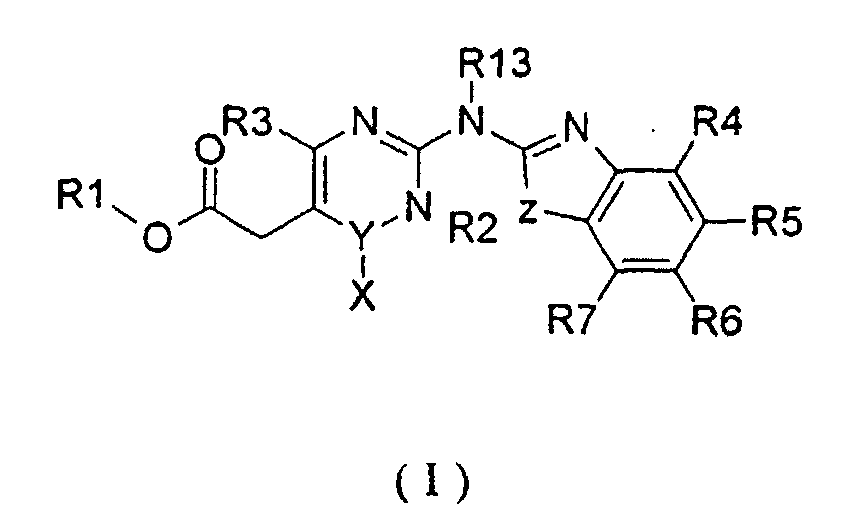
- Y-X is >C = X when X is NR8, O, or S and R2 is H, a straight or branched chain with 1 to 8 carbon atoms; a straight or branched chain substituted with a ring having 5-12 carbon atoms and optionally having one or two hetero atoms, a ring having 5-12 carbon atoms and optionally having one or two hetero atoms substituted with halogen, -OH, a straight or branched chain with 1 to 8 carbon atoms; OR10, NR10, R11, NO2, CF3, CN, COR8 and/or COOR8; or
- Y-X is >C-X when X is H, a straight or branched chain with 1 to 8 carbon atoms, a straight or branched chain with 1 to 8 carbon atoms substituted with halogen, -OH, a straight or branched chain with 1 to 8 carbon atoms; OR10, NR10, R11, NO2, CF3, CN, COR8 and/or COOR8, a ring having 5-12 carbon atoms and optionally having one or two hetero atoms, a ring having 5-12 carbon atoms and optionally having one or two hetero atoms substituted with halogen, -OH, a straight or branched chain with 1 to 8 carbon atoms; OR10, NR10, R11, NO2, CF3, CN, COR8 and/or COOR8, OR9 or NHR9 and R2 is a bond to Y;
- Z = O, S or NR12;
- R1 is H, methyl, propyl, butyl or isoforms thereof, a straight or branched chain with 1 to 8 carbon atoms substituted with halogen, -OH, a straight or branched chain with 1 to 8 carbon atoms; OR10, NR10, R11, NO2, CF3, CN, COR8 and/or COOR8, a ring having 5-12 carbon atoms and optionally having one or two hetero atoms or a ring having 5-12 carbon atoms and optionally having one or two hetero atoms or a ring having 5-12 carbon atoms and optionally having one or two hetero atoms substituted with halogen, -OH, a straight or branched chain with 1 to 8 carbon atoms; OR10, NR10, R11, NO2, CF3, CN, COR8 and/or COOR8;
- R3 is H, a straight or branched chain with 1 to 8 carbon atoms, a straight or branched chain with 1 to 8 carbon atoms substituted with halogen, -OH, a straight or branched chain with 1 to 8 carbon atoms; OR10, NR10, R11, NO2, CF3, CN, COR8 and/or COOR8, a ring having 5-12 carbon atoms and optionally having one or two hetero atoms or a ring having 5-12 carbon atoms and optionally having one or two hetero atoms substituted with halogen, -OH, a straight or branched chain with 1 to 8 carbon atoms; OR10, NR10, R11, NO2, CF3, CN, COR8 and/or COOR8, OR9 or NHR9;
- R4, R5, R6, R7 are H, halogen, OR10, NR10, R11, NO2, CF3, CN, COR8, COOR8, CONHR8 and/or N3 in any combination and/or two adjacent R4, R5, R6 or R7 form a carbocycloc or heterocyclic ring;
- R8, R9, R10, R11, R12 and R13 are H, a straight or branched chain with 1 to 8 carbon atoms, a straight or branched chain substituted with a ring having 5-12 carbon atoms and optionally having one or two hetero atoms, a ring having 5-12 carbon atoms and optionally having one or two hetero atoms and/or a ring having 5-12 carbon atoms and optionally having one or two hetero atoms substituted halogen, -OH, a straight or branched chain with 1 to 8 carbon atoms; OR10, NR10, R11, NO2, CF3, CN, COR8 and/or COOR8 with in any combination.
-
- A straight or branched chain with 1 to 8 carbon atoms is preferably 1 to 4 carbon atoms, e.g. methyl, ethyl, propyl, butyl and isoforms thereof.
- A ring having 5-12 carbon atoms, is e.g. cyclopropyl, phenyl, cyclohexyl and possibly one or two hetero atoms.
- By "hetero atom" is preferably meant O, S and/or N.
- The compounds could be a pharmaceutical acceptable salts and esters thereof.
- More particular the following compounds are of interest:
- 2-[(5,6-Dimethyl-2-benzoimidazolyl)amino]-4-hydoxy-6-methyl-5-pyrimidine acetic acid, ethyl ester (1) and
- 2-[(5,6-DimethyI-2-benzoimidazolyl)amino]-4-hydroxy-6-methyl-5-pyrimidine acetic acid (2).
-
- The invention also relates to use of the claims compounds, pharmaceutical compositions comprising the compounds and method for the preparation of the compounds as claimed.
- We have shown biological activity for the claimed compounds by different assays, such as a dimerisation assay in which the compounds which mimics the quench induced upon hGH binding in this assay also may mimic the full biological effects of native hormone and increased glucose transport.
- The claimed compounds can be useful for treatment of diseases related to e.g. growth hormone deficiency, Turner syndrome, infertility, wound healing, dystrophy, osteoporosis, and/or lactation failure, for preoperative administration and other diseases and conditions which are treated or could be treated by administration of hGH.
-
- Figure 1 A and 1B
- Schemes I and II, respectively
- Figure 2
- Schemes III, IV and V
- Figure 3
- Dose response curves of hGH and compound (2) in dimerisation assay
- Figure 4A.13
- Glucose uptake in cardiac myocytes treated with medium (control), hGH (x nM) and compound (2) (10 mM)
- These compounds can be prepared according to two different routes :
- 1) via pyrimidine derivatives or
- 2) via the 2-guanidino-5,6-dimethylbenzoimidazole See Figure 1, scheme I.
-
- (2-Cyanoamino)-4-hydroxy-6-methyl-5-pyrimidine acetic acid (4) obtained from diethyl acetylsuccinate and cyanoguanidine in presence of sodium in ethanol, was treated with phenyldiamine in H2O and concentrated HCl to afford 2-[(5,6-Dimethyl-2-benzoimidazolyl)amino]-4-hydroxy-6-methyl-5-pyrimidine acetic acid (2) in 25% yield. Recrystallisation of acid from DMF gave the pure compound. Esterification was performed in ethanol in presence of H2SO4 to lead to 2-[(5,6-Dimethyl-2-benzoimidazolyl)amino]-4-hydroxy-6-methyl-5-pyrimidine acetic acid, ethyl ester (1) in only 19 % yield (scheme II).
- Synthesis of
analogues 5a-j was carried out similarly by reacting (4) with different ortho-diamino derivatives, under the conditions used to prepare (2), as shown in scheme III. - The following compounds were prepared according to Scheme II or III:
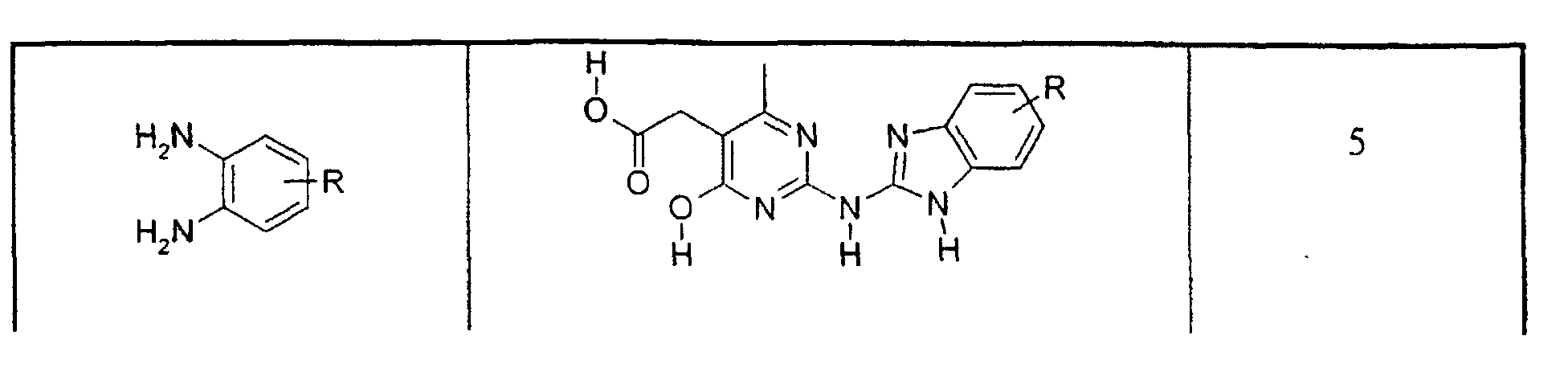

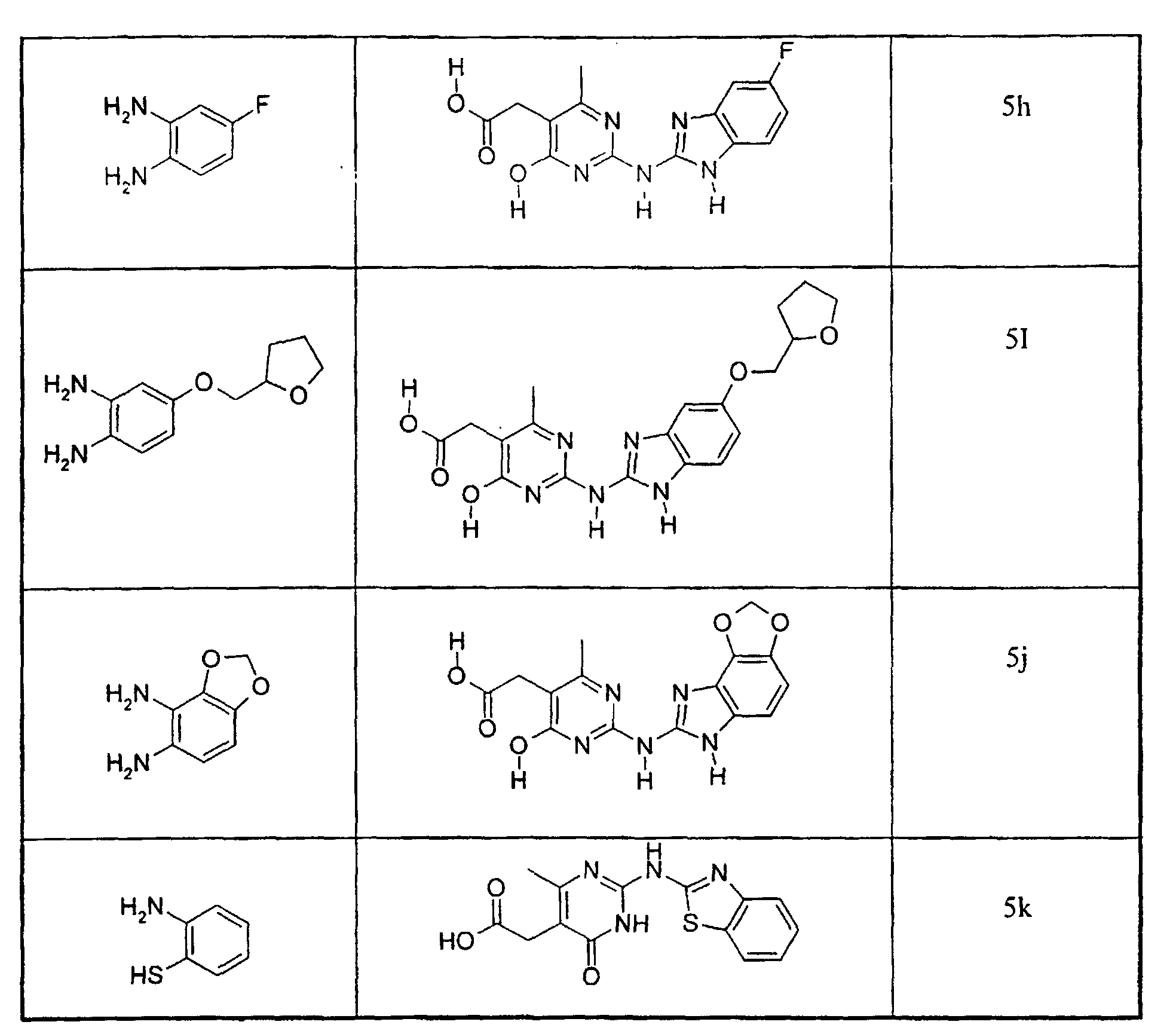
- The reaction was carried in refluxing H2O for 2 hours then cooled to room temperature and the precipitate was collected. Similarly benzothiazole analogues can be prepared. Thus 5k was prepared from the corresponding amino-thiophenol in 3M HCl at 100 °C/10hr, to give the product in 40% yield after recystallisation.
- The parent acid (2) was obtained in 27% yield when 2-guanidino-5,6-dimethylimidazole 2-guanidino-5,6-dimethyl-benzimidazole, (6) was heated at 120 °C for 45min in neat diethyl acetylsuccinate. followed by refluxing in ethanol and recrytallisation from DMF.
- In order to prepare a number of analogues of (2) by this route a series of 2-guanidinobenzoimidazoles were prepared (scheme V).

- Similarly heating 2-guanidinobenzothiazole and ethyl acetoacetonate together at 110°C for 45 min gave (8)

- These analogues were prepared in a similar fashion to (2)

- N-1 methyl analogues could be prepared in low yield during the methylation of the dithiocarbonimido using excess methyl iodide.

-

- Under an inert atmosphere, Na (2-Cyanoamino)-4-hydroxy-6-methyl-5-pyrimidine acetic acid (4) (0.345 g. 15 mmol) was added portionwise to dry ethanol (10 mL) at room temperature. After stirring for 15 min (disapppearance of the Na), cyanoguanidine (0.840 g, 10 mmol) and diethyl acetylsuccinate (2.0 mL, 10 mmol) were added to the solution at room temperature.
- The suspension was heated at reflux for 5h and the resulting suspension was cooled, filtered and washed with ethanol. The precipitate was dissolved in water (at the solubility limit) and concentrated HCl was added. The precipitate formed was filtered and gave 1.10 g (50%) of Na (2-Cyanoamino)-4-hydroxy-6-methyl-5-pyrimidine acetic acid. mp: 234-236 °C (dec). IR (KBr): υ = 3520, 3440, 3200-2500, 2190, 1730, 1655, 1602, 1500, 1340, 1200. 830 cm-1.
- (2-Cyanoamino)-4-hydroxy-6-methyl-5-pyrimidine acetic acid (4) (0.416 g, 2 mmol) and 5,6-dimethyl-1,2-diphenyldiamine (0.276 g, 2 mmol) in a mixture of H2O (2 mL) and concentrated HCl (0.4 mL) were stirred for 1.5 h at 100 °C. The initial suspension dissolved and a second precipitate appeared after 1 h. The supension was cooled and the precipitate was collected and washed with water to give 0.164 g (25%) of 2-[(5,6-Dimethyl-2-benzoimidazolyl)amino]-4-hydroxy-6-methyl-5-pyrimidine acetic acid (2). mp: > 300 °C (DMF). IR (KBr): υ = 3331, 2949, 1705, 1655, 1602, 1509, 1252, 1157, 1047, 701 cm-1. Accurate mass: calculated: 327.1331. Found 327.1337. Analysis calculated for C16H17N5O3: C, 58.71; H, 5.23; N, 21.39. Found: C, 57.8; H, 5.1; N, 20.7.
- (5a) was prepared according to procedure used for (2) in Example 1; yield 5%. mp:> 300 °C (DMF). IR (KBr): υ = 2878, 1748, 1700, 1625, 1557, 1474, 1357, 1219, 744 cm-1. 1H-NMR (CF3CO2D): δ = 2.64 (s, 3H, CH3), 3.88 (s, 2H, CH2), 7.52 (m. 2H, 2 x Harom), 7.67 (m, 2H, 2 x Harom). Accurate mass: calculated: 299.1018. Found 299.1013. Analysis calculated for C14H13N5O3: C, 55.2; H, 4.40; N, 23.40. Found: C, 55.4: H, 4.7; N, 22.5.

- L-112787 was prepared according to procedure used for (2) in Example 1: yield 1%. mp: > 300 °C (DMF). IR (KBr): υ = 3150-2700. 1701, 1638, 1605, 1570, 1419, 1353, 1228, 781 cm-1. Accurate mass: calculated: 313.1175. Found 313.1190. Analysis calculated for C15H15N5O3: C, 57.50; H, 4.83; N, 22.35. Found: C, 53.3; H, 4.5; N, 20.4.

- L-112788 was prepared according to procedure used for (2) in Example 1; yield 5%. mp: > 300 °C (DMF). IR (KBr): υ = 3200-2700, 1702, 1640, 1602, 1474, 1352, 1295, 1207, 875, 796 cm-1. Accurate mass: calculated: 313.1175. Found 313.1187. Analysis calculated for C15H15N5O3: C, 57.50, H, 4.83, N, 22.35. Found: C, 53.3, H, 4.5, N, 20.4.

- L-112789 was prepared according to procedure used for (2) in Example 1; yield 4%. mp: > 300 °C (DMF). IR (KBr): υ = 3200-2700. 1703, 1627, 1601, 1565, 1342, 1293, 1234, 903, 788 cm-1. Accurate mass: calculated: 327.1331. Found 327.1349.

- PNU-181223 was prepared according to procedure used for (2) in Example 1: yield 16%. mp: > 300 °C (DMF). IR (KBr): υ = 3039, 2882, 1738, 1596, 1465, 1333, 1292, 1182, 876 cm-1. 1H-NMR (CF3CO2D): δ = 2.62 (s, 3H, CH,), 3.87 (s, 2H, CH2), 7.88 (d, 1H, J = 8 Hz, Harom), 8.45 (d, 1H, J = 8 Hz, Harom), 7.88 (s, 1H, Harom). Analysis calculated for C14H12N6O5: C, 55.2; H, 4.40; N, 23.40. Found: C, 55.4; H, 4.7; N, 22.5.

- L-112790 was prepared according to procedure used for (2); yield 3%. mp:> 300 °C (DMF). IR (KBr): υ = 3150-2700, 1625, 1603, 1559, 1484, 1346, 1297, 1145, 790 cm-1 . Accurate mass: calculated: 317.0924. Found 317.0939. Analysis calculated for C14H12FN5O3: C, 53.00; H, 3.81: N, 22.07. Found: C, 49.5; H, 4.0; N, 19.9.
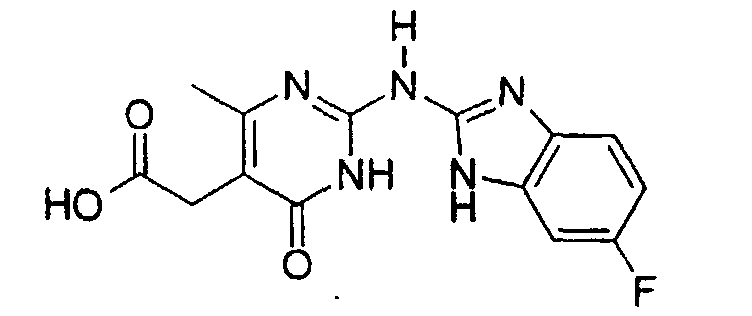
-

- A mixture of 2-aminothiophenol (601.4 mg, 4.80 mmol) and 2-cyanamino-4-hydroxy-6-methyl-5-pyrimidylacetic acid (1.0 g 4.80 mmol) in concentrated HCl (1 mL) and water (5 mL) was stirred at 100 °C for 10 h. The reaction mixture was cooled and the precipitate was filtered and washed with aqueous ethanol. Crude yield 1.2 g (contains minor impurities according to 1H NMR). The crude solid was recrystallized from DMF (∼ 150 mL). The product precipitated in the refrigerator. The crystalls were triturated with water/MeOH and dried under vaccum at 90 °C (yield 604.5
mg 40 %). mp > 300 °C. 1H NMR (CF3COD) d 7.97-7.86 (m, 2 H), 8.00-7.54 (m, 4 H), 3.90 (s, 3 H), 2.66 (s, 3 H); Anal. Calcd for C14H12N4O3S 0.25 H2O: C. 51.67; H, 4.03; N, 17.22; Found: C, 51.80; H, 3.90; N, 16.95. - Benzimidazol-2-yl guanidino derivatives: General procedure for the intermediates In water (8 mL). concentrated HCI (3 mL). cyanoguanidine (20 mmol) and the ortho-phenylenediamine derivative (10 mmol) were heated at reflux overnight. A precipitate appeared after cooling, the solid was filtered and washed with water. A suspension of the solid in water, was treated with a solution of NaOH 1 M to reach
pH 10. Then the basic solution was (pH 6) with an aqueous solution of HCI 1M and the resulting precipitate was filtered to give the title compound. - mp: > 260 °C IR (KBr): υ = 3500-2800, 1616, 1283, 1224, 1159, 963, 764, 729 cm-1. Analysis calculated for C9H11N5, HCl + 1/2 H2O: C, 46.00, H, 5.5; N, 29.8. Found: C, 46.0; H, 5.7; N, 29.7.

- mp: > 260 °C IR (KBr): υ = 3500-2800, 1667, 1598, 1517, 1487, 1382, 1127, 1037, 802, 782, cm-1. Analysis calculated for C9H15N5, 1/2 HCl: C, 52.00; H, 5.54; N, 33.73. Found: C, 51.6; H, 5.5; N, 34.9.
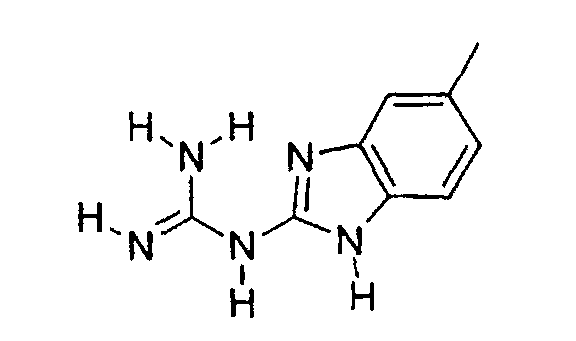
- mp: > 260 °C IR (KBr): υ = 3500-2800, 3361, 1680, 1608, 1573, 1497, 1309, 1270, 1225, 1148, 1054, 791, 748, 723 cm-1. Analysis calculated for C10H13N5, HCl + 1/2 H2O: C, 48.3; H, 6.0; N, 28.2. Found: C, 47.9; H, 5.9; N, 29.5.

- mp: > 260 °C IR (KBr): υ = 3623, 3496, 3500-2800, 1704, 1622, 1565, 1426, 1280, 1096, 862, 852 cm-1. Analysis calculated for C8H7Cl2N5 HCl: C, 34.20; H, 2.85; N, 24.95. Found: C, 34.2; H, 3.3; N, 23.7.

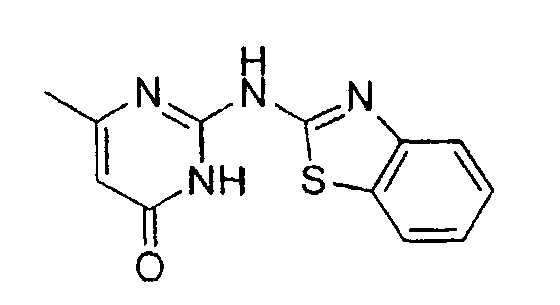
- 2-Guanidinobenzothiazole (0.384 g, 2 mmol) and ethyl acetoacetonate(2 mL) were heated together at 110°C for 45 min. After cooling, ethanol was added, and the resulting precipitate was filtrated to afford 0.050g (10%) of the tittle compound. mp:> 300°C. IR (KBr): υ = 3026, 2867, 1644, 1617, 1590, 1546, 1459, 1360, 762, 742, 640 cm-1. Analysis calculated for C12H10N4OS: C, 55.8, H, 3.90, N, 21.69. Found: C, 55.2, H, 4.2; N, 22.2.
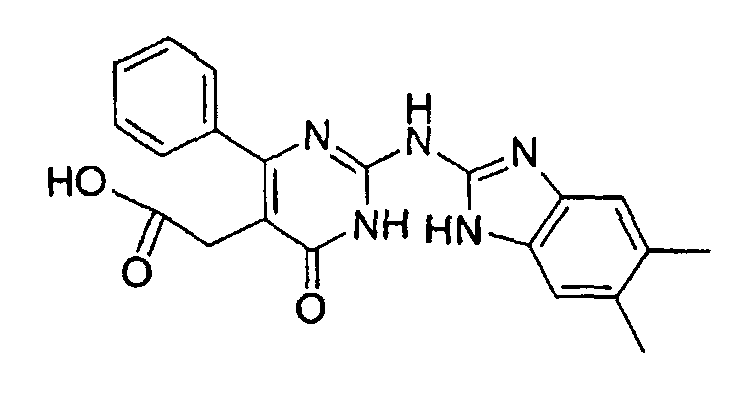
- Diethyl-2-benzoyl succinate (2.70 g, 9.7 mmol) and 2-guanidino-5,6-dimethylbenzimidazole, PNU-10708A (6) (1.0 g, 4.17 mmol) was mixed with some EtOH to give a slurry. Sodium ethoxide (4.2 mL, 1 M) in ethanol was added and the solvent was evaporated. The mixture was heated at 120° C for 20 h and the reaction was followed by PDMS. The crude product was recrystallized from DMF. filtered and washed with acetone and water. During recrystallization the ester had been hydrolyzed and the product obtained was the corresponding acid. 1H NMR (DMSO) δ 2.25 (s, 6H), 3.20 (s, 2H), 7.09 (s, 2H) and 7.53 (m. 5H).
- Diethyl-2-trifluoroacetyl succinate (0.40 g. 1.5 mmol) and 2-guanidino-5,6-dimethylbenzimidazole (6) ( 0.35 g, 1.5 mmol) was mixed with some EtOH to give a slurry. Sodium ethoxide (1.5 mL, 1 M) in ethanol was added and the solvent was evaporated. The mixture was heated at 100° C for 4 h. followed by 1 h heating at 150° C. The reaction was followed by PDMS. The crude product was recrystallized from DMF (5 mL), filtered and washed with acetone and water. During recrystallization the ester had been hydrolyzed and the product obtained was the corresponding acid. Gave 0.23 g as mixture of acid and ester. 50 mg was hydrolyzed in NaOH (50 mL, 1 M). The solution was then acidified and the precipitated product was collected to give 30 mg. 1H NMR (DMSO) δ 2.27 (s, 6H), 3.43 (s, 2H) and 7.18 (s, 2H).

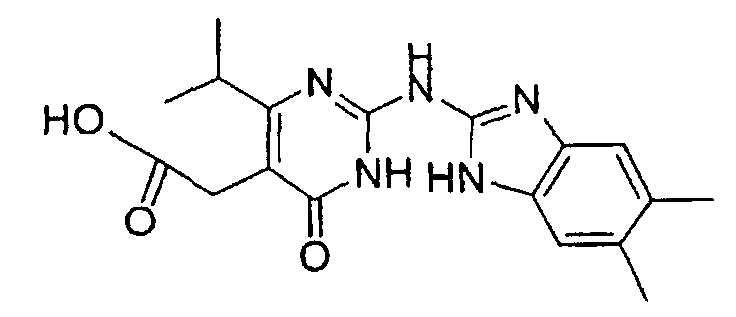
- 2-Guanidino-5,6-dimethyl-benzimidazole, (6) (1.24 g, 5.17 mmol) was dissolved in EtOH and ethoxide (5.2 mL, 1 M) in ethanol was added. The salt formed was filtered and diethyl-2-isobutyryl succinate (1.86 g, 7.6 mmol) was added and the solvent was followed by PDMS. The crude product was recrystallized from DMF, filtered and washed with acetone and water. The product was hydrolyzed in NaOH (50 mL, 1 M), acidified with HCl and the precipitate was collected. The product was recrystallized from DMSO (5 mL), filtered and washed with water and acetone to give 54 mg. 1H NMR (DMSO) δ 1.19 (d, 6H), 2.23 (s, 6H), 3.01 (q, 1H), 3.33 (s, 2H) and 7.09 (s, 2H).
- Guanidine hydrochloride (4.0 g, 42 mmol) was added to sodium ethoxide in ethanol (60 mL, 1 M) and the solution was stirred for 10 min. Diethylacetylsuccinate (9.0 g, 42 mmol) was added and the solution was refluxed for 4 h and then stirred over night at room temperature. Water (20 mL) was added to the mixture and the product was filtered and washed with water and EtOH. Yield: 4.2 g (55%). 1H NMR (DMSO) δ 2.00 (s, 3H) and 3.22 (s, 2H).
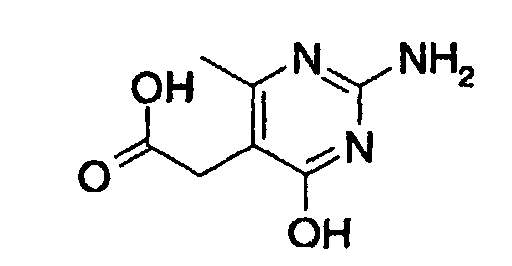
- 4-Hydroxy-6-methyl-5-pyrimidine acetic acid (1.0 g, 5.5 mmol) was mixed with DMF (150 mL). NaOH (6 mL, 20 M) was added and the mixture was allowed to cool and CS2 (10 mL) was added. The dark red mixture was stirred for 30 min, followed by addition of MeI (10 mL). The colour changed to yellow and the mixture was stirred for 2 h. The reaction mixture was partitioned between water and methylene chloride and the organic phase was dried and evaporated. The crude product was purified on silica gel with a gradient of toluene:EtOAc (100% toluene-50% toluene). Yield:75 mg. (4%) 1H NMR (DMSO) δ 2.18 (s, 3H), 2.58 (s, 6H), 3.41 (s, 3H), 3.50 (s, 2H) and 3.58 (s, 3H).
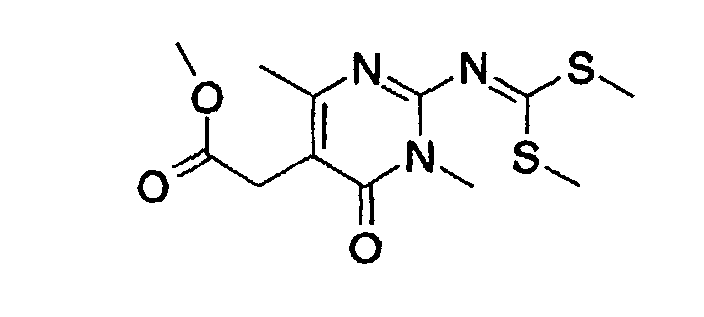
- Methyl-2-[(di-(S)-methylthio)carbonimido]-N-methyl- 4-oxo-6-methyl-5-pyrimidine acetate (34 mg, 0.108 mmol) was dissolved in DMF (1 mL). A solution of 4,5-dimethyl-1,2-phenylenediamine (16 mg, 0.117 mmol) in a few drops of DMF was added and the solution was heated at 100 ° C for 1 h and at 150 ° C for 1 h more. The solution was allowed to cool and the solvent was evaporated. The product was purified on silica gel with chloroform : acetone: formic acid (gradient 96:3:1-89:10:1). Yield: 19 mg. (50%)

Mp: 272-274° C. -
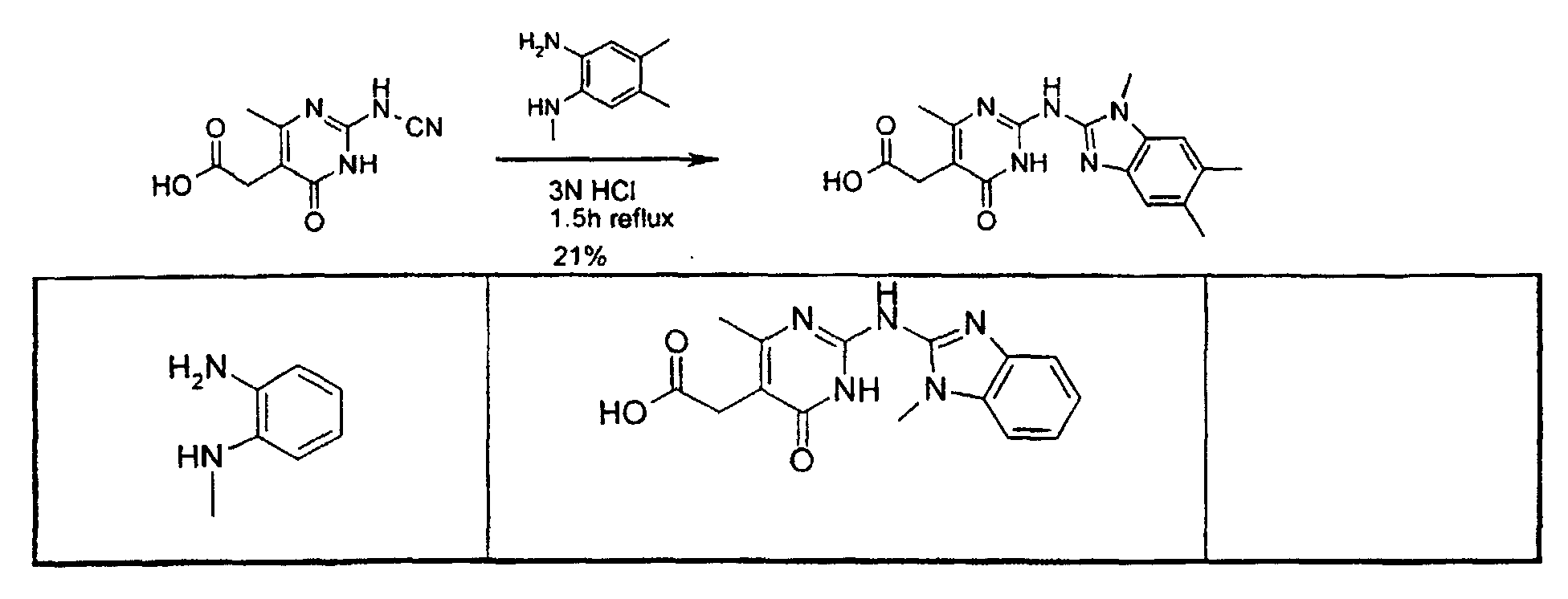
- A suspension of N,4,5-trimethylphenylene-1,2-diamine (541 mg, 3.6 mmol) and (2-cyanoamino)-4-hydroxy-6-methyl-5-pyrimidineacetic acid (625 mg, 3.0 mmol) in 3N aqueous HCl was refluxed (bath 160° C) for 90 minutes. The heating was switched off and the reaction mixture was left to cool down over night. The white solid that had formed was isolated by filtration, washed with cold water and dried in vacuum over P2O5. The very insoluble off-white solid (213 mg, 21%) was suspended in a small amount of water and the pH was raised to 7.0 (from 2.0) by addition of an aqueous solution of NaOH. The mixture was concentrated and dried yielding a brownish solid. 1H NMR (DMSO) δ 2.16 (s, 3H, CH3), 2.27 (s, 3H, CH3). 2.30 (s, 3H, CH3), 3.18 (s, 2H, CH2), 3.58 (s, 3H, N-CH3), 7.12 (s, 1H, CH), 7.26 (s. 1H, CH); 13C NMR (DMSO) δ 19.9, 28.0, 31.7, 109.1. 115.0, 129.1, 130.6, 153.3, 163.0, 173.0; MS (EI+, [M]+) m/z 341; Anal. Calcd. (found) for C9H14N2 (incl. 1.7 eq. NaOH): C 50.00 (49.88) % H 5.00 (5.10) % N 17.11 (16.90)%.
- A slightly modified fluoresence quenching assay previously described by Cunningham BC et al., 1991, Science 254, 821-825 was used.
- Hormone induced receptor oligomerization via the formation of a 1:2 complex with the extracellular domain of its receptor or binding protein (hGHbp) has been identified as a first critical step in hGH signal transduction. The binding of hGH to recombinantly expressed hGHbp which has been labeled with a flourescent label such as rhodamine results in a diminished signal. A small modecule which mimics the quench induced upon hGH binding in this assay may also mimic the full biological effects of native hormone.
- The protein reagents used in this assay were recombinantly produced in E.Coli. These included the hGH, reference active, and a modified form of hGHbp. The modification was used to facilitate labeling and consisted of hGHbpGly4Cys. This is hereinafter designated hGHbp1433. HGHbp1433 was subsequently labeled with rhodamine, hereinafter designated rho-hGHbp.
- In Fig 3 the effects on fluorescence quenching in dimerisation assay is shown for hGH and (2). In both cases clear dose response curves could be detected in repeated experiments.
- Cell culture.AT-1 cells from left atrial-derived transplantable tumors were established in primary cultures as earlier described by Steinhelper M.E et al., Am. J. Physiol. 259, 1826-1834, 1990.
- Glucose transport. Glucose transport was assayed as described by Hundal et al Biochem J. 297, 289-295, 1994.
- Cells were kept in low glucose DMEM without serum for 5 hours prior hormone addition. After incubation with hormones for 60 minutes if not otherwise stated cell monolayers were rinsed with PBS. Glucose uptake was quantified by incubating the cells in the presence of 0.1 Ci/ml 3H-2-deoxy-glucose in PBS for 4 minutes. Non specific uptake was determined by quantifying cell associated radioactivity in the presence of 20 uM CytochalasinB. Uptake of 3H-2-deoxy-glucose was terminated by rapidly aspirating the medium followed by two successive washes with ice cold PBS. The cells were lysed in 0.5 M NaOH and followed by liquid scintillation counting. Rates of transport were normalized for protein content in each well.
- Materials. Female B6D2/F1 mice were purchased from Bomholt Gård, Denmark. At-1 cells was provided by dr. W.Claycomb. Louisiana State University Medical Center, New Orleans, Louisiana.
- Joklik's MEM, Dulbecko's MEM, Pen/Strep and Foetal Calf Serum (FCS) and all plastic ware were from Life Technologies. Collagenase was from Worthington biochemical Corp. and Trypsin (pig pancreas) from US Biochemical Corp. USA. 3H-2-deoxy-glucose was from Du Pont NEN. duMedical Scandinavia, Sweden. Human Growth Hormone, Genotropin batch 68199-51 was from Pharmacia & Upjohn, Sweden. CytochalasinB, bovine insulin and Wortmannin were from Sigma.
- When 10 uM of the compound (2) was incubated for 1 hour prior glucose transport measurement the substance increased glucose transport to the same extent as GH (Fig4A). When cardiomyocytes were incubated with 1 uM Wortmannin together with hGH or the compound for 60 minutes prior transport measurements, the wortmannin treated cells did not respond with increased glucose transport (Fig 4B). This was due to an inhibition of a signal generated from the receptor by inhibiting the signal transducer phosphoinositide 3-kinase (PI 3-kinase).
Claims (8)
- Compounds of the general formula (I)in which

Y-X is >C = X when X is NR8, O, or S and R2 is H, a straight or branched chain with 1 to 8 carbon atoms; a straight or branched chain substituted with a ring having 5-12 carbon atoms and optionally having one or two hetero atoms, a ring having 5-12 carbon atoms and optionally having one or two hetero atoms substituted with halogen, -OH, a straight or branched chain with 1 to 8 carbon atoms, OR10, NR10, R11, NO2, CF3, CN, COR8 and/or COOR8; or
Y-X is >C-X when X is H, a straight or branched chain with 1 to 8 carbon atoms, a straight or branched chain with 1 to 8 carbon atoms substituted with halogen, -OH, a straight or branched chain with 1 to 8 carbon atoms OR10, NR10, R11, NO2, CF3, CN, COR8 and/or COOR8, a ring having 5-12 carbon atoms and optionally having one or two hetero atoms, a ring having 5-12 carbon atoms and optionally having one or two hetero atoms substituted with halogen, -OH, a straight or branched chain with 1 to 8 carbon atoms, OR10, NR10, R11, NO2, CF3, CN, COR8 and/or COOR8, or X is OR9 or NHR9 and R2 is a bond to Y;
Z=O, S or NR12;
R1 is H, methyl, propyl, butyl or isoforms thereof, a straight or branched chain with 1 to 8 carbon atoms substituted with halogen, -OH, a straight or branched chain with 1 to 8 carbon atoms, OR10, NR10, R11, NO2, CF3, CN, COR8 and/or COOR8, a ring having 5-12 carbon atoms and optionally having one or two hetero atoms or a ring having 5-12 carbon atoms and optionally having one or two hetero atoms or a ring having 5-12 carbon atoms and optionally having one or two hetero atoms substituted with halogen, -OH, a straight or branched chain with 1 to 8 carbon atoms, OR10, NR10, R11, NO2, CF3, CN, COR8 and/or COOR8;
R3 is H, a straight or branched chain with 1 to 8 carbon atoms, a straight or branched chain with 1 to 8 carbon atoms substituted with halogen, -OH, a straight or branched chain with 1 to 8 carbon atoms OR10, NR10, R11, NO2, CF3, CN, COR8 and/or COOR8, a ring having 5-12 carbon atoms and optionally having one or two hetero atoms or a ring having 5-12 carbon atoms and optionally having one or two hetero atoms substituted with halogen, -OH, a straight or branched chain with 1 to 8 carbon atoms, OR10, NR10, R11, NO2, CF3, CN, COR8 and/or COOR8, or R3 is OR9 or NHR9;
R4, R5, R6, R7 are H, halogen, OR10, NR10, R11, NO2, CF3, CN, COR8, COOR8, CONHR8 and/or R3 in any combination and/or two adjacent R4, R5, R6 or R7 form a carbocyclic or heterocyclic ring;
R8, R9, R10, R11, R12 and R13 are H, a straight or branched chain with 1 to 8 carbon atoms, a straight or branched chain substituted with a ring having 5-12 carbon atoms and optionally having one or two hetero atoms, a ring having 5-12 carbon atoms and optionally having one or two hetero atoms and/or a ring having 5-12 carbon atoms and optionally having one or two hetero atoms substituted halogen, -OH, a straight or branched chain with 1 to 8 carbon atoms OR10, NR10, R11, NO2, CF3, CN, COR8 and/or COOR8 with in any combination. - Compound according to claim 1 selected from any of
2-[(5,6-Dimethyl-2-benzoimidazolyl)amino]-4-hydroxy-6-methyl-5-pyrimidine acetic acid (2)
2-[(5,6-Dimethyl-2-benzoimidazolyl)amino]-4-hydroxy-6-phenyl-5-pyrimidine acetic acid (9)
2-[(5,6-Dimethyl-2-benzoimidazolyl)amino]-4-hydroxy-6-trifluoromethyl-5-pyrimidine acetic acid (10)
Methyl-2-[(5,6-Dimethyl-2-benzoimidazolyl)amino]-1-4-dimethyl-6-oxo-5-pyrimidinyl acetate, (12) - Compounds according to any of claims 1 to 2 for use as an active therapeutic substance.
- Compounds of the general formula (I)in which
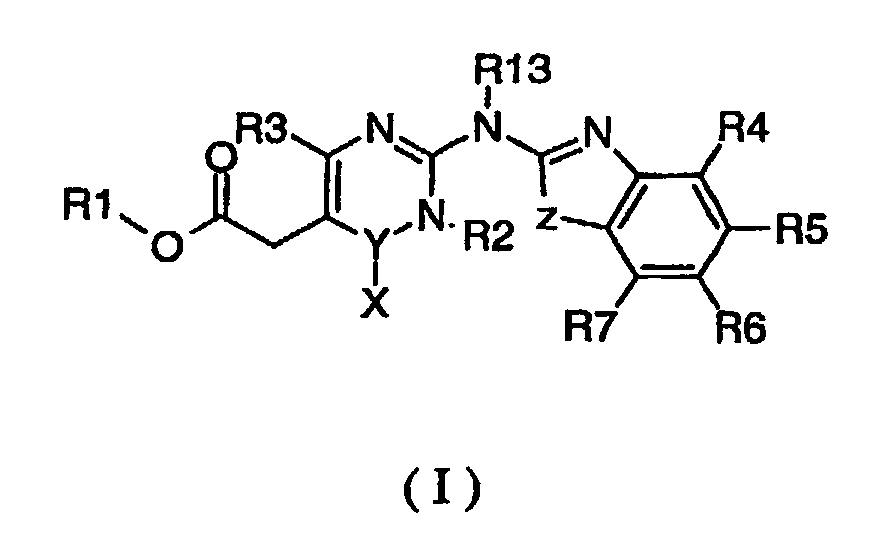
Y -X is >C = X when X is NR8, O, or S and R2 is H, a straight or branched chain with 1 to 8 carbon atoms; a straight or branched chain substituted with a ring having 5-12 carbon atoms and optionally having one or two hetero atoms, a ring having 5-12 carbon atoms and optionally having one or two hetero atoms substituted with halogen, -OH, a straight or branched chain with 1 to 8 carbon atoms, OR10, NR10, R11, NO2, CF3, CN, COR8 and/or COOR8; or
Y-X is >C-X when X is a straight or branched chain with 1 to 8 carbon atoms, a straight or branched chain with 1 to 8 carbon atoms substituted with halogen, -OH, a straight or branched chain with 1 to 8 carbon atoms; OR10, NR10, R11, NO2, CF3, CN, COR8 and/or COOR8, a ring having 5-12 carbon atoms and optionally having one or two hetero atoms, a ring having 5-12 carbon atoms and optionally having one or two hetero atoms substituted with halogen, -OH, a straight or branched chain with 1 to 8 carbon atom, OR10, NR10, R11, NO2, CF3, CN, COR8 and/or COOR8, or X is OR9 or NHR9 and R2 is a bond to Y;
Z=O, S or NR12;
Z = O, S or NR12;
R1 is H, methy, propyl, butyl or isoforms thereof a straight or branched chain with 1 to 8 carbon atoms substituted with halogen, -OH, a straight or branched chain with 1 to 8 carbon atoms; OR10, NR10, R11, NO2, CF3, CN, COR8 and/or COOR8, a ring having 5-12 carbon atoms and optionally having one or two hetero atoms or a ring having 5-12 carbon atoms and optionally having one or two hetero atoms substituted with halogen, -OH, a straight or branched chain with 1 to 8 carbon atoms, OR10, NR10, R11, NO2, CF3, CN, COR8 and/or COOR8;
R3 is H, a straight or branched chain with 1 to 8 carbon atoms, a straight or branched chain with 1 to 8 carbon atoms substituted with halogen, -OH, a straight or branched chain with 1 to 8 carbon atoms; OR10, NR10, R11, NO2, CF3, CN, COR8 and/or COOR8, a ring having 5-12 carbon atoms and optionally having one or two hetero atoms or a ring having 5-12 carbon atoms and optionally having one or two hetero atoms substituted with halogen, -OH, a straight or branched chain with 1 to 8 carbon atoms; OR10, NR10, R11, NO2, CF3, CN, COR8 and/or COOR8, or R3 is OR9 or NHR9;
R4, R5, R6, R7 are H, halogen, OR10, NR10, R11, NO2, CF3, CN, COR8, COOR8, CONHR8 and/or R3 in any combination and/or two adjacent R4, R5, R6 or R7 form a carbocyclic or heterocyclic ring;
R8, R9, R10, R11, R12, R13 are H, a straight or branched chain with 1 to 8 carbon atoms, a straight or branched chain substituted with a ring having 5-12 carbon atoms and optionally having one or two hetero atoms, a ring having 5-12 carbon atoms and optionally having one or two hetero atoms and/or a ring having 5-12 carbon atoms and optionally having one or two hetero atoms substituted halogen, -OH, a straight or branched chain with 1 to 8 carbon atom, OR10, NR10, R11, NO2, CF3, CN, COR8 and/or COOR8 with in any combination
for use as an active therapeutic substance in the treatment of growth hormone deficiency, Turner syndrome, infertility, wound healing, dystrophy, osteoporosis and/or lactation failure. - Pharmaceutical composition comprising the compounds according to any of claims 1 to 4 with a pharmaceutically acceptable carrier
- Method for the preparation of the compounds according to any of claims 1 to 4 by any of the following routes:a) Reacting cyanoamine pyrimidine derivatives together with phenyldiamines or 2-amino thiophenols or 2-amino phenols orb) Reacting 2-guanidino-benzoimidazoles together with diethyl acylsuccinate.
- Process for the preparation of a composition according to claim 6, which comprises the mixing of the compound of the general formula I and a pharmaceutically acceptable carrier.
- Use of compounds according to any of claims 1 to 4 for the preparation of medicaments for the treatment of growth hormone deficiency, Turner syndrome, infertility, wound healing, dystrophy, osteoporosis and/or lactation failure.
Priority Applications (1)
| Application Number | Priority Date | Filing Date | Title |
|---|---|---|---|
| SI200030180T SI1155014T1 (en) | 1999-01-25 | 2000-01-24 | New benzimidazole compounds for use as active therapeutic substances, process for the preparation of these compoudns and pharmaceutical compositions comprising them |
Applications Claiming Priority (3)
| Application Number | Priority Date | Filing Date | Title |
|---|---|---|---|
| SE9900211 | 1999-01-25 | ||
| SE9900211A SE9900211D0 (en) | 1999-01-25 | 1999-01-25 | New compounds |
| PCT/SE2000/000144 WO2000043387A1 (en) | 1999-01-25 | 2000-01-24 | New benzimidazole compounds for use as active therapeutic substances, process for the preparation of these compoudns and pharmaceutical compositions comprising them |
Publications (2)
| Publication Number | Publication Date |
|---|---|
| EP1155014A1 EP1155014A1 (en) | 2001-11-21 |
| EP1155014B1 true EP1155014B1 (en) | 2003-06-04 |
Family
ID=20414207
Family Applications (1)
| Application Number | Title | Priority Date | Filing Date |
|---|---|---|---|
| EP00902282A Expired - Lifetime EP1155014B1 (en) | 1999-01-25 | 2000-01-24 | New benzimidazole compounds for use as active therapeutic substances, process for the preparation of these compoudns and pharmaceutical compositions comprising them |
Country Status (12)
| Country | Link |
|---|---|
| EP (1) | EP1155014B1 (en) |
| JP (1) | JP2002535325A (en) |
| AT (1) | ATE242237T1 (en) |
| AU (1) | AU760346B2 (en) |
| CA (1) | CA2359107A1 (en) |
| DE (1) | DE60003158T2 (en) |
| DK (1) | DK1155014T3 (en) |
| ES (1) | ES2202045T3 (en) |
| NZ (1) | NZ512597A (en) |
| PT (1) | PT1155014E (en) |
| SE (1) | SE9900211D0 (en) |
| WO (1) | WO2000043387A1 (en) |
Families Citing this family (4)
| Publication number | Priority date | Publication date | Assignee | Title |
|---|---|---|---|---|
| CN102361857B (en) * | 2008-09-26 | 2015-09-16 | 默沙东公司 | Can be used as the ring-type benzimidizole derivatives of antidiabetic |
| GB0908394D0 (en) | 2009-05-15 | 2009-06-24 | Univ Leuven Kath | Novel viral replication inhibitors |
| GB0913636D0 (en) | 2009-08-05 | 2009-09-16 | Univ Leuven Kath | Novel viral replication inhibitors |
| BR112013011737A2 (en) | 2010-11-15 | 2016-08-09 | Univ Leuven Kath | compound, use of a compound pharmaceutical composition, and method of treating or preventing an HIV infection |
-
1999
- 1999-01-25 SE SE9900211A patent/SE9900211D0/en unknown
-
2000
- 2000-01-24 NZ NZ512597A patent/NZ512597A/en unknown
- 2000-01-24 ES ES00902282T patent/ES2202045T3/en not_active Expired - Lifetime
- 2000-01-24 DK DK00902282T patent/DK1155014T3/en active
- 2000-01-24 AU AU23406/00A patent/AU760346B2/en not_active Ceased
- 2000-01-24 AT AT00902282T patent/ATE242237T1/en not_active IP Right Cessation
- 2000-01-24 WO PCT/SE2000/000144 patent/WO2000043387A1/en not_active Ceased
- 2000-01-24 JP JP2000594803A patent/JP2002535325A/en not_active Withdrawn
- 2000-01-24 PT PT00902282T patent/PT1155014E/en unknown
- 2000-01-24 CA CA002359107A patent/CA2359107A1/en not_active Abandoned
- 2000-01-24 EP EP00902282A patent/EP1155014B1/en not_active Expired - Lifetime
- 2000-01-24 DE DE60003158T patent/DE60003158T2/en not_active Expired - Fee Related
Also Published As
| Publication number | Publication date |
|---|---|
| AU2340600A (en) | 2000-08-07 |
| SE9900211D0 (en) | 1999-01-25 |
| EP1155014A1 (en) | 2001-11-21 |
| AU760346B2 (en) | 2003-05-15 |
| DK1155014T3 (en) | 2003-09-29 |
| WO2000043387A1 (en) | 2000-07-27 |
| CA2359107A1 (en) | 2000-07-27 |
| PT1155014E (en) | 2003-10-31 |
| ATE242237T1 (en) | 2003-06-15 |
| NZ512597A (en) | 2003-12-19 |
| DE60003158T2 (en) | 2003-12-04 |
| ES2202045T3 (en) | 2004-04-01 |
| DE60003158D1 (en) | 2003-07-10 |
| JP2002535325A (en) | 2002-10-22 |
Similar Documents
| Publication | Publication Date | Title |
|---|---|---|
| RU2075478C1 (en) | 2-(4-ethyl-1-piperazinyl)-4-(4-fluorophenyl)-5,6,7,8,9,10-hex- -ahydrocycloocta[b]pyridine or its acid-additive salt | |
| JP2955318B2 (en) | Substituted pyrimidine derivatives | |
| US6329383B1 (en) | 2-amino-5-pyrimidine acetic acid compounds | |
| JP2003128672A (en) | Diacid-substituted heteroaryl derivatives as matrixmetalloproteinase inhibitor | |
| SU986297A3 (en) | Method of producing derivatives of 5-(4-diarylmethyl)-1-piperazinylalkylbenz imidozole or their salts | |
| IL204231A (en) | Thyroid hormone receptor agonists, process for their preparation, pharmaceutical compostions comprising them and uses thereof | |
| CN102216316A (en) | Substituted amine derivative and medicinal composition comprising same as the active ingredient | |
| EP0526598B1 (en) | New pharmacologically active catechol derivatives | |
| JP2003522751A (en) | Dehydroamino acid | |
| TW200306313A (en) | Phosphatase inhibitors | |
| US7902237B2 (en) | Heterocyclic compounds as pharmaceutical agents | |
| Höhn et al. | Potential antidiabetic agents. Pyrazolo [3, 4-b] pyridines | |
| EP1844004B1 (en) | Quinazoline derivates as antiviral agents | |
| EP0649843B1 (en) | Thiazoline derivative | |
| US4686227A (en) | Imidazoisoquinoline compounds useful as anti-ulcerative agents | |
| AU760346B2 (en) | New benzimidazole compounds for use as active therapeutic substances, process for the preparation of these compounds and pharmaceutical compositions comprising them | |
| US20070066542A1 (en) | Novel imidazole derivatives, their preparation and their use as medicaments | |
| GB2039485A (en) | Carboxyalky and carboxyalkoxy diphenylhydantoin derivatives and their preparation | |
| US6511984B2 (en) | Neuropeptide Y antagonists | |
| US4297365A (en) | Benzimidazoles and pharmaceutical preparations containing such compounds | |
| EP0402859B1 (en) | Therapeutic agents of metabolic bone disease | |
| US6339092B1 (en) | Metalloprotease inhibitors | |
| JP3223090B2 (en) | Phenylbenzimidazole derivative | |
| Sweetman et al. | Biologically oriented organic sulfur chemistry. III. Formation of mercaptals, mercaptoles, an orthothioformate, and thiazolidines for the latentiation of thiols | |
| JP3702382B2 (en) | NF-κB activation inhibitor |
Legal Events
| Date | Code | Title | Description |
|---|---|---|---|
| PUAI | Public reference made under article 153(3) epc to a published international application that has entered the european phase |
Free format text: ORIGINAL CODE: 0009012 |
|
| 17P | Request for examination filed |
Effective date: 20010821 |
|
| AK | Designated contracting states |
Kind code of ref document: A1 Designated state(s): AT BE CH CY DE DK ES FI FR GB GR IE IT LI LU MC NL PT SE |
|
| AX | Request for extension of the european patent |
Free format text: AL PAYMENT 20010821;LT PAYMENT 20010821;LV PAYMENT 20010821;MK PAYMENT 20010821;RO PAYMENT 20010821;SI PAYMENT 20010821 |
|
| 17Q | First examination report despatched |
Effective date: 20020308 |
|
| GRAH | Despatch of communication of intention to grant a patent |
Free format text: ORIGINAL CODE: EPIDOS IGRA |
|
| GRAH | Despatch of communication of intention to grant a patent |
Free format text: ORIGINAL CODE: EPIDOS IGRA |
|
| GRAA | (expected) grant |
Free format text: ORIGINAL CODE: 0009210 |
|
| AK | Designated contracting states |
Designated state(s): AT BE CH CY DE DK ES FI FR GB GR IE IT LI LU MC NL PT SE |
|
| AX | Request for extension of the european patent |
Extension state: AL LT LV MK RO SI |
|
| REG | Reference to a national code |
Ref country code: GB Ref legal event code: FG4D |
|
| REG | Reference to a national code |
Ref country code: CH Ref legal event code: EP |
|
| REG | Reference to a national code |
Ref country code: CH Ref legal event code: NV Representative=s name: DIETLIN & CIE SA |
|
| REG | Reference to a national code |
Ref country code: IE Ref legal event code: FG4D |
|
| REF | Corresponds to: |
Ref document number: 60003158 Country of ref document: DE Date of ref document: 20030710 Kind code of ref document: P |
|
| REG | Reference to a national code |
Ref country code: SE Ref legal event code: TRGR |
|
| REG | Reference to a national code |
Ref country code: GR Ref legal event code: EP Ref document number: 20030403336 Country of ref document: GR |
|
| REG | Reference to a national code |
Ref country code: DK Ref legal event code: T3 |
|
| ET | Fr: translation filed | ||
| REG | Reference to a national code |
Ref country code: ES Ref legal event code: FG2A Ref document number: 2202045 Country of ref document: ES Kind code of ref document: T3 |
|
| PLBE | No opposition filed within time limit |
Free format text: ORIGINAL CODE: 0009261 |
|
| STAA | Information on the status of an ep patent application or granted ep patent |
Free format text: STATUS: NO OPPOSITION FILED WITHIN TIME LIMIT |
|
| 26N | No opposition filed |
Effective date: 20040305 |
|
| PGFP | Annual fee paid to national office [announced via postgrant information from national office to epo] |
Ref country code: GB Payment date: 20041210 Year of fee payment: 6 Ref country code: AT Payment date: 20041210 Year of fee payment: 6 |
|
| PGFP | Annual fee paid to national office [announced via postgrant information from national office to epo] |
Ref country code: DK Payment date: 20041213 Year of fee payment: 6 |
|
| PGFP | Annual fee paid to national office [announced via postgrant information from national office to epo] |
Ref country code: NL Payment date: 20041215 Year of fee payment: 6 |
|
| PGFP | Annual fee paid to national office [announced via postgrant information from national office to epo] |
Ref country code: LU Payment date: 20041220 Year of fee payment: 6 |
|
| PGFP | Annual fee paid to national office [announced via postgrant information from national office to epo] |
Ref country code: FI Payment date: 20050103 Year of fee payment: 6 |
|
| PGFP | Annual fee paid to national office [announced via postgrant information from national office to epo] |
Ref country code: PT Payment date: 20050105 Year of fee payment: 6 Ref country code: MC Payment date: 20050105 Year of fee payment: 6 Ref country code: FR Payment date: 20050105 Year of fee payment: 6 |
|
| PGFP | Annual fee paid to national office [announced via postgrant information from national office to epo] |
Ref country code: SE Payment date: 20050107 Year of fee payment: 6 |
|
| REG | Reference to a national code |
Ref country code: SI Ref legal event code: IF |
|
| PGFP | Annual fee paid to national office [announced via postgrant information from national office to epo] |
Ref country code: IE Payment date: 20050111 Year of fee payment: 6 |
|
| PGFP | Annual fee paid to national office [announced via postgrant information from national office to epo] |
Ref country code: GR Payment date: 20050118 Year of fee payment: 6 |
|
| PGFP | Annual fee paid to national office [announced via postgrant information from national office to epo] |
Ref country code: ES Payment date: 20050120 Year of fee payment: 6 |
|
| PGFP | Annual fee paid to national office [announced via postgrant information from national office to epo] |
Ref country code: BE Payment date: 20050127 Year of fee payment: 6 |
|
| PGFP | Annual fee paid to national office [announced via postgrant information from national office to epo] |
Ref country code: DE Payment date: 20050131 Year of fee payment: 6 |
|
| PGFP | Annual fee paid to national office [announced via postgrant information from national office to epo] |
Ref country code: CY Payment date: 20050222 Year of fee payment: 6 |
|
| PGFP | Annual fee paid to national office [announced via postgrant information from national office to epo] |
Ref country code: CH Payment date: 20050317 Year of fee payment: 6 |
|
| PG25 | Lapsed in a contracting state [announced via postgrant information from national office to epo] |
Ref country code: IE Free format text: LAPSE BECAUSE OF NON-PAYMENT OF DUE FEES Effective date: 20060124 Ref country code: GB Free format text: LAPSE BECAUSE OF NON-PAYMENT OF DUE FEES Effective date: 20060124 Ref country code: FI Free format text: LAPSE BECAUSE OF NON-PAYMENT OF DUE FEES Effective date: 20060124 Ref country code: CY Free format text: LAPSE BECAUSE OF NON-PAYMENT OF DUE FEES Effective date: 20060124 Ref country code: AT Free format text: LAPSE BECAUSE OF NON-PAYMENT OF DUE FEES Effective date: 20060124 |
|
| PG25 | Lapsed in a contracting state [announced via postgrant information from national office to epo] |
Ref country code: SE Free format text: LAPSE BECAUSE OF NON-PAYMENT OF DUE FEES Effective date: 20060125 Ref country code: ES Free format text: LAPSE BECAUSE OF NON-PAYMENT OF DUE FEES Effective date: 20060125 |
|
| PG25 | Lapsed in a contracting state [announced via postgrant information from national office to epo] |
Ref country code: MC Free format text: LAPSE BECAUSE OF NON-PAYMENT OF DUE FEES Effective date: 20060131 Ref country code: LU Free format text: LAPSE BECAUSE OF NON-PAYMENT OF DUE FEES Effective date: 20060131 Ref country code: LI Free format text: LAPSE BECAUSE OF NON-PAYMENT OF DUE FEES Effective date: 20060131 Ref country code: FR Free format text: LAPSE BECAUSE OF NON-PAYMENT OF DUE FEES Effective date: 20060131 Ref country code: DK Free format text: LAPSE BECAUSE OF NON-PAYMENT OF DUE FEES Effective date: 20060131 Ref country code: CH Free format text: LAPSE BECAUSE OF NON-PAYMENT OF DUE FEES Effective date: 20060131 Ref country code: BE Free format text: LAPSE BECAUSE OF NON-PAYMENT OF DUE FEES Effective date: 20060131 |
|
| PGFP | Annual fee paid to national office [announced via postgrant information from national office to epo] |
Ref country code: IT Payment date: 20060131 Year of fee payment: 7 |
|
| PG25 | Lapsed in a contracting state [announced via postgrant information from national office to epo] |
Ref country code: PT Free format text: LAPSE BECAUSE OF NON-PAYMENT OF DUE FEES Effective date: 20060724 |
|
| PG25 | Lapsed in a contracting state [announced via postgrant information from national office to epo] |
Ref country code: NL Free format text: LAPSE BECAUSE OF NON-PAYMENT OF DUE FEES Effective date: 20060801 Ref country code: DE Free format text: LAPSE BECAUSE OF NON-PAYMENT OF DUE FEES Effective date: 20060801 |
|
| REG | Reference to a national code |
Ref country code: DK Ref legal event code: EBP |
|
| REG | Reference to a national code |
Ref country code: CH Ref legal event code: PL |
|
| EUG | Se: european patent has lapsed | ||
| LTLA | Lt: lapse of european patent or patent extension |
Effective date: 20060124 |
|
| GBPC | Gb: european patent ceased through non-payment of renewal fee |
Effective date: 20060124 |
|
| REG | Reference to a national code |
Ref country code: PT Ref legal event code: MM4A Effective date: 20060724 |
|
| NLV4 | Nl: lapsed or anulled due to non-payment of the annual fee |
Effective date: 20060801 |
|
| REG | Reference to a national code |
Ref country code: IE Ref legal event code: MM4A |
|
| REG | Reference to a national code |
Ref country code: FR Ref legal event code: ST Effective date: 20060929 |
|
| REG | Reference to a national code |
Ref country code: SI Ref legal event code: KO00 Effective date: 20061010 |
|
| REG | Reference to a national code |
Ref country code: ES Ref legal event code: FD2A Effective date: 20060125 |
|
| BERE | Be: lapsed |
Owner name: *PHARMACIA A.B. Effective date: 20060131 |
|
| PG25 | Lapsed in a contracting state [announced via postgrant information from national office to epo] |
Ref country code: GR Free format text: LAPSE BECAUSE OF NON-PAYMENT OF DUE FEES Effective date: 20060802 |
|
| PG25 | Lapsed in a contracting state [announced via postgrant information from national office to epo] |
Ref country code: IT Free format text: LAPSE BECAUSE OF NON-PAYMENT OF DUE FEES Effective date: 20070124 |