EP1154433A2 - Internet-based indices for pre-recorded broadcast information - Google Patents
Internet-based indices for pre-recorded broadcast information Download PDFInfo
- Publication number
- EP1154433A2 EP1154433A2 EP01303570A EP01303570A EP1154433A2 EP 1154433 A2 EP1154433 A2 EP 1154433A2 EP 01303570 A EP01303570 A EP 01303570A EP 01303570 A EP01303570 A EP 01303570A EP 1154433 A2 EP1154433 A2 EP 1154433A2
- Authority
- EP
- European Patent Office
- Prior art keywords
- descriptors
- index
- audio
- video
- segment
- Prior art date
- Legal status (The legal status is an assumption and is not a legal conclusion. Google has not performed a legal analysis and makes no representation as to the accuracy of the status listed.)
- Withdrawn
Links
Images

Classifications
-
- G—PHYSICS
- G11—INFORMATION STORAGE
- G11B—INFORMATION STORAGE BASED ON RELATIVE MOVEMENT BETWEEN RECORD CARRIER AND TRANSDUCER
- G11B27/00—Editing; Indexing; Addressing; Timing or synchronising; Monitoring; Measuring tape travel
- G11B27/10—Indexing; Addressing; Timing or synchronising; Measuring tape travel
- G11B27/19—Indexing; Addressing; Timing or synchronising; Measuring tape travel by using information detectable on the record carrier
- G11B27/28—Indexing; Addressing; Timing or synchronising; Measuring tape travel by using information detectable on the record carrier by using information signals recorded by the same method as the main recording
-
- G—PHYSICS
- G06—COMPUTING OR CALCULATING; COUNTING
- G06F—ELECTRIC DIGITAL DATA PROCESSING
- G06F16/00—Information retrieval; Database structures therefor; File system structures therefor
- G06F16/70—Information retrieval; Database structures therefor; File system structures therefor of video data
- G06F16/78—Retrieval characterised by using metadata, e.g. metadata not derived from the content or metadata generated manually
-
- G—PHYSICS
- G11—INFORMATION STORAGE
- G11B—INFORMATION STORAGE BASED ON RELATIVE MOVEMENT BETWEEN RECORD CARRIER AND TRANSDUCER
- G11B27/00—Editing; Indexing; Addressing; Timing or synchronising; Monitoring; Measuring tape travel
- G11B27/10—Indexing; Addressing; Timing or synchronising; Measuring tape travel
- G11B27/102—Programmed access in sequence to addressed parts of tracks of operating record carriers
- G11B27/105—Programmed access in sequence to addressed parts of tracks of operating record carriers of operating discs
-
- G—PHYSICS
- G11—INFORMATION STORAGE
- G11B—INFORMATION STORAGE BASED ON RELATIVE MOVEMENT BETWEEN RECORD CARRIER AND TRANSDUCER
- G11B27/00—Editing; Indexing; Addressing; Timing or synchronising; Monitoring; Measuring tape travel
- G11B27/10—Indexing; Addressing; Timing or synchronising; Measuring tape travel
- G11B27/102—Programmed access in sequence to addressed parts of tracks of operating record carriers
- G11B27/107—Programmed access in sequence to addressed parts of tracks of operating record carriers of operating tapes
-
- G—PHYSICS
- G11—INFORMATION STORAGE
- G11B—INFORMATION STORAGE BASED ON RELATIVE MOVEMENT BETWEEN RECORD CARRIER AND TRANSDUCER
- G11B27/00—Editing; Indexing; Addressing; Timing or synchronising; Monitoring; Measuring tape travel
- G11B27/10—Indexing; Addressing; Timing or synchronising; Measuring tape travel
- G11B27/11—Indexing; Addressing; Timing or synchronising; Measuring tape travel by using information not detectable on the record carrier
-
- G—PHYSICS
- G11—INFORMATION STORAGE
- G11B—INFORMATION STORAGE BASED ON RELATIVE MOVEMENT BETWEEN RECORD CARRIER AND TRANSDUCER
- G11B2220/00—Record carriers by type
- G11B2220/90—Tape-like record carriers
-
- G—PHYSICS
- G11—INFORMATION STORAGE
- G11B—INFORMATION STORAGE BASED ON RELATIVE MOVEMENT BETWEEN RECORD CARRIER AND TRANSDUCER
- G11B27/00—Editing; Indexing; Addressing; Timing or synchronising; Monitoring; Measuring tape travel
- G11B27/10—Indexing; Addressing; Timing or synchronising; Measuring tape travel
-
- G—PHYSICS
- G11—INFORMATION STORAGE
- G11B—INFORMATION STORAGE BASED ON RELATIVE MOVEMENT BETWEEN RECORD CARRIER AND TRANSDUCER
- G11B27/00—Editing; Indexing; Addressing; Timing or synchronising; Monitoring; Measuring tape travel
- G11B27/10—Indexing; Addressing; Timing or synchronising; Measuring tape travel
- G11B27/34—Indicating arrangements
Definitions
- the present invention relates to the provisioning of an index for on-demand playback of a pre-recorded broadcast program (audio, video, or both) and, more particularly, to an index downloadable over the Internet that can be synchronized with the pre-recorded broadcast and used to "cue" into any desired index location within the recorded program.
- broadcasting is the most efficient way of disseminating information to a very large number of receivers.
- the efficiency becomes vital for conveying large amounts of information, such as video, as manifested by the popularity of broadcast television.
- This efficiency exhibits at least two different inherent limitations.
- broadcasting over media such as radio or television is considered somewhat restrictive in that broadcast times cannot be tailored for individual subscribers and, further, the broadcast must be viewed in the time sequence within which it was transmitted (i.e., the broadcast must be received sequentially).
- the first limitation can be alleviated by using a personal recorder (such as a VCR for television programs or cassette recorder for audio programs) for "time-shifted" viewing/listening.
- the present invention relates to the use of an index for on-demand playback of a recorded broadcast program (audio, video, or both) and, more particularly, to an index that is downloaded over the Internet and synchronized with the pre-recorded broadcast to "cue" into any desired index location within the recorded program.
- a time-based index is created that includes separate indices to various segments of a pre-recorded program.
- the index can be created either manually or automatically, and created by either the broadcaster or a third party.
- the indices include textual descriptions of each portion of a recorded program.
- relatively short audio or video clips may be included as part of the indices. Any combination of text, audio and video may also be used to identify each segment (i.e., "clip") within the recorded program.
- the created index is stored on a server that may be located and accessed via the Internet (or other equivalent data network).
- a VCR or a video program
- a tape recorder for audio
- the user wishes to access the recorded program he logs onto the Internet (or any other suitable data network) and locates an "index-on-demand" service provider. Once found, the user browses/searches (using, for example any well-known web browser) through the list of indexed programs until finding the one that coincides with his recorded program.
- the index is then downloaded onto the user's computer.
- a connection between the computer and recording device is required (existing by default in the case where the computer is used as the recording device), so that the user may "click” on any desired listing within the displayed index to cue the recording to begin at the selected program segment.
- a brief audio segment may be included as a "header" within the downloaded index to allow for the index to be synchronized with the recording.
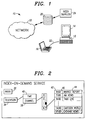
- FIG. 1 An exemplary arrangement 10 for using the index-on-demand service of the present invention is illustrated in FIG. 1.
- a user has recorded a television broadcast on a VCR 12 for playback on an associated television monitor 14. For example, the user may have recorded a dinner time news program to be played back at a more convenient hour.
- the user then uses a computer 16 to access a data network 18 (such as the Internet) to be in communication with an index-on-demand server 20.
- index-on-demand server 20 contains numerous indices (which may be created by a broadcaster or a third party). The user then browses (or searches) through a listing of these indices on his computer 16 until finding the index associated with the news program that he has recorded.
- connection 22 (for example, an RS232 connection or infrared link) is established between computer 16 and VCR 12 to control the coordination of the recorded video playback with the index.
- index entries are time-stamped so that the timing information may be transmitted over connection 22 to VCR 12, causing VCR 12 to "fast forward” or “rewind” to precisely the desired location on the video.
- the index of the present invention may be created by either the broadcaster or a third party.
- an "index supplier" 24 as shown in FIG. 1 continuously works to create new indices and store them in a database system, represented by server 20.
- server 20 There are some commercial advantages that may also be offered by a commercial "index supplier". For example, the number of "hits" on a particular index (or class of indices - such as news shows, talk shows, etc.) may be useful information for the broadcaster in terms of assessing the success of various types of programming.
- an index itself may take a variety of different forms.
- an index comprises a plurality of time-based textual representations of the various segments within a recording.
- FIG. 3 illustrates this type of index.
- relatively short audio "clips" may be used (with or without text) to identify the various segments within a recording.
- FIG. 4 illustrates an exemplary index listing including audio clips. Video clips may also be used (discussed with FIG. 5) and, in general, any combination of text, video and audio may be used in accordance with the teachings of the present invention.
- FIG. 2 illustrates an exemplary computer screen 30 that could be presented to the user upon gaining access to server 20 containing the various on-demand indices.
- the index-on-demand service may be implemented by either the broadcaster or by a third party vendor separate from the source of the broadcast material.
- a number of different "media" indices may be available, including those associated with radio programs 32 and television programs 34, as shown.
- a pop-up menu 36, associated with television listing 34 may be activated to select a particular channel 38 or time 40 for further browsing.
- a listing of indices 42 is next presented, where a short descriptor 44, is indicated for each time slot 46 for which an index has been created. Once the user has found the proper index, it may be selected for downloading onto computer 16. In this case, the index 50 associated with the evening news is selected and downloaded.
- evening news index 50 includes a header 52 defining the particular program, including the time and date of its original broadcast.
- the user may then scroll through index 50, searching for the particular news segment of interest. For example, if the user wanted to see the weather report, the computer would scroll down to field 54 in index 50 and the user would "select" this field (using a mouse click, for example).
- a time stamp indicating this index marking would then be transmitted from computer 16 to VCR 12 and used to "cue up" the recorded news to the proper location.
- the beginning of the recording include a time stamp of 00:00, where each subsequent index segment would define elapsed time from this 00:00 start time.
- An advantage of the index-on-demand service of the present invention is that the user may view the recorded program in any desired order. That is, if the user wanted to review the news story related to the apartment fire after seeing the weather report, the user would merely scroll back upward through the index and "click" on field 56 associated with the time "cue" for the apartment fire report. Any number of such selections can be made.
- timing control can easily be accomplished by programming a VCR for recording, or using automatic VCR programming systems suited to this purpose (e.g., VCR Plus+). On programs recorded directly onto a computer, such timing can easily be controlled as well. In some cases, particularly where relatively "fine” index time increments are used (for example, defining intervals in terms of elapsed seconds), there may be some "skew" between the index segment time stamps and the actual recorded video. In this case, some "fine tuning" to re-synchronize the video with the index may be applied.
- a relatively short audio segment corresponding to the beginning of the recorded program may be downloaded with the index and included as a synchronization header 58 in the index file.
- an index sync signal could be embedded in a predetermined portion of the broadcast material and then used to coordinate the timing with a downloaded index. This approach, however, requires the broadcaster to be actively involved in the indexing service.
- FIG. 4 illustrates an alternative index 60, this one associated with a recorded radio broadcast.
- the recorded broadcast may have been itself recorded from the Internet and then stored directly within computer 16.
- index 60 also contains a header field 62, in this case identifying the radio station, date and time of the recording.
- the remaining time-stamped fields include a short audio clip file of each piece of music included in the index, as well as a brief textual description of the piece. The user may therefore activate a particular index element and listen to the brief audio clip to determine if the selected piece is the one being searched for. Once the proper index element is found, the element is selected and a time-stamp signal is sent from the index file to the recording to being the playback of the selected piece.
- relatively short video clips may be used as index elements, as shown an index file 70 of FIG. 5 associated with a recording of the movie Gone With the Wind.
- Various short clips from different scenes in the movie may be used as index elements, where the user may view the short clips, then select the desired portion of the movie to be viewed.
Landscapes
- Engineering & Computer Science (AREA)
- Theoretical Computer Science (AREA)
- Library & Information Science (AREA)
- Multimedia (AREA)
- Data Mining & Analysis (AREA)
- Databases & Information Systems (AREA)
- Physics & Mathematics (AREA)
- General Engineering & Computer Science (AREA)
- General Physics & Mathematics (AREA)
- Two-Way Televisions, Distribution Of Moving Picture Or The Like (AREA)
- Television Signal Processing For Recording (AREA)
Abstract
Description
Claims (30)
- A network-based server (20) comprising a plurality of separate indices associated with a plurality of pre-recorded broadcast programs, the server associated with an index-on-demand service (24), characterized in that each index comprises a time-based index (40) including a plurality of indexed segments (42) having descriptors (44,46) for each segment.
- A network-based index-on-demand server as defined in claim 1 characterized in that the plurality of pre-recorded broadcast programs is characterized by a plurality of video programs.
- A network-based index-on-demand server as defined in claim 1 characterized in that the plurality of pre-recorded broadcast programs is characterized by a plurality of audio programs.
- A network-based index-on-demand server as defined in claim 1 characterized in that the segment descriptors is characterized by textual descriptors.
- A network-based index-on-demand server as defined in claim 1 characterized in that the segment descriptors are characterized by at least audio descriptors.
- A network-based index-on-demand server as defined in claim 5 characterized in that the segment descriptors is further characterized by textual descriptors associated with the audio descriptors.
- A network-based index-on-demand server as defined in claim 1 characterized in that the segment descriptors are characterized by at least video descriptors.
- A network-based index-on-demand server as defined in claim 7 characterized in that the segment descriptors are further characterized by textual descriptors associated with the video descriptors.
- A network-based index-on-demand server as defined in claim 7 characterized in that the segment descriptors are further characterized by audio descriptors associated with the video descriptors.
- A network-based index-on-demand server as defined in claim 7 characterized in that the segment descriptors are further characterized by audio and textual descriptors associated with the video descriptors.
- A method of providing an index-on-demand service for use with a pre-recorded broadcast program, the method characterized by the steps of:a) creating a time-based index for a broadcasted program (24), the index including a plurality of indexed segments (42,44,46), each segment having a descriptor associated therewith;b) storing the created index in a server (20) that is accessible over a data network (18); andc) repeating steps a) and b) for each desired pre-recorded broadcast program.
- The provisioning method as defined in claim 11 characterized in that the plurality of pre-recorded broadcast programs is characterized by a plurality of video programs.
- The provisioning method as defined in claim 11 characterized in that the plurality of pre-recorded broadcast programs is characterized by a plurality of audio programs.
- The provisioning method as defined in claim 11 characterized in that in performing step a), textual descriptors are created.
- The provisioning method as defined in claim 11 characterized in that in performing step a), audio descriptors are created.
- The provisioning method as defined in claim 15 characterized in that in performing step a), textual descriptors are created for use with the audio descriptors.
- The provisioning method as defined in claim 11 characterized in that in performing step a), video descriptors are created.
- The provisioning method as defined in claim 17 characterized in that in performing step a), textual descriptors are created for use with the video descriptors.
- The provisioning method as defined in claim 17 characterized in that in performing step a), audio descriptors are created for use with the video descriptors.
- The provisioning method as defined in claim 17 characterized in that in performing step a), audio and textual descriptors are created for use with the video descriptors.
- A method for searching through a pre-recorded program based on an index, the method characterized by the steps of:a) accessing, using a computer (12), an index server (20) including a plurality of time-based index created for various pre-recorded programs, each index including a plurality of indexed segments (42,44,46) including descriptors for each segment;b) browsing through the plurality of indices stored on the server and selecting a desired index;c) downloading the selected index;d) browsing through the selected index and selecting a particular index segment for playback;e) transmitting the identity of the selected index segment to a recording device containing the pre-recorded program; andf) continuing through steps d) and e) as many times as desired.
- The provisioning method as defined in claim 21 characterized in that the plurality of pre-recorded broadcast programs include a plurality of video programs.
- The provisioning method as defined in claim 21 characterized in that the plurality of pre-recorded broadcast programs include a plurality of audio programs.
- The provisioning method as defined in claim 21 characterized in that in performing step a), each index includes textual descriptors.
- The provisioning method as defined in claim 21 characterized in that in performing step a), each index includes audio descriptors.
- The provisioning method as defined in claim 25 characterized in that in performing step a), textual descriptors are used with the audio descriptors.
- The provisioning method as defined in claim 21 characterized in that in performing step a), each index includes video descriptors.
- The provisioning method as defined in claim 27 characterized in that in performing step a), textual descriptors are used with the video descriptors.
- The provisioning method as defined in claim 27 characterized in that in performing step a), audio descriptors are used with the video descriptors.
- The provisioning method as defined in claim 27 characterized in that in performing step a), audio and textual descriptors are used with the video descriptors.
Applications Claiming Priority (2)
| Application Number | Priority Date | Filing Date | Title |
|---|---|---|---|
| US56633800A | 2000-05-08 | 2000-05-08 | |
| US566338 | 2000-05-08 |
Publications (2)
| Publication Number | Publication Date |
|---|---|
| EP1154433A2 true EP1154433A2 (en) | 2001-11-14 |
| EP1154433A3 EP1154433A3 (en) | 2004-04-07 |
Family
ID=24262462
Family Applications (1)
| Application Number | Title | Priority Date | Filing Date |
|---|---|---|---|
| EP01303570A Withdrawn EP1154433A3 (en) | 2000-05-08 | 2001-04-19 | Internet-based indices for pre-recorded broadcast information |
Country Status (2)
| Country | Link |
|---|---|
| EP (1) | EP1154433A3 (en) |
| CA (1) | CA2345839A1 (en) |
Cited By (4)
| Publication number | Priority date | Publication date | Assignee | Title |
|---|---|---|---|---|
| WO2004100540A1 (en) * | 2003-05-09 | 2004-11-18 | Matsushita Electric Industrial Co., Ltd. | Reproduction apparatus and digest reproduction method |
| DE102004047670A1 (en) * | 2004-09-30 | 2006-04-20 | Siemens Ag | Arrangement for providing television programs and additional information associated therewith |
| JP2006254146A (en) * | 2005-03-11 | 2006-09-21 | Casio Comput Co Ltd | Broadcast program distribution system and control program thereof |
| EP1827018A4 (en) * | 2004-12-03 | 2009-07-29 | Nec Corp | Video content reproduction supporting method, video content reproduction supporting system, and information delivery program |
Family Cites Families (11)
| Publication number | Priority date | Publication date | Assignee | Title |
|---|---|---|---|---|
| WO1990015507A1 (en) * | 1989-06-01 | 1990-12-13 | Right Hemisphere Pty. Limited | Television program selection |
| US5136655A (en) * | 1990-03-26 | 1992-08-04 | Hewlett-Pacard Company | Method and apparatus for indexing and retrieving audio-video data |
| US5793980A (en) * | 1994-11-30 | 1998-08-11 | Realnetworks, Inc. | Audio-on-demand communication system |
| DE19518944A1 (en) * | 1995-05-23 | 1996-11-28 | Siemens Ag | Video and/or audio transmission recording arrangement |
| IL125141A0 (en) * | 1998-06-29 | 1999-01-26 | Nds Ltd | Advanced television system |
| GB9802415D0 (en) * | 1998-02-05 | 1998-04-01 | Danmere Limited | Storage tape control system |
| JP3102407B2 (en) * | 1998-02-26 | 2000-10-23 | 日本電気株式会社 | Dynamic editing method for received broadcast data and dynamic editing device for received broadcast data |
| GB9815638D0 (en) * | 1998-07-20 | 1998-09-16 | Danmere Limited | Identification of video storage media |
| US6721488B1 (en) * | 1999-11-30 | 2004-04-13 | Koninklijke Philips Electronics N.V. | Method and apparatus to identify sequential content stored on a storage medium |
| WO2001045103A1 (en) * | 1999-12-14 | 2001-06-21 | Koninklijke Philips Electronics N.V. | Method and apparatus to identify content stored on a storage medium |
| JP4325071B2 (en) * | 2000-04-07 | 2009-09-02 | ソニー株式会社 | Digital video playback method and digital video playback apparatus |
-
2001
- 2001-04-19 EP EP01303570A patent/EP1154433A3/en not_active Withdrawn
- 2001-05-01 CA CA002345839A patent/CA2345839A1/en not_active Abandoned
Cited By (4)
| Publication number | Priority date | Publication date | Assignee | Title |
|---|---|---|---|---|
| WO2004100540A1 (en) * | 2003-05-09 | 2004-11-18 | Matsushita Electric Industrial Co., Ltd. | Reproduction apparatus and digest reproduction method |
| DE102004047670A1 (en) * | 2004-09-30 | 2006-04-20 | Siemens Ag | Arrangement for providing television programs and additional information associated therewith |
| EP1827018A4 (en) * | 2004-12-03 | 2009-07-29 | Nec Corp | Video content reproduction supporting method, video content reproduction supporting system, and information delivery program |
| JP2006254146A (en) * | 2005-03-11 | 2006-09-21 | Casio Comput Co Ltd | Broadcast program distribution system and control program thereof |
Also Published As
| Publication number | Publication date |
|---|---|
| CA2345839A1 (en) | 2001-11-08 |
| EP1154433A3 (en) | 2004-04-07 |
Similar Documents
| Publication | Publication Date | Title |
|---|---|---|
| US10313714B2 (en) | Audiovisual content presentation dependent on metadata | |
| US8042136B2 (en) | Information processing apparatus and information processing method, and computer program | |
| US8634944B2 (en) | Auto-station tuning | |
| JP5254090B2 (en) | Content distribution apparatus, content distribution method, viewer terminal, and content reproduction method | |
| US20120315014A1 (en) | Audio fingerprinting to bookmark a location within a video | |
| US20060117365A1 (en) | Stream output device and information providing device | |
| US8584169B1 (en) | System and method for creating and managing custom media channels | |
| US20050198317A1 (en) | Method and apparatus for sharing internet content | |
| US20120089911A1 (en) | Bookmarking System | |
| US7555196B1 (en) | Methods and systems for synchronizing timecodes when sending indices to client devices | |
| US20020104101A1 (en) | Information providing system and information providing method | |
| KR100967658B1 (en) | Personalization Broadcasting System and Method Based on Dynamic Selection of Multi-camera View and Storage Media | |
| JP4483906B2 (en) | INFORMATION PROVIDING SYSTEM, VIDEO REPRODUCTION DEVICE, INFORMATION PROVIDING DEVICE, INFORMATION PROVIDING METHOD, AND PROGRAM | |
| US8219634B2 (en) | Information distribution system, and information distribution method | |
| KR20040029027A (en) | System with improved user interface | |
| JP5279457B2 (en) | Broadcast receiving terminal | |
| US20060168622A1 (en) | Real-time synchronization of content viewers | |
| CA2345839A1 (en) | Internet-based indices for pre-recorded broadcast information | |
| CN100449536C (en) | Systems and methods for associating different types of media content | |
| EP1784009A2 (en) | Methods and apparatuses providing synchronised electronic program guide | |
| CN1790300B (en) | Information processing device and information processing method | |
| CN101326584B (en) | Method and receiver for identifying recorded documents by displaying and selecting key images | |
| US9098577B1 (en) | System and method for creating collaborative content tracks for media content | |
| US20060080720A1 (en) | System, method and program for identifying Web information related to subjects in a program broadcast | |
| KR100430610B1 (en) | Method for selectively reproducing broadcast program and apparatus therefor |
Legal Events
| Date | Code | Title | Description |
|---|---|---|---|
| PUAI | Public reference made under article 153(3) epc to a published international application that has entered the european phase |
Free format text: ORIGINAL CODE: 0009012 |
|
| AK | Designated contracting states |
Kind code of ref document: A2 Designated state(s): AT BE CH CY DE DK ES FI FR GB GR IE IT LI LU MC NL PT SE TR |
|
| AX | Request for extension of the european patent |
Free format text: AL;LT;LV;MK;RO;SI |
|
| 17P | Request for examination filed |
Effective date: 20011030 |
|
| PUAL | Search report despatched |
Free format text: ORIGINAL CODE: 0009013 |
|
| AK | Designated contracting states |
Kind code of ref document: A3 Designated state(s): AT BE CH CY DE DK ES FI FR GB GR IE IT LI LU MC NL PT SE TR |
|
| AX | Request for extension of the european patent |
Extension state: AL LT LV MK RO SI |
|
| RIC1 | Information provided on ipc code assigned before grant |
Ipc: 7H 04H 1/10 B Ipc: 7G 11B 27/10 B Ipc: 7G 06F 17/30 B Ipc: 7G 11B 27/11 B Ipc: 7G 11B 27/28 A |
|
| AKX | Designation fees paid |
Designated state(s): DE FR GB |
|
| STAA | Information on the status of an ep patent application or granted ep patent |
Free format text: STATUS: THE APPLICATION IS DEEMED TO BE WITHDRAWN |
|
| 18D | Application deemed to be withdrawn |
Effective date: 20041008 |