EP1153655A2 - Mixed-cation adsorbent production with single pass ion exchange - Google Patents
Mixed-cation adsorbent production with single pass ion exchange Download PDFInfo
- Publication number
- EP1153655A2 EP1153655A2 EP01110984A EP01110984A EP1153655A2 EP 1153655 A2 EP1153655 A2 EP 1153655A2 EP 01110984 A EP01110984 A EP 01110984A EP 01110984 A EP01110984 A EP 01110984A EP 1153655 A2 EP1153655 A2 EP 1153655A2
- Authority
- EP
- European Patent Office
- Prior art keywords
- cation
- adsorbent
- cations
- exchanged
- ion
- Prior art date
- Legal status (The legal status is an assumption and is not a legal conclusion. Google has not performed a legal analysis and makes no representation as to the accuracy of the status listed.)
- Withdrawn
Links
- 239000003463 adsorbent Substances 0.000 title claims abstract description 107
- 238000005342 ion exchange Methods 0.000 title claims abstract description 30
- 238000004519 manufacturing process Methods 0.000 title abstract description 4
- 150000001768 cations Chemical class 0.000 claims abstract description 165
- 239000010457 zeolite Substances 0.000 claims abstract description 74
- 229910021536 Zeolite Inorganic materials 0.000 claims abstract description 64
- HNPSIPDUKPIQMN-UHFFFAOYSA-N dioxosilane;oxo(oxoalumanyloxy)alumane Chemical compound O=[Si]=O.O=[Al]O[Al]=O HNPSIPDUKPIQMN-UHFFFAOYSA-N 0.000 claims abstract description 64
- 238000000034 method Methods 0.000 claims abstract description 43
- 239000000203 mixture Substances 0.000 claims abstract description 28
- 238000009826 distribution Methods 0.000 claims abstract description 16
- HPALAKNZSZLMCH-UHFFFAOYSA-M sodium;chloride;hydrate Chemical compound O.[Na+].[Cl-] HPALAKNZSZLMCH-UHFFFAOYSA-M 0.000 claims description 105
- 239000012267 brine Substances 0.000 claims description 100
- 150000002500 ions Chemical class 0.000 claims description 68
- 239000011575 calcium Substances 0.000 claims description 40
- 229910052744 lithium Inorganic materials 0.000 claims description 36
- OYPRJOBELJOOCE-UHFFFAOYSA-N Calcium Chemical compound [Ca] OYPRJOBELJOOCE-UHFFFAOYSA-N 0.000 claims description 32
- 229910052791 calcium Inorganic materials 0.000 claims description 32
- WHXSMMKQMYFTQS-UHFFFAOYSA-N Lithium Chemical compound [Li] WHXSMMKQMYFTQS-UHFFFAOYSA-N 0.000 claims description 31
- 239000011734 sodium Substances 0.000 claims description 22
- 229910052708 sodium Inorganic materials 0.000 claims description 21
- XEEYBQQBJWHFJM-UHFFFAOYSA-N Iron Chemical compound [Fe] XEEYBQQBJWHFJM-UHFFFAOYSA-N 0.000 claims description 18
- KDLHZDBZIXYQEI-UHFFFAOYSA-N Palladium Chemical compound [Pd] KDLHZDBZIXYQEI-UHFFFAOYSA-N 0.000 claims description 18
- DGAQECJNVWCQMB-PUAWFVPOSA-M Ilexoside XXIX Chemical compound C[C@@H]1CC[C@@]2(CC[C@@]3(C(=CC[C@H]4[C@]3(CC[C@@H]5[C@@]4(CC[C@@H](C5(C)C)OS(=O)(=O)[O-])C)C)[C@@H]2[C@]1(C)O)C)C(=O)O[C@H]6[C@@H]([C@H]([C@@H]([C@H](O6)CO)O)O)O.[Na+] DGAQECJNVWCQMB-PUAWFVPOSA-M 0.000 claims description 14
- PXHVJJICTQNCMI-UHFFFAOYSA-N Nickel Chemical compound [Ni] PXHVJJICTQNCMI-UHFFFAOYSA-N 0.000 claims description 14
- 239000011777 magnesium Substances 0.000 claims description 14
- 239000000243 solution Substances 0.000 claims description 13
- 229910052700 potassium Inorganic materials 0.000 claims description 12
- FYYHWMGAXLPEAU-UHFFFAOYSA-N Magnesium Chemical compound [Mg] FYYHWMGAXLPEAU-UHFFFAOYSA-N 0.000 claims description 11
- 229910052749 magnesium Inorganic materials 0.000 claims description 11
- 239000011591 potassium Substances 0.000 claims description 11
- ZLMJMSJWJFRBEC-UHFFFAOYSA-N Potassium Chemical compound [K] ZLMJMSJWJFRBEC-UHFFFAOYSA-N 0.000 claims description 10
- 239000000463 material Substances 0.000 claims description 10
- 229910052742 iron Inorganic materials 0.000 claims description 9
- WPBNNNQJVZRUHP-UHFFFAOYSA-L manganese(2+);methyl n-[[2-(methoxycarbonylcarbamothioylamino)phenyl]carbamothioyl]carbamate;n-[2-(sulfidocarbothioylamino)ethyl]carbamodithioate Chemical compound [Mn+2].[S-]C(=S)NCCNC([S-])=S.COC(=O)NC(=S)NC1=CC=CC=C1NC(=S)NC(=O)OC WPBNNNQJVZRUHP-UHFFFAOYSA-L 0.000 claims description 9
- 229910052763 palladium Inorganic materials 0.000 claims description 9
- 229910052761 rare earth metal Inorganic materials 0.000 claims description 9
- 150000002910 rare earth metals Chemical class 0.000 claims description 9
- HCHKCACWOHOZIP-UHFFFAOYSA-N Zinc Chemical compound [Zn] HCHKCACWOHOZIP-UHFFFAOYSA-N 0.000 claims description 7
- 229910017052 cobalt Inorganic materials 0.000 claims description 7
- 239000010941 cobalt Substances 0.000 claims description 7
- GUTLYIVDDKVIGB-UHFFFAOYSA-N cobalt atom Chemical compound [Co] GUTLYIVDDKVIGB-UHFFFAOYSA-N 0.000 claims description 7
- 229910052759 nickel Inorganic materials 0.000 claims description 7
- 229910052725 zinc Inorganic materials 0.000 claims description 7
- 239000011701 zinc Substances 0.000 claims description 7
- RYGMFSIKBFXOCR-UHFFFAOYSA-N Copper Chemical compound [Cu] RYGMFSIKBFXOCR-UHFFFAOYSA-N 0.000 claims description 6
- BQCADISMDOOEFD-UHFFFAOYSA-N Silver Chemical compound [Ag] BQCADISMDOOEFD-UHFFFAOYSA-N 0.000 claims description 6
- 229910052788 barium Inorganic materials 0.000 claims description 6
- DSAJWYNOEDNPEQ-UHFFFAOYSA-N barium atom Chemical compound [Ba] DSAJWYNOEDNPEQ-UHFFFAOYSA-N 0.000 claims description 6
- 229910052802 copper Inorganic materials 0.000 claims description 6
- 239000010949 copper Substances 0.000 claims description 6
- 229910052709 silver Inorganic materials 0.000 claims description 6
- 239000004332 silver Substances 0.000 claims description 6
- 229910052712 strontium Inorganic materials 0.000 claims description 6
- CIOAGBVUUVVLOB-UHFFFAOYSA-N strontium atom Chemical compound [Sr] CIOAGBVUUVVLOB-UHFFFAOYSA-N 0.000 claims description 5
- 239000007864 aqueous solution Substances 0.000 claims description 4
- UFHFLCQGNIYNRP-UHFFFAOYSA-N Hydrogen Chemical compound [H][H] UFHFLCQGNIYNRP-UHFFFAOYSA-N 0.000 claims description 2
- 239000001257 hydrogen Substances 0.000 claims description 2
- 229910052739 hydrogen Inorganic materials 0.000 claims description 2
- 238000005406 washing Methods 0.000 abstract description 19
- 238000011067 equilibration Methods 0.000 abstract description 14
- 239000002243 precursor Substances 0.000 abstract 1
- 239000002245 particle Substances 0.000 description 29
- KWGKDLIKAYFUFQ-UHFFFAOYSA-M lithium chloride Chemical compound [Li+].[Cl-] KWGKDLIKAYFUFQ-UHFFFAOYSA-M 0.000 description 24
- 150000003839 salts Chemical class 0.000 description 24
- -1 brine cation Chemical class 0.000 description 17
- XLYOFNOQVPJJNP-UHFFFAOYSA-N water Substances O XLYOFNOQVPJJNP-UHFFFAOYSA-N 0.000 description 14
- 238000011084 recovery Methods 0.000 description 11
- BHPQYMZQTOCNFJ-UHFFFAOYSA-N Calcium cation Chemical compound [Ca+2] BHPQYMZQTOCNFJ-UHFFFAOYSA-N 0.000 description 9
- UXVMQQNJUSDDNG-UHFFFAOYSA-L Calcium chloride Chemical compound [Cl-].[Cl-].[Ca+2] UXVMQQNJUSDDNG-UHFFFAOYSA-L 0.000 description 9
- 229910001628 calcium chloride Inorganic materials 0.000 description 9
- 235000011148 calcium chloride Nutrition 0.000 description 9
- 238000009792 diffusion process Methods 0.000 description 9
- HBBGRARXTFLTSG-UHFFFAOYSA-N Lithium ion Chemical compound [Li+] HBBGRARXTFLTSG-UHFFFAOYSA-N 0.000 description 8
- 239000001110 calcium chloride Substances 0.000 description 8
- 229910001424 calcium ion Inorganic materials 0.000 description 7
- 229910001416 lithium ion Inorganic materials 0.000 description 7
- 238000001556 precipitation Methods 0.000 description 7
- 238000002156 mixing Methods 0.000 description 6
- IJGRMHOSHXDMSA-UHFFFAOYSA-N Atomic nitrogen Chemical compound N#N IJGRMHOSHXDMSA-UHFFFAOYSA-N 0.000 description 4
- FAPWRFPIFSIZLT-UHFFFAOYSA-M Sodium chloride Chemical compound [Na+].[Cl-] FAPWRFPIFSIZLT-UHFFFAOYSA-M 0.000 description 4
- 150000001450 anions Chemical class 0.000 description 4
- 239000007788 liquid Substances 0.000 description 4
- 238000012546 transfer Methods 0.000 description 3
- QVGXLLKOCUKJST-UHFFFAOYSA-N atomic oxygen Chemical compound [O] QVGXLLKOCUKJST-UHFFFAOYSA-N 0.000 description 2
- 239000011324 bead Substances 0.000 description 2
- AXCZMVOFGPJBDE-UHFFFAOYSA-L calcium dihydroxide Chemical compound [OH-].[OH-].[Ca+2] AXCZMVOFGPJBDE-UHFFFAOYSA-L 0.000 description 2
- 239000000920 calcium hydroxide Substances 0.000 description 2
- 229910001861 calcium hydroxide Inorganic materials 0.000 description 2
- USOPFYZPGZGBEB-UHFFFAOYSA-N calcium lithium Chemical compound [Li].[Ca] USOPFYZPGZGBEB-UHFFFAOYSA-N 0.000 description 2
- 239000013078 crystal Substances 0.000 description 2
- 238000013461 design Methods 0.000 description 2
- 238000001640 fractional crystallisation Methods 0.000 description 2
- 238000012986 modification Methods 0.000 description 2
- 230000004048 modification Effects 0.000 description 2
- 229910052757 nitrogen Inorganic materials 0.000 description 2
- 239000001301 oxygen Substances 0.000 description 2
- 229910052760 oxygen Inorganic materials 0.000 description 2
- 239000011148 porous material Substances 0.000 description 2
- 239000011780 sodium chloride Substances 0.000 description 2
- 239000007787 solid Substances 0.000 description 2
- 238000009827 uniform distribution Methods 0.000 description 2
- 239000002699 waste material Substances 0.000 description 2
- UGFAIRIUMAVXCW-UHFFFAOYSA-N Carbon monoxide Chemical compound [O+]#[C-] UGFAIRIUMAVXCW-UHFFFAOYSA-N 0.000 description 1
- CBENFWSGALASAD-UHFFFAOYSA-N Ozone Chemical compound [O-][O+]=O CBENFWSGALASAD-UHFFFAOYSA-N 0.000 description 1
- 229910052770 Uranium Inorganic materials 0.000 description 1
- LZCOCTOKXDDGEP-UHFFFAOYSA-N [Ag].[Ca].[Mg].[Li] Chemical compound [Ag].[Ca].[Mg].[Li] LZCOCTOKXDDGEP-UHFFFAOYSA-N 0.000 description 1
- XCPQSHFJZZSKLG-UHFFFAOYSA-N [Li].[Mg].[Ca] Chemical compound [Li].[Mg].[Ca] XCPQSHFJZZSKLG-UHFFFAOYSA-N 0.000 description 1
- 238000007792 addition Methods 0.000 description 1
- 229910001413 alkali metal ion Inorganic materials 0.000 description 1
- JYIBXUUINYLWLR-UHFFFAOYSA-N aluminum;calcium;potassium;silicon;sodium;trihydrate Chemical compound O.O.O.[Na].[Al].[Si].[K].[Ca] JYIBXUUINYLWLR-UHFFFAOYSA-N 0.000 description 1
- 238000005349 anion exchange Methods 0.000 description 1
- 229910000019 calcium carbonate Inorganic materials 0.000 description 1
- 229910052799 carbon Inorganic materials 0.000 description 1
- 229940026110 carbon dioxide / nitrogen Drugs 0.000 description 1
- 229910002091 carbon monoxide Inorganic materials 0.000 description 1
- 150000004649 carbonic acid derivatives Chemical class 0.000 description 1
- 229910001603 clinoptilolite Inorganic materials 0.000 description 1
- 238000007865 diluting Methods 0.000 description 1
- 229910052675 erionite Inorganic materials 0.000 description 1
- 238000001704 evaporation Methods 0.000 description 1
- 230000008020 evaporation Effects 0.000 description 1
- 239000003456 ion exchange resin Substances 0.000 description 1
- 229920003303 ion-exchange polymer Polymers 0.000 description 1
- 150000002641 lithium Chemical class 0.000 description 1
- XGZVUEUWXADBQD-UHFFFAOYSA-L lithium carbonate Chemical compound [Li+].[Li+].[O-]C([O-])=O XGZVUEUWXADBQD-UHFFFAOYSA-L 0.000 description 1
- 229910052808 lithium carbonate Inorganic materials 0.000 description 1
- 229940006487 lithium cation Drugs 0.000 description 1
- VVNXEADCOVSAER-UHFFFAOYSA-N lithium sodium Chemical compound [Li].[Na] VVNXEADCOVSAER-UHFFFAOYSA-N 0.000 description 1
- 238000011068 loading method Methods 0.000 description 1
- 229910000021 magnesium carbonate Inorganic materials 0.000 description 1
- 229910052680 mordenite Inorganic materials 0.000 description 1
- 229910001414 potassium ion Inorganic materials 0.000 description 1
- 238000012545 processing Methods 0.000 description 1
- 238000004064 recycling Methods 0.000 description 1
- 238000000926 separation method Methods 0.000 description 1
- 150000004760 silicates Chemical class 0.000 description 1
- 229910001415 sodium ion Inorganic materials 0.000 description 1
- 239000012798 spherical particle Substances 0.000 description 1
- 238000011144 upstream manufacturing Methods 0.000 description 1
- JFALSRSLKYAFGM-UHFFFAOYSA-N uranium(0) Chemical compound [U] JFALSRSLKYAFGM-UHFFFAOYSA-N 0.000 description 1
- 239000002351 wastewater Substances 0.000 description 1
Images
Classifications
-
- B—PERFORMING OPERATIONS; TRANSPORTING
- B01—PHYSICAL OR CHEMICAL PROCESSES OR APPARATUS IN GENERAL
- B01J—CHEMICAL OR PHYSICAL PROCESSES, e.g. CATALYSIS OR COLLOID CHEMISTRY; THEIR RELEVANT APPARATUS
- B01J20/00—Solid sorbent compositions or filter aid compositions; Sorbents for chromatography; Processes for preparing, regenerating or reactivating thereof
- B01J20/02—Solid sorbent compositions or filter aid compositions; Sorbents for chromatography; Processes for preparing, regenerating or reactivating thereof comprising inorganic material
- B01J20/10—Solid sorbent compositions or filter aid compositions; Sorbents for chromatography; Processes for preparing, regenerating or reactivating thereof comprising inorganic material comprising silica or silicate
- B01J20/16—Alumino-silicates
- B01J20/18—Synthetic zeolitic molecular sieves
- B01J20/186—Chemical treatments in view of modifying the properties of the sieve, e.g. increasing the stability or the activity, also decreasing the activity
Definitions
- the present invention relates to a process for the production of cation-exchanged adsorbents. More particularly, the present invention relates to a single-step continuous ion exchange process for the production of cation-exchanged zeolite adsorbents.
- mixed-cation zeolites such as calcium-lithium zeolites
- processes for producing mixed cation zeolites require a complex and expensive sequence of successive ion-exchange steps in which ions present in the "raw" (i.e. untreated) zeolite are exchanged with other ions to produce a mixed cation zeolite product with the desired adsorbent properties.
- the prior art utilizes two basic methods for producing ion exchange materials containing mixed cations.
- the batches of raw (untreated) zeolite are exchanged with an aqueous solution containing the ions which are to be introduced into the product zeolite.
- the ion composition of the aqueous solution which is referred to in the art as "brine" is adjusted to be in equilibrium with the ion concentration desired in the mixed-cation zeolite product.
- the slow and inefficient batch exchange steps are replaced with fast and continuous counterflow steps in which untreated zeolite is continuously countercurrently exchanged with a brine containing the mixed cations to be introduced into the product zeolite.
- the ion composition of the brine is again in equilibrium with the ion concentration desired in the mixed-cation zeolite product.
- An object of the present invention is to provide a single step ion-exchange process for producing adsorbents, such as mixed cation zeolites, which does not suffer from,one or more of the drawbacks of the above prior art processes.
- Another object of the present invention is to provide an ion exchange process which permits reduced amounts of expensive cations to be utilized and reduces the loss of valuable cations in the spent brine solutions.
- Yet another object of the invention is to provide a process for making mixed cation-exchanged zeolites having an improved (more controlled) cation distribution compared to those provided by prior art processes.
- Another object of the present invention is to provide an ion exchange process which reduces both costs and processing time compared to the processes of the prior art.
- the process of the present invention removes one or more ions from an ion-exchangeable adsorbent material, such as a zeolite, and replaces these ions with two or more desired ions in a single, continuous countercurrent ion-exchange step.
- An ion-exchangeable adsorbent material such as a zeolite
- a "raw" zeolite in which substantially all of the ion-exchangeable sites are occupied by one or more undesirable cations is thus converted to a product zeolite in which two or more desired cations have replaced most or practically all the undesirable cations.
- the replacement or partial replacement is accomplished by ion exchange in a continuous counterflow contactor using a feed brine containing the desired cations at predetermined concentrations wherein the ion composition of the brine is not in equilibrium with the-product zeolite.
- the brine contains essentially stoichiometric amounts of the more strongly held cation(s) whereas the least strongly held cation is provided at an excess sufficient to overcome the unfavorable equilibrium and mass transfer resistance with respect to that cation.
- an equilibrating or cation distribution step may optionally be provided to insure uniform cation distribution in the product zeolite.
- the length of the cation distribution step may be controlled so as to provide a mixed cation exchanged product having either a substantially uniform distribution of the exchanged ions or a distribution gradient of the exchanged ions across the radius of the zeolite.
- the process may further comprise controlling the concentrations of said desirable cations within said cation-exchanged adsorbent by contacting said adsorbent with an aqueous solution comprising the desirable cations for a time sufficient to ensure a desired distribution of the cations in the mixed cation-exchanged adsorbent, thereby yielding a mixed cation-exchanged adsorbent having controlled concentrations of said cations across either the radius or the diameter of said adsorbent.
- a washing step may optionally be provided to wash the zeolite following the equilibrating step (or following the exchange step, if there is no equilibration).
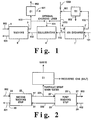
- the process of the present invention converts a raw adsorbent (101) containing one or more undesired cations to a product adsorbent (501) with any desired combination of cations.
- the present process uses single-step continuous counterflow ion-exchange (in Contactor 1) with a single aqueous feed brine composition (1003) containing calculated amounts of the desired mixed cations.
- the ion- exchanged adsorbent can be equilibrated (in Section 4) to provide a uniform distribution of cations therethrough, and the equilibrated adsorbent can be washed (in Section 5) to remove spent brine.
- the ion exchange operation produces a tail brine (102) containing the original undesired cations and unused cations from the feed brine.
- An optional recovery unit denoted as Rl in Fig. 1, may be used to recover some of the unused components notably expensive cations from the tail brine (102) for reuse (through stream 801) in the feed brine composition. Residual low cost salts (802) may be discarded or put to another use.
- An optional ion concentrator, Cl in Fig. 1, may be used to recover residual valuable salts (901) from the spent wash water (503). Wastewater (902) is discarded.
- the first (and only ion-exchange) step of the process of the present invention involves ion-exchange of raw adsorbent (101) having an undesired cation or set of cations to convert it to a product adsorbent having a set of two or more desirable cations.
- This step takes place in a moving-bed counterflow contactor 1.
- the raw adsorbent (101) enters at the inlet 2 of the contactor 1, is transported through the contactor, and leaves through the outlet 3 of the contactor as ion-exchanged adsorbent 103.
- the feed brine flows through the contactor and comes in contact with the adsorbent stream, effecting ion exchange on the adsorbent.
- the brine (now depleted in desired cations) is removed from the adsorbent feed end of the contactor as the tail brine(102) at brine outlet 2'.
- the cations in the feed brine replace cations on the adsorbent by ion exchange at different rates depending on the affinity with which the adsorbent binds a particular ion.
- the most strongly selected cations (e.g. Ca) in the feed brine are quickly adsorbed into the adsorbent particles at or close to the point of introduction of the feed brine (1003) If these more strongly selected cations are present at essentially stoichiometric amounts by the time the zeolite exits the contactor, the more strongly held cations will replace the correct proportion of less strongly selected cations (e.g. Li) so that the ion-exchanged adsorbent exiting the contactor at 3 will have the correct overall cation composition.
- less strongly selected cations e.g. Li
- Essentially stoichiometric means an amount of a cation sufficient to satisfy the composition requirement of the desired zeolite plus to cover losses of that cation.
- the feed brine having contacted the exiting adsorbent will be depleted of the more strongly selected cation relatively quickly within section 1 and will then contain substantially only the less strongly selected cation (e.g. Li, as well as the undesirable cation (e.g. Na)).
- the key cation is provided in an amount such that the total equivalents of the cations added are within the range of about 4 to about 12 times the total capacity of the adsorbent to take them up, and preferably, from about 6 to about 9 times that amount.
- the strongly held cation or cations e.g., Ca and/or Mg and/or Sr.
- the less strongly held cation, e.g. Li will be the one to be used in excess.
- less strongly selected cations are bound onto the adsorbent in parts of the contactor that are farther from the brine inlet point 3'.
- the least strongly selected cation type from the feed brine (e.g. Li) remains in solution as the brine flows through the contactor after all the other ions have been bound onto the adsorbent.
- the brine stream flowing towards brine outlet 2' now contains all of the least strongly selected cations that entered with the feed brine plus all ions displaced from the zeolite stream by the strongly selected cations originally in the feed brine.
- the least strongly selected cations eventually replace the undesirable cations that are found in the raw adsorbent.
- Tail brines of processes according to the invention are depleted in more strongly held cations (e.g. Ca, Sr, Mg) the presence of which interferes with the ability to recover the less strongly held cations, especially by fractional crystallization.
- more strongly held cations e.g. Ca, Sr, Mg
- the feed brine must supply a sufficient number of cations of each type to ensure that the product adsorbent will have the desired ion composition. This calculation is well within the skill in the art.
- the excess over stoichiometry of the key cation varies on a case-by-case basis.
- the excess can also vary depending on the ion-exchange efficiency and size of the contactor and the relative selectivity of the adsorbent for the key cation. All of these are design considerations which can be readily taken into account by those skilled in the art, in light of the present disclosure.
- the strongly held cation(s) in the feed brine need to be used in essentially stoichiometric amounts. This makes it possible to reduce the amount of the strongly held cation(s) in the feed brine, and avoid contaminating the tail brine with the strongly held cation(s). This permits use of the key cation in a relatively large excess without wasting key cation because it can then be recovered in a recovery section.
- ion-exchanged adsorbent products i.e. products containing various exchanged ions or ion combinations
- the total amount of the cations used in the feed brine is first calculated to be equal to the amount of the key cation that would be necessary to ensure removal of the raw adsorbent's undesirable cations if the key cation were the only one to be exchanged.
- the amounts of the other feed brine cation types are adjusted to ensure that there will be just enough (stoichiometric amount plus losses) of each in the product adsorbent.
- the difference between the total amount of cations calculated and the sum of the essentially stoichiometric amounts of the nonkey cations is the amount of the key cation used (which is thus used at a substantial excess).
- the amount of adsorbable ions added to the feed brine may also be affected by the pH of the brine solution, which may be adjusted as necessary to prevent precipitation of ion salts and provide optimum ion diffusion conditions. For example, a lower pH is used to avoid precipitation of carbonates (e.g. calcium, magnesium or lithium carbonate); a higher pH is used to avoid precipitation of silicates, as needed and as is well-known in the art.
- carbonates e.g. calcium, magnesium or lithium carbonate
- silicates e.g. calcium, magnesium or lithium carbonate
- the process of the invention can be used to prepare any cation-exchanged material, including zeolite type X, other zeolites (such as zeolite A, zeolite Y, mordenite, clinoptilolite, erionite, etc. without limitation), ion-exchange resins, or other materials.
- zeolite type X other zeolites (such as zeolite A, zeolite Y, mordenite, clinoptilolite, erionite, etc. without limitation), ion-exchange resins, or other materials.
- the cations used to make a mixed cation zeolite product include without limitation lithium, sodium, zinc, nickel, cobalt, manganese, iron, palladium, rare earth metals, potassium, calcium, magnesium, strontium, barium, silver, copper, and others.
- X zeolites with mixtures of cations, such as calcium-lithium, calcium-magnesium-lithium or lithium-magnesium-calcium-silver.
- Other preferred compositions include: lithium-sodium with one or more of calcium, barium, zinc, copper, silver, nickel, cobalt, manganese, iron, palladium, rare earth metals and/or potassium; and hydrogen with one or more of manganese, iron, palladium, rare earth metals and/or potassium.
- zeolites containing lithium it is preferable that they contain from 5 to 95% lithium and preferably from 50 to 95% lithium the percentage being based on the exchangeable ion content.
- the materials prepared may be used for various separations including oxygen/nitrogen, carbon dioxide/nitrogen, carbon monoxide/nitrogen, ozone/oxygen, NOx removal and/or SOx removal.
- the nonexchanged adsorbent can contain alkali metal ions usually sodium or potassium or a combination thereof. It is preferred that the exchanged adsorbent not contain more than 3% of the undesirable ion(s).
- the process of the invention could also be used to make mixed anion-exchanged material by using a feed brine with a calculated mixture of salts having the desired anions, using the same principles and design considerations outlined above with such modifications as will be readily apparent to those skilled in the art. Additionally, those skilled in the art will use information on anion exchange equilibrium, anion diffusivities and anion mass transfer rates, which can be found from the published literature and/or determined by well-known methods.
- the invention can be used with any continuous counterflow contractor suitable for liquid-solid contact, and preferably equipped with mixing means to achieve thorough mixing.
- Some examples are: trayed moving-bed contactors such as used in the Bureau of Mines process for uranium recovery, true plug-flow moving beds, horizontal contactors using screw conveyors to transport the solids, contactors equipped with mixing blades and some simulated moving beds.
- trayed moving-bed contactors such as used in the Bureau of Mines process for uranium recovery
- true plug-flow moving beds such as used in the Bureau of Mines process for uranium recovery
- horizontal contactors using screw conveyors to transport the solids contactors equipped with mixing blades and some simulated moving beds.
- Such equipment has been disclosed, e.g., in Haas, P.A. Separat. Sci. & Tech. 28 :1579-1594, 1993.
- the invention can be used with or without recovery of the cations (or anions) and with or without equilibrating.
- the adsorbent product leaving the contactor may require treatment in the equilibrating/cation distributing section 4 shown in Figure 1 depending on the desired ion concentration distribution.
- the feed brine (1003) enters the contactor (at 31) and contacts the adsorbent, there is a very rapid ion-exchange rate for the more strongly held ions.
- the adsorbent is in the form of beads or other relatively large particles, the outer shells of the particles quickly adsorb up nearly all the more strongly held ions. The particles hold nearly all of the adsorbed ions near their surfaces, and comparatively few tightly held ions reach the particle cores.
- some particles may adsorb an excess of the more strongly held ions, leaving others with less. If the adsorbent particles recovered from the outlet of the contactor are immediately washed with water or with a very dilute brine, then diffusion of the ions is slowed and may be nearly halted.
- an equilibrating section 4 can be provided downstream from the contactor and before the washing section 5, as shown in Figure 1. Following continued contact of the ion-exchanged adsorbent particles (103) with additional brine in the equilibrating section 4, the particles equilibrate as the ions diffuse throughout each particle.
- the adsorbent particles (103) are maintained in stationary contact with an equilibrating solution.
- the equilibrating solution is not flowed through the equilibrating section, but merely allowed to remain in immediate contact with the particles passing through.
- the equilibrating solution may originally consist of water or a strong brine (e.g. a brine having the same composition as the feed brine) (see dotted line and stream 401 in Fig. 1) containing the ions to be diffused into the particles; after the equilibrating operation begins, the liquid in the equilibrating section will equilibrate with the entering ion-exchanged adsorbent particles.
- the equilibrating solution not be disturbed during the equilibration step (e.g. it is preferred that no water or extra brine be added in this stage) and it is important that the equilibrating solution contain no ions other than the feed brine (although it may contain a stronger brine than the feed brine).
- the equilibrating solution may be heated to e.g. 90 °C to expedite the equilibration.
- the equilibration time may vary widely, and depends on such system variables as the diffusion rate of the ions from the feed brine composition into the adsorbent particles, the diffusion rate of the ions from the adsorbent into the feed brine, and the degree of mixing of the ions with the adsorbent in the contactor.
- the equilibration time also depends on the size and porosity of the adsorbent particles.
- the equilibration/cation distribution time also depends on how nearly uniform an ion concentration is desired in the adsorbent particles, and the particles must remain in contact with the equilibrating solution for a sufficient time to achieve this desired ion concentration level.
- equilibration time is approximately proportional to the square of the particle size and approximately inversely proportional to the diffusivities of the ions involved. Equilibration time is typically within the range of about 1 to about 6 hours for most mixed cation zeolites made by the process of the invention.
- zeolite X beads containing 90 % Li and 9 % Ca
- at least about two hours of equilibration time should be used, and five hours of equilibration are preferred to further improve the evenness of the ion distribution. More time is needed for lower temperatures or for equilibration brines with lower ion concentrations.
- a shorter equilibration time is preferred.
- Ionic diffusivities in the adsorbent can be estimated from ionic diffusivities in solution by multiplying with particle porosity and dividing by particle tortuosity.
- Tortuosity is the ratio of average actual diffusion path length to the theoretical minimum diffusion path length. For spherical particles the minimum length diffusion paths would lie along the particle radii. Actual diffusion paths would curve and twist and so would have longer lengths.
- the equilibrated zeolite 402 may optionally be washed as illustrated in Fig. 1 and described below.
- washing step of the process of the present invention which in the system illustrated in Fig. 1 is conducted in the washing section 5, removes unwanted salts from the (optionally equilibrated) adsorbent.
- Wash water (502) enters the outlet 6 of the washing section and spent wash water leaves at the inlet 7.
- the washing section may optionally be set up as a 2-stage wash as shown in Figure 2.
- the equilibrated zeolite (402) (from equilibrating section 4 in Fig. 1) enters the inlet 29 of the first washing stage 8, where it is washed with partially spent washwater 201 entering through inlet 201 from the second wash stage 22 to remove the bulk of the dissolved salts.
- the partially washed adsorbent 202 leaves first washing stage 28 through outlet 20 and passes into the inlet 21 of the second washing stage 22 where it is final-washed with fresh wash water 502 to remove the last of the dissolved salts.
- the fully washed adsorbent 501 then leaves the second washing section 22 through outlet 23 as the product adsorbent.
- a strong flow (e.g., about 10 to about 100 times the amount of liquid entrained in the adsorbent material) of fresh wash water passes through inlet 24 into the second washing section 22 to thoroughly wash salts from the zeolite.
- Partially spent wash water stream 201 exiting through outlet 211 from the second washing section 22 therefore contains a small amount of ion salts, such as calcium chloride or lithium chloride (e.g. about 1/10 to about 1/100 of the feed brine concentrations of these ions).
- a portion of the spent wash water stream 111 from the second washing section may be discarded or subjected to ion concentration (e.g. by evaporation of the water or precipitation of the salts) in concentration stage Cl to recover any valuable ions.
- a slow flow (e.g. about 1 to about 1.5 times the amount of liquid entrained in the adsorbent material which in turn includes liquid contained within the adsorbent crystals, and within the particle pores and interparticular voids) of wash water stream 201 passes through the first washing section 28 to lightly wash the bulk of the salts from the adsorbent without diluting them much.
- Spent wash water 503 exiting through outlet 27 from the first washing section 28 contains residual ion salts, and the total salt concentration is as high or nearly as high (e.g. 60-100%) as that of the feed brine to the contactor.
- the spent wash water 7 from the first washing section may optionally be mixed into the feed brine for the contactor to save valuable salts.
- a mixed cation lithium-containing X zeolite containing lithium and calcium at an equivalent ratio of 85:15 (and no more than 5% sodium, typically 1-3% sodium) is prepared.
- a sodium X zeolite would need to be treated with a feed brine with a total salt concentration of 1.7 equivalents/liter maintained at about 100 °C if stoichiometric amounts of both cations were to be used.
- Sodium and calcium are each more strongly selected than lithium. Sodium is about five times more strongly selected than lithium; therefore, if no calcium is present in the feed brine composition, an amount of lithium chloride of at least five times the stoichiometric ion-exchange amount would be required to overcome the unfavorable lithium-to-sodium exchange.
- the stoichiometric amount referred to in the preceding sentence is the amount needed to exactly replace every untreated zeolite cation with a lithium ion as if the zeolite was to be 100% ionexchanged with lithium.)
- Calcium ions are also added in the feed brine composition to provide the desired amount in the product zeolite (stoichiometric amount) and to allow for expected loss. Some calcium ions fail to enter the zeolite and are lost in the tail brine; however, this loss of calcium ions is very small, since the zeolite strongly selects calcium compared to lithium. Nearly all of the calcium ions rapidly replace lithium in the stream of zeolite near the zeolite outlet (3 in Fig. 1) from the contactor. The desorbed lithium is carried by the brine stream flowing countercurrently through the contactor and thus is available to help displace sodium cations from the raw zeolite.
- This concentration of calcium chloride is far above the equilibrium level for the desired 15% calcium-exchanged zeolite X.
- the equilibrium equivalent fraction would have been less than 35 about 0.00005 instead of 0.01875. (These fractions are calculated based on published equilibrium values. If the solution were multicomponent, then they would be estimated based on published one-component and two-component equilibria, as is well known.) If that equilibrium calcium concentration were used in the feed brine, then far more feed brine and far more lithium chloride would be required to achieve acceptable levels of ion exchange.
- the present invention wastes less lithium chloride by using an excess of both lithium and calcium over equilibrium in the feed brine.
- the contactor requires only the same amount of feed brine having a composition providing as many total ions as the amount of lithium ions that would be needed just to convert the raw zeolite to the lithium-exchanged form, because the calcium ions from the feed brine composition displace an equivalent amount of lithium ions from the zeolite, and those displaced ions become immediately available to help displace sodium ions upstream.
- the present invention replaces some of the lithium ions in the feed brine by less expensive calcium ions.
- the feed brine composition uses a smaller amount of the expensive lithium chloride; the balance is made up of the much less expensive calcium chloride.
- the pH of the feed brine may be adjusted to prevent precipitation of calcium as calcium hydroxide.
- the solubility of calcium hydroxide is 1.0 x 10 -2 mol/liter, or 2.0 x 10 -2 calcium equivalents/liter.
- the pH should be adjusted slightly downward. Lowering the pH from 7 to 6.5 would increase the limiting calcium concentration by a factor of about 10; that would dissolve calcium to a concentration of about 0.20, well over the actual level.
- the tail brine contains all the displaced sodium cations as sodium chloride. It also contains all the excess lithium-ions as lithium chloride.
- the sodium chloride in the tail brine can be selectively precipitated out in the optional tail brine recovery plant, shown as Rl in Figure 1.
- the recovered tail brine can be mixed with makeup lithium chloride and calcium chlorides (stream 1008 in Fig. 1) and reused as new feed brine fed to the outlet of the contactor.
- the operation again uses makeup calcium chloride to replace some makeup lithium chloride, consistent with the above calculation of the amount of calcium and lithium chloride needed. Otherwise, recovery and recycling operate as if the ion-exchange section were merely converting the raw zeolite to the lithium-exchanged form.
- the raw zeolite in this Example contains both potassium and sodium cations (1-70% K) instead of just the sodium cations of the zeolite utilized in Example 1.
- the potassium cations are typically more strongly held than sodium cations by the zeolite so that more of the lithium cation is needed to remove them (if all of the cations were to be replaced by lithium cations). For example, about 16 times the stoichiometric amount of lithium may be needed instead of only eight (in Ex. 1), so either more feed brine (double the amount used in Ex. 1) or a higher concentration of the less strongly held cation in the brine must be used.
- the amount needed is:
- the product zeolite is to have cation types with the following equivalent percentages: 12% magnesium, 3% calcium, and 85% lithium, then the same lithium amount is still needed in the feed brine composition, since both magnesium and calcium are able to displace lithium from the adsorbent.
Landscapes
- Chemical & Material Sciences (AREA)
- Inorganic Chemistry (AREA)
- Analytical Chemistry (AREA)
- Organic Chemistry (AREA)
- Chemical Kinetics & Catalysis (AREA)
- Silicates, Zeolites, And Molecular Sieves (AREA)
- Solid-Sorbent Or Filter-Aiding Compositions (AREA)
- Treating Waste Gases (AREA)
- Separation Of Gases By Adsorption (AREA)
- Treatment Of Liquids With Adsorbents In General (AREA)
- Water Treatment By Sorption (AREA)
Abstract
Description
0.12/8 = 0.015 equivalents of magnesium per equivalent of total salt in the brine.
0.03/8 = 0.00375 equivalents of calcium per equivalent of total salt in the brine.
Claims (10)
- A process producing a mixed cation exchanged adsorbent having a predetermined cation composition from a non-exchanged adsorbent containing at least one undesirable ion by at least partially displacing said at least one undesirable ion by: (i) at least one desirable cation weakly held by said adsorbent; and (ii) at least one desirable cation strongly held by said adsorbent, the process comprising a single, continuous ion-exchange stage comprising:
concurrently contacting an adsorbent stream comprising said non-exchanged adsorbent with an aqueous brine stream containing an essentially stoichiometric amount of said strongly held cation and an excess over stoichiometric amount of said weakly held cation said amounts in combination being sufficient to at least partially displace undesirable ions from said non-exchanged adsorbent, yielding a mixed cation exchanged adsorbent having said predetermined cation composition, further comprising controlling the concentration distribution of said desirable cations within said cation-exchanged adsorbent by contacting said adsorbent with an aqueous solution comprising the desirable cations for a time sufficient to ensure a desired distribution of the cations in the mixed cation-exchanged adsorbent, thereby yielding a mixed cation-exchanged adsorbent having controlled concentrations of said cations that differ across the radius of said adsor4bent. - A process according to claim 1, wherein the strongly held cation is selected from the group consisting of calcium, magnesium, zinc, nickel, cobalt, manganese, iron, palladium, rare earth metals, barium, silver, copper and strontium.
- A process according to claim 1, wherein the weakly adsorbed cation is lithium.
- The process of claim 1 wherein said adsorbent is zeolite.
- The process of claim 1 wherein said undesirable cation is selected from the group consisting of sodium, potassium and combinations thereof; said weakly held cation is lithium and said strongly held cation is selected from the group consisting of calcium, magnesium, strontium, zinc, nickel, cobalt, manganese, iron, barium, silver, copper, palladium, rare earth metals and combinations of at least two thereof.
- The process of claim 5 wherein said ion-exchanged adsorbent contains no more than 5% sodium.
- The process of claim 6 wherein the exchanged ion content of said mixed cation exchanged adsorbent is between 5 and 95% lithium, the balance being calcium.
- The process of claim 1, wherein said desired distribution of cations is one where said concentration of cations varies in a gradient across the radius of said adsorbent.
- A process producing a mixed cation exchanged adsorbent having a predetermined cation composition from a non-exchanged adsorbent containing at least one undesirable ion by at least partially displacing said at least one undesirable ion by: (i) at least one desirable cation weakly held by said adsorbent; and (ii) at least one desirable cation strongly held by said adsorbent, the process comprising a single, continuous ion-exchange stage comprising:
concurrently contacting an adsorbent stream comprising said non-exchanged adsorbent with an aqueous brine stream containing an essentially stoichiometric amount of said strongly held cation and an excess over stoichiometric amount of said weakly held cation said amounts in combination being sufficient to at least partially displace undesirable ions from said non-exchanged adsorbent, yielding a mixed cation exchanged adsorbent having said predetermined cation composition, further comprising controlling the concentration distribution of said desirable cations within said cation-exchanged adsorbent by contacting said adsorbent with an aqueous equilibrating solution comprising the substantially uniform cations for a time sufficient to ensure a desired distribution of the cations in the mixed cation-exchanged adsorbent, thereby yielding a mixed cation-exchanged adsorbent and wherein the exchanged ion content of said mixed cation exchanged adsorbent comprises either i)lithium and one or more of zinc, nickel, cobalt, manganese, iron, palladium and rare earth metals, or ii) lithium, one or more of calcium, magnesium, strontium, barium, silver and copper, and one or more of zinc, nickel, cobalt, manganese, iron, palladium and rare earth metals or iii) hydrogen and one or more of manganese, iron, palladium, rare earth metals and potassium; or iv) lithium, one or more of sodium and potassium, and one or more of one or more of calcium, magnesium, strontium, barium, silver and copper, and one or more of zinc, nickel, cobalt, manganese, iron, palladium and rare earth metals;
and wherein said concentration of cations is substantially uniform across the diameter of said adsorbent. - A mixed cation adsorbent material, wherein said cations are distributed within said material such that the concentration of said cations varies in a gradient across the radius of said adsorbent.
Applications Claiming Priority (2)
| Application Number | Priority Date | Filing Date | Title |
|---|---|---|---|
| US56712300A | 2000-05-08 | 2000-05-08 | |
| US567123 | 2000-05-08 |
Publications (2)
| Publication Number | Publication Date |
|---|---|
| EP1153655A2 true EP1153655A2 (en) | 2001-11-14 |
| EP1153655A3 EP1153655A3 (en) | 2003-04-02 |
Family
ID=24265813
Family Applications (1)
| Application Number | Title | Priority Date | Filing Date |
|---|---|---|---|
| EP01110984A Withdrawn EP1153655A3 (en) | 2000-05-08 | 2001-05-07 | Mixed-cation adsorbent production with single pass ion exchange |
Country Status (2)
| Country | Link |
|---|---|
| EP (1) | EP1153655A3 (en) |
| JP (1) | JP2002001108A (en) |
Cited By (1)
| Publication number | Priority date | Publication date | Assignee | Title |
|---|---|---|---|---|
| CN112742361A (en) * | 2019-10-31 | 2021-05-04 | 中国石油化工股份有限公司 | Method and device for preparing barium-containing adsorbent |
Families Citing this family (2)
| Publication number | Priority date | Publication date | Assignee | Title |
|---|---|---|---|---|
| JP2004202393A (en) * | 2002-12-25 | 2004-07-22 | Tokyo Electric Power Co Inc:The | How to desorb carbon dioxide |
| JP2004202408A (en) * | 2002-12-26 | 2004-07-22 | Tokyo Electric Power Co Inc:The | Adsorbent and large-capacity continuous removal method of carbon dioxide using the same |
Family Cites Families (3)
| Publication number | Priority date | Publication date | Assignee | Title |
|---|---|---|---|---|
| US5174979A (en) * | 1989-10-06 | 1992-12-29 | Uop | Mixed ion-exchanged zeolites and processes for the use thereof in gas separations |
| US5258058A (en) * | 1992-10-05 | 1993-11-02 | Air Products And Chemicals, Inc. | Nitrogen adsorption with a divalent cation exchanged lithium X-zeolite |
| DE69613872T2 (en) * | 1995-03-02 | 2002-04-04 | Praxair Technology, Inc. | Preparation of a mixed cation sorbent in a single pass ion exchange process |
-
2001
- 2001-05-07 EP EP01110984A patent/EP1153655A3/en not_active Withdrawn
- 2001-05-07 JP JP2001136342A patent/JP2002001108A/en not_active Withdrawn
Cited By (1)
| Publication number | Priority date | Publication date | Assignee | Title |
|---|---|---|---|---|
| CN112742361A (en) * | 2019-10-31 | 2021-05-04 | 中国石油化工股份有限公司 | Method and device for preparing barium-containing adsorbent |
Also Published As
| Publication number | Publication date |
|---|---|
| EP1153655A3 (en) | 2003-04-02 |
| JP2002001108A (en) | 2002-01-08 |
Similar Documents
| Publication | Publication Date | Title |
|---|---|---|
| US5958817A (en) | Adsorbent production with single pass ion exchange | |
| MXPA96000829A (en) | Production of adsorbent of mixed cations with exchange of ions of a single p | |
| KR900000905B1 (en) | How to remove ammonia from wastewater | |
| US5919287A (en) | Process for the purification of a solution of lithium salts contaminated by metallic cations and use of this process in the production of zeolites exchanged with lithium | |
| KR100754268B1 (en) | Exchanged zeolites x, in particular exchanged with lithium, their process of preparation and their use as adsorbents of nitrogen in the separtation of the gases of the air | |
| JP7124917B1 (en) | Method for producing lithium-containing solution | |
| US5089123A (en) | Apparatus for continuous removal of materials from a liquid | |
| US20020072468A1 (en) | Method of manufacture of molecular sieves | |
| RU2145258C1 (en) | Adsorbents for isolation of nitrogen from original gas | |
| KR20020005495A (en) | Process for the preparation of agglomerated zeolites x and lsx exchanged with lithium | |
| Barros et al. | Chromium uptake from tricomponent solution in zeolite fixed bed | |
| RU2125105C1 (en) | Method of nickel recovery from sheet solutions of electroplating | |
| CN109200627A (en) | A kind of purification method of alcohol amine solution | |
| JP2002001108A (en) | Manufacture of mixed cation adsorbents using one-pass ion exchange | |
| WO2011027213A2 (en) | Apparatus for the treatment of an effluent | |
| JPH034905A (en) | Recovery of solute by using circulation liquid with storage concentration profile | |
| US7368059B2 (en) | Method for preferentially removing monovalent cations from contaminated water | |
| JP3390148B2 (en) | Purification treatment method for salt water for electrolysis | |
| JP4278403B2 (en) | Method for producing metal-substituted zeolite | |
| JP2006522683A (en) | Production of homogeneously charged ion exchangers | |
| JP2004149361A (en) | Method for producing ion-exchanged zeolite | |
| RU2055640C1 (en) | Heavy metals salts-bearing solutions treatment method | |
| JP2003094053A (en) | Method for treating boron-containing wastewater containing sulfate groups | |
| JPH0142753B2 (en) | ||
| JPH0889949A (en) | Fluoride ion removal device |
Legal Events
| Date | Code | Title | Description |
|---|---|---|---|
| PUAI | Public reference made under article 153(3) epc to a published international application that has entered the european phase |
Free format text: ORIGINAL CODE: 0009012 |
|
| AK | Designated contracting states |
Kind code of ref document: A2 Designated state(s): AT BE CH CY DE DK ES FI FR GB GR IE IT LI LU MC NL PT SE TR |
|
| AX | Request for extension of the european patent |
Free format text: AL;LT;LV;MK;RO;SI |
|
| RIN1 | Information on inventor provided before grant (corrected) |
Inventor name: LEAVITT, FEDERICK WELLS |
|
| PUAL | Search report despatched |
Free format text: ORIGINAL CODE: 0009013 |
|
| AK | Designated contracting states |
Kind code of ref document: A3 Designated state(s): AT BE CH CY DE DK ES FI FR GB GR IE IT LI LU MC NL PT SE TR Designated state(s): AT BE CH CY DE DK ES FI FR GB GR IE IT LI LU MC NL PT SE TR |
|
| AX | Request for extension of the european patent |
Extension state: AL LT LV MK RO SI |
|
| AKX | Designation fees paid | ||
| REG | Reference to a national code |
Ref country code: DE Ref legal event code: 8566 |
|
| STAA | Information on the status of an ep patent application or granted ep patent |
Free format text: STATUS: THE APPLICATION IS DEEMED TO BE WITHDRAWN |
|
| 18D | Application deemed to be withdrawn |
Effective date: 20031202 |