EP1153485B1 - Adaptive hybrid interference cancellation for multi rate users - Google Patents
Adaptive hybrid interference cancellation for multi rate users Download PDFInfo
- Publication number
- EP1153485B1 EP1153485B1 EP00903867A EP00903867A EP1153485B1 EP 1153485 B1 EP1153485 B1 EP 1153485B1 EP 00903867 A EP00903867 A EP 00903867A EP 00903867 A EP00903867 A EP 00903867A EP 1153485 B1 EP1153485 B1 EP 1153485B1
- Authority
- EP
- European Patent Office
- Prior art keywords
- users
- bit rate
- hic
- interference
- signals
- Prior art date
- Legal status (The legal status is an assumption and is not a legal conclusion. Google has not performed a legal analysis and makes no representation as to the accuracy of the status listed.)
- Expired - Lifetime
Links
- 230000003044 adaptive effect Effects 0.000 title 1
- 238000000034 method Methods 0.000 claims abstract description 19
- 238000010295 mobile communication Methods 0.000 abstract description 2
- 238000001514 detection method Methods 0.000 description 5
- 230000008569 process Effects 0.000 description 4
- 239000008186 active pharmaceutical agent Substances 0.000 description 3
- 230000008901 benefit Effects 0.000 description 3
- 230000008929 regeneration Effects 0.000 description 3
- 238000011069 regeneration method Methods 0.000 description 3
- 238000004891 communication Methods 0.000 description 2
- 238000010586 diagram Methods 0.000 description 2
- 230000000694 effects Effects 0.000 description 2
- 238000011156 evaluation Methods 0.000 description 2
- 230000009467 reduction Effects 0.000 description 2
- 238000004088 simulation Methods 0.000 description 2
- 101000579423 Homo sapiens Regulator of nonsense transcripts 1 Proteins 0.000 description 1
- 102100028287 Regulator of nonsense transcripts 1 Human genes 0.000 description 1
- 150000001875 compounds Chemical group 0.000 description 1
- 238000005516 engineering process Methods 0.000 description 1
- 230000006872 improvement Effects 0.000 description 1
- 230000003252 repetitive effect Effects 0.000 description 1
- 238000001228 spectrum Methods 0.000 description 1
- 230000007480 spreading Effects 0.000 description 1
Images


Classifications
-
- H—ELECTRICITY
- H04—ELECTRIC COMMUNICATION TECHNIQUE
- H04B—TRANSMISSION
- H04B1/00—Details of transmission systems, not covered by a single one of groups H04B3/00 - H04B13/00; Details of transmission systems not characterised by the medium used for transmission
- H04B1/69—Spread spectrum techniques
- H04B1/707—Spread spectrum techniques using direct sequence modulation
- H04B1/7097—Interference-related aspects
- H04B1/7103—Interference-related aspects the interference being multiple access interference
- H04B1/7107—Subtractive interference cancellation
-
- H—ELECTRICITY
- H04—ELECTRIC COMMUNICATION TECHNIQUE
- H04B—TRANSMISSION
- H04B1/00—Details of transmission systems, not covered by a single one of groups H04B3/00 - H04B13/00; Details of transmission systems not characterised by the medium used for transmission
- H04B1/69—Spread spectrum techniques
- H04B1/707—Spread spectrum techniques using direct sequence modulation
- H04B1/7097—Interference-related aspects
- H04B1/7103—Interference-related aspects the interference being multiple access interference
- H04B1/7107—Subtractive interference cancellation
- H04B2001/71077—Partial interference cancellation
Definitions
- the present invention relates to a method for reducing interference in Wireless Telecommunications Systems and in particular it relates to a method for reducing interference which can be applied to a multi-rate (multi-service) wideband code division multiple access (W-CDMA) which is used in personal mobile communications.
- W-CDMA wideband code division multiple access
- Interference cancellation is used to reduce the interference between two or more signals.
- W-CDMA will be able to support more than one service in a single carrier e.g. a 5 MHz carrier and this can cause interference among users of the same service and between users of one service and users of the other services.
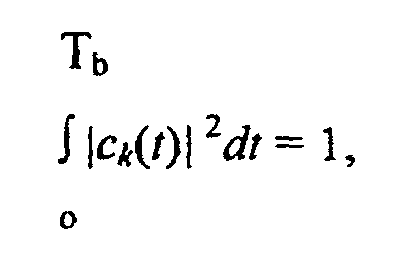
- the spreading sequences are designed in such a way that (where c k ( t ) represents the user's code). This is reflected in the different power spectrum density (PSD) of different services.
- PSD power spectrum density
- PIC parallel interference cancellation
- a method for reducing interference between users of a carrier signal in which there are users with a high bit rate and users with a lower bit rate characterised in that the higher bit rate users have their interference reduced by hybrid interference cancellation (HIC) and then the interference between the other lower bit rate users reduced by HIC and in that a different HIC configuration is used for the higher bit rate users and the lower bit rate users.
- HIC hybrid interference cancellation
- the HIC configuration for the high bit rate users is different from the HIC configuration of the low bit rate users and the method of the invention takes advantage of this flexibility; this is not possible with PIC and SIC.
- HIC The principal idea behind HIC is that instead of cancelling all K users either in series or parallel there is cancellation partially in series and partially in parallel.
- HIC is described in D. Koulakiotis, A.H. Aghvami, "Evaluation of a DS/CDMA Multiuser Receiver Employing a Hybrid form of Interference Cancellation in Rayleigh Fading Channels", IEEE, Communication Letters, Vol. 2, No 3, pp.61-63, March 98.
- D. Koulakiotis, A.H. Aghvami "Effect of Imperfect Amplitude Estimation on the Performance of Hybrid Interference Cancellation", ICC'98, Atlanta, USA, pp.1571-1575, June 1998.
- D. Koulakiotis, A.H. Aghvami "Hybrid Interference Cancellation, a Multiuser Detection Scheme for W-DS/CDMA Systems", ICT'98, Porto Carras, Greece, Vol II, pp.52-56
- K-P-S where K is the total number of users in the category and the number cancelled at the PIC and SIC stage is expressed by P and S respectively.
- the signals selected for partial PIC are preferably the "most reliable users" (users whose interferences can be regenerated most correctly) and this ensures that most of the interference will be cancelled between the P users and the partial P cancellation is substantially accurate.
- the number of users per loop at the buffer with the R x signal will be 10,8,6,4,2, while at the partial PIC stage there will be 5,5,5,4,2 users respectively, at the end of which 2 users will be cancelled per loop.
- FIG. 1 A block diagram of an HIC system is shown in fig. 1 and such a system is applied to the higher bit rate users and then applied to the lower bit rate users.
- the advantages of this hybrid interference cancellation (HIC) system over PIC and SIC is that the system will have better performance because interference cancellation takes place at two places (1. partial PIC and 2. cancellation at the end of the loop from the received compound signal).
- the selection, at 1, of the "most reliable users” ensures that most of the interference will be cancelled among the P users, the cancellation of more than one user at the time ensures that the total delay is not high, unlike SIC and, in addition, at high bit rates the limitation due to delay is partially alleviated.
- the repetitive partial PIC requires fewer computations than the equivalent one stage PIC and the K-P-S configuration is flexible so that it enables there to be a trade off between complexity and BER performance.
- the regenerated signals can be cancelled from the received signals at the baseband or the cross correlations between the cancelled and the remaining users can be cancelled from matched filter outputs. Fewer operations are required in the latter case, reducing complexity as the former requires re-processing through matched filters. However cancelling the interference at the baseband improves the detection of users autocorrelation peaks thus improving delay estimation.
- HIC HIC ⁇ ⁇ ⁇ ⁇ ⁇ ⁇ ⁇ ⁇ ⁇ ⁇ ⁇ ⁇ ⁇ ⁇ ⁇ ⁇ ⁇ ⁇ ⁇ ⁇ ⁇ ⁇ ⁇ ⁇ ⁇ ⁇ ⁇ ⁇ ⁇ ⁇ ⁇ ⁇ ⁇ ⁇ ⁇ ⁇ ⁇ ⁇ ⁇ ⁇ ⁇ ⁇ ⁇ ⁇ ⁇ ⁇ ⁇ ⁇ ⁇ ⁇ ⁇ ⁇ ⁇ ⁇ ⁇ ⁇ ⁇ ⁇ ⁇ ⁇ ⁇ ⁇ ⁇ ⁇ ⁇ ⁇ ⁇ ⁇ ⁇ ⁇ ⁇ ⁇ ⁇ ⁇ ⁇ ⁇ ⁇ ⁇ ⁇ ⁇ ⁇ ⁇ ⁇ ⁇ ⁇ ⁇ ⁇ ⁇ ⁇ ⁇ ⁇ ⁇ ⁇ ⁇ ⁇ ⁇ ⁇ ⁇ ⁇ ⁇ ⁇ ⁇ ⁇ ⁇ ⁇ ⁇ ⁇ ⁇ ⁇ ⁇ ⁇ ⁇ ⁇ ⁇ ⁇ ⁇ ⁇ ⁇ ⁇ ⁇ ⁇ ⁇ ⁇ ⁇
- the BER performance of five configurations of HIC (10-5-5, 10-5-2, 10-4-4, 10-4-3 and 10-4-2) is assessed, along with PIC and SIC and a version of SIC with only six out of ten cancellations, in order to compare all the schemes based on similar delay requirements. All the results are related to the upper bound (UB) i.e. the matched filter receiver and also the lower bound (LB) i.e. the single user case.
- UB upper bound
- LB lower bound
- Figs. 2, 3 and 4 depict the simulation results for processing gains (PG) of 19, 25 and 47 respectively, in fig. 5 there are 10 users and PG of 49. It is clear that HIC performs much better than either SIC and PIC and for HIC 10-5-2 is the best. In general the more users at the P stage and the fewer at the S stage the better the result so 10-10-1 (K-K-1) should give the best performance however such as system is not feasible in a single service W-CDMA environment due to its increased complexity. In fig. 4 it can be seen that although PIC and SIC are above the lower bound the HIC configurations, especially the 10-4-2 is very close to it and, in particular for low Eb/No the two performances almost match.
- each user is regenerated/cancelled once whilst, for PIC, each user has to regenerate its signal and cancel it from the remaining K-1 users.
- the process of regeneration and cancellation of a user is more complex than the one of ranking.
- SIC requires the smallest number and PIC the largest number, among HIC 10-5-2 offers the best BER at the expense of increased complexity, however 10-4-3 and 10-4-4 require half or less but give very good BER performance.
- a second measure of complexity is the number of user rankings which have to be done. For PIC user rankings are not required and the results for 10 users are shown in Table 2.
- SIC requires the largest number and HIC 10-4-4 and 10-4-3 require numbers which are nearly half the maximum required by SIC.
- Overall PIC is the most complex scheme and HIC 10-4-4 and 10-4-3 provide two affordable complex solutions.
- W-CDMA will be expected to use cascade IC schemes so two or more stages will be used and the computations will be increased by the number of stages.
- the cancellation of interference amongst the high bit rate users is carried out using HIC and then cancellation of the interference amongst the low bit rate users is carried out using HIC.
- cancellation of the signals (interference) of the high bit rate users should be as complete as possible, otherwise there is the risk that the residual high bit rate interference will degrade the performance of the interference cancellation process during cancellation among the low bit rate users.
- cancellation of the signals of the high bit rate users can be carried out using a complex HIC configuration e.g. H-H-1, or a less complex configuration but still having high performance capabilities.
- interference from the low bit rate users can be considered as noise.
- the HIC configuration chosen to reduce the interference among the low bit rate users can be selected as specified above.
- the method can be applied by firstly using an HIC with the best BER among HIC configurations as referred to above e.g. H-H-1, to cancel the signals (interference) of the high bit rate users and then applying HIC e.g. L-P-S to cancel the interference among the low bit rate users.
- HIC with the best BER among HIC configurations as referred to above e.g. H-H-1, to cancel the signals (interference) of the high bit rate users and then applying HIC e.g. L-P-S to cancel the interference among the low bit rate users.
- the invention is exemplified in fig. 7 in which there are 9 low bit rate users and 1 high bit rate user. Simulations are performed for both cases of 4-arm and 6-arm RAKE receiver
Landscapes
- Engineering & Computer Science (AREA)
- Computer Networks & Wireless Communication (AREA)
- Signal Processing (AREA)
- Noise Elimination (AREA)
- Mobile Radio Communication Systems (AREA)
- Cable Transmission Systems, Equalization Of Radio And Reduction Of Echo (AREA)
- Detection And Prevention Of Errors In Transmission (AREA)
- Maintenance And Management Of Digital Transmission (AREA)
Abstract
Description
- The present invention relates to a method for reducing interference in Wireless Telecommunications Systems and in particular it relates to a method for reducing interference which can be applied to a multi-rate (multi-service) wideband code division multiple access (W-CDMA) which is used in personal mobile communications.
- Interference cancellation is used to reduce the interference between two or more signals.
- W-CDMA will be able to support more than one service in a single carrier e.g. a 5 MHz carrier and this can cause interference among users of the same service and between users of one service and users of the other services.
- Interference can occur when there are users with a high bit rate and a low bit rate using the same bandwidth. In these circumstances there will be interference amongst users of the same service (for both high and low bit rate users) and also considerable interference by the high bit rate users on the low bit rate users. This can occur when there are video signals which have a high bit rate and voice signals which have a lower bit rate using the same bandwidth.
- Normally the spreading sequences (codes) are designed in such a way that(where ck (t) represents the user's code). This is reflected in the different power spectrum density (PSD) of different services. Using a fixed bandwidth, the lower the processing gain (PG), i.e. higher bit rate, the more powerful (higher PSD) interferer a user is to other, lower bit rate users (higher PG) so that users of lower bit rate services will experience severe interference from users of higher bit rate services.
- It is known to use a successive interference cancellation (SIC) scheme to reduce interference between users as described in "Analysis of a Successive Interference Scheme in a DS/CDMA System" IEEE Journal on Selected Areas in Communications, Vol 12, No. 5 pp 796-807 June 1994 by P. Patel, J Holtzman, however this technique can involve a long delay for the detection/ cancellation of all user and, assuming a one bit delay is required for one loop, then the total delay for the detection/ cancellation of K users is K bits. The scheme is such that the first users detected experience either no, or a small reduction in MUI as, for example, the first user detected experiences no interference reduction and the second user only that due to the cancellation of the first user etc. so only the last user will experience complete MAI cancellation.
- However, due to the unequal amount of interference seen by each user, users cancelled initially have different signal to noise ratio (S/N ratio) and thus bit error rate (BER), than users cancelled later in the interference cancellation process. This involves the need for some sort of power control that will ensure that all users have the same S/N ratio and thus BER.
- Another interference cancellation scheme is parallel interference cancellation (PIC), however this involves high complexity as each user regenerates/cancels a replica of its signal K-1 times so that the total number of regenerations/cancellations is K(K-1) and the regeneration process of all interferences includes users that are weak and thus unreliable. In order to avoid this conventional PIC requires either fast power control (in order to compensate for the near/far effect) and/or multistage.
- This is described in "Improved Parallel Interference Cancellation for CDMA" by D. Divsalar et al, IEE Trans. On Comms. Vol. 46 No2 pp 258-268 February 1998.
- Another interference cancellation scheme using parallel interference cancellation (PIC), is described in a paper by Tero Ojanpera, Ramjee Prasad, and Hiroshi Harada "Qualitative Comparison of Some Multiuser Detector Algorithms for Widwband CDMA" IEEE Vehicular Technology Conference Vol. 1 pages 46-50, which discloses the use of wideband weighted parallel interference cancellation (MW-PIC) which has the disadvantages of PIC above.
- We have now devised an interference scheme which reduces these problems.
- According to the invention there is provided a method for reducing interference between users of a carrier signal in which there are users with a high bit rate and users with a lower bit rate characterised in that the higher bit rate users have their interference reduced by hybrid interference cancellation (HIC) and then the interference between the other lower bit rate users reduced by HIC and in that a different HIC configuration is used for the higher bit rate users and the lower bit rate users.
- The HIC configuration for the high bit rate users is different from the HIC configuration of the low bit rate users and the method of the invention takes advantage of this flexibility; this is not possible with PIC and SIC.
- The principal idea behind HIC is that instead of cancelling all K users either in series or parallel there is cancellation partially in series and partially in parallel. HIC is described in D. Koulakiotis, A.H. Aghvami, "Evaluation of a DS/CDMA Multiuser Receiver Employing a Hybrid form of Interference Cancellation in Rayleigh Fading Channels", IEEE, Communication Letters, Vol. 2,
No 3, pp.61-63, March 98.
D. Koulakiotis, A.H. Aghvami, "Effect of Imperfect Amplitude Estimation on the Performance of Hybrid Interference Cancellation", ICC'98, Atlanta, USA, pp.1571-1575, June 1998.
D. Koulakiotis, A.H. Aghvami, "Hybrid Interference Cancellation, a Multiuser Detection Scheme for W-DS/CDMA Systems", ICT'98, Porto Carras, Greece, Vol II, pp.52-56, June 1998. - Taking the higher bit rate users and the lower bit rate users separately this can be expressed as K-P-S where K is the total number of users in the category and the number cancelled at the PIC and SIC stage is expressed by P and S respectively.
- The signals selected for partial PIC are preferably the "most reliable users" (users whose interferences can be regenerated most correctly) and this ensures that most of the interference will be cancelled between the P users and the partial P cancellation is substantially accurate.
- Thus, for a 10-5-2 configuration the number of users per loop at the buffer with the Rx signal will be 10,8,6,4,2, while at the partial PIC stage there will be 5,5,5,4,2 users respectively, at the end of which 2 users will be cancelled per loop.
- According to the UMTS Specifications (concept Group Alpha-Wideband Direct - Sequence CDMA, Part 1: System Description, Performance Evaluation, ETSI SMG2#23, Bad Salzdetfurth, Germany, October 1997) the number of higher bit rate users will be small.
- A block diagram of an HIC system is shown in fig. 1 and such a system is applied to the higher bit rate users and then applied to the lower bit rate users.
- The advantages of this hybrid interference cancellation (HIC) system over PIC and SIC is that the system will have better performance because interference cancellation takes place at two places (1. partial PIC and 2. cancellation at the end of the loop from the received compound signal). The selection, at 1, of the "most reliable users" ensures that most of the interference will be cancelled among the P users, the cancellation of more than one user at the time ensures that the total delay is not high, unlike SIC and, in addition, at high bit rates the limitation due to delay is partially alleviated. The repetitive partial PIC requires fewer computations than the equivalent one stage PIC and the K-P-S configuration is flexible so that it enables there to be a trade off between complexity and BER performance.
- By carrying out HIC on the higher bit rate users followed by carrying out HIC on the lower bit rate users interference between the higher bit rate users and lower bit rate users and amongst the different bit rate users is reduced.
- The position where the interference cancellation takes place is optional, the regenerated signals can be cancelled from the received signals at the baseband or the cross correlations between the cancelled and the remaining users can be cancelled from matched filter outputs. Fewer operations are required in the latter case, reducing complexity as the former requires re-processing through matched filters. However cancelling the interference at the baseband improves the detection of users autocorrelation peaks thus improving delay estimation.
- The use of HIC is exemplified with reference to the comparison with various configurations and PIC and SIC and the results shown in figs 2 to 5.
- In the figures, the BER performance of five configurations of HIC (10-5-5, 10-5-2, 10-4-4, 10-4-3 and 10-4-2) is assessed, along with PIC and SIC and a version of SIC with only six out of ten cancellations, in order to compare all the schemes based on similar delay requirements. All the results are related to the upper bound (UB) i.e. the matched filter receiver and also the lower bound (LB) i.e. the single user case.
- Figs. 2, 3 and 4 depict the simulation results for processing gains (PG) of 19, 25 and 47 respectively, in fig. 5 there are 10 users and PG of 49. It is clear that HIC performs much better than either SIC and PIC and for HIC 10-5-2 is the best. In general the more users at the P stage and the fewer at the S stage the better the result so 10-10-1 (K-K-1) should give the best performance however such as system is not feasible in a single service W-CDMA environment due to its increased complexity. In fig. 4 it can be seen that although PIC and SIC are above the lower bound the HIC configurations, especially the 10-4-2 is very close to it and, in particular for low Eb/No the two performances almost match.
- In the case of complexity in SIC, each user is regenerated/cancelled once whilst, for PIC, each user has to regenerate its signal and cancel it from the remaining K-1 users. The process of regeneration and cancellation of a user is more complex than the one of ranking.
- It can be shown that for K equal to 10 users the results in table 1 are obtained.
SIC 10-4-4 10-4-3 10-5-5 10-4-2 10-5-2 PIC 9 34 45 45 58 82 90 - As can be seen, SIC requires the smallest number and PIC the largest number, among HIC 10-5-2 offers the best BER at the expense of increased complexity, however 10-4-3 and 10-4-4 require half or less but give very good BER performance.
- A second measure of complexity is the number of user rankings which have to be done. For PIC user rankings are not required and the results for 10 users are shown in Table 2.
PIC 10-4-4 10-4-3 10-5-5 10-4-2 10-5-2 SIC - 25 28 35 48 51 54 - As can be seen SIC requires the largest number and HIC 10-4-4 and 10-4-3 require numbers which are nearly half the maximum required by SIC. Overall PIC is the most complex scheme and HIC 10-4-4 and 10-4-3 provide two affordable complex solutions.
- In practice W-CDMA will be expected to use cascade IC schemes so two or more stages will be used and the computations will be increased by the number of stages.
- Where there are users in a bandwidth which can be divided between two services a high bit rate (with H users) and a low bit rate (with L users) the number of users K = H + L.
- The cancellation of interference amongst the high bit rate users is carried out using HIC and then cancellation of the interference amongst the low bit rate users is carried out using HIC.
- The cancellation of the signals (interference) of the high bit rate users should be as complete as possible, otherwise there is the risk that the residual high bit rate interference will degrade the performance of the interference cancellation process during cancellation among the low bit rate users. As there will be a low number of high bit rate users, cancellation of the signals of the high bit rate users can be carried out using a complex HIC configuration e.g. H-H-1, or a less complex configuration but still having high performance capabilities. During this stage of detection/cancellation of high bit rate users, interference from the low bit rate users can be considered as noise.
- The HIC configuration chosen to reduce the interference among the low bit rate users can be selected as specified above.
- In the case where the total number of users K = H + L, where H is the number of high bit rate users and L is the number of low bit rate users, then the method can be applied by firstly using an HIC with the best BER among HIC configurations as referred to above e.g. H-H-1, to cancel the signals (interference) of the high bit rate users and then applying HIC e.g. L-P-S to cancel the interference among the low bit rate users.
- This is illustrated in the block diagram shown as fig. 6.
- The invention is exemplified in fig. 7 in which there are 9 low bit rate users and 1 high bit rate user. Simulations are performed for both cases of 4-arm and 6-arm RAKE receiver
- (1) in the case when all users (high + low bit rate) use a conventional matched filter detector.
- (2) in the case where a matched filter detector is used for the low bit rate users but
interference cancellation is applied on the high bit rate user.
Results are repeated for the case of 4-arm RAKE receiver - (3) in the case when all users use the conventional matched filter detector
- (4) in the case where a matched filter detector is used for the low bit rate users but interference cancellation is applied on the higher bit rate user.
-
- This illustrates the advantage of cancelling the high bit rate users that cause severe interference to the low bit rate users. Even when there is only one high bit rate user there is a substantial improvement in the average BER when this is cancelled. Interference cancellation is not applied amongst the low bit rate users in this example.
Claims (7)
- A method for reducing interference between users of a carrier signal in which there are users with a high bit rate and users with a lower bit rate characterised in that the higher bit rate users have their interference reduced by hybrid interference cancellation (HIC) and then the interference between the other lower bit rate users is reduced by HIC and in that a different HIC configuration is used for the higher bit rate users and the lower bit rate users.
- A method as claimed in claim 1 characterised in that the signals selected for partial PIC (Parallel Interference Cancellation) are the signals corresponding to the users whose interferences can be regenerated most correctly.
- A method as claimed in claim 1 or 2 characterised in that the signals regenerated during interference cancellation are cancelled from signals received at the baseband.
- A method as claimed in claim 1 or 2 characterised in that cross correlations between the signals which have been cancelled and the remaining users are cancelled from matched filter outputs.
- A method as claimed in any one of the preceding claims characterised in that the cancellation of the signals of the high bit rate users is carried out using a complex HIC configuration so that the cancellation is substantially complete.
- A method as claimed in any one of the preceding claims characterised in tthat thetotal number users is K = H + L, where H is the number of high bit rate users and L is the number of low bit rate users and (i) using an HIC with the best BER (Bit Error Rate) among HIC configurations to cancel the signals of the high bit rate users and then (ii) applying HIC to cancel the interference among the low bit rate users.
- A method as claimed in claim 6 characterised in that characterised in that the signals of the high bit rate users are cancelled using a H-H-1 configuration and then applying L-P-S, where L is the total remaining number of users, P are the users out of L that are processed in parallel, and S are the users cancelled using successive interference cancellation (sic), to cancel the signals among the low bit rate users.
Applications Claiming Priority (3)
| Application Number | Priority Date | Filing Date | Title |
|---|---|---|---|
| GB9903465 | 1999-02-17 | ||
| GBGB9903465.4A GB9903465D0 (en) | 1999-02-17 | 1999-02-17 | Adaptive hybrid interfernce cancellation,multi-user detection for multi-rate system |
| PCT/GB2000/000556 WO2000049724A1 (en) | 1999-02-17 | 2000-02-17 | Adaptive hybrid interference cancellation for multi rate users |
Publications (2)
| Publication Number | Publication Date |
|---|---|
| EP1153485A1 EP1153485A1 (en) | 2001-11-14 |
| EP1153485B1 true EP1153485B1 (en) | 2003-08-20 |
Family
ID=10847838
Family Applications (1)
| Application Number | Title | Priority Date | Filing Date |
|---|---|---|---|
| EP00903867A Expired - Lifetime EP1153485B1 (en) | 1999-02-17 | 2000-02-17 | Adaptive hybrid interference cancellation for multi rate users |
Country Status (7)
| Country | Link |
|---|---|
| EP (1) | EP1153485B1 (en) |
| JP (1) | JP2002537711A (en) |
| AT (1) | ATE247879T1 (en) |
| AU (1) | AU2562000A (en) |
| DE (1) | DE60004639T2 (en) |
| GB (1) | GB9903465D0 (en) |
| WO (1) | WO2000049724A1 (en) |
Families Citing this family (11)
| Publication number | Priority date | Publication date | Assignee | Title |
|---|---|---|---|---|
| US6959065B2 (en) * | 2001-04-20 | 2005-10-25 | Telefonaktiebolaget Lm Ericsson (Publ) | Reduction of linear interference canceling scheme |
| US7190749B2 (en) | 2001-06-06 | 2007-03-13 | Qualcomm Incorporated | Method and apparatus for canceling pilot interference in a wireless communication system |
| US8611311B2 (en) | 2001-06-06 | 2013-12-17 | Qualcomm Incorporated | Method and apparatus for canceling pilot interference in a wireless communication system |
| US7263118B2 (en) | 2002-04-26 | 2007-08-28 | Electronics And Telecommunications Research Institute | Interference canceling device and method in mobile communication system |
| US8099123B2 (en) | 2004-12-23 | 2012-01-17 | Qualcomm Incorporated | Adaptation of transmit subchannel gains in a system with interference cancellation |
| US8406695B2 (en) | 2004-12-23 | 2013-03-26 | Qualcomm Incorporated | Joint interference cancellation of pilot, overhead and traffic channels |
| US8442441B2 (en) | 2004-12-23 | 2013-05-14 | Qualcomm Incorporated | Traffic interference cancellation |
| US8422955B2 (en) * | 2004-12-23 | 2013-04-16 | Qualcomm Incorporated | Channel estimation for interference cancellation |
| US8472877B2 (en) | 2005-10-24 | 2013-06-25 | Qualcomm Incorporated | Iterative interference cancellation system and method |
| US8385388B2 (en) | 2005-12-06 | 2013-02-26 | Qualcomm Incorporated | Method and system for signal reconstruction from spatially and temporally correlated received samples |
| WO2013025134A1 (en) * | 2011-08-17 | 2013-02-21 | Telefonaktiebolaget L M Ericsson (Publ) | A receiver unit and method for suppressing interference in a multipath radio signal |
-
1999
- 1999-02-17 GB GBGB9903465.4A patent/GB9903465D0/en not_active Ceased
-
2000
- 2000-02-17 WO PCT/GB2000/000556 patent/WO2000049724A1/en not_active Ceased
- 2000-02-17 JP JP2000600359A patent/JP2002537711A/en not_active Withdrawn
- 2000-02-17 EP EP00903867A patent/EP1153485B1/en not_active Expired - Lifetime
- 2000-02-17 AT AT00903867T patent/ATE247879T1/en not_active IP Right Cessation
- 2000-02-17 DE DE60004639T patent/DE60004639T2/en not_active Expired - Lifetime
- 2000-02-17 AU AU25620/00A patent/AU2562000A/en not_active Abandoned
Also Published As
| Publication number | Publication date |
|---|---|
| GB9903465D0 (en) | 1999-04-07 |
| EP1153485A1 (en) | 2001-11-14 |
| DE60004639D1 (en) | 2003-09-25 |
| DE60004639T2 (en) | 2004-03-11 |
| ATE247879T1 (en) | 2003-09-15 |
| WO2000049724A1 (en) | 2000-08-24 |
| AU2562000A (en) | 2000-09-04 |
| JP2002537711A (en) | 2002-11-05 |
Similar Documents
| Publication | Publication Date | Title |
|---|---|---|
| JP4559002B2 (en) | Apparatus and method for selecting correlation timing in rake receiver | |
| EP1344327B1 (en) | Apparatus and methods for finger delay selection in rake receivers | |
| US6473415B1 (en) | Interference canceling method and apparatus of a multi-mode subtraction type in asynchronous multipath channels of code division multiple access system | |
| US6501788B1 (en) | Apparatus and methods for intereference cancellation in spread spectrum communications systems | |
| US6259688B1 (en) | Spread spectrum CDMA subtractive interference canceler system | |
| CN1087885C (en) | demodulator for demodulation spread spectrum signal and its method | |
| US20020109631A1 (en) | Method of interference cancellation based on smart antenna | |
| CN1077750C (en) | Data transmission method using CDMA method, transmitter and receiver | |
| JP2003513484A (en) | Adaptive channel estimation in wireless communication systems | |
| JP2003503879A (en) | RAKE combination method and apparatus using weighting factors derived from knowledge of spread spectrum signal characteristics | |
| JP2003510883A (en) | Interference cancellation method and apparatus using complex interference orthogonal technology | |
| JP2003503878A (en) | Multi-stage RAKE coupling method and apparatus | |
| US6222833B1 (en) | Device and method for multiuser detection in DS-CDMA system | |
| JP4205761B2 (en) | Interference cancellation method and receiver | |
| EP1153485A1 (en) | Adaptive hybrid interference cancellation for multi rate users | |
| US7391803B2 (en) | Interference suppression in a receiver during at least one of idle state and access state operation | |
| US20040252753A1 (en) | Apparatus and method for generating and receiving traffic in a block spreading code division multiple access mobile communication system | |
| CN1145303C (en) | Methods for Interference Cancellation | |
| Koulakiotis et al. | Evaluation of a DS/CDMA multiuser receiver employing a hybrid form of interference cancellation in Rayleigh-fading channels | |
| Latva-Aho et al. | Parallel interference cancellation receiver for DS-CDMA systems in fading channels | |
| EP1164734A1 (en) | Radio base station device and radio communication method | |
| US7075972B2 (en) | Intra-cell interference cancellation in a W-CDMA communications network | |
| JP2003535549A (en) | Zero-delay interference cancellation cross-reference for related applications | |
| KR100396118B1 (en) | Method for iterative cancellation of interference-signals due to multiuser access in a code-division-multiple-access system | |
| US7756191B2 (en) | Deconvolution searcher for wireless communication system |
Legal Events
| Date | Code | Title | Description |
|---|---|---|---|
| PUAI | Public reference made under article 153(3) epc to a published international application that has entered the european phase |
Free format text: ORIGINAL CODE: 0009012 |
|
| 17P | Request for examination filed |
Effective date: 20010807 |
|
| AK | Designated contracting states |
Kind code of ref document: A1 Designated state(s): AT BE CH CY DE DK ES FI FR GB GR IE IT LI LU MC NL PT SE |
|
| AX | Request for extension of the european patent |
Free format text: AL;LT;LV;MK;RO;SI |
|
| 17Q | First examination report despatched |
Effective date: 20020111 |
|
| GRAH | Despatch of communication of intention to grant a patent |
Free format text: ORIGINAL CODE: EPIDOS IGRA |
|
| GRAS | Grant fee paid |
Free format text: ORIGINAL CODE: EPIDOSNIGR3 |
|
| GRAA | (expected) grant |
Free format text: ORIGINAL CODE: 0009210 |
|
| RAP1 | Party data changed (applicant data changed or rights of an application transferred) |
Owner name: KING'S COLLEGE LONDON |
|
| AK | Designated contracting states |
Designated state(s): AT BE CH CY DE DK ES FI FR GB GR IE IT LI LU MC NL PT SE |
|
| PG25 | Lapsed in a contracting state [announced via postgrant information from national office to epo] |
Ref country code: IT Free format text: LAPSE BECAUSE OF FAILURE TO SUBMIT A TRANSLATION OF THE DESCRIPTION OR TO PAY THE FEE WITHIN THE PRESCRIBED TIME-LIMIT;WARNING: LAPSES OF ITALIAN PATENTS WITH EFFECTIVE DATE BEFORE 2007 MAY HAVE OCCURRED AT ANY TIME BEFORE 2007. THE CORRECT EFFECTIVE DATE MAY BE DIFFERENT FROM THE ONE RECORDED. Effective date: 20030820 Ref country code: NL Free format text: LAPSE BECAUSE OF FAILURE TO SUBMIT A TRANSLATION OF THE DESCRIPTION OR TO PAY THE FEE WITHIN THE PRESCRIBED TIME-LIMIT Effective date: 20030820 Ref country code: CY Free format text: LAPSE BECAUSE OF FAILURE TO SUBMIT A TRANSLATION OF THE DESCRIPTION OR TO PAY THE FEE WITHIN THE PRESCRIBED TIME-LIMIT Effective date: 20030820 Ref country code: AT Free format text: LAPSE BECAUSE OF FAILURE TO SUBMIT A TRANSLATION OF THE DESCRIPTION OR TO PAY THE FEE WITHIN THE PRESCRIBED TIME-LIMIT Effective date: 20030820 Ref country code: BE Free format text: LAPSE BECAUSE OF FAILURE TO SUBMIT A TRANSLATION OF THE DESCRIPTION OR TO PAY THE FEE WITHIN THE PRESCRIBED TIME-LIMIT Effective date: 20030820 Ref country code: CH Free format text: LAPSE BECAUSE OF FAILURE TO SUBMIT A TRANSLATION OF THE DESCRIPTION OR TO PAY THE FEE WITHIN THE PRESCRIBED TIME-LIMIT Effective date: 20030820 Ref country code: LI Free format text: LAPSE BECAUSE OF FAILURE TO SUBMIT A TRANSLATION OF THE DESCRIPTION OR TO PAY THE FEE WITHIN THE PRESCRIBED TIME-LIMIT Effective date: 20030820 Ref country code: FI Free format text: LAPSE BECAUSE OF FAILURE TO SUBMIT A TRANSLATION OF THE DESCRIPTION OR TO PAY THE FEE WITHIN THE PRESCRIBED TIME-LIMIT Effective date: 20030820 |
|
| REG | Reference to a national code |
Ref country code: GB Ref legal event code: FG4D |
|
| REG | Reference to a national code |
Ref country code: CH Ref legal event code: EP |
|
| REG | Reference to a national code |
Ref country code: IE Ref legal event code: FG4D |
|
| REF | Corresponds to: |
Ref document number: 60004639 Country of ref document: DE Date of ref document: 20030925 Kind code of ref document: P |
|
| PG25 | Lapsed in a contracting state [announced via postgrant information from national office to epo] |
Ref country code: SE Free format text: LAPSE BECAUSE OF FAILURE TO SUBMIT A TRANSLATION OF THE DESCRIPTION OR TO PAY THE FEE WITHIN THE PRESCRIBED TIME-LIMIT Effective date: 20031120 Ref country code: GR Free format text: LAPSE BECAUSE OF FAILURE TO SUBMIT A TRANSLATION OF THE DESCRIPTION OR TO PAY THE FEE WITHIN THE PRESCRIBED TIME-LIMIT Effective date: 20031120 Ref country code: DK Free format text: LAPSE BECAUSE OF FAILURE TO SUBMIT A TRANSLATION OF THE DESCRIPTION OR TO PAY THE FEE WITHIN THE PRESCRIBED TIME-LIMIT Effective date: 20031120 |
|
| PG25 | Lapsed in a contracting state [announced via postgrant information from national office to epo] |
Ref country code: ES Free format text: LAPSE BECAUSE OF FAILURE TO SUBMIT A TRANSLATION OF THE DESCRIPTION OR TO PAY THE FEE WITHIN THE PRESCRIBED TIME-LIMIT Effective date: 20031201 |
|
| PG25 | Lapsed in a contracting state [announced via postgrant information from national office to epo] |
Ref country code: PT Free format text: LAPSE BECAUSE OF FAILURE TO SUBMIT A TRANSLATION OF THE DESCRIPTION OR TO PAY THE FEE WITHIN THE PRESCRIBED TIME-LIMIT Effective date: 20040120 |
|
| LTIE | Lt: invalidation of european patent or patent extension |
Effective date: 20030820 |
|
| NLV1 | Nl: lapsed or annulled due to failure to fulfill the requirements of art. 29p and 29m of the patents act | ||
| PG25 | Lapsed in a contracting state [announced via postgrant information from national office to epo] |
Ref country code: LU Free format text: LAPSE BECAUSE OF NON-PAYMENT OF DUE FEES Effective date: 20040217 Ref country code: IE Free format text: LAPSE BECAUSE OF NON-PAYMENT OF DUE FEES Effective date: 20040217 |
|
| REG | Reference to a national code |
Ref country code: CH Ref legal event code: PL |
|
| PG25 | Lapsed in a contracting state [announced via postgrant information from national office to epo] |
Ref country code: MC Free format text: LAPSE BECAUSE OF NON-PAYMENT OF DUE FEES Effective date: 20040228 |
|
| ET | Fr: translation filed | ||
| PLBE | No opposition filed within time limit |
Free format text: ORIGINAL CODE: 0009261 |
|
| STAA | Information on the status of an ep patent application or granted ep patent |
Free format text: STATUS: NO OPPOSITION FILED WITHIN TIME LIMIT |
|
| 26N | No opposition filed |
Effective date: 20040524 |
|
| REG | Reference to a national code |
Ref country code: IE Ref legal event code: MM4A |
|
| PGFP | Annual fee paid to national office [announced via postgrant information from national office to epo] |
Ref country code: FR Payment date: 20100210 Year of fee payment: 11 |
|
| PGFP | Annual fee paid to national office [announced via postgrant information from national office to epo] |
Ref country code: DE Payment date: 20100127 Year of fee payment: 11 Ref country code: GB Payment date: 20100121 Year of fee payment: 11 |
|
| GBPC | Gb: european patent ceased through non-payment of renewal fee |
Effective date: 20110217 |
|
| REG | Reference to a national code |
Ref country code: FR Ref legal event code: ST Effective date: 20111102 |
|
| REG | Reference to a national code |
Ref country code: DE Ref legal event code: R119 Ref document number: 60004639 Country of ref document: DE Effective date: 20110901 |
|
| PG25 | Lapsed in a contracting state [announced via postgrant information from national office to epo] |
Ref country code: FR Free format text: LAPSE BECAUSE OF NON-PAYMENT OF DUE FEES Effective date: 20110228 |
|
| PG25 | Lapsed in a contracting state [announced via postgrant information from national office to epo] |
Ref country code: GB Free format text: LAPSE BECAUSE OF NON-PAYMENT OF DUE FEES Effective date: 20110217 |
|
| PG25 | Lapsed in a contracting state [announced via postgrant information from national office to epo] |
Ref country code: DE Free format text: LAPSE BECAUSE OF NON-PAYMENT OF DUE FEES Effective date: 20110901 |