EP1152513A2 - Power generation system and fuel supply method - Google Patents
Power generation system and fuel supply method Download PDFInfo
- Publication number
- EP1152513A2 EP1152513A2 EP00309199A EP00309199A EP1152513A2 EP 1152513 A2 EP1152513 A2 EP 1152513A2 EP 00309199 A EP00309199 A EP 00309199A EP 00309199 A EP00309199 A EP 00309199A EP 1152513 A2 EP1152513 A2 EP 1152513A2
- Authority
- EP
- European Patent Office
- Prior art keywords
- power generation
- electric power
- fuel
- isolated
- isolated area
- Prior art date
- Legal status (The legal status is an assumption and is not a legal conclusion. Google has not performed a legal analysis and makes no representation as to the accuracy of the status listed.)
- Withdrawn
Links
Images

Classifications
-
- H—ELECTRICITY
- H02—GENERATION; CONVERSION OR DISTRIBUTION OF ELECTRIC POWER
- H02J—ELECTRIC POWER NETWORKS; CIRCUIT ARRANGEMENTS OR SYSTEMS FOR SUPPLYING OR DISTRIBUTING ELECTRIC POWER; SYSTEMS FOR STORING ELECTRIC ENERGY
- H02J3/00—Circuit arrangements for AC mains or AC distribution networks
-
- H—ELECTRICITY
- H02—GENERATION; CONVERSION OR DISTRIBUTION OF ELECTRIC POWER
- H02J—ELECTRIC POWER NETWORKS; CIRCUIT ARRANGEMENTS OR SYSTEMS FOR SUPPLYING OR DISTRIBUTING ELECTRIC POWER; SYSTEMS FOR STORING ELECTRIC ENERGY
- H02J3/00—Circuit arrangements for AC mains or AC distribution networks
- H02J3/38—Arrangements for feeding a single network from two or more generators or sources in parallel; Arrangements for feeding already energised networks from additional generators or sources in parallel
- H02J3/46—Controlling the sharing of generated power between the generators, sources or networks
-
- H—ELECTRICITY
- H02—GENERATION; CONVERSION OR DISTRIBUTION OF ELECTRIC POWER
- H02J—ELECTRIC POWER NETWORKS; CIRCUIT ARRANGEMENTS OR SYSTEMS FOR SUPPLYING OR DISTRIBUTING ELECTRIC POWER; SYSTEMS FOR STORING ELECTRIC ENERGY
- H02J2101/00—Supply or distribution of decentralised, dispersed or local electric power generation
- H02J2101/10—Dispersed power generation using fossil fuels, e.g. diesel generators
-
- H—ELECTRICITY
- H02—GENERATION; CONVERSION OR DISTRIBUTION OF ELECTRIC POWER
- H02J—ELECTRIC POWER NETWORKS; CIRCUIT ARRANGEMENTS OR SYSTEMS FOR SUPPLYING OR DISTRIBUTING ELECTRIC POWER; SYSTEMS FOR STORING ELECTRIC ENERGY
- H02J2101/00—Supply or distribution of decentralised, dispersed or local electric power generation
- H02J2101/20—Dispersed power generation using renewable energy sources
-
- H—ELECTRICITY
- H02—GENERATION; CONVERSION OR DISTRIBUTION OF ELECTRIC POWER
- H02J—ELECTRIC POWER NETWORKS; CIRCUIT ARRANGEMENTS OR SYSTEMS FOR SUPPLYING OR DISTRIBUTING ELECTRIC POWER; SYSTEMS FOR STORING ELECTRIC ENERGY
- H02J2101/00—Supply or distribution of decentralised, dispersed or local electric power generation
- H02J2101/20—Dispersed power generation using renewable energy sources
- H02J2101/22—Solar energy
- H02J2101/24—Photovoltaics
-
- H—ELECTRICITY
- H02—GENERATION; CONVERSION OR DISTRIBUTION OF ELECTRIC POWER
- H02J—ELECTRIC POWER NETWORKS; CIRCUIT ARRANGEMENTS OR SYSTEMS FOR SUPPLYING OR DISTRIBUTING ELECTRIC POWER; SYSTEMS FOR STORING ELECTRIC ENERGY
- H02J2101/00—Supply or distribution of decentralised, dispersed or local electric power generation
- H02J2101/20—Dispersed power generation using renewable energy sources
- H02J2101/28—Wind energy
-
- H—ELECTRICITY
- H02—GENERATION; CONVERSION OR DISTRIBUTION OF ELECTRIC POWER
- H02J—ELECTRIC POWER NETWORKS; CIRCUIT ARRANGEMENTS OR SYSTEMS FOR SUPPLYING OR DISTRIBUTING ELECTRIC POWER; SYSTEMS FOR STORING ELECTRIC ENERGY
- H02J2101/00—Supply or distribution of decentralised, dispersed or local electric power generation
- H02J2101/40—Hybrid power plants, i.e. a plurality of different generation technologies being operated at one power plant
-
- H—ELECTRICITY
- H02—GENERATION; CONVERSION OR DISTRIBUTION OF ELECTRIC POWER
- H02J—ELECTRIC POWER NETWORKS; CIRCUIT ARRANGEMENTS OR SYSTEMS FOR SUPPLYING OR DISTRIBUTING ELECTRIC POWER; SYSTEMS FOR STORING ELECTRIC ENERGY
- H02J3/00—Circuit arrangements for AC mains or AC distribution networks
- H02J3/38—Arrangements for feeding a single network from two or more generators or sources in parallel; Arrangements for feeding already energised networks from additional generators or sources in parallel
- H02J3/381—Dispersed generators
-
- Y—GENERAL TAGGING OF NEW TECHNOLOGICAL DEVELOPMENTS; GENERAL TAGGING OF CROSS-SECTIONAL TECHNOLOGIES SPANNING OVER SEVERAL SECTIONS OF THE IPC; TECHNICAL SUBJECTS COVERED BY FORMER USPC CROSS-REFERENCE ART COLLECTIONS [XRACs] AND DIGESTS
- Y02—TECHNOLOGIES OR APPLICATIONS FOR MITIGATION OR ADAPTATION AGAINST CLIMATE CHANGE
- Y02E—REDUCTION OF GREENHOUSE GAS [GHG] EMISSIONS, RELATED TO ENERGY GENERATION, TRANSMISSION OR DISTRIBUTION
- Y02E10/00—Energy generation through renewable energy sources
- Y02E10/50—Photovoltaic [PV] energy
- Y02E10/56—Power conversion systems, e.g. maximum power point trackers
-
- Y—GENERAL TAGGING OF NEW TECHNOLOGICAL DEVELOPMENTS; GENERAL TAGGING OF CROSS-SECTIONAL TECHNOLOGIES SPANNING OVER SEVERAL SECTIONS OF THE IPC; TECHNICAL SUBJECTS COVERED BY FORMER USPC CROSS-REFERENCE ART COLLECTIONS [XRACs] AND DIGESTS
- Y02—TECHNOLOGIES OR APPLICATIONS FOR MITIGATION OR ADAPTATION AGAINST CLIMATE CHANGE
- Y02E—REDUCTION OF GREENHOUSE GAS [GHG] EMISSIONS, RELATED TO ENERGY GENERATION, TRANSMISSION OR DISTRIBUTION
- Y02E10/00—Energy generation through renewable energy sources
- Y02E10/70—Wind energy
- Y02E10/76—Power conversion electric or electronic aspects
Definitions
- the present invention relates to a power generation system and a fuel supply method for generating electric power at isolated areas such as an isolated island.
- a general power generation system transmits electric power generated at the large-scale thermal power plant, hydraulic power plant, atomic power plant, etc. to consumers using transmission lines.
- the transmission method using transmission lines is suitable for the area having large population or population density.
- this transmission method is not efficient for the areas which have a small population density and are isolated from these power plants, because transmission loss increases depending on the transmission distance. Therefore, this transmission method is not suitable for such areas. Consequently, many isolated areas such as isolated islands having a small population density have not been supplied electric power yet.
- a power generation system comprising an electric power generation facility which is arranged on an isolated area, generates electric power using an energy source obtainable on the isolated area, and supplies the electric power to the isolated area.
- this power generation system it is not necessary to transmit electric power generated in the outsides of the isolated area to the isolated area using transmission lines. In other words, the electric power generated in the isolated area is used in the isolated area; therefore, a transmission loss is extremely small. Thus, this power generation system is suitable for the isolated areas having a small population density.
- the "isolated area” means an area that is far away from a metropolitan area, has a small population density, and where no or an extremely small amount of electric power has supplied, such as an isolated island, mountainous area, etc.
- a second aspect of the present invention is the first power generation system, wherein the power generation system further comprises a battery device for storing the electric power generated by the electric power generation facility.
- the output of electric power varies in response to weather variations.
- the amount of electric power required by the consumer varies during a day. According to this power generation system, it is possible to store the excess electric power and expend it as the need arises.
- a third aspect of the present invention is the first power generation system, wherein the electric power generation facility comprises a plurality of electric power generation apparatuses which generate electric power using a different energy source respectively.
- the electric power generation facility using an energy source which is influenced by weather variations, such as wind force, and the electric power generation facility using an energy source which is not influenced by weather variations, such as an engine, are jointly used.
- the decrement can be compensated for by the electric power generation facility using an energy source which is not influenced by weather variations.
- the electric power generation facility using an energy source which can easily increase the output can be responded a rapid increase of the amount of electric power required by the consumer.
- Best energy source can be selected by considering the natural environment in the isolated area, economical efficiency, etc.
- the electric power generation facility using a renewable energy source and a non-fossil fuel such as a wind mill, solar cell, methanol engine, fuel cell, micro-gas turbine, micro-water turbine, etc.
- the "renewable energy source” means the natural energy which is obtainable nearly limitlessly on the isolated area, such as sunshine, wind force, water power, etc or organisms, such as plants growning on the isolated area.
- a fourth aspect of the present invention is the first power generation system, wherein the power generation system is used for a plurality of isolated areas; and a control center for controlling the electric power generation facilities, which is connected to the electric power generation facilities on the isolated areas via a communication device, is provided in at least one isolated area.
- one control center controls the electric power generation facilities in a plurality of the isolated areas. Therefore, it is possible to decrease the number of the monitor and control persons in the electric power generation facilities. In addition, it is also possible to adjust optimally the output of the electric power generation facilities.
- Communication satellites such as a low-level orbital satellite, cable lines, etc. can be used as the communication device.
- a fifth aspect of the present invention is the fourth power generation system, wherein further comprising weather observation devices for obtaining weather observation data for the each isolated area and a control center for controlling the electric power generation facilities based on weather observation data input from the weather observation devices via the communication device.
- the control center controls the electric power generation facilities based on the weather observation data in response to weather variations. For example, when the solar cell which is influenced by weather variations and the engine which is not influenced by weather variations are jointly used as the electric power generation facility, and the output of the solar cell decreases due to weather variations, the amount of electric power required by the consumer can be obtained by increasing the output of the engine.
- a sixth aspect of the present invention is the fourth power generation system, wherein further comprising a fuel production device which produces fuel from the fuel material obtainable in at least one isolated area and supplies the fuel to at least one electric power generation facility.
- the fuel production device it is not necessary to provide the fuel production device in all isolated areas.
- the produced fuel may be used in the isolated area where the fuel material is obtained, or may be used in the other isolated areas.
- the fuel production device can be carried in a ship.
- the fuel production device can be carried in an automobile such as a trailer.
- a seventh aspect of the present invention is the sixth power generation system, wherein the fuel material is a plant.
- the fuel production device can be used in one isolated area while the plant is sufficiently growning again on another isolated areas where the plant is gathered.
- a eighth aspect of the present invention is a fuel supply method comprising the steps of:
- the produced fuel may be used in the isolated area where the fuel material is obtained, or may be used in the other isolated areas.
- a ninth aspect of the present invention is the fuel supply method wherein the method comprises the steps of:
- the fuel production device moves to the other isolated area, the plant is gathered, and the fuel is produced from the plant.
- the produced fuel may be used in the isolated area where the fuel material is obtained, or may be used in the other isolated areas.
- this fuel supply method is carried out in a plurality of isolated islands, the fuel production device can be carried in a ship.
- the fuel production device can be carried in an automobile such as a trailer.
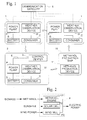
- FIG. 1 is a block diagram showing the embodiment of the power generation system and the fuel supply method according to the present invention.
- the power generation system and the fuel supply method are suitable for a plurality of isolated islands.
- reference numerals 1 and 2 denote the isolated islands (isolated areas).
- the power plant P, the consumer C such as a house, the battery B, and the weather observation device W are provided in each isolated island 1, 1 and 2. Electric power is supplied to the consumer C from the power plant P.
- the control center 3 is provided on the isolated island 2.
- the power plants P and the weather observation devices W provided on the isolated islands 1 and 1 are connected the control center 3, via the communication satellite (communication means) 5. Moreover, the power plant P and the weather observation device W of the isolated island 2 are connected the control center 3 by the cable line (communication means) 6.
- each of the power plants P comprises the methanol engine P1, the solar cell P2, and the wind mill P3 as power plants.
- the methanol engine P is a diesel engine, and expends methanol produced by biomass (plants such as grass) gathered on the isolated island as fuel.
- the solar cell P2 generates electric power by receiving sunlight, and is suitable for generating electric power during fine weather in the daytime.
- the wind mill P3 generates electric power by receiving wind, and it can generate electric power during day and night. However, the amount of electric power generated by the wind mill P3 varies depending on the wind capacity. Moreover, the output of the wind mill P3 can be adjusted by adjusting the angle of the wings comprising the wind mill P3.
- the methanol production ship 10 cruises between the isolated islands 1, 1 and 2.
- the methanol production ship 10 comprises the methanol production device 11 for producing methanol from the biomass.
- the methanol production device 11 synthesizes methanol from the gas produced by drying and crushing all parts of biomass such as the stem, leaf, fruit, etc., and gasifying them using oxygen and vapor.
- FIG. 3A shows the variation of the electric power in the isolated islands 1, 1 and 2 when the weather is clear and windy.
- the broken lines 20 denotes the electric power demand by the consumer C
- the full line 21 denotes the electric power generated by the power plant P. More specifically, the full line 21 a denotes the electric power generated by the methanol engine P1
- the full line 21b denotes the electric power generated by the methanol engine P 1 and the solar cell P2.
- the demand electric power 20 When the demand electric power 20 is less than the electric power 21 generated by the power plant P, the excessive electric power 25 is stored in the battery B. In contrast, when the demand electric power 20 is more than the electric power 21 generated by the power plant P, the insufficiency of the electric power 21 is compensated for by the stored electric power 26 in the battery B.
- FIG. 3B shows the variation of the electric power in the isolated islands 1, 1 and 2 when the weather is rainy and slight windy.
- the electric power generated by the solar cell P2 and the wind mill P3 decreases; therefore, the output of the methanol engine P1 increases.
- the demand electric power 20 is more than the electric power 21 generated by the power plant P, the insufficiency of the electric power 21 is compensated by discharging the battery B.
- the power plant P is controlled in the control center 3 provided on the isolated island 2.
- the observation data of the weather observation device W provided on the isolated islands 1 and 1 are input in the control center 3, via the communication satellite 5.
- driving data such as the amount of generated electric power, the effective availability of sunshine, etc of power plant P are also input in the control center 3, via the communication satellite 5.
- the control center 3 controls the power plant P based on the observation data and the driving data.
- the power plant P adjusts the output by the methanol engine P1, the angle of the wings comprising the wind mill P3 based on the commands from the control center 3.
- the power plant P provided on the isolated island 2 is operated similarly to the power plant P provided on the isolated islands 1 and 1, except that the power plant P provided on the isolated island 2 is connected the control center 3, via the cable line 6.
- Methanol used by the methanol engine P1 as a fuel is produced from the biomass gathered on the isolated islands 1, 1 and 2, explained above.
- the methanol production ship 10 cruises between the isolated islands 1, 1 and 2.
- the biomass is gathered on the isolated island 1, 1 or 2 where the methanol production ship 10 stays and carried to the methanol production ship 10.
- methanol is produced from the biomass by the methanol production device 11 provided in the methanol production ship 10.
- the methanol produced in the methanol production ship 10 is discharged in the isolated island 1, 1 or 2.
Landscapes
- Engineering & Computer Science (AREA)
- Power Engineering (AREA)
- Fuel Cell (AREA)
- Supply And Distribution Of Alternating Current (AREA)
Abstract
Description
- The present invention relates to a power generation system and a fuel supply method for generating electric power at isolated areas such as an isolated island.
- This application is based on the Japanese Patent Application No. Hei 12-131649, the contents of which are incorporated herein by reference.
- A general power generation system transmits electric power generated at the large-scale thermal power plant, hydraulic power plant, atomic power plant, etc. to consumers using transmission lines.
- The transmission method using transmission lines is suitable for the area having large population or population density. However, this transmission method is not efficient for the areas which have a small population density and are isolated from these power plants, because transmission loss increases depending on the transmission distance. Therefore, this transmission method is not suitable for such areas. Consequently, many isolated areas such as isolated islands having a small population density have not been supplied electric power yet.
- In consideration of the above described problems with conventional technology, it would be desirable to be able to provide a power generation system and a fuel supply method which are suitable for the isolated areas.
- According to a first aspect of the present invention, there is provided a power generation system comprising an electric power generation facility which is arranged on an isolated area, generates electric power using an energy source obtainable on the isolated area, and supplies the electric power to the isolated area.
- According to this power generation system, it is not necessary to transmit electric power generated in the outsides of the isolated area to the isolated area using transmission lines. In other words, the electric power generated in the isolated area is used in the isolated area; therefore, a transmission loss is extremely small. Thus, this power generation system is suitable for the isolated areas having a small population density.
- Moreover, the "isolated area" means an area that is far away from a metropolitan area, has a small population density, and where no or an extremely small amount of electric power has supplied, such as an isolated island, mountainous area, etc.
- A second aspect of the present invention is the first power generation system, wherein the power generation system further comprises a battery device for storing the electric power generated by the electric power generation facility.
- For example, when a solar cell or a wind mill is used as the power generation device in this power generation system, the output of electric power varies in response to weather variations. In addition, the amount of electric power required by the consumer varies during a day. According to this power generation system, it is possible to store the excess electric power and expend it as the need arises.
- A third aspect of the present invention is the first power generation system, wherein the electric power generation facility comprises a plurality of electric power generation apparatuses which generate electric power using a different energy source respectively.
- In this power generation system, the electric power generation facility using an energy source which is influenced by weather variations, such as wind force, and the electric power generation facility using an energy source which is not influenced by weather variations, such as an engine, are jointly used. Thereby, when the output of the electric power generation facility using an energy source which is influenced by weather variations decreases, the decrement can be compensated for by the electric power generation facility using an energy source which is not influenced by weather variations. In addition, the electric power generation facility using an energy source which can easily increase the output can be responded a rapid increase of the amount of electric power required by the consumer.
- Best energy source can be selected by considering the natural environment in the isolated area, economical efficiency, etc. However, the electric power generation facility using a renewable energy source and a non-fossil fuel, such as a wind mill, solar cell, methanol engine, fuel cell, micro-gas turbine, micro-water turbine, etc., are preferable. Moreover, the "renewable energy source" means the natural energy which is obtainable nearly limitlessly on the isolated area, such as sunshine, wind force, water power, etc or organisms, such as plants growning on the isolated area.
- A fourth aspect of the present invention is the first power generation system, wherein the power generation system is used for a plurality of isolated areas; and a control center for controlling the electric power generation facilities, which is connected to the electric power generation facilities on the isolated areas via a communication device, is provided in at least one isolated area.
- According to this power generation system, one control center controls the electric power generation facilities in a plurality of the isolated areas. Therefore, it is possible to decrease the number of the monitor and control persons in the electric power generation facilities. In addition, it is also possible to adjust optimally the output of the electric power generation facilities. Communication satellites such as a low-level orbital satellite, cable lines, etc. can be used as the communication device.
- A fifth aspect of the present invention is the fourth power generation system, wherein further comprising weather observation devices for obtaining weather observation data for the each isolated area and a control center for controlling the electric power generation facilities based on weather observation data input from the weather observation devices via the communication device.
- In this power generation system, the control center controls the electric power generation facilities based on the weather observation data in response to weather variations. For example, when the solar cell which is influenced by weather variations and the engine which is not influenced by weather variations are jointly used as the electric power generation facility, and the output of the solar cell decreases due to weather variations, the amount of electric power required by the consumer can be obtained by increasing the output of the engine.
- A sixth aspect of the present invention is the fourth power generation system, wherein further comprising a fuel production device which produces fuel from the fuel material obtainable in at least one isolated area and supplies the fuel to at least one electric power generation facility.
- According to this power generation system, it is not necessary to provide the fuel production device in all isolated areas. The produced fuel may be used in the isolated area where the fuel material is obtained, or may be used in the other isolated areas. When the power generation system is provided on a plurality of isolated islands, the fuel production device can be carried in a ship. When the power generation system is provided on a plurality of isolated land areas, the fuel production device can be carried in an automobile such as a trailer.
- A seventh aspect of the present invention is the sixth power generation system, wherein the fuel material is a plant.
- According to this power generation system, the fuel production device can be used in one isolated area while the plant is sufficiently growning again on another isolated areas where the plant is gathered.
- A eighth aspect of the present invention is a fuel supply method comprising the steps of:
- moving a fuel production device between each of a plurality of isolated areas where an electric power generation facility is provided;
- producing fuel in the isolated area from the fuel material obtainable on the isolated area; and
- supplying the fuel to the electric power generation facility.
-
- According to this fuel supply method, it is not necessary to provide the fuel production device in all isolated areas. The produced fuel may be used in the isolated area where the fuel material is obtained, or may be used in the other isolated areas.
- A ninth aspect of the present invention is the fuel supply method wherein the method comprises the steps of:
- producing fuel in the isolated area from plants obtainable on the isolated area; and
- gathering the plants on the isolated area and moving the fuel production device in the other isolated area in order to gather the plants while the plants on the isolated area are growning.
-
- Certain periods are required for growing the plant sufficient for harvesting again in the isolated area. In the meantime, the fuel production device moves to the other isolated area, the plant is gathered, and the fuel is produced from the plant. The produced fuel may be used in the isolated area where the fuel material is obtained, or may be used in the other isolated areas. When this fuel supply method is carried out in a plurality of isolated islands, the fuel production device can be carried in a ship. When this fuel supply method is carried out in a plurality of isolated land areas, the fuel production device can be carried in an automobile such as a trailer.
- In the drawings:
- FIG. 1 is a block diagram showing the embodiment according to the present invention.
- FIG. 2 is a block diagram showing the power plant provided in the power generation system shown in FIG. 1.
- FIGS. 3A and 3B show the variation of the electric power in the isolated area, when the present invention is adopted.
-
- Next, an embodiment of the power generation system and the fuel supply method of the present invention will be explained referring to the drawings.
- FIG. 1 is a block diagram showing the embodiment of the power generation system and the fuel supply method according to the present invention. The power generation system and the fuel supply method are suitable for a plurality of isolated islands.
- In FIG. 1,
reference numerals island control center 3 is provided on theisolated island 2. - The power plants P and the weather observation devices W provided on the
isolated islands control center 3, via the communication satellite (communication means) 5. Moreover, the power plant P and the weather observation device W of the isolatedisland 2 are connected thecontrol center 3 by the cable line (communication means) 6. - As shown in FIG. 2, each of the power plants P comprises the methanol engine P1, the solar cell P2, and the wind mill P3 as power plants. The methanol engine P is a diesel engine, and expends methanol produced by biomass (plants such as grass) gathered on the isolated island as fuel. The solar cell P2 generates electric power by receiving sunlight, and is suitable for generating electric power during fine weather in the daytime. The wind mill P3 generates electric power by receiving wind, and it can generate electric power during day and night. However, the amount of electric power generated by the wind mill P3 varies depending on the wind capacity. Moreover, the output of the wind mill P3 can be adjusted by adjusting the angle of the wings comprising the wind mill P3.
- As shown in FIG. 1, the
methanol production ship 10 cruises between theisolated islands methanol production ship 10 comprises themethanol production device 11 for producing methanol from the biomass. Themethanol production device 11 synthesizes methanol from the gas produced by drying and crushing all parts of biomass such as the stem, leaf, fruit, etc., and gasifying them using oxygen and vapor. - The operation of the system will be explained below.
- First, the operation of the power plant P provided on the
isolated islands - FIG. 3A shows the variation of the electric power in the
isolated islands broken lines 20 denotes the electric power demand by the consumer C, thefull line 21 denotes the electric power generated by the power plant P. More specifically, thefull line 21 a denotes the electric power generated by the methanol engine P1, thefull line 21b denotes the electric power generated by themethanol engine P 1 and the solar cell P2. - When the demand
electric power 20 is less than theelectric power 21 generated by the power plant P, the excessiveelectric power 25 is stored in the battery B. In contrast, when the demandelectric power 20 is more than theelectric power 21 generated by the power plant P, the insufficiency of theelectric power 21 is compensated for by the storedelectric power 26 in the battery B. - Moreover, it is impossible to increase the output of the solar cell P2 and the wind mill P3, depending on the rapid increase of the demand
electric power 20. Therefore, as shown by thereference numeral 35, when the demandelectric power 20 temporarily increases, the output of the methanol engine P1 increases. - FIG. 3B shows the variation of the electric power in the
isolated islands electric power 20 is more than theelectric power 21 generated by the power plant P, the insufficiency of theelectric power 21 is compensated by discharging the battery B. - The power plant P is controlled in the
control center 3 provided on the isolatedisland 2. The observation data of the weather observation device W provided on theisolated islands control center 3, via thecommunication satellite 5. Moreover, driving data such as the amount of generated electric power, the effective availability of sunshine, etc of power plant P are also input in thecontrol center 3, via thecommunication satellite 5. - The
control center 3 controls the power plant P based on the observation data and the driving data. The power plant P adjusts the output by the methanol engine P1, the angle of the wings comprising the wind mill P3 based on the commands from thecontrol center 3. The power plant P provided on the isolatedisland 2 is operated similarly to the power plant P provided on theisolated islands island 2 is connected thecontrol center 3, via thecable line 6. - Methanol used by the methanol engine P1 as a fuel is produced from the biomass gathered on the
isolated islands methanol production device 11 in bothisolated islands methanol production ship 10 cruises between theisolated islands methanol production ship 10 stays either the isolatedisland island 2, the biomass is gathered on the isolatedisland methanol production ship 10 stays and carried to themethanol production ship 10. Then, methanol is produced from the biomass by themethanol production device 11 provided in themethanol production ship 10. The methanol produced in themethanol production ship 10 is discharged in the isolatedisland - Certain periods are required for growing up biomass sufficient for gathering again on the isolated
island methanol production ship 10 moves to the otherisolated island methanol production ship 10 supplies methanol to the isolatedisland isolated islands methanol production ship 10. - The following effects can be obtained by this embodiment.
- (1) The power plants P provided on the
isolated islands isolated island island isolated island isolated islands isolated islands - (2) The battery B is provided on the
isolated islands electric power 25 and expend it as the need arises. Therefore, electric power can be stably supplied to the consumer C when the weather varies. - (3) The power plant P comprises the methanol engine P1, the solar cell P2, and the wind mill P3. The methanol engine P1 expends methanol produced from biomass as a fuel. The solar cell P2 harnesses sunshine, and the wind mill P3 harnesses wind force. For example, when the duration of sunshine decreases and the amount of electric power generated by the solar cell P2 decreases, the decrement can be compensated for by the methanol engine P1.
- (4) The
control center 3 provided on the isolatedisland 2 controls the power plants P provided on theisolated islands communication satellite 5. Therefore, it is possible to decrease the number of the monitor and control persons in the power plants P on theisolated islands - (5) The weather observation device W is provided on the
isolated islands control center 3, via thecommunication satellite 5 or thecable line 6. Thecontrol center 3 controls the power plant P based on the weather observation data such as the duration of sunshine, wind direction, wind capacity, and temperature in theisolated islands control center 3 commands the methanol engine P1 to increase the output. Thereby, the power plant P can generate the amount of electric power needed for the consumer C, in spite of weather variations. - (6) The
methanol production ship 10 carrying themethanol production device 11 cruises between theisolated islands methanol production device 11 on eachisolated island methanol production device 11 produces methanol in the isolatedisland isolated island - (7) When the elements needed for a repair of the power plant P, the weather observation
device W, etc, are carried in advance in the
methanol production ship 10, the power plant P, the weather observation device W, etc., on the isolatedisland methanol production ship 10 stays at the isolatedisland - (8) Methanol can be shipped between the
isolated islands methanol production ship 10. Therefore, methanol can be shipped from the isolatedisland island - (9) Methanol produced in the
methanol production ship 10 can be used in the cars as a fuel besides a fuel of the power plant P. -
Claims (9)
- A power generation system comprising an electric power generation facility which is arranged on an isolated area, generates electric power using an energy source obtainable on the isolated area, and supplies the electric power to the isolated area.
- A power generation system according to claim 1, wherein the power generation system further comprises a battery device for storing the electric power generated by the electric power generation facility.
- A power generation system according to claim 1 or claim 2, wherein the electric power generation facility comprises a plurality of electric power generation apparatuses which generate electric power using a different energy source respectively.
- A power generation system according to any one of claims 1 to 3, wherein the power generation system is used for a plurality of the isolated areas; and
a control center for controlling the electric power generation facilities, which is connected to the electric power generation facilities in the isolated areas via a communication device, is provided in at least one isolated area. - A power generation system according to claim 4, wherein further comprising weather observation devices for obtaining weather observation data for the each isolated area and a control center for controlling the electric power generation facilities based on weather observation data input from the weather observation devices via the communication device.
- A power generation system according to claim 4, wherein further comprising a fuel production device which produces fuel from the fuel material obtainable in at least one isolated area and supplies the fuel to at least one electric power generation facility.
- A power generation system according to claim 6, wherein said fuel material is a plant.
- A fuel supply method comprising the steps of:moving a fuel production device between a plurality of isolated areas each where an electric power generation facility is provided;producing a fuel in the isolated area from the fuel material obtainable on the isolated area; andsupplying the fuel to the electric power generation facility.
- A fuel supply method according to claim 8 comprising the steps of:producing fuel in the isolated area from plants obtainable on the isolated area; andgathering the plants on the isolated area and moving the fuel production device in the other isolated area in order to gather the plant while the plants on the isolated area are growning.
Applications Claiming Priority (2)
| Application Number | Priority Date | Filing Date | Title |
|---|---|---|---|
| JP2000131649 | 2000-04-28 | ||
| JP2000131649A JP2001314038A (en) | 2000-04-28 | 2000-04-28 | Power generation system and fuel supply method |
Publications (2)
| Publication Number | Publication Date |
|---|---|
| EP1152513A2 true EP1152513A2 (en) | 2001-11-07 |
| EP1152513A3 EP1152513A3 (en) | 2004-11-03 |
Family
ID=18640513
Family Applications (1)
| Application Number | Title | Priority Date | Filing Date |
|---|---|---|---|
| EP00309199A Withdrawn EP1152513A3 (en) | 2000-04-28 | 2000-10-19 | Power generation system and fuel supply method |
Country Status (3)
| Country | Link |
|---|---|
| US (1) | US6420978B1 (en) |
| EP (1) | EP1152513A3 (en) |
| JP (1) | JP2001314038A (en) |
Cited By (1)
| Publication number | Priority date | Publication date | Assignee | Title |
|---|---|---|---|---|
| CN113011083A (en) * | 2021-02-25 | 2021-06-22 | 中国科学院电工研究所 | Simulation evaluation method for island operation time length of comprehensive energy system |
Families Citing this family (7)
| Publication number | Priority date | Publication date | Assignee | Title |
|---|---|---|---|---|
| US6757590B2 (en) * | 2001-03-15 | 2004-06-29 | Utc Fuel Cells, Llc | Control of multiple fuel cell power plants at a site to provide a distributed resource in a utility grid |
| DE102004046701A1 (en) | 2004-09-24 | 2006-04-06 | Aloys Wobben | Regenerative energy system |
| US20100050500A1 (en) * | 2008-09-03 | 2010-03-04 | Stephen Attilio Pieraccini | Maritime Hydrogen or Hydrocarbon Production Facility |
| JP5690681B2 (en) * | 2011-07-21 | 2015-03-25 | 日立アプライアンス株式会社 | Power control device |
| JP7306365B2 (en) | 2020-11-11 | 2023-07-11 | トヨタ自動車株式会社 | Charging control system, charging control device and charging control program |
| JP7322864B2 (en) | 2020-11-12 | 2023-08-08 | トヨタ自動車株式会社 | Charging control system, charging control device and charging control program |
| JP7287378B2 (en) * | 2020-11-25 | 2023-06-06 | トヨタ自動車株式会社 | Charging control system, charging control device and charging control program |
Citations (4)
| Publication number | Priority date | Publication date | Assignee | Title |
|---|---|---|---|---|
| JPH04306569A (en) * | 1991-04-02 | 1992-10-29 | Meidensha Corp | Distributed type regenerable power generation system |
| DE19714512A1 (en) * | 1997-04-08 | 1998-10-15 | Tassilo Dipl Ing Pflanz | Floating deep water power station extracts energy from wind, wave, water and solar sources |
| JP2000004545A (en) * | 1998-06-15 | 2000-01-07 | Sumitomo Electric Ind Ltd | Power supply total management system |
| JP2000051831A (en) * | 1998-08-10 | 2000-02-22 | Ebara Corp | Waste transfer treatment system |
Family Cites Families (13)
| Publication number | Priority date | Publication date | Assignee | Title |
|---|---|---|---|---|
| US4553037A (en) * | 1982-11-26 | 1985-11-12 | Veazey Sidney E | Solar breeze power package and saucer ship |
| US5223781A (en) * | 1983-07-13 | 1993-06-29 | Criswell David R | Power collection and transmission system and method |
| US4883823A (en) * | 1986-11-14 | 1989-11-28 | Perry Oceanographics, Inc. | Self-contained renewable energy system |
| AT390304B (en) * | 1987-04-14 | 1990-04-25 | Sonnek Rudolf Ing | METHOD FOR USING MUELL AS A FUEL FOR ENVIRONMENTALLY FRIENDLY ENERGY USE |
| DE3733324A1 (en) * | 1987-10-02 | 1989-04-20 | Artur Richard Greul | Method and device for making ammonia and methanol plants, fertiliser works, or other chemical production plants mobile |
| US5592074A (en) * | 1992-06-26 | 1997-01-07 | Canon Kabushiki Kaisha | Battery power supply system |
| DE4312901C2 (en) * | 1993-04-16 | 1997-08-21 | Ver Energiewerke Ag | Method and arrangement for the combustion of bio-substances for a coal-fired steam boiler |
| DE4417499A1 (en) * | 1994-05-19 | 1994-10-06 | Irps Hartwig | The CES cold energy system |
| US5731688A (en) * | 1996-03-13 | 1998-03-24 | Alaska Power Systems Inc. | Control system and circuits for distributed electrical-power generating stations |
| US5929538A (en) * | 1997-06-27 | 1999-07-27 | Abacus Controls Inc. | Multimode power processor |
| EP0849435A3 (en) * | 1998-04-01 | 1998-10-21 | Christian S. Michaelsen | Power plant |
| JP3700386B2 (en) | 1998-04-15 | 2005-09-28 | 株式会社日立製作所 | Energy and power interchange system |
| US6055163A (en) * | 1998-08-26 | 2000-04-25 | Northrop Grumman Corporation | Communications processor remote host and multiple unit control devices and methods for micropower generation systems |
-
2000
- 2000-04-28 JP JP2000131649A patent/JP2001314038A/en active Pending
- 2000-10-17 US US09/690,382 patent/US6420978B1/en not_active Expired - Lifetime
- 2000-10-19 EP EP00309199A patent/EP1152513A3/en not_active Withdrawn
Patent Citations (4)
| Publication number | Priority date | Publication date | Assignee | Title |
|---|---|---|---|---|
| JPH04306569A (en) * | 1991-04-02 | 1992-10-29 | Meidensha Corp | Distributed type regenerable power generation system |
| DE19714512A1 (en) * | 1997-04-08 | 1998-10-15 | Tassilo Dipl Ing Pflanz | Floating deep water power station extracts energy from wind, wave, water and solar sources |
| JP2000004545A (en) * | 1998-06-15 | 2000-01-07 | Sumitomo Electric Ind Ltd | Power supply total management system |
| JP2000051831A (en) * | 1998-08-10 | 2000-02-22 | Ebara Corp | Waste transfer treatment system |
Non-Patent Citations (1)
| Title |
|---|
| COLEMAN C J: "HYBRID POWER SYSTEM FOR A REMOTE MICROWAVE REPEATER SITE IN THE DOMINICAN REPUBLIC", PROCEEDINGS OF THE INTERNATIONAL TELECOMMUNICATIONS ENERGY CONFERENCE.(INTELEC). WASHINGTON, OCT. 4 - 8, 1992, NEW YORK, IEEE, US, XP000357555 * |
Cited By (2)
| Publication number | Priority date | Publication date | Assignee | Title |
|---|---|---|---|---|
| CN113011083A (en) * | 2021-02-25 | 2021-06-22 | 中国科学院电工研究所 | Simulation evaluation method for island operation time length of comprehensive energy system |
| CN113011083B (en) * | 2021-02-25 | 2023-09-05 | 中国科学院电工研究所 | A simulation evaluation method for island running time of integrated energy system |
Also Published As
| Publication number | Publication date |
|---|---|
| JP2001314038A (en) | 2001-11-09 |
| EP1152513A3 (en) | 2004-11-03 |
| US6420978B1 (en) | 2002-07-16 |
Similar Documents
| Publication | Publication Date | Title |
|---|---|---|
| Mohamed et al. | Techno-economic feasibility analysis of Benban solar Park | |
| US7654073B2 (en) | Power generating systems and methods | |
| Perez et al. | Deploying effectively dispatchable PV on reservoirs: Comparing floating PV to other renewable technologies | |
| EP0539244B1 (en) | Method of supplying energy through medium of methanol | |
| EP1798837B1 (en) | Electrical power generation system and method for generating electrical power | |
| AU2011213745B2 (en) | System and method for distribution of inverter VAR support | |
| US20130193266A1 (en) | Wind power generation system for lighter than air (lta) platforms | |
| US20100207453A1 (en) | Hybrid renewable energy turbine using wind and solar power | |
| CA2972841C (en) | Integrated techniques for producing bio-methanol | |
| US6420978B1 (en) | Power generation system and fuel supply method | |
| US10097065B2 (en) | Bioenergy storage and management system and method | |
| KR100721002B1 (en) | Solar generator | |
| KR20210089314A (en) | Floating Solar System and Method of Maximizing Solar System Efficiency Using the Same | |
| Gomaa et al. | Design and analysis of photovoltaic and wind energy hybrid systems in Alexandria, Egypt | |
| KR20120057851A (en) | Small scale hybrid system for generating electricity | |
| US20210383485A1 (en) | Systems, methods, and apparatuses for facilitaing powering of transoceanic shipping and international energy/chemical supply | |
| EP4206069A1 (en) | Renewable energy power generation system | |
| Maoulida et al. | Feasibility Study for a Hybrid Power Plant (PV-Wind-Diesel-Storage) Connected to the Electricity Grid | |
| US20230145414A1 (en) | System, method and apparatus for providing a solar pump system for use within a mechanized irrigation system | |
| JP2007129850A (en) | Power generation control system | |
| Geuder et al. | Comparison of solar terrestrial and space power generation for Europe | |
| Summerer | Space and Terrestrial solar power sources for large-scale hydrogen production-a comparison | |
| Darus et al. | Potential of Wind Energy in Sustainable Development of Resort Island in Malaysia: A Case Study of Pulau Perhentian(Perhentian Island) | |
| Kühne et al. | Assessment of present and future potential | |
| Hendriks et al. | Solar power from space: European strategy in the light of sustainable development |
Legal Events
| Date | Code | Title | Description |
|---|---|---|---|
| PUAI | Public reference made under article 153(3) epc to a published international application that has entered the european phase |
Free format text: ORIGINAL CODE: 0009012 |
|
| 17P | Request for examination filed |
Effective date: 20001108 |
|
| AK | Designated contracting states |
Kind code of ref document: A2 Designated state(s): AT BE CH CY DE DK ES FI FR GB GR IE IT LI LU MC NL PT SE |
|
| AX | Request for extension of the european patent |
Free format text: AL;LT;LV;MK;RO;SI |
|
| PUAL | Search report despatched |
Free format text: ORIGINAL CODE: 0009013 |
|
| AK | Designated contracting states |
Kind code of ref document: A3 Designated state(s): AT BE CH CY DE DK ES FI FR GB GR IE IT LI LU MC NL PT SE |
|
| AX | Request for extension of the european patent |
Extension state: AL LT LV MK RO SI |
|
| RIC1 | Information provided on ipc code assigned before grant |
Ipc: 7H 02J 13/00 B Ipc: 7H 02J 7/34 B Ipc: 7H 02J 3/38 B Ipc: 7H 02J 3/00 A |
|
| AKX | Designation fees paid |
Designated state(s): DK GB SE |
|
| REG | Reference to a national code |
Ref country code: DE Ref legal event code: 8566 |
|
| 17Q | First examination report despatched |
Effective date: 20070105 |
|
| STAA | Information on the status of an ep patent application or granted ep patent |
Free format text: STATUS: THE APPLICATION IS DEEMED TO BE WITHDRAWN |
|
| 18D | Application deemed to be withdrawn |
Effective date: 20070516 |