EP1152382A1 - Method for defining an order of priority in reproducing traffic messages - Google Patents
Method for defining an order of priority in reproducing traffic messages Download PDFInfo
- Publication number
- EP1152382A1 EP1152382A1 EP00201459A EP00201459A EP1152382A1 EP 1152382 A1 EP1152382 A1 EP 1152382A1 EP 00201459 A EP00201459 A EP 00201459A EP 00201459 A EP00201459 A EP 00201459A EP 1152382 A1 EP1152382 A1 EP 1152382A1
- Authority
- EP
- European Patent Office
- Prior art keywords
- traffic messages
- reproduction
- messages
- broadcast traffic
- received
- Prior art date
- Legal status (The legal status is an assumption and is not a legal conclusion. Google has not performed a legal analysis and makes no representation as to the accuracy of the status listed.)
- Granted
Links
Images
Classifications
-
- H—ELECTRICITY
- H04—ELECTRIC COMMUNICATION TECHNIQUE
- H04H—BROADCAST COMMUNICATION
- H04H20/00—Arrangements for broadcast or for distribution combined with broadcast
- H04H20/53—Arrangements specially adapted for specific applications, e.g. for traffic information or for mobile receivers
- H04H20/59—Arrangements specially adapted for specific applications, e.g. for traffic information or for mobile receivers for emergency or urgency
-
- G—PHYSICS
- G08—SIGNALLING
- G08G—TRAFFIC CONTROL SYSTEMS
- G08G1/00—Traffic control systems for road vehicles
- G08G1/09—Arrangements for giving variable traffic instructions
- G08G1/091—Traffic information broadcasting
- G08G1/092—Coding or decoding of the information
-
- G—PHYSICS
- G08—SIGNALLING
- G08G—TRAFFIC CONTROL SYSTEMS
- G08G1/00—Traffic control systems for road vehicles
- G08G1/09—Arrangements for giving variable traffic instructions
- G08G1/091—Traffic information broadcasting
- G08G1/093—Data selection, e.g. prioritizing information, managing message queues, selecting the information to be output
-
- H—ELECTRICITY
- H04—ELECTRIC COMMUNICATION TECHNIQUE
- H04H—BROADCAST COMMUNICATION
- H04H20/00—Arrangements for broadcast or for distribution combined with broadcast
- H04H20/53—Arrangements specially adapted for specific applications, e.g. for traffic information or for mobile receivers
- H04H20/55—Arrangements specially adapted for specific applications, e.g. for traffic information or for mobile receivers for traffic information
Definitions
- the invention relates to a method for defining an order of priority in reproducing traffic messages and to a receiver using the method.
- US Patent 5,438,687 discloses a radio receiver using the Radio Data System (RDS) defined by the European Broadcasting Union (EBU) in Brussels.
- RDS Radio Data System
- EBU European Broadcasting Union
- a selection of route relevant information is provided, in which only those traffic messages are being released for reproduction, exceeding in priority or urgency a certain threshold.
- An indication for such urgency may be attributed to the traffic message at the transmitter end and such indication may be included in coded form in the digital traffic message code format.
- the traffic messages having a priority or urgency exceeding said certain threshold are being released for reproduction at their occurrence in the received signal.
- the driver is to make his own interpretation as to the urgency or priority of the reproduced traffic messages.
- the invention is characterized by prioritizing new broadcast traffic messages which are to be reproduced for the first time over broadcast traffic messages which have been reproduced.
- This method is in particular applicable in a system for repetitive reproduction of traffic messages, which avoids the driver from missing relevant traffic data.
- Preferably said method is characterized by continuously storing the received broadcast traffic messages, these received broadcast traffic messages being released for actual reproduction at any re-initiation of the method.
- a receiver for using the above method, comprising a tuner stage having an output, a decoder stage having an input connected to the output of the tuning stage for decoding digital broadcast traffic messages.
- such receiver is characterized by storage means for storing received broadcast traffic messages, control means for controlling the release for reproduction of said received broadcast traffic messages, and message reproduction means for reproducing said released broadcast traffic messages, said control means prioritizing for reproduction new broadcast traffic messages which are to be reproduced for the first time over broadcast traffic messages which have been reproduced.
- a preferred embodiment of a receiver according to the invention is characterized by said storage means having a non-volatile memory for continuously storing the received broadcast traffic messages latest received, said control means releasing for reproduction said stored broadcast traffic messages at a re-initiation of the receiver.
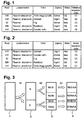
- the table of Figure 1 shows traffic data inputted and stored in a local memory of an RDS radio receiver at a certain point in time in a certain reference sequence order.
- the stored traffic data is continuously actualised by replacing traffic messages, which have become obsolete and/or already have been represented to the user, by newly received traffic data.
- Reproduction of traffic data can be in audible form through speech synthesis or visually by displaying the messages in textform.
- the table shows under a column header "Road”, location code identifiers, indicating the specific road or geographical area to which the respective stored traffic messages pertain, e.g. expressed in roadnumbers or area codes.
- a closer definition of the location of interest is given, such as the exact place and/or direction of the event referred to in the respective traffic messages.
- Event the event of interest is characterised, such as fog, traffic jam, queu lengths, etc..
- the respective traffic messages are being classified in two classes of urgency: normal or urgent.
- the traffic messages classified as urgent are to be prioritised in reproduction over the normal traffic messages.
- Status an indication with regard to the novelty of the traffic messages: new traffic messsages which have not yet been represented to the user are indicated as new and are given the characterisation old, once they have been represented.
- Figure 2 shows the effect of the method of sorting of traffic messages in accordance with the invention when applied to the traffic messages included in the table of Figure 1.
- the sorted sequence order indicated in the most right hand column defines the order of priority for presentation or reproduction, such that the traffic message having highest urgency is placed in the top row, whereas the traffic message having lowest urgency is placed in the bottom row of the table.
- the traffic message having reference sequence order 02 now being placed at the top urgency row of the list, followed in decreasing order of urgency by the traffic message with respective reference sequence order 05, 03, 04 and 01.
- Figure 3 shows the sorting principle which is used to go from the message sequence order 01-05 of Figure 1 to the message sequence order 02,05,03,04,01 of Figure 2 in memory listings 1-4.
- memory list 1 the messages received are being stored in any arbritary order, e.g. in order of reception.
- a sorting key K1 is used to divide the messages in memory list 1 in a category of newly received, not yet reproduced traffic messages on the one hand and a category of traffic messages, which have been reproduced at least once on the other hand.
- the new messages being are stored in a part N of a memory list 2 and the old messages in a part 0 of the memory list 2.
- a second sorting key K2 is used to order the traffic messages in either of both above classifications in accordance with the urgency of the respective messages.
- urgent traffic messages Ur are being separated from normal traffic messages, resulting in the parts N and 0 of the memory list 2 being subdivided into respective parts N ⁇ Ur, N ⁇ No, O ⁇ Ur and O ⁇ No as shown in memory list 3.
- a third sorting key K3 is used to place the traffic messages in each of the respective parts N ⁇ Ur, N ⁇ No, O ⁇ Ur and O ⁇ No of memory list 3 in alphabetic order of location.
- the resulting sequence order defines the order of release for reproduction of received broadcast traffic messages, in which new broadcast traffic messages which are to be reproduced for the first time are being prioritized over broadcast traffic messages which have been reproduced, in which the broadcast traffic messages within said categories are being ordered in reproduction priority in accordance with the urgency of the messages and within the order of urgency in alphabetic order of location.
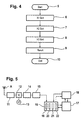
- Figure 4 shows the sorting method according to the invention in a flow diagram, starting from an initiating of the method in step 5.
- the method is applied to all broadcast traffic messages received either after the initiating step 5 or already available at the receiving end by a continuous storage of traffic messages.
- the initiating step 5 is followed respectively by first to third sorting steps 6-8, providing the result of the sorting method in step 9 and the ending of the method in step 10.
- FIG. 5 a receiver for using the method in accordance with the invention comprising an RF input circuit 11 an input thereof being coupled to an antenna A and an output thereof being coupled to a mixer stage 12, supplied with a local oscillator signal from a tunable oscillator 13, a selective intermediate frequency (IF) amplifier 14 for selecting and amplifying an IF signal, a decoder stage 15 for decoding digital broadcast traffic messages, storage means 16 for storing received broadcast traffic messages, control means 17 for controlling the release for reproduction of said received broadcast traffic messages, and traffic message reproduction means 18, comprising a display, for reproducing said released broadcast traffic messages.
- IF intermediate frequency
- the reception and decoding and selection of traffic messages is as such known: the RF input circuit 11, the mixer stage 12 and tunable oscillator 13 constitute a tuner stage, in which a wanted RF broadcast signal is selected and downconverted into an IF signal.
- the IF signal after being selectively amplified in the selective intermediate frequency (IF) amplifier 14, is being decoded in the decoder stage 15 for decoding and selecting traffic messages, which are supplied to the storage means 16.
- the storage means 16 comprise first to fourth memory banks 19-22 for storing therein respectively the traffic messages of the memory lists 1-4 of Figure 3.
- the first memory bank 19 may have a non-volatile memory in order for the receiver to continuously store the received broadcast traffic messages latest received.
- Said control means 17 provide for the release for reproduction of said stored broadcast traffic messages at a re-initiation of or switching on the receiver.
- the traffic messages after being stored and reordered in the first to fourth memory banks 19-22 are released for reproduction in traffic message reproduction means 18 in the sequence order of the memory list 4 in the fourth memory bank 22.
Landscapes
- Engineering & Computer Science (AREA)
- Multimedia (AREA)
- Physics & Mathematics (AREA)
- General Physics & Mathematics (AREA)
- Business, Economics & Management (AREA)
- Emergency Management (AREA)
- Signal Processing (AREA)
- Circuits Of Receivers In General (AREA)
Abstract
Description
- The invention relates to a method for defining an order of priority in reproducing traffic messages and to a receiver using the method.
- US Patent 5,438,687 discloses a radio receiver using the Radio Data System (RDS) defined by the European Broadcasting Union (EBU) in Brussels. In a practical embodiment of this receiver a selection of route relevant information is provided, in which only those traffic messages are being released for reproduction, exceeding in priority or urgency a certain threshold. An indication for such urgency may be attributed to the traffic message at the transmitter end and such indication may be included in coded form in the digital traffic message code format. However, the traffic messages having a priority or urgency exceeding said certain threshold, are being released for reproduction at their occurrence in the received signal. The driver is to make his own interpretation as to the urgency or priority of the reproduced traffic messages. Furthermore, it may well be that dependent on the time the receiver is switched on, relevant traffic data may be missed.
- In consequence, amongst other things, it is an object of the present invention to provide a method for defining an order of priority in reproducing traffic messages at the receiving end allowing to inform the driver continuously of the most relevant traffic information.
- Now therefore, according to one of its aspects the invention is characterized by prioritizing new broadcast traffic messages which are to be reproduced for the first time over broadcast traffic messages which have been reproduced. This method is in particular applicable in a system for repetitive reproduction of traffic messages, which avoids the driver from missing relevant traffic data.
- Preferably said method is characterized by continuously storing the received broadcast traffic messages, these received broadcast traffic messages being released for actual reproduction at any re-initiation of the method.
- It is another object of the present invention to provide a receiver for using the above method, comprising a tuner stage having an output, a decoder stage having an input connected to the output of the tuning stage for decoding digital broadcast traffic messages. In accordance with the invention, such receiver is characterized by storage means for storing received broadcast traffic messages, control means for controlling the release for reproduction of said received broadcast traffic messages, and message reproduction means for reproducing said released broadcast traffic messages, said control means prioritizing for reproduction new broadcast traffic messages which are to be reproduced for the first time over broadcast traffic messages which have been reproduced.
- A preferred embodiment of a receiver according to the invention is characterized by said storage means having a non-volatile memory for continuously storing the received broadcast traffic messages latest received, said control means releasing for reproduction said stored broadcast traffic messages at a re-initiation of the receiver.
- These and further aspects and advantages of the invention will be discussed more in detail hereinafter with reference to the disclosure of preferred embodiments, and in particular with reference to the appended Figures that show:
- Figure 1 is an input table representing various traffic messages in a certain reference sequence order;
- Figure 2 is an output table representing information content of various traffic messages in preferred order;
- Figure 3 shows process of sorting in various steps;
- Figure 4 is an applicable flow chart;
- Figure 5 shows a receiver according to the invention implementing the invention
-
- The table of Figure 1 shows traffic data inputted and stored in a local memory of an RDS radio receiver at a certain point in time in a certain reference sequence order. The stored traffic data is continuously actualised by replacing traffic messages, which have become obsolete and/or already have been represented to the user, by newly received traffic data. Reproduction of traffic data can be in audible form through speech synthesis or visually by displaying the messages in textform.
The table shows under a column header "Road", location code identifiers, indicating the specific road or geographical area to which the respective stored traffic messages pertain, e.g. expressed in roadnumbers or area codes. Under a column header "Location/extent" a closer definition of the location of interest is given, such as the exact place and/or direction of the event referred to in the respective traffic messages. Under a column header "Event", the event of interest is characterised, such as fog, traffic jam, queu lengths, etc.. In the column headed with "Urgency" the respective traffic messages are being classified in two classes of urgency: normal or urgent. The traffic messages classified as urgent are to be prioritised in reproduction over the normal traffic messages. Under the column "Status" an indication with regard to the novelty of the traffic messages: new traffic messsages which have not yet been represented to the user are indicated as new and are given the characterisation old, once they have been represented. Where the information stored under the columns headed with "Road", "Location/extent", "Event" and "Urgency" are being transmitted and received along with the traffic messages, the data in this column "Status" is being locally generated.
The most righthand column is indicating a reference sequence order of the stored messages, which is merely to illustrate the effect of the invention on the order of presentation or reproduction of the respective stored traffic messages. In a conventional receiver the order of presentation to the user is defined by this reference sequence order. - Figure 2 shows the effect of the method of sorting of traffic messages in accordance with the invention when applied to the traffic messages included in the table of Figure 1. The sorted sequence order indicated in the most right hand column defines the order of priority for presentation or reproduction, such that the traffic message having highest urgency is placed in the top row, whereas the traffic message having lowest urgency is placed in the bottom row of the table. The traffic message having
reference sequence order 02 now being placed at the top urgency row of the list, followed in decreasing order of urgency by the traffic message with respectivereference sequence order - Figure 3 shows the sorting principle which is used to go from the message sequence order 01-05 of Figure 1 to the
message sequence order memory list 1 the messages received are being stored in any arbritary order, e.g. in order of reception. In a first sorting step a sorting key K1 is used to divide the messages inmemory list 1 in a category of newly received, not yet reproduced traffic messages on the one hand and a category of traffic messages, which have been reproduced at least once on the other hand. The new messages being are stored in a part N of amemory list 2 and the old messages in a part 0 of thememory list 2. In a second sorting step a second sorting key K2 is used to order the traffic messages in either of both above classifications in accordance with the urgency of the respective messages. In both N and O parts of thememory list 1, urgent traffic messages Ur are being separated from normal traffic messages, resulting in the parts N and 0 of thememory list 2 being subdivided into respective parts NΛUr, NΛNo, OΛUr and OΛNo as shown inmemory list 3. A third sorting key K3 is used to place the traffic messages in each of the respective parts NΛUr, NΛNo, OΛUr and OΛNo ofmemory list 3 in alphabetic order of location. This results in a listing of traffic messages as shown in thememory list 4, or when starting from the table of Figure 1 in the order sequence as shown in the table of Figure 2. The resulting sequence order defines the order of release for reproduction of received broadcast traffic messages, in which new broadcast traffic messages which are to be reproduced for the first time are being prioritized over broadcast traffic messages which have been reproduced, in which the broadcast traffic messages within said categories are being ordered in reproduction priority in accordance with the urgency of the messages and within the order of urgency in alphabetic order of location. - Figure 4 shows the sorting method according to the invention in a flow diagram, starting from an initiating of the method in
step 5. The method is applied to all broadcast traffic messages received either after the initiatingstep 5 or already available at the receiving end by a continuous storage of traffic messages. The initiatingstep 5 is followed respectively by first to third sorting steps 6-8, providing the result of the sorting method in step 9 and the ending of the method instep 10.
Figure 5 a receiver for using the method in accordance with the invention comprising anRF input circuit 11 an input thereof being coupled to an antenna A and an output thereof being coupled to amixer stage 12, supplied with a local oscillator signal from atunable oscillator 13, a selective intermediate frequency (IF)amplifier 14 for selecting and amplifying an IF signal, adecoder stage 15 for decoding digital broadcast traffic messages, storage means 16 for storing received broadcast traffic messages, control means 17 for controlling the release for reproduction of said received broadcast traffic messages, and traffic message reproduction means 18, comprising a display, for reproducing said released broadcast traffic messages. The reception and decoding and selection of traffic messages is as such known: theRF input circuit 11, themixer stage 12 andtunable oscillator 13 constitute a tuner stage, in which a wanted RF broadcast signal is selected and downconverted into an IF signal. The IF signal after being selectively amplified in the selective intermediate frequency (IF)amplifier 14, is being decoded in thedecoder stage 15 for decoding and selecting traffic messages, which are supplied to the storage means 16. The storage means 16 comprise first to fourth memory banks 19-22 for storing therein respectively the traffic messages of the memory lists 1-4 of Figure 3. Thefirst memory bank 19 may have a non-volatile memory in order for the receiver to continuously store the received broadcast traffic messages latest received. Said control means 17 provide for the release for reproduction of said stored broadcast traffic messages at a re-initiation of or switching on the receiver. The traffic messages after being stored and reordered in the first to fourth memory banks 19-22 are released for reproduction in traffic message reproduction means 18 in the sequence order of thememory list 4 in thefourth memory bank 22. - The person skilled in the art of traffic message handling will recognize further policies to be followed within the ambit of the present invention, the scope of which has justfully been determined by the appended Claims hereinafter.
Claims (10)
- Method for defining an order of release for reproduction of received broadcast traffic messages, characterized by prioritizing new broadcast traffic messages which are to be reproduced for the first time over broadcast traffic messages which have been reproduced.
- Method according to claim 1, characterized by said new broadcast traffic messages being ordered in reproduction priority in accordance with the urgency of the respective traffic messages.
- Method according to claim 1 or 2, characterized by the received traffic messages after reproduction being ordered in priority for repetitive reproduction in accordance with the urgency of the respective traffic messages.
- Method according to one of claims 1 to 3, characterized by the traffic messages being alphabetically ordered in reproduction priority with respect to the name of location to which said traffic messages respectively pertain.
- Method according to one of claims 1 to 4 characterized by continuously storing the received broadcast traffic messages, these received broadcast traffic messages being released for actual reproduction at any re-initiation of the method.
- Receiver for using the method of claim 1 comprising a tuner stage and coupled thereto a decoder stage having an input connected to the output of the tuning stage for decoding digital broadcast traffic messages, characterized by storage means for storing received broadcast traffic messages, control means for controlling the release for reproduction of said received broadcast traffic messages, and message reproduction means for reproducing said released broadcast traffic messages, said control means prioritizing for reproduction new broadcast traffic messages which are to be reproduced for the first time over broadcast traffic messages which have been reproduced.
- Receiver according to claim 6, characterized by said control means ordering newly received traffic messages in reproduction priority in accordance with the urgency of the respective traffic messages.
- Receiver according to claim 6 or 7, characterized by said control means ordering received traffic messages after once being reproduced in reproduction priority in accordance with the urgency of the respective traffic messages.
- Receiver according to one of claims 6 to 8, characterized by said control means ordering said traffic messages alphabetically in reproduction priority with respect to the name of location to which said traffic messages respectively pertain.
- Receiver according to one of claims 6 to 9, characterized by said storage means having a non-volatile memory for continuously storing the received broadcast traffic messages latest received, said control means releasing for reproduction said stored broadcast traffic messages at a re-initiation of the receiver.
Priority Applications (2)
| Application Number | Priority Date | Filing Date | Title |
|---|---|---|---|
| EP20000201459 EP1152382B1 (en) | 2000-04-25 | 2000-04-25 | Method for defining an order of priority in reproducing traffic messages |
| DE2000613775 DE60013775T2 (en) | 2000-04-25 | 2000-04-25 | Method for determining a priority order for the issue of traffic reports |
Applications Claiming Priority (1)
| Application Number | Priority Date | Filing Date | Title |
|---|---|---|---|
| EP20000201459 EP1152382B1 (en) | 2000-04-25 | 2000-04-25 | Method for defining an order of priority in reproducing traffic messages |
Publications (2)
| Publication Number | Publication Date |
|---|---|
| EP1152382A1 true EP1152382A1 (en) | 2001-11-07 |
| EP1152382B1 EP1152382B1 (en) | 2004-09-15 |
Family
ID=8171384
Family Applications (1)
| Application Number | Title | Priority Date | Filing Date |
|---|---|---|---|
| EP20000201459 Expired - Lifetime EP1152382B1 (en) | 2000-04-25 | 2000-04-25 | Method for defining an order of priority in reproducing traffic messages |
Country Status (2)
| Country | Link |
|---|---|
| EP (1) | EP1152382B1 (en) |
| DE (1) | DE60013775T2 (en) |
Cited By (1)
| Publication number | Priority date | Publication date | Assignee | Title |
|---|---|---|---|---|
| DE102004017091B4 (en) * | 2004-04-07 | 2013-01-10 | Audi Ag | Method for operating a navigation system for a motor vehicle |
Citations (4)
| Publication number | Priority date | Publication date | Assignee | Title |
|---|---|---|---|---|
| EP0297473A2 (en) * | 1987-06-27 | 1989-01-04 | DRATON ELECTRONIC GmbH | Car radio for traffic broadcasting reception |
| DE3806972A1 (en) * | 1988-03-03 | 1989-09-14 | Assmann Informatik 2000 Gmbh | Device for receiving, detecting and reproducing traffic radio announcements |
| EP0725504A2 (en) * | 1995-02-03 | 1996-08-07 | Robert Bosch Gmbh | Radio data system receiver with a means for displaying digitally coded traffic information |
| EP0818898A2 (en) * | 1996-07-12 | 1998-01-14 | Robert Bosch Gmbh | Method and means for selecting digitally coded traffic messages |
-
2000
- 2000-04-25 DE DE2000613775 patent/DE60013775T2/en not_active Expired - Lifetime
- 2000-04-25 EP EP20000201459 patent/EP1152382B1/en not_active Expired - Lifetime
Patent Citations (4)
| Publication number | Priority date | Publication date | Assignee | Title |
|---|---|---|---|---|
| EP0297473A2 (en) * | 1987-06-27 | 1989-01-04 | DRATON ELECTRONIC GmbH | Car radio for traffic broadcasting reception |
| DE3806972A1 (en) * | 1988-03-03 | 1989-09-14 | Assmann Informatik 2000 Gmbh | Device for receiving, detecting and reproducing traffic radio announcements |
| EP0725504A2 (en) * | 1995-02-03 | 1996-08-07 | Robert Bosch Gmbh | Radio data system receiver with a means for displaying digitally coded traffic information |
| EP0818898A2 (en) * | 1996-07-12 | 1998-01-14 | Robert Bosch Gmbh | Method and means for selecting digitally coded traffic messages |
Cited By (1)
| Publication number | Priority date | Publication date | Assignee | Title |
|---|---|---|---|---|
| DE102004017091B4 (en) * | 2004-04-07 | 2013-01-10 | Audi Ag | Method for operating a navigation system for a motor vehicle |
Also Published As
| Publication number | Publication date |
|---|---|
| EP1152382B1 (en) | 2004-09-15 |
| DE60013775D1 (en) | 2004-10-21 |
| DE60013775T2 (en) | 2005-04-14 |
Similar Documents
| Publication | Publication Date | Title |
|---|---|---|
| JP2962822B2 (en) | Radio receiver | |
| US5864305A (en) | Traffic information system | |
| US9698923B2 (en) | Traffic information client device | |
| US6453230B1 (en) | Apparatus for handling a traffic message | |
| US5465088A (en) | Receiver for traffic messages | |
| JPH07312563A (en) | Rds data reception display method and its device | |
| EP1475909A1 (en) | Background tuner of a radio broadcast receiver to receive traffic and travel information (TTI) and to check alternative frequencies | |
| US20090037093A1 (en) | Vehicle-Mounted Navigation Apparatus | |
| US6535813B1 (en) | Method and system for selecting traffic information services receivable by at least one mobile receiver | |
| KR100514419B1 (en) | Output method of digitally coded incoming traffic message | |
| EP1152382A1 (en) | Method for defining an order of priority in reproducing traffic messages | |
| EP1515466B1 (en) | Traffic information receiver and traffic information reception method | |
| KR19980074989A (en) | Ioen information storage processing method of car audio for RDS broadcasting reception | |
| JPH10124795A (en) | Method and apparatus for selecting digitally encoded traffic messages | |
| EP1909417A2 (en) | Method and apparatus for automatically updating data broadcasting | |
| JPH10326099A (en) | RDS-TMC radio receiver including voice segment memory | |
| JPH06188846A (en) | Fm multiplex broadcasting receiver | |
| JP5794935B2 (en) | Reception device, reception method, and reception program | |
| JPH0652877B2 (en) | RDS receiver | |
| EP0921510B1 (en) | Apparatus for handling a traffic message | |
| JP3761599B2 (en) | Multiple broadcast receiver | |
| KR960001675Y1 (en) | Radio data system | |
| KR20000010764A (en) | Method and receiver for geographical selection of digitally coded messages | |
| JPH10341174A (en) | Rds receiver | |
| JP2002026753A (en) | On-vehicle radio reception system |
Legal Events
| Date | Code | Title | Description |
|---|---|---|---|
| PUAI | Public reference made under article 153(3) epc to a published international application that has entered the european phase |
Free format text: ORIGINAL CODE: 0009012 |
|
| AK | Designated contracting states |
Kind code of ref document: A1 Designated state(s): AT BE CH CY DE DK ES FI FR GB GR IE IT LI LU MC NL PT SE Kind code of ref document: A1 Designated state(s): DE FR GB |
|
| AX | Request for extension of the european patent |
Free format text: AL;LT;LV;MK;RO;SI |
|
| RAP1 | Party data changed (applicant data changed or rights of an application transferred) |
Owner name: SIEMENS AKTIENGESELLSCHAFT |
|
| 17P | Request for examination filed |
Effective date: 20020318 |
|
| AKX | Designation fees paid |
Free format text: DE FR GB |
|
| 17Q | First examination report despatched |
Effective date: 20030813 |
|
| GRAP | Despatch of communication of intention to grant a patent |
Free format text: ORIGINAL CODE: EPIDOSNIGR1 |
|
| GRAS | Grant fee paid |
Free format text: ORIGINAL CODE: EPIDOSNIGR3 |
|
| GRAA | (expected) grant |
Free format text: ORIGINAL CODE: 0009210 |
|
| AK | Designated contracting states |
Kind code of ref document: B1 Designated state(s): DE FR GB |
|
| REG | Reference to a national code |
Ref country code: GB Ref legal event code: FG4D |
|
| REF | Corresponds to: |
Ref document number: 60013775 Country of ref document: DE Date of ref document: 20041021 Kind code of ref document: P |
|
| ET | Fr: translation filed | ||
| PLBE | No opposition filed within time limit |
Free format text: ORIGINAL CODE: 0009261 |
|
| STAA | Information on the status of an ep patent application or granted ep patent |
Free format text: STATUS: NO OPPOSITION FILED WITHIN TIME LIMIT |
|
| 26N | No opposition filed |
Effective date: 20050616 |
|
| REG | Reference to a national code |
Ref country code: FR Ref legal event code: TP |
|
| REG | Reference to a national code |
Ref country code: GB Ref legal event code: 732E Free format text: REGISTERED BETWEEN 20110825 AND 20110831 |
|
| PGFP | Annual fee paid to national office [announced via postgrant information from national office to epo] |
Ref country code: GB Payment date: 20130418 Year of fee payment: 14 |
|
| PGFP | Annual fee paid to national office [announced via postgrant information from national office to epo] |
Ref country code: FR Payment date: 20130515 Year of fee payment: 14 |
|
| PGFP | Annual fee paid to national office [announced via postgrant information from national office to epo] |
Ref country code: DE Payment date: 20140430 Year of fee payment: 15 |
|
| GBPC | Gb: european patent ceased through non-payment of renewal fee |
Effective date: 20140425 |
|
| REG | Reference to a national code |
Ref country code: FR Ref legal event code: ST Effective date: 20141231 |
|
| PG25 | Lapsed in a contracting state [announced via postgrant information from national office to epo] |
Ref country code: GB Free format text: LAPSE BECAUSE OF NON-PAYMENT OF DUE FEES Effective date: 20140425 |
|
| PG25 | Lapsed in a contracting state [announced via postgrant information from national office to epo] |
Ref country code: FR Free format text: LAPSE BECAUSE OF NON-PAYMENT OF DUE FEES Effective date: 20140430 |
|
| REG | Reference to a national code |
Ref country code: DE Ref legal event code: R119 Ref document number: 60013775 Country of ref document: DE |
|
| PG25 | Lapsed in a contracting state [announced via postgrant information from national office to epo] |
Ref country code: DE Free format text: LAPSE BECAUSE OF NON-PAYMENT OF DUE FEES Effective date: 20151103 |