EP1152331A2 - Parallel task processing system and method - Google Patents
Parallel task processing system and method Download PDFInfo
- Publication number
- EP1152331A2 EP1152331A2 EP01106561A EP01106561A EP1152331A2 EP 1152331 A2 EP1152331 A2 EP 1152331A2 EP 01106561 A EP01106561 A EP 01106561A EP 01106561 A EP01106561 A EP 01106561A EP 1152331 A2 EP1152331 A2 EP 1152331A2
- Authority
- EP
- European Patent Office
- Prior art keywords
- task
- data
- objects
- shading
- pot
- Prior art date
- Legal status (The legal status is an assumption and is not a legal conclusion. Google has not performed a legal analysis and makes no representation as to the accuracy of the status listed.)
- Granted
Links
Images



Classifications
-
- G—PHYSICS
- G06—COMPUTING OR CALCULATING; COUNTING
- G06F—ELECTRIC DIGITAL DATA PROCESSING
- G06F8/00—Arrangements for software engineering
- G06F8/40—Transformation of program code
- G06F8/41—Compilation
- G06F8/45—Exploiting coarse grain parallelism in compilation, i.e. parallelism between groups of instructions
-
- G—PHYSICS
- G06—COMPUTING OR CALCULATING; COUNTING
- G06F—ELECTRIC DIGITAL DATA PROCESSING
- G06F9/00—Arrangements for program control, e.g. control units
- G06F9/06—Arrangements for program control, e.g. control units using stored programs, i.e. using an internal store of processing equipment to receive or retain programs
- G06F9/44—Arrangements for executing specific programs
- G06F9/448—Execution paradigms, e.g. implementations of programming paradigms
- G06F9/4494—Execution paradigms, e.g. implementations of programming paradigms data driven
Definitions
- This invention relates to the field of computer graphics and, in particular, to the use of am improved parallel processing method to obtain greater throughput in computer graphics rendering.
- CG systems create display images frame-by-frame from digital data representing mathematically-described objects in a scene.
- CG systems have been noteworthy recently in creating computer-generated special effects, animated films, interactive 3D video games, and other interactive or 3D effects in digital media. They are widely used for entertainment and advertising, computer aided design, flight simulation and training, and many other applications.
- Pipelining One basic approach to parallel processing is a technique known as pipelining, in which individual processors are, in effect, connected in an assembly-line configuration. Each processor performs a set of operations on one chunk of data, then passes that chunk along to another processor which performs a second set of operations, while at the same time the first processor performs the first set operations again on another chunk of data.
- pipelining is generally suitable only for simple processing sequences where the same tasks are performed on all chunks of data and take roughly the same amount of time for each of the processors.
- Another parallel processing strategy proposed assigning one or more three-dimensional objects to each processor module, in which each processor module produces pixel data from the objects.
- the processor outputs must be pipelined so that pixel data from each processor are combined with pixel data from other processors where objects in a scene overlap or have different types of lighting or viewing effects on each other.
- a major problem with this approach is the potential inefficiency of having objects of widely varying pixel sizes (array numbers) or lighting effects distributed unevenly among the processors, such that some processors are idle while others have too many pixels or processing steps to perform.
- Yet another parallel processing strategy employed multiple whole-screen frame buffers matched to multiple processors, with each computing the whole screen but only a fraction of the total number of objects in the scene. The contributions to a pixel from each of the multiple screens are then combined. This simplifies the requirements for load balancing among processors by avoiding having to test each object for clipping and assignment to a given subregion of the scene.
- this approach creates a new problem in that each of the multiple whole-screen frame buffers for a single image requires substantial amounts of interprocessing to correctly form a composited image upon output.
- a scene data management processor selects and organizes the objects modeled with polygons and distributes the polygons to parallel geometry processing modules.
- the geometry processing modules convert the images from 3D to 2D screen coordinates and divide the polygons into constituent line elements or "spans". The spans are collected and sorted in order in a region buffer associated with each field of view.
- This approach also has the problems, discussed above, of potential inefficiencies in assigning polygons unevenly among the processors, and delays in pipelining the polygon outputs of the processors to a composited image based upon the most delayed processor.
- One proposed solution specifically for CG scene rendering has been to use multiple CPUs running the rendering software in parallel, where the rendering tasks for a scene are broken up between the different CPUs so that each one renders some assigned part of the scene.
- This technique may be used whenever the scene data is too large to fit in a single processor.
- the scene is broken down into several layers, which may then be rendered by a renderer such as the RENDERMANTM system of Pixar Animation Studios of Emeryville, CA.
- this approach does not account for different CPU loads for different layers.
- the software does not know how to divide a scene across the different CPUs, so human effort is required to do this job.
- the rendered images also require an additional step of compositing together the images generated by the different CPUs. Also, it does not allow for effects such as correct reflection across different objects, since the individual CPUs do not know about the CG data being rendered on the other processors.
- Square USA's in-house renderer takes this "data-parallel" approach to handle the large data size of CG scenes.
- the scene data are distributed among the different processors, and the processors communicate via message passing when one processor needs some computation performed by another processor.
- a typical parallel processing system employs a set of processing machines or CPU processors (Machine A, Machine B, etc.) to which different processing tasks (Task A, Task B, Task C, etc.) are assigned in order to perform them in parallel.
- Machine A performs a processing task on Task A
- Machine B performs a processing task on Task B.
- Task A requires data input from another source, such as from Task B, to complete its task, then it sends a message to Task B and awaits its input.
- Task A in many cases cannot go on to further processing until it gets a reply from Task B. It is normal for many such situations to occur within a distributed processing system.
- Task A will remain in a wait state and cannot go on to a next assigned Task C until the reply from Task B comes back.
- Machine A on which Task A is running will be used simply for waiting, thereby wasting a valuable CPU resource.
- the task management for each of the many processing tasks and assignments to the multiple processors taking into account the independence and parallelism of each process, requires a huge development cost and experience on the part of the programmer, and is not a trivial task.
- a more specific object of the invention is to greatly reduce the amount of wasted time of a processor waiting for a return message from other tasks being processed in a parallel processing environment of the message-passing type. It is also a particular desired object to significantly improve the throughput of CG scene rendering by devising a way for the sequence of rendering tasks to be performed in parallel by minimizing the waiting time between tasks.
- a parallel processing method for performing processing tasks in parallel on a plurality of processors comprises:
- a master task grouping is defined by a plurality of task spaces each of which contains multiple task objects and does not require data access from an external source. All task objects in the "active" state from any of the task spaces are placed on the queue, and each is assigned in turn to a next available "unoccupied" processor.
- a master engine maintains threads for tracking the processing of task objects in the task spaces.
- the master task grouping maintains an internal space address assigned to each respective task object.
- a task object in one master task grouping can exchange data with a task object in another master task grouping by providing its internal space address indexed to the master task grouping.
- a rendering task for an image frame of a scene includes a master task grouping of shading task spaces for shading points of an object intersected by an eye ray in the image frame.
- Each shading task space includes a plurality of "point shading" task objects for performing shading of a point based upon light sources in the scene, and a "compositing" task object for compositing the shading results for the point.
- Each shading task object has at least one "data-waiting" slot for return of data characterizing light emitted from a respective light source in the scene. All shading task objects in the active state from any of the shading task spaces of the shading task grouping are placed on a queue and each is assigned in turn to a next available "unoccupied" processor of the CG processor array.
- a computer graphics rendering application is performed in a UNIXTM programming environment.
- the CG rendering application may be performed on SGITM workstations running IRIXTM operating systems, as are available commercially from Silicon Graphics Inc., of Mountain View, CA, or even on standard IBM PC-compatible computers running the LINUXTM operating system.
- a CG development platform is used to create an overall CG media program and accompanying database of scenes and objects, such as the MAYATM development platform offered by Alias Wavefront, Inc., of Toronto, Ontario, Canada, which is a subsidiary of Silicon Graphics, Inc.
- the MAYATM development platform is a 3D modeling, animation, and rendering software package that has advanced interface, workflow, flexibility, and depth features.
- MAYA includes many tools used for modeling and animation, including setting keyframes and constraints, inverse kinematics, attaching surfaces to skeletons, character modeling, nurbs modeling, character expressions, particle and dynamics suites for rigid and soft bodies, texturing, and tools for rendering including node-based shaders, anti-aliasing, motion blur, and selective raytracing/raycasting.
- MEL its scripting language. It is, therefore, possible to create new tools, combinations of tools, completely modify the interface, and tie MAYA in with other software programs using MEL.
- the parallel processing system of the invention can be implemented using the MEL scripting language, or by implementing a 'hook' in MEL which will invoke external programs written in other programming languages, such as C++.
- the developed CG media program and data files can then be rendered into a visual display of the CG media program.
- the rendering process operates on a "World Task” which invokes many different rendering tasks.
- the many rendering tasks include many independent operations which lend themselves to efficiencies obtained by parallel processing using multiple CPUs.
- the previous approaches to parallel processing have resulted in many instances of waiting time wastage which can obviate the advantages of parallel processing.
- shading requires computing the surface color of point P, a point on a reflective surface in the scene, as seen by the viewpoint I.
- the surface color of point P will have two parts.
- the color information Pcol can be computed from the object surface's information itself, mainly the surface characteristic and the color properties of the object, and the lighting information of the lights which hit affect the point.
- point P is a point on a reflective surface, a secondary computation needs to be performed as well.
- the reflection vector must be computed relative to the surface normal Nv, then perform a space traversal, then calculate if the reflection vector hits some other object in the scene space.
- the space traversal computation is typically handled by a separate task.
- the shading task must send a request to a separate, reflected color computation task in the form of a message for the computed Reflcol, and the space traversal task must also be computed to determine which object the reflection vector will hit separately.
- the information is retrieved as the processed output of another shading request, and the color of the reflection vector's target must be determined.
- the computed reflected color information will be sent back to the shading task which initially computed the reflection vector, and once the Reflcol information is received, the initial shading task can complete its computation of Pcol + Reflcol, and then will be able to go on to the next step in the shading process. In this manner, many situations will arise in the shading computation for a single point on a surface needs to call other functions within separate processes, and wait for the result. If the shading process were to wait for the return value every time this occurs, the message passing overhead will pile up until the value of the system's parallelism is completely lost.
- the rendering tasks are conventionally grouped together into processes which have a common mode and can proceed according to a described order or "Rank".
- the Rank processes communicate among each other by message passing. If processing is halted in each Rank process awaiting results to be returned by another Rank process, the advantages of using parallel processing for the rendering tasks can be easily lost.
- the rendering process is referred to as the Master process M.
- the Master process M executes a World Task W, based upon "Shot data" representing the scene and objects in the scene as developed for the CG media program, i.e., movie or video game.
- the required data and program sequence are held in a data Depot D and accessed for rendering each image Frame F.
- Each Frame F is rendered by rendering the viewer's eye view of objects in the scene.
- the viewer's eye view is represented by an array of eye rays computed by the AccelGrid function A, and the intersections of the eye rays with 3D objects in the scene are computed by the Intersect function I.
- the Shader function S For each point of an object intersected by an eye ray, the Shader function S is invoked.
- the Shader function takes into account the surface characteristics of the object to generate one or more Raytracer process(es) R from light sources in the scene.
- the light sources may be, for example, emitted, reflected, ambient, and/or diffused light in the scene.
- the Shader function S can compute the shading of the point.
- the Tile process T is invoke to composite the shaded objects together into an Output O and displayed as the frame image.
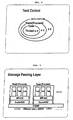
- the task control of the Master rendering process can be visualized as depth nesting of many Rank processes, each encompassing many Rendering Tasks, each encompassing many Threads of computation.
- the message passing interface between Rank processes and Tasks is illustrated in FIG. 6.
- a Message Passing Interface (MPI) utility is operative to pass messages from the Tasks to a Socket Utility operative with each defined Rank process.
- the Socket Utility enables the messages to be transmitted on a data bus or network (indicated as TCP/IP) which connects the Rank processes to an array of parallel processors (CPUs).
- a parallel object task (POT) Engine is created to handle the parallel processing of rendering tasks.
- the POT Engine is implemented as a C++ class library, making it possible for programmers to develop the parallel message passing system more securely and easily, writing each operation in accordance with the POT Engine's design.
- the POT Engine can be considered to be a very large waiting queue of tasks which are to be executed in parallel as independent operations.
- the POT Engine includes one or more POT Master task groupings which in general are groupings of tasks according to a chosen task control methodology.
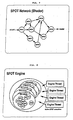
- the shading task which is accomplished by a parallel ray tracer using message passing, is implemented in a POT Master task grouping as a plurality of Shading POT (or SPOT) Spaces.
- each SPOT Space can be a network of elemental shading tasks, with some elemental shading tasks requiring data from other elemental shading tasks before they can finish.
- Each elemental shading task is referred to as a "SPOT Object", and is defined as a processing task which is self-contained, requires a data input from another SPOT Object or external process, and, once the data input becomes available, can be executed in one computational step without having to wait for data in order to complete its task.
- the SPOT Space can be visualized as a network of SPOT Objects which proceeds from a START point through the SPOT Objects as they pass the results of their individual computations on to the next SPOT Objects until the task of the SPOT Space reaches a FINISH.
- a SPOT Engine can be visualized as comprising a large number of Engine Threads used to monitor the processing of SPOT Objects in a plurality of SPOT Spaces in a POT Master.
- Each POT Engine Thread seeks out POT Objects in an active state in a POT Space, and assigns them for processing.
- Each POT Master may start up multiple POT Engine Threads.
- An active POT Object is executed by one and only one POT Engine Thread, and multiple POT Engine Threads will never execute the same POT Object simultaneously.
- the assigned processor can then perform the computation required for the POT Object without having to wait for any data to be passed from another object, task or process.
- the results are passed to the next POT Object as designated by the Engine Thread that needs the results for its computation, and the now available processor is assigned another active POT Object on the queue.
- POT Masters with multiple POT Engine Threads can be expected to execute multiple POT Objects efficiently in parallel, and thus increases the parallel execution efficiency in a machine with multiple CPUs.
- a SPOT Space for a shading task can be visualized as initiated by receipt of a Shading Request.
- the Shading Request can initiate a number of Shading SPOT Objects for the different points in the 3D scene to be shaded.
- the Shading SPOT Objects issue a plurality of RayTrace requests for the different light elements in the scene contributing to the lighting of the point.
- the Shading SPOT Objects also have a slot awaiting color data Col for each RayTrace request it issues. When all the RayTrace data are returned in the slots, the Shading SPOT Objects can complete their computational tasks.
- FIG. 10 the solution in the present invention to the "wait" problem of tying up parallel processing resources is illustrated.
- a SPOT Object sends a RayTrace request and is waiting for data, it is placed in a "wait” state, and processing resources will not be allocated to it.
- multiple RayTrace requests may be sent by a SPOT Object requiring multiple data inputs to be returned.
- the status of the SPOT Object is changed to "active" and placed on the queue to be processed by the next available processing resource.
- the parallel processing resources are more or less continuously occupied and are not wasted by waiting for data.
- the processors need not wait for an entire SPOT Space to be completed before it is assigned a new SPOT Object.
- each point of a surface's shader computation is implemented as a SPOT Space, and each SPOT Space may require multiple SPOT Objects to compute each of the respective RayTracing requests for that pixel.
- the parallel processing resources are continuously occupied with executing the many SPOT Objects of the SPOT Spaces that are in the active state, and not waiting for a SPOT Space to finish its computation. In this manner, multiple shading computation objects can be executed in parallel. Therefore, by implementing shading with the POT Engine, the message transmission latency inherent in message passing systems is negated, and parallel processing efficiency is increased.
- a POT Master contains all the functionality and data for a single POT Engine. Basically, all the functionality required for mangaging the POT Engine is implemented within the POT Master, and programmers can program without thinking about its internal workings at all. It is possible for multiple POT Masters to exist within a single program. However, each POT Master is designed to operate independently of others, and its internal data (POT Spaces, POT Objects) may not directly access other tasks or processes than that of the POT Master they belong to. Multiple POT Spaces can exist within a POT Master, and each POT Space contains multiple POT Objects that can be executed in parallel.
- a POT Space's internal data may not access other POT Spaces than the one they belong to.
- a POT Space defines a single closed process, and if multiple such processes are required, multiple POT Spaces can be created within the POT Engine to accommodate that.
- a POT Object is the smallest unit for program execution.
- the POT Master which manages the queue for the POT Objects, will assign the complete execution of a POT Object to a processor before the processor can be assigned to the next POT Object.
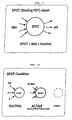
- Each POT Object contains one or more "slots" for receipt of data from an external source. The data received by a slot can also spcify a function to be performed by the POT Object. Also, it is possible for a POT Object to contain variables for internal use. Therefore a POT Object is an object in an object-oriented programming sense, and is implemented as a C++ class. Programmers can code the desired operations and data into the POT Object, as well as define input slots for receiving data from external sources, by extending the basic POT Object.
- POT Object whose slot has been defined but currently has no data set in the slot is said to be in the "waiting" state.
- a POT Object in this state will not be assigned to a processor nor be executed. Only after data values are set in all the defined slots will the status of the POT Object be changed to active state, signifying that it is ready for execution.
- POT Objects within the same POT Space may write to each other's data slots by specifying the POT Space Address (PSA) of the target POT Object.
- PSA POT Space Address
- the PSA is defined as a data structure containing 1) the physical address of the POT Object, as assigned by the standard C++ "new" operator, 2) the rank id of the POT Object, which specifies the type of the computation being performed, and 3) The slot ID the data will be stored in.
- the status of the POT Object is changed to the "dead" state.
- the POT Master will periodically delete dead POT Objects from memory at certain intervals.
- a POT Object may also have a "static" state in which it will never be executed, and is used for referencing its internal data from or to other POT Objects.
- POT Object To implement a POT Object, a programmer only needs to specify when a POT Object is in any of the four states and allow for the creation of its "data-waiting" slot address(es), and the flow of data from one POT Object to another.
- the POT Engine will execute all POT Objects in an active state. Having multiple POT Objects in an active state implies that such POT Objects have no dependencies on each other and that they can be executed in parallel. If a POT Object is waiting for input from an external source, then this is equivalent to the state of waiting for a process awaiting results from other functions commonly found in conventional message-passing-based parallel processing systems, except that the waiting POT Object is not in active execution and does not tie up a processor resource. Therefore, the CPU can be busy executing the many other POT Objects that probably exist at the same time.
- a POT Engine requires that a programmer first identify those areas of a large rendering task that can be grouped together as POT Spaces that do not require message passing from an external process in order to complete a POT Space computation, and then breaking up elemental tasks as POT Objects within a POT Space that are self-contained and can be executed in one computational step without requiring message passing to or from another object.
- a POT Object is generally characterized by a self-contained programmed sequence within an overall complex programmed application which has as its starting point the input of data being awaited, an uninterrupted computational step, and an output of the computational step on the input data.
- FIG. 14 an example is shown of two shader POT Objects defined within one of many shading tasks of a shading operation in a CG rendering application.
- the shading operation is initiated during a CG rendering application after an image frame of a scene has been defined, and the World Map data of the scene and objects therein ("Shot Data") are retrieved and held in a Depot to be used for shading of objects as they appear in the image frame (see FIG. 4 ).
- the AccelGrid function is called to narrow down the areas of the scene which will be scanned for intersecting objects.
- the Intersect function is called to find a point in the 3D scene that is intersected by traversal of eye rays from the viewer through the screen to the object in the 3D scene.
- the rendering program calls the shading function to derive the light and color with which the point will be shaded, based upon the light sources that impact the point in the scene.
- the shading function starts by determining the surface texture and characteristic of the point and generating a Shading POT (SPOT) Engine 103 for parallel processing of "ray-shooting" requests for light/color data from each light source.
- SPOT Shading POT
- Each "ray-shooting" request can form a single Shading POT (SPOT) Space 103a of many such spaces 103b, 103c, 103d, ....
- each SPOT Space there may be one or more SPOT Objects in which a message is passed to another process for return of data.
- one source of light on a point being shaded is from a point A, which in turn is illuminated by a nearby light source B.
- SPOT Space 103a defined within SPOT Space 103a is a SPOT Object 103-1 which awaits data representing light source B and computes the light reflected from reflection surface A, and a SPOT Object 103-2 which awaits the result of computation of reflected light from SPOT Object 103-1 and computes the light and color values to be applied to the pixel representing that point on the object.
- SPOT Objects are defined in each of the SPOT Spaces, and the SPOT Objects are processed by the SPOT Engine using the above-described method of prarallel processing.
- templates representing different light shading models can be stored in a library for use by the programmer to easily program the SPOT Spaces and SPOT Objects.
- An example of the use of a shading template to implement a SPOT Engine for a shading task is provided in Appendix A hereto.
- POT Engine Because all the processing within a POT Engine is encoded in terms of POT Objects and POT Spaces, it requires significantly more memory than an ordinary sequential program. In order to conserve memory as much as possible, POT Objects which are no longer needed, i.e., dead objects, are quickly deleted from the POT Engine. This operation is programmed to be performed by the POT Engine automatically, so programmers do not need to concern themselves with explicitly freeing memory.
- each of POT Object, POT Space, and POT Master classes are inherited by new classes, and the necessary new data and functions are added.
- the SPOT Engine class is created implementing the necessary data and functions for the shading engine, which apply to the SPOT Space and SPOT Master classes as well. For example, a new raytracing request that is required for shading is passed to other processes as a RayTracingRequest message, but this part is handled completely by the SPOT Master.
- a POT Engine may commonly need to be accessed from within another separate process.
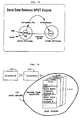
- a POT Engine can send data to another POT Engine by maintaining a POT Space Address (PSA) listing.
- PSA POT Space Address
- the program is executed within a single memory address space, so data access can easily be performed in the form of pointers.
- the PSA listing method is used for specifying addresses within the POT Engine so that they can be accessed from within a different process.
- the PSA is a unique address ID defined only within that POT Engine itself, so by using that address indexed to a specific POT Engine, access to the correct memory space address can be performed in a safe manner. This is illustrated in FIG. 13 , in which the SPOT Engine for Shader Task A sends a RayTrace request and PSA address for return of data to the SPOT Engine for Shader Task B, which can then return a color result to the indicated PSA and SPOT Engine.
- the POT Engine In order to use the POT Engine, programmers will be inheriting from the POT class as necessary. Therefore, it is difficult to determine the data size of the POT Objects which exists within the POT Engine until runtime. Because of its architecture, the POT Engine allocates a large number of POT Objects internally which changes dynamically. This requires a dynamic allocation of memory, and in actual use, the system will have to handle a large number of POT Objects of differing sizes. Therefore, having a fast, efficient memory management is an extremely important issue. Therefore, the POT Engine is designed to contain its own memory management functionality, which realizes a faster performance than the default memory management implemented in the operating system. This memory management system is built to be thread-safe, in order to be able to deal with parallel processing correctly.
- a POT Engine can be designed to profile its own execution and log its performance. It is possible to dump such data in real-time or check the performance at the end, which allows the system to monitor the rate at which the tasks are being performed. This feature is effective for tuning the overall performance of the system.
- the POT methodology can also be applied to other parallel processing applications, such as: (1) Simulation Programs; (2) Particle Simulator; (3) Physical Phenomenon Simulator; (4) Fluid Simulator; (5) Circuit Simulator.
- the POT Engine methodology is applicable in general to simulation programs where parallel processing is possible, and has an especially high affinity for tasks which require message passing. Certain simulations require independent sets of large amounts of computation, and there is a lot of merit to implementing such tasks on workstation clusters where multiple machines are connected over a generic network. Being able to take advantage of free CPU time in environments where there are many workstations, not all of which are performing a useful task 24 hours a day, is especially advantageous. In such situations, message passing between multiple CPUs are required, and the logic driving such programs require massive waiting queue characteristics as well as the ability to execute multiple objects concurrently.
- the POT Engine fulfills all of these requirements effectively.
- the POT Engine technology is also applicable for network games where multiple machines are connected and communicate with each other over a network.
- Such systems can be broken down into two major programs.
- One is the server process, and the other is the client process.
- the client side is where the human player actually interacts with the computer, and the server handles the events coming from multiple client processes.
- the server process requires extreme parallelism as well as a massive queue structure for the events waiting for a reaction. Both of these are well matched with the POT Engine's basic traits, and good results can be expected by implementing such servers on top of the POT Engine.
- the server functionality may have to be distributed over several processes, or the server may need to be implemented in such a way that multiple processes function as a single server program. In such cases, overall stability of the system and performance gains can be expected without losing POT Engine's advantages.
- the POT Engine may also be used on the client side where queue structures are required, such as in an event handling, and should be effective in all other operations where parallel processing and wait queue structures are required simultaneously.
- the overloaded POT Engine can transfer some of its load to the idle POT Engines. Because each POT Engine has a PSA address space unique to its system, identical results can be guaranteed after transferring tasks from one POT Engine to another. However, this requires that the originating POT Engine keep the information about the transferred tasks in order to determine the destination of the results of the transferred tasks.
- Some applications require the clocking of time as a part of the computation, necessitating some virtual time computation for all POT Engines. Generally, such times are determined virtually within the computation. In other cases, continuous time is broken down into very short periods (steps), and computation is performed by taking a large number of discrete samples. Adapting such problems to the POT Engine is possible by adding the clocking of time to every POT Object and POT Engine. POT Objects within the POT Engine can be waiting or running depending on its state. Whether it is ready to run depends largely on the status of the slots defined for the POT Object. When data is set for all the defined slots of the POT Object, that particular POT Object will be executed. Time can be added as a slot for determining whether the POT Object is ready to execute, as well as to record the POT Object's local time within itself. In addition, a global time common to every POT Engine can be maintained.
- the POT Engine methodology for intensive computation, the CPU wait problem that occurs in message passing-based parallel processing systems can be solved. Especially when there are large number of messages, most of the CPU's wait times can be eliminated, and this methodology has been demonstrated to work effectively for computations with very large latency. Also, for processing large number of messages in parallel, because the POT Engine tries very strongly to execute parallel processing, it became possible for a system to inherently possess parallel processing capabilities. Until now, programming any logic required a separate design in how the parallel processing would be maintained and implemented, but by using the POT methodology and implementing the processing on top of that, the need for complex individual design of the system functions can be eliminated, and programmers can focus on the more important, core functionality of the processing objects to be carried out in the particular application. The POT methodology in effect implements a highly effective queuing system for dealing with the CPU wait problem, instead of trying to implement a specific solution for each type of processing application.
- steps 7-10 will be computed immediately. However, if the scene data is distributed among multiple computers, there will be a delay in sending a request to computer B, waiting for the computation to take place, and then receive the result of the computation from the remote computer. During this time, computer A will not be able to proceed with the computation.
- POT Engine can get around this problem by implementing steps 6-10 as follows:
- step 8' where the shading POT Object is placed in a WAIT state.
- the POT Engine can be thought of as a large waiting queue. Every POT Object is placed in this queue when they are put in the WAIT state, and processing resources are turned over to some other process. POT Engine will constantly iterate through every POT Object in the queue, monitoring the state of the POT Objects. When all of the input slots of a POT Object are filled, the state of the POT Object will change to ACTIVE. POT Engine will take the POT Object out of the queue and allow it to execute its computation. In this case, the shading POT Object will compute the above equation for each of its input slots, add the results together, and return the sum as the illumination value at point P.
- Each pixel in the area to be rendered can be computed independently of each other. Therefore, steps 1-2 can be computed in parallel. This helps ensure that the POT Engine will have enough POT Objects in parallel to keep the processing resources from being idle.
- a POT Object can be implemented using object-oriented programming languages, such as C++.
- object-oriented programming languages such as C++.
- the Lambert illumination model implemented above can be used as a template to implement a more complex illumination model.
- the Phong illumination model is also a commonly illumination model, so it will not be explained here.
- a generic POT Object implementation contains all the data and functionality to perform a computation in parallel within the POT Engine. Functionality such as the ability to switch between the WAIT and ACTIVE states are implemented in a generic POT Object. For a POT Object to perform a meaningful task, programmers extend the POT Object and add any other necessary functionality via subclassing and virtual functions. For example, a shading POT Object is a subclass of a generic POT Object that implements the necessary functionality to shoot rays into the 3D space.
- the Lambert illumination example is a subclass of the shading POT Object that adds the computation of the Lambert illumination equation. Therefore, a Phong illumination POT can be implemented by subclassing the Lambert illumination POT Object, adding the extra code to implement the Phong equation.
- a class library of different POT Objects can be created in this way, each implementing a different illumination model. They, in turn, can be used to implement new illumination models.
Landscapes
- Engineering & Computer Science (AREA)
- Software Systems (AREA)
- Theoretical Computer Science (AREA)
- General Engineering & Computer Science (AREA)
- Physics & Mathematics (AREA)
- General Physics & Mathematics (AREA)
- Image Generation (AREA)
- Image Processing (AREA)
Abstract
Description
The Lambert illumination model can be described by the equation
Implementing this model in a ray tracer can be psudocoded as follows:
In a recursive ray tracer, step 5 can be expanded as follows:
POT Engine can get around this problem by implementing steps 6-10 as follows:
Each raytrace request is implemented as follows:
The Phong illumination model can be described by the equation
Claims (20)
- A parallel processing method for performing processing tasks in parallel on a plurality of processors comprising:(a) breaking down a processing task into a plurality of self-contained task objects, wherein each task object is defined with a computational task and at least one "data-waiting" slot for receipt of data requested from another task object to which the processing task passes a message for the requested data, and wherein once all the "data-waiting" slots of a task object are filled by the respective return message(s), the task object can perform its defined computational task without waiting for any other input;(b) scheduling the defined task objects to be processed by distributing them across the plurality of processors, by:(i) placing a task object with an unfilled "data-waiting" slot in a "waiting" state in which it is not assigned to any processor;(ii) changing the status of a task object to an "active" state when all of its defined "data-waiting" slots have been filled, wherein it is assigned to a next available processor in an "unoccupied" state, then placing that processor's status in an "occupied" state; and(iii) changing the status of the task object to a "dead" state when the computational task to be performed for the task object by the assigned processor has been completed, and then changing the processor's status to an "unoccupied" state to be assigned to a next "active" task object.
- A parallel processing method according to Claim 1, wherein a master task grouping is defined by a plurality of task spaces each of which contains multiple task objects and does not require message passing from an external source in order to complete computation for the respective task space.
- A parallel processing method according to Claim 2, wherein all task objects of the task spaces which are in an"active" state are placed in a processing queue and each is assigned in turn to a next available "unoccupied" processor.
- A parallel processing method according to Claim 3, wherein a master engine for the master task grouping maintains threads which track the processing of task objects in each of the task spaces.
- A parallel processing method according to Claim 4, wherein the master engine for the master task grouping maintains an internal space address assigned to each respective task object.
- A parallel processing method according to Claim 5, wherein a task object in one master task grouping can exchange data with a task object in another master task grouping by providing its internal space address indexed to its master task grouping.
- A parallel processing method according to Claim 1, wherein the processing task includes shading an image frame of a scene in computer graphics rendering.
- A parallel processing method according to Claim 7, wherein the shading task includes a master task grouping of shading task spaces each of which performs shading of a pixel in the image frame.
- A parallel processing method according to Claim 8, wherein each shading task space includes a plurality of "pixel shading" task objects for performing shading of the pixel based upon ray shooting from light sources in the scene, and a "compositing" task object for compositing the shading results for the pixel.
- A parallel processing method according to Claim 9, wherein each shading task object has at least one "data-waiting" slot for return of data characterizing light emitted from a respective light source in the scene.
- A parallel processing method according to Claim 9, wherein the rendering task includes a function for receiving scene data for a "world map" of the scene, a function for defining the scene objects in each frame of the scene, a function for defining the pixels of an object in the scene intersected by an eye ray of a viewer of the scene, and a function for tiling together the shading results returned by each of the master shading task groupings for respective objects in the image frame.
- A software programming method for performing processing tasks in parallel on a plurality of processors comprising:(a) breaking down a processing task into a plurality of self-contained task objects, wherein each task object is defined with a computational task and at least one "data-waiting" slot for receipt of data requested from another task object to which the processing task passes a message for the requested data, and wherein once all the "data-waiting" slots of a task object are filled by the respective return message(s), the task object can perform its defined computational task without waiting for any other input;(b) defining the task objects to be processed by distributing them across the plurality of processors, by:(i) placing a task object with an unfilled "data-waiting" slot in a "waiting" state in which it is not assigned to any processor;(ii) changing the status of a task object to an "active" state when all of its defined "data-waiting" slots have been filled, wherein it is assigned to a next available processor in an "unoccupied" state, then placing that processor's status in an "occupied" state; and(iii) changing the status of the task object to a "dead" state when the computational task to be performed for the task object by the assigned processor has been completed, and then changing the processor's status to an "unoccupied" state to be assigned to a next "active" task object.
- A software programming method according to Claim 12, wherein a master task grouping is defined by a plurality of task spaces each of which contains multiple task objects and does not require message passing from an external source in order to complete computation for the respective task space.
- A software programming method according to Claim 13, wherein all task objects of the task spaces which are in an"active" state are placed in a processing queue and each is assigned in turn to a next available "unoccupied" processor.
- A software programming method according to Claim 14, wherein a master engine for the master task grouping maintains threads which track the processing of task objects in each of the task spaces.
- A software programming method according to Claim 15, wherein the master engine for the master task grouping maintains an internal space address assigned to each respective task object.
- A software programming method according to Claim 16, wherein a task object in one master task grouping can exchange data with a task object in another master task grouping by providing its internal space address indexed to its master task grouping.
- A software programming method according to Claim 12, further comprising storing templates for different types of task engines, spaces, and objects in a library and utilizing the templates to generate software programming for a desired processing task.
- A software programming method according to Claim 12, wherein the processing task includes shading an image frame of a scene in computer graphics rendering.
- A software programming method according to Claim 19, wherein the shading task includes a master task grouping of shading task spaces each of which performs shading of a pixel in the image frame.
Applications Claiming Priority (2)
| Application Number | Priority Date | Filing Date | Title |
|---|---|---|---|
| US19032900P | 2000-03-16 | 2000-03-16 | |
| US190329P | 2000-03-16 |
Publications (3)
| Publication Number | Publication Date |
|---|---|
| EP1152331A2 true EP1152331A2 (en) | 2001-11-07 |
| EP1152331A3 EP1152331A3 (en) | 2005-03-02 |
| EP1152331B1 EP1152331B1 (en) | 2017-11-22 |
Family
ID=22700890
Family Applications (1)
| Application Number | Title | Priority Date | Filing Date |
|---|---|---|---|
| EP01106561.2A Expired - Lifetime EP1152331B1 (en) | 2000-03-16 | 2001-03-15 | Parallel task processing system and method |
Country Status (2)
| Country | Link |
|---|---|
| EP (1) | EP1152331B1 (en) |
| JP (1) | JP2001318798A (en) |
Cited By (6)
| Publication number | Priority date | Publication date | Assignee | Title |
|---|---|---|---|---|
| EP1783604A3 (en) * | 2005-11-07 | 2007-10-03 | Slawomir Adam Janczewski | Object-oriented, parallel language, method of programming and multi-processor computer |
| EP1640875A3 (en) * | 2004-09-27 | 2008-04-16 | Microsoft Corporation | Method and system for multithread processing of spreadsheet chain calculations |
| WO2010108967A3 (en) * | 2009-03-24 | 2011-02-10 | National University Of Ireland, Cork | A method of processing a condensed graph |
| US8032821B2 (en) | 2006-05-08 | 2011-10-04 | Microsoft Corporation | Multi-thread spreadsheet processing with dependency levels |
| CN114637581A (en) * | 2022-01-26 | 2022-06-17 | 武汉艺画开天文化传播有限公司 | Optimization system for submitting rendering model |
| US11886916B2 (en) | 2020-06-30 | 2024-01-30 | Microsoft Technology Licensing, Llc | System for adaptive multithreaded recalculation operations |
Families Citing this family (7)
| Publication number | Priority date | Publication date | Assignee | Title |
|---|---|---|---|---|
| KR20050118224A (en) * | 2003-04-03 | 2005-12-15 | 코닌클리즈케 필립스 일렉트로닉스 엔.브이. | Runtime configurable virtual video pipeline |
| DE102004007835A1 (en) * | 2004-02-17 | 2005-09-15 | Universität des Saarlandes | Device for displaying dynamic complex scenes |
| CA2593902A1 (en) * | 2006-07-31 | 2008-01-31 | Avid Technology, Inc. | Efficient processing of operator graphs representing three-dimensional character animation |
| JP4965995B2 (en) * | 2006-12-22 | 2012-07-04 | 株式会社東芝 | Program processing method, processing program, and information processing apparatus |
| JP2008276547A (en) * | 2007-04-27 | 2008-11-13 | Toshiba Corp | Program processing method and information processing apparatus |
| CN102508704A (en) * | 2011-11-10 | 2012-06-20 | 上海市共进通信技术有限公司 | Method for implementing task decomposition and parallel processing in computer software system |
| US12045654B2 (en) * | 2021-02-09 | 2024-07-23 | Alteryx, Inc. | Memory management through control of data processing tasks |
Family Cites Families (6)
| Publication number | Priority date | Publication date | Assignee | Title |
|---|---|---|---|---|
| US3662401A (en) * | 1970-09-23 | 1972-05-09 | Collins Radio Co | Method of program execution |
| US4644461A (en) * | 1983-04-29 | 1987-02-17 | The Regents Of The University Of California | Dynamic activity-creating data-driven computer architecture |
| DE68909426T2 (en) * | 1988-01-15 | 1994-01-27 | Quantel Ltd | Data processing and transmission. |
| EP0357444A3 (en) * | 1988-09-02 | 1991-12-18 | Tektronix, Inc. | Dynamically configurable, demand driven data processing pipeline |
| JP3337706B2 (en) * | 1992-02-26 | 2002-10-21 | シャープ株式会社 | Data flow program execution control method |
| WO1999030230A1 (en) * | 1997-12-12 | 1999-06-17 | Cacheon, L.L.C. | Naturally parallel computing system and method |
-
2001
- 2001-03-15 EP EP01106561.2A patent/EP1152331B1/en not_active Expired - Lifetime
- 2001-03-16 JP JP2001077144A patent/JP2001318798A/en active Pending
Cited By (9)
| Publication number | Priority date | Publication date | Assignee | Title |
|---|---|---|---|---|
| EP1640875A3 (en) * | 2004-09-27 | 2008-04-16 | Microsoft Corporation | Method and system for multithread processing of spreadsheet chain calculations |
| US7533139B2 (en) | 2004-09-27 | 2009-05-12 | Microsoft Corporation | Method and system for multithread processing of spreadsheet chain calculations |
| EP1783604A3 (en) * | 2005-11-07 | 2007-10-03 | Slawomir Adam Janczewski | Object-oriented, parallel language, method of programming and multi-processor computer |
| US7853937B2 (en) | 2005-11-07 | 2010-12-14 | Slawomir Adam Janczewski | Object-oriented, parallel language, method of programming and multi-processor computer |
| US8032821B2 (en) | 2006-05-08 | 2011-10-04 | Microsoft Corporation | Multi-thread spreadsheet processing with dependency levels |
| WO2010108967A3 (en) * | 2009-03-24 | 2011-02-10 | National University Of Ireland, Cork | A method of processing a condensed graph |
| US11886916B2 (en) | 2020-06-30 | 2024-01-30 | Microsoft Technology Licensing, Llc | System for adaptive multithreaded recalculation operations |
| CN114637581A (en) * | 2022-01-26 | 2022-06-17 | 武汉艺画开天文化传播有限公司 | Optimization system for submitting rendering model |
| CN114637581B (en) * | 2022-01-26 | 2023-04-11 | 武汉艺画开天文化传播有限公司 | Optimization system for submitting rendering model |
Also Published As
| Publication number | Publication date |
|---|---|
| EP1152331B1 (en) | 2017-11-22 |
| EP1152331A3 (en) | 2005-03-02 |
| JP2001318798A (en) | 2001-11-16 |
Similar Documents
| Publication | Publication Date | Title |
|---|---|---|
| US7233331B2 (en) | Parallel object task engine and processing method | |
| Samanta et al. | Load balancing for multi-projector rendering systems | |
| US6088044A (en) | Method for parallelizing software graphics geometry pipeline rendering | |
| Wald et al. | Interactive distributed ray tracing of highly complex models | |
| US9043801B2 (en) | Two-tiered dynamic load balancing using sets of distributed thread pools | |
| US9584592B2 (en) | Internet-based graphics application profile management system for updating graphic application profiles stored within the multi-GPU graphics rendering subsystems of client machines running graphics-based applications | |
| US7940274B2 (en) | Computing system having a multiple graphics processing pipeline (GPPL) architecture supported on multiple external graphics cards connected to an integrated graphics device (IGD) embodied within a bridge circuit | |
| CA2638453C (en) | General purpose software parallel task engine | |
| US8587588B2 (en) | Ray-aggregation for ray-tracing during rendering of imagery | |
| EP1152331B1 (en) | Parallel task processing system and method | |
| Salmon et al. | A hypercube ray-tracer | |
| Crow et al. | 3d image synthesis on the connection machine | |
| Krogh et al. | Parallel sphere rendering | |
| Kumar | Optimizing Computational Performance for Ray Tracing on the Cell Broadband Engine: A Parallel Processing Approach | |
| Schormann et al. | Porting a Large 3D Graphics System onto Transputers—Experiences from Implementing Mirashading on a Parallel Computer | |
| Clay | Optimization for real-time graphics applications | |
| SCHORMANN et al. | PORTING A LARGE 3D GRAPHICS SYSTEM ONTO TRANSPUTERS-EXPERIENCES FROM IMPLEMENTING MIRASHADING ON A PARALLEL | |
| Žára et al. | Load balancing for parallel raytracer on virtual walls | |
| Lastra et al. | Harnessing parallelism for high-performance interactive computer graphics | |
| Frank et al. | Dependency graph approach to load balancing distributed volume visualization | |
| Crow | Graphics Algorithms for Parallel Machines | |
| Plachetka et al. | The HiQoS rendering system | |
| Menzel | Load balancing for parallel raytracer on Virtual Walls | |
| Tovar et al. | A survey of techniques and technologies for web-based real-time interactive rendering | |
| Renaud | Fast local and global illuminations through a SIMD z-buffer |
Legal Events
| Date | Code | Title | Description |
|---|---|---|---|
| PUAI | Public reference made under article 153(3) epc to a published international application that has entered the european phase |
Free format text: ORIGINAL CODE: 0009012 |
|
| AK | Designated contracting states |
Kind code of ref document: A2 Designated state(s): AT BE CH CY DE DK ES FI FR GB GR IE IT LI LU MC NL PT SE TR |
|
| AX | Request for extension of the european patent |
Free format text: AL;LT;LV;MK;RO;SI |
|
| RAP1 | Party data changed (applicant data changed or rights of an application transferred) |
Owner name: KABUSHIKI KAISHA SQUARE ENIX |
|
| RIC1 | Information provided on ipc code assigned before grant |
Ipc: 7G 06F 9/44 A Ipc: 7G 06F 9/46 B |
|
| PUAL | Search report despatched |
Free format text: ORIGINAL CODE: 0009013 |
|
| RIC1 | Information provided on ipc code assigned before grant |
Ipc: 7G 06F 9/48 B Ipc: 7G 06F 9/46 B Ipc: 7G 06F 9/44 A |
|
| AK | Designated contracting states |
Kind code of ref document: A3 Designated state(s): AT BE CH CY DE DK ES FI FR GB GR IE IT LI LU MC NL PT SE TR |
|
| AX | Request for extension of the european patent |
Extension state: AL LT LV MK RO SI |
|
| 17P | Request for examination filed |
Effective date: 20050822 |
|
| AKX | Designation fees paid |
Designated state(s): DE FR GB |
|
| RAP1 | Party data changed (applicant data changed or rights of an application transferred) |
Owner name: KABUSHIKI KAISHA SQUARE ENIX HOLDINGS (ALSO TRADIN |
|
| RAP1 | Party data changed (applicant data changed or rights of an application transferred) |
Owner name: KABUSHIKI KAISHA SQUARE ENIX (ALSO TRADING AS SQUA |
|
| REG | Reference to a national code |
Ref country code: DE Ref legal event code: R079 Ref document number: 60150682 Country of ref document: DE Free format text: PREVIOUS MAIN CLASS: G06F0009440000 Ipc: G06F0009450000 |
|
| GRAP | Despatch of communication of intention to grant a patent |
Free format text: ORIGINAL CODE: EPIDOSNIGR1 |
|
| RIC1 | Information provided on ipc code assigned before grant |
Ipc: G06F 9/44 20060101ALI20170630BHEP Ipc: G06F 9/46 20060101ALI20170630BHEP Ipc: G06F 9/48 20060101ALI20170630BHEP Ipc: G06F 9/45 20060101AFI20170630BHEP |
|
| INTG | Intention to grant announced |
Effective date: 20170721 |
|
| GRAS | Grant fee paid |
Free format text: ORIGINAL CODE: EPIDOSNIGR3 |
|
| GRAA | (expected) grant |
Free format text: ORIGINAL CODE: 0009210 |
|
| AK | Designated contracting states |
Kind code of ref document: B1 Designated state(s): DE FR GB |
|
| RAP1 | Party data changed (applicant data changed or rights of an application transferred) |
Owner name: KABUSHIKI KAISHA SQUARE ENIX (ALSO TRADING AS SQUA |
|
| REG | Reference to a national code |
Ref country code: GB Ref legal event code: FG4D |
|
| REG | Reference to a national code |
Ref country code: DE Ref legal event code: R079 Ref document number: 60150682 Country of ref document: DE Free format text: PREVIOUS MAIN CLASS: G06F0009450000 Ipc: G06F0009440000 |
|
| REG | Reference to a national code |
Ref country code: DE Ref legal event code: R096 Ref document number: 60150682 Country of ref document: DE |
|
| REG | Reference to a national code |
Ref country code: FR Ref legal event code: PLFP Year of fee payment: 18 |
|
| REG | Reference to a national code |
Ref country code: DE Ref legal event code: R097 Ref document number: 60150682 Country of ref document: DE |
|
| PLBE | No opposition filed within time limit |
Free format text: ORIGINAL CODE: 0009261 |
|
| STAA | Information on the status of an ep patent application or granted ep patent |
Free format text: STATUS: NO OPPOSITION FILED WITHIN TIME LIMIT |
|
| 26N | No opposition filed |
Effective date: 20180823 |
|
| PGFP | Annual fee paid to national office [announced via postgrant information from national office to epo] |
Ref country code: GB Payment date: 20200304 Year of fee payment: 20 Ref country code: DE Payment date: 20200303 Year of fee payment: 20 |
|
| PGFP | Annual fee paid to national office [announced via postgrant information from national office to epo] |
Ref country code: FR Payment date: 20200214 Year of fee payment: 20 |
|
| REG | Reference to a national code |
Ref country code: DE Ref legal event code: R071 Ref document number: 60150682 Country of ref document: DE |
|
| REG | Reference to a national code |
Ref country code: GB Ref legal event code: PE20 Expiry date: 20210314 |
|
| PG25 | Lapsed in a contracting state [announced via postgrant information from national office to epo] |
Ref country code: GB Free format text: LAPSE BECAUSE OF EXPIRATION OF PROTECTION Effective date: 20210314 |