EP1152035A1 - Preform for hollow molding made of polyester resin composition, hollow molding made of polyester resin composition, and process for producing the same - Google Patents
Preform for hollow molding made of polyester resin composition, hollow molding made of polyester resin composition, and process for producing the same Download PDFInfo
- Publication number
- EP1152035A1 EP1152035A1 EP00961113A EP00961113A EP1152035A1 EP 1152035 A1 EP1152035 A1 EP 1152035A1 EP 00961113 A EP00961113 A EP 00961113A EP 00961113 A EP00961113 A EP 00961113A EP 1152035 A1 EP1152035 A1 EP 1152035A1
- Authority
- EP
- European Patent Office
- Prior art keywords
- polyester resin
- resin composition
- preform
- infrared absorbing
- group
- Prior art date
- Legal status (The legal status is an assumption and is not a legal conclusion. Google has not performed a legal analysis and makes no representation as to the accuracy of the status listed.)
- Withdrawn
Links
- 229920001225 polyester resin Polymers 0.000 title claims abstract description 86
- 239000004645 polyester resin Substances 0.000 title claims abstract description 86
- 239000000203 mixture Substances 0.000 title claims abstract description 60
- 238000000034 method Methods 0.000 title claims abstract description 30
- 238000000465 moulding Methods 0.000 title description 11
- 239000003086 colorant Substances 0.000 claims abstract description 64
- 238000010438 heat treatment Methods 0.000 claims abstract description 19
- 238000010521 absorption reaction Methods 0.000 claims abstract description 14
- 230000009477 glass transition Effects 0.000 claims abstract description 11
- 238000000071 blow moulding Methods 0.000 claims abstract description 8
- LKKPNUDVOYAOBB-UHFFFAOYSA-N naphthalocyanine Chemical compound N1C(N=C2C3=CC4=CC=CC=C4C=C3C(N=C3C4=CC5=CC=CC=C5C=C4C(=N4)N3)=N2)=C(C=C2C(C=CC=C2)=C2)C2=C1N=C1C2=CC3=CC=CC=C3C=C2C4=N1 LKKPNUDVOYAOBB-UHFFFAOYSA-N 0.000 claims abstract description 8
- IEQIEDJGQAUEQZ-UHFFFAOYSA-N phthalocyanine Chemical compound N1C(N=C2C3=CC=CC=C3C(N=C3C4=CC=CC=C4C(=N4)N3)=N2)=C(C=CC=C2)C2=C1N=C1C2=CC=CC=C2C4=N1 IEQIEDJGQAUEQZ-UHFFFAOYSA-N 0.000 claims abstract description 8
- -1 phthalocyanine compound Chemical class 0.000 claims description 117
- 125000001424 substituent group Chemical group 0.000 claims description 54
- 125000004432 carbon atom Chemical group C* 0.000 claims description 26
- 125000004429 atom Chemical group 0.000 claims description 14
- 239000002184 metal Substances 0.000 claims description 13
- 229910052751 metal Inorganic materials 0.000 claims description 13
- 229920000139 polyethylene terephthalate Polymers 0.000 claims description 12
- 239000005020 polyethylene terephthalate Substances 0.000 claims description 12
- 125000003118 aryl group Chemical group 0.000 claims description 11
- 125000000217 alkyl group Chemical group 0.000 claims description 10
- 125000005110 aryl thio group Chemical group 0.000 claims description 9
- 125000004414 alkyl thio group Chemical group 0.000 claims description 8
- 125000001769 aryl amino group Chemical group 0.000 claims description 8
- 125000003545 alkoxy group Chemical group 0.000 claims description 7
- 125000003282 alkyl amino group Chemical group 0.000 claims description 7
- 125000004104 aryloxy group Chemical group 0.000 claims description 7
- 125000005843 halogen group Chemical group 0.000 claims description 6
- 229920003207 poly(ethylene-2,6-naphthalate) Polymers 0.000 claims description 6
- 239000011112 polyethylene naphthalate Substances 0.000 claims description 6
- 125000004435 hydrogen atom Chemical group [H]* 0.000 claims description 4
- LYCAIKOWRPUZTN-UHFFFAOYSA-N Ethylene glycol Chemical compound OCCO LYCAIKOWRPUZTN-UHFFFAOYSA-N 0.000 description 11
- OFOBLEOULBTSOW-UHFFFAOYSA-N Malonic acid Chemical compound OC(=O)CC(O)=O OFOBLEOULBTSOW-UHFFFAOYSA-N 0.000 description 6
- KKEYFWRCBNTPAC-UHFFFAOYSA-N Terephthalic acid Chemical compound OC(=O)C1=CC=C(C(O)=O)C=C1 KKEYFWRCBNTPAC-UHFFFAOYSA-N 0.000 description 6
- 239000008188 pellet Substances 0.000 description 6
- 125000004185 ester group Chemical group 0.000 description 5
- 238000001746 injection moulding Methods 0.000 description 5
- 238000004519 manufacturing process Methods 0.000 description 5
- QQVIHTHCMHWDBS-UHFFFAOYSA-N isophthalic acid Chemical compound OC(=O)C1=CC=CC(C(O)=O)=C1 QQVIHTHCMHWDBS-UHFFFAOYSA-N 0.000 description 4
- 125000001624 naphthyl group Chemical group 0.000 description 4
- 125000001997 phenyl group Chemical group [H]C1=C([H])C([H])=C(*)C([H])=C1[H] 0.000 description 4
- 238000006068 polycondensation reaction Methods 0.000 description 4
- UHOVQNZJYSORNB-UHFFFAOYSA-N Benzene Chemical compound C1=CC=CC=C1 UHOVQNZJYSORNB-UHFFFAOYSA-N 0.000 description 3
- DNIAPMSPPWPWGF-UHFFFAOYSA-N Propylene glycol Chemical compound CC(O)CO DNIAPMSPPWPWGF-UHFFFAOYSA-N 0.000 description 3
- 125000002496 methyl group Chemical group [H]C([H])([H])* 0.000 description 3
- KYTZHLUVELPASH-UHFFFAOYSA-N naphthalene-1,2-dicarboxylic acid Chemical compound C1=CC=CC2=C(C(O)=O)C(C(=O)O)=CC=C21 KYTZHLUVELPASH-UHFFFAOYSA-N 0.000 description 3
- CXMXRPHRNRROMY-UHFFFAOYSA-N sebacic acid Chemical compound OC(=O)CCCCCCCCC(O)=O CXMXRPHRNRROMY-UHFFFAOYSA-N 0.000 description 3
- PUPZLCDOIYMWBV-UHFFFAOYSA-N (+/-)-1,3-Butanediol Chemical compound CC(O)CCO PUPZLCDOIYMWBV-UHFFFAOYSA-N 0.000 description 2
- JPVYNHNXODAKFH-UHFFFAOYSA-N Cu2+ Chemical compound [Cu+2] JPVYNHNXODAKFH-UHFFFAOYSA-N 0.000 description 2
- QIGBRXMKCJKVMJ-UHFFFAOYSA-N Hydroquinone Chemical compound OC1=CC=C(O)C=C1 QIGBRXMKCJKVMJ-UHFFFAOYSA-N 0.000 description 2
- 229910021617 Indium monochloride Inorganic materials 0.000 description 2
- 239000004594 Masterbatch (MB) Substances 0.000 description 2
- 239000002253 acid Substances 0.000 description 2
- WNLRTRBMVRJNCN-UHFFFAOYSA-N adipic acid Chemical compound OC(=O)CCCCC(O)=O WNLRTRBMVRJNCN-UHFFFAOYSA-N 0.000 description 2
- 125000002723 alicyclic group Chemical group 0.000 description 2
- 125000003277 amino group Chemical group 0.000 description 2
- 230000004888 barrier function Effects 0.000 description 2
- QMKYBPDZANOJGF-UHFFFAOYSA-N benzene-1,3,5-tricarboxylic acid Chemical compound OC(=O)C1=CC(C(O)=O)=CC(C(O)=O)=C1 QMKYBPDZANOJGF-UHFFFAOYSA-N 0.000 description 2
- WERYXYBDKMZEQL-UHFFFAOYSA-N butane-1,4-diol Chemical compound OCCCCO WERYXYBDKMZEQL-UHFFFAOYSA-N 0.000 description 2
- 239000003795 chemical substances by application Substances 0.000 description 2
- 230000000052 comparative effect Effects 0.000 description 2
- 150000001875 compounds Chemical class 0.000 description 2
- 238000005886 esterification reaction Methods 0.000 description 2
- 125000001495 ethyl group Chemical group [H]C([H])([H])C([H])([H])* 0.000 description 2
- APHGZSBLRQFRCA-UHFFFAOYSA-M indium(1+);chloride Chemical compound [In]Cl APHGZSBLRQFRCA-UHFFFAOYSA-M 0.000 description 2
- KLRHPHDUDFIRKB-UHFFFAOYSA-M indium(i) bromide Chemical compound [Br-].[In+] KLRHPHDUDFIRKB-UHFFFAOYSA-M 0.000 description 2
- BDJRBEYXGGNYIS-UHFFFAOYSA-N nonanedioic acid Chemical compound OC(=O)CCCCCCCC(O)=O BDJRBEYXGGNYIS-UHFFFAOYSA-N 0.000 description 2
- WXHIJDCHNDBCNY-UHFFFAOYSA-N palladium dihydride Chemical compound [PdH2] WXHIJDCHNDBCNY-UHFFFAOYSA-N 0.000 description 2
- XNGIFLGASWRNHJ-UHFFFAOYSA-N phthalic acid Chemical compound OC(=O)C1=CC=CC=C1C(O)=O XNGIFLGASWRNHJ-UHFFFAOYSA-N 0.000 description 2
- 229920000728 polyester Polymers 0.000 description 2
- 229920000642 polymer Polymers 0.000 description 2
- YPFDHNVEDLHUCE-UHFFFAOYSA-N propane-1,3-diol Chemical compound OCCCO YPFDHNVEDLHUCE-UHFFFAOYSA-N 0.000 description 2
- 239000007858 starting material Substances 0.000 description 2
- 229920001169 thermoplastic Polymers 0.000 description 2
- ZSUXOVNWDZTCFN-UHFFFAOYSA-L tin(ii) bromide Chemical compound Br[Sn]Br ZSUXOVNWDZTCFN-UHFFFAOYSA-L 0.000 description 2
- 230000000007 visual effect Effects 0.000 description 2
- 125000005918 1,2-dimethylbutyl group Chemical group 0.000 description 1
- SFRDXVJWXWOTEW-UHFFFAOYSA-N 2-(hydroxymethyl)propane-1,3-diol Chemical compound OCC(CO)CO SFRDXVJWXWOTEW-UHFFFAOYSA-N 0.000 description 1
- 125000003541 2-chlorobenzoyl group Chemical group ClC1=C(C(=O)*)C=CC=C1 0.000 description 1
- 125000003006 2-dimethylaminoethyl group Chemical group [H]C([H])([H])N(C([H])([H])[H])C([H])([H])C([H])([H])* 0.000 description 1
- 125000006179 2-methyl benzyl group Chemical group [H]C1=C([H])C(=C(C([H])=C1[H])C([H])([H])*)C([H])([H])[H] 0.000 description 1
- 125000000094 2-phenylethyl group Chemical group [H]C1=C([H])C([H])=C(C([H])=C1[H])C([H])([H])C([H])([H])* 0.000 description 1
- 125000006479 2-pyridyl methyl group Chemical group [H]C1=C([H])C([H])=C([H])C(=N1)C([H])([H])* 0.000 description 1
- 125000006180 3-methyl benzyl group Chemical group [H]C1=C([H])C(=C([H])C(=C1[H])C([H])([H])[H])C([H])([H])* 0.000 description 1
- 125000003542 3-methylbutan-2-yl group Chemical group [H]C([H])([H])C([H])(*)C([H])(C([H])([H])[H])C([H])([H])[H] 0.000 description 1
- 125000002999 4-(trifluoromethyl)benzoyl group Chemical group FC(C1=CC=C(C(=O)*)C=C1)(F)F 0.000 description 1
- 125000000242 4-chlorobenzoyl group Chemical group ClC1=CC=C(C(=O)*)C=C1 0.000 description 1
- 125000006181 4-methyl benzyl group Chemical group [H]C1=C([H])C(=C([H])C([H])=C1C([H])([H])[H])C([H])([H])* 0.000 description 1
- 125000002674 6-bromohexanoyl group Chemical group BrCCCCCC(=O)* 0.000 description 1
- ZCYVEMRRCGMTRW-UHFFFAOYSA-N 7553-56-2 Chemical compound [I] ZCYVEMRRCGMTRW-UHFFFAOYSA-N 0.000 description 1
- 229930185605 Bisphenol Natural products 0.000 description 1
- UUAGPGQUHZVJBQ-UHFFFAOYSA-N Bisphenol A bis(2-hydroxyethyl)ether Chemical compound C=1C=C(OCCO)C=CC=1C(C)(C)C1=CC=C(OCCO)C=C1 UUAGPGQUHZVJBQ-UHFFFAOYSA-N 0.000 description 1
- ZOXJGFHDIHLPTG-UHFFFAOYSA-N Boron Chemical compound [B] ZOXJGFHDIHLPTG-UHFFFAOYSA-N 0.000 description 1
- WKBOTKDWSSQWDR-UHFFFAOYSA-N Bromine atom Chemical compound [Br] WKBOTKDWSSQWDR-UHFFFAOYSA-N 0.000 description 1
- ZAMOUSCENKQFHK-UHFFFAOYSA-N Chlorine atom Chemical compound [Cl] ZAMOUSCENKQFHK-UHFFFAOYSA-N 0.000 description 1
- 229910021554 Chromium(II) chloride Inorganic materials 0.000 description 1
- CWYNVVGOOAEACU-UHFFFAOYSA-N Fe2+ Chemical compound [Fe+2] CWYNVVGOOAEACU-UHFFFAOYSA-N 0.000 description 1
- PXGOKWXKJXAPGV-UHFFFAOYSA-N Fluorine Chemical compound FF PXGOKWXKJXAPGV-UHFFFAOYSA-N 0.000 description 1
- 229910006111 GeCl2 Inorganic materials 0.000 description 1
- 229910006158 GeF2 Inorganic materials 0.000 description 1
- 229910006162 GeI2 Inorganic materials 0.000 description 1
- 229910021600 Germanium(II) bromide Inorganic materials 0.000 description 1
- WAEMQWOKJMHJLA-UHFFFAOYSA-N Manganese(2+) Chemical compound [Mn+2] WAEMQWOKJMHJLA-UHFFFAOYSA-N 0.000 description 1
- OAICVXFJPJFONN-UHFFFAOYSA-N Phosphorus Chemical compound [P] OAICVXFJPJFONN-UHFFFAOYSA-N 0.000 description 1
- 229910004016 SiF2 Inorganic materials 0.000 description 1
- XUIMIQQOPSSXEZ-UHFFFAOYSA-N Silicon Chemical compound [Si] XUIMIQQOPSSXEZ-UHFFFAOYSA-N 0.000 description 1
- NINIDFKCEFEMDL-UHFFFAOYSA-N Sulfur Chemical compound [S] NINIDFKCEFEMDL-UHFFFAOYSA-N 0.000 description 1
- 229910010068 TiCl2 Inorganic materials 0.000 description 1
- 229910010347 TiF2 Inorganic materials 0.000 description 1
- ATJFFYVFTNAWJD-UHFFFAOYSA-N Tin Chemical compound [Sn] ATJFFYVFTNAWJD-UHFFFAOYSA-N 0.000 description 1
- 229910021626 Tin(II) chloride Inorganic materials 0.000 description 1
- ZJCCRDAZUWHFQH-UHFFFAOYSA-N Trimethylolpropane Chemical compound CCC(CO)(CO)CO ZJCCRDAZUWHFQH-UHFFFAOYSA-N 0.000 description 1
- PTFCDOFLOPIGGS-UHFFFAOYSA-N Zinc dication Chemical compound [Zn+2] PTFCDOFLOPIGGS-UHFFFAOYSA-N 0.000 description 1
- 229910007928 ZrCl2 Inorganic materials 0.000 description 1
- ORLQHILJRHBSAY-UHFFFAOYSA-N [1-(hydroxymethyl)cyclohexyl]methanol Chemical compound OCC1(CO)CCCCC1 ORLQHILJRHBSAY-UHFFFAOYSA-N 0.000 description 1
- 239000006096 absorbing agent Substances 0.000 description 1
- 125000002777 acetyl group Chemical group [H]C([H])([H])C(*)=O 0.000 description 1
- 125000002252 acyl group Chemical group 0.000 description 1
- 125000005073 adamantyl group Chemical group C12(CC3CC(CC(C1)C3)C2)* 0.000 description 1
- 239000000654 additive Substances 0.000 description 1
- 235000011037 adipic acid Nutrition 0.000 description 1
- 239000001361 adipic acid Substances 0.000 description 1
- 125000001931 aliphatic group Chemical group 0.000 description 1
- 125000004448 alkyl carbonyl group Chemical group 0.000 description 1
- 125000003368 amide group Chemical group 0.000 description 1
- 150000003863 ammonium salts Chemical class 0.000 description 1
- 125000005428 anthryl group Chemical group [H]C1=C([H])C([H])=C2C([H])=C3C(*)=C([H])C([H])=C([H])C3=C([H])C2=C1[H] 0.000 description 1
- 239000003963 antioxidant agent Substances 0.000 description 1
- 230000003078 antioxidant effect Effects 0.000 description 1
- 239000002216 antistatic agent Substances 0.000 description 1
- 125000005129 aryl carbonyl group Chemical group 0.000 description 1
- QVGXLLKOCUKJST-UHFFFAOYSA-N atomic oxygen Chemical compound [O] QVGXLLKOCUKJST-UHFFFAOYSA-N 0.000 description 1
- 125000003236 benzoyl group Chemical group [H]C1=C([H])C([H])=C(C([H])=C1[H])C(*)=O 0.000 description 1
- 125000001797 benzyl group Chemical group [H]C1=C([H])C([H])=C(C([H])=C1[H])C([H])([H])* 0.000 description 1
- 125000000440 benzylamino group Chemical group [H]N(*)C([H])([H])C1=C([H])C([H])=C([H])C([H])=C1[H] 0.000 description 1
- 125000000051 benzyloxy group Chemical group [H]C1=C([H])C([H])=C(C([H])=C1[H])C([H])([H])O* 0.000 description 1
- 230000015572 biosynthetic process Effects 0.000 description 1
- IISBACLAFKSPIT-UHFFFAOYSA-N bisphenol A Chemical compound C=1C=C(O)C=CC=1C(C)(C)C1=CC=C(O)C=C1 IISBACLAFKSPIT-UHFFFAOYSA-N 0.000 description 1
- 238000007664 blowing Methods 0.000 description 1
- 125000001727 boranediyl group Chemical group [H]B(*)* 0.000 description 1
- 125000002515 boranetriyl group Chemical group *B(*)* 0.000 description 1
- 229910052796 boron Inorganic materials 0.000 description 1
- GDTBXPJZTBHREO-UHFFFAOYSA-N bromine Substances BrBr GDTBXPJZTBHREO-UHFFFAOYSA-N 0.000 description 1
- 229910052794 bromium Inorganic materials 0.000 description 1
- 125000003739 carbamimidoyl group Chemical group C(N)(=N)* 0.000 description 1
- 239000006229 carbon black Substances 0.000 description 1
- 125000005587 carbonate group Chemical group 0.000 description 1
- 125000003178 carboxy group Chemical group [H]OC(*)=O 0.000 description 1
- 150000001244 carboxylic acid anhydrides Chemical group 0.000 description 1
- 239000003054 catalyst Substances 0.000 description 1
- 238000006243 chemical reaction Methods 0.000 description 1
- 239000000460 chlorine Substances 0.000 description 1
- 229910052801 chlorine Inorganic materials 0.000 description 1
- XOYLJNJLGBYDTH-UHFFFAOYSA-M chlorogallium Chemical compound [Ga]Cl XOYLJNJLGBYDTH-UHFFFAOYSA-M 0.000 description 1
- XBWRJSSJWDOUSJ-UHFFFAOYSA-L chromium(ii) chloride Chemical compound Cl[Cr]Cl XBWRJSSJWDOUSJ-UHFFFAOYSA-L 0.000 description 1
- XLJKHNWPARRRJB-UHFFFAOYSA-N cobalt(2+) Chemical compound [Co+2] XLJKHNWPARRRJB-UHFFFAOYSA-N 0.000 description 1
- 238000001816 cooling Methods 0.000 description 1
- 239000002537 cosmetic Substances 0.000 description 1
- 125000004093 cyano group Chemical group *C#N 0.000 description 1
- 125000000753 cycloalkyl group Chemical group 0.000 description 1
- QYQADNCHXSEGJT-UHFFFAOYSA-N cyclohexane-1,1-dicarboxylate;hydron Chemical compound OC(=O)C1(C(O)=O)CCCCC1 QYQADNCHXSEGJT-UHFFFAOYSA-N 0.000 description 1
- 125000000113 cyclohexyl group Chemical group [H]C1([H])C([H])([H])C([H])([H])C([H])(*)C([H])([H])C1([H])[H] 0.000 description 1
- NKLCHDQGUHMCGL-UHFFFAOYSA-N cyclohexylidenemethanone Chemical group O=C=C1CCCCC1 NKLCHDQGUHMCGL-UHFFFAOYSA-N 0.000 description 1
- 125000001511 cyclopentyl group Chemical group [H]C1([H])C([H])([H])C([H])([H])C([H])(*)C1([H])[H] 0.000 description 1
- 125000003074 decanoyl group Chemical group [H]C([H])([H])C([H])([H])C([H])([H])C([H])([H])C([H])([H])C([H])([H])C([H])([H])C([H])([H])C([H])([H])C(*)=O 0.000 description 1
- 125000000664 diazo group Chemical group [N-]=[N+]=[*] 0.000 description 1
- DUVPPTXIBVUIKL-UHFFFAOYSA-N dibromogermanium Chemical compound Br[Ge]Br DUVPPTXIBVUIKL-UHFFFAOYSA-N 0.000 description 1
- KBDJQNUZLNUGDS-UHFFFAOYSA-N dibromosilicon Chemical compound Br[Si]Br KBDJQNUZLNUGDS-UHFFFAOYSA-N 0.000 description 1
- BUMGIEFFCMBQDG-UHFFFAOYSA-N dichlorosilicon Chemical compound Cl[Si]Cl BUMGIEFFCMBQDG-UHFFFAOYSA-N 0.000 description 1
- MGNHOGAVECORPT-UHFFFAOYSA-N difluorosilicon Chemical compound F[Si]F MGNHOGAVECORPT-UHFFFAOYSA-N 0.000 description 1
- YOBCTIIWHLYFII-UHFFFAOYSA-L difluorotitanium Chemical compound F[Ti]F YOBCTIIWHLYFII-UHFFFAOYSA-L 0.000 description 1
- IAGYEMVJHPEPGE-UHFFFAOYSA-N diiodogermanium Chemical compound I[Ge]I IAGYEMVJHPEPGE-UHFFFAOYSA-N 0.000 description 1
- RNRZLEZABHZRSX-UHFFFAOYSA-N diiodosilicon Chemical compound I[Si]I RNRZLEZABHZRSX-UHFFFAOYSA-N 0.000 description 1
- 125000005022 dithioester group Chemical group 0.000 description 1
- GHLKSLMMWAKNBM-UHFFFAOYSA-N dodecane-1,12-diol Chemical compound OCCCCCCCCCCCCO GHLKSLMMWAKNBM-UHFFFAOYSA-N 0.000 description 1
- 239000003814 drug Substances 0.000 description 1
- 229940079593 drug Drugs 0.000 description 1
- 230000032050 esterification Effects 0.000 description 1
- 150000002148 esters Chemical class 0.000 description 1
- 125000001033 ether group Chemical group 0.000 description 1
- 238000001125 extrusion Methods 0.000 description 1
- 229910052731 fluorine Inorganic materials 0.000 description 1
- 239000011737 fluorine Substances 0.000 description 1
- 235000013305 food Nutrition 0.000 description 1
- 239000007789 gas Substances 0.000 description 1
- 229910052732 germanium Inorganic materials 0.000 description 1
- GNPVGFCGXDBREM-UHFFFAOYSA-N germanium atom Chemical compound [Ge] GNPVGFCGXDBREM-UHFFFAOYSA-N 0.000 description 1
- QHGIKMVOLGCZIP-UHFFFAOYSA-N germanium dichloride Chemical compound Cl[Ge]Cl QHGIKMVOLGCZIP-UHFFFAOYSA-N 0.000 description 1
- GGJOARIBACGTDV-UHFFFAOYSA-N germanium difluoride Chemical compound F[Ge]F GGJOARIBACGTDV-UHFFFAOYSA-N 0.000 description 1
- 125000000268 heptanoyl group Chemical group O=C([*])C([H])([H])C([H])([H])C([H])([H])C([H])([H])C([H])([H])C([H])([H])[H] 0.000 description 1
- 150000002391 heterocyclic compounds Chemical group 0.000 description 1
- XXMIOPMDWAUFGU-UHFFFAOYSA-N hexane-1,6-diol Chemical compound OCCCCCCO XXMIOPMDWAUFGU-UHFFFAOYSA-N 0.000 description 1
- 125000003104 hexanoyl group Chemical group O=C([*])C([H])([H])C([H])([H])C([H])([H])C([H])([H])C([H])([H])[H] 0.000 description 1
- 125000000717 hydrazino group Chemical group [H]N([*])N([H])[H] 0.000 description 1
- 125000005638 hydrazono group Chemical group 0.000 description 1
- 125000002887 hydroxy group Chemical group [H]O* 0.000 description 1
- WGCNASOHLSPBMP-UHFFFAOYSA-N hydroxyacetaldehyde Natural products OCC=O WGCNASOHLSPBMP-UHFFFAOYSA-N 0.000 description 1
- 125000001841 imino group Chemical group [H]N=* 0.000 description 1
- 239000011630 iodine Substances 0.000 description 1
- 229910052740 iodine Inorganic materials 0.000 description 1
- 125000000959 isobutyl group Chemical group [H]C([H])([H])C([H])(C([H])([H])[H])C([H])([H])* 0.000 description 1
- 125000002462 isocyano group Chemical group *[N+]#[C-] 0.000 description 1
- 125000001972 isopentyl group Chemical group [H]C([H])([H])C([H])(C([H])([H])[H])C([H])([H])C([H])([H])* 0.000 description 1
- 125000001449 isopropyl group Chemical group [H]C([H])([H])C([H])(*)C([H])([H])[H] 0.000 description 1
- 125000000400 lauroyl group Chemical group O=C([*])C([H])([H])C([H])([H])C([H])([H])C([H])([H])C([H])([H])C([H])([H])C([H])([H])C([H])([H])C([H])([H])C([H])([H])C([H])([H])[H] 0.000 description 1
- 239000007791 liquid phase Substances 0.000 description 1
- 125000000040 m-tolyl group Chemical group [H]C1=C([H])C(*)=C([H])C(=C1[H])C([H])([H])[H] 0.000 description 1
- 230000014759 maintenance of location Effects 0.000 description 1
- IPJKJLXEVHOKSE-UHFFFAOYSA-L manganese dihydroxide Chemical compound [OH-].[OH-].[Mn+2] IPJKJLXEVHOKSE-UHFFFAOYSA-L 0.000 description 1
- 125000000628 margaroyl group Chemical group O=C([*])C([H])([H])C([H])([H])C([H])([H])C([H])([H])C([H])([H])C([H])([H])C([H])([H])C([H])([H])C([H])([H])C([H])([H])C([H])([H])C([H])([H])C([H])([H])C([H])([H])C([H])([H])C([H])([H])[H] 0.000 description 1
- 239000002923 metal particle Substances 0.000 description 1
- 125000004674 methylcarbonyl group Chemical group CC(=O)* 0.000 description 1
- 238000002156 mixing Methods 0.000 description 1
- 125000001419 myristoyl group Chemical group O=C([*])C([H])([H])C([H])([H])C([H])([H])C([H])([H])C([H])([H])C([H])([H])C([H])([H])C([H])([H])C([H])([H])C([H])([H])C([H])([H])C([H])([H])C([H])([H])[H] 0.000 description 1
- 125000004108 n-butyl group Chemical group [H]C([H])([H])C([H])([H])C([H])([H])C([H])([H])* 0.000 description 1
- 125000003136 n-heptyl group Chemical group [H]C([H])([H])C([H])([H])C([H])([H])C([H])([H])C([H])([H])C([H])([H])C([H])([H])* 0.000 description 1
- 125000001280 n-hexyl group Chemical group C(CCCCC)* 0.000 description 1
- 125000000740 n-pentyl group Chemical group [H]C([H])([H])C([H])([H])C([H])([H])C([H])([H])C([H])([H])* 0.000 description 1
- 125000004123 n-propyl group Chemical group [H]C([H])([H])C([H])([H])C([H])([H])* 0.000 description 1
- 125000005184 naphthylamino group Chemical group C1(=CC=CC2=CC=CC=C12)N* 0.000 description 1
- SLCVBVWXLSEKPL-UHFFFAOYSA-N neopentyl glycol Chemical compound OCC(C)(C)CO SLCVBVWXLSEKPL-UHFFFAOYSA-N 0.000 description 1
- 125000000449 nitro group Chemical group [O-][N+](*)=O 0.000 description 1
- QJGQUHMNIGDVPM-UHFFFAOYSA-N nitrogen group Chemical group [N] QJGQUHMNIGDVPM-UHFFFAOYSA-N 0.000 description 1
- 125000000018 nitroso group Chemical group N(=O)* 0.000 description 1
- 125000001402 nonanoyl group Chemical group O=C([*])C([H])([H])C([H])([H])C([H])([H])C([H])([H])C([H])([H])C([H])([H])C([H])([H])C([H])([H])[H] 0.000 description 1
- 125000003261 o-tolyl group Chemical group [H]C1=C([H])C(*)=C(C([H])=C1[H])C([H])([H])[H] 0.000 description 1
- 125000002801 octanoyl group Chemical group C(CCCCCCC)(=O)* 0.000 description 1
- 125000002811 oleoyl group Chemical group O=C([*])C([H])([H])C([H])([H])C([H])([H])C([H])([H])C([H])([H])C([H])([H])C([H])([H])/C([H])=C([H])\C([H])([H])C([H])([H])C([H])([H])C([H])([H])C([H])([H])C([H])([H])C([H])([H])C([H])([H])[H] 0.000 description 1
- 229910052760 oxygen Inorganic materials 0.000 description 1
- 239000001301 oxygen Substances 0.000 description 1
- 125000001037 p-tolyl group Chemical group [H]C1=C([H])C(=C([H])C([H])=C1*)C([H])([H])[H] 0.000 description 1
- 125000001312 palmitoyl group Chemical group O=C([*])C([H])([H])C([H])([H])C([H])([H])C([H])([H])C([H])([H])C([H])([H])C([H])([H])C([H])([H])C([H])([H])C([H])([H])C([H])([H])C([H])([H])C([H])([H])C([H])([H])C([H])([H])[H] 0.000 description 1
- WXZMFSXDPGVJKK-UHFFFAOYSA-N pentaerythritol Chemical compound OCC(CO)(CO)CO WXZMFSXDPGVJKK-UHFFFAOYSA-N 0.000 description 1
- 125000000864 peroxy group Chemical group O(O*)* 0.000 description 1
- 125000005561 phenanthryl group Chemical group 0.000 description 1
- 125000001863 phosphorothioyl group Chemical group *P(*)(*)=S 0.000 description 1
- 229910052698 phosphorus Inorganic materials 0.000 description 1
- 239000011574 phosphorus Substances 0.000 description 1
- 238000002360 preparation method Methods 0.000 description 1
- 125000001501 propionyl group Chemical group O=C([*])C([H])([H])C([H])([H])[H] 0.000 description 1
- 238000010298 pulverizing process Methods 0.000 description 1
- 238000009790 rate-determining step (RDS) Methods 0.000 description 1
- 229920005989 resin Polymers 0.000 description 1
- 239000011347 resin Substances 0.000 description 1
- 125000002914 sec-butyl group Chemical group [H]C([H])([H])C([H])([H])C([H])(*)C([H])([H])[H] 0.000 description 1
- 238000007493 shaping process Methods 0.000 description 1
- 229910052710 silicon Inorganic materials 0.000 description 1
- 239000010703 silicon Substances 0.000 description 1
- 239000007790 solid phase Substances 0.000 description 1
- ANOBYBYXJXCGBS-UHFFFAOYSA-L stannous fluoride Chemical compound F[Sn]F ANOBYBYXJXCGBS-UHFFFAOYSA-L 0.000 description 1
- 125000003696 stearoyl group Chemical group O=C([*])C([H])([H])C([H])([H])C([H])([H])C([H])([H])C([H])([H])C([H])([H])C([H])([H])C([H])([H])C([H])([H])C([H])([H])C([H])([H])C([H])([H])C([H])([H])C([H])([H])C([H])([H])C([H])([H])C([H])([H])[H] 0.000 description 1
- 239000000126 substance Substances 0.000 description 1
- 125000004646 sulfenyl group Chemical group S(*)* 0.000 description 1
- 125000000475 sulfinyl group Chemical group [*:2]S([*:1])=O 0.000 description 1
- 125000000020 sulfo group Chemical group O=S(=O)([*])O[H] 0.000 description 1
- 125000005420 sulfonamido group Chemical group S(=O)(=O)(N*)* 0.000 description 1
- 125000000472 sulfonyl group Chemical group *S(*)(=O)=O 0.000 description 1
- 229910052717 sulfur Inorganic materials 0.000 description 1
- 239000011593 sulfur Substances 0.000 description 1
- 238000003786 synthesis reaction Methods 0.000 description 1
- GBECUEIQVRDUKB-UHFFFAOYSA-M thallium monochloride Chemical compound [Tl]Cl GBECUEIQVRDUKB-UHFFFAOYSA-M 0.000 description 1
- 150000007970 thio esters Chemical group 0.000 description 1
- 125000003441 thioacyl group Chemical group 0.000 description 1
- 125000000101 thioether group Chemical group 0.000 description 1
- 125000003396 thiol group Chemical group [H]S* 0.000 description 1
- AXZWODMDQAVCJE-UHFFFAOYSA-L tin(II) chloride (anhydrous) Chemical compound [Cl-].[Cl-].[Sn+2] AXZWODMDQAVCJE-UHFFFAOYSA-L 0.000 description 1
- 229910021509 tin(II) hydroxide Inorganic materials 0.000 description 1
- AUZMWGNTACEWDV-UHFFFAOYSA-L titanium(2+);dibromide Chemical compound Br[Ti]Br AUZMWGNTACEWDV-UHFFFAOYSA-L 0.000 description 1
- ZWYDDDAMNQQZHD-UHFFFAOYSA-L titanium(ii) chloride Chemical compound [Cl-].[Cl-].[Ti+2] ZWYDDDAMNQQZHD-UHFFFAOYSA-L 0.000 description 1
- 125000003944 tolyl group Chemical group 0.000 description 1
- 125000004665 trialkylsilyl group Chemical group 0.000 description 1
- 125000004044 trifluoroacetyl group Chemical group FC(C(=O)*)(F)F 0.000 description 1
- QXJQHYBHAIHNGG-UHFFFAOYSA-N trimethylolethane Chemical compound OCC(C)(CO)CO QXJQHYBHAIHNGG-UHFFFAOYSA-N 0.000 description 1
- 229940124543 ultraviolet light absorber Drugs 0.000 description 1
- 239000006097 ultraviolet radiation absorber Substances 0.000 description 1
- 125000000297 undecanoyl group Chemical group O=C([*])C([H])([H])C([H])([H])C([H])([H])C([H])([H])C([H])([H])C([H])([H])C([H])([H])C([H])([H])C([H])([H])C([H])([H])[H] 0.000 description 1
- 125000003774 valeryl group Chemical group O=C([*])C([H])([H])C([H])([H])C([H])([H])C([H])([H])[H] 0.000 description 1
- XLYOFNOQVPJJNP-UHFFFAOYSA-N water Substances O XLYOFNOQVPJJNP-UHFFFAOYSA-N 0.000 description 1
Classifications
-
- C—CHEMISTRY; METALLURGY
- C08—ORGANIC MACROMOLECULAR COMPOUNDS; THEIR PREPARATION OR CHEMICAL WORKING-UP; COMPOSITIONS BASED THEREON
- C08G—MACROMOLECULAR COMPOUNDS OBTAINED OTHERWISE THAN BY REACTIONS ONLY INVOLVING UNSATURATED CARBON-TO-CARBON BONDS
- C08G63/00—Macromolecular compounds obtained by reactions forming a carboxylic ester link in the main chain of the macromolecule
- C08G63/02—Polyesters derived from hydroxycarboxylic acids or from polycarboxylic acids and polyhydroxy compounds
- C08G63/12—Polyesters derived from hydroxycarboxylic acids or from polycarboxylic acids and polyhydroxy compounds derived from polycarboxylic acids and polyhydroxy compounds
- C08G63/16—Dicarboxylic acids and dihydroxy compounds
- C08G63/18—Dicarboxylic acids and dihydroxy compounds the acids or hydroxy compounds containing carbocyclic rings
- C08G63/181—Acids containing aromatic rings
- C08G63/183—Terephthalic acids
-
- C—CHEMISTRY; METALLURGY
- C08—ORGANIC MACROMOLECULAR COMPOUNDS; THEIR PREPARATION OR CHEMICAL WORKING-UP; COMPOSITIONS BASED THEREON
- C08L—COMPOSITIONS OF MACROMOLECULAR COMPOUNDS
- C08L67/00—Compositions of polyesters obtained by reactions forming a carboxylic ester link in the main chain; Compositions of derivatives of such polymers
- C08L67/02—Polyesters derived from dicarboxylic acids and dihydroxy compounds
- C08L67/03—Polyesters derived from dicarboxylic acids and dihydroxy compounds the dicarboxylic acids and dihydroxy compounds having the carboxyl- and the hydroxy groups directly linked to aromatic rings
-
- C—CHEMISTRY; METALLURGY
- C08—ORGANIC MACROMOLECULAR COMPOUNDS; THEIR PREPARATION OR CHEMICAL WORKING-UP; COMPOSITIONS BASED THEREON
- C08J—WORKING-UP; GENERAL PROCESSES OF COMPOUNDING; AFTER-TREATMENT NOT COVERED BY SUBCLASSES C08B, C08C, C08F, C08G or C08H
- C08J5/00—Manufacture of articles or shaped materials containing macromolecular substances
- C08J5/24—Impregnating materials with prepolymers which can be polymerised in situ, e.g. manufacture of prepregs
-
- C—CHEMISTRY; METALLURGY
- C08—ORGANIC MACROMOLECULAR COMPOUNDS; THEIR PREPARATION OR CHEMICAL WORKING-UP; COMPOSITIONS BASED THEREON
- C08K—Use of inorganic or non-macromolecular organic substances as compounding ingredients
- C08K5/00—Use of organic ingredients
- C08K5/0008—Organic ingredients according to more than one of the "one dot" groups of C08K5/01 - C08K5/59
- C08K5/0041—Optical brightening agents, organic pigments
-
- C—CHEMISTRY; METALLURGY
- C08—ORGANIC MACROMOLECULAR COMPOUNDS; THEIR PREPARATION OR CHEMICAL WORKING-UP; COMPOSITIONS BASED THEREON
- C08K—Use of inorganic or non-macromolecular organic substances as compounding ingredients
- C08K5/00—Use of organic ingredients
- C08K5/0091—Complexes with metal-heteroatom-bonds
-
- C—CHEMISTRY; METALLURGY
- C08—ORGANIC MACROMOLECULAR COMPOUNDS; THEIR PREPARATION OR CHEMICAL WORKING-UP; COMPOSITIONS BASED THEREON
- C08K—Use of inorganic or non-macromolecular organic substances as compounding ingredients
- C08K5/00—Use of organic ingredients
- C08K5/16—Nitrogen-containing compounds
- C08K5/34—Heterocyclic compounds having nitrogen in the ring
- C08K5/3467—Heterocyclic compounds having nitrogen in the ring having more than two nitrogen atoms in the ring
-
- B—PERFORMING OPERATIONS; TRANSPORTING
- B29—WORKING OF PLASTICS; WORKING OF SUBSTANCES IN A PLASTIC STATE IN GENERAL
- B29C—SHAPING OR JOINING OF PLASTICS; SHAPING OF MATERIAL IN A PLASTIC STATE, NOT OTHERWISE PROVIDED FOR; AFTER-TREATMENT OF THE SHAPED PRODUCTS, e.g. REPAIRING
- B29C49/00—Blow-moulding, i.e. blowing a preform or parison to a desired shape within a mould; Apparatus therefor
- B29C49/02—Combined blow-moulding and manufacture of the preform or the parison
- B29C2049/023—Combined blow-moulding and manufacture of the preform or the parison using inherent heat of the preform, i.e. 1 step blow moulding
-
- B—PERFORMING OPERATIONS; TRANSPORTING
- B29—WORKING OF PLASTICS; WORKING OF SUBSTANCES IN A PLASTIC STATE IN GENERAL
- B29C—SHAPING OR JOINING OF PLASTICS; SHAPING OF MATERIAL IN A PLASTIC STATE, NOT OTHERWISE PROVIDED FOR; AFTER-TREATMENT OF THE SHAPED PRODUCTS, e.g. REPAIRING
- B29C2949/00—Indexing scheme relating to blow-moulding
- B29C2949/07—Preforms or parisons characterised by their configuration
- B29C2949/0715—Preforms or parisons characterised by their configuration the preform having one end closed
-
- B—PERFORMING OPERATIONS; TRANSPORTING
- B29—WORKING OF PLASTICS; WORKING OF SUBSTANCES IN A PLASTIC STATE IN GENERAL
- B29C—SHAPING OR JOINING OF PLASTICS; SHAPING OF MATERIAL IN A PLASTIC STATE, NOT OTHERWISE PROVIDED FOR; AFTER-TREATMENT OF THE SHAPED PRODUCTS, e.g. REPAIRING
- B29C2949/00—Indexing scheme relating to blow-moulding
- B29C2949/30—Preforms or parisons made of several components
- B29C2949/3032—Preforms or parisons made of several components having components being injected
-
- B—PERFORMING OPERATIONS; TRANSPORTING
- B29—WORKING OF PLASTICS; WORKING OF SUBSTANCES IN A PLASTIC STATE IN GENERAL
- B29C—SHAPING OR JOINING OF PLASTICS; SHAPING OF MATERIAL IN A PLASTIC STATE, NOT OTHERWISE PROVIDED FOR; AFTER-TREATMENT OF THE SHAPED PRODUCTS, e.g. REPAIRING
- B29C49/00—Blow-moulding, i.e. blowing a preform or parison to a desired shape within a mould; Apparatus therefor
- B29C49/0005—Blow-moulding, i.e. blowing a preform or parison to a desired shape within a mould; Apparatus therefor characterised by the material
-
- B—PERFORMING OPERATIONS; TRANSPORTING
- B29—WORKING OF PLASTICS; WORKING OF SUBSTANCES IN A PLASTIC STATE IN GENERAL
- B29C—SHAPING OR JOINING OF PLASTICS; SHAPING OF MATERIAL IN A PLASTIC STATE, NOT OTHERWISE PROVIDED FOR; AFTER-TREATMENT OF THE SHAPED PRODUCTS, e.g. REPAIRING
- B29C49/00—Blow-moulding, i.e. blowing a preform or parison to a desired shape within a mould; Apparatus therefor
- B29C49/02—Combined blow-moulding and manufacture of the preform or the parison
- B29C49/06—Injection blow-moulding
-
- B—PERFORMING OPERATIONS; TRANSPORTING
- B29—WORKING OF PLASTICS; WORKING OF SUBSTANCES IN A PLASTIC STATE IN GENERAL
- B29C—SHAPING OR JOINING OF PLASTICS; SHAPING OF MATERIAL IN A PLASTIC STATE, NOT OTHERWISE PROVIDED FOR; AFTER-TREATMENT OF THE SHAPED PRODUCTS, e.g. REPAIRING
- B29C49/00—Blow-moulding, i.e. blowing a preform or parison to a desired shape within a mould; Apparatus therefor
- B29C49/08—Biaxial stretching during blow-moulding
-
- B—PERFORMING OPERATIONS; TRANSPORTING
- B29—WORKING OF PLASTICS; WORKING OF SUBSTANCES IN A PLASTIC STATE IN GENERAL
- B29K—INDEXING SCHEME ASSOCIATED WITH SUBCLASSES B29B, B29C OR B29D, RELATING TO MOULDING MATERIALS OR TO MATERIALS FOR MOULDS, REINFORCEMENTS, FILLERS OR PREFORMED PARTS, e.g. INSERTS
- B29K2067/00—Use of polyesters or derivatives thereof, as moulding material
-
- C—CHEMISTRY; METALLURGY
- C08—ORGANIC MACROMOLECULAR COMPOUNDS; THEIR PREPARATION OR CHEMICAL WORKING-UP; COMPOSITIONS BASED THEREON
- C08J—WORKING-UP; GENERAL PROCESSES OF COMPOUNDING; AFTER-TREATMENT NOT COVERED BY SUBCLASSES C08B, C08C, C08F, C08G or C08H
- C08J2367/00—Characterised by the use of polyesters obtained by reactions forming a carboxylic ester link in the main chain; Derivatives of such polymers
- C08J2367/02—Polyesters derived from dicarboxylic acids and dihydroxy compounds
- C08J2367/03—Polyesters derived from dicarboxylic acids and dihydroxy compounds the dicarboxylic acids and dihydroxy compounds having the hydroxy and the carboxyl groups directly linked to aromatic rings
Definitions
- the present invention relates to a preform which comprises a polyester resin composition containing an infrared absorbing colorant and which has been improved in the rate of heating by a near infrared heater, a blow molded product obtained by blow molding of the preform, and a process for producing the blow molded product.
- Polyester resin blow molded products such as PET bottles generally have excellent mechanical properties, water barrier properties, gas barrier properties, chemical resistance, aroma retention properties, transparency and hygienic quality, so that they have been widely used as containers of foods, medicines, cosmetics, etc. in recent years.
- the cold parison process comprises two molding steps.
- a hollow preformed product in the form of a test tube, that is called a preform is produced, and the preform is cooled to a temperature of not higher than the glass transition temperature.
- the preform is blow molded by a highpressure air in a mold to produce a blow molded product.
- the preform is heated to an optimum stretching temperature (e.g., about 100°C in case of polyethylene terephthalate).
- a near infrared heater having a maximum emission wavelength in the region of 1000 to 2000 nm is usually used.
- the absorptive power of the polyester resin to absorb electromagnetic wave of 700 to 2000 nm that is infrared rays is low, so that it takes a long period of time to heat the resin up to the optimum stretching temperature.
- the heating time becomes a rate-determining step of the whole molding cycle. Accordingly, development of a method to shorten the heating time has been desired.
- thermoplastic polymer composition obtained by mixing a thermoplastic polymer with a heat-stable near infrared 'fluorescent labeled compound, and a method in which a container is identified and separated by detecting fluorescence emitted by a molded product (e.g., container) made of the polymer composition when the molded product is irradiated with near infrared rays.
- a molded product e.g., container
- the present invention has been made under such circumstances as mentioned above, and it is an object of the invention to provide a preform for a polyester resin composition blow molded product, which is capable of producing a blow molded product of excellent hue and transparency, has excellent near infrared absorptive power and has a temperature of not higher than the glass transition temperature. It is another object of the invention to provide a blow molded product which is produced from the above-mentioned preform and has excellent hue and transparency. It is a further object of the invention to provide a process for producing the blow molded product.
- the preform for a polyester resin composition blow molded product according to the invention which has a temperature of not higher than the glass transition temperature, comprises a polyester resin composition comprising a polyester resin and an infrared absorbing colorant which is at least one colorant selected from a phthalocyanine infrared absorbing colorant and a naphthalocyanine infrared absorbing colorant and which has an infrared maximum absorption peak in the region of 700 to 2000 nm.
- the polyester resin composition blow molded product according to the invention is produced by a cold parison process from a polyester resin composition comprising a polyester resin and an infrared absorbing colorant which is at least one colorant selected from a phthalocyanine infrared absorbing colorant and a naphthalocyanine infrared absorbing colorant and which has an infrared maximum absorption peak in the region of 700 to 2000 nm.
- the process for producing a polyester resin composition blow molded product according to the invention comprises the steps of:
- the infrared absorbing colorant is, for example, at least one colorant selected from a phthalocyanine compound represented by the following formula (1) and a naphthalocyanine compound represented by the following formula (2): wherein M is a divalent metal atom, a trivalent substituted metal atom, a tetravalent substituted atom or an oxy metal,
- two neighboring groups of the groups indicated by B 1 to B 24 may be linked to form a five-membered ring or a six-membered ring in cooperation with carbon atoms to which said
- the polyester resin is preferably polyethylene terephthalate or polyethylene naphthalate.
- the preform for a polyester resin composition blow molded product according to the invention is formed from a polyester resin composition comprising a polyester resin and at least one infrared absorbing colorant selected from a specific phthalocyanine infrared absorbing colorant and a specific naphthalocyanine infrared absorbing colorant.
- the polyester resin for use in the invention can be prepared by subjecting an aromatic dicarboxylic acid or its ester-forming derivative and an aliphatic diol or its ester-forming derivative to esterification reaction to obtain a low condensate (ester low polymer), then subjecting the low condensate to deglycolation reaction (liquid phase polycondensation) in the presence of a polycondensation catalyst to obtain a high-molecular weight product, and optionally performing solid phase polycondensation.
- aromatic dicarboxylic acids used for preparing the polyester resin include terephthalic acid, phthalic acid, isophthalic acid, naphthalenedicarboxylic acid, diphenyldicarboxylic acid and diphenoxyethanedicarboxylic acid.
- aliphatic diols examples include ethylene glycol, trimethylene glycol, propylene glycol, tetramethylene glycol, neopentyl glycol, hexamethylene glycol and dodecamethylene glycol.
- an aliphatic. dicarboxylic acid such as adipic acid, sebacic acid, azelaic acid or decanedicarboxylic acid, or an alicyclic dicarboxylic acid, such as cyclohexanedicarboxylic acid
- an aliphatic diol such as adipic acid, sebacic acid, azelaic acid or decanedicarboxylic acid
- an alicyclic dicarboxylic acid such as cyclohexanedicarboxylic acid
- an aromatic diol such as bisphenol, hydroquinone, 2,2-bis(4- ⁇ -hydroxyethoxyphenyl)propane or 1,3-bis(2-dihyroxyethoxy)benzene
- a polyfunctional compound such as trimesic acid, trimethylolethane, trimethylolpropane, trimethylolmethane or pentaerythritol, can be used as a starting material.
- the polyester resin is desired to be:
- the infrared absorbing colorant for use in the invention is at least one colorant selected from a phthalocyanine compound represented by the following formula (1) and a naphthalocyanine compound represented by the following formula (2).
- M is a divalent metal atom, a trivalent substituted metal atom, a tetravalent substituted atom or an oxy metal.
- divalent metal atoms examples include Cu(II), Zn(II), Fe(II), Co(II), Ni(II), Ru(II), Rh(II), Pd(II), Pt(II), Mn(II), Mg(II), Ti(II), Be(II), Ca(II), Ba(II), Cd(II), Hg(II), Pb(II) and Sn(II).
- trivalent substituted metal atoms examples include mono-substituted trivalent metal atoms, such as AlCl, AlBr, AlF, AlI, GaCl, GaF, GaI, GaBr, InCl, InBr, InI, InF, TlCl, TlBr, TlI, TlF, FeCl, RuCl, Al-C 6 H 5 , Al-C 6 H 4 (CH 3 ), In-C 6 H 5 , In-C 6 H 4 (CH 3 ), In-C 6 H 5 , Mn(OH), Mn(OC 6 H 5 ) and Mn(OSi(CH 3 ) 3 ).
- mono-substituted trivalent metal atoms such as AlCl, AlBr, AlF, AlI, GaCl, GaF, GaI, GaBr, InCl, InBr, InI, InF, TlCl, TlBr, TlI, TlF, FeCl, RuCl, Al
- tetravalent substituted atoms include di-substituted tetravalent atoms, such as CrCl 2 , SiCl 2 , SiBr 2 , SiF 2 , SiI 2 , ZrCl 2 , GeCl 2 , GeBr 2 , GeI 2 , GeF 2 , SnCl 2 , SnBr 2 , SnF 2 , TiCl 2 , TiBr 2 , TiF 2 , Si(OH) 2 , Ge(OH) 2 , Zr(OH) 2 , Mn(OH) 2 , Sn(OH) 2 , TiR 2 , CrR 2 , SiR 2 , SnR 2 , GeR 2 (R is an alkyl group, a phenyl group, a naphthyl group or a derivative thereof), Si(OR') 2 , Sn(OR') 2 , Ge(OR') 2 , Ti(OR') 2 , Cr(OR) 2
- Examples of the oxy metals include VO, MnO and TiO.
- Cu(II), Pd(II), Pb(II), AlCl, InCl, TiO or VO is preferable as M, and VO is particularly preferable.
- a 1 to A 16 and B 1 to B 24 may be the same or different and are each a hydrogen atom, a halogen atom, an alkyl group which may have a substituent, an aryl group which may have a substituent, an alkoxy group which may have a substituent, an aryloxy group which may have a substituent, an alkylthio group which may have a substituent, an arylthio group which may have a substituent, an alkylamino group which may have a substituent or an arylamino group which may have a substituent.
- halogen atoms examples include fluorine, chlorine, bromine and iodine.
- alkyl groups which may have a substituent include straight-chain or branched alkyl groups of 1 to 20 carbon atoms, preferably 1 to 10 carbon atoms, such as methyl, ethyl, n-propyl, isopropyl, n-butyl, iso-butyl, sec-butyl, n-pentyl, isopentyl, 1,2-dimethylpropyl, n-hexyl, 1,3-dimethylbutyl, 1,2-dimethylbutyl, n-heptyl, 1,4-dimethylpentyl, 1-ethyl-3-methylbutyl, n-octyl, 2-ethylhexyl, n-nonyl, n-decyl, n-undecyl, n-dodecyl, n-tridecyl, n-tetradecyl, n-pentadecyl,
- aryl groups 6 to 20 carbon atoms, preferably 6 to 12 carbon atoms, such as phenyl, tolyl, dimethylphenyl, trimethylphenyl, ethylphenyl, propylphenyl, biphenylyl, 2-mercaptophenyl, 3-mercaptophenyl, 4-mercaptophenyl, 2-methylphenyl, 3-methylphenyl,
- alkoxy groups of 1 to
- two neighboring groups may be linked to form a five-membered ring or a six-membered ring in cooperation with carbon atoms to which said two neighboring groups are bonded.
- two neighboring groups may be linked to form a five-membered ring or a six-membered ring in cooperation with carbon atoms to which said two neighboring groups are bonded.
- substituents include the same halogen atoms, the same alkyl groups which may have a substituent, the same aryl groups which may have a substituent, the same alkoxy groups which may have a substituent, the same aryloxy groups which may have a substituent, the same alkylthio groups which may have a substituent, the same arylthio groups which may have a substituent, the same alkylamino groups which may have a substituent and the same arylamino groups which may have a substituent as previously described.
- heterocyclic compound residues oxygen-containing groups, such as ester group, ether group, acyl group, carboxyl group, carbonato group, hydroxyl group, peroxy group and carboxylic anhydride group; nitrogen-containing groups, such as amino group, imino group, amido group, imido group, hydrazino group, hydrazono group, nitro group, nitroso group, cyano group, isocyano group, cyanic ester group, amidino group, diazo group and ammonium salt derived from amino group; boron-containing groups, such as boranediyl group, boranetriyl group and diboranyl group; sulfur-containing groups, such as mercapto group, thioester group, dithioester group, alkylthio group, arylthio group, thioacyl group, thioether group, thiocyanic ester group, isothiocyanic ester group, sulfate, boron-containing
- a 1 to A 16 and B 1 to B 24 are each preferably a hydrogen atom, a halogen atom, an arylthio group which may have a substituent or an arylamino group which may have a substituent.
- the infrared absorbing colorant for use in the invention is at least one colorant selected from a phthalocyanine compound represented by the aforesaid formula (1) and a naphthalocyanine compound represented by the aforesaid formula (2) and has an infrared maximum absorption peak in the wavelength region of 700 to 2000 nm, preferably 750 to 2000 nm.
- the infrared absorbing colorant has excellent infrared absorption properties.
- the infrared maximum absorption peak of the infrared absorbing colorant is measured in the following manner.
- the infrared absorbing colorant is added to the polyester to be molded, and from the resulting 'mixture, a molded product in the form of a plate having a thickness of 4 mm is produced by an injection molding machine under the conditions of a molding temperature of 280°C and a mold temperature of 10°C.
- the infrared maximum absorption peak is measured by a spectrophotometer UV-3100 manufactured by Shimazu Seisakusho K.K.
- a colorant having a low absorptive power of electromagnetic wave in the visible region is preferable, and a colorant being not decomposed at a synthesis temperature of the polyester resin and a molding temperature of the preform, e.g., 260 to 320°C, is preferable.
- the polyester resin composition for use in the invention comprises the polyester resin and the infrared absorbing colorant.
- the infrared absorbing colorant is contained in an amount of usually 0.01 to 1000 ppm, preferably 0.1 to 100 ppm, particularly preferably 0.5 to 50 ppm.
- the polyester resin composition has excellent near infrared absorptive power, and is capable of obtaining a blow molded product having excellent hue and transparency.
- any process hitherto known can be adopted.
- the polyester resin composition may further contain additives usually added to polyester resins, such as hue adjusting agent, antistatic agent, ultraviolet light absorber, antioxidant and release agent.
- additives usually added to polyester resins such as hue adjusting agent, antistatic agent, ultraviolet light absorber, antioxidant and release agent.
- the preform for a polyester resin composition blow molded product according to the invention which has a temperature of not higher than' the glass transition temperature, is formed from the polyester resin composition containing the specific infrared absorbing colorant.
- any process hitherto known can be adopted, and the preform is produced from the polyester resin composition by, for example, injection molding.
- the preform for a polyester resin composition blow molded product according to the invention is formed from the polyester resin composition containing the specific infrared absorbing colorant, and hence the preform has excellent absorptive power to absorb infrared rays in the region of 700 to 2000 nm that is emitted by a near infrared heater, and the temperature of the preform rises up to an optimum stretching temperature for a shorter period of time than that of a conventional preform.
- the polyester resin composition blow molded product according to the invention is a blow molded product produced by a cold parison process from the polyester resin composition containing the specific infrared absorbing colorant.
- the blow molded product can be produced by heating a preform having a temperature of not higher than the glass transition temperature, e.g., room temperature, to an optimum stretching temperature, then holding the preform in a mold of desired shape and blowing air into the preform to fit it into the mold.
- the preform for a polyester resin composition blow molded product according to the invention has excellent transparency and hue.
- a preform is produced from the polyester resin composition.
- the preform can be produced by a hitherto known method such as injection molding.
- the temperature for heating the polyester resin to produce the preform- varies depending upon the type of the polyester resin used.
- the heating temperature is in the range of preferably 270 to 300°C
- the heating temperature is in the range of preferably 280 to 320°C.
- the preform is then cooled to a temperature of not higher than the glass transition temperature in a mold and if necessary in a forced cooling device outside the mold.
- the preform thus obtained is then heated to an optimum stretching temperature by the use of a near infrared heater to perform blow molding.
- the heating temperature in the blow molding varies depending upon the type of the polyester resin used.
- the heating temperature is in the rage of usually 90 to 125°C, preferably 100 to 120°C
- the heating temperature is in the range of usually 115 to 150°C, preferably 120 to 140°C.
- a preform comprising the polyester resin composition containing the specific infrared absorbing colorant is used, so that the time required for heating the preform to an optimum temperature can be reduced. Consequently, the molding cycle can be shortened and the blow molded product can be produced with excellent productivity.
- the preform for a polyester resin composition blow molded product according to the invention By the use of the preform for a polyester resin composition blow molded product according to the invention, a blow molded product having excellent hue and transparency can be produced, and in the second step of the cold parison process, heating of the preform by a near infrared heater can be carried out for a shorter period of time than that of a conventional preform.
- the polyester resin composition blow molded product according to the invention has excellent hue and transparency.
- the process for producing a polyester resin composition blow molded product according to the invention has a short molding cycle and is excellent in productivity.
- the maximum absorption peak wavelength of the infrared absorbing agent contained in the polyester was measured in the following manner. Using the same mixture pellets as used for the production of a preform, a plate having a thickness of 4 mm was prepared by an injection molding machine M-70 manufactured by Meiki Seisakusho under the conditions of a molding temperature of 280°C and a mold temperature of 10°C. Then, using the plate, the maximum absorption peak wavelength was measured by a spectrophotometer manufactured by Shimazu Seisakusho K.K.
- Powdery polyethylene terephthalate (intrinsic viscosity: 0.83 dl/g) previously obtained by freeze pulverization was vacuum dried at 150°C for 10 hours.
- 0.1 part by weight of an infrared absorbing colorant shown in Table 1 was added, and the polyethylene terephthalate mixture was extruded by a single-screw extruder having a screw diameter of 40 mm (manufactured by Modern Machinery Co.) at an extrusion temperature of 260°C to obtain a strand.
- the strand was cut to obtain masterbatch pellets containing an infrared absorbing colorant.
- the mixture pellets were then molded by an injection molding machine M-100 manufactured by Meiki Seisakusho under the conditions of a molding temperature of 280°C and a mold temperature of 10°C to prepare a 1.5-liter preform having a thickness of 3.8 mm and a weight of 55 g. 100 Shots were continuously made.
- molding was performed without any trouble. All of the preforms obtained were transparent, and any burning or any foreign matter was not observed.
- the above-obtained preforms having a temperature of not higher than the glass transition temperature were subjected to biaxial orientation blow molding by the use of a biaxial orientation blow molding machine manufactured by Corpoplast Co., while hating them by an infrared heater.
Landscapes
- Chemical & Material Sciences (AREA)
- Health & Medical Sciences (AREA)
- Chemical Kinetics & Catalysis (AREA)
- Medicinal Chemistry (AREA)
- Polymers & Plastics (AREA)
- Organic Chemistry (AREA)
- Engineering & Computer Science (AREA)
- Materials Engineering (AREA)
- Manufacturing & Machinery (AREA)
- Mechanical Engineering (AREA)
- Compositions Of Macromolecular Compounds (AREA)
- Blow-Moulding Or Thermoforming Of Plastics Or The Like (AREA)
Abstract
Provided is a preform for a polyester resin
composition blow molded product, which is capable of
producing a blow molded product of excellent hue and
transparency and has excellent near infrared
absorptive power. Also provided is a blow molded
product which is produced from the preform and has
excellent hue and transparency, and a process for
producing the blow molded product.
The preform for a polyester resin composition blow
molded product comprises a polyester resin composition
comprising a polyester resin and an infrared absorbing
colorant which is at least one colorant selected from
a phthalocyanine infrared absorbing colorant and a
naphthalocyanine infrared absorbing colorant and which
has an infrared maximum absorption peak in the region
of 700 to 2000 nm. The process for producing a
polyester resin composition blow molded product
comprises heating a preform, which is formed from a
polyester resin composition comprising a polyester
resin and the above-mentioned infrared absorbing
colorant and has a temperature of not higher than the
glass transition temperature, by an infrared heater,
and then blow molding the preform.
Description
The present invention relates to a preform which
comprises a polyester resin composition containing an
infrared absorbing colorant and which has been
improved in the rate of heating by a near infrared
heater, a blow molded product obtained by blow molding
of the preform, and a process for producing the blow
molded product.
Polyester resin blow molded products such as PET
bottles generally have excellent mechanical properties,
water barrier properties, gas barrier properties,
chemical resistance, aroma retention properties,
transparency and hygienic quality, so that they have
been widely used as containers of foods, medicines,
cosmetics, etc. in recent years.
Most of the polyester resin blow molded products
are usually produced by a "cold parison process". The
cold parison process comprises two molding steps. In
the first step, a hollow preformed product in the form
of a test tube, that is called a preform, is produced,
and the preform is cooled to a temperature of not
higher than the glass transition temperature. In the
second step, the preform is blow molded by a highpressure
air in a mold to produce a blow molded
product. In this second step, the preform is heated to
an optimum stretching temperature (e.g., about 100°C
in case of polyethylene terephthalate). For the
heating in the second step, a near infrared heater
having a maximum emission wavelength in the region of
1000 to 2000 nm is usually used. However, the
absorptive power of the polyester resin to absorb
electromagnetic wave of 700 to 2000 nm that is
infrared rays is low, so that it takes a long period
of time to heat the resin up to the optimum stretching
temperature. On this account, the heating time becomes
a rate-determining step of the whole molding cycle.
Accordingly, development of a method to shorten the
heating time has been desired.
As a method to solve such a problem as mentioned
above, a method of adding carbon black to the
polyester resin to improve the infrared absorptive
power of the preform is disclosed in Japanese Patent
Publication No. 21938/1993. In Japanese Patent Laid-Open
Publication No. 230933/1991, there is disclosed a
method of incorporating metal particles into the
polyester resin to shorten the heating time in the
second step of the cold parison process. These methods,
however, are insufficient in the hue and transparency
of the resulting molded products.
In National Publication of International Patent No.
507074/1995 (PCT/US92/08676), there are described a
thermoplastic polymer composition obtained by mixing a
thermoplastic polymer with a heat-stable near infrared
'fluorescent labeled compound, and a method in which a
container is identified and separated by detecting
fluorescence emitted by a molded product (e.g.,
container) made of the polymer composition when the
molded product is irradiated with near infrared rays.
The present invention has been made under such
circumstances as mentioned above, and it is an object
of the invention to provide a preform for a polyester
resin composition blow molded product, which is
capable of producing a blow molded product of
excellent hue and transparency, has excellent near
infrared absorptive power and has a temperature of not
higher than the glass transition temperature. It is
another object of the invention to provide a blow
molded product which is produced from the above-mentioned
preform and has excellent hue and
transparency. It is a further object of the invention
to provide a process for producing the blow molded
product.
The preform for a polyester resin composition blow
molded product according to the invention, which has a
temperature of not higher than the glass transition
temperature, comprises a polyester resin composition
comprising a polyester resin and an infrared absorbing
colorant which is at least one colorant selected from
a phthalocyanine infrared absorbing colorant and a
naphthalocyanine infrared absorbing colorant and which
has an infrared maximum absorption peak in the region
of 700 to 2000 nm.
The polyester resin composition blow molded
product according to the invention is produced by a
cold parison process from a polyester resin
composition comprising a polyester resin and an
infrared absorbing colorant which is at least one
colorant selected from a phthalocyanine infrared
absorbing colorant and a naphthalocyanine infrared
absorbing colorant and which has an infrared maximum
absorption peak in the region of 700 to 2000 nm.
The process for producing a polyester resin
composition blow molded product according to the
invention comprises the steps of:
The infrared absorbing colorant is, for example,
at least one colorant selected from a phthalocyanine
compound represented by the following formula (1) and
a naphthalocyanine compound represented by the
following formula (2):
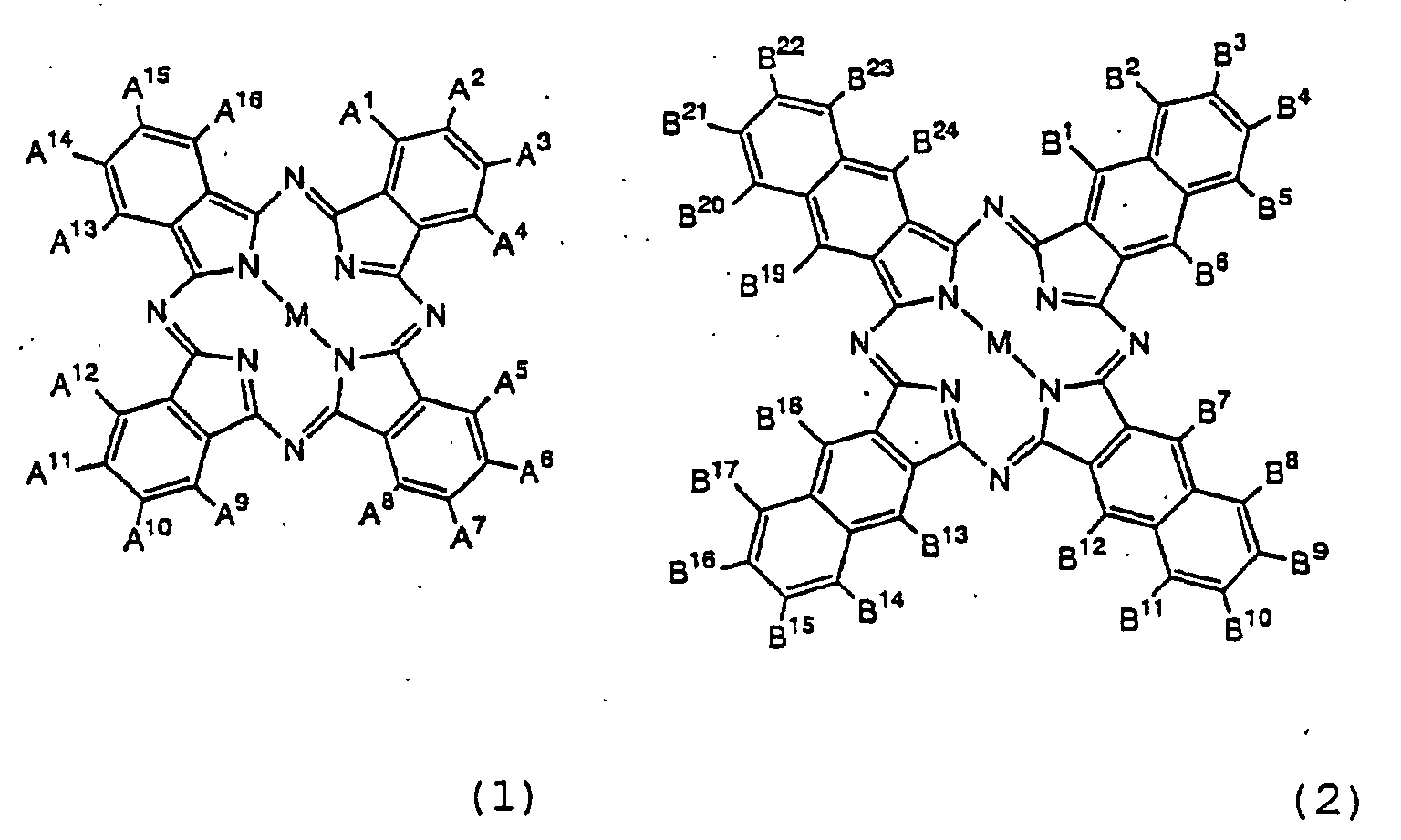 wherein M is a divalent metal atom, a trivalent
substituted metal atom, a tetravalent substituted atom
or an oxy metal,
wherein M is a divalent metal atom, a trivalent
substituted metal atom, a tetravalent substituted atom
or an oxy metal,
A1 to A16 and B1 to B24 may be the same or
different and are each a hydrogen atom, a halogen atom,
an alkyl group which may have a substituent, an aryl
group which may have a substituent, an alkoxy group
which may have a substituent, an aryloxy group which
may have a substituent, an alkylthio group which may
have a substituent, an arylthio group which may have a
substituent, an alkylamino group which may have a
substituent or an arylamino group which may have a
substituent, and
two neighboring groups of the groups indicated by A1 to A16 may be linked to form a five-membered ring or a six-membered ring in cooperation with carbon atoms to which said two neighboring groups are bonded, and two neighboring groups of the groups indicated by B1 to B24 may be linked to form a five-membered ring or a six-membered ring in cooperation with carbon atoms to which said two neighboring groups are bonded.
two neighboring groups of the groups indicated by A1 to A16 may be linked to form a five-membered ring or a six-membered ring in cooperation with carbon atoms to which said two neighboring groups are bonded, and two neighboring groups of the groups indicated by B1 to B24 may be linked to form a five-membered ring or a six-membered ring in cooperation with carbon atoms to which said two neighboring groups are bonded.
The polyester resin is preferably polyethylene
terephthalate or polyethylene naphthalate.
The preform for a polyester resin composition blow
molded product, the polyester resin composition blow
molded product and the process for producing the blow
molded product according to the invention are
described in detail hereinafter.
The preform for a polyester resin composition blow
molded product according to the invention is formed
from a polyester resin composition comprising a
polyester resin and at least one infrared absorbing
colorant selected from a specific phthalocyanine
infrared absorbing colorant and a specific
naphthalocyanine infrared absorbing colorant.
The polyester resin for use in the invention can
be prepared by subjecting an aromatic dicarboxylic
acid or its ester-forming derivative and an aliphatic
diol or its ester-forming derivative to esterification
reaction to obtain a low condensate (ester low
polymer), then subjecting the low condensate to
deglycolation reaction (liquid phase polycondensation)
in the presence of a polycondensation catalyst to
obtain a high-molecular weight product, and optionally
performing solid phase polycondensation.
Examples of the aromatic dicarboxylic acids used
for preparing the polyester resin include terephthalic
acid, phthalic acid, isophthalic acid,
naphthalenedicarboxylic acid, diphenyldicarboxylic
acid and diphenoxyethanedicarboxylic acid.
Examples of the aliphatic diols include ethylene
glycol, trimethylene glycol, propylene glycol,
tetramethylene glycol, neopentyl glycol, hexamethylene
glycol and dodecamethylene glycol.
In the preparation of the polyester resin,
together with the aromatic dicarboxylic acid, an
aliphatic. dicarboxylic acid, such as adipic acid,
sebacic acid, azelaic acid or decanedicarboxylic acid,
or an alicyclic dicarboxylic acid, such as
cyclohexanedicarboxylic acid, can be used as a
starting materiel, and together with the aliphatic
diol, an alicyclic glycol, such as
cyclohexanedimethanol, or an aromatic diol, such as
bisphenol, hydroquinone, 2,2-bis(4-β-hydroxyethoxyphenyl)propane
or 1,3-bis(2-dihyroxyethoxy)benzene,
can be used as a starting
material.
Moreover, a polyfunctional compound, such as
trimesic acid, trimethylolethane, trimethylolpropane,
trimethylolmethane or pentaerythritol, can be used as
a starting material.
In the present invention, the polyester resin is
desired to be:
The infrared absorbing colorant for use in the
invention is at least one colorant selected from a
phthalocyanine compound represented by the following
formula (1) and a naphthalocyanine compound
represented by the following formula (2).

In the formulas (1) and (2), M is a divalent metal
atom, a trivalent substituted metal atom, a
tetravalent substituted atom or an oxy metal.
Examples of the divalent metal atoms include
Cu(II), Zn(II), Fe(II), Co(II), Ni(II), Ru(II), Rh(II),
Pd(II), Pt(II), Mn(II), Mg(II), Ti(II), Be(II), Ca(II),
Ba(II), Cd(II), Hg(II), Pb(II) and Sn(II).
Examples of the trivalent substituted metal atoms
include mono-substituted trivalent metal atoms, such
as AlCl, AlBr, AlF, AlI, GaCl, GaF, GaI, GaBr, InCl,
InBr, InI, InF, TlCl, TlBr, TlI, TlF, FeCl, RuCl, Al-C6H5,
Al-C6H4(CH3), In-C6H5, In-C6H4(CH3), In-C6H5,
Mn(OH), Mn(OC6H5) and Mn(OSi(CH3)3).
Examples of the tetravalent substituted atoms
include di-substituted tetravalent atoms, such as
CrCl2, SiCl2, SiBr2, SiF2, SiI2, ZrCl2, GeCl2, GeBr2,
GeI2, GeF2, SnCl2, SnBr2, SnF2, TiCl2, TiBr2, TiF2,
Si(OH)2, Ge(OH)2, Zr(OH)2, Mn(OH)2, Sn(OH)2, TiR2,
CrR2, SiR2, SnR2, GeR2 (R is an alkyl group, a phenyl
group, a naphthyl group or a derivative thereof),
Si(OR')2, Sn(OR')2, Ge(OR')2, Ti(OR')2, Cr(OR')2 (R'
is an alkyl group, a phenyl group, a naphthyl group, a
trialkylsilyl group, a dialkylalkoxysilyl group or a
derivative thereof), Sn(SR")2 and Ge(SR")2 (R" is an
alkyl group, a phenyl group, a naphthyl group or a
derivative thereof).
Examples of the oxy metals include VO, MnO and TiO.
Of these, Cu(II), Pd(II), Pb(II), AlCl, InCl, TiO
or VO is preferable as M, and VO is particularly
preferable.
A1 to A16 and B1 to B24 may be the same or
different and are each a hydrogen atom, a halogen atom,
an alkyl group which may have a substituent, an aryl
group which may have a substituent, an alkoxy group
which may have a substituent, an aryloxy group which
may have a substituent, an alkylthio group which may
have a substituent, an arylthio group which may have a
substituent, an alkylamino group which may have a
substituent or an arylamino group which may have a
substituent.
Examples of the halogen atoms include fluorine,
chlorine, bromine and iodine.
Examples of the alkyl groups which may have a
substituent include straight-chain or branched alkyl
groups of 1 to 20 carbon atoms, preferably 1 to 10
carbon atoms, such as methyl, ethyl, n-propyl,
isopropyl, n-butyl, iso-butyl, sec-butyl, n-pentyl,
isopentyl, 1,2-dimethylpropyl, n-hexyl, 1,3-dimethylbutyl,
1,2-dimethylbutyl, n-heptyl, 1,4-dimethylpentyl,
1-ethyl-3-methylbutyl, n-octyl, 2-ethylhexyl,
n-nonyl, n-decyl, n-undecyl, n-dodecyl, n-tridecyl,
n-tetradecyl, n-pentadecyl, n-hexadecyl, n-heptadecyl,
n-octadecyl, n-nonadecyl, n-eicosyl,
benzyl, sec-phenylethyl, 2-methylbenzyl, 3-methylbenzyl,
4-methylbenzyl, 2-phenylethyl, 3-dimethylaminopropyl,
2-dimethylaminoethyl, 2-diisopropylaminoethyl,
2-diethylaminoethyl, 2,2,2-trifluoro-1-(trifluoromethyl)ethyl,
2-(1-piperidinyl)ethyl,
3-(1-piperidinyl)propyl, 3-(4-morpholinyl)propyl,
3-(4-morpholinyl)ethyl, 2-(1-pyrrolidinyl)ethyl
and 2-pyridylmethyl; and cycloalkyl
groups of 3 to 20 carbon atoms, preferably 3 to 10
carbon atoms, such as cyclopentyl, cyclohexyl,
horbornyl and adamantyl.
Examples of the aryl groups which may have a
substituent include aryl groups of 6 to 20 carbon
atoms, preferably 6 to 12 carbon atoms, such as phenyl,
tolyl, dimethylphenyl, trimethylphenyl, ethylphenyl,
propylphenyl, biphenylyl, 2-mercaptophenyl, 3-mercaptophenyl,
4-mercaptophenyl, 2-methylphenyl, 3-methylphenyl,
4-methylphenyl, naphthyl, methylnaphthyl,
anthryl and phenanthryl.
Examples of the alkoxy groups which may have a
substituent include alkoxy groups of 1 to 20 carbon
atoms, preferably 1 to 10 carbon atoms, such as
methoxy, ethoxy, n-propoxy, isopropoxy, n-butoxy,
isobutoxy, sec-butoxy, n-pentoxy, isopentoxy, n-hexyloxy,
cyclohexyloxy, n-heptyloxy, n-octyloxy, 2-ethylhexyloxy,
n-nonyloxy, methoxyethoxy, ethoxyethoxy,
ethoxyethoxyethoxy, hydroxyethoxyethoxy,
diethylaminoethoxy, aminoethoxy, n-butylaminoethoxy,
benzylaminoethoxy, methylcarbonylaminoethoxy,
phenylcarbonyaminoethoxy and benzyloxy.
Examples of the aryloxy groups which may have a
substituent include aryloxy groups of 6 to 20 carbon
atoms, preferably 6 to 12 carbon atoms, such as
phenoxy, 2-methylphenoxy, 3-methylphenoxy, 4-methylphenoxy
and naphthoxy.
Examples of the alkylthio groups which may have a
substituent include alkylthio groups of 1 to 20 carbon
atoms, preferably 1 to 10 carbon atoms, such as
methylthio, ethylthio, n-propylthio, isopropylthio, n-butylthio,
isobutylthio, sec-butylthio, t-butylthio,
n-pentylthio, isopentylthio, neo-pentylthio, 1,2-dimethylpropylthio,
n-hexylthio, cyclohexylthio, n-heptylthio,
2-ethylhexylthio, n-octylthio, n-nonylthio,
methoxyethylthio, ethoxyethylthio, propoxyethyithio,
butoxyethylthio, aminoethylthio, n-butylaminoethylthio,
benzylaminoethylthio, methylcarbonylaminoethylthio,
phenylcarbonylaminoethylthio,
methylsulfonylaminoethylthio,
phenylsulfonylaminoethylthio, dimethylaminoethylthio
and diethylaminoethylthio.
Examples of the arylthio groups which may have a
substituent include arylthio groups of 6 to 20 carbon
atoms, preferably 6 to 12 carbon atoms, such as
phenylthio, naphthylthio, 4-methylphenylthio, 4-ethylphenylthio,
4-propylphenylthio, 4-t-butylphenylthio,
4-methoxyphenylthio, 4-ethoxyphenylthio,
4-aminophenylthio, 4-alkylaminophenylthio,
4-dialkylaminophenylthio, 4-phenylaminophenylthio,
4-diphenylaminophenylthio, 4-hydroxyphenylthio,
4-chlorophenylthio, 4-bromophenylthio,
2-methylphenylthio, 2-ethylphenylthio,
2-propylphenylthio, 2-t-butylphenylthio, 2-methoxyphenylthio,
2-ethoxyphenylthio, 2-aminophenylthio,
2-alkylaminophenylthio, 2-dialkylaminophenylthio,
2-phenylaminophenylthio, 2-diphenylaminophenylthio,
2-hydroxyphenylthio, 4-dimethylaminophenylthio,
4-methylaminophenylthio, 4-methylcarbonylaminophenylthio,
4-phenylcarbonylaminophenylthio,
4-methylsulfonylaminophenylthio
and 4-phenylsulfonylaminophenylthio.
Examples of the alkylamino groups which may have a
substituent include alkylamino groups of 1 to 20
carbon atoms, preferably 1 to 10 carbon atoms, such as
methylamino, ethylamino, n-propylamino, isopropylamino,
butylamino, pentylamino, dipentylamino, hexylamino,
heptylamino, octylamino, nonylamino and benzylamino.
Examples of the arylamino groups which may have a
substituent include arylamino groups of 6 to 20 carbon
atoms, preferably 6 to 12 carbon atoms, such as
phenylamino, 4-methylphenylamino, 4-methoxyphenylamino,
hydroxyphenylamino and naphthylamino.
Of the groups indicated by A1 to A16, two
neighboring groups may be linked to form a five-membered
ring or a six-membered ring in cooperation
with carbon atoms to which said two neighboring groups
are bonded. Of the groups indicated by B1 to B24, two
neighboring groups may be linked to form a five-membered
ring or a six-membered ring in cooperation
with carbon atoms to which said two neighboring groups
are bonded.
Examples of the groups wherein two neighboring
groups of the groups indicated by A1 to A16 or B1 to
B24 are linked to form a five-membered ring or a six-membered
ring in cooperation with carbon atoms to
which said two neighboring groups are bonded are given
below.
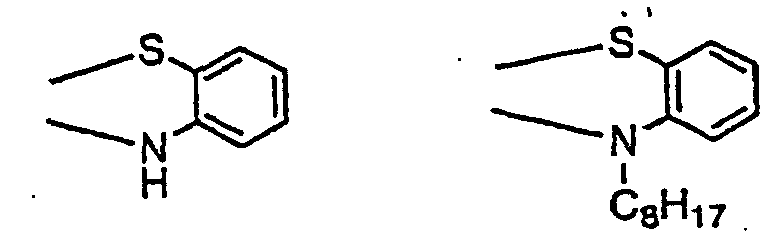
The alkyl group which may have a substituent, the
aryl group which may have a substituent, the alkoxy
group which may have a substituent, the aryloxy group
which may have a substituent, the alkylthio group
which may have a substituent, the arylthio group which
may have a substituent, the alkylamino group which may
have a substituent, the arylamino group which may have
a substituent and the group (wherein two neighboring
groups of the groups indicated by A1 to A16 or B1 to
B24 are linked to form a five-membered ring or a six-membered
ring in cooperation with carbon atoms to
which said two neighboring groups are bonded) may
further have a substituent. Examples of such
substituents include the same halogen atoms, the same
alkyl groups which may have a substituent, the same
aryl groups which may have a substituent, the same
alkoxy groups which may have a substituent, the same
aryloxy groups which may have a substituent, the same
alkylthio groups which may have a substituent, the
same arylthio groups which may have a substituent, the
same alkylamino groups which may have a substituent
and the same arylamino groups which may have a
substituent as previously described.
Other examples of the substituents include:
Also available as the substituents are
heterocyclic compound residues; oxygen-containing
groups, such as ester group, ether group, acyl group,
carboxyl group, carbonato group, hydroxyl group,
peroxy group and carboxylic anhydride group; nitrogen-containing
groups, such as amino group, imino group,
amido group, imido group, hydrazino group, hydrazono
group, nitro group, nitroso group, cyano group,
isocyano group, cyanic ester group, amidino group,
diazo group and ammonium salt derived from amino
group; boron-containing groups, such as boranediyl
group, boranetriyl group and diboranyl group; sulfur-containing
groups, such as mercapto group, thioester
group, dithioester group, alkylthio group, arylthio
group, thioacyl group, thioether group, thiocyanic
ester group, isothiocyanic ester group, sulfonic ester
group, sulfonamido group, thiocarboxyl group,
dithiocarboxyl group, sulfo group, sulfonyl group,
sulfinyl group and sulfenyl group; phosphorus-containing
groups, such as phosphido group, phosphoryl
group, thiophosphoryl group and phosphato group;
silicon-containing groups; germanium-containing
groups; and tin-containing groups.
A1 to A16 and B1 to B24 are each preferably a
hydrogen atom, a halogen atom, an arylthio group which
may have a substituent or an arylamino group which may
have a substituent.
The infrared absorbing colorant for use in the
invention is at least one colorant selected from a
phthalocyanine compound represented by the aforesaid
formula (1) and a naphthalocyanine compound
represented by the aforesaid formula (2) and has an
infrared maximum absorption peak in the wavelength
region of 700 to 2000 nm, preferably 750 to 2000 nm.
When the infrared maximum absorption peak is in this
wavelength region, the infrared absorbing colorant has
excellent infrared absorption properties.
In the present invention, the infrared maximum
absorption peak of the infrared absorbing colorant is
measured in the following manner. The infrared
absorbing colorant is added to the polyester to be
molded, and from the resulting 'mixture, a molded
product in the form of a plate having a thickness of 4
mm is produced by an injection molding machine under
the conditions of a molding temperature of 280°C and a
mold temperature of 10°C. Using the plate molded
product, the infrared maximum absorption peak is
measured by a spectrophotometer UV-3100 manufactured
by Shimazu Seisakusho K.K.
As the infrared absorbing colorant for use in the
invention, a colorant having a low absorptive power of
electromagnetic wave in the visible region is
preferable, and a colorant being not decomposed at a
synthesis temperature of the polyester resin and a
molding temperature of the preform, e.g., 260 to 320°C,
is preferable.
The polyester resin composition for use in the
invention comprises the polyester resin and the
infrared absorbing colorant. In the composition, the
infrared absorbing colorant is contained in an amount
of usually 0.01 to 1000 ppm, preferably 0.1 to 100 ppm,
particularly preferably 0.5 to 50 ppm.
When the content of the infrared absorbing
colorant is in the above range, the polyester resin
composition has excellent near infrared absorptive
power, and is capable of obtaining a blow molded
product having excellent hue and transparency.
As the process for preparing the polyester resin
composition, any process hitherto known can be adopted.
For example, a process in which the infrared absorbing
colorant is added during the production of the
polyester resin, e.g., in an esterification step or a
polycondensation step, and a process in which the
polyester resin and the infrared absorbing colorant
are mixed and melt kneaded under heating are available.
The polyester resin composition may further
contain additives usually added to polyester resins,
such as hue adjusting agent, antistatic agent,
ultraviolet light absorber, antioxidant and release
agent.
The preform for a polyester resin composition blow
molded product according to the invention, which has a
temperature of not higher than' the glass transition
temperature, is formed from the polyester resin
composition containing the specific infrared absorbing
colorant. For producing the preform for a blow molded
product from the polyester resin composition, any
process hitherto known can be adopted, and the preform
is produced from the polyester resin composition by,
for example, injection molding.
The preform for a polyester resin composition blow
molded product according to the invention is formed
from the polyester resin composition containing the
specific infrared absorbing colorant, and hence the
preform has excellent absorptive power to absorb
infrared rays in the region of 700 to 2000 nm that is
emitted by a near infrared heater, and the temperature
of the preform rises up to an optimum stretching
temperature for a shorter period of time than that of
a conventional preform.
The polyester resin composition blow molded
product according to the invention is a blow molded
product produced by a cold parison process from the
polyester resin composition containing the specific
infrared absorbing colorant. The blow molded product
can be produced by heating a preform having a
temperature of not higher than the glass transition
temperature, e.g., room temperature, to an optimum
stretching temperature, then holding the preform in a
mold of desired shape and blowing air into the preform
to fit it into the mold.
The preform for a polyester resin composition blow
molded product according to the invention has
excellent transparency and hue.
Next, the process for producing a polyester resin
composition blow molded product according to the
invention is described in detail.
First, from the polyester resin composition, a
preform is produced. The preform can be produced by a
hitherto known method such as injection molding. The
temperature for heating the polyester resin to produce
the preform-varies depending upon the type of the
polyester resin used. When the polyester resin is
polyethylene terephthalate, the heating temperature is
in the range of preferably 270 to 300°C, and when the
polyester resin is polyethylene naphthalate, the
heating temperature is in the range of preferably 280
to 320°C. The preform is then cooled to a temperature
of not higher than the glass transition temperature in
a mold and if necessary in a forced cooling device
outside the mold.
The preform thus obtained is then heated to an
optimum stretching temperature by the use of a near
infrared heater to perform blow molding. The heating
temperature in the blow molding varies depending upon
the type of the polyester resin used. When the
polyester resin is polyethylene terephthalate, the
heating temperature is in the rage of usually 90 to
125°C, preferably 100 to 120°C, and when the polyester
resin is polyethylene naphthalate, the heating
temperature is in the range of usually 115 to 150°C,
preferably 120 to 140°C.
In the process for producing a blow molded product
according to the invention, a preform comprising the
polyester resin composition containing the specific
infrared absorbing colorant is used, so that the time
required for heating the preform to an optimum
temperature can be reduced. Consequently, the molding
cycle can be shortened and the blow molded product can
be produced with excellent productivity.
By the use of the preform for a polyester resin
composition blow molded product according to the
invention, a blow molded product having excellent hue
and transparency can be produced, and in the second
step of the cold parison process, heating of the
preform by a near infrared heater can be carried out
for a shorter period of time than that of a
conventional preform.
The polyester resin composition blow molded
product according to the invention has excellent hue
and transparency.
The process for producing a polyester resin
composition blow molded product according to the
invention has a short molding cycle and is excellent
in productivity.
The present invention is further described with
reference to the following examples, but it should be
construed that the invention is in no way limited to
those examples.
The maximum absorption peak wavelength of the
infrared absorbing agent contained in the polyester
was measured in the following manner. Using the same
mixture pellets as used for the production of a
preform, a plate having a thickness of 4 mm was
prepared by an injection molding machine M-70
manufactured by Meiki Seisakusho under the conditions
of a molding temperature of 280°C and a mold
temperature of 10°C. Then, using the plate, the
maximum absorption peak wavelength was measured by a
spectrophotometer manufactured by Shimazu Seisakusho
K.K.
Powdery polyethylene terephthalate (intrinsic
viscosity: 0.83 dl/g) previously obtained by freeze
pulverization was vacuum dried at 150°C for 10 hours.
To 99.9 parts by weight of the polyethylene
terephthalate, 0.1 part by weight of an infrared
absorbing colorant shown in Table 1 was added, and the
polyethylene terephthalate mixture was extruded by a
single-screw extruder having a screw diameter of 40 mm
(manufactured by Modern Machinery Co.) at an extrusion
temperature of 260°C to obtain a strand. The strand
was cut to obtain masterbatch pellets containing an
infrared absorbing colorant.
The same powdery polyethylene terephthalate
(intrinsic viscosity: 0.83 dl/g) as used above was
mixed with the above-obtained masterbatch pellets
containing an infrared absorbing colorant to obtain
mixture pellets having an infrared absorbing colorant
concentration shown in Table 2. The pellets were
vacuum dried at 150°C for 10 hours.
The mixture pellets were then molded by an
injection molding machine M-100 manufactured by Meiki
Seisakusho under the conditions of a molding
temperature of 280°C and a mold temperature of 10°C to
prepare a 1.5-liter preform having a thickness of 3.8
mm and a weight of 55 g. 100 Shots were continuously
made. In Examples 1 to 4 and Comparative Example 1,
molding was performed without any trouble. All of the
preforms obtained were transparent, and any burning or
any foreign matter was not observed.
In an attempt to produce 100 of 1.5-liter bottles,
the above-obtained preforms having a temperature of
not higher than the glass transition temperature were
subjected to biaxial orientation blow molding by the
use of a biaxial orientation blow molding machine
manufactured by Corpoplast Co., while hating them by
an infrared heater.
The results are set forth in Table 2.
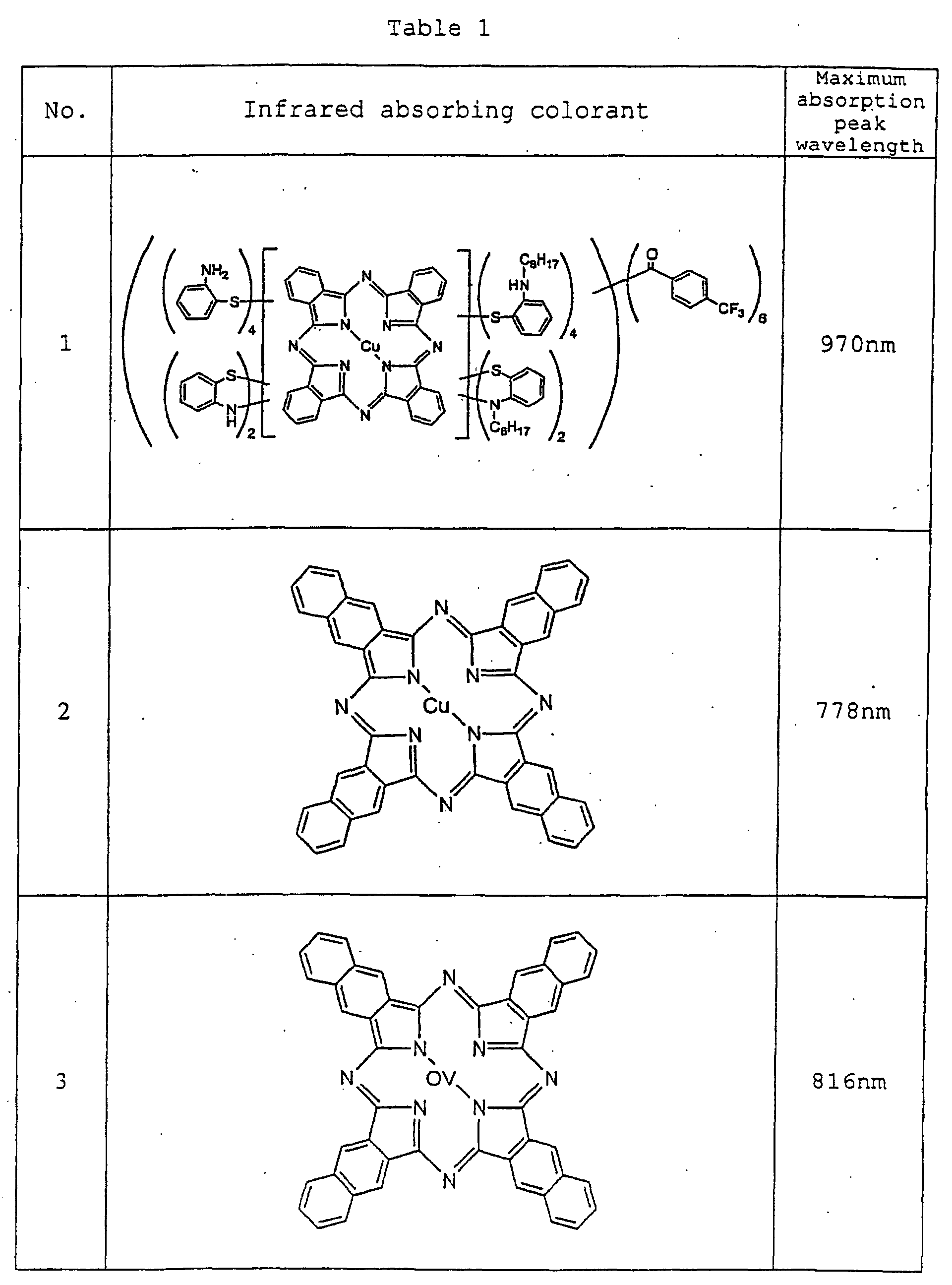
| Appearance of bottle | ||||||
| Type and amount of colorant | Preform heating time (sec) | Productivity per hour (preforms /hr) | Stretching failure (number of bottles) | Transparency | Hue | |
| Ex. 1 | No.1 10ppm | 60 | 60 | 0 | good | Colorless |
| 55 | 65 | 0 | good | Colorless | ||
| Ex. 2 | No.1 50ppm | 50 | 72 | 0 | good | Colorless |
| 45 | 80 | 0 | good | Colorless | ||
| Ex. 3 | No.2 50ppm | 50 | 72 | 0 | good | very light green |
| Ex. 4 | No.3 50ppm | 50 | 72 | 0 | good | very light yellow |
| 45 | 80 | 0 | good | very light yellow | ||
| Comp. Ex. 1 | Not added | 60 | 60 | 0 | good | Colorless |
| 55 | - | 0 | Whitened | - | ||
| 50 | - | 58 | Whitened | - | ||
| 45 | - | 100 | - | - | ||
| ( Remarks ) Stretching failure : Shaping of the preform to a bottle was infeasible because the preform was broken in the course of stretching or the preform was partially stretched. | ||||||
| Transparency: The transparency was evaluated by visual observation. By the term "good" is meant that none of 100 bottles were whitened. | ||||||
| Hue : The hue was evaluated by visual observation. |
Claims (7)
- A preform for a polyester resin composition blow molded product, comprising a polyester resin composition and having a temperature of not higher than the glass transition temperature, said polyester resin composition comprising a polyester resin and an infrared absorbing colorant which is at least one colorant selected from a phthalocyanine infrared absorbing colorant and a naphthalocyanine infrared absorbing colorant and which has an infrared maximum absorption peak in the region of 700 to 2000 nm.
- The preform for a polyester resin composition blow molded product as claimed in claim 1, wherein the infrared absorbing colorant is at least one colorant selected from a phthalocyanine compound represented by the following formula (1) and a naphthalocyanine compound represented by the following formula (2):wherein M is a divalent metal atom, a trivalent substituted metal atom, a tetravalent substituted atom or an oxy metal,
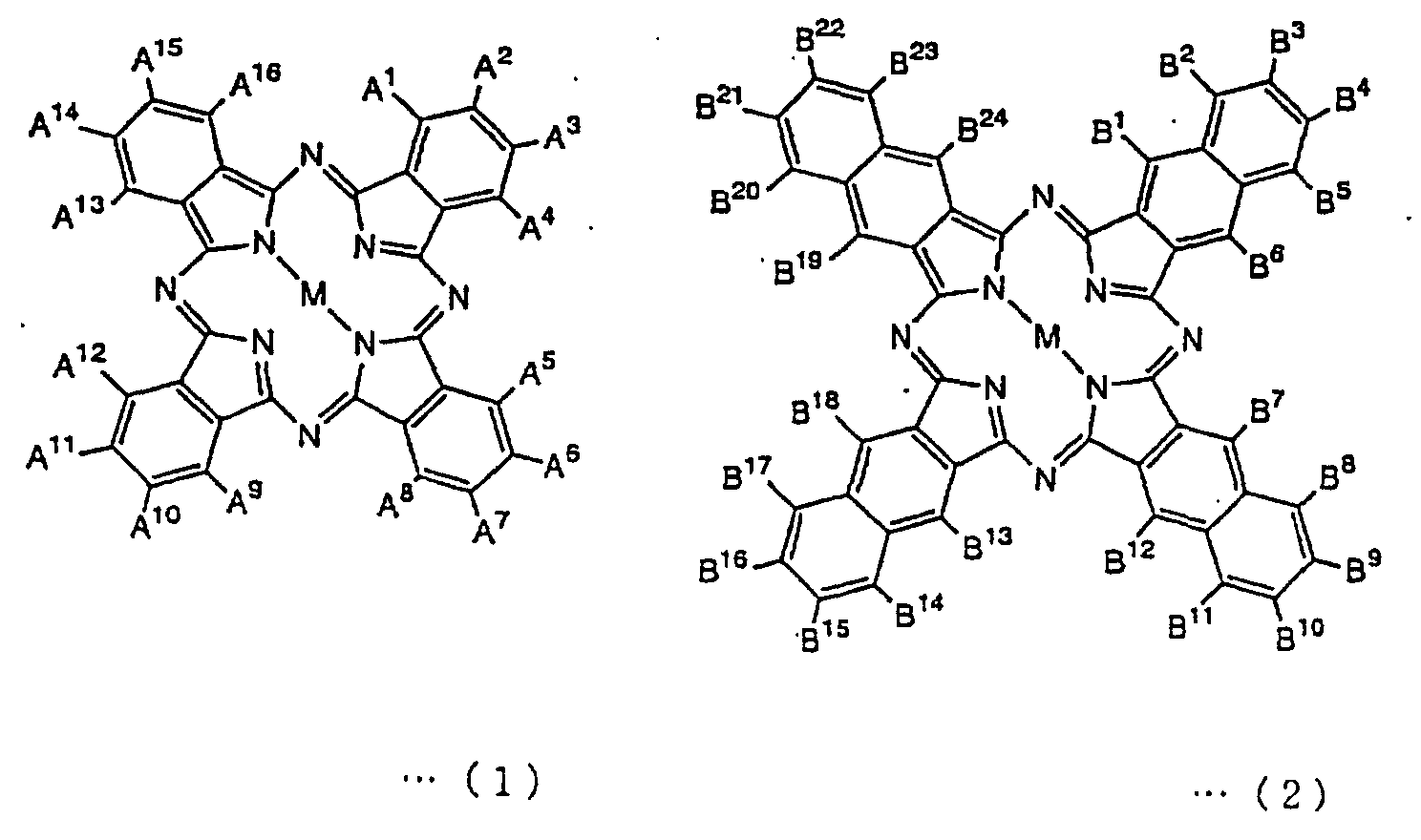 A1 to A16 and B1 to B24 may be the same or different and are each a hydrogen atom, a halogen atom, an alkyl group which may have a substituent, an aryl group which may have a substituent, an alkoxy group which may have a substituent, an aryloxy group which may have a substituent, an alkylthio group which may have a substituent, an arylthio group which may have a substituent, an alkylamino group which may have a substituent or an arylamino group which may have a substituent, andtwo neighboring groups of the groups indicated by A1 to A16 may be linked to form a five-membered ring or a six-membered ring in cooperation with carbon atoms to which said two neighboring groups are bonded, and two neighboring groups of the groups indicated by B1 to B24 may be linked to form a five-membered ring or a six-membered ring in cooperation with carbon atoms to which said two neighboring groups are bonded.
 - The preform for a polyester resin composition blow molded product as claimed in claim 1 or 2, wherein the polyester resin is polyethylene terephthalate or polyethylene naphthalate.
- A polyester resin composition blow molded product produced by a cold parison process from a polyester resin composition comprising a polyester resin and an infrared absorbing colorant which is at least one colorant selected from a phthalocyanine infrared absorbing colorant and a naphthalocyanine infrared absorbing colorant and which has an infrared maximum absorption peak in the region of 700 to 2000 nm.
- The polyester resin composition blow molded product as claimed in claim 4, wherein the infrared absorbing colorant is at least one colorant selected from the phthalocyanine compound represented by the formula (1) and the naphthalocyanine compound represented by the formula (2) according to claim 2.
- The polyester resin composition blow molded product as claimed in claim 4 or 5, wherein the polyester resin is polyethylene terephthalate or polyethylene naphthalate.
- A process for producing a polyester resin composition blow molded product, comprising the steps of:heating a preform formed from a polyester resin composition and having a temperature of not higher than the glass transition temperature by a near infrared heater, said polyester resin composition comprising a polyester resin and an infrared absorbing colorant which is at least one colorant selected from a phthalocyanine infrared absorbing colorant and a naphthalocyanine infrared absorbing colorant and which has an infrared maximum absorption peak in the region of 700 to 2000 nm, andblow molding the preform.
Applications Claiming Priority (3)
| Application Number | Priority Date | Filing Date | Title |
|---|---|---|---|
| JP26714899 | 1999-09-21 | ||
| JP26714899 | 1999-09-21 | ||
| PCT/JP2000/006414 WO2001021709A1 (en) | 1999-09-21 | 2000-09-20 | Preform for hollow molding made of polyester resin composition, hollow molding made of polyester resin composition, and process for producing the same |
Publications (2)
| Publication Number | Publication Date |
|---|---|
| EP1152035A1 true EP1152035A1 (en) | 2001-11-07 |
| EP1152035A4 EP1152035A4 (en) | 2003-04-16 |
Family
ID=17440764
Family Applications (1)
| Application Number | Title | Priority Date | Filing Date |
|---|---|---|---|
| EP00961113A Withdrawn EP1152035A4 (en) | 1999-09-21 | 2000-09-20 | Preform for hollow molding made of polyester resin composition, hollow molding made of polyester resin composition, and process for producing the same |
Country Status (4)
| Country | Link |
|---|---|
| EP (1) | EP1152035A4 (en) |
| KR (1) | KR20010107971A (en) |
| CN (1) | CN1322224A (en) |
| WO (1) | WO2001021709A1 (en) |
Cited By (13)
| Publication number | Priority date | Publication date | Assignee | Title |
|---|---|---|---|---|
| US7189777B2 (en) | 2003-06-09 | 2007-03-13 | Eastman Chemical Company | Compositions and method for improving reheat rate of PET using activated carbon |
| US7300967B2 (en) | 2004-11-12 | 2007-11-27 | Eastman Chemical Company | Polyester polymer and copolymer compositions containing metallic titanium particles |
| US7368523B2 (en) | 2004-11-12 | 2008-05-06 | Eastman Chemical Company | Polyester polymer and copolymer compositions containing titanium nitride particles |
| US7474009B2 (en) | 2004-12-30 | 2009-01-06 | Henkel Corporation | Optoelectronic molding compound that transmits visible light and blocks infrared light |
| US7655746B2 (en) | 2005-09-16 | 2010-02-02 | Eastman Chemical Company | Phosphorus containing compounds for reducing acetaldehyde in polyesters polymers |
| US7662880B2 (en) | 2004-09-03 | 2010-02-16 | Eastman Chemical Company | Polyester polymer and copolymer compositions containing metallic nickel particles |
| US7745512B2 (en) | 2005-09-16 | 2010-06-29 | Eastman Chemical Company | Polyester polymer and copolymer compositions containing carbon-coated iron particles |
| US7776942B2 (en) | 2005-09-16 | 2010-08-17 | Eastman Chemical Company | Polyester polymer and copolymer compositions containing particles of titanium nitride and carbon-coated iron |
| US7838596B2 (en) | 2005-09-16 | 2010-11-23 | Eastman Chemical Company | Late addition to effect compositional modifications in condensation polymers |
| US7932345B2 (en) | 2005-09-16 | 2011-04-26 | Grupo Petrotemex, S.A. De C.V. | Aluminum containing polyester polymers having low acetaldehyde generation rates |
| US8431202B2 (en) | 2005-09-16 | 2013-04-30 | Grupo Petrotemex, S.A. De C.V. | Aluminum/alkaline or alkali/titanium containing polyesters having improved reheat, color and clarity |
| US8557950B2 (en) | 2005-06-16 | 2013-10-15 | Grupo Petrotemex, S.A. De C.V. | High intrinsic viscosity melt phase polyester polymers with acceptable acetaldehyde generation rates |
| US9267007B2 (en) | 2005-09-16 | 2016-02-23 | Grupo Petrotemex, S.A. De C.V. | Method for addition of additives into a polymer melt |
Families Citing this family (9)
| Publication number | Priority date | Publication date | Assignee | Title |
|---|---|---|---|---|
| US6835333B2 (en) * | 2002-05-07 | 2004-12-28 | Milliken & Company | Combinations for use as toners in polyesters |
| KR100455456B1 (en) * | 2004-01-16 | 2004-11-06 | 태광산업주식회사 | Polyester resin with improved infrared absorbing properties |
| WO2006011507A1 (en) * | 2004-07-29 | 2006-02-02 | Mitsui Chemicals, Inc. | Method of producing thermoplastic resin hollow molded product |
| US7709595B2 (en) | 2006-07-28 | 2010-05-04 | Eastman Chemical Company | Non-precipitating alkali/alkaline earth metal and aluminum solutions made with polyhydroxyl ether solvents |
| US7709593B2 (en) | 2006-07-28 | 2010-05-04 | Eastman Chemical Company | Multiple feeds of catalyst metals to a polyester production process |
| US7745368B2 (en) | 2006-07-28 | 2010-06-29 | Eastman Chemical Company | Non-precipitating alkali/alkaline earth metal and aluminum compositions made with organic hydroxyacids |
| JP4978127B2 (en) * | 2006-09-20 | 2012-07-18 | 富士ゼロックス株式会社 | Invisible toner for developing electrostatic charge, developer for developing electrostatic charge using the same, developer cartridge for developing electrostatic charge, image forming apparatus, and image forming method |
| US8563677B2 (en) | 2006-12-08 | 2013-10-22 | Grupo Petrotemex, S.A. De C.V. | Non-precipitating alkali/alkaline earth metal and aluminum solutions made with diols having at least two primary hydroxyl groups |
| TW201435830A (en) | 2012-12-11 | 2014-09-16 | 3M Innovative Properties Co | Inconspicuous optical tags and methods therefor |
Family Cites Families (3)
| Publication number | Priority date | Publication date | Assignee | Title |
|---|---|---|---|---|
| US4374949A (en) * | 1980-10-27 | 1983-02-22 | The Goodyear Tire & Rubber Company | Composition and process for making a green colored polyester |
| JP3357176B2 (en) * | 1994-04-14 | 2002-12-16 | カネボウ株式会社 | Hollow molded products |
| JP2870519B2 (en) * | 1997-04-17 | 1999-03-17 | 三菱化学株式会社 | Thermoplastic polyester resin hollow molded container and method for producing the same |
-
2000
- 2000-09-20 WO PCT/JP2000/006414 patent/WO2001021709A1/en not_active Ceased
- 2000-09-20 KR KR1020017006285A patent/KR20010107971A/en not_active Withdrawn
- 2000-09-20 CN CN00802008A patent/CN1322224A/en active Pending
- 2000-09-20 EP EP00961113A patent/EP1152035A4/en not_active Withdrawn
Cited By (17)
| Publication number | Priority date | Publication date | Assignee | Title |
|---|---|---|---|---|
| US7189777B2 (en) | 2003-06-09 | 2007-03-13 | Eastman Chemical Company | Compositions and method for improving reheat rate of PET using activated carbon |
| US7662880B2 (en) | 2004-09-03 | 2010-02-16 | Eastman Chemical Company | Polyester polymer and copolymer compositions containing metallic nickel particles |
| US8039577B2 (en) | 2004-11-12 | 2011-10-18 | Grupo Petrotemex, S.A. De C.V. | Polyester polymer and copolymer compositions containing titanium nitride particles |
| US7300967B2 (en) | 2004-11-12 | 2007-11-27 | Eastman Chemical Company | Polyester polymer and copolymer compositions containing metallic titanium particles |
| US7368523B2 (en) | 2004-11-12 | 2008-05-06 | Eastman Chemical Company | Polyester polymer and copolymer compositions containing titanium nitride particles |
| US7439294B2 (en) | 2004-11-12 | 2008-10-21 | Eastman Chemical Company | Polyester polymer and copolymer compositions containing metallic titanium particles |
| US7474009B2 (en) | 2004-12-30 | 2009-01-06 | Henkel Corporation | Optoelectronic molding compound that transmits visible light and blocks infrared light |
| US8987408B2 (en) | 2005-06-16 | 2015-03-24 | Grupo Petrotemex, S.A. De C.V. | High intrinsic viscosity melt phase polyester polymers with acceptable acetaldehyde generation rates |
| US8557950B2 (en) | 2005-06-16 | 2013-10-15 | Grupo Petrotemex, S.A. De C.V. | High intrinsic viscosity melt phase polyester polymers with acceptable acetaldehyde generation rates |
| US7776942B2 (en) | 2005-09-16 | 2010-08-17 | Eastman Chemical Company | Polyester polymer and copolymer compositions containing particles of titanium nitride and carbon-coated iron |
| US7932345B2 (en) | 2005-09-16 | 2011-04-26 | Grupo Petrotemex, S.A. De C.V. | Aluminum containing polyester polymers having low acetaldehyde generation rates |
| US7838596B2 (en) | 2005-09-16 | 2010-11-23 | Eastman Chemical Company | Late addition to effect compositional modifications in condensation polymers |
| US8431202B2 (en) | 2005-09-16 | 2013-04-30 | Grupo Petrotemex, S.A. De C.V. | Aluminum/alkaline or alkali/titanium containing polyesters having improved reheat, color and clarity |
| US7745512B2 (en) | 2005-09-16 | 2010-06-29 | Eastman Chemical Company | Polyester polymer and copolymer compositions containing carbon-coated iron particles |
| US8791187B2 (en) | 2005-09-16 | 2014-07-29 | Grupo Petrotemex, S.A. De C.V. | Aluminum/alkyline or alkali/titanium containing polyesters having improved reheat, color and clarity |
| US7655746B2 (en) | 2005-09-16 | 2010-02-02 | Eastman Chemical Company | Phosphorus containing compounds for reducing acetaldehyde in polyesters polymers |
| US9267007B2 (en) | 2005-09-16 | 2016-02-23 | Grupo Petrotemex, S.A. De C.V. | Method for addition of additives into a polymer melt |
Also Published As
| Publication number | Publication date |
|---|---|
| WO2001021709A1 (en) | 2001-03-29 |
| CN1322224A (en) | 2001-11-14 |
| KR20010107971A (en) | 2001-12-07 |
| EP1152035A4 (en) | 2003-04-16 |
Similar Documents
| Publication | Publication Date | Title |
|---|---|---|
| KR20010107971A (en) | Preform for hollow molding made of polyester resin composition, hollow molding made of polyester resin composition, and process for producing the same | |
| KR101167322B1 (en) | Compositions and a method for improving reheat rate of pet using activated carbon | |
| US6197851B1 (en) | Polyester compositions containing near infrared absorbing materials to improve reheat | |
| EP1557439B1 (en) | Polyester resin, polyester resin composition, sheet or film obtained therefrom and hollow molded container | |
| EP0884365A2 (en) | Infrared absorbing polyester packaging material | |
| JP2004518779A (en) | Polyester composition for high temperature filling containers | |
| WO1998008895A9 (en) | Polyester compositions containing near infrared absorbing materials | |
| KR950011905B1 (en) | Thermoplastic polyester resin composition | |
| WO1996019520A1 (en) | Production of particular polyesters using a novel catalyst system | |
| BRPI0709881A2 (en) | Polyethylene Terephthalate Manufacturing Method | |
| KR0129545B1 (en) | Thermoplastic Polyester Resin Compositions and Molded Articles Produced therefrom | |
| JP2001179810A (en) | Preform for multilayer hollow molded article, multilayer hollow molded article, and method for producing the same | |
| JP2002264203A (en) | Preform for forming bottle, bottle made of polyester composition, and its manufacturing method | |
| JP2014125588A (en) | Polyester composition and polyester molded article | |
| JP2001179811A (en) | Preform for multilayer hollow molded article using infrared absorbent-containing resin for intermediate layer, multilayer hollow molded article, and method for producing the same | |
| JPWO2001021709A1 (en) | Preform for blow molded article made of polyester resin composition, blow molded article made of polyester resin composition, and method for producing the same | |
| JP3888712B2 (en) | High durability near infrared ray absorbing compound and use thereof | |
| JPH0320353A (en) | Production of polyester resin molding | |
| CN1255463C (en) | Low-color ultraviolet absorber compounds and compositions thereof | |
| MXPA06011692A (en) | Methods of making titanium-catalyzed polyethylene terephthalate resins. | |
| JP2864760B2 (en) | Polyester resin composition | |
| US8735482B2 (en) | Polyester resin containing tungsten—titanium carbide particles and polyester preform made therefrom | |
| JP2004182904A (en) | Saturated polyester composition for plastic container having excellent heat-resistance and gas-barrierness and method for producing the same | |
| JPH1053696A (en) | Thermoplastic polyester resin hollow molded container and method for producing the same | |
| JPH02175152A (en) | Ultraviolet-ray absorptive multilayered polyester vessel and production thereof |
Legal Events
| Date | Code | Title | Description |
|---|---|---|---|
| PUAI | Public reference made under article 153(3) epc to a published international application that has entered the european phase |
Free format text: ORIGINAL CODE: 0009012 |
|
| 17P | Request for examination filed |
Effective date: 20010619 |
|
| AK | Designated contracting states |
Kind code of ref document: A1 Designated state(s): DE FR GB IT |
|
| A4 | Supplementary search report drawn up and despatched |
Effective date: 20030227 |
|
| STAA | Information on the status of an ep patent application or granted ep patent |
Free format text: STATUS: THE APPLICATION IS DEEMED TO BE WITHDRAWN |
|
| 18D | Application deemed to be withdrawn |
Effective date: 20030507 |