EP1152016A1 - Ethylene copolymer rubber, process for producing the same, and use - Google Patents
Ethylene copolymer rubber, process for producing the same, and use Download PDFInfo
- Publication number
- EP1152016A1 EP1152016A1 EP00976392A EP00976392A EP1152016A1 EP 1152016 A1 EP1152016 A1 EP 1152016A1 EP 00976392 A EP00976392 A EP 00976392A EP 00976392 A EP00976392 A EP 00976392A EP 1152016 A1 EP1152016 A1 EP 1152016A1
- Authority
- EP
- European Patent Office
- Prior art keywords
- rubber
- copolymer rubber
- cross
- ethylene
- ethylenic copolymer
- Prior art date
- Legal status (The legal status is an assumption and is not a legal conclusion. Google has not performed a legal analysis and makes no representation as to the accuracy of the status listed.)
- Withdrawn
Links
Classifications
-
- C—CHEMISTRY; METALLURGY
- C08—ORGANIC MACROMOLECULAR COMPOUNDS; THEIR PREPARATION OR CHEMICAL WORKING-UP; COMPOSITIONS BASED THEREON
- C08L—COMPOSITIONS OF MACROMOLECULAR COMPOUNDS
- C08L23/00—Compositions of homopolymers or copolymers of unsaturated aliphatic hydrocarbons having only one carbon-to-carbon double bond; Compositions of derivatives of such polymers
- C08L23/02—Compositions of homopolymers or copolymers of unsaturated aliphatic hydrocarbons having only one carbon-to-carbon double bond; Compositions of derivatives of such polymers not modified by chemical after-treatment
- C08L23/16—Ethylene-propylene or ethylene-propylene-diene copolymers
-
- C—CHEMISTRY; METALLURGY
- C08—ORGANIC MACROMOLECULAR COMPOUNDS; THEIR PREPARATION OR CHEMICAL WORKING-UP; COMPOSITIONS BASED THEREON
- C08F—MACROMOLECULAR COMPOUNDS OBTAINED BY REACTIONS ONLY INVOLVING CARBON-TO-CARBON UNSATURATED BONDS
- C08F210/00—Copolymers of unsaturated aliphatic hydrocarbons having only one carbon-to-carbon double bond
- C08F210/16—Copolymers of ethene with alpha-alkenes, e.g. EP rubbers
- C08F210/18—Copolymers of ethene with alpha-alkenes, e.g. EP rubbers with non-conjugated dienes, e.g. EPT rubbers
-
- C—CHEMISTRY; METALLURGY
- C08—ORGANIC MACROMOLECULAR COMPOUNDS; THEIR PREPARATION OR CHEMICAL WORKING-UP; COMPOSITIONS BASED THEREON
- C08F—MACROMOLECULAR COMPOUNDS OBTAINED BY REACTIONS ONLY INVOLVING CARBON-TO-CARBON UNSATURATED BONDS
- C08F212/00—Copolymers of compounds having one or more unsaturated aliphatic radicals, each having only one carbon-to-carbon double bond, and at least one being terminated by an aromatic carbocyclic ring
- C08F212/02—Monomers containing only one unsaturated aliphatic radical
- C08F212/04—Monomers containing only one unsaturated aliphatic radical containing one ring
- C08F212/06—Hydrocarbons
- C08F212/08—Styrene
-
- C—CHEMISTRY; METALLURGY
- C08—ORGANIC MACROMOLECULAR COMPOUNDS; THEIR PREPARATION OR CHEMICAL WORKING-UP; COMPOSITIONS BASED THEREON
- C08F—MACROMOLECULAR COMPOUNDS OBTAINED BY REACTIONS ONLY INVOLVING CARBON-TO-CARBON UNSATURATED BONDS
- C08F220/00—Copolymers of compounds having one or more unsaturated aliphatic radicals, each having only one carbon-to-carbon double bond, and only one being terminated by only one carboxyl radical or a salt, anhydride ester, amide, imide or nitrile thereof
- C08F220/02—Monocarboxylic acids having less than ten carbon atoms; Derivatives thereof
- C08F220/42—Nitriles
- C08F220/44—Acrylonitrile
-
- C—CHEMISTRY; METALLURGY
- C08—ORGANIC MACROMOLECULAR COMPOUNDS; THEIR PREPARATION OR CHEMICAL WORKING-UP; COMPOSITIONS BASED THEREON
- C08F—MACROMOLECULAR COMPOUNDS OBTAINED BY REACTIONS ONLY INVOLVING CARBON-TO-CARBON UNSATURATED BONDS
- C08F255/00—Macromolecular compounds obtained by polymerising monomers on to polymers of hydrocarbons as defined in group C08F10/00
- C08F255/02—Macromolecular compounds obtained by polymerising monomers on to polymers of hydrocarbons as defined in group C08F10/00 on to polymers of olefins having two or three carbon atoms
-
- C—CHEMISTRY; METALLURGY
- C08—ORGANIC MACROMOLECULAR COMPOUNDS; THEIR PREPARATION OR CHEMICAL WORKING-UP; COMPOSITIONS BASED THEREON
- C08F—MACROMOLECULAR COMPOUNDS OBTAINED BY REACTIONS ONLY INVOLVING CARBON-TO-CARBON UNSATURATED BONDS
- C08F4/00—Polymerisation catalysts
- C08F4/42—Metals; Metal hydrides; Metallo-organic compounds; Use thereof as catalyst precursors
- C08F4/44—Metals; Metal hydrides; Metallo-organic compounds; Use thereof as catalyst precursors selected from light metals, zinc, cadmium, mercury, copper, silver, gold, boron, gallium, indium, thallium, rare earths or actinides
- C08F4/60—Metals; Metal hydrides; Metallo-organic compounds; Use thereof as catalyst precursors selected from light metals, zinc, cadmium, mercury, copper, silver, gold, boron, gallium, indium, thallium, rare earths or actinides together with refractory metals, iron group metals, platinum group metals, manganese, rhenium technetium or compounds thereof
- C08F4/62—Refractory metals or compounds thereof
- C08F4/64—Titanium, zirconium, hafnium or compounds thereof
- C08F4/659—Component covered by group C08F4/64 containing a transition metal-carbon bond
- C08F4/65908—Component covered by group C08F4/64 containing a transition metal-carbon bond in combination with an ionising compound other than alumoxane, e.g. (C6F5)4B-X+
-
- C—CHEMISTRY; METALLURGY
- C08—ORGANIC MACROMOLECULAR COMPOUNDS; THEIR PREPARATION OR CHEMICAL WORKING-UP; COMPOSITIONS BASED THEREON
- C08F—MACROMOLECULAR COMPOUNDS OBTAINED BY REACTIONS ONLY INVOLVING CARBON-TO-CARBON UNSATURATED BONDS
- C08F4/00—Polymerisation catalysts
- C08F4/42—Metals; Metal hydrides; Metallo-organic compounds; Use thereof as catalyst precursors
- C08F4/44—Metals; Metal hydrides; Metallo-organic compounds; Use thereof as catalyst precursors selected from light metals, zinc, cadmium, mercury, copper, silver, gold, boron, gallium, indium, thallium, rare earths or actinides
- C08F4/60—Metals; Metal hydrides; Metallo-organic compounds; Use thereof as catalyst precursors selected from light metals, zinc, cadmium, mercury, copper, silver, gold, boron, gallium, indium, thallium, rare earths or actinides together with refractory metals, iron group metals, platinum group metals, manganese, rhenium technetium or compounds thereof
- C08F4/62—Refractory metals or compounds thereof
- C08F4/64—Titanium, zirconium, hafnium or compounds thereof
- C08F4/659—Component covered by group C08F4/64 containing a transition metal-carbon bond
- C08F4/65912—Component covered by group C08F4/64 containing a transition metal-carbon bond in combination with an organoaluminium compound
-
- C—CHEMISTRY; METALLURGY
- C08—ORGANIC MACROMOLECULAR COMPOUNDS; THEIR PREPARATION OR CHEMICAL WORKING-UP; COMPOSITIONS BASED THEREON
- C08J—WORKING-UP; GENERAL PROCESSES OF COMPOUNDING; AFTER-TREATMENT NOT COVERED BY SUBCLASSES C08B, C08C, C08F, C08G or C08H
- C08J9/00—Working-up of macromolecular substances to porous or cellular articles or materials; After-treatment thereof
- C08J9/04—Working-up of macromolecular substances to porous or cellular articles or materials; After-treatment thereof using blowing gases generated by a previously added blowing agent
- C08J9/06—Working-up of macromolecular substances to porous or cellular articles or materials; After-treatment thereof using blowing gases generated by a previously added blowing agent by a chemical blowing agent
-
- C—CHEMISTRY; METALLURGY
- C08—ORGANIC MACROMOLECULAR COMPOUNDS; THEIR PREPARATION OR CHEMICAL WORKING-UP; COMPOSITIONS BASED THEREON
- C08K—Use of inorganic or non-macromolecular organic substances as compounding ingredients
- C08K5/00—Use of organic ingredients
- C08K5/36—Sulfur-, selenium-, or tellurium-containing compounds
-
- C—CHEMISTRY; METALLURGY
- C08—ORGANIC MACROMOLECULAR COMPOUNDS; THEIR PREPARATION OR CHEMICAL WORKING-UP; COMPOSITIONS BASED THEREON
- C08L—COMPOSITIONS OF MACROMOLECULAR COMPOUNDS
- C08L23/00—Compositions of homopolymers or copolymers of unsaturated aliphatic hydrocarbons having only one carbon-to-carbon double bond; Compositions of derivatives of such polymers
- C08L23/02—Compositions of homopolymers or copolymers of unsaturated aliphatic hydrocarbons having only one carbon-to-carbon double bond; Compositions of derivatives of such polymers not modified by chemical after-treatment
- C08L23/04—Homopolymers or copolymers of ethene
- C08L23/08—Copolymers of ethene
-
- C—CHEMISTRY; METALLURGY
- C09—DYES; PAINTS; POLISHES; NATURAL RESINS; ADHESIVES; COMPOSITIONS NOT OTHERWISE PROVIDED FOR; APPLICATIONS OF MATERIALS NOT OTHERWISE PROVIDED FOR
- C09K—MATERIALS FOR MISCELLANEOUS APPLICATIONS, NOT PROVIDED FOR ELSEWHERE
- C09K3/00—Materials not provided for elsewhere
- C09K3/10—Materials in mouldable or extrudable form for sealing or packing joints or covers
-
- C—CHEMISTRY; METALLURGY
- C08—ORGANIC MACROMOLECULAR COMPOUNDS; THEIR PREPARATION OR CHEMICAL WORKING-UP; COMPOSITIONS BASED THEREON
- C08F—MACROMOLECULAR COMPOUNDS OBTAINED BY REACTIONS ONLY INVOLVING CARBON-TO-CARBON UNSATURATED BONDS
- C08F210/00—Copolymers of unsaturated aliphatic hydrocarbons having only one carbon-to-carbon double bond
- C08F210/16—Copolymers of ethene with alpha-alkenes, e.g. EP rubbers
-
- C—CHEMISTRY; METALLURGY
- C08—ORGANIC MACROMOLECULAR COMPOUNDS; THEIR PREPARATION OR CHEMICAL WORKING-UP; COMPOSITIONS BASED THEREON
- C08L—COMPOSITIONS OF MACROMOLECULAR COMPOUNDS
- C08L23/00—Compositions of homopolymers or copolymers of unsaturated aliphatic hydrocarbons having only one carbon-to-carbon double bond; Compositions of derivatives of such polymers
- C08L23/02—Compositions of homopolymers or copolymers of unsaturated aliphatic hydrocarbons having only one carbon-to-carbon double bond; Compositions of derivatives of such polymers not modified by chemical after-treatment
- C08L23/04—Homopolymers or copolymers of ethene
-
- C—CHEMISTRY; METALLURGY
- C08—ORGANIC MACROMOLECULAR COMPOUNDS; THEIR PREPARATION OR CHEMICAL WORKING-UP; COMPOSITIONS BASED THEREON
- C08L—COMPOSITIONS OF MACROMOLECULAR COMPOUNDS
- C08L51/00—Compositions of graft polymers in which the grafted component is obtained by reactions only involving carbon-to-carbon unsaturated bonds; Compositions of derivatives of such polymers
- C08L51/06—Compositions of graft polymers in which the grafted component is obtained by reactions only involving carbon-to-carbon unsaturated bonds; Compositions of derivatives of such polymers grafted on to homopolymers or copolymers of aliphatic hydrocarbons containing only one carbon-to-carbon double bond
Definitions
- the present invention relates to a novel and useful ethylenic copolymer rubber having cross-linkable (vulcanizable) unsaturation bonds and to a production process and use thereof.
- hydrocarbon compounds having two carbon-to-carbon double bonds in the molecule are called dienes, among which a variety of compounds have been known, for example, linear dienes, such as 1,3-butadiene, 1,3-pentadiene and 1,4-hexadiene; cyclic dienes such as ethylidene-2-norbornene (ENB) and dicyclopentadiene.
- diene linear dienes
- cyclic dienes such as ethylidene-2-norbornene (ENB) and dicyclopentadiene.
- Such an unsaturated ethylenic copolymer rubber is a polymer product susceptible of being vulcanized which is superior in the weatherability, resistance to ozone, resistance to thermal aging and so on and can be used for rubber products, such as automobile parts, electric insulating materials, architectural and constructional materials, industrial rubber materials and so on, and used widely for materials (modofiers) for blending with plastic resins, such as polypropylene, polystyrene and the like, as well.
- the unsaturated ethylenic copolymer rubber there have hitherto been known, for example, an ethylene/propylene/5-ethylidene-2-norbornene copolymer rubber, ethylene/propylene/dicyclopentadiene copolymer rubber and ethylene/propylene/1,4-hexadiene copolymer rubber.
- the ethylene/propylene/5-ethylidene-2-norbornene copolymer rubber has found its wider applications due to its higher vulcanization velocity as compared with other unsaturated ethylenic copolymer rubbers.
- the vulcanization velocity of an unsaturated ethylenic copolymer rubber namely, even that of, for example, ethylene/propylene/5-ethylidene-2-norbornene copolymer rubber, is lower as compared with that of a diene rubber, such as natural rubber, styrene/butadiene rubber, isoprene rubber, butadiene rubber or nitrile rubber.
- a diene rubber such as natural rubber, styrene/butadiene rubber, isoprene rubber, butadiene rubber or nitrile rubber.
- free and wide control of the vulcanization velocity is limited, as compared with these diene rubbers.
- the ability of co-vulcanization with diene rubbers is low.
- vulcanization velocity on vulcanizing the unsaturated ethylenic copolymer rubber may be increased by increasing the vulcanization temperature or by using a large amount of vulcanizing agent, this may accompany an increase in the process cost for the vulcanization.
- Vulcanization at higher temperature will cause reduction of the quality of the vulcanized rubber.
- Use of larger amount of the vulcanizing agent will result in an increase in the possibility of occurence of blooming on the rubber surface by the vulcanizing agent, which is undesirable both in the hygienic point of view and in the appearance. It is difficult, on the contrtary, to attempt to reduce the vulcanization duration by lowering the temperature of vulcanization of the unsaturated ethylenic copolymer rubber to economize energy consumption on the vulcanization.
- a vulcanizable copolymer rubber exhibiting higher vulcanization velocity tends, as a general nature, to reveal a poor scorch stability. This may be attributed to the fact that a copolymer rubber exhibiting higher vulcanization velocity may suffer from a premature vulcanization, since it tends to cause the vulcanization to proceed more easily during the process steps other than the vulcanization step, such as the step of storage of the rubber blend and steps before the vulcanization step, as compared with copolymer rubbers exhibiting lower vulcanization velocities. Thus, an ability of prompter vulcanization contradicts the scorch stability, so that a copolymer rubber having both these properties may difficultly be obtained.
- the resulting copolymer rubber may reveal a higher scorch stability and improved easiness in the handling, nevertheless, the through-put of the vulcanized rubber may be decreased due to the reduction of the vulcanization velocity.
- Sealing performances are influenced by various parameters, including cross sectional form, resistance to compressive permanent strain and flexibility of a rubber sealant.
- cross sectional form recent rubber sealants have complicate configurations, as having a thinner and longer lip portion, as compared with conventional ones.
- a sealant to be assembled on a part element of hard top type a structure with greater sectional area and thinner wall thickness than the prior art is requested, whereby a problem has come up to the front, in which so-called molding deformation may occur wherein an accurate cross sectional form is not attained in the vulcanization foaming process step.
- the vulcanization velocity and the mechanical strength of the resulting vulcanized rubber may not reach a sufficient value, in accordance with the selection of the balance between the contents of ENB and DCPD.
- a latex composition in which a non-crystalline ethylene/ ⁇ -olefin/polyene copolymer is contained as the main component and a technique for producing such a latex composition have been known in Japanese Patent Kokai Sho 61-238842 A (Patent Publication Hei 5-82415 B) and that a technique for effecting cross linking of a polymer present as an aqueous dispersion by an ionized corpuscular radiant ray has been known in Japanese Patent Kokai Sho 52-121054 A and so on.
- Japanese Patent Kokai Sho 61-238842 A applied for a patent by the present applicant discloses a latex composition comprising a blend of a non-crystalline ethylene/ ⁇ -olefin/polyene copolymer, a low molecular weight copolymer of an ⁇ -olefin and/or a low molecular weight copolymer of a modified ⁇ -olefin, wherein the non-crystalline copolymer component has cross-linked bonding.
- polyene components constituting the non-crystalline ethylene/ ⁇ -olefin/polyene copolymer, 1,4-hexadiene, 5-ethylidene-2-norbornene, dicyclopentadiene and 5-vinylnorbornene.
- the non-crystalline ethylene/ ⁇ -olefin/polyene copolymer mentioned above (in the following, referred to as the ethylene/ ⁇ -olefin/non-conjugated polyene copolymer rubber) is used as an essential component for the latex to be used as the resin modifier, since it is superior in itself in the weatherability and in the resistance to solvents.
- AES resin acrylonitrile/ethylene copolymer/s
- An object of the present invention is to solve the problems concomitant with the prior techniques and to provide a first and a second ethylenic copolymer rubbers which are novel and useful and have a high cross-linking (vulcanization) velocity together with superior characteristics in the scorch stability, in the workability and in the moldability and the resulting cross-linked product of which is superior in the mechanical properties, such as the strength of the cross-linked rubber and so on, and in the form-preservability, to provide a cross-linkable rubber composition comprising the said copolymer rubber, to provide a cross-linked rubber and to provide a cross-linked molded rubber product.
- Another object of the present invention is to provide a third ethylenic copolymer rubber which is novel and useful and has a high cross-linking velocity together with superior characteristics in the scorch stability, in the workability and in the moldability and the resulting cross-linked product of which is superior in the mechanical properties, such as the strength of the cross-linked rubber and so on, to provide a cross-linkable rubber composition comprising the said copolymer rubber, to provide a cross-linked rubber and to provide a cross-linked molded rubber product.
- a further object of the present invention is to provide a process for producing the ethylenic copolymer rubber mentioned above, which can afford to produce the ethylenic copolymer rubber in a simple and efficient manner.
- a still further object of the present invention is to provide a process for producing the cross-linked molded rubber product mentioned above, which can afford to produce the cross-linked molded rubber product in a simple and efficient manner.
- a further object of the present invention is to provide a cross-linked rubber latex composition capable of modifying resins that have not been able to build up formed resin articles superior in the impact resistance and in the surface gloss, into such a resin that can be molded into formed resin articles superior in the impact resistance and in the surface gloss without debasing the superior weatherability and solvent-resistance intrinsic to an ethylene/ ⁇ -olefin/triene copolymer rubber.
- a still further object of the present invention is to provide an AES resin which can be formed into articles superior in the impact resistance and in the surface gloss as compared with conventional AES resins, without debacing the superior characteristics in the weatherability and in the solvent-resistance intrinsic to an ethylene/ ⁇ -olefin/triene copolymer rubber.
- the present invention consists in an ethylenic copolymer rubber and a production process and use thereof as given below:
- the ethylenic copolymer rubber does mean any one, some or all of the first, second, third and fourth ethylenic copolymer resins.
- cross linking is used for representing vulcanization by sulfur, non-sulfur vulcanization by a vulcanizing agent other than sulfur and vulcanization by a radiant ray or so on, wherein “cross linking” encompasses vulcanization.
- (meth)acryl represents acryl and/or methacryl.
- (co)polymer represents homopolymer and/or copolymer.
- ⁇ -olefin (b) having 3 - 20 carbon atoms to be used according to the present invention there may be enumerated, for example, propylene, 1-butene, 1-pentene, 1-hexene, 3-methyl-1-butene, 3-methyl-1-pentene, 3-ethyl-1-pentene, 4-methyl-1-pentene, 4-methyl-1-hexene, 4,4-dimethyl-1-hexene, 4,4-dimethyl-1-pentene, 4-ethyl-1-hexene, 3-ethyl-1-hexene, 1-heptene, 1-octene, 1-nonene, 1-decene, 1-undecene, 1-dodecene, 1-tridecene, 1-tetradecene, 1-pentadecene, 1-hexadecene, 1-heptadecene, 1-octadecene, 1-nonadecene
- ⁇ -olefins (b) may be used either each solely or in a combination of two or more of them.
- ⁇ -olefin (b) those having 3 - 8 carbon atoms, in particular, propylene, 1-butene, 1-hexene and 1-octene, are preferred.
- the trienes (c) to be used according to the present invention are those represented by the formula (1) given above.
- the triene (c) represented by the formula (1) has double bond present at the terminal end of the molecule and two other double bonds located each at a position other than the terminal end (present at intermediate positions).
- the said one double bond present at the terminal end is an ethylenic double bond and is susceptible of coupling with ethylene or an ⁇ -olefin to cause polymerization, whereas the other two double bonds do not participate in the polymerization and remain in a side chain of the ethylenic copolymer rubber molecule.
- the triene (c) represented by the formula (1) is a non-conjugated triene having carbon-to-carbon double bonds in the molecule, of which one is polymerizable, so that it is distinguished from the non-conjugated polyene (d) which has two or more polymerizable double bonds in the molecule.
- polymerizable double bond is meant a double bond which can polymerize with ethylene or with an ⁇ -olefin, as described above.
- trienes (c) represented by the formula (1) those in which the groups R 4 and R 5 stand both for methyl are preferred.
- the ethylenic copolymer rubber obtained using such triene as a starting comonomer is especially superior in the balance between the vulcanization velocity and the scorch aspect.
- the first given 4,8-dimethyl-1,4,8-decatriene in the following, abbreviated sometimes as DMDT is preferred.
- the triens represented by the formula (1) may be a mixture of the trans- and cis-isomers or composed solely of either the trans- or the cis-isomer. Such trienes (c) may be used either solely or in a combination of two or more of them.
- the triene (c) represented by the formula (1) can be produced by, for example, the method disclosed in Japanese Patent Application Hei 11-146429 applied for a patent by the present applicant. Thus, it can be produced by reacting a triene compound having a conjugated diene structure represented by the following formula (2), in which R 1 , R 2 , R 3 and R 4 have the same meanings as those given for the formula (1), with ethylene.
- the triene having a conjugated diene structure represented by the formula (2) may concretely be exemplied by the following compounds:
- the reaction of the triene having conjugated diene structure represented by the formula (2) with ethylene may favorably be carried out at a temperature usually in the range from 30 to 200 °C, preferably from 50 to 150 °C, under an ethylene pressure usually in the range from 0.05 to 9.8 MPa (from 0.5 to 100 kgf/cm 2 , gauge), preferably from 0.2 to 6.9 MPa (from 2 to 70 kgf/cm 2 , gauge), for a reaction duration usually in the range from 0.5 to 30 hours.
- the reaction may be performed under an atmosphere of ethylene gas per se or an atmosphere of ethylene gas containing an inert gas, such as nitrogen or argon. While a reaction solvent is not particularly necessary, use thereof may be permitted.
- reaction solvent there may favorably be used, for example, hydrocarbon solvent, such as hexane, heptane, octane, nonane, decane, undecane, tridecane, toluene and xylene.
- hydrocarbon solvent such as hexane, heptane, octane, nonane, decane, undecane, tridecane, toluene and xylene.
- the reaction of the triene having conjugated diene structure represented by the formula (2) with ethylene is carried out usually in the presence of a catalyst.
- a catalyst for example, a catalyst made of a transition metal thiocyanate, one or more organic compounds capable of coordinating to the transition metal atom of the thiocyanate as ligand and an organoaluminum compound may be employed.
- transition metal thiocyanate there may be enumerated concretely thiocyanates of transition metal of Group 8 of the periodic table, such as iron and ruthenium; of Group 9 thereof, such as cobalt, rhodium and iridium; and of Group 10 thereof, such as nickel and palladium.
- phosphorus-containing compounds such as tri-o-tolylphosphine, triethylphosphine, tripropylphosphine, tributylphosphine, triphenylphosphine, bis(diphenylphosphino)methane, 1,2-bis(diphenylphosphino)ethane, 1,3-bis(diphenylphosphino)propane, 1,4-bis(diphenylphosphino)-butane, triphenyl phosphite, triphenylphosphine oxide and triphenyl phosphate.
- phosphorus-containing compounds such as tri-o-tolylphosphine, triethylphosphine, tripropylphosphine, tributylphosphine, triphenylphosphine, bis(diphenylphosphino)methane, 1,2-bis(diphenylphosphino)ethane, 1,3-bis(dip
- organoaluminum compound there may be recited, for example, trimethylaluminum, triethylaluminum, triisobutylaluminum, dimethylaluminum chloride, diethylaluminum chloride, ethylaluminum dichloride and diethylaluminum ethoxide.
- the structural unit derived from the triene (c) in the ethylenic copolymer rubber according to the present invention has substantially the structure represented by the formula (1') given above.
- the ethylenic copolymer rubber according to the present invention for example, ethylene/propylene/4,8-dimethyl-1,4,8-decatriene copolymer rubber, reveals some twofold as high a cross-linking velocity as that of known ethylene/propylene/5-ethylidene-2-norbornene terpolymer rubber, permitting thereby reduction of the cross-linking time (vulcanization time), lowering of the cross-linking temperature (vulcanization temperature) or reduction of vulcanization accelerator. It reveals further a superior scorch stability.
- the non-conjugated polyene (d) to be employed according to the present invention has carbon-to-carbon double bonds in the molecule, among which at least two, preferably two, are polymerizable double bond.
- the polymerizable double bond is meant a double bond which can couple with ethylene or with an ⁇ -olefin to build up a polymer, as given previously in the description of the triene (c).
- Concrete exemplification of such a polymerizable double bond include the double bond present at the terminal end of a linear hydrocarbon, double bond of, for example, vinyl group or allyl group, and double bond which is present in the ring of a cycloaliphatic hydrocarbon but does not conjugate.
- the non-conjugated polyene (d) may have, in addition to the said at least two polymerizable double bonds, other unsaturation bonds which do not participate in the polymerization.
- non-conjugated polyene (d) to be used according to the present invention include non-conjugated dienes having at least two polymerizable double bonds in the molecule, for example, 5-alkenyl-2-norbornenes, such as 5-vinyl-2-norbornene (VNB) and 5-allyl-2-norbornene; cycloaliphatic dienes, such as 2,5-norbornadiene (NBD), di-cyclopentadiene (DCPD) and tetracyclo[4.4.0.1 2,5 .1 7, 10 ]deca-3,8-diene; and aliphatic ⁇ , ⁇ -dienes, such as 1,7-octadiene and 1,9-decadiene.
- 5-alkenyl-2-norbornenes such as 5-vinyl-2-norbornene (VNB) and 5-allyl-2-norbornene
- cycloaliphatic dienes such as 2,5-norbornadiene (NBD), di
- 5-alkenyl-2-norbornenes dicyclopentadiene, 2,5-norbornadiene and 1,7-octadiene are preferred, wherein special preference is given to 2,5-norbornadiene (NBD) and 5-alkenyl-2-norbornenes.
- NBD 2,5-norbornadiene
- ethylenic copolymer rubber according to the present invention may comprise other comonomer(s) in a copolymerized form.
- other comonomer(s) there may be recited non-conjugated dienes other than the non-conjugated polyene (d), for example, non-conjugated dienes having only one polymerizable carbon-to-carbon double bond.
- non-conjugated dienes having only one polymerizable carbon-to-carbon double bond are also exemplifiable.
- non-conjugated dienes having only one polymerizable carbon-to-carbon double bond in the molecule there may be enumerated aliphatic dienes and alicyclic dienes having an alicyclic moiety which has one carbon-to-carbon double bond and a linear chain moiety which has internal olefinic bond (carbon-to-carbon double bond) are present. Among them, alicyclic dienes are preferred.
- aliphatic dienes to be used as other comonomer(s) than the non-conjugated polyene (d) include 1,4-hexadiene, 1,6-octadiene, 3-methyl-1,4-hexadiene, 4-methyl-1,4-hexadiene, 5-methyl-1,4-hexadiene, 4-ethyl-1,4-hexadiene, 3-methyl-1,5-hexadiene, 3,3-dimethyl-1,4-hexadiene, 5-methyl-1,4-heptadiene, 5-ethyl-1,4-heptadiene, 5-methyl-1,5-heptadiene, 6-methyl-1,5-heptadiene, 5-ethyl-1,5-heptadiene, 4-methyl-1,4-octadiene, 5-methyl-1,4-octadiene, 4-ethyl-1,4-octadiene, 5-ethyl-1,4-octad
- alicyclic dienes to be used as other comonomer than the non-conjugated polyene (d) include norbornene derivatives, such as 5-ethylidene-2-norbornene, 5-propylidene-2-norbornene and 5-butylidene-2-norbornene; and norbornadiene derivatives, such as 2-methyl-2,5-norbornadiene and 2-ethyl-2,5-norbornadiene. Among them, 5-ethylidene-2-norbornene is preferred.
- non-conjugated dienes to be used as other comonomer may be incorporated either solely or in a combination of two or more of them.
- cycloolefin to be used as other comonomer there may be exemplified:
- the cycloolefins can be produced by subjecting a cyclopentadiene and an olefin having corresponding molecular structure to Diels-Alder reaction.
- cycloolefins can be employed solely or in a combination of two or more of them.
- the first ethylenic copolymer rubber according to the present invention is an ethylene/ ⁇ -olefin/ triene copolymer rubber. If necessary, one or more non-conjugated polyenes (d) having in the molecule at least two polymerizable double bonds may be co-polymerized together.
- the structural units derived from ethylene (a), from the ⁇ -olefin(s) having 3 - 20 carbon atoms (b) and from the triene(s) represented by the formula (1) given above (c) are bound together in a random arrangement. It is possessed of unsaturation bonds derived from the triene(s) (c) represented by the formula (1).
- the main chain of the first ethylenic copolymer rubber according to the present invention has substantially a linear structure.
- the fact that the first ethylenic copolymer rubber has substantially a linear structure and does not substantially contain a cross-linked gelled polymer can be confirmed by the fact that this copolymer dissolves in an organic solvent without exhibiting substantially any insoluble residue. For example, this can be ascertained by the fact that this copolymer dissolves completely in decalin at 135 °C on the determination of its intrinsic viscosity ( ⁇ ).
- the structural unit derived from the triene (c) in the random copolymer rubber has substantially the structure represented by the formula (1').
- the first ethylenic copolymer rubber according to the present invention has a mole ratio of the structural unit derived from ethylene (a) versus the structural unit derived from the ⁇ -olefin(s) (b), namely, (ethylene)/( ⁇ -olefin(s)), in the range from 95/5 to 40/60, preferably from 90/10 to 50/50, more preferably from 85/15 to 55/45, especially preferably from 85/15 to 60/40.
- this mole ratio is in the above range, a cross-linked molded rubber product for sealing (vulcanized molded rubber product for sealing) superior in the mechanical strength with superior flexibility can be obtained.
- the first ethylenic copolymer rubber according to the present invention has an intrinsic viscosity ( ⁇ ) determined in decalin (decahydronaphthalene) at 135 °C in the range from 0.1 to 10 dl/g, preferably from 0.5 to 5 dl/g, more preferably from 0.7 to 4.0 dl/g.
- ⁇ intrinsic viscosity
- the first ethylenic copolymer rubber according to the present invention has a content of the structural unit derived from the triene(s) (c) represented by the formula (1) in the range from 0.1 to 10 mole %, preferably from 0.5 to 7 mole %, more preferably from 1 to 5 mole %.
- the resulting ethylenic copolymer rubber exhibits a higher vulcanization velocity and a superior scorch stability.
- the structural unit derived from the triene (c) in the first ethylenic copolymer rubber according to the present invention has a structure which is represented substantially by the formula (1') given above.
- the fact that the structural unit derived from the triene (c) has the structure represented by the formula (1') can be confirmed by detecting 13 C-NMR spectrum of the first ethylenic copolymer rubber.
- the first ethylenic copolymer rubber according to the present invention may have, co-polymerized therein, in addition to ethylene (a), the ⁇ -olefin(s) having 3 - 20 carbon atoms (b) and the triene(s) (c), other compound(s) capable of co-polymerizing with these comonomers, as other comonomer(s).
- ethylene ethylene
- c triene(s)
- other compound(s) capable of co-polymerizing with these comonomers as other comonomer(s).
- non-conjugated polyenes (d) non-conjugated dienes and cyclic olefins.
- the content of the structural unit derived from the non-conjugated polyene(s) (d) ⁇ in the following, denoted sometimes simply as "the content of non-conjugated polyene (d)" ⁇ may favorably be in the range from 0.02 to 3 mole %, preferably from 0.05 to 2.5 mole %, more preferably from 0.1 to 2.0 mole %.
- the content of non-conjugated polyene (d) is in the above range, a superior workability on the extrusion can be attained with exclusion of formation of gelled cross-linked polymer. In addition, longer-chain branch is brought about, whereby the formability is increased.
- the content of the structural units derived from the said other comonomer(s) in the first ethylenic copolymer rubber according to the present invention may favorably be 30 mole % or less, preferably in the range from 0.5 to 10 mole %, based on the total moles of the entire structural units derived from all the comonomers.
- the value g' is defined by the ratio of the intrinsic viscosity ( ⁇ ) detected in the manner as described in the above paragraph (ii) versus the converted intrinsic viscosity ( ⁇ ) blank ' converted into the intrinsic viscosity of a linear ethylene/ propylene copolymer (EPR) having an ethylene content of 70 mole % determined by gel permeation chromatography (GPC, 140 °C, solvent: o-dichlorobenzene) of the first ethylenic copolymer rubber, nemely ( ⁇ )/( ⁇ ) blank '.
- the ( ⁇ ) blank ' value is determined in the manner as follows:
- GPC of the first ethylenic copolymer rubber is carried out to obtain each molecular weight of each fraction converted into the molecular weight of corresponding polystyrene Mi PSt .
- a g' value of the first ethylenic copolymer rubber according to the present invention not higher than 0.95 indicates presence of long chain branch in the molecule.
- the first ethylenic copolymer rubber such as above has a characteristic feature that it exhibits lower tenacity under higher shearing rates on working by, such as kneading and molding, and higher tenacity under lower shearing velocity after molding but before the cross-linking (vulcanization).
- the first ethylenic copolymer rubber having such a g' value as above is superior in the workability on kneading, molding and so on and can be formed into cross-linked molded products for sealing which are superior, after the cross linking, in the ability of preserving the form before the cross linking.
- the second ethylenic copolymer rubber according to the present invention is the same as the first ethylenic copolymer rubber except that the restriction of g' value is excluded and that the complex viscosity coefficient ( ⁇ * A ) at 8 rad/sec and the ratio of this ( ⁇ * A ) and the complex viscosity coefficient ( ⁇ * B ) at 0.01 rad/sec, namely, ( ⁇ * B )/ ( ⁇ * A ), are limited both specifically.
- the second ethylenic copolymer rubber according to the present invention has a characteristic feature that the complex viscosity coefficient ( ⁇ * A ) at 8 rad/sec in the assessment of dependence of the complex viscosity coefficient ( ⁇ *) on frequency estimated from the kinematic viscoelasticity at 190 °C is at least 2 ⁇ 10 3 Pa ⁇ S and the ratio of the complex viscosity coefficient ( ⁇ * B ) at 0.01 rad/sec versus the complex viscosity coefficient ( ⁇ * A ), namely, ( ⁇ * B )/( ⁇ * A ), is at least 35; preferably ( ⁇ * A ) is in the range from 2 ⁇ 10 3 to 2 ⁇ 10 5 Pa ⁇ S and ( ⁇ * B )/ ( ⁇ * A ) is in the range from 35 to 300; more preferably ( ⁇ * A ) is in the range from 2 x 10 3 to 2 x 10 5 Pa ⁇ S and ( ⁇ * B )/( ⁇ * A ) is in the range
- the second ethylenic copolymer rubber according to the present invention has, thus, the ( ⁇ * A ) value and the ratio ( ⁇ * B )/( ⁇ * A ) within the limitations as given above and exhibits a characteristic feature that it exhibits lower tenacity under higher shearing rates on working by, such as kneading and molding, and higher tenacity under lower shearing velocity after molding but before the cross linking (vulcanization). Therefore, the second ethylenic copolymer rubber according to the present invention is superior in the workability on kneading, molding and so on and can be formed into cross-linked molded products for sealing which are superior, after the cross linking, in the ability of preserving the form before the cross linking.
- such a condition as to increase the compounding temperature can be employed by using a UHF vulcanization vessel, so that a high speed molding and a high performance foaming can be realized.
- the resulting products do scarcely suffer from distortion.
- the complex viscosity coefficient ( ⁇ * A ) at 8 rad/sec is a value nearly corresponding to Mooney viscosity.
- the ratio ( ⁇ * B )/( ⁇ * A ) is a parameter indicating the degree of branching in the ethylenic copolymer rubber, in which the greater this ratio, is, the more superior will be the resulting spongy rubber product in the form preservability.
- the ratio ( ⁇ * B )/( ⁇ * A ) should be modified into ⁇ ( ⁇ * B )/( ⁇ * A ) ⁇ / ⁇ (1 - A oil )/(100 + A oil ) ⁇ in which A oil (amount of extending oil) denotes the amount of the softener in part by weight, per 100 parts by weight of the ethylenic copolymer rubber.
- the first and the second ethylenic copolymer rubbers according to the present invention can be produced by a random copolymerization of ethylene (a), the ⁇ -olefin(s) having 3 - 20 carbon atoms (b), the triene(s) (c) and, if necessary, other comonomer(s), such as the non-conjugated polyene(s) (d), in the presence of a catalyst, preferably a metallocene catalyst.
- a catalyst preferably a metallocene catalyst.
- a compound of a transition metal (e) of, such as vanadium (V), zirconium (Zr) or titanium (Ti), and an organoaluminum compound (f) and/or an ionizing ionic compound (g) may be employed.
- the metallocene catalyst is preferred.
- metallocene (e-3) one represented by the following formula (3) may be used.
- M denotes a transition metal atom of Group IVB of the periodic table, which may concretely be titanium, zirconium or hafnium, especially preferably zirconium.
- R 1 is a hydrocarbyl having 1 - 6 carbon atoms, wherefor concretely an alkyl, such as methyl, ethyl, n-propyl, iso-propyl, n-butyl, iso-butyl, sec-butyl, tert-butyl, n-pentyl, neopentyl, n-hexyl or cyclohexyl; and an alkenyl, such as vinyl or propenyl, may be exemplified.
- alkyls in which the carbon atom bound to indenyl group is primary one are preferred and alkyls of 1 - 4 carbon atoms are more preferred, especially methyl and ethyl.
- R 2 , R 4 , R 5 and R 6 may be identical with or different from each other and stand each for hydrogen atom, a halogen atom or a hydrocarbyl of 1 - 6 carbon atoms as given for the group R 1 above.
- the halogen atom is fluorine, chlorine, bromine or idine.
- R 3 is an aryl group of 6 - 16 carbon atoms.
- This aryl group may be substituted by, for example, the above-mentioned halogen atom(s), hydrocarbyl(s) of 1 - 20 carbon atoms and/or organic silyl group(s).
- the aryl group there may be enumerated, for example, phenyl, ⁇ -naphthyl, ⁇ -naphthyl, anthracenyl, phenanthryl, pyrenyl acenaphthyl, phenalenyl, aceanthrylenyl, tetrahydronaphthyl, indanyl and biphenylyl.
- phenyl, naphthyl, anthracenyl and phenanthryl are preferred.
- hydrocarbyl of 1 - 20 carbon atoms which is the substituent of the above aryl group
- alkyl groups such as methyl, ethyl, propyl, butyl, hexyl, cyclohexyl, octyl, nonyl, dodecyl, eicosyl, norbornyl and adamantyl
- alkenyl groups such as vinyl, propenyl and cyclohexenyl
- aralkyl groups such as benzyl, phenylethyl and phenylpropyl
- aryl groups of 6 - 20 carbon atoms such as aryl groups as exemplified for the group R 3 , tolyl, dimethylphenyl, trimethylphenyl, ethylphenyl, propylphenyl, methylnaphthyl and benzylphenyl.
- organosilyl groups there may be exemplified trimethylsilyl, triethylsilyl and triphenylsilyl.
- X 1 and X 2 may be identical with or different from each other and may stand each for hydrogen atom, a halogen atom, a hydrocarbyl of 1 - 20 carbon atoms which may be substituted by halogen atom(s) as given above, an oxygen-containing group or a sulfur-containing group.
- oxygen-containing group there may be recited concretely, for example, hydroxy; alkoxy groups having 1 - 20 carbon atoms, such as, methoxy, ethoxy, propoxy and butoxy; aryloxy groups, such as, phenoxy, methylphenoxy, dimethylphenoxy and naphthoxy; and aryl-(C 1 -C 20 )alkoxy groups, such as, phenylmethoxy and phenylethoxy.
- sulfur-containing groups there may be enumerated concretely those in which oxygen atom of the above-mentioned oxygen-containg groups is replaced by sulfur; sulfonyloxy groups, such as methylsulfonyloxy, trifluoromethanesulfonyloxy, phenylsulfonyloxy, benzylsulfonyloxy, p-toluenesulfonyloxy, trimethylbenzenesulfonyloxy, triisobutylbenzenesulfonyloxy, p-chlorobenzenesulfonyloxy and pentafluorobenzenesulfonyloxy; and sulfonyl groups, such as methylsulfonyl, phenylsulfonyl, benzenesulfonyl, p-toluenesulfonyl, trimethylbenzenesulfonyl and pent
- X 1 and X 2 may each preferably stand for, among them, a halogen atom or a hydrocarbyl of 1 - 20 carbon atoms.
- Y denotes a divalent hydrocarbyl having 1 - 20 carbon atoms, a divalent halogenated hydrocarbyl having 1 - 20 carbon atoms, a divalent silicium-containing group, a divalent germanium-containing group, the group -O-, -CO-, -S-, -SO-, -SO 2 -, -NR 7 -,-P(R 7 )-, -P(O)(R 7 )-, -BR 7 - or -AlR 7 -, with R 7 being hydrogen atom, a halogen atom, a hydrocarbyl having 1 - 20 carbon atoms or a hydrocarbyl substituted by one or more halogen atoms and having 1 - 20 carbon atoms.
- Y stands for alkylenes, such as methylene, dimethylmethylene, ethylene, dimethylethylene, trimethylene, tetramethylene and 1,2-cyclohexylene; alkylidenes, such as cyclohexylidene; divalent hydrocarbyls having 1 - 20 carbon atoms, for example, arylalkylenes, such as diphenylmethylene and diphenylethylene; divalent halogenated hydrocarbyls obtained by halogenating the above divalent hydrocarbyls having 1 - 20 carbon atoms, for example, chloromethylene; silicium-containing divalent groups, for example, alkylsilylenes, such as methylsilylene, dimethylsilylene, diethylsilylene, di(n-propyl)silylene, di(i-propyl)silylene, di(cyclohexyl)silylene, methylphenylsilylene, diphenylsilylene, di(p-to-to
- silicium-containing divalent groups and the germanium-containing divalent groups are preferred, wherein further preference is given to the silicium-containing divalent groups, with special preference to alkylsilylenes, alkylarylsilylenes and arylsilylenes.
- the metallocenes (e-3) may be used in a combination of two or more of them.
- metallocenes (e-3) can be produced in accordance with the disclosures of, for example, Journal of Organometallic Chem., 288, 63-67, (1985) and EP Laid-Open Patent Application No. 0,320,762.
- the organoaluminum-oxy compounds (f-2) to be used for preparing the metallocene catalyst may be aluminoxanes known per se or the benzene-insoluble organoaluminum-oxy compounds exemplified in Japanese Patent Kokai Hei 2-78687.
- aluminoxanes known per se can be prepared, for example, by the methods given below:
- aluminoxanes may contain a small amount of organometallic component(s). They may be redissolved in a solvent, after the reaction solvent or the unreacted organoaluminum compound has been removed from the recovered aluminoxane solution by distillation.
- organoaluminum compound to be employed for preparing the aluminoxane there may concretely be enumerated, for example, trialkylaluminums, such as trimethylaluminum, triethylaluminum, tripropylaluminum, triisopropylaluminum, tri-n-butylaluminum, triisobutylaluminum, tri-sec-butylaluminum, tri-tert-butylaluminum, tripentylaluminum, trihexylaluminum, trioctylaluminum and tridecylaluminum; tricycloalkylaluminums, such as tricyclohexylaluminum and tricyclooctylaluminum; dialkylaluminum halides, such as dimethylaluminum chloride, diethylaluminum chloride, diethylaluminum bromide and diisobutylaluminum chloride; dialkylaluminum
- organoaluminum compound to be incorporated in the production of the aluminoxane an isoprenylaluminum represented by the formula (i-C 4 H 9 ) x Al y (C 5 H 10 ) z , with x, y, z being a positive integer and ⁇ 2x.
- organoaluminum compounds given above also in a combination of two or more of them.
- aromatic hydrocarbons such as benzene, toluene, xylene, cumene and cymene
- aliphatic hydrocarbons such as pentane, hexane, heptane, octane, decane, dodecane, hexadecane and octadecane
- alicyclic hydrocarbons such as cyclopentane, cyclohexane, cyclooctane and methylcyclopentane
- hydrocarbons of petroleum cut fractions such as gasoline, kerosene and light oil
- halogenated hydrocarbons such as, above all, chlorinated or brominated products of the aromatic, aliphatic and alicyclic hydrocarbons given above.
- ethers such as ethyl ether and tetrahydrofuran may also be used.
- ionized ionic compound (g-1) to be reacted with the metallocene (e-3) to build up an ion pair there may be exemplified Lewis acids, ionic compounds, boranes and carboranes as given in the literatures, for example, Japanese Patent Kohyos Hei 1-501950 (corresponding to International Publication WO 88/05792) and Hei 1-502036 (corresponding to International Publication WO 90/04899), Japanese Patent Kokais Hei-3-179005 (corresponding to US Patent Nos. 5,561,092, 5,763,549, 5,807,939 and 5,883,202), Hei-3-179006 (corresponding to US Patent No.
- Lewis acids magnesium-containing Lewis acids, aluminum-containing Lewis acids and boron-containing Lewis acids are enumerated.
- boron-containing Lewis acids are preferred.
- those which are represented by the formula BR 8 R 9 R 10 may be exemplified, wherein R 8 , R 9 and R 10 represent each, independently of each other, a phenyl group which may have substituent group(s), such as fluorine, methyl and trifluorophenyl, or a fluorine atom.
- boron-containing Lewis acids expressed by the above formula, concretely, there may be recited, for example, trifluoroboron, triphenylboron, tris(4-fluorophenyl)boron, tris(3,5-difluorophenyl)boron, tris-(4-fluoromethylphenyl)boron and tris(pentafluorophenyl)boron, tris(p-tolyl)boron, tris(o-tolyl)boron and tris(3,5-dimethylphenyl)boron.
- tris(pentafluorophenyl)boron is preferred.
- the ionic compound is a salt composed of a cationic component and an anionic component.
- An anion functions to stabilize the transition metal cation by building up an ion pair by reacting with the metallocene (e-3) to cationize the metellocene (e-3).
- anions of organoboron, organoarsene, organoaluminum and so on are enumerated, wherein an anion of relatively bulky geometry permitting to stabilize transition metal cation is preferred.
- cation there may be enumerated, for example, matal cations, organometallic cations, carbonium cations, tripium cations, oxonium cations, sulfonium cations, phosphonium cations and ammonium cation.
- matal cations for example, matal cations, organometallic cations, carbonium cations, tripium cations, oxonium cations, sulfonium cations, phosphonium cations and ammonium cation.
- triphenylcarbenium cation tributylammonium cation
- N,N-dimethylammonium cation and ferrocenium cations.
- ionic compounds those comprising organoboron anion are preferred.
- trialkyl-substituted ammonium salts such as triethylammonium tetra(phenyl)-borate, tripropylammonium tetra(phenyl)borate, tri(n-butyl)ammonium tetra(phenyl)borate, trimethylammonium tetra(p-tolyl)borate, trimethylammonium tetra(o-tolyl)-borate, tributylammonium tetra(pentafluorophenyl)borate, tripropylammonium tetra(2,4-dimethylphenyl)borate, tributylammonium tetra(3,5-dimethylphenyl)borate, tributylammonium tetra(p-trifluoromethylphenyl)borate
- ionic compounds having boron atom there may also be enumerated triphenylcarbenium tetrakis-(pentafluorophenyl)borate, N,N-dimethylanilinium tetrakis(pentafluorophenyl)borate and ferrocenium tetra (pentafluorophenyl)borate.
- boron-containing ionic compounds as given below, wherein the ionic compounds given have commonly a counter ion of tri(n-butyl)ammonium, while other counter ions may also be permitted:
- Salts of anions such as bis ⁇ tri(n-butyl)-ammonium ⁇ nonaborate, bis ⁇ tri(n-butyl)ammonium ⁇ decaborate, bis ⁇ tri(n-butyl)ammonium) undecaborate, bis- ⁇ tri(n-butyl)ammonium ⁇ dodecaborate, bis ⁇ tri(n-butyl)-ammonium ⁇ decachlorodecaborate, bis ⁇ tri(n-butyl)ammonium ⁇ dodecachlorododecaborate, tri(n-butyl)ammonium-1-carba decaborate, tri(n-butyl)ammonium-1-carba undecaborate, tri(n-butyl)ammonium-1-carba dodecaborate, tri-(n-butyl)-ammonium-1-trimethylsilyl-1-carba decaborate and tri(n-butyl)ammoniumbromo-1-carba dodecaborate.
- carborane complexes and salts of carborane anions there may be enumerated, for example, decaborane(14), 7,8-dicarbaundecaborane(13), 2,7-dicarbaundecaborane(13), undecahydrido-7,8-dimethyl-7,8-dicarbaundecaborane, dodecahydrido-11-methyl-2,7-dicarbaundecaborane, tri(n-butyl)ammonium 6-carbadecaborate(14), tri(n-butyl)ammonium 6-carbadecaborate(12) tri(n-butyl)ammonium 7-carbaundecaborate(13), tri(n-butyl)ammonium 7,8-dicarbaundecaborate(12), tri(n-butyl)ammonium 2,9-dicarbaundecaborate(12), tri(n-butyl)ammonium dodecahydrido-8-
- carboranes and the salts of carboranes there may be enumerated, for example, 4-carbanonaborane (14), 1,3-dicarbanonaborane(13), 6,9-dicarbadecaborane (14), dodecahydrido-1-phenyl-1,3-dicarbanonaborane, dodecahydrido-1-methyl-1,3-dicarbanonaborane and undecahydrido-1,3-dimethyl-1,3-dicarbanonaborane.
- 4-carbanonaborane 14
- 6,9-dicarbadecaborane 14
- dodecahydrido-1-phenyl-1,3-dicarbanonaborane dodecahydrido-1-methyl-1,3-dicarbanonaborane
- undecahydrido-1,3-dimethyl-1,3-dicarbanonaborane undecahydrido-1,3-dimethyl
- Salts of metal carboranes and metal borane anions such as tri(n-butyl)ammonium bis(nonahydrido-1,3-dicarbanonaborate) cobaltate(III), tri(n-butyl)-ammonium bis(undecahydrido-7,8-dicarbaundecaborate) ferrate(III), tri(n-butyl)ammonium bis(undecahydrido-7,8-dicarbaundecaborate) cobaltate(III), tri(n-butyl)ammonium bis(undecahydrido-7,8-dicarbaundecaborate) nickelate(III), tri(n-butyl)ammonium bis(undecahydrido-7,8-dicarbaundecaborate) cuprate(III), tri(n-butyl)ammonium bis(undecahydrido-7,8-dicarbaundecaborate) aurate(III), tri(n-butyl)ammonium bis(
- the ionizing ionic compounds (g-1) as given above may be used in a combination of two or more of them.
- the organoaluminum compound (f-1) to be used according to the present invention is represented, for example, by the following formula (a): (R 11 ) n AlX 3-n in which R 11 is a hydrocarbon group having 1 - 12 carbon atoms, X denotes a halogen atom or hydrogen atom and n is an integer of 1- 3.
- R 11 represents a hydrocarbon group having 1 - 12 carbon atoms, such as alkyl, cycloalkyl or aryl and, concretely, it stands for, for example, methyl, ethyl, n-propyl, isopropyl, isobutyl, pentyl, hexyl, octyl, cyclopentyl, cyclohexyl, phenyl or tolyl.
- organoaluminum compound examples include trialkylaluminums, such as trimethylaluminum, triethylaluminum, triisopropylaluminum, triisobutylaluminum, trioctylaluminum and tri-2-ethylhexylaluminum; alkenylaluminums, such as isoprenylaluminum and so on; dialkylaluminum halides, such as dimethylaluminum chloride, diethylaluminum chloride, diisopropylaluminum chloride, diisobutylaluminum chloride and dimethylalumunim bromide; alkylaluminum sesquihalides, such as methylaluminum sesquichloride, ethylaluminum sesquichloride, isopropylaluminum sesquichloride, butylaluminum sesquichloride and ethylaluminum sesquibromide; alkylaluminums
- organoaluminum compound (f-1) also the compounds represented by the following formula (b): (R 11 ) n AlY 3-n in which R 11 is the same as R 11 in the formula (a), Y denotes a group of -OR 12 , -OSi(R 13 ) 3 , -OAl(R 14 ) 2 , -N(R 15 ) 2 , -Si(R 16 ) 3 or -N(R 17 )Al(R 18 ) 2 and n is a number of 1 - 2, wherein R 12 , R 13 , R 14 and R 18 denote each methyl, ethyl, isopropyl, isobutyl, cyclohexyl or phenyl, R 15 denotes hydrogen atom, methyl, ethyl, isopropyl, phenyl or trimethylsilyl and R 16 and R 17 represent each methyl, ethyl or the like.
- organoaluminum compounds represented by the formulae (R 11 ) 3 Al, (R 11 ) n Al(OR 12 ) 3-n and (R 11 ) n Al ⁇ OAl(R 14 ) 2 ⁇ 3-n may be recited as preferable examples, wherein special preference is given to those compounds in which R 11 denotes an iso-alkyl and n is 2.
- the metallocene catalyst to be used according to the present invention contains the metallocene (e-3) as given above and can be formed from the metallocene (e-3) and the organoaluminum compound (f-2). It may also be formed from the metallocene (e-3) and the ionizing ionic compound (g-1). Further, it is permissible to use the organoaluminum-oxy compound (f-2) and the ionizing ionic compound (g-1) concurrently together with the metellocene (e-3). In these modes, the concurrent use with the organoaluminum compound (f-1) is especially preferred.
- the metallocene (e-3) is used usually in an amount of about 0.00005 - 0.1 mmol, preferably 0.0001 - 0.05 mmol, as converted to the transition metal atom, per one liter of the polymerization volume.
- the organoaluminum-oxy compound (f-2) may be used usually in an amount of about 1 - 10,000 moles, preferably 10 - 5,000 moles, of aluminum atom per one mole of the transition metal atom.
- the ionizing ionic compound (g-1) may be used usually in an amount of about 0.5 - 20 moles, preferably 1 - 10 moles, of boron atom per one mole of the transition metal atom.
- the organoaluminum compound (f-1) may be used on requirement usually in an amount of about 0 - 1,000 moles, preferably about 0 - 500 moles, per one mole of aluminum atom in the organoaluminum-oxy compound (f-2) or per one mole of boron atom in the ionizing ionic compound (g-1).
- the metallocene (e-3), the organoaluminum-oxy compound (f-2) and the ionizing ionic compound (g-1) constituting the metallocene catalyst as well as the organoaluminum compound (f-1) may be supplied to the polymerization reactor each individually or they may be served for the copolymerization after having been processed into the metallocene catalyst comprising the metallocene (e-3).
- a solvent inert to the catalyst components may be used, for which there may be recited aliphatic hydrocarbons, such as propane, butane, pentane, hexane, heptane, octane, decane, dodecane and kerosene; alicyclic hydrocarbons, such as cyclopentane, cyclohexane and methylcyclopentane; aromatic hydrocarbons, such as benzene, toluene and xylene; and halogenated hydrocarbons, such as ethylene chloride, chlorobenzene and dichloromethane. They may be used either each alone or in a combination.
- aliphatic hydrocarbons such as propane, butane, pentane, hexane, heptane, octane, decane, dodecane and kerosene
- alicyclic hydrocarbons such as cyclopentane, cyclohexane
- the metallocene (e-3), the organoaluminum-oxy compound (f-2), the ionizing ionic compound (g-1) and the organoaluminum compound (f-1) may be blended together usually at a temperature in the range from minus 100 °C to +200 °C, preferably from minus 70 °C to +100 °C, to cause them to contact with each other.
- the copolymerization of ethylene (a), the ⁇ -olefin(s) having 3 - 20 carbon atoms (b) and the triene(s) (c) may be realized usually at a temperature of 40 - 200 °C, preferably 50 - 150 °C, more preferably 60 - 120 °C, under a pressure in the range from the atmospheric pressure to 9.8 MPa, (100 kgf/cm 2 ), preferably from the atmospheric pressure to 4.9 MPa (50 kgf/cm 2 ), more preferably from the atmospheric pressure to 2.9 MPa (30 kgf/cm 2 ).
- the copolymerization can be effected by various techniques, while it may preferably be effected by a solution polymerization.
- the solvents mentioned above may be used as the polymerization solvent.
- the copolymerization can be realized in a batch-wise process, in a semi-continuous process or in a continuous process, while continuous process is preferred.
- the first and the second ethylenic copolymer rubbers according to the present invention are produced by a technique as above, wherein the molecular weight of the resulting copolymer can be adjusted by altering the polymerization condition, such as the polymerization temperature, or by controlling the amount of hydrogen (molecular weight regulator).
- the first and the second ethylenic copolymer rubbers according to the present invention obtained as above exhibit higher vulcanization velocity and are superior in the scorch stability and in the form preservability, with excellence in the workability, formability, weatherability, heat resistance, resistance to ozone, low-temperature stability, resistance to permanent compressive strain and so on.
- the first and the second ethylenic copolymer rubbers according to the present invention may be subjected to a cross linking solely in itself or in a blend with other rubber(s).
- the first and the second ethylenic copolymer rubbers according to the present invention Due to the high vulcanization velocity of the first and the second ethylenic copolymer rubbers according to the present invention, they can be subjected to cross linking within a briefer period of time or at a lower temperature even without using a larger amount of vulcanizing agent as compared with conventional unsaturated olefinic copolymers.
- the volume magnification on foaming molding thereof is maintained stably, whereby foamed articles can be produced in a better productivity.
- the volume magnification on foaming is decided by a delicate balance among the initial viscosity of the raw resin, the rate of increase of the viscosity and the rate of decomposition of the foaming agent during the molding, wherein the viscosity variation within a short period of time is higher as the rate of increase of viscosity becomes higher, making the control of volume magnification on foaming difficult.
- the rate of increase of the viscosity during the foaming molding is scarce due to the superior scorch stability, whereby a foamed article with a stable foaming volume magnification can be produced efficiently.
- the superior scorch stability of the first and the second ethylenic copolymer rubbers according to the present invention are superior also in the stability in handling during the working operation.
- troubles due to increase in the viscosity during extrusion within the extruder by the progress of the cross-linking reaction such as reduction of through-put, increase in the load of motor and clogging of the cylinder and extrusion die, can be prevented.
- the superior form preservability of the first and the second ethylenic copolymer rubbers according to the present invention are superior also in the stability in handling upon the working operation.
- flexibility for the design of configuration and thinner wall thickness in the section is facilitated, since drooping-down of the rubber composition by the own weight during the process after the extrusion till completion of the cross linking is scarce.
- the first and the second ethylenic copolymer rubbers according to the present invention have also a characteristic feature that they are superior in the resistance to heat aging, in the weatherability and in the resistance to ozone, together with the superior charactristic features mentioned above.
- the third ethylenic copolymer rubber according to the present invention has a mole proportion of the structural unit derived from ethylene (a) versus the structural unit derived from the ⁇ -olefin of 3 - 20 carbon atoms (b), namely, ethylene/ ⁇ -olefin, in the range from 95/5 to 40/60, preferably from 85/15 to 50/50, more preferably from 82/18 to 55/45. Due to the mole ratio of ethylene/ ⁇ -olefin in the above range, it exhibits a rubbery nature and is superior in the low-temperature chracteristics.
- the third ethylenic copolymer rubber according to the present invention has a content of the structural unit derived from the triene(s) (c) ⁇ in the following, sometimes referred to simply as the content of triene (c) ⁇ in the range from 0.1 to 10 mole %, preferably from 0.2 to 8 mole %, more preferably from 0.5 to 5 mole %. Due to the content of triene (c) in the above range, cross linking by sulfur-vulcanization or the like is rendered easier and the resistance to environmental aging is superior.
- the third ethylenic copolymer rubber according to the present invention has a content of the structural unit derived from the non-conjugated polyene(s) (d) ⁇ in the following, sometimes referred to simply as the content of non-conjugated polyene (d) ⁇ in the range from 0.02 to 3 mole %, preferably from 0.05 to 2.5 mole %, more preferably from 0.1 to 2.0 mole %. Due to the content of non-conjugated polyene (d) in the above range, it is superior in the moldability by extrusion without forming gelled cross-linked polymer.
- the mole ratio of the structural unit derived from the triene(s) (c) versus the structural unit derived from the non-conjugated polyene(s) (d), namely, triene/non-conjugated polyene may favorably be in the range from 1/3 to 30/1, preferably from 1/2 to 20/1, more preferably from 1/1 to 10/1.
- the third ethylenic copolymer rubber according to the present invention has an intrinsic viscosity ( ⁇ ) determined in decalin (decahydronaphthalene) at 135 °C in the range from 0.1 to 10 dl/g, preferably from 0.5 to 5 dl/g, more preferably from 0.8 to 4 dl/g.
- the third ethylenic copolymer rubber according to the present invention has a superior moldability by extrusion and a high cross-linking velocity, together with superior mechanical characteristics, such as the cross linking strength, of the cross-linked rubber product.
- the third ethylenic copolymer rubber according to the present invention may be brought into practical use either in the non-cross-linked state as such or in a cross-linked state after being cross-linked by a cross linking technique as will be described afterwards, wherein the characteristic properties may be revealed more facilitatedly when used in the cross-linked form.
- the third ethylenic copolymer rubber according to the present invention may be brought into practical use either after having been cross-linked solely in itself or in a blend with other rubber material(s).
- the third ethylenic copolymer rubber according to the present invention Due to the high cross-linking velocity of the third ethylenic copolymer rubber according to the present invention, it can be subjected to cross linking within a briefer period of time or at a lower temperature even without using a larger amount of vulcanizing agent as compared with conventional olefinic copolymer rubbers, whereby cross-linked rubber can be produced at a better productivity.
- the third ethylenic copolymer rubber according to the present invention is superior in the ability of co-cross-linking (co-vulcanizability) with diene rubbers, in particular, with natural rubber, styrene/ butadiene rubber, isoprene rubber, butadiene rubber, nitrile rubber and chloroprene rubber.
- a co-cross-linked product (co-vulcanized product) of the third ethylenic copolymer rubber with a diene rubber has the superior properties intrinsic to the diene rubber in the mechanical characteristics and resistances to abrasion, to dynamic fatigue and to oils, together with superior weatherability, resistance to ozone, resitance to heat aging and so on.
- a co-cross-linked product of the third ethylenic copolymer rubber according to the present invention with natural rubber is superior in the strength, in the weatherability, in the resistance to ozone and in the dynamic characteristics.
- a co-cross-linked product of the third ethylenic copolymer rubber according to the present invention with a nitrile rubber is superior in the weatherability and in the resistances to ozone and to oils.
- a co-cross-linked product of the third ethylenic copolymer rubber according to the present invention with a butadiene rubber is superior in the weatherability and in the resistances to ozone and to abrasion.
- the third ethylenic copolymer rubber according to the present invention may be served favorably as a modifier for resins and as a raw material of various rubber products.
- the shock resistance and the resistance to stress-cracking of these resins may remarkably be improved.
- the third ethylenic copolymer rubber according to the present invention can be produced by co-polymerizing ethylene (a), the ⁇ -olefin having 3 - 20 carbon atoms (b), the triene (c) represented by the formula (1) and the non-conjugated polyene(s) (d) in the presence of a catalyst.
- a catalyst that constituted of a transition metal compound (e) of, such as vanadium (V), zirconium (Zr) or titanium (Ti), and of an organoaluminum compound (f) and/or an ionizing ionic compound (g) may favorably be employed.
- the metallocene catalyst has a high catalytic activity and can produce the third ethylenic copolymer rubber having a narrow distribution of the molecular weight and a narrow compositional distribution with high conversion proportion of the triene (c) represented by the formula (1).
- the solid titanium catalyst component (e-1) is prepared by bringing a titanium compound, a magnesium compound and an electron donor as given below into contact with each other.
- titanium compound a compound of trivalent or tetravalent titanium is employed, wherein tetravalent titanium compound is preferred.
- tetravalent titanium compound for example, tetravalent titanium compounds represented by Ti(OR) j X 4-j (in which R is a hydrocarbon group, X is a halogen atom and 0 ⁇ j ⁇ 4) may be enumerated.
- halogen-containing titanium compounds are favorable, wherein preference is given to titanium tetrahalides, especially titanium tetrachloride.
- the magnesium compound to be used for preparing the solid titaniferous catalyst component (e-1) may be a magnesium compound which may or may not exhibit a reducing property.
- the magnesium compound exhibiting a reducing property those which have magnesium-to-carbon bond(s) and magnesium-to-hydrogen bond(s) may be enumerated.
- the magnesium compound which does not exhibit reducing property those which are derived from the above-mentioned reducible magnesium compounds or those which are derived upon the preparation of the catalyst component may be employed. It is also possible to use a complex of the magnesium compound with other metal, composite compound or a mixture composed of such a magnesium compound and other metal compound. A mixture of two or more of such a magnesium compound may also be employed.
- the magnesium compound those which do not exhibit reducing property are favorable, with preference to halogen-containing ones, especially to magnesium chloride, an alkoxy magnesium chloride and an aryloxy magnesium chloride.
- esters of organic carboxylic acids and esters of polybasic carboxylic acids may be enumerated.
- the solid titaniferous catalyst component (e-1) can be prepared by bringing a titanium compound, a magnesium compound (or metallic magnesium) and an electron donor, as described above, into contact with each other.
- a known method for preparing a highly active titaniferous catalyst component from a titanium compound, a magnesium compound and an electron donor may be employed. On contacting the above components, they can be brought into contact with each other in the presence of other reaction reagent, such as a compound of silicium, phosphorus or aluminum.
- organoaluminum compound (f-1) for building up the catalyst based on titanium compounds containing at least one Al-to-carbon bond in the molecule may be employed.
- organoaluminum compounds represented by the formula (4), (R 1 ) m Al(OR 2 ) n H p X q in which R 1 and R 2 denote each a hydrocarbon group containing usually 1 - 15 carbon atoms, preferably 1 - 4 carbon atoms, which may be identical with or different from each other, X is a halogen atom, m, n, p and q are each a number sufficing the conditions 0 ⁇ m ⁇ 3, 0 ⁇ n ⁇ 3, 0 ⁇ p ⁇ 3 and 0 ⁇ q ⁇ 3, with m+n+p+q 3; and alkylated complexes of aluminum with a metal of Group 1 of the periodic table represented by the formula (5), (M 1 )Al(R 1 ) 4 in which M
- an electron donor may be incorporated on requirement.
- an organosilicic compound as represented by the formula (6) or (7) may be employed: R n Si(OR') 4-n SiR 1 R 2 m (OR 3 ) 3-m
- R and R' denote each a hydrocarbon group and n is a number sufficing the condition 0 ⁇ n ⁇ 4.
- R 1 denotes cyclopentyl or an alkyl-containing cyclopentyl
- R 2 is an alkyl, a cyclopentyl or an alkyl-containing cyclopentyl
- R 3 is a hydrocarbon group
- m is a number sufficing the condition 0 ⁇ m ⁇ 2.
- alkyl-containing cyclopentyl R 1 in the formula (7) for example, 2-methylcyclopentyl, 3-methylcyclopentyl, 2-ethylcyclopentyl and 2,3-dimethylcyclopentyl may be enumerated.
- an ⁇ -olefin may be incorporated under a prepolymerization.
- the prepolymerization may desirably be realized by using an ⁇ -olefin in an amount of 0.1 - 500 g, preferably 0.3 - 300 g, especially preferably 1 - 100 g, per 1 g of the titanium-based catalyst.
- the prepolymerization may preferably be effected by mixing the ⁇ -olefin and the catalyst components in an inert hydrocarbon solvent to cause the prepolymerization under a mild condition.
- the ⁇ -olefin to be employed in the prepolymerization may or may not be identical with the ⁇ -olefin (b) used for preparing the third ethylenic copolymer rubber.
- soluble vanadium compound (e-2) for building up the catalyst based on vanadium such compounds as represented by the following formulae (8) or (9) may be enumerated: VO(OR) a X b V(OR) c X d
- R is a hydrocarbon group
- X is a halogen atom
- the symbols a, b, c and d suffice each the conditions 0 ⁇ a ⁇ 3, 0 ⁇ b ⁇ 3, 2 ⁇ a + b ⁇ 3, 0 ⁇ c ⁇ 4, 0 ⁇ d ⁇ 4 and 3 ⁇ c + d ⁇ 4, respectively.
- soluble vanadium compound (e-2) an electron donor adduct of a soluble vanadium compound obtained by contacting an electron donor with the soluble vanadium compound may be employed.
- organoaluminum compound (f-1) for building up the catalyst based on vanadium those which are the same as the organoaluminum compound (f-1) for building up the catalyst based on titanium mentioned above may be used.
- the metallocene (e-3) to be employed for building up the catalyst based on metallocene is that of a transition metal selected from the elements of Group 4 of the periodic table.
- a transition metal selected from the elements of Group 4 of the periodic table Concrete examples thereof include those represented by the following formula (10), ML x in which M is a transition metal selected from the elements of Group 4 of the periodic table, x is the valency of the transition metal M and L represents a ligand.
- transition metal represented by M in the formula (10) examples include zirconium, titanium and hafnium.
- L in the formula (10) denotes a ligand to be coordinated to the transition metal.
- at least one ligand L has a skeleton of cyclopentadienyl, which may have substituent group(s).
- cyclopentadienyl group alkyl- or cycloalkyl-substituted cyclopentadienyl group, such as, methylcyclopentadienyl group, ethylcyclopentadienyl group, n- or i-propylcyclopentadienyl group, n-, i-, sec- or t-butylcyclopentadienyl group, dimethylcyclopentadienyl group, methylpropylcyclopentadienyl group, methylbutylcyclopentadienyl group and methylbenzylcyclopentadienyl group; indenyl group; 4,5,6,7-tetrahydroindenyl group; and fluorenyl group.
- cyclopentadienyl group alkyl- or cycloalkyl-substituted cyclopentadienyl group, such as, methylcyclopentadien
- the group having the cyclopentadienyl-skeleton mentioned above may have substituent(s) of, for example, a halogen atom or a trialkylsilyl group.
- the compound represented by the formula (10) has two or more groups having the skeleton of cyclopentadienyl as the ligand L
- two of such groups having the skeleton of cyclopentadienyl may be bound together through a bridging group, for example, an alkylene, such as ethylene or propylene, a substituted alkylene, such as isopropylidene or diphenylmethylene, a silylene or a substituted silylene, such as dimethylsilylene, diphenylsilylene or methylphenylsilylene.
- a bridging group for example, an alkylene, such as ethylene or propylene, a substituted alkylene, such as isopropylidene or diphenylmethylene, a silylene or a substituted silylene, such as dimethylsilylene, diphenylsilylene or methylphenylsilylene.
- ligands L other than those having the skeleton of cyclopentadienyl, namely, those which do not possess the skeleton of cyclopentadienyl there may be enumerated, for example, hydrocarbon groups having 1 - 12 carbon atoms, alkoxy groups, aryloxy groups, sulfo-containing groups (-SO 3 R a in which R a denotes an alkyl, a halogen-substituted alkyl, aryl or a halogen- or alkyl-substituted aryl), halogen atoms and hydrogen atom.
- alkyl, cycloalkyl, aryl and aralkyl are enumerated. More concretely, they include alkyl groups, such as, methyl, ethyl, n-propyl, isopropyl, n-butyl, isobutyl, sec-butyl, t-butyl, pentyl, hexyl, octyl, decyl and dodecyl; cycloalkyl groups, such as, cyclopentyl and cyclohexyl; aryl groups, such as, phenyl and tolyl; and aralkyl groups, such as, benzyl and neophyl.
- alkyl groups such as, methyl, ethyl, n-propyl, isopropyl, n-butyl, isobutyl, sec-butyl, t-butyl, pentyl, hexyl, o
- alkoxy groups for the ligand L for example, methoxy, ethoxy and n-propoxy; are enumerated.
- aryloxy groups for example, phenoxy etc.
- sulfo-containing groups (-SO 3 R a ) for example, methanesulfonato, p-toluenesulfonato, trifluoromethanesulfonato and p-chlorobenzenesulfonato are enumerated.
- halogen atom for example, fluorine, chlorine, bromine and iodine are enumerated.
- the metallocene (e-3) a bridged metallocene in which at least two of R 2 , R 3 , R 4 and R 5 in the formula (11), for example, R 2 and R 3 , are a group (ligand) having a skeleton of cyclopentadienyl, wherein said at least two groups are bound together through a bridging group, such as an alkylene, substituted alkylene, silylene or substituted silylene.
- the groups R 4 and R 5 are the same, independently of each other, as the ligands L other than that having cyclopentadienyl skeleton as mentioned previously for the formula (10).
- metallocene (e-3) metallocenes disclosed in Japanese Patent Kokai Hei 4-268307 (corresponding to USP No. 5,243,001) represented by the following formula (12) may also be enumerated.
- M 1 denotes a metal of Group 4 of the periodic table and may concretely be, for example, titanium, zirconium or hafnium.
- R 1 and R 2 may each be hydrogen atom, an alkyl having 1 - 10 carbon atoms, preferably 1 - 3 carbon atoms, an alkoxy having 1 - 10 carbon atoms, preferably 1 - 3 carbon atoms, an aryl group having 6 - 10 carbon atoms, preferably 6 - 8 carbon atoms, an aryloxy group having 6 - 10 carbon atoms, preferably 6 - 8 carbon atoms, an alkenyl group having 2 - 10 carbon atoms, preferably 2 - 4 carbon atoms, an aralkyl group having 7 - 40 carbon atoms, preferably 7 - 10 carbon atoms, an alkaryl group having 7 - 40 carbon atoms, preferably 7 - 12 carbon atoms, or an aralkenyl group having 8 - 40 carbon atoms, preferably 8 - 12 carbon atoms, or, further, a halogen atom, preferably chlorine atom.
- R 3 and R 4 may each stand for hydrogen atom, a halogen atom, preferably fluorine atom, chlorine atom or bromine atom, an alkyl group which may be halogenated and which has 1 - 10 carbon atoms, preferably 1 - 4 carbon atoms, an aryl group having 6 - 10, preferably 6 - 8 carbon atoms, a group of -N(R 10 ) 2 , -SR 10 , -OSi(R 10 ) 3 , -Si(R 10 ) 3 or -P(R 10 ) 2 .
- R 10 is a halogen atom, preferably chlorine atom, an alkyl group having 1 - 10 carbon atoms, preferably 1 1 - 3 carbon atoms, or an aryl group having 6 - 10 carbon atoms, preferably 6 - 8 carbon atoms.
- R 3 and R 4 may or may not be identical with each other. It is especially preferable that both R 3 and R 4 are hydrogen atom.
- R 5 and R 6 may be the same as R 3 and R 4 except hydrogen atom.
- R 5 and R 6 may or may not be identical with each other, while it is preferable that both are the same.
- R 5 and R 6 may each preferably be an alkyl group having 1 - 4 carbon atoms which may be halogenated, of which concrete examples are methyl, ethyl, propyl, isopropyl, butyl, isobutyl and trifluoromethyl, wherein a particular preference is given to methyl.
- R 11 , R 12 and R 13 may each stand for hydrogen atom; a halogen atom; an alkyl group having 1 - 10 carbon atoms, preferably 1 - 4 carbon atoms, and more preferably methyl; a fluoroalkyl group having 1 - 10 carbon atoms, preferably -CF 3 ; an aryl group having 6 - 10 carbon atoms, preferably 6 - 8 carbon atoms; a fluoroaryl group having 6 - 10 carbon atoms, preferably pentafluorophenyl; an alkoxy group having 1 - 10 carbon atoms, preferably 1 - 4 carbon atoms, in particular methoxy; an alkenyl group having 2 - 10 carbon atoms, preferably 2 - 4 carbon atoms; an aralkyl group having 7 - 40 carbon atoms, preferably 7 - 10 carbon atoms; an aralkenyl group having 8 - 40 carbon atoms, preferably 8 -
- M 2 given above may stand for silicium, germanium or tin, preferably silicium or germanium.
- R 8 and R 9 may each be the same as R 11 , wherein R 8 and R 9 may or may not be identical with each other.
- m and n represent each 0, 1 or 2, preferably 0 or 1, with m+n being 0, 1 or 2, preferably 0 or 1.
- m and n may or may not be identical with each other.
- the metallocene (e-3) represented by the formula (12) can be produced by known methods ⁇ for example, Japanese Patent Kokai Hei 4-268307 (corresponding to US Patent No. 5,243,001).
- metallocene (e-3) one represented by the following formula (13) may also be used.
- M denotes a transition metal atom of Group 4 of the periodic table, which may concretely be titanium, zirconium or hafnium.
- R 1 and R 2 stand, independently of each other, for hydrogen atom, a halogen atom, a hydrocarbon group having 1 - 20 carbon atoms, a halogenated hydrocarbon group having 1 - 20 carbon atoms, a silicium-containing group, a oxygen-containing group, a sulfur-containing group, a nitrogen-containing group or a phosphorus-containing group.
- the groups for R 1 and R 2 include:
- hydrocarbon groups are preferred, with particular preference being given to an alkyl group having 1 - 3 carbon atoms, such as, methyl, ethyl or propyl.
- R 2 may preferably stand for hydrogen atom or a hydrocarbon group, wherein a particular preference is given to hydrogen atom or an alkyl group having 1 - 3 carbon atoms, such as, methyl, ethyl and propyl.
- R 3 , R 4 , R 5 and R 6 denote, independently of each other, hydrogen atom, a halogen atom, a hydrocarbon group having 1 - 20 carbon atoms or a halogenated hydrocarbon group having 1 - 20 carbon atoms. Among them, hydrogen atom, hydrocarbon groups and halogenated hydrocarbon groups are preferred.
- the pairs R 3 with R 4 , R 4 with R 5 and R 5 with R 6 at least one pair may form a monocyclic aromatic ring together with the carbon atoms bound thereto. If two or more hydrocarbon groups or halogenated hydrocarbon groups are present in the other pairs than that forming the aromatic ring, they may form a ring by combining together. It is preferable that R 6 is hydrogen atom, so long as it is not an aromatic substituent group.
- R 3 , R 4 , R 5 and R 6 in the formula (13) as the halogen atom, hydrocarbon group having 1 - 20 carbon atoms and halogenated hydrocarbon group having 1 - 20 carbon atoms, the same as those recited for R 1 and R 2 may be exemplified.
- X 1 and X 2 denote each, independently of each other, hydrogen atom, a halogen atom, a hydrocarbon group having 1 - 20 carbon atoms or a halogenated hydrocarbon group having 1 - 20 carbon atoms, oxygen-containing group or sulfur-containing group.
- halogen atom for the hydrocarbon groups having 1 - 20 carbon atoms, for the halogenated hydrocarbon groups having 1 - 20 carbon atoms and for the oxygen-containing groups, those which are exemplified for R' and R 2 may be enumerated.
- sulfur-containing groups there may be exemplified those which are exemplified above for the groups R 1 and R 2 ; as well as sulfonates; such as methylsulfonate, trifluoromethanesufonate, phenylsulfonate, benzylsulfonate, p-toluenesulfonate, trimethylbenzenesulfonate, triisobutylbenzenesulfonate, p-chlorobenzenesulfonate and pentafluorobenzenesulfonate; and sulfinates, such as methylsulfinate, phenylsulfinate, benzenesulfinate, p-toluenesulfinate, trimethylbenzenesulfinate and pentafluorobenzenesulfinate.
- sulfonates such as methylsulfonate, trifluoromethanesufonate
- Y denotes a divalent hydrocarbon group having 1 - 20 carbon atoms, a divalent halogenated hydrocarbon group having 1 - 20 carbon atoms, a silicium-containing divalent group, a germanium-containing divalent group, a tin-containing divalent group, the group -O-, -CO-, -S-, -SO-, -SO 2 -, -NR 7 -, -P(R 7 )-, -P(O)(R 7 )-, -BR 7 - or -AlR 7 -, with R 7 being hydrogen atom, a halogen atom, a hydrocarbyl having 1 - 20 carbon atoms or a halogenated hydrocarbyl having 1 - 20 carbon atoms.
- the silicium-containing divalent groups, the germanium-containing divalent groups and tin-containing divalent groups are preferred, wherein particular preference is given to the silicium-containing divalent groups, with special preference being given to alkylsilylenes, alkarylsilylenes and arylsilylenes.
- Transition metal compounds represented by the following formula (17) may also be used as the metallocene (e-3), in which M, R 1 , R 2 , R 3 , R 4 , R 5 and R 6 are the same as those in the formula (13).
- two groups including R 3 are each an alkyl group, wherein preference is given to that R 3 and R 5 or R 3 and R 6 stand each for an alkyl group.
- These alkyl groups may preferably be secondary or tertiary alkyl groups. Further, these alkyl groups may be substituted by halogen atom(s) or silicium-containing group(s), wherein, as the halogen atom and as the silicium-containing group, those which are exemplified previously for R' and R 2 may be enumerated.
- the groups for R 3 , R 4 , R 5 and R 6 in the formula (17) other than the alkyl groups as mentioned above are hydrogen atom.
- the hydrocarbon group having 1 - 20 carbon atoms there may be recited chain-formed and cyclic alkyl groups, such as methyl, ethyl, n-propyl, i-propyl, n-butyl, i-butyl, sec-butyl, tert-butyl, pentyl, hexyl, cyclohexyl, heptyl, octyl, nonyl, dodecyl, eicosyl, norbornyl and adamantyl; and aralkyl groups, such as, benzyl, phenylethyl, phenylpropyl and tolylmethyl, wherein they may include double bond(s) and/or triple bond(s).
- R 5 and R 6 in the formula (17) may form a monocyclic or polycyclic ring other than aromatic ring, by combining together.
- transition metal compounds in which the zirconium in the compounds given above is replaced by titanium or hafnium may be used.
- transition metal compounds as given above may usually be employed as a racemate, while it is possible to use R- or S-compound.
- metallocenes (e-3) represented by the formula (17) such compounds as given below may also be used.
- R' may preferably be a hydrocarbon group, wherein a particular preferance is given to an alkyl group having 1 - 4 carbon atoms, such as, methyl, ethyl, propyl or butyl.
- X 1 and X 2 may each preferably be a halogen atom or a hydrocarbon group having 1 - 20 carbon atoms.
- R 3 denotes an aryl group having 6 - 16 carbon atoms, wherein concrete examples therefor include phenyl, ⁇ -naphthyl, ⁇ -naphthyl, anthracenyl, phenanthryl, pyrenyl, acenaphthyl, phenalenyl (perinaphthenyl) and aceanthrylenyl. Among them, phenyl and naphthyl are preferred. These aryl groups may be substituted by halogen atom(s), hydrocarbon group(s) having 1 - 20 carbon atoms or halogenated hydrocarbon group(s) having 1 - 20 carbon atoms, as those defined for R 1 .
- transition metal compounds in which the zirconium in the compounds given above is replaced by titanium or hafnium.
- the compounds represented by the following formula (18) may also be used as the metallocene (e-3): L a MX 2 wherein M is a metal of Group 4 or of the Lantanide series in the periodic table, L a denotes a derivative from a non-localized ⁇ -bound group, which imparts a restrictive geometrical configuration to the active sites of the metal M, and X denotes, independently of one another, hydrogen atom, a halogen atom, a hydrocarbon group having 20 or less carbon atoms, a silyl group having 20 or less silicium atoms or a germyl group having 20 or less germanium atoms.
- M denotes titanium, zirconium or hafnium
- X has the same meaning as that defined for the formula (18)
- Cp represents a substituted cyclopentadienyl group bound to the metal M by ⁇ -bond and having a substituent group Z
- Z stands for oxygen, sulfur, boron or an element in Group 14 of the periodic table (for example, silicium, germanium or tin)
- Y denotes a ligand containing nitrogen, phosphorus, oxygen or sulfur, wherein Z and Y together may form a condensed ring.
- zirconocenes in which the central metal atom is zirconium and at least two ligands having cyclopentadienyl skeleton are included may preferably be employed.
- a compound of a transition metal of Group 4 of the periodic table represented by the following formula (20) may also be employed: in which M is an atom of transition metal of Group 4 of the periodic table and may concretely be titanium, zirconium or hafnium, with preference to zirconium.
- R 1 s in the formula (20) may be or may not be identical with each other, wherein at least one of them may be an aryl group having 11 - 20 carbon atoms, an aralkyl group having 12 - 40 carbon atoms, an aralkenyl group having 13 - 40 carbon atoms, an alkaryl group having 12 - 40 carbon atoms or a silicium-containing group or at least two neighboring R's among these R 1 s may form one or more monocyclic or polycyclic aromatic or aliphatic rings together with the carbon atoms to which they are bound.
- the total number of carbon atoms of the ring formed by R 1 inclusive of the carbon atoms to which R 1 s are bound, are 4 - 20.
- Examples in which at least two neigboring R 1 s in the formula (20) build up, together with the carbon atoms to which such R 1 s are bound, one or more aromatic or aliphatic rings include condensed phenyl group, condensed cyclohexyl group, condensed cyclopentadienyl group, condensed dihydrocyclopentadienyl group, condensed indenyl group, condensed tetrahydroindenyl group, condensed fluorenyl group, condensed tetrahydrofluorenyl group and condensed octahydrofluorenyl group.
- These groups may be substituted by linear alkyl, cycloalkyl, halogen, halogen-substituted alkyl, aryl, silicium-containing group, oxygen-containing group, nitrogen-containing group or phosphorus-containing group.
- R 1 s other than those which form aryl, aralkyl, aralkenyl, alkaryl or aromatic or aliphatic ring stand each for hydrogen atom, a halogen atom, an alkyl having 1 - 10 carbon atoms or a silicium-containing group.
- aryl group having 11 - 20 carbon atoms there may be exemplified biphenylyl, anthryl and phenanthryl.
- aralkyl group having 12 - 40 carbon atoms there may be exemplified phenanthrylmethyl, phenanthrylethyl and phenanthrylpropyl.
- aralkenyl group having 13 - 40 carbon atoms there may be exemplified vinylphenanthryl and so on.
- alkaryl group having 12 - 40 carbon atoms there may be exemplified methylphenanthryl, ethylphenanthryl and propylphenanthryl.
- halogen atom fluorine, chlorine, bromine and iodine are exemplified.
- alkyl group having 1 - 10 carbon atoms there may be exemplified methyl, ethyl, propyl, butyl, hexyl, cyclohexyl, octyl and nonyl.
- silicium-containing group there may be exemplified methylsilyl, phenylsilyl, dimethylsilyl, diethylsilyl, diphenylsilyl, trimethylsilyl, triethylsilyl, tripropylsilyl, tricyclohexylsilyl, triphenylsilyl, dimethylphenylsilyl, methyldiphenylsilyl, tritolylsilyl and trinaphthylsilyl.
- alkyl, aryl, aralkyl, aralkenyl and alkaryl may be halogen-substituted .
- R 2 s may or may not be identical with each other and stand each for hydrogen atom, a halogen atom, an alkyl group having 1 - 10 carbon atoms, an aryl group having 6 - 20 carbon atoms, an alkenyl group having 2 - 10 carbon atoms, an aralkyl group having 7 - 40 carbon atoms, an aralkenyl group having 8 - 40 carbon atoms, an alkaryl group having 7 - 40 carbon atoms, a silicium-containing group, an oxygen-containing group, a sulfur-containing group, a nitrogen-containing group or a phosphorus-containing group.
- At least two adjacent groups among the groups represented by R 2 in the formula (20) may form, together with the carbon atoms to which these two R 2 s are bound, one or more aromatic or aliphatic rings.
- the total number of carbon atoms of the ring(s) formed by R 2 inclusive of the carbon atoms to which these R 2 s are bound, may be 4 - 20 and the R 2 s other than those which form the aromatic or aliphatic ring may each stand for hydrogen atom, a halogen atom, an alkyl group having 1 - 10 carbon atoms or a silicium-containing group.
- alkyl group having 1 - 10 carbon atoms and as the halogen atom the same ones as given above may be exemplified.
- aryl group having 6 - 20 carbon atoms there may be exemplified phenyl, biphenyl, ⁇ - and ⁇ -naphthyls, anthryl and phenanthryl.
- aralkyl group having 7 - 40 carbon atoms there may be exemplified benzyl, phenylethyl, phenylpropyl, phenanthrylmethyl, phenanthrylethyl and phenanthrylpropyl.
- aralkenyl group having 8 - 40 carbon atoms there may be exemplified styryl and vinylphenanthryl.
- alkaryl group having 7 - 40 carbon atoms there may be exemplified tolyl, dimethylphenyl, trimethylphenyl, ethylphenyl, propylphenyl, methylnaphthyl, methylphenanthryl, ethylphenanthryl and propylphenanthryl.
- alkenyl group having 2 - 10 carbon atoms there may be exemplified vinyl, propenyl and cyclohexenyl.
- silicium-containing group there may be exemplified the same ones as given previously.
- oxygen-containing group there may be exemplified hydroxyl group; alkoxy groups, such as methoxy, ethoxy, propoxy and butoxy; aryloxy groups, such as phenoxy, methylphenoxy, dimethylphenoxy and naphthoxy; and aralkoxy groups, such as phenylmethoxy and phenylethoxy.
- sulfur-containing group there may be exemplified those in which the oxygen atom in the above-mentioned oxygen-containing group is replaced by sulfur atom as well as sulfonates, such as methylsulfonate, trifluoromethanesulfonate, phenylsulfonate, benzylsulfonate, p-toluenesulfonate, trimethylbenzenesulfonate, triisobutylbenzenesulfonate, p-chlorobenzenesulfonate and pentafluorobenzenesulfonate; and sulfinates, such as methylsulfinate, phenylsulfinate, benzenesulfinate, p-toluenesulfinate, trimethylbenzenesulfinate and pentafluorobenzenesulfinate.
- sulfonates such as methylsulfonate, trifluoromethan
- nitrogen-containing group there may be exemplified, amino group; alkylamino groups, such as methylamino, dimethylamino, diethylamino, dipropylamino, dibutylamino and dicyclohexylamino; arylamino groups, such as phenylamino, diphenylamino, ditolylamino, dinaphthylamino and methylphenylamino; and alkarylamino groups.
- alkylamino groups such as methylamino, dimethylamino, diethylamino, dipropylamino, dibutylamino and dicyclohexylamino
- arylamino groups such as phenylamino, diphenylamino, ditolylamino, dinaphthylamino and methylphenylamino
- alkarylamino groups such as phenylamino, diphenylamino, ditolyla
- phosphorus-containing group there may be exemplified dimethylphosphino and diphenylphosphino.
- the groups R 2 may preferably be hydrogen atom or an alkyl group, wherein special preferance is given to hydrogen atom or a hydrocarbyl having 1 to 3 carbon atoms, such as methyl, ethyl or propyl.
- fluorenyl group having such substituent groups R 2 there may be enumerated, as a favorable example, 2,7-dialkylfluorenyl with preferable alkyl groups being those having 1 - 5 carbon atoms.
- R 1 and R 2 may or may not be identical with each other.
- R 3 and R 4 in the formula (20) may be identical with or different from each other, wherein they stand each, similarly as above, for hydrogen atom, a halogen atom, an alkyl group having 1 - 10 carbon atoms,an aryl group having 6 - 20 carbon atoms, an alkenyl group having 2 - 10 carbon atoms, an aralkyl group having 7 - 40 carbon atoms, an aralkenyl group having 8 - 40 carbon atoms, an alkaryl group having 7 - 40 carbon atoms, a silicium-containing group, an oxygen-containing group, a sulfur-containing group, a nitrogen-containing group or a phosphorus-containing group.
- R 3 and R 4 may favorably be such that at least one of them is an alkyl group having 1 - 3 carbon atoms.
- X 1 and X 2 in the formula (20) may be identical with or different from each other and stand each for hydrogen atom, a halogen atom, a hydrocarbyl having 1 - 20 carbon atoms, a halogenated hydrocarbyl having 1 - 20 carbon atoms, an oxygen-containing group, a sulfur-containing group or a nitrogen-containing group, or they may form together a conjugate diene radical, wherein concrete examples of halogen atom, oxygen-containing group, sulfur-containing group and nitrogen-containing group include those which are exemplified as above.
- an alkyl group such as methyl, ethyl, propyl, butyl, hexyl, cyclohexyl, octyl, nonyl, dodecyl, eicosyl, norbornyl or adamantyl; an alkenyl group, such as, vinyl, propenyl or cyclohexenyl; an aralkyl group, such as, benzyl, phenylethyl or phenylpropyl; or an aryl group, such as phenyl, tolyl, dimethylphenyl, trimethylphenyl, ethylphenyl, propylphenyl, ⁇ - or ⁇ -naphthyl, methylnaphthyl, anthryl, phenanthryl, benzylphenyl, pyrenyl, ace
- conjugated diene radial formed from X 1 and X 2 there may be exemplified ⁇ 4 -1,4-diphenyl-1,3-butadiene, ⁇ 4 -1,3-butadiene, ⁇ 4 -1,4-dibenzyl-1,3-butadiene, ⁇ 4 -1-phenyl-1,3-pentadiene, ⁇ 4-3-methyl-1,3-pentadiene, ⁇ 4 -1,4-bis(trimethylsilyl)-1,3-butadiene 2,3-dimethylbutadiene, ⁇ 4 -2,4-hexadiene and isoprene.
- conjugated diene radical formed from X 1 and X 2 preference is given to those of 1,3-butadiene, 2,4-hexadiene, 1-phenyl-1,3-pentadiene and 1,4-diphenylbutadiene, wherein these radicals may further be substituted by a hydrocarbyl having 1 - 10 carbon atoms.
- Y denotes a divalent hydrocarbon group having 1 - 20 carbon atoms, a divalent halogenated hydrocarbon group having 1 - 20 carbon atoms, a divalent silicium-containing group, a divalent germanium-containing group, a divalent tin-containing group, the group -O-, -CO-, -S-, -SO-, -SO 2 -, -NR 5 -, -P(R 5 )-, -P(O)(R 5 )-, -BR 5 - or -AlR 5 -, with R 5 being hydrogen atom, a halogen atom, a hydrocarbyl having 1 - 20 carbon atoms, a halogenated hydrocarbyl having 1 - 20 carbon atoms, concrete examples of which include
- the group R 5 stands, the same as the above, for a halogen atom, a hydrocarbyl having 1 - 20 carbon atoms and a halogenated hydrocarbyl having 1 - 20 carbon atoms.
- the group Y may favorably be divalent hydrocarbyl groups each having 1 - 5 carbon atoms, silicium-containing divalent groups and germanium-containing divalent groups, wherein preference is given to the silicium-containing divalent groups, with special preference to alkylsilylenes, alkarylsilylenes and arylsilylenes.
- a transition metal compound represented by the following formula (22) may also be used.
- M denotes a transition metal element of Group 4 of the periodic table and may concretely stand for titanium, zirconium or hafnium, preferably zirconium.
- R 6 s in the formula (22) may be identical with or different from each other and stand each for hydrogen atom, a halogen atom, an alkyl having 1 - 10 carbon atoms, an aryl having 6 - 10 carbon atoms, an alkenyl having 2 - 10 carbon atoms, a silicium-containing group, an oxygen-containing group, a sulfur-containing group, a nitrogen-containing group or a phosphorus-containing group, wherein, as the halogen or the alkyl having 1 - 10 carbon atoms, there may be exemplified concretely the same ones as those given for R 1 of the formula (20) and, as the silicium-containing group, oxygen-containing group, sulfur-containing group, nitrogen-containing group and phosphorus-containing group, there may be exemplified the same ones as those given for R 2 of the formula (20).
- aryl having 6 - 10 carbon atoms there may be exemplified phenyl and ⁇ - and ⁇ -naphthyl.
- alkenyl having 2 - 10 carbon atoms there may be exemplified vinyl, propenyl and cyclohexenyl.
- alkyls and alkenyls may be substituted by halogen.
- R 6 may preferably be an alkyl, aryl or hydrogen atom, wherein particular preference is given to hydrocarbon groups having 1 - 3 carbon atoms, such as methyl, ethyl, n-propyl and i-propyl, and such aryl groups as phenyl, ⁇ -naphthyl and ⁇ -naphthyl, as well as hydrogen atom.
- R 7 s in the formula (22) may be identical with or different from each other and stand each for hydrogen atom, a halogen atom, an alkyl having 1 - 10 carbon atoms, an aryl having 6 - 20 carbon atoms, an alkenyl having 2 - 10 carbon atoms, an aralkyl having 7 - 40 carbon atoms, an aralkenyl having 8 - 40 carbon atoms, an alkaryl having 7 - 40 carbon atoms, a silicium-containing group, an oxygen-containing group, a sulfur-containing group, a nitrogen-containing group or a phosphorus-containing group. Concretely, they may be those which are given for R 2 in the formula (20).
- alkyls, aryls, alkenyls, aralkyls, aralkenyls and alkaryls may be substituted by halogen.
- R 7 s may each preferably be hydrogen atom or an alkyl, wherein special preference is given to hydrogen atom and hydrocarbyls having 1 - 4 carbon atoms, such as methyl, ethyl, n-propyl, i-propyl, n-butyl and tert-butyl.
- R 6 and R 7 may be identical with or different from each other.
- Either one of R 8 and R 9 in the formula (22) is an alkyl having 1 - 5 carbon atoms and the other is the same as those given for R 2 in the formula (20) and is, thus, hydrogen atom, a halogen atom, an alkyl having 1 - 10 carbon atoms, an alkenyl having 2 - 10 carbon atoms, a silicium-containing group, an oxygen-containing group, a sulfur-containing group a nitrogen-containing group or a phosphorus-containing group.
- alkyl having 1 - 5 carbon atoms there may be exemplified methyl, ethyl, propyl, butyl and pentyl.
- R 8 and R 9 are alkyl having 1 - 3 carbon atoms, such as methyl, ethyl or propyl, and the other one is hydrogen atom.
- X 1 and X 2 in the formula (22) may be identical with or different from each other and stand each for hydrogen atom, a halogen atom, a hydrocarbyl having 1 - 20 carbon atoms, a halogenated hydrocarbyl having 1 - 20 carbon atoms, an oxygen-containing group, a sulfur-containing group or a nitrogen-containing group, as in those X 1 and X 2 in the formula (20), or, further, a conjugated diene radical formed from X 1 and X 2 .
- halogen atoms and hydrocarbyls having 1 - 20 carbon atoms are preferred.
- Y denotes, as in the formula (20), a divalent hydrocarbon group having 1 - 20 carbon atoms, a divalent halogenated hydrocarbon group having 1 - 20 carbon atoms, a divalent silicium-containing group, a divalent germanium-containing group, a divalent tin-containing group, the group -O-, -CO-, -S-, -SO-, -SO 2 -, -NR 5 -, -P(R 5 )-, -P(O)(R 5 )-, -BR 5 - or -AlR 5 -, with R 5 being hydrogen atom, a halogen atom, a hydrocarbyl having 1- 20 carbon atoms or a halogenated hydrocarbyl having 1 -20 carbon atoms.
- Y may preferably be a divalent hydrocarbyl having 1 - 5 carbon atoms, a silicium-containing divalent group or a germanium-containing divalent group, more preferably a silicium-containing divalent group, especially preferably an alkylsilylene, an alkylarylsilylene or an arylsilylene.
- the metallocenes (e-3) may be employed alone or in a combination of two or more of them. It is possible to use the metallocenes (e-3) under dilution in a solvent such as a hydrocarbon or a halogenated hydrocarbon. It is also possible to use the metallocene (e-3) in a state held in contact with a granular carrier compound.
- inorganic carrier compounds such as, SiO 2 , Al 2 O 3 , B 2 O 3 , MgO, ZrO 2 , CaO, TiO 2 , ZnO, SnO 2 , BaO and ThO, and resins of, for example, polyethylene, polypropylene, poly-1-butene, poly-4-methyl-1-pentene and styrene/divinylbenzene copolymer, may be employed.
- These carrier compounds may be used alone or in a combination of two or more of them.
- organoaluminum-oxy compound (f-2) and the ionizing ionic compound (g-1) to be used for preparing the metallocene catalyst.
- the organoaluminum-oxy compound (f-2) may be aluminoxanes known per se or may be such organoaluminum-oxy compounds (f-2) which are insoluble in benzene.
- Such known aluminoxanes may concretely be represented by the following formula (23) or (24): in which R represents a hydrocarbon group, such as, methyl, ethyl, propyl or butyl, preferably methyl or ethyl, with particular preference to methyl, m is an integer of 2 or higher, preferably 5 - 40.
- the aluminoxane may be composed of mixed alkyloxyaluminum units constituted of an alkyloxyaluminum unit represented by the formula ⁇ OAl(R 1 ) ⁇ and an alkyloxyaluminum unit represented by the formula ⁇ OAl(R 2 ) ⁇ , wherein R 1 and R 2 may each be exemplified by those hydrocarbyls which are defined for R and wherein R 1 is different from R 2 .
- the organoaluminum-oxy compound (f-2) may contain a small amount of organometallic component(s) of metal(s) other than aluminum.
- ionizing ionic compound (g-1) which may sometimes be called “ionic ionizing compound” or “ionic compound”
- Lewis acids ionic compounds, boranes and carboranes.
- Lewis acids those which are represented by BR 3 , wherein R stands for fluorine or a phenyl group which may have substituent group(s), such as, fluorine, methyl or trifluoromethyl, may be employed.
- a Lewis acid include trifluoroboron, triphenylboron, tris(4-fluorophenyl)boron, tris(3,5-difluorophenyl)boron, tris(4-fluoromethylphenyl)boron, tris(pentafluorophenyl)boron, tris(p-tolyl)boron, tris-(o-tolyl)boron and tris(3,5-dimethylphenyl)boron.
- ionic compounds mentioned above there may be enumerated, for example, trialkyl-substituted ammonium salts, N,N-dialkylanilinium salts, dialkylammonium salts and triarylphosphonium salts.
- trialkyl-substituted ammonium salt for the ionic compound there may be exemplified triethylammonium tetra(phenyl)boron, tripropylammonium tetra(phenyl)-boron and tri(n-butyl)ammonium tetra(phenyl)boron.
- dialkylammonium salt for the ionic compound there may be exemplified di(1-propyl)ammonium tetra(pentafluorophenyl)boron and dicyclohexylammonium tetra-(phenyl)boron.
- triphenylcarbenium tetrakis(pentafluorophenyl) borate N,N-dimethylanilinium tetrakis-(pentafluorophenyl) borate and ferrocenium tetra(pentafluorophenyl) borate.
- metal borane anions such as, decaborane(9); bis[tri(n-butyl)ammonium] nonaborate, bis[tri(n-butyl)ammonium] decaborate and bis[tri-(n-butyl)ammonium] bis(dodecahydride dodecaborate) nickelate(III).
- metal carborane anions such as, 4-carbanonaborane(9), 1,3-dicarbanonaborane(8), bis-[tri(n-butyl)ammonium] bis(undecahydride-7-carbaundecaborate] nickelate(IV).
- the ionizing ionic compound (g-1) may be used alone or in a combination of two or more of them.
- the organoaluminum-oxy compound (f-2) and the ionizing ionic compound (g-1) may be used in a form held on the carrier compound mentioned previously.
- the organoaluminum compounds (f-1) described above can be used together with the organoaluminum-oxy compound (f-2) or the ionizing ionic compound (g-1).
- ethylene (a), the ⁇ -olefin (b), the triene (c) represented by the formula (1) and the non-conjugated polyene (d) are co-polymerized, usually in a liquid phase, in the presence of the catalyst based on titanium or based on vanadium or the metallocene catalyst as described above.
- a hydrocarbon solvent is used usually, while it is permissible to use the ⁇ -olefin (b) as the solvent.
- hydrocarbon solvent there may be used, for example, an aliphatic hydrocarbon, such as pentane, hexane, heptane, octane, decane, dodecane or kerosene, or a halogenated derivative thereof; a cycloaliphatic hydrocarbon, such as cyclohexane, methylcyclopentane or methylcyclohexane, or a halogenated derivative thereof; an aromatic hydrocarbon or a halogenated derivative thereof, such as benzene, toluene, xylene or chlorobenzene, wherein the solvent may be used in a combination.
- an aliphatic hydrocarbon such as pentane, hexane, heptane, octane, decane, dodecane or kerosene, or a halogenated derivative thereof
- a cycloaliphatic hydrocarbon such as cyclohexane, methylcyclopent
- the copolymerization of ethylene (a), the ⁇ -olefin (b), the triene (c) and the non-conjugated polyene (d) may be effected either in a batch-wise or continuous way.
- the catalyst On carrying out the copolymerization in a batch-wise way, the catalyst may be used at a concentration as given below:
- the solid titaniferous component (e-1) may be used usually in an amount of, as calculated based on titanium atom, about 0.001 to about 1.0 mmol, preferably about 0.005 to 0.5 mmol, per one liter of the copolymerization volume.
- the organoaluminum compound (f-1) may be used usually in an amount of, as calculated based on the metal atom in the organoaluminum compound (f-1), about 10 - 500 moles, preferably 20 - 200 moles, per one mole of the titanium in the solid titaniferous component (e-1).
- an electron donor it may be used usually in an amount of about 0.001 to 10 moles, preferably 0.01 to 2 moles, especially preferably 0.05 to 1 mole, per one mole of the metal atom in the organoaluminum compound (f-1).
- the concentration of the soluble vanadium compound in the polymerization system may usually be in the range from 0.01 to 5 mmol, preferably from 0.05 to 3 mmol, per liter of the polymerization volume.
- the soluble vanadium compound (e-2) may preferably be supplied at a concentration of 10 times or less, preferably 1 - 7 times, more preferably 1 - 5 times the concentration of the soluble vanadium compound present in the polymerization system.
- the organoaluminum compound (f-1) may be supplied in a mole ratio of aluminum atom to vanadium atom (Al/V) in the polymerization system of 2 or higher, preferably in the range of 2 - 50, more preferably in the range of 3 - 20.
- the soluble vanadium compound (e-2) and the organoaluminum compound (f-1) is supplied usually under dilution by the hydrocarbon solvent, liquid ethylene, the triene (c) or so on.
- the concentration of the metallocene (e-3) is usually in the range of 0.00005 - 0.1 mmol, preferably in the range of 0.0001 - 0.05 mmol, per liter of the polymerization volume.
- the organoaluminum-oxy compound (f-2) may be supplied in a mole ratio of aluminum atom to the transition metal atom in the metallocene (Al/transition metal) in the polymerization system of 1 - 10,000, preferably 10 - 5,000.
- the ionizing ionic compound (g-1) For the ionizing ionic compound (g-1), it is supplied in a mole ratio of the ionizing ionic compound (g-1) to the metallocene (e-3) in the copolymerization system ⁇ ionizing ionic compound (g-l)/metallocene (e-3) ⁇ in the range of 0.5 - 20, preferably 1 - 10.
- organoaluminum compound (f-1) it is used usually in such an amount that its concentration will be at about 0 - 5 mmol per liter of the polymerization volume, preferably about 0 - 2 mmol per liter of the polymerization volume.
- the copolymerization is realized usually under the condition of a temperature in the range from -20°C to +150°C , preferably from 0 to 120°C , more preferably from 0 to 100 °C , and a pressure in the range over 0 up to 7.8 MPa (80 kgf/cm 2 gauge), preferably over 0 up to 4.9 MPa (50 kgf/cm 2 gauge).
- the copolymerization is effected usually under the condition of a temperature in the range from -50°C to +100°C , preferably from -30 °C to +80 °C , more preferably from -20 °C to + 60°C , and a pressure in the range over 0 up to 4.9 MPa (50 kgf/cm 2 gauge),preferably over 0 up to 2.0 MPa (20 kgf/cm 2 gauge).
- the copolymerization is effected usually under the condition of a temperature in the range from -20°C to +150 °C , preferably from 0 to 120°C, more preferably from 0 to 100 °C, and a pressure in the range over 0 up to 7.8 MPa (80 kgf/cm 2 guage), preferably in the range over 0 up to 4.9 MPa (50 kgf/cm 2 gauge).
- ethylene (a), the ⁇ -olefin (b), the triene (c) and the non-conjugated polyene (d) as well as other comonomer(s) to be incorporated on requirement may be supplied to the polymerization system each in such an amount that the third ethylenic copolymer rubber having the above-mentioned definite compostion will be obtained.
- a molecular weight regulator such as hydrogen, can be employed.
- the third ethylenic copolymer rubber is obtained usually as a liquid polymerization mixture containing the copolymer.
- This liquid copolymerization mixture is treated by the ordinary technique, whereby the third ethylenic copolymer rubber is obtained.
- the third ethylenic copolymer rubber according to the present invention may also be a modified product in which one or more polar monomers are grafted on the copolymer.
- the graft-modified third ethylenic copolymer rubber according to the present invention which may be called also a graft modified ethylenic copolymer rubber, can be obtained by reacting the third ethylenic copolymer rubber of the present invention described above with one or more polar monomers in the presence or absence of a radical initiator.
- polar monomer to be used for the graft-modificastion there may be employed, for example, hydroxyl group-containing ethylenically unsaturated compounds, amino group-containing ethylenically unsaturated compounds, epoxy group-containing ethylenically unsaturated compounds, aromatic vinyl compounds, unsaturated carboxylic acids and derivatives thereof, vinyl esters and vinyl chloride.
- (meth)acrylic acid esters such as, hydroxyethyl (meth)acrylate, 2-hydroxypropyl (meth)acrylate, 3-hydroxypropyl (meth)-acrylate, 2-hydroxy-3-phenoxypropyl (meth)acrylate, 3-chloro-2-hydroxypropyl (meth)acrylate, glycerin mono-(meth)acrylate, pentaerythritol mono(meth)acrylate, trimethylolpropane mono(meth)acrylate, tetramethylolethane mono(meth)acrylate, butanediol mono(meth)-acrylate, polyethyleneglycol mono(meth)acrylate and 2-(6-hydroxyhexanoyloxy) ethylacrylate; as well as 10-undecen-1-ol, 1-octen-3-
- the amino group-containing ethylenically unsaturated compound to be used for the graft-modification is a compound containing ethylenic double bond(s) and amino group(s).
- monomeric compounds based on vinyl having at least one radical among amino group and substituted amino groups represented by the following formula (25) may be enumerated.
- R 1 denotes hydrogen atom, methyl or ethyl
- R 2 denotes hydrogen atom
- the alkyl and the cycloalkyl may contain substituent group(s).
- amino group-containing ethylenically unsaturated compound there may be exemplified derivatives based on alkyl esters of acrylic or methacrylic acid, such as aminoethyl (meth)acrylate, propylaminoethyl (meth)acrylate, dimethylaminoethyl methacrylate, aminopropyl (meth)acrylate, phenylaminoethyl methacrylate and cyclohexylaminoethyl methacrylate; derivatives based on vinylamine, such as, N-vinyldiethylamine and N-acetylvinylamine; derivatives based on allylamine, such as, allylamine, methacrylamine, N-methylacrylamine, N,N-dimethylacrylamine and N,N-dimethylaminopropylacrylamine; derivatives based on acrylamide, such as, acryalmide and N-methylacrylamide; aminostyrenes, such as,
- the epoxy group-containing ethylenically unsaturated compound to be used for the graft-modificatiom is a monomer containing at least one polymerizable unsaturation bond and at least one epoxy group in the molecule.
- the epoxy group-containing ethylenically unsaturated compound there may be exemplified glycidyl acrylate; glycidyl methacrylate; mono- and dialkylglycidyl esters (wherein the alkyl group for the monoglycidyl ester has 1 - 12 carbon atoms) of dicarboxylic acids such as, mono- and diglycidyl esters of maleic acid, mono- and diglycidyl esters of fumaric acid, mono- and diglycidyl esters of crotonic acid, mono- and diglycidyl esters of tetrahydrophthalic acid, mono- and diglycidyl esters of itaconic acid, mono- and diglycidyl esters of
- R 1 and R 2 denote, independently of each other, hydrogen atom or an alkyl having 1 - 3 carbon atoms, concretely, for example, methyl, ethyl, propyl or isopropyl
- R 3 denotes a hydrocarbon group having 1 - 3 carbon atoms, concretely, for example, methyl, ethyl, propyl or isopropyl
- n is an integer of 0 - 5, preferably 1 - 5.
- aromatic vinyl compound examples include styrene, ⁇ -methylstyrene, o-methylstyrene, p-methylstyrene, m-methylstyrene, p-chlorostyrene, m-chlorostyrene, p-chloromethylstyrene, 4-vinylpyridine, 2-vinylpyridine, 5-ethyl-2-vinylpyridine, 2-methyl-5-vinylpyridine, 2-isopropenylpyridine, 2-vinylquinoline, 3-vinylisoquinoline, N-vinylcarbazole and N-vinylpyrrolidone.
- unsaturated carboxylic acid to be used for the graft-modification there may be exemplified unsaturated carboxylic acids, such as, acrylic acid, methacrylic acid, maleic acid, fumaric acid, tetrahydrophthalic acid, itaconic acid, citraconic acid, crotonic acid, isocrotonic acid, norbornene dicarboxylic acid, bicyclo[2.2.1]hept-2-ene-5,6-dicarboxylic acid, and anhydrides of these acids as well as derivatives of these acids, such as acid halides, amides, imides and esters.
- unsaturated carboxylic acids such as, acrylic acid, methacrylic acid, maleic acid, fumaric acid, tetrahydrophthalic acid, itaconic acid, citraconic acid, crotonic acid, isocrotonic acid, norbornene dicarboxylic acid, bicyclo[2.2.1]hept-2-ene-5,6-dicarboxylic
- Examples include malenyl chloride, malenyl imide, maleic anhydride, itaconic anhydride, citraconic anhydride, tetrahydrophthalic anhydride, bicyclo[2.2.1]hept-2-ene-5,6-dicarboxylic acid anhydride, dimethyl maleate, monomethyl maleate, diethyl maleate, diethyl fumarate, dimethyl itaconate, diethyl citraconate, dimethyl tetrahydrophthalate, dimethyl bicyclo[2.2.1]hept-2-ene-5,6-dicarboxylate, hydroxyethyl (meth)acrylate, hydroxypropyl (meth)acrylate, glycidyl (meth)acrylate, aminoethyl methacrylate and aminopropyl methacrylate.
- vinyl esters to be used for the graft-modification there may be recited, vinyl acetate, vinyl propionate, vinyl n-butyrate, vinyl isobutyrate, vinyl pivalate, vinyl caproate, vinyl versatate, vinyl laurate, vinyl stearate, vinyl benzoate, vinyl p-t-butylbezoate, vinyl salicylate and vinyl cyclohexane carboxylate.
- the polar monomer to be used for the graft-modification is used in an amount of usually 0.1 - 100 parts by weight, preferably 0.5 - 80 parts by weight, per 100 parts by weight of the third ethylenic copolymer rubber before the modification.
- radical initiator organic peroxides and azo compounds may be employed.
- organic peroxide to be used for the graft modification there may be recited, for example, dicumyl peroxide, di-t-butyl peroxide, 2,5-dimethyl-2,5-bis(t-butylperoxy)hexane, 2,5-dimethyl-2,5-bis(t-butylperoxy)hexyne-3, 1, 3-bis(t-butylperoxyisopropyl)benzene, 1,1-bis(t-butylperoxy)valerate, benzoyl peroxide, t-butylperoxy benzoate, acetyl peroxide, isobutyryl peroxide, octanoyl peroxide, decanoyl peroxide, lauroyl peroxide, 3,5,5-trimethylhexanoyl peroxide, 2,4-dichlorobenzoyl peroxide and m-toluyl peroxide.
- the azo compound there may be recited
- Such a radical initiator may preferably be used in general in an amount of 0.001 - 10 parts by weight per 100 parts by weight of the third ethylenic copolymer rubber before the modification.
- radical initiator may be employed as such by mixing with the third ethylenic copolymer rubber and with the polar monomer(s), it is possible also to use the radical initiator as a solution by dissolving it in a small amount of an organic solvent.
- organic solvent to be employed here, every organic solvent capable of dissolving the radical initiator can be used without any restriction.
- an aromatic hydrocarbon solvent such as, benzene, toluene or xylene
- an aliphatic hydrocarbon solvent such as, pentane, hexane, heptane, octane, nonane or decane
- an alicyclic hydrocarbon solvent such as, cyclohexane, methylcyclohexane or decahydronaphthalene
- a chlorinated hydrocarbon such as, chlorobenzene, dichlorobenzene, trichlorobenzene, methylene chloride, chloroform, carbon tetrachloride or tetrachloroethylene
- a solvent based on alcohol such as, methanol, ethanol, n-propanol, iso-propanol, n-butanol, sec-butanol, or tert-butanol
- a solvent based on ketone such as, acetone, methyl ethylene
- a reducing substance may also be used.
- Such a reducing substance has a function of increasing the grafted amount in the resulting graft-modified ethylenic copolymer rubber.
- the reducing substance there may be recited, for example, iron(II) ion, chromium ion, cobalt ion, nickel ion, palladium ion, sulfites, hydroxylamine and hydrazine, as well as compounds containing the groups -SH, -SO 3 H, -NHNH 2 and -COCH(OH)-.
- ferrous chloride potassium bichromate
- cobalt chloride cobalt naphthenate
- palladium chloride ethanolamine, diethanolamine, N,N-dimethylanilin, hydrazine, ethyl mercaptane, benzenesulfonic acid and p-toluenesulfonic acid.
- the reducing substance mentioned above is used usually in an amount of 0.001 - 5 parts by weight, preferably 0.1 - 3 parts by weight, per 100 parts by weight of the third ethylenic copolymer rubber before the modification.
- the graft-modification of the third ethylenic copolymer rubber according to the present invention can be carried out by known methods, for example, by dissolving the third ethylenic copolymer rubber in an organic solvent, adding then the polar monomer(s) and the radical initiator thereto and subjecting the resulting mixture to reaction at a temperature of 70 - 200 °C , preferably 80 - 190 °C for a duration of 0.5 - 15 hours, preferably 1 - 10 hours.
- every organic solvent capable of dissolving the third ethylenic copolymer rubber can be used without any restriction.
- a solvent based on aromatic hydrocarbon such as benzene, toluene and xylene, or a solvent based on aliphatic hydrocarbon, such as, pentane, hexane or heptane, may be used.
- the reaction temperature may usually be above the melting point of the third ethylenic copolymer rubber and, concretely, at a temperature in the range from 120°C to 250 °C.
- the reaction duration at such a temperature may usually be in the range from 0.5 to 10 minutes.
- the grafted amount of the grafted groups derived from the polar monomer(s) in the resulting graft-modified ethylenic copolymer rubber may usually be in the range from 0.1 to 50 % by weight, preferably in the range from 0.2 to 30 % by weight.
- the graft-modified ethylenic copolymer rubber is superior in the adhesion onto metals and polar resins. It is possible to improve the shock resistance and the low temperature shock resistance of the modified ethylenic copolymer rubber by blending it with a polar resin.
- Molded products obtained by molding the graft-modified ethylenic copolymer rubber are superior in the susceptibility to printing and coating thereon. It is possible to obtain a resin composition in which the dispersion of the filler is improved, by blending the graft-modified ethylenic copolymer rubber with a polyolefin together with a filler, such as glass fiber or an inorganic material. In this manner, resin compositions in which the advantages due to compounding with a filler is retained, can be obtained, while attaining an improved mechanical strength.
- the cross-linkable rubber composition according to the present invention (in the following, occasionally referred to merely as the rubber composition) comprises (A) the above-mentioned ethylenic copolymer rubber according to the present invention and comprises usually at least one of the additives selected from the group consisting of (B) a reinforcing agent, (C) a softener, (D) a vulcanizing agent and (E) a foaming agent.
- the ethylenic copolymer rubber (A) at least one ethylenic copolymer rubber selected from the group consisting of the first ethylenic copolymer rubber, the second ethylenic copolymer rubber and the third ethylenic copolymer rubber.
- the graft-modified ethylenic copolymer rubber described above may also be used.
- the rubber composition according to the present invention may be subjected to cross linking by methods of heating while using a vulcanizing agent or of irradiation by an electron beam without using any vulcanizing agent.
- the rubber composition according to the present invention may favorably contain at least 20 % by weight, preferably in the range from 22 to 70 % by weight, more preferably in the range from 25 to 50 % by weight, of the ethylenic copolymer rubber (A), based on the total weight of the rubber composition.
- the proportion of the ethylenic copolymer rubber (A) in the rubber composition is in the above range, better material properties for the rubber composition will be revealed.
- reinforcing agent (B) to be incorporated according to the present invention known ones for being compounded in known rubbers may be employed without any restrction, wherein concrete examples thereof include carbon black products, such as SRF, GPF, FEF, MAF, HAF, ISAF, SAF, FT and MT; surface treated carbon black products in which the above-mentioned carbon black is subjected to a surface treatment using, for example, a silane coupling agent; inorganic fillers, such as, silica, activated calcium carbonate, light calcium carbonate, heavy calcium carbonate, fine powdery talc, talc, fine powdery silicic acid and clays.
- carbon black products such as SRF, GPF, FEF, MAF, HAF, ISAF, SAF, FT and MT
- surface treated carbon black products in which the above-mentioned carbon black is subjected to a surface treatment using, for example, a silane coupling agent
- inorganic fillers such as, silica, activated calcium
- the content of the reinforcing agent (B) may favorably be in a proportion of 300 parts by weight or less, preferably 10 - 300 parts by weight, more preferably 10 - 200 parts by weight, per 100 parts by weight of the ethylenic copolymer rubber (A).
- softener (C) for the softener (C) to be incorporated according to the present invention, known ones which are compounded in known rubbers may be employed without any restrction, wherein concrete examples thereof include softeners based on petroleum, such as process oils, lubricating oils, paraffin, liquid paraffin, petroleum asphalt and vaseline; softeners based on coal tar, such as, coal tar and coal tar pitch; softeners based on fatty oils, such as, castor oil, linseed oil, rape-seed oil, palm oil; waxes, such as, tall oil, sabu, factice, bees wax, carnauba wax and lanolin; fatty acids and fatty acid salts, such as, ricinoleic acid, palmitic acid, barium stearate, calcium stearate and zinc laurate; softeners based on esters, such as dioctyl phthalate, dioctyl adipate and dioctyl
- the content of the softener (C) may favorably be in a proportion of 200 parts by weight or less, preferably 10 - 200 parts by weight, more preferably 10 - 150 parts by weight, per 100 parts by weight of the ethylenic copolymer rubber (A).
- a vulcanizing agent (D) is admixed usually to the rubber composition. It is possible on requirement to incorporate one or more compounds constituting the vulcanizer system, such as, vulcanization accelerator, vulcanization assistant and so on.
- vulcanizing agent (D) there may be employed, for example, sulfur, compounds based on sulfur and organic peroxides.
- the form of sulfur is not specifically limited and, for example, powdery sulfur, precipitated sulfur, colloidal sulfur, surface-treated sulfur and insoluble sulfur, may be employed.
- sulfur chloride sulfur dichloride
- high-polymeric polysulfides morpholine disulfide
- alkylphenol disulfide alkylphenol disulfide
- tetramethylthiuram disulfide selenium dimethyldithiocarbamate.
- organic peroxide to be used as the vulcanizing agent (D) there may be exemplified alkyl peroxides, such as dicumyl peroxide, di-t-butyl peroxide, di-t-butylperoxy-3,3,5-trimethylcyclohexane, t-butylcumyl peroxide, di-t-amyl peroxide, 2,5-dimethyl-2,5-di(t-butylperoxy)hexine-3, 2,5-dimethyl-2,5-di-(benzoylperoxy)hexane, 2,5-dimethyl-2,5-di(t-butylperoxy)-hexane, ⁇ , ⁇ '-bis(t-butylperoxy-m-isopropyl)benzene and t-butyl hydroperoxide; peroxyesters, such as t-butylperoxy acetate, t-butylperoxy isobutyrate,
- organic peroxides having a 1 minute half life temperature of 130 - 200°C are preferred, for example, concretely, dicumyl peroxide, di-t-butyl peroxide, di-t-butylperoxy-3,3,5-trimethylcyclohexane, t-butylcumyl peroxide, di-t-amyl peroxide and t-butyl hydroperoxide.
- the present invention it is favorable to use, among the above vulcanizing agents, sulfur or a compound based on sulfur, in particular, sulfur, since thereby a rubber composition and a cross-linked rubber product exhibiting superior characteristic properties can be obtained.
- the vulcanizing agent (D) is sulfur or a compound based on sulfur, it can favorably be used in an amount of 0.1 - 10 parts by weight, preferably 0.5 - 5 parts by weight, per 100 parts by weight of the ethylenic copolymer rubber (A).
- the vulcanizing agent (D) is an organic peroxide
- it can favorably be used in an amount of 0.0003 - 0.05 mole, preferably 0.001 - 0.03 mole, per 100 grams of the ethylenic copolymer rubber (A), or in an amount of 0.05 - 15 parts by weight, preferably 0.15 - 5 parts by weight, per 100 parts by weight of the ethylenic copolymer rubber (A).
- vulcanizing agent (D) When sulfur or a compound based on sulfur is used as the vulcanizing agent (D), it is preferable to use concurrently a vulcanization accelerator.
- vulcanization accelerator there may be recited, for example,
- the above vulcanization accelerator may favorably be used in an amount of 0.1 - 20 parts by weight, preferably 0.2 - 10 parts by weight, per 100 parts by weight of the ethylenic copolymer rubber (A).
- a vulcanization assistant a polyfunctional monomer in an amount of 0.5 - 2 moles per one mole of the organic peroxide, preferably in nearly equimolar proportion therewith.
- the vulcanization assistant there may be exemplified sulfur; compounds based on quinone dioxime, such as p-quinone dioxime etc.; and polyfunctional monomers.
- the polyfunctional monomer for example, compounds based on (meth)acrylate, such as trimethylol propane triacrylate and polyethyleneglycol dimethacrylate; compounds based on allyl, such as diallyl phthalate and triallyl cyanurate; compounds based on maleimide, such as m-phenylene bismaleimide etc.; and divinylbenzene.
- the rubber composition according to the present invention may be molded under foaming, if it contains one or more compounds constituting a foaming system, such as a foaming agent (E), a foaming assistant and so on.
- a foaming agent E
- a foaming assistant e.g., a foaming assistant
- foaming agent (E) those which are used in general for foaming-molding rubbers can be used widely.
- inorganic foaming agents such as sodium bicarbonate, sodium carbonate, ammonium bicarbonate, ammonium carbonate and ammonium nitrite; nitroso compounds, such as N,N'-dimethyl-N,N'-dinitrosoterephthalamide and N,N'-di-nitrosopentamethylenetetramine; azo compounds, such as azodicarbonamide, azobisisobutyronitrile, azocyclohexylnitrile, azodiaminobenzene and barium azodicarboxylate; sulfonylhydrazide compounds, such as benzenesulfonylhydrazide, toluenesulfonylhydrazide, p,p'-oxybis-(benzenesulfonylhydrazide) and diphenylsul
- the foaming agent (E) may be used in an amount of 0.5 - 30 parts by weight, preferably 1 - 20 parts by weight, per 100 parts by weight of the ethylenic copolymer rubber (A). From the rubber composition having a content of the foaming agent (E) in the range given above, a foamed product having an apparent density of 0.03 - 0.8 g/cm 3 can be produced.
- foaming assistant concurrently with the foaming agent (E).
- the concurrent use of a foaming assistant will reveal effects of reduction of the decomposition temperature of the foaming agent (E), acceleration of the decomposition and homogenization of the foam sizes.
- organic acids such as salicylic acid, phthalic acid, stearic acid and oxalic acid, as well as urea and its derivatives may be enumerated.
- the foaming assistant may favorably be used in an amount of 0.01 - 10 parts by weight, preferably 0.1 - 5 parts by weight, per 100 parts by weight of the ethylenic copolymer rubber (A).
- the rubber composition according to the present invention may contain various other components, for example, stabilizers, such as antioxydant and light-stabilizer; processing assistant; plasticizer; colorants; fire retardant; and other rubber additives.
- stabilizers such as antioxydant and light-stabilizer
- processing assistant plasticizer
- colorants such as fire retardant
- other rubber additives such as rubber, plasticizer, and other rubber additives.
- the kind and the amont of incorporation of such other components may be chosen adequately in accordance with each specific application.
- the rubber composition according to the present invention may favorably contain an antioxidant, since thereby the life of the product can be extended.
- an antioxidant there may be exemplified stabilizers based on aromatic secondary amine, such as phenylnaphthylamine, 4,4'-( ⁇ , ⁇ -dimethylbenzyl)diphenylamine and N,N'-di-2-naphthyl-p-phenylenediamine; stabilizers based on phenol, such as 2,6-di-t-butyl-4-methylphenol and tetrakis-(methylene-3-(3',5'-di-t-butyl-4'-hydroxyphenyl)-propionate ⁇ methane; stabilizers based on thioether, such as bis ⁇ 2-methyl-4-(3-n-alkylthiopropionyloxy)-5-t-butylphenyl ⁇ sulfide and the like; stabilizers based on benzimidazole,
- Such an antioxydant may be used adequately in an amount of 5 parts by weight or less, preferably 3 parts by weight or less, per 100 parts by weight of the ethylenic copolymer rubber (A).
- processing assistants those which are used in general as processing assistant in rubbers can be used widely.
- Concrete examples include higher fatty acids, such as, ricinoleic acid, stearic acid, palmitic acid and lauric acid, and salts and esters of these higher fatty acids, such as barium stearate, zinc stearate and calcium stearate.
- the processing assistant may be used adequately in an amount of 10 parts by weight or less, preferably 5 parts by weight or less, per 100 parts by weight of the ethylenic copolymer rubber (A).
- the rubber composition according to the present invention may contain other rubber component(s) known per se, within the range not obstructing the purpose of the invention.
- NR natural rubber
- IR isoprene rubber
- BR butadiene rubber
- SBR styrene-butadiene rubber
- NBR acrilonitrile-butadiene rubber
- CR chloroprene rubber
- copolymer rubber(s) based on ethylene/ ⁇ -olefin for example, an ethylene/propylene random copolymer (EPR) and an ethylene/ ⁇ -olefin/polyene copolymer other than the ethylenic copolymer rubber (A), such as EPDM.
- EPR ethylene/propylene random copolymer
- A ethylene/ ⁇ -olefin/polyene copolymer other than the ethylenic copolymer rubber
- the rubber composition according to the present invention can be prepared from the ethylenic copolymer rubber (A) and at least one additive selected from the group consisting of the reinforcing agent (B), the softener (C), the vulcanizing agent (D) and the foaming agent (E) together with the above-mentioned optionally blended other component(s) by general methods for preparing rubber blend.
- It can be prepared, for example, by kneading the ethylenic copolymer rubber (A), the reinforcing agent (B), softener (C) and the said other component(s) on an internal mixer, such as Bumbury mixer, kneader and intermix, at a temperature of 80 - 170 °C for 3 - 10 minutes and, after admixing thereto, if necessary, a vulcanizing agent (D), a vulcanization accelerator, a vulcanization assistant or so on, the resulting compound is further kneaded on a roller, such as an open roll, or on a kneader at a roller temperature of 40 - 80 °C for 5 - 30 minutes, before it is subdividedly discharged out.
- an internal mixer such as Bumbury mixer, kneader and intermix
- a rubber composition in a form of usually a ribbon or sheet can be obtained. If the kneading temperature in the internal mixer is lower, it is possible also to knead the composition together with the vulcanizing agent (D), vulcanization accelerator and foaming agent (E) and so on simultaneously.
- Cross-linked rubber according to the present invention is a product obtained by pre-forming the non-cross-linked rubber composition as above into a desired shape by means of various forming techniques usually by using a forming machine, such as an extrusion molding machine, a calendering roll, a press, an injection molding machine or a transfer molding machine, whereupon the so-preformed green product is heated either during the pre-forming or after having been transferred to a vulcanizing vessel or is subjected to irradiation of electron beam to effect vulcanization.
- Foamed articles can be obtained by subjecting a non-cross-linked rubber blend containing a foaming agent (E) to cross linking by procedures as given above, wherein foaming proceeds during the cross-linking simultaneously.
- a heating vessel with a heating mode of, for example, HAV (hot air), PCM (glass beads fluidized bed), UHF (ultra high frequency radio wave), steam or LCM (hot molten salt vessel), at a temperature of 150 - 270 °C for 1 - 30 minutes.
- HAV hot air
- PCM glass beads fluidized bed
- UHF ultra high frequency radio wave
- steam or LCM hot molten salt vessel
- the pre-formed rubber composition is subjected to irradiation with an electron beam having an energy of 0.1 - 10 MeV, preferably 0.3 - 2 MeV so as to provide an absorbed dose of 0.5 - 35 Mrad, preferably 0.5 - 10 Mrad.
- a metal mold may or may not be employed.
- the rubber composition is usually molded under cross linking in continuous mode.
- the cross-linked rubber according to the present invention may favorably be used for applications, for example, parts for automobile industry, such as sealing elements, automobile weather strips, door glass run channel, window sash, radiator hose, brake parts and wiper blade; industrial rubber products, such as rubber rollers, belts, packings and hoses; electric insulators, such as anode cap and grommet; architectural and constructional parts, such as gaskets for architectural use, sheets for constructional uses; and rubber-coated cloth. Molded cross-linked rubber articles obtained by foaming with heating the rubber compound containing the foaming agent (E) may be used for applications, such as heat insulators and cushioning materials.
- parts for automobile industry such as sealing elements, automobile weather strips, door glass run channel, window sash, radiator hose, brake parts and wiper blade
- industrial rubber products such as rubber rollers, belts, packings and hoses
- electric insulators such as anode cap and grommet
- architectural and constructional parts such as gaskets for architectural use, sheets for constructional
- the molded cross-linked rubber article for sealing according to the present invention is made of the above-mentioned cross-linked rubber and is formed into a configuration corresponding to each specific application.
- the molded cross-linked rubber article for sealing according to the present invention may or may not be foamed product.
- the molded cross-linked rubber article according to the present invention may favorably be served for applications, for example, sealants for automobile, such as weather strip sponge for automobile, in-mold foaming-molded sponge, door glass run channel and door sash; architectural gaskets; and constructional sealing materials, such as sheets for constructional use.
- sealants for automobile such as weather strip sponge for automobile, in-mold foaming-molded sponge, door glass run channel and door sash
- architectural gaskets such as sheets for constructional use.
- constructional sealing materials such as sheets for constructional use.
- the molded cross-linked rubber article for sealing according to the present invention is superior especially in the sealing performance and in the form-preservability.
- the weather strip sponge for automobile according to the present invention is made of the above-mentioned foamed article of the cross-linked rubber and is especially superior in the sealing performance and in the form-preservability.
- the fourth ethylenic copolymer rubber (F) to be used as the base polymer of the cross-linked rubber latex composition according to the present invention is an ethylene/ ⁇ -olefin/triene copolymer rubber which comprises a structural unit derived from ethylene (a), a structural unit derived from the ⁇ -olefin of 3 - 20 carbon atoms (b) and a structural unit derived from the triene (c) represented by the formula (1).
- ⁇ -olefin of 3 - 20 carbon atoms (b) to be used for the fourth ethylenic copolymer rubber (F) there may be enumerated concretely, for example, propylene, 1-butene, 1-pentene, 1-hexene, 3-methyl-1-butene, 3-methyl-1-pentene, 3-ethyl-1-pentene, 4-methyl-1-pentene, 4-methyl-1-hexene, 4,4-dimethyl-1-hexene, 4,4-dimethyl-1-pentene, 4-ethyl-1-hexene, 3-ethyl-1-hexene, 1-octene, 1-decene, 1-dodecene, 1-tetradecene, 1-hexadecene, 1-octadecene and 1-eicosene. Among them, preference is given to propylene, 1-butene, 1-hexene and 1-octene.
- trienes (c) represented by the formula (1) those in which both R 3 and R 4 represent methyl are preferred.
- the random copolymer rubber obtained using such triene(s) (c) as a starting monomer is particularly superior in the balance between the vulcanization velocity and the scorching profile.
- the same trienes (c) as those described above for the ethylenic copolymer rubber may be recited.
- the trienes (c) 4,8-dimethyl-1,4,8-decatriene (DMDT) is preferred.
- the triene (c) may be present as a mixture of trans- and cis-isomers or as sole trans- or cis-isomer.
- the structural unit derived from the triene (c) in the fourth ethylenic copolymer rubber (F) is represented by the formula (1') given above.
- the structural units derived from the respective comonomers, ethylene (a), the ⁇ -olefin(s) and the triene(s) (c), are coupled in random arrangement, in which branched structure originated from the triene(s) (c) is present and the main chain has substantially a linear structure.
- the fact that the structural unit derived from the triene (c) has the above-mentioned structure can be confirmed by inspecting the copolymer by 13 C-NMR spectrometry.
- other comonomer(s) than the triene(s) (c) may also be co-polymerized.
- the non-conjugate polyene(s) (d) and other non-conjugated dienes for example, those in which only one polymerizable carbon-to-carbon double bond is present in the molecule.
- cyclic olefins may be enumerated.
- those which are exemplified as other monomer(s) for the first ethylenic copolymer rubber and the like may be used.
- the fourth ethylenic copolymer rubber (F) may favorably have a mole ratio of ethylene (a) versus the ⁇ -olefin having 3 - 20 carbon atoms (b), namely (ethylene/ ⁇ -olefin), in the range from 95/5 to 40/60, preferably from 92/8 to 60/40, more preferably from 90/10 to 65/35.
- the fourth ethylenic coplymer rubber (F) having the mole ratio of ethylene/ ⁇ -olefin in the range from 95/5 to 40/60 is superior both in the flexibility at low temperatures and in the shock resistance and heat resistance at low temperatures.
- the fourth ethylenic copolymer rubber (F) may favorably have a content of the triene (c) in the range from 0.1 to 30 mole %, preferably from 0.5 to 7 mole %.
- the fourth ethylenic copolymer rubber (F) having a content of the triene (c) in the range from 0.1 to 30 mole % is superior in the ability for modifying the shock resistance and surface gloss.
- the fourth ethylenic copolymer rubber (F) may favorably have an intrinsic viscosity ( ⁇ ) determined in decalin at 135 °C in the range from 0.1 to 10 dl/g, preferably from 0.31 to 10 dl/g, more preferably from 0.5 to 2.0 dl/g, especially preferably from 0.7 to 1.5 dl/g.
- the intrinsic viscosity ( ⁇ ) of the fourth ethlenic copolymer rubber (F) exerts a significant influence on the particle size reguration in preparing latex and on the characteristic properties of the resulting latex.
- the intrinsic viscosity of the fourth ethylenic copolymer rubber (F) is in the range from 0.1 to 10 dl/g, a better effect on the improvement of the shock resistance may be realized, permitting thus to use it as a resin modifier favoritely.
- it functions to regulate the average particle size of the solid component in the latex to a value of 3.0 ⁇ m or lower, whereby the storage stability of the latex composition becomes superior.
- the fourth ethylenic copolymer rubber (F) there may be used the first, second and third ethylenic copolymer rubbers, while use of other ones may be permitted.
- the fourth erthylenic copolymer rubber (F) may be produced by the same production process as that for the first, second or third ethylenic copolymer rubber.
- the low molecular weight (co)polymer (G) to be used according to the present invention is a low molecular weight polyethylene (homopolymer of ethylene), a low molecular weight ethylene/ ⁇ -olefin copolymer, a low molecular weight polyethylene modified by a compound based on unsaturated carboxylic acid or a low molecular weight ethylene/ ⁇ -olefin copolymer modified by a compound based on unsaturated carboxylic acid.
- the low molecular weight polyethylene modified by a compound based on unsaturated carboxylic acid or the low molecular weight ethylene/ ⁇ -olefin copolymer modified by a compound based on unsaturated carboxylic acid is preferred.
- the low molecular weight (co)polymer(s) (G) play a role of atomizing the fourth ethylenic copolymer rubber (F) easily upon preparation of latex.
- the low molecular weight (co)polymer (G) may be present in a waxy state or in a liquid state at normal temperature.
- low molecular weight polyethylene there may be exemplified a polyethylene wax.
- low molecular weight ethylene / ⁇ -olefin copolymer there may be exemplified an ethylene/ ⁇ -olefin copolymer, such as an ethylene/propylene copolymer, an ethylene/1-butene copolymer or so on.
- the low molecular weight polyethylene and the low molecular weight ethylene/ ⁇ -olefin copolymer may favorably have intrinsic viscosities ( ⁇ ) determined in decalin at 135 °C in the range from 0.01 to 0.3 dl/g, preferably from 0.01 to 0.2 dl/g.
- the low molecular weight (co)polymer (G) a modified low molecular weight polyethylene or a modified low molecular weight ethylene/ ⁇ -olefin copolymer obtained by co-polymerizing or graft-co-polymerizing a compound based on unsaturated carboxylic acid described afterwards onto the low molecular weight polyethylene or onto the low molecular weight ethylene/ ⁇ -olefin copolymer mentioned above.
- unsaturated carboxylic acid there may be enumerated unsaturated carboxylic acids having in the molecule 3 - 20 carbon atoms, preferably 3 - 10 carbon atoms, acid anhydrides, amides, imides and esters of them.
- compounds based on unsaturated carboxylic acid such as maleic acid, maleic anhydride, maleic acid monoamide, maleic acid diamide, maleimide, monomethyl maleate, diethyl maleate and glycidyl (meth)acrylate, are preferred.
- These compound based on unsaturated carboxylic acid may be used each solely or in a combination.
- the amount of copolymerization or grafting of the compound based on unsaturated carboxylic acid to be co-polymerized with or grafted onto the low molecular weight polyethylene or the low molecular weight ethylene / ⁇ -olefin copolymer may favorably be, in general, in the range from 0.2 to 50 %, preferably from 0.2 to 20 %, more preferably from 0.2 to 10 %, based on the weight of the modified low molecular weight copolymer.
- the intrinsic viscosity ( ⁇ ) of the modified low molecular weight copolymer such as above, determined in decalin at 135 °C may favorably be in the range from 0.01 to 0.3 dl/g, preferably from 0.01 to 0.2 dl/g.
- the low molecular weight (co)polymer (G) such as above may be incorporated either individually or in a combination.
- the low molecular weight (co)polymer(s) (G) may be incorporated in a proportion in the range from 2 to 30 parts by weight, preferably from 5 to 25 parts by weight, more preferably from 5 to 20 parts by weight, per 100 parts by weight of the fourth ethylenic copolymer rubber (F).
- the resulting cross-linked rubber latex composition indicates a superior effect of improvement of the shock resistance and so on and can be used favorably as a resin modifier.
- the cross-linked rubber latex composition according to the present invention can be obtained by dispersing the fourth ethylenic copolymer rubber (F) and the low molecular weight (co)polymer(s) (G) in the proportion given above uniformly in an aqueous medium in the presence of a surfactant to build up a latex and subjecting the resulting latex composition, then, to a cross-linking treatment.
- anionic, cationic and non-ionic surfactants known per se may be used, wherein, in particular, anionic surfactants, such as sodium salts and potassium salts of fatty acids, may preferably be employed.
- the surfactant in a proportion in the range from 0.2 to 20 parts by weight, preferably from 0.5 to 10 parts by weight, per 100 parts by weight of the fourth ethylenic copolymer rubber (F), though such proportion may be different due to each specific kind of the fourth ethylenic copolymer rubber (F) used and of the low molecular weight (co)polymer (G) used and so on.
- the latex For preparing the latex, it is enough to practise, for example, to dissolve the fourth ethylenic copolymer rubber (F) and the low molecular weight (co)-polymer(s) (G) in a hydrocarbon solvent, such as n-hexane, homogeneously to obtain a solution and, then, to mix and disperse the resulting solution with agitation in an aqueous solution containing dispersed therein a predetermined amount of a surfactant, followed by volatilizing off of the solvent component by heating at an adequate temperature.
- a hydrocarbon solvent such as n-hexane
- the amount of the aqueous solution to be used usually such that the concentration of solid matter in the latex is in the range from 5 to 65 %, preferably from 10 to 60 %, based on the weight of the product latex.
- the latex composition obtained as above is then subjected to cross-linking treatment, whereby cross-linking bonds are formed in molecular chains in the fourth ethylenic copolymer rubber (F).
- the cross-linking treatment can be realized by techniques therefor known per se, such as cross linking by an ionizing radiant ray and cross linking by using an organic peroxide.
- the cross-linking treatment may be carried out with or without admixing polyfunctional comonomer(s) to the latex composition.
- polyfunctional comonomer there may favorably be employed, for example, monomers having at least two ethylenic unsaturated groups, in particular, vinyl groups.
- monomers having at least two ethylenic unsaturated groups in particular, vinyl groups.
- divinylbenzene, tetramethylenediacrylate, glyceryltriacrylate, ethyleneglycoldimethacrylate, 1,2,4-trivinylcyclohexane, tetraallyloxyethane may be enumerated.
- the polyfunctional comonomer may be employed in a proportion of 0.1 - 20 parts, preferably 0.3 - 5 parts by weight, per 100 parts by weight of the fourth ethylenic copolymer rubber (F).
- any of ⁇ -ray, ⁇ -ray, ⁇ -ray, electron beam and X-ray may be employed.
- the irradiation strength of such ionizing radiant ray may favorably be at a dose in the range from 1 to 50 Mrad, preferably from 5 to 25 Mrad.
- the cross-linking treatment using an organic peroxide may be carried out by dispersing the organic peroxide uniformly in the latex composition and heating the resulting latex composition at a temperature above the decomposition temperature of the organic peroxide.
- organic peroxide those which have a 10 hour half life temperature from 0 °C to 100 °C are preferred, in the point of view of the stability of the latex particles, of safety in operation of the cross-linking reaction and of economy.
- organic peroxide those which have a 10 hour half life temperature from 0 °C to 100 °C are preferred, in the point of view of the stability of the latex particles, of safety in operation of the cross-linking reaction and of economy.
- the organic peroxide may favorably be used in a proportion of 0.3 - 20 parts by weight, preferably 1 - 10 parts by weight, per 100 parts by weight of the fourth ethylenic copolymer rubber (F) in the latex composition.
- the condition of cross-linking treatment such as heating duration and so on, is settled in such a way that the content of the hot-toluene-insoluble portion of the component of fourth ethylenic copolymer rubber (F) will be not lower than 30 % by weight, preferably not lower than 50 % by weight, more preferably not lower than 60 % by weight, while either normal pressure or superatmosphertic pressure may be employed. Concretely, it may be suitable to settle the heating duration usually to be 5 to 7 times the half life.
- the above-mentioned content of the hot-toluene-insoluble portion, nemely, the gel fraction is expressed by the proportion of the portion insoluble in toluene at 120 °C, relative to the total solid matter of the latex composition, and can be utilized as a parameter of the degree of cross linking. Concrete method of determining the content of the hot-toluene-insoluble portion will be given afterwards in the description of Examples.
- the gel fraction is in the above-mentioned range, a sufficient effect of improvement in the shock resistance can be obtained.
- the average particle size of the solid matter in the cross-linked rubber latex composition according to the present invention may favorably be in the range from 0.2 to 3.0, preferably from 0.2 to 2.0 ⁇ m.
- the cross-linked rubber latex composition according to the present invention may contain, within the limit not obstructing the purpose of the invention, additives known per se, such as pigment, thickener, plasticizer, antiseptic, antifoaming agent, pH regulator, antioxidizer and antioxidant. These additives may be admixed to the latex composition either before the cross-linking treatment or after the cross-linking treatment.
- the cross-linked rubber latex composition prepared as above which contains the fourth ethylenic copolymer rubber (F) as the main component has an average particle size of the solid matter in the range from 0.2 to 3.0 ⁇ m and, therefore, is superior in the storage stability.
- the cross-linked rubber latex composition has a hot-toluene-insoluble portion (gel fraction) of the fourth ethylenic copolymer rubber (F) not lower than 30 % by weight and, therefore, is very useful for modifying resins, which are not able to mold into a molded article superior in the shock resistance and in the surface gloss, into resins which can be molded into a molded article superior in the shock resistance and in the surface gloss.
- Such modification of resins can be attained by blending the cross-linked rubber latex composition according to the present invention with the resin to be modified.
- the amount of the cross-linked rubber latex composition according to the present invention to be blended may favorably be such that the amount of the solid matter of the cross-linked rubber latex composition occupied in the total solid matter of the resin after having been modified will be in the range from 5 to 50 % by weight, preferably from 10 to 40 % by weight.
- the resin to be modified an example being polyvinyl chloride.
- the fourth ethylenic copolymer rubber (F) has a content of specific triene(s) (c) and, thus, exhibits higher susceptibility to being subjected to grafting, whereby dispersibility of the ethylene/ ⁇ -olefin/triene copolymer rubber in the resin component to be modified is increased.
- the AES resin according to the present invention is a copolymer of acrylonitrile, the fourth ethylenic copolymer rubber (F) and styrene, in which acrylonitrile and styrene are grafted onto the fourth ethylenic copolymer rubber (F).
- This AES resin comprises also the low molecular weight (co)polymer(s) (G) and so on which are the components of the cross-linked rubber latex composition.
- the AES resin according to the present invention can be produced by known techniques from the cross-linked rubber latex composition according to the present invention.
- the AES resin according to the present invention can be produced by subjecting the cross-linked rubber latex composition according to the present invention to an emulsion graft-polymerization with acrylonitrile and styrene.
- a further process for producing the AES resin as given below may also be incorporated in order to correspond to varying kinds, to attain easy quality improvement, to increase the productivity and to economize waste water treatment.
- a dry product rich in rubber content obtained by subjecting the cross-linked rubber latex composition according to the present invention to an emulsion graft-polymerization with acrylonitrile and styrene is first prepared. Then, this dry product is belded with a preliminarily prepared resin component, namely, acrylonitrile/styrene resin (AS resin) to obtain the AES resin.
- AS resin acrylonitrile/styrene resin
- the contemplated AES resin is prepared by adjusting the amount of the fourth ethylenic copolymer rubber (F) by regulating the blend ratio.
- Such blending is performed using, for example, extruding machine, at a temperature in the range from 150 to 300 °C, preferably from 180 to 250 °C.
- the content of the cross-linked rubber latex composition according to the present invention in the AES resin according to the present invention may faborably be in the range from 5 to 50 % by weight, preferably from 10 to 40 % by weight, as the amount of solid matter of the cross-linked rubber latex composition occupying in the total solid matter of the AES resin.
- the AES resin according to the present invention can be processed into a molded article superior in the shock resistance and in the surface gloss without deteriorating the original superior weatherability and resistance to solvent intrinsic to the fourth ethylenic copolymer rubber (F), as contrasted to conventional AES resins.
- the AES resin according to the present invention can serve in itself for use for casings of household electric appliances, for automobile internal furnitures, such as instrument panel, for automobile external furnishings, such as front grille, and so on.
- the AES resin according to the present invention can also be used for modifying shock resistance etc. of, for example, PVC, by blending therewith.
- the first and the second ethylenic copolymer rubbers according to the present invention are novel and useful copolymer rubbers.
- the first and the second ethylenic copolymer rubbers are each a random copolymer rubber which has specific proportions of structural units derived from ethylene (a), one or more ⁇ -olefins each having 3 - 20 carbon atoms (b), one or more speicific trienes (c) and, if necessary one or more non-conjugated polyenes having in the molecule at least two polymerizable double bonds (d) and reveals specific characteristic features, so that they exhibit high cross-linking velocity and are superior in the scorching stability, in the workability and in the moldability with superior mechanical properties of the cross-linked product, such as the strength of the cross-linked rubber.
- the third ethylenic copolymer rubber according to the present invention is novel and useful.
- the third ethylenic copolymer rubber according to the present invention is a random copolymer rubber comprising structural units derived from (a) ethylene, (b) one or more ⁇ -olefins having 3 - 20 carbon atoms, (c) specific triene(s) and (d) one or more non-conjugated polyenes having at least two polymerizable double bonds in the molecule, respectively, each in a specific proportion and exhibiting specific material properties, whereby it reveals higher cross-linking velocity, is superior in the scorching stability, in the workability and in the moldability and is, after having been subjected to cross linking, superior also in the mechanical characteristic properties, such as strength of cross-linked rubber etc.
- ethylene (a), the ⁇ -olefin(s) having 3 - 20 carbon atoms, the specific triene(s) and the non-conjugated polyene(s) having in the molecule at least two polymerizable double bonds (d) are subjected to copolymerization in the presence of a catalyst constituted of a transition metal compound (e), an organoaluminum compound (f) and/or an ionizing ionic compound (g), whereby the first, the second and the third ethylenic copolymer rubbers can be produced in a simple and efficient manner.
- the rubber composition according to the present invention comprises the first, the second or the third ethylenic copolymer rubber and exhibits a high cross-linking velocity and is superior in the scorching stability, in the workability and in the moldability, with superior mechanical properties of the cross-linked product, such as the strength of the cross-linked rubber, together with superior form-preservability.
- the cross-linked rubber according to the present invention comprises a cross-linked product of the rubber composition mentioned above and can be produced in an efficient manner at lower costs and is superior in the mechanical properties, such as the strength of cross-linked rubber, together with superior form-preservability.
- the molded cross-linked rubber article for sealing according to the present invention comprises a cross-linked product of the rubber composition mentioned above and can be produced in an efficient manner at lower costs and is superior in the mechanical properties, such as the strength of cross-linked rubber, and in the form-preservability, together with superior sealing performance.
- the weather strip sponge for automobile comprises a foamed article of the cross-linked rubber mentioned above and is superior in the sealing performance and in the form-preservability.
- the molded cross-linked rubber article according to the present invention is obtained under cross linking from the rubber composition and can be produced in a simple and efficient manner at lower costs.
- the cross-linked rubber latex composition according to the present invention comprises the specific ethylenic copolymer rubber (F) and the low molecular weight (co)polymer(s) (G) each in a specific proportion, wherein the component of the ethylenic copolymer rubber (F) has cross-linked bonds, so that it can afford to modify a resin, which cannot be molded into a molded article superior in the shock resistance and in the surface gloss, into a resin which can be molded into a molded article superior in the shock resistance and in the surface gloss, without deteriorating the original superior properties of weatherability and resistance to solvents intrinsic to the ethylenic copolymer rubber(F).
- the AES resin according to the present invention is prepared using the cross-linked rubber latex composition mentioned above and can be processed into molded articles superior in the shock resistance and in the surface gloss without deteriorating the original superior properties of weatherability and reistance to solvents intrinsic to the ethylenic copolymer rubber (F), as contrasted to conventional AES resins.
- a toluene solution in which a zirconium compound and methylalumoxane are dissolved was prepared by mixing rac-dimethylsylilene-bis(2-methyl-4-phenyl-1-indenyl)zirconium dichloride and a toluene solution of methylalumoxane (methylaluminoxane) (with 1.2 mg atom/ml, as converted into aluminum atom) in the dark at room temperature while agitation for 30 minutes.
- the Zr concentration of this toluene solution was 0.002 mmol/ml and the concentration of methylalumoxane was 1.2 mg atom/ml calculated as aluminum atom.
- the polymerization reactor was supplied, from above thereinto, with dehydrated and purified hexane at a rate of 3.23 liters per hour, a mixed solution of the zirconium compound and the methylalumoxane given above at a rate of 0.03 liter per hour, a solution of triisobutylaluminum in hexane (of a concentration of 17 mmol/l) at a rate of 1.5 liters per hour and a solution of DMDT in hexane (of a concentration of 0.02 l / l ) at a rate of 1.8 liters per hour each continuously.
- an ethylene/ propylene/DMDT copolymer rubber (1-A) was obtained in an amount of 75 grams per hour.
- the resulting copolymer had a mole ratio of the structural unit derived from ethylene versus the structural unit derived from propylene (ethylene/propylene) of 73/27, a DMDT content of 2.8 mole % and an intrinsic viscosity ( ⁇ ) determined in decalin solvent at 135 °C of 2.7 dl/g.
- the g'-value thereof was 0.87.
- Table 1-1 together with other material properties.
- An ethylene/propylene/DMDT copolymer rubber (1-B) or an ethylene/1-butene/DMDT copolymer rubber (1-C) was obtained in the same procedures as in Example 1-1, except that the sort of the ⁇ -olefin and/or the polymerization condition was changed.
- the characteristic properties are recited in Table 1-1.
- Example 1-1 An ethylene/propylene/ENB copolymer rubber (1-D) was obtained in the same procedures as in Example 1-1, except that the polymerization reactor of Example 1-1 was supplied, from above thereinto, with dehydrated and purified hexane at a rate of 2.7 liters per hour and, as the catalyst, with a solution of VOCl 3 in hexane (of a concentration of 6 mmol/ l) at 1.4 liters per hour and a solution of Al(C 2 H 5 ) 1.5 Cl 1.5 in hexane (of a concentration of 42 mmol/ l) at a rate of 1.4 liters per hour and, further, a solution of 5-ethylidene-2-norbornene (ENB) in hexane (of a concentration of 0.03 l / l ) at a rate of 1.5 liters per hour each continuously, with alteration of the polymerization temperature to 40 °C.
- the characteristc properties are
- Example 1-1 Using ENB or 4-ethylidene-8-methyl-1,7-nonadiene (in the following, denoted as EMND) ⁇ both compounds do not belong to the triene (c) ⁇ instead of DMDT, a copolymer rubber (1-E) or a copolymer rubber (1-F) was obtained in the same procedures as in Example 1-1 except that the polymerization condition was changed. The characteristic properties are recited in Table 1-1.
- Example Comp. Example 1-1 1-2 1-3 1-1 1-2 1-3 Copolymer rubber ⁇ -olefin 1-A Propyl. 1-B Propyl. 1-C 1-but. 1-D Propyl. 1-E Propyl. 1-F Propyl.
- the copolymer rubber and other components were kneaded on a Bumbury's mixer of a capacity of 2.95 liters (supplied by Kobe Steel, Ltd.) for 6 minutes.
- the rubber composition was extruded by a 50 mm exteruder provided with a tubular die (inner diameter 10 mm, wall thickness 1 mm) at a die temperature of 80 °C and a cylinder temperature of 60 °C into a tubular form.
- This formed product was subjected to a vulcanization in a hot air vulcanization vessel of 230 °C for 6 minutes to obtain a vulcanized tubular sponge rubber.
- tests for the material properties as given below were carried out. The results are recited in Table 1-3.
- T 10 the time till arriving at 10 % ME (in the following, referred to as T 10 , expressed by the unit of minute) was used as a parameter for estimating the scorching stability.
- T 10 the time till arriving at 10 % ME
- a sample piece of a size of 20 mm ⁇ 20 mm was punched out from upper portion of sponge on the vulcanized tube and stain on its surface was wiped off using alcohol. This sample piece was attached onto an automatic gravimeter (Model M-1 of Toyo Seiki Seisaku-Sho, Ltd.) under an atmosphere of 25 °C and the specifc gravity was detected from the difference between the mass weight in the air and that in pure water.
- the strength at break (T B ) and the elongation at break (E B ) were determined according to the norm of JIS K 6301.
- a vulcanized sponge rubber of a form of tube (a cross-linked article of extruded sponge rubber) was cut into a segment of a length of 30 mm, which was placed in a metal box for determining permanent compressive strain of sponge rubber and was compressed up to 50 % of the height, namely, the diameter, of the sponge rubber tube, whereupon it was subjected together with the metal box to a heat treatment at 70 °C for 100 hours in a gear oven, before it was examined for the permanent compressive strain (CS) in accordance with the method for physical examination of swollen rubber (SRIS-0101).
- CS permanent compressive strain
- the ratio of the height versus the width of the cross section of a vulacanized tubular sponge was determined, which was assumed to be the form-preservability.
- Form-preservability (%) (L/D) x 100 wherein L is the height of the sponge tube and D is the width of the spoge tube.
- Example Comp. Example 1-4 1-5 1-6 1-4 1-5 1-6 Polymer properties ⁇ -olefin Propyl. Propyl. 1-but. Propyl. Propyl. Propyl. Mole ratio ethylene/ ⁇ -olefin 73/ 27 63/ 37 81/ 19 71/ 29 68/ 32 71/ 29 Polyene DMDT DMDT DMDT ENB ENB EMND Cont. of polyene (mole %) 2.8 3.1 2.6 2.6 3.6 2.5 Intrinsic visc.
- DMDT 4,8-dimethyl-1,4-8-decatriene
- VNB 5-vinyl-2-norbornene
- the above mixed solution was pressed into the autoclave by boosting with nitrogen gas, to thereby cause the polymerization to start. Then, adjustment of the temperature of the autoclave was effected for 60 minutes, so that an internal temperature of 70 °C was settled, while ethylene was supplied directly thereto so as to adjust the pressure at 0.78 MPa (8 kgf/cm 2 , gauge). After 60 minutes had elapsed from the initiation of polymerization, 50 ml of methanol were pumped into the autoclave to cause the polymerization to terminate, whereupon the pressure of the autoclave was relieved to atmospheric pressure. Then, 20 liters of methanol were introduced into the autoclave with agitation.
- Example 2-1 2-2 2-3 Catalyst (mmol/l ) 0.002 0.002 0.002 Boron-based catalyst promotor (mmol/l ) 0.04 0.04 0.04 TIBA (mmol/l ) 0.5 0.5 0.5 ⁇ -olefin Propyl. Propyl.
- a compounded rubber was prepared using the ethylene/propylene/DMDT/VNB copolymer rubber obtained as above and other components each in a proportion as given in Table 2-2.
- Components Amount blended (part by wt.) Components for blending on Bumbury's mixer
- the third ethylenic copolymer rubber 100 Zinc white 5 Stearic acid 1 Carbon black 80 Naphthenic process oil 50
- a vulcanization-accelerator 1.0 part by weight of vulcanization-accelerator A, a commercial product of tetramethylthiuram disulfide with trade name "SANSELLER TT" of Sanshin Chemical Ind.
- the non-cross-linked rubber blend was press-molded under the condition of 160 °C for a time of T 90 (min.) plus 5 minutes to obtain a cross-linked rubber.
- the material properties of this cross-linked rubber were detected in accordance with the norm of JIS K 6251 for 100 % modulas (M 100 ), tensile stress at break (T B ), elongation at break (E s ) and Shore A hardness (H s ). The results are recited in Table 2-3.
- Example Comp. Examp. 2-2 2-2 2-3 2-1 Properties of unvulcanized rubber Scorch. time t 5 (min.) 12.7 13.1 14.8 13.4 Vulc.
- Example 2-1 By the same procedures as in Example 2-1, copolymerization was carried out, except that the conditions of the copolymerization in Example 2-1 were changed. The copolymerization conditions and the results are recited in Table 2-1.
- An ethylene/propylene/ENB copolymer rubber having an ethylene/propylene mole ratio of 70/30, an intrinsic viscosity ( ⁇ ) of 2.6 dl/g and the content of 5-ethylidene-2-norbornene (ENB) of 3.0 mole % was synthesized using VO(OC 2 H 5 )Cl 2 and (C 2 H 5 ) 1.5 AlCl 1. 5 as the catalyst.
- Example 2-1 Thereafter, the procedures of Example 2-1 were pursued except that this ethylene/propylene/ENB copolymer rubber was used in the place of the ethylene/ propylene/DMDT/VNB quaternary copolymer rubber in Example 2-1.
- the results are recited in Table 2-3.
- a rubber blend (composition) was prepared using the ethylene/propylene/EMN/VNB copolymer rubber obtained in Example 2-1 and other components each in a proportion as given in Table 2-4.
- the unit: part by weight Components Amount blended Components for blending on Bumbury's mixer
- the third ethylenic opolymer rubber 100 Activated zinc white 5 Stearic acid 2 Dimethyldistearylammonium chloride 2 SRF-H carbon black 100 Calcium bicarbonate 40
- Paraffinic oil 80 Components added on roller N-cyclohexyl-2-benzothiazyl sulfenamide 1.0 Tetrakis(2-ethylhexyl)thiuram disulfide 1.6 Zinc dibenzyldithiocarbamate 0.8 Sulfur 2.0 p,p'-oxy-bis(benzenesulfonylhydrazide) 3.5
- Example 2-1 100 parts by weight of an ethylene/ propylene/EMN/VNB copolymer rubber obtained in Example 2-1, 5 parts by weight of activated zinc white, 2 part by weight of stearic acid, 100 parts by weight of carbon black, 80 parts by weight of a paraffinic oil, 2 parts by weight of dimethyldistearyl ammonium chloride and 40 parts by weight of calcium bicarbonate were kneaded on a Bumbury's mixer of a capacity of 1.7 liters.
- a vulcanizing agent sulfur
- This non-cross-linked rubber blend was extruded by using a 60 mm extruding machine provided with a die of a tubular form (inner diameter 10 mm, wall thickness 1 mm) at a die temperature of 80 °C and a cylinder temperature of 60 °C into a tube.
- the so-obtained molded article was subjected to vulcanization in a hot air vulcanization vessel at 220 °C for four minutes to obtain a sponge rubber.
- Example 2-4 The same procedures as in Example 2-4 were pursued, except that the terpolymer rubber obtained in Comparative Example 2-1 was used in the place of the ethylene/propylene/EMN/NBD copolymer rubber in Example 2-4. The results are recited in Table 2-5.
- DMDT ethylene/propylene/4,8-dimethyl-1,4,8-decatriene copolymer rubber
- F-1 ethylene/propylene/4,8-dimethyl-1,4,8-decatriene copolymer rubber
- G low molecular weight polyethylene wax
- ⁇ intrinsic viscosity
- the emulsion obtained by the mixing mentioned above was agitated slowly at a temperature of 60 - 80 °C for evaporating off n-hexane to obtain a latex composition.
- this latex composition was transferred to a vessel for exposing to irradiation of electron beam so as to accumulate as a layer of a thickness of 1.5 mm.
- the upper part of the vessel was closed tightly with a polyethylene film of a thickness of 30 ⁇ m, whereupon the content was exposed to irradiation by an electron beam of 10 Mrad with an acceleration voltage of 750 kV to prepare a cross-linked rubber latex composition.
- Coal Tar Counter supplied by the firm Coal Tar Elactoronics, total number of particles in the sample of the cross-linked rubber latex composition are counted, whereupon a histogram for particle diameter and a histogram for cumulative amount are prepared.
- the average particle size is defined by the point on the cumulative amount histogram at which the cumulative histogram reaches 50 %.
- the entire solid matter in a sample of the cross-linked rubber latex composition is caused to deposit by coagulation, followed by drying.
- 1.5 grams are taken in a bag made of a stainless steel net of 100 mesh and are soaked in 100 ml of toluene at 120 °C for 6 hours. Then, the bag is taken out and dried, whereupon the solid matter left in the bag is weighed, from which the content of hot toluene-insoluble ingredient (gel fraction) is calculated and is served for a parameter of the degree of cross linking.
- a sample of the cross-linked rubber latex composition is placed in a tightly sealed vessel and was stood still at room temperature for two months. Then, the deposited amount of coagulated rubber is determined by the same procedures as in the above (1), which is served as a parameter for estimating the storage stability of the cross-linked rubber latex composition.
- an AES resin was produced by a known practice.
- Izod impact strength was determined using an Izod impact testing machine (made by Toyo Seiki K.K.) in accordance with the norm of JIS K 7110.
- Example 3-1 The procedures were performed in the same manner as in Example 3-1, except that ethylene/propylene copolymer rubber ⁇ with an ethylene/propylene mole ratio of 70/30 and an intrinsic viscosity ( ⁇ ) determined in decalin at 135 °C of 1.0 dl/g ⁇ was used in the place of ethylene/propylene/4,8-dimethyl-1,4,8-decatriene copolymer rubber (F-1) in Example 3-1. The results are recited in Table 3-2.
- Example 3-1 The procedures were performed in the same manner as in Example 3-1, except that ethylene/ propylene/5-ethylidene-2-norbornene copolymer rubber ⁇ with an ethylene/propylene mole ratio of 70/30, an ENB content of 2.7 mole % and an intrinsic viscosity ( ⁇ ) determined in decalin at 135 °C of 1.0 dl/g ⁇ was used in the place of ethylene/propylene/4,8-dimethyl-1,4,8-decatriene copolymer rubber (F-1) in Example 3-1. The results are recited in Table 3-2.
- Example 3-1 The procedures were performed in the same manner as in Example 3-1, except that ethylene/1-octene/ 4,8-dimethyl-1,4,8-decatriene copolymer rubber (F-2) was used in the place of ethylene/propylene/4,8-dimethyl-1,4,8-decatriene copolymer rubber (F-1) in Example 3-1.
- F-2 ethylene/1-octene/ 4,8-dimethyl-1,4,8-decatriene copolymer rubber
- F-1 ethylene/1-octene/ 4,8-dimethyl-1,4,8-decatriene copolymer rubber
- a cross-linked rubber latex composition was prepared in the same manner as in Example 3-1, except that an organic peroxide was used for the cross-linking treatment instead of using electron beam irradiation as in Example 3-1.
- the cross-linking by the organic peroxide was effected in the manner as follows. Two parts by weight of p-divinylbenzene were added with respect to 100 parts by weight of the solid matter of the original latex composition before the cross-linking treatment so as to disperse it sufficiently. Then, the resulting latex composition was transferred to an autoclave of a capacity of two liters and thereto were added 3.0 parts by weight of 1,1-di-tert-butylperoxy-3,3,5-trimethylcyclohexane (a product of Nippon Oil & Fatsco, Ltd. with trade name of PERHEXA 3M) as the organic peroxide, whereupon the cross-linking reaction was effected with agitation at 120 °C for 2 hours to produce a cross-linked rubber latex composition.
- 1,1-di-tert-butylperoxy-3,3,5-trimethylcyclohexane a product of Nippon Oil & Fatsco, Ltd. with trade name of
- Example 3-1 The procedures were performed in the same manner as in Example 3-1, except that the above cross-linked rubber latex composition was used in the place of the cross-linked rubber latex composition obtained in Example 3-1. The results are recited in Table 3-2.
- Example Compar. Example 3-1 3-2 3-3 3-4 3-1 3-2 Features of cross-link. rubber latex composition Deposited amt. of coagulated rubber (wt. %) 0 0 0 0 0 0 0 0 Average particle diameter ( ⁇ m) 0.3 0.4 0.5 0.5 0.4 0.5 Gel fraction (wt. %) 80 79 81 72 55 65 Storage stability Deposited amt. of coagulated rubber (wt.
- the polyvinyl chloride blend prepared as above was subjected to a preliminary heating at 170 °C for 30 minutes, whereupon it was processed by hot press at 170 °C for 2 minutes under a pressure of 10 MPa. Thereafter, a cold press was effected under a pressure of 10 MPa at 20 °C for 5 minutes to obtain a pressed sheet of 150 mm ⁇ 120 mm ⁇ 2 mm thickness.
- Example 3-5 The procedures of Example 3-5 were pursued in the same manner as in Example 3-5, except that no dry AES product was incorporated. The results are recited in Table 3-3.
- the novel and useful ethylenic copolymer rubber according to the present invention exhibits a high cross-linking velocity and is superior in the scorching stability, workability and moldabilty, with superior mechanical properties, after the cross linking, such as cross-linked rubber strength and so on, as well as superior form-preservability, so that it can favorably be used in a form of non-foamed or foamed cross-linked rubber for applications, for example, parts for automobile industry, such as sealant, automobile weather strips, door glass run channel, window frame, radiator hose, parts for brake and wiper blade; industrial rubber products, such as rubber roller, belt, gasket and hose; electric insulators, such as anode cap and grommet; architectural and constructional products, such as gasket for architectural use and sheet for constructional use; rubber-coated cloth; heat insulator; and cushioning material.
- the cross-linked rubber latex composition containing the ethylenic copolymer rubber and the low molecular weight (co)polymer can be used
Landscapes
- Chemical & Material Sciences (AREA)
- Organic Chemistry (AREA)
- Health & Medical Sciences (AREA)
- Chemical Kinetics & Catalysis (AREA)
- Medicinal Chemistry (AREA)
- Polymers & Plastics (AREA)
- Engineering & Computer Science (AREA)
- Materials Engineering (AREA)
- Crystallography & Structural Chemistry (AREA)
- General Chemical & Material Sciences (AREA)
- Addition Polymer Or Copolymer, Post-Treatments, Or Chemical Modifications (AREA)
- Compositions Of Macromolecular Compounds (AREA)
Abstract
The ethylenic copolymer rubber according to the
present invention is a novel and useful ethylenic
copolymer rubber which can be cross-linked at a high
velocity and is superior in scorching stability, in
workability and in moldability, of which cross-linked
product is superior in the mechanical properties, such
as the cross-linked rubber strength etc., and in the
form-preservability. A cross-linkable rubber
composition containing this ethylenic copolymer rubber
is utilized for producing, for example, cross-linked
molded rubber product for use as sealing element and
automobile weather strip sponge. The ethylenic
copolymer rubber according to the present invention
comprises a random copolymer made of ethylene, an α-olefin
having 3 - 20 carbon atoms and a triene
represented by the formula (1) given below as well as
an optionally incorporated non-conjuagted polyene
having two or more polymerizable double bonds in the
molecule, wherein the mole ratio of ethylene/α -olefin
is 95/5 - 40/60 and the triene content is 0.1 - 10 mole
%, the intrinsic viscosity (η) determined in decalin
at 135 °C is 0.1 - 10 dl/g and wherein the ratio of
the above intrinsic viscosity (η) versus the
converted intrinsic viscosity (η)blank, converted to
a linear ethylene/propylene copolymer having 70 mole %
of ethylene units determined by gel permeation
chromatography (GPC, at 140 °C, in o-dichlorobenzene
solvent) of the ethylenic copolymer rubber, i.e. (η)/
(η)blank, = g', is 0.5 - 0.95.
 in which R1 and R2 denote each, independently of each
other, hydrogen atom, methyl or ethyl and R3 and R4
denote each, independently of each other, methyl or
ethyl.
in which R1 and R2 denote each, independently of each
other, hydrogen atom, methyl or ethyl and R3 and R4
denote each, independently of each other, methyl or
ethyl.
Description
The present invention relates to a novel and
useful ethylenic copolymer rubber having cross-linkable
(vulcanizable) unsaturation bonds and to a production
process and use thereof.
In general, hydrocarbon compounds having two
carbon-to-carbon double bonds in the molecule are
called dienes, among which a variety of compounds have
been known, for example, linear dienes, such as
1,3-butadiene, 1,3-pentadiene and 1,4-hexadiene; cyclic
dienes such as ethylidene-2-norbornene (ENB) and
dicyclopentadiene. By co-polymerizing such a diene
with an α -olefin, such as ethylene or propylene, an
unsaturated ethylenic copolymer rubber having
vulcanizable unsaturation bond(s) can be obtained.
Such an unsaturated ethylenic copolymer rubber
is a polymer product susceptible of being vulcanized
which is superior in the weatherability, resistance to
ozone, resistance to thermal aging and so on and can be
used for rubber products, such as automobile parts,
electric insulating materials, architectural and
constructional materials, industrial rubber materials
and so on, and used widely for materials (modofiers) for
blending with plastic resins, such as polypropylene,
polystyrene and the like, as well.
For the unsaturated ethylenic copolymer rubber,
there have hitherto been known, for example, an
ethylene/propylene/5-ethylidene-2-norbornene copolymer
rubber, ethylene/propylene/dicyclopentadiene copolymer
rubber and ethylene/propylene/1,4-hexadiene copolymer
rubber. Among them, the ethylene/propylene/5-ethylidene-2-norbornene
copolymer rubber has found its wider
applications due to its higher vulcanization velocity
as compared with other unsaturated ethylenic copolymer
rubbers.
However, a demand has been put on the
conventional unsaturated ethylenic copolymer rubbers for
a further improvement of the vulcanization velocity.
Thus, the vulcanization velocity of an unsaturated
ethylenic copolymer rubber, namely, even that of, for
example, ethylene/propylene/5-ethylidene-2-norbornene
copolymer rubber, is lower as compared with that of a
diene rubber, such as natural rubber, styrene/butadiene
rubber, isoprene rubber, butadiene rubber or nitrile
rubber. Moreover, there is a problem that free and
wide control of the vulcanization velocity is limited,
as compared with these diene rubbers. Furthermore,
there is a problem that the ability of co-vulcanization
with diene rubbers is low.
While the vulcanization velocity on vulcanizing
the unsaturated ethylenic copolymer rubber may be
increased by increasing the vulcanization temperature
or by using a large amount of vulcanizing agent, this
may accompany an increase in the process cost for the
vulcanization. Vulcanization at higher temperature will
cause reduction of the quality of the vulcanized
rubber. Use of larger amount of the vulcanizing agent
will result in an increase in the possibility of
occurence of blooming on the rubber surface by the
vulcanizing agent, which is undesirable both in the
hygienic point of view and in the appearance. It is
difficult, on the contrtary, to attempt to reduce the
vulcanization duration by lowering the temperature of
vulcanization of the unsaturated ethylenic copolymer
rubber to economize energy consumption on the
vulcanization.
On the other hand, a vulcanizable copolymer
rubber exhibiting higher vulcanization velocity tends,
as a general nature, to reveal a poor scorch stability.
This may be attributed to the fact that a copolymer
rubber exhibiting higher vulcanization velocity may
suffer from a premature vulcanization, since it tends
to cause the vulcanization to proceed more easily
during the process steps other than the vulcanization
step, such as the step of storage of the rubber blend
and steps before the vulcanization step, as compared
with copolymer rubbers exhibiting lower vulcanization
velocities. Thus, an ability of prompter vulcanization
contradicts the scorch stability, so that a copolymer
rubber having both these properties may difficultly be
obtained. For example, when the content of
5-ethylidene-2-norbornene is increased in the
ethylene/propylene/5-ethylidene-2-norbornene copolymer
rubber, a higher vulcanization velocity of the
resulting copolymer rubber may be attained,
nevertheless, the scorch stability thereof is decreased
and the easiness in handling on the working process
etc. are reduced. Explaining concretely, troubles due
to the increase in the rate of increase of the
viscosity may tend to occur, such as a reduction of the
delivery rate, an increase of the motor load and
clogging of the cylinder die. When, on the contrary,
the content of 5-ethylidene-2-norbornene is reduced,
the resulting copolymer rubber may reveal a higher
scorch stability and improved easiness in the handling,
nevertheless, the through-put of the vulcanized rubber
may be decreased due to the reduction of the
vulcanization velocity.
In these circumstances, it has been desired to
realize an ethylenic copolymer rubber which exhibits a
higher vulcanization velocity and, nevertheless, is
superior in the scorch stability, workability and
moldability with simultaneous attainment of superior
mechanical characteristics of the vulcanized product,
such as the strength of the vulcanized rubber.
In the practice, demands for the properties of
sealing materials for, for example, door seal, trunk
seal and window seal for automobile, which constitute
representative applications of EPR and EPDM, become,
with the recent general trend to high performance cars
with longer life, more sophisticated, whereby it has
become difficult to satisfy sufficiently all the
requested high grade characteristics by the
conventional unsaturated ethylenic copolymer rubbers.
Sealing performances are influenced by various
parameters, including cross sectional form, resistance
to compressive permanent strain and flexibility of a
rubber sealant. As for the cross sectional form,
recent rubber sealants have complicate configurations,
as having a thinner and longer lip portion, as compared
with conventional ones. For a sealant to be assembled
on a part element of hard top type, a structure with
greater sectional area and thinner wall thickness than
the prior art is requested, whereby a problem has come
up to the front, in which so-called molding deformation
may occur wherein an accurate cross sectional form is
not attained in the vulcanization foaming process step.
As the parameter for representing the phenomenon
of molding deformation, so-called "form preservability"
has been used in general and, thus, a sponge rubber
having a superior form preservability is requested.
While attempts were proposed from of relatively old, to
use two or more polyene components for improving the
form preservability of EPT and EPDM {See, for example,
Japanese Patent Publications Sho 44-7713 B and Sho
47-23914 B, Japanese Patent Kokais Sho 49-62582 A
(corresponding to British Patent Application No.
1412519 A), Sho 49-62583 A (corresponding to USP No.
3,903,061), Sho 56-22338 A, Sho 58-191705 A
(corresponding to USP No. 4,510,303) and so on}, none
has reached the goal of satifying all the requested
demands.
For example, in the proposed technique of using
5-ethylidene-2-norbornene (ENB) and dicyclopentadiene
(DCPD) together as the polyenes for EPDM, some of the
extrusion processibility, the vulcanization velocity
and the mechanical strength of the resulting vulcanized
rubber may not reach a sufficient value, in accordance
with the selection of the balance between the contents
of ENB and DCPD. In the proposed technique of using
ENB and vinylnorbornene (VNB) together as the polyenes
for EPDM, the balance among the extrusion processibility,
the vulcanization velocity and the mechanical
strength of the resulting vulcanized rubber may be
improved somewhat as compared with the concurrent use
of ENB and DCPD, nevertheless, no satisfactory EPDM was
obtained, since the improvement is still insufficient
and a shortcoming of debased aspect of production costs
accompanies.
In these circumstances, it has been desired to
realize an ethylenic copolymer rubber which exhibits a
higher vulcanization velocity and, nevertheless, is
superior in the scorch stability, workability and
moldability together with attainment of a vulcanized
rubber which is superior in the mechanical
characteristics, such as the strength of the vulcanized
rubber, and in the form preservability.
By the way, it is to be pointed out that a
latex composition in which a non-crystalline ethylene/
α -olefin/polyene copolymer is contained as the main
component and a technique for producing such a latex
composition have been known in Japanese Patent Kokai
Sho 61-238842 A (Patent Publication Hei 5-82415 B) and
that a technique for effecting cross linking of a
polymer present as an aqueous dispersion by an ionized
corpuscular radiant ray has been known in Japanese
Patent Kokai Sho 52-121054 A and so on. Further, a
technique of utilizing a latex of a cross-linked rubber
for a modifier of resin has been known in Japanese
Patent Kokais Sho 62-20532 A (corresponding to USP No.
4,818,785) and Sho 62-89716 A and in others.
Furthermore, Japanese Patent Kokai Sho 61-238842 A
applied for a patent by the present applicant discloses
a latex composition comprising a blend of a
non-crystalline ethylene/α -olefin/polyene copolymer,
a low molecular weight copolymer of an α -olefin
and/or a low molecular weight copolymer of a modified
α -olefin, wherein the non-crystalline copolymer
component has cross-linked bonding. Therein are
recited, as preferable polyene components constituting
the non-crystalline ethylene/α -olefin/polyene copolymer,
1,4-hexadiene, 5-ethylidene-2-norbornene,
dicyclopentadiene and 5-vinylnorbornene.
However, it was found by the present inventors
by their tracing experiments for the latex compositions
disclosed in the above-mentioned patent gazettes, that,
in these latex compositions, a performance as a resin
modifier for, for example, acrylonitrile/styrene
copolymer resin (AS resin), was certainly recognized,
nevertheless, the effects for improving the impact
resistance and the surface gloss were still
insufficient.
The non-crystalline ethylene/α -olefin/polyene
copolymer mentioned above (in the following, referred
to as the ethylene/α -olefin/non-conjugated polyene
copolymer rubber) is used as an essential component for
the latex to be used as the resin modifier, since it is
superior in itself in the weatherability and in the
resistance to solvents.
Therefore, it has been desired to realize a
latex composition capable of modifying the resin, which
had failed to build up formed resin articles superior
in the impact resistance and in the surface gloss, into
such a resin that can be molded into formed resin
articles superior in the impact resistance and in the
surface gloss without debasing the superior
weatherability and solvent-resistance intrinsic to
the ethylene/α -olefin/non-conjugated polyene copolymer
rubber. Here, the word "superior in the surface gloss"
does mean that the surface gloss value is high.
The inventors found that a molded article of an
acrylonitrile/ethylene copolymer/styrene resin (AES
resin) superior in the impact resistance and in the
surface gloss was able to be obtained without debasing
the superior weatherability and solvent-resistance
intrinsic to the ethylene/α -olefin/triene copolymer
rubber, when a latex of cross-linked rubber composition
obtained from a latex composition of a blend of
an ethylene/α -olefin/triene copolymer rubber contining
a specific triene and of a low molecular weight
polyethylene or a low molecular weight ethylene/α-olefin
copolymer etc. in a specific proportion was used
and the blend was subjected to a cross-linking treatment
to build up cross-linked boning in the rubber
component, whereupon the resulting composition was
used as a modifier for an AS resin, whereby the present
invention has been completed.
An object of the present invention is to solve
the problems concomitant with the prior techniques and
to provide a first and a second ethylenic copolymer
rubbers which are novel and useful and have a high
cross-linking (vulcanization) velocity together with
superior characteristics in the scorch stability, in
the workability and in the moldability and the resulting
cross-linked product of which is superior in the
mechanical properties, such as the strength of the
cross-linked rubber and so on, and in the
form-preservability, to provide a cross-linkable rubber
composition comprising the said copolymer rubber, to
provide a cross-linked rubber and to provide a
cross-linked molded rubber product.
Another object of the present invention is to
provide a third ethylenic copolymer rubber which is
novel and useful and has a high cross-linking velocity
together with superior characteristics in the scorch
stability, in the workability and in the moldability
and the resulting cross-linked product of which is
superior in the mechanical properties, such as the
strength of the cross-linked rubber and so on, to
provide a cross-linkable rubber composition comprising
the said copolymer rubber, to provide a cross-linked
rubber and to provide a cross-linked molded rubber
product.
A further object of the present invention is to
provide a process for producing the ethylenic copolymer
rubber mentioned above, which can afford to produce the
ethylenic copolymer rubber in a simple and efficient
manner.
A still further object of the present invention
is to provide a process for producing the cross-linked
molded rubber product mentioned above, which can afford
to produce the cross-linked molded rubber product in a
simple and efficient manner.
A further object of the present invention is to
provide a cross-linked rubber latex composition capable
of modifying resins that have not been able to build up
formed resin articles superior in the impact resistance
and in the surface gloss, into such a resin that can be
molded into formed resin articles superior in the
impact resistance and in the surface gloss without
debasing the superior weatherability and
solvent-resistance intrinsic to an ethylene/ α-olefin/triene
copolymer rubber.
A still further object of the present invention
is to provide an AES resin which can be formed into
articles superior in the impact resistance and in the
surface gloss as compared with conventional AES resins,
without debacing the superior characteristics in the
weatherability and in the solvent-resistance intrinsic
to an ethylene/α -olefin/triene copolymer rubber.
The present invention consists in an ethylenic
copolymer rubber and a production process and use
thereof as given below:

wherein the copolymer rubber has characteristic features
wherein the copolymer rubber has characteristic features
wherein the copolymer rubber has characteristic features

copolymerizing the comonomers comprising
in the presence of a catalyst constituted of
one or more additives selected from the group consisting of
one or more additives selected from the group consisting of
In the context of this specification, an
expression merely by "the ethylenic copolymer rubber"
does mean any one, some or all of the first, second,
third and fourth ethylenic copolymer resins.
In the context of this specification, the word
"cross linking" is used for representing vulcanization
by sulfur, non-sulfur vulcanization by a vulcanizing
agent other than sulfur and vulcanization by a radiant
ray or so on, wherein "cross linking" encompasses
vulcanization.
In this specification, the expression
"(meth)acryl" represents acryl and/or methacryl.
In this specification, the expression
"(co)polymer" represents homopolymer and/or copolymer.
As the α -olefin (b) having 3 - 20 carbon atoms
to be used according to the present invention, there
may be enumerated, for example, propylene, 1-butene,
1-pentene, 1-hexene, 3-methyl-1-butene, 3-methyl-1-pentene,
3-ethyl-1-pentene, 4-methyl-1-pentene, 4-methyl-1-hexene,
4,4-dimethyl-1-hexene, 4,4-dimethyl-1-pentene,
4-ethyl-1-hexene, 3-ethyl-1-hexene, 1-heptene,
1-octene, 1-nonene, 1-decene, 1-undecene, 1-dodecene,
1-tridecene, 1-tetradecene, 1-pentadecene, 1-hexadecene,
1-heptadecene, 1-octadecene, 1-nonadecene and
1-eicosene. These α -olefins (b) may be used either
each solely or in a combination of two or more of them.
As the α -olefin (b), those having 3 - 8 carbon
atoms, in particular, propylene, 1-butene, 1-hexene and
1-octene, are preferred.
The trienes (c) to be used according to the
present invention are those represented by the formula
(1) given above. The triene (c) represented by the
formula (1) has double bond present at the terminal end
of the molecule and two other double bonds located each
at a position other than the terminal end (present at
intermediate positions). The said one double bond
present at the terminal end is an ethylenic double bond
and is susceptible of coupling with ethylene or an α-olefin
to cause polymerization, whereas the other two
double bonds do not participate in the polymerization
and remain in a side chain of the ethylenic copolymer
rubber molecule.
Thus, the triene (c) represented by the formula
(1) is a non-conjugated triene having carbon-to-carbon
double bonds in the molecule, of which one is
polymerizable, so that it is distinguished from the
non-conjugated polyene (d) which has two or more
polymerizable double bonds in the molecule. Here, by
the "polymerizable double bond" is meant a double bond
which can polymerize with ethylene or with an α
-olefin, as described above.
Among the trienes (c) represented by the
formula (1), those in which the groups R4 and R5 stand
both for methyl are preferred. The ethylenic copolymer
rubber obtained using such triene as a starting
comonomer is especially superior in the balance between
the vulcanization velocity and the scorch aspect.
Concrete examples of the trienes (c)
represented by the formula (1) include:




Among the above trienes (c), the first given
4,8-dimethyl-1,4,8-decatriene (in the following,
abbreviated sometimes as DMDT) is preferred.
The triens represented by the formula (1) may be
a mixture of the trans- and cis-isomers or composed
solely of either the trans- or the cis-isomer. Such
trienes (c) may be used either solely or in a
combination of two or more of them.
The triene (c) represented by the formula (1)
can be produced by, for example, the method disclosed
in Japanese Patent Application Hei 11-146429 applied for
a patent by the present applicant. Thus, it can be
produced by reacting a triene compound having a
conjugated diene structure represented by the following
formula (2),
 in which R1, R2, R3 and R4 have the same meanings as
those given for the formula (1), with ethylene.
in which R1, R2, R3 and R4 have the same meanings as
those given for the formula (1), with ethylene.
The triene having a conjugated diene structure
represented by the formula (2) may concretely be
exemplied by the following compounds:


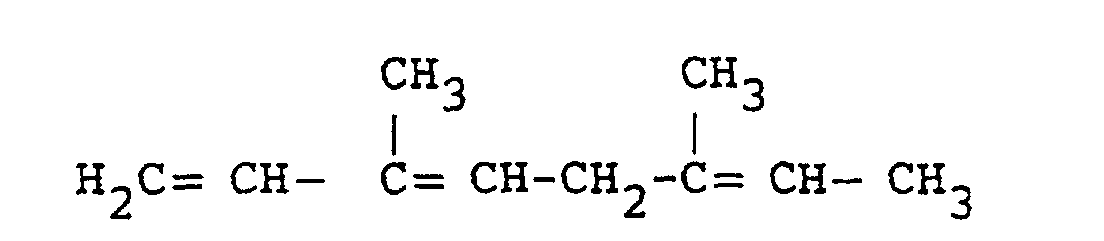

The reaction of the triene having conjugated
diene structure represented by the formula (2) with
ethylene may favorably be carried out at a temperature
usually in the range from 30 to 200 °C, preferably from
50 to 150 °C, under an ethylene pressure usually in the
range from 0.05 to 9.8 MPa (from 0.5 to 100 kgf/cm2,
gauge), preferably from 0.2 to 6.9 MPa (from 2 to 70
kgf/cm2, gauge), for a reaction duration usually in the
range from 0.5 to 30 hours. The reaction may be
performed under an atmosphere of ethylene gas per se or
an atmosphere of ethylene gas containing an inert gas,
such as nitrogen or argon. While a reaction solvent is
not particularly necessary, use thereof may be
permitted. As the reaction solvent, there may
favorably be used, for example, hydrocarbon solvent,
such as hexane, heptane, octane, nonane, decane,
undecane, tridecane, toluene and xylene.
The reaction of the triene having conjugated
diene structure represented by the formula (2) with
ethylene is carried out usually in the presence of a
catalyst. As the catalyst, for example, a catalyst
made of a transition metal thiocyanate, one or more
organic compounds capable of coordinating to the
transition metal atom of the thiocyanate as ligand and
an organoaluminum compound may be employed.
As the transition metal thiocyanate, there may
be enumerated concretely thiocyanates of transition
metal of Group 8 of the periodic table, such as iron
and ruthenium; of Group 9 thereof, such as cobalt,
rhodium and iridium; and of Group 10 thereof, such as
nickel and palladium.
For the organic compound capable of coordinating
as ligand, there may be recited, for example,
phosphorus-containing compounds, such as tri-o-tolylphosphine,
triethylphosphine, tripropylphosphine, tributylphosphine,
triphenylphosphine, bis(diphenylphosphino)methane,
1,2-bis(diphenylphosphino)ethane, 1,3-bis(diphenylphosphino)propane,
1,4-bis(diphenylphosphino)-butane,
triphenyl phosphite, triphenylphosphine oxide
and triphenyl phosphate.
As the organoaluminum compound, there may be
recited, for example, trimethylaluminum, triethylaluminum,
triisobutylaluminum, dimethylaluminum
chloride, diethylaluminum chloride, ethylaluminum
dichloride and diethylaluminum ethoxide.
The structural unit derived from the triene (c)
in the ethylenic copolymer rubber according to the
present invention has substantially the structure
represented by the formula (1') given above.
The fact that the structural unit derived from
the triene (c) in the ethylenic copolymer rubber
according to the present invention has the structure
represented by the formula (1') can be confirmed by
detecting 13C-NMR spectrum of this copolymer.
The ethylenic copolymer rubber according to the
present invention, for example, ethylene/propylene/4,8-dimethyl-1,4,8-decatriene
copolymer rubber, reveals
some twofold as high a cross-linking velocity as that
of known ethylene/propylene/5-ethylidene-2-norbornene
terpolymer rubber, permitting thereby reduction of the
cross-linking time (vulcanization time), lowering of
the cross-linking temperature (vulcanization
temperature) or reduction of vulcanization accelerator.
It reveals further a superior scorch stability.
The non-conjugated polyene (d) to be employed
according to the present invention has carbon-to-carbon
double bonds in the molecule, among which at least two,
preferably two, are polymerizable double bond. By the
polymerizable double bond is meant a double bond which
can couple with ethylene or with an α -olefin to build
up a polymer, as given previously in the description of
the triene (c). Concrete exemplification of such a
polymerizable double bond include the double bond
present at the terminal end of a linear hydrocarbon,
double bond of, for example, vinyl group or allyl group,
and double bond which is present in the ring of a
cycloaliphatic hydrocarbon but does not conjugate. The
non-conjugated polyene (d) may have, in addition to the
said at least two polymerizable double bonds, other
unsaturation bonds which do not participate in the
polymerization.
Concrete ones of the non-conjugated polyene (d)
to be used according to the present invention include
non-conjugated dienes having at least two polymerizable
double bonds in the molecule, for example, 5-alkenyl-2-norbornenes,
such as 5-vinyl-2-norbornene (VNB) and
5-allyl-2-norbornene; cycloaliphatic dienes, such as
2,5-norbornadiene (NBD), di-cyclopentadiene (DCPD)
and tetracyclo[4.4.0.12,5.17, 10]deca-3,8-diene; and
aliphatic α, ω-dienes, such as 1,7-octadiene and
1,9-decadiene. Among them, 5-alkenyl-2-norbornenes,
dicyclopentadiene, 2,5-norbornadiene and 1,7-octadiene
are preferred, wherein special preference is given to
2,5-norbornadiene (NBD) and 5-alkenyl-2-norbornenes.
In the ethylenic copolymer rubber according to
the present invention may comprise other comonomer(s)
in a copolymerized form. For such other comonomer(s),
there may be recited non-conjugated dienes other than
the non-conjugated polyene (d), for example,
non-conjugated dienes having only one polymerizable
carbon-to-carbon double bond. Also exemplifiable are
cycloolefins.
As the non-conjugated dienes other than the
non-conjugated polyene (d), those in which only one
carbon-to-carbon double bond is present at one terminal
end of the molecule as a vinyl group (CH2=CH-) and
other carbon-to-carbon double bonds are present in the
molecular chain (inclusive of the main chain and side
chain) in a form of internal olefin structure are
preferred. As the non-conjugated dienes having only
one polymerizable carbon-to-carbon double bond in the
molecule, there may be enumerated aliphatic dienes and
alicyclic dienes having an alicyclic moiety which has
one carbon-to-carbon double bond and a linear chain
moiety which has internal olefinic bond (carbon-to-carbon
double bond) are present. Among them, alicyclic
dienes are preferred.
Concrete examples of the aliphatic dienes to be
used as other comonomer(s) than the non-conjugated
polyene (d) include 1,4-hexadiene, 1,6-octadiene,
3-methyl-1,4-hexadiene, 4-methyl-1,4-hexadiene,
5-methyl-1,4-hexadiene, 4-ethyl-1,4-hexadiene, 3-methyl-1,5-hexadiene,
3,3-dimethyl-1,4-hexadiene, 5-methyl-1,4-heptadiene,
5-ethyl-1,4-heptadiene, 5-methyl-1,5-heptadiene,
6-methyl-1,5-heptadiene, 5-ethyl-1,5-heptadiene,
4-methyl-1,4-octadiene, 5-methyl-1,4-octadiene,
4-ethyl-1,4-octadiene, 5-ethyl-1,4-octadiene,
5-methyl-1,5-octadiene, 6-methyl-1,5-octadiene, 5-ethyl-1,5-octadiene,
6-ethyl-1,5-octadiene, 6-methyl-1,6-octadiene,
7-methyl-1,6-octadiene, 6-ethyl-1,6-octadiene,
6-propyl-1,6-octadiene, 6-butyl-1,6-octadiene,
4-methyl-1,4-nonadiene, 5-methyl-1,4-nonadiene,
4-ethyl-1,4-nonadiene, 5-ethyl-1,4-nonadiene, 5-methyl-1,5-nonadiene,
6-methyl-1,5-nonadiene, 5-ethyl-1,5-nonadiene,
6-ethyl-1,5-nonadiene, 6-methyl-1,6-nonadiene,
7-methyl-1,6-nonadiene, 6-ethyl-1,6-nonadiene, 7-ethyl-1,6-nonadiene,
7-methyl-1,7-nonadiene, 8-methyl-1,7-nonadiene,
7-ethyl-1,7-nonadiene, 5-methyl-1,4-decadiene,
5-ethyl-1,4-decadiene, 5-methyl-1,5-decadiene,
6-methyl-1,5-decadiene, 5-ethyl-1,5-decadiene, 6-ethyl-1,5-decadiene,
6-methyl-1,6-decadiene, 6-ethyl-1,6-decadiene,
7-methyl-1,6-decadiene, 7-ethyl-1,6-decadiene,
7-methyl-1,7-decadiene, 8-methyl-1,7-decadiene, 7-ethyl-1,7-decadiene,
8-ethyl-1,7-decadiene, 8-methyl-1,8-decadiene,
9-methyl-1,8-decadiene, 8-ethyl-1,8-decadiene, 6-methyl-1,6-undecadiene
and 9-methyl-1,8-undecadiene.
Concrete examples of the alicyclic dienes to be
used as other comonomer than the non-conjugated polyene
(d) include norbornene derivatives, such as
5-ethylidene-2-norbornene, 5-propylidene-2-norbornene
and 5-butylidene-2-norbornene; and norbornadiene
derivatives, such as 2-methyl-2,5-norbornadiene and
2-ethyl-2,5-norbornadiene. Among them, 5-ethylidene-2-norbornene
is preferred.
The non-conjugated dienes to be used as other
comonomer may be incorporated either solely or in a
combination of two or more of them.
Concretely, as the cycloolefin to be used as
other comonomer, there may be exemplified:
The cycloolefins can be produced by subjecting a
cyclopentadiene and an olefin having corresponding
molecular structure to Diels-Alder reaction.
These cycloolefins can be employed solely or in
a combination of two or more of them.
The first ethylenic copolymer rubber according
to the present invention is an ethylene/α -olefin/
triene copolymer rubber. If necessary, one or more
non-conjugated polyenes (d) having in the molecule at
least two polymerizable double bonds may be
co-polymerized together.
In the first ethylenic copolymer rubber
according to the present invention, the structural
units derived from ethylene (a), from the α -olefin(s)
having 3 - 20 carbon atoms (b) and from the triene(s)
represented by the formula (1) given above (c) are
bound together in a random arrangement. It is possessed
of unsaturation bonds derived from the triene(s) (c)
represented by the formula (1). The main chain of the
first ethylenic copolymer rubber according to the
present invention has substantially a linear structure.
The fact that the first ethylenic copolymer rubber has
substantially a linear structure and does not
substantially contain a cross-linked gelled polymer can
be confirmed by the fact that this copolymer dissolves
in an organic solvent without exhibiting substantially
any insoluble residue. For example, this can be
ascertained by the fact that this copolymer dissolves
completely in decalin at 135 °C on the determination of
its intrinsic viscosity (η).
The structural unit derived from the triene (c)
in the random copolymer rubber has substantially the
structure represented by the formula (1').
The first ethylenic copolymer rubber according
to the present invention has a mole ratio of the
structural unit derived from ethylene (a) versus the
structural unit derived from the α -olefin(s) (b),
namely, (ethylene)/(α -olefin(s)), in the range from
95/5 to 40/60, preferably from 90/10 to 50/50, more
preferably from 85/15 to 55/45, especially preferably
from 85/15 to 60/40. When this mole ratio is in the
above range, a cross-linked molded rubber product for
sealing (vulcanized molded rubber product for sealing)
superior in the mechanical strength with superior
flexibility can be obtained.
The first ethylenic copolymer rubber according
to the present invention has an intrinsic viscosity (η)
determined in decalin (decahydronaphthalene) at 135 °C
in the range from 0.1 to 10 dl/g, preferably from 0.5
to 5 dl/g, more preferably from 0.7 to 4.0 dl/g. When
the intrisic viscosity (η ) is in the above-mentioned
range, a vulcanized molded rubber product for sealing
exhibiting a better balance between the workability and
the strength can be obtained.
The first ethylenic copolymer rubber according
to the present invention has a content of the structural
unit derived from the triene(s) (c) represented by the
formula (1) in the range from 0.1 to 10 mole %,
preferably from 0.5 to 7 mole %, more preferably from 1
to 5 mole %. When the content of the structural unit
derived from the triene(s) (c) is in the range mentioned
above, the resulting ethylenic copolymer rubber exhibits
a higher vulcanization velocity and a superior scorch
stability.
The structural unit derived from the triene (c)
in the first ethylenic copolymer rubber according to
the present invention has a structure which is
represented substantially by the formula (1') given
above. The fact that the structural unit derived from
the triene (c) has the structure represented by the
formula (1') can be confirmed by detecting 13C-NMR
spectrum of the first ethylenic copolymer rubber.
The first ethylenic copolymer rubber according
to the present invention may have, co-polymerized
therein, in addition to ethylene (a), the α -olefin(s)
having 3 - 20 carbon atoms (b) and the triene(s) (c),
other compound(s) capable of co-polymerizing with these
comonomers, as other comonomer(s). For such other
comonomer(s), there may be exemplified the
non-conjugated polyenes (d), non-conjugated dienes and
cyclic olefins. The content of the structural unit
derived from the non-conjugated polyene(s) (d) {in the
following, denoted sometimes simply as "the content of
non-conjugated polyene (d)"} may favorably be in the
range from 0.02 to 3 mole %, preferably from 0.05 to
2.5 mole %, more preferably from 0.1 to 2.0 mole %. When
the content of non-conjugated polyene (d) is in the
above range, a superior workability on the extrusion
can be attained with exclusion of formation of gelled
cross-linked polymer. In addition, longer-chain branch
is brought about, whereby the formability is increased.
The content of the structural units derived from the
said other comonomer(s) in the first ethylenic
copolymer rubber according to the present invention may
favorably be 30 mole % or less, preferably in the range
from 0.5 to 10 mole %, based on the total moles of the
entire structural units derived from all the
comonomers. By co-polymerizing the non-conjugated
polyene(s) (d) and/or the non-conjugated diene(s),
adjustment of cross-linking velocity can be attained.
The value g' is defined by the ratio of the
intrinsic viscosity (η) detected in the manner as
described in the above paragraph (ii) versus the
converted intrinsic viscosity (η)blank' converted
into the intrinsic viscosity of a linear ethylene/
propylene copolymer (EPR) having an ethylene content of
70 mole % determined by gel permeation chromatography
(GPC, 140 °C, solvent: o-dichlorobenzene) of the first
ethylenic copolymer rubber, nemely (η )/( η)blank'.
The (η )blank' value is determined in the manner as
follows:
First, GPC of the first ethylenic copolymer
rubber is carried out to obtain each molecular weight
of each fraction converted into the molecular weight of
corresponding polystyrene MiPSt.
Then, this MiPSt is converted into the molecular
weight of corresponding EPR, i.e. MiEPR, by calculating
the equations
(η)iPSt ·MiPSt = (η) iEPR ·MiEPR ,
(77 )iPSt = 1.37× {10-4 ·MiPSt 0,686 }
(η )iEPR = 7.2 × {10-4 · MiEPR 0.667 }
Then, the converted MiEPR is further converted
into (η)iblank' for each specific fraction by the
equation (II)
(η)iblank ' = 7.2 × {10-4 · MiEPR 0,667 }
Here, "i" represents each specific fraction
number in the fractionation by GPC. From the
so-converted (η)iblank', ( η)blank' is calculated by
the following equation (III)
(η)blank ' = Σ ω i · (η )iblank '/Σω i
Here, ω represents the weight proportion.
By calculating the ratio of the so-calculated
(η )blank' versus (η ), the value g' is determined.
The g' value { = (η )/( η )blank'} for the first
ethylenic copolymer rubber is in the range from 0.5 to
0.95, preferably from 0.7 to 0.90.
A g' value of the first ethylenic copolymer
rubber according to the present invention not higher
than 0.95 indicates presence of long chain branch in
the molecule. The first ethylenic copolymer rubber
such as above has a characteristic feature that it
exhibits lower tenacity under higher shearing rates on
working by, such as kneading and molding, and higher
tenacity under lower shearing velocity after molding
but before the cross-linking (vulcanization).
Therefore, the first ethylenic copolymer rubber having
such a g' value as above is superior in the workability
on kneading, molding and so on and can be formed into
cross-linked molded products for sealing which are
superior, after the cross linking, in the ability of
preserving the form before the cross linking.
The second ethylenic copolymer rubber according
to the present invention is the same as the first
ethylenic copolymer rubber except that the restriction
of g' value is excluded and that the complex viscosity
coefficient ( η *A) at 8 rad/sec and the ratio of this
( η *A) and the complex viscosity coefficient ( η *B)
at 0.01 rad/sec, namely, (η *B)/ ( η *A), are limited
both specifically.
The second ethylenic copolymer rubber according
to the present invention has a characteristic feature
that the complex viscosity coefficient (η *A) at 8
rad/sec in the assessment of dependence of the complex
viscosity coefficient ( η*) on frequency estimated
from the kinematic viscoelasticity at 190 °C is at
least 2 × 10³ Pa·S and the ratio of the complex
viscosity coefficient ( η *B) at 0.01 rad/sec versus
the complex viscosity coefficient ( η*A), namely,
( η *B)/( η *A), is at least 35; preferably (η*A) is
in the range from 2 × 10³ to 2 × 10⁵ Pa·S and ( η *B)/
( η *A) is in the range from 35 to 300; more preferably
( η *A) is in the range from 2 x 10³ to 2 x 10⁵ Pa·S
and ( η *B)/(η *A) is in the range from 35 to 250.
The second ethylenic copolymer rubber according
to the present invention has, thus, the (η *A) value
and the ratio (η *B)/(η * A) within the limitations as
given above and exhibits a characteristic feature that
it exhibits lower tenacity under higher shearing rates
on working by, such as kneading and molding, and higher
tenacity under lower shearing velocity after molding
but before the cross linking (vulcanization). Therefore,
the second ethylenic copolymer rubber according to the
present invention is superior in the workability on
kneading, molding and so on and can be formed into
cross-linked molded products for sealing which are
superior, after the cross linking, in the ability of
preserving the form before the cross linking. For
performing cross linking of the second ethylenic
copolymer rubber according to the present invention,
such a condition as to increase the compounding
temperature can be employed by using a UHF
vulcanization vessel, so that a high speed molding and
a high performance foaming can be realized. In
addition, the resulting products do scarcely suffer
from distortion.
The complex viscosity coefficient (η*A) at 8
rad/sec is a value nearly corresponding to Mooney
viscosity. The ratio (η *B)/(η *A) is a parameter
indicating the degree of branching in the ethylenic
copolymer rubber, in which the greater this ratio, is,
the more superior will be the resulting spongy rubber
product in the form preservability. By the way, for
the case where the ethylenic copolymer rubber is
oil-extended, the ratio (η *B)/( η * A ) should be
modified into
{(η *B )/( η *A )}/{(1 - Aoil )/(100 + Aoil )}
in which Aoil (amount of extending oil) denotes the
amount of the softener in part by weight, per 100 parts
by weight of the ethylenic copolymer rubber.
The first and the second ethylenic copolymer
rubbers according to the present invention can be
produced by a random copolymerization of ethylene (a),
the α -olefin(s) having 3 - 20 carbon atoms (b), the
triene(s) (c) and, if necessary, other comonomer(s),
such as the non-conjugated polyene(s) (d), in the
presence of a catalyst, preferably a metallocene
catalyst.
As the catalyst, one constituted of a compound
of a transition metal (e) of, such as vanadium (V),
zirconium (Zr) or titanium (Ti), and an organoaluminum
compound (f) and/or an ionizing ionic compound (g) may
be employed.
Concrete examples of the catalyst include
Among them, the metallocene catalyst is
preferred.
As the metallocene (e-3), one represented by
the following formula (3) may be used.
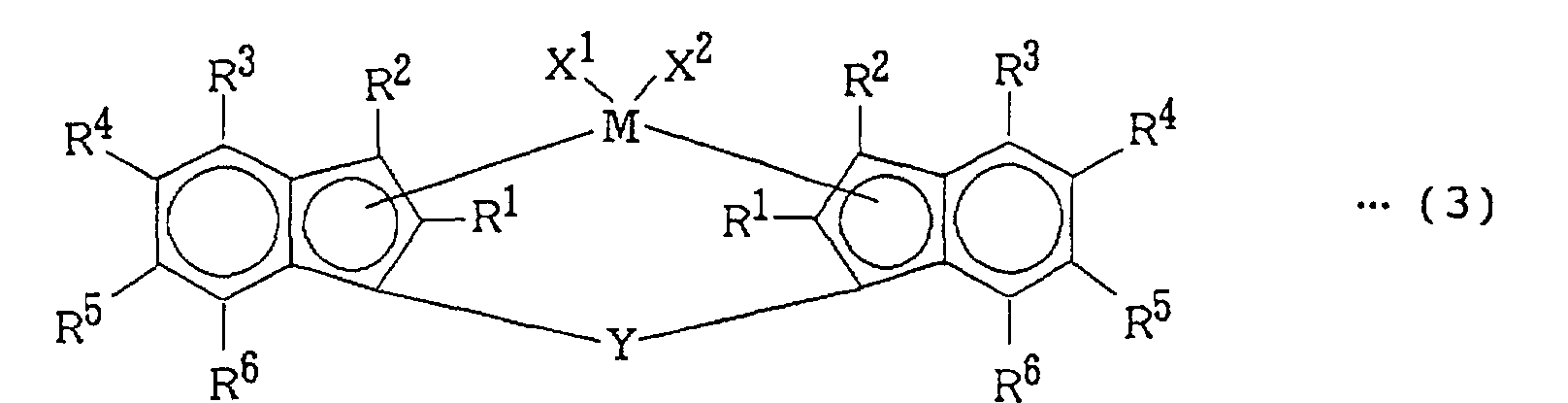
In the above formula (3), M denotes a
transition metal atom of Group IVB of the periodic
table, which may concretely be titanium, zirconium or
hafnium, especially preferably zirconium.
R1 is a hydrocarbyl having 1 - 6 carbon atoms,
wherefor concretely an alkyl, such as methyl, ethyl,
n-propyl, iso-propyl, n-butyl, iso-butyl, sec-butyl,
tert-butyl, n-pentyl, neopentyl, n-hexyl or cyclohexyl;
and an alkenyl, such as vinyl or propenyl, may be
exemplified. Among them, alkyls in which the carbon
atom bound to indenyl group is primary one are preferred
and alkyls of 1 - 4 carbon atoms are more preferred,
especially methyl and ethyl.
R2, R4, R5 and R6 may be identical with or
different from each other and stand each for hydrogen
atom, a halogen atom or a hydrocarbyl of 1 - 6 carbon
atoms as given for the group R1 above. The halogen
atom is fluorine, chlorine, bromine or idine.
R3 is an aryl group of 6 - 16 carbon atoms.
This aryl group may be substituted by, for example, the
above-mentioned halogen atom(s), hydrocarbyl(s) of 1 -
20 carbon atoms and/or organic silyl group(s).
Concretely, as the aryl group, there may be enumerated,
for example, phenyl, α -naphthyl, β -naphthyl,
anthracenyl, phenanthryl, pyrenyl acenaphthyl,
phenalenyl, aceanthrylenyl, tetrahydronaphthyl, indanyl
and biphenylyl. Among them, phenyl, naphthyl,
anthracenyl and phenanthryl are preferred.
As the hydrocarbyl of 1 - 20 carbon atoms which
is the substituent of the above aryl group, there may
be enumerated, for example, alkyl groups, such as
methyl, ethyl, propyl, butyl, hexyl, cyclohexyl, octyl,
nonyl, dodecyl, eicosyl, norbornyl and adamantyl;
alkenyl groups, such as vinyl, propenyl and
cyclohexenyl; aralkyl groups, such as benzyl, phenylethyl
and phenylpropyl; and aryl groups of 6 - 20 carbon
atoms, such as aryl groups as exemplified for the group
R3, tolyl, dimethylphenyl, trimethylphenyl, ethylphenyl,
propylphenyl, methylnaphthyl and benzylphenyl.
As the organosilyl groups, there may be
exemplified trimethylsilyl, triethylsilyl and
triphenylsilyl.
X1 and X2 may be identical with or different
from each other and may stand each for hydrogen atom, a
halogen atom, a hydrocarbyl of 1 - 20 carbon atoms which
may be substituted by halogen atom(s) as given above,
an oxygen-containing group or a sulfur-containing group.
As the oxygen-containing group, there may be
recited concretely, for example, hydroxy; alkoxy groups
having 1 - 20 carbon atoms, such as, methoxy, ethoxy,
propoxy and butoxy; aryloxy groups, such as, phenoxy,
methylphenoxy, dimethylphenoxy and naphthoxy; and aryl-(C1-C20)alkoxy
groups, such as, phenylmethoxy and
phenylethoxy.
As the sulfur-containing groups, there may be
enumerated concretely those in which oxygen atom of the
above-mentioned oxygen-containg groups is replaced by
sulfur; sulfonyloxy groups, such as methylsulfonyloxy,
trifluoromethanesulfonyloxy, phenylsulfonyloxy, benzylsulfonyloxy,
p-toluenesulfonyloxy, trimethylbenzenesulfonyloxy,
triisobutylbenzenesulfonyloxy, p-chlorobenzenesulfonyloxy
and pentafluorobenzenesulfonyloxy;
and sulfonyl groups, such as methylsulfonyl, phenylsulfonyl,
benzenesulfonyl, p-toluenesulfonyl, trimethylbenzenesulfonyl
and pentafluorobenzenesulfonyl.
X1 and X2 may each preferably stand for, among
them, a halogen atom or a hydrocarbyl of 1 - 20 carbon
atoms.
Y denotes a divalent hydrocarbyl having 1 - 20
carbon atoms, a divalent halogenated hydrocarbyl having
1 - 20 carbon atoms, a divalent silicium-containing
group, a divalent germanium-containing group, the group
-O-, -CO-, -S-, -SO-, -SO2-, -NR7-,-P(R7)-, -P(O)(R7)-,
-BR7- or -AlR7-, with R7 being hydrogen atom, a halogen
atom, a hydrocarbyl having 1 - 20 carbon atoms or a
hydrocarbyl substituted by one or more halogen atoms
and having 1 - 20 carbon atoms. Concretely, Y stands
for alkylenes, such as methylene, dimethylmethylene,
ethylene, dimethylethylene, trimethylene, tetramethylene
and 1,2-cyclohexylene; alkylidenes, such as
cyclohexylidene; divalent hydrocarbyls having 1 - 20
carbon atoms, for example, arylalkylenes, such as
diphenylmethylene and diphenylethylene; divalent
halogenated hydrocarbyls obtained by halogenating the
above divalent hydrocarbyls having 1 - 20 carbon atoms,
for example, chloromethylene; silicium-containing
divalent groups, for example, alkylsilylenes, such as
methylsilylene, dimethylsilylene, diethylsilylene,
di(n-propyl)silylene, di(i-propyl)silylene, di(cyclohexyl)silylene,
methylphenylsilylene, diphenylsilylene,
di(p-tolyl)silylene and di(p-chlorophenyl)silylene;
alkylarylsilylenes; arylsilylenes; alkyldisilyls, such
as tetrametyl-1,2-disilyl and tetraphenyl-1,2-disilyl;
alkylaryldisilyls; aryldisilyls; and germanium-containing
divalent groups, in which the silicium in
the above silicium-containing divalent groups is
replaced by germanium.
Among them, the silicium-containing divalent
groups and the germanium-containing divalent groups are
preferred, wherein further preference is given to the
silicium-containing divalent groups, with special
preference to alkylsilylenes, alkylarylsilylenes and
arylsilylenes.
In the following, concrete examples of the
metallocene represented by the formula (3) are given:
Further, compounds in which zirconium in the
above metallocenes is replaced by titanium or hafnium
may also be enumerated.
According to the present invention, usually
racemates of the metallocenes are used, though use of
R-compounds or S-compounds may be permitted.
According to the present invention, the
metallocenes (e-3) may be used in a combination of two
or more of them.
These metallocenes (e-3) can be produced in
accordance with the disclosures of, for example,
Journal of Organometallic Chem., 288, 63-67, (1985) and
EP Laid-Open Patent Application No. 0,320,762.
The organoaluminum-oxy compounds (f-2) to be
used for preparing the metallocene catalyst may be
aluminoxanes known per se or the benzene-insoluble
organoaluminum-oxy compounds exemplified in Japanese
Patent Kokai Hei 2-78687.
The aluminoxanes known per se can be prepared,
for example, by the methods given below:
These aluminoxanes may contain a small amount
of organometallic component(s). They may be redissolved
in a solvent, after the reaction solvent or
the unreacted organoaluminum compound has been removed
from the recovered aluminoxane solution by distillation.
As the organoaluminum compound to be employed
for preparing the aluminoxane, there may concretely be
enumerated, for example, trialkylaluminums, such as
trimethylaluminum, triethylaluminum, tripropylaluminum,
triisopropylaluminum, tri-n-butylaluminum, triisobutylaluminum,
tri-sec-butylaluminum, tri-tert-butylaluminum,
tripentylaluminum, trihexylaluminum, trioctylaluminum
and tridecylaluminum; tricycloalkylaluminums, such as
tricyclohexylaluminum and tricyclooctylaluminum; dialkylaluminum
halides, such as dimethylaluminum
chloride, diethylaluminum chloride, diethylaluminum
bromide and diisobutylaluminum chloride; dialkylaluminum
hydride, such as diethylaluminum hydride and diisobutylaluminum
hydride; dialkylaluminum alkoxide, such as
dimethylaluminum methoxide and diethylaluminum ethoxide;
and dialkylaluminum aryloxide, such as diethylaluminum
phenoxide. Among them, trialkylaluminums and tricycloalkylaluminums
are especially preferred.
It is possible to employ as the organoaluminum
compound to be incorporated in the production of the
aluminoxane an isoprenylaluminum represented by the
formula (i-C4H9)xAly(C5H10)z, with x, y, z being a
positive integer and ≧ 2x.
It is permissible to use the organoaluminum
compounds given above also in a combination of two or
more of them.
As the solvent used in the preparation of the
aluminoxane, there may be exemplified aromatic
hydrocarbons, such as benzene, toluene, xylene, cumene
and cymene; aliphatic hydrocarbons, such as pentane,
hexane, heptane, octane, decane, dodecane, hexadecane
and octadecane; alicyclic hydrocarbons, such as
cyclopentane, cyclohexane, cyclooctane and methylcyclopentane;
hydrocarbons of petroleum cut fractions, such
as gasoline, kerosene and light oil; and halogenated
hydrocarbons, such as, above all, chlorinated or
brominated products of the aromatic, aliphatic and
alicyclic hydrocarbons given above. Further, ethers,
such as ethyl ether and tetrahydrofuran may also be
used. Among these solvents, especially aromatic
hydrocarbons are preferred.
For the ionized ionic compound (g-1) to be
reacted with the metallocene (e-3) to build up an ion
pair, there may be exemplified Lewis acids, ionic
compounds, boranes and carboranes as given in the
literatures, for example, Japanese Patent Kohyos
Hei 1-501950 (corresponding to International Publication
WO 88/05792) and Hei 1-502036 (corresponding to
International Publication WO 90/04899), Japanese Patent
Kokais Hei-3-179005 (corresponding to US Patent Nos.
5,561,092, 5,763,549, 5,807,939 and 5,883,202),
Hei-3-179006 (corresponding to US Patent No. 5,443,613),
Hei-3-207703 (corresponding to US Patent Nos. 5,387,568
and 5,663,249), Hei-3-207704 (corresponding to US Patent
Nos. 5,519,100 and 5,614,457) and US Patent No. 547,718.
As the Lewis acids, magnesium-containing Lewis
acids, aluminum-containing Lewis acids and boron-containing
Lewis acids are enumerated. Among them,
boron-containing Lewis acids are preferred. For the
boron-containing Lewis acids, concretely, those which
are represented by the formula
BR8 R9 R10
may be exemplified, wherein R8, R9 and R10 represent
each, independently of each other, a phenyl group which
may have substituent group(s), such as fluorine, methyl
and trifluorophenyl, or a fluorine atom.
As the boron-containing Lewis acids expressed
by the above formula, concretely, there may be recited,
for example, trifluoroboron, triphenylboron, tris(4-fluorophenyl)boron,
tris(3,5-difluorophenyl)boron, tris-(4-fluoromethylphenyl)boron
and tris(pentafluorophenyl)boron,
tris(p-tolyl)boron, tris(o-tolyl)boron
and tris(3,5-dimethylphenyl)boron. Among them, in
particular, tris(pentafluorophenyl)boron is preferred.
The ionic compound is a salt composed of a
cationic component and an anionic component. An anion
functions to stabilize the transition metal cation
by building up an ion pair by reacting with the
metallocene (e-3) to cationize the metellocene (e-3).
For such an anion, anions of organoboron, organoarsene,
organoaluminum and so on are enumerated, wherein an
anion of relatively bulky geometry permitting to
stabilize transition metal cation is preferred. For
the cation, there may be enumerated, for example, matal
cations, organometallic cations, carbonium cations,
tripium cations, oxonium cations, sulfonium cations,
phosphonium cations and ammonium cation. Concretely,
there may be exemplified triphenylcarbenium cation,
tributylammonium cation, N,N-dimethylammonium cation
and ferrocenium cations.
As the ionic compounds, those comprising
organoboron anion are preferred. Concretely, there may
be enumerated, for example, trialkyl-substituted
ammonium salts, such as triethylammonium tetra(phenyl)-borate,
tripropylammonium tetra(phenyl)borate, tri(n-butyl)ammonium
tetra(phenyl)borate, trimethylammonium
tetra(p-tolyl)borate, trimethylammonium tetra(o-tolyl)-borate,
tributylammonium tetra(pentafluorophenyl)borate,
tripropylammonium tetra(2,4-dimethylphenyl)borate, tributylammonium
tetra(3,5-dimethylphenyl)borate, tributylammonium
tetra(p-trifluoromethylphenyl)borate, tri-(n-butyl)ammonium
tetra(o-tolyl)borate and tri(n-butyl)-ammonium
tetra(4-fluorophenyl)borate; N,N-dialkylanilinium
salts, such as N,N-dimethylanilinium tetra-(phenyl)borate,
N,N-diethylanilinium tetra(phenyl)-borate
and N,N-2,4,6-pentamethylanilinium tetra-(phenyl)borate;
dialkylammonium salts, such as di(n-propyl)ammonium
tetra(pentafluorophenyl)borate and
dicyclohexylammonium tetra(phenyl)borate; and triarylphosphonium
salts, such as triphenylphosphonium tetra-(phenyl)borate,
tri(methylphenyl)phosphonium tetra-(phenyl)borate
and tri(dimethylphenyl)phosphonium tetra-(phenyl
)borate.
As the ionic compounds having boron atom, there
may also be enumerated triphenylcarbenium tetrakis-(pentafluorophenyl)borate,
N,N-dimethylanilinium tetrakis(pentafluorophenyl)borate
and ferrocenium tetra
(pentafluorophenyl)borate.
Further, there may also be exemplified boron-containing
ionic compounds as given below, wherein
the ionic compounds given have commonly a counter ion
of tri(n-butyl)ammonium, while other counter ions may
also be permitted:
Salts of anions, such as bis{tri(n-butyl)-ammonium}
nonaborate, bis{tri(n-butyl)ammonium} decaborate,
bis{tri(n-butyl)ammonium) undecaborate, bis-{tri(n-butyl)ammonium}
dodecaborate, bis{tri(n-butyl)-ammonium}
decachlorodecaborate, bis{tri(n-butyl)ammonium}
dodecachlorododecaborate, tri(n-butyl)ammonium-1-carba
decaborate, tri(n-butyl)ammonium-1-carba undecaborate,
tri(n-butyl)ammonium-1-carba dodecaborate, tri-(n-butyl)-ammonium-1-trimethylsilyl-1-carba
decaborate
and tri(n-butyl)ammoniumbromo-1-carba dodecaborate.
Further, boranes and carboranes given below may also be
exemplified, which may be used as the Lewis acids and
as the ionic compounds.
As the boranes, carborane complexes and salts
of carborane anions, there may be enumerated, for
example, decaborane(14), 7,8-dicarbaundecaborane(13),
2,7-dicarbaundecaborane(13), undecahydrido-7,8-dimethyl-7,8-dicarbaundecaborane,
dodecahydrido-11-methyl-2,7-dicarbaundecaborane,
tri(n-butyl)ammonium 6-carbadecaborate(14),
tri(n-butyl)ammonium 6-carbadecaborate(12)
tri(n-butyl)ammonium 7-carbaundecaborate(13), tri(n-butyl)ammonium
7,8-dicarbaundecaborate(12), tri(n-butyl)ammonium
2,9-dicarbaundecaborate(12), tri(n-butyl)ammonium
dodecahydrido-8-methyl-7,9-dicarbaundecaborate,
tri(n-butyl)ammonium undecahydrido-8-ethyl-7,9-dicarbaundecaborate,
tri(n-butyl)ammonium undecahydrido-8-butyl-7,9-dicarbaundecaborate,
tri(n-butyl)ammonium
undecahydrido-8-allyl-7,9-dicarbaundecaborate, tri(n-butyl)ammonium
undecahydrido-9-trimethylsilyl-7,8-dicarbaundecaborate
and tri(n-butyl)ammonium undecahydrido-4,6-dibromo-7-carbaundecaborate.
As the carboranes and the salts of carboranes,
there may be enumerated, for example, 4-carbanonaborane
(14), 1,3-dicarbanonaborane(13), 6,9-dicarbadecaborane
(14), dodecahydrido-1-phenyl-1,3-dicarbanonaborane, dodecahydrido-1-methyl-1,3-dicarbanonaborane
and undecahydrido-1,3-dimethyl-1,3-dicarbanonaborane.
Further, those compounds as given below may
also be exemplified, wherein these compounds given have
commonly a counter ion of tri(n-butyl)ammonium, while
other counter ions may also be permitted:
Salts of metal carboranes and metal borane
anions, such as tri(n-butyl)ammonium bis(nonahydrido-1,3-dicarbanonaborate)
cobaltate(III), tri(n-butyl)-ammonium
bis(undecahydrido-7,8-dicarbaundecaborate)
ferrate(III), tri(n-butyl)ammonium bis(undecahydrido-7,8-dicarbaundecaborate)
cobaltate(III), tri(n-butyl)ammonium
bis(undecahydrido-7,8-dicarbaundecaborate) nickelate(III),
tri(n-butyl)ammonium bis(undecahydrido-7,8-dicarbaundecaborate)
cuprate(III), tri(n-butyl)ammonium bis(undecahydrido-7,8-dicarbaundecaborate)
aurate(III), tri(n-butyl)ammonium
bis(nonahydrido-7,8-dimethyl-7,8-dicarbaundecaborate)
ferrate(III), tri(n-butyl)ammonium bis-(nonahydrido-7,8-dimethyl-7,8-dicarbaundecaborate)
chromate(III),
tri(n-butyl)ammonium bis(tribromooctahydrido-7,8-dicarbaundecaborate)
cobaltate(III), tri(n-butyl)-ammonium
bis(dodecahydridodicarbadodecaborate) cobaltate
(III), bis{tri(n-butyl)ammonium) bis(dodecahydridododecaborate)
nickelate(III), tris{tri(n-butyl)ammonium} bis-(undecahydrido-7-carbaundecaborate)
chromate(III), bis-{tri(n-butyl)ammonium}
bis(undecahydrido-7-carbaundecaborate)
manganate(IV), bis{tri(n-butyl)ammonium) bis-(undecahydrido-7-carbaundecaborate)
cobaltate(III) and
bis{tri(n-butyl)ammonium} bis(undecahydrido-7-carbaundecaborate)
nickelate(IV).
The ionizing ionic compounds (g-1) as given
above may be used in a combination of two or more of
them.
The organoaluminum compound (f-1) to be used
according to the present invention is represented, for
example, by the following formula (a):
(R11 )n AlX3-n
in which R11 is a hydrocarbon group having 1 - 12
carbon atoms, X denotes a halogen atom or hydrogen atom
and n is an integer of 1- 3.
In the formula (a), R11 represents a hydrocarbon
group having 1 - 12 carbon atoms, such as alkyl,
cycloalkyl or aryl and, concretely, it stands for, for
example, methyl, ethyl, n-propyl, isopropyl, isobutyl,
pentyl, hexyl, octyl, cyclopentyl, cyclohexyl, phenyl
or tolyl.
Concrete examples of such an organoaluminum
compound include trialkylaluminums, such as trimethylaluminum,
triethylaluminum, triisopropylaluminum, triisobutylaluminum,
trioctylaluminum and tri-2-ethylhexylaluminum;
alkenylaluminums, such as isoprenylaluminum
and so on; dialkylaluminum halides, such as dimethylaluminum
chloride, diethylaluminum chloride, diisopropylaluminum
chloride, diisobutylaluminum chloride
and dimethylalumunim bromide; alkylaluminum sesquihalides,
such as methylaluminum sesquichloride,
ethylaluminum sesquichloride, isopropylaluminum sesquichloride,
butylaluminum sesquichloride and ethylaluminum
sesquibromide; alkylaluminum dihalides, such
as methylaluminum dichloride, ethylaluminum dichloride,
isopropylaluminum dichloride and ethylaluminum
dibromide; and alkylaluminum hydrides, such as diethylaluminum
hydride and diisobutylaluminum hydride.
It is permissible to use, as the organoaluminum
compound (f-1), also the compounds represented by the
following formula (b):
(R11 )n AlY3-n
in which R11 is the same as R11 in the formula (a), Y
denotes a group of -OR12, -OSi(R13)3, -OAl(R14)2,
-N(R15)2, -Si(R16)3 or -N(R17)Al(R18)2 and n is a number
of 1 - 2, wherein R12, R13, R14 and R18 denote each
methyl, ethyl, isopropyl, isobutyl, cyclohexyl or
phenyl, R15 denotes hydrogen atom, methyl, ethyl,
isopropyl, phenyl or trimethylsilyl and R16 and R17
represent each methyl, ethyl or the like.
Concretely, there may be enumerated for these
organoaluminum compounds the followings:
Among them, organoaluminum compounds
represented by the formulae (R11)3Al, (R11)nAl(OR12)3-n
and (R11)nAl{OAl(R14)2}3-n may be recited as preferable
examples, wherein special preference is given to those
compounds in which R11 denotes an iso-alkyl and n is 2.
They may be employed either each alone or in a
combination of two or more of them.
The metallocene catalyst to be used according
to the present invention contains the metallocene (e-3)
as given above and can be formed from the metallocene
(e-3) and the organoaluminum compound (f-2). It may
also be formed from the metallocene (e-3) and the
ionizing ionic compound (g-1). Further, it is
permissible to use the organoaluminum-oxy compound (f-2)
and the ionizing ionic compound (g-1) concurrently
together with the metellocene (e-3). In these modes,
the concurrent use with the organoaluminum compound
(f-1) is especially preferred.
According to the present invention, the
metallocene (e-3) is used usually in an amount of about
0.00005 - 0.1 mmol, preferably 0.0001 - 0.05 mmol, as
converted to the transition metal atom, per one liter
of the polymerization volume.
The organoaluminum-oxy compound (f-2) may be
used usually in an amount of about 1 - 10,000 moles,
preferably 10 - 5,000 moles, of aluminum atom per one
mole of the transition metal atom.
The ionizing ionic compound (g-1) may be used
usually in an amount of about 0.5 - 20 moles, preferably
1 - 10 moles, of boron atom per one mole of the
transition metal atom.
The organoaluminum compound (f-1) may be used
on requirement usually in an amount of about 0 - 1,000
moles, preferably about 0 - 500 moles, per one mole of
aluminum atom in the organoaluminum-oxy compound (f-2)
or per one mole of boron atom in the ionizing ionic
compound (g-1).
When ethylene (a), the α -olefin(s) of 3 - 20
carbon atoms (b) and the triene(s) (c) are subjected to
copolymerization in the presence of the metallocene
catalyst, an ethylene/α -olefin/triene copolymer rubber
can be obtained with a superior polymerization activity.
On the copolymerization of ethylene (a), the
α -olefin(s) of 3 - 20 carbon atoms (b) and the
triene(s) (c) according to the present invention, the
metallocene (e-3), the organoaluminum-oxy compound
(f-2) and the ionizing ionic compound (g-1) constituting
the metallocene catalyst as well as the organoaluminum
compound (f-1) may be supplied to the polymerization
reactor each individually or they may be served for the
copolymerization after having been processed into the
metallocene catalyst comprising the metallocene (e-3).
On preparing the metallocene catalyst, a
solvent inert to the catalyst components may be used,
for which there may be recited aliphatic hydrocarbons,
such as propane, butane, pentane, hexane, heptane,
octane, decane, dodecane and kerosene; alicyclic
hydrocarbons, such as cyclopentane, cyclohexane and
methylcyclopentane; aromatic hydrocarbons, such as
benzene, toluene and xylene; and halogenated
hydrocarbons, such as ethylene chloride, chlorobenzene
and dichloromethane. They may be used either each
alone or in a combination.
The metallocene (e-3), the organoaluminum-oxy
compound (f-2), the ionizing ionic compound (g-1) and
the organoaluminum compound (f-1) may be blended
together usually at a temperature in the range from
minus 100 °C to +200 °C, preferably from minus 70 °C to
+100 °C, to cause them to contact with each other.
The copolymerization of ethylene (a), the α-olefin(s)
having 3 - 20 carbon atoms (b) and the
triene(s) (c) may be realized usually at a temperature
of 40 - 200 °C, preferably 50 - 150 °C, more preferably
60 - 120 °C, under a pressure in the range from the
atmospheric pressure to 9.8 MPa, (100 kgf/cm2),
preferably from the atmospheric pressure to 4.9 MPa (50
kgf/cm2), more preferably from the atmospheric pressure
to 2.9 MPa (30 kgf/cm2).
The copolymerization can be effected by various
techniques, while it may preferably be effected by a
solution polymerization. Here, the solvents mentioned
above may be used as the polymerization solvent. The
copolymerization can be realized in a batch-wise
process, in a semi-continuous process or in a
continuous process, while continuous process is
preferred.
The first and the second ethylenic copolymer
rubbers according to the present invention are produced
by a technique as above, wherein the molecular weight
of the resulting copolymer can be adjusted by altering
the polymerization condition, such as the
polymerization temperature, or by controlling the amount
of hydrogen (molecular weight regulator).
The first and the second ethylenic copolymer
rubbers according to the present invention obtained as
above exhibit higher vulcanization velocity and are
superior in the scorch stability and in the form
preservability, with excellence in the workability,
formability, weatherability, heat resistance,
resistance to ozone, low-temperature stability,
resistance to permanent compressive strain and so on.
The first and the second ethylenic copolymer
rubbers according to the present invention may be
subjected to a cross linking solely in itself or in a
blend with other rubber(s).
Due to the high vulcanization velocity of the
first and the second ethylenic copolymer rubbers
according to the present invention, they can be
subjected to cross linking within a briefer period of
time or at a lower temperature even without using a
larger amount of vulcanizing agent as compared with
conventional unsaturated olefinic copolymers.
Due to the superior scorch stability of the
first and the second ethylenic copolymer rubbers, the
volume magnification on foaming molding thereof is
maintained stably, whereby foamed articles can be
produced in a better productivity. Thus, the volume
magnification on foaming is decided by a delicate
balance among the initial viscosity of the raw resin,
the rate of increase of the viscosity and the rate of
decomposition of the foaming agent during the molding,
wherein the viscosity variation within a short period
of time is higher as the rate of increase of viscosity
becomes higher, making the control of volume
magnification on foaming difficult. Using the first or
the second ethylenic copolymer rubber according to the
present invention, however, the rate of increase of the
viscosity during the foaming molding is scarce due to
the superior scorch stability, whereby a foamed article
with a stable foaming volume magnification can be
produced efficiently.
Due to the superior scorch stability of the
frist and the second ethylenic copolymer rubbers
according to the present invention, they are superior
also in the stability in handling during the working
operation. Thus, for example, troubles due to increase
in the viscosity during extrusion within the extruder
by the progress of the cross-linking reaction, such as
reduction of through-put, increase in the load of motor
and clogging of the cylinder and extrusion die, can be
prevented.
Due to the superior form preservability of the
first and the second ethylenic copolymer rubbers
according to the present invention, they are superior
also in the stability in handling upon the working
operation. Thus, for example, flexibility for the
design of configuration and thinner wall thickness in
the section is facilitated, since drooping-down of the
rubber composition by the own weight during the process
after the extrusion till completion of the cross
linking is scarce.
The first and the second ethylenic copolymer
rubbers according to the present invention have also a
characteristic feature that they are superior in the
resistance to heat aging, in the weatherability and in
the resistance to ozone, together with the superior
charactristic features mentioned above.
The third ethylenic copolymer rubber according
to the present invention has a mole proportion of the
structural unit derived from ethylene (a) versus the
structural unit derived from the α -olefin of 3 - 20
carbon atoms (b), namely, ethylene/α -olefin, in the
range from 95/5 to 40/60, preferably from 85/15 to
50/50, more preferably from 82/18 to 55/45. Due to the
mole ratio of ethylene/α -olefin in the above range,
it exhibits a rubbery nature and is superior in the
low-temperature chracteristics.
The third ethylenic copolymer rubber according
to the present invention has a content of the
structural unit derived from the triene(s) (c) {in the
following, sometimes referred to simply as the content
of triene (c)} in the range from 0.1 to 10 mole %,
preferably from 0.2 to 8 mole %, more preferably from
0.5 to 5 mole %. Due to the content of triene (c) in
the above range, cross linking by sulfur-vulcanization
or the like is rendered easier and the resistance to
environmental aging is superior.
The third ethylenic copolymer rubber according
to the present invention has a content of the
structural unit derived from the non-conjugated
polyene(s) (d) {in the following, sometimes referred to
simply as the content of non-conjugated polyene (d)} in
the range from 0.02 to 3 mole %, preferably from 0.05
to 2.5 mole %, more preferably from 0.1 to 2.0 mole %.
Due to the content of non-conjugated polyene (d) in the
above range, it is superior in the moldability by
extrusion without forming gelled cross-linked polymer.
In the third ethylenic copolymer rubber, the
mole ratio of the structural unit derived from the
triene(s) (c) versus the structural unit derived from
the non-conjugated polyene(s) (d), namely, triene/non-conjugated
polyene, may favorably be in the range from
1/3 to 30/1, preferably from 1/2 to 20/1, more
preferably from 1/1 to 10/1.
The third ethylenic copolymer rubber according
to the present invention has an intrinsic viscosity
( η ) determined in decalin (decahydronaphthalene) at
135 °C in the range from 0.1 to 10 dl/g, preferably
from 0.5 to 5 dl/g, more preferably from 0.8 to 4 dl/g.
Due to the intrinsic viscosity in the above
range, it is superior in the strength after being
cross-linked and is also superior in the workability.
The third ethylenic copolymer rubber according
to the present invention has a superior moldability by
extrusion and a high cross-linking velocity, together
with superior mechanical characteristics, such as the
cross linking strength, of the cross-linked rubber
product.
The third ethylenic copolymer rubber according
to the present invention may be brought into practical
use either in the non-cross-linked state as such or in
a cross-linked state after being cross-linked by a
cross linking technique as will be described
afterwards, wherein the characteristic properties may
be revealed more facilitatedly when used in the
cross-linked form.
The third ethylenic copolymer rubber according
to the present invention may be brought into practical
use either after having been cross-linked solely in
itself or in a blend with other rubber material(s).
Due to the high cross-linking velocity of the
third ethylenic copolymer rubber according to the
present invention, it can be subjected to cross linking
within a briefer period of time or at a lower
temperature even without using a larger amount of
vulcanizing agent as compared with conventional
olefinic copolymer rubbers, whereby cross-linked rubber
can be produced at a better productivity.
The third ethylenic copolymer rubber according
to the present invention is superior in the ability of
co-cross-linking (co-vulcanizability) with diene
rubbers, in particular, with natural rubber, styrene/
butadiene rubber, isoprene rubber, butadiene rubber,
nitrile rubber and chloroprene rubber. A co-cross-linked
product (co-vulcanized product) of the third
ethylenic copolymer rubber with a diene rubber has the
superior properties intrinsic to the diene rubber in
the mechanical characteristics and resistances to
abrasion, to dynamic fatigue and to oils, together with
superior weatherability, resistance to ozone, resitance
to heat aging and so on.
For example, a co-cross-linked product of the
third ethylenic copolymer rubber according to the
present invention with natural rubber is superior in the
strength, in the weatherability, in the resistance to
ozone and in the dynamic characteristics.
A co-cross-linked product of the third ethylenic
copolymer rubber according to the present invention
with a nitrile rubber is superior in the weatherability
and in the resistances to ozone and to oils.
A co-cross-linked product of the third ethylenic
copolymer rubber according to the present invention
with a butadiene rubber is superior in the weatherability
and in the resistances to ozone and to abrasion.
The third ethylenic copolymer rubber according
to the present invention may be served favorably as a
modifier for resins and as a raw material of various
rubber products.
For example, by adding the third ethylenic
copolymer rubber as a resin modifier to resins of, such
as polypropylene, polyethylene, polybutene and
polystyrene, the shock resistance and the resistance to
stress-cracking of these resins may remarkably be
improved.
The third ethylenic copolymer rubber according
to the present invention can be produced by
co-polymerizing ethylene (a), the α -olefin having 3 -
20 carbon atoms (b), the triene (c) represented by the
formula (1) and the non-conjugated polyene(s) (d) in
the presence of a catalyst. As the catalyst, that
constituted of a transition metal compound (e) of, such
as vanadium (V), zirconium (Zr) or titanium (Ti), and
of an organoaluminum compound (f) and/or an ionizing
ionic compound (g) may favorably be employed.
Concrete examples of the catalyst include
Among them, the metallocene catalyst is
preferred. The metallocene catalyst has a high
catalytic activity and can produce the third ethylenic
copolymer rubber having a narrow distribution of the
molecular weight and a narrow compositional distribution
with high conversion proportion of the triene (c)
represented by the formula (1).
The solid titanium catalyst component (e-1) is
prepared by bringing a titanium compound, a magnesium
compound and an electron donor as given below into
contact with each other.
As the titanium compound, a compound of
trivalent or tetravalent titanium is employed, wherein
tetravalent titanium compound is preferred. As the
tetravalent titanium compound, for example, tetravalent
titanium compounds represented by Ti(OR)jX4-j (in which
R is a hydrocarbon group, X is a halogen atom and 0 ≦
j ≦ 4) may be enumerated. Among them, halogen-containing
titanium compounds are favorable, wherein
preference is given to titanium tetrahalides, especially
titanium tetrachloride.
The magnesium compound to be used for preparing
the solid titaniferous catalyst component (e-1) may be
a magnesium compound which may or may not exhibit a
reducing property. As the magnesium compound exhibiting
a reducing property, those which have magnesium-to-carbon
bond(s) and magnesium-to-hydrogen bond(s) may be
enumerated. As the magnesium compound which does not
exhibit reducing property, those which are derived from
the above-mentioned reducible magnesium compounds or
those which are derived upon the preparation of the
catalyst component may be employed. It is also
possible to use a complex of the magnesium compound with
other metal, composite compound or a mixture composed
of such a magnesium compound and other metal compound.
A mixture of two or more of such a magnesium compound
may also be employed. As the magnesium compound, those
which do not exhibit reducing property are favorable,
with preference to halogen-containing ones, especially
to magnesium chloride, an alkoxy magnesium chloride
and an aryloxy magnesium chloride.
As the electron doner to be employed for
preparing the solid titaniferous catalyst component
(e-1), esters of organic carboxylic acids and esters of
polybasic carboxylic acids may be enumerated.
The solid titaniferous catalyst component (e-1)
can be prepared by bringing a titanium compound, a
magnesium compound (or metallic magnesium) and an
electron donor, as described above, into contact with
each other. For preparing the solid titaniferous
catalyst component (e-1), a known method for preparing
a highly active titaniferous catalyst component from a
titanium compound, a magnesium compound and an electron
donor may be employed. On contacting the above
components, they can be brought into contact with each
other in the presence of other reaction reagent, such
as a compound of silicium, phosphorus or aluminum.
As the organoaluminum compound (f-1) for
building up the catalyst based on titanium, compounds
containing at least one Al-to-carbon bond in the
molecule may be employed. Examples of such compounds
include organoaluminum compounds represented by the
formula (4),
(R1 )m Al(OR2 )n Hp Xq
in which R1 and R2 denote each a hydrocarbon group
containing usually 1 - 15 carbon atoms, preferably 1 - 4
carbon atoms, which may be identical with or different
from each other, X is a halogen atom, m, n, p and q are
each a number sufficing the conditions 0 < m ≦ 3,
0 ≦ n< 3, 0 ≦ p< 3 and 0 ≦ q< 3, with m+n+p+q =
3; and alkylated complexes of aluminum with a metal of
Group 1 of the periodic table represented by the
formula (5),
(M1 )Al(R1 )4
in which M1 is Li, Na or K and R1 has the same meaning
as that in the formula (4).
For preparing the catalyst based on titanium,
an electron donor may be incorporated on requirement.
For such an electron donor, an organosilicic compound
as represented by the formula (6) or (7) may be
employed:
Rn Si(OR')4-n
SiR1 R2 m (OR3 )3-m
In the formula (6), R and R' denote each a
hydrocarbon group and n is a number sufficing the
condition 0 < n < 4.
In the formula (7), R1 denotes cyclopentyl or
an alkyl-containing cyclopentyl, R2 is an alkyl, a
cyclopentyl or an alkyl-containing cyclopentyl, R3 is a
hydrocarbon group and m is a number sufficing the
condition 0≦ m ≦ 2.
As the alkyl-containing cyclopentyl R1 in the
formula (7), for example, 2-methylcyclopentyl, 3-methylcyclopentyl,
2-ethylcyclopentyl and 2,3-dimethylcyclopentyl
may be enumerated.
In the catalyst components for building up the
catalyst based on titanium, an α-olefin may be
incorporated under a prepolymerization. The
prepolymerization may desirably be realized by using an
α -olefin in an amount of 0.1 - 500 g, preferably 0.3 -
300 g, especially preferably 1 - 100 g, per 1 g of the
titanium-based catalyst. The prepolymerization may
preferably be effected by mixing the α -olefin and the
catalyst components in an inert hydrocarbon solvent to
cause the prepolymerization under a mild condition. The
α -olefin to be employed in the prepolymerization may
or may not be identical with the α -olefin (b) used
for preparing the third ethylenic copolymer rubber.
As the soluble vanadium compound (e-2) for
building up the catalyst based on vanadium, such
compounds as represented by the following formulae
(8) or (9) may be enumerated:
VO(OR)a Xb
V(OR)c Xd
In the formulae (8) and (9), R is a hydrocarbon
group, X is a halogen atom and the symbols a, b, c and
d suffice each the conditions 0 ≦ a ≦ 3, 0 ≦ b ≦
3, 2 ≦ a + b ≦ 3, 0 ≦ c ≦ 4, 0 ≦ d ≦ 4 and
3 ≦ c + d ≦ 4, respectively.
As the soluble vanadium compound (e-2), an
electron donor adduct of a soluble vanadium compound
obtained by contacting an electron donor with the
soluble vanadium compound may be employed.
As the organoaluminum compound (f-1) for
building up the catalyst based on vanadium, those which
are the same as the organoaluminum compound (f-1) for
building up the catalyst based on titanium mentioned
above may be used.
The metallocene (e-3) to be employed for
building up the catalyst based on metallocene is that
of a transition metal selected from the elements of
Group 4 of the periodic table. Concrete examples
thereof include those represented by the following
formula (10),
MLx
in which M is a transition metal selected from the
elements of Group 4 of the periodic table, x is the
valency of the transition metal M and L represents a
ligand.
Concrete examples of the transition metal
represented by M in the formula (10) include zirconium,
titanium and hafnium.
L in the formula (10) denotes a ligand to be
coordinated to the transition metal. Among these
ligands, at least one ligand L has a skeleton of
cyclopentadienyl, which may have substituent group(s).
For the ligand L having a skeleton of
cyclopentadienyl, there may be enumerated, for example,
cyclopentadienyl group; alkyl- or cycloalkyl-substituted
cyclopentadienyl group, such as, methylcyclopentadienyl
group, ethylcyclopentadienyl group, n- or i-propylcyclopentadienyl
group, n-, i-, sec- or t-butylcyclopentadienyl
group, dimethylcyclopentadienyl group, methylpropylcyclopentadienyl
group, methylbutylcyclopentadienyl
group and methylbenzylcyclopentadienyl group;
indenyl group; 4,5,6,7-tetrahydroindenyl group; and
fluorenyl group.
The group having the cyclopentadienyl-skeleton
mentioned above may have substituent(s) of, for
example, a halogen atom or a trialkylsilyl group.
If the compound represented by the formula
(10) has two or more groups having the skeleton of
cyclopentadienyl as the ligand L, two of such groups
having the skeleton of cyclopentadienyl may be bound
together through a bridging group, for example, an
alkylene, such as ethylene or propylene, a substituted
alkylene, such as isopropylidene or diphenylmethylene,
a silylene or a substituted silylene, such as dimethylsilylene,
diphenylsilylene or methylphenylsilylene.
For the ligands L other than those having the
skeleton of cyclopentadienyl, namely, those which do
not possess the skeleton of cyclopentadienyl, there may
be enumerated, for example, hydrocarbon groups having 1
- 12 carbon atoms, alkoxy groups, aryloxy groups,
sulfo-containing groups (-SO3Ra in which Ra denotes an
alkyl, a halogen-substituted alkyl, aryl or a halogen-
or alkyl-substituted aryl), halogen atoms and hydrogen
atom.
For the hydrocarbon groups containing 1 - 12
carbon atoms of the ligand L, for example, alkyl,
cycloalkyl, aryl and aralkyl are enumerated. More
concretely, they include alkyl groups, such as, methyl,
ethyl, n-propyl, isopropyl, n-butyl, isobutyl,
sec-butyl, t-butyl, pentyl, hexyl, octyl, decyl and
dodecyl; cycloalkyl groups, such as, cyclopentyl and
cyclohexyl; aryl groups, such as, phenyl and tolyl; and
aralkyl groups, such as, benzyl and neophyl.
As the alkoxy groups for the ligand L, for
example, methoxy, ethoxy and n-propoxy; are enumerated.
As the aryloxy groups, for example, phenoxy etc., may
be enumerated. As the sulfo-containing groups (-SO3Ra),
for example, methanesulfonato, p-toluenesulfonato,
trifluoromethanesulfonato and p-chlorobenzenesulfonato
are enumerated. As the halogen atom, for example,
fluorine, chlorine, bromine and iodine are enumerated.
More concretely, the metallocene represented by
the formula (10) in which the valency of the transition
metal is four is represented by the following formula
(11),
R2 k R3 1 R4 m R5 n M
in which M is a transition metal defined in the formula
(10), R2 is a group (ligand) having the skeleton of
cyclopentadienyl, R3, R4 and R5 represent each,
independently of each other, a group (ligand) which may
or may not have the skeleton of cyclopentadienyl and k
is an integer of at least 1, with k + 1 + m + n = 4.
Below, examples of the metallocene (e-3) in
which M is zirconium and which has at least two ligands
having a cyclopentadienyl skeleton are recited:
- Bis(cyclopentadienyl)zirconium monochloride monohydride
- Bis(cyclopentadienyl)zirconium dichloride
- Bis(1-methyl-3-butylcyclopentadienyl)zirconium bis-(trifluoromethanesulfonate)
- Bis(1,3-dimethylcyclopentadienyl)zirconium dichloride
It is permissible to use a compound in which
the above-mentioned 1,3-disubstituted cyclopentadienyl
group is replaced by a 1,2-disubstituted
cyclopentadienyl group.
Also, it is possible to use, for the metallocene
(e-3), a bridged metallocene in which at least two of
R2, R3, R4 and R5 in the formula (11), for example, R2
and R3 , are a group (ligand) having a skeleton of
cyclopentadienyl, wherein said at least two groups are
bound together through a bridging group, such as an
alkylene, substituted alkylene, silylene or substituted
silylene. In such a case, the groups R4 and R5 are the
same, independently of each other, as the ligands L
other than that having cyclopentadienyl skeleton as
mentioned previously for the formula (10).
For such bridged metallocenes (e-3) there may
be enumerated
- ethylene bis(indenyl)dimethylzirconium,
- ethylene bis(indenyl)zirconium dichloride,
- isopropylidene(cyclopentadienyl-fluorenyl)zirconium dichloride,
- diphenylsilylene bis(indenyl)zirconium dichloride and
- methylphenylsilylene bis(indenyl)zirconium dichloride.
Also, as the metallocene (e-3), metallocenes
disclosed in Japanese Patent Kokai Hei 4-268307
(corresponding to USP No. 5,243,001) represented by the
following formula (12) may also be enumerated.

In the above formula (12), M1 denotes a metal
of Group 4 of the periodic table and may concretely be,
for example, titanium, zirconium or hafnium.
In the formula (12), R1 and R2 may each be
hydrogen atom, an alkyl having 1 - 10 carbon atoms,
preferably 1 - 3 carbon atoms, an alkoxy having 1 - 10
carbon atoms, preferably 1 - 3 carbon atoms, an aryl
group having 6 - 10 carbon atoms, preferably 6 - 8
carbon atoms, an aryloxy group having 6 - 10 carbon
atoms, preferably 6 - 8 carbon atoms, an alkenyl group
having 2 - 10 carbon atoms, preferably 2 - 4 carbon
atoms, an aralkyl group having 7 - 40 carbon atoms,
preferably 7 - 10 carbon atoms, an alkaryl group having
7 - 40 carbon atoms, preferably 7 - 12 carbon atoms, or
an aralkenyl group having 8 - 40 carbon atoms,
preferably 8 - 12 carbon atoms, or, further, a halogen
atom, preferably chlorine atom. Here, R1 and R2 may or
may not be identical with each other.
In the formula (12), R3 and R4 may each stand
for hydrogen atom, a halogen atom, preferably fluorine
atom, chlorine atom or bromine atom, an alkyl group
which may be halogenated and which has 1 - 10 carbon
atoms, preferably 1 - 4 carbon atoms, an aryl group
having 6 - 10, preferably 6 - 8 carbon atoms, a group
of -N(R10)2, -SR10, -OSi(R10)3, -Si(R10)3 or -P(R10)2.
Here, R10 is a halogen atom, preferably chlorine atom,
an alkyl group having 1 - 10 carbon atoms, preferably 1 1
- 3 carbon atoms, or an aryl group having 6 - 10 carbon
atoms, preferably 6 - 8 carbon atoms. R3 and R4 may or
may not be identical with each other. It is especially
preferable that both R3 and R4 are hydrogen atom.
In the formula (12), R5 and R6 may be the same
as R3 and R4 except hydrogen atom. R5 and R6 may or
may not be identical with each other, while it is
preferable that both are the same. R5 and R6 may each
preferably be an alkyl group having 1 - 4 carbon atoms
which may be halogenated, of which concrete examples
are methyl, ethyl, propyl, isopropyl, butyl, isobutyl
and trifluoromethyl, wherein a particular preference is
given to methyl.
In the formula (12), R7 may stand for:

 as well as =BR11, =AlR11, -Ge-, -Sn-, -O-, -S-, =SO,
=SO2, -NR11, =CO, =PR11 or =P(O)R11. In the above, R11,
R12 and R13 may each stand for hydrogen atom; a halogen
atom; an alkyl group having 1 - 10 carbon atoms,
preferably 1 - 4 carbon atoms, and more preferably
methyl; a fluoroalkyl group having 1 - 10 carbon atoms,
preferably -CF3; an aryl group having 6 - 10 carbon
atoms, preferably 6 - 8 carbon atoms; a fluoroaryl group
having 6 - 10 carbon atoms, preferably pentafluorophenyl;
an alkoxy group having 1 - 10 carbon atoms,
preferably 1 - 4 carbon atoms, in particular methoxy;
an alkenyl group having 2 - 10 carbon atoms, preferably
2 - 4 carbon atoms; an aralkyl group having 7 - 40
carbon atoms, preferably 7 - 10 carbon atoms; an
aralkenyl group having 8 - 40 carbon atoms, preferably
8 - 12 carbon atoms; or an alkaryl group having 7 - 40
carbon atoms, preferably 7 - 12 carbon atoms. The pair
"R11 with R12" or "R11 with R13" may form a ring
together with the atoms bound thereto. R11, R12 and R13
may or may not be identical with each other.
as well as =BR11, =AlR11, -Ge-, -Sn-, -O-, -S-, =SO,
=SO2, -NR11, =CO, =PR11 or =P(O)R11. In the above, R11,
R12 and R13 may each stand for hydrogen atom; a halogen
atom; an alkyl group having 1 - 10 carbon atoms,
preferably 1 - 4 carbon atoms, and more preferably
methyl; a fluoroalkyl group having 1 - 10 carbon atoms,
preferably -CF3; an aryl group having 6 - 10 carbon
atoms, preferably 6 - 8 carbon atoms; a fluoroaryl group
having 6 - 10 carbon atoms, preferably pentafluorophenyl;
an alkoxy group having 1 - 10 carbon atoms,
preferably 1 - 4 carbon atoms, in particular methoxy;
an alkenyl group having 2 - 10 carbon atoms, preferably
2 - 4 carbon atoms; an aralkyl group having 7 - 40
carbon atoms, preferably 7 - 10 carbon atoms; an
aralkenyl group having 8 - 40 carbon atoms, preferably
8 - 12 carbon atoms; or an alkaryl group having 7 - 40
carbon atoms, preferably 7 - 12 carbon atoms. The pair
"R11 with R12" or "R11 with R13" may form a ring
together with the atoms bound thereto. R11, R12 and R13
may or may not be identical with each other.
M2 given above may stand for silicium, germanium
or tin, preferably silicium or germanium.
In the formula (12), R7 may preferably stand
for =CR11R12, =SiR11R12, =GeR11R12, -O-, -S-, =SO,
=PR11 or =P(O)R11.
In the formula (12), R8 and R9 may each be the
same as R11, wherein R8 and R9 may or may not be
identical with each other.
In the formula (12), m and n represent each 0,
1 or 2, preferably 0 or 1, with m+n being 0, 1 or 2,
preferably 0 or 1. m and n may or may not be identical
with each other.
As the metallocene (e-3) represented by the
formula (12), the following compounds may be
exemplified:
- rac-ethylene(2-methyl-1-indenyl)-2-zirconium dichloride
- rac-dimethylsilylene(2-methy-1-indenyl)-2-zirconium dichloride
The metallocene (e-3) represented by the
formula (12) can be produced by known methods {for
example, Japanese Patent Kokai Hei 4-268307
(corresponding to US Patent No. 5,243,001).
As the metallocene (e-3), one represented by
the following formula (13) may also be used.
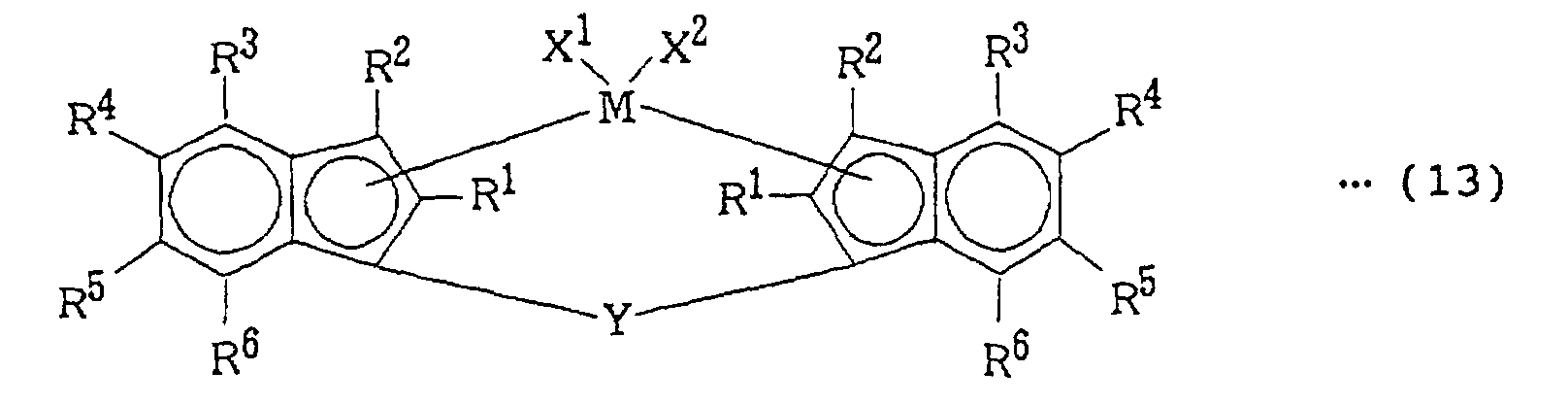
In the above formula (13), M denotes a
transition metal atom of Group 4 of the periodic
table, which may concretely be titanium, zirconium or
hafnium.
In the formula (13), R1 and R2 stand,
independently of each other, for hydrogen atom, a
halogen atom, a hydrocarbon group having 1 - 20 carbon
atoms, a halogenated hydrocarbon group having 1 - 20
carbon atoms, a silicium-containing group, a oxygen-containing
group, a sulfur-containing group, a
nitrogen-containing group or a phosphorus-containing
group. Concrete examples of the groups for R1 and R2
include:
- a halogen atom, such as, fluorine, chlorine, bromine or iodine;
- a hydrocarbon group having 1 - 20 carbon atoms, for example, an alkyl group, such as, methyl, ethyl, propyl, butyl, hexyl, cyclohexyl, octyl, nonyl, dodecyl, eicosyl, norbornyl or adamantyl, an alkenyl group, such as, vinyl, propenyl or cyclohexenyl, an aralkyl group, such as, benzyl, phenylethyl or phenylpropyl, or an aryl group, such as, phenyl, tolyl, dimethylphenyl, trimethylphenyl, ethylphenyl, propylphenyl, biphenyl, naphthyl, methylnaphthyl, anthracenyl or phenanthryl;
- a halogenated hydrocarbon group having 1 - 20 carbon atoms of those in which the above-recited hydrocarbon groups are halogen-substituted;
- a silicium-containing group, for example, a mono-hydrocarbon-substituted silyl, such as, methylsilyl or phenylsilyl, di-hydrocarbon-substituted silyl, such as dimethylsilyl or diphenylsilyl, tri-hydrocarbon-substituted silyl, such as, trimethylsilyl, triethylsilyl, tripropylsilyl, tricyclohexylsilyl, triphenylsilyl, dimethylphenylsilyl, methyldiphenylsilyl, tritolylsilyl or trinaphthylsilyl, a silyl ether group of a hydrocarbon-substituted silyl, such as trimethyl silyl ether, a silicium-substituted alkyl, such as, trimethylsilylmethyl, or a silicium-substituted aryl, such as, trimethylsilylphenyl;
- an oxygen-containing group, for example, hydroxy, an alkoxy group, such as, methoxy, ethoxy, propoxy or butoxy, an aryloxy group, such as, phenoxy, methylphenoxy, dimethylphenoxy or naphthoxy, or an aralkoxy group, such as, phenylmethoxy or phenylethoxy;
- a sulfur-containing group, for example, a group of those in which the oxygen atom in the above-recited oxygen-containing groups is replaced by sulfur;
- a nitrogen-containing group, for example, amino group, an alkylamino group, such as, methylamino, dimethylamino, diethylamino, dipropylamino, dibutylamino or dicyclohexylamino, an arylamino or alkylarylamino group, such as, phenylamino, diphenylamino, ditolylamino, dinaphthylamino or methylphenylamino; and
- a phosphorus-containing group, for example, a phosphino group, such as dimethylphosphino or diphenylphosphino.
Among the above-recited groups for R1,
hydrocarbon groups are preferred, with particular
preference being given to an alkyl group having 1 -
3 carbon atoms, such as, methyl, ethyl or propyl. R2
may preferably stand for hydrogen atom or a hydrocarbon
group, wherein a particular preference is given to
hydrogen atom or an alkyl group having 1 - 3 carbon
atoms, such as, methyl, ethyl and propyl.
In the formula (13), R3, R4, R5 and R6 denote,
independently of each other, hydrogen atom, a halogen
atom, a hydrocarbon group having 1 - 20 carbon atoms or
a halogenated hydrocarbon group having 1 - 20 carbon
atoms. Among them, hydrogen atom, hydrocarbon groups
and halogenated hydrocarbon groups are preferred. Among
the pairs R3 with R4, R4 with R5 and R5 with R6, at
least one pair may form a monocyclic aromatic ring
together with the carbon atoms bound thereto. If two
or more hydrocarbon groups or halogenated hydrocarbon
groups are present in the other pairs than that forming
the aromatic ring, they may form a ring by combining
together. It is preferable that R6 is hydrogen atom,
so long as it is not an aromatic substituent group.
For R3, R4, R5 and R6 in the formula (13), as
the halogen atom, hydrocarbon group having 1 - 20
carbon atoms and halogenated hydrocarbon group having 1
- 20 carbon atoms, the same as those recited for R1 and
R2 may be exemplified.
In the formula (13), X1 and X2 denote each,
independently of each other, hydrogen atom, a halogen
atom, a hydrocarbon group having 1 - 20 carbon atoms or
a halogenated hydrocarbon group having 1 - 20 carbon
atoms, oxygen-containing group or sulfur-containing
group.
For the concrete examples of the halogen atom,
for the hydrocarbon groups having 1 - 20 carbon atoms,
for the halogenated hydrocarbon groups having 1 - 20
carbon atoms and for the oxygen-containing groups,
those which are exemplified for R' and R2 may be
enumerated.
As the sulfur-containing groups, there may be
exemplified those which are exemplified above for the
groups R1 and R2; as well as sulfonates; such as methylsulfonate,
trifluoromethanesufonate, phenylsulfonate,
benzylsulfonate, p-toluenesulfonate, trimethylbenzenesulfonate,
triisobutylbenzenesulfonate, p-chlorobenzenesulfonate
and pentafluorobenzenesulfonate; and
sulfinates, such as methylsulfinate, phenylsulfinate,
benzenesulfinate, p-toluenesulfinate, trimethylbenzenesulfinate
and pentafluorobenzenesulfinate.
In the formula (13), Y denotes a divalent
hydrocarbon group having 1 - 20 carbon atoms, a divalent
halogenated hydrocarbon group having 1 - 20 carbon
atoms, a silicium-containing divalent group, a
germanium-containing divalent group, a tin-containing
divalent group, the group -O-, -CO-, -S-, -SO-, -SO2-,
-NR7-, -P(R7)-, -P(O)(R7)-, -BR7- or -AlR7-, with R7
being hydrogen atom, a halogen atom, a hydrocarbyl
having 1 - 20 carbon atoms or a halogenated hydrocarbyl
having 1 - 20 carbon atoms.
Concrete examples of Y in the formula (13)
include
- divalent hydrocarbon groups having 1 - 20 carbon atoms, for example, alkylenes, such as methylene, dimethylmethylene, 1,2-ethylene, dimethyl-1,2-ethylene, 1,3-trimethylene, 1,4-tetramethylene, 1,2-cyclohexylene and 1,4-cyclohexylene; and aralkylenes, such as diphenylmethylene and diphenyl-1,2-ethylene;
- halogenated hydrocarbon groups derived from the above divalent hydrocarbyls having 1 - 20 carbon atoms which are halogenated, such as chloromethylene and the like;
- silicium-containing divalent groups, for example, alkylsilylenes, alkarylsilylenes and arylsilylenes, such as methylsilylene, dimethylsilylene, diethylsilylene, di(n-propyl)silylene, di(i-propyl)silylene, di(cyclohexyl)silylene, methylphenylsilylene, diphenylsilylene, di(p-tolyl)silylene and di(p-chlorophenyl)silylene; alkyldisilylenes, alkaryldisilylenes, and aryldisilylenes, such as tetramethyl-1,2-disilylene, tetraphenyl-1,2-disilylene and so on;
- germanium-containing divalent groups, in which the silicium in the above silicium-containing divalent groups is replaced by germanium; and
- tin-containing divalent groups, in which the silicium in the above silicium-containing divalent groups is replaced by tin, wherein R7 stands for a halogen atom, a hydrocarbyl having 1 - 20 carbon atoms and a halogenated hydrocarbyl having 1 - 20 carbon atoms as in the above R1 and R2.
Among the above-exemplified groups for Y, the
silicium-containing divalent groups, the germanium-containing
divalent groups and tin-containing divalent
groups are preferred, wherein particular preference is
given to the silicium-containing divalent groups, with
special preference being given to alkylsilylenes,
alkarylsilylenes and arylsilylenes.
In the formula (13), as the ligands
coordinating to the metal M, which contain the
monocyclic aromatic ring formed by coupling at least
one pair among the pairs of R3 with R4, R4 with R6 and
R5 with R6 with each other, those which are represented
by the following formulae (14) to (16) may be
exemplified:
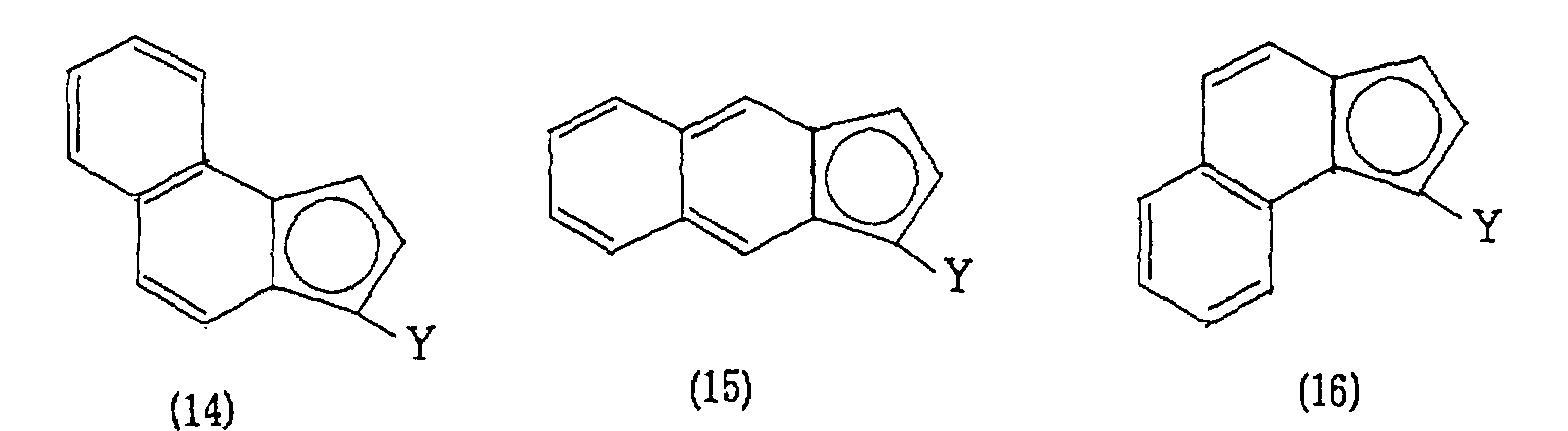 in which Y has the same meaning as that in the formula
(13).
in which Y has the same meaning as that in the formula
(13).
Transition metal compounds represented by the
following formula (17) may also be used as the
metallocene (e-3),
 in which M, R1, R2, R3 , R4 , R5 and R6 are the same as
those in the formula (13).
in which M, R1, R2, R3 , R4 , R5 and R6 are the same as
those in the formula (13).
In the formula (17), it is preferable that,
among the groups R3 , R4, R5 and R6, two groups including
R3 are each an alkyl group, wherein preference is given
to that R3 and R5 or R3 and R6 stand each for an alkyl
group. These alkyl groups may preferably be secondary
or tertiary alkyl groups. Further, these alkyl groups
may be substituted by halogen atom(s) or silicium-containing
group(s), wherein, as the halogen atom and
as the silicium-containing group, those which are
exemplified previously for R' and R2 may be enumerated.
It is preferable, that the groups for R3, R4,
R5 and R6 in the formula (17) other than the alkyl
groups as mentioned above are hydrogen atom. As the
hydrocarbon group having 1 - 20 carbon atoms, there may
be recited chain-formed and cyclic alkyl groups, such
as methyl, ethyl, n-propyl, i-propyl, n-butyl, i-butyl,
sec-butyl, tert-butyl, pentyl, hexyl, cyclohexyl,
heptyl, octyl, nonyl, dodecyl, eicosyl, norbornyl and
adamantyl; and aralkyl groups, such as, benzyl,
phenylethyl, phenylpropyl and tolylmethyl, wherein they
may include double bond(s) and/or triple bond(s).
It is permissible that two groups selected among
R3, R4. R5 and R6 in the formula (17) may form a
monocyclic or polycyclic ring other than aromatic ring,
by combining together.
As the halogen atom, those given for R1 and R2
may be recited.
As the groups for X1, X2 and Y, those which are
given for the formula (13) may be recited.
Concrete examples of the metallocenes (e-3)
represented by the formula (17) are given below.
- rac-dimethylsilylene-bis(4,7-dimethyl-1-indenyl)-zirconium dichloride
- rac-dimethylsilylene-bis(2,4,7-trimethyl-1-indenyl)-zirconium dichloride
- rac-dimethylsilylene-bis(2,4,6-trimethyl-1-indenyl)-zirconium dichloride
Also, transition metal compounds in which the
zirconium in the compounds given above is replaced by
titanium or hafnium may be used.
The transition metal compounds as given above
may usually be employed as a racemate, while it is
possible to use R- or S-compound.
For the metallocenes (e-3) represented by the
formula (17), such compounds as given below may also
be used.
R' may preferably be a hydrocarbon group,
wherein a particular preferance is given to an alkyl
group having 1 - 4 carbon atoms, such as, methyl, ethyl,
propyl or butyl.
X1 and X2 may each preferably be a halogen
atom or a hydrocarbon group having 1 - 20 carbon atoms.
R3 denotes an aryl group having 6 - 16 carbon
atoms, wherein concrete examples therefor include
phenyl, α -naphthyl, β -naphthyl, anthracenyl,
phenanthryl, pyrenyl, acenaphthyl, phenalenyl
(perinaphthenyl) and aceanthrylenyl. Among them,
phenyl and naphthyl are preferred. These aryl groups
may be substituted by halogen atom(s), hydrocarbon
group(s) having 1 - 20 carbon atoms or halogenated
hydrocarbon group(s) having 1 - 20 carbon atoms, as
those defined for R1.
Concrete examples of such transition metal
compounds (metallocenes) are given below:
- rac-dimethylsilylene-bis(4-phenyl-1-indenyl)-zirconium dichloride
- rac-dimethylsilylene-bis(2-methyl-4-phenyl-1-indenyl)-zirconium dichloride
- rac-dimethylsilylene-bis{2-methyl-4- (α-naphthyl)-1-indenyl}zirconium dichloride
- rac-dimethylsilylene-bis{2-methyl-4- (β-naphthyl)-1-indenyl}zirconium dichloride
- rac-dimethylsilylene-bis{2-methyl-4-(1-anthracenyl)-1-indenyl}zirconium dichloride
It is also possible to use transition metal
compounds in which the zirconium in the compounds given
above is replaced by titanium or hafnium.
The compounds represented by the following
formula (18) may also be used as the metallocene (e-3):
La MX2
wherein M is a metal of Group 4 or of the Lantanide
series in the periodic table, La denotes a derivative
from a non-localized π -bound group, which imparts a
restrictive geometrical configuration to the active
sites of the metal M, and X denotes, independently of
one another, hydrogen atom, a halogen atom, a
hydrocarbon group having 20 or less carbon atoms, a
silyl group having 20 or less silicium atoms or a
germyl group having 20 or less germanium atoms.
Among the compounds represented by the formula
(18), those which are represented by the following
formula (19) are preferred:
 in which M denotes titanium, zirconium or hafnium, X
has the same meaning as that defined for the formula
(18), Cp represents a substituted cyclopentadienyl
group bound to the metal M by π -bond and having a
substituent group Z, Z stands for oxygen, sulfur, boron
or an element in Group 14 of the periodic table (for
example, silicium, germanium or tin), Y denotes a
ligand containing nitrogen, phosphorus, oxygen or
sulfur, wherein Z and Y together may form a condensed
ring.
in which M denotes titanium, zirconium or hafnium, X
has the same meaning as that defined for the formula
(18), Cp represents a substituted cyclopentadienyl
group bound to the metal M by π -bond and having a
substituent group Z, Z stands for oxygen, sulfur, boron
or an element in Group 14 of the periodic table (for
example, silicium, germanium or tin), Y denotes a
ligand containing nitrogen, phosphorus, oxygen or
sulfur, wherein Z and Y together may form a condensed
ring.
For the compounds represented by the formula
(19), there may be exemplified {dimethyl(t-butylamido)(
tetramethyl-η 5-cyclopentadienyl)silane}titanium
dichloride and {(t-butylamido)(tetramethyl-η5-cyclopentadienyl)-1,2-ethanediyl}titanium
dichloride.
Those compounds in which the titanium in the
metallocenes given above is replaced by zirconium or
hafnium may also be employed.
As the metallocenes (e-3) represented by the
formula (18) or (19), zirconocenes in which the central
metal atom is zirconium and at least two ligands having
cyclopentadienyl skeleton are included may preferably
be employed.
As the metallocene (e-3), a compound of a
transition metal of Group 4 of the periodic table
represented by the following formula (20) may also be
employed:
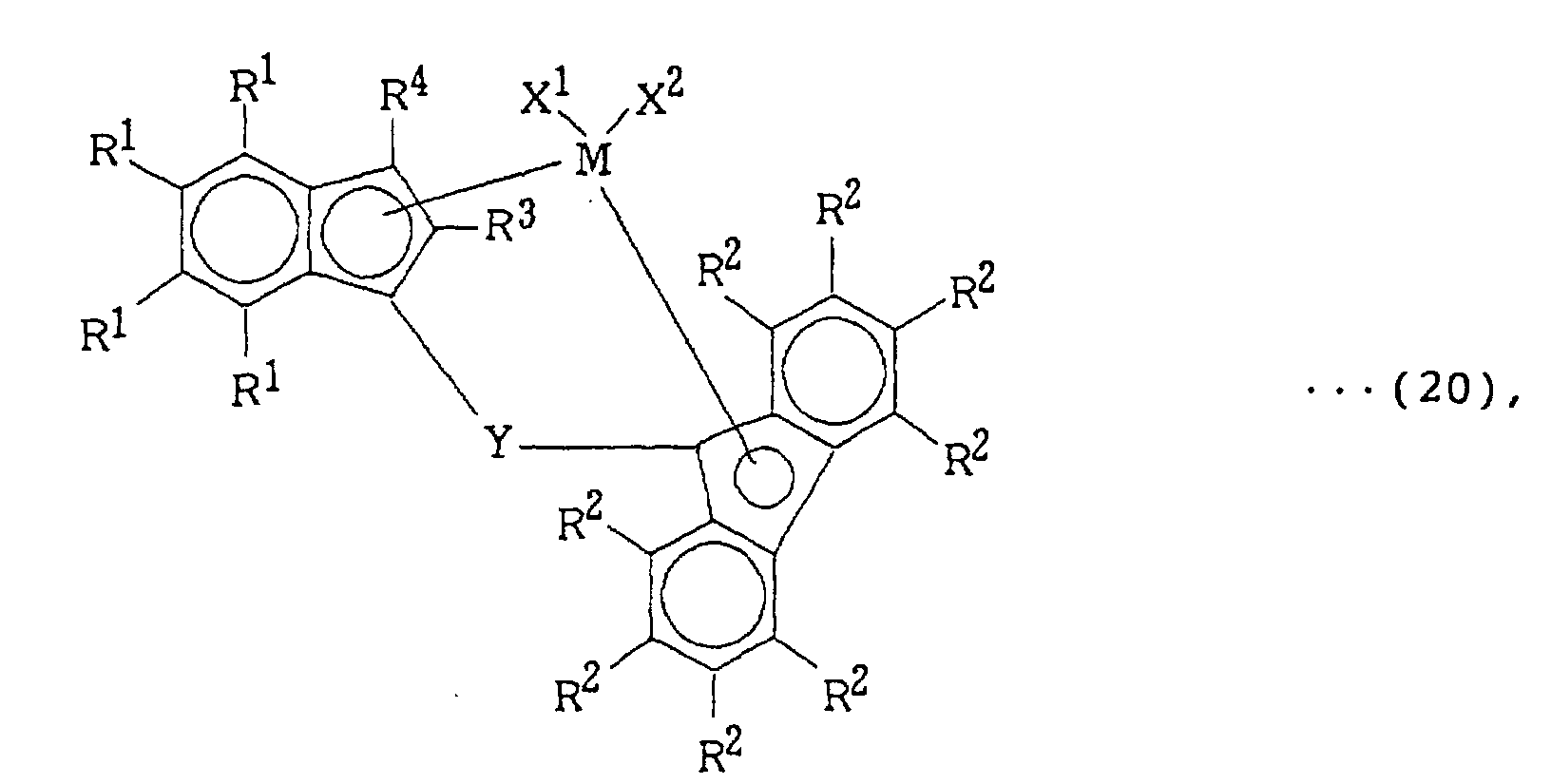 in which M is an atom of transition metal of Group 4 of
the periodic table and may concretely be titanium,
zirconium or hafnium, with preference to zirconium.
in which M is an atom of transition metal of Group 4 of
the periodic table and may concretely be titanium,
zirconium or hafnium, with preference to zirconium.
R1 s in the formula (20) may be or may not be
identical with each other, wherein at least one of them
may be an aryl group having 11 - 20 carbon atoms, an
aralkyl group having 12 - 40 carbon atoms, an aralkenyl
group having 13 - 40 carbon atoms, an alkaryl group
having 12 - 40 carbon atoms or a silicium-containing
group or at least two neighboring R's among these R1s
may form one or more monocyclic or polycyclic aromatic
or aliphatic rings together with the carbon atoms to
which they are bound. Here, the total number of carbon
atoms of the ring formed by R1, inclusive of the carbon
atoms to which R1s are bound, are 4 - 20.
Examples in which at least two neigboring R1s
in the formula (20) build up, together with the carbon
atoms to which such R1s are bound, one or more aromatic
or aliphatic rings include condensed phenyl group,
condensed cyclohexyl group, condensed cyclopentadienyl
group, condensed dihydrocyclopentadienyl group,
condensed indenyl group, condensed tetrahydroindenyl
group, condensed fluorenyl group, condensed tetrahydrofluorenyl
group and condensed octahydrofluorenyl group.
These groups may be substituted by linear alkyl,
cycloalkyl, halogen, halogen-substituted alkyl, aryl,
silicium-containing group, oxygen-containing group,
nitrogen-containing group or phosphorus-containing
group.
The R1s other than those which form aryl,
aralkyl, aralkenyl, alkaryl or aromatic or aliphatic
ring stand each for hydrogen atom, a halogen atom, an
alkyl having 1 - 10 carbon atoms or a silicium-containing
group.
As the aryl group having 11 - 20 carbon atoms,
there may be exemplified biphenylyl, anthryl and
phenanthryl. As the aralkyl group having 12 - 40
carbon atoms, there may be exemplified phenanthrylmethyl,
phenanthrylethyl and phenanthrylpropyl. As the
aralkenyl group having 13 - 40 carbon atoms, there may
be exemplified vinylphenanthryl and so on. As the
alkaryl group having 12 - 40 carbon atoms, there may be
exemplified methylphenanthryl, ethylphenanthryl and
propylphenanthryl. As the halogen atom, fluorine,
chlorine, bromine and iodine are exemplified. As the
alkyl group having 1 - 10 carbon atoms, there may be
exemplified methyl, ethyl, propyl, butyl, hexyl,
cyclohexyl, octyl and nonyl.
As the silicium-containing group, there may be
exemplified methylsilyl, phenylsilyl, dimethylsilyl,
diethylsilyl, diphenylsilyl, trimethylsilyl, triethylsilyl,
tripropylsilyl, tricyclohexylsilyl, triphenylsilyl,
dimethylphenylsilyl, methyldiphenylsilyl, tritolylsilyl
and trinaphthylsilyl.
These alkyl, aryl, aralkyl, aralkenyl and
alkaryl may be halogen-substituted .
In the formula (20), R2s may or may not be
identical with each other and stand each for hydrogen
atom, a halogen atom, an alkyl group having 1 - 10
carbon atoms, an aryl group having 6 - 20 carbon atoms,
an alkenyl group having 2 - 10 carbon atoms, an aralkyl
group having 7 - 40 carbon atoms, an aralkenyl group
having 8 - 40 carbon atoms, an alkaryl group having 7 -
40 carbon atoms, a silicium-containing group, an
oxygen-containing group, a sulfur-containing group, a
nitrogen-containing group or a phosphorus-containing
group.
At least two adjacent groups among the groups
represented by R2 in the formula (20) may form,
together with the carbon atoms to which these two R2 s
are bound, one or more aromatic or aliphatic rings.
Here, the total number of carbon atoms of the ring(s)
formed by R2, inclusive of the carbon atoms to which
these R2s are bound, may be 4 - 20 and the R2 s other
than those which form the aromatic or aliphatic ring
may each stand for hydrogen atom, a halogen atom, an
alkyl group having 1 - 10 carbon atoms or a silicium-containing
group.
To the group which is constituted from two
groups represented by R2 in the formula (20) by being
formed into one or more aromatic or aliphatic rings,
such a group formed from fluorenyl as represented by
the following formula (21) may also belong.

As the alkyl group having 1 - 10 carbon atoms
and as the halogen atom, the same ones as given above
may be exemplified.
As the aryl group having 6 - 20 carbon atoms,
there may be exemplified phenyl, biphenyl, α - and β-naphthyls,
anthryl and phenanthryl. As the aralkyl
group having 7 - 40 carbon atoms, there may be
exemplified benzyl, phenylethyl, phenylpropyl, phenanthrylmethyl,
phenanthrylethyl and phenanthrylpropyl.
As the aralkenyl group having 8 - 40 carbon atoms,
there may be exemplified styryl and vinylphenanthryl.
As the alkaryl group having 7 - 40 carbon
atoms, there may be exemplified tolyl, dimethylphenyl,
trimethylphenyl, ethylphenyl, propylphenyl, methylnaphthyl,
methylphenanthryl, ethylphenanthryl and
propylphenanthryl. As the alkenyl group having 2 - 10
carbon atoms, there may be exemplified vinyl, propenyl
and cyclohexenyl. As the silicium-containing group,
there may be exemplified the same ones as given
previously. As the oxygen-containing group, there may
be exemplified hydroxyl group; alkoxy groups, such as
methoxy, ethoxy, propoxy and butoxy; aryloxy groups,
such as phenoxy, methylphenoxy, dimethylphenoxy and
naphthoxy; and aralkoxy groups, such as phenylmethoxy
and phenylethoxy.
As the sulfur-containing group, there may be
exemplified those in which the oxygen atom in the
above-mentioned oxygen-containing group is replaced by
sulfur atom as well as sulfonates, such as methylsulfonate,
trifluoromethanesulfonate, phenylsulfonate,
benzylsulfonate, p-toluenesulfonate, trimethylbenzenesulfonate,
triisobutylbenzenesulfonate, p-chlorobenzenesulfonate
and pentafluorobenzenesulfonate; and
sulfinates, such as methylsulfinate, phenylsulfinate,
benzenesulfinate, p-toluenesulfinate, trimethylbenzenesulfinate
and pentafluorobenzenesulfinate.
As the nitrogen-containing group, there may be
exemplified, amino group; alkylamino groups, such as
methylamino, dimethylamino, diethylamino, dipropylamino,
dibutylamino and dicyclohexylamino; arylamino groups,
such as phenylamino, diphenylamino, ditolylamino,
dinaphthylamino and methylphenylamino; and alkarylamino
groups.
As the phosphorus-containing group, there may
be exemplified dimethylphosphino and diphenylphosphino.
The groups R2 may preferably be hydrogen atom
or an alkyl group, wherein special preferance is given
to hydrogen atom or a hydrocarbyl having 1 to 3 carbon
atoms, such as methyl, ethyl or propyl.
As the fluorenyl group having such substituent
groups R2, there may be enumerated, as a favorable
example, 2,7-dialkylfluorenyl with preferable alkyl
groups being those having 1 - 5 carbon atoms.
The above-mentioned R1 and R2 may or may not
be identical with each other.
R3 and R4 in the formula (20) may be identical
with or different from each other, wherein they stand
each, similarly as above, for hydrogen atom, a halogen
atom, an alkyl group having 1 - 10 carbon atoms,an aryl
group having 6 - 20 carbon atoms, an alkenyl group
having 2 - 10 carbon atoms, an aralkyl group having 7 -
40 carbon atoms, an aralkenyl group having 8 - 40
carbon atoms, an alkaryl group having 7 - 40 carbon
atoms, a silicium-containing group, an oxygen-containing
group, a sulfur-containing group, a nitrogen-containing
group or a phosphorus-containing group.
Among them, R3 and R4 may favorably be such
that at least one of them is an alkyl group having 1 -
3 carbon atoms.
X1 and X2 in the formula (20) may be identical
with or different from each other and stand each for
hydrogen atom, a halogen atom, a hydrocarbyl having 1 -
20 carbon atoms, a halogenated hydrocarbyl having 1 -
20 carbon atoms, an oxygen-containing group, a sulfur-containing
group or a nitrogen-containing group, or
they may form together a conjugate diene radical,
wherein concrete examples of halogen atom, oxygen-containing
group, sulfur-containing group and
nitrogen-containing group include those which are
exemplified as above.
As the hydrocarbyl having 1 - 20 carbon atoms,
there may be exemplified an alkyl group, such as methyl,
ethyl, propyl, butyl, hexyl, cyclohexyl, octyl, nonyl,
dodecyl, eicosyl, norbornyl or adamantyl; an alkenyl
group, such as, vinyl, propenyl or cyclohexenyl; an
aralkyl group, such as, benzyl, phenylethyl or phenylpropyl;
or an aryl group, such as phenyl, tolyl, dimethylphenyl,
trimethylphenyl, ethylphenyl, propylphenyl,
α - or β -naphthyl, methylnaphthyl, anthryl, phenanthryl,
benzylphenyl, pyrenyl, acenaphthyl, phenalenyl,
aceanthrylenyl, tetrahydronaphthyl, indanyl and
biphenylyl. As the halogenated hydrocarbyl having 1 -
20 carbon atoms, there may be exemplified those in
which the above-mentioned hydrocarbyls having 1 - 20
carbon atoms have halogen substituent(s).
As the conjugated diene radial formed from X1
and X2, there may be exemplified η 4-1,4-diphenyl-1,3-butadiene,
η 4-1,3-butadiene, η 4-1,4-dibenzyl-1,3-butadiene,
η 4-1-phenyl-1,3-pentadiene, η 4-3-methyl-1,3-pentadiene,
η 4-1,4-bis(trimethylsilyl)-1,3-butadiene
2,3-dimethylbutadiene, η 4-2,4-hexadiene and isoprene.
As the conjugated diene radical formed from X1 and X2,
preference is given to those of 1,3-butadiene, 2,4-hexadiene,
1-phenyl-1,3-pentadiene and 1,4-diphenylbutadiene,
wherein these radicals may further be
substituted by a hydrocarbyl having 1 - 10 carbon atoms.
Among them, preference is given to those which
are each a halogen atom, a hydrocarbyl having 1 - 20
carbon atoms or a sulfur-containing group.
In the formula (20), Y denotes a divalent
hydrocarbon group having 1 - 20 carbon atoms, a divalent
halogenated hydrocarbon group having 1 - 20 carbon
atoms, a divalent silicium-containing group, a divalent
germanium-containing group, a divalent tin-containing
group, the group -O-, -CO-, -S-, -SO-, -SO2-, -NR5-,
-P(R5)-, -P(O)(R5)-, -BR5- or -AlR5-, with R5 being
hydrogen atom, a halogen atom, a hydrocarbyl having 1 -
20 carbon atoms, a halogenated hydrocarbyl having 1 -
20 carbon atoms, concrete examples of which include
- divalent hydrocarbon groups having 1 - 20 carbon atoms, for example, alkylenes, such as methylene, dimethylmethylene, 1,2-ethylene, dimethyl-1,2-ethylene, 1,3-trimethylene, 1,4-tetramethylene, 1,2-cyclohexylene and 1,4-cyclohexylene; and aralkylenes, such as diphenylmethylene and diphenyl-1,2-ethylene;
- halogenated hydrocarbon groups in which the above divalent hydrocarbon groups having 1 - 20 carbon atoms are halogenated, such as chloromethylene;
- silicium-containing divalent groups, for example, alkylsilylenes, alkarylsilylenes and arylsilylenes, such as methylsilylene, dimethylsilylene, diethylsilylene, di(n-propyl)silylene, di(i-propyl)silylene, di(cyclohexyl)silylene, methylphenylsilylene, diphenylsilylene, di(p-tolyl)silylene and di(p-chlorophenyl)silylene; alkyldisilylenes, alkaryldisilylenes and aryldisilylenes, such as tetrametyl-1,2-disilylene, tetraphenyl-1,2-disilylene and so on;
- germanium-containing divalent groups, in which the silicium in the above silicium-containing divalent groups is replaced by germanium; and
- tin-containing divalent groups, in which the silicium in the above silicium-containing divalent groups is replaced by tin.
Among these divalent groups, those in which the
shortest bond of -Y- bridge as shown by the formula
(20) is constituted of one or two atoms are preferred.
The group R5 stands, the same as the above, for
a halogen atom, a hydrocarbyl having 1 - 20 carbon
atoms and a halogenated hydrocarbyl having 1 - 20
carbon atoms.
Among them, the group Y may favorably be
divalent hydrocarbyl groups each having 1 - 5 carbon
atoms, silicium-containing divalent groups and
germanium-containing divalent groups, wherein
preference is given to the silicium-containing divalent
groups, with special preference to alkylsilylenes,
alkarylsilylenes and arylsilylenes.
As the metallocene (e-3), a transition metal
compound represented by the following formula (22) may
also be used.
 in which M denotes a transition metal element of Group
4 of the periodic table and may concretely stand for
titanium, zirconium or hafnium, preferably zirconium.
in which M denotes a transition metal element of Group
4 of the periodic table and may concretely stand for
titanium, zirconium or hafnium, preferably zirconium.
R6 s in the formula (22) may be identical with
or different from each other and stand each for hydrogen
atom, a halogen atom, an alkyl having 1 - 10 carbon
atoms, an aryl having 6 - 10 carbon atoms, an alkenyl
having 2 - 10 carbon atoms, a silicium-containing group,
an oxygen-containing group, a sulfur-containing group,
a nitrogen-containing group or a phosphorus-containing
group, wherein, as the halogen or the alkyl having 1 -
10 carbon atoms, there may be exemplified concretely
the same ones as those given for R1 of the formula (20)
and, as the silicium-containing group, oxygen-containing
group, sulfur-containing group, nitrogen-containing
group and phosphorus-containing group, there may be
exemplified the same ones as those given for R2 of the
formula (20).
As the aryl having 6 - 10 carbon atoms, there
may be exemplified phenyl and α - and β -naphthyl. As
the alkenyl having 2 - 10 carbon atoms, there may be
exemplified vinyl, propenyl and cyclohexenyl.
These alkyls and alkenyls may be substituted by
halogen.
Among them, R6 may preferably be an alkyl, aryl
or hydrogen atom, wherein particular preference is
given to hydrocarbon groups having 1 - 3 carbon atoms,
such as methyl, ethyl, n-propyl and i-propyl, and such
aryl groups as phenyl, α-naphthyl and β-naphthyl, as
well as hydrogen atom.
R7s in the formula (22) may be identical with
or different from each other and stand each for hydrogen
atom, a halogen atom, an alkyl having 1 - 10 carbon
atoms, an aryl having 6 - 20 carbon atoms, an alkenyl
having 2 - 10 carbon atoms, an aralkyl having 7 - 40
carbon atoms, an aralkenyl having 8 - 40 carbon atoms,
an alkaryl having 7 - 40 carbon atoms, a silicium-containing
group, an oxygen-containing group, a sulfur-containing
group, a nitrogen-containing group or a
phosphorus-containing group. Concretely, they may be
those which are given for R2 in the formula (20).
These alkyls, aryls, alkenyls, aralkyls,
aralkenyls and alkaryls may be substituted by halogen.
Among them, R7s may each preferably be hydrogen
atom or an alkyl, wherein special preference is given
to hydrogen atom and hydrocarbyls having 1 - 4 carbon
atoms, such as methyl, ethyl, n-propyl, i-propyl,
n-butyl and tert-butyl.
R6 and R7 may be identical with or different
from each other.
Either one of R8 and R9 in the formula (22) is
an alkyl having 1 - 5 carbon atoms and the other is the
same as those given for R2 in the formula (20) and is,
thus, hydrogen atom, a halogen atom, an alkyl having 1
- 10 carbon atoms, an alkenyl having 2 - 10 carbon
atoms, a silicium-containing group, an oxygen-containing
group, a sulfur-containing group a nitrogen-containing
group or a phosphorus-containing group.
As the alkyl having 1 - 5 carbon atoms, there
may be exemplified methyl, ethyl, propyl, butyl and
pentyl.
Among them, it is favorable that either one of
R8 and R9 is an alkyl having 1 - 3 carbon atoms, such
as methyl, ethyl or propyl, and the other one is
hydrogen atom.
X1 and X2 in the formula (22) may be identical
with or different from each other and stand each for
hydrogen atom, a halogen atom, a hydrocarbyl having 1 -
20 carbon atoms, a halogenated hydrocarbyl having 1 -
20 carbon atoms, an oxygen-containing group, a sulfur-containing
group or a nitrogen-containing group, as in
those X1 and X2 in the formula (20), or, further, a
conjugated diene radical formed from X1 and X2.
Among them, halogen atoms and hydrocarbyls
having 1 - 20 carbon atoms are preferred.
In the formula (22), Y denotes, as in the
formula (20), a divalent hydrocarbon group having 1 -
20 carbon atoms, a divalent halogenated hydrocarbon
group having 1 - 20 carbon atoms, a divalent silicium-containing
group, a divalent germanium-containing group,
a divalent tin-containing group, the group -O-, -CO-,
-S-, -SO-, -SO2-, -NR5-, -P(R5)-, -P(O)(R5)-, -BR5- or
-AlR5-, with R5 being hydrogen atom, a halogen atom, a
hydrocarbyl having 1- 20 carbon atoms or a halogenated
hydrocarbyl having 1 -20 carbon atoms.
Among them, Y may preferably be a divalent
hydrocarbyl having 1 - 5 carbon atoms, a silicium-containing
divalent group or a germanium-containing
divalent group, more preferably a silicium-containing
divalent group, especially preferably an alkylsilylene,
an alkylarylsilylene or an arylsilylene.
The metallocenes (e-3) may be employed alone
or in a combination of two or more of them. It is
possible to use the metallocenes (e-3) under dilution
in a solvent such as a hydrocarbon or a halogenated
hydrocarbon. It is also possible to use the
metallocene (e-3) in a state held in contact with a
granular carrier compound.
For the carrier compound supporting the
metallocene (e-3), inorganic carrier compounds, such as,
SiO2, Al2O3, B2O3, MgO, ZrO2, CaO, TiO2, ZnO, SnO2, BaO
and ThO, and resins of, for example, polyethylene,
polypropylene, poly-1-butene, poly-4-methyl-1-pentene
and styrene/divinylbenzene copolymer, may be employed.
These carrier compounds may be used alone or in a
combination of two or more of them.
Now, the description is directed to the organoaluminum-oxy
compound (f-2) and the ionizing ionic
compound (g-1) to be used for preparing the metallocene
catalyst.
The organoaluminum-oxy compound (f-2) may be
aluminoxanes known per se or may be such organoaluminum-oxy
compounds (f-2) which are insoluble in benzene.
Such known aluminoxanes may concretely be
represented by the following formula (23) or (24):

 in which R represents a hydrocarbon group, such as,
methyl, ethyl, propyl or butyl, preferably methyl or
ethyl, with particular preference to methyl, m is an
integer of 2 or higher, preferably 5 - 40.
in which R represents a hydrocarbon group, such as,
methyl, ethyl, propyl or butyl, preferably methyl or
ethyl, with particular preference to methyl, m is an
integer of 2 or higher, preferably 5 - 40.
In the formula (23) or (24), the aluminoxane
may be composed of mixed alkyloxyaluminum units
constituted of an alkyloxyaluminum unit represented by
the formula {OAl(R1)} and an alkyloxyaluminum unit
represented by the formula {OAl(R2)}, wherein R1 and R2
may each be exemplified by those hydrocarbyls which are
defined for R and wherein R1 is different from R2.
The organoaluminum-oxy compound (f-2) may
contain a small amount of organometallic component(s)
of metal(s) other than aluminum.
As the ionizing ionic compound (g-1), which may
sometimes be called "ionic ionizing compound" or "ionic
compound", there may be exemplified Lewis acids, ionic
compounds, boranes and carboranes.
As the Lewis acids, those which are represented
by BR3, wherein R stands for fluorine or a phenyl group
which may have substituent group(s), such as, fluorine,
methyl or trifluoromethyl, may be employed. Concrete
examples of such a Lewis acid include trifluoroboron,
triphenylboron, tris(4-fluorophenyl)boron, tris(3,5-difluorophenyl)boron,
tris(4-fluoromethylphenyl)boron,
tris(pentafluorophenyl)boron, tris(p-tolyl)boron, tris-(o-tolyl)boron
and tris(3,5-dimethylphenyl)boron.
As the ionic compounds mentioned above, there
may be enumerated, for example, trialkyl-substituted
ammonium salts, N,N-dialkylanilinium salts, dialkylammonium
salts and triarylphosphonium salts. As the
trialkyl-substituted ammonium salt for the ionic
compound, there may be exemplified triethylammonium
tetra(phenyl)boron, tripropylammonium tetra(phenyl)-boron
and tri(n-butyl)ammonium tetra(phenyl)boron. As
the dialkylammonium salt for the ionic compound, there
may be exemplified di(1-propyl)ammonium tetra(pentafluorophenyl)boron
and dicyclohexylammonium tetra-(phenyl)boron.
As the ionic compounds mentioned above, there
may be exemplified triphenylcarbenium tetrakis(pentafluorophenyl)
borate, N,N-dimethylanilinium tetrakis-(pentafluorophenyl)
borate and ferrocenium tetra(pentafluorophenyl)
borate.
As the boranes mentioned above, there may be
exemplified salts of metal borane anions, such as,
decaborane(9); bis[tri(n-butyl)ammonium] nonaborate,
bis[tri(n-butyl)ammonium] decaborate and bis[tri-(n-butyl)ammonium]
bis(dodecahydride dodecaborate)
nickelate(III).
As the carboranes mentioned above, there may be
exemplified salts of metal carborane anions, such as,
4-carbanonaborane(9), 1,3-dicarbanonaborane(8), bis-[tri(n-butyl)ammonium]
bis(undecahydride-7-carbaundecaborate]
nickelate(IV).
The ionizing ionic compound (g-1) may be used
alone or in a combination of two or more of them. The
organoaluminum-oxy compound (f-2) and the ionizing
ionic compound (g-1) may be used in a form held on the
carrier compound mentioned previously.
On preparing the metallocene catalyst, the
organoaluminum compounds (f-1) described above can be
used together with the organoaluminum-oxy compound
(f-2) or the ionizing ionic compound (g-1).
For producing the third ethylenic copolymer
rubber according to the present invention, ethylene
(a), the α -olefin (b), the triene (c) represented by
the formula (1) and the non-conjugated polyene (d) are
co-polymerized, usually in a liquid phase, in the
presence of the catalyst based on titanium or based on
vanadium or the metallocene catalyst as described above.
Here, a hydrocarbon solvent is used usually, while it
is permissible to use the α-olefin (b) as the solvent.
For such a hydrocarbon solvent, there may be
used, for example, an aliphatic hydrocarbon, such as
pentane, hexane, heptane, octane, decane, dodecane or
kerosene, or a halogenated derivative thereof; a cycloaliphatic
hydrocarbon, such as cyclohexane, methylcyclopentane
or methylcyclohexane, or a halogenated
derivative thereof; an aromatic hydrocarbon or a
halogenated derivative thereof, such as benzene,
toluene, xylene or chlorobenzene, wherein the solvent
may be used in a combination.
The copolymerization of ethylene (a), the α-olefin
(b), the triene (c) and the non-conjugated
polyene (d) may be effected either in a batch-wise or
continuous way. On carrying out the copolymerization
in a batch-wise way, the catalyst may be used at a
concentration as given below:
When using the catalyst based on titanium
composed of the solid titaniferous component (e-1) and
the organoaluminum compound (f-1), the solid
titaniferous component (e-1) may be used usually in an
amount of, as calculated based on titanium atom, about
0.001 to about 1.0 mmol, preferably about 0.005 to 0.5
mmol, per one liter of the copolymerization volume. The
organoaluminum compound (f-1) may be used usually in an
amount of, as calculated based on the metal atom in the
organoaluminum compound (f-1), about 10 - 500 moles,
preferably 20 - 200 moles, per one mole of the titanium
in the solid titaniferous component (e-1). In case an
electron donor is used, it may be used usually in an
amount of about 0.001 to 10 moles, preferably 0.01 to 2
moles, especially preferably 0.05 to 1 mole, per one
mole of the metal atom in the organoaluminum compound
(f-1).
In case the catalyst based on vanadium composed
of the soluble vanadium compound (e-2) and the organoaluminum
compound (f-1) is employed, the concentration
of the soluble vanadium compound in the polymerization
system may usually be in the range from 0.01 to 5 mmol,
preferably from 0.05 to 3 mmol, per liter of the
polymerization volume. The soluble vanadium compound
(e-2) may preferably be supplied at a concentration of
10 times or less, preferably 1 - 7 times, more
preferably 1 - 5 times the concentration of the soluble
vanadium compound present in the polymerization system.
The organoaluminum compound (f-1) may be supplied in a
mole ratio of aluminum atom to vanadium atom (Al/V) in
the polymerization system of 2 or higher, preferably
in the range of 2 - 50, more preferably in the range of
3 - 20.
The soluble vanadium compound (e-2) and the
organoaluminum compound (f-1) is supplied usually under
dilution by the hydrocarbon solvent, liquid ethylene,
the triene (c) or so on. Here, it is favorable to
supply the organoaluminum compound (f-1) to the
polymerization system at a concentration adjusted to
any voluntary concentration, for example, below 50
times the existing concentration thereof in the
polymerization system, while the soluble vanadium
compound (e-2) is supplied thereto preferably under
dilution at a concentration as given above.
In the case of using the metallocene catalyst
composed of the metallocene (e-3), the organoaluminum-oxy
compound (f-2) or the ionizing ionic compound
(g-1), the concentration of the metallocene (e-3) is
usually in the range of 0.00005 - 0.1 mmol, preferably
in the range of 0.0001 - 0.05 mmol, per liter of the
polymerization volume. The organoaluminum-oxy compound
(f-2) may be supplied in a mole ratio of aluminum atom
to the transition metal atom in the metallocene
(Al/transition metal) in the polymerization system of 1
- 10,000, preferably 10 - 5,000.
For the ionizing ionic compound (g-1), it is
supplied in a mole ratio of the ionizing ionic compound
(g-1) to the metallocene (e-3) in the copolymerization
system {ionizing ionic compound (g-l)/metallocene (e-3)}
in the range of 0.5 - 20, preferably 1 - 10.
In case of incorporation of the organoaluminum
compound (f-1), it is used usually in such an amount
that its concentration will be at about 0 - 5 mmol per
liter of the polymerization volume, preferably about 0
- 2 mmol per liter of the polymerization volume.
For co-polymerizing the comonomers, i.e.
ethylene (a), the α-olefin (b), the triene (c) and the
non-conjugated polyene (d) etc. in the presence of the
catalyst based on titanium mentioned above, the
copolymerization is realized usually under the condition
of a temperature in the range from -20°C to +150°C ,
preferably from 0 to 120°C , more preferably from 0 to
100 °C , and a pressure in the range over 0 up to 7.8
MPa (80 kgf/cm2 gauge), preferably over 0 up to 4.9 MPa
(50 kgf/cm2 gauge).
For co-polymerizing the comonomers, i.e.
ethylene (a), the α -olefin (b), the triene (c) and the
non-conjugated polyene (d) etc. in the presence of the
catalyst based on vanadium mentioned above, the
copolymerization is effected usually under the condition
of a temperature in the range from -50°C to +100°C ,
preferably from -30 °C to +80 °C , more preferably from
-20 °C to + 60°C , and a pressure in the range over 0 up
to 4.9 MPa (50 kgf/cm2 gauge),preferably over 0 up to
2.0 MPa (20 kgf/cm2 gauge).
For co-polymerizing the comonomers, i.e.
ethylene (a), the α -olefin (b), the triene (c) and the
non-conjugated polyene (d) etc. in the presence of the
metallocene catalyst mentioned above, the
copolymerization is effected usually under the condition
of a temperature in the range from -20°C to +150 °C ,
preferably from 0 to 120°C, more preferably from 0 to
100 °C, and a pressure in the range over 0 up to 7.8
MPa (80 kgf/cm2 guage), preferably in the range over 0
up to 4.9 MPa (50 kgf/cm2 gauge).
On the copolymerization, ethylene (a), the α-olefin
(b), the triene (c) and the non-conjugated
polyene (d) as well as other comonomer(s) to be
incorporated on requirement may be supplied to the
polymerization system each in such an amount that the
third ethylenic copolymer rubber having the above-mentioned
definite compostion will be obtained. On the
copolymerization, a molecular weight regulator, such as
hydrogen, can be employed.
By copolymerizing ethylene (a), the α -olefin
(b), the triene (c) and the non-conjugated polyene (d)
in this manner, the third ethylenic copolymer rubber is
obtained usually as a liquid polymerization mixture
containing the copolymer. This liquid copolymerization
mixture is treated by the ordinary technique, whereby
the third ethylenic copolymer rubber is obtained.
The third ethylenic copolymer rubber according
to the present invention may also be a modified product
in which one or more polar monomers are grafted on the
copolymer.
The graft-modified third ethylenic copolymer
rubber according to the present invention, which may be
called also a graft modified ethylenic copolymer rubber,
can be obtained by reacting the third ethylenic
copolymer rubber of the present invention described
above with one or more polar monomers in the presence
or absence of a radical initiator.
As the polar monomer to be used for the graft-modificastion,
there may be employed, for example,
hydroxyl group-containing ethylenically unsaturated
compounds, amino group-containing ethylenically
unsaturated compounds, epoxy group-containing
ethylenically unsaturated compounds, aromatic vinyl
compounds, unsaturated carboxylic acids and derivatives
thereof, vinyl esters and vinyl chloride.
As the hydroxyl group-containing ethylenically
unsaturated compound to be used for the graft-modification,
there may be exemplified (meth)acrylic
acid esters, such as, hydroxyethyl (meth)acrylate, 2-hydroxypropyl
(meth)acrylate, 3-hydroxypropyl (meth)-acrylate,
2-hydroxy-3-phenoxypropyl (meth)acrylate, 3-chloro-2-hydroxypropyl
(meth)acrylate, glycerin mono-(meth)acrylate,
pentaerythritol mono(meth)acrylate,
trimethylolpropane mono(meth)acrylate, tetramethylolethane
mono(meth)acrylate, butanediol mono(meth)-acrylate,
polyethyleneglycol mono(meth)acrylate and
2-(6-hydroxyhexanoyloxy) ethylacrylate; as well as
10-undecen-1-ol, 1-octen-3-ol, 2-methanolnorbornene,
hydroxystyrene, hydroxyethyl vinyl ether, hydroxybutyl
vinyl ether, N-methylol acrylamide, 2-(meth)acryloyloxyethyl
acid phosphate, glycerin monoallyl ether, allyl
alcohol, allyloxyethanol, 2-butene-1,4-diol and glycerin
monoalcohol. Here, "(meth)acryl" means "acryl and/or
methacryl".
The amino group-containing ethylenically
unsaturated compound to be used for the graft-modification
is a compound containing ethylenic double
bond(s) and amino group(s). For such compounds,
monomeric compounds based on vinyl having at least one
radical among amino group and substituted amino groups
represented by the following formula (25) may be
enumerated.
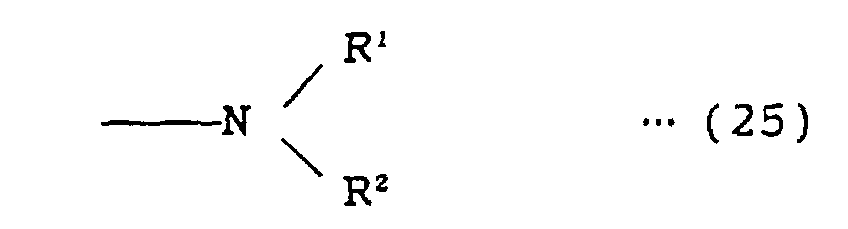 in which R1 denotes hydrogen atom, methyl or ethyl and
R2 denotes hydrogen atom, an alkyl having 1 - 12 carbon
atoms, preferably 1 - 8 carbon atoms, or a cycloalkyl
having 6 - 12 carbon atoms, preferably 6 - 8 carbon
atoms. Here, the alkyl and the cycloalkyl may contain
substituent group(s).
in which R1 denotes hydrogen atom, methyl or ethyl and
R2 denotes hydrogen atom, an alkyl having 1 - 12 carbon
atoms, preferably 1 - 8 carbon atoms, or a cycloalkyl
having 6 - 12 carbon atoms, preferably 6 - 8 carbon
atoms. Here, the alkyl and the cycloalkyl may contain
substituent group(s).
As the amino group-containing ethylenically
unsaturated compound, there may be exemplified
derivatives based on alkyl esters of acrylic or
methacrylic acid, such as aminoethyl (meth)acrylate,
propylaminoethyl (meth)acrylate, dimethylaminoethyl
methacrylate, aminopropyl (meth)acrylate, phenylaminoethyl
methacrylate and cyclohexylaminoethyl methacrylate;
derivatives based on vinylamine, such as, N-vinyldiethylamine
and N-acetylvinylamine; derivatives
based on allylamine, such as, allylamine, methacrylamine,
N-methylacrylamine, N,N-dimethylacrylamine and
N,N-dimethylaminopropylacrylamine; derivatives based
on acrylamide, such as, acryalmide and N-methylacrylamide;
aminostyrenes, such as p-aminostyrene etc.; and
6-aminohexylsuccinimide and 2-aminoethylsuccinimide.
The epoxy group-containing ethylenically
unsaturated compound to be used for the graft-modificatiom
is a monomer containing at least one
polymerizable unsaturation bond and at least one epoxy
group in the molecule. As the epoxy group-containing
ethylenically unsaturated compound, there may be
exemplified glycidyl acrylate; glycidyl methacrylate;
mono- and dialkylglycidyl esters (wherein the alkyl
group for the monoglycidyl ester has 1 - 12 carbon
atoms) of dicarboxylic acids such as, mono- and
diglycidyl esters of maleic acid, mono- and diglycidyl
esters of fumaric acid, mono- and diglycidyl esters of
crotonic acid, mono- and diglycidyl esters of
tetrahydrophthalic acid, mono- and diglycidyl esters of
itaconic acid, mono- and diglycidyl esters of
butenetricarboxylic acid, mono- and diglycidyl esters
of citraconic acid, mono- and diglycidyl esters of
endo-cis-bicyclo[2.2.1]hept-5-ene-2,3-dicarboxylic acid
(Nadic acid TM), mono- and diglycidyl esters of endocis-bicyclo[2.2.1]hept-5-ene-2-methyl-2,3-dicarboxylic
acid
(methyl Nadic acid TM) and mono- and diglycidyl esters
of allylsuccinic acid; as well as alkyl glycidyl esters
of p-styrene carboxylic acid, allyl glycidyl ether,
2-methylallyl glycidyl ether, styrene p-glycidyl ether,
3,4-epoxy-1-butene, 3,4-epoxy-3-methyl-1-butene, 3,4-epoxy-1-pentene,
3,4-epoxy-3-methyl-1-pentene, 5,6-epoxy-1-hexene
and vinylcyclohexene monoxide.
As the aromatic vinyl compound to be used for
the graft modification, compounds represented by the
following formula (26) may be exemplified:
 wherein R1 and R2 denote, independently of each other,
hydrogen atom or an alkyl having 1 - 3 carbon atoms,
concretely, for example, methyl, ethyl, propyl or
isopropyl, R3 denotes a hydrocarbon group having 1 - 3
carbon atoms, concretely, for example, methyl, ethyl,
propyl or isopropyl, or a halogen atom, such as
chlorine, bromine or iodine, and n is an integer of 0 -
5, preferably 1 - 5.
wherein R1 and R2 denote, independently of each other,
hydrogen atom or an alkyl having 1 - 3 carbon atoms,
concretely, for example, methyl, ethyl, propyl or
isopropyl, R3 denotes a hydrocarbon group having 1 - 3
carbon atoms, concretely, for example, methyl, ethyl,
propyl or isopropyl, or a halogen atom, such as
chlorine, bromine or iodine, and n is an integer of 0 -
5, preferably 1 - 5.
Examples of the aromatic vinyl compound include
styrene, α -methylstyrene, o-methylstyrene, p-methylstyrene,
m-methylstyrene, p-chlorostyrene, m-chlorostyrene,
p-chloromethylstyrene, 4-vinylpyridine, 2-vinylpyridine,
5-ethyl-2-vinylpyridine, 2-methyl-5-vinylpyridine,
2-isopropenylpyridine, 2-vinylquinoline,
3-vinylisoquinoline, N-vinylcarbazole and N-vinylpyrrolidone.
As the unsaturated carboxylic acid to be used
for the graft-modification, there may be exemplified
unsaturated carboxylic acids, such as, acrylic acid,
methacrylic acid, maleic acid, fumaric acid,
tetrahydrophthalic acid, itaconic acid, citraconic
acid, crotonic acid, isocrotonic acid, norbornene
dicarboxylic acid, bicyclo[2.2.1]hept-2-ene-5,6-dicarboxylic
acid, and anhydrides of these acids as well
as derivatives of these acids, such as acid halides,
amides, imides and esters. Concrete examples include
malenyl chloride, malenyl imide, maleic anhydride,
itaconic anhydride, citraconic anhydride, tetrahydrophthalic
anhydride, bicyclo[2.2.1]hept-2-ene-5,6-dicarboxylic
acid anhydride, dimethyl maleate, monomethyl
maleate, diethyl maleate, diethyl fumarate, dimethyl
itaconate, diethyl citraconate, dimethyl tetrahydrophthalate,
dimethyl bicyclo[2.2.1]hept-2-ene-5,6-dicarboxylate,
hydroxyethyl (meth)acrylate, hydroxypropyl
(meth)acrylate, glycidyl (meth)acrylate, aminoethyl
methacrylate and aminopropyl methacrylate. Among them,
(meth)acrylic acid, maleic anhydrid, hydroxyethyl
(meth)acrylate, glycidyl methacrylate and aminopropyl
methacrylate are preferred.
As the vinyl esters to be used for the graft-modification,
there may be recited, vinyl acetate, vinyl
propionate, vinyl n-butyrate, vinyl isobutyrate, vinyl
pivalate, vinyl caproate, vinyl versatate, vinyl
laurate, vinyl stearate, vinyl benzoate, vinyl
p-t-butylbezoate, vinyl salicylate and vinyl cyclohexane
carboxylate.
The polar monomer to be used for the graft-modification
is used in an amount of usually 0.1 - 100
parts by weight, preferably 0.5 - 80 parts by weight,
per 100 parts by weight of the third ethylenic
copolymer rubber before the modification.
As the radical initiator to be used for the
graft-modification, organic peroxides and azo compounds
may be employed.
For the organic peroxide to be used for the
graft modification, there may be recited, for example,
dicumyl peroxide, di-t-butyl peroxide, 2,5-dimethyl-2,5-bis(t-butylperoxy)hexane,
2,5-dimethyl-2,5-bis(t-butylperoxy)hexyne-3,
1, 3-bis(t-butylperoxyisopropyl)benzene,
1,1-bis(t-butylperoxy)valerate, benzoyl peroxide,
t-butylperoxy benzoate, acetyl peroxide, isobutyryl
peroxide, octanoyl peroxide, decanoyl peroxide, lauroyl
peroxide, 3,5,5-trimethylhexanoyl peroxide, 2,4-dichlorobenzoyl
peroxide and m-toluyl peroxide. As the
azo compound, there may be exemplified azoisobutyronitrile
and dimethylazoisobutyronitrile.
Such a radical initiator may preferably be used
in general in an amount of 0.001 - 10 parts by weight
per 100 parts by weight of the third ethylenic copolymer
rubber before the modification.
While the radical initiator may be employed as
such by mixing with the third ethylenic copolymer rubber
and with the polar monomer(s), it is possible also to
use the radical initiator as a solution by dissolving
it in a small amount of an organic solvent. As the
organic solvent to be employed here, every organic
solvent capable of dissolving the radical initiator can
be used without any restriction. For such an organic
solvent, an aromatic hydrocarbon solvent, such as,
benzene, toluene or xylene; an aliphatic hydrocarbon
solvent, such as, pentane, hexane, heptane, octane,
nonane or decane; an alicyclic hydrocarbon solvent,
such as, cyclohexane, methylcyclohexane or
decahydronaphthalene; a chlorinated hydrocarbon, such
as, chlorobenzene, dichlorobenzene, trichlorobenzene,
methylene chloride, chloroform, carbon tetrachloride or
tetrachloroethylene; a solvent based on alcohol, such
as, methanol, ethanol, n-propanol, iso-propanol,
n-butanol, sec-butanol, or tert-butanol; a solvent
based on ketone, such as, acetone, methyl ethyl ketone
or methyl isobutyl ketone; a solvent based on ester,
such as, ethyl acetate or dimethylphthalate; or a
solvent based on ether, such as, dimethyl ether,
diethyl ether, di-n-amyl ether, tetrahydrofuran or
dioxyanisole.
On graft-modifying the third ethylenic copolymer
rubber according to the present invention, a reducing
substance may also be used. Such a reducing substance
has a function of increasing the grafted amount in the
resulting graft-modified ethylenic copolymer rubber.
As the reducing substance, there may be recited,
for example, iron(II) ion, chromium ion, cobalt ion,
nickel ion, palladium ion, sulfites, hydroxylamine and
hydrazine, as well as compounds containing the groups
-SH, -SO3H, -NHNH2 and -COCH(OH)-.
For such a reducing substance, there may be
exemplified ferrous chloride, potassium bichromate,
cobalt chloride, cobalt naphthenate, palladium chloride,
ethanolamine, diethanolamine, N,N-dimethylanilin,
hydrazine, ethyl mercaptane, benzenesulfonic acid and
p-toluenesulfonic acid.
The reducing substance mentioned above is used
usually in an amount of 0.001 - 5 parts by weight,
preferably 0.1 - 3 parts by weight, per 100 parts by
weight of the third ethylenic copolymer rubber before
the modification.
The graft-modification of the third ethylenic
copolymer rubber according to the present invention can
be carried out by known methods, for example, by
dissolving the third ethylenic copolymer rubber in an
organic solvent, adding then the polar monomer(s) and
the radical initiator thereto and subjecting the
resulting mixture to reaction at a temperature of 70 -
200 °C , preferably 80 - 190 °C for a duration of 0.5 -
15 hours, preferably 1 - 10 hours.
As the organic solvent to be used in the
graft-modification, every organic solvent capable of
dissolving the third ethylenic copolymer rubber can be
used without any restriction. For such an organic
solvent, a solvent based on aromatic hydrocarbon, such
as benzene, toluene and xylene, or a solvent based on
aliphatic hydrocarbon, such as, pentane, hexane or
heptane, may be used.
It is also possible to produce the graft-modified
ethylenic copolymer rubber by reacting the
third ethylenic copolymer rubber with the polar monomer
without any solvent using an extruding machine or the
like. The reaction temperature may usually be above
the melting point of the third ethylenic copolymer
rubber and, concretely, at a temperature in the range
from 120°C to 250 °C. The reaction duration at such a
temperature may usually be in the range from 0.5 to 10
minutes.
The grafted amount of the grafted groups
derived from the polar monomer(s) in the resulting
graft-modified ethylenic copolymer rubber may usually
be in the range from 0.1 to 50 % by weight, preferably
in the range from 0.2 to 30 % by weight.
The graft-modified ethylenic copolymer rubber is
superior in the adhesion onto metals and polar resins.
It is possible to improve the shock resistance and the
low temperature shock resistance of the modified
ethylenic copolymer rubber by blending it with a polar
resin.
Molded products obtained by molding the graft-modified
ethylenic copolymer rubber are superior in the
susceptibility to printing and coating thereon. It is
possible to obtain a resin composition in which the
dispersion of the filler is improved, by blending the
graft-modified ethylenic copolymer rubber with a
polyolefin together with a filler, such as glass fiber
or an inorganic material. In this manner, resin
compositions in which the advantages due to compounding
with a filler is retained, can be obtained, while
attaining an improved mechanical strength.
The cross-linkable rubber composition according
to the present invention (in the following, occasionally
referred to merely as the rubber composition) comprises
(A) the above-mentioned ethylenic copolymer rubber
according to the present invention and comprises usually
at least one of the additives selected from the group
consisting of (B) a reinforcing agent, (C) a softener,
(D) a vulcanizing agent and (E) a foaming agent. As the
ethylenic copolymer rubber (A), at least one ethylenic
copolymer rubber selected from the group consisting of
the first ethylenic copolymer rubber, the second
ethylenic copolymer rubber and the third ethylenic
copolymer rubber. For the third ethylenic copolymer
rubber, the graft-modified ethylenic copolymer rubber
described above may also be used.
While the rubber composition according to the
present invention can be used in its non-cross-linked
state as such, more superior characteristic features
may be attained when it is used in cross-linked state.
The rubber composition according to the present
invention may be subjected to cross linking by methods
of heating while using a vulcanizing agent or of
irradiation by an electron beam without using any
vulcanizing agent.
The rubber composition according to the present
invention may favorably contain at least 20 % by weight,
preferably in the range from 22 to 70 % by weight, more
preferably in the range from 25 to 50 % by weight, of
the ethylenic copolymer rubber (A), based on the total
weight of the rubber composition. When the proportion
of the ethylenic copolymer rubber (A) in the rubber
composition is in the above range, better material
properties for the rubber composition will be revealed.
As the reinforcing agent (B) to be incorporated
according to the present invention, known ones for being
compounded in known rubbers may be employed without any
restrction, wherein concrete examples thereof include
carbon black products, such as SRF, GPF, FEF, MAF, HAF,
ISAF, SAF, FT and MT; surface treated carbon black
products in which the above-mentioned carbon black is
subjected to a surface treatment using, for example, a
silane coupling agent; inorganic fillers, such as,
silica, activated calcium carbonate, light calcium
carbonate, heavy calcium carbonate, fine powdery talc,
talc, fine powdery silicic acid and clays.
The content of the reinforcing agent (B) may
favorably be in a proportion of 300 parts by weight or
less, preferably 10 - 300 parts by weight, more
preferably 10 - 200 parts by weight, per 100 parts by
weight of the ethylenic copolymer rubber (A).
When the content of the reinforcing agent (B)
is in the above range, a cross-linked rubber product
superior in the mechanical properties, such as, tensile
strength, tear strength, wear resistance and hardness
can be obtained and the production costs may also be
reduced.
For the softener (C) to be incorporated
according to the present invention, known ones which are
compounded in known rubbers may be employed without any
restrction, wherein concrete examples thereof include
softeners based on petroleum, such as process oils,
lubricating oils, paraffin, liquid paraffin, petroleum
asphalt and vaseline; softeners based on coal tar, such
as, coal tar and coal tar pitch; softeners based on
fatty oils, such as, castor oil, linseed oil, rape-seed
oil, palm oil; waxes, such as, tall oil, sabu, factice,
bees wax, carnauba wax and lanolin; fatty acids and
fatty acid salts, such as, ricinoleic acid, palmitic
acid, barium stearate, calcium stearate and zinc
laurate; softeners based on esters, such as dioctyl
phthalate, dioctyl adipate and dioctyl sebacate; and
synthetic high-polymeric substances, such as, petroleum
resin, atactic polypropylene and cumarone-indene
resin. Among them, softeners based on petroleum are
preferred, with particular preference to process oils.
The content of the softener (C) may favorably
be in a proportion of 200 parts by weight or less,
preferably 10 - 200 parts by weight, more preferably 10
- 150 parts by weight, per 100 parts by weight of the
ethylenic copolymer rubber (A).
For cross-linking the rubber composition
according to the present invention by heating, a
vulcanizing agent (D) is admixed usually to the rubber
composition. It is possible on requirement to
incorporate one or more compounds constituting the
vulcanizer system, such as, vulcanization accelerator,
vulcanization assistant and so on.
As the vulcanizing agent (D), there may be
employed, for example, sulfur, compounds based on
sulfur and organic peroxides.
The form of sulfur is not specifically limited
and, for example, powdery sulfur, precipitated sulfur,
colloidal sulfur, surface-treated sulfur and insoluble
sulfur, may be employed.
As the compound based on sulfur, there may be
exemplified sulfur chloride, sulfur dichloride, high-polymeric
polysulfides, morpholine disulfide,
alkylphenol disulfide, tetramethylthiuram disulfide and
selenium dimethyldithiocarbamate.
As the organic peroxide to be used as the
vulcanizing agent (D), there may be exemplified alkyl
peroxides, such as dicumyl peroxide, di-t-butyl
peroxide, di-t-butylperoxy-3,3,5-trimethylcyclohexane,
t-butylcumyl peroxide, di-t-amyl peroxide, 2,5-dimethyl-2,5-di(t-butylperoxy)hexine-3,
2,5-dimethyl-2,5-di-(benzoylperoxy)hexane,
2,5-dimethyl-2,5-di(t-butylperoxy)-hexane,
α, α'-bis(t-butylperoxy-m-isopropyl)benzene
and t-butyl hydroperoxide; peroxyesters, such as
t-butylperoxy acetate, t-butylperoxy isobutyrate,
t-butylperoxy pivalate, t-butylperoxy maleate, t-butylperoxy
neodecanoate, t-butylperoxy benzoate and
di-t-butylperoxy phthalate; and ketone peroxides, such
as dicyclohexanone peroxide etc. They can be used in a
combination of two or more of them.
Among them, organic peroxides having a 1 minute
half life temperature of 130 - 200°C are preferred, for
example, concretely, dicumyl peroxide, di-t-butyl
peroxide, di-t-butylperoxy-3,3,5-trimethylcyclohexane,
t-butylcumyl peroxide, di-t-amyl peroxide and t-butyl
hydroperoxide.
According to the present invention, it is
favorable to use, among the above vulcanizing agents,
sulfur or a compound based on sulfur, in particular,
sulfur, since thereby a rubber composition and a
cross-linked rubber product exhibiting superior
characteristic properties can be obtained.
When the vulcanizing agent (D) is sulfur or a
compound based on sulfur, it can favorably be used in
an amount of 0.1 - 10 parts by weight, preferably 0.5 -
5 parts by weight, per 100 parts by weight of the
ethylenic copolymer rubber (A).
When the vulcanizing agent (D) is an organic
peroxide, it can favorably be used in an amount of
0.0003 - 0.05 mole, preferably 0.001 - 0.03 mole, per
100 grams of the ethylenic copolymer rubber (A), or in
an amount of 0.05 - 15 parts by weight, preferably 0.15
- 5 parts by weight, per 100 parts by weight of the
ethylenic copolymer rubber (A).
When sulfur or a compound based on sulfur is
used as the vulcanizing agent (D), it is preferable to
use concurrently a vulcanization accelerator.
As the vulcanization accelerator, there may be
recited, for example,
The above vulcanization accelerator may
favorably be used in an amount of 0.1 - 20 parts by
weight, preferably 0.2 - 10 parts by weight, per 100
parts by weight of the ethylenic copolymer rubber (A).
In case an organic peroxide is used as the
vulcanizing agent (D), it is preferable to use
concurrently a vulcanization assistant (a polyfunctional
monomer) in an amount of 0.5 - 2 moles per one mole of
the organic peroxide, preferably in nearly equimolar
proportion therewith.
As the vulcanization assistant, there may be
exemplified sulfur; compounds based on quinone dioxime,
such as p-quinone dioxime etc.; and polyfunctional
monomers. As the polyfunctional monomer, for example,
compounds based on (meth)acrylate, such as trimethylol
propane triacrylate and polyethyleneglycol dimethacrylate;
compounds based on allyl, such as diallyl
phthalate and triallyl cyanurate; compounds based on
maleimide, such as m-phenylene bismaleimide etc.; and
divinylbenzene.
The rubber composition according to the present
invention may be molded under foaming, if it contains
one or more compounds constituting a foaming system,
such as a foaming agent (E), a foaming assistant and so
on.
As the foaming agent (E), those which are used
in general for foaming-molding rubbers can be used
widely. Concrete examples therefor include inorganic
foaming agents, such as sodium bicarbonate, sodium
carbonate, ammonium bicarbonate, ammonium carbonate and
ammonium nitrite; nitroso compounds, such as N,N'-dimethyl-N,N'-dinitrosoterephthalamide
and N,N'-di-nitrosopentamethylenetetramine;
azo compounds, such as
azodicarbonamide, azobisisobutyronitrile, azocyclohexylnitrile,
azodiaminobenzene and barium azodicarboxylate;
sulfonylhydrazide compounds, such as benzenesulfonylhydrazide,
toluenesulfonylhydrazide, p,p'-oxybis-(benzenesulfonylhydrazide)
and diphenylsulfon-3,3'-disulfonylhydrazide;
and azids, such as calcium azide,
4,4-diphenyldisulfonyl azide and p-toluenesulfonyl
azide.
Among them, nitroso compounds, azo compounds
and azides are preferred. The foaming agent (E) may be
used in an amount of 0.5 - 30 parts by weight,
preferably 1 - 20 parts by weight, per 100 parts by
weight of the ethylenic copolymer rubber (A). From the
rubber composition having a content of the foaming
agent (E) in the range given above, a foamed product
having an apparent density of 0.03 - 0.8 g/cm3 can be
produced.
It is possible to use also a foaming assistant
concurrently with the foaming agent (E). The concurrent
use of a foaming assistant will reveal effects of
reduction of the decomposition temperature of the
foaming agent (E), acceleration of the decomposition
and homogenization of the foam sizes. As the foaming
assistant, for example, organic acids, such as salicylic
acid, phthalic acid, stearic acid and oxalic acid, as
well as urea and its derivatives may be enumerated.
The foaming assistant may favorably be used in
an amount of 0.01 - 10 parts by weight, preferably 0.1
- 5 parts by weight, per 100 parts by weight of the
ethylenic copolymer rubber (A).
The rubber composition according to the present
invention may contain various other components, for
example, stabilizers, such as antioxydant and light-stabilizer;
processing assistant; plasticizer;
colorants; fire retardant; and other rubber additives.
The kind and the amont of incorporation of such other
components may be chosen adequately in accordance with
each specific application.
The rubber composition according to the present
invention may favorably contain an antioxidant, since
thereby the life of the product can be extended. As
the antioxydant, there may be exemplified stabilizers
based on aromatic secondary amine, such as phenylnaphthylamine,
4,4'-(α, α-dimethylbenzyl)diphenylamine and
N,N'-di-2-naphthyl-p-phenylenediamine; stabilizers based
on phenol, such as 2,6-di-t-butyl-4-methylphenol and
tetrakis-(methylene-3-(3',5'-di-t-butyl-4'-hydroxyphenyl)-propionate}methane;
stabilizers based on thioether,
such as bis{2-methyl-4-(3-n-alkylthiopropionyloxy)-5-t-butylphenyl}sulfide
and the like; stabilizers based on
benzimidazole, such as 2-mercaptobenzimidazole etc.;
stabilizers based on dithiocarbamate, such as, nickel
dibutyldithiocarbamate etc.; and stabilizers based on
quinoline, such as a polymer of 2,2,4-trimethyl-1,2-dihydroquinoline.
It is possible to use two or more of
them concurrently.
Such an antioxydant may be used adequately in
an amount of 5 parts by weight or less, preferably 3
parts by weight or less, per 100 parts by weight of the
ethylenic copolymer rubber (A).
For the processing assistants, those which are
used in general as processing assistant in rubbers can
be used widely. Concrete examples include higher fatty
acids, such as, ricinoleic acid, stearic acid, palmitic
acid and lauric acid, and salts and esters of these
higher fatty acids, such as barium stearate, zinc
stearate and calcium stearate.
The processing assistant may be used adequately
in an amount of 10 parts by weight or less, preferably
5 parts by weight or less, per 100 parts by weight of
the ethylenic copolymer rubber (A).
The rubber composition according to the present
invention may contain other rubber component(s) known
per se, within the range not obstructing the purpose
of the invention.
For such other rubber component(s), there may
be enumerated, for example, natural rubber (NR), rubbers
based on isoprene, such as isoprene rubber (IR) etc.;
rubbers based on conjugated diene, such as butadiene
rubber (BR), styrene-butadiene rubber (SBR),
acrilonitrile-butadiene rubber (NBR) and chloroprene
rubber (CR).
It is also possible to incorporate other known
copolymer rubber(s) based on ethylene/α -olefin, for
example, an ethylene/propylene random copolymer (EPR)
and an ethylene/α -olefin/polyene copolymer other than
the ethylenic copolymer rubber (A), such as EPDM.
The rubber composition according to the present
invention can be prepared from the ethylenic copolymer
rubber (A) and at least one additive selected from the
group consisting of the reinforcing agent (B), the
softener (C), the vulcanizing agent (D) and the foaming
agent (E) together with the above-mentioned optionally
blended other component(s) by general methods for
preparing rubber blend. It can be prepared, for
example, by kneading the ethylenic copolymer rubber
(A), the reinforcing agent (B), softener (C) and the
said other component(s) on an internal mixer, such as
Bumbury mixer, kneader and intermix, at a temperature
of 80 - 170 °C for 3 - 10 minutes and, after admixing
thereto, if necessary, a vulcanizing agent (D), a
vulcanization accelerator, a vulcanization assistant or
so on, the resulting compound is further kneaded on a
roller, such as an open roll, or on a kneader at a
roller temperature of 40 - 80 °C for 5 - 30 minutes,
before it is subdividedly discharged out. In this
manner, a rubber composition (compounded rubber) in a
form of usually a ribbon or sheet can be obtained. If
the kneading temperature in the internal mixer is
lower, it is possible also to knead the composition
together with the vulcanizing agent (D), vulcanization
accelerator and foaming agent (E) and so on
simultaneously.
Cross-linked rubber according to the present
invention is a product obtained by pre-forming the non-cross-linked
rubber composition as above into a desired
shape by means of various forming techniques usually by
using a forming machine, such as an extrusion molding
machine, a calendering roll, a press, an injection
molding machine or a transfer molding machine,
whereupon the so-preformed green product is heated
either during the pre-forming or after having been
transferred to a vulcanizing vessel or is subjected to
irradiation of electron beam to effect vulcanization.
Foamed articles can be obtained by subjecting a non-cross-linked
rubber blend containing a foaming agent
(E) to cross linking by procedures as given above,
wherein foaming proceeds during the cross-linking
simultaneously.
For effecting cross linking of the rubber
composition according to the present invention by
heating, it is preferable to effect the heating using a
heating vessel with a heating mode of, for example, HAV
(hot air), PCM (glass beads fluidized bed), UHF (ultra
high frequency radio wave), steam or LCM (hot molten
salt vessel), at a temperature of 150 - 270 °C for 1 -
30 minutes.
For effecting cross linking by electron beam
irradiation without using vulcanizing agent (D), the
pre-formed rubber composition is subjected to
irradiation with an electron beam having an energy of
0.1 - 10 MeV, preferably 0.3 - 2 MeV so as to provide
an absorbed dose of 0.5 - 35 Mrad, preferably 0.5 - 10
Mrad.
For molding and cross linking, a metal mold may
or may not be employed. In case of without using metal
mold, the rubber composition is usually molded under
cross linking in continuous mode.
The cross-linked rubber according to the present
invention may favorably be used for applications, for
example, parts for automobile industry, such as sealing
elements, automobile weather strips, door glass run
channel, window sash, radiator hose, brake parts and
wiper blade; industrial rubber products, such as rubber
rollers, belts, packings and hoses; electric insulators,
such as anode cap and grommet; architectural and
constructional parts, such as gaskets for architectural
use, sheets for constructional uses; and rubber-coated
cloth. Molded cross-linked rubber articles obtained by
foaming with heating the rubber compound containing the
foaming agent (E) may be used for applications, such as
heat insulators and cushioning materials.
The molded cross-linked rubber article for
sealing according to the present invention is made of
the above-mentioned cross-linked rubber and is formed
into a configuration corresponding to each specific
application. The molded cross-linked rubber article
for sealing according to the present invention may or
may not be foamed product.
The molded cross-linked rubber article according
to the present invention may favorably be served for
applications, for example, sealants for automobile,
such as weather strip sponge for automobile, in-mold
foaming-molded sponge, door glass run channel and door
sash; architectural gaskets; and constructional sealing
materials, such as sheets for constructional use. The
molded cross-linked rubber article for sealing according
to the present invention is superior especially in the
sealing performance and in the form-preservability.
The weather strip sponge for automobile
according to the present invention is made of the
above-mentioned foamed article of the cross-linked
rubber and is especially superior in the sealing
performance and in the form-preservability.
The fourth ethylenic copolymer rubber (F) to be
used as the base polymer of the cross-linked rubber
latex composition according to the present invention is
an ethylene/α -olefin/triene copolymer rubber which
comprises a structural unit derived from ethylene (a),
a structural unit derived from the α -olefin of 3 - 20
carbon atoms (b) and a structural unit derived from the
triene (c) represented by the formula (1).
As the α-olefin of 3 - 20 carbon atoms (b) to
be used for the fourth ethylenic copolymer rubber (F),
there may be enumerated concretely, for example,
propylene, 1-butene, 1-pentene, 1-hexene, 3-methyl-1-butene,
3-methyl-1-pentene, 3-ethyl-1-pentene, 4-methyl-1-pentene,
4-methyl-1-hexene, 4,4-dimethyl-1-hexene,
4,4-dimethyl-1-pentene, 4-ethyl-1-hexene, 3-ethyl-1-hexene,
1-octene, 1-decene, 1-dodecene, 1-tetradecene,
1-hexadecene, 1-octadecene and 1-eicosene. Among them,
preference is given to propylene, 1-butene, 1-hexene
and 1-octene. These α-olefins (b) may be used either
each alone or in a combination of two or more of them.
Among the trienes (c) represented by the
formula (1), those in which both R3 and R4 represent
methyl are preferred. The random copolymer rubber
obtained using such triene(s) (c) as a starting
monomer is particularly superior in the balance between
the vulcanization velocity and the scorching profile.
As the concrete examples of the triene (c)
represented by the formula (1), the same trienes (c) as
those described above for the ethylenic copolymer
rubber may be recited. Among the trienes (c), 4,8-dimethyl-1,4,8-decatriene
(DMDT) is preferred. The
triene (c) may be present as a mixture of trans- and
cis-isomers or as sole trans- or cis-isomer. The
structural unit derived from the triene (c) in the
fourth ethylenic copolymer rubber (F) is represented by
the formula (1') given above.
In the fourth ethylenic copolymer rubber (F) to
be used according to the present invention, the
structural units derived from the respective comonomers,
ethylene (a), the α -olefin(s) and the triene(s) (c),
are coupled in random arrangement, in which branched
structure originated from the triene(s) (c) is present
and the main chain has substantially a linear structure.
The fact that the structural unit derived from the
triene (c) has the above-mentioned structure can be
confirmed by inspecting the copolymer by 13C-NMR
spectrometry.
In the fourth ethylenic copolymer rubber (F),
other comonomer(s) than the triene(s) (c) may also be
co-polymerized. For such other comonomer(s), there may
be enumerated the non-conjugate polyene(s) (d) and other
non-conjugated dienes, for example, those in which only
one polymerizable carbon-to-carbon double bond is
present in the molecule. Also, cyclic olefins may be
enumerated. For such other comonomer(s), those which
are exemplified as other monomer(s) for the first
ethylenic copolymer rubber and the like may be used.
There may be enumerated concretely 1,4-hexadiene,
5-ethylidene-2-norbornene, dicyclopentadiene, 5-vinylnorbornene
and so on.
For the fourth ethylenic copolymer rubber (F)
to be used according to the present invention, those
which have the composition and the characteristic
features as given below are preferred.
The fourth ethylenic copolymer rubber (F) may
favorably have a mole ratio of ethylene (a) versus the
α -olefin having 3 - 20 carbon atoms (b), namely
(ethylene/α -olefin), in the range from 95/5 to 40/60,
preferably from 92/8 to 60/40, more preferably from
90/10 to 65/35. The fourth ethylenic coplymer rubber
(F) having the mole ratio of ethylene/α -olefin in the
range from 95/5 to 40/60 is superior both in the
flexibility at low temperatures and in the shock
resistance and heat resistance at low temperatures.
The fourth ethylenic copolymer rubber (F) may
favorably have a content of the triene (c) in the range
from 0.1 to 30 mole %, preferably from 0.5 to 7 mole %.
The fourth ethylenic copolymer rubber (F) having a
content of the triene (c) in the range from 0.1 to 30
mole % is superior in the ability for modifying the
shock resistance and surface gloss.
The fourth ethylenic copolymer rubber (F) may
favorably have an intrinsic viscosity ( η ) determined
in decalin at 135 °C in the range from 0.1 to 10 dl/g,
preferably from 0.31 to 10 dl/g, more preferably from
0.5 to 2.0 dl/g, especially preferably from 0.7 to 1.5
dl/g. The intrinsic viscosity (η) of the fourth
ethlenic copolymer rubber (F) exerts a significant
influence on the particle size reguration in preparing
latex and on the characteristic properties of the
resulting latex. When the intrinsic viscosity of the
fourth ethylenic copolymer rubber (F) is in the range
from 0.1 to 10 dl/g, a better effect on the improvement
of the shock resistance may be realized, permitting
thus to use it as a resin modifier favoritely. At the
same time, it functions to regulate the average particle
size of the solid component in the latex to a value of
3.0 µ m or lower, whereby the storage stability of the
latex composition becomes superior.
For the fourth ethylenic copolymer rubber (F),
there may be used the first, second and third ethylenic
copolymer rubbers, while use of other ones may be
permitted. The fourth erthylenic copolymer rubber (F)
may be produced by the same production process as that
for the first, second or third ethylenic copolymer
rubber.
The low molecular weight (co)polymer (G) to be
used according to the present invention is a low
molecular weight polyethylene (homopolymer of
ethylene), a low molecular weight ethylene/α -olefin
copolymer, a low molecular weight polyethylene modified
by a compound based on unsaturated carboxylic acid or a
low molecular weight ethylene/α -olefin copolymer
modified by a compound based on unsaturated carboxylic
acid. Among them, the low molecular weight
polyethylene modified by a compound based on unsaturated
carboxylic acid or the low molecular weight ethylene/
α -olefin copolymer modified by a compound based on
unsaturated carboxylic acid is preferred.
The low molecular weight (co)polymer(s) (G)
play a role of atomizing the fourth ethylenic copolymer
rubber (F) easily upon preparation of latex.
The low molecular weight (co)polymer (G) may be
present in a waxy state or in a liquid state at normal
temperature.
According to the present invention, it is
possible to incorporate, either each individually or
concurrently, one or more low molecular weight
(co)polymers of waxy consistency at normal temperature
and one or more low molecular weight (co)polymers of
liquid consistency at normal temperature.
As the above-mentioned low molecular weight
polyethylene, there may be exemplified a polyethylene
wax. As the above-mentioned low molecular weight
ethylene /α-olefin copolymer, there may be exemplified
an ethylene/α-olefin copolymer, such as an ethylene/propylene
copolymer, an ethylene/1-butene copolymer or
so on. The low molecular weight polyethylene and the
low molecular weight ethylene/α-olefin copolymer may
favorably have intrinsic viscosities (η) determined in
decalin at 135 °C in the range from 0.01 to 0.3 dl/g,
preferably from 0.01 to 0.2 dl/g.
It is possible also to use, as the low
molecular weight (co)polymer (G), a modified low
molecular weight polyethylene or a modified low
molecular weight ethylene/α -olefin copolymer obtained
by co-polymerizing or graft-co-polymerizing a compound
based on unsaturated carboxylic acid described
afterwards onto the low molecular weight polyethylene
or onto the low molecular weight ethylene/α -olefin
copolymer mentioned above.
As the compound based on unsaturated carboxylic
acid, there may be enumerated unsaturated carboxylic
acids having in the molecule 3 - 20 carbon atoms,
preferably 3 - 10 carbon atoms, acid anhydrides, amides,
imides and esters of them.
Concretely, there may be recited, for example,
Among them, compounds based on unsaturated
carboxylic acid, such as maleic acid, maleic anhydride,
maleic acid monoamide, maleic acid diamide, maleimide,
monomethyl maleate, diethyl maleate and glycidyl
(meth)acrylate, are preferred. These compound based on
unsaturated carboxylic acid may be used each solely or
in a combination.
The amount of copolymerization or grafting of
the compound based on unsaturated carboxylic acid to be
co-polymerized with or grafted onto the low molecular
weight polyethylene or the low molecular weight
ethylene /α -olefin copolymer may favorably be, in
general, in the range from 0.2 to 50 %, preferably from
0.2 to 20 %, more preferably from 0.2 to 10 %, based on
the weight of the modified low molecular weight
copolymer.
The intrinsic viscosity (η) of the modified
low molecular weight copolymer such as above, determined
in decalin at 135 °C may favorably be in the range from
0.01 to 0.3 dl/g, preferably from 0.01 to 0.2 dl/g.
The low molecular weight (co)polymer (G) such
as above may be incorporated either individually or in
a combination.
In the cross-linked rubber latex composition
according to the present invention, the low molecular
weight (co)polymer(s) (G) may be incorporated in a
proportion in the range from 2 to 30 parts by weight,
preferably from 5 to 25 parts by weight, more
preferably from 5 to 20 parts by weight, per 100 parts
by weight of the fourth ethylenic copolymer rubber (F).
By incorporating the low molecular weight
copolymer (G) in the above proportion, a finer
atomization of the latex may be realized easily and, as
a result, the storage stability of the resulting
cross-linked latex composition becomes better. At the
same time, the resulting cross-linked rubber latex
composition indicates a superior effect of improvement
of the shock resistance and so on and can be used
favorably as a resin modifier.
The cross-linked rubber latex composition
according to the present invention can be obtained by
dispersing the fourth ethylenic copolymer rubber (F)
and the low molecular weight (co)polymer(s) (G) in the
proportion given above uniformly in an aqueous medium
in the presence of a surfactant to build up a latex
and subjecting the resulting latex composition, then,
to a cross-linking treatment.
As the above-mentioned surfactant, anionic,
cationic and non-ionic surfactants known per se may be
used, wherein, in particular, anionic surfactants, such
as sodium salts and potassium salts of fatty acids, may
preferably be employed.
It is favorable in general to use the surfactant
in a proportion in the range from 0.2 to 20 parts by
weight, preferably from 0.5 to 10 parts by weight, per
100 parts by weight of the fourth ethylenic copolymer
rubber (F), though such proportion may be different due
to each specific kind of the fourth ethylenic copolymer
rubber (F) used and of the low molecular weight
(co)polymer (G) used and so on.
For preparing the latex, it is enough to
practise, for example, to dissolve the fourth ethylenic
copolymer rubber (F) and the low molecular weight (co)-polymer(s)
(G) in a hydrocarbon solvent, such as
n-hexane, homogeneously to obtain a solution and, then,
to mix and disperse the resulting solution with
agitation in an aqueous solution containing dispersed
therein a predetermined amount of a surfactant,
followed by volatilizing off of the solvent component
by heating at an adequate temperature.
It is preferable in view of the feasibility of
handling in the state of latex to choose the amount of
the aqueous solution to be used usually such that the
concentration of solid matter in the latex is in the
range from 5 to 65 %, preferably from 10 to 60 %, based
on the weight of the product latex.
The latex composition obtained as above is then
subjected to cross-linking treatment, whereby
cross-linking bonds are formed in molecular chains in
the fourth ethylenic copolymer rubber (F).
The cross-linking treatment can be realized by
techniques therefor known per se, such as cross linking
by an ionizing radiant ray and cross linking by using
an organic peroxide. The cross-linking treatment may
be carried out with or without admixing polyfunctional
comonomer(s) to the latex composition.
As the polyfunctional comonomer, there may
favorably be employed, for example, monomers having at
least two ethylenic unsaturated groups, in particular,
vinyl groups. Concretely, for example, divinylbenzene,
tetramethylenediacrylate, glyceryltriacrylate, ethyleneglycoldimethacrylate,
1,2,4-trivinylcyclohexane, tetraallyloxyethane,
may be enumerated.
The polyfunctional comonomer may be employed in
a proportion of 0.1 - 20 parts, preferably 0.3 - 5
parts by weight, per 100 parts by weight of the fourth
ethylenic copolymer rubber (F).
As the ionizing radiant ray mentioned above,
any of α -ray, β -ray, γ -ray, electron beam and X-ray
may be employed. The irradiation strength of such
ionizing radiant ray may favorably be at a dose in the
range from 1 to 50 Mrad, preferably from 5 to 25 Mrad.
The cross-linking treatment using an organic
peroxide may be carried out by dispersing the organic
peroxide uniformly in the latex composition and heating
the resulting latex composition at a temperature above
the decomposition temperature of the organic peroxide.
As the organic peroxide, those which have a 10
hour half life temperature from 0 °C to 100 °C are
preferred, in the point of view of the stability of the
latex particles, of safety in operation of the
cross-linking reaction and of economy. Concretely,
there may be enumerated, for example, 1,1-di-tert-butylperoxy-3,3,5-trimethylcyclohexane,
1,1-bis(tert-butylperoxy)cyclohexane,
tert-butyl peroxypivalate, tert-butylperoxy-2-ethyl
hexanoate, tert-butylperoxyisopropyl
carbonate, 2,5-dimethyl-2,5-di(benzoylperoxy)-hexane,
3,5,5-trimethylhexanoyl peroxide, benzoyl
peroxide, p-chlorobenzoyl peroxide, 2,4-dichlorobenzoyl
peroxide, isobutyl peroxide, diisopropyl peroxydicarbonate
and di(2-ethylhexyl) peroxycarbonate.
Usually, the organic peroxide may favorably be
used in a proportion of 0.3 - 20 parts by weight,
preferably 1 - 10 parts by weight, per 100 parts by
weight of the fourth ethylenic copolymer rubber (F) in
the latex composition.
The condition of cross-linking treatment, such
as heating duration and so on, is settled in such a way
that the content of the hot-toluene-insoluble portion
of the component of fourth ethylenic copolymer rubber
(F) will be not lower than 30 % by weight, preferably
not lower than 50 % by weight, more preferably not
lower than 60 % by weight, while either normal pressure
or superatmosphertic pressure may be employed.
Concretely, it may be suitable to settle the heating
duration usually to be 5 to 7 times the half life.
The above-mentioned content of the hot-toluene-insoluble
portion, nemely, the gel fraction, is
expressed by the proportion of the portion insoluble
in toluene at 120 °C, relative to the total solid
matter of the latex composition, and can be utilized as
a parameter of the degree of cross linking. Concrete
method of determining the content of the hot-toluene-insoluble
portion will be given afterwards in the
description of Examples. When the gel fraction is in
the above-mentioned range, a sufficient effect of
improvement in the shock resistance can be obtained.
The average particle size of the solid matter
in the cross-linked rubber latex composition according
to the present invention may favorably be in the range
from 0.2 to 3.0, preferably from 0.2 to 2.0 µ m.
The cross-linked rubber latex composition
according to the present invention may contain, within
the limit not obstructing the purpose of the invention,
additives known per se, such as pigment, thickener,
plasticizer, antiseptic, antifoaming agent, pH
regulator, antioxidizer and antioxidant. These
additives may be admixed to the latex composition
either before the cross-linking treatment or after the
cross-linking treatment.
The cross-linked rubber latex composition
prepared as above which contains the fourth ethylenic
copolymer rubber (F) as the main component has an
average particle size of the solid matter in the range
from 0.2 to 3.0 µ m and, therefore, is superior in the
storage stability. The cross-linked rubber latex
composition has a hot-toluene-insoluble portion (gel
fraction) of the fourth ethylenic copolymer rubber (F)
not lower than 30 % by weight and, therefore, is very
useful for modifying resins, which are not able to mold
into a molded article superior in the shock resistance
and in the surface gloss, into resins which can be
molded into a molded article superior in the shock
resistance and in the surface gloss. Such modification
of resins can be attained by blending the cross-linked
rubber latex composition according to the present
invention with the resin to be modified. The amount of
the cross-linked rubber latex composition according to
the present invention to be blended may favorably be
such that the amount of the solid matter of the
cross-linked rubber latex composition occupied in the
total solid matter of the resin after having been
modified will be in the range from 5 to 50 % by weight,
preferably from 10 to 40 % by weight. There is no
restriction for the resin to be modified, an example
being polyvinyl chloride.
Although the reason that the cross-linked
rubber latex composition according to the present
invention improves the modifying effect on the shock
resistance and on the surface gloss is not clear, it is
assumed to be due to that the fourth ethylenic
copolymer rubber (F) has a content of specific
triene(s) (c) and, thus, exhibits higher susceptibility
to being subjected to grafting, whereby dispersibility
of the ethylene/α-olefin/triene copolymer rubber in
the resin component to be modified is increased.
The AES resin according to the present
invention is a copolymer of acrylonitrile, the fourth
ethylenic copolymer rubber (F) and styrene, in which
acrylonitrile and styrene are grafted onto the fourth
ethylenic copolymer rubber (F). This AES resin
comprises also the low molecular weight (co)polymer(s)
(G) and so on which are the components of the
cross-linked rubber latex composition.
The AES resin according to the present invention
can be produced by known techniques from the
cross-linked rubber latex composition according to the
present invention.
For example, the AES resin according to the
present invention can be produced by subjecting the
cross-linked rubber latex composition according to the
present invention to an emulsion graft-polymerization
with acrylonitrile and styrene.
A further process for producing the AES resin
as given below may also be incorporated in order to
correspond to varying kinds, to attain easy quality
improvement, to increase the productivity and to
economize waste water treatment. In this process, a dry
product rich in rubber content obtained by subjecting
the cross-linked rubber latex composition according to
the present invention to an emulsion graft-polymerization
with acrylonitrile and styrene is first
prepared. Then, this dry product is belded with a
preliminarily prepared resin component, namely,
acrylonitrile/styrene resin (AS resin) to obtain the
AES resin. Here, the contemplated AES resin is
prepared by adjusting the amount of the fourth
ethylenic copolymer rubber (F) by regulating the blend
ratio. Such blending is performed using, for example,
extruding machine, at a temperature in the range from
150 to 300 °C, preferably from 180 to 250 °C.
The content of the cross-linked rubber latex
composition according to the present invention in the
AES resin according to the present invention may
faborably be in the range from 5 to 50 % by weight,
preferably from 10 to 40 % by weight, as the amount of
solid matter of the cross-linked rubber latex
composition occupying in the total solid matter of the
AES resin.
The AES resin according to the present
invention can be processed into a molded article
superior in the shock resistance and in the surface
gloss without deteriorating the original superior
weatherability and resistance to solvent intrinsic to
the fourth ethylenic copolymer rubber (F), as contrasted
to conventional AES resins.
Therefore, the AES resin according to the
present invention can serve in itself for use for
casings of household electric appliances, for automobile
internal furnitures, such as instrument panel, for
automobile external furnishings, such as front grille,
and so on. The AES resin according to the present
invention can also be used for modifying shock
resistance etc. of, for example, PVC, by blending
therewith.
As described above, the first and the second
ethylenic copolymer rubbers according to the present
invention are novel and useful copolymer rubbers. The
frist and the second ethylenic copolymer rubbers are
each a random copolymer rubber which has specific
proportions of structural units derived from ethylene
(a), one or more α -olefins each having 3 - 20 carbon
atoms (b), one or more speicific trienes (c) and, if
necessary one or more non-conjugated polyenes having
in the molecule at least two polymerizable double bonds
(d) and reveals specific characteristic features, so
that they exhibit high cross-linking velocity and are
superior in the scorching stability, in the workability
and in the moldability with superior mechanical
properties of the cross-linked product, such as the
strength of the cross-linked rubber.
The third ethylenic copolymer rubber according
to the present invention is novel and useful. The third
ethylenic copolymer rubber according to the present
invention is a random copolymer rubber comprising
structural units derived from (a) ethylene, (b) one or
more α -olefins having 3 - 20 carbon atoms, (c)
specific triene(s) and (d) one or more non-conjugated
polyenes having at least two polymerizable double bonds
in the molecule, respectively, each in a specific
proportion and exhibiting specific material properties,
whereby it reveals higher cross-linking velocity, is
superior in the scorching stability, in the workability
and in the moldability and is, after having been
subjected to cross linking, superior also in the
mechanical characteristic properties, such as strength
of cross-linked rubber etc.
For producing the ethylenic copolymer rubber
according to the present invention, ethylene (a), the
α -olefin(s) having 3 - 20 carbon atoms, the specific
triene(s) and the non-conjugated polyene(s) having in
the molecule at least two polymerizable double bonds
(d) are subjected to copolymerization in the presence
of a catalyst constituted of a transition metal
compound (e), an organoaluminum compound (f) and/or an
ionizing ionic compound (g), whereby the first, the
second and the third ethylenic copolymer rubbers can be
produced in a simple and efficient manner.
The rubber composition according to the present
invention comprises the first, the second or the third
ethylenic copolymer rubber and exhibits a high cross-linking
velocity and is superior in the scorching
stability, in the workability and in the moldability,
with superior mechanical properties of the cross-linked
product, such as the strength of the cross-linked
rubber, together with superior form-preservability.
The cross-linked rubber according to the
present invention comprises a cross-linked product of
the rubber composition mentioned above and can be
produced in an efficient manner at lower costs and is
superior in the mechanical properties, such as the
strength of cross-linked rubber, together with superior
form-preservability.
The molded cross-linked rubber article for
sealing according to the present invention comprises a
cross-linked product of the rubber composition
mentioned above and can be produced in an efficient
manner at lower costs and is superior in the mechanical
properties, such as the strength of cross-linked
rubber, and in the form-preservability, together with
superior sealing performance.
The weather strip sponge for automobile
according to the present invention comprises a foamed
article of the cross-linked rubber mentioned above and
is superior in the sealing performance and in the form-preservability.
The molded cross-linked rubber article
according to the present invention is obtained under
cross linking from the rubber composition and can be
produced in a simple and efficient manner at lower
costs.
The cross-linked rubber latex composition
according to the present invention comprises the
specific ethylenic copolymer rubber (F) and the low
molecular weight (co)polymer(s) (G) each in a specific
proportion, wherein the component of the ethylenic
copolymer rubber (F) has cross-linked bonds, so that it
can afford to modify a resin, which cannot be molded
into a molded article superior in the shock resistance
and in the surface gloss, into a resin which can be
molded into a molded article superior in the shock
resistance and in the surface gloss, without
deteriorating the original superior properties of
weatherability and resistance to solvents intrinsic to
the ethylenic copolymer rubber(F).
The AES resin according to the present
invention is prepared using the cross-linked rubber
latex composition mentioned above and can be processed
into molded articles superior in the shock resistance
and in the surface gloss without deteriorating the
original superior properties of weatherability and
reistance to solvents intrinsic to the ethylenic
copolymer rubber (F), as contrasted to conventional AES
resins.
In the following, the present invention will be
described by way of Examples, wherein it is to be noted
that the present invention should not be restricted to
these Examples.
In a stainless steel autoclave of 1,500 ml
capacity, there were charged 257 grams (1.89 mol) of
2,6-dimethyl-1,3,6-octatriene, 500 ml of toluene, 6.18
grams (35.2 mmol) of cobalt thiocyanate, 21.4 grams
(70.4 mmol) of tri-o-tolylphosphine and 200 ml of a
solution of triethylalunimum in toluene with a
concentration of 1 mol/1 (200 mmol of triethylaluminum)
under a nitrogen atmosphere and the autoclave was
closed tightly. Then, a bomb of ethylene was connected
directly to the autoclave to introduce thereinto
ethylene so as to reach an inner pressure of the
autoclave of 0.98 MPa (10 kgf/cm2, gauge). Then, the
autoclave was heated at 120 °C and the reaction was
effected for a total duration of 5 hours while
supplementing thereto the consumed amount of ethylene
intermittently. After termination of the reaction, the
autoclave was cooled and was opened, whereupon the
resulting reaction mixture was poured into 500 ml of
water to cause phase separation into aqueous and
organic phases. The so-separated organic phase was
subjected to rectification in a distillation column of
80 trays to obtain 108 grams of the contemplated
product, i.e. 4,8-dimethyl-1,4-8-decatriene (with a
yield of 36 %). The analytical results of the
so-obtained 4,8-dimethyl-1,4,8- decatriene product are
recited in the following.
absorption peaks are recited below:
A toluene solution in which a zirconium
compound and methylalumoxane are dissolved was
prepared by mixing rac-dimethylsylilene-bis(2-methyl-4-phenyl-1-indenyl)zirconium
dichloride and a toluene
solution of methylalumoxane (methylaluminoxane) (with
1.2 mg atom/ml, as converted into aluminum atom) in the
dark at room temperature while agitation for 30
minutes. The Zr concentration of this toluene solution
was 0.002 mmol/ml and the concentration of methylalumoxane
was 1.2 mg atom/ml calculated as aluminum
atom.
To this toluene solution, there was added,
then, hexane in an amount five times the amount of the
toluene solution with agitation to prepare a catalyst
solution having a Zr concentration and a methylalumoxane
concentration as given below, which was used as the
polymerization catalyst.
0.20 mmol/ml (= 200 mmol/ℓ )
Using a stainless steel polymerization reactor
of a capacity of 15 liters equipped with stirring
blade, copolymerization of ethylene, propylene and 4,8-dimethyl-1,4,8-decatriene
(DMDT) was carried out in a
continuous manner in the presence of the polymerization
catalyst given above. Thus, the polymerization reactor
was supplied, from above thereinto, with dehydrated and
purified hexane at a rate of 3.23 liters per hour, a
mixed solution of the zirconium compound and the methylalumoxane
given above at a rate of 0.03 liter per hour,
a solution of triisobutylaluminum in hexane (of a
concentration of 17 mmol/ℓ) at a rate of 1.5 liters
per hour and a solution of DMDT in hexane (of a
concentration of 0.02 ℓ / ℓ ) at a rate of 1.8 liters
per hour each continuously. To the polymerization
reactor was also supplied, from above thereinto,
ethylene at a rate of 190 liters per hour and propylene
at a rate of 140 liters per hour each continuously.
The polymerization was carried out at 70 °C in such a
manner that the average residence time was settled to be
one hour. To the polymerization liquor withdrawn from
the polymerization reactor at a lower portion thereof,
a small amount of methanol was added to terminate the
polymerization and the copolymer was separated from the
solvent by steam stripping treatment, followed by drying
under a condition of 100 °C and a reduced pressure
(13,300 Pa, i.e. 100 mmHg) for 24 hours.
By the procedures as above, an ethylene/
propylene/DMDT copolymer rubber (1-A) was obtained in an
amount of 75 grams per hour. The resulting copolymer
had a mole ratio of the structural unit derived from
ethylene versus the structural unit derived from
propylene (ethylene/propylene) of 73/27, a DMDT content
of 2.8 mole % and an intrinsic viscosity (η)
determined in decalin solvent at 135 °C of 2.7 dl/g.
The g'-value thereof was 0.87. The results are recited
in Table 1-1 together with other material properties.
An ethylene/propylene/DMDT copolymer rubber
(1-B) or an ethylene/1-butene/DMDT copolymer rubber
(1-C) was obtained in the same procedures as in Example
1-1, except that the sort of the α -olefin and/or the
polymerization condition was changed. The characteristic
properties are recited in Table 1-1.
An ethylene/propylene/ENB copolymer rubber
(1-D) was obtained in the same procedures as in Example
1-1, except that the polymerization reactor of Example
1-1 was supplied, from above thereinto, with dehydrated
and purified hexane at a rate of 2.7 liters per hour
and, as the catalyst, with a solution of VOCl3 in
hexane (of a concentration of 6 mmol/ ℓ) at 1.4 liters
per hour and a solution of Al(C2H5)1.5Cl1.5 in hexane
(of a concentration of 42 mmol/ ℓ) at a rate of 1.4
liters per hour and, further, a solution of
5-ethylidene-2-norbornene (ENB) in hexane (of a
concentration of 0.03 ℓ / ℓ ) at a rate of 1.5 liters
per hour each continuously, with alteration of the
polymerization temperature to 40 °C. The characteristc
properties are recited in Table 1-1.
Using ENB or 4-ethylidene-8-methyl-1,7-nonadiene
(in the following, denoted as EMND) {both compounds do
not belong to the triene (c)} instead of DMDT, a
copolymer rubber (1-E) or a copolymer rubber (1-F) was
obtained in the same procedures as in Example 1-1
except that the polymerization condition was changed.
The characteristic properties are recited in Table 1-1.
| Example | Comp. Example | |||||
| 1-1 | 1-2 | 1-3 | 1-1 | 1-2 | 1-3 | |
| Copolymer rubber α -olefin | 1-A Propyl. | 1-B Propyl. | 1-C 1-but. | 1-D Propyl. | 1-E Propyl. | 1-F Propyl. |
| Mole ratio ethylene/ α -olefin | 73/ 27 | 63/ 37 | 81/ 19 | 71/ 29 | 68/ 32 | 71/ 29 |
| Polyene | DMDT | DMDT | DMDT | ENB | ENB | EMND |
| Cont. of polyene (mole %) | 2.8 | 3.1 | 2.6 | 2.6 | 3.6 | 2.5 |
| Intrinsic visc. (dl/g) | 2.7 | 2.5 | 2.8 | 2.6 | 2.4 | 2.5 |
| g1 | 0.87 | 0.85 | 0.79 | 0.99 | 0.85 | 0.86 |
| Complex viscosity coeffic. (η *A) (x 103 Pa·S) | 10.4 | 10.2 | 11.0 | 6.0 | 7.3 | 9.8 |
| (η *B )/ (η *A) | 53 | 59 | 67 | 25 | 47 | 51 |
Using copolymer rubber as given in Table 1-1
each in a blending amount as given in Table 1-2, a
blended rubber (rubber composition) was prepared.
| Components | Part by weight |
| Components for blending on Bumbury's mixer | |
| Copolymer rubber | 100 |
| Activated zinc white | 5 |
| Stearic acid | 2 |
| Dimethyldistearylammonium chloride | 2 |
| SRF-H carbon black | 90 |
| Paraffinic oil | 70 |
| Components added on roller | |
| 2-mercaptobenzothiazole | 0.8 |
| 2-(4'-morpholinodithio)benzothiazole | 1.2 |
| Zinc dibutyldithiocarbamate | 2.0 |
| Ethylenethiourea | 1.0 |
| p,p'-oxy-bis(benzenesulfonylhydrazide) | 3.5 |
| Calcium oxide | 5.0 |
Thus, the copolymer rubber and other components
were kneaded on a Bumbury's mixer of a capacity of 2.95
liters (supplied by Kobe Steel, Ltd.) for 6 minutes. To
the resulting kneaded blend, a vulcanizing agent, a
vulcanization-accelerator, a foaming agent and others
were addded and kneaded on a 14 inch roller (F/B =
40/40 °C) for 10 minutes to prepare a rubber
composition (compounded rubber) for exterusion molding
sponge rubber. Then, the rubber composition was
extruded by a 50 mm exteruder provided with a tubular
die (inner diameter 10 mm, wall thickness 1 mm) at a
die temperature of 80 °C and a cylinder temperature of
60 °C into a tubular form. This formed product was
subjected to a vulcanization in a hot air vulcanization
vessel of 230 °C for 6 minutes to obtain a vulcanized
tubular sponge rubber. For the resulting sponge rubber
and for the non-cross-linked rubber before the
vulcanization, tests for the material properties as
given below were carried out. The results are recited
in Table 1-3.
The tests for the material properties of non-cross-linked
rubber were performed in accordance with
the norm of JIS K 6300 and the cross-linking velocity
was estimated using JSR CURASTOMETER type 3 (of Japan
Synthetic Rubber Co., Ltd.). Thus, detecting the
difference ME between the minimum value ML and the
maximum value MH of torque determined on the
vulcanization curve at 170 °C, i.e. ME = MH - ML, and
the time till arriving at 90 % ME (in the following,
referred to as T90, / expressed by the unit of minute)
was used as a parameter for estimating the
vulcanization velocity. The smaller this T90 value, the
higher the vulcanization velocity will be. On the other
hand, the time till arriving at 10 % ME (in the
following, referred to as T10, expressed by the unit of
minute) was used as a parameter for estimating the
scorching stability. The greater the T10 value, the
better will be the scorching stability.
A sample piece of a size of 20 mm × 20 mm was
punched out from upper portion of sponge on the
vulcanized tube and stain on its surface was wiped off
using alcohol. This sample piece was attached onto an
automatic gravimeter (Model M-1 of Toyo Seiki Seisaku-Sho,
Ltd.) under an atmosphere of 25 °C and the specifc
gravity was detected from the difference between the
mass weight in the air and that in pure water.
The strength at break (TB) and the elongation
at break (EB) were determined according to the norm of
JIS K 6301.
A vulcanized sponge rubber of a form of tube (a
cross-linked article of extruded sponge rubber) was cut
into a segment of a length of 30 mm, which was placed
in a metal box for determining permanent compressive
strain of sponge rubber and was compressed up to 50 %
of the height, namely, the diameter, of the sponge
rubber tube, whereupon it was subjected together with
the metal box to a heat treatment at 70 °C for 100
hours in a gear oven, before it was examined for the
permanent compressive strain (CS) in accordance with
the method for physical examination of swollen rubber
(SRIS-0101).
The ratio of the height versus the width of the
cross section of a vulacanized tubular sponge was
determined, which was assumed to be the form-preservability.
Form-preservability (%) = (L/D) x 100
wherein L is the height of the sponge tube and D is the
width of the spoge tube.
| Example | Comp. Example | |||||
| 1-4 | 1-5 | 1-6 | 1-4 | 1-5 | 1-6 | |
| Polymer properties | ||||||
| α -olefin | Propyl. | Propyl. | 1-but. | Propyl. | Propyl. | Propyl. |
| Mole ratio ethylene/ α -olefin | 73/ 27 | 63/ 37 | 81/ 19 | 71/ 29 | 68/ 32 | 71/ 29 |
| Polyene | DMDT | DMDT | DMDT | ENB | ENB | EMND |
| Cont. of polyene (mole %) | 2.8 | 3.1 | 2.6 | 2.6 | 3.6 | 2.5 |
| Intrinsic visc. (dl/g) | 2.7 | 2.5 | 2.8 | 2.6 | 2.4 | 2.5 |
| g' | 0.87 | 0.85 | 0.79 | 0.99 | 0.85 | 0.86 |
| Complex viscos. coeff. (η *A ) (x 103 Pa·S) | 10.4 | 10.2 | 11.0 | 6.0 | 7.3 | 9.8 |
| ( η *B)/ (η *A) | 53 | 59 | 67 | 25 | 47 | 51 |
| Properties of un- vulcanized rubber (170 °C) | ||||||
| T10 (min.) | 2.7 | 2.6 | 2.8 | 2.6 | 2.1 | 2.4 |
| T90 (min.) | 5.2 | 5.0 | 5.5 | 9.3 | 7.8 | 5.6 |
| Specific weight of sponge rubber | 0.53 | 0.52 | 0.56 | 0.46 | 0.59 | 0.54 |
| Properties of sponge rubber | ||||||
| TB (MPa) | 2.6 | 2.4 | 2.7 | 2.0 | 2.6 | 2.7 |
| EB (%) | 270 | 250 | 270 | 290 | 230 | 270 |
| Permanent compres. strain (%) | 23 | 19 | 21 | 35 | 27 | 22 |
| Form-preservability (%) | 87 | 84 | 89 | 65 | 80 | 84 |
An autoclave made of SUS having a capacity of
15 liters equipped with stirring vanes, which had been
replaced sufficiently with nitrogen, was charged with
356 ml of 4,8-dimethyl-1,4-8-decatriene (DMDT)
synthesized in Production Example 1, 6.4 liters of
heptane and 15 ml of 5-vinyl-2-norbornene (VNB). Into
this autoclave, propylene was introduced so as to
reach a pressure of 0.50 MPa (5.1 kgf/cm2, gauge) under
ice-cooling while rotating the stirring vanes. Then,
the autoclave was heated up to a temperature of 40 °C,
whereupon ethylene was pressed thereinto so as to reach
a total pressure of 0.78 MPa (8.0 kgf/cm2, gauge).
On the other hand, another reactor was charged
with 15 ml of a solution (of a concentration of 0.02
mmol/ml) of triphenylcarbenium(tetrakispentafluorophenyl)
borate (supplied from Asahi Glass Co., Ltd.) in toluene,
15 ml of a solution (of a concentration of 0.25 mmol/ml)
of triisobutylaluminum (TIBA) (supplied from the firm
Toso-Akuzo) in heptane and 15 ml of a solution (of a
concentration of 0.001 mmol/ml) of {dimethyl(t-butylamido)(tetramethyl-
n 5-cyclopentadienyl)silane}titanium
dichloride (supplied from the firm Aldrich) in toluene,
whereupon the resulting mixed solution was agitated for
15 minutes.
The above mixed solution was pressed into the
autoclave by boosting with nitrogen gas, to thereby
cause the polymerization to start. Then, adjustment of
the temperature of the autoclave was effected for 60
minutes, so that an internal temperature of 70 °C was
settled, while ethylene was supplied directly thereto
so as to adjust the pressure at 0.78 MPa (8 kgf/cm2,
gauge). After 60 minutes had elapsed from the
initiation of polymerization, 50 ml of methanol were
pumped into the autoclave to cause the polymerization
to terminate, whereupon the pressure of the autoclave
was relieved to atmospheric pressure. Then, 20 liters
of methanol were introduced into the autoclave with
agitation.
To the resulting rubber ball-like mass of the
copolymer having inclusion of the solvent was then
admixed a stabilizer {30 mg of Irganox 1010 (trademark)
of Ciba Geigy and 60 mg of Mark 329 k (trademark) of
Asahi Denka Kogyo K.K., per 100 grams of the polymer}
and the resulting mixture was dried at 130 °C under a
pressure of 800 hPa (600 torr) for 13 hours. As a
result, 160 grams of an ethylene/propylene/DMDT/VNB
copolymer rubber having an ethhylene/propylene/DMDT/VNB
mole ratio of 65.5/30.7/3.5/0.3, an intrinsic
viscosity (η ) determined in decalin at 135 °C of 2.7
dl/g and an iodine value of 22 were obtained. The
reaction conditions and the results are summarized in
Table 2-1.
| Example | |||
| 2-1 | 2-2 | 2-3 | |
| Catalyst (mmol/ℓ ) | 0.002 | 0.002 | 0.002 |
| Boron-based catalyst promotor (mmol/ℓ ) | 0.04 | 0.04 | 0.04 |
| TIBA (mmol/ℓ ) | 0.5 | 0.5 | 0.5 |
| α-olefin | Propyl. | Propyl. | 1-butene |
| α-olefin feed amt. | 0.50 | 0.42 | 0.37 |
| Triene | DMDT | DMDT | DMDT |
| Amount of triene (ml) | 356 | 320 | 300 |
| Non-conjug. polyene | VNB | NBD | VNB |
| Amount of non-conjugated polyene (ml) | 15 | 18 | 15 |
| Temperature (°C) | 70 | 70 | 70 |
| Duration (min.) | 60 | 60 | 60 |
| Yield (g) | 160 | 213 | 175 |
| Ethylene content (mol %) | 65.5 | 68.3 | 76.3 |
| α-olefin cont. (mol %) | 30.7 | 28.2 | 20.6 |
| Triene content (mol %) | 3.5 | 3.1 | 2.8 |
| Non-conj. polyene cont. (mol %) | 0.3 | 0.4 | 0.3 |
| Intrinsic visc. (dl/g) | 2.7 | 2.8 | 2.4 |
| Complex viscos. coeff. ( η *A) (x 103 Pa·S) | 10.8 | 11.3 | 11.5 |
| ( η *B)/( η *A)/ | 145 | 151 | 143 |
A compounded rubber (composition) was prepared
using the ethylene/propylene/DMDT/VNB copolymer rubber
obtained as above and other components each in a
proportion as given in Table 2-2.
| Components | Amount blended (part by wt.) |
| Components for blending on Bumbury's mixer | |
| The third ethylenic copolymer rubber | 100 |
| Zinc white | 5 |
| Stearic acid | 1 |
| Carbon black | 80 |
| Naphthenic process oil | 50 |
| Components added on roller | |
| 2-mercaptobenzothiazole | 0.5 |
| Tetramethylthiuram disulfide | 1.0 |
| Sulfur | 1.5 |
Thus, 100 parts by weight of an ethylene/
propylene/DMDT/VNB copolymer, 5 parts by weight of zinc
white No. 1, 1 part by weight of stearic acid, 80 parts
by weight of carbon black and 50 parts by weight of the
naphthenic process oil were kneaded on a Bumbury's
mixer of a capacity of 1.7 liters. To the resulting
kneaded blend, a vulcanization-accelerator (1.0 part by
weight of vulcanization-accelerator A, a commercial
product of tetramethylthiuram disulfide with trade
name "SANSELLER TT" of Sanshin Chemical Ind. Co., Ltd.,
and 0.5 part by weight of vulcanization-accelerator B,
a commercial product of 2-mercaptobenzothiazole with
trade name "SANSELLER M" of Sanshin Chemical Ind. Co.,
Ltd.) and 1.5 parts by weight of sulfur were added and
kneaded on a 6 inch roller (F/B = 50/50 °C) to prepare
a rubber blend.
For the resulting non-cross-linked rubber blend,
scorching time (t5) at 125 °C and vulcanization velocity
(T90 in minutes) at 160 °C were determined. The results
are recited in Table 2-3.
The non-cross-linked rubber blend was press-molded
under the condition of 160 °C for a time of T90
(min.) plus 5 minutes to obtain a cross-linked rubber.
The material properties of this cross-linked rubber
were detected in accordance with the norm of JIS K 6251
for 100 % modulas (M100), tensile stress at break (TB),
elongation at break (Es ) and Shore A hardness (Hs ).
The results are recited in Table 2-3.
| Example | Comp. Examp. | |||
| 2-2 | 2-2 | 2-3 | 2-1 | |
| Properties of unvulcanized rubber | ||||
| Scorch. time t5 (min.) | 12.7 | 13.1 | 14.8 | 13.4 |
| Vulc. velocity T90 (min.) | 4.3 | 5.2 | 5.4 | 10.9 |
| Properties of vulcanized rubber | ||||
| 100 % modulas *3) (MPa) | 2.7 | 2.5 | 2.4 | 2.3 |
| Tens. stress at break (MPa) *3) | 18.1 | 18.8 | 16.7 | 19.4 |
| Elong. at break *3) (MPa) | 490 | 500 | 440 | 400 |
| Shore hardness A *3) | 67 | 67 | 66 | 66 |
By the same procedures as in Example 2-1,
copolymerization was carried out, except that the
conditions of the copolymerization in Example 2-1 were
changed. The copolymerization conditions and the
results are recited in Table 2-1.
Using the quaternary copolymer obtained in the
manner as above, a non-cross-linked rubber blend and a
cross-linked rubber were prepared in the same manner as
in Example 2-1, for which material properties were
estimated. The results are recited in Table 2-2.
An ethylene/propylene/ENB copolymer rubber
having an ethylene/propylene mole ratio of 70/30, an
intrinsic viscosity (η ) of 2.6 dl/g and the content
of 5-ethylidene-2-norbornene (ENB) of 3.0 mole % was
synthesized using VO(OC2H5)Cl2 and (C2H5)1.5 AlCl1. 5 as
the catalyst.
Thereafter, the procedures of Example 2-1 were
pursued except that this ethylene/propylene/ENB
copolymer rubber was used in the place of the ethylene/
propylene/DMDT/VNB quaternary copolymer rubber in
Example 2-1. The results are recited in Table 2-3.
A rubber blend (composition) was prepared using
the ethylene/propylene/EMN/VNB copolymer rubber
obtained in Example 2-1 and other components each in a
proportion as given in Table 2-4.
| The unit: part by weight | |
| Components | Amount blended |
| Components for blending on Bumbury's mixer | |
| The third ethylenic opolymer rubber | 100 |
| Activated zinc white | 5 |
| Stearic acid | 2 |
| Dimethyldistearylammonium chloride | 2 |
| SRF-H carbon black | 100 |
| Calcium bicarbonate | 40 |
| Paraffinic oil | 80 |
| Components added on roller | |
| N-cyclohexyl-2-benzothiazyl sulfenamide | 1.0 |
| Tetrakis(2-ethylhexyl)thiuram disulfide | 1.6 |
| Zinc dibenzyldithiocarbamate | 0.8 |
| Sulfur | 2.0 |
| p,p'-oxy-bis(benzenesulfonylhydrazide) | 3.5 |
| A compound based on urea | 0.5 |
| Calcium oxide | 4.0 |
Thus, 100 parts by weight of an ethylene/
propylene/EMN/VNB copolymer rubber obtained in Example
2-1, 5 parts by weight of activated zinc white, 2 part
by weight of stearic acid, 100 parts by weight of carbon
black, 80 parts by weight of a paraffinic oil, 2 parts
by weight of dimethyldistearyl ammonium chloride and 40
parts by weight of calcium bicarbonate were kneaded on
a Bumbury's mixer of a capacity of 1.7 liters.
To the resulting kneaded blend, 2.0 parts by
weight of a vulcanizing agent (sulfur) and other
components as given in Table 2-4 {namely, the remaining
components, i.e. 4 parts by weight of calcium oxide,
1.0 part by weight of N-cyclohexyl-2-mercaptobenzothiazyl
sulfenamide, 1.6 parts by weight of tetrakis(2-ethylhexyl)thiuram
disulfide, 0.8 part by weight of
zinc dibenzyl dithiocarbamate, 3.5 parts by weight of
p,p'-oxybis(benzenesulfonylhydrazide) and 0.5 part by
weight of a compound based on urea} were added and
kneaded on a 14 inch roller (F/B = 50/50 °C) to prepare
a rubber blend.
This non-cross-linked rubber blend was extruded
by using a 60 mm extruding machine provided with a die
of a tubular form (inner diameter 10 mm, wall thickness
1 mm) at a die temperature of 80 °C and a cylinder
temperature of 60 °C into a tube. The so-obtained
molded article was subjected to vulcanization in a hot
air vulcanization vessel at 220 °C for four minutes to
obtain a sponge rubber.
The resulting sponge rubber was examined for
its tensile stress at break (TB), elongation at break
(EB ), specific gravity, permanent compressive strain,
form-preservability and surface roughness. The results
are recited in Table 2-5.
| Properties of sponge rubber | Example 2-4 | Example 2-2 |
| Tensile stress at break (MPa) *1) | 3.3 | 2.5 |
| Elongation at break (MPa) | 260 | 250 |
| Specific gravity (g/cm3) | 0.53 | 0.46 |
| Perma. compres. strain (%) | 18 | 24 |
| Form-preservability (%) | 78 | 65 |
| Surface roughness | 7 | 12 |
The same procedures as in Example 2-4 were
pursued, except that the terpolymer rubber obtained in
Comparative Example 2-1 was used in the place of the
ethylene/propylene/EMN/NBD copolymer rubber in Example
2-4. The results are recited in Table 2-5.
The ethylene/α -olefin/triene copolymer rubbers
used in the following Examples are given in Table 3-1.
| Copolymer rubber | ||
| F-1 | F-2 | |
| α -olefin | propylene | 1-octene |
| ethylene /α -olefin mole ratio | 70/30 | 90/10 |
| Intrins. viscosity (η ) (dl/g) | 1.0 | 1.5 |
| Triene | DMDT | DMDT |
| Content of triene (mole %) | 1.3 | 0.7 |
100 grams of the ethylene/propylene/4,8-dimethyl-1,4,8-decatriene
(DMDT) copolymer rubber (F-1)
as given in Table 3-1 and 10 grams of a modified
polyethylene wax as the low molecular weight
(co)polymer (G) {having a maleic anhydride content of 3
% by weight and an intrinsic viscosity (η) determine
in decalin at 135 °C of 0.05 dl/g} were dissolved in
900 grams of n-hexane and agitation was effected until a
homogeneous solution was obtained.
Then, a dispersion prepared by dispersing 5
grams of potassium oleate as surfactant in 900 grams of
water was added to the above homogeneous solution with
mixing for 30 minutes using a homomixer (with a
revolution rate of the stirring blades of 1,200 rpm).
Thereafter, the emulsion obtained by the mixing
mentioned above was agitated slowly at a temperature of
60 - 80 °C for evaporating off n-hexane to obtain a
latex composition.
Then, this latex composition was transferred to
a vessel for exposing to irradiation of electron beam
so as to accumulate as a layer of a thickness of 1.5
mm. The upper part of the vessel was closed tightly
with a polyethylene film of a thickness of 30 µ m,
whereupon the content was exposed to irradiation by an
electron beam of 10 Mrad with an acceleration voltage
of 750 kV to prepare a cross-linked rubber latex
composition.
For the cross-linked rubber latex composition
prepared as above, amount of deposition of coagulated
rubber, average particle size and hot toluene-insoluble
ingredient (gel fraction) were determined in accordance
with the procedures given below. The results are
recited in Table 3-2.
This is expressed by the proportion, in % by
weight, of the deposited amount of coagulated rubber,
which is left on a 100 mesh stainless steel screen after
a sample of the cross-linked rubber latex is poured
onto the screen, relative to the total solids in the
cross-linked rubber latex composition.
Using Coal Tar Counter supplied by the firm
Coal Tar Elactoronics, total number of particles in the
sample of the cross-linked rubber latex composition are
counted, whereupon a histogram for particle diameter
and a histogram for cumulative amount are prepared. The
average particle size is defined by the point on the
cumulative amount histogram at which the cumulative
histogram reaches 50 %.
The entire solid matter in a sample of the
cross-linked rubber latex composition is caused to
deposit by coagulation, followed by drying. 1.5 grams
are taken in a bag made of a stainless steel net of 100
mesh and are soaked in 100 ml of toluene at 120 °C for
6 hours. Then, the bag is taken out and dried,
whereupon the solid matter left in the bag is weighed,
from which the content of hot toluene-insoluble
ingredient (gel fraction) is calculated and is served
for a parameter of the degree of cross linking.
The procedures of the above (1) to (4) were
carried out within 48 hours after the cross-linking
treatment.
A sample of the cross-linked rubber latex
composition is placed in a tightly sealed vessel and
was stood still at room temperature for two months.
Then, the deposited amount of coagulated rubber is
determined by the same procedures as in the above (1),
which is served as a parameter for estimating the
storage stability of the cross-linked rubber latex
composition.
Using the cross-linked rubber latex composition
obtained as above, an AES resin was produced by a known
practice.
Thus, 100 grams of the above cross-linked rubber
latex composition were charged in a glass autoclave of
a capacity of 2 liters, whereto 2 grams of potassium
oleate were added. After keeping the temperature at
60 °C, thereto were added 0.01 g/min. of potassium
persulfate, 0.25 g/min. of styrene and 0.25 g/min. of
acrylonitrile for a period of time of one hour while
agitating at 10 r.p.m. After cessation of addition of
them, the autoclave was stood still for further 30
minutes to terminate the reaction.
Then, a small amount of diluted hydrochloric
acid was dropped into the so-obtained product under
agitation to cause the product to coagulate, followed
by washing, dewatering and drying. The yield of the
resulting product was 125 grams. Subsequently, 125
grams of this dry product and 375 grams of a commercial
AS resin (of Denki Kagaku Kogyo K.K. with a tradename
of AS-S) were blended on an extruding machine at 200 °C,
whereupon a rectangular plate of 100 mm × 70 mm x
2 mm thickness was produced by an injection molding
machine (of Toshiba Machine Co., Ltd. with article
number 1S22P) at an injection temperature of 200 °C.
On this rectangular plate, Izod impact strength
and surface gloss were observed in accordance with the
procedures given below. The results are recited in
Table 3-2.
Izod impact strength (IZ) was determined using
an Izod impact testing machine (made by Toyo Seiki K.K.)
in accordance with the norm of JIS K 7110.
60° mirror surface gloss was determined using
Glossmeter (of Nippon Denshoku K.K.) in accordance with
the norm of JIS K 7105
The procedures were performed in the same
manner as in Example 3-1, except that ethylene/propylene
copolymer rubber {with an ethylene/propylene mole ratio
of 70/30 and an intrinsic viscosity (η ) determined in
decalin at 135 °C of 1.0 dl/g} was used in the place of
ethylene/propylene/4,8-dimethyl-1,4,8-decatriene copolymer
rubber (F-1) in Example 3-1. The results are
recited in Table 3-2.
The procedures were performed in the same
manner as in Example 3-1, except that ethylene/
propylene/5-ethylidene-2-norbornene copolymer rubber
{with an ethylene/propylene mole ratio of 70/30, an ENB
content of 2.7 mole % and an intrinsic viscosity (η )
determined in decalin at 135 °C of 1.0 dl/g} was used
in the place of ethylene/propylene/4,8-dimethyl-1,4,8-decatriene
copolymer rubber (F-1) in Example 3-1. The
results are recited in Table 3-2.
The procedures were performed in the same
manner as in Example 3-1, except that ethylene/1-octene/
4,8-dimethyl-1,4,8-decatriene copolymer rubber (F-2)
was used in the place of ethylene/propylene/4,8-dimethyl-1,4,8-decatriene
copolymer rubber (F-1) in
Example 3-1.
A cross-linked rubber latex composition was
prepared in the same manner as in Example 3-1, except
that an organic peroxide was used for the cross-linking
treatment instead of using electron beam irradiation as
in Example 3-1.
The cross-linking by the organic peroxide was
effected in the manner as follows. Two parts by weight
of p-divinylbenzene were added with respect to 100
parts by weight of the solid matter of the original
latex composition before the cross-linking treatment so
as to disperse it sufficiently. Then, the resulting
latex composition was transferred to an autoclave of a
capacity of two liters and thereto were added 3.0 parts
by weight of 1,1-di-tert-butylperoxy-3,3,5-trimethylcyclohexane
(a product of Nippon Oil & Fatsco, Ltd.
with trade name of PERHEXA 3M) as the organic peroxide,
whereupon the cross-linking reaction was effected with
agitation at 120 °C for 2 hours to produce a
cross-linked rubber latex composition.
Subsequently, the deposited amount of coagulated
rubber, average particle size and hot toluene-insoluble
ingredient (gel fraction) were determined for this
cross-linked rubber latex composition by the same
procedures as in Example 3-1. The results are recited
in Table 3-2.
The procedures were performed in the same
manner as in Example 3-1, except that the above
cross-linked rubber latex composition was used in the
place of the cross-linked rubber latex composition
obtained in Example 3-1. The results are recited in
Table 3-2.
The procedures were performed in the same
manner as in Example 3-1, except that the irradiation
dose of electron beam on the cross-linking treatment of
Example 3-1 was settled at 30 Mrad. The results are
recited in Table 3-2.
| Example | Compar. Example | |||||
| 3-1 | 3-2 | 3-3 | 3-4 | 3-1 | 3-2 | |
| Features of cross-link. rubber latex composition | ||||||
| Deposited amt. of coagulated rubber (wt. %) | 0 | 0 | 0 | 0 | 0 | 0 |
| Average particle diameter (µ m) | 0.3 | 0.4 | 0.5 | 0.5 | 0.4 | 0.5 |
| Gel fraction (wt. %) | 80 | 79 | 81 | 72 | 55 | 65 |
| Storage stability | ||||||
| Deposited amt. of coagulated rubber (wt. %) | 0 | 0 | 0 | 0 | 0 | 0 |
| Assessment of storage stability | good | good | good | good | good | good |
| Performance of AES resin molded article | ||||||
| Surface gloss (%) | 90 | 92 | 94 | 81 | 43 | 75 |
| Iz (at 25 °C) (J/m) | 380 | 390 | 410 | 200 | 160 | 210 |
| Iz (at -10 °C) (J/m) | 51 | 98 | 41 | 24 | 21 | 24 |
The modification effect of a polyvinyl chloride
by the dry AES product produced in Example 3-1 was
examined by the procedures given below.
Thus, 10 parts by weight of the dry AES product
of Example 3-1 (original product before the AS resin was
admixed), 100 parts by weight of a powdery polyvinyl
chloride (a product of Nippon Zeon Co., Ltd. with trade
name of ZEON 103 EP), 1.5 parts by weight of a
stabilizer for polyvinyl chloride based on organo-Cd-Ba-Zn
(a product of Sakai Chemical Ind. Co., Ltd.
with trade name of LKBZ-80) and 1.0 part by weight of
calcium stearate (a product of Wako Pure Chemical Ind.,
Ltd.) were blended on a Henschel mixer at 50 °C. Then,
this mixture was kneaded on an 8-inch roller of a
surface temperature of 130 - 140 °C for 5 minutes.
The polyvinyl chloride blend prepared as above
was subjected to a preliminary heating at 170 °C for 30
minutes, whereupon it was processed by hot press at
170 °C for 2 minutes under a pressure of 10 MPa.
Thereafter, a cold press was effected under a pressure
of 10 MPa at 20 °C for 5 minutes to obtain a pressed
sheet of 150 mm × 120 mm × 2 mm thickness.
For the so-obtained pressed sheet, an Izod
impact test (JIS K 7110) was carried out under an
atmosphere of 25 °C or of 0 °C to determine Izod impact
strength (IZ). The results are recited in Table 3-3.
The procedures of Example 3-5 were pursued in
the same manner as in Example 3-5, except that no dry
AES product was incorporated. The results are recited
in Table 3-3.
The procedures were pursued in the same manner
as in Example 3-5, except that 10 parts by weight of a
commercial chlorinated polyethylene (a product of Showa
Denko K.K. with trade name of ELASREN 301 A) was
incorporated in the place of the dry AES product of
Example 3-5. The results are recited in Table 3-3.
| Example | Compar. Example | ||
| 3-5 | 3-3 | 3-4 | |
| IZ (at 25 °C) (J/m) | 1,200 | 80 | 410 |
| IZ (at 0 °C) (J/m) | 350 | 70 | 90 |
The novel and useful ethylenic copolymer rubber
according to the present invention exhibits a high
cross-linking velocity and is superior in the scorching
stability, workability and moldabilty, with superior
mechanical properties, after the cross linking, such as
cross-linked rubber strength and so on, as well as
superior form-preservability, so that it can favorably
be used in a form of non-foamed or foamed cross-linked
rubber for applications, for example, parts for
automobile industry, such as sealant, automobile
weather strips, door glass run channel, window frame,
radiator hose, parts for brake and wiper blade;
industrial rubber products, such as rubber roller,
belt, gasket and hose; electric insulators, such as
anode cap and grommet; architectural and constructional
products, such as gasket for architectural use and
sheet for constructional use; rubber-coated cloth; heat
insulator; and cushioning material. The cross-linked
rubber latex composition containing the ethylenic
copolymer rubber and the low molecular weight
(co)polymer can be used as a modifier for improving the
shock resistance and the surface gloss of various
resins.
Claims (24)
- An ethylenic copolymer rubber comprising structural units derived from comonomers, respectively, of(a) ethylene,(b) one or more α -olefins having 3 - 20 carbon atoms and(c) one or more trienes represented by the formula (1)in which R1 and R2 denote each, independently of each other, hydrogen atom, methyl or ethyl and R3 and R4 denote each, independently of each other, methyl or ethyl,

wherein the copolymer rubber has characteristic featuresthat the mole ratio of the structural unit derived from ethylene (a) versus the structural unit derived from the α -olefin(s) having 3 - 20 carbon atoms (b), i.e. ethylene/α -olefin(s), is in the range from 95/5 to 40/60,that the content of the structural unit derived from the triene(s) (c) is in the range from 0.1 to 10 mole %,that the intrinsic viscosity (η ) determined in decalin at 135 °C is in the range from 0.1 to 10 dl/g andthat the ratio of the above intrinsic viscosity (η) versus the converted intrinsic viscosity (η)blank, converted to a linear ethylene/propylene copolymer having 70 mole % of ethylene determined by gel permeation chromatography (GPC: determined at 140 °C, in a solvent of o-dichlorobenzene) of the ethylenic copolymer rubber, i.e. (η )/( η )blank . = g', is 0.5 - 0.95. - An ethylenic copolymer rubber comprising structural units derived from comonomers, respectively, of(a) ethylene,(b) one or more α -olefins having 3 - 20 carbon atoms and(c) one or more trienes represented by the formula (1)in which R1 and R2 denote each, independently of each other, hydrogen atom, methyl or ethyl and R3 and R4 denote each, independently of each other, methyl or ethyl,

wherein the copolymer rubber has characteristic featuresthat the mole ratio of the structural unit derived from ethylene (a) versus the structural unit derived from the α -olefin(s) having 3 - 20 carbon atoms (b), i.e. ethylene/α -olefin(s), is in the range from 95/5 to 40/60,that the content of the structural unit derived from the triene(s) (c) is in the range from 0.1 to 10 mole %,that the intrinsic viscosity (η) determined in decalin at 135 °C is in the range from 0.1 to 10 dl/g andthat the complex viscosity coefficient (η *A) at 8 rad/sec in the assessment of dependence of the complex viscosity coefficient (η *) on the frequency estimated from the kinematic viscoelasticity at 190 °C is at least 2 × 10³ Pa·S and the ratio of the complex viscosity coefficient ( η *B ) at 0.01 rad/sec versus the complex viscosity coefficient ( η *A) namely, (η *B)/ ( η *A) is at least 35. - The ethylenic copolymer rubber as claimed in claim 1 or 2, wherein it further comprises a structural unit derived from one or more non-conjugated polyenes (d) having at least two polymerizable double bonds in the molecule and the content of the structural unit derived from the non-conjugated polyene(s) (d) is in the range from 0.02 to 3 mole %.
- An ethylenic copolymer rubber comprising a random copolymer comprising structural units derived from comonomers, respectively, of(a) ethylene,(b) one or more α -olefins having 3 - 20 carbon atoms,(c) one or more trienes represented by the formula (1)in which R1 and R2 denote each, independently of each other, hydrogen atom, methyl or ethyl and R3 and R4 denote each, independently of each other, methyl or ethyl, and
 (d) one or more non-conjugated polyenes having in the molecule at least two polymerizable double bonds,
wherein the copolymer rubber has characteristic featuresthat the mole ratio of the structural unit derived from ethylene (a) versus the structural unit derived from the α -olefin(s) having 3 - 20 carbon atoms (b), i.e. ethylene/α -olefin(s), is in the range from 95/5 to 40/60,that the content of the structural unit derived from the triene(s) (c) is in the range from 0.1 to 10 mole %,that the content of the structural unit derived from the non-conjugated polyene(s) (d) is in the range from 0.02 to 3 mole % andthat the intrinsic viscosity (η ) determined in decalin at 135 °C is in the range from 0.1 to 10 dl/g. - The ethylenic copolymer rubber as claimed in any one of claims 1 to 4, wherein it is obtained by subjecting ethylene (a), the α -olefin(s) having 3 - 20 carbon atoms (b), the triene(s) (c) and, on requirement, the non-conlugated polyene(s) (d) to a random copolymerization in the presence of a metallocene catalyst.
- The ethylenic copolymer rubber as claimed in any one of claims 1 to 5, wherein the structural unit derived from the α -olefin(s) (b) is that derived from one or more α -olefins selected from the group consisting of propylene, 1-butene, 1-hexene and 1-octene.
- The ethylenic copolymer rubber as claimed in any one of claims 1 to 6, wherein both the radicals R3 and R4 stand for methyl.
- The ethylenic copolymer rubber as claimed in any one of claims 1 to 7, wherein the structural unit derived from the triene(s) (c) is represented by the formula (1')in which R1 and R2 denote each, independently of each other, hydrogen atom, methyl or ethyl and R3 and R4 denote each, independently of each other, methyl or ethyl.

- A process for producing the ethylenic copolymer rubber as claimed in any one of the preceding claims 1 to 8, comprising
copolymerizing the comonomers comprising(a) ethylene,(b) one or more α -olefins having 3 - 20 carbon atoms,(c) one or more trienes represented by the formula (1) given below and, if necessary,(d) one or more non-conjugated polyenes having in the molecule at least two polymerizable double bonds
in the presence of a catalyst constituted of(e) a transition metal compound,(f) an organoaluminum compound and/or(g) an ionizing ionic compound:in which R1 and R2 denote each, independently of each other, hydrogen atom, methyl or ethyl and R3 and R4 denote each, independently of each other, methyl or ethyl.
- The process for producing the ethylenic copolymer rubber in the presence of a metallocene catalyst as claimed in claim 9, wherein the transition metal compound (e) is a metallocene.
- A cross-linkable rubber composition comprising the ethylenic copolymer rubber as claimed in any one of claims 1 to 8.
- A cross-linkable rubber composition comprising(A) the ethylenic copolymer rubber as claimed in any one of claims 1 to 8 and
one or more additives selected from the group consisting of(B) a reinforcing agent,(C) a softener,(D) a vulcanizing agent and(E) a foaming agent. - A cross-linkable rubber composition comprisingwherein the content of the reinforcing agent (B) is 300 parts by weight or less per 100 parts by weight of the ethylenic copolymer rubber (A), the content of the softener (C) is 200 parts by weight or less per 100 parts by weight of the ethylenic copolymer rubber (A) and the content of the foaming agent (E) is in the range from 0.5 to 30 parts by weight per 100 parts by weight of the ethylenic copolymer rubber (A).(A) the ethylenic copolymer rubber as claimed in any one of claims 1 to 8 and
one or more additives selected from the group consisting of(B) a reinforcing agent,(C) a softener,(D) a vulcanizing agent and(E) a foaming agent, - A cross-linked rubber obtained by subjecting the cross-linkable rubber composition as claimed in any one of claims 11 to 13 to cross linking.
- A molded cross-linked rubber article for sealing obtained from the cross-linkable rubber composition as claimed in any one of claims 11 to 13 under cross linking.
- A weather strip sponge for automobile obtained from the cross-linkable rubber composition comprising the ethylenic copolymer rubber (A) as claimed in any one of claims 1 to 8 and at least the foaming agent (E) under cross linking.
- A process for preparing a molded cross-linked rubber article for sealing, comprising
cross-linking the cross-linkable rubber composition as claimed in any one of claims 11 to 13 by heating or by irradiation of electron beam. - A latex composition of cross-linked rubber, comprising2 - 30 parts by weight of at least one lower molecular weight (co)polymer (G), selected from the group consisting of a lower molecular weight polyethylene, a lower molecular weight ethylene/α-olefin copolymer, a lower molecular weight polyethylene modified by a compound based on unsaturated carboxylic acid and a lower molecular weight ethylene/α -olefin copolymer modified by a compound based on unsaturated carboxylic acid, per100 parts by weight of an ethylenic copolymer rubber (F) comprising a structural unit derived from ethylene (a), a structural unit derived from one or more α -olefins having 3 - 20 carbon atoms (b) and a structural unit derived from one or. more trienes (c) represented by the formula (1):in which R1 and R2 denote each, independently of each other, hydrogen atom, methyl or ethyl and R3 and R4 denote each, independently of each other, methyl or ethyl,
 wherein the ethylenic copolymer rubber (F) has cross-linkings.
 - The latex composition of cross-linked rubber as claimed in claim 18, wherein the ethylenic copolymer rubber (F) has a content of an ingredient insoluble in hot toluene of at least 30 % by weight.
- The latex composition of cross-linked rubber as claimed in claim 18 or 19, wherein the average particle diameter of the solid matter thereof is in the range from 0.2 to 3.0 µm.
- The latex composition of cross-linked rubber as claimed in any one of claims 18 to 20, whereinthe ethylenic copolymer rubber (F) has a mole ratio of ethylene (a) versus the α -olefin (b) having 3 - 20 carbon atoms, i.e. ethylene/α -olefin(s), in the range from 95/5 to 40/60,the content of the structural unit derived from the triene(s) is in the range from 0.1 to 30 mole % andthe intrinsic viscosity (η) determined in decalin at 135 °C is in the range from 0.1 to 10 dl/g.
- The latex composition of cross-linked rubber as claimed in any one of claims 18 to 21, wherein the lower molecular weight (co)polymer (G) is a lower molecular weight polyethylene modified by a compound based on unsaturated carboxylic acid or a lower molecular weight ethylene/α -olefin copolymer modified by a compound based on unsaturated carboxylic acid.
- An AES resin comprising a copolymer made of acrylonitrile, of the ethylenic copolymer rubber (F) and of styrene, which is obtained by grafting acrylonitrile and styrene onto the latex composition of cross-linked rubber as claimed in any one of claims 18 to 22 by an emulsion graft-polymerization.
- An AES resin comprising a copolymer made of acrylonitrile, of the ethylenic copolymer rubber (F) and of styrene, which is obtained by blending an acrylonitrile/styrene resin (AS resin) with a dried product obtained by grafing acrylonitrile and styrene onto the latex composition of cross-linked rubber as claimed in any one of claims 18 to 22 by an emulsion graft- polymerization.
Applications Claiming Priority (7)
| Application Number | Priority Date | Filing Date | Title |
|---|---|---|---|
| JP33133599 | 1999-11-22 | ||
| JP33133599A JP3918384B2 (en) | 1999-11-22 | 1999-11-22 | Ethylene copolymer rubber, process for producing the same and vulcanizable rubber composition |
| JP33276999A JP2001151961A (en) | 1999-11-24 | 1999-11-24 | Crosslinked rubber latex composition and styrene resin prepared by using same |
| JP33276999 | 1999-11-24 | ||
| JP33467099A JP2001151819A (en) | 1999-11-25 | 1999-11-25 | Ethylene.alpha-olefin.triene copolymer rubber, crosslinkable rubber composition, molded and crosslinked rubber article for sealing and its production |
| JP33467099 | 1999-11-25 | ||
| PCT/JP2000/008202 WO2001038410A1 (en) | 1999-11-22 | 2000-11-21 | Ethylene copolymer rubber, process for producing the same, and use |
Publications (2)
| Publication Number | Publication Date |
|---|---|
| EP1152016A1 true EP1152016A1 (en) | 2001-11-07 |
| EP1152016A4 EP1152016A4 (en) | 2003-03-26 |
Family
ID=27340478
Family Applications (1)
| Application Number | Title | Priority Date | Filing Date |
|---|---|---|---|
| EP00976392A Withdrawn EP1152016A4 (en) | 1999-11-22 | 2000-11-21 | Ethylene copolymer rubber, process for producing the same, and use |
Country Status (6)
| Country | Link |
|---|---|
| US (1) | US6635727B1 (en) |
| EP (1) | EP1152016A4 (en) |
| KR (1) | KR100632822B1 (en) |
| CN (1) | CN1191286C (en) |
| TW (1) | TW555768B (en) |
| WO (1) | WO2001038410A1 (en) |
Cited By (6)
| Publication number | Priority date | Publication date | Assignee | Title |
|---|---|---|---|---|
| EP1746113A4 (en) * | 2004-04-28 | 2008-11-12 | Mitsui Chemicals Inc | Unconjugated polyene copolymer, rubber composition and uses of those |
| WO2008144120A1 (en) * | 2007-05-14 | 2008-11-27 | Exxonmobil Chemical Patents Inc. | Ethylene elastomer compositions |
| EP1921096A4 (en) * | 2005-08-10 | 2009-08-12 | Mitsui Chemicals Inc | COPOLYMER RUBBER, RUBBER COMPOSITIONS AND RUBBER MOLDINGS |
| EP2348069A1 (en) * | 2010-01-20 | 2011-07-27 | Nichias Corporation | Dimethyl ether-resistant rubber composition |
| CN103450398A (en) * | 2012-06-01 | 2013-12-18 | 中国石油天然气股份有限公司 | A kind of emulsion polymerization method prepares the method for rapid vulcanization acrylonitrile-butadiene rubber |
| WO2023239994A1 (en) * | 2022-06-06 | 2023-12-14 | Exxonmobil Chemical Patents Inc. | Producing copolymers of elemental sulfur and comonomers recovered from post-consumer polymer stream |
Families Citing this family (22)
| Publication number | Priority date | Publication date | Assignee | Title |
|---|---|---|---|---|
| AU2001232855A1 (en) | 2000-01-21 | 2001-07-31 | U.S. Borax Inc. | Nonaborate compositions and their preparation |
| KR100479661B1 (en) * | 2002-07-24 | 2005-03-30 | 이정길 | The teatcup liner compound with improved durability for milking machine |
| US20050209355A1 (en) * | 2004-03-22 | 2005-09-22 | Roitman Lipa L | [Novel Reactions and the Products of Such Reactions] |
| US8056292B2 (en) * | 2004-10-28 | 2011-11-15 | Diversified Foam Products, Inc. | Low relflected-sound-pressure-level, low moisture-vapor-transmission-rate flooring system |
| ES2311181T3 (en) * | 2005-02-28 | 2009-02-01 | Borealis Technology Oy | COMPOSITION POLYMERICA RETARDANTE OF THE COMBUSTION. |
| JP2011524447A (en) | 2008-06-18 | 2011-09-01 | ダウ グローバル テクノロジーズ エルエルシー | POLYMER COMPOSITION, METHOD FOR PRODUCING THE POLYMER COMPOSITION, AND PREPARATION FROM THE POLYMER COMPOSITION |
| BRPI1010079B1 (en) | 2009-07-15 | 2019-10-08 | Dow Global Technologies Llc | POLYMERIC COMPOSITION AND ARTICLE |
| JP5129866B2 (en) * | 2010-02-25 | 2013-01-30 | 日清紡ホールディングス株式会社 | Diaphragm sheet |
| US8575233B2 (en) * | 2010-04-26 | 2013-11-05 | Ku Do Moon | Slip-resistant rubber composition, outsole using the rubber composition and method of manufacturing the outsole |
| KR20110130693A (en) * | 2010-05-28 | 2011-12-06 | 동우 화인켐 주식회사 | Adhesive composition and polarizing plate comprising same |
| KR101397688B1 (en) * | 2010-12-30 | 2014-05-22 | 제일모직주식회사 | Rubber-modified vinyl graft copolymer and thermoplastic resin composition comprising the same |
| EP2710202B1 (en) * | 2011-05-16 | 2019-07-24 | Diversified Foam Products, Inc. | Luxury vinyl tile flooring system |
| EP2584614A4 (en) * | 2011-07-04 | 2014-11-19 | Nisshinbo Mechatronics Inc | DIAPHRAGM SHEET, METHOD FOR MANUFACTURING SOLAR CELL MODULE USING DIAPHRAGM SHEET, LAMINATING METHOD USING STRATIFICATION APPARATUS FOR PRODUCTION OF SOLAR CELL MODULE |
| AP2016009264A0 (en) * | 2013-12-18 | 2016-06-30 | Kemira Oyj | Methods for removing contaminants from aqueous systems |
| KR101641208B1 (en) * | 2014-06-10 | 2016-07-20 | 주식회사 엘지화학 | Propylene-based elastomer and preparation method thereof |
| KR101641209B1 (en) * | 2014-06-10 | 2016-07-20 | 주식회사 엘지화학 | Propylene-based elastomer |
| CN109206550B (en) * | 2017-06-30 | 2022-09-09 | 厦门天策材料科技有限公司 | Hybrid supermolecule dynamic polymer |
| BE1026355B1 (en) | 2018-06-06 | 2020-01-17 | Ivc Bvba | FLOOR PANELS |
| KR102233684B1 (en) * | 2019-11-18 | 2021-03-29 | 김효정 | Composition for moulding an environmentally friendly trench cover and the trench cover manufactured with the same |
| CN113896959B (en) * | 2020-06-22 | 2023-05-30 | 中国石油化工股份有限公司 | Modified ethylene propylene diene monomer and preparation method thereof |
| KR102950560B1 (en) | 2021-05-31 | 2026-04-10 | 에스케이이노베이션 주식회사 | Epdm copolymer and manufacturing method thereof |
| CN116499736B (en) * | 2023-05-24 | 2026-04-28 | 中国重汽集团济南动力有限公司 | Stability testing methods, devices, equipment, and storage media for countershaft brakes |
Family Cites Families (8)
| Publication number | Priority date | Publication date | Assignee | Title |
|---|---|---|---|---|
| US5698751A (en) * | 1994-07-06 | 1997-12-16 | Mitsui Petrochemical Industries, Ltd. | Branched polyene compounds and production thereof |
| JP3570790B2 (en) * | 1995-08-07 | 2004-09-29 | 三井化学株式会社 | Ethylene-based copolymer rubber, method for producing the same, and vulcanizable rubber composition containing the copolymer rubber |
| JP3552826B2 (en) * | 1995-12-29 | 2004-08-11 | 三井化学株式会社 | Unsaturated propylene copolymer and method for producing the same |
| JP3611389B2 (en) * | 1995-12-29 | 2005-01-19 | 三井化学株式会社 | Unsaturated ethylene copolymer and process for producing the same |
| JP3746339B2 (en) * | 1996-11-07 | 2006-02-15 | 三井化学株式会社 | Liquid rubber, liquid rubber composition thereof and vulcanized rubber comprising the composition |
| US6303727B1 (en) | 1998-05-28 | 2001-10-16 | Mitsui Chemicals Inc. | Linear triene compound and copolymer |
| JP2000080128A (en) | 1998-09-07 | 2000-03-21 | Mitsui Chemicals Inc | Unsaturated ethylene copolymer and its production |
| KR100632821B1 (en) | 1999-08-10 | 2006-10-16 | 미쓰이 가가쿠 가부시키가이샤 | Non-Conjugated Cyclic Polyene Copolymers, Rubber Compositions and Uses |
-
2000
- 2000-11-21 WO PCT/JP2000/008202 patent/WO2001038410A1/en not_active Ceased
- 2000-11-21 EP EP00976392A patent/EP1152016A4/en not_active Withdrawn
- 2000-11-21 TW TW089124634A patent/TW555768B/en active
- 2000-11-21 KR KR1020017008561A patent/KR100632822B1/en not_active Expired - Lifetime
- 2000-11-21 CN CNB008053081A patent/CN1191286C/en not_active Expired - Lifetime
- 2000-11-21 US US09/889,777 patent/US6635727B1/en not_active Expired - Lifetime
Cited By (8)
| Publication number | Priority date | Publication date | Assignee | Title |
|---|---|---|---|---|
| EP1746113A4 (en) * | 2004-04-28 | 2008-11-12 | Mitsui Chemicals Inc | Unconjugated polyene copolymer, rubber composition and uses of those |
| EP1921096A4 (en) * | 2005-08-10 | 2009-08-12 | Mitsui Chemicals Inc | COPOLYMER RUBBER, RUBBER COMPOSITIONS AND RUBBER MOLDINGS |
| WO2008144120A1 (en) * | 2007-05-14 | 2008-11-27 | Exxonmobil Chemical Patents Inc. | Ethylene elastomer compositions |
| US7943711B2 (en) | 2007-05-14 | 2011-05-17 | Exxonmobil Chemical Patents Inc. | Ethylene elastomer compositions |
| EP2348069A1 (en) * | 2010-01-20 | 2011-07-27 | Nichias Corporation | Dimethyl ether-resistant rubber composition |
| CN103450398A (en) * | 2012-06-01 | 2013-12-18 | 中国石油天然气股份有限公司 | A kind of emulsion polymerization method prepares the method for rapid vulcanization acrylonitrile-butadiene rubber |
| CN103450398B (en) * | 2012-06-01 | 2015-08-12 | 中国石油天然气股份有限公司 | A kind of emulsion polymerization method prepares the method for rapid vulcanization acrylonitrile-butadiene rubber |
| WO2023239994A1 (en) * | 2022-06-06 | 2023-12-14 | Exxonmobil Chemical Patents Inc. | Producing copolymers of elemental sulfur and comonomers recovered from post-consumer polymer stream |
Also Published As
| Publication number | Publication date |
|---|---|
| EP1152016A4 (en) | 2003-03-26 |
| US6635727B1 (en) | 2003-10-21 |
| KR100632822B1 (en) | 2006-10-16 |
| CN1191286C (en) | 2005-03-02 |
| KR20010089777A (en) | 2001-10-08 |
| TW555768B (en) | 2003-10-01 |
| CN1344283A (en) | 2002-04-10 |
| WO2001038410A9 (en) | 2001-08-30 |
| WO2001038410A1 (en) | 2001-05-31 |
Similar Documents
| Publication | Publication Date | Title |
|---|---|---|
| US6635727B1 (en) | Ethylene copolymer rubber, process for producing the same, and use | |
| JP3483176B2 (en) | Ethylene / α-olefin / non-conjugated polyene random copolymer and use of the copolymer | |
| US6310164B1 (en) | Unsaturated copolymers, processes for preparing the same, and compositions containing the same | |
| JP4213351B2 (en) | Ethylene / α-olefin / non-conjugated polyene copolymer rubber, rubber composition for sealing, rubber molded article for sealing, and method for producing the molded article | |
| EP0781788B1 (en) | Unsaturated copolymer based on olefin and production and use thereof | |
| KR100323116B1 (en) | Unsaturated elastomer compositions and their vulcanized rub bers | |
| KR100353462B1 (en) | Unsaturated copolymer of ethylene and its manufacturing method | |
| US6787623B1 (en) | Unconjugated cyclopolyene copolymer, rubber composition, and use | |
| JPH0971616A (en) | Ethylenic copolymer rubber, vulcanizable rubber composition containing the same and production of the same | |
| US6303727B1 (en) | Linear triene compound and copolymer | |
| JP3388075B2 (en) | Ethylene / α-olefin / non-conjugated polyene random copolymer, rubber composition and method for producing the same | |
| JP3570790B2 (en) | Ethylene-based copolymer rubber, method for producing the same, and vulcanizable rubber composition containing the copolymer rubber | |
| JP2003268043A (en) | Ethylene/alpha-olefin/nonconjugated polyene random copolymer and use of the same | |
| JP3282858B2 (en) | Ethylene / α-olefin / 7-methyl-1,6-octadiene copolymer rubber composition | |
| JP3497925B2 (en) | Unsaturated ethylene copolymer and method for producing the same | |
| JP3535923B2 (en) | Ethylene-based copolymer rubber, method for producing the same, and vulcanizable rubber composition containing the copolymer rubber | |
| JP3373566B2 (en) | Unsaturated ethylene copolymer and method for producing the same | |
| JP3766664B2 (en) | Rubber composition for building material gasket | |
| JP3415182B2 (en) | Unsaturated ethylene copolymer composition and method for producing the same | |
| JP3575778B2 (en) | Ethylene-based copolymer rubber, method for producing the same, and vulcanizable rubber composition containing the copolymer rubber | |
| JP3918384B2 (en) | Ethylene copolymer rubber, process for producing the same and vulcanizable rubber composition | |
| JP3611388B2 (en) | Unsaturated higher α-olefin copolymer and process for producing the same | |
| JP2005344101A (en) | Rubber composition and its application | |
| JP3575779B2 (en) | Ethylene-based copolymer rubber, method for producing the same, and vulcanizable rubber composition containing the copolymer rubber | |
| JP2000080128A (en) | Unsaturated ethylene copolymer and its production |
Legal Events
| Date | Code | Title | Description |
|---|---|---|---|
| PUAI | Public reference made under article 153(3) epc to a published international application that has entered the european phase |
Free format text: ORIGINAL CODE: 0009012 |
|
| AK | Designated contracting states |
Kind code of ref document: A1 Designated state(s): DE FR GB |
|
| 17P | Request for examination filed |
Effective date: 20011022 |
|
| A4 | Supplementary search report drawn up and despatched |
Effective date: 20030211 |
|
| RAP1 | Party data changed (applicant data changed or rights of an application transferred) |
Owner name: MITSUI CHEMICALS, INC. |
|
| 17Q | First examination report despatched |
Effective date: 20050124 |
|
| STAA | Information on the status of an ep patent application or granted ep patent |
Free format text: STATUS: THE APPLICATION IS DEEMED TO BE WITHDRAWN |
|
| 18D | Application deemed to be withdrawn |
Effective date: 20050604 |