EP1151008B1 - Artificial peptides having surface activity and the use thereof in the preparation of artificial surfactant - Google Patents
Artificial peptides having surface activity and the use thereof in the preparation of artificial surfactant Download PDFInfo
- Publication number
- EP1151008B1 EP1151008B1 EP00910658A EP00910658A EP1151008B1 EP 1151008 B1 EP1151008 B1 EP 1151008B1 EP 00910658 A EP00910658 A EP 00910658A EP 00910658 A EP00910658 A EP 00910658A EP 1151008 B1 EP1151008 B1 EP 1151008B1
- Authority
- EP
- European Patent Office
- Prior art keywords
- surfactant
- analogues
- formula
- fgipsspvhlkrx
- gallmgl
- Prior art date
- Legal status (The legal status is an assumption and is not a legal conclusion. Google has not performed a legal analysis and makes no representation as to the accuracy of the status listed.)
- Expired - Lifetime
Links
- 239000004094 surface-active agent Substances 0.000 title claims description 53
- 238000002360 preparation method Methods 0.000 title claims description 28
- 108090000765 processed proteins & peptides Proteins 0.000 title description 58
- 102000004196 processed proteins & peptides Human genes 0.000 title description 35
- 230000000694 effects Effects 0.000 title description 13
- 102000007620 Pulmonary Surfactant-Associated Protein C Human genes 0.000 claims description 59
- 108010007125 Pulmonary Surfactant-Associated Protein C Proteins 0.000 claims description 59
- 150000002632 lipids Chemical class 0.000 claims description 34
- 239000000203 mixture Substances 0.000 claims description 28
- 150000003904 phospholipids Chemical class 0.000 claims description 14
- 108010093965 Polymyxin B Proteins 0.000 claims description 13
- 229920000024 polymyxin B Polymers 0.000 claims description 13
- 229960005266 polymyxin b Drugs 0.000 claims description 13
- 150000001413 amino acids Chemical class 0.000 claims description 10
- LRQKBLKVPFOOQJ-YFKPBYRVSA-N L-norleucine Chemical compound CCCC[C@H]([NH3+])C([O-])=O LRQKBLKVPFOOQJ-YFKPBYRVSA-N 0.000 claims description 7
- 230000007812 deficiency Effects 0.000 claims description 7
- 239000000725 suspension Substances 0.000 claims description 7
- 206010001052 Acute respiratory distress syndrome Diseases 0.000 claims description 6
- 208000013616 Respiratory Distress Syndrome Diseases 0.000 claims description 6
- 239000000243 solution Substances 0.000 claims description 6
- 108010040201 Polymyxins Proteins 0.000 claims description 5
- 125000002252 acyl group Chemical group 0.000 claims description 5
- KDXKERNSBIXSRK-UHFFFAOYSA-N Lysine Natural products NCCCCC(N)C(O)=O KDXKERNSBIXSRK-UHFFFAOYSA-N 0.000 claims description 4
- 230000004064 dysfunction Effects 0.000 claims description 4
- 239000003580 lung surfactant Substances 0.000 claims description 4
- 125000004432 carbon atom Chemical group C* 0.000 claims description 3
- 229910052731 fluorine Inorganic materials 0.000 claims description 3
- 125000001312 palmitoyl group Chemical group O=C([*])C([H])([H])C([H])([H])C([H])([H])C([H])([H])C([H])([H])C([H])([H])C([H])([H])C([H])([H])C([H])([H])C([H])([H])C([H])([H])C([H])([H])C([H])([H])C([H])([H])C([H])([H])[H] 0.000 claims description 3
- AHLPHDHHMVZTML-BYPYZUCNSA-N L-Ornithine Chemical compound NCCC[C@H](N)C(O)=O AHLPHDHHMVZTML-BYPYZUCNSA-N 0.000 claims description 2
- ROHFNLRQFUQHCH-UHFFFAOYSA-N Leucine Natural products CC(C)CC(N)C(O)=O ROHFNLRQFUQHCH-UHFFFAOYSA-N 0.000 claims description 2
- 239000004472 Lysine Substances 0.000 claims description 2
- AHLPHDHHMVZTML-UHFFFAOYSA-N Orn-delta-NH2 Natural products NCCCC(N)C(O)=O AHLPHDHHMVZTML-UHFFFAOYSA-N 0.000 claims description 2
- UTJLXEIPEHZYQJ-UHFFFAOYSA-N Ornithine Natural products OC(=O)C(C)CCCN UTJLXEIPEHZYQJ-UHFFFAOYSA-N 0.000 claims description 2
- 125000003588 lysine group Chemical group [H]N([H])C([H])([H])C([H])([H])C([H])([H])C([H])([H])C([H])(N([H])[H])C(*)=O 0.000 claims description 2
- 229960003104 ornithine Drugs 0.000 claims description 2
- 229940024606 amino acid Drugs 0.000 claims 5
- AGPKZVBTJJNPAG-WHFBIAKZSA-N L-isoleucine Chemical group CC[C@H](C)[C@H](N)C(O)=O AGPKZVBTJJNPAG-WHFBIAKZSA-N 0.000 claims 1
- COLNVLDHVKWLRT-QMMMGPOBSA-N L-phenylalanine Chemical group OC(=O)[C@@H](N)CC1=CC=CC=C1 COLNVLDHVKWLRT-QMMMGPOBSA-N 0.000 claims 1
- BIABMEZBCHDPBV-UHFFFAOYSA-N dipalmitoyl phosphatidylglycerol Chemical compound CCCCCCCCCCCCCCCC(=O)OCC(COP(O)(=O)OCC(O)CO)OC(=O)CCCCCCCCCCCCCCC BIABMEZBCHDPBV-UHFFFAOYSA-N 0.000 claims 1
- 239000006185 dispersion Substances 0.000 claims 1
- AGPKZVBTJJNPAG-UHFFFAOYSA-N isoleucine Chemical group CCC(C)C(N)C(O)=O AGPKZVBTJJNPAG-UHFFFAOYSA-N 0.000 claims 1
- 229960000310 isoleucine Drugs 0.000 claims 1
- 125000001909 leucine group Chemical group [H]N(*)C(C(*)=O)C([H])([H])C(C([H])([H])[H])C([H])([H])[H] 0.000 claims 1
- COLNVLDHVKWLRT-UHFFFAOYSA-N phenylalanine Chemical group OC(=O)C(N)CC1=CC=CC=C1 COLNVLDHVKWLRT-UHFFFAOYSA-N 0.000 claims 1
- 239000000843 powder Substances 0.000 claims 1
- KILNVBDSWZSGLL-KXQOOQHDSA-N 1,2-dihexadecanoyl-sn-glycero-3-phosphocholine Chemical compound CCCCCCCCCCCCCCCC(=O)OC[C@H](COP([O-])(=O)OCC[N+](C)(C)C)OC(=O)CCCCCCCCCCCCCCC KILNVBDSWZSGLL-KXQOOQHDSA-N 0.000 description 22
- ATBOMIWRCZXYSZ-XZBBILGWSA-N [1-[2,3-dihydroxypropoxy(hydroxy)phosphoryl]oxy-3-hexadecanoyloxypropan-2-yl] (9e,12e)-octadeca-9,12-dienoate Chemical compound CCCCCCCCCCCCCCCC(=O)OCC(COP(O)(=O)OCC(O)CO)OC(=O)CCCCCCC\C=C\C\C=C\CCCCC ATBOMIWRCZXYSZ-XZBBILGWSA-N 0.000 description 22
- AWUCVROLDVIAJX-UHFFFAOYSA-N alpha-glycerophosphate Natural products OCC(O)COP(O)(O)=O AWUCVROLDVIAJX-UHFFFAOYSA-N 0.000 description 22
- IPCSVZSSVZVIGE-UHFFFAOYSA-N hexadecanoic acid Chemical compound CCCCCCCCCCCCCCCC(O)=O IPCSVZSSVZVIGE-UHFFFAOYSA-N 0.000 description 22
- OKKJLVBELUTLKV-UHFFFAOYSA-N Methanol Chemical compound OC OKKJLVBELUTLKV-UHFFFAOYSA-N 0.000 description 18
- FAPWRFPIFSIZLT-UHFFFAOYSA-M Sodium chloride Chemical compound [Na+].[Cl-] FAPWRFPIFSIZLT-UHFFFAOYSA-M 0.000 description 18
- DTQVDTLACAAQTR-UHFFFAOYSA-N Trifluoroacetic acid Chemical compound OC(=O)C(F)(F)F DTQVDTLACAAQTR-UHFFFAOYSA-N 0.000 description 18
- ROHFNLRQFUQHCH-YFKPBYRVSA-N L-leucine Chemical compound CC(C)C[C@H](N)C(O)=O ROHFNLRQFUQHCH-YFKPBYRVSA-N 0.000 description 12
- 241001465754 Metazoa Species 0.000 description 11
- 235000021314 Palmitic acid Nutrition 0.000 description 11
- WQEPLUUGTLDZJY-UHFFFAOYSA-N n-Pentadecanoic acid Natural products CCCCCCCCCCCCCCC(O)=O WQEPLUUGTLDZJY-UHFFFAOYSA-N 0.000 description 11
- 239000011780 sodium chloride Substances 0.000 description 10
- 235000001014 amino acid Nutrition 0.000 description 7
- 230000007480 spreading Effects 0.000 description 7
- IJGRMHOSHXDMSA-UHFFFAOYSA-N Atomic nitrogen Chemical compound N#N IJGRMHOSHXDMSA-UHFFFAOYSA-N 0.000 description 6
- HEDRZPFGACZZDS-UHFFFAOYSA-N Chloroform Chemical compound ClC(Cl)Cl HEDRZPFGACZZDS-UHFFFAOYSA-N 0.000 description 6
- KFZMGEQAYNKOFK-UHFFFAOYSA-N Isopropanol Chemical compound CC(C)O KFZMGEQAYNKOFK-UHFFFAOYSA-N 0.000 description 5
- LFQSCWFLJHTTHZ-UHFFFAOYSA-N Ethanol Chemical compound CCO LFQSCWFLJHTTHZ-UHFFFAOYSA-N 0.000 description 4
- 230000006835 compression Effects 0.000 description 4
- 238000007906 compression Methods 0.000 description 4
- 230000006872 improvement Effects 0.000 description 4
- 229920001184 polypeptide Polymers 0.000 description 4
- 125000002987 valine group Chemical group [H]N([H])C([H])(C(*)=O)C([H])(C([H])([H])[H])C([H])([H])[H] 0.000 description 4
- JKMHFZQWWAIEOD-UHFFFAOYSA-N 2-[4-(2-hydroxyethyl)piperazin-1-yl]ethanesulfonic acid Chemical compound OCC[NH+]1CCN(CCS([O-])(=O)=O)CC1 JKMHFZQWWAIEOD-UHFFFAOYSA-N 0.000 description 3
- UXVMQQNJUSDDNG-UHFFFAOYSA-L Calcium chloride Chemical compound [Cl-].[Cl-].[Ca+2] UXVMQQNJUSDDNG-UHFFFAOYSA-L 0.000 description 3
- YMWUJEATGCHHMB-UHFFFAOYSA-N Dichloromethane Chemical compound ClCCl YMWUJEATGCHHMB-UHFFFAOYSA-N 0.000 description 3
- RTZKZFJDLAIYFH-UHFFFAOYSA-N Diethyl ether Chemical compound CCOCC RTZKZFJDLAIYFH-UHFFFAOYSA-N 0.000 description 3
- QMMFVYPAHWMCMS-UHFFFAOYSA-N Dimethyl sulfide Chemical compound CSC QMMFVYPAHWMCMS-UHFFFAOYSA-N 0.000 description 3
- 125000003275 alpha amino acid group Chemical group 0.000 description 3
- 125000000539 amino acid group Chemical group 0.000 description 3
- 230000015572 biosynthetic process Effects 0.000 description 3
- 239000001110 calcium chloride Substances 0.000 description 3
- 229910001628 calcium chloride Inorganic materials 0.000 description 3
- 125000004122 cyclic group Chemical group 0.000 description 3
- 230000003247 decreasing effect Effects 0.000 description 3
- 208000037265 diseases, disorders, signs and symptoms Diseases 0.000 description 3
- 230000002209 hydrophobic effect Effects 0.000 description 3
- 239000007788 liquid Substances 0.000 description 3
- 210000004072 lung Anatomy 0.000 description 3
- 239000000463 material Substances 0.000 description 3
- 229910052757 nitrogen Inorganic materials 0.000 description 3
- 238000010647 peptide synthesis reaction Methods 0.000 description 3
- 229940041153 polymyxins Drugs 0.000 description 3
- 230000002028 premature Effects 0.000 description 3
- 238000000746 purification Methods 0.000 description 3
- 125000001424 substituent group Chemical group 0.000 description 3
- 238000010189 synthetic method Methods 0.000 description 3
- 239000000232 Lipid Bilayer Substances 0.000 description 2
- 208000019693 Lung disease Diseases 0.000 description 2
- 201000005085 Meconium Aspiration Syndrome Diseases 0.000 description 2
- 241000283973 Oryctolagus cuniculus Species 0.000 description 2
- 206010033078 Otitis media Diseases 0.000 description 2
- 206010035664 Pneumonia Diseases 0.000 description 2
- 150000001263 acyl chlorides Chemical class 0.000 description 2
- 238000004458 analytical method Methods 0.000 description 2
- 208000006673 asthma Diseases 0.000 description 2
- 206010006451 bronchitis Diseases 0.000 description 2
- 238000012512 characterization method Methods 0.000 description 2
- 238000002983 circular dichroism Methods 0.000 description 2
- 201000010099 disease Diseases 0.000 description 2
- 230000002349 favourable effect Effects 0.000 description 2
- 238000007710 freezing Methods 0.000 description 2
- 230000008014 freezing Effects 0.000 description 2
- 238000001727 in vivo Methods 0.000 description 2
- 238000011534 incubation Methods 0.000 description 2
- 238000005259 measurement Methods 0.000 description 2
- 238000000034 method Methods 0.000 description 2
- 239000003960 organic solvent Substances 0.000 description 2
- 235000018102 proteins Nutrition 0.000 description 2
- 102000004169 proteins and genes Human genes 0.000 description 2
- 108090000623 proteins and genes Proteins 0.000 description 2
- 238000004007 reversed phase HPLC Methods 0.000 description 2
- 238000002415 sodium dodecyl sulfate polyacrylamide gel electrophoresis Methods 0.000 description 2
- 239000007790 solid phase Substances 0.000 description 2
- 238000000527 sonication Methods 0.000 description 2
- 238000001228 spectrum Methods 0.000 description 2
- 239000000126 substance Substances 0.000 description 2
- 238000006467 substitution reaction Methods 0.000 description 2
- 238000003786 synthesis reaction Methods 0.000 description 2
- WSLDOOZREJYCGB-UHFFFAOYSA-N 1,2-Dichloroethane Chemical compound ClCCCl WSLDOOZREJYCGB-UHFFFAOYSA-N 0.000 description 1
- 239000004475 Arginine Substances 0.000 description 1
- XDTMQSROBMDMFD-UHFFFAOYSA-N C1CCCCC1 Chemical compound C1CCCCC1 XDTMQSROBMDMFD-UHFFFAOYSA-N 0.000 description 1
- 102000004405 Collectins Human genes 0.000 description 1
- 108090000909 Collectins Proteins 0.000 description 1
- KRHYYFGTRYWZRS-UHFFFAOYSA-N Fluorane Chemical compound F KRHYYFGTRYWZRS-UHFFFAOYSA-N 0.000 description 1
- 101000612671 Homo sapiens Pulmonary surfactant-associated protein C Proteins 0.000 description 1
- 102000004895 Lipoproteins Human genes 0.000 description 1
- 108090001030 Lipoproteins Proteins 0.000 description 1
- 241000334993 Parma Species 0.000 description 1
- 102000007615 Pulmonary Surfactant-Associated Protein A Human genes 0.000 description 1
- 108010007100 Pulmonary Surfactant-Associated Protein A Proteins 0.000 description 1
- 229920005654 Sephadex Polymers 0.000 description 1
- 239000012507 Sephadex™ Substances 0.000 description 1
- 239000004809 Teflon Substances 0.000 description 1
- 229920006362 Teflon® Polymers 0.000 description 1
- 108010003205 Vasoactive Intestinal Peptide Proteins 0.000 description 1
- 102400000015 Vasoactive intestinal peptide Human genes 0.000 description 1
- 239000002253 acid Substances 0.000 description 1
- 230000010933 acylation Effects 0.000 description 1
- 238000005917 acylation reaction Methods 0.000 description 1
- 239000000443 aerosol Substances 0.000 description 1
- ODKSFYDXXFIFQN-UHFFFAOYSA-N arginine Natural products OC(=O)C(N)CCCNC(N)=N ODKSFYDXXFIFQN-UHFFFAOYSA-N 0.000 description 1
- QVGXLLKOCUKJST-UHFFFAOYSA-N atomic oxygen Chemical compound [O] QVGXLLKOCUKJST-UHFFFAOYSA-N 0.000 description 1
- 230000000975 bioactive effect Effects 0.000 description 1
- 244000309464 bull Species 0.000 description 1
- 210000004899 c-terminal region Anatomy 0.000 description 1
- 229910052799 carbon Inorganic materials 0.000 description 1
- 230000008859 change Effects 0.000 description 1
- 238000006243 chemical reaction Methods 0.000 description 1
- 238000004587 chromatography analysis Methods 0.000 description 1
- 238000000978 circular dichroism spectroscopy Methods 0.000 description 1
- 238000003776 cleavage reaction Methods 0.000 description 1
- 239000000470 constituent Substances 0.000 description 1
- 229940092456 curosurf Drugs 0.000 description 1
- 125000000151 cysteine group Chemical group N[C@@H](CS)C(=O)* 0.000 description 1
- 230000001419 dependent effect Effects 0.000 description 1
- 238000010511 deprotection reaction Methods 0.000 description 1
- 238000003795 desorption Methods 0.000 description 1
- 238000010790 dilution Methods 0.000 description 1
- 239000012895 dilution Substances 0.000 description 1
- 238000001035 drying Methods 0.000 description 1
- 238000005516 engineering process Methods 0.000 description 1
- 238000011067 equilibration Methods 0.000 description 1
- 150000002148 esters Chemical class 0.000 description 1
- 230000001747 exhibiting effect Effects 0.000 description 1
- 238000000605 extraction Methods 0.000 description 1
- YMTINGFKWWXKFG-UHFFFAOYSA-N fenofibrate Chemical compound C1=CC(OC(C)(C)C(=O)OC(C)C)=CC=C1C(=O)C1=CC=C(Cl)C=C1 YMTINGFKWWXKFG-UHFFFAOYSA-N 0.000 description 1
- 238000004128 high performance liquid chromatography Methods 0.000 description 1
- 102000047087 human SFTPC Human genes 0.000 description 1
- 229910000040 hydrogen fluoride Inorganic materials 0.000 description 1
- 125000001165 hydrophobic group Chemical group 0.000 description 1
- 230000008105 immune reaction Effects 0.000 description 1
- 238000010348 incorporation Methods 0.000 description 1
- 239000012678 infectious agent Substances 0.000 description 1
- 238000003780 insertion Methods 0.000 description 1
- 230000037431 insertion Effects 0.000 description 1
- 230000003434 inspiratory effect Effects 0.000 description 1
- 230000003993 interaction Effects 0.000 description 1
- 238000011835 investigation Methods 0.000 description 1
- VBUWHHLIZKOSMS-RIWXPGAOSA-N invicorp Chemical compound C([C@@H](C(=O)N[C@@H](CC(C)C)C(=O)N[C@@H](CC(N)=O)C(=O)N[C@@H](CO)C(=O)N[C@@H]([C@@H](C)CC)C(=O)N[C@@H](CC(C)C)C(=O)N[C@@H](CC(N)=O)C(O)=O)NC(=O)[C@H](CCCCN)NC(=O)[C@H](CCCCN)NC(=O)[C@@H](NC(=O)[C@H](C)NC(=O)[C@H](CCSC)NC(=O)[C@H](CCC(N)=O)NC(=O)[C@H](CCCCN)NC(=O)[C@H](CCCNC(N)=N)NC(=O)[C@H](CC(C)C)NC(=O)[C@H](CCCNC(N)=N)NC(=O)[C@@H](NC(=O)[C@H](CC=1C=CC(O)=CC=1)NC(=O)[C@H](CC(N)=O)NC(=O)[C@H](CC(O)=O)NC(=O)[C@@H](NC(=O)[C@H](CC=1C=CC=CC=1)NC(=O)[C@@H](NC(=O)[C@H](C)NC(=O)[C@H](CC(O)=O)NC(=O)[C@H](CO)NC(=O)[C@@H](N)CC=1NC=NC=1)C(C)C)[C@@H](C)O)[C@@H](C)O)C(C)C)C1=CC=C(O)C=C1 VBUWHHLIZKOSMS-RIWXPGAOSA-N 0.000 description 1
- 229950003188 isovaleryl diethylamide Drugs 0.000 description 1
- 238000004949 mass spectrometry Methods 0.000 description 1
- 239000011159 matrix material Substances 0.000 description 1
- 239000012528 membrane Substances 0.000 description 1
- 238000002156 mixing Methods 0.000 description 1
- 238000002663 nebulization Methods 0.000 description 1
- 239000013642 negative control Substances 0.000 description 1
- 229910052760 oxygen Inorganic materials 0.000 description 1
- 239000001301 oxygen Substances 0.000 description 1
- 239000002245 particle Substances 0.000 description 1
- 150000008105 phosphatidylcholines Chemical class 0.000 description 1
- 238000002264 polyacrylamide gel electrophoresis Methods 0.000 description 1
- 108010050934 polyleucine Proteins 0.000 description 1
- 239000013641 positive control Substances 0.000 description 1
- 239000003380 propellant Substances 0.000 description 1
- 125000006239 protecting group Chemical group 0.000 description 1
- 238000010188 recombinant method Methods 0.000 description 1
- 230000009467 reduction Effects 0.000 description 1
- 238000011160 research Methods 0.000 description 1
- 239000011347 resin Substances 0.000 description 1
- 229920005989 resin Polymers 0.000 description 1
- 238000002390 rotary evaporation Methods 0.000 description 1
- 230000007017 scission Effects 0.000 description 1
- 239000002904 solvent Substances 0.000 description 1
- 238000000638 solvent extraction Methods 0.000 description 1
- 238000001179 sorption measurement Methods 0.000 description 1
- 238000004611 spectroscopical analysis Methods 0.000 description 1
- 238000005507 spraying Methods 0.000 description 1
- 229910052717 sulfur Inorganic materials 0.000 description 1
- 125000005931 tert-butyloxycarbonyl group Chemical group [H]C([H])([H])C(OC(*)=O)(C([H])([H])[H])C([H])([H])[H] 0.000 description 1
- 238000012360 testing method Methods 0.000 description 1
- 238000002560 therapeutic procedure Methods 0.000 description 1
- 150000003626 triacylglycerols Chemical class 0.000 description 1
Images


Classifications
-
- C—CHEMISTRY; METALLURGY
- C07—ORGANIC CHEMISTRY
- C07K—PEPTIDES
- C07K14/00—Peptides having more than 20 amino acids; Gastrins; Somatostatins; Melanotropins; Derivatives thereof
-
- C—CHEMISTRY; METALLURGY
- C07—ORGANIC CHEMISTRY
- C07K—PEPTIDES
- C07K14/00—Peptides having more than 20 amino acids; Gastrins; Somatostatins; Melanotropins; Derivatives thereof
- C07K14/435—Peptides having more than 20 amino acids; Gastrins; Somatostatins; Melanotropins; Derivatives thereof from animals; from humans
- C07K14/785—Alveolar surfactant peptides; Pulmonary surfactant peptides
-
- A—HUMAN NECESSITIES
- A61—MEDICAL OR VETERINARY SCIENCE; HYGIENE
- A61P—SPECIFIC THERAPEUTIC ACTIVITY OF CHEMICAL COMPOUNDS OR MEDICINAL PREPARATIONS
- A61P11/00—Drugs for disorders of the respiratory system
-
- A—HUMAN NECESSITIES
- A61—MEDICAL OR VETERINARY SCIENCE; HYGIENE
- A61P—SPECIFIC THERAPEUTIC ACTIVITY OF CHEMICAL COMPOUNDS OR MEDICINAL PREPARATIONS
- A61P11/00—Drugs for disorders of the respiratory system
- A61P11/06—Antiasthmatics
-
- A—HUMAN NECESSITIES
- A61—MEDICAL OR VETERINARY SCIENCE; HYGIENE
- A61P—SPECIFIC THERAPEUTIC ACTIVITY OF CHEMICAL COMPOUNDS OR MEDICINAL PREPARATIONS
- A61P27/00—Drugs for disorders of the senses
- A61P27/16—Otologicals
-
- A—HUMAN NECESSITIES
- A61—MEDICAL OR VETERINARY SCIENCE; HYGIENE
- A61P—SPECIFIC THERAPEUTIC ACTIVITY OF CHEMICAL COMPOUNDS OR MEDICINAL PREPARATIONS
- A61P43/00—Drugs for specific purposes, not provided for in groups A61P1/00-A61P41/00
-
- A—HUMAN NECESSITIES
- A61—MEDICAL OR VETERINARY SCIENCE; HYGIENE
- A61K—PREPARATIONS FOR MEDICAL, DENTAL OR TOILETRY PURPOSES
- A61K38/00—Medicinal preparations containing peptides
Definitions
- the present invention provides new artificial peptides having surface activity.
- the invention provides SP-C analogues which, once combined with suitable lipids, are particularly effective in reducing surface tension at the air-liquid interface.
- the peptides of the invention may be used in combination with lipids, and optionally in combination with SP-B or an active analogue thereof or a substitute of SP-B, for preparing artificial surfactants useful in the treatment of respiratory distress syndrome (RDS), other surfactant deficiencies or dysfunction, related pulmonary diseases such as pneumonia, bronchitis, asthma, meconium aspiration syndrome and also other diseases such as serous otitis media (glue ear).
- RDS respiratory distress syndrome
- other surfactant deficiencies or dysfunction related pulmonary diseases such as pneumonia, bronchitis, asthma, meconium aspiration syndrome and also other diseases such as serous otitis media (glue ear).
- Pulmonary surfactant reduces surface tension at the air-liquid interface of the alveolar lining, preventing the lungs from collapsing at end expiration.
- Surfactant deficiency is a common disorder in premature infants and causes respiratory distress syndrome (RDS), which can be effectively treated with natural surfactants extracted from animal lungs (Fujiwara, T. and Robertson B. (1992) In : Robertson, B., van Golde, L.M.G. and Batenburg, B. (eds) Pulmonary Surfactant: From Molecular Biology to Clinical Practice Amsterdam, Elsevier, pp. 561-592).
- the main constituents of these surfactant preparations are phospholipids such as 1,2-dipalmitoyl- sn -glycero-3-phosphocholine (DPPC), phosphatidylgly-cerol (PG) and the hydrophobic surfactant proteins B and C (SP-B and SP-C).
- DPPC 1,2-dipalmitoyl- sn -glycero-3-phosphocholine
- PG phosphatidylgly-cerol
- SP-B and SP-C hydrophobic surfactant proteins B and C
- the hydrophilic surfactant proteins SP-A and SP-D which are C-type (Ca 2+ -dependent) collagenous lectins and thought to act primarily in the host-defence system, are normally not included in the surfactant preparations due to the organic solvent extraction procedures employed.
- SP-B and SP-C constitute only about 1-2 % of the surfactant mass, but are still able to exercise dramatic improvements on surface activity, compared to pure lipid preparations (Curstedt, T. et al. (1987) Eur. J. Biochem. 168 , 255-262; Takahashi, A., Nemoto, T. and Fujiwara, T. (1994) Acta Paediatr. Jap. 36, 613-618).
- the primary and secondary structures of SP-B and SP-C and a tertiary structure of SP-C in solution have been determined (see 4).
- SP-B is composed of two identical polypeptide chains of 79 amino acids, connected with an interchain disulphide bridge (Curstedt, T. et al.
- the helix is composed mostly of valyl-residues and is embedded in a lipid bilayer and oriented in parallel with the lipid acyl chains (Vandenbussche, et al. (1992) Eur. J. Biochem. 203 , 201-209).
- Two palmitoyl groups are covalently linked to cysteine residues in positions 5 and 6 in the N-terminal part of the peptide (Curstedt, T. et al. (1990) Proc. Natl. Acad. Sci. U.S.A. 87 , 2985-2989).
- the rigidity of the lipid-peptide interaction may be decreased towards the C-terminal end, since it contains small or hydrophobic residues only, making this part potentially more mobile in a phospholipid bilayer.
- SP-C is thought to influence the thickness and fluidity of the surrounding lipids via the extremely stable poly-valyl helix (Johansson, J.. and Curstedt, T. (1997) Eur. J. Biochem. 244, 675-693)
- SP-C analogues do not fold like the native peptide and do not interact properly with the surfactant lipids.
- several attempts have been made to modify the sequence, for instance by replacing all helical Val residues in native SP-C with Leu, which strongly favour ⁇ -helical conformation.
- the corresponding transmembranous analogue, SP-C(Leu) showed good spreading at an air-liquid interface when combined with DPPC:PG:PA (68:22:9) (w/w/w).
- ⁇ max the maximum surface tension value during cyclic surface compression
- SP-C analogue peptides which combine the following features: i) substitution of Val residues of SP-C with Ile, Leu or Nle residues; ii) substitution of Cys residues with Ser residues; iii) insertion of positively charged or bulky aminoacid residues in SP-C sequence, show particularly favourable properties for surface tension reduction.
- the latter feature in virtue of the positive charges conferred by the polar residues or the steric hindrance conferred by the bulky substituents, allow to avoid self-oligomerisation.
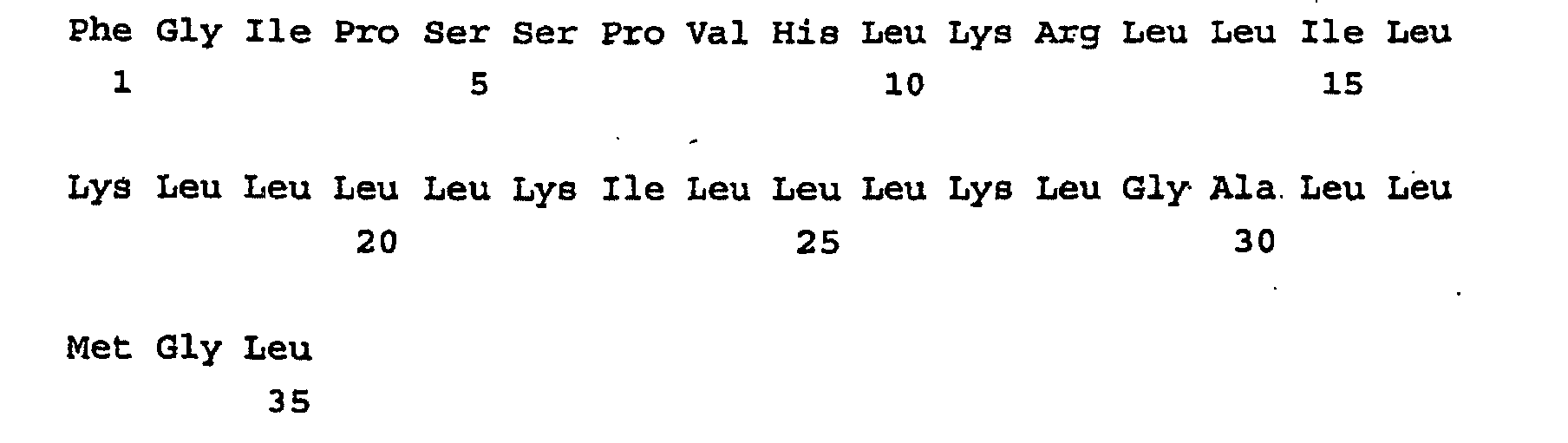
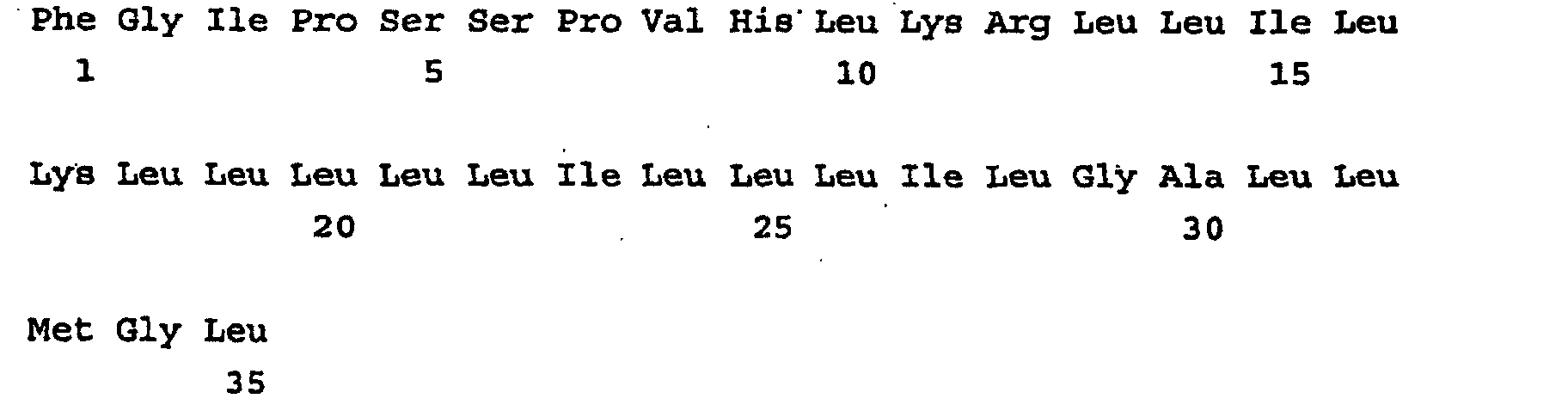
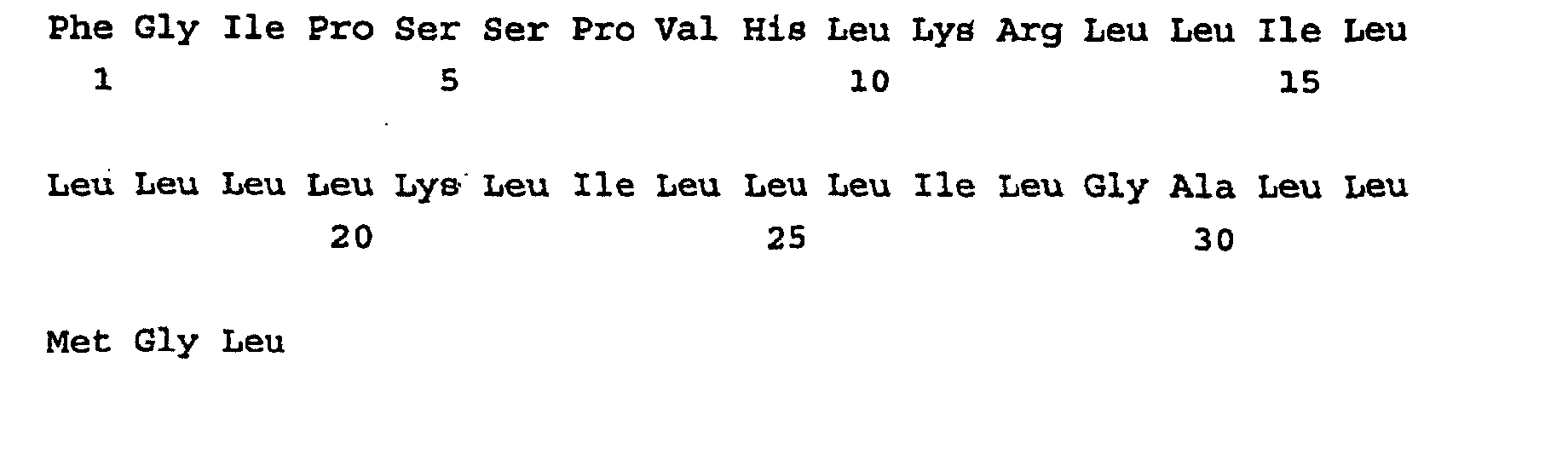
- the invention provides SP-C analogues having the following general formula (I), using the one-letter amino acid code: F e G f IPZZPVHLKR(X a B) n (X b B) n (X c B) m X d GALLMGL wherein:
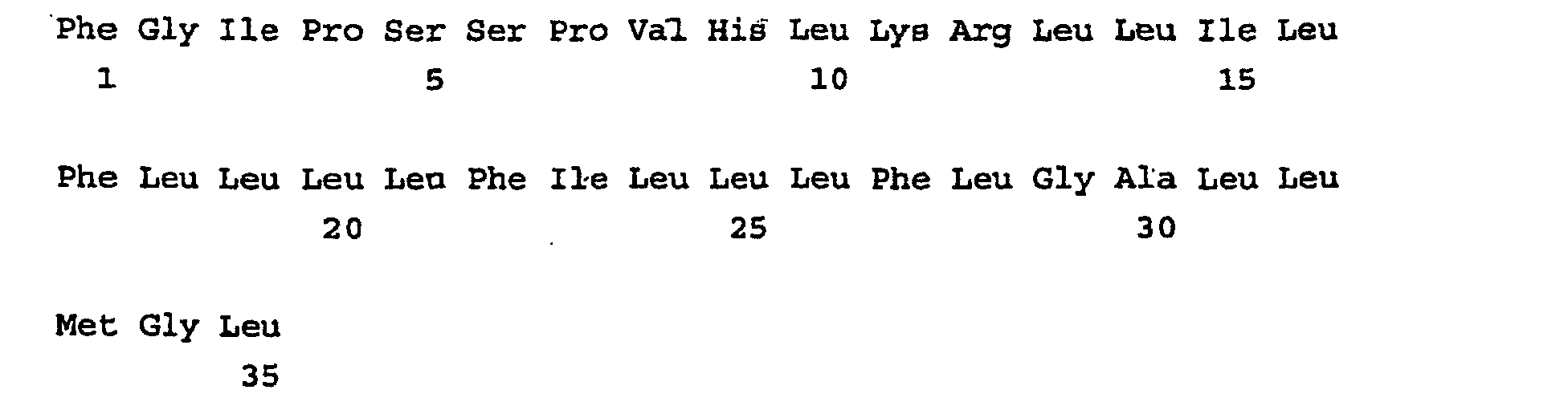
- Preferred peptides of Formula (I) have the following sequences: (Ia) FGIPSSPVHLKRX 4 BX 4 BX 4 BXGALLMGL (Ib) FGIPSSPVHLKRX 5 BX 5 BX 4 GALLMGL (Ic) FGIPSSPVHLKRX 4 BX 11 GALLMGL (Id) FGIPSSPVHLKRX 8 BX 7 GALLMGL (Ie) FGIPSSPVHLKRX 11 BX 4 GALLMGL
- peptides of formula (Ia)-(If) have the following sequences, respectively:
- the Ser residues are covalently linked with acyl groups containing 12-22 carbon atoms.
- Peptides of formula (I) may be prepared by synthetic methods or recombinant techniques.
- S- or O- acylated peptides are preferably synthesized by treatment of the non-acylated peptides with acyl chloride in neat trifluoroacetic acid as described in Yousefi-Salakdeh et al. Biochem J 1999, 343, 557-562. After synthesis and purification, the synthetic peptides were biochemically and biophysically characterised, as reported in the following section "Examples".
- the activity of the peptides of the invention in reducing surface tension has been evaluated in combination with lipids and phospholipids, SP-B, analogues of SP-B or substitutes of SP-B.
- the peptides have been combined with DPPC (1,2-dipalmitoyl-sn-glycero-3-phosphocholine)/PG (phosphatidylglycerol)/PA (palmitic acid) with or without SP-B, an active analogue thereof and polymyxins.
- SP-B or active analogue thereof to the mixture peptide/lipids-phospholipids gave particularly favourable results. Furthermore it has been surprisingly found that polymyxins, in particular polymyxin B, act as substituents of SP-B and their addition gave comparable results to those achieved with SP-B.
- the invention provides a synthetic surfactant comprising one or more peptides of formula (I), in admixture with lipids and/or phospholipids and optionally SP-B, an active derivative thereof or polymyxins.
- Suitable lipids/phospholipids may be selected from the group consisting of phosphatidylcholines (preferably DPPC) PG, PA, triacylglycerols, sphingomyelin.
- surfactant mixtures containing the peptide in which palmitoyl chains are O-covalently linked to the Ser residues should be used. It has been found that surfactant mixtures containing a dipalmitoylated form of the reference peptide (SP-C(Leu)) exhibit higher surface film stability and increased size of the surface-associated lipid reservoir, compared to mixtures containing the corresponding non-palmitoylated peptide, as measured by captive bubble system. In the samples containing 5% of dipalmitoylated peptide, the ⁇ min was below 1.5 mN/m and the films very stable, as the surface tension increased by less than 0.5 mN/m within 10 min at constant bubble volume.
- the ⁇ min for the non-palmitoylated peptide was approx. 5 mN/m and the films were less stable as observed by frequent bubble clicking at low surface tensions.
- the ability to reach near zero stable surface tension was lost after a few adsorption steps, whereas with the dipalmitoylated peptide the film quality did not deteriorate even after more than 10 expansion steps and the incorporation of reservoir material equivalent to more than two monolayers.
- the improved surface activity of dipalmitoylated peptides was also demonstrated by pulsating bubble surfactometer.
- acyl groups were found to further reduce the tendency to form oligomers. This finding is very important, as during preparation of artificial surfactants, peptide oligomerisation has been found to hinder preparation of the mixtures at higher concentrations than 20 mg/ml (Nilsson et al . Eur J Biochem 1998, 255, 116-124).
- the synthetic surfactant may be prepared by mixing solutions or suspensions of peptides and lipids and by subsequently drying the mixture.
- the dry mixture may be suspended, dispersed or administered as such to subjects in need of treatment for surfactant deficiency.
- the synthetic surfactant will be preferably administered endotracheally or via aerosol.
- the latter form of administration will require the combination of small particles of surfactant with suitable inert propellant.
- Other forms of administration like nebulization or spraying of stable solutions/suspensions of surfactant are also included within the scope of the invention.
- the invention provides the use of the described peptides for the preparation of a surfactant agent to be used in all cases of adult or neonatal surfactant deficiency or dysfunction, related pulmonary diseases such as pneumonia, bronchitis, asthma, meconium aspiration syndrome and also other diseases such as serous otitis media (glue ear).
- pulmonary diseases such as pneumonia, bronchitis, asthma, meconium aspiration syndrome and also other diseases such as serous otitis media (glue ear).
- the surfactant agent will be used, preferably upon endotracheal administration, in the treatment of respiratory distress syndrome which frequently affects premature infants.
- An analogue of SP-C, SP-C(LKS) (Fig. 1) was synthesised by use of stepwise solid phase technology and the tert -butyloxycarbonyl chemistry (Kent, S.B.H. (1988) Annu. Rev. Biochem. 57, 957-989) in an Applied Biosystems 430A instrument. Cleavage of the resin-peptide bond and deprotection of the side-chains were carried out in anhydrous hydrogen fluoride/metoxybenzene/dimethylsulfide, 10:1:1 (v/v/v) for 1.5 h at 0°C.
- acylation the purified peptide (typically about 5 mg) is dried, dissolved in distilled TFA (100 ⁇ l) and acyl chloride (10-20 equivalents compared to peptide) is added. After 10 minutes the reaction is quenched with 80% aqueous ethanol (1.9 ml). Purification of acyl peptides is performed using chromatography over Lipidex 5000 in ethylene chloride/methanol 1:4 (v/v) followed by reversed-phase HPLC over a C18 column using a linear gradient of 2-propanol/0.1% TFA running into 60% (aqueous) methanol/0.1% TFA or 75% (aqueous) ethanol/0.1% TFA.
- the purity of the peptide was checked by sodium-dodecylsulphate (SDS) polyacrylamide gel electrophoresis (PAGE) (Phast-system, Pharmacia, Sweden) and by reversed phase high performance liquid chromatography (HPLC), using a C 18 column and a linear gradient of 60 % aqueous methanol /0.1 % TFA and isopropanol/ 0.1 % TFA (Gustafsson, M. et al. (1997) Biochem. J. 326 , 799-806).
- SDS sodium-dodecylsulphate
- PAGE polyacrylamide gel electrophoresis
- HPLC reversed phase high performance liquid chromatography
- Molecular masses were determined by matrix-assisted laser desorption ionisation-time-of-flight (MALDI-TOF) mass spectrometry (Lasermat 2000, Finnigan MAT) calibrated with vasoactive intestinal peptide (M r 3326.8).
- MALDI-TOF matrix-assisted laser desorption ionisation-time-of-flight
- SP-C(LKS) SDS-PAGE of SP-C(LKS) showed a single band similar to native SP-C while SP-C(Leu) which lacks Lys in the helical part forms oligomers.
- SP-C(Leu)/lipid mixtures which are difficult to solubilize in higher concentrations than 20 mg/ml (Nilsson, G. et al. (1998) Eur. J. Biochem. 255, 116-124.)
- DPPC, PG and PA were all purchased from Sigma Chemical Co. (St Louis, MO).
- Surfactant preparations were prepared by adding SP-C(LKS) alone or SP-C(LKS) and SP-B, to each of the lipid mixtures, at total polypeptide/lipid weight ratios of 0-0.05.
- the mixtures were evaporated under nitrogen and resuspended in 150 mmol/l NaCl or in 10 mmol/l Hepes buffer pH 6,9 containing 140 mmol/l NaCl and 2.0 mmol/l CaCl 2 , at lipid concentrations of 10 ⁇ 80 mg/ml. Repeated freezing and sonication (50 W, 48 kHz) were performed until homogeneous suspensions were achieved. In some cases the final suspensions were incubated at 45°C for 1 h.
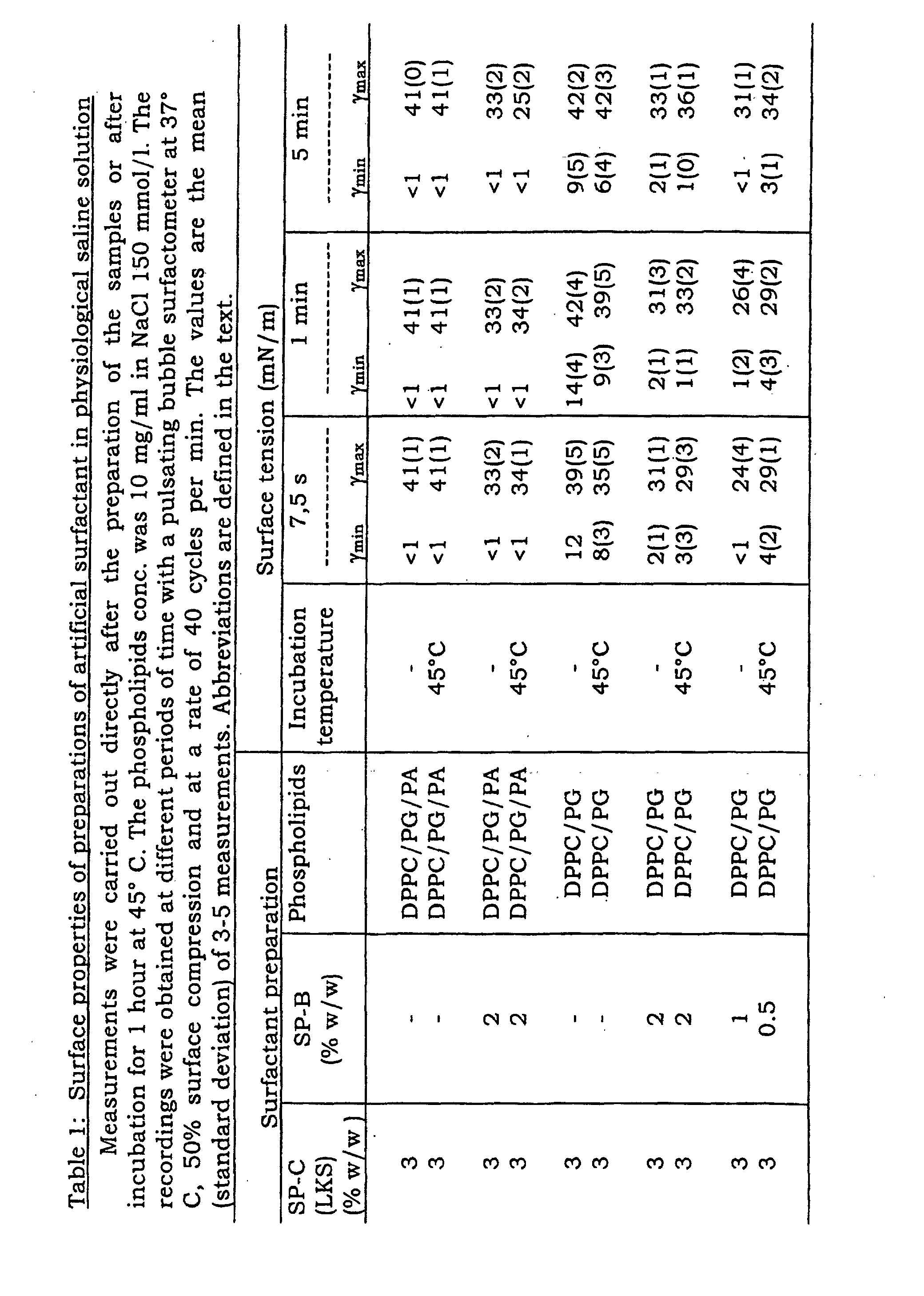
- Surfactant preparations suspended in 150 mmol/l NaCl have a pH of 3.5-5.5. The lower pH-values 3.5-4.5 were observed in preparations containing SP-B. Since native SP-B is purified using acidified organic solvents (Curstedt, T. et al. (1987) Eur. J. Biochem. 168 , 255-262) small amounts of acid may remain in the preparations. Near physiological pH was obtained by suspending the surfactant preparation in Hepes buffer pH 6.9, containing 140 mmol/l NaCl and 2 mmol/l CaCl 2 (Table 1).
- DPPC and PG were purchased from Sigma Chemical Co (St Louis, MO).
- SP-C (LKS) was added to the phospholipid mixtures, at a total polypeptide/phospholipid weight ratio of 0.03.
- the mixtures were evaporated under nitrogen and resuspended at room temperature in 10 mmol/l Hepes buffer pH 6,9 containing 140 mmol/l NaCl and 2.0 mmol/l CaCl 2 or in the same buffer containing 0.01% polymyxin B (PxB) (Sigma Chemical Co, St Louis, MO).
- Dynamic surface tension was recorded using a pulsating bubble surfactometer (Surfactometer International, Toronto, Canada) at 37°C during 50 % cyclic compression of the bubble surface and at a frequency of 40 cycles per min. All measurements were performed for 5 min and at a lipid concentration of 10 mg/ml. The pressure gradiens across the bubble wall were measured at specific time intervals were measured and used to calculate surface tensions at minimum ( ⁇ min ) and maximum ( ⁇ max ) bubble size.
- Surfactant preparations were prepared by adding 3% w/w SP-C(Leu) or dipalmitoylated SP-C(Leu) to each lipid mixtures, made of DPPC/PG/PA 68:22:9 w/w/w. The mixtures were evaporated under nitrogen and resuspended in 150 mmol/l NaCl at lipid concentrations of 10 mg/ml. In the samples in which a SP-B substituent was also used, 1% w/w of polymyxin B was added.
- the effect of surfactant therapy on the mechanical properties of immature lungs was evaluated in 9 preterm newborn rabbits with a gestational age of 27 days.
- the animals were tracheotomized at birth and five of them received, via the tracheal cannula, twice 2.5 ml/kg of artificial surfactant containing DPPC, PG, and SP-C (LKS), with or without polymyxin B, in the proportions given above.
- Total phospholipid concentration of the exogenous surfactant material was 40 mg/ml.
- Servo Ventilator 900B Siemens-Elema, Solna, Sweden
- Tidal volumes were measured with a pneumotachygraph connected to each plethysmograph box.
- the animals were ventilated with a standardized tidal volume of 8-10 ml/kg and without a positive end-expiratory pressure (PEEP).
- PEEP positive end-expiratory pressure
- Lung-thorax compliance was defined as the ratio between tidal volume and peak inspiratory pressure, and expressed as ml/cm H 2 O kg.
- Fig. 1 Amino acid sequences and helical wheel presentations of SP-C and its analogues.
- SP-C(LKS) is based on the primary structure of SP-C but all Val residues at the positions 16-28 with the exception of position 17 are replaced with Leu residues, Lys residues have been introduced at positions 17,22 and 27, and the palmitoylated Cys at positions 5 and 6 are replaced with Ser.
- Fig. 2 Surface spreading of synthetic surfactant preparations.
Landscapes
- Health & Medical Sciences (AREA)
- Chemical & Material Sciences (AREA)
- Organic Chemistry (AREA)
- Life Sciences & Earth Sciences (AREA)
- General Health & Medical Sciences (AREA)
- Medicinal Chemistry (AREA)
- Pulmonology (AREA)
- General Chemical & Material Sciences (AREA)
- Pharmacology & Pharmacy (AREA)
- Veterinary Medicine (AREA)
- Public Health (AREA)
- Animal Behavior & Ethology (AREA)
- Nuclear Medicine, Radiotherapy & Molecular Imaging (AREA)
- Chemical Kinetics & Catalysis (AREA)
- Bioinformatics & Cheminformatics (AREA)
- Engineering & Computer Science (AREA)
- Proteomics, Peptides & Aminoacids (AREA)
- Molecular Biology (AREA)
- Biophysics (AREA)
- Gastroenterology & Hepatology (AREA)
- Genetics & Genomics (AREA)
- Biochemistry (AREA)
- Zoology (AREA)
- Toxicology (AREA)
- Peptides Or Proteins (AREA)
- Medicines That Contain Protein Lipid Enzymes And Other Medicines (AREA)
Description
- a
- is an integer from 1 to 19
- b
- is an integer from 1 to 19
- c
- is an integer from 1 to 21
- d
- is an integer from 0 to 20
- e
- is 0 or 1
- f
- is 0 or 1
- n
- is 0 or 1
- m
- is 0 or 1
- n + m > 0,
- f ≥ e;
- (XaB)n(XbB)n(XcB)mXd is a sequence having a maximum of 22 amino acids, preferably from 10 to 22.







| Surface properties Surface tension of the mixtures was obtained with a pulsating bubble surfactometer. After two minutes of equilibration, the recordings were obtained at different periods, at 37° C, 50% surface compression and at a rate of 40 cycles per min. | ||||||||
| Surfactant preparation | Surface tension (mN/m) | |||||||
| SP-C(Leu) | Dipalm. SP-C(Leu) | PxB | 7,5 s | 1 min | 5 min | |||
| (weight %) | (weight %) | (weight %) | γ min | γ max | γ min | γ max | γ min | γ max |
| 1 | 11 | 39 | 6,2 | 39 | 2 | 42 | ||
| 1 | 1 | 3 | 37 | 3 | 38 | 0 | 40 | |
| 1 | - | 1 | 34 | 1 | 35 | 1 | 36 | |
| 1 | 1 | 0 | 29 | 0 | 34 | 0 | 35 |
<141>
<151> 1999-02-12
<211> 35
<212> PRT
<213> Artificial Sequence
<223> Description of Artificial Sequence:syntetic peptides
<211> 35
<212> PRT
<213> Artificial Sequence
<223> Description of Artificial Sequence:syntetic peptides

<211> 35
<212> PRT
<213> Artificial Sequence
<223> Description of Artificial Sequence:syntetic peptides
<211> 35
<212> PRT
<213> Artificial Sequence
<223> Description of Artificial Sequence:syntetic peptides
<211> 35
<212> PRT
<213> Artificial Sequence
<223> Description of Artificial Sequence:syntetic peptides

<211> 35
<212> PRT
<213> Artificial Sequence
<223> Description of Artificial Sequence:syntetic peptides
Claims (16)
- SP-C analogues having general formula (I), according to one-letter amino acid code:
- X
- is an amino acid selected from the group consisting of I, L, Nle (norleucine);
- B
- is an amino acid selected from the group consisting of K, W, F, Y, Ornithine;
- Z
- is S and can be optionally linked via ester bond with acyl group containing 12-22 carbon atoms.
- a
- is an integer from 1 to 19;
- b
- is an integer from 1 to 19;
- c
- is an integer from 1 to 21;
- d
- is an integer from 0 to 20;
- e
- is 0 or 1;
- f
- is 0 or 1;
- n
- is 0 or 1;
- m
- is 0 or 1,
n + m > 0;f ≥ e;(XaB)n(XbB)n(XcB)mXd is a sequence having a maximum of 22 amino acids, preferably from 10 to 22 amino acids. - SP-C analogues according to claim 1, having formula (Ia):
- SP-C analogues according to claim 1, having formula (Ib):
- SP-C analogues according to claim 1, having formula (Ic)
- SP-C analogues according to claim 1, having formula (Id)
- SP-C analogues according to claim 1, having formula (Ie)
- SP-C analogues according to claims 1-6, in which Ser residues are acylated preferably with palmitoyl groups.
- SP-C analogues according to claims 1-7, in which B is Lysine or Phenylalanine and X is Leucine, Isoleucine or Norleucine.
- SP-C analogues according to claim 8, selected from the group consisting of:






- A synthetic surfactant comprising at least one SP-C analogue of formula (I) in admixture with lipids and phospholipids.
- A synthetic surfactant according to claim 10, in which the mixture lipids/phospholipids comprises DPPG, PG, PA.
- A synthetic surfactant according to claims 10-11, further comprising SP-B or an active derivative thereof or a polymyxin.
- A synthetic surfactant according to claims 10-12, in form of solution, dispersion, suspension, dry powder.
- Use of SP-C analogues of claims 1-7 for the preparation of an artificial surfactant to be used in all cases of pulmonary surfactant deficiencies and related dysfunctions.
- Use of a polymyxin, preferably polymyxin B for the preparation of an artificial surfactant according to claims 10-13, for the treatment of all cases of pulmonary surfactant deficiencies and related dysfunctions.
- Use according to claims 14 and 15, in which the surfactant deficiency is respiratory distress syndrome.
Priority Applications (1)
| Application Number | Priority Date | Filing Date | Title |
|---|---|---|---|
| SI200030533T SI1151008T1 (en) | 1999-02-12 | 2000-02-09 | Artificial peptides having surface activity and the use thereof in the preparation of artificial surfactant |
Applications Claiming Priority (3)
| Application Number | Priority Date | Filing Date | Title |
|---|---|---|---|
| IT1999MI000275A IT1308180B1 (en) | 1999-02-12 | 1999-02-12 | SYNTHETIC PEPTIDES HAVING THE ABILITY TO DECREASE SURFACE TENSION AND THEIR USE IN THE PREPARATION OF A SURFACTANT |
| ITMI990275 | 1999-02-12 | ||
| PCT/EP2000/001044 WO2000047623A1 (en) | 1999-02-12 | 2000-02-09 | Artificial peptides having surface activity and the use thereof in the preparation of artificial surfactant |
Publications (2)
| Publication Number | Publication Date |
|---|---|
| EP1151008A1 EP1151008A1 (en) | 2001-11-07 |
| EP1151008B1 true EP1151008B1 (en) | 2004-10-20 |
Family
ID=11381859
Family Applications (1)
| Application Number | Title | Priority Date | Filing Date |
|---|---|---|---|
| EP00910658A Expired - Lifetime EP1151008B1 (en) | 1999-02-12 | 2000-02-09 | Artificial peptides having surface activity and the use thereof in the preparation of artificial surfactant |
Country Status (32)
| Country | Link |
|---|---|
| US (1) | US7053044B1 (en) |
| EP (1) | EP1151008B1 (en) |
| JP (1) | JP4754073B2 (en) |
| KR (1) | KR100645145B1 (en) |
| CN (1) | CN1221570C (en) |
| AR (1) | AR022578A1 (en) |
| AT (1) | ATE280181T1 (en) |
| AU (1) | AU758735B2 (en) |
| BG (1) | BG65196B1 (en) |
| BR (1) | BR0009964A (en) |
| CA (1) | CA2362507C (en) |
| CO (1) | CO5241361A1 (en) |
| CZ (1) | CZ301108B6 (en) |
| DE (1) | DE60015082T2 (en) |
| EA (1) | EA004058B1 (en) |
| EE (1) | EE04879B1 (en) |
| ES (1) | ES2228473T3 (en) |
| GE (1) | GEP20032976B (en) |
| HU (1) | HU228997B1 (en) |
| IL (1) | IL144842A0 (en) |
| IT (1) | IT1308180B1 (en) |
| MA (1) | MA25381A1 (en) |
| NO (1) | NO20013888L (en) |
| NZ (1) | NZ513451A (en) |
| PL (1) | PL201084B1 (en) |
| PT (1) | PT1151008E (en) |
| SK (1) | SK286428B6 (en) |
| TR (1) | TR200102308T2 (en) |
| UA (1) | UA72751C2 (en) |
| WO (1) | WO2000047623A1 (en) |
| YU (1) | YU57701A (en) |
| ZA (1) | ZA200106530B (en) |
Families Citing this family (37)
| Publication number | Priority date | Publication date | Assignee | Title |
|---|---|---|---|---|
| IT1308180B1 (en) * | 1999-02-12 | 2001-12-07 | Chiesi Farma Spa | SYNTHETIC PEPTIDES HAVING THE ABILITY TO DECREASE SURFACE TENSION AND THEIR USE IN THE PREPARATION OF A SURFACTANT |
| CA2399944A1 (en) * | 2000-02-11 | 2001-08-16 | Altana Pharma Ag | Novel use of pulmonary surfactant for the prophylaxis and treatment of chronic pulmonary diseases |
| DK1340506T3 (en) * | 2002-03-01 | 2007-05-07 | Chiesi Farma Spa | Compositions comprising pulmonary surfactants and a polymyxin with improved surface properties |
| ITMI20021058A1 (en) * | 2002-05-17 | 2003-11-17 | Chiesi Farma Spa | MIXTURES OF SYNTHETIC LIPIDS OPTIMIZED FOR THE PREPARATION OF A RECONSTITUTED SURFACTANT |
| CA2507613A1 (en) * | 2002-12-09 | 2004-07-08 | Jeffrey A. Whitsett | Methods of diagnosis and treatment of interstitial lung disease |
| EP1481665A1 (en) * | 2003-05-30 | 2004-12-01 | CHIESI FARMACEUTICI S.p.A. | Novel lipid mixtures for synthetic surfactants |
| US20090011978A1 (en) * | 2003-08-28 | 2009-01-08 | Atlanta Pharma Ag | Use of Surfactant Preparations for the Treatment of Surgical Adhesions |
| US20060004185A1 (en) * | 2004-07-01 | 2006-01-05 | Leese Richard A | Peptide antibiotics and peptide intermediates for their prepartion |
| US8337815B2 (en) * | 2004-12-23 | 2012-12-25 | Discovery Laboratories, Inc. | Pulmonary surfactant formulations |
| WO2008011559A2 (en) | 2006-07-20 | 2008-01-24 | University Of Rochester | Synthetic lung surfactant and use thereof |
| PT2078038E (en) * | 2006-10-13 | 2013-12-12 | Chiesi Farma Spa | Reconstituted surfactants having improved properties |
| EP1997502A1 (en) | 2007-06-01 | 2008-12-03 | CHIESI FARMACEUTICI S.p.A. | Reconstituted surfactants having improved properties |
| US8048043B2 (en) | 2007-06-08 | 2011-11-01 | Chiesi Farmaceutici S. P. A. | Method of administration of a pulmonary surfactant |
| EP2022798A1 (en) * | 2007-08-09 | 2009-02-11 | CHIESI FARMACEUTICI S.p.A. | Synthetic pulmonary surfactant peptides |
| AR074874A1 (en) | 2008-12-23 | 2011-02-16 | Biosource Pharm Inc | ANTIBIOTIC COMPOSITIONS FOR THE TREATMENT OF NEGATIVE GRAM INFECTIONS. METHOD. USE. COMPOUND. |
| WO2011029525A1 (en) | 2009-09-08 | 2011-03-17 | Chiesi Farmaceutici S.P.A. | A therapeutic combination comprising a pulmonary surfactant and antioxidant enzymes |
| US8415307B1 (en) | 2010-06-23 | 2013-04-09 | Biosource Pharm, Inc. | Antibiotic compositions for the treatment of gram negative infections |
| EA027030B1 (en) * | 2012-04-23 | 2017-06-30 | КЬЕЗИ ФАРМАЧЕУТИЧИ С.п.А. | Method and system for the administration of a pulmonary surfactant by atomization |
| US9074018B2 (en) | 2012-11-21 | 2015-07-07 | Chiesi Farmaceutici S.P.A. | Reconstituted pulmonary surfactants |
| EP3106090A1 (en) | 2015-06-15 | 2016-12-21 | CHIESI FARMACEUTICI S.p.A. | System for effective breath-synchronized delivery of medicament to the lungs |
| HK1247140A1 (en) | 2015-04-22 | 2018-09-21 | 奇斯药制品公司 | Method and system for effective breath-synchronized delivery of medicament to the lungs |
| US11311691B2 (en) | 2015-04-28 | 2022-04-26 | Chiesi Farmaceutici S.P.A | Device for facilitating the administration of a medicament to the lung by a catheter |
| JP2018514545A (en) | 2015-04-30 | 2018-06-07 | ユニバーシティ オブ ブレーメン | New skin care products for medical and cosmetic use |
| CN109496159A (en) | 2016-07-28 | 2019-03-19 | 奇斯药制品公司 | For delivering the method and system of aerosolized medication |
| ES2892903T3 (en) | 2016-10-26 | 2022-02-07 | Chiesi Farm Spa | Device to facilitate the administration of a drug to the lungs by means of a catheter |
| BR112019012922A2 (en) | 2016-12-22 | 2019-12-10 | Chiesi Farm Spa | combination of a pulmonary surfactant, use of a combination of a pulmonary surfactant and kit |
| TW201927286A (en) | 2017-12-15 | 2019-07-16 | 義大利商凱西製藥公司 | Pharmaceutical formulation comprising pulmonary surfactant for administration by nebulization |
| WO2019115771A1 (en) | 2017-12-15 | 2019-06-20 | Pari Pharma Gmbh | Nebuliser system, holding system, combination comprising nebuliser system and holding system, and aerosol administration method |
| JP7378425B2 (en) | 2018-04-23 | 2023-11-13 | シエシー ファルマセウティチィ ソシエタ ペル アチオニ | Therapeutic combination including pulmonary surfactant and steroids for the prevention of BPD |
| EP3666316A1 (en) | 2018-12-14 | 2020-06-17 | PARI Pharma GmbH | Aerosol delivery device and method of operating the aerosol delivery device |
| EP3666315A1 (en) | 2018-12-14 | 2020-06-17 | PARI Pharma GmbH | Aerosol delivery device and method of operating the aerosol delivery device |
| EP3843105A1 (en) | 2019-12-23 | 2021-06-30 | PARI Pharma GmbH | Control device for aerosol nebulizer system |
| US12606609B2 (en) | 2020-01-28 | 2026-04-21 | Chiesi Farmaceutici S.P.A. | Polypeptides having improved properties |
| CN114159546B (en) * | 2021-12-20 | 2024-06-04 | 北京双鹤润创科技有限公司 | New generation synthetic lung surfactant preparation and clinical application thereof |
| EP4411745A1 (en) | 2023-02-01 | 2024-08-07 | Pari Medical Holding GmbH | Medical evaluation method, aerosol nebulizer and medical evaluation system |
| EP4464354A1 (en) | 2023-05-15 | 2024-11-20 | Pari Medical Holding GmbH | Method of operating an inhalation device, inhalation device and inhalation device system for providing inhalation process/breath guiding |
| EP4464236A1 (en) | 2023-05-15 | 2024-11-20 | Pari Medical Holding GmbH | Method of operating an inhalation device, inhalation device and inhalation device system for providing inhalation process feedback |
Family Cites Families (5)
| Publication number | Priority date | Publication date | Assignee | Title |
|---|---|---|---|---|
| US5104853A (en) * | 1984-12-11 | 1992-04-14 | California Biotechnology Inc. | Alveolar surfactant proteins having cys to ser mutations |
| SE8803713D0 (en) * | 1988-10-18 | 1988-10-18 | Kabigen Ab | BIOLOGICALLY ACTIVE LIPOPROTEIN AND ITS USE |
| PT733645E (en) * | 1993-12-08 | 2003-07-31 | Mitsubishi Pharma Corp | NEW SYNTHETIC SYNTHETIC PEPTIDE TENSOACTIVE PULMONARY THAT CONTAINS IT AND MEDICATION FOR SYNDROME OF RESPIRATORY INSUFFICIENCY |
| DE4418936A1 (en) * | 1994-05-31 | 1996-02-08 | Byk Gulden Lomberg Chem Fab | Polypeptide |
| IT1308180B1 (en) * | 1999-02-12 | 2001-12-07 | Chiesi Farma Spa | SYNTHETIC PEPTIDES HAVING THE ABILITY TO DECREASE SURFACE TENSION AND THEIR USE IN THE PREPARATION OF A SURFACTANT |
-
1999
- 1999-02-12 IT IT1999MI000275A patent/IT1308180B1/en active
-
2000
- 2000-02-09 NZ NZ513451A patent/NZ513451A/en unknown
- 2000-02-09 ES ES00910658T patent/ES2228473T3/en not_active Expired - Lifetime
- 2000-02-09 PT PT00910658T patent/PT1151008E/en unknown
- 2000-02-09 AU AU32793/00A patent/AU758735B2/en not_active Ceased
- 2000-02-09 US US09/926,009 patent/US7053044B1/en not_active Expired - Lifetime
- 2000-02-09 TR TR2001/02308T patent/TR200102308T2/en unknown
- 2000-02-09 CN CNB008036691A patent/CN1221570C/en not_active Expired - Fee Related
- 2000-02-09 EP EP00910658A patent/EP1151008B1/en not_active Expired - Lifetime
- 2000-02-09 HU HU0200141A patent/HU228997B1/en unknown
- 2000-02-09 BR BR0009964-3A patent/BR0009964A/en not_active Application Discontinuation
- 2000-02-09 EA EA200100749A patent/EA004058B1/en not_active IP Right Cessation
- 2000-02-09 DE DE60015082T patent/DE60015082T2/en not_active Expired - Lifetime
- 2000-02-09 WO PCT/EP2000/001044 patent/WO2000047623A1/en not_active Ceased
- 2000-02-09 YU YU57701A patent/YU57701A/en unknown
- 2000-02-09 JP JP2000598538A patent/JP4754073B2/en not_active Expired - Fee Related
- 2000-02-09 GE GEAP20006042A patent/GEP20032976B/en unknown
- 2000-02-09 SK SK1144-2001A patent/SK286428B6/en not_active IP Right Cessation
- 2000-02-09 CZ CZ20012876A patent/CZ301108B6/en not_active IP Right Cessation
- 2000-02-09 EE EEP200100413A patent/EE04879B1/en unknown
- 2000-02-09 CA CA2362507A patent/CA2362507C/en not_active Expired - Fee Related
- 2000-02-09 AT AT00910658T patent/ATE280181T1/en active
- 2000-02-09 KR KR1020017009666A patent/KR100645145B1/en not_active Expired - Fee Related
- 2000-02-09 PL PL349785A patent/PL201084B1/en unknown
- 2000-02-09 IL IL14484200A patent/IL144842A0/en unknown
- 2000-02-11 CO CO00009307A patent/CO5241361A1/en not_active Application Discontinuation
- 2000-02-11 AR ARP000100605A patent/AR022578A1/en unknown
- 2000-09-02 UA UA2001075375A patent/UA72751C2/en unknown
-
2001
- 2001-08-01 BG BG105764A patent/BG65196B1/en unknown
- 2001-08-03 MA MA26285A patent/MA25381A1/en unknown
- 2001-08-08 ZA ZA200106530A patent/ZA200106530B/en unknown
- 2001-08-09 NO NO20013888A patent/NO20013888L/en not_active Application Discontinuation
Also Published As
Similar Documents
| Publication | Publication Date | Title |
|---|---|---|
| US7053044B1 (en) | Artificial peptides having surface activity and the use thereof in the preparation of artificial surfactant | |
| RS57701B1 (en) | Fertiliser coating containing micronutrients | |
| JP5575639B2 (en) | Reconstruction surfactant with improved properties | |
| EP2078038B1 (en) | Reconstituted surfactants having improved properties | |
| PALMBLAD et al. | Biophysical activity of an artificial surfactant containing an analogue of surfactant protein (SP)-C and native SP-B | |
| AU2008286026B2 (en) | Synthetic pulmonary surfactant peptides | |
| MXPA01008073A (en) | Artificial peptides having surface activity and the use thereof in the preparation of artificial surfactant | |
| HK1185274B (en) | Reconstituted surfactants having improved properties | |
| HK1134497B (en) | Reconstituted surfactants having improved properties | |
| HK1144435A (en) | Synthetic pulmonary surfactant peptides |
Legal Events
| Date | Code | Title | Description |
|---|---|---|---|
| PUAI | Public reference made under article 153(3) epc to a published international application that has entered the european phase |
Free format text: ORIGINAL CODE: 0009012 |
|
| 17P | Request for examination filed |
Effective date: 20010725 |
|
| AK | Designated contracting states |
Kind code of ref document: A1 Designated state(s): AT BE CH CY DE DK ES FI FR GB GR IE IT LI LU MC NL PT SE |
|
| AX | Request for extension of the european patent |
Free format text: AL PAYMENT 20010725;LT PAYMENT 20010725;LV PAYMENT 20010725;MK PAYMENT 20010725;RO PAYMENT 20010725;SI PAYMENT 20010725 |
|
| 17Q | First examination report despatched |
Effective date: 20030818 |
|
| GRAP | Despatch of communication of intention to grant a patent |
Free format text: ORIGINAL CODE: EPIDOSNIGR1 |
|
| GRAS | Grant fee paid |
Free format text: ORIGINAL CODE: EPIDOSNIGR3 |
|
| GRAA | (expected) grant |
Free format text: ORIGINAL CODE: 0009210 |
|
| AK | Designated contracting states |
Kind code of ref document: B1 Designated state(s): AT BE CH CY DE DK ES FI FR GB GR IE IT LI LU MC NL PT SE |
|
| AX | Request for extension of the european patent |
Extension state: AL LT LV MK RO SI |
|
| REG | Reference to a national code |
Ref country code: GB Ref legal event code: FG4D |
|
| REG | Reference to a national code |
Ref country code: CH Ref legal event code: EP |
|
| REG | Reference to a national code |
Ref country code: IE Ref legal event code: FG4D |
|
| REF | Corresponds to: |
Ref document number: 60015082 Country of ref document: DE Date of ref document: 20041125 Kind code of ref document: P |
|
| REG | Reference to a national code |
Ref country code: GR Ref legal event code: EP Ref document number: 20040403917 Country of ref document: GR |
|
| REG | Reference to a national code |
Ref country code: CH Ref legal event code: NV Representative=s name: ISLER & PEDRAZZINI AG |
|
| REG | Reference to a national code |
Ref country code: PT Ref legal event code: SC4A Effective date: 20041129 |
|
| REG | Reference to a national code |
Ref country code: SE Ref legal event code: TRGR |
|
| REG | Reference to a national code |
Ref country code: DK Ref legal event code: T3 |
|
| REG | Reference to a national code |
Ref country code: ES Ref legal event code: FG2A Ref document number: 2228473 Country of ref document: ES Kind code of ref document: T3 |
|
| PLBE | No opposition filed within time limit |
Free format text: ORIGINAL CODE: 0009261 |
|
| STAA | Information on the status of an ep patent application or granted ep patent |
Free format text: STATUS: NO OPPOSITION FILED WITHIN TIME LIMIT |
|
| ET | Fr: translation filed | ||
| 26N | No opposition filed |
Effective date: 20050721 |
|
| REG | Reference to a national code |
Ref country code: CH Ref legal event code: PCAR Free format text: ISLER & PEDRAZZINI AG;POSTFACH 1772;8027 ZUERICH (CH) |
|
| PGFP | Annual fee paid to national office [announced via postgrant information from national office to epo] |
Ref country code: MC Payment date: 20080118 Year of fee payment: 9 |
|
| PGFP | Annual fee paid to national office [announced via postgrant information from national office to epo] |
Ref country code: CY Payment date: 20080128 Year of fee payment: 9 |
|
| PG25 | Lapsed in a contracting state [announced via postgrant information from national office to epo] |
Ref country code: MC Free format text: LAPSE BECAUSE OF NON-PAYMENT OF DUE FEES Effective date: 20090228 |
|
| PG25 | Lapsed in a contracting state [announced via postgrant information from national office to epo] |
Ref country code: CY Free format text: LAPSE BECAUSE OF NON-PAYMENT OF DUE FEES Effective date: 20090209 |
|
| REG | Reference to a national code |
Ref country code: FR Ref legal event code: PLFP Year of fee payment: 17 |
|
| REG | Reference to a national code |
Ref country code: FR Ref legal event code: PLFP Year of fee payment: 18 |
|
| REG | Reference to a national code |
Ref country code: FR Ref legal event code: PLFP Year of fee payment: 19 |
|
| PGFP | Annual fee paid to national office [announced via postgrant information from national office to epo] |
Ref country code: NL Payment date: 20190226 Year of fee payment: 20 Ref country code: LU Payment date: 20190227 Year of fee payment: 20 |
|
| PGFP | Annual fee paid to national office [announced via postgrant information from national office to epo] |
Ref country code: FI Payment date: 20190227 Year of fee payment: 20 Ref country code: DE Payment date: 20190227 Year of fee payment: 20 Ref country code: IE Payment date: 20190227 Year of fee payment: 20 Ref country code: CH Payment date: 20190304 Year of fee payment: 20 Ref country code: IT Payment date: 20190222 Year of fee payment: 20 Ref country code: GB Payment date: 20190227 Year of fee payment: 20 Ref country code: ES Payment date: 20190301 Year of fee payment: 20 |
|
| PGFP | Annual fee paid to national office [announced via postgrant information from national office to epo] |
Ref country code: SE Payment date: 20190227 Year of fee payment: 20 Ref country code: FR Payment date: 20190225 Year of fee payment: 20 Ref country code: DK Payment date: 20190227 Year of fee payment: 20 Ref country code: GR Payment date: 20190227 Year of fee payment: 20 Ref country code: AT Payment date: 20190122 Year of fee payment: 20 Ref country code: BE Payment date: 20190227 Year of fee payment: 20 |
|
| PGFP | Annual fee paid to national office [announced via postgrant information from national office to epo] |
Ref country code: PT Payment date: 20190122 Year of fee payment: 20 |
|
| REG | Reference to a national code |
Ref country code: DE Ref legal event code: R071 Ref document number: 60015082 Country of ref document: DE |
|
| REG | Reference to a national code |
Ref country code: DK Ref legal event code: EUP Effective date: 20200209 |
|
| REG | Reference to a national code |
Ref country code: NL Ref legal event code: MK Effective date: 20200208 |
|
| REG | Reference to a national code |
Ref country code: CH Ref legal event code: PL |
|
| REG | Reference to a national code |
Ref country code: GB Ref legal event code: PE20 Expiry date: 20200208 |
|
| REG | Reference to a national code |
Ref country code: AT Ref legal event code: MK07 Ref document number: 280181 Country of ref document: AT Kind code of ref document: T Effective date: 20200209 |
|
| REG | Reference to a national code |
Ref country code: FI Ref legal event code: MAE |
|
| REG | Reference to a national code |
Ref country code: IE Ref legal event code: MK9A |
|
| REG | Reference to a national code |
Ref country code: BE Ref legal event code: MK Effective date: 20200209 |
|
| REG | Reference to a national code |
Ref country code: SE Ref legal event code: EUG |
|
| PG25 | Lapsed in a contracting state [announced via postgrant information from national office to epo] |
Ref country code: IE Free format text: LAPSE BECAUSE OF EXPIRATION OF PROTECTION Effective date: 20200209 Ref country code: GB Free format text: LAPSE BECAUSE OF EXPIRATION OF PROTECTION Effective date: 20200208 Ref country code: PT Free format text: LAPSE BECAUSE OF EXPIRATION OF PROTECTION Effective date: 20200220 |
|
| REG | Reference to a national code |
Ref country code: ES Ref legal event code: FD2A Effective date: 20210111 |
|
| PG25 | Lapsed in a contracting state [announced via postgrant information from national office to epo] |
Ref country code: ES Free format text: LAPSE BECAUSE OF EXPIRATION OF PROTECTION Effective date: 20200210 |