EP1150532A1 - Procédé de connexion à un réseau informatique d'un terminal téléphonique radio "bimode" - Google Patents
Procédé de connexion à un réseau informatique d'un terminal téléphonique radio "bimode" Download PDFInfo
- Publication number
- EP1150532A1 EP1150532A1 EP01401053A EP01401053A EP1150532A1 EP 1150532 A1 EP1150532 A1 EP 1150532A1 EP 01401053 A EP01401053 A EP 01401053A EP 01401053 A EP01401053 A EP 01401053A EP 1150532 A1 EP1150532 A1 EP 1150532A1
- Authority
- EP
- European Patent Office
- Prior art keywords
- terminal
- connection
- network
- internet
- channel
- Prior art date
- Legal status (The legal status is an assumption and is not a legal conclusion. Google has not performed a legal analysis and makes no representation as to the accuracy of the status listed.)
- Withdrawn
Links
- 238000000034 method Methods 0.000 title claims abstract description 9
- 230000009977 dual effect Effects 0.000 title description 2
- 230000001413 cellular effect Effects 0.000 claims abstract description 15
- 238000001514 detection method Methods 0.000 claims abstract description 4
Images
Classifications
-
- H—ELECTRICITY
- H04—ELECTRIC COMMUNICATION TECHNIQUE
- H04W—WIRELESS COMMUNICATION NETWORKS
- H04W36/00—Hand-off or reselection arrangements
- H04W36/14—Reselecting a network or an air interface
Definitions
- Certain radio telephone terminals are capable of communicating through a cellular telephone network, by example GSM, and, via a radio base, for example DECT, to through a fixed or wired telephone network, such as the PSTN or ISDN network.
- Such telephone terminals can also be equipped with Internet capabilities allowing them to send and receive messages to across the Internet and / or browse the Internet.
- a telephone terminal To communicate over the Internet, a telephone terminal must first connect to it, by telephone connection, through one of the two networks, cellular and fixed, to an Internet service provider. The terminal is then connected to the Internet through a communication channel of one of the networks, cellular and fixed.
- the present invention proposes to optimize the data rate, during a communication from a telephone terminal of the type defined above to across the Internet and more generally across a computer network of this type.
- the invention relates to a method of connection, to a network computer, radio telephone terminal, able to communicate to over a cellular network and through a telephone base radio, through a fixed network, in which the terminal connects to the network IT via a first communication channel of the cellular network, characterized in that, in the event that the terminal enters in the base coverage area during its connection to the network IT via the first channel, the base connects to the IT network via a second fixed network communication channel and the terminal switches from the first channel to the second channel for connection to the computer network.
- the terminal changes the connection channel to take advantage of the advantages of fixed network.
- the terminal being in communication with through the computer network via the first channel, after switching, it continues said communication via the second channel and base.
- the base automatically connects to the computer network, upon detection of the presence of the terminal in its area of coverage and ongoing connection of the terminal to the computer network.
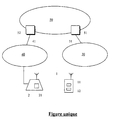
- the radio telephone terminal 1 is here a "dual-mode" telephone, able to communicate in cellular mode, here GSM, through a network GSM 30 cellular telephone, and, via a base telephone radio 2, here DECT, in DECT mode, through a network fixed or wired telephone, in this case the PSTN switched telephone network 40, to which the base 2 is connected.
- GSM Global System for Mobile Communications
- the terminal 1 includes an Internet browser 11, allowing it to be connect to the Internet 50, by telephone connection, through the network cellular 30, to a first provider 51 of access to the Internet 50, and communicate through the Internet 50.
- the terminal 1 also comprises a block 12 channel switching, allowing it to change connection channel to the Internet 50, during the same connection to the Internet 50, like this will be explained later.
- the base 2 is connected to the telephone network 40, by wire connection. It includes a block 21 for connection to the Internet 50, allowing it to connect to the Internet 50, by telephone connection, through the network wired 40, to a second Internet access provider 52 30. Base 2 is arranged to automatically connect to the Internet 50, upon receipt of a message from terminal 1 indicating that it is connected to the Internet 50, such as explained below.
- the terminal 1 is initially located in the coverage area of the GSM 30 network, but in outside the coverage area of the DECT 2 base.
- terminal 1 Under the control of a user, terminal 1 connects to the Internet 50, by telephone connection, through the GSM 30 network, at access provider 51. For this, terminal 1 calls the access provider 51, establishes a telephone communication with him, through a first communication channel 31, of the GSM network 30, and executes a protocol of connection to the Internet 50. When connecting, terminal 1 obtains a first Internet Protocol (IP) computer address on Internet 50, which will hereinafter be called "IP1".
- IP Internet Protocol
- terminal 1 connected to the Internet 50 by the GSM channel 31, communicates, or navigates, through the Internet 50.
- Data from the Internet communication pass through the GSM 31 channel.
- terminal 1 moves and enters the coverage area of base 2.
- terminal 1 Upon receipt of beacon signals, emitted by base 2, terminal 1 pairs with base 2 and signals its current connection to the Internet 50, by sending a message on specifying.
- the base 2 thus detects the presence of the terminal 1 in its area of coverage and the fact that it is connected to the Internet 50.
- base 2 Upon detection of the presence of terminal 1 in its coverage area and from the current connection of terminal 1 to the Internet 50, base 2 connects automatically to the Internet 50, by telephone connection, through the GSM network 40, to the access provider 52. For this, base 2 calls the access provider 52, establishes with him a telephone call to through a communication channel 41 of the fixed network 40, and performs a Internet connection protocol 50. While connected to the Internet 50, base 2 obtains a second IP address on the Internet 50, which is thereafter will call "IP2".
- IP2 IP2
- Base 2 notifies terminal 1 of its connection to the Internet 50, by sending of a message.
- Terminal 1 then switches from GSM channel 31 to the channel PSTN 41, for connection to the Internet 50, and interrupts the connection with the first access provider 51.
- terminal 1 After changing the communication channel, for connection Internet, terminal 1 resumes and continues the communication in progress through Internet 50, via radio base 2 and PSTN channel 41, in using the IP2 address and no longer the IP1 address.
- terminal 1 leaves of the base 2 coverage area while it is being communication through the Internet 50 via base 2, the terminal 1 connects directly to the Internet 50, via the first access provider 51, then switches communication channel for connection to the Internet 50 and continue Internet communication, after switching, through the GSM channel.
- the terminal could be arranged to communicate in modes cellular and wireless telephony, other than GSM and DECT.
- the base could be connected to any other type of network.
- landline for example to the ISDN network.
Landscapes
- Engineering & Computer Science (AREA)
- Computer Networks & Wireless Communication (AREA)
- Signal Processing (AREA)
- Mobile Radio Communication Systems (AREA)
Abstract
Description
Claims (4)
- Procédé de connexion, à un réseau informatique (50), d'un terminal téléphonique radio (1), pouvant communiquer à travers un réseau cellulaire (30) et, par l'intermédiaire d'une base téléphonique radio (2), à travers un réseau fixe (40), dans lequel le terminal (1) se connecte au réseau informatique (50) par l'intermédiaire d'un premier canal de communication (31) du réseau cellulaire (30), caractérisé par le fait que, dans le cas où le terminal (1) pénètre dans la zone de couverture de la base (2) au cours de sa connexion au réseau informatique (50) par le premier canal (41), la base (2) se connecte au réseau informatique (50) par l'intermédiaire d'un second canal de communication (41) du réseau fixe (40) et le terminal (1) commute du premier canal (31) sur le second canal (41) pour la connexion au réseau informatique (50).
- Procédé selon la revendication 1, dans lequel, le terminal (1) étant en cours de communication à travers le réseau informatique (50) par l'intermédiaire du premier canal (31), après commutation, il poursuit ladite communication par l'intermédiaire du second canal (41) et de la base (2).
- Procédé selon l'une des revendications 1 et 2, dans lequel la base (2) se connecte automatiquement au réseau informatique (50), sur détection de la présence du terminal (1) dans sa zone de couverture et de la connexion en cours du terminal (1) au réseau informatique (50).
- Procédé selon la revendication 3, dans lequel, lorsqu'il pénètre dans la zone de couverture de la base (2), le terminal (1) s'apparie à la base (2) et lui signale qu'il est connecté au réseau informatique (50).
Applications Claiming Priority (2)
| Application Number | Priority Date | Filing Date | Title |
|---|---|---|---|
| FR0005291A FR2808404B1 (fr) | 2000-04-26 | 2000-04-26 | Procede de connexion a un reseau informatique d'un terminal telephonique radio "bimode" |
| FR0005291 | 2000-04-26 |
Publications (1)
| Publication Number | Publication Date |
|---|---|
| EP1150532A1 true EP1150532A1 (fr) | 2001-10-31 |
Family
ID=8849592
Family Applications (1)
| Application Number | Title | Priority Date | Filing Date |
|---|---|---|---|
| EP01401053A Withdrawn EP1150532A1 (fr) | 2000-04-26 | 2001-04-25 | Procédé de connexion à un réseau informatique d'un terminal téléphonique radio "bimode" |
Country Status (2)
| Country | Link |
|---|---|
| EP (1) | EP1150532A1 (fr) |
| FR (1) | FR2808404B1 (fr) |
Cited By (1)
| Publication number | Priority date | Publication date | Assignee | Title |
|---|---|---|---|---|
| GB2406482A (en) * | 2002-03-12 | 2005-03-30 | Toshiba Res Europ Ltd | Multi-mode mobile handover by establishing a data link via the first network |
Citations (2)
| Publication number | Priority date | Publication date | Assignee | Title |
|---|---|---|---|---|
| EP0944203A2 (fr) * | 1998-02-09 | 1999-09-22 | Nokia Mobile Phones Ltd. | Accès mobile à Internet |
| WO2000035151A1 (fr) * | 1998-12-04 | 2000-06-15 | Telefonaktiebolaget Lm Ericsson (Publ) | Transfert dans un systeme de communication |
-
2000
- 2000-04-26 FR FR0005291A patent/FR2808404B1/fr not_active Expired - Fee Related
-
2001
- 2001-04-25 EP EP01401053A patent/EP1150532A1/fr not_active Withdrawn
Patent Citations (2)
| Publication number | Priority date | Publication date | Assignee | Title |
|---|---|---|---|---|
| EP0944203A2 (fr) * | 1998-02-09 | 1999-09-22 | Nokia Mobile Phones Ltd. | Accès mobile à Internet |
| WO2000035151A1 (fr) * | 1998-12-04 | 2000-06-15 | Telefonaktiebolaget Lm Ericsson (Publ) | Transfert dans un systeme de communication |
Cited By (2)
| Publication number | Priority date | Publication date | Assignee | Title |
|---|---|---|---|---|
| GB2406482A (en) * | 2002-03-12 | 2005-03-30 | Toshiba Res Europ Ltd | Multi-mode mobile handover by establishing a data link via the first network |
| GB2406482B (en) * | 2002-03-12 | 2005-08-17 | Toshiba Res Europ Ltd | Alternative radio system monitoring |
Also Published As
| Publication number | Publication date |
|---|---|
| FR2808404B1 (fr) | 2003-10-03 |
| FR2808404A1 (fr) | 2001-11-02 |
Similar Documents
| Publication | Publication Date | Title |
|---|---|---|
| US6757269B2 (en) | Mobile wireless router | |
| US10368281B2 (en) | Telephone with automatic switching between cellular and VoIP networks | |
| US5533029A (en) | Cellular digital packet data mobile data base station | |
| TW448657B (en) | Arrangement, system and method relating to data network access | |
| CA2519312A1 (fr) | Passerelle sans fil | |
| US10064129B2 (en) | Mobile communication system, communication control method and a mobile station | |
| US8483126B2 (en) | Multi-network mobile communications systems and/or methods | |
| US6330316B1 (en) | Alternate routing schemes using quality of service information for calls involving unreliable networks | |
| WO2005048577A1 (fr) | Systeme et procede de transition entre une communication cellulaire et une communication par protocole voix sur ip | |
| JP5074210B2 (ja) | 通信方法及び通信システム | |
| US20040116108A1 (en) | Internet phone system and internet phone service method for a mobile telephone | |
| EP1206090A3 (fr) | Procedée, dispositif et module de programmation pour la transmission des données avec une qualité de service securisée | |
| FR2808404A1 (fr) | Procede de connexion a un reseau informatique d'un terminal telephonique radio "bimode" | |
| EP1928201A1 (fr) | Procédé de transfert d'une communication téléphonique d'un réseau sans fil à un autre, et terminal téléphonique mobile bi-mode correspondant | |
| FR2784837A1 (fr) | Procede economique de mise en communication de deux terminaux a travers l'internet et terminal de communication | |
| US7742428B1 (en) | Dynamic gateway selection | |
| EP1807986B1 (fr) | Habilitation d'un client de reseau par paquets comme terminal mobile | |
| US6628647B1 (en) | Internet network based telephone call forwarding system and method | |
| JP3692946B2 (ja) | 情報到着通知システム及びそれに用いる情報到着通知方法 | |
| EP1077567B1 (fr) | Procédé d'établissement d'une communication entre deux installations téléphoniques à travers un réseau informatique par messages SMS | |
| EP1133204A1 (fr) | Réseau informatique comportant une pluralité de passerelles vers au moins un réseau téléphonique | |
| EP1133209A1 (fr) | Procédé d'appel, pour communiquer à travers un réseau informatique, d'un terminal d'un premier réseau cellulaire régional en déplacement dans la région d'un second réseau cellulaire régional | |
| EP1677507B1 (fr) | Système, terminal d'abonné et programme informatique pour établissement d'appel sur un réseau de données | |
| JP2025031935A (ja) | 無線lan端末、無線lan端末の制御方法および無線lan端末の制御プログラム | |
| EP1150533A1 (fr) | Procédé pour appeler un terminal téléphonique d'un réseau local de téléphonie cellulaire et réseau local associé |
Legal Events
| Date | Code | Title | Description |
|---|---|---|---|
| PUAI | Public reference made under article 153(3) epc to a published international application that has entered the european phase |
Free format text: ORIGINAL CODE: 0009012 |
|
| AK | Designated contracting states |
Kind code of ref document: A1 Designated state(s): DE GB Kind code of ref document: A1 Designated state(s): AT BE CH CY DE DK ES FI FR GB GR IE IT LI LU MC NL PT SE TR |
|
| AX | Request for extension of the european patent |
Free format text: AL;LT;LV;MK;RO;SI |
|
| 17P | Request for examination filed |
Effective date: 20020425 |
|
| AKX | Designation fees paid |
Free format text: DE GB |
|
| RAP1 | Party data changed (applicant data changed or rights of an application transferred) |
Owner name: SAGEM COMMUNICATION |
|
| 17Q | First examination report despatched |
Effective date: 20061110 |
|
| STAA | Information on the status of an ep patent application or granted ep patent |
Free format text: STATUS: THE APPLICATION HAS BEEN WITHDRAWN |
|
| 18W | Application withdrawn |
Effective date: 20080421 |