EP1150513A1 - Preprocessing for motion-compensated predictive image encoding - Google Patents
Preprocessing for motion-compensated predictive image encoding Download PDFInfo
- Publication number
- EP1150513A1 EP1150513A1 EP01000129A EP01000129A EP1150513A1 EP 1150513 A1 EP1150513 A1 EP 1150513A1 EP 01000129 A EP01000129 A EP 01000129A EP 01000129 A EP01000129 A EP 01000129A EP 1150513 A1 EP1150513 A1 EP 1150513A1
- Authority
- EP
- European Patent Office
- Prior art keywords
- pixel
- frame
- motion
- filtering
- comparing
- Prior art date
- Legal status (The legal status is an assumption and is not a legal conclusion. Google has not performed a legal analysis and makes no representation as to the accuracy of the status listed.)
- Granted
Links
- 238000007781 pre-processing Methods 0.000 title claims abstract description 14
- 238000001914 filtration Methods 0.000 claims abstract description 26
- 238000000034 method Methods 0.000 claims abstract description 16
- 239000013598 vector Substances 0.000 claims description 26
- 230000002123 temporal effect Effects 0.000 claims description 21
- 230000006835 compression Effects 0.000 description 8
- 238000007906 compression Methods 0.000 description 8
- 238000005192 partition Methods 0.000 description 4
- 238000013139 quantization Methods 0.000 description 4
- 230000005540 biological transmission Effects 0.000 description 3
- 238000004891 communication Methods 0.000 description 3
- 238000012545 processing Methods 0.000 description 3
- 230000000007 visual effect Effects 0.000 description 3
- 238000001514 detection method Methods 0.000 description 2
- 238000010586 diagram Methods 0.000 description 2
- 230000000694 effects Effects 0.000 description 2
- 230000001965 increasing effect Effects 0.000 description 2
- 230000003044 adaptive effect Effects 0.000 description 1
- 238000000354 decomposition reaction Methods 0.000 description 1
- 230000006837 decompression Effects 0.000 description 1
- 230000003247 decreasing effect Effects 0.000 description 1
- 230000001934 delay Effects 0.000 description 1
- 238000013461 design Methods 0.000 description 1
- 230000002708 enhancing effect Effects 0.000 description 1
- 239000000203 mixture Substances 0.000 description 1
- 238000012986 modification Methods 0.000 description 1
- 230000004048 modification Effects 0.000 description 1
- 230000011218 segmentation Effects 0.000 description 1
Images


Classifications
-
- H—ELECTRICITY
- H04—ELECTRIC COMMUNICATION TECHNIQUE
- H04N—PICTORIAL COMMUNICATION, e.g. TELEVISION
- H04N19/00—Methods or arrangements for coding, decoding, compressing or decompressing digital video signals
- H04N19/80—Details of filtering operations specially adapted for video compression, e.g. for pixel interpolation
-
- H—ELECTRICITY
- H04—ELECTRIC COMMUNICATION TECHNIQUE
- H04N—PICTORIAL COMMUNICATION, e.g. TELEVISION
- H04N19/00—Methods or arrangements for coding, decoding, compressing or decompressing digital video signals
- H04N19/50—Methods or arrangements for coding, decoding, compressing or decompressing digital video signals using predictive coding
- H04N19/503—Methods or arrangements for coding, decoding, compressing or decompressing digital video signals using predictive coding involving temporal prediction
- H04N19/51—Motion estimation or motion compensation
Definitions
- the invention relates to electronic image methods and devices, and, more particularly, to digital communication and storage systems with compressed images.
- Video communication typically transmits a stream of video frames (pictures, images) along with audio over a transmission channel for real time viewing and listening or storage.
- video frames pictures, images
- transmission channels frequently add corrupting noise and have limited bandwidth. Consequently, digital video transmission with compression enjoys widespread use.
- various standards for compression of digital video have emerged and include the various JPEG and MPEG standards.
- Further compression can be achieved by segmenting a picture into subjectively important regions and unimportant regions and then reducing the number of information bits used for the unimportant regions.
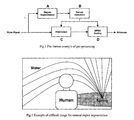
- the segmenting into regions is a preprocessing operation as illustrated in Figure 1; see Yoshihisa Yamada, Masahide Kaneko, Hiroshi Harashima: "MPEG Encoding Simulator for Enhancing the Image Quality by Manual Operation," 1996 ITE Annual Convention, 23-5.
- functional block A partitions a frame (picture) into and combines regions.
- the method of extracting regions in an I picture is a manual processing operation, and in P and B pictures, manual processing operations only adjust detail point of results.
- Functional block B selects a type of preprocessing and sets up parameters for quantization in each region.
- Functional block C preprocesses by, such as, low pass filtering regions which an operator considers as needless. Several types of filter with different bandwidths are prepared and block C is able to choose one of them according to the importance of the region.
- Functional block D applies MPEG coding with quantization steps determined in each region.
- FIG. 1 One aspect of preprocessing by manual operation is that an operator can partition regions as he or she likes; however, the other aspect is that it takes time to operate so that it is not suitable for realtime MPEG encoding and that manual operation may cause inaccurate region segmentation.
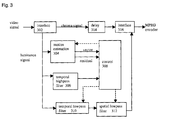
- Figure 2 shows an image with a center of human which can be considered as subjectively important object. Therefore, we should partition the region between human and his background. However, the region boundary is extremely complex so that it is difficult to partition accurately. Even if the region is partitioned as blocks including its boundaries, it may cause noticeable block distortion. Therefore, it is difficult for this method to preprocess images such as this example.
- JPEG, H.261, MPEG-1, and MPEG-2 compression and decoding exist.
- programmable microprocessors or digital signal processors such as the Ultrasparc or TMS320C6xxx, running appropriate software can handle most compression and decoding in real time, and less powerful processors may handle lower bitrate compression and decompression.
- the present invention provides a preprocessing for a video sequence prior to motion compensation encoding with filtering in response to the temporal and spatial neighborhoods of a pixel and the motion compensation of the pixel's macroblock.
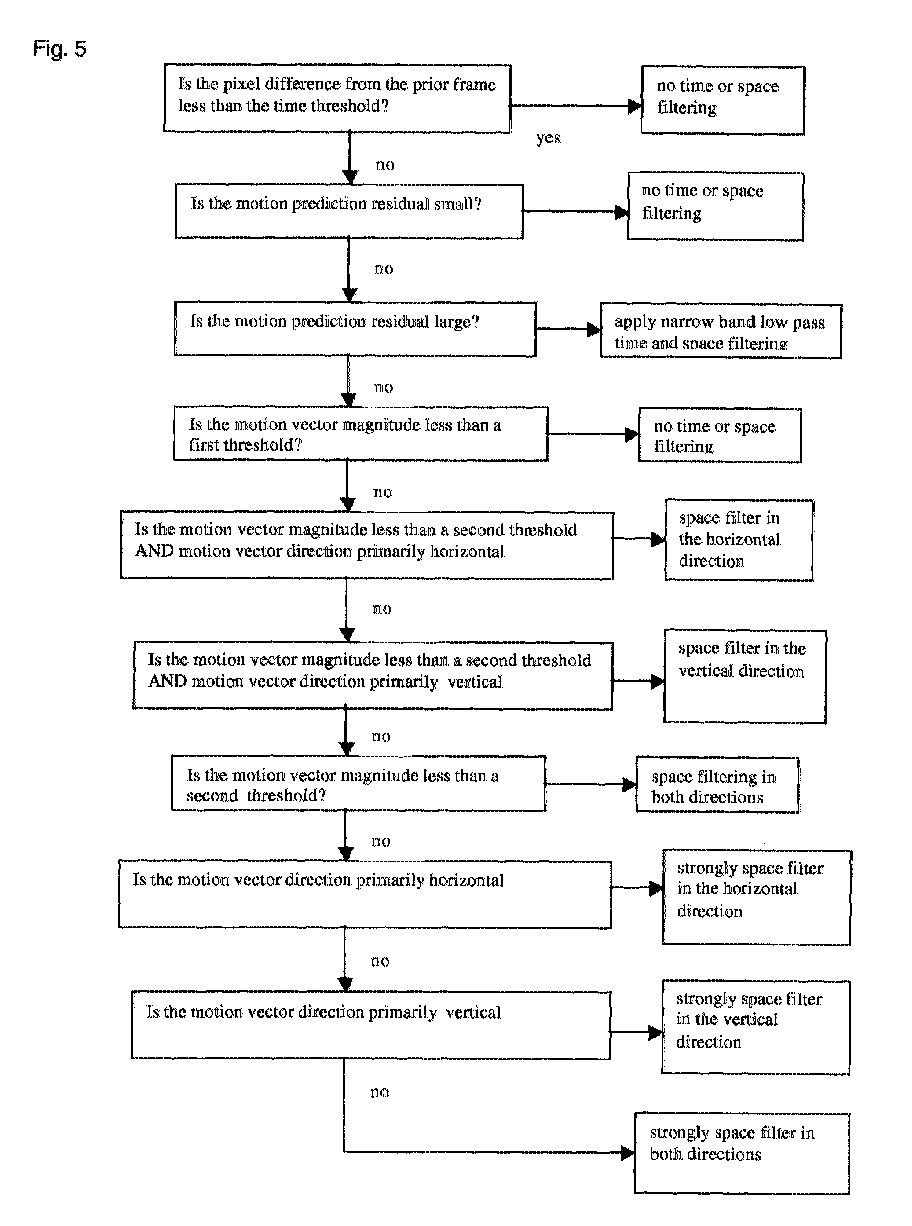
- Figure 3 illustrates a first preferred embodiment MPEG encoding preprocessing method which proceeds as follows.
- Input video signal (luminance plus chroma for a frame) enters interface functional block 302 which sends luminance signal and chroma signal to different blocks.
- Motion estimation functional block 304 receives luminance signal for the input frame and for each macroblock of the input frame outputs a motion vector and motion estimation residual just as in standard MPEG encoding; the output motion vector and residual are inputs for control block 308.
- Temporal difference detection functional block 306 calculates temporal difference in the luminance signal Y (i.e., difference of current input frame and the prior input frame) and outputs the difference for each pixel to control block 308.
- Control block 308 controls adaptive filters 310 and 312 plus motion estimation block 304.
- Filter 310 is a temporal low pass filter and filter 312 is a two-dimensional filter according to temporal differences, motion vectors, and motion estimation residuals.
- functional block 310 is a temporal low pass filter which filters in response to control signals from 308.
- Functional block 308 is a two-dimensional spatial low pass filter; it selects a two-dimensional filter according to size and direction of the motion vector.
- Functional block 314 delays chroma signal to synchronize it with luminance signal Y.
- Functional block H is an interface, which sends luminance signal Y and chroma signal to MPEG encoder. The net effect of this preprocessing is the filtering of the luminance signal Y by temporal low pass filter 310 and spatial low pass filter 312 prior to a standard MPEG encoding.
- the low pass filtering adapts to the macroblock being filtered, and in this manner the unimportant regions can be effectively simplified.
- Control block 308 operates to control filters 310 and 312 as follows.
- Motion estimation residual MR the difference between the pixel value and the predicted pixel value from the reference macroblock of the prior frame defined by the motion vector
- predetermine a threshold of prediction error in advance in order that MR falls into one of three results: small, medium, or large.
- Control block 308 contains thresholds T A , T B , T C , and T D for the motion vector and threshold T T for temporal difference; these thresholds and the prediction error levels for small-medium and medium-large are programmed by the user. Then proceed as follows for each pixel of an input frame. First consider the temporal difference TD and proceed as follows:
- the spatial lowpass filters could be separable (a two-dimensional filter kernel equal to the product of an x-direction one-dimensional filter kernel and a y-direction one-dimensional filter kernel).
- an example of a narrow band lowpass one-dimensional filter kernel could be the five-tap kernel -1/8, 2/8, 6/8, 2/8, -1/8 and an example of a narrower band lowpass one-dimensional filter kernel could be the nine-tap kernel -1/15, 0, 2/15, 4/15, 5/15, 4/15, 2/15, 0, -1/15.
- all sorts of other filter kernels could be used, such as the simple kernels of 1/N, 1/N, ..., 1/N, with increasing N yielding progressively narrower bands.
- the temporal lowpass filter is just a one-dimensional filter and could be a simple kernel such as the three-tap 1/4, 2/4, 1/4 or two-tap 1/2, 1/2 or any of the one-dimensional kernels of the spatial filters.
- the thresholds T C and T D are roughly 1/4 and 4, respectively, and the motion vector magnitude thresholds T A and T B could be 3-5 (pixel intervals) and 5-10, respectively.
- the temporal threshold T T could be on the order of 5.
- a small MR could be (for luminance values in the range 0-255) less than on the order of 5 and large if greater than on the order of 50.
- all of these thresholds and sizes may be adjusted in response to the perceived quality and bits saved of various types of video sequences of interest.
- Fig. 5 illustrates the decision flow for the division of the motion vector magnitude into three classes and as in Fig.4.
- the "strong" filtering is narrower band than the other filterings.
- filters for pixels with motion vectors falling into class 4 and class 7, which indicate the object moves in diagonal directions apply lowpass filters with especially narrower bandwidths because human visual system is less sensitive in diagonal directions as compared to horizontal and vertical direction even if the spatial frequency responses are the same.
- control block 308 enables the filtering of each pixel independently using parameters such as the temporal difference TD, the motion estimation residual MR, and the motion vector v through the temporal filter 310 and the two-dimensional filter 312 which make use of human visual system characteristics. Therefore, the preferred embodiment preprocessing can reduce information bits effectively, which allows for enhanced picture quality of MPEG and other motion compensated encoded and decoded images.
- the preferred embodiments may be varied while retaining the feature of pixel based preprocessing adapted to a pixel's temporal and/or spatial neighborhood.
- the temporal difference detection may be omitted and the pixel neighborhood analysis started with the motion prediction error (residual);
- the motion vector magnitude could be measured by the sum of squares of the components or any analogous vecto r norm rather than the sum of absolute values;
- the threshold values could be varied according to frame parameters such as quantization level;
- the number of regions for classifying the motion vector could be increased or decreased, such as only four regions: small magnitude, primarily horizontal, primarily vertical, and diagonal;
- the inequalities used for decisions could be a mixture of (i) "less than” or (ii) "less than or equal to” and (iii) "greater than” or “greater than or equal to”, ...
Landscapes
- Engineering & Computer Science (AREA)
- Multimedia (AREA)
- Signal Processing (AREA)
- Compression Or Coding Systems Of Tv Signals (AREA)
- Compression, Expansion, Code Conversion, And Decoders (AREA)
Abstract
Description
- The invention relates to electronic image methods and devices, and, more particularly, to digital communication and storage systems with compressed images.
- Video communication (television, teleconferencing, Internet, digital camera, and so forth) typically transmits a stream of video frames (pictures, images) along with audio over a transmission channel for real time viewing and listening or storage. However, transmission channels frequently add corrupting noise and have limited bandwidth. Consequently, digital video transmission with compression enjoys widespread use. In particular, various standards for compression of digital video have emerged and include the various JPEG and MPEG standards.
- Tekalp, Digital Video Processing (Prentice Hall 1995), Clarke, Digital Compression of Still Images and Video (Academic Press 1995), and Schafer et al, Digital Video Coding Standards and Their Role in Video Communications, 83 Proc. IEEE 907 (1995), include summaries of various compression methods, including descriptions of the JPEG, H.261, MPEG-1, and MPEG-2 standards
- For encoding a single frame as in JPEG or an I frame in MPEG, Shapiro, Embedded Image Coding Using Zerotrees of Wavelet Coefficients, 41 IEEE Tr.Sig.Proc 3445 (1993) provides a wavelet hierarchical subband decomposition which groups wavelet coefficients at different scales and predicts zero coefficients across scales. This provides a quantization and fully embedded bitstream in the sense that the bitstream of a lower bitrate is embedded in the bitstream of higher bitrates.
- Further compression can be achieved by segmenting a picture into subjectively important regions and unimportant regions and then reducing the number of information bits used for the unimportant regions. The segmenting into regions is a preprocessing operation as illustrated in Figure 1; see Yoshihisa Yamada, Masahide Kaneko, Hiroshi Harashima: "MPEG Encoding Simulator for Enhancing the Image Quality by Manual Operation," 1996 ITE Annual Convention, 23-5. In particular, functional block A partitions a frame (picture) into and combines regions. The method of extracting regions in an I picture is a manual processing operation, and in P and B pictures, manual processing operations only adjust detail point of results. Functional block B selects a type of preprocessing and sets up parameters for quantization in each region. Functional block C preprocesses by, such as, low pass filtering regions which an operator considers as needless. Several types of filter with different bandwidths are prepared and block C is able to choose one of them according to the importance of the region. Functional block D applies MPEG coding with quantization steps determined in each region.
- One aspect of preprocessing by manual operation is that an operator can partition regions as he or she likes; however, the other aspect is that it takes time to operate so that it is not suitable for realtime MPEG encoding and that manual operation may cause inaccurate region segmentation. For example, Figure 2 shows an image with a center of human which can be considered as subjectively important object. Therefore, we should partition the region between human and his background. However, the region boundary is extremely complex so that it is difficult to partition accurately. Even if the region is partitioned as blocks including its boundaries, it may cause noticeable block distortion. Therefore, it is difficult for this method to preprocess images such as this example.
- Hardware and software implementations of JPEG, H.261, MPEG-1, and MPEG-2 compression and decoding exist. Further, programmable microprocessors or digital signal processors, such as the Ultrasparc or TMS320C6xxx, running appropriate software can handle most compression and decoding in real time, and less powerful processors may handle lower bitrate compression and decompression.
- The present invention provides a preprocessing for a video sequence prior to motion compensation encoding with filtering in response to the temporal and spatial neighborhoods of a pixel and the motion compensation of the pixel's macroblock.
- This has advantages including the control of preprocessing at each pixel in realtime to improve picture quality of MPEG or other motion compensated necoded and decoded images
- The present invention will now be further described, by way of example, with reference to the preferred and exemplary embodiments illustrated in the figures of the accompanying drawings in which:
- Figure 1 shows known MPEG preprocessing.
- Figure 2 illustrates a picture with regions of differing importance.
- Figure 3 is a block diagram of a preferred embodiment preprocessor.
- Figure 4 shows motion vector decision regions.
- Figure 5 is a flow diagram.
-
- Figure 3 illustrates a first preferred embodiment MPEG encoding preprocessing method which proceeds as follows. Input video signal (luminance plus chroma for a frame) enters interface
functional block 302 which sends luminance signal and chroma signal to different blocks. Motion estimationfunctional block 304 receives luminance signal for the input frame and for each macroblock of the input frame outputs a motion vector and motion estimation residual just as in standard MPEG encoding; the output motion vector and residual are inputs forcontrol block 308. Temporal difference detectionfunctional block 306 calculates temporal difference in the luminance signal Y (i.e., difference of current input frame and the prior input frame) and outputs the difference for each pixel to controlblock 308.Control block 308 controlsadaptive filters motion estimation block 304.Filter 310 is a temporal low pass filter andfilter 312 is a two-dimensional filter according to temporal differences, motion vectors, and motion estimation residuals. In particular,functional block 310 is a temporal low pass filter which filters in response to control signals from 308.Functional block 308 is a two-dimensional spatial low pass filter; it selects a two-dimensional filter according to size and direction of the motion vector.Functional block 314 delays chroma signal to synchronize it with luminance signal Y. Functional block H is an interface, which sends luminance signal Y and chroma signal to MPEG encoder. The net effect of this preprocessing is the filtering of the luminance signal Y by temporallow pass filter 310 and spatiallow pass filter 312 prior to a standard MPEG encoding. The low pass filtering adapts to the macroblock being filtered, and in this manner the unimportant regions can be effectively simplified. -
Control block 308 operates to controlfilters Control block 308 uses three kinds of parameters tocontrol filters 310 and 312: Motion vector v=(vx,vy) and motion estimation residual MR fromMotion estimation block 304 plus temporal difference TD from temporalhigh pass filter 306. With respect to motion estimation residual MR (the difference between the pixel value and the predicted pixel value from the reference macroblock of the prior frame defined by the motion vector), predetermine a threshold of prediction error in advance in order that MR falls into one of three results: small, medium, or large.Control block 308 contains thresholds TA, TB, TC, and TD for the motion vector and threshold TT for temporal difference; these thresholds and the prediction error levels for small-medium and medium-large are programmed by the user. Then proceed as follows for each pixel of an input frame.
First consider the temporal difference TD and proceed as follows: - 1. If TD ≤ TT, then the pixel can be considered as stationary in time and
control blocks - 2. If TD > TT, then consider the motion estimation residual MR at the pixel.
For this
case 2, in the motion estimation residual MR of the macroblock including the pixel under consideration: - 3. If MR is small, then the motion prediction can be considered correct, so
control blocks - 4. If MR is large, then the motion prediction is not very reliable, so
control blocks - 5. If MR is medium, then consider the motion vector v. For this
- If |vx|+|vy| ≤ TA, then control
block 312 to process a filter of class 1 (no filter) - Else if |vx|+|vy| ≤ TB and TC|vx| ≥ |vy|, then control
block 312 to apply a filter ofclass 2. - Else if |vx|+|vy| ≤ TB and TD|vx| ≤ |vy|, then control
block 312 to apply a filter ofclass 3. - Else if |vx|+|vy| ≤ TB, then control
block 312 to apply a filter ofclass 4. - Else if TC|vx| ≥ |vy|, then control
block 312 to apply a filter ofclass 5. - Else if TD|vx| ≤ |vy|, then control
block 312 to apply a filter ofclass 6. - Else, then control 312 to apply a filter of
class 7. -
- The spatial lowpass filters could be separable (a two-dimensional filter kernel equal to the product of an x-direction one-dimensional filter kernel and a y-direction one-dimensional filter kernel). And an example of a narrow band lowpass one-dimensional filter kernel could be the five-tap kernel -1/8, 2/8, 6/8, 2/8, -1/8 and an example of a narrower band lowpass one-dimensional filter kernel could be the nine-tap kernel -1/15, 0, 2/15, 4/15, 5/15, 4/15, 2/15, 0, -1/15. Of course, all sorts of other filter kernels could be used, such as the simple kernels of 1/N, 1/N, ..., 1/N, with increasing N yielding progressively narrower bands. The temporal lowpass filter is just a one-dimensional filter and could be a simple kernel such as the three-
tap 1/4, 2/4, 1/4 or two-tap 1/2, 1/2 or any of the one-dimensional kernels of the spatial filters. - For Fig.4 the thresholds TC and TD are roughly 1/4 and 4, respectively, and the motion vector magnitude thresholds TA and TB could be 3-5 (pixel intervals) and 5-10, respectively. For luminance values in the range 0-255 the temporal threshold TT could be on the order of 5. A small MR could be (for luminance values in the range 0-255) less than on the order of 5 and large if greater than on the order of 50. Of course, all of these thresholds and sizes may be adjusted in response to the perceived quality and bits saved of various types of video sequences of interest.
- Fig. 5 illustrates the decision flow for the division of the motion vector magnitude into three classes and as in Fig.4. In Fig.5 the "strong" filtering is narrower band than the other filterings.
- As an illustration of the effects of the time and space filterings, first consider case of the motion vector falling into
class 2 as shown in Fig.4. This implies that the pixel's object is moving in a horizontal direction. Therefore, in this case, apply a two-dimensional lowpass filter with narrow bandwidth only in the horizontal direction. Analogously, in the case of the motion vector falling intoclass 5, apply a lowpass filter with horizontal bandwidth narrower than that for aclass 2 motion vector pixel. In this design, the fact is used that human visual response becomes more inaccurate as an object moves faster. As for filters for pixels with motion vectors falling intoclass 4 andclass 7, which indicate the object moves in diagonal directions, apply lowpass filters with especially narrower bandwidths because human visual system is less sensitive in diagonal directions as compared to horizontal and vertical direction even if the spatial frequency responses are the same. - In this way, the
control block 308 enables the filtering of each pixel independently using parameters such as the temporal difference TD, the motion estimation residual MR, and the motion vector v through thetemporal filter 310 and the two-dimensional filter 312 which make use of human visual system characteristics. Therefore, the preferred embodiment preprocessing can reduce information bits effectively, which allows for enhanced picture quality of MPEG and other motion compensated encoded and decoded images. - The preferred embodiments may be varied while retaining the feature of pixel based preprocessing adapted to a pixel's temporal and/or spatial neighborhood.
- For example, the temporal difference detection may be omitted and the pixel neighborhood analysis started with the motion prediction error (residual); the motion vector magnitude could be measured by the sum of squares of the components or any analogous vecto r norm rather than the sum of absolute values; the threshold values could be varied according to frame parameters such as quantization level; the number of regions for classifying the motion vector could be increased or decreased, such as only four regions: small magnitude, primarily horizontal, primarily vertical, and diagonal; the inequalities used for decisions could be a mixture of (i) "less than" or (ii) "less than or equal to" and (iii) "greater than" or "greater than or equal to", ...
Claims (8)
- A method of preprocessing for motion-compensated video encoding, comprising:(a) providing a frame in a video sequence for motion-compensated encoding;(b) for a pixel in said frame, comparing a difference between (i) the value of said pixel and (ii) the predicted value of said pixel from motion compensation prediction of said frame to a first level;(c) when said comparing of step (b) indicates said difference is greater than said first level, apply lowpass filtering to said pixel; and(d) repeating steps (b)-(c) for other pixels of said frame;(e) motion-compensated encoding of said frame after said filtering.
- The method of claim 1, wherein:
(a) said filtering of step (c) of claim 1 is filtering is both spatial in said frame and temporal over other frames of said video sequence. - The method of claim 2, further comprising:(a) for said pixel, comparing said difference to a second level which is less than said first level; and(b) when said comparing of step (a) indicates said difference is greater than said second level but less than or equal to said first level, comparing the magnitude of the motion vector for the block containing said pixel to a first threshold;(c) when said comparing of step (b) indicates the magnitude of said motion vector is greater than said first threshold, spatial lowpass filtering to said pixel; and(d) wherein said step (e) of claim 1 encoding applies to said frame after filtering by both steps (b)-(d) of claim 1 and foregoing steps (a)-(c).
- The method of claim 3, wherein:
(a) said spatial filtering of step (c) of claim 3 depends upon the direction of said motion vector. - A method of preprocessing for motion-compensated video encoding, comprising:(a) providing a frame in a video sequence for motion-compensated encoding;(b) for a pixel in said frame, comparing a first difference between (i) the value of said pixel and (ii) the value of said pixel in a frame prior to said frame to a temporal threshold;(c) when said comparing of step (b) indicates said first difference is greater than said temporal threshold, comparing a second difference between (i) the value of said pixel and (ii) the predicted value of said pixel from motion compensation prediction of said frame to a first level;(d) when said comparing of step (b) indicates said second difference is greater than said first level, apply lowpass filtering to said pixel; and(e) repeating steps (b)-(d) for other pixels of said frame;(f) motion-compensated encoding of said frame after said filtering.
- The method of claim 5, wherein:
(a) said filtering of step (d) of claim 5 is filtering is both spatial in said frame and temporal over other frames of said video sequence. - The method of claim 6, further comprising:(a) for said pixel, compari ng said second difference to a second level which is less than said first level; and(b) when said comparing of step (a) indicates said second difference is greater than said second level but less than or equal to said first level, comparing the magnitude of the motion vector for the block containing said pixel to a first threshold;(c) when said comparing of step (b) indicates the magnitude of said motion vector is greater than said first threshold, spatial lowpass filtering to said pixel; and(d) wherein said step (f) of claim 5 encoding applies to said frame after filtering by both steps (b)-(e) of claim 5 and foregoing steps (a)-(c).
- The method of claim 7, wherein:
(a) said spatial filtering of step (c) of claim 7 depends upon the direction of said motion vector.
Applications Claiming Priority (2)
| Application Number | Priority Date | Filing Date | Title |
|---|---|---|---|
| US20082800P | 2000-04-28 | 2000-04-28 | |
| US200828P | 2000-04-28 |
Publications (2)
| Publication Number | Publication Date |
|---|---|
| EP1150513A1 true EP1150513A1 (en) | 2001-10-31 |
| EP1150513B1 EP1150513B1 (en) | 2011-09-21 |
Family
ID=22743378
Family Applications (1)
| Application Number | Title | Priority Date | Filing Date |
|---|---|---|---|
| EP01000129A Expired - Lifetime EP1150513B1 (en) | 2000-04-28 | 2001-04-26 | Preprocessing for motion-compensated predictive image encoding |
Country Status (3)
| Country | Link |
|---|---|
| US (2) | US7412002B2 (en) |
| EP (1) | EP1150513B1 (en) |
| JP (1) | JP2001320713A (en) |
Cited By (2)
| Publication number | Priority date | Publication date | Assignee | Title |
|---|---|---|---|---|
| EP1667432A1 (en) * | 2003-04-24 | 2006-06-07 | Eastman Kodak Company | Method and system for automatically reducing aliasing artefacts |
| EP1684520A2 (en) | 2005-01-24 | 2006-07-26 | Kabushiki Kaisha Toshiba | Image compression method and image compression device |
Families Citing this family (16)
| Publication number | Priority date | Publication date | Assignee | Title |
|---|---|---|---|---|
| US7412002B2 (en) * | 2000-04-28 | 2008-08-12 | Texas Instruments Incorporated | Image preprocessing with selective lowpass filtering from motion compensation |
| JP4527720B2 (en) * | 2004-02-23 | 2010-08-18 | ティーオーエー株式会社 | Image compression method, image compression apparatus, image transmission system, data compression pre-processing apparatus, and computer program |
| US9667999B2 (en) * | 2005-04-25 | 2017-05-30 | Avago Technologies General Ip (Singapore) Pte. Ltd. | Method and system for encoding video data |
| EP1727372A1 (en) * | 2005-05-27 | 2006-11-29 | Thomson Licensing | Method and apparatus for encoding and decoding video data, |
| US20080101469A1 (en) * | 2006-10-31 | 2008-05-01 | Motorola, Inc. | Method and apparatus for adaptive noise filtering of pixel data |
| US7952646B2 (en) * | 2006-12-27 | 2011-05-31 | Intel Corporation | Method and apparatus for content adaptive spatial-temporal motion adaptive noise reduction |
| WO2009073415A2 (en) | 2007-11-30 | 2009-06-11 | Dolby Laboratories Licensing Corporation | Temporal image prediction |
| US20090278921A1 (en) * | 2008-05-12 | 2009-11-12 | Capso Vision, Inc. | Image Stabilization of Video Play Back |
| JP5022400B2 (en) * | 2009-03-30 | 2012-09-12 | 日本放送協会 | Moving image noise removing device, moving region image noise removing device, moving image noise removing program, and moving region image noise removing program |
| US9258573B2 (en) * | 2010-12-07 | 2016-02-09 | Panasonic Intellectual Property Corporation Of America | Pixel adaptive intra smoothing |
| US8989261B2 (en) | 2011-02-23 | 2015-03-24 | Qualcomm Incorporated | Multi-metric filtering |
| US9053366B2 (en) * | 2013-02-20 | 2015-06-09 | Honeywell International Inc. | System and method for detecting motion in compressed video |
| US9270999B2 (en) * | 2013-09-25 | 2016-02-23 | Apple Inc. | Delayed chroma processing in block processing pipelines |
| WO2016184527A1 (en) * | 2015-05-21 | 2016-11-24 | Huawei Technologies Co., Ltd. | Apparatus and method for video motion compensation |
| US10257449B2 (en) * | 2016-01-05 | 2019-04-09 | Nvidia Corporation | Pre-processing for video noise reduction |
| WO2017122997A1 (en) * | 2016-01-11 | 2017-07-20 | 삼성전자 주식회사 | Image encoding method and apparatus, and image decoding method and apparatus |
Citations (4)
| Publication number | Priority date | Publication date | Assignee | Title |
|---|---|---|---|---|
| EP0624981A2 (en) * | 1993-04-09 | 1994-11-17 | Sharp Kabushiki Kaisha | Motion vector detecting circuit |
| EP0644696A2 (en) * | 1993-09-17 | 1995-03-22 | Daewoo Electronics Co., Ltd | Method for temporal filtering of video signals using a motion adaptive spatial filter |
| US5510834A (en) * | 1992-04-13 | 1996-04-23 | Dv Sweden Ab | Method for adaptive estimation of unwanted global picture instabilities in picture sequences in digital video signals |
| US5572258A (en) * | 1993-09-28 | 1996-11-05 | Nec Corporation | Motion compensation estimating device and method achieving improved motion compensation |
Family Cites Families (20)
| Publication number | Priority date | Publication date | Assignee | Title |
|---|---|---|---|---|
| US5144426A (en) * | 1989-10-13 | 1992-09-01 | Matsushita Electric Industrial Co., Ltd. | Motion compensated prediction interframe coding system |
| US5146326A (en) * | 1989-11-14 | 1992-09-08 | Fujitsu Limited | Coded picture information decoding apparatus having means for improving picture distortion |
| DE4211955A1 (en) * | 1992-04-09 | 1993-10-14 | Thomson Brandt Gmbh | Method and device for an interlace progressive conversion |
| US5477272A (en) * | 1993-07-22 | 1995-12-19 | Gte Laboratories Incorporated | Variable-block size multi-resolution motion estimation scheme for pyramid coding |
| US5592226A (en) * | 1994-01-26 | 1997-01-07 | Btg Usa Inc. | Method and apparatus for video data compression using temporally adaptive motion interpolation |
| JP3529432B2 (en) * | 1994-06-30 | 2004-05-24 | 株式会社東芝 | Video encoding / decoding device |
| US6037986A (en) * | 1996-07-16 | 2000-03-14 | Divicom Inc. | Video preprocessing method and apparatus with selective filtering based on motion detection |
| JP3466032B2 (en) * | 1996-10-24 | 2003-11-10 | 富士通株式会社 | Video encoding device and decoding device |
| US6005626A (en) * | 1997-01-09 | 1999-12-21 | Sun Microsystems, Inc. | Digital video signal encoder and encoding method |
| FR2766946B1 (en) * | 1997-08-04 | 2000-08-11 | Thomson Multimedia Sa | PRETREATMENT METHOD AND DEVICE FOR MOTION ESTIMATION |
| US6281942B1 (en) * | 1997-08-11 | 2001-08-28 | Microsoft Corporation | Spatial and temporal filtering mechanism for digital motion video signals |
| US6061100A (en) * | 1997-09-30 | 2000-05-09 | The University Of British Columbia | Noise reduction for video signals |
| US6178205B1 (en) * | 1997-12-12 | 2001-01-23 | Vtel Corporation | Video postfiltering with motion-compensated temporal filtering and/or spatial-adaptive filtering |
| US6560371B1 (en) * | 1997-12-31 | 2003-05-06 | Sarnoff Corporation | Apparatus and method for employing M-ary pyramids with N-scale tiling |
| US6434196B1 (en) * | 1998-04-03 | 2002-08-13 | Sarnoff Corporation | Method and apparatus for encoding video information |
| EP1230791A1 (en) * | 1999-11-11 | 2002-08-14 | STMicroelectronics Asia Pacific Pte Ltd. | Spatio-temporal video noise reduction system |
| US7412002B2 (en) * | 2000-04-28 | 2008-08-12 | Texas Instruments Incorporated | Image preprocessing with selective lowpass filtering from motion compensation |
| JP2004518360A (en) * | 2001-01-26 | 2004-06-17 | コーニンクレッカ フィリップス エレクトロニクス エヌ ヴィ | Spatio-temporal filter unit and image display device including such a spatio-temporal filter unit |
| US6907143B2 (en) * | 2001-05-16 | 2005-06-14 | Tektronix, Inc. | Adaptive spatio-temporal filter for human vision system models |
| US7199838B2 (en) * | 2004-06-17 | 2007-04-03 | Samsung Electronics Co., Ltd. | Motion adaptive noise reduction apparatus and method for video signals |
-
2001
- 2001-04-25 US US09/842,955 patent/US7412002B2/en not_active Expired - Lifetime
- 2001-04-26 EP EP01000129A patent/EP1150513B1/en not_active Expired - Lifetime
- 2001-05-01 JP JP2001134308A patent/JP2001320713A/en not_active Abandoned
-
2008
- 2008-06-24 US US12/144,791 patent/US7697612B2/en not_active Expired - Fee Related
Patent Citations (4)
| Publication number | Priority date | Publication date | Assignee | Title |
|---|---|---|---|---|
| US5510834A (en) * | 1992-04-13 | 1996-04-23 | Dv Sweden Ab | Method for adaptive estimation of unwanted global picture instabilities in picture sequences in digital video signals |
| EP0624981A2 (en) * | 1993-04-09 | 1994-11-17 | Sharp Kabushiki Kaisha | Motion vector detecting circuit |
| EP0644696A2 (en) * | 1993-09-17 | 1995-03-22 | Daewoo Electronics Co., Ltd | Method for temporal filtering of video signals using a motion adaptive spatial filter |
| US5572258A (en) * | 1993-09-28 | 1996-11-05 | Nec Corporation | Motion compensation estimating device and method achieving improved motion compensation |
Non-Patent Citations (2)
| Title |
|---|
| SUK BYUNG CHAE ET AL: "VIDEO CODING BY SEGMENTING MOTION VECTORS AND FRAME DIFFERENCES", OPTICAL ENGINEERING,SOC. OF PHOTO-OPTICAL INSTRUMENTATION ENGINEERS. BELLINGHAM,US, vol. 32, no. 4, 1 April 1993 (1993-04-01), pages 870 - 876, XP000364010, ISSN: 0091-3286 * |
| YAMADA, Y., KANEKO, M., HARASHIMA, H.: "MPEG Encoding Simulator for Enhancing the Image Quality by Manual Operation", ITE'96: 1996 ITE ANNUAL CONVENTION 23-5, pages 348 - 349, XP001014247 * |
Cited By (4)
| Publication number | Priority date | Publication date | Assignee | Title |
|---|---|---|---|---|
| EP1667432A1 (en) * | 2003-04-24 | 2006-06-07 | Eastman Kodak Company | Method and system for automatically reducing aliasing artefacts |
| US7164807B2 (en) | 2003-04-24 | 2007-01-16 | Eastman Kodak Company | Method and system for automatically reducing aliasing artifacts |
| EP1684520A2 (en) | 2005-01-24 | 2006-07-26 | Kabushiki Kaisha Toshiba | Image compression method and image compression device |
| EP1684520A3 (en) * | 2005-01-24 | 2008-12-31 | Kabushiki Kaisha Toshiba | Image compression method and image compression device |
Also Published As
| Publication number | Publication date |
|---|---|
| US20010048720A1 (en) | 2001-12-06 |
| US20080253458A1 (en) | 2008-10-16 |
| EP1150513B1 (en) | 2011-09-21 |
| JP2001320713A (en) | 2001-11-16 |
| US7697612B2 (en) | 2010-04-13 |
| US7412002B2 (en) | 2008-08-12 |
Similar Documents
| Publication | Publication Date | Title |
|---|---|---|
| US7697612B2 (en) | Image preprocessing with selective lowpass filtering from motion compensation | |
| US5473384A (en) | Method of and system for enhancing distorted graphical information | |
| US7920628B2 (en) | Noise filter for video compression | |
| Wu et al. | Perceptual visual signal compression and transmission | |
| EP1596604B1 (en) | Apparatus for coding/decoding and filtering method for the reduction of artifacts in reconstructed images | |
| EP1797722B1 (en) | Adaptive overlapped block matching for accurate motion compensation | |
| US7095903B2 (en) | Method and apparatus for visual lossless image syntactic encoding | |
| US5757969A (en) | Method for removing a blocking effect for use in a video signal decoding apparatus | |
| KR20010033798A (en) | Hierarchical motion estimation apparatus and method using variable block sizes | |
| KR20010041900A (en) | Coding and noise filtering an image sequence | |
| US6553071B1 (en) | Motion compensation coding apparatus using wavelet transformation and method thereof | |
| US8064516B2 (en) | Text recognition during video compression | |
| KR100229796B1 (en) | Image decoding system with compensation function for degraded image | |
| US8203617B2 (en) | Apparatus and method for increasing coding efficiency with an adaptive pre-filter | |
| KR100608036B1 (en) | Image data segmentation method and apparatus | |
| US20050286628A1 (en) | Human visual system (HVS) filter in a discrete cosine transformator (DCT) | |
| Klima et al. | Image compression techniques in the field of security technology: examples and discussion | |
| Sridhara et al. | Point cloud attribute compression via chroma subsampling | |
| JP3736291B2 (en) | Image signal decoding apparatus and method | |
| Klock et al. | Region-based motion compensated 3D-wavelet transform coding of video | |
| Del Corso et al. | MNR: A novel approach to correct MPEG temporal distortions | |
| Patnaik et al. | Region of interest based scalable image and video coding a superlative study | |
| Podilchuk et al. | Image and video compression: A review | |
| Jeong et al. | Development of an experimental full-digital HDTV system: algorithm and implementation | |
| Lee et al. | Video coding with a variable block-sizing technique in the wavelet transform domain |
Legal Events
| Date | Code | Title | Description |
|---|---|---|---|
| PUAI | Public reference made under article 153(3) epc to a published international application that has entered the european phase |
Free format text: ORIGINAL CODE: 0009012 |
|
| AK | Designated contracting states |
Kind code of ref document: A1 Designated state(s): AT BE CH CY DE DK ES FI FR GB GR IE IT LI LU MC NL PT SE TR |
|
| AX | Request for extension of the european patent |
Free format text: AL;LT;LV;MK;RO;SI |
|
| 17P | Request for examination filed |
Effective date: 20020502 |
|
| AKX | Designation fees paid |
Free format text: AT BE CH CY DE DK ES FI FR GB GR IE IT LI LU MC NL PT SE TR |
|
| RBV | Designated contracting states (corrected) |
Designated state(s): DE FR GB |
|
| 17Q | First examination report despatched |
Effective date: 20100705 |
|
| GRAP | Despatch of communication of intention to grant a patent |
Free format text: ORIGINAL CODE: EPIDOSNIGR1 |
|
| GRAS | Grant fee paid |
Free format text: ORIGINAL CODE: EPIDOSNIGR3 |
|
| GRAA | (expected) grant |
Free format text: ORIGINAL CODE: 0009210 |
|
| AK | Designated contracting states |
Kind code of ref document: B1 Designated state(s): DE FR GB |
|
| REG | Reference to a national code |
Ref country code: GB Ref legal event code: FG4D |
|
| REG | Reference to a national code |
Ref country code: DE Ref legal event code: R096 Ref document number: 60145323 Country of ref document: DE Effective date: 20111208 |
|
| PLBE | No opposition filed within time limit |
Free format text: ORIGINAL CODE: 0009261 |
|
| STAA | Information on the status of an ep patent application or granted ep patent |
Free format text: STATUS: NO OPPOSITION FILED WITHIN TIME LIMIT |
|
| 26N | No opposition filed |
Effective date: 20120622 |
|
| REG | Reference to a national code |
Ref country code: DE Ref legal event code: R097 Ref document number: 60145323 Country of ref document: DE Effective date: 20120622 |
|
| REG | Reference to a national code |
Ref country code: FR Ref legal event code: PLFP Year of fee payment: 16 |
|
| REG | Reference to a national code |
Ref country code: FR Ref legal event code: PLFP Year of fee payment: 17 |
|
| PGFP | Annual fee paid to national office [announced via postgrant information from national office to epo] |
Ref country code: FR Payment date: 20170322 Year of fee payment: 17 |
|
| PGFP | Annual fee paid to national office [announced via postgrant information from national office to epo] |
Ref country code: GB Payment date: 20170328 Year of fee payment: 17 |
|
| PGFP | Annual fee paid to national office [announced via postgrant information from national office to epo] |
Ref country code: DE Payment date: 20170428 Year of fee payment: 17 |
|
| REG | Reference to a national code |
Ref country code: DE Ref legal event code: R119 Ref document number: 60145323 Country of ref document: DE |
|
| GBPC | Gb: european patent ceased through non-payment of renewal fee |
Effective date: 20180426 |
|
| PG25 | Lapsed in a contracting state [announced via postgrant information from national office to epo] |
Ref country code: DE Free format text: LAPSE BECAUSE OF NON-PAYMENT OF DUE FEES Effective date: 20181101 |
|
| PG25 | Lapsed in a contracting state [announced via postgrant information from national office to epo] |
Ref country code: GB Free format text: LAPSE BECAUSE OF NON-PAYMENT OF DUE FEES Effective date: 20180426 |
|
| PG25 | Lapsed in a contracting state [announced via postgrant information from national office to epo] |
Ref country code: FR Free format text: LAPSE BECAUSE OF NON-PAYMENT OF DUE FEES Effective date: 20180430 |