EP1149854A1 - Toner composition - Google Patents
Toner composition Download PDFInfo
- Publication number
- EP1149854A1 EP1149854A1 EP00201455A EP00201455A EP1149854A1 EP 1149854 A1 EP1149854 A1 EP 1149854A1 EP 00201455 A EP00201455 A EP 00201455A EP 00201455 A EP00201455 A EP 00201455A EP 1149854 A1 EP1149854 A1 EP 1149854A1
- Authority
- EP
- European Patent Office
- Prior art keywords
- acid
- toner
- cyclo
- aryl
- toner composition
- Prior art date
- Legal status (The legal status is an assumption and is not a legal conclusion. Google has not performed a legal analysis and makes no representation as to the accuracy of the status listed.)
- Withdrawn
Links
Classifications
-
- G—PHYSICS
- G03—PHOTOGRAPHY; CINEMATOGRAPHY; ANALOGOUS TECHNIQUES USING WAVES OTHER THAN OPTICAL WAVES; ELECTROGRAPHY; HOLOGRAPHY
- G03G—ELECTROGRAPHY; ELECTROPHOTOGRAPHY; MAGNETOGRAPHY
- G03G9/00—Developers
- G03G9/08—Developers with toner particles
- G03G9/097—Plasticisers; Charge controlling agents
- G03G9/09733—Organic compounds
Definitions
- the present invention relates to a toner composition.
- electrography is a complex process involving in most embodiments distinct steps being charging, exposing, developing, transfering, fusing and cleaning.
- the toner particles are brougtht into the vicinity of the latent image.
- the toner adheres to the latent image, transforming it into a real image.
- the developed toner is transferred to the paper.
- the image is fixed to the paper by melting the toner into the paper surface.
- a toner composition may comprise a resin, a colorant, a charge control agent, magnetic material, carrier material and additives.
- toners suffer mechanical friction when they receive shearing and impact forces caused by the mechanical operation of the apparatus, and the tones deteriote when several thousand to several ten thousand copies are produced. Such a toner deterioration may be avoided by the use of though resin which has a high enough molecular weight to be able to withstand the mechanical friction.
- resins of this kind generally have high softening points, so that fixing using infrared radiation cannot be sufficiently conducted because of poor thermal efficiency.
- the heated roller fixing method involves exceedingly good thermal efficiency because a heated roller is brought into contact with a receiving sheet so that the toner image on the receiving sheet is pressed by the heated roller surface.
- this fixing method is widely used at fixing speeds ranging from low to high due to its good thermal efficiency an offset phenomenon is apt to occur where part of the toner adheres to the heated roller surface during contact of the heated roller with the toner image and is then transferred to a receiving paper or other receiving sheet.
- rollers having surface layers made of a material with excellent release properties such as a fluoroplastic
- a release agent such as for example a silicone oil is coated on the roller surface.
- a release agent has the disadvantage since this causes the apparatus to have an increased enlarged size, become more costly and also the resulting complicated structure is prone to be a cause of problems.
- the lowest fixing temperature for a toner is between the cold offset-disappearing temperature and the hot offset-occuring temperature and, hence, the usable temperature range is from the lowest fixing temperature to the hot offset-occurring temperature. Therefore, by lowering the lowest fixing temperature as much as possible and by increasing the hot offset-occuring temperature as much as possible.
- the usable fixing temperatures can be lowered and the usable temperature range can be increased at the same time, thereby attaining energy saving, high speed fixing and prevention of paper curling.
- the toner composition can prevent high temperature offset without applying an oil on the fixing roll.
- the invention is characterised in that the toner composition comprises a compound represented by formula (I): in which:
- the molecular weight Mn generally ranges between 500 and 250000 and preferably between 500 and 150000.
- the toner composition according to the invention shows an improved high temperature off set resistance.
- E is or in which R 4 may be R 3 or R 1 .
- R H or (C 6 -C 10 ) aryl or (C 1 -C 8 ) (cyclo)alkyl radical.
- R 2 H or (C 6 -C 10 ) aryl or (C 1 -C 8 ) (cyclo)alkyl radical,
- R 1 and R 2 are (C 1 -C 4 ) alkyl.
- R 1 and R 2 are methyl or ethyl.
- R 3 and R 4 are optionally hetero-atom substituted (C 1 -C 20 ) alkyl groups.
- R 3 and R 4 may be selected from the group consisting of optionally heteroatom substituted (C 6 -C 10 ) arylgroups or optionally heteroatom substituted (C 1 -C 28 ) alkylgroups.
- R 3 and R 4 are hetero-atom substituted C 2- , C 3- or C 6- alkylgroups.
- R 3 and R 4 may be substituted with a group selected from the group of alcohol, ether, ester, cyanide, carbonate, urethane, urea, amide, imide, amine, imine, imidazole, oxime, sulfide, thiol, thiourea, sulfon, silane, silicone, silicate, fluoro, chloro, bromo or iodo groups.
- Suitable examples include di(m)ethylaminoethyl, di(m)ethylaminopropyl, di(m)ethylaminohexyl, tri(m)ethylsilylpropyl, tri(m)ethoxysilylpropyl, perfluoro-octyl, perfluoro-octyl-(m)ethyl, (m)ethoxy-ethyl, (m)ethoxy-2-propyl, maleimido-propyl, maleimido-hexyl, octenylsuccinimido-hexyl, hexahydrophthalimido-hexyl, 2-(benz)imidazole-ethyl, difenylfosfino-ethyl, furfuryl, cyanoethyl, or cyanopropyl groups.
- R 3 and R 4 may also be part of the same optionally substituted cyclic group, such as for example a morfoline, thiomorfoline, piperidine, pyrrolidine, oxazolidine, thiazolidine or piperazine group.
- the compound may consist of the same or different R 3 groups.
- E is derived from a carboxylic acid group.
- Suitable carboxylic acids to be applied as basic components for E-R 3 are, for example, saturated aliphatic (C 1 -C 26 ) acids, unsaturated (C 1 -C 20 ) fatty acids, aromatic acids and ⁇ , ⁇ -unsaturated acids.
- Suitable ⁇ , ⁇ -unsaturated acids are (meth)acrylic acid, crotonic acid and monoesters or monoamides of itaconic acid, maleic acid, 12-hydroxystearic acid, polyether carboxylic acid, and fumaric acid.
- Suitable saturated aliphatic acids are for example acetic acid, propionic acid, butyric acid, 2-ethyl hexanoic acid, laurylic acid and stearic acid.
- Suitable carboxylic acids are, for example, saturated aliphatic (C 1 -C 26 ) acids, unsaturated (C 1 -C 20 ) fatty acids, aromatic acids and ⁇ , ⁇ -unsaturated acids.
- Suitable ⁇ , ⁇ -unsaturated acids are (meth)acrylic acid, crotonic acid and monoesters or monoamides of itaconic acid, maleic acid, 12-hydroxystearic acid, polyether carboxylic acid, and fumaric acid.
- Suitable saturated aliphatic acids are for example acetic acid, propionic acid, butyric acid, 2-ethyl hexanoic acid, laurylic acid and stearic acid.
- Suitable aromatic acid are for example benzoic acid and tertiairy butyl benzoic acid.
- the compound used in the toner composition may be prepared for example by a process as disclosed in WO-A-9916810 which publication is directed to a condensation polymer containing ester groups and at least one amide group in the backbone and having at least one hydroxyalkylamide end group
- the compound may also be prepared by a process according to PCT/NL00/00197 which is directed to a condensation polymer having at least one dialkylamide endgroup connected through the polymer backbone to a unit derived from an alkylamide, the connection comprising at least one ester linkage.
- the toner composition may comprise the compound according to the invention, a resin, a colorant, a charge control agent, magnetic material and/or additives.
- the compound may be present in amounts between 0,1 and 100% by weight ( relative to the total amount of resin and compound) in the toner composition.
- the amounts depends amongst others on the function of the compound which may be compatabiliser, release agent(wax) and/or binder resin.
- Suitable resins include for example polyesters, polyamides, polyolefins, styrene (meth)acrylates, styrene butadienes, crosslinked styrene polymers, epoxies, polyurethanes, vinyl resins and/or polyester imides.
- the resin is a polyester and/or a styrene acrylate.
- the acid number of an acid functional polyester containing carboxylic acid is preferably higher than 10, and preferably higher than 15.
- the acid number is preferably lower than 60 and less than 35.
- the polyester may also be hydroxyl functional, epoxy functional or phosphoric acid functional.
- the Tg of the polyester may be greater than 45°C, and is preferably greater than 60°C.
- the Tg is generally lower than 90°C.
- Suitable charge control agents include for example a possitive-charge control agent or negative-charge control agent.
- positive-charge control agent examples include nigrosine dyes, triphenylmethane dyes containing a tertiary amine as a pendant group, quaternary ammonium salt compounds, cetyltrimethylammonium bromide, polyamine resins, imidazole derivatives.
- negative-charge control agent examples include metal-containing azo dyes, copper phthalocyanine dyes, metal complexes of salicylic alkyl derivatives and quaternary ammonium salts.
- the charge control agent may be incorporated in the toner in an amount from 0.1 to 8.0% by weight, preferably from 0.2 to 5.0% by weight, based on the amount of the binder resin.
- modifiers are usually added or incorporated therein, such as polyolefin waxes and other waxes, as anti-offset agents, and hydrophobic silica as flow modifiers.
- modifys such as polyolefin waxes and other waxes, as anti-offset agents, and hydrophobic silica as flow modifiers.
- the amount of anti-offset agent and flow modifier may be between for example 0.5 to 10 % by weight and 0.05 to 5.0% by weight, respectively.
- a toner may, for example, be obtained by uniformely dispersing additives such as for instance, a colorant, a charge control agent, a magnetic material and/or a modifier into the polymer.The resulting mixture is melt kneaded, cooled, pulverized, and then classified to thereby obtain a toner having an average particle diameter of 5 to 15 ⁇ m.
- This toner may be mixed with a magnetic powder, i.e. an iron oxide carrier, a truly spherical iron oxide carrier,or a ferrite carrier, to give a dry two-component developer.
- the magnetic powder is used as it is or after being coated with a resin or other material.
- the magnetic material used may be a powder of a ferromagnetic metal such as for example iron, cobalt nickel or an alloy or compound containing an element exhibiting ferromagnetism such as for example ferrite, hematite or magnetite.
- the magnetic material may be used in the form of a fine powder having an average particle diameter of from 0.1 to 1 ⁇ m and the amount of the magnetic material dispersed into the binder resin may be from 30 to 70 parts by weight per 100 parts by weight of the binder resin.
- the toner may also be obtained by a chemical route, a polymerised toner or an emulsion dispersion route.
Landscapes
- Physics & Mathematics (AREA)
- General Physics & Mathematics (AREA)
- Developing Agents For Electrophotography (AREA)
Abstract
The invention relates to a toner
composition comprising a compound represented by
formula (I) :

The toner composition shows an improved
high temperature off set resistance.
Description
- The present invention relates to a toner composition.
- As disclosed in "Electrography and development physics by L.B. Schein (Volume 14, pages 26-49) electrography is a complex process involving in most embodiments distinct steps being charging, exposing, developing, transfering, fusing and cleaning. During the development step the toner particles are brougtht into the vicinity of the latent image. By virtue of the electric field the toner adheres to the latent image, transforming it into a real image. Next the developed toner is transferred to the paper. The image is fixed to the paper by melting the toner into the paper surface. A toner composition may comprise a resin, a colorant, a charge control agent, magnetic material, carrier material and additives.
- Often toners suffer mechanical friction when they receive shearing and impact forces caused by the mechanical operation of the apparatus, and the tones deteriote when several thousand to several ten thousand copies are produced. Such a toner deterioration may be avoided by the use of though resin which has a high enough molecular weight to be able to withstand the mechanical friction. However, resins of this kind generally have high softening points, so that fixing using infrared radiation cannot be sufficiently conducted because of poor thermal efficiency. Further, in the case of heated roller fixing which is a contact fixing technique extensively used because of its good thermal efficiency, there is the drawback that the temperature of the heated roller must be increased in order to attain sufficient fixing and the thus elevated roller temperature leads to a deterioration of the fixing apparatus, a curling of paper and an increase in the energy in the energy consumption. In addition, if such resins are used for producing toners, production efficiency is considerably lowered since the pulverizability of such resins is poor. Because of these drawbacks binder resins whose polymerization degrees and softening points are too high cannot be used.
- The heated roller fixing method involves exceedingly good thermal efficiency because a heated roller is brought into contact with a receiving sheet so that the toner image on the receiving sheet is pressed by the heated roller surface. Although this fixing method is widely used at fixing speeds ranging from low to high due to its good thermal efficiency an offset phenomenon is apt to occur where part of the toner adheres to the heated roller surface during contact of the heated roller with the toner image and is then transferred to a receiving paper or other receiving sheet. In order to avoid this phenomenon, rollers having surface layers made of a material with excellent release properties, such as a fluoroplastic, are employed and, in addition, a release agent such as for example a silicone oil is coated on the roller surface.A release agent has the disadvantage since this causes the apparatus to have an increased enlarged size, become more costly and also the resulting complicated structure is prone to be a cause of problems.
- In general, the lowest fixing temperature for a toner is between the cold offset-disappearing temperature and the hot offset-occuring temperature and, hence, the usable temperature range is from the lowest fixing temperature to the hot offset-occurring temperature. Therefore, by lowering the lowest fixing temperature as much as possible and by increasing the hot offset-occuring temperature as much as possible. The usable fixing temperatures can be lowered and the usable temperature range can be increased at the same time, thereby attaining energy saving, high speed fixing and prevention of paper curling.
- It is the object of the present invention to provide a toner composition which shows simultaneously low-temperature flexibility, antiblocking properties and high temperature offset resistance which characteristics are inherently supposed to be incompatible. The toner composition can prevent high temperature offset without applying an oil on the fixing roll.
- The invention is characterised in that the toner composition comprises a compound represented by formula (I):in which:


- B = (C2-C12), optionally substituted, aryl or
(cyclo)alkyl aliphatic diradical,

- X2 = H, X1 or E-R3,
- R1 and R2 may, independently of one another, be the same or different, H, (C6-C10) aryl or (C1-C8) (cyclo)alkyl radical,
- E is derived from a reactive group selected from carboxylic acid, carboxylic ester, carboxylic anhydride, epoxy, isocyanate, acid chloride, amine and/or methylolated amide and
- R3 may be selected from, for example, a saturated or unsaturated (C1-C1000), preferably (C1-C400), alkyl or aromatic group, a polymer or an oligomer. Examples of suitable polymers include polyesters, polyethers, polyethylene, polypropylene and poly(capro)lactones.
-
- The molecular weight Mn generally ranges between 500 and 250000 and preferably between 500 and 150000.
- The toner composition according to the invention shows an improved high temperature off set resistance.
- Preferably,
E isor in which R4 may be R3 or R1.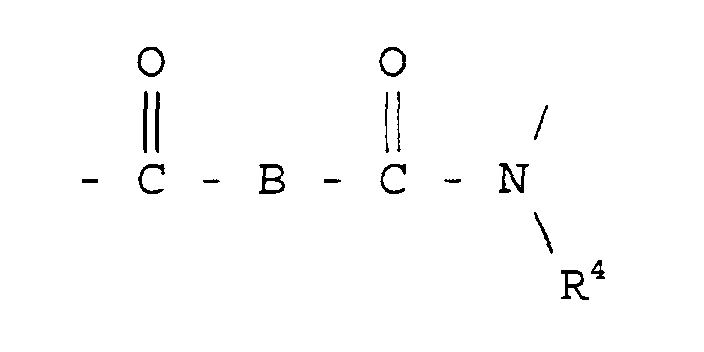
- Preferably, R = H or (C6-C10) aryl or (C1-C8) (cyclo)alkyl radical.
- Preferably R2 = H or (C6-C10) aryl or (C1-C8) (cyclo)alkyl radical,
- More preferably R1 and R2 are (C1-C4) alkyl.
- According to a further preferred embodiment of the invention R1 and R2 are methyl or ethyl.
- R3 and R4 are optionally hetero-atom substituted (C1-C20) alkyl groups.
- R3 and R4 may be selected from the group consisting of optionally heteroatom substituted (C6-C10) arylgroups or optionally heteroatom substituted (C1-C28) alkylgroups.
- More preferably, R3 and R4 are hetero-atom substituted C2-, C3- or C6- alkylgroups.
- R3 and R4 may be substituted with a group selected from the group of alcohol, ether, ester, cyanide, carbonate, urethane, urea, amide, imide, amine, imine, imidazole, oxime, sulfide, thiol, thiourea, sulfon, silane, silicone, silicate, fluoro, chloro, bromo or iodo groups. Suitable examples include di(m)ethylaminoethyl, di(m)ethylaminopropyl, di(m)ethylaminohexyl, tri(m)ethylsilylpropyl, tri(m)ethoxysilylpropyl, perfluoro-octyl, perfluoro-octyl-(m)ethyl, (m)ethoxy-ethyl, (m)ethoxy-2-propyl, maleimido-propyl, maleimido-hexyl, octenylsuccinimido-hexyl, hexahydrophthalimido-hexyl, 2-(benz)imidazole-ethyl, difenylfosfino-ethyl, furfuryl, cyanoethyl, or cyanopropyl groups. R3 and R4 may also be part of the same optionally substituted cyclic group, such as for example a morfoline, thiomorfoline, piperidine, pyrrolidine, oxazolidine, thiazolidine or piperazine group.
- The compound may consist of the same or different R3 groups.
- More preferably E is

- Most preferably E is derived from a carboxylic acid group.
- Suitable carboxylic acids to be applied as basic components for E-R3 are, for example, saturated aliphatic (C1-C26) acids, unsaturated (C1-C20) fatty acids, aromatic acids and α,β-unsaturated acids.
- Examples of suitable α,β-unsaturated acids are (meth)acrylic acid, crotonic acid and monoesters or monoamides of itaconic acid, maleic acid, 12-hydroxystearic acid, polyether carboxylic acid, and fumaric acid.
- Suitable saturated aliphatic acids are for example acetic acid, propionic acid, butyric acid, 2-ethyl hexanoic acid, laurylic acid and stearic acid. Suitable carboxylic acids are, for example, saturated aliphatic (C1-C26) acids, unsaturated (C1-C20) fatty acids, aromatic acids and α,β-unsaturated acids.
- Examples of suitable α,β-unsaturated acids are (meth)acrylic acid, crotonic acid and monoesters or monoamides of itaconic acid, maleic acid, 12-hydroxystearic acid, polyether carboxylic acid, and fumaric acid.
- Suitable saturated aliphatic acids are for example acetic acid, propionic acid, butyric acid, 2-ethyl hexanoic acid, laurylic acid and stearic acid. Suitable aromatic acid are for example benzoic acid and tertiairy butyl benzoic acid.
- The compound used in the toner composition may be prepared for example by a process as disclosed in WO-A-9916810 which publication is directed to a condensation polymer containing ester groups and at least one amide group in the backbone and having at least one hydroxyalkylamide end group
- The compound may also be prepared by a process according to PCT/NL00/00197 which is directed to a condensation polymer having at least one dialkylamide endgroup connected through the polymer backbone to a unit derived from an alkylamide, the connection comprising at least one ester linkage.
- The toner composition may comprise the compound according to the invention, a resin, a colorant, a charge control agent, magnetic material and/or additives.
- The compound may be present in amounts between 0,1 and 100% by weight ( relative to the total amount of resin and compound) in the toner composition. The amounts depends amongst others on the function of the compound which may be compatabiliser, release agent(wax) and/or binder resin.
- Suitable resins include for example polyesters, polyamides, polyolefins, styrene (meth)acrylates, styrene butadienes, crosslinked styrene polymers, epoxies, polyurethanes, vinyl resins and/or polyester imides.
- Preferably, the resin is a polyester and/or a styrene acrylate.
- The acid number of an acid functional polyester containing carboxylic acid is preferably higher than 10, and preferably higher than 15. The acid number is preferably lower than 60 and less than 35. The polyester may also be hydroxyl functional, epoxy functional or phosphoric acid functional. The Tg of the polyester may be greater than 45°C, and is preferably greater than 60°C. The Tg is generally lower than 90°C.
- Suitable charge control agents include for example a possitive-charge control agent or negative-charge control agent.
- Examples of the positive-charge control agent include nigrosine dyes, triphenylmethane dyes containing a tertiary amine as a pendant group, quaternary ammonium salt compounds, cetyltrimethylammonium bromide, polyamine resins, imidazole derivatives.
- Examples of the negative-charge control agent include metal-containing azo dyes, copper phthalocyanine dyes, metal complexes of salicylic alkyl derivatives and quaternary ammonium salts.
- The charge control agent may be incorporated in the toner in an amount from 0.1 to 8.0% by weight, preferably from 0.2 to 5.0% by weight, based on the amount of the binder resin.
- In the production of toners, modifiers are usually added or incorporated therein, such as polyolefin waxes and other waxes, as anti-offset agents, and hydrophobic silica as flow modifiers. However, in the case of a toner composition comprising the compound according to the present invention as the binder resin, there is no need of adding such a modifier, and even if a modifier is incorporated, its amount may be reduced for example. The amount of anti-offset agent and flow modifier may be between for example 0.5 to 10 % by weight and 0.05 to 5.0% by weight, respectively.
- A toner may, for example, be obtained by uniformely dispersing additives such as for instance, a colorant, a charge control agent, a magnetic material and/or a modifier into the polymer.The resulting mixture is melt kneaded, cooled, pulverized, and then classified to thereby obtain a toner having an average particle diameter of 5 to 15 µm. This toner may be mixed with a magnetic powder, i.e. an iron oxide carrier, a truly spherical iron oxide carrier,or a ferrite carrier, to give a dry two-component developer. In this case, the magnetic powder is used as it is or after being coated with a resin or other material.
- In the case of producing a magnetic toner using for example the polyester resin the magnetic material used may be a powder of a ferromagnetic metal such as for example iron, cobalt nickel or an alloy or compound containing an element exhibiting ferromagnetism such as for example ferrite, hematite or magnetite. The magnetic material may be used in the form of a fine powder having an average particle diameter of from 0.1 to 1 µm and the amount of the magnetic material dispersed into the binder resin may be from 30 to 70 parts by weight per 100 parts by weight of the binder resin.
- The toner may also be obtained by a chemical route, a polymerised toner or an emulsion dispersion route.
Claims (4)
- A toner composition comprising a compound represented by formula (I):in which:

 B = (C2-C12), optionally substituted, aryl or (cyclo)alkyl aliphatic diradical,
 X2 = H, X1 or E-R3,R1 and R2 may, independently of one another, be the same or different, H, (C6-C10) aryl of (C1-C8) (cyclo)alkyl radical,E is derived from a reactive group selected from carboxylic acid, carboxylic ester, carboxylic anhydride, epoxy, isocyanate, acid chloride, amine and/or methylolated amide andR3 is selected from a saturated or unsaturated (C1-C1000) alkyl or aromatic group, a polymer or an oligomer.
 - A composition according to Claim 1 characterised in that
E isor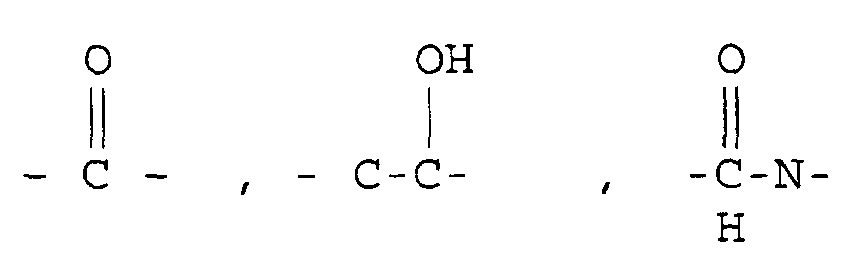 which R4 may be R3 or R1
- A composition according to any one of Claims 1-2
characterised in that R1 = H or (C6-C10) aryl or (C1-C8) (cyclo)alkyl radical. - A composition according to any one of Claims 1-3
characterised in that R2 = H or (C6-C10) aryl or (C1-C8) (cyclo)alkyl radical.
Priority Applications (4)
| Application Number | Priority Date | Filing Date | Title |
|---|---|---|---|
| EP00201455A EP1149854A1 (en) | 2000-04-25 | 2000-04-25 | Toner composition |
| AU50677/01A AU5067701A (en) | 2000-04-25 | 2001-04-20 | Toner composition |
| US10/258,392 US20030162114A1 (en) | 2000-04-25 | 2001-04-20 | Toner composition |
| PCT/NL2001/000318 WO2001083590A1 (en) | 2000-04-25 | 2001-04-20 | Toner composition |
Applications Claiming Priority (1)
| Application Number | Priority Date | Filing Date | Title |
|---|---|---|---|
| EP00201455A EP1149854A1 (en) | 2000-04-25 | 2000-04-25 | Toner composition |
Publications (1)
| Publication Number | Publication Date |
|---|---|
| EP1149854A1 true EP1149854A1 (en) | 2001-10-31 |
Family
ID=8171381
Family Applications (1)
| Application Number | Title | Priority Date | Filing Date |
|---|---|---|---|
| EP00201455A Withdrawn EP1149854A1 (en) | 2000-04-25 | 2000-04-25 | Toner composition |
Country Status (4)
| Country | Link |
|---|---|
| US (1) | US20030162114A1 (en) |
| EP (1) | EP1149854A1 (en) |
| AU (1) | AU5067701A (en) |
| WO (1) | WO2001083590A1 (en) |
Families Citing this family (1)
| Publication number | Priority date | Publication date | Assignee | Title |
|---|---|---|---|---|
| EP2021451A1 (en) * | 2006-05-18 | 2009-02-11 | Henkel AG & Co. KGaA | Colour-protecting laundry detergent |
Citations (2)
| Publication number | Priority date | Publication date | Assignee | Title |
|---|---|---|---|---|
| US5422227A (en) * | 1989-11-27 | 1995-06-06 | Toyo Boseki Kabushiki Kaisha | Resin particles, method for production thereof and their uses |
| WO1999016810A1 (en) * | 1997-10-01 | 1999-04-08 | Dsm N.V. | Condensation polymer containing hydroxyalkylamide groups |
Family Cites Families (4)
| Publication number | Priority date | Publication date | Assignee | Title |
|---|---|---|---|---|
| IT1214920B (en) * | 1985-01-16 | 1990-01-31 | Giuseppe Canestri | Dispersing agents for solid particles in organic liquids |
| CA2072560A1 (en) * | 1989-12-28 | 1991-06-29 | Hans-Tobias Macholdt | Biscationic acid amide and acid imide derivatives as charge controllers |
| JP3005884B2 (en) * | 1993-07-08 | 2000-02-07 | 花王株式会社 | Electrostatic image developer composition |
| TW499449B (en) * | 1999-03-24 | 2002-08-21 | Dsm Nv | Condensation polymer containing esteralkylamide-acid groups |
-
2000
- 2000-04-25 EP EP00201455A patent/EP1149854A1/en not_active Withdrawn
-
2001
- 2001-04-20 WO PCT/NL2001/000318 patent/WO2001083590A1/en not_active Ceased
- 2001-04-20 US US10/258,392 patent/US20030162114A1/en not_active Abandoned
- 2001-04-20 AU AU50677/01A patent/AU5067701A/en not_active Abandoned
Patent Citations (2)
| Publication number | Priority date | Publication date | Assignee | Title |
|---|---|---|---|---|
| US5422227A (en) * | 1989-11-27 | 1995-06-06 | Toyo Boseki Kabushiki Kaisha | Resin particles, method for production thereof and their uses |
| WO1999016810A1 (en) * | 1997-10-01 | 1999-04-08 | Dsm N.V. | Condensation polymer containing hydroxyalkylamide groups |
Also Published As
| Publication number | Publication date |
|---|---|
| WO2001083590A1 (en) | 2001-11-08 |
| US20030162114A1 (en) | 2003-08-28 |
| AU5067701A (en) | 2001-11-12 |
Similar Documents
| Publication | Publication Date | Title |
|---|---|---|
| DE69329811T2 (en) | Capsule toner for heat and pressure fixation and process for its production | |
| JP5451258B2 (en) | Toner composition | |
| EP1132780B1 (en) | Toner and developer for magnetic brush development system | |
| EP0479275A1 (en) | Process for producing binder resin and developer composition for electrophotography | |
| JP2000275908A (en) | Toner for developing electrostatic images | |
| JP4390643B2 (en) | Polyester for toner | |
| GB2280039A (en) | Toner | |
| KR100663778B1 (en) | Toner Binder Resin and Toner | |
| JP3219230B2 (en) | Binder resin and toner for developing electrostatic images containing the same | |
| US5472819A (en) | Toner and developer composition containing the same | |
| JP3344611B2 (en) | Developer for developing electrostatic images | |
| US20030162114A1 (en) | Toner composition | |
| EP0201340A2 (en) | Toner composition and method for preparing the same | |
| US4960666A (en) | Toner and developer compositions with polysilylenes | |
| JPH0844108A (en) | Binder resin and toner for electrostatic image development | |
| JPH0259982B2 (en) | ||
| CN107229197B (en) | Toner composition for magnetic ink character recognition | |
| JP2002189316A (en) | Electrophotographic toner binder and electrophotographic toner | |
| JP3028463B2 (en) | Positively chargeable toner | |
| JPS6221169A (en) | Positively electrifiable toner | |
| JPS5823622B2 (en) | Manufacturing method of magnetic toner for electrostatic photography | |
| JPH0854754A (en) | Binder resin and toner for electrostatic image development | |
| WO2002031019A1 (en) | A polyester and a toner composition | |
| JPH09302083A (en) | Binder resin and toner | |
| JPS6374072A (en) | Developer composition |
Legal Events
| Date | Code | Title | Description |
|---|---|---|---|
| PUAI | Public reference made under article 153(3) epc to a published international application that has entered the european phase |
Free format text: ORIGINAL CODE: 0009012 |
|
| AK | Designated contracting states |
Kind code of ref document: A1 Designated state(s): AT BE CH CY DE DK ES FI FR GB GR IE IT LI LU MC NL PT SE |
|
| AX | Request for extension of the european patent |
Free format text: AL;LT;LV;MK;RO;SI |
|
| AKX | Designation fees paid | ||
| REG | Reference to a national code |
Ref country code: DE Ref legal event code: 8566 |
|
| STAA | Information on the status of an ep patent application or granted ep patent |
Free format text: STATUS: THE APPLICATION IS DEEMED TO BE WITHDRAWN |
|
| 18D | Application deemed to be withdrawn |
Effective date: 20020503 |