EP1149852A1 - Aromatic polycarbonate, process for producing the same, and molded article - Google Patents
Aromatic polycarbonate, process for producing the same, and molded article Download PDFInfo
- Publication number
- EP1149852A1 EP1149852A1 EP00978000A EP00978000A EP1149852A1 EP 1149852 A1 EP1149852 A1 EP 1149852A1 EP 00978000 A EP00978000 A EP 00978000A EP 00978000 A EP00978000 A EP 00978000A EP 1149852 A1 EP1149852 A1 EP 1149852A1
- Authority
- EP
- European Patent Office
- Prior art keywords
- less
- content
- ppb
- group
- carbon atoms
- Prior art date
- Legal status (The legal status is an assumption and is not a legal conclusion. Google has not performed a legal analysis and makes no representation as to the accuracy of the status listed.)
- Withdrawn
Links
- 0 C1CC*CC1 Chemical compound C1CC*CC1 0.000 description 3
Classifications
-
- C—CHEMISTRY; METALLURGY
- C08—ORGANIC MACROMOLECULAR COMPOUNDS; THEIR PREPARATION OR CHEMICAL WORKING-UP; COMPOSITIONS BASED THEREON
- C08G—MACROMOLECULAR COMPOUNDS OBTAINED OTHERWISE THAN BY REACTIONS ONLY INVOLVING UNSATURATED CARBON-TO-CARBON BONDS
- C08G64/00—Macromolecular compounds obtained by reactions forming a carbonic ester link in the main chain of the macromolecule
- C08G64/04—Aromatic polycarbonates
-
- G—PHYSICS
- G11—INFORMATION STORAGE
- G11B—INFORMATION STORAGE BASED ON RELATIVE MOVEMENT BETWEEN RECORD CARRIER AND TRANSDUCER
- G11B7/00—Recording or reproducing by optical means, e.g. recording using a thermal beam of optical radiation by modifying optical properties or the physical structure, reproducing using an optical beam at lower power by sensing optical properties; Record carriers therefor
- G11B7/24—Record carriers characterised by shape, structure or physical properties, or by the selection of the material
- G11B7/241—Record carriers characterised by shape, structure or physical properties, or by the selection of the material characterised by the selection of the material
- G11B7/252—Record carriers characterised by shape, structure or physical properties, or by the selection of the material characterised by the selection of the material of layers other than recording layers
- G11B7/253—Record carriers characterised by shape, structure or physical properties, or by the selection of the material characterised by the selection of the material of layers other than recording layers of substrates
- G11B7/2533—Record carriers characterised by shape, structure or physical properties, or by the selection of the material characterised by the selection of the material of layers other than recording layers of substrates comprising resins
- G11B7/2534—Record carriers characterised by shape, structure or physical properties, or by the selection of the material characterised by the selection of the material of layers other than recording layers of substrates comprising resins polycarbonates [PC]
-
- C—CHEMISTRY; METALLURGY
- C08—ORGANIC MACROMOLECULAR COMPOUNDS; THEIR PREPARATION OR CHEMICAL WORKING-UP; COMPOSITIONS BASED THEREON
- C08G—MACROMOLECULAR COMPOUNDS OBTAINED OTHERWISE THAN BY REACTIONS ONLY INVOLVING UNSATURATED CARBON-TO-CARBON BONDS
- C08G63/00—Macromolecular compounds obtained by reactions forming a carboxylic ester link in the main chain of the macromolecule
- C08G63/02—Polyesters derived from hydroxycarboxylic acids or from polycarboxylic acids and polyhydroxy compounds
- C08G63/06—Polyesters derived from hydroxycarboxylic acids or from polycarboxylic acids and polyhydroxy compounds derived from hydroxycarboxylic acids
-
- C—CHEMISTRY; METALLURGY
- C08—ORGANIC MACROMOLECULAR COMPOUNDS; THEIR PREPARATION OR CHEMICAL WORKING-UP; COMPOSITIONS BASED THEREON
- C08G—MACROMOLECULAR COMPOUNDS OBTAINED OTHERWISE THAN BY REACTIONS ONLY INVOLVING UNSATURATED CARBON-TO-CARBON BONDS
- C08G64/00—Macromolecular compounds obtained by reactions forming a carbonic ester link in the main chain of the macromolecule
- C08G64/04—Aromatic polycarbonates
- C08G64/06—Aromatic polycarbonates not containing aliphatic unsaturation
- C08G64/14—Aromatic polycarbonates not containing aliphatic unsaturation containing a chain-terminating or -crosslinking agent
-
- C—CHEMISTRY; METALLURGY
- C08—ORGANIC MACROMOLECULAR COMPOUNDS; THEIR PREPARATION OR CHEMICAL WORKING-UP; COMPOSITIONS BASED THEREON
- C08G—MACROMOLECULAR COMPOUNDS OBTAINED OTHERWISE THAN BY REACTIONS ONLY INVOLVING UNSATURATED CARBON-TO-CARBON BONDS
- C08G64/00—Macromolecular compounds obtained by reactions forming a carbonic ester link in the main chain of the macromolecule
- C08G64/20—General preparatory processes
- C08G64/30—General preparatory processes using carbonates
- C08G64/307—General preparatory processes using carbonates and phenols
-
- G—PHYSICS
- G11—INFORMATION STORAGE
- G11B—INFORMATION STORAGE BASED ON RELATIVE MOVEMENT BETWEEN RECORD CARRIER AND TRANSDUCER
- G11B7/00—Recording or reproducing by optical means, e.g. recording using a thermal beam of optical radiation by modifying optical properties or the physical structure, reproducing using an optical beam at lower power by sensing optical properties; Record carriers therefor
- G11B7/24—Record carriers characterised by shape, structure or physical properties, or by the selection of the material
- G11B7/241—Record carriers characterised by shape, structure or physical properties, or by the selection of the material characterised by the selection of the material
- G11B7/252—Record carriers characterised by shape, structure or physical properties, or by the selection of the material characterised by the selection of the material of layers other than recording layers
- G11B7/253—Record carriers characterised by shape, structure or physical properties, or by the selection of the material characterised by the selection of the material of layers other than recording layers of substrates
- G11B7/2533—Record carriers characterised by shape, structure or physical properties, or by the selection of the material characterised by the selection of the material of layers other than recording layers of substrates comprising resins
-
- G—PHYSICS
- G11—INFORMATION STORAGE
- G11B—INFORMATION STORAGE BASED ON RELATIVE MOVEMENT BETWEEN RECORD CARRIER AND TRANSDUCER
- G11B7/00—Recording or reproducing by optical means, e.g. recording using a thermal beam of optical radiation by modifying optical properties or the physical structure, reproducing using an optical beam at lower power by sensing optical properties; Record carriers therefor
- G11B7/24—Record carriers characterised by shape, structure or physical properties, or by the selection of the material
- G11B7/241—Record carriers characterised by shape, structure or physical properties, or by the selection of the material characterised by the selection of the material
- G11B7/252—Record carriers characterised by shape, structure or physical properties, or by the selection of the material characterised by the selection of the material of layers other than recording layers
- G11B7/253—Record carriers characterised by shape, structure or physical properties, or by the selection of the material characterised by the selection of the material of layers other than recording layers of substrates
- G11B7/2533—Record carriers characterised by shape, structure or physical properties, or by the selection of the material characterised by the selection of the material of layers other than recording layers of substrates comprising resins
- G11B7/2535—Record carriers characterised by shape, structure or physical properties, or by the selection of the material characterised by the selection of the material of layers other than recording layers of substrates comprising resins polyesters, e.g. PET, PETG or PEN
-
- G—PHYSICS
- G11—INFORMATION STORAGE
- G11B—INFORMATION STORAGE BASED ON RELATIVE MOVEMENT BETWEEN RECORD CARRIER AND TRANSDUCER
- G11B7/00—Recording or reproducing by optical means, e.g. recording using a thermal beam of optical radiation by modifying optical properties or the physical structure, reproducing using an optical beam at lower power by sensing optical properties; Record carriers therefor
- G11B7/24—Record carriers characterised by shape, structure or physical properties, or by the selection of the material
- G11B7/241—Record carriers characterised by shape, structure or physical properties, or by the selection of the material characterised by the selection of the material
- G11B7/252—Record carriers characterised by shape, structure or physical properties, or by the selection of the material characterised by the selection of the material of layers other than recording layers
- G11B7/253—Record carriers characterised by shape, structure or physical properties, or by the selection of the material characterised by the selection of the material of layers other than recording layers of substrates
- G11B7/2533—Record carriers characterised by shape, structure or physical properties, or by the selection of the material characterised by the selection of the material of layers other than recording layers of substrates comprising resins
- G11B7/2536—Record carriers characterised by shape, structure or physical properties, or by the selection of the material characterised by the selection of the material of layers other than recording layers of substrates comprising resins polystyrene [PS]
Definitions
- the present invention relates to an aromatic polycarbonate which has a small content of a specific metal element and high durability and stability particularly when it is used at a high temperature and a high humidity for a long time, production method and molded products thereof.
- Aromatic polycarbonates are excellent engineering plastics which are excellent in color, transparency and mechanical strength. Since they have recently been used for various purposes and under wider environmental conditions, high durability and stability are required of the polycarbonates to retain the above characteristic properties even when they are used under high-temperature and high-humidity conditions for a long time.
- JP-A 5-148355 discloses an aromatic polycarbonate having an iron content of 5 ppm or less and a sodium content of 1 ppm or less and JP-A 6-32885 discloses a polycarbonate having a total content of iron, chromium and molybdenum of 10 ppm or less and a total content of nickel and copper of 50 ppm or less.
- JP-A 2-175722 teaches that a polycarbonate having an improved color tone is obtained by reducing the total content of hydrolyzable chlorine the content of sodium ions and iron ions in raw materials.
- JP-A 11-310630 discloses a method of producing an aromatic polycarbonate by reducing impurities contained in bisphenol A as a raw material, such as iron to 10 ppb by weight and chroman-based impurities to 40 ppm by weight. In the method, some results are achieved by improving color tone, heat resistant stability and gel.
- the contents of metals disclosed in examples in which the optimal conditions are realized are still high in the order of ppm and unsatisfactory to retain the excellent color, transparency and mechanical strength of an aromatic polycarbonate for a long time under a severe moist heat condition disclosed by the present invention.
- Metal species to be reduced as impurities are limited to sodium, iron and some transition metals. Required durability and stability cannot be achieved under severe conditions simply by reducing the contents of these metals.
- an aromatic polycarbonate which comprises a main recurring unit represented by the following formula (1): wherein R 1 and R 2 are each independently a hydrogen atom, alkyl group having 1 to 20 carbon atoms, alkoxy group having 1 to 20 carbon atoms, cycloalkyl group having 6 to 20 carbon atoms, aryl group having 6 to 20 carbon atoms, cycloalkoxy group having 6 to 20 carbon atoms or aryloxy group having 6 to 20 carbon atoms, m and n are each independently an integer of 0 to 4, and X is a single bond, oxygen atom, carbonyl group, alkylene group having 1 to 20 carbon atoms, alkylidene group having 2 to 20 carbon atoms, cycloalkylene group having 6 to 20 carbon atoms, cycloalkylidene group having 6 to 20 carbon atoms, arylene group having 6 to 20 carbon atoms or alkylene-
- a method for producing a polycarbonate which comprises polycondensing an aromatic dihydroxy compound and a carbonic acid diester in the presence of a catalyst containing a) at least one basic compound selected from the group consisting of a nitrogen-containing basic compound and a phosphorus-containing basic compound in an amount of 10 to 1,000 p chemical equivalents based on 1 mol of the aromatic dihydroxy compound and b) at least one compound selected from the group consisting of an alkali metal compound and an alkali earth metal compound in an amount of 0.05 to 5 ⁇ chemical equivalents based on 1 mol of the aromatic dihydroxy compound, wherein the aromatic dihydroxy compound and the carbonic acid diester having 1) a sodium metal element content of 52 ppb or less and 2) a content of each of first elements Fe, Cr, Mn, Ni and Pb of 40 ppb or less are used, and 3) the amount of the basic compound based on 1 mol of the aromatic dihydroxy compound is not more than 20 x (
- the aromatic polycarbonate of the present invention comprises the main recurring unit represented by the following formula (1): wherein R 1 and R 2 are each independently an alkyl group having 1 to 20 carbon atoms, alkoxy group having 1 to 20 carbon atoms, cycloalkyl group having 6 to 20 carbon atoms, aryl group having 6 to 20 carbon atoms, cycloalkoxy group having 6 to 20 carbon atoms or aryloxy group having 6 to 20 carbon atoms, m and n are each independently an integer of 0 to 4, and X is a single bond, oxygen atom, carbonyl group, alkylene group having 1 to 20 carbon atoms, alkylidene group having 2 to 20 carbon atoms, cycloalkylene group having 6 to 20 carbon atoms, cycloalkylidene group having 6 to 20 carbon atoms, arylene group having 6 to 20 carbon atoms or alkylene-arylene-alkylene group having 6 to 20 carbon atoms, and terminals groups consisting essentially
- an aromatic polycarbonate which has excellent durability, stability and transparency when it is used under a severe moist heat condition which cannot be conceived in the prior art for a long time by classifying specific elements contained in the aromatic polycarbonate into some groups according to the sizes of their influences and limiting the contents of these groups to specific values or less.
- trace elements which are contained as impurities in the aromatic polycarbonate and raw materials thereof are classified into sodium and the following first to fourth groups according to the sizes of their influences upon the durability, color tone and transparency of the obtained aromatic polycarbonate.
- the aromatic polycarbonate of the present invention has a sodium metal element content of 100 ppb or less and a content of each of the first elements of 70 ppb or less in order to achieve excellent durability and stability when it is used under severe high-temperature and high-humidity conditions for a long time.
- the aromatic polycarbonate has a sodium metal element content of preferably 70 ppb or less, more preferably 20 ppb or less and a content of each of the first elements of preferably 40 ppb or less, more preferably 20 ppb or less, particularly preferably 10 ppb or less.
- the terminal groups of the aromatic polycarbonate of the present invention consist essentially of aryloxy groups (A) and phenolic hydroxyl groups (B) and the (A)/(B) molar ratio is 95/5 to 40/60, preferably 90/10 to 50/50, more preferably 85/15 to 60/40, particularly preferably 80/20 to 70/30.
- the following relationship is preferably established between the amount (H) (eq/ton-polycarbonate) of the phenolic terminal hydroxyl group and the total ( ⁇ first elements (ppb)) of contents of the first elements (Ni, Pb, Cr, Mn and Fe).
- H ⁇ ⁇ first elements
- the above relationship is preferably (H) ⁇ 0.5 x ( ⁇ first elements).
- the content of each of the second elements is preferably 20 ppb or less, the content of the third element is preferably 1 ppb or less, and the content of each of the fourth elements is preferably 1 ppm or less.
- the viscosity stability (which will be defined hereinafter) of the molten polymer of the aromatic polycarbonate of the present invention is 0.5 % or less. When this value is larger than 0.5%, the hydrolysis deterioration of the aromatic polycarbonate is promoted. To ensure actual hydrolysis resistant stability, the value should be set to 0.5% or less. To this end, it is preferred that a melt viscosity stabilizer which will be described hereinafter should be used especially after polymerization to stabilize the melt viscosity of the aromatic polycarbonate of the present invention.
- the melt viscosity stability is evaluated by the absolute value of a change in melt viscosity measured at a shear rate of 1 rad/sec and 300°C under a nitrogen stream for 30 minutes and expressed as a change rate per minute.
- the aromatic polycarbonate of the present invention maybe produced by any conventionally known method such as melt polymerization or interfacial polymerization. It is preferably produced by melt polycondensing an aromatic dihydroxy compound and a carbonic acid diester from the viewpoints of costs including process and raw materials and because a polymerization solvent such as chlorinated hydrocarbon does not need to be used and an injurious compound such as phosgene does not need to be used as a carbonic acid ester forming compound.
- a polymerization solvent such as chlorinated hydrocarbon does not need to be used and an injurious compound such as phosgene does not need to be used as a carbonic acid ester forming compound.
- the melting method is carried out by stirring an aromatic dihydroxy compound (may be abbreviated as BPA group hereinafter) and a carbonic acid diester (may be abbreviated as DPC group hereinafter) while heating under normal pressure and/or vacuum nitrogen atmosphere in the presence of an ester exchange catalyst to distill off the formed alcohol or phenol derived from the carbonic acid diester.
- the reaction temperature which changes according to the boiling point or the like of the product is generally 120 to 350°C to remove the alcohol or phenol formed by a reaction, preferably 180 to 280°C to obtain an aromatic polycarbonate having a small total content of impurities, more preferably 250 to 270°C.
- the system is depressurized to facilitate the distillation off of the formed alcohol or phenol.
- the inside pressure of the system in the latter stage of the reaction is preferably 133.3 Pa (1 mmHg) or less, more preferably 66.7 Pa (0.5 mmHg) or less.
- a method of producing an aromatic polycarbonate by melting an aromatic dihydroxy compound (BPA group) and a carbonic acid diester (DPC group) by heating and polycondensing them in the presence of a catalyst containing a) at least one basic compound (may be abbreviated as NCBA hereinafter) selected from the group consisting of a nitrogen-containing basic compound and a phosphorus-containing basic compound in an amount of 10 to 1,000 ⁇ chemical equivalents based on 1 mol of BPA group and b) at least one compound (maybe abbreviated as AMC hereinafter) selected from the group consisting of an alkali metal compound and an alkali earth metal compound in an amount of 0.05 to 5 ⁇ chemical equivalents based on 1 mol of BPA as the aromatic polycarbonate production method of the present invention.
- NCBA aromatic dihydroxy compound
- AMC alkali earth metal compound
- BPA group and DPC group having an Na metal element content of preferably 52 ppb or less, more preferably 35 ppb or less, particularly preferably 6 ppb or less and a content of each element of the first element group of preferably 40 ppb or less, more preferably 23 ppb or less, particularly preferably 6 ppb or less are used.
- the amount ( ⁇ chemical equivalents/1 mol of BPA group) of NCBA must be not more than (20 x Fe* + 200) based on Fe* (total content of Fe in DPC group and BPA group : ppb).
- the content of each of the second elements in DPC group and BPA group is preferably 10 ppb or less.
- the content of each of the third element in DPC group and BPA group is preferably 1 ppb or less and the content of each of the fourth elements in DPC group and BPA group is preferably 1 ppm.
- an aromatic polycarbonate having excellent durability can be obtained by using the above BPA group and DPC group whose contents of specific elements are specific values or less as raw materials and an NCBA catalyst in a specific ratio to the content of iron.
- the contents of metals in conventionally known raw materials are in the order of ppm whereas the contents of metals in raw materials specified by the present invention are each in the order of 0 to 80 ppb, specific metal elements contained in the raw materials are classified into some groups according to the sizes of their influences, the content of each group of the specific elements is limited to a specific value or less, the content of a specific non-metal element is specified, and further an NCBA catalyst is used in a specific ratio to the content of iron in the raw materials, thereby making it possible to produce an aromatic polycarbonate having excellent durability, stability and transparency when it is used under a moist heat condition which cannot be conceived in the prior art for a long time.
- BPA bisphenol A
- compound group A a group of compounds
- BPA having a ratio of the total of the absorption peak areas of a group of compounds (to be referred to as "compound group A” hereinafter) eluting for 15.5 to 24 minutes to the absorption peak area of BPA of 2.0 x 10 -3 or less, preferably 1.0 x 10 -3 or less when it is measured by specific high-speed liquid chromatography (using a 0.1 % phosphoric acid aqueous solution as an elute A and acetonitrile as an elute B, this measurement is carried out at a total flow rate of the elute A and the elute B of 0.9 ml/min when the elute A/elute B ratio is 1:1 for 5 minutes after the start of measurement with a high-speed liquid chromatograph
- BPA having a ratio of the total of the absorption peak areas of a group of compounds (to be referred to as "compound group B” hereinafter) eluting for 22 to 24 minutes to the absorption peak area of BPA of 5 x 10 -5 (50 ppm) or less, preferably a ratio of the total of the absorption peak areas of compounds having a molecular weight of 307 to 309 eluting for 22 to 24 minutes to the absorption peak area of BPA of 2 x 10 -5 (20 ppm) or less when it is measured by the above specific high-speed liquid chromatography is used.
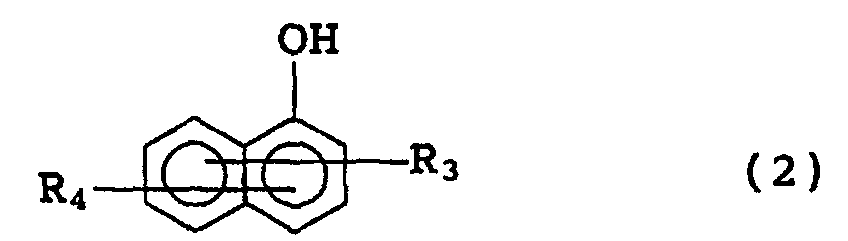
- R 3 and R 4 can be bonded to the 2-to 8-position other than the 1-position (substituted by a hydroxyl group) of a naphthalene ring separately.
- R 5 to R 7 are each independently an alkyl group having 1 to 4 carbon atoms
- R 8 and R 9 are each independently an alkyl group having 1 to 4 carbon
- R 15 to R 17 are each independently an alkyl group having 1 to 4 carbon atoms
- R 18 is an alkyl group having 1 to 4 carbon atoms
- a is an integer of 0 to 4,
- Examples of the 1-naphthol represented by the above formula (2) include 2,4-dimethyl-1-hydroxynaphthalene, 2,6-dimethyl-1-hydroxynaphthalene, 2,7-dimethyl-1 -hydroxynaphthalene, 3,6-dimethyl-1-hydroxynaphthalene, 2-isopropyl-1-hydroxynaphthalene and 6-isopropenyl-1-hydroxynaphthalene.
- Examples of the paraflavan compound represented by the above formula (3) include 2-(4-hydroxyphenyl)-2,4,4-trimethylchroman, 2-(3-methyl-4-hydroxyphenyl)-2,4,4-trimethylchroman, 2-(3,5-dimethyl-4-hydroxyphenyl)-2,4,4-trimethylchroman, 2-(3,5-dimethyl-4-hydroxyphenyl)-2,4,4-trimethylchroman and 2-(3-methyl-4-hydroxyphenyl)-2,4,4,8-tetramethylchroman.
- Examples of the codimer derivative represented by the above formula (4) include 4-(4-hydroxyphenyl)-2,2,4-trimethylchroman, 4-(3-methyl-4-hydroxyphenyl)-2,2,4-trimethylchroman, 4-(3,5-dimethyl-4-hydroxyphenyl)-2,2,4-trimethylchroman, 4-(3,5-dimethyl-4-hydroxyphenyl)-2,2,4-trimethylchroman and 4-(3-methyl-4-hydroxyphenyl)-2,4,4,8-tetramethylchroman.
- chromene compound represented by the above formula (5) examples include 2,2,4-trimethylchroman-(3)-ene, 2,2-dimethyl-4-ethylchroman-(3)-ene, 2,2-dimethyl-4-ethylchroman-(3)-ene, 2,2,6-trimethylchroman-(3)-ene, 2,2-dimethyl-6-ethylchroman-(3)-ene, 2,2,4,6-tetramethylchroman-(3)-ene and 2,2,4-trimethyl-7-butylchroman-(3)-ene.
- Examples of the xanthene represented by the above formula (6) include 9,9-dimethylxanthene, 2-butyl-9,9-dimethylxanthene, 3-methyl-9,9-diethylxanthene, 9,9-diethylxanthene, 9-methylxanthene and 2,6,9,9-tetramethylxanthene.
- Bisphenol A is produced by dehydrating and condensing acetone and excess phenol in the presence of an acid catalyst such as a uniform acid exemplified by hydrochloric acid or a solid acid exemplified by an ion exchange resin.
- the bisphenol A obtained by the above production method is easily acquired as a commercially available product and generally contains compounds (impurities) represented by the above formulas (2) to (6).
- a conventionally known dihydroxy compound can be advantageously used as BPA group in the present invention.
- the dihydroxy compound include 2,2-bis(4-hydroxyphenyl)propane (that is, BPA), bis(2-hydroxyphenyl)methane, bis(4-hydroxyphenyl)methane, 1,1-bis(4-hydroxyphenyl)ethane, 1,1-bis(4-hydroxyphenyl)propane, 2,2-bis(2-hydroxyphenyl)propane, 2,2-bis(4-hydroxy-3,5-dimethylphenyl)propane, 2,2-bis(4-hydroxy-3,5-dibromophenyl)propane, 2,2-bis(4-hydroxy-3-methylphenyl)propane, 2,2-bis(4-hydroxyphenyl)pentane, 3,3-bis(4-hydroxyphenyl)pentane, 1,1-bis(4-hydroxyphenyl)cyclohexane, bis(4-hydroxyphenyl)sulfide, bis(2-hydroxy
- DPC group examples include diphenyl carbonate (may be abbreviated as DPC hereinafter), bis(diphenyl)carbonate, dimethyl carbonate, diethyl carbonate and dibutyl carbonate. Out of these, DPC is preferred from an economical point of view.
- An aromatic polycarbonate which has low contents of specific metal elements contained as impurities as described above and is excellent in durability, color tone and transparency can be obtained by purifying BPA and DPC used as raw materials or by purifying an aromatic polycarbonate.
- BPA group and DPC group used as raw materials can be purified by a known purification method such as distillation, extraction, recrystallization or a combination thereof.
- the raw materials are also preferably purified by sublimation at a temperature as low as possible for a long time, more preferably a combination of sublimation and any one of the above purification methods.
- the contents of the above impurity elements can be reduced from the level of ppm to the level of ppb which is 1/1,000 or less of the above level by these methods.
- the contents of the above organic impurities which have not had attracted much attention can be reduced to predetermined values.
- the aromatic polycarbonate can be purified by such a method as the water washing or reprecipitation of a polymer solution.
- the polymer solution is preferably fully dehydrated after washing.
- dehydration a treatment with a silica gel or filtration with a fine porous filter is used.
- the reprecipitation of a polymer is carried out by adding a poor solvent for a polymer such as methanol or acetonitrile to a polymer solution in a solvent such as methylene chloride or 1-methyl-2-pyrrolidinone (may be abbreviated as NMP hereinafter).
- NMP 1-methyl-2-pyrrolidinone
- the raw materials purified by any one of the above methods be used to produce a polymer and the obtained polymer be further purified by any one of the above methods.
- a high-purity solvent having extremely small contents of impurity elements is preferably used for the purification of the raw materials and polymer.
- a solvent for the electronic industry may be used.
- a specific catalyst that is, at least one catalyst selected from a) at least one basic compound (NCBA) selected from the group consisting of a nitrogen-containing basic compound and a phosphorus-containing basic compound and b) at least one compound (AMC) selected from the group consisting of an alkali metal compound and an alkali earth metal compound is preferably used for the ester exchange melt polymerization of the aromatic polycarbonate.
- NCBA basic compound
- AMC compound selected from the group consisting of an alkali metal compound and an alkali earth metal compound
- the nitrogen-containing basic compound examples include ammonium hydroxides having an alkyl, aryl or alkylaryl group such as tetramethylammonium hydroxide (Me 4 NOH), tetrabutylammonium hydroxide (Bu 4 NOH), benzyltrimethylammonium hydroxide ( ⁇ -CH 2 (Me) 3 NOH) and hexadecyltrimethylammonium hydroxide; basic ammonium salts having an alkyl, aryl or alkylaryl group such as tetramethylammonium acetate, tetraethylammonium phenoxide, tetrabutylammonium carbonic acid salts, benzyltrimethylammonium benzoic acid salts and hexadecyltrimethylammonium ethoxide; tertiary amines such as triethylamine, dimethylbenzylamine and hex
- Examples of the phosphorus-containing basic compound include phosphonium hydroxides having an alkyl, aryl or alkylaryl group such as tetrabutylphosphonium hydroxide (Bu 4 POH), benzyltrimethylphosphonium hydroxide ( ⁇ -CH 2 (Me) 3 POH) and hexadecyltrimethylphosphonium hydroxide; and basic salts such as tetrabutylphosphonium borohydride (Bu 4 PBH 4 ), tetrabutylphosphonium tetraphenyl borate (Bu 4 PBPh 4 ) and tetramethylphosphonium tetraphenyl borate (Me 4 PBPh 4 ).
- phosphonium hydroxides having an alkyl, aryl or alkylaryl group such as tetrabutylphosphonium hydroxide (Bu 4 POH), benzyltrimethylphosphonium hydroxide ( ⁇ -CH 2 (Me) 3 POH) and he
- NCBA is preferably used in an amount of 10 to 1,000 ⁇ chemical equivalents in terms of basic nitrogen atoms or basic phosphorus atoms based on 1 mol of BPA group. It is more preferably used in an amount of 20 to 500 ⁇ chemical equivalents, particularly preferably 50 to 500 ⁇ chemical equivalents based on the same standard.
- NCBA in an amount of not more than (20 x Fe* + 200) ⁇ chemical equivalents based on the total weight (Fe*, ppb) of iron contained in the DPC group and BPA group raw materials is particularly effective in improving the color of the obtained aromatic polycarbonate.
- the amount is particularly preferably not more than (20 x Fe* + 150) ⁇ chemical equivalents.
- AMC is used in conduction with NCBA.
- a compound containing an alkali metal compound is preferably used as AMC.
- the alkali metal compound is used in an amount of 5 x 10 -8 to 5 x 10 -6 chemical equivalent in terms of an alkali metal element based on 1 mol of BPA group.
- the catalyst in the above molar ratio is preferred because it can suppress unfavorable phenomena such as a branching reaction which readily occurs during a polycondensation reaction, a main chain cleavage reaction, the formation of foreign matter in an apparatus at the time of molding and yellowing without impairing the rate of the terminal capping reaction of each molecule and the rate of a polycondensation reaction.
- the alkali metal compound exerts a bad influence upon the physical properties of the obtained aromatic polycarbonate, an ester exchange reaction hardly proceeds to the full, and an aromatic polycarbonate having a high molecular weight is hardly obtained disadvantageously.
- the catalyst AMC is, for example, a hydroxide, bicarbonate, carbonate, acetate, nitrate, nitrite, sulfite, cyanate, thiocyanate, stearate, borohydride, benzoate, hydrogenphosphate, or bisphenol or phenol salt of an alkali metal or alkali earth metal.
- Examples of the AMC include sodium hydroxide, lithium hydroxide, sodium bicarbonate, potassium bicarbonate, sodium carbonate, lithium carbonate, cesium carbonate, sodium acetate, lithium acetate, sodium nitrate, rubidium nitrate, sodium nitrite, rubidium nitrite, potassium sulfite, sodium cyanate, potassium cyanate, sodium thiocyanate, potassium thiocyanate, lithium thiocyanate, cesium thiocyanate, sodium stearate, lithium stearate, cesium stearate, sodium borohydride, lithium borohydride, sodium tetraphenyl borate, sodium benzoate, disodium hydrogenphosphate, dipotassium hydrogenphosphate, disodium salts, dilithium salts, monosodium salts, sodium potassium salts and sodium lithium salts of bisphenol A, and sodium salts and lithium salts of phenol.
- the alkali metal compound may be (a) the ate-complex alkali metal salt of the group XIV element of the periodic table or (b) the alkali metal salt of the oxo acid of the group XIV element of the periodic table.
- the group XIV element of the periodic table is silicon, germanium or tin.
- alkali metal compound as a polyaondensation reaction catalyst, a polycondensation reaction can proceed quickly and completely as described above.
- these alkali metal compound can control an undesired secondary reaction such as a branching reaction which proceeds during the polycondensation reaction to a low level.
- JP-A 7-268091 may be used as (a) the ate-complex alkali metal salt of the group XIV element of the periodic table, as exemplified by NaGe (OMe) 5 , NaGe(OPh) 5 , LiGe(OPh) 5 , NaSn(OMe) 3 , NaSn(OMe) 5 and NaSn(OPh) 5 .
- the alkali metal salt of the oxo acid of the group XIV element of the periodic table is preferably the alkali metal salt of silicic acid, stannic acid, germanic (II) acid or germanic (IV) acid.
- Illustrative examples of the above alkali metal salt include disodium orthosilicate, tetrasodium orthosilicate, disodium monostannate, monosodium germanate (II) (NaHGeO 2 ), disodium orthogermanate (IV) and disodium digermanate (IV) (Na 2 Ge 2 O 5 ).
- At least one compound selected from the group consisting of oxo acids and oxides of the group XIV elements of the periodic table and alkoxides and phenoxides of the same elements may be optionally used as a co-catalyst together with the above catalyst.
- the co-catalyst in a specific amount, undesired phenomena such as a branching reaction which readily occurs during a polycondensation reaction, a main chain cleavage reaction, the formation of foreign matter in an apparatus at the time of molding and yellowing without impairing the rate of a terminal capping reaction and the rate of a polycondensation reaction can be suppressed more effectively.
- the oxo acids of the group XIV elements of the periodic table include silicic acid, stannic acid and germanic acid.
- the oxides of the group XIV elements of the periodic table include silicon dioxide, tin dioxide, germanium dioxide, silicon tetrabutoxide, silicon tetraphenoxide, tetraethoxy tin, tetraphenoxy tin, tetramethoxy germanium, tetrabutoxy germanium, tetraphenoxy germanium and condensates thereof.
- the co-catalyst is preferably used in such a proportion that the amount of the group XIV element of the periodic table becomes 50 molar atoms or less based on 1 molar atom of an alkali metal element contained in the polycondensation reaction catalyst.
- the co-catalyst is used in such a proportion that the amount of the metal element becomes more than 50 molar atoms, the polycondensation reaction slows down disadvantageously.
- the co-catalyst is more preferably used in such a proportion that the amount of the group XIV element of the periodic table becomes 0.1 to 30 molar atoms based on 1 molar atom of the alkali metal element contained in the polycondensation reaction catalyst.
- the sodium compound Since a sodium compound has a smaller influence upon the durability of the produced aromatic polycarbonate than alkali metal and alkali earth metal compounds other than sodium compounds, the sodium compound is preferably used as a catalyst to obtain an aromatic polycarbonate having excellent durability in the present invention.
- AMC is used as a polymerization catalyst, it is preferably used in an amount of 0.05 to 5 ⁇ chemical equivalents, more preferably 0.07 to 3 ⁇ chemical equivalents, particularly preferably 0.07 to 2 ⁇ chemical equivalents based on 1 mol of BPA group.
- sodium compound catalyst When a sodium compound is used as a catalyst, sodium derived from the catalyst is added to a polymer in addition to sodium derived from raw materials. Therefore, it is understood that the sodium compound catalyst must be used in such an amount that the total content of a sodium metal element contained in the polymers should not exceed a specific value in the present invention.
- amelt viscosity stabilizer is preferably used after polymerization to stabilize melt viscosity.
- the melt viscosity stability is evaluated by the absolute value of a change in melt viscosity measured at a shear rate of 1 rad./sec and 300° C under a nitrogen stream for 30 minutes and expressed as a change rate per minute.
- the melt viscosity stabilizer in the present invention has the function of deactivating part or all of the activity of a polymerization catalyst used for the production of an aromatic polycarbonate.
- the melt viscosity stabilizer may be added while a polymer is molten after polymerization or remolten and added after a polycarbonate is pelletized.
- the melt viscosity stabilizer may be added while a polycarbonate which is a reaction product in a reactor or extruder is molten, or may be added and kneaded while the obtained polycarbonate after polymerization passing through an extruder from a reactor is pelletized.
- melt viscosity stabilizers may be used.
- Sulfonic acid compounds such as organic sulfonic acid salts, organic sulfonic acid esters, organic sulfonic anhydrides and organic sulfonic acid betaines are preferred and phosphonium salts of sulfonic acid and/or ammonium salts of sulfonic acid are more preferred because they have the large effect of improving the physical properties such as color, heat resistance and boilingwater resistance of the obtained polymer.
- tetrabutylphosphonium dodecylbenzene sulfonate and tetrabutylammonium p-toluene sulfonate are particularly preferred examples.
- the polymer of the present invention can be obtained by the above method.
- a conventionally known processing stabilizer, heat resistant stabilizer, antioxidant, ultraviolet light absorber, antistatic agent, flame retardant, release agent and the like may be added according to application purpose to form moldings from the polymer.
- a heat stabilizer may be used to prevent a reduction in the molecular weight of the aromatic polycarbonate of the present invention and deterioration in the color of the aromatic polycarbonate of the present invention.
- the heat stabilizer include phosphorous acid, phosphoric acid, phosphonous acid, phosphonic acid and esters thereof.
- Bis(2,4-di-tert-butylphenyl)pentaerythrityl diphosphite, tris(2,4-di-tert-butylphenyl)phosphite, 4,4'-biphenylene diphosphinic acid tetrakis(2,4-di-tert-butylphenyl), trimethylphosphate and dimethyl benzene phosphonate are preferably used.
- heat stabilizers may be used alone or in combination of two or more.
- the amount of the heat stabilizer is preferably 0.0001 to 1 part by weight, more preferably 0.0005 to 0.5 part by weight, much more preferably 0.001 to 0.1 part by weight based on 100 parts by weight of the aromatic polycarbonate.
- a release agent may be mixed with the aromatic polycarbonate of the present invention in limits that do not impair the object of the present invention.
- the release agent include olefin-based wax, olefin-based wax containing a carboxyl group and/or carboxylic anhydride group, silicone oil, organopolysiloxane, higher fatty acid esters of monohydric and polyhydric alcohols, paraffin wax and beeswax.
- the amount of the release agent is preferably 0.01 to 5 parts by weight based on 100 parts by weight of the aromatic polycarbonate.
- a partial ester or whole ester of a monohydric or polyhydric alcohol having 1 to 20 carbon atoms and a saturated or unsaturated fatty acid having 10 to 30 carbon atoms is preferred.
- Preferred examples of the partial ester or whole ester of a monohydric or polyhydric alcohol and a saturated or unsaturated fatty acid include glycerol monostearate, glycerol tristearate and pentaerythritol tetrastearate.
- the amount of the release agent is preferably 0.01 to 5 parts by weight based on 100 parts by weight of the aromatic polycarbonate.
- An inorganic or organic filler may be mixed with the aromatic polycarbonate of the present invention in limits that do not impair the object of the present invention to improve rigidity.
- the inorganic filler include lamellar or granular inorganic fillers such as talc, mica, glass flake, glass bead, calcium carbonate and titanium oxide; fibrous fillers such as glass fiber, glass milled fiber, wollastonite, carbon fiber, aramide fiber and metal-based conductive fiber; and organic particles such as crosslinked acrylic particles and crosslinked silicone particles.
- the amount of the inorganic or organic filler is preferably 1 to 150 parts by weight, more preferably 3 to 100 parts by weight based on 100 parts by weight of the aromatic polycarbonate.
- the inorganic filler usable in the present invention may be surface treated with a silane coupling agent or the like. A good result such as the suppression of the decomposition of the aromatic polycarbonate is obtained by this surface treatment.
- Another resin may be mixed with the aromatic polycarbonate of the present invention in limits that do not impair the object of the present invention.
- the another resin examples include polyamide resin, polyimide resin, polyether imide resin, polyurethane resin, polyphenylene ether resin, polyphenylene sulfide resin, polysulfone resin, polyolefin resin such as polyethylene and polypropylene, polyester resins such as polyethylene terephthalate and polybutylene terephthalate, amorphous polyacrylate resin, polystyrene resin, acrylonitrile/styrene copolymer (AS resin), acrylonitrile/butadiene/styrene copolymer (ABS resin), polymethacrylate resin, phenolic resin and epoxy resin.
- polyamide resin polyimide resin, polyether imide resin, polyurethane resin, polyphenylene ether resin, polyphenylene sulfide resin, polysulfone resin, polyolefin resin such as polyethylene and polypropylene
- polyester resins such as polyethylene terephthalate and polybutylene terephthalate
- the aromatic polycarbonate of the present invention is excellent in the effect of retaining durability, especially durability under severe temperature and humidity conditions for a long time. Therefore, substrates for high-density optical disks typified by compact disks (CD), CD-ROM, CD-R, CD-RW, magnet optical disks (MO), digital versatile disks (DVD-ROM, DVD-Video, DVD-Audio, DVD-R, DVD-RAM, etc.) obtained from this polymer can have high reliability for a long time. It is particularly useful for high-density optical disks such as digital versatile disks.
- Sheets obtained from the aromatic polycarbonate of the present invention are excellent in adhesion and printability. Therefore, making use of their characteristic properties, they are widely used in electric parts, construction parts, auto parts and the like, specifically glazing parts products for widow materials, that is, glazing parts window materials for general houses, gyms, baseball domes and vehicles (construction machines, automobiles, buses, Shinkansen, trains, etc.), side wall plates (wainscots for sky domes, top lights, arcades and condominiums, side walls along roads), window materials for vehicles, displays and touch panels for OA equipment, membrane switches, photo covers, polycarbonate resin laminated boards for water tanks, front panels for projection TVs and plasma displays, Fresnel lenses, and optical products such as optical cards, optical disks, liquid crystal cells produced by combining polarization plates, and phase difference compensators.
- glazing parts products for widow materials that is, glazing parts window materials for general houses, gyms, baseball domes and vehicles (construction machines, automobiles, buses, Shinkansen, trains, etc.), side wall plates (wainscots
- the thickness of the aromatic polycarbonate sheet is not particularly limited but generally 0.1 to 10 mm, preferably 0.2 to 8 mm, particularly preferably 0.2 to 3 mm. Processing treatments (such as lamination for improving weatherability, scuffing resistance improving treatment for improving surface hardness, surfacing with a matt finish or embossing finish and treatments for obtaining a translucent surface and opaque surface) for providing new functions to the aromatic polycarbonate sheet may be made.
- the aromatic polycarbonate of the present invention is mixed with the above additives by any means such as a tumbler, V-shaped blender, super mixer, "Nauter” mixer, Banbury mixer, kneading roll, extruder or the like.
- the thus obtained aromatic polycarbonate resin composition can be formed into a sheet by melt extrusion directly or after it is pelletized by a melt extruder.
- Moldings having excellent durability and stability can be obtained from the aromatic polycarbonate of the present invention by molding such as injection molding.
- the aromatic polycarbonate of the present invention may be used for any purpose. As partly described above, it can be advantageously used in electronic and communication equipment, OA equipment, optical parts such as lenses, prisms, optical disk substrates and optical fibers, electronic and electric materials for home electric appliances, lighting members and heavy electric members, car interiors and exteriors, precision machinery, machine materials such as insulating materials, medical materials, security and protection materials, sports and leisure goods, sundry goods such as household goods, container and packing materials, display and ornament materials and composite materials of other resins and organic or inorganic materials.
- the aromatic polycarbonate of the present invention is particularly preferably used in an optical disk substrate due to its excellent durability and stability.
- bisphenol A When bisphenol A has a melt hazen color number of 20 or less at 175°C and a melt hazen color number of 40 or less after it is maintained at 175°C for 2 hours, it can be used as a raw material for a polycarbonate.
- diphenyl carbonate When diphenyl carbonate has a melt hazen color number of 10 or less at 250°C and a melt hazen color number of 20 or less after it is maintained at 250°C for 2 hours, it can be used as a raw material for a polycarbonate. Purification of raw materials
- BPA Bisphenol A
- DPC diphenyl carbonate
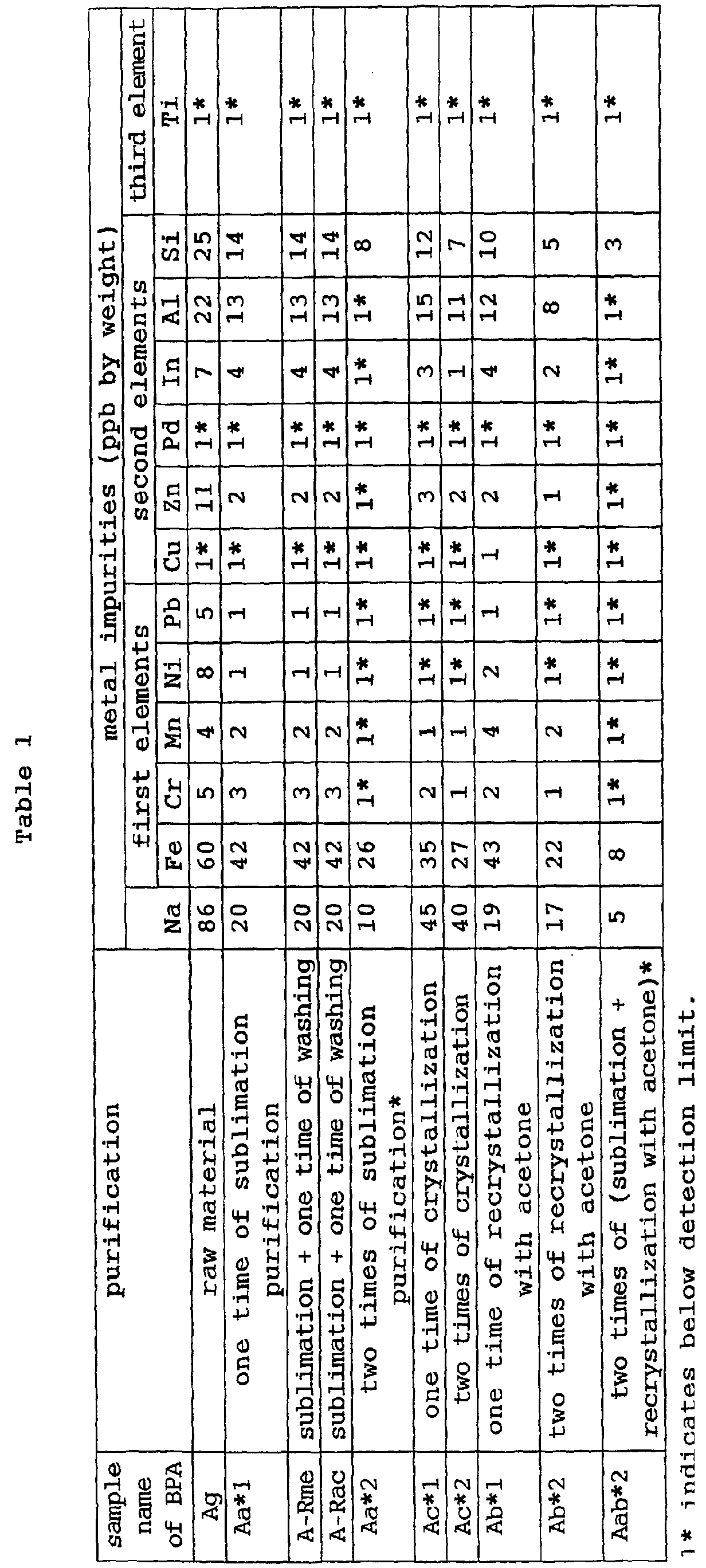
- BPA commercially available BPA was charged into a glass sublimation purifier to carry out sublimation purification slowly under a nitrogen atmosphere at a pressure of 13 Pa (0.1 Torr) and a temperature of 140°C for 5 hours using a decompressor to obtain purified BPA. Sublimation purification was repeated 2 to 4 times as required to prepare purified samples.
- a sample obtained by carrying out sublimation purification once was designated as Aa*1
- a sample obtained by carrying out sublimation purification twice was designated as Aa*2
- samples obtained by carrying out sublimation purification 3 times, 4 times and n times were designated as Aa*3, Aa*4, ... , Aa*n.
- apurified bisphenol sample Aab*2 was prepared by recrystallizing sublimation purified Aa*1 as a raw material once and further purifying it by sublimation again and then recrystallization.
- raw material 1 (Dg): DPC is produced in accordance with a method described in "Plastic Material Lecture 17, Polycarbonate” written by Shoichi Sakajiri et al., pp. 45-46.
- raw material 2 DPC is obtained by purifying DPC produced in accordance with Example 1 of JP-A 7-188116 (Bayer AG) by a method described in "Plastic Material Lecture 17, Polycarbonate” written by Shoichi Sakajiri et al., pp. 45-46.
- DPC is obtained by purifying DPC produced from commercially available dimethyl carbonate in the presence of Ti(OBu) 4 as a catalyst in accordance with Example 1 of JP-B 7-091230 (the term "JP-B” as used herein means an "examined Japanese patent publication") (Asahi Chemical Industry Co., Ltd.) by the above method.
- the raw materials 2 and 3 had an extremely bad APHA (melt hazen color number) owing to impurities and were judged as difficult to be used.
- the same apparatus as used for the sublimation purification of BPA was used for DPC to carry out sublimation purification under a nitrogen atmosphere at a pressure of 30 Pa (0.3 Torr) and a temperature of 77° C for 4 hours n number of times to obtain purified DPC.
- Da*1 A sample obtained by carrying out sublimation purification once was designated as Da*1
- Da*2 a sample obtained by carrying out sublimation purification twice was designated as Da*2
- samples obtained by carrying out sublimation purification 3 times, 4 times and n number of times were designated as Da*3, Da*4, ..., Da*n.
- raw material DPC was washed in hot water (50°C) three times, dried and distilled under vacuum in accordance with a method described in "Plastic Material Lecture 17, Polycarbonate” written by Toshihisa Tatekawa (Nikkan Kogyo Shimbun Co., Ltd.), pp. 45 to collect a fraction at 167 to 168°C and 2,000 kPa (15 mmHg) which was further purified by sublimation as described above to obtain purified diphenyl carbonate D-c.
- the raw material DPC was dissolved in a ten-fold amount of acetone and let pass through a cation and anion mixed ion exchange column, the solvent was distilled off under vacuum, and the DPC was purified by sublimation to obtain purified diphenyl carbonate D-d.
- Impurities contained in the purified bisphenol A and diphenyl carbonate were measured by the above method and the results are shown in Tables 1 to 3 below.
- An aromatic polycarbonate was produced as follows. 137 parts by weight of commercially available BPA (Ag) and 135 parts by weight of purified DPC (Da*1) as raw materials, and 8.2 x 10 -6 part by weight of a disodium salt of bisphenol A and 5.5 x 10 -3 part by weight of tetramethylammonium hydroxide (to be abbreviated as TMAH hereinafter) as polymerization catalysts were charged into a reactor equipped with a stirrer, fractionating column and decompressor and molten at 180° C under a nitrogen atmosphere.
- BPA commercially available BPA
- Da*1 purified DPC
- TMAH tetramethylammonium hydroxide
- the inside pressure of the reactor was reduced to 13.33 kPa (100 mmHg) to carry out a reaction under agitation for 20 minutes while the formed phenol was distilled off. After the temperature was raised to 200°C, the pressure was gradually reduced to carry out the reaction at 4,000 kPa (30 mmHg) for 20 minutes while phenol was distilled off.
- the reaction was further continued by gradually increasing the temperature to 220°C for 20 minutes, 240°C for 20 minutes and 260°C for 20 minutes and then by reducing the pressure to 2.666 kPa (20 mmHg) at 260°C for 10 minutes, 1.333 kPa (10 mmHg) for 5 minutes and finally at 260° C and 66.7 Pa (0.5 mmHg) until the viscosity average molecular weight became 15,300.
- DBSP tetrabutylphosphonium dodecylbenzene sulfonate
- the aromatic polycarbonate obtained in Comparative Example 1 was dissolved in 1.5 x 10 3 parts by weight of NMP for the electronic industry, 1.1 x 10 -4 parts by weight of methanol for the electronic industry was added to separate the precipitated polymer by filtration, and the polymer was dried at 13.3 Pa (0.1 mmHg) and 100°C for 24 hours.
- the obtained aromatic polycarbonate had a viscosity average molecular weight of 15,300, a terminal hydroxyl group concentration of 85, a phenoxy terminal group concentration of 154 (eq/ton-polycarbonate) and a melt viscosity stability of 0.
- 2-methoxycarbonylphenylphenyl carbonate (to be abbreviated as SAM hereinafter) was added in an amount of 8.0 x 10 -3 part by weight based on 1 part by weight of a polymer when the viscosity average molecular weight of a polycarbonate became 15,300 in the production of the polycarbonate in Comparative Example 1 and stirred at 260°C and 133.3 Pa (1 mmHg) for 10 minutes. Thereafter, 2.3 x 10 -6 part by weight of DBSP was added and stirred at 260°C and 66.7 Pa (0.5 mmHg) for 10 minutes.
- SAM 2-methoxycarbonylphenylphenyl carbonate
- the obtained aromatic polycarbonate was dissolved in 1.5 x 10 3 parts by weight of NMP for the electronic industry, 1.1 x 10 4 parts by weight of methanol for the electronic industry was added to separate the precipitated polymer by filtration, and the polymer was dried at 13.3 Pa (0.1 mmHg) and 100°C for 24 hours.
- the obtained aromatic polycarbonate had a viscosity average molecular weight of 15,300, a terminal hydroxyl group concentration of 60, a phenoxy terminal group concentration of 179 (eq/ton-polycarbonate) and a melt viscosity stability of 0.
- Example 2 The procedure of Example 2 was repeated except that SAM was used in an amount of 17.6 x 10 -3 part by weight based on 1 part by weight of the polymer.
- the obtained aromatic polycarbonate had a viscosity average molecular weight of 15,300, a terminal hydroxyl group concentration of 30, a phenoxy terminal group concentration of 209 (eq/tonpolycarbonate) and a melt viscosity stability of 0.
- the aromatic polycarbonate obtained in Comparative Example 1 was dissolved in 1.5 x 10 3 parts by weight of NMP for the electronic industry and treated with activated carbon, and 1.1 x 10 4 parts by weight of methanol for the electronic industry was added dropwise under agitation at a rate of 1 x 10 2 parts by weight/min to separate the precipitated polymer by filtration. This reprecipitation operation was repeated twice and the obtained polymer was dried at 13.3 Pa (0.1 mmHg) and 100°C for 24 hours.
- the obtained polycarbonate had a viscosity average molecular weight of 15,300, a terminal hydroxyl group concentration of 85, a phenoxy terminal group concentration of 154 (eq/ton-polycarbonate) and a melt viscosity stability of 0.
- Example 6 The procedure of Example 6 was repeated except that TMAH was used in an amount of 5.5 x 10 -2 part by weight.
- the finally obtained aromatic polycarbonate had a viscosity average molecular weight of 15,300, a terminal hydroxyl group concentration of 30, a phenoxy terminal group concentration of 209 (eq/ton-polycarbonate) and a melt viscosity stability of 0.
- the aromatic polycarbonate obtained in Comparative Example 1 was dissolved in 1.5 x 10 3 parts by weight of NMP for the electronic industry and treated with a mixed ion exchange resin column, and 1.1 x 10 4 parts by weight of methanol for the electronic industry was added dropwise under agitation at a rate of 1 x 10 2 parts by weight/min to separate the precipitated polymer by filtration. This reprecipitation operation was repeated twice and the obtained polymer was dried at 13.3 Pa (0.1 mmHg) and 100°C for 24 hours.
- the finally obtained aromatic polycarbonate had a viscosity average molecular weight of 15,300 , a terminal hydroxyl group concentration of 85, a phenoxy terminal group concentration of 154 (eq/ton-polycarbonate) and a melt viscosity stability of 0.
- the inside pressure of the reactor was reduced to 13.33 kPa (100 mmHg) to carry out a reaction under agitation for 20 minutes while the formed phenol was distilled off. After the temperature was raised to 200°C, the pressure was gradually reduced to carry out the reaction at 4.000 kPa (30 mmHg) for 20 minutes while phenol was distilled off.
- the reaction was further continued by gradually increasing the temperature to 220°C for 20 minutes, 240°C for 20 minutes and 260°C for 20 minutes and then by reducing the pressure to 2.666 kPa (20 mmHg) at 260°C for 10 minutes, 1.333 kPa (10 mmHg) for 5 minutes and finally at 280° C and 66.7 Pa (0.5 mmHg) until the viscosity average molecular weight became 15,300.
- the obtained aromatic polycarbonate had a viscosity average molecular weight of 15,300, a terminal hydroxyl group concentration of 85, a phenoxy terminal group concentration of 154 eq/tonpolycarbonate and a melt viscosity stability of 0.
- the polymerization of the aromatic polycarbonate was further continued in Comparative Example 1 to obtain a polycarbonate having a viscosity average molecular weight of 22,500 in the end.
- the obtained aromatic polycarbonate had a viscosity average molecular weight of 22,500, a terminal hydroxyl group concentration of 73, a phenoxy terminal group concentration of 77 eq/ton-polycarbonate and a melt viscosity stability of 0.
- the aromatic polycarbonate obtained in Comparative Example 4 was treated in the same manner as in Example 1 and Example 8.
- the obtained polycarbonates had a viscosity average molecular weight of 22,500, a terminal hydroxyl group concentration of 73, a phenoxy terminal group concentration of 77 eq/ton-polycarbonate and a melt viscosity stability of 0.
- a methylene chloride layer was separated from the reaction mixed solution which was then purified by washing in water 5 times to obtain a polycarbonate resin having a viscosity average molecular weight of 15,300, a terminal hydroxyl group concentration of 15, a terminal phenoxy group concentration of 224 eq./ton-polycarbonate and a melt viscosity stability of 0.1.
- Example 4 The same treatment as in Example 1 was made on the polymer of Comparative Example 5. Finally, a polycarbonate resin having a viscosity average molecular weight of 15,300, a terminal hydroxyl group concentration of 15, a terminal phenoxy group concentration of 224 eq./ton-polycarbonate and a melt viscosity stability of 0 was obtained.
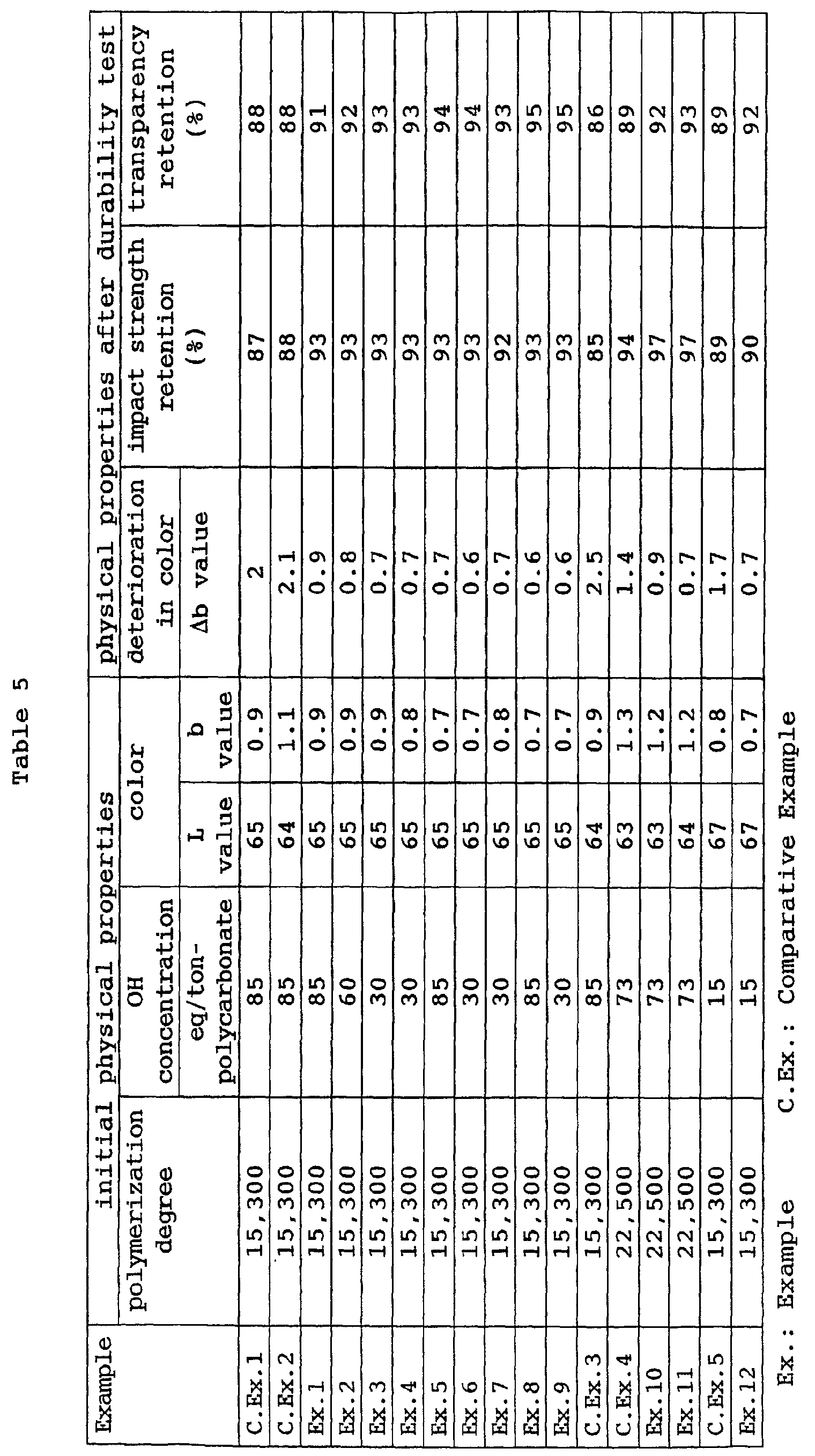
- the contents of impurities (unit: ppm, ppb) in the aromatic polycarbonates obtained in Examples 1 to 12 and Comparative Examples 1 to 5 are shown in Table 4 below.
- a melt mold special for DVDs was attached to the DISK3 M III injection molding machine of Sumitomo Heavy Industries, Ltd., a nickel DVD stamper having information including an address signal was set in this metal mold, the above pellets were injected into the hopper of a molding machine automatically, and a DVD disk substrate having a diameter of 120 mm and a thickness of 0.6 mm was molded at a cylinder temperature of 380°C, a metal mold temperature of 115°C, an injection speed of 200 mm/sec and a retention pressure of 3,432 kPa (35 kgf/cm 2 ).
- the aromatic polycarbonate optical disk substrate was maintained at a temperature of 80°C and a relative humidity of 85 % for 1,000 hours and then evaluated by the following measurement.
- Number of formed white points The optical disk substrate after the temperature and humidity deterioration test was observed through a polarization microscope to count the number of formed white points of 20 ⁇ m or more in size. This was made on 25 optical disk substrates (diameter of 120 mm) to obtain a mean value which was taken as the number of white points.
- Example 10 After the aromatic polycarbonate of Example 10 was molten, it was supplied to the T die of a molding machine by a gear pump quantitatively. 0.003 wt% of trisnonylphenyl phosphite was added before the gear pump and the aromatic polycarbonate was melt extruded into the form of a sheet having a thickness of 2 mm or 0.2 mm and a width of 800 mm while it was sandwiched between a mirror surface cooling roll and a mirror surface roll or contacted on one side.
- a visible light curable plastic adhesive (BENEFIX PC of Ardel Co., Ltd.) was applied to one side of the obtained aromatic polycarbonate sheet (thickness of 2 mm) to form an adhesive layer on the sheet while the sheet was extruded in one direction such that air bubbles were not contained in the sheet and exposed to light having an energy of 5,000 mJ/cm 2 by an optical curing device equipped with a visible light-exclusive metal halide lamp to obtain a laminate.
- the adhesive strength of the obtained laminate was measured in accordance with JIS K-6852 (compression shear adhesive strength test method), it was 10.4 MPa (106 Kgf/cm 2 ).
- the ink printed surface was satisfactory without a transfer failure.
- a sheet (thickness of 0.2 mm) printed with printing ink prepared by mixing 30 parts of a polycarbonate resin (specific viscosity of 0.895, Tg of 175°C) obtained from general interfacial polycondensation between 1,1-bis(4-hydroxyphenyl)cyclohexane and phosgene, 15 parts of Plast Red 8370 (of Arimoto Kagaku Kogyo Co., Ltd.) as a dye and 130 parts of dioxane as a solvent was placed in an injection molding metal mold and polycarbonate resin pellets (Panlite L-1225 of Teijin Chemicals, Ltd.) were insert molded at 310°C.
- the pattern of the printed portion of the molded product after insert molding had no abnormalities such as blotches and blurry spots and an insert molded product whose printed portion had a good appearance was obtained.
- the durability, especially long-term durability under severe temperature and humidity conditions of a polymer is greatly improved and the excellent color, transparency and mechanical strength of the polymer are retained by suppressing the contents of specific impurities in the aromatic polycarbonate to specific values or less as in the present invention.
- An aromatic polycarbonate resin having excellent stability can be produced by polymerizing DPC and BPA whose contents of specific metal elements are specific values or less as raw materials.
Landscapes
- Chemical & Material Sciences (AREA)
- Health & Medical Sciences (AREA)
- Chemical Kinetics & Catalysis (AREA)
- Medicinal Chemistry (AREA)
- Polymers & Plastics (AREA)
- Organic Chemistry (AREA)
- Polyesters Or Polycarbonates (AREA)
Abstract
Description

the aromatic dihydroxy compound and the carbonic acid diester having 1) a sodium metal element content of 52 ppb or less and 2) a content of each of first elements Fe, Cr, Mn, Ni and Pb of 40 ppb or less are used, and 3) the amount of the basic compound based on 1 mol of the aromatic dihydroxy compound is not more than 20 x (Fe*) + 200 based on the total weight Fe* (ppb) of Fe contained in the aromatic dihydroxy compound and Fe contained in the carbonic acid diester.

isopropyl or isopropenyl,
of 2 x 10⁻⁴ part or less by weight, preferably 1 x 10⁻⁴ part or less by weight based on 1 part by weight of BPA is used. In the above formula (2), R3 and R4 can be bonded to the 2-to 8-position other than the 1-position (substituted by a hydroxyl group) of a naphthalene ring separately.

of 5 x 10⁻⁵ part or less by weight based on 1 part by weight of BPA and a content of a codimer derivative represented by the following formula (4):

of 5 x 10⁻⁵ part or less by weight based on 1 part by weight of BPA is used.

of 1 x 10⁻⁵ part or less by weight based on 1 part by weight of BPA and a content of a xanthene represented by the following formula (6):

of 1 x 10⁻⁵ part or less by weight based on 1 part by weight of BPA is used.
1-methyl-2-pyrrolidinone (may be abbreviated as NMP hereinafter). In order to obtain a polymer having high purity, it is preferred that the poor solvent be gradually added over a long time.
The contents of metals contained in a polymer are determined by drawing a calibration curve for a solution of 0.5 g of the polymer dissolved in 25 g of NMP for the electronic industry by the ICP-MS SPQ9000 of Seiko Instrument Co., Ltd. to be measured.
column; A column having an inner diameter of 4.6 mm and a length of 250 mm, filled with the Inertosil ODS-3 adsorbent of GL Science Co., Ltd. prepared by bonding 15 % (amount of carbon) of an octadecyl group to a high-purity spherical silica gel having a pore diameter of 100 Å, is used and maintained at 40±0.1°C.
eluting conditions; Using a 0.1 % phosphoric acid aqueous solution as an elute A and acetonitrile as an elute B, measurement is carried out at a total flow rate of the elute A and the elute B of 0.9 ml/min when the ratio of the elute A to the elute B is 1:1 for 5 minutes after the start of measurement, and then gradient operation is carried out by continuously increasing the amount of the elute B after 5 minutes from the start of measurement until the ratio of the elute A to the elute B becomes 0:1 in 55 minutes after the start of measurement while the total flow rate is fixed. 0.1 % phosphoric acid aqueous solution: phosphoric acid of JIS special grade or higher is diluted with distilled water for high-speed liquid chromatography to 0.1±0.0001 %, elute B: acetonitrile for high-speed liquid chromatography is used. chromatograph: LC-10A of Shimadzu Corporation.
detector; detector for ultraviolet light having a wavelength of 254 nm
The melt viscosity stability of a polymer is evaluated. The absolute value of a change in melt viscosity is measured under a nitrogen stream at a shear rate of 1 rad./sec and 300° C by the RAA fluidity analyzer of Rheometrics Co., Ltd. for 30 minutes to obtain a change rate per minute. When the aromatic polycarbonate has excellent stability for a long time, this value does not exceed 0.5 %.
To test the long-term durability under severe high-temperature and high-humidity conditions of an aromatic polycarbonate, the aromatic polycarbonate is maintained at a temperature of 90°C and a relative humidity of 90% for 1,000 hours. 10 samples are prepared for each polymer and the following measurements are made to evaluate each polymer based on mean values.
0.02 g of a polymer sample is dissolved in 0.4 ml of heavy chloroform to measure the concentration of OH terminals using 1H-NMR (EX-270 of JEOL Ltd.) at 20°C. The number of aryloxy terminal groups is calculated as a difference between the total number of terminals obtained from the following expression and the number of OH terminals. total number of terminals = 56.54/ [η]1.4338
"Pyrex" color comparison tube with a flat bottom having a diameter of 23 mm and a thickness of 1.5 mm is used to compare its melt hazen color number with that of a hazen standard color comparison liquid at a liquid depth of 140 mm in a molten state based on a color number test method specified in JIS K-4101.
measurement method: 54 g of bisphenol A and 2 mg of tetramethylammonium hydroxide are charged, and the melt hazen color number of the resulting mixture in a molten state in the atmosphere at 175°C and the melt hazen color number after the resulting mixture is maintained at 175°C for 2 hours are measured.
measurement method: 54 g of diphenyl carbonate and 2 mg of tetramethylammonium hydroxide are charged, and the melt hazen color number of the resulting mixture in a molten state in the atmosphere at 250°C and the melt hazen color number after the resulting mixture is maintained at 250° C for 2 hours are measured.
raw material 2: DPC is obtained by purifying DPC produced in accordance with Example 1 of JP-A 7-188116 (Bayer AG) by a method described in "Plastic Material Lecture 17, Polycarbonate" written by Shoichi Sakajiri et al., pp. 45-46.
raw material 3: DPC is obtained by purifying DPC produced from commercially available dimethyl carbonate in the presence of Ti(OBu)4 as a catalyst in accordance with Example 1 of JP-B 7-091230 (the term "JP-B" as used herein means an "examined Japanese patent publication") (Asahi Chemical Industry Co., Ltd.) by the above method.


(isophorone/cyclohexane/isobutanol = 40/40/20 (wt%)) was printed on a 0.2 mm thick aromatic polycarbonate sheet by a silk screen printer and dried at 100°C for 60 minutes. The ink printed surface was satisfactory without a transfer failure.
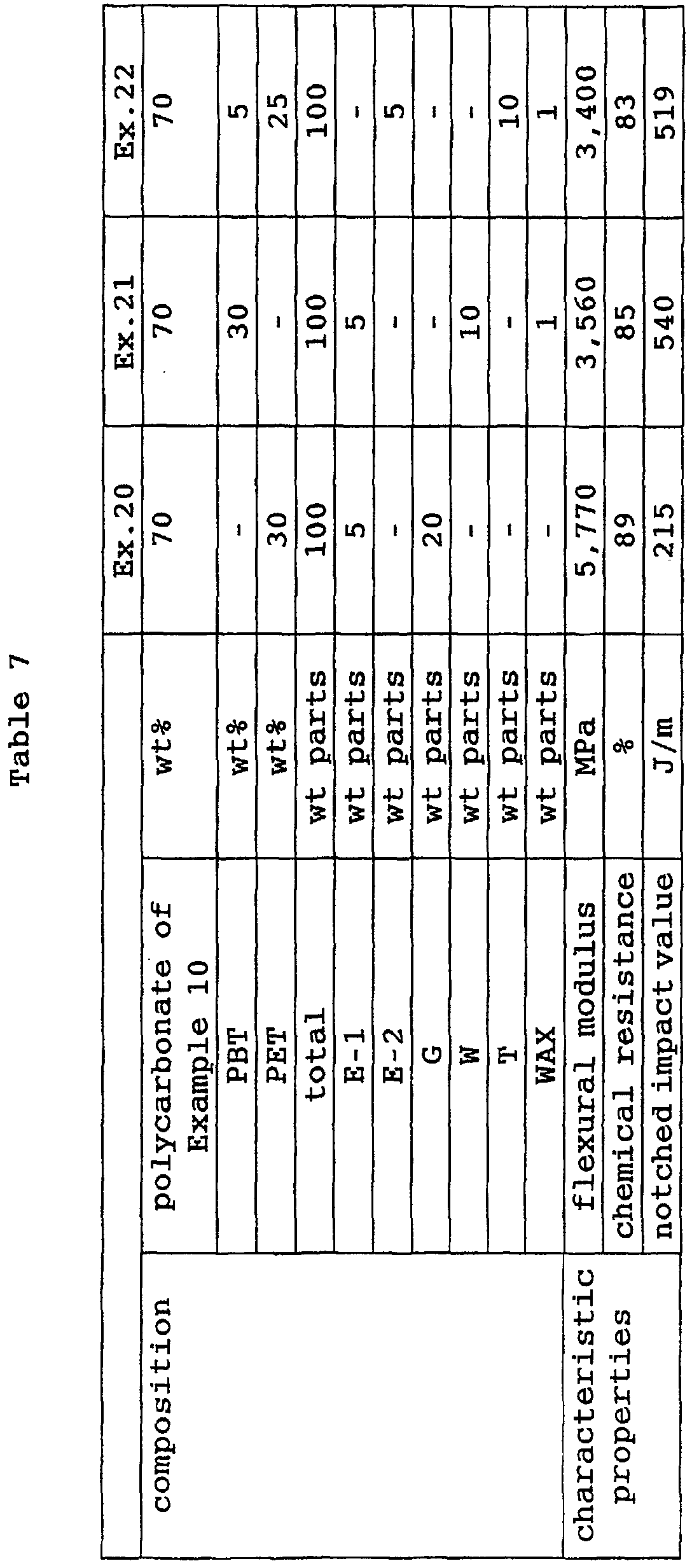
This was measured in accordance with ASTM D790.
This was measured by striking a weight against a 3.2 mm thick test piece from the notch side in accordance with ASTM D256.
This was measured by an Archimedes type spiral flow (thickness of 2 mm, width of 8 mm) at a cylinder temperature of 250°C, a metal mold temperature of 80°C and an injection pressure of 98.1 MPa.

Claims (26)
- An aromatic polycarbonate which comprises a main recurring unit represented by the following formula (1):wherein R1 and R2 are each independently alkyl group having 1 to 20 carbon atoms, alkoxy group having 1 to 20 carbon atoms, cycloalkyl group having 6 to 20 carbon atoms, aryl group having 6 to 20 carbon atoms, cycloalkoxy group having 6 to 20 carbon atoms or aryloxy group having 6 to 20 carbon atoms, m and n are each independently an integer of 0 to 4, and X is a single bond, oxygen atom, carbonyl group, alkylene group having 1 to 20 carbon atoms, alkylidene group having 2 to 20 carbon atoms, cycloalkylene group having 6 to 20 carbon atoms, cycloalkylidene group having 6 to 20 carbon atoms, arylene group having 6 to 20 carbon atoms or alkylene-arylene-alkylene group having 6 to 20 carbon atoms, and terminals groups consisting essentially of aryloxy groups (A) and phenolic hydroxyl groups (B), the (A)/(B) molar ratio being 95/5 to 40/60, and which has a melt viscosity stability of 0.5 % or less, a sodium metal element content of 100 ppb or less and a content of each of first elements, Ni, Pb, Cr, Mn and Fe of 70 ppb or less.

- The aromatic polycarbonate of claim 1, wherein the content of each of the first elements is 40 ppb or less.
- The aromatic polycarbonate of claim 1, wherein the content of sodium metal element is 70 ppb or less and the content of each of the first elements is 20 ppb or less.
- The aromatic polycarbonate of claim 1, wherein the content of sodium metal element is 20 ppb or less and the content of each of the first elements is 10 ppb or less.
- The aromatic polycarbonate of claim 1, wherein the relationship between the concentration (H) (eq./tonpolycarbonate) of terminal hydroxyl groups and the total content (Σfirst elements) (ppb) of the first elements is represented by (H) ≦ Σfirst elements.
- The aromatic polycarbonate of claim 1, wherein the relationship between the concentration (H) (eq./tonpolycarbonate) of terminal hydroxyl groups and the total content (Σfirst elements) (ppb) of the first elements is represented by (H) ≦ 0.5 x (Σfirst elements).
- The aromatic polycarbonate of claim 1, wherein the content of each of second elements Cu, Zn, Pd, In, Si and Al, is 20 ppb or less.
- The aromatic polycarbonate of claim 1, wherein the content of a third element Ti is 1 ppb or less and the content of each of fourth elements P, N, S, Cl and Br is 1 ppm or less.
- A molded product of the aromatic polycarbonate of any one of claims 1, 7 and 8.
- The molded product of claim 9 which is an optical disk substrate.
- A method for producing a polycarbonate which comprises polycondensing an aromatic dihydroxy compound and a carbonic acid diester in the presence of a catalyst containing a) at least one basic compound selected from the group consisting of a nitrogen-containing basic compound and a phosphorus-containing basic compound in an amount of 10 to 1,000 µ chemical equivalents based on 1 mol of the aromatic dihydroxy compound and b) at least one compound selected from the group consisting of an alkali metal compound and an alkali earth metal compound in an amount of 0.05 to 5 µ chemical equivalents based on 1 mol of the aromatic dihydroxy compound, wherein
the aromatic dihydroxy compound and the carbonic acid diester having 1) a sodium metal element content of 52 ppb or less and 2) a content of each of first elements Fe, Cr, Mn, Ni and Pb of 40 ppb or less are used, and 3) the amount of the basic compound based on 1 mol of the aromatic dihydroxy compound is not more than 20 x (Fe*) + 200 based on the total weight Fe* (ppb) of Fe contained in the aromatic dihydroxy compound and Fe contained in the carbonic acid diester. - The method of claim 11, wherein the aromatic dihydroxy compound and the carbonic acid diester each have 1) a sodium metal element content of 35 ppb or less by weight and 2) a content of each of the first elements of 23 ppb or less by weight.
- The method of claim 11, wherein the aromatic dihydroxy compound and the carbonic acid diester each have 1) a sodium metal element content of 6 ppb or less by weight and 2) a content of each of the first elements of 6 ppb or less by weight.
- The method of claim 11, wherein the aromatic dihydroxy compound and the carbonic acid diester each have a content of each of second elements Cu, Zn, In, Pd, Si and Al of 10 ppb or less by weight.
- The method of claim 11, wherein the aromatic dihydroxy compound and the carbonic acid diester each have a content of a third element Ti of 1 ppb or less by weight and a content of each of fourth elements P, N, S, Cl and Br of 1 ppm or less by weight.
- The method of claim 11, wherein the aromatic dihydroxy compound is bisphenol A.
- The method of claim 16, wherein when the bisphenol A is analyzed by high-speed liquid chromatography (using a 0.1 % phosphoric acid aqueous solution as an elute A and acetonitrile as an elute B, this measurement is carried out at a total flow rate of the elute A and the elute B of 0.9 ml/min when the elute A/elute B ratio is 1:1 for 5 minutes after the start of measurement with a high-speed liquid chromatograph comprising a column having an inner diameter of 4.6 mm and a length of 250 mm, filled with an adsorbent prepared by bonding 15 % (amount of carbon) of an octadecyl group to a high-purity spherical silica gel having a pore diameter of 100 Å and maintained at 40°C±0.1°C, and then gradient operation is carried out by continuously increasing the amount of the elute B after 5 minutes from the start of measurement so that the ratio of the elute A to the elute B becomes 0:1 in 55 minutes after the start of measurement while the total flow rate is fixed, to analyze BPA with a detector for ultraviolet light having a wavelength of 254 nm) , the ratio of the total of the absorption peak areas of compounds eluting for 15.5 to 24 minutes to the absorption peak area of bisphenol A is 2.0 x 10⁻³ or less.
- The method of claim 17, wherein the ratio of the total of the absorption peak areas of the eluting compounds to the absorption peak area of bisphenol A is 1.0 x 10⁻³ or less.
- The method of claim 17, wherein when bisphenol A is analyzed by high-speed liquid chromatography, the ratio of the total of the absorption peak areas of compounds eluting for 22 to 24 minutes to the absorption peak area of bisphenol A is 5 x 10⁻⁵ or less.
- The method of claim 19, wherein when bisphenol A is analyzed by high-speed liquid chromatography, the ratio of the total of the absorption peak areas of compounds eluting for 22 to 24 minutes and having a molecular weight of 307 or more and 309 or less to the absorption peak area of bisphenol A is 2 x 10⁻⁵ or less.
- The method of claim 17, wherein bisphenol A has a total content of 1-naphthols represented by the following formula (2):wherein R3 and R4 are each independently methyl, ethyl, n-propyl, isopropyl or isopropenyl,
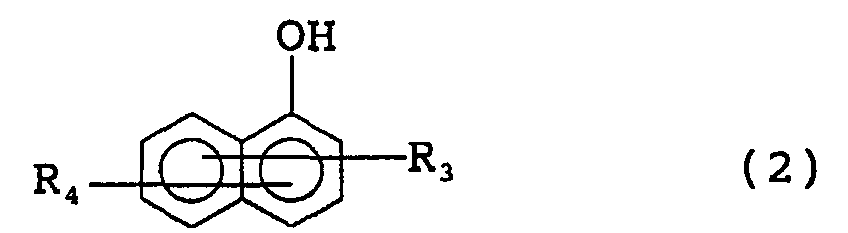
of 2 x 10⁻⁴ part or less by weight based on 1 part by weight of bisphenol A. - The method of claim 21, wherein the total content of 1-napthols is 1 x 10⁻⁴ part or less by weight based on 1 part by weight of bisphenol A.
- The method of claim 17, wherein bisphenol A contains a paraflavan compound represented by the following formula (3):wherein R5 to R7 are each independently an alkyl group having 1 to 4 carbon atoms, R8 and R9 are each independently an alkyl group having 1 to 4 carbon atoms, and p and q are each independently an integer of 0 to 4,

in an amount of 5 x 10⁻⁵ part or less by weight based on 1 part by weight of bisphenol A, and a codimer derivative represented by the following general formula (4):wherein R10 to R12 are each independently an alkyl group having 1 to 4 carbon atoms, R13 and R14 are each independently an alkyl group having 1 to 4 carbon atoms, and s and t are each independently an integer of 0 to 4,
in an amount of 5 x 10⁻⁵ part or less by weight based on 1 part by weight of bisphenol A. - The method of claim 17, wherein bisphenol A contains a chromene compound represented by the following formula (5):wherein R15 to R17 are each independently an alkyl group having 1 to 4 carbon atoms, R18 is a hydrogen atom or alkyl group having 1 to 4 carbon atoms, and a is an integer of 0 to 4, in an amount of 1 x 10⁻⁵ part or less by weight based on 1 part by weight of bisphenol A, and a compound represented by the following formula (6):
 wherein R19 and R20 are each independently an alkyl group having 1 to 4 carbon atoms, R21 and R22 are each independently an alkyl group having 1 to 4 carbon atoms, and b and c are each independently an integer of 0 to 4,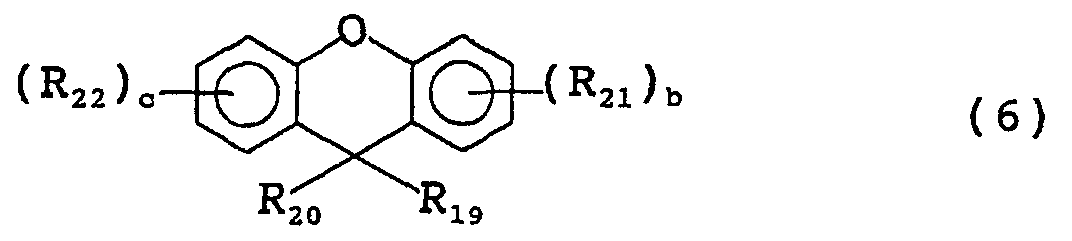
in an amount of 1 x 10⁻⁵ part or less by weight based on 1 part by weight of bisphenol A. - Use of the aromatic polycarbonate of claim 1 as a raw material for the production of a molded product.
- Use of claim 25, wherein the molded product is an optical disk substrate.
Applications Claiming Priority (13)
| Application Number | Priority Date | Filing Date | Title |
|---|---|---|---|
| JP34472499 | 1999-12-03 | ||
| JP34472599 | 1999-12-03 | ||
| JP34472499 | 1999-12-03 | ||
| JP34472799 | 1999-12-03 | ||
| JP34472599 | 1999-12-03 | ||
| JP34472699 | 1999-12-03 | ||
| JP34472899 | 1999-12-03 | ||
| JP34472899 | 1999-12-03 | ||
| JP34472699 | 1999-12-03 | ||
| JP34472799 | 1999-12-03 | ||
| JP2000000277 | 2000-01-05 | ||
| JP2000000277 | 2000-01-05 | ||
| PCT/JP2000/008415 WO2001040352A1 (en) | 1999-12-03 | 2000-11-29 | Aromatic polycarbonate, process for producing the same, and molded article |
Publications (2)
| Publication Number | Publication Date |
|---|---|
| EP1149852A1 true EP1149852A1 (en) | 2001-10-31 |
| EP1149852A4 EP1149852A4 (en) | 2003-01-22 |
Family
ID=27554666
Family Applications (1)
| Application Number | Title | Priority Date | Filing Date |
|---|---|---|---|
| EP00978000A Withdrawn EP1149852A4 (en) | 1999-12-03 | 2000-11-29 | Aromatic polycarbonate, process for producing the same, and molded article |
Country Status (5)
| Country | Link |
|---|---|
| US (1) | US6410678B1 (en) |
| EP (1) | EP1149852A4 (en) |
| KR (1) | KR20010101769A (en) |
| CN (1) | CN1339043A (en) |
| WO (1) | WO2001040352A1 (en) |
Cited By (3)
| Publication number | Priority date | Publication date | Assignee | Title |
|---|---|---|---|---|
| US8268953B2 (en) | 2007-10-04 | 2012-09-18 | Teijin Limited | Polycarbonate containing plant-derived component and process for the preparation thereof |
| EP2128187A4 (en) * | 2007-02-27 | 2014-10-29 | Teijin Chemicals Ltd | METHOD FOR PRODUCING MOLDED ARTICLE |
| WO2016194749A1 (en) | 2015-05-29 | 2016-12-08 | 出光興産株式会社 | Polycarbonate resin composition and molded article of same |
Families Citing this family (30)
| Publication number | Priority date | Publication date | Assignee | Title |
|---|---|---|---|---|
| MY141753A (en) * | 2003-09-15 | 2010-06-30 | Shell Int Research | Method for producing polycarbonate |
| US7112645B2 (en) * | 2004-03-19 | 2006-09-26 | General Electric Company | Polycarbonate composition and method of making thereof |
| US7189869B2 (en) * | 2004-11-01 | 2007-03-13 | General Electric Company | Method for making polycarbonate |
| US7906612B2 (en) * | 2006-09-01 | 2011-03-15 | Teijin Limited | Plant-derived component-containing polycarbonates and process for their production |
| CN101754994A (en) * | 2007-05-17 | 2010-06-23 | 帝人株式会社 | Method for production of polycarbonate containing plant-derived component |
| US7619053B2 (en) * | 2007-09-28 | 2009-11-17 | Sabic Innovative Plastics Ip B.V. | Monomer solution for producing polycarbonate |
| US7601794B2 (en) * | 2007-09-28 | 2009-10-13 | Sabic Innovative Plastics Ip B.V. | Monomer solution for producing polycarbonate |
| JP5415685B2 (en) * | 2007-10-04 | 2014-02-12 | 帝人株式会社 | Polycarbonate having plant-derived components and process for producing the same |
| JP2009127037A (en) * | 2007-11-28 | 2009-06-11 | Teijin Ltd | Polycarbonate having plant-derived components and method for producing the same |
| JP2009091418A (en) * | 2007-10-05 | 2009-04-30 | Teijin Ltd | Polycarbonate having plant-derived components and method for producing the same |
| WO2009057609A1 (en) * | 2007-10-31 | 2009-05-07 | Teijin Limited | Sugar alcohol anhydride composition having good storage stability, and process for production of polycarbonate using the same |
| WO2009120235A1 (en) * | 2008-03-26 | 2009-10-01 | Sabic Innovative Plastics Ip Bv | Monomer solution for producing polycarbonate |
| US7615605B2 (en) * | 2008-03-26 | 2009-11-10 | Sabic Innovative Plastics Ip B.V. | Monomer solution for producing polycarbonate |
| CN103319706A (en) * | 2009-11-30 | 2013-09-25 | 三菱化学株式会社 | Polycarbonate resin and its manufacturing method |
| KR20140016919A (en) * | 2011-04-06 | 2014-02-10 | 데이진 가부시키가이샤 | Transparent conductive laminate and transparent touch panel |
| JP5893856B2 (en) * | 2011-06-16 | 2016-03-23 | 帝人株式会社 | Method for reducing the formation of gelled polycarbonate resin |
| EP2820065B1 (en) | 2012-02-28 | 2017-01-11 | SABIC Global Technologies B.V. | Processes for preparing polycarbonates with enhanced optical properties |
| US8691915B2 (en) | 2012-04-23 | 2014-04-08 | Sabic Innovative Plastics Ip B.V. | Copolymers and polymer blends having improved refractive indices |
| EP2778186B1 (en) | 2013-03-15 | 2017-07-12 | SABIC Global Technologies B.V. | Production of a polycarbonate with limited metal residuals |
| KR102041268B1 (en) | 2013-03-15 | 2019-11-06 | 사빅 글로벌 테크놀러지스 비.브이. | Process for purification of diphenyl carbonate for the manufacturing of high quality polycarbonate |
| EP3024782B1 (en) | 2013-07-26 | 2019-06-12 | SABIC Global Technologies B.V. | Method and apparatus for producing high purity phosgene |
| WO2015013655A1 (en) | 2013-07-26 | 2015-01-29 | Sabic Innovative Plastics Ip B.V. | Method and apparatus for producing high purity phosgene |
| EP3024813B1 (en) | 2014-02-04 | 2017-03-29 | SABIC Global Technologies B.V. | Method for producing carbonates |
| US9695106B2 (en) | 2014-02-04 | 2017-07-04 | Sabic Global Technologies B.V. | Method for producing carbonates |
| US20180022918A1 (en) * | 2015-02-17 | 2018-01-25 | Sabic Global Technologies B.V. | A method of quenching a melt polycarbonate |
| WO2018134734A1 (en) | 2017-01-17 | 2018-07-26 | Sabic Global Technologies B.V. | Reduced color polycarbonate compositions, methods of manufacture, and articles thereof |
| US10364322B2 (en) | 2017-01-25 | 2019-07-30 | Alliance For Sustainable Energy, Llc | Naphthalene-containing polymers and methods of making the same |
| EP3891209B1 (en) | 2018-12-05 | 2022-05-25 | SABIC Global Technologies B.V. | Polycarbonate compositions with improved oxidation stability and methods of manufacturing the same |
| TW202037632A (en) * | 2018-12-28 | 2020-10-16 | 日商三菱瓦斯化學股份有限公司 | Thermoplastic resin, manufacturing method thereof, and optical lens containing the thermoplastic resin |
| WO2026053526A1 (en) * | 2024-09-06 | 2026-03-12 | 出光興産株式会社 | Polycarbonate-based resin composition |
Family Cites Families (13)
| Publication number | Priority date | Publication date | Assignee | Title |
|---|---|---|---|---|
| US4880896A (en) | 1987-05-30 | 1989-11-14 | Idemitsu Petrochemical Co., Ltd. | Polycarbonate for disc substrate having low bisphenol content |
| ES2107999T3 (en) * | 1988-07-11 | 1997-12-16 | Gen Electric | PROCEDURE FOR PREPARING POLYCARBONATES. |
| JPH0618868B2 (en) | 1988-09-22 | 1994-03-16 | 日本ジーイープラスチックス株式会社 | Method for producing polycarbonate |
| JPH0827978B2 (en) * | 1989-01-25 | 1996-03-21 | 出光石油化学株式会社 | Optical disc substrate and optical information recording medium using the substrate |
| JPH05148355A (en) | 1991-11-28 | 1993-06-15 | Daicel Chem Ind Ltd | Polycarbonate |
| JP2901418B2 (en) | 1992-06-22 | 1999-06-07 | 出光石油化学株式会社 | Method for producing polycarbonate |
| EP0592900A3 (en) * | 1992-10-14 | 1995-02-22 | Daicel Chem | Process for the preparation of polycarbonates by melt-polycondensation. |
| JP3808905B2 (en) | 1992-10-28 | 2006-08-16 | 帝人化成株式会社 | Optical fiber molding materials |
| EP0677545B1 (en) * | 1994-04-14 | 2000-07-05 | Daicel Chemical Industries, Ltd. | Process for the preparation of (co)-polycarbonate |
| JP3973239B2 (en) * | 1995-04-06 | 2007-09-12 | 日本ジーイープラスチックス株式会社 | Dihydroxy compound mixtures and polymers |
| JPH09165442A (en) | 1995-10-11 | 1997-06-24 | Mitsubishi Gas Chem Co Inc | Polycarbonate for optical recording media |
| US5973101A (en) | 1997-09-30 | 1999-10-26 | General Electric Company | Aromatic polycarbonate resin composition |
| JPH11310630A (en) * | 1998-04-30 | 1999-11-09 | Mitsubishi Gas Chem Co Inc | Manufacturing method of aromatic polycarbonate |
-
2000
- 2000-11-29 WO PCT/JP2000/008415 patent/WO2001040352A1/en not_active Ceased
- 2000-11-29 CN CN00803270A patent/CN1339043A/en active Pending
- 2000-11-29 EP EP00978000A patent/EP1149852A4/en not_active Withdrawn
- 2000-11-29 US US09/890,465 patent/US6410678B1/en not_active Expired - Lifetime
- 2000-11-29 KR KR1020017009525A patent/KR20010101769A/en not_active Withdrawn
Cited By (4)
| Publication number | Priority date | Publication date | Assignee | Title |
|---|---|---|---|---|
| EP2128187A4 (en) * | 2007-02-27 | 2014-10-29 | Teijin Chemicals Ltd | METHOD FOR PRODUCING MOLDED ARTICLE |
| US8268953B2 (en) | 2007-10-04 | 2012-09-18 | Teijin Limited | Polycarbonate containing plant-derived component and process for the preparation thereof |
| WO2016194749A1 (en) | 2015-05-29 | 2016-12-08 | 出光興産株式会社 | Polycarbonate resin composition and molded article of same |
| US11034834B2 (en) | 2015-05-29 | 2021-06-15 | Idemitsu Kosan Co., Ltd. | Polycarbonate resin composition and molded article of same |
Also Published As
| Publication number | Publication date |
|---|---|
| EP1149852A4 (en) | 2003-01-22 |
| WO2001040352A1 (en) | 2001-06-07 |
| KR20010101769A (en) | 2001-11-14 |
| US6410678B1 (en) | 2002-06-25 |
| CN1339043A (en) | 2002-03-06 |
Similar Documents
| Publication | Publication Date | Title |
|---|---|---|
| US6410678B1 (en) | Aromatic polycarbonate, production method and molded products thereof | |
| JP2012041548A (en) | Aromatic polycarbonate, composition thereof, and use | |
| US6608165B2 (en) | Aromatic polycarbonate and production process therefor | |
| KR100808035B1 (en) | Aromatic Polycarbonate Compositions, Methods for Making the Same, and Molded Articles | |
| JPWO2001092371A1 (en) | Aromatic polycarbonate, its composition and uses | |
| JPWO2003031516A1 (en) | Aromatic polycarbonate resin composition | |
| JPWO2001072901A1 (en) | Aromatic polycarbonate composition, its production method and molded article | |
| JP4928018B2 (en) | Aromatic polycarbonate, process for producing the same and molded article | |
| JP4713750B2 (en) | Copolycarbonate, process for producing the same, and resin composition | |
| JP2012067312A (en) | Method for producing aromatic polycarbonate | |
| JP4700166B2 (en) | Method for producing aromatic polycarbonate | |
| JP4361192B2 (en) | Stabilized aromatic polycarbonate composition | |
| JP2003147186A (en) | Aromatic polycarbonate composition, molded product and molding method | |
| JP4594570B2 (en) | Method for producing stabilized aromatic polycarbonate and composition thereof | |
| JP2002155198A (en) | Polycarbonate resin composition | |
| JP4505119B2 (en) | Method for producing polycarbonate | |
| JP2001288352A (en) | Flame retardant polycarbonate composition and molded article | |
| JPWO2001090215A1 (en) | Aromatic polycarbonate, its composition and molded article | |
| JP4598311B2 (en) | Method for producing polycarbonate | |
| JP2003155406A (en) | Aromatic polycarbonate composition and molded article thereof | |
| JP2001354762A (en) | Method for producing polycarbonate |
Legal Events
| Date | Code | Title | Description |
|---|---|---|---|
| PUAI | Public reference made under article 153(3) epc to a published international application that has entered the european phase |
Free format text: ORIGINAL CODE: 0009012 |
|
| 17P | Request for examination filed |
Effective date: 20010801 |
|
| AK | Designated contracting states |
Kind code of ref document: A1 Designated state(s): AT BE CH CY DE DK ES FI FR GB GR IE IT LI LU MC NL PT SE TR |
|
| AX | Request for extension of the european patent |
Free format text: AL;LT;LV;MK;RO;SI |
|
| A4 | Supplementary search report drawn up and despatched |
Effective date: 20021209 |
|
| AK | Designated contracting states |
Kind code of ref document: A4 Designated state(s): AT BE CH CY DE DK ES FI FR GB GR IE IT LI LU MC NL PT SE TR |
|
| RIC1 | Information provided on ipc code assigned before grant |
Free format text: 7C 08G 64/04 A, 7C 08G 64/20 B, 7G 11B 7/24 B, 7C 08G 64/30 B, 7C 07C 68/08 B |
|
| 17Q | First examination report despatched |
Effective date: 20040206 |
|
| STAA | Information on the status of an ep patent application or granted ep patent |
Free format text: STATUS: THE APPLICATION IS DEEMED TO BE WITHDRAWN |
|
| 18D | Application deemed to be withdrawn |
Effective date: 20040617 |