EP1149830A1 - Process for production of sulfur compounds - Google Patents
Process for production of sulfur compounds Download PDFInfo
- Publication number
- EP1149830A1 EP1149830A1 EP00979053A EP00979053A EP1149830A1 EP 1149830 A1 EP1149830 A1 EP 1149830A1 EP 00979053 A EP00979053 A EP 00979053A EP 00979053 A EP00979053 A EP 00979053A EP 1149830 A1 EP1149830 A1 EP 1149830A1
- Authority
- EP
- European Patent Office
- Prior art keywords
- group
- substituent
- carbon atoms
- compound
- sulfur
- Prior art date
- Legal status (The legal status is an assumption and is not a legal conclusion. Google has not performed a legal analysis and makes no representation as to the accuracy of the status listed.)
- Withdrawn
Links
- 0 CCC(C)(CC1SCCSC1)SC(*)(CCC*)*C Chemical compound CCC(C)(CC1SCCSC1)SC(*)(CCC*)*C 0.000 description 3
- IBCLCBRQEDPAJV-UHFFFAOYSA-N CC(C(OCCNCCNCCNCCOC(C(C)=C)=O)=O)=C Chemical compound CC(C(OCCNCCNCCNCCOC(C(C)=C)=O)=O)=C IBCLCBRQEDPAJV-UHFFFAOYSA-N 0.000 description 1
- JRCCCRAOTFLJRY-CXUHLZMHSA-N CC(C)(C)C(/N=C/CNCCNC(C(C)=C)=O)=O Chemical compound CC(C)(C)C(/N=C/CNCCNC(C(C)=C)=O)=O JRCCCRAOTFLJRY-CXUHLZMHSA-N 0.000 description 1
- RCLRAKIFPWESPQ-UHFFFAOYSA-N OCCN(CI)c1cc(OC(C=C2)(c(cc3)ccc3N3CCOCC3)c3cccc(F)c3)c2c2c1cccc2 Chemical compound OCCN(CI)c1cc(OC(C=C2)(c(cc3)ccc3N3CCOCC3)c3cccc(F)c3)c2c2c1cccc2 RCLRAKIFPWESPQ-UHFFFAOYSA-N 0.000 description 1
Classifications
-
- C—CHEMISTRY; METALLURGY
- C07—ORGANIC CHEMISTRY
- C07C—ACYCLIC OR CARBOCYCLIC COMPOUNDS
- C07C327/00—Thiocarboxylic acids
- C07C327/20—Esters of monothiocarboxylic acids
- C07C327/22—Esters of monothiocarboxylic acids having carbon atoms of esterified thiocarboxyl groups bound to hydrogen atoms or to acyclic carbon atoms
-
- C—CHEMISTRY; METALLURGY
- C07—ORGANIC CHEMISTRY
- C07C—ACYCLIC OR CARBOCYCLIC COMPOUNDS
- C07C319/00—Preparation of thiols, sulfides, hydropolysulfides or polysulfides
- C07C319/14—Preparation of thiols, sulfides, hydropolysulfides or polysulfides of sulfides
-
- C—CHEMISTRY; METALLURGY
- C07—ORGANIC CHEMISTRY
- C07C—ACYCLIC OR CARBOCYCLIC COMPOUNDS
- C07C329/00—Thiocarbonic acids; Halides, esters or anhydrides thereof
- C07C329/02—Monothiocarbonic acids; Derivatives thereof
- C07C329/04—Esters of monothiocarbonic acids
- C07C329/06—Esters of monothiocarbonic acids having sulfur atoms of thiocarbonic groups bound to acyclic carbon atoms
-
- C—CHEMISTRY; METALLURGY
- C07—ORGANIC CHEMISTRY
- C07C—ACYCLIC OR CARBOCYCLIC COMPOUNDS
- C07C333/00—Derivatives of thiocarbamic acids, i.e. compounds containing any of the groups, the nitrogen atom not being part of nitro or nitroso groups
- C07C333/02—Monothiocarbamic acids; Derivatives thereof
- C07C333/04—Monothiocarbamic acids; Derivatives thereof having nitrogen atoms of thiocarbamic groups bound to hydrogen atoms or to acyclic carbon atoms
-
- C—CHEMISTRY; METALLURGY
- C07—ORGANIC CHEMISTRY
- C07D—HETEROCYCLIC COMPOUNDS
- C07D339/00—Heterocyclic compounds containing rings having two sulfur atoms as the only ring hetero atoms
- C07D339/08—Six-membered rings
-
- C—CHEMISTRY; METALLURGY
- C08—ORGANIC MACROMOLECULAR COMPOUNDS; THEIR PREPARATION OR CHEMICAL WORKING-UP; COMPOSITIONS BASED THEREON
- C08G—MACROMOLECULAR COMPOUNDS OBTAINED OTHERWISE THAN BY REACTIONS ONLY INVOLVING UNSATURATED CARBON-TO-CARBON BONDS
- C08G75/00—Macromolecular compounds obtained by reactions forming a linkage containing sulfur with or without nitrogen, oxygen, or carbon in the main chain of the macromolecule
- C08G75/02—Polythioethers
- C08G75/04—Polythioethers from mercapto compounds or metallic derivatives thereof
-
- G—PHYSICS
- G02—OPTICS
- G02B—OPTICAL ELEMENTS, SYSTEMS OR APPARATUS
- G02B5/00—Optical elements other than lenses
- G02B5/20—Filters
- G02B5/22—Absorbing filters
- G02B5/23—Photochromic filters
Definitions
- the present invention relates to a method of preparing a sulfur-containing compound having at least one thio group in the molecules by reacting a thiol compound with an organic compound having at least one functional group capable of forming a thio group in the molecules upon the reaction with a mercapto group, easily, in a high yield and in a highly pureform being colored little.
- the invention further relates to a sulfur-containing compound of a highly pure form obtained by the above method.
- the sulfur-containing compound having a thio group in the molecules can be used as an optical material that exhibits a high refractive index owing to its relatively large molecular refraction possessed by a sulfur atom and can be used in the field of medicines and agricultural chemicals owing to a high degree of activity exhibited by sulfur for animals and plants.
- the sulfur-containing compound is very useful as a polymerizable monomer or an intermediate product thereof for obtaining an optical material in a field where a high degree of refractive index is desired as represented by photochromic plastic lenses.
- Photochromic property is a reversible action of a material which quickly changes its color when irradiated with light containing ultraviolet rays such as of sunlight or light of a mercury lamp, and exhibits its initial color when the material is no longer irradiated with light but is placed in a dark place.
- a photochromic plastic lens is obtained by dispersing a photochromic compound having the above-mentioned property in a plastic lens.
- photochromic curable compositions obtained by dissolving a photochromic compound in a radically polymerizable monomer as disclosed in Japanese Unexamined Patent Publication (Kokai) No. 124790/1991 and PCT International Patent Application No. 96/19741.
- the cured products obtained by curing the above-mentioned photochromic curable composition exhibit refractive indexes of smaller than 1.55, and it has been desired to further increase the refractive index from the standpoint of producing stronger lenses yet having smaller thicknesses.
- a resin that exhibits a high refractive index can be realized by introducing halogen atoms other than fluorine, or by introducing aromatic rings or sulfur atoms in large amounts into the molecules of the polymerizable monomer.
- the method of introducing sulfur atoms into the monomer molecules is particularly effective from such a standpoint that the weight of the polymer (i.e., plastic lens) does not increase compared to the case of introducing halogen atoms other than fluorine or introducing aromatic rings and, besides, Abbe's number does not decrease.
- the present inventors have studied the method of introducing thio groups into the molecules of a polymerizable monomer based on such an idea that sulfur atoms can be introduced in large amounts into the monomer molecules by introducing sulfur atoms in the form of thio groups and that the refractive index of a polymer can be increased due to this effect.
- the polymerizable sulfur-containing compound obtained by the above method was evaluated for its performance as a monomer for producing photochromic plastic lenses.
- the refractive index could be increased, there occurred a new problem in that the light resistance of photochromic properties was markedly deteriorated.
- the invention further has an object of providing a method of preparing the sulfur-containing compound, wherein when the sulfur-containing compound having a polymerizable functional group is used as a monomer for forming the photochromic plastic lens, photochromic property having good light resistance is exhibited.
- the present invention was proposed in order to solve the above-mentioned objects and was completed based on a discovery that a sulfur-containing compound which is an object compound is obtained suppressing the formation of impurities, suppressing the development of color in the product, maintaining a high purity and a high yield by controlling the amount of water in the reaction system to be smaller than a predetermined value, and that, in addition to the above, when the above reaction is conducted in an atmosphere without substantially containing oxygen such as nitrogen atmosphere, formation of the disulfide compounds, which are the impurities, is suppressed to a high degree, the disulfide compounds exhibiting chemical and physical behaviors resembling to those of the object sulfur-containing compound and, as a result, light resistance of the photochromic property is markedly improved when the above sulfur-containing compound is used as the monomer for forming photochromic plastic lenses.
- the present invention is concerned with a method of preparing a sulfur-containing compound having at least one thio group in the molecules by reacting a thiol compound with an organic compound having at least one functional group capable of forming a thio group in the molecules upon reacting with a mercapto group in the presence of a basic compound, wherein the number of moles of water contained in the reaction system is set to be not larger than 7.5 times as large as the number of moles obtained by multiplying the number of moles of the thiol compound to be reacted by a number of mercapto groups present in one molecule of the thiol compound.
- Another invention is concerned with a method of preparing a sulfur-containing compound wherein the method of preparing the sulfur-containing compound is carried out in an atmosphere without substantially containing oxygen.
- a further invention is concerned with a sulfur-containing compound of a highly pure form, which is a reaction product obtained by reacting a thiol compound with an organic compound having at least one functional group capable of forming a thio group in the molecules upon the reaction with a mercapto group or is a derivative of said reaction product and having at least one thio group in the molecules, said sulfur-containing compound containing not larger than 2 mol% of the compounds having a disulfide bond, which are the impurities.
- a still further invention is concerned with a polymerizable monomer composition
- a polymerizable monomer composition comprising the above sulfur-containing compound of a highly pure form and another polymerizable monomer copolymerizable therewith, wherein the content of the compound having a disulfide bond contained in said composition is not larger than 0.02 mols per mole of said sulfur-containing compound.
- a yet further invention is concerned with a photochromic polymerization-curable composition containing the above polymerizable monomer composition and a photochromic compound.
- a further invention is concerned with a photochromic cured product obtained by curing the photochromic polymerization-curable composition by polymerization.
- the thiol compound which is a starting material for obtaining the sulfur-containing compound provided it has one or more mercapto groups in the molecules
- any known thiol compound can be used.
- the organic compound (capable of reacting with the mercapto group) having at least one functional group capable of forming a thio group (the thio group-forming functional group) in the molecules upon the reaction with the mercapto group there can be used any known compound without particular limitation provided it is capable of forming a thio group (synonymous with a group -S- without, however, including those in which the thio groups are continuing like a group -S-S-) in the molecules upon the reaction with the mercapto group.
- the functional group capable of forming a thio group upon the reaction with the mercapto group is the one capable of forming a bond having a thio group, such as sulfide bond, thioester bond, thiourethane bond or thiocarbonate bond upon the reaction with the mercapto group, as represented by halogen atoms as well as radically polymerizable, ionically polymerizable, polyadditive or polycondensing polymerizable functional group, such as (meth)acryloyl group, (meth)acryloyloxy group, hydroxyl group, mercapto group, isocyanate group, thioisocyanate group, vinyl group, styryl group, aryloxy group, epoxy group, epithio group, amino group and carboxyl group.
- a thio group such as sulfide bond, thioester bond, thiourethane bond or thiocarbonate bond upon the reaction with the mercap
- the thiol compound is reacted with a compound capable of reacting with the mercapto group to prepare a sulfur-containing compound having at least one thio group in the molecules.
- a basic compound such as sodium hydroxide that can be easily handled compared with metal sodium.
- the conversion is higher than that of when sodium metal is used and, besides, by-products are formed in small amounts.
- a thiol compounds such as:
- the preparation method 1 ⁇ is desirable from such a standpoint that the obtained sulfur-containing compound is useful as a monomer for obtaining optical lenses having a high refractive index and a large Abbe's number or as an intermediate monomer product for obtaining such optical lenses.
- the sulfur-containing compound is useful as an intermediate monomer product for obtaining optical lenses, further, it is particularly desired to use an organic compound having at least one functional group capable of forming a thio group in the molecules upon reacting with a mercapto group represented by the general formula (6) in which R 11 is an alkyl group with 1 to 4 carbon atoms having a reactive substituent such as a hydroxyl group, a mercapto group or a halogen atom.
- a thiol compound is reacted with an organic compound having at least one functional group capable of forming a thio group in the molecules upon the reaction with a mercapto group in the presence of a basic compound in order to substitute an organic group for a hydrogen atom of the mercapto group (group -SH) in the thiol compound, thereby to obtain, as an object product, a sulfur-containing compound having a chain extended due to an organic residue substituted by newly forming a thio group.
- group -SH group-SH
- the thiol compound used as a starting material in the preparation method of the present invention may be any known compound without limitation provided it has one or more mercapto groups in the molecules. From the standpoint of usefulness of the formed product, however, it is desired to use a thiol compound represented by the above general formula (1), (2), (3), (4) or (5). These thiol compounds will now be described.
- R 1 and R 2 are, independently from each other, alkylene groups with 1 to 4 carbon atoms which may have a substituent or arylene groups with 6 to 12 carbon atoms which may have a substituent.
- the number of carbon atoms does not include those carbon atoms of the substituent.
- alkylene groups with 1 to 4 carbon atoms those without substituent are, concretely, ethylene group, propylene group, isopropylene group and butylene group. Among them, ethylene group is particularly preferred.
- arylene groups with 6 to 12 carbon atoms further, those without substituent are, concretely, phenylene group, tolylene group, xylylene group and naphthylene group.
- the substituent possessed by the alkylene group or the arylene group is at least the one selected from the group consisting of alkyl group, aryl group, aralkyl group, alkoxy group, alkylthio group, aromatic heterocyclic group, halogen atom excluding fluorine and group represented by the above general formula (12).
- alkyl group which is the substituent any known group can be used without limitation. It is, however, desired to use an alkyl group with 1 to 4 carbon atoms, such as methyl group, ethyl group, propyl group, isopropyl group, butyl group or t-butyl group.
- aryl group which is the substituent any known group can be used without limitation. It is, however, desired to use an aryl group with 6 to 12 carbon atoms, such as phenyl group, tolyl group or naphthyl group.
- any known group can be used without limitation. It is, however, desired to use an aralkyl group with 7 to 11 carbon atoms, such as benzyl group or phenetyl group.
- alkoxy group which is the substituent
- any known group can be used without limitation. It is, however, desired to use an alkoxy group with 1 to 4 carbon atoms, such as methoxy group, ethoxy group, propoxy group, isopropoxy group, butoxy group or t-butoxy group.
- alkylthio group which is the substituent
- any known group can be used without limitation. It is, however, desired to use an alkylthio group with 1 to 4 carbon atoms, such as methylthio group, ethylthio group, propylthio group, isopropylthio group, butylthio group or t-butylthio group.
- aromatic heterocyclic group which is the substituent
- any known group can be used without limitation. It is, however, desired to use an aromatic heterocyclic group with 4 to 10 carbon atoms, such as thienyl group, furyl group or benzothienyl group.
- halogen atom excluding fluorine there can be used chlorine, bromine or iodine.
- R 4 is an alkylene group with 1 to 4 carbon atoms which may have a substituent.
- the number of carbon atoms does not include carbon atoms of the substituent.
- the alkylene groups with 1 to 4 carbon atoms those without substituent are, concretely, methylene group, ethylene group, propylene group, isopropylene group and butylene group. Among them, ethylene group is particularly preferred.
- the substituent of the alkylene group which may have a substituent denoted by R 4 is at least the one selected from the group consisting of alkyl group, aryl group, aralkyl group, alkoxy group, alkylthio group, aromatic heterocyclic group and halogen atom excluding fluorine.
- the substituent may be the same as that of the alkylene group that may have a substituent or may be the same as that of the arylene group that may have a substituent denoted by R 1 and R 2 . It is, however, desired to use ethylene group, isopropylene group or phenylene group. Among them, it is particularly desired to use ethylene group or isopropylene group.
- d is an integer of 0 to 10. From the standpoint of easy synthesis, however, it is desired that d is an integer of 0 to 3.
- R 3 is a group represented by the above formula (13).
- e is an integer of 0 to 5 and, preferably, an integer of 0 to 4.
- R 5 is an alkylene group with 1 to 4 carbon atoms which may have a substituent (without, however, including the number of carbon atoms of the substituent), an arylene group with 6 to 12 carbon atoms which may have a substituent (without, however, including the number of carbon atoms of the substituent), a divalent aromatic heterocyclic group which may have a substituent, or a group represented by the above general formula (14).
- R 6 , R 7 , R 8 and R 9 are, independently from each other, halogen atoms excluding fluorine atoms, or hydrogen atoms, and R 10 is an alkylene group with 1 to 3 carbon atoms or a sulfur atom.
- the alkylene group is a methylene group, an ethylene group or a propylene group. It is, however, desired that R 10 is a sulfur atom from the standpoint of easy availability of the starting material.
- the alkylene group and arylene group denoted by R 5 may be the same as those denoted by R 1 and R 2 , and are, desirably, ethylene groups, isopropylene groups or phenylene groups and, particularly preferably, ethylene groups or isopropylene groups.
- the substituents thereof are the same as those of the alkylene group that may have a substituent denoted by R 4 .
- aromatic heterocyclic group that may have a substituent denoted by R 5
- any known group can be used without limitation. It is, however, desired to use an aromatic heterocyclic group with 4 to 10 carbon atoms, such as thienyl group, furyl group or benzothienyl group, or a group thereof for which are substituted one or two or more substituents of the alkylene group that may have a substituent denoted by R 4 .
- c is an integer of 0 to 6. From the standpoint of easy availability of the starting material or easy synthesis, however, it is desired that c is an integer of 0 to 3.
- the positions where the group -CH 2 - (when c is 0) and the group -CH 2 -R 3 -CH 2 - (when c is not 0) are bonded to the dithian ring may be such that the dithian rings become a 2,5-substituted 1,4-dithian ring or a 2,6-substituted 1,4-dithian ring.
- positions may be such that they are arbitrarily mixed together.
- c' is 0 or 1. From the standpoint of easy synthesis, however, it is. desired that c' is 0. As an intermediate product of the optical material, on the other hand, it is desired that c' is 1.
- a and a' are, independently from each other, integers of 0 to 10. From the standpoint of easy availability of the starting material or easy synthesis, however, it is desired that a and a' are integers of 0 to 6. When c' is 0 in the above general formula (1), the sum of a and a' is not smaller than 2.
- R 15 is a monovalent to trivalent aromatic group with 6 to 14 carbon atoms which may have a substituent (without, however, including the number of carbon atoms of the substituent) or a monovalent to trivalent aromatic heterocyclic group with 3 to 12 carbon atoms which may have a substituent (without, however, including the number of carbon atoms of the substituent).
- the substituents of these groups are the same as the substituent of the alkylene group with 1 to 4 carbon atoms which may have a substituent of the above formula (12).
- Examples of the monovalent to trivalent aromatic group or of the monovalent to trivalent aromatic heterocyclic group include phenylene group, tolylene group, xylylene group, naphthylene group, thienyl group, furyl group, benzothienyl group and triazine group. Among them, it is particularly desired to use phenylene group from the standpoint of easy availability of the starting material.
- f is, independently from each other, an integer of 0 or 1. From the standpoint of easy synthesis and easy availability of the starting material, it is desired that f' is 1. From the standpoint of monomer for photochromic lenses having a high refractive index, it is desired that f' is 3.
- R 16 is an alkylene group with 1 to 4 carbon atoms which may have a substituent.
- the number of carbon atoms does not include the number of carbon atoms of the substituent.
- the alkylene group with 1 to 4 carbon atoms that may have a substituent may be the same as the alkylene group with 1 to 4 carbon atoms which may have a substituent denoted by R 1 and R 2 .
- R 17 is a hydrogen atom or an alkyl group with 1 to 4 carbon atoms which may have a substituent.
- the number of carbon atoms does not include the carbon atoms of the substituent.
- the substituent possessed by the alkyl group may be the same as the substituent, other than the alkyl group, in the alkylene group with 1 to 4 carbon atoms which may have a substituent in the above formula (12).
- Concrete examples of the alkyl group include methyl group, ethyl group, propyl group, isopropyl group and butyl group. Among them, it is particularly desired to use methyl group.
- g is an integer of 1 to 10. From the standpoint of easy availability of the starting material and easy synthesis, however, g is preferably an integer of 1 to 5. In the general formula (3), further, g' is an integer of 0 to 1. In the same formula, h is an integer of 0 to 5. From the standpoint of easy availability and easy synthesis, however, h is 1 to 3. In the same formula, further, h' is 0 or 1. From the standpoint of easy synthesis, however, h' is 1.
- R 18 and R 19 are, independently from each other, alkylene groups with 1 to 4 carbon atoms which may have a substituent (without, however, including the number of carbon atoms of the substituent) or arylene groups with 6 to 12 carbon atoms which may have a substituent (without, however, including the number of carbon atoms of the substituent).
- the alkylene groups with 1 to 4 carbon atoms that may have a substituent and the arylene groups that may have a substituent denoted by R 18 and R 19 may be the same as those denoted by R 1 and R 2 , and, preferably, ethylene groups, isopropylene groups or phenylene groups and, particularly preferably, ethylene groups or isopropylene groups.
- R 20 is an alkyl groups with 1 to 4 carbon atoms which may have a substituent, an aryl group with 6 to 12 carbon atoms which may have a substituent or an aralkyl group which may have a substituent.
- the alkyl group with 1 to 4 carbon atoms which may have the substituent may be the same as the alkyl group with 1 to 4 carbon atoms denoted by R 17 .
- the substituents possessed by the aryl group and aralkyl group are the same as the substituent of the alkylene group with 1 to 4 carbon atoms which may have a substituent in the above formula (12).
- Y and Z are oxygen atoms or sulfur atoms.
- Y and Z are not oxygen atoms at the same time.
- Y and Z are both sulfur atoms.
- i and i' are, independently from each other, integers of 0 to 10, and the sum of i and i' is not smaller than 1.
- R 21 , R 22 , R 23 , R 24 , R 25 and R 26 are, independently from each other, hydrogen atoms or groups represented by the above formula (16).
- at least one of R 21 , R 22 , R 23 , R 24 , R 25 and R 26 in the above general formula (5) is the group represented by the above formula (16).
- R 27 and R 28 are, independently from each other, alkylene groups with 1 to 4 carbon atoms which may have a substituent.
- the number of carbon atoms does not include the carbon atoms of the substituent.
- the substituents of the alkylene groups are the same as the substituent of the alkylene group with 1 to 4 carbon atoms which may have a substituent denoted by R 1 and R 2 in the above general formula (1).
- j and j' are, independently from each other, integers of 0 to 4, and the sum of j and j' is not smaller than 1.
- another starting material i.e., an organic compound (capable of reacting with a mercapto group) having at least one functional group capable of forming a thio group (the thio group-forming functional group) in the molecules upon the reaction with a mercapto group
- an organic compound capable of reacting with a mercapto group
- the thio group-forming functional group the thio group-forming functional group
- the reaction with the mercapto group for forming the thio group may be a reaction in which a hydrogen atom of the mercapto group is condensed while being split in the form of hydrogen halide or a reaction in which a sulfur atom and a hydrogen atom of the mercapto group are added while being split off to the unsaturated bond in the thio group-forming functional group.
- the combination of the thiol compound and the compound capable of reacting with the mercapto group may be suitably determined depending upon the kind of the reaction.
- the compound capable of reacting with the mercapto group is an organic compound having a thio group-forming functional group in the molecules, and there can be used any one of a structure corresponding to the object compound and to the thiol compound that is used.
- the thio group-forming functional group is as described already. From the standpoint of easy availability of the starting material and easy synthesis, however, it is desired to use a halogen atom and, particularly, a chlorine atom, a bromine atom or an iodine atom when the thio group is to formed as a sulfide bond.
- the thio group When the thio group is to be formed as a thio ester bond, it is desired to use a halogen atom and, particularly, a chlorine atom. When the thio group is to be formed as a thiourethane bond, it is desired to use an isocyanate group or a thioisocyanate group. When the thio group is to be formed as a thiocarbonate bond, it is desired to use a carbonic acid ester.
- polymerizable functional group there can be exemplified a variety of radically polymerizable, ionically polymerizable, polymerization additive or polymerization condensing functional group exemplified already as the thio group-forming functional group.
- the thio group-forming functional group and the polymerizable functional group may be those of the same kind.
- the sulfur-containing compound which is the object product must have one thio group and one polymerizable functional group. Accordingly, the number of the groups must not be smaller than 2.
- the reaction is conducted by using the compound capable of reacting with the mercapto group and having in the molecules the number of the functional groups larger than the number of the mercapto groups present in the molecules of the thiol compound, so that the polymerizable groups are left in the reaction product (object product).
- the total number of the functional groups present in a molecule of the compound capable of reacting with the mercapto group may be selected to be larger than the number of the mercapto groups present in a molecule of the thiol compound in the same manner as described above to leave the polymerizable functional groups.
- these two functional groups exhibit different reactivity to the mercapto group. Upon suitably setting the reaction conditions, therefore, the group having a low reactivity can be left as the polymerizable group. It is, hence, desired that the thio group-forming functional group and the polymerizable functional group are of different kinds.
- the compound capable of reacting with the mercapto group used in the present invention is, usually, a compound represented by the above general formula (6).
- W is a thio group-forming functional group.
- R 11 is an alkyl group with 1 to 4 carbon atoms which may have a substituent (without, however, including the number of carbon atoms of the substituent) or a (meth)acryloyl group.
- the substituent of the alkyl group is at least one group selected from the group consisting of polymerizable functional group, aryl group, aralkyl group, alkoxy group, alkylthio group, aromatic heterocyclic group and halogen atom excluding fluorine.
- R 11 in the general formula (6) is an alkyl group with 1 to 4 carbon atoms having a polymerizable functional group as a substituent or a (meth)acryloyl group, or is, particularly, an alkyl group with 1 to 4 carbon atoms having a reactive substituent such as hydroxyl group, mercapto group or halogen atom which enables the polymerizable groups to be easily introduced.
- the amount of the compound capable of reacting with the mercapto group, that is used in the present invention is not particular limitation. It is, however, desired to use the compound capable of reacting with the mercapto group in a number of moles which is 0.5 to 5.0 times as great and, particularly, which is 1.0 to 3.0 times as great as the number of moles obtained by multiplying the number of moles of the thiol compound that is to be reacted by the number of mercapto groups present in a molecule of the thiol compound.
- the above-mentioned thiol compound is reacted with the compound capable of reacting with the mercapto group in the presence of a basic compound while controlling the amount of water in the reaction system to be not larger than 7.5 times as large as the number of moles obtained by multiplying the number of moles of the thiol compound by the number of mercapto groups present in a molecule of the thiol compound.
- the amount of water in the reaction system it is allowed to obtain the desired product maintaining good operability and in a high yield. It is further allowed to favorably prevent the reaction product from being colored.
- the basic compound that is used activates the mercapto group of the thiol compound and improves the reactivity with the compound capable of reacting with the mercapto group. From the standpoint of easy handling, however, it is desired to use a hydroxide of an alkali metal, a carbonate of an alkali metal, an alkoxide of an alkali metal or an organic base.
- Examples of the basic compound that can be favorably used include lithium hydroxide, sodium hydroxide, potassium hydroxide, cesium hydroxide, lithium carbonate, sodium carbonate, potassium carbonate, cesium carbonate, sodium hydrogen carbonate, potassium hydrogen carbonate, lithium methoxide, sodium methoxide, sodium ethoxide, t-butoxypotassium, triethylamine, pyridine and quinoline.
- a basic compound such as sodium hydroxide, potassium hydroxide, sodium carbonate, potassium carbonate, cesium carbonate, sodium methoxide, sodium ethoxide, t-butoxypotassium, triethylamine or pyridine from the standpoint of easy handling and solubility in an organic solvent (particularly in an alcohol). It is further allowable to use basic compounds of different kinds in a mixed manner.
- the amount of the basic compound there is no particular limitation on the amount of the basic compound. From the standpoint of trapping by-products such as hydrogen halide and the like and of preventing excess use, however, it is desired that the basic compound is used in a number of moles which is 0.5 to 5.0 times as large and, particularly, 1.0 to 3.0 times as large as the number of moles obtained by multiplying the number of mols of the thiol compound by the number of the mercapto groups in a molecule of the thiol compound.
- the basic compound dissolves sparingly depending upon the kind of the reaction reagent that is used or depending upon the reaction solvent that is used as required.
- water may be added, as required, to the reaction system.
- it is essential to decrease the amount of water contained in the reaction system to be smaller than the above-mentioned particular value.
- the number of moles of water contained in the reaction system must be decreased to be not larger than 7.5 times as large as the number of moles (hereinafter also referred to as the number of moles of the starting mercapto groups) obtained by multiplying the number of moles of the thiol compound used as the starting material by the number of the mercapto groups present in a molecule of the thiol compound.
- the amount of water contained in the reaction system exceeds the above amount, it is not possible to suppress the formation of by-products, whereby the reaction yield decreases and the formed product is colored. From the standpoint of suppressing the formation of by-products, it is desired that the amount of water in the reaction system is not larger than 5.0 times and, particularly, not larger than 2.5 times as large as the number of moles of the starting mercapto groups.
- the amount of water in the reaction system can be limited by using the (dehydrated) reaction reagent or a dehydrated solvent, or by adding a basic compound that forms no water in the reaction with the mercapto group.
- the amount of the water may be measured by measuring, in advance and relying upon Karl Fischer's method, the amount of water contained in the reaction reagent or in the solvent of before being mixed. Upon measuring the final amount of water contained in the reaction system after the reaction, further, it becomes possible to confirm the amount of water formed by the reaction relying upon the difference from a value of before the mixing.
- the object sulfur-containing compound can be obtained in a considerably high yield suppressing the formation of the by-product.
- the sulfur-containing compounds obtained by this method when the one having a polymerizable functional group (hereinafter also referred to as polymerizable sulfur-containing compound) is evaluated for its performance as a monomer for obtaining photochromic plastic lenses, the object of high refractive index is accomplished but light resistance of photochromic properties is very deteriorated.
- the present inventors have closely analyzed the polymerizable sulfur-containing compound to investigate the cause of drop in the light resistance of photochromic properties. That is, the polymerizable sulfur-containing compound used for the evaluation is the one of which the purity is confirmed by gas chromatography (GC method) after the color has been removed by the treatment with activated carbon and by washing with an aqueous solution of sodium hydroxide, which, however, has not been carefully analyzed by the high-speed liquid chromatography (HPLC method). As a result, the polymerizable sulfur-containing compound could not be detected by the analysis based on the GC method.
- GC method gas chromatography
- HPLC method high-speed liquid chromatography
- disulfide compound a compound having a disulfide bond had been contained as an impurity that could be confirmed by the HPLC method.
- This disulfide compound exhibits chemical/physical behavior similar to that of the sulfur-containing compound having a thio group, which is the object compound, and cannot be removed by practicable refining means.
- the reaction system may be substituted to a sufficient degree with an inert gas such as of nitrogen, helium or argon, and the reaction may be conducted in such a gaseous atmosphere.
- an inert gas such as of nitrogen, helium or argon
- the atmosphere without substantially containing oxygen stands for a state where the content of oxygen in the atmosphere is not larger than 10000 ppm (1% in the atmosphere).
- the basic compound which is even in a solid form dissolves partly or entirely enabling the reaction to be smoothly conducted.
- water is added in amount specified by the present invention to further enhance the rate of reaction.
- any known solvent can be used without limitation provided it does not adversely affect the reaction.
- the solvent that can be preferably used include alcohols such as methanol, ethanol, and isopropanol; ethers such as diethylether, tetrahydrofurane and dioxane; halogen compounds such as methylene chloride and chloroform; and aliphatic or aromatic hydrocarbons such as hexane, heptane, benzene and toluene.
- alcohols such as methanol, ethanol or isopropanol from the standpoint of easily dissolving the solid basic compound.
- the above solvents may be used being mixed together. There is no particular limitation on the amount of using the solvent. Usually, however, the solvent is used in an amount of about 50 to about 2000 parts by weight per 100 parts by weight of the thiol compound.
- reaction reagents for example, a solvent used as required and water used as required.
- the thiol compound is dissolved in the presence of the basic compound and the reaction solvent and, then, the compound capable of reacting with the mercapto group diluted with the reaction solvent is added to the above solution, followed by stirring in an invert gas atmosphere.
- a polymerization inhibitor When it is attempted to prepare a radically polymerizable sulfur-containing compound such as (meth)acryloyl group as a polymerizable functional group, it is desired to add a polymerization inhibitor to prevent gelation.
- the polymerization inhibitor there can be used any known compound without limitation. Concrete examples thereof include phenolic polymerization inhibitors such as hydroquinone, p-methoxyphenol, 2,6-di-t-butyl-4-methylphenol and p-t-butylcatechol; phenothiazine, copper chloride (II) and iron chloride (III).
- the polymerization inhibitor is used in an amount that varies depending upon the kind of the inhibitor and the reaction temperature. Generally, however, the polymerization inhibitor is used in an amount of 0.01 to 10% by weight and, preferably, 0.1 to 5% by weight of the radically polymerizable sulfur-containing compound such as (meth)acryloyl group which is the object product.
- reaction conditions are not particularly limited but are generally as described below.
- the reaction temperature differs depending upon the kinds and amounts of the reaction agents and solvents that are used, but is generally from -5 to 150°C and, preferably, from 10 to 100°C.
- the reaction time differs depending upon the kinds and amounts of the starting materials that are used, but is generally from 10 minutes to 48 hours and, preferably, from 30 minutes to 24 hours. It is desired to maintain the stirring during the reaction.
- the sulfur-containing compound prepared according to the above method can be isolated by a known method. According to the above method of the present invention, the side reaction is suppressed. When the conversion of the reaction is high, therefore, all what are needed are simply to effect the filtering (when the object product is a solid) and to distill the solvent off. When the conversion is low, an excess of the basic compound is processed and, then, the unreacted reagent and, as required, the solvent may be separated by distillation or recrystallization.
- the separation operation may be executed after having conducted a known refining operation such as column chromatography, treatment with an adsorbing agent such as a treatment with activated carbon, or treatment with silica, decoloring treatment such as washing by using a mother, an aqueous solution of hydrogen chloride, or an aqueous solution of sodium hydroxide.
- a known refining operation such as column chromatography, treatment with an adsorbing agent such as a treatment with activated carbon, or treatment with silica, decoloring treatment such as washing by using a mother, an aqueous solution of hydrogen chloride, or an aqueous solution of sodium hydroxide.
- the sulfur-containing compound has a polymerizable functional group in the molecules from the standpoint of using it as a polymerizable monomer for an optical material for producing photochromic plastic lenses, as described above.
- the sulfur-containing compounds represented by, for example, the general formulas (7) to (11) it is desired that R 11 , R 12 , R 13 and R 14 are alkyl groups with 1 to 4 carbon atoms having at least a polymerizable functional group or (meth)acryloyl groups as a substituent.
- sulfur-containing compound represented by the above general formula (7) and derivatives thereof that can be favorably used as monomers for producing photochromic lenses according to the invention include compounds of the following structures.
- sulfur-containing compound represented by the above general formula (8) and derivatives thereof that can be favorably used as monomers for producing photochromic lenses according to the invention include compounds of the following structures.
- sulfur-containing compound represented by the above general formula (9) and derivatives thereof that can be favorably used as monomers for producing photochromic lenses according to the invention include compounds of the following structures.
- sulfur-containing compound represented by the above general formula (10) and derivatives thereof that can be favorably used as monomers for producing photochromic lenses according to the invention include compounds of the following structures.
- sulfur-containing compound represented by the above general formula (11) and derivatives thereof that can be favorably used as monomers for producing photochromic lenses according to the invention include compounds of the following structures.
- the sulfur-containing compound having such a polymerizable functional group in the molecules can be readily used as a monomer for producing photochromic plastic lenses (the monomers used for this purpose are usually cured by radical polymerization).
- the sulfur-containing compound having such a polymerizable functional group can be used as a monomer for being ionization polymerized, for being polycondensed or for being polyadded.
- the sulfur-containing compound may be reacted with a compound (hereinafter also referred to as a compound for introducing radically polymerizable group) having a radically polymerizable group and having a group capable of reacting with the polymerizable functional group of the sulfur-containing compound to introduce the radically polymerizable group into the sulfur-containing compound.
- a compound for introducing radically polymerizable group having a radically polymerizable group and having a group capable of reacting with the polymerizable functional group of the sulfur-containing compound to introduce the radically polymerizable group into the sulfur-containing compound.
- the compound for introducing the radically polymerizable group there is no particular limitation on the compound for introducing the radically polymerizable group provided it has in the molecules thereof above a ragically polymerizable group and a group (hereinafter also referred to as functional group for introducing radically polymerizable group) that reacts with the polymerizable functional group of the sulfur-containing compound to introduce the radically polymerizable group into the sulfur-containing compound.
- the functional group for introducing the radically polymerizable group may be the one capable of introducing the radically polymerizable group into the sulfur-containing compound relying on a simple reaction such as addition, condensation or substitution, and is suitably selected out of the known functional groups depending upon the kind of the polymerizable functional group that is to be reacted.
- the combination of the polymerizable functional group and the functional group for introducing the radically polymerizable group or the compound for introducing the radically polymerizable group capable of introducing the radically polymerizable group according to a customary manner include a combination of a hydroxyl group and a halogen atom or an ester compound; a combination of a mercapto group and a halogen atom; a combination of an isocyanate group and an amino group, a hydroxyl group or a mercapto group; a combination of a thioisocyanate group and an amino group, a hydroxyl group or a mercapto group; a combination of an epoxy group and a hydroxyl group or a mercapto group; a combination of an epithio group and a hydroxyl group or a mercapto group; a combination of an amino group and a carboxyl group; and a combination of a carboxyl group and an amino group or a hydroxyl
- the thiol compound is reacted with the compound capable of reacting with the mercapto group in the preceding stage in an atmosphere without substantially containing oxygen in addition to controlling the number of moles of water contained in the reaction system to be a particular value. Then, the derivative that is obtained contains a very small amount of disulfide compound that is formed by the reaction in the preceding stage.
- the obtained reaction product contains a greatly decreased amount of disulfide compound which causes a drop in the light resistance of photochromic properties of the lenses when it is used as a monomer for producing photochromic plastic lenses.
- the content is usually not larger than 2 mol% and can, further, be decreased to be not larger than 1 mol%.
- the obtained derivative does not almost contain the disulfide compound which is the impurity on account of the reasons described above.
- a highly pure sulfur-containing compound which is a reaction product obtained by reacting a thiol compound with an organic compound having in the molecules thereof at least one functional group capable of forming a thio group upon reacting with a mercapto group, or a derivative of said reaction product, and is a sulfur-containing compound having at least one thio group in the molecules thereof, the sulfur-containing compound containing not more than 2 mol% of the compound having a disulfide bond, which is an impurity.
- the derivative stands for a compound obtained by changing the structure of a small portion of the reaction product, i.e., stands for a compound obtained by introducing a substituent, by replacing the substituent (when the initial compound has a substituent) or by effecting a simple reaction such as addition reaction (when the initial compound has an unsaturated bond or a functional group), without affecting the basic structure thereof (e.g., without destroying the thio group).
- the disulfide compound is contained as an impurity in the reaction product obtained by reacting the thiol compound with the compound capable of reacting with the mercapto group or in the derivative of the reaction product. Therefore, any particular refining has not been effected for removing the disulfide compound. Accordingly, the product or the derivative contained not smaller than 2 mol% (usually, not smaller than 5 mol%) of the disulfide compound irrespective of whether it was the one obtained by using metal sodium or the one obtained by an improved method.
- the highly pure sulfur-containing compound of the present invention is a novel one containing not more than 2 mol% of the disulfide compound, and has a feature in that when it is used as a monomer for obtaining photochromic plastic lenses, a high refractive index is exhibited without decreasing the light resistance in the photochromic property of the obtained lenses.
- the sulfur-containing compound of the present invention When used for such applications, the sulfur-containing compound usually has a radically polymerizable group in the molecules.
- the sulfur-containing compound When used for the above application, it is desired to use the sulfur-containing compound in combination with one or two or more of radically polymerizable monomers which are copolymerizable therewith from the standpoint of moldability, physical properties, optical properties and photochromic properties of the cured product that is obtained.
- the content of the sulfur-containing compound of the invention is not smaller than 10% by weight, preferably, from 10 to 90% by weight and, particularly preferably, from 20 to 90% by weight of the weight of the whole polymerizable monomers.
- Examples of the compound that can be preferably used as a polymerizable monomer in combination with the sulfur-containing compound of the present invention include monofunctional (meth)acrylate polymerizable monomers such as glycidyl (meth)acrylate, ⁇ -methyl glycidyl (meth)acrylate, bisphenol A-monoglycidyl ether methacrylate, 4-glycidyloxybutyl methacrylate, 3-(glycidyl-2-oxyethoxy)-2-hydroxypropyl methacrylate, 3-(glycidyloxy-1-isopropyloxy)-2-hydroxypropyl acrylate, 3-(glycidyloxy-2-hydroxypropyloxy)-2-hydroxypropylacrylate, methyl (meth)acrylate, ethyl (meth)acrylate, butyl (meth)acrylate, isobornyl (meth)acrylate, benzyl (meth)acrylate, phenyl (meth)acrylate, tri
- the polymerizable monomer composition containing the sulfur-containing compound of the invention can be used as a monomer composition for producing photochromic plastic lenses.
- the sulfur-containing compound is of a highly pure form containing the disulfide compound in an amount of not larger than 2 mol%, the amount of the disulfide compound contained in the polymerizable monomer composition is not larger than 0.02 mols per mole of the highly pure sulfur-containing compound.
- the amount of the disulfide compound contained in the polymerizable monomer composition is not larger than 0.01 mol and, particularly, not larger than 0.005 mols per mole of the sulfur-containing compound.
- Any known photochromic compound that exhibits photochromic action can be mixed without any limitation to the polymerizable monomer composition. Fulgide compounds, chromene compounds and spirooxazine compounds are well-known examples of the photochromic compounds, and it is allowable to use these photochromic compounds. It is allowable to use those photochromic compounds that are disclosed in, for example, Japanese Unexamined Patent Publication (Kokai) No. 28154/1990, Japanese Unexamined Patent Publication (Kokai) No. 288830/1987 and PCT International Patent Application 96/14596.
- photochromic compounds As compounds having excellent photochromic properties, there can be further favorably used many compounds developed by the development group to which the present inventors belong (Japanese Patent Application No. 207871/1997, Japanese Patent Application No. 23110/1999, Japanese Patent Application No. 27959/1999, Japanese Patent Application No. 27961/1999, Japanese Patent Application No. 27960/1999, Japanese Patent Application No. 140836/1999, Japanese Patent Application No. 144072/1999, Japanese Patent Application No. 150690/1999, Japanese Patent Application No. 144074/1999, Japanese Patent Application No. 156270/1999, Japanese Patent Application No. 154272/1999, Japanese Patent Application No. 188146/1999, Japanese Patent Application No. 188902/1999).
- These photochromic compounds can be used in one kind or being mixed in two or more kinds, the blending ratio thereof being determined depending upon the use.
- photochromic compounds it is particularly desired to use the chromene compounds represented by the following general formulas (18) to (25) having photochromic properties such as light resistance, color density and fading rate that are superior to those of other photochromic compounds.
- R 33 , R 34 and R 35 are alkyl groups, alkoxy groups, aralkoxy groups, amino groups, substituted amino groups, cyano groups, substituted or unsubstituted aryl groups, halogen atoms, aralkyl groups, hydroxy groups, substituted or unsubstituted alkynyl groups, substituted or unsubstituted heterocyclic groups having a nitrogen atom as a hetero atom and in which the nitrogen atom and a pyran ring or a ring of the group represented by the above general formula (18) are bonded together, or condensed heterocyclic groups in which the heterocyclic group is condensed with an aromatic hydrocarbon ring or with an aromatic heterocyclic ring, k is an integer
- R 36 is a substituted or unsubstituted aryl group or a substituted or unsubstituted heteroaryl group
- R 37 is a hydrogen atom, an alkyl group or a halogen atom
- m is an integer of 1 to 3
- groups represented by the following formula (28) wherein R 38 is a substituted or unsubstituted aryl group, or a substituted or unsubstituted heteroaryl group, and m' is an integer of 1 to 3, substituted or unsubstituted aryl groups, substituted or unsubstituted heteroaryl groups or alkyl groups, or R 31 and R 32 together may constitute an aliphatic hydrocarbon ring or an aromatic hydrocarbon ring.
- the substituents in the substituted aryl groups or in the substituted heteroaryl groups in the above formulas (27) and (28) or denoted by R 31 and R 32 are the same as those denoted by R 33 to R 35 .
- chromene compounds that can be particularly favorably used in the present invention are those compounds having structures as described below.
- the ratio of blending the photochromic compound there is no particular limitation on the ratio of blending the photochromic compound. From the standpoint of photochromic properties and initial color of the cured product (color of when not irradiated with light, i.e., color in a dark place), however, it is desired to blend the photochromic compound in an amount of from 0.0001 to 10 parts by weight, more preferably, from 0.001 to 5 parts by weight and, particularly preferably, from 0.001 to 1 part by weight per 100 parts by weight of the whole polymerizable monomers.
- the photochromic polymerization-curable composition of the present invention may be further blended, as required, with various stabilizers and additives being mixed together, such as parting agent, antioxidizing agent, radical-trapping agent, ultraviolet ray absorber, infrared ray absorber, ultraviolet ray stabilizer, antioxidant, coloring-preventing agent, antistatic agent, surfactant, fluorescent dye, dye, pigment, perfume, and plasticizer.
- various stabilizers and additives such as parting agent, antioxidizing agent, radical-trapping agent, ultraviolet ray absorber, infrared ray absorber, ultraviolet ray stabilizer, antioxidant, coloring-preventing agent, antistatic agent, surfactant, fluorescent dye, dye, pigment, perfume, and plasticizer.
- the ultraviolet ray stabilizer When the ultraviolet ray stabilizer is mixed into the photochromic polymerization-curable composition of the present invention, the light resistance of the photochromic compound is further improved, which is favorable.
- the ultraviolet ray stabilizer there can be favorably used a hindered amine photo-stabilizer, hindered phenol photo-stabilizer, and sulfur-type antioxidant.
- the ultraviolet ray stabilizer is usually used in an amount of from 0.001 to 10 parts by weight and, more preferably, from 0.01 to 1 part by weight per 100 parts by weight of the whole polymerizable monomers.
- the infrared ray absorber Upon mixing the infrared ray absorber, further, there can be obtained a photochromic cured product which exhibits infrared ray-absorbing property in addition to exhibiting photochromic action.
- the infrared ray-absorber there can be used a polymethine compound, a diimonium compound, a cyanin compound, an anthraquinone compound and an aluminum compound.
- the diimonium compound is preferred having a large molar extinction coefficient and exhibiting the effect by the addition in a small amount. It is desired that the infrared ray absorber is blended in an amount of from 0.0001 to 1 part by weight and, particularly, from 0.001 to 0.01 part by weight per 100 parts of the whole polymerizable monomers.
- the composition can be prepared by weighing and mixing the individual components in predetermined amounts.
- the order of adding the individual components All of the components may be added at the same time, or the monomer components may be mixed, first, and then the photochromic compound and other additives may be added just before being polymerized.
- the polymerization initiator may be added in conducting the polymerization.
- the polymerization method for obtaining a cured product from the photochromic polymerization-curable composition of the invention there is no particular limitation on the polymerization method for obtaining a cured product from the photochromic polymerization-curable composition of the invention, and any known radical polymerization method may be employed depending upon the kind of the monomer that is used.
- the polymerization can be initiated by using various radical polymerization initiators such as peroxides or azo compounds, or by the irradiation with ultraviolet rays, ⁇ -rays, ⁇ -rays or ⁇ -rays, or by a combination thereof.
- a cast polymerization in which the photochromic polymerization-curable composition of the invention mixed with a radical polymerization initiator is poured into between the elastomer gaskets or the molds held by spacers, cured by polymerization in an air furnace and is, then, taken out from the molds.
- any known radical polymerization initiator can be used without particular limitation.
- Its representative examples include diacyl peroxides such as benzoyl peroxide, p-chlorobenzoyl peroxide, decanoyl peroxide, lauroyl peroxide, and acetyl peroxide; peroxy esters such as t-butylperoxy-2-ethyl hexanate, t-butylperoxy neodecanate, cumylperoxy neodecanate and t-butylperoxy benzoate; percarbonates such as diisopropylperoxy dicarbonate, and di-sec-butylperoxy dicarbonate; and azo compounds such as azobisisobutilonitrile.
- the amount of using the radical polymerization initiator varies depending upon the polymerization conditions, kind of the initiator and the composition of the monomers, and cannot be exclusively specified. Generally, however, the radical polymerization initiator is used in an amount of from 0.001 to 10 parts by weight and, preferably, from 0.01 to 5 parts by weight per 100 parts by weight of the whole polymerizable monomers.
- the polymerization temperature seriously affects the properties of the obtained photochromic cured product.
- Optimum temperature conditions cannot be exclusively specified as they are affected by the kind and amount of the initiator and by the kind of the monomer.
- it is desired to employ a so-called taper-type two-stage polymerization in which the polymerization starts at a relatively low temperature, the temperature is gradually elevated and the polymerization is completed at a high temperature to effect the curing.
- the polymerization time too, differs depending upon a variety of factors, and it is desired to determine, in advance, an optimum time depending upon these conditions. In general, however, it is desired to so select the conditions that the polymerization is completed in 2 to 40 hours.
- the photopolymerization initiator that can be used include benzoin, benzoinmethyl ether, benzoinbutyl ether, benzophenol, acetophenone-4,4'-dichlorobenzophenone, diethoxyacetophenone, 2-hydroxy-2-methyl-1-phenylpropane-1-one, benzylmethyl ketal, 1-(4-isopropylphenyl)-2-hydroxy-2-methylpropane-1-one, 1-hydroxycyclohexylphenyl ketone, and 2-isopropylthioxanthone.
- these photopolymerization initiators are used in an amount of from 0.001 to 5 parts by weight per 100 parts by weight of the whole polymerizable monomers.
- the photochromic cured product of the invention obtained by the above method can be put to the following treatment depending upon the field of use. That is, dying by using a dye such as dispersion dye; reflection-preventing treatment by forming an organic high molecular thin film by applying a hard coating agent comprising, chiefly, a sol such as silane coupling agent, silicon, zirconium, antimony, aluminum, tin or tungsten, or by forming a thin film by vaporizing a metal oxide such as SiO 2 , TiO 2 or ZrO 2 ; or antistatic treatment.
- a dye such as dispersion dye
- reflection-preventing treatment by forming an organic high molecular thin film by applying a hard coating agent comprising, chiefly, a sol such as silane coupling agent, silicon, zirconium, antimony, aluminum, tin or tungsten, or by forming a thin film by vaporizing a metal oxide such as SiO 2 , TiO 2 or ZrO 2 ; or antistatic treatment.
- the sulfur-containing compounds having at least one thio group and at least one polymerizable functional group in the molecules were measured for their purities by using a high-speed liquid chromatography (HPLC method)(purity II).
- HPLC method high-speed liquid chromatography
- the content of the disulfide compound was also determined by the high-speed liquid chromatography.
- the color of the product was evaluated by eyes by isolating the sulfur-containing compound obtained by the reaction without refining it and dissolving it in an N,N-dimethyl sulfoxide solution in an amount of 5% by weight.
- the basis of evaluation was as follows:
- the amount of water in the reaction was measured by the Karl Fischer's method, and it was found that the amount of water was about 1000 ppm (about 0.03 times of the mole number of the starting mercapto groups; hereinafter, the mol number of water for the mol number of the starting mercapto group is also simply referred to as "water molar ratio") at the start of the reaction and was about 40,000 ppm (about 1.1 times of the mole number of the starting mercapto groups, i.e., a water molar ratio of about 1.1) at the end of the reaction.
- the amount of water has increased due to the formation of water by the reaction of hydrogen chloride with sodium hydroxide.
- the formed product was examined for its color. However, almost no color was observed and the product was nearly in a colorless state (evaluation: ⁇ ).
- Sulfur-containing compounds shown in Tables 1 and 2 were synthesized by using the starting thiol compounds and the compounds capable of reacting with mercapto groups shown in Tables 1 and 2, and by conducting the reaction in the same manner as in Example 1 but changing the reaction conditions as shown in Tables 3 and 4. Conversions of the reactions (based on the starting thiol compounds), amounts of by-products, yields of isolation of the formed sulfur-containing compounds, purities I and evaluated results of colors, were as shown in Tables 3 and 4.
- the solid matter was removed, washed with a 5% sodium hydroxide aqueous solution, water and a 20% sodium chloride aqueous solution, followed by distillation of a solvent, thereby to obtain 287.2 g (0.760 mols) of the following compound (B) which is a derivative of the above compound (A) and also is a highly pure sulfur-containing compound of the invention.
- the yield was 92.0%, the purity II was 95.4%, and the content of the disulfide compound contained in the compound (B) was 0.0 mol%.
- the yield that is used is a value on the basis of the compound (A) which is a starting material.
- Thiol compounds having the structures shown in Tables 5 to 8 and the compounds capable of reacting with the mercapto group were reacted as starting materials under the reaction conditions shown in Table 10 to synthesize "sulfur-containing compounds having at least one thio group and at least one polymerizable functional group in the molecules" (polymerizable sulfur-containing compounds) shown in Tables.
- the yields of isolation of the reactions, purities II and the amounts of the disulfide compound were as shown in Table 10.
- the content of the disulfide compound was not larger than 2 mol%, and the highly pure sulfur-containing compounds of the invention had been obtained maintaining high yields of isolation.
- the polymerizable sulfur-containing compound prepared in Example 22 was used as the component A and various comonomers (component B) were added to prepare a polymerizable composition comprising 78% by mass of the component A, 4% by mass of a trimethylolpropane trimethacrylate (TMPT), 2% by mass of a methoxypolyethylene glycol allylether having an average molecular weight of 550 (ALMePEG (550)), 1% by mass of a triethylene glycol diacrylate (3EGA), 4% by mass of a glycidyl methacrylate (GMA), 6% by mass of an a-methylstyrene (MS), 3% by mass of an ⁇ -methylstyrene dimer (MSD) and 2% by eight of a divinyl benzene (DVB).
- TMPT trimethylolpropane trimethacrylate
- TMPT methoxypolyethylene glycol allylether having an average molecular weight of
- a chromene 1 represented by the following general formula as a photochromic compound (component C)
- a t-butylperoxy neodecanate as a radical polymerization initiator
- Examples 40 to 53 cured products were obtained in the same manner as in Example 39 but changing the compositions of the photochromic polymerization-curable composition as shown in Tables 11 and 12, and their physical properties were measured. The results were as shown in Tables 11 and 12.
- Tables 11 and 12 the column of "Component A” shows only the Example number of the polymerizable sulfur-containing compound that was used. It will be learned from Tables 11 and 12 that the photochromic cured products of the invention of Examples 39 to 53 exhibit refractive indexes of as high as 1.58 or more and light resistances of as large as about 80% or more.
- the photochromic polymerization-curable compositions shown in Table 12 were prepared to obtain cured products in the same manner as in Example 39 and to measure their physical properties. The results were as shown in Table 12.
- the photochromic cured products of Comparative Examples 4 to 7 have high refractive indexes but low light resistances.
- the preparation method of the present invention it is allowed to obtain in high yields the sulfur-containing compound that is highly pure, is little colored and has a thio group in the molecules without using the metal sodium that must be carefully handled.
- the sulfur-containing compound as an optical material or as a medical or agricultural starting material, therefore, the step of refining can be simplified, and the loss (drop of yield) can be decreased in the step of refining.
Landscapes
- Chemical & Material Sciences (AREA)
- Organic Chemistry (AREA)
- Health & Medical Sciences (AREA)
- Chemical Kinetics & Catalysis (AREA)
- Medicinal Chemistry (AREA)
- Polymers & Plastics (AREA)
- Organic Low-Molecular-Weight Compounds And Preparation Thereof (AREA)
- Addition Polymer Or Copolymer, Post-Treatments, Or Chemical Modifications (AREA)
Abstract
A method of preparing a sulfur-containing compound
having at least one thio group in the molecules by
reacting a thiol compound with an organic compound having
at least one functional group capable of forming a thio
group in the molecules upon reacting with a mercapto group
in the presence of a basic compound, wherein the number of
moles of water contained in the reaction system is set to
be not larger than 7.5 times as large as the number of
moles obtained by multiplying the number of moles of the
thiol compound to be reacted by a number of mercapto
groups present in one molecule of the thiol compound.
Description
The present invention relates to a method of
preparing a sulfur-containing compound having at least one
thio group in the molecules by reacting a thiol compound
with an organic compound having at least one functional
group capable of forming a thio group in the molecules
upon the reaction with a mercapto group, easily, in a high
yield and in a highly pureform being colored little. The
invention further relates to a sulfur-containing compound
of a highly pure form obtained by the above method.
It is expected that the sulfur-containing compound
having a thio group in the molecules can be used as an
optical material that exhibits a high refractive index
owing to its relatively large molecular refraction
possessed by a sulfur atom and can be used in the field of
medicines and agricultural chemicals owing to a high
degree of activity exhibited by sulfur for animals and
plants. In particular, the sulfur-containing compound is
very useful as a polymerizable monomer or an intermediate
product thereof for obtaining an optical material in a
field where a high degree of refractive index is desired
as represented by photochromic plastic lenses.
In the field of plastic lenses in recent years,
attention has been given to those highly functional
materials to which photochromic properties are imparted.
Photochromic property is a reversible action of a material
which quickly changes its color when irradiated with light
containing ultraviolet rays such as of sunlight or light
of a mercury lamp, and exhibits its initial color when the
material is no longer irradiated with light but is placed
in a dark place. A photochromic plastic lens is obtained
by dispersing a photochromic compound having the above-mentioned
property in a plastic lens. As the
polymerization-curable compositions for obtaining the
photochromic plastic lenses, there have been known
photochromic curable compositions obtained by dissolving a
photochromic compound in a radically polymerizable monomer
as disclosed in Japanese Unexamined Patent Publication
(Kokai) No. 124790/1991 and PCT International Patent
Application No. 96/19741.
It has further been demanded to produce plastic
lenses having smaller thicknesses. For example, the cured
products obtained by curing the above-mentioned
photochromic curable composition exhibit refractive
indexes of smaller than 1.55, and it has been desired to
further increase the refractive index from the standpoint
of producing stronger lenses yet having smaller
thicknesses.
It has generally known that a resin that exhibits a
high refractive index can be realized by introducing
halogen atoms other than fluorine, or by introducing
aromatic rings or sulfur atoms in large amounts into the
molecules of the polymerizable monomer. Among these
methods, the method of introducing sulfur atoms into the
monomer molecules is particularly effective from such a
standpoint that the weight of the polymer (i.e., plastic
lens) does not increase compared to the case of
introducing halogen atoms other than fluorine or
introducing aromatic rings and, besides, Abbe's number
does not decrease.
When sulfur atoms are introduced into the molecules
of the polymerizable compound, however, offensive odor is
in many cases produced in working the finally obtained
polymer (plastic lens). Besides, sulfur atoms must be
introduced in large amounts from the standpoint of
increasing the refractive index. Because of these
reasons, there has not yet been obtained a highly
refractive photochromic plastic lens which is satisfactory
to a sufficient degree by using sulfur-containing
polymerizable monomers.
As described above, no photochromic plastic lens has
ever been known which is highly refractive, light in
weight and exhibiting a large Abbe's number. It has
therefore been desired to develop a method of preparing a
polymerizable monomer for forming such a photochromic
plastic lens maintaining a high yield and a high purity.
The present inventors have studied the method of
introducing thio groups into the molecules of a
polymerizable monomer based on such an idea that sulfur
atoms can be introduced in large amounts into the monomer
molecules by introducing sulfur atoms in the form of thio
groups and that the refractive index of a polymer can be
increased due to this effect.
Concerning the method of introducing thio groups into
the molecules, Journal of American Chemical Society, 74,
828, 1952 teaches that an ethylphenylthio ether is
obtained maintaining an yield of 82% by reacting a
thiophenol with an ethyl bromide in the presence of
sodium. The present inventors have attempted to
synthesize a polymerizable sulfur-containing compound
having thio groups relying on the sulfide-forming reaction
by removing hydrogen halide by using an organohalide and
metal sodium in compliance with the above-mentioned method
only, however, to find that the reaction yield was from 70
to 80% involving much problem if the method is to be put
into practice on an industrial scale.
According to the above method, further, use of metal
sodium makes the operation cumbersome. In order to
improve operability, therefore, the reaction was conducted
by using an aqueous solution of sodium hydroxide instead
of sodium. As a result, though the operability was
improved, by-products were formed due to side reactions
and, hence, the purity was low and, besides, color was
observed.
Further, the polymerizable sulfur-containing compound
obtained by the above method was evaluated for its
performance as a monomer for producing photochromic
plastic lenses. As a result, though the refractive index
could be increased, there occurred a new problem in that
the light resistance of photochromic properties was
markedly deteriorated.
It is therefore an object of the present invention to
provide a method of preparing a sulfur-containing compound
having a thio group in the molecules by reacting a thiol
compound with an organic halogen compound in the presence
of a basic compound such as sodium hydroxide, the method
requiring easy operation, featuring a high reaction yield
of the object compound and free from the problem of
coloring caused by impurities.
The invention further has an object of providing a
method of preparing the sulfur-containing compound,
wherein when the sulfur-containing compound having a
polymerizable functional group is used as a monomer for
forming the photochromic plastic lens, photochromic
property having good light resistance is exhibited.
The present invention was proposed in order to solve
the above-mentioned objects and was completed based on a
discovery that a sulfur-containing compound which is an
object compound is obtained suppressing the formation of
impurities, suppressing the development of color in the
product, maintaining a high purity and a high yield by
controlling the amount of water in the reaction system to
be smaller than a predetermined value, and that, in
addition to the above, when the above reaction is
conducted in an atmosphere without substantially
containing oxygen such as nitrogen atmosphere, formation
of the disulfide compounds, which are the impurities, is
suppressed to a high degree, the disulfide compounds
exhibiting chemical and physical behaviors resembling to
those of the object sulfur-containing compound and, as a
result, light resistance of the photochromic property is
markedly improved when the above sulfur-containing
compound is used as the monomer for forming photochromic
plastic lenses.
That is, the present invention is concerned with a
method of preparing a sulfur-containing compound having at
least one thio group in the molecules by reacting a thiol
compound with an organic compound having at least one
functional group capable of forming a thio group in the
molecules upon reacting with a mercapto group in the
presence of a basic compound, wherein the number of moles
of water contained in the reaction system is set to be not
larger than 7.5 times as large as the number of moles
obtained by multiplying the number of moles of the thiol
compound to be reacted by a number of mercapto groups
present in one molecule of the thiol compound.
Another invention is concerned with a method of
preparing a sulfur-containing compound wherein the method
of preparing the sulfur-containing compound is carried out
in an atmosphere without substantially containing oxygen.
A further invention is concerned with a sulfur-containing
compound of a highly pure form, which is a
reaction product obtained by reacting a thiol compound
with an organic compound having at least one functional
group capable of forming a thio group in the molecules
upon the reaction with a mercapto group or is a derivative
of said reaction product and having at least one thio
group in the molecules, said sulfur-containing compound
containing not larger than 2 mol% of the compounds having
a disulfide bond, which are the impurities.
A still further invention is concerned with a
polymerizable monomer composition comprising the above
sulfur-containing compound of a highly pure form and
another polymerizable monomer copolymerizable therewith,
wherein the content of the compound having a disulfide
bond contained in said composition is not larger than 0.02
mols per mole of said sulfur-containing compound.
A yet further invention is concerned with a
photochromic polymerization-curable composition containing
the above polymerizable monomer composition and a
photochromic compound.
A further invention is concerned with a photochromic
cured product obtained by curing the photochromic
polymerization-curable composition by polymerization.
In the present invention, there is no particular
limitation on the thiol compound which is a starting
material for obtaining the sulfur-containing compound
provided it has one or more mercapto groups in the
molecules, and any known thiol compound can be used. As
another starting material, i.e., the organic compound
(capable of reacting with the mercapto group) having at
least one functional group capable of forming a thio group
(the thio group-forming functional group) in the molecules
upon the reaction with the mercapto group, there can be
used any known compound without particular limitation
provided it is capable of forming a thio group (synonymous
with a group -S- without, however, including those in
which the thio groups are continuing like a group -S-S-)
in the molecules upon the reaction with the mercapto
group. Here, the functional group capable of forming a
thio group upon the reaction with the mercapto group is
the one capable of forming a bond having a thio group,
such as sulfide bond, thioester bond, thiourethane bond or
thiocarbonate bond upon the reaction with the mercapto
group, as represented by halogen atoms as well as
radically polymerizable, ionically polymerizable,
polyadditive or polycondensing polymerizable functional
group, such as (meth)acryloyl group, (meth)acryloyloxy
group, hydroxyl group, mercapto group, isocyanate group,
thioisocyanate group, vinyl group, styryl group, aryloxy
group, epoxy group, epithio group, amino group and
carboxyl group.
According to the present invention, the thiol
compound is reacted with a compound capable of reacting
with the mercapto group to prepare a sulfur-containing
compound having at least one thio group in the molecules.
In this case in the method of the present invention, there
is used a basic compound such as sodium hydroxide that can
be easily handled compared with metal sodium. In this
case, further, the conversion is higher than that of when
sodium metal is used and, besides, by-products are formed
in small amounts.
Among the preparation methods of the present
invention, it is desired to employ:
That is, a thiol compounds such as:


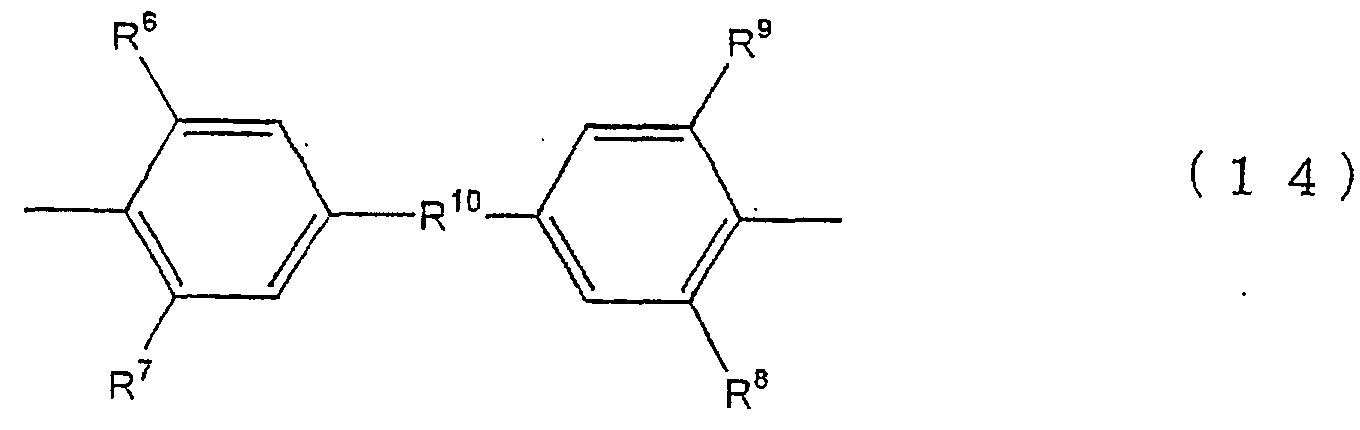


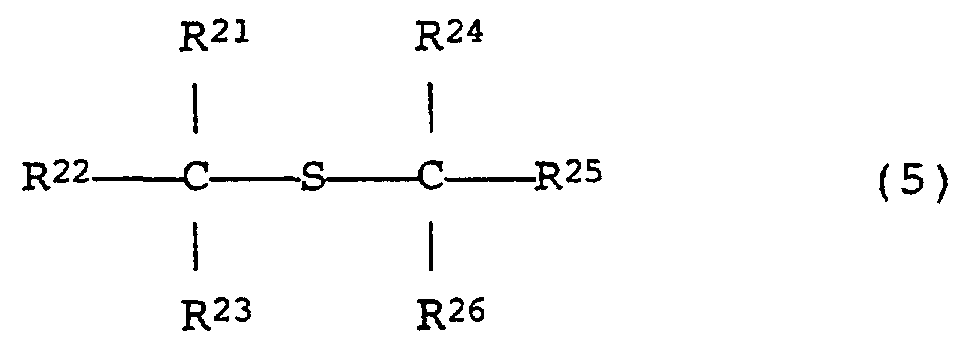


- a compound represented by the following general
formula (7),
wherein R1 and R2 are, independently from each other, alkylene groups with 1 to 4 carbon atoms that may have a substituent (without, however, including the number of carbon atoms of the substituent) or arylene groups with 6 to 12 carbon atoms that may have a substituent (without, however, including the number of carbon atoms of the substituent), the substituent of each ofsaid alkylene group and of said arylene group being at least the one selected from the group consisting of an alkyl group, an aryl group, an aralkyl group, an alkoxy group, an alkylthio group, an aromatic heterocyclic group, a halogen atom excluding fluorine, and a group represented by the following formula (15)


- wherein R4 is as defined in the above formula (12), R14 is the same as R11 in the above formula (6), d is an integer of from 0 to 10, and d' is an integer of 0 or 1;
- R12 and R13 are, independently from each other, the same groups as those of R11 of the above general formula (6),
- R3 is as defined in the above general formula (1), a and a' are, independently from each other, integers of 0 to 10, c is an integer of from 0 to 6, c' is 0 or 1 and, when c' is 0, the sum of a and a' is not smaller than 2; or
- a compound represented by the following general
formula (8),
wherein R15, f and f' are as defined in the above general formula (2), and R11, independently from each other, is as defined in the above general formula (6); or

- a compound represented by the following general
formula (9),
wherein R16' is an alkylene group with 1 to 4 carbon atoms that may have a substituent (without, however, including the number of carbon atoms of the substituent), the substituent of said alkylene group being the same as the substituent of the alkylene group with 1 to 4 carbon atoms which may have a substituent denoted by R1' and R2' in the above general formula (7), R17, g, g', h and h' being as defined in the above general formula (3), and R11 being, independently from each other the same as defined in the above formula (6); or

- a compound represented by the following general
formula (10),
wherein R18' and R19' are, independently from each other, alkylene groups with 1 to 4 carbon atoms which may have a substituent (without, however, including the number of carbon atoms of the substituent), or arylene groups with 6 to 12 carbon atoms which may have a substituent (without, however, including the number of carbon atoms of the substituent), the substituent of each of said alkylene group and said arylene group being the same as the substituent of the alkylene group with 1 to 4 carbon atoms which may have a substituent or of the arylene group with 6 to 12 carbon atoms which may have a substituent denoted by R1' and R2' in the above general formula (7), and R20, Y, Z, i and i' are as defined in the above general formula (4), and R11 is as defined in the above general formula (6); or

- a compound represented by the following general
formula (11),
wherein R21', R22', R23', R24', R25' and R26' are, independently from each other, hydrogen atoms or groups represented by the following formula (17),
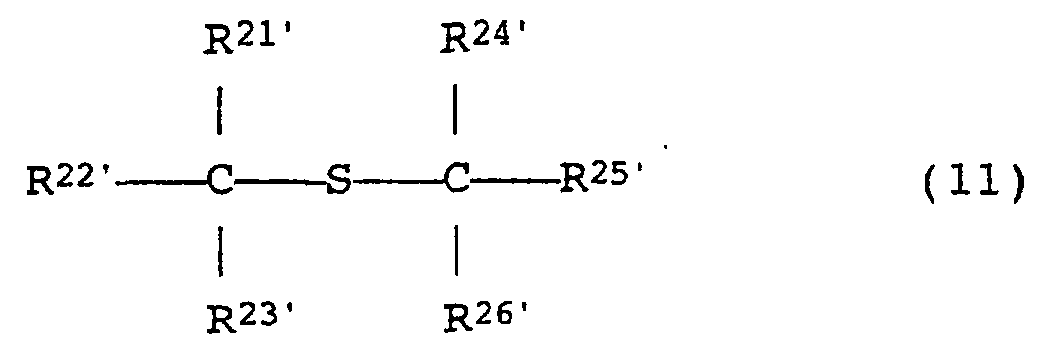 wherein R29 and R30 are, independently from each other, alkylene groups with 1 to 4 carbon atoms that may have a substituent (without, however, including the number of carbon atoms of the substituent), the substituent of said alkylene group being the same as the substituent in the alkylene group with 1 to 4 carbon atoms which may have a substituent denoted by R1' and R2' in the above general formula (7), j and j' being as defined in the above formula (16), and R11 being as defined in the above general formula (6); and at least one of R21', R22', R23', R24', R25' and R26' is a group represented by the above general formula (5).
Among the above-mentioned preparation methods 1 ○ to
5 ○, the preparation method 1 ○ is desirable from such a
standpoint that the obtained sulfur-containing compound is
useful as a monomer for obtaining optical lenses having a
high refractive index and a large Abbe's number or as an
intermediate monomer product for obtaining such optical
lenses. From such a standpoint that the sulfur-containing
compound is useful as an intermediate monomer product for
obtaining optical lenses, further, it is particularly
desired to use an organic compound having at least one
functional group capable of forming a thio group in the
molecules upon reacting with a mercapto group represented
by the general formula (6) in which R11 is an alkyl group
with 1 to 4 carbon atoms having a reactive substituent
such as a hydroxyl group, a mercapto group or a halogen
atom.
According to the method of preparing the sulfur-containing
compound of the present invention, a thiol
compound is reacted with an organic compound having at
least one functional group capable of forming a thio group
in the molecules upon the reaction with a mercapto group
in the presence of a basic compound in order to substitute
an organic group for a hydrogen atom of the mercapto group
(group -SH) in the thiol compound, thereby to obtain, as
an object product, a sulfur-containing compound having a
chain extended due to an organic residue substituted by
newly forming a thio group. According to the preparation
method of the present invention, therefore, there is
prepared a sulfur-containing compound having at least one
thio group in the molecules. It is generally desired to
prepare, as an object product, a sulfur-containing
compound having not less than two thio groups in the
molecules by using, as the thiol compound, a compound
having one or more thio groups in the molecules.
The thiol compound used as a starting material in the
preparation method of the present invention may be any
known compound without limitation provided it has one or
more mercapto groups in the molecules. From the
standpoint of usefulness of the formed product, however,
it is desired to use a thiol compound represented by the
above general formula (1), (2), (3), (4) or (5). These
thiol compounds will now be described.
The thiol compound represented by the above general
formula (1) will be described, first.
In the above general formula (1), R1 and R2 are,
independently from each other, alkylene groups with 1 to 4
carbon atoms which may have a substituent or arylene
groups with 6 to 12 carbon atoms which may have a
substituent. Here, however, the number of carbon atoms
does not include those carbon atoms of the substituent.
Among the alkylene groups with 1 to 4 carbon atoms,
those without substituent are, concretely, ethylene group,
propylene group, isopropylene group and butylene group.
Among them, ethylene group is particularly preferred.
Among the arylene groups with 6 to 12 carbon atoms,
further, those without substituent are, concretely,
phenylene group, tolylene group, xylylene group and
naphthylene group.
The substituent possessed by the alkylene group or
the arylene group is at least the one selected from the
group consisting of alkyl group, aryl group, aralkyl
group, alkoxy group, alkylthio group, aromatic
heterocyclic group, halogen atom excluding fluorine and
group represented by the above general formula (12).
These substituents will now be described.
As the alkyl group which is the substituent, any
known group can be used without limitation. It is,
however, desired to use an alkyl group with 1 to 4 carbon
atoms, such as methyl group, ethyl group, propyl group,
isopropyl group, butyl group or t-butyl group.
As the aryl group which is the substituent, any known
group can be used without limitation. It is, however,
desired to use an aryl group with 6 to 12 carbon atoms,
such as phenyl group, tolyl group or naphthyl group.
As the aralkyl group which is the substituent, any
known group can be used without limitation. It is,
however, desired to use an aralkyl group with 7 to 11
carbon atoms, such as benzyl group or phenetyl group.
As the alkoxy group which is the substituent, any
known group can be used without limitation. It is,
however, desired to use an alkoxy group with 1 to 4 carbon
atoms, such as methoxy group, ethoxy group, propoxy group,
isopropoxy group, butoxy group or t-butoxy group.
As the alkylthio group which is the substituent, any
known group can be used without limitation. It is,
however, desired to use an alkylthio group with 1 to 4
carbon atoms, such as methylthio group, ethylthio group,
propylthio group, isopropylthio group, butylthio group or
t-butylthio group.
As the aromatic heterocyclic group which is the
substituent, any known group can be used without
limitation. It is, however, desired to use an aromatic
heterocyclic group with 4 to 10 carbon atoms, such as
thienyl group, furyl group or benzothienyl group.
As the halogen atom excluding fluorine as the
substituent, there can be used chlorine, bromine or
iodine.
In the substituent in the above formula (12), R4 is
an alkylene group with 1 to 4 carbon atoms which may have
a substituent. Here, however, the number of carbon atoms
does not include carbon atoms of the substituent. Among
the alkylene groups with 1 to 4 carbon atoms, those
without substituent are, concretely, methylene group,
ethylene group, propylene group, isopropylene group and
butylene group. Among them, ethylene group is
particularly preferred.
The substituent of the alkylene group which may have
a substituent denoted by R4 is at least the one selected
from the group consisting of alkyl group, aryl group,
aralkyl group, alkoxy group, alkylthio group, aromatic
heterocyclic group and halogen atom excluding fluorine.
The substituent may be the same as that of the alkylene
group that may have a substituent or may be the same as
that of the arylene group that may have a substituent
denoted by R1 and R2. It is, however, desired to use
ethylene group, isopropylene group or phenylene group.
Among them, it is particularly desired to use ethylene
group or isopropylene group.
In the above formula (12), further, d is an integer
of 0 to 10. From the standpoint of easy synthesis,
however, it is desired that d is an integer of 0 to 3.
There is no particular limitation on the number of
the substituents. When the number of the substituents is
not smaller than 2, different substituents may be
substituted for.
In the above general formula (1), R3 is a group
represented by the above formula (13).
In the above formula (13), e is an integer of 0 to 5
and, preferably, an integer of 0 to 4.
In the above formula (13), further, R5 is an alkylene
group with 1 to 4 carbon atoms which may have a
substituent (without, however, including the number of
carbon atoms of the substituent), an arylene group with 6
to 12 carbon atoms which may have a substituent (without,
however, including the number of carbon atoms of the
substituent), a divalent aromatic heterocyclic group which
may have a substituent, or a group represented by the
above general formula (14).
In the above formula (14), R6, R7, R8 and R9 are,
independently from each other, halogen atoms excluding
fluorine atoms, or hydrogen atoms, and R10 is an alkylene
group with 1 to 3 carbon atoms or a sulfur atom.
Concretely, the alkylene group is a methylene group, an
ethylene group or a propylene group. It is, however,
desired that R10 is a sulfur atom from the standpoint of
easy availability of the starting material.
The alkylene group and arylene group denoted by R5
may be the same as those denoted by R1 and R2, and are,
desirably, ethylene groups, isopropylene groups or
phenylene groups and, particularly preferably, ethylene
groups or isopropylene groups. The substituents thereof
are the same as those of the alkylene group that may have
a substituent denoted by R4.
As the aromatic heterocyclic group that may have a
substituent denoted by R5, further, any known group can be
used without limitation. It is, however, desired to use
an aromatic heterocyclic group with 4 to 10 carbon atoms,
such as thienyl group, furyl group or benzothienyl group,
or a group thereof for which are substituted one or two or
more substituents of the alkylene group that may have a
substituent denoted by R4.
In the above general formula (1), c is an integer of
0 to 6. From the standpoint of easy availability of the
starting material or easy synthesis, however, it is
desired that c is an integer of 0 to 3. In the above
general formula (1), the positions where the group -CH2-
(when c is 0) and the group -CH2-R3-CH2- (when c is not 0)
are bonded to the dithian ring may be such that the
dithian rings become a 2,5-substituted 1,4-dithian ring or
a 2,6-substituted 1,4-dithian ring. When c is not smaller
than 1, positions may be such that they are arbitrarily
mixed together.
In the above general formula (1), c' is 0 or 1. From
the standpoint of easy synthesis, however, it is. desired
that c' is 0. As an intermediate product of the optical
material, on the other hand, it is desired that c' is 1.
In the above general formula (1), a and a' are,
independently from each other, integers of 0 to 10. From
the standpoint of easy availability of the starting
material or easy synthesis, however, it is desired that a
and a' are integers of 0 to 6. When c' is 0 in the above
general formula (1), the sum of a and a' is not smaller
than 2.
Next, described below is the compound represented by
the above general formula (2).
In the above general formula (2), R15 is a monovalent
to trivalent aromatic group with 6 to 14 carbon atoms
which may have a substituent (without, however, including
the number of carbon atoms of the substituent) or a
monovalent to trivalent aromatic heterocyclic group with 3
to 12 carbon atoms which may have a substituent (without,
however, including the number of carbon atoms of the
substituent). The substituents of these groups are the
same as the substituent of the alkylene group with 1 to 4
carbon atoms which may have a substituent of the above
formula (12). Concrete examples of the monovalent to
trivalent aromatic group or of the monovalent to trivalent
aromatic heterocyclic group include phenylene group,
tolylene group, xylylene group, naphthylene group, thienyl
group, furyl group, benzothienyl group and triazine group.
Among them, it is particularly desired to use phenylene
group from the standpoint of easy availability of the
starting material.
In the above general formula (2), f is, independently
from each other, an integer of 0 or 1. From the
standpoint of easy synthesis and easy availability of the
starting material, it is desired that f' is 1. From the
standpoint of monomer for photochromic lenses having a
high refractive index, it is desired that f' is 3.
Next, described below is the compound represented by
the above general formula (3).
In the above general formula (3), R16 is an alkylene
group with 1 to 4 carbon atoms which may have a
substituent. Here, however, the number of carbon atoms
does not include the number of carbon atoms of the
substituent. The alkylene group with 1 to 4 carbon atoms
that may have a substituent may be the same as the
alkylene group with 1 to 4 carbon atoms which may have a
substituent denoted by R1 and R2.
In the above general formula (3), R17 is a hydrogen
atom or an alkyl group with 1 to 4 carbon atoms which may
have a substituent. Here, however, the number of carbon
atoms does not include the carbon atoms of the
substituent. The substituent possessed by the alkyl group
may be the same as the substituent, other than the alkyl
group, in the alkylene group with 1 to 4 carbon atoms
which may have a substituent in the above formula (12).
Concrete examples of the alkyl group include methyl group,
ethyl group, propyl group, isopropyl group and butyl
group. Among them, it is particularly desired to use
methyl group.
In the above general formula (3), g is an integer of
1 to 10. From the standpoint of easy availability of the
starting material and easy synthesis, however, g is
preferably an integer of 1 to 5. In the general formula
(3), further, g' is an integer of 0 to 1. In the same
formula, h is an integer of 0 to 5. From the standpoint
of easy availability and easy synthesis, however, h is 1
to 3. In the same formula, further, h' is 0 or 1. From
the standpoint of easy synthesis, however, h' is 1.
Next, described below is the compound represented by
the above general formula (4).
In the above general formula (4), R18 and R19 are,
independently from each other, alkylene groups with 1 to 4
carbon atoms which may have a substituent (without,
however, including the number of carbon atoms of the
substituent) or arylene groups with 6 to 12 carbon atoms
which may have a substituent (without, however, including
the number of carbon atoms of the substituent). The
alkylene groups with 1 to 4 carbon atoms that may have a
substituent and the arylene groups that may have a
substituent denoted by R18 and R19 may be the same as those
denoted by R1 and R2, and, preferably, ethylene groups,
isopropylene groups or phenylene groups and, particularly
preferably, ethylene groups or isopropylene groups.
In the above general formula (4), R20 is an alkyl
groups with 1 to 4 carbon atoms which may have a
substituent, an aryl group with 6 to 12 carbon atoms which
may have a substituent or an aralkyl group which may have
a substituent. Here, however, the number of carbon atoms
does not include the carbon atoms of the substituent. The
alkyl group with 1 to 4 carbon atoms which may have the
substituent may be the same as the alkyl group with 1 to 4
carbon atoms denoted by R17. Further, the substituents
possessed by the aryl group and aralkyl group are the same
as the substituent of the alkylene group with 1 to 4
carbon atoms which may have a substituent in the above
formula (12).
In the above general formula (4), Y and Z are oxygen
atoms or sulfur atoms. Here, however, Y and Z are not
oxygen atoms at the same time. As the monomer for
obtaining photochromic plastic lenses having a high
refractive index, it is desired that Y and Z are both
sulfur atoms.
In the above general formula (4), i and i' are,
independently from each other, integers of 0 to 10, and
the sum of i and i' is not smaller than 1.
Finally, described below is the compound represented
by the above general formula (5).
In the above general formula (5), R21, R22, R23, R24,
R25 and R26 are, independently from each other, hydrogen
atoms or groups represented by the above formula (16).
Here, however, at least one of R21, R22, R23, R24, R25 and
R26 in the above general formula (5) is the group
represented by the above formula (16).
In the above formula (16), R27 and R28 are,
independently from each other, alkylene groups with 1 to 4
carbon atoms which may have a substituent. Here, however,
the number of carbon atoms does not include the carbon
atoms of the substituent. The substituents of the
alkylene groups are the same as the substituent of the
alkylene group with 1 to 4 carbon atoms which may have a
substituent denoted by R1 and R2 in the above general
formula (1).
In the above formula (16), further, j and j' are,
independently from each other, integers of 0 to 4, and the
sum of j and j' is not smaller than 1.
In the preparation method of the present invention,
another starting material, i.e., an organic compound
(capable of reacting with a mercapto group) having at
least one functional group capable of forming a thio group
(the thio group-forming functional group) in the molecules
upon the reaction with a mercapto group, may be any known
compound without limitation.
The reaction with the mercapto group for forming the
thio group may be a reaction in which a hydrogen atom of
the mercapto group is condensed while being split in the
form of hydrogen halide or a reaction in which a sulfur
atom and a hydrogen atom of the mercapto group are added
while being split off to the unsaturated bond in the thio
group-forming functional group. The combination of the
thiol compound and the compound capable of reacting with
the mercapto group may be suitably determined depending
upon the kind of the reaction.
There is no particular limitation on the compound
capable of reacting with the mercapto group provided it is
an organic compound having a thio group-forming functional
group in the molecules, and there can be used any one of a
structure corresponding to the object compound and to the
thiol compound that is used. The thio group-forming
functional group is as described already. From the
standpoint of easy availability of the starting material
and easy synthesis, however, it is desired to use a
halogen atom and, particularly, a chlorine atom, a bromine
atom or an iodine atom when the thio group is to formed as
a sulfide bond. When the thio group is to be formed as a
thio ester bond, it is desired to use a halogen atom and,
particularly, a chlorine atom. When the thio group is to
be formed as a thiourethane bond, it is desired to use an
isocyanate group or a thioisocyanate group. When the thio
group is to be formed as a thiocarbonate bond, it is
desired to use a carbonic acid ester.
When it is attempted to prepare a polymerizable
monomer that is useful as an optical material such as of
photochromic plastic lenses according to the method of the
present invention, it is desired to use the thio group-forming
functional group as well as a compound having at
lest one polymerizable functional group as a compound
capable of reacting with the mercapto group. Namely, it
is desired to obtain the sulfur-containing compound of the
present invention by forming a thio group while leaving
the polymerizable functional group in the compound capable
of reacting with the mercapto group. As the polymerizable
functional group, there can be exemplified a variety of
radically polymerizable, ionically polymerizable,
polymerization additive or polymerization condensing
functional group exemplified already as the thio group-forming
functional group.
In preparing the polymerizable monomer, the thio
group-forming functional group and the polymerizable
functional group may be those of the same kind. However,
the sulfur-containing compound which is the object product
must have one thio group and one polymerizable functional
group. Accordingly, the number of the groups must not be
smaller than 2. In this case, further, the reaction is
conducted by using the compound capable of reacting with
the mercapto group and having in the molecules the number
of the functional groups larger than the number of the
mercapto groups present in the molecules of the thiol
compound, so that the polymerizable groups are left in the
reaction product (object product). When the thio group-forming
functional group and the polymerizable functional
group are of different kinds, the total number of the
functional groups present in a molecule of the compound
capable of reacting with the mercapto group may be
selected to be larger than the number of the mercapto
groups present in a molecule of the thiol compound in the
same manner as described above to leave the polymerizable
functional groups. In general, however, these two
functional groups exhibit different reactivity to the
mercapto group. Upon suitably setting the reaction
conditions, therefore, the group having a low reactivity
can be left as the polymerizable group. It is, hence,
desired that the thio group-forming functional group and
the polymerizable functional group are of different kinds.
The compound capable of reacting with the mercapto
group used in the present invention is, usually, a
compound represented by the above general formula (6).
In the above general formula (6), W is a thio group-forming
functional group. In the above general formula
(6), further, R11 is an alkyl group with 1 to 4 carbon
atoms which may have a substituent (without, however,
including the number of carbon atoms of the substituent)
or a (meth)acryloyl group. The substituent of the alkyl
group is at least one group selected from the group
consisting of polymerizable functional group, aryl group,
aralkyl group, alkoxy group, alkylthio group, aromatic
heterocyclic group and halogen atom excluding fluorine.
As described already, from the standpoint of effectively
using the compound of the above general formula (6) as a
monomer or an intermediate product thereof for producing
plastic lenses, it is desired that R11 in the general
formula (6) is an alkyl group with 1 to 4 carbon atoms
having a polymerizable functional group as a substituent
or a (meth)acryloyl group, or is, particularly, an alkyl
group with 1 to 4 carbon atoms having a reactive
substituent such as hydroxyl group, mercapto group or
halogen atom which enables the polymerizable groups to be
easily introduced.
There is no particular limitation on the amount of
the compound capable of reacting with the mercapto group,
that is used in the present invention. It is, however,
desired to use the compound capable of reacting with the
mercapto group in a number of moles which is 0.5 to 5.0
times as great and, particularly, which is 1.0 to 3.0
times as great as the number of moles obtained by
multiplying the number of moles of the thiol compound that
is to be reacted by the number of mercapto groups present
in a molecule of the thiol compound.
In the present invention, the above-mentioned thiol
compound is reacted with the compound capable of reacting
with the mercapto group in the presence of a basic
compound while controlling the amount of water in the
reaction system to be not larger than 7.5 times as large
as the number of moles obtained by multiplying the number
of moles of the thiol compound by the number of mercapto
groups present in a molecule of the thiol compound. Upon
controlling the amount of water by using the basic
compound, it is allowed to obtain the desired product
maintaining good operability and in a high yield. It is
further allowed to favorably prevent the reaction product
from being colored.
There is no particular limitation on the basic
compound that is used provided it activates the mercapto
group of the thiol compound and improves the reactivity
with the compound capable of reacting with the mercapto
group. From the standpoint of easy handling, however, it
is desired to use a hydroxide of an alkali metal, a
carbonate of an alkali metal, an alkoxide of an alkali
metal or an organic base. Concrete examples of the basic
compound that can be favorably used include lithium
hydroxide, sodium hydroxide, potassium hydroxide, cesium
hydroxide, lithium carbonate, sodium carbonate, potassium
carbonate, cesium carbonate, sodium hydrogen carbonate,
potassium hydrogen carbonate, lithium methoxide, sodium
methoxide, sodium ethoxide, t-butoxypotassium,
triethylamine, pyridine and quinoline. Among them, it is
particularly desired to use a basic compound such as
sodium hydroxide, potassium hydroxide, sodium carbonate,
potassium carbonate, cesium carbonate, sodium methoxide,
sodium ethoxide, t-butoxypotassium, triethylamine or
pyridine from the standpoint of easy handling and
solubility in an organic solvent (particularly in an
alcohol). It is further allowable to use basic compounds
of different kinds in a mixed manner.
There is no particular limitation on the amount of
the basic compound. From the standpoint of trapping by-products
such as hydrogen halide and the like and of
preventing excess use, however, it is desired that the
basic compound is used in a number of moles which is 0.5
to 5.0 times as large and, particularly, 1.0 to 3.0 times
as large as the number of moles obtained by multiplying
the number of mols of the thiol compound by the number of
the mercapto groups in a molecule of the thiol compound.
In the preparation method of the present invention,
the basic compound dissolves sparingly depending upon the
kind of the reaction reagent that is used or depending
upon the reaction solvent that is used as required. In
order to enhance the solubility, therefore, water may be
added, as required, to the reaction system. In conducting
the reaction, however, it is essential to decrease the
amount of water contained in the reaction system to be
smaller than the above-mentioned particular value.
That is, the number of moles of water contained in
the reaction system must be decreased to be not larger
than 7.5 times as large as the number of moles
(hereinafter also referred to as the number of moles of
the starting mercapto groups) obtained by multiplying the
number of moles of the thiol compound used as the starting
material by the number of the mercapto groups present in a
molecule of the thiol compound. When the amount of water
contained in the reaction system exceeds the above amount,
it is not possible to suppress the formation of by-products,
whereby the reaction yield decreases and the
formed product is colored. From the standpoint of
suppressing the formation of by-products, it is desired
that the amount of water in the reaction system is not
larger than 5.0 times and, particularly, not larger than
2.5 times as large as the number of moles of the starting
mercapto groups.
When use is made, as the basic compound, of a
starting material used for the reaction or a water-soluble
compound which is not almost soluble in an organic solvent
that is used as required, it is desired to add water in an
amount of not larger than 7.5 times and, particularly, not
larger than 2.5 times as large as the number of moles of
the starting mercapto groups from the standpoint of
improving the solubility.
The amount of water in the reaction system can be
limited by using the (dehydrated) reaction reagent or a
dehydrated solvent, or by adding a basic compound that
forms no water in the reaction with the mercapto group.
The amount of the water may be measured by measuring,
in advance and relying upon Karl Fischer's method, the
amount of water contained in the reaction reagent or in
the solvent of before being mixed. Upon measuring the
final amount of water contained in the reaction system
after the reaction, further, it becomes possible to
confirm the amount of water formed by the reaction relying
upon the difference from a value of before the mixing.
In the present invention, it is particularly desired
to conduct the reaction of the thiol compound with the
compound capable of reacting with the mercapto group in an
atmosphere without substantially containing oxygen while
controlling the amount of the water.
That is, even when the above reaction is effected by
simply controlling the amount of water, the object sulfur-containing
compound can be obtained in a considerably high
yield suppressing the formation of the by-product. Among
the sulfur-containing compounds obtained by this method,
however, when the one having a polymerizable functional
group (hereinafter also referred to as polymerizable
sulfur-containing compound) is evaluated for its
performance as a monomer for obtaining photochromic
plastic lenses, the object of high refractive index is
accomplished but light resistance of photochromic
properties is very deteriorated.
In order to solve this problem, the present inventors
have closely analyzed the polymerizable sulfur-containing
compound to investigate the cause of drop in the light
resistance of photochromic properties. That is, the
polymerizable sulfur-containing compound used for the
evaluation is the one of which the purity is confirmed by
gas chromatography (GC method) after the color has been
removed by the treatment with activated carbon and by
washing with an aqueous solution of sodium hydroxide,
which, however, has not been carefully analyzed by the
high-speed liquid chromatography (HPLC method). As a
result, the polymerizable sulfur-containing compound could
not be detected by the analysis based on the GC method.
It was, however, learned that a compound (hereinafter also
referred to as disulfide compound) having a disulfide bond
had been contained as an impurity that could be confirmed
by the HPLC method. This disulfide compound exhibits
chemical/physical behavior similar to that of the sulfur-containing
compound having a thio group, which is the
object compound, and cannot be removed by practicable
refining means.
Under such circumstances, formation of the disulfide
compound which is a by-product can be greatly decreased by
conducting the reaction of the thiol compound with the
compound capable of reacting with the mercapto group in an
atmosphere without substantially containing oxygen while
controlling the amount of water as described above. To
realize the atmosphere without containing oxygen, the
reaction system may be substituted to a sufficient degree
with an inert gas such as of nitrogen, helium or argon,
and the reaction may be conducted in such a gaseous
atmosphere. When a solvent is to be used, it is desired
to remove oxygen that has been dissolved therein by deairing.
In the present invention, the atmosphere without
substantially containing oxygen stands for a state where
the content of oxygen in the atmosphere is not larger than
10000 ppm (1% in the atmosphere).
In conducting the reaction in the present invention,
it is desired to use a solvent. By using the solvent, the
basic compound which is even in a solid form dissolves
partly or entirely enabling the reaction to be smoothly
conducted. As described above, further, when the basic
compound that is used does not almost dissolve in the
starting material or in the organic solvent used for the
reaction but dissolves in water, then, water is added in
amount specified by the present invention to further
enhance the rate of reaction.
Any known solvent can be used without limitation
provided it does not adversely affect the reaction.
Examples of the solvent that can be preferably used
include alcohols such as methanol, ethanol, and
isopropanol; ethers such as diethylether, tetrahydrofurane
and dioxane; halogen compounds such as methylene chloride
and chloroform; and aliphatic or aromatic hydrocarbons
such as hexane, heptane, benzene and toluene. Among them,
it is desired to use alcohols such as methanol, ethanol or
isopropanol from the standpoint of easily dissolving the
solid basic compound. When these alcohols are used, the
reaction proceeds at a sufficiently large rate even
without adding water. The above solvents may be used
being mixed together. There is no particular limitation
on the amount of using the solvent. Usually, however, the
solvent is used in an amount of about 50 to about 2000
parts by weight per 100 parts by weight of the thiol
compound.
In the above reaction, there is no particular
limitation on the procedure of operation; i.e., into a
reaction vessel that has been substituted with an inert
gas in advance, there may be suitably mixed the reaction
reagents, a solvent used as required and water used as
required. For example, the thiol compound is dissolved in
the presence of the basic compound and the reaction
solvent and, then, the compound capable of reacting with
the mercapto group diluted with the reaction solvent is
added to the above solution, followed by stirring in an
invert gas atmosphere.
When it is attempted to prepare a radically
polymerizable sulfur-containing compound such as
(meth)acryloyl group as a polymerizable functional group,
it is desired to add a polymerization inhibitor to prevent
gelation. As the polymerization inhibitor, there can be
used any known compound without limitation. Concrete
examples thereof include phenolic polymerization
inhibitors such as hydroquinone, p-methoxyphenol, 2,6-di-t-butyl-4-methylphenol
and p-t-butylcatechol;
phenothiazine, copper chloride (II) and iron chloride
(III). Among them, it is desired to use p-methoxyphenol
and p-t-butylcatechol from the standpoint of ability for
inhibiting the polymerization, coloring of the product and
removing the reaction product after the reaction. The
polymerization inhibitor is used in an amount that varies
depending upon the kind of the inhibitor and the reaction
temperature. Generally, however, the polymerization
inhibitor is used in an amount of 0.01 to 10% by weight
and, preferably, 0.1 to 5% by weight of the radically
polymerizable sulfur-containing compound such as
(meth)acryloyl group which is the object product.
The reaction conditions are not particularly limited
but are generally as described below.
The reaction temperature differs depending upon the
kinds and amounts of the reaction agents and solvents that
are used, but is generally from -5 to 150°C and,
preferably, from 10 to 100°C. The reaction time, too,
differs depending upon the kinds and amounts of the
starting materials that are used, but is generally from 10
minutes to 48 hours and, preferably, from 30 minutes to 24
hours. It is desired to maintain the stirring during the
reaction.
The sulfur-containing compound prepared according to
the above method can be isolated by a known method.
According to the above method of the present invention,
the side reaction is suppressed. When the conversion of
the reaction is high, therefore, all what are needed are
simply to effect the filtering (when the object product is
a solid) and to distill the solvent off. When the
conversion is low, an excess of the basic compound is
processed and, then, the unreacted reagent and, as
required, the solvent may be separated by distillation or
recrystallization. When even a slight degree of coloring
of the object product is of a problem, the separation
operation may be executed after having conducted a known
refining operation such as column chromatography,
treatment with an adsorbing agent such as a treatment with
activated carbon, or treatment with silica, decoloring
treatment such as washing by using a mother, an aqueous
solution of hydrogen chloride, or an aqueous solution of
sodium hydroxide.
Through the above-mentioned method, there is obtained
a sulfur-containing compound having at least one thio
group in the molecule and having a structure corresponding
to the structure of the thiol compound and of the compound
capable of reacting with the mercapto group, that are used
as starting materials. For example, when the compounds
represented by the above formulas (1) to (5) are used as
thiol compounds and a compound represented by the above
general formula (6) is used as the compound capable of
reacting with the mercapto group, there are obtained
sulfur-containing compounds represented by the above
general formulas (7) to (11) corresponding thereto.
It is desired that the sulfur-containing compound has
a polymerizable functional group in the molecules from the
standpoint of using it as a polymerizable monomer for an
optical material for producing photochromic plastic
lenses, as described above. In the case of the sulfur-containing
compounds represented by, for example, the
general formulas (7) to (11), it is desired that R11, R12,
R13 and R14 are alkyl groups with 1 to 4 carbon atoms
having at least a polymerizable functional group or
(meth)acryloyl groups as a substituent.
Concrete examples of the sulfur-containing compound
represented by the above general formula (7) and
derivatives thereof that can be favorably used as monomers
for producing photochromic lenses according to the
invention, include compounds of the following structures.


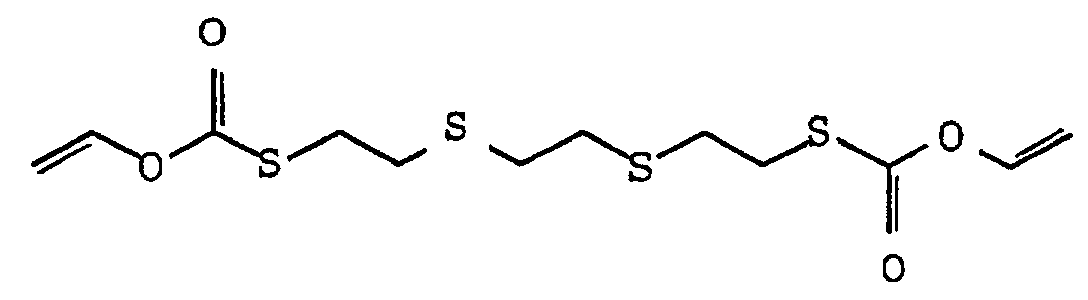
Concrete examples of the sulfur-containing compound
represented by the above general formula (8) and
derivatives thereof that can be favorably used as monomers
for producing photochromic lenses according to the
invention, include compounds of the following structures.


Concrete examples of the sulfur-containing compound
represented by the above general formula (9) and
derivatives thereof that can be favorably used as monomers
for producing photochromic lenses according to the
invention, include compounds of the following structures.
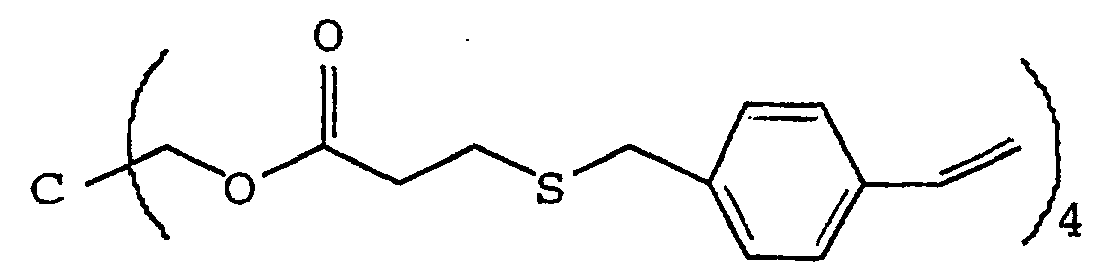

Concrete examples of the sulfur-containing compound
represented by the above general formula (10) and
derivatives thereof that can be favorably used as monomers
for producing photochromic lenses according to the
invention, include compounds of the following structures.
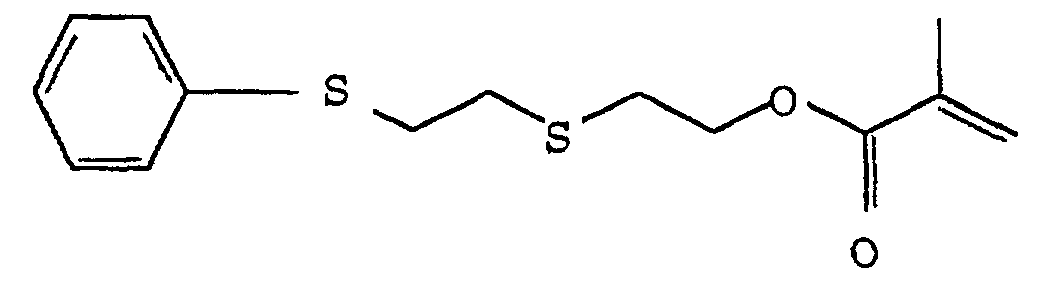

Concrete examples of the sulfur-containing compound
represented by the above general formula (11) and
derivatives thereof that can be favorably used as monomers
for producing photochromic lenses according to the
invention, include compounds of the following structures.



When the polymerizable functional group is a
radically polymerizable group such as (meth)acryloyl
group, (meth)acryloyloxy group, vinyl group, allyloxy
group or styryl group, the sulfur-containing compound
having such a polymerizable functional group in the
molecules can be readily used as a monomer for producing
photochromic plastic lenses (the monomers used for this
purpose are usually cured by radical polymerization).
When the polymerizable functional group is hydroxyl group,
mercapto group, isocyanate group, thioisocyanate group,
epoxy group, epithio group, amino group or carboxyl group,
the sulfur-containing compound having such a polymerizable
functional group can be used as a monomer for being
ionization polymerized, for being polycondensed or for
being polyadded. Or, the sulfur-containing compound may
be reacted with a compound (hereinafter also referred to
as a compound for introducing radically polymerizable
group) having a radically polymerizable group and having a
group capable of reacting with the polymerizable
functional group of the sulfur-containing compound to
introduce the radically polymerizable group into the
sulfur-containing compound. Then, the thus obtained
derivative having the radically polymerizable group
introduced into the molecules can be used as a monomer for
producing photochromic plastic lenses.
In the method of preparing the above derivative
having a radically polymerizable group introduced into the
molecules, there is no particular limitation on the
compound for introducing the radically polymerizable group
provided it has in the molecules thereof above a ragically
polymerizable group and a group (hereinafter also
referred to as functional group for introducing radically
polymerizable group) that reacts with the polymerizable
functional group of the sulfur-containing compound to
introduce the radically polymerizable group into the
sulfur-containing compound.
Here, the functional group for introducing the
radically polymerizable group may be the one capable of
introducing the radically polymerizable group into the
sulfur-containing compound relying on a simple reaction
such as addition, condensation or substitution, and is
suitably selected out of the known functional groups
depending upon the kind of the polymerizable functional
group that is to be reacted. Concrete examples of the
combination of the polymerizable functional group and the
functional group for introducing the radically
polymerizable group or the compound for introducing the
radically polymerizable group capable of introducing the
radically polymerizable group according to a customary
manner, include a combination of a hydroxyl group and a
halogen atom or an ester compound; a combination of a
mercapto group and a halogen atom; a combination of an
isocyanate group and an amino group, a hydroxyl group or a
mercapto group; a combination of a thioisocyanate group
and an amino group, a hydroxyl group or a mercapto group;
a combination of an epoxy group and a hydroxyl group or a
mercapto group; a combination of an epithio group and a
hydroxyl group or a mercapto group; a combination of an
amino group and a carboxyl group; and a combination of a
carboxyl group and an amino group or a hydroxyl group.
Even in preparing a derivative having a radically
polymerizable group introduced into the molecules by
reacting the compound for introducing the radically
polymerizable group with a reaction product of the thiol
compound and the compound capable of reacting with the
mercapto group, the thiol compound is reacted with the
compound capable of reacting with the mercapto group in
the preceding stage in an atmosphere without substantially
containing oxygen in addition to controlling the number of
moles of water contained in the reaction system to be a
particular value. Then, the derivative that is obtained
contains a very small amount of disulfide compound that is
formed by the reaction in the preceding stage.
When the method of the present invention is conducted
in the reaction atmosphere without substantially
containing oxygen as described above, the obtained
reaction product contains a greatly decreased amount of
disulfide compound which causes a drop in the light
resistance of photochromic properties of the lenses when
it is used as a monomer for producing photochromic plastic
lenses. The content is usually not larger than 2 mol% and
can, further, be decreased to be not larger than 1 mol%.
Even when the derivative is prepared by using the
above reaction product as a starting material like when
the reaction product is reacted with the compound for
introducing the radically polymerizable group, the
obtained derivative does not almost contain the disulfide
compound which is the impurity on account of the reasons
described above.
According to the present invention, therefore, there
is further provided a highly pure sulfur-containing
compound which is a reaction product obtained by reacting
a thiol compound with an organic compound having in the
molecules thereof at least one functional group capable of
forming a thio group upon reacting with a mercapto group,
or a derivative of said reaction product, and is a sulfur-containing
compound having at least one thio group in the
molecules thereof, the sulfur-containing compound
containing not more than 2 mol% of the compound having a
disulfide bond, which is an impurity. Here, the
derivative stands for a compound obtained by changing the
structure of a small portion of the reaction product,
i.e., stands for a compound obtained by introducing a
substituent, by replacing the substituent (when the
initial compound has a substituent) or by effecting a
simple reaction such as addition reaction (when the
initial compound has an unsaturated bond or a functional
group), without affecting the basic structure thereof
(e.g., without destroying the thio group).
There has not heretofore been recognized that the
disulfide compound is contained as an impurity in the
reaction product obtained by reacting the thiol compound
with the compound capable of reacting with the mercapto
group or in the derivative of the reaction product.
Therefore, any particular refining has not been effected
for removing the disulfide compound. Accordingly, the
product or the derivative contained not smaller than 2
mol% (usually, not smaller than 5 mol%) of the disulfide
compound irrespective of whether it was the one obtained
by using metal sodium or the one obtained by an improved
method. On the other hand, the highly pure sulfur-containing
compound of the present invention is a novel
one containing not more than 2 mol% of the disulfide
compound, and has a feature in that when it is used as a
monomer for obtaining photochromic plastic lenses, a high
refractive index is exhibited without decreasing the light
resistance in the photochromic property of the obtained
lenses.
Next, described below is when the sulfur-containing
compound of the present invention is used as a monomer for
producing photochromic plastic lenses. When used for such
applications, the sulfur-containing compound usually has a
radically polymerizable group in the molecules.
When used for the above application, it is desired to
use the sulfur-containing compound in combination with one
or two or more of radically polymerizable monomers which
are copolymerizable therewith from the standpoint of
moldability, physical properties, optical properties and
photochromic properties of the cured product that is
obtained. In order that the obtained cured product
exhibits a high refractive index and a high Abbe's number,
it is desired that the content of the sulfur-containing
compound of the invention is not smaller than 10% by
weight, preferably, from 10 to 90% by weight and,
particularly preferably, from 20 to 90% by weight of the
weight of the whole polymerizable monomers.
Concrete examples of the compound that can be
preferably used as a polymerizable monomer in combination
with the sulfur-containing compound of the present
invention include monofunctional (meth)acrylate
polymerizable monomers such as glycidyl (meth)acrylate,
β-methyl glycidyl (meth)acrylate, bisphenol A-monoglycidyl
ether methacrylate, 4-glycidyloxybutyl
methacrylate, 3-(glycidyl-2-oxyethoxy)-2-hydroxypropyl
methacrylate, 3-(glycidyloxy-1-isopropyloxy)-2-hydroxypropyl
acrylate, 3-(glycidyloxy-2-hydroxypropyloxy)-2-hydroxypropylacrylate,
methyl
(meth)acrylate, ethyl (meth)acrylate, butyl
(meth)acrylate, isobornyl (meth)acrylate, benzyl
(meth)acrylate, phenyl (meth)acrylate, tribromophenyl
(meth)acrylate, 2-hydroxyethyl (meth)acrylate,
phenoxyethyl(meth)acrylate, phenoxypolyethylene glycol
(meth)acrylate, alkoxypolyethylene glycol (meth)acrylate,
alkoxypolypropylene glycol (meth)acrylate and
trifluoromethyl (meth)acrylate; monofunctional allyl ether
compounds such as methoxypolyethylene glycol allyl ether,
methoxypolyethylene polypropylene glycol allyl ether,
butoxypolyethylene glycol polypropylene glycol allyl
ether, and phenoxypolyethylene glycol allyl ether;
polyfunctional (meth)acrylate polymerizable monomers such
as triethylene glycol di(meth)acrylate, tetraethylene
glycol di(meth)acrylate, nonaethylene glycol
di(meth)acrylate, tetradecaethylene glycol
di(meth)acrylate, tripropylene glycol di(meth)acrylate,
tetrapropylene glycol di(meth)acrylate, nonapropylene
glycol di(meth)acrylate, di(meth)acrylate of nonaethylene
glycol diacrylate, polybutylene glycol di(meth)acrylate,
1,6-hexanediol di(meth)acrylate, neopentyl glycol
di(meth)acrylate, acrylic acid and methacrylic ester
compound of 2,2'-bis(4-methacryloyloxyethoxyphenyl)propane,
acrylic acid and
methacrylic ester compound of 2,2'-bis(4-methacryloyloxypolyethoxyphenyl)propane,
acrylic acid and methacrylic
ester compound of 2,2'-bis(4-methacryloyloxypropoxyphenyl)propane,
acrylic acid and
methacrylic ester compound of 2,2'-bis(4-methacryloyloxypolypropoxyphenyl)propane,
acrylic acid and methacrylic
ester compound of 2,2'-bis(3,5-dibromo-4-methacryloyloxyethoxy)propane,
acrylic acid and
methacrylic ester compound of hydrogenated bisphenol A
ethylene oxide or propylene oxide adduct, dimethylol
tricyclodecane di(meth)acrylate,
dimethyloltricyclodecanepolyethoxy di(meth)acrylate,
trimethylolpropane tri(meth)acrylate, pentaerythritol
tetra(meth)acrylate, a reaction product of ethylene glycol
or polyethylene glycol with glycidyl (meth)acrylate, a
reaction product of propylene glycol or polypropylene
glycol with glycidyl (meth)acrylate, a reaction product of
bisphenol A ethylene oxide or propylene oxide adduct with
glycidyl (meth)acrylate, a reaction product of
hydrogenated bisphenol A ethylene oxide or propylene oxide
adduct with glycidyl (meth)acrylate, and urethane
acrylate; and styryl polymerizable monomers such as
styrene, chlorostyrene, α-methylstyrene, α-methylstyrene
dimer, vinyl naphthalene, isopropenyl naphthalene,
bromostyrene and divinyl benzene. These polymerizable
monomers can be used in one kind or being mixed in two or
more kinds.
Upon being mixed with a photochromic compound, the
polymerizable monomer composition containing the sulfur-containing
compound of the invention can be used as a
monomer composition for producing photochromic plastic
lenses. When the sulfur-containing compound is of a
highly pure form containing the disulfide compound in an
amount of not larger than 2 mol%, the amount of the
disulfide compound contained in the polymerizable monomer
composition is not larger than 0.02 mols per mole of the
highly pure sulfur-containing compound. From the
standpoint of light resistance of photochromic properties
in the obtained photochromic plastic lenses, it is desired
that the amount of the disulfide compound contained in the
polymerizable monomer composition is not larger than 0.01
mol and, particularly, not larger than 0.005 mols per mole
of the sulfur-containing compound.
Any known photochromic compound that exhibits
photochromic action can be mixed without any limitation to
the polymerizable monomer composition. Fulgide compounds,
chromene compounds and spirooxazine compounds are well-known
examples of the photochromic compounds, and it is
allowable to use these photochromic compounds. It is
allowable to use those photochromic compounds that are
disclosed in, for example, Japanese Unexamined Patent
Publication (Kokai) No. 28154/1990, Japanese Unexamined
Patent Publication (Kokai) No. 288830/1987 and PCT
International Patent Application 96/14596.
As compounds having excellent photochromic
properties, there can be further favorably used many
compounds developed by the development group to which the
present inventors belong (Japanese Patent Application No.
207871/1997, Japanese Patent Application No. 23110/1999,
Japanese Patent Application No. 27959/1999, Japanese
Patent Application No. 27961/1999, Japanese Patent
Application No. 27960/1999, Japanese Patent Application
No. 140836/1999, Japanese Patent Application No.
144072/1999, Japanese Patent Application No. 150690/1999,
Japanese Patent Application No. 144074/1999, Japanese
Patent Application No. 156270/1999, Japanese Patent
Application No. 154272/1999, Japanese Patent Application
No. 188146/1999, Japanese Patent Application No.
188902/1999). These photochromic compounds can be used in
one kind or being mixed in two or more kinds, the blending
ratio thereof being determined depending upon the use.
Among these photochromic compounds, it is
particularly desired to use the chromene compounds
represented by the following general formulas (18) to (25)
having photochromic properties such as light resistance,
color density and fading rate that are superior to those
of other photochromic compounds.
A chromene compound represented by the following
general formula (18),
 wherein a group represented by the following formula
(26),
wherein a group represented by the following formula
(26),
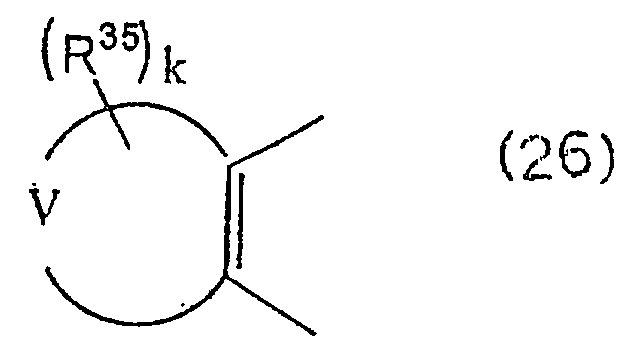 is a substituted, or unsubstituted aromatic
hydrocarbon group or a substituted or unsubstituted
unsaturated heterocyclic group,
is a substituted, or unsubstituted aromatic
hydrocarbon group or a substituted or unsubstituted
unsaturated heterocyclic group,
R33, R34 and R35 are alkyl groups, alkoxy groups, aralkoxy groups, amino groups, substituted amino groups, cyano groups, substituted or unsubstituted aryl groups, halogen atoms, aralkyl groups, hydroxy groups, substituted or unsubstituted alkynyl groups, substituted or unsubstituted heterocyclic groups having a nitrogen atom as a hetero atom and in which the nitrogen atom and a pyran ring or a ring of the group represented by the above general formula (18) are bonded together, or condensed heterocyclic groups in which the heterocyclic group is condensed with an aromatic hydrocarbon ring or with an aromatic heterocyclic ring, k is an integer of 0 to 6,
R31 and R32 are, independently from each other, groups represented by the following formula (27).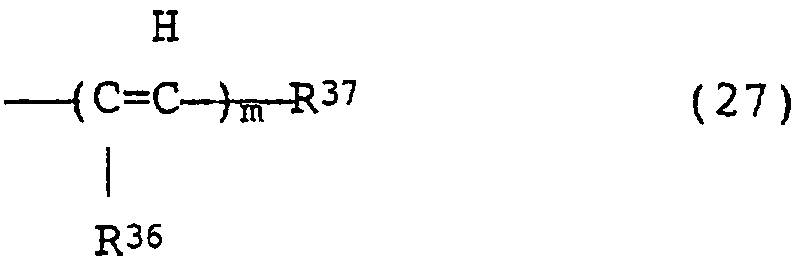 wherein R36 is a substituted or unsubstituted aryl
group or a substituted or unsubstituted heteroaryl
group, R37 is a hydrogen atom, an alkyl group or a
halogen atom, m is an integer of 1 to 3, groups
represented by the following formula (28),
wherein R36 is a substituted or unsubstituted aryl
group or a substituted or unsubstituted heteroaryl
group, R37 is a hydrogen atom, an alkyl group or a
halogen atom, m is an integer of 1 to 3, groups
represented by the following formula (28),
 wherein R38 is a substituted or unsubstituted aryl
group, or a substituted or unsubstituted heteroaryl
group, and m' is an integer of 1 to 3,
substituted or unsubstituted aryl groups, substituted
or unsubstituted heteroaryl groups or alkyl groups,
or R31 and R32 together may constitute an aliphatic
hydrocarbon ring or an aromatic hydrocarbon ring.
The substituents in the substituted aryl groups or in
the substituted heteroaryl groups in the above formulas
(27) and (28) or denoted by R31 and R32 are the same as
those denoted by R33 to R35.
wherein R38 is a substituted or unsubstituted aryl
group, or a substituted or unsubstituted heteroaryl
group, and m' is an integer of 1 to 3,
substituted or unsubstituted aryl groups, substituted
or unsubstituted heteroaryl groups or alkyl groups,
or R31 and R32 together may constitute an aliphatic
hydrocarbon ring or an aromatic hydrocarbon ring.
The substituents in the substituted aryl groups or in
the substituted heteroaryl groups in the above formulas
(27) and (28) or denoted by R31 and R32 are the same as
those denoted by R33 to R35.
R33, R34 and R35 are alkyl groups, alkoxy groups, aralkoxy groups, amino groups, substituted amino groups, cyano groups, substituted or unsubstituted aryl groups, halogen atoms, aralkyl groups, hydroxy groups, substituted or unsubstituted alkynyl groups, substituted or unsubstituted heterocyclic groups having a nitrogen atom as a hetero atom and in which the nitrogen atom and a pyran ring or a ring of the group represented by the above general formula (18) are bonded together, or condensed heterocyclic groups in which the heterocyclic group is condensed with an aromatic hydrocarbon ring or with an aromatic heterocyclic ring, k is an integer of 0 to 6,
R31 and R32 are, independently from each other, groups represented by the following formula (27).
A chromene compound of the following general formula
(19),
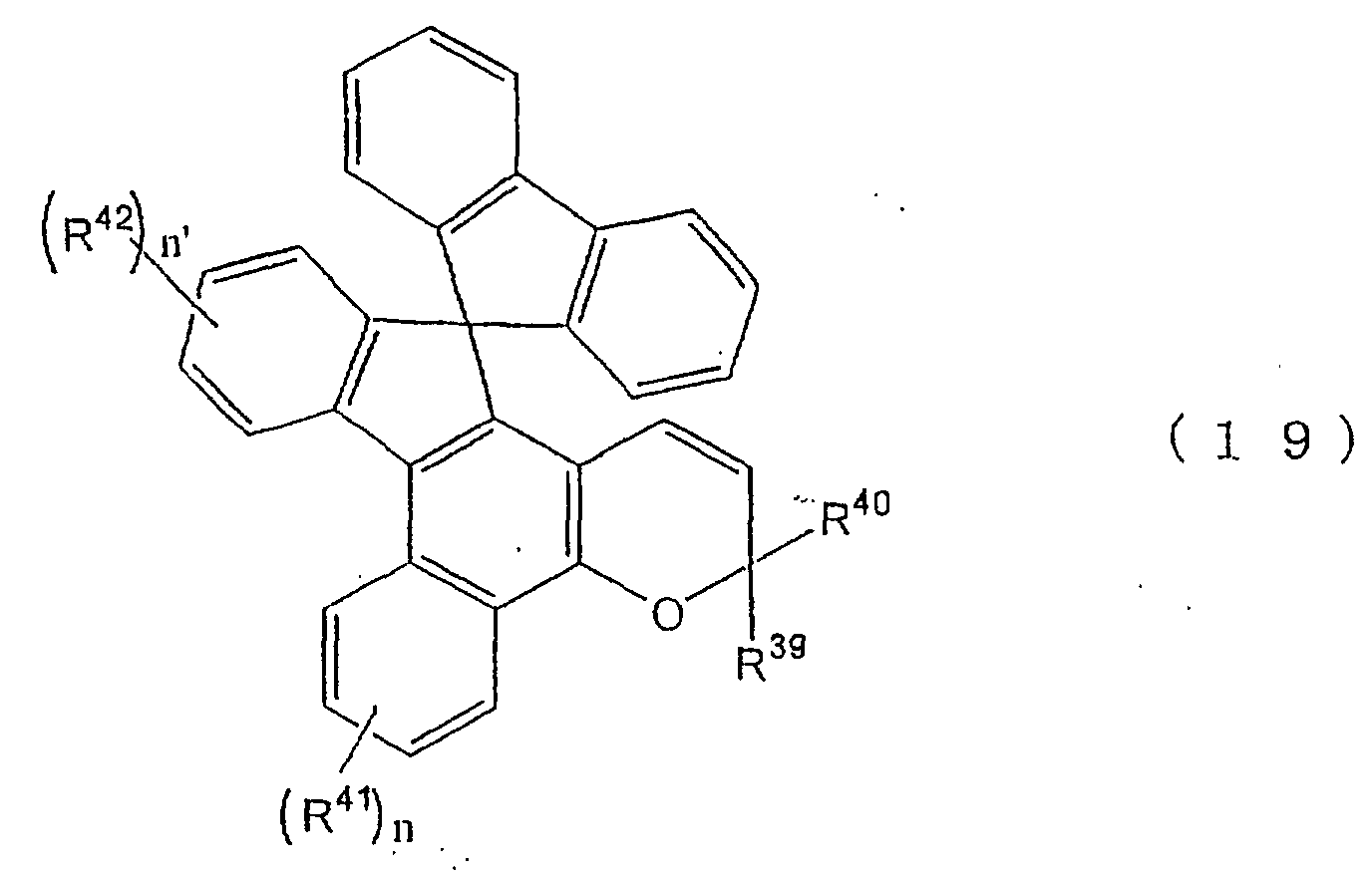 wherein R39 and R40 are, independently from each
other, the same as those denoted by R31 and R32 in the
above general formula (18), R41 and R42 are the same
as those denoted by R33, R34 and R35 in the above
general formula (18), and n and n' are, independently
from each other, integers of 0 to 4.
wherein R39 and R40 are, independently from each
other, the same as those denoted by R31 and R32 in the
above general formula (18), R41 and R42 are the same
as those denoted by R33, R34 and R35 in the above
general formula (18), and n and n' are, independently
from each other, integers of 0 to 4.
A chromene compound represented by the general
formula (20),
 wherein R43 and R44 are, independently from each
other, the same as those denoted by R31 and R32 in the
above general formula (18), R45 and R46 are the same
as those denoted by R33, R34 and R35 in the above
general formula (18), p and p' are, independently
from each other, integers of 0 to 4, and G is any one
of the group represented by the following general
formulas,
wherein R43 and R44 are, independently from each
other, the same as those denoted by R31 and R32 in the
above general formula (18), R45 and R46 are the same
as those denoted by R33, R34 and R35 in the above
general formula (18), p and p' are, independently
from each other, integers of 0 to 4, and G is any one
of the group represented by the following general
formulas,
 wherein J is an oxygen atom or a sulfur atom, R47 is
an alkylene group with 1 to 6 carbon atoms, and q, r,
s and t are, independently from each other, integers
of 1 to 4.
wherein J is an oxygen atom or a sulfur atom, R47 is
an alkylene group with 1 to 6 carbon atoms, and q, r,
s and t are, independently from each other, integers
of 1 to 4.
A chromene compound represented by the general
formula (21),
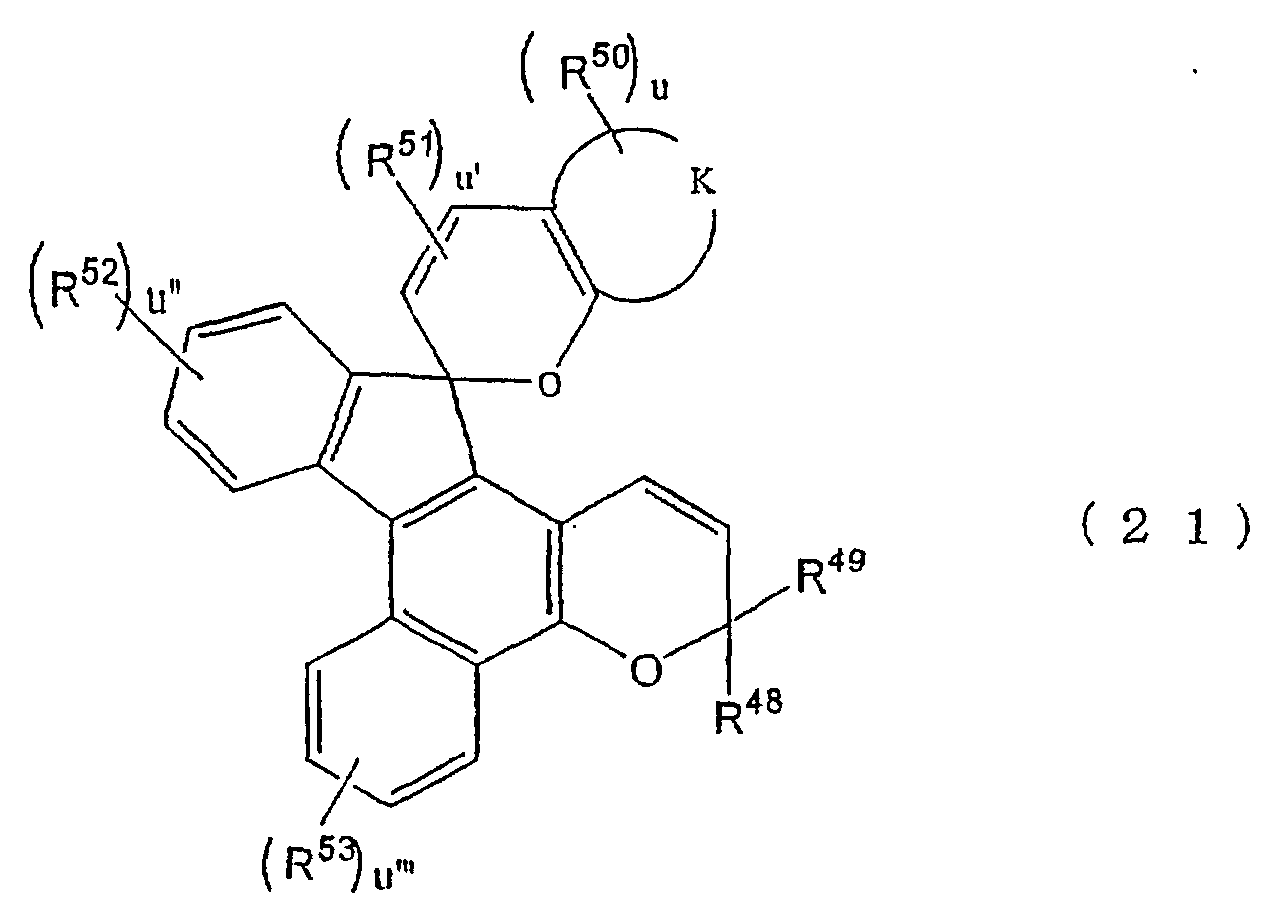 wherein R48 and R49 are, independently from each
other, the same as those denoted by R31 and R32 in the
above general formula (18), R50, R51, R52 and R53 are
the same as those denoted by R33, R34 and R35 in the
above general formula (18), u is an integer of 0 to
6, u', u" and u"' are, independently from each other,
integers of 0 to 4, and the following formula (29)
wherein R48 and R49 are, independently from each
other, the same as those denoted by R31 and R32 in the
above general formula (18), R50, R51, R52 and R53 are
the same as those denoted by R33, R34 and R35 in the
above general formula (18), u is an integer of 0 to
6, u', u" and u"' are, independently from each other,
integers of 0 to 4, and the following formula (29)
 represents a substituted or unsubstituted aromatic
hydrocarbon group, or a substituted or unsubstituted
unsaturated heterocyclic group.
represents a substituted or unsubstituted aromatic
hydrocarbon group, or a substituted or unsubstituted
unsaturated heterocyclic group.
A chromene compound represented by the general
formula (22),
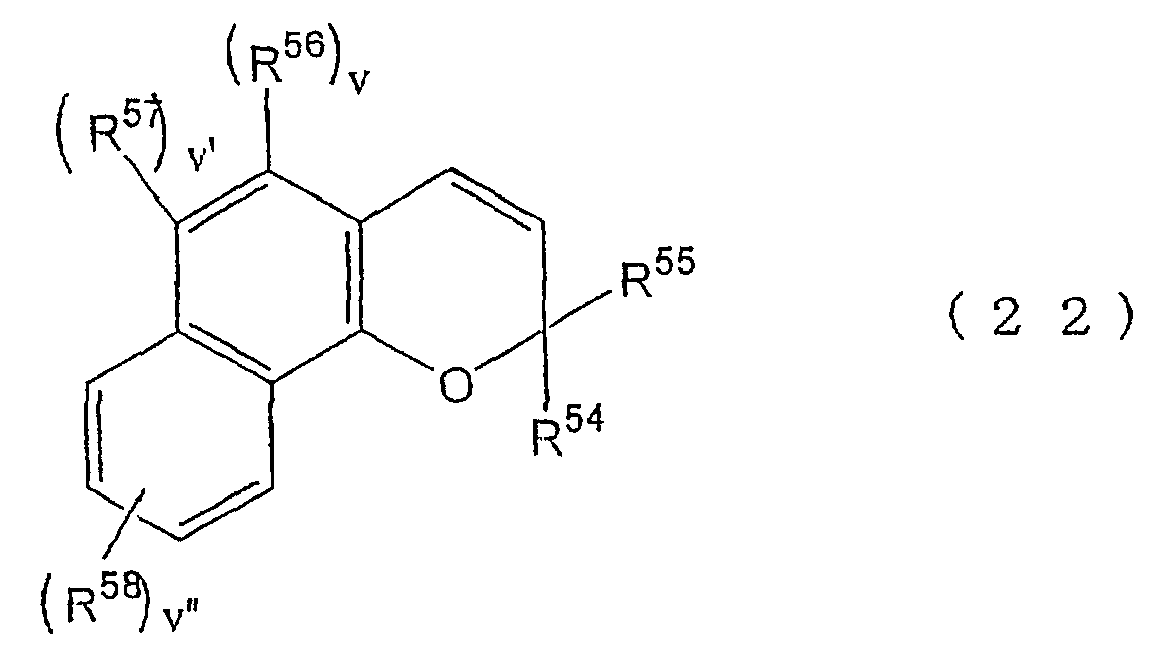 wherein R54 and R55 are, independently from each
other, the same as those denoted by R31 and R32 in the
above general formula (18), R56, R57 and R58 are the
same as those denoted by R33, R34 and R35 in the above
general formula (18), v' and v" are, independently
from each other, integers of 0 or 1, and v"' is an
integer of 0 to 4.
wherein R54 and R55 are, independently from each
other, the same as those denoted by R31 and R32 in the
above general formula (18), R56, R57 and R58 are the
same as those denoted by R33, R34 and R35 in the above
general formula (18), v' and v" are, independently
from each other, integers of 0 or 1, and v"' is an
integer of 0 to 4.
A chromene compound represented by the general
formula (23),
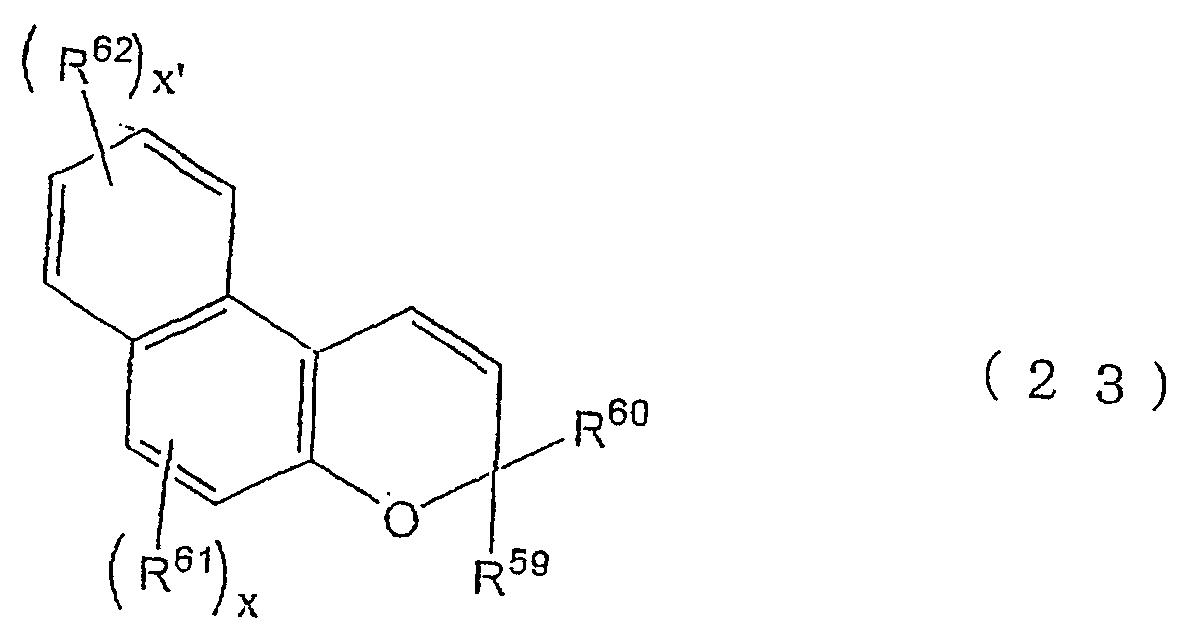 wherein R59 and R60 are, independently from each
other, the same as those denoted by R31 and R32 in the
above general formula (18), R61 and R62 are the same
as those denoted by R33, R34 and R35 in the above
general formula (18), x is an integer of 0 to 2, and
x' is an integer of 0 to 4.
wherein R59 and R60 are, independently from each
other, the same as those denoted by R31 and R32 in the
above general formula (18), R61 and R62 are the same
as those denoted by R33, R34 and R35 in the above
general formula (18), x is an integer of 0 to 2, and
x' is an integer of 0 to 4.
A chromene compound represented by the general
formula (24),
 wherein R63 and R64 are, independently from each
other, the same as those denoted by R31 and R32 in the
above general formula (18), R65, R66, R67 and R68 are
the same as those denoted by R33, R34 and R35 in the
above general formula (18), and y and y' are,
independently from each other, integers of 0 to 4.
wherein R63 and R64 are, independently from each
other, the same as those denoted by R31 and R32 in the
above general formula (18), R65, R66, R67 and R68 are
the same as those denoted by R33, R34 and R35 in the
above general formula (18), and y and y' are,
independently from each other, integers of 0 to 4.
A chromene compound represented by the general
formula (25),
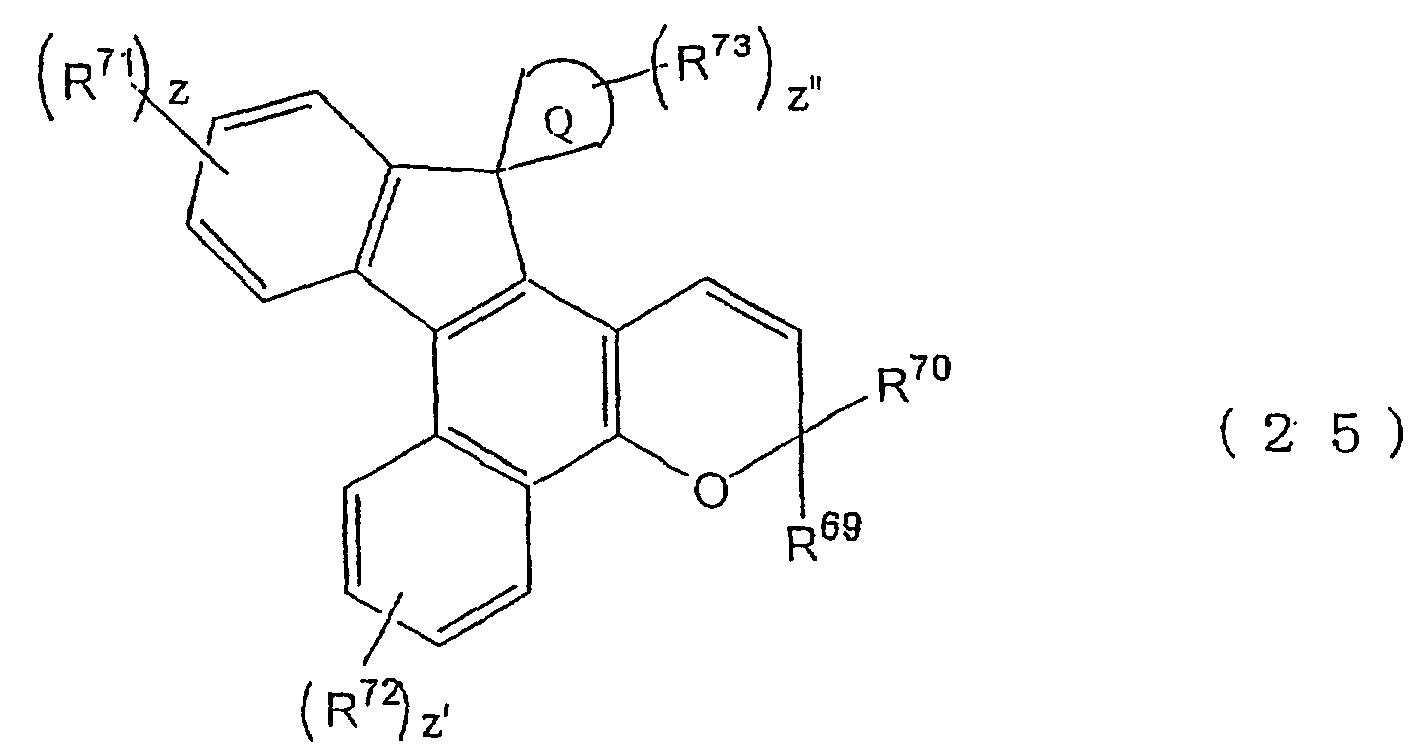 wherein R69 and R70 are, independently from each
other, the same as those denoted by R31 and R32 in the
above general formula (18), R71, R72 and R73 are the
same as those denoted by R33, R34 and R35 in the above
general formula (18), and z and z' are, independently
from each other, integers of 0 to 4, z"' is an
integer of 0 to 6, and the following formula (30)
wherein R69 and R70 are, independently from each
other, the same as those denoted by R31 and R32 in the
above general formula (18), R71, R72 and R73 are the
same as those denoted by R33, R34 and R35 in the above
general formula (18), and z and z' are, independently
from each other, integers of 0 to 4, z"' is an
integer of 0 to 6, and the following formula (30)
 represents an aliphatic hydrocarbon ring that may
have up to 6 substituents.
represents an aliphatic hydrocarbon ring that may
have up to 6 substituents.
The chromene compounds that can be particularly
favorably used in the present invention are those
compounds having structures as described below.

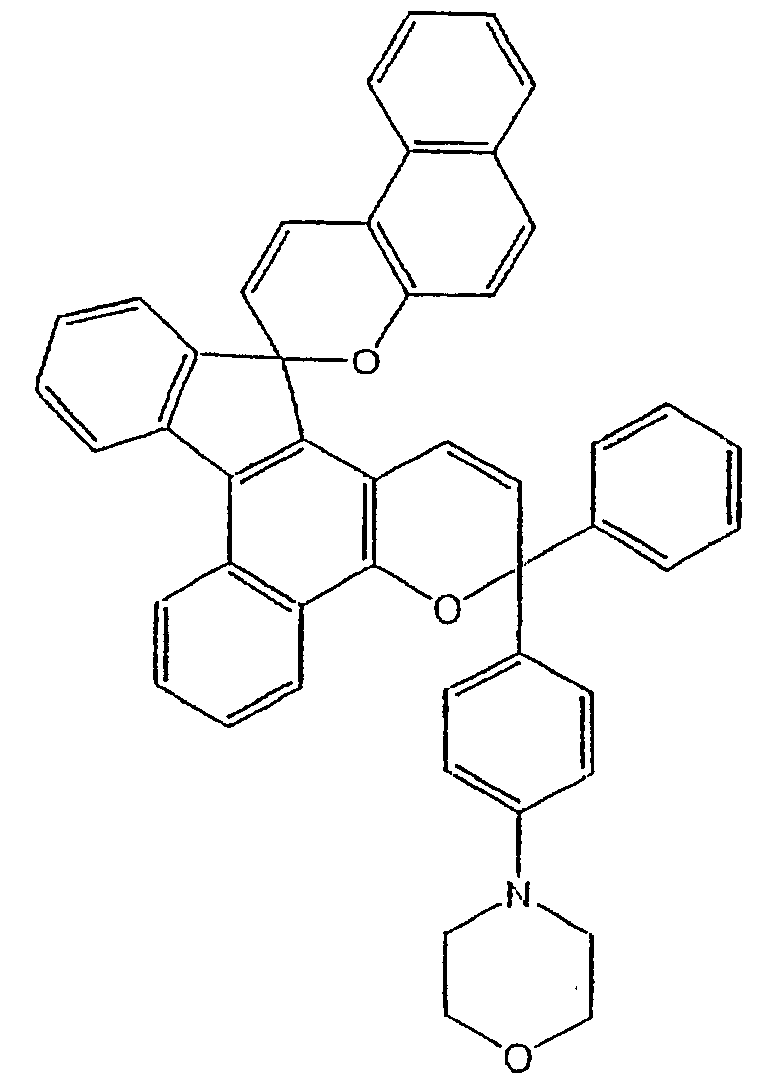

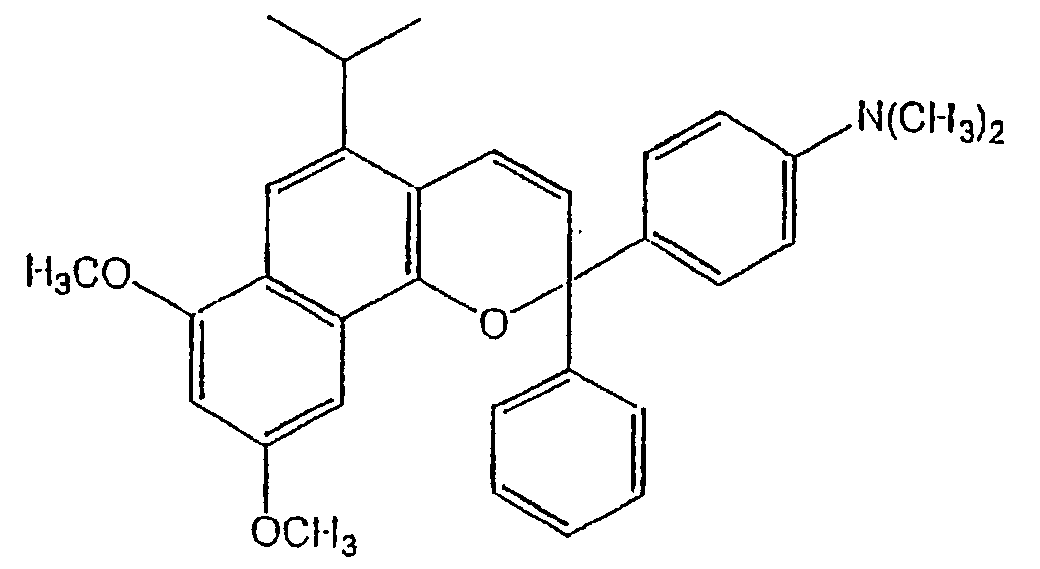


In the photochromic polymerization-curable
composition of the present invention, there is no
particular limitation on the ratio of blending the
photochromic compound. From the standpoint of
photochromic properties and initial color of the cured
product (color of when not irradiated with light, i.e.,
color in a dark place), however, it is desired to blend
the photochromic compound in an amount of from 0.0001 to
10 parts by weight, more preferably, from 0.001 to 5 parts
by weight and, particularly preferably, from 0.001 to 1
part by weight per 100 parts by weight of the whole
polymerizable monomers.
In order to improve the light resistance of the
photochromic compound, to improve the color density, to
improve the fading rate and to improve the moldability,
the photochromic polymerization-curable composition of the
present invention may be further blended, as required,
with various stabilizers and additives being mixed
together, such as parting agent, antioxidizing agent,
radical-trapping agent, ultraviolet ray absorber, infrared
ray absorber, ultraviolet ray stabilizer, antioxidant,
coloring-preventing agent, antistatic agent, surfactant,
fluorescent dye, dye, pigment, perfume, and plasticizer.
When the ultraviolet ray stabilizer is mixed into the
photochromic polymerization-curable composition of the
present invention, the light resistance of the
photochromic compound is further improved, which is
favorable. As the ultraviolet ray stabilizer, there can
be favorably used a hindered amine photo-stabilizer,
hindered phenol photo-stabilizer, and sulfur-type
antioxidant. Though there is no particular limitation,
the ultraviolet ray stabilizer is usually used in an
amount of from 0.001 to 10 parts by weight and, more
preferably, from 0.01 to 1 part by weight per 100 parts by
weight of the whole polymerizable monomers.
Upon mixing the infrared ray absorber, further, there
can be obtained a photochromic cured product which
exhibits infrared ray-absorbing property in addition to
exhibiting photochromic action. As the infrared ray-absorber,
there can be used a polymethine compound, a
diimonium compound, a cyanin compound, an anthraquinone
compound and an aluminum compound. Among them, however,
the diimonium compound is preferred having a large molar
extinction coefficient and exhibiting the effect by the
addition in a small amount. It is desired that the
infrared ray absorber is blended in an amount of from
0.0001 to 1 part by weight and, particularly, from 0.001
to 0.01 part by weight per 100 parts of the whole
polymerizable monomers.
There is no particular limitation on the method of
preparing the photochromic polymerization-curable
composition of the invention, and the composition can be
prepared by weighing and mixing the individual components
in predetermined amounts. There is no particular
limitation on the order of adding the individual
components. All of the components may be added at the
same time, or the monomer components may be mixed, first,
and then the photochromic compound and other additives may
be added just before being polymerized. As required, the
polymerization initiator may be added in conducting the
polymerization.
There is no particular limitation on the
polymerization method for obtaining a cured product from
the photochromic polymerization-curable composition of the
invention, and any known radical polymerization method may
be employed depending upon the kind of the monomer that is
used. The polymerization can be initiated by using
various radical polymerization initiators such as
peroxides or azo compounds, or by the irradiation with
ultraviolet rays, α-rays, β-rays or γ-rays, or by a
combination thereof.
To obtain a cured product used as a photochromic
plastic lens, for example, there can be favorably employed
a cast polymerization in which the photochromic
polymerization-curable composition of the invention mixed
with a radical polymerization initiator is poured into
between the elastomer gaskets or the molds held by
spacers, cured by polymerization in an air furnace and is,
then, taken out from the molds.
Here, any known radical polymerization initiator can
be used without particular limitation. Its representative
examples include diacyl peroxides such as benzoyl
peroxide, p-chlorobenzoyl peroxide, decanoyl peroxide,
lauroyl peroxide, and acetyl peroxide; peroxy esters such
as t-butylperoxy-2-ethyl hexanate, t-butylperoxy
neodecanate, cumylperoxy neodecanate and t-butylperoxy
benzoate; percarbonates such as diisopropylperoxy
dicarbonate, and di-sec-butylperoxy dicarbonate; and azo
compounds such as azobisisobutilonitrile.
The amount of using the radical polymerization
initiator varies depending upon the polymerization
conditions, kind of the initiator and the composition of
the monomers, and cannot be exclusively specified.
Generally, however, the radical polymerization initiator
is used in an amount of from 0.001 to 10 parts by weight
and, preferably, from 0.01 to 5 parts by weight per 100
parts by weight of the whole polymerizable monomers.
In carrying out the cast polymerization, the
polymerization temperature seriously affects the
properties of the obtained photochromic cured product.
Optimum temperature conditions cannot be exclusively
specified as they are affected by the kind and amount of
the initiator and by the kind of the monomer. Generally,
however, it is desired to employ a so-called taper-type
two-stage polymerization in which the polymerization
starts at a relatively low temperature, the temperature is
gradually elevated and the polymerization is completed at
a high temperature to effect the curing. Like the
temperature, the polymerization time, too, differs
depending upon a variety of factors, and it is desired to
determine, in advance, an optimum time depending upon
these conditions. In general, however, it is desired to
so select the conditions that the polymerization is
completed in 2 to 40 hours.
In the foregoing was described the cast
polymerization by using the radical polymerization
initiator. It is, however, also possible to conduct the
cast polymerization in the same manner by using the
photopolymerization initiator. The photopolymerization
initiator that can be used include benzoin, benzoinmethyl
ether, benzoinbutyl ether, benzophenol, acetophenone-4,4'-dichlorobenzophenone,
diethoxyacetophenone, 2-hydroxy-2-methyl-1-phenylpropane-1-one,
benzylmethyl ketal, 1-(4-isopropylphenyl)-2-hydroxy-2-methylpropane-1-one,
1-hydroxycyclohexylphenyl
ketone, and 2-isopropylthioxanthone.
Generally, these
photopolymerization initiators are used in an amount of
from 0.001 to 5 parts by weight per 100 parts by weight of
the whole polymerizable monomers.
The photochromic cured product of the invention
obtained by the above method can be put to the following
treatment depending upon the field of use. That is, dying
by using a dye such as dispersion dye; reflection-preventing
treatment by forming an organic high molecular
thin film by applying a hard coating agent comprising,
chiefly, a sol such as silane coupling agent, silicon,
zirconium, antimony, aluminum, tin or tungsten, or by
forming a thin film by vaporizing a metal oxide such as
SiO2, TiO2 or ZrO2; or antistatic treatment.
The invention will now be described by way of Working
Examples to which only, however, the invention is in no
way limited.
In Examples 1 to 21 and in Comparative Examples 1 to
3 among all of Examples and Comparative Examples, the
sulfur-containing compounds having at least one thio group
in the molecules were determined for their purities by
using a gas chromatography (purity I: containing a
disulfide compound which is an impurity). In these
Examples and Comparative Examples were further determined,
by the gas chromatography, the contents of by-products
having, in the molecules, thio groups (hereinafter simply
referred to as by-products) in amounts smaller than those
of the sulfur-containing compound which is the object
product.
In Examples 22 to 38, the sulfur-containing compounds
having at least one thio group and at least one
polymerizable functional group in the molecules were
measured for their purities by using a high-speed liquid
chromatography (HPLC method)(purity II). In these
Examples and Comparative Examples, further, the content of
the disulfide compound was also determined by the high-speed
liquid chromatography.
The color of the product was evaluated by eyes by
isolating the sulfur-containing compound obtained by the
reaction without refining it and dissolving it in an N,N-dimethyl
sulfoxide solution in an amount of 5% by weight.
The basis of evaluation was as follows:
150 Grams (0.974 mols) of a 2-mercaptoethyl sulfide
that is a starting thiol compound was heated and stirred
in 1000 ml of methanol (solvent) in the presence of 77.9 g
(1.948 mols) of sodium hydroxide that is a basic compound
at 40° C for 30 minutes. To this solution was then added
dropwise a solution of 164.7 g (2.045 mols) of a 2-chloroethanol
which is a compound capable of reacting with
a mercapto group and 150 ml of methanol. Since heat
generates during the dropwise addition, the dropping
operation was carefully conducted such that the reaction
temperature did not exceed 60° C. After the dropwise
addition has been finished, the solution was stirred at 40
° C for 3 hours and the temperature was, then, raised to
60° C.
Then, NaCl which is a by-product of the reaction was
removed by filtering while it was still hot, and the
filtrate was cooled in an ice bath to obtain a sulfur-containing
compound having a thio group in the molecules
(hereinafter also referred to simply as formed sulfur-containing
compound) represented by the following
structural formula (A) maintaining an yield of 215.2 g
(0.889 mols). The yield of isolation was 91.3% and the
purity I was 98.9% as measured by gas chromatography. The
yield of isolation used here is a value on the basis of
the starting thiol compound.

The amount of water in the reaction was measured by
the Karl Fischer's method, and it was found that the
amount of water was about 1000 ppm (about 0.03 times of
the mole number of the starting mercapto groups;
hereinafter, the mol number of water for the mol number of
the starting mercapto group is also simply referred to as
"water molar ratio") at the start of the reaction and was
about 40,000 ppm (about 1.1 times of the mole number of
the starting mercapto groups, i.e., a water molar ratio of
about 1.1) at the end of the reaction. The amount of
water has increased due to the formation of water by the
reaction of hydrogen chloride with sodium hydroxide.
The formed product was examined for its color.
However, almost no color was observed and the product was
nearly in a colorless state (evaluation: ○).
Sulfur-containing compounds shown in Tables 1 and 2
were synthesized by using the starting thiol compounds and
the compounds capable of reacting with mercapto groups
shown in Tables 1 and 2, and by conducting the reaction in
the same manner as in Example 1 but changing the reaction
conditions as shown in Tables 3 and 4. Conversions of the
reactions (based on the starting thiol compounds), amounts
of by-products, yields of isolation of the formed sulfur-containing
compounds, purities I and evaluated results of
colors, were as shown in Tables 3 and 4.
In all of the Examples, by-products were formed
little, and sulfur-containing compounds having high
purities were obtained maintaining high yields of
isolation as measured by gas chromatography. The isolated
sulfur-containing compounds did not almost exhibit color,
and their coloring properties were evaluated to be
favorable.
The reaction was conducted in the same manner as in
Example 1 but using the solvents shown in Table 4. The
results were as shown in Table 4.
As demonstrated by the results of Comparative
Examples 1 to 3, when the reaction was conducted under the
conditions in which water existed in large amounts in the
reaction system, by-products were formed in large amounts.
In particular, when water was used as a reaction solvent
(Comparative Example 2), the formed sulfur-containing
compound which was the object product was colored to a
considerable degree.

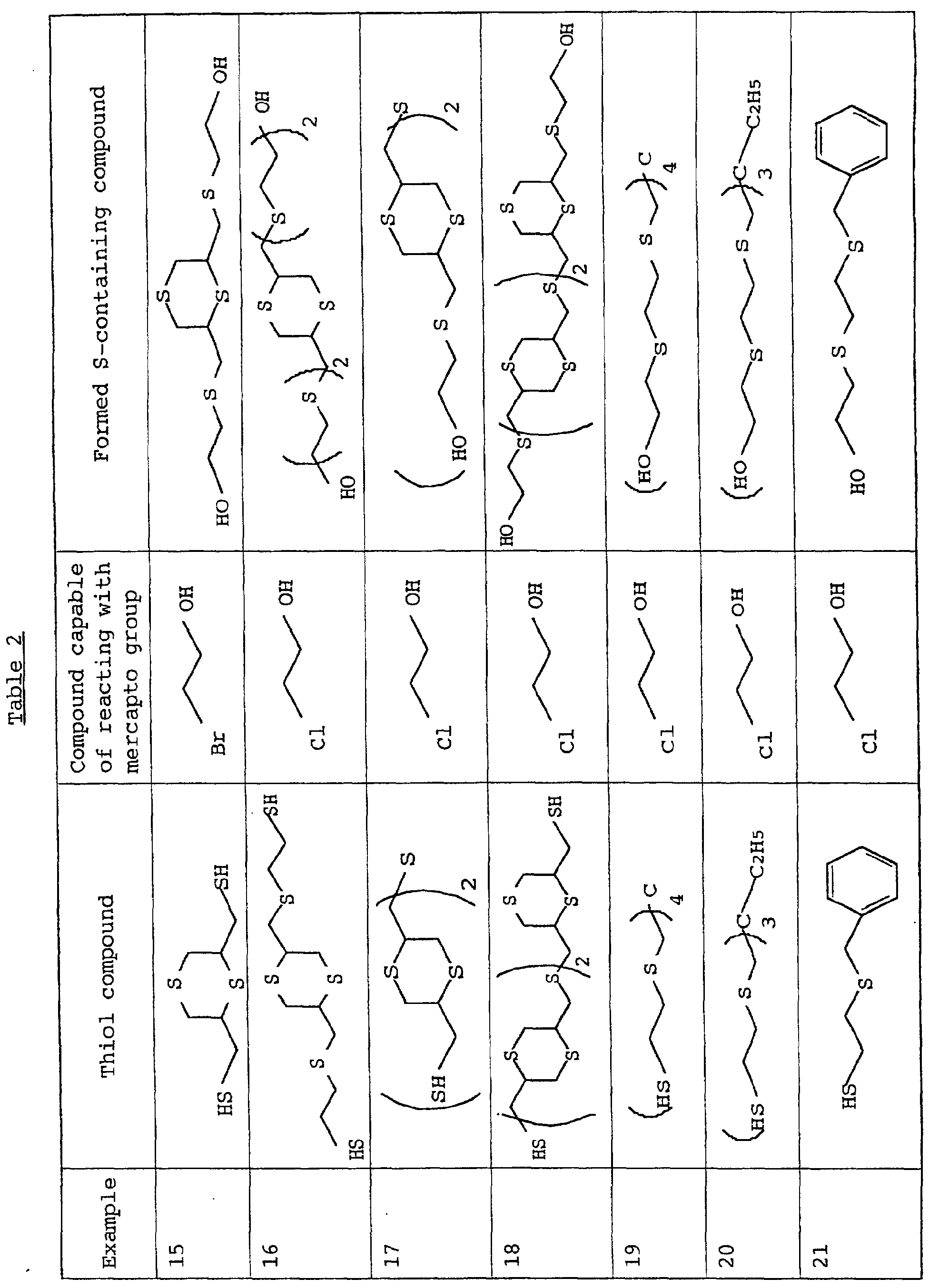

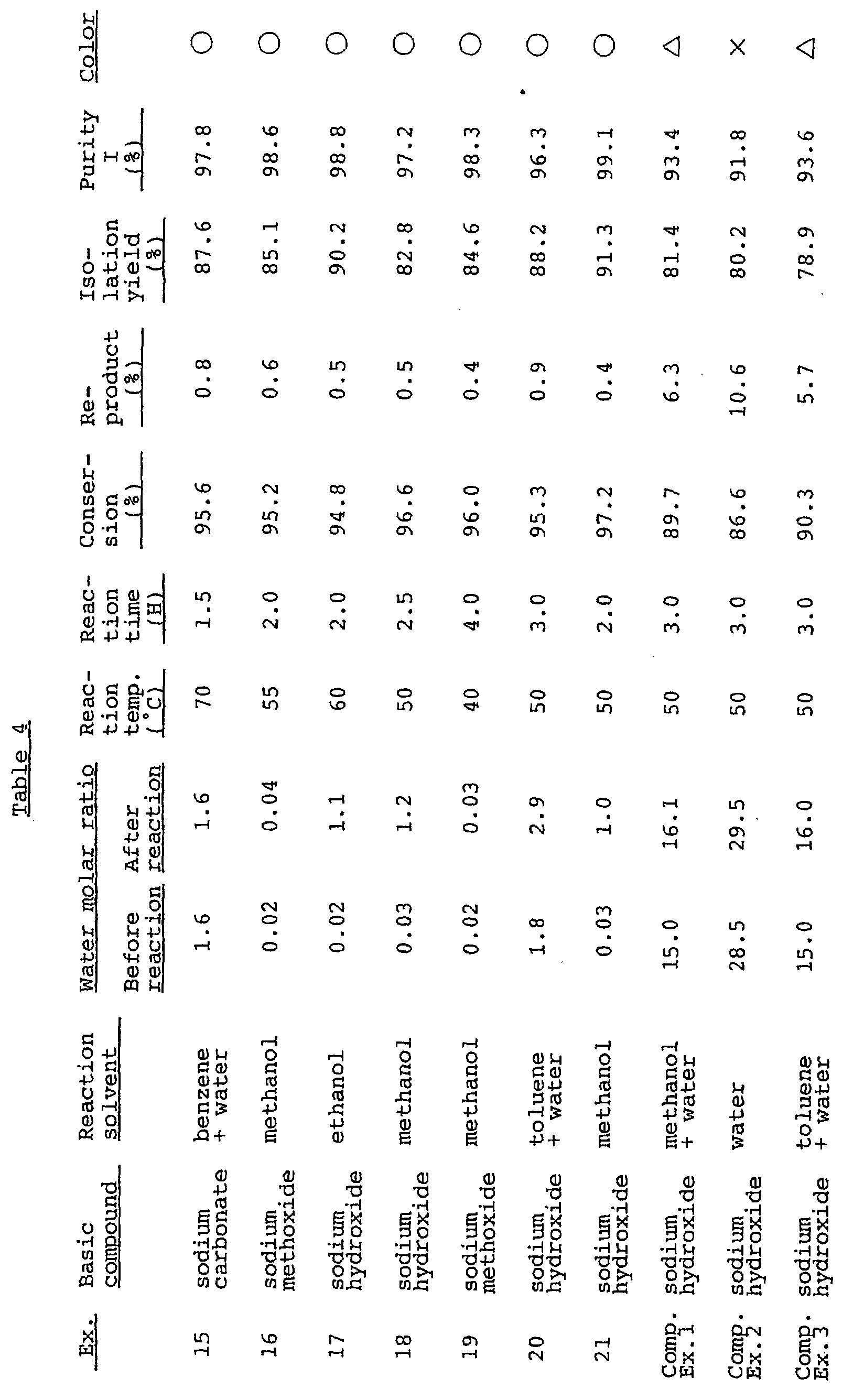
The following operation was all carried out in a
nitrogen atmosphere unless stated otherwise. 111.8 Grams
(2.790 mols) of sodium hydroxide as a basic compound and
1300 ml of dehydrated methanol (solvent) were added into a
2000-ml four-way flask with stirring at room temperature
to prepare a homogeneous solution. 200 Grams (1.299 mols)
of a 2-mercaptoethyl sulfide that is a thiol compound was
added dropwise to the solution while cooling the solution
in a water bath. After the dropwise addition has been
finished, the solution was stirred at 40° C for 30 minutes
to obtain a homogeneous solution. To the solution was
then added dropwise a mixture solution of 219.6 g (2.728
mols) of a 2-chloroethanol as a halogeno alcohol which is
a compound capable of reacting with the mercapto group and
200 ml of dehydrated methanol. Since heat generates
during the dropwise addition, the dropping operation was
carefully conducted such that the reaction temperature did
not exceed 60° C. After the dropwise addition has been
finished, the solution was stirred at 60°C for one hour.
Then, NaCl which is a by-product of the reaction was
removed in the open air by filtering while it was still
hot, and the filtrate was cooled in an ice bath to obtain
a highly pure sulfur-containing compound of the invention
{compound (A)} having two hydroxyl group in the molecules
represented by the following structural formula (A)
maintaining an yield of 294.8 g (1.218 mols). The yield
of isolation was 93.8% and the purity II was 99.0% as
measured by the high-speed liquid chromatography. The
content of the disulfide compound contained in the
compound (A) was 0.0 mol%. The yield of isolation used
here is a value on the basis of the 2-mercaptoethyl
sulfide which is a thiol compound.
Further, 200 g (0.826 mols) of the above compound,
4.0 g of cesium carbonate, 250 g (2.5 mols) of methyl
methacrylate, 4.0 g of p-methoxy-phenol and 80 ml of
hexane were fed, heated at 90° C to conduct the reaction
for 20 hours while removing methanol by azeotropy together
with hexane. Thereafter, the solid matter was removed,
washed with a 5% sodium hydroxide aqueous solution, water
and a 20% sodium chloride aqueous solution, followed by
distillation of a solvent, thereby to obtain 287.2 g
(0.760 mols) of the following compound (B) which is a
derivative of the above compound (A) and also is a highly
pure sulfur-containing compound of the invention. The
yield was 92.0%, the purity II was 95.4%, and the content
of the disulfide compound contained in the compound (B)
was 0.0 mol%. Here, the yield that is used is a value on
the basis of the compound (A) which is a starting
material.

Thiol compounds having the structures shown in Tables
5 to 8 and the compounds capable of reacting with the
mercapto group were reacted as starting materials under
the reaction conditions shown in Table 10 to synthesize
"sulfur-containing compounds having at least one thio
group and at least one polymerizable functional group in
the molecules" (polymerizable sulfur-containing compounds)
shown in Tables. The yields of isolation of the
reactions, purities II and the amounts of the disulfide
compound were as shown in Table 10.
In Tables 5 to 8, when two kinds of compounds are
described in the column of the compound that reacts with
the mercapto group, it means that the compound of the
upper stage was reacted, first, and, then, the obtained
polymerizable sulfur-containing compound was reacted with
the compound of the lower stage to obtain a highly pure
sulfur-containing compound of the invention which is a
derivative of the above polymerizable sulfur-containing
compound. In this case, the reaction conditions shown in
Table 10 stand for the reaction of the first stage.
However, the purities II, the contents and the yields of
the disulfide compound in Table 10 are those of the
results of when the final compounds were obtained.
In all of the Examples, the content of the disulfide
compound was not larger than 2 mol%, and the highly pure
sulfur-containing compounds of the invention had been
obtained maintaining high yields of isolation.
By using the starting materials shown in Tables 8 and
9, the reaction was conducted under the reaction
conditions shown in Table 10. In Table 10, the reaction
solvents were all those that had been fully dehydrated.
The reaction was conducted in the presence of the air.
The results were as shown in Table 10.
The reactions of Examples 35 to 38 were all those
conducted in the presence of oxygen. Though the
polymerizable sulfur-containing compounds were obtained in
considerably high yields, the contents of the disulfide
compound were as large as 5 mol% or more as demonstrated
by the results of Table 10.


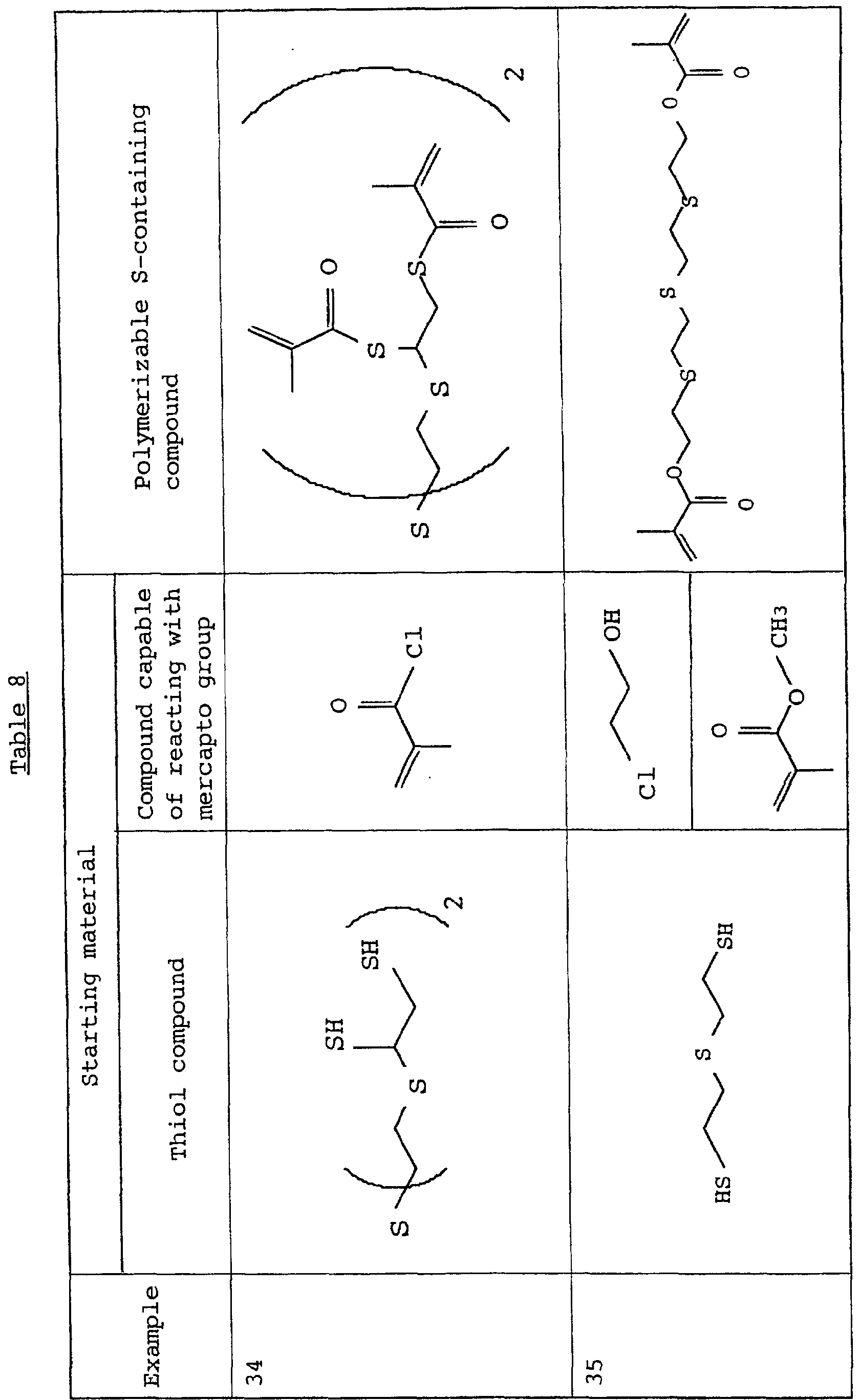

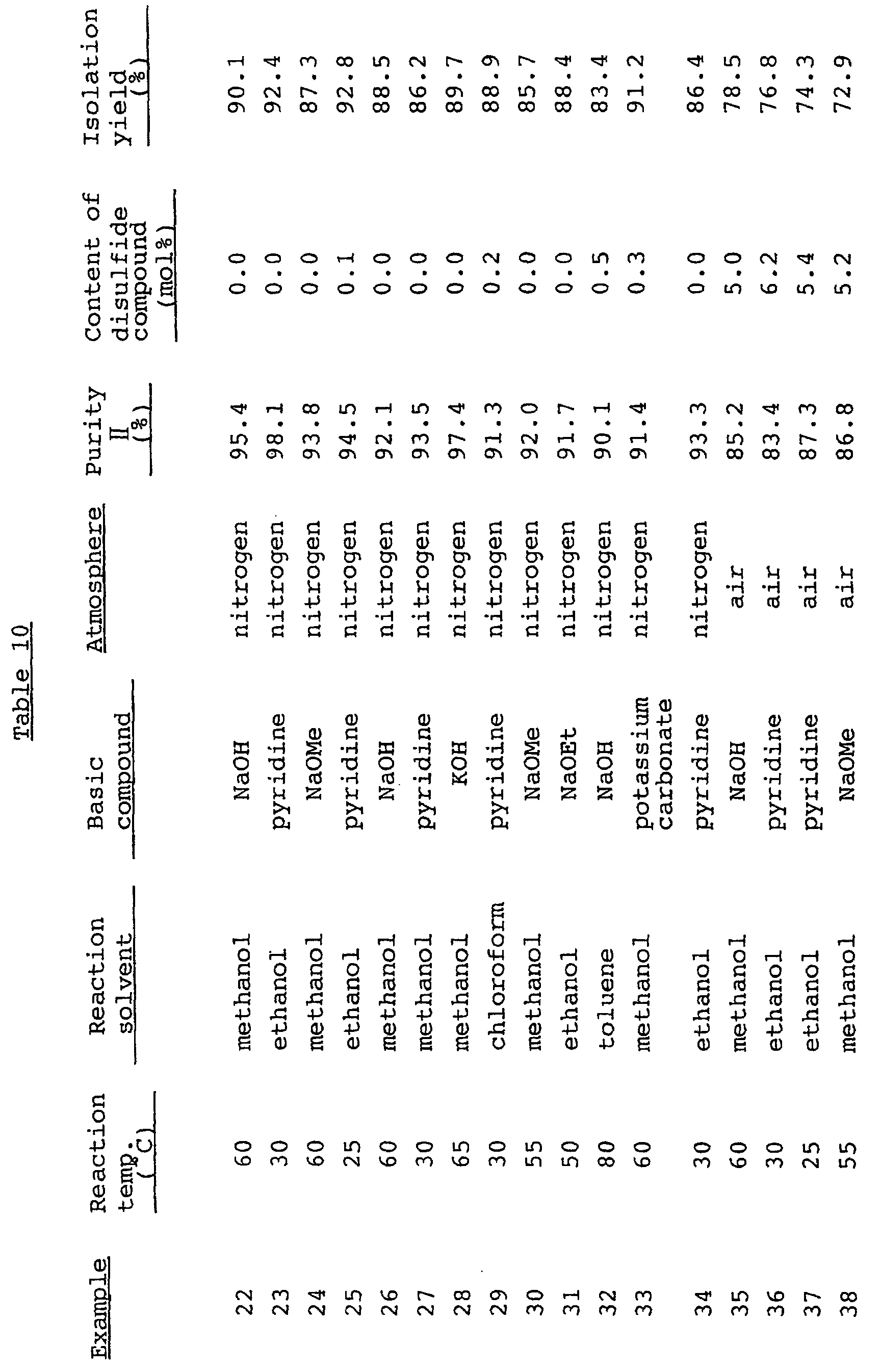
The polymerizable sulfur-containing compound prepared
in Example 22 was used as the component A and various
comonomers (component B) were added to prepare a
polymerizable composition comprising 78% by mass of the
component A, 4% by mass of a trimethylolpropane
trimethacrylate (TMPT), 2% by mass of a
methoxypolyethylene glycol allylether having an average
molecular weight of 550 (ALMePEG (550)), 1% by mass of a
triethylene glycol diacrylate (3EGA), 4% by mass of a
glycidyl methacrylate (GMA), 6% by mass of an a-methylstyrene
(MS), 3% by mass of an α-methylstyrene
dimer (MSD) and 2% by eight of a divinyl benzene (DVB).
To 100 parts by weight of the above polymerizable
composition were added 0.03 parts by weight of a chromene
1 represented by the following general formula as a
photochromic compound (component C),
 and 1.0 part by weight of a t-butylperoxy neodecanate as a
radical polymerization initiator, which were mixed well to
prepare a photochromic polymerization-curable composition.
Next, the thus obtained composition was poured into a mold
constituted by glass plates and a gasket of an
ethylene/vinyl acetate copolymer to execute the cast
polymerization. The polymerization was conducted by using
an air furnace while gradually raising the temperature
from 33° C to 90° C over a period of 17 hours and the
temperature was maintained at 90° for 2 hours. After the
polymerization, the mold was taken out from the air
furnace, left to cool, and the cured product was removed
from the glass mold.
and 1.0 part by weight of a t-butylperoxy neodecanate as a
radical polymerization initiator, which were mixed well to
prepare a photochromic polymerization-curable composition.
Next, the thus obtained composition was poured into a mold
constituted by glass plates and a gasket of an
ethylene/vinyl acetate copolymer to execute the cast
polymerization. The polymerization was conducted by using
an air furnace while gradually raising the temperature
from 33° C to 90° C over a period of 17 hours and the
temperature was maintained at 90° for 2 hours. After the
polymerization, the mold was taken out from the air
furnace, left to cool, and the cured product was removed
from the glass mold.
The photochromic cured product (2 mm thick) of the
invention obtained as described above was irradiated with
light by using a xenon lamp L-2480 (300W) SHL-100
manufactured by Hamamatsu Photonics Co. through an
aeromass filter (manufactured by Corning Co.) at 20 ± 1°
C at beam intensities on the surface of the cured product
of 365 nm = 2.4 mW/cm2 and 245 nm = 24 µW/cm2 for 120
seconds to develop color and to measure the photochromic
properties 1 ○ to 3 ○ and the optical property (refractive
index) 4 ○ described below.
In the following Examples and Comparative Examples,
polymerizable monomers (comonomers) and photochromic
compounds represented by the following abbreviations were
used for obtaining photochromic cured products.
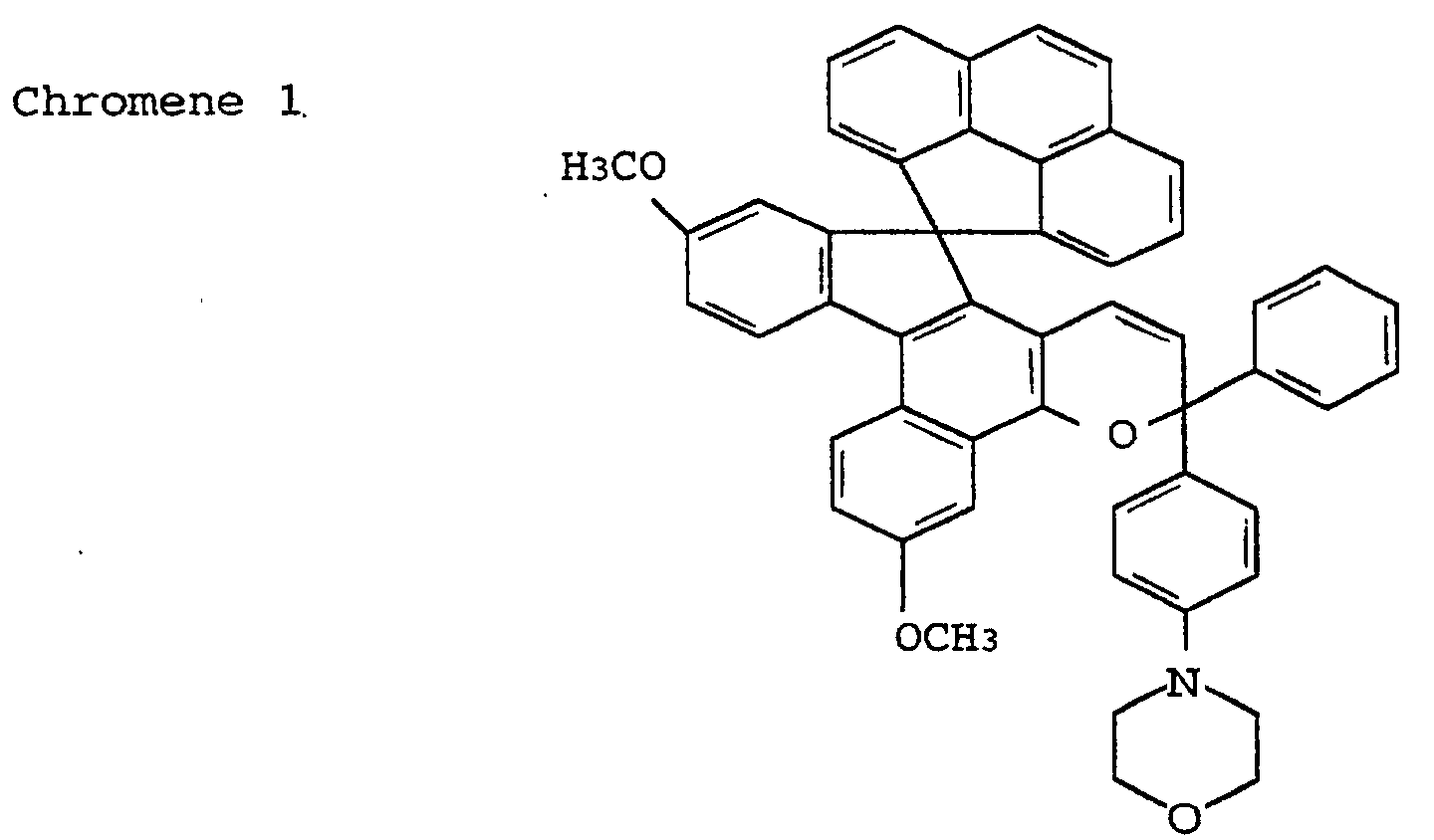
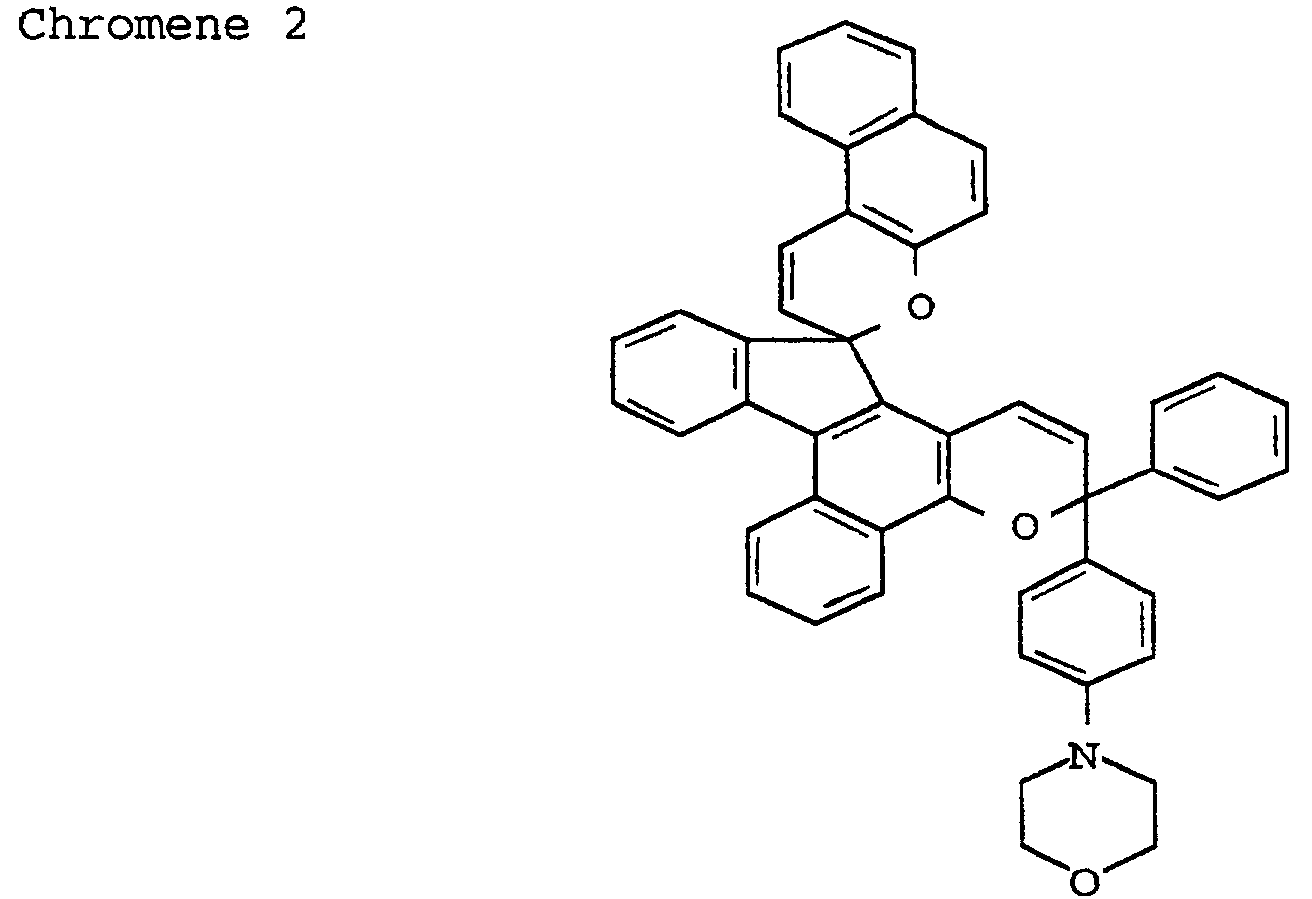
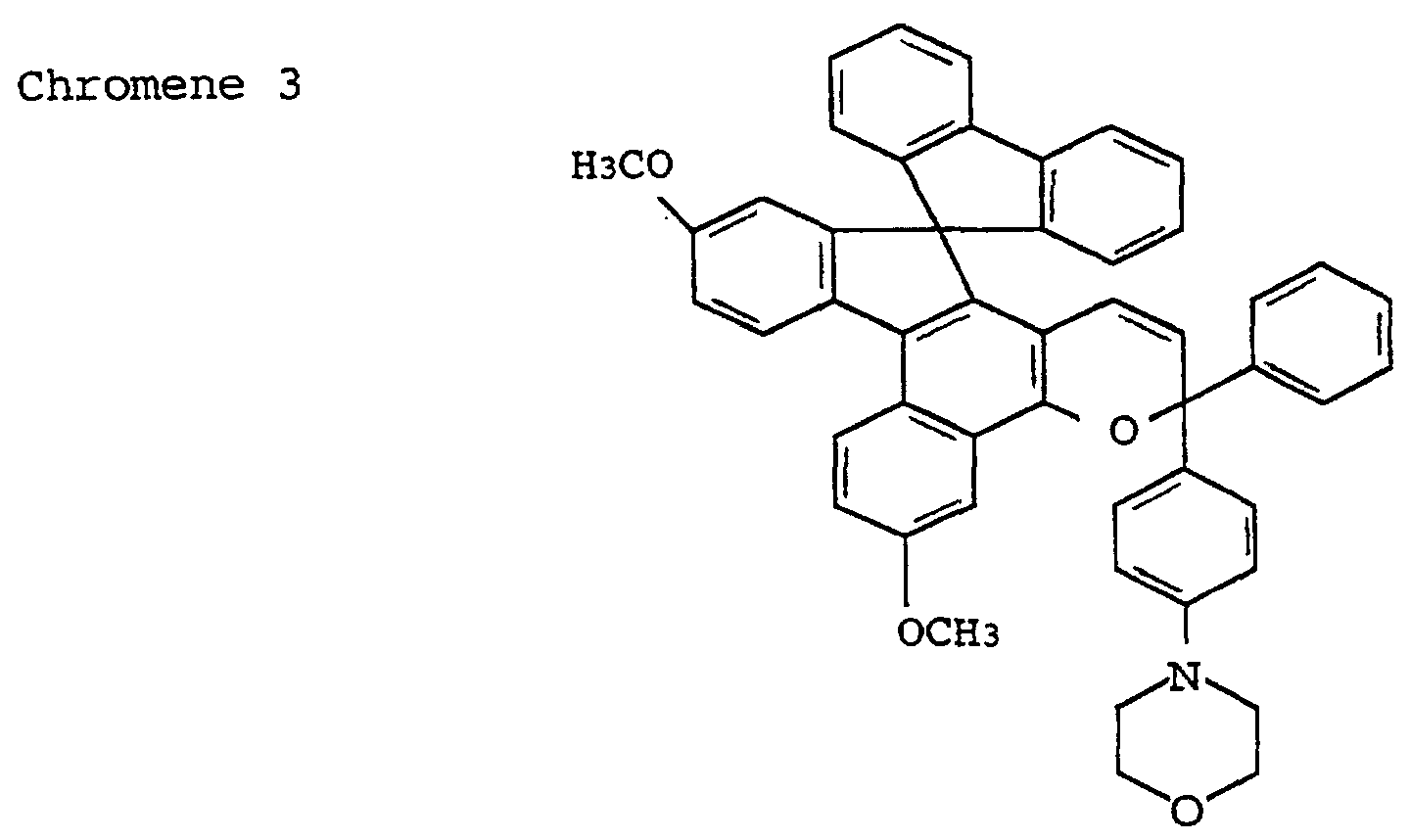


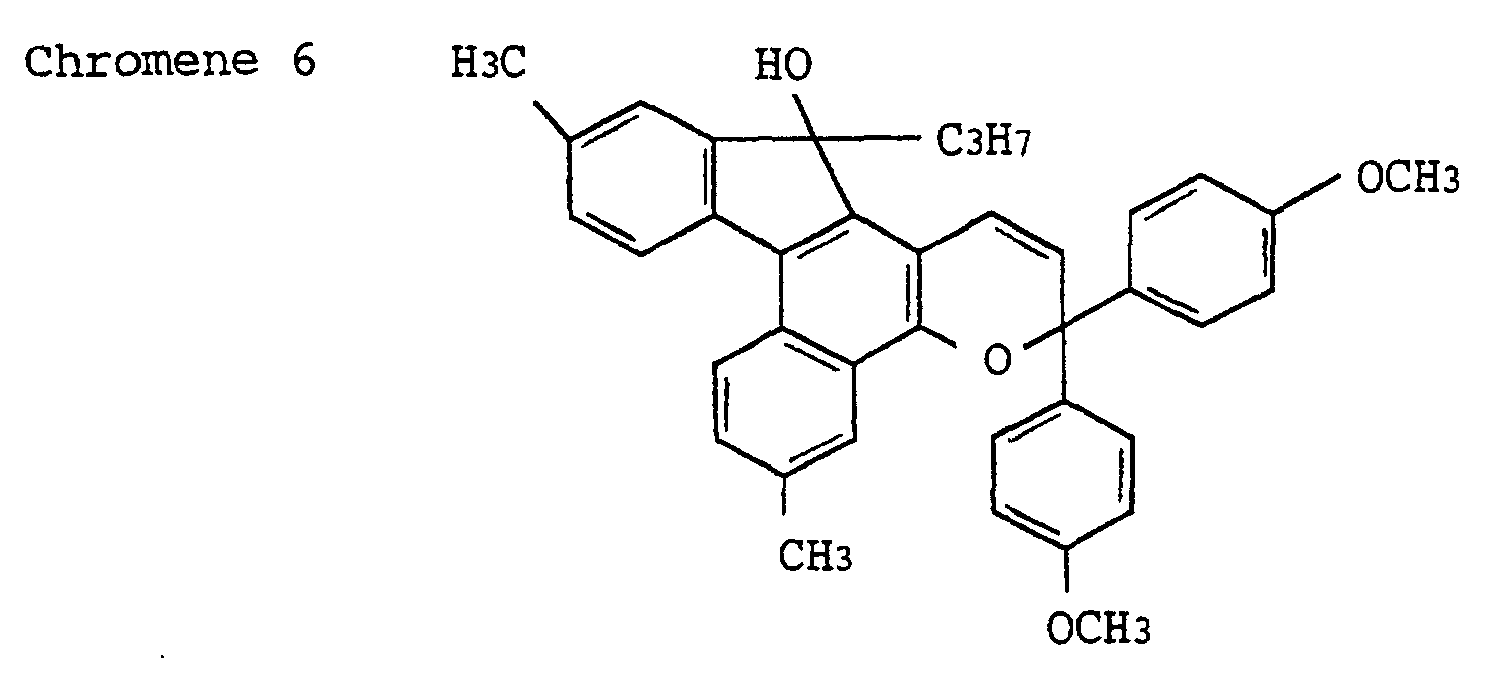

In Examples 40 to 53, cured products were obtained in
the same manner as in Example 39 but changing the
compositions of the photochromic polymerization-curable
composition as shown in Tables 11 and 12, and their
physical properties were measured. The results were as
shown in Tables 11 and 12. In Tables 11 and 12, the
column of "Component A" shows only the Example number of
the polymerizable sulfur-containing compound that was
used. It will be learned from Tables 11 and 12 that the
photochromic cured products of the invention of Examples
39 to 53 exhibit refractive indexes of as high as 1.58 or
more and light resistances of as large as about 80% or
more.
By using the polymerizable sulfur-containing
compounds containing much disulfide compound synthesized
in Examples 35 to 38 as the component A, the photochromic
polymerization-curable compositions shown in Table 12 were
prepared to obtain cured products in the same manner as in
Example 39 and to measure their physical properties. The
results were as shown in Table 12.
As shown in Table 12, the photochromic cured products
of Comparative Examples 4 to 7 have high refractive
indexes but low light resistances.


According to the preparation method of the present
invention, it is allowed to obtain in high yields the
sulfur-containing compound that is highly pure, is little
colored and has a thio group in the molecules without
using the metal sodium that must be carefully handled. In
using the sulfur-containing compound as an optical
material or as a medical or agricultural starting
material, therefore, the step of refining can be
simplified, and the loss (drop of yield) can be decreased
in the step of refining.
In particular, when the method of the present
invention is put into practice in an atmosphere without
substantially containing oxygen, it is allowed to greatly
decrease the formation of by-product, i.e., disulfide
compound which has chemical and physical properties
resembling those of the sulfur-containing compound and is
difficult to remove. When the present invention is put
into practice relying upon the above method, therefore, a
highly pure sulfur-containing compound is obtained
containing smaller than 2 mol% of the disulfide compound
which is the impurity that is contained in large amounts
in the conventional sulfur-containing compound obtained by
reacting the thiol compound with the compound capable of
reacting with the mercapto group.
When the highly pure sulfur-containing compound is
used in combination with the photochromic compound as a
monomer for photochromic plastic lenses, very useful
lenses are obtained exhibiting high refractive indexes and
greatly improved light resistance of photochromic
properties.
Claims (15)
- A method of preparing a sulfur-containing compound having at least one thio group in the molecules by reacting a thiol compound with an organic compound having at least one functional group capable of forming a thio group in the molecules upon reacting with a mercapto group in the presence of a basic compound, wherein the number of moles of water contained in the reaction system is set to be not larger than 7.5 times as large as the number of moles obtained by multiplying the number of moles of the thiol compound to be reacted by a number of mercapto groups present in one molecule of the thiol compound.
- A method of preparing a sulfur-containing compound according to claim 1, wherein a thiol compound represented by any one of the following general formulas (1) to (5) is reacted with an organic compound represented by the following general formula (6) having at least one functional group capable of forming a thio group in the molecules upon the reaction with a mercapto group, thereby to form a sulfur-containing compound having at least one thio group in the molecules represented by any one of the following general formulas (7) to (11): i.e., a thiol compound such as:is reacted with an organic compound having at least one functional group capable of forming a thio group in the molecules upon the reaction with a mercapto group, represented by the following general formula (6),a compound represented by the following general formula (1),wherein R1 and R2 are, independently from each other, alkylene groups with 1 to 4 carbon atoms that may have a substituent (without, however, including the number of carbon atoms of the substituent) or arylene groups with 6 to 12 carbon atoms that may have a substituent (without, however, including the number of carbon atoms of the substituent), the substituent of each of said alkylene group and of said arylene group being an alkyl group, an aryl group, an aralkyl group, an alkoxy group, an alkylthio group, an aromatic heterocyclic group, a halogen atom excluding fluorine, or at least one group selected from the group consisting of groups represented by the following formula (12)
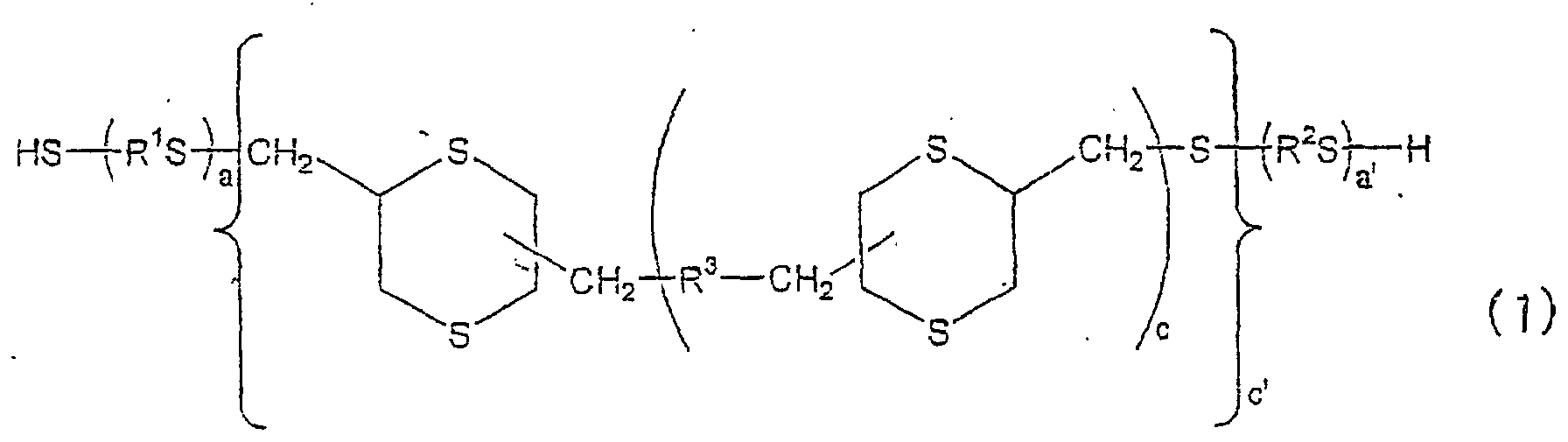 wherein R4 is an alkylene group with 1 to 4 carbon atoms that may have a substituent (without, however, including the number of carbon atoms of the substituent), the substituent of said alkylene group being at least one group selected from the group consisting of an alkyl group, an aryl group, an aralkyl group, an alkoxy group, an alkylthio group, an aromatic heterocyclic group and a halogen atom excluding fluorine, and d is an integer of from 0 to 10;
R3 is a divalent group represented by the following formula (13),wherein R5 is an alkylene group with 1 to 4 carbon atoms that may have a substituent (without, however, including the number of carbon atoms of the substituent), an arylene group with 6 to 12 carbon atoms that may have a substituent (without, however, including the number ofcarbon atoms of the substituent), a divalent aromatic heterocyclic group that may have a substituent, or a divalent group represented by the following formula (14), wherein R6, R7, R8 and R9 are, independently from each other, halogen atoms excluding fluorine atoms, or hydrogen atoms, and R10 is an alkylene group having 1 to 3 carbon atoms or sulfur atoms), the substituent of each of said alkylene group, arylene group and divalent aromatic heterocyclic group being the same as the substituent of the alkylene group with 1 to 4 carbon atoms that may have a substituent in the above formula (12), and e being an integer of 0 to 5; and a and a' are, independently from each other, integers of 0 to 10, c is an integer of from 0 to 6, c' is 0 or 1 and, when c' is 0, the sum of a and a' is not smaller than 2; or
 a compound represented by the following general formula (2),wherein R15 is a monovalent to trivalent aromatic group with 6 to 14 carbon atoms which may have a substituent (without, however, including the number of carbon atoms of the substituent) or a monovalent to trivalent aromatic heterocyclic group with 3 to 12 carbon atoms which may have a substituent (without, however, including the number of carbon atoms of the substituent), the substituent of each of these aromatic group and aromatic heterocyclic group being the same as the substituent of the alkylene group with 1 to 4 carbon atoms which may have a substituent in the above formula (12), and f is, independently from each other, an integer of 0 or 1, and f' is an integer of 1 to 3; or
 a compound represented by the following general formula (3),wherein R16 is an alkylene group with 1 to 4 carbon atoms which may have a substituent (without, however, including the number of carbon atoms of the substituent), the substituent of said alkylene group being the same as the substituent of the alkylene group with 1 to 4 carbon atoms that may have a substituent denoted by R1 and R2 in the above general formula (1), R17 is a hydrogen atom or an alkyl group with 1 to 4 carbon atoms which may have a substituent (without, however, including the number of carbon atoms of the substituent), the substituent of said alkyl group being the same as the substituent other than the alkyl group in the alkylene group with 1 to 4 carbon atoms that may have a substituent in the above formula (12), g' is an integer of 0 or 1, g is an integer of 1 to 10, h is an integer of 0 to 5 and, when g' is 1, h is an integer of 1 to 5, and h' is 0 or 1; or
 a compound represented by the following general formula (4),wherein R18 and R19 are, independently from each other, alkylene groups with 1 to 4 carbon atoms that may have a substituent (without, however, including the number of carbon atoms of the substituent) or arylene groups with 6 to 12 carbon atoms that may have a substituent (without, however, including the number of carbon atoms of the substituent), the substituent of each of said alkylene group and said arylene group being the same as the substituent of the alkylene group with 1 to 4 carbon atoms which may have a substituent and of the arylene group with 6 to 12 carbon atoms which may have a substituent denoted by R1 and R2 in the above general formula (1), R20 is an alkyl group with 1 to 4 carbon atoms which may have a substituent (without, however, including the number of carbon atoms of the substituent), an aryl group with 6 to 12 carbon atoms which may have a substituent (without, however, including the number of carbon atoms of the substituent), or an aralkyl group which may have a substituent, the substituent of said alkyl group being the same as the substituent other than the alkyl group in the alkylene group with 1 to 4 carbon atoms which may have a substituent in the above formula (12), the substituent of each of said aryl group and said aralkyl group being the same as the substituent of the alkylene group with 1 to 4 carbon atoms that may have a substituent in the above formula (12), Y is an oxygen atom or a sulfur atom, Z is an oxygen atom or a sulfur atom, it does no happen that both Y and Z are simultaneously oxygen atoms, i and i' are, independently from each other, integers of 0 to 10, and the sum of i and i' is not smaller than 1; or
 a compound represented by the following general formula (5),wherein R21, R22, R23, R24, R25 and R26 are, independently from each other, hydrogen atoms or groups represented by the following formula (16),
 wherein R27 and R28 are, independently from each other, alkylene groups with 1 to 4 carbon atoms that may have a substituent (without, however, including the number of carbon atoms of the substituent), the substituent of said alkylene group being the same as the substituent of the alkylene group with 1 to 4 carbon atoms which may have a substituent represented by R1 and R2 in the above general formula (1), j and j' are, independently from each other, integers of 0 to 4, and the sum of j and j' is not smaller than 1; and
at least one of R21, R22, R23, R24, R25 and R26 is the group represented by the above formula (16);wherein W is a functional group capable of forming a thio group upon reacting with a mercapto group, and R11 is an alkyl group with 1 to 4 carbon atoms that may have a substituent (without, however, including the number of carbon atoms of the substituent), or a (meth)acryloyl group, the substituent of said alkyl group being at least the one selected from the group consisting of a polymerizable functional group, an aryl group, an aralkyl group, an alkoxy group, an alkylthio group, an aromatic heterocyclic group and a halogen atom excluding fluorine;
to form a sulfur-containing compound having at least one thio group in the molecule, such as:a compound represented by the following general formula (7),wherein R1' and R2' are, independently from each other, alkylene groups with 1 to 4 carbon atoms that may have a substituent (without, however, including the number of carbon atoms of the substituent) or arylene groups with 6 to 12 carbon atoms that may have a substituent (without, however, including the number of carbon atoms of the substituent), the substituent of each of said alkylene group and of said arylene group being at least the one selected from the group consisting of an alkyl group, an aryl group, an aralkyl group, an alkoxy group, an alkylthio group, an aromatic heterocyclic group, a halogen atom excluding fluorine, and a group represented by the following formula (15) wherein R4 is as defined in the above formula (12), R14 is the same as R11 in the above formula (6), d is an integer of from 0 to 10, and d' is an integer of 0 or 1;
R12 and R13 are, independently from each other, the same groups as those of R11 of the above general formula (6),
R3 is as defined in the above general formula (1), a and a' are, independently from each other, integers of 0 to 10, c is an integer of from 0 to 6, c' is 0 or 1 and, when c' is 0, the sum of a and a' is not smaller than 2; ora compound represented by the following general formula (8),wherein R15, f and f' are as defined in the above general formula (2), and R11 is, independently from each other, as defined in the above general formula (6); or a compound represented by the following general formula (9),wherein R16' is an alkylene group with 1 to 4 carbon atoms that may have a substituent (without, however, including the number of carbon atoms of the substituent), the substituent of said alkylene group being the same as the substituent of the alkylene group with 1 to 4 carbon atoms which may have a substituent denoted by R1' and R2' in the above general formula (7), R17, g, g', h and h' being as defined in the above general formula (3), and R11 being, independently from each other, the same as defined in the above formula (6); or
 a compound represented by the following general formula (10),wherein R18' and R19' are, independently from each other, alkylene groups with 1 to 4 carbon atoms which may have a substituent (without, however, including the number of carbon atoms of the substituent), or arylene groups with 6 to 12 carbon atoms which may have a substituent (without, however, including the number of carbon atoms of the substituent), the substituent of each of said alkylene group and said arylene group being the same as the substituent of the alkylene group with 1 to 4 carbon atoms which may have a substituent or of the arylene group with 6 to 12 carbon atoms which may have a substituent denoted by R1' and R2' in the above general formula (7), and R20, Y, Z, i and i' are as defined in the above general formula (4), and R11 is as defined in the above general formula (6); or
 a compound represented by the following general formula (11),wherein R21', R22', R23', R24', R25' and R26' are, independently from each other, hydrogen atoms or groups represented by the following formula (17),
 wherein R29 and R30 are, independently from each other, alkylene groups with 1 to 4 carbon atoms that may have a substituent (without, however, including the number of carbon atoms of the substituent), the substituent of said alkylene group being the same as the substituent in the alkylene group with 1 to 4 carbon atoms which may have a substituent denoted by R1' and R2' in the above general formula (7), j and j' being as defined in the above formula (16), and R11 being as defined in the above general formula (6); and at least one of R21', R22', R23', R24', R25' and R26' is a group represented by the above general formula (5).
- A method of preparing a sulfur-containing compound according to claim 2, wherein a thiol compound represented by said general formula (1) is reacted with an organic compound represented by said general formula (6) having at least one functional group capable of forming a thio group in the molecules upon reacting with a mercapto group, thereby to form a sulfur-containing compound represented by said general formula (7) having at least one thio group in the molecules.
- A method of preparing a sulfur-containing compound according to claim 1, wherein an organic compound having at least one polymerizable functional group is used as the organic compound having at least one functional group capable of forming a thio group in the molecules upon reacting with a mercapto group, in order to prepare a sulfur-containing compound having at least one polymerizable functional group as the sulfur-containing compound having at least one thio group in the molecules.
- A method of preparing a sulfur-containing compound according to claim 2, wherein use is made of a compound in which R11 is an alkylene group or a (meth)acryloyl group with 1 to 4 carbon atoms which has at least a polymerizable functional group as a substituent or a (meth)acryloyl group, as an organic compound represented by said general formula (6) having at least one functional group capable of forming a thio group in the molecules upon reacting with a mercapto group.
- A method of preparing a sulfur-containing compound according to any one of claims 1 to 5, wherein the method is carried out in an atmosphere without substantially containing oxygen.
- A method of preparing a sulfur-containing compound wherein:
the preparation method of claim 4 or 5 is conducted by using:
as the organic compound having at least one functional group capable of forming a thio group upon reacting with the mercapto group and having at least one polymerizable functional group,
a compound in which the functional group capable of forming the thio group upon reacting with the mercapto group is at least one group selected from the group consisting of a halogen atom, an isocyanate group, a thioisocyanate group and a carbonic acid ester group, and in which the polymerizable functional group is at least one functional group (which, however, is not the same as the functional group capable of forming the thio group upon reacting with the mercapto group) selected from the group consisting of a hydroxyl group, a mercapto group, an isocyanate group, a thioisocyanate group, an allyloxy group, an epoxy group, an epithio group, an amino group and a carboxyl group; and the obtained reaction product is reacted with a compound having a radically polymerizable group and a group capable of reacting with said polymerizable functional group in said reaction product to introduce said radically polymerizable group into said reaction product, thereby to obtain a sulfur-containing compound having at least one thio group and at least radically polymerizable functional group in the molecules. - A method of preparing a sulfur-containing compound according to claim 7, wherein the step in the preparation method of claim 4 or 5 is conducted in an atmosphere without substantially containing oxygen.
- A highly pure sulfur-containing compound, which is a reaction product obtained by reacting a thiol compound with an organic compound having at least one functional group capable of forming a thio group in the molecules upon the reaction with a mercapto group, or is a derivative of said reaction product and having at least one thio group in the molecules, said sulfur-containing compound containing not larger than 2 mol% of the compounds having a disulfide bond, which are the impurities.
- A highly pure sulfur-containing compound according to claim 9 obtained by the preparation method of claim 6 or 8.
- A highly pure sulfur-containing compound according to claim 9, wherein the sulfur-containing compound is a reaction product obtained by the reaction of a thiol compound with an organic compound having at least one functional group capable of forming a thio group in the molecules upon reacting with a mercapto group and at least one polymerizable functional group, or is a derivative thereof, the sulfur-containing compound having at least one thio group and at least one polymerizable functional group in the molecules.
- A highly pure sulfur-containing compound according to claim 11, wherein the sulfur-containing compound is the one having at least one thio group in the molecules as represented by said general formulas (7) to (11), R11, R12, R13 and R14 being alkyl groups with 1 to 4 carbon atoms having at least a polymerizable functional group as a substituent or (meth)acryloyl groups.
- A polymerizable monomer composition comprising the above sulfur-containing compound of a highly pure form of claim 11 or 12 and another polymerizable monomer copolymerizable therewith, wherein the content of the compound having a disulfide bond in said composition is not larger than 0.02 mols per mole of said sulfur-containing compound.
- A photochromic polymerization-curable composition containing the above polymerizable monomer composition of claim 13 and a photochromic compound.
- A photochromic cured product obtained by curing the photochromic polymerization-curable composition of claim 14 by polymerization.
Applications Claiming Priority (7)
| Application Number | Priority Date | Filing Date | Title |
|---|---|---|---|
| JP34377999 | 1999-12-02 | ||
| JP34377999 | 1999-12-02 | ||
| JP2000053276 | 2000-02-29 | ||
| JP2000053276 | 2000-02-29 | ||
| JP2000312535 | 2000-10-12 | ||
| JP2000312535 | 2000-10-12 | ||
| PCT/JP2000/008522 WO2001040175A1 (en) | 1999-12-02 | 2000-12-01 | Process for production of sulfur compounds |
Publications (2)
| Publication Number | Publication Date |
|---|---|
| EP1149830A1 true EP1149830A1 (en) | 2001-10-31 |
| EP1149830A4 EP1149830A4 (en) | 2005-04-27 |
Family
ID=27341096
Family Applications (1)
| Application Number | Title | Priority Date | Filing Date |
|---|---|---|---|
| EP00979053A Withdrawn EP1149830A4 (en) | 1999-12-02 | 2000-12-01 | PROCESS FOR PRODUCING SULFIDE COMPOUNDS |
Country Status (4)
| Country | Link |
|---|---|
| US (1) | US6646104B1 (en) |
| EP (1) | EP1149830A4 (en) |
| AU (1) | AU777978B2 (en) |
| WO (1) | WO2001040175A1 (en) |
Cited By (4)
| Publication number | Priority date | Publication date | Assignee | Title |
|---|---|---|---|---|
| CN101400648A (en) * | 2006-04-20 | 2009-04-01 | 三井化学株式会社 | Method for producing polythiol compound for optical material and polymerizable composition containing the same |
| WO2018075848A1 (en) * | 2016-10-21 | 2018-04-26 | Corning Incorporated | High refractive index polymerizable monomers and applications thereof |
| EP3838935A3 (en) * | 2011-09-08 | 2021-10-13 | PPG Industries Ohio, Inc. | Polymerizable compositions containing (meth)acrylate monomers having sulfide linkages |
| WO2026072260A1 (en) * | 2024-09-30 | 2026-04-02 | Ppg Industries Ohio, Inc. | Free radical-polymerizable compounds, polymerizable compositions, and polymerizates and optical articles formed therefrom |
Families Citing this family (11)
| Publication number | Priority date | Publication date | Assignee | Title |
|---|---|---|---|---|
| JP4596663B2 (en) * | 2001-02-27 | 2010-12-08 | 大阪瓦斯株式会社 | Bis (hydroxyphenylthio) fluorene compound and method for producing the same |
| JP3971901B2 (en) * | 2001-05-14 | 2007-09-05 | Hoya株式会社 | Plastic photochromic lens for spectacles and manufacturing method thereof |
| JP4596680B2 (en) * | 2001-05-22 | 2010-12-08 | 大阪瓦斯株式会社 | Bisthiophenol fluorenes and method for producing the same |
| KR20090115797A (en) * | 2007-02-20 | 2009-11-06 | 바스프 에스이 | High refractive index monomers, compositions and uses thereof |
| JP2011046820A (en) * | 2009-08-26 | 2011-03-10 | Jsr Corp | Sulfur-containing compound and manufacturing method for the same |
| KR20140072061A (en) | 2011-09-30 | 2014-06-12 | 니폰 가세이 가부시키가이샤 | Polymerizable inorganic particle-dispersing agent, inorganic/organic composite particles containing said polymerizable inorganic particle-dispersing agent, and inorganic/organic resin composite |
| CN106831510B (en) * | 2017-01-16 | 2018-10-19 | 黄河三角洲京博化工研究院有限公司 | Three thio hendecanes of 1,11- dihydroxy -3,6,9- and preparation method thereof |
| EP3898734B1 (en) * | 2018-12-18 | 2026-02-04 | PPG Industries Ohio Inc. | High refractive index compositions and uses thereof |
| WO2024004755A1 (en) * | 2022-06-27 | 2024-01-04 | 三井化学株式会社 | Compound, additive, plasticizer, curable composition, adhesive, cured product and tackifier |
| WO2025192497A1 (en) * | 2024-03-15 | 2025-09-18 | 三井化学株式会社 | Compound, composition, additive, plasticizer, curable composition, bonding agent, cured product, and adhesive |
| CN119528894B (en) * | 2024-10-23 | 2025-11-25 | 江苏集萃光敏电子材料研究所有限公司 | A novel high-sulfur-content photopolymerizable high-refractive-index monomer and its preparation method |
Family Cites Families (12)
| Publication number | Priority date | Publication date | Assignee | Title |
|---|---|---|---|---|
| JPH02172966A (en) * | 1988-12-23 | 1990-07-04 | Nippon Oil & Fats Co Ltd | New organic sulfur compound and production thereof |
| JP2546887B2 (en) * | 1989-02-07 | 1996-10-23 | 株式会社トクヤマ | Thiocarboxylic acid ester compound and method for producing the same |
| JP2896261B2 (en) * | 1992-01-16 | 1999-05-31 | ホーヤ株式会社 | Vinyl compound, polymer for optical material and optical product obtained using the same |
| JPH0841049A (en) * | 1994-08-02 | 1996-02-13 | Mitsubishi Chem Corp | 1,4-dithiane ring-containing vinyl compound and isomer mixture thereof |
| JP4115543B2 (en) * | 1995-06-09 | 2008-07-09 | 株式会社日本触媒 | Method for producing fluorine-containing phthalonitrile derivative |
| JPH0959248A (en) * | 1995-08-22 | 1997-03-04 | Sumitomo Seika Chem Co Ltd | New sulfur compound and its production |
| DK0841380T3 (en) * | 1996-11-07 | 2000-02-21 | Witco Gmbh | Process for the preparation of polymeric binders and their use in antifouling dye systems |
| AU5881798A (en) * | 1997-02-19 | 1998-09-09 | Sumitomo Seika Chemicals Co., Ltd. | Curable composition and optical material prepared therefrom |
| JPH11240864A (en) * | 1998-02-24 | 1999-09-07 | Nof Corp | Styrene polymer for plastic optical material and its raw material |
| AU735154B2 (en) * | 1998-03-02 | 2001-07-05 | Tokuyama Corporation | Photochromic curable composition |
| DE69901867T2 (en) * | 1998-07-14 | 2002-11-07 | Hoya Corp., Tokio/Tokyo | Polyisocyanate compounds, processes for their preparation and optical materials using them |
| JP2997244B1 (en) * | 1998-07-29 | 2000-01-11 | ホーヤ株式会社 | Polyisocyanate compound and method for producing the same |
-
2000
- 2000-12-01 WO PCT/JP2000/008522 patent/WO2001040175A1/en not_active Ceased
- 2000-12-01 AU AU16508/01A patent/AU777978B2/en not_active Ceased
- 2000-12-01 EP EP00979053A patent/EP1149830A4/en not_active Withdrawn
- 2000-12-01 US US09/890,232 patent/US6646104B1/en not_active Expired - Fee Related
Cited By (5)
| Publication number | Priority date | Publication date | Assignee | Title |
|---|---|---|---|---|
| CN101400648A (en) * | 2006-04-20 | 2009-04-01 | 三井化学株式会社 | Method for producing polythiol compound for optical material and polymerizable composition containing the same |
| EP3838935A3 (en) * | 2011-09-08 | 2021-10-13 | PPG Industries Ohio, Inc. | Polymerizable compositions containing (meth)acrylate monomers having sulfide linkages |
| EP2753649B1 (en) * | 2011-09-08 | 2022-03-09 | PPG Industries Ohio, Inc. | Polymerizable compositions containing (meth)acrylate monomers having sulfide linkages |
| WO2018075848A1 (en) * | 2016-10-21 | 2018-04-26 | Corning Incorporated | High refractive index polymerizable monomers and applications thereof |
| WO2026072260A1 (en) * | 2024-09-30 | 2026-04-02 | Ppg Industries Ohio, Inc. | Free radical-polymerizable compounds, polymerizable compositions, and polymerizates and optical articles formed therefrom |
Also Published As
| Publication number | Publication date |
|---|---|
| EP1149830A4 (en) | 2005-04-27 |
| US6646104B1 (en) | 2003-11-11 |
| AU1650801A (en) | 2001-06-12 |
| WO2001040175A1 (en) | 2001-06-07 |
| AU777978B2 (en) | 2004-11-11 |
Similar Documents
| Publication | Publication Date | Title |
|---|---|---|
| US8529789B2 (en) | Curable composition | |
| US6646104B1 (en) | Process for production of sulfur compounds | |
| US6312811B1 (en) | Photochromic naphtho [2,1-b]pyran compounds containing bithienyl or terthienyl substituents, process for their manufacture, and photochromic materials and articles obtained | |
| US6802993B2 (en) | Curable composition comprising a photochromic compound | |
| US6698883B2 (en) | Curable composition and photochromic cured article | |
| EP2130071B1 (en) | Light filters comprising a naturally occurring chromophore and derivatives thereof | |
| WO2003011925A1 (en) | High refractive index optical resin composition | |
| JPWO2001005854A1 (en) | curable composition | |
| EP0940694A1 (en) | Photochromic curable composition | |
| US6528601B1 (en) | Polymerizable sulfur-containing (meth) acrylate, polymerizable composition and optical lens | |
| KR100559815B1 (en) | Acrylic acid ester compound and uses thereof | |
| EP1193264A1 (en) | Acrylic ester compound and usage thereof | |
| CN114105939A (en) | Transparent colorless liquid high-refractive-index monomer and application thereof | |
| JP2004536934A (en) | High refractive index optical resin composition | |
| JP2002030082A (en) | Polymerizable thio (meth) acrylate compound | |
| JP4704550B2 (en) | Sulfur-containing (meth) acrylic acid thioester compounds and uses thereof | |
| JP3688021B2 (en) | Novel xylylenedithiol derivatives | |
| JP4372990B2 (en) | Sulfur-containing (meth) acrylic acid thioester compounds and uses thereof | |
| US6291561B1 (en) | Photochromic compositions, photochromic compounds (co)polymer matrices | |
| KR100357685B1 (en) | Aromatic Acrylic or Methacrylic Compounds and Process for Preparing the Same, Their Polymerisable Composition, and Method for Preparing a High Reflective Plastic Material | |
| JP2001316355A (en) | Sulfur-containing unsaturated carboxylic ester compound and use thereof | |
| JP5213100B2 (en) | Novel sulfur-containing ethylenically unsaturated group-containing compound and polymer thereof | |
| JPWO2001040175A1 (en) | Method for producing sulfur-containing compounds | |
| JP3981602B2 (en) | Radical polymerizable sulfur-containing adamantane compound and cured product | |
| KR20020020774A (en) | Aromatic Acrylic or Methacrylic Compounds and Process for Preparing the Same, Their Polymerisable Composition, and Method for Preparing a High Reflective Plastic Material |
Legal Events
| Date | Code | Title | Description |
|---|---|---|---|
| PUAI | Public reference made under article 153(3) epc to a published international application that has entered the european phase |
Free format text: ORIGINAL CODE: 0009012 |
|
| 17P | Request for examination filed |
Effective date: 20010802 |
|
| AK | Designated contracting states |
Kind code of ref document: A1 Designated state(s): AT BE CH CY DE DK ES FI FR GB GR IE IT LI LU MC NL PT SE TR |
|
| RBV | Designated contracting states (corrected) |
Designated state(s): DE ES FR GB IT |
|
| A4 | Supplementary search report drawn up and despatched |
Effective date: 20050310 |
|
| 17Q | First examination report despatched |
Effective date: 20090619 |
|
| STAA | Information on the status of an ep patent application or granted ep patent |
Free format text: STATUS: THE APPLICATION IS DEEMED TO BE WITHDRAWN |
|
| 18D | Application deemed to be withdrawn |
Effective date: 20130701 |