EP1149826A2 - Ester compounds having alicyclic structure, and methods for preparing the same - Google Patents
Ester compounds having alicyclic structure, and methods for preparing the same Download PDFInfo
- Publication number
- EP1149826A2 EP1149826A2 EP01303947A EP01303947A EP1149826A2 EP 1149826 A2 EP1149826 A2 EP 1149826A2 EP 01303947 A EP01303947 A EP 01303947A EP 01303947 A EP01303947 A EP 01303947A EP 1149826 A2 EP1149826 A2 EP 1149826A2
- Authority
- EP
- European Patent Office
- Prior art keywords
- carbon atoms
- norbornen
- ester compound
- compound
- acetoxy
- Prior art date
- Legal status (The legal status is an assumption and is not a legal conclusion. Google has not performed a legal analysis and makes no representation as to the accuracy of the status listed.)
- Granted
Links
- -1 Ester compounds Chemical class 0.000 title claims abstract description 40
- 238000000034 method Methods 0.000 title claims description 24
- 125000002723 alicyclic group Chemical group 0.000 title 1
- 125000004432 carbon atom Chemical group C* 0.000 claims abstract description 23
- 239000000203 mixture Substances 0.000 claims abstract description 14
- 239000011347 resin Substances 0.000 claims abstract description 9
- 229920005989 resin Polymers 0.000 claims abstract description 9
- 239000002253 acid Substances 0.000 claims abstract description 7
- 125000002252 acyl group Chemical class 0.000 claims abstract description 4
- 125000004453 alkoxycarbonyl group Chemical class 0.000 claims abstract description 4
- 229920000642 polymer Polymers 0.000 claims description 18
- 125000004435 hydrogen atom Chemical group [H]* 0.000 claims description 13
- 229910052751 metal Inorganic materials 0.000 claims description 12
- 239000002184 metal Substances 0.000 claims description 12
- 229910052739 hydrogen Inorganic materials 0.000 claims description 10
- 239000001257 hydrogen Substances 0.000 claims description 10
- 150000001875 compounds Chemical class 0.000 claims description 9
- 125000005843 halogen group Chemical group 0.000 claims description 8
- 125000006165 cyclic alkyl group Chemical group 0.000 claims description 7
- 150000001728 carbonyl compounds Chemical class 0.000 claims description 6
- 229910052744 lithium Inorganic materials 0.000 claims description 6
- QTBSBXVTEAMEQO-UHFFFAOYSA-M Acetate Chemical compound CC([O-])=O QTBSBXVTEAMEQO-UHFFFAOYSA-M 0.000 claims description 5
- 125000002496 methyl group Chemical group [H]C([H])([H])* 0.000 claims description 5
- 229910052708 sodium Inorganic materials 0.000 claims description 5
- 125000002887 hydroxy group Chemical group [H]O* 0.000 claims description 4
- 229910052700 potassium Inorganic materials 0.000 claims description 4
- 230000010933 acylation Effects 0.000 claims description 3
- 238000005917 acylation reaction Methods 0.000 claims description 3
- 238000007259 addition reaction Methods 0.000 claims description 3
- 238000007083 alkoxycarbonylation reaction Methods 0.000 claims description 3
- 229910052799 carbon Inorganic materials 0.000 claims description 3
- 239000000470 constituent Substances 0.000 claims description 3
- 125000001183 hydrocarbyl group Chemical group 0.000 claims 1
- 239000000178 monomer Substances 0.000 abstract description 25
- 238000001459 lithography Methods 0.000 abstract description 2
- 125000004169 (C1-C6) alkyl group Chemical group 0.000 abstract 1
- 230000015572 biosynthetic process Effects 0.000 description 50
- 238000003786 synthesis reaction Methods 0.000 description 50
- WFDIJRYMOXRFFG-UHFFFAOYSA-N Acetic anhydride Chemical compound CC(=O)OC(C)=O WFDIJRYMOXRFFG-UHFFFAOYSA-N 0.000 description 12
- VLKZOEOYAKHREP-UHFFFAOYSA-N n-Hexane Chemical compound CCCCCC VLKZOEOYAKHREP-UHFFFAOYSA-N 0.000 description 12
- 238000006243 chemical reaction Methods 0.000 description 11
- HEDRZPFGACZZDS-MICDWDOJSA-N Trichloro(2H)methane Chemical compound [2H]C(Cl)(Cl)Cl HEDRZPFGACZZDS-MICDWDOJSA-N 0.000 description 10
- AJIBZRIAUXVGQJ-UHFFFAOYSA-N bicyclo[2.2.1]hept-2-ene-5-carbaldehyde Chemical compound C1C2C(C=O)CC1C=C2 AJIBZRIAUXVGQJ-UHFFFAOYSA-N 0.000 description 9
- NRTGZESAIDNRFP-UHFFFAOYSA-N (1-ethylcyclopentyl) acetate Chemical compound CC(=O)OC1(CC)CCCC1 NRTGZESAIDNRFP-UHFFFAOYSA-N 0.000 description 8
- YXFVVABEGXRONW-UHFFFAOYSA-N Toluene Chemical compound CC1=CC=CC=C1 YXFVVABEGXRONW-UHFFFAOYSA-N 0.000 description 6
- 238000005160 1H NMR spectroscopy Methods 0.000 description 5
- 229910052736 halogen Inorganic materials 0.000 description 5
- 238000006116 polymerization reaction Methods 0.000 description 5
- 230000035945 sensitivity Effects 0.000 description 5
- 239000010409 thin film Substances 0.000 description 5
- VHYFNPMBLIVWCW-UHFFFAOYSA-N 4-Dimethylaminopyridine Chemical compound CN(C)C1=CC=NC=C1 VHYFNPMBLIVWCW-UHFFFAOYSA-N 0.000 description 4
- WYURNTSHIVDZCO-UHFFFAOYSA-N Tetrahydrofuran Chemical compound C1CCOC1 WYURNTSHIVDZCO-UHFFFAOYSA-N 0.000 description 4
- 238000005530 etching Methods 0.000 description 4
- ZCSHNCUQKCANBX-UHFFFAOYSA-N lithium diisopropylamide Chemical compound [Li+].CC(C)[N-]C(C)C ZCSHNCUQKCANBX-UHFFFAOYSA-N 0.000 description 4
- 239000000463 material Substances 0.000 description 4
- 230000009257 reactivity Effects 0.000 description 4
- 239000011734 sodium Substances 0.000 description 4
- QAEDZJGFFMLHHQ-UHFFFAOYSA-N trifluoroacetic anhydride Chemical compound FC(F)(F)C(=O)OC(=O)C(F)(F)F QAEDZJGFFMLHHQ-UHFFFAOYSA-N 0.000 description 4
- QHOIGGWVVMZTFB-UHFFFAOYSA-N (1-ethylcyclopentyl) 3-acetyloxy-3-(5-bicyclo[2.2.1]hept-2-enyl)propanoate Chemical compound C1C(C=C2)CC2C1C(OC(C)=O)CC(=O)OC1(CC)CCCC1 QHOIGGWVVMZTFB-UHFFFAOYSA-N 0.000 description 3
- UHOVQNZJYSORNB-UHFFFAOYSA-N Benzene Chemical compound C1=CC=CC=C1 UHOVQNZJYSORNB-UHFFFAOYSA-N 0.000 description 3
- RGSFGYAAUTVSQA-UHFFFAOYSA-N Cyclopentane Chemical compound C1CCCC1 RGSFGYAAUTVSQA-UHFFFAOYSA-N 0.000 description 3
- YMWUJEATGCHHMB-UHFFFAOYSA-N Dichloromethane Chemical compound ClCCl YMWUJEATGCHHMB-UHFFFAOYSA-N 0.000 description 3
- RTZKZFJDLAIYFH-UHFFFAOYSA-N Diethyl ether Chemical compound CCOCC RTZKZFJDLAIYFH-UHFFFAOYSA-N 0.000 description 3
- WHXSMMKQMYFTQS-UHFFFAOYSA-N Lithium Chemical compound [Li] WHXSMMKQMYFTQS-UHFFFAOYSA-N 0.000 description 3
- WMFOQBRAJBCJND-UHFFFAOYSA-M Lithium hydroxide Chemical compound [Li+].[OH-] WMFOQBRAJBCJND-UHFFFAOYSA-M 0.000 description 3
- KWYUFKZDYYNOTN-UHFFFAOYSA-M Potassium hydroxide Chemical compound [OH-].[K+] KWYUFKZDYYNOTN-UHFFFAOYSA-M 0.000 description 3
- HEMHJVSKTPXQMS-UHFFFAOYSA-M Sodium hydroxide Chemical compound [OH-].[Na+] HEMHJVSKTPXQMS-UHFFFAOYSA-M 0.000 description 3
- ZMANZCXQSJIPKH-UHFFFAOYSA-N Triethylamine Chemical compound CCN(CC)CC ZMANZCXQSJIPKH-UHFFFAOYSA-N 0.000 description 3
- HCHKCACWOHOZIP-UHFFFAOYSA-N Zinc Chemical compound [Zn] HCHKCACWOHOZIP-UHFFFAOYSA-N 0.000 description 3
- 239000010408 film Substances 0.000 description 3
- 150000002430 hydrocarbons Chemical group 0.000 description 3
- YNESATAKKCNGOF-UHFFFAOYSA-N lithium bis(trimethylsilyl)amide Chemical compound [Li+].C[Si](C)(C)[N-][Si](C)(C)C YNESATAKKCNGOF-UHFFFAOYSA-N 0.000 description 3
- FPYJFEHAWHCUMM-UHFFFAOYSA-N maleic anhydride Chemical compound O=C1OC(=O)C=C1 FPYJFEHAWHCUMM-UHFFFAOYSA-N 0.000 description 3
- 238000000206 photolithography Methods 0.000 description 3
- 239000002904 solvent Substances 0.000 description 3
- 238000002834 transmittance Methods 0.000 description 3
- XLYOFNOQVPJJNP-UHFFFAOYSA-N water Substances O XLYOFNOQVPJJNP-UHFFFAOYSA-N 0.000 description 3
- 229910052725 zinc Inorganic materials 0.000 description 3
- 239000011701 zinc Substances 0.000 description 3
- DSIYQYBKQKLSEP-UHFFFAOYSA-N (1-cyclohexylcyclopentyl) 3-acetyloxy-3-(5-bicyclo[2.2.1]hept-2-enyl)propanoate Chemical compound C1C(C=C2)CC2C1C(OC(=O)C)CC(=O)OC1(C2CCCCC2)CCCC1 DSIYQYBKQKLSEP-UHFFFAOYSA-N 0.000 description 2
- IJKNOWJUHAEFMK-UHFFFAOYSA-N (1-ethylcyclohexyl) 3-acetyloxy-4-(5-bicyclo[2.2.1]hept-2-enyl)-3-methylbutanoate Chemical compound C1C(C=C2)CC2C1CC(C)(OC(C)=O)CC(=O)OC1(CC)CCCCC1 IJKNOWJUHAEFMK-UHFFFAOYSA-N 0.000 description 2
- GIKIJHJJGRINGW-UHFFFAOYSA-N (1-ethylcyclopentyl) 3-(5-bicyclo[2.2.1]hept-2-enyl)-3-[(2-methylpropan-2-yl)oxycarbonyloxy]propanoate Chemical compound C1C(C=C2)CC2C1C(OC(=O)OC(C)(C)C)CC(=O)OC1(CC)CCCC1 GIKIJHJJGRINGW-UHFFFAOYSA-N 0.000 description 2
- YTXITXHRMYHFSG-UHFFFAOYSA-N (1-ethylcyclopentyl) 3-acetyloxy-3-(4-tetracyclo[6.2.1.13,6.02,7]dodec-9-enyl)propanoate Chemical compound C1C(C2C3CC(C=C3)C22)CC2C1C(OC(C)=O)CC(=O)OC1(CC)CCCC1 YTXITXHRMYHFSG-UHFFFAOYSA-N 0.000 description 2
- KQOSOSJHMQHOHV-UHFFFAOYSA-N (1-ethylcyclopentyl) 3-acetyloxy-3-(5-bicyclo[2.2.1]hept-2-enyl)butanoate Chemical compound C1C(C=C2)CC2C1C(C)(OC(C)=O)CC(=O)OC1(CC)CCCC1 KQOSOSJHMQHOHV-UHFFFAOYSA-N 0.000 description 2
- QLDZTAXIAZAYJL-UHFFFAOYSA-N (2-ethyl-2-adamantyl) 3-acetyloxy-5-(5-bicyclo[2.2.1]hept-2-enyl)pentanoate Chemical compound C1C(C2)CC3CC1C(CC)(OC(=O)CC(CCC1C4CC(C=C4)C1)OC(C)=O)C2C3 QLDZTAXIAZAYJL-UHFFFAOYSA-N 0.000 description 2
- CGJUCSIFDYROCO-UHFFFAOYSA-N 2-(1-adamantyl)propan-2-yl 3-acetyloxy-6-(5-bicyclo[2.2.1]hept-2-enyl)hexanoate Chemical compound C1C(C2)CC(C3)CC2CC13C(C)(C)OC(=O)CC(OC(=O)C)CCCC1C(C=C2)CC2C1 CGJUCSIFDYROCO-UHFFFAOYSA-N 0.000 description 2
- RDVJELUEGMTATN-UHFFFAOYSA-N 2-(1-adamantyl)propan-2-yl acetate Chemical compound C1C(C2)CC3CC2CC1(C(C)(C)OC(=O)C)C3 RDVJELUEGMTATN-UHFFFAOYSA-N 0.000 description 2
- SMZOUWXMTYCWNB-UHFFFAOYSA-N 2-(2-methoxy-5-methylphenyl)ethanamine Chemical compound COC1=CC=C(C)C=C1CCN SMZOUWXMTYCWNB-UHFFFAOYSA-N 0.000 description 2
- YYHNSIZRWDHFBH-UHFFFAOYSA-N 2-(3-bicyclo[2.2.1]heptanyl)propan-2-yl 3-acetyloxy-6-(5-bicyclo[2.2.1]hept-2-enyl)hexanoate Chemical compound C1C(C2)CCC2C1C(C)(C)OC(=O)CC(OC(=O)C)CCCC1C(C=C2)CC2C1 YYHNSIZRWDHFBH-UHFFFAOYSA-N 0.000 description 2
- VJRBVUWDUYICNG-UHFFFAOYSA-N 2-methylbutan-2-yl 3-acetyloxy-3-(5-bicyclo[2.2.1]hept-2-enyl)propanoate Chemical compound C1C2C(C(OC(C)=O)CC(=O)OC(C)(C)CC)CC1C=C2 VJRBVUWDUYICNG-UHFFFAOYSA-N 0.000 description 2
- ATLGEXKVAUDBSQ-UHFFFAOYSA-N 3-ethylpentan-3-yl 3-acetyloxy-6-(5-bicyclo[2.2.1]hept-2-enyl)-3-methylhexanoate Chemical compound C1C2C(CCCC(C)(CC(=O)OC(CC)(CC)CC)OC(C)=O)CC1C=C2 ATLGEXKVAUDBSQ-UHFFFAOYSA-N 0.000 description 2
- 0 C*(C(CC1C2)C2C(C)(C)CC(C)(C)C(*)(CC(O*)=O)O*)C2C1C1C=C*(C)C2C1 Chemical compound C*(C(CC1C2)C2C(C)(C)CC(C)(C)C(*)(CC(O*)=O)O*)C2C1C1C=C*(C)C2C1 0.000 description 2
- NUPSHWCALHZGOV-UHFFFAOYSA-N Decyl acetate Chemical compound CCCCCCCCCCOC(C)=O NUPSHWCALHZGOV-UHFFFAOYSA-N 0.000 description 2
- XTHFKEDIFFGKHM-UHFFFAOYSA-N Dimethoxyethane Chemical compound COCCOC XTHFKEDIFFGKHM-UHFFFAOYSA-N 0.000 description 2
- LFQSCWFLJHTTHZ-UHFFFAOYSA-N Ethanol Chemical compound CCO LFQSCWFLJHTTHZ-UHFFFAOYSA-N 0.000 description 2
- FYYHWMGAXLPEAU-UHFFFAOYSA-N Magnesium Chemical compound [Mg] FYYHWMGAXLPEAU-UHFFFAOYSA-N 0.000 description 2
- CERQOIWHTDAKMF-UHFFFAOYSA-N Methacrylic acid Chemical class CC(=C)C(O)=O CERQOIWHTDAKMF-UHFFFAOYSA-N 0.000 description 2
- 229910017697 MgY Inorganic materials 0.000 description 2
- IMNFDUFMRHMDMM-UHFFFAOYSA-N N-Heptane Chemical compound CCCCCCC IMNFDUFMRHMDMM-UHFFFAOYSA-N 0.000 description 2
- JUJWROOIHBZHMG-UHFFFAOYSA-N Pyridine Chemical compound C1=CC=NC=C1 JUJWROOIHBZHMG-UHFFFAOYSA-N 0.000 description 2
- CDBYLPFSWZWCQE-UHFFFAOYSA-L Sodium Carbonate Chemical compound [Na+].[Na+].[O-]C([O-])=O CDBYLPFSWZWCQE-UHFFFAOYSA-L 0.000 description 2
- PMZURENOXWZQFD-UHFFFAOYSA-L Sodium Sulfate Chemical compound [Na+].[Na+].[O-]S([O-])(=O)=O PMZURENOXWZQFD-UHFFFAOYSA-L 0.000 description 2
- UIIMBOGNXHQVGW-UHFFFAOYSA-M Sodium bicarbonate Chemical compound [Na+].OC([O-])=O UIIMBOGNXHQVGW-UHFFFAOYSA-M 0.000 description 2
- WQDUMFSSJAZKTM-UHFFFAOYSA-N Sodium methoxide Chemical compound [Na+].[O-]C WQDUMFSSJAZKTM-UHFFFAOYSA-N 0.000 description 2
- ORILYTVJVMAKLC-UHFFFAOYSA-N adamantane Chemical compound C1C(C2)CC3CC1CC2C3 ORILYTVJVMAKLC-UHFFFAOYSA-N 0.000 description 2
- 150000001334 alicyclic compounds Chemical class 0.000 description 2
- 229920005603 alternating copolymer Polymers 0.000 description 2
- 238000001816 cooling Methods 0.000 description 2
- 229920001577 copolymer Polymers 0.000 description 2
- RWGFKTVRMDUZSP-UHFFFAOYSA-N cumene Chemical compound CC(C)C1=CC=CC=C1 RWGFKTVRMDUZSP-UHFFFAOYSA-N 0.000 description 2
- HGCIXCUEYOPUTN-UHFFFAOYSA-N cyclohexene Chemical compound C1CCC=CC1 HGCIXCUEYOPUTN-UHFFFAOYSA-N 0.000 description 2
- 125000000113 cyclohexyl group Chemical group [H]C1([H])C([H])([H])C([H])([H])C([H])(*)C([H])([H])C1([H])[H] 0.000 description 2
- LPIQUOYDBNQMRZ-UHFFFAOYSA-N cyclopentene Chemical compound C1CC=CC1 LPIQUOYDBNQMRZ-UHFFFAOYSA-N 0.000 description 2
- 125000001511 cyclopentyl group Chemical group [H]C1([H])C([H])([H])C([H])([H])C([H])(*)C1([H])[H] 0.000 description 2
- NNBZCPXTIHJBJL-UHFFFAOYSA-N decalin Chemical compound C1CCCC2CCCCC21 NNBZCPXTIHJBJL-UHFFFAOYSA-N 0.000 description 2
- DIOQZVSQGTUSAI-UHFFFAOYSA-N decane Chemical compound CCCCCCCCCC DIOQZVSQGTUSAI-UHFFFAOYSA-N 0.000 description 2
- 125000002704 decyl group Chemical group [H]C([H])([H])C([H])([H])C([H])([H])C([H])([H])C([H])([H])C([H])([H])C([H])([H])C([H])([H])C([H])([H])C([H])([H])* 0.000 description 2
- SNRUBQQJIBEYMU-UHFFFAOYSA-N dodecane Chemical compound CCCCCCCCCCCC SNRUBQQJIBEYMU-UHFFFAOYSA-N 0.000 description 2
- 125000001495 ethyl group Chemical group [H]C([H])([H])C([H])([H])* 0.000 description 2
- 238000000605 extraction Methods 0.000 description 2
- 238000009472 formulation Methods 0.000 description 2
- 150000002367 halogens Chemical group 0.000 description 2
- 238000010438 heat treatment Methods 0.000 description 2
- 125000000959 isobutyl group Chemical group [H]C([H])([H])C([H])(C([H])([H])[H])C([H])([H])* 0.000 description 2
- 125000001449 isopropyl group Chemical group [H]C([H])([H])C([H])(*)C([H])([H])[H] 0.000 description 2
- 229910052749 magnesium Inorganic materials 0.000 description 2
- 239000011777 magnesium Substances 0.000 description 2
- 125000004108 n-butyl group Chemical group [H]C([H])([H])C([H])([H])C([H])([H])C([H])([H])* 0.000 description 2
- 125000001280 n-hexyl group Chemical group C(CCCCC)* 0.000 description 2
- 125000000740 n-pentyl group Chemical group [H]C([H])([H])C([H])([H])C([H])([H])C([H])([H])C([H])([H])* 0.000 description 2
- 125000004123 n-propyl group Chemical group [H]C([H])([H])C([H])([H])C([H])([H])* 0.000 description 2
- 238000005935 nucleophilic addition reaction Methods 0.000 description 2
- 239000012044 organic layer Substances 0.000 description 2
- BWHMMNNQKKPAPP-UHFFFAOYSA-L potassium carbonate Chemical compound [K+].[K+].[O-]C([O-])=O BWHMMNNQKKPAPP-UHFFFAOYSA-L 0.000 description 2
- 230000035484 reaction time Effects 0.000 description 2
- 125000002914 sec-butyl group Chemical group [H]C([H])([H])C([H])([H])C([H])(*)C([H])([H])[H] 0.000 description 2
- 239000000758 substrate Substances 0.000 description 2
- 125000000999 tert-butyl group Chemical group [H]C([H])([H])C(*)(C([H])([H])[H])C([H])([H])[H] 0.000 description 2
- YLQBMQCUIZJEEH-UHFFFAOYSA-N tetrahydrofuran Natural products C=1C=COC=1 YLQBMQCUIZJEEH-UHFFFAOYSA-N 0.000 description 2
- PHBYQOYBLVUCNC-UHFFFAOYSA-N (1-cyclohexylcyclopentyl) acetate Chemical compound C1CCCCC1C1(OC(=O)C)CCCC1 PHBYQOYBLVUCNC-UHFFFAOYSA-N 0.000 description 1
- XNXQRDXUIDHJNY-UHFFFAOYSA-N (1-ethylcyclohexyl) acetate Chemical compound CC(=O)OC1(CC)CCCCC1 XNXQRDXUIDHJNY-UHFFFAOYSA-N 0.000 description 1
- YKHYODVGYKDVGZ-UHFFFAOYSA-N (2-ethyl-2-adamantyl) acetate Chemical compound C1C(C2)CC3CC1C(CC)(OC(C)=O)C2C3 YKHYODVGYKDVGZ-UHFFFAOYSA-N 0.000 description 1
- LZDKZFUFMNSQCJ-UHFFFAOYSA-N 1,2-diethoxyethane Chemical compound CCOCCOCC LZDKZFUFMNSQCJ-UHFFFAOYSA-N 0.000 description 1
- RYHBNJHYFVUHQT-UHFFFAOYSA-N 1,4-Dioxane Chemical compound C1COCCO1 RYHBNJHYFVUHQT-UHFFFAOYSA-N 0.000 description 1
- NIMLCWCLVJRPFY-UHFFFAOYSA-N 1-(5-bicyclo[2.2.1]hept-2-enyl)ethanone Chemical compound C1C2C(C(=O)C)CC1C=C2 NIMLCWCLVJRPFY-UHFFFAOYSA-N 0.000 description 1
- IVVSGCMAIALZMK-UHFFFAOYSA-N 1-(5-bicyclo[2.2.1]hept-2-enyl)propan-2-one Chemical compound C1C2C(CC(=O)C)CC1C=C2 IVVSGCMAIALZMK-UHFFFAOYSA-N 0.000 description 1
- DURPTKYDGMDSBL-UHFFFAOYSA-N 1-butoxybutane Chemical compound CCCCOCCCC DURPTKYDGMDSBL-UHFFFAOYSA-N 0.000 description 1
- UTQNKKSJPHTPBS-UHFFFAOYSA-N 2,2,2-trichloroethanone Chemical group ClC(Cl)(Cl)[C]=O UTQNKKSJPHTPBS-UHFFFAOYSA-N 0.000 description 1
- YQTCQNIPQMJNTI-UHFFFAOYSA-N 2,2-dimethylpropan-1-one Chemical group CC(C)(C)[C]=O YQTCQNIPQMJNTI-UHFFFAOYSA-N 0.000 description 1
- IPJLLAVPVAFKQN-UHFFFAOYSA-N 2-(3-bicyclo[2.2.1]heptanyl)propan-2-yl acetate Chemical compound C1CC2C(C(C)(C)OC(=O)C)CC1C2 IPJLLAVPVAFKQN-UHFFFAOYSA-N 0.000 description 1
- HGPAAOXEISGNNV-UHFFFAOYSA-N 2-(5-bicyclo[2.2.1]hept-2-enyl)acetaldehyde Chemical compound C1C2C(CC=O)CC1C=C2 HGPAAOXEISGNNV-UHFFFAOYSA-N 0.000 description 1
- ZFFBIQMNKOJDJE-UHFFFAOYSA-N 2-bromo-1,2-diphenylethanone Chemical compound C=1C=CC=CC=1C(Br)C(=O)C1=CC=CC=C1 ZFFBIQMNKOJDJE-UHFFFAOYSA-N 0.000 description 1
- JCCIFDCPHCKATH-UHFFFAOYSA-N 2-methylbutan-2-yl acetate Chemical compound CCC(C)(C)OC(C)=O JCCIFDCPHCKATH-UHFFFAOYSA-N 0.000 description 1
- OQRPTSQRBUFJKP-UHFFFAOYSA-N 3-(5-bicyclo[2.2.1]hept-2-enyl)propanal Chemical compound C1C2C(CCC=O)CC1C=C2 OQRPTSQRBUFJKP-UHFFFAOYSA-N 0.000 description 1
- ACSHVVSRYXERPD-UHFFFAOYSA-N 3-ethylpentan-3-yl acetate Chemical compound CCC(CC)(CC)OC(C)=O ACSHVVSRYXERPD-UHFFFAOYSA-N 0.000 description 1
- CSDQQAQKBAQLLE-UHFFFAOYSA-N 4-(4-chlorophenyl)-4,5,6,7-tetrahydrothieno[3,2-c]pyridine Chemical compound C1=CC(Cl)=CC=C1C1C(C=CS2)=C2CCN1 CSDQQAQKBAQLLE-UHFFFAOYSA-N 0.000 description 1
- HINVNHPVUMDHHV-UHFFFAOYSA-N 4-(5-bicyclo[2.2.1]hept-2-enyl)butan-2-one Chemical compound C1C2C(CCC(=O)C)CC1C=C2 HINVNHPVUMDHHV-UHFFFAOYSA-N 0.000 description 1
- GKLFSLCOXRMHMC-UHFFFAOYSA-N 5-(5-bicyclo[2.2.1]hept-2-enyl)pentan-2-one Chemical compound C1C2C(CCCC(=O)C)CC1C=C2 GKLFSLCOXRMHMC-UHFFFAOYSA-N 0.000 description 1
- XVMSFILGAMDHEY-UHFFFAOYSA-N 6-(4-aminophenyl)sulfonylpyridin-3-amine Chemical compound C1=CC(N)=CC=C1S(=O)(=O)C1=CC=C(N)C=N1 XVMSFILGAMDHEY-UHFFFAOYSA-N 0.000 description 1
- ABRZZRAVUVFMRK-UHFFFAOYSA-N 8-tetracyclo[4.4.0.12,5.17,10]-dodecene-3-carbaldehyde Chemical compound C1C(C23)C=CC1C3C1CC2CC1C=O ABRZZRAVUVFMRK-UHFFFAOYSA-N 0.000 description 1
- NLXLAEXVIDQMFP-UHFFFAOYSA-N Ammonia chloride Chemical class [NH4+].[Cl-] NLXLAEXVIDQMFP-UHFFFAOYSA-N 0.000 description 1
- ZTQSAGDEMFDKMZ-UHFFFAOYSA-N Butyraldehyde Chemical compound CCCC=O ZTQSAGDEMFDKMZ-UHFFFAOYSA-N 0.000 description 1
- MNMFXACDCDAPRS-UHFFFAOYSA-N C1C2C(CCC(OC(=O)C)CC(O)=O)CC1C=C2 Chemical compound C1C2C(CCC(OC(=O)C)CC(O)=O)CC1C=C2 MNMFXACDCDAPRS-UHFFFAOYSA-N 0.000 description 1
- XJCPOQDPDMHCMG-UHFFFAOYSA-N C=1C=CC=CC=1C(C=1C=CC=CC=1)([K])C1=CC=CC=C1 Chemical compound C=1C=CC=CC=1C(C=1C=CC=CC=1)([K])C1=CC=CC=C1 XJCPOQDPDMHCMG-UHFFFAOYSA-N 0.000 description 1
- 239000004971 Cross linker Substances 0.000 description 1
- XDTMQSROBMDMFD-UHFFFAOYSA-N Cyclohexane Chemical compound C1CCCCC1 XDTMQSROBMDMFD-UHFFFAOYSA-N 0.000 description 1
- DGAQECJNVWCQMB-PUAWFVPOSA-M Ilexoside XXIX Chemical compound C[C@@H]1CC[C@@]2(CC[C@@]3(C(=CC[C@H]4[C@]3(CC[C@@H]5[C@@]4(CC[C@@H](C5(C)C)OS(=O)(=O)[O-])C)C)[C@@H]2[C@]1(C)O)C)C(=O)O[C@H]6[C@@H]([C@H]([C@@H]([C@H](O6)CO)O)O)O.[Na+] DGAQECJNVWCQMB-PUAWFVPOSA-M 0.000 description 1
- CTQNGGLPUBDAKN-UHFFFAOYSA-N O-Xylene Chemical compound CC1=CC=CC=C1C CTQNGGLPUBDAKN-UHFFFAOYSA-N 0.000 description 1
- ZLMJMSJWJFRBEC-UHFFFAOYSA-N Potassium Chemical compound [K] ZLMJMSJWJFRBEC-UHFFFAOYSA-N 0.000 description 1
- 238000006680 Reformatsky reaction Methods 0.000 description 1
- KEAYESYHFKHZAL-UHFFFAOYSA-N Sodium Chemical compound [Na] KEAYESYHFKHZAL-UHFFFAOYSA-N 0.000 description 1
- 238000010521 absorption reaction Methods 0.000 description 1
- 125000002777 acetyl group Chemical group [H]C([H])([H])C(*)=O 0.000 description 1
- 150000008065 acid anhydrides Chemical class 0.000 description 1
- 125000005073 adamantyl group Chemical group C12(CC3CC(CC(C1)C3)C2)* 0.000 description 1
- 239000000654 additive Substances 0.000 description 1
- 230000001464 adherent effect Effects 0.000 description 1
- 230000001476 alcoholic effect Effects 0.000 description 1
- 125000004450 alkenylene group Chemical group 0.000 description 1
- 150000004703 alkoxides Chemical class 0.000 description 1
- 125000000217 alkyl group Chemical group 0.000 description 1
- 125000002947 alkylene group Chemical group 0.000 description 1
- 150000001408 amides Chemical class 0.000 description 1
- 239000007864 aqueous solution Substances 0.000 description 1
- RQPZNWPYLFFXCP-UHFFFAOYSA-L barium dihydroxide Chemical compound [OH-].[OH-].[Ba+2] RQPZNWPYLFFXCP-UHFFFAOYSA-L 0.000 description 1
- 229910001863 barium hydroxide Inorganic materials 0.000 description 1
- 150000007514 bases Chemical class 0.000 description 1
- UORVGPXVDQYIDP-UHFFFAOYSA-N borane Chemical class B UORVGPXVDQYIDP-UHFFFAOYSA-N 0.000 description 1
- 229910000085 borane Inorganic materials 0.000 description 1
- 239000003054 catalyst Substances 0.000 description 1
- 230000000052 comparative effect Effects 0.000 description 1
- 125000004210 cyclohexylmethyl group Chemical group [H]C([H])(*)C1([H])C([H])([H])C([H])([H])C([H])([H])C([H])([H])C1([H])[H] 0.000 description 1
- 125000004851 cyclopentylmethyl group Chemical group C1(CCCC1)C* 0.000 description 1
- 238000000276 deep-ultraviolet lithography Methods 0.000 description 1
- HSUGRBWQSSZJOP-RTWAWAEBSA-N diltiazem Chemical compound C1=CC(OC)=CC=C1[C@H]1[C@@H](OC(C)=O)C(=O)N(CCN(C)C)C2=CC=CC=C2S1 HSUGRBWQSSZJOP-RTWAWAEBSA-N 0.000 description 1
- 238000004090 dissolution Methods 0.000 description 1
- 238000010894 electron beam technology Methods 0.000 description 1
- 230000032050 esterification Effects 0.000 description 1
- 238000005886 esterification reaction Methods 0.000 description 1
- 150000002170 ethers Chemical class 0.000 description 1
- 125000003754 ethoxycarbonyl group Chemical group C(=O)(OCC)* 0.000 description 1
- 125000004672 ethylcarbonyl group Chemical group [H]C([H])([H])C([H])([H])C(*)=O 0.000 description 1
- 125000002485 formyl group Chemical group [H]C(*)=O 0.000 description 1
- DMEGYFMYUHOHGS-UHFFFAOYSA-N heptamethylene Natural products C1CCCCCC1 DMEGYFMYUHOHGS-UHFFFAOYSA-N 0.000 description 1
- 229930195733 hydrocarbon Natural products 0.000 description 1
- 230000002209 hydrophobic effect Effects 0.000 description 1
- 239000003112 inhibitor Substances 0.000 description 1
- 239000003999 initiator Substances 0.000 description 1
- 229910052806 inorganic carbonate Inorganic materials 0.000 description 1
- 229910001853 inorganic hydroxide Inorganic materials 0.000 description 1
- 230000010354 integration Effects 0.000 description 1
- XGZVUEUWXADBQD-UHFFFAOYSA-L lithium carbonate Chemical compound [Li+].[Li+].[O-]C([O-])=O XGZVUEUWXADBQD-UHFFFAOYSA-L 0.000 description 1
- 229910052808 lithium carbonate Inorganic materials 0.000 description 1
- 229910000103 lithium hydride Inorganic materials 0.000 description 1
- JILPJDVXYVTZDQ-UHFFFAOYSA-N lithium methoxide Chemical compound [Li+].[O-]C JILPJDVXYVTZDQ-UHFFFAOYSA-N 0.000 description 1
- JCIVHYBIFRUGKO-UHFFFAOYSA-N lithium;2,2,6,6-tetramethylpiperidine Chemical compound [Li].CC1(C)CCCC(C)(C)N1 JCIVHYBIFRUGKO-UHFFFAOYSA-N 0.000 description 1
- LZWQNOHZMQIFBX-UHFFFAOYSA-N lithium;2-methylpropan-2-olate Chemical compound [Li+].CC(C)(C)[O-] LZWQNOHZMQIFBX-UHFFFAOYSA-N 0.000 description 1
- UBJFKNSINUCEAL-UHFFFAOYSA-N lithium;2-methylpropane Chemical compound [Li+].C[C-](C)C UBJFKNSINUCEAL-UHFFFAOYSA-N 0.000 description 1
- WGOPGODQLGJZGL-UHFFFAOYSA-N lithium;butane Chemical compound [Li+].CC[CH-]C WGOPGODQLGJZGL-UHFFFAOYSA-N 0.000 description 1
- UPRXAOPZPSAYHF-UHFFFAOYSA-N lithium;cyclohexyl(propan-2-yl)azanide Chemical compound CC(C)N([Li])C1CCCCC1 UPRXAOPZPSAYHF-UHFFFAOYSA-N 0.000 description 1
- AZVCGYPLLBEUNV-UHFFFAOYSA-N lithium;ethanolate Chemical compound [Li+].CC[O-] AZVCGYPLLBEUNV-UHFFFAOYSA-N 0.000 description 1
- UODMSBYDFUPQHC-UHFFFAOYSA-M magnesium;di(propan-2-yl)azanide;bromide Chemical compound CC(C)N([Mg]Br)C(C)C UODMSBYDFUPQHC-UHFFFAOYSA-M 0.000 description 1
- FRIJBUGBVQZNTB-UHFFFAOYSA-M magnesium;ethane;bromide Chemical compound [Mg+2].[Br-].[CH2-]C FRIJBUGBVQZNTB-UHFFFAOYSA-M 0.000 description 1
- 238000004519 manufacturing process Methods 0.000 description 1
- 229910052987 metal hydride Inorganic materials 0.000 description 1
- 150000004681 metal hydrides Chemical class 0.000 description 1
- 150000002739 metals Chemical class 0.000 description 1
- 125000001160 methoxycarbonyl group Chemical group [H]C([H])([H])OC(*)=O 0.000 description 1
- DVSDBMFJEQPWNO-UHFFFAOYSA-N methyllithium Chemical compound C[Li] DVSDBMFJEQPWNO-UHFFFAOYSA-N 0.000 description 1
- 238000002156 mixing Methods 0.000 description 1
- 230000004048 modification Effects 0.000 description 1
- 238000012986 modification Methods 0.000 description 1
- 239000012299 nitrogen atmosphere Substances 0.000 description 1
- UMRZSTCPUPJPOJ-KNVOCYPGSA-N norbornane Chemical compound C1C[C@H]2CC[C@@H]1C2 UMRZSTCPUPJPOJ-KNVOCYPGSA-N 0.000 description 1
- 125000003518 norbornenyl group Chemical class C12(C=CC(CC1)C2)* 0.000 description 1
- 230000003287 optical effect Effects 0.000 description 1
- 239000003960 organic solvent Substances 0.000 description 1
- NHKJPPKXDNZFBJ-UHFFFAOYSA-N phenyllithium Chemical compound [Li]C1=CC=CC=C1 NHKJPPKXDNZFBJ-UHFFFAOYSA-N 0.000 description 1
- 229920002120 photoresistant polymer Polymers 0.000 description 1
- 239000003505 polymerization initiator Substances 0.000 description 1
- 229920000193 polymethacrylate Polymers 0.000 description 1
- 239000011591 potassium Substances 0.000 description 1
- IUBQJLUDMLPAGT-UHFFFAOYSA-N potassium bis(trimethylsilyl)amide Chemical compound C[Si](C)(C)N([K])[Si](C)(C)C IUBQJLUDMLPAGT-UHFFFAOYSA-N 0.000 description 1
- 229910000027 potassium carbonate Inorganic materials 0.000 description 1
- NTTOTNSKUYCDAV-UHFFFAOYSA-N potassium hydride Chemical compound [KH] NTTOTNSKUYCDAV-UHFFFAOYSA-N 0.000 description 1
- 229910000105 potassium hydride Inorganic materials 0.000 description 1
- LPNYRYFBWFDTMA-UHFFFAOYSA-N potassium tert-butoxide Chemical compound [K+].CC(C)(C)[O-] LPNYRYFBWFDTMA-UHFFFAOYSA-N 0.000 description 1
- ZMJJCODMIXQWCQ-UHFFFAOYSA-N potassium;di(propan-2-yl)azanide Chemical compound [K+].CC(C)[N-]C(C)C ZMJJCODMIXQWCQ-UHFFFAOYSA-N 0.000 description 1
- RUOKERZPIANWCP-UHFFFAOYSA-N potassium;dicyclohexylazanide Chemical compound [K+].C1CCCCC1[N-]C1CCCCC1 RUOKERZPIANWCP-UHFFFAOYSA-N 0.000 description 1
- 238000002360 preparation method Methods 0.000 description 1
- UMJSCPRVCHMLSP-UHFFFAOYSA-N pyridine Natural products COC1=CC=CN=C1 UMJSCPRVCHMLSP-UHFFFAOYSA-N 0.000 description 1
- 230000005855 radiation Effects 0.000 description 1
- 239000000376 reactant Substances 0.000 description 1
- 238000010898 silica gel chromatography Methods 0.000 description 1
- ODZPKZBBUMBTMG-UHFFFAOYSA-N sodium amide Chemical compound [NH2-].[Na+] ODZPKZBBUMBTMG-UHFFFAOYSA-N 0.000 description 1
- 229910000030 sodium bicarbonate Inorganic materials 0.000 description 1
- 235000017557 sodium bicarbonate Nutrition 0.000 description 1
- WRIKHQLVHPKCJU-UHFFFAOYSA-N sodium bis(trimethylsilyl)amide Chemical compound C[Si](C)(C)N([Na])[Si](C)(C)C WRIKHQLVHPKCJU-UHFFFAOYSA-N 0.000 description 1
- 229910000029 sodium carbonate Inorganic materials 0.000 description 1
- QDRKDTQENPPHOJ-UHFFFAOYSA-N sodium ethoxide Chemical compound [Na+].CC[O-] QDRKDTQENPPHOJ-UHFFFAOYSA-N 0.000 description 1
- 239000012312 sodium hydride Substances 0.000 description 1
- 229910000104 sodium hydride Inorganic materials 0.000 description 1
- DYHSDKLCOJIUFX-UHFFFAOYSA-N tert-butoxycarbonyl anhydride Chemical compound CC(C)(C)OC(=O)OC(=O)OC(C)(C)C DYHSDKLCOJIUFX-UHFFFAOYSA-N 0.000 description 1
- BZBMBZJUNPMEBD-UHFFFAOYSA-N tert-butyl bicyclo[2.2.1]hept-2-ene-5-carboxylate Chemical compound C1C2C(C(=O)OC(C)(C)C)CC1C=C2 BZBMBZJUNPMEBD-UHFFFAOYSA-N 0.000 description 1
- 125000005931 tert-butyloxycarbonyl group Chemical group [H]C([H])([H])C(OC(*)=O)(C([H])([H])[H])C([H])([H])[H] 0.000 description 1
- VDZOOKBUILJEDG-UHFFFAOYSA-M tetrabutylammonium hydroxide Chemical compound [OH-].CCCC[N+](CCCC)(CCCC)CCCC VDZOOKBUILJEDG-UHFFFAOYSA-M 0.000 description 1
- 125000004044 trifluoroacetyl group Chemical group FC(C(=O)*)(F)F 0.000 description 1
- 239000008096 xylene Substances 0.000 description 1
Classifications
-
- C—CHEMISTRY; METALLURGY
- C07—ORGANIC CHEMISTRY
- C07C—ACYCLIC OR CARBOCYCLIC COMPOUNDS
- C07C69/00—Esters of carboxylic acids; Esters of carbonic or haloformic acids
- C07C69/74—Esters of carboxylic acids having an esterified carboxyl group bound to a carbon atom of a ring other than a six-membered aromatic ring
- C07C69/753—Esters of carboxylic acids having an esterified carboxyl group bound to a carbon atom of a ring other than a six-membered aromatic ring of polycyclic acids
-
- G—PHYSICS
- G03—PHOTOGRAPHY; CINEMATOGRAPHY; ANALOGOUS TECHNIQUES USING WAVES OTHER THAN OPTICAL WAVES; ELECTROGRAPHY; HOLOGRAPHY
- G03F—PHOTOMECHANICAL PRODUCTION OF TEXTURED OR PATTERNED SURFACES, e.g. FOR PRINTING, FOR PROCESSING OF SEMICONDUCTOR DEVICES; MATERIALS THEREFOR; ORIGINALS THEREFOR; APPARATUS SPECIALLY ADAPTED THEREFOR
- G03F7/00—Photomechanical, e.g. photolithographic, production of textured or patterned surfaces, e.g. printing surfaces; Materials therefor, e.g. comprising photoresists; Apparatus specially adapted therefor
- G03F7/004—Photosensitive materials
- G03F7/039—Macromolecular compounds which are photodegradable, e.g. positive electron resists
-
- C—CHEMISTRY; METALLURGY
- C07—ORGANIC CHEMISTRY
- C07C—ACYCLIC OR CARBOCYCLIC COMPOUNDS
- C07C67/00—Preparation of carboxylic acid esters
- C07C67/30—Preparation of carboxylic acid esters by modifying the acid moiety of the ester, such modification not being an introduction of an ester group
- C07C67/333—Preparation of carboxylic acid esters by modifying the acid moiety of the ester, such modification not being an introduction of an ester group by isomerisation; by change of size of the carbon skeleton
- C07C67/343—Preparation of carboxylic acid esters by modifying the acid moiety of the ester, such modification not being an introduction of an ester group by isomerisation; by change of size of the carbon skeleton by increase in the number of carbon atoms
-
- C—CHEMISTRY; METALLURGY
- C07—ORGANIC CHEMISTRY
- C07C—ACYCLIC OR CARBOCYCLIC COMPOUNDS
- C07C69/00—Esters of carboxylic acids; Esters of carbonic or haloformic acids
- C07C69/02—Esters of acyclic saturated monocarboxylic acids having the carboxyl group bound to an acyclic carbon atom or to hydrogen
- C07C69/12—Acetic acid esters
- C07C69/14—Acetic acid esters of monohydroxylic compounds
-
- C—CHEMISTRY; METALLURGY
- C07—ORGANIC CHEMISTRY
- C07C—ACYCLIC OR CARBOCYCLIC COMPOUNDS
- C07C69/00—Esters of carboxylic acids; Esters of carbonic or haloformic acids
- C07C69/66—Esters of carboxylic acids having esterified carboxylic groups bound to acyclic carbon atoms and having any of the groups OH, O—metal, —CHO, keto, ether, acyloxy, groups, groups, or in the acid moiety
- C07C69/73—Esters of carboxylic acids having esterified carboxylic groups bound to acyclic carbon atoms and having any of the groups OH, O—metal, —CHO, keto, ether, acyloxy, groups, groups, or in the acid moiety of unsaturated acids
- C07C69/732—Esters of carboxylic acids having esterified carboxylic groups bound to acyclic carbon atoms and having any of the groups OH, O—metal, —CHO, keto, ether, acyloxy, groups, groups, or in the acid moiety of unsaturated acids of unsaturated hydroxy carboxylic acids
-
- C—CHEMISTRY; METALLURGY
- C08—ORGANIC MACROMOLECULAR COMPOUNDS; THEIR PREPARATION OR CHEMICAL WORKING-UP; COMPOSITIONS BASED THEREON
- C08F—MACROMOLECULAR COMPOUNDS OBTAINED BY REACTIONS ONLY INVOLVING CARBON-TO-CARBON UNSATURATED BONDS
- C08F220/00—Copolymers of compounds having one or more unsaturated aliphatic radicals, each having only one carbon-to-carbon double bond, and only one being terminated by only one carboxyl radical or a salt, anhydride ester, amide, imide or nitrile thereof
- C08F220/02—Monocarboxylic acids having less than ten carbon atoms; Derivatives thereof
- C08F220/10—Esters
- C08F220/12—Esters of monohydric alcohols or phenols
- C08F220/16—Esters of monohydric alcohols or phenols of phenols or of alcohols containing two or more carbon atoms
- C08F220/18—Esters of monohydric alcohols or phenols of phenols or of alcohols containing two or more carbon atoms with acrylic or methacrylic acids
-
- C—CHEMISTRY; METALLURGY
- C08—ORGANIC MACROMOLECULAR COMPOUNDS; THEIR PREPARATION OR CHEMICAL WORKING-UP; COMPOSITIONS BASED THEREON
- C08F—MACROMOLECULAR COMPOUNDS OBTAINED BY REACTIONS ONLY INVOLVING CARBON-TO-CARBON UNSATURATED BONDS
- C08F222/00—Copolymers of compounds having one or more unsaturated aliphatic radicals, each having only one carbon-to-carbon double bond, and at least one being terminated by a carboxyl radical and containing at least one other carboxyl radical in the molecule; Salts, anhydrides, esters, amides, imides, or nitriles thereof
- C08F222/04—Anhydrides, e.g. cyclic anhydrides
- C08F222/06—Maleic anhydride
-
- C—CHEMISTRY; METALLURGY
- C08—ORGANIC MACROMOLECULAR COMPOUNDS; THEIR PREPARATION OR CHEMICAL WORKING-UP; COMPOSITIONS BASED THEREON
- C08F—MACROMOLECULAR COMPOUNDS OBTAINED BY REACTIONS ONLY INVOLVING CARBON-TO-CARBON UNSATURATED BONDS
- C08F232/00—Copolymers of cyclic compounds containing no unsaturated aliphatic radicals in a side chain, and having one or more carbon-to-carbon double bonds in a carbocyclic ring system
- C08F232/08—Copolymers of cyclic compounds containing no unsaturated aliphatic radicals in a side chain, and having one or more carbon-to-carbon double bonds in a carbocyclic ring system having condensed rings
-
- C—CHEMISTRY; METALLURGY
- C08—ORGANIC MACROMOLECULAR COMPOUNDS; THEIR PREPARATION OR CHEMICAL WORKING-UP; COMPOSITIONS BASED THEREON
- C08G—MACROMOLECULAR COMPOUNDS OBTAINED OTHERWISE THAN BY REACTIONS ONLY INVOLVING UNSATURATED CARBON-TO-CARBON BONDS
- C08G61/00—Macromolecular compounds obtained by reactions forming a carbon-to-carbon link in the main chain of the macromolecule
- C08G61/02—Macromolecular compounds containing only carbon atoms in the main chain of the macromolecule, e.g. polyxylylenes
- C08G61/04—Macromolecular compounds containing only carbon atoms in the main chain of the macromolecule, e.g. polyxylylenes only aliphatic carbon atoms
- C08G61/06—Macromolecular compounds containing only carbon atoms in the main chain of the macromolecule, e.g. polyxylylenes only aliphatic carbon atoms prepared by ring-opening of carbocyclic compounds
- C08G61/08—Macromolecular compounds containing only carbon atoms in the main chain of the macromolecule, e.g. polyxylylenes only aliphatic carbon atoms prepared by ring-opening of carbocyclic compounds of carbocyclic compounds containing one or more carbon-to-carbon double bonds in the ring
-
- G—PHYSICS
- G03—PHOTOGRAPHY; CINEMATOGRAPHY; ANALOGOUS TECHNIQUES USING WAVES OTHER THAN OPTICAL WAVES; ELECTROGRAPHY; HOLOGRAPHY
- G03F—PHOTOMECHANICAL PRODUCTION OF TEXTURED OR PATTERNED SURFACES, e.g. FOR PRINTING, FOR PROCESSING OF SEMICONDUCTOR DEVICES; MATERIALS THEREFOR; ORIGINALS THEREFOR; APPARATUS SPECIALLY ADAPTED THEREFOR
- G03F7/00—Photomechanical, e.g. photolithographic, production of textured or patterned surfaces, e.g. printing surfaces; Materials therefor, e.g. comprising photoresists; Apparatus specially adapted therefor
- G03F7/004—Photosensitive materials
- G03F7/0045—Photosensitive materials with organic non-macromolecular light-sensitive compounds not otherwise provided for, e.g. dissolution inhibitors
-
- G—PHYSICS
- G03—PHOTOGRAPHY; CINEMATOGRAPHY; ANALOGOUS TECHNIQUES USING WAVES OTHER THAN OPTICAL WAVES; ELECTROGRAPHY; HOLOGRAPHY
- G03F—PHOTOMECHANICAL PRODUCTION OF TEXTURED OR PATTERNED SURFACES, e.g. FOR PRINTING, FOR PROCESSING OF SEMICONDUCTOR DEVICES; MATERIALS THEREFOR; ORIGINALS THEREFOR; APPARATUS SPECIALLY ADAPTED THEREFOR
- G03F7/00—Photomechanical, e.g. photolithographic, production of textured or patterned surfaces, e.g. printing surfaces; Materials therefor, e.g. comprising photoresists; Apparatus specially adapted therefor
- G03F7/004—Photosensitive materials
- G03F7/039—Macromolecular compounds which are photodegradable, e.g. positive electron resists
- G03F7/0392—Macromolecular compounds which are photodegradable, e.g. positive electron resists the macromolecular compound being present in a chemically amplified positive photoresist composition
- G03F7/0395—Macromolecular compounds which are photodegradable, e.g. positive electron resists the macromolecular compound being present in a chemically amplified positive photoresist composition the macromolecular compound having a backbone with alicyclic moieties
-
- G—PHYSICS
- G03—PHOTOGRAPHY; CINEMATOGRAPHY; ANALOGOUS TECHNIQUES USING WAVES OTHER THAN OPTICAL WAVES; ELECTROGRAPHY; HOLOGRAPHY
- G03F—PHOTOMECHANICAL PRODUCTION OF TEXTURED OR PATTERNED SURFACES, e.g. FOR PRINTING, FOR PROCESSING OF SEMICONDUCTOR DEVICES; MATERIALS THEREFOR; ORIGINALS THEREFOR; APPARATUS SPECIALLY ADAPTED THEREFOR
- G03F7/00—Photomechanical, e.g. photolithographic, production of textured or patterned surfaces, e.g. printing surfaces; Materials therefor, e.g. comprising photoresists; Apparatus specially adapted therefor
- G03F7/004—Photosensitive materials
- G03F7/039—Macromolecular compounds which are photodegradable, e.g. positive electron resists
- G03F7/0392—Macromolecular compounds which are photodegradable, e.g. positive electron resists the macromolecular compound being present in a chemically amplified positive photoresist composition
- G03F7/0397—Macromolecular compounds which are photodegradable, e.g. positive electron resists the macromolecular compound being present in a chemically amplified positive photoresist composition the macromolecular compound having an alicyclic moiety in a side chain
Definitions
- This invention relates to ester compounds and methods of making them. Such compounds are particularly envisaged as useful as monomers to form base resins for use in chemically amplified resist compositions adapted for micropatterning lithography.
- the resist materials for use in photolithography using light of an excimer laser, especially ArF excimer laser having a wavelength of 193 nm are, of course, required to have a high transmittance to light of that wavelength.
- they are required to have an etching resistance sufficient to allow for film thickness reduction, a high sensitivity sufficient to eliminate any extra burden on the expensive optical material, and especially, a high resolution sufficient to form a precise micropattern.
- it is crucial to develop a base resin having a high transparency, rigidity and reactivity. None of the currently available polymers satisfy all of these requirements. Practically acceptable resist materials are not yet available.
- Known high transparency resins include copolymers of acrylic or methacrylic acid derivatives and polymers containing in the backbone an alicyclic compound derived from a norbornene derivative. All these resins are unsatisfactory.
- copolymers of acrylic or methacrylic acid derivatives are relatively easy to increase reactivity in that highly reactive monomers can be introduced and acid labile units can be increased as desired, but difficult to increase rigidity because of their backbone structure.
- the polymers containing an alicyclic compound in the backbone have rigidity within the acceptable range, but are less reactive with acid than poly(meth)acrylate because of their backbone structure, and difficult to increase reactivity because of the low freedom of polymerization.
- a general aim herein is to provide new polymerisable ester compounds, which in a preferred aspect are useful as monomers to form a polymer for use in the formulation of a photoresist composition which exhibits a high reactivity and transparency when processed by photolithography using light with a wavelength of less than 300 nm, especially ArF excimer laser light as the light source.
- Another object is to provide a method for preparing the ester compound.
- an ester compound of formula (1) can be prepared in high yields by a simple method, that a polymer obtained from this ester compound has high transparency at the exposure wavelength of an excimer laser, and that a resist composition comprising the polymer as a base resin is improved in sensitivity and resolution.
- the invention provides an ester compound of the following general formula (1).
- R 1 is hydrogen or a straight, branched or cyclic alkyl group of 1 to 6 carbon atoms
- R 2 is an acyl or alkoxycarbonyl group of 1 to 15 carbon atoms in which some or all of the hydrogen atoms on the constituent carbon atoms may be substituted with halogen atoms
- R 3 is an acid labile group
- k is 0 or 1
- m is an integer from 0 to 5.
- the ester compound has the following general formula (2) or (3).
- m and R 2 are as defined above, R 4 is hydrogen or methyl, R 5 to R 8 are independently selected from straight, branched or cyclic alkyl groups of 1 to 15 carbon atoms, the sum of carbon atoms in R 5 , R 6 and R 7 is at least 4, and Z is a divalent hydrocarbon group of 4 to 15 carbon atoms which forms a ring with the carbon atom to which it is connected at opposite ends.
- a method for preparing the ester compound forms another aspect of the invention, which involves the steps of effecting addition reaction of a metal enolate of acetate of the following formula (5) to a carbonyl compound of the following formula (4) to form a ⁇ -hydroxyester compound of the following formula (6), and effecting acylation or alkoxycarbonylation of the hydroxyl group of the ⁇ -hydroxyester compound.
- k, m, R 1 and R 3 are as defined above
- M is Li, Na, K, MgY or ZnY
- Y is a halogen atom.
- ester compounds of the invention are of the following general formula (1).
- R 1 is hydrogen or a straight, branched or cyclic alkyl group of 1 to 6 carbon atoms.
- exemplary alkyl groups include methyl, ethyl, n-propyl, isopropyl, n-butyl, isobutyl, sec-butyl, tert-butyl, tert-amyl, n-pentyl, n-hexyl, cyclopentyl, and cyclohexyl.
- R 2 is an acyl or alkoxycarbonyl group of 1 to 15 carbon atoms; one, some or all of the hydrogen atoms on the constituent carbon atoms may be substituted with halogen atom.
- R 2 are formyl, acetyl, ethylcarbonyl, pivaloyl, methoxycarbonyl, ethoxycarbonyl, tert-butoxycarbonyl, trifluoroacetyl, trichloroacetyl, and 2,2,2-trifluoroethylcarbonyl.
- R 3 is an acid labile group.
- the letter k is 0 or 1
- m is an integer from 0 to 5 (i.e., 0 ⁇ m ⁇ 5), and preferably from 0 to 3.
- R 3 The preferred acid labile group represented by R 3 are those of the following formulas.
- R 5 to R 8 and Z are as defined below.
- ester compounds of formula (1) are ester compounds of the following general formula (2) or (3).
- R 4 is hydrogen or methyl.
- R 5 to R 8 are independently selected from straight, branched or cyclic alkyl groups of 1 to 15 carbon atoms. The total number of carbon atoms in R 5 , R 6 and R 7 is at least 4.
- Examples of the straight, branched or cyclic alkyl groups of 1 to 15 carbon atoms include methyl, ethyl, n-propyl, isopropyl, n-butyl, isobutyl, sec-butyl, tert-butyl, tert-amyl, n-pentyl, n-hexyl, cyclopentyl, cyclohexyl, cyclopentylmethyl, cyclopentylethyl, cyclohexylmethyl, cyclohexylethyl, bicyclo[2.2.1]heptyl, bicyclo[2.2.2]octyl, bicyclo[3.3.1]nonyl, bicyclo[4.4.0]decanyl, tricyclo[5.2.1.0 2,6 ]decanyl, tetracyclo[4.4.0.1 2,5 .1 7,10 ]dodecanyl, and adamantyl.
- Z stands for divalent hydrocarbon groups of 4 to 15 carbon atoms, such as alkylene and alkenylene groups, which each forms a ring with the carbon atom to which it is connected at opposite ends.
- the rings that Z forms include cyclopentane, cyclopentene, cyclohexane, cyclohexene, bicyclo[2.2.1]heptane, bicyclo[4.4.0]decane, tricyclo[5.2.1.0 2.6 ]decane, tetracyclo[4.4.0.1 2,5 .1 7,10 ]dodecane, and adamantane.
- ester compounds of formula (1) and formulas (2) and (3) are given below.
- the ester compound of formula (1) can be prepared by the first step of causing a base to act on a corresponding acetate of formula (7) (where X is hydrogen) or a corresponding haloacetate of formula (7) (where X is halogen) to form a metal enolate of formula (5) and effecting nucleophilic addition reaction of the metal enolate to a carbonyl compound of formula (4) to form a ⁇ -hydroxyester compound of formula (6), and the second step of effecting acylation or alkoxycarbonylation (or esterification) of the hydroxyl group on the ⁇ -hydroxyester compound.
- k, m, R 1 , R 2 and R 3 are as defined above.
- X is hydrogen or halogen.
- M is Li, Na, K, MgY or ZnY, and Y is halogen.
- a base acts on a corresponding acetate (where X is hydrogen) or a corresponding haloacetate (where X is halogen) to form a metal enolate, and nucleophilic addition reaction is effected between the metal enolate and a carbonyl compound to form a ⁇ -hydroxyester compound.
- the bases used herein include metal amides such as sodium amide, potassium amide, lithium diisopropylamide, potassium diisopropylamide, lithium dicyclohexylamide.
- 0.8 to 1.5 mol of the metal enolate is preferably used per mol of the carbonyl compound.
- Useful solvents are ethers such as tetrahydrofuran, diethyl ether, di-n-butyl ether, 1,4-dioxane, ethylene glycol dimethyl ether, and ethylene glycol diethyl ether and hydrocarbons such as hexane, heptane, benzene, toluene, xylene and cumene, alone or in admixture thereof.
- the reaction temperature and time vary with particular starting reactants used.
- the preferred reaction conditions include a reaction temperature in the low range of -80°C to -30°C and a reaction time of about 1/2 to about 3 hours because the metal enolate is thermally unstable.
- a haloacetate of formula (7) wherein X is halogen and a metal such as zinc or magnesium it is generally preferred to keep the reaction temperature in the range of 20 to 80°C and the reaction time in the range of about 1 to 20 hours.
- the reaction conditions are not limited to these ranges.
- the second step is to esterify the alcoholic hydroxyl group produced in the first step.
- the reaction readily proceeds under well-known conditions.
- a corresponding acid anhydride such as acetic anhydride or trifluoroacetic anhydride, and a base such as triethylamine, pyridine or 4-dimethylaminopyridine are sequentially or simultaneously added while heating or cooling the system if necessary.
- a polymer is prepared using any present ester compound as a monomer.
- the method is generally by mixing the monomer with a solvent, adding a catalyst or polymerization initiator, and effecting polymerization reaction while heating or cooling the system if necessary. This polymerization reaction can be effected in a conventional way.
- a resist composition is formulated using as a base resin the polymer resulting from polymerization of the ester compound.
- the resist composition is formulated by adding an organic solvent and a photoacid generator to the polymer and if necessary, further adding a crosslinker, a basic compound, a dissolution inhibitor and other additives. Preparation of the resist composition can be effected in a conventional way.
- resist compositions lend themselves to micropatterning with electron beams or deep-UV rays, being sensitive to high-energy radiation and having excellent sensitivity, resolution, and etching resistance. Especially because of the minimized absorption at the exposure wavelength of an ArF or KrF excimer laser, a finely defined pattern having sidewalls perpendicular to the substrate can easily be formed.
- the resist composition is thus suitable as micropatterning material for VLSI fabrication.
- Polymerization reaction was effected between Monomer 1 and maleic anhydride using the initiator V65 (by Wako Junyaku K.K.), yielding an alternating copolymer of 1-ethylcyclopentyl 3-acetoxy-3-(5-norbornen-2-yl)-propionate/maleic anhydride.
- the polymer was measured for transmittance at a wavelength of 193 nm, finding 78.0% at a film thickness of 500 nm.
- an alternating copolymer of tert-butyl 5-norbornene-2-carboxylate/maleic anhydride was measured for transmittance at a wavelength of 193 nm, finding 55.0% at a film thickness of 500 nm.
Landscapes
- Chemical & Material Sciences (AREA)
- Organic Chemistry (AREA)
- Physics & Mathematics (AREA)
- Spectroscopy & Molecular Physics (AREA)
- General Physics & Mathematics (AREA)
- Health & Medical Sciences (AREA)
- Chemical Kinetics & Catalysis (AREA)
- Medicinal Chemistry (AREA)
- Polymers & Plastics (AREA)
- Materials For Photolithography (AREA)
- Addition Polymer Or Copolymer, Post-Treatments, Or Chemical Modifications (AREA)
- Organic Low-Molecular-Weight Compounds And Preparation Thereof (AREA)
Abstract

Description
- This invention relates to ester compounds and methods of making them. Such compounds are particularly envisaged as useful as monomers to form base resins for use in chemically amplified resist compositions adapted for micropatterning lithography.
- While a number of recent efforts are being made to achieve a finer pattern rule in the drive for higher integration and operating speeds in LSI devices, deep-ultraviolet lithography is thought to hold particular promise as the next generation in microfabrication technology. In particular, photolithography using a KrF or ArF excimer laser as the light source is strongly desired to reach the practical level as the micropatterning technique capable of achieving a feature size of 0.3 µm or less.
- The resist materials for use in photolithography using light of an excimer laser, especially ArF excimer laser having a wavelength of 193 nm, are, of course, required to have a high transmittance to light of that wavelength. In addition, they are required to have an etching resistance sufficient to allow for film thickness reduction, a high sensitivity sufficient to eliminate any extra burden on the expensive optical material, and especially, a high resolution sufficient to form a precise micropattern. To meet these requirements, it is crucial to develop a base resin having a high transparency, rigidity and reactivity. None of the currently available polymers satisfy all of these requirements. Practically acceptable resist materials are not yet available.
- Known high transparency resins include copolymers of acrylic or methacrylic acid derivatives and polymers containing in the backbone an alicyclic compound derived from a norbornene derivative. All these resins are unsatisfactory. For example, copolymers of acrylic or methacrylic acid derivatives are relatively easy to increase reactivity in that highly reactive monomers can be introduced and acid labile units can be increased as desired, but difficult to increase rigidity because of their backbone structure. On the other hand, the polymers containing an alicyclic compound in the backbone have rigidity within the acceptable range, but are less reactive with acid than poly(meth)acrylate because of their backbone structure, and difficult to increase reactivity because of the low freedom of polymerization. Additionally, since the backbone is highly hydrophobic, these polymers are less adherent when applied to substrates. Therefore, some resist compositions which are formulated using these polymers as the base resin fail to withstand etching although they have satisfactory sensitivity and resolution. Some other resist compositions are highly resistant to etching, but have low sensitivity and low resolution below the practically acceptable level.
- A general aim herein is to provide new polymerisable ester compounds, which in a preferred aspect are useful as monomers to form a polymer for use in the formulation of a photoresist composition which exhibits a high reactivity and transparency when processed by photolithography using light with a wavelength of less than 300 nm, especially ArF excimer laser light as the light source. Another object is to provide a method for preparing the ester compound.
- The inventor has found that an ester compound of formula (1) can be prepared in high yields by a simple method, that a polymer obtained from this ester compound has high transparency at the exposure wavelength of an excimer laser, and that a resist composition comprising the polymer as a base resin is improved in sensitivity and resolution.
- The invention provides an ester compound of the following general formula (1).Herein R1 is hydrogen or a straight, branched or cyclic alkyl group of 1 to 6 carbon atoms, R2 is an acyl or alkoxycarbonyl group of 1 to 15 carbon atoms in which some or all of the hydrogen atoms on the constituent carbon atoms may be substituted with halogen atoms, R3 is an acid labile group, k is 0 or 1, and m is an integer from 0 to 5.

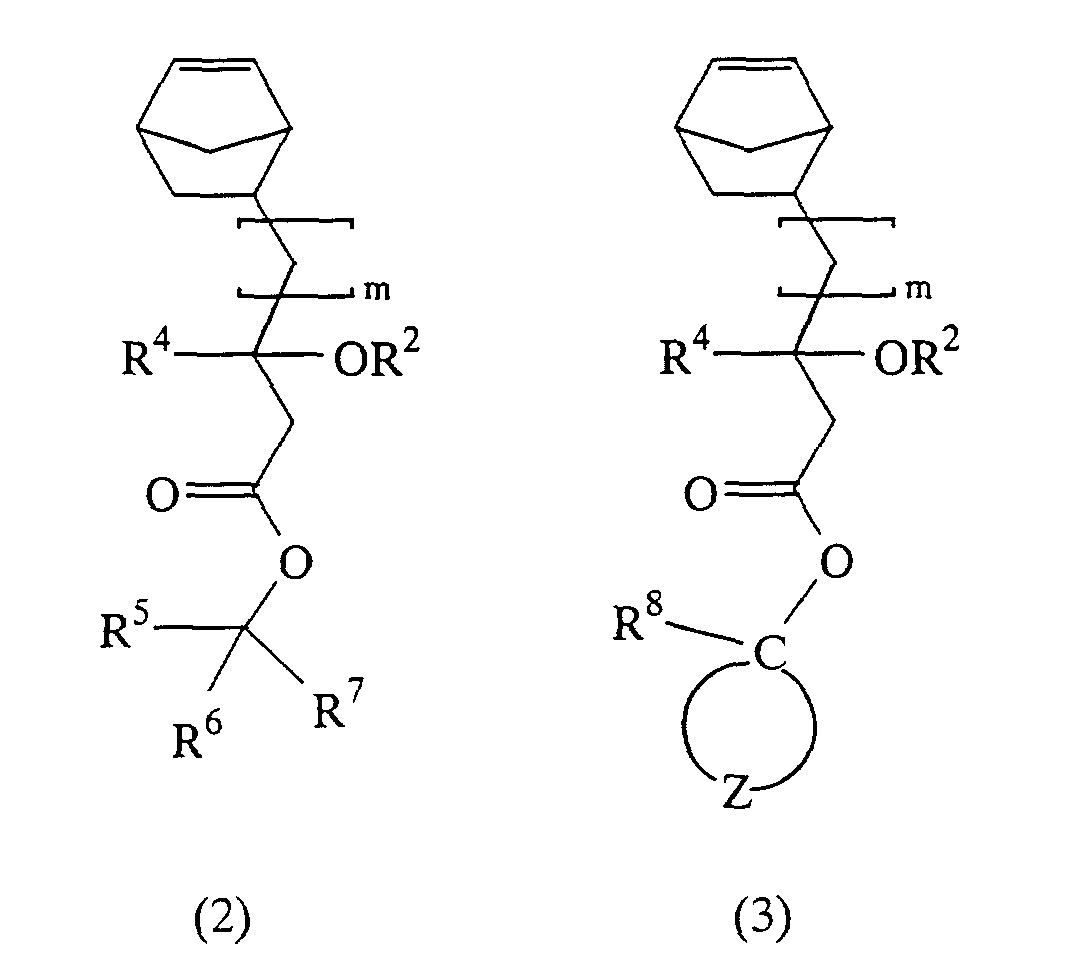
- Preferably the ester compound has the following general formula (2) or (3).Herein m and R2 are as defined above, R4 is hydrogen or methyl, R5 to R8 are independently selected from straight, branched or cyclic alkyl groups of 1 to 15 carbon atoms, the sum of carbon atoms in R5, R6 and R7 is at least 4, and Z is a divalent hydrocarbon group of 4 to 15 carbon atoms which forms a ring with the carbon atom to which it is connected at opposite ends.
- A method for preparing the ester compound forms another aspect of the invention, which involves the steps of effecting addition reaction of a metal enolate of acetate of the following formula (5) to a carbonyl compound of the following formula (4) to form a β-hydroxyester compound of the following formula (6), and effecting acylation or alkoxycarbonylation of the hydroxyl group of the β-hydroxyester compound.Herein k, m, R1 and R3 are as defined above, M is Li, Na, K, MgY or ZnY, and Y is a halogen atom.

- The ester compounds of the invention are of the following general formula (1).
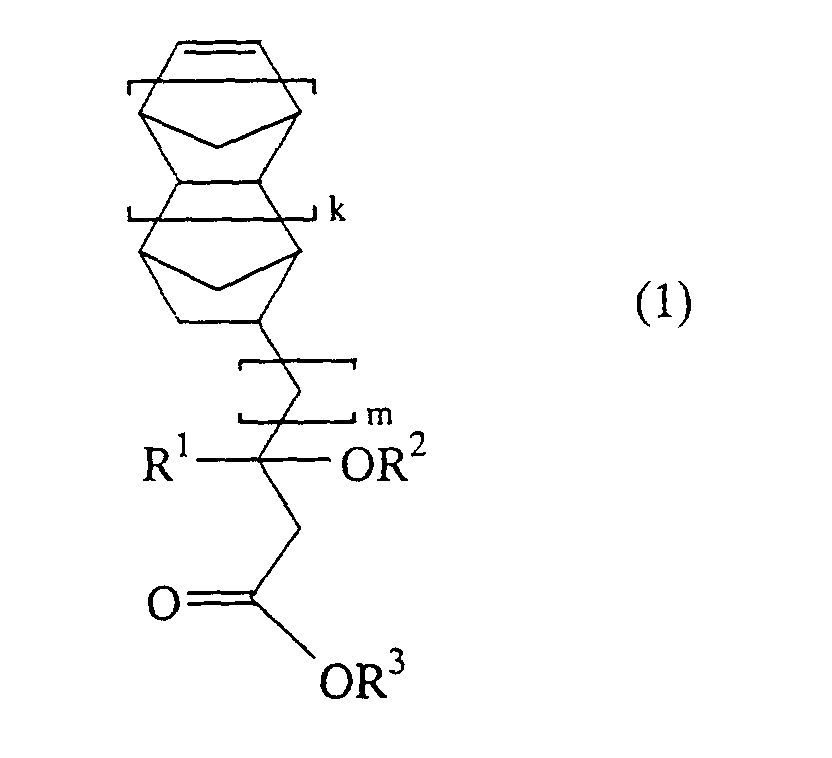
- Herein R1 is hydrogen or a straight, branched or cyclic alkyl group of 1 to 6 carbon atoms. Exemplary alkyl groups include methyl, ethyl, n-propyl, isopropyl, n-butyl, isobutyl, sec-butyl, tert-butyl, tert-amyl, n-pentyl, n-hexyl, cyclopentyl, and cyclohexyl. R2 is an acyl or alkoxycarbonyl group of 1 to 15 carbon atoms; one, some or all of the hydrogen atoms on the constituent carbon atoms may be substituted with halogen atom. Exemplary of R2 are formyl, acetyl, ethylcarbonyl, pivaloyl, methoxycarbonyl, ethoxycarbonyl, tert-butoxycarbonyl, trifluoroacetyl, trichloroacetyl, and 2,2,2-trifluoroethylcarbonyl. R3 is an acid labile group. The letter k is 0 or 1, and m is an integer from 0 to 5 (i.e., 0 ≤ m ≤ 5), and preferably from 0 to 3.
- The preferred acid labile group represented by R3 are those of the following formulas.R5 to R8 and Z are as defined below.

- Preferred among the ester compounds of formula (1) are ester compounds of the following general formula (2) or (3).

- Herein m and R2 are as defined above. R4 is hydrogen or methyl. R5 to R8 are independently selected from straight, branched or cyclic alkyl groups of 1 to 15 carbon atoms. The total number of carbon atoms in R5, R6 and R7 is at least 4. Examples of the straight, branched or cyclic alkyl groups of 1 to 15 carbon atoms include methyl, ethyl, n-propyl, isopropyl, n-butyl, isobutyl, sec-butyl, tert-butyl, tert-amyl, n-pentyl, n-hexyl, cyclopentyl, cyclohexyl, cyclopentylmethyl, cyclopentylethyl, cyclohexylmethyl, cyclohexylethyl, bicyclo[2.2.1]heptyl, bicyclo[2.2.2]octyl, bicyclo[3.3.1]nonyl, bicyclo[4.4.0]decanyl, tricyclo[5.2.1.02,6]decanyl, tetracyclo[4.4.0.12,5.17,10]dodecanyl, and adamantyl. Z stands for divalent hydrocarbon groups of 4 to 15 carbon atoms, such as alkylene and alkenylene groups, which each forms a ring with the carbon atom to which it is connected at opposite ends. Examples of the rings that Z forms include cyclopentane, cyclopentene, cyclohexane, cyclohexene, bicyclo[2.2.1]heptane, bicyclo[4.4.0]decane, tricyclo[5.2.1.02.6]decane, tetracyclo[4.4.0.12,5.17,10]dodecane, and adamantane.
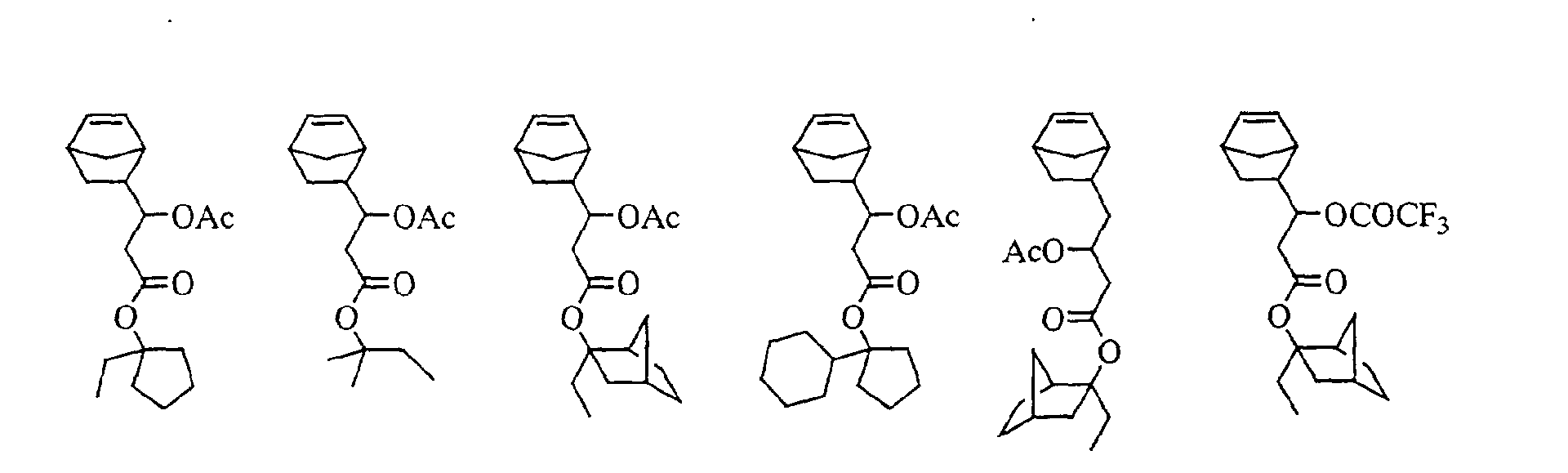
- Illustrative, non-limiting, examples of the ester compounds of formula (1) and formulas (2) and (3) are given below.


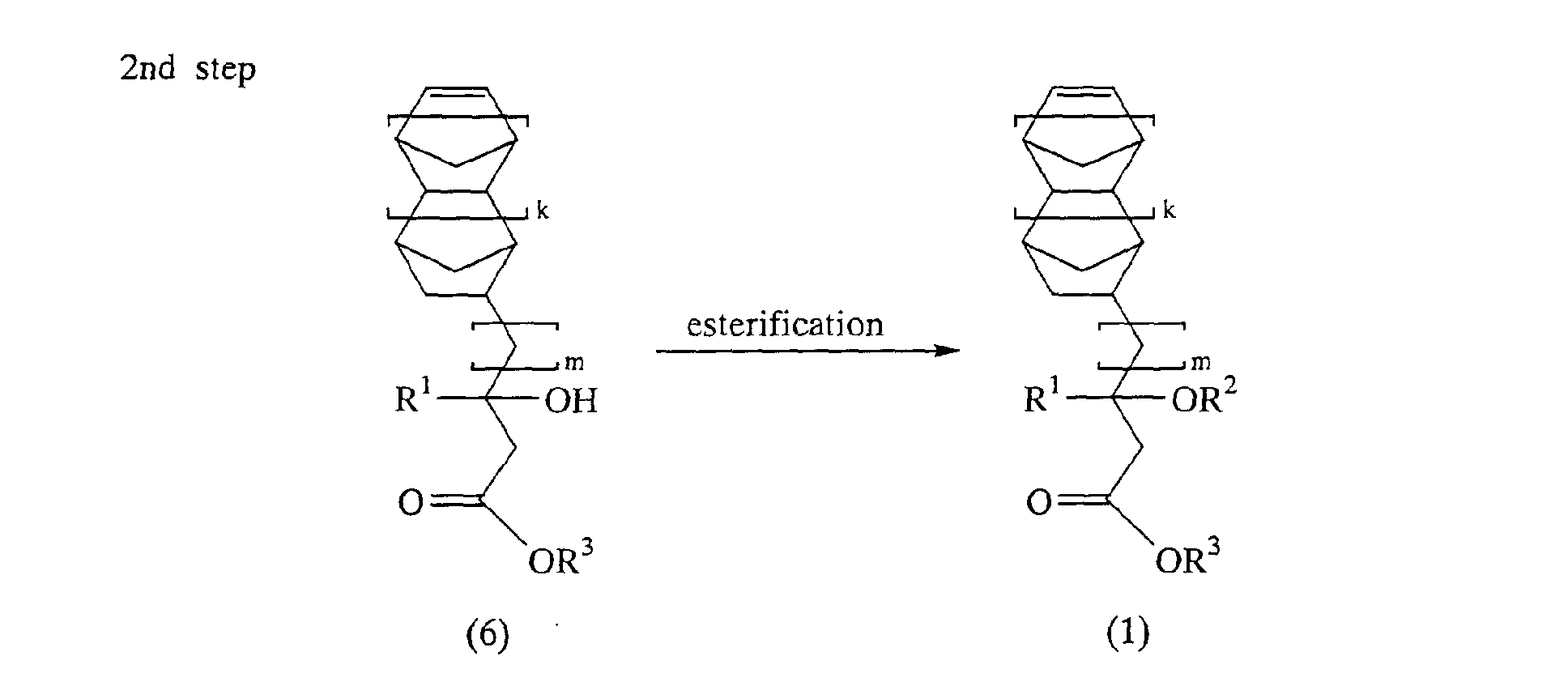
- As seen from the reaction scheme shown below, the ester compound of formula (1) can be prepared by the first step of causing a base to act on a corresponding acetate of formula (7) (where X is hydrogen) or a corresponding haloacetate of formula (7) (where X is halogen) to form a metal enolate of formula (5) and effecting nucleophilic addition reaction of the metal enolate to a carbonyl compound of formula (4) to form a β-hydroxyester compound of formula (6), and the second step of effecting acylation or alkoxycarbonylation (or esterification) of the hydroxyl group on the β-hydroxyester compound.

- Herein, k, m, R1, R2 and R3 are as defined above. X is hydrogen or halogen. M is Li, Na, K, MgY or ZnY, and Y is halogen.
- In the first step, a base acts on a corresponding acetate (where X is hydrogen) or a corresponding haloacetate (where X is halogen) to form a metal enolate, and nucleophilic addition reaction is effected between the metal enolate and a carbonyl compound to form a β-hydroxyester compound. The bases used herein include metal amides such as sodium amide, potassium amide, lithium diisopropylamide, potassium diisopropylamide, lithium dicyclohexylamide. potassium dicyclohexylamide, lithium 2,2,6,6-tetramethylpiperidine, lithium bistrimethylsilylamide, sodium bistrimethylsilylamide, potassium bistrimethylsilylamide, lithium isopropylcyclohexylamide, and bromomagnesium diisopropylamide; alkoxides such as sodium methoxide, sodium ethoxide, lithium methoxide, lithium ethoxide, lithium tert-butoxide, and potassium tert-butoxide; inorganic hydroxides such as sodium hydroxide, lithium hydroxide, potassium hydroxide, barium hydroxide, and tetra-n-butylammonium hydroxide; inorganic carbonates such as sodium carbonate, sodium hydrogen carbonate, lithium carbonate and potassium carbonate; metal hydrides such as boranes, alkylboranes, sodium hydride, lithium hydride, potassium hydride, and calcium hydride; alkyl metal compounds such as trityl lithium, trityl sodium, trityl potassium, methyl lithium, phenyl lithium, sec-butyl lithium, tert-butyl lithium, and ethyl magnesium bromide; and metals such as lithium, sodium, potassium, magnesium, and zinc, but are not limited thereto. It is noted that reaction using haloacetate and zinc is known as Reformatsky reaction.
- In the addition reaction of the carbonyl compound of formula (4) with the metal enolate of formula (5), 0.8 to 1.5 mol of the metal enolate is preferably used per mol of the carbonyl compound. Useful solvents are ethers such as tetrahydrofuran, diethyl ether, di-n-butyl ether, 1,4-dioxane, ethylene glycol dimethyl ether, and ethylene glycol diethyl ether and hydrocarbons such as hexane, heptane, benzene, toluene, xylene and cumene, alone or in admixture thereof. The reaction temperature and time vary with particular starting reactants used. In one example where an acetate of formula (7) wherein X is hydrogen and a strong base such as lithium diisopropylamide or lithium bistrimethylsilylamide are used, the preferred reaction conditions include a reaction temperature in the low range of -80°C to -30°C and a reaction time of about 1/2 to about 3 hours because the metal enolate is thermally unstable. In another example where a haloacetate of formula (7) wherein X is halogen and a metal such as zinc or magnesium are used, it is generally preferred to keep the reaction temperature in the range of 20 to 80°C and the reaction time in the range of about 1 to 20 hours. The reaction conditions are not limited to these ranges.
- The second step is to esterify the alcoholic hydroxyl group produced in the first step. The reaction readily proceeds under well-known conditions. Preferably in a solventless system or in a solvent such as methylene chloride, toluene or hexane, the β-hydroxyester compound resulting from the first step, a corresponding acid anhydride such as acetic anhydride or trifluoroacetic anhydride, and a base such as triethylamine, pyridine or 4-dimethylaminopyridine are sequentially or simultaneously added while heating or cooling the system if necessary.
- A polymer is prepared using any present ester compound as a monomer. The method is generally by mixing the monomer with a solvent, adding a catalyst or polymerization initiator, and effecting polymerization reaction while heating or cooling the system if necessary. This polymerization reaction can be effected in a conventional way.
- A resist composition is formulated using as a base resin the polymer resulting from polymerization of the ester compound. Usually, the resist composition is formulated by adding an organic solvent and a photoacid generator to the polymer and if necessary, further adding a crosslinker, a basic compound, a dissolution inhibitor and other additives. Preparation of the resist composition can be effected in a conventional way.
- We have found such resist compositions to lend themselves to micropatterning with electron beams or deep-UV rays, being sensitive to high-energy radiation and having excellent sensitivity, resolution, and etching resistance. Especially because of the minimized absorption at the exposure wavelength of an ArF or KrF excimer laser, a finely defined pattern having sidewalls perpendicular to the substrate can easily be formed. The resist composition is thus suitable as micropatterning material for VLSI fabrication.
- Synthesis Examples and Reference Examples are given below for further illustrating the invention. It is not construed that the invention be limited to these examples.
- Synthesis Examples are first described. Ester compounds within the scope of the invention were synthesized in accordance with the following formulation.
- First, in a nitrogen atmosphere, 184 g of lithium bis(trimethylsilyl)amide and 172 g of 1-ethylcyclopentyl acetate were reacted in 1 kg of dry tetrahydrofuran at -60°C to form lithium enolate. Then 122 g of 5-norbornene-2-carbaldehyde was slowly added, following which the temperature was raised to -20°C over one hour, at which reaction was effected. Then 1 kg of a saturated ammonium chloride aqueous solution was added to stop the reaction, whereupon hexane was added for extraction. The organic layer was washed with water, dried over anhydrous sodium sulfate, filtered, and concentrated in vacuum, obtaining an alcohol intermediate. In 127 g of pyridine in the presence of 6 g of 4-dimethylaminopyridine, the alcohol intermediate was reacted with 123 g of acetic anhydride at 25°C for 10 hours. Water, 30 g, was added to stop the reaction whereupon hexane was added for extraction. The organic layer was washed with water, dried over anhydrous sodium sulfate, filtered, concentrated in vacuum, and purified by silica gel column chromatography, obtaining 295 g (yield 92%) of 1-ethylcyclopentyl 3-acetoxy-3-(5-norbornen-2-yl)propionate, designated Monomer 1.
IR (thin film): ν = 3059, 2968, 2872, 1740, 1371, 1340, 1238, 1157, 1026, 953 cm-1
1H-NMR of main diastereomer (270 MHz in CDCl3): δ = 0.58 (1H, ddd, J = 11.7, 4.9, 2.4 Hz), 0.82 (3H, t, J = 5.4 Hz), 1.10-2.15 {(16H, m) including 2.04 (3H, s)}, 2.36 (1H, dd, J = 15.1, 7.3 Hz), 2.52 (1H, dd, J = 15.1, 3.8 Hz), 2.61 (1H, m), 2.75-2.85 (2H, m), 4.60 (1H, ddd, J = 10.7, 7.3, 3.8 Hz), 5.94 (1H, m), 6.18 (1H, m). - By following the procedure of Synthesis Example 1 except that 2-methyl-2-butyl acetate was used instead of 1-ethylcyclopentyl acetate, there was obtained 2-methyl-2-butyl 3-acetoxy-3-(5-norbornen-2-yl)propionate. Yield 93%.
- By following the procedure of Synthesis Example 1 except that 2-ethyl-2-exo-norbornyl acetate was used instead of 1-ethylcyclopentyl acetate, there was obtained 2-ethyl-2-exo-norbornyl 3-acetoxy-3-(5-norbornen-2-yl)propionate. Yield 91%.
IR (thin film): ν = 3057, 2966, 2872, 1740, 1371, 1332, 1288, 1238, 1174, 1159, 1132, 1026, 951 cm-1
1H-NMR of main diastereomer (270 MHz in CDCl3) : δ = 0.58 (1H, ddd, J = 11.2, 4.9, 2.4 Hz), 0.79 (3H, t, J = 7.3 Hz), 0.95-2.00 (12H, m), 2.04 (3H, s), 2.10-2.70 (6H, m), 2.75-2.85 (2H, m), 4.60 (1H, m), 5.94 (1H, m), 6.16 (1H, m). - By following the procedure of Synthesis Example 1 except that 1-cyclohexylcyclopentyl acetate was used instead of 1-ethylcyclopentyl acetate, there was obtained 1-cyclohexylcyclopentyl 3-acetoxy-3-(5-norbornen-2-yl)propionate. Yield 90%.
IR (thin film): ν = 3057, 2933, 2854, 1741, 1448, 1371, 1338, 1238, 1155, 1147, 1024 cm-1
1H-NMR of main diastereomer (300 MHz in CDCl3): 6 = 0.58 (1H, ddd, J = 11.6, 4.7, 2.5 Hz), 0.90-2.00 (21H, m), 2.04 (3H, s), 2.25-2.70 {(4H, m) including 2.36 (1H, dd, J = 15.1, 7.4 Hz), 2.51 (1H, dd, J = 15.1, 3.6 Hz)}, 2.75-2.85 (2H, m), 4.61 (1H, m), 5.95 (1H, m), 6.18 (1H, m). - By following the procedure of Synthesis Example 3 except that 2-(5-norbornen-2-yl)acetoaldehyde was used instead of 5-norbornene-2-carbaldehyde, there was obtained 2-ethyl-2-exo-norbornyl 3-acetoxy-4-(5-norbornen-2-yl)-butyrate. Yield 90%.
IR (thin film): ν = 3057, 2966, 2872, 1741, 1458, 1441, 1373, 1240, 1192, 1171, 1132, 1025 cm-1
1H-NMR of main diastereomer (300 MHz in CDCl3): δ = 0.56 (1H, m), 0.79 (3H, t, J = 7.3 Hz), 1.00-2.10 {(18H, m) including 2.02 (3H, s)}, 2.10-2.30 (2H, m), 2.40-2.60 (3H, m), 2.70-2.85 (2H, m), 5.20 (1H, m), 5.92 (1H, m), 6.11 (1H, m). - By following the procedure of Synthesis Example 1 except that trifluoroacetic anhydride was used instead of acetic anhydride, there was obtained 2-ethyl-2-exo-norbornyl 3-(5-norbornen-2-yl)-3-trifluoroacetoxypropionate. Yield 85%.
IR (thin film): ν = 3061, 2970, 2875, 1786, 1730, 1383, 1358, 1265, 1221, 1167 cm-1
1H-NMR of main diastereomer (300 MHz in CDCl3): δ = 0.60 (1H, m), 0.77 (3H, t, J = 6.8 Hz), 0.95-2.00 (12H, m), 2.10-2.25 (2H, m), 2.30-2.90 (6H, m), 4.87 (1H, m), 5.96 (1H, m), 6.23 (1H, m). - By following the procedure of Synthesis Example 1 except that 5-acetyl-2-norbornene was used instead of 5-norbornene-2-carbaldehyde, there was obtained 1-ethylcyclopentyl 3-acetoxy-3-(5-norbornen-2-yl)butyrate. Yield 80%.
- The procedure of Synthesis Example 1 was repeated except that 1-ethylcyclohexyl acetate was used instead of 1-ethylcyclopentyl acetate, and 3-(5-norbornen-2-yl)acetone was used instead of 5-norbornene-2-carbaldehyde. There was obtained 1-ethylcyclohexyl 3-acetoxy-3-methyl-4-(5-norbornen-2-yl)butyrate. Yield 81%.
- The procedure of Synthesis Example 1 was repeated except that 8-ethyl-8-exo-tricyclo[5.2.1.02,6]decanyl acetate was used instead of 1-ethylcyclopentyl acetate, and 3-(5-norbornen-2-yl)propionaldehyde was used instead of 5-norbornene-2-carbaldehyde. There was obtained 8-ethyl-8-exo-tricyclo[5.2.1.02,6]decanyl 3-acetoxy-5-(5-norbornen-2-yl)valerate. Yield 89%.
- The procedure of Synthesis Example 9 was repeated except that 2-ethyl-2-adamantyl acetate was used instead of 8-ethyl-8-exo-tricyclo[5.2.1.02,6]decanyl acetate. There was obtained 2-ethyl-2-adamantyl 3-acetoxy-5-(5-norbornen-2-yl)valerate. Yield 91%.
- The procedure of Synthesis Example 3 was repeated except that 4-(5-norbornen-2-yl)butanone was used instead of 5-norbornene-2-carbaldehyde. There was obtained 2-ethyl-2-exo-norbornyl 3-acetoxy-3-methyl-5-(5-norbornen-2-yl)-valerate. Yield 81%.
- The procedure of Synthesis Example 1 was repeated except that 2-(1-adamantyl)-2-propyl acetate was used instead of 1-ethylcyclopentyl acetate, and 4-(5-norbornen-2-yl)butyrylaldehyde was used instead of 5-norbornene-2-carbaldehyde. There was obtained 2-(1-adamantyl)-2-propyl 3-acetoxy-6-(5-norbornen-2-yl)hexanoate. Yield 90%.
- The procedure of Synthesis Example 12 was repeated except that 2-(2-norbornyl)-2-propyl acetate was used instead of 2-(1-adamantyl)-2-propyl acetate. There was obtained 2-(2-norbornyl)-2-propyl 3-acetoxy-6-(5-norbornen-2-yl)hexanoate. Yield 91%.
- The procedure of Synthesis Example 1 was repeated except that 3-ethyl-3-pentyl acetate was used instead of 1-ethylcyclopentyl acetate, and 5-(5-norbornen-2-yl)-2-pentanone was used instead of 5-norbornene-2-carbaldehyde. There was obtained 3-ethyl-3-pentyl 3-acetoxy-3-methyl-6-(5-norbornen-2-yl)hexanoate. Yield 83%.
- The procedure of Synthesis Example 1 was repeated except that 8-tetracyclo[4.4.0.12,5.17,10]dodecene-3-carbaldehyde was used instead of 5-norbornene-2-carbaldehyde. There was obtained 1-ethylcyclopentyl 3-acetoxy-3-(8-tetracyclo[4.4.0.12,5.17,10]dodecen-3-yl)propionate. Yield 92%.
- The procedure of Synthesis Example 1 was repeated except that di-tert-butyl pyrocarbonate was used instead of acetic anhydride. There was obtained 1-ethylcyclopentyl 3-tert-butoxycarbonyloxy-3-(5-norbornen-2-yl)propionate. Yield 85%.
- The structural formulas of Monomers 1 to 16 are shown below.
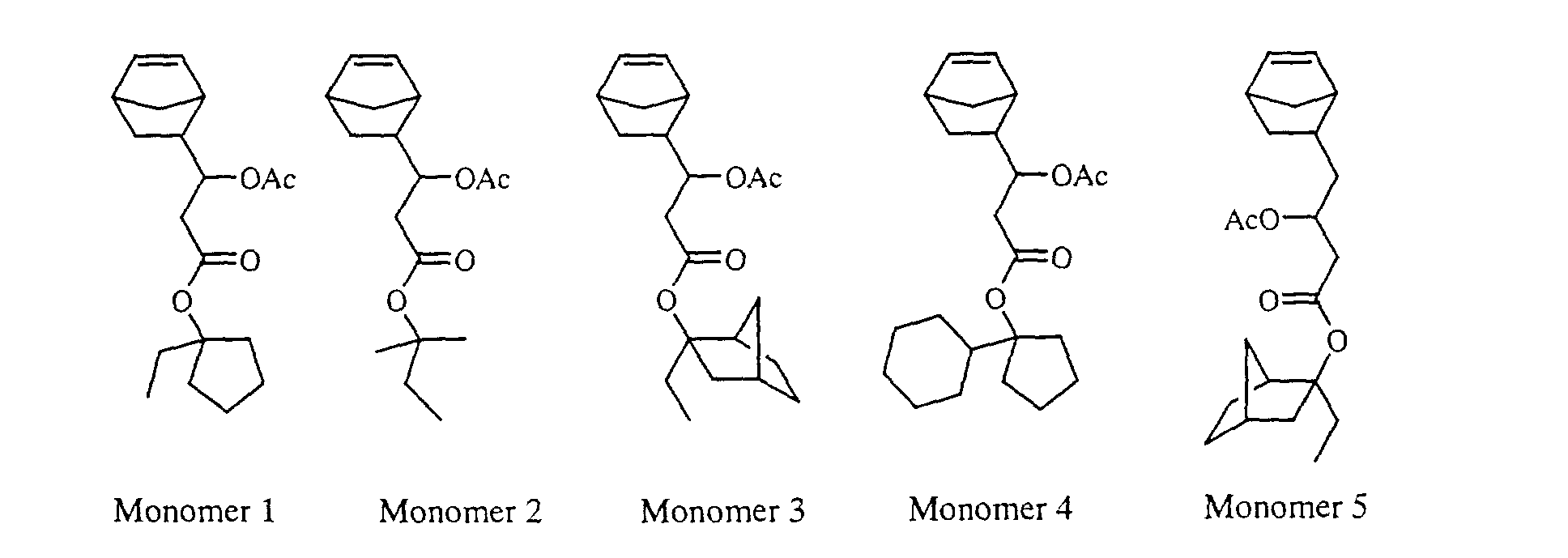


- Polymers were synthesized using the ester compounds obtained in the above Synthesis Examples and examined for transparency.
- Polymerization reaction was effected between Monomer 1 and maleic anhydride using the initiator V65 (by Wako Junyaku K.K.), yielding an alternating copolymer of 1-ethylcyclopentyl 3-acetoxy-3-(5-norbornen-2-yl)-propionate/maleic anhydride. The polymer was measured for transmittance at a wavelength of 193 nm, finding 78.0% at a film thickness of 500 nm.
- For comparison purposes, an alternating copolymer of tert-butyl 5-norbornene-2-carboxylate/maleic anhydride was measured for transmittance at a wavelength of 193 nm, finding 55.0% at a film thickness of 500 nm.
- It was confirmed that polymers resulting from the inventive ester compounds have very high transparency as compared with prior art polymers.
- Japanese Patent Application No. 2000-131164 is incorporated herein by reference.
- Although some preferred embodiments have been described, many modifications and variations may be made thereto in light of the above teachings. It is therefore to be understood that the invention may be practiced otherwise than as specifically described in the Examples.
Claims (6)
- An ester compound of the following general formula (1):wherein R1 is hydrogen or a straight, branched or cyclic alkyl group of 1 to 6 carbon atoms, R2 is an acyl or alkoxycarbonyl group of 1 to 15 carbon atoms in which some or all of the hydrogen atoms on the constituent carbon atoms may be substituted with halogen atoms, R3 is an acid labile group, k is 0 or 1, and m is an integer from 0 to 5.

- The ester compound of claim 1 having the following general formula (2) or (3):wherein m and R2 are as defined above, R4 is hydrogen or methyl, R5 to R8 are independently selected from straight, branched or cyclic alkyl groups of 1 to 15 carbon atoms, the sum of carbon atoms in R5, R6 and R7 is at least 4, and Z is a divalent hydrocarbon group of 4 to 15 carbon atoms which forms a ring with the carbon atom to which it is connected at opposite ends.

- A method for preparing the ester compound of claim 1 or 2, comprising the steps of effecting addition reaction of a metal enolate of acetate of the following formula (5) to a carbonyl compound of the following formula (4) to form a β-hydroxyester compound of the following formula (6), and effecting acylation or alkoxycarbonylation of the hydroxyl group on the β-hydroxyester compound,wherein k, m, R1 and R3 are as defined above, M is Li, Na, K, MgY or ZnY, and Y is a halogen atom.
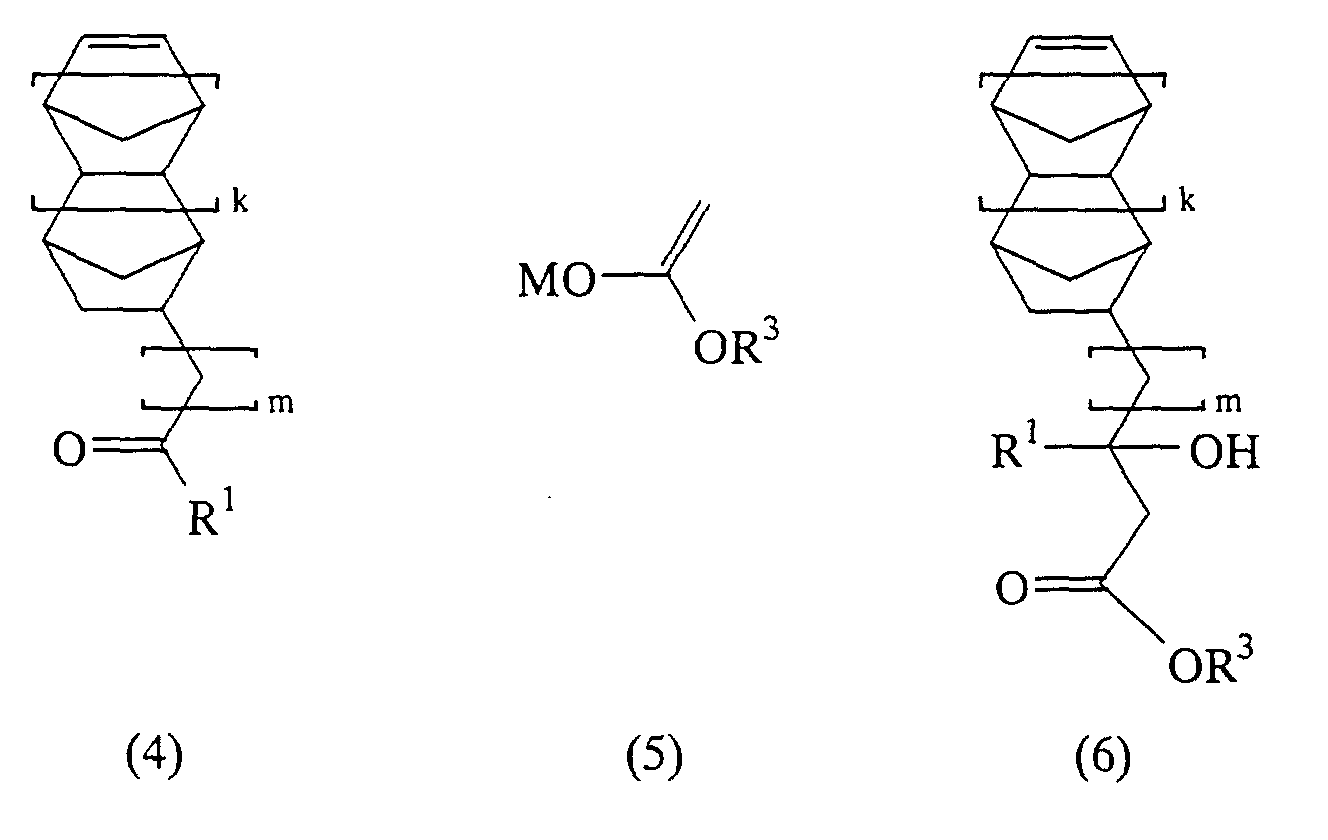
- A polymer comprising polymerised residues of an ester compound according to claim 1 or 2.
- A method comprising polymerising an ester compound according to claim 1 or claim 2 to prepare a polymer.
- A resist composition comprising as base resin a polymer according to claim 4.
Applications Claiming Priority (2)
| Application Number | Priority Date | Filing Date | Title |
|---|---|---|---|
| JP2000131164A JP3997381B2 (en) | 2000-04-28 | 2000-04-28 | Novel ester compound having alicyclic structure and process for producing the same |
| JP2000131164 | 2000-04-28 |
Publications (3)
| Publication Number | Publication Date |
|---|---|
| EP1149826A2 true EP1149826A2 (en) | 2001-10-31 |
| EP1149826A3 EP1149826A3 (en) | 2003-04-16 |
| EP1149826B1 EP1149826B1 (en) | 2010-11-24 |
Family
ID=18640113
Family Applications (1)
| Application Number | Title | Priority Date | Filing Date |
|---|---|---|---|
| EP01303947A Expired - Lifetime EP1149826B1 (en) | 2000-04-28 | 2001-04-30 | Ester compounds having alicyclic structure, and methods for preparing the same |
Country Status (6)
| Country | Link |
|---|---|
| US (1) | US6403823B2 (en) |
| EP (1) | EP1149826B1 (en) |
| JP (1) | JP3997381B2 (en) |
| KR (1) | KR100500348B1 (en) |
| DE (1) | DE60143503D1 (en) |
| TW (1) | TW583175B (en) |
Cited By (1)
| Publication number | Priority date | Publication date | Assignee | Title |
|---|---|---|---|---|
| EP3640234A1 (en) * | 2018-10-16 | 2020-04-22 | Basf Se | Ethers and esters of 1-substituted cycloalkanols for use as aroma chemicals |
Families Citing this family (7)
| Publication number | Priority date | Publication date | Assignee | Title |
|---|---|---|---|---|
| TWI228205B (en) * | 2000-03-06 | 2005-02-21 | Shinetsu Chemical Co | Polymer, resist composition and patterning process |
| US6492090B2 (en) * | 2000-04-28 | 2002-12-10 | Shin-Etsu Chemical Co., Ltd. | Polymers, resist compositions and patterning process |
| US6660448B2 (en) * | 2000-11-10 | 2003-12-09 | Shin-Etsu Chemical Co., Ltd. | Polymer, resist composition and patterning process |
| US7488565B2 (en) * | 2003-10-01 | 2009-02-10 | Chevron U.S.A. Inc. | Photoresist compositions comprising diamondoid derivatives |
| CA2724949A1 (en) | 2007-06-27 | 2008-12-31 | The General Hospital Corporation | Method and apparatus for optical inhibition of photodynamic therapy |
| KR101761897B1 (en) | 2011-12-28 | 2017-07-27 | 금호석유화학 주식회사 | Additive for resist and resist composition comprising same |
| KR20130076364A (en) * | 2011-12-28 | 2013-07-08 | 금호석유화학 주식회사 | Additive for resist and resist composition comprising same |
Family Cites Families (8)
| Publication number | Priority date | Publication date | Assignee | Title |
|---|---|---|---|---|
| KR100195583B1 (en) * | 1997-04-08 | 1999-06-15 | 박찬구 | Copolymer for preparing positive photoresist and chemically amplified positive photoresist composition containing same |
| KR100572899B1 (en) * | 1997-09-12 | 2006-04-24 | 스미토모 베이클라이트 가부시키가이샤 | Photoresist composition comprising a polycyclic polymer having an acid labile pendant group |
| KR100271420B1 (en) * | 1998-09-23 | 2001-03-02 | 박찬구 | Chemically Amplified Positive Photoresist Composition |
| KR100271419B1 (en) * | 1998-09-23 | 2001-03-02 | 박찬구 | Polymer for producing chemically amplified resist and resist composition containing same |
| KR100274119B1 (en) * | 1998-10-08 | 2001-03-02 | 박찬구 | Polymer for preparing radiation-sensitive resist and resist composition containing same |
| KR100332463B1 (en) * | 1999-12-20 | 2002-04-13 | 박찬구 | Chemically amplified resist composition containing norbornane type low molecular additives |
| US6492090B2 (en) * | 2000-04-28 | 2002-12-10 | Shin-Etsu Chemical Co., Ltd. | Polymers, resist compositions and patterning process |
| US6566038B2 (en) * | 2000-04-28 | 2003-05-20 | Shin-Etsu Chemical Co., Ltd. | Polymers, resist compositions and patterning process |
-
2000
- 2000-04-28 JP JP2000131164A patent/JP3997381B2/en not_active Expired - Fee Related
-
2001
- 2001-04-26 US US09/842,006 patent/US6403823B2/en not_active Expired - Lifetime
- 2001-04-27 KR KR10-2001-0022834A patent/KR100500348B1/en not_active Expired - Fee Related
- 2001-04-27 TW TW090110152A patent/TW583175B/en not_active IP Right Cessation
- 2001-04-30 EP EP01303947A patent/EP1149826B1/en not_active Expired - Lifetime
- 2001-04-30 DE DE60143503T patent/DE60143503D1/en not_active Expired - Lifetime
Non-Patent Citations (1)
| Title |
|---|
| None |
Cited By (3)
| Publication number | Priority date | Publication date | Assignee | Title |
|---|---|---|---|---|
| EP3640234A1 (en) * | 2018-10-16 | 2020-04-22 | Basf Se | Ethers and esters of 1-substituted cycloalkanols for use as aroma chemicals |
| WO2020079007A1 (en) * | 2018-10-16 | 2020-04-23 | Basf Se | Ethers and esters of 1-substituted cycloalkanols for use as aroma chemicals |
| US11920104B2 (en) | 2018-10-16 | 2024-03-05 | Basf Se | Ethers and esters of 1-substituted cycloalkanols for use as aroma chemicals |
Also Published As
| Publication number | Publication date |
|---|---|
| US20010051742A1 (en) | 2001-12-13 |
| KR100500348B1 (en) | 2005-07-12 |
| KR20010098920A (en) | 2001-11-08 |
| EP1149826A3 (en) | 2003-04-16 |
| JP2001302589A (en) | 2001-10-31 |
| DE60143503D1 (en) | 2011-01-05 |
| TW583175B (en) | 2004-04-11 |
| JP3997381B2 (en) | 2007-10-24 |
| US6403823B2 (en) | 2002-06-11 |
| EP1149826B1 (en) | 2010-11-24 |
Similar Documents
| Publication | Publication Date | Title |
|---|---|---|
| US6746818B2 (en) | (Meth)acrylates having lactone structure, polymers, photoresist compositions and patterning process | |
| EP1829850B1 (en) | Method for the preparation of fluorinated monomers | |
| KR100531535B1 (en) | (meth)acrylate esters, starting alcohols for the preparation thereof, processes for preparing both, polymers of the esters, chemically amplifiable resist compositions, and method for forming patterns | |
| KR20150027057A (en) | Process for producing? - (meth) acryloyloxy-? -butyrolactones | |
| US6403823B2 (en) | Ester compounds having alicyclic structure and method for preparing same | |
| US20040176630A1 (en) | Alicyclic methacrylate having oxygen substituent group on alpha-methyl | |
| JP2001328964A (en) | New polycyclic unsaturated hydrocarbon derivative and method for producing the same | |
| US6403822B2 (en) | Ester compounds having alicyclic structure and method for preparing same | |
| US6500961B2 (en) | Lactone compounds having alicyclic structure and their manufacturing method | |
| US6774258B2 (en) | Tertiary alcohol compounds having alicyclic structure | |
| US7312288B2 (en) | Polymerizable fluorinated ester compounds and their preparing processes | |
| JP4390065B2 (en) | Fluorine-containing polymerizable ester compound and process for producing the same | |
| US6472543B2 (en) | Lactone compounds having alicyclic structure and their manufacturing method | |
| JP5193597B2 (en) | Polymerizable compound for photoresist, polymer thereof and photoresist composition containing the polymer | |
| US6500971B2 (en) | Ester compounds having alicyclic and oxirane structures and method for preparing the same | |
| JP4081640B2 (en) | Novel lactone compound having alicyclic structure and method for producing the same | |
| JP2008120758A (en) | Cyclic (meth) acrylate compound and method for producing the same |
Legal Events
| Date | Code | Title | Description |
|---|---|---|---|
| PUAI | Public reference made under article 153(3) epc to a published international application that has entered the european phase |
Free format text: ORIGINAL CODE: 0009012 |
|
| AK | Designated contracting states |
Kind code of ref document: A2 Designated state(s): AT BE CH CY DE DK ES FI FR GB GR IE IT LI LU MC NL PT SE TR |
|
| AX | Request for extension of the european patent |
Free format text: AL;LT;LV;MK;RO;SI |
|
| PUAL | Search report despatched |
Free format text: ORIGINAL CODE: 0009013 |
|
| AK | Designated contracting states |
Designated state(s): AT BE CH CY DE DK ES FI FR GB GR IE IT LI LU MC NL PT SE TR |
|
| AX | Request for extension of the european patent |
Extension state: AL LT LV MK RO SI |
|
| RIC1 | Information provided on ipc code assigned before grant |
Ipc: 7C 07C 69/96 B Ipc: 7C 07C 69/73 B Ipc: 7C 07C 67/343 B Ipc: 7C 08F 20/16 B Ipc: 7G 03F 7/039 B Ipc: 7C 07C 69/732 A |
|
| 17P | Request for examination filed |
Effective date: 20030711 |
|
| AKX | Designation fees paid |
Designated state(s): DE FR GB |
|
| 17Q | First examination report despatched |
Effective date: 20070612 |
|
| GRAP | Despatch of communication of intention to grant a patent |
Free format text: ORIGINAL CODE: EPIDOSNIGR1 |
|
| GRAS | Grant fee paid |
Free format text: ORIGINAL CODE: EPIDOSNIGR3 |
|
| GRAA | (expected) grant |
Free format text: ORIGINAL CODE: 0009210 |
|
| AK | Designated contracting states |
Kind code of ref document: B1 Designated state(s): DE FR GB |
|
| REG | Reference to a national code |
Ref country code: GB Ref legal event code: FG4D |
|
| REF | Corresponds to: |
Ref document number: 60143503 Country of ref document: DE Date of ref document: 20110105 Kind code of ref document: P |
|
| PGFP | Annual fee paid to national office [announced via postgrant information from national office to epo] |
Ref country code: DE Payment date: 20110427 Year of fee payment: 11 Ref country code: FR Payment date: 20110426 Year of fee payment: 11 |
|
| PGFP | Annual fee paid to national office [announced via postgrant information from national office to epo] |
Ref country code: GB Payment date: 20110427 Year of fee payment: 11 |
|
| PLBE | No opposition filed within time limit |
Free format text: ORIGINAL CODE: 0009261 |
|
| STAA | Information on the status of an ep patent application or granted ep patent |
Free format text: STATUS: NO OPPOSITION FILED WITHIN TIME LIMIT |
|
| 26N | No opposition filed |
Effective date: 20110825 |
|
| REG | Reference to a national code |
Ref country code: DE Ref legal event code: R097 Ref document number: 60143503 Country of ref document: DE Effective date: 20110825 |
|
| GBPC | Gb: european patent ceased through non-payment of renewal fee |
Effective date: 20120430 |
|
| REG | Reference to a national code |
Ref country code: FR Ref legal event code: ST Effective date: 20121228 |
|
| PG25 | Lapsed in a contracting state [announced via postgrant information from national office to epo] |
Ref country code: GB Free format text: LAPSE BECAUSE OF NON-PAYMENT OF DUE FEES Effective date: 20120430 |
|
| REG | Reference to a national code |
Ref country code: DE Ref legal event code: R119 Ref document number: 60143503 Country of ref document: DE Effective date: 20121101 |
|
| PG25 | Lapsed in a contracting state [announced via postgrant information from national office to epo] |
Ref country code: FR Free format text: LAPSE BECAUSE OF NON-PAYMENT OF DUE FEES Effective date: 20120430 |
|
| PG25 | Lapsed in a contracting state [announced via postgrant information from national office to epo] |
Ref country code: DE Free format text: LAPSE BECAUSE OF NON-PAYMENT OF DUE FEES Effective date: 20121101 |