EP1149824A1 - Protection of di-t-butyl dicarbonate against decomposition - Google Patents
Protection of di-t-butyl dicarbonate against decomposition Download PDFInfo
- Publication number
- EP1149824A1 EP1149824A1 EP00963078A EP00963078A EP1149824A1 EP 1149824 A1 EP1149824 A1 EP 1149824A1 EP 00963078 A EP00963078 A EP 00963078A EP 00963078 A EP00963078 A EP 00963078A EP 1149824 A1 EP1149824 A1 EP 1149824A1
- Authority
- EP
- European Patent Office
- Prior art keywords
- compound
- butyl dicarbonate
- decomposition
- carbon atoms
- mixed composition
- Prior art date
- Legal status (The legal status is an assumption and is not a legal conclusion. Google has not performed a legal analysis and makes no representation as to the accuracy of the status listed.)
- Granted
Links
Classifications
-
- C—CHEMISTRY; METALLURGY
- C07—ORGANIC CHEMISTRY
- C07C—ACYCLIC OR CARBOCYCLIC COMPOUNDS
- C07C68/00—Preparation of esters of carbonic or haloformic acids
- C07C68/08—Purification; Separation; Stabilisation
Definitions
- the present invention relates to the inhibition of decomposition of di-t-butyl dicarbonate. More specifically, it relates to the inhibition of decomposition of di-t-butyl dicarbonate in liquid form.
- Di-t-butyl dicarbonate is an important compound as a protective agent for an amino group in the synthesis of pharmaceuticals and agricultural chemicals.
- di-t-butyl dicarbonate is a thermally unstable compound and gradually decomposes when stored in liquid form. Therefore, when it is to be stored, it has been necessary to store it in a low-temperature storage at temperatures lower than its melting point so as to keep it in solid form.
- di-t-butyl dicarbonate since the melting point of di-t-butyl dicarbonate is 22 to 23° C, solid di-t-butyl dicarbonate melts partially in use, thereby making it very difficult to handle. Therefore, to avoid the difficulty in handling the solid di-t-butyl dicarbonate, the compound must be used in liquid form by keeping it at temperatures higher than its melting point at all times. However, when the compound is kept in liquid form for a long time, the decomposition as described above cannot be avoided.
- the present inventors have made intensive studies to solve the above problems. As a result, they have found that the decomposition of di-t-butyl dicarbonate can be inhibited by adding a hydrocarbon compound and/or a chain ether compound to di-t-butyl dicarbonate and have therefore completed the present invention.
- the present invention relates to a mixed composition consisting essentially of (a) di-t-butyl dicarbonate and (b) at least one compound selected from the group consisting of a hydrocarbon compound and a chain ether compound.
- the present invention relates to the use of at least one compound selected from a group consisting of a hydrocarbon compound and a chain ether compound for inhibiting the decomposition of di-t-butyl dicarbonate.
- the present invention relates to the use of the mixed composition of the present invention for protecting the amino group of an amino group-containing. compound by a t-butoxycarbonyl group.
- a compound used for inhibiting the decomposition of di-t-butyl dicarbonate (to be sometimes referred to as "decomposition inhibitor" hereinafter) is a hydrocarbon compound or a chain ether compound.
- hydrocarbon compound in the present invention a known compound which comprises carbon and hydrogen and which can be kept in liquid or solid form at room temperature and atmospheric pressure can be used without any limitation.
- the hydrocarbon compound is preferably a saturated aliphatic hydrocarbon having 5 to 16 carbon atoms, an unsaturated aliphatic hydrocarbon having 5 to 16 carbon atoms or an aromatic hydrocarbon having 6 to 18 carbon atoms.
- a saturated aliphatic hydrocarbon having 5 to 9 carbon atoms, an unsaturated aliphatic hydrocarbon having 5 to 9 carbon atoms and an aromatic hydrocarbon having 6 to 7 carbon atoms are more preferable.
- hydrocarbon compound examples include saturated aliphatic hydrocarbons having 5 to 16 carbon atoms such as pentane, 2-methylbutane, hexane, 2-methylpentane, 2,2-dimethylbutane, 2,3-dimethylbutane, heptane, 2,2,3-trimethylpentane, octane, isooctane, nonane, 2,2,5-trimethylhexane, decane, undecane, dodecane, tridecane, tetradecane, hexadecane, cyclopentane, methylcyclopentane, cyclohexane, methylcyclohexane, ethylcyclohexane, p-menthane and bicyclohexyl; unsaturated hydrocarbons having 5 to 16 carbon atoms such as 1-hexene, 1-pentene, 1-octene, 1-heptene, 1-nonene
- saturated aliphatic hydrocarbons having 5 to 9 carbon atoms such as pentane, 2-methylbutane, hexane, 2-methylpentane, 2,2-dimethylbutane, 2,3-dimethylbutane, heptane, 2,2,3-trimethylpentane, octane, isooctane, 2,2,5-trimethylhexane, cyclopentane, methylcyclopentane, cyclohexane, methylcyclohexane and ethylcyclohexane; unsaturated aliphatic hydrocarbons having 5 to 9 carbon atoms such as 1-hexene, 1-pentene, 1-octene, 1-heptene and 1-nonene; and aromatic hydrocarbons having 6 or 7 carbon atoms such as benzene and toluene are suitably used in that their effect of inhibiting the decomposition is high.
- chain ether compound in the present invention a known compound in which two hydrocarbon groups are bonded to an oxygen atom and which can be kept in liquid or solid form at room temperature and atmospheric pressure can be used without any limitation.
- An example of the compound is an ether compound represented by the following formula (1): R 1 -O-R 2 wherein R 1 and R 2 independently represent an alkyl group having 2 to 6 carbon atoms or an alkenyl group having 2 to 6 carbon atoms.
- a dialkyl ether having 4 to 8 carbon atoms is preferable.
- chain ether compound examples include chain ether compounds having 4 to 12 carbon atoms such as diethyl ether, dipropyl ether, diisopropyl ether, dibutyl ether, t-butyl methyl ether, di-t-butyl ether, dihexyl ether, ethyl vinyl ether and butyl vinyl ether.
- dialkyl ether compounds having 4 to 8 carbon atoms such as diethyl ether, dipropyl ether, diisopropyl ether, dibutyl ether, t-butyl methyl ether and di-t-butyl ether are suitably used in that their effect of inhibiting the decomposition is high.
- These decomposition inhibitors may be used solely or in combination of two or more as required.
- the decomposition inhibitor is not limited to a particular amount, it should be used in such an amount that ensures that the concentration of the decomposition inhibitor should be 0.1 to 95 wt%, preferably 1 to 80 wt%, based on the total amount of di-t-butyl dicarbonate and the decomposition inhibitor to obtain a satisfactory effect of inhibiting the decomposition. Therefore, the concentration of di-t-butyl dicarbonate is 99.9 to 5 wt%, preferably 99 to 20 wt%, based on the total amount of di-t-butyl dicarbonate and the decomposition inhibitor.
- a conventional mixing method can be used without any limitation. However, it is preferable that they be mixed by stirring or the like to form a homogeneous mixture. In this case, they can be charged into a mixing container simultaneously or successively and then mixed.
- di-t-butyl dicarbonate decomposes. It is generally 50° C or lower, preferably 30°C or lower.
- the storage temperature when it is too high, a satisfactory effect of inhibiting the decomposition cannot be obtained, and di-t-butyl dicarbonate decomposes. It is generally 30°C or lower, preferably 10°C or lower.
- a decomposition inhibitor obtained as a reagent or an industrial raw material may be used directly as the decomposition inhibitor used in the present invention. In some cases, however', it may be dehydrated and purified by such procedures as distillation.
- the amount of water contained in the decomposition inhibitor is generally 30,000 ppm or less, preferably 10,000 ppm or less, to obtain a satisfactory effect of inhibiting the decomposition.
- the decomposition inhibitor should not contain such impurities as peroxides, acids and bases.
- the decomposition inhibitor should be purified to such an extent that ensures that the peroxides cannot be detected by a color identification test using potassium iodide and that the amounts of the acids and bases should be 1,000 ppm or less, preferably 100 ppm or less.
- di-t-butyl dicarbonate used in the present invention is not particularly limited, it should be generally 90% or higher, preferably 95% or higher to obtain a satisfactory effect of inhibiting the decomposition.
- the amount of water contained in di-t-butyl dicarbonate is generally 30,000 ppm or less, preferably 10,000 ppm or less, to obtain a satisfactory effect of inhibiting the decomposition.
- the water content of the mixed composition of the present invention is preferably 30,000 ppm at most, more preferably 10,000 ppm at most.
- contents of acids, bases or both in the mixed composition of the present invention are preferably 1,000 ppm at most, more preferably 100 ppm at most.
- hydrocarbon compound and the chain ether compound as a decomposition inhibitor for di-t-butyl dicarbonate is provided for the first time by the present invention.
- the mixture in the present invention which comprises the hydrocarbon compound and/or the chain ether compound and di-t-butyl dicarbonate has the advantage that it can be directly used in the reaction of protecting an amino group in organic synthesis without removing the decomposition inhibitor contained in the mixture. That is, the mixed composition of the present invention can be used for protecting the amino group of an amino group-containing compound by a t-butoxycarbonyl group, and, in that case, the mixed composition can be directly used in the protection reaction. As a matter of course, when the presence of the decomposition inhibitors is undesirable, the mixed composition may be used after the hydrocarbon compound and/or the chain ether compound are/is removed by such procedures as distillation.
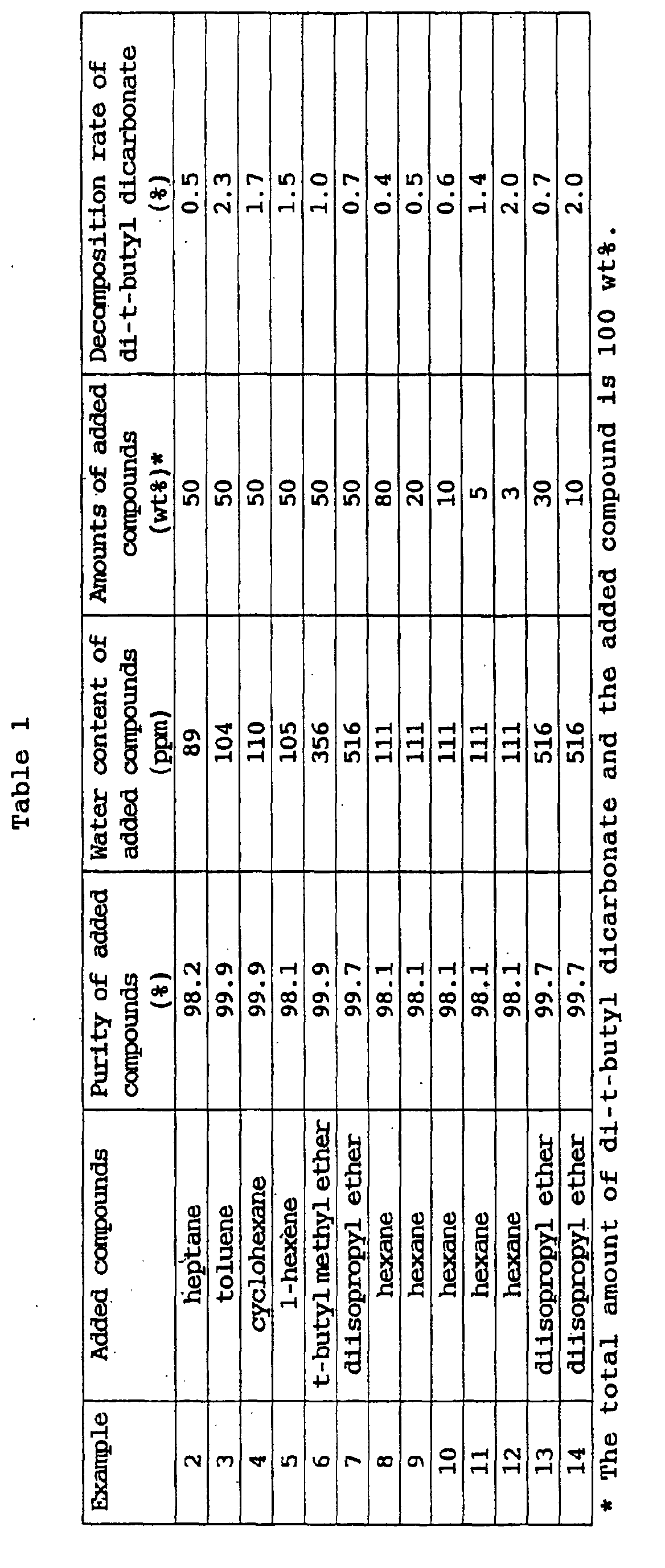
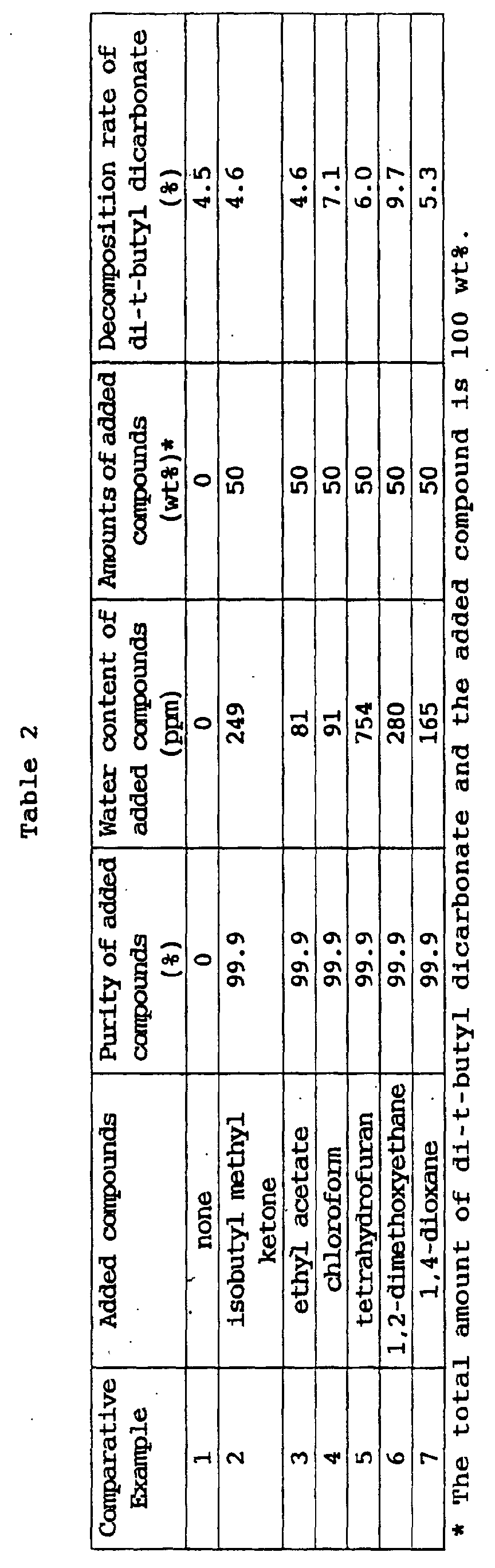
- di-t-butyl dicarbonate (purity: 99.3%, water content: 85 ppm) was charged into a 200-ml flask, and 50 g of hexane (purity: 98.1%, water content: 111 ppm) was then charged therein. The mixture was kept at 50° C under agitation. After 200 hours, naphthalene was added as an internal standard substance, and the residual amount of di-t-butyl dicarbonate was quantified by gas chromatography (column: HP-5, product of Hewlett-Packard Company, detector: FID, carrier gas: helium) to determine its decomposition rate, which was found to be 0.5%.
- gas chromatography columnumn: HP-5, product of Hewlett-Packard Company, detector: FID, carrier gas: helium
Landscapes
- Chemical & Material Sciences (AREA)
- Organic Chemistry (AREA)
- Organic Low-Molecular-Weight Compounds And Preparation Thereof (AREA)
- Polyesters Or Polycarbonates (AREA)
Abstract
Description
As a matter of course, when the presence of the decomposition inhibitors is undesirable, the mixed composition may be used after the hydrocarbon compound and/or the chain ether compound are/is removed by such procedures as distillation.
Claims (8)
- A mixed composition consisting essentially of (a) di-t-butyl dicarbonate and (b) at least one compound selected from the group consisting of a hydrocarbon compound and a chain ether compound.
- The mixed composition of claim 1, wherein the hydrocarbon compound is a saturated aliphatic hydrocarbon having 5 to 9 carbon atoms, an unsaturated aliphatic hydrocarbon having 5 to 9 carbon atoms or an aromatic hydrocarbon having 6 to 7 carbon atoms.
- The mixed composition of claim 1, wherein the chain ether compound is a dialkyl ether having 4 to 8 carbon atoms.
- The mixed composition of claim 1, wherein di-t-butyl dicarbonate (a) is contained in an amount of 20 to 99 wt% and the compound (b) is contained in an amount of 80 to 1 wt%, based on the total weight of di-t-butyl dicarbonate (a) and the compound (b).
- The mixed composition of claim 1, wherein the water content is 30,000 ppm at most.
- The mixed composition of claim 1, wherein the contents of acids, bases or both are 1,000 ppm at most.
- Use of the mixed composition of claim 1 for protecting the amino group of an amino group-containing compound by a t-butoxycarbonyl group.
- Use of at least one compound selected from a group consisting of a hydrocarbon compound and a chain ether compound for inhibiting the decomposition of di-t-butyl dicarbonate.
Applications Claiming Priority (3)
| Application Number | Priority Date | Filing Date | Title |
|---|---|---|---|
| JP28781899 | 1999-10-08 | ||
| JP28781899A JP3385245B2 (en) | 1999-10-08 | 1999-10-08 | Degradation inhibitor |
| PCT/JP2000/006881 WO2001027066A1 (en) | 1999-10-08 | 2000-10-03 | PROTECTION OF DI-t-BUTYL DICARBONATE AGAINST DECOMPOSITION |
Publications (3)
| Publication Number | Publication Date |
|---|---|
| EP1149824A1 true EP1149824A1 (en) | 2001-10-31 |
| EP1149824A4 EP1149824A4 (en) | 2004-08-11 |
| EP1149824B1 EP1149824B1 (en) | 2008-03-05 |
Family
ID=17722170
Family Applications (1)
| Application Number | Title | Priority Date | Filing Date |
|---|---|---|---|
| EP00963078A Expired - Lifetime EP1149824B1 (en) | 1999-10-08 | 2000-10-03 | Protection of di-t-butyl dicarbonate against decomposition |
Country Status (9)
| Country | Link |
|---|---|
| US (1) | US6555713B1 (en) |
| EP (1) | EP1149824B1 (en) |
| JP (1) | JP3385245B2 (en) |
| KR (1) | KR100676781B1 (en) |
| CN (1) | CN1327441A (en) |
| AT (1) | ATE388133T1 (en) |
| DE (1) | DE60038221T2 (en) |
| TW (1) | TWI278447B (en) |
| WO (1) | WO2001027066A1 (en) |
Cited By (1)
| Publication number | Priority date | Publication date | Assignee | Title |
|---|---|---|---|---|
| WO2007134710A1 (en) * | 2006-05-18 | 2007-11-29 | Lanxess Deutschland Gmbh | Stabilization of dicarbonic diesters by finely divided solids |
Family Cites Families (10)
| Publication number | Priority date | Publication date | Assignee | Title |
|---|---|---|---|---|
| DE3231397A1 (en) * | 1982-08-24 | 1984-03-01 | Bayer Ag, 5090 Leverkusen | USE OF CARBONYL COMPOUNDS AND / OR HETEROANALOGIC CARBONYL COMPOUNDS AS A STABILIZING AGENT FOR SOLUTIONS CONTAINING PYROCARCOURED ACYLEDIUM CYLESTER AND POLYISUBYANITATE-ZONATE COMPOUNDS |
| JPH0629225B2 (en) * | 1986-08-20 | 1994-04-20 | 三菱化成株式会社 | Method for producing zirconium-butyl dicarbonate |
| JPH0737423B2 (en) * | 1987-07-14 | 1995-04-26 | 三菱化学株式会社 | Method for Purifying Zita-Shari-Butyl Dicarbonate |
| ATE116283T1 (en) * | 1989-10-09 | 1995-01-15 | Rhone Poulenc Chimie | METHOD FOR PRODUCING DISECONDARY OR DITERTIARY ALKYLDICARBONATE. |
| US5151542A (en) * | 1990-07-23 | 1992-09-29 | Sumitomo Chemical Co., Ltd. | Process for preparing di-tert.-butyl dicarbonate |
| US5082965A (en) * | 1990-10-29 | 1992-01-21 | E. I. Du Pont De Nemours And Company | Process for preparation of alkoxycarbonyloxystyrene |
| DE4124029A1 (en) * | 1991-07-19 | 1993-01-21 | Hoechst Ag | METHOD FOR PRODUCING ORGANIC COMPOUNDS CARRYING TERT.-BUTYLOXYCARBONYL GROUPS |
| JP2735737B2 (en) * | 1992-04-24 | 1998-04-02 | 株式会社トクヤマ | Method for producing dialkyl dicarbonate |
| JPH05310645A (en) * | 1992-04-28 | 1993-11-22 | Dai Ichi Pure Chem Co Ltd | Method for purifying di-tert-butyl dicarbonate |
| JP3375120B2 (en) * | 1997-11-10 | 2003-02-10 | 株式会社トクヤマ | Method for producing di-tert-butyl dicarbonate |
-
1999
- 1999-10-08 JP JP28781899A patent/JP3385245B2/en not_active Expired - Lifetime
-
2000
- 2000-10-03 WO PCT/JP2000/006881 patent/WO2001027066A1/en not_active Ceased
- 2000-10-03 KR KR1020017007075A patent/KR100676781B1/en not_active Expired - Fee Related
- 2000-10-03 CN CN00802182A patent/CN1327441A/en active Pending
- 2000-10-03 DE DE60038221T patent/DE60038221T2/en not_active Expired - Lifetime
- 2000-10-03 AT AT00963078T patent/ATE388133T1/en not_active IP Right Cessation
- 2000-10-03 EP EP00963078A patent/EP1149824B1/en not_active Expired - Lifetime
- 2000-10-03 US US09/857,700 patent/US6555713B1/en not_active Expired - Lifetime
- 2000-10-06 TW TW089120875A patent/TWI278447B/en not_active IP Right Cessation
Cited By (1)
| Publication number | Priority date | Publication date | Assignee | Title |
|---|---|---|---|---|
| WO2007134710A1 (en) * | 2006-05-18 | 2007-11-29 | Lanxess Deutschland Gmbh | Stabilization of dicarbonic diesters by finely divided solids |
Also Published As
| Publication number | Publication date |
|---|---|
| EP1149824A4 (en) | 2004-08-11 |
| TWI278447B (en) | 2007-04-11 |
| DE60038221T2 (en) | 2009-03-19 |
| ATE388133T1 (en) | 2008-03-15 |
| CN1327441A (en) | 2001-12-19 |
| KR100676781B1 (en) | 2007-02-01 |
| WO2001027066A1 (en) | 2001-04-19 |
| JP2001114730A (en) | 2001-04-24 |
| US6555713B1 (en) | 2003-04-29 |
| KR20010101139A (en) | 2001-11-14 |
| EP1149824B1 (en) | 2008-03-05 |
| JP3385245B2 (en) | 2003-03-10 |
| DE60038221D1 (en) | 2008-04-17 |
Similar Documents
| Publication | Publication Date | Title |
|---|---|---|
| FR2552079A1 (en) | Improved process for the synthesis of 1-butene by ethylene dimerisation. | |
| US4323714A (en) | Alkylation of hydroxy-substituted aromatic compounds | |
| US6100437A (en) | Alkylation process of alkyl-benzene with olefin using a sodium-and-potassium catalyst | |
| FR2476642A1 (en) | PROCESS FOR ALKYLATION OF POLYAMINES | |
| CA1128965A (en) | Polymerization reactions with a catalyst containing aluminum oxide, boron oxide and a halogen | |
| GB913358A (en) | Process for the preparation of hydrocarbon compounds of aluminium | |
| US6555713B1 (en) | Protection of di-t-butyl dicarbonate against decomposition | |
| US2584784A (en) | Salts of 1-salicylalaminoguanidine | |
| JPS6084257A (en) | Manufacture of n,o-substituted mono- and/or polyurethane | |
| WO2014155185A1 (en) | Catalyst composition | |
| US6734332B1 (en) | Process for enriching cis or trans-isomers in an olefin stream | |
| JPH10139698A (en) | Stabilization of pentafluoroethane | |
| US20090216057A1 (en) | Method for Preparing Linear Alpha-Olefins | |
| US3000964A (en) | Process of recovering boron fluoride catalyst for the alkylation of phenols | |
| US4279621A (en) | Polyamines mixture for stabilizing certain hydrocarbons against oxidation | |
| US3878255A (en) | Process for preparing 3,5-dialkyl phenols | |
| TW388752B (en) | Tertiary-alkyl primary amines and process for preparing the same | |
| US3714257A (en) | Method for producing dialkylated diarylamines | |
| US6475348B1 (en) | Mixture of substances containing compounds with vinyl groups and stabilizers | |
| US3201482A (en) | Stabilization of methyl chloroform | |
| CA1055470A (en) | Manufacturing process of a catalysy containing aluminium oxide and borox oxide, catalyst thus obtained and its use in alkylation reactions | |
| US3274272A (en) | Process for the production of cyclohexene and methylcyclohexene | |
| US3670038A (en) | Chemical process | |
| JPWO2013008509A1 (en) | Method for stabilizing allyl bromide compound, and stabilized allyl bromide compound composition | |
| US4326924A (en) | Stabilization of methylchloroform |
Legal Events
| Date | Code | Title | Description |
|---|---|---|---|
| PUAI | Public reference made under article 153(3) epc to a published international application that has entered the european phase |
Free format text: ORIGINAL CODE: 0009012 |
|
| 17P | Request for examination filed |
Effective date: 20010611 |
|
| AK | Designated contracting states |
Kind code of ref document: A1 Designated state(s): AT BE CH CY DE DK ES FI FR GB GR IE IT LI LU MC NL PT SE |
|
| RBV | Designated contracting states (corrected) |
Designated state(s): AT CH DE FR GB IT LI |
|
| A4 | Supplementary search report drawn up and despatched |
Effective date: 20040624 |
|
| RIC1 | Information provided on ipc code assigned before grant |
Ipc: 7C 07C 68/08 A Ipc: 7C 07C 15/06 B Ipc: 7C 07C 43/04 B Ipc: 7C 07C 69/96 B Ipc: 7C 07C 9/00 B |
|
| 17Q | First examination report despatched |
Effective date: 20051212 |
|
| GRAP | Despatch of communication of intention to grant a patent |
Free format text: ORIGINAL CODE: EPIDOSNIGR1 |
|
| GRAS | Grant fee paid |
Free format text: ORIGINAL CODE: EPIDOSNIGR3 |
|
| RIN1 | Information on inventor provided before grant (corrected) |
Inventor name: HIRANO, NAOKI Inventor name: SAIJO, MASAKO |
|
| RAP1 | Party data changed (applicant data changed or rights of an application transferred) |
Owner name: TOKUYAMA CORPORATION |
|
| GRAA | (expected) grant |
Free format text: ORIGINAL CODE: 0009210 |
|
| AK | Designated contracting states |
Kind code of ref document: B1 Designated state(s): AT CH DE FR GB IT LI |
|
| REG | Reference to a national code |
Ref country code: GB Ref legal event code: FG4D |
|
| REG | Reference to a national code |
Ref country code: CH Ref legal event code: EP |
|
| REF | Corresponds to: |
Ref document number: 60038221 Country of ref document: DE Date of ref document: 20080417 Kind code of ref document: P |
|
| PG25 | Lapsed in a contracting state [announced via postgrant information from national office to epo] |
Ref country code: AT Free format text: LAPSE BECAUSE OF FAILURE TO SUBMIT A TRANSLATION OF THE DESCRIPTION OR TO PAY THE FEE WITHIN THE PRESCRIBED TIME-LIMIT Effective date: 20080305 |
|
| EN | Fr: translation not filed | ||
| PLBE | No opposition filed within time limit |
Free format text: ORIGINAL CODE: 0009261 |
|
| STAA | Information on the status of an ep patent application or granted ep patent |
Free format text: STATUS: NO OPPOSITION FILED WITHIN TIME LIMIT |
|
| 26N | No opposition filed |
Effective date: 20081208 |
|
| PG25 | Lapsed in a contracting state [announced via postgrant information from national office to epo] |
Ref country code: FR Free format text: LAPSE BECAUSE OF FAILURE TO SUBMIT A TRANSLATION OF THE DESCRIPTION OR TO PAY THE FEE WITHIN THE PRESCRIBED TIME-LIMIT Effective date: 20081226 |
|
| REG | Reference to a national code |
Ref country code: CH Ref legal event code: PL |
|
| GBPC | Gb: european patent ceased through non-payment of renewal fee |
Effective date: 20081003 |
|
| PG25 | Lapsed in a contracting state [announced via postgrant information from national office to epo] |
Ref country code: CH Free format text: LAPSE BECAUSE OF NON-PAYMENT OF DUE FEES Effective date: 20081031 Ref country code: LI Free format text: LAPSE BECAUSE OF NON-PAYMENT OF DUE FEES Effective date: 20081031 |
|
| PG25 | Lapsed in a contracting state [announced via postgrant information from national office to epo] |
Ref country code: GB Free format text: LAPSE BECAUSE OF NON-PAYMENT OF DUE FEES Effective date: 20081003 |
|
| PGFP | Annual fee paid to national office [announced via postgrant information from national office to epo] |
Ref country code: DE Payment date: 20140930 Year of fee payment: 15 |
|
| PGFP | Annual fee paid to national office [announced via postgrant information from national office to epo] |
Ref country code: IT Payment date: 20141015 Year of fee payment: 15 |
|
| REG | Reference to a national code |
Ref country code: DE Ref legal event code: R119 Ref document number: 60038221 Country of ref document: DE |
|
| PG25 | Lapsed in a contracting state [announced via postgrant information from national office to epo] |
Ref country code: IT Free format text: LAPSE BECAUSE OF NON-PAYMENT OF DUE FEES Effective date: 20151003 Ref country code: DE Free format text: LAPSE BECAUSE OF NON-PAYMENT OF DUE FEES Effective date: 20160503 |