EP1149428B1 - Non-aqueous electrolytes for electrochemical cells - Google Patents
Non-aqueous electrolytes for electrochemical cells Download PDFInfo
- Publication number
- EP1149428B1 EP1149428B1 EP99967390A EP99967390A EP1149428B1 EP 1149428 B1 EP1149428 B1 EP 1149428B1 EP 99967390 A EP99967390 A EP 99967390A EP 99967390 A EP99967390 A EP 99967390A EP 1149428 B1 EP1149428 B1 EP 1149428B1
- Authority
- EP
- European Patent Office
- Prior art keywords
- lithium
- cell according
- electrolyte
- solvate
- ether
- Prior art date
- Legal status (The legal status is an assumption and is not a legal conclusion. Google has not performed a legal analysis and makes no representation as to the accuracy of the status listed.)
- Expired - Lifetime
Links
- 239000011255 nonaqueous electrolyte Substances 0.000 title claims abstract description 34
- 239000002904 solvent Substances 0.000 claims abstract description 137
- 229910003002 lithium salt Inorganic materials 0.000 claims abstract description 109
- 159000000002 lithium salts Chemical class 0.000 claims abstract description 109
- QVGXLLKOCUKJST-UHFFFAOYSA-N atomic oxygen Chemical compound [O] QVGXLLKOCUKJST-UHFFFAOYSA-N 0.000 claims abstract description 31
- 229910052760 oxygen Inorganic materials 0.000 claims abstract description 31
- 239000001301 oxygen Substances 0.000 claims abstract description 31
- 239000012453 solvate Substances 0.000 claims description 133
- 239000003792 electrolyte Substances 0.000 claims description 92
- -1 LiSCN Inorganic materials 0.000 claims description 61
- XTHFKEDIFFGKHM-UHFFFAOYSA-N Dimethoxyethane Chemical compound COCCOC XTHFKEDIFFGKHM-UHFFFAOYSA-N 0.000 claims description 45
- WNXJIVFYUVYPPR-UHFFFAOYSA-N 1,3-dioxolane Chemical compound C1COCO1 WNXJIVFYUVYPPR-UHFFFAOYSA-N 0.000 claims description 42
- 229910052744 lithium Inorganic materials 0.000 claims description 41
- NINIDFKCEFEMDL-UHFFFAOYSA-N Sulfur Chemical compound [S] NINIDFKCEFEMDL-UHFFFAOYSA-N 0.000 claims description 33
- QSZMZKBZAYQGRS-UHFFFAOYSA-N lithium;bis(trifluoromethylsulfonyl)azanide Chemical compound [Li+].FC(F)(F)S(=O)(=O)[N-]S(=O)(=O)C(F)(F)F QSZMZKBZAYQGRS-UHFFFAOYSA-N 0.000 claims description 29
- 229910052717 sulfur Inorganic materials 0.000 claims description 27
- 239000011593 sulfur Substances 0.000 claims description 27
- RTZKZFJDLAIYFH-UHFFFAOYSA-N Diethyl ether Chemical compound CCOCC RTZKZFJDLAIYFH-UHFFFAOYSA-N 0.000 claims description 26
- WHXSMMKQMYFTQS-UHFFFAOYSA-N Lithium Chemical compound [Li] WHXSMMKQMYFTQS-UHFFFAOYSA-N 0.000 claims description 23
- WYURNTSHIVDZCO-UHFFFAOYSA-N Tetrahydrofuran Chemical compound C1CCOC1 WYURNTSHIVDZCO-UHFFFAOYSA-N 0.000 claims description 20
- 239000006182 cathode active material Substances 0.000 claims description 14
- 230000000536 complexating effect Effects 0.000 claims description 14
- ZJZXSOKJEJFHCP-UHFFFAOYSA-M lithium;thiocyanate Chemical compound [Li+].[S-]C#N ZJZXSOKJEJFHCP-UHFFFAOYSA-M 0.000 claims description 14
- 239000007788 liquid Substances 0.000 claims description 13
- 229920000570 polyether Polymers 0.000 claims description 13
- 150000004292 cyclic ethers Chemical class 0.000 claims description 10
- HSZCZNFXUDYRKD-UHFFFAOYSA-M lithium iodide Inorganic materials [Li+].[I-] HSZCZNFXUDYRKD-UHFFFAOYSA-M 0.000 claims description 8
- YLQBMQCUIZJEEH-UHFFFAOYSA-N tetrahydrofuran Natural products C=1C=COC=1 YLQBMQCUIZJEEH-UHFFFAOYSA-N 0.000 claims description 8
- HXJUTPCZVOIRIF-UHFFFAOYSA-N sulfolane Chemical compound O=S1(=O)CCCC1 HXJUTPCZVOIRIF-UHFFFAOYSA-N 0.000 claims description 7
- LCGLNKUTAGEVQW-UHFFFAOYSA-N Dimethyl ether Chemical compound COC LCGLNKUTAGEVQW-UHFFFAOYSA-N 0.000 claims description 6
- SBZXBUIDTXKZTM-UHFFFAOYSA-N diglyme Chemical compound COCCOCCOC SBZXBUIDTXKZTM-UHFFFAOYSA-N 0.000 claims description 6
- NKDDWNXOKDWJAK-UHFFFAOYSA-N dimethoxymethane Chemical compound COCOC NKDDWNXOKDWJAK-UHFFFAOYSA-N 0.000 claims description 6
- PYOKUURKVVELLB-UHFFFAOYSA-N trimethyl orthoformate Chemical compound COC(OC)OC PYOKUURKVVELLB-UHFFFAOYSA-N 0.000 claims description 6
- 150000003457 sulfones Chemical class 0.000 claims description 5
- YFNKIDBQEZZDLK-UHFFFAOYSA-N triglyme Chemical compound COCCOCCOCCOC YFNKIDBQEZZDLK-UHFFFAOYSA-N 0.000 claims description 5
- DURPTKYDGMDSBL-UHFFFAOYSA-N 1-butoxybutane Chemical compound CCCCOCCCC DURPTKYDGMDSBL-UHFFFAOYSA-N 0.000 claims description 4
- ZAFNJMIOTHYJRJ-UHFFFAOYSA-N Diisopropyl ether Chemical compound CC(C)OC(C)C ZAFNJMIOTHYJRJ-UHFFFAOYSA-N 0.000 claims description 4
- DHXVGJBLRPWPCS-UHFFFAOYSA-N Tetrahydropyran Chemical compound C1CCOCC1 DHXVGJBLRPWPCS-UHFFFAOYSA-N 0.000 claims description 4
- 230000009477 glass transition Effects 0.000 claims description 4
- MCVFFRWZNYZUIJ-UHFFFAOYSA-M lithium;trifluoromethanesulfonate Chemical compound [Li+].[O-]S(=O)(=O)C(F)(F)F MCVFFRWZNYZUIJ-UHFFFAOYSA-M 0.000 claims description 4
- ZUHZGEOKBKGPSW-UHFFFAOYSA-N tetraglyme Chemical compound COCCOCCOCCOCCOC ZUHZGEOKBKGPSW-UHFFFAOYSA-N 0.000 claims description 4
- CZLMRJZAHXYRIX-UHFFFAOYSA-N 1,3-dioxepane Chemical compound C1CCOCOC1 CZLMRJZAHXYRIX-UHFFFAOYSA-N 0.000 claims description 3
- RYHBNJHYFVUHQT-UHFFFAOYSA-N 1,4-Dioxane Chemical compound C1COCCO1 RYHBNJHYFVUHQT-UHFFFAOYSA-N 0.000 claims description 3
- LMTDPKYREUZYAO-UHFFFAOYSA-N 1,4-dioxepane Chemical compound C1COCCOC1 LMTDPKYREUZYAO-UHFFFAOYSA-N 0.000 claims description 3
- GYZMNNQUSLUCLP-UHFFFAOYSA-N 1,4-dioxocane Chemical compound C1CCOCCOC1 GYZMNNQUSLUCLP-UHFFFAOYSA-N 0.000 claims description 3
- JWUJQDFVADABEY-UHFFFAOYSA-N 2-methyltetrahydrofuran Chemical compound CC1CCCO1 JWUJQDFVADABEY-UHFFFAOYSA-N 0.000 claims description 3
- 229910007354 Li2Sx Inorganic materials 0.000 claims description 3
- 229910000552 LiCF3SO3 Inorganic materials 0.000 claims description 3
- BZLVMXJERCGZMT-UHFFFAOYSA-N Methyl tert-butyl ether Chemical compound COC(C)(C)C BZLVMXJERCGZMT-UHFFFAOYSA-N 0.000 claims description 3
- 239000004721 Polyphenylene oxide Substances 0.000 claims description 3
- QTJOIXXDCCFVFV-UHFFFAOYSA-N [Li].[O] Chemical compound [Li].[O] QTJOIXXDCCFVFV-UHFFFAOYSA-N 0.000 claims description 3
- 125000002015 acyclic group Chemical group 0.000 claims description 3
- POLCUAVZOMRGSN-UHFFFAOYSA-N dipropyl ether Chemical compound CCCOCCC POLCUAVZOMRGSN-UHFFFAOYSA-N 0.000 claims description 3
- 238000003487 electrochemical reaction Methods 0.000 claims description 3
- UHHKSVZZTYJVEG-UHFFFAOYSA-N oxepane Chemical compound C1CCCOCC1 UHHKSVZZTYJVEG-UHFFFAOYSA-N 0.000 claims description 3
- LZDKZFUFMNSQCJ-UHFFFAOYSA-N 1,2-diethoxyethane Chemical compound CCOCCOCC LZDKZFUFMNSQCJ-UHFFFAOYSA-N 0.000 claims description 2
- LEEANUDEDHYDTG-UHFFFAOYSA-N 1,2-dimethoxypropane Chemical compound COCC(C)OC LEEANUDEDHYDTG-UHFFFAOYSA-N 0.000 claims description 2
- VDFVNEFVBPFDSB-UHFFFAOYSA-N 1,3-dioxane Chemical compound C1COCOC1 VDFVNEFVBPFDSB-UHFFFAOYSA-N 0.000 claims description 2
- YHCCCMIWRBJYHG-UHFFFAOYSA-N 3-(2-ethylhexoxymethyl)heptane Chemical compound CCCCC(CC)COCC(CC)CCCC YHCCCMIWRBJYHG-UHFFFAOYSA-N 0.000 claims description 2
- VATRWWPJWVCZTA-UHFFFAOYSA-N 3-oxo-n-[2-(trifluoromethyl)phenyl]butanamide Chemical compound CC(=O)CC(=O)NC1=CC=CC=C1C(F)(F)F VATRWWPJWVCZTA-UHFFFAOYSA-N 0.000 claims description 2
- 229910012440 LiSx Inorganic materials 0.000 claims description 2
- XAQHXGSHRMHVMU-UHFFFAOYSA-N [S].[S] Chemical compound [S].[S] XAQHXGSHRMHVMU-UHFFFAOYSA-N 0.000 claims description 2
- 125000004432 carbon atom Chemical group C* 0.000 claims description 2
- LYCAIKOWRPUZTN-UHFFFAOYSA-N ethylene glycol Natural products OCCO LYCAIKOWRPUZTN-UHFFFAOYSA-N 0.000 claims description 2
- WGCNASOHLSPBMP-UHFFFAOYSA-N hydroxyacetaldehyde Natural products OCC=O WGCNASOHLSPBMP-UHFFFAOYSA-N 0.000 claims description 2
- 229920001748 polybutylene Polymers 0.000 claims description 2
- 125000001931 aliphatic group Chemical group 0.000 claims 1
- 125000003118 aryl group Chemical group 0.000 claims 1
- 238000000034 method Methods 0.000 abstract description 5
- 239000000203 mixture Substances 0.000 description 39
- 150000003839 salts Chemical class 0.000 description 36
- 150000008117 polysulfides Polymers 0.000 description 22
- 239000007787 solid Substances 0.000 description 22
- 230000008018 melting Effects 0.000 description 19
- 238000002844 melting Methods 0.000 description 19
- 229920000642 polymer Polymers 0.000 description 15
- AMXOYNBUYSYVKV-UHFFFAOYSA-M lithium bromide Chemical compound [Li+].[Br-] AMXOYNBUYSYVKV-UHFFFAOYSA-M 0.000 description 14
- 239000000463 material Substances 0.000 description 14
- 239000000243 solution Substances 0.000 description 13
- 239000005077 polysulfide Substances 0.000 description 11
- 229920001021 polysulfide Polymers 0.000 description 11
- 239000000126 substance Substances 0.000 description 11
- 229940052303 ethers for general anesthesia Drugs 0.000 description 10
- GNOIPBMMFNIUFM-UHFFFAOYSA-N hexamethylphosphoric triamide Chemical compound CN(C)P(=O)(N(C)C)N(C)C GNOIPBMMFNIUFM-UHFFFAOYSA-N 0.000 description 10
- 239000002861 polymer material Substances 0.000 description 10
- HBBGRARXTFLTSG-UHFFFAOYSA-N Lithium ion Chemical compound [Li+] HBBGRARXTFLTSG-UHFFFAOYSA-N 0.000 description 9
- 229910001416 lithium ion Inorganic materials 0.000 description 9
- YQCIWBXEVYWRCW-UHFFFAOYSA-N methane;sulfane Chemical compound C.S YQCIWBXEVYWRCW-UHFFFAOYSA-N 0.000 description 9
- 125000004430 oxygen atom Chemical group O* 0.000 description 9
- 239000006183 anode active material Substances 0.000 description 8
- 230000000052 comparative effect Effects 0.000 description 8
- 239000005518 polymer electrolyte Substances 0.000 description 8
- OKTJSMMVPCPJKN-UHFFFAOYSA-N Carbon Chemical compound [C] OKTJSMMVPCPJKN-UHFFFAOYSA-N 0.000 description 7
- 150000001450 anions Chemical class 0.000 description 7
- 229920001940 conductive polymer Polymers 0.000 description 7
- 229910052751 metal Inorganic materials 0.000 description 7
- 239000002184 metal Substances 0.000 description 7
- AVQQQNCBBIEMEU-UHFFFAOYSA-N 1,1,3,3-tetramethylurea Chemical compound CN(C)C(=O)N(C)C AVQQQNCBBIEMEU-UHFFFAOYSA-N 0.000 description 6
- XEKOWRVHYACXOJ-UHFFFAOYSA-N Ethyl acetate Chemical compound CCOC(C)=O XEKOWRVHYACXOJ-UHFFFAOYSA-N 0.000 description 6
- 125000004429 atom Chemical group 0.000 description 6
- 125000004434 sulfur atom Chemical group 0.000 description 6
- 229910006715 Li—O Inorganic materials 0.000 description 5
- 230000015572 biosynthetic process Effects 0.000 description 5
- 238000006243 chemical reaction Methods 0.000 description 5
- 150000002739 metals Chemical class 0.000 description 5
- DHKHKXVYLBGOIT-UHFFFAOYSA-N 1,1-Diethoxyethane Chemical compound CCOC(C)OCC DHKHKXVYLBGOIT-UHFFFAOYSA-N 0.000 description 4
- LFQSCWFLJHTTHZ-UHFFFAOYSA-N Ethanol Chemical compound CCO LFQSCWFLJHTTHZ-UHFFFAOYSA-N 0.000 description 4
- 229920003171 Poly (ethylene oxide) Polymers 0.000 description 4
- XBDQKXXYIPTUBI-UHFFFAOYSA-M Propionate Chemical compound CCC([O-])=O XBDQKXXYIPTUBI-UHFFFAOYSA-M 0.000 description 4
- 229910052799 carbon Inorganic materials 0.000 description 4
- 239000008151 electrolyte solution Substances 0.000 description 4
- 229940021013 electrolyte solution Drugs 0.000 description 4
- 239000011244 liquid electrolyte Substances 0.000 description 4
- KWGKDLIKAYFUFQ-UHFFFAOYSA-M lithium chloride Chemical compound [Li+].[Cl-] KWGKDLIKAYFUFQ-UHFFFAOYSA-M 0.000 description 4
- MHCFAGZWMAWTNR-UHFFFAOYSA-M lithium perchlorate Chemical compound [Li+].[O-]Cl(=O)(=O)=O MHCFAGZWMAWTNR-UHFFFAOYSA-M 0.000 description 4
- 229910001486 lithium perchlorate Inorganic materials 0.000 description 4
- 230000010287 polarization Effects 0.000 description 4
- 239000011877 solvent mixture Substances 0.000 description 4
- 229910001560 Li(CF3SO2)2N Inorganic materials 0.000 description 3
- 239000004642 Polyimide Substances 0.000 description 3
- UCKMPCXJQFINFW-UHFFFAOYSA-N Sulphide Chemical compound [S-2] UCKMPCXJQFINFW-UHFFFAOYSA-N 0.000 description 3
- KXKVLQRXCPHEJC-UHFFFAOYSA-N acetic acid trimethyl ester Natural products COC(C)=O KXKVLQRXCPHEJC-UHFFFAOYSA-N 0.000 description 3
- 150000004649 carbonic acid derivatives Chemical class 0.000 description 3
- 239000010406 cathode material Substances 0.000 description 3
- 239000011248 coating agent Substances 0.000 description 3
- 238000000576 coating method Methods 0.000 description 3
- 230000001351 cycling effect Effects 0.000 description 3
- 230000007423 decrease Effects 0.000 description 3
- 235000019441 ethanol Nutrition 0.000 description 3
- 150000002170 ethers Chemical class 0.000 description 3
- 150000003949 imides Chemical class 0.000 description 3
- 150000002500 ions Chemical class 0.000 description 3
- 239000003446 ligand Substances 0.000 description 3
- UKODFQOELJFMII-UHFFFAOYSA-N pentamethyldiethylenetriamine Chemical compound CN(C)CCN(C)CCN(C)C UKODFQOELJFMII-UHFFFAOYSA-N 0.000 description 3
- 239000000049 pigment Substances 0.000 description 3
- 229920002239 polyacrylonitrile Polymers 0.000 description 3
- 229920001223 polyethylene glycol Polymers 0.000 description 3
- 229920001721 polyimide Polymers 0.000 description 3
- 229920000098 polyolefin Polymers 0.000 description 3
- 229920001296 polysiloxane Polymers 0.000 description 3
- 239000007784 solid electrolyte Substances 0.000 description 3
- 150000004763 sulfides Chemical class 0.000 description 3
- 229910052723 transition metal Inorganic materials 0.000 description 3
- UUAMLBIYJDPGFU-UHFFFAOYSA-N 1,3-dimethoxypropane Chemical compound COCCCOC UUAMLBIYJDPGFU-UHFFFAOYSA-N 0.000 description 2
- SZNYYWIUQFZLLT-UHFFFAOYSA-N 2-methyl-1-(2-methylpropoxy)propane Chemical compound CC(C)COCC(C)C SZNYYWIUQFZLLT-UHFFFAOYSA-N 0.000 description 2
- YEJRWHAVMIAJKC-UHFFFAOYSA-N 4-Butyrolactone Chemical group O=C1CCCO1 YEJRWHAVMIAJKC-UHFFFAOYSA-N 0.000 description 2
- 229910000838 Al alloy Inorganic materials 0.000 description 2
- OIFBSDVPJOWBCH-UHFFFAOYSA-N Diethyl carbonate Chemical compound CCOC(=O)OCC OIFBSDVPJOWBCH-UHFFFAOYSA-N 0.000 description 2
- KMTRUDSVKNLOMY-UHFFFAOYSA-N Ethylene carbonate Chemical compound O=C1OCCO1 KMTRUDSVKNLOMY-UHFFFAOYSA-N 0.000 description 2
- KFZMGEQAYNKOFK-UHFFFAOYSA-N Isopropanol Chemical compound CC(C)O KFZMGEQAYNKOFK-UHFFFAOYSA-N 0.000 description 2
- 239000002202 Polyethylene glycol Substances 0.000 description 2
- 229920000265 Polyparaphenylene Polymers 0.000 description 2
- JUJWROOIHBZHMG-UHFFFAOYSA-N Pyridine Chemical compound C1=CC=NC=C1 JUJWROOIHBZHMG-UHFFFAOYSA-N 0.000 description 2
- 229910001128 Sn alloy Inorganic materials 0.000 description 2
- JFBZPFYRPYOZCQ-UHFFFAOYSA-N [Li].[Al] Chemical compound [Li].[Al] JFBZPFYRPYOZCQ-UHFFFAOYSA-N 0.000 description 2
- 239000000654 additive Substances 0.000 description 2
- 229910052783 alkali metal Inorganic materials 0.000 description 2
- 150000001340 alkali metals Chemical class 0.000 description 2
- VXAUWWUXCIMFIM-UHFFFAOYSA-M aluminum;oxygen(2-);hydroxide Chemical compound [OH-].[O-2].[Al+3] VXAUWWUXCIMFIM-UHFFFAOYSA-M 0.000 description 2
- 230000009918 complex formation Effects 0.000 description 2
- 150000001875 compounds Chemical class 0.000 description 2
- 229920001577 copolymer Polymers 0.000 description 2
- 150000001983 dialkylethers Chemical class 0.000 description 2
- 238000004090 dissolution Methods 0.000 description 2
- 239000011262 electrochemically active material Substances 0.000 description 2
- 150000002148 esters Chemical class 0.000 description 2
- 230000005496 eutectics Effects 0.000 description 2
- 239000011888 foil Substances 0.000 description 2
- 230000003993 interaction Effects 0.000 description 2
- 238000002955 isolation Methods 0.000 description 2
- 229910001540 lithium hexafluoroarsenate(V) Inorganic materials 0.000 description 2
- UIDWHMKSOZZDAV-UHFFFAOYSA-N lithium tin Chemical compound [Li].[Sn] UIDWHMKSOZZDAV-UHFFFAOYSA-N 0.000 description 2
- 238000004519 manufacturing process Methods 0.000 description 2
- 229910021645 metal ion Inorganic materials 0.000 description 2
- QPJVMBTYPHYUOC-UHFFFAOYSA-N methyl benzoate Chemical compound COC(=O)C1=CC=CC=C1 QPJVMBTYPHYUOC-UHFFFAOYSA-N 0.000 description 2
- TZIHFWKZFHZASV-UHFFFAOYSA-N methyl formate Chemical compound COC=O TZIHFWKZFHZASV-UHFFFAOYSA-N 0.000 description 2
- 150000002926 oxygen Chemical class 0.000 description 2
- 238000010587 phase diagram Methods 0.000 description 2
- 229920002627 poly(phosphazenes) Polymers 0.000 description 2
- 229920001197 polyacetylene Polymers 0.000 description 2
- 229920001451 polypropylene glycol Polymers 0.000 description 2
- 229920000128 polypyrrole Polymers 0.000 description 2
- 239000011148 porous material Substances 0.000 description 2
- CYIGRWUIQAVBFG-UHFFFAOYSA-N 1,2-bis(2-ethenoxyethoxy)ethane Chemical compound C=COCCOCCOCCOC=C CYIGRWUIQAVBFG-UHFFFAOYSA-N 0.000 description 1
- ZXHDVRATSGZISC-UHFFFAOYSA-N 1,2-bis(ethenoxy)ethane Chemical compound C=COCCOC=C ZXHDVRATSGZISC-UHFFFAOYSA-N 0.000 description 1
- BSGBGTJQKZSUTQ-UHFFFAOYSA-N 1,2-dimethoxycyclohexane Chemical compound COC1CCCCC1OC BSGBGTJQKZSUTQ-UHFFFAOYSA-N 0.000 description 1
- BGJSXRVXTHVRSN-UHFFFAOYSA-N 1,3,5-trioxane Chemical compound C1OCOCO1 BGJSXRVXTHVRSN-UHFFFAOYSA-N 0.000 description 1
- CJSITSBWCLTCAP-UHFFFAOYSA-N 1,3-dioxocane Chemical compound C1CCOCOCC1 CJSITSBWCLTCAP-UHFFFAOYSA-N 0.000 description 1
- SAMJGBVVQUEMGC-UHFFFAOYSA-N 1-ethenoxy-2-(2-ethenoxyethoxy)ethane Chemical compound C=COCCOCCOC=C SAMJGBVVQUEMGC-UHFFFAOYSA-N 0.000 description 1
- RIAWWRJHTAZJSU-UHFFFAOYSA-N 1-methoxyoctane Chemical compound CCCCCCCCOC RIAWWRJHTAZJSU-UHFFFAOYSA-N 0.000 description 1
- WOYWLLHHWAMFCB-UHFFFAOYSA-N 2-ethylhexyl acetate Chemical compound CCCCC(CC)COC(C)=O WOYWLLHHWAMFCB-UHFFFAOYSA-N 0.000 description 1
- LJPCNSSTRWGCMZ-UHFFFAOYSA-N 3-methyloxolane Chemical compound CC1CCOC1 LJPCNSSTRWGCMZ-UHFFFAOYSA-N 0.000 description 1
- CMJLMPKFQPJDKP-UHFFFAOYSA-N 3-methylthiolane 1,1-dioxide Chemical compound CC1CCS(=O)(=O)C1 CMJLMPKFQPJDKP-UHFFFAOYSA-N 0.000 description 1
- 229920002799 BoPET Polymers 0.000 description 1
- CPELXLSAUQHCOX-UHFFFAOYSA-M Bromide Chemical compound [Br-] CPELXLSAUQHCOX-UHFFFAOYSA-M 0.000 description 1
- DKPFZGUDAPQIHT-UHFFFAOYSA-N Butyl acetate Natural products CCCCOC(C)=O DKPFZGUDAPQIHT-UHFFFAOYSA-N 0.000 description 1
- VEXZGXHMUGYJMC-UHFFFAOYSA-M Chloride anion Chemical compound [Cl-] VEXZGXHMUGYJMC-UHFFFAOYSA-M 0.000 description 1
- RYGMFSIKBFXOCR-UHFFFAOYSA-N Copper Chemical compound [Cu] RYGMFSIKBFXOCR-UHFFFAOYSA-N 0.000 description 1
- XOBKSJJDNFUZPF-UHFFFAOYSA-N Methoxyethane Chemical compound CCOC XOBKSJJDNFUZPF-UHFFFAOYSA-N 0.000 description 1
- ICBJCVRQDSQPGI-UHFFFAOYSA-N Methyl hexyl ether Chemical compound CCCCCCOC ICBJCVRQDSQPGI-UHFFFAOYSA-N 0.000 description 1
- ISWSIDIOOBJBQZ-UHFFFAOYSA-N Phenol Chemical class OC1=CC=CC=C1 ISWSIDIOOBJBQZ-UHFFFAOYSA-N 0.000 description 1
- 239000004698 Polyethylene Substances 0.000 description 1
- 239000004743 Polypropylene Substances 0.000 description 1
- ZMZDMBWJUHKJPS-UHFFFAOYSA-M Thiocyanate anion Chemical compound [S-]C#N ZMZDMBWJUHKJPS-UHFFFAOYSA-M 0.000 description 1
- 229910003092 TiS2 Inorganic materials 0.000 description 1
- XHCLAFWTIXFWPH-UHFFFAOYSA-N [O-2].[O-2].[O-2].[O-2].[O-2].[V+5].[V+5] Chemical class [O-2].[O-2].[O-2].[O-2].[O-2].[V+5].[V+5] XHCLAFWTIXFWPH-UHFFFAOYSA-N 0.000 description 1
- TWSOFXCPBRATKD-UHFFFAOYSA-N [diphenyl-(triphenylsilylamino)silyl]benzene Chemical compound C=1C=CC=CC=1[Si](C=1C=CC=CC=1)(C=1C=CC=CC=1)N[Si](C=1C=CC=CC=1)(C=1C=CC=CC=1)C1=CC=CC=C1 TWSOFXCPBRATKD-UHFFFAOYSA-N 0.000 description 1
- 150000001241 acetals Chemical class 0.000 description 1
- 239000006230 acetylene black Substances 0.000 description 1
- 150000001298 alcohols Chemical class 0.000 description 1
- 150000001299 aldehydes Chemical class 0.000 description 1
- 150000004703 alkoxides Chemical class 0.000 description 1
- 229910045601 alloy Inorganic materials 0.000 description 1
- 239000000956 alloy Substances 0.000 description 1
- 229910052782 aluminium Inorganic materials 0.000 description 1
- XAGFODPZIPBFFR-UHFFFAOYSA-N aluminium Chemical compound [Al] XAGFODPZIPBFFR-UHFFFAOYSA-N 0.000 description 1
- 150000001408 amides Chemical class 0.000 description 1
- 239000010405 anode material Substances 0.000 description 1
- VMPVEPPRYRXYNP-UHFFFAOYSA-I antimony(5+);pentachloride Chemical compound Cl[Sb](Cl)(Cl)(Cl)Cl VMPVEPPRYRXYNP-UHFFFAOYSA-I 0.000 description 1
- 239000003849 aromatic solvent Substances 0.000 description 1
- XGIUDIMNNMKGDE-UHFFFAOYSA-N bis(trimethylsilyl)azanide Chemical compound C[Si](C)(C)[N-][Si](C)(C)C XGIUDIMNNMKGDE-UHFFFAOYSA-N 0.000 description 1
- 229930188620 butyrolactone Natural products 0.000 description 1
- 238000003490 calendering Methods 0.000 description 1
- 235000013877 carbamide Nutrition 0.000 description 1
- 150000001732 carboxylic acid derivatives Chemical class 0.000 description 1
- 150000001733 carboxylic acid esters Chemical class 0.000 description 1
- 150000001768 cations Chemical class 0.000 description 1
- 229910010293 ceramic material Inorganic materials 0.000 description 1
- 230000008859 change Effects 0.000 description 1
- 229910052802 copper Inorganic materials 0.000 description 1
- 239000010949 copper Substances 0.000 description 1
- 239000013078 crystal Substances 0.000 description 1
- 125000004122 cyclic group Chemical group 0.000 description 1
- 238000011161 development Methods 0.000 description 1
- 230000018109 developmental process Effects 0.000 description 1
- PBGGNZZGJIKBMJ-UHFFFAOYSA-N di(propan-2-yl)azanide Chemical compound CC(C)[N-]C(C)C PBGGNZZGJIKBMJ-UHFFFAOYSA-N 0.000 description 1
- 125000004386 diacrylate group Chemical group 0.000 description 1
- 238000009792 diffusion process Methods 0.000 description 1
- IEJIGPNLZYLLBP-UHFFFAOYSA-N dimethyl carbonate Chemical compound COC(=O)OC IEJIGPNLZYLLBP-UHFFFAOYSA-N 0.000 description 1
- 238000001035 drying Methods 0.000 description 1
- JBTWLSYIZRCDFO-UHFFFAOYSA-N ethyl methyl carbonate Chemical compound CCOC(=O)OC JBTWLSYIZRCDFO-UHFFFAOYSA-N 0.000 description 1
- 238000011049 filling Methods 0.000 description 1
- WBJINCZRORDGAQ-UHFFFAOYSA-N formic acid ethyl ester Natural products CCOC=O WBJINCZRORDGAQ-UHFFFAOYSA-N 0.000 description 1
- 239000012634 fragment Substances 0.000 description 1
- 239000003365 glass fiber Substances 0.000 description 1
- 150000004820 halides Chemical class 0.000 description 1
- FUZZWVXGSFPDMH-UHFFFAOYSA-M hexanoate Chemical compound CCCCCC([O-])=O FUZZWVXGSFPDMH-UHFFFAOYSA-M 0.000 description 1
- XMBWDFGMSWQBCA-UHFFFAOYSA-N hydrogen iodide Chemical compound I XMBWDFGMSWQBCA-UHFFFAOYSA-N 0.000 description 1
- ZMZDMBWJUHKJPS-UHFFFAOYSA-N hydrogen thiocyanate Natural products SC#N ZMZDMBWJUHKJPS-UHFFFAOYSA-N 0.000 description 1
- 238000009830 intercalation Methods 0.000 description 1
- 230000002687 intercalation Effects 0.000 description 1
- 150000002576 ketones Chemical class 0.000 description 1
- 150000002596 lactones Chemical class 0.000 description 1
- 239000006193 liquid solution Substances 0.000 description 1
- WZYBGFOUTNDIBZ-UHFFFAOYSA-N lithium bis(trifluoromethylsulfonyl)azanide 1,2-dimethoxyethane Chemical compound [Li+].COCCOC.FC(F)(F)S(=O)(=O)[N-]S(=O)(=O)C(F)(F)F WZYBGFOUTNDIBZ-UHFFFAOYSA-N 0.000 description 1
- 229910001496 lithium tetrafluoroborate Inorganic materials 0.000 description 1
- LHYHIWIRNJYTLP-UHFFFAOYSA-M lithium;1,2-dimethoxyethane;thiocyanate Chemical compound [Li+].[S-]C#N.COCCOC LHYHIWIRNJYTLP-UHFFFAOYSA-M 0.000 description 1
- RHLSKTZMLVFTQH-UHFFFAOYSA-M lithium;1,3-dioxolane;thiocyanate Chemical compound [Li+].[S-]C#N.C1COCO1 RHLSKTZMLVFTQH-UHFFFAOYSA-M 0.000 description 1
- QVXQYMZVJNYDNG-UHFFFAOYSA-N lithium;bis(trifluoromethylsulfonyl)methylsulfonyl-trifluoromethane Chemical compound [Li+].FC(F)(F)S(=O)(=O)[C-](S(=O)(=O)C(F)(F)F)S(=O)(=O)C(F)(F)F QVXQYMZVJNYDNG-UHFFFAOYSA-N 0.000 description 1
- IHLVCKWPAMTVTG-UHFFFAOYSA-N lithium;carbanide Chemical compound [Li+].[CH3-] IHLVCKWPAMTVTG-UHFFFAOYSA-N 0.000 description 1
- AMWRITDGCCNYAT-UHFFFAOYSA-L manganese oxide Inorganic materials [Mn].O[Mn]=O.O[Mn]=O AMWRITDGCCNYAT-UHFFFAOYSA-L 0.000 description 1
- PPNAOCWZXJOHFK-UHFFFAOYSA-N manganese(2+);oxygen(2-) Chemical class [O-2].[Mn+2] PPNAOCWZXJOHFK-UHFFFAOYSA-N 0.000 description 1
- 238000005259 measurement Methods 0.000 description 1
- 239000000155 melt Substances 0.000 description 1
- 239000012528 membrane Substances 0.000 description 1
- 229910001092 metal group alloy Inorganic materials 0.000 description 1
- 229910044991 metal oxide Inorganic materials 0.000 description 1
- 150000004706 metal oxides Chemical class 0.000 description 1
- 229940095102 methyl benzoate Drugs 0.000 description 1
- 238000012986 modification Methods 0.000 description 1
- 230000004048 modification Effects 0.000 description 1
- LYGJENNIWJXYER-UHFFFAOYSA-N nitromethane Chemical compound C[N+]([O-])=O LYGJENNIWJXYER-UHFFFAOYSA-N 0.000 description 1
- 230000033116 oxidation-reduction process Effects 0.000 description 1
- MPQXHAGKBWFSNV-UHFFFAOYSA-N oxidophosphanium Chemical class [PH3]=O MPQXHAGKBWFSNV-UHFFFAOYSA-N 0.000 description 1
- HZIVRQOIUMAXID-UHFFFAOYSA-N oxocane Chemical compound C1CCCOCCC1 HZIVRQOIUMAXID-UHFFFAOYSA-N 0.000 description 1
- 230000000737 periodic effect Effects 0.000 description 1
- 150000008298 phosphoramidates Chemical class 0.000 description 1
- 150000003014 phosphoric acid esters Chemical class 0.000 description 1
- 229920000573 polyethylene Polymers 0.000 description 1
- 229920001155 polypropylene Polymers 0.000 description 1
- 229920000123 polythiophene Polymers 0.000 description 1
- 230000008569 process Effects 0.000 description 1
- 239000011253 protective coating Substances 0.000 description 1
- UMJSCPRVCHMLSP-UHFFFAOYSA-N pyridine Natural products COC1=CC=CN=C1 UMJSCPRVCHMLSP-UHFFFAOYSA-N 0.000 description 1
- 230000009467 reduction Effects 0.000 description 1
- 229920005989 resin Polymers 0.000 description 1
- 239000011347 resin Substances 0.000 description 1
- 238000012552 review Methods 0.000 description 1
- 150000003346 selenoethers Chemical class 0.000 description 1
- 238000007614 solvation Methods 0.000 description 1
- 239000000758 substrate Substances 0.000 description 1
- 150000003462 sulfoxides Chemical class 0.000 description 1
- 150000003512 tertiary amines Chemical class 0.000 description 1
- 125000003718 tetrahydrofuranyl group Chemical group 0.000 description 1
- 150000007944 thiolates Chemical class 0.000 description 1
- 239000010936 titanium Substances 0.000 description 1
- 229910052719 titanium Inorganic materials 0.000 description 1
- OCDVSJMWGCXRKO-UHFFFAOYSA-N titanium(4+);disulfide Chemical class [S-2].[S-2].[Ti+4] OCDVSJMWGCXRKO-UHFFFAOYSA-N 0.000 description 1
- 150000003624 transition metals Chemical class 0.000 description 1
- 150000003672 ureas Chemical class 0.000 description 1
- 229910001935 vanadium oxide Inorganic materials 0.000 description 1
- 239000011800 void material Substances 0.000 description 1
Images

Classifications
-
- H—ELECTRICITY
- H01—ELECTRIC ELEMENTS
- H01M—PROCESSES OR MEANS, e.g. BATTERIES, FOR THE DIRECT CONVERSION OF CHEMICAL ENERGY INTO ELECTRICAL ENERGY
- H01M10/00—Secondary cells; Manufacture thereof
- H01M10/05—Accumulators with non-aqueous electrolyte
- H01M10/056—Accumulators with non-aqueous electrolyte characterised by the materials used as electrolytes, e.g. mixed inorganic/organic electrolytes
- H01M10/0564—Accumulators with non-aqueous electrolyte characterised by the materials used as electrolytes, e.g. mixed inorganic/organic electrolytes the electrolyte being constituted of organic materials only
- H01M10/0566—Liquid materials
-
- H—ELECTRICITY
- H01—ELECTRIC ELEMENTS
- H01M—PROCESSES OR MEANS, e.g. BATTERIES, FOR THE DIRECT CONVERSION OF CHEMICAL ENERGY INTO ELECTRICAL ENERGY
- H01M10/00—Secondary cells; Manufacture thereof
- H01M10/05—Accumulators with non-aqueous electrolyte
- H01M10/052—Li-accumulators
-
- H—ELECTRICITY
- H01—ELECTRIC ELEMENTS
- H01M—PROCESSES OR MEANS, e.g. BATTERIES, FOR THE DIRECT CONVERSION OF CHEMICAL ENERGY INTO ELECTRICAL ENERGY
- H01M4/00—Electrodes
- H01M4/02—Electrodes composed of, or comprising, active material
- H01M4/36—Selection of substances as active materials, active masses, active liquids
- H01M4/60—Selection of substances as active materials, active masses, active liquids of organic compounds
- H01M4/602—Polymers
-
- H—ELECTRICITY
- H01—ELECTRIC ELEMENTS
- H01M—PROCESSES OR MEANS, e.g. BATTERIES, FOR THE DIRECT CONVERSION OF CHEMICAL ENERGY INTO ELECTRICAL ENERGY
- H01M4/00—Electrodes
- H01M4/02—Electrodes composed of, or comprising, active material
- H01M4/36—Selection of substances as active materials, active masses, active liquids
- H01M4/38—Selection of substances as active materials, active masses, active liquids of elements or alloys
-
- H—ELECTRICITY
- H01—ELECTRIC ELEMENTS
- H01M—PROCESSES OR MEANS, e.g. BATTERIES, FOR THE DIRECT CONVERSION OF CHEMICAL ENERGY INTO ELECTRICAL ENERGY
- H01M6/00—Primary cells; Manufacture thereof
- H01M6/14—Cells with non-aqueous electrolyte
- H01M6/16—Cells with non-aqueous electrolyte with organic electrolyte
- H01M6/162—Cells with non-aqueous electrolyte with organic electrolyte characterised by the electrolyte
- H01M6/164—Cells with non-aqueous electrolyte with organic electrolyte characterised by the electrolyte by the solvent
-
- H—ELECTRICITY
- H01—ELECTRIC ELEMENTS
- H01M—PROCESSES OR MEANS, e.g. BATTERIES, FOR THE DIRECT CONVERSION OF CHEMICAL ENERGY INTO ELECTRICAL ENERGY
- H01M6/00—Primary cells; Manufacture thereof
- H01M6/14—Cells with non-aqueous electrolyte
- H01M6/16—Cells with non-aqueous electrolyte with organic electrolyte
- H01M6/162—Cells with non-aqueous electrolyte with organic electrolyte characterised by the electrolyte
- H01M6/166—Cells with non-aqueous electrolyte with organic electrolyte characterised by the electrolyte by the solute
-
- Y—GENERAL TAGGING OF NEW TECHNOLOGICAL DEVELOPMENTS; GENERAL TAGGING OF CROSS-SECTIONAL TECHNOLOGIES SPANNING OVER SEVERAL SECTIONS OF THE IPC; TECHNICAL SUBJECTS COVERED BY FORMER USPC CROSS-REFERENCE ART COLLECTIONS [XRACs] AND DIGESTS
- Y02—TECHNOLOGIES OR APPLICATIONS FOR MITIGATION OR ADAPTATION AGAINST CLIMATE CHANGE
- Y02E—REDUCTION OF GREENHOUSE GAS [GHG] EMISSIONS, RELATED TO ENERGY GENERATION, TRANSMISSION OR DISTRIBUTION
- Y02E60/00—Enabling technologies; Technologies with a potential or indirect contribution to GHG emissions mitigation
- Y02E60/10—Energy storage using batteries
Definitions
- the present invention relates generally to the field of nonaqueous electrolytes for use in electric current producing cells. More particularly, the present invention pertains to nonaqueous electrolytes comprising a highly concentrated solution of one or more lithium salts in one or more nonaqueous solvents.
- the present invention pertains to nonaqueous electrolytes, suitable for use in an electric current producing cell, comprising: (a) one or more lithium salts, dissolved in (b) one or more nonaqueous oxygen-containing solvents; wherein the concentration of said one or more lithium salts is: (i) greater than 110% of the molar concentration of said one or more lithium salts which would provide maximum ionic conductivity at 25 °C in said one or more solvents; and, (ii) greater than 1.3 M.
- the present invention also pertains to electric current producing cells comprising such nonaqueous electrolytes, and methods for increasing the safety and cycle life of an electric current producing cell.
- Electric current producing cells and batteries containing such cells, consist of pairs of electrodes of opposite polarity separated by an electrolyte.
- the charge flow between electrodes is maintained by an ionically conducting electrolyte, typically comprising an electrolyte solvent in which an ionic electrolyte salt is dissolved to provide the ionic conductivity.
- electrolyte conductivity data are provided for combinations of lithium salts and solvents or solvent mixtures at numerous temperatures and concentrations. These tabulations show that in most salt/solvent combinations maximum conductivity is achieved at a particular salt concentration in the solvent, typically at about 1 M to 1.5 M, where M means moles/L. Above this concentration, conductivity decreases, or below this concentration conductivity decreases. These summaries also show that a mixture of two or more solvents provides higher conductivity than either single solvent alone. Furthermore, the most favored solvent mixtures are those comprising a solvent with a low dielectric constant, such as ⁇ less than 10, and a solvent of high dielectric constant, such as ⁇ greater than 20. Dudley et al.
- electrolyte for a particular cathode and anode combination depends on many factors, including: safety, cycle life, and, chemical compatibility of the cathode and anode materials to the components of the electrolyte.
- electrolyte concentration is an important factor in determining the cycle life or charge-discharge efficiency.
- U.S. Pat. No. 4,416,960 to Eustace et al. describes electrolytes based on LiAsF 6 in concentrations of 2.0 M to 3.0 M in 1,3-dioxolane/dimethoxyethane in Li/TiS 2 cells, and show Figure of Merit (FOM) data, a measure of cycle life, which tend to be higher at the lower end of this concentration range.
- FOM Figure of Merit
- the solubility of a lithium salt in a solvent or mixture of solvents may limit the concentration of the electrolyte to 2 M or less.
- crystals of the salt or solid solvate complex may separate from the electrolyte at or above these concentrations.
- the crystalline solid solvate complex which may form from a salt and a solvent may be used as an electrolyte by dissolution in a non-solvating solvent.
- the electrolyte comprises an inorganic lithium salt complexed with a chelating tertiary amine, for example LiBr•PMDT, which has a melting point of 84-110 °C, dissolved in an aromatic solvent, where PMDT is pentamethyl diethylene triamine.
- a chelating tertiary amine for example LiBr•PMDT
- PMDT pentamethyl diethylene triamine
- U.S. Pat. No. 4,321,314 to Bowden et al. describes a nonaqueous electrochemical cell in which the electrolyte system comprises a stoichiometric lithium salt complex with a volatile ether solvent dissolved in a second solvent.
- U.S. Pat. No. 4,329,404 to Bowden et al. describes a nonaqueous electrochemical cell in which an electrolyte salt is comprised of a lithium salt complexed with an ether solvent, substantially free of uncomplexed ether, dissolved in a solvent such as SO
- Solid solvate complexes with moderately low melting points may be used as electrolytes at temperatures above their melting points, (m.p.).
- U.S. Pat. No. 3,977,900 to Luehrs describes the formation and isolation of LiCl•HMPA, (m.p. 150 °C), LiBr•4HMPA, (m.p. 71-74 °C), LiBr•TMU, (m.p. 123 °C), LiClO 4 •HMPA, (m.p. 128 °C), LiSCN•2HMPA, (m.p. 82 °C), among others, where HMPA is hexamethylphosphoramide and TMU is tetramethylurea and the use of these as an electrolyte, in molten form, in thermally activated electrochemical cells.
- solid lithium salt solvates have been used as solid electrolytes.
- Francis et al . in U.S. Pat. No. 4,075,397 describe an electrochemical cell in which the solid electrolyte is the solid solvate from a glyme, such as mono-, di-, or triglyme, with lithium salts such as lithium hexafluorophosphate, lithium hexafluoroarsenate or lithium tetrafluoroborate.
- Rao et al . J. Electrochem. Soc., 1980, 127, 761-2, report that cells using lithium iodide solvates with glymes as a solid electrolyte were unable to be recharged.
- the present invention pertains to a nonaqueous electrolyte for use in an electric current producing cell, wherein the electrolyte comprising: one or more lithium salt solvate complexes, wherein: (a) the solvate complexes comprise one or more salts and one or more complexing solvents; (b) the solvate complexes are characterized by n lithium-oxygen coordinate bonds per molecule, where n is an integer from 2 to 6, and may be the same or different in each occurrence; (c) the ratio of total oxygen equivalents, r, in the free solvating solvent of the electrolyte divided by the total oxygen equivalents coordinated in solvate complexes of the electrolyte, is less than 0.8; (d) the molar concentration of the one or more lithium salt solvate complexes is greater than 1.3 M; and (e) said one or more solvate complexes is liquid below 40°C.
- the one or more lithium salts is selected from the group consisting of: LiI, LiSCN, LiCF 3 SO 3 , LiN(CF 3 SO 2 ) 2 , LiC(SO 2 CF 3 ) 3 , (LiS x ) n R, and Li 2 S x , where x is an integer from 1 to 20, and n is an integer from 1 to 20.
- the one or more lithium salts comprises lithium thiocyanate.
- the one or more lithium salts comprises lithium bis(trifluoromethylsulfonyl)imide.
- the one or more lithium salts comprises a mixture of lithium thiocyanate and lithium bis(trifluoromethylsulfonyl)imide.
- the mole ratio of lithium thiocyanate to lithium bis(trifluoromethylsulfonyl)imide is from 4:1 to 1:10.
- the one or more complexing solvents is selected from the group consisting of: acyclic ethers, cyclic ethers, polyethers, and, sulfones.
- the acyclic ether is selected from the group consisting of: dimethyl ether, diethyl ether, dipropyl ether, diisopropyl ether, dibutyl ether, bis-(2-ethylhexyl) ether, methyl t -butyl ether, dimethoxymethane, trimethoxymethane, ethylene glycol dimethyl ether, ethylene glycol diethyl ether, and, propylene glycol dimethyl ether.
- the cyclic ether is selected from the group consisting of: tetrahydrofuran, 2-methyl tetrahydrofuran, tetrahydropyran, oxepane, 1,3dioxolane, 1,3-dioxane, 1,4-dioxane, 1,3-dioxepane, 1,4-dioxepane, and, 1,4-dioxocane.
- the polyether is selected from the group consisting of: diethylene glycol dimethyl ether, triethylene glycol dimethyl ether, tetraethylene glycol dimethyl ether, dipropylene glycol dimethyl ether, and, polybutylene glycol ethers.
- r is less than 0.4. In a more preferred embodiment, r is essentially zero.
- the solvate complex comprises lithium thiocyanate with 1,3-dioxolane.
- the one or more solvate complexes comprises lithium bis(trifluoromethylsulfonyl)imide with 1,3-dioxolane and 1,2-dimethoxyethane.
- the one or more solvate complexes is liquid below 40 °C. In a preferred embodiment, the one or more solvate complexes is liquid below 0 °C. In a more preferred embodiment, the one or more solvate complexes is liquid below -20 °C.
- the one or more solvate complexes has a glass transition temperature below -30 °C.
- Another aspect of the present invention pertains to a nonaqueous electrolyte for use in an electric current producing cell, the electrolyte consisting essentially of one or more lithium salt solvate complexes.
- the lithium salt solvate complex comprises a lithium thiocyanate 1,3-dioxolane solvate complex.
- the lithium salt solvate complex comprises lithium bis(trifluoromethylsulfonyl)imide dimethoxyethane and 1,3-dioxolane solvate complexes.
- the lithium salt solvate complex comprises lithium bis(trifluoromethylsulfonyl)imide sulfolane solvate complex.
- the lithium salt solvate complex comprises lithium bis(trifluoromethylsulfonyl)imide and lithium thiocyanate dimethoxyethane and 1,3-dioxolane solvate complexes.
- the one or more lithium salt solvate complex is liquid below 40 °C. In a preferred embodiment, the one or more solvate complexes is liquid below 0 °C. In a more preferred embodiment, the one or more lithium salt solvate complex is liquid below -20 °C.
- the one or more lithium salt solvate complex has a glass transition temperature below -30 °C.
- Still another aspect of the present invention pertains to electric current producing cells comprising: (i) a cathode; (ii) an anode; and, (iii) a nonaqueous electrolyte, as described herein, interposed between the cathode and the anode.
- the cathode comprises a sulfur-containing cathode active material.
- the sulfur-containing cathode active material comprises elemental sulfur.
- the sulfur-containing cathode active material comprises a carbon-sulfur polymer material which, in its oxidized state, comprises a polysulfide moiety of the formula, -S m -, wherein m is an integer from 3 to 10. In a preferred embodiment, m is an integer equal or greater than 8.
- the polymer backbone chain of the carbon-sulfur polymer material comprises conjugated segments.
- the carbon-sulfur polymer has a polymer backbone chain and the polysulfide moiety, -S m -, is covalently bonded by one or both of its terminal sulfur atoms on a side group to the polymer backbone.
- the polysulfide moiety, -S m - is incorporated into the polymer backbone chain of the carbon-sulfur polymer material by covalent bonding of the polysulfide moiety's terminal sulfur atoms.
- the carbon-sulfur polymer material comprises greater than 75 weight percent of sulfur.
- the anode comprises one or more anode active materials selected from the group consisting of: lithium metal, lithium-aluminum alloys, lithium-tin alloys, lithium-intercalated carbons, and lithium-intercalated graphites.
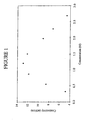
- Figure 1 shows the conductivity of lithium bis(trifluoromethylsulfonyl)imide in dimethoxyethane and 1,3-dioxolane (42.6/57.4% v/v) at various concentrations.
- Figure 2 shows the conductivity of lithium thiocyanate in 1,3-dioxolane at various concentrations at 25 °C.
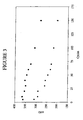
- Figure 3 show the capacity of cells in mAh with 1.4 M lithium imide electrolyte of Example 1 ( ⁇ ) and 0.75 M lithium imide electrolyte of Comparative Example 1 (•) from 1 to 150 cycles.
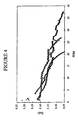
- Figure 4 shows the Figure of Merit for cells with 1.4 M lithium imide electrolyte of Example 2 ( ⁇ ), 1.9 M lithium imide electrolyte of Example 3 ( ⁇ ), and 0.75 M lithium imide electrolyte of Comparative Example 2 ( ⁇ ).
- the electric current producing cells of the present invention are characterized by improved performance, as shown, for example, by high figure of merit (FOM) and a low rate of fade.
- FOM figure of merit
- the donor properties of the preferred solvents of the invention lead to solvate complex formation so that at high concentration of salt the electrolyte has minimal free solvent.
- Lower concentration of sulfides and polysulfides in the electrolyte leads to less diffusion of these entities to other layers of the cell preventing undesirable sulfide and polysulfide reactions at the lithium based anode, including self discharge of the cell.
- electrolytes of lower salt concentration such as from 0.5 M to 1.0 M, where there is much more free solvent, sulfides and polysulfides are much more readily dissolved and at these higher concentrations can migrate to other layers of the cell creating undesirable results.
- the low amounts of free solvent in the electrolytes provides cells of enhanced safety, both in their use and in their fabrication.
- One aspect of the present invention pertains to a nonaqueous electrolyte suitable for use in an electric current producing cell.
- the nonaqueous electrolyte of the present invention comprises a highly concentrated solution of one or more lithium salts in one or more nonaqueous solvents.
- the present invention pertains to a nonaqueous electrolyte, suitable for use in an electric current producing cell, comprising: (a) one or more lithium salts, dissolved in (b) one or more nonaqueous oxygen-containing solvents; wherein the concentration of said one or more lithium salts is: (i) greater than 110% of the molar concentration of said one or more lithium salts which would provide maximum ionic conductivity at 25 °C in said one or more solvents; and, (ii) greater than 1.3 M.
- the present invention pertains to a nonaqueous electrolyte, suitable for use in an electric current producing cell, comprising one or more lithium salt solvate complexes, wherein (a) said solvate complexes comprise one or more lithium salts and one or more complexing solvents; (b) said solvate complexes characterized by n lithium-oxygen coordinate bonds per molecule of the solvate complex, where n is an integer from 2 to 6 and may be the same or different at each occurrence; (c) the ratio of the total oxygen equivalents, r, in free solvating solvent of said electrolyte divided by the total oxygen equivalents coordinated in solvate complexes of said electrolyte, is less than 0.8; (d) the molar concentration of said one or more lithium salt solvate complexes is greater than 1.3 M; and (e) said one or more solvate complexes is liquid below 40°C.
- the present invention pertains to a nonaqueous electrolyte, suitable for use in an electric current producing cell, consisting essentially of one or more lithium salt solvate complexes.
- the nonaqueous electrolytes of the present invention comprise, inter alia , one or more lithium salts.
- lithium salts which are useful in the nonaqueous electrolytes of the present invention, include, but are not limited to, halides, such as, chloride, bromide, and iodide; thiocyanate; tetraphenylborate; alkoxides; phenoxides; enolates; thiolates; amides, such as diisopropylamide, bis(trimethylsilyl)amide and bis(triphenylsilyl)amide; phosphides, such as diphenylphosphide and bis(trimethylsilyl)phosphide; and the following lithium salts: lithium trifluoromethylsulfonate, (LiCF 3 SO 3 , lithium triflate), lithium bis(trifluoromethylsulfonyl)imide, (LN(CF 3 SO 2 ) 2 , lithium imide) and lithium tris
- lithium imide compounds are described in U.S. Pat. No. 5,514,493 to Waddell et al, by Krause et al. in Journal of Power Sources, 1997, 68, 320-325 and by Kita et al. in Journal of Power Sources, 1997, 68, 307-310.
- suitable lithium salts include:
- the nonaqueous electrolytes of the present invention comprise, inter alia, one or more solvents.
- solvent refers to a substance, usually a liquid, in which another substance, usually a solid may be dissolved.
- a solvent may comprise a single chemical compound (e.g. , pure ethyl alcohol) or it may comprise a mixture of chemical compounds (e.g ., ethyl alcohol and ethyl acetate).
- solute refers to a substance which has been dissolved in a solvent to yield a solution.
- the solute is usually the component of a solution, which is present in a lesser amount than the solvent.
- solvation refers to a chemical interaction between a solute and a solvent in a solution, which typically is in the form of coordinate bonds.
- solvates and “solvate complex,” as used herein, pertain to the product of the chemical interaction between a solute and one or more solvent molecules, in which the solute and solvent molecules are bound by coordinate bonds.
- coordinate bond refers to a covalent chemical bond between two atoms that is produced when one atom shares a pair of electrons with another atom lacking such a pair.
- Atoms capable of sharing a pair of electrons may be part of a molecule and may or may not carry a charge.
- the oxygen atom of an ether i.e. in a structure, -C-O-C-, is capable of sharing a pair of electrons to form a coordinate bond, such as with a metal ion.
- Molecules which share a pair of electrons with a metal ion are termed ligands.
- free solvent refers to the portion of the solvent of the electrolyte solutions which is not part of a lithium salt solvate complex. In other words free solvent is not bound by coordinate bonds to lithium ions of the solute and is not a direct part of lithium salt solvate complexes.
- DN Gutmann Donor Number or donor number
- a larger DN indicates a more effective or stronger ability to interact or solvate cations, such as lithium ions.
- Solvents with low DN such as from 2 to 10, do not effectively solvate lithium ions and are relatively poor solvents for lithium salts.
- solvents with a high DN such as from 30 to 40, coordinate lithium too strongly.
- the preferred solvents for use in the present invention are those which have a DN in the range of 12 to 25.
- the one or more solvents are solvents containing O atom donors which can form Li-O coordination bonds.
- suitable classes of oxygen containing solvents for use in the present invention include, but are not limited to, carboxylic acid esters, carbonate esters, carboxylic acid amides, ureas, ketones, aldehydes, acetals, ketals, lactones, alcohols, ethers, sulfoxides, sulfones, phosphine oxides, phosphate esters, and phosphoramidates.
- Preferred classes of oxygen-containing solvents for use in the present invention include, but are not limited to, ethers, cyclic ethers, polyethers, carbonates, esters, and sulfones.
- ethers include, but are not limited to, acyclic ethers, including, but not limited to, dialkyl ethers including dimethyl ether, diethyl ether, methylethyl ether, dipropyl ether, diisopropyl ether, dibutyl ether, methyl tertiarybutyl ether, diisobutyl ether, methylhexyl ether, bis-2-ethylhexyl ether, methyloctyl ether, dimethoxymethane, trimethoxymethane, dimethoxyethane, diethoxyethane, and 1,3-dimethoxypropane.
- acyclic ether as used herein, pertains to non-cyclic organic structures containing the -C-O-C- fragment.
- cyclic ethers include, but are not limited to, tetrahydrofuran, tetrahydropyran, 3-methyltetrahydrofuran, oxepane, 1,4-dioxane, 1,3-dioxolane, 1,3-dioxepane, 1,4-dioxepane, oxocane, 1,3-dioxocane, 1,4-dioxocane, and trioxane.
- polyethers include, but are not limited to, diethylene glycol dimethyl ether (diglyme), triethylene glycol dimethyl ether (triglyme), higher glymes, ethylene glycol divinylether, diethylene glycol divinylether, and triethylene glycol divinylether.
- carbonates include, but are not limited to, dimethyl carbonate, diethyl carbonate, and methyl ethyl carbonate.
- esters include, but are not limited to, methyl formate, ethyl formate, methyl acetate, ethyl acetate, butyl acetate, 2-ethylhexyl acetate, and methyl benzoate.
- sulfones include, but are not limited to, sulfolane, 3-methyl sulfolane, and 3-3-sulfolene.
- solvents include, but are not limited to,acyclic ethers, glymes and related polyethers, and cyclic ethers, such as 1,3-dioxolane. More preferred are mixtures of solvents comprising two or more solvents selected from acyclic ethers, glymes and related polyethers, and cyclic ethers, such as 1,3-dioxolane. Examples of such preferred mixtures include, but are not limited to, acyclic ethers and polyethers, acyclic ethers and cyclic ethers, and, polyethers and cyclic ethers.
- Preferred mixtures of solvents include, but are not limited to, 1,3-dioxolane and dimethoxyethane, 1,3-dioxolane and dimethoxymethane, tetrahydrofuran and 1,3-dioxolane, and tetrahydrofuran and dimethoxyethane.
- the volume ratio of the two solvents in the preferred binary mixtures may vary from about 5 to 95 to 95 to 5.
- the ionic conductivity of solutions of lithium salts in nonaqueous solvents typically increases with concentration of the salt to a maximum and then decreases at higher concentrations.
- the maximum ionic conductivity for many electrolytes is obtained at concentrations close to 1 molar (1 M), for example, as shown in the data compiled by Dudley et al. in Journal of Power Sources, 1991, 35, 59-82.
- the electrolyte comprises a liquid solution of one or more lithium salts in one or more solvents in which the actual concentration of lithium salts is greater than that concentration which would be required to attain maximum conductivity.
- the actual concentration of lithium salts is more than 110% of the concentration which would be required to attain maximum conductivity.
- the actual concentration of lithium salts is more than 120% of the concentration which would be required to attain maximum conductivity.
- the actual concentration of lithium salts is more than 130% of the concentration which would be required to attain maximum conductivity.
- the actual concentration of lithium salts is more than 140% of the concentration which would be required to attain maximum conductivity.
- Lithium salts are solvated upon dissolution in solvents such as those described herein. As the salt concentration increases, increasing amounts of solvent are consumed in the formation of a lithium salt solvate complex or solvate complexes. In some instances, at higher concentration of lithium salt, a lithium salt solvate complex may separate as a solid. In other instances, at higher concentrations of lithium salts, the solvents may be completely consumed in lithium salt solvate complex formation but the resulting solvate complex or complexes may remain liquid.
- the solvate complex or complexes may be low melting or the mixture of two or more complexes may form a low melting eutectic. In fact, it may not be recognized that solvate complexes have been formed unless determinations such as phase diagrams are made on these systems.
- Solvate complexes prepared from a number of lithium salts with a number of different solvating solvents have been described. Many of the solvate complexes described have a discrete stoichiometry of lithium salt to solvating solvent.
- U.S. Pat. No. 3,977,900 to Luehrs describes the formation and isolation of LiCl•HMPA, LiBr•4HMPA, LiBr•TMU, LiSCN•HMPA, LiSCN•2HMPA, LiClO 4 •HMPA, LiClO 4 •4HMPA among others, where HMPA is hexamethylphosphoramide and TMU is tetramethylurea.
- solvate complexes of the present invention have melting points below 40 °C. In one embodiment, solvate complexes of the present invention have melting points below 0 °C. In one embodiment, solvate complexes of the present invention have melting points below -20 °C. Certain solvate complexes exhibit no distinct melting point and, for these solvate complexes, those with a glass transition point below -30 °C are preferred.
- lithium salt solvate complexes have melting points above the melting points of the solvate complexes which are useful in the present invention, that is, above 40 °C.
- Multi-component lithium salt solvate complexes invariably have lower melting points than single component complexes.
- lithium bis(trifluoromethylsulfonyl)imide with 3DME, lithium imide•3DME, has a melting point of 29 °C and lithium imide•2DME has melting point 61 °C, while a mixture of the two form a eutectic of melting point about 20 °C.
- Lithium imide forms a solvate with 1,3-dioxolane with a melting point of about -50 °C which can be combined with higher melting solvate complexes, such as lithium imide•3DME, to form lithium salt solvate complexes in the more preferred melting range of below -20 °C.
- the lithium salt solvate complexes of this invention may comprise several combinations of lithium salts and solvents.
- the one or more lithium salt solvate complexes may comprise a single solvate from a lithium salt and one complexing solvent, such as, for example LiX•4L, where X is the anion of the electrolyte salt and L is the solvating solvent.
- the one or more lithium salt solvate complexes may comprise a mixture of solvates from a single lithium salt and a single complexing solvent, such as, for example, LiX•6L and LiX•4L, where X is the anion of the electrolyte salt and L is the solvating solvent.
- the one or more lithium salt solvate complexes may comprise a mixture of solvates from a single lithium salt and more than one complexing solvent, such as, for example, LiX•4L 1 and LiX•4L 2 , where X is the anion of the electrolyte and L 1 and L 2 are solvating solvents.
- the one or more lithium salt solvate complexes may comprise a mixture of solvates from more than one lithium salt and a single complexing solvent, such as, for example, LiX 1 •6L and LiX 2 •6L, where X 1 and X 2 are anions of the electrolyte salts and L the solvating solvent.
- the one or more lithium salt solvate complexes may comprise a mixture of solvates from more than one lithium salt and more than one complexing solvent, such as, for example, LiX 1 •4L 1 and LiX 2 •6L 2 or LiX 1 •6L 2 and LiX 2 •4L 1 , where X 1 and X 2 are anions of the electrolyte salts, and L 1 and L 2 are solvating solvents.
- the electric current producing cell of the present invention employs a lithium containing anode active material and a sulfur containing cathode active material.
- a lithium containing anode active material typically yield lithium ions and sulfide and/or polysulfide ions.
- the free solvating solvent or solvents present in the cell prior to discharge will solvate the lithium ions generated upon the discharge of the cell.
- the electrolyte solution in the cell typically comprises electrolyte salt solvate complexes and lithium polysulfide solvate complexes, generated from the anode and cathode.
- the electrolyte solution in the discharged cell will be comprised of a mixture of lithium salt complexes and lithium polysulfide solvate complexes, such as for example, LiX•6L, LiX•4L, and Li 2 S x •yL, where X is the anion of the electrolyte salt, L is the solvating solvent, y is an integer from 4 to 12, and x is an integer from 2 to 20.
- lithium salt solvate complexes from other salts and solvating solvents will comprise lithium polysulfide solvates from the discharged cell of the present invention.
- the ratios of the individual lithium salt complexes may vary widely.
- the lithium salt complex consists of two components the ratios may range from about 1 to 10 to about 10 to 1 by weight.
- the ratios may range from about 1 to 10 to about 10 to 1 by weight.
- mixtures comprising more than two lithium salt solvate complexes it is preferably that at least 5% by weight of each be present.
- the nonaqueous electrolytes of the present invention may be characterized by the ratio, r, of the total oxygen equivalents in the free solvating solvent of the nonaqeuous electrolyte to the total oxygen equivalents actually coordinated in the solvate complex of the nonaqueous electrolyte.
- oxygen equivalent as used herein, pertains to the number of oxygen atoms per molecule of nonaqueous oxygen-containing solvent which may coordinate with a lithium ion to form a Li-O coordinate bond.
- lithium salt solvate complexes with oxygen-containing solvents the solvents act as ligands through the oxygen atoms.
- the lithium salt solvate complexes will, for example, have six or possibly four oxygen atoms from the solvating solvent or solvents coordinated to the lithium ion to form Li-O coordinate bonds.
- the six Li-O coordinate bonds of the lithium salt solvate complex may be formed from six molecules of solvating solvent or may be formed from less than six molecules of solvating solvent, if the solvent has more than one oxygen atom per molecule.
- solvents which contain a single oxygen atom such as tetrahydrofuran, (THF, C 4 H 8 O) may form solvates of the formula LiX•6THF.
- THF as a solvating solvent has one oxygen equivalent per molecule.
- Dimethoxyethane, (C 4 H 10 O 2 ) forms solvates with lithium salts of the formula LiX•3DME.
- LiX•3DME there are six Li-O coordinate bonds formed from three molecules of DME.
- the solvent DME has two equivalents of oxygen per molecule.
- 1,3-dioxolane (C 3 H 6 O 2 )
- 1,3-dioxolane solvates of the formula LiX•6DOL are formed with lithium salts.
- 1,3-dioxolane is a solvent with one oxygen equivalents.
- solvents with one oxygen equivalent include, but are not limited to, diethyl ether, diisopropyl ether, dibutyl ether, dialkyl ethers, tetrahydrofuran, tetrahydropyran, 1,3-dioxolane, diethyl carbonate, methyl acetate, and, sulfolane.
- solvents with two oxygen equivalents per molecule include, but are not limited to, dimethoxyethane, diethoxyethane, 1,3-dimethoxy propane, and, 1,2-dimethoxy cyclohexane.
- An example of a solvent with three oxygen equivalents per molecule is diethylene glycol dimethyl ether, (diglyme).
- the ratio, r can be calculated as illustrated in the following example, in which one mole of lithium salt, LiX, is dissolved in a mixture of 4 moles of DME and 4 moles of DOL, by assuming that, from the salt LiX and the solvent mixture of 4 moles of DME and 4 moles of DOL, the solvate complex LiX•3DME is formed.
- This solvate complex has 6 oxygen equivalents incorporated in the solvate complex, two oxygen equivalents for each DME molecule.
- the total oxygen equivalents in the DME/DOL solvent mixture is 12; four equivalents from 4 moles of DOL and eight equivalents from 4 moles of DME.
- Preferred nonaqueous electrolytes of the present invention are those in which the ratio, r, of the total oxygen equivalents in the free solvating solvent of the nonaqeuous electrolyte to the total oxygen equivalents actually coordinated in the solvate complex of the nonaqueous electrolyte, is less than 0.8. More preferred electrolytes are those in which r is less than 0.4. Most preferred electrolytes are those in which r is essentially zero.
- the nonaqueous electrolytes of the present invention may be characterized by the ratio, r, of the total oxygen equivalents in the free solvating solvent of the nonaqeuous electrolyte to the total oxygen equivalents actually coordinated in the solvate complex of the nonaqueous electrolyte.
- lithium salt solvate complexes for use in the present invention are those derived from lithium salts including, but not limited to, lithium bis(trifluoromethylsulfonyl)imide, lithium thiocyanate, lithium iodide and lithium triflate, and solvents including, but not limited to, 1,3-dioxolane, dimethoxyethane, dimethoxymethane, and, sulfolane.
- lithium salts including, but not limited to, lithium bis(trifluoromethylsulfonyl)imide, lithium thiocyanate, lithium iodide and lithium triflate
- solvents including, but not limited to, 1,3-dioxolane, dimethoxyethane, dimethoxymethane, and, sulfolane.
- a lithium salt solvate complex derived from one salt with one solvent is formed from lithium thiocyanate and 1,3-dioxolane.
- Preferred are the complexes or the mixture of complexes LiSCN•zDOL, where z is an integer from 2 to 4. Note that lithium thiocyanate solvate complexes with 1,3-dioxolane, LiSCN•zDOL, where z is greater than 5 are below the salt concentration of maximum ionic conductivity, as shown in Figure 2, and are not preferred.
- a lithium salt solvate complex derived from one salt with one solvent is formed from lithium bis(trifluoromethylsulfonyl)imide and sulfolane.
- Especially preferred are complexes or mixtures of complexes Li(CF 3 SO 2 ) 2 N•zSulfolane, where z is an integer from 2 to 4.
- a lithium salt solvate complex mixture derived from one salt with two solvents is formed from lithium bis(trifluoromethylsulfonyl)imide, dimethoxyethane, and 1,3-dioxolane.
- a lithium salt solvate complex mixture derived from two salts with two solvents is formed from the salts lithium bis(trifluoromethylsulfonyl)imide and lithium thiocyanate with solvents dimethoxyethane and 1,3-dioxolane.
- the weight ratio of lithium salts is from I to 5 to 5 to 1 and the weight ratio of dimethoxyethane to 1,3-dioxolane is from about 1 to 5 to 5 to 1.
- One aspect of the present invention pertains to electric current producing cells, also referred to herein as batteries, comprising an electrolyte as described herein.
- the present invention pertains to an electric current producing cell comprising: (i) a cathode; (ii) an anode; and, (iii) a nonaqueous electrolyte, as described herein, interposed between said cathode and said anode.
- the electric current producing cell of the present invention may be utilized for a wide variety of primary and secondary batteries known in the art, it is preferred to utilize these cells in secondary or rechargeable batteries.
- the electric current producing cells of the present invention comprise a cathode, which may comprise any of the commonly used cathode active materials, including but not limited to those described in the various references cited herein.
- cathode active material as used herein, pertains to an electrochemically active material which is present in the cathode.
- cathode active materials include, but are not limited to, lithiated transition metal chalcogenides, such as, for example, the electroactive oxides, sulfides, and selenides of transition metals, for example, manganese oxides, titanium sulfides, and vanadium oxides; electroactive conductive polymer, such as, for example, polypyrroles, polyphenylenes, polythiophenes, and polyacetylenes; and, sulfur-containing cathode active materials.
- lithiated transition metal chalcogenides such as, for example, the electroactive oxides, sulfides, and selenides of transition metals, for example, manganese oxides, titanium sulfides, and vanadium oxides
- electroactive conductive polymer such as, for example, polypyrroles, polyphenylenes, polythiophenes, and polyacetylenes
- sulfur-containing cathode active materials include, but are not limited to, lithiated transition
- the cathode comprises a sulfur-containing cathode active material.
- electroactive sulfur-containing cathode active materials undergo oxidation-reduction, or redox, electrochemical reactions during the operation of the cell by the breaking or forming of sulfur-sulfur covalent bonds.
- the electroactive sulfur-containing material comprises elemental sulfur.
- the electroactive sulfur-containing material is organic, that is, it comprises both sulfur atoms and carbon atoms. In one embodiment, the electroactive sulfur-containing material is polymeric.
- the cathode comprises electroactive sulfur-containing cathode materials which, in their oxidized state, comprise a polysulfide moiety of the formula, -S m -, wherein m is an integer equal to or greater than 3, preferably m is an integer from 3 to 10, and most preferably m is an integer equal to or greater than 6.
- these preferred cathode materials include elemental sulfur and carbon-sulfur polymer materials, as described in U.S. Pat. Nos. 5,529,860; 5,601,947; and 5,690,702; in U.S. Pat. Application Ser. No. 08/602,323, all by Skotheim et al .; and in U.S. Pat. Application Ser. No. 08/995,112 to Gorkovenko et al .
- the polysulfide moiety, -S m -, of the carbon-sulfur polymer material is covalently bonded by one or both of its terminal sulfur atoms on a side group to the polymer backbone chain of the polymer material.
- the polysulfide moiety, -S m -, of the carbon-sulfur polymer material is incorporated into the polymer backbone chain of the polymer material by covalent bonding of the polysulfide moiety's terminal sulfur atoms.
- the carbon-sulfur polymer material with polysulfide, -S m -, groups, wherein m is an integer equal to or greater than 3, comprises greater than 75 weight percent of sulfur.
- the electroactive sulfur-containing material comprises a sulfur-containing polymer comprising an ionic polysulfide moiety selected from the group of ionic polysulfide moieties consisting of: ionic -S m - moieties and ionic S m 2- moieties, wherein m is an integer equal to or greater than 3, and preferably m is an integer equal to or greater than 8.
- these sulfur-containing materials include sulfur-containing polymers comprising ionic -S m - moieties, as described in U.S. Pat. No. 4,664,991 to Perichaud et al , and sulfur-containing polymers comprising ionic S m 2- moieties, as described in the aforementioned U.S.
- the polymer backbone chain of the sulfur-containing polymer having an ionic polysulfide moiety comprises conjugated segments.
- the polysulfide moiety, -S m - is covalently bonded by one of its terminal sulfur atoms on a side group to the polymer backbone chain of the sulfur-containing polymer.
- the sulfur-containing polymer having an ionic polysulfide moiety comprises greater than 75 weight percent of sulfur.
- the cathode of the cells of this invention may further comprise additives which are not cathode active materials.
- additives include, but are not limited to, conductive metals, conductive carbons, and, metal oxides.
- the electric current producing cells of the present invention comprise an anode, which may comprise any of the commonly used anode active materials, including but not limited to those described in the various references cited herein.
- anode active material as used herein, pertains to an electrochemically active material which is present in the anode.
- suitable anode active materials include, but are not limited to, one or more metals or metal alloys or a mixture of one or more metals and one or more alloys, wherein said metals are selected from the Group IA and IIA metals in the Periodic Table.
- suitable anode active materials include, but are not limited to, alkali-metal intercalated conductive polymers, such as lithium doped polyacetylenes, polyphenylenes, polypyrroles, and the like, and alkali-metal intercalated graphites and carbons.
- Anode active materials comprising lithium are especially useful.
- Preferred anode active materials are lithium metal, lithium-aluminum alloys, lithium-tin alloys, lithium-intercalated carbons, and lithium-intercalated graphites.
- the electric current producing cells of the present invention preferably comprise a separator.
- the separator is a solid non-conductive or insulative material which separates or insulates the anode and the cathode from each other and which comprises permits the transport of ions between the anode and the cathode.
- separator materials are known in the art.
- the separator is a solid porous material, the pores of which are partially or substantially filed with one or more ionic electrolyte salts and solvents, and optionally ionic conductive polymers.
- suitable solid porous separator materials include, but are not limited to, polyolefins, such as, for example, polyethylenes and polypropylenes, glass fiber filter papers, and ceramic materials.
- separators and separator materials suitable for use in this invention are those comprising a microporous pseudo-boehmite layer, which may be provided either as a free standing film or by a direct coating application on one of the electrodes, as described in U.S. Pat. Application Ser. No. 08/995,089, by Carlson et al. of the common assignee and in copending applications "Separators for Electrochemical Cells" and “Protective Coating for Separators for Electrochemical Cells,” both filed on even day herewith of the common assignee.
- these separator materials are supplied as porous free standing films which are interleaved with the anodes and the cathodes in the fabrication of electric current producing cells.
- the solid porous separator layer may be applied directly to one of the electrodes, for example, as described in U.S. Pat. No. 5,194,341 to Bagley et al .
- the solid porous separator is a porous polyolefin separator. In one embodiment, the solid porous separator comprises a microporous pseudo-boehmite layer.
- the electric current producing cells of the present invention comprise a nonaqueous electrolyte, as described herein, interposed between said cathode and said anode.
- the nonaqueous electrolyte of the present invention may be in the form of a liquid electrolyte, a gel polymer electrolyte, or a solid polymer electrolyte.
- the electrolyte is in the form of a liquid electrolyte.
- one or more ionic electrolyte salts as described herein, is typically added to one or more electrolyte solvents, as described herein.
- one or more ionic conductive polymers is typically added to the nonaqueous electrolyte of this invention.
- the amount of electrolyte solvent results in a gel or semi-solid state of the electrolyte in contrast to the solid state of a solid polymer electrolyte.
- suitable gel polymer electrolytes in the methods of the present invention include, but are not limited to, those comprising, an ionic lithium salt, one or more electrolyte solvents in sufficient quantity to provide the desired semi-solid or gel state, and one or more ionically conductive polymers selected from the group consisting of: polyethylene oxides (PEO), polypropylene oxides, polyacrylonitriles, polysiloxanes, polyphosphazenes, polyimides, polyethers, sulfonated polyimides, perfluorinated membranes (NAFIONTM resins), polydivinyl polyethylene glycols, polyethylene glycol diacrylates, polyethylene glycol dimethacrylates, derivatives of the foregoing, copolymers of the foregoing, crosslinked and network structures of the foregoing, and blends of the foregoing.
- PEO polyethylene oxides
- polypropylene oxides polyacrylonitriles
- polysiloxanes polyphosphazenes
- one or more ionic conductive polymers is typically added to the nonaqeuous electrolyte of this invention.
- the amount of nonaqeuous electrolyte is less than 20 per cent by weight of the total weight of solid polymer electrolyte.
- ionic conductive polymers include, but are not limited to, those selected from the group consisting of: polyethers, polyethylene oxides (PEO), polypropylene oxides, polyimides, polyphosphazenes, polyacrylonitriles (PAN), polysiloxanes, polyether grafted polysiloxanes, derivatives of the foregoing, copolymers of the foregoing, and crosslinked and networked structures of the foregoing.
- Ionically conductive solid polymer electrolytes may additionally function as separator materials between the anode and the cathode of an electric current producing cell.
- a cathode was prepared by coating a mixture of 75 parts of elemental sulfur (available from Aldrich Chemical Company, Milwaukee, WI), 10 parts of a conductive carbon pigment PRINTEX XE-2 (a trademark for a carbon pigment available from Degussa Corporation, Akron, OH), and 15 parts of SAB-50 conductive carbon pigment (a tradename for acetylene black available from Chevron Corporation, Baytown, TX) dispersed in isopropanol onto a 17 micron thick conductive carbon coated aluminum foil substrate (Product No. 60303 available from Rexam Graphics, South Hadley, MA). After drying and calendering the cathode coating thickness was about 12 microns. The anode was lithium foil of about 50 microns in thickness.
- the electrolyte was a 1.4 M solution of lithium bis(trifluoromethylsulfonyl)imide (available from 3M Corporation, St. Paul, MN) in a 42:58 volume ratio mixture of 1,3-dioxolane and dimethoxyethane.
- the porous separator used was 16 micron E25 SETELA (a trademark for a polyolefin separator available from Tonen Chemical Corporation, Tokyo, Japan, and also available from Mobil Chemical Company, Films Division, Pittsford, NY).
- Prismatic cells were constructed as in Example 1, except that the electrolyte was a 0.75 M solution of lithium bis(trifluoromethylsulfonyl)imide in a 50:50 volume ratio mixture of 1,3-dioxolane and dimethoxyethane, a concentration lower than the electrolytes of the present invention.
- Discharge-charge cycling of these was performed at 0.7/0.4 mA/cm 2 , respectively, with discharge cutoff at a voltage of 1.3 V and charge cutoff at 3 V or 5 hour charge, whichever came first.
- Typical capacity of these cells was 310 mAh (specific capacity of 614 mAh/g of elemental sulfur in the cell) at the 5 th cycle with a total capacity fade of about 35% over the next 145 cycles, or 0.24% per cycle, as shown in Figure 3.
- Prismatic cells were prepared as in Example 1 except that the electrode area was about 1000 cm 2 .
- the electrolyte was that used in Example 1.
- Discharge-charge cycling of these cells was performed at 0.5/0.3 mA/cm 2 , respectively, with discharge cutoff at voltage of 1.25 V and charge cutoff at 2.8 V or 20% overcharge versus the last discharge cycle, whichever came first.
- Prismatic cells were prepared as in Example 2 except that the electrolyte was a mixture of solvates, lithium bis(trifluoromethylsulfonyl)imide•6 DOL and lithium bis(trifluoromethylsulfonyl)imide•3 DME in a weight ratio of 3:1.
- This electrolyte is about 1.9M lithium bis(trifluoromethylsulfonyl)imide in a 3:1 v/v mixture of 1,3-dioxolane and dimethoxyethane.
- the charge and discharge conditions were as used in Example 2.
- Prismatic cells were prepared as in Example 2 except that the electrolyte was that used in Comparative Example 1.
- the charge and discharge conditions were as used in Example 2.
- Prismatic cells with an electrode area of about 25 cm 2 were constructed from the cathode and separator compositions of Example 2 sandwiched with an anode formed on a 12 micron thick PET film on which was deposited a 500 ⁇ layer of copper and a 10 micron layer of lithium.
- the electrolyte was mixture of 4 molar parts of sulfolane and one molar part of lithium bis(trifluoromethylsulfonyl)imide.
- Specific discharge capacity was about 1063 mAh/g based on the sulfur content of the cell.
- Prismatic cells with an electrode area of about 25 cm 2 were constructed as in Example 4.
- the electrolyte was mixture of 3 molar parts of sulfolane and one molar part of lithium bis(trifluoromethylsulfonyl)imide.
- Specific discharge capacity was about 1021 mAh/g. based on the sulfur content of the cell.
- Prismatic cells were constructed as in Example 2 except that the electrode area was about 800 cm 2 .
- the electrolyte was a solvate complex of 4 molar parts of 1,3-dioxolane and one part of LiSCN, which is a 3.19 M solution.
- Polarization resistance was calculated based on the voltage drop between high and low current pulses and found to be 84 mOhms.
- Prismatic cells were constructed as in Example 6 and discharged at the same GSM conditions.
- the electrolyte was a solvate complex of 3 molar parts of 1,3-dioxolane and one part of LiSCN, which is a 4.09 M solution.
- Polarization resistance calculated as in Example 6, was 79 mOhms. Surprisingly the low polarization resistance occurs at an electrolyte concentration much higher than that of maximum ionic conductivity.
- Prismatic cells were constructed as in Example 6 and discharged at the same GSM conditions.
- the electrolyte was mixture of 6 molar parts of 1,3-dioxolane and one part of LiSCN, about a 2.2 M solution, a concentration below that providing maximum conductivity.
- Polarization resistance calculated as in Example 6, was 434 mOhms.
- Conductivity of solutions of LiSCN in 1,3-dioxolane was determined in YSI Model 3403 conductivity cells at 25 °C and measured at 10kHz in a Gen Rad 1659 RLC Digibridge apparatus. The results of the measurements are shown in Table 3.
- Conductivity of LiSCN in 1,3-dioxolane at 25 °C Concentration in moles/L Conductivity in mS/cm 0.125 0.023 0.500 0.324 0.750 0.724 1.000 1.106 1.500 1.980 2.190 2.469 2.580 2.626 3.190 2.560 4.090 2.287 4.780 1.667 5.680 1.225 7.000 0.942
- Prismatic cells were constructed as in Example 4, with an electrode area of about 25 cm 2 .
- the electrolyte was mixture of two solvate complexes: lithium bis(trifluoromethylsulfonyl)imide•6 DOL and LiSCN•2DME in a molar ratio 1 to 1.
- Specific discharge capacity was about 1115 mAh/g based on the sulfur content of the cell.
Landscapes
- Chemical & Material Sciences (AREA)
- Chemical Kinetics & Catalysis (AREA)
- Electrochemistry (AREA)
- General Chemical & Material Sciences (AREA)
- Engineering & Computer Science (AREA)
- Manufacturing & Machinery (AREA)
- Physics & Mathematics (AREA)
- Condensed Matter Physics & Semiconductors (AREA)
- General Physics & Mathematics (AREA)
- Inorganic Chemistry (AREA)
- Secondary Cells (AREA)
- Battery Electrode And Active Subsutance (AREA)
Abstract
Description
- The present invention relates generally to the field of nonaqueous electrolytes for use in electric current producing cells. More particularly, the present invention pertains to nonaqueous electrolytes comprising a highly concentrated solution of one or more lithium salts in one or more nonaqueous solvents. More specifically, the present invention pertains to nonaqueous electrolytes, suitable for use in an electric current producing cell, comprising: (a) one or more lithium salts, dissolved in (b) one or more nonaqueous oxygen-containing solvents; wherein the concentration of said one or more lithium salts is: (i) greater than 110% of the molar concentration of said one or more lithium salts which would provide maximum ionic conductivity at 25 °C in said one or more solvents; and, (ii) greater than 1.3 M. The present invention also pertains to electric current producing cells comprising such nonaqueous electrolytes, and methods for increasing the safety and cycle life of an electric current producing cell.
- Throughout this application, various publications, patents, and published patent applications are referred to by an identifying citation. The disclosures of the publications, patents, and published patent applications referenced in this application are included to more fully describe the state of the art to which this invention pertains.
- Electric current producing cells, and batteries containing such cells, consist of pairs of electrodes of opposite polarity separated by an electrolyte. The charge flow between electrodes is maintained by an ionically conducting electrolyte, typically comprising an electrolyte solvent in which an ionic electrolyte salt is dissolved to provide the ionic conductivity.
- Numerous nonaqueous electrolyte solvents and electrolyte salts for lithium secondary batteries have been described. Hossain in Handbook of Batteries, 1995, 2nd Edition, Chapter 36, 13-16, McGraw-Hill, New York; Dominey in Lithium Batteries, New Materials, Developments and Perspectives, 1994,
Chapter 4, 137-165, Elsevier, Amsterdam; and, Ue in Progress in Batteries & Battery Materials, 1997, 16, 332-349, for example, provide summaries of the properties of more widely used combinations of electrolyte salts and electrolyte solvents. - In these summaries electrolyte conductivity data are provided for combinations of lithium salts and solvents or solvent mixtures at numerous temperatures and concentrations. These tabulations show that in most salt/solvent combinations maximum conductivity is achieved at a particular salt concentration in the solvent, typically at about 1 M to 1.5 M, where M means moles/L. Above this concentration, conductivity decreases, or below this concentration conductivity decreases. These summaries also show that a mixture of two or more solvents provides higher conductivity than either single solvent alone. Furthermore, the most favored solvent mixtures are those comprising a solvent with a low dielectric constant, such as ε less than 10, and a solvent of high dielectric constant, such as ε greater than 20. Dudley et al. in Journal of Power Sources, 1991, 35, 59-82, report conductivity data on 150 electrolytes useful for rechargeable lithium batteries. For the most part these electrolytes are based on salt concentrations of 1 M in mixtures of solvents. However, a few examples are described in which the conductivity is determined at several salt concentrations and these show maximum conductivity at close to 1 M in each case.
- In contrast, Rao et al. in J. Applied Electrochem., 1980, 10, 757-763, describe a rechargeable lithium/titanium disulfide cell with lithium thiocyanate in 1,3-dioxolane/dimethoxyethane electrolytes in which the salt concentration is in the range of 2.5 to 3.5 molal.
- The choice of electrolyte for a particular cathode and anode combination depends on many factors, including: safety, cycle life, and, chemical compatibility of the cathode and anode materials to the components of the electrolyte.
- For secondary batteries, electrolyte concentration is an important factor in determining the cycle life or charge-discharge efficiency. For example, U.S. Pat. No. 4,416,960 to Eustace et al. describes electrolytes based on LiAsF6 in concentrations of 2.0 M to 3.0 M in 1,3-dioxolane/dimethoxyethane in Li/TiS2 cells, and show Figure of Merit (FOM) data, a measure of cycle life, which tend to be higher at the lower end of this concentration range. Tobishima et al. in U.S. Pat. No. 4,737,424 show that for an electrolyte based on LiAsF6 in ethylene carbonate/2-methyl tetrahydrofuran maximum charge-discharge efficiency occurs at salt concentrations of between 1.0 M and 1.5 M. Furthermore, the maximum efficiency is obtained at an electrolyte concentration apparently below the electrolyte concentration giving maximum conductivity.
- The solubility of a lithium salt in a solvent or mixture of solvents may limit the concentration of the electrolyte to 2 M or less. For example, crystals of the salt or solid solvate complex may separate from the electrolyte at or above these concentrations. The crystalline solid solvate complex which may form from a salt and a solvent may be used as an electrolyte by dissolution in a non-solvating solvent. For example, U.S. Pat. No. 3,764,385 to Langer et al. describes an electric battery in which the electrolyte comprises an inorganic lithium salt complexed with a chelating tertiary amine, for example LiBr•PMDT, which has a melting point of 84-110 °C, dissolved in an aromatic solvent, where PMDT is pentamethyl diethylene triamine. Similarly, U.S. Pat. No. 4,321,314 to Bowden et al. describes a nonaqueous electrochemical cell in which the electrolyte system comprises a stoichiometric lithium salt complex with a volatile ether solvent dissolved in a second solvent. U.S. Pat. No. 4,329,404 to Bowden et al. describes a nonaqueous electrochemical cell in which an electrolyte salt is comprised of a lithium salt complexed with an ether solvent, substantially free of uncomplexed ether, dissolved in a solvent such as SO2.
- Solid solvate complexes with moderately low melting points may be used as electrolytes at temperatures above their melting points, (m.p.). For example, U.S. Pat. No. 3,977,900 to Luehrs describes the formation and isolation of LiCl•HMPA, (m.p. 150 °C), LiBr•4HMPA, (m.p. 71-74 °C), LiBr•TMU, (m.p. 123 °C), LiClO4•HMPA, (m.p. 128 °C), LiSCN•2HMPA, (m.p. 82 °C), among others, where HMPA is hexamethylphosphoramide and TMU is tetramethylurea and the use of these as an electrolyte, in molten form, in thermally activated electrochemical cells.
- In some cases solid lithium salt solvates have been used as solid electrolytes. For example, Francis et al. in U.S. Pat. No. 4,075,397 describe an electrochemical cell in which the solid electrolyte is the solid solvate from a glyme, such as mono-, di-, or triglyme, with lithium salts such as lithium hexafluorophosphate, lithium hexafluoroarsenate or lithium tetrafluoroborate. In a related study, Rao et al., J. Electrochem. Soc., 1980, 127, 761-2, report that cells using lithium iodide solvates with glymes as a solid electrolyte were unable to be recharged.
- Aurbach et al. in Electrochimica Acta, 1997, 42, 697-718 describe a study of electrolyte solutions based on solvents from the glyme family for secondary lithium batteries and conclude that glyme-based electrolytes are not suitable for use in rechargeable lithium battery systems having lithium anodes.
- The present invention pertains to a nonaqueous electrolyte for use in an electric current producing cell, wherein the electrolyte comprising: one or more lithium salt solvate complexes, wherein: (a) the solvate complexes comprise one or more salts and one or more complexing solvents; (b) the solvate complexes are characterized by n lithium-oxygen coordinate bonds per molecule, where n is an integer from 2 to 6, and may be the same or different in each occurrence; (c) the ratio of total oxygen equivalents, r, in the free solvating solvent of the electrolyte divided by the total oxygen equivalents coordinated in solvate complexes of the electrolyte, is less than 0.8; (d) the molar concentration of the one or more lithium salt solvate complexes is greater than 1.3 M; and (e) said one or more solvate complexes is liquid below 40°C.
- In one embodiment, the one or more lithium salts is selected from the group consisting of: LiI, LiSCN, LiCF3SO3, LiN(CF3SO2)2, LiC(SO2CF3)3, (LiSx)nR, and Li2Sx, where x is an integer from 1 to 20, and n is an integer from 1 to 20.
- In one embodiment, the one or more lithium salts comprises lithium thiocyanate.
- In one embodiment, the one or more lithium salts comprises lithium bis(trifluoromethylsulfonyl)imide.
- In one embodiment, the one or more lithium salts comprises a mixture of lithium thiocyanate and lithium bis(trifluoromethylsulfonyl)imide. In a preferred embodiment, the mole ratio of lithium thiocyanate to lithium bis(trifluoromethylsulfonyl)imide is from 4:1 to 1:10.
- In one embodiment, the one or more complexing solvents is selected from the group consisting of: acyclic ethers, cyclic ethers, polyethers, and, sulfones.
- In one embodiment, the acyclic ether is selected from the group consisting of: dimethyl ether, diethyl ether, dipropyl ether, diisopropyl ether, dibutyl ether, bis-(2-ethylhexyl) ether, methyl t-butyl ether, dimethoxymethane, trimethoxymethane, ethylene glycol dimethyl ether, ethylene glycol diethyl ether, and, propylene glycol dimethyl ether.
- In one embodiment, the cyclic ether is selected from the group consisting of: tetrahydrofuran, 2-methyl tetrahydrofuran, tetrahydropyran, oxepane, 1,3dioxolane, 1,3-dioxane, 1,4-dioxane, 1,3-dioxepane, 1,4-dioxepane, and, 1,4-dioxocane.
- In one embodiment, the polyether is selected from the group consisting of: diethylene glycol dimethyl ether, triethylene glycol dimethyl ether, tetraethylene glycol dimethyl ether, dipropylene glycol dimethyl ether, and, polybutylene glycol ethers.
- In one embodiment, r is less than 0.4. In a more preferred embodiment, r is essentially zero.
- In one embodiment, the solvate complex comprises lithium thiocyanate with 1,3-dioxolane.
- In one embodiment, the one or more solvate complexes comprises lithium bis(trifluoromethylsulfonyl)imide with 1,3-dioxolane and 1,2-dimethoxyethane.
- The one or more solvate complexes is liquid below 40 °C. In a preferred embodiment, the one or more solvate complexes is liquid below 0 °C. In a more preferred embodiment, the one or more solvate complexes is liquid below -20 °C.
- In one embodiment, the one or more solvate complexes has a glass transition temperature below -30 °C.
- Another aspect of the present invention pertains to a nonaqueous electrolyte for use in an electric current producing cell, the electrolyte consisting essentially of one or more lithium salt solvate complexes.
- In one embodiment, the lithium salt solvate complex comprises a
lithium thiocyanate 1,3-dioxolane solvate complex. - In one embodiment, the lithium salt solvate complex comprises lithium bis(trifluoromethylsulfonyl)imide dimethoxyethane and 1,3-dioxolane solvate complexes.
- In one embodiment, the lithium salt solvate complex comprises lithium bis(trifluoromethylsulfonyl)imide sulfolane solvate complex.
- In one embodiment, the lithium salt solvate complex comprises lithium bis(trifluoromethylsulfonyl)imide and lithium thiocyanate dimethoxyethane and 1,3-dioxolane solvate complexes.
- The one or more lithium salt solvate complex is liquid below 40 °C. In a preferred embodiment, the one or more solvate complexes is liquid below 0 °C. In a more preferred embodiment, the one or more lithium salt solvate complex is liquid below -20 °C.
- In one embodiment, the one or more lithium salt solvate complex has a glass transition temperature below -30 °C.
- Still another aspect of the present invention pertains to electric current producing cells comprising: (i) a cathode; (ii) an anode; and, (iii) a nonaqueous electrolyte, as described herein, interposed between the cathode and the anode.
- In one embodiment, the cathode comprises a sulfur-containing cathode active material. In one embodiment, the sulfur-containing cathode active material comprises elemental sulfur. In one embodiment, the sulfur-containing cathode active material comprises a carbon-sulfur polymer material which, in its oxidized state, comprises a polysulfide moiety of the formula,
-Sm-, wherein m is an integer from 3 to 10. In a preferred embodiment, m is an integer equal or greater than 8. In one embodiment, the polymer backbone chain of the carbon-sulfur polymer material comprises conjugated segments. In one embodiment, the carbon-sulfur polymer has a polymer backbone chain and the polysulfide moiety, -Sm-, is covalently bonded by one or both of its terminal sulfur atoms on a side group to the polymer backbone. In one embodiment, the polysulfide moiety, -Sm-, is incorporated into the polymer backbone chain of the carbon-sulfur polymer material by covalent bonding of the polysulfide moiety's terminal sulfur atoms. In one embodiment, the carbon-sulfur polymer material comprises greater than 75 weight percent of sulfur. - In one embodiment, the anode comprises one or more anode active materials selected from the group consisting of: lithium metal, lithium-aluminum alloys, lithium-tin alloys, lithium-intercalated carbons, and lithium-intercalated graphites.
- As will be appreciated by one of skill in the art, features of one aspect or embodiment of the invention are also applicable to other aspects or embodiments of the invention.
- Figure 1 shows the conductivity of lithium bis(trifluoromethylsulfonyl)imide in dimethoxyethane and 1,3-dioxolane (42.6/57.4% v/v) at various concentrations.
- Figure 2 shows the conductivity of lithium thiocyanate in 1,3-dioxolane at various concentrations at 25 °C.
- Figure 3 show the capacity of cells in mAh with 1.4 M lithium imide electrolyte of Example 1 (▪) and 0.75 M lithium imide electrolyte of Comparative Example 1 (•) from 1 to 150 cycles.
- Figure 4 shows the Figure of Merit for cells with 1.4 M lithium imide electrolyte of Example 2 (○), 1.9 M lithium imide electrolyte of Example 3 (◆), and 0.75 M lithium imide electrolyte of Comparative Example 2 (Δ).
- The electric current producing cells of the present invention are characterized by improved performance, as shown, for example, by high figure of merit (FOM) and a low rate of fade. Without wishing to be held to any specific theory, it is believed that this high performance arises from the low solubility of sulfide and polysulfide ions in the high concentration electrolyte. The donor properties of the preferred solvents of the invention lead to solvate complex formation so that at high concentration of salt the electrolyte has minimal free solvent. Lower concentration of sulfides and polysulfides in the electrolyte leads to less diffusion of these entities to other layers of the cell preventing undesirable sulfide and polysulfide reactions at the lithium based anode, including self discharge of the cell. In electrolytes of lower salt concentration, such as from 0.5 M to 1.0 M, where there is much more free solvent, sulfides and polysulfides are much more readily dissolved and at these higher concentrations can migrate to other layers of the cell creating undesirable results.
- Furthermore, all electrolyte solvents are susceptible to reaction with lithium metal anode surfaces. It is generally believed that the reaction of the solvents results in the formation of a film at the metal surface. This film, in many cases, can reduce the efficiency of the cell. By reducing the amount of free solvent in the electrolyte the undesirable film forming reaction at the lithium surface is lessened.
- In addition to the improvements in cycle life and capacity from the electrolytes of the present invention, the low amounts of free solvent in the electrolytes provides cells of enhanced safety, both in their use and in their fabrication.
- One aspect of the present invention pertains to a nonaqueous electrolyte suitable for use in an electric current producing cell. The nonaqueous electrolyte of the present invention comprises a highly concentrated solution of one or more lithium salts in one or more nonaqueous solvents.
- In one embodiment, the present invention pertains to a nonaqueous electrolyte, suitable for use in an electric current producing cell, comprising: (a) one or more lithium salts, dissolved in (b) one or more nonaqueous oxygen-containing solvents; wherein the concentration of said one or more lithium salts is: (i) greater than 110% of the molar concentration of said one or more lithium salts which would provide maximum ionic conductivity at 25 °C in said one or more solvents; and, (ii) greater than 1.3 M.
- The present invention pertains to a nonaqueous electrolyte, suitable for use in an electric current producing cell, comprising one or more lithium salt solvate complexes, wherein (a) said solvate complexes comprise one or more lithium salts and one or more complexing solvents; (b) said solvate complexes characterized by n lithium-oxygen coordinate bonds per molecule of the solvate complex, where n is an integer from 2 to 6 and may be the same or different at each occurrence; (c) the ratio of the total oxygen equivalents, r, in free solvating solvent of said electrolyte divided by the total oxygen equivalents coordinated in solvate complexes of said electrolyte, is less than 0.8; (d) the molar concentration of said one or more lithium salt solvate complexes is greater than 1.3 M; and (e) said one or more solvate complexes is liquid below 40°C.
- In one embodiment, the present invention pertains to a nonaqueous electrolyte, suitable for use in an electric current producing cell, consisting essentially of one or more lithium salt solvate complexes.
- The nonaqueous electrolytes of the present invention comprise, inter alia, one or more lithium salts. Examples of lithium salts which are useful in the nonaqueous electrolytes of the present invention, include, but are not limited to, halides, such as, chloride, bromide, and iodide; thiocyanate; tetraphenylborate; alkoxides; phenoxides; enolates; thiolates; amides, such as diisopropylamide, bis(trimethylsilyl)amide and bis(triphenylsilyl)amide; phosphides, such as diphenylphosphide and bis(trimethylsilyl)phosphide; and the following lithium salts: lithium trifluoromethylsulfonate, (LiCF3SO3, lithium triflate), lithium bis(trifluoromethylsulfonyl)imide, (LN(CF3SO2)2, lithium imide) and lithium tris (trifluoromethylsulfonyl) methide (LiC(SO2CF3)3, lithium methide). Additional lithium imide compounds are described in U.S. Pat. No. 5,514,493 to Waddell et al, by Krause et al. in Journal of Power Sources, 1997, 68, 320-325 and by Kita et al. in Journal of Power Sources, 1997, 68, 307-310. Still other examples of suitable lithium salts include:

- The nonaqueous electrolytes of the present invention comprise, inter alia, one or more solvents.
- The term "solvent," as used herein, pertains to a substance, usually a liquid, in which another substance, usually a solid may be dissolved. A solvent may comprise a single chemical compound (e.g., pure ethyl alcohol) or it may comprise a mixture of chemical compounds (e.g., ethyl alcohol and ethyl acetate).
- The term "solute," as used herein, pertains to a substance which has been dissolved in a solvent to yield a solution. The solute is usually the component of a solution, which is present in a lesser amount than the solvent.
- The term "solvation," as used herein, pertains to a chemical interaction between a solute and a solvent in a solution, which typically is in the form of coordinate bonds.
- The term "solvates," and "solvate complex," as used herein, pertain to the product of the chemical interaction between a solute and one or more solvent molecules, in which the solute and solvent molecules are bound by coordinate bonds.
- The term "coordinate bond," as used herein, pertains to a covalent chemical bond between two atoms that is produced when one atom shares a pair of electrons with another atom lacking such a pair. Atoms capable of sharing a pair of electrons may be part of a molecule and may or may not carry a charge. For example, the oxygen atom of an ether, i.e. in a structure, -C-O-C-, is capable of sharing a pair of electrons to form a coordinate bond, such as with a metal ion. Molecules which share a pair of electrons with a metal ion are termed ligands.
- The term "free solvent," as used herein, pertains to the portion of the solvent of the electrolyte solutions which is not part of a lithium salt solvate complex. In other words free solvent is not bound by coordinate bonds to lithium ions of the solute and is not a direct part of lithium salt solvate complexes.
- Many solvents contain donor atoms which may participate in solvate formation with ionic lithium salts. Solvents which contain the donor atoms N and O are especially effective in forming solvates with ionic lithium salts. One useful measure of the ability of solvents to form solvates is the Gutmann Donor Number or donor number (DN), as defined and described by Gutmann in Coordination Chemistry in Nonaqueous Solvents, 1968, Springer-Verlag, Vienna. The numerical value of DN is derived from the heat of reaction (-ΔH in kcal.mole-1) of the solvent with SbCl5. On this scale DN values range from 2.7 for nitromethane to 33.1 for pyridine and 38.8 for hexamethylphosphoramide. A larger DN indicates a more effective or stronger ability to interact or solvate cations, such as lithium ions. Solvents with low DN, such as from 2 to 10, do not effectively solvate lithium ions and are relatively poor solvents for lithium salts. On the other hand solvents with a high DN, such as from 30 to 40, coordinate lithium too strongly. The preferred solvents for use in the present invention are those which have a DN in the range of 12 to 25. As examples, Ue in Progress in Batteries & Battery Materials, 1997, 16, 332-349, reports a DN of 16.4 for ethylene carbonate, a DN of 20 for dimethoxyethane, a DN of 20 for tetrahydrofuran, and a DN of 16.5 for methyl acetate.
- In one embodiment of the present invention, the one or more solvents are solvents containing O atom donors which can form Li-O coordination bonds.
- Examples of suitable classes of oxygen containing solvents for use in the present invention, include, but are not limited to, carboxylic acid esters, carbonate esters, carboxylic acid amides, ureas, ketones, aldehydes, acetals, ketals, lactones, alcohols, ethers, sulfoxides, sulfones, phosphine oxides, phosphate esters, and phosphoramidates. Preferred classes of oxygen-containing solvents for use in the present invention include, but are not limited to, ethers, cyclic ethers, polyethers, carbonates, esters, and sulfones.
- Examples of ethers include, but are not limited to, acyclic ethers, including, but not limited to, dialkyl ethers including dimethyl ether, diethyl ether, methylethyl ether, dipropyl ether, diisopropyl ether, dibutyl ether, methyl tertiarybutyl ether, diisobutyl ether, methylhexyl ether, bis-2-ethylhexyl ether, methyloctyl ether, dimethoxymethane, trimethoxymethane, dimethoxyethane, diethoxyethane, and 1,3-dimethoxypropane. The term "acyclic ether," as used herein, pertains to non-cyclic organic structures containing the -C-O-C- fragment.
- Examples of cyclic ethers include, but are not limited to, tetrahydrofuran, tetrahydropyran, 3-methyltetrahydrofuran, oxepane, 1,4-dioxane, 1,3-dioxolane, 1,3-dioxepane, 1,4-dioxepane, oxocane, 1,3-dioxocane, 1,4-dioxocane, and trioxane.
- Examples of polyethers include, but are not limited to, diethylene glycol dimethyl ether (diglyme), triethylene glycol dimethyl ether (triglyme), higher glymes, ethylene glycol divinylether, diethylene glycol divinylether, and triethylene glycol divinylether.
- Examples of carbonates include, but are not limited to, dimethyl carbonate, diethyl carbonate, and methyl ethyl carbonate.
- Examples of esters include, but are not limited to, methyl formate, ethyl formate, methyl acetate, ethyl acetate, butyl acetate, 2-ethylhexyl acetate, and methyl benzoate.
- Examples of sulfones include, but are not limited to, sulfolane, 3-methyl sulfolane, and 3-3-sulfolene.
- The specific choice of solvent will depend on several factors including the specific anion associated with the lithium ion in the lithium salt. Particularly preferred solvents include, but are not limited to,acyclic ethers, glymes and related polyethers, and cyclic ethers, such as 1,3-dioxolane. More preferred are mixtures of solvents comprising two or more solvents selected from acyclic ethers, glymes and related polyethers, and cyclic ethers, such as 1,3-dioxolane. Examples of such preferred mixtures include, but are not limited to, acyclic ethers and polyethers, acyclic ethers and cyclic ethers, and, polyethers and cyclic ethers. Preferred mixtures of solvents include, but are not limited to, 1,3-dioxolane and dimethoxyethane, 1,3-dioxolane and dimethoxymethane, tetrahydrofuran and 1,3-dioxolane, and tetrahydrofuran and dimethoxyethane. The volume ratio of the two solvents in the preferred binary mixtures may vary from about 5 to 95 to 95 to 5.
- The ionic conductivity of solutions of lithium salts in nonaqueous solvents, especially those of low dielectric constant, such as from a dielectric constant of 2 to 15, typically increases with concentration of the salt to a maximum and then decreases at higher concentrations. The maximum ionic conductivity for many electrolytes is obtained at concentrations close to 1 molar (1 M), for example, as shown in the data compiled by Dudley et al. in Journal of Power Sources, 1991, 35, 59-82.
- In one embodiment of this invention, the electrolyte comprises a liquid solution of one or more lithium salts in one or more solvents in which the actual concentration of lithium salts is greater than that concentration which would be required to attain maximum conductivity. In one embodiment, the actual concentration of lithium salts is more than 110% of the concentration which would be required to attain maximum conductivity. In one embodiment, the actual concentration of lithium salts is more than 120% of the concentration which would be required to attain maximum conductivity. In one embodiment, the actual concentration of lithium salts is more than 130% of the concentration which would be required to attain maximum conductivity. In one embodiment, the actual concentration of lithium salts is more than 140% of the concentration which would be required to attain maximum conductivity.
- The conductivity of lithium bis(trifluoromethylsulfonyl)imide in a mixture of dimethoxyethane (DME) and 1,3-dioxolane (DOL) (42.6/57.4% v/v) at various concentrations is shown in Figure 1. It can be seen that the maximum conductivity is obtained at a concentration of approximately 1.2 M. A series of prismatic cells with lithium metal anodes, a cathode comprising a sulfur-containing cathode active material and containing a lithium imide DME and DOL electrolyte as shown in Figure 1, were evaluated with respect to capacity fade. Table 1 shows the specific capacity at 1st and 10th cycle and the fade (reduction in specific capacity) from the 1st to 10th cycle. The results show that at salt concentrations above 1 M, performance is improved as measured by capacity fade. The fade was 28% at 1.5 M, which is 125% (i.e., 1.5/1.2 = 1.25) of the concentration yielding maximum conductivity for this salt in this solvent system. The lowest fade was observed at 2.0 M, which is 167% (i.e., 2.0/1.2 = 1.67) of the concentration yielding maximum conductivity for this salt in this solvent system.
Lithium Imide in DME/DOL, 42.6/57.4%, v/ v Imide Concentration 1st Cycle Specific Capacity mAh/ g 10th Cycle Specific Capacity mAh/g Fade 0.5 M 1175 795 32% 1.5M 1160 840 28% 2.0 M 1145 925 19% - Lithium salts are solvated upon dissolution in solvents such as those described herein. As the salt concentration increases, increasing amounts of solvent are consumed in the formation of a lithium salt solvate complex or solvate complexes. In some instances, at higher concentration of lithium salt, a lithium salt solvate complex may separate as a solid. In other instances, at higher concentrations of lithium salts, the solvents may be completely consumed in lithium salt solvate complex formation but the resulting solvate complex or complexes may remain liquid. The solvate complex or complexes may be low melting or the mixture of two or more complexes may form a low melting eutectic. In fact, it may not be recognized that solvate complexes have been formed unless determinations such as phase diagrams are made on these systems.
- Solvate complexes prepared from a number of lithium salts with a number of different solvating solvents have been described. Many of the solvate complexes described have a discrete stoichiometry of lithium salt to solvating solvent. For example, U.S. Pat. No. 3,977,900 to Luehrs describes the formation and isolation of LiCl•HMPA, LiBr•4HMPA, LiBr•TMU, LiSCN•HMPA, LiSCN•2HMPA, LiClO4•HMPA, LiClO4•4HMPA among others, where HMPA is hexamethylphosphoramide and TMU is tetramethylurea. These solvates are reported to have melting points ranging from 70 °C to 150 °C. Couture et al., Canadian Journal of Chemistry, 1996, 74, 153-164, describe the identification of lithium salt solvates LiClO4•2DME, LiBr•3BUTY and LiBr•2DME, where DME is dimethoxyethane and BUTY is butyrolactone. Brouillette et al., Journal of Solution Chemistry, 1998, 27, 151-182 report that, based on the phase diagram, lithium bis(trifluoromethylsulfonyl)imide forms a solvate with dimethoxyethane which melts at 29 °C and has a composition lithium imide•3DME.
- In one embodiment, solvate complexes of the present invention have melting points below 40 °C. In one embodiment, solvate complexes of the present invention have melting points below 0 °C. In one embodiment, solvate complexes of the present invention have melting points below -20 °C. Certain solvate complexes exhibit no distinct melting point and, for these solvate complexes, those with a glass transition point below -30 °C are preferred.
- The most frequently described lithium salt solvate complexes have melting points above the melting points of the solvate complexes which are useful in the present invention, that is, above 40 °C. Multi-component lithium salt solvate complexes invariably have lower melting points than single component complexes. For example, lithium bis(trifluoromethylsulfonyl)imide with 3DME, lithium imide•3DME, has a melting point of 29 °C and lithium imide•2DME has melting point 61 °C, while a mixture of the two form a eutectic of melting point about 20 °C. Lithium imide forms a solvate with 1,3-dioxolane with a melting point of about -50 °C which can be combined with higher melting solvate complexes, such as lithium imide•3DME, to form lithium salt solvate complexes in the more preferred melting range of below -20 °C.
- The lithium salt solvate complexes of this invention may comprise several combinations of lithium salts and solvents. The one or more lithium salt solvate complexes may comprise a single solvate from a lithium salt and one complexing solvent, such as, for example LiX•4L, where X is the anion of the electrolyte salt and L is the solvating solvent. The one or more lithium salt solvate complexes may comprise a mixture of solvates from a single lithium salt and a single complexing solvent, such as, for example, LiX•6L and LiX•4L, where X is the anion of the electrolyte salt and L is the solvating solvent. The one or more lithium salt solvate complexes may comprise a mixture of solvates from a single lithium salt and more than one complexing solvent, such as, for example, LiX•4L1 and LiX•4L2, where X is the anion of the electrolyte and L1 and L2 are solvating solvents. The one or more lithium salt solvate complexes may comprise a mixture of solvates from more than one lithium salt and a single complexing solvent, such as, for example, LiX1•6L and LiX2•6L, where X1 and X2 are anions of the electrolyte salts and L the solvating solvent. The one or more lithium salt solvate complexes may comprise a mixture of solvates from more than one lithium salt and more than one complexing solvent, such as, for example, LiX1•4L1 and LiX2•6L2 or LiX1•6L2 and LiX2•4L1, where X1 and X2 are anions of the electrolyte salts, and L1 and L2 are solvating solvents.
- In one embodiment, the electric current producing cell of the present invention employs a lithium containing anode active material and a sulfur containing cathode active material. Upon discharge, such cells typically yield lithium ions and sulfide and/or polysulfide ions. The free solvating solvent or solvents present in the cell prior to discharge will solvate the lithium ions generated upon the discharge of the cell. In the discharged state the electrolyte solution in the cell typically comprises electrolyte salt solvate complexes and lithium polysulfide solvate complexes, generated from the anode and cathode. For example, where the electrolyte of the cell consists of the one or more lithium salt solvate complexes comprising a mixture of solvates from a single lithium salt and a single solvent, the electrolyte solution in the discharged cell will be comprised of a mixture of lithium salt complexes and lithium polysulfide solvate complexes, such as for example, LiX•6L, LiX•4L, and Li2Sx•yL, where X is the anion of the electrolyte salt, L is the solvating solvent, y is an integer from 4 to 12, and x is an integer from 2 to 20. In like manner, lithium salt solvate complexes from other salts and solvating solvents will comprise lithium polysulfide solvates from the discharged cell of the present invention.
- When the electrolyte comprises more than one lithium salt solvate complex, the ratios of the individual lithium salt complexes may vary widely. For example, when the lithium salt complex consists of two components the ratios may range from about 1 to 10 to about 10 to 1 by weight. For mixtures comprising more than two lithium salt solvate complexes it is preferably that at least 5% by weight of each be present.
- The nonaqueous electrolytes of the present invention may be characterized by the ratio, r, of the total oxygen equivalents in the free solvating solvent of the nonaqeuous electrolyte to the total oxygen equivalents actually coordinated in the solvate complex of the nonaqueous electrolyte. The term "oxygen equivalent," as used herein, pertains to the number of oxygen atoms per molecule of nonaqueous oxygen-containing solvent which may coordinate with a lithium ion to form a Li-O coordinate bond.
- The most common coordination numbers of lithium ions with oxygen ligands is 6 or 4 as illustrated in Olsher et al., Chemical Reviews, 1991, 137-164. In lithium salt solvate complexes with oxygen-containing solvents the solvents act as ligands through the oxygen atoms. The lithium salt solvate complexes will, for example, have six or possibly four oxygen atoms from the solvating solvent or solvents coordinated to the lithium ion to form Li-O coordinate bonds. The six Li-O coordinate bonds of the lithium salt solvate complex may be formed from six molecules of solvating solvent or may be formed from less than six molecules of solvating solvent, if the solvent has more than one oxygen atom per molecule. For example, solvents which contain a single oxygen atom, such as tetrahydrofuran, (THF, C4H8O), may form solvates of the formula LiX•6THF. Thus, THF as a solvating solvent has one oxygen equivalent per molecule. Dimethoxyethane, (C4H10O2), forms solvates with lithium salts of the formula LiX•3DME. In the solvate complex, LiX•3DME, there are six Li-O coordinate bonds formed from three molecules of DME. Thus, the solvent DME has two equivalents of oxygen per molecule. Other solvents such as, for example, 1,3-dioxolane, (C3H6O2), although containing two oxygen atoms per molecule, forms solvates in which only one oxygen atom per molecule coordinates with the lithium salt. For example, 1,3-dioxolane solvates of the formula LiX•6DOL are formed with lithium salts. 1,3-dioxolane is a solvent with one oxygen equivalents.
- Examples of solvents with one oxygen equivalent include, but are not limited to, diethyl ether, diisopropyl ether, dibutyl ether, dialkyl ethers, tetrahydrofuran, tetrahydropyran, 1,3-dioxolane, diethyl carbonate, methyl acetate, and, sulfolane. Examples of solvents with two oxygen equivalents per molecule include, but are not limited to, dimethoxyethane, diethoxyethane, 1,3-dimethoxy propane, and, 1,2-dimethoxy cyclohexane. An example of a solvent with three oxygen equivalents per molecule is diethylene glycol dimethyl ether, (diglyme).
- The ratio, r, can be calculated as illustrated in the following example, in which one mole of lithium salt, LiX, is dissolved in a mixture of 4 moles of DME and 4 moles of DOL, by assuming that, from the salt LiX and the solvent mixture of 4 moles of DME and 4 moles of DOL, the solvate complex LiX•3DME is formed. This solvate complex has 6 oxygen equivalents incorporated in the solvate complex, two oxygen equivalents for each DME molecule. The total oxygen equivalents in the DME/DOL solvent mixture is 12; four equivalents from 4 moles of DOL and eight equivalents from 4 moles of DME. Free solvent oxygen equivalents is, therefore, 12 - 6 = 6. Free solvent oxygen equivalents divided by oxygen equivalents in solvate, r, is 6/6 = 1.0.
- Applying this method of calculation to lithium bis(trifluoromethylsulfonyl)imide in 1,3-dioxolane/dimethoxyethane at the different concentrations of examples and comparative examples, as described later, provides the results summarized in Table 2.
Free solvent ratio, r, for lithium imide electrolytes Imide concentration r Example 1 1.4M 0.63 Comparative Example 1 0.75 M 2.3 Example 3 1.9M 0.0 Maximum conductivity 1.2 M 0.93 - Preferred nonaqueous electrolytes of the present invention are those in which the ratio, r, of the total oxygen equivalents in the free solvating solvent of the nonaqeuous electrolyte to the total oxygen equivalents actually coordinated in the solvate complex of the nonaqueous electrolyte, is less than 0.8. More preferred electrolytes are those in which r is less than 0.4. Most preferred electrolytes are those in which r is essentially zero.
- The nonaqueous electrolytes of the present invention may be characterized by the ratio, r, of the total oxygen equivalents in the free solvating solvent of the nonaqeuous electrolyte to the total oxygen equivalents actually coordinated in the solvate complex of the nonaqueous electrolyte.
- Particularly useful lithium salt solvate complexes for use in the present invention are those derived from lithium salts including, but not limited to, lithium bis(trifluoromethylsulfonyl)imide, lithium thiocyanate, lithium iodide and lithium triflate, and solvents including, but not limited to, 1,3-dioxolane, dimethoxyethane, dimethoxymethane, and, sulfolane.
- In one embodiment, a lithium salt solvate complex derived from one salt with one solvent is formed from lithium thiocyanate and 1,3-dioxolane. Preferred are the complexes or the mixture of complexes LiSCN•zDOL, where z is an integer from 2 to 4. Note that lithium thiocyanate solvate complexes with 1,3-dioxolane, LiSCN•zDOL, where z is greater than 5 are below the salt concentration of maximum ionic conductivity, as shown in Figure 2, and are not preferred.
- In one embodiment, a lithium salt solvate complex derived from one salt with one solvent is formed from lithium bis(trifluoromethylsulfonyl)imide and sulfolane. Especially preferred are complexes or mixtures of complexes Li(CF3SO2)2N•zSulfolane, where z is an integer from 2 to 4.
- In one embodiment, a lithium salt solvate complex mixture derived from one salt with two solvents is formed from lithium bis(trifluoromethylsulfonyl)imide, dimethoxyethane, and 1,3-dioxolane. Especially preferred are mixtures of Li(CF3SO2)2N•zDME, where z in an integer from 2 to 4, and Li(CF3SO2)2N•zDOL, where z is an integer from 3 to 6, in weight ratios of from 1 to 5 to 5 to 1.
- In one embodiment, a lithium salt solvate complex mixture derived from two salts with two solvents is formed from the salts lithium bis(trifluoromethylsulfonyl)imide and lithium thiocyanate with solvents dimethoxyethane and 1,3-dioxolane. Especially preferred are such mixtures wherein the weight ratio of lithium salts is from I to 5 to 5 to 1 and the weight ratio of dimethoxyethane to 1,3-dioxolane is from about 1 to 5 to 5 to 1.
- One aspect of the present invention pertains to electric current producing cells, also referred to herein as batteries, comprising an electrolyte as described herein. Thus, in one embodiment, the present invention pertains to an electric current producing cell comprising: (i) a cathode; (ii) an anode; and, (iii) a nonaqueous electrolyte, as described herein, interposed between said cathode and said anode.
- Although the electric current producing cell of the present invention may be utilized for a wide variety of primary and secondary batteries known in the art, it is preferred to utilize these cells in secondary or rechargeable batteries.
- The electric current producing cells of the present invention comprise a cathode, which may comprise any of the commonly used cathode active materials, including but not limited to those described in the various references cited herein. The term "cathode active material," as used herein, pertains to an electrochemically active material which is present in the cathode.
- Examples of suitable cathode active materials include, but are not limited to, lithiated transition metal chalcogenides, such as, for example, the electroactive oxides, sulfides, and selenides of transition metals, for example, manganese oxides, titanium sulfides, and vanadium oxides; electroactive conductive polymer, such as, for example, polypyrroles, polyphenylenes, polythiophenes, and polyacetylenes; and, sulfur-containing cathode active materials.
- In one embodiment, the cathode comprises a sulfur-containing cathode active material. Unlike the lithiated transition metal chalcogenides which undergo a lithium intercalation process and a change in the valence state of the metal during the electrochemical reaction of the cell, electroactive sulfur-containing cathode active materials undergo oxidation-reduction, or redox, electrochemical reactions during the operation of the cell by the breaking or forming of sulfur-sulfur covalent bonds. In one embodiment, the electroactive sulfur-containing material comprises elemental sulfur. In one embodiment, the electroactive sulfur-containing material is organic, that is, it comprises both sulfur atoms and carbon atoms. In one embodiment, the electroactive sulfur-containing material is polymeric.
- In a preferred embodiment, the cathode comprises electroactive sulfur-containing cathode materials which, in their oxidized state, comprise a polysulfide moiety of the formula, -Sm-, wherein m is an integer equal to or greater than 3, preferably m is an integer from 3 to 10, and most preferably m is an integer equal to or greater than 6. Examples of these preferred cathode materials include elemental sulfur and carbon-sulfur polymer materials, as described in U.S. Pat. Nos. 5,529,860; 5,601,947; and 5,690,702; in U.S. Pat. Application Ser. No. 08/602,323, all by Skotheim et al.; and in U.S. Pat. Application Ser. No. 08/995,112 to Gorkovenko et al.
- In a preferred embodiment, the polysulfide moiety, -Sm-, of the carbon-sulfur polymer material is covalently bonded by one or both of its terminal sulfur atoms on a side group to the polymer backbone chain of the polymer material. In another preferred embodiment, the polysulfide moiety, -Sm-, of the carbon-sulfur polymer material is incorporated into the polymer backbone chain of the polymer material by covalent bonding of the polysulfide moiety's terminal sulfur atoms. In another preferred embodiment, the carbon-sulfur polymer material with polysulfide, -Sm-, groups, wherein m is an integer equal to or greater than 3, comprises greater than 75 weight percent of sulfur.
- In a preferred embodiment, the electroactive sulfur-containing material comprises a sulfur-containing polymer comprising an ionic polysulfide moiety selected from the group of ionic polysulfide moieties consisting of: ionic -Sm - moieties and ionic Sm 2- moieties, wherein m is an integer equal to or greater than 3, and preferably m is an integer equal to or greater than 8. Examples of these sulfur-containing materials include sulfur-containing polymers comprising ionic -Sm - moieties, as described in U.S. Pat. No. 4,664,991 to Perichaud et al, and sulfur-containing polymers comprising ionic Sm 2- moieties, as described in the aforementioned U.S. Pat. No. 4,664,991 and in European Pat. No. 250,518 B1 to Genies. In one embodiment, the polymer backbone chain of the sulfur-containing polymer having an ionic polysulfide moiety comprises conjugated segments. In one embodiment, the polysulfide moiety, -Sm -, is covalently bonded by one of its terminal sulfur atoms on a side group to the polymer backbone chain of the sulfur-containing polymer. In one embodiment, the sulfur-containing polymer having an ionic polysulfide moiety comprises greater than 75 weight percent of sulfur.
- The cathode of the cells of this invention may further comprise additives which are not cathode active materials. Examples of such additives include, but are not limited to, conductive metals, conductive carbons, and, metal oxides.
- The electric current producing cells of the present invention comprise an anode, which may comprise any of the commonly used anode active materials, including but not limited to those described in the various references cited herein. The term "anode active material," as used herein, pertains to an electrochemically active material which is present in the anode.
- Examples of suitable anode active materials include, but are not limited to, one or more metals or metal alloys or a mixture of one or more metals and one or more alloys, wherein said metals are selected from the Group IA and IIA metals in the Periodic Table. Other examples of suitable anode active materials include, but are not limited to, alkali-metal intercalated conductive polymers, such as lithium doped polyacetylenes, polyphenylenes, polypyrroles, and the like, and alkali-metal intercalated graphites and carbons. Anode active materials comprising lithium are especially useful. Preferred anode active materials are lithium metal, lithium-aluminum alloys, lithium-tin alloys, lithium-intercalated carbons, and lithium-intercalated graphites.
- The electric current producing cells of the present invention preferably comprise a separator. Typically, the separator is a solid non-conductive or insulative material which separates or insulates the anode and the cathode from each other and which comprises permits the transport of ions between the anode and the cathode. A variety of separator materials are known in the art.
- In one embodiment, the separator is a solid porous material, the pores of which are partially or substantially filed with one or more ionic electrolyte salts and solvents, and optionally ionic conductive polymers.
- Examples of suitable solid porous separator materials include, but are not limited to, polyolefins, such as, for example, polyethylenes and polypropylenes, glass fiber filter papers, and ceramic materials. Further examples of separators and separator materials suitable for use in this invention are those comprising a microporous pseudo-boehmite layer, which may be provided either as a free standing film or by a direct coating application on one of the electrodes, as described in U.S. Pat. Application Ser. No. 08/995,089, by Carlson et al. of the common assignee and in copending applications "Separators for Electrochemical Cells" and "Protective Coating for Separators for Electrochemical Cells," both filed on even day herewith of the common assignee.
- Typically, these separator materials are supplied as porous free standing films which are interleaved with the anodes and the cathodes in the fabrication of electric current producing cells. Alternatively, the solid porous separator layer may be applied directly to one of the electrodes, for example, as described in U.S. Pat. No. 5,194,341 to Bagley et al.
- In one embodiment, the solid porous separator is a porous polyolefin separator. In one embodiment, the solid porous separator comprises a microporous pseudo-boehmite layer.
- The electric current producing cells of the present invention comprise a nonaqueous electrolyte, as described herein, interposed between said cathode and said anode. The nonaqueous electrolyte of the present invention may be in the form of a liquid electrolyte, a gel polymer electrolyte, or a solid polymer electrolyte. In a preferred embodiment, the electrolyte is in the form of a liquid electrolyte.
- To form a liquid electrolyte, one or more ionic electrolyte salts, as described herein, is typically added to one or more electrolyte solvents, as described herein.
- To form a gel polymer electrolyte, one or more ionic conductive polymers is typically added to the nonaqueous electrolyte of this invention. The amount of electrolyte solvent results in a gel or semi-solid state of the electrolyte in contrast to the solid state of a solid polymer electrolyte.
- Examples of suitable gel polymer electrolytes in the methods of the present invention include, but are not limited to, those comprising, an ionic lithium salt, one or more electrolyte solvents in sufficient quantity to provide the desired semi-solid or gel state, and one or more ionically conductive polymers selected from the group consisting of: polyethylene oxides (PEO), polypropylene oxides, polyacrylonitriles, polysiloxanes, polyphosphazenes, polyimides, polyethers, sulfonated polyimides, perfluorinated membranes (NAFION™ resins), polydivinyl polyethylene glycols, polyethylene glycol diacrylates, polyethylene glycol dimethacrylates, derivatives of the foregoing, copolymers of the foregoing, crosslinked and network structures of the foregoing, and blends of the foregoing.
- To form a solid polymer electrolyte, one or more ionic conductive polymers is typically added to the nonaqeuous electrolyte of this invention. Typically, the amount of nonaqeuous electrolyte is less than 20 per cent by weight of the total weight of solid polymer electrolyte. Examples of suitable ionic conductive polymers include, but are not limited to, those selected from the group consisting of: polyethers, polyethylene oxides (PEO), polypropylene oxides, polyimides, polyphosphazenes, polyacrylonitriles (PAN), polysiloxanes, polyether grafted polysiloxanes, derivatives of the foregoing, copolymers of the foregoing, and crosslinked and networked structures of the foregoing. Ionically conductive solid polymer electrolytes may additionally function as separator materials between the anode and the cathode of an electric current producing cell.
- Several embodiments of the present invention are described in the following examples, which are offered by way of illustration and not by way of limitation.
- A cathode was prepared by coating a mixture of 75 parts of elemental sulfur (available from Aldrich Chemical Company, Milwaukee, WI), 10 parts of a conductive carbon pigment PRINTEX XE-2 (a trademark for a carbon pigment available from Degussa Corporation, Akron, OH), and 15 parts of SAB-50 conductive carbon pigment (a tradename for acetylene black available from Chevron Corporation, Baytown, TX) dispersed in isopropanol onto a 17 micron thick conductive carbon coated aluminum foil substrate (Product No. 60303 available from Rexam Graphics, South Hadley, MA). After drying and calendering the cathode coating thickness was about 12 microns. The anode was lithium foil of about 50 microns in thickness. The electrolyte was a 1.4 M solution of lithium bis(trifluoromethylsulfonyl)imide (available from 3M Corporation, St. Paul, MN) in a 42:58 volume ratio mixture of 1,3-dioxolane and dimethoxyethane. The porous separator used was 16 micron E25 SETELA (a trademark for a polyolefin separator available from Tonen Chemical Corporation, Tokyo, Japan, and also available from Mobil Chemical Company, Films Division, Pittsford, NY).
- The above components were combined into a layered structure of cathode/separator/anode, which was wound and compressed, with the liquid electrolyte filling the void areas of the separator and cathode to form prismatic cells with an electrode area of about 360 cm2. Discharge-charge cycling on these cells was done at 0.7/0.4 mA/cm2, respectively, with discharge cutoff at a voltage of 1.3V and charge cutoff at 3V or 5 hour charge, whichever came first. Typical capacity of these cells was 362 mAh (specific capacity of 729 mAh/g of elemental sulfur in the cell) at the 5th cycle with a total capacity fade of about 22% over the next 145 cycles, or 0.15% per cycle, as shown in Figure 3.
- Prismatic cells were constructed as in Example 1, except that the electrolyte was a 0.75 M solution of lithium bis(trifluoromethylsulfonyl)imide in a 50:50 volume ratio mixture of 1,3-dioxolane and dimethoxyethane, a concentration lower than the electrolytes of the present invention.
- Discharge-charge cycling of these was performed at 0.7/0.4 mA/cm2, respectively, with discharge cutoff at a voltage of 1.3 V and charge cutoff at 3 V or 5 hour charge, whichever came first. Typical capacity of these cells was 310 mAh (specific capacity of 614 mAh/g of elemental sulfur in the cell) at the 5th cycle with a total capacity fade of about 35% over the next 145 cycles, or 0.24% per cycle, as shown in Figure 3.
- Prismatic cells were prepared as in Example 1 except that the electrode area was about 1000 cm2. The electrolyte was that used in Example 1. Discharge-charge cycling of these cells was performed at 0.5/0.3 mA/cm2, respectively, with discharge cutoff at voltage of 1.25 V and charge cutoff at 2.8 V or 20% overcharge versus the last discharge cycle, whichever came first. Depth of Discharge, DoD, of lithium was calculated based on total discharge capacity, Ct, for each cycle and theoretical capacity of starting amount of metallic lithium in the cell, CLi, DoD = Ct / CLi.
- Figure of Merit, FOM, for cycle number N was calculated as a sum of DoD for all N cycles. Therefore, FOM = Sum (DoD).
- The cutoff was at a DoD of 7% at which the FOM was 26 and the number of cycles reached was 196 as shown in Figure 4.
- Prismatic cells were prepared as in Example 2 except that the electrolyte was a mixture of solvates, lithium bis(trifluoromethylsulfonyl)imide•6 DOL and lithium bis(trifluoromethylsulfonyl)imide•3 DME in a weight ratio of 3:1. This electrolyte is about 1.9M lithium bis(trifluoromethylsulfonyl)imide in a 3:1 v/v mixture of 1,3-dioxolane and dimethoxyethane. The charge and discharge conditions were as used in Example 2.
- The cutoff was at a DoD of 7% at which the FOM was 37 and the number of cycles reached was 338 as show in Figure 4.
- Prismatic cells were prepared as in Example 2 except that the electrolyte was that used in Comparative Example 1. The charge and discharge conditions were as used in Example 2.
- The cutoff was at DoD of 7% at which the FOM was 21 and the number of cycles reached was 149 as shown in Figure 4.
- Prismatic cells with an electrode area of about 25 cm2 were constructed from the cathode and separator compositions of Example 2 sandwiched with an anode formed on a 12 micron thick PET film on which was deposited a 500 Å layer of copper and a 10 micron layer of lithium. The electrolyte was mixture of 4 molar parts of sulfolane and one molar part of lithium bis(trifluoromethylsulfonyl)imide.
- Specific discharge capacity was about 1063 mAh/g based on the sulfur content of the cell.
- Prismatic cells with an electrode area of about 25 cm2 were constructed as in Example 4. The electrolyte was mixture of 3 molar parts of sulfolane and one molar part of lithium bis(trifluoromethylsulfonyl)imide.
- Specific discharge capacity was about 1021 mAh/g. based on the sulfur content of the cell.
- Prismatic cells were constructed as in Example 2 except that the electrode area was about 800 cm2.
- These cells were discharged at GSM conditions with 2000 mA x 0.6 mS and 150 mA x 4.4 mS pulses. The electrolyte was a solvate complex of 4 molar parts of 1,3-dioxolane and one part of LiSCN, which is a 3.19 M solution.
- Polarization resistance was calculated based on the voltage drop between high and low current pulses and found to be 84 mOhms.
- Prismatic cells were constructed as in Example 6 and discharged at the same GSM conditions. The electrolyte was a solvate complex of 3 molar parts of 1,3-dioxolane and one part of LiSCN, which is a 4.09 M solution.
- Polarization resistance, calculated as in Example 6, was 79 mOhms. Surprisingly the low polarization resistance occurs at an electrolyte concentration much higher than that of maximum ionic conductivity.
- Prismatic cells were constructed as in Example 6 and discharged at the same GSM conditions. The electrolyte was mixture of 6 molar parts of 1,3-dioxolane and one part of LiSCN, about a 2.2 M solution, a concentration below that providing maximum conductivity.
- Polarization resistance, calculated as in Example 6, was 434 mOhms.
- Conductivity of solutions of LiSCN in 1,3-dioxolane was determined in YSI Model 3403 conductivity cells at 25 °C and measured at 10kHz in a Gen Rad 1659 RLC Digibridge apparatus. The results of the measurements are shown in Table 3.
Conductivity of LiSCN in 1,3-dioxolane at 25 °C Concentration in moles/L Conductivity in mS/cm 0.125 0.023 0.500 0.324 0.750 0.724 1.000 1.106 1.500 1.980 2.190 2.469 2.580 2.626 3.190 2.560 4.090 2.287 4.780 1.667 5.680 1.225 7.000 0.942 - The results, which are plotted in Figure 2, show that the maximum conductivity is attained at a concentration of about 2.6 M.
- Prismatic cells were constructed as in Example 4, with an electrode area of about 25 cm2. The electrolyte was mixture of two solvate complexes: lithium bis(trifluoromethylsulfonyl)imide•6 DOL and LiSCN•2DME in a
molar ratio 1 to 1. - Specific discharge capacity was about 1115 mAh/g based on the sulfur content of the cell.
- While the invention has been described in detail and with reference to specific embodiments thereof, it will be apparent to one skilled in the art that various changes and modifications can be made without departing from the scope thereof.
Claims (20)
- An electric current producing cell comprising:(i) a cathode comprising a sulfur-containing cathode active material;(ii) an anode; and,(iii) a nonaqueous electrolyte interposed between said cathode and said anode, said electrolyte comprising:one or more lithium salt solvate complexes, wherein:(a) said solvate complexes comprise one or more lithium salts and one or more complexing solvents;(b) said solvate complexes are characterized by n lithium-oxygen coordinate bonds per molecule of the solvate complex, where n is an integer from 2 to 6 and may be the same or different at each occurrence;(c) the ratio, r, of the total oxygen equivalents of free solvating solvent of said electrolyte divided by the total oxygen equivalents of coordinated solvent in solvate complexes of said electrolyte, is less than 0.8;(d) the molar concentration of said one or more lithium salt solvate complexes in said electrolyte is greater than 1.3 M; and,(e) said one or more solvate complexes is liquid below 40 °C.
- A cell according to claim 1, wherein said one or more solvate complexes is liquid below 0 °C.
- A cell according to claim 1, wherein said one or more solvate complexes is liquid below -20 °C.
- A cell according to any one of claims 1 to 3, wherein said one or more solvate complexes has a glass transition temperature below -30 °C.
- A cell according to any one of claims 1 to 4, wherein said cell is a rechargeable cell.
- A cell according to any one of claims 1 to 5, wherein said one or more lithium salts is selected from the group consisting of: LiI, LiSCN, LiCF3SO3, LiN(CF3SO2)2, LiC(SO2CF3)3, (LiSx)nR, and Li2Sx, where x is an integer from 1 to 20; n is an integer from 1 to 3; and R is one or more aliphatic or aromatic moieties having 1 to 20 carbon atoms.
- A cell according to any one of claims 1 to 5, wherein said one or more lithium salts comprises lithium thiocyanate.
- A cell according to any one of claims 1 to 5, wherein said one or more lithium salts comprises lithium bis(trifluoromethylsulfonyl)imide.
- A cell according to any one of claims 1 to 8, wherein said one or more complexing solvents is selected from the group consisting of: acyclic ethers, cyclic ethers, polyethers, and sulfones.
- A cell according to any one of claims 1 to 8, wherein said one or more complexing solvents is an acyclic ether selected from the group consisting of:dimethyl ether, diethyl ether, dipropyl ether, diisopropyl ether, dibutyl ether, bis-(2-ethylhexyl) ether, methyl t-butyl ether, dimethoxymethane, trimethoxymethane, ethylene glycol dimethyl ether, ethylene glycol diethyl ether, and propylene glycol dimethyl ether
- A cell according to any one of claims 1 to 8, wherein said one or more complexing solvents is a cyclic ether selected from the group consisting of:tetrahydrofuran, 2-methyl tetrahydrofuran, tetrahydropyran, oxepane, 1,3-dioxolane, 1,3-dioxane, 1,4-dioxane, 1,3-dioxepane, 1,4-dioxepane, and 1,4-dioxocane.
- A cell according to any one of claims 1 to 8, wherein said one or more complexing solvents is a polyether selected from the group consisting of:diethylene glycol dimethyl ether, triethylene glycol dimethyl ether, tetraethylene glycol dimethyl ether, dipropylene glycol dimethyl ether; and polybutylene glycol ethers.
- A cell according to any one of claims 1 to 6, wherein said solvate complexes comprise:one or more lithium salts selected from: lithium bis(trifluoromethylsulfonyl)imide, lithium thiocyanate, lithium iodide, and lithium triflate; and,one or more complexing solvents selected from: 1,3-dioxolane, dimethoxyethane, dimethoxymethane, and, sulfolane.
- A cell according to any one of claims 1 to 6, wherein said one or more solvate complex comprises lithium thiocyanate with 1,3-dioxolane.
- A cell according to any one of claims 1 to 6, wherein said one or more solvate complexes comprises lithium bis(trifluoromethylsulfonyl)imide with 1,3-dioxolane and 1,2-dimethoxyethane.
- A cell according to any one of claims 1 to 6, wherein said one or more solvate complexes comprises lithium bis(trifluoromethylsulfonyl)imide and lithium thiocyanate with dimethoxyethane and 1,3-dioxolane.
- A cell according to any one of claims 1 to 16, wherein r is less than 0.4.
- A cell according to any one of claims 1 to 16, wherein r is essentially zero.
- A cell according to any one of claims 1 to 18, wherein said anode comprises lithium.
- A cell according to any one of claims 1 to 19, wherein said cathode active material undergoes electrochemical reactions during operation of the cell by the breaking or forming of sulfur-sulfur covalent bonds.
Applications Claiming Priority (3)
| Application Number | Priority Date | Filing Date | Title |
|---|---|---|---|
| US21511598A | 1998-12-17 | 1998-12-17 | |
| US215115 | 1998-12-17 | ||
| PCT/US1999/030116 WO2000036683A2 (en) | 1998-12-17 | 1999-12-16 | Non-aqueous electrolytes for electrochemical cells |
Publications (2)
| Publication Number | Publication Date |
|---|---|
| EP1149428A2 EP1149428A2 (en) | 2001-10-31 |
| EP1149428B1 true EP1149428B1 (en) | 2003-03-19 |
Family
ID=22801720
Family Applications (1)
| Application Number | Title | Priority Date | Filing Date |
|---|---|---|---|
| EP99967390A Expired - Lifetime EP1149428B1 (en) | 1998-12-17 | 1999-12-16 | Non-aqueous electrolytes for electrochemical cells |
Country Status (5)
| Country | Link |
|---|---|
| EP (1) | EP1149428B1 (en) |
| CN (1) | CN1333933A (en) |
| AU (1) | AU2367700A (en) |
| DE (1) | DE69906150D1 (en) |
| WO (1) | WO2000036683A2 (en) |
Families Citing this family (30)
| Publication number | Priority date | Publication date | Assignee | Title |
|---|---|---|---|---|
| US7807300B2 (en) | 2006-01-31 | 2010-10-05 | Medtronic, Inc. | Resistance-stabilizing additives for electrolyte |
| JP3866191B2 (en) | 2001-12-11 | 2007-01-10 | 日立マクセル株式会社 | Non-aqueous electrolyte and non-aqueous electrolyte battery using the same |
| DE10228201B4 (en) * | 2002-06-24 | 2006-12-21 | Chemetall Gmbh | Process for the preparation of lithium iodide solutions |
| KR100472509B1 (en) * | 2002-10-04 | 2005-03-10 | 삼성에스디아이 주식회사 | Organic electrolytic solution and lithium battery employing the same |
| US20040161671A1 (en) * | 2003-02-13 | 2004-08-19 | Medtronic, Inc. | Liquid electrolyte for an electrochemical cell |
| US7510808B2 (en) | 2004-08-27 | 2009-03-31 | Eveready Battery Company, Inc. | Low temperature Li/FeS2 battery |
| US7722988B2 (en) | 2005-08-16 | 2010-05-25 | Eveready Battery Company, Inc. | All-temperature LiFeS2 battery with ether and low concentration LiI electrolyte |
| KR101431259B1 (en) | 2007-06-14 | 2014-08-20 | 주식회사 엘지화학 | Additive for non-aqueous electrolyte and secondary battery using the same |
| US20080318123A1 (en) * | 2007-06-22 | 2008-12-25 | Zhiping Jiang | Lithium cell |
| US8076028B2 (en) * | 2008-04-16 | 2011-12-13 | The Gillette Company | Lithium cell with cathode including iron disulfide and iron sulfide |
| US20120328939A1 (en) * | 2011-06-09 | 2012-12-27 | Bhat Vinay V | Materials for Battery Electrolytes and Methods for Use |
| US8734668B2 (en) | 2011-06-09 | 2014-05-27 | Asahi Kasei Kabushiki Kaisha | Materials for battery electrolytes and methods for use |
| US8703344B2 (en) | 2011-06-09 | 2014-04-22 | Asahi Kasei Kabushiki Kaisha | Materials for battery electrolytes and methods for use |
| CN104641503B (en) * | 2012-04-26 | 2017-10-13 | 罗克伍德锂有限责任公司 | The 1.5 3V lithium batteries with additives for overcharge protection |
| CN103531839A (en) * | 2012-07-04 | 2014-01-22 | 中国科学院物理研究所 | Rechargeable metal lithium secondary battery capable of preventing from generating lithium dendrites |
| KR101558669B1 (en) | 2013-10-31 | 2015-10-07 | 현대자동차주식회사 | A cathode for lithium sulfur battery and a method for preparing thereof |
| KR102050837B1 (en) * | 2016-02-03 | 2019-12-03 | 주식회사 엘지화학 | Electrolyte for lithium-sulfur battery and lithium-sulfur battery comprising thereof |
| US10913809B2 (en) | 2016-06-17 | 2021-02-09 | Cornell University | Cross-linked polymeric material |
| JP6879812B2 (en) * | 2017-03-31 | 2021-06-02 | 三井化学株式会社 | Lithium salt complex compounds, battery additives, non-aqueous electrolytes for batteries, and lithium secondary batteries |
| CN110945705B (en) * | 2017-07-27 | 2023-05-09 | 株式会社村田制作所 | Electrolyte for secondary batteries, secondary batteries, battery packs, electric vehicles, power storage systems, electric tools and electronic equipment |
| US10707530B2 (en) * | 2017-08-15 | 2020-07-07 | GM Global Technology Operations LLC | Carbonate-based electrolyte system improving or supporting efficiency of electrochemical cells having lithium-containing anodes |
| US11993623B2 (en) * | 2017-11-08 | 2024-05-28 | Massachusetts Institute Of Technology | Method for producing phosphorus chemicals from wet process phosphate |
| US11322778B2 (en) | 2018-05-29 | 2022-05-03 | Wildcat Discovery Technologies, Inc. | High voltage electrolyte additives |
| WO2020148285A1 (en) | 2019-01-17 | 2020-07-23 | Sceye Sàrl | Lis battery with low solvating electrolyte |
| CN111916830A (en) * | 2019-05-07 | 2020-11-10 | 宁德时代新能源科技股份有限公司 | Electrolyte of lithium ion secondary battery and lithium ion secondary battery |
| CN111416108B (en) * | 2020-03-23 | 2021-07-27 | 华中科技大学 | A kind of covalent sulfur carbon compound and its wet chemical in-situ synthesis method and application |
| WO2021226483A1 (en) * | 2020-05-07 | 2021-11-11 | Fastcap Systems Corporation | Wide temperature electrolyte |
| KR102932779B1 (en) * | 2024-01-11 | 2026-02-27 | 국립군산대학교산학협력단 | Electrolyte composition for Lithium-sulfur battery and Lithium-sulfur battery containing thereof |
| CN118712472B (en) * | 2024-07-05 | 2025-09-16 | 比亚迪股份有限公司 | Polymer electrolyte, preparation method and application thereof |
| CN119852512A (en) * | 2025-01-07 | 2025-04-18 | 浙江冠盛东驰能源科技有限公司 | Polymer electrolyte, solid lithium metal battery and preparation method of solid lithium metal battery |
Family Cites Families (4)
| Publication number | Priority date | Publication date | Assignee | Title |
|---|---|---|---|---|
| CA1066766A (en) * | 1975-05-09 | 1979-11-20 | Lewis H. Gaines | Reversible lithium battery using a dioxolane based solvent system |
| US4075397A (en) * | 1977-03-01 | 1978-02-21 | Exxon Research & Engineering Co. | Cell having chalcogenide cathode and solvated alkali metal salt electrolyte |
| US4215188A (en) * | 1979-08-13 | 1980-07-29 | Honeywell Inc. | Rechargeable electrochemical cell |
| US4416960A (en) * | 1980-01-28 | 1983-11-22 | Exxon Research And Engineering Co. | Li/TiS2 Current producing system |
-
1999
- 1999-12-16 AU AU23677/00A patent/AU2367700A/en not_active Abandoned
- 1999-12-16 EP EP99967390A patent/EP1149428B1/en not_active Expired - Lifetime
- 1999-12-16 CN CN99815726A patent/CN1333933A/en active Pending
- 1999-12-16 DE DE69906150T patent/DE69906150D1/en not_active Expired - Lifetime
- 1999-12-16 WO PCT/US1999/030116 patent/WO2000036683A2/en not_active Ceased
Also Published As
| Publication number | Publication date |
|---|---|
| EP1149428A2 (en) | 2001-10-31 |
| AU2367700A (en) | 2000-07-03 |
| WO2000036683A3 (en) | 2000-11-09 |
| DE69906150D1 (en) | 2003-04-24 |
| WO2000036683A2 (en) | 2000-06-22 |
| CN1333933A (en) | 2002-01-30 |
Similar Documents
| Publication | Publication Date | Title |
|---|---|---|
| EP1149428B1 (en) | Non-aqueous electrolytes for electrochemical cells | |
| US20250226449A1 (en) | Complex electrolytes and other compositions for metal-ion batteries | |
| CN109891654B (en) | Electrolyte additive and non-aqueous electrolyte solution for lithium secondary battery comprising the same | |
| US8679684B2 (en) | Electrolyte for lithium-sulphur batteries and lithium-sulphur batteries using the same | |
| KR20070121034A (en) | Non-aqueous electrolyte, and electrochemical energy storage device and non-aqueous electrolyte secondary battery using same | |
| KR100804696B1 (en) | Electrolyte for lithium secondary battery, and lithium secondary battery comprising same | |
| EP0803924B1 (en) | Organic carbonate additives for nonaqueous electrolyte in alkali metal electrochemical cells | |
| US6436583B1 (en) | Storage life enhancement in lithium-sulfur batteries | |
| KR102183657B1 (en) | Electrolyte for lithium-sulfur battery and lithium-sulfur battery comprising thereof | |
| US20240243364A1 (en) | Liquid electrolyte for lithium secondary batteries | |
| US20010004506A1 (en) | Phosphonate additives for nonaqueous electrolyte in rechargeable electrochemical cells | |
| US20050019656A1 (en) | Method for fabricating composite electrodes | |
| KR20080082276A (en) | Electrolyte for rechargeable lithium battery and rechargeable lithium battery comprising same | |
| JP2008522376A5 (en) | ||
| KR102207522B1 (en) | Electrolyte for lithium-sulfur battery and lithium-sulfur battery comprising thereof | |
| KR101108945B1 (en) | Electrolyte for lithium-sulphur batteries and lithium-sulphur batteries using the same | |
| CA2353751A1 (en) | Phosphate additives for nonaqueous electrolyte rechargeable electrochemical cells | |
| EP1406339B1 (en) | Organic electrolytic solution and lithium battery employing the same | |
| KR101212204B1 (en) | Composition for positive electrode of rechargeable lithium battery and rechargeable lithium battery including the positive electrode | |
| CN114583239A (en) | Electrolyte for rechargeable lithium battery and rechargeable lithium battery | |
| US20090269676A1 (en) | Non-aqueous electrolytes for lithium electrochemical cells | |
| GB2420907A (en) | Electrolyte for lithium-sulphur batteries and lithium sulphur batteries using the same | |
| Barghamadi et al. | Electrolyte for lithium–sulfur batteries | |
| JPH065309A (en) | Electrolyte solvent for battery and battery electrolyte using same | |
| JP2000294274A (en) | Nonaqueous electrolyte and secondary battery using it |
Legal Events
| Date | Code | Title | Description |
|---|---|---|---|
| PUAI | Public reference made under article 153(3) epc to a published international application that has entered the european phase |
Free format text: ORIGINAL CODE: 0009012 |
|
| 17P | Request for examination filed |
Effective date: 20010713 |
|
| AK | Designated contracting states |
Kind code of ref document: A2 Designated state(s): AT BE CH CY DE DK ES FI FR GB GR IE IT LI LU MC NL PT SE |
|
| AX | Request for extension of the european patent |
Free format text: AL;LT;LV;MK;RO;SI |
|
| GRAG | Despatch of communication of intention to grant |
Free format text: ORIGINAL CODE: EPIDOS AGRA |
|
| 17Q | First examination report despatched |
Effective date: 20020214 |
|
| GRAG | Despatch of communication of intention to grant |
Free format text: ORIGINAL CODE: EPIDOS AGRA |
|
| GRAH | Despatch of communication of intention to grant a patent |
Free format text: ORIGINAL CODE: EPIDOS IGRA |
|
| GRAH | Despatch of communication of intention to grant a patent |
Free format text: ORIGINAL CODE: EPIDOS IGRA |
|
| GRAA | (expected) grant |
Free format text: ORIGINAL CODE: 0009210 |
|
| AK | Designated contracting states |
Designated state(s): DE FR GB IT |
|
| PG25 | Lapsed in a contracting state [announced via postgrant information from national office to epo] |
Ref country code: IT Free format text: LAPSE BECAUSE OF FAILURE TO SUBMIT A TRANSLATION OF THE DESCRIPTION OR TO PAY THE FEE WITHIN THE PRE;WARNING: LAPSES OF ITALIAN PATENTS WITH EFFECTIVE DATE BEFORE 2007 MAY HAVE OCCURRED AT ANY TIME BEFORE 2007. THE CORRECT EFFECTIVE DATE MAY BE DIFFERENT FROM THE ONE RECORDED.SCRIBED TIME-LIMIT Effective date: 20030319 Ref country code: FR Free format text: LAPSE BECAUSE OF FAILURE TO SUBMIT A TRANSLATION OF THE DESCRIPTION OR TO PAY THE FEE WITHIN THE PRESCRIBED TIME-LIMIT Effective date: 20030319 |
|
| REG | Reference to a national code |
Ref country code: GB Ref legal event code: FG4D |
|
| REG | Reference to a national code |
Ref country code: IE Ref legal event code: FG4D |
|
| REF | Corresponds to: |
Ref document number: 69906150 Country of ref document: DE Date of ref document: 20030424 Kind code of ref document: P |
|
| PG25 | Lapsed in a contracting state [announced via postgrant information from national office to epo] |
Ref country code: DE Free format text: LAPSE BECAUSE OF FAILURE TO SUBMIT A TRANSLATION OF THE DESCRIPTION OR TO PAY THE FEE WITHIN THE PRESCRIBED TIME-LIMIT Effective date: 20030621 |
|
| LTIE | Lt: invalidation of european patent or patent extension |
Effective date: 20030319 |
|
| PLBE | No opposition filed within time limit |
Free format text: ORIGINAL CODE: 0009261 |
|
| STAA | Information on the status of an ep patent application or granted ep patent |
Free format text: STATUS: NO OPPOSITION FILED WITHIN TIME LIMIT |
|
| EN | Fr: translation not filed | ||
| 26N | No opposition filed |
Effective date: 20031222 |
|
| REG | Reference to a national code |
Ref country code: IE Ref legal event code: MM4A |
|
| PGFP | Annual fee paid to national office [announced via postgrant information from national office to epo] |
Ref country code: GB Payment date: 20071220 Year of fee payment: 9 |
|
| GBPC | Gb: european patent ceased through non-payment of renewal fee |
Effective date: 20081216 |
|
| PG25 | Lapsed in a contracting state [announced via postgrant information from national office to epo] |
Ref country code: GB Free format text: LAPSE BECAUSE OF NON-PAYMENT OF DUE FEES Effective date: 20081216 |