EP1148040A1 - Method for producing ortho-alkylated phenols - Google Patents
Method for producing ortho-alkylated phenols Download PDFInfo
- Publication number
- EP1148040A1 EP1148040A1 EP01109381A EP01109381A EP1148040A1 EP 1148040 A1 EP1148040 A1 EP 1148040A1 EP 01109381 A EP01109381 A EP 01109381A EP 01109381 A EP01109381 A EP 01109381A EP 1148040 A1 EP1148040 A1 EP 1148040A1
- Authority
- EP
- European Patent Office
- Prior art keywords
- mol
- reaction
- selectivity
- phenol
- autoclave
- Prior art date
- Legal status (The legal status is an assumption and is not a legal conclusion. Google has not performed a legal analysis and makes no representation as to the accuracy of the status listed.)
- Granted
Links
Classifications
-
- C—CHEMISTRY; METALLURGY
- C07—ORGANIC CHEMISTRY
- C07C—ACYCLIC OR CARBOCYCLIC COMPOUNDS
- C07C37/00—Preparation of compounds having hydroxy or O-metal groups bound to a carbon atom of a six-membered aromatic ring
- C07C37/11—Preparation of compounds having hydroxy or O-metal groups bound to a carbon atom of a six-membered aromatic ring by reactions increasing the number of carbon atoms
- C07C37/16—Preparation of compounds having hydroxy or O-metal groups bound to a carbon atom of a six-membered aromatic ring by reactions increasing the number of carbon atoms by condensation involving hydroxy groups of phenols or alcohols or the ether or mineral ester group derived therefrom
-
- Y—GENERAL TAGGING OF NEW TECHNOLOGICAL DEVELOPMENTS; GENERAL TAGGING OF CROSS-SECTIONAL TECHNOLOGIES SPANNING OVER SEVERAL SECTIONS OF THE IPC; TECHNICAL SUBJECTS COVERED BY FORMER USPC CROSS-REFERENCE ART COLLECTIONS [XRACs] AND DIGESTS
- Y02—TECHNOLOGIES OR APPLICATIONS FOR MITIGATION OR ADAPTATION AGAINST CLIMATE CHANGE
- Y02P—CLIMATE CHANGE MITIGATION TECHNOLOGIES IN THE PRODUCTION OR PROCESSING OF GOODS
- Y02P20/00—Technologies relating to chemical industry
- Y02P20/50—Improvements relating to the production of bulk chemicals
- Y02P20/54—Improvements relating to the production of bulk chemicals using solvents, e.g. supercritical solvents or ionic liquids
Definitions
- the present invention relates to a method for producing ortho-alkylated phenols.
- Aromatic ring alkylated phenols are industrially used as raw materials or intermediates of medical and agricultural chemicals, resins, various additives, polymerization inhibitors, antioxidants, disinfectants, preservatives, industrial chemicals and the like.
- thymol having a structure in which an isopropyl group is bonded to 2-position and a methyl group is bonded to 5-position of phenol is used as a vermicide.
- JP-A No. 2000-38363 discloses a method in which phenols and alcohol are heated at 400°C in the supercritical region using zirconium oxide as a catalyst to produce ortho-alkylated phenols.
- this method has a problem that when the reaction is conducted by a batch system, components having higher boiling points composed of dimers of phenols and derivatives thereof as main components are by-produced in large amount.
- the object of the present invention is to provide a method for producing or the-alkylated phenols from phenols and alcohol, with high selectivity and by-producing a small amount of components having higher boiling points even if the reaction is conducted by a batch system.
- ortho-alkylated phenols can be produced by reacting phenols with alcohol using germanium oxide as a catalyst under the supercritical condition of the alcohol or by reacting phenols with alcohol in the presence of germanium oxide and carbon dioxide under conditions in which a mixture of alcohol and carbon dioxide is in the supercritical condition with high selectivity and by-produced a small amount of components having higher boiling points even if the reaction is conducted by a batch system.
- the present invention relates to [I] a method for producing ortho-alkylated phenols comprising reacting phenols represented by the general formula (1) with monohydric or dihydric alcohol in the presence of germanium oxide under conditions in which said alcohol is in the supercritical condition, wherein each of R 1 , R 2 , R 3 , R 4 and R 5 independently represents a hydrogen atom, or a linear or branched alkyl group having 1 to 10 carbon atoms.
- the present invention relates to [II] the method according to [I], wherein the method comprises reacting phenols represented by the general formula (1) with monohydric or dihydric alcohol in the presence of germanium oxide and carbon dioxide under conditions in which a mixture of said alcohol and carbon dioxide is in the supercritical condition.
- the alcohol which is another starting raw material is not particularly restricted providing it is monohydric or dihydric alcohol, and it is preferably monohydric alcohol of the general formula (2): R 6 -OH (wherein, R 6 represents a linear or branched alkyl group having 1 to 10 carbon atoms).
- R 6 represents a linear or branched alkyl group having 1 to 10 carbon atoms.
- R 6 represents a linear or branched alkyl group having 1 to 10 carbon atoms.
- R 6 represents a linear or branched alkyl group having 1 to 10 carbon atoms.
- methanol, ethanol, n-propanol, isopropanol, n-butanol, isobutanol, t-butanol, pentanol, hexanol, heptanol, n-octanol, n-nonanol, n-decanol and the like are specifically listed, and because of high selectivity, methanol, ethanol, n-propanol and n-butanol are preferable, methanol and ethanol are more preferable, methanol is further preferable.
- dihydric alcohol ethylene glycol, propylene glycol and the like are listed.
- the molar ratio of monohydric or dihydric alcohol to phenols of the general formula (1) is appropriately determined depending on compounds used, and generally from 1 to 1000, and ratios from 1 to 200 are preferably used.
- Substances have inherent three conditions, gas, liquid and solid, and further, at the critical temperature or more and critical pressure or more, a fluid phase exists which is not condensed even if it is pressed. This condition is called the supercritical condition.
- the size of a reaction apparatus can be decreased as compared with the gas phase reaction since the supercritical condition has a density near liquid phase.
- the upper limit of the reaction temperature is not restricted, and preferably 450°C or less so that phenols of the general formula (1) are not decomposed.
- the upper limit of the reaction pressure also is not restrictive, and preferably 25 MPa or less since it is expensive to increase pressure resistance of a reaction apparatus.
- a reaction is conducted under conditions in which monohydric or dihydric alcohol is in the supercritical condition in the presence of germanium oxide.
- methanol used as this alcohol, the reaction is conducted under conditions of 240°C ormore and 8 MPa or more since methanol has a critical temperature of 240°C and a critical pressure of 8 MPa.
- ethanol used, the reaction is conducted under conditions of 243°C or more and 6.3 MPa or more since ethanol has a critical temperature of 243°C and a critical pressure of 6.3 MPa.
- n-propanol When n-propanol is used, the reaction is conducted under conditions of 264°C or more and 5 MPa or more since n-propanol has a critical temperature of 264°C and a critical pressure of 5 MPa.
- isopropanol When isopropanol is used, the reaction is conducted under conditions of 235°C or more and 4.8 MPa or more since isopropanol has a critical temperature of 235°C and a critical pressure of 4.8 MPa.
- n-butanol When n-butanol is used, the reaction is conducted under conditions of 287°C or more and 4.8 MPa or more since n-butanol has a critical temperature of 287°C and a critical pressure of 4.8 MPa.
- a reaction is conducted in the presence of germanium oxide and carbon dioxide under conditions in which a mixture of monohydric or dihydric alcohol and carbon dioxide is in the supercritical condition.
- the mixing ratio of the above-mentioned alcohol to carbon dioxide is not particularly restricted, and determined in view of the solubility of phenols of the general formula (1) used in the reaction into the above-mentioned alcohol.
- the mixing ratio of the above-mentioned alcohol to carbon dioxide is preferably from 10:90 to 99:1.
- temperature and pressure conditions are necessary under which the mixture is in the supercritical condition.
- the reaction it is necessary to conduct the reaction at a temperature of 204°C or more and a pressure of 12.75 MPa or more, and the reaction is preferably conducted at a temperature of 240°C or more and a pressure of 12.75 MPa or more.
- reaction times in the production method [I] of the present invention and the production method [II] of the present invention are appropriately determined depending on the kinds of the phenols and the alcohol, respectively, and the like, and usually in the range from 1 minute to 24 hours.
- the amount of germanium oxide added as a catalyst maybe small, and the amount of germanium oxide added is preferably from 0.05 to 50% by weight, more preferably from 0.1 to 30% by weight, further preferably from 0.5 to 10% by weight based on phenols of the general formula (1).
- any of the production method [I] and the production method [II] of the present invention it may be conducted by a batch system or by a flow system, and the batch system is preferable.
- the reaction mixture after completion of the reaction may sometimes contain unreacted raw materials or by-products or impurities in addition to ortho-alkylated phenols of the general formula (1)
- the ortho-alkylated phenols of the general formula (1) can be separated and purified to purities required for various uses.
- the separation and purification methods are not particularly restricted, and methods industrially usually used such as distillation, extraction and the like can be applied.
- ortho-alkylated phenols can be produced from phenols of the general formula (1) and monohydric or dihydric alcohol, using a relatively small reaction vessel, at high selectivity under conditions in which by-production of components having higher boiling points such as dimers of phenols and derivatives thereof and the like is small.
- the production methods of the present. invention have also characteristics that a reaction is possible even if the amount of a catalyst is small, and that by-production of components having higher boiling points is small particularly in the batch system.
- ortho-alkylated phenols can be produced from phenols and alcohol using a relatively small reaction vessel with high selectivity under conditions in which by-production of components having higher boiling points such as dimers of phenols and derivatives thereof, even if the reaction is conducted by batch system, therefore, the method of the present invention is industrially useful.
- Quantification was conducted by the above-mentioned method to find that the conversion of phenol was 44 mol%, the selectivity of o-cresol was 71 mol%, the selectivity of 2,6-xylenol was 25 mol%, the selectivity of anisole was 1 mol%, and the production amount of components having higher boiling points composed of dimers of phenol of the following chemical formula (5) and derivative thereof as main components was as small as 3 mol% in total. p-cresol,2,4-xylenol and 2,4,6-trimethylphenol were not produced.
- Quantification was conducted by the above-mentioned method to find that the conversion of phenol was 3 mol%, the selectivity of o-cresol was 49 mol%, the selectivity of p-cresol was 2 mol%, the selectivity of anisole was 13 mol%, and the production amount of components having higher boiling points composed of dimers of phenol of the above-described chemical formula (5) and derivative thereof as main components was 32 mol% in total. 2,4-xylenol, 2,6-xylenol and 2,4,6-trimethylphenol were not produced. Pressure was measured in the same manner as in Example 1 except that phenol and methanol were charged in the same amounts as described above into the same autoclave, and the pressure during the reaction was estimated. The estimated pressure during the reaction was 15.0 MPa.
- Quantification was conducted by the above-mentioned method to find that the conversion of phenol was 24 mol%, the selectivity of o-cresol was 4.3 mol%, the selectivity of 2,6-xylenol was 2 mol%, the selectivity of p-cresol was 2 mol%, the selectivity of 2,4-xylenol was 1mol%, the selectivity of anisole was 9 mol%, and the production amount of components having higher boiling points composed of dimers of phenol of the above-described chemical formula (5) and derivative thereof as main components was 42 mol% in total.
- Quantification was conducted by the above-mentioned method to find that the conversion of phenol was 8 mol%, the selectivity of o-cresol was 16 mol%, the selectivity of p-cresol was 2 mol%, the selectivity of anisole was 22 mol%, and the production amount of components having higher boiling points composed of dimers of phenol of the above-described chemical formula (5) and derivative thereof as main components was 53 mol% in total. 2,4-xylenol, 2,6-xylenol and 2,4,6-trimethylphenol were notproduced. Pressure was measured in the same manner as in Example 1 except that phenol and methanol were charged in the same amounts as described above into the same autoclave, and the pressure during the reaction was estimated. The estimated pressure during the reaction was 14.7 MPa.
- Quantification was conducted by the above-mentioned method to find that the conversion of phenol was 5 mol%, the selectivity of o-cresol was 16 mol%, the selectivity of p-cresol was 1 mol%, the selectivity of anisole was 6 mol%, and the production amount of components having higher boiling points composed of dimers of phenol of the above-described chemical formula (5) and derivative thereof as main components was 71 mol% in total. 2,4-xylenol, 2,6-xylenol and 2,4,6-trimethylphenol were not produced. Pressure was measured in the same manner as in Example 1 except that phenol and methanol were charged in the same amounts as described above into the same autoclave, and the pressure during the reaction was estimated. The estimated pressure during the reaction was 14.7 MPa.
- Quantification was conducted by the above-mentioned method to find that the conversion of phenol was 97 mol%, the selectivity of o-cresol was 22 mol%, the selectivity of 2,6-xylenol was 39 mol%, the selectivity of 2,4-xylenol was 3 mol%, the selectivity of anisole was 2 mol%, the selectivity of 2,4,6-trimethylphenol was 9 mol% and the production amount of components having higher boiling points composed of dimers of phenol of the above-described chemical formula (5) and derivative thereof as main components was 19 mol% in total. p-cresol was not produced. Pressure was measured in the same manner as in Example 1 except that phenol and methanol were charged in the same amounts as described above into the same autoclave, and the pressure during the reaction was estimated. The estimated pressure during the reaction was 14.7 MPa.
- Quantification was conducted by the above-mentioned method to find that the conversion of phenol was 21 mol%, the selectivity of o-cresol was 16 mol%, the selectivity of 2,6-xylenol was 1 mol%, the selectivity of p-cresol was 4 mol%, the selectivity of 2,4-xylenol was 1 mol%, the selectivity of anisole was 21 mol% and the production amount of components having higher boiling points composed of dimers of phenol of the above-described chemical formula (5) and derivative thereof as main components was 51 mol% in total. 2,4,6-trimethylphenol was not produced. Pressure was measured in the same manner as in Example 1 except that phenol and methanol were charged in the same amounts as described above into the same autoclave, and the pressure during the reaction was estimated. The estimated pressure during the reaction was 14.7 MPa.
- Quantification was conducted by the above-mentioned method to find that the conversion of phenol was 19 mol%, the selectivity of o-cresol was 39 mol%, the selectivity of 2,6-xylenol was 1 mol%, the selectivity of p-cresol was 1 mol%, the selectivity of 2,4-xylenol was 1 mol%, the selectivity of anisole was 2 mol% and the production amount of components having higher boiling points composed of dimers of phenol of the above-described chemical formula (5) and derivative thereof as main components was 54 mol% in total. 2,4,6-trimethylphenol was not produced. Pressure was measured in the same manner as in Example 1 except that phenol and methanol were charged in the same amounts as described above into the same autoclave, and the pressure during the reaction was estimated. The estimated pressure during the reaction was 14.7 MPa.
- Quantification was conducted by the above-mentioned method to find that the conversion of phenol was 21 mol%, the selectivity of o-cresol was 70 mol%, the selectivity of 2,6-xylenol was 4 mol%, the selectivity of anisole was 1 mol% and the production amount of components having higher boiling points composed of dimers of phenol of the above-described chemical formula (5) and derivative thereof as main components was 24 mol% in total.
- p-cresol, 2,4-xylenol and 2,4,6-trimethylphenol were not produced.
- Pressure was measured in the same manner as in Example 1 except that phenol and methanol were charged in the same amounts as described above into the same autoclave, and the pressure during the reaction was estimated. The estimated pressure during the reaction was 14.7 MPa.
- Quantification was conducted by the above-mentioned method to find that the conversion of phenol was 48 mol%, the selectivity of o-cresol was 31 mol%, the selectivity of 2,6-xylenol was 2 mol%, the selectivity of p-cresol was 1 mol% and the production amount of components having higher boiling points composed of dimers of phenol of the above-described chemical formula (5) and derivative thereof as main components was 6 mol% in total. 2,4-xylenol, anisole and 2,4,6-trimethylphenol were not produced.
- Quantification was conducted by the above-mentioned method to find that the conversion of phenol was 5 mol%, the selectivity of o-cresol was 27 mol%, the selectivity of p-cresol was 2 mol%, the selectivity of anisole was 5 mol% and the production amount of components having higher boiling points composed of dimers of phenol of the above-described chemical formula (5) and derivative thereof as main components was 63 mol% in total. 2,4-xylenol, 2,6-xylenol and 2,4,6-trimethylphenol were not produced. Pressure was measured in the same manner as in Example 1 except that phenol and methanol were charged in the same amounts as described above into the same autoclave, and the pressure during the reaction was estimated. The estimated pressure during the reaction was 14.7 MPa.
- Quantification was conducted by the above-mentioned method to find that the conversion of phenol was 19 mol%, the selectivity of o-cresol was 17 mol%, the selectivity of p-cresol was 1 mol%, the selectivity of anisole was 51 mol% and the production amount of components having higher boiling points composed of dimers of phenol of the above-described chemical formula (5) and derivative thereof as main components was 28 mol% in total. 2,4-xylenol, 2,6-xylenol and 2,4,6-trimethylphenol were not produced. Pressure was measured in the same manner as in Example 1 except that phenol and methanol were charged in the same amounts as described above into the same autoclave, and the pressure during the reaction was estimated. The estimated pressure during the reaction was 14.7 MPa.
- Quantification was conducted by the above-mentioned method to find that the conversion of phenol was 23 mol%, the selectivity of o-cresol was 52 mol%, the selectivity of 2,6-xylenol was 2 mol%, the selectivity of p-cresol was 1 mol%, the selectivity of anisole was 3 mol% and the production amount of components having higher boiling points composed of dimers of phenol of the above-described chemical formula (5) and derivative thereof as main components was 40 mol% in total. 2,4-xylenol and 2,4,6-trimethylphenol ware not produced. Pressure was measured in the same manner as in Example 1 except that phenol and methanol were charged in the same amounts as described above into the same autoclave, and the pressure during the reaction was estimated. The estimated pressure during the reaction was 14.7 MPa.
- Quantification was conducted by the above-mentioned method to find that the conversion of phenol was 17 mol%, the selectivity of o-cresol was 14 mol%, the selectivity of p-cresol was 1 mol%, the selectivity of anisole was 2 mol% and the production amount of components having higher boiling points composed of dimers of phenol of the above-described chemical formula (5) and derivative thereof as main components was 81 mol% in total, 2,4-xylenol, 2,6-xylenol and 2,4,6-trimethylphenol were not produced.
- Pressure was measured in the same manner as in Example 1 except that phenol and methanol were charged in the same amounts as described above into the same autoclave, and the pressure during the reaction was estimated. The estimated pressure during the reaction was 14.7 MPa.
- Quantification was conducted by the above-mentioned method to find that the conversion of phenol was 24 mol%, the selectivity of o-cresol was 25 mol%, the selectivity of 2,6-xylenol was 1 mol%, the selectivity of p-cresol was 1 mol%, the selectivity of anisole was 1 mol% and the production amount of components having higher boiling points composed of dimers of phenol of the above-described chemical formula (5) and derivative thereof as main components was 71 mol% in total. 2,4-xylenol and 2,4,6-trimethylphenol were not produced. Pressure was measured in the same manner as in Example 1 except that phenol and methanol were charged in the same amounts as described above into the same autoclave, and the pressure during the reaction was estimated. The estimated pressure during the reaction was 14.7 MPa.
- Quantification was conducted by the above-mentioned method to find that the conversion of phenol was 3 mol%, the selectivity of o-cresol was 23 mol%, the selectivity of p-cresol was 2 mol%, the selectivity of anisole was 29 mol% and the production amount of components having higher boiling points composed of dimers of phenol of the above-described chemical formula (5) and derivative thereof as main components was 36 mol% in total. 2,4-xylenol, 2,6-xyle-ol and 2,4,6-trimethylphenol were not produced. Pressure was measured in the same manner as in Example 1 except that phenol and methanol were charged in the same amounts as described above into the same autoclave, and the pressure during the reaction was estimated. The estimated pressure during the reaction was 14.7 MPa.
- Quantification was conducted by the above-mentioned method to find that the conversion of phenol was 10 mol%, the selectivity of o-cresol was 45 mol%, the selectivity of 2,6-xylenol was 1 mol%, the selectivity of p-cresol was 11 mol%, the selectivity of 2,4-xylenol was 1 mol%, the selectivity of anisole was 8 mol% and the production amount of components having higher boiling points composed of dimers of phenol of the above-described chemical formula (5) and derivative thereof as main components was 32 mol% in total.
- Pressure was measured in the same manner as in Example 1 except that phenol and methanol were charged in the same amounts as described above into the same autoclave, and the pressure during the reaction was estimated. The estimated pressure during the reaction was 14.7 MPa.
- Quantification was conducted by the above-mentioned method to find that the conversion of phenol was 61 mol%, the selectivity of o-cresol was 43 mol%, the selectivity of 2,6-xylenol was 6 mol%, the selectivity of p-cresol was 13 mol%, the selectivity of 2,4-xylenol was 8 mol%, the selectivity of anisole was 13 mol%, the selectivity of 2,4,6-trimethylphenol was 1 mol%, and the production amount of components having higher boiling points composed of dimers of phenol of the above-described chemical formula (5) and derivative thereof as main components was 13 mol% in total.
- Pressure was measured in the same manner as in Example 1 except that phenol and methanol were charged in the same amounts as described above into the same autoclave, and the pressure during the reaction was estimated. The estimated pressure during the reaction was 14.7 MPa.
- Quantification was conducted by the above-mentioned method to find that the conversion of phenol was 38 mol%, the selectivity of o-cresol was 24 mol%, the selectivity of 2,6-xylenol was 1 mol%, the selectivity of p-cresol was 16 mol%, the selectivity of 2,4-xylenol was 3 mol%, the selectivity of anisole was 8 mol% and the production amount of components having higher boiling points composed of dimers of phenol of the above-described chemical formula (5) and derivative thereof as main components was 46 mol% in total. 2,4,6-trimethylphenol was not produced. Pressure was measured in the same manner as in Example 1 except that phenol and methanol were charged in the same amounts as described above into the same autoclave, and the pressure during the reaction was estimated. The estimated pressure during the reaction was 14.7 MPa.
- Quantification was conducted by the above-mentioned method to find that the conversion of phenol was 2 mol%, the selectivity of o-cresol was 17 mol%, the selectivity of p-cresol was 1 mol%, the selectivity of anisole was 10 mol% and the production amount of components having higher boiling points composed of dimers of phenol of the above-described chemical formula (5) and derivative thereof as main components was 66 mol% in total. 2,4-xylenol, 2,6-xylenol and 2,4,6-trimethylphenol were not produced. Pressure was measured in the same manner as in Example 1 except that phenol and methanol were charged in the same amounts as described above into the same autoclave, and the pressure during the reaction was estimated. The estimated pressure during the reaction was 14.7 MPa.
- Quantification was conducted by the above-mentioned method to find that the conversion of phenol was 4 mol%, the selectivity of o-cresol was 26 mol%, the selectivity of p-cresol was 2 mol%, the selectivity of anisole was 9 mol% and the production amount of components having higher boiling points composed of dimers of phenol of the above-described chemical formula (5) and derivative thereof as main components was 59 mol% in total. 2,4-xylenol, 2,6-xylenol and 2,4,6-trimethylphenol were not produced. Pressure was measured in the same manner as in Example 1 except that phenol and methanol were charged in the same amounts as described above into the same autoclave, and the pressure during the reaction was estimated. The estimated pressure during the reaction was 14.7 MPa.
- Quantification was conducted by the above-mentioned method to find that the conversion of phenol was 6 mol%, the selectivity of o-cresol was 17 mol%, the selectivity of p-cresol was 2 mol%, the selectivity of anisole was 5 mol% and the production amount of components having higher boiling points composed of dimers of phenol of the above-described chemical formula (5) and derivative thereof as main components was 73 mol% in total. 2,4-xylenol, 2,6-xylenol and 2,4,6-trimethylphenol were not produced. Pressure was measured in the same manner as in Example 1 except that phenol and methanol were charged in the same amounts as described above into the same autoclave, and the pressure during the reaction was estimated. The estimated pressure during the reaction was 14.7 MPa.
- Quantification was conducted by the above-mentioned method to find that the conversion of phenol was 5 mol%, the selectivity of o-cresol was 20 mol%, the selectivity of p-cresol was 1 mol%, the selectivity of anisole was 20 mol% and the production amount of components having higher boiling points composed of dimers of phenol of the above-described chemical formula (5) and derivative thereof as main components was 53 mol% in total. 2,4-xylenol, 2,6-xylenol and 2,4,6-trimethylphenol were not produced. Pressure was measured in the same manner as in Example 1 except that phenol and methanol were charged in the same amounts as described above into the same autoclave, and the pressure during the reaction was estimated. The estimated pressure during the reaction was 14.7 MPa.
- Quantification was conducted by the above-mentioned method to find that the conversion of phenol was 43 mol%, the selectivity of o-cresol was 32 mol%, the selectivity of 2,6-xylenol was 3 mol%, the selectivity of p-cresol was 2 mol%, the selectivity of 2,4-xylenol was 1 mol%, the selectivity of anisole was 1 mol% and the production amount of components having higher boiling points composed of dimers of phenol of the above-described chemical formula (5) and derivative thereof as main components was 53 mol% in total, 2,4,6-trimethylphenol was not produced, Pressure was measured in the same manner as in Example 1 except that phenol and methanol were charged in the same amounts as described above into the same autoclave, and the pressure during the reaction was estimated. The estimated pressure during the reaction was 15.3 MPa.
- Example 1 and Comparative Examples 1 to 24 are summarized in the following Table 1.
- No. Conversion(% by mole) Selectivity (% by mole) OCL 26Xyl OMP HBP Ex-1 44 71 25 96 3 Com.1 3 49 0 49 32 Com.2 24 43 2 45 42 Com.3 8 16 0 16 53 Com.4 5 16 0 16 71 Com.5 97 22 39 61 19 Com.6 21 16 1 17 51 Com.7 19 39 1 40 54 Com.8 21 70 4 74 24 Com.9 48 31 2 33 6 Com.10 5 27 0 27 63 Com.11 19 17 0 17 28 Com.12 23 52 2 54 40 Com.13 17 14 0 14 81 Com.14 24 25 1 26 71 Com.15 3 23 0 23 36 Com.16 10 45 1 46 32 Com.17 61 43 6 49 13 Com.18 38 24 1 25 46 Com.19 2 17 0 17 66 Com.20 4 26 0 26 59 Com.21 9 27 0 27 63 Com.22 6 17 0 17
Landscapes
- Chemical & Material Sciences (AREA)
- Organic Chemistry (AREA)
- Chemical Kinetics & Catalysis (AREA)
- Organic Low-Molecular-Weight Compounds And Preparation Thereof (AREA)
Abstract
Description
- The present invention relates to a method for producing ortho-alkylated phenols.
- Aromatic ring alkylated phenols are industrially used as raw materials or intermediates of medical and agricultural chemicals, resins, various additives, polymerization inhibitors, antioxidants, disinfectants, preservatives, industrial chemicals and the like. For example, thymol having a structure in which an isopropyl group is bonded to 2-position and a methyl group is bonded to 5-position of phenol is used as a vermicide.
- Conventionally, for producing ortho-alkylated phenols, a gas phase reaction in which phenols and alcohol are vaporized and allowed to flow through a catalyst phase for reaction, a liquid phase reaction utilizing a Friedel and Crafts' reaction, and other methods, are known, JP-A No. 2000-38363 discloses a method in which phenols and alcohol are heated at 400°C in the supercritical region using zirconium oxide as a catalyst to produce ortho-alkylated phenols. However, this method has a problem that when the reaction is conducted by a batch system, components having higher boiling points composed of dimers of phenols and derivatives thereof as main components are by-produced in large amount.
- The object of the present invention is to provide a method for producing or the-alkylated phenols from phenols and alcohol, with high selectivity and by-producing a small amount of components having higher boiling points even if the reaction is conducted by a batch system.
- This object has been achieved by the surprising finding that ortho-alkylated phenols can be produced by reacting phenols with alcohol using germanium oxide as a catalyst under the supercritical condition of the alcohol or by reacting phenols with alcohol in the presence of germanium oxide and carbon dioxide under conditions in which a mixture of alcohol and carbon dioxide is in the supercritical condition with high selectivity and by-produced a small amount of components having higher boiling points even if the reaction is conducted by a batch system.
- Namely, the present invention relates to [I] a method for producing ortho-alkylated phenols comprising reacting phenols represented by the general formula (1) with monohydric or dihydric alcohol in the presence of germanium oxide under conditions in which said alcohol is in the supercritical condition, wherein each of R1, R2, R3, R4 and R5 independently represents a hydrogen atom, or a linear or branched alkyl group having 1 to 10 carbon atoms.
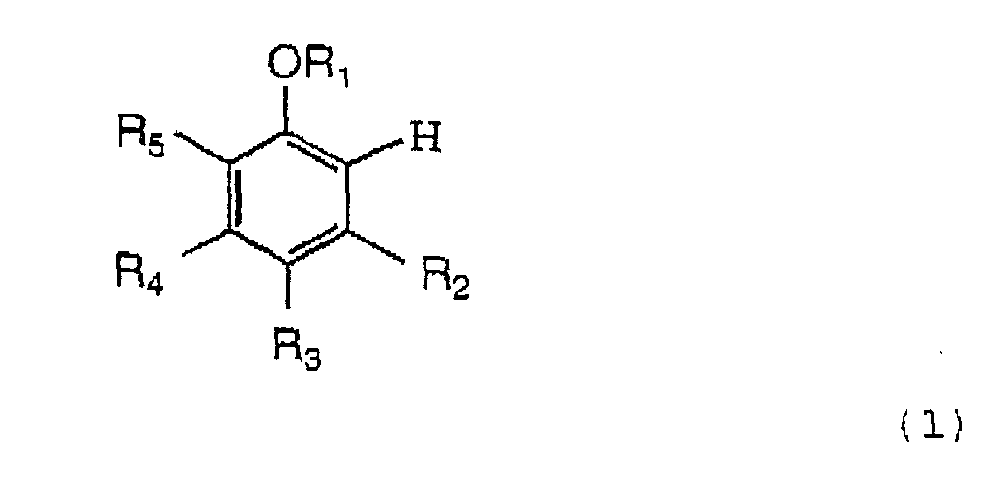
- Further, the present invention relates to [II] the method according to [I], wherein the method comprises reacting phenols represented by the general formula (1) with monohydric or dihydric alcohol in the presence of germanium oxide and carbon dioxide under conditions in which a mixture of said alcohol and carbon dioxide is in the supercritical condition.
- The present invention will be illustrated in detail below.
- As the linear or branched alkyl group having 1 to 10 carbon atoms represented by R1, R2, R3, R4 and R5 in phenols of the general formula (1) used as a starting raw material in the present invention, a methyl group, ethyl group, n-propylgroup, isopropyl group, n-butyl group, isobutyl group, t-butyl group and the like are listed, and as specific examples of phenols of the general formula (1), phenol, o-cresol, m-cresol, p-cresol, 2,3-xylenol, 2,4-xylenol, 2,5-xylenol, 3,4-xylenol, 3,5-xylenol, anisole, t-butylphenol and the like are listed.
- In the present invention, the alcohol which is another starting raw material is not particularly restricted providing it is monohydric or dihydric alcohol, and it is preferably monohydric alcohol of the general formula (2):
- As the monohydricalcohol of the general formula (2), methanol, ethanol, n-propanol, isopropanol, n-butanol, isobutanol, t-butanol, pentanol, hexanol, heptanol, n-octanol, n-nonanol, n-decanol and the like are specifically listed, and because of high selectivity, methanol, ethanol, n-propanol and n-butanol are preferable, methanol and ethanol are more preferable, methanol is further preferable.
- As the dihydric alcohol, ethylene glycol, propylene glycol and the like are listed.
- In the present invention, the molar ratio of monohydric or dihydric alcohol to phenols of the general formula (1) is appropriately determined depending on compounds used, and generally from 1 to 1000, and ratios from 1 to 200 are preferably used.
- Substances have inherent three conditions, gas, liquid and solid, and further, at the critical temperature or more and critical pressure or more, a fluid phase exists which is not condensed even if it is pressed. This condition is called the supercritical condition.
- When a substance is chemically reacted in fluid under the supercritical condition, this substance may manifest higher reactivity than in fluid under gas phase condition and in fluid under liquid phase condition, the reason for this being not apparent, and being guessed that the fluid under the supercritical condition presumably has high density and high diffusion property.
- Further, under the supercritical condition, the size of a reaction apparatus can be decreased as compared with the gas phase reaction since the supercritical condition has a density near liquid phase.
- In the present invention, the upper limit of the reaction temperature is not restricted, and preferably 450°C or less so that phenols of the general formula (1) are not decomposed. The upper limit of the reaction pressure also is not restrictive, and preferably 25 MPa or less since it is expensive to increase pressure resistance of a reaction apparatus.
- In the production method [I] of the present invention, a reaction is conducted under conditions in which monohydric or dihydric alcohol is in the supercritical condition in the presence of germanium oxide. When methanol is used as this alcohol, the reaction is conducted under conditions of 240°C ormore and 8 MPa or more since methanol has a critical temperature of 240°C and a critical pressure of 8 MPa. When ethanol is used, the reaction is conducted under conditions of 243°C or more and 6.3 MPa or more since ethanol has a critical temperature of 243°C and a critical pressure of 6.3 MPa. When n-propanol is used, the reaction is conducted under conditions of 264°C or more and 5 MPa or more since n-propanol has a critical temperature of 264°C and a critical pressure of 5 MPa. When isopropanol is used, the reaction is conducted under conditions of 235°C or more and 4.8 MPa or more since isopropanol has a critical temperature of 235°C and a critical pressure of 4.8 MPa. When n-butanol is used, the reaction is conducted under conditions of 287°C or more and 4.8 MPa or more since n-butanol has a critical temperature of 287°C and a critical pressure of 4.8 MPa.
- Next, the production method [II] of the present invention will be illustrated.
- In the production method [II] of the present invention, a reaction is conducted in the presence of germanium oxide and carbon dioxide under conditions in which a mixture of monohydric or dihydric alcohol and carbon dioxide is in the supercritical condition.
- The mixing ratio of the above-mentioned alcohol to carbon dioxide is not particularly restricted, and determined in view of the solubility of phenols of the general formula (1) used in the reaction into the above-mentioned alcohol. The mixing ratio of the above-mentioned alcohol to carbon dioxide is preferably from 10:90 to 99:1.
- A case in which methanol is used as the above-mentioned alcohol and phenol is used as the phenols of the general formula (1) will be specifically illustrated. For example, in the case of a mixture having a molar ratio of methanol to carbon dioxide of 75:25, this mixture has a critical temperature of 204°C and a critical pressure of 12.75 MPa according to J. Chem. Thermodynamics, vol. 23, p. 970 (1991).
- When ortho-methylation of phenols is conducted under temperature and pressure conditions in which a mixture of methanol and carbon dioxide is in the supercritical condition, temperature and pressure conditions are necessary under which the mixture is in the supercritical condition. For example, in the case of the above-mentioned mixture having a molar ratio of methanol to carbon dioxide of 75:25, it is necessary to conduct the reaction at a temperature of 204°C or more and a pressure of 12.75 MPa or more, and the reaction is preferably conducted at a temperature of 240°C or more and a pressure of 12.75 MPa or more.
- The reaction times in the production method [I] of the present invention and the production method [II] of the present invention are appropriately determined depending on the kinds of the phenols and the alcohol, respectively, and the like, and usually in the range from 1 minute to 24 hours.
- In the respective production methods of the present invention, it is preferable to effect a batch system reaction of phenols with monohydric or dihydric alcohol using as germanium oxide as a catalyst, and by adopting such a reaction embodiment, by-production of components having higher boiling points composed of dimers of phenols and derivatives thereof as main components is suppressed, and selectivity of ortho-alkylated phenols increases.
- Further, the amount of germanium oxide added as a catalyst maybe small, and the amount of germanium oxide added is preferably from 0.05 to 50% by weight, more preferably from 0.1 to 30% by weight, further preferably from 0.5 to 10% by weight based on phenols of the general formula (1).
- In any of the production method [I] and the production method [II] of the present invention, it may be conducted by a batch system or by a flow system, and the batch system is preferable.
- In any of the production method [I] and the production method [II] of the present invention, since the reaction mixture after completion of the reaction may sometimes contain unreacted raw materials or by-products or impurities in addition to ortho-alkylated phenols of the general formula (1), the ortho-alkylated phenols of the general formula (1) can be separated and purified to purities required for various uses. The separation and purification methods are not particularly restricted, and methods industrially usually used such as distillation, extraction and the like can be applied.
- According to the production method of the present invention, ortho-alkylated phenols can be produced from phenols of the general formula (1) and monohydric or dihydric alcohol, using a relatively small reaction vessel, at high selectivity under conditions in which by-production of components having higher boiling points such as dimers of phenols and derivatives thereof and the like is small. The production methods of the present. invention have also characteristics that a reaction is possible even if the amount of a catalyst is small, and that by-production of components having higher boiling points is small particularly in the batch system.
- According to the method of the present invention, ortho-alkylated phenols can be produced from phenols and alcohol using a relatively small reaction vessel with high selectivity under conditions in which by-production of components having higher boiling points such as dimers of phenols and derivatives thereof, even if the reaction is conducted by batch system, therefore, the method of the present invention is industrially useful.
- The following examples illustrate the present invention further in detail, but do not limit the scope of the present invention.
- Reaction materials and products in examples were identified by using a gas chromatography mass selective detector, HP-6890 (GC: manufactured by Yokogawa Electric Corp.)-HP5973 (MS: manufactured by Yokogawa Electric Corp.), and quantitatively analyzed using a gas chromatography apparatus, GC-353B (manufactured by GL Science) equipped with FID (flow ionization detector). Conversions and selectivities in examples were calculated by the following methods. The conversion was calculated using the formula: (conversion) (%)={1-(area of chromatograph of reaction substrate remaining unreacted in reaction liquid)/(sum of areas of chromatograph of remaining reaction substrate and all reaction products) }×100. Further, selectivity was calculated, hypothesizing areas of gas chromatograph per mol of reaction products are the same, using the formula: (selectivity) (%) = {(area of gas chromatograph of reaction product to be calculated)/(sum of areas of gas chromatograph of all reaction products))×100.
- 0.460 g of phenol (manufactured by Wako Pure Chemical Industries Ltd.), 1.451g of methanol (manufactured by Wako Pure Chemical Industries Ltd.) and 0.030 g of germanium oxide (GeO2, manufactured by Kojundo Kagaku K.K.) were charged in an autoclave (made of SUS316, inner volume 4.5 ml, no pressure gauge) , the mixture was heated up to 400°C in a sand bath to initiate the reaction. 30 minutes after, the autoclave was quenched, and the temperature was returned to room temperature (ca. 25°C), then, the reaction liquid was removed out of the autoclave. Namely, the reaction was conducted by batch system. Quantification was conducted by the above-mentioned method to find that the conversion of phenol was 44 mol%, the selectivity of o-cresol was 71 mol%, the selectivity of 2,6-xylenol was 25 mol%, the selectivity of anisole was 1 mol%, and the production amount of components having higher boiling points composed of dimers of phenol of the following chemical formula (5) and derivative thereof as main components was as small as 3 mol% in total. p-cresol,2,4-xylenol and 2,4,6-trimethylphenol were not produced. Components were separated from the reaction liquid by using liquid chromatography (elution liquid; water and methanol) , and o-cresol and 2,6-xylenol were separated out from them. The separated liquid was analyzed by using a gas chromatography mass selective detector, to confirm that o-cresol and 2,6-xylenol were separated from the products. Since this autoclave was not equipped with a pressure gauge, the following experiment was conducted to estimate the pressure during the reaction. Namely, a pressure gauge was installed to the same autoclave, phenol and methanol in the same amounts were charged, and the mixture was heated up to 400°C in a sand bath, and the pressure was measured. The estimated pressure during the reaction was 15.4 MPa.
- A higher boiling point component of the formula:wherein, each of m and n independently represents an integer from 0 to 4.

- 0.403 g of phenol, 1.405 g of methanol and 0.031 g of zirconium oxide (ZrO2, manufactured by Kojundo Kagaku K.K.) were charged in an autoclave (made of SUS316, inner volume 4.5 ml, no pressure gauge), the mixture was heated up to 400°C in a sand bath to initiate the reaction. 30 minutes after, the autoclave was quenched, and the temperature was returned to room temperature, then, the reaction liquid was removed out of the autoclave. Quantification was conducted by the above-mentioned method to find that the conversion of phenol was 3 mol%, the selectivity of o-cresol was 49 mol%, the selectivity of p-cresol was 2 mol%, the selectivity of anisole was 13 mol%, and the production amount of components having higher boiling points composed of dimers of phenol of the above-described chemical formula (5) and derivative thereof as main components was 32 mol% in total. 2,4-xylenol, 2,6-xylenol and 2,4,6-trimethylphenol were not produced. Pressure was measured in the same manner as in Example 1 except that phenol and methanol were charged in the same amounts as described above into the same autoclave, and the pressure during the reaction was estimated. The estimated pressure during the reaction was 15.0 MPa.
- 0.411 g of phenol, 1.363 g of methanol and 0.031 g of titanium oxide (TiO2, manufactured by Kojundo Kagaku K.K.) were charged in an autoclave (made of SUS316, inner volume 4.5 ml, no pressure gauge), the mixture was heated up to 400°C in a sand bath to initiate the reaction. 30 minutes after, the autoclave was quenched, and the temperature was returned to room temperature, then, the reaction liquid was removed out of the autoclave. Quantification was conducted by the above-mentioned method to find that the conversion of phenol was 24 mol%, the selectivity of o-cresol was 4.3 mol%, the selectivity of 2,6-xylenol was 2 mol%, the selectivity of p-cresol was 2 mol%, the selectivity of 2,4-xylenol was 1mol%, the selectivity of anisole was 9 mol%, and the production amount of components having higher boiling points composed of dimers of phenol of the above-described chemical formula (5) and derivative thereof as main components was 42 mol% in total. 2,4,6-trimethylphenol was not produced, Pressure was measured in the same manner as in Example 1 except that phenol and methanol were charged in the same amounts as described above into the same autoclave, and the pressure during the reaction was estimated. The estimated pressure during the reaction was 14.7 MPa.
- 0.407 g of phenol, 1.353 g of methanol and 0.031 g of niobium oxide (Nb2O5, manufactured by Wako Pure Chemical Industries Ltd.) were charged in an autoclave (made of SUS316, inner volume 4.5 ml, no pressure gauge), the mixture was heated up to 400°C in a sand bath to initiate the reaction. 30 minutes after, the autoclave was quenched, and the temperature was returned to room temperature, then, the reaction liquid was removed out of the autoclave. Quantification was conducted by the above-mentioned method to find that the conversion of phenol was 8 mol%, the selectivity of o-cresol was 16 mol%, the selectivity of p-cresol was 2 mol%, the selectivity of anisole was 22 mol%, and the production amount of components having higher boiling points composed of dimers of phenol of the above-described chemical formula (5) and derivative thereof as main components was 53 mol% in total. 2,4-xylenol, 2,6-xylenol and 2,4,6-trimethylphenol were notproduced. Pressure was measured in the same manner as in Example 1 except that phenol and methanol were charged in the same amounts as described above into the same autoclave, and the pressure during the reaction was estimated. The estimated pressure during the reaction was 14.7 MPa.
- 0.408 g of phenol, 1.353 g of methanol and 0.032 g of chromium oxide (Cr2O3, manufactured by Wako Pure Chemical Industries Ltd.) were charged in an autoclave (made of SUS316, inner volume 4.5 ml, no pressure gauge), the mixture was heated up to 400°C in a sand bath to initiate the reaction. 30 minutes after, the autoclave was quenched, and the temperature was returned to room temperature, then, the reaction liquid was removed out of the autoclave. Quantification was conducted by the above-mentioned method to find that the conversion of phenol was 5 mol%, the selectivity of o-cresol was 16 mol%, the selectivity of p-cresol was 1 mol%, the selectivity of anisole was 6 mol%, and the production amount of components having higher boiling points composed of dimers of phenol of the above-described chemical formula (5) and derivative thereof as main components was 71 mol% in total. 2,4-xylenol, 2,6-xylenol and 2,4,6-trimethylphenol were not produced. Pressure was measured in the same manner as in Example 1 except that phenol and methanol were charged in the same amounts as described above into the same autoclave, and the pressure during the reaction was estimated. The estimated pressure during the reaction was 14.7 MPa.
- 0.410 g of phenol, 1.355 g of methanol and 0.031 g of molybdenum oxide (MoO3, manufactured by Wako Pure Chemical Industries Ltd.) were charged in an autoclave (made of SUS316, inner volume 4.5 ml, no pressure gauge), the mixture was heated up to 400°C in a sand bath to initiate the reaction. 30 minutes after, the autoclave was quenched, and the temperature was returned to room temperature, then, the reaction liquid was removed out of the autoclave. Quantification was conducted by the above-mentioned method to find that the conversion of phenol was 97 mol%, the selectivity of o-cresol was 22 mol%, the selectivity of 2,6-xylenol was 39 mol%, the selectivity of 2,4-xylenol was 3 mol%, the selectivity of anisole was 2 mol%, the selectivity of 2,4,6-trimethylphenol was 9 mol% and the production amount of components having higher boiling points composed of dimers of phenol of the above-described chemical formula (5) and derivative thereof as main components was 19 mol% in total. p-cresol was not produced. Pressure was measured in the same manner as in Example 1 except that phenol and methanol were charged in the same amounts as described above into the same autoclave, and the pressure during the reaction was estimated. The estimated pressure during the reaction was 14.7 MPa.
- 0.410 g of phenol, 1.363 g of methanol and 0.031 g of tungsten oxide (WO3, manufactured by Wako Pure Chemical Industries Ltd.) were charged in an autoclave (made of SUS316, inner volume 4.5 ml, no pressure gauge), the mixture was heated up to 400°C in a sand bath to initiate the reaction, 30 minutes after, the autoclave was quenched, and the temperature was returned to room temperature, then, the reaction liquid was removed out of the autoclave. Quantification was conducted by the above-mentioned method to find that the conversion of phenol was 21 mol%, the selectivity of o-cresol was 16 mol%, the selectivity of 2,6-xylenol was 1 mol%, the selectivity of p-cresol was 4 mol%, the selectivity of 2,4-xylenol was 1 mol%, the selectivity of anisole was 21 mol% and the production amount of components having higher boiling points composed of dimers of phenol of the above-described chemical formula (5) and derivative thereof as main components was 51 mol% in total. 2,4,6-trimethylphenol was not produced. Pressure was measured in the same manner as in Example 1 except that phenol and methanol were charged in the same amounts as described above into the same autoclave, and the pressure during the reaction was estimated. The estimated pressure during the reaction was 14.7 MPa.
- 0.405 g of phenol, 1.358 g of methanol and 0.031 g of manganese oxide (MnO2, manufactured by Kojundo Kagaku K.K.) were charged in an autoclave (made of SUS316, inner volume 4.5 ml, no pressure gauge), the mixture was heated up to 400°C in a sand bath to initiate the reaction. 30 minutes after, the autoclave was quenched, and the temperature was returned to room temperature, then, the reaction liquid was removed out of the autoclave. Quantification was conducted by the above-mentioned method to find that the conversion of phenol was 19 mol%, the selectivity of o-cresol was 39 mol%, the selectivity of 2,6-xylenol was 1 mol%, the selectivity of p-cresol was 1 mol%, the selectivity of 2,4-xylenol was 1 mol%, the selectivity of anisole was 2 mol% and the production amount of components having higher boiling points composed of dimers of phenol of the above-described chemical formula (5) and derivative thereof as main components was 54 mol% in total. 2,4,6-trimethylphenol was not produced. Pressure was measured in the same manner as in Example 1 except that phenol and methanol were charged in the same amounts as described above into the same autoclave, and the pressure during the reaction was estimated. The estimated pressure during the reaction was 14.7 MPa.
- 0.401 g of phenol, 1.354 g of methanol and 0.031 g of iron oxide (Fe2O3, manufactured by Kojundo Kagaku K.K.) were charged in an autoclave (made of SUS316, inner volume 4.5 ml, no pressure gauge), the mixture was heated up to 400°C in a sand bath to initiate the reaction. 30 minutes after, the autoclave was quenched, and the temperature was returned to room temperature, then, the reaction liquid was removed out of the autoclave. Quantification was conducted by the above-mentioned method to find that the conversion of phenol was 21 mol%, the selectivity of o-cresol was 70 mol%, the selectivity of 2,6-xylenol was 4 mol%, the selectivity of anisole was 1 mol% and the production amount of components having higher boiling points composed of dimers of phenol of the above-described chemical formula (5) and derivative thereof as main components was 24 mol% in total. p-cresol, 2,4-xylenol and 2,4,6-trimethylphenol were not produced. Pressure was measured in the same manner as in Example 1 except that phenol and methanol were charged in the same amounts as described above into the same autoclave, and the pressure during the reaction was estimated. The estimated pressure during the reaction was 14.7 MPa.
- 0.413 g of phenol, 1.364 g of methanol and 0.032 g of cobalt oxide (CoO, manufactured by Wako Pure Chemical Industries Ltd.) were charged in an autoclave (made of SUS316, inner volume 4.5 ml, no pressure gauge), the mixture was heated up to 400°C in a sand bath to initiate the reaction. 30 minutes after, the autoclave was quenched, and the temperature was returned to room temperature, then, the reaction liquid was removed out of the autoclave. Quantification was conducted by the above-mentioned method to find that the conversion of phenol was 48 mol%, the selectivity of o-cresol was 31 mol%, the selectivity of 2,6-xylenol was 2 mol%, the selectivity of p-cresol was 1 mol% and the production amount of components having higher boiling points composed of dimers of phenol of the above-described chemical formula (5) and derivative thereof as main components was 6 mol% in total. 2,4-xylenol, anisole and 2,4,6-trimethylphenol were not produced. In this reaction, hydrogenation of an aromatic ring progressed, and consequently, cyclohexanol was produced in a selectivity of 15 mol% and cyclohexanone was produced in a selectivity of 38 mol%. Pressure was measured in the same manner as in Example 1 except that phenol and methanol were charged in the same amounts as described above into the same autoclave, and the pressure during the reaction was estimated. The estimated pressure during the reaction was 14.7 MPa.
- 0.415 g of phenol, 1.359 g of methanol and 0.031 g of zinc oxide (ZnO, manufactured by Wako Pure Chemical Industries Ltd.) were charged in an autoclave (made of SUS316, inner volume 4.5 ml, no pressure gauge), the mixture was heated up to 400°C in a sand bath to initiate the reaction. 30 minutes after, the autoclave was quenched, and the temperature was returned to room temperature, then, the reaction liquid was removed out of the autoclave. Quantification was conducted by the above-mentioned method to find that the conversion of phenol was 5 mol%, the selectivity of o-cresol was 27 mol%, the selectivity of p-cresol was 2 mol%, the selectivity of anisole was 5 mol% and the production amount of components having higher boiling points composed of dimers of phenol of the above-described chemical formula (5) and derivative thereof as main components was 63 mol% in total. 2,4-xylenol, 2,6-xylenol and 2,4,6-trimethylphenol were not produced. Pressure was measured in the same manner as in Example 1 except that phenol and methanol were charged in the same amounts as described above into the same autoclave, and the pressure during the reaction was estimated. The estimated pressure during the reaction was 14.7 MPa.
- 0.414 g of phenol, 1.360 g of methanol and 0.031 g of aluminum oxide (Al2O3, manuf actured by Wako Pure Chemical Industries Ltd.) were charged in an autoclave (made of SUS316, inner volume 4.5 ml, no pressure gauge), the mixture was heated up to 400°C in a sand bath to initiate the reaction. 30 minutes after, the autoclave was quenched, and the temperature was returned to room temperature, then, the reaction liquid was removed out of the autoclave. Quantification was conducted by the above-mentioned method to find that the conversion of phenol was 19 mol%, the selectivity of o-cresol was 17 mol%, the selectivity of p-cresol was 1 mol%, the selectivity of anisole was 51 mol% and the production amount of components having higher boiling points composed of dimers of phenol of the above-described chemical formula (5) and derivative thereof as main components was 28 mol% in total. 2,4-xylenol, 2,6-xylenol and 2,4,6-trimethylphenol were not produced. Pressure was measured in the same manner as in Example 1 except that phenol and methanol were charged in the same amounts as described above into the same autoclave, and the pressure during the reaction was estimated. The estimated pressure during the reaction was 14.7 MPa.
- 0.415 g of phenol, 1.356 g of methanol and 0.031 g of indium oxide (In2O3, manufactured by Kojundo Kagaku K.K.) were charged in an autoclave (made of SUS316, inner volume 4.5 ml, no pressure gauge), the mixture was heated up to 400°C in a sand bath to initiate the reaction. 30 minutes after, the autoclave was quenched, and the temperature was returned to room temperature, then, the reaction liquid was removed out of the autoclave. Quantification was conducted by the above-mentioned method to find that the conversion of phenol was 23 mol%, the selectivity of o-cresol was 52 mol%, the selectivity of 2,6-xylenol was 2 mol%, the selectivity of p-cresol was 1 mol%, the selectivity of anisole was 3 mol% and the production amount of components having higher boiling points composed of dimers of phenol of the above-described chemical formula (5) and derivative thereof as main components was 40 mol% in total. 2,4-xylenol and 2,4,6-trimethylphenol ware not produced. Pressure was measured in the same manner as in Example 1 except that phenol and methanol were charged in the same amounts as described above into the same autoclave, and the pressure during the reaction was estimated. The estimated pressure during the reaction was 14.7 MPa.
- 0.402 g of phenol (manufactured by Wako Pure Chemical Industries Ltd.), 1.353 g of methanol (manufactured by Wako Pure Chemical Industries Ltd.) and 0.031 g of silicon oxide (SiO2, manufactured by Nitto Kagaku K.K.) were charged in an autoclave (made of SUS316, inner volume 4.5 ml, no pressure gauge), the mixture was heated up to 400°C in a sand bath to initiate the reaction. 30 minutes after, the autoclave was quenched, and the temperature was returned to room temperature, then, the reaction liquid was removed out of the autoclave. Quantification was conducted by the above-mentioned method to find that the conversion of phenol was 17 mol%, the selectivity of o-cresol was 14 mol%, the selectivity of p-cresol was 1 mol%, the selectivity of anisole was 2 mol% and the production amount of components having higher boiling points composed of dimers of phenol of the above-described chemical formula (5) and derivative thereof as main components was 81 mol% in total, 2,4-xylenol, 2,6-xylenol and 2,4,6-trimethylphenol were not produced. Pressure was measured in the same manner as in Example 1 except that phenol and methanol were charged in the same amounts as described above into the same autoclave, and the pressure during the reaction was estimated. The estimated pressure during the reaction was 14.7 MPa.
- 0.389 g of phenol, 1.372 g of methanol and 0.029 g of tin oxide (SnO2, manufactured by Wako Pure Chemical Industries Ltd.) were charged in an autoclave (made of SUS316, inner volume 4.5 ml, no pressure gauge), the mixture was heated up to 400°C in a sand bath to initiate the reaction. 30 minutes after, the autoclave was quenched, and the temperature was returned to room temperature, then, the reaction liquid was removed out of the autoclave. Quantification was conducted by the above-mentioned method to find that the conversion of phenol was 24 mol%, the selectivity of o-cresol was 25 mol%, the selectivity of 2,6-xylenol was 1 mol%, the selectivity of p-cresol was 1 mol%, the selectivity of anisole was 1 mol% and the production amount of components having higher boiling points composed of dimers of phenol of the above-described chemical formula (5) and derivative thereof as main components was 71 mol% in total. 2,4-xylenol and 2,4,6-trimethylphenol were not produced. Pressure was measured in the same manner as in Example 1 except that phenol and methanol were charged in the same amounts as described above into the same autoclave, and the pressure during the reaction was estimated. The estimated pressure during the reaction was 14.7 MPa.
- 0.408 g of phenol, 1.354 g of methanol and 0.031 g of magnesium oxide (MgO, manufactured by Kojundo Kagaku K.K.) were charged in an autoclave (made of SUS316, inner volume 4.5 ml, no pressure gauge), the mixture was heated up to 400°C in a sand bath to initiate the reaction. 30 minutes after, the autoclave was quenched, and the temperature was returned to room temperature, then, the reaction liquid was removed out of the autoclave. Quantification was conducted by the above-mentioned method to find that the conversion of phenol was 3 mol%, the selectivity of o-cresol was 23 mol%, the selectivity of p-cresol was 2 mol%, the selectivity of anisole was 29 mol% and the production amount of components having higher boiling points composed of dimers of phenol of the above-described chemical formula (5) and derivative thereof as main components was 36 mol% in total. 2,4-xylenol, 2,6-xyle-ol and 2,4,6-trimethylphenol were not produced. Pressure was measured in the same manner as in Example 1 except that phenol and methanol were charged in the same amounts as described above into the same autoclave, and the pressure during the reaction was estimated. The estimated pressure during the reaction was 14.7 MPa.
- 0.407 g of phenol, 1.357 g of methanol and 0.031 g of calcium oxide (CaO, manufactured by Wako Pure Chemical Industries Ltd.) were charged in an autoclave (made of SUS316, inner volume 4.5 ml, no pressure gauge) , the mixture was heated up to 400°C in a sand bath to initiate the reaction. 30 minutes after, the autoclave was quenched, and the temperature was returned to room temperature, then, the reaction liquid was removed out of the autoclave. Quantification was conducted by the above-mentioned method to find that the conversion of phenol was 10 mol%, the selectivity of o-cresol was 45 mol%, the selectivity of 2,6-xylenol was 1 mol%, the selectivity of p-cresol was 11 mol%, the selectivity of 2,4-xylenol was 1 mol%, the selectivity of anisole was 8 mol% and the production amount of components having higher boiling points composed of dimers of phenol of the above-described chemical formula (5) and derivative thereof as main components was 32 mol% in total. Pressure was measured in the same manner as in Example 1 except that phenol and methanol were charged in the same amounts as described above into the same autoclave, and the pressure during the reaction was estimated. The estimated pressure during the reaction was 14.7 MPa.
- 0.406 g of phenol, 1.353 g of methanol and 0.031 g of strontium oxide (SrO, manufactured by Kojundo Kagaku K.K.) were charged in an autoclave (made of SUS316, inner volume 4.5 ml, no pressure gauge) , the mixture was heated up to 400°C in a sand bath to initiate the reaction. 30 minutes after, the autoclave was quenched, and the temperature was returned to room temperature, then, the reaction liquid was removed out of the autoclave. Quantification was conducted by the above-mentioned method to find that the conversion of phenol was 61 mol%, the selectivity of o-cresol was 43 mol%, the selectivity of 2,6-xylenol was 6 mol%, the selectivity of p-cresol was 13 mol%, the selectivity of 2,4-xylenol was 8 mol%, the selectivity of anisole was 13 mol%, the selectivity of 2,4,6-trimethylphenol was 1 mol%, and the production amount of components having higher boiling points composed of dimers of phenol of the above-described chemical formula (5) and derivative thereof as main components was 13 mol% in total. Pressure was measured in the same manner as in Example 1 except that phenol and methanol were charged in the same amounts as described above into the same autoclave, and the pressure during the reaction was estimated. The estimated pressure during the reaction was 14.7 MPa.
- 0.411 g of phenol, 1.361 g of methanol and 0.030 g of barium oxide (BaO, manufactured by Kojundo Kagaku K.K.) were charged in an autoclave (made of SUS316, inner volume 4.5 ml, no pressure gauge), the mixture was heated up to 400°C in a sand bath to initiate the reaction. 30 minutes after, the autoclave was quenched, and the temperature was returned to room temperature, then, the reaction liquid was removed out of the autoclave. Quantification was conducted by the above-mentioned method to find that the conversion of phenol was 38 mol%, the selectivity of o-cresol was 24 mol%, the selectivity of 2,6-xylenol was 1 mol%, the selectivity of p-cresol was 16 mol%, the selectivity of 2,4-xylenol was 3 mol%, the selectivity of anisole was 8 mol% and the production amount of components having higher boiling points composed of dimers of phenol of the above-described chemical formula (5) and derivative thereof as main components was 46 mol% in total. 2,4,6-trimethylphenol was not produced. Pressure was measured in the same manner as in Example 1 except that phenol and methanol were charged in the same amounts as described above into the same autoclave, and the pressure during the reaction was estimated. The estimated pressure during the reaction was 14.7 MPa.
- 0.401 g of phenol, 1.355 g of methanol and 0.030 g of yttrium oxide (Y2O5, manufactured by Wako Pure Chemical Industries Ltd.) were charged in an autoclave (made of SUS316, inner volume 4.5 ml, no pressure gauge), the mixture was heated up to 400°C in a sand bath to initiate the reaction. 30 minutes after, the autoclave was quenched, and the temperature was returned to room temperature, then, the reaction liquid was removed out of the autoclave. Quantification was conducted by the above-mentioned method to find that the conversion of phenol was 2 mol%, the selectivity of o-cresol was 17 mol%, the selectivity of p-cresol was 1 mol%, the selectivity of anisole was 10 mol% and the production amount of components having higher boiling points composed of dimers of phenol of the above-described chemical formula (5) and derivative thereof as main components was 66 mol% in total. 2,4-xylenol, 2,6-xylenol and 2,4,6-trimethylphenol were not produced. Pressure was measured in the same manner as in Example 1 except that phenol and methanol were charged in the same amounts as described above into the same autoclave, and the pressure during the reaction was estimated. The estimated pressure during the reaction was 14.7 MPa.
- 0.419 g of phenol, 1.357 g of methanol and 0.030 g of lanthanum oxide (La2O3, manufactured by Wako Pure Chemical Industries Ltd.) were charged in an autoclave (made of SUS316, inner volume 4.5 ml, no pressure gauge), the mixture was heated up to 400°C in a sand bath to initiate the reaction. 30 minutes after, the autoclave was quenched, and the temperature was returned to room temperature, then, the reaction liquid was removed out of the autoclave. Quantification was conducted by the above-mentioned method to find that the conversion of phenol was 4 mol%, the selectivity of o-cresol was 26 mol%, the selectivity of p-cresol was 2 mol%, the selectivity of anisole was 9 mol% and the production amount of components having higher boiling points composed of dimers of phenol of the above-described chemical formula (5) and derivative thereof as main components was 59 mol% in total. 2,4-xylenol, 2,6-xylenol and 2,4,6-trimethylphenol were not produced. Pressure was measured in the same manner as in Example 1 except that phenol and methanol were charged in the same amounts as described above into the same autoclave, and the pressure during the reaction was estimated. The estimated pressure during the reaction was 14.7 MPa.
- 0.401 g of phenol, 1.357 g of methanol and 0.030 g of nickel oxide (NiO, manufactured by Hanni Kagaku K.K.) were charged in an autoclave (made of SUS316, inner volume 4.5 ml, no pressure gauge), the mixture was heated up to 400°C in a sand bath to initiate the reaction. 30 minutes after, the autoclave was quenched, and the temperature was returned to room temperature, then, the reaction liquid was removed out of the autoclave, Quantification was conducted by the above-mentioned method to find that the conversion of phenol was 9 mol%, the selectivity of o-cresol was 27 mol%, the selectivity of p-cresol was 1 mol%, the selectivity of anisole was 4 mol% and the production amount of components having higher boiling points composed of dimers of phenol of the above-described chemical formula (5) and derivative thereof as main components was 63 mol% in total. 2,4-xylenol, 2,6-xylenol and 2,4,6-trimethylphenol were not produced. Pressure was measured in the same manner as in Example l'except that phenol and methanol were charged in the same amounts as described above into the same autoclave, and the pressure during the reaction was estimated. The estimated pressure during the reaction was 14.7 MPa.
- 0.400 g of phenol, 1.352 g of methanol and 0.031 g of samarium oxide (Sm2O3, manufactured by Kojundo Kagaku K.K.) were charged in an autoclave (made of SUS316, inner volume 4.5 ml, no pressure gauge), the mixture was heated up to 400°C in a sand bath to initiate the reaction. 30 minutes after, the autoclave was quenched, and the temperature was returned to room temperature, then, the reaction liquid was removed out of the autoclave. Quantification was conducted by the above-mentioned method to find that the conversion of phenol was 6 mol%, the selectivity of o-cresol was 17 mol%, the selectivity of p-cresol was 2 mol%, the selectivity of anisole was 5 mol% and the production amount of components having higher boiling points composed of dimers of phenol of the above-described chemical formula (5) and derivative thereof as main components was 73 mol% in total. 2,4-xylenol, 2,6-xylenol and 2,4,6-trimethylphenol were not produced. Pressure was measured in the same manner as in Example 1 except that phenol and methanol were charged in the same amounts as described above into the same autoclave, and the pressure during the reaction was estimated. The estimated pressure during the reaction was 14.7 MPa.
- 0.404 g of phenol, 1.359 g of methanol and 0.031 g of tantalum oxide (Ta2O3, manufactured by Wako Pure Chemical Industries Ltd.) were charged in an autoclave (made of SUS316, inner volume 4.5 ml, no pressure gauge), the mixture was heated up to 400°C in a sand bath to initiate the reaction. 30 minutes after, the autoclave was quenched, and the temperature was returned to room temperature, then, the reaction liquid was removed out of the autoclave. Quantification was conducted by the above-mentioned method to find that the conversion of phenol was 5 mol%, the selectivity of o-cresol was 20 mol%, the selectivity of p-cresol was 1 mol%, the selectivity of anisole was 20 mol% and the production amount of components having higher boiling points composed of dimers of phenol of the above-described chemical formula (5) and derivative thereof as main components was 53 mol% in total. 2,4-xylenol, 2,6-xylenol and 2,4,6-trimethylphenol were not produced. Pressure was measured in the same manner as in Example 1 except that phenol and methanol were charged in the same amounts as described above into the same autoclave, and the pressure during the reaction was estimated. The estimated pressure during the reaction was 14.7 MPa.
- 0.406 g of phenol, 1.441 g of methanol and 0.030 g of copper oxide (CuO, manufactured by Kojundo Kagaku K.K.) were charged in an autoclave (made of SUS316, inner volume 4.5 ml, no pressure gauge), the mixture was heated up to 400°C in a sand bath to initiate the reaction. 30 minutes after, the autoclave was quenched, and the temperature was returned to room temperature, then, the reaction liquid was removed out of the autoclave. Quantification was conducted by the above-mentioned method to find that the conversion of phenol was 43 mol%, the selectivity of o-cresol was 32 mol%, the selectivity of 2,6-xylenol was 3 mol%, the selectivity of p-cresol was 2 mol%, the selectivity of 2,4-xylenol was 1 mol%, the selectivity of anisole was 1 mol% and the production amount of components having higher boiling points composed of dimers of phenol of the above-described chemical formula (5) and derivative thereof as main components was 53 mol% in total, 2,4,6-trimethylphenol was not produced, Pressure was measured in the same manner as in Example 1 except that phenol and methanol were charged in the same amounts as described above into the same autoclave, and the pressure during the reaction was estimated. The estimated pressure during the reaction was 15.3 MPa.
- The results of Example 1 and Comparative Examples 1 to 24 are summarized in the following Table 1.
No. Conversion(% by mole) Selectivity (% by mole) OCL 26Xyl OMP HBP Ex-1 44 71 25 96 3 Com.1 3 49 0 49 32 Com.2 24 43 2 45 42 Com.3 8 16 0 16 53 Com.4 5 16 0 16 71 Com.5 97 22 39 61 19 Com.6 21 16 1 17 51 Com.7 19 39 1 40 54 Com.8 21 70 4 74 24 Com.9 48 31 2 33 6 Com.10 5 27 0 27 63 Com.11 19 17 0 17 28 Com.12 23 52 2 54 40 Com.13 17 14 0 14 81 Com.14 24 25 1 26 71 Com.15 3 23 0 23 36 Com.16 10 45 1 46 32 Com.17 61 43 6 49 13 Com.18 38 24 1 25 46 Com.19 2 17 0 17 66 Com.20 4 26 0 26 59 Com.21 9 27 0 27 63 Com.22 6 17 0 17 73 Com.23 5 20 0 20 53 Com.24 43 32 3 35 53 - OCL:
- o-cresol; 26Xyl: 2,6-Xylenol
- OMP:
- total of all ortho-methylated phenols
- HBP:
- components having higher boiling points composed of dimers of phenol of the above-described chemical formula (5) and derivative
Claims (6)
- A method for producing ortho-alkylated phenols comprising reacting phenols represented by the general formula (1) with monohydric or dihydric alcohol in the presence of germanium oxide under conditions in which said alcohol is in the supercritical condition, wherein each of R1, R2, R3, R4 and R5 independently represents a hydrogen atom, or a linear or branched alkyl group having 1 to 10 carbon atoms.

- The method according to claim 1, wherein the method comprises reacting phenols represented by the general formula (1) with monohydric or dihydric alcohol in the presence of germanium oxide and carbon dioxide under conditions in which a mixture of said alcohol and carbon dioxide is in the supercritical condition.
- The method according to Claim 1 or 2, wherein the alcohol is a monohydric alcohol.
- The method according to Claim 3, wherein the monohydric alcohol is alcohol represented by the general formula (2), wherein, R6 represents a linear or branched alkyl group having 1 to 10 carbon atoms.
- The method according to Claim 4, wherein R6 in the general formula (2) is a methyl group.
- The method according to any one of Claims 1 to 5, wherein the germanium oxide is added in the amount of from 0.1 to 30% by weight based on the phenols of the general formula (1).
Applications Claiming Priority (4)
| Application Number | Priority Date | Filing Date | Title |
|---|---|---|---|
| JP2000119398 | 2000-04-20 | ||
| JP2000119398 | 2000-04-20 | ||
| JP2000218858 | 2000-07-19 | ||
| JP2000218858 | 2000-07-19 |
Publications (2)
| Publication Number | Publication Date |
|---|---|
| EP1148040A1 true EP1148040A1 (en) | 2001-10-24 |
| EP1148040B1 EP1148040B1 (en) | 2005-01-05 |
Family
ID=26590465
Family Applications (1)
| Application Number | Title | Priority Date | Filing Date |
|---|---|---|---|
| EP01109381A Expired - Lifetime EP1148040B1 (en) | 2000-04-20 | 2001-04-18 | Method for producing ortho-alkylated phenols |
Country Status (4)
| Country | Link |
|---|---|
| US (1) | US6417410B1 (en) |
| EP (1) | EP1148040B1 (en) |
| DE (1) | DE60108191T2 (en) |
| SG (1) | SG101438A1 (en) |
Families Citing this family (3)
| Publication number | Priority date | Publication date | Assignee | Title |
|---|---|---|---|---|
| CN102076738B (en) * | 2008-07-30 | 2012-08-29 | Sk新技术株式会社 | Novel coordination complex and method for preparing polycarbonate by copolymerization of carbon dioxide and epoxide using the complex as catalyst |
| CN116239450A (en) * | 2022-12-16 | 2023-06-09 | 中触媒新材料股份有限公司 | A kind of method that gas-phase phenol alkylation prepares cresol |
| CN117447309A (en) * | 2023-07-28 | 2024-01-26 | 薪业资源(江苏)科技有限公司 | Preparation of multi-carbon bridged phenolic compounds from phenols and polyol compounds and synthesis method |
Citations (2)
| Publication number | Priority date | Publication date | Assignee | Title |
|---|---|---|---|---|
| EP0419045A1 (en) * | 1989-08-22 | 1991-03-27 | Mitsubishi Gas Chemical Company, Inc. | Method for alkylation of phenols, and catalyst therefor |
| JP2000038363A (en) * | 1998-07-21 | 2000-02-08 | Nippon Shokubai Co Ltd | Method for producing orthoalkylphenol compound |
Family Cites Families (5)
| Publication number | Priority date | Publication date | Assignee | Title |
|---|---|---|---|---|
| US3959394A (en) * | 1972-06-12 | 1976-05-25 | Sumitomo Chemical Company Limited | Process for selective methylation of phenols |
| US4329517A (en) * | 1979-05-16 | 1982-05-11 | Mitsui Petrochemical Industries Ltd. | Process for production of mono- or di-ortho-methyl-substituted phenols by catalytic methylation and catalyst therefor |
| US4406824A (en) * | 1980-03-29 | 1983-09-27 | Union Rheinische Braunkohlen Kraftstoff Ag | Catalysts for the o-substitution of phenols |
| NL187157C (en) * | 1980-03-29 | 1991-06-17 | Union Rheinische Braunkohlen | METHOD FOR PREPARING 2,6-DIG SUBSTITUTED PHENOLS |
| DE3103665C2 (en) * | 1981-02-04 | 1983-10-13 | Union Rheinische Braunkohlen Kraftstoff AG, 5000 Köln | Process for the o-methylation of phenols and a catalyst for carrying out the process |
-
2001
- 2001-04-06 SG SG200102046A patent/SG101438A1/en unknown
- 2001-04-18 EP EP01109381A patent/EP1148040B1/en not_active Expired - Lifetime
- 2001-04-18 DE DE60108191T patent/DE60108191T2/en not_active Expired - Fee Related
- 2001-04-18 US US09/836,216 patent/US6417410B1/en not_active Expired - Fee Related
Patent Citations (2)
| Publication number | Priority date | Publication date | Assignee | Title |
|---|---|---|---|---|
| EP0419045A1 (en) * | 1989-08-22 | 1991-03-27 | Mitsubishi Gas Chemical Company, Inc. | Method for alkylation of phenols, and catalyst therefor |
| JP2000038363A (en) * | 1998-07-21 | 2000-02-08 | Nippon Shokubai Co Ltd | Method for producing orthoalkylphenol compound |
Non-Patent Citations (1)
| Title |
|---|
| DATABASE WPI Section Ch Week 200018, Derwent World Patents Index; Class B05, AN 2000-200707, XP002170171 * |
Also Published As
| Publication number | Publication date |
|---|---|
| US6417410B1 (en) | 2002-07-09 |
| US20020022750A1 (en) | 2002-02-21 |
| EP1148040B1 (en) | 2005-01-05 |
| DE60108191T2 (en) | 2005-12-08 |
| SG101438A1 (en) | 2004-01-30 |
| DE60108191D1 (en) | 2005-02-10 |
Similar Documents
| Publication | Publication Date | Title |
|---|---|---|
| US8853443B2 (en) | Process for preparing an isocyanate | |
| US6518474B1 (en) | Process for producing isobutylene from tertiary butyl alcohol | |
| EP2231571B1 (en) | Process for the continuous production of high purity phenolic glycol ether | |
| US8115043B2 (en) | Method for producing cyclic olefin compound | |
| US4359591A (en) | Process for the o-substitution of phenols | |
| EP1148040B1 (en) | Method for producing ortho-alkylated phenols | |
| US4283574A (en) | Process for the synthesis of 2,6-xylenol and 2,3,6-trimethylphenol | |
| US4590306A (en) | Process for the conversion of meta/para-cresol mixtures | |
| KR101602594B1 (en) | Method for purifying phenol | |
| JP4792652B2 (en) | Process for producing orthoalkylated phenols | |
| EP1108705B1 (en) | Process for alkylation on the aromatic ring of phenols or of ethers of phenols | |
| JP4432228B2 (en) | Method for aromatic alkylation of phenols | |
| EP3544945B1 (en) | Process for preparing (poly)alkylated phenols | |
| CN101903320A (en) | Method for preparing 4,4'-[1-(trifluoromethyl)alkylidene]bis(2,6-diphenylphenol) | |
| EP1041061B1 (en) | Process for producing alkyl-substituted hydroquinones | |
| CA2254847A1 (en) | Process for preparing saturated alcohols | |
| EP1151986B1 (en) | Method for removing tert-butyl groups from tert-butyl phenol compounds | |
| CN101128411B (en) | Method for purifying phenols | |
| EP0868417B1 (en) | Method to prepare ortho substituted phenol | |
| US4236031A (en) | Preparation of 5-t-butyl alkyl-substituted phenols | |
| EP0284424B1 (en) | Process for producing hydroxybenzenes | |
| US4108909A (en) | N-alkylated cresylic acids via direct alkylation in a liquid phase | |
| EP0066325B1 (en) | Process for the preparation of aniline derivatives | |
| EP0622350B1 (en) | Process for producing aromatic hydroxylic compound | |
| US6846962B2 (en) | Selective production of o-alkylphenols |
Legal Events
| Date | Code | Title | Description |
|---|---|---|---|
| PUAI | Public reference made under article 153(3) epc to a published international application that has entered the european phase |
Free format text: ORIGINAL CODE: 0009012 |
|
| AK | Designated contracting states |
Kind code of ref document: A1 Designated state(s): AT BE CH CY DE DK ES FI FR GB GR IE IT LI LU MC NL PT SE TR Kind code of ref document: A1 Designated state(s): DE FR GB IT |
|
| AX | Request for extension of the european patent |
Free format text: AL;LT;LV;MK;RO;SI |
|
| 17P | Request for examination filed |
Effective date: 20020419 |
|
| AKX | Designation fees paid |
Free format text: DE FR GB IT |
|
| 17Q | First examination report despatched |
Effective date: 20030521 |
|
| GRAP | Despatch of communication of intention to grant a patent |
Free format text: ORIGINAL CODE: EPIDOSNIGR1 |
|
| GRAS | Grant fee paid |
Free format text: ORIGINAL CODE: EPIDOSNIGR3 |
|
| GRAA | (expected) grant |
Free format text: ORIGINAL CODE: 0009210 |
|
| RAP1 | Party data changed (applicant data changed or rights of an application transferred) |
Owner name: SUMITOMO CHEMICAL COMPANY, LIMITED |
|
| AK | Designated contracting states |
Kind code of ref document: B1 Designated state(s): DE FR GB IT |
|
| REG | Reference to a national code |
Ref country code: GB Ref legal event code: FG4D |
|
| REF | Corresponds to: |
Ref document number: 60108191 Country of ref document: DE Date of ref document: 20050210 Kind code of ref document: P |
|
| PGFP | Annual fee paid to national office [announced via postgrant information from national office to epo] |
Ref country code: FR Payment date: 20050408 Year of fee payment: 5 |
|
| PGFP | Annual fee paid to national office [announced via postgrant information from national office to epo] |
Ref country code: GB Payment date: 20050413 Year of fee payment: 5 |
|
| PGFP | Annual fee paid to national office [announced via postgrant information from national office to epo] |
Ref country code: DE Payment date: 20050414 Year of fee payment: 5 |
|
| ET | Fr: translation filed | ||
| PLBE | No opposition filed within time limit |
Free format text: ORIGINAL CODE: 0009261 |
|
| STAA | Information on the status of an ep patent application or granted ep patent |
Free format text: STATUS: NO OPPOSITION FILED WITHIN TIME LIMIT |
|
| 26N | No opposition filed |
Effective date: 20051006 |
|
| REG | Reference to a national code |
Ref country code: GB Ref legal event code: FG4D |
|
| PG25 | Lapsed in a contracting state [announced via postgrant information from national office to epo] |
Ref country code: GB Free format text: LAPSE BECAUSE OF NON-PAYMENT OF DUE FEES Effective date: 20060418 |
|
| PGFP | Annual fee paid to national office [announced via postgrant information from national office to epo] |
Ref country code: IT Payment date: 20060430 Year of fee payment: 6 |
|
| PG25 | Lapsed in a contracting state [announced via postgrant information from national office to epo] |
Ref country code: DE Free format text: LAPSE BECAUSE OF NON-PAYMENT OF DUE FEES Effective date: 20061101 |
|
| GBPC | Gb: european patent ceased through non-payment of renewal fee |
Effective date: 20060418 |
|
| REG | Reference to a national code |
Ref country code: FR Ref legal event code: ST Effective date: 20061230 |
|
| PG25 | Lapsed in a contracting state [announced via postgrant information from national office to epo] |
Ref country code: FR Free format text: LAPSE BECAUSE OF NON-PAYMENT OF DUE FEES Effective date: 20060502 |
|
| PG25 | Lapsed in a contracting state [announced via postgrant information from national office to epo] |
Ref country code: IT Free format text: LAPSE BECAUSE OF NON-PAYMENT OF DUE FEES Effective date: 20070418 |