EP1147916A2 - Device for binding booklets of variable thickness - Google Patents
Device for binding booklets of variable thickness Download PDFInfo
- Publication number
- EP1147916A2 EP1147916A2 EP01101351A EP01101351A EP1147916A2 EP 1147916 A2 EP1147916 A2 EP 1147916A2 EP 01101351 A EP01101351 A EP 01101351A EP 01101351 A EP01101351 A EP 01101351A EP 1147916 A2 EP1147916 A2 EP 1147916A2
- Authority
- EP
- European Patent Office
- Prior art keywords
- booklet
- station
- binding
- cover element
- booklets
- Prior art date
- Legal status (The legal status is an assumption and is not a legal conclusion. Google has not performed a legal analysis and makes no representation as to the accuracy of the status listed.)
- Granted
Links
- 239000000853 adhesive Substances 0.000 claims description 30
- 230000001070 adhesive effect Effects 0.000 claims description 30
- 230000003313 weakening effect Effects 0.000 claims description 15
- 238000004026 adhesive bonding Methods 0.000 claims description 8
- 238000009966 trimming Methods 0.000 claims description 6
- 239000000463 material Substances 0.000 claims description 4
- 239000000126 substance Substances 0.000 claims 4
- 239000003292 glue Substances 0.000 description 6
- 238000005259 measurement Methods 0.000 description 5
- TVEXGJYMHHTVKP-UHFFFAOYSA-N 6-oxabicyclo[3.2.1]oct-3-en-7-one Chemical compound C1C2C(=O)OC1C=CC2 TVEXGJYMHHTVKP-UHFFFAOYSA-N 0.000 description 1
- 239000004831 Hot glue Substances 0.000 description 1
- 230000000694 effects Effects 0.000 description 1
- 238000002372 labelling Methods 0.000 description 1
- 239000002184 metal Substances 0.000 description 1
- 238000012986 modification Methods 0.000 description 1
- 230000004048 modification Effects 0.000 description 1
- NJPPVKZQTLUDBO-UHFFFAOYSA-N novaluron Chemical compound C1=C(Cl)C(OC(F)(F)C(OC(F)(F)F)F)=CC=C1NC(=O)NC(=O)C1=C(F)C=CC=C1F NJPPVKZQTLUDBO-UHFFFAOYSA-N 0.000 description 1
- 238000004806 packaging method and process Methods 0.000 description 1
- 230000000717 retained effect Effects 0.000 description 1
- 230000001360 synchronised effect Effects 0.000 description 1
Images


Classifications
-
- B—PERFORMING OPERATIONS; TRANSPORTING
- B42—BOOKBINDING; ALBUMS; FILES; SPECIAL PRINTED MATTER
- B42C—BOOKBINDING
- B42C19/00—Multi-step processes for making books
- B42C19/02—Multi-step processes for making books starting with single sheets
-
- B—PERFORMING OPERATIONS; TRANSPORTING
- B42—BOOKBINDING; ALBUMS; FILES; SPECIAL PRINTED MATTER
- B42P—INDEXING SCHEME RELATING TO BOOKS, FILING APPLIANCES OR THE LIKE
- B42P2261/00—Manufacturing; Forming
- B42P2261/04—Producing books by printing sheets in following order, e.g. for ordering via the Internet
Definitions
- This invention relates to a device for automatically binding booklets comprising a variable number of sheets and hence of different thicknesses.
- sheets means flexible elements of any material and thickness
- booklet means an assembly of sheets all of the same type or of different types, or an assembly in which only the first or the last sheet of the assembly are of different type, to act for example as a front cover and/or back cover.
- the first sheet of the booklet is either a booklet front cover or, depending on the particular case, the first actual sheet of the booklet (in the case of booklets without a front cover);
- binding means that operation by which the sheets of a booklet are joined together by gluing and/or stapling along one of their edges, a cover element then being made to cover and bind to said edge and to at least one portion of the first and last sheet of the booklet, said cover element being suitably folded such that its parts adhere perfectly to said edge and said portions.
- Adhesive-binding devices are known, however such devices are able to apply a binding element automatically only to booklets having all the same thickness.
- An object of the present invention is to provide a device able to automatically bind booklets having any desired thickness or a variable number of sheets.
- a further object is to provide a device of simple type and easy assembly.
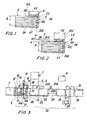
- this shows a device according to the invention, comprising a usual device 1 for grouping an assembly of sheets 4 pertaining to the same booklet 5, and usual conveyor means 2 for conveying towards a binding line 33 the various booklets generated by the device 1.
- This latter is of usual type and comprises means 3 for measuring the thickness S ( Figures 1, 2) of each booklet 5 to be bound. If the sheets of the booklets 5 are all of the same type, the thickness measurement means could comprise a usual member able to count the sheets while they are being grouped one on another to form the booklet; this member can be of mechanical or electronic type and comprise for example a photoelectric cell.
- the information obtained relative to the number of sheets of the booklet is then fed to a control and processing unit 6 of the binding line which, by means of algorithms of conventional type, calculates the booklet thickness.
- This thickness can also be calculated by other conventional measurement means able to automatically determine the dimensions of an article and to supply a relative electrical signal to the control unit 6.
- the binding line 33 comprises a first station 7 acting as a reservoir for the binding elements 8, hereinafter also known as back covers or cover elements.
- This station comprises a usual holder in which the back covers are piled one on another, and means for transferring the back covers of the first station 7 one at a time to a creasing station 9.
- the back covers 8 are formed from a sheet preferably of a paper or plastic material, or in any event a material which can be folded and which once folded maintains the fold. These back covers could for example be made of light cardboard.
- the creasing station 9 comprises one or two fixed creasing elements 10, a movable creasing element 11 and usual means 12 for transferring the back covers from the creasing station 9 to a trimming station 13. Only one fixed disc is shown in the figures; one or two fixed discs are required, depending on the type of binding to be effected, as will be explained hereinafter.
- the creasing elements 10 and 11 comprise a metal or hard plastic disc shaped such that its edge forms a groove or a weakening line in the back cover, to facilitate and regulate its subsequent folding.
- Each of the creasing discs advantageously comprises an underlying backing disc; the back cover passes between the creasing disc and the backing disc.
- the movable creasing element 11 and the relative disc are movable along a guide element 14A and are rigidly secured to an arm 14 connected to a carriage 15 movable perpendicular to the direction D of advancement of the back cover.
- the carriage 15 is connected to a guide element 16 and to usual means 17 for its movement. In this manner, the movable creasing element 11 can be moved automatically, perpendicular to the direction of advancement D of the back covers, into any desired position.
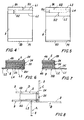
- the first creasing element 10 is arranged to form a first folding line L1 ( Figure 4) in a predefined position in proximity to an edge 8A of the back cover, at a predefined distance H1 from said edge.
- This distance H1 is equal to the distance H5 ( Figure 1) of that part 21A of the back cover provided on the first page of the booklet.
- the part 21A always has the same width H5 for all the booklets, whatever their thickness.
- the movable creasing element 11 is arranged to form in the back cover 8 a second folding line L2, parallel to the first line L1, at a distance from this latter equal to or slightly greater than the thickness S of the booklet to be bound.
- a first fixed creasing element 10 forms a first creasing line L3 at a distance H3 from the edge 8A which is slightly less than the width H5 ( Figure 2) of the visible part 21A of the cover element
- a second fixed creasing element (not shown) forms a second creasing line L4 at a distance H4 from the first line L3 equal to the width H5 ( Figure 2) of the visible part 21A of the cover element
- the movable creasing element 11 forms a third creasing line L2 at a distance H2 from the second line L4 equal to the sum of the thickness S of the booklet to be bound and the thickness S' of the back cover.
- the drive means 17 for the carriage 15 to which the moving creasing element 11 is connected are controlled by the control unit 6 such that this creasing element is always positioned in the correct position based on the thickness S of the booklet to be bound, i.e. positioned in such a manner as to impress the weakening lines L2 into the back cover 8 in such positions that when the back cover 8 is folded onto the edge 34 of the booklet, as shown in Figures 1 and 2, the parts 21A, B, C of this back cover adhere perfectly to the booklet, i.e. they follow perfectly the edge of the booklet and those portions of the first and last sheet of the booklet on which the back cover rests.
- the trimming station 13 comprises a cutting member 18, for example a rotary blade, movable perpendicular to the direction of advancement of the back cover.
- the cutting member 18 is secured to a support element 19 movable along a guide 20 secured to an arm 21 which is connected to a carriage 15A advantageously movable along the said guide 16 of the carriage connected to the movable creasing element 11, and is driven by the said means 17 which drive this creasing element 11.
- the trimming station is arranged to remove any portions P1, P2 and P3 from the back cover along that edge 8B thereof distant from the edge 8A along which the weakening lines are provided. In this respect, if the thickness S of the booklet to be bound is less than the maximum thickness which can be bound with the back cover 8, a portion P1 must be removed from the edge 8B, and which would otherwise project from the booklet.
- the back cover 8 is conveyed by usual means from the trimming station 13 to a feed station 22 for the booklet to be bound.
- the control unit 6 having verified by usual sensors, not shown, the presence of a back cover, moves onto this latter by the action of the means 2 the booklet having that thickness on the basis of which, in the preceding stations, the weakening lines L1-4 were incised in that back cover and the portions P1 were removed.
- the back cover and the relative booklet then pass together to a stapling station 23 comprising a conventional perforating member 23A; the back cover is secured to the booklet by making one or more staples 24 penetrate the booklet and the lower part 21B of the back cover, as shown in Figures 6 and 7.
- the booklet 5 and the back cover 8 are superposed and fed to the stapling station differently, depending on the type of binding to be obtained.
- the back cover 8 is associated with the booklet as shown in Figure 6, with an edge 28 flush with the edge 34 of the booklet to be bound and with the booklet inverted, i.e. with its last page 4B in the upper position. In this condition, the booklet and back cover are stapled together by the staple 24.
- the back cover 8 is associated with the booklet as shown in Figure 7 with its first page 4A in the upper position, and with the parts 21C, 21A of the back cover projecting beyond the edge 34 of the booklet to be bound. It should be noted that in the case of "single” binding, stapling is an optional operation.
- the booklet could be associated with the back cover with the sheets already stapled together, but without the staple 24 also securing the back cover (as shown in Figure 1).
- the booklet and the back cover are then fed to a gluing station 25 comprising two glue expulsion members 25A, B, for example usual hot glue extruders, positioned such as to be able to spread the layer of glue onto the booklet and/or onto the back cover.
- a gluing station 25 comprising two glue expulsion members 25A, B, for example usual hot glue extruders, positioned such as to be able to spread the layer of glue onto the booklet and/or onto the back cover.
- the glue is spread on the edge 34 of the booklet ( Figure 6), on a portion 28 of the last sheet 4B of the booklet in proximity to the edge 34, and on the visible face of the part 21A' of the back cover.
- the combined back cover and binding element are then moved by usual conveying means (not shown) to a feed station 26 for a possible front cover for the booklet.
- This station is an accessory, the booklet being able either to comprise or not comprise a front cover.
- This station comprises a usual holder for containing the front covers and conventional means for moving the front covers one at a time onto the relative booklet.
- a station 27 for rotating the parts 21A, B, C of the binding element 8 follows.
- the operation of rotating the binding element is extremely simple, it being sufficient to make the parts 21C and 21A (Figure 7) of this element adhere respectively to the edge 34 of the booklet and to the upper portion 28 of the first page, or of a possible front cover.
- the back cover 8 is firstly detached from the first page 4A of the booklet. This can be done using sucker devices and/or wedge-shaped guides which are wedged between the first page 4A of the booklet and the back cover and which, by virtue of the weakening line L3, fold the back cover firstly perpendicular to the booklet, position A of Figure 8, then parallel to the booklet and into contact with the part 21A' of the back cover, position B.
- a first usual movable guide device utilizing the weakening line L4, folds the back cover upwards making it adhere to the edge 34 (position C), and finally a second usual movable guide device, utilizing the weakening line L2, folds the back cover onto the booklet (position D).
- binding line comprises a passage station 30 for the back cover and in particular for those of its parts 21A, 21B, 21C which adhere to the nipped edge of the booklet.
- This station comprises a usual flat press 31 arranged to compress at least a portion of the booklet in a position corresponding with the nipped edge.
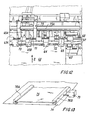
- Figure 9 shows schematically a second embodiment of a possible binding device comprising: assembler means 40 (schematically represented in Figure 9), arranged to assemble the booklets to be bound, and a member 41 for moving the booklets to be bound by the assembler means 40 to adhesive-binding means 42.
- the device of the present variant is arranged to bind booklets the sheets of which are not secured together by staples but by gluing one of the edges, in which the booklet cover element entirely covers the first and last sheet of the booklet and the glued edge, and is itself glued to said edge and to a portion of the first and last sheet at said edge.
- the assembler means 40 are of known type and will therefore not be described in detail hereinafter; they are arranged to automatically group together the booklets to be bound and to move the groups one at a time to an exit station 40A with that edge of the booklet to be glued and bound facing downwards and the free edge facing upwards.
- the mover means 41 comprise an upright 44 secured in any known manner to the adhesive-binding means 42 or to the floor by its own independent pedestal (not shown), arranged to support a horizontal guide track 54 for a movable carriage 45, with which a movable gripping member 46 is associated.
- the movable gripping member 46 comprises a fixed vertical plate 46A and a plate 46B movable perpendicular to the first.
- the fixed plate 46A is rigidly secured to a flat support 47 carrying usual means 48 for horizontally moving the movable plate, for example a pneumatic piston, and usual means 49 for measuring the thickness of the booklet retained between the two plates 46A, B.
- the means 49 comprise, for example, a usual encoder arranged to sense the movement of a shaft 49A which, by means of a series of gearwheels, indicated overall by 49B, is rotated by the movement of the plate 46B.
- the measurement means 49 are connected by cables, not shown, to the device control unit, to provide this latter with a precise indication of the thickness of the booklet to be measured.
- the movable carriage 45 there are connected conventional vertical mover means, for example a pair of pneumatic pistons, rigidly secured to the flat support 47.
- the carriage 45 is removably connected, in usual manner, to the horizontal guide track 54 with which there are also associated usual means 53 for automatically moving the carriage along the track.
- Usual sensors are also provided to sense the movements and/or the attainment of end-of-travel points of the gripping member, and the presence of the booklets in the booklet withdrawal and discharge stations 40A, B respectively; these sensors and the mover means 53, 48, 50 are controlled by the control unit of the entire device.
- the gripping member 46 is arranged to lower the plates 46A, B, in the open position, as far as the exit station 40A of the assembler means, to grip between the plates 46A, B the booklet to be moved, to vertically raise the plates together with the booklet, to move them horizontally towards the adhesive-binding means 42, to lower them into an entry station A of the adhesive-binding means where the plates are opened to deposit the booklet to be bound, and to return to its initial position to withdraw the next booklet.
- the aforedescribed mover means are arranged to withdraw a booklet to be bound from the assembler means 40 one at a time, to transport it to the adhesive-binding means 42, and deposit each booklet onto a carriage 57 of the adhesive-binding means. Transport preferably takes place non-synchronously relative to the assembler means, it being possible to move a booklet only if a free carriage 57 is present in the entry station A of the adhesive-binding means.
- the adhesive-binding means 42 comprise a plurality (only three are shown in Figure 9) of of carriages 57 movable automatically along an elliptical path to convey the booklets to be bound from one working station to the other.
- the carriages 57 conventionally comprise a support structure secured to drive means, for example of chain type, and to guide elements (not shown) with which there is associated a booklet gripping member 58 comprising a fixed vertical wall 58A and a bar 58B movable perpendicular to said fixed wall 58A.
- the gripping member 58 the carriages 57 can move the booklets 59 from one working station to another with that of their edges to be glued and bound facing downwards.
- the adhesive-binding means conventionally comprise an entry station A, a station B for cutting that edge 59A of the booklet to be bound, a station C for spreading a layer of glue onto said edge 59A and onto the sides of the booklet, a cover feeding station D, a station (not shown) for assembling the cover and the booklet together, and an exit station (not shown) connected to usual means 90 for moving the bound booklets.
- Adhesive-binding means of the aforedescribed type are known and will therefore not be described in detail hereinafter.
- the exit station 40A of the assembler means 40, the entry station A of the adhesive-binding means 42 and the means 41 for conveying the booklets between said two stations are disposed in series along a rectilinear path, the conveyor means being provided between said two stations.
- the adhesive-binding means 42 for generating an appropriate cover for each booklet.
- These means 60 comprise a holder 61 for covers 62 to be cut to size, depending on the thickness of each booklet, usual motorized rollers 63 and guide elements for moving one cover at a time from the holder to an exit station 64, and rotary members 65A and B, 66, arranged respectively to impress weakening lines in the cover and to trim the cover.
- the motorized rollers are connected in conventional manner to a common rotary shaft 67, whereas the guide elements 64 are connected to a crosspiece 68.
- the rotary member 65B and the cutting member 66 can not only rotate but also traverse perpendicular to the direction of advancement of the covers 62, whereas the other rotary member 65A is fixed with regard to these movements.
- the rotary members 65A, B comprise a first roller presenting a projecting circumferential portion arranged to incise into the back cover a weakening and folding line.
- the cutting member 66 comprises a usual roller presenting a circumferential cutting portion and a rotary backing roller (not shown). That weakening member 65A which does not traverse axially is connected to a first rotary shaft 71, to which the roller 63A which moves the covers is also connected.
- the other weakening member 65B and the cutting member 66 are connected to a common rotary shaft 71 and to a support element 73 which can traverse along a horizontal guide 73A and is connected to mover means (not shown), for example to a pneumatic piston, arranged to simultaneously move the members 65B and 66 perpendicular to the direction of advancement Z of the covers into the appropriate position.
- mover means for example to a pneumatic piston
- the horizontal movements of the movable rotary weakening member 65B and of the cutting member 66 are controlled by the control unit of the device of the invention, in relation to the measured thickness of the booklet for which the cover being handled is intended. In this manner each booklet can be provided with a cover suitable for the booklet thickness.
- the finished cover 75 passes onto an exit surface 74 provided at a height less than that at which the booklets to be bound traverse, so that in this position the finished cover does not interfere with said booklets.
- the finished cover is moved by means of usual type (not shown) along a surface 74A as far as a station in which it is engaged with the booklet to be bound.
- guide members comprising a fixed rail 78A and a rail 78B movable parallel to the first, both presenting along their opposing edges a central slot to house an edge of the cover.
- the movable rail 78B is connected to conventional mover means 79, for example pneumatic pistons, connected to and controlled by the device control unit, such that based on the dimensions of each cover the guide elements are always positioned at a suitable distance one from the other.
- the engagement station (not shown) is of known type, and comprises a first member for raising that portion of the cover between the two weakening lines, to cause that portion of the cover to adhere to the edge or rear of the booklet to be bound.
- This station also comprises a second plate member arranged to fold the cover and cause it to adhere to the first and last sheet of the booklet; this member preferably comprises a fixed plate disposed spaced from and perpendicular to the first raising member, and a second plate movable parallel to the first.
- the entry station A, the cutting station B, the gluing station C, the cover feed station D and the station in which the cover is engaged with the booklet have not been described in detail as they are of a type conventional in known adhesive-binding means; it should however be noted that the known devices are able only to form booklets all having the same thickness and equal cover dimensions.
- the thickness of each booklet to be bound could be measured by means associated with other components of the device.
- the thickness of the booklet could be measured in the assembler means 40 by counting the number of sheets of each booklet and hence calculating from this information the thickness of the booklet in relation to the known thickness of the sheets.
- the booklet thickness could be calculated by measuring the movement of the jaws of the gripping member provided in the carriages 57 of the adhesive-binding means.
- the assembler means 40, the adhesive-binding means 42 and the booklet mover means 41 are distinct means separate from each other, and that the means for the non-synchronous movement of the booklets, with or without the booklet thickness measurement members, could also be used on booklet handling devices of conventional type, different from that heretofore described.
- booklets each of different thickness can be automatically bound very rapidly and uniformly.
- the binding line could comprise further stations to effect other different operations on the booklet, for example labelling or packaging (for example wrapping).
- the creasing station could comprise a single movable creasing element or two or more creasing elements, both movable; the cover feed station could also be situated immediately downstream of the feed station for the booklet to be bound.
- the binding element 8 could also comprise only those parts 21A, B, C in contact with the nipped edge of the booklet and the portions of the first and last sheet immediately adjacent to said edge, or, in addition to a part to act as a back cover and extending over the entire last sheet of the booklet, also a part to act as a front cover and extending over the entire first page of the booklet.
Landscapes
- Folding Of Thin Sheet-Like Materials, Special Discharging Devices, And Others (AREA)
- Basic Packing Technique (AREA)
- Dicing (AREA)
- Formation Of Insulating Films (AREA)
- Electrical Discharge Machining, Electrochemical Machining, And Combined Machining (AREA)
Abstract
Description
Claims (21)
- A device for automatically binding booklets (5) comprising a variable number of sheets (4), characterised by comprising means (3) for measuring the thickness (S) of each booklet (5) to be bound, and a binding line (33) arranged to automatically fix, at least about that edge (34) of said booklet (5) in which the sheets are secured together and about a portion (28) of the first (4A) and last sheet of the booklet, a cover element (8) comprising a first part (21C) arranged to adhere to said edge (34), and a second (21A) and third part (21B) arranged to adhere respectively to at least said portions (28) of the first and last sheet; said line comprising means (9, 13) arranged to generate, on the basis of the measured thickness of the booklet to be bound, for each booklet, a particular cover element (8) having dimensions and creasing lines (L1-L4) such that said three parts (21A-C) of the cover element perfectly follow said edge and said portions of the first and last sheet.
- A device as claimed in claim 1, characterised in that the means arranged to generate for each booklet to be bound a particular cover element (8) comprise at least one creasing member (11) arranged to generate on each cover element a plurality of parallel weakening lines (L1-L4), two of said lines (L1-L2) being at a distance apart (H2) equal to or slightly greater than the thickness measured for the booklet with which said cover element is to be associated.
- A device as claimed in claim 2, characterised in that the creasing member (11) is arranged to generate two further creasing lines at a distance apart (H4) greater than or equal to that of the portion (28) of the first sheet of the booklet which in all the booklets is to be covered by the cover element (8).
- A device as claimed in claim 2, characterised in that the creasing member presents at least one creasing element (11) movable perpendicular to the direction of advancement (D) of the cover elements (8) in the line (33).
- A device as claimed in claim 4, characterised in that the creasing member also comprises a fixed creasing element (10).
- A device as claimed in claim 4, characterised in that the movable creasing member (11) is secured to mover and guide means (16, 17, 14A, 15) for automatically moving it perpendicular to the direction of advancement (D) of the cover element within the line (33).
- A device as claimed in claim 1, characterised in that the means for generating a particular cover element (8) for each booklet to be bound comprise at least one movable cutting member (18) able to remove one or more portions (P1) of the cover element; said portions being situated along at least one of the edges (8B) of the cover element, parallel to the creasing lines (L1-L4).
- A device as claimed in claim 7, characterised in that the cutting member (18) comprises means (19, 20, 21, 15A, 16, 17) for moving it and guiding it automatically perpendicular to the direction (D) in which the cover elements (8) advance along the line (33).
- A device as claimed in one of the preceding claims, characterised in that the binding line (33) comprises a feed station (7) for the cover elements (8), a creasing station (9) and a trimming station (13) for each of said cover elements (8), a station (22) for feeding the booklet (5) to be bound onto the previously crease-lined and/or trimmed cover element, and/or a station (23) for stapling together the booklet and a portion (21B) of the cover element, and/or a gluing station (25) arranged to spread an adhesive substance onto those portions (21A-C) of the cover element which are to be associated with each other and/or with the edge (34) of the booklet and with the portions (28) of the first and last sheet of the booklet, and/or on said edge (343) and portions of the booklet, and/or a station (27) for rotating those parts (21A, B, C) of the cover element (8) on which an adhesive substance has been previously spread to make them adhere to each other and/or to the edge (34) of the booklet and to its upper portion (28), and/or a station (30) for pressing at least the cover element (8) and that part of the booklet wrapped by said element.
- A device as claimed in claim 9, characterised in that the feed station (7) for the cover elements (8), the creasing station (9), the trimming station (13), the booklet feed station (22), the stapling station (23), the gluing station (25), the cover element feed station (26), the rotating station (27) and the pressing station (30) are in series with each other.
- A device as claimed in claim 9, characterised in that the gluing station (25) comprises two separate adhesive substance spreading members (25A, B) which lie opposite each other so as to be able to spread said substance on both faces of the cover element.
- A device as claimed in claim 1, characterised in that the cover element is made of a material which can be folded and which once folded at least partly maintains the fold.
- A device as claimed in claim 1, characterised by comprising guide and/or mover members arranged to automatically fold the cover element (8) along the weakening lines (L1-L4) and to make said folded parts adhere to the booklet.
- A device as claimed in one of the preceding claims, characterised in that the movable creasing element (65B) and the movable cutting element (66) comprise common mover, guide and support means, such as to be simultaneously moved perpendicular to the direction (Z) of advancement of the cover elements (62), while always maintaining the same distance apart.
- A device as claimed in claim 1, characterised in that the binding line comprises assembler means (40) for the booklets to be bound, adhesive-binding means (42) for the booklets, mover means (41) for transferring the booklets (59) one at a time from said assembler means to the adhesive-binding means, said mover means transferring the booklets to the adhesive-binding means non-synchronously with the assembler means.
- A device as claimed in claim 1, characterised in that the binding line comprises assembler means (40) for the booklets to be bound, adhesive-binding means (42) for the booklets and mover means (41) for transferring the booklets from said assembler means (40) to said adhesive-binding means (42), in which said mover means (41) comprise means (49) for measuring the thickness of each booklet transferred.
- A device as claimed in claim 16, characterised in that the mover means comprise a movable gripping member (46) for the booklets (59), for said gripping member there being provided automatic mover members (45, 48, 50, 53) and guide members (54) arranged to enable the gripping member to undergo vertical and horizontal movements between an exit station (40A) of said assembler means (40) and an entry station (A) of said adhesive-binding means (42).
- A device as claimed in one of the preceding claims, characterised in that the exit station (40A) of the assembler means (40), the entry station (A) of the adhesive-binding means (42) and the mover means (41) for moving the booklets between said two stations are in series with each other and disposed along a rectilinear path, with the mover means being provided between said two stations.
- A device as claimed in one of the preceding claims, characterised in that the assembler means (40), the adhesive-binding means (42) and the mover means (41) are distinct and are separate from each other.
- A device as claimed in one of the preceding claims, characterised in that the binding line comprises assembler means (40) for the booklets to be bound, adhesive-binding means (42) for said booklets, means (41) for transferring the booklets from said assembler means to said adhesive-binding means, means (49) for measuring the thickness of each booklet to be bound, and means (60) for generating, for each booklet, on the basis of the relative measured thickness, a cover element (75) of suitable dimensions, in which all said means are connected to and controlled by a common control unit.
- A device as claimed in one of the preceding claims, characterised by comprising guide members (78A, B) for the movement of the cover elements (8, 75) generated for each booklet on the basis of the measured thickness of the booklet, said guide members comprising at least one guide element (78B) movable in such a manner as to be able to adapt to the different dimensions of said cover elements, for said guide element there being provided automatic mover means (79), controlled in relation to said measured thickness.
Applications Claiming Priority (2)
| Application Number | Priority Date | Filing Date | Title |
|---|---|---|---|
| ITMI200594 | 2000-03-21 | ||
| IT2000MI000594A IT1316822B1 (en) | 2000-03-21 | 2000-03-21 | DEVICE FOR AUTOMATIC BINDING OF ADJUSTABLE THICKNESS FILES |
Publications (3)
| Publication Number | Publication Date |
|---|---|
| EP1147916A2 true EP1147916A2 (en) | 2001-10-24 |
| EP1147916A3 EP1147916A3 (en) | 2002-04-10 |
| EP1147916B1 EP1147916B1 (en) | 2005-07-27 |
Family
ID=11444572
Family Applications (1)
| Application Number | Title | Priority Date | Filing Date |
|---|---|---|---|
| EP01101351A Expired - Lifetime EP1147916B1 (en) | 2000-03-21 | 2001-01-22 | Device for binding booklets of variable thickness |
Country Status (6)
| Country | Link |
|---|---|
| US (1) | US20010024593A1 (en) |
| EP (1) | EP1147916B1 (en) |
| AT (1) | ATE300431T1 (en) |
| DE (1) | DE60112160T2 (en) |
| ES (1) | ES2246259T3 (en) |
| IT (1) | IT1316822B1 (en) |
Cited By (1)
| Publication number | Priority date | Publication date | Assignee | Title |
|---|---|---|---|---|
| EP1504922A1 (en) * | 2003-08-06 | 2005-02-09 | Müller Martini Holding AG | Transportation device with thickness measurement of book blocks |
Families Citing this family (2)
| Publication number | Priority date | Publication date | Assignee | Title |
|---|---|---|---|---|
| ITMI20020841A1 (en) * | 2002-04-19 | 2003-10-20 | Cem Spa | DEVICE FOR THE AUTOMATIC BINDING OF FILES OF VARIABLE THICKNESS INCLUDING AT LEAST TWO FEEDING VEHICLES |
| US7433336B1 (en) * | 2002-08-27 | 2008-10-07 | Broadcom Corporation | Method and apparatus for distributing data to a mobile device using plural access points |
Family Cites Families (2)
| Publication number | Priority date | Publication date | Assignee | Title |
|---|---|---|---|---|
| FR2722734B1 (en) * | 1994-07-20 | 1996-09-06 | Calligraphe Sa | NOTEPAD |
| US6099225A (en) * | 1998-09-29 | 2000-08-08 | Hewlett-Packard Company | Booklet maker |
-
2000
- 2000-03-21 IT IT2000MI000594A patent/IT1316822B1/en active
-
2001
- 2001-01-22 AT AT01101351T patent/ATE300431T1/en not_active IP Right Cessation
- 2001-01-22 EP EP01101351A patent/EP1147916B1/en not_active Expired - Lifetime
- 2001-01-22 DE DE60112160T patent/DE60112160T2/en not_active Expired - Fee Related
- 2001-01-22 ES ES01101351T patent/ES2246259T3/en not_active Expired - Lifetime
- 2001-01-30 US US09/772,509 patent/US20010024593A1/en not_active Abandoned
Cited By (1)
| Publication number | Priority date | Publication date | Assignee | Title |
|---|---|---|---|---|
| EP1504922A1 (en) * | 2003-08-06 | 2005-02-09 | Müller Martini Holding AG | Transportation device with thickness measurement of book blocks |
Also Published As
| Publication number | Publication date |
|---|---|
| ITMI20000594A1 (en) | 2001-09-21 |
| DE60112160D1 (en) | 2005-09-01 |
| US20010024593A1 (en) | 2001-09-27 |
| EP1147916B1 (en) | 2005-07-27 |
| ES2246259T3 (en) | 2006-02-16 |
| ITMI20000594A0 (en) | 2000-03-21 |
| IT1316822B1 (en) | 2003-05-12 |
| ATE300431T1 (en) | 2005-08-15 |
| EP1147916A3 (en) | 2002-04-10 |
| DE60112160T2 (en) | 2006-04-20 |
Similar Documents
| Publication | Publication Date | Title |
|---|---|---|
| US8870174B2 (en) | Machine for producing books, in particular photo books and/or illustrated books | |
| US6966553B2 (en) | Device for preparing adhesive bindings of blocks and brochures, especially for small print runs | |
| US4552497A (en) | Apparatus and method for preparing multipage, taped, side-stitched documents | |
| US20090274536A1 (en) | Perfect binder for processing book blocks and perfect binding method | |
| US3897051A (en) | Method and apparatus for making stacks of printed sheets for a bookbinding machine | |
| US3966185A (en) | Book making | |
| EP0273240A2 (en) | Apparatus for folding and closing a blank of wrapping material around an article to be packaged | |
| US6506275B1 (en) | Informational item forming and bonding machine and method | |
| CA2161699C (en) | A method and a device for the manufacture of booklets | |
| EP1354721B1 (en) | Device for automatically binding booklets of variable thickness, comprising at least two feed means | |
| GB1599270A (en) | Method and apparatus for binding memorials | |
| EP1147916B1 (en) | Device for binding booklets of variable thickness | |
| US6769676B2 (en) | Apparatus for feeding spine inserts for the mechanical manufacture of book covers | |
| BG64478B1 (en) | Gather-stitcher machine and method for producing a header index for print materials or papers which are filed by means of gather-stitcher machine | |
| US4504336A (en) | Tab applying method and apparatus | |
| EP3261936B1 (en) | Wrapping group and wrapping method for wrapping products, in particular editorial products, in containment bands | |
| HK1248661A1 (en) | Wrapping group and wrapping method for wrapping products, in particular editorial products, in containment bands | |
| BE1024330B1 (en) | Device for double folding of sheets. | |
| WO2014006483A1 (en) | Line for producing book blocks with pages glued two by two | |
| US4979348A (en) | Sealing film applying machine, adapted for packaging parcels, books, signatures and brochures, even individually, by means of a wrapping web | |
| US5087162A (en) | Process for binding pamphlets and the like | |
| SE444538B (en) | DEVICE FOR bonding sheets | |
| JP4067500B2 (en) | Book binding apparatus for saddle stitch book, gluing nozzle unit and signature holding member used therefor, and bookbinding method for saddle stitch book | |
| JPH04146190A (en) | Booklet slit automatic bookbinding machine using continuous form paper | |
| ITPD20010044A1 (en) | INSTANTANEOUS ADJUSTMENT MACHINE FOR THE CONTINUOUS BINDING OF BOOKS OF DIFFERENT THICKNESS AND DIMENSIONS. |
Legal Events
| Date | Code | Title | Description |
|---|---|---|---|
| PUAI | Public reference made under article 153(3) epc to a published international application that has entered the european phase |
Free format text: ORIGINAL CODE: 0009012 |
|
| AK | Designated contracting states |
Kind code of ref document: A2 Designated state(s): AT BE CH CY DE DK ES FI FR GB GR IE IT LI LU MC NL PT SE TR |
|
| AX | Request for extension of the european patent |
Free format text: AL;LT;LV;MK;RO;SI |
|
| PUAL | Search report despatched |
Free format text: ORIGINAL CODE: 0009013 |
|
| AK | Designated contracting states |
Kind code of ref document: A3 Designated state(s): AT BE CH CY DE DK ES FI FR GB GR IE IT LI LU MC NL PT SE TR |
|
| AX | Request for extension of the european patent |
Free format text: AL;LT;LV;MK;RO;SI |
|
| RIC1 | Information provided on ipc code assigned before grant |
Free format text: 7B 42C 3/00 A, 7B 42D 5/00 B |
|
| 17P | Request for examination filed |
Effective date: 20020605 |
|
| AKX | Designation fees paid |
Free format text: AT BE CH CY DE DK ES FI FR GB GR IE IT LI LU MC NL PT SE TR |
|
| AXX | Extension fees paid |
Free format text: RO PAYMENT 20020605 |
|
| GRAP | Despatch of communication of intention to grant a patent |
Free format text: ORIGINAL CODE: EPIDOSNIGR1 |
|
| GRAS | Grant fee paid |
Free format text: ORIGINAL CODE: EPIDOSNIGR3 |
|
| GRAA | (expected) grant |
Free format text: ORIGINAL CODE: 0009210 |
|
| AK | Designated contracting states |
Kind code of ref document: B1 Designated state(s): AT BE CH CY DE DK ES FI FR GB GR IE IT LI LU MC NL PT SE TR |
|
| AX | Request for extension of the european patent |
Extension state: RO |
|
| PG25 | Lapsed in a contracting state [announced via postgrant information from national office to epo] |
Ref country code: TR Free format text: LAPSE BECAUSE OF FAILURE TO SUBMIT A TRANSLATION OF THE DESCRIPTION OR TO PAY THE FEE WITHIN THE PRESCRIBED TIME-LIMIT Effective date: 20050727 Ref country code: NL Free format text: LAPSE BECAUSE OF FAILURE TO SUBMIT A TRANSLATION OF THE DESCRIPTION OR TO PAY THE FEE WITHIN THE PRESCRIBED TIME-LIMIT Effective date: 20050727 Ref country code: AT Free format text: LAPSE BECAUSE OF FAILURE TO SUBMIT A TRANSLATION OF THE DESCRIPTION OR TO PAY THE FEE WITHIN THE PRESCRIBED TIME-LIMIT Effective date: 20050727 Ref country code: FI Free format text: LAPSE BECAUSE OF FAILURE TO SUBMIT A TRANSLATION OF THE DESCRIPTION OR TO PAY THE FEE WITHIN THE PRESCRIBED TIME-LIMIT Effective date: 20050727 Ref country code: BE Free format text: LAPSE BECAUSE OF FAILURE TO SUBMIT A TRANSLATION OF THE DESCRIPTION OR TO PAY THE FEE WITHIN THE PRESCRIBED TIME-LIMIT Effective date: 20050727 |
|
| REG | Reference to a national code |
Ref country code: GB Ref legal event code: FG4D |
|
| REG | Reference to a national code |
Ref country code: CH Ref legal event code: EP |
|
| REG | Reference to a national code |
Ref country code: IE Ref legal event code: FG4D |
|
| REF | Corresponds to: |
Ref document number: 60112160 Country of ref document: DE Date of ref document: 20050901 Kind code of ref document: P |
|
| PG25 | Lapsed in a contracting state [announced via postgrant information from national office to epo] |
Ref country code: DK Free format text: LAPSE BECAUSE OF FAILURE TO SUBMIT A TRANSLATION OF THE DESCRIPTION OR TO PAY THE FEE WITHIN THE PRESCRIBED TIME-LIMIT Effective date: 20051027 Ref country code: GR Free format text: LAPSE BECAUSE OF FAILURE TO SUBMIT A TRANSLATION OF THE DESCRIPTION OR TO PAY THE FEE WITHIN THE PRESCRIBED TIME-LIMIT Effective date: 20051027 Ref country code: SE Free format text: LAPSE BECAUSE OF FAILURE TO SUBMIT A TRANSLATION OF THE DESCRIPTION OR TO PAY THE FEE WITHIN THE PRESCRIBED TIME-LIMIT Effective date: 20051027 |
|
| REG | Reference to a national code |
Ref country code: CH Ref legal event code: NV Representative=s name: TROESCH SCHEIDEGGER WERNER AG |
|
| PG25 | Lapsed in a contracting state [announced via postgrant information from national office to epo] |
Ref country code: PT Free format text: LAPSE BECAUSE OF FAILURE TO SUBMIT A TRANSLATION OF THE DESCRIPTION OR TO PAY THE FEE WITHIN THE PRESCRIBED TIME-LIMIT Effective date: 20051227 |
|
| PG25 | Lapsed in a contracting state [announced via postgrant information from national office to epo] |
Ref country code: IE Free format text: LAPSE BECAUSE OF NON-PAYMENT OF DUE FEES Effective date: 20060123 |
|
| PG25 | Lapsed in a contracting state [announced via postgrant information from national office to epo] |
Ref country code: MC Free format text: LAPSE BECAUSE OF NON-PAYMENT OF DUE FEES Effective date: 20060131 Ref country code: LU Free format text: LAPSE BECAUSE OF NON-PAYMENT OF DUE FEES Effective date: 20060131 |
|
| NLV1 | Nl: lapsed or annulled due to failure to fulfill the requirements of art. 29p and 29m of the patents act | ||
| REG | Reference to a national code |
Ref country code: ES Ref legal event code: FG2A Ref document number: 2246259 Country of ref document: ES Kind code of ref document: T3 |
|
| ET | Fr: translation filed | ||
| PLBE | No opposition filed within time limit |
Free format text: ORIGINAL CODE: 0009261 |
|
| STAA | Information on the status of an ep patent application or granted ep patent |
Free format text: STATUS: NO OPPOSITION FILED WITHIN TIME LIMIT |
|
| 26N | No opposition filed |
Effective date: 20060428 |
|
| REG | Reference to a national code |
Ref country code: IE Ref legal event code: MM4A |
|
| PG25 | Lapsed in a contracting state [announced via postgrant information from national office to epo] |
Ref country code: CY Free format text: LAPSE BECAUSE OF FAILURE TO SUBMIT A TRANSLATION OF THE DESCRIPTION OR TO PAY THE FEE WITHIN THE PRESCRIBED TIME-LIMIT Effective date: 20050727 |
|
| PGFP | Annual fee paid to national office [announced via postgrant information from national office to epo] |
Ref country code: ES Payment date: 20081222 Year of fee payment: 9 |
|
| PGFP | Annual fee paid to national office [announced via postgrant information from national office to epo] |
Ref country code: DE Payment date: 20090115 Year of fee payment: 9 |
|
| PGFP | Annual fee paid to national office [announced via postgrant information from national office to epo] |
Ref country code: CH Payment date: 20090327 Year of fee payment: 9 Ref country code: GB Payment date: 20090124 Year of fee payment: 9 |
|
| PGFP | Annual fee paid to national office [announced via postgrant information from national office to epo] |
Ref country code: FR Payment date: 20081223 Year of fee payment: 9 |
|
| REG | Reference to a national code |
Ref country code: CH Ref legal event code: PL |
|
| GBPC | Gb: european patent ceased through non-payment of renewal fee |
Effective date: 20100122 |
|
| REG | Reference to a national code |
Ref country code: FR Ref legal event code: ST Effective date: 20100930 |
|
| PG25 | Lapsed in a contracting state [announced via postgrant information from national office to epo] |
Ref country code: CH Free format text: LAPSE BECAUSE OF NON-PAYMENT OF DUE FEES Effective date: 20100131 Ref country code: LI Free format text: LAPSE BECAUSE OF NON-PAYMENT OF DUE FEES Effective date: 20100131 Ref country code: FR Free format text: LAPSE BECAUSE OF NON-PAYMENT OF DUE FEES Effective date: 20100201 |
|
| PG25 | Lapsed in a contracting state [announced via postgrant information from national office to epo] |
Ref country code: DE Free format text: LAPSE BECAUSE OF NON-PAYMENT OF DUE FEES Effective date: 20100803 |
|
| PG25 | Lapsed in a contracting state [announced via postgrant information from national office to epo] |
Ref country code: GB Free format text: LAPSE BECAUSE OF NON-PAYMENT OF DUE FEES Effective date: 20100122 |
|
| PG25 | Lapsed in a contracting state [announced via postgrant information from national office to epo] |
Ref country code: IT Free format text: LAPSE BECAUSE OF NON-PAYMENT OF DUE FEES Effective date: 20100122 |
|
| REG | Reference to a national code |
Ref country code: ES Ref legal event code: FD2A Effective date: 20111121 |
|
| PG25 | Lapsed in a contracting state [announced via postgrant information from national office to epo] |
Ref country code: ES Free format text: LAPSE BECAUSE OF NON-PAYMENT OF DUE FEES Effective date: 20100123 |
|
| PGFP | Annual fee paid to national office [announced via postgrant information from national office to epo] |
Ref country code: IT Payment date: 20171221 Year of fee payment: 18 |
|
| PG25 | Lapsed in a contracting state [announced via postgrant information from national office to epo] |
Ref country code: IT Free format text: LAPSE BECAUSE OF NON-PAYMENT OF DUE FEES Effective date: 20190122 |