EP1147111B1 - Cryptate compounds and methods for diagnosis and therapy - Google Patents
Cryptate compounds and methods for diagnosis and therapy Download PDFInfo
- Publication number
- EP1147111B1 EP1147111B1 EP00902480A EP00902480A EP1147111B1 EP 1147111 B1 EP1147111 B1 EP 1147111B1 EP 00902480 A EP00902480 A EP 00902480A EP 00902480 A EP00902480 A EP 00902480A EP 1147111 B1 EP1147111 B1 EP 1147111B1
- Authority
- EP
- European Patent Office
- Prior art keywords
- compound
- group
- formula
- metal ion
- radionuclide
- Prior art date
- Legal status (The legal status is an assumption and is not a legal conclusion. Google has not performed a legal analysis and makes no representation as to the accuracy of the status listed.)
- Expired - Lifetime
Links
- 150000001875 compounds Chemical class 0.000 title claims abstract description 165
- 238000003745 diagnosis Methods 0.000 title claims abstract description 15
- 238000000034 method Methods 0.000 title abstract description 29
- 238000002560 therapeutic procedure Methods 0.000 title abstract description 18
- -1 nitro, nitroso, amino Chemical group 0.000 claims abstract description 44
- 150000003839 salts Chemical class 0.000 claims abstract description 40
- 208000037265 diseases, disorders, signs and symptoms Diseases 0.000 claims abstract description 26
- 201000010099 disease Diseases 0.000 claims abstract description 24
- 125000002887 hydroxy group Chemical group [H]O* 0.000 claims abstract description 8
- 125000000217 alkyl group Chemical group 0.000 claims abstract description 7
- 125000004435 hydrogen atom Chemical group [H]* 0.000 claims abstract description 6
- LSNNMFCWUKXFEE-UHFFFAOYSA-M Bisulfite Chemical compound OS([O-])=O LSNNMFCWUKXFEE-UHFFFAOYSA-M 0.000 claims abstract description 4
- 125000003710 aryl alkyl group Chemical group 0.000 claims abstract description 4
- 230000027455 binding Effects 0.000 claims abstract description 4
- 125000002496 methyl group Chemical group [H]C([H])([H])* 0.000 claims abstract description 4
- 229910052757 nitrogen Inorganic materials 0.000 claims abstract description 4
- 229910052760 oxygen Inorganic materials 0.000 claims abstract description 4
- 125000000547 substituted alkyl group Chemical group 0.000 claims abstract description 4
- 229910052717 sulfur Inorganic materials 0.000 claims abstract description 4
- JCXJVPUVTGWSNB-UHFFFAOYSA-N Nitrogen dioxide Chemical compound O=[N]=O JCXJVPUVTGWSNB-UHFFFAOYSA-N 0.000 claims abstract description 3
- 229910052799 carbon Inorganic materials 0.000 claims abstract description 3
- 125000004093 cyano group Chemical group *C#N 0.000 claims abstract description 3
- 229910052739 hydrogen Inorganic materials 0.000 claims abstract description 3
- 239000001257 hydrogen Substances 0.000 claims abstract description 3
- CBOIHMRHGLHBPB-UHFFFAOYSA-N hydroxymethyl Chemical compound O[CH2] CBOIHMRHGLHBPB-UHFFFAOYSA-N 0.000 claims abstract description 3
- 229910052698 phosphorus Inorganic materials 0.000 claims abstract description 3
- 125000003107 substituted aryl group Chemical group 0.000 claims abstract description 3
- 206010028980 Neoplasm Diseases 0.000 claims description 59
- 229910021645 metal ion Inorganic materials 0.000 claims description 27
- 150000004696 coordination complex Chemical class 0.000 claims description 16
- 229910052702 rhenium Inorganic materials 0.000 claims description 16
- 239000008194 pharmaceutical composition Substances 0.000 claims description 14
- 229910052733 gallium Inorganic materials 0.000 claims description 12
- 229910052738 indium Inorganic materials 0.000 claims description 12
- 229910052763 palladium Inorganic materials 0.000 claims description 11
- 201000011510 cancer Diseases 0.000 claims description 10
- 239000003814 drug Substances 0.000 claims description 10
- 108091034117 Oligonucleotide Proteins 0.000 claims description 8
- 229910052745 lead Inorganic materials 0.000 claims description 8
- 229910052697 platinum Inorganic materials 0.000 claims description 8
- 125000002924 primary amino group Chemical group [H]N([H])* 0.000 claims description 8
- 108090000765 processed proteins & peptides Proteins 0.000 claims description 8
- 229910052793 cadmium Inorganic materials 0.000 claims description 7
- 229910052741 iridium Inorganic materials 0.000 claims description 7
- 229910052748 manganese Inorganic materials 0.000 claims description 7
- 229910052759 nickel Inorganic materials 0.000 claims description 7
- 125000001997 phenyl group Chemical group [H]C1=C([H])C([H])=C(*)C([H])=C1[H] 0.000 claims description 7
- 229910052707 ruthenium Inorganic materials 0.000 claims description 7
- 229910052721 tungsten Inorganic materials 0.000 claims description 7
- 229910052720 vanadium Inorganic materials 0.000 claims description 7
- 229910052725 zinc Inorganic materials 0.000 claims description 7
- 125000003178 carboxy group Chemical group [H]OC(*)=O 0.000 claims description 6
- 239000003937 drug carrier Substances 0.000 claims description 6
- 229920001542 oligosaccharide Polymers 0.000 claims description 6
- 150000002482 oligosaccharides Chemical class 0.000 claims description 6
- 108090000623 proteins and genes Proteins 0.000 claims description 6
- 102000004169 proteins and genes Human genes 0.000 claims description 6
- 229910052802 copper Inorganic materials 0.000 claims description 5
- 229910052736 halogen Inorganic materials 0.000 claims description 5
- 150000002367 halogens Chemical group 0.000 claims description 5
- 150000002602 lanthanoids Chemical group 0.000 claims description 5
- 150000001720 carbohydrates Chemical class 0.000 claims description 4
- 125000001188 haloalkyl group Chemical group 0.000 claims description 4
- 239000002502 liposome Substances 0.000 claims description 4
- 238000001959 radiotherapy Methods 0.000 claims description 4
- 125000001424 substituent group Chemical group 0.000 claims description 4
- 125000002252 acyl group Chemical group 0.000 claims description 3
- 125000004442 acylamino group Chemical group 0.000 claims description 3
- 125000004423 acyloxy group Chemical group 0.000 claims description 3
- 125000003545 alkoxy group Chemical group 0.000 claims description 3
- 125000004390 alkyl sulfonyl group Chemical group 0.000 claims description 3
- 125000003917 carbamoyl group Chemical group [H]N([H])C(*)=O 0.000 claims description 3
- 230000000737 periodic effect Effects 0.000 claims description 3
- 125000005138 alkoxysulfonyl group Chemical group 0.000 claims description 2
- 125000004397 aminosulfonyl group Chemical group NS(=O)(=O)* 0.000 claims description 2
- 108020004707 nucleic acids Proteins 0.000 claims description 2
- 150000007523 nucleic acids Chemical class 0.000 claims description 2
- 102000039446 nucleic acids Human genes 0.000 claims description 2
- 125000003170 phenylsulfonyl group Chemical group C1(=CC=CC=C1)S(=O)(=O)* 0.000 claims description 2
- 229910052719 titanium Inorganic materials 0.000 claims 11
- 229910052753 mercury Inorganic materials 0.000 claims 6
- 229910052742 iron Inorganic materials 0.000 claims 5
- 238000004519 manufacturing process Methods 0.000 claims 2
- 238000000163 radioactive labelling Methods 0.000 abstract description 16
- 239000002738 chelating agent Substances 0.000 abstract description 5
- 125000005843 halogen group Chemical group 0.000 abstract 1
- 125000000896 monocarboxylic acid group Chemical group 0.000 abstract 1
- 239000010949 copper Substances 0.000 description 40
- 210000000056 organ Anatomy 0.000 description 24
- LFQSCWFLJHTTHZ-UHFFFAOYSA-N Ethanol Chemical compound CCO LFQSCWFLJHTTHZ-UHFFFAOYSA-N 0.000 description 21
- 210000003734 kidney Anatomy 0.000 description 18
- 239000000203 mixture Substances 0.000 description 17
- 210000004185 liver Anatomy 0.000 description 16
- 241001465754 Metazoa Species 0.000 description 14
- 230000000694 effects Effects 0.000 description 12
- 210000000988 bone and bone Anatomy 0.000 description 11
- 210000004072 lung Anatomy 0.000 description 11
- 210000003205 muscle Anatomy 0.000 description 11
- 210000000952 spleen Anatomy 0.000 description 11
- 210000002784 stomach Anatomy 0.000 description 11
- 210000001519 tissue Anatomy 0.000 description 11
- LMDZBCPBFSXMTL-UHFFFAOYSA-N 1-ethyl-3-(3-dimethylaminopropyl)carbodiimide Chemical compound CCN=C=NCCCN(C)C LMDZBCPBFSXMTL-UHFFFAOYSA-N 0.000 description 10
- 210000004369 blood Anatomy 0.000 description 10
- 239000008280 blood Substances 0.000 description 10
- 238000006243 chemical reaction Methods 0.000 description 10
- 239000000243 solution Substances 0.000 description 10
- XLYOFNOQVPJJNP-UHFFFAOYSA-N water Substances O XLYOFNOQVPJJNP-UHFFFAOYSA-N 0.000 description 10
- 241000699660 Mus musculus Species 0.000 description 9
- 229910052751 metal Inorganic materials 0.000 description 9
- 239000002184 metal Substances 0.000 description 9
- 238000011580 nude mouse model Methods 0.000 description 9
- 210000001672 ovary Anatomy 0.000 description 9
- 238000002360 preparation method Methods 0.000 description 9
- 238000011282 treatment Methods 0.000 description 9
- AOJJSUZBOXZQNB-TZSSRYMLSA-N Doxorubicin Chemical compound O([C@H]1C[C@@](O)(CC=2C(O)=C3C(=O)C=4C=CC=C(C=4C(=O)C3=C(O)C=21)OC)C(=O)CO)[C@H]1C[C@H](N)[C@H](O)[C@H](C)O1 AOJJSUZBOXZQNB-TZSSRYMLSA-N 0.000 description 8
- VEXZGXHMUGYJMC-UHFFFAOYSA-N Hydrochloric acid Chemical compound Cl VEXZGXHMUGYJMC-UHFFFAOYSA-N 0.000 description 8
- DNIAPMSPPWPWGF-UHFFFAOYSA-N Propylene glycol Chemical compound CC(O)CO DNIAPMSPPWPWGF-UHFFFAOYSA-N 0.000 description 8
- 239000003446 ligand Substances 0.000 description 8
- 239000003550 marker Substances 0.000 description 8
- 210000001685 thyroid gland Anatomy 0.000 description 8
- 241000699670 Mus sp. Species 0.000 description 7
- 230000015572 biosynthetic process Effects 0.000 description 7
- 238000010668 complexation reaction Methods 0.000 description 7
- 238000009472 formulation Methods 0.000 description 7
- KDLHZDBZIXYQEI-UHFFFAOYSA-N palladium Substances [Pd] KDLHZDBZIXYQEI-UHFFFAOYSA-N 0.000 description 7
- 230000005855 radiation Effects 0.000 description 7
- 230000003439 radiotherapeutic effect Effects 0.000 description 7
- 238000003786 synthesis reaction Methods 0.000 description 7
- LYCAIKOWRPUZTN-UHFFFAOYSA-N Ethylene glycol Chemical compound OCCO LYCAIKOWRPUZTN-UHFFFAOYSA-N 0.000 description 6
- 239000007864 aqueous solution Substances 0.000 description 6
- 210000000481 breast Anatomy 0.000 description 6
- 238000012360 testing method Methods 0.000 description 6
- 210000002700 urine Anatomy 0.000 description 6
- QTBSBXVTEAMEQO-UHFFFAOYSA-N Acetic acid Chemical compound CC(O)=O QTBSBXVTEAMEQO-UHFFFAOYSA-N 0.000 description 5
- IJGRMHOSHXDMSA-UHFFFAOYSA-N Atomic nitrogen Chemical compound N#N IJGRMHOSHXDMSA-UHFFFAOYSA-N 0.000 description 5
- 229910052772 Samarium Inorganic materials 0.000 description 5
- 239000002253 acid Substances 0.000 description 5
- 125000003118 aryl group Chemical group 0.000 description 5
- 210000001185 bone marrow Anatomy 0.000 description 5
- 210000004556 brain Anatomy 0.000 description 5
- 239000000969 carrier Substances 0.000 description 5
- 239000003085 diluting agent Substances 0.000 description 5
- 210000000232 gallbladder Anatomy 0.000 description 5
- 238000002347 injection Methods 0.000 description 5
- 239000007924 injection Substances 0.000 description 5
- 210000000496 pancreas Anatomy 0.000 description 5
- 239000000047 product Substances 0.000 description 5
- 229940051022 radioimmunoconjugate Drugs 0.000 description 5
- 210000000813 small intestine Anatomy 0.000 description 5
- 239000002904 solvent Substances 0.000 description 5
- 210000001550 testis Anatomy 0.000 description 5
- 230000001225 therapeutic effect Effects 0.000 description 5
- 210000001541 thymus gland Anatomy 0.000 description 5
- 210000004291 uterus Anatomy 0.000 description 5
- 229910052727 yttrium Inorganic materials 0.000 description 5
- HEDRZPFGACZZDS-UHFFFAOYSA-N Chloroform Chemical compound ClC(Cl)Cl HEDRZPFGACZZDS-UHFFFAOYSA-N 0.000 description 4
- CMSMOCZEIVJLDB-UHFFFAOYSA-N Cyclophosphamide Chemical compound ClCCN(CCCl)P1(=O)NCCCO1 CMSMOCZEIVJLDB-UHFFFAOYSA-N 0.000 description 4
- 229910052689 Holmium Inorganic materials 0.000 description 4
- KFZMGEQAYNKOFK-UHFFFAOYSA-N Isopropanol Chemical compound CC(C)O KFZMGEQAYNKOFK-UHFFFAOYSA-N 0.000 description 4
- MUBZPKHOEPUJKR-UHFFFAOYSA-N Oxalic acid Chemical compound OC(=O)C(O)=O MUBZPKHOEPUJKR-UHFFFAOYSA-N 0.000 description 4
- JUJWROOIHBZHMG-UHFFFAOYSA-N Pyridine Chemical compound C1=CC=NC=C1 JUJWROOIHBZHMG-UHFFFAOYSA-N 0.000 description 4
- FAPWRFPIFSIZLT-UHFFFAOYSA-M Sodium chloride Chemical compound [Na+].[Cl-] FAPWRFPIFSIZLT-UHFFFAOYSA-M 0.000 description 4
- 239000002671 adjuvant Substances 0.000 description 4
- 239000003638 chemical reducing agent Substances 0.000 description 4
- 239000003795 chemical substances by application Substances 0.000 description 4
- 229960004397 cyclophosphamide Drugs 0.000 description 4
- 238000002156 mixing Methods 0.000 description 4
- 238000012544 monitoring process Methods 0.000 description 4
- 229920001296 polysiloxane Polymers 0.000 description 4
- 229940002612 prodrug Drugs 0.000 description 4
- 239000000651 prodrug Substances 0.000 description 4
- 125000006239 protecting group Chemical group 0.000 description 4
- 239000011734 sodium Substances 0.000 description 4
- 230000009870 specific binding Effects 0.000 description 4
- VZCYOOQTPOCHFL-UHFFFAOYSA-N trans-butenedioic acid Natural products OC(=O)C=CC(O)=O VZCYOOQTPOCHFL-UHFFFAOYSA-N 0.000 description 4
- OGWKCGZFUXNPDA-XQKSVPLYSA-N vincristine Chemical compound C([N@]1C[C@@H](C[C@]2(C(=O)OC)C=3C(=CC4=C([C@]56[C@H]([C@@]([C@H](OC(C)=O)[C@]7(CC)C=CCN([C@H]67)CC5)(O)C(=O)OC)N4C=O)C=3)OC)C[C@@](C1)(O)CC)CC1=C2NC2=CC=CC=C12 OGWKCGZFUXNPDA-XQKSVPLYSA-N 0.000 description 4
- 229960004528 vincristine Drugs 0.000 description 4
- OGWKCGZFUXNPDA-UHFFFAOYSA-N vincristine Natural products C1C(CC)(O)CC(CC2(C(=O)OC)C=3C(=CC4=C(C56C(C(C(OC(C)=O)C7(CC)C=CCN(C67)CC5)(O)C(=O)OC)N4C=O)C=3)OC)CN1CCC1=C2NC2=CC=CC=C12 OGWKCGZFUXNPDA-UHFFFAOYSA-N 0.000 description 4
- ZWEHNKRNPOVVGH-UHFFFAOYSA-N 2-Butanone Chemical compound CCC(C)=O ZWEHNKRNPOVVGH-UHFFFAOYSA-N 0.000 description 3
- QTBSBXVTEAMEQO-UHFFFAOYSA-M Acetate Chemical compound CC([O-])=O QTBSBXVTEAMEQO-UHFFFAOYSA-M 0.000 description 3
- CSCPPACGZOOCGX-UHFFFAOYSA-N Acetone Chemical compound CC(C)=O CSCPPACGZOOCGX-UHFFFAOYSA-N 0.000 description 3
- WEVYAHXRMPXWCK-UHFFFAOYSA-N Acetonitrile Chemical compound CC#N WEVYAHXRMPXWCK-UHFFFAOYSA-N 0.000 description 3
- UHOVQNZJYSORNB-UHFFFAOYSA-N Benzene Chemical compound C1=CC=CC=C1 UHOVQNZJYSORNB-UHFFFAOYSA-N 0.000 description 3
- 206010009944 Colon cancer Diseases 0.000 description 3
- YMWUJEATGCHHMB-UHFFFAOYSA-N Dichloromethane Chemical compound ClCCl YMWUJEATGCHHMB-UHFFFAOYSA-N 0.000 description 3
- WSFSSNUMVMOOMR-UHFFFAOYSA-N Formaldehyde Chemical compound O=C WSFSSNUMVMOOMR-UHFFFAOYSA-N 0.000 description 3
- VZCYOOQTPOCHFL-OWOJBTEDSA-N Fumaric acid Chemical compound OC(=O)\C=C\C(O)=O VZCYOOQTPOCHFL-OWOJBTEDSA-N 0.000 description 3
- 241000282414 Homo sapiens Species 0.000 description 3
- DGAQECJNVWCQMB-PUAWFVPOSA-M Ilexoside XXIX Chemical compound C[C@@H]1CC[C@@]2(CC[C@@]3(C(=CC[C@H]4[C@]3(CC[C@@H]5[C@@]4(CC[C@@H](C5(C)C)OS(=O)(=O)[O-])C)C)[C@@H]2[C@]1(C)O)C)C(=O)O[C@H]6[C@@H]([C@H]([C@@H]([C@H](O6)CO)O)O)O.[Na+] DGAQECJNVWCQMB-PUAWFVPOSA-M 0.000 description 3
- FBOZXECLQNJBKD-ZDUSSCGKSA-N L-methotrexate Chemical compound C=1N=C2N=C(N)N=C(N)C2=NC=1CN(C)C1=CC=C(C(=O)N[C@@H](CCC(O)=O)C(O)=O)C=C1 FBOZXECLQNJBKD-ZDUSSCGKSA-N 0.000 description 3
- OKKJLVBELUTLKV-UHFFFAOYSA-N Methanol Chemical compound OC OKKJLVBELUTLKV-UHFFFAOYSA-N 0.000 description 3
- ZMXDDKWLCZADIW-UHFFFAOYSA-N N,N-Dimethylformamide Chemical compound CN(C)C=O ZMXDDKWLCZADIW-UHFFFAOYSA-N 0.000 description 3
- 239000002262 Schiff base Substances 0.000 description 3
- 150000004753 Schiff bases Chemical class 0.000 description 3
- HEMHJVSKTPXQMS-UHFFFAOYSA-M Sodium hydroxide Chemical compound [OH-].[Na+] HEMHJVSKTPXQMS-UHFFFAOYSA-M 0.000 description 3
- YXFVVABEGXRONW-UHFFFAOYSA-N Toluene Chemical compound CC1=CC=CC=C1 YXFVVABEGXRONW-UHFFFAOYSA-N 0.000 description 3
- ZMANZCXQSJIPKH-UHFFFAOYSA-N Triethylamine Chemical compound CCN(CC)CC ZMANZCXQSJIPKH-UHFFFAOYSA-N 0.000 description 3
- 150000001299 aldehydes Chemical class 0.000 description 3
- 238000010171 animal model Methods 0.000 description 3
- 239000000427 antigen Substances 0.000 description 3
- 102000036639 antigens Human genes 0.000 description 3
- 108091007433 antigens Proteins 0.000 description 3
- WPYMKLBDIGXBTP-UHFFFAOYSA-N benzoic acid Chemical compound OC(=O)C1=CC=CC=C1 WPYMKLBDIGXBTP-UHFFFAOYSA-N 0.000 description 3
- 238000004364 calculation method Methods 0.000 description 3
- KRKNYBCHXYNGOX-UHFFFAOYSA-N citric acid Chemical compound OC(=O)CC(O)(C(O)=O)CC(O)=O KRKNYBCHXYNGOX-UHFFFAOYSA-N 0.000 description 3
- 150000004699 copper complex Chemical class 0.000 description 3
- 229940127089 cytotoxic agent Drugs 0.000 description 3
- 229910001873 dinitrogen Inorganic materials 0.000 description 3
- 229960004679 doxorubicin Drugs 0.000 description 3
- 230000007717 exclusion Effects 0.000 description 3
- 239000012634 fragment Substances 0.000 description 3
- 125000001072 heteroaryl group Chemical group 0.000 description 3
- 239000012216 imaging agent Substances 0.000 description 3
- 238000003384 imaging method Methods 0.000 description 3
- 238000001727 in vivo Methods 0.000 description 3
- 238000002372 labelling Methods 0.000 description 3
- 239000000463 material Substances 0.000 description 3
- 229960000485 methotrexate Drugs 0.000 description 3
- 239000002953 phosphate buffered saline Substances 0.000 description 3
- XOFYZVNMUHMLCC-ZPOLXVRWSA-N prednisone Chemical compound O=C1C=C[C@]2(C)[C@H]3C(=O)C[C@](C)([C@@](CC4)(O)C(=O)CO)[C@@H]4[C@@H]3CCC2=C1 XOFYZVNMUHMLCC-ZPOLXVRWSA-N 0.000 description 3
- 229960004618 prednisone Drugs 0.000 description 3
- 229960004063 propylene glycol Drugs 0.000 description 3
- 238000011363 radioimmunotherapy Methods 0.000 description 3
- 239000011541 reaction mixture Substances 0.000 description 3
- 210000002966 serum Anatomy 0.000 description 3
- 229910052708 sodium Inorganic materials 0.000 description 3
- 239000012279 sodium borohydride Substances 0.000 description 3
- 229910000033 sodium borohydride Inorganic materials 0.000 description 3
- 229910052713 technetium Inorganic materials 0.000 description 3
- YBJHBAHKTGYVGT-ZKWXMUAHSA-N (+)-Biotin Chemical compound N1C(=O)N[C@@H]2[C@H](CCCCC(=O)O)SC[C@@H]21 YBJHBAHKTGYVGT-ZKWXMUAHSA-N 0.000 description 2
- PUPZLCDOIYMWBV-UHFFFAOYSA-N (+/-)-1,3-Butanediol Chemical compound CC(O)CCO PUPZLCDOIYMWBV-UHFFFAOYSA-N 0.000 description 2
- 238000005160 1H NMR spectroscopy Methods 0.000 description 2
- BXRFQSNOROATLV-UHFFFAOYSA-N 4-nitrobenzaldehyde Chemical compound [O-][N+](=O)C1=CC=C(C=O)C=C1 BXRFQSNOROATLV-UHFFFAOYSA-N 0.000 description 2
- QGZKDVFQNNGYKY-UHFFFAOYSA-O Ammonium Chemical compound [NH4+] QGZKDVFQNNGYKY-UHFFFAOYSA-O 0.000 description 2
- CIWBSHSKHKDKBQ-JLAZNSOCSA-N Ascorbic acid Chemical compound OC[C@H](O)[C@H]1OC(=O)C(O)=C1O CIWBSHSKHKDKBQ-JLAZNSOCSA-N 0.000 description 2
- 108010006654 Bleomycin Proteins 0.000 description 2
- RYGMFSIKBFXOCR-UHFFFAOYSA-N Copper Chemical compound [Cu] RYGMFSIKBFXOCR-UHFFFAOYSA-N 0.000 description 2
- FEWJPZIEWOKRBE-JCYAYHJZSA-N Dextrotartaric acid Chemical compound OC(=O)[C@H](O)[C@@H](O)C(O)=O FEWJPZIEWOKRBE-JCYAYHJZSA-N 0.000 description 2
- ROSDSFDQCJNGOL-UHFFFAOYSA-N Dimethylamine Chemical compound CNC ROSDSFDQCJNGOL-UHFFFAOYSA-N 0.000 description 2
- QUSNBJAOOMFDIB-UHFFFAOYSA-N Ethylamine Chemical compound CCN QUSNBJAOOMFDIB-UHFFFAOYSA-N 0.000 description 2
- VTLYFUHAOXGGBS-UHFFFAOYSA-N Fe3+ Chemical compound [Fe+3] VTLYFUHAOXGGBS-UHFFFAOYSA-N 0.000 description 2
- GHASVSINZRGABV-UHFFFAOYSA-N Fluorouracil Chemical compound FC1=CNC(=O)NC1=O GHASVSINZRGABV-UHFFFAOYSA-N 0.000 description 2
- PEDCQBHIVMGVHV-UHFFFAOYSA-N Glycerine Chemical compound OCC(O)CO PEDCQBHIVMGVHV-UHFFFAOYSA-N 0.000 description 2
- AFVFQIVMOAPDHO-UHFFFAOYSA-N Methanesulfonic acid Chemical compound CS(O)(=O)=O AFVFQIVMOAPDHO-UHFFFAOYSA-N 0.000 description 2
- BAVYZALUXZFZLV-UHFFFAOYSA-N Methylamine Chemical compound NC BAVYZALUXZFZLV-UHFFFAOYSA-N 0.000 description 2
- 241000699666 Mus <mouse, genus> Species 0.000 description 2
- NWIBSHFKIJFRCO-WUDYKRTCSA-N Mytomycin Chemical compound C1N2C(C(C(C)=C(N)C3=O)=O)=C3[C@@H](COC(N)=O)[C@@]2(OC)[C@@H]2[C@H]1N2 NWIBSHFKIJFRCO-WUDYKRTCSA-N 0.000 description 2
- 229910019142 PO4 Inorganic materials 0.000 description 2
- 229930012538 Paclitaxel Natural products 0.000 description 2
- 235000019483 Peanut oil Nutrition 0.000 description 2
- NBIIXXVUZAFLBC-UHFFFAOYSA-N Phosphoric acid Chemical compound OP(O)(O)=O NBIIXXVUZAFLBC-UHFFFAOYSA-N 0.000 description 2
- 235000019485 Safflower oil Nutrition 0.000 description 2
- 229920005654 Sephadex Polymers 0.000 description 2
- 239000012507 Sephadex™ Substances 0.000 description 2
- VMHLLURERBWHNL-UHFFFAOYSA-M Sodium acetate Chemical compound [Na+].CC([O-])=O VMHLLURERBWHNL-UHFFFAOYSA-M 0.000 description 2
- UIIMBOGNXHQVGW-UHFFFAOYSA-M Sodium bicarbonate Chemical compound [Na+].OC([O-])=O UIIMBOGNXHQVGW-UHFFFAOYSA-M 0.000 description 2
- RAHZWNYVWXNFOC-UHFFFAOYSA-N Sulphur dioxide Chemical compound O=S=O RAHZWNYVWXNFOC-UHFFFAOYSA-N 0.000 description 2
- NKANXQFJJICGDU-QPLCGJKRSA-N Tamoxifen Chemical compound C=1C=CC=CC=1C(/CC)=C(C=1C=CC(OCCN(C)C)=CC=1)/C1=CC=CC=C1 NKANXQFJJICGDU-QPLCGJKRSA-N 0.000 description 2
- GKLVYJBZJHMRIY-OUBTZVSYSA-N Technetium-99 Chemical compound [99Tc] GKLVYJBZJHMRIY-OUBTZVSYSA-N 0.000 description 2
- WYURNTSHIVDZCO-UHFFFAOYSA-N Tetrahydrofuran Chemical compound C1CCOC1 WYURNTSHIVDZCO-UHFFFAOYSA-N 0.000 description 2
- JLCPHMBAVCMARE-UHFFFAOYSA-N [3-[[3-[[3-[[3-[[3-[[3-[[3-[[3-[[3-[[3-[[3-[[5-(2-amino-6-oxo-1H-purin-9-yl)-3-[[3-[[3-[[3-[[3-[[3-[[5-(2-amino-6-oxo-1H-purin-9-yl)-3-[[5-(2-amino-6-oxo-1H-purin-9-yl)-3-hydroxyoxolan-2-yl]methoxy-hydroxyphosphoryl]oxyoxolan-2-yl]methoxy-hydroxyphosphoryl]oxy-5-(5-methyl-2,4-dioxopyrimidin-1-yl)oxolan-2-yl]methoxy-hydroxyphosphoryl]oxy-5-(6-aminopurin-9-yl)oxolan-2-yl]methoxy-hydroxyphosphoryl]oxy-5-(6-aminopurin-9-yl)oxolan-2-yl]methoxy-hydroxyphosphoryl]oxy-5-(6-aminopurin-9-yl)oxolan-2-yl]methoxy-hydroxyphosphoryl]oxy-5-(6-aminopurin-9-yl)oxolan-2-yl]methoxy-hydroxyphosphoryl]oxyoxolan-2-yl]methoxy-hydroxyphosphoryl]oxy-5-(5-methyl-2,4-dioxopyrimidin-1-yl)oxolan-2-yl]methoxy-hydroxyphosphoryl]oxy-5-(4-amino-2-oxopyrimidin-1-yl)oxolan-2-yl]methoxy-hydroxyphosphoryl]oxy-5-(5-methyl-2,4-dioxopyrimidin-1-yl)oxolan-2-yl]methoxy-hydroxyphosphoryl]oxy-5-(5-methyl-2,4-dioxopyrimidin-1-yl)oxolan-2-yl]methoxy-hydroxyphosphoryl]oxy-5-(6-aminopurin-9-yl)oxolan-2-yl]methoxy-hydroxyphosphoryl]oxy-5-(6-aminopurin-9-yl)oxolan-2-yl]methoxy-hydroxyphosphoryl]oxy-5-(4-amino-2-oxopyrimidin-1-yl)oxolan-2-yl]methoxy-hydroxyphosphoryl]oxy-5-(4-amino-2-oxopyrimidin-1-yl)oxolan-2-yl]methoxy-hydroxyphosphoryl]oxy-5-(4-amino-2-oxopyrimidin-1-yl)oxolan-2-yl]methoxy-hydroxyphosphoryl]oxy-5-(6-aminopurin-9-yl)oxolan-2-yl]methoxy-hydroxyphosphoryl]oxy-5-(4-amino-2-oxopyrimidin-1-yl)oxolan-2-yl]methyl [5-(6-aminopurin-9-yl)-2-(hydroxymethyl)oxolan-3-yl] hydrogen phosphate Polymers Cc1cn(C2CC(OP(O)(=O)OCC3OC(CC3OP(O)(=O)OCC3OC(CC3O)n3cnc4c3nc(N)[nH]c4=O)n3cnc4c3nc(N)[nH]c4=O)C(COP(O)(=O)OC3CC(OC3COP(O)(=O)OC3CC(OC3COP(O)(=O)OC3CC(OC3COP(O)(=O)OC3CC(OC3COP(O)(=O)OC3CC(OC3COP(O)(=O)OC3CC(OC3COP(O)(=O)OC3CC(OC3COP(O)(=O)OC3CC(OC3COP(O)(=O)OC3CC(OC3COP(O)(=O)OC3CC(OC3COP(O)(=O)OC3CC(OC3COP(O)(=O)OC3CC(OC3COP(O)(=O)OC3CC(OC3COP(O)(=O)OC3CC(OC3COP(O)(=O)OC3CC(OC3COP(O)(=O)OC3CC(OC3COP(O)(=O)OC3CC(OC3CO)n3cnc4c(N)ncnc34)n3ccc(N)nc3=O)n3cnc4c(N)ncnc34)n3ccc(N)nc3=O)n3ccc(N)nc3=O)n3ccc(N)nc3=O)n3cnc4c(N)ncnc34)n3cnc4c(N)ncnc34)n3cc(C)c(=O)[nH]c3=O)n3cc(C)c(=O)[nH]c3=O)n3ccc(N)nc3=O)n3cc(C)c(=O)[nH]c3=O)n3cnc4c3nc(N)[nH]c4=O)n3cnc4c(N)ncnc34)n3cnc4c(N)ncnc34)n3cnc4c(N)ncnc34)n3cnc4c(N)ncnc34)O2)c(=O)[nH]c1=O JLCPHMBAVCMARE-UHFFFAOYSA-N 0.000 description 2
- 230000002159 abnormal effect Effects 0.000 description 2
- 229960000583 acetic acid Drugs 0.000 description 2
- RJURFGZVJUQBHK-UHFFFAOYSA-N actinomycin D Natural products CC1OC(=O)C(C(C)C)N(C)C(=O)CN(C)C(=O)C2CCCN2C(=O)C(C(C)C)NC(=O)C1NC(=O)C1=C(N)C(=O)C(C)=C2OC(C(C)=CC=C3C(=O)NC4C(=O)NC(C(N5CCCC5C(=O)N(C)CC(=O)N(C)C(C(C)C)C(=O)OC4C)=O)C(C)C)=C3N=C21 RJURFGZVJUQBHK-UHFFFAOYSA-N 0.000 description 2
- 239000013543 active substance Substances 0.000 description 2
- 229910052784 alkaline earth metal Inorganic materials 0.000 description 2
- 230000003321 amplification Effects 0.000 description 2
- 125000002178 anthracenyl group Chemical group C1(=CC=CC2=CC3=CC=CC=C3C=C12)* 0.000 description 2
- 230000000890 antigenic effect Effects 0.000 description 2
- 239000002246 antineoplastic agent Substances 0.000 description 2
- 150000004945 aromatic hydrocarbons Chemical group 0.000 description 2
- 229960001561 bleomycin Drugs 0.000 description 2
- OYVAGSVQBOHSSS-UAPAGMARSA-O bleomycin A2 Chemical compound N([C@H](C(=O)N[C@H](C)[C@@H](O)[C@H](C)C(=O)N[C@@H]([C@H](O)C)C(=O)NCCC=1SC=C(N=1)C=1SC=C(N=1)C(=O)NCCC[S+](C)C)[C@@H](O[C@H]1[C@H]([C@@H](O)[C@H](O)[C@H](CO)O1)O[C@@H]1[C@H]([C@@H](OC(N)=O)[C@H](O)[C@@H](CO)O1)O)C=1N=CNC=1)C(=O)C1=NC([C@H](CC(N)=O)NC[C@H](N)C(N)=O)=NC(N)=C1C OYVAGSVQBOHSSS-UAPAGMARSA-O 0.000 description 2
- 239000000872 buffer Substances 0.000 description 2
- 239000001768 carboxy methyl cellulose Substances 0.000 description 2
- 239000003054 catalyst Substances 0.000 description 2
- MVPPADPHJFYWMZ-UHFFFAOYSA-N chlorobenzene Chemical compound ClC1=CC=CC=C1 MVPPADPHJFYWMZ-UHFFFAOYSA-N 0.000 description 2
- DQLATGHUWYMOKM-UHFFFAOYSA-L cisplatin Chemical compound N[Pt](N)(Cl)Cl DQLATGHUWYMOKM-UHFFFAOYSA-L 0.000 description 2
- 229960004316 cisplatin Drugs 0.000 description 2
- 208000029742 colonic neoplasm Diseases 0.000 description 2
- 230000000536 complexating effect Effects 0.000 description 2
- 238000006482 condensation reaction Methods 0.000 description 2
- 235000005687 corn oil Nutrition 0.000 description 2
- 235000012343 cottonseed oil Nutrition 0.000 description 2
- 239000002385 cottonseed oil Substances 0.000 description 2
- ZUOUZKKEUPVFJK-UHFFFAOYSA-N diphenyl Chemical compound C1=CC=CC=C1C1=CC=CC=C1 ZUOUZKKEUPVFJK-UHFFFAOYSA-N 0.000 description 2
- 208000035475 disorder Diseases 0.000 description 2
- WBZKQQHYRPRKNJ-UHFFFAOYSA-L disulfite Chemical compound [O-]S(=O)S([O-])(=O)=O WBZKQQHYRPRKNJ-UHFFFAOYSA-L 0.000 description 2
- MOTZDAYCYVMXPC-UHFFFAOYSA-N dodecyl hydrogen sulfate Chemical compound CCCCCCCCCCCCOS(O)(=O)=O MOTZDAYCYVMXPC-UHFFFAOYSA-N 0.000 description 2
- 229940043264 dodecyl sulfate Drugs 0.000 description 2
- 150000002148 esters Chemical class 0.000 description 2
- VJJPUSNTGOMMGY-MRVIYFEKSA-N etoposide Chemical compound COC1=C(O)C(OC)=CC([C@@H]2C3=CC=4OCOC=4C=C3[C@@H](O[C@H]3[C@@H]([C@@H](O)[C@@H]4O[C@H](C)OC[C@H]4O3)O)[C@@H]3[C@@H]2C(OC3)=O)=C1 VJJPUSNTGOMMGY-MRVIYFEKSA-N 0.000 description 2
- 229960005420 etoposide Drugs 0.000 description 2
- 230000029142 excretion Effects 0.000 description 2
- 238000002474 experimental method Methods 0.000 description 2
- 229940127121 immunoconjugate Drugs 0.000 description 2
- 238000000338 in vitro Methods 0.000 description 2
- 238000001990 intravenous administration Methods 0.000 description 2
- 238000010253 intravenous injection Methods 0.000 description 2
- 229960004592 isopropanol Drugs 0.000 description 2
- 229910052747 lanthanoid Inorganic materials 0.000 description 2
- 230000004807 localization Effects 0.000 description 2
- VZCYOOQTPOCHFL-UPHRSURJSA-N maleic acid Chemical compound OC(=O)\C=C/C(O)=O VZCYOOQTPOCHFL-UPHRSURJSA-N 0.000 description 2
- 239000012528 membrane Substances 0.000 description 2
- GLVAUDGFNGKCSF-UHFFFAOYSA-N mercaptopurine Chemical compound S=C1NC=NC2=C1NC=N2 GLVAUDGFNGKCSF-UHFFFAOYSA-N 0.000 description 2
- 125000001624 naphthyl group Chemical group 0.000 description 2
- 231100000252 nontoxic Toxicity 0.000 description 2
- 230000003000 nontoxic effect Effects 0.000 description 2
- 238000003199 nucleic acid amplification method Methods 0.000 description 2
- 239000012038 nucleophile Substances 0.000 description 2
- 239000003921 oil Substances 0.000 description 2
- 235000019198 oils Nutrition 0.000 description 2
- 239000004006 olive oil Substances 0.000 description 2
- 235000008390 olive oil Nutrition 0.000 description 2
- 230000002611 ovarian Effects 0.000 description 2
- 230000003647 oxidation Effects 0.000 description 2
- 238000007254 oxidation reaction Methods 0.000 description 2
- 229960001592 paclitaxel Drugs 0.000 description 2
- 239000000312 peanut oil Substances 0.000 description 2
- 229920000642 polymer Polymers 0.000 description 2
- 239000002243 precursor Substances 0.000 description 2
- 102000004196 processed proteins & peptides Human genes 0.000 description 2
- BDERNNFJNOPAEC-UHFFFAOYSA-N propan-1-ol Chemical compound CCCO BDERNNFJNOPAEC-UHFFFAOYSA-N 0.000 description 2
- 238000000746 purification Methods 0.000 description 2
- UMJSCPRVCHMLSP-UHFFFAOYSA-N pyridine Natural products COC1=CC=CN=C1 UMJSCPRVCHMLSP-UHFFFAOYSA-N 0.000 description 2
- 125000004076 pyridyl group Chemical group 0.000 description 2
- 239000012217 radiopharmaceutical Substances 0.000 description 2
- 229940121896 radiopharmaceutical Drugs 0.000 description 2
- 230000002799 radiopharmaceutical effect Effects 0.000 description 2
- 229910052703 rhodium Inorganic materials 0.000 description 2
- 239000010948 rhodium Substances 0.000 description 2
- 235000005713 safflower oil Nutrition 0.000 description 2
- 239000003813 safflower oil Substances 0.000 description 2
- 239000008159 sesame oil Substances 0.000 description 2
- 235000011803 sesame oil Nutrition 0.000 description 2
- 239000001632 sodium acetate Substances 0.000 description 2
- 235000017281 sodium acetate Nutrition 0.000 description 2
- 241000894007 species Species 0.000 description 2
- PRAKJMSDJKAYCZ-UHFFFAOYSA-N squalane Chemical compound CC(C)CCCC(C)CCCC(C)CCCCC(C)CCCC(C)CCCC(C)C PRAKJMSDJKAYCZ-UHFFFAOYSA-N 0.000 description 2
- 238000003756 stirring Methods 0.000 description 2
- 230000004083 survival effect Effects 0.000 description 2
- 239000000725 suspension Substances 0.000 description 2
- 101150047061 tag-72 gene Proteins 0.000 description 2
- 230000008685 targeting Effects 0.000 description 2
- RCINICONZNJXQF-MZXODVADSA-N taxol Chemical compound O([C@@H]1[C@@]2(C[C@@H](C(C)=C(C2(C)C)[C@H](C([C@]2(C)[C@@H](O)C[C@H]3OC[C@]3([C@H]21)OC(C)=O)=O)OC(=O)C)OC(=O)[C@H](O)[C@@H](NC(=O)C=1C=CC=CC=1)C=1C=CC=CC=1)O)C(=O)C1=CC=CC=C1 RCINICONZNJXQF-MZXODVADSA-N 0.000 description 2
- 229940056501 technetium 99m Drugs 0.000 description 2
- WYWHKKSPHMUBEB-UHFFFAOYSA-N tioguanine Chemical compound N1C(N)=NC(=S)C2=C1N=CN2 WYWHKKSPHMUBEB-UHFFFAOYSA-N 0.000 description 2
- 238000002054 transplantation Methods 0.000 description 2
- GETQZCLCWQTVFV-UHFFFAOYSA-N trimethylamine Chemical compound CN(C)C GETQZCLCWQTVFV-UHFFFAOYSA-N 0.000 description 2
- 238000000108 ultra-filtration Methods 0.000 description 2
- 125000000391 vinyl group Chemical group [H]C([*])=C([H])[H] 0.000 description 2
- 238000005406 washing Methods 0.000 description 2
- LSPHULWDVZXLIL-UHFFFAOYSA-N (+/-)-Camphoric acid Chemical compound CC1(C)C(C(O)=O)CCC1(C)C(O)=O LSPHULWDVZXLIL-UHFFFAOYSA-N 0.000 description 1
- TXUICONDJPYNPY-UHFFFAOYSA-N (1,10,13-trimethyl-3-oxo-4,5,6,7,8,9,11,12,14,15,16,17-dodecahydrocyclopenta[a]phenanthren-17-yl) heptanoate Chemical compound C1CC2CC(=O)C=C(C)C2(C)C2C1C1CCC(OC(=O)CCCCCC)C1(C)CC2 TXUICONDJPYNPY-UHFFFAOYSA-N 0.000 description 1
- SFPQDYSOPQHZAQ-SCSAIBSYSA-N (2r)-2-methoxypropanenitrile Chemical compound CO[C@H](C)C#N SFPQDYSOPQHZAQ-SCSAIBSYSA-N 0.000 description 1
- FDKXTQMXEQVLRF-ZHACJKMWSA-N (E)-dacarbazine Chemical compound CN(C)\N=N\c1[nH]cnc1C(N)=O FDKXTQMXEQVLRF-ZHACJKMWSA-N 0.000 description 1
- AVQQQNCBBIEMEU-UHFFFAOYSA-N 1,1,3,3-tetramethylurea Chemical compound CN(C)C(=O)N(C)C AVQQQNCBBIEMEU-UHFFFAOYSA-N 0.000 description 1
- WSLDOOZREJYCGB-UHFFFAOYSA-N 1,2-Dichloroethane Chemical compound ClCCCl WSLDOOZREJYCGB-UHFFFAOYSA-N 0.000 description 1
- YJTKZCDBKVTVBY-UHFFFAOYSA-N 1,3-Diphenylbenzene Chemical group C1=CC=CC=C1C1=CC=CC(C=2C=CC=CC=2)=C1 YJTKZCDBKVTVBY-UHFFFAOYSA-N 0.000 description 1
- 229940058015 1,3-butylene glycol Drugs 0.000 description 1
- RYHBNJHYFVUHQT-UHFFFAOYSA-N 1,4-Dioxane Chemical compound C1COCCO1 RYHBNJHYFVUHQT-UHFFFAOYSA-N 0.000 description 1
- AOSFMYBATFLTAQ-UHFFFAOYSA-N 1-amino-3-(benzimidazol-1-yl)propan-2-ol Chemical compound C1=CC=C2N(CC(O)CN)C=NC2=C1 AOSFMYBATFLTAQ-UHFFFAOYSA-N 0.000 description 1
- 125000004343 1-phenylethyl group Chemical group [H]C1=C([H])C([H])=C(C([H])=C1[H])C([H])(*)C([H])([H])[H] 0.000 description 1
- YBYIRNPNPLQARY-UHFFFAOYSA-N 1H-indene Natural products C1=CC=C2CC=CC2=C1 YBYIRNPNPLQARY-UHFFFAOYSA-N 0.000 description 1
- UEJJHQNACJXSKW-UHFFFAOYSA-N 2-(2,6-dioxopiperidin-3-yl)-1H-isoindole-1,3(2H)-dione Chemical compound O=C1C2=CC=CC=C2C(=O)N1C1CCC(=O)NC1=O UEJJHQNACJXSKW-UHFFFAOYSA-N 0.000 description 1
- LBLYYCQCTBFVLH-UHFFFAOYSA-M 2-methylbenzenesulfonate Chemical compound CC1=CC=CC=C1S([O-])(=O)=O LBLYYCQCTBFVLH-UHFFFAOYSA-M 0.000 description 1
- CMWKITSNTDAEDT-UHFFFAOYSA-N 2-nitrobenzaldehyde Chemical compound [O-][N+](=O)C1=CC=CC=C1C=O CMWKITSNTDAEDT-UHFFFAOYSA-N 0.000 description 1
- 125000000094 2-phenylethyl group Chemical group [H]C1=C([H])C([H])=C(C([H])=C1[H])C([H])([H])C([H])([H])* 0.000 description 1
- GFWBKUDRXMQSFD-FJXQXJEOSA-M 3-aminopropanoyl-[(1s)-1-carboxy-2-(1h-imidazol-5-yl)ethyl]azanide;zinc Chemical compound [Zn].NCCC(=O)[N-][C@H](C(O)=O)CC1=CN=CN1 GFWBKUDRXMQSFD-FJXQXJEOSA-M 0.000 description 1
- BMYNFMYTOJXKLE-UHFFFAOYSA-N 3-azaniumyl-2-hydroxypropanoate Chemical compound NCC(O)C(O)=O BMYNFMYTOJXKLE-UHFFFAOYSA-N 0.000 description 1
- ZRPLANDPDWYOMZ-UHFFFAOYSA-N 3-cyclopentylpropionic acid Chemical compound OC(=O)CCC1CCCC1 ZRPLANDPDWYOMZ-UHFFFAOYSA-N 0.000 description 1
- XMIIGOLPHOKFCH-UHFFFAOYSA-M 3-phenylpropionate Chemical compound [O-]C(=O)CCC1=CC=CC=C1 XMIIGOLPHOKFCH-UHFFFAOYSA-M 0.000 description 1
- HIQIXEFWDLTDED-UHFFFAOYSA-N 4-hydroxy-1-piperidin-4-ylpyrrolidin-2-one Chemical compound O=C1CC(O)CN1C1CCNCC1 HIQIXEFWDLTDED-UHFFFAOYSA-N 0.000 description 1
- FHVDTGUDJYJELY-UHFFFAOYSA-N 6-{[2-carboxy-4,5-dihydroxy-6-(phosphanyloxy)oxan-3-yl]oxy}-4,5-dihydroxy-3-phosphanyloxane-2-carboxylic acid Chemical compound O1C(C(O)=O)C(P)C(O)C(O)C1OC1C(C(O)=O)OC(OP)C(O)C1O FHVDTGUDJYJELY-UHFFFAOYSA-N 0.000 description 1
- OOLRAQKFMNOZBV-UHFFFAOYSA-N 8-n-[(4-aminophenyl)methyl]-3,6,10,13,16,19-hexazabicyclo[6.6.6]icosane-1,8-diamine Chemical compound C1=CC(N)=CC=C1CNC1(CNCCNC2)CNCCNCC2(N)CNCCNC1 OOLRAQKFMNOZBV-UHFFFAOYSA-N 0.000 description 1
- 244000215068 Acacia senegal Species 0.000 description 1
- 235000006491 Acacia senegal Nutrition 0.000 description 1
- 229920001817 Agar Polymers 0.000 description 1
- 102400000068 Angiostatin Human genes 0.000 description 1
- 108010079709 Angiostatins Proteins 0.000 description 1
- 235000003911 Arachis Nutrition 0.000 description 1
- 244000105624 Arachis hypogaea Species 0.000 description 1
- 241000416162 Astragalus gummifer Species 0.000 description 1
- 108090001008 Avidin Proteins 0.000 description 1
- 239000005711 Benzoic acid Substances 0.000 description 1
- 206010005003 Bladder cancer Diseases 0.000 description 1
- BTBUEUYNUDRHOZ-UHFFFAOYSA-N Borate Chemical compound [O-]B([O-])[O-] BTBUEUYNUDRHOZ-UHFFFAOYSA-N 0.000 description 1
- 206010006187 Breast cancer Diseases 0.000 description 1
- 208000026310 Breast neoplasm Diseases 0.000 description 1
- FERIUCNNQQJTOY-UHFFFAOYSA-M Butyrate Chemical compound CCCC([O-])=O FERIUCNNQQJTOY-UHFFFAOYSA-M 0.000 description 1
- FERIUCNNQQJTOY-UHFFFAOYSA-N Butyric acid Natural products CCCC(O)=O FERIUCNNQQJTOY-UHFFFAOYSA-N 0.000 description 1
- MTSOWPFNWPPZEP-UHFFFAOYSA-N CNCC(CNCCNC1)(CN(CCNC2)CNCC2C1N)NCC(C=C1)=CCC1=N Chemical compound CNCC(CNCCNC1)(CN(CCNC2)CNCC2C1N)NCC(C=C1)=CCC1=N MTSOWPFNWPPZEP-UHFFFAOYSA-N 0.000 description 1
- FVLVBPDQNARYJU-XAHDHGMMSA-N C[C@H]1CCC(CC1)NC(=O)N(CCCl)N=O Chemical compound C[C@H]1CCC(CC1)NC(=O)N(CCCl)N=O FVLVBPDQNARYJU-XAHDHGMMSA-N 0.000 description 1
- OYPRJOBELJOOCE-UHFFFAOYSA-N Calcium Chemical compound [Ca] OYPRJOBELJOOCE-UHFFFAOYSA-N 0.000 description 1
- 229920002134 Carboxymethyl cellulose Polymers 0.000 description 1
- DLGOEMSEDOSKAD-UHFFFAOYSA-N Carmustine Chemical compound ClCCNC(=O)N(N=O)CCCl DLGOEMSEDOSKAD-UHFFFAOYSA-N 0.000 description 1
- KRKNYBCHXYNGOX-UHFFFAOYSA-K Citrate Chemical compound [O-]C(=O)CC(O)(CC([O-])=O)C([O-])=O KRKNYBCHXYNGOX-UHFFFAOYSA-K 0.000 description 1
- 208000001333 Colorectal Neoplasms Diseases 0.000 description 1
- 108020004635 Complementary DNA Proteins 0.000 description 1
- JPVYNHNXODAKFH-UHFFFAOYSA-N Cu2+ Chemical compound [Cu+2] JPVYNHNXODAKFH-UHFFFAOYSA-N 0.000 description 1
- UHDGCWIWMRVCDJ-CCXZUQQUSA-N Cytarabine Chemical compound O=C1N=C(N)C=CN1[C@H]1[C@@H](O)[C@H](O)[C@@H](CO)O1 UHDGCWIWMRVCDJ-CCXZUQQUSA-N 0.000 description 1
- 108010092160 Dactinomycin Proteins 0.000 description 1
- IAZDPXIOMUYVGZ-UHFFFAOYSA-N Dimethylsulphoxide Chemical compound CS(C)=O IAZDPXIOMUYVGZ-UHFFFAOYSA-N 0.000 description 1
- KCXVZYZYPLLWCC-UHFFFAOYSA-N EDTA Chemical compound OC(=O)CN(CC(O)=O)CCN(CC(O)=O)CC(O)=O KCXVZYZYPLLWCC-UHFFFAOYSA-N 0.000 description 1
- LVGKNOAMLMIIKO-UHFFFAOYSA-N Elaidinsaeure-aethylester Natural products CCCCCCCCC=CCCCCCCCC(=O)OCC LVGKNOAMLMIIKO-UHFFFAOYSA-N 0.000 description 1
- 239000001856 Ethyl cellulose Substances 0.000 description 1
- ZZSNKZQZMQGXPY-UHFFFAOYSA-N Ethyl cellulose Chemical compound CCOCC1OC(OC)C(OCC)C(OCC)C1OC1C(O)C(O)C(OC)C(CO)O1 ZZSNKZQZMQGXPY-UHFFFAOYSA-N 0.000 description 1
- 229920000084 Gum arabic Polymers 0.000 description 1
- 241000282412 Homo Species 0.000 description 1
- CPELXLSAUQHCOX-UHFFFAOYSA-N Hydrogen bromide Chemical compound Br CPELXLSAUQHCOX-UHFFFAOYSA-N 0.000 description 1
- 102000006992 Interferon-alpha Human genes 0.000 description 1
- 108010047761 Interferon-alpha Proteins 0.000 description 1
- JVTAAEKCZFNVCJ-UHFFFAOYSA-M Lactate Chemical compound CC(O)C([O-])=O JVTAAEKCZFNVCJ-UHFFFAOYSA-M 0.000 description 1
- WHXSMMKQMYFTQS-UHFFFAOYSA-N Lithium Chemical compound [Li] WHXSMMKQMYFTQS-UHFFFAOYSA-N 0.000 description 1
- GQYIWUVLTXOXAJ-UHFFFAOYSA-N Lomustine Chemical compound ClCCN(N=O)C(=O)NC1CCCCC1 GQYIWUVLTXOXAJ-UHFFFAOYSA-N 0.000 description 1
- 206010025323 Lymphomas Diseases 0.000 description 1
- 239000002616 MRI contrast agent Substances 0.000 description 1
- FYYHWMGAXLPEAU-UHFFFAOYSA-N Magnesium Chemical compound [Mg] FYYHWMGAXLPEAU-UHFFFAOYSA-N 0.000 description 1
- OFOBLEOULBTSOW-UHFFFAOYSA-L Malonate Chemical compound [O-]C(=O)CC([O-])=O OFOBLEOULBTSOW-UHFFFAOYSA-L 0.000 description 1
- WAEMQWOKJMHJLA-UHFFFAOYSA-N Manganese(2+) Chemical compound [Mn+2] WAEMQWOKJMHJLA-UHFFFAOYSA-N 0.000 description 1
- 206010027476 Metastases Diseases 0.000 description 1
- ZOKXTWBITQBERF-AKLPVKDBSA-N Molybdenum Mo-99 Chemical compound [99Mo] ZOKXTWBITQBERF-AKLPVKDBSA-N 0.000 description 1
- HSHXDCVZWHOWCS-UHFFFAOYSA-N N'-hexadecylthiophene-2-carbohydrazide Chemical compound CCCCCCCCCCCCCCCCNNC(=O)c1cccs1 HSHXDCVZWHOWCS-UHFFFAOYSA-N 0.000 description 1
- 229910002651 NO3 Inorganic materials 0.000 description 1
- 208000003788 Neoplasm Micrometastasis Diseases 0.000 description 1
- PVNIIMVLHYAWGP-UHFFFAOYSA-N Niacin Chemical compound OC(=O)C1=CC=CN=C1 PVNIIMVLHYAWGP-UHFFFAOYSA-N 0.000 description 1
- NHNBFGGVMKEFGY-UHFFFAOYSA-N Nitrate Chemical compound [O-][N+]([O-])=O NHNBFGGVMKEFGY-UHFFFAOYSA-N 0.000 description 1
- MSHZHSPISPJWHW-UHFFFAOYSA-N O-(chloroacetylcarbamoyl)fumagillol Chemical compound O1C(CC=C(C)C)C1(C)C1C(OC)C(OC(=O)NC(=O)CCl)CCC21CO2 MSHZHSPISPJWHW-UHFFFAOYSA-N 0.000 description 1
- 206010033128 Ovarian cancer Diseases 0.000 description 1
- 206010061535 Ovarian neoplasm Diseases 0.000 description 1
- 102000004211 Platelet factor 4 Human genes 0.000 description 1
- 108090000778 Platelet factor 4 Proteins 0.000 description 1
- 239000002202 Polyethylene glycol Substances 0.000 description 1
- OFOBLEOULBTSOW-UHFFFAOYSA-N Propanedioic acid Natural products OC(=O)CC(O)=O OFOBLEOULBTSOW-UHFFFAOYSA-N 0.000 description 1
- XBDQKXXYIPTUBI-UHFFFAOYSA-M Propionate Chemical compound CCC([O-])=O XBDQKXXYIPTUBI-UHFFFAOYSA-M 0.000 description 1
- DWAQJAXMDSEUJJ-UHFFFAOYSA-M Sodium bisulfite Chemical compound [Na+].OS([O-])=O DWAQJAXMDSEUJJ-UHFFFAOYSA-M 0.000 description 1
- 108010090804 Streptavidin Proteins 0.000 description 1
- KDYFGRWQOYBRFD-UHFFFAOYSA-N Succinic acid Natural products OC(=O)CCC(O)=O KDYFGRWQOYBRFD-UHFFFAOYSA-N 0.000 description 1
- QAOWNCQODCNURD-UHFFFAOYSA-L Sulfate Chemical compound [O-]S([O-])(=O)=O QAOWNCQODCNURD-UHFFFAOYSA-L 0.000 description 1
- QAOWNCQODCNURD-UHFFFAOYSA-N Sulfuric acid Chemical compound OS(O)(=O)=O QAOWNCQODCNURD-UHFFFAOYSA-N 0.000 description 1
- FEWJPZIEWOKRBE-UHFFFAOYSA-N Tartaric acid Natural products [H+].[H+].[O-]C(=O)C(O)C(O)C([O-])=O FEWJPZIEWOKRBE-UHFFFAOYSA-N 0.000 description 1
- 229910052771 Terbium Inorganic materials 0.000 description 1
- WDLRUFUQRNWCPK-UHFFFAOYSA-N Tetraxetan Chemical compound OC(=O)CN1CCN(CC(O)=O)CCN(CC(O)=O)CCN(CC(O)=O)CC1 WDLRUFUQRNWCPK-UHFFFAOYSA-N 0.000 description 1
- ZMZDMBWJUHKJPS-UHFFFAOYSA-M Thiocyanate anion Chemical compound [S-]C#N ZMZDMBWJUHKJPS-UHFFFAOYSA-M 0.000 description 1
- FOCVUCIESVLUNU-UHFFFAOYSA-N Thiotepa Chemical compound C1CN1P(N1CC1)(=S)N1CC1 FOCVUCIESVLUNU-UHFFFAOYSA-N 0.000 description 1
- 241000795412 Thyriodes Species 0.000 description 1
- 229910021626 Tin(II) chloride Inorganic materials 0.000 description 1
- 229920001615 Tragacanth Polymers 0.000 description 1
- 208000025865 Ulcer Diseases 0.000 description 1
- 208000007097 Urinary Bladder Neoplasms Diseases 0.000 description 1
- 241000251539 Vertebrata <Metazoa> Species 0.000 description 1
- JXLYSJRDGCGARV-WWYNWVTFSA-N Vinblastine Natural products O=C(O[C@H]1[C@](O)(C(=O)OC)[C@@H]2N(C)c3c(cc(c(OC)c3)[C@]3(C(=O)OC)c4[nH]c5c(c4CCN4C[C@](O)(CC)C[C@H](C3)C4)cccc5)[C@@]32[C@H]2[C@@]1(CC)C=CCN2CC3)C JXLYSJRDGCGARV-WWYNWVTFSA-N 0.000 description 1
- FCMYSEXCLRFWBP-UHFFFAOYSA-N [NH4+].[NH4+].[O-]S(=O)S([O-])=O Chemical compound [NH4+].[NH4+].[O-]S(=O)S([O-])=O FCMYSEXCLRFWBP-UHFFFAOYSA-N 0.000 description 1
- 230000005856 abnormality Effects 0.000 description 1
- 235000010489 acacia gum Nutrition 0.000 description 1
- 235000011054 acetic acid Nutrition 0.000 description 1
- DPXJVFZANSGRMM-UHFFFAOYSA-N acetic acid;2,3,4,5,6-pentahydroxyhexanal;sodium Chemical compound [Na].CC(O)=O.OCC(O)C(O)C(O)C(O)C=O DPXJVFZANSGRMM-UHFFFAOYSA-N 0.000 description 1
- 125000000641 acridinyl group Chemical group C1(=CC=CC2=NC3=CC=CC=C3C=C12)* 0.000 description 1
- 229910052768 actinide Inorganic materials 0.000 description 1
- 150000001255 actinides Chemical class 0.000 description 1
- RJURFGZVJUQBHK-IIXSONLDSA-N actinomycin D Chemical compound C[C@H]1OC(=O)[C@H](C(C)C)N(C)C(=O)CN(C)C(=O)[C@@H]2CCCN2C(=O)[C@@H](C(C)C)NC(=O)[C@H]1NC(=O)C1=C(N)C(=O)C(C)=C2OC(C(C)=CC=C3C(=O)N[C@@H]4C(=O)N[C@@H](C(N5CCC[C@H]5C(=O)N(C)CC(=O)N(C)[C@@H](C(C)C)C(=O)O[C@@H]4C)=O)C(C)C)=C3N=C21 RJURFGZVJUQBHK-IIXSONLDSA-N 0.000 description 1
- WNLRTRBMVRJNCN-UHFFFAOYSA-L adipate(2-) Chemical compound [O-]C(=O)CCCCC([O-])=O WNLRTRBMVRJNCN-UHFFFAOYSA-L 0.000 description 1
- 229940009456 adriamycin Drugs 0.000 description 1
- 239000008272 agar Substances 0.000 description 1
- 229940072056 alginate Drugs 0.000 description 1
- 235000010443 alginic acid Nutrition 0.000 description 1
- 229920000615 alginic acid Polymers 0.000 description 1
- 150000001338 aliphatic hydrocarbons Chemical class 0.000 description 1
- 239000003513 alkali Substances 0.000 description 1
- 229910052783 alkali metal Inorganic materials 0.000 description 1
- 150000001340 alkali metals Chemical class 0.000 description 1
- 229940045714 alkyl sulfonate alkylating agent Drugs 0.000 description 1
- 150000008052 alkyl sulfonates Chemical class 0.000 description 1
- 208000026935 allergic disease Diseases 0.000 description 1
- AWUCVROLDVIAJX-UHFFFAOYSA-N alpha-glycerophosphate Natural products OCC(O)COP(O)(O)=O AWUCVROLDVIAJX-UHFFFAOYSA-N 0.000 description 1
- 229960000473 altretamine Drugs 0.000 description 1
- 229910000147 aluminium phosphate Inorganic materials 0.000 description 1
- 150000001408 amides Chemical class 0.000 description 1
- 150000001412 amines Chemical class 0.000 description 1
- 238000004458 analytical method Methods 0.000 description 1
- 210000003484 anatomy Anatomy 0.000 description 1
- 229940045799 anthracyclines and related substance Drugs 0.000 description 1
- 239000003242 anti bacterial agent Substances 0.000 description 1
- 230000000844 anti-bacterial effect Effects 0.000 description 1
- 230000000259 anti-tumor effect Effects 0.000 description 1
- 229940088710 antibiotic agent Drugs 0.000 description 1
- 229940045686 antimetabolites antineoplastic purine analogs Drugs 0.000 description 1
- 229940045687 antimetabolites folic acid analogs Drugs 0.000 description 1
- 229940045719 antineoplastic alkylating agent nitrosoureas Drugs 0.000 description 1
- 229940045688 antineoplastic antimetabolites pyrimidine analogues Drugs 0.000 description 1
- 125000006615 aromatic heterocyclic group Chemical group 0.000 description 1
- 229940072107 ascorbate Drugs 0.000 description 1
- 235000010323 ascorbic acid Nutrition 0.000 description 1
- 239000011668 ascorbic acid Substances 0.000 description 1
- FZCSTZYAHCUGEM-UHFFFAOYSA-N aspergillomarasmine B Natural products OC(=O)CNC(C(O)=O)CNC(C(O)=O)CC(O)=O FZCSTZYAHCUGEM-UHFFFAOYSA-N 0.000 description 1
- 239000012298 atmosphere Substances 0.000 description 1
- 125000003828 azulenyl group Chemical group 0.000 description 1
- 239000003899 bactericide agent Substances 0.000 description 1
- 230000006399 behavior Effects 0.000 description 1
- 230000003542 behavioural effect Effects 0.000 description 1
- 230000008901 benefit Effects 0.000 description 1
- 229940077388 benzenesulfonate Drugs 0.000 description 1
- SRSXLGNVWSONIS-UHFFFAOYSA-M benzenesulfonate Chemical compound [O-]S(=O)(=O)C1=CC=CC=C1 SRSXLGNVWSONIS-UHFFFAOYSA-M 0.000 description 1
- 125000000499 benzofuranyl group Chemical group O1C(=CC2=C1C=CC=C2)* 0.000 description 1
- 235000010233 benzoic acid Nutrition 0.000 description 1
- 125000001164 benzothiazolyl group Chemical group S1C(=NC2=C1C=CC=C2)* 0.000 description 1
- 125000004196 benzothienyl group Chemical group S1C(=CC2=C1C=CC=C2)* 0.000 description 1
- 125000004541 benzoxazolyl group Chemical group O1C(=NC2=C1C=CC=C2)* 0.000 description 1
- 125000001797 benzyl group Chemical group [H]C1=C([H])C([H])=C(C([H])=C1[H])C([H])([H])* 0.000 description 1
- XMIIGOLPHOKFCH-UHFFFAOYSA-N beta-phenylpropanoic acid Natural products OC(=O)CCC1=CC=CC=C1 XMIIGOLPHOKFCH-UHFFFAOYSA-N 0.000 description 1
- 229920002988 biodegradable polymer Polymers 0.000 description 1
- 239000004621 biodegradable polymer Substances 0.000 description 1
- 229960002685 biotin Drugs 0.000 description 1
- 235000020958 biotin Nutrition 0.000 description 1
- 239000011616 biotin Substances 0.000 description 1
- 235000010290 biphenyl Nutrition 0.000 description 1
- 239000004305 biphenyl Substances 0.000 description 1
- 230000037396 body weight Effects 0.000 description 1
- PHEZJEYUWHETKO-UHFFFAOYSA-N brequinar Chemical compound N1=C2C=CC(F)=CC2=C(C(O)=O)C(C)=C1C(C=C1)=CC=C1C1=CC=CC=C1F PHEZJEYUWHETKO-UHFFFAOYSA-N 0.000 description 1
- 229950010231 brequinar Drugs 0.000 description 1
- 239000006172 buffering agent Substances 0.000 description 1
- 235000019437 butane-1,3-diol Nutrition 0.000 description 1
- KDYFGRWQOYBRFD-NUQCWPJISA-N butanedioic acid Chemical compound O[14C](=O)CC[14C](O)=O KDYFGRWQOYBRFD-NUQCWPJISA-N 0.000 description 1
- 239000006227 byproduct Substances 0.000 description 1
- 238000010804 cDNA synthesis Methods 0.000 description 1
- 239000011575 calcium Substances 0.000 description 1
- 229910052791 calcium Inorganic materials 0.000 description 1
- 150000001718 carbodiimides Chemical class 0.000 description 1
- BVKZGUZCCUSVTD-UHFFFAOYSA-N carbonic acid Chemical compound OC(O)=O BVKZGUZCCUSVTD-UHFFFAOYSA-N 0.000 description 1
- 235000010948 carboxy methyl cellulose Nutrition 0.000 description 1
- 239000008112 carboxymethyl-cellulose Substances 0.000 description 1
- 229960005243 carmustine Drugs 0.000 description 1
- 235000010418 carrageenan Nutrition 0.000 description 1
- 239000000679 carrageenan Substances 0.000 description 1
- 229920001525 carrageenan Polymers 0.000 description 1
- 229940113118 carrageenan Drugs 0.000 description 1
- 230000015556 catabolic process Effects 0.000 description 1
- 239000001913 cellulose Substances 0.000 description 1
- 229920002678 cellulose Polymers 0.000 description 1
- 230000000973 chemotherapeutic effect Effects 0.000 description 1
- 229960004630 chlorambucil Drugs 0.000 description 1
- JCKYGMPEJWAADB-UHFFFAOYSA-N chlorambucil Chemical compound OC(=O)CCCC1=CC=C(N(CCCl)CCCl)C=C1 JCKYGMPEJWAADB-UHFFFAOYSA-N 0.000 description 1
- 125000002676 chrysenyl group Chemical group C1(=CC=CC=2C3=CC=C4C=CC=CC4=C3C=CC12)* 0.000 description 1
- 239000003240 coconut oil Substances 0.000 description 1
- 235000019864 coconut oil Nutrition 0.000 description 1
- 210000001072 colon Anatomy 0.000 description 1
- 201000010989 colorectal carcinoma Diseases 0.000 description 1
- 230000000052 comparative effect Effects 0.000 description 1
- 230000000295 complement effect Effects 0.000 description 1
- 239000002299 complementary DNA Substances 0.000 description 1
- 238000009833 condensation Methods 0.000 description 1
- 230000005494 condensation Effects 0.000 description 1
- 230000001268 conjugating effect Effects 0.000 description 1
- 230000021615 conjugation Effects 0.000 description 1
- 239000002872 contrast media Substances 0.000 description 1
- 238000007796 conventional method Methods 0.000 description 1
- 239000007822 coupling agent Substances 0.000 description 1
- 238000005859 coupling reaction Methods 0.000 description 1
- 239000002254 cytotoxic agent Substances 0.000 description 1
- 231100000599 cytotoxic agent Toxicity 0.000 description 1
- 229960003901 dacarbazine Drugs 0.000 description 1
- 229960000640 dactinomycin Drugs 0.000 description 1
- 230000002939 deleterious effect Effects 0.000 description 1
- 238000013461 design Methods 0.000 description 1
- 238000001514 detection method Methods 0.000 description 1
- UREBDLICKHMUKA-CXSFZGCWSA-N dexamethasone Chemical compound C1CC2=CC(=O)C=C[C@]2(C)[C@]2(F)[C@@H]1[C@@H]1C[C@@H](C)[C@@](C(=O)CO)(O)[C@@]1(C)C[C@@H]2O UREBDLICKHMUKA-CXSFZGCWSA-N 0.000 description 1
- 229960003957 dexamethasone Drugs 0.000 description 1
- 238000002059 diagnostic imaging Methods 0.000 description 1
- 150000001983 dialkylethers Chemical class 0.000 description 1
- 235000014113 dietary fatty acids Nutrition 0.000 description 1
- 229960001760 dimethyl sulfoxide Drugs 0.000 description 1
- LOKCTEFSRHRXRJ-UHFFFAOYSA-I dipotassium trisodium dihydrogen phosphate hydrogen phosphate dichloride Chemical compound P(=O)(O)(O)[O-].[K+].P(=O)(O)([O-])[O-].[Na+].[Na+].[Cl-].[K+].[Cl-].[Na+] LOKCTEFSRHRXRJ-UHFFFAOYSA-I 0.000 description 1
- 239000012153 distilled water Substances 0.000 description 1
- PCAXGMRPPOMODZ-UHFFFAOYSA-N disulfurous acid, diammonium salt Chemical compound [NH4+].[NH4+].[O-]S(=O)S([O-])(=O)=O PCAXGMRPPOMODZ-UHFFFAOYSA-N 0.000 description 1
- POULHZVOKOAJMA-UHFFFAOYSA-M dodecanoate Chemical compound CCCCCCCCCCCC([O-])=O POULHZVOKOAJMA-UHFFFAOYSA-M 0.000 description 1
- 230000005059 dormancy Effects 0.000 description 1
- 238000012377 drug delivery Methods 0.000 description 1
- 239000003974 emollient agent Substances 0.000 description 1
- 239000003995 emulsifying agent Substances 0.000 description 1
- 238000005516 engineering process Methods 0.000 description 1
- CCIVGXIOQKPBKL-UHFFFAOYSA-M ethanesulfonate Chemical compound CCS([O-])(=O)=O CCIVGXIOQKPBKL-UHFFFAOYSA-M 0.000 description 1
- 150000002170 ethers Chemical class 0.000 description 1
- 235000019325 ethyl cellulose Nutrition 0.000 description 1
- 229920001249 ethyl cellulose Polymers 0.000 description 1
- LVGKNOAMLMIIKO-QXMHVHEDSA-N ethyl oleate Chemical compound CCCCCCCC\C=C/CCCCCCCC(=O)OCC LVGKNOAMLMIIKO-QXMHVHEDSA-N 0.000 description 1
- 229940093471 ethyl oleate Drugs 0.000 description 1
- 229940093476 ethylene glycol Drugs 0.000 description 1
- 238000011156 evaluation Methods 0.000 description 1
- 239000000194 fatty acid Substances 0.000 description 1
- 229930195729 fatty acid Natural products 0.000 description 1
- 239000000706 filtrate Substances 0.000 description 1
- 238000001914 filtration Methods 0.000 description 1
- 239000012467 final product Substances 0.000 description 1
- 125000003983 fluorenyl group Chemical group C1(=CC=CC=2C3=CC=CC=C3CC12)* 0.000 description 1
- 229960002949 fluorouracil Drugs 0.000 description 1
- 150000002224 folic acids Chemical class 0.000 description 1
- 230000037406 food intake Effects 0.000 description 1
- 235000012631 food intake Nutrition 0.000 description 1
- 125000002485 formyl group Chemical group [H]C(*)=O 0.000 description 1
- 239000012458 free base Substances 0.000 description 1
- 239000001530 fumaric acid Substances 0.000 description 1
- 125000000524 functional group Chemical group 0.000 description 1
- 125000002541 furyl group Chemical group 0.000 description 1
- 230000005021 gait Effects 0.000 description 1
- CKHJYUSOUQDYEN-UHFFFAOYSA-N gallium(3+) Chemical compound [Ga+3] CKHJYUSOUQDYEN-UHFFFAOYSA-N 0.000 description 1
- 239000007789 gas Substances 0.000 description 1
- 239000012362 glacial acetic acid Substances 0.000 description 1
- 239000011521 glass Substances 0.000 description 1
- 235000011187 glycerol Nutrition 0.000 description 1
- 229960005150 glycerol Drugs 0.000 description 1
- 230000012010 growth Effects 0.000 description 1
- 150000008282 halocarbons Chemical class 0.000 description 1
- IPCSVZSSVZVIGE-UHFFFAOYSA-M hexadecanoate Chemical compound CCCCCCCCCCCCCCCC([O-])=O IPCSVZSSVZVIGE-UHFFFAOYSA-M 0.000 description 1
- UUVWYPNAQBNQJQ-UHFFFAOYSA-N hexamethylmelamine Chemical compound CN(C)C1=NC(N(C)C)=NC(N(C)C)=N1 UUVWYPNAQBNQJQ-UHFFFAOYSA-N 0.000 description 1
- FUZZWVXGSFPDMH-UHFFFAOYSA-N hexanoic acid Chemical compound CCCCCC(O)=O FUZZWVXGSFPDMH-UHFFFAOYSA-N 0.000 description 1
- KJZYNXUDTRRSPN-UHFFFAOYSA-N holmium atom Chemical compound [Ho] KJZYNXUDTRRSPN-UHFFFAOYSA-N 0.000 description 1
- 229940088597 hormone Drugs 0.000 description 1
- 239000005556 hormone Substances 0.000 description 1
- 239000003667 hormone antagonist Substances 0.000 description 1
- XMBWDFGMSWQBCA-UHFFFAOYSA-N hydrogen iodide Chemical compound I XMBWDFGMSWQBCA-UHFFFAOYSA-N 0.000 description 1
- ZMZDMBWJUHKJPS-UHFFFAOYSA-N hydrogen thiocyanate Natural products SC#N ZMZDMBWJUHKJPS-UHFFFAOYSA-N 0.000 description 1
- QAOWNCQODCNURD-UHFFFAOYSA-M hydrogensulfate Chemical compound OS([O-])(=O)=O QAOWNCQODCNURD-UHFFFAOYSA-M 0.000 description 1
- 239000001866 hydroxypropyl methyl cellulose Substances 0.000 description 1
- 235000010979 hydroxypropyl methyl cellulose Nutrition 0.000 description 1
- 229920003088 hydroxypropyl methyl cellulose Polymers 0.000 description 1
- 229960001101 ifosfamide Drugs 0.000 description 1
- HOMGKSMUEGBAAB-UHFFFAOYSA-N ifosfamide Chemical compound ClCCNP1(=O)OCCCN1CCCl HOMGKSMUEGBAAB-UHFFFAOYSA-N 0.000 description 1
- 238000011503 in vivo imaging Methods 0.000 description 1
- 238000011065 in-situ storage Methods 0.000 description 1
- 238000011534 incubation Methods 0.000 description 1
- 125000003454 indenyl group Chemical group C1(C=CC2=CC=CC=C12)* 0.000 description 1
- 125000001041 indolyl group Chemical group 0.000 description 1
- 239000011261 inert gas Substances 0.000 description 1
- 238000001802 infusion Methods 0.000 description 1
- 239000004615 ingredient Substances 0.000 description 1
- 239000007972 injectable composition Substances 0.000 description 1
- 229940102223 injectable solution Drugs 0.000 description 1
- 229940102213 injectable suspension Drugs 0.000 description 1
- 238000000185 intracerebroventricular administration Methods 0.000 description 1
- 238000007917 intracranial administration Methods 0.000 description 1
- 238000007918 intramuscular administration Methods 0.000 description 1
- 238000010255 intramuscular injection Methods 0.000 description 1
- 239000007927 intramuscular injection Substances 0.000 description 1
- 238000007912 intraperitoneal administration Methods 0.000 description 1
- 230000007794 irritation Effects 0.000 description 1
- SUMDYPCJJOFFON-UHFFFAOYSA-N isethionic acid Chemical compound OCCS(O)(=O)=O SUMDYPCJJOFFON-UHFFFAOYSA-N 0.000 description 1
- 238000002955 isolation Methods 0.000 description 1
- XUGNVMKQXJXZCD-UHFFFAOYSA-N isopropyl palmitate Chemical compound CCCCCCCCCCCCCCCC(=O)OC(C)C XUGNVMKQXJXZCD-UHFFFAOYSA-N 0.000 description 1
- 125000005956 isoquinolyl group Chemical group 0.000 description 1
- 150000002576 ketones Chemical class 0.000 description 1
- 229940001447 lactate Drugs 0.000 description 1
- 229940099584 lactobionate Drugs 0.000 description 1
- JYTUSYBCFIZPBE-AMTLMPIISA-M lactobionate Chemical compound [O-]C(=O)[C@H](O)[C@@H](O)[C@@H]([C@H](O)CO)O[C@@H]1O[C@H](CO)[C@H](O)[C@H](O)[C@H]1O JYTUSYBCFIZPBE-AMTLMPIISA-M 0.000 description 1
- 229940070765 laurate Drugs 0.000 description 1
- 239000011133 lead Substances 0.000 description 1
- 231100001231 less toxic Toxicity 0.000 description 1
- 125000005647 linker group Chemical group 0.000 description 1
- 239000007788 liquid Substances 0.000 description 1
- 229940057995 liquid paraffin Drugs 0.000 description 1
- 229910052744 lithium Inorganic materials 0.000 description 1
- 229960001078 lithium Drugs 0.000 description 1
- OBTSLRFPKIKXSZ-UHFFFAOYSA-N lithium potassium Chemical compound [Li].[K] OBTSLRFPKIKXSZ-UHFFFAOYSA-N 0.000 description 1
- SUPUVLWGKPVHBQ-UHFFFAOYSA-M lithium sulfite Chemical compound [Li+].OS([O-])=O SUPUVLWGKPVHBQ-UHFFFAOYSA-M 0.000 description 1
- 229960002247 lomustine Drugs 0.000 description 1
- 239000011777 magnesium Substances 0.000 description 1
- 229910052749 magnesium Inorganic materials 0.000 description 1
- 238000002595 magnetic resonance imaging Methods 0.000 description 1
- 229940049920 malate Drugs 0.000 description 1
- BJEPYKJPYRNKOW-UHFFFAOYSA-L malate(2-) Chemical compound [O-]C(=O)C(O)CC([O-])=O BJEPYKJPYRNKOW-UHFFFAOYSA-L 0.000 description 1
- 239000011976 maleic acid Substances 0.000 description 1
- 229960004961 mechlorethamine Drugs 0.000 description 1
- HAWPXGHAZFHHAD-UHFFFAOYSA-N mechlorethamine Chemical compound ClCCN(C)CCCl HAWPXGHAZFHHAD-UHFFFAOYSA-N 0.000 description 1
- SGDBTWWWUNNDEQ-LBPRGKRZSA-N melphalan Chemical compound OC(=O)[C@@H](N)CC1=CC=C(N(CCCl)CCCl)C=C1 SGDBTWWWUNNDEQ-LBPRGKRZSA-N 0.000 description 1
- 229960001924 melphalan Drugs 0.000 description 1
- 229960001428 mercaptopurine Drugs 0.000 description 1
- 150000002739 metals Chemical class 0.000 description 1
- 230000009401 metastasis Effects 0.000 description 1
- 230000006510 metastatic growth Effects 0.000 description 1
- 229920000609 methyl cellulose Polymers 0.000 description 1
- 239000001923 methylcellulose Substances 0.000 description 1
- 235000010981 methylcellulose Nutrition 0.000 description 1
- 239000002480 mineral oil Substances 0.000 description 1
- 229960004857 mitomycin Drugs 0.000 description 1
- 238000012986 modification Methods 0.000 description 1
- 230000004048 modification Effects 0.000 description 1
- 239000002808 molecular sieve Substances 0.000 description 1
- 229950009740 molybdenum mo-99 Drugs 0.000 description 1
- JXTPJDDICSTXJX-UHFFFAOYSA-N n-Triacontane Natural products CCCCCCCCCCCCCCCCCCCCCCCCCCCCCC JXTPJDDICSTXJX-UHFFFAOYSA-N 0.000 description 1
- 235000001968 nicotinic acid Nutrition 0.000 description 1
- 239000011664 nicotinic acid Substances 0.000 description 1
- 150000002825 nitriles Chemical class 0.000 description 1
- QIQXTHQIDYTFRH-UHFFFAOYSA-N octadecanoic acid Chemical compound CCCCCCCCCCCCCCCCCC(O)=O QIQXTHQIDYTFRH-UHFFFAOYSA-N 0.000 description 1
- 229940049964 oleate Drugs 0.000 description 1
- ZQPPMHVWECSIRJ-KTKRTIGZSA-M oleate Chemical compound CCCCCCCC\C=C/CCCCCCCC([O-])=O ZQPPMHVWECSIRJ-KTKRTIGZSA-M 0.000 description 1
- 150000007524 organic acids Chemical class 0.000 description 1
- 230000003204 osmotic effect Effects 0.000 description 1
- 235000006408 oxalic acid Nutrition 0.000 description 1
- 239000012188 paraffin wax Substances 0.000 description 1
- 230000005298 paramagnetic effect Effects 0.000 description 1
- 238000007911 parenteral administration Methods 0.000 description 1
- 230000007170 pathology Effects 0.000 description 1
- 229940043138 pentosan polysulfate Drugs 0.000 description 1
- 238000010647 peptide synthesis reaction Methods 0.000 description 1
- JRKICGRDRMAZLK-UHFFFAOYSA-L peroxydisulfate Chemical compound [O-]S(=O)(=O)OOS([O-])(=O)=O JRKICGRDRMAZLK-UHFFFAOYSA-L 0.000 description 1
- 235000019271 petrolatum Nutrition 0.000 description 1
- 239000000546 pharmaceutical excipient Substances 0.000 description 1
- 125000001791 phenazinyl group Chemical group C1(=CC=CC2=NC3=CC=CC=C3N=C12)* 0.000 description 1
- NBIIXXVUZAFLBC-UHFFFAOYSA-K phosphate Chemical compound [O-]P([O-])([O-])=O NBIIXXVUZAFLBC-UHFFFAOYSA-K 0.000 description 1
- 239000010452 phosphate Substances 0.000 description 1
- 235000011007 phosphoric acid Nutrition 0.000 description 1
- 229940075930 picrate Drugs 0.000 description 1
- OXNIZHLAWKMVMX-UHFFFAOYSA-M picrate anion Chemical compound [O-]C1=C([N+]([O-])=O)C=C([N+]([O-])=O)C=C1[N+]([O-])=O OXNIZHLAWKMVMX-UHFFFAOYSA-M 0.000 description 1
- 229950010765 pivalate Drugs 0.000 description 1
- IUGYQRQAERSCNH-UHFFFAOYSA-M pivalate Chemical compound CC(C)(C)C([O-])=O IUGYQRQAERSCNH-UHFFFAOYSA-M 0.000 description 1
- 229920001515 polyalkylene glycol Polymers 0.000 description 1
- 229920001223 polyethylene glycol Polymers 0.000 description 1
- 229920001451 polypropylene glycol Polymers 0.000 description 1
- DJEHXEMURTVAOE-UHFFFAOYSA-M potassium bisulfite Chemical compound [K+].OS([O-])=O DJEHXEMURTVAOE-UHFFFAOYSA-M 0.000 description 1
- 229940099427 potassium bisulfite Drugs 0.000 description 1
- HEZHYQDYRPUXNJ-UHFFFAOYSA-L potassium dithionite Chemical compound [K+].[K+].[O-]S(=O)S([O-])=O HEZHYQDYRPUXNJ-UHFFFAOYSA-L 0.000 description 1
- 235000010259 potassium hydrogen sulphite Nutrition 0.000 description 1
- RWPGFSMJFRPDDP-UHFFFAOYSA-L potassium metabisulfite Chemical compound [K+].[K+].[O-]S(=O)S([O-])(=O)=O RWPGFSMJFRPDDP-UHFFFAOYSA-L 0.000 description 1
- 229940043349 potassium metabisulfite Drugs 0.000 description 1
- 235000010263 potassium metabisulphite Nutrition 0.000 description 1
- 239000003755 preservative agent Substances 0.000 description 1
- CPTBDICYNRMXFX-UHFFFAOYSA-N procarbazine Chemical compound CNNCC1=CC=C(C(=O)NC(C)C)C=C1 CPTBDICYNRMXFX-UHFFFAOYSA-N 0.000 description 1
- 229960000624 procarbazine Drugs 0.000 description 1
- 229940056457 promace Drugs 0.000 description 1
- 235000013772 propylene glycol Nutrition 0.000 description 1
- 150000003212 purines Chemical class 0.000 description 1
- 125000000561 purinyl group Chemical group N1=C(N=C2N=CNC2=C1)* 0.000 description 1
- 125000003373 pyrazinyl group Chemical group 0.000 description 1
- 125000003226 pyrazolyl group Chemical group 0.000 description 1
- 125000001725 pyrenyl group Chemical group 0.000 description 1
- 125000002098 pyridazinyl group Chemical group 0.000 description 1
- 150000003230 pyrimidines Chemical class 0.000 description 1
- 125000000714 pyrimidinyl group Chemical group 0.000 description 1
- 125000001453 quaternary ammonium group Chemical group 0.000 description 1
- 125000002294 quinazolinyl group Chemical group N1=C(N=CC2=CC=CC=C12)* 0.000 description 1
- 125000005493 quinolyl group Chemical group 0.000 description 1
- 230000002285 radioactive effect Effects 0.000 description 1
- 230000001690 radiotoxic effect Effects 0.000 description 1
- 239000000376 reactant Substances 0.000 description 1
- 239000012429 reaction media Substances 0.000 description 1
- WUAPFZMCVAUBPE-UHFFFAOYSA-N rhenium atom Chemical compound [Re] WUAPFZMCVAUBPE-UHFFFAOYSA-N 0.000 description 1
- KZUNJOHGWZRPMI-UHFFFAOYSA-N samarium atom Chemical compound [Sm] KZUNJOHGWZRPMI-UHFFFAOYSA-N 0.000 description 1
- 229910052706 scandium Inorganic materials 0.000 description 1
- 229960003440 semustine Drugs 0.000 description 1
- 238000000926 separation method Methods 0.000 description 1
- 229920002545 silicone oil Polymers 0.000 description 1
- 238000002603 single-photon emission computed tomography Methods 0.000 description 1
- 238000001542 size-exclusion chromatography Methods 0.000 description 1
- AWUCVROLDVIAJX-GSVOUGTGSA-N sn-glycerol 3-phosphate Chemical compound OC[C@@H](O)COP(O)(O)=O AWUCVROLDVIAJX-GSVOUGTGSA-N 0.000 description 1
- 239000007974 sodium acetate buffer Substances 0.000 description 1
- URGAHOPLAPQHLN-UHFFFAOYSA-N sodium aluminosilicate Chemical compound [Na+].[Al+3].[O-][Si]([O-])=O.[O-][Si]([O-])=O URGAHOPLAPQHLN-UHFFFAOYSA-N 0.000 description 1
- 229910000030 sodium bicarbonate Inorganic materials 0.000 description 1
- 235000019812 sodium carboxymethyl cellulose Nutrition 0.000 description 1
- 229920001027 sodium carboxymethylcellulose Polymers 0.000 description 1
- BEOOHQFXGBMRKU-UHFFFAOYSA-N sodium cyanoborohydride Chemical compound [Na+].[B-]C#N BEOOHQFXGBMRKU-UHFFFAOYSA-N 0.000 description 1
- HRZFUMHJMZEROT-UHFFFAOYSA-L sodium disulfite Chemical compound [Na+].[Na+].[O-]S(=O)S([O-])(=O)=O HRZFUMHJMZEROT-UHFFFAOYSA-L 0.000 description 1
- JVBXVOWTABLYPX-UHFFFAOYSA-L sodium dithionite Chemical compound [Na+].[Na+].[O-]S(=O)S([O-])=O JVBXVOWTABLYPX-UHFFFAOYSA-L 0.000 description 1
- 235000010267 sodium hydrogen sulphite Nutrition 0.000 description 1
- 229940001584 sodium metabisulfite Drugs 0.000 description 1
- 235000010262 sodium metabisulphite Nutrition 0.000 description 1
- 239000007787 solid Substances 0.000 description 1
- 229940032094 squalane Drugs 0.000 description 1
- 238000010561 standard procedure Methods 0.000 description 1
- 239000001119 stannous chloride Substances 0.000 description 1
- 235000011150 stannous chloride Nutrition 0.000 description 1
- 229960001052 streptozocin Drugs 0.000 description 1
- ZSJLQEPLLKMAKR-GKHCUFPYSA-N streptozocin Chemical compound O=NN(C)C(=O)N[C@H]1[C@@H](O)O[C@H](CO)[C@@H](O)[C@@H]1O ZSJLQEPLLKMAKR-GKHCUFPYSA-N 0.000 description 1
- 238000007920 subcutaneous administration Methods 0.000 description 1
- KDYFGRWQOYBRFD-UHFFFAOYSA-L succinate(2-) Chemical compound [O-]C(=O)CCC([O-])=O KDYFGRWQOYBRFD-UHFFFAOYSA-L 0.000 description 1
- 239000001117 sulphuric acid Substances 0.000 description 1
- 235000011149 sulphuric acid Nutrition 0.000 description 1
- 238000001356 surgical procedure Methods 0.000 description 1
- 238000013268 sustained release Methods 0.000 description 1
- 239000012730 sustained-release form Substances 0.000 description 1
- 229960001603 tamoxifen Drugs 0.000 description 1
- 239000011975 tartaric acid Substances 0.000 description 1
- 235000002906 tartaric acid Nutrition 0.000 description 1
- 229940095064 tartrate Drugs 0.000 description 1
- GKLVYJBZJHMRIY-UHFFFAOYSA-N technetium atom Chemical compound [Tc] GKLVYJBZJHMRIY-UHFFFAOYSA-N 0.000 description 1
- CBXCPBUEXACCNR-UHFFFAOYSA-N tetraethylammonium Chemical compound CC[N+](CC)(CC)CC CBXCPBUEXACCNR-UHFFFAOYSA-N 0.000 description 1
- 125000001712 tetrahydronaphthyl group Chemical group C1(CCCC2=CC=CC=C12)* 0.000 description 1
- QEMXHQIAXOOASZ-UHFFFAOYSA-N tetramethylammonium Chemical compound C[N+](C)(C)C QEMXHQIAXOOASZ-UHFFFAOYSA-N 0.000 description 1
- 229960003433 thalidomide Drugs 0.000 description 1
- 125000000335 thiazolyl group Chemical group 0.000 description 1
- 239000002562 thickening agent Substances 0.000 description 1
- 125000001544 thienyl group Chemical group 0.000 description 1
- 238000004809 thin layer chromatography Methods 0.000 description 1
- 150000003573 thiols Chemical group 0.000 description 1
- ZWZVWGITAAIFPS-UHFFFAOYSA-N thiophosgene Chemical compound ClC(Cl)=S ZWZVWGITAAIFPS-UHFFFAOYSA-N 0.000 description 1
- 229960001196 thiotepa Drugs 0.000 description 1
- 229960003087 tioguanine Drugs 0.000 description 1
- 238000004448 titration Methods 0.000 description 1
- 125000003944 tolyl group Chemical group 0.000 description 1
- 230000000699 topical effect Effects 0.000 description 1
- 231100000419 toxicity Toxicity 0.000 description 1
- 230000001988 toxicity Effects 0.000 description 1
- 230000036269 ulceration Effects 0.000 description 1
- ZDPHROOEEOARMN-UHFFFAOYSA-N undecanoic acid Chemical compound CCCCCCCCCCC(O)=O ZDPHROOEEOARMN-UHFFFAOYSA-N 0.000 description 1
- 201000005112 urinary bladder cancer Diseases 0.000 description 1
- NQPDZGIKBAWPEJ-UHFFFAOYSA-N valeric acid Chemical class CCCCC(O)=O NQPDZGIKBAWPEJ-UHFFFAOYSA-N 0.000 description 1
- 230000002792 vascular Effects 0.000 description 1
- 235000013311 vegetables Nutrition 0.000 description 1
- 239000003981 vehicle Substances 0.000 description 1
- 229960003048 vinblastine Drugs 0.000 description 1
- JXLYSJRDGCGARV-XQKSVPLYSA-N vincaleukoblastine Chemical compound C([C@@H](C[C@]1(C(=O)OC)C=2C(=CC3=C([C@]45[C@H]([C@@]([C@H](OC(C)=O)[C@]6(CC)C=CCN([C@H]56)CC4)(O)C(=O)OC)N3C)C=2)OC)C[C@@](C2)(O)CC)N2CCC2=C1NC1=CC=CC=C21 JXLYSJRDGCGARV-XQKSVPLYSA-N 0.000 description 1
- 238000005303 weighing Methods 0.000 description 1
- 230000004580 weight loss Effects 0.000 description 1
- 239000008096 xylene Substances 0.000 description 1
- 150000003738 xylenes Chemical class 0.000 description 1
- VWQVUPCCIRVNHF-UHFFFAOYSA-N yttrium atom Chemical compound [Y] VWQVUPCCIRVNHF-UHFFFAOYSA-N 0.000 description 1
- UHVMMEOXYDMDKI-JKYCWFKZSA-L zinc;1-(5-cyanopyridin-2-yl)-3-[(1s,2s)-2-(6-fluoro-2-hydroxy-3-propanoylphenyl)cyclopropyl]urea;diacetate Chemical compound [Zn+2].CC([O-])=O.CC([O-])=O.CCC(=O)C1=CC=C(F)C([C@H]2[C@H](C2)NC(=O)NC=2N=CC(=CC=2)C#N)=C1O UHVMMEOXYDMDKI-JKYCWFKZSA-L 0.000 description 1
Images





Classifications
-
- C—CHEMISTRY; METALLURGY
- C07—ORGANIC CHEMISTRY
- C07D—HETEROCYCLIC COMPOUNDS
- C07D487/00—Heterocyclic compounds containing nitrogen atoms as the only ring hetero atoms in the condensed system, not provided for by groups C07D451/00 - C07D477/00
- C07D487/02—Heterocyclic compounds containing nitrogen atoms as the only ring hetero atoms in the condensed system, not provided for by groups C07D451/00 - C07D477/00 in which the condensed system contains two hetero rings
- C07D487/08—Bridged systems
-
- A—HUMAN NECESSITIES
- A61—MEDICAL OR VETERINARY SCIENCE; HYGIENE
- A61K—PREPARATIONS FOR MEDICAL, DENTAL OR TOILETRY PURPOSES
- A61K51/00—Preparations containing radioactive substances for use in therapy or testing in vivo
- A61K51/02—Preparations containing radioactive substances for use in therapy or testing in vivo characterised by the carrier, i.e. characterised by the agent or material covalently linked or complexing the radioactive nucleus
- A61K51/04—Organic compounds
- A61K51/08—Peptides, e.g. proteins, carriers being peptides, polyamino acids, proteins
- A61K51/10—Antibodies or immunoglobulins; Fragments thereof, the carrier being an antibody, an immunoglobulin or a fragment thereof, e.g. a camelised human single domain antibody or the Fc fragment of an antibody
- A61K51/1045—Antibodies or immunoglobulins; Fragments thereof, the carrier being an antibody, an immunoglobulin or a fragment thereof, e.g. a camelised human single domain antibody or the Fc fragment of an antibody against animal or human tumor cells or tumor cell determinants
- A61K51/1063—Antibodies or immunoglobulins; Fragments thereof, the carrier being an antibody, an immunoglobulin or a fragment thereof, e.g. a camelised human single domain antibody or the Fc fragment of an antibody against animal or human tumor cells or tumor cell determinants the tumor cell being from stomach or intestines
-
- A—HUMAN NECESSITIES
- A61—MEDICAL OR VETERINARY SCIENCE; HYGIENE
- A61K—PREPARATIONS FOR MEDICAL, DENTAL OR TOILETRY PURPOSES
- A61K51/00—Preparations containing radioactive substances for use in therapy or testing in vivo
- A61K51/02—Preparations containing radioactive substances for use in therapy or testing in vivo characterised by the carrier, i.e. characterised by the agent or material covalently linked or complexing the radioactive nucleus
- A61K51/04—Organic compounds
- A61K51/08—Peptides, e.g. proteins, carriers being peptides, polyamino acids, proteins
- A61K51/10—Antibodies or immunoglobulins; Fragments thereof, the carrier being an antibody, an immunoglobulin or a fragment thereof, e.g. a camelised human single domain antibody or the Fc fragment of an antibody
- A61K51/1045—Antibodies or immunoglobulins; Fragments thereof, the carrier being an antibody, an immunoglobulin or a fragment thereof, e.g. a camelised human single domain antibody or the Fc fragment of an antibody against animal or human tumor cells or tumor cell determinants
- A61K51/1072—Antibodies or immunoglobulins; Fragments thereof, the carrier being an antibody, an immunoglobulin or a fragment thereof, e.g. a camelised human single domain antibody or the Fc fragment of an antibody against animal or human tumor cells or tumor cell determinants the tumor cell being from the reproductive system, e.g. ovaria, uterus, testes or prostate
-
- A—HUMAN NECESSITIES
- A61—MEDICAL OR VETERINARY SCIENCE; HYGIENE
- A61K—PREPARATIONS FOR MEDICAL, DENTAL OR TOILETRY PURPOSES
- A61K51/00—Preparations containing radioactive substances for use in therapy or testing in vivo
- A61K51/02—Preparations containing radioactive substances for use in therapy or testing in vivo characterised by the carrier, i.e. characterised by the agent or material covalently linked or complexing the radioactive nucleus
- A61K51/04—Organic compounds
- A61K51/08—Peptides, e.g. proteins, carriers being peptides, polyamino acids, proteins
- A61K51/10—Antibodies or immunoglobulins; Fragments thereof, the carrier being an antibody, an immunoglobulin or a fragment thereof, e.g. a camelised human single domain antibody or the Fc fragment of an antibody
- A61K51/1093—Antibodies or immunoglobulins; Fragments thereof, the carrier being an antibody, an immunoglobulin or a fragment thereof, e.g. a camelised human single domain antibody or the Fc fragment of an antibody conjugates with carriers being antibodies
-
- C—CHEMISTRY; METALLURGY
- C07—ORGANIC CHEMISTRY
- C07B—GENERAL METHODS OF ORGANIC CHEMISTRY; APPARATUS THEREFOR
- C07B2200/00—Indexing scheme relating to specific properties of organic compounds
- C07B2200/05—Isotopically modified compounds, e.g. labelled
Definitions
- the present invention relates to cryptate compounds useful as chelating agents.
- the present invention relates to functionalised derivatives of certain cryptate compounds. These functionalised derivatives are suitable for use in radiolabelling and similar applications.
- the present invention also relates to the use of functionalised derivatives of cryptate compounds in a method for diagnosis or therapy of a disease.
- Radiolabelled compounds are useful as radiopharmaceuticals, imaging agents, or the like which are especially useful for but not limited to the diagnosis and therapy of diseases including cancer.
- WO 90/12050 discloses macrocyclic ligands, such as DOTA, conjugated to targeting molecules, and metal complexes thereof, for use in diagnostic imaging and radiotherapy.
- radiolabelled compounds suffer from the disadvantage that, in use, the radiolabelled nuclide can become detached from the carrier compound thereby leading to problems and potential complications in diagnostic and therapeutic applications. Further, the known radiopharmaceuticals tend to be non-specific in their biodistribution throughout a subject.
- the present invention seeks to ameliorate the stated disadvantages of the prior art by providing compounds which are capable of being radiolabelled more expeditiously, specifically target a localised area of tissue or an organ in a subject and which are more stable than the prior art compounds and less toxic. Further, the compounds of the present invention are typically suitable for use in pharmaceutical formulations. It is a further typical object of the present invention to provide a method of diagnosis or therapy of disease in a subject.
- molecular recognition unit includes an antibody, protein, peptide, carbohydrate, nucleic acid, oligonucleotide, oligosaccharide, liposome, or other molecule which can form part of a specific binding pair.
- each R 4 and R 5 is H; W is NH; and n is 2 to 4. more typically 2 or 3, still more typically 2.
- aryl refers to single, polynuclear, conjugated and fused residues of aromatic hydrocarbons or aromatic heterocyclic ring systems.
- groups are phenyl, biphenyl, terphenyl, quaterphenyl, naphthyl, tetrahydronaphthyl, anthracenyl, dihydroanthracenyl, benzanthracenyl, dibenzanthracenyl, phenanthracenyl, fluorenyl, pyrenyl, indenyl, azulenyl, chrysenyl, pyridyl, 4-phenylpyridyl, 3-phenylpyridyl, thienyl, furyl, pyrryl, indolyl, pyridazinyl, pyrazolyl, pyrazinyl, thiazolyl, pyrimidinyl, quinolyl, iso
- aralkyl refers to alkyl groups substituted with one or more aryl groups as previously defined. Examples of such groups are benzyl, 2-phenylethyl and 1-phenylethyl.
- optionally substituted means that the moiety described as optionally substituted may carry one or more substituents selected from amino, halogen, hydroxy, mercapto, nitro, cyano, thiocyano, alkyl, alkoxy, halogenoalkyl, acyl, acylamino, acyloxy, carboxyl, alkoxycarboxyl, carbamoyl, pyridoylamino, carboxyalkyl-carbamoyl, N-carboxyalkylcarbamoyl, sulpho, sulphamoyl, mono- or dialkylated or phenylated sulphamoyl which can carry one or more alkyl substituents, alkylsulphonyl, alkoxysulphonyl, optionally hydroxy-containing phenylsulphonyl or phenoxy sulphonyl.
- the metal ion is typically selected from 64 Cu, 67 Cu, 99m Tc, Ga, In, Co, Re, Fe, Au, Ag, Rh, Pt, Bi, Cr, W, Ni, V, Pb, Ir, Zn, Cd, Mn, Ru, Pd, Hg, Ti, and, the lanthanide group of elements in the Periodic Table such as Sm, Ho, Gd, Tb, Sc, Y, and the actinides.
- the metal ion is further typically a radionuclide selected from the group of 64 Cu, 67 Cu, 99m Tc, and radionuclides of In(III), Ga (III), Fe (III), Cu (II), Ti (IV) and other radionuclides from the Lanthanides, Re, Sm, Ho, and Y.
- a radionuclide selected from the group of 64 Cu, 67 Cu, 99m Tc, and radionuclides of In(III), Ga (III), Fe (III), Cu (II), Ti (IV) and other radionuclides from the Lanthanides, Re, Sm, Ho, and Y.
- a pharmaceutical formulation comprising a compound of Formula (I) as described in the first embodiment of the present invention or a metal complex, radiolabelled complex or pharmaceutically acceptable salt thereof together with a pharmaceutically acceptable carrier.
- a diagnostic formulation comprising a compound of Formula (I) as described in the first embodiment of the present invention or a metal complex, radiolabelled complex or pharmaceutically acceptable salt thereof and a reducing agent in a pharmaceutically acceptable carrier.
- a compound of Formula (I) or a metal complex, radiolabelled complex or pharmaceutically acceptable salt thereof in the preparation of a medicament for diagnosis or therapy of disease in a subject.
- a conjugate compound comprising at least one compound of Formula (I) as described in the first embodiment of the present invention or a metal complex, radiolabelled complex or a pharmaceutically acceptable salt thereof bonded to at least one molecular recognition unit comprising an antibody, protein, peptide, carbohydrate, oligonucleotide, oligosaccharide, liposome or the like.
- conjugate compound as described in the seventh embodiment of the present invention when used in the diagnosis or therapy of disease in a subject.
- a compound of Formula (I) or a metal complex, radiolabelled complex, conjugate compound or pharmaceutically acceptable salt thereof in the preparation of a medicament for imaging in a subject.
- a compound of Formula (I) or a metal complex, radiolabelled complex, conjugate compound or pharmaceutically acceptable salt thereof when used in imaging in a subject is provided.
- the compounds of Formula (I) comprise those compounds where n represents an integer from 2 to 4, more typically 2 or 3, still more typically 2. At least one of X and Y is a C-Z group where Z is as previously defined, and p is 1 to 4, more typically 1 to 2 and still more typically 1. Usually, one of X is a C-Z group and the other is a group C-R, where R is as previously defined.
- the Z group in a compound of Formula (1) may provide a point of attachment of a compound of Formula (1) to a molecular recognition unit.
- the molecular recognition unit is typically an antibody, protein, peptide, oligonucleotide, oligosaccharide.
- the molecular recognition unit is typically an antibody and more typically a monoclonal antibody.
- compounds of Formula (I) provide a method of attachment of radionuclide metal ions such as In(III), Ga(III), Fe(III), Tc(IV) or Tc(V), Re(VII), Cu(II), Ti(IV), other radionuclides from the Lanthanides, Rhenium, Samarium, Holmium, Yttrium and the like to molecular recognition units such as monoclonal antibodies, receptor specific proteins, peptides or oligonucleotides for in vivo imaging and therapy.
- radionuclide metal ions such as In(III), Ga(III), Fe(III), Tc(IV) or Tc(V), Re(VII), Cu(II), Ti(IV), other radionuclides from the Lanthanides, Rhenium, Samarium, Holmium, Yttrium and the like to molecular recognition units such as monoclonal antibodies, receptor specific proteins, peptides or oligonucleotides for in vivo imaging and therapy.
- the compounds of general Formula (I) are typically prepared by attachment of a functional linking group to a suitable cryptate.
- Methods of synthesis of cryptates useful as precursors to compounds of Formula (I) in which W is NH are described in United States Patent No. 4,497,737 in the name of Sargeson et al, the disclosure of which is incorporated herein by reference.
- Other cryptates where W is S or O may be prepared by analogous methods.
- Sargeson et al describe synthesis of metal cage "cryptate" compounds by the condensation of a tris-(diamine) metal ion complex as described at column 3 lines 30 to 35 with formaldehyde and an appropriate nucleophile.
- an appropriate nucleophile is selected so as to obtain the desired functionalised linkage group Z as defined in Formula (I).
- a functionalised linkage group Z may be attached to a functional group of a cryptate prepared by the methods taught by Sargeson et al (for example see Example 9 at column 9 line 65 to column 12 line 10 of Sargeson et al) by standard synthetic techniques.
- a protecting group may be introduced into the cryptate structure to protect latent functionality for the desired functionalised linkage group Z as defined in Formula (I) during synthesis of the desired cryptate precursor.
- Suitable protecting groups are described, for example in Greene, T.W., Protective Groups in Organic Synthesis (John Wiley & Sons, New York, 1981) and McOmie, J.F.W., Protective Groups in Organic Chemistry (Plenum Press, London, 1973).
- compounds of Formula (I) where said Z group comprises a mono- or di-substituted amino group and where the substituent is optionally substituted alkyl are readily prepared by treating the amino compound with the appropriate halo-substituted alkyl.
- the compound of Formula (I) where Z is -NH-CH 2 -CH 2 -NH 2 can be prepared by treating a compound of Formula (I) where R is NH 2 with BrCH 2 CH 2 NH 2 in the presence of NaHCO 3 or the like with suitable protection.
- Compounds of formula (I) where R 1 is -NCS may be prepared by reacting the amino compound with thiophosgene (see WO87/12631), Kozak et al., Cancer Res. 49, 2639 (1989). Substituted acid halide compounds are produced by reacting a compound of formula (I) where R is NH 2 with BrCH 2 COBr at 4°C according to the procedure of C J Mathias et al., Bioconjugate Chem., 1, 204 (1990). Compounds with an electrophilic moiety can also he prepared by methods known in the art, such as in ACC Chem. Res. 17 202-209 (1984).
- compounds of formula (I) in which X or Y is C-Z where the group Z is a group NH(CH 2 ) p R 1 or NH(CH 2 ) p ArR 1 may be prepared by a Schiff Base condensation reaction of a compound of formula (I) (or a metal complex thereof) in which X or Y is NH 2 with an aldehyde of formula HC(O)(CH 2 ) p-1 R 1 or HC(O)(CH 2 ) p-1 ArR 1 .
- a compound of formula (I) is obtained by the reaction of nitrobenzaldehyde with the copper complex of an aminocryptate such as described by Sargeson et al. The reaction is typically performed in an inert-gas atmosphere and in the presence of solvent and diluents typically inert to the reactants.
- Suitable solvents comprise aliphatic, aromatic, or halogenated hydrocarbons such as benzene, toluene, xylenes; chlorobenzene, chloroform, methylene chloride, ethylene chloride; ethers and ethereal compounds such as dialkyl ether, ethylene glycol mono or -dialkyl ether, THF, dioxane; alkanols such as methanol, ethanol, n-propanol, isopropanol; ketones such as acetone, methyl ethyl ketone; nitriles such as acetonitrile or 2-methoxypropionitrile; N,N-dialkylated amides such as dimethylformamide; dimethylsulphoxide, tetramethylurea; as well as mixtures of these solvents with each other. If the amine or a salt thereof is soluble in water, then the reaction medium may be water at low temperature.
- the compounds of formula (I) may be
- salts of the compounds of the present invention will be pharmaceutically acceptable salts; although other salts may be used in the preparation of the inventive compound or of the pharmaceutically acceptable salt thereof.
- pharmaceutically acceptable salt is meant those salts which are, within the scope of sound medical judgement, suitable for use in contact with the tissues of humans and lower animals without undue toxicity, irritation, allergic response and the like, and are commensurate with a reasonable benefit/risk ratio.
- Pharmaceutically acceptable salts are well known in the art.
- Suitable pharmaceutically acceptable salts of the compounds of the present invention may be prepared by mixing a pharmaceutically acceptable acid such as hydrochloric acid, sulphuric acid, methanesulphonic acid, succinic acid, fumaric acid, maleic acid, benzoic acid, phosphoric acid, acetic acid, oxalic acid, carbonic acid, tartaric acid, or citric acid.
- a pharmaceutically acceptable acid such as hydrochloric acid, sulphuric acid, methanesulphonic acid, succinic acid, fumaric acid, maleic acid, benzoic acid, phosphoric acid, acetic acid, oxalic acid, carbonic acid, tartaric acid, or citric acid.
- Suitable pharmaceutically acceptable salts of the compounds of the present invention therefore include acid addition salts.
- Representative acid addition salts include acetate, adipate, alginate, ascorbate, asparate, benzenesulfonate, benzoate, bisulfate, borate, butyrate, camphorate, camphersulfonate, citrate, cyclopentanepropionate, digluconate, dodecylsulfate, ethanesulfonate, fumarate, glucoheptanate, glycerophosphate, hemisulfate, heptonate, hexanoate, hydrobromide, hydrochloride, hydroiodide, 2-hydroxyethanesulfonate, lactobionate, lactate, laurate, lauryl sulfate, malate, maleate, malonate, methanesulfonate, 2-naphthalenesulfanate, nicotinate, nitrate, oleate, oxalate, palmitate, pamoate, pec
- alkali or alkaline earth metal salts include sodium, lithium potassium, calcium, magnesium, and the like, as well as nontoxic ammonium, quaternary ammonium, and amine cations, including, but not limited to ammonium, tetramethylammonium, tetraethylammonium, methylamine, dimethylamine, trimethylamine, triethylamine, ethylamine, and the like.
- radiolabelling of compounds of formula (I), and salts thereof can be accomplished by using procedures recognised in the art.
- radiolabelling of the chelator with 67 Cu can be achieved by adding copper in an aqueous acetate solution to a compound of formula (I) in an aqueous solution and incubating at room temperature.
- the radiolabelling of a compound of formula (I) with technetium may be achieved by adding a reducing agent such as stannous salts typically stannous chloride, to an aqueous solution of a compound of formula (I), followed by reaction with aqueous sodium pertechnetate solution (Na 99m TcO 4 ).
- a reducing agent such as stannous salts typically stannous chloride
- aqueous sodium pertechnetate solution Na 99m TcO 4
- Suitable reducing agents comprise alkali metal dithionites such as sodium dithionite, sodium borohydride, hydrochloric acid, hydrobromic acid, other soluble dithionites such as potassium dithionite or ammonium dithionite, a soluble bisulfite or metabisulfite such as sodium bisulfite, potassium bisulfite, lithium bisulfite, ammonium bisulfite, sodium metabisulfite, potassium metabisulfite, lithium metabisulfite or ammonium metabisulfite, or an aqueous solution of sulfur dioxide.
- alkali metal dithionites such as sodium dithionite, sodium borohydride, hydrochloric acid, hydrobromic acid
- other soluble dithionites such as potassium dithionite or ammonium dithionite
- a soluble bisulfite or metabisulfite such as sodium bisulfite, potassium bisulfite, lithium bisulfite, ammonium bisulfite, sodium metabisulfite,
- Technetium-99m in the form of an aqueous solution of sodium pertechnetate is readily obtainable from commercially available molybdenum-99/technetium-99m generators or alternatively, instant 99m Tc may be used.
- Cu-64 is commercially available from Australian Nuclear Science & Technology Organisation and 67 Cu from the US Department of Energy, Brookhaven, USA.
- the conjugate compounds of the seventh embodiment of this invention may be formed by the reaction of a radiolabelled metal complex of a compound of Formula (I) together with a molecular recognition unit.
- the radionuclides which are useful for complexing with the compounds of Formula (I) typically comprise metal ions which have at least two oxidation states, most typically an oxidation state of +2 or +3.
- the radiolabelled metal complex is selected from 64 Cu, 67 Cu and 99m Tc, Sm, Ho, Re, Sc, Cu, Pd, Rh, and Y.
- the most typical metal ions comprise 64 Cu, 67 Cu, 99m Tc, These radiolabelled metal complexes are then reacted with a molecular recognition unit.
- the radiolabelled molecular recognition unit so formed is useful for diagnostic, therapeutic and radioimaging applications.
- a conjugate of a compound of formula (I) may be first prepared and then it may be radiolabelled.
- radiolabelling of molecular recognition units such as proteinaceous materials using compounds of formula (I) can be conducted in two ways, namely:
- a conjugate compound of formula (I) is usually achieved by the reaction of the functionalised linkage group with a thiol, amino, carboxyl, hydroxyl, aldehyde, aromatic or heteroaromatic group present in the molecular recognition unit.
- a thiol, amino, carboxyl, hydroxyl, aldehyde, aromatic or heteroaromatic group present in the molecular recognition unit For example, an amino or hydroxy group of the functionalised linkage group may be reacted with a free carboxyl group of the molecular recognition unit, or vice versa.
- a coupling agent such as a carbodiimide may be employed to facilitate the coupling reaction.
- the conjugate compounds according to the seventh embodiment of the present invention may contain more than one molecule of a compound of formula (I) to any one molecular recognition unit.
- the metal complexing and radiolabelling of compounds of formula (I), and pharmaceutically acceptable salts thereof can be accomplished by using procedures recognised in the art.
- the radiolabelling of the conjugate compounds with 64 Cu may be achieved by adding an aqueous acetate solution of 64 Cu to the conjugate compound in an aqueous solution and incubating for 5 minutes at room temperature-
- a composition comprising an uncomplexed conjugate in accordance with the invention may also be supplied to radio-chemists, technicians, radiopharmacists, doctors or the like in the form of a kit for radiolabelling immediately prior to use.
- the kit comprises a first container that contains a radiolabelling metal ion, usually in solution, and a second container that contains a conjugate compound as described in the eighth embodiment of the present invention.
- the kit in use, then involves mixing the contents of said first and second containers to obtain the radiolabelled conjugate compound.
- the compounds of Formula (I) or the metal, complex, radiolabelled complex or pharmaceutically acceptable salt thereof are useful for labelling molecular recognition units for use in methods of diagnosis and therapy of disease.
- the typical radiolabelled molecular recognition units are monoclonal antibodies and fragments thereof, peptides, oligonucleotides, oligosaccharides or liposome or a part of a specific binding pair.
- radiolabelled molecular recognition units comprise diagnosis, imaging and therapy of disease such as cancer.
- the compounds of formula (I) and their metal complexes and/or salts thereof have a diagnostic use as imaging agents in vitro and in vivo.
- the method of diagnosis using the aforesaid imaging agents will result from the localisation of the radiolabelled conjugate compounds on specific organs and tissues in a subject.
- the method of diagnosis will typically involve first the administration of an effective amount of a radiolabelled compound of Formula (I) to a subject; and then monitoring the subject after a suitable period of time in order to ascertain the presence or absence of a cancer for example as evidenced by localisation of the radiolabel at a particular site in the subject. Typically , the monitoring step shall provide information regarding the location of any cancer if it is present.
- the effective amount or dosage of the radiolabelled compound of Formula (I) will depend upon the desired amount of radioactivity required for the diagnostic application balanced with the safety requirement of not exposing the subject, in particular their organs and tissues, to harmful amounts of radiation. Appropriate dosages for any given application may be determined by persons skilled in the relevant art by no more than routine experimentation, given the teaching herein.
- the method of therapy will typically involve compounds of formula (I) or the metal complexes, radiolabelled complexes and/or pharmaceutically acceptable salts thereof which are useful as cytotoxic agents.
- the therapy of disease comprises treatment of cancer, abnormal cell disorders and the treatment of tumours.
- the radiolabelled compound of formula (I) is typically conjugated to a molecular recognition unit which is capable of binding specifically to the tumour or abnormal cell. Examples of such molecular recognition units comprise one part of specific binding pairs and are known to persons skilled in the relevant art and typically comprise antibody/antigen pairs and the like.
- the method of therapy will typically involve the administration of an effective amount of a radiolabelled compound of Formula (I) to a subject.
- the effective amount or dosage will depend upon the desired amount of radioactivity required for the diagnostic application balanced with the safety requirement of not exposing the subject, in particular their organs and tissues, to harmful amounts of radiation. Appropriate dosages for any given application may be determined by persons skilled in the relevant art by no more than routine experimentation, given the teaching herein.
- the treatment would be for the duration of the condition, and contact times would typically be for the duration of the condition.
- prodrugs of the inventive compound are also included within the scope of the present invention.
- prodrugs will be functional derivatives of a compound of Formula (I) in accordance with the first embodiment of the invention, which are readily converted in vivo to the required compound for use in the present invention as described herein.
- Typical procedures for the selection and preparation of prodrugs are known to those of skill in the art and are described, for instance, in H. Bundgaard (Ed), Design of Prodrugs, Elsevier, 1985.
- the compound of Formula (I) in accordance with the first embodiment of the invention or a metal complex, radiolabelled complex or a pharmaceutically acceptable salt thereof may be administered alone.
- these compounds may be administered in conjunction with other chemotherapeutic treatments conventionally administered to patients for treating disease.
- a tumour may be treated conventionally with surgery, and the compound of Formula (I) in accordance with the first embodiment of the invention or a metal complex, radiolabelled complex or a pharmaceutically acceptable salt thereof, to extend the dormancy of micrometastases and to stabilise and inhibit the growth of any residual primary tumour.
- compounds of the present invention may be administered with chemotherapeutic agents such as: adriamycin, taxol, fluorouricil, melphalan, cisplatin, alpha interferon, COMP (cyclophosphamide, vincristine, methotrexate and prednisone), etoposide, mBACOD (methortrexate, bleomycin, doxorubicin, cyclophosphamide, vincristine and dexamethasone), PROMACE/MOPP (prednisone, methotrexate (w/leucovin rescue), doxorubicin, cyclophosphamide, taxol, etoposide/mechlorethamine, vincristine, prednisone and procarbazine), vincristine, vinblastine, angioinhibins, TNP-470, pentosan polysulfate, platelet factor 4,
- chemotherapeutic agents such as:
- chemotherapeutic agents include alkylatirig agents such as nitrogen mustards including mechloethamine, melphan, chlorambucil, cyclophosphamide and ifosfamide; nitrosoureas including carmustine, lomustine, semustine and streptozocin; alkyl sulfonates including busulfan; triazines including dacarbazine; ethyenimines including thiotepa and hexamethylmelamine; folic acid analogues including methotrexate; pyrimidine analogues including 5-fluorouracil, cytosine arabinoside; purine analogues including 6-mercaptopurine and 6-thioguanine; antitumour antibiotics including actinomycin D; the anthracyclines including doxorubicin, bleomycin, mitomycin C and methramycin; hormones and hormone antagonists including tamoxifen and cortiosteroids and
- the compound of Formula (I) in accordance with the first embodiment of the invention or a metal complex, radiolabelled complex or a pharmaceutically acceptable salt thereof may be administered alone. However, it is generally preferable that they be administered as pharmaceutical formulations.
- pharmaceutical formulations of the present invention may be prepared according to methods which are known to those of ordinary skill in the art and accordingly may include a pharmaceutically acceptable carrier, diluent and/or adjuvant.
- formulations can be administered by standard routes.
- the combinations may be administered by the topical, transdermal, intraperitoneal, intracranial, intracerebroventricular, intracerebral, intravaginal, intrauterine, oral, rectal or parenteral (e.g., intravenous, intraspinal, subcutaneous or intramuscular) route.
- the compound of Formula (I) in accordance with the first embodiment of the invention or a metal complex, radiolabelled complex or a pharmaceutically acceptable salt thereof may be incorporated into biodegradable polymers allowing for sustained release, the polymers being implanted in the vicinity of where drug delivery is desired, for example, at the site of for example, a tumour or implanted so that the active agents are slowly released systemically.
- Osmotic minipumps may also be used to provide controlled delivery of high concentrations of the active agents through cannulae to the site of interest, such as directly into for example, a metastatic growth or into the vascular supply to that tumour.
- the carriers, diluents and adjuvants must be "acceptable” in terms of being compatible with the other ingredients of the formulation, and not deleterious to the recipient thereof.
- Examples of pharmaceutically and veterinarily acceptable carriers or diluents are demineralised or distilled water; saline solution; vegetable based oils such as peanut oil, safflower oil, olive oil, cottonseed oil, maize oil, sesame oils such as peanut oil, safflower oil, olive oil, cottonseed oil, maize oil, sesame oil, arachis oil or coconut oil; silicone oils, including polysiloxanes, such as methyl polysiloxane, phenyl polysiloxane and methylphenyl polysolpoxane; volatile silicones; mineral oils such as liquid paraffin, soft paraffin or squalane; cellulose derivatives such as methyl cellulose, ethyl cellulose, carboxymethylcellulose, sodium carboxymethylcellulose or hydroxypropylmethylcellulose; lower alkanols, for example ethanol or iso-propanol; lower aralkanols; lower polyalkylene glycols or lower alkylene glycols,
- non-toxic parenterally acceptable diluents or carriers can include, Ringer's solution, isotonic saline, phosphate buffered saline, ethanol and 1,2 propylene glycol.
- Adjuvants typically include emollients, emulsifiers, thickening agents, preservatives, bactericides and buffering agents.
- parenterally administrable compositions are apparent to those skilled in the art, and are described in more detail in, for example, Remington's Pharmaceutical Science, 15th ed., Mack Publishing Company, Easton, Pa., hereby incorporated by reference herein.
- radiolabelled molecular recognition units especially radiolabelled antibodies are particularly useful in medicine, for example, in locating specific tissue types and in the therapy of cell disorders.
- the radiolabelled antibodies can also be used to target metal ions to a specific tissue type, both in vitro and in vivo.
- a typical use of the radiolabelled compounds of Formula (I) is to radiolabel monoclonal antibodies specific for colon, ovarian, lymphoma, breast and/or bladder cancer, with beta emitter radionuclides of metals such as Sm, Ho, Re, Sc, Cu, Pd, Pb, Rh and Y for therapy of above mentioned cancer.
- a further typical use is in the radiolabelling of a monoclonal antibody specific for metastasis of colon cancer for diagnosis and therapy.
- the antibody in the conjugate compound may be a complete antibody molecule or a fragment thereof or an analogue of either of these, provided that the antibody comprises a specific binding region.
- the antibody may be a humanised monoclonal or a fragment thereof.
- the antibody may also be a recombinant antibody.
- the antibody may be specific for any number of antigenic determinants, but is typically specific for one antigenic determinant.
- RIS radioimmunoscintography
- RIT radioimmunotherapy
- Other radionuclides comprise Auger emitting agents where the compound of Formula (I) is coupled to the monoclonal antibody and labelled with auger emitting isotope such as Fe-59 or Cu-64.
- a two step pretargeted radioimmunotherapy where a monoclonal antibody with a first marker molecule attached thereto is injected into a subject. Once the antibody has cleared from the system and localised to the tumour, a second injection is administered to the subject.
- This second injection typically involves the radiolabelled complex of Formula (I) attached to a second marker molecule which recognises the first marker molecule on the targeted antibody.
- the second injection may typically be the second marker molecule alone and when cleared from the system, the radiolabelled complex of Formula (I) attached to the first marker molecule is administered to the subject. Both procedures provide amplification of the target site and reduce exposure of the radiolabelled complex to normal tissue.
- the first marker molecule is biotin and the second marker molecule is avidin or streptavidin. Still more typically, the first marker molecule is smaller than the targeted antibody.
- the invention also provides a two step procedure which involves the administration of an antibody-DNA conjugate or antibody-oligonucleotide conjugate followed by targeting with a radiolabelled complementary DNA or complementary oligonucleotide. This procedure also provides amplification of the target site and reduces exposure complex of the radiolabelled to normal tissue.
- the invention also provides a use of compounds of Formula (1) or metal complexes, radiolabelled complexes, conjugate compounds or pharmaceutically acceptable salts thereof as Magnetic Resonance Imaging (MRI) agents.
- MRI Magnetic Resonance Imaging
- a complex of compound of formula (I) or a conjugate of the seventh embodiment with a paramagnetic metal ion, typically Fe (111), Mn(II), which may be used as a contrast agent to enhance images.
- complexes such as these may be employed in the form of a pharmaceutical formulation where the complex is present with a pharmaceutically acceptable carrier, excipient or vehicle therefor.
- the pharmaceutical formulations described for the different embodiments of this invention typically comprise a formulation in the form of a suspension, solution or other suitable formulation.
- Physiologically acceptable suspending media together with or without adjuvants may be used.
- the pharmaceutical formulations are in a liquid form and still more typically are in an injectable form.
- the injectable formulations are dissolved in suitable physiologically acceptable carriers which are recognised in the art.
- the industrial use of the compounds of formula (I) further comprises their attachment to solid surfaces such as polymers, for use in the concentration of metal ions and purification of water or attached to an electrode surface for detection of specific metal ions.
- Compound (2) is prepared by Schiff base reaction of compound (1) with p-nitrobenzaldehyde. Synthesis of compound (1) is described in Aust. J. Chem (1994) 47, 143-179. A copper complex of (1) is dissolved in dry ethanol (2.4 mmoles in 100 mls) and p-nitrobenzaldehyde (2.2 mmoles) is added. The reaction mixture is evaporated to dryness and reconstituted (with dry ethanol) twice to remove any water. The reaction mixture is once again reconstituted in dry ethanol and stirred for 30 mins under nitrogen gas.
- the quantity of product is determined by titration with a known concentration of 64 Cu as described in Example 2.
- Product is stored frozen at pH ⁇ 1 in a rubber-stoppered vial under nitrogen gas. Yield: > 95% (Scheme 2).
- the final product is characterised by 1 H-NMR in D 2 O at 298K (Bruker Avance DPX 400).
- 1 H NMR 3.28 ppm, m. 6H, CH 2 (cage); 3.39 ppm, m, 6H, CH 2 (cage); 3.59 ppm, s, 6H, C H 2 (cage); 3.71 ppm, s. 6H, C H 2 (cage); 4.45 ppm, s, 2H, C H 2 ; 7.51 ppm, d, 2H, Ar; 7.70 ppm, d, 2H, Ar.
- a typical method of radiolabelling the ligand is achieved by adjusting the pH of an aqueous solution of the ligand to pH 5.0. Sufficient volume of 64/67 Cu solution (usually in 0.02 M HCl or diluted into 0.1 M sodium acetate buffer pH 5.0) is added to form a 1:1 complex. The efficacy of labelling is determined by ITLC-SG as described above. One main radiochemical species is observed.
- Serum stability studies were conducted by incubating a 67 Cu complex of related species (4) in human plasma at 37°C.
- a typical method for radiolabelling an antibody is to incubate the antibody with the ligand (such as compound (3)) in the presence of EDC at pH 5.0 for 30 mins at 37°C.
- the unreacted ligand and EDC by-products are removed by washing with buffer (pH 5.0) on a size exclusion ultra filtration membrane.
- the purified immunoconjugate is exposed to a slight excess of 64/67 Cu. The reaction is allowed to proceed at room temperature, and labelling is complete in less than 5 mins.
- Excess 64/67 Cu is removed by washing with 0.1 M EDTA in PBS (pH 7.2) on a size exclusion ultra filtration membrane or by separation on a size exclusion column (sephadex G25, eluted with PBS pH 7.2). (Scheme 3)
- the conditions for radiolabelling B72.3 were optimised over incubation time (30 mins), reaction pH (5.0), concentration of B72.3 (5 mg/ml) and the molar ratio of B72.3:EDC:ligand (1:1000:250).
- the B72.3 antibody recognises the TAG-72 antigen which is expressed on colorectal and ovarian tumours.
- the animal model used in the present study uses LS174t cells which also express TAG-72 antigen.
- the biodistribution of the 64 Cu immunoconjugate (0.10 ml intravenous injection) was evaluated in LS174t tumour bearing nude mice (5 animals per time point) at 1, 3, 5, 24 and 48 hour time intervals. Biodistribution studies were performed in duplicate. Biodistribution of the radiolabel is presented in Table 4, and is illustrated diagrammatically in Figure 6a; Biodistribution of complex of compounds (1) (2) and (3) show that if the ligand actually detaches from the antibody in any form it will clear rapidly from the system and not release the 64 Cu.
- tumour is a small source located in the lower trunk which will make a contribution to all other organ doses.
- computer software program known as MIRDOSE3 can be used, the activity is assumed to be located in the ovaries.
- the ovary dose given in above was calculated separately. It is not the tumour dose.
- Bladder Residence Time The activity excreted via the bladder is almost insignificant.
- the total bladder and urine residence times in Table 5 was used as the urine activity in the dose calculation. No excretion model or assumed voiding time were used. Table 9.
- tumour is a small source located in the lower trunk which will make a contribution to all other organ doses. So that the computer software program known as MIRDOSE3 can be used, the activity is assumed to be located in the ovaries. The ovary dose given in above was calculated separately. It is not the tumour dose.
- Bladder Residence Time The activity excreted via the bladder is almost insignificant. The total bladder and urine residence times in Table 5 was used as the urine activity in the dose calculation. No excretion model or assumed voiding time were used. Table 10.
- Radiotherapeutic Study was conducted in two parts.
- Part B where the various radioactive levels of 64 Cu-SarAr-B72.3 was injected into tumour bearing mice and the therapeutic effect of the product was monitored as an extension of animal survival time.
- Theoretical maximum accumulated dose (which is equivalent to 10 half life decay) for each radioimmunoconjugate was calculated.
- Total body dose for 64 Cu-SarAr-B72.3 was significantly lower (0.09 rad/mCi) than analogous products ( 131 I-B72.3, 2.64 rad/mCi; 90 Y-B72.3, 2.387 rad/mCi).
- Comparative maximum doses to tumours of various sizes was calculated. Doses for 131 I- and 90 Y-B72.3 appear to be better than for 64 Cu-SarAr-B72.3.
- the lack of stability of the radioimmunoconjugate at the tumour site in real biological systems prevents the tumour from receiving the maximum accumulated dose.
- nude mice bearing LS174t colorectal carcinoma were injected with various doses (0, 10, 20, 30, 40 MBq) of 64 Cu-SarAr-B72.3.
- Results are given in Table 13 and a typical profile of a study is given in Figure 1.
- Table 13 Extension of mouse life relative to 64 Cu-SarAr-B72.3 - Part B Experiment Survival 1 (Days) Control 2 20-25 10 MBq 30-35 20 MBq 60-70 30 MBq 40-45 40 MBq 30-35 1 Greater than 30 % of animals; 2 Greater than 50 control animals; Figure 1. Radiotherapeutic effect of 30 MBq of 64 Cu-SarAr-B72.3 in tumour bearing mice.
- compositions of the present invention may be prepared, and examples of which are provided below.
- the following specific formulations are to be construed as merely illustrative examples of formulations and not as a limitation of the scope of the present invention in any way.
- a compound of Formula (I) may be administered alone, although it is preferable that it be administered as a pharmaceutical formulation.
- a pharmaceutical composition of the present invention for intramuscular injection could be prepared to contain 1 mL sterile isotonic saline, and 1 mg of compound of Fonnula (I).
- a pharmaceutical composition for intravenous infusion may comprise 250 ml of sterile Ringer's solution, and 5 mg of compound of Formula (I).
- a pharmaceutical composition of this invention in a form suitable for administration by injection may be prepared by mixing 1 % by weight of compound of Formula (I) in 12 % by volume propylene glycol and isotonic saline. The solution is sterilised by filtration.
Landscapes
- Health & Medical Sciences (AREA)
- Life Sciences & Earth Sciences (AREA)
- Proteomics, Peptides & Aminoacids (AREA)
- Chemical & Material Sciences (AREA)
- Medicinal Chemistry (AREA)
- Epidemiology (AREA)
- Veterinary Medicine (AREA)
- Immunology (AREA)
- Public Health (AREA)
- Physics & Mathematics (AREA)
- Organic Chemistry (AREA)
- Optics & Photonics (AREA)
- Pharmacology & Pharmacy (AREA)
- Oncology (AREA)
- Animal Behavior & Ethology (AREA)
- General Health & Medical Sciences (AREA)
- Cell Biology (AREA)
- Reproductive Health (AREA)
- Medicines Containing Antibodies Or Antigens For Use As Internal Diagnostic Agents (AREA)
- Pharmaceuticals Containing Other Organic And Inorganic Compounds (AREA)
- Organic Low-Molecular-Weight Compounds And Preparation Thereof (AREA)
- Acyclic And Carbocyclic Compounds In Medicinal Compositions (AREA)
Abstract
Description
- The present invention relates to cryptate compounds useful as chelating agents. In particular, the present invention relates to functionalised derivatives of certain cryptate compounds. These functionalised derivatives are suitable for use in radiolabelling and similar applications. The present invention also relates to the use of functionalised derivatives of cryptate compounds in a method for diagnosis or therapy of a disease.
- Radiolabelled compounds are useful as radiopharmaceuticals, imaging agents, or the like which are especially useful for but not limited to the diagnosis and therapy of diseases including cancer.
- Jackson et al (Nucl. Med. Biol., Vol. 18, No. 8 pp 855-858, 1991) discloses a chromima-cage complex of the ligand (NH2)2Sar as a potential MRI contrast agent for diagnostic applications. The 57Co complex of(NH2)2Sar is also disclosed.
WO 90/12050 discloses macrocyclic ligands, such as DOTA, conjugated to targeting molecules, and metal complexes thereof, for use in diagnostic imaging and radiotherapy. - Known radiolabelled compounds suffer from the disadvantage that, in use, the radiolabelled nuclide can become detached from the carrier compound thereby leading to problems and potential complications in diagnostic and therapeutic applications. Further, the known radiopharmaceuticals tend to be non-specific in their biodistribution throughout a subject.
- The present invention seeks to ameliorate the stated disadvantages of the prior art by providing compounds which are capable of being radiolabelled more expeditiously, specifically target a localised area of tissue or an organ in a subject and which are more stable than the prior art compounds and less toxic. Further, the compounds of the present invention are typically suitable for use in pharmaceutical formulations. It is a further typical object of the present invention to provide a method of diagnosis or therapy of disease in a subject.
- In accordance with a first embodiment of the present invention, there is provided a compound which is capable of being radiolabelled of general Formula (I):

- in which n represents an integer from 2 to 4,
- wherein each R4 and R5 is independently selected from -H, CH3, COOH, NO2, CH2OH, H2PO4, HSO3, CN, C(=O)NH2 and CHO;
- X and Y are the same or different and are selected from the group consisting of C-R, N, P and C-Z in which R is selected from hydrogen, halogen, hydroxyl, nitro, nitroso, amino, optionally substituted alkyl, optionally substituted aryl, optionally substituted aralkyl, cyano, -COOR', COCOOR', NH-COCH2Br, -NH-CO-CH=H-COOR' in which R' is a hydrogen atom or alkyl group, wherein at least one of X and Y is C-Z;
- W is selected from the group consisting of NH, S and O; and
- Z is a functionalised group which is capable of binding said compound of formula (I) to a molecular recognition unit, selected from

- wherein p is an integer from 1 to 4 and Ar is optionally substituted phenyl;
- wherein said optional substituents are selected from the group consisting of amino, halogen, hydroxy, mercapto, nitro, cyano, thiocyano, alkyl, alkoxy, halogenoalkyl, acyl, acylamino, acyloxy, carboxyl, alkoxycarboxyl, carbamoyl, pyridoylamino, carboxyalkyl-carbamoyl, N-carboxylalkylcaxbamoyl, sulfo, sulfamoyl, mono- or di-alkylated or phenylated sulfamoyl optionally having one or more alkyl substituents, alkylsulfonyl, alkoxysulfonyl, optionally hydroxy-containing phenylsulfonyl or phenoxy sulfonyl;
- It is to be understood that throughout this specification, the term "molecular recognition unit" includes an antibody, protein, peptide, carbohydrate, nucleic acid, oligonucleotide, oligosaccharide, liposome, or other molecule which can form part of a specific binding pair.
- Typically in a compound of Formula (I), each R4 and R5 is H; W is NH; and n is 2 to 4. more typically 2 or 3, still more typically 2.
- As used herein, the term "aryl" refers to single, polynuclear, conjugated and fused residues of aromatic hydrocarbons or aromatic heterocyclic ring systems. Examples of such groups are phenyl, biphenyl, terphenyl, quaterphenyl, naphthyl, tetrahydronaphthyl, anthracenyl, dihydroanthracenyl, benzanthracenyl, dibenzanthracenyl, phenanthracenyl, fluorenyl, pyrenyl, indenyl, azulenyl, chrysenyl, pyridyl, 4-phenylpyridyl, 3-phenylpyridyl, thienyl, furyl, pyrryl, indolyl, pyridazinyl, pyrazolyl, pyrazinyl, thiazolyl, pyrimidinyl, quinolyl, isoquinolyl, benzofuranyl, benzothienyl, purinyl, quinazolinyl, phenazinyl, acridinyl, benzoxazolyl, benzothiazolyl, heteroaryl, pyridine and Het-CH=CH2 and the like. Typically aryl is phenyl, pyridyl, naphthyl, anthracenyl or the like, and heteroaryl is typically pyridine and Het-CH=CH2. Still more typically, aryl is phenyl.
- As used herein, the term "aralkyl" refers to alkyl groups substituted with one or more aryl groups as previously defined. Examples of such groups are benzyl, 2-phenylethyl and 1-phenylethyl.
- As used herein, the term "optionally substituted" means that the moiety described as optionally substituted may carry one or more substituents selected from amino, halogen, hydroxy, mercapto, nitro, cyano, thiocyano, alkyl, alkoxy, halogenoalkyl, acyl, acylamino, acyloxy, carboxyl, alkoxycarboxyl, carbamoyl, pyridoylamino, carboxyalkyl-carbamoyl, N-carboxyalkylcarbamoyl, sulpho, sulphamoyl, mono- or dialkylated or phenylated sulphamoyl which can carry one or more alkyl substituents, alkylsulphonyl, alkoxysulphonyl, optionally hydroxy-containing phenylsulphonyl or phenoxy sulphonyl.
- In accordance with a second embodiment of the present invention, there is also provided a compound of Formula (I) as described in the first embodiment of the present invention which is complexed with a metal ion.
- The metal ion is typically selected from 64Cu, 67Cu, 99mTc, Ga, In, Co, Re, Fe, Au, Ag, Rh, Pt, Bi, Cr, W, Ni, V, Pb, Ir, Zn, Cd, Mn, Ru, Pd, Hg, Ti, and, the lanthanide group of elements in the Periodic Table such as Sm, Ho, Gd, Tb, Sc, Y, and the actinides.
- The metal ion is further typically a radionuclide selected from the group of 64Cu, 67Cu, 99mTc, and radionuclides of In(III), Ga (III), Fe (III), Cu (II), Ti (IV) and other radionuclides from the Lanthanides, Re, Sm, Ho, and Y.
- In accordance with a third embodiment of the present invention, there is also provided a pharmaceutical formulation comprising a compound of Formula (I) as described in the first embodiment of the present invention or a metal complex, radiolabelled complex or pharmaceutically acceptable salt thereof together with a pharmaceutically acceptable carrier.
- In accordance with a fourth embodiment of the present invention, there is also provided a diagnostic formulation comprising a compound of Formula (I) as described in the first embodiment of the present invention or a metal complex, radiolabelled complex or pharmaceutically acceptable salt thereof and a reducing agent in a pharmaceutically acceptable carrier.
- In accordance with a fifth embodiment of the present invention, there is also provided a use of a compound of Formula (I) or a metal complex, radiolabelled complex or pharmaceutically acceptable salt thereof in the preparation of a medicament for diagnosis or therapy of disease in a subject.
- In accordance with a sixth embodiment of the present invention, there is also provided a compound of Formula (I) as described in the first embodiment of the present invention or a metal complex, radiolabelled complex or pharmaceutically acceptable salt thereof when used in the diagnosis or therapy of disease in a subject.
- In accordance with a seventh embodiment of the present invention, there is also provided a conjugate compound comprising at least one compound of Formula (I) as described in the first embodiment of the present invention or a metal complex, radiolabelled complex or a pharmaceutically acceptable salt thereof bonded to at least one molecular recognition unit comprising an antibody, protein, peptide, carbohydrate, oligonucleotide, oligosaccharide, liposome or the like.
- In accordance with an eighth embodiment of the present invention, there is provided a use of a conjugate compound as described in the seventh embodiment of the present invention in the preparation of a medicament for diagnosis or therapy of disease in a subject.
- In accordance with ninth embodiment of the present invention, there is provided a conjugate compound as described in the seventh embodiment of the present invention when used in the diagnosis or therapy of disease in a subject.
- In accordance with a tenth embodiment of the present invention, there is provided a use of a compound of Formula (I) or a metal complex, radiolabelled complex, conjugate compound or pharmaceutically acceptable salt thereof in the preparation of a medicament for imaging in a subject.
- In accordance with an eleventh embodiment of the present invention, there is provided a compound of Formula (I) or a metal complex, radiolabelled complex, conjugate compound or pharmaceutically acceptable salt thereof when used in imaging in a subject.
- In accordance with a twelfth embodiment of the present invention, there is provided a compound of Formula (I) having the following structure:

- The compounds of Formula (I) comprise those compounds where n represents an integer from 2 to 4, more typically 2 or 3, still more typically 2. At least one of X and Y is a C-Z group where Z is as previously defined, and p is 1 to 4, more typically 1 to 2 and still more typically 1. Usually, one of X is a C-Z group and the other is a group C-R, where R is as previously defined.
- An example of a compound of Formula (I) is:

- The Z group in a compound of Formula (1) may provide a point of attachment of a compound of Formula (1) to a molecular recognition unit.
- The molecular recognition unit is typically an antibody, protein, peptide, oligonucleotide, oligosaccharide. In particular, the molecular recognition unit is typically an antibody and more typically a monoclonal antibody.
- Thus, compounds of Formula (I) provide a method of attachment of radionuclide metal ions such as In(III), Ga(III), Fe(III), Tc(IV) or Tc(V), Re(VII), Cu(II), Ti(IV), other radionuclides from the Lanthanides, Rhenium, Samarium, Holmium, Yttrium and the like to molecular recognition units such as monoclonal antibodies, receptor specific proteins, peptides or oligonucleotides for in vivo imaging and therapy.
- The compounds of general Formula (I) are typically prepared by attachment of a functional linking group to a suitable cryptate. Methods of synthesis of cryptates useful as precursors to compounds of Formula (I) in which W is NH are described in United States Patent No. 4,497,737 in the name of Sargeson et al, the disclosure of which is incorporated herein by reference. Other cryptates where W is S or O may be prepared by analogous methods. Sargeson et al describe synthesis of metal cage "cryptate" compounds by the condensation of a tris-(diamine) metal ion complex as described at
column 3lines 30 to 35 with formaldehyde and an appropriate nucleophile. In order to obtain the compounds of Formula (I), an appropriate nucleophile is selected so as to obtain the desired functionalised linkage group Z as defined in Formula (I). In particular, reference is made tocolumn 4 lines 17 to 27 of United States Patent No. 4,497,737. Alternatively, a functionalised linkage group Z may be attached to a functional group of a cryptate prepared by the methods taught by Sargeson et al (for example see Example 9 atcolumn 9 line 65 to column 12line 10 of Sargeson et al) by standard synthetic techniques. If necessary, a protecting group may be introduced into the cryptate structure to protect latent functionality for the desired functionalised linkage group Z as defined in Formula (I) during synthesis of the desired cryptate precursor. Suitable protecting groups are described, for example in Greene, T.W., Protective Groups in Organic Synthesis (John Wiley & Sons, New York, 1981) and McOmie, J.F.W., Protective Groups in Organic Chemistry (Plenum Press, London, 1973). - For example, compounds of Formula (I) where said Z group comprises a mono- or di-substituted amino group and where the substituent is optionally substituted alkyl, are readily prepared by treating the amino compound with the appropriate halo-substituted alkyl. Typically, the compound of Formula (I) where Z is -NH-CH2-CH2-NH2 can be prepared by treating a compound of Formula (I) where R is NH2 with BrCH2CH2NH2 in the presence of NaHCO3 or the like with suitable protection.
- Compounds of formula (I) where R1 is -NCS may be prepared by reacting the amino compound with thiophosgene (see WO87/12631), Kozak et al., Cancer Res. 49, 2639 (1989). Substituted acid halide compounds are produced by reacting a compound of formula (I) where R is NH2 with BrCH2COBr at 4°C according to the procedure of C J Mathias et al., Bioconjugate Chem., 1, 204 (1990). Compounds with an electrophilic moiety can also he prepared by methods known in the art, such as in ACC Chem. Res. 17 202-209 (1984). Compounds with active esters (CH)p-C(O)-X may be formed by the procedures of Bodanszky M, The Peptide. Analysis Synthesis Biology, Ed. E. Gross and J Meienhofer, Vol I. pp 105-196, Academic Press, Inc., Orlando, FL. (1979) and Bodanszky M, Principles of Peptide Synthesis, pp 9-58, Springerverlag, New York, (1984). Other compounds of formula (1) may be prepared from such compounds by standard procedures such as described in Modern Synthetic Reactions, H O House, 2nd Edition, Benjamin, Inc. Philippines, 1972.
- In a typical embodiment, compounds of formula (I) in which X or Y is C-Z where the group Z is a group NH(CH2)pR1 or NH(CH2)pArR1 may be prepared by a Schiff Base condensation reaction of a compound of formula (I) (or a metal complex thereof) in which X or Y is NH2 with an aldehyde of formula HC(O)(CH2)p-1R1 or HC(O)(CH2)p-1ArR1. (Still typically, the Schiff Base condensation reaction is most appropriately conducted between a copper complex of compounds of Formula (I) in which X or Y is NH2 with an aldehyde of formula HC(O)(CH2)p-1R1 or HC(O)(CH2)p-1R1.) In one particular form of this embodiment, a compound of formula (I) is obtained by the reaction of nitrobenzaldehyde with the copper complex of an aminocryptate such as described by Sargeson et al. The reaction is typically performed in an inert-gas atmosphere and in the presence of solvent and diluents typically inert to the reactants. Suitable solvents comprise aliphatic, aromatic, or halogenated hydrocarbons such as benzene, toluene, xylenes; chlorobenzene, chloroform, methylene chloride, ethylene chloride; ethers and ethereal compounds such as dialkyl ether, ethylene glycol mono or -dialkyl ether, THF, dioxane; alkanols such as methanol, ethanol, n-propanol, isopropanol; ketones such as acetone, methyl ethyl ketone; nitriles such as acetonitrile or 2-methoxypropionitrile; N,N-dialkylated amides such as dimethylformamide; dimethylsulphoxide, tetramethylurea; as well as mixtures of these solvents with each other. If the amine or a salt thereof is soluble in water, then the reaction medium may be water at low temperature. The compounds of formula (I) may be converted to pharmaceutically acceptable salts by way of recognised procedures.
- Typically, for medical use salts of the compounds of the present invention will be pharmaceutically acceptable salts; although other salts may be used in the preparation of the inventive compound or of the pharmaceutically acceptable salt thereof. By pharmaceutically acceptable salt is meant those salts which are, within the scope of sound medical judgement, suitable for use in contact with the tissues of humans and lower animals without undue toxicity, irritation, allergic response and the like, and are commensurate with a reasonable benefit/risk ratio. Pharmaceutically acceptable salts are well known in the art.
- Suitable pharmaceutically acceptable salts of the compounds of the present invention may be prepared by mixing a pharmaceutically acceptable acid such as hydrochloric acid, sulphuric acid, methanesulphonic acid, succinic acid, fumaric acid, maleic acid, benzoic acid, phosphoric acid, acetic acid, oxalic acid, carbonic acid, tartaric acid, or citric acid. Suitable pharmaceutically acceptable salts of the compounds of the present invention therefore include acid addition salts.
- For example, S. M. Berge et al. describe pharmaceutically acceptable salts in detail in J. Pharmaceutical Sciences, 1977, 66:1-19. The salts can be prepared in situ during the final isolation and purification of the compounds of the invention, or separately by reacting the free base function with a suitable organic acid. Representative acid addition salts include acetate, adipate, alginate, ascorbate, asparate, benzenesulfonate, benzoate, bisulfate, borate, butyrate, camphorate, camphersulfonate, citrate, cyclopentanepropionate, digluconate, dodecylsulfate, ethanesulfonate, fumarate, glucoheptanate, glycerophosphate, hemisulfate, heptonate, hexanoate, hydrobromide, hydrochloride, hydroiodide, 2-hydroxyethanesulfonate, lactobionate, lactate, laurate, lauryl sulfate, malate, maleate, malonate, methanesulfonate, 2-naphthalenesulfanate, nicotinate, nitrate, oleate, oxalate, palmitate, pamoate, pectinate, persulfate, 3-phenylpropionate, phosphate, picrate, pivalate, propionate, stearate, succinate, sulfate, tartrate, thiocyanate, toluenesulfonate, undecanoate, valerate salts, and the like. Representative alkali or alkaline earth metal salts include sodium, lithium potassium, calcium, magnesium, and the like, as well as nontoxic ammonium, quaternary ammonium, and amine cations, including, but not limited to ammonium, tetramethylammonium, tetraethylammonium, methylamine, dimethylamine, trimethylamine, triethylamine, ethylamine, and the like.
- The radiolabelling of compounds of formula (I), and salts thereof can be accomplished by using procedures recognised in the art. For example, radiolabelling of the chelator with 67Cu can be achieved by adding copper in an aqueous acetate solution to a compound of formula (I) in an aqueous solution and incubating at room temperature.
- Alternatively, the radiolabelling of a compound of formula (I) with technetium, for example, may be achieved by adding a reducing agent such as stannous salts typically stannous chloride, to an aqueous solution of a compound of formula (I), followed by reaction with aqueous sodium pertechnetate solution (Na99mTcO4). The order of mixing these three components is believed not to be critical. However, typically the reducing agent is added to the chelator of formula (1). Other suitable reducing agents comprise alkali metal dithionites such as sodium dithionite, sodium borohydride, hydrochloric acid, hydrobromic acid, other soluble dithionites such as potassium dithionite or ammonium dithionite, a soluble bisulfite or metabisulfite such as sodium bisulfite, potassium bisulfite, lithium bisulfite, ammonium bisulfite, sodium metabisulfite, potassium metabisulfite, lithium metabisulfite or ammonium metabisulfite, or an aqueous solution of sulfur dioxide.
- Technetium-99m in the form of an aqueous solution of sodium pertechnetate is readily obtainable from commercially available molybdenum-99/technetium-99m generators or alternatively, instant 99mTc may be used. Cu-64 is commercially available from Australian Nuclear Science & Technology Organisation and 67Cu from the US Department of Energy, Brookhaven, USA.
- The conjugate compounds of the seventh embodiment of this invention may be formed by the reaction of a radiolabelled metal complex of a compound of Formula (I) together with a molecular recognition unit. The radionuclides which are useful for complexing with the compounds of Formula (I) typically comprise metal ions which have at least two oxidation states, most typically an oxidation state of +2 or +3. In a typical embodiment, the radiolabelled metal complex is selected from 64Cu, 67Cu and 99mTc, Sm, Ho, Re, Sc, Cu, Pd, Rh, and Y. The most typical metal ions comprise 64Cu, 67Cu, 99mTc, These radiolabelled metal complexes are then reacted with a molecular recognition unit. The radiolabelled molecular recognition unit so formed is useful for diagnostic, therapeutic and radioimaging applications.
- Alternatively a conjugate of a compound of formula (I) may be first prepared and then it may be radiolabelled.
- Thus, radiolabelling of molecular recognition units such as proteinaceous materials using compounds of formula (I) can be conducted in two ways, namely:
- (a) prelabelling of a compound of Formula (1) with a suitable radionuclide, followed by conjugation of the resultant radiocomplexed compound to proteinaceous or other material, or
- (b) conjugating the compound of formula (I) to proteinaceous or other material for subsequent radiolabelling.
- The formation of a conjugate compound of formula (I) is usually achieved by the reaction of the functionalised linkage group with a thiol, amino, carboxyl, hydroxyl, aldehyde, aromatic or heteroaromatic group present in the molecular recognition unit. For example, an amino or hydroxy group of the functionalised linkage group may be reacted with a free carboxyl group of the molecular recognition unit, or vice versa. Suitably a coupling agent such as a carbodiimide may be employed to facilitate the coupling reaction.
- The conjugate compounds according to the seventh embodiment of the present invention may contain more than one molecule of a compound of formula (I) to any one molecular recognition unit. The metal complexing and radiolabelling of compounds of formula (I), and pharmaceutically acceptable salts thereof can be accomplished by using procedures recognised in the art. For example, the radiolabelling of the conjugate compounds with 64Cu may be achieved by adding an aqueous acetate solution of 64Cu to the conjugate compound in an aqueous solution and incubating for 5 minutes at room temperature- A composition comprising an uncomplexed conjugate in accordance with the invention may also be supplied to radio-chemists, technicians, radiopharmacists, doctors or the like in the form of a kit for radiolabelling immediately prior to use.
- In a typical form of this invention, the kit comprises a first container that contains a radiolabelling metal ion, usually in solution, and a second container that contains a conjugate compound as described in the eighth embodiment of the present invention. The kit, in use, then involves mixing the contents of said first and second containers to obtain the radiolabelled conjugate compound.
- Typically, the compounds of Formula (I) or the metal, complex, radiolabelled complex or pharmaceutically acceptable salt thereof are useful for labelling molecular recognition units for use in methods of diagnosis and therapy of disease. In particular, the typical radiolabelled molecular recognition units are monoclonal antibodies and fragments thereof, peptides, oligonucleotides, oligosaccharides or liposome or a part of a specific binding pair.
- The applications of radiolabelled molecular recognition units comprise diagnosis, imaging and therapy of disease such as cancer. Typically, the compounds of formula (I) and their metal complexes and/or salts thereof have a diagnostic use as imaging agents in vitro and in vivo. The method of diagnosis using the aforesaid imaging agents will result from the localisation of the radiolabelled conjugate compounds on specific organs and tissues in a subject.
- The method of diagnosis will typically involve first the administration of an effective amount of a radiolabelled compound of Formula (I) to a subject; and then monitoring the subject after a suitable period of time in order to ascertain the presence or absence of a cancer for example as evidenced by localisation of the radiolabel at a particular site in the subject. Typically , the monitoring step shall provide information regarding the location of any cancer if it is present. The effective amount or dosage of the radiolabelled compound of Formula (I) will depend upon the desired amount of radioactivity required for the diagnostic application balanced with the safety requirement of not exposing the subject, in particular their organs and tissues, to harmful amounts of radiation. Appropriate dosages for any given application may be determined by persons skilled in the relevant art by no more than routine experimentation, given the teaching herein.
- The method of therapy will typically involve compounds of formula (I) or the metal complexes, radiolabelled complexes and/or pharmaceutically acceptable salts thereof which are useful as cytotoxic agents. In a typical embodiment, the therapy of disease comprises treatment of cancer, abnormal cell disorders and the treatment of tumours. In such applications, the radiolabelled compound of formula (I) is typically conjugated to a molecular recognition unit which is capable of binding specifically to the tumour or abnormal cell. Examples of such molecular recognition units comprise one part of specific binding pairs and are known to persons skilled in the relevant art and typically comprise antibody/antigen pairs and the like.
- The method of therapy will typically involve the administration of an effective amount of a radiolabelled compound of Formula (I) to a subject. The effective amount or dosage will depend upon the desired amount of radioactivity required for the diagnostic application balanced with the safety requirement of not exposing the subject, in particular their organs and tissues, to harmful amounts of radiation. Appropriate dosages for any given application may be determined by persons skilled in the relevant art by no more than routine experimentation, given the teaching herein.
- Typically the treatment would be for the duration of the condition, and contact times would typically be for the duration of the condition.
- Further, it will be apparent to one of ordinary skill in the art that the optimal quantity and spacing of individual dosages of a compound of the present invention will be determined by the nature and extent of-the condition being treated, the form, route and site of administration, and the nature of the particular vertebrate being treated. Also, such optimum conditions can be determined by conventional techniques.
- It will also be apparent to one of ordinary skill in the art that the optimal course of treatment, such as, the number of doses of the compound of the present invention given per day for a defined number of days, can be ascertained by those skilled in the art using conventional course of treatment determination tests.
- Also included within the scope of the present invention are prodrugs of the inventive compound. Typically, prodrugs will be functional derivatives of a compound of Formula (I) in accordance with the first embodiment of the invention, which are readily converted in vivo to the required compound for use in the present invention as described herein. Typical procedures for the selection and preparation of prodrugs are known to those of skill in the art and are described, for instance, in H. Bundgaard (Ed), Design of Prodrugs, Elsevier, 1985.
- When used in the treatment of disease, the compound of Formula (I) in accordance with the first embodiment of the invention or a metal complex, radiolabelled complex or a pharmaceutically acceptable salt thereof, may be administered alone. However, it is generally preferable that these compounds be administered in conjunction with other chemotherapeutic treatments conventionally administered to patients for treating disease. For example, a tumour may be treated conventionally with surgery, and the compound of Formula (I) in accordance with the first embodiment of the invention or a metal complex, radiolabelled complex or a pharmaceutically acceptable salt thereof, to extend the dormancy of micrometastases and to stabilise and inhibit the growth of any residual primary tumour.
- Typically, when used in the treatment of solid tumours, compounds of the present invention may be administered with chemotherapeutic agents such as: adriamycin, taxol, fluorouricil, melphalan, cisplatin, alpha interferon, COMP (cyclophosphamide, vincristine, methotrexate and prednisone), etoposide, mBACOD (methortrexate, bleomycin, doxorubicin, cyclophosphamide, vincristine and dexamethasone), PROMACE/MOPP (prednisone, methotrexate (w/leucovin rescue), doxorubicin, cyclophosphamide, taxol, etoposide/mechlorethamine, vincristine, prednisone and procarbazine), vincristine, vinblastine, angioinhibins, TNP-470, pentosan polysulfate,
platelet factor 4, angiostatin, LM-609, SU-101, CM-101, Techgalan, thalidomide, SP-PG and the like. Other chemotherapeutic agents include alkylatirig agents such as nitrogen mustards including mechloethamine, melphan, chlorambucil, cyclophosphamide and ifosfamide; nitrosoureas including carmustine, lomustine, semustine and streptozocin; alkyl sulfonates including busulfan; triazines including dacarbazine; ethyenimines including thiotepa and hexamethylmelamine; folic acid analogues including methotrexate; pyrimidine analogues including 5-fluorouracil, cytosine arabinoside; purine analogues including 6-mercaptopurine and 6-thioguanine; antitumour antibiotics including actinomycin D; the anthracyclines including doxorubicin, bleomycin, mitomycin C and methramycin; hormones and hormone antagonists including tamoxifen and cortiosteroids and miscellaneous agents including cisplatin and brequinar. - When used in the treatment of disease, the compound of Formula (I) in accordance with the first embodiment of the invention or a metal complex, radiolabelled complex or a pharmaceutically acceptable salt thereof, may be administered alone. However, it is generally preferable that they be administered as pharmaceutical formulations. In general pharmaceutical formulations of the present invention may be prepared according to methods which are known to those of ordinary skill in the art and accordingly may include a pharmaceutically acceptable carrier, diluent and/or adjuvant.
- These formulations can be administered by standard routes. In general, the combinations may be administered by the topical, transdermal, intraperitoneal, intracranial, intracerebroventricular, intracerebral, intravaginal, intrauterine, oral, rectal or parenteral (e.g., intravenous, intraspinal, subcutaneous or intramuscular) route. In addition, the compound of Formula (I) in accordance with the first embodiment of the invention or a metal complex, radiolabelled complex or a pharmaceutically acceptable salt thereof, may be incorporated into biodegradable polymers allowing for sustained release, the polymers being implanted in the vicinity of where drug delivery is desired, for example, at the site of for example, a tumour or implanted so that the active agents are slowly released systemically. Osmotic minipumps may also be used to provide controlled delivery of high concentrations of the active agents through cannulae to the site of interest, such as directly into for example, a metastatic growth or into the vascular supply to that tumour.
- The carriers, diluents and adjuvants must be "acceptable" in terms of being compatible with the other ingredients of the formulation, and not deleterious to the recipient thereof.
- Examples of pharmaceutically and veterinarily acceptable carriers or diluents are demineralised or distilled water; saline solution; vegetable based oils such as peanut oil, safflower oil, olive oil, cottonseed oil, maize oil, sesame oils such as peanut oil, safflower oil, olive oil, cottonseed oil, maize oil, sesame oil, arachis oil or coconut oil; silicone oils, including polysiloxanes, such as methyl polysiloxane, phenyl polysiloxane and methylphenyl polysolpoxane; volatile silicones; mineral oils such as liquid paraffin, soft paraffin or squalane; cellulose derivatives such as methyl cellulose, ethyl cellulose, carboxymethylcellulose, sodium carboxymethylcellulose or hydroxypropylmethylcellulose; lower alkanols, for example ethanol or iso-propanol; lower aralkanols; lower polyalkylene glycols or lower alkylene glycols, for example polyethylene glycol, polypropylene glycol, ethylene glycol, propylene glycol, 1,3-butylene glycol or glycerin; fatty acid esters such as isopropyl palmitate, isopropyl myristate or ethyl oleate; polyvinylpyrridone; agar; carrageenan; gum tragacanth or gum acacia, and petroleum jelly. Typically, the carrier or carriers will form from 10% to 99.9% by weight of the compositions.
- For administration as an injectable solution or suspension, non-toxic parenterally acceptable diluents or carriers can include, Ringer's solution, isotonic saline, phosphate buffered saline, ethanol and 1,2 propylene glycol.
- Adjuvants typically include emollients, emulsifiers, thickening agents, preservatives, bactericides and buffering agents.
- Methods for preparing parenterally administrable compositions are apparent to those skilled in the art, and are described in more detail in, for example, Remington's Pharmaceutical Science, 15th ed., Mack Publishing Company, Easton, Pa., hereby incorporated by reference herein.
- The radiolabelled molecular recognition units especially radiolabelled antibodies are particularly useful in medicine, for example, in locating specific tissue types and in the therapy of cell disorders. The radiolabelled antibodies can also be used to target metal ions to a specific tissue type, both in vitro and in vivo.
- A typical use of the radiolabelled compounds of Formula (I) is to radiolabel monoclonal antibodies specific for colon, ovarian, lymphoma, breast and/or bladder cancer, with beta emitter radionuclides of metals such as Sm, Ho, Re, Sc, Cu, Pd, Pb, Rh and Y for therapy of above mentioned cancer. A further typical use is in the radiolabelling of a monoclonal antibody specific for metastasis of colon cancer for diagnosis and therapy.
- In another typical embodiment, the antibody in the conjugate compound may be a complete antibody molecule or a fragment thereof or an analogue of either of these, provided that the antibody comprises a specific binding region. The antibody may be a humanised monoclonal or a fragment thereof. The antibody may also be a recombinant antibody. The antibody may be specific for any number of antigenic determinants, but is typically specific for one antigenic determinant.
- In another typical embodiment, there is provided radiolabelling of monoclonal antibodies with 67Cu (beta and gamma emitter) and 64Cu (positron and beta emitter), for combined radioimmunoscintography (RIS) (SPECT and PET) and radioimmunotherapy (RIT). Other radionuclides comprise Auger emitting agents where the compound of Formula (I) is coupled to the monoclonal antibody and labelled with auger emitting isotope such as Fe-59 or Cu-64.
- In still another typical embodiment, there is provided a two step pretargeted radioimmunotherapy where a monoclonal antibody with a first marker molecule attached thereto is injected into a subject. Once the antibody has cleared from the system and localised to the tumour, a second injection is administered to the subject. This second injection typically involves the radiolabelled complex of Formula (I) attached to a second marker molecule which recognises the first marker molecule on the targeted antibody. Alternatively, the second injection may typically be the second marker molecule alone and when cleared from the system, the radiolabelled complex of Formula (I) attached to the first marker molecule is administered to the subject. Both procedures provide amplification of the target site and reduce exposure of the radiolabelled complex to normal tissue. Still typically, the first marker molecule is biotin and the second marker molecule is avidin or streptavidin. Still more typically, the first marker molecule is smaller than the targeted antibody.
- The invention also provides a two step procedure which involves the administration of an antibody-DNA conjugate or antibody-oligonucleotide conjugate followed by targeting with a radiolabelled complementary DNA or complementary oligonucleotide. This procedure also provides amplification of the target site and reduces exposure complex of the radiolabelled to normal tissue.
- The invention also provides a use of compounds of Formula (1) or metal complexes, radiolabelled complexes, conjugate compounds or pharmaceutically acceptable salts thereof as Magnetic Resonance Imaging (MRI) agents. In this form of the invention; there is typically formed a complex of compound of formula (I) or a conjugate of the seventh embodiment, with a paramagnetic metal ion, typically Fe (111), Mn(II), which may be used as a contrast agent to enhance images. Further, complexes such as these may be employed in the form of a pharmaceutical formulation where the complex is present with a pharmaceutically acceptable carrier, excipient or vehicle therefor.
- The pharmaceutical formulations described for the different embodiments of this invention typically comprise a formulation in the form of a suspension, solution or other suitable formulation. Physiologically acceptable suspending media together with or without adjuvants may be used. Still typically, the pharmaceutical formulations are in a liquid form and still more typically are in an injectable form. Still more typically, the injectable formulations are dissolved in suitable physiologically acceptable carriers which are recognised in the art.
- The industrial use of the compounds of formula (I) further comprises their attachment to solid surfaces such as polymers, for use in the concentration of metal ions and purification of water or attached to an electrode surface for detection of specific metal ions.
- The present invention will be further illustrated, by way of example only, with reference to the accompanying figures; in which:
- Figures 1a and 1b are graphical representations of the serum stability of 67Cu complex of compound (4) at 0 and 7 days respectively;
- Figure 2 is a graphical representation of the effect of pH on the complexation of 64Cu with compound (3);
- Figure 3 is a graphical representation of the biodistribution of a 64Cu complex of compound (4);
- Figure 4 is a graphical representation of the biodistribution of a 64Cu complex of compound (1);
- Figure 5 is a graphical representation of the biodistribution of a 64Cu complex of compound (3): and
- Figure 6 is a graphical representation of the biodistribution of 64Cu labelled conjugate of B72.3 conjugated with compound (3) in Tumour Bearing Nude Mice.
- Figure 7 is a graphical representation of the radiotherapeutic effect of 30MBq of 64Cu labelled conjugate of B72.3 conjugated with compound (3) in Tumour Bearing Nude Mice.
- The following examples serve only to illustrate the invention and should not be construed as limiting the generality of the above description.
-

- Preparation of compound (3) is illustrated in
Schemes 1 and 2.


- Compound (2) is prepared by Schiff base reaction of compound (1) with p-nitrobenzaldehyde. Synthesis of compound (1) is described in Aust. J. Chem (1994) 47, 143-179. A copper complex of (1) is dissolved in dry ethanol (2.4 mmoles in 100 mls) and p-nitrobenzaldehyde (2.2 mmoles) is added. The reaction mixture is evaporated to dryness and reconstituted (with dry ethanol) twice to remove any water. The reaction mixture is once again reconstituted in dry ethanol and stirred for 30 mins under nitrogen gas. Sodium cyanoborohydride (25 mmoles), glacial acetic acid (2 mmoles) and activated 3 A molecular sieves are added and the reaction is allowed to stir overnight. The mixture is filtered, evaporated to dryness and extracted with chloroform and water (100 ml : 200 ml). The water layer is diluted to 2 L, sorbed onto SP Sephadex C25 and eluted with 0.3 M sodium acetate. (Scheme 1).
- To palladium/C catalyst (20 mg) in water (0.5 ml) is added sodium borohydride (50 mg) in water (0.5 ml) under nitrogen gas. To this mixture is then added compound (2) (30 mg) dissolved in approximately 0.1 M sodium hydroxide (0.5 ml). The mixture is left to stir at room temperature for a further 30 mins or until the solution becomes clear. A 2 ml glass vial is cooled on ice. The mixture is 0.22 µm filtered into the cooled vial to remove the suspended palladium/C catalyst. To this cooled filtrate is added concentrated hydrochloric acid dropwise until all excess sodium borohydride is quenched (i.e. until gas evolution on addition of acid ceases). The quantity of product is determined by titration with a known concentration of 64Cu as described in Example 2. Product is stored frozen at pH < 1 in a rubber-stoppered vial under nitrogen gas. Yield: > 95% (Scheme 2). The final product is characterised by 1H-NMR in D2O at 298K (Bruker Avance DPX 400). 1H NMR 3.28 ppm, m. 6H, CH2 (cage); 3.39 ppm, m, 6H, CH2 (cage); 3.59 ppm, s, 6H, CH 2 (cage); 3.71 ppm, s. 6H, CH2 (cage); 4.45 ppm, s, 2H, CH 2; 7.51 ppm, d, 2H, Ar; 7.70 ppm, d, 2H, Ar.
- The effect of pH on complexation of 64Cu by compound (3) was investigated. Compound (3) was diluted into buffers of pH 3.0, 4.0, 5.0, 6.0, 7.0, 8.0 and 9.0. A sufficient amount of 64Cu was added and the rate of complexation was monitored at (t = 1, 2.5, 5, 10, 60 and 90 mins) (see method below) by Instant Thin Layer Chromatography (ITLC-SG). Complete complexation (> 98 %) was achieved within 1 min for all pH ≥ 4.0. The rate of complexation at pH 3.0 was slower. (Figure 2).
- ITLC-SG strips (10 cm X 0.8 cm) were spotted with ~ 1 µL of
reaction mixture 1 cm from the bottom of the strip (origin) and were developed in a solvent containing 0.1 M sodium acetate (pH 4.5) : ethanol = 9:1. 64Cu-compound (3) remains at the origin (Rf= 0.0), and "free" 64Cu appears at the solvent front (Rf= 1.0). - A typical method of radiolabelling the ligand is achieved by adjusting the pH of an aqueous solution of the ligand to pH 5.0. Sufficient volume of 64/67Cu solution (usually in 0.02 M HCl or diluted into 0.1 M sodium acetate buffer pH 5.0) is added to form a 1:1 complex. The efficacy of labelling is determined by ITLC-SG as described above. One main radiochemical species is observed.
- Serum stability studies were conducted by incubating a 67Cu complex of related species (4) in human plasma at 37°C.

- At various time intervals, the complex was separated from the plasma by size exclusion chromatography and the complex breakdown was assessed. Results indicated that no more than 2% of the copper is lost from the chelator during the first 174 hours at 37°C. (Figure 1a and 1b)
- A typical method for radiolabelling an antibody (such as B72.3) is to incubate the antibody with the ligand (such as compound (3)) in the presence of EDC at pH 5.0 for 30 mins at 37°C. The unreacted ligand and EDC by-products are removed by washing with buffer (pH 5.0) on a size exclusion ultra filtration membrane. The purified immunoconjugate is exposed to a slight excess of 64/67Cu. The reaction is allowed to proceed at room temperature, and labelling is complete in less than 5 mins. Excess 64/67Cu is removed by washing with 0.1 M EDTA in PBS (pH 7.2) on a size exclusion ultra filtration membrane or by separation on a size exclusion column (sephadex G25, eluted with PBS pH 7.2). (Scheme 3)
- The conditions for radiolabelling B72.3 were optimised over incubation time (30 mins), reaction pH (5.0), concentration of B72.3 (5 mg/ml) and the molar ratio of B72.3:EDC:ligand (1:1000:250).
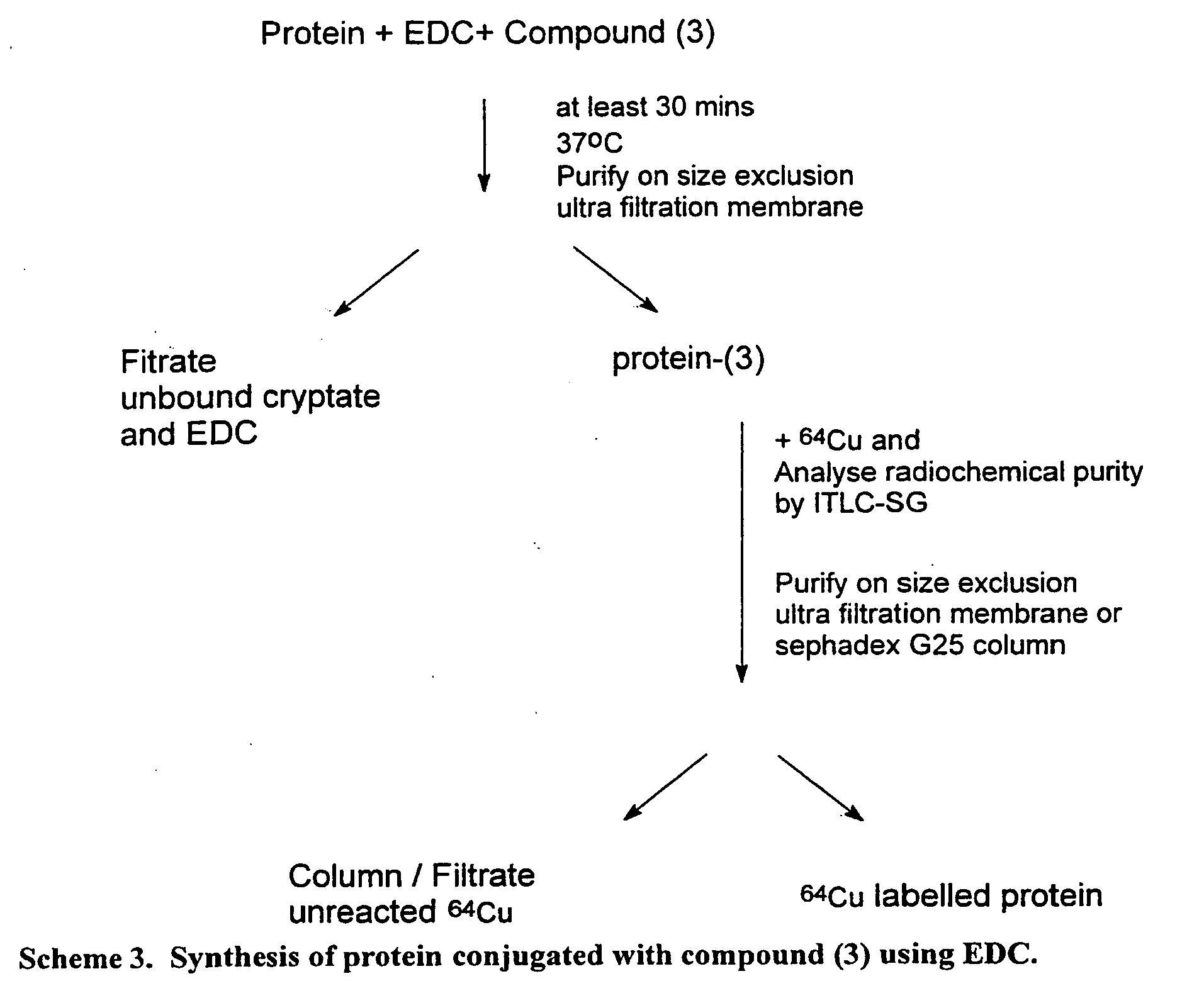
- The biodistribution of the 64Cu complexes of compounds (1), (3) and (4) (0.10 ml intravenous injection) were evaluated in balb/c mice (5 animals per time point) at 3, 5, 10, 15, 20 and 30 minute time intervals. Biodistribution studies were performed in duplicate. Biodistribution of the radiolabel is presented in Tables 1, 2 and 3, and is illustrated diagrammatically in Figures 3, 4 and 5.
- The B72.3 antibody recognises the TAG-72 antigen which is expressed on colorectal and ovarian tumours. The animal model used in the present study uses LS174t cells which also express TAG-72 antigen. The biodistribution of the 64Cu immunoconjugate (0.10 ml intravenous injection) was evaluated in LS174t tumour bearing nude mice (5 animals per time point) at 1, 3, 5, 24 and 48 hour time intervals. Biodistribution studies were performed in duplicate. Biodistribution of the radiolabel is presented in Table 4, and is illustrated diagrammatically in Figure 6a; Biodistribution of complex of compounds (1) (2) and (3) show that if the ligand actually detaches from the antibody in any form it will clear rapidly from the system and not release the 64Cu.
TABLE 1. 64Cu-labelled compound (4) % INJECTED DOSE PER GRAM TIME 3 MIN 5 MIN 10 MIN 15 MIN 20 MIN 30 MIN ORGAN MEAN S.D. MEAN S.D MEAN S.D MEAN S.D MEAN S.D MEAN S.D LIVER 1.81 0.30 1.59 0.12 1.16 0.06 0.64 0.06 5.01 0.55 5.76 0.58 SPLEEN 2.26 0.43 2.17 0.29 1.28 0.14 0.67 0.15 0.52 0.08 0.35 0.07 KIDNEY 20.08 4.98 18.62 4.09 14.79 6.26 7.52 0.54 25.99 3.24 30.26 4.50 MUSCLE 1.76 0.23 2.10 0.59 1.24 0.27 1.73 1.32 0.36 0.06 1.27 1.43 SKIN 5.98 0.31 6.46 0.56 4.21 0.68 2.76 0.10 1.73 0.45 1.42 0.42 BONE 1.60 0.25 1.56 0.24 1.28 0.23 1.60 0.41 0.89 0.51 0.65 0.10 LUNGS 5.85 0.03 5.28 0.46 2.84 1.09 2.09 0.24 1.13 0.30 0.92 0.15 HEART 3.25 0.34 2.66 0.14 1.60 0.36 1.08 0.18 0.51 0.08 0.47 0.17 BLOOD 8.25 0.32 7.08 0.22 4.41 0.78 2.71 0.57 1.40 0.12 1.07 0.21 BLADDER 13.15 6.81 28.05 18.33 69.91 54.03 8.17 4.96 16.38 20.77 25.38 35.78 STOMACH 3.53 0.56 3.04 0.29 1.84 0.55 0.89 0.37 0.70 0.14 0.65 0.10 GIT 2.62 0.08 3.16 0.20 1.49 0.31 1.07 0.18 0.89 0.05 0.80 0.04 TABLE 2. 64Cu-labelled compound (1) % INJECTED DOSE PER GRAM TIME 3 MIN 5 MIN 10 MIN 15 MIN 20 MIN 30 MIN ORGAN MEAN S.D. MEAN S.D MEAN S.D MEAN S.D MEAN S.D MEAN S.D LIVER 2.29 0.22 1.50 0.17 1.42 0.22 0.82 0.19 0.69 0.15 0.50 0.08 SPLEEN 2.09 0.52 1.48 0.21 1.54 0.25 1.44 0.76 0.69 0.12 0.52 0.16 KIDNEY 23.18 11.73 11.50 1.34 12.80 1.83 6.77 1.40 7.77 0.67 4.95 0.92 MUSCLE 1.81 0.32 1.81 0.59 2.39 1.14 2.28 1.66 1.17 1.02 1.33 1.59 SKIN 5.82 0.42 5.59 0.59 5.48 1.07 2.61 0.44 2.96 0.72 1.63 0.08 BONE 2.25 0.45 1.87 0.47 1.79 0.29 1.23 0.12 1.25 0.44 0.78 0.23 LUNGS 6.51 1.28 4.45 0.54 3.91 1.98 2.06 0.32 2.73 0.61 0.85 0.31 HEART 3.11 0.38 2.25 0.10 2.27 0.43 0.89 0.12 1.23 0.71 0.40 0.10 BLOOD 8.68 1.35 6.32 0.70 5.45 0.81 2.48 0.31 2.63 0.29 1.14 0.25 BLADDER 24.36 16.90 31.12 19.21 27.75 21.59 15.17 8.53 23.29 15.56 122.93 71.11 STOMACH 3.50 0.64 2.73 0.36 2.08 0.80 1.50 0.46 1.16 0.06 0.74 0.04 GIT 2.75 0.59 2.21 0.08 1.85 0.38 1.11 0.06 1.05 0.17 1.16 0.72 TABLE 3. 64Cu-labelled compound (3) % INJECTED DOSE PER GRAM TIME 3 MIN 5 MIN 10 MIN 15 MIN 20 MIN 30 MIN ORGAN MEAN S.D. MEAN S.D MEAN S.D MEAN S.D MEAN S.D MEAN S.D LIVER 1.94 0.17 2.00 0.52 1.46 0.39 1.24 0.23 1.04 0.08 0.72 0.02 SPLEEN 1.96 0.14 2.01 0.16 1.26 0.20 1.09 0.25 0.93 0.13 0.39 0.05 KIDNEY 22.41 5.77 18.99 2.98 13.41 3.04 10.26 1.76 9.98 1.73 5.95 0.27 MUSCLE 1.98 0.48 3.17 2.34 1.73 0.28 2.40 1.39 2.13 1.35 0.50 0.01 SKIN 5.63 1.05 6.18 1.17 4.86 1.14 4.49 1.03 3.41 1.10 1.45 0.13 BONE 1.68 0.04 2.11 0.60 1.29 0.43 1.36 0.24 1.11 0.08 0.72 0.10 LUNGS 5.48 0.61 5.74 1.07 4.00 0.79 3.25 0.64 2.59 0.50 1.13 0.01 HEART 2.79 0.36 3.00 0.59 2.03 0.58 1.56 0.29 1.24 0.05 0.50 0.11 BLOOD 7.74 0.43 8.19 1.53 5.23 1.28 4.39 0.59 3.05 0.44 1.25 0.02 BLADDER 11.36 4.02 12.31 4.09 14.36 9.79 10.54 9.64 13.45 16.47 2.74 2.02 STOMACH 2.69 0.51 3.11 0.79 2.35 0.65 1.91 0.45 1.54 0.33 0.60 0.04 GIT 2.66 0.29 2.88 0.46 1.80 0.38 2.92 2.46 1.05 0.22 0.55 0.03 TABLE 4. 64Cu-labelled conjugate of B72.3 with compound (3) % INJECTED DOSE PER GRAM TIME 1HR 3 HR 5HR 16 HR 24 HR 48 HR ORGAN MEAN SD MEAN SD MEAN SD MEAN SD MEAN SD MEAN SD LIVER 19.09 1.05 18.44 0.58 19.54 2.34 16.38 1.59 15.52 2.95 13.76 3.21 SPLEEN 11.51 1.13 8.35 1.19 10.17 0.98 10.08 1.75 8.47 1.89 8.44 1.57 KIDNEY 10.64 1.47 9.94 0.15 10.41 1.10 9.16 1.77 7.39 0.65 7.59 1.35 MUSCLE 1.45 0.52 1.48 0.23 1.45 0.16 1.98 0.27 2.54 0.54 1.72 0.42 SKIN 2.83 0.52 5.18 0.26 5.99 1.38 8.64 1.16 8.30 1.30 6.95 0.16 BONE 4.42 0.55 3.82 0.49 3.21 0.30 3.93 0.49 4.28 0.72 3.39 0.38 LUNGS 13.32 1.52 11.43 1.44 9.78 0.86 11.03 1.93 7.76 0.87 6.81 1.09 HEART 10.56 2.29 8.58 1.21 9.04 3.30 6.77 0.92 5.14 0.72 5.20 0.43 BLOOD 47.98 5.60 37.94 1.52 33.41 3.66 26.41 1.48 21.50 1.81 18.69 2.01 BLADDER 2.33 0.77 2.93 0.62 3.15 0.47 7.00 5.09 5.41 2.37 4.87 0.92 STOMACH 1.41 0.29 1.69 0.33 2.32 0.51 1.48 0.74 1.58 0.31 1.43 0.32 GIT 2.23 0.35 2.60 0.20 2.87 0.23 2.28 0.14 2.20 0.20 1.86 0.31 TAIL 5.03 0.73 4.96 0.83 5.64 1.82 6.14 2.47 5.18 1.20 4.08 0.30 TUMOUR 5.98 0.80 11.10 0.76 12.31 1.68 23.77 2.46 29.43 4.44 38.43 4.79 Table 5 Biodistribution of 123I-B72.3 in nu/nu mice %ID/g Time (hours) 1 3 6 16 24 48 ORGAN Mean SD Mean SD Mean SD Mean SD Mean SD Mean SD LIVER 11.89 2.33 8.93 1.24 7.45 1.51 5.61 0.64 5.03 0.82 4.92 0.90 SPLEEN 10.17 2.79 6.92 0.92 6.27 0.79 5.20 0.95 4.33 1.34 4.58 1.25 KIDNEY 11.20 0.77 8.89 1.40 9.24 0.53 5.83 0.88 5.40 0.98 4.76 0.78 MUSCLE 1.69 0.42 2.40 0.43 3.04 0.59 2.55 0.65 2.70 0.42 2.48 0.33 SKIN 4.36 1.85 5.96 0.94 7.79 0.76 7.94 0.95 7.96 0.78 7.41 1.44 BONE 5.43 0.54 4.43 0.69 3.23 0.43 3.19 0.78 2.58 0.58 2.54 0.36 LUNGS 14.28 2.97 12.84 2.89 11.00 1.57 7.39 1.62 6.64 1.57 6.47 0.64 HEART 14.03 6.26 10.11 1.16 9.46 1.59 7.28 2.50 5.78 0.62 4.87 1.10 BLOOD 55.63 3.36 44.78 4.03 42.20 3.93 28.27 3.00 28.73 2.23 22.73 2.50 URINE 3.96 0.58 13.29 5.00 18.31 6.92 7.28 4.17 6.92 1.11 6.87 2.11 BLADDER 3.49 1.15 5.10 1.63 4.85 0.91 4.74 1.24 5.70 1.13 6.63 1.23 STOMACH 1.80 0.2 2.94 0.44 4.06 0.50 2.64 0.90 3.06 0.99 3.05 0.72 GIT 2.35 0.26 2.74 0.29 2.74 0.39 1.84 0.33 1.65 0.26 1.51 0.07 THYROID 8.76 3.60 17.29 6.24 38.66 7.92 29.47 9.54 85.96 44.73 549.83 353.44 TUMOUR 9.61 2.04 16.46 1.61 31.43 8.39 31.37 6.54 44.67 8.50 46.17 7.25 %1D THYROID 0.08 0.02 0.19 0.03 0.42 0.11 0.40 0.18 1.24 0.64 2.59 1.13 TUMOUR:BLOOD 0.2 0.0 0.4 0.1 0.7 0.3 1.1 0.3 1.6 0.4 2.0 0.5 TUMOUR:LIVER 0.8 0.3 1.8 0.4 4.2 2.0 5.6 1.8 8.9 3.1 9.4 3.2 TUMOUR:KIDNEY 0.9 0.2 1.9 0.5 3.4 1.1 5.4 1.9 8.3 3.1 9.7 3.1 KIDNEY:BLOOD 0.2 0.0 0.2 0.0 0.2 0.0 0.2 0.1 0.2 0.0 0.2 0.1 KIDNEY:LIVER 0.9 0.2 1.0 0.3 1.2 0.3 1.0 0.3 1.1 0.4 1.0 0.3 Table 6. Biodistribution of 111In-DTPA-B72.3 in nu/nu mice. % ID/g Time (hours) 1 3 6 16 24 48 ORGAN Mean SD Mean SD Mean SD Mean SD Mean SD Mean SD LIVER 13.4 1.72 10.54 1.41 11.2 1.2 7.27 0.86 8.43 2.28 7.59 0.72 SPLEEN 12.52 2.66 9.56 1.96 10.05 2.55 6.47 3.33 7.32 1.43 4.48 2.28 KIDNEY 15.41 1.57 12.04 1.67 14.13 1.83 15.59 1.39 13.97 1.64 15.04 1.57 MUSCLE 2.08 0.81 1.96 0.42 2.56 0.32 2.44 0.82 2.28 0.26 1.84 0.51 SKIN 4.17 1.98 7.54 1.53 9.31 1.41 9.48 1.21 8.44 0.42 7.54 0.75 BONE 5.9 1.12 4.59 0.53 3.85 0.97 5.81 1.12 5.52 0.58 5.23 0.9 LUNGS 18.58 4.72 13.14 4.58 13.03 2.65 8.06 1.89 6.58 1.4 7.07 1.93 HEART 11.9 3.88 9.59 1.65 11.71 4.12 6.25 0.88 4.99 0.39 3.95 0.45 BLOOD 56.19 9.04 39.03 4.66 38.23 3.64 26.51 1.72 21.78 2.36 17.04 0.89 URINE 5.23 0 3.96 1.16 4.46 1.68 4.46 1.12 4.43 1.56 BLADDER 11.82 9.4 5.59 2.85 8.31 19.94 7.68 2.97 6.88 1.87 4.28 0.39 STOMACH 2.43 0.8 2.49 0.66 2.2 0.9 1.53 0.48 1.47 0.46 1.47 0.44 GIT 2.12 0.34 2.44 0.51 2.33 0.42 2.17 0.25 2.04 0.2 2.33 0.2 TAIL 9.37 5.68 8.39 4.38 8.53 5.27 4.98 1.17 4.69 0.96 3.79 1.37 THYRIOD 18.66 8.1 25.91 17.2 8.09 3.14 7.37 1.62 8.51 2.21 4.45 0.91 TUMOUR 8.87 2.39 17.95 4.93 21.24 6.11 38.25 8.71 35 5.21 48.99 4 %ID THYROID 0.07 0.01 0.06 0.03 0.07 0.01 0.07 0.02 0.06 0.03 0.06 0.01 TUMOUR:BLOOD 0.2 0.1 0.5 0.2 0.6 0.2 1.4 0.4 1.6 0.4 2.9 0.4 TUMOUR:LIVER 0.7 0.3 1.7 0.7 1.9 0.7 5.3 1.8 4.2 1.7 6.5 1.1 TUMOUR:KIDNEY 0.6 0.2 1.5 0.6 1.5 0.6 2.5 0.8 2.5 0.7 3.3 0.6 KIDNEY:BLOOD 0.3 0.1 0:3 0.1 0.4 0.1 0.6 0.1 0.6 0.1 0.9 0.1 KIDNEY:LIVER 1.2 0.3 1.1 0.3 1.3 0.3 2.1 0.4 1.7 0.6 2.0 0.4 - It is to be understood that the term "SarAr" as used in the following tables and description refers to compound (3) as shown in example 1.
Table 7 Maximum Radiation Dose Estimates for 64Cu-SarAr-B72.3 Organ Total Dose Total Dose mGy/MBq Rad/mCi Adrenals 0.030 0.111 Brain 0.018 0.068 Breasts 0.021 0.078 Gallbladder Wall 0.036 0.133 LLI Wall 0.094 0.347 Small Intestine 0.047 0.175 Stomach 0.029 0.107 ULI Wall 0.069 0.255 Heart Wall 0.075 0.278 Kidneys 0.129 0.477 Liver 0.152 0.563 Lungs 0.062 0.230 Ovaries 0.026 0.095 Muscle 0.013 0.047 Pancreas 0.030 0.110 Red Marrow 0.029 0.107 Bone Surfaces 0.030 0.111 Skin 0.019 0.069 Spleen 0.088 0.327 Thymus 0.023 0.086 Testes 0.019 0.072 Thyroid 0.020 0.074 Bladder Wall 0.019 0.070 Uterus 0.029 0.109 Total Body 0.024 0.090 Tumour S factor Dose Dose Mass (g) rad/uCi-h Gy rad 0.1 2.25 17.80 1779.75 0.5 0.48 3.80 380.47 1.0 0.25 1.97 196.96 2.0 0.13 1.00 99.67 Table 8 Maximum Radiation Dose Estimate for 131I-B72.3 Organ Total Dose Total Dose mGy/MBq rad/mCi Adrenals 0.821 3.038 Brain 0.514 1.902 Breasts 0.603 2.231 Gallbladder Wall 0.913 3.378 LLI Wall 2.24 8.288 Small Intestine 1.3 4.810 Stomach 1.15 4.255 ULI Wall 1.69 6.253 Heart Wall 1.82 6.734 Kidneys 2.41 8.917 Liver 1.92 7.104 Lungs 1.55 5.735 Muscle 0.473 1.750 Ovaries 0.768 2.842 Pancreas 0.858 3.175 Red Marrow 0.783 2.897 Bone Surfaces 0.678 2.509 Skin 0.547 2.024 Spleen 2.04 7.548 Testes 0.595 .2.202 Thymus 0.717 2.653 Thyroid 44.6 165.020 Bladder Wall 0.755 2.794 Uterus 1.13 4.181 Total Body 0.715 2.646 Effective Dose 3.45 mSv/MBq 12.765 rem/mCi (Tumour not included) Tumour S factor Dose per mCi Mass (g) Gy rad 0.1 3.6 982 98275 0.5 0.759 207 20720 1 0.393 107 10728 2 0.2 54 5460 - It is assumed that the tumour is a small source located in the lower trunk which will make a contribution to all other organ doses. So that the computer software program known as MIRDOSE3 can be used, the activity is assumed to be located in the ovaries.
The ovary dose given in above was calculated separately. It is not the tumour dose.
Bladder Residence Time - The activity excreted via the bladder is almost insignificant.
The total bladder and urine residence times in Table 5 was used as the urine activity in the dose calculation. No excretion model or assumed voiding time were used.Table 9. Maximum Radiation Dose Estimates for 90Y Organ Total Dose Total Dose mGy/MBq rad/mCi Adrenals 0.57 2.109 Brain 0.57 2.109 Breasts 0.57 2.109 Gallbladder Wall 0.57 2.109 LLI Wall 3.47 12.839 Small Intestine 1.36 5.032 Stomach 0.709 2.623 ULI Wall 2.25 8.325 Heart Wall 1.8 6.660 Kidneys 7.87 29.119 Liver 2.89 10.693 Lungs 1.88 6.956 Muscle 0.232 0.858 Ovaries 0.57 2.109 Pancreas 0.57 2.109 Red Marrow 0.964 3.567 Bone Surfaces 1.03 3.811 Skin 0.57 2.109 Spleen 2.32 8.584 Testes 0.57 2.109 Thymus 0.57 2.109 Thyroid 1.72 6.364 Bladder Wall 0.444 1.643 Uterus 0.57 2.109 Total Body 0.645 2.387 Tumour S Dose per mCi Mass (g) rad/uCi-h Gy rad 0.1 8.97 546 54585 0.5 2.51 152.7 15274 1 1.4 85.2 8519 2 0.758 46.1 4613 - It is assumed that the tumour is a small source located in the lower trunk which will make a contribution to all other organ doses. So that the computer software program known as MIRDOSE3 can be used, the activity is assumed to be located in the ovaries. The ovary dose given in above was calculated separately. It is not the tumour dose.
Bladder Residence Time: The activity excreted via the bladder is almost insignificant.
The total bladder and urine residence times in Table 5 was used as the urine activity in the dose calculation. No excretion model or assumed voiding time were used.Table 10. Radiation Dose Estimate for 131I-B72.3 (7 days) Organ Total Dose Total Dose mGy/MBq rad/mCi Adrenals 0.377 1.395 Brain 0.24 0.888 Breasts 0.276 1.021 Gallbladder Wall 0.418 1.547 LLI Wall 1.02 3.774 Small Intestine 0.587 2.172 Stomach 0.52 1.924 ULI Wall 0.769 2.845 Heart Wall 0.863 3.193 Kidneys 1.13 4.181 Liver 0.888 3.286 Lungs 0.727 2.690 Muscle 0.212 0.784 Ovaries 0.35 1.295 Pancreas 0.393 1.454 Red Marrow 0.358 1.325 Bone Surfaces 0.309 1.143 Skin 0.25 0.925 Spleen 0.951 3.519 Testes 0.272 1.006 Thymus 0.328 1.214 Thyroid 17.8 65.860 Bladder Wall 0.338 1.251 Uterus 0.497 1.839 Total Body 0.323 1.195 Tumour Dose to 24 hour Mass (g) rad/mCi 0.1 2991 0.5 631 1 327 2 166 Table 11. Radiation Dose Estimates for 90Y (7 days) Organ Total Dose Total Dose mGy/MBq rad/mCi Adrenals 0.5 1.850 Brain 0.365 1.351 Breasts 0.5 1.850 Gallbladder Wall 0.5 1.850 LLI Wall 2.87 10.619 Small Intestine 1.14 4.218 Stomach 0.603 2.231 ULI Wall 1.87 6.919 Heart Wall 1.53 5.661 Kidneys 6.5 24.050 Liver 2.41 8.917 Lungs 1.58 5.846 Muscle 0.194 0.718 Ovaries 0.4 1.480 Pancreas 0.5 1.850 Red Marrow 0.808 2.990 Bone Surfaces 0.858 3.175 Skin 0.5 1.850 Spleen 1.97 7.289 Testes 0.5 1.850 Thymus 0.5 1.850 Thyroid 1.43 5.291 Bladder Wall 0.38 1.406 Uterus 0.5 1.850 Total Body 0.546 2.020 Tumour rad/mCi at Mass (g) 24 hour 0.1 6925 0.5 1938 1 1081 2 585 - Radiotherapeutic Study was conducted in two parts.
- Part A where the theoretical doses to target and non-target organs were calculated for the analogous radioimmunoconjugates.
- Part B where the various radioactive levels of 64Cu-SarAr-B72.3 was injected into tumour bearing mice and the therapeutic effect of the product was monitored as an extension of animal survival time.
- Biodistribution studies of 123I- and 111In- radiolabelled B72.3 were conducted in LS 174t tumour bearing nude mice (see Table 5,6) Standard calculations were performed using
computer software MIRDOSE 3 which was used to compare target to non-target dose of their analogous therapeutic counterparts (90Y and 131I respectively) with 64Cu-SarAr-B72.3 (see Table 7,8,9) - Theoretical maximum accumulated dose (which is equivalent to 10 half life decay) for each radioimmunoconjugate was calculated. Total body dose for 64Cu-SarAr-B72.3 was significantly lower (0.09 rad/mCi) than analogous products (131I-B72.3, 2.64 rad/mCi; 90Y-B72.3, 2.387 rad/mCi). Comparative maximum doses to tumours of various sizes was calculated. Doses for 131I- and 90Y-B72.3 appear to be better than for 64Cu-SarAr-B72.3. However, the lack of stability of the radioimmunoconjugate at the tumour site in real biological systems prevents the tumour from receiving the maximum accumulated dose.
- Hence doses to target and non-target organs were re-calculated assuming the radioimmunoconjugates (131I and 90Y) were stable for approximately 24 hours at the tumour site and the non-target organs were dosed for up to 7 days allowing for natural biological clearance.
MIRDOSE 3 was used to re-calculate dose to various organs under these conditions (see Table 10,11). Most relevant resultant target to non-target ratios are given in Table 12.Table 12 Ratio of Target:Non-Target Doses for each Radioimmunoconjugate 64Cu 131I 90Y Tumour (0.1g):Kidneys 2094 716 288 Tumour (0.1 g):Liver 1795 906 776 Total Body Dose for 7 days 0.09 1.195 2.020 * MIRDOSE 3 was used to estimate human organ doses assuming the residence times in man are the same as the animal model. It is acknowledged that this affects the accuracy of the dose estimates. - In order to assess therapeutic effect of 64Cu, in a real biological system, nude mice bearing LS174t colorectal carcinoma were injected with various doses (0, 10, 20, 30, 40 MBq) of 64Cu-SarAr-B72.3.
- Results are given in Table 13 and a typical profile of a study is given in Figure 1. For all activity levels greater than 20 MBq a significant extension in mouse life was achieved. Experimental details follow.
Table 13 Extension of mouse life relative to 64Cu-SarAr-B72.3 - Part B Experiment Survival1 (Days) Control2 20-25 10 MBq 30-35 20 MBq 60-70 30 MBq 40-45 40 MBq 30-35 1Greater than 30 % of animals; 2Greater than 50 control animals; -
- Animal model: LS174t tumour tissue from nude mice was transplanted into nude mice for each experiment.
- Animal selection: Only animals bearing tumours 3.5 - 5.5 mm
- 7 days post transplantation were selected for each study. Up to 10 animals per dose.
- Injection: The product was injected into the nude mice on
Day 7 after transplantation of tumour tissue. - Doses: Various activities of Cu-64-SarAr-B72.3 was injected into the mice. Control animals receive only antibody.
- Monitoring of animals : Animals were monitored for changes in tumour size
- Animal mass
- Behavioural and physical abnormalities
- (e.g. movement / gait, food intake and hunching)
- (For any of the above characteristic, frequency of weighing increased)
- Histology, Haematology and Biochemistry:
Animals were sacrificed at pre-determined time points (2 days, 1, 2, 3, 4 weeks, 2, 3, 4, 5 and 6 months). - Radiotoxic effects were monitored.
(conducted by external pathologist of Department of Veterinary Anatomy and Pathology, University of Sydney) - Endpoint of the study :
- 1) Body weight loss > 20 %.
- 2) Rapid weight loss of > 10% overnight.
- 3) Ulceration of tumour
- 4) Limitation of normal behaviour (e.g. ability to feed or drink).
- 5) Tumour size 10 x 10 mm (UK Cancer Council)
- In accordance with the description of the invention provided above specific preferred pharmaceutical compositions of the present invention may be prepared, and examples of which are provided below. The following specific formulations are to be construed as merely illustrative examples of formulations and not as a limitation of the scope of the present invention in any way.
- A compound of Formula (I) may be administered alone, although it is preferable that it be administered as a pharmaceutical formulation.
- A pharmaceutical composition of the present invention for intramuscular injection could be prepared to contain 1 mL sterile isotonic saline, and 1 mg of compound of Fonnula (I).
- Similarly, a pharmaceutical composition for intravenous infusion may comprise 250 ml of sterile Ringer's solution, and 5 mg of compound of Formula (I).
- A pharmaceutical composition of this invention in a form suitable for administration by injection may be prepared by mixing 1 % by weight of compound of Formula (I) in 12 % by volume propylene glycol and isotonic saline. The solution is sterilised by filtration.
- Modifications and variations such as would be apparent to a skilled addressee are deemed to be within the scope of the present invention. It is to be understood that the present invention should not be limited to the particular embodiment(s) described above. Throughout the specification, unless the context clearly indicates otherwise, the word, "comprise", "comprises", "comprising" or other variations thereof shall be understood as meaning that the stated integer is included and does not exclude other integers from being present even though those other integers are not explicitly stated.
Claims (35)
- A compound which is capable of being radiolabelled of general Formula (I):
 in which n represents an integer from 2 to 4,wherein each R4 and R5 is independently selected from -H, CH3, COOH, NO2, CH2OH, H2PO4, HSO3, CN, C(=O)NH2 and CHO;X and Y are the same or different and are selected from the group consisting of C-R, N, P and C-Z in which R is selected from hydrogen, halogen, hydroxyl, nitro, nitroso, amino, optionally substituted alkyl, optionally substituted aryl, optionally substituted aralkyl, cyano, -COOR', COCOOR', NH-COCH2Br, -NH-CO-CH=CH-COOR' in which R' is a hydrogen atom or alkyl group, wherein at least one of X and Y is C-Z;W is selected from the group consisting of NH, S and O; andZ is a functionalised group which is capable of binding said compound of formula (I) to a molecular recognition unit, selected from
 wherein p is an integer from 1 to 4 and Ar is optionally substituted phenyl;wherein said optional substituents are selected from the group consisting of amino, halogen, hydroxy, mercapto, nitro, cyano, thiocyano, alkyl, alkoxy, halogenoalkyl, acyl, acylamino, acyloxy, carboxyl, alkoxycarboxyl, carbamoyl, pyridoylamino, carboxyalkyl-carbamoyl, N-carboxylalkylcarbamoyl, sulfo, sulfamoyl, mono- or di-alkylated or phenylated sulfamoyl optionally having one or more alkyl substituents, alkylsulfonyl, alkoxysulfonyl, optionally hydroxy-containing phenylsulfonyl or phenoxy sulfonyl;or a pharmaceutically acceptable salt thereof.
 - A compound of formula (I) according to claim 1, wherein W is NH.
- A compound of formula (I) according to claim 1 or 2, wherein Z is -NH-(CH2)p-Ar-NH2 or -NH-(CH2)p-Ar-NCS, and p is 1 or 2.
- A compound of formula (I) according to claim 1, wherein W is NH and Z is -NH-(CH2)p-Ar-NH2.
- A compound of formula (I) according to claim 1, wherein W is NH and Z is -NH-(CH2)p-Ar-NCS.
- A compound of formula (I) according to claim 4 or 5, wherein Ar is phenyl.
- A compound of formula (I) according to claim 1 which is

- A compound according to any one of claims 1 to 7, wherein the molecular recognition unit is selected from the group consisting of an antibody, protein, peptide, carbohydrate, nucleic acid, oligonucleotide, oligosaccharide and liposome.
- A compound according to claim 8, wherein the molecular recognition unit is an antibody.
- A compound according to any one of claims 1 to 9, wherein said compound is complexed with a metal ion selected from the group consisting of Cu, Tc, Ga, In, Co, Re, Fe, Au, Ag, Rh, Pt, Bi, Cr, W, Ni, V, Pb, Ir, Zn, Cd, Mn, Ru, Pd, Hg and Ti.
- A compound according to claim 10, wherein the metal ion is selected from the group consisting of Cu, Tc, Ga, In, Re, Fe, Au, Ag, Rh, Pt, Bi, Cr, W, Ni, V, Pb, Ir, Zn, Cd, Mn, Ru, Pd, Hg and Ti.
- A compound of formula (I) according to claim 10, wherein the metal ion is a radionuclide selected from the group consisting of Cu, Tc, In, Ga, Fe, Ti and Re.
- A compound of formula (I) according to claim 12, wherein the radionuclide is selected from 64Cu and 67Cu.
- A compound of formula (I) according to claim 1, wherein n is 3 or 4 and the compound is complexed with a metal ion selected from the lanthanide group of elements in the Periodic Table.
- A pharmaceutical composition for radioimaging or diagnosis comprising a compound of formula (I) according to any one of claims 1 to 14, a pharmaceutically acceptable salt thereof, a metal ion complex thereof, or a radiolabelled complex thereof, together with a pharmaceutically acceptable carrier.
- Use of a radiolabelled complex of a compound of formula (I) according to any one of claims 1 to 14, or a pharmaceutically acceptable salt thereof for the manufacture of a medicament for diagnosing a disease, radioimaging, or radiotherapy of a disease.
- The use according to claim 16, wherein said disease is cancer.
- The use according to claim 16 or 17, wherein said medicament is for diagnosing a disease and the metal ion is a radionuclide selected from the group consisting of Cu, Tc, Ga, In, Co, Re, Fe, Au, Ag, Rh, Pt, Bi, Cr, W, Ni, V, Pb, Ir, Zn, Cd, Mn, Ru, Pd, Hg and Ti.
- The use according to claim 18, wherein the metal ion is a radionuclide selected from the group consisting of Cu, Tc, In, Ga, Fe, Ti and Re.
- The use according to claim 19, wherein the radionuclide is selected from 64Cu and 67Cu.
- The use according to claim 16 or 17, wherein said medicament is for radioimaging a disease and said metal ion is a radionuclide selected from the group consisting of Cu, Tc, Ga, In, Re, Fe, Au, Ag, Rh, Pt, Bi, Cr, W, Ni, V, Pb, Ir, Zn, Cd, Mn, Ru, Pd, Hg and Ti.
- The use according to claim 21, wherein the metal ion is a radionuclide selected from the group consisting of Cu, Tc, In, Ga, Fe, Ti and Re.
- The use according to claim 20, wherein the radionuclide is selected from 64Cu and 67Cu.
- The use according to claim 16 or 17, wherein said medicament is for radiotherapy of a disease, wherein said metal ion is a radionuclide selected from the group consisting of Cu, Ga, In, Co, Re, Fe, Au, Ag, Rh, Pt, Bi, Cr, W, Ni, V, Pb, Ir, Pt, Zn, Cd, Mn, Ru, Pd, Hg and Ti.
- The use according to claim 24, wherein the metal ion is a radionuclide selected from the group consisting of Cu, In, Ga, Fe, Ti and Re.
- The use according to claim 25, wherein the radionuclide is selected from 64Cu and 67Cu.
- The use according to claim 16, wherein n is 3 or 4 and the compound is complexed with a radiolabelled metal ion selected from the lanthanide group of elements in the Periodic Table.
- A conjugate compound comprising at least one compound of Formula (I) according to any one of claims 1 to 14, or a metal complex, or radiolabelled complex, or a pharmaceutically acceptable salt thereof, bonded to at least one molecular recognition unit comprising an antibody, protein, peptide, carbohydrate, oligonucleotide or oligosaccharide.
- A conjugate compound according to claim 28, wherein the molecular recognition unit is an antibody.
- A pharmaceutical composition comprising a conjugate compound or metal complex thereof according to claim 28 or 29, together with a pharmaceutically acceptable carrier.
- Use of a radiolabelled metal ion complex of a conjugate compound according to claim 28 or 29, or a pharmaceutically acceptable salt thereof, for the manufacture of a medicament for diagnosing a disease, radioimaging, or radiotherapy of a disease.
- The use according to claim 31, wherein said disease is cancer.
- The use according to claim 31 or 32, wherein said medicament is for diagnosing a disease and the metal ion is a radionuclide selected from the group consisting of Cu, Tc, Ga, In, Co, Re, Fe, Au, Ag, Rh, Pt, Bi, Cr, W, Ni, V, Pb, Ir, Zn, Cd, Mn, Ru, Pd, Hg and Ti.
- The use according to claim 33, wherein the metal ion is a radionuclide selected from the group consisting of Cu, Tc, In, Ga, Fe, Ti and Re.
- The use according to claim 34, wherein the radionuclide is selected from 64Cu and 67Cu.
Applications Claiming Priority (3)
| Application Number | Priority Date | Filing Date | Title |
|---|---|---|---|
| AUPP803899 | 1999-01-05 | ||
| AUPP8038A AUPP803899A0 (en) | 1999-01-05 | 1999-01-05 | Cryptate compounds and methods for diagnosis and therapy. |
| PCT/AU2000/000003 WO2000040585A1 (en) | 1999-01-05 | 2000-01-05 | Cryptate compounds and methods for diagnosis and therapy |
Publications (3)
| Publication Number | Publication Date |
|---|---|
| EP1147111A1 EP1147111A1 (en) | 2001-10-24 |
| EP1147111A4 EP1147111A4 (en) | 2002-05-02 |
| EP1147111B1 true EP1147111B1 (en) | 2006-12-20 |
Family
ID=3812244
Family Applications (1)
| Application Number | Title | Priority Date | Filing Date |
|---|---|---|---|
| EP00902480A Expired - Lifetime EP1147111B1 (en) | 1999-01-05 | 2000-01-05 | Cryptate compounds and methods for diagnosis and therapy |
Country Status (7)
| Country | Link |
|---|---|
| US (1) | US6869589B1 (en) |
| EP (1) | EP1147111B1 (en) |
| AT (1) | ATE348830T1 (en) |
| AU (1) | AUPP803899A0 (en) |
| DE (1) | DE60032460T2 (en) |
| ES (1) | ES2278590T3 (en) |
| WO (1) | WO2000040585A1 (en) |
Families Citing this family (7)
| Publication number | Priority date | Publication date | Assignee | Title |
|---|---|---|---|---|
| ZA981883B (en) * | 1997-03-07 | 1998-09-01 | Univ Kansas | Catalysts and methods for catalytic oxidation |
| US20050187126A1 (en) * | 2002-08-27 | 2005-08-25 | Busch Daryle H. | Catalysts and methods for catalytic oxidation |
| CN102300866B (en) * | 2008-12-02 | 2015-08-26 | 墨尔本大学 | As radiopharmaceutic nitrogenous large ring conjugate |
| US9403875B2 (en) * | 2009-01-27 | 2016-08-02 | University Of Southern California | Cage-like bifunctional chelators, copper-64 radiopharmaceuticals and PET imaging using the same |
| US10717741B2 (en) * | 2011-07-07 | 2020-07-21 | Australian Nuclear Science And Technology Organisation | Cryptate compounds |
| US10583206B2 (en) | 2014-04-07 | 2020-03-10 | Kyungpook National University Industry-Academic, Cooperation Foundation | Radioactive probe for detecting hydrogen sulfide |
| CN110914274B (en) * | 2017-06-06 | 2022-08-26 | 透明医药有限公司 | Radiopharmaceuticals, radioimaging agents and uses thereof |
Family Cites Families (3)
| Publication number | Priority date | Publication date | Assignee | Title |
|---|---|---|---|---|
| US4741900A (en) * | 1982-11-16 | 1988-05-03 | Cytogen Corporation | Antibody-metal ion complexes |
| US5364613A (en) * | 1989-04-07 | 1994-11-15 | Sieving Paul F | Polychelants containing macrocyclic chelant moieties |
| WO1995031202A1 (en) * | 1994-05-17 | 1995-11-23 | Commonwealth Scientific And Industrial Research Organisation | Cage compounds, processes for their preparation and their use as antiviral agents |
-
1999
- 1999-01-05 AU AUPP8038A patent/AUPP803899A0/en not_active Abandoned
-
2000
- 2000-01-05 DE DE60032460T patent/DE60032460T2/en not_active Expired - Lifetime
- 2000-01-05 AT AT00902480T patent/ATE348830T1/en active
- 2000-01-05 ES ES00902480T patent/ES2278590T3/en not_active Expired - Lifetime
- 2000-01-05 US US09/869,777 patent/US6869589B1/en not_active Expired - Lifetime
- 2000-01-05 WO PCT/AU2000/000003 patent/WO2000040585A1/en not_active Ceased
- 2000-01-05 EP EP00902480A patent/EP1147111B1/en not_active Expired - Lifetime
Also Published As
| Publication number | Publication date |
|---|---|
| ATE348830T1 (en) | 2007-01-15 |
| WO2000040585A1 (en) | 2000-07-13 |
| DE60032460T2 (en) | 2007-11-15 |
| EP1147111A4 (en) | 2002-05-02 |
| AUPP803899A0 (en) | 1999-01-28 |
| EP1147111A1 (en) | 2001-10-24 |
| ES2278590T3 (en) | 2007-08-16 |
| DE60032460D1 (en) | 2007-02-01 |
| US6869589B1 (en) | 2005-03-22 |
Similar Documents
| Publication | Publication Date | Title |
|---|---|---|
| US20250057993A1 (en) | Labeled inhibitors of prostate specific membrane antigen (psma), their use as imaging agents and pharmaceutical agents for the treatment of psma-expressing cancers | |
| JP7650938B2 (en) | Complexes containing PSMA targeting compounds linked to lead or thorium radionuclides - Patent Application 20070123333 | |
| Zalutsky et al. | Radioimmunotherapy with α-particle emitting radioimmunoconjugates | |
| US20220040337A1 (en) | Radioligands for pretargeted pet imaging and methods of their therapeutic use | |
| US10821195B2 (en) | Compositions for therapeutics, targeted PET imaging and methods of their use | |
| Vallabhajosula et al. | Radioimmunotherapy of prostate cancer in human xenografts using monoclonal antibodies specific to prostate specific membrane antigen (PSMA): studies in nude mice | |
| Wong et al. | A phase I trial of 90Y-DOTA-anti-CEA chimeric T84. 66 (cT84. 66) radioimmunotherapy in patients with metastatic CEA-producing malignancies | |
| US7368100B2 (en) | Backbone-substituted bifunctional DOTA ligands, complexes and compositions thereof, and methods of using same | |
| Chong et al. | Rational design and generation of a bimodal bifunctional ligand for antibody-targeted radiation cancer therapy | |
| US6869589B1 (en) | Cryptate compounds and methods for diagnosis and therapy | |
| Yordanov et al. | Antitenascin antibody 81C6 armed with 177Lu: in vivo comparison of macrocyclic and acyclic ligands | |
| JP2017141300A (en) | Cryptate compound | |
| Goldenberg | Carcinoembryonic antigen as a target cancer antigen for radiolabeled antibodies: prospects for cancer imaging and therapy | |
| EP3721907B1 (en) | Psma inhibitor derivatives for labelling with 99mtc via hynic, a radiopharmaceutical kit, radiopharmaceutical preparations and their use in prostate cancer diagnostics | |
| Borchardt et al. | Indium-111-and yttrium-90-labeled human monoclonal immunoglobulin M targeting of human ovarian cancer in mice | |
| AU780635B2 (en) | Cryptate compounds and methods for diagnosis and therapy | |
| US5807535A (en) | Metal complexes of hydroxyaryl containing aminocarboxylic acid chelating agents | |
| EP0590766B1 (en) | Hydroxylaryl containing aminocarboxylic acid chelating agents | |
| AU671465B2 (en) | Metal complexes of hydroxyaryl containing aminocarboxylic acid chelating agents | |
| HK40120870A (en) | Labeled inhibitors of prostate specific membrane antigen (psma), their use as imaging agents and pharmaceutical agents for the treatment of psma-expressing cancers | |
| AU2026201506A1 (en) | Dosage regimen for short-lived radioisotope | |
| Wiebe | Radiohalogenated nitroimidazoles for single-photon scintigraphic imaging of hypoxic tissues |
Legal Events
| Date | Code | Title | Description |
|---|---|---|---|
| PUAI | Public reference made under article 153(3) epc to a published international application that has entered the european phase |
Free format text: ORIGINAL CODE: 0009012 |
|
| 17P | Request for examination filed |
Effective date: 20010803 |
|
| AK | Designated contracting states |
Kind code of ref document: A1 Designated state(s): AT BE CH CY DE DK ES FI FR GB GR IE IT LI LU MC NL PT SE |
|
| AX | Request for extension of the european patent |
Free format text: AL;LT;LV;MK;RO;SI |
|
| RIC1 | Information provided on ipc code assigned before grant |
Free format text: 7C 07D 487/08 A, 7C 07F 1/08 B, 7A 61K 51/02 B, 7A 61K 49/12 B, 7A 61K 49/14 B, 7A 61K 49/16 B, 7A 61K 31/395 B, 7A 61K 31/555 B |
|
| A4 | Supplementary search report drawn up and despatched |
Effective date: 20020315 |
|
| AK | Designated contracting states |
Kind code of ref document: A4 Designated state(s): AT BE CH CY DE DK ES FI FR GB GR IE IT LI LU MC NL PT SE |
|
| 17Q | First examination report despatched |
Effective date: 20020724 |
|
| RIN1 | Information on inventor provided before grant (corrected) |
Inventor name: HARROWFIELD, JOHN, M. Inventor name: SMITH, SUZANNE, VIRGINIA Inventor name: DI BARTOLO, NADINE, MARIE Inventor name: SARGESON, ALAN, MCLEOD |
|
| GRAP | Despatch of communication of intention to grant a patent |
Free format text: ORIGINAL CODE: EPIDOSNIGR1 |
|
| GRAS | Grant fee paid |
Free format text: ORIGINAL CODE: EPIDOSNIGR3 |
|
| GRAA | (expected) grant |
Free format text: ORIGINAL CODE: 0009210 |
|
| AK | Designated contracting states |
Kind code of ref document: B1 Designated state(s): AT BE CH CY DE DK ES FI FR GB GR IE IT LI LU MC NL PT SE |
|
| PG25 | Lapsed in a contracting state [announced via postgrant information from national office to epo] |
Ref country code: DK Free format text: LAPSE BECAUSE OF FAILURE TO SUBMIT A TRANSLATION OF THE DESCRIPTION OR TO PAY THE FEE WITHIN THE PRESCRIBED TIME-LIMIT Effective date: 20061220 Ref country code: FI Free format text: LAPSE BECAUSE OF FAILURE TO SUBMIT A TRANSLATION OF THE DESCRIPTION OR TO PAY THE FEE WITHIN THE PRESCRIBED TIME-LIMIT Effective date: 20061220 |
|
| REG | Reference to a national code |
Ref country code: GB Ref legal event code: FG4D |
|
| REG | Reference to a national code |
Ref country code: CH Ref legal event code: EP |
|
| PG25 | Lapsed in a contracting state [announced via postgrant information from national office to epo] |
Ref country code: MC Free format text: LAPSE BECAUSE OF NON-PAYMENT OF DUE FEES Effective date: 20070131 |
|
| REF | Corresponds to: |
Ref document number: 60032460 Country of ref document: DE Date of ref document: 20070201 Kind code of ref document: P |
|
| REG | Reference to a national code |
Ref country code: IE Ref legal event code: FG4D |
|
| PG25 | Lapsed in a contracting state [announced via postgrant information from national office to epo] |
Ref country code: SE Free format text: LAPSE BECAUSE OF FAILURE TO SUBMIT A TRANSLATION OF THE DESCRIPTION OR TO PAY THE FEE WITHIN THE PRESCRIBED TIME-LIMIT Effective date: 20070320 |
|
| REG | Reference to a national code |
Ref country code: CH Ref legal event code: NV Representative=s name: SUSI PRYDE-HAENI BSC |
|
| PG25 | Lapsed in a contracting state [announced via postgrant information from national office to epo] |
Ref country code: PT Free format text: LAPSE BECAUSE OF FAILURE TO SUBMIT A TRANSLATION OF THE DESCRIPTION OR TO PAY THE FEE WITHIN THE PRESCRIBED TIME-LIMIT Effective date: 20070424 |
|
| ET | Fr: translation filed | ||
| REG | Reference to a national code |
Ref country code: ES Ref legal event code: FG2A Ref document number: 2278590 Country of ref document: ES Kind code of ref document: T3 |
|
| PLBE | No opposition filed within time limit |
Free format text: ORIGINAL CODE: 0009261 |
|
| STAA | Information on the status of an ep patent application or granted ep patent |
Free format text: STATUS: NO OPPOSITION FILED WITHIN TIME LIMIT |
|
| 26N | No opposition filed |
Effective date: 20070921 |
|
| PG25 | Lapsed in a contracting state [announced via postgrant information from national office to epo] |
Ref country code: GR Free format text: LAPSE BECAUSE OF FAILURE TO SUBMIT A TRANSLATION OF THE DESCRIPTION OR TO PAY THE FEE WITHIN THE PRESCRIBED TIME-LIMIT Effective date: 20070321 |
|
| PG25 | Lapsed in a contracting state [announced via postgrant information from national office to epo] |
Ref country code: CY Free format text: LAPSE BECAUSE OF FAILURE TO SUBMIT A TRANSLATION OF THE DESCRIPTION OR TO PAY THE FEE WITHIN THE PRESCRIBED TIME-LIMIT Effective date: 20061220 Ref country code: LU Free format text: LAPSE BECAUSE OF NON-PAYMENT OF DUE FEES Effective date: 20070105 |
|
| PGFP | Annual fee paid to national office [announced via postgrant information from national office to epo] |
Ref country code: CH Payment date: 20140114 Year of fee payment: 15 Ref country code: IE Payment date: 20140110 Year of fee payment: 15 |
|
| PGFP | Annual fee paid to national office [announced via postgrant information from national office to epo] |
Ref country code: AT Payment date: 20131224 Year of fee payment: 15 Ref country code: ES Payment date: 20131230 Year of fee payment: 15 |
|
| REG | Reference to a national code |
Ref country code: CH Ref legal event code: PL |
|
| REG | Reference to a national code |
Ref country code: AT Ref legal event code: MM01 Ref document number: 348830 Country of ref document: AT Kind code of ref document: T Effective date: 20150105 |
|
| PG25 | Lapsed in a contracting state [announced via postgrant information from national office to epo] |
Ref country code: LI Free format text: LAPSE BECAUSE OF NON-PAYMENT OF DUE FEES Effective date: 20150131 Ref country code: CH Free format text: LAPSE BECAUSE OF NON-PAYMENT OF DUE FEES Effective date: 20150131 |
|
| REG | Reference to a national code |
Ref country code: IE Ref legal event code: MM4A |
|
| PG25 | Lapsed in a contracting state [announced via postgrant information from national office to epo] |
Ref country code: AT Free format text: LAPSE BECAUSE OF NON-PAYMENT OF DUE FEES Effective date: 20150105 |
|
| PG25 | Lapsed in a contracting state [announced via postgrant information from national office to epo] |
Ref country code: IE Free format text: LAPSE BECAUSE OF NON-PAYMENT OF DUE FEES Effective date: 20150105 |
|
| REG | Reference to a national code |
Ref country code: ES Ref legal event code: FD2A Effective date: 20160226 |
|
| REG | Reference to a national code |
Ref country code: FR Ref legal event code: PLFP Year of fee payment: 17 |
|
| PG25 | Lapsed in a contracting state [announced via postgrant information from national office to epo] |
Ref country code: ES Free format text: LAPSE BECAUSE OF NON-PAYMENT OF DUE FEES Effective date: 20150106 |
|
| PG25 | Lapsed in a contracting state [announced via postgrant information from national office to epo] |
Ref country code: BE Free format text: LAPSE BECAUSE OF NON-PAYMENT OF DUE FEES Effective date: 20160131 |
|
| PGRI | Patent reinstated in contracting state [announced from national office to epo] |
Ref country code: BE Effective date: 20160415 |
|
| REG | Reference to a national code |
Ref country code: FR Ref legal event code: PLFP Year of fee payment: 18 |
|
| REG | Reference to a national code |
Ref country code: FR Ref legal event code: PLFP Year of fee payment: 19 |
|
| PGFP | Annual fee paid to national office [announced via postgrant information from national office to epo] |
Ref country code: GB Payment date: 20190118 Year of fee payment: 20 Ref country code: DE Payment date: 20190129 Year of fee payment: 20 Ref country code: FR Payment date: 20190114 Year of fee payment: 20 Ref country code: IT Payment date: 20190222 Year of fee payment: 20 Ref country code: NL Payment date: 20190125 Year of fee payment: 20 |
|
| PGFP | Annual fee paid to national office [announced via postgrant information from national office to epo] |
Ref country code: BE Payment date: 20190123 Year of fee payment: 20 |
|
| REG | Reference to a national code |
Ref country code: DE Ref legal event code: R071 Ref document number: 60032460 Country of ref document: DE |
|
| REG | Reference to a national code |
Ref country code: NL Ref legal event code: MK Effective date: 20200104 |
|
| REG | Reference to a national code |
Ref country code: GB Ref legal event code: PE20 Expiry date: 20200104 |
|
| REG | Reference to a national code |
Ref country code: BE Ref legal event code: MK Effective date: 20200105 |
|
| PG25 | Lapsed in a contracting state [announced via postgrant information from national office to epo] |
Ref country code: GB Free format text: LAPSE BECAUSE OF EXPIRATION OF PROTECTION Effective date: 20200104 |