EP1146649A1 - Tyem-series predicting method using wavelet number series and device therefor - Google Patents
Tyem-series predicting method using wavelet number series and device therefor Download PDFInfo
- Publication number
- EP1146649A1 EP1146649A1 EP00931637A EP00931637A EP1146649A1 EP 1146649 A1 EP1146649 A1 EP 1146649A1 EP 00931637 A EP00931637 A EP 00931637A EP 00931637 A EP00931637 A EP 00931637A EP 1146649 A1 EP1146649 A1 EP 1146649A1
- Authority
- EP
- European Patent Office
- Prior art keywords
- prediction
- series
- time
- time series
- frequency components
- Prior art date
- Legal status (The legal status is an assumption and is not a legal conclusion. Google has not performed a legal analysis and makes no representation as to the accuracy of the status listed.)
- Withdrawn
Links
Images


Classifications
-
- G—PHYSICS
- G06—COMPUTING OR CALCULATING; COUNTING
- G06F—ELECTRIC DIGITAL DATA PROCESSING
- G06F17/00—Digital computing or data processing equipment or methods, specially adapted for specific functions
- G06F17/10—Complex mathematical operations
- G06F17/14—Fourier, Walsh or analogous domain transformations, e.g. Laplace, Hilbert, Karhunen-Loeve, transforms
- G06F17/148—Wavelet transforms
-
- H—ELECTRICITY
- H03—ELECTRONIC CIRCUITRY
- H03M—CODING; DECODING; CODE CONVERSION IN GENERAL
- H03M7/00—Conversion of a code where information is represented by a given sequence or number of digits to a code where the same, similar or subset of information is represented by a different sequence or number of digits
- H03M7/30—Compression; Expansion; Suppression of unnecessary data, e.g. redundancy reduction
Definitions
- the present invention relates to a time-series prediction method and apparatus utilizing wavelet coefficient series.
- time-series prediction has been performed in solely the time domain or in solely the frequency domain.
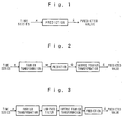
- Time-domain prediction is performed as shown in FIG. 1, and many models, such as a linear regression model, pertain to time-domain prediction.
- Frequency-domain prediction is performed as shown in FIG. 2, and a model for inferring the shape of a power spectrum pertains to frequency-domain prediction.
- prediction accuracy decreases for a time series having a certain time configuration in solely a specific frequency band or for a composite time series having a different time configuration in each of different frequency bands. This is because prediction in solely the time domain or in solely the frequency domain cannot simultaneously handle information in the time domain and information in the frequency domain.
- the time series is represented in the form of the sum of frequency components localized in the time domain.
- an object of the present invention is to provide a time-series prediction method and apparatus utilizing wavelet coefficient series which can obtain a prediction value of an original time series through an operation of wavelet-transforming the time series to thereby decompose the time series into a plurality of time series which are band-restricted in the frequency domain, and then inversely transforming the individual prediction values of the plurality of time series of the respective frequency components.
- the present invention provides the following.
- FIG. 4 is a block diagram showing the configuration of a time-series prediction system utilizing wavelet coefficient series according to an embodiment of the present invention.
- reference numeral 1 denotes a wavelet transformation unit
- 2 1 , ..., 2 n-1 , and 2 n denote prediction units for different frequency components
- 3 denotes an inverse wavelet transformation unit.
- the wavelet transformation unit 1 decomposes a time series x into a plurality of frequency components. Subsequently, the prediction units 2 1 , ..., 2 n-1 , and 2 n calculate prediction values of the respective frequency components.
- the inverse wavelet transformation unit 3 performs inverse wavelet transformation for the thus-obtained prediction values of the respective frequency components, in order to obtain a prediction value of the original time series.
- the input time series is decomposed into a plurality of frequency components by the wavelet transformation unit 1.
- the frequency components are shown in order of frequency such that the frequency component of highest frequency is shown at the uppermost position and the frequency component of lowest frequency is shown at the lowermost position.
- a prediction value of each frequency component is predicted by the corresponding prediction unit 2 1 , ..., 2 n-1 , or 2 n .
- the thus-obtained prediction values of the respective frequency components are subjected to inverse wavelet transformation performed by the inverse wavelet transformation unit 3.
- a prediction value of the original time series is constructed.
- Prediction can be performed for all types of time series through changing the prediction units 2 1 , ..., 2 n-1 , and 2 n according to the properties of a time series to be predicted.
- a deterministic prediction model such as a locally linear model is used for deterministic time series
- a stochastic prediction model such as an AR model is used for stochastic processes.
- the time series is expanded by use of periodic boundary conditions.
- the above-described transformation can be justified to be a transformation in L 2 (R).
- the length of the time series must be 2 J (J ⁇ N).
- correspondence between the original time series and frequency components is represented by the following formula (2), and, ideally, the respective wavelet coefficients correspond to sampling values of time-frequency components by WT shown in FIG. 5.
- f(t) is obtained through projection, and stationary wavelet transformation (hereinafter referred to as SWT) of the following formula (3) is performed.
- SWT stationary wavelet transformation
- FIG. 6 shows sampling of SWT in time/frequency domain.
- an original dynamical system is the sum of a deterministic chaotic dynamical system constituting a high-frequency component and a deterministic chaotic dynamical system constituting a low-frequency component
- each frequency component is controlled only by the corresponding dynamical system, so that prediction up to a certain point in time can be performed accurately. Therefore, prediction for the original time series can be performed at relatively high accuracy.
- direct prediction is performed in the time domain
- the high-frequency noise component deteriorates accuracy of prediction for the low-frequency component, and the error increases exponentially. Therefore, satisfactory prediction cannot be performed.
- y(n) represents a low-frequency component
- z(n) represents high-frequency noise.
- R was set to 10 in both the prediction by WT and the prediction by SWT.
- FIG. 7 shows prediction results. Piecewise linear mapping is used for the prediction.
- Both the prediction by WT and the prediction by SWT provide accuracy higher than that of time-domain direct prediction, in both a short period and a long period. Whereas the direct prediction becomes unable to provide effective prediction after a few steps, the method utilizing wavelets can predict the low-frequency component ( ' 10 , etc.) controlled by [y(n)], so that the overall prediction accuracy is improved. Since excessive interpolation deteriorates the prediction accuracy, WT provides higher accuracy for long-term prediction than does SWT.
- time-series prediction system utilizing wavelet is effective even in the case in which a deterministic low-frequency variation is accompanied with white noise.
- time-domain direct prediction is not satisfactory even in short term prediction, due to influence of white noise.
- S/N ratio is high at low frequency, prediction utilizing wavelets enables stable prediction of low-frequency variation over a long time.
- prediction of x was performed for 128 periods.
- FIG. 8 shows the result of the prediction.
- FIG. 8 further shows the result of prediction performed by a method in which prediction is performed after removal of the high-frequency component by use of a low-pass filter (see FIG. 3).
- Direct prediction fails to perform even short-term prediction.
- the method in which prediction is performed after the time series is passed through a low-pass filter provides a prediction accuracy equal to that of other methods within about 30 steps.
- the prediction utilizing wavelets provides a higher prediction accuracy in subsequent steps. Since the method utilizing wavelets can properly approximate a local function of the low-frequency component, stable prediction over a long time can be performed.
- a time series is decomposed into frequency components by use of wavelet; and a prediction value of the original time series is obtained from prediction values of the respective frequency components through inverse wavelet transformation.
- highly accurate prediction is enabled.
- SWT is advantageous from the viewpoint that the number of sampling points is large and that frequency components are observed while their observation times are aligned.
- redundant data are sampled excessively, with the result that two data points sampled at times close to each other strongly relate to each other, resulting in deterioration in prediction accuracy, because the prediction method erroneously induces a causal relationship between the data points.
- use of WT is desirable in order to perform prediction while avoiding auto-correlation.
- WT is advantageous from the viewpoint of shorter computation time.
- the prediction method of the present invention is effective in particular for prediction for a time series whose low-frequency component and high-frequency component are controlled by different laws. Further, prediction can be performed for all types of time series through changing the prediction units according to the properties of a time series to be predicted.
- time-series prediction system utilizing wavelet coefficient series can be applied to various types of time series, regardless of whether they are deterministic or stochastic.
- the present invention can be applied to prediction for various types of data and provides remarkable effects.
- Examples of such data include data associated with atmospheric phenomena and data associated with earthquakes in which various high-frequency components such as environment/thermal noise are superimposed on low-frequency hydrodynamic systems; data obtained from brain measurement in which high-frequency pulses are superimposed on low-frequency field potential; and data obtained through measurement of membrane potential of each neuron in which high-frequency channel noise is superimposed on low-frequency membrane potential variation.
- the time series prediction method and apparatus utilizing wavelet coefficient series according to the present invention can be used effectively in particular for prediction for a time series whose low-frequency component and high-frequency component are controlled by different laws. Further, prediction can be performed for all types of time series through changing the prediction units according to the properties of a time series to be predicted.
Landscapes
- Engineering & Computer Science (AREA)
- Physics & Mathematics (AREA)
- Theoretical Computer Science (AREA)
- General Physics & Mathematics (AREA)
- Mathematical Physics (AREA)
- Computational Mathematics (AREA)
- Mathematical Analysis (AREA)
- Mathematical Optimization (AREA)
- Pure & Applied Mathematics (AREA)
- Data Mining & Analysis (AREA)
- Algebra (AREA)
- Software Systems (AREA)
- General Engineering & Computer Science (AREA)
- Databases & Information Systems (AREA)
- Management, Administration, Business Operations System, And Electronic Commerce (AREA)
- Compression, Expansion, Code Conversion, And Decoders (AREA)
- Complex Calculations (AREA)
Abstract
Description
- The present invention relates to a time-series prediction method and apparatus utilizing wavelet coefficient series.
- Conventionally, time-series prediction has been performed in solely the time domain or in solely the frequency domain. Time-domain prediction is performed as shown in FIG. 1, and many models, such as a linear regression model, pertain to time-domain prediction. Frequency-domain prediction is performed as shown in FIG. 2, and a model for inferring the shape of a power spectrum pertains to frequency-domain prediction. These traditional methods have been studied widely and applied to actual time-series prediction.
- However, in the above-described conventional methods, prediction accuracy decreases for a time series having a certain time configuration in solely a specific frequency band or for a composite time series having a different time configuration in each of different frequency bands. This is because prediction in solely the time domain or in solely the frequency domain cannot simultaneously handle information in the time domain and information in the frequency domain.
- Incidentally, when a time series is subjected to wavelet expansion, the time series is represented in the form of the sum of frequency components localized in the time domain.
- In view of the foregoing, an object of the present invention is to provide a time-series prediction method and apparatus utilizing wavelet coefficient series which can obtain a prediction value of an original time series through an operation of wavelet-transforming the time series to thereby decompose the time series into a plurality of time series which are band-restricted in the frequency domain, and then inversely transforming the individual prediction values of the plurality of time series of the respective frequency components.
- To achieve the above object, the present invention provides the following.
- [1] A time-series prediction method utilizing wavelet coefficient series comprising: (a) wavelet-transforming a time series by use of a wavelet transformation unit in order to decompose the time series into a plurality of time series which are band-restricted in the frequency domain; (b) predicting values of frequency components obtained as a result of decomposition, by use of corresponding prediction units; and (c) reconstructing the prediction values of the respective frequency components by use of an inverse wavelet transformation unit to thereby obtain a prediction value of the original time series.
- [2] A time-series prediction method utilizing wavelet coefficient series as described in [1] above, characterized in that ordinary wavelet transformation is used in order to wavelet-transform the time series to thereby univocally decompose the time series into a plurality of time series of the respective frequency components.
- [3] A time-series prediction method utilizing wavelet coefficient series as described in [1] above, characterized in that stationary wavelet transformation is used for decomposition of the time series in order to observe the frequency components of the time series while aligning their observation times.
- [4] A time-series prediction apparatus utilizing wavelet coefficient series, comprising: (a) a wavelet transformation unit for decomposing a time series into a plurality of coefficient series of different frequency components; (b) prediction units for predicting values of the respective frequency components; and (c) an inverse wavelet transformation unit for reconstructing the prediction values of the respective frequency components to thereby obtain a prediction value of the original time series.
-
-
- FIG. 1 is a block diagram showing a conventional method for time-domain prediction;
- FIG. 2 is a block diagram showing a conventional method for frequency-domain prediction;
- FIG. 3 is a block diagram showing a method for performing prediction after a time series is passed through a low-pass filter;
- FIG. 4 is a block diagram showing the configuration of a time-series prediction system utilizing wavelet coefficient series according to an embodiment of the present invention;
- FIG. 5 is a diagram showing sampling of time-frequency components by means of wavelet transformation (WT) performed in the embodiment of the present invention;
- FIG. 6 is a diagram showing sampling of time-frequency components by means of stationary wavelet transformation (SWT) performed in the embodiment of the present invention;
- FIG. 7 is a first graph showing the relation between prediction time and prediction result obtained in the embodiment of the present invention; and
- FIG. 8 is a second graph showing the relation between prediction time and prediction result obtained in the embodiment of the present invention.
-
- An embodiment of the present invention will next be described in detail with reference to the drawings.
- FIG. 4 is a block diagram showing the configuration of a time-series prediction system utilizing wavelet coefficient series according to an embodiment of the present invention.
- In FIG. 4,
reference numeral 1 denotes a wavelet transformation unit; 21, ..., 2n-1, and 2n denote prediction units for different frequency components; and 3 denotes an inverse wavelet transformation unit. - First, the
wavelet transformation unit 1 decomposes a time series x into a plurality of frequency components. Subsequently, theprediction units 21, ..., 2n-1, and 2n calculate prediction values of the respective frequency components. The inversewavelet transformation unit 3 performs inverse wavelet transformation for the thus-obtained prediction values of the respective frequency components, in order to obtain a prediction value of the original time series. - As described above, the input time series is decomposed into a plurality of frequency components by the
wavelet transformation unit 1. In FIG. 4, the frequency components are shown in order of frequency such that the frequency component of highest frequency is shown at the uppermost position and the frequency component of lowest frequency is shown at the lowermost position. A prediction value of each frequency component is predicted by thecorresponding prediction unit 21, ..., 2n-1, or 2n. The thus-obtained prediction values of the respective frequency components are subjected to inverse wavelet transformation performed by the inversewavelet transformation unit 3. Thus, a prediction value of the original time series is constructed. - Notably, ordinary wavelet transformation (WT) and stationary wavelet transformation (SWT) can be used in the
wavelet transformation unit 1 and the inversewavelet transformation unit 3. - Prediction can be performed for all types of time series through changing the
prediction units 21, ..., 2n-1, and 2n according to the properties of a time series to be predicted. A deterministic prediction model such as a locally linear model is used for deterministic time series, and a stochastic prediction model such as an AR model is used for stochastic processes. - Next will be described decomposition of a time series by use of two types of wavelet transformations, as well as a specific prediction scheme.
- Here, there will be described a method for wavelet-transforming a time series in order to univocally decompose the time series into a plurality of time series of the respective frequency components. Further, there will be described stationary wavelet transformation which is necessary for observing frequency components of a time series while aligning their observation times.
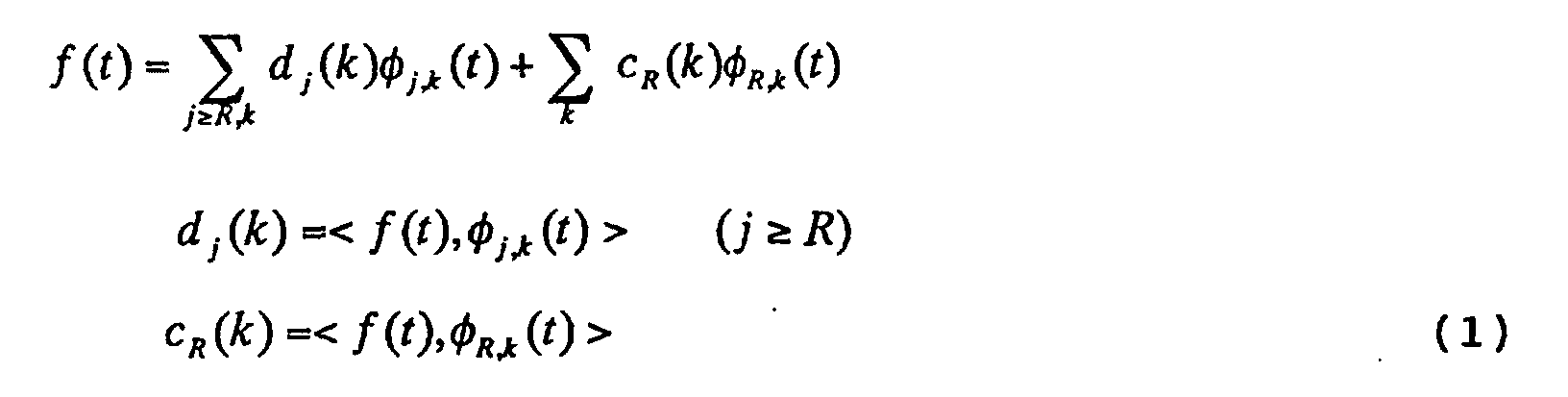
- When Ψj,k (t) = 2j/2Ψ (2jt-k) for an orthogonal wavelet Ψ(t), a certain {R,k (t)|k∈Z}, R,k (t) = 2R/2(2Rt-k) is present, and f(t)∈L2(R) is univocally wavelet-transformed (hereinafter referred to as "WT").Here, <f1, f2> represent inner products of f1 and f2 in L2(R). dj(k) whose j is large represents a high-frequency component, and CR(k) represents a low-frequency component.
- When a discrete time series χ = (x(n)} is transformed,
first, f(t) obtained through projecting {x(n)} on a subspace spanned by {J,k(t)|k∈Z} is transformed by use of the above-described formula (1) as follows:
- With regard to a discrete time series of finite length, the time series is expanded by use of periodic boundary conditions. Thus, the above-described transformation can be justified to be a transformation in L2(R). However, the length of the time series must be 2J(J∈N). In this case, correspondence between the original time series and frequency components is represented by the following formula (2), and, ideally, the respective wavelet coefficients correspond to sampling values of time-frequency components by WT shown in FIG. 5.

- In order to observe all frequency components of a discrete time series at a certain time, the sampling interval of dj must be made the same for all values of j. First, f(t) is obtained through projection, and stationary wavelet transformation (hereinafter referred to as SWT) of the following formula (3) is performed.
- FIG. 6 shows sampling of SWT in time/frequency domain.
- The following relation holds between the coefficients of SWT and those of WT:
- As in the case of WT, for a time series of
length 2J, the following correspondence holds:In order to perform inverse transformation of SWT of formula (5), required dj(k) and cR(k) are picked up from the above-described formula (4) and are subjected to inverse wavelet transformation.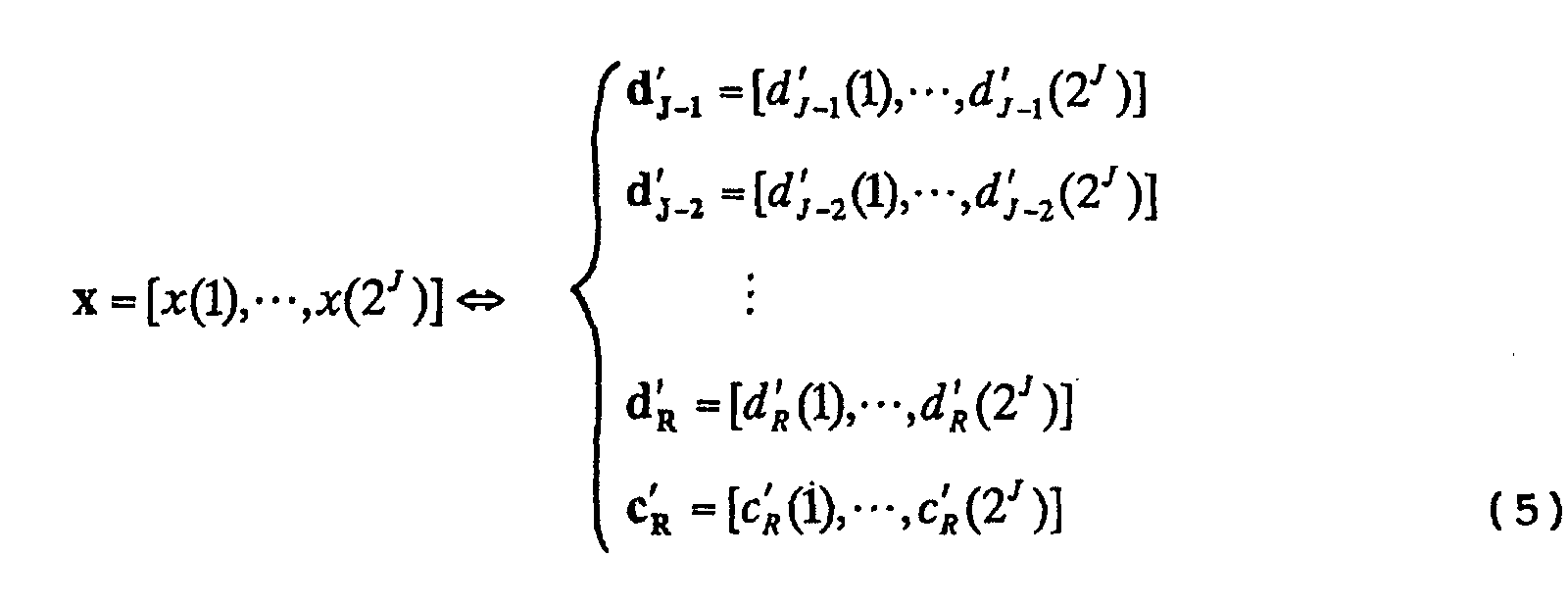
- A specific prediction scheme will be described for the case in which WT is used in the prediction system of FIG. 4 and for the case in which SWT is used in the prediction system of FIG. 4. The original time series x is assumed to have a length of 2J.
-
- (1) Through WT of x, respective frequency components dJ-1, dJ-2 ..., dR, cR are obtained.
- (2) For the respective frequency components, prediction is performed for 2j-Rp steps ahead of the present. A prediction value of dj(2j) for ith step is written as d andj (2 j +i).
- (3) Inverse wavelet transformation is performed for the
following:
Thus, [x and(2 J-Rp+1), x and(p+2),···,x and(2 J+2 J-R p)] is obtained, and prediction values x and(2 J + 1), ··· x and(2 J + 2 J-R p) is obtained therefrom.

-
-
- (1) Through SWT of χ, respective frequency components
d'J-1, d'J-2 ..., d'R, c'R of
length 2J are obtained. - (2) For the respective frequency components, prediction is performed for p steps ahead of the present. A prediction value of d'j(2J) for ith step is written as d and'j (2 J +i).
- (3) Inverse wavelet transformation is performed for the
following
Thus, [x and(p+1),x and(p+2),···,x and(2 J + p)] is obtained, and prediction values x and(2 J + 1),···x and(2 J + p) is obtained therefrom.

-
- Effectiveness of the time-series prediction system utilizing wavelet coefficient series according to the present invention will be described, while prediction of chaotic time series are taken as examples.
- When an original dynamical system is the sum of a deterministic chaotic dynamical system constituting a high-frequency component and a deterministic chaotic dynamical system constituting a low-frequency component, each frequency component is controlled only by the corresponding dynamical system, so that prediction up to a certain point in time can be performed accurately. Therefore, prediction for the original time series can be performed at relatively high accuracy. Meanwhile, when direct prediction is performed in the time domain, the high-frequency noise component deteriorates accuracy of prediction for the low-frequency component, and the error increases exponentially. Therefore, satisfactory prediction cannot be performed.
- Effectiveness of the time-series prediction system utilizing wavelet coefficient series according to the present invention will be shown through simulation.
- Here, a time series z(n), which is obtained through normalized xn of the Ikeda map such that the average is zero, is added to a y(n), which is a discrete time observation value of the x coordinate of the Rossler equations, to obtain a time series [x(n)], and prediction is performed for the time series [x(n)]. y(n) represents a low-frequency component, and z(n) represents high-frequency noise. When the variance of the time series is represented by a, σ[y(n)]=6.374 and σ[z(n)]=0.640. The length of χ is N=2J=8192.
- Prediction was performed for χ up to a point in time where M=128, by use of WT and SWT. R was set to 10 in both the prediction by WT and the prediction by SWT. FIG. 7 shows prediction results. Piecewise linear mapping is used for the prediction.
- Both the prediction by WT and the prediction by SWT provide accuracy higher than that of time-domain direct prediction, in both a short period and a long period. Whereas the direct prediction becomes unable to provide effective prediction after a few steps, the method utilizing wavelets can predict the low-frequency component ('10, etc.) controlled by [y(n)], so that the overall prediction accuracy is improved. Since excessive interpolation deteriorates the prediction accuracy, WT provides higher accuracy for long-term prediction than does SWT.

- Next will be shown that the time-series prediction system utilizing wavelet is effective even in the case in which a deterministic low-frequency variation is accompanied with white noise.
- The accuracy of time-domain direct prediction is not satisfactory even in short term prediction, due to influence of white noise. However, since the S/N ratio is high at low frequency, prediction utilizing wavelets enables stable prediction of low-frequency variation over a long time.
- Here, a discrete time observation value of the x component of the Lorenz equations is used as a low-frequency component y(n); white noise is used as a high-frequency component z(n); and x=[x(n)]=[y(n)+z(n)] is used as a time series under observation. σ[y(n)]=8.242 and σ[z(n)]=0.700. The length of the time series is N=2J=8192. In accordance with the same method as used in the above-described example A, prediction of x was performed for 128 periods. FIG. 8 shows the result of the prediction. For comparison, FIG. 8 further shows the result of prediction performed by a method in which prediction is performed after removal of the high-frequency component by use of a low-pass filter (see FIG. 3).
- Direct prediction fails to perform even short-term prediction. The method in which prediction is performed after the time series is passed through a low-pass filter provides a prediction accuracy equal to that of other methods within about 30 steps. However, the prediction utilizing wavelets provides a higher prediction accuracy in subsequent steps. Since the method utilizing wavelets can properly approximate a local function of the low-frequency component, stable prediction over a long time can be performed.
- As described above, in the present invention, a time series is decomposed into frequency components by use of wavelet; and a prediction value of the original time series is obtained from prediction values of the respective frequency components through inverse wavelet transformation. Thus, highly accurate prediction is enabled.
- Two methods, utilizing WT and SWT, respectively, were proposed, and it was demonstrated that either method can perform prediction while preserving the chaotic characteristics of the original dynamical system.
- SWT is advantageous from the viewpoint that the number of sampling points is large and that frequency components are observed while their observation times are aligned. However, redundant data are sampled excessively, with the result that two data points sampled at times close to each other strongly relate to each other, resulting in deterioration in prediction accuracy, because the prediction method erroneously induces a causal relationship between the data points. It has been shown that use of WT is desirable in order to perform prediction while avoiding auto-correlation. Moreover, WT is advantageous from the viewpoint of shorter computation time.
- The prediction method of the present invention is effective in particular for prediction for a time series whose low-frequency component and high-frequency component are controlled by different laws. Further, prediction can be performed for all types of time series through changing the prediction units according to the properties of a time series to be predicted.
- That is, the time-series prediction system utilizing wavelet coefficient series according to the present invention can be applied to various types of time series, regardless of whether they are deterministic or stochastic.
- The present invention is not limited to the above-described embodiment. Numerous modifications and variations of the present invention are possible in light of the spirit of the present invention, and they are not excluded from the scope of the present invention.
- As have been described in detail, the present invention provides the following effects.
- (A) Highly accurate prediction can be performed through the operation of decomposing a time series into frequency components by use of a wavelet coefficient series, and obtaining a prediction value of the original time series from prediction values of the respective frequency components through inverse wavelet transformation. In particular, the method of the present invention is effective for prediction of a time series in which high-frequency chaotic noise or white noise is superimposed on deterministic low-frequency variation.
- (B) Both of the methods; i.e., those using ordinary wavelet transformation and stationary wavelet transformation, can perform prediction while preserving the chaotic characteristics of the original dynamical system. Further, use of ordinary wavelet transformation is advantageous in order to avoid auto-correlation during prediction and to shorten computation time.
- (C) Stationary wavelet transformation is advantageous from the viewpoint that the number of sampling points is large and that frequency components are observed while their observation times are aligned.
-
- Accordingly, the present invention can be applied to prediction for various types of data and provides remarkable effects. Examples of such data include data associated with atmospheric phenomena and data associated with earthquakes in which various high-frequency components such as environment/thermal noise are superimposed on low-frequency hydrodynamic systems; data obtained from brain measurement in which high-frequency pulses are superimposed on low-frequency field potential; and data obtained through measurement of membrane potential of each neuron in which high-frequency channel noise is superimposed on low-frequency membrane potential variation.
- The time series prediction method and apparatus utilizing wavelet coefficient series according to the present invention can be used effectively in particular for prediction for a time series whose low-frequency component and high-frequency component are controlled by different laws. Further, prediction can be performed for all types of time series through changing the prediction units according to the properties of a time series to be predicted.
Claims (4)
- A time-series prediction method utilizing wavelet coefficient series comprising:(a) wavelet-transforming a time series by use of a wavelet transformation unit in order to decompose the time series into a plurality of time series which are band-restricted in the frequency domain;(b) predicting values of frequency components obtained as a result of decomposition, by use of corresponding prediction units; and(c) reconstructing the prediction values of the respective frequency components by use of an inverse wavelet transformation unit to thereby obtain a prediction value of the original time series.
- A time-series prediction method utilizing wavelet coefficient series according to claim 1, wherein ordinary wavelet transformation is used in order to wavelet-transform the time series to thereby univocally decompose the time series into a plurality of time series of the respective frequency components.
- A time-series prediction method utilizing wavelet coefficient series according to claim 1, wherein stationary wavelet transformation is used for decomposition of the time series in order to observe the frequency components of the time series while aligning their observation times.
- A time-series prediction apparatus utilizing wavelet coefficient series, comprising:(a) a wavelet transformation unit for decomposing a time series into a plurality of coefficient series of different frequency components;(b) prediction units for predicting values of the respective frequency components; and(c) an inverse wavelet transformation unit for reconstructing the prediction values of the respective frequency components to thereby obtain a prediction value of the original time series.
Applications Claiming Priority (3)
| Application Number | Priority Date | Filing Date | Title |
|---|---|---|---|
| JP15445899 | 1999-06-02 | ||
| JP11154458A JP2000349646A (en) | 1999-06-02 | 1999-06-02 | Time series prediction method and apparatus using wavelet series |
| PCT/JP2000/003545 WO2000076074A1 (en) | 1999-06-02 | 2000-06-01 | Tyem-series predicting method using wavelet number series and device therefor |
Publications (2)
| Publication Number | Publication Date |
|---|---|
| EP1146649A1 true EP1146649A1 (en) | 2001-10-17 |
| EP1146649A4 EP1146649A4 (en) | 2010-06-02 |
Family
ID=15584684
Family Applications (1)
| Application Number | Title | Priority Date | Filing Date |
|---|---|---|---|
| EP00931637A Withdrawn EP1146649A4 (en) | 1999-06-02 | 2000-06-01 | PREDICTIVE METHOD FOR CHRONOLOGICAL SERIES USING DIGITAL WAVELET SERIES AND DEVICE RELATING THERETO |
Country Status (5)
| Country | Link |
|---|---|
| US (1) | US6772185B1 (en) |
| EP (1) | EP1146649A4 (en) |
| JP (1) | JP2000349646A (en) |
| CA (1) | CA2339127C (en) |
| WO (1) | WO2000076074A1 (en) |
Cited By (13)
| Publication number | Priority date | Publication date | Assignee | Title |
|---|---|---|---|---|
| US8855999B1 (en) | 2013-03-15 | 2014-10-07 | Palantir Technologies Inc. | Method and system for generating a parser and parsing complex data |
| US8909656B2 (en) | 2013-03-15 | 2014-12-09 | Palantir Technologies Inc. | Filter chains with associated multipath views for exploring large data sets |
| US8930897B2 (en) | 2013-03-15 | 2015-01-06 | Palantir Technologies Inc. | Data integration tool |
| US8938686B1 (en) | 2013-10-03 | 2015-01-20 | Palantir Technologies Inc. | Systems and methods for analyzing performance of an entity |
| US9229966B2 (en) | 2008-09-15 | 2016-01-05 | Palantir Technologies, Inc. | Object modeling for exploring large data sets |
| US9852205B2 (en) | 2013-03-15 | 2017-12-26 | Palantir Technologies Inc. | Time-sensitive cube |
| US9880987B2 (en) | 2011-08-25 | 2018-01-30 | Palantir Technologies, Inc. | System and method for parameterizing documents for automatic workflow generation |
| US9898335B1 (en) | 2012-10-22 | 2018-02-20 | Palantir Technologies Inc. | System and method for batch evaluation programs |
| US10120857B2 (en) | 2013-03-15 | 2018-11-06 | Palantir Technologies Inc. | Method and system for generating a parser and parsing complex data |
| US10180977B2 (en) | 2014-03-18 | 2019-01-15 | Palantir Technologies Inc. | Determining and extracting changed data from a data source |
| US10198515B1 (en) | 2013-12-10 | 2019-02-05 | Palantir Technologies Inc. | System and method for aggregating data from a plurality of data sources |
| US10747952B2 (en) | 2008-09-15 | 2020-08-18 | Palantir Technologies, Inc. | Automatic creation and server push of multiple distinct drafts |
| US11681914B2 (en) | 2020-05-08 | 2023-06-20 | International Business Machines Corporation | Determining multivariate time series data dependencies |
Families Citing this family (7)
| Publication number | Priority date | Publication date | Assignee | Title |
|---|---|---|---|---|
| US20100088153A1 (en) * | 2008-04-08 | 2010-04-08 | Plan4Demand Solutions, Inc. | Demand curve analysis method for demand planning |
| JP5018809B2 (en) * | 2009-03-04 | 2012-09-05 | 沖電気工業株式会社 | Time series data prediction device |
| CN109992608B (en) * | 2019-03-26 | 2022-03-04 | 浙江大学 | Multi-model fusion prediction method and system based on frequency domain |
| CN110414442B (en) * | 2019-07-31 | 2022-04-01 | 广东省智能机器人研究院 | Pressure time sequence data segmentation characteristic value prediction method |
| CN110839016B (en) * | 2019-10-18 | 2022-07-15 | 平安科技(深圳)有限公司 | Abnormal flow monitoring method, device, equipment and storage medium |
| EP3896625A1 (en) * | 2020-04-17 | 2021-10-20 | Tata Consultancy Services Limited | An adaptive filter based learning model for time series sensor signal classification on edge devices |
| CN114944831A (en) * | 2022-05-12 | 2022-08-26 | 中国科学技术大学先进技术研究院 | Multi-cycle time series data decomposition method, device, equipment and storage medium |
Family Cites Families (5)
| Publication number | Priority date | Publication date | Assignee | Title |
|---|---|---|---|---|
| JP2997355B2 (en) * | 1991-12-04 | 2000-01-11 | シャープ株式会社 | Decryption device |
| JPH09182069A (en) * | 1995-12-22 | 1997-07-11 | Matsushita Electric Ind Co Ltd | Image compression method and image compression device |
| JPH09307903A (en) * | 1996-05-16 | 1997-11-28 | Ricoh Co Ltd | Multi-tone image coding method |
| GB2326300B (en) * | 1997-06-10 | 2001-11-21 | Sony Uk Ltd | Concealing errors |
| JPH1188183A (en) * | 1997-09-11 | 1999-03-30 | Seiko Epson Corp | Wavelet converter, its method, wavelet inverse converter, its method, image coder, its method, image decoder and its method |
-
1999
- 1999-06-02 JP JP11154458A patent/JP2000349646A/en active Pending
-
2000
- 2000-06-01 CA CA002339127A patent/CA2339127C/en not_active Expired - Fee Related
- 2000-06-01 WO PCT/JP2000/003545 patent/WO2000076074A1/en not_active Ceased
- 2000-06-01 EP EP00931637A patent/EP1146649A4/en not_active Withdrawn
- 2000-06-01 US US09/744,912 patent/US6772185B1/en not_active Expired - Fee Related
Non-Patent Citations (5)
| Title |
|---|
| BJORN V: "Multiresolution methods for financial time series prediction" COMPUTATIONAL INTELLIGENCE FOR FINANCIAL ENGINEERING, 1995.,PROCEEDING S OF THE IEEE/IAFE 1995 NEW YORK, NY, USA 9-11 APRIL 1995, NEW YORK, NY, USA,IEEE, US LNKD- DOI:10.1109/CIFER.1995.495258, 9 April 1995 (1995-04-09), page 97, XP010160024 ISBN: 978-0-7803-2145-8 * |
| FU-CHIANG TSUI ET AL: "A comparative study of two biorthogonal wavelet transforms in time series prediction" SYSTEMS, MAN, AND CYBERNETICS, 1997. COMPUTATIONAL CYBERNETICS AND SIM ULATION., 1997 IEEE INTERNATIONAL CONFERENCE ON ORLANDO, FL, USA 12-15 OCT. 1997, NEW YORK, NY, USA,IEEE, US, vol. 2, 12 October 1997 (1997-10-12), pages 1791-1796, XP010249649 ISBN: 978-0-7803-4053-4 * |
| FU-CHIANG TSUI ET AL: "Recurrent neural networks and discrete wavelet transform for time series modeling and prediction" 1995 INTERNATIONAL CONFERENCE ON ACOUSTICS, SPEECH, AND SIGNAL PROCESSING - 9-12 MAY 1995 - DETROIT, MI, USA, IEEE - NEW YORK, NY, USA, vol. 5, 9 May 1995 (1995-05-09), pages 3359-3362, XP010152066 ISBN: 978-0-7803-2431-2 * |
| MASUDA N ET AL: "THE PREDICTION OF CHAOTIC TIME SERIES WITH WAVELET COEFFICIENTS" Transactions of the Institute of Electronics, Information and Communication Engineers vol. J82-A, no. 11, November 1999 (1999-11), pages 1710-1718, XP002579174 Japan ISSN: 0913-5707 Retrieved from the Internet: URL:http://sciencelinks.jp/j-east/article/200011/000020001100A0049927.php> [retrieved on 2010-04-22] & MASUDA N ET AL: "PREDICTION OF CHAOTIC TIME SERIES WITH WAVELET COEFFICIENTS" ELECTRONICS & COMMUNICATIONS IN JAPAN, PART III - FUNDAMENTALELECTRONIC SCIENCE, WILEY, HOBOKEN, NJ, US LNKD- DOI:10.1002/1520-6440(200106)84:6<,50::A ID-ECJC6>,3.0.CO,2-T, vol. 84, no. 6, PART 03, 1 January 2001 (2001-01-01), pages 50-59, XP001059332 ISSN: 1042-0967 * |
| See also references of WO0076074A1 * |
Cited By (19)
| Publication number | Priority date | Publication date | Assignee | Title |
|---|---|---|---|---|
| US10747952B2 (en) | 2008-09-15 | 2020-08-18 | Palantir Technologies, Inc. | Automatic creation and server push of multiple distinct drafts |
| US9229966B2 (en) | 2008-09-15 | 2016-01-05 | Palantir Technologies, Inc. | Object modeling for exploring large data sets |
| US9880987B2 (en) | 2011-08-25 | 2018-01-30 | Palantir Technologies, Inc. | System and method for parameterizing documents for automatic workflow generation |
| US10706220B2 (en) | 2011-08-25 | 2020-07-07 | Palantir Technologies, Inc. | System and method for parameterizing documents for automatic workflow generation |
| US11182204B2 (en) | 2012-10-22 | 2021-11-23 | Palantir Technologies Inc. | System and method for batch evaluation programs |
| US9898335B1 (en) | 2012-10-22 | 2018-02-20 | Palantir Technologies Inc. | System and method for batch evaluation programs |
| US10452678B2 (en) | 2013-03-15 | 2019-10-22 | Palantir Technologies Inc. | Filter chains for exploring large data sets |
| US9852205B2 (en) | 2013-03-15 | 2017-12-26 | Palantir Technologies Inc. | Time-sensitive cube |
| US10120857B2 (en) | 2013-03-15 | 2018-11-06 | Palantir Technologies Inc. | Method and system for generating a parser and parsing complex data |
| US8855999B1 (en) | 2013-03-15 | 2014-10-07 | Palantir Technologies Inc. | Method and system for generating a parser and parsing complex data |
| US8930897B2 (en) | 2013-03-15 | 2015-01-06 | Palantir Technologies Inc. | Data integration tool |
| US10977279B2 (en) | 2013-03-15 | 2021-04-13 | Palantir Technologies Inc. | Time-sensitive cube |
| US8909656B2 (en) | 2013-03-15 | 2014-12-09 | Palantir Technologies Inc. | Filter chains with associated multipath views for exploring large data sets |
| US9996229B2 (en) | 2013-10-03 | 2018-06-12 | Palantir Technologies Inc. | Systems and methods for analyzing performance of an entity |
| US8938686B1 (en) | 2013-10-03 | 2015-01-20 | Palantir Technologies Inc. | Systems and methods for analyzing performance of an entity |
| US10198515B1 (en) | 2013-12-10 | 2019-02-05 | Palantir Technologies Inc. | System and method for aggregating data from a plurality of data sources |
| US11138279B1 (en) | 2013-12-10 | 2021-10-05 | Palantir Technologies Inc. | System and method for aggregating data from a plurality of data sources |
| US10180977B2 (en) | 2014-03-18 | 2019-01-15 | Palantir Technologies Inc. | Determining and extracting changed data from a data source |
| US11681914B2 (en) | 2020-05-08 | 2023-06-20 | International Business Machines Corporation | Determining multivariate time series data dependencies |
Also Published As
| Publication number | Publication date |
|---|---|
| US6772185B1 (en) | 2004-08-03 |
| CA2339127C (en) | 2005-03-29 |
| CA2339127A1 (en) | 2000-12-14 |
| WO2000076074A1 (en) | 2000-12-14 |
| EP1146649A4 (en) | 2010-06-02 |
| JP2000349646A (en) | 2000-12-15 |
Similar Documents
| Publication | Publication Date | Title |
|---|---|---|
| US6772185B1 (en) | Time-series predicting method using wavelet number series and device thereof | |
| US5675553A (en) | Method for data gap compensation | |
| Hong | Multiresolutional filtering using wavelet transform | |
| CN119622236A (en) | An adaptive time-frequency analysis method based on kurtosis maximization and continuity criterion | |
| Paiva et al. | Wavelet-packet identification of dynamic systems in frequency subbands | |
| Choi et al. | Interpolation and denoising of nonuniformly sampled data using wavelet-domain processing | |
| JPH1049791A (en) | Time series signal processing method and apparatus | |
| CN112505413A (en) | Time-frequency analysis method and system | |
| Rodríguez Fonollosa | Sample cumulants of stationary processes: asymptotic results | |
| Shan et al. | High-resolution instantaneous frequency estimation based on time-varying AR modeling | |
| Gantert | Self-similarity of Brownian motion and a large deviation principle for random fields on a binary tree | |
| Cevri et al. | Performance analysis of Gibbs sampling for Bayesian extracting sinusoids | |
| AU5433999A (en) | Signal processing | |
| CN119862927B (en) | A method, apparatus, device, and storage medium for training a noise reduction neural network. | |
| Luz et al. | Robust filtering of sequences with periodically stationary multiplicative seasonal increments | |
| Khorasani et al. | Effects of pre-processing on the ECG signal sparsity and compression quality | |
| vom Scheidt et al. | Asymptotic expansions of integral functionals of weakly correlated random processes | |
| Soltani et al. | Time series prediction and the wavelet transform | |
| Kapetanios et al. | Block bootstrap and long memory | |
| Wickramasinghe et al. | A Comparative Study on Methods to Handle Wavelet Edge Distortion | |
| Gonzaga et al. | Wavelet-based Bayesian analysis of generalized long-memory process | |
| Rauf et al. | New nonlinear adaptive filters with applications to chaos | |
| Procházka et al. | Wavelet use for noise rejection and signal modelling | |
| Cutler | Computing pointwise fractal dimension by conditioning in multivariate distributions and time series | |
| Pantaleón et al. | Comments on" An aperiodic phenomenon of the extended Kalman filter in filtering noisy chaotic signals" |
Legal Events
| Date | Code | Title | Description |
|---|---|---|---|
| PUAI | Public reference made under article 153(3) epc to a published international application that has entered the european phase |
Free format text: ORIGINAL CODE: 0009012 |
|
| 17P | Request for examination filed |
Effective date: 20010201 |
|
| AK | Designated contracting states |
Kind code of ref document: A1 Designated state(s): DE FR GB |
|
| AX | Request for extension of the european patent |
Free format text: AL;LT;LV;MK;RO;SI |
|
| RAP1 | Party data changed (applicant data changed or rights of an application transferred) |
Owner name: JAPAN SCIENCE AND TECHNOLOGY AGENCY |
|
| RAP1 | Party data changed (applicant data changed or rights of an application transferred) |
Owner name: JAPAN SCIENCE AND TECHNOLOGY AGENCY |
|
| A4 | Supplementary search report drawn up and despatched |
Effective date: 20100507 |
|
| RIC1 | Information provided on ipc code assigned before grant |
Ipc: H03M 7/30 20060101ALI20100426BHEP Ipc: G06F 17/14 20060101AFI20100426BHEP |
|
| STAA | Information on the status of an ep patent application or granted ep patent |
Free format text: STATUS: THE APPLICATION HAS BEEN WITHDRAWN |
|
| 18W | Application withdrawn |
Effective date: 20100617 |