EP1146074A2 - Heat resistant resin composition and process for producing the same - Google Patents
Heat resistant resin composition and process for producing the same Download PDFInfo
- Publication number
- EP1146074A2 EP1146074A2 EP01105796A EP01105796A EP1146074A2 EP 1146074 A2 EP1146074 A2 EP 1146074A2 EP 01105796 A EP01105796 A EP 01105796A EP 01105796 A EP01105796 A EP 01105796A EP 1146074 A2 EP1146074 A2 EP 1146074A2
- Authority
- EP
- European Patent Office
- Prior art keywords
- resin composition
- poly
- group
- heat resistant
- amic acid
- Prior art date
- Legal status (The legal status is an assumption and is not a legal conclusion. Google has not performed a legal analysis and makes no representation as to the accuracy of the status listed.)
- Withdrawn
Links
- 239000011342 resin composition Substances 0.000 title claims abstract description 93
- 229920006015 heat resistant resin Polymers 0.000 title claims abstract description 59
- 238000000034 method Methods 0.000 title claims description 12
- 150000001875 compounds Chemical class 0.000 claims abstract description 48
- 229920005575 poly(amic acid) Polymers 0.000 claims abstract description 42
- 239000002966 varnish Substances 0.000 claims abstract description 23
- XLYOFNOQVPJJNP-UHFFFAOYSA-N water Substances O XLYOFNOQVPJJNP-UHFFFAOYSA-N 0.000 claims abstract description 15
- 125000000524 functional group Chemical group 0.000 claims abstract description 10
- 238000007259 addition reaction Methods 0.000 claims abstract description 8
- 239000000203 mixture Substances 0.000 claims description 28
- VYPSYNLAJGMNEJ-UHFFFAOYSA-N Silicium dioxide Chemical compound O=[Si]=O VYPSYNLAJGMNEJ-UHFFFAOYSA-N 0.000 claims description 22
- 229920001721 polyimide Polymers 0.000 claims description 19
- 238000003860 storage Methods 0.000 claims description 16
- 238000010438 heat treatment Methods 0.000 claims description 15
- 239000000126 substance Substances 0.000 claims description 12
- 238000005133 29Si NMR spectroscopy Methods 0.000 claims description 11
- 239000004642 Polyimide Substances 0.000 claims description 9
- 239000000377 silicon dioxide Substances 0.000 claims description 9
- XUIMIQQOPSSXEZ-UHFFFAOYSA-N Silicon Chemical compound [Si] XUIMIQQOPSSXEZ-UHFFFAOYSA-N 0.000 claims description 7
- 125000003178 carboxy group Chemical group [H]OC(*)=O 0.000 claims description 7
- 125000000962 organic group Chemical group 0.000 claims description 7
- 229910052710 silicon Inorganic materials 0.000 claims description 7
- 239000010703 silicon Substances 0.000 claims description 7
- 238000009833 condensation Methods 0.000 claims description 5
- 230000005494 condensation Effects 0.000 claims description 5
- 238000001029 thermal curing Methods 0.000 abstract description 8
- 125000000896 monocarboxylic acid group Chemical group 0.000 abstract 1
- 229920005989 resin Polymers 0.000 description 22
- 239000011347 resin Substances 0.000 description 22
- SECXISVLQFMRJM-UHFFFAOYSA-N N-Methylpyrrolidone Chemical compound CN1CCCC1=O SECXISVLQFMRJM-UHFFFAOYSA-N 0.000 description 20
- 239000010408 film Substances 0.000 description 12
- 239000009719 polyimide resin Substances 0.000 description 10
- 239000003054 catalyst Substances 0.000 description 9
- 230000007062 hydrolysis Effects 0.000 description 9
- 238000006460 hydrolysis reaction Methods 0.000 description 9
- 238000005259 measurement Methods 0.000 description 9
- 239000000758 substrate Substances 0.000 description 9
- CBCKQZAAMUWICA-UHFFFAOYSA-N 1,4-phenylenediamine Chemical compound NC1=CC=C(N)C=C1 CBCKQZAAMUWICA-UHFFFAOYSA-N 0.000 description 8
- UKLDJPRMSDWDSL-UHFFFAOYSA-L [dibutyl(dodecanoyloxy)stannyl] dodecanoate Chemical compound CCCCCCCCCCCC(=O)O[Sn](CCCC)(CCCC)OC(=O)CCCCCCCCCCC UKLDJPRMSDWDSL-UHFFFAOYSA-L 0.000 description 8
- 229910052681 coesite Inorganic materials 0.000 description 7
- 229910052906 cristobalite Inorganic materials 0.000 description 7
- 230000000704 physical effect Effects 0.000 description 7
- 229910052682 stishovite Inorganic materials 0.000 description 7
- 229910052905 tridymite Inorganic materials 0.000 description 7
- 230000000052 comparative effect Effects 0.000 description 6
- 239000002131 composite material Substances 0.000 description 6
- 239000000463 material Substances 0.000 description 6
- 238000010521 absorption reaction Methods 0.000 description 5
- GTDPSWPPOUPBNX-UHFFFAOYSA-N ac1mqpva Chemical compound CC12C(=O)OC(=O)C1(C)C1(C)C2(C)C(=O)OC1=O GTDPSWPPOUPBNX-UHFFFAOYSA-N 0.000 description 5
- 239000002253 acid Substances 0.000 description 5
- 239000011259 mixed solution Substances 0.000 description 5
- 239000000243 solution Substances 0.000 description 5
- VQVIHDPBMFABCQ-UHFFFAOYSA-N 5-(1,3-dioxo-2-benzofuran-5-carbonyl)-2-benzofuran-1,3-dione Chemical compound C1=C2C(=O)OC(=O)C2=CC(C(C=2C=C3C(=O)OC(=O)C3=CC=2)=O)=C1 VQVIHDPBMFABCQ-UHFFFAOYSA-N 0.000 description 4
- 0 CC(C(C1)C1C1)*1C1CC1 Chemical compound CC(C(C1)C1C1)*1C1CC1 0.000 description 4
- WKDNYTOXBCRNPV-UHFFFAOYSA-N bpda Chemical compound C1=C2C(=O)OC(=O)C2=CC(C=2C=C3C(=O)OC(C3=CC=2)=O)=C1 WKDNYTOXBCRNPV-UHFFFAOYSA-N 0.000 description 4
- 239000000969 carrier Substances 0.000 description 4
- 239000000919 ceramic Substances 0.000 description 4
- 239000002184 metal Substances 0.000 description 4
- 229910052751 metal Inorganic materials 0.000 description 4
- 150000002739 metals Chemical class 0.000 description 4
- VLDPXPPHXDGHEW-UHFFFAOYSA-N 1-chloro-2-dichlorophosphoryloxybenzene Chemical compound ClC1=CC=CC=C1OP(Cl)(Cl)=O VLDPXPPHXDGHEW-UHFFFAOYSA-N 0.000 description 3
- FXHOOIRPVKKKFG-UHFFFAOYSA-N N,N-Dimethylacetamide Chemical compound CN(C)C(C)=O FXHOOIRPVKKKFG-UHFFFAOYSA-N 0.000 description 3
- 229910003849 O-Si Inorganic materials 0.000 description 3
- 229910003872 O—Si Inorganic materials 0.000 description 3
- 238000006482 condensation reaction Methods 0.000 description 3
- 238000001723 curing Methods 0.000 description 3
- 230000009477 glass transition Effects 0.000 description 3
- ZHDTXTDHBRADLM-UHFFFAOYSA-N hydron;2,3,4,5-tetrahydropyridin-6-amine;chloride Chemical compound Cl.NC1=NCCCC1 ZHDTXTDHBRADLM-UHFFFAOYSA-N 0.000 description 3
- 229910010272 inorganic material Inorganic materials 0.000 description 3
- 239000011147 inorganic material Substances 0.000 description 3
- 238000004519 manufacturing process Methods 0.000 description 3
- 239000007769 metal material Substances 0.000 description 3
- 239000012299 nitrogen atmosphere Substances 0.000 description 3
- 239000004065 semiconductor Substances 0.000 description 3
- 239000010409 thin film Substances 0.000 description 3
- 150000001412 amines Chemical class 0.000 description 2
- 239000000805 composite resin Substances 0.000 description 2
- YMHQVDAATAEZLO-UHFFFAOYSA-N cyclohexane-1,1-diamine Chemical compound NC1(N)CCCCC1 YMHQVDAATAEZLO-UHFFFAOYSA-N 0.000 description 2
- 230000032798 delamination Effects 0.000 description 2
- 150000004985 diamines Chemical class 0.000 description 2
- 125000006159 dianhydride group Chemical group 0.000 description 2
- NAQMVNRVTILPCV-UHFFFAOYSA-N hexane-1,6-diamine Chemical compound NCCCCCCN NAQMVNRVTILPCV-UHFFFAOYSA-N 0.000 description 2
- 150000004706 metal oxides Chemical class 0.000 description 2
- PHQOGHDTIVQXHL-UHFFFAOYSA-N n'-(3-trimethoxysilylpropyl)ethane-1,2-diamine Chemical compound CO[Si](OC)(OC)CCCNCCN PHQOGHDTIVQXHL-UHFFFAOYSA-N 0.000 description 2
- BASFCYQUMIYNBI-UHFFFAOYSA-N platinum Chemical compound [Pt] BASFCYQUMIYNBI-UHFFFAOYSA-N 0.000 description 2
- 229920006267 polyester film Polymers 0.000 description 2
- KIDHWZJUCRJVML-UHFFFAOYSA-N putrescine Chemical compound NCCCCN KIDHWZJUCRJVML-UHFFFAOYSA-N 0.000 description 2
- 235000012239 silicon dioxide Nutrition 0.000 description 2
- 239000002904 solvent Substances 0.000 description 2
- 230000008646 thermal stress Effects 0.000 description 2
- WZCQRUWWHSTZEM-UHFFFAOYSA-N 1,3-phenylenediamine Chemical compound NC1=CC=CC(N)=C1 WZCQRUWWHSTZEM-UHFFFAOYSA-N 0.000 description 1
- RIUQGYSJDINMRC-UHFFFAOYSA-N 2,3-diphenylpropane-1,1,1,2-tetracarboxylic acid Chemical compound C=1C=CC=CC=1C(C(C(O)=O)(C(O)=O)C(O)=O)(C(=O)O)CC1=CC=CC=C1 RIUQGYSJDINMRC-UHFFFAOYSA-N 0.000 description 1
- XVBLEUZLLURXTF-UHFFFAOYSA-N 2,4-dimethylbenzene-1,3-diamine Chemical compound CC1=CC=C(N)C(C)=C1N XVBLEUZLLURXTF-UHFFFAOYSA-N 0.000 description 1
- HVHNMNGARPCGGD-UHFFFAOYSA-N 2-nitro-p-phenylenediamine Chemical compound NC1=CC=C(N)C([N+]([O-])=O)=C1 HVHNMNGARPCGGD-UHFFFAOYSA-N 0.000 description 1
- OLQWMCSSZKNOLQ-UHFFFAOYSA-N 3-(2,5-dioxooxolan-3-yl)oxolane-2,5-dione Chemical compound O=C1OC(=O)CC1C1C(=O)OC(=O)C1 OLQWMCSSZKNOLQ-UHFFFAOYSA-N 0.000 description 1
- YBRVSVVVWCFQMG-UHFFFAOYSA-N 4,4'-diaminodiphenylmethane Chemical compound C1=CC(N)=CC=C1CC1=CC=C(N)C=C1 YBRVSVVVWCFQMG-UHFFFAOYSA-N 0.000 description 1
- DZIHTWJGPDVSGE-UHFFFAOYSA-N 4-[(4-aminocyclohexyl)methyl]cyclohexan-1-amine Chemical compound C1CC(N)CCC1CC1CCC(N)CC1 DZIHTWJGPDVSGE-UHFFFAOYSA-N 0.000 description 1
- PDVGPRKWYIVXGR-UHFFFAOYSA-N 4-phenylcyclohexa-2,4-diene-1,1-diamine Chemical group C1=CC(N)(N)CC=C1C1=CC=CC=C1 PDVGPRKWYIVXGR-UHFFFAOYSA-N 0.000 description 1
- DFWXYHZQNLIBLY-UHFFFAOYSA-N 5-nitrobenzene-1,3-diamine Chemical compound NC1=CC(N)=CC([N+]([O-])=O)=C1 DFWXYHZQNLIBLY-UHFFFAOYSA-N 0.000 description 1
- KOQDZLJGORGLNW-UHFFFAOYSA-N 5-phenylcyclohexa-2,4-diene-1,1-diamine Chemical group C1=CC(N)(N)CC(C=2C=CC=CC=2)=C1 KOQDZLJGORGLNW-UHFFFAOYSA-N 0.000 description 1
- GMGNUOLWNOPRLR-JMJZKYOTSA-N C[C@@H](CC1)C[C@@H]1[C@H](CN)C1CC1 Chemical compound C[C@@H](CC1)C[C@@H]1[C@H](CN)C1CC1 GMGNUOLWNOPRLR-JMJZKYOTSA-N 0.000 description 1
- 229910001111 Fine metal Inorganic materials 0.000 description 1
- 229910002808 Si–O–Si Inorganic materials 0.000 description 1
- QLBRROYTTDFLDX-UHFFFAOYSA-N [3-(aminomethyl)cyclohexyl]methanamine Chemical compound NCC1CCCC(CN)C1 QLBRROYTTDFLDX-UHFFFAOYSA-N 0.000 description 1
- OXIKYYJDTWKERT-UHFFFAOYSA-N [4-(aminomethyl)cyclohexyl]methanamine Chemical compound NCC1CCC(CN)CC1 OXIKYYJDTWKERT-UHFFFAOYSA-N 0.000 description 1
- TUQQUUXMCKXGDI-UHFFFAOYSA-N bis(3-aminophenyl)methanone Chemical compound NC1=CC=CC(C(=O)C=2C=C(N)C=CC=2)=C1 TUQQUUXMCKXGDI-UHFFFAOYSA-N 0.000 description 1
- ZLSMCQSGRWNEGX-UHFFFAOYSA-N bis(4-aminophenyl)methanone Chemical compound C1=CC(N)=CC=C1C(=O)C1=CC=C(N)C=C1 ZLSMCQSGRWNEGX-UHFFFAOYSA-N 0.000 description 1
- 238000004364 calculation method Methods 0.000 description 1
- 239000000539 dimer Substances 0.000 description 1
- 230000008034 disappearance Effects 0.000 description 1
- 238000006073 displacement reaction Methods 0.000 description 1
- 238000001035 drying Methods 0.000 description 1
- 230000000694 effects Effects 0.000 description 1
- 238000005516 engineering process Methods 0.000 description 1
- 230000002708 enhancing effect Effects 0.000 description 1
- 125000003700 epoxy group Chemical group 0.000 description 1
- 239000003822 epoxy resin Substances 0.000 description 1
- 239000000945 filler Substances 0.000 description 1
- 238000013007 heat curing Methods 0.000 description 1
- 229940018564 m-phenylenediamine Drugs 0.000 description 1
- 239000011159 matrix material Substances 0.000 description 1
- 229910044991 metal oxide Inorganic materials 0.000 description 1
- 239000000178 monomer Substances 0.000 description 1
- 239000003960 organic solvent Substances 0.000 description 1
- 229910052697 platinum Inorganic materials 0.000 description 1
- 229920000647 polyepoxide Polymers 0.000 description 1
- 229920000642 polymer Polymers 0.000 description 1
- 238000002360 preparation method Methods 0.000 description 1
- 238000006798 ring closing metathesis reaction Methods 0.000 description 1
- 229910000077 silane Inorganic materials 0.000 description 1
- -1 silane alkoxide Chemical class 0.000 description 1
- 150000004756 silanes Chemical class 0.000 description 1
- 229910000679 solder Inorganic materials 0.000 description 1
- 230000008961 swelling Effects 0.000 description 1
- 150000000000 tetracarboxylic acids Chemical class 0.000 description 1
- 238000011282 treatment Methods 0.000 description 1
Classifications
-
- C—CHEMISTRY; METALLURGY
- C08—ORGANIC MACROMOLECULAR COMPOUNDS; THEIR PREPARATION OR CHEMICAL WORKING-UP; COMPOSITIONS BASED THEREON
- C08L—COMPOSITIONS OF MACROMOLECULAR COMPOUNDS
- C08L79/00—Compositions of macromolecular compounds obtained by reactions forming in the main chain of the macromolecule a linkage containing nitrogen with or without oxygen or carbon only, not provided for in groups C08L61/00 - C08L77/00
- C08L79/04—Polycondensates having nitrogen-containing heterocyclic rings in the main chain; Polyhydrazides; Polyamide acids or similar polyimide precursors
- C08L79/08—Polyimides; Polyester-imides; Polyamide-imides; Polyamide acids or similar polyimide precursors
-
- C—CHEMISTRY; METALLURGY
- C09—DYES; PAINTS; POLISHES; NATURAL RESINS; ADHESIVES; COMPOSITIONS NOT OTHERWISE PROVIDED FOR; APPLICATIONS OF MATERIALS NOT OTHERWISE PROVIDED FOR
- C09D—COATING COMPOSITIONS, e.g. PAINTS, VARNISHES OR LACQUERS; FILLING PASTES; CHEMICAL PAINT OR INK REMOVERS; INKS; CORRECTING FLUIDS; WOODSTAINS; PASTES OR SOLIDS FOR COLOURING OR PRINTING; USE OF MATERIALS THEREFOR
- C09D179/00—Coating compositions based on macromolecular compounds obtained by reactions forming in the main chain of the macromolecule a linkage containing nitrogen, with or without oxygen, or carbon only, not provided for in groups C09D161/00 - C09D177/00
- C09D179/04—Polycondensates having nitrogen-containing heterocyclic rings in the main chain; Polyhydrazides; Polyamide acids or similar polyimide precursors
- C09D179/08—Polyimides; Polyester-imides; Polyamide-imides; Polyamide acids or similar polyimide precursors
-
- C—CHEMISTRY; METALLURGY
- C08—ORGANIC MACROMOLECULAR COMPOUNDS; THEIR PREPARATION OR CHEMICAL WORKING-UP; COMPOSITIONS BASED THEREON
- C08K—Use of inorganic or non-macromolecular organic substances as compounding ingredients
- C08K5/00—Use of organic ingredients
- C08K5/54—Silicon-containing compounds
- C08K5/541—Silicon-containing compounds containing oxygen
- C08K5/5415—Silicon-containing compounds containing oxygen containing at least one Si—O bond
-
- C—CHEMISTRY; METALLURGY
- C08—ORGANIC MACROMOLECULAR COMPOUNDS; THEIR PREPARATION OR CHEMICAL WORKING-UP; COMPOSITIONS BASED THEREON
- C08K—Use of inorganic or non-macromolecular organic substances as compounding ingredients
- C08K5/00—Use of organic ingredients
- C08K5/54—Silicon-containing compounds
- C08K5/549—Silicon-containing compounds containing silicon in a ring
Definitions
- This invention relates to a heat resistant resin composition improved in physical properties such as modulus of elasticity, thermal expansion coefficient, etc. at high temperatures, a process for producing the same, a semiconductor device using the same and a heat resistant film using the same.
- polyimide resins are excellent in electrical properties, dynamic properties, and heat resistance, they are widely used as electrical insulating films in module substrates, flexible substrates, thin film layers for substrates for packages, insulating films for tape carriers, and the like.
- the substrates or tape carriers are formed by a composite material containing two or more materials including polyimide and a metallic material as essential components, and if necessary, inorganic material(s).
- the polyimide resins are usually cured at 300 to 400°C, they are required to have the same thermal dimensional stability as metallic materials and inorganic materials at the temperature ranges in both of use temperature and thermal curing temperature. That is, it is required that changes in thermal expansion coefficient and modulus of elasticity hardly take place at a temperature range of -50°C to 400°C.
- JP-A 10-298405 discloses a process for adding a silane alkoxide containing an epoxy group to an epoxy resin, followed by thermal curing. After thermal curing, the resin is improved in thermal dimensional stability at high temperatures due to disappearance of a glass transition temperature. But, this process has a problem of causing a large shrinkage at the time of curing and warpage is inevitable at the time of producing the substrate or tape carrier.
- the present invention provides a heat resistant resin composition
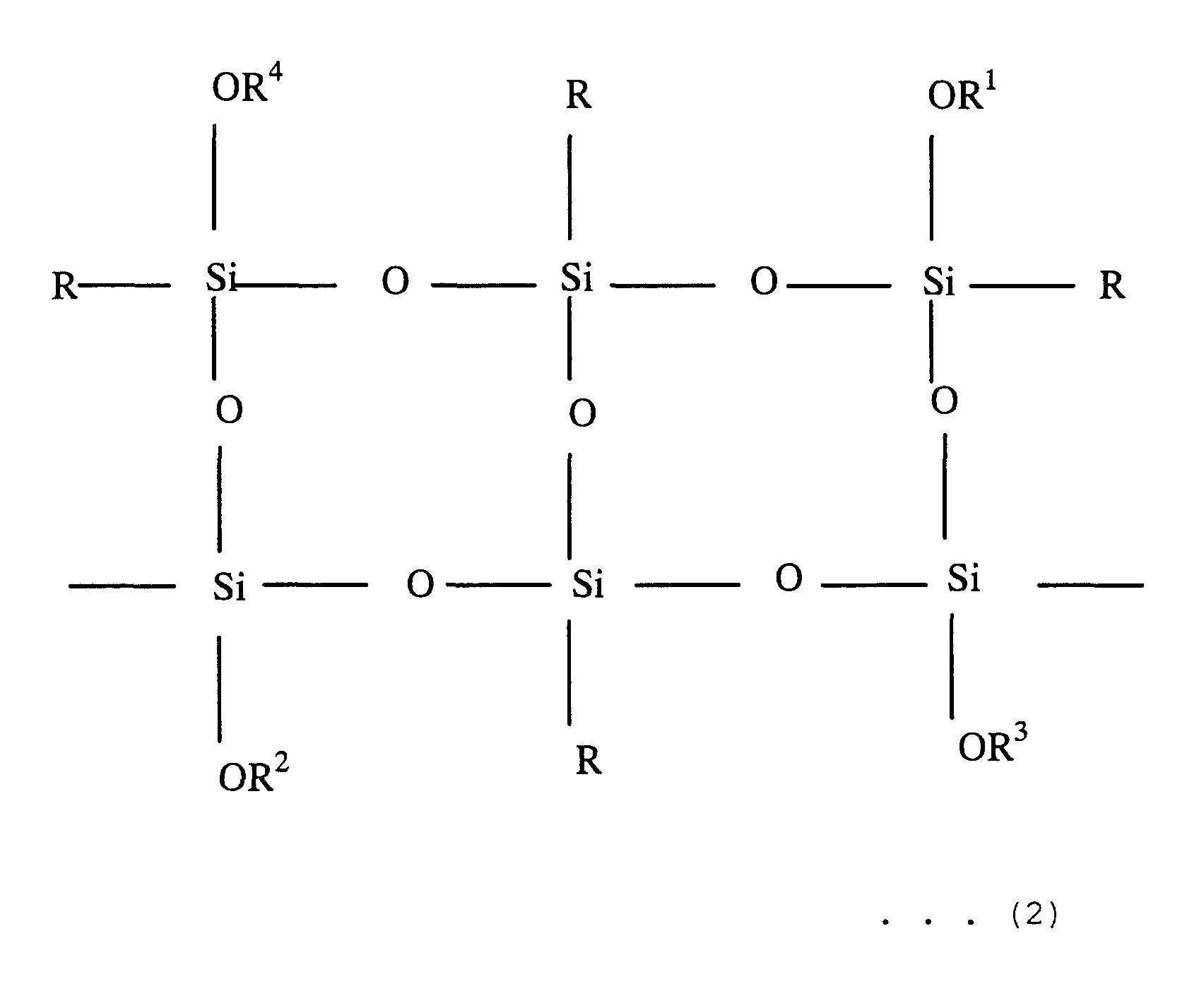
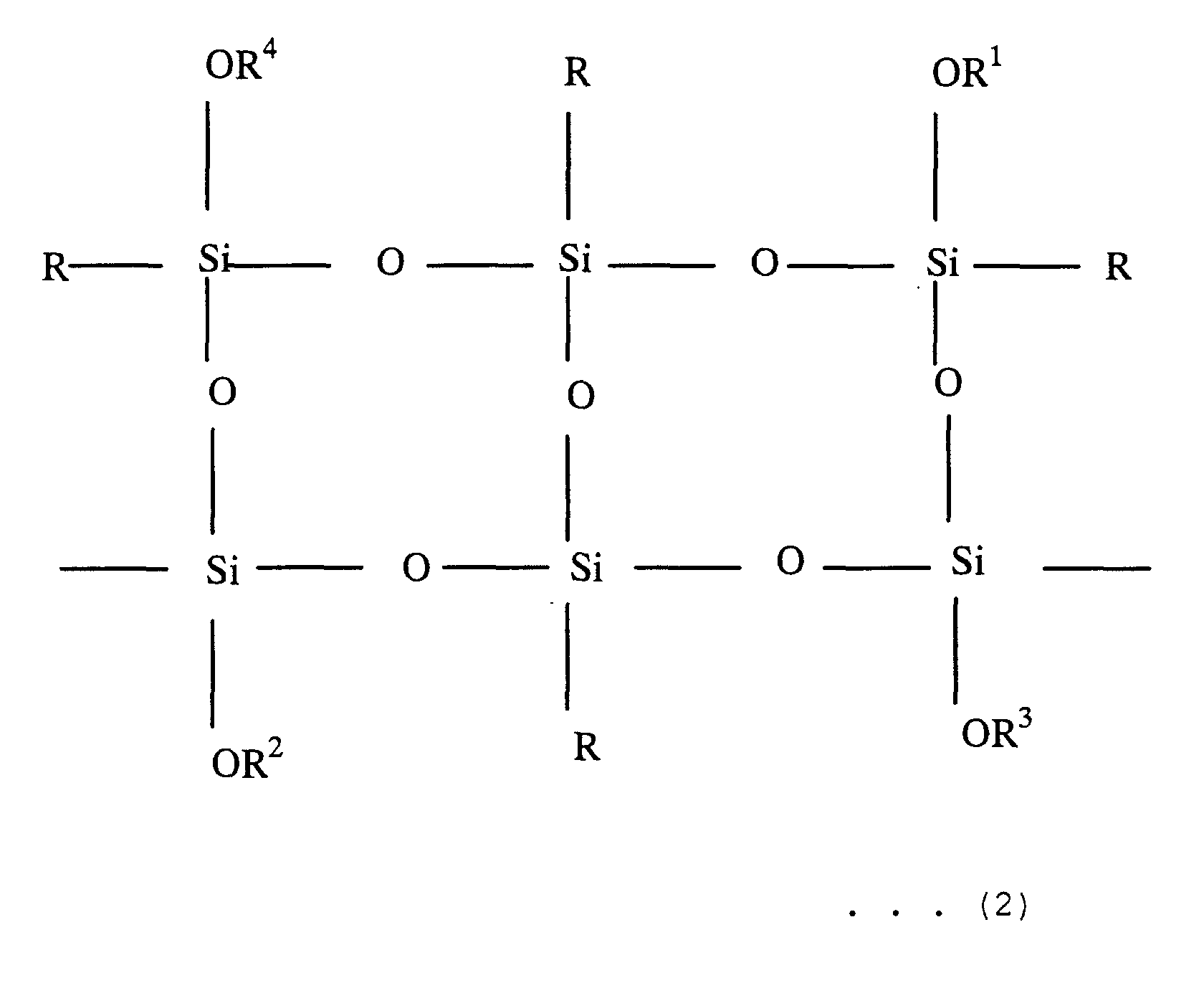
- a heat resistant resin composition comprising a polyimide and an organic silicic compound of the formula (1) or (2): wherein R is an organic group which forms a covalent bond with the polyimide; and R 1 , R 2 , R 3 , R 4 , R 5 and R 6 are independently a silicon-containing group having 0 to 3 groups of (SiRO 3/2 ) as repeating units, provided that when (SiRO 3/2 ) is zero, R 1 , R 2 , R 3 , R 4 , R 5 and R 6 are independently H, CH 3 or C 2 H 5 .
- the present invention further provides a heat resistant film using the heat resistant resin composition mentioned above.
- the present invention also provides a poly(amic acid varnish composition
- the present invention still further provides a process for producing a heat resistant resin composition, which comprises heating a mixture comprising a poly(amic acid), an organic silicic compound having a functional group which brings about an addition reaction with at least one of NH group and COOH group, and water to conduct condensation, and curing the resulting condensate.
- the present inventors have found that when poly(amic acid), an organic silicic compound and water are heat-treated in a mixed state, an oligomer-size of the organic silicic compound is produced in the resin, and this is also effective to obtain a poly(amic acid) varnish having a low viscosity.
- the silicic compound should have a functional group capable of bringing about an addition reaction with at least one of NH group and COOH group in the poly(amic acid).
- SiO 2 skeleton which is stable in dynamic properties is produced uniformly in the polyimide resin in molecular level. Further, by providing functional groups which can covalently bond to the resin at the ends of the SiO 2 skeleton, there can be obtained a heat resistant resin composition wherein the SiO 2 skeleton and the resin are bonded covalently.
- the heat resistant resin composition comprises a polyimide and an organic silicic compound of the formula (1) or (2): wherein R is an organic group which forms a covalent bond with the polyimide; and R 1 , R 2 , R 3 , R 4 , R 5 and R 6 are independently a silicon-containing group having 0 to 3 groups of (SiRO 3/2 ) as repeating units, provided that when (SiRO 3/2 ) is zero, R 1 , R 2 , R 3 , R 4 , R 5 and R 6 are independently H, CH 3 or C 2 H 5 .
- a cured resin obtained by curing the poly(amic acid) varnish composition of the present invention is high in heat resistance, almost disappearing a glass transition point, small in changes of thermal expansion coefficient, and high in thermal dimensional stability at high temperatures. This seems to be caused by the oligomer-size organic silicic compound cured in uniformly dispersed state in the resin.
- the heat resistant resin composition of the present invention is used in module substrates, thin film layers for substrates for package, and insulating films for tape carriers, etc. and composite materials of metals and ceramics, generation of thermal stress is little. Therefore, there hardly arise warpage, cracks, delaminations at interfaces in the composite materials with metals and c ceramics.
- the organic silicic compound when the organic silicic compound is only mixed with water and not mixed with a poly(amic acid) varnish using a solvent, followed by heat treatment, no oligomer-level organic silicic compound is formed.
- the silicic compound is solidified or becomes a high viscosity solution of 10000 poises or more. Even if the poly(amic acid) varnish is mixed after the heat treatment, it is impossible to obtain a uniform mixture in molecular level.
- 29 Si-NMR chemical shift of organic silicic compound having one -O-Si bond and represented by the formula: has an absorption at -48 ppm to -52 ppm.
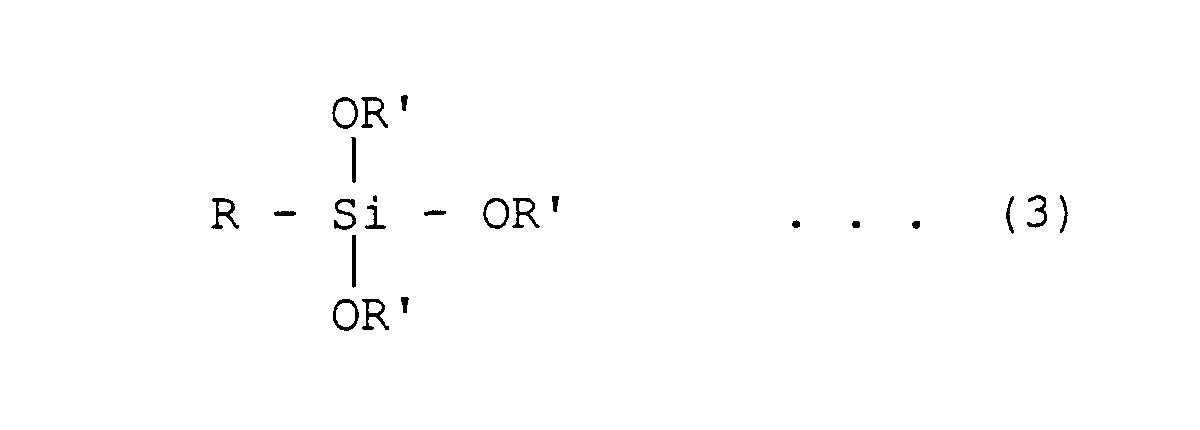
- Another feature of the present invention is to subject a mixture of a poly(amic acid), a silicic compound of the formula: wherein R and R' are as defined above, and water to heat treatment at 60°C to 150°C, preferably 60 to 130°C, for 0.5 to 4 hours, followed by thermal curing.
- the water is preferably used in an amount of 0.02 to 3 moles per mole of the organic silicic compound.
- a solvent such an organic solvent can be used.
- polyimide resin there can be used conventional ones, which can be prepared by reacting one or more acid components such as acid dianhydrides or derivatives thereof with one or more amine components such as diamines or derivatives thereof to produce a poly(amic acid), followed by ring closure with heating or chemically.
- acid components such as acid dianhydrides or derivatives thereof
- amine components such as diamines or derivatives thereof
- tetracarboxylic acid anhydrides such as butanetetracarboxylic dianhydride, pyromellitic dianhydride, benzophenonetetracarboxylic dianhydride, diphenylsulfonetetracarboxylic dianhydride, diphenylethertetracarboxylic dianhydride, biphenytetracarboxylic dianhydride, diphenylpropanetetracarboxylic dianhydride, diphenylhexaflluoropropanetetracarboxylic dianhydride, etc.
- acid dianhydrides can be used alone or as a mixture thereof.
- amine component there can be used hexamethylenediamine, tetramethylenediamine, 4,4-diaminocyclohexane, 4,4-diaminodicyclohexylmethane, 1,3-bis-(amino-methyl)cyclohexane, 1,4-bis-(aminomethyl)cyclohexane, p-phenylenediamine, m-phenylenediamine, 4,4-diaminodiphenyl ether, 3,3-diaminocyclohexane, 4,4-diaminodiphenylmethane, 2,4-dimethyl-m-phenylenediamine, 5-nitro-m-phenylenediamine, 5-nitro-p-phenylenediamine, 5-chloro-m-phenylinediamine, 4,4-diaminodiphenylhexafluoropropane, 3,3-diaminodiphenylhex
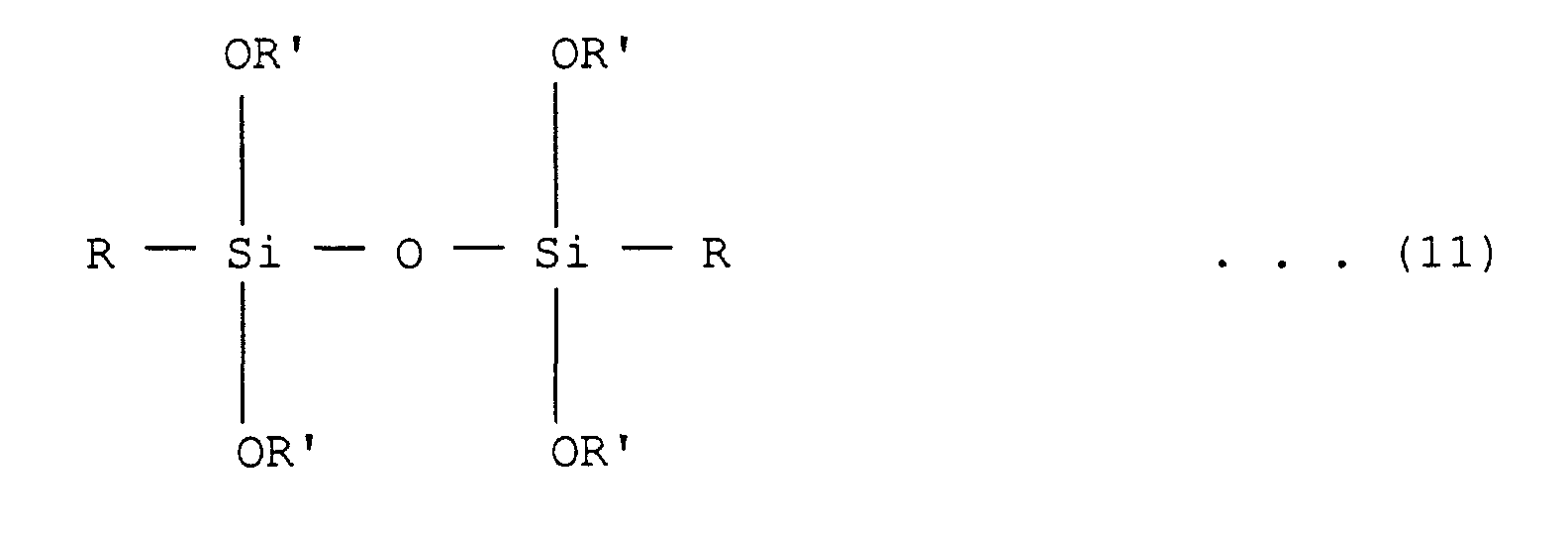
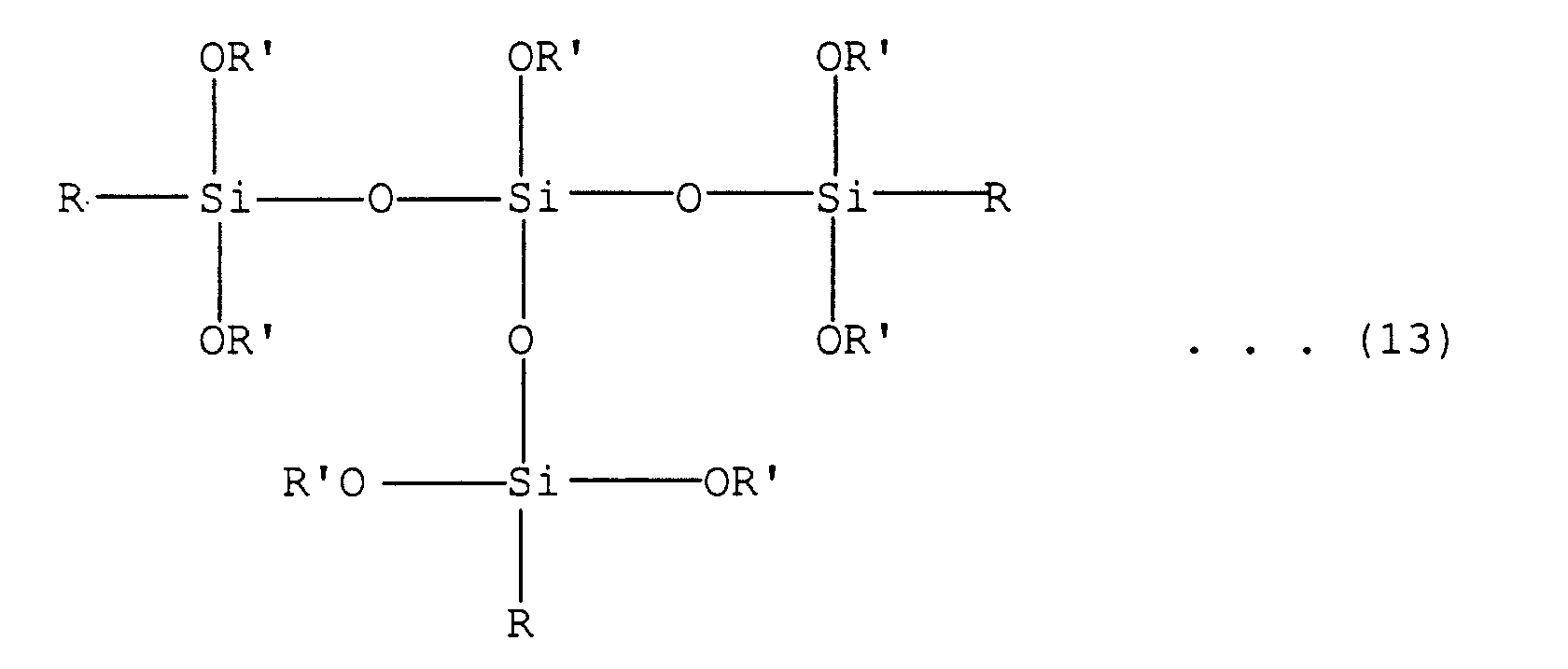
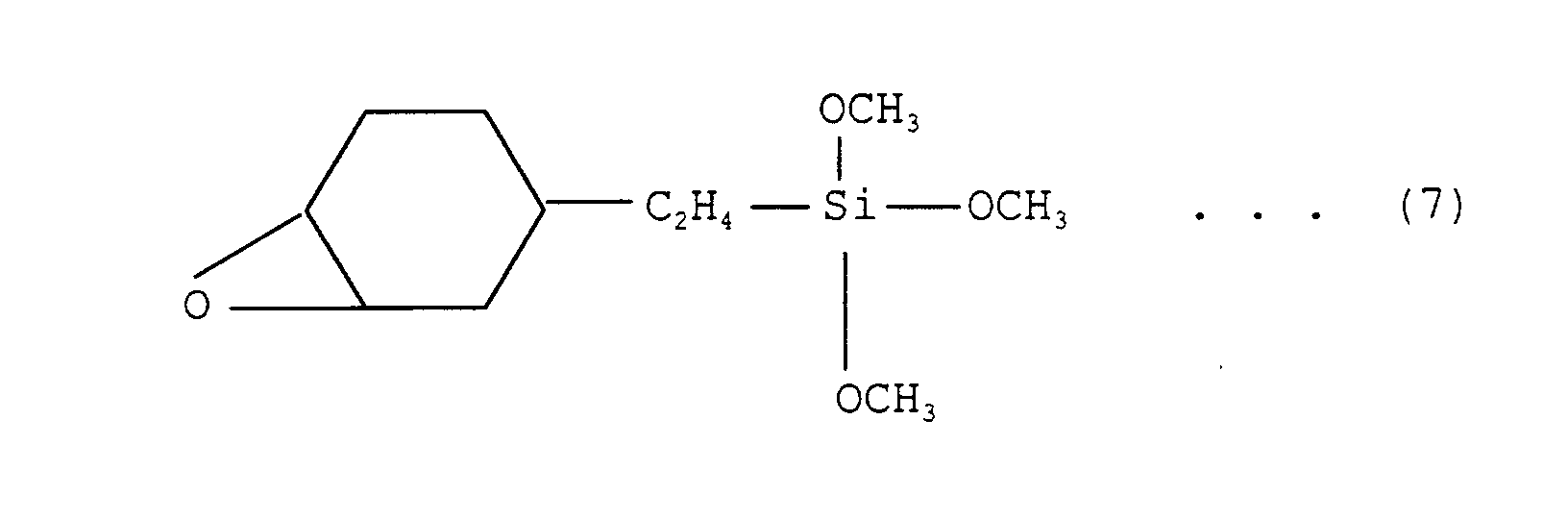
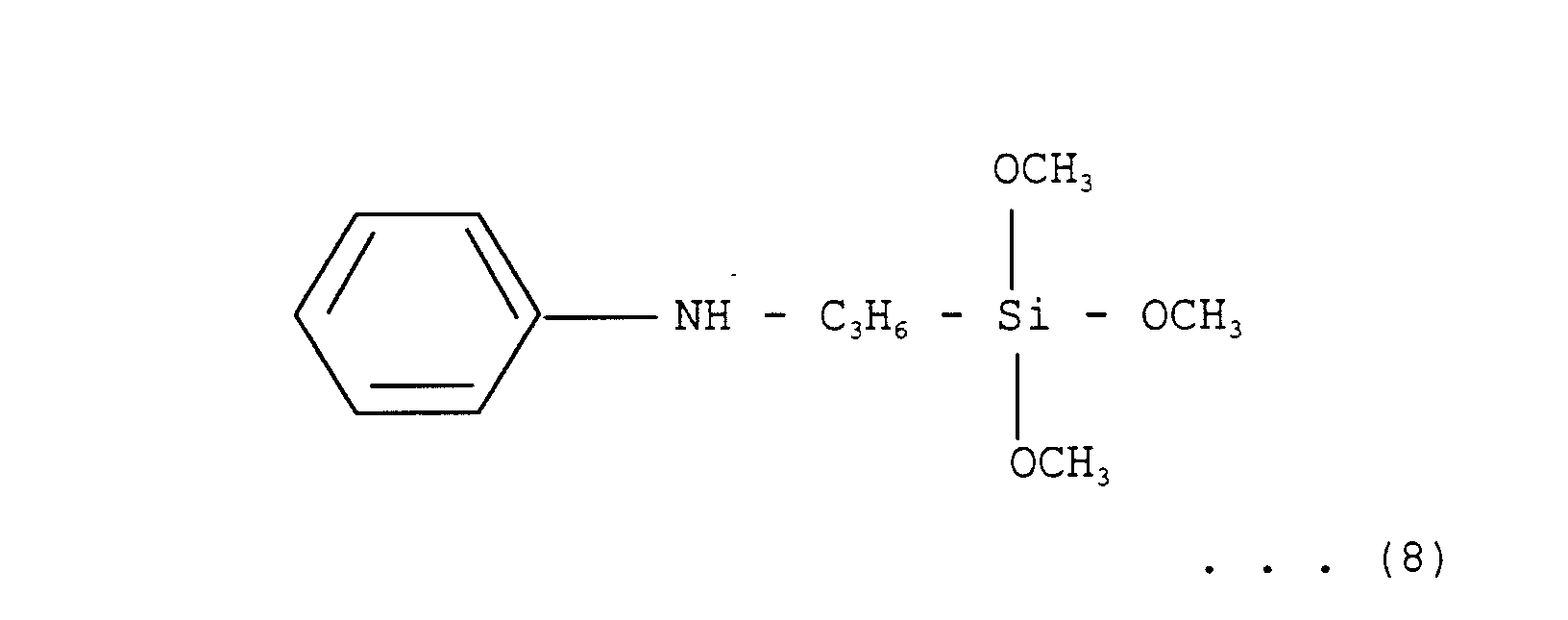
- organic silicic compound of the formula (3) there can be used the following compounds of the formulae (4) to (13) having functional groups.
- a heat resistant resin composition was prepared by using 3-glycidoxytrimethoxysilane as an organic silicic compound, tin dibutyldilaurate as a hydrolysis catalyst, and poly(amic acid).
- the poly(amic acid) was synthesized from equal equivalent weight of 3,3',4,4'-benzophenonetetracarboxylic dianhydride and p-phenylenediamine in N-methyl-2-pyrrolidone.
- the heat resistant resin composition in a film state in 20 ⁇ m thick was produced and subjected to various tests.
- the film-state heat resistant resin composition was prepared as follows.
- the varnish obtained in above (3) was coated on a releasable polyester film using an applicator, dried at 100°C for 5 minutes and at 150°C for 10 minutes, followed by peeling from the releasable film. After heat curing at 200°C for 1 hour and 350°C for 1 hour in a nitrogen atmosphere, the film-state heat resistant resin composition 1 was obtained.
- Test pieces for measuring physical properties were prepared from the film-state heat resistant resin composition 1 and subjected to measurement of thermal expansion and kinematic viscoelasticity under the following conditions:
- the amount of SiO 2 component in the heat resistant resin composition was obtained by burning the heat resistant resin composition in a platinum crucible at 1000°C in the air, measuring the amount of SiO 2 as a residue, and conducting calculation.
- N-(2-aminoethyl)-3-aminopropyltrimethoxysilane as the organic silicic compound
- tin dibutyldilaurate as the hydrolysis catalyst
- poly(amic acid) obtained from 3,3',4,4'-biphenyltetracarboxylic dianhydride and p-phenylenediamine in equivalent weight in N,N-dimethylacetamide.
- the heat resistant resin composition was produced by the following steps.
- Test pieces were prepared from the heat resistant resin composition 2 in the same manner as described in Example 1 and subjected to the measurement of the thermal expansion coefficient and kinematic viscoelasticity in the same manner as in Example 1. The results are shown in Table 1.
- the thermal expansion coefficients at 350°C are 150% or less of those at 50°C, so that the increase of thermal expansion coefficient is suppressed.
- the Compositions 1 and 2 are large in thermal dimensional stability at high temperatures.
- the storage modulus of elasticity at 350°C is 50% or more of that at 50°C, respectively.
- the decrease of the storage modulus of elasticity is suppressed.
- Compositions 1 and 2 are small in changes in dynamic properties.
- the ratio of integrated value of peak from -53 ppm to -72 ppm in 29 Si-NMR chemical shift to that from -40 ppm to -52 ppm is 9.6 in the case of Composition 1 and 8.2 in the case of Composition 2, meaning that the organic silicic compounds are in an oligomer level molecules.
- the SiO 2 conentent in the heat resistant resin composition is 10.8% by weight in the case of Composition 1 and 11.4% by weight in the case of Composition 2.
- the heat resistant resin compositions of Examples 1 and 2 are small in changes in the thermal expansion coefficients at high temperatures, the thermal dimensional stability at high temperatures is high. Further, since the changes in modulus of elasticity at high temperatures are small, these compositions are excellent in dynamic properties at high temperatures.
- the heat resistant resin compositions of Examples 1 and 2 are used in module substrates, thin film layers for substrates for packages and as composite materials with metals, ceramics, etc. for insulating films for tape carriers, there take place almost no warpage, cracks and peeling at interfaces due to generation of little thermal stress.
- the heat resistant resin compositions of Examples 1 and 2 are most suitable for electric appliances requiring high reliability.
- Resin compositions 3 and 4 obtained by using only poly(amic acid) without using an organic silicic compound and a hydrolysis catalyst are explained.
- Resin composition 3 of Comparative Example 1 was obtained by preparing a poly(amic acid) from 3,3',4,4'-benzophenonetetracarboxylic dianhydride and p-phenylene-diamine in equivalent weights in N-methyl-2-pyrrolidone.
- Resin composition 4 of Comparative Example 2 was obtained by preparing a poly(amic acid) from 3,3',4,4'-biphenyltetracarboxylic dianhydride and p-phenylenediamine in equivalent weights in N,N-dimethylacetamide.
- Poly(amic acid) varnishes obtained from Resin compositions 3 and 4 containing resin components in 14% by weight were coated and dried at 100°C for 5 minutes and at 150°C for 10 minutes, and subjected to heat treatment at 200°C for 1 hour and at 400°C for 1 hour.
- Test pieces were prepared from the resin compositions 3 and 4 in the same manner as in Example 1.
- the results are shown in Table 1.
- the thermal expansion coefficients of the resin compositions 3 and 4 at 350°C are 10 times or more as large as those at 50°C.
- the thermal dimensional stability at high temperatures is smaller than that of the heat resistant resin compositions 1 and 2.
- the storage modulus of elasticity is lowered to 1/4. This means that changes in the dynamic properties at high temperatures is large compared with the heat resistant resin compositions 1 and 2.
- the heat resistant resin compositions used in this Example were obtained by using the same organic silicic compound and the hydrolysis catalyst as used in Example 1 and poly(amic acid) obtained from 3,3',4,4'-biphenyltetracarboxylic dianhydride and p-phenylenediamine in equivalent weights in N-methyl-2-pyrrolidone.
- the concentrations of the organic silicic compound and the hydrolysis catalyst were changed to prepare two heat resistant resin compositions 5 and 6.
- the heat resistant resin compositions 5 and 6 were produced by the following steps.
- Test pieces were prepared from the heat resistant resin compositions 5 and 6 in the same manner as described in Example 1 and subjected to the measurement of the thermal expansion coefficients and kinematic viscoelasticity in the same manner as in Example 1. The results are shown in Table 2.
- the thermal expansion coefficients of the resin compositions 5 and 6 at 350°C are 170% or less compared with those at 50°C, resulting in suppressing an increase of the thermal expansion coefficient.
- the thermal dimensional stability at high temperatures is large.
- the storage modulus of elasticity at 350°C is 50% or more compared with that at 50°C. Lowering in the storage modulus of elasticity is suppressed.
- changes of dynamic properties at high temperatures are small.
- the SiO2 content in the resin compositions are 2.0 and 20% by weight, respectively.
- the heat resistant resin compositions of Example 3 are small in changes of thermal expansion coefficient at high temperatures as in the heat resistant resin compositions of Example 1 and 2, the thermal dimensional stability at high temperature is high. Further, since the changes of modulus of elasticity at high temperatures are small, the compositions are excellent in dynamic properties at high temperatures.
- a resin composition 7 having different concentrations of the organic silicic compound and the hydrolysis catalyst compared with the resin compositions of Example 3 was prepared. That is, the resin composition 7 was prepared by futher using 2.0 g of 3-glycidoxytrimethoxysilane, 2.0 g of water and 0.02 g of tin dibutyldilaurate. A resin composition 8 was tried to prepare by further using 50 g of 3-glycidoxytrimethoxysilane, 5 g of water and 0.5 g of tin dibutyldilaurate, but it was difficult to use as a varnish, since the solution was solidified by heat treatment.
- Test pieces were prepared from the resin composition 7 in the same manner as described in Example 1 and subjected to measurement of the thermal expansion coefficient and kinematic viscoelasticity in the same manner as described in Example 1. The results are shown in Table 2.
- the thermal expansion coefficient of the resin composition 7b at 350°C was 10 times as large as that at 50°C.
- the resin composition 7 is small in the thermal dimensional stability at high temperatures compared with the heat resistant resin compositions 5 and 6. Further, the storage modulus of elasticity is lowered to 1/4, resulting in making the change of dynamic properties at high temperatures larger than that of the heat resistant resin compositions 5 and 6.
- the amount of SiO2 is 1.2% by weight based on the weight of the resin composition 7.
- Heat resistant resin compositions were prepared by using the same organic silicic compound and hydrolysis catalyst as used in Example 1, and as the poly(amic acid) that obtained from 3,3',4,4'-biphenyltetracarboxylic dianhydride and p-phenylenediamine in equivalent weights in N-methyl-2-pyrrolidone in the same manner as described in Example 1.
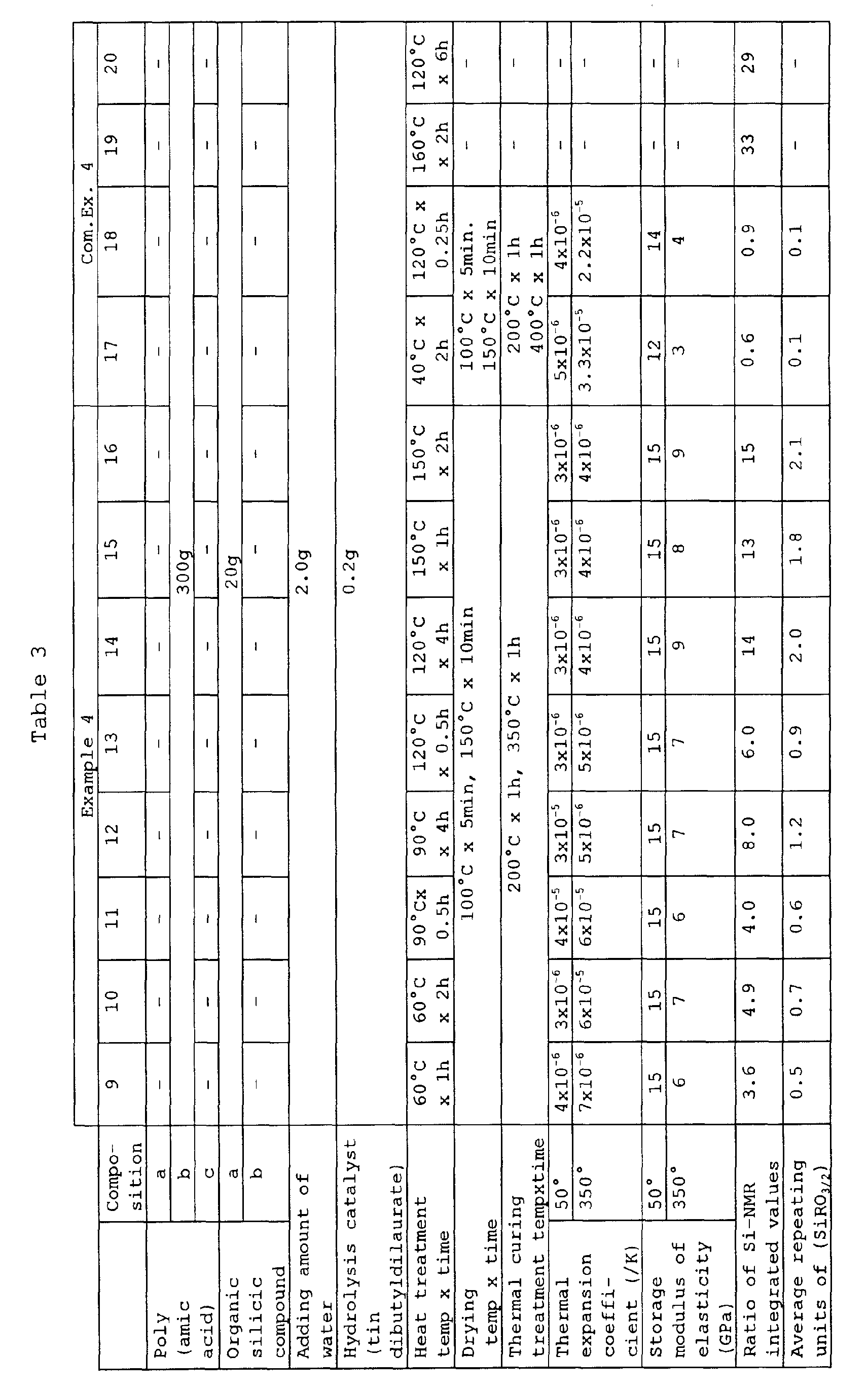
- 8 kinds of the heat resistant resin compositions 9 to 16 were prepared by changing the temperature and time for heat treatment for condensation. Each heat treatment condition is shown in Table 3.
- Test pieces were prepared from these heat resistant resin compositions 9 to 16 in the same manner as described in Example 1 and subjected to the measurement of thermal expansion coefficients and kinematic viscoelesticity in the same manner as described in Example 1. The results are shown in Table 3.
- the cured products from the heat resistant resin composition Nos. 9 to 16 have the thermal expansion coefficients at 350°C suppressed by 150% or less compared with the values at 50°C, resulting in making the thermal dimensional stability at high temperatures large. Further, since the values of storage modulus of elasticity at 350°C is 50% or more of the values at 50°C, lowering in the storage modulus of elasticity is suppressed, resulting in making the change in dynamic properties at high temperatures small.
- Resin compositions were prepared by using poly(amic acid)s different from those used in Example 4.
- the poly(amic acid)s were produced by using 3,3',4,4'-benzophenone-tetracarboxylic dianhydride and p-phenylene-diamine in equivalent weights in N-methyl-2-pyrrolidone.
- Initial heat treatment temperature and time for condensation of the organic silicic compounds each other were changed to obtain two kinds of resin compositions 17 and 18. Individual heat treatments were at 40°C for 2 hours and at 120°C for 0.25 hour.
- the thermal curing condition was at 200°C for 1 hour and at 400°C for 1 hour, respectively.
- varnish (resin) compositions 19 and 20 were prepared by changing the initial heat treatment temperature and time to at 160°C for 2 hours and at 120°C for 6 hours, respectively. Since these varnishes had too high viscosity to coat, so that preparation of resin compositions was abandoned.
- Test pieces were produced from the resin compositions 17 and 18 in the same manner as described in Example 1 and subjected to the measurement of thermal expansion coefficients and kinematic viscoelasticity in the same manner as described in Example 1. The results are shown in Table 3.
- the thermal expansion coefficients of the resin compositions 17 and 18 at 350°C is 5 times as large as those at 50°C. This means that the thermal dimensional stability at high temperatures is smaller than that of the heat resistant resin compositions of Example 3. Further, since the storage modulus of elasticity is lowered to 1/3, changes of dynamic properties at high temperatures are larger than those of the heat resistant resin compositions of Example 3.
- the SiO 2 content of the resin composition 17 was 1.2% by weight.
- Heat resistant resin composition 21 was prepared by using the same organic silicic compound and hydrolysis catalyst as used in Example 1 and poly(amic acid) obtained from pyromellitic dianhydride and 4,4-diaminodiphenyl ether in equivalent weights in N-methyl-2-pyrrolidone.
- the heat resistant resin composition was prepared in the same manner as described in Example 1, but the heat treatment for condensation reaction was carried out at 100°C for 2 hours, drying at 100°C or 10 minutes and at 150°C for 20 minutes, followed by thermal curing treatment at 200°C for 1 hour and 350°C for 1 hour.
- the heat resistant resin composition was formed into a film with 50 ⁇ m thick. Test pieces for measuring physical properties were formed from the heat resistant resin composition 21 in the same manner as described in Example 1 and subjected to measurement of thermal expansion coefficient and kinematic viscoelasticity in the same manner as described in Example 1. The results are shown in Table 4.
- the thermal expansion coefficient at 350°C of the heat resistant resin composition 21 is 105% or less of the value at 50°C, meaning that an increase of the thermal expansion coefficient is suppressed.
- the storage modulus of elasticity at 350°C is 50% or more of the value at 50°C, meaning that lowering of the storage modulus of elasticity is also suppressed. Therefore, the thermal stability at high temperatures was large.
- the heat resistant resin composition of Example 5 is high in thermal dimensional stability at high temperatures, since changes of thermal expansion coefficient and storage modulus of elasticity at high temperatures are small.
- a resin composition 22 was prepared by only using a poly(amic acid) without using an organic silicic compound and a hydrolysis catalyst.
- the poly(amic acid) was produced by using pyromellitic dianhydride and 4,4-diaminodiphenyl ether in equivalent weights in N-methyl-2-pyrrolidone.
- the poly(amic acid) was diluted with N-methyl-2-pyrrolidone so as to make the resin content 14% by weight.
- the resulting varnish was coated on a releasable polyester film using an applicator and dried at 100°C for 10 minutes and at 150°C for 20 minutes, followed by peeling from the releasable film to give a film compsition with 50 ⁇ m.
- the film composition was heat cured at 200°C for 1 hour and 350°C for 1 hour in a nitrogen atmosphere to give a resin composition 22.
- Test pieces were formed from the resin composition 22 in the same manner as described in Example 1 and subjected to measurement of thermal expansion coefficient and kinematic viscoelasticity in the same manner as described in Example 1. The results are shown in Table 4.
- the thermal expansion coefficient of the resin composition at 350°C is 20 times as large as that at 50°C and the storage modulus of elasticity is lowered to 1/10. Thus, thermal stability at high temperatures is poor.
- the heat resistant resin composition contains the SiO 2 skeleton, which has stable dynamic properties, uniformly in molecular level, changes of physical properties such as thermal expansion coefficient and storage modulus of elasticity with temperature changes are small and heat resistance is high.
- SiO 2 skeleton which has stable dynamic properties, uniformly in molecular level, changes of physical properties such as thermal expansion coefficient and storage modulus of elasticity with temperature changes are small and heat resistance is high.
- the devices are subjected to heat history such as solder reflow during a production process and heat cycles, etc. at the time of use.
- heat history such as solder reflow during a production process and heat cycles, etc. at the time of use.
- the heat resistant resin composition of the present invention is small in changes of physical properties depending on temperature changes, and high is heat resistance, so that there arise no warpage, peeling and cracks at interfaces in composite materials. Therefore, when the heat resistant resin composition is used in the semiconductor devices, high reliability is exhibited against the heat history mentioned above.
Landscapes
- Chemical & Material Sciences (AREA)
- Chemical Kinetics & Catalysis (AREA)
- Organic Chemistry (AREA)
- Health & Medical Sciences (AREA)
- Medicinal Chemistry (AREA)
- Polymers & Plastics (AREA)
- Life Sciences & Earth Sciences (AREA)
- Engineering & Computer Science (AREA)
- Materials Engineering (AREA)
- Wood Science & Technology (AREA)
- Compositions Of Macromolecular Compounds (AREA)
- Macromolecular Compounds Obtained By Forming Nitrogen-Containing Linkages In General (AREA)
Abstract
Description











Claims (9)
- A heat resistant resin composition comprising a polyimide and an organic silicic compound of the formula (1) or (2):
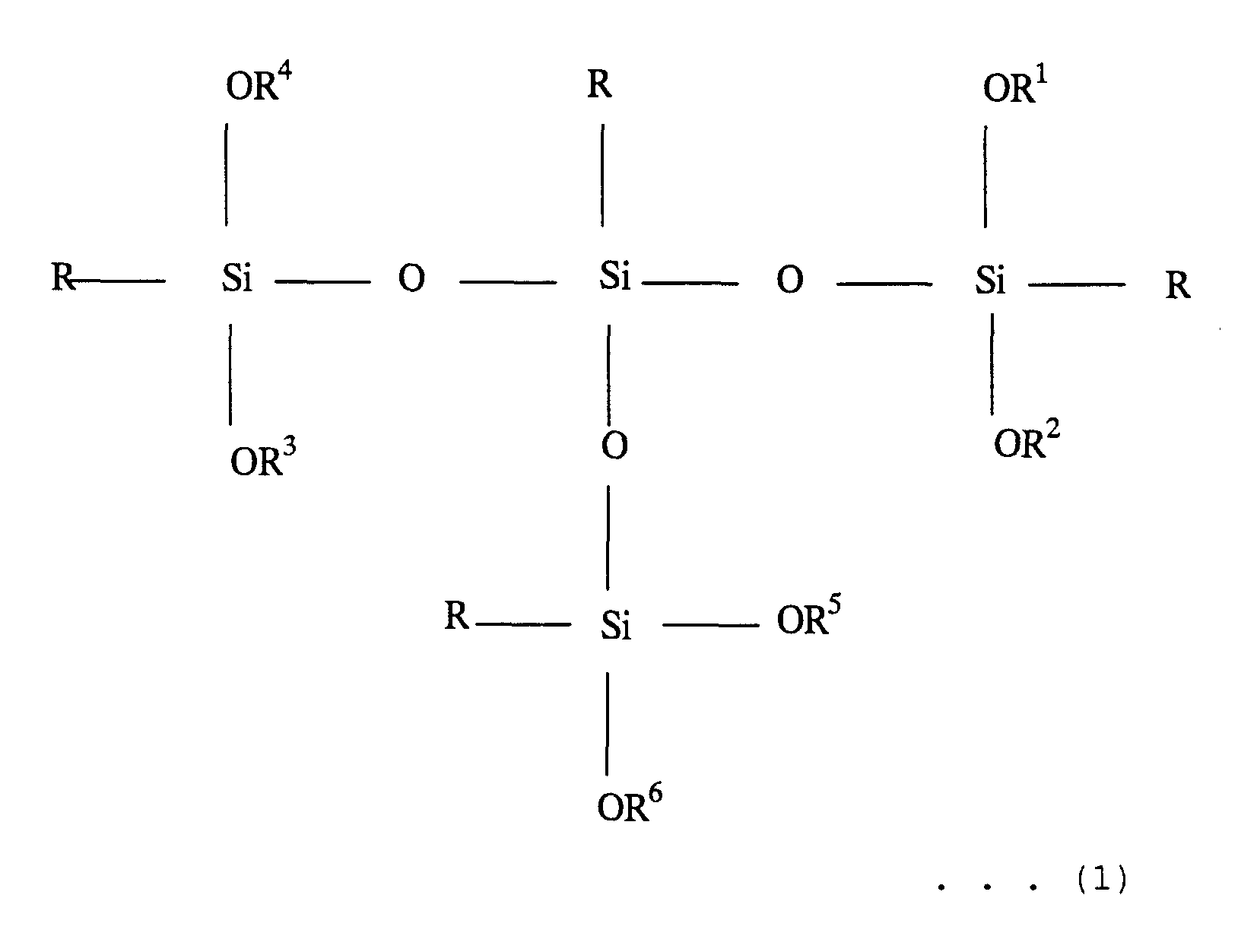 wherein R is an organic group which forms a covalent bond with the polyimide; and R1, R2, R3, R4, R5 and R6 are independently a silicon-containing group having 0 to 3 groups of (SiRO3/2) as repeating units, provided that when (SiRO3/2) is zero, R1, R2, R3, R4, R5 and R6 are independently H, CH3 or C2H5.
- A resin composition according to claim 1, wherein the amount of silicon in the resin composition is 2 to 20% by weight in terms of silica.
- A resin composition according to claim 1, wherein the organic silicic compound has an integrated value of peaks from -53 ppm to -72 ppm in 29Si-NMR chemical shift in an amount of 1 to 30 times as large as that of peaks from -40 ppm to -52 ppm.
- A resin composition according to claim 1, wherein the resin composition provides a cured product having a storage modulus of elasticity at 25°C of 10 times or less of the value at 350°C, and a thermal expansion coefficient at near 25°C of 1/2 or more of the value at near 350°C.
- A heat resistant film obtained by using the heat resistant composition of claim 1.
- A poly(amic acid) varnish composition comprising a poly(amic acid) and an organic silicic compound of the formula (1) or (2):
 wherein R is an organic group having a functional group which brings about an addition reaction with at least one of NH group and COOH group in the poly(amic acid); and R1, R2, R3, R4, R5 and R6 are independently a silicon-containing group having 0 to 3 groups of (SiRO3/2) as repeating units, provided that when (SiRO3/2) is zero, R1, R2, R3, R4, R5 and R6 are independently H, CH3 or C2H5.
- A poly(amic acid) varnish composition according to claim 6, wherein the varnish composition contains silicon in an amount of 2 to 20% by weight in terms of silica.
- A process for producing a heat resistant resin composition, which comprisesheating a mixture comprising a poly(amic acid), an organic silicic compound having a functional group which brings about an addition reaction with at least one of NH group and COOH group, and water to conduct condensation, andcuring the resulting condensate.
- A process according to claim 8, wherein the organic silicic compound is represented by the formula:wherein R is an organic group having a functional group which brings about an addition reaction with at least one of NH group and COOH group in the poly(amic acid); R' is CH3 or C2H5, and the condensation is carried out by heat treating the mixture at 60 to 150°C for 0.5 to 4 hours.
Applications Claiming Priority (2)
| Application Number | Priority Date | Filing Date | Title |
|---|---|---|---|
| JP2000107979 | 2000-04-05 | ||
| JP2000107979A JP2001288362A (en) | 2000-04-05 | 2000-04-05 | Heat resistant resin composition and method for producing the same |
Publications (2)
| Publication Number | Publication Date |
|---|---|
| EP1146074A2 true EP1146074A2 (en) | 2001-10-17 |
| EP1146074A3 EP1146074A3 (en) | 2002-05-02 |
Family
ID=18620899
Family Applications (1)
| Application Number | Title | Priority Date | Filing Date |
|---|---|---|---|
| EP01105796A Withdrawn EP1146074A3 (en) | 2000-04-05 | 2001-03-08 | Heat resistant resin composition and process for producing the same |
Country Status (4)
| Country | Link |
|---|---|
| US (1) | US20010044485A1 (en) |
| EP (1) | EP1146074A3 (en) |
| JP (1) | JP2001288362A (en) |
| KR (1) | KR20010095317A (en) |
Families Citing this family (3)
| Publication number | Priority date | Publication date | Assignee | Title |
|---|---|---|---|---|
| JP4763964B2 (en) * | 2003-11-18 | 2011-08-31 | 三井化学株式会社 | Method for producing polyimide metal laminate |
| JP4866561B2 (en) * | 2005-03-29 | 2012-02-01 | 株式会社巴川製紙所 | Flexible metal laminate and flexible printed circuit board |
| JP5055244B2 (en) * | 2008-10-29 | 2012-10-24 | 三井化学株式会社 | Polyimide metal laminate |
Family Cites Families (12)
| Publication number | Priority date | Publication date | Assignee | Title |
|---|---|---|---|---|
| FR1036694A (en) * | 1950-04-12 | 1953-09-10 | Dow Corning | siloxane elastomers |
| JPS53140973A (en) * | 1977-05-13 | 1978-12-08 | Sanyo Electric Co Ltd | Forming method of semiconductor insulation film |
| JPS6066437A (en) * | 1983-09-22 | 1985-04-16 | Oki Electric Ind Co Ltd | Forming method of heat-resistant resin film |
| JPH069222B2 (en) * | 1986-01-07 | 1994-02-02 | 日立化成工業株式会社 | Manufacturing method of multilayer wiring structure |
| JPH07116407B2 (en) * | 1986-07-08 | 1995-12-13 | 東レ株式会社 | Passive method for semiconductor device |
| JPH0578573A (en) * | 1991-05-01 | 1993-03-30 | Yoshio Imai | Production of polyimide composition |
| JPH07331069A (en) * | 1994-06-09 | 1995-12-19 | Toyobo Co Ltd | Heat-resistant resin composition |
| JPH0873739A (en) * | 1994-09-08 | 1996-03-19 | Dainippon Ink & Chem Inc | Polyimide composition and method for producing the same |
| JP3638340B2 (en) * | 1995-07-05 | 2005-04-13 | 三井化学株式会社 | Polyimide resin composition |
| US6011123A (en) * | 1996-11-20 | 2000-01-04 | Jsr Corporation | Curable resin composition and cured products |
| JPH10298405A (en) * | 1997-04-25 | 1998-11-10 | Yuka Shell Epoxy Kk | Epoxy resin composition and cured product composite |
| JP3941262B2 (en) * | 1998-10-06 | 2007-07-04 | 株式会社日立製作所 | Thermosetting resin material and manufacturing method thereof |
-
2000
- 2000-04-05 JP JP2000107979A patent/JP2001288362A/en active Pending
-
2001
- 2001-02-27 US US09/793,623 patent/US20010044485A1/en not_active Abandoned
- 2001-03-08 EP EP01105796A patent/EP1146074A3/en not_active Withdrawn
- 2001-04-04 KR KR1020010017962A patent/KR20010095317A/en not_active Withdrawn
Also Published As
| Publication number | Publication date |
|---|---|
| US20010044485A1 (en) | 2001-11-22 |
| KR20010095317A (en) | 2001-11-03 |
| EP1146074A3 (en) | 2002-05-02 |
| JP2001288362A (en) | 2001-10-16 |
Similar Documents
| Publication | Publication Date | Title |
|---|---|---|
| EP1184403B1 (en) | Polyimide silicone resin, process for its production, and polyimide silicone resin composition | |
| Tsai et al. | Low dielectric polyimide/poly (silsesquioxane)-like nanocomposite material | |
| EP0216007B1 (en) | Process for producing organic silicon-terminated polyimide precursor and polyimide | |
| JPH10182820A (en) | Polyimide precursor composition and polyimide film | |
| JPH01217037A (en) | Production of silicon-containing polyimide having low moisture absorption and high adhesiveness and precursor thereof | |
| EP0208396A2 (en) | Process for producing highly adherent silicon-containing polyamic acid and crosslinked silicon-containing polyimide | |
| EP0194865A2 (en) | Soluble polyimide-siloxane precursor, process for producing same and cross-linked polyimide-siloxane | |
| US20080214777A1 (en) | Heteropolymeric Polyimide Polymer Compositions | |
| WO2012103238A2 (en) | Polyimide polymer from non-stoichiometric components | |
| JPH0291124A (en) | Polyimide copolymer and its manufacturing method | |
| JPH05178992A (en) | Polyimide-siloxane extended block copolymer | |
| US5346979A (en) | Curable resin, process for making and electronic part protective coating | |
| JP2619515B2 (en) | Silicon polyimide precursor composition | |
| US5063115A (en) | Electronic device coated with a polyimide coating composition | |
| EP1146074A2 (en) | Heat resistant resin composition and process for producing the same | |
| CN108395577A (en) | Nano powder and polyimide resin composition | |
| US5376733A (en) | Precursor composition capable of yielding a polyimidesilicone resin | |
| EP0304022A2 (en) | Polyimide coating composition | |
| CA2030736A1 (en) | Crystalline polyimidesiloxanes | |
| JP2607104B2 (en) | Silicon-containing polyimide cured product and method for producing the same | |
| JPS6222830A (en) | Silicon-containing polyimide resin and its production | |
| JPS58118825A (en) | Production of polyimide precursor | |
| JP3461031B2 (en) | Paste composition and semiconductor device using the same | |
| US5109058A (en) | Curable resin solution compositions, their preparation, and electronic part protective coatings | |
| JPH01126331A (en) | Silicone-containing soluble polyimide precursor and production thereof |
Legal Events
| Date | Code | Title | Description |
|---|---|---|---|
| PUAI | Public reference made under article 153(3) epc to a published international application that has entered the european phase |
Free format text: ORIGINAL CODE: 0009012 |
|
| AK | Designated contracting states |
Kind code of ref document: A2 Designated state(s): DE FR GB Kind code of ref document: A2 Designated state(s): AT BE CH CY DE DK ES FI FR GB GR IE IT LI LU MC NL PT SE TR |
|
| AX | Request for extension of the european patent |
Free format text: AL;LT;LV;MK;RO;SI |
|
| PUAL | Search report despatched |
Free format text: ORIGINAL CODE: 0009013 |
|
| AK | Designated contracting states |
Kind code of ref document: A3 Designated state(s): AT BE CH CY DE DK ES FI FR GB GR IE IT LI LU MC NL PT SE TR |
|
| AX | Request for extension of the european patent |
Free format text: AL;LT;LV;MK;RO;SI |
|
| 17P | Request for examination filed |
Effective date: 20021025 |
|
| AKX | Designation fees paid |
Free format text: DE FR GB |
|
| STAA | Information on the status of an ep patent application or granted ep patent |
Free format text: STATUS: THE APPLICATION HAS BEEN WITHDRAWN |
|
| 18W | Application withdrawn |
Effective date: 20030319 |