EP1146033A2 - Fragrance precursors - Google Patents
Fragrance precursors Download PDFInfo
- Publication number
- EP1146033A2 EP1146033A2 EP01106425A EP01106425A EP1146033A2 EP 1146033 A2 EP1146033 A2 EP 1146033A2 EP 01106425 A EP01106425 A EP 01106425A EP 01106425 A EP01106425 A EP 01106425A EP 1146033 A2 EP1146033 A2 EP 1146033A2
- Authority
- EP
- European Patent Office
- Prior art keywords
- formula
- residue
- ethanone
- carbon atoms
- precursors
- Prior art date
- Legal status (The legal status is an assumption and is not a legal conclusion. Google has not performed a legal analysis and makes no representation as to the accuracy of the status listed.)
- Granted
Links
- 0 *C(*)(*)C(c1c(*)c(*)c(*)c(*)c1*)=O Chemical compound *C(*)(*)C(c1c(*)c(*)c(*)c(*)c1*)=O 0.000 description 1
Images

Classifications
-
- C—CHEMISTRY; METALLURGY
- C11—ANIMAL OR VEGETABLE OILS, FATS, FATTY SUBSTANCES OR WAXES; FATTY ACIDS THEREFROM; DETERGENTS; CANDLES
- C11D—DETERGENT COMPOSITIONS; USE OF SINGLE SUBSTANCES AS DETERGENTS; SOAP OR SOAP-MAKING; RESIN SOAPS; RECOVERY OF GLYCEROL
- C11D3/00—Other compounding ingredients of detergent compositions covered in group C11D1/00
- C11D3/50—Perfumes
- C11D3/502—Protected perfumes
- C11D3/507—Compounds releasing perfumes by thermal or chemical activation
-
- C—CHEMISTRY; METALLURGY
- C07—ORGANIC CHEMISTRY
- C07C—ACYCLIC OR CARBOCYCLIC COMPOUNDS
- C07C45/00—Preparation of compounds having >C = O groups bound only to carbon or hydrogen atoms; Preparation of chelates of such compounds
- C07C45/61—Preparation of compounds having >C = O groups bound only to carbon or hydrogen atoms; Preparation of chelates of such compounds by reactions not involving the formation of >C = O groups
- C07C45/64—Preparation of compounds having >C = O groups bound only to carbon or hydrogen atoms; Preparation of chelates of such compounds by reactions not involving the formation of >C = O groups by introduction of functional groups containing oxygen only in singly bound form
-
- C—CHEMISTRY; METALLURGY
- C07—ORGANIC CHEMISTRY
- C07C—ACYCLIC OR CARBOCYCLIC COMPOUNDS
- C07C45/00—Preparation of compounds having >C = O groups bound only to carbon or hydrogen atoms; Preparation of chelates of such compounds
- C07C45/61—Preparation of compounds having >C = O groups bound only to carbon or hydrogen atoms; Preparation of chelates of such compounds by reactions not involving the formation of >C = O groups
- C07C45/67—Preparation of compounds having >C = O groups bound only to carbon or hydrogen atoms; Preparation of chelates of such compounds by reactions not involving the formation of >C = O groups by isomerisation; by change of size of the carbon skeleton
- C07C45/673—Preparation of compounds having >C = O groups bound only to carbon or hydrogen atoms; Preparation of chelates of such compounds by reactions not involving the formation of >C = O groups by isomerisation; by change of size of the carbon skeleton by change of size of the carbon skeleton
-
- C—CHEMISTRY; METALLURGY
- C07—ORGANIC CHEMISTRY
- C07C—ACYCLIC OR CARBOCYCLIC COMPOUNDS
- C07C45/00—Preparation of compounds having >C = O groups bound only to carbon or hydrogen atoms; Preparation of chelates of such compounds
- C07C45/61—Preparation of compounds having >C = O groups bound only to carbon or hydrogen atoms; Preparation of chelates of such compounds by reactions not involving the formation of >C = O groups
- C07C45/67—Preparation of compounds having >C = O groups bound only to carbon or hydrogen atoms; Preparation of chelates of such compounds by reactions not involving the formation of >C = O groups by isomerisation; by change of size of the carbon skeleton
- C07C45/68—Preparation of compounds having >C = O groups bound only to carbon or hydrogen atoms; Preparation of chelates of such compounds by reactions not involving the formation of >C = O groups by isomerisation; by change of size of the carbon skeleton by increase in the number of carbon atoms
- C07C45/70—Preparation of compounds having >C = O groups bound only to carbon or hydrogen atoms; Preparation of chelates of such compounds by reactions not involving the formation of >C = O groups by isomerisation; by change of size of the carbon skeleton by increase in the number of carbon atoms by reaction with functional groups containing oxygen only in singly bound form
- C07C45/71—Preparation of compounds having >C = O groups bound only to carbon or hydrogen atoms; Preparation of chelates of such compounds by reactions not involving the formation of >C = O groups by isomerisation; by change of size of the carbon skeleton by increase in the number of carbon atoms by reaction with functional groups containing oxygen only in singly bound form being hydroxy groups
-
- C—CHEMISTRY; METALLURGY
- C07—ORGANIC CHEMISTRY
- C07C—ACYCLIC OR CARBOCYCLIC COMPOUNDS
- C07C49/00—Ketones; Ketenes; Dimeric ketenes; Ketonic chelates
- C07C49/76—Ketones containing a keto group bound to a six-membered aromatic ring
- C07C49/84—Ketones containing a keto group bound to a six-membered aromatic ring containing ether groups, groups, groups, or groups
Definitions
- the present invention relates to fragrance precursors for a fragrant ketone and a fragrant ester.
- a principal strategy currently employed in imparting odors to consumer products is the admixing of the fragrance directly into the product. There are, however, several drawbacks to this strategy.
- the fragrance material can be too volatile and/or too soluble, resulting in fragrance loss during manufacturing, storage, and use. Many fragrance materials are also unstable over time. This again results in loss during storage.
- fragrance delivery system which is capable of releasing the fragrant compound or compounds in a controlled manner, maintaining a desired smell over a prolonged period of time.
- WO 99/60990 describes fragrance precursors which release fragrant alcohols, aldehydes or ketones upon exposure to light.
- Perfuming compositions comprising these fragrance precursors can be used in various consumer products such as detergents, fabric softeners, household products, hair-care products etc..
- esters of high volatility resulting in a short period of perceivable odor.
- esters are fast hydrolyzed in alkaline environment, thereby loosing the fragrant characteristic. Therefore, they are of limited use for laundry products.
- Object of the present invention is to provide non volatile precursors for volatile fragrant esters.
- a further object of the present invention is to provide fragrance precursors which are stable in alkaline environment, especially in laundry products.
- an object of the present invention is to provide fragrance precursors with high substantivity.
- a further object of the present invention is to provide fragrance precursors which are activated and cleaved by light.
- an object of the present invention is to provide fragrance precursors with slow release properties.
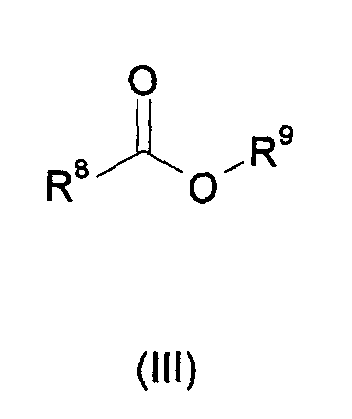
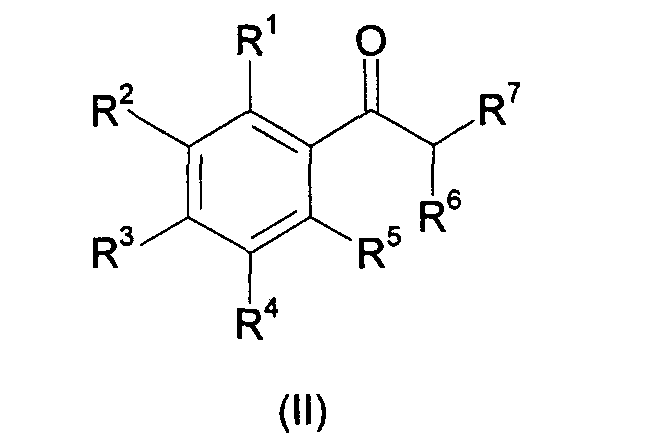
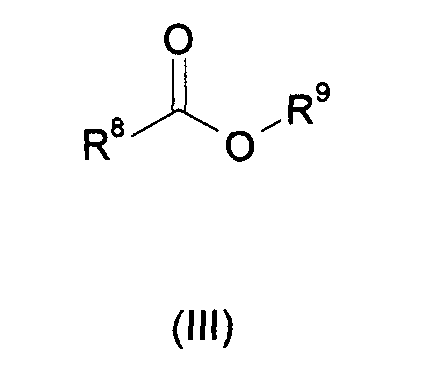
- the present invention relates to fragrance precursors of formula I which upon exposure to light, and in particular daylight, release a fragrant ketone of formula II and a fragrant ester of formula III wherein
- R 8 and R 9 are the residues of an acid R 8 -COOH and an alcohol R 9 OH respectively forming the fragrant ester of formula III.
- Branched carbon chains also comprise multiple branched chains.
- the present invention also relates to the compounds of formula I.
- fragrance precursors of formula I release upon exposure to light volatile fragrant esters of formula III and fragrant ketons of formula II. Since the precursors of the invention are stable in alkaline environment and show high substantivity, they are excellently adapted for detergent and laundry use.
- the fragrance precursors of the present invention are slowly cleaved when exposed to light, in particular daylight. Upon absorption of energy from said light, the phenacyl acetals undergo a Norrish Type II photoreaction which leads to the release of a fragrant ketone of formula II and a fragrant ester of formula III.
- the release of the above mentioned fragrant compounds occurs for example upon exposure to sunlight penetrating through ordinary windows and being not particularly rich in UV irradiation. It is needless to say that upon exposure to bright sunlight, in particular outdoors, the release of the fragrant compounds of formula II and III will occur faster and to a greater extent than upon exposure to room light inside a building.
- the cleavage of the precursors of the present invention can also be initiated by an appropriate lamp, for example a sun tanning lamp.
- the photoreaction of the fragrance precursors of formula I involves in a first step the absorption of light by the keto-group followed by abstraction of the acetal-H atom and subsequent cleavage of the resulting 1,4-diradical (Scheme A). It has been found that the aromatic residue of the fragrance precursors plays an important role in this photoreaction as it influences the absorption maxium ⁇ max of the keto-group. Therefore, the cleavage properties of the fragrance precursors can be modified by variation of the substituents R 1 to R 5 .
- Fragrant aryl alkyl ketones of formula II are well known to those skilled in the art.
- a fragrant ketone of formula II is a compound known to a person skilled in the art as being a useful ingredient for the formulation of perfumes or perfumed articles.
- Non-limiting examples of said aryl alkyl ketones are acetanisole (1-(4-methoxyphenyl)-ethanone) [Givaudan Roure (International) SA, Vernier, Switzerland], acetophenone (1-phenyl-ethanone) [Haarmann & Reimer GmbH, Germany], Crysolide® (4-acetyl-6-tert-butyl-1,1-dimethyl-indan) [Givaudan Roure (International) SA, Vernier, Switzerland], dimethyl acetophenone (1-(2,4-dimethylphenyl)-ethanone) [Fluka AG, Buchs, Switzerland], Fixolide® (1-(5,6,7,8-tetrahydro-3,5,
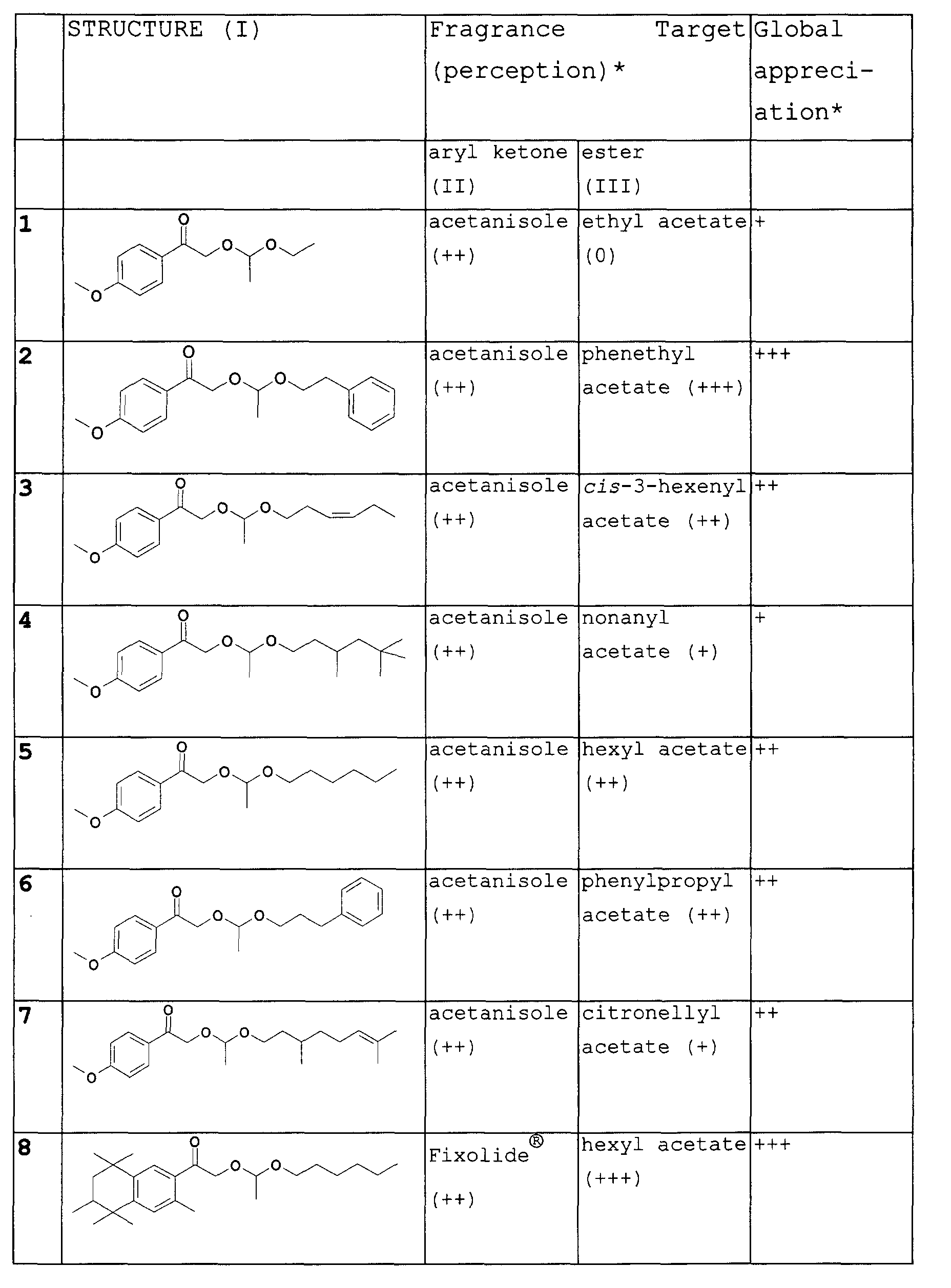
- Fragrance esters of formula III represent an important class of perfumery raw materials and comprise compounds of a great structural variety. Fragrance esters of formula III contribute to the odor and aroma of nearly all fruits and are known to be useful ingredients for the formulation of perfumes or perfumed articles. In the following a non-limiting list of such esters are given as examples.
- esters of formula III are either acetates or comprise ethanol as the alcohol component.
- esters of formula III include amyl butyrate, butyl 2-methylpentanoate, 3,7-dimethyloctan-3-yl acetate, ethyl 2-methylbutyrate, hexyl acetate, hexyl isobutyrate and isopropyl 2-methylbutyrate.
- the lower fatty acid esters of acyclic terpene alcohols e.g. geraniol, linalool and citronellol
- cyclic terpene alcohols e.g. menthol, ⁇ -terpineol, borneol and guaiyol
- cycloaliphatic esters of formula III are widely used perfumery chemicals, non-limiting examples are Agrumex® (2-tert-butylcyclohexyl acetate) [Haarmann & Reimer GmbH, Germany], Vertenex® (4-tert-butylcyclohexyl acetate) [International Flavors & Fragrances, USA], Verdylacetate® (4,7-Methano-3a,4,5,6,7,7a-hexahydro-5(6)-indenyl acetate) [Givaudan Roure (International) SA, Vernier, Switzerland], Givescone® (ethyl 2-ethyl-6,6-dimethyl-2-cyclohexenecarboxylate and ethyl 2,3,6,6-tetramethyl-2-cyclohexenecarboxylate) [Givaudan Roure (International) SA, Vernier, Switzerland], Cyclogalbanat® (allyl cyclohexyloxyacetate) [DRA
- esters of formula III used in perfumery are those derived from araliphatic alcohols and aliphatic acids. They have characteristic odor properties. Important esters that fall into this category are e.g. benzyl acetate, phenethyl acetate, ⁇ , ⁇ -dimethylphenethyl acetate and cinnamyl acetate.
- esters of formula III described above which are of pleasant odor, have a rather high volatility. This is especially true for aliphatic esters exhibiting typical fruity odors and for lower fatty acid esters of acyclic terpene alcohols having pleasant citrusy, floral odors.
- An example of such a volatile ester is e.g. cis-3-hexenyl acetate. Cis-3-hexenyl acetate applied to a surface of, for example, a fabric using a fabric softener in the rinsing cycle of the washing process, can only be perceived over a short period of time of one or two hours, depending on the concentration of cis-3-hexenyl acetate in the fabric softener.
- the fragrance precursors of the present invention are not, or only slightly, volatile.
- the fragrant ketone of formula II and the fragrant ester of formula III are released only upon exposure to light, and especially daylight.
- the photochemical cleavage provides over days and weeks perceptible amounts of the fragrant compounds. The period depends interalia on the amount or concentration of the precursor applied, the duration of exposure to light, its intensity and its wavelength.
- Fragrance esters of formula III are prone to undergo hydrolysis into an acid of formula R 8 COOH and an alcohol of formula R 9 OH, especially in alkaline products. Therefore many fragrance accords comprising such esters, e.g. fruity accords, cannot be imparted to such products.
- fragrance precursors of the present invention have the advantage that they are not or only slightly volatile and chemically stable in consumer products having alkaline and neutral pH.
- a precursor of formula I added to a powder detergent is stable in the detergent powder throughout storage.
- the washing cycle alkaline pH
- the rinsing cycle neutral pH
- the precursor is deposited on the fabric surface. It is only upon exposure of the fabric to light, for example during line drying in the sun, that the release of the fragrant ketone of formula II and the fragrant ester of formula III is started.
- esters of formula III are rather volatile compounds. Furthermore, they are water soluble and are, therefore, lost to some extent during the washing/rinsing cycle if introduced directly into detergents.
- the fragrance precursors of formula I have the advantage that they have good substantivity on different substrates, especially on fabrics. Furthermore, the precursors are not or only slightly volatile, thus no loss occurs during storage. With the precursors of the present invention highly volatile esters of formula III with low substantivity are successfully applied to achieve a long lasting pleasant odor. The volatile esters are produced in situ after application of the precursors of formula I onto a fabric during the washing cycle.
- the moiety derived from a fragrant ketone of formula II brings three advantages: it introduces stability as well as substantivity to the precursors of formula I and upon activation by light exhibits fragrant properties.
- the fragrance precursors of the present invention are advantageously prepared via two methods. Both methods use an ⁇ -hydroxy-ketone as starting material. The latter is prepared by bromination of the corresponding fragrant ketone followed by sodium formate treatment and subsequent hydrolysis shown in scheme I:
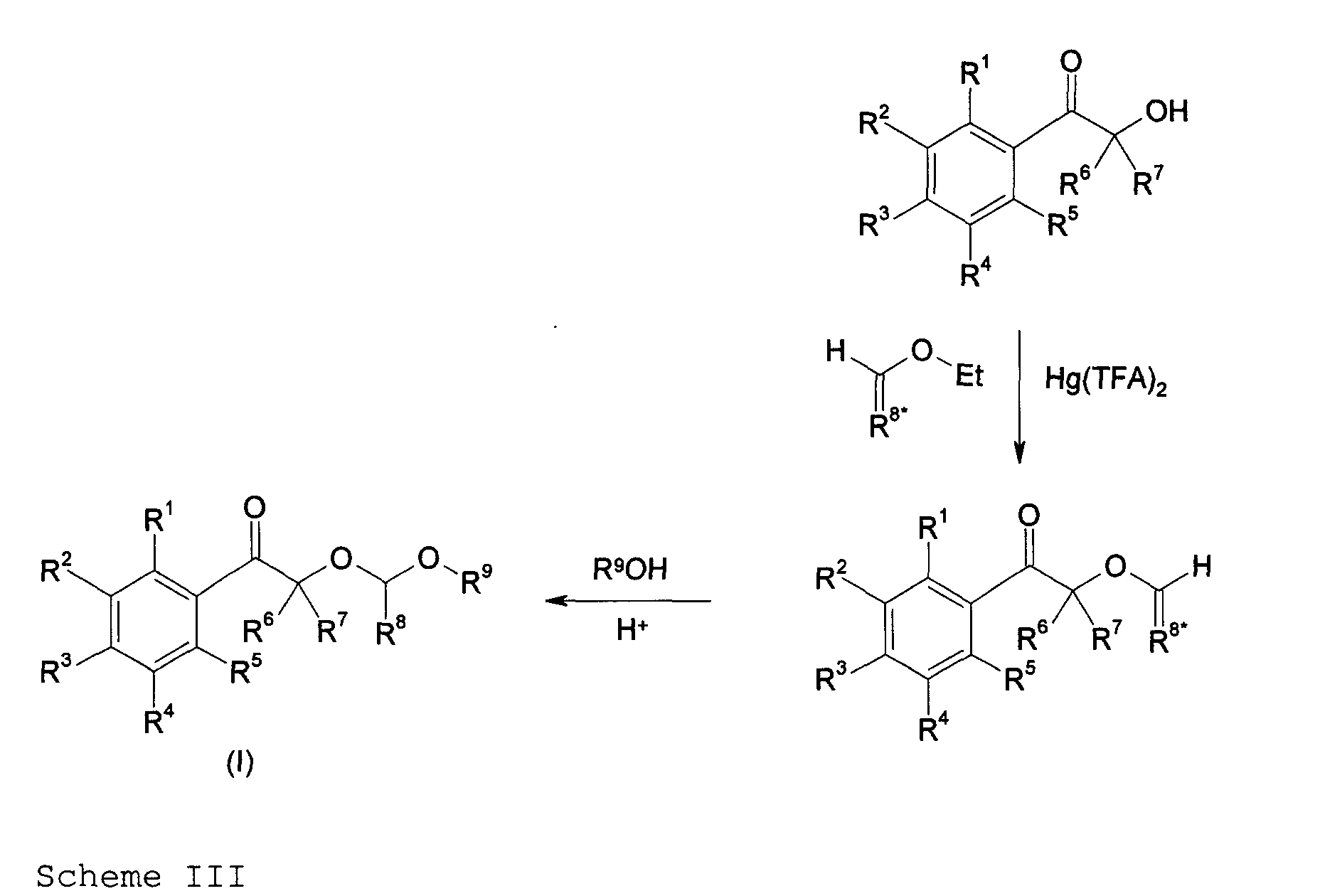
- the ⁇ -hydroxy-ketone is transformed to the corresponding vinyl ether using a Hg catalyst.
- the vinyl ether is then coupled with the alcohol R 9 OH from which the fragrant ester of formula III is derived.
- This method allows for the use of a great variety of alcohols, i.e. residues R 9 especially for allylic residues.
- the synthesis via this route is illustrated in scheme III:
- Preferred precursors of the present invention are compounds releasing an aliphatic ester of formula III wherein R 8 is the residue of an aliphatic acid having 1 to 4 carbon atoms and R 9 is the residue of an aliphatic alcohol having 2 to 20 carbon atoms. Most preferred precursors are those releasing an ester derived from acetic acid, i.e. wherein R 8 is -CH 3 .
- R 8 is the residue of an aliphatic acid having 5 to 20 carbon atoms and R 9 is the residue of an aliphatic alcohol having 1 to 5 carbon atoms.
- Most preferred compounds are those releasing an ester derived from ethanol, i.e. wherein R 9 is -CH 2 CH 3 .
- R 8 is the residue of an aliphatic acid having 1 to 4 carbon atoms and R 9 is the residue of a terpene alcohol having 10 to 20 carbon atoms.
- Most preferred compounds are those wherein the alcohol is a monoterpene alcohol.
- R 8 is the residue of a cycloaliphatic acid having 5 to 20 carbon atoms and R 9 is the residue of an aliphatic alcohol having 1 to 5 carbon atoms.
- Most preferred compounds are those wherein the alcohol is ethanol.
- R 8 is the residue of an aliphatic acid having 1 to 4 carbon atoms and R 9 is the residue of an araliphatic alcohol having more than 5 carbon atoms.
- Most preferred precursors are those releasing an ester derived from acetic acid, wherein R 8 is -CH 3 .
- R 6 and R 7 H and R 1 to R 5 represent independently hydrogen, -NO 2 , linear or branched C 1 -C 6 alkyl, alkenyl, alkinyl, and C 1 -C 4 alkoxy.
- Most preferred compounds are those releasing a fragrant ketone of formula II wherein the fragrant ketone is selected from 1-phenyl-ethanone, 2,4-dimethylphenylethanone, 1-[4-(1,1-dimethylethyl)-2,6-dimethylphenyl]-ethanone, 1-(4-tert-butyl-3,5-dinitro-2,6-dimethyl)-ethanone and 1-(4-methoxyphenyl)-ethanone.
- R 1 and R 2 , R 2 and R 3 , R 3 and R 4 , R 4 and R 5 form together an aliphatic or aromatic ring, wherein this ring may optionally contain substituted or unsubstituted C 1 -C 4 alkyl, alkenyl, alkinyl residues and may comprise one or more oxygen atoms.
- Most preferred compounds are those releasing a fragrant ketone of formula II wherein the fragrant ketone is selected from 1-(2-naphtalenyl)-ethanone, 4-acetyl-6-tert-butyl-1,1-dimethyl-indan, 1-(5,6,7,8-tetrahydro-3,5,5,6,8,8-hexamethyl-2-naphthalenylethanone, 1-(5,6,7,8-tetrahydro-3',5',5',8',8'-penta-methyl-2-naphthalenyl)-ethanone, 1-(5,6,7,8-tetrahydro-3'-ethyl-5',5',8',8'-tetramethyl-2-naphthalenyl)-ethanone, 1-(2,3-dihydro-1,1,2,3,3,6-hexamethyl-1H-inden-5-yl-ethanone, 1-[2,3-dihydro-1,1,2,6-tetramethyl
- the present invention also relates to the use of all compounds of formula I as precursors for fragrant compounds.
- fragrance precursors of the present invention can be used in any product in which a prolonged and defined release of the above mentioned fragrant compounds is desired. Therefore, these precursors are especially useful in functional perfumery, in products which are exposed to sunlight, during or after application.
- the compounds of the present invention can act as fragrance precursors in functional and fine perfumery i.e. in fine fragrances, industrial, institutional, home and personal care products.
- Industrial, institutional and home cleaning products to which the fragrance precursors can be added are all kinds of detergents, window cleaners, hard surface cleaners, all purpose cleaners and furniture polishes.
- the products can be liquids or solids, such as powders or tablets. Fabrics and surfaces treated with a product comprising a fragrance precursor of the present invention will diffuse a fresh and clean odor upon exposure to light much longer than when cleaned with a conventional cleaner. Fabrics or cloths washed with such detergents will release the fragrant compounds even after having been stored for weeks in a dark place, e.g. a wardrobe.
- the precursors of the present invention are also useful for application in all kinds of body care products.
- Especially interesting products are hair care products, for example shampoos, conditioners and hairsprays and skin care products such as cosmetic products and especially sun protection products.
- fragrance precursors of the present invention can be used alone or in combination with other fragrance ingredients, solvents or adjuvants known to those skilled in the art.
- Such ingredients are described, for example, in "Perfume and Flavor Chemicals", S. Arctander, Ed., Vol. I & II, Allured Publishing Corporation, Carol Stream, USA, 1994 and include fragrance compounds of natural or synthetic origin and essential oils of natural products.
- the amounts in which the precursors of formula I are incorporated in the various above-mentioned products vary within a wide range. The amounts depend on the nature of the fragrant compounds to be released, the nature of the product to which the precursors are added and the desired olfactory effect. The amounts used also depend on the co-ingredients in a given composition when the precursors of the present invention are used in admixture with perfuming co-ingredients, solvents or adjuvants. Typical concentrations are in the order of 0.01% to 5% by weight of the products.
- ⁇ -Bromo-Fixolide was prepared from Fixolide® according to R.M. Cowper, L.H. Davidson, Org. Synth. Coll. Vol. II , 1943, 480-481.
- NMR values of coupling constants J are given in Hertz (Hz).
- trans -isomer 1 H-NMR (400 MHz, CDCl 3 ): 0.82 (s, 9H); 0.9-1.05 (m, 3H); 1.15-1.35 (m, 2H); 1.42 (d, 3H, J 2.1); 1.7-1.8 (m, 2H); 1.95-2.1 (m, 2H); 3.75-3.6 (m, 1H); 4.95 (m, 2H); 5.1 (q, 1H); 7.5-7.65 (m, 2H); 7.85-8.05 (m, 4H); 8.5 (s, 1H).
- Photorelease assays were conducted on solutions (typical concentrations of precursors (I): 0.05% to 0.1% g/v) in organic solvents (preferably ethanol) or on cotton towels after deposition of the phenacyl acetals (I), as described below in the example 3.
- the solutions were irradiated with a mercury lamp (150 W) in a borosilicate glass apparatus (Pyrex® ) so as to limit the irradiation window to mainly the UVA and UVB spectrum of sun light.
- the alcoholic solution was irradiated for one hour and samples taken every 15 min to analyze the extent of the photolysis.
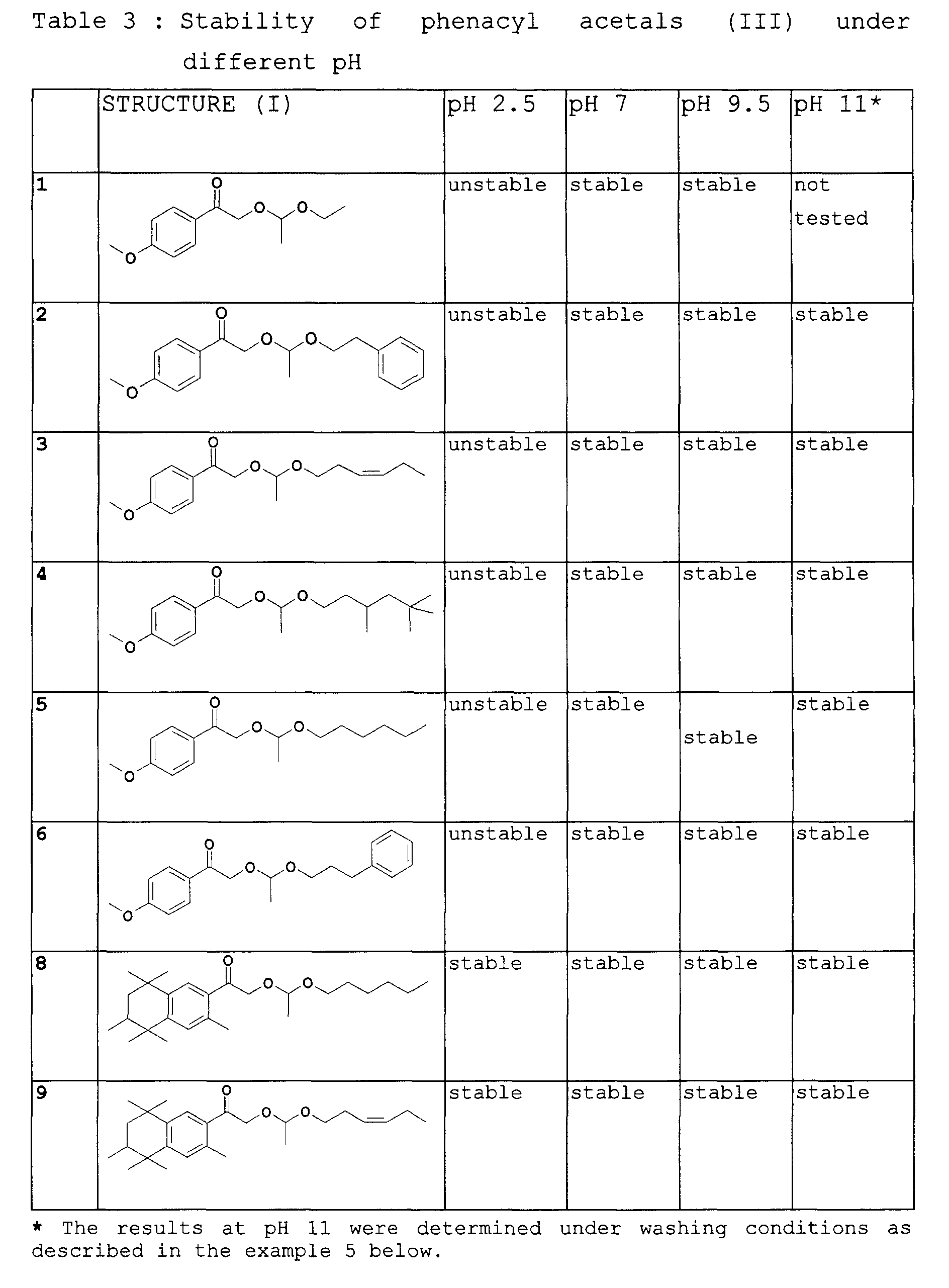
- the phenacyl acetals (I) were incubated in aqueous buffer solutions of pH 2.5, pH 7 and pH 9.5 for 24h at 37 °C and were found to be stable in basic and neutral media, but less so under acidic conditions. The results are summarized in table 3.
- the towels were extracted with an organic solvent (preferably t-butyl methyl ether) using a Dionex ASE200 Accelerated Solvent Extractor and the extracts were analyzed by HPLC (Hewlett Packard Series 1100, column: Zorbax Eclipse XDB-C18, dimensions 15 cm x 4.6 mm x 5 ⁇ m).
- the washing liquor was extracted with an organic solvent (preferably t-butyl methyl ether, 250 ml) and analyzed by HPLC as above.
- the washing liquor (2.1 g washing powder containing 1% phenacyl acetal (I) in 500 ml water), according to 1 in the above described washing procedure, was stirred during one hour at room temperature. Extraction with an organic solvent (preferably t -butyl methyl ether) to recover organic compounds and analysis with HPLC gave the amounts of recovered phenacyl acetal (I), table 4.
- an organic solvent preferably t -butyl methyl ether
- the dried towels taken from the described hand washing procedure, were either irradiated with the previously mentioned tanning lamp and olfactively evaluated or analyzed by HPLC.
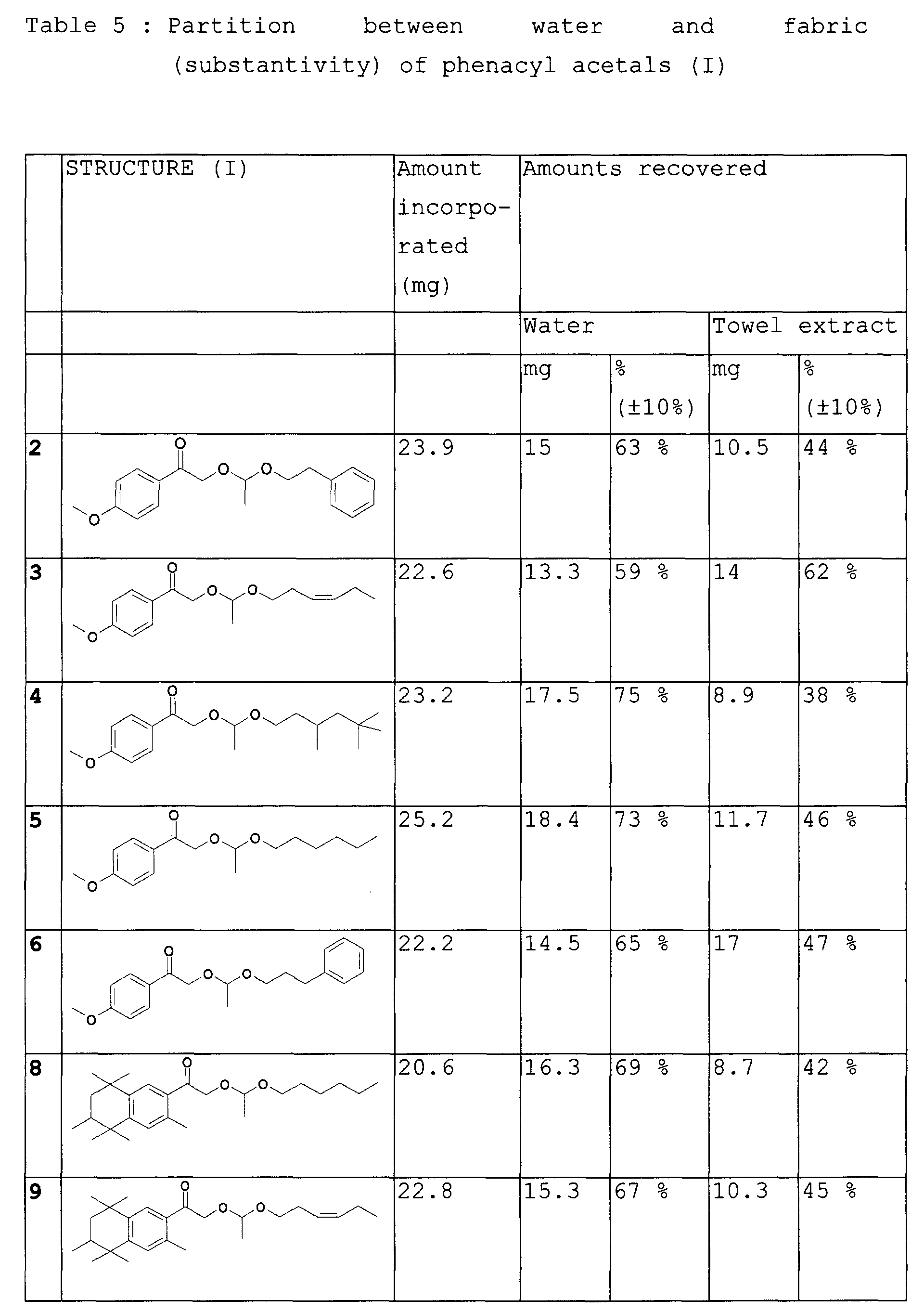
- the aqueous liquors were extracted with an organic solvent (preferably t -butyl methyl ether) and analytical HPLC gave the results in table 5, which are related to partition between water and fabric.
Landscapes
- Chemical & Material Sciences (AREA)
- Organic Chemistry (AREA)
- Chemical Kinetics & Catalysis (AREA)
- Life Sciences & Earth Sciences (AREA)
- Engineering & Computer Science (AREA)
- Oil, Petroleum & Natural Gas (AREA)
- Wood Science & Technology (AREA)
- Fats And Perfumes (AREA)
- Organic Low-Molecular-Weight Compounds And Preparation Thereof (AREA)
Abstract


Description

The release of the above mentioned fragrant compounds occurs for example upon exposure to sunlight penetrating through ordinary windows and being not particularly rich in UV irradiation. It is needless to say that upon exposure to bright sunlight, in particular outdoors, the release of the fragrant compounds of formula II and III will occur faster and to a greater extent than upon exposure to room light inside a building. The cleavage of the precursors of the present invention can also be initiated by an appropriate lamp, for example a sun tanning lamp.

Additional fragrant ketones of formula II are e.g. described in "Perfume and Flavor Chemicals", S. Arctander Ed. , Vol. I & II, Allured Publishing Corporation, Carol Stream, USA, 1994 and in K. Bauer, D. Garbe and H. Surburg, Eds., Common Fragrance and Flavor Materials, Wiley-VCH, 3rd Edition, Weinheim, 1997.


Other preferred precursor include compounds wherein R1 and R2, R2 and R3, R3 and R4, R4 and R5 form together an aliphatic or aromatic ring, wherein this ring may optionally contain substituted or unsubstituted C1-C4 alkyl, alkenyl, alkinyl residues and may comprise one or more oxygen atoms. Most preferred compounds are those releasing a fragrant ketone of formula II wherein the fragrant ketone is selected from 1-(2-naphtalenyl)-ethanone, 4-acetyl-6-tert-butyl-1,1-dimethyl-indan, 1-(5,6,7,8-tetrahydro-3,5,5,6,8,8-hexamethyl-2-naphthalenylethanone, 1-(5,6,7,8-tetrahydro-3',5',5',8',8'-penta-methyl-2-naphthalenyl)-ethanone, 1-(5,6,7,8-tetrahydro-3'-ethyl-5',5',8',8'-tetramethyl-2-naphthalenyl)-ethanone, 1-(2,3-dihydro-1,1,2,3,3,6-hexamethyl-1H-inden-5-yl-ethanone, 1-[2,3-dihydro-1,1,2,6-tetramethyl-3-(1-methylethyl-1H-inden-5-yl-ethanone, 5-acetyl-1,1,2,3,3-pentamethyl-indane, 1-(5,6,7,8-tetrahydro-2-naphthalenyl)-ethanone.
NMR: values of coupling constants J are given in Hertz (Hz).
mp 104-105 °C.
1H-NMR (400 MHz, CDCl3): 3.48 (t, 1H, J 4); 4.82 (d, 2H, J 4); 6.95-7.0 (m, 2H); 7.85-7.95 (m, 2H).
IR (νmax, cm-1, neat): 3415m, 2929w, 1672s, 1603s.
MS [m/z (EI)]: 166 (M+, 4), 155 (100), 77 (28).
mp 81-82 °C.
1H-NMR (400 MHz, CDCl3): 1.0 (d, 3H, J 6.8); 1.08 (s, 3H); 1.26 (s, 3H); 1.31 (s, 3H); 1.33 (s, 3H); 1.41 (dd, 1H, J 13.2, 2.4); 1.63 (dd, 1H, J 13.2, 13.2); 1.8-1.95 (m, 1H); 2.54 (s, 3H); 4.76 (s, 2H); 7.26 (s, 1H); 7.57 (s, 1H).
IR (νmax, cm-1, neat): 3447w, 2963m, 2911m, 1675s, 1607w.
MS [m/z (EI)]: 274 (M+, 3), 243 (100).
mp 114-115 °C.
1H-NMR (400 MHz, CDCl3): 3.59 (t, 1H, J 4.4); 5.02 (d, 2H, J 4.4); 7.55-7.7 (m, 2H); 7.85-8.0 (m, 4H); 8.43 (s, 1H).
IR (νmax, cm-1, neat): 3428m, 3391m, 3051w, 2931w, 1680s, 1627m.
MS [m/z (EI)]: 186 (M+, 12), 155 (75), 127 (100), 40 (26), 28 (41).
bp170mbar 89 °C.
1H-NMR (400 MHz, CDCl3): 0.9 (t, 3H, J 6.8); 1.25-1.42 (m, 6H); 1.6-1.7 (m, 2H); 3.67 (t, 2H, J 6.8); 3.96 (dd, 1H, J 6.8, 2); 4.16 (dd, 1H, J 14.4, 2); 6.46 (dd, 1H, J 14.4, 6.8).
IR (νmax, cm-1, neat): 3119w, 2957s, 2932s, 2861m, 1740w, 1636m, 1611s.
MS [m/z (EI)]: 128 (M+, 1), 56 (34), 55 (23), 43 (100), 41 (39).
1H-NMR (400 MHz, CDCl3) : 2.96 (t, 2H, J 7.2); 3.88 (t, 2H, J 7.2); 3.99 (dd, 1H, J 6.8, 2); 4.18 (dd, 1H, J 14.4, 2); 6.46 (dd, 1H, J 14.4, 6.8); 7.19-7.32 (m, 5H).
IR (νmax, cm-1, neat): 3028m, 2947m, 2872m, 1636m, 1615s.
MS [m/z (EI)]: 148 (M+, 1), 105 (100), 104 (36), 79 (21), 77 (21).
bp45mbar 95 °C.
1H-NMR (400 MHz, CDCl3): 0.9 (s, 9H); 0.95 (d, 3H, J 6.4); 1.05-1.27 (m, 2H); 1.42-1.52 (m, 1H); 1.6-1.7 (m, 2H); 3.68 (t, 2H, J 6.4); 3.96 (dd, 1H,
IR (νmax, cm-1, neat): 2955s, 2870m, 1649m, 1635m, 1610m.
MS [m/z (EI)]: 170 (M+, 1), 71 (23), 70 (24), 69 (21), 57 (100), 41 (22).
bp140mbar 86 °C.
1H-NMR (400 MHz, CDCl3): 0.97 (t, 3H, J 7.2); 2.0-2.1 (m, 2H); 2.37-2.45 (m, 2H); 3.68 (t, 2H, J 7.2); 3.98 (dd, 1H, J 6.8, 2); 4.18 (dd, 1H, J 14.4, 2); 5.3-5.4 (m, 1H); 5.47-5.55 (m, 1H); 6.46 (dd, 1H, J 14.4, 6.8).
IR (νmax, cm-1, neat): 3011w, 2965m, 2934m, 2874m, 1740w, 1636m, 1613m.
MS [m/z (EI)]: 126 (M+, 1), 83 (21), 70 (45), 67 (34), 55 (100), 41 (45).
bp15mbar 88-90°C.
1H-NMR (400 MHz, CDCl3): 0.85-0.9 (m, 9H); 1.12-1.6 (m, 9H); 1.18 (s, 3H); 4.01 (d, 1H, J 6.4); 4.40 (dd, 1H, J 13.6, 0.4); 6.41 (dd, 1H, J 13.6, 6.4).
IR (νmax, cm-1, neat): 3010w, 2940s, 2860m, 1625s.
MS [m/z (EI)]: 184 (M+, 1), 85 (51), 71 (59), 69 (20), 57 (100), 55 (31), 43 (83), 41 (32), 29 (23).
bp15mbar 98 °C.
1H-NMR (400 MHz, CDCl3): 0.82 (d, 3H, J 8); 1.05-1.7 (m, 5H); 1.51 (s, 3H); 1.59 (s, 3H); 1.8-2.0 (m, 2H); 3.57-3.65 (s, 2H); 3.87 (dd, 1H,
IR (νmax, cm-1, neat): 2960m, 2927w, 1636w, 1610m.
MS [m/z (EI)]: 182 (M+, 1), 181 (1), 123 (22), 95 (36), 82(28), 81(37), 69 (100), 68 (22), 67 (33), 55 (47), 41 (64).
1H-NMR (400 MHz, CDCl3): 1.9-2.05 (m, 2H); 2.72 (t, 2H, J 7.6); 3.68 (t, 2H, J 6.4); 3.98 (dd, 1H, J 6.8, 2); 4.16 (dd, 1H, J 14.4, 2); 6.48 (dd, 1H, J 14.4, 6.8); 7.15-7.35 (m, 5H).
IR (νmax, cm-1, neat): 3027w, 2946w, 2870w, 1636m, 1613s.
MS [m/z (EI)]: 162 (M+, 1), 118 (52), 117 (30), 91 (100).
bp15mbar 95 °C.
1H-NMR (400 MHz, CDCl3): 0.8-0.9 (m, 9H); 0.95-1.1 (m, 2H); 1.1-1.45 (m, 4H); 1.5-1.6 (m, 1H); 1.75-1.85 (m, 1H); 1.9-2.13 (m, 2H); 3.57-3.67 (m, 0.6H); 3.95-4.05 (m, 1.4H); 4.28 (dd, 1H, J 14, 1.2); 6.27-6.37 (m, 1H).
IR (νmax, cm-1, neat): 2943s, 2865m, 1633m, 1607w.
MS [m/z (EI)]: 182 (M+, 4), 83 (46), 69 (23), 57 (100), 55 (23), 41 (25).
The crude, obtained after evaporation of the solvents, was purified by chromatography (SiO2, EtOAc/Hexane) to afford the desired product as a colorless to pale yellow oil.
1H-NMR (400 MHz, CDCl3) : 1.19 (t, 3H, J 7.2); 1.4 (d, 3H, J 5.2); 3.5-3.7 (m, 2H); 3.87 (s, 3H); 4.77 (m, 2H); 4.91 (q, 1H, J 5.6); 6.9-7.0 (m, 2H); 7.9-8.0 (m, 2H).
IR (νmax, cm-1, neat): 2977w, 1693m, 1601s, 1576m, 1512.
UV [λ(ε), nm, CH2Cl2]: 219 (11796), 273 (17127).
MS [m/z (EI)]: 237 (M+), 135 (100), 77 (26).
1H-NMR (200 MHz, CDCl3) : 1.37 (d, 3H, J 5); 2.8-2.9 (m, 2H); 3.65-3.9 (m, 2H); 3.87 (s, 3H); 4.42-4.62 (m, 2H); 4.89 (q, 1H, J 5); 6.87-6.95 (m, 2H); 7.1-7.3 (m, 5H); 7.75-7.85 (m, 2H).
IR (νmax, cm-1, neat): 2987m, 2936m, 2840m, 1693s, 1601s, 1575m, 1512m.
UV [λ(ε), nm, CH2Cl2]: 276 (15042).
MS [m/z (EI)]: 314 (M+), 150 (44), 135 (86), 105 (100), 77 (29).
1H-NMR (200 MHz, CDCl3): 0.95 (t, 3H, J 7.5); 1.4 (d, 3H, J 6); 1.95-2.15 (m, 2H); 2.25-2.4 (m, 2H); 3.4- 3.7 (m, 2H); 3.87 (s, 3H); 4.8 (m, 2H); 4.92 (q, 1H, J 6); 5.25-5.55 (m, 2H); 6.9-7.0 (m, 2H); 7.9-8.0 (m, 2H).
IR (νmax, cm-1, neat): 2963m, 2934m, 2874m, 1695m, 1602s, 1576m, 1512m.
UV [λ(ε), nm, CH2Cl2]: 219 (11211), 273 (16231).
MS [m/z (EI)]: 292 (M+, 1), 150 (27), 135 (100), 83 (75), 55 (57).
1H-NMR (200 MHz, CDCl3): 0.8-0.95 (m, 3H); 0.86 (s, 9H); 1.0-1.35 (m, 3H); 1.41 (d, 3H, J 5); 1.45-1.7 (m, 2H); 3.4-3.7 (m, 2H); 3.89 (s, 3H); 4.65-4.7 (m, 2H); 4.9 (q, 1H, J 5); 5.05-5.1 (m, 1H); 6.9-7.0 (m, 2H); 7.9-8.0 (m, 2H).
IR (νmax, cm-1, neat): 2954s, 1695m, 1602s, 1576m, 1512m.
UV [λ(ε), nm, CH2Cl2] : 219 (10941), 273 (15481).
MS [m/z (EI)]: 336 (M+), 135 (73), 71 (24), 70 (22), 69 (21), 57 (100), 41 (22).
1H-NMR (200 MHz, CDCl3): 0.8-1.0 (m, 3H); 1.1-1.7 (m, 11H); 3.4-3.7 (m, 2H); 3.89 (s, 3H); 4.7-4.8 (m, 2H); 4.91 (q, 1H, J 6.2); 6.9-7.0 (m, 2H); 7.9-8.0 (m, 2H).
IR (νmax, cm-1, neat): 2932s, 2859m, 1694m, 1601s, 1576m, 1512s.
UV [λ(ε), nm, CH2Cl2]: 219 (10656), 276 (15203).
MS [m/z (EI)]: 294 (M+), 135 (93), 85 (21), 56 (35), 55 (24), 43 (100), 41 (36).
1H-NMR (400 MHz, CDCl3): 1.4 (d, 3H, J 5.2); 1.85-1.9 (m, 2H); 2.65-2.7 (m, 2H); 3.45-3.65 (m, 2H); 3.86 (s, 3H); 4.76 (m, 2H); 4.9 (q, 1H, J 5.2); 6.9-7.0 (m, 2H); 7.1-7.3 (m, 5H); 7.9-8.0 (m, 2H).
IR (νmax, cm-1, neat) : 2936w, 1693m, 1600s, 1575m, 1511m.
UV [λ(ε), nm, CH2Cl2]: 217 (18180), 273 (18826).
MS [m/z (EI)]: 328 (M+), 135 (51), 118 (45), 117 (29), 92 (20), 91 (100), 77 (22).
1H-NMR (400 MHz, CDCl3): 0.8-0.95 (m, 3H) ; 1.1-1.2 (m, 1H); 1.25-1.45 (m, 5H); 1.5-1.7 (m, 8H); 1.9-2.05 (m, 2H); 3.45-3.7 (m, 2H); 3.87 (s, 3H); 4.7-4.82 (m, 2H); 4.9 (q, 1H, J 5.6); 5.05-5.1 (m, 1H); 6.9-7.0 (m, 2H); 7.9-8.0 (m, 2H).
IR (νmax, cm-1, neat): 3534w, 2914m, 1694m, 1601s, 1576m, 1511m.
UV [λ(ε), nm, CH2Cl2]: 218 (13546), 273 (18063).
MS [m/z (EI)]: 348 (M+), 193 (42), 135 (100), 121 (31), 83 (29), 81 (24), 69 (60), 41 (22).
1H-NMR (400 MHz, CDCl3) : 0.87 (t, 3H, J 7.2); 0.99 (d, 3H, J 6.9); 1.06 (s, 3H); 1.15-1.45 (m, 20H); 1.5-1.7 (m, 2H); 1.8-1.95 (m, 1H); 2.48 (s, 3H); 3.4-3.65 (m, 2H); 4.68 (m, 2H); 4.89 (q, 1H, J 5.2); 7.21 (s, 1H); 7.55 (s, 1H).
IR (νmax, cm-1, neat): 2960m, 2929m, 2871m, 1681m, 1607w, 1544w.
UV [λ(ε), nm, CH2Cl2]: 217 (20110), 257 (11478).
MS [m/z (EI)]: 402 (M+), 243 (100), 85 (22), 43 (24).
1H-NMR (400 MHz, CDCl3): 0.95 (t, 3H, J 6.8) ; 0.99 (d, 3H, J 6.8); 1.07 (s, 3H); 1.15-1.45 (m, 12H); 1.6-1.7 (m, 2H); 1.8-1.95 (m, 1H); 2.0-2.1 (m, 2H); 2.25-2.35 (m, 2H); 2.48 (s, 3H); 3.4-3.7 (m, 2H); 4.69 (m, 2H); 4.91 (q, 1H, J 5.2); 5.3-5.5 (m, 2H); 7.21 (s, 1H); 7.54 (s, 1H).
IR (νmax, cm-1, neat): 2963s, 2931m, 1681m, 1608w, 1544w.
UV [λ(ε), nm, CH2Cl2]: 216 (21722), 258 (12495), 295 (2228).
MS [m/z (EI)]: 400 (M+, 1), 243 (100), 83 (28), 55 (24).
1H-NMR (400 MHz, CDCl3) : 0.94 (d, 3H, J 6.8); 1.0 (s, 3H) ; 1.15-1.45 (m, 15H); 1.55-1.7 (m, 2H); 1.8-1.95 (m, 1H); 2.47 (s, 3H); 3.5-3.75 (m, 2H); 4.68 (m, 2H); 4.89 (q, 1H, J 5.6); 7.21(s, 1H); 7.55 (s, 1H).
IR (νmax, cm-1, neat): 2964s, 2929m, 1681m, 1607w, 1544w.
UV [λ(ε), nm, CH2Cl2]: 217 (20799), 257 (11635).
MS [m/z (EI)]: 346 (M+), 243 (100).
1H-NMR (400 MHz, CDCl3): 0.86 (t, 3H); 1.2-1.4 (m, 6H); 1.43 (d, 3H, J 5.2); 1.5-1.6 (m, 2H); 3.45-3.7 (m, 2H); 4.9-5.02 (m, 3H); 7.52-7.65 (m, 2H); 7.85-8.05 (m, 4H); 8.47 (s, 1H).
IR (νmax, cm-1, neat): 2930m, 2858w, 1697m, 1628w.
UV [λ(ε), nm, CH2Cl2]: 250 (51217), 285 (9882).
MS [m/z (EI)]: 314 (M+), 155 (100), 127 (87), 56 (22), 43 (67), 41 (23).
1H-NMR (400 MHz, CDCl3): 0.8-0.95 (m, 3H); 1.1-1.2 (m, 1H); 1.25-1.5 (m, 2H); 1.43 (d, 3H, J 5.6); 1.5-1.7 (m, 8H); 1.57 (s, 3H); 1.66 (s, 3H); 1.85-2.05 (m, 2H); 3.45-3.75 (m, 2H); 4.9-5.0 (m, 3H); 5.02-5.1 (m, 1H); 7.52-7.65 (m, 2H); 7.85-8.05 (m, 4H); 8.47 (s, 1H).
UV [λ(ε), nm, CH2Cl2]: 250 (51252), 285 (9760).
MS [m/z (EI)]: 368 (M+), 213 (26), 155 (83), 142 (26), 127 (26), 83 (54), 81 (31), 69 (100), 57 (28), 55 (24), 41 (35).
1H-NMR (400 MHz, CDCl3): 0.8-0.9 (m, 9H); 1.1-1.65 (m, 15H); 4.9-5.02 (m, 2H); 5.27 (m, 1H); 7.55-7.65 (m, 2H); 7.85-8.05 (m, 4H); 8.49 (s, 1H).
IR (νmax, cm-1, neat): 3520w, 2951m, 1699s, 1628m, 1597w.
UV [λ(ε), nm, CH2Cl2]: 250 (54132), 284 (10278).
MS [m/z (EI)]: 370 (M+, 2), 213 (32), 156 (21), 155 (100), 141 (55), 127 (65), 85 (53), 71 (60), 69 (23), 57 (74), 55 (32), 43 (74), 41 (34).
trans-isomer :
1H-NMR (400 MHz, CDCl3): 0.82 (s, 9H); 0.9-1.05 (m, 3H); 1.15-1.35 (m, 2H); 1.42 (d, 3H, J 2.1); 1.7-1.8 (m, 2H); 1.95-2.1 (m, 2H); 3.75-3.6 (m, 1H); 4.95 (m, 2H); 5.1 (q, 1H); 7.5-7.65 (m, 2H); 7.85-8.05 (m, 4H); 8.5 (s, 1H).
cis-isomer :
1H-NMR (400 MHz, CDCl3): 0.84 (s, 9H); 0.95-1.05 (m, 2H); 1.25-1.55 (m, 6H); 1.75-2.05 (m, 4H); 3.9-3.95 (m, 1H); 4.95 (m, 2H); 5.02 (q, 1H); 7.5-7.65 (m, 2H); 7.85-8.05 (m, 4H); 8.5 (s, 1H).
IR (νmax, cm-1, neat): 2939m, 2865m, 1698m, 1628w.
UV [λ(ε), nm, CH2Cl2]: 251 (43232), 287 (8289).
MS [m/z (EI)]: 368 (M+), 170 (28), 155 (39), 139 (38), 127 (31), 83 (53), 57 (100), 41 (27).
1H-NMR (400 MHz, CDCl3): 3.0-3.05 (m, 2H); 3.35 (s, 3H); 3.88 (s, 3H); 4.76 (m, 2H); 4.8-4.85 (m, 1H); 6.9-6.95 (m, 2H); 7.15-7.25 (m, 5H); 7.9-7.95 (m, 2H).
IR (νmax, cm-1, neat): 2933 m, 2838m, 1692m, 1600s, 1575m, 1511s.
UV [λ(ε), nm, CH2Cl2]: 218 (17292), 277 (13404).
MS [m/z (EI)]: 300 (M+), 209 (26), 149 (34), 135 (100), 134 (21), 121 (46), 91 (43), 77 (24).
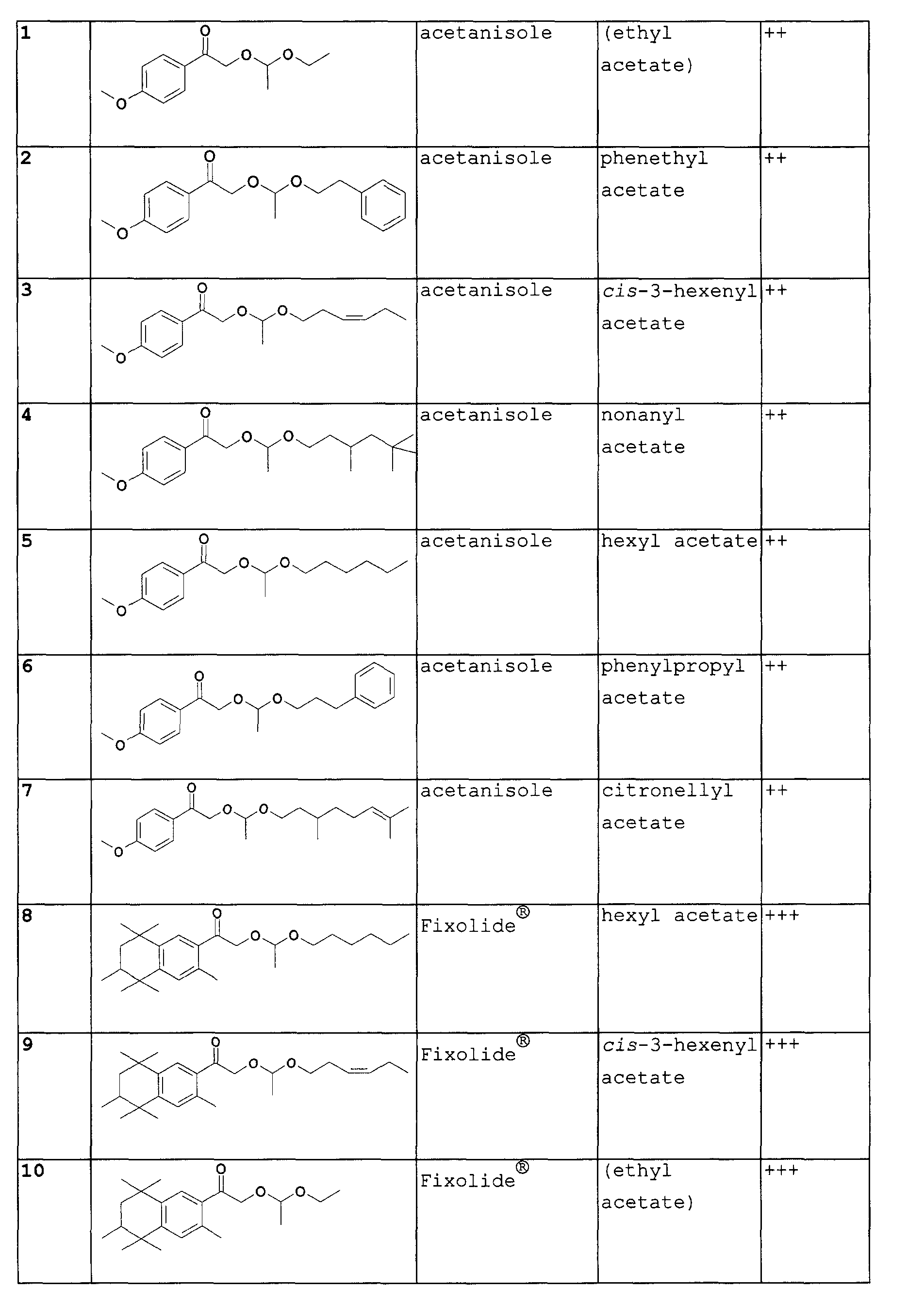
The solutions were irradiated with a mercury lamp (150 W) in a borosilicate glass apparatus (Pyrex® ) so as to limit the irradiation window to mainly the UVA and UVB spectrum of sun light. The alcoholic solution was irradiated for one hour and samples taken every 15 min to analyze the extent of the photolysis.
Whereas precursors derived from Oranger Crystals® cleaved fairly slowly (Figure 1), those derived from acetanisole cleaved fast and Fixolide® precursors even faster. The estimated half lives under the said conditions were inferred from the curves given in Figure 1. * The rates are calculated from the GC analysis (corresponding peak area).Representative UV spectra are shown in Figure 2.




| LAS | 22.0 % |
| STP | 13.3 % |
| CP5 (as 100%) | 1.5 % |
| SCMC (as 100%) | 0.34 % |
| Fluorescer (E1/1) | 1.41 |
| Savinase | 1.15 % |
| Lipolase | 0.15 % |
| Amilase | 0.30 % |
| Perborate | 8.0 % |
| TAED | 2.4 % |
| Alkalinity (pH) | 14.4 |

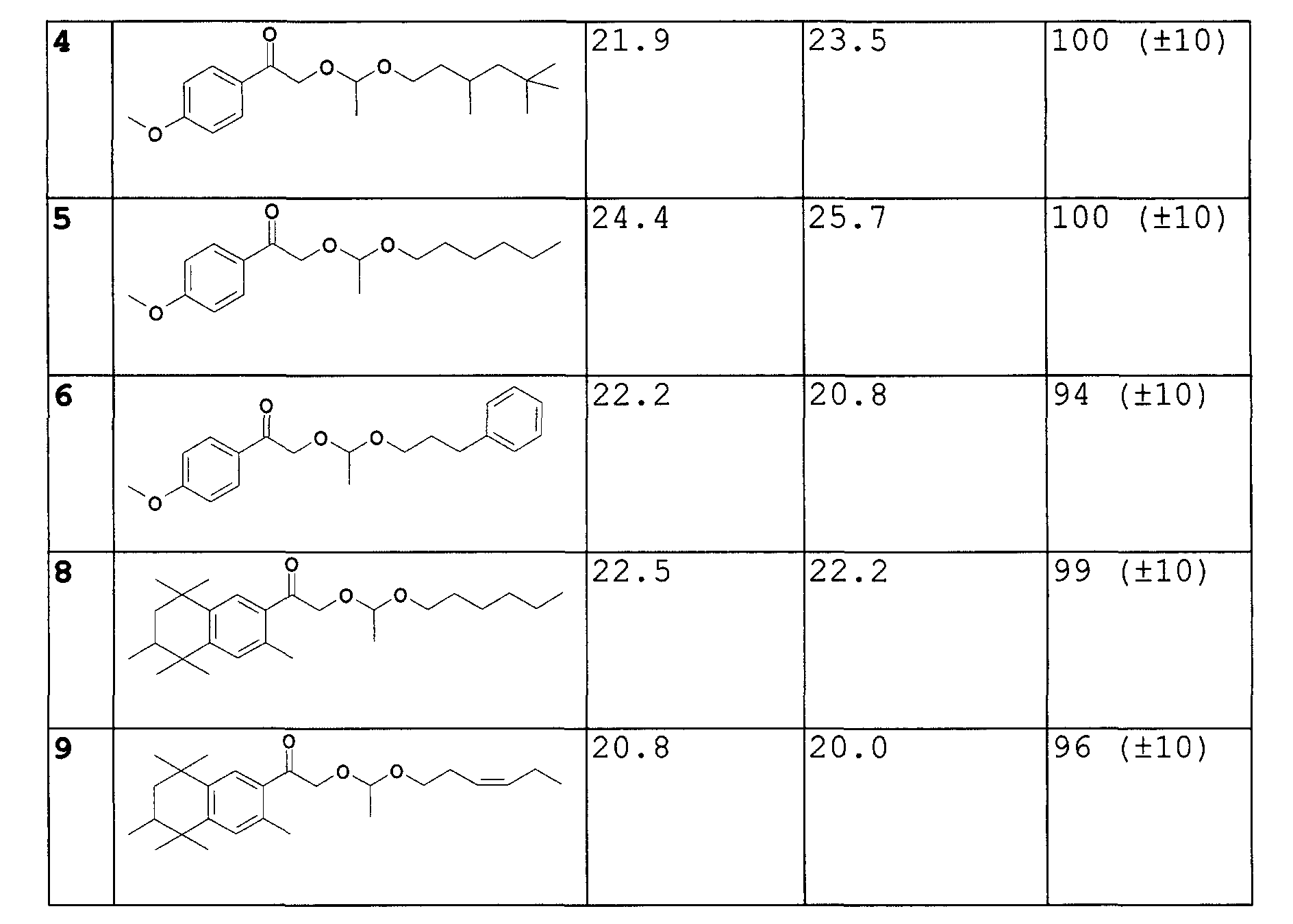
The aqueous liquors were extracted with an organic solvent (preferably t-butyl methyl ether) and analytical HPLC gave the results in table 5, which are related to partition between water and fabric.
Claims (19)
- Fragrance precursors of formula Ifor a fragrant ketone of formula II
 and a fragrant ester of formula III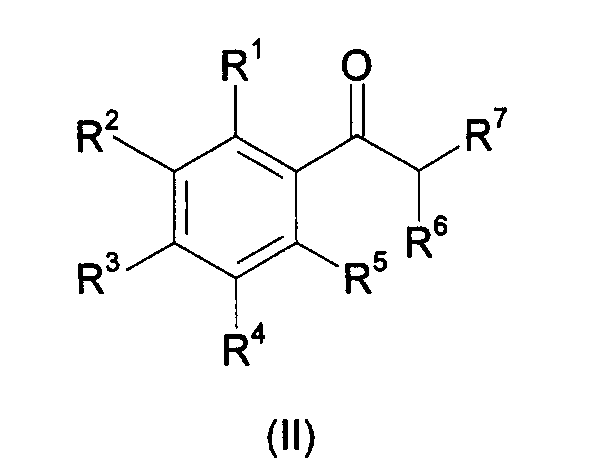
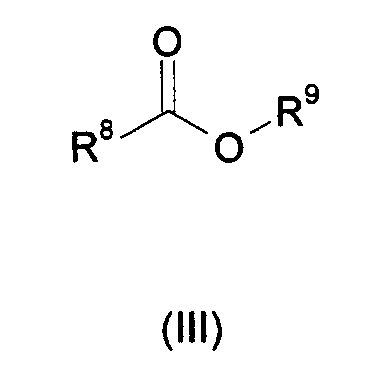 R1 to R5 represent independently H, -NO2, linear or branched C1-C6-alkyl, C1-C6-alkenyl, C1-C6-alkinyl or C1-C4-alkoxy,R1 and R2, R2 and R3, R3 and R4 and R4 and R5 may form together one or two aliphatic or aromatic rings, these rings may optionally contain linear or branched C1-C4-alkyl, C1-C4-alkenyl or C1-C4-alkinyl residues, and the above rings and residues may comprise one or more oxygen atoms,R6 and R7 are independently H, linear or branched C1-C6-alkyl-, C1-C6-alkenyl, C1-C6-alkinyl, and R6 or R7 may form with either R1 or R5 a carbocyclic ring optionally substituted by an aliphatic residueR8 and R9 are the residues of an acid R8-C00H and an alcohol R9OH respectively forming the fragrant ester of formula III.
 - Fragrance precursors of formula I, wherein R8 is the residue of an aliphatic acid having 1 to 4 carbon atoms and R9 is the residue of an aliphatic alcohol having 2 to 20 carbon atoms.
- Fragrance precursors of formula I, wherein R8 is -CH3 and R9 is the residue of an aliphatic alcohol having 2 to 20 carbon atoms.
- Fragrance precursors of formula I, wherein R8 is the residue of an aliphatic acid having 5 to 20 carbon atoms and R9 is the residue of an aliphatic alcohol having 1 to 5 carbon atoms.
- Fragrance precursors of formula I, wherein R8 is the residue of an aliphatic acid having 5 to 20 carbon atoms and R9 is -CH2CH3.
- Fragrance precursors of formula I, wherein R8 is the residue of an aliphatic acid having 1 to 4 carbon atoms and R9 is the residue of a terpene alcohol having 10 to 20 carbon atoms.
- Fragrance precursors of formula I, wherein R8 is the residue of an aliphatic acid having 1 to 4 carbon atoms and R9 is the residue of a monoterpene alcohol.
- Fragrance precursors of formula I, wherein R8 is the residue of a cycloaliphatic acid having 5 to 20 carbon atoms and R9 is the residue of aliphatic alcohol having 1 to 5 carbon atoms.
- Fragrance precursors of formula I, wherein R8 is the residue of a cycloaliphatic acid having 5 to 20 carbon atoms and R9 is -CH2CH3.
- Fragrance precursors of formula I, wherein R8 is the residue of an aliphatic acid having 1 to 4 carbon atoms and R9 is the residue of an araliphatic alcohol having more than 5 carbon atoms.
- Fragrance precursors of formula I, wherein R8 is -CH3 and R9 is the residue of an araliphatic alcohol having more than 5 carbon atoms.
- Fragrance precursors of formula I, wherein at least one of the residues R6 and R7 is H.
- Fragrance precursors of formula I, wherein the residues R6 and R7 are H.
- Fragrance precursors of formula I, wherein R6 and R7 are H and R1 to R5 represent independently H, -NO2, linear or branched C1-C6-alkyl, C1-C6-alkenyl, C1-C6-alkinyl or C1-C4 alkoxy.
- Fragrance precursors of formula I wherein the fragrant ketone of formula II ketone is selected from 1-phenyl-ethanone, 2,4-dimethylphenyl-ethanone, 1-[4-(1,1-dimethylethyl)-2,6-dimethylphenyl]-ethanone, 1-(4-tert-butyl-3,5-dinitro-2,6-dimethyl)-ethanone and 1-(4-methoxyphenyl)-ethanone.
- Fragrance precursors of formula I, wherein R1 and R2, R2 and R3, R3 and R4, R4 and R5, form together an aliphatic or aromatic ring which may optionally contain substituted or unsubstituted C1-C4-alkyl, C1-C4-alkenyl, C1-C4-alkinyl residues and may comprise one or more oxygen atoms.
- Fragrance precursors of formula I wherein the fragrant ketone of formula II is selected from 1-(2-naphtalenyl)-ethanone, 4-acetyl-6-tert-butyl-1,1-dimethyl-indan, 1-(5,6,7,8-tetrahydro-3,5,5,6,8,8-hexamethyl-2-naphthalenyl-ethanone, 1-(5,6,7,8-tetrahydro-3',5',5',8',8'-pentamethyl-2-naphthalenyl)-ethanone, 1-(5,6,7,8-tetrahydro-3'-ethyl-5',5',8',8'-tetramethyl-2-naphthalenyl)-ethanone, 1-(2,3-dihydro-1,1,2,3,3,6-hexamethyl-1H-inden-5-yl-ethanone, 1-[2,3-dihydro-1,1,2,6-tetramethyl-3-(1-methylethyl-1H-inden-5-yl-ethanone, 5-acetyl-1,1,2,3,3-pentamethyl-indane, 1-(5,6,7,8-tetrahydro-2-naphthalenyl)-ethanone.
- Compounds of formula Iwherein
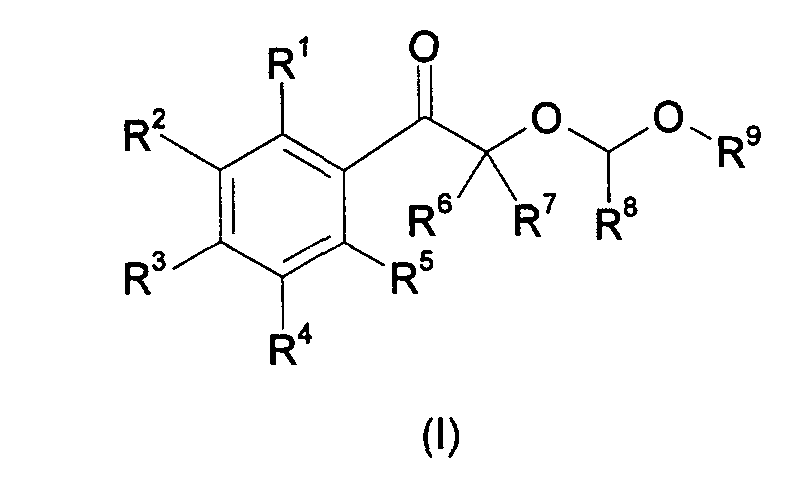 R1 to R5 represent independently H, -NO2, linear or branched C1-C6-alkyl, C1-C6-alkenyl, C1-C6-alkinyl, or C1-C4-alkoxy,R1 and R2, R2 and R3, R3 and R4 and R4 and R5 may form together one or two aliphatic or aromatic rings, these rings may optionally contain substituted or unsubstituted C1-C4-alkyl, C1-C4-alkenyl or C1-C4-alkinyl residues, and may comprise one or more oxygen atoms,R6 and R7 are independently H, linear or branched C1-C6-alkyl, C1-C6-alkenyl, C1-C6-alkinyl, and R6 or R7 may form with either R1 or R5 a substituted or unsubstituted carbocyclic ring and R8 and R9 are the residues of an acid and an alcohol respectively, which together form a fragrant ester.
 - Use of the precursors of formula I according to one of the claims 1 to 18 in perfumery.
Priority Applications (1)
| Application Number | Priority Date | Filing Date | Title |
|---|---|---|---|
| EP20010106425 EP1146033B1 (en) | 2000-04-10 | 2001-03-22 | Fragrance precursors |
Applications Claiming Priority (3)
| Application Number | Priority Date | Filing Date | Title |
|---|---|---|---|
| EP00107680 | 2000-04-10 | ||
| EP00107680 | 2000-04-10 | ||
| EP20010106425 EP1146033B1 (en) | 2000-04-10 | 2001-03-22 | Fragrance precursors |
Publications (3)
| Publication Number | Publication Date |
|---|---|
| EP1146033A2 true EP1146033A2 (en) | 2001-10-17 |
| EP1146033A3 EP1146033A3 (en) | 2002-03-06 |
| EP1146033B1 EP1146033B1 (en) | 2009-12-23 |
Family
ID=26070798
Family Applications (1)
| Application Number | Title | Priority Date | Filing Date |
|---|---|---|---|
| EP20010106425 Expired - Lifetime EP1146033B1 (en) | 2000-04-10 | 2001-03-22 | Fragrance precursors |
Country Status (1)
| Country | Link |
|---|---|
| EP (1) | EP1146033B1 (en) |
Cited By (2)
| Publication number | Priority date | Publication date | Assignee | Title |
|---|---|---|---|---|
| WO2011067707A2 (en) | 2009-12-02 | 2011-06-09 | L'oreal | A cosmetic treatment method |
| EP3395793A1 (en) * | 2017-04-24 | 2018-10-31 | IGM Group B.V. | Process for the preparation of alpha-functionalized ketones |
Family Cites Families (1)
| Publication number | Priority date | Publication date | Assignee | Title |
|---|---|---|---|---|
| EP0983990A3 (en) * | 1998-09-04 | 2000-08-02 | Givaudan Roure (International) S.A. | Ketones useful as precursors for organoleptic compounds |
-
2001
- 2001-03-22 EP EP20010106425 patent/EP1146033B1/en not_active Expired - Lifetime
Cited By (6)
| Publication number | Priority date | Publication date | Assignee | Title |
|---|---|---|---|---|
| WO2011067707A2 (en) | 2009-12-02 | 2011-06-09 | L'oreal | A cosmetic treatment method |
| EP3395793A1 (en) * | 2017-04-24 | 2018-10-31 | IGM Group B.V. | Process for the preparation of alpha-functionalized ketones |
| WO2018197325A1 (en) * | 2017-04-24 | 2018-11-01 | Igm Group B.V. | Process for the preparation of alpha-functionalized ketones |
| CN110494414A (en) * | 2017-04-24 | 2019-11-22 | Igm集团私人有限公司 | Preparation method of α-functionalized ketones |
| JP2020517583A (en) * | 2017-04-24 | 2020-06-18 | アイジーエム グループ ビー.ヴィ. | Method for preparing α-functionalized ketone |
| US12410114B2 (en) | 2017-04-24 | 2025-09-09 | Igm Group B.V. | Process for the preparation of α-functionalized ketones |
Also Published As
| Publication number | Publication date |
|---|---|
| EP1146033B1 (en) | 2009-12-23 |
| EP1146033A3 (en) | 2002-03-06 |
Similar Documents
| Publication | Publication Date | Title |
|---|---|---|
| EP2994447B1 (en) | Pro-fragrance compounds | |
| RU2667901C2 (en) | Improvements in or relating to organic compounds | |
| JPH07330653A (en) | Aromatic compounds, methods for imparting, improving, enhancing or modifying odor properties, perfume compositions and perfume products, processes for the production of compounds and starting compounds of the compounds and processes for producing the starting compounds | |
| US6492563B2 (en) | Fragrance precursors | |
| US7589055B2 (en) | Compounds for a controlled release of active molecules | |
| EP3868358A1 (en) | Synthesis and use of 2-ethyl-5,5-dimethyl-cyclohexanol as fragrance and flavor material | |
| US6939845B2 (en) | Fragrance precursors | |
| SG11202110808SA (en) | Organic compounds | |
| US7572938B2 (en) | Precursors for ketones and aldehydes | |
| JP2022509417A (en) | Alkoxybenzaldehyde derivatives and their precursors | |
| EP1146033B1 (en) | Fragrance precursors | |
| EP2268779B1 (en) | Ketones as perfuming ingredients | |
| US6323173B1 (en) | 2-indanmethanol derivatives and their use in perfumery | |
| US7704933B2 (en) | α-Decalones with damascone-woody odor | |
| JP5535235B2 (en) | Compound with sandalwood fragrance | |
| JP5431350B2 (en) | Patchoulol odor substance | |
| CN100509749C (en) | Fragrance compound | |
| US5939368A (en) | Use of 1-methoxy-2-methyl-3-phenylpropane, 1-(2-methoxypropyl)-4-methylbenzene and 3-methoxy-2,2,3-trimethyl-1-phenylbutane in perfumery | |
| JP2026508427A (en) | Fragrance Precursors | |
| MX2007001239A (en) | Citronella and floral perfuming ingredient. | |
| CN102369179B (en) | Carboxylic derivatives as violet and/or woody odorant |
Legal Events
| Date | Code | Title | Description |
|---|---|---|---|
| PUAI | Public reference made under article 153(3) epc to a published international application that has entered the european phase |
Free format text: ORIGINAL CODE: 0009012 |
|
| AK | Designated contracting states |
Kind code of ref document: A2 Designated state(s): AT BE CH CY DE DK ES FI FR GB GR IE IT LI LU MC NL PT SE TR |
|
| AX | Request for extension of the european patent |
Free format text: AL;LT;LV;MK;RO;SI |
|
| PUAL | Search report despatched |
Free format text: ORIGINAL CODE: 0009013 |
|
| AK | Designated contracting states |
Kind code of ref document: A3 Designated state(s): AT BE CH CY DE DK ES FI FR GB GR IE IT LI LU MC NL PT SE TR |
|
| AX | Request for extension of the european patent |
Free format text: AL;LT;LV;MK;RO;SI |
|
| 17P | Request for examination filed |
Effective date: 20020808 |
|
| AKX | Designation fees paid |
Free format text: AT BE CH CY DE DK ES FI FR GB GR IE IT LI LU MC NL PT SE TR |
|
| 17Q | First examination report despatched |
Effective date: 20030220 |
|
| GRAP | Despatch of communication of intention to grant a patent |
Free format text: ORIGINAL CODE: EPIDOSNIGR1 |
|
| GRAS | Grant fee paid |
Free format text: ORIGINAL CODE: EPIDOSNIGR3 |
|
| GRAA | (expected) grant |
Free format text: ORIGINAL CODE: 0009210 |
|
| RIC1 | Information provided on ipc code assigned before grant |
Ipc: C07C 49/84 20060101AFI20091026BHEP Ipc: A61K 8/18 20060101ALI20091026BHEP Ipc: C11D 3/50 20060101ALI20091026BHEP |
|
| AK | Designated contracting states |
Kind code of ref document: B1 Designated state(s): AT BE CH CY DE DK ES FI FR GB GR IE IT LI LU MC NL PT SE TR |
|
| REG | Reference to a national code |
Ref country code: GB Ref legal event code: FG4D |
|
| REG | Reference to a national code |
Ref country code: CH Ref legal event code: EP |
|
| REG | Reference to a national code |
Ref country code: IE Ref legal event code: FG4D |
|
| REF | Corresponds to: |
Ref document number: 60140834 Country of ref document: DE Date of ref document: 20100204 Kind code of ref document: P |
|
| REG | Reference to a national code |
Ref country code: NL Ref legal event code: VDEP Effective date: 20091223 |
|
| PG25 | Lapsed in a contracting state [announced via postgrant information from national office to epo] |
Ref country code: SE Free format text: LAPSE BECAUSE OF FAILURE TO SUBMIT A TRANSLATION OF THE DESCRIPTION OR TO PAY THE FEE WITHIN THE PRESCRIBED TIME-LIMIT Effective date: 20091223 Ref country code: FI Free format text: LAPSE BECAUSE OF FAILURE TO SUBMIT A TRANSLATION OF THE DESCRIPTION OR TO PAY THE FEE WITHIN THE PRESCRIBED TIME-LIMIT Effective date: 20091223 |
|
| REG | Reference to a national code |
Ref country code: ES Ref legal event code: FG2A Ref document number: 2337982 Country of ref document: ES Kind code of ref document: T3 |
|
| PG25 | Lapsed in a contracting state [announced via postgrant information from national office to epo] |
Ref country code: AT Free format text: LAPSE BECAUSE OF FAILURE TO SUBMIT A TRANSLATION OF THE DESCRIPTION OR TO PAY THE FEE WITHIN THE PRESCRIBED TIME-LIMIT Effective date: 20091223 |
|
| PG25 | Lapsed in a contracting state [announced via postgrant information from national office to epo] |
Ref country code: NL Free format text: LAPSE BECAUSE OF FAILURE TO SUBMIT A TRANSLATION OF THE DESCRIPTION OR TO PAY THE FEE WITHIN THE PRESCRIBED TIME-LIMIT Effective date: 20091223 |
|
| PG25 | Lapsed in a contracting state [announced via postgrant information from national office to epo] |
Ref country code: BE Free format text: LAPSE BECAUSE OF FAILURE TO SUBMIT A TRANSLATION OF THE DESCRIPTION OR TO PAY THE FEE WITHIN THE PRESCRIBED TIME-LIMIT Effective date: 20091223 |
|
| PG25 | Lapsed in a contracting state [announced via postgrant information from national office to epo] |
Ref country code: GR Free format text: LAPSE BECAUSE OF FAILURE TO SUBMIT A TRANSLATION OF THE DESCRIPTION OR TO PAY THE FEE WITHIN THE PRESCRIBED TIME-LIMIT Effective date: 20100324 Ref country code: CY Free format text: LAPSE BECAUSE OF FAILURE TO SUBMIT A TRANSLATION OF THE DESCRIPTION OR TO PAY THE FEE WITHIN THE PRESCRIBED TIME-LIMIT Effective date: 20091223 Ref country code: MC Free format text: LAPSE BECAUSE OF NON-PAYMENT OF DUE FEES Effective date: 20100331 |
|
| PLBE | No opposition filed within time limit |
Free format text: ORIGINAL CODE: 0009261 |
|
| STAA | Information on the status of an ep patent application or granted ep patent |
Free format text: STATUS: NO OPPOSITION FILED WITHIN TIME LIMIT |
|
| 26N | No opposition filed |
Effective date: 20100924 |
|
| PG25 | Lapsed in a contracting state [announced via postgrant information from national office to epo] |
Ref country code: IE Free format text: LAPSE BECAUSE OF NON-PAYMENT OF DUE FEES Effective date: 20100322 Ref country code: DK Free format text: LAPSE BECAUSE OF FAILURE TO SUBMIT A TRANSLATION OF THE DESCRIPTION OR TO PAY THE FEE WITHIN THE PRESCRIBED TIME-LIMIT Effective date: 20091223 |
|
| PG25 | Lapsed in a contracting state [announced via postgrant information from national office to epo] |
Ref country code: IT Free format text: LAPSE BECAUSE OF FAILURE TO SUBMIT A TRANSLATION OF THE DESCRIPTION OR TO PAY THE FEE WITHIN THE PRESCRIBED TIME-LIMIT Effective date: 20091223 |
|
| PGFP | Annual fee paid to national office [announced via postgrant information from national office to epo] |
Ref country code: FR Payment date: 20110404 Year of fee payment: 11 Ref country code: CH Payment date: 20110324 Year of fee payment: 11 |
|
| PGFP | Annual fee paid to national office [announced via postgrant information from national office to epo] |
Ref country code: GB Payment date: 20110321 Year of fee payment: 11 Ref country code: DE Payment date: 20110325 Year of fee payment: 11 Ref country code: ES Payment date: 20110322 Year of fee payment: 11 |
|
| REG | Reference to a national code |
Ref country code: CH Ref legal event code: NV Representative=s name: GIVAUDAN SCHWEIZ AG GLOBAL PATENTS |
|
| PG25 | Lapsed in a contracting state [announced via postgrant information from national office to epo] |
Ref country code: PT Free format text: LAPSE BECAUSE OF FAILURE TO SUBMIT A TRANSLATION OF THE DESCRIPTION OR TO PAY THE FEE WITHIN THE PRESCRIBED TIME-LIMIT Effective date: 20100523 Ref country code: LU Free format text: LAPSE BECAUSE OF NON-PAYMENT OF DUE FEES Effective date: 20100322 |
|
| PG25 | Lapsed in a contracting state [announced via postgrant information from national office to epo] |
Ref country code: TR Free format text: LAPSE BECAUSE OF FAILURE TO SUBMIT A TRANSLATION OF THE DESCRIPTION OR TO PAY THE FEE WITHIN THE PRESCRIBED TIME-LIMIT Effective date: 20091223 |
|
| REG | Reference to a national code |
Ref country code: CH Ref legal event code: PL |
|
| GBPC | Gb: european patent ceased through non-payment of renewal fee |
Effective date: 20120322 |
|
| REG | Reference to a national code |
Ref country code: FR Ref legal event code: ST Effective date: 20121130 |
|
| REG | Reference to a national code |
Ref country code: DE Ref legal event code: R119 Ref document number: 60140834 Country of ref document: DE Effective date: 20121002 |
|
| PG25 | Lapsed in a contracting state [announced via postgrant information from national office to epo] |
Ref country code: GB Free format text: LAPSE BECAUSE OF NON-PAYMENT OF DUE FEES Effective date: 20120322 Ref country code: CH Free format text: LAPSE BECAUSE OF NON-PAYMENT OF DUE FEES Effective date: 20120331 Ref country code: LI Free format text: LAPSE BECAUSE OF NON-PAYMENT OF DUE FEES Effective date: 20120331 Ref country code: FR Free format text: LAPSE BECAUSE OF NON-PAYMENT OF DUE FEES Effective date: 20120402 |
|
| REG | Reference to a national code |
Ref country code: ES Ref legal event code: FD2A Effective date: 20130710 |
|
| PG25 | Lapsed in a contracting state [announced via postgrant information from national office to epo] |
Ref country code: ES Free format text: LAPSE BECAUSE OF NON-PAYMENT OF DUE FEES Effective date: 20120323 |
|
| PG25 | Lapsed in a contracting state [announced via postgrant information from national office to epo] |
Ref country code: DE Free format text: LAPSE BECAUSE OF NON-PAYMENT OF DUE FEES Effective date: 20121002 |