EP1145116B1 - System und verfahren zur objektidentifizierung in verteilten hierarchischen systemen, insbesondere in automatisierungssystemen - Google Patents
System und verfahren zur objektidentifizierung in verteilten hierarchischen systemen, insbesondere in automatisierungssystemen Download PDFInfo
- Publication number
- EP1145116B1 EP1145116B1 EP00925040A EP00925040A EP1145116B1 EP 1145116 B1 EP1145116 B1 EP 1145116B1 EP 00925040 A EP00925040 A EP 00925040A EP 00925040 A EP00925040 A EP 00925040A EP 1145116 B1 EP1145116 B1 EP 1145116B1
- Authority
- EP
- European Patent Office
- Prior art keywords
- objects
- context
- contexts
- document
- identifications
- Prior art date
- Legal status (The legal status is an assumption and is not a legal conclusion. Google has not performed a legal analysis and makes no representation as to the accuracy of the status listed.)
- Expired - Lifetime
Links
Images

Classifications
-
- G—PHYSICS
- G06—COMPUTING OR CALCULATING; COUNTING
- G06F—ELECTRIC DIGITAL DATA PROCESSING
- G06F9/00—Arrangements for program control, e.g. control units
- G06F9/06—Arrangements for program control, e.g. control units using stored programs, i.e. using an internal store of processing equipment to receive or retain programs
- G06F9/46—Multiprogramming arrangements
- G06F9/465—Distributed object oriented systems
-
- G—PHYSICS
- G06—COMPUTING OR CALCULATING; COUNTING
- G06F—ELECTRIC DIGITAL DATA PROCESSING
- G06F9/00—Arrangements for program control, e.g. control units
- G06F9/06—Arrangements for program control, e.g. control units using stored programs, i.e. using an internal store of processing equipment to receive or retain programs
- G06F9/44—Arrangements for executing specific programs
- G06F9/448—Execution paradigms, e.g. implementations of programming paradigms
- G06F9/4488—Object-oriented
Definitions
- the invention relates to a system and method for object identification in distributed hierarchical data processing systems, in particular in automation systems.
- the object of the invention is object identification for operations such as moving, copying, renaming, etc. ensure.
- OVA Open Distributed Automation
- context For every object there is an environment in which it is known. At OVA, this environment is modeled by context. Within a context, names and identifiers of all contained objects are known and unique. As a rule, the context is determined by the entry point that a user chooses to edit his automation solution. Context information is available on every container object (ie an object that contains other objects) such as H-Container, Chart or Master. However, the smallest environment for a context is a document. In the case of embedded objects, the context information of the surrounding document is used. However, this also means that context information can be structured hierarchically. Deeper contexts are always part of the hierarchically higher context. In addition, other contexts that are not hierarchically related can be associated with any context.
- this context can access the information of the associated context.
- this association is unidirectional.
- the (hierarchically) contained contexts are automatically associated.
- the context information determines which objects are entered in the directory.
- the content of the document automatically belongs to the same context; this also applies in particular to linked objects or objects added via a rule ("all objects in this directory", etc.).
- the context is also the administrator of the context IDs. These will be described later.
- OVA uses a standardized procedure to access data storage, it is necessary to make the objects securely identifiable.
- the reason for this is that part of the data is structural information, for example which ES car is in which chart, or which car is connected to which.
- This structural information is subject to rules that are taken into account by the implementation of the data model.
- the IStorage interface as an interface for data storage, it is always possible to change this structure without considering the data model. For example, a client is able to perform copy, move, or rename operations through the IStorage interface without an OVA data model server being involved. This brings with it the problem that inconsistencies can arise which must later be corrected manually by the user.
- Unidirectional links are problematic, as there is one Action is not apparent that an inconsistency arises. For example, in a Word document via a link referenced to a file, and this file to a later one Renamed at the time, the Word document does not get any of this with and will not find the file again. This problem can only be eliminated by a central authority that knows where to find the file.
- a central location can manage the objects so that they are (almost) clearly identifiable. Therefore, all objects are referenced via object IDs, which can be resolved by the central body, in our case the Active Directory Service.
- This ID is independent of all actions; it is assigned when the object is created and then no longer changes as long as no other object with the same ID exists. However, this will only happen when copying outside the data model.
- Each container awards when creating an embedded Object's name.
- FIG. 2 shows a schematic illustration for the assignment and assignment of object identifications as object IDs.
- ID1, ID2, ID3 and ID4 are stored with their container. This means that the hierarchy container knows ID1 and ID2, Chart 2 knows ID3. These IDs are only unique within the container at the top level. That means Chart 1 can start again with ID1.
- ES-Auto 1 is identified via / ID1! ID1.
- IDy is now a kind of alias for the connection from ES-Auto 2 to ES-Auto 3. This is saved in the hierarchically lowest possible container. In this case, this is the H container 1, since both Chart 1 and Chart 2 are involved in the interconnection. Only the two ES cars 1 and 2 are involved in the IDx interconnection; therefore the information on how IDx is resolved can be stored in Chart 1. This procedure of keeping the information as local as possible has the advantage that this reference can be resolved even if only a partial context is opened. In such a sub-context, all references, interconnections, etc. are known that remain within the context. All references to the outside (or from outside) cannot be resolved.
- IDs there are two different types. Firstly, the local IDs, such as ID1, ID2, ..., which are only known locally to the container. On the other hand there are the context IDs, which are valid within the entire current context. Both IDs must be unique in their environment. The local at the container level, the context IDs across the context.
- an ID must be resolved if the object is to be activated.
- ES-Auto 2 will check its interconnections during a consistency check. For this, IDx and IDy must be determined. To do this, ES-Auto 2 asks the individual objects of the context. Since the circuits are stored as monikers, a BindToObject () is sufficient from the point of view of the ES car:
- ObjectID monikers is the server for ObjectID monikers, i.e. the Context, asked about the object. He knows IDy because he is for its storage is responsible and dissolves it into its components on. The ParseDisplayName function extracts IDy and Source and determines that this is / ID1! ID4! c. Now be asked the containers recursively for this object.
- Chart 1 can be chosen as the entry point (context). On the Interconnection IDx can then also be accessed. IDy is in this case an external connection, which is not as long is available, the processor is only in the context moved from Chart 1.
- the actions are move, copy, delete and rename.
- the MoveESAuto method is triggered in the source chart. It is given the ES car and the target chart:
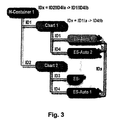
- FIG. 3 shows a schematic representation for moving of an object called "ES-Auto1".
- Chart 2 must assign a new ID to the target ES-Auto (e.g. ID4). Furthermore, all external references of the new ES cars deleted.
- Chart 1 is opened first. This determines that there is no ES car for ID1. He now deletes his entry "ID1". On the other hand, an object can try to resolve the reference (eg ES-Auto 2). Since this is not possible, the user is asked what happened to ES-Auto 1 and what should be done with the reference.
- the invention thus relates to a system and Procedure for object identification in distributed hierarchical Systems, especially in automation systems.
- to Ensuring object identification during operations like moving, copying, renaming, etc. is suggested that contexts for the formation of several levels of Management of identifiers will be introduced. This results in efficient procedures for the repair of so-called Broken links without the introduction of global, central administrative functions.
Landscapes
- Engineering & Computer Science (AREA)
- Software Systems (AREA)
- Theoretical Computer Science (AREA)
- Physics & Mathematics (AREA)
- General Engineering & Computer Science (AREA)
- General Physics & Mathematics (AREA)
- Multi Processors (AREA)
- Information Retrieval, Db Structures And Fs Structures Therefor (AREA)
- Computer And Data Communications (AREA)
- Devices For Executing Special Programs (AREA)
- Management, Administration, Business Operations System, And Electronic Commerce (AREA)
- Investigating Or Analysing Biological Materials (AREA)
- Data Exchanges In Wide-Area Networks (AREA)
Description
- Zentrale Verwaltung: Das Verfahren benötigt zentrale Verwaltungsstrukturen wie eine Verwaltung der Objektidentifikatoren und Umsetztabellen der Objektidentifikatoren auf die Objekte.
- Schlechte Unterstützung von verteilten Arbeiten: Durch die Notwendigkeit einer zentralen Verwaltung wird das Aufteilen von Objektmengen, deren getrennte Bearbeitung und anschließende Zusammenführung (Stichwort Branch-and-Merge) erschwert.
- Geringe Stabilität: Durch Verwendung der relativen Lage zur Identifizierung wird der Identifikator (bzw. die Identifikatoren) beim Verschieben des Objekts ungültig und das Objekt ist nicht mehr verfügbar (Broken Link).
- Hoher Änderungsaufwand: Nach dem die Identifikatoren eines Objekts ungültig geworden sind, müssen diese durch eine Art Korrekturlauf berichtigt werden.
- Keine zentrale Verwaltung: Die Verwaltung erfolgt über die Kontexthierarchie. Das bedeutet, daß jeder Kontext alle notwendigen Informationen beinhaltet.
- Unterstützung von verteiltem Arbeiten: Die Kontexthierarchie
ist beliebig zerlegbar und wieder zusammenfügbar.
Dadurch ist ein Branch-and-Merge von Projekten problemlos durchführbar. - Geringer Änderungsaufwand: Durch die Kontexthierarchie ist unmittelbar klar, wo Änderungen von Identifikatoren nachzuvollziehen sind. Die Änderungen sind auch nur an den betroffenen Kontextobjekten durch zuführen.
- FIG 1
- ein Blockschaltbild zur Kennzeichnung des Sachverhalts: ein Client sieht Namen, ein Objektmodell arbeitet mit Ids,
- FIG 2
- eine schematische Darstellung für die Vergabe und Zuordnung von Objektidentifizierungen als Objekt IDs und
- FIG 3
- eine schematische Darstellung zum Verschieben eines Objekts mit der Bezeichnung "ES-Autol".
Die Kontextinformation bestimmt, welche Objekte in dem Directory eingetragen sind. Der Inhalt des Dokuments gehört automatisch zum selben Kontext; das gilt insbesondere auch für gelinkte oder über eine Regel ("alle Objekte in diesem Verzeichnis", etc.) hinzugefügte Objekte.
Der Kontext ist auch der Verwalter der Kontext IDs. Diese werden später beschrieben.
Daher stellt sich nun die Frage, wie die Konsistenz so weit wie möglich hergestellt werden kann, ohne dem Entwickler von ES-Autos oder OVA Werkzeugen hierfür einen übermäßigen Aufwand abzuverlangen. Auch sollten diese Mechanismen nicht an die Teile des API durchscheinen, die von den OVA Werkzeugen verwendet werden. Eine Client-Anwendung sollte beispielsweise immer mit den ES-Auto Namen hantieren nicht mit kryptischen IDs (siehe FIG 1).
Diese ID ist von allen Aktionen unabhängig; sie wird bei der Objekterstellung vergeben und ändert sich dann nicht mehr, solange kein anderes Objekt mit der selben ID existiert. Dies wird jedoch nur beim Kopieren außerhalb des Datenmodells geschehen.
Bei der Verschaltung IDx sind nur die beiden ES-Autos 1 und 2 beteiligt; daher kann die Information, wie IDx aufgelöst wird, bei Chart 1 gespeichert werden. Dieses Vorgehen, die Information so lokal wie möglich zu halten, hat den Vorteil, daß dieses Referenzen auch dann aufgelöst werden können, wenn nur ein Teilkontext geöffnet wird. In so einem Teilkontext sind so alle Referenzen, Verschaltungen, etc. bekannt, die innerhalb des Kontextes bleiben. Alle Referenzen nach außen (oder von außen) können nicht aufgelöst werden.





Andererseits kann ein Objekt versuchen, die Referenz aufzulösen (z.b. ES-Auto 2). Da dies nicht möglich ist, wird der Benutzer gefragt, was mit ES-Auto 1 passiert ist, und was mit der Referenz geschehen soll.
Claims (16)
- System zur Identifizierung von Objekten in verteilten hierarchischen Datenverarbeitungssystemen, insbesondere in Automatisierungssystemen, welches Identifikatoren zur Kennzeichnung der Objekte und Kontexte zur Verwaltung der Identifikatoren enthält, wobei die Kontexte mehrere Indirektionsstufen bilden und innerhalb eines Kontexts Namen und Identifikatoren aller enthaltenen Objekte bekannt und eindeutig sind.
- System nach Anspruch 1,
dadurch gekennzeichnet, dass das System Containerobjekte aufweist und dass Kontextinformationen an jedem Containerobjekt verfügbar sind, wobei die Containerobjekte andere Objekte enthalten und wobei die Kontextinformationen hierarchisch gegliedert sind. - System nach Anspruch 1 oder 2,
dadurch gekennzeichnet, dass weitere Kontexte, welche hierarchisch nicht verwandt sind, jedem beliebigen Kontext unidirektional assoziiert werden können, wobei die weiteren Kontexte auf die Information des assoziierten Kontexts zugreifen können. - System nach einem der vorhergehenden Ansprüche,
dadurch gekennzeichnet, dass den Objekten lokale Objektidentifizierungen (ID1, ID2, ID3, ID4) zugeordnet sind, welche beim hierarchisch niedrigst möglichen Containerobjekt, welches die Objekte enthält, hinterlegt sind, wobei die Objekte über eine Kette von Objektidentifizierungen (ID1, ID2, ID3, ID4) identifizierbar sind. - System nach einem der vorhergehenden Ansprüche,
dadurch gekennzeichnet, dass Kontexte zur Verwaltung von Kontextidentifizierungen vorgesehen sind, wobei die Kontextidentifizierungen Objekten im Kontext zugeordnet sind und innerhalb des Kontexts gültig und eindeutig sind. - System nach einem der vorhergehenden Ansprüche,
dadurch gekennzeichnet, dass Verschaltungen der Objekte als Moniker ausgeführt sind. - System nach einem der vorhergehenden Ansprüche,
dadurch gekennzeichnet, dass ein Dokument als kleinste Umgebung für einen Kontext vorgesehen ist, wobei für in das Dokument eingebettete Objekte die Kontextinformation des umgebenden Dokuments verwendet wird und das Dokument dem eingebetteten Dokument einen Namen vergibt. - System nach einem der vorhergehenden Ansprüche,
dadurch gekennzeichnet, dass die Kontexte zur Verwaltung der Identifikatoren der Objekte bei Operationen mit Objekten wie Verschieben, Kopieren, Umbenennen, etc. vorgesehen sind, wobei keine globalen, zentralen Verwaltungsfunktionen vorgesehen sind. - Verfahren zur Identifizierung von Objekten in verteilten hierarchischen Datenverarbeitungssystemen, insbesondere in Automatisierungssystemen, bei welchem Objekte mit Identifikatoren gekennzeichnet werden und Kontexte die Identifikatoren verwalten, wobei die Kontexte mehrere Indirektionsstufen bilden und innerhalb eines Kontexts Namen und Identifikatoren aller enthaltenen Objekte bekannt und eindeutig sind.
- Verfahren nach Anspruch 9,
dadurch gekennzeichnet, dass Containerobjekte andere Objekte enthalten und dass Kontextinformationen an jedem Containerobjekt verfügbar sind, wobei die Kontextinformationen hierarchisch gegliedert sind. - Verfahren nach Anspruch 9 oder 10,
dadurch gekennzeichnet, dass weitere Kontexte, welche hierarchisch nicht verwandt sind, jedem beliebigen Kontext unidirektional assoziiert werden können, wobei die weiteren Kontexte auf die Information des assoziierten Kontexts zugreifen können. - Verfahren nach einem der Ansprüche 9 bis 11,
dadurch gekennzeichnet, dass den Objekten lokale Objektidentifizierungen (ID1, ID2, ID3, ID4) zugeordnet sind, welche beim hierarchisch niedrigst möglichen Containerobjekt, welches die Objekte enthält, hinterlegt sind, wobei die Objekte über eine Kette von Objektidentifizierungen (ID1, ID2, ID3, ID4) identifizierbar sind. - Verfahren nach einem der Ansprüche 9 bis 12,
dadurch gekennzeichnet, dass Kontexte Kontextidentifizierungen verwalten, wobei die Kontextidentifizierungen Objekten im Kontext zugeordnet sind und innerhalb des Kontexts gültig und eindeutig sind. - Verfahren nach einem der Ansprüche 9 bis 13,
dadurch gekennzeichnet, dass Verschaltungen der Objekte als Moniker ausgeführt sind. - Verfahren nach einem der Ansprüche 9 bis 14,
dadurch gekennzeichnet, dass ein Dokument als kleinste Umgebung für einen Kontext vorgesehen ist, wobei für in das Dokument eingebettete Objekte die Kontextinformation des umgebenden Dokuments verwendet wird und das Dokument dem eingebetteten Dokument einen Namen vergibt. - Verfahren nach einem der Ansprüche 9 bis 15,
dadurch gekennzeichnet, dass die Kontexte die Identifikatoren der Objekte bei Operationen mit Objekten wie Verschieben, Kopieren, Umbenennen, etc. verwalten, wobei keine globalen, zentralen Verwaltungsfunktionen vorgesehen sind.
Applications Claiming Priority (3)
| Application Number | Priority Date | Filing Date | Title |
|---|---|---|---|
| DE19910527A DE19910527A1 (de) | 1999-03-09 | 1999-03-09 | System und Verfahren zur Objektidentifizierung in verteilten hierarchischen Systemen, insbesondere in Automatisierungssystemen |
| DE19910527 | 1999-03-09 | ||
| PCT/DE2000/000738 WO2000054148A2 (de) | 1999-03-09 | 2000-03-09 | System und verfahren zur objektidentifizierung in verteilten hierarchischen systemen, insbesondere in automatisierungssystemen |
Publications (2)
| Publication Number | Publication Date |
|---|---|
| EP1145116A2 EP1145116A2 (de) | 2001-10-17 |
| EP1145116B1 true EP1145116B1 (de) | 2002-10-16 |
Family
ID=7900379
Family Applications (1)
| Application Number | Title | Priority Date | Filing Date |
|---|---|---|---|
| EP00925040A Expired - Lifetime EP1145116B1 (de) | 1999-03-09 | 2000-03-09 | System und verfahren zur objektidentifizierung in verteilten hierarchischen systemen, insbesondere in automatisierungssystemen |
Country Status (7)
| Country | Link |
|---|---|
| EP (1) | EP1145116B1 (de) |
| JP (1) | JP2002539521A (de) |
| CN (1) | CN1343333A (de) |
| AT (1) | ATE226333T1 (de) |
| DE (2) | DE19910527A1 (de) |
| ES (1) | ES2185590T3 (de) |
| WO (1) | WO2000054148A2 (de) |
Cited By (3)
| Publication number | Priority date | Publication date | Assignee | Title |
|---|---|---|---|---|
| WO2015013524A1 (en) * | 2013-07-25 | 2015-01-29 | Sas Ip, Inc. | Systems and methods for context based search of simulation objects |
| US10002164B2 (en) | 2012-06-01 | 2018-06-19 | Ansys, Inc. | Systems and methods for context based search of simulation objects |
| US11449202B1 (en) | 2012-06-01 | 2022-09-20 | Ansys, Inc. | User interface and method of data navigation in the user interface of engineering analysis applications |
Families Citing this family (1)
| Publication number | Priority date | Publication date | Assignee | Title |
|---|---|---|---|---|
| RU2413528C2 (ru) | 2007-01-18 | 2011-03-10 | Открытое Акционерное Общество "Валента Фармацевтика" | Лекарственный препарат для лечения сахарного диабета на основе экзенатида и даларгина, применение и способ лечения |
Family Cites Families (1)
| Publication number | Priority date | Publication date | Assignee | Title |
|---|---|---|---|---|
| US6009266A (en) * | 1995-03-22 | 1999-12-28 | Sun Microsystems, Inc. | Methods, apparatus and data structures for managing objects |
-
1999
- 1999-03-09 DE DE19910527A patent/DE19910527A1/de not_active Withdrawn
-
2000
- 2000-03-09 DE DE50000647T patent/DE50000647D1/de not_active Expired - Lifetime
- 2000-03-09 JP JP2000604307A patent/JP2002539521A/ja active Pending
- 2000-03-09 WO PCT/DE2000/000738 patent/WO2000054148A2/de not_active Ceased
- 2000-03-09 ES ES00925040T patent/ES2185590T3/es not_active Expired - Lifetime
- 2000-03-09 CN CN00804802A patent/CN1343333A/zh active Pending
- 2000-03-09 AT AT00925040T patent/ATE226333T1/de not_active IP Right Cessation
- 2000-03-09 EP EP00925040A patent/EP1145116B1/de not_active Expired - Lifetime
Cited By (3)
| Publication number | Priority date | Publication date | Assignee | Title |
|---|---|---|---|---|
| US10002164B2 (en) | 2012-06-01 | 2018-06-19 | Ansys, Inc. | Systems and methods for context based search of simulation objects |
| US11449202B1 (en) | 2012-06-01 | 2022-09-20 | Ansys, Inc. | User interface and method of data navigation in the user interface of engineering analysis applications |
| WO2015013524A1 (en) * | 2013-07-25 | 2015-01-29 | Sas Ip, Inc. | Systems and methods for context based search of simulation objects |
Also Published As
| Publication number | Publication date |
|---|---|
| CN1343333A (zh) | 2002-04-03 |
| DE19910527A1 (de) | 2000-09-14 |
| DE50000647D1 (de) | 2002-11-21 |
| WO2000054148A3 (de) | 2001-04-05 |
| ATE226333T1 (de) | 2002-11-15 |
| EP1145116A2 (de) | 2001-10-17 |
| ES2185590T3 (es) | 2003-05-01 |
| JP2002539521A (ja) | 2002-11-19 |
| WO2000054148A2 (de) | 2000-09-14 |
Similar Documents
| Publication | Publication Date | Title |
|---|---|---|
| EP0825524B1 (de) | Verfahren zur Verwaltung der Benennung von Objekten | |
| DE69327777T2 (de) | Informationsbearbeitungseinrichtung, die die Führung von Betriebsmitteln durch ein Verwaltungssystem erlaubt | |
| DE69533786T2 (de) | Vorrichtung zum Erzeugen von objektorientierten Schnittstellen für relationale Datenbanken und von dieser Vorrichtung durchgeführtes Verfahren | |
| DE69802437T2 (de) | Feinkörniger übereinstimmungsmechanismus für optimistische parallelsteuerung mit verriegelungsgruppen | |
| DE69326874T2 (de) | Server und Klient | |
| DE69114763T2 (de) | Verteiltes Datenbanksystem. | |
| WO1995030959A1 (de) | Datenverwaltungssystem | |
| DE10313048A1 (de) | System und Verfahren zur Verwaltung verteilter gleichzeitiger Versionen | |
| EP1159656A1 (de) | Automatisierungssystem mit wiederverwendbaren automatisierungsobjekten und verfahren zur wiederverwendung von automatisierungslösungen in engineering-werkzeugen | |
| DE4420451A1 (de) | Sperrmechanismus für ein CHECK-IN/CHECK-OUT-Modell | |
| DE69123493T2 (de) | Verarbeitungsverfahren und Gerät um einen Dateinamen von einem logischen zu einem richtigen Namen zu erstellen | |
| EP3699704A1 (de) | System und verfahren zum überprüfen von systemanforderungen von cyber-physikalischen systemen | |
| EP1674954A1 (de) | System und Verfahren zur Wiederverwendung von Projektierungsdaten | |
| DE69723500T2 (de) | Datenqualitätsverwaltungssystem | |
| EP3123367A1 (de) | Verfahren zur automatisierten erstellung eines zwei technische zeichnungen charakterisierenden datensatzes | |
| WO2000054148A2 (de) | System und verfahren zur objektidentifizierung in verteilten hierarchischen systemen, insbesondere in automatisierungssystemen | |
| DE69308790T2 (de) | Dateienverwaltungsverfahren, Aufzeichnungsmedium und Rechnersystem dafür | |
| DE10129654A1 (de) | Verfahren zum Ermitteln von Auswirkungen von Konstruktionsänderungen | |
| DE10115380A1 (de) | Verfahren zum Ändern eines Parameters eines Betriebssystems eines Computersystems | |
| EP0825525B1 (de) | Verfahren zur Unterstützung des Erzeugens eines Objektes | |
| WO2000054119A1 (de) | Automatisierungssystem mit aus modulkomponenten bestehenden automatisierungsobjekten | |
| EP1242852B1 (de) | Vorrichtung und verfahren zur einbindung von automatisierungskomponenten | |
| DE19607132B4 (de) | Verfahren zum rechnergestützten Abgleich mehrerer, in mindestens einem Rechner gespeicherten Dateikopien einer gespeicherten Datei | |
| EP1674953B1 (de) | System und Verfahren zur Wiederverwendung von Projektierungsdaten | |
| DE60000301T2 (de) | Verfahren, gerät, und hergestellter gegenstand für beinamen |
Legal Events
| Date | Code | Title | Description |
|---|---|---|---|
| PUAI | Public reference made under article 153(3) epc to a published international application that has entered the european phase |
Free format text: ORIGINAL CODE: 0009012 |
|
| 17P | Request for examination filed |
Effective date: 20010810 |
|
| AK | Designated contracting states |
Kind code of ref document: A2 Designated state(s): AT BE CH CY DE DK ES FI FR GB GR IE IT LI LU MC NL PT SE |
|
| XX | Miscellaneous (additional remarks) |
Free format text: DERZEIT SIND DIE WIPO-PUBLIKATIONSDATEN A3 NICHT VERFUEGBAR. |
|
| GRAG | Despatch of communication of intention to grant |
Free format text: ORIGINAL CODE: EPIDOS AGRA |
|
| 17Q | First examination report despatched |
Effective date: 20020208 |
|
| GRAG | Despatch of communication of intention to grant |
Free format text: ORIGINAL CODE: EPIDOS AGRA |
|
| GRAH | Despatch of communication of intention to grant a patent |
Free format text: ORIGINAL CODE: EPIDOS IGRA |
|
| GRAH | Despatch of communication of intention to grant a patent |
Free format text: ORIGINAL CODE: EPIDOS IGRA |
|
| GRAA | (expected) grant |
Free format text: ORIGINAL CODE: 0009210 |
|
| AK | Designated contracting states |
Kind code of ref document: B1 Designated state(s): AT CH DE ES FR GB LI |
|
| REF | Corresponds to: |
Ref document number: 226333 Country of ref document: AT Date of ref document: 20021115 Kind code of ref document: T |
|
| REG | Reference to a national code |
Ref country code: GB Ref legal event code: FG4D Free format text: NOT ENGLISH |
|
| XX | Miscellaneous (additional remarks) |
Free format text: DERZEIT SIND DIE WIPO-PUBLIKATIONSDATEN A3 NICHT VERFUEGBAR. |
|
| REG | Reference to a national code |
Ref country code: CH Ref legal event code: EP Ref country code: CH Ref legal event code: NV Representative=s name: SIEMENS SCHWEIZ AG |
|
| GBT | Gb: translation of ep patent filed (gb section 77(6)(a)/1977) |
Effective date: 20021016 |
|
| REG | Reference to a national code |
Ref country code: IE Ref legal event code: FG4D Free format text: GERMAN |
|
| REF | Corresponds to: |
Ref document number: 50000647 Country of ref document: DE Date of ref document: 20021121 |
|
| REG | Reference to a national code |
Ref country code: ES Ref legal event code: FG2A Ref document number: 2185590 Country of ref document: ES Kind code of ref document: T3 |
|
| ET | Fr: translation filed | ||
| REG | Reference to a national code |
Ref country code: IE Ref legal event code: FD4D Ref document number: 1145116E Country of ref document: IE |
|
| PLBE | No opposition filed within time limit |
Free format text: ORIGINAL CODE: 0009261 |
|
| STAA | Information on the status of an ep patent application or granted ep patent |
Free format text: STATUS: NO OPPOSITION FILED WITHIN TIME LIMIT |
|
| 26N | No opposition filed |
Effective date: 20030717 |
|
| PGFP | Annual fee paid to national office [announced via postgrant information from national office to epo] |
Ref country code: CH Payment date: 20080612 Year of fee payment: 9 Ref country code: ES Payment date: 20080416 Year of fee payment: 9 |
|
| REG | Reference to a national code |
Ref country code: CH Ref legal event code: PCAR Free format text: SIEMENS SCHWEIZ AG;INTELLECTUAL PROPERTY FREILAGERSTRASSE 40;8047 ZUERICH (CH) |
|
| PGFP | Annual fee paid to national office [announced via postgrant information from national office to epo] |
Ref country code: AT Payment date: 20090213 Year of fee payment: 10 |
|
| REG | Reference to a national code |
Ref country code: CH Ref legal event code: PL |
|
| PG25 | Lapsed in a contracting state [announced via postgrant information from national office to epo] |
Ref country code: LI Free format text: LAPSE BECAUSE OF NON-PAYMENT OF DUE FEES Effective date: 20090331 Ref country code: CH Free format text: LAPSE BECAUSE OF NON-PAYMENT OF DUE FEES Effective date: 20090331 |
|
| REG | Reference to a national code |
Ref country code: ES Ref legal event code: FD2A Effective date: 20090310 |
|
| PG25 | Lapsed in a contracting state [announced via postgrant information from national office to epo] |
Ref country code: ES Free format text: LAPSE BECAUSE OF NON-PAYMENT OF DUE FEES Effective date: 20090310 |
|
| PG25 | Lapsed in a contracting state [announced via postgrant information from national office to epo] |
Ref country code: AT Free format text: LAPSE BECAUSE OF NON-PAYMENT OF DUE FEES Effective date: 20100309 |
|
| PG25 | Lapsed in a contracting state [announced via postgrant information from national office to epo] |
Ref country code: DE Free format text: LAPSE BECAUSE OF NON-PAYMENT OF DUE FEES Effective date: 20111001 |
|
| PGFP | Annual fee paid to national office [announced via postgrant information from national office to epo] |
Ref country code: GB Payment date: 20130311 Year of fee payment: 14 Ref country code: FR Payment date: 20130408 Year of fee payment: 14 |
|
| PGFP | Annual fee paid to national office [announced via postgrant information from national office to epo] |
Ref country code: DE Payment date: 20130521 Year of fee payment: 14 |
|
| REG | Reference to a national code |
Ref country code: DE Ref legal event code: R119 Ref document number: 50000647 Country of ref document: DE |
|
| GBPC | Gb: european patent ceased through non-payment of renewal fee |
Effective date: 20140309 |
|
| REG | Reference to a national code |
Ref country code: FR Ref legal event code: ST Effective date: 20141128 |
|
| REG | Reference to a national code |
Ref country code: DE Ref legal event code: R119 Ref document number: 50000647 Country of ref document: DE Effective date: 20141001 |
|
| PG25 | Lapsed in a contracting state [announced via postgrant information from national office to epo] |
Ref country code: GB Free format text: LAPSE BECAUSE OF NON-PAYMENT OF DUE FEES Effective date: 20140309 Ref country code: FR Free format text: LAPSE BECAUSE OF NON-PAYMENT OF DUE FEES Effective date: 20140331 |
|
| PG25 | Lapsed in a contracting state [announced via postgrant information from national office to epo] |
Ref country code: DE Free format text: LAPSE BECAUSE OF NON-PAYMENT OF DUE FEES Effective date: 20141001 |