EP1144624B1 - Human and mouse trek-1 potassium channel protein and their use - Google Patents
Human and mouse trek-1 potassium channel protein and their use Download PDFInfo
- Publication number
- EP1144624B1 EP1144624B1 EP00905230A EP00905230A EP1144624B1 EP 1144624 B1 EP1144624 B1 EP 1144624B1 EP 00905230 A EP00905230 A EP 00905230A EP 00905230 A EP00905230 A EP 00905230A EP 1144624 B1 EP1144624 B1 EP 1144624B1
- Authority
- EP
- European Patent Office
- Prior art keywords
- trek
- potassium
- task
- potassium transport
- protein
- Prior art date
- Legal status (The legal status is an assumption and is not a legal conclusion. Google has not performed a legal analysis and makes no representation as to the accuracy of the status listed.)
- Expired - Lifetime
Links
- 108010083945 potassium channel protein TREK-1 Proteins 0.000 title abstract description 82
- 241000282414 Homo sapiens Species 0.000 title abstract description 9
- ZLMJMSJWJFRBEC-UHFFFAOYSA-N Potassium Chemical compound [K] ZLMJMSJWJFRBEC-UHFFFAOYSA-N 0.000 claims abstract description 43
- 229910052700 potassium Inorganic materials 0.000 claims abstract description 43
- 239000011591 potassium Substances 0.000 claims abstract description 43
- 230000000694 effects Effects 0.000 claims abstract description 27
- 102000014914 Carrier Proteins Human genes 0.000 claims abstract description 23
- 108010078791 Carrier Proteins Proteins 0.000 claims abstract description 23
- 238000000034 method Methods 0.000 claims abstract description 21
- 230000004913 activation Effects 0.000 claims abstract description 20
- 239000000126 substance Substances 0.000 claims abstract description 16
- 230000003444 anaesthetic effect Effects 0.000 claims abstract description 14
- 210000004027 cell Anatomy 0.000 claims description 52
- 239000013598 vector Substances 0.000 claims description 10
- 150000007523 nucleic acids Chemical class 0.000 claims description 9
- 108020004707 nucleic acids Proteins 0.000 claims description 7
- 102000039446 nucleic acids Human genes 0.000 claims description 7
- 239000002773 nucleotide Substances 0.000 claims description 5
- 125000003729 nucleotide group Chemical group 0.000 claims description 5
- 210000000287 oocyte Anatomy 0.000 claims description 4
- 241000256248 Spodoptera Species 0.000 claims description 2
- 241000269370 Xenopus <genus> Species 0.000 claims description 2
- 210000004978 chinese hamster ovary cell Anatomy 0.000 claims description 2
- 210000002950 fibroblast Anatomy 0.000 claims description 2
- 230000002441 reversible effect Effects 0.000 abstract description 5
- 238000012360 testing method Methods 0.000 abstract description 5
- 208000000044 Amnesia Diseases 0.000 abstract description 3
- 208000031091 Amnestic disease Diseases 0.000 abstract description 3
- 208000003443 Unconsciousness Diseases 0.000 abstract description 3
- 230000006986 amnesia Effects 0.000 abstract description 3
- 230000036592 analgesia Effects 0.000 abstract description 3
- 241000124008 Mammalia Species 0.000 abstract description 2
- 102100023204 Potassium channel subfamily K member 2 Human genes 0.000 description 50
- HEDRZPFGACZZDS-UHFFFAOYSA-N Chloroform Chemical compound ClC(Cl)Cl HEDRZPFGACZZDS-UHFFFAOYSA-N 0.000 description 42
- 108091006146 Channels Proteins 0.000 description 36
- BCQZXOMGPXTTIC-UHFFFAOYSA-N halothane Chemical compound FC(F)(F)C(Cl)Br BCQZXOMGPXTTIC-UHFFFAOYSA-N 0.000 description 27
- 229960003132 halothane Drugs 0.000 description 27
- 239000003193 general anesthetic agent Substances 0.000 description 24
- 102000004169 proteins and genes Human genes 0.000 description 21
- 108090000623 proteins and genes Proteins 0.000 description 21
- 229940035674 anesthetics Drugs 0.000 description 20
- RTZKZFJDLAIYFH-UHFFFAOYSA-N Diethyl ether Chemical compound CCOCC RTZKZFJDLAIYFH-UHFFFAOYSA-N 0.000 description 18
- 241001529936 Murinae Species 0.000 description 12
- 125000003275 alpha amino acid group Chemical group 0.000 description 12
- 238000006467 substitution reaction Methods 0.000 description 10
- 108020004414 DNA Proteins 0.000 description 9
- 101710185483 Potassium channel subfamily K member 4 Proteins 0.000 description 9
- 102100023205 Potassium channel subfamily K member 4 Human genes 0.000 description 9
- YZXBAPSDXZZRGB-DOFZRALJSA-N arachidonic acid Chemical compound CCCCC\C=C/C\C=C/C\C=C/C\C=C/CCCC(O)=O YZXBAPSDXZZRGB-DOFZRALJSA-N 0.000 description 8
- 238000002474 experimental method Methods 0.000 description 8
- 210000002569 neuron Anatomy 0.000 description 8
- 239000000243 solution Substances 0.000 description 7
- PIWKPBJCKXDKJR-UHFFFAOYSA-N Isoflurane Chemical compound FC(F)OC(Cl)C(F)(F)F PIWKPBJCKXDKJR-UHFFFAOYSA-N 0.000 description 6
- TWRXJAOTZQYOKJ-UHFFFAOYSA-L Magnesium chloride Chemical compound [Mg+2].[Cl-].[Cl-] TWRXJAOTZQYOKJ-UHFFFAOYSA-L 0.000 description 6
- 229960002725 isoflurane Drugs 0.000 description 6
- 238000001890 transfection Methods 0.000 description 6
- 102000004257 Potassium Channel Human genes 0.000 description 5
- 230000006870 function Effects 0.000 description 5
- 238000003752 polymerase chain reaction Methods 0.000 description 5
- 108020001213 potassium channel Proteins 0.000 description 5
- 108091026890 Coding region Proteins 0.000 description 4
- 101001049841 Homo sapiens Potassium channel subfamily K member 1 Proteins 0.000 description 4
- 102100023242 Potassium channel subfamily K member 1 Human genes 0.000 description 4
- 150000001413 amino acids Chemical class 0.000 description 4
- 229940114079 arachidonic acid Drugs 0.000 description 4
- 235000021342 arachidonic acid Nutrition 0.000 description 4
- 239000013604 expression vector Substances 0.000 description 4
- JKMHFZQWWAIEOD-UHFFFAOYSA-N 2-[4-(2-hydroxyethyl)piperazin-1-yl]ethanesulfonic acid Chemical compound OCC[NH+]1CCN(CCS([O-])(=O)=O)CC1 JKMHFZQWWAIEOD-UHFFFAOYSA-N 0.000 description 3
- 102000016928 DNA-directed DNA polymerase Human genes 0.000 description 3
- 108010014303 DNA-directed DNA polymerase Proteins 0.000 description 3
- 239000007995 HEPES buffer Substances 0.000 description 3
- FAPWRFPIFSIZLT-UHFFFAOYSA-M Sodium chloride Chemical compound [Na+].[Cl-] FAPWRFPIFSIZLT-UHFFFAOYSA-M 0.000 description 3
- HEMHJVSKTPXQMS-UHFFFAOYSA-M Sodium hydroxide Chemical compound [OH-].[Na+] HEMHJVSKTPXQMS-UHFFFAOYSA-M 0.000 description 3
- -1 TASK Proteins 0.000 description 3
- 230000009471 action Effects 0.000 description 3
- 231100000673 dose–response relationship Toxicity 0.000 description 3
- 229940005494 general anesthetics Drugs 0.000 description 3
- 229910001629 magnesium chloride Inorganic materials 0.000 description 3
- 239000012528 membrane Substances 0.000 description 3
- 239000011148 porous material Substances 0.000 description 3
- 230000001242 postsynaptic effect Effects 0.000 description 3
- BFSVOASYOCHEOV-UHFFFAOYSA-N 2-diethylaminoethanol Chemical compound CCN(CC)CCO BFSVOASYOCHEOV-UHFFFAOYSA-N 0.000 description 2
- UXVMQQNJUSDDNG-UHFFFAOYSA-L Calcium chloride Chemical compound [Cl-].[Cl-].[Ca+2] UXVMQQNJUSDDNG-UHFFFAOYSA-L 0.000 description 2
- 108020004394 Complementary RNA Proteins 0.000 description 2
- 229920002307 Dextran Polymers 0.000 description 2
- 241000699660 Mus musculus Species 0.000 description 2
- 101001049827 Mus musculus Potassium channel subfamily K member 4 Proteins 0.000 description 2
- 108091028043 Nucleic acid sequence Proteins 0.000 description 2
- 108700026244 Open Reading Frames Proteins 0.000 description 2
- 229940124326 anaesthetic agent Drugs 0.000 description 2
- 239000001110 calcium chloride Substances 0.000 description 2
- 229910001628 calcium chloride Inorganic materials 0.000 description 2
- 239000003795 chemical substances by application Substances 0.000 description 2
- 230000000052 comparative effect Effects 0.000 description 2
- 239000003184 complementary RNA Substances 0.000 description 2
- 239000012634 fragment Substances 0.000 description 2
- 239000011521 glass Substances 0.000 description 2
- 230000002102 hyperpolarization Effects 0.000 description 2
- 238000000338 in vitro Methods 0.000 description 2
- 239000003112 inhibitor Substances 0.000 description 2
- 238000005259 measurement Methods 0.000 description 2
- 230000009456 molecular mechanism Effects 0.000 description 2
- 230000037361 pathway Effects 0.000 description 2
- 230000010412 perfusion Effects 0.000 description 2
- 108090000161 potassium channel subfamily K member 3 Proteins 0.000 description 2
- 102000003788 potassium channel subfamily K member 3 Human genes 0.000 description 2
- 230000003518 presynaptic effect Effects 0.000 description 2
- 239000013615 primer Substances 0.000 description 2
- 108091008146 restriction endonucleases Proteins 0.000 description 2
- 239000011780 sodium chloride Substances 0.000 description 2
- 230000000946 synaptic effect Effects 0.000 description 2
- 210000001519 tissue Anatomy 0.000 description 2
- WCSPDMCSKYUFBX-ZJZGAYNASA-N (2s)-n-[(2s)-1-amino-1-oxo-3-phenylpropan-2-yl]-2-[[(2s)-2-[[(2s)-2-amino-3-phenylpropanoyl]amino]-4-methylsulfanylbutanoyl]amino]-5-(diaminomethylideneamino)pentanamide Chemical compound C([C@H](N)C(=O)N[C@@H](CCSC)C(=O)N[C@@H](CCCNC(N)=N)C(=O)N[C@@H](CC=1C=CC=CC=1)C(N)=O)C1=CC=CC=C1 WCSPDMCSKYUFBX-ZJZGAYNASA-N 0.000 description 1
- NUKYPUAOHBNCPY-UHFFFAOYSA-N 4-aminopyridine Chemical compound NC1=CC=NC=C1 NUKYPUAOHBNCPY-UHFFFAOYSA-N 0.000 description 1
- 208000010444 Acidosis Diseases 0.000 description 1
- 206010002091 Anaesthesia Diseases 0.000 description 1
- 241000700199 Cavia porcellus Species 0.000 description 1
- 239000003155 DNA primer Substances 0.000 description 1
- 101800000164 FMRF-amide Proteins 0.000 description 1
- 241000238631 Hexapoda Species 0.000 description 1
- 102000009855 Inwardly Rectifying Potassium Channels Human genes 0.000 description 1
- 108010009983 Inwardly Rectifying Potassium Channels Proteins 0.000 description 1
- 102000004086 Ligand-Gated Ion Channels Human genes 0.000 description 1
- 108090000543 Ligand-Gated Ion Channels Proteins 0.000 description 1
- 241000699666 Mus <mouse, genus> Species 0.000 description 1
- 241000699670 Mus sp. Species 0.000 description 1
- 102000004108 Neurotransmitter Receptors Human genes 0.000 description 1
- 108090000590 Neurotransmitter Receptors Proteins 0.000 description 1
- 238000012408 PCR amplification Methods 0.000 description 1
- 241000700159 Rattus Species 0.000 description 1
- 208000004756 Respiratory Insufficiency Diseases 0.000 description 1
- 238000012300 Sequence Analysis Methods 0.000 description 1
- 241000256251 Spodoptera frugiperda Species 0.000 description 1
- 238000000692 Student's t-test Methods 0.000 description 1
- 108010037096 Xenopus Proteins Proteins 0.000 description 1
- 239000002253 acid Substances 0.000 description 1
- 230000007950 acidosis Effects 0.000 description 1
- 208000026545 acidosis disease Diseases 0.000 description 1
- 239000012190 activator Substances 0.000 description 1
- 230000003321 amplification Effects 0.000 description 1
- 230000037005 anaesthesia Effects 0.000 description 1
- 238000001949 anaesthesia Methods 0.000 description 1
- 238000004458 analytical method Methods 0.000 description 1
- 238000000137 annealing Methods 0.000 description 1
- 239000011324 bead Substances 0.000 description 1
- 210000004556 brain Anatomy 0.000 description 1
- 239000000872 buffer Substances 0.000 description 1
- 210000004899 c-terminal region Anatomy 0.000 description 1
- 230000000747 cardiac effect Effects 0.000 description 1
- 210000000170 cell membrane Anatomy 0.000 description 1
- 210000003169 central nervous system Anatomy 0.000 description 1
- 210000001638 cerebellum Anatomy 0.000 description 1
- 210000003710 cerebral cortex Anatomy 0.000 description 1
- 238000012512 characterization method Methods 0.000 description 1
- 238000006243 chemical reaction Methods 0.000 description 1
- 229960001701 chloroform Drugs 0.000 description 1
- 238000010367 cloning Methods 0.000 description 1
- 210000002808 connective tissue Anatomy 0.000 description 1
- 238000007405 data analysis Methods 0.000 description 1
- 230000003247 decreasing effect Effects 0.000 description 1
- 238000004925 denaturation Methods 0.000 description 1
- 230000036425 denaturation Effects 0.000 description 1
- 230000003001 depressive effect Effects 0.000 description 1
- 230000000994 depressogenic effect Effects 0.000 description 1
- 238000001514 detection method Methods 0.000 description 1
- 229960004132 diethyl ether Drugs 0.000 description 1
- 230000007831 electrophysiology Effects 0.000 description 1
- 238000002001 electrophysiology Methods 0.000 description 1
- 238000004520 electroporation Methods 0.000 description 1
- DEFVIWRASFVYLL-UHFFFAOYSA-N ethylene glycol bis(2-aminoethyl)tetraacetic acid Chemical compound OC(=O)CN(CC(O)=O)CCOCCOCCN(CC(O)=O)CC(O)=O DEFVIWRASFVYLL-UHFFFAOYSA-N 0.000 description 1
- 229960004979 fampridine Drugs 0.000 description 1
- 238000004817 gas chromatography Methods 0.000 description 1
- 238000002695 general anesthesia Methods 0.000 description 1
- 102000018146 globin Human genes 0.000 description 1
- 108060003196 globin Proteins 0.000 description 1
- 230000004217 heart function Effects 0.000 description 1
- 210000004295 hippocampal neuron Anatomy 0.000 description 1
- 210000001320 hippocampus Anatomy 0.000 description 1
- 230000006698 induction Effects 0.000 description 1
- 230000002401 inhibitory effect Effects 0.000 description 1
- 230000000297 inotrophic effect Effects 0.000 description 1
- 230000000670 limiting effect Effects 0.000 description 1
- 230000001404 mediated effect Effects 0.000 description 1
- 230000010291 membrane polarization Effects 0.000 description 1
- 238000000520 microinjection Methods 0.000 description 1
- 238000012986 modification Methods 0.000 description 1
- 230000004048 modification Effects 0.000 description 1
- 210000002161 motor neuron Anatomy 0.000 description 1
- 210000004165 myocardium Anatomy 0.000 description 1
- 230000001537 neural effect Effects 0.000 description 1
- 238000003199 nucleic acid amplification method Methods 0.000 description 1
- 210000000956 olfactory bulb Anatomy 0.000 description 1
- 238000012402 patch clamp technique Methods 0.000 description 1
- 239000002831 pharmacologic agent Substances 0.000 description 1
- 239000013612 plasmid Substances 0.000 description 1
- 239000013600 plasmid vector Substances 0.000 description 1
- 238000006116 polymerization reaction Methods 0.000 description 1
- 235000020777 polyunsaturated fatty acids Nutrition 0.000 description 1
- 229910001414 potassium ion Inorganic materials 0.000 description 1
- 238000001556 precipitation Methods 0.000 description 1
- 102000005962 receptors Human genes 0.000 description 1
- 108020003175 receptors Proteins 0.000 description 1
- 230000000284 resting effect Effects 0.000 description 1
- 238000005070 sampling Methods 0.000 description 1
- 238000012163 sequencing technique Methods 0.000 description 1
- 238000013207 serial dilution Methods 0.000 description 1
- 238000007619 statistical method Methods 0.000 description 1
- 239000011550 stock solution Substances 0.000 description 1
- CBXCPBUEXACCNR-UHFFFAOYSA-N tetraethylammonium Chemical compound CC[N+](CC)(CC)CC CBXCPBUEXACCNR-UHFFFAOYSA-N 0.000 description 1
- 238000013518 transcription Methods 0.000 description 1
- 230000035897 transcription Effects 0.000 description 1
- 238000003146 transient transfection Methods 0.000 description 1
- 239000003039 volatile agent Substances 0.000 description 1
- 238000005406 washing Methods 0.000 description 1
Images


Classifications
-
- C—CHEMISTRY; METALLURGY
- C07—ORGANIC CHEMISTRY
- C07K—PEPTIDES
- C07K14/00—Peptides having more than 20 amino acids; Gastrins; Somatostatins; Melanotropins; Derivatives thereof
- C07K14/435—Peptides having more than 20 amino acids; Gastrins; Somatostatins; Melanotropins; Derivatives thereof from animals; from humans
- C07K14/705—Receptors; Cell surface antigens; Cell surface determinants
-
- C—CHEMISTRY; METALLURGY
- C07—ORGANIC CHEMISTRY
- C07K—PEPTIDES
- C07K2319/00—Fusion polypeptide
Definitions
- the invention relates to a method for identifying substances that are capable of acting as anesthetics.
- Volatile anesthetics are a remarkable class of agents producing a safe, reversible state of unconsciousness with concurrent amnesia and analgesia. They have hyperpolarizing action on mammalian neurons. They activate an inhibitory synaptic K + current (I K(As) in molluscan pacemaker neurons which has been proposed to have an important role in general anaesthesia.
- Volatile anesthetics hyperpolarize frog motor neurons, rat hippocampal neurons, guinea pig thalmic neurons and human cerebral cortex neurons. Therefore, it has been proposed that the molecular mechanism of volatile anesthetics involves an action on a specific class of K+ channels.
- I K(An) a particular inhibitor synaptic K+ current, I K(An), reversibly activated by volatile agents is present in anesthetic-sensitive molluscan pacemaker neurons, but absent in insensitive neurons has made it a very attractive candidate as a target for these important pharmacological agents.
- I K(As) behaves as a background channel; it is not voltage-gated, it activates immediately, and it does not inactivate with time.
- I K(As) obeys the Goldman-Hodgkin-Katz constant field equation and is resistant to the classical K+ channel blockers, tetraethylammonium and 4-aminopyridine.
- TWIK-1 has been previously shown to dimerize, implying that a functional channel is formed by at least two subunits. Heteromultimerization does not occur between the four members of this novel family as tested in Sf9 cells expressing various combinations of these channels (unpublished data).
- mice TREK-1 Three members of this family, mouse TREK-1, mouse TRAAK, and human TASK, encode for background outward-going K+ rectifiers with properties resembling those of I K(An) .
- TRAAK and TREK-1 are directly opened by arachidonic acid and other polyunsaturated fatty acids, while TASK encodes a resting K+ channel which is controlled by external pH variations near physiological pH.
- TREK-1 and TASK are expressed in many tissues and are particularly abundant in the brain and in the heart, whereas TRAAK is selectively expressed in the central nervous system. Neuronal expression of these channels is detected at high levels in the cortex, cerebellum, hippocampus and olfactory bulb, and cardiac expression is detected in both the myocardium and connective tissues.
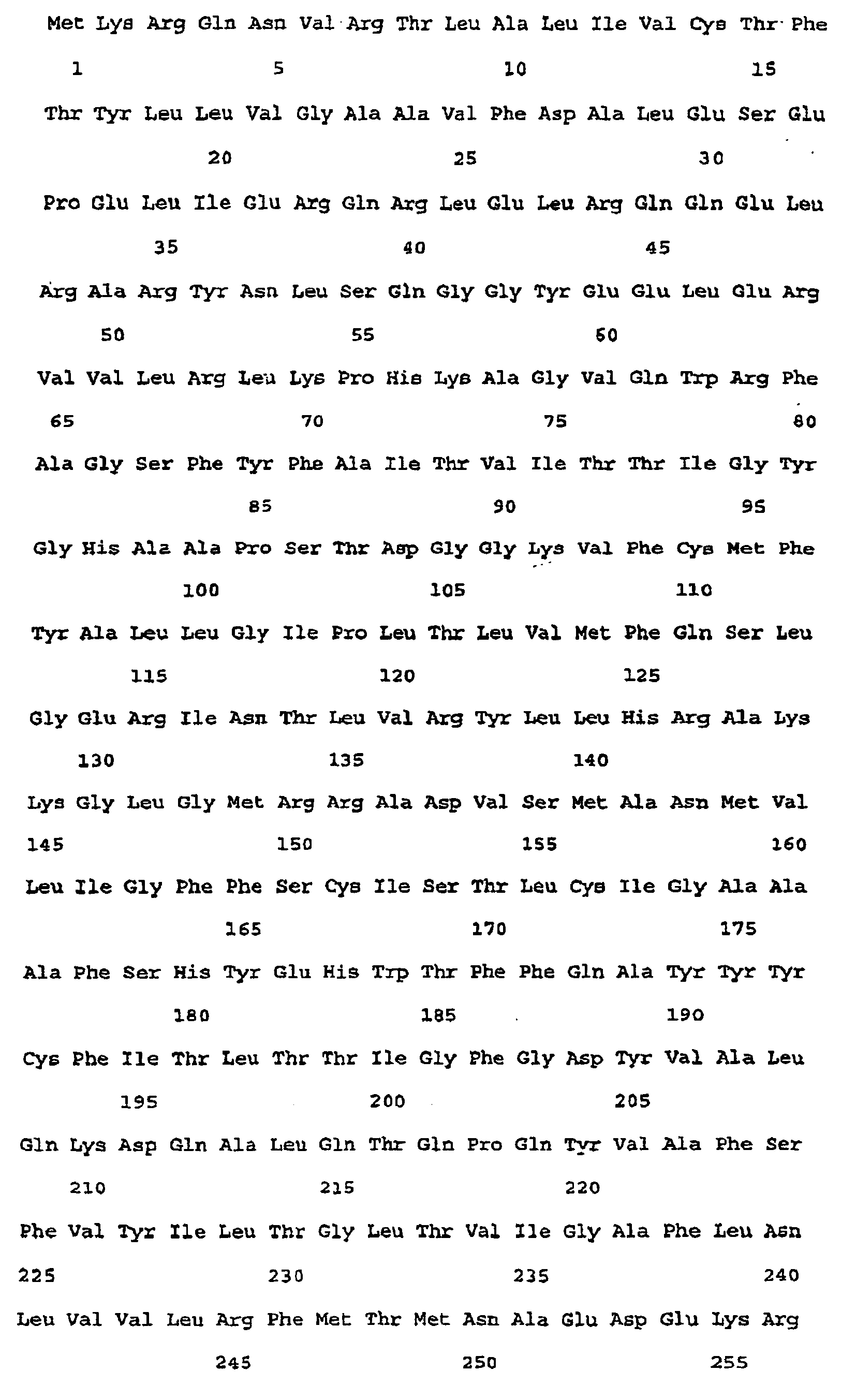
- SEQ ID NO:1 An isolated nucleic acid molecule encoding human TREK-1 channel (SEQ ID NO:1) is disclosed the isolated human TREK-1 protein (SEQ ID NO:2) is also disclosed. The nucleic acid and deduced amino acid sequence is shown in SEQ ID NO:1.
- the isolated nucleic acid molecule encoding the murine TREK-1 channel (SEQ ID NO:3) is disclosed.
- the isolated protein, murine TREK-1 (SEQ ID NO 4), is also disclosed.
- the invention relates to a method for identifying substances having anesthetic properties upon inhalation comprising:
- the method involves contacting a test substance with a potassium transport protein in vitro and determining whether there has been activation of potassium transport.
- test substance is a substance which will have certain properties when used in a mammal as a volatile inhalant. These properties may include the induction of a safe, reversible state of unconsciousness, amnesia and analgesia.
- the cells expressing the potassium transport protein may is transiently express the protein.
- the cells may be selected from the group consisting of Spodoptera, Xenophus oocytes, Chinese hamster ovary cells, and fibroblast.
- the potassium transport proteins which is suitable for use in the invention is TASK (SEQ ID NO:5), which may be derived from any mammalian source, such as rat, mouse, or human.
- the molecular sequence of TREE-1 may be the human TREK-1 as show in SEQ ID NO:2, or an amino acid sequence that is substantially identical to SEQ ID NOS.
- substantially identical it is understood that amino acid substitutions may be made such that the overall conformation of the potassium transport protein is not significantly altered: the protein remains active as a potassium transport protein.
- a suitable substantially identical protein is a protein having an amino acid sequence that is generally at least 90% identical to the amino acid sequence of human TREK-1 (SEQ ID NO:2). More preferably, the protein is at least 95% identical to SEQ ID NO:2. Most preferably, the amino acid sequence, is at least 99% identical to SEQ ID NO: 1.
- the cells used in the method of the present invention express the potassium transport protein expressed on their surface transiently.
- Introduction of the nucleic acid into the cells so that the protein is expressed may be by any known method such as transfection of an appropriate nucleic acid construct into the cells, microinjection of RNA encoding the protein, and the like.
- Many different protocols are known in the art. Two methods are briefly described herein, however, it will be appreciated by one of ordinary skill in the art that many modifications and substitutions may be made to these methods without departing from the spirit and the scope of the invention.
- the coding sequence of the potassium transport protein may be inserted between the noncoding sequences 5' and 3' of a Xenopus laevis protein (such as globin) in an appropriate vector, such as pEXO.
- the construct is introduced into an appropriate cell type to replicate the vector and/or to transcribe RNA.
- the vector may be used as a template for in vitro transcription.
- a complementary RNA (cRNA) is transcribed and injected into a cell, such as a Xenopus oocyte.
- Such a procedure may be performed in a 0.3 ml perfusion chamber, wherein single oocytes are impaled on two standard glass microelectrodes (0.5-2.0 MW) charged with 3 M KCl and maintained under voltage clamp with a Dagan TEV200 amplifier,
- the bath solution contains 98 mM KCl,1.8 mM CaCl 2 , 2 mM MgCl 2 , and 5 mM HEPES at pH 7.4 with KOH.
- functional expression of the potassium channel may be accomplished by transfection of insect cells, such as Spodoptera frugiperda (Sf9) cells.
- a suitable vector such as pVL1392 may be used and the coding sequence for the potassium transport protein may be inserted into the vector in-frame so that expression of the potassium transport protein may be expressed.
- the coding sequence for the potassium transport protein may be obtained by any convenient method, such as by PCR or by digesting a plasmid containing the potassium transport protein coding sequence with appropriate restriction endonuclease(s) for subsequent ligation into the pVL1392 vector.
- the amplified product of the PCR may be digested with restriction enzymes and ligated into the vector. Transfection of SF9 cells may be performed by the manufacturer's protocol (Pharmingen).
- functional expression of the potassium channel may be by transient transfection of cells such as COS cells whereby COS cells are seeded at a density of 20,000 cells per 35 mm dish.
- Cells are transfected with expression vector, such as the pIRES-CD8 vector, comprising the nucleic acid molecules encoding the desired potassium channel protein.
- the cells may be transfected by any method known in the art, such as the DEAE dextran protocol, Ca 2 PO 4 precipitation, or electroporation, for example.
- the transfected cells, expressing the desired potassium channel, or induced to express the desired potassium channel may then be used in the method of the invention and the cells may be assayed for the transport of potassium.
- the TREK-1 channel was cloned by degenerate PCR technology using previously characterized murine sequence. Although such technology is extensively described in the literature and is familiar to those of ordinary skill in the art, briefly, degenerate oligonucleotide primers selected to amplify a region of murine TREK-1 were synthesized and placed in a polymerase chain reaction amplification using human DNA with appropriate buffer, nucleotides and DNA polymerase.
- the reaction is cycled through temperature stages for denaturation of DNA (generally about 94°C), annealing of primers to DNA template (this temperature can be varied to optimize amplification and can be based on many factors, including primer length and GC content), and extension of DNA polymerization by DNA polymerase (generally at the optimum temperature for the activity of the DNA polymerase which is usually about 72°C).
- the amplified DNA fragment may be isolated and cloned into a plasmid vector for subsequent sequence analysis, or the amplified DNA may be directly sequenced by known methods.
- substitution of nucleotides may be made without changing the amino acid sequence of the protein.
- substitution of certain amino acids in the sequence can be made without significant effect on the function of the protein.
- substitutions are known in the art as "conservative substitutions.”
- the encompasses human TREK I proteins that contain conservative substitutions, wherein the function of the protein is not altered is disclosed Generally, the identity of such an mutant TREK-1 will be at least 90% identical to SEQ ID NO:2. Preferably, the mutant TREK-1 will be at least 97 % identical to SEQ ID NO:2. Most preferably, the mutant TREK-1 will be at least 99 % identical to SEQ ID NO:2.
- the sequence for murine TREK-1 which is a corrected form of murine TREK-1 reported earlier, is shown in SEQ ID NO:4. There is a longer open reading frame than originally reported, producing a protein with a deduced amino acid sequence of 411 amino acids. Due to the degeneracy of the DNA code, it will be well understood to one of ordinary skill in the art that substitution of nucleotides may be made without changing the amino acid sequence of the protein. Therefore, the invention includes any nucleic acid sequence for the murine TREK-1 channel that encodes the amino acid sequence determined for murine TREK-1 (SEQ ID NO:4).
- TREK-1 As is the case with human TREK-1, it is understood in the art that for a given protein's amino acid sequence, substitution of certain amino acids in the sequence can be made without significant effect on the function of the protein.
- the invention encompasses murine TREK-1 proteins that contain conservative substitutions, wherein the function of the protein is not altered.
- the identity of such an mutant TREK-1 will be at least 90% identical to SEQ ID NO:4.
- the mutant TREK-1 will be at least 95% identical to SEQ ID NO:4. More preferably, the mutant TREK-1 will be at least 97% identical to SEQ ID NO:4.
- the mutant TREK-1 will be at least 99% identical to SEQ ID NO:4.
- the functional properties of the human TREK-1 channel were studied on the basis of transfected COS cells temporarily expressing the protein. Like the murine channel, the human channel is selective for potassium and is activated by cis -unsaturated fatty acids, volatile anesthetics and by stretching of the plasma membrane.
- the selectivity of the TREK-1 currents for potassium is shown in Fig. 5A .
- the currents are recordings in the whole-cell configuration of the patch-clamp technique (imposed potential gradient from -130 to +100 mV).
- the inverse potential of the currents follow the equilibrium potential of potassium when the extracellular concentration of potassium ions climbs from 5 to 155 mM.
- FIG. 5B shows that the application of arachidonic acid (10 ⁇ M) induced activation of the TREK-1 currents.
- Fig. 5C shows that the application of volatile anesthetics (halothane in this case) at the concentrations employed in general anesthesia induced activation of the TREK-1 channel.
- Fig. 5D shows that the TREK-1 currents recorded in an excised patch (inside-out configuration) are mechanosensitive. When a pressure of -66 mmHg is applied on the membrane, the TREK-1 currents are activated in a reversible manner.
- COS cell transfection, culture and electrophysiology are well known in the art and are described in the literature such as in the references cited.
- COS cells were seeded at a density of 20,000 cells per 35 mm dish 24 hours prior to transfection.
- Cells were transfected by the DEAE dextran protocol (1 ⁇ g DNA per plate).
- Mouse TREK-1 GenBank Accession No. U734878
- human TASK GenBank Accession No. AF006823
- mouse TRAAK GeneBank Accession No. AF056492 fragments were amplified by polymerase chain reaction (PCR) and subcloned into the pIRES-CD8 vector. Transfected cells were visualized 48 hours after transfection using the anti-CD8 antibody coated beads method.
- the internal solution was 150 mM KCl, 3 mM MgCl 2 , 5mM EGTA and 10 mM HEPES at pH 7.2 with KOH and the external medium contained 150 mM NaCl, 5 mM KCL, 3 mM MgCl 2 , 1 mM CaCl 2 , 10 mM HEPES at pH 7.4 with NaOH.
- Cells were continuously superfused with a microperfusion system during the time course of the experiments (0.1 ml/min) performed at room temperature.
- a RK300 patch clamp amplifier (Biologic, Grenoble, France) was used for whole cell as well as single channel recordings.
- Ionic currents were monitored and recorded continuously using a DAT recorder (Biologic, Grenoble, France). Subsequently, data were replayed and sampled using pClamp software. Data analysis were performed using clampfit (pClamp) for whole cell recording as well as Biopatch (Biologic) software for single channel recordings. Membrane capacitance was measured during a 10 V hyperpolarizing step from a holding potential of -80 mV. Student's t test was used for statistical analysis (P ⁇ 0.001).
- the actual concentrations of anesthetics were subsequently determined by means of a gas chromatography method (HP 6890 equipped with a DB624 column) using FID detection. Sampled (2.5 ml of solution) were collected prior to (t 0 ) and after perfusion (t 45 ) through the experimental setup. Solutions were collected using gas impermeable tubing and stored in sealed glass containers at 4°C for subsequent analysis. Samplings and measurements were performed in duplicate. Actual concentrations of anesthetics were determined by multiplying the calculated concentration by the ratio t 45 /t 0 (chloroform: 0.16; halothane: 0.37; isoflurane: 0.76; and diethyl ether: 0.57). In the dose effect curves, the threshold concentrations were estimated as concentrations producing an increase higher than 10% in current amplitude.
- the nucleic acid sequence corresponding to the open reading frame of the human TREK-1 channel is shown in SEQ ID NO:1.
- the sequence of 1236 nucleotides encodes a protein of 411 amino acids.
- the conservation between human and murine proteins is very high, exceeding 99% homology.
- TASK and TREK-1 two mammalian 2P domain K+ channels which have similar properties to I K(An) are activated by volatile general anesthetics. Chloroform, diethyl ether, halothane and isoflurane activated TREK-1, while only halothane and isoflurane activated TASK.
- Chloroform, diethyl ether, halothane and isoflurane activated TREK-1
- TASK halothane and isoflurane activated TASK.
- the C-terminal regions of both TREK-1 and TASK are critical for anesthetic activation. Thus, both TREK-1 and TASK are important target sites for these agents.
- chloroform strongly and reversibly activated TREK-1 expressed in transfected COS cells, while it slightly depressed TASK and did not effect TRAAK.
- chloroform induced a typical background current, characterized by an outward-going rectification which reverses at the predicted value for E K + as demonstrated by the shift of the reversal potential to 0 mV in symmetrical K + conditions. No current activation was observed in mock-transfected cells ( Fig. 1B).
- TREK-1 activation was dose dependent, with a threshold concentration for activation of 500 ⁇ M, as shown in Fig. 1E .
- the inset of Fig. 1E shows that current activation, measured at a holding potential of 0 mV, started rapidly, but steady-state activation was barely reached after one minute in the presence of chloroform.
- halothane-induced current displayed an outward-going rectification and revered at the predicted value for E K + .
- the dose-effect curves (shown in Fig. 2D and Fig. 2E ) demonstrated that the threshold concentrations for halothane on TREK-1 and TASK are 400 ⁇ M and 200 ⁇ M, respectively.
- the effects of halothane on TASK were rapid completely reversible. Opening of TASK was faster compared to the opening of TREK-1 by chloroform (compare Fig. 2F with Fig. 1E , inset).
- Isoflurane like halothane, activated both TREK-1 and TASK channels without altering TRAAK, as shown in Fig. 3A .
- Diethyl ether like chloroform, opened TREK-1, but did not affect TRAAK. Diethyl ether also decreased TASK activity.
- Fig. 4A shows that in an excised outside-out patch, halothane reversibly, and in a dose dependent manner, opened a 48 pS TREK-1 channel. No channel activity was observed in the absence of the anesthetic, suggesting that halothane converts inactive channels into active channels.
- the I-V curve of the chloroform-sensitive current in an outside-out patch shows the characteristic outward-going rectification previously observed in the macroscopic whole cell conditions, as shown in Figs. 4B-4C and Fig. 1B (inset). As shown in Figs.
- halothane in the inside-out patch configuration, halothane reversibly opened a 12 pS TASK channel.
- a single TASK channel was opened, as shown in the left panels of Figs. 4D-4E .
- the addition of halothane induced the opening of a second channel (see Figs. 4D-4E middle panel) which closed again after washing (see right panel of Figs. 4D and 4E ). All the data, taken together, demonstrate that volatile general anesthetics open TASK and TREK-1 channels and that these effects are likely to be direct and independent of second messengers.
- TREK-1 and TASK are probably critical channels for the action of general volatile anesthetics. Opening of these K+ channels along with the known modulation of neurotransmitter receptors will probably explain general anesthetic action. Effects of volatile anesthetics on ligand-gated ion channels such as GABA A receptors are probably particularly important at the post-synaptic level. Opening of background TREK-1 and TASK channels by volatile anesthetics might be very important both at the pre-synaptic (I K(An) ) and at the post-synaptic level.
- TREK-1 and TASK channels are expressed in neuronal cells but they are also expressed in other tissues, and particularly in the heart. It is, therefore, not surprising that volatile anesthetics have depressive side-effects on heart function. These effects include a slowing of the heart rate and negative inotropic effects and are fully compatible with an exaggerate opening of background K+ channels by volatile anesthetics. The same considerations might very well explain ventilatory depression.
Landscapes
- Health & Medical Sciences (AREA)
- Life Sciences & Earth Sciences (AREA)
- Chemical & Material Sciences (AREA)
- Organic Chemistry (AREA)
- Zoology (AREA)
- Molecular Biology (AREA)
- Gastroenterology & Hepatology (AREA)
- Immunology (AREA)
- Biochemistry (AREA)
- Biophysics (AREA)
- General Health & Medical Sciences (AREA)
- Genetics & Genomics (AREA)
- Medicinal Chemistry (AREA)
- Toxicology (AREA)
- Proteomics, Peptides & Aminoacids (AREA)
- Cell Biology (AREA)
- Peptides Or Proteins (AREA)
- Measuring Or Testing Involving Enzymes Or Micro-Organisms (AREA)
- Investigating Or Analysing Biological Materials (AREA)
- Micro-Organisms Or Cultivation Processes Thereof (AREA)
- Acyclic And Carbocyclic Compounds In Medicinal Compositions (AREA)
- Medicines Containing Antibodies Or Antigens For Use As Internal Diagnostic Agents (AREA)
Abstract
Description
- The invention relates to a method for identifying substances that are capable of acting as anesthetics.
- Volatile anesthetics are a remarkable class of agents producing a safe, reversible state of unconsciousness with concurrent amnesia and analgesia. They have hyperpolarizing action on mammalian neurons. They activate an inhibitory synaptic K+ current (IK(As) in molluscan pacemaker neurons which has been proposed to have an important role in general anaesthesia.
- Volatile anesthetics hyperpolarize frog motor neurons, rat hippocampal neurons, guinea pig thalmic neurons and human cerebral cortex neurons. Therefore, it has been proposed that the molecular mechanism of volatile anesthetics involves an action on a specific class of K+ channels. The fact that a particular inhibitor synaptic K+ current, IK(An), reversibly activated by volatile agents is present in anesthetic-sensitive molluscan pacemaker neurons, but absent in insensitive neurons has made it a very attractive candidate as a target for these important pharmacological agents. IK(As) behaves as a background channel; it is not voltage-gated, it activates immediately, and it does not inactivate with time. IK(As) obeys the Goldman-Hodgkin-Katz constant field equation and is resistant to the classical K+ channel blockers, tetraethylammonium and 4-aminopyridine.
- Lopes et al « Action of general anaesthesic and arachidonci acid pathway inhibitors on K+ currents activated by volatile anaesthetics and FMRFamide in molluscan neurones » British journal of pharmacology (1998) 125, 309-318 discloses the study of K+ currents activated by volatile general anaesthetics. In particular, this document discloses the activation of background currents by volatile anaesthetic.
- We recently identified a novel family of mammalian K+ channels with a unique structural motif consisting of two pore domains in tandem and four transmembrane segments. The four members in this family have been classified as TWIK-1, TASK, TREK-1, and TRAAK, which are shown in
Fig. 1A . TWIK-1 has been previously shown to dimerize, implying that a functional channel is formed by at least two subunits. Heteromultimerization does not occur between the four members of this novel family as tested in Sf9 cells expressing various combinations of these channels (unpublished data). Three members of this family, mouse TREK-1, mouse TRAAK, and human TASK, encode for background outward-going K+ rectifiers with properties resembling those of IK(An). TRAAK and TREK-1 are directly opened by arachidonic acid and other polyunsaturated fatty acids, while TASK encodes a resting K+ channel which is controlled by external pH variations near physiological pH. TREK-1 and TASK are expressed in many tissues and are particularly abundant in the brain and in the heart, whereas TRAAK is selectively expressed in the central nervous system. Neuronal expression of these channels is detected at high levels in the cortex, cerebellum, hippocampus and olfactory bulb, and cardiac expression is detected in both the myocardium and connective tissues. -
-
Fig. 1 shows the results of experiments with chloroform demonstrating that chloroform selectively activates TREK-1: A, a schematic showing the two pore domains and four transmembrane domains of the 2P domain potassium K+ channels, TREK-1 TRAAK, TWIK-1 and TASK. The four transmembrane domain segments are indicated by TM1 through TM4, and the two pore regions are indicated by P1 and P2. The phylogenetic tree indicates the three subfamilies. TWIK-1 is an inward rectifier K+ channel and TASK is a background rectifier K+ channel inhibited by external acidosis. Both TREK-1 and TRAAK are background outward rectifier K+ channels opened by arachidonic acid; B, whole cell patch clamp experiments showing that 0.8 mM chloroform strongly and reversibly activates TREK-1 expressed in transfected COS cells. The mock condition is the wild-type (empty) expression vector. The effects of chloroform were investigated on K+ currents elicited in the whole cell configuration during a voltage ramp of one second in duration from a holding potential of -80 mV as illustrated in the inset for TREK-1; C, 0.8 mM chloroform induced a typical background current characterized by an outward-going rectification which reverses at the predicted value for EK+; Chloroform activated TREK-1 currents in physiological and symmetrical K+ gradients were examined. Voltage ramps of one second in duration from a holding potential of -80 mV in both K+ conditions and in the presence of 0.8 mM chloroform were digitally subtracted from ramps in control conditions; D, 0.8 mM chloroform reversibly and reproducibly hyperpolarized COS cells expressing TREK-1; E, dose-dependence of TREK-1 activation. The inset illustrates the effect of 0.8 mM chloroform on TREK-1 current measured at a holding potential of 0 mV. The number of cells in each experimental condition is indicated. -
Fig. 2 Halothane is a common activator of TREK-1 and TASK. A, comparative effects of 1 mM halothane on the 2P domain K+ channel activities. The mock condition is the wild-type (empty) expression vector; B, halothane (1 mM) stimulates TASK channel activity elicited in the whole cell configuration during voltage ramps of one second in duration from a holding potential of -80 mV; C, halothane (1 mM)-activated TASK currents in physiological and symmetrical K+ gradients. Voltage ramps of one second in duration from a holding potential of -80 mV in both K+ conditions and in the presence of 1 mM halothane are digitally subtracted from ramps in control conditions; D, dose-effect curve of halothane on TREK-1 channel activation; F, halothane (1 mM) reversibly activates TASK at a holding potential of 0 mV. The number of cells in each experimental condition is indicated. -
Fig. 3 Isoflurane and diethyl ether differentially activate TREK-1 and TASK. A, comparative effects of 2 mM isoflurane (A) and 0.6 mM diethyl ether (B) on the 2P domain K+ channels. The mock condition is the wild-type (empty) expression vector. The effects of the anesthetics are investigated on K+ currents elicited in whole cell configuration during voltage ramps of one second in duration from a holding potential of -80 mV as illustrated in insets for TREK-1. The number of cells in each experimental condition is indicated. -
Fig. 4 Volatile anesthetics stimulate TREK-1 and TASK in the excised patch configurations. A, effects of increasing concentrations of halothane on TREK-1 channel activity in an outside-out patch. In an outside-out patch, halothane reversibly opens a 48 pS TREK-1 channel in a dose-dependent fashion. The holding potential is 0 mV and applications of halothane are indicated by horizontal bars; B, effect of 0.8 mM chloroform on the I-V curve of TREK-1 in an outside-out patch. The I-V curve is performed with a voltage ramp of one second in duration from a holding potential of -80 mV; C, kinetics of activation of TREK-1 by 0.8 mM chloroform. The I-V curve of the chloroform-sensitive current in an outside-out patch shows the characteristic outward-going rectification; D, halothane (1 mM) induces TASK channel opening in an inside-out patch. The holding potential is 0 mV and channel activities before, during, and after addition of 1 mM halothane are illustrated from left to right. Halothane reversibly opens a 12 pS TASK channel. -
Fig. 5 Functional characterization of the human TREK-1 (hTREK-1). Transiently transfected COS cells expressing hTREK-1 are voltage-clamped using the whole cell patch clamp configuration. A, The basal TREK-1 current is recorded in physiological K conditions (5 mM) and in symmetrical K conditions (155 mM). The cells are held at -80 mV and voltage ramps of 800 ms in duration are applied from -130 mV to 100 mV. B, hTREK-1 is stimulated by the addition of 10 µM arachidonic acid in the bath. Same protocol as in A. C, hTREK-1 is opened by increasing concentrations of halothane (as indicated). D, In the inside-out patch configuration hTREK-1 is opened by a membrane stretch of -66 mmHg. The patch is voltage clamped at 0 mV. - An isolated nucleic acid molecule encoding human TREK-1 channel (SEQ ID NO:1) is disclosed the isolated human TREK-1 protein (SEQ ID NO:2) is also disclosed. The nucleic acid and deduced amino acid sequence is shown in SEQ ID NO:1.
- The isolated nucleic acid molecule encoding the murine TREK-1 channel (SEQ ID NO:3) is disclosed. The isolated protein, murine TREK-1 (SEQ ID NO 4), is also disclosed.
- The invention relates to a method for identifying substances having anesthetic properties upon inhalation comprising:
- (a) contacting said substance with a mammalian potassium transport protein, wherein said potassium transport exhibits outward-going potassium rectification; and
- (b) determining the potassium transport activity of said potassium transport protein, wherein an activation of potassium transport is indicative of said substance having said anesthetic properties,
- The method involves contacting a test substance with a potassium transport protein in vitro and determining whether there has been activation of potassium transport.
- As used in the method, cells which express a potassium transport protein are used in the presence of the test substance. The test substance is a substance which will have certain properties when used in a mammal as a volatile inhalant. These properties may include the induction of a safe, reversible state of unconsciousness, amnesia and analgesia.
- The cells expressing the potassium transport protein may is transiently express the protein. The cells may be selected from the group consisting of Spodoptera, Xenophus oocytes, Chinese hamster ovary cells, and fibroblast.
- The potassium transport proteins which is suitable for use in the invention is TASK (SEQ ID NO:5), which may be derived from any mammalian source, such as rat, mouse, or human. The molecular sequence of TREE-1 may be the human TREK-1 as show in SEQ ID NO:2, or an amino acid sequence that is substantially identical to SEQ ID NOS. By "substantially identical" it is understood that amino acid substitutions may be made such that the overall conformation of the potassium transport protein is not significantly altered: the protein remains active as a potassium transport protein.
- A suitable substantially identical protein is a protein having an amino acid sequence that is generally at least 90% identical to the amino acid sequence of human TREK-1 (SEQ ID NO:2). More preferably, the protein is at least 95% identical to SEQ ID NO:2. Most preferably, the amino acid sequence, is at least 99% identical to SEQ ID NO: 1.
- The cells used in the method of the present invention express the potassium transport protein expressed on their surface transiently. Introduction of the nucleic acid into the cells so that the protein is expressed may be by any known method such as transfection of an appropriate nucleic acid construct into the cells, microinjection of RNA encoding the protein, and the like. Many different protocols are known in the art. Two methods are briefly described herein, however, it will be appreciated by one of ordinary skill in the art that many modifications and substitutions may be made to these methods without departing from the spirit and the scope of the invention.
- The coding sequence of the potassium transport protein may be inserted between the noncoding sequences 5' and 3' of a Xenopus laevis protein (such as globin) in an appropriate vector, such as pEXO. The construct is introduced into an appropriate cell type to replicate the vector and/or to transcribe RNA. Alternatively, the vector may be used as a template for in vitro transcription. A complementary RNA (cRNA) is transcribed and injected into a cell, such as a Xenopus oocyte. Such a procedure may be performed in a 0.3 ml perfusion chamber, wherein single oocytes are impaled on two standard glass microelectrodes (0.5-2.0 MW) charged with 3 M KCl and maintained under voltage clamp with a Dagan TEV200 amplifier, The bath solution contains 98 mM KCl,1.8 mM CaCl2, 2 mM MgCl2, and 5 mM HEPES at pH 7.4 with KOH.
- Alternatively, functional expression of the potassium channel may be accomplished by transfection of insect cells, such as Spodoptera frugiperda (Sf9) cells. Briefly a suitable vector, such as pVL1392 may be used and the coding sequence for the potassium transport protein may be inserted into the vector in-frame so that expression of the potassium transport protein may be expressed. The coding sequence for the potassium transport protein may be obtained by any convenient method, such as by PCR or by digesting a plasmid containing the potassium transport protein coding sequence with appropriate restriction endonuclease(s) for subsequent ligation into the pVL1392 vector. Similarly, the amplified product of the PCR may be digested with restriction enzymes and ligated into the vector. Transfection of SF9 cells may be performed by the manufacturer's protocol (Pharmingen).
- Alternatively, functional expression of the potassium channel may be by transient transfection of cells such as COS cells whereby COS cells are seeded at a density of 20,000 cells per 35 mm dish. Cells are transfected with expression vector, such as the pIRES-CD8 vector, comprising the nucleic acid molecules encoding the desired potassium channel protein. The cells may be transfected by any method known in the art, such as the DEAE dextran protocol, Ca2PO4 precipitation, or electroporation, for example. The transfected cells, expressing the desired potassium channel, or induced to express the desired potassium channel may then be used in the method of the invention and the cells may be assayed for the transport of potassium.
- The invention will be described in greater detail with reference to the examples which are provides to illustrate the invention. The examples are not to be construed to be limiting as to the scope of the invention, which is set forth in the appended claims.
- The TREK-1 channel was cloned by degenerate PCR technology using previously characterized murine sequence. Although such technology is extensively described in the literature and is familiar to those of ordinary skill in the art, briefly, degenerate oligonucleotide primers selected to amplify a region of murine TREK-1 were synthesized and placed in a polymerase chain reaction amplification using human DNA with appropriate buffer, nucleotides and DNA polymerase. The reaction is cycled through temperature stages for denaturation of DNA (generally about 94°C), annealing of primers to DNA template (this temperature can be varied to optimize amplification and can be based on many factors, including primer length and GC content), and extension of DNA polymerization by DNA polymerase (generally at the optimum temperature for the activity of the DNA polymerase which is usually about 72°C). The amplified DNA fragment may be isolated and cloned into a plasmid vector for subsequent sequence analysis, or the amplified DNA may be directly sequenced by known methods.
- Due to the degeneracy of the DNA code, it will be well understood to one of ordinary skill in the art that substitution of nucleotides may be made without changing the amino acid sequence of the protein. Moreover, it is understood in the art that for a given protein's amino acid sequence, substitution of certain amino acids in the sequence can be made without significant effect on the function of the protein. Such substitutions are known in the art as "conservative substitutions." The encompasses human TREK I proteins that contain conservative substitutions, wherein the function of the protein is not altered is disclosed Generally, the identity of such an mutant TREK-1 will be at least 90% identical to SEQ ID NO:2. Preferably, the mutant TREK-1 will be at least 97 % identical to SEQ ID NO:2. Most preferably, the mutant TREK-1 will be at least 99 % identical to SEQ ID NO:2.
- The sequence for murine TREK-1, which is a corrected form of murine TREK-1 reported earlier, is shown in SEQ ID NO:4. There is a longer open reading frame than originally reported, producing a protein with a deduced amino acid sequence of 411 amino acids. Due to the degeneracy of the DNA code, it will be well understood to one of ordinary skill in the art that substitution of nucleotides may be made without changing the amino acid sequence of the protein. Therefore, the invention includes any nucleic acid sequence for the murine TREK-1 channel that encodes the amino acid sequence determined for murine TREK-1 (SEQ ID NO:4). Moreover, as is the case with human TREK-1, it is understood in the art that for a given protein's amino acid sequence, substitution of certain amino acids in the sequence can be made without significant effect on the function of the protein. The invention encompasses murine TREK-1 proteins that contain conservative substitutions, wherein the function of the protein is not altered. Generally, the identity of such an mutant TREK-1 will be at least 90% identical to SEQ ID NO:4. Preferably, the mutant TREK-1 will be at least 95% identical to SEQ ID NO:4. More preferably, the mutant TREK-1 will be at least 97% identical to SEQ ID NO:4. Most preferably, the mutant TREK-1 will be at least 99% identical to SEQ ID NO:4.
- The functional properties of the human TREK-1 channel were studied on the basis of transfected COS cells temporarily expressing the protein. Like the murine channel, the human channel is selective for potassium and is activated by cis-unsaturated fatty acids, volatile anesthetics and by stretching of the plasma membrane. The selectivity of the TREK-1 currents for potassium is shown in
Fig. 5A . The currents are recordings in the whole-cell configuration of the patch-clamp technique (imposed potential gradient from -130 to +100 mV). The inverse potential of the currents follow the equilibrium potential of potassium when the extracellular concentration of potassium ions climbs from 5 to 155 mM.Fig. 5B shows that the application of arachidonic acid (10 µM) induced activation of the TREK-1 currents.Fig. 5C shows that the application of volatile anesthetics (halothane in this case) at the concentrations employed in general anesthesia induced activation of the TREK-1 channel.Fig. 5D shows that the TREK-1 currents recorded in an excised patch (inside-out configuration) are mechanosensitive. When a pressure of -66 mmHg is applied on the membrane, the TREK-1 currents are activated in a reversible manner. - COS cell transfection, culture and electrophysiology are well known in the art and are described in the literature such as in the references cited.
- As performed herein, COS cells were seeded at a density of 20,000 cells per 35 mm dish 24 hours prior to transfection. Cells were transfected by the DEAE dextran protocol (1 µg DNA per plate). Mouse TREK-1 (GenBank Accession No. U73488), human TASK (GenBank Accession No. AF006823) and mouse TRAAK (GenBank Accession No. AF056492) fragments were amplified by polymerase chain reaction (PCR) and subcloned into the pIRES-CD8 vector. Transfected cells were visualized 48 hours after transfection using the anti-CD8 antibody coated beads method. For whole cell and excised patch experiments, the internal solution was 150 mM KCl, 3 mM MgCl2, 5mM EGTA and 10 mM HEPES at pH 7.2 with KOH and the external medium contained 150 mM NaCl, 5 mM KCL, 3 mM MgCl2, 1 mM CaCl2, 10 mM HEPES at pH 7.4 with NaOH. Cells were continuously superfused with a microperfusion system during the time course of the experiments (0.1 ml/min) performed at room temperature. A RK300 patch clamp amplifier (Biologic, Grenoble, France) was used for whole cell as well as single channel recordings. Ionic currents were monitored and recorded continuously using a DAT recorder (Biologic, Grenoble, France). Subsequently, data were replayed and sampled using pClamp software. Data analysis were performed using clampfit (pClamp) for whole cell recording as well as Biopatch (Biologic) software for single channel recordings. Membrane capacitance was measured during a 10 V hyperpolarizing step from a holding potential of -80 mV. Student's t test was used for statistical analysis (P<0.001).
- General anesthetics were directly dissolved in saline solutions. All experiments were performed at room temperature (24°C). Solutions were prepared every 3 hours in gas-tight bottles as stock solutions (calculated concentrations of 5 10 mM). Serial dilutions were prepared just prior to the electrophysiological experiment. 2.5 ml of each experimental solution at the desired concentration was placed in a syringe connected to the experimental superfusion system. The electrophysiological measurements were performed within 45 minutes.
- The actual concentrations of anesthetics were subsequently determined by means of a gas chromatography method (HP 6890 equipped with a DB624 column) using FID detection. Sampled (2.5 ml of solution) were collected prior to (t0) and after perfusion (t45) through the experimental setup. Solutions were collected using gas impermeable tubing and stored in sealed glass containers at 4°C for subsequent analysis. Samplings and measurements were performed in duplicate. Actual concentrations of anesthetics were determined by multiplying the calculated concentration by the ratio t45/t0 (chloroform: 0.16; halothane: 0.37; isoflurane: 0.76; and diethyl ether: 0.57). In the dose effect curves, the threshold concentrations were estimated as concentrations producing an increase higher than 10% in current amplitude.
- The nucleic acid sequence corresponding to the open reading frame of the human TREK-1 channel is shown in SEQ ID NO:1. The sequence of 1236 nucleotides encodes a protein of 411 amino acids. The conservation between human and murine proteins is very high, exceeding 99% homology.
- TASK and TREK-1, two mammalian 2P domain K+ channels which have similar properties to IK(An) are activated by volatile general anesthetics. Chloroform, diethyl ether, halothane and isoflurane activated TREK-1, while only halothane and isoflurane activated TASK. The C-terminal regions of both TREK-1 and TASK are critical for anesthetic activation. Thus, both TREK-1 and TASK are important target sites for these agents.
- In whole patch clamp experiments shown in
Fig. 1B , chloroform strongly and reversibly activated TREK-1 expressed in transfected COS cells, while it slightly depressed TASK and did not effect TRAAK. As shown inFig. 1C , chloroform induced a typical background current, characterized by an outward-going rectification which reverses at the predicted value for EK + as demonstrated by the shift of the reversal potential to 0 mV in symmetrical K+ conditions. No current activation was observed in mock-transfected cells (Fig. 1B). Fig. 1D shows that chloroform also reversibly and reproducibly hyperpolarized COS cells expressing TREK-1 (but not mock-transfected cells, not shown; n = 5). TREK-1 activation was dose dependent, with a threshold concentration for activation of 500 µM, as shown inFig. 1E . The inset ofFig. 1E shows that current activation, measured at a holding potential of 0 mV, started rapidly, but steady-state activation was barely reached after one minute in the presence of chloroform. - Both TREK and TASK, but not TRAAK, were opened by halothane. As shown in
Fig. 2B and 2C , halothane-induced current displayed an outward-going rectification and revered at the predicted value for EK +. The dose-effect curves (shown inFig. 2D and Fig. 2E ) demonstrated that the threshold concentrations for halothane on TREK-1 and TASK are 400 µM and 200 µM, respectively. The effects of halothane on TASK were rapid completely reversible. Opening of TASK was faster compared to the opening of TREK-1 by chloroform (compareFig. 2F withFig. 1E , inset). These results suggest that the components of the activation of both channels by anesthetics may be mediated by different molecular mechanisms. - Isoflurane, like halothane, activated both TREK-1 and TASK channels without altering TRAAK, as shown in
Fig. 3A . Diethyl ether, like chloroform, opened TREK-1, but did not affect TRAAK. Diethyl ether also decreased TASK activity. - To demonstrate that activation by volatile anesthetics does not occur via second messenger pathways, experiments were conducted on excised patches.
Fig. 4A shows that in an excised outside-out patch, halothane reversibly, and in a dose dependent manner, opened a 48 pS TREK-1 channel. No channel activity was observed in the absence of the anesthetic, suggesting that halothane converts inactive channels into active channels. The I-V curve of the chloroform-sensitive current in an outside-out patch shows the characteristic outward-going rectification previously observed in the macroscopic whole cell conditions, as shown inFigs. 4B-4C andFig. 1B (inset). As shown inFigs. 4D-4E , in the inside-out patch configuration, halothane reversibly opened a 12 pS TASK channel. In the absence of anesthetics, a single TASK channel was opened, as shown in the left panels ofFigs. 4D-4E . The addition of halothane induced the opening of a second channel (seeFigs. 4D-4E middle panel) which closed again after washing (see right panel ofFigs. 4D and 4E ). All the data, taken together, demonstrate that volatile general anesthetics open TASK and TREK-1 channels and that these effects are likely to be direct and independent of second messengers. - TREK-1 and TASK are probably critical channels for the action of general volatile anesthetics. Opening of these K+ channels along with the known modulation of neurotransmitter receptors will probably explain general anesthetic action. Effects of volatile anesthetics on ligand-gated ion channels such as GABAA receptors are probably particularly important at the post-synaptic level. Opening of background TREK-1 and TASK channels by volatile anesthetics might be very important both at the pre-synaptic (IK(An)) and at the post-synaptic level. An activation of only a small fraction of these IK(An) channels will be expected to have significant effects on membrane polarization and consequently potentially important effects in both pre- and post-synaptic functions. TREK-1 and TASK channels are expressed in neuronal cells but they are also expressed in other tissues, and particularly in the heart. It is, therefore, not surprising that volatile anesthetics have depressive side-effects on heart function. These effects include a slowing of the heart rate and negative inotropic effects and are fully compatible with an exaggerate opening of background K+ channels by volatile anesthetics. The same considerations might very well explain ventilatory depression.
-
- <110> PATEL, AMANDA J.
HONORE, ERIC
LESAGE, FLORIAN
ROMEY, GEORGES
LAZDUSKI, MICHEL - <120> A method for the identification of anesthetics
- <130> f17b12prov3-humanTREK
- <140> 6079727
<141> 1999-02-12 - <160> 4
- <170> Wordperfect 8.0
- <210> 1
<211> 1236
<212> ADN
<213> Homo sapiens - <220>
<221> CDS
<222> (1) .. (1236) - <400> 1


- <210> 2
<211> 411
<212> PRT
<213> Homo sapiens - <400> 2

- <210> 3
<211> 3580
<212> ADN
<213> Mus musculus - <220>
<221> CDS
<222> (484) .. (1719) - <400> 3


- <210> 4
<211> 411
<212> PRT
<213> Mus musculus - <400> 4


- <210> 5
<211> 394
<212> PRT
<213> Mus sp.
<223> TASK - <400> 5

Claims (3)
- A method for identifying substances having anesthetic properties upon inhalation comprising:(a) contacting said substance with a mammalian potassium transport protein, wherein said potassium transport exhibits outward-going potassium rectification; and(b) determining the potassium transport activity of said potassium transport protein, wherein an activation of potassium transport is indicative of said substance having said anesthetic properties,wherein said mammalian potassium transport protein is TASK of sequence SEQ ID NO 5.
- The method of claim 1 comprising:(a) contacting said substance with transfected cells, wherein said transfected cells are transfected with a nucleotide vector comprising a nucleic acid molecule encoding said TASK, wherein said transfected cells transiently express said TASK on a surface of said transfected cells, and wherein said TASK exhibits outward-going potassium rectification; and(b) determining the potassium transport activity of said TASK, wherein an activation of potassium transport is indicative of said substance having said anesthetic properties.
- The method of claim 2, wherein said transfected cells are selected from the group consisting of Spodoptera, Xenopus oocytes, Chinese hamster ovary cells, and fibroblasts.
Applications Claiming Priority (5)
| Application Number | Priority Date | Filing Date | Title |
|---|---|---|---|
| US11972799P | 1999-02-12 | 1999-02-12 | |
| US119727P | 1999-02-12 | ||
| PCT/IB2000/000226 WO2000047738A2 (en) | 1999-02-12 | 2000-02-11 | Human and mouse trek-1 potassium channel protein and their use |
| US09/503,089 US7112403B1 (en) | 1998-09-01 | 2000-02-11 | Method for the identification of anesthetics |
| US503089 | 2000-02-11 |
Publications (3)
| Publication Number | Publication Date |
|---|---|
| EP1144624A2 EP1144624A2 (en) | 2001-10-17 |
| EP1144624A3 EP1144624A3 (en) | 2002-09-11 |
| EP1144624B1 true EP1144624B1 (en) | 2011-05-04 |
Family
ID=26817637
Family Applications (1)
| Application Number | Title | Priority Date | Filing Date |
|---|---|---|---|
| EP00905230A Expired - Lifetime EP1144624B1 (en) | 1999-02-12 | 2000-02-11 | Human and mouse trek-1 potassium channel protein and their use |
Country Status (7)
| Country | Link |
|---|---|
| EP (1) | EP1144624B1 (en) |
| JP (1) | JP2002536017A (en) |
| AT (1) | ATE508192T1 (en) |
| AU (1) | AU2685400A (en) |
| CA (1) | CA2359761C (en) |
| DE (1) | DE60045915D1 (en) |
| WO (1) | WO2000047738A2 (en) |
Families Citing this family (4)
| Publication number | Priority date | Publication date | Assignee | Title |
|---|---|---|---|---|
| GB2365010A (en) * | 2000-04-25 | 2002-02-13 | Smithkline Beecham Corp | Human TREK2 polypeptides |
| FR2850397A1 (en) * | 2003-01-29 | 2004-07-30 | Centre Nat Rech Scient | METHOD FOR IDENTIFYING BIOLOGICALLY ACTIVE COMPOUNDS IN THE TREATMENT OF DEPRESSION |
| WO2005054866A2 (en) * | 2003-11-25 | 2005-06-16 | Bayer Healthcare Ag | Diagnostics and therapeutics for diseases associated with two-pore domain potassium channel (kcnk2) |
| US20250025647A1 (en) * | 2023-07-18 | 2025-01-23 | Anecare, Llc | Reactivation of and restoration of electrical signaling by neurons involved in controlling brain function |
Family Cites Families (1)
| Publication number | Priority date | Publication date | Assignee | Title |
|---|---|---|---|---|
| FR2744730B1 (en) * | 1996-02-08 | 1998-04-17 | Centre Nat Rech Scient | NEW FAMILY OF MAMMALIAN POTASSIUM CHANNELS, THEIR CLONING AND THEIR USE IN PARTICULAR FOR DRUG SCREENING |
-
2000
- 2000-02-11 AT AT00905230T patent/ATE508192T1/en not_active IP Right Cessation
- 2000-02-11 WO PCT/IB2000/000226 patent/WO2000047738A2/en not_active Ceased
- 2000-02-11 CA CA2359761A patent/CA2359761C/en not_active Expired - Fee Related
- 2000-02-11 EP EP00905230A patent/EP1144624B1/en not_active Expired - Lifetime
- 2000-02-11 JP JP2000598636A patent/JP2002536017A/en active Pending
- 2000-02-11 AU AU26854/00A patent/AU2685400A/en not_active Abandoned
- 2000-02-11 DE DE60045915T patent/DE60045915D1/en not_active Expired - Lifetime
Also Published As
| Publication number | Publication date |
|---|---|
| DE60045915D1 (en) | 2011-06-16 |
| AU2685400A (en) | 2000-08-29 |
| EP1144624A2 (en) | 2001-10-17 |
| WO2000047738A3 (en) | 2000-11-30 |
| CA2359761C (en) | 2012-09-25 |
| WO2000047738A9 (en) | 2001-08-30 |
| WO2000047738A2 (en) | 2000-08-17 |
| CA2359761A1 (en) | 2000-08-17 |
| ATE508192T1 (en) | 2011-05-15 |
| JP2002536017A (en) | 2002-10-29 |
| EP1144624A3 (en) | 2002-09-11 |
Similar Documents
| Publication | Publication Date | Title |
|---|---|---|
| Grabner et al. | Transfer of 1, 4-dihydropyridine sensitivity from L-type to class A (BI) calcium channels | |
| Schachtman et al. | Expression of an inward-rectifying potassium channel by the Arabidopsis KAT1 cDNA | |
| US5747278A (en) | DNA encoding inward rectifier, G-protein activated, mammalian, potassium KGA channel and uses thereof | |
| Buell et al. | Molecular characterisation, expression and localisation of human neurokinin-3 receptor | |
| Zheng et al. | Differential roles of the C and N termini of Orai1 protein in interacting with stromal interaction molecule 1 (STIM1) for Ca2+ release-activated Ca2+ (CRAC) channel activation | |
| Ressot et al. | Connexin32 mutations associated with X-linked Charcot–Marie–Tooth disease show two distinct behaviors: loss of function and altered gating properties | |
| Zimmer et al. | The b1 Subunit but not the b2 Subunit Colocalizes with the Human Heart Na+ Channel (hH1) already within the Endoplasmic Reticulum. | |
| WO1995004820A1 (en) | CLONING OF MAMMALIAN INWARD RECTIFIER POTASSIUM CHANNEL cDNAs | |
| Cohen et al. | Voltage-dependent sodium channels | |
| Werkman et al. | Charybdotoxin, dendrotoxin and mast cell degranulating peptide block the voltage-activated K+ current of fibroblast cells stably transfected with NGK1 (Kvl. 2) K+ channel complementary DNA | |
| Lambolez et al. | Functional and molecular analysis of glutamate-gated channels by patch-clamp and RT-PCR at the single cell level | |
| Bindra et al. | Conservation of the amino acid sequence of SV2, a transmembrane transporter in synaptic vesicles and endocrine cells | |
| Lü et al. | Cloning and functional expression of novel N-type Ca2+ channel variants | |
| US7112403B1 (en) | Method for the identification of anesthetics | |
| CA2359761C (en) | Human and mouse trek-1 potassium channel protein and their use | |
| JP2003529337A (en) | DNA encoding human alpha 1G-CT calcium channel | |
| US5468615A (en) | Binding assay employing a synthetic gene for D4 dopamine receptors | |
| EP1190053A2 (en) | Mammalian calcium channels and related probes, cell lines and methods | |
| CA2281984A1 (en) | Human calcium channels alfa1 subunits and related probes, cell lines and methods | |
| US8664179B2 (en) | Identification of novel antagonist toxins of T-type calcium channel for analgesic purposes | |
| US5593864A (en) | Process for functional expression of the para cation channel | |
| US5550049A (en) | Process for identifying para cation channel modulators | |
| ES2366080T3 (en) | POTASSIUM CHANNEL PROTEIN TREK-1 HUMAN AND MOUSE AND ITS USE. | |
| Chraïbi et al. | Functional analyses of a N-terminal splice variant of the α subunit of the epithelial sodium channel | |
| Bennett et al. | Molecular and functional diversity of cloned cardiac potassium channels |
Legal Events
| Date | Code | Title | Description |
|---|---|---|---|
| PUAI | Public reference made under article 153(3) epc to a published international application that has entered the european phase |
Free format text: ORIGINAL CODE: 0009012 |
|
| 17P | Request for examination filed |
Effective date: 20010727 |
|
| AK | Designated contracting states |
Kind code of ref document: A2 Designated state(s): AT BE CH CY DE DK ES FI FR GB GR IE IT LI LU MC NL PT SE |
|
| XX | Miscellaneous (additional remarks) |
Free format text: DERZEIT SIND DIE WIPO-PUBLIKATIONSDATEN A3 NICHT VERFUEGBAR. |
|
| RIN1 | Information on inventor provided before grant (corrected) |
Inventor name: ROMEY, GEORGES Inventor name: LAZDUNSKI, MICHEL Inventor name: LESAGE, FLORIAN Inventor name: HONORE, ERIC Inventor name: PATEL, AMANDA J. |
|
| PUAK | Availability of information related to the publication of the international search report |
Free format text: ORIGINAL CODE: 0009015 |
|
| AK | Designated contracting states |
Kind code of ref document: A3 Designated state(s): AT BE CH CY DE DK ES FI FR GB GR IE IT LI LU MC NL PT SE |
|
| 17Q | First examination report despatched |
Effective date: 20050308 |
|
| 17Q | First examination report despatched |
Effective date: 20050308 |
|
| GRAP | Despatch of communication of intention to grant a patent |
Free format text: ORIGINAL CODE: EPIDOSNIGR1 |
|
| GRAS | Grant fee paid |
Free format text: ORIGINAL CODE: EPIDOSNIGR3 |
|
| GRAA | (expected) grant |
Free format text: ORIGINAL CODE: 0009210 |
|
| AK | Designated contracting states |
Kind code of ref document: B1 Designated state(s): AT BE CH CY DE DK ES FI FR GB GR IE IT LI LU MC NL PT SE |
|
| REG | Reference to a national code |
Ref country code: GB Ref legal event code: FG4D |
|
| XX | Miscellaneous (additional remarks) |
Free format text: DERZEIT SIND DIE WIPO-PUBLIKATIONSDATEN A3 NICHT VERFUEGBAR. |
|
| REG | Reference to a national code |
Ref country code: CH Ref legal event code: EP |
|
| REG | Reference to a national code |
Ref country code: IE Ref legal event code: FG4D |
|
| REF | Corresponds to: |
Ref document number: 60045915 Country of ref document: DE Date of ref document: 20110616 Kind code of ref document: P |
|
| REG | Reference to a national code |
Ref country code: DE Ref legal event code: R096 Ref document number: 60045915 Country of ref document: DE Effective date: 20110616 |
|
| REG | Reference to a national code |
Ref country code: NL Ref legal event code: T3 |
|
| REG | Reference to a national code |
Ref country code: CH Ref legal event code: NV Representative=s name: NOVAGRAAF SWITZERLAND SA |
|
| REG | Reference to a national code |
Ref country code: ES Ref legal event code: FG2A Ref document number: 2366080 Country of ref document: ES Kind code of ref document: T3 Effective date: 20111017 |
|
| PG25 | Lapsed in a contracting state [announced via postgrant information from national office to epo] |
Ref country code: PT Free format text: LAPSE BECAUSE OF FAILURE TO SUBMIT A TRANSLATION OF THE DESCRIPTION OR TO PAY THE FEE WITHIN THE PRESCRIBED TIME-LIMIT Effective date: 20110905 Ref country code: SE Free format text: LAPSE BECAUSE OF FAILURE TO SUBMIT A TRANSLATION OF THE DESCRIPTION OR TO PAY THE FEE WITHIN THE PRESCRIBED TIME-LIMIT Effective date: 20110504 |
|
| PG25 | Lapsed in a contracting state [announced via postgrant information from national office to epo] |
Ref country code: GR Free format text: LAPSE BECAUSE OF FAILURE TO SUBMIT A TRANSLATION OF THE DESCRIPTION OR TO PAY THE FEE WITHIN THE PRESCRIBED TIME-LIMIT Effective date: 20110805 Ref country code: CY Free format text: LAPSE BECAUSE OF FAILURE TO SUBMIT A TRANSLATION OF THE DESCRIPTION OR TO PAY THE FEE WITHIN THE PRESCRIBED TIME-LIMIT Effective date: 20110504 Ref country code: FI Free format text: LAPSE BECAUSE OF FAILURE TO SUBMIT A TRANSLATION OF THE DESCRIPTION OR TO PAY THE FEE WITHIN THE PRESCRIBED TIME-LIMIT Effective date: 20110504 Ref country code: AT Free format text: LAPSE BECAUSE OF FAILURE TO SUBMIT A TRANSLATION OF THE DESCRIPTION OR TO PAY THE FEE WITHIN THE PRESCRIBED TIME-LIMIT Effective date: 20110504 |
|
| PG25 | Lapsed in a contracting state [announced via postgrant information from national office to epo] |
Ref country code: DK Free format text: LAPSE BECAUSE OF FAILURE TO SUBMIT A TRANSLATION OF THE DESCRIPTION OR TO PAY THE FEE WITHIN THE PRESCRIBED TIME-LIMIT Effective date: 20110504 |
|
| PLBE | No opposition filed within time limit |
Free format text: ORIGINAL CODE: 0009261 |
|
| STAA | Information on the status of an ep patent application or granted ep patent |
Free format text: STATUS: NO OPPOSITION FILED WITHIN TIME LIMIT |
|
| 26N | No opposition filed |
Effective date: 20120207 |
|
| PGFP | Annual fee paid to national office [announced via postgrant information from national office to epo] |
Ref country code: FR Payment date: 20120316 Year of fee payment: 13 |
|
| REG | Reference to a national code |
Ref country code: DE Ref legal event code: R097 Ref document number: 60045915 Country of ref document: DE Effective date: 20120207 |
|
| PGFP | Annual fee paid to national office [announced via postgrant information from national office to epo] |
Ref country code: IT Payment date: 20120128 Year of fee payment: 13 |
|
| PG25 | Lapsed in a contracting state [announced via postgrant information from national office to epo] |
Ref country code: MC Free format text: LAPSE BECAUSE OF NON-PAYMENT OF DUE FEES Effective date: 20120229 |
|
| REG | Reference to a national code |
Ref country code: IE Ref legal event code: MM4A |
|
| PG25 | Lapsed in a contracting state [announced via postgrant information from national office to epo] |
Ref country code: IE Free format text: LAPSE BECAUSE OF NON-PAYMENT OF DUE FEES Effective date: 20120211 |
|
| PGFP | Annual fee paid to national office [announced via postgrant information from national office to epo] |
Ref country code: ES Payment date: 20130208 Year of fee payment: 14 Ref country code: CH Payment date: 20130130 Year of fee payment: 14 Ref country code: GB Payment date: 20130129 Year of fee payment: 14 Ref country code: DE Payment date: 20130124 Year of fee payment: 14 |
|
| PGFP | Annual fee paid to national office [announced via postgrant information from national office to epo] |
Ref country code: NL Payment date: 20130124 Year of fee payment: 14 Ref country code: BE Payment date: 20130128 Year of fee payment: 14 |
|
| REG | Reference to a national code |
Ref country code: FR Ref legal event code: ST Effective date: 20131031 |
|
| PG25 | Lapsed in a contracting state [announced via postgrant information from national office to epo] |
Ref country code: FR Free format text: LAPSE BECAUSE OF NON-PAYMENT OF DUE FEES Effective date: 20130228 |
|
| PG25 | Lapsed in a contracting state [announced via postgrant information from national office to epo] |
Ref country code: LU Free format text: LAPSE BECAUSE OF NON-PAYMENT OF DUE FEES Effective date: 20120211 |
|
| BERE | Be: lapsed |
Owner name: CENTRE NATIONAL DE LA RECHERCHE SCIENTIFIQUE Effective date: 20140228 |
|
| REG | Reference to a national code |
Ref country code: DE Ref legal event code: R119 Ref document number: 60045915 Country of ref document: DE |
|
| REG | Reference to a national code |
Ref country code: NL Ref legal event code: V1 Effective date: 20140901 |
|
| REG | Reference to a national code |
Ref country code: CH Ref legal event code: PL |
|
| GBPC | Gb: european patent ceased through non-payment of renewal fee |
Effective date: 20140211 |
|
| PG25 | Lapsed in a contracting state [announced via postgrant information from national office to epo] |
Ref country code: LI Free format text: LAPSE BECAUSE OF NON-PAYMENT OF DUE FEES Effective date: 20140228 Ref country code: CH Free format text: LAPSE BECAUSE OF NON-PAYMENT OF DUE FEES Effective date: 20140228 Ref country code: NL Free format text: LAPSE BECAUSE OF NON-PAYMENT OF DUE FEES Effective date: 20140901 |
|
| REG | Reference to a national code |
Ref country code: DE Ref legal event code: R119 Ref document number: 60045915 Country of ref document: DE Effective date: 20140902 |
|
| PG25 | Lapsed in a contracting state [announced via postgrant information from national office to epo] |
Ref country code: BE Free format text: LAPSE BECAUSE OF NON-PAYMENT OF DUE FEES Effective date: 20140228 Ref country code: GB Free format text: LAPSE BECAUSE OF NON-PAYMENT OF DUE FEES Effective date: 20140211 Ref country code: DE Free format text: LAPSE BECAUSE OF NON-PAYMENT OF DUE FEES Effective date: 20140902 |
|
| REG | Reference to a national code |
Ref country code: ES Ref legal event code: FD2A Effective date: 20150504 |
|
| PG25 | Lapsed in a contracting state [announced via postgrant information from national office to epo] |
Ref country code: ES Free format text: LAPSE BECAUSE OF NON-PAYMENT OF DUE FEES Effective date: 20140212 |
|
| PG25 | Lapsed in a contracting state [announced via postgrant information from national office to epo] |
Ref country code: IT Free format text: LAPSE BECAUSE OF NON-PAYMENT OF DUE FEES Effective date: 20140211 |