EP1143657A2 - Stream enciphering method, deciphering method and cryptographic communication system - Google Patents
Stream enciphering method, deciphering method and cryptographic communication system Download PDFInfo
- Publication number
- EP1143657A2 EP1143657A2 EP01107753A EP01107753A EP1143657A2 EP 1143657 A2 EP1143657 A2 EP 1143657A2 EP 01107753 A EP01107753 A EP 01107753A EP 01107753 A EP01107753 A EP 01107753A EP 1143657 A2 EP1143657 A2 EP 1143657A2
- Authority
- EP
- European Patent Office
- Prior art keywords
- code
- signal
- cryptographic
- plaintext
- storage means
- Prior art date
- Legal status (The legal status is an assumption and is not a legal conclusion. Google has not performed a legal analysis and makes no representation as to the accuracy of the status listed.)
- Granted
Links
Images


Classifications
-
- H—ELECTRICITY
- H04—ELECTRIC COMMUNICATION TECHNIQUE
- H04L—TRANSMISSION OF DIGITAL INFORMATION, e.g. TELEGRAPHIC COMMUNICATION
- H04L9/00—Cryptographic mechanisms or cryptographic arrangements for secret or secure communications; Network security protocols
- H04L9/06—Cryptographic mechanisms or cryptographic arrangements for secret or secure communications; Network security protocols the encryption apparatus using shift registers or memories for block-wise or stream coding, e.g. DES systems or RC4; Hash functions; Pseudorandom sequence generators
- H04L9/065—Encryption by serially and continuously modifying data stream elements, e.g. stream cipher systems, RC4, SEAL or A5/3
-
- H—ELECTRICITY
- H04—ELECTRIC COMMUNICATION TECHNIQUE
- H04L—TRANSMISSION OF DIGITAL INFORMATION, e.g. TELEGRAPHIC COMMUNICATION
- H04L9/00—Cryptographic mechanisms or cryptographic arrangements for secret or secure communications; Network security protocols
- H04L9/12—Transmitting and receiving encryption devices synchronised or initially set up in a particular manner
-
- H—ELECTRICITY
- H04—ELECTRIC COMMUNICATION TECHNIQUE
- H04L—TRANSMISSION OF DIGITAL INFORMATION, e.g. TELEGRAPHIC COMMUNICATION
- H04L2209/00—Additional information or applications relating to cryptographic mechanisms or cryptographic arrangements for secret or secure communication H04L9/00
- H04L2209/34—Encoding or coding, e.g. Huffman coding or error correction
Definitions
- the present invention relates to improvement of stream enciphering method for generating cryptographic code by performing an enciphering in which exclusive-OR operations between plaintext code which is a secrecy object and pseudo noise (PN) signal are carried out.
- plaintext code which is a secrecy object and pseudo noise (PN) signal
- Modern society is often called a highly information-oriented society. In this society, it is indispensable to strongly maintain secrecy in transmission and storage of information in order to establish really impartial, fair social system.
- the plaintext codes which are secrecy objects, are taken out successively by each character unit and then, exclusive-OR operations are carried out to bits composing the plaintext code with bits composing the PN signal.
- the present invention has been achieved in views of the above described background art and an object of the present invention is to provide a stream enciphering method capable of satisfying both improvement of the encryption strength and suppression of the increase of communication load by employing a cycle contradictory to the basic processing unit of plaintext code as a cycle of the PN signal which takes an important role in the stream enciphering method.
- Another object of the present invention is to provide an optimum deciphering method for use in restoring the cryptographic code enciphered with the above described stream enciphering method to original plaintext code.
- Still another object of the present invention is to provide a cryptographic communication system so constructed as to be capable of achieving cryptographic communication of information between a transmitter side and a receiver side by enciphering information with the above described stream enciphering method and restoring the cryptographic code to plaintext code with the above described deciphering method.
- a stream enciphering method for generating a cryptographic code by carrying out exclusive-OR operations between a plaintext code which is a secrecy object and a PN signal, wherein a cycle contradictory to the basic processing unit of said plaintext code is employed as a cycle of the PN signal.
- a cycle contradictory to the basic processing unit of the plaintext code is employed as a cycle of the PN signal.
- a code string composing the cryptographic code is mixed very well, thereby preventing an original text from being transparently seen through the cryptographic code.
- the present invention by technical approach for adjusting the cycle of the PN signal from viewpoints of ensuring non-affinity of the cycle of the PN signal with respect to the basic processing unit of the plaintext code, completely different from mere adjustment of cycle length, the original text is prevented from being transparently seen through the cryptographic code. Therefore, it is possible to provide a stream enciphering method capable of satisfying both improvement of the encryption strength and suppression of the increase of communication load.
- the present invention is capable of improving the encryption strength to some extent independently, for example, if a relatively short cycle is employed for the PN signal, a possibility of direct enciphering with one-to-one correspondence between the data quantity of the plaintext code and that of cryptographic code without expanding the data quantity with diffusion is expanded so that an increase of communication load is suppressed. If a relatively long cycle is employed for the PN signal, an effect of improvement of the encryption strength thereby and an effect of the encryption strength by the present invention itself cooperates with each other so that a conspicuously excellent improvement of the encryption strength can be expected.
- the stream enciphering method of the present invention has a feature in selection of the cycle of the PN signal. How the cryptographic code enciphered with this method is restored to an original plaintext code is an important problem.
- a deciphering method for deciphering a cryptographic code to a plaintext code which is a secrecy object, the cryptographic code being enciphered by a stream enciphering method for generating the cryptographic code by carrying out exclusive-OR operations between the plaintext code and a PN signal having a cycle contradictory to a basic processing unit of the plaintext code, wherein the cryptographic code is restored to an original plaintext code by carrying out exclusive-OR operations by obtaining synchronism between the cryptographic code and a same PN signal as the aforementioned PN signal.
- exclusive-OR operations are carried out to the cryptographic code by obtaining synchronism with the same PN signal as the aforementioned PN signal so as to restore the cryptographic code to a plaintext code. More specifically, upon restoration of the cryptographic code, the exclusive-OR operations between the cryptographic code and the PN signal are carried out again by obtaining synchronism therebetween. If the PN signal is asynchronous with the cryptographic code, the cryptographic code is not restored to an original plaintext code properly but converted to just noise.
- the present invention provides a procedure for restoring the cryptographic code enciphered with the stream enciphering method having a feature in selection of the cycle of the PN signal to the original plaintext code.
- a cryptographic communication system constituted so as to be capable of achieving cryptographic communication between a transmitter side and a receiver side
- the transmitter side comprises: a plaintext storage means for storing a plaintext code which is a secrecy object by each basic processing unit; a transmitter side PN signal storage means for storing a PN signal which has a contradictory cycle to the basic processing unit of the plaintext code; an enciphering means for generating a cryptographic code by carrying out exclusive-OR operations between the plaintext code stored in the plaintext storage means and the PN signal stored in the transmitter side PN signal storage means; and a transmitting means for transmitting the cryptographic code generated by the enciphering means to the receiver side
- the receiver side comprises: a receiving means for receiving the cryptographic code transmitted from the transmitting means; a cipher text storage means for storing the cryptographic code received by the receiving means by each basic processing unit; a receiver side PN signal storage means for storing a
- the enciphering means on the transmitter side, the enciphering means generates a cryptographic code by carrying out exclusive-OR operations between the plaintext code stored in the plaintext storage means and the PN signal stored in the transmitter side PN signal storage means. Then, the transmitting means transmits the cryptographic code generated by the enciphering means to the receiver side. On the other hand, on the receiver side, the receiving means receives the cryptographic code transmitted by the transmitting means. Then the cipher text storage means stores the cryptographic code received by the receiving means by each basic processing unit.
- the deciphering means deciphers the cryptographic code to an original plaintext code by carrying out exclusive-OR operations by obtaining synchronism between the cryptographic code stored in the cipher text storage means and the PN signal stored in the receiver side PN signal storage means, which is the same PN signal as the PN signal in the transmitter side PN signal storage means.
- the transmitter side transmits the cryptographic code enciphered with the stream enciphering method having a feature in selection of the cycle of the PN signal while the receiver side restores the cryptographic code enciphered according to the above described procedure to an original plaintext by carrying out exclusive-OR operations again. Consequently, the code string composing the cryptographic code is mixed very well. As a result, it is possible to obtain a cryptographic communication system capable of satisfying demands for improvement of the encryption strength and suppression of an increase of communication load.
- PN signal is an enciphering key.
- the number of the enciphering key types increases , in other words, the length of the PN signal cycle or bit length increases, robustness of system is improved.
- a too long PN signal is difficult to handle.
- an object of the present invention can be achieved. Its answer is to employ a cycle not coinciding with the basic processing unit of plaintext code as the cycle of the PN signal.
- the basic processing unit of the plaintext code is 8 bits (even number)
- 23 bits (odd number) is used as the cycle of the PN signal not coinciding with this 8 bits (even number).
- 8-bit and 23-bit are not capable of obtaining synchronism until 184-bit cycle is reached, which is a least common multiple of 8 ⁇ 23 calculated from a place on time axis in which mutual head bits are synchronous with each other.
- the cycle of a combination of the basic processing unit of plaintext code with the cycle of the PN signal, which is relatively long so as to obtain mutual synchronism, is called contradictory cycle.
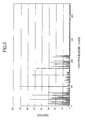
- Figs.2 and 3 are diagrams for explaining improvement of encryption strength achieved by the stream enciphering method of the present invention.
- ASCII code which is one of character system for expressing characters and numerals, can express 128 characters including 96 7-bit capital/small alphabetic letters, numerals and special letters and 32 control characters.
- the head bit of 8 bits (1 byte) which is the basic processing unit of information for today's digital computer is always 0.
- the characters thereof are distributed only in front half portion (0-127) of 8-bit (0-255) while no characters are distributed in the remaining latter half portion (128-255).
- Fig.3 shows a distribution of appearance frequency of cryptographic code produced by stream-enciphering an alphabetic file expressed by ASCII code with one-to-one correspondence between plaintext code and cryptographic code by using 24 bits as the bit length L of the PN signal. This distribution is deviated to left half. Although the left half is mixed quite well, the third party can estimate that its original text is expressed in English easily.
- Fig.2 shows a distribution of appearance frequency of cryptographic code produced by stream-enciphering an alphabetic file expressed by ASCII code with one-to-one correspondence between plaintext code and cryptographic code like Fig.1, by using 23 bits as the bit length L of the PN signal.
- the cryptographic code is diffused and mixed throughout entire 8 bits (0-255). Consequently, it is impossible for the third party to estimate whether the original text is alphabetic, Japanese or numeral data from the distribution of appearance frequency of the cryptographic code.
- Fig.1 is a block diagram showing the structure of an embodiment of the cryptographic communication system of the present invention.
- the cryptographic communication system 11 is so constructed as to be capable of carrying out cryptographic communication of information between a transmitter side and a receiver side.
- the transmitter side comprises a plaintext storage means 13 for storing a plaintext which is a secrecy object by each basic processing unit, a transmitter side PN signal storage means 15 for storing the PN signal which has a contradictory cycle to the basic processing unit of the plaintext code, an enciphering means 17 for generating cryptographic code by carrying out exclusive-OR operations to the plaintext code stored in the plaintext storage means 13 with the PN signal stored in the transmitter side PN signal storage means 15 and a transmitting means 19 for transmitting the cryptographic code generated by the enciphering means 17 to the receiver side.
- the receiver side comprises a receiving means 21 for receiving the cryptographic code transmitted from the transmitting means 19, a cipher text storage means 23 for storing the cryptographic code by each basic processing unit received by the receiving means 21, a receiver side PN signal storage means 25 for storing the same PN signal as the PN signal stored in the transmitter side PN signal storage means 15, and a deciphering means 27 for deciphering the cryptographic code to original plaintext code by carrying out exclusive-OR operations by obtaining synchronism between the cryptographic code stored in the cipher text storage means 23 and the PN signal stored in the receiver side PN signal storage means 25.
- the enciphering means 17 carries out exclusive-OR operations between the plaintext code stored in the plaintext storage means 13 and the PN signal stored in the transmitter side PN signal storage means 15 so as to generate the cryptographic code.
- the transmitting means 19 transmits the cryptographic code generated by the enciphering means 17 to the receiving side.
- the receiving means 21 receives the cryptographic code transmitted from the transmitting means 19.
- the cipher text storage means 23 stores the cryptographic code by each basic processing unit received by the receiving means 21.
- the deciphering means 27 carries out exclusive-OR operations by obtaining synchronism between the cryptographic code stored in the cipher test storage means 23 and the same PN signal as the PN signal in the transmitter side PN signal storage means 15, stored in the receiving side PN signal storage means 25 so as to restore the cryptographic code to plaintext code.
- the PN signal which takes an important role in enciphering, it is possible to generate a binary code string using a conventionally well known pseudorandom number generation method and employ a signal string obtained by cutting out a predetermined bit length suitable for achieving a predetermined object of the present invention from the generated binary code string.
- the PN signal is not limited to the above described example, but it is possible to cut out a code string of an appropriate bit length, from a binary code string obtained by two-level-encoding, through a 1-bit quantizer (AD converter), an output of a flip-flop loop through a CMOS switch in a one-dimensional mapping circuit for generating chaos, thereby to use the code string as the PN signal.
- a chaos string starting from an initial value may be used as the cycle signal of the PN signal as it is.
- a code string having an appropriate bit length from the obtained binary code string can be employed as the PN signal.
- ASCII code is exemplified as code system of plaintext code
- the present invention is not restricted to this embodiment, but it is needless to say that code system including ISO code, EBCDI code, JIS code or Japanese Kanji character JIS code may be employed appropriately.
Landscapes
- Engineering & Computer Science (AREA)
- Computer Security & Cryptography (AREA)
- Computer Networks & Wireless Communication (AREA)
- Signal Processing (AREA)
- Storage Device Security (AREA)
- Small-Scale Networks (AREA)
- Communication Control (AREA)
- Selective Calling Equipment (AREA)
Abstract
Description
Claims (3)
- A stream enciphering method for generating a cryptographic code by carrying out exclusive-OR operations between a plaintext code which is a secrecy object and a PN signal, wherein a cycle contradictory to the basic processing unit of said plaintext code is employed as a cycle of said PN signal.
- A deciphering method for deciphering a cryptographic code to a plaintext code which is a secrecy object, the cryptographic code being enciphered by a stream enciphering method for generating the cryptographic code by carrying out exclusive-OR operations between the plaintext code and a PN signal having a cycle contradictory to a basic processing unit of said plaintext code, wherein
said cryptographic code is restored to an original plaintext code by carrying out exclusive-OR operations by obtaining synchronism between said cryptographic code and a same PN signal as said PN signal. - A cryptographic communication system (11) constituted so as to be capable of achieving cryptographic communication between a transmitter side and a receiver side, whereinsaid transmitter side comprises:a plaintext storage means (13) for storing a plaintext code which is a secrecy object by each basic processing unit;a transmitter side PN signal storage means (15) for storing a PN signal which has a contradictory cycle to the basic processing unit of said plaintext code;an enciphering means (17) for generating a cryptographic code by carrying out exclusive-OR operations between the plaintext code stored in said plaintext storage means (13) and the PN signal stored in said transmitter side PN signal storage means (15); anda transmitting means (19) for transmitting the cryptographic code generated by said enciphering means (17) to the receiver side, andsaid receiver side comprises:a receiving means (21) for receiving the cryptographic code transmitted from said transmitting means (19);a cipher text storage means (23) for storing the cryptographic code received by said receiving means (21) by each basic processing unit;a receiver side PN signal storage means (25) for storing a same PN signal as the PN signal stored in said transmitter side PN signal storage means (15); anda deciphering means (27) for deciphering the cryptographic code to an original plaintext code by carrying out exclusive-OR operations by obtaining synchronism between the cryptographic code stored in said cipher text storage means (23) and the PN signal stored in said receiver side PN signal storage means (25).
Applications Claiming Priority (2)
| Application Number | Priority Date | Filing Date | Title |
|---|---|---|---|
| JP2000100909A JP2001285276A (en) | 2000-04-03 | 2000-04-03 | Stream encryption method, decryption method, and encryption communication system |
| JP2000100909 | 2000-04-03 |
Publications (3)
| Publication Number | Publication Date |
|---|---|
| EP1143657A2 true EP1143657A2 (en) | 2001-10-10 |
| EP1143657A3 EP1143657A3 (en) | 2002-09-04 |
| EP1143657B1 EP1143657B1 (en) | 2005-01-12 |
Family
ID=18615050
Family Applications (1)
| Application Number | Title | Priority Date | Filing Date |
|---|---|---|---|
| EP01107753A Expired - Lifetime EP1143657B1 (en) | 2000-04-03 | 2001-04-03 | Stream enciphering method, deciphering method and cryptographic communication system |
Country Status (4)
| Country | Link |
|---|---|
| US (1) | US20020044652A1 (en) |
| EP (1) | EP1143657B1 (en) |
| JP (1) | JP2001285276A (en) |
| DE (1) | DE60108291T2 (en) |
Families Citing this family (2)
| Publication number | Priority date | Publication date | Assignee | Title |
|---|---|---|---|---|
| EP2882117B1 (en) * | 2012-07-31 | 2017-07-05 | Kuang-Chi Intelligent Photonic Technology Ltd. | Visible light encryption method, decryption method, communication device and communication system |
| CN111371751B (en) * | 2020-02-24 | 2022-06-14 | 天元大数据信用管理有限公司 | File stream byte group data encryption and network transmission method |
Family Cites Families (8)
| Publication number | Priority date | Publication date | Assignee | Title |
|---|---|---|---|---|
| US3789377A (en) * | 1972-05-26 | 1974-01-29 | Lockheed Electronics Co | Pseudo-random sequence synchronization for magnetic recording system |
| US3978449A (en) * | 1975-01-27 | 1976-08-31 | Computer Transmission Corporation | Method and apparatus for in-band signalling in data transmission |
| US5060265A (en) * | 1990-07-23 | 1991-10-22 | Motorola, Inc. | Method of protecting a linear feedback shift register (LFSR) output signal |
| KR100326312B1 (en) * | 1994-06-17 | 2002-06-22 | 윤종용 | Synchronous transmission and reception device of spread spectrum communication method |
| US6014445A (en) * | 1995-10-23 | 2000-01-11 | Kabushiki Kaisha Toshiba | Enciphering/deciphering apparatus and method incorporating random variable and keystream generation |
| US6044388A (en) * | 1997-05-15 | 2000-03-28 | International Business Machine Corporation | Pseudorandom number generator |
| JP2000048478A (en) * | 1998-05-26 | 2000-02-18 | Yamaha Corp | Digital copy control method, and device using the method |
| US6760440B1 (en) * | 1999-12-11 | 2004-07-06 | Honeywell International Inc. | One's complement cryptographic combiner |
-
2000
- 2000-04-03 JP JP2000100909A patent/JP2001285276A/en active Pending
-
2001
- 2001-04-02 US US09/822,459 patent/US20020044652A1/en not_active Abandoned
- 2001-04-03 EP EP01107753A patent/EP1143657B1/en not_active Expired - Lifetime
- 2001-04-03 DE DE60108291T patent/DE60108291T2/en not_active Expired - Lifetime
Also Published As
| Publication number | Publication date |
|---|---|
| DE60108291D1 (en) | 2005-02-17 |
| EP1143657A3 (en) | 2002-09-04 |
| DE60108291T2 (en) | 2005-12-22 |
| EP1143657B1 (en) | 2005-01-12 |
| US20020044652A1 (en) | 2002-04-18 |
| JP2001285276A (en) | 2001-10-12 |
Similar Documents
| Publication | Publication Date | Title |
|---|---|---|
| US5193115A (en) | Pseudo-random choice cipher and method | |
| AU2008327506B2 (en) | Method and system for encryption of data | |
| US7224795B2 (en) | Variable-length key cryptosystem | |
| KR100657062B1 (en) | Information encryption method and apparatus for realizing this method | |
| US6370247B1 (en) | Hash value generating method and device, data encryption method and device, data decryption method and device | |
| US5483598A (en) | Message encryption using a hash function | |
| US5363447A (en) | Method for loading encryption keys into secure transmission devices | |
| US20070174374A1 (en) | Pseudorandom number generator and pseudorandom number generation program | |
| CN104243149A (en) | Encrypting and decrypting method, device and server | |
| US20020159588A1 (en) | Cryptography with unconditional security for the internet, commercial intranets, and data storage | |
| WO1994017613A1 (en) | Random sum cipher system and method | |
| US8290160B1 (en) | Method and apparatus for secured facsimile transmission | |
| JP2003516659A (en) | One's complement crypto combiner | |
| EP1143657B1 (en) | Stream enciphering method, deciphering method and cryptographic communication system | |
| EP0886399A2 (en) | Hash value generating method and device, data encryption method and device, data decryption method and device | |
| US5764771A (en) | Method for processing a digital signal in a so-called secure communication system and use of this method for access control and/or binary signature | |
| JP2005114870A (en) | Cryptographic communication system | |
| JPH04335730A (en) | Random ciphering communication system | |
| EP1421548B1 (en) | Encryption protocol | |
| US20080232585A1 (en) | Method for Code Generation | |
| JPH0993242A (en) | Data transmitter-receiver | |
| KR20020051597A (en) | Data encryption system and its method using asymmetric key encryption algorithm | |
| JP4570381B2 (en) | Electronic data transmission system and electronic data transmission method | |
| CN110519055B (en) | Method and device for image comparison encryption and decryption algorithm | |
| CN114143022A (en) | Data encryption method, data transmission method, data decryption method and related devices |
Legal Events
| Date | Code | Title | Description |
|---|---|---|---|
| PUAI | Public reference made under article 153(3) epc to a published international application that has entered the european phase |
Free format text: ORIGINAL CODE: 0009012 |
|
| 17P | Request for examination filed |
Effective date: 20010403 |
|
| AK | Designated contracting states |
Kind code of ref document: A2 Designated state(s): AT BE CH CY DE DK ES FI FR GB GR IE IT LI LU MC NL PT SE TR |
|
| AX | Request for extension of the european patent |
Free format text: AL;LT;LV;MK;RO;SI |
|
| PUAL | Search report despatched |
Free format text: ORIGINAL CODE: 0009013 |
|
| AK | Designated contracting states |
Kind code of ref document: A3 Designated state(s): AT BE CH CY DE DK ES FI FR GB GR IE IT LI LU MC NL PT SE TR |
|
| AX | Request for extension of the european patent |
Free format text: AL;LT;LV;MK;RO;SI |
|
| AKX | Designation fees paid |
Designated state(s): DE FR GB |
|
| 17Q | First examination report despatched |
Effective date: 20030410 |
|
| GRAP | Despatch of communication of intention to grant a patent |
Free format text: ORIGINAL CODE: EPIDOSNIGR1 |
|
| GRAS | Grant fee paid |
Free format text: ORIGINAL CODE: EPIDOSNIGR3 |
|
| GRAA | (expected) grant |
Free format text: ORIGINAL CODE: 0009210 |
|
| AK | Designated contracting states |
Kind code of ref document: B1 Designated state(s): DE FR GB |
|
| REG | Reference to a national code |
Ref country code: GB Ref legal event code: FG4D |
|
| REF | Corresponds to: |
Ref document number: 60108291 Country of ref document: DE Date of ref document: 20050217 Kind code of ref document: P |
|
| REG | Reference to a national code |
Ref country code: IE Ref legal event code: FG4D |
|
| PLBE | No opposition filed within time limit |
Free format text: ORIGINAL CODE: 0009261 |
|
| STAA | Information on the status of an ep patent application or granted ep patent |
Free format text: STATUS: NO OPPOSITION FILED WITHIN TIME LIMIT |
|
| ET | Fr: translation filed | ||
| 26N | No opposition filed |
Effective date: 20051013 |
|
| REG | Reference to a national code |
Ref country code: FR Ref legal event code: PLFP Year of fee payment: 15 |
|
| PGFP | Annual fee paid to national office [announced via postgrant information from national office to epo] |
Ref country code: DE Payment date: 20150331 Year of fee payment: 15 Ref country code: GB Payment date: 20150401 Year of fee payment: 15 |
|
| PGFP | Annual fee paid to national office [announced via postgrant information from national office to epo] |
Ref country code: FR Payment date: 20150408 Year of fee payment: 15 |
|
| REG | Reference to a national code |
Ref country code: DE Ref legal event code: R119 Ref document number: 60108291 Country of ref document: DE |
|
| GBPC | Gb: european patent ceased through non-payment of renewal fee |
Effective date: 20160403 |
|
| REG | Reference to a national code |
Ref country code: FR Ref legal event code: ST Effective date: 20161230 |
|
| PG25 | Lapsed in a contracting state [announced via postgrant information from national office to epo] |
Ref country code: GB Free format text: LAPSE BECAUSE OF NON-PAYMENT OF DUE FEES Effective date: 20160403 Ref country code: FR Free format text: LAPSE BECAUSE OF NON-PAYMENT OF DUE FEES Effective date: 20160502 Ref country code: DE Free format text: LAPSE BECAUSE OF NON-PAYMENT OF DUE FEES Effective date: 20161101 |