EP1142733A2 - Vehicle wheel suspension - Google Patents
Vehicle wheel suspension Download PDFInfo
- Publication number
- EP1142733A2 EP1142733A2 EP01303210A EP01303210A EP1142733A2 EP 1142733 A2 EP1142733 A2 EP 1142733A2 EP 01303210 A EP01303210 A EP 01303210A EP 01303210 A EP01303210 A EP 01303210A EP 1142733 A2 EP1142733 A2 EP 1142733A2
- Authority
- EP
- European Patent Office
- Prior art keywords
- resilient
- vehicle
- arrangement
- torsion
- resilience
- Prior art date
- Legal status (The legal status is an assumption and is not a legal conclusion. Google has not performed a legal analysis and makes no representation as to the accuracy of the status listed.)
- Withdrawn
Links
- 239000000725 suspension Substances 0.000 title claims abstract description 41
- 230000004048 modification Effects 0.000 claims abstract description 8
- 238000012986 modification Methods 0.000 claims abstract description 8
- 239000011521 glass Substances 0.000 abstract description 3
- 238000000034 method Methods 0.000 abstract description 3
- 238000007747 plating Methods 0.000 abstract description 3
- 238000009434 installation Methods 0.000 description 2
- 239000000463 material Substances 0.000 description 2
- 239000006096 absorbing agent Substances 0.000 description 1
- 230000003247 decreasing effect Effects 0.000 description 1
- 238000012938 design process Methods 0.000 description 1
- 230000001681 protective effect Effects 0.000 description 1
- 230000035939 shock Effects 0.000 description 1
Images

Classifications
-
- B—PERFORMING OPERATIONS; TRANSPORTING
- B60—VEHICLES IN GENERAL
- B60G—VEHICLE SUSPENSION ARRANGEMENTS
- B60G11/00—Resilient suspensions characterised by arrangement, location or kind of springs
- B60G11/32—Resilient suspensions characterised by arrangement, location or kind of springs having springs of different kinds
- B60G11/48—Resilient suspensions characterised by arrangement, location or kind of springs having springs of different kinds not including leaf springs
- B60G11/64—Resilient suspensions characterised by arrangement, location or kind of springs having springs of different kinds not including leaf springs having both torsion-bar springs and fluid springs
-
- B—PERFORMING OPERATIONS; TRANSPORTING
- B60—VEHICLES IN GENERAL
- B60G—VEHICLE SUSPENSION ARRANGEMENTS
- B60G11/00—Resilient suspensions characterised by arrangement, location or kind of springs
- B60G11/18—Resilient suspensions characterised by arrangement, location or kind of springs having torsion-bar springs only
-
- B—PERFORMING OPERATIONS; TRANSPORTING
- B60—VEHICLES IN GENERAL
- B60G—VEHICLE SUSPENSION ARRANGEMENTS
- B60G11/00—Resilient suspensions characterised by arrangement, location or kind of springs
- B60G11/32—Resilient suspensions characterised by arrangement, location or kind of springs having springs of different kinds
-
- B—PERFORMING OPERATIONS; TRANSPORTING
- B60—VEHICLES IN GENERAL
- B60G—VEHICLE SUSPENSION ARRANGEMENTS
- B60G17/00—Resilient suspensions having means for adjusting the spring or vibration-damper characteristics, for regulating the distance between a supporting surface and a sprung part of vehicle or for locking suspension during use to meet varying vehicular or surface conditions, e.g. due to speed or load
- B60G17/015—Resilient suspensions having means for adjusting the spring or vibration-damper characteristics, for regulating the distance between a supporting surface and a sprung part of vehicle or for locking suspension during use to meet varying vehicular or surface conditions, e.g. due to speed or load the regulating means comprising electric or electronic elements
- B60G17/0152—Resilient suspensions having means for adjusting the spring or vibration-damper characteristics, for regulating the distance between a supporting surface and a sprung part of vehicle or for locking suspension during use to meet varying vehicular or surface conditions, e.g. due to speed or load the regulating means comprising electric or electronic elements characterised by the action on a particular type of suspension unit
-
- B—PERFORMING OPERATIONS; TRANSPORTING
- B60—VEHICLES IN GENERAL
- B60G—VEHICLE SUSPENSION ARRANGEMENTS
- B60G17/00—Resilient suspensions having means for adjusting the spring or vibration-damper characteristics, for regulating the distance between a supporting surface and a sprung part of vehicle or for locking suspension during use to meet varying vehicular or surface conditions, e.g. due to speed or load
- B60G17/02—Spring characteristics, e.g. mechanical springs and mechanical adjusting means
-
- B—PERFORMING OPERATIONS; TRANSPORTING
- B60—VEHICLES IN GENERAL
- B60G—VEHICLE SUSPENSION ARRANGEMENTS
- B60G2202/00—Indexing codes relating to the type of spring, damper or actuator
- B60G2202/10—Type of spring
- B60G2202/13—Torsion spring
- B60G2202/132—Torsion spring comprising a longitudinal torsion bar and/or tube
-
- B—PERFORMING OPERATIONS; TRANSPORTING
- B60—VEHICLES IN GENERAL
- B60G—VEHICLE SUSPENSION ARRANGEMENTS
- B60G2202/00—Indexing codes relating to the type of spring, damper or actuator
- B60G2202/10—Type of spring
- B60G2202/13—Torsion spring
- B60G2202/134—Torsion spring comprising a transversal torsion bar and/or tube
-
- B—PERFORMING OPERATIONS; TRANSPORTING
- B60—VEHICLES IN GENERAL
- B60G—VEHICLE SUSPENSION ARRANGEMENTS
- B60G2202/00—Indexing codes relating to the type of spring, damper or actuator
- B60G2202/10—Type of spring
- B60G2202/15—Fluid spring
- B60G2202/152—Pneumatic spring
-
- B—PERFORMING OPERATIONS; TRANSPORTING
- B60—VEHICLES IN GENERAL
- B60G—VEHICLE SUSPENSION ARRANGEMENTS
- B60G2202/00—Indexing codes relating to the type of spring, damper or actuator
- B60G2202/10—Type of spring
- B60G2202/15—Fluid spring
- B60G2202/152—Pneumatic spring
- B60G2202/1524—Pneumatic spring with two air springs per wheel, arranged before and after the wheel axis
-
- B—PERFORMING OPERATIONS; TRANSPORTING
- B60—VEHICLES IN GENERAL
- B60G—VEHICLE SUSPENSION ARRANGEMENTS
- B60G2206/00—Indexing codes related to the manufacturing of suspensions: constructional features, the materials used, procedures or tools
- B60G2206/01—Constructional features of suspension elements, e.g. arms, dampers, springs
- B60G2206/90—Maintenance
- B60G2206/91—Assembly procedures
- B60G2206/911—Assembly procedures using a modification kit
-
- B—PERFORMING OPERATIONS; TRANSPORTING
- B60—VEHICLES IN GENERAL
- B60G—VEHICLE SUSPENSION ARRANGEMENTS
- B60G2206/00—Indexing codes related to the manufacturing of suspensions: constructional features, the materials used, procedures or tools
- B60G2206/01—Constructional features of suspension elements, e.g. arms, dampers, springs
- B60G2206/90—Maintenance
- B60G2206/99—Suspension element selection procedure depending on loading or performance requirements, e.g. selection of damper, spring or bush
-
- B—PERFORMING OPERATIONS; TRANSPORTING
- B60—VEHICLES IN GENERAL
- B60G—VEHICLE SUSPENSION ARRANGEMENTS
- B60G2500/00—Indexing codes relating to the regulated action or device
- B60G2500/20—Spring action or springs
-
- B—PERFORMING OPERATIONS; TRANSPORTING
- B60—VEHICLES IN GENERAL
- B60G—VEHICLE SUSPENSION ARRANGEMENTS
- B60G2600/00—Indexing codes relating to particular elements, systems or processes used on suspension systems or suspension control systems
- B60G2600/18—Automatic control means
- B60G2600/182—Active control means
Definitions
- the present invention relates to vehicle wheel suspension arrangements.
- Motor vehicles conventionally have ground engaging wheels mounted on the vehicle by means of a resilient suspension arrangement, many variations of which have been proposed.
- a rigid member such as a wishbone
- a spring which may be a mechanical spring, pneumatic spring or other resilient member is attached to act between the rigid member and the vehicle chassis or body, thereby providing resilience in the mounting of the wheel on the vehicle.
- the characteristics of the suspension arrangement can be further modified in other ways, such as by the installation of a shock absorber unit.
- a vehicle which is modified from the original design, in such a way as to produce a significant increase in vehicle weight, such as by the installation of armour plating within the body panels of the vehicle, will have a greater weight than the weight for which the suspension was originally designed and the suspension will thus not behave in the manner intended by the designer, particularly if the suspension is an automatic system.
- the present invention provides a vehicle comprising a plurality of ground engaging wheels, each mounted on the vehicle by means of a resilient suspension arrangement strong enough to provide adequate support for the vehicle during use, the vehicle being modified and thereby having a substantially increased weight, and the vehicle being provided as part of the modification with a second resilient arrangement connected between the vehicle body and the wheel to provide increased resilient resistance in the suspension arrangement, for bearing the increased weight.
- the second resilient arrangement may comprise a linear resilient device such as a mechanical or gas spring or the like, or may comprise a torsion member.
- the torsion member may be an elongate member acting in torsion between a moveable component of the resilient suspension arrangement, and a fixed position relative to the vehicle body, such as a chassis member.
- the second resilient arrangement preferably acts between the vehicle and a rigid member on which the wheel is mounted, such as a wishbone arrangement.
- the resilient suspension arrangement may comprise a first resilient member having adjustable resilience.
- the resilience may be adjustable while the vehicle is in motion.
- the suspension arrangement may further comprise control means operable to provide automatic adjustment of the first resilient member.
- the invention also provides a vehicle wheel suspension arrangement comprising a first resilient member operable to provide resilience in the mounting of a ground engaging wheel on the vehicle, and a second resilient arrangement which, in use, provides additional resilience in the mounting, the wheel being moveable relative to the remainder of the vehicle against the combined resilience of the first and second resilient members.
- the second resilient arrangement may comprise a linear resilient device such as a mechanical or gas spring or the like, or may comprise a torsion member.
- the torsion member may be an elongate member acting in torsion between a moveable component of the resilient suspension arrangement, and a fixed position relative to the vehicle body, such as a chassis member.
- the second resilient arrangement preferably acts between the vehicle and a rigid member on which the wheel is mounted, such as a wishbone arrangement.
- the resilient suspension arrangement may comprise a first resilient member having adjustable resilience.
- the resilience may be adjustable while the vehicle is in motion.
- the suspension arrangement may further comprise control means operable to provide automatic adjustment of the first resilient member.
- a vehicle which in this example is in the form of a car.
- the body of the car is indicated in ghosted lines.
- the car has four ground engaging wheels 12 of which two are visible in Fig. 1.
- Each wheel 12 is associated with a stub axle 14 (which may alternatively be a wishbone arrangement) extending generally transversely of the car 10 and carrying the wheel 12 at the outermost end of the axle 14.
- the outermost end of the stub axle 14 will rise and fall, relative to the remainder of the car 10, as the wheel 12 rises or falls, for instance to accommodate unevenness in the surface beneath the car 10.
- a resilient arrangement 16 such as a mechanical or gas spring is provided, acting between the stub axle 14 and a fixed location on the car 10, so that any tendency for the wheel 12 to rise relative to the car 10 must overcome the resistance provided by the spring 16, while the spring 16 will provide a restoring force tending to move the wheel 12 back down when the cause of the movement has been removed.
- the car 10 is conventional.
- the car 10 has been modified in a manner which increases the weight of the car body.
- the car may have had armour plating and armoured glass added, for the protection of the VIP occupants.
- a sheet of armour plate material 18 may be incorporated within a vehicle panel, as illustrated by broken lines in Fig. 1, as part of this modification.
- the nature of armour plate material and protective glass is such that the modification will substantially increase the weight of the car 10, perhaps adding as much as 1.5 tonnes to the weight of a 2 tonne car. Consequently, the weight supported by the suspension arrangements will be significantly different to the weight assumed by the designer of those arrangements.
- An algorithm on which this control is based will implicitly or explicitly incorporate reference to the expected weight of the car 10 and will thus become inappropriate once that weight has significantly changed.
- the remaining features illustrated in the drawings are incorporated by virtue of the invention, in order to accommodate these changes.
- the springs 16 are not the only components which provide resilient resistance against movement of the stub axle 14. Additional springs 20 are installed, acting between the stub axles 14 and fixed locations on the vehicle 10, in parallel with the springs 16. Furthermore, the inboard end of the stub axle 14 is not pivotally connected in conventional manner to a fixed point on the vehicle chassis, but is carried on one end of a torsion bar 22.
- the torsion bar 22 runs in a longitudinal direction away from the stub axle 14, to a position 24 fixed on a chassis member 26.
- the torsion bar 22 may be splined to engage complimentary splines within a socket in the chassis member 26, or may be alternatively connected to prevent the fixed end of the torsion bar 22 turning relative to the chassis member 26.
- the other end of the torsion bar 22 is fixed to the stub axle 14, such as by means of interengaging splines so that at that end, the torsion bar 22 provides a pivot mounting for the inboard end of the axle 14, and that end of the torsion bar 22 must turn as the wheel 12 moves up and down.
- the bar 22 will be under torsion, the amount of torsion experienced by the bar 22 being increased as the wheel 12 moves up relative to the car 10, and being decreased as the wheel moves down relative to the car 10.
- the torsion bar 22 provides a resilient bias, by means of the torsion, acting to press the wheel 12 downwardly relative to the car 10 and thus assisting the spring 16 in determining the overall characteristics of the suspension arrangement.
- the additional spring 20 and the torsion bar 22 may each be used without the other, or may both be used together. In the event that the torsion bar 22 is not used, the inboard end of the stub axle 14 would be pivotally connected with a fixed chassis member, in conventional manner.
- the design performance of the arrangement can be recovered and in particular, if the spring 16 is an automatically adjusted arrangement, the conditions under which it is operating will be restored to those for which is was designed, or substantially so, thus allowing the algorithm to be used to control the spring 16 in the manner which will be appropriate.
- Fig. 2 also shows a further torsion bar 28, which would preferably be used instead of the torsion bar 22, but could be used in addition to the bar 22.
- the torsion bar 28 extends transversely of the car 10, i.e. generally parallel with the rotation axis of the wheel 12.
- the end of the bar 28 remote from the wheel 12 is fixed at a position 30 against rotation relative to the chassis, such as by splined engagement with a chassis member 32 in the manner described above in relation to the chassis member 26 and bar 22.
- the other end of the bar 28 carries a lever 34 splined to the bar 28.
- the free end of the bar 28 may also be supported by a clearance fit through another chassis member 36, allowing free rotation relative to the member 36.
- the lever 34 extends away from the bar 28 to a position above the stub axle 14, where the lever 34 bends to occupy a position generally above and parallel with the axle 14.
- a link member 38 is attached to the lever 34 and axle 14 by pivot pins 40.
- vertical movement of the stub axle 14 is applied to the end of the lever 34 by the link 38, causing the torsion bar 28 to be twisted, by the lever 34 acting in the manner of a crank. Consequently, the torsion experienced by the bar 28 is caused to change as the wheel 12 moves up and down.
- the torsion bar 28 is therefore again providing a pre-loading to the stub axle 14, in the manner which has been described.
Landscapes
- Engineering & Computer Science (AREA)
- Mechanical Engineering (AREA)
- Vehicle Body Suspensions (AREA)
- Springs (AREA)
Abstract
Description
- The present invention relates to vehicle wheel suspension arrangements.
- Motor vehicles conventionally have ground engaging wheels mounted on the vehicle by means of a resilient suspension arrangement, many variations of which have been proposed. Typically, a rigid member, such as a wishbone, will be pivotally attached to the vehicle chassis at one end of the member, carrying the wheel at the other end. A spring, which may be a mechanical spring, pneumatic spring or other resilient member is attached to act between the rigid member and the vehicle chassis or body, thereby providing resilience in the mounting of the wheel on the vehicle. The characteristics of the suspension arrangement can be further modified in other ways, such as by the installation of a shock absorber unit.
- Traditional arrangements which use mechanical springs have fixed characteristics chosen as part of the design process of the vehicle. More recently, it has been proposed to use adjustable springs, such as air filled springs, the internal pressure of which can be varied to change the spring characteristics. The springs may be adjusted either by manual intervention by the driver, or automatically by a control system which monitors driving conditions, driving techniques or the like.
- A vehicle which is modified from the original design, in such a way as to produce a significant increase in vehicle weight, such as by the installation of armour plating within the body panels of the vehicle, will have a greater weight than the weight for which the suspension was originally designed and the suspension will thus not behave in the manner intended by the designer, particularly if the suspension is an automatic system.
- The present invention provides a vehicle comprising a plurality of ground engaging wheels, each mounted on the vehicle by means of a resilient suspension arrangement strong enough to provide adequate support for the vehicle during use, the vehicle being modified and thereby having a substantially increased weight, and the vehicle being provided as part of the modification with a second resilient arrangement connected between the vehicle body and the wheel to provide increased resilient resistance in the suspension arrangement, for bearing the increased weight.
- The second resilient arrangement may comprise a linear resilient device such as a mechanical or gas spring or the like, or may comprise a torsion member. The torsion member may be an elongate member acting in torsion between a moveable component of the resilient suspension arrangement, and a fixed position relative to the vehicle body, such as a chassis member. There may be an intermediate member connected between the torsion member and the moveable member of the suspension arrangement, whereby to cause movement of the moveable member to change to torsion applied to the torsion member.
- The second resilient arrangement preferably acts between the vehicle and a rigid member on which the wheel is mounted, such as a wishbone arrangement.
- The resilient suspension arrangement may comprise a first resilient member having adjustable resilience. The resilience may be adjustable while the vehicle is in motion. The suspension arrangement may further comprise control means operable to provide automatic adjustment of the first resilient member.
- The invention also provides a vehicle wheel suspension arrangement comprising a first resilient member operable to provide resilience in the mounting of a ground engaging wheel on the vehicle, and a second resilient arrangement which, in use, provides additional resilience in the mounting, the wheel being moveable relative to the remainder of the vehicle against the combined resilience of the first and second resilient members.
- The second resilient arrangement may comprise a linear resilient device such as a mechanical or gas spring or the like, or may comprise a torsion member. The torsion member may be an elongate member acting in torsion between a moveable component of the resilient suspension arrangement, and a fixed position relative to the vehicle body, such as a chassis member. There may be an intermediate member connected between the torsion member and the moveable member of the suspension arrangement, whereby to cause movement of the moveable member to change to torsion applied to the torsion member.
- The second resilient arrangement preferably acts between the vehicle and a rigid member on which the wheel is mounted, such as a wishbone arrangement.
- The resilient suspension arrangement may comprise a first resilient member having adjustable resilience. The resilience may be adjustable while the vehicle is in motion. The suspension arrangement may further comprise control means operable to provide automatic adjustment of the first resilient member.
- Embodiments of the present invention will now be described in more detail, by way of example only, and with reference to the accompanying drawings, in which:
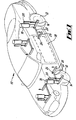
- Fig. 1 is a highly schematic perspective view of a vehicle which incorporates a suspension arrangement according to the present invention; and
- Fig. 2 is a highly schematic perspective view of the suspension arrangement for a single wheel of the vehicle of Fig. 1, illustrating two alternative embodiments of the invention.
-
- Turning to Fig. 1, there is shown a vehicle which in this example is in the form of a car. The body of the car is indicated in ghosted lines. The car has four ground
engaging wheels 12 of which two are visible in Fig. 1. Eachwheel 12 is associated with a stub axle 14 (which may alternatively be a wishbone arrangement) extending generally transversely of thecar 10 and carrying thewheel 12 at the outermost end of theaxle 14. The outermost end of thestub axle 14 will rise and fall, relative to the remainder of thecar 10, as thewheel 12 rises or falls, for instance to accommodate unevenness in the surface beneath thecar 10. In order to control this motion, to provide desired ride characteristics for thecar 10, aresilient arrangement 16, such as a mechanical or gas spring is provided, acting between thestub axle 14 and a fixed location on thecar 10, so that any tendency for thewheel 12 to rise relative to thecar 10 must overcome the resistance provided by thespring 16, while thespring 16 will provide a restoring force tending to move thewheel 12 back down when the cause of the movement has been removed. - To the extent so far described, the
car 10 is conventional. However, thecar 10 has been modified in a manner which increases the weight of the car body. For instance, the car may have had armour plating and armoured glass added, for the protection of the VIP occupants. For instance, a sheet ofarmour plate material 18 may be incorporated within a vehicle panel, as illustrated by broken lines in Fig. 1, as part of this modification. The nature of armour plate material and protective glass is such that the modification will substantially increase the weight of thecar 10, perhaps adding as much as 1.5 tonnes to the weight of a 2 tonne car. Consequently, the weight supported by the suspension arrangements will be significantly different to the weight assumed by the designer of those arrangements. In particular, this presents a difficulty in the event that thesprings 16 are adjustable, such as air or gas filled springs whose pressure is automatically adjusted by a control system in order to accommodate differences in driving conditions, driving techniques or the like. An algorithm on which this control is based will implicitly or explicitly incorporate reference to the expected weight of thecar 10 and will thus become inappropriate once that weight has significantly changed. The remaining features illustrated in the drawings are incorporated by virtue of the invention, in order to accommodate these changes. - First, the
springs 16 are not the only components which provide resilient resistance against movement of thestub axle 14.Additional springs 20 are installed, acting between thestub axles 14 and fixed locations on thevehicle 10, in parallel with thesprings 16. Furthermore, the inboard end of thestub axle 14 is not pivotally connected in conventional manner to a fixed point on the vehicle chassis, but is carried on one end of atorsion bar 22. Thetorsion bar 22 runs in a longitudinal direction away from thestub axle 14, to aposition 24 fixed on achassis member 26. Thetorsion bar 22 may be splined to engage complimentary splines within a socket in thechassis member 26, or may be alternatively connected to prevent the fixed end of thetorsion bar 22 turning relative to thechassis member 26. In similar manner, the other end of thetorsion bar 22 is fixed to thestub axle 14, such as by means of interengaging splines so that at that end, thetorsion bar 22 provides a pivot mounting for the inboard end of theaxle 14, and that end of thetorsion bar 22 must turn as thewheel 12 moves up and down. In consequence, thebar 22 will be under torsion, the amount of torsion experienced by thebar 22 being increased as thewheel 12 moves up relative to thecar 10, and being decreased as the wheel moves down relative to thecar 10. Thus, thetorsion bar 22 provides a resilient bias, by means of the torsion, acting to press thewheel 12 downwardly relative to thecar 10 and thus assisting thespring 16 in determining the overall characteristics of the suspension arrangement. - The
additional spring 20 and thetorsion bar 22 may each be used without the other, or may both be used together. In the event that thetorsion bar 22 is not used, the inboard end of thestub axle 14 would be pivotally connected with a fixed chassis member, in conventional manner. - The introduction of additional
resilient components spring 20, the torsion strength of thebar 22, and the relative positions of the various components, the length of thestub axle 14, size of the wheel and the like. Nevertheless, the additional components can be thought of as simply providing a pre-loading of the suspension arrangement in order to support all or much of the additional weight given to thecar 10 during the modification. Thus, thespring 16 is then required only to support the unmodified weight of thecar 10, which is the task for which thespring 16 was designed. Accordingly, the design performance of the arrangement can be recovered and in particular, if thespring 16 is an automatically adjusted arrangement, the conditions under which it is operating will be restored to those for which is was designed, or substantially so, thus allowing the algorithm to be used to control thespring 16 in the manner which will be appropriate. - Fig. 2 also shows a
further torsion bar 28, which would preferably be used instead of thetorsion bar 22, but could be used in addition to thebar 22. Thetorsion bar 28 extends transversely of thecar 10, i.e. generally parallel with the rotation axis of thewheel 12. The end of thebar 28 remote from thewheel 12 is fixed at aposition 30 against rotation relative to the chassis, such as by splined engagement with achassis member 32 in the manner described above in relation to thechassis member 26 andbar 22. The other end of thebar 28 carries alever 34 splined to thebar 28. The free end of thebar 28 may also be supported by a clearance fit through anotherchassis member 36, allowing free rotation relative to themember 36. - The
lever 34 extends away from thebar 28 to a position above thestub axle 14, where thelever 34 bends to occupy a position generally above and parallel with theaxle 14. Alink member 38 is attached to thelever 34 andaxle 14 by pivot pins 40. In consequence, vertical movement of thestub axle 14 is applied to the end of thelever 34 by thelink 38, causing thetorsion bar 28 to be twisted, by thelever 34 acting in the manner of a crank. Consequently, the torsion experienced by thebar 28 is caused to change as thewheel 12 moves up and down. Thetorsion bar 28 is therefore again providing a pre-loading to thestub axle 14, in the manner which has been described. - It will be apparent to the skilled man that many variations and modifications can be made to the apparatus described above, without departing from the scope of the present invention. In particular, alternative arrangements for resilient pre-loading of the suspension arrangements could be devised. Several pre-loading components could be used together, or separately, and the strength and characteristics of those components can be selected in order to set the final characteristics of the modified suspension. It is envisaged that the suspension arrangement associated with each ground engaging wheel would be modified in like manner, but it may be appropriate in some circumstances to modify each suspension arrangement in a different manner, such as if the modification to the vehicle results in an uneven weight distribution around the vehicle.
- Whilst endeavouring in the foregoing specification to draw attention to those features of the invention believed to be of particular importance it should be understood that the Applicant claims protection in respect of any patentable feature or combination of features hereinbefore referred to and/or shown in the drawings whether or not particular emphasis has been placed thereon.
Claims (24)
- A vehicle comprising a plurality of ground engaging wheels, each mounted on the vehicle by means of a resilient suspension arrangement strong enough to provide adequate support for the vehicle during use, the vehicle being modified and thereby having a substantially increased weight, and the vehicle being provided as part of the modification with a second resilient arrangement connected between the vehicle body and the wheel to provide increased resilient resistance in the suspension arrangement, for bearing the increased weight.
- A vehicle according to claim 1, wherein the second resilient arrangement comprises a linear resilient device.
- A vehicle according to claim 2, wherein the linear resilient device is a mechanical or gas spring.
- A vehicle according to claim 2, wherein the linear resilient device comprises a torsion member.
- A vehicle according to claim 4, wherein the torsion member is an elongate member acting in torsion between a moveable component of the resilient suspension arrangement, and a fixed position relative to the vehicle body.
- A vehicle according to claim 5, wherein the fixed position is provided on a chassis member.
- A vehicle according to any of claims 4 to 6, wherein an intermediate member is connected between the torsion member and the moveable member of the suspension arrangement, whereby to cause movement of the moveable member to change to torsion applied to the torsion member.
- A vehicle according to any preceding claim, wherein the second resilient arrangement acts between the vehicle and a rigid member on which the wheel is mounted.
- A vehicle according to claim 8, wherein the rigid member is a wishbone arrangement.
- A vehicle according to any preceding claim, wherein the resilient suspension arrangement comprises a first resilient member having adjustable resilience.
- A vehicle according to claim 10, wherein the resilience of the first resilient member is adjustable while the vehicle is in motion.
- A vehicle according to claim 10 or 11, wherein the suspension arrangement further comprises control means operable to provide automatic adjustment of the first resilient member.
- A vehicle wheel suspension arrangement comprising a first resilient member operable to provide resilience in the mounting of a ground engaging wheel on the vehicle, and a second resilient arrangement which, in use, provides additional resilience in the mounting, the wheel being moveable relative to the remainder of the vehicle against the combined resilience of the first and second resilient members.
- An arrangement according to claim 13, wherein the second resilient arrangement comprises a linear resilient device.
- An arrangement according to claim 14, wherein the resilient device is a mechanical or gas spring.
- An arrangement according to claim 14, wherein the resilient device comprises a torsion member.
- An arrangement according to claim 16, wherein the torsion member is an elongate member acting in torsion between a moveable component of the resilient suspension arrangement, and a fixed position relative to the vehicle body.
- An arrangement according to claim 17, wherein the fixed position is on a chassis member.
- An arrangement according to any of claims 16 to 18, comprising an intermediate member connected between the torsion member and the moveable member of the suspension arrangement, whereby to cause movement of the moveable member to change to torsion applied to the torsion member.
- An arrangement according to any of claims 13 to 19, wherein the second resilient arrangement acts between the vehicle and a rigid member on which the wheel is mounted.
- An arrangement according to claim 20, wherein the rigid member is a wishbone arrangement.
- An arrangement according to any of claims 13 to 21, wherein the resilient suspension arrangement comprises a first resilient member having adjustable resilience.
- An arrangement according to claim 22, wherein the resilience is adjustable while the vehicle is in motion.
- An arrangement according to claim 22 or 23, wherein the suspension arrangement further comprises control means operable to provide automatic adjustment of the first resilient member.
Applications Claiming Priority (2)
| Application Number | Priority Date | Filing Date | Title |
|---|---|---|---|
| GB0008568A GB2363594B (en) | 2000-04-07 | 2000-04-07 | Vehicle wheel suspension |
| GB0008568 | 2000-04-07 |
Publications (2)
| Publication Number | Publication Date |
|---|---|
| EP1142733A2 true EP1142733A2 (en) | 2001-10-10 |
| EP1142733A3 EP1142733A3 (en) | 2003-08-06 |
Family
ID=9889416
Family Applications (1)
| Application Number | Title | Priority Date | Filing Date |
|---|---|---|---|
| EP01303210A Withdrawn EP1142733A3 (en) | 2000-04-07 | 2001-04-05 | Vehicle wheel suspension |
Country Status (2)
| Country | Link |
|---|---|
| EP (1) | EP1142733A3 (en) |
| GB (1) | GB2363594B (en) |
Cited By (4)
| Publication number | Priority date | Publication date | Assignee | Title |
|---|---|---|---|---|
| WO2009134253A1 (en) * | 2008-04-30 | 2009-11-05 | Bombardier Recreational Products Inc. | Adjustable height suspension system |
| CN104129249A (en) * | 2014-05-27 | 2014-11-05 | 管中林 | Device for achieving rising, falling and damping of vehicle body through adjustment of torsion rod spring movement |
| EP3034905B1 (en) * | 2014-12-15 | 2018-07-11 | G + H Schallschutz GmbH | Spring system for oscillation insulating bearing |
| WO2020016083A1 (en) * | 2018-07-19 | 2020-01-23 | Deregallera Holdings Ltd | Suspension and steering systems for a vehicle |
Family Cites Families (9)
| Publication number | Priority date | Publication date | Assignee | Title |
|---|---|---|---|---|
| GB890876A (en) * | 1959-03-28 | 1962-03-07 | Porsche Ferdinand A | Improvements in and relating to springing systems |
| CH452364A (en) * | 1967-03-09 | 1968-05-31 | Avrona S A | Suspension device and use of this device |
| US3806151A (en) * | 1972-08-28 | 1974-04-23 | Cambria Spring Co | Spring suspension system for vehicle |
| DE3728120A1 (en) * | 1987-08-22 | 1989-03-02 | Bosch Gmbh Robert | PNEUMATIC SUSPENSION FOR MOTOR VEHICLES |
| JPH02117410A (en) * | 1988-10-27 | 1990-05-01 | Showa Mfg Co Ltd | Suspension spring constant variable mechanism |
| GB9112461D0 (en) * | 1991-06-10 | 1991-07-31 | Detroit Steel Products Co Inc | Vehicle suspension |
| US5540417A (en) * | 1993-08-02 | 1996-07-30 | Spencer; William W. | Adjustable coil spring assembly |
| US5464245A (en) * | 1994-08-08 | 1995-11-07 | The Boler Company | Suspension for light duty trucks |
| JPH10193939A (en) * | 1997-01-14 | 1998-07-28 | Mitsubishi Motors Corp | Independent suspension system for vehicles |
-
2000
- 2000-04-07 GB GB0008568A patent/GB2363594B/en not_active Expired - Fee Related
-
2001
- 2001-04-05 EP EP01303210A patent/EP1142733A3/en not_active Withdrawn
Non-Patent Citations (1)
| Title |
|---|
| None |
Cited By (5)
| Publication number | Priority date | Publication date | Assignee | Title |
|---|---|---|---|---|
| WO2009134253A1 (en) * | 2008-04-30 | 2009-11-05 | Bombardier Recreational Products Inc. | Adjustable height suspension system |
| CN104129249A (en) * | 2014-05-27 | 2014-11-05 | 管中林 | Device for achieving rising, falling and damping of vehicle body through adjustment of torsion rod spring movement |
| EP3034905B1 (en) * | 2014-12-15 | 2018-07-11 | G + H Schallschutz GmbH | Spring system for oscillation insulating bearing |
| WO2020016083A1 (en) * | 2018-07-19 | 2020-01-23 | Deregallera Holdings Ltd | Suspension and steering systems for a vehicle |
| US12187339B2 (en) | 2018-07-19 | 2025-01-07 | Deregallera Holdings Ltd | Suspension and steering systems for a vehicle |
Also Published As
| Publication number | Publication date |
|---|---|
| GB0008568D0 (en) | 2000-05-24 |
| EP1142733A3 (en) | 2003-08-06 |
| GB2363594A (en) | 2002-01-02 |
| GB2363594B (en) | 2003-09-17 |
Similar Documents
| Publication | Publication Date | Title |
|---|---|---|
| EP1795384B1 (en) | A vehicle wheel suspension assembly | |
| US5351986A (en) | Vehicle air suspension system | |
| US6540038B2 (en) | Vehicle cab suspension system | |
| US6386565B1 (en) | Traction system | |
| US4152011A (en) | Characteristic compensating device for air springs for automotive suspension use | |
| KR100316893B1 (en) | Torsion beam mount of suspension system for vehicle | |
| EP1142733A2 (en) | Vehicle wheel suspension | |
| EP2076422B1 (en) | Cab suspension system | |
| US20060208448A1 (en) | Vehicle suspension system and method | |
| US20020109325A1 (en) | Tri-link suspension system | |
| US6571903B2 (en) | Heavy duty truck suspension with drive axle | |
| AU2023336528A1 (en) | Axle structure for a utility vehicle chassis, comprising an axle bridge | |
| EP2076423A1 (en) | Cab suspension system | |
| KR100650321B1 (en) | Rear suspension of vehicle | |
| KR20010059224A (en) | Torsion beam mount of suspension system for vehicle | |
| JP3209467B2 (en) | Rear wheel suspension device for automobile | |
| KR100908175B1 (en) | Car Stabilizer Bar | |
| KR101273152B1 (en) | an air suspension for a vehicle | |
| KR20090062206A (en) | Car Axle Suspension | |
| US20080157565A1 (en) | Vehicle Cab Suspension | |
| US20210387501A1 (en) | Adjustable anti-roll bar arrangement | |
| KR20020036321A (en) | front wheel suspension for truck | |
| KR100217591B1 (en) | Vehicle rear suspension system with variable type supplementary leaf spring | |
| KR20080018542A (en) | Car rear wheel trailing arms | |
| KR20250105508A (en) | Tuning devic for supporting hehavior of lower arm of vehicle |
Legal Events
| Date | Code | Title | Description |
|---|---|---|---|
| PUAI | Public reference made under article 153(3) epc to a published international application that has entered the european phase |
Free format text: ORIGINAL CODE: 0009012 |
|
| AK | Designated contracting states |
Kind code of ref document: A2 Designated state(s): AT BE CH CY DE DK ES FI FR GB GR IE IT LI LU MC NL PT SE TR |
|
| AX | Request for extension of the european patent |
Free format text: AL;LT;LV;MK;RO;SI |
|
| PUAL | Search report despatched |
Free format text: ORIGINAL CODE: 0009013 |
|
| AK | Designated contracting states |
Designated state(s): AT BE CH CY DE DK ES FI FR GB GR IE IT LI LU MC NL PT SE TR |
|
| AX | Request for extension of the european patent |
Extension state: AL LT LV MK RO SI |
|
| RIC1 | Information provided on ipc code assigned before grant |
Ipc: 7B 60G 3/02 B Ipc: 7B 60G 11/32 B Ipc: 7B 60G 17/02 B Ipc: 7B 60G 17/015 A |
|
| AKX | Designation fees paid | ||
| REG | Reference to a national code |
Ref country code: DE Ref legal event code: 8566 |
|
| STAA | Information on the status of an ep patent application or granted ep patent |
Free format text: STATUS: THE APPLICATION IS DEEMED TO BE WITHDRAWN |
|
| 18D | Application deemed to be withdrawn |
Effective date: 20040207 |