EP1142654A2 - Quick plastic forming of aluminium alloy sheet metal - Google Patents
Quick plastic forming of aluminium alloy sheet metal Download PDFInfo
- Publication number
- EP1142654A2 EP1142654A2 EP01108511A EP01108511A EP1142654A2 EP 1142654 A2 EP1142654 A2 EP 1142654A2 EP 01108511 A EP01108511 A EP 01108511A EP 01108511 A EP01108511 A EP 01108511A EP 1142654 A2 EP1142654 A2 EP 1142654A2
- Authority
- EP
- European Patent Office
- Prior art keywords
- sheet
- pressure
- forming
- stretching
- psi
- Prior art date
- Legal status (The legal status is an assumption and is not a legal conclusion. Google has not performed a legal analysis and makes no representation as to the accuracy of the status listed.)
- Withdrawn
Links
Images

Classifications
-
- C—CHEMISTRY; METALLURGY
- C22—METALLURGY; FERROUS OR NON-FERROUS ALLOYS; TREATMENT OF ALLOYS OR NON-FERROUS METALS
- C22F—CHANGING THE PHYSICAL STRUCTURE OF NON-FERROUS METALS AND NON-FERROUS ALLOYS
- C22F1/00—Changing the physical structure of non-ferrous metals or alloys by heat treatment or by hot or cold working
- C22F1/04—Changing the physical structure of non-ferrous metals or alloys by heat treatment or by hot or cold working of aluminium or alloys based thereon
-
- B—PERFORMING OPERATIONS; TRANSPORTING
- B21—MECHANICAL METAL-WORKING WITHOUT ESSENTIALLY REMOVING MATERIAL; PUNCHING METAL
- B21D—WORKING OR PROCESSING OF SHEET METAL OR METAL TUBES, RODS OR PROFILES WITHOUT ESSENTIALLY REMOVING MATERIAL; PUNCHING METAL
- B21D26/00—Shaping without cutting otherwise than using rigid devices or tools or yieldable or resilient pads, i.e. applying fluid pressure or magnetic forces
- B21D26/02—Shaping without cutting otherwise than using rigid devices or tools or yieldable or resilient pads, i.e. applying fluid pressure or magnetic forces by applying fluid pressure
- B21D26/021—Deforming sheet bodies
-
- B—PERFORMING OPERATIONS; TRANSPORTING
- B21—MECHANICAL METAL-WORKING WITHOUT ESSENTIALLY REMOVING MATERIAL; PUNCHING METAL
- B21D—WORKING OR PROCESSING OF SHEET METAL OR METAL TUBES, RODS OR PROFILES WITHOUT ESSENTIALLY REMOVING MATERIAL; PUNCHING METAL
- B21D26/00—Shaping without cutting otherwise than using rigid devices or tools or yieldable or resilient pads, i.e. applying fluid pressure or magnetic forces
- B21D26/02—Shaping without cutting otherwise than using rigid devices or tools or yieldable or resilient pads, i.e. applying fluid pressure or magnetic forces by applying fluid pressure
- B21D26/021—Deforming sheet bodies
- B21D26/029—Closing or sealing means
-
- B—PERFORMING OPERATIONS; TRANSPORTING
- B21—MECHANICAL METAL-WORKING WITHOUT ESSENTIALLY REMOVING MATERIAL; PUNCHING METAL
- B21D—WORKING OR PROCESSING OF SHEET METAL OR METAL TUBES, RODS OR PROFILES WITHOUT ESSENTIALLY REMOVING MATERIAL; PUNCHING METAL
- B21D26/00—Shaping without cutting otherwise than using rigid devices or tools or yieldable or resilient pads, i.e. applying fluid pressure or magnetic forces
- B21D26/02—Shaping without cutting otherwise than using rigid devices or tools or yieldable or resilient pads, i.e. applying fluid pressure or magnetic forces by applying fluid pressure
- B21D26/053—Shaping without cutting otherwise than using rigid devices or tools or yieldable or resilient pads, i.e. applying fluid pressure or magnetic forces by applying fluid pressure characterised by the material of the blanks
-
- B—PERFORMING OPERATIONS; TRANSPORTING
- B21—MECHANICAL METAL-WORKING WITHOUT ESSENTIALLY REMOVING MATERIAL; PUNCHING METAL
- B21D—WORKING OR PROCESSING OF SHEET METAL OR METAL TUBES, RODS OR PROFILES WITHOUT ESSENTIALLY REMOVING MATERIAL; PUNCHING METAL
- B21D26/00—Shaping without cutting otherwise than using rigid devices or tools or yieldable or resilient pads, i.e. applying fluid pressure or magnetic forces
- B21D26/02—Shaping without cutting otherwise than using rigid devices or tools or yieldable or resilient pads, i.e. applying fluid pressure or magnetic forces by applying fluid pressure
- B21D26/053—Shaping without cutting otherwise than using rigid devices or tools or yieldable or resilient pads, i.e. applying fluid pressure or magnetic forces by applying fluid pressure characterised by the material of the blanks
- B21D26/055—Blanks having super-plastic properties
-
- Y—GENERAL TAGGING OF NEW TECHNOLOGICAL DEVELOPMENTS; GENERAL TAGGING OF CROSS-SECTIONAL TECHNOLOGIES SPANNING OVER SEVERAL SECTIONS OF THE IPC; TECHNICAL SUBJECTS COVERED BY FORMER USPC CROSS-REFERENCE ART COLLECTIONS [XRACs] AND DIGESTS
- Y10—TECHNICAL SUBJECTS COVERED BY FORMER USPC
- Y10T—TECHNICAL SUBJECTS COVERED BY FORMER US CLASSIFICATION
- Y10T29/00—Metal working
- Y10T29/49—Method of mechanical manufacture
- Y10T29/49805—Shaping by direct application of fluent pressure
Definitions
- This invention pertains to the forming of certain aluminum alloy sheets into automotive body panels, or other non-automotive parts of complex shape, where portions of the workpiece sheets are highly strained. More specifically, this invention pertains to the forming of such sheet metal workpieces under gas pressure at suitable temperatures and pressures to produce such panels at rates acceptable, for example, for automobile manufacture.
- Automobile body panels are made by shaping low carbon steel or aluminum alloy sheet stock into inner and outer panel shapes.
- the number of sheet metal pieces that must be formed and welded or otherwise attached together to form the vehicle body depends upon the design shape of the panels and the formability of the sheet metal. It is desirable, both from the viewpoint of manufacturing cost and fit and integrity of the assembled structural panels, to make the body from as few parts as possible. Other manufacturing operations are likewise affected by the complexity of a product shape that can be formed from the starting sheet metal. Thus, there is always an incentive to devise more formable metal alloys and better forming processes so that relatively few parts of more complex shape can be made and joined to make a car body or other product rather than welding or bolting together a myriad of smaller, simpler pieces.
- the SP 5083 brackets were formed at 490°C with 0.45 MPa (65 psi) gas pressure on a male forming tool without back pressure. They reported a forming time per part of approximately 40 minutes. While their practice formed a part of complex shape in a single step, the time required was far too long for practical automobile manufacturing applications.
- the US patent 4,645,543 to Watanabe et al. describes a process for making modified AA5083 sheet material having "excellent superplasticity. " These alloys were composed, by weight, of 3.5% to 6% magnesium; 0.12% to 2% copper; at least one of 0.1% to 1% manganese, 0.05% to 0.35% chromium, and/or 0.03% to 0.25% zirconium; and the balance of aluminum and unavoidable impurities. Maximum incidental amounts of many other elements are also specified. After chill casting and a carefully specified schedule of hot rolling followed by cold rolling, some 18 different superplastic sheet samples, 1.6 mm thick, were made for testing.
- Watanabe et al. superplastic aluminum-magnesium-copper alloy samples were prepared as tensile test bars, heated to 530°C and subjected to an initial strain rate of 1.1 x 10 -3 /sec to determine total superplastic elongation. Among the many alloy samples, total elongation values of from 330% to 800% were obtained.
- the low strain rate of the Watanabe et al. superplastic tensile test specimens is typical of superplastic forming strain rates for these magnesium-containing aluminum alloys as reported in the Hecht et al and Nakamura et al publications.
- SPF forming operations on modified AA5083 sheet metal stock have taken 30, 40 or 60 minutes or more to form into a shaped article.
- This invention includes a materials component and a forming process component.
- the rapid sheet metal forming process component of this invention was discovered while working with sheet stock of a specific aluminum alloy family that had been processed to a stable, uniformly fine grain structure in the range of about 5 to 30 micrometers.
- a preferred alloy is Aluminum Alloy 5083 having a typical composition, by weight, of about 4% to 5% magnesium, 0.3 to 1% manganese, a maximum of 0.25% chromium, about 0.1% copper, up to about 0.3% iron, up to about 0.2% silicon, and the balance substantially all aluminum.
- the alloy is first hot and then cold rolled to a thickness from about one to about four millimeters.
- the microstructure is characterized by a principal phase of a solid solution of magnesium in aluminum with well-distributed, finely dispersed particles of intermetallic compounds containing the minor alloying constituents, such as Al 6 Mn.
- Such aluminum alloys are known to be capable of experiencing several hundred percent elongation in a high temperature tensile test at a low strain rate. For example, when a tensile test specimen has been heated to about 550°C and subjected to tensile loading at a rate of 10 -4 to 10 -3 second -1 , the specimen may experience an elongation of up to 500% before failure.
- Such sheet alloys have been used in superplastic forming (SPF) processes at relatively high forming temperatures and low strain rates.
- SPPF superplastic forming
- the accepted practice for SPF stretch forming or drawing of the material involves undertaking such forming operation at 490°C to 560°C and at low strain rates like those stated above. This means that a forming press can only complete one to three cycles per hour, far below the productivity expected and required in the automotive industry.
- large AA5083-type aluminum-magnesium alloy sheet stock may be formed into a complex three-dimensional shape with high elongation regions, like an SPF-formed part, at much higher production rates than those now achieved by SPF practices.
- the magnesium-containing, aluminum sheet is heated to a forming temperature in the range of about 400°C to 510°C (750°F to 950°F).
- the forming may often be conducted at a temperature of 460°C or lower.
- the heated sheet is stretched against a forming tool and into conformance with the forming surface of the tool by air or gas pressure against the back surface of the sheet.
- the fluid pressure is preferably increased continuously or stepwise from 0 psi gage at initial pressurization to a final pressure of about 250 to 500 psi (gage pressure, i.e., above ambient pressure) or higher.
- psi gage at initial pressurization to a final pressure of about 250 to 500 psi (gage pressure, i.e., above ambient pressure) or higher.
- the sheet accommodates itself on the tool surface.
- the pressure can then be increased at an even faster rate.
- such forming can normally be completed in a period of about two to twelve minutes, considerably faster than realized in superplastic forming.
- an automobile decklid outer panel was stretch formed from AA5083 sheet, 1.2 millimeter thick.
- the decklid panel (illustrated in Figure 1) represented a challenging one-step, one-piece forming operation because of the normal curvature of a decklid in combination with an integral, deep, generally rectangular license plate recess.
- the sheet was heated to about 446°C (835°F) for stretch forming against the sculptured surface of a forming tool.
- the sheet was held against the periphery of the tool and air pressure was initially applied to the back of the sheet.
- the pressure was continually increased at an increasing rate of application to 450 psi over a period of 260 seconds.
- the pressure was maintained at 450 psi for the next 60 seconds.
- the total forming time under pressure for the decklid outer panel was only 320 seconds.
- the formed part was lifted from the stretch form press for cooling, cleaning and trimming before being assembled with a complementary inner panel. Further development effort led to an even faster forming cycle for the decklid outer panel.
- analysis of progressively formed parts revealed that highly strained regions of the parts experienced strain rates greater than 10 -3 sec -1 and as high as 10 -2 sec -1 .
- Figure 1 shows an automobile decklid outer panel after forming in accordance with this invention.
- Figure 2 is a cross-sectional view of upper and lower complementary stretch form tools, with interposed aluminum sheet stock, for forming the decklid outer panel of Figure 1.
- Figure 3 is a cross section of the forming tool of Figure 2 with the formed panel.
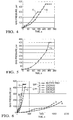
- Figure 4 is a graph of two production pressure vs. time forming cycles for the decklid outer panel of Figure 1.
- Figure 5 is a graph of the production pressure vs. time for a decklid inner panel complementary to the outer panel of Figure 1.
- Figure 6 is a graph containing the pressure vs. time curves of Figures 4 and 5 as comparative pressure vs. time curves of two comparable superplastic forming practices on the same magnesium-containing aluminum alloys.
- the practice is to use a magnesium-containing (for example, up to about 6% by weight magnesium) aluminum alloy sheet metal but process it at a temperature region that is lower than the typical temperature regions chosen for reliable and repeatable superplastic forming.
- the practice is also to subject the heated sheet metal to increasing working pressures that strain the sheet metal at a rate greater than those practiced in superplastic forming.
- a suitable magnesium-containing aluminum alloy sheet is heated to a temperature of about 400°C to 510°C (750°F to 950°F).
- the sheet metal is formed by a stretch forming process in which the heated sheet is held between two tool halves that clamp it at its periphery, and working gas pressure (e.g., air, nitrogen or argon) is introduced against one side of the sheet to force it into conformance with the forming surface of a forming tool.
- working gas pressure e.g., air, nitrogen or argon
- stretch forming the peripheral edge of the sheet is held fixed between the complementary forming tool halves, and the interior of the heated sheet is literally stretched into conformance against the shaping surface of a tool half by the gas pressure applied to the opposite side of the sheet within the tool.
- the air or gas pressure is slowly but continuously increased above ambient pressure. While the pressure is still relatively low, e.g., of the order of 5 to 10 psi, the hot metal is stretched and brought into initial contact with the forming surface. At this time, generally less than one minute into the forming, the sheet accommodates itself on the tool, particularly at entry radii into pockets and flanges.
- the pressure can then be raised at an increasing rate. As the pressure is further continuously raised at a controlled and normally increasing rate to a final level, typically in the range of 250 to 500 psi, the rate of stretching increases and more of the sheet is stretched against the shaping surface of the tool. Continued pressure stretches the sheet into full conformance with the tool. In this quick stretch forming of many articles, such as automobile body panels, the total forming time at such temperatures and working fluid pressures is surprisingly low, e.g., up to about 12 minutes per part or less.
- Decklid 10 is of familiar shape with a curved, generally horizontal upper portion 12 leading to bend 14 to a curved, generally vertical portion 16 that will define part of the rear of the car body.
- decklid 10 is shaped to enclose the trunk compartment of the vehicle and to carry a latch and lock with pierced key hole 17 and often a license plate.
- Horizontal portion 12 has a forward edge 18 that is adapted to be fixed to the car body usually below the rear window and side edges 20 that fit close to the rear fender regions of the car body.
- Vertical portion 16 also has three edges. Side edges 22 fit close to the car body, usually between the rear stop lights, and bottom edge 24 fits close to the body near the bumper level of the vehicle.
- the decklid 10 is of complex curvature, both across the width of the decklid and across the length of its horizontal surface and down its vertical surface. But a particularly difficult forming step in making the decklid is stretching the severely indented region 26 for holding a license plate.
- Recessed region 26 includes flat portion 28 with four very steep side walls. Two side walls 30 and 32 are seen in the generally perspective view of Figure 1. In a typical stamping, the forming of deep recess 26 is very difficult to accomplish within the same sheet metal piece as the rest of the decklid is formed.
- the decklid outer panel is also formed with flanges 34 (one shown in Figure 1) at side edges 20 of the horizontal portion 12 and a panel break 36 at the rear edge 18 of horizontal portion 12.
- Bottom edge 24 also has a flange 38 seen in Figure 3.
- the combination of the bend 14, the severe angles of the flanges 34 and 38 and . the steep walls 30, 32 and flat bottom 28 of recessed portion 26 of the decklid require high local elongation of the sheet metal and are difficult to form in a single workpiece.
- a decklid outer panel was formed in accordance with this invention starting with a blank of AA5083 sheet metal.
- the blank size was 47 inches by 70 inches and 0.048 inch (1.2 mm) thick.
- the nominal composition of the aluminum alloy was, by weight, 4.5% magnesium, 0.7% manganese, 0.15% chromium, less than 0.2% iron, less than 0.1% silicon, and the balance substantially aluminum.
- An aqueous suspension of fine boron nitride lubricant particles was sprayed onto both sides of the aluminum alloy blank surface and the material dried to produce a thin film of boron nitride.
- the blank was heated to a forming temperature in the range of 825°F to 845°F (about 441°C to 452°C).
- FIG 2 is illustrated two halves of forming tool (lower 40, upper 42) for stretch forming a previously bent and heated aluminum alloy blank 44 into the decklid outer panel shown in Figure 1.
- a flat, cleaned and lubricated sheet blank is heated with a first tool (not shown) that heats the blank to its forming temperature and forms three simple bends 46 so that the blank 44 easily fits between tool halves 40 and 42 for stretch forming.
- the lower tool half 40 contains a complex forming surface 48 that defines the back side of the one-piece outer panel 10.
- the lower tool half 40 is in section but is seen to contain a forming surface portion 50 that defines the horizontal portion 12 of the decklid.
- Another portion 52 of the tool shaping surface forms the vertical portion 16 of the decklid.
- Still another portion 54 forms the license plate recess.
- Other portions 56 and 57 form flanges at the forward edge of the horizontal portion of the decklid and the bottom of the vertical portion.
- the periphery 58 of the rectangular lower shaping tool 40 has a flat surface for clamping and sealing the peripheral portion of the aluminum alloy blank.
- the upper tool half 42 is complementary in shape to the male forming tool 40 and is provided with a shallow cavity 60 for the introduction of a high pressure working gas, e.g., air, nitrogen or argon, against the back side of the blank 44.
- a high pressure working gas e.g., air, nitrogen or argon
- the periphery 62 of the upper tool half 42 is flat except for a sealing bead 64 which is adapted to engage the perimeter of the aluminum blank and to seal against working gas pressure loss when the upper tool half 42 is closed against the blank 44 and lower tool half 40.
- the upper tool half 42 also includes a working gas inlet 65 to admit fluid pressure against the back side of the blank 44. Means for controlling the pressure of the working gas is also provided.
- the lower forming tool half 40 is hollowed out in regions 68 to reduce its mass and to facilitate machining of a plurality of vent holes 66 for air or other entrapped gas to escape from below the blank 44 so that the blank can subsequently be stretched into strict conformance with the shaping surface 48 of the forming tool half 40.
- the blank may be heated in an oven to its working temperature or preferably, as described above, it may be heated in a first tool that simply heats the workpiece and commences its formation such as bending it to form simple bends 46 like that illustrated in Figure 2.
- a flat blank or a bent blank such as that illustrated in Figure 2 is positioned, typically by robot manipulators, between the opened upper 42 and lower 40 forming tool.
- the upper tool half 42 is lowered against the upper peripheral surface of the blank and air is vented from the lower tool half so that the periphery of the blank is tightly clamped between the complementary holding surfaces 58, 62 of the lower and upper tool. Gas pressure is then applied to the back surface of the blank, the visible surface of the formed decklid.
- the gas pressure was applied and increased over a period of 320 seconds at pressure levels in accordance with the following table.
- the pressure was increased generally in a continuous manner with gage values recorded at 20 second intervals.
- the vertical portion is forced into compliance with the recess forming portion 54 of the tool 40. Then by holding the pressure at 450 psi, the final compliance of the sheet metal with the forming surface is obtained.
- the aluminum alloy sheet is found to be deformed precisely into conformation with the forming surface of the shaping tool. Thereafter, the upper tool is opened and the decklid panel 10 is removed from the working tool for cooling, trimming and operations of the like.
- the strategy of the process is to relatively slowly increase the forming pressure and begin the stretching of the tightly held sheet against the prominent portions of the forming tool.
- the pressure is further increased, preferably at a faster than linear rate with time, to bring the sheet into contact with most of the forming surface of the tool.
- the final pressure level completes the compliance of the sheet with the forming surface.
- the pressure is advantageously held at a final level for a minute or so to complete the forming in high deformation regions such as the license plate recess area of the lid.
- the working gas pressure is increased from a low initial value to a final pressure of 250 to 500 psi or more.
- a decklid inner panel was also formed by the subject process.
- the inner panel is not specifically illustrated. It had a shape complementary to that of the outer panel, but it did not have the license plate recess. However, it did have rectangular cross-section strengthening ribs.
- the blank for the inner panel was made of the same aluminum alloy AA5083 composition. It had a thickness of 0.63 inches (1.6 mm) and a blank size of 43.5 inches by 64 inches.
- the inner blank was heated to a temperature in the range of 835°F to 860°F.
- the blank was formed by stretch forming operation in complementary tooling similar to that depicted in Figures 2 and 3.
- the air pressure was applied in accordance with a different schedule from that used on the outer panel.
- the forming pressure schedule is shown in tabular form below and in the graph of Figure 5.
- the strain rate was about 5 x 10 -3 sec -1 . From 30 seconds through 90 seconds of stretching, the part had a nearly constant maximum strain rate of about 10 -2 sec -1 . The sample taken after 100 seconds was seen to be nearly fully formed and the average strain rate had then decreased to about 3 x10 -3 sec -1 .
- actual strain rates in the subject quick plastic forming process are substantially faster (e.g., 10 to 100 times faster) than strain rates considered possible in conventional SPF processing of these magnesium-containing aluminum alloys.
- alloys comprising, by weight, up to about 4% to 6% magnesium, about 0.3 to 1% manganese, a maximum of about 0.25% chromium, about 0.1% copper, up to about 0.3% iron, up to about 0.2% silicon, and the balance substantially all aluminum and incidental impurities.
- magnesium-aluminum alloys sheet metal forming times of 2 to 12 minutes, depending upon part complexity, at forming temperatures of 820°F to 860°F have produced high quality automotive body panels as described above.
- Figure 6 graphically compares representative forming cycles, gas pressure in psi vs. time in seconds, for the subject quick plastic forming (QPF) process and the conventional superplastic forming (SPF) process as applied to the same AA5083 alloy.
- Curves D and E depict the same pressure-time forming cycles for the decklid outer panel that are shown in Figure 4, but the time scale is compressed to allow for the superplastic forming cycles to be included in the figure.
- curve C depicts the pressure-time forming cycle for the decklid inner panel shown in Figure 5.
- curve B is the pressure-time forming cycle curve for the SPF stretch forming of the same decklid outer panel as described above.
- SPF technology was also used to form a "butter tray" which is a deep rectangular container with flat sides, bottom and edges for holding a slab of butter.
- the shape of the butter tray is like that of the license plate recess in the decklid outer panel and is a prototype difficult shape to stretch form from flat sheet metal stock.
- the SPF pressure-time forming cycle for the butter tray at over 900°F is pressure vs. time curve A in Figure 6. It is seen that nearly 30 minutes was required to form the tray using the SPF practice of high forming temperatures and low strain rates.
- this invention provides a new and practical process for the quick plastic deformation of aluminum alloy sheet stock by a metal stretching operation.
- the fast stretch forming operation is accomplished by using a forming temperature well below the SPF temperature for the alloy and stretching the sheet much faster than can be tolerated in SPF forming.
Landscapes
- Physics & Mathematics (AREA)
- Engineering & Computer Science (AREA)
- Mechanical Engineering (AREA)
- Fluid Mechanics (AREA)
- Chemical & Material Sciences (AREA)
- Thermal Sciences (AREA)
- Crystallography & Structural Chemistry (AREA)
- Materials Engineering (AREA)
- Metallurgy (AREA)
- Organic Chemistry (AREA)
- Shaping Metal By Deep-Drawing, Or The Like (AREA)
- Superstructure Of Vehicle (AREA)
Abstract
Description
| Time (seconds) | Pressure (psi) |
| 0 | 0 |
| 20 | 15 |
| 40 | 30 |
| 60 | 45 |
| 80 | 60 |
| 100 | 90 |
| 120 | 120 |
| 140 | 150 |
| 160 | 200 |
| 180 | 250 |
| 200 | 300 |
| 220 | 350 |
| 240 | 400 |
| 260 | 450 |
| 280 | 450 |
| 300 | 450 |
| 320 | 450 |
| Time (sec) | Pressure (psi) |
| 0 | 0 |
| 30 | 6 |
| 60 | 14 |
| 90 | 32 |
| 120 | 56 |
| 150 | 89 |
| 180 | 127 |
| 210 | 173 |
| 241 | 225 |
| 270 | 282 |
| 300 | 400 |
| 323 | 400 |
| Time (sec) | Pressure (psi) |
| 0 | 0 |
| 20 | 25 |
| 40 | 50 |
| 60 | 75 |
| 120 | 200 |
| 160 | 300 |
| 180 | 300 |
| 200 | 300 |
Claims (14)
- A method of stretch forming a magnesium-containing, aluminum alloy sheet (44) into a product (10), said alloy comprising up to about 6 % by weight magnesium and having a microstructure characterized by a grain size in the range of about 5 to 30 micrometers, said method comprisingheating said sheet (44) to a temperature in the range of about 400°C to about 510°C andstretching at least a portion of the heated sheet (44) so that one side of the sheet is brought into conformance with a shaping surface (40, 48) by applying working gas pressure (42, 60, 65) to the opposite side of the sheet, said stretching being accomplished by continually increasing said pressure from ambient pressure to a final stretching pressure in the range of about 250 psi to about 500 psi above ambient pressure and completing said stretching within a period of up to about 12 minutes.
- A method as recited in claim 1 comprising increasing the rate of increase of said pressure at a time after about one minute of application of said pressure to a final stretching pressure in said range of about 250 psi to about 500 psi.
- A method as recited in claim 1 comprising increasing said pressure to a level of 10 psi to 50 psi during the first minute of the application of said pressure and, thereafter, increasing said pressure at a rate faster than a linear rate of increase to a final stretching pressure in the range of about 250 psi to about 500 psi.
- A method as recited in any of claims 1-3 in which said magnesium-containing aluminum alloy comprises, by weight, about 3.5% to about 6% magnesium as a solid solution in said aluminum.
- A method as recited in any of claims 1-3 in which said aluminum alloy comprises, by weight, about 3.5% to about 6% magnesium, about 0.1% to about 1% manganese and aluminum.
- A method as recited in any of claims 1-3 in which said aluminum alloy comprises, by weight, about 4% to 5% magnesium, about 0.3% to 1% manganese, up to about 0.25% chromium, up to about 0.1% copper, up to about 0.3% iron, up to about 0.2% silicon and aluminum.
- A method of forming an article of manufacture (10) from superplastic magnesium-containing aluminum alloy sheet stock (44), comprisingproviding a sheet forming tool (40, 42) having a peripheral surface (58, 62) against which the periphery of said sheet stock (44) can be held in sealing engagement and a sheet forming surface (48) within said peripheral surface (58) for forming said sheet (44), said tool (40) including means (66) for venting said cavity during the forming of said sheet,heating said sheet to a temperature in said range and holding said sheet in sealing engagement with said peripheral surface of said tool, said sheet then having a first surface facing said forming surface and an opposite surface,stretching said heated sheet into conformance with said forming surface by applying working gas pressure (42, 60, 65) to said opposite side of the sheet, said stretching being accomplished by continually increasing said pressure from ambient pressure to a final stretching pressure in the range of about 250 psi to about 500 psi above ambient pressure and completing said stretching within a period of up to about 12 minutes.
- A method as recited in claim 7 in which the rate of pressure increase is greater than a linear rate of increase.
- A method as recited claim 7 or 8 in which said article is an automotive vehicle body panel.
- A method of stretch forming a magnesium-containing, aluminum alloy sheet into a product, said alloy comprising up to about 6% by weight magnesium and having a microstructure characterized by a grain size in the range of about 5 to 30 micrometers, said method comprisingheating said sheet to a temperature in the range of about 400°C to about 510°C andstretching at least a portion of the heated sheet so that one side of the sheet is brought into conformance with a shaping surface by applying working gas pressure to the opposite side of the sheet, said stretching being accomplished such that at least a portion of the sheet experiences a strain rate greater than 10-3 sec-1.
- A method as recited in claim 10 comprising stretching said sheet such that at least a portion of the sheet experiences a strain rate greater than 5 x 10⁻³ sec-1.
- A method as recited in claim 10 comprising continuously increasing said gas pressure from ambient pressure to a final stretching pressure and completing said stretching within a period of up to about 12 minutes.
- A method as recited in claim 12 in which said stretching is completed within a period of up to about six minutes.
- A method as recited in claim 12 in which said stretching is completed within a period of up to about three minutes.
Applications Claiming Priority (2)
| Application Number | Priority Date | Filing Date | Title |
|---|---|---|---|
| US09/545,500 US6253588B1 (en) | 2000-04-07 | 2000-04-07 | Quick plastic forming of aluminum alloy sheet metal |
| US545500 | 2000-04-07 |
Publications (2)
| Publication Number | Publication Date |
|---|---|
| EP1142654A2 true EP1142654A2 (en) | 2001-10-10 |
| EP1142654A3 EP1142654A3 (en) | 2004-02-25 |
Family
ID=24176494
Family Applications (1)
| Application Number | Title | Priority Date | Filing Date |
|---|---|---|---|
| EP01108511A Withdrawn EP1142654A3 (en) | 2000-04-07 | 2001-04-04 | Quick plastic forming of aluminium alloy sheet metal |
Country Status (4)
| Country | Link |
|---|---|
| US (2) | US6253588B1 (en) |
| EP (1) | EP1142654A3 (en) |
| JP (1) | JP3704292B2 (en) |
| KR (1) | KR100512296B1 (en) |
Cited By (1)
| Publication number | Priority date | Publication date | Assignee | Title |
|---|---|---|---|---|
| FR3046368A1 (en) * | 2016-01-06 | 2017-07-07 | Peugeot Citroen Automobiles Sa | DEVICE FOR FORMING A SQUARE FLAN COMPRISING A LINE OF STYLE |
Families Citing this family (93)
| Publication number | Priority date | Publication date | Assignee | Title |
|---|---|---|---|---|
| US6253588B1 (en) * | 2000-04-07 | 2001-07-03 | General Motors Corporation | Quick plastic forming of aluminum alloy sheet metal |
| JP2004514160A (en) * | 2000-10-06 | 2004-05-13 | ハイワイアード・テクノロジーズ・インコーポレーテッド | Method and apparatus for a mixing media messaging system |
| DE60206844T2 (en) * | 2001-06-13 | 2006-07-27 | Kabushiki Kaisha Toyota Chuo Kenkyusho | Method of forming under pressure and element produced thereby |
| US6843336B2 (en) * | 2001-08-23 | 2005-01-18 | General Motors Corporation | Vehicle belly pan |
| US6845839B2 (en) * | 2001-08-23 | 2005-01-25 | General Motors Corporation | Vehicle body platform |
| KR100646619B1 (en) * | 2001-10-23 | 2006-11-23 | 수미도모 메탈 인더스트리즈, 리미티드 | Hot pressing method, plated steel material for the same and manufacturing method thereof |
| US6793275B1 (en) | 2001-11-27 | 2004-09-21 | General Motors Corporation | Load-bearing body panel assembly for a motor vehicle |
| US7441615B2 (en) * | 2001-12-07 | 2008-10-28 | General Motors Corporation | Modular chassis with simplified body-attachment interface |
| US6581428B1 (en) | 2002-01-24 | 2003-06-24 | Ford Motor Company | Method and apparatus for superplastic forming |
| US6672121B2 (en) | 2002-04-15 | 2004-01-06 | General Motors Corporation | Flat pinch hemming of aluminum panels |
| US6810709B2 (en) | 2002-10-11 | 2004-11-02 | General Motors Corporation | Heated metal forming tool |
| US6776020B2 (en) | 2002-10-11 | 2004-08-17 | General Motors Corporation | Method for stretching forming and transporting and aluminum metal sheet |
| US6799450B2 (en) | 2002-10-11 | 2004-10-05 | General Motors Corporation | Method of stretch forming an aluminum metal sheet and handling equipment for doing the same |
| US6880377B2 (en) * | 2002-10-17 | 2005-04-19 | General Motors Corporation | Method for double action gas pressure forming sheet material |
| US6811625B2 (en) * | 2002-10-17 | 2004-11-02 | General Motors Corporation | Method for processing of continuously cast aluminum sheet |
| US6843089B2 (en) * | 2002-10-23 | 2005-01-18 | General Motors Corporation | Method of producing surface features in sheet metal using superplastic forming |
| US6886383B2 (en) * | 2002-11-04 | 2005-05-03 | General Motors Corporation | Method for stretch forming sheet metal by pressing and the application of gas pressure |
| US6835254B2 (en) * | 2002-12-09 | 2004-12-28 | General Motors Corporation | Recrystallization of metal alloy sheet with convection and infrared radiation heating |
| US6890394B2 (en) * | 2002-12-18 | 2005-05-10 | General Motors Corporation | Heating of metal alloy sheet by thermal conduction |
| US7204112B1 (en) * | 2002-12-30 | 2007-04-17 | Dana Corporation | Method of lubricating a workpiece for hydroforming |
| US6825442B2 (en) | 2003-01-06 | 2004-11-30 | General Motors Corporation | Tailor welded blank for fluid forming operation |
| US6745604B1 (en) | 2003-03-13 | 2004-06-08 | General Motors Corporation | Enamel coated binding surface |
| US6948226B2 (en) * | 2003-04-02 | 2005-09-27 | General Motors Corporation | Chassis frame packaging cavity loading method |
| US7040688B2 (en) * | 2003-04-29 | 2006-05-09 | General Motors Corporation | Vehicle door |
| US20040216386A1 (en) * | 2003-04-29 | 2004-11-04 | Chernoff Adrian B. | Vehicle door having unitary inner panel and outer panel |
| US6805397B1 (en) | 2003-04-30 | 2004-10-19 | General Motors Corporation | Vehicle door |
| US6921601B2 (en) * | 2003-05-16 | 2005-07-26 | General Motors Corporation | Fuel cell stack humidification method incorporating an accumulation device |
| US7021099B2 (en) * | 2003-06-12 | 2006-04-04 | General Motors Corporation | Extraction system for hot formed parts |
| US7032958B2 (en) * | 2003-07-01 | 2006-04-25 | General Motors Corporation | Body and frame assembly for a vehicle and method of assembling a vehicle |
| US6886885B2 (en) * | 2003-07-01 | 2005-05-03 | General Motors Corporation | Rear and side panel assembly for a vehicle and a method of assembling a vehicle |
| US7077439B2 (en) * | 2003-08-25 | 2006-07-18 | General Motors Corporation | Vehicle bumper and method of making same |
| US6910358B2 (en) * | 2003-08-25 | 2005-06-28 | General Motors Corporation | Two temperature two stage forming |
| US7082783B2 (en) * | 2003-09-19 | 2006-08-01 | U-Line Corporation | Stacked drawer refrigerator |
| US7112249B2 (en) * | 2003-09-30 | 2006-09-26 | General Motors Corporation | Hot blow forming control method |
| US7516529B2 (en) * | 2003-12-17 | 2009-04-14 | General Motors Corporation | Method for producing in situ metallic foam components |
| US7100259B2 (en) * | 2003-12-17 | 2006-09-05 | General Motors Corporation | Method of metallic sandwiched foam composite forming |
| US7028519B2 (en) * | 2004-01-12 | 2006-04-18 | General Motors Corporation | High throughput quick-plastic-forming |
| US7225542B2 (en) * | 2004-01-23 | 2007-06-05 | General Motors Corporation | Vehicle body compartment lid method of manufacturing |
| US7111900B2 (en) * | 2004-01-23 | 2006-09-26 | General Motors Corporation | Vehicle floor having a unitary inner panel and outer panel |
| US20050179242A1 (en) * | 2004-02-03 | 2005-08-18 | Chernoff Adrian B. | Vehicle front seat configuration |
| US6843088B1 (en) * | 2004-02-13 | 2005-01-18 | General Motors Corporation | Raised surface features for hot blow-forming tooling |
| FR2866592B1 (en) * | 2004-02-19 | 2007-06-08 | Usinor | PROCESS FOR MANUFACTURING A COMPOSITE WORKPIECE |
| EP1566461B1 (en) * | 2004-02-19 | 2007-10-17 | General Motors Corporation | Recrystallization of metal alloy sheet with convection & infrared radiation heating |
| US7310878B2 (en) * | 2004-02-27 | 2007-12-25 | Gm Global Technology Operations, Inc. | Automotive lower body component method of manufacture |
| DE112005000407B4 (en) * | 2004-02-27 | 2010-08-05 | General Motors Corp. (N.D.Ges.D. Staates Delaware), Detroit | Closing assembly of mixed metals and methods |
| US7159931B2 (en) * | 2004-02-27 | 2007-01-09 | Gm Global Technology Operations, Inc. | Automotive roof rack and accessories manufactured with QPF/SPF technology |
| US20050189790A1 (en) * | 2004-02-27 | 2005-09-01 | Chernoff Adrian B. | Automotive side frame and upper structure and method of manufacture |
| US6837088B1 (en) * | 2004-03-10 | 2005-01-04 | General Motors Corporation | Blow-forming flask and tool assembly |
| US7080535B2 (en) * | 2004-04-20 | 2006-07-25 | General Motors Corporation | Spring-loaded part extractors for heated forming tools |
| US7096557B2 (en) * | 2004-06-24 | 2006-08-29 | General Motors Corporation | Making panel reinforcements during hot stretch forming |
| JP4719456B2 (en) * | 2004-08-03 | 2011-07-06 | 古河スカイ株式会社 | Aluminum alloy sheet for high temperature blow molding |
| DE102005050868A1 (en) * | 2004-11-30 | 2006-06-01 | Ford Global Technologies, LLC, Dearborn | Pressure-controlled superplastic deformation device for ductile sheet includes control unit varying gas pressure to control flux during deformation |
| US7199334B2 (en) * | 2004-11-30 | 2007-04-03 | Ford Global Technologies, Llc. | Apparatus and method for heating and transferring a workpiece prior to forming |
| US7284402B2 (en) * | 2004-11-30 | 2007-10-23 | Ford Global Technologies, L.L.C. | System and process for superplastic forming |
| US7318333B2 (en) * | 2005-05-18 | 2008-01-15 | Ford Global Technologies, L.L.C. | Superplastic forming tool |
| US7266982B1 (en) | 2005-06-10 | 2007-09-11 | Guza David E | Hydroforming device and method |
| US7165435B1 (en) * | 2005-07-25 | 2007-01-23 | Gm Global Technology Operations, Inc. | Conduction preheating for hot-formed sheet metal panels |
| US7363790B2 (en) * | 2005-08-30 | 2008-04-29 | Gm Global Technology Operations, Inc. | Method for vaccum assisted preforming of superplastically or quick plastically formed article |
| US8323428B2 (en) * | 2006-09-08 | 2012-12-04 | Honeywell International Inc. | High strain rate forming of dispersion strengthened aluminum alloys |
| US7389665B1 (en) * | 2006-11-30 | 2008-06-24 | Ford Motor Company | Sheet metal forming process |
| US7827840B2 (en) * | 2006-11-30 | 2010-11-09 | Ford Global Technologies, Llc | Multistage superplastic forming apparatus and method |
| US7849601B2 (en) * | 2007-01-11 | 2010-12-14 | Ford Motor Company | Method of manufacturing a vehicle |
| US7703841B2 (en) * | 2007-01-11 | 2010-04-27 | Ford Motor Company | Vehicle body assembly |
| US8123284B2 (en) * | 2007-01-11 | 2012-02-28 | Ford Motor Company | Vehicle body component and mating feature |
| US7810876B2 (en) * | 2007-01-11 | 2010-10-12 | Ford Motor Company | Vehicle having a rear end body structure |
| US8317964B2 (en) * | 2007-01-11 | 2012-11-27 | Ford Motor Company | Method of manufacturing a vehicle |
| US7798560B2 (en) * | 2007-01-11 | 2010-09-21 | Ford Motor Company | Vehicle body structure |
| US8038205B2 (en) * | 2007-01-11 | 2011-10-18 | Ford Motor Company | Vehicle having a passenger compartment body structure |
| US7677649B2 (en) * | 2007-01-11 | 2010-03-16 | Ford Motor Company | Vehicle having an interlocking floor assembly |
| US7618087B2 (en) * | 2007-01-11 | 2009-11-17 | Ford Motor Company | Vehicle having a front end body structure |
| US20080184755A1 (en) * | 2007-02-01 | 2008-08-07 | Gm Global Technology Operations, Inc. | Lubrication of magnesium workpieces for hot forming |
| US8381562B2 (en) * | 2007-02-06 | 2013-02-26 | GM Global Technology Operations LLC | Metal forming apparatus characterized by rapid cooling and method of use thereof |
| US7730753B2 (en) * | 2007-02-06 | 2010-06-08 | Gm Global Technology Operations, Inc. | Lubricant for elevated temperature forming |
| US7654125B2 (en) * | 2007-02-06 | 2010-02-02 | Gm Global Technology Operations, Inc. | Metal forming apparatus |
| DE102007014948A1 (en) * | 2007-03-23 | 2008-09-25 | Rolls-Royce Deutschland Ltd & Co Kg | Method and apparatus for hot forming sheet metal from titanium based alloys |
| US20080265591A1 (en) * | 2007-04-30 | 2008-10-30 | International Truck Intellectual Property Company, Llc | Superplastic aluminum vehicle bumper |
| US7661282B2 (en) | 2008-03-21 | 2010-02-16 | Gm Global Technology Operations, Inc. | Hot forming process for metal alloy sheets |
| US8250890B2 (en) | 2009-04-22 | 2012-08-28 | GM Global Technology Operations LLC | Method to improve solid lubricant film tribological performance and adhesion to hot forming material |
| US8297091B2 (en) * | 2009-06-03 | 2012-10-30 | GM Global Technology Operations LLC | Nanocomposite coating for hot metal forming tools |
| US20110061406A1 (en) * | 2009-09-15 | 2011-03-17 | Gm Global Tehnology Operations, Inc. | Method of cooling stretch-formed-part |
| CN101786128B (en) * | 2010-02-25 | 2012-08-22 | 机械科学研究总院先进制造技术研究中心 | Hot stamping and superplastic gas-bulging combined forming process |
| US20130064627A1 (en) * | 2011-09-12 | 2013-03-14 | Alcoa Inc. | Expandable member and method of making the same |
| US20130205864A1 (en) * | 2012-02-13 | 2013-08-15 | Ford Global Technologies, Llc | Contoured air vent holes for dies |
| CN103671313B (en) * | 2012-08-30 | 2016-07-06 | 北京索普液压机电有限公司 | The hydraulic pressure press of transformer coil can be processed |
| CA2889954C (en) | 2012-10-30 | 2017-02-14 | Hydro Aluminium Rolled Products Gmbh | Aluminium composite material and forming method |
| JP6244384B2 (en) * | 2013-06-07 | 2017-12-06 | ハイドロ アルミニウム ロールド プロダクツ ゲゼルシャフト ミット ベシュレンクテル ハフツングHydro Aluminium Rolled Products GmbH | Metal sheet or strip coating |
| US9302312B2 (en) | 2014-02-07 | 2016-04-05 | GM Global Technology Operations LLC | Lubrication system for warm forming |
| US10166590B2 (en) | 2015-09-25 | 2019-01-01 | Tesla, Inc. | High speed blow forming processes |
| US20180127849A1 (en) * | 2016-08-23 | 2018-05-10 | Rasoul Jelokhani Niaraki | Hot sheet metal forming by gas and direct quenching |
| EP3515620B1 (en) | 2016-09-19 | 2023-05-17 | Eugene Ryzer | Use of a supersonic fluidic oscillator in superplastic forming and system for same |
| CN106270155B (en) * | 2016-09-29 | 2017-12-08 | 天津天锻航空科技有限公司 | Convex-concave multi-curvature class aircraft skin product combined forming process |
| TWI634334B (en) | 2016-10-21 | 2018-09-01 | 新特系統股份有限公司 | Probe card module |
| IT202000029915A1 (en) | 2020-12-04 | 2022-06-04 | Fontana Pietro Spa | HEATING STRUCTURE OF A MOLD, FOR HIGH TEMPERATURE FORMING |
Family Cites Families (10)
| Publication number | Priority date | Publication date | Assignee | Title |
|---|---|---|---|---|
| JPS59159961A (en) | 1983-02-28 | 1984-09-10 | Mitsubishi Alum Co Ltd | Superplastic al alloy |
| US4616499A (en) * | 1985-10-17 | 1986-10-14 | Lockheed Corporation | Isothermal forging method |
| EP0297035B1 (en) | 1987-06-23 | 1991-12-18 | Alusuisse-Lonza Services Ag | Aluminium alloy for superplastic deformation |
| US5372027A (en) * | 1989-11-29 | 1994-12-13 | Armco Steel Company, L.P. | Controlled material flow hydroforming |
| JPH06505439A (en) * | 1991-12-03 | 1994-06-23 | マクダネル ダグラス コーポレイション | Using exhaust gas flow to control superplastic forming |
| KR960007633B1 (en) * | 1993-12-23 | 1996-06-07 | 재단법인 한국계연구원 | High Formability High Strength Aluminum-Magnesium-Based Alloy and Manufacturing Method Thereof |
| US5819572A (en) * | 1997-07-22 | 1998-10-13 | General Motors Corporation | Lubrication system for hot forming |
| US5974847A (en) * | 1998-06-02 | 1999-11-02 | General Motors Corporation | Superplastic forming process |
| US6047583A (en) * | 1999-05-10 | 2000-04-11 | General Motors Corporation | Seal bead for superplastic forming of aluminum sheet |
| US6253588B1 (en) * | 2000-04-07 | 2001-07-03 | General Motors Corporation | Quick plastic forming of aluminum alloy sheet metal |
-
2000
- 2000-04-07 US US09/545,500 patent/US6253588B1/en not_active Ceased
-
2001
- 2001-04-04 EP EP01108511A patent/EP1142654A3/en not_active Withdrawn
- 2001-04-06 KR KR10-2001-0018177A patent/KR100512296B1/en not_active Expired - Fee Related
- 2001-04-09 JP JP2001110545A patent/JP3704292B2/en not_active Expired - Fee Related
-
2002
- 2002-04-15 US US10/122,668 patent/USRE43012E1/en not_active Expired - Lifetime
Cited By (1)
| Publication number | Priority date | Publication date | Assignee | Title |
|---|---|---|---|---|
| FR3046368A1 (en) * | 2016-01-06 | 2017-07-07 | Peugeot Citroen Automobiles Sa | DEVICE FOR FORMING A SQUARE FLAN COMPRISING A LINE OF STYLE |
Also Published As
| Publication number | Publication date |
|---|---|
| EP1142654A3 (en) | 2004-02-25 |
| KR100512296B1 (en) | 2005-09-05 |
| USRE43012E1 (en) | 2011-12-13 |
| JP3704292B2 (en) | 2005-10-12 |
| KR20010090744A (en) | 2001-10-19 |
| US6253588B1 (en) | 2001-07-03 |
| JP2002011527A (en) | 2002-01-15 |
Similar Documents
| Publication | Publication Date | Title |
|---|---|---|
| US6253588B1 (en) | Quick plastic forming of aluminum alloy sheet metal | |
| CA2306555C (en) | Superplastic forming process | |
| Sebastian et al. | Properties and processing of magnesium wrought products for automotive applications | |
| CN100354056C (en) | Warm hot stamping method for aluminum-magnesium alloy components | |
| EP1410856B1 (en) | Method of forming a sheet metal article by superplastic or quick plastic forming | |
| US7225542B2 (en) | Vehicle body compartment lid method of manufacturing | |
| RU2699437C1 (en) | Method of making panel-like molded article | |
| US6910358B2 (en) | Two temperature two stage forming | |
| US20040197532A1 (en) | Method of forming and blank therefor | |
| US6672121B2 (en) | Flat pinch hemming of aluminum panels | |
| EP1415735B1 (en) | Method of forming a sheet metal article by superplastic or quick plastic forming | |
| US7077439B2 (en) | Vehicle bumper and method of making same | |
| US4559797A (en) | Method for forming structural parts | |
| US7040688B2 (en) | Vehicle door | |
| CN101977707B (en) | Hot forming process for metal alloy sheets | |
| US20040216386A1 (en) | Vehicle door having unitary inner panel and outer panel | |
| CN101638762B (en) | Recovery heat treatment to improve formability of magnesium alloys | |
| US7766414B2 (en) | Mixed metal closure assembly and method | |
| JP2014176883A (en) | Automobile panel press molding method | |
| US20050110327A1 (en) | Vehicle seat | |
| US4290293A (en) | Method for deep drawing | |
| Palaniswamy et al. | New technologies to form light weight automotive components | |
| GB2029304A (en) | Method of making a metallic structure | |
| JPH06292927A (en) | Opposing hydraulic deep drawing method |
Legal Events
| Date | Code | Title | Description |
|---|---|---|---|
| PUAI | Public reference made under article 153(3) epc to a published international application that has entered the european phase |
Free format text: ORIGINAL CODE: 0009012 |
|
| AK | Designated contracting states |
Kind code of ref document: A2 Designated state(s): AT BE CH CY DE DK ES FI FR GB GR IE IT LI LU MC NL PT SE TR |
|
| AX | Request for extension of the european patent |
Free format text: AL;LT;LV;MK;RO;SI |
|
| PUAL | Search report despatched |
Free format text: ORIGINAL CODE: 0009013 |
|
| AK | Designated contracting states |
Kind code of ref document: A3 Designated state(s): AT BE CH CY DE DK ES FI FR GB GR IE IT LI LU MC NL PT SE TR |
|
| AX | Request for extension of the european patent |
Extension state: AL LT LV MK RO SI |
|
| 17P | Request for examination filed |
Effective date: 20040415 |
|
| AKX | Designation fees paid |
Designated state(s): DE FR GB |
|
| 17Q | First examination report despatched |
Effective date: 20041207 |
|
| 17Q | First examination report despatched |
Effective date: 20041207 |
|
| RAP1 | Party data changed (applicant data changed or rights of an application transferred) |
Owner name: GM GLOBAL TECHNOLOGY OPERATIONS, INC. |
|
| RAP1 | Party data changed (applicant data changed or rights of an application transferred) |
Owner name: GM GLOBAL TECHNOLOGY OPERATIONS, INC. |
|
| RAP1 | Party data changed (applicant data changed or rights of an application transferred) |
Owner name: GM GLOBAL TECHNOLOGY OPERATIONS LLC |
|
| GRAP | Despatch of communication of intention to grant a patent |
Free format text: ORIGINAL CODE: EPIDOSNIGR1 |
|
| INTG | Intention to grant announced |
Effective date: 20161109 |
|
| STAA | Information on the status of an ep patent application or granted ep patent |
Free format text: STATUS: THE APPLICATION IS DEEMED TO BE WITHDRAWN |
|
| 18D | Application deemed to be withdrawn |
Effective date: 20170321 |