EP1142585A1 - Remedies for corneal disorders - Google Patents
Remedies for corneal disorders Download PDFInfo
- Publication number
- EP1142585A1 EP1142585A1 EP00900336A EP00900336A EP1142585A1 EP 1142585 A1 EP1142585 A1 EP 1142585A1 EP 00900336 A EP00900336 A EP 00900336A EP 00900336 A EP00900336 A EP 00900336A EP 1142585 A1 EP1142585 A1 EP 1142585A1
- Authority
- EP
- European Patent Office
- Prior art keywords
- corneal
- rho
- effects
- migration
- compounds
- Prior art date
- Legal status (The legal status is an assumption and is not a legal conclusion. Google has not performed a legal analysis and makes no representation as to the accuracy of the status listed.)
- Withdrawn
Links
Classifications
-
- A—HUMAN NECESSITIES
- A61—MEDICAL OR VETERINARY SCIENCE; HYGIENE
- A61K—PREPARATIONS FOR MEDICAL, DENTAL OR TOILETRY PURPOSES
- A61K31/00—Medicinal preparations containing organic active ingredients
-
- A—HUMAN NECESSITIES
- A61—MEDICAL OR VETERINARY SCIENCE; HYGIENE
- A61K—PREPARATIONS FOR MEDICAL, DENTAL OR TOILETRY PURPOSES
- A61K31/00—Medicinal preparations containing organic active ingredients
- A61K31/66—Phosphorus compounds
- A61K31/661—Phosphorus acids or esters thereof not having P—C bonds, e.g. fosfosal, dichlorvos, malathion or mevinphos
-
- A—HUMAN NECESSITIES
- A61—MEDICAL OR VETERINARY SCIENCE; HYGIENE
- A61P—SPECIFIC THERAPEUTIC ACTIVITY OF CHEMICAL COMPOUNDS OR MEDICINAL PREPARATIONS
- A61P27/00—Drugs for disorders of the senses
Definitions
- the present invention relates to therapeutic agents for corneal disorders having effects of promoting corneal epithelial migration and containing as active ingredients compounds having effects of activating Rho such as lysophosphatidic acid and acyl derivatives thereof.
- Corneas are a transparent and avascular tissue having a diameter of about 1 cm and thickness of about 1 mm. Transparency of the cornea affects a visual function greatly. Various physiological and biochemical phenomena in the cornea function mainly for the purpose of maintaining the transparency of the cornea.
- Corneal epithelial defect caused by various diseases such as corneal ulcer, corneal erosion, keratitis and dry eye is repaired naturally, unless a mixed infection coincides.
- the repair is delayed for some reasons or the corneal epithelial defect is persisted without repair, such a delay or persistency exerts harmful influences on normal growth of the epithelium, and further constructions and functions of corneal stroma and endothelium are impaired.
- a conventional method of treating the corneal epithelial defect is based on a passive principle that corneal epithelium migrates naturally to re-cover defect sites by protecting the corneal surface from external stimulation.
- cytoskeleton a cytoskeleton and a cell adhesion mechanism greatly to adapt them to an outside environment.
- Main constituents forming the cytoskeleton have three types of fiber structure: a microfilament made of actin and the like, a microtubule made of tubulin and the like and an intermediate filament made of keratin and the like. These constituents perform higher-order functions such as cell adhesion, cell shape, cytokinesis and formation of cell polarity while relating closely each other.
- Rho family which is one of subfamilies of low-molecular weight GTP-binding protein, is considered to control the actin-microfilament cytoskeleton.
- the Rho family consists of members such as Rho, Rac and Cdc 42 and acts downstream from extracellular signals such as cell growth factors.
- a target protein which is specific for Rho was identified, and regulation mechanisms of cell phenomena are going to be clarified such as a regulation mechanism of the cytoskeleton and the adhesion (Experimental Medicine, 16 , 1782-1788 (1998)) and a regulation mechanism of cell movement (Experimental Medicine, 16 , 2032-2039 (1998)).
- lysophosphatidic acid and acyl derivatives thereof are known as compounds which activate Rho specifically (Cell, 70 , 389-399 (1992)).
- Various actions were reported with regard to lysophosphatidic acid and the acyl derivatives thereof. For example, they enhance binding of fibronectin to cells and regulate cell shape (J. Cell Biol., 127, 1447-1459 (1994)). They enhance fibronectin binding to epithelial and endothelial cells in a skin wound (U.S. Pat. No. 5,480,877). They are skin activators with glycosaminoglycan production-accelerating effects, and are useful as cosmetics and external preparations to prevent skin aging (WO 95/35090).
- lysophosphatidic acid stimulates proliferation of retinal pigment epithelial cells (Curr. Eye Res., 16 , 698-702 (1997)), lysophosphatidic acid sensitizes Ca ion influx in cultured lens epithelial cells (Cell. Signal., 9 , 609-616 (1997)), corneal injury results in increased production of lysophosphatidic acid and acyl derivatives thereof in aqueous humor, and they promote proliferation of normal keratocytes (Am. J. Physiol., 274, C1065-C1074 (1988)), and the like.
- Rho is a low-molecular weight GTP-binding protein participating in the regulation mechanisms of the cell phenomena, on corneal disorders, particularly on the corneal epithelial migration through studies of participation of Rho in the migration mechanism of the corneal epithelium.
- Rho In order to study the participation of Rho in the migration mechanism of the corneal epithelium, the present inventors first studied effects of Rho inhibitors on the corneal epithelium. As a result, it was clarified that the corneal epithelial migration is completely inhibited by the Rho inhibitors and regulation of intracellular scafford protein by Rho, which is the low-molecular weight GTP-binding protein, participates in the migration mechanism of the corneal epithelium.
- the present inventors found that the compounds have excellent effects of promoting the corneal epithelial migration.
- the compounds having the Rho-activating effects have the excellent effects of promoting the corneal epithelial migration and are useful as therapeutic agents for corneal disorders such as corneal ulcer, corneal erosion, keratitis and dry eye wherein the cornea is injured from various causes.
- Compounds having Rho-activating effects in the present invention mean compounds which augment regulation mechanisms of cell phenomena in which Rho participates.
- Lysophosphatidic acid and acyl derivatives thereof are compounds represented by the following general formula [I]: wherein R is hydrogen or acyl.
- the acyl in the compounds [I] is saturated or unsaturated aliphatic carbonyl or aromatic carbonyl, preferably saturated or unsaturated aliphatic carbonyl, more preferably higher aliphatic carbonyl having six or more carbon atoms, and particularly preferred examples of the acyl are oleoyl and stearoyl.
- Corneal disorders in the present invention are corneal ulcer, corneal erosion, keratitis, dry eye and the like wherein cornea is injured from various causes.
- Rho inhibitors In order to study participation of Rho in a migration mechanism of corneal epithelium, the present inventors studied the effects of Rho inhibitors and the compounds having the Rho-activating effects, on the corneal epithelium. Details are described in a section of "Pharmacological Tests" hereinbelow. Corneal epithelial migration was recognized to be almost completely inhibited by a C3 enzyme, which is an exoenzyme of Clostridium botulinum and is known as the Rho inhibitor (hereinafter referred to as "Exoenzyme C3") (Cell, 70 , 389-399 (1992)).
- Rho which is low-molecular weight GTP-binding protein, participates in the migration mechanism of the corneal epithelium.
- lysophosphatidic acid and the acyl derivatives thereof which are typical compounds having the Rho-activating effects
- lysophosphatidic acid and the acyl derivatives thereof promote corneal epithelial migration in a corneal piece tissue culture system. Further, it was recognized that such corneal epithelial migration-promoting effects are almost completely inhibited by Exoenzyme C3, and it was confirmed that the corneal epithelial migration-promoting effects of lysophosphatidic acid and the acyl derivatives thereof are based on the Rho-activating effects.
- the compounds having the Rho-activating effects have excellent effects of promoting the corneal epithelial migration and are useful for treatment of the corneal disorders, namely corneal ulcer, corneal erosion, keratitis, dry eye and the like wherein the cornea is injured from the various causes.
- the compound having the Rho-activating effect can be administered orally or parenterally.
- dosage forms are tablets, capsules, granules, powders, injections, eyedrops and the like, and eyedrops are particularly preferable.
- the compound can be formulated into preparations by general techniques.
- eyedrops can be prepared by optionally using an isotonic agent such as sodium chloride or concentrated glycerine; a buffer such as sodium phosphate or sodium acetate; a surfactant such as polyoxyethylenesorbitan monooleate, polyoxyl 40 stearate or polyoxyethylene hydrogenated castor oil; a stabilizer such as sodium citrate or disodium edetate; a preservative such as benzalkonium chloride or paraben; or the like. pH can be in a range acceptable for ophthalmic preparations, and it is preferably in a range of 4 to 8. Eye ointments can be prepared by using a general base such as white vaseline or liquid paraffin.
- an isotonic agent such as sodium chloride or concentrated glycerine
- a buffer such as sodium phosphate or sodium acetate
- a surfactant such as polyoxyethylenesorbitan monooleate, polyoxyl 40 stearate or polyoxyethylene hydrogenated castor oil
- a stabilizer
- Oral preparations such as tablets, capsules, granules and powders can be prepared by optionally adding a diluent such as lactose, crystalline cellulose, starch or vegetable oil; a lubricant such as magnesium stearate or talc; a binder such as hydroxypropylcellulose or polyvinyl pyrrolidone; a disintegrator such as calcium carboxymethylcellulose or low-substituted hydroxypropylmethylcellulose; a coating agent such as hydroxypropylmethylcellulose, macrogol or silicone resin; a film forming agent such as gelatin film; or the like.
- a diluent such as lactose, crystalline cellulose, starch or vegetable oil
- a lubricant such as magnesium stearate or talc
- a binder such as hydroxypropylcellulose or polyvinyl pyrrolidone
- a disintegrator such as calcium carboxymethylcellulose or low-substituted hydroxypropyl
- the dosage can be selected suitably depending on symptoms, age, dosage form and the like.
- eyedrops they are instilled once to several times per day with a concentration of 0.0001 to 1% (w/v), preferably 0.001 to 1% (w/v) solution.
- the usual daily dosage is 0.1 to 5000 mg, preferably 1 to 1000 mg, which can be given in a single dose or several divided doses.
- Eyedrops having the following formulation were prepared by a general method.
- Formulation 1 ophthalmic solution
- Sodium chloride 900 mg Sodium hydroxide q.s. Hydrochloric acid q.s. Sterile purified water q.s.
- Eye ointments containing 1 mg, 5 mg, 10 mg and 50 mg of oleoyl LPA can be prepared by a method similar to Formulation 2.
- Formulation 3 (tablet) In 100 mg Oleoyl LPA 10 mg Lactose 59.4 mg Cornstarch 20 mg Calcium carboxymethylcellulose 6 mg Hydroxypropylcellulose 4 mg Magnesium stearate 0.6 mg
- a corneal block cultured similarly in a culture medium containing no test compound was used as a control.
- Table 1 shows a result obtained by culturing the corneal block in a culture medium containing Exoenzyme C3, which is an Rho inhibitor, as the test compound.
- Migration length ( ⁇ m) Control 454 Exoenzyme C3 (2 ⁇ g/ml) 186 (Each datum in the table is an average of six samples.)
- Table 2 shows results obtained by culturing the corneal block in a culture medium containing oleoyl LPA as the test compound at concentrations of 0.02 ⁇ M, 0.2 ⁇ M and 2 ⁇ M respectively.
- Migration length ( ⁇ m) Control 454 Oleoyl LPA (0.02 ⁇ M) 528 (0.2 ⁇ M) 658 (2 ⁇ M) 712 (Each datum in the table is an average of six samples.)
- Table 3 shows results obtained by adding Exoenzyme C3 to the culture medium together with oleoyl LPA as the test compounds.
- Migration length ( ⁇ m) Control 454 Exoenzyme C3 (2 ⁇ g/ml) + Oleoyl LPA (0.02 ⁇ M) 185 + Oleoyl LPA (0.2 ⁇ M) 182 + Oleoyl LPA (2 ⁇ M) 198 (Each datum in the table is an average of six samples.)
- the compound having the Rho-activating effect has the excellent effects of promoting corneal epithelial migration and is useful as a therapeutic agent for corneal disorders such as corneal ulcer, corneal erosion, keratitis and dry eye wherein the cornea is injured from various causes, through an effect of promoting wound healing of the corneal epithelium.
- the present invention relates to therapeutic agents for corneal disorders containing compounds having Rho-activating effects as active ingredients, for example corneal epithelial migration promoters.
Landscapes
- Health & Medical Sciences (AREA)
- Veterinary Medicine (AREA)
- Chemical & Material Sciences (AREA)
- Medicinal Chemistry (AREA)
- Pharmacology & Pharmacy (AREA)
- Life Sciences & Earth Sciences (AREA)
- Animal Behavior & Ethology (AREA)
- General Health & Medical Sciences (AREA)
- Public Health (AREA)
- Epidemiology (AREA)
- Engineering & Computer Science (AREA)
- Bioinformatics & Cheminformatics (AREA)
- Chemical Kinetics & Catalysis (AREA)
- General Chemical & Material Sciences (AREA)
- Nuclear Medicine, Radiotherapy & Molecular Imaging (AREA)
- Organic Chemistry (AREA)
- Acyclic And Carbocyclic Compounds In Medicinal Compositions (AREA)
- Pharmaceuticals Containing Other Organic And Inorganic Compounds (AREA)
Abstract
The present invention provides therapeutic agents for corneal
disorders comprising compounds having effects of activating Rho as active
ingredients, for example corneal epithelial migration promoters. The
compounds having the effects of activating Rho are exemplified by
lysophosphatidic acid and acyl derivatives thereof. The corneal disorders are
exemplified by corneal ulcer, corneal erosion, keratitis and dry eye.
Description
The present invention relates to therapeutic agents for corneal
disorders having effects of promoting corneal epithelial migration and
containing as active ingredients compounds having effects of activating Rho
such as lysophosphatidic acid and acyl derivatives thereof.
Corneas are a transparent and avascular tissue having a diameter of
about 1 cm and thickness of about 1 mm. Transparency of the cornea affects
a visual function greatly. Various physiological and biochemical phenomena
in the cornea function mainly for the purpose of maintaining the
transparency of the cornea.
Corneal epithelial defect caused by various diseases such as corneal
ulcer, corneal erosion, keratitis and dry eye is repaired naturally, unless a
mixed infection coincides. However, when the repair is delayed for some
reasons or the corneal epithelial defect is persisted without repair, such a
delay or persistency exerts harmful influences on normal growth of the
epithelium, and further constructions and functions of corneal stroma and
endothelium are impaired. A conventional method of treating the corneal
epithelial defect is based on a passive principle that corneal epithelium
migrates naturally to re-cover defect sites by protecting the corneal surface
from external stimulation. In recent years, with development of cell biology,
a factor which participates in division, migration, adhesion, extension and
the like of cells has been elucidated. It is reported that a compound which
promotes the migration of corneal epithelium plays an important role in
repairing the corneal epithelial defect (Clin. Ophthalm., 46, 738-743 (1992),
Jpn. J. Ophthalm. Surg., 5, 719-727 (1992)).
Cells respond to outside signals and change a cytoskeleton and a cell
adhesion mechanism greatly to adapt them to an outside environment. Main
constituents forming the cytoskeleton have three types of fiber structure: a
microfilament made of actin and the like, a microtubule made of tubulin and
the like and an intermediate filament made of keratin and the like. These
constituents perform higher-order functions such as cell adhesion, cell shape,
cytokinesis and formation of cell polarity while relating closely each other.
Among them, an Rho family, which is one of subfamilies of
low-molecular weight GTP-binding protein, is considered to control the
actin-microfilament cytoskeleton. The Rho family consists of members such
as Rho, Rac and Cdc 42 and acts downstream from extracellular signals such
as cell growth factors. Recently, a target protein which is specific for Rho was
identified, and regulation mechanisms of cell phenomena are going to be
clarified such as a regulation mechanism of the cytoskeleton and the
adhesion (Experimental Medicine, 16, 1782-1788 (1998)) and a regulation
mechanism of cell movement (Experimental Medicine, 16, 2032-2039 (1998)).
On the other hand, lysophosphatidic acid and acyl derivatives thereof
are known as compounds which activate Rho specifically (Cell, 70, 389-399
(1992)). Various actions were reported with regard to lysophosphatidic acid
and the acyl derivatives thereof. For example, they enhance binding of
fibronectin to cells and regulate cell shape (J. Cell Biol., 127, 1447-1459
(1994)). They enhance fibronectin binding to epithelial and endothelial cells
in a skin wound (U.S. Pat. No. 5,480,877). They are skin activators with
glycosaminoglycan production-accelerating effects, and are useful as
cosmetics and external preparations to prevent skin aging (WO 95/35090).
They inhibit hyperproliferation of epithelial cells resulting from psoriasis or
the like (U.S. Pat. No. 5,565,439). They activate macrophages and inhibit
necrosis in tumor cells (U.S. Pat. No. 5,149,527). They inhibit apoptosis and
maintain or restore cell functions (WO 98/41213), etc.
In an ophthalmological field, it was reported that lysophosphatidic
acid stimulates proliferation of retinal pigment epithelial cells (Curr. Eye
Res., 16, 698-702 (1997)), lysophosphatidic acid sensitizes Ca ion influx in
cultured lens epithelial cells (Cell. Signal., 9, 609-616 (1997)), corneal injury
results in increased production of lysophosphatidic acid and acyl derivatives
thereof in aqueous humor, and they promote proliferation of normal
keratocytes (Am. J. Physiol., 274, C1065-C1074 (1988)), and the like.
However, there has been no report concerning a relation between Rho
and corneal epithelial cells, and it has not been known, of course, whether
compounds having effects of activating Rho exhibit effects on a migration
mechanism of the corneal epithelium, which is closely related to the repair of
the corneal epithelial defect.
As mentioned above, it was a very interesting subject to study effects
of the compounds having the effects of activating Rho, which is a
low-molecular weight GTP-binding protein participating in the regulation
mechanisms of the cell phenomena, on corneal disorders, particularly on the
corneal epithelial migration through studies of participation of Rho in the
migration mechanism of the corneal epithelium.
In order to study the participation of Rho in the migration
mechanism of the corneal epithelium, the present inventors first studied
effects of Rho inhibitors on the corneal epithelium. As a result, it was
clarified that the corneal epithelial migration is completely inhibited by the
Rho inhibitors and regulation of intracellular scafford protein by Rho, which
is the low-molecular weight GTP-binding protein, participates in the
migration mechanism of the corneal epithelium.
Next, studying effects of the compounds having the Rho-activating
effects, the present inventors found that the compounds have excellent
effects of promoting the corneal epithelial migration.
Further, when the compounds having the Rho-activating effects and
the Rho inhibitors were used jointly, the above-mentioned promotion of the
corneal epithelial migration was almost completely inhibited. It was
confirmed that the effects of promoting the corneal epithelial migration are
based on the Rho-activating effects.
The above-mentioned results clearly show that the compounds
having the Rho-activating effects have the excellent effects of promoting the
corneal epithelial migration and are useful as therapeutic agents for corneal
disorders such as corneal ulcer, corneal erosion, keratitis and dry eye
wherein the cornea is injured from various causes.
Compounds having Rho-activating effects in the present invention
mean compounds which augment regulation mechanisms of cell phenomena
in which Rho participates.
Lysophosphatidic acid and acyl derivatives thereof are compounds
represented by the following general formula [I]:
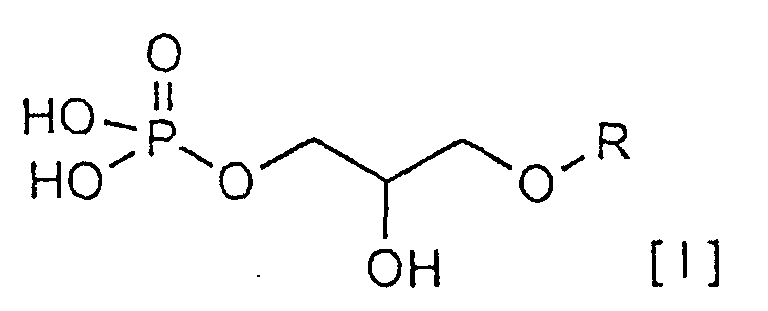 wherein R is hydrogen or acyl.
The acyl in the compounds [I] is saturated or unsaturated aliphatic
carbonyl or aromatic carbonyl, preferably saturated or unsaturated aliphatic
carbonyl, more preferably higher aliphatic carbonyl having six or more
carbon atoms, and particularly preferred examples of the acyl are oleoyl and
stearoyl.
Corneal disorders in the present invention are corneal ulcer, corneal
erosion, keratitis, dry eye and the like wherein cornea is injured from
various causes.
In order to study participation of Rho in a migration mechanism of
corneal epithelium, the present inventors studied the effects of Rho
inhibitors and the compounds having the Rho-activating effects, on the
corneal epithelium. Details are described in a section of "Pharmacological
Tests" hereinbelow. Corneal epithelial migration was recognized to be almost
completely inhibited by a C3 enzyme, which is an exoenzyme of Clostridium
botulinum and is known as the Rho inhibitor (hereinafter referred to as
"Exoenzyme C3") (Cell, 70, 389-399 (1992)).
This result clearly shows that Rho, which is low-molecular weight
GTP-binding protein, participates in the migration mechanism of the corneal
epithelium.
Next, studying effects of lysophosphatidic acid and the acyl
derivatives thereof, which are typical compounds having the Rho-activating
effects, on corneal epithelial migration, it was found that lysophosphatidic
acid and the acyl derivatives thereof promote corneal epithelial migration in
a corneal piece tissue culture system. Further, it was recognized that such
corneal epithelial migration-promoting effects are almost completely
inhibited by Exoenzyme C3, and it was confirmed that the corneal epithelial
migration-promoting effects of lysophosphatidic acid and the acyl derivatives
thereof are based on the Rho-activating effects. These results clearly show
that the compounds having the Rho-activating effects have excellent effects
of promoting the corneal epithelial migration and are useful for treatment of
the corneal disorders, namely corneal ulcer, corneal erosion, keratitis, dry
eye and the like wherein the cornea is injured from the various causes.
The compound having the Rho-activating effect can be administered
orally or parenterally. Examples of dosage forms are tablets, capsules,
granules, powders, injections, eyedrops and the like, and eyedrops are
particularly preferable. The compound can be formulated into preparations
by general techniques. For example, eyedrops can be prepared by optionally
using an isotonic agent such as sodium chloride or concentrated glycerine; a
buffer such as sodium phosphate or sodium acetate; a surfactant such as
polyoxyethylenesorbitan monooleate, polyoxyl 40 stearate or
polyoxyethylene hydrogenated castor oil; a stabilizer such as sodium citrate
or disodium edetate; a preservative such as benzalkonium chloride or
paraben; or the like. pH can be in a range acceptable for ophthalmic
preparations, and it is preferably in a range of 4 to 8. Eye ointments can be
prepared by using a general base such as white vaseline or liquid paraffin.
Oral preparations such as tablets, capsules, granules and powders can be
prepared by optionally adding a diluent such as lactose, crystalline cellulose,
starch or vegetable oil; a lubricant such as magnesium stearate or talc; a
binder such as hydroxypropylcellulose or polyvinyl pyrrolidone; a
disintegrator such as calcium carboxymethylcellulose or low-substituted
hydroxypropylmethylcellulose; a coating agent such as
hydroxypropylmethylcellulose, macrogol or silicone resin; a film forming
agent such as gelatin film; or the like.
The dosage can be selected suitably depending on symptoms, age,
dosage form and the like. In the case of eyedrops, they are instilled once to
several times per day with a concentration of 0.0001 to 1% (w/v), preferably
0.001 to 1% (w/v) solution. In the case of oral preparations, the usual daily
dosage is 0.1 to 5000 mg, preferably 1 to 1000 mg, which can be given in a
single dose or several divided doses.
Examples of formulation and results of pharmacological tests are
shown below. These examples do not limit the scope of the invention, but are
intended to make the invention more clearly understandable.
Typical examples of formulation using oleoyl lysophosphatidic acid
(hereinafter referred to as "oleoyl LPA") as a compound having an
Rho-activating effect are shown below.
Eyedrops having the following formulation were prepared by a
general method.
| Formulation 1 (ophthalmic solution) | |
| In 100 ml | |
| Oleoyl LPA | 1 mg |
| Sodium chloride | 900 mg |
| Sodium hydroxide | q.s. |
| Hydrochloric acid | q.s. |
| Sterile purified water | q.s. |
Ophthalmic solutions containing 5 mg, 10 mg, 50 mg, 100 mg, 500 mg
and 1000 mg of oleoyl LPA in 100 ml can be prepared by optionally adding a
surfactant or a stabilizer by a method similar to Formulation 1.
| Formulation 2 (eye ointment) | |
| In 100 g | |
| Oleoyl LPA | 100 mg |
| White vaseline | 90 g |
| Liquid paraffin | q.s. |
Eye ointments containing 1 mg, 5 mg, 10 mg and 50 mg of oleoyl LPA
can be prepared by a method similar to Formulation 2.
| Formulation 3 (tablet) | |
| In 100 mg | |
| Oleoyl LPA | 10 mg |
| Lactose | 59.4 mg |
| Cornstarch | 20 mg |
| Calcium carboxymethylcellulose | 6 mg |
| Hydroxypropylcellulose | 4 mg |
| Magnesium stearate | 0.6 mg |
Desired coated tablets can be obtained by coating tablets according to
the formulation as above with 2 mg/tablet of a coating agent such as
hydroxypropylcellulose.
Tablets containing 0.1 mg, 0.5 mg, 1 mg, 5 mg and 50 mg of oleoyl
LPA in 100 mg can be obtained by a method similar to Formulation 3.
Effects of the following test compounds on corneal epithelial
migration were studied using cornea of a male Japanese white rabbit by
using corneal epithelial migration length in a corneal piece tissue culture
system as an index according to the method of Nishida et al. (J. Cell Biol., 97,
1653-1657 (1983)).
A corneal block isolated from a corneal piece of a rabbit was cultured
for 24 hours in a culture medium (TC-199) containing the test compound
under a condition of 37°C-5% CO2. After the culture, the corneal block was
fixed in a mixed liquid of ethanol-glacial acetic acid (volume ratio 95:5) and
embedded with paraffin to prepare a section. Removing the paraffin from the
section, the section was stained with hematoxylin-eosin, and migration
length of an epithelial cell layer was measured under a microscope.
A corneal block cultured similarly in a culture medium containing no
test compound was used as a control.
Table 1 shows a result obtained by culturing the corneal block in a
culture medium containing Exoenzyme C3, which is an Rho inhibitor, as the
test compound.
| Migration length (µm) | |
| Control | 454 |
| Exoenzyme C3 (2 µ g/ml) | 186 |
| (Each datum in the table is an average of six samples.) |
Table 1 clearly shows that when the corneal block is cultured in the
culture medium containing Exoenzyme C3, which is the Rho inhibitor, the
corneal epithelial migration is almost completely inhibited, and Rho
participates in the corneal epithelial migration.
Table 2 shows results obtained by culturing the corneal block in a
culture medium containing oleoyl LPA as the test compound at
concentrations of 0.02 µM, 0.2 µM and 2 µM respectively.
| Migration length (µm) | |
| Control | 454 |
| Oleoyl LPA (0.02 µ M) | 528 |
| (0.2 µM) | 658 |
| (2 µM) | 712 |
| (Each datum in the table is an average of six samples.) |
Table 2 shows that when the corneal block is cultured in the culture
medium containing oleoyl LPA, the corneal epithelial migration is
remarkably promoted concentration dependently.
Table 3 shows results obtained by adding Exoenzyme C3 to the
culture medium together with oleoyl LPA as the test compounds.
| Migration length (µ m) | |
| Control | 454 |
| Exoenzyme C3 (2 µg/ml) | |
| + Oleoyl LPA (0.02 µ M) | 185 |
| + Oleoyl LPA (0.2 µM) | 182 |
| + Oleoyl LPA (2 µM) | 198 |
| (Each datum in the table is an average of six samples.) |
Table 3 shows that when Exoenzyme C3, which is the Rho inhibitor,
is added to the culture medium together with oleoyl LPA, the corneal
epithelial migration is almost completely inhibited.
These results confirm that the corneal epithelial
migration-promoting effect is based on the Rho-activating effect.
The above-mentioned pharmacological tests show that the compound
having the Rho-activating effect has the excellent effects of promoting
corneal epithelial migration and is useful as a therapeutic agent for corneal
disorders such as corneal ulcer, corneal erosion, keratitis and dry eye
wherein the cornea is injured from various causes, through an effect of
promoting wound healing of the corneal epithelium.
The present invention relates to therapeutic agents for corneal
disorders containing compounds having Rho-activating effects as active
ingredients, for example corneal epithelial migration promoters.
Claims (5)
- A therapeutic agent for a corneal disorder comprising a compound having an effect of activating Rho as an active ingredient.
- The therapeutic agent for the corneal disorder as claimed in claim 1, wherein the compound having the effect of activating Rho is lysophosphatidic acid or an acyl derivative thereof.
- The therapeutic agent for the corneal disorder as claimed in claim 2, wherein the acyl derivative of lysophosphatidic acid is oleoyl lysophosphatidic acid.
- The therapeutic agent for the corneal disorder as claimed in any one of claims 1 to 3, wherein the corneal disorder is corneal ulcer, corneal erosion, keratitis or dry eye.
- A corneal epithelial migration promoter comprising a compound having an effect of activating Rho as an active ingredient.
Applications Claiming Priority (3)
| Application Number | Priority Date | Filing Date | Title |
|---|---|---|---|
| JP542099 | 1999-01-12 | ||
| JP542099 | 1999-01-12 | ||
| PCT/JP2000/000095 WO2000041729A1 (en) | 1999-01-12 | 2000-01-12 | Remedies for corneal disorders |
Publications (2)
| Publication Number | Publication Date |
|---|---|
| EP1142585A1 true EP1142585A1 (en) | 2001-10-10 |
| EP1142585A4 EP1142585A4 (en) | 2005-08-03 |
Family
ID=11610680
Family Applications (1)
| Application Number | Title | Priority Date | Filing Date |
|---|---|---|---|
| EP00900336A Withdrawn EP1142585A4 (en) | 1999-01-12 | 2000-01-12 | Remedies for corneal disorders |
Country Status (2)
| Country | Link |
|---|---|
| EP (1) | EP1142585A4 (en) |
| WO (1) | WO2000041729A1 (en) |
Cited By (2)
| Publication number | Priority date | Publication date | Assignee | Title |
|---|---|---|---|---|
| EP2305308A1 (en) * | 2003-04-18 | 2011-04-06 | Advanced Medicine Research Institute | Remedies for diseases to be applied to eye |
| US8207119B2 (en) | 2002-12-27 | 2012-06-26 | Nihon Tenganyaku Kenkyusho Co., Ltd. | Ophthalmological composition |
Family Cites Families (3)
| Publication number | Priority date | Publication date | Assignee | Title |
|---|---|---|---|---|
| US3423440A (en) * | 1965-12-29 | 1969-01-21 | Eastman Kodak Co | Preparation of monoglyceride phosphoric acid and salts thereof |
| US5480877A (en) * | 1993-11-02 | 1996-01-02 | Wisconsin Alumni Research Foundation | Use of lysophosphatidic acids to enhance fibronectin binding |
| DE69836972D1 (en) * | 1997-03-19 | 2007-03-15 | Sky High Llc | COMPOSITIONS CONTAINING LYSOPHOPHASIC ACID THAT PREVENT THE APOPTOSIS AND ITS USE |
-
2000
- 2000-01-12 EP EP00900336A patent/EP1142585A4/en not_active Withdrawn
- 2000-01-12 WO PCT/JP2000/000095 patent/WO2000041729A1/en not_active Ceased
Cited By (2)
| Publication number | Priority date | Publication date | Assignee | Title |
|---|---|---|---|---|
| US8207119B2 (en) | 2002-12-27 | 2012-06-26 | Nihon Tenganyaku Kenkyusho Co., Ltd. | Ophthalmological composition |
| EP2305308A1 (en) * | 2003-04-18 | 2011-04-06 | Advanced Medicine Research Institute | Remedies for diseases to be applied to eye |
Also Published As
| Publication number | Publication date |
|---|---|
| EP1142585A4 (en) | 2005-08-03 |
| WO2000041729A1 (en) | 2000-07-20 |
Similar Documents
| Publication | Publication Date | Title |
|---|---|---|
| CA2454976C (en) | Therapeutic agent for glaucoma comprising compound having pi3 kinase inhibitory action as active ingredient | |
| US20120232119A1 (en) | Method for treating a keratoconjunctival disorder | |
| US6833358B1 (en) | Lacrimal secretion promoters or eye drops for treating keratoconjunctival failure containing as the active ingredient natriuretic peptides | |
| KR101401353B1 (en) | Use of l-carnitine or of alkanoyl l-carnitines for the preparation of a physiological supplement or medicament for ophthalmic use in the form of eye-drops | |
| US6221846B1 (en) | Ophthalmic drug compositions | |
| JP3812957B2 (en) | Corneal injury treatment agent | |
| KR20010041337A (en) | Remedies for corneal epithelium disturbance | |
| AU2006260184B2 (en) | Prophylactic or therapeutic agent for corneal/conjunctival disease | |
| JPH0723317B2 (en) | Corneal epithelial disorder treatment | |
| US5433944A (en) | Therapeutic agent for corneal disorders | |
| JPH06271478A (en) | Agent for treating dry eye | |
| JP2000264847A (en) | Corneal disorder treatment | |
| US8207119B2 (en) | Ophthalmological composition | |
| JPH10218792A (en) | An agent for promoting lacrimal secretion and treating keratoconjunctival disorders containing an angiotensin converting enzyme inhibitor as an active ingredient | |
| EP2157082B1 (en) | Neurite formation promoter | |
| WO2000041729A1 (en) | Remedies for corneal disorders | |
| WO2007148744A1 (en) | Prophylactic or therapeutic agent for corneal/conjunctival disorder comprising fumaric acid derivative as active ingredient | |
| JPH08291060A (en) | Therapeutic agent for keratopathy and corneal protectant | |
| KR20210107394A (en) | Composition for treatment of corneal damage comprising 5-Amino-4-Imidazole Carboxamide Riboside-1-β-D-Ribofuranosideas an active ingredient | |
| JP2003104909A (en) | Glaucoma therapeutic agent comprising a compound having PI3 kinase inhibitory activity as an active ingredient | |
| JP2008024699A (en) | A preventive or therapeutic agent for keratoconjunctival disorders containing a fumaric acid derivative as an active ingredient | |
| JP2006348025A (en) | Preventive or therapeutic agent for keratoconjunctival disorder |
Legal Events
| Date | Code | Title | Description |
|---|---|---|---|
| PUAI | Public reference made under article 153(3) epc to a published international application that has entered the european phase |
Free format text: ORIGINAL CODE: 0009012 |
|
| 17P | Request for examination filed |
Effective date: 20010726 |
|
| AK | Designated contracting states |
Kind code of ref document: A1 Designated state(s): AT BE CH CY DE DK ES FI FR GB GR IE IT LI LU MC NL PT SE |
|
| A4 | Supplementary search report drawn up and despatched |
Effective date: 20050622 |
|
| STAA | Information on the status of an ep patent application or granted ep patent |
Free format text: STATUS: THE APPLICATION IS DEEMED TO BE WITHDRAWN |
|
| 18D | Application deemed to be withdrawn |
Effective date: 20051209 |