EP1142533A1 - "Monitoring and classification of the physical activity of a person" - Google Patents
"Monitoring and classification of the physical activity of a person" Download PDFInfo
- Publication number
- EP1142533A1 EP1142533A1 EP00830253A EP00830253A EP1142533A1 EP 1142533 A1 EP1142533 A1 EP 1142533A1 EP 00830253 A EP00830253 A EP 00830253A EP 00830253 A EP00830253 A EP 00830253A EP 1142533 A1 EP1142533 A1 EP 1142533A1
- Authority
- EP
- European Patent Office
- Prior art keywords
- movement
- fuzzy
- classification
- sensor
- subject
- Prior art date
- Legal status (The legal status is an assumption and is not a legal conclusion. Google has not performed a legal analysis and makes no representation as to the accuracy of the status listed.)
- Granted
Links
- 238000012544 monitoring process Methods 0.000 title claims description 6
- 230000037081 physical activity Effects 0.000 title description 8
- 230000000694 effects Effects 0.000 claims abstract description 31
- 238000012545 processing Methods 0.000 claims abstract description 14
- 238000004364 calculation method Methods 0.000 claims abstract description 6
- 206010038743 Restlessness Diseases 0.000 claims description 6
- 230000001133 acceleration Effects 0.000 claims description 3
- 230000007704 transition Effects 0.000 claims description 2
- 230000002688 persistence Effects 0.000 claims 1
- 230000000875 corresponding effect Effects 0.000 description 7
- 238000002372 labelling Methods 0.000 description 7
- 238000005259 measurement Methods 0.000 description 7
- 238000010586 diagram Methods 0.000 description 4
- 230000006870 function Effects 0.000 description 3
- 230000004872 arterial blood pressure Effects 0.000 description 2
- 238000012512 characterization method Methods 0.000 description 2
- 230000002354 daily effect Effects 0.000 description 2
- 230000036772 blood pressure Effects 0.000 description 1
- 230000035565 breathing frequency Effects 0.000 description 1
- 230000001427 coherent effect Effects 0.000 description 1
- 239000012141 concentrate Substances 0.000 description 1
- 230000002596 correlated effect Effects 0.000 description 1
- 238000001514 detection method Methods 0.000 description 1
- 230000002708 enhancing effect Effects 0.000 description 1
- 238000011156 evaluation Methods 0.000 description 1
- 230000003203 everyday effect Effects 0.000 description 1
- 239000002184 metal Substances 0.000 description 1
- 238000000034 method Methods 0.000 description 1
- 238000007670 refining Methods 0.000 description 1
- 238000011160 research Methods 0.000 description 1
- 230000001020 rhythmical effect Effects 0.000 description 1
- 238000005070 sampling Methods 0.000 description 1
- 238000012360 testing method Methods 0.000 description 1
Images


Classifications
-
- A—HUMAN NECESSITIES
- A61—MEDICAL OR VETERINARY SCIENCE; HYGIENE
- A61B—DIAGNOSIS; SURGERY; IDENTIFICATION
- A61B5/00—Measuring for diagnostic purposes; Identification of persons
- A61B5/103—Measuring devices for testing the shape, pattern, colour, size or movement of the body or parts thereof, for diagnostic purposes
- A61B5/11—Measuring movement of the entire body or parts thereof, e.g. head or hand tremor or mobility of a limb
- A61B5/1118—Determining activity level
-
- A—HUMAN NECESSITIES
- A61—MEDICAL OR VETERINARY SCIENCE; HYGIENE
- A61B—DIAGNOSIS; SURGERY; IDENTIFICATION
- A61B5/00—Measuring for diagnostic purposes; Identification of persons
- A61B5/72—Signal processing specially adapted for physiological signals or for diagnostic purposes
- A61B5/7235—Details of waveform analysis
- A61B5/7264—Classification of physiological signals or data, e.g. using neural networks, statistical classifiers, expert systems or fuzzy systems
-
- G—PHYSICS
- G16—INFORMATION AND COMMUNICATION TECHNOLOGY [ICT] SPECIALLY ADAPTED FOR SPECIFIC APPLICATION FIELDS
- G16H—HEALTHCARE INFORMATICS, i.e. INFORMATION AND COMMUNICATION TECHNOLOGY [ICT] SPECIALLY ADAPTED FOR THE HANDLING OR PROCESSING OF MEDICAL OR HEALTHCARE DATA
- G16H50/00—ICT specially adapted for medical diagnosis, medical simulation or medical data mining; ICT specially adapted for detecting, monitoring or modelling epidemics or pandemics
-
- G—PHYSICS
- G16—INFORMATION AND COMMUNICATION TECHNOLOGY [ICT] SPECIALLY ADAPTED FOR SPECIFIC APPLICATION FIELDS
- G16H—HEALTHCARE INFORMATICS, i.e. INFORMATION AND COMMUNICATION TECHNOLOGY [ICT] SPECIALLY ADAPTED FOR THE HANDLING OR PROCESSING OF MEDICAL OR HEALTHCARE DATA
- G16H50/00—ICT specially adapted for medical diagnosis, medical simulation or medical data mining; ICT specially adapted for detecting, monitoring or modelling epidemics or pandemics
- G16H50/20—ICT specially adapted for medical diagnosis, medical simulation or medical data mining; ICT specially adapted for detecting, monitoring or modelling epidemics or pandemics for computer-aided diagnosis, e.g. based on medical expert systems
-
- Y—GENERAL TAGGING OF NEW TECHNOLOGICAL DEVELOPMENTS; GENERAL TAGGING OF CROSS-SECTIONAL TECHNOLOGIES SPANNING OVER SEVERAL SECTIONS OF THE IPC; TECHNICAL SUBJECTS COVERED BY FORMER USPC CROSS-REFERENCE ART COLLECTIONS [XRACs] AND DIGESTS
- Y10—TECHNICAL SUBJECTS COVERED BY FORMER USPC
- Y10S—TECHNICAL SUBJECTS COVERED BY FORMER USPC CROSS-REFERENCE ART COLLECTIONS [XRACs] AND DIGESTS
- Y10S128/00—Surgery
- Y10S128/92—Computer assisted medical diagnostics
-
- Y—GENERAL TAGGING OF NEW TECHNOLOGICAL DEVELOPMENTS; GENERAL TAGGING OF CROSS-SECTIONAL TECHNOLOGIES SPANNING OVER SEVERAL SECTIONS OF THE IPC; TECHNICAL SUBJECTS COVERED BY FORMER USPC CROSS-REFERENCE ART COLLECTIONS [XRACs] AND DIGESTS
- Y10—TECHNICAL SUBJECTS COVERED BY FORMER USPC
- Y10S—TECHNICAL SUBJECTS COVERED BY FORMER USPC CROSS-REFERENCE ART COLLECTIONS [XRACs] AND DIGESTS
- Y10S706/00—Data processing: artificial intelligence
- Y10S706/902—Application using ai with detail of the ai system
- Y10S706/924—Medical
Definitions
- the present invention relates in general to data acquisition instruments of the motion activity of an individual in a totally instrumental manner as test data per se or to be correlated to simultaneous measurements of physiological parameters of the subject such as for example arterial pressure, breathing frequency, heart beat and alike.
- the patient is recommended to note down on a diary the timing of daily activities performed, especially when the carried instrument actually takes a reading.
- this practice may lead to voids and/or imprecisions in the recordings.
- the ideal situation would be to combine to the instrument measuring the physiological parameters of clinical interest with a device capable of automatically detecting the physical activity being performed by the patient and to classify it for storing this information together with the readings periodically taken and recorded.
- a solution of this type would be extremely advantageous because of a greatly enhanced reliability of the data.
- the parameterization of data in function of the current state of the physical exertion would be extremely more coherent than that the patient who inadvertently could quantify in the same way different physical activities, could ever provide.
- the automatic system of the invention is composed of
- fuzzy logic processing is itself extremely effective because the task is to assess hardly quantifiable (that is "fuzzy") quantities, the processing of which is greatly enhanced by using a fuzzy logic that is ideally structured for managing not sharply definable situations.
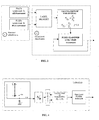
- the system of Figure 1 provides an overall classification of the motion activity of a subject by processing information on simultaneously detected movement of different parts of the body.
- fuzzy labelers are depicted. Each of them includes a sensor of motion and classifies the movement of a certain selected part of the body. Each fuzzy labeler dynamically outputs a sequence of "labels" that constitutes a classification of the movement detected in a certain time interval T.
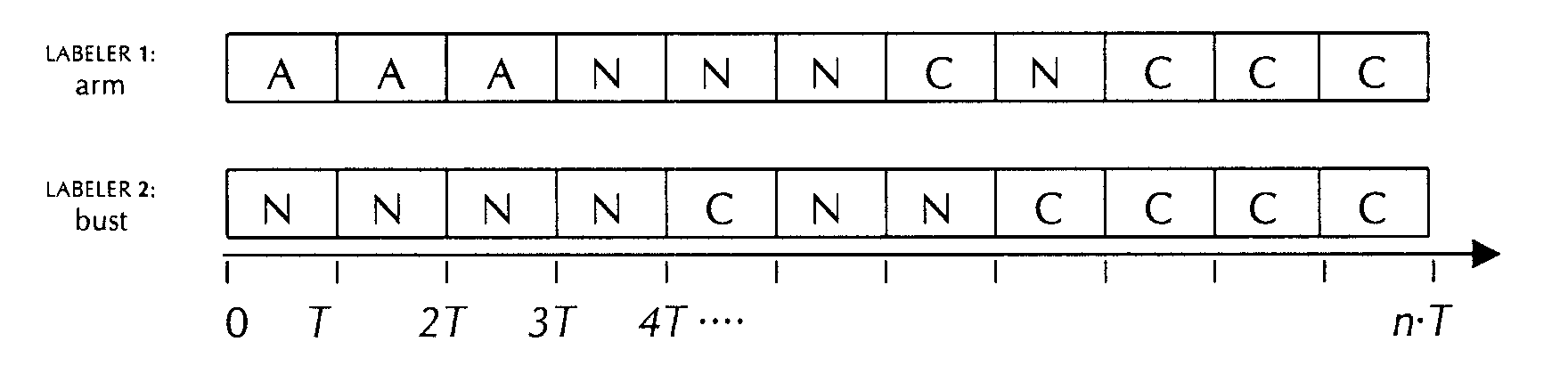
- the following string may be output: where labels "C", “N and "A” correspond respectively to a classification of the movement that has been performed in a fixed time interval T as: calm, normal and restless. Therefore in a time N*T, N labels are produced by each of the n labelers.
- the monitoring is continuous and information on the motion been detected are stored in the memory 2.
- N labels of classification are detected for each of the n labelers
- significative parameters that may be extracted are the numbers N C , N N and N A corresponding to the number of times in which, among the N labels provided by anyone of the n labelers, a classification of movement, respectively as: calm , normal and restless is obtained.
- the thus extracted parameters are then used for carrying out a classification of "second level" of the motion activity.
- the object is that of using the information provided dynamically by the labelers on the "instantaneous" movement of the different parts of the body depending on the actual characteristics of the movement performed by the subject to be recognized, as well as of the parts of the body that are actually involved, in a procedure of classification.
- the following parameters are established:
- the fuzzy algorithm that is implemented in the block 4 is input with the so-extracted parameters and by applying a certain set of fuzzy rules classifies the overall motion activity of the subject during the time interval t by processing all the information (parameters) obtained on the movement of the different parts of the body of the monitored subject during the considered interval of time.
- Both the movement classification of first level (block 1) and the classification of second level (block 4) take place dynamically and the system as a whole is able to monitor the actual motion activity of a subject over a long periods of time.
- each single labeling device implements a first level classification of the movement.
- the sensor suitably chosen, among the many sensors of motion that can be satisfactorily used, detects the movement of the part of the body of interest and outputs an analog signal representative of the movement of the part of the body on which the sensor is applied.
- the analog signal is converted in digital data that are stored.
- the fuzzy logic processing block After every time interval T, that may be chosen by programming, the parameters that will be input to the fuzzy logic algorithm of global classification of the motion activity of the subject are calculated.
- the fuzzy logic processing block performs a classification of the movement of the particular part of the body as detected during each interval T.
- the classifier of the overall motion activity of the invention is schematically depicted in Figure 3.
- the movement classification is done in two steps:
- the sensor used is constituted by a cantilevered lamina restrained by a spring of elastic constant K.
- the metal lamina closes a circuit every time the system is subject to an acceleration such to overcome the force of the contrasting spring.
- the output voltage Vout assumes one or the other of two values according to whether the lamina closes or not the circuit.
- the analog signal provided by such an ON/OFF sensor is converted in a logic signal such that the bit "1" and "0" correspond to the ON and OFF condition of the contact of the circuit of the sensor.
- N U number of 1 f C ⁇ T
- N T number of transitions 0 ⁇ 1 f C ⁇ T
- the experimental data have permitted to construct an efficient fuzzy algorithm of classification of the movement of the arm (and of the bust) based on the parameters N U and N T .
- the value that the parameters N U and N T may assume have been grouped in three fuzzy sets corresponding to the indexes: Low, Medium and High.
- the arm movement (and the bust movement) has been divided in three fuzzy classes, corresponding to: calm (C) , normal (N) and restless (A).
- the labeling system thus implemented provides a reliable classification of the movement of even other parts of the body.
- the classification of the overall motion activity of a subject is implemented by the block 2 of Figure 3, by assembling information on the right arm movement, obtained by the two respective identical labeling systems.
- each labeling system After each time interval n*T, where T is the time necessary to receive a classification label, each labeling system outputs a string of the type:
- n*T 12*5.1sec ⁇ 1 min
- the fuzzy logic algorithm of second level classification has been developed on the base of experimental observations and in particular the fuzzy sets and the block of rules. In developing the rules, it has been accounted for the fact that different parts of the body contribute in a different way toward an overall assessment of the motion activity of the subject been monitored. For example, should, according to a first level classification, be present a conspicuously rhythmic movement of the arm and simultaneously a calm condition of the bust, the subject would be classified as being in a semi-calm overall condition. Therefore, the fuzzy sets of second level are structured such to weight differently the classification (labeling) of the movement of different parts of the body.
- the values that each parameter may assume are grouped in three fuzzy sets corresponding to Low , Medium and High .
- the memberships Low, Medium and High are different for each input parameter.
- the thresholds that fix the passage from a fuzzy set to another are suitably shifted depending on whether the input parameter refers to the arm or to the bust.
- the block of fuzzy rules classifies the overall motion activity, as calm, normal or restless, according to the scheme depicted in Figure 6.
- Each fuzzy rule is structured such that the antecedent contains information on both the labelers of the considered example.
- the rules are of the type: IF P A/N 1 IS Low AND P A/N 2 IS Low THAN movement IS Calm IF P A/N 1 IS Medium AND P A/N 2 IS Low THAN movement IS Calm IF P A/N 1 IS Low AND P A/N 2 IS Medium THAN movement IS Normal etc. etc.
- the system functions in a dynamic way. Therefore, instant by instant the system produces a classification of the overall motion activity carried out for the n*T preceding seconds.
- the prototype system that has been developed has proven itself outstandingly suited to classify the overall motion activity of a subject, providing information useful toward a precise characterization of the current state of physical exertion of a patient.
- the system has been used as a support for a pressure holter and the additional information on the motion activity at the time of the taking of each pressure reading reveals itself extremely useful for more reliably analyzing the collected blood pressure data provided by the holter.
- the block of fuzzy rules may be easily reprogrammed, allowing exploitation of additional information on the movement of other parts of the body.
Landscapes
- Health & Medical Sciences (AREA)
- Engineering & Computer Science (AREA)
- Life Sciences & Earth Sciences (AREA)
- Public Health (AREA)
- Medical Informatics (AREA)
- Biomedical Technology (AREA)
- Pathology (AREA)
- General Health & Medical Sciences (AREA)
- Physics & Mathematics (AREA)
- Surgery (AREA)
- Molecular Biology (AREA)
- Veterinary Medicine (AREA)
- Biophysics (AREA)
- Artificial Intelligence (AREA)
- Physiology (AREA)
- Heart & Thoracic Surgery (AREA)
- Animal Behavior & Ethology (AREA)
- Epidemiology (AREA)
- Data Mining & Analysis (AREA)
- Databases & Information Systems (AREA)
- Primary Health Care (AREA)
- Mathematical Physics (AREA)
- Evolutionary Computation (AREA)
- Computer Vision & Pattern Recognition (AREA)
- Psychiatry (AREA)
- Fuzzy Systems (AREA)
- Signal Processing (AREA)
- Dentistry (AREA)
- Oral & Maxillofacial Surgery (AREA)
- Measurement Of The Respiration, Hearing Ability, Form, And Blood Characteristics Of Living Organisms (AREA)
Abstract
Description

- the interval of time t within which the calculation of the desired parameters must be effected;
- the significative parameters for the evaluation.
- classification of the movement of the single parts of the body (arm and bust), or of first level. In this step two labelers are used, one for detecting and classifying the arm's movement and the other for detecting and classifying the bust movement.
- overall motion activity classification of second level, performed by using the information relative to the bust movement and arm movement produced in the first step.
- At rest or during calm conditions both parameters NU and NT are near to zero.
- The parameter NU provides a measure of the intensity of the movement. For example, it has been observed that by swinging the arm more and more vigorously, the values of NU proportionally increase.
- The parameter NT increases with the frequency of repeated abrupt movements.
etc.
etc.
PCj, PNj e PAj j=1,2
IF PA/N1 IS Low AND PA/N2 IS Low THAN movement IS Calm
IF PA/N1 IS Medium AND PA/N2 IS Low THAN movement IS Calm
IF PA/N1 IS Low AND PA/N2 IS Medium THAN movement IS Normal
etc.
etc.
Claims (6)
- A portable automatic system of acquisition and recording of information on the movement of one or more parts of the body of a monitored subject through a corresponding number of motion sensors placed on respective parts of the body, the movement of which must be detected and of assessment data on the global motion activity of the subject during an established interval of time, characterized by comprisingone or more motion sensors respectively placed on parts of the body of a subject under observation;an analog-to-digital converter associated to each sensor converting an analog signal generated by the sensor into digital data;a logic block of calculation of predefined parameters from successive sequences of said digital data for each sensor;first fuzzy logic means processing said calculated parameters and generating corresponding fuzzy labels of classification of the movement detected by each of said sensors during the same established interval of time;a storage memory of said parameters and/or fuzzy labels;second fuzzy logic processing means of classification of the global motion activity of the subject under observation input with sets of fuzzy labels relative to the different motion sensors and outputting a representative index of the global motion activity of the subject in said interval.
- The system according to claim 1, wherein said memory supports also the storage of said sequences of digital data produced by each sensor.
- The system according to claim 1, characterized by comprising at least two motion sensors, a first sensor been applied to an arm and a second sensor been applied to the bust of the subject under observation.
- The system according to claim 1, wherein said sensors detect the presence or absence of acceleration in an ON/OFF mode.
- The system according to claim 4, wherein said calculated parameters for each sensor represent the total time of persistence of acceleration during a fixed interval of time of monitoring and the number of ON/OFF and OFF/ON transitions occurred during said interval of observation.
- The system according to claim 1, wherein said fuzzy labels of classification of the movement detected by each of said sensors during each interval of time are three, qualifying the movement as either calm, normal or restless.
Priority Applications (3)
| Application Number | Priority Date | Filing Date | Title |
|---|---|---|---|
| DE60028926T DE60028926D1 (en) | 2000-04-04 | 2000-04-04 | Observing and classifying a person's movements |
| EP00830253A EP1142533B1 (en) | 2000-04-04 | 2000-04-04 | "Monitoring and classification of the physical activity of a person" |
| US09/825,156 US6511443B2 (en) | 2000-04-04 | 2001-04-03 | Monitoring and classification of the physical activity of a subject |
Applications Claiming Priority (1)
| Application Number | Priority Date | Filing Date | Title |
|---|---|---|---|
| EP00830253A EP1142533B1 (en) | 2000-04-04 | 2000-04-04 | "Monitoring and classification of the physical activity of a person" |
Publications (2)
| Publication Number | Publication Date |
|---|---|
| EP1142533A1 true EP1142533A1 (en) | 2001-10-10 |
| EP1142533B1 EP1142533B1 (en) | 2006-06-21 |
Family
ID=8175274
Family Applications (1)
| Application Number | Title | Priority Date | Filing Date |
|---|---|---|---|
| EP00830253A Expired - Lifetime EP1142533B1 (en) | 2000-04-04 | 2000-04-04 | "Monitoring and classification of the physical activity of a person" |
Country Status (3)
| Country | Link |
|---|---|
| US (1) | US6511443B2 (en) |
| EP (1) | EP1142533B1 (en) |
| DE (1) | DE60028926D1 (en) |
Cited By (2)
| Publication number | Priority date | Publication date | Assignee | Title |
|---|---|---|---|---|
| GB2447940A (en) * | 2007-03-28 | 2008-10-01 | Thales Holdings Uk Plc | A Motion Classification Device |
| CN114569130A (en) * | 2022-02-25 | 2022-06-03 | 西南交通大学 | Attention level identification method for monitoring work of high-speed railway traffic dispatcher |
Families Citing this family (14)
| Publication number | Priority date | Publication date | Assignee | Title |
|---|---|---|---|---|
| US7625316B1 (en) | 2004-04-27 | 2009-12-01 | Performance Health Technologies, Inc. | Position monitoring system |
| US7658695B1 (en) | 2004-04-27 | 2010-02-09 | Performance Health Technologies, Inc. | Position monitoring displays |
| US7503878B1 (en) | 2004-04-27 | 2009-03-17 | Performance Health Technologies, Inc. | Position monitoring device |
| KR100972795B1 (en) * | 2008-01-14 | 2010-07-29 | 한국과학기술연구원 | Daily life activity classification device and daily life activity classification method |
| US8909330B2 (en) * | 2009-05-20 | 2014-12-09 | Sotera Wireless, Inc. | Body-worn device and associated system for alarms/alerts based on vital signs and motion |
| US9326704B2 (en) * | 2012-06-22 | 2016-05-03 | Alpinereplay, Inc. | Method and apparatus for determining sportsman jumps using fuzzy logic |
| US10008237B2 (en) | 2012-09-12 | 2018-06-26 | Alpinereplay, Inc | Systems and methods for creating and enhancing videos |
| US10408857B2 (en) | 2012-09-12 | 2019-09-10 | Alpinereplay, Inc. | Use of gyro sensors for identifying athletic maneuvers |
| SE537845C2 (en) * | 2013-07-18 | 2015-11-03 | Wememove Ab | Method and system for determining performance indicators for periodic movements |
| BR112016018556B1 (en) | 2014-02-14 | 2022-06-14 | 3M Innovative Properties Company | DEVICE FOR RECOGNITION OF ACTIVITY OF AN OBJECT AND METHOD FOR RECOGNIZING THE ACTIVITY OF AN OBJECT |
| BR112017005277B1 (en) | 2014-09-15 | 2022-11-16 | 3M Innovative Properties Company | METHOD FOR MONITORING DYSFUNCTION INDICATORS AND DEVICE FOR MONITORING DYSFUNCTION INDICATORS |
| CA2961371C (en) | 2014-09-15 | 2023-05-16 | 3M Innovative Properties Company | Impairment detection with biological considerations |
| KR20170056635A (en) | 2014-09-15 | 2017-05-23 | 쓰리엠 이노베이티브 프로퍼티즈 캄파니 | Impairment detection |
| WO2016134031A1 (en) | 2015-02-17 | 2016-08-25 | Alpinereplay, Inc | Systems and methods to control camera operations |
Citations (5)
| Publication number | Priority date | Publication date | Assignee | Title |
|---|---|---|---|---|
| WO1986004802A1 (en) * | 1985-02-26 | 1986-08-28 | Lucien Steru | Method and device for evaluating the psychotropic effects of medicinal substances on animals |
| WO1993016636A1 (en) * | 1992-02-28 | 1993-09-02 | Myllymaeki Matti | Wrist-held monitoring device for physical condition |
| DE4227483C1 (en) * | 1992-08-20 | 1993-11-25 | Imf Electronic Gmbh | Motor parameter detector with sensors and data memory for animals and humans - has body position and motion sensors with sensor pulse width discriminators and logic circuit connected to balancing data memories |
| WO1999004691A1 (en) * | 1997-07-23 | 1999-02-04 | Sensitive Technologies, Llc | Respiration and movement monitoring system |
| DE19832361A1 (en) * | 1998-07-20 | 2000-02-03 | Noehte Steffen | Body function monitor measures bodily conditions, determines environmental stresses, pauses and computes probabilities, before pronouncing on criticality with high confidence level |
Family Cites Families (3)
| Publication number | Priority date | Publication date | Assignee | Title |
|---|---|---|---|---|
| US5788640A (en) * | 1995-10-26 | 1998-08-04 | Peters; Robert Mitchell | System and method for performing fuzzy cluster classification of stress tests |
| DE69731206D1 (en) * | 1997-11-18 | 2004-11-18 | St Microelectronics Srl | Fuzzy logic method for indirect measurement of monitored physical signals and corresponding measuring device |
| EP1095617B1 (en) * | 1999-10-28 | 2005-08-10 | STMicroelectronics S.r.l. | Instrumental measurement of the neuro-psycho-physical state of a person |
-
2000
- 2000-04-04 DE DE60028926T patent/DE60028926D1/en not_active Expired - Lifetime
- 2000-04-04 EP EP00830253A patent/EP1142533B1/en not_active Expired - Lifetime
-
2001
- 2001-04-03 US US09/825,156 patent/US6511443B2/en not_active Expired - Lifetime
Patent Citations (5)
| Publication number | Priority date | Publication date | Assignee | Title |
|---|---|---|---|---|
| WO1986004802A1 (en) * | 1985-02-26 | 1986-08-28 | Lucien Steru | Method and device for evaluating the psychotropic effects of medicinal substances on animals |
| WO1993016636A1 (en) * | 1992-02-28 | 1993-09-02 | Myllymaeki Matti | Wrist-held monitoring device for physical condition |
| DE4227483C1 (en) * | 1992-08-20 | 1993-11-25 | Imf Electronic Gmbh | Motor parameter detector with sensors and data memory for animals and humans - has body position and motion sensors with sensor pulse width discriminators and logic circuit connected to balancing data memories |
| WO1999004691A1 (en) * | 1997-07-23 | 1999-02-04 | Sensitive Technologies, Llc | Respiration and movement monitoring system |
| DE19832361A1 (en) * | 1998-07-20 | 2000-02-03 | Noehte Steffen | Body function monitor measures bodily conditions, determines environmental stresses, pauses and computes probabilities, before pronouncing on criticality with high confidence level |
Cited By (4)
| Publication number | Priority date | Publication date | Assignee | Title |
|---|---|---|---|---|
| GB2447940A (en) * | 2007-03-28 | 2008-10-01 | Thales Holdings Uk Plc | A Motion Classification Device |
| GB2447940B (en) * | 2007-03-28 | 2012-04-04 | Thales Holdings Uk Plc | A motion classification device |
| CN114569130A (en) * | 2022-02-25 | 2022-06-03 | 西南交通大学 | Attention level identification method for monitoring work of high-speed railway traffic dispatcher |
| CN114569130B (en) * | 2022-02-25 | 2023-07-04 | 西南交通大学 | Attention level identification method for monitoring work of high-speed railway driving dispatcher |
Also Published As
| Publication number | Publication date |
|---|---|
| DE60028926D1 (en) | 2006-08-03 |
| EP1142533B1 (en) | 2006-06-21 |
| US6511443B2 (en) | 2003-01-28 |
| US20020052541A1 (en) | 2002-05-02 |
Similar Documents
| Publication | Publication Date | Title |
|---|---|---|
| EP1142533B1 (en) | "Monitoring and classification of the physical activity of a person" | |
| US7720610B2 (en) | Detection of psychological disorder activity patterns | |
| Mathie et al. | Detection of daily physical activities using a triaxial accelerometer | |
| US11730424B2 (en) | Methods and systems to detect eating | |
| EP0467502A2 (en) | Improved cardiovascular monitoring system | |
| US20180206749A1 (en) | Apparatus and method for determining a health parameter of a subject | |
| Kang et al. | Real-time elderly activity monitoring system based on a tri-axial accelerometer | |
| US10238330B2 (en) | Method of indicating the probability of psychogenic non-epileptic seizures | |
| KR100870961B1 (en) | Portable Physical Activity Monitoring System | |
| JP3027346B2 (en) | Exercise level storage device | |
| US7814324B2 (en) | Method of making a patient monitor | |
| Fei et al. | A wearable health monitoring system | |
| EP1848335B1 (en) | Method and apparatus for monitoring a sedated patient | |
| JP2672327B2 (en) | Biological information measurement device | |
| KR20240023554A (en) | smart sleep management system | |
| Shen et al. | An ear-lead ECG based smart sensor system with voice biofeedback for daily activity monitoring | |
| KR20060115931A (en) | Bio-signal measuring device capable of behavior analysis | |
| JP3880260B2 (en) | Exercise level recording device | |
| Bosnjak et al. | An approach to intelligent ischaemia monitoring | |
| Sherrill et al. | A neural network approach to monitor motor activities | |
| AU2006211808B2 (en) | Method and apparatus for monitoring a sedated patient | |
| Yang et al. | Development of a portable system for physical activity assessment in a home environment | |
| van der Voorn | Detection of Bruxism Using Data From an In-Mouth Accelerometer | |
| Wu et al. | A portable monitoring system with automatic event detection for sleep apnea level-IV evaluation | |
| Kamble et al. | A ZigBee Based Wireless Health Monitoring System |
Legal Events
| Date | Code | Title | Description |
|---|---|---|---|
| PUAI | Public reference made under article 153(3) epc to a published international application that has entered the european phase |
Free format text: ORIGINAL CODE: 0009012 |
|
| AK | Designated contracting states |
Kind code of ref document: A1 Designated state(s): AT BE CH CY DE DK ES FI FR GB GR IE IT LI LU MC NL PT SE Kind code of ref document: A1 Designated state(s): DE FR GB IT |
|
| AX | Request for extension of the european patent |
Free format text: AL;LT;LV;MK;RO;SI |
|
| 17P | Request for examination filed |
Effective date: 20020402 |
|
| AKX | Designation fees paid |
Free format text: DE FR GB IT |
|
| 17Q | First examination report despatched |
Effective date: 20050426 |
|
| GRAP | Despatch of communication of intention to grant a patent |
Free format text: ORIGINAL CODE: EPIDOSNIGR1 |
|
| GRAS | Grant fee paid |
Free format text: ORIGINAL CODE: EPIDOSNIGR3 |
|
| GRAA | (expected) grant |
Free format text: ORIGINAL CODE: 0009210 |
|
| AK | Designated contracting states |
Kind code of ref document: B1 Designated state(s): DE FR GB IT |
|
| PG25 | Lapsed in a contracting state [announced via postgrant information from national office to epo] |
Ref country code: IT Free format text: LAPSE BECAUSE OF FAILURE TO SUBMIT A TRANSLATION OF THE DESCRIPTION OR TO PAY THE FEE WITHIN THE PRESCRIBED TIME-LIMIT;WARNING: LAPSES OF ITALIAN PATENTS WITH EFFECTIVE DATE BEFORE 2007 MAY HAVE OCCURRED AT ANY TIME BEFORE 2007. THE CORRECT EFFECTIVE DATE MAY BE DIFFERENT FROM THE ONE RECORDED. Effective date: 20060621 |
|
| REG | Reference to a national code |
Ref country code: GB Ref legal event code: FG4D |
|
| REF | Corresponds to: |
Ref document number: 60028926 Country of ref document: DE Date of ref document: 20060803 Kind code of ref document: P |
|
| PG25 | Lapsed in a contracting state [announced via postgrant information from national office to epo] |
Ref country code: DE Free format text: LAPSE BECAUSE OF FAILURE TO SUBMIT A TRANSLATION OF THE DESCRIPTION OR TO PAY THE FEE WITHIN THE PRESCRIBED TIME-LIMIT Effective date: 20060922 |
|
| PLBE | No opposition filed within time limit |
Free format text: ORIGINAL CODE: 0009261 |
|
| STAA | Information on the status of an ep patent application or granted ep patent |
Free format text: STATUS: NO OPPOSITION FILED WITHIN TIME LIMIT |
|
| EN | Fr: translation not filed | ||
| 26N | No opposition filed |
Effective date: 20070322 |
|
| PGFP | Annual fee paid to national office [announced via postgrant information from national office to epo] |
Ref country code: IT Payment date: 20070608 Year of fee payment: 8 |
|
| PG25 | Lapsed in a contracting state [announced via postgrant information from national office to epo] |
Ref country code: FR Free format text: LAPSE BECAUSE OF FAILURE TO SUBMIT A TRANSLATION OF THE DESCRIPTION OR TO PAY THE FEE WITHIN THE PRESCRIBED TIME-LIMIT Effective date: 20070309 |
|
| PG25 | Lapsed in a contracting state [announced via postgrant information from national office to epo] |
Ref country code: FR Free format text: LAPSE BECAUSE OF FAILURE TO SUBMIT A TRANSLATION OF THE DESCRIPTION OR TO PAY THE FEE WITHIN THE PRESCRIBED TIME-LIMIT Effective date: 20060621 |
|
| PG25 | Lapsed in a contracting state [announced via postgrant information from national office to epo] |
Ref country code: IT Free format text: LAPSE BECAUSE OF NON-PAYMENT OF DUE FEES Effective date: 20080404 |
|
| PGFP | Annual fee paid to national office [announced via postgrant information from national office to epo] |
Ref country code: GB Payment date: 20120328 Year of fee payment: 13 |
|
| GBPC | Gb: european patent ceased through non-payment of renewal fee |
Effective date: 20130404 |
|
| PG25 | Lapsed in a contracting state [announced via postgrant information from national office to epo] |
Ref country code: GB Free format text: LAPSE BECAUSE OF NON-PAYMENT OF DUE FEES Effective date: 20130404 |