EP1142217B1 - Admission control of mixed vbr sources in broadband networks - Google Patents
Admission control of mixed vbr sources in broadband networks Download PDFInfo
- Publication number
- EP1142217B1 EP1142217B1 EP98962673A EP98962673A EP1142217B1 EP 1142217 B1 EP1142217 B1 EP 1142217B1 EP 98962673 A EP98962673 A EP 98962673A EP 98962673 A EP98962673 A EP 98962673A EP 1142217 B1 EP1142217 B1 EP 1142217B1
- Authority
- EP
- European Patent Office
- Prior art keywords
- class
- vbr
- capacity
- traffic
- classes
- Prior art date
- Legal status (The legal status is an assumption and is not a legal conclusion. Google has not performed a legal analysis and makes no representation as to the accuracy of the status listed.)
- Expired - Lifetime
Links
- 238000000034 method Methods 0.000 claims description 27
- 239000013598 vector Substances 0.000 claims description 21
- 239000000872 buffer Substances 0.000 claims description 19
- 238000010276 construction Methods 0.000 claims description 7
- 238000012512 characterization method Methods 0.000 claims description 4
- 230000001105 regulatory effect Effects 0.000 claims description 4
- 230000008901 benefit Effects 0.000 claims description 3
- 230000003247 decreasing effect Effects 0.000 claims description 2
- 238000013139 quantization Methods 0.000 claims 1
- 238000004458 analytical method Methods 0.000 description 9
- 239000000203 mixture Substances 0.000 description 9
- 238000013459 approach Methods 0.000 description 6
- 238000011161 development Methods 0.000 description 5
- 230000003993 interaction Effects 0.000 description 4
- 238000002955 isolation Methods 0.000 description 4
- 230000008569 process Effects 0.000 description 4
- 238000009472 formulation Methods 0.000 description 3
- 230000033228 biological regulation Effects 0.000 description 2
- 238000004891 communication Methods 0.000 description 2
- 238000000354 decomposition reaction Methods 0.000 description 2
- 230000007423 decrease Effects 0.000 description 2
- 238000010586 diagram Methods 0.000 description 2
- 239000004615 ingredient Substances 0.000 description 2
- RZVAJINKPMORJF-UHFFFAOYSA-N Acetaminophen Chemical compound CC(=O)NC1=CC=C(O)C=C1 RZVAJINKPMORJF-UHFFFAOYSA-N 0.000 description 1
- 238000012935 Averaging Methods 0.000 description 1
- 230000000903 blocking effect Effects 0.000 description 1
- 230000000295 complement effect Effects 0.000 description 1
- 230000001276 controlling effect Effects 0.000 description 1
- 230000004069 differentiation Effects 0.000 description 1
- 238000005315 distribution function Methods 0.000 description 1
- 230000000694 effects Effects 0.000 description 1
- 238000011835 investigation Methods 0.000 description 1
- 230000003287 optical effect Effects 0.000 description 1
- 230000000737 periodic effect Effects 0.000 description 1
- 238000012797 qualification Methods 0.000 description 1
- 230000008707 rearrangement Effects 0.000 description 1
- 238000013468 resource allocation Methods 0.000 description 1
- 230000004044 response Effects 0.000 description 1
- 238000013519 translation Methods 0.000 description 1
Images



Classifications
-
- H—ELECTRICITY
- H04—ELECTRIC COMMUNICATION TECHNIQUE
- H04L—TRANSMISSION OF DIGITAL INFORMATION, e.g. TELEGRAPHIC COMMUNICATION
- H04L12/00—Data switching networks
- H04L12/54—Store-and-forward switching systems
- H04L12/56—Packet switching systems
- H04L12/5601—Transfer mode dependent, e.g. ATM
- H04L12/5602—Bandwidth control in ATM Networks, e.g. leaky bucket
-
- H—ELECTRICITY
- H04—ELECTRIC COMMUNICATION TECHNIQUE
- H04Q—SELECTING
- H04Q11/00—Selecting arrangements for multiplex systems
- H04Q11/04—Selecting arrangements for multiplex systems for time-division multiplexing
- H04Q11/0428—Integrated services digital network, i.e. systems for transmission of different types of digitised signals, e.g. speech, data, telecentral, television signals
- H04Q11/0478—Provisions for broadband connections
-
- H—ELECTRICITY
- H04—ELECTRIC COMMUNICATION TECHNIQUE
- H04L—TRANSMISSION OF DIGITAL INFORMATION, e.g. TELEGRAPHIC COMMUNICATION
- H04L12/00—Data switching networks
- H04L12/54—Store-and-forward switching systems
- H04L12/56—Packet switching systems
- H04L12/5601—Transfer mode dependent, e.g. ATM
- H04L2012/5629—Admission control
- H04L2012/5631—Resource management and allocation
- H04L2012/5632—Bandwidth allocation
-
- H—ELECTRICITY
- H04—ELECTRIC COMMUNICATION TECHNIQUE
- H04L—TRANSMISSION OF DIGITAL INFORMATION, e.g. TELEGRAPHIC COMMUNICATION
- H04L12/00—Data switching networks
- H04L12/54—Store-and-forward switching systems
- H04L12/56—Packet switching systems
- H04L12/5601—Transfer mode dependent, e.g. ATM
- H04L2012/5638—Services, e.g. multimedia, GOS, QOS
- H04L2012/5646—Cell characteristics, e.g. loss, delay, jitter, sequence integrity
- H04L2012/5651—Priority, marking, classes
-
- H—ELECTRICITY
- H04—ELECTRIC COMMUNICATION TECHNIQUE
- H04L—TRANSMISSION OF DIGITAL INFORMATION, e.g. TELEGRAPHIC COMMUNICATION
- H04L12/00—Data switching networks
- H04L12/54—Store-and-forward switching systems
- H04L12/56—Packet switching systems
- H04L12/5601—Transfer mode dependent, e.g. ATM
- H04L2012/5678—Traffic aspects, e.g. arbitration, load balancing, smoothing, buffer management
- H04L2012/5684—Characteristics of traffic flows
Definitions
- This invention concerns methods of connection admission control (CAC) for ATM networks, whereby requests for admitting and routing a virtual circuit are granted or denied on the basis of currently available network resources (buffer space in the nodes, channel capacity in the links) and quality of service (QOS) requirements. More in particular. the invention addresses a basic issue of recognized importance in the above context, namely how to guarantee QOS for multiplexed variable bit rate (VBR) sources, particularly when the the traffic classes are mixed with respect to their potential multiplexing gains.
- VBR variable bit rate
- FIG. 1 A network in which the method of admission control and routing of requests for virtual circuits of the invention may be practiced is depicted in Figure 1.
- the means used to estimate both resource availability and prospective resource consumption (by the requested circuit) is based on the concept of an effective bandwidth (EB).
- EB effective bandwidth
- source classes are typically mixed in the sense that some classes can benefit from statistical multiplexing while others cannot.
- S-VBR statistically multiplexable
- NS-VBR nonstatistically multiplexable
- traffic sources are represented by worst-case, regulated rate processes.
- CBR constant bit rate
- a class- j source is bandwidth limited (BL) since, under condition (5), its bandwidth need exceeds what is required (proportionately) of the buffer.
- the bandwidth e 0, j can be be expressed in terms of the traffic and resource parameters as In [1, 2], this quantity is called the "effective bandwidth for lossless performance".
- ⁇ j denote the fraction of time that the channel is utilized by a class- j source
- connection vector n ( n 1 , n 2 ,..., n J )
- the aggregate demand on the channel is specified in terms of the saturation probability P sat (1) and the QOS parameter ⁇ (where ⁇ > 0).
- connection vector n is admissible (under this QOS constraint) if and only if its corresponding demand S (9) satisfies Pr[ S > C ] ⁇ e - ⁇ .
- LMGF log moment generating function
- connection vector n is admissible, i.e.. its corresponding channel load S satisfies (10).
- n is admissible, i.e.. its corresponding channel load S satisfies (10).
- E [ S ] ⁇ C .
- this stability condition for n can be equivalently expressed as If, further, condition (7) is satisfied then there is no saturation and, hence, n is trivially admissible.
- the region in which this occurs is called the admissible set for no saturation (or "lossless performance" in the terminology of [1, 2]), denoted A 0 , where by (7),
- the bound (15) insures that the QOS requirement (10) will be satisfied for connection vector n if F n ( s *) ⁇ ⁇ .
- a ⁇ is nonlinear, by using the tangent hyperplane construction of [5, 3], one can obtain a linear, conservative estimate of A ⁇ .
- n * denote an appropriately chosen tangent point on the boundary ⁇ A ⁇ of A ⁇
- the quantity e j ( j ⁇ J ) can be legitimately referred to as the effective bandwidth (EB) of a class- j traffic source.
- connection requests range over a proper mix of S-VBR and NS-VBR classes (including CBR) then, as demonstrated in [1], there are nonlinear interactions which can severely reduce the accuracy of a linear (hyperplane) approximation. As a consequence, there is an increase in the number of admissible connections (relative to A( ) that get falsely rejected, thereby reducing resource (bandwidth, buffer) utilization.
- WO 9701895 discloses a method involving an ATM network which has ATM switches interconnected and related to a connection admission controller. The controller determines if a new connection request can be accommodated within the current limits of the system. When a request is made the associated connection parameters are retrieved. These are quantised in a non-linear manner.
- the bandwidth available on the link is established and compared with the request to decide its acceptability.
- the table is created in a set-up phase using exponential queue length bounds and a Martingale function.
- look up table is therefore a table of pre-computedvirtual bandwidths, where these values are independent of how much bandwidth (buffer space) has been allocated.
- the inventive methods disclosed in the section that follows feature a CAC algorithm which efficiently and accurately controls the admission/routing a diverse mix of ATM traffic demands, ranging from highly multiplexable S-VBR sources to nonstatistically multiplexable CBR demands.
- innovative ancillary methods devised in the development of this algorithm include a means of ordering traffic classes according to their relative multiplexability, formulating linear upper and lower bounds (hyperplanes) of an improved admissible connection region (based on the modified Chernov bound), and computing EB-entries for the table on which the CAC algorithm is based.
- the novel method of the invention are described in the invention.
- the invention will now be described in detail in the sections that follow.
- the first section (Case 1) considers the admissible set given by the modified Chernov bound (MCB) and, in terms of the traffic and resource parameters, derives necessary and sufficient conditions for class j sources to be S-VBR.
- the second section (Case 2) details the analysis and computations that accurately determine MCB-based effective bandwidths (EBs) when all classes are S-VBR.
- the third section (Case 3) responds directly to the need identified in the last paragraph of the background section. namely accurate admission control when the considered traffic is a mix of S-VBR and /NS-VBR classes.
- M S denote the LMGF of the aggregate load S , i.e., by (9), and let ⁇ 2 / n( s ) denote the second derivative (with respect to s ) of (25), i.e., Assume further that saturation is possible (Pr[ S > C ] > 0) and, as with (17), let s * be the value of s that maximizes F n ( s ). Then the refined large deviations approximation of P sat (first considered by Hui [5] in this context) is P sat ⁇ e -Fn ( s *) s * 2 ⁇ 2 n ( s *) .
- G n j ( s *) is a nicely behaved function of n j over the interval (36). Specifically, it has a value which occurs when n j is quite close to n 0, j ; beyond this point, G n j ( s *) decreases montonically with increasing n j and remains larger than F n j ( s *) until n j is very close to n 0, j / ⁇ j .
- the figure also includes a plot of F n j ( s *), as given by (38), permitting a comparison of G' n j ( s *) with the magnitude of the BCB exponent.
- n j ( C ) denote the maximum value of G n j ( s *), i.e., Then, relative to the QOS exponent ⁇ , it follows that class j is S-VBR for capacity C if and only if m j ( C ) ⁇ ⁇ . Sufficiency : If m j ( C ) ⁇ ⁇ then there exist n j > n 0, j satisfying (30).
- a m / ⁇ thus coincides with the no-saturation region A 0 , in which case the effective bandwidth is e 0, j .
- g j 1, i.e., class j is NS-VBR.
- C j thus provides an alternative characterization of statistical multiplexability, for if C ⁇ C j then, by the definition of C j , class j is S-VBR. Conversely, if class j is S-VBR then, by (42), m j ( C ) ⁇ ⁇ and, since m j ( C ) increases strictly with C , C ⁇ C j . Consequently, class j is S-VBR for capacity C if and only if C ⁇ C j or, equivalently, C / C j ⁇ 1.
- Case 1 nothing can be gained by statistical multiplexing since all classes are NS-VBR; hence the EBs are just the NEBs e 0, j for all j ⁇ J . In other words, there is no need to approximate A m / ⁇ since it coincides with A 0 .
- Case 3 involves a proper mix of of S-VBR and NS-VBR classes and, hence, the boundary of A m / ⁇ gets distorted by the influence of the NS-VBR classes. As demonstrated in [1] and emphasized in their concluding remarks, this interaction can preclude an accurate linear approximation of the admissible set. Consequently, even though the constructions and computations described below likewise apply to Case 3 (since there exist admissible connection vectors in A m / ⁇ - A 0 ), the EBs so determined can be too conservative, resulting in an underutilization of system resources.
- n c,j (0,0,...,0, n max, j ,0, ... , 0) denote the corner point determined by class j . Since j is S-VBR, by (41) and (42) we have m j ( C ) ⁇ ⁇ .
- n * is just the point where this line intersects the boundary ⁇ A m / ⁇ .
- ⁇ indeed lies in H opt / ⁇ since and hence, by (50), ⁇ ⁇ H opt / ⁇ .
- ⁇ can be viewed as "averaging" what can be achieved by sources in isolation, for if we sum the J corner points and divide by J , by definitions (49) and (51) we have
- H m / ⁇ denote the hyperplane in question
- H m / ⁇ denote this hyperplane when the tangent point is n *
- ( n - n* )• ⁇ g ( n *) 0 ⁇ where • denotes the inner (dot) product.
- e m / j denote the effective bandwidth of a class- j source relative to H m / ⁇ (analogous to the EBs (21) associated with the BCB), then we also want Exploiting the equivalence of the conditions which define (54) and (55), the EBs e m / j can be computed as follows.
- n j C e m j
- e 0,1 1 Mbps
- ⁇ 1 0.3
- e 0,2 5 Mbps
- ⁇ 2 0.1.
- the MCB-determined admissible set A m / ⁇ is, itself, very accurate. This is illustrated in Figure 5, where the presumed traffic classes are the same as those considered above. Specifically, the boundary ⁇ A m / ⁇ of A m / ⁇ (the smooth curve) is compared with that determined by a saddlepoint approximation (the jagged curve). The latter is known to provide an essentially exact bound for CAC [7] as well as for seemingly diverse applications such as bounding the error probability of digital optical communication systems (see [8], for example). As attested to by this figure, the two bounds are practically identical. In particular, this says that the tangent point n * lies right on the edge of actual admissibility. In turn, this suggests that, generally, the hyperplane H m / ⁇ provides a highly accurate linear estimate of the actual boundary.
- This section describes a preferred embodiment of the algorithm of the invention, namely a CAC algorithm that accommodates mixed S-VBR/NS-VBR (Case 3) traffic without compromising the accuracy of the admission decisions.
- a CAC algorithm that accommodates mixed S-VBR/NS-VBR (Case 3) traffic without compromising the accuracy of the admission decisions.
- such an algorithm will also apply to pure S-VBR traffic (Case 2); here, however, a direct computation of the EBs using (64) suffices, eliminating the need for the more refined approach that follows.
- a key ingredient of the algorithm is a ranking of classes j ⁇ J according to their potential for a multiplexing gain.
- the traffic classes are named in an order of nonincreasing relative multiplexability, i.e.. ⁇ 1 ⁇ ⁇ 2 ⁇ ⁇ ⁇ ⁇ J .
- ⁇ 1 ⁇ ⁇ 2 ⁇ ⁇ ⁇ ⁇ J the highest numbered class that is S-VBR for rC , namely the class where l( r ) is referred to as the least statistically multiplexable (LSM) class for capacity rC.
- LSM least statistically multiplexable
- an LSM class does exist ( l ( r ) ⁇ 1)
- a precomputed table of bandwidth allocations is determined as follows.
- the channel capacity C is quantized into K levels, resulting in a finite set of residual capacities ⁇ r k C
- Figure 7 compares the boundaries of the admission region for classes 1 and 2, as computed by using the TB (bold curves) and the SP algorithms. Being conservative, the former permits somewhat fewer connections, particularly in instances where most of the allocation involves a single class (connection vectors near the corner points). Nevertheless, we see that the admission decisions made by this algorithm are surprisingly accurate when compared to the near-exact SP computations.
- Table 2 describes the time-efficiency of the TB algorithm as compared with that of the SP algorithm.
- the table For various durations of CPU time required by a contemporary workstation (HP Series 9000. Model 715/100, with a PA RISC 2.0 microprocessor), the table displays the maximum number of traffic classes J that can be accommodated by each algorithm in that amount of time. Here we see that. even for execution times exceeding I ms. the capability of the saddlepoint method is modest compared to what the TB algorithm can handle in a fraction of a millisecond. Traffic class capability as a function of CPU time.
Landscapes
- Engineering & Computer Science (AREA)
- Computer Networks & Wireless Communication (AREA)
- Signal Processing (AREA)
- Data Exchanges In Wide-Area Networks (AREA)
Description
- This invention concerns methods of connection admission control (CAC) for ATM networks, whereby requests for admitting and routing a virtual circuit are granted or denied on the basis of currently available network resources (buffer space in the nodes, channel capacity in the links) and quality of service (QOS) requirements. More in particular. the invention addresses a basic issue of recognized importance in the above context, namely how to guarantee QOS for multiplexed variable bit rate (VBR) sources, particularly when the the traffic classes are mixed with respect to their potential multiplexing gains.
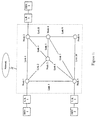
- A network in which the method of admission control and routing of requests for virtual circuits of the invention may be practiced is depicted in Figure 1. The means used to estimate both resource availability and prospective resource consumption (by the requested circuit) is based on the concept of an effective bandwidth (EB). In controlling the admission and routing of variable bit rate (VBR) traffic, source classes are typically mixed in the sense that some classes can benefit from statistical multiplexing while others cannot. Moreover, such a mix of statistically multiplexable (S-VBR) and nonstatistically multiplexable (NS-VBR) sources is known to cause nonlinear interactions. Accordingly, if the boundary of the set of admissible sources is conservatively estimated by a linear approximation (for the purpose of determining EBs), the number of falsely rejected connections can become excessive. This problem and certain difficulties associated with solving it are nicely described in the work of Ewalid et al. [1]; its solution, however, is left open as a "subject of future work". In a subsequent patent application by the same authors [2], they propose a step in this direction whereby bandwidth is allocated directly to CBR (Constant Bit Rate) sources; available link capacity is then reduced accordingly and the EBs for the remaining classes are computed relative to this residual capacity. Although this approach can reduce the severity of nonlinear interactions, if the remaining VBR classes are mixed (which is likely) then the problem cited above persists.
- According to [1, 2], traffic sources are represented by worst-case, regulated rate processes. Specifically, regulation is implemented by a leaky bucket, as schematically depicted in Figure 2, with parameters r (the token rate, which regulates the mean input rate), BT (the token buffer capacity, which bounds the burst size), and P (the peak rate permitted, where r ≤ P), these are deterministic sources that behave as follows. If r < P then the worst-case arrival process (when so regulated) is a deterministic, on-off, periodic rate process. The duration of an on period is T on = BT /(P-r), during which the rate is equal to the peak rate P. The source is then off (rate = 0) for a duration T off = BT /r. Accordingly, the source is able to transmit the maximum amount of information (burst size) permitted by the leaky bucket, namely Q = BTP/(P - r); the mean rate is likewise maximized (= r) with respect to the period T = T on + T off. If r = P then the periodicity disappears, i.e., the output of the regulator becomes a constant bit rate (CBR) source with rate r. Heterogeneity is introduced by considering a set
- With these input assumptions, the analysis in [1, 2] concerns the probabilistic behavior of channel (trunk) utilization at the output of a buffer with capacity B. The QOS measure in question is the saturation probability P sat where, letting C denote the channel capacity and S the total instantaneous demand on the channel,
- In [1, 2], this is referred to as the "loss probability" (denoted P loss) and the no-saturation (or "lossless") case is considered first. To reduce the allocation problem to a single resource (either the buffer or the channel), it is assumed that buffer/bandwidth allocations for a class-j connection are such that both resources are exhausted simultaneously. In other words, if b 0, j and e 0, j denote the buffer and channel allocations, respectively, then the allocation policy is such thatwhere rj ≤ e 0, j ≤ Pj . Accordingly, if

- On the other hand, if (4) is not satisfied, i.e.,
- Summarizing the above and selecting the channel as the focus of the analysis (from this point on, buffer allocations are implicit via the assumptions just adopted), the bandwidth e 0, j can be be expressed in terms of the traffic and resource parameters asIn [1, 2], this quantity is called the "effective bandwidth for lossless performance". However, in keeping with our preferred term for the QOS measure (1), we will subsequently refer to e 0, j as the no-saturation effective bandwidth (NEB) of a class-j source. This is justified by the fact that a connection vector

Notational Differences. Description Ewalid et al. Our notation Load due to the ith class-j source uji Xji Number of class-j sources Kj nj Aggregate demand U S QOS requirement P loss ≤ L P sat ≤ e -γ (In what follows. the coordinates nj of n are taken to be non-negative real numbers: all further uses of n are implicitly so qualified.) Further. letting ωj denote the fraction of time that the channel is utilized by a class-j source, the product ω je 0, j is equal to the mean rate rj permitted by the regulator, whence
- The quantities given by (6) and (8) are key to the subsequent development in Ewalid et al. ([1], Section III), which considers statistical multiplexing gains with possible losses due to saturation. To complete our summary of this background, we find it convenient to employ certain notation that conforms more closely with Kelly [3]. Specifically, the translation to our usage is given by Table 1, where some of these differences have already been noted.
- The variable Xji represents the instantaneous utilization of the channel due to the ith class-j source. Accordingly, for a given connection vector n = (n 1,n 2,...,nJ ), the aggregate demand on the channel isAs noted in the above table, the quality of service requirement is specified in terms of the saturation probability P sat (1) and the QOS parameter γ (where γ > 0). Hence, connection vector n is admissible (under this QOS constraint) if and only if its corresponding demand S (9) satisfies
 where s ≥ 0 and Wj is the probability distribution function of Xji (i = 1,2, .... nj ). i.e.,
- In terms of the above terminology and notation. the basic question considered is whether a connection vector n is admissible, i.e.. its corresponding channel load S satisfies (10). To this end, it is assumed throughout that the system is stable in the sense that E[S] ≤ C. Equivalently, under the traffic assumptions that yield (6) and (8), this stability condition for n can be equivalently expressed asIf, further, condition (7) is satisfied then there is no saturation and, hence, n is trivially admissible. The region in which this occurs is called the admissible set for no saturation (or "lossless performance" in the terminology of [1, 2]), denoted A 0, where by (7),


- On the other hand, if saturation is possible, i.e., Pr[S > C] > 0, then under this condition (together with (13)), Chernov's bound [4] applies to the random variable S - C. This yields a bound on the saturation probability given byand s* is the (unique) value of s that maximizes Fn (s), i.e.,


- In other words, the bound (15) insures that the QOS requirement (10) will be satisfied for connection vector n ifwhere

- In view of the linear nature of (20), the quantity ej (j ∈ J) can be legitimately referred to as the effective bandwidth (EB) of a class-j traffic source. As defined in [1], the statistical multiplexing gain gj compares the EB given by (21) with the NEB (6), i.e.,
- This distinction between S-VBR and NS-VBR classes is an important contribution of [1] since, as shown in their subsequent development (beginning with Proposition 4.3), the nature of A γ (19) and the accuracy of its approximation depend on which types (S-VBR and/or NS-VBR) are involved. If all classes are NS-VBR then A( = A0 and the effective bandwidths are given by the (0,j . If all classes are S-VBR then (20) provides a linear, conservative estimate of A( and, om tirm, a relatively straightforward means of computing the Ebs. However, if connection requests range over a proper mix of S-VBR and NS-VBR classes (including CBR) then, as demonstrated in [1], there are nonlinear interactions which can severely reduce the accuracy of a linear (hyperplane) approximation. As a consequence, there is an increase in the number of admissible connections (relative to A( ) that get falsely rejected, thereby reducing resource (bandwidth, buffer) utilization.
- WO 9701895 discloses a method involving an ATM network which has ATM switches interconnected and related to a connection admission controller. The controller determines if a new connection request can be accommodated within the current limits of the system. When a request is made the associated connection parameters are retrieved. These are quantised in a non-linear manner.
- These parameters are then used via a look-up table to extract the virtual bandwidth the connection represents. The bandwidth available on the link is established and compared with the request to decide its acceptability. The table is created in a set-up phase using exponential queue length bounds and a Martingale function.
- The above mentioned look up table is therefore a table of pre-computedvirtual bandwidths, where these values are independent of how much bandwidth (buffer space) has been allocated.
- In view of this background, there is a need for innovative CAC methods that avoid the difficulties just mentioned. Moreover, if these methods are to profit from improvements afforded by te use of a modified Chernov bound (first considered by Hui [5] in this context), this requires a careful investigation of issues concerning multiplexability and effective bandwidth computation for the traffic classes in question.
- In response to this need, the inventive methods disclosed in the section that follows feature a CAC algorithm which efficiently and accurately controls the admission/routing a diverse mix of ATM traffic demands, ranging from highly multiplexable S-VBR sources to nonstatistically multiplexable CBR demands. Innovative ancillary methods devised in the development of this algorithm include a means of ordering traffic classes according to their relative multiplexability, formulating linear upper and lower bounds (hyperplanes) of an improved admissible connection region (based on the modified Chernov bound), and computing EB-entries for the table on which the CAC algorithm is based. The novel method of the invention.
-
- Figure 1 schematically shows a typical network to which the method of the invention refers.
- Figure 2 shows the scheme of a so called leaky bucket regulator.
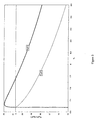
- Figure 3 shows how the characteristic Gn
j (s*) comprises with the QOS parameter and the characteristic Fnj (s*) of the BCB exponent. - Figure 4 is a diagram showing the admissible sets and tangent hyperplanes.
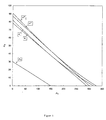
- Figure 5 is a diagram showing the accuracy characteristic of admissible set.
- Figure 6 is a flow sheet representation of the table-based algorithm of the invention.
- Figure 7 shows a set of accuracy characteristics of the table-based algorithm of the invention.
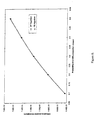
- Figure 8 shows the probabilities of a CBR connection request for the algorithm of the prior art and for the TB (Table Based) algorithm of the invention.
-
- The invention will now be described in detail in the sections that follow. The first section (Case 1) considers the admissible set given by the modified Chernov bound (MCB) and, in terms of the traffic and resource parameters, derives necessary and sufficient conditions for class j sources to be S-VBR.
- The second section (Case 2) details the analysis and computations that accurately determine MCB-based effective bandwidths (EBs) when all classes are S-VBR.
- The third section (Case 3) responds directly to the need identified in the last paragraph of the background section. namely accurate admission control when the considered traffic is a mix of S-VBR and /NS-VBR classes.
- The preferred algorithm of the invention is described in the section entitled "CAC algorithm for mixed traffic" (that is for Case 3).
- To formulate the admissible set determined by the modified Chernov bound, let MS denote the LMGF of the aggregate load S, i.e., by (9),and let σ 2 / n(s) denote the second derivative (with respect to s) of (25), i.e.,
 Assume further that saturation is possible (Pr[S > C] > 0) and, as with (17), let s* be the value of s that maximizes Fn (s). Then the refined large deviations approximation of P sat (first considered by Hui [5] in this context) is
- If there is no saturation then, as earlier (14), admissibility is characterized by the set A 0. Combining these two cases, the corresponding admissible set is
- Under the traffic and regulation assumptions that led to (6) and (8), let us now consider the problem of determining effective bandwidths that comply with (31). Given a connection vector n for which saturation is possible (n ∈ A m / γ- A 0), Fn (s*) and log Kn (s*) can be formulated as follows in terms of the resource and traffic parameters. (Since the first of these is the essential ingredient of the BCB-based analysis [1], its expression there is similar, the differences being notational.) Recalling the assumptions of the Background section, the load variables Xji are binomially distributed. Specifically, Xji is equal to the NEB e 0, j when a type-j source is utilizing the channel; else it is 0. Accordingly, the fraction of time ω j (under steady-state conditions) that the channel is busy (due to such a source) can be identified with the probabilityMoreover, since n is such that saturation is possible (n ∉ A 0), the s* associated with n is the unique solution of F'n (s) = 0. Specifically, taking the first derivative of (33) with respect to s, we have
 and equating the above with 0, it follows that s* is the unique s that satisfies

- Before considering a linear approximation of the boundary of (31), it is helpful to first address the question of statistical multiplexability with respect to this modified admissible set. More precisely, if bandwidth is allocated to class-j sources in isolation, one seeks conditions under which the number of admissible sources can exceed the maximum permitted with no saturation. In this regard (and with a slight abuse of notation), let nj denote the connection vector consisting of nj class-j sources only, i.e.,
j (s*) ≥ γ then. by (30), nj is admissible, yielding a statistical multiplexing gain. Hence, what remains is an analysis that expresses Gnj (s*) in terms of traffic and resource parameters. - If ωj = 1 then the interval Nj is empty and nothing more needs to be done. Note that this is consistent with the definition (8) of ω j , where its value is 1 if class-j is bandwidth limited (5), including the CBR extreme where e 0, j = Pj = rj . Suppose then that ω j < 1 and let nj ∈ Nj . Then by (34) when restricted to class-j sources. the corresponding value of s* must satisfyIn turn, an explicit expression of Gn (s*) for class-j sources can be obtained by substituting nj for n and s* for s in the formulas for Fn (s) and log Kn (s). Specifically, for the two summands of (29), if n = nj then by (33),
 and
and Since Gn
j (s*) = Fnj (s*) + log Knj (s*), the sum of (38) and (39) thus expresses Gnj (s*) as a function of nj and the associated traffic and resource parameters. - Taking the limit of this sum as nj approaches its lower bound n 0, j from above (in which case s* → ∞), we find thatSimilarly, as nj approaches the upper limit imposed by stability,
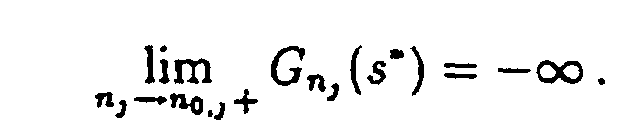 However, with the exception of values very near these extremes (which will not arise in practice). Gn
j (s*) is a nicely behaved function of nj over the interval (36). Specifically, it has a value which occurs when nj is quite close to n 0, j ; beyond this point, Gnj (s*) decreases montonically with increasing nj and remains larger than Fnj (s*) until nj is very close to n 0, j /ω j . - Figure 3 depicts the behavior of Gn
j (s) (the bold curve) in the region surrounding its maximum value, as it compares with the value of γ (20.72; the horizontal line) that bounds P sat by e -γ = 10-9. The channel capacity is taken to be C = 150 Mbps and the sources considered are very bursty, i.e..j (s*), as given by (38), permitting a comparison of G'nj (s*) with the magnitude of the BCB exponent. - In view of the above, whether a traffic class can profit from statistical multiplexing can be decided as follows. Let mj (C) denote the maximum value of Gn
j (s*), i.e.,Then, relative to the QOS exponent γ, it follows that class j is S-VBR for capacity C if and only if
j (s*) beyond mj (C) (see Figure 3), the largest such nj occurs where Gnj (s*) = γ, resulting in an effective bandwidth ej = C/nj . Hence, the statistical multiplexing gain (22) is gj = e 0, j /ej = nj /n 0, j > 1 and, by definition, class-j is S-VBR.
Necessity: If mj (C) < γ then, for all nj ∈ Nj , (30) is never satisfied. By (31), A m / γ thus coincides with the no-saturation region A 0, in which case the effective bandwidth is e 0, j . Hence, gj = 1, i.e., class j is NS-VBR. - Comparing (42) with the BCB-based criterion (24) of [1], namely
j (s*) that results as nj → n 0, j = C/e 0, j from above. However, because n 0, j is on the boundary of A 0, the inequality must be proper to insure that gj > 1. On the other hand. since Gnj (s*) is maximized within the interval Nj , we still have gj > 1 at the extreme where equality holds. Accounting for this technicality, the critical bandwidth of source class j is defined to be the least capacity Cj such that. for all C ≥ Cj,gj > 1. (Our use of Cj here distinguishes it from the BCB-based critical bandwidth Cc,j defined in [1]; see the definition following (22) and note that, there, C must property exceed Cc,j ) Then by (42) and the fact that mj (C) is monotonic and strictly increasing with increasing C (the other parameter values being fixed), - Although the quantities (41) and (43) that characterize an S-VBR class (according to (42) and (44), respectively) agree in form with their BCB-based counterparts, it is important to observe that they differ quantitatively. This is due to the improved nature of the MCB which, for 0 < ω j < 1 (as assumed at the outset of this development), implies
- This is illustrated by the example considered in Figure 3, where we see that Fn
j (s*) attains a maximum value of γ at the limit point where nj = n 0, j . Hence, although right on the edge of being statistically multiplexable, it is nevertheless NS-VBR with respect to the BCB-based definition. On the other hand, since the maximum value of Gnj (s*) exceeds γ, this class can indeed profit from statistical multiplexing, where the computation of ej reveals a gain of gj = 1.105. Consequently, relative to allocations that would result from its NS-VBR classification according to (24), this "upgrade" to S-VBR status afforded by (42) results in a 10% increase in the maximum number of admissible connections. Similarly, comparing critical bandwidths for the assumed values (40) of the source parameters. Cc,j = 150 Mbs whereas a numerical solution of mj (Cj ) = γ yields a critical bandwidth of Cj = 141.2 Mbps. - Generally, unlike the BCB-based analysis, there are no simply expressed solutions of mj (C) and Cj in terms of the underlying traffic and resource parameters. However, based on the formulation of Gn
j (s*) given by the sum of (38) and (39), each is easily determined numerically. Moreover, the absence of closed-form solutions does not diminish their utility since effective bandwidth computations involving multiple S-VBR traffic classes must likewise rely on numerical computations (whether based on the BCB or MCB). Indeed, the quantities mj (C) and Cj play important roles in the development that follows since the algorithms we describe presume an accurately quantified S-VBR/NS-VBR distinction. - To set the stage for these algorithms, we suppose that the traffic mix J = {1,2,...,J} has at least two classes (otherwise J is effectively an isolated class and can be treated as above). Then, as in the BCB-based analysis of [1] but in terms of our modified criteria, the problem of computing effective bandwidths (EBs) differs considerably according to the following three cases.
- Case 1: max j ∈ J mj (C) < γ. Here, by (42), no class is S-VBR (all are NS-VBR) and, since Gn (s*) ≤ max j ∈ Jmj (C),Gn (s*) < γ. Hence, by (31), A m / γ = A 0.
- Case 2: min j∈J mj (C) ≥ γ. Again by (42), this says that all source classes are S-VBR. In this case, A m / γ ⊃ A 0 and, moreover, their boundaries are disjoint.
- Case 3: Neither of the above, i.e.,
-
- In Case 1, nothing can be gained by statistical multiplexing since all classes are NS-VBR; hence the EBs are just the NEBs e 0, j for all j ∈ J. In other words, there is no need to approximate A m / γ since it coincides with A 0. Case 2, on the other hand, is the one for which the tangent hyperplane approximation is intended since, in this case, the boundary ∂A m / γ of A m / γ can be characterized strictly in terms of the modified Chernov bound, i.e.,
- By its definition, Case 3 involves a proper mix of of S-VBR and NS-VBR classes and, hence, the boundary of A m / γ gets distorted by the influence of the NS-VBR classes. As demonstrated in [1] and emphasized in their concluding remarks, this interaction can preclude an accurate linear approximation of the admissible set. Consequently, even though the constructions and computations described below likewise apply to Case 3 (since there exist admissible connection vectors in A m / γ-A 0), the EBs so determined can be too conservative, resulting in an underutilization of system resources.
- The remainder of this section presumes Case 2, where we show how to approximate A m / γ and in turn, compute EBs relative to the MCB in a manner analogous to that of (20) and (21) for the BCB. Case 3 is then addressed the section that follows, where we find that the Case 2 computations remain useful, thanks to an innovative decomposition of the bandwidth allocation process.
- If all traffic classes j ∈ J = {1,2,...,J} are S-VBR (Case 2), then as noted above, (48) is the boundary of the admissible set A m / γ, where Gn (s*) is given by (29). As the first step in constructing a hyperplane approximation of ∂A m / γ, we seek a tangent point n* ∈ ∂A m / γ that reflects a balance of the bandwidth needs of individual classes. This is accomplished by initially considering the J corner points of the boundary ∂A m / γ that result when each of the source classes are considered in isolation, where we let
j (s*) = mj (C) (if mj (C) = γ) or the larger of two values of nj that satisfy Gnj (s*) = γ (if mj (C) > γ; see Figure 3, for example). In the latter case, n max, j is computed via a bisectional search over the interval (n 0, j ,n 0, j /ω j ), beginning with the valuej (s*) decreases as a function of nj (again see Figure 3). This is indeed the case since i) the initial value is in this region and ii) the region where Gnj (s*) increases with nj is a very small interval at the extreme lower end of the search space. - Due to the concavity of ∂A m / γ, the hyperplane having the same corner points. i.e., the setbounds the admissible set A m / γ from above. Accordingly, a reasonable approach to selecting a tangent point n* is to consider the "midpoint" of H opt / γand then locate n* on the straight line that connects the origin (0,0,...,0) to this midpoint. In other words, n* is just the point where this line intersects the boundary ∂A m / γ. To describe this construction more precisely, let ñ denote the midpoint of H opt / γ, i.e..
 and hence, by (50), ñ ∈ H opt / γ. Moreover, by its definition, it is located in the "middle" of H opt / γ, e.g., if J = 2, it is the midpoint of the straight line that joins the corner points (n max,1,0) and (0, n max.2). Alternatively, ñ can be viewed as "averaging" what can be achieved by sources in isolation, for if we sum the J corner points and divide by J, by definitions (49) and (51) we have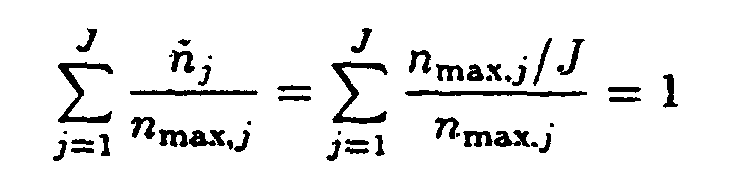

- Intuitively, therefore, ñappears to be an appropriate departure point for selecting a point n* on ∂A m / γ that likewise reflects a balance of the bandwidth needs for individual classes. In the latter regard, we choose to place n*on the line with endpoints (0,0,...,0) and ñ, i.e, the set of points
- Let us now consider the construction of the hyperplane that is tangent to ∂A m / γ at the point n* determined above. i.e., the linear approximation that defines effective bandwidths relative to the modified Chernov bound. Although similar to Hui's construction [5, 6], the formulation is somewhat more complicated due to the log Kn (s*) term of Gn (s*).
- Let H m / γ denote the hyperplane in question, let g be the function whose value at n is Gn (s*), i.e..Exploiting the equivalence of the conditions which define (54) and (55), the EBs e m / j can be computed as follows.

- We first consider the coordinates of ▿g, where we recall that g(n) = Gn (s*) and, making similar abbreviations for the components of (29), we let
- Accordingly, as established in [6] (Theorem 3).However, by the definition of s*,
 thus nullifying the first term on the right. Hence, for j = 1,2,...,J, the value of this derivative at point n ∈ ∂A m / γ is just
- In view of (58), we see that ▿f(n) depends on the tangent point n only to the extent that n influences s*, leading to the relatively simple expression (21) of effective bandwidth associated with the BCB. On the other hand. as revealed in the following formulation of ▿h, the gradient ▿g = ▿f + ▿h for the MCB depends directly on n through quantities such as σ 2 / n(s*). Moreover, unlike ▿f where dependence on the partial derivatives ∂s / ∂nj is nullified by (57), these derivatives influence ▿g through their effect on ▿h.
- In keeping with the above remarks. we first determine ∂s* / ∂nj , where taking partial derivatives with respect to nj on both sides of (57), it follows thatApplying the chain rule for differentiation.
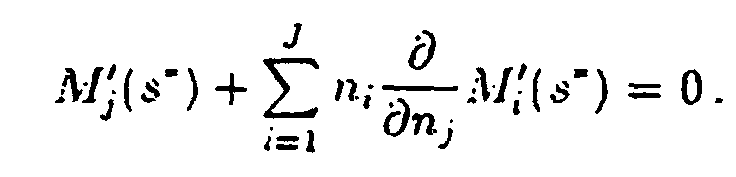 and recalling the definition (26) of σ 2 / n(s), a rearrangement of terms yields
 Summarizing the above and letting ∂g / ∂nj (n) denote the value of the ∂g / ∂nj at n,
 Accordingly, ∂g / ∂nj (n) depends not only on n and the probabilistic nature of class-j traffic (as conveyed by Mj (s*) and its derivatives) but also on the LMGFs and derivatives thereof associated with the remaining classes. Specifically, for the traffic in question and any class j, Mj (s*) is given by (32) (with s = s*) and, taking its partial derivatives with respect to s*,
- 1) Determine the value of s* that corresponds to n.
- 2) For each traffic class j, determine Mj (s*) and its derivatives via the above equations.
- 3) For each j, substitute the results of 2) (which pertain to all classes) in equation (60), thus obtaining the jth coordinate of ▿g(n).
-
- Applying the above to the tangent point n* given by (53), let c(n*) denote the inner product of n* and ▿g(n*), i.e.,Then by the first characterization (54) of the tangent hyperplane, the vectors n that comprise H m / γ are just those which satisfy


- In particular, if bandwidth is allocated to class-j sources only, the vector
- Figure 4 illustrates the above computations for a pair of traffic classes, where e 0,1 = 1 Mbps, ω1 = 0.3 and e 0,2 = 5 Mbps, ω2 = 0.1. Assuming a channel with capacity C = 150 Mbps, the values of mj (C) are m 1(C') = 181.76 and m 2(C) = 70.29. Further, taking the QOS requirement to be P sat ≤ 10-9, γ = 20.72; hence, by (42), both classes are S-VBR, With these choices, the curves labeled A 0, A γ, and A m / γ delineate the connection vectors n = (n 1,n 2) that lie on the boundaries of admissible sets (14), (19), and (31), respectively. Relative to the admissible set A m / γ determined by the MCB, H m / γ is the tangent hyperplane (a line in this case, since J = 2) given by (54) and computed via the formulas derived above. Similarly, the line labeled H γ is the tangent hyperplane for the set A γ More precisely, H γ is the boundary of (20), where the tangent point n* is chosen in a manner analogous to (53).
- These plots reveal several things that appear to be typical of S-VBR traffic. First, one notes that the size of the admissible set is obviously improved through the use of the MCB as opposed to the BCB. Further, we see that the boundaries of these sets are fairly linear; hence, the tangent hyperplane approximations are not overly conservative. One also notes that the choice of the tangent point can make a difference, e.g., if it were selected at a corner point of the boundary, the approximation would be considerably worse.
- Regarding the resulting EBs and, in turn, the corresponding statistical multiplexing gains, the figure indicates these as follows. Restricting our attention to the MCB-based allocations, when bandwidth is allocated to class-j sources only, the maximum number nj of admissible connections is given by the intersection of H m / γ with the nj axis. In turn, by (63),
- Finally, it is important to note that the MCB-determined admissible set A m / γ is, itself, very accurate. This is illustrated in Figure 5, where the presumed traffic classes are the same as those considered above. Specifically, the boundary ∂A m / γ of A m / γ (the smooth curve) is compared with that determined by a saddlepoint approximation (the jagged curve). The latter is known to provide an essentially exact bound for CAC [7] as well as for seemingly diverse applications such as bounding the error probability of digital optical communication systems (see [8], for example). As attested to by this figure, the two bounds are practically identical. In particular, this says that the tangent point n* lies right on the edge of actual admissibility. In turn, this suggests that, generally, the hyperplane H m / γ provides a highly accurate linear estimate of the actual boundary.
- This section describes a preferred embodiment of the algorithm of the invention, namely a CAC algorithm that accommodates mixed S-VBR/NS-VBR (Case 3) traffic without compromising the accuracy of the admission decisions. Needless to say, such an algorithm will also apply to pure S-VBR traffic (Case 2); here, however, a direct computation of the EBs using (64) suffices, eliminating the need for the more refined approach that follows.
- A key ingredient of the algorithm is a ranking of classes j ∈ J according to their potential for a multiplexing gain. As suggested by (44), a logical choice in this regard is the reciprocal of the critical bandwidth Cj , provided Cj exists (wj < 1); if not (wj = 1), a proper gain is impossible for any finite capacity and its rank is 0. Accordingly, we define the relative multiplexability of class j ∈ J to be the quantitySince Cj depends only on γ and the characteristics of traffic class j, µ j is likewise determined and, in particular, remains invariant with changes in C. In turn, this invariance is useful since the algorithm involves allocations with respect to residual capacities

- In view of the above and without loss of generality, we can assume that the traffic classes are named in an order of nonincreasing relative multiplexability, i.e..where ℓ(r) is referred to as the least statistically multiplexable (LSM) class for capacity rC. Although no such class exists if ℓ(r) = 0 (all classes are NS-VBR), the terminology is excused by the fact that 1 is the lowest numbered class. Also, when an LSM class does exist (ℓ(r) ≥ 1), there may be other S-VBR classes with the same relative multiplexability; however, among such classes, ℓ(r) is the highest numbered. By the ordering assumption (67), the LSM class therefore conveniently distinguishes the subset

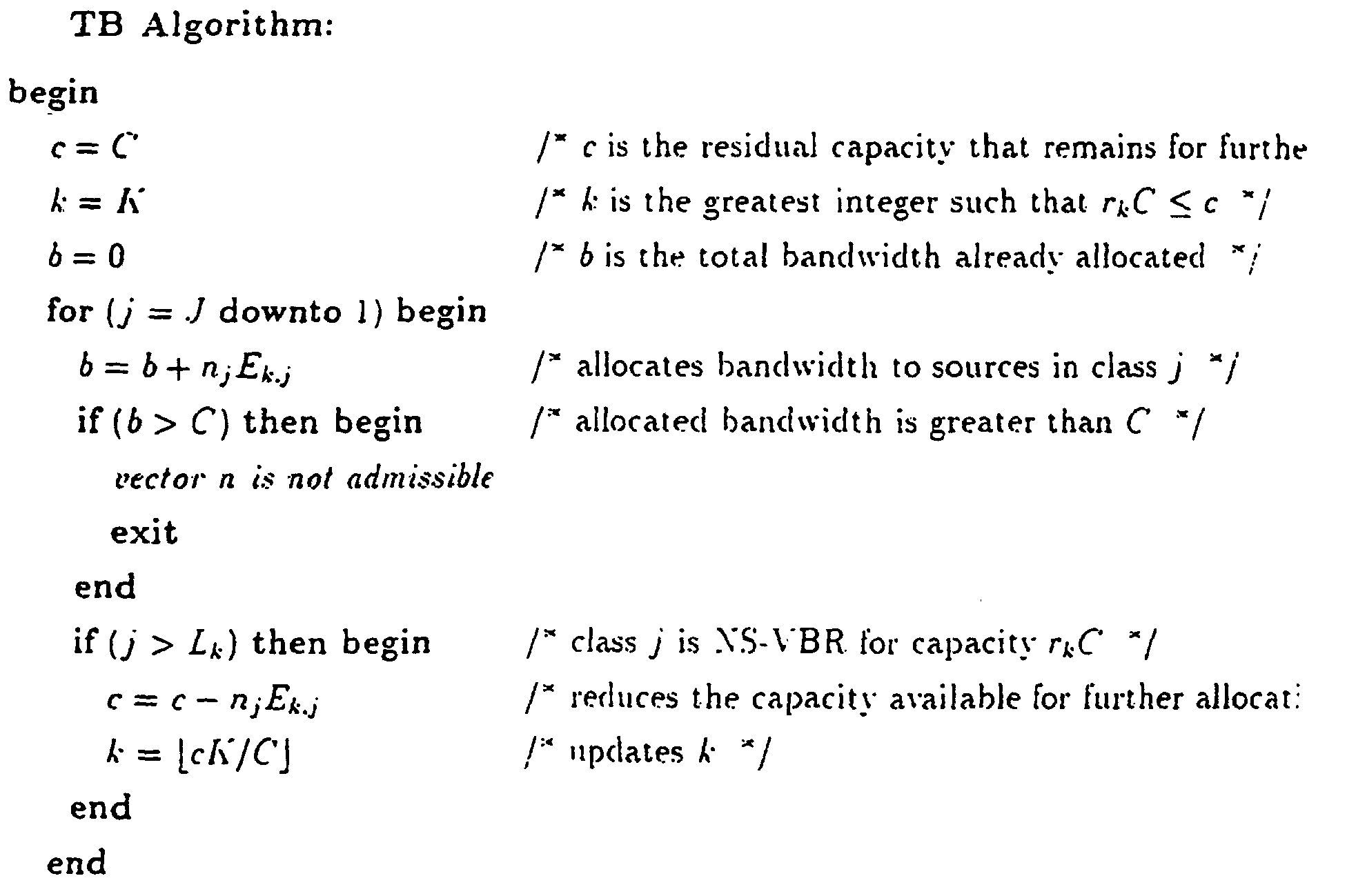
- Assisted by the notions just described, a precomputed table of bandwidth allocations is determined as follows. The channel capacity C is quantized into K levels, resulting in a finite set of residual capacities
k of S-VBR classes, let e m / j(rk ) denote the EB of sources in S-VBR class j ≤ ℓ(rk ), as computed according to (64) for capacity rkC. Note that the computation here is restricted to the above subset (J is taken to be (rk )) and, hence. Case 2 assumptions apply. The remaining classes j > ℓ(rk ) are NS-VBR where, if treated independently. Case 1 applies. Therefore, for sources in these classes, we conservatively allocate their corresponding NEB e 0, j . Doing this for each level k, we thus precompute a table E with K rows and J columns, where entry Ek,j is the bandwidthA second precomputed table L, again with K rows, stores the corresponding LSM class numbers, i.e.. its row-k entry is

- When compared to the saddlepoint (SP) algorithm [7], we find that the TB algorithm is both accurate and extremely time-efficient. Regarding first its accuracy, Figure 7 compares the resulting admissible set boundaries for an example involving three source classes. Classes 1 and 2 coincide with those considered in Figures 4 and 5. The channel capacity and QOS requirement are likewise the same. i.e.. C = 150 Mbps and γ = 20.72. As earlier, Classes 1 and 2 are therefore S-VBR. Class-3 sources are taken to have an NEB of e 0,3 = 10 Mbps, with ω3 = 0.4. Computing the corresponding value of (41), mj (C) = 14.67: hence, class 3 is NS-VBR. This is therefore an example of mixed traffic, as characterized by condition (47). For various values of n 3 (the number of class-3 connections), Figure 7 compares the boundaries of the admission region for classes 1 and 2, as computed by using the TB (bold curves) and the SP algorithms. Being conservative, the former permits somewhat fewer connections, particularly in instances where most of the allocation involves a single class (connection vectors near the corner points). Nevertheless, we see that the admission decisions made by this algorithm are surprisingly accurate when compared to the near-exact SP computations.
- Further testimony to the effectiveness of the TB algorithm has been obtained by evaluating its performance under simulated traffic conditions. Here, the nature of a newly arrived connection request is determined by randomly selecting its traffic class from a predefined set of S-VBR and NS-VBR classes. The latter include CBR classes, where the probability of a CBR connection is adjustable via a parameter of the simulation program. In the presence of such simulated traffic and for both the TB and SP methods, we evaluated channel utilization (relative throughput), mean accepted bandwidth, and the probability that a connection is blocked (not admitted). As revealed by Figure 8, which displays channel utilization as a function of the CBR-connection probability for both algorithms, the slightly improved performance realized by lengthy SP computations is barely perceptible. Moreover, with respect to the other two measures (accepted bandwidth, blocking probability) we have likewise found that the performauce of these two algorithms is essentially identical.
- However, as compared with the SP algorithm, execution of the TB algorithm is significantly faster. Indeed, together with accurate admission decisions. real-time implementation was a pivotal objective of the algorithm's developmem. By virtue of using precomputed EB tables, its time-complexity is but linear in the number of traffic classes J. Specifically, the worst-case number of required operations is 2J floating-point products plus 2J floating-point sums. This permits the admission control of highly nonhomogeneous traffic (large values of J), a requirement that is likely for emerging broadband networks. On the other hand, methods that employ convolution or the SP approximation become infeasible if the number of traffic classes is even moderately large.
- In more concrete terms. Table 2 describes the time-efficiency of the TB algorithm as compared with that of the SP algorithm.
- For various durations of CPU time required by a contemporary workstation (HP Series 9000. Model 715/100, with a PA RISC 2.0 microprocessor), the table displays the maximum number of traffic classes J that can be accommodated by each algorithm in that amount of time. Here we see that. even for execution times exceeding I ms. the capability of the saddlepoint method is modest compared to what the TB algorithm can handle in a fraction of a millisecond.
Traffic class capability as a function of CPU time. CPU time (ms) Maximum value of J SP algorithm TB algorithm 0.1 5 268 0.2 10 552 0.3 16 798 0.4 22 1000 0.5 27 1204 0.6 33 1408 0.7 39 1612 0.8 45 1815 0.9 51 2015 1.0 56 2219 1.1 62 2389 1.2 68 2566 1.3 74 2718 1.4 80 2871 -
- [1] A. I. Ewalid, D. Mitra, and R. H. Wentworth, "A new approach for allocating buffers and bandwidth to heterogeneous, regulated traffic in an ATM node," IEEEJSAC, pp. 1115-1127, August 1995.
- [2] European Patent Application EP 0 756 403 A2, July 1996.
- [3] F. P. Kelly, "Effective bandwidth at multi-class queues," Queueing Systems, pp. 5-16, September 1991.
- [4] P. Billingsley, Probability and Measure, Wiley, NY, 1986.
- [5] J. Y. Hui. "Resource allocation for broadband networks," IEEEJSAC, pp. 1598-1608, June 1988.
- [6] J. Y. Hui. "Layered required bandwidth for heterogenous traffic." in Proc. IN-FOCOM '92, pp. 13-20, 1992.
- [7] S. Montagna, R. Paglino, and A. Puglisi, "Call acceptance control algorithms for voice, video, and data traffic," in Proc. of 4th Int'l Workshop on Performance Modelling and Evaluation of ATM Networks, Ilkley, UK, July 1996.
- [8] K. Schumacher and J. J. O'Reilly, "Relationship between the saddlepoint approximation and the modified Chernoff bound." IEEE Trans. Communications, vol. 38, no. 3, pp. 270-272, March 1990.
-
Claims (8)
- A method for carrying out a connectton admission control in an asynchronous network including at least a network node with presented buffer and output link capacities, said node receiving a request signal for a virtual circuit that routes vanable bit rate VBR information and where the information source may include J traffic classes either statistically multiplexable (S-VBR), or nonstatistically multiplexable (NS-VBR), said request can be granted by said node, by an algorithm which, given the resulting traffic demand in terms of existing connections plus the requested connection, as represented by a vector describing the number of connections in each of plurality of J predefined S-VBR and NS-VBR classes, decides whether said connection vector is admissible with respect to a specified upper bound on the probability of channel saturation, said method including the step of storing a look-up table in a memory for each queuing point, and characterized in thatthe entries Ekj of said look-up table consist of effective bandwidth value calculated using the modified Chernov bound and the look-up table has J columns and K rows;the J columns correspond to the said predefined traffic classes and are listed in a nonincreasing order of the extent to which a traffic class can benefit from statistical multiplexing;the K rows correspond to a quantization of the channel capacity C into K levels of residual capacity Ck=(k/K)C, where k=1,2....K, Ck being the capacity that remains available after prior allocations of bandwidth to NS-VBR connections and;being Lk the largest class of said ordered traffic classes, corresponding to the S-VBR class for a certain capacity Ck, the precomputed entry Ekj of row k and column j of said look-up table is:if j > Lk, the maximum bandwidth required by class-j sources, class j being in this case NS-VBR for said capacity Ck; orif j ≤Lk, the effective bandwidth of class-j sources as determined relative to all the Lk classes that are S-VBR for said capacity Ck.
- The method of claim 1, wherein based on said look-up table and beginning with a capacity relatively at the maximum level K and J traffic classes, the algorithm allocates bandwidth Ekj to any connection of the class j in said connection vector and compares an unaccumulated total bandwidth allocation value b with C:if b>C, then said connection vector is not admissible;if j>1 and class j is S-VBR for the capacity Ck, where j<Lk, then the above allocation procedure is repeated for the connections of the class j-1;if j>1, then k is reduced to a value k', when Ck' is the residual capacity that remains after allocations to connections of the class j, and the above routine is repeated for connections of the class j-1;If j=1 and said connection vector is admissible.
- The method of claim 1, wherein each request signal from a certain traffic source has a set of leaky-bucket characterization parameters comprising a token rate parameter r regulating the average input rate, a token buffer capacity parameter Br defining the burst size and a peak rate parameter P defining the maximum peak rate of the source, the statistical multiplexability of a request coming from a source classified as belonging to a certain class of traffic being decreased in value by a factor corresponding to said parameter r, whereby a class nominally statistically multiplexable at a certain available bandwidth capacity of the link may result non-multiplexable because of said decrement of statistical multiplexability, and further characterized in that among requests classified as statistically multiplexable, a least-statistically-multiplexable request is identified as the one of highest class number that remains multiplexable after accounting for said decrement.
- The method of claim 1, wherein for a set of traffic classes, all statistically multiplexable, the method comprises the compotation of a linear upper bound or hyperplane for the admissible set determined by the so-called modified Chernov bound, MCB, algorithm.
- The method of claim 3, wherein the corner points of the MCB-determined admissible set are first determined algorithmically and then a linear outer bound is identified with the said hyperplane having the same comer points.
- The method of claim 3, wherein a linear lower bound or hyperplane for the MCB-determined admissible set tangent to a point on the boundary of said set is constructed.
- The method of claim 5 whereby the tangent point is selected along a line that runs between the midpoint of the said outer bound and the original corresponding to the point where no sources are allocated; said tangent point being the pointy where this line intersects the MCB-determined admissible set and the construction of said linear lower bound or hyperplane is based on partial derivatives associated with the MCB.
- The method of claim 5, wherein effective bandwidths relative to a linear approximation of an admissible set of the traffic classes relative to the linear lower bound are computed.
Applications Claiming Priority (1)
| Application Number | Priority Date | Filing Date | Title |
|---|---|---|---|
| PCT/IT1998/000373 WO2000038378A1 (en) | 1998-12-21 | 1998-12-21 | Admission control of mixed vbr sources in broadband networks |
Publications (2)
| Publication Number | Publication Date |
|---|---|
| EP1142217A1 EP1142217A1 (en) | 2001-10-10 |
| EP1142217B1 true EP1142217B1 (en) | 2004-05-19 |
Family
ID=11332917
Family Applications (1)
| Application Number | Title | Priority Date | Filing Date |
|---|---|---|---|
| EP98962673A Expired - Lifetime EP1142217B1 (en) | 1998-12-21 | 1998-12-21 | Admission control of mixed vbr sources in broadband networks |
Country Status (3)
| Country | Link |
|---|---|
| EP (1) | EP1142217B1 (en) |
| DE (1) | DE69824050D1 (en) |
| WO (1) | WO2000038378A1 (en) |
Families Citing this family (2)
| Publication number | Priority date | Publication date | Assignee | Title |
|---|---|---|---|---|
| US8451719B2 (en) | 2008-05-16 | 2013-05-28 | Imagine Communications Ltd. | Video stream admission |
| CN116709558A (en) * | 2023-06-01 | 2023-09-05 | 浙江大学 | A resource allocation method for a car networking and synaesthesia integrated system compatible with 5G NR V2X |
Family Cites Families (2)
| Publication number | Priority date | Publication date | Assignee | Title |
|---|---|---|---|---|
| US5347511A (en) * | 1993-06-07 | 1994-09-13 | International Business Machines Corp. | Traffic management in packet communications networks |
| GB9513024D0 (en) * | 1995-06-27 | 1995-08-30 | Newbridge Networks Corp | Connection admission control system (cac) for atm networks |
-
1998
- 1998-12-21 WO PCT/IT1998/000373 patent/WO2000038378A1/en not_active Ceased
- 1998-12-21 EP EP98962673A patent/EP1142217B1/en not_active Expired - Lifetime
- 1998-12-21 DE DE69824050T patent/DE69824050D1/en not_active Expired - Fee Related
Also Published As
| Publication number | Publication date |
|---|---|
| WO2000038378A1 (en) | 2000-06-29 |
| DE69824050D1 (en) | 2004-06-24 |
| EP1142217A1 (en) | 2001-10-10 |
Similar Documents
| Publication | Publication Date | Title |
|---|---|---|
| US5881049A (en) | Admission control in an ATM switching node | |
| US6434160B1 (en) | Adaptive service weight assignments for ATM scheduling | |
| US5581544A (en) | Method and apparatus for evaluating QOS in ATM multiplexing apparatus in which priority control is performed and for controlling call admissions and optimizing priority control on the basis of the evaluation | |
| JPH0946336A (en) | Method for admission control and routing by allocating network resources to network nodes | |
| US5831971A (en) | Method for leaky bucket traffic shaping using fair queueing collision arbitration | |
| JP2620513B2 (en) | Communication network, connection method thereof, and communication network node | |
| US6788646B1 (en) | Link capacity sharing for throughput-blocking optimality | |
| US6212163B1 (en) | Method and device for multi-class ATM connection admission control | |
| US5917804A (en) | Connection admission control for ATM networks handling CBR and VBR services | |
| US6337851B1 (en) | Method and apparatus for relative error scheduling in a communications network using discrete rates and proportional rate scaling | |
| AU2145795A (en) | A communication network control method and apparatus | |
| US6657960B1 (en) | Method and system for providing differentiated services in computer networks | |
| US20030112762A1 (en) | Method of radio resource management for integrated voice and data CDMA networks | |
| US7388867B2 (en) | Data networks | |
| US6771598B1 (en) | Method of admission control for packetized communication networks | |
| EP0863680B1 (en) | Method and apparatus for improved call control scheduling in a distributed system with dissimilar call processors | |
| US6768744B1 (en) | Methods and apparatus for managing communication networks supporting multiple quality of service classes utilizing generalized processor sharing | |
| Tong et al. | Reinforcement learning for call admission control and routing under quality of service constraints in multimedia networks | |
| EP0843501A2 (en) | Resource sharing for book-ahead and instantaneous-request calls | |
| EP1232609B1 (en) | Link capacity sharing for throughput-blocking optimality | |
| US7400630B1 (en) | Call admission control with overbooking support and cell loss ratio and cell delay variation guarantee | |
| WO2000038378A1 (en) | Admission control of mixed vbr sources in broadband networks | |
| JP2002533997A (en) | Connection admission control based on bandwidth and buffer usage | |
| US20050038903A1 (en) | ATM connection admission control device for DBR connections | |
| Gbadebo et al. | A Fuzzy-Based Servers’ Management Technique for M/M/m Queue Network |
Legal Events
| Date | Code | Title | Description |
|---|---|---|---|
| PUAI | Public reference made under article 153(3) epc to a published international application that has entered the european phase |
Free format text: ORIGINAL CODE: 0009012 |
|
| 17P | Request for examination filed |
Effective date: 20010620 |
|
| AK | Designated contracting states |
Kind code of ref document: A1 Designated state(s): DE FI FR GB IT SE |
|
| GRAP | Despatch of communication of intention to grant a patent |
Free format text: ORIGINAL CODE: EPIDOSNIGR1 |
|
| GRAS | Grant fee paid |
Free format text: ORIGINAL CODE: EPIDOSNIGR3 |
|
| GRAA | (expected) grant |
Free format text: ORIGINAL CODE: 0009210 |
|
| RAP1 | Party data changed (applicant data changed or rights of an application transferred) |
Owner name: SIEMENS AKTIENGESELLSCHAFT |
|
| AK | Designated contracting states |
Kind code of ref document: B1 Designated state(s): DE FI FR GB IT SE |
|
| PG25 | Lapsed in a contracting state [announced via postgrant information from national office to epo] |
Ref country code: FI Free format text: LAPSE BECAUSE OF FAILURE TO SUBMIT A TRANSLATION OF THE DESCRIPTION OR TO PAY THE FEE WITHIN THE PRESCRIBED TIME-LIMIT Effective date: 20040519 |
|
| REG | Reference to a national code |
Ref country code: GB Ref legal event code: FG4D |
|
| REF | Corresponds to: |
Ref document number: 69824050 Country of ref document: DE Date of ref document: 20040624 Kind code of ref document: P |
|
| PG25 | Lapsed in a contracting state [announced via postgrant information from national office to epo] |
Ref country code: SE Free format text: LAPSE BECAUSE OF FAILURE TO SUBMIT A TRANSLATION OF THE DESCRIPTION OR TO PAY THE FEE WITHIN THE PRESCRIBED TIME-LIMIT Effective date: 20040819 |
|
| PGFP | Annual fee paid to national office [announced via postgrant information from national office to epo] |
Ref country code: GB Payment date: 20041207 Year of fee payment: 7 |
|
| PGFP | Annual fee paid to national office [announced via postgrant information from national office to epo] |
Ref country code: FR Payment date: 20041223 Year of fee payment: 7 |
|
| ET | Fr: translation filed | ||
| PLBE | No opposition filed within time limit |
Free format text: ORIGINAL CODE: 0009261 |
|
| STAA | Information on the status of an ep patent application or granted ep patent |
Free format text: STATUS: NO OPPOSITION FILED WITHIN TIME LIMIT |
|
| 26N | No opposition filed |
Effective date: 20050222 |
|
| PG25 | Lapsed in a contracting state [announced via postgrant information from national office to epo] |
Ref country code: DE Free format text: LAPSE BECAUSE OF NON-PAYMENT OF DUE FEES Effective date: 20050701 |
|
| PG25 | Lapsed in a contracting state [announced via postgrant information from national office to epo] |
Ref country code: IT Free format text: LAPSE BECAUSE OF NON-PAYMENT OF DUE FEES;WARNING: LAPSES OF ITALIAN PATENTS WITH EFFECTIVE DATE BEFORE 2007 MAY HAVE OCCURRED AT ANY TIME BEFORE 2007. THE CORRECT EFFECTIVE DATE MAY BE DIFFERENT FROM THE ONE RECORDED. Effective date: 20051221 Ref country code: GB Free format text: LAPSE BECAUSE OF NON-PAYMENT OF DUE FEES Effective date: 20051221 |
|
| GBPC | Gb: european patent ceased through non-payment of renewal fee |
Effective date: 20051221 |
|
| PG25 | Lapsed in a contracting state [announced via postgrant information from national office to epo] |
Ref country code: FR Free format text: LAPSE BECAUSE OF NON-PAYMENT OF DUE FEES Effective date: 20060831 |
|
| REG | Reference to a national code |
Ref country code: FR Ref legal event code: ST Effective date: 20060831 |