EP1142131B1 - Electronic device with hidden keyboard - Google Patents
Electronic device with hidden keyboard Download PDFInfo
- Publication number
- EP1142131B1 EP1142131B1 EP99958949A EP99958949A EP1142131B1 EP 1142131 B1 EP1142131 B1 EP 1142131B1 EP 99958949 A EP99958949 A EP 99958949A EP 99958949 A EP99958949 A EP 99958949A EP 1142131 B1 EP1142131 B1 EP 1142131B1
- Authority
- EP
- European Patent Office
- Prior art keywords
- display
- keyboard
- base
- sliding
- sliding mechanism
- Prior art date
- Legal status (The legal status is an assumption and is not a legal conclusion. Google has not performed a legal analysis and makes no representation as to the accuracy of the status listed.)
- Expired - Lifetime
Links
Images




Classifications
-
- G—PHYSICS
- G06—COMPUTING OR CALCULATING; COUNTING
- G06F—ELECTRIC DIGITAL DATA PROCESSING
- G06F15/00—Digital computers in general; Data processing equipment in general
- G06F15/02—Digital computers in general; Data processing equipment in general manually operated with input through keyboard and computation using a built-in program, e.g. pocket calculators
-
- H—ELECTRICITY
- H04—ELECTRIC COMMUNICATION TECHNIQUE
- H04M—TELEPHONIC COMMUNICATION
- H04M1/00—Substation equipment, e.g. for use by subscribers
- H04M1/02—Constructional features of telephone sets
- H04M1/0202—Portable telephone sets, e.g. cordless phones, mobile phones or bar type handsets
- H04M1/0206—Portable telephones comprising a plurality of mechanically joined movable body parts, e.g. hinged housings
- H04M1/0208—Portable telephones comprising a plurality of mechanically joined movable body parts, e.g. hinged housings characterized by the relative motions of the body parts
-
- G—PHYSICS
- G06—COMPUTING OR CALCULATING; COUNTING
- G06F—ELECTRIC DIGITAL DATA PROCESSING
- G06F1/00—Details not covered by groups G06F3/00 - G06F13/00 and G06F21/00
- G06F1/16—Constructional details or arrangements
- G06F1/1613—Constructional details or arrangements for portable computers
- G06F1/1615—Constructional details or arrangements for portable computers with several enclosures having relative motions, each enclosure supporting at least one I/O or computing function
- G06F1/1622—Constructional details or arrangements for portable computers with several enclosures having relative motions, each enclosure supporting at least one I/O or computing function with enclosures rotating around an axis perpendicular to the plane they define or with ball-joint coupling, e.g. PDA with display enclosure orientation changeable between portrait and landscape by rotation with respect to a coplanar body enclosure
-
- G—PHYSICS
- G06—COMPUTING OR CALCULATING; COUNTING
- G06F—ELECTRIC DIGITAL DATA PROCESSING
- G06F1/00—Details not covered by groups G06F3/00 - G06F13/00 and G06F21/00
- G06F1/16—Constructional details or arrangements
- G06F1/1613—Constructional details or arrangements for portable computers
- G06F1/1615—Constructional details or arrangements for portable computers with several enclosures having relative motions, each enclosure supporting at least one I/O or computing function
- G06F1/1624—Constructional details or arrangements for portable computers with several enclosures having relative motions, each enclosure supporting at least one I/O or computing function with sliding enclosures, e.g. sliding keyboard or display
-
- G—PHYSICS
- G06—COMPUTING OR CALCULATING; COUNTING
- G06F—ELECTRIC DIGITAL DATA PROCESSING
- G06F1/00—Details not covered by groups G06F3/00 - G06F13/00 and G06F21/00
- G06F1/16—Constructional details or arrangements
- G06F1/1613—Constructional details or arrangements for portable computers
- G06F1/1633—Constructional details or arrangements of portable computers not specific to the type of enclosures covered by groups G06F1/1615 - G06F1/1626
- G06F1/1675—Miscellaneous details related to the relative movement between the different enclosures or enclosure parts
- G06F1/1677—Miscellaneous details related to the relative movement between the different enclosures or enclosure parts for detecting open or closed state or particular intermediate positions assumed by movable parts of the enclosure, e.g. detection of display lid position with respect to main body in a laptop, detection of opening of the cover of battery compartment
-
- G—PHYSICS
- G06—COMPUTING OR CALCULATING; COUNTING
- G06F—ELECTRIC DIGITAL DATA PROCESSING
- G06F1/00—Details not covered by groups G06F3/00 - G06F13/00 and G06F21/00
- G06F1/16—Constructional details or arrangements
- G06F1/1613—Constructional details or arrangements for portable computers
- G06F1/1633—Constructional details or arrangements of portable computers not specific to the type of enclosures covered by groups G06F1/1615 - G06F1/1626
- G06F1/1675—Miscellaneous details related to the relative movement between the different enclosures or enclosure parts
- G06F1/1683—Miscellaneous details related to the relative movement between the different enclosures or enclosure parts for the transmission of signal or power between the different housings, e.g. details of wired or wireless communication, passage of cabling
-
- H—ELECTRICITY
- H04—ELECTRIC COMMUNICATION TECHNIQUE
- H04M—TELEPHONIC COMMUNICATION
- H04M1/00—Substation equipment, e.g. for use by subscribers
- H04M1/02—Constructional features of telephone sets
- H04M1/0202—Portable telephone sets, e.g. cordless phones, mobile phones or bar type handsets
- H04M1/0206—Portable telephones comprising a plurality of mechanically joined movable body parts, e.g. hinged housings
- H04M1/0208—Portable telephones comprising a plurality of mechanically joined movable body parts, e.g. hinged housings characterized by the relative motions of the body parts
- H04M1/0225—Rotatable telephones, i.e. the body parts pivoting to an open position around an axis perpendicular to the plane they define in closed position
- H04M1/0233—Including a rotatable display body part
-
- H—ELECTRICITY
- H04—ELECTRIC COMMUNICATION TECHNIQUE
- H04M—TELEPHONIC COMMUNICATION
- H04M1/00—Substation equipment, e.g. for use by subscribers
- H04M1/02—Constructional features of telephone sets
- H04M1/0202—Portable telephone sets, e.g. cordless phones, mobile phones or bar type handsets
- H04M1/0206—Portable telephones comprising a plurality of mechanically joined movable body parts, e.g. hinged housings
- H04M1/0208—Portable telephones comprising a plurality of mechanically joined movable body parts, e.g. hinged housings characterized by the relative motions of the body parts
- H04M1/0235—Slidable or telescopic telephones, i.e. with a relative translation movement of the body parts; Telephones using a combination of translation and other relative motions of the body parts
-
- G—PHYSICS
- G06—COMPUTING OR CALCULATING; COUNTING
- G06F—ELECTRIC DIGITAL DATA PROCESSING
- G06F2200/00—Indexing scheme relating to G06F1/04 - G06F1/32
- G06F2200/16—Indexing scheme relating to G06F1/16 - G06F1/18
- G06F2200/161—Indexing scheme relating to constructional details of the monitor
- G06F2200/1614—Image rotation following screen orientation, e.g. switching from landscape to portrait mode
-
- H—ELECTRICITY
- H04—ELECTRIC COMMUNICATION TECHNIQUE
- H04M—TELEPHONIC COMMUNICATION
- H04M1/00—Substation equipment, e.g. for use by subscribers
- H04M1/02—Constructional features of telephone sets
- H04M1/0202—Portable telephone sets, e.g. cordless phones, mobile phones or bar type handsets
- H04M1/0206—Portable telephones comprising a plurality of mechanically joined movable body parts, e.g. hinged housings
- H04M1/0208—Portable telephones comprising a plurality of mechanically joined movable body parts, e.g. hinged housings characterized by the relative motions of the body parts
- H04M1/0214—Foldable telephones, i.e. with body parts pivoting to an open position around an axis parallel to the plane they define in closed position
Definitions
- the described invention relates to an electronic device providing a display output and allowing input via a keyboard or keypad.
- PDA personal digital assistants
- palm PC's such as the Palm Pilot device manufactured by 3COM
- still and video cameras two-way pagers, and so forth.
- a few navigation buttons are used to allow a user to maneuver through displayed data.
- These electronic devices may have real estate (i.e., area) limitations that may not allow for both a keyboard/keypad and a display output.
- Handheld devices especially may have these real estate constraints.
- a compromise is made.
- One solution is to use a touch screen LCD to allow the input of text as well as to display images. If keyboard input is desired, a virtual keyboard is displayed on the touch screen LCD. A user can then input information via the virtual keyboard. However, this limits the portion of the touch screen LCD that can be used for displaying images (because a virtual keyboard is also being displayed).
- a hinged device as in US-A-5 644 469, US-A-5 712 760, US-A-5 278 779, US-A-5 128 662 including a display output on one side and a keyboard on the other side is an alternate solution.
- This type of device allows both input from the keyboard, and simultaneous display of data and/or images. However, when the hinged device is closed, the user can no longer view displayed information from the display output.
- Further alternative solutions are disclosed in US-A-5440502 which shows a display surface which may be latched over a keyboard and US-A-5821881 which discloses a keyboard which is slidable into position over a display.
- a further device is disclosed in US-A-5494447 which shows a device having a keyboard located in a base in which the base is electrically connected by an arm to a display, the arm being slidably located within both the base and the display so that the display may be mounted over the keyboard in a face down position or in a face up position and in which the display may be coplanar with the keyboard.
- An electronic device having a display that is capable of concealing a keyboard is disclosed.
- a "read mode” the display is visible to a user, but the display conceals the keyboard.
- This mode allows easy access to data and images via the display.
- the display is moved to a "full I/O (input/output) mode, the display is still visible to a user, but the display no longer conceals the keyboard. This mode allows the user to input information via the keyboard as well as view information output from the display.
- Figure 1 shows a prior art example of an electronic device 10 having a display 20 and maneuver buttons 22.
- a user is able to view information on the display 20, and the maneuver buttons 22 allow limited input for scrolling through data.
- the information displayed may comprise pictorial information (images) or textual information (names, appointments, etc.)
- the "read mode" of the present invention acts the same as that of the prior art Figure 1. This read mode allows the user to conveniently access information and images from the electronic device 10.
- Figure 2 shows one embodiment of the present invention in its "full I/O mode.” This mode is achieved by moving the display 20 so that it no longer conceals a keyboard/keypad 24.
- the keyboard/keypad 24 may provide a full character set including all letters, numbers and special characters such as that of a typewriter or computer keyboard; or the keyboard/keypad 24 may provide a simplified character set such as the keypad of a touch-tone telephone.
- the term keyboard will be used to denote a full character set keyboard, or any subset of a full character set keyboard in which selection of a particular button corresponds to the input of a character (alphanumeric or special character). In both the read mode and the full I/O mode, the display output is visible to the user.
- Figure 3 shows one embodiment of the display portion 30 of the present invention
- figure 4 shows one embodiment of a corresponding base portion 32 of the present invention.
- the display portion 30 and base portion 32 include several electrical contacts 40 that provide an electrical connection between the display portion 30 and the base portion 32.
- the display portion 30 is a liquid crystal display (LCD), and the base portion 32 houses a processor, memory, and power source (batteries).
- the processor, memory and/or power source could be moved into the display portion.
- the power source could also be provided externally.
- the display portion 30 is coupled to the base portion 32 via a serial connection, such as an SPI* serial bus or an I 2 C* serial bus, which are well-known serial connections.
- SPI is a serial bus developed by Motorola Incorporated as a peripheral interconnect standard.
- I 2 C is a serial bus developed by Philips Semiconductor.
- Third party names and marks are property of their respective owners.
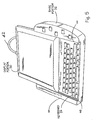
- Figure 5 shows another embodiment of electrically connecting the display portion 30 to the base portion 32 of the electrical device 10.
- a flexible connector such as a ribbon cable 42 is connected between the display portion 30 and the base portion 32.
- a mechanical guide 46 such as grooves along the edges 44 of the base portion 32 (or display portion 30) is used to allow the display portion 30 to slidably move between the read mode and the full I/O mode. Rollers or ball bearings may be employed to allow freer movement within the mechanical guides.
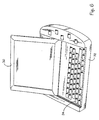
- the topside of the display portion 30 raises as its bottomside is moved within the mechanical guides to reveal the keyboard, as shown in Figure 6.
- Figures 7A and 7B show an alternative embodiment of a device that includes a display portion 30 coupled to a base portion 32 via a rod 50 that allows the display portion 30 to rotatably move to reveal the keyboard 24.
- the display portion 30 may employ a curved side to allow rotatable movement.
- An electrical connection between the display portion 30 and the base portion 32 may be routed through the rod 50.
- Figures 8A-8C show an alternative embodiment of mechanically connecting the display portion 30 to the base portion 32 using an arm 60.
- the arm 60 is bendable and swivels in various directions to allow the display portion 30 to be placed in different positions.
- An electrical connection from the display portion 30 to the base portion 32 is routed internal to the arm 60.
- Figure 8A shows a side view of the device having extendable arm 60.
- the device's display portion 30 fits within the base portion 32 as shown by the dotted lines.
- the display portion 30 can also be extended upwards and rotated so that the display faces the user, as shown in Figure 8B.
- Figure 8C shows a top view of the display portion 30 that has been extended outward and then rotated about pivot 62.
- contacts or sensors detect the position of the display portion 30 in order to present information to a user with the correct viewing orientation.
- the device would need to display information using an orientation that is opposite to that of the read mode of Figure 7A.
- the device shown in Figures 8A-8C would need to detect the orientation of the display portion 30. This could be done by detecting the angle of rotation of the pivot points of the arm 60.
- a transmitter is added to communicate signals corresponding to characters input into the device via the keyboard, such as in a two-way pager or a cellular telephone application.
- an optical system is added to capture one or more images, such as in a still or video camera application.
Landscapes
- Engineering & Computer Science (AREA)
- Theoretical Computer Science (AREA)
- Physics & Mathematics (AREA)
- Computer Hardware Design (AREA)
- General Engineering & Computer Science (AREA)
- General Physics & Mathematics (AREA)
- Human Computer Interaction (AREA)
- Signal Processing (AREA)
- Mathematical Physics (AREA)
- Computer Networks & Wireless Communication (AREA)
- Computing Systems (AREA)
- Input From Keyboards Or The Like (AREA)
- Telephone Set Structure (AREA)
- Devices For Indicating Variable Information By Combining Individual Elements (AREA)
Abstract
Description
- The described invention relates to an electronic device providing a display output and allowing input via a keyboard or keypad.
- Electronic devices employing display outputs include personal digital assistants (PDA's), palm PC's (such as the Palm Pilot device manufactured by 3COM), still and video cameras, two-way pagers, and so forth. In many cases, a few navigation buttons are used to allow a user to maneuver through displayed data. These electronic devices, however, may have real estate (i.e., area) limitations that may not allow for both a keyboard/keypad and a display output. Handheld devices especially may have these real estate constraints.
- If a device has real estate constraints and needs both a keyboard/keypad and a display, a compromise is made. One solution is to use a touch screen LCD to allow the input of text as well as to display images. If keyboard input is desired, a virtual keyboard is displayed on the touch screen LCD. A user can then input information via the virtual keyboard. However, this limits the portion of the touch screen LCD that can be used for displaying images (because a virtual keyboard is also being displayed).
- A hinged device as in US-A-5 644 469, US-A-5 712 760, US-A-5 278 779, US-A-5 128 662 including a display output on one side and a keyboard on the other side is an alternate solution. This type of device allows both input from the keyboard, and simultaneous display of data and/or images. However, when the hinged device is closed, the user can no longer view displayed information from the display output. Further alternative solutions are disclosed in US-A-5440502 which shows a display surface which may be latched over a keyboard and US-A-5821881 which discloses a keyboard which is slidable into position over a display. A further device is disclosed in US-A-5494447 which shows a device having a keyboard located in a base in which the base is electrically connected by an arm to a display, the arm being slidably located within both the base and the display so that the display may be mounted over the keyboard in a face down position or in a face up position and in which the display may be coplanar with the keyboard.
- According to this invention there is provided a device as claimed in claim 1 herein.
- Preferred features of the invention are defined by the dependent claims.
-
- Figure 1 shows one embodiment of an electronic device in a read only mode.
- Figure 2 shows one embodiment of an electronic device in a full I/O mode.
- Figure 3 shows one embodiment of the display portion of the present invention.
- Figure 4 shows one embodiment of a base portion corresponding to the display portion of Figure 3.
- Figure 5 shows an embodiment of electrically connecting the display portion to the base portion of the electrical device using a flexible connector.
- Figure 6 shows an embodiment of mechanically connecting the display portion to the base portion using a sliding mechanical guide.
- Figures 7A and 7B show an embodiment of a device that includes a display portion coupled to a base portion via a rod that allows the display portion to rotatably move to reveal the keyboard.
- Figures 8A - 8C show different views of an embodiment of mechanically connecting the display portion to the base portion using an arm. Figures 8A and 8B are side views. Figure 8C is a top view.
- An electronic device having a display that is capable of concealing a keyboard is disclosed. In a "read mode," the display is visible to a user, but the display conceals the keyboard. This mode allows easy access to data and images via the display. When the display is moved to a "full I/O (input/output) mode, the display is still visible to a user, but the display no longer conceals the keyboard. This mode allows the user to input information via the keyboard as well as view information output from the display.
- Figure 1 shows a prior art example of an
electronic device 10 having adisplay 20 andmaneuver buttons 22. A user is able to view information on thedisplay 20, and themaneuver buttons 22 allow limited input for scrolling through data. The information displayed may comprise pictorial information (images) or textual information (names, appointments, etc.) - The "read mode" of the present invention acts the same as that of the prior art Figure 1. This read mode allows the user to conveniently access information and images from the
electronic device 10. - Figure 2 shows one embodiment of the present invention in its "full I/O mode." This mode is achieved by moving the
display 20 so that it no longer conceals a keyboard/keypad 24. The keyboard/keypad 24 may provide a full character set including all letters, numbers and special characters such as that of a typewriter or computer keyboard; or the keyboard/keypad 24 may provide a simplified character set such as the keypad of a touch-tone telephone. The term keyboard will be used to denote a full character set keyboard, or any subset of a full character set keyboard in which selection of a particular button corresponds to the input of a character (alphanumeric or special character). In both the read mode and the full I/O mode, the display output is visible to the user. - Figure 3 shows one embodiment of the
display portion 30 of the present invention, and figure 4 shows one embodiment of acorresponding base portion 32 of the present invention. In this embodiment, thedisplay portion 30 andbase portion 32 include severalelectrical contacts 40 that provide an electrical connection between thedisplay portion 30 and thebase portion 32. - In one embodiment, the
display portion 30 is a liquid crystal display (LCD), and thebase portion 32 houses a processor, memory, and power source (batteries). However, in an alternative embodiment, the processor, memory and/or power source could be moved into the display portion. The power source could also be provided externally. - In one embodiment, the
display portion 30 is coupled to thebase portion 32 via a serial connection, such as an SPI* serial bus or an I2C* serial bus, which are well-known serial connections. (SPI is a serial bus developed by Motorola Incorporated as a peripheral interconnect standard. I2C is a serial bus developed by Philips Semiconductor.)
* Third party names and marks are property of their respective owners. - Figure 5 shows another embodiment of electrically connecting the
display portion 30 to thebase portion 32 of theelectrical device 10. In this embodiment, a flexible connector such as aribbon cable 42 is connected between thedisplay portion 30 and thebase portion 32. Amechanical guide 46 such as grooves along theedges 44 of the base portion 32 (or display portion 30) is used to allow thedisplay portion 30 to slidably move between the read mode and the full I/O mode. Rollers or ball bearings may be employed to allow freer movement within the mechanical guides. In one embodiment, the topside of thedisplay portion 30 raises as its bottomside is moved within the mechanical guides to reveal the keyboard, as shown in Figure 6. - Figures 7A and 7B show an alternative embodiment of a device that includes a
display portion 30 coupled to abase portion 32 via arod 50 that allows thedisplay portion 30 to rotatably move to reveal thekeyboard 24. Thedisplay portion 30 may employ a curved side to allow rotatable movement. An electrical connection between thedisplay portion 30 and thebase portion 32 may be routed through therod 50. - Figures 8A-8C show an alternative embodiment of mechanically connecting the
display portion 30 to thebase portion 32 using anarm 60. Thearm 60 is bendable and swivels in various directions to allow thedisplay portion 30 to be placed in different positions. An electrical connection from thedisplay portion 30 to thebase portion 32 is routed internal to thearm 60. - Figure 8A shows a side view of the device having
extendable arm 60. In its read mode, the device'sdisplay portion 30 fits within thebase portion 32 as shown by the dotted lines. Thedisplay portion 30 can also be extended upwards and rotated so that the display faces the user, as shown in Figure 8B. Figure 8C shows a top view of thedisplay portion 30 that has been extended outward and then rotated aboutpivot 62. - In one embodiment, contacts or sensors detect the position of the
display portion 30 in order to present information to a user with the correct viewing orientation. For example, in the full I/O position of Figure 7B, the device would need to display information using an orientation that is opposite to that of the read mode of Figure 7A. Similarly, the device shown in Figures 8A-8C would need to detect the orientation of thedisplay portion 30. This could be done by detecting the angle of rotation of the pivot points of thearm 60. - The present invention allows input via keyboard to a variety of different devices. For example, in one embodiment, a transmitter is added to communicate signals corresponding to characters input into the device via the keyboard, such as in a two-way pager or a cellular telephone application. In another embodiment, an optical system is added to capture one or more images, such as in a still or video camera application.
- Thus, an electronic device having a display that conceals a keyboard is disclosed. The specific arrangements and methods described herein are merely illustrative of the principles of this invention. Numerous modifications in form and detail may be made without departing from the scope of the described invention. Although this invention has been shown in relation to a particular embodiment, it should not be considered so limited. Rather, the described invention is limited only by the scope of the appended claims.
Claims (18)
- A device comprising:a keyboard (24) to enter data into the device;a display (30) having a viewing surface to display information; anda sliding mechanism (46) to couple the display with the keyboard,wherein the display may be located in a first position in which the display hides the keyboard, and the display may be located in a second full input/output position in which the entire keyboard is exposed to allow entry of data,
wherein the viewing surface is visible to a user in the first position and the second full input/output position,
wherein in the second full input/output position the viewing surface of the display is substantially coplanar with an operating surface of the keyboard, and
wherein the display is mechanically and electrically coupled with the keyboard in the first position and the second full input/output position, characterised by a plurality of sliding mechanisms (46) including a first sliding mechanism on a first side of the display and a second sliding (46) mechanism on a second side of the display. - The device of claim 1, further comprising a base (32) that includes the keyboard and that is mechanically and electrically connected with the display.
- The device of claim 1 or 2, wherein the keyboard includes a majority of a total number of keys that are available to enter data.
- The device of claim 1 or 2, wherein the keyboard includes substantially all of a total number of keys that are available to enter data.
- The device of any preceding claim, wherein the display hides substantially all of a total number of keys that are available to enter data when located in the first position.
- The device of any preceding claim, wherein movement of the display from the first position to the second full input/output position maintains the viewing surface substantially coplanar with the operating surface.
- The device of claim 1, wherein a sliding mechanism of the plurality includes a protrusion of the display that has a length that is at least a majority of a shortest length of the display and a coupling groove in the base.
- The device of claim 2, wherein a sliding mechanism of the plurality includes a groove in the display that has a length that is at least a majority of a shortest length of the display and a coupling protrusion of the base.
- The device of any preceding claim, wherein the plurality of sliding mechanism include at least three sliding mechanisms.
- The device of claim 2, wherein the plurality of sliding mechanisms include a sliding mechanism having a portion on the display to contact and slide against a portion on the base to provide an electrical connection.
- The device of claim 1, wherein the device does not include an arm to move the display between the first position and the second position.
- The device of claim 2, wherein the device does not include a ball joint to pivot the display relative to the base.
- The device of claim 1, further comprising a transmitter to wirelessly communicate signals corresponding to characters input into the device via the keyboard.
- The device of claim 13, wherein the device is a two-way pager.
- The device of claim 13, wherein the device is a cellular telephone.
- The device of claim 2, wherein the plurality of sliding mechanisms comprises a sliding means to couple the display to the base.
- The device of claim 2, further comprising an electrical contact means to provide electrical contact between the display and the base.
- The device of claim 2, wherein the base comprises a processor, a memory and a power source.
Applications Claiming Priority (3)
| Application Number | Priority Date | Filing Date | Title |
|---|---|---|---|
| US219925 | 1998-12-21 | ||
| US09/219,925 US6483445B1 (en) | 1998-12-21 | 1998-12-21 | Electronic device with hidden keyboard |
| PCT/US1999/026864 WO2000038332A1 (en) | 1998-12-21 | 1999-11-12 | Electronic device with hidden keyboard |
Publications (3)
| Publication Number | Publication Date |
|---|---|
| EP1142131A1 EP1142131A1 (en) | 2001-10-10 |
| EP1142131A4 EP1142131A4 (en) | 2002-01-16 |
| EP1142131B1 true EP1142131B1 (en) | 2005-09-21 |
Family
ID=22821299
Family Applications (1)
| Application Number | Title | Priority Date | Filing Date |
|---|---|---|---|
| EP99958949A Expired - Lifetime EP1142131B1 (en) | 1998-12-21 | 1999-11-12 | Electronic device with hidden keyboard |
Country Status (8)
| Country | Link |
|---|---|
| US (2) | US6483445B1 (en) |
| EP (1) | EP1142131B1 (en) |
| JP (1) | JP2002533821A (en) |
| KR (1) | KR100406905B1 (en) |
| AU (1) | AU1621600A (en) |
| DE (1) | DE69927404T2 (en) |
| TW (1) | TW511068B (en) |
| WO (1) | WO2000038332A1 (en) |
Families Citing this family (144)
| Publication number | Priority date | Publication date | Assignee | Title |
|---|---|---|---|---|
| US6542721B2 (en) * | 1999-10-11 | 2003-04-01 | Peter V. Boesen | Cellular telephone, personal digital assistant and pager unit |
| US6665173B2 (en) * | 1999-12-20 | 2003-12-16 | Wireless Agents, Llc | Physical configuration of a hand-held electronic communication device |
| US7224373B1 (en) | 2000-04-07 | 2007-05-29 | Danger, Inc. | Adjustable data processing display |
| JP4974405B2 (en) * | 2000-08-31 | 2012-07-11 | ソニー株式会社 | Server use method, server use reservation management apparatus, and program storage medium |
| US8332553B2 (en) | 2000-09-21 | 2012-12-11 | Hewlett-Packard Development Company, L.P. | Method and apparatus for accessing a contacts database and telephone services |
| KR20010035360A (en) * | 2001-02-06 | 2001-05-07 | 임하진 | Mobile computer with versatile functions usable during move |
| US6760465B2 (en) | 2001-03-30 | 2004-07-06 | Intel Corporation | Mechanism for tracking colored objects in a video sequence |
| US7308652B2 (en) * | 2001-06-08 | 2007-12-11 | Lenovo Singapore Pte. Ltd | Entry of a password through a touch-sensitive computer screen |
| US7003266B2 (en) * | 2001-06-29 | 2006-02-21 | Nokia Corporation | Portable electronic device with foldable display and hide-away keyboard |
| US6970509B2 (en) * | 2001-07-31 | 2005-11-29 | Wis Technologies, Inc. | Cell array and method of multiresolution motion estimation and compensation |
| US6636419B2 (en) * | 2001-08-09 | 2003-10-21 | Danger, Inc. | Handheld display and keyboard |
| US7692667B2 (en) | 2001-08-17 | 2010-04-06 | Palm, Inc. | Handheld computer having moveable segments that are interactive with an integrated display |
| US20030034987A1 (en) * | 2001-08-17 | 2003-02-20 | William Webb | Handheld computer having moveable segments that can be adjusted to affect a size of the handheld computer |
| KR20030028587A (en) * | 2001-09-18 | 2003-04-10 | 삼성전자주식회사 | cover plate for use in Personal terminal, having a keyborad on a side thereof |
| JP3656742B2 (en) * | 2001-10-30 | 2005-06-08 | 日本電気株式会社 | Portable information terminal |
| GB2381774B (en) * | 2001-11-06 | 2004-03-03 | Inventec Appliances Corp | Hand-held electronic device with hidden keyboard |
| US6850226B2 (en) * | 2001-11-09 | 2005-02-01 | Nokia Corporation | Multifunction mobile communications device with slidable display screen |
| US7187363B2 (en) * | 2001-11-30 | 2007-03-06 | Palm, Inc. | Integrated handheld data processing device having a sliding form factor |
| AU2003217586A1 (en) * | 2002-02-21 | 2003-09-09 | Mobicom Corporation | Article comprising an adaptable input device abstract |
| US6628508B2 (en) * | 2002-02-21 | 2003-09-30 | Mobicom Corporation | Portable terminal with foldable keyboard |
| US20040026136A1 (en) * | 2002-04-03 | 2004-02-12 | International Business Machines Corporation | Flip-touch handheld device |
| US20030222846A1 (en) * | 2002-05-31 | 2003-12-04 | Huy Nguyen | Multi-functional handheld device having moveable segments |
| US7474298B2 (en) * | 2002-05-31 | 2009-01-06 | Palm, Inc. | Mobile device having an adjustable length to selectively expose a surface component |
| AU2003260405B2 (en) * | 2002-08-13 | 2008-05-29 | Vega Grieshaber Kg | Input and output device for detachable connection to an electronic device |
| US7305631B1 (en) | 2002-09-30 | 2007-12-04 | Danger, Inc. | Integrated motion sensor for a data processing device |
| US6829139B1 (en) * | 2002-10-01 | 2004-12-07 | Danger, Inc. | Adjustable data processing display |
| TWI255978B (en) * | 2003-03-28 | 2006-06-01 | Quanta Comp Inc | Electronic device and its combination structure with rotation buckle and signal transmission |
| US7295852B1 (en) | 2003-05-01 | 2007-11-13 | Palm, Inc. | Automated telephone conferencing method and system |
| US7149557B2 (en) * | 2003-05-12 | 2006-12-12 | Siemens Communications, Inc. | Mobile communication device having extendable display |
| US20040229664A1 (en) * | 2003-05-12 | 2004-11-18 | Siemens Information And Communication Mobile Llc. | Mobile communication device having extendable display |
| US6972944B2 (en) * | 2003-05-13 | 2005-12-06 | Intel Corporation | Sliding screen emerging keyboard |
| JP2004348650A (en) * | 2003-05-26 | 2004-12-09 | Toshiba Corp | Electronics |
| US7865180B2 (en) | 2003-06-23 | 2011-01-04 | Palm, Inc. | Automated telephone conferencing method and system |
| KR100531880B1 (en) * | 2003-07-10 | 2005-11-29 | 엘지전자 주식회사 | Sliding device in sliding type mobile phone |
| JP4357900B2 (en) * | 2003-08-18 | 2009-11-04 | 加藤電機株式会社 | Slide hinge for small information terminal |
| US20050055487A1 (en) * | 2003-09-04 | 2005-03-10 | Toshiyuki Tanaka | Rotating docking station |
| US7035090B2 (en) * | 2003-09-04 | 2006-04-25 | Kabushiki Kaisha Toshiba | Interlocking mechanism for a display |
| US6961234B2 (en) * | 2003-09-04 | 2005-11-01 | Kabushiki Kaisha Toshiba | Display support mechanism |
| US20050052831A1 (en) * | 2003-09-08 | 2005-03-10 | Inventec Corporation | Lift-back tablet computer background of the invention |
| US7280346B2 (en) * | 2003-09-29 | 2007-10-09 | Danger, Inc. | Adjustable display for a data processing apparatus |
| US7184802B2 (en) * | 2003-09-29 | 2007-02-27 | Siemens Communications, Inc. | Mobile communication device having rotating keypad assembly |
| US7636748B2 (en) | 2003-09-29 | 2009-12-22 | Microsoft Corporation | Display configurations for a data processing device |
| WO2005034487A1 (en) * | 2003-09-29 | 2005-04-14 | Danger, Inc. | Multipurpose data input/output and display configurations for a data processing apparatus |
| JP2005107122A (en) * | 2003-09-30 | 2005-04-21 | Toshiba Corp | Electronics |
| US7042711B2 (en) * | 2003-11-18 | 2006-05-09 | Kabushiki Kaisha Toshiba | Multi-functional electronic device with a continuously accessible pointing device |
| US7054145B2 (en) * | 2003-11-18 | 2006-05-30 | Kabushiki Kaisha Toshiba | Mechanism for adjusting a display |
| US7092246B2 (en) * | 2003-11-18 | 2006-08-15 | Kabushiki Kaisha Toshiba | Apparatus for connecting a display to a body case of an electronic device |
| US6958910B2 (en) * | 2003-11-18 | 2005-10-25 | Kabushiki Kaisha Toshiba | Cooling apparatus for electronic apparatus |
| US6980423B2 (en) * | 2003-11-18 | 2005-12-27 | Kabushiki Kaisha Toshiba | Tablet interlocking mechanism |
| US7907121B2 (en) | 2003-11-19 | 2011-03-15 | Qualcomm Incorporated | Portable device with versatile keyboard |
| JP4387777B2 (en) * | 2003-11-28 | 2009-12-24 | 株式会社東芝 | Electronics |
| US20050134568A1 (en) * | 2003-12-17 | 2005-06-23 | International Business Machines Corporation | Method and system for providing a rotated keyboard and angled display in a hand-held computing device |
| JP2005190316A (en) * | 2003-12-26 | 2005-07-14 | Toshiba Corp | Electronics |
| US20050185788A1 (en) * | 2004-02-23 | 2005-08-25 | Daw Sean P. | Keypad adapted for use in dual orientations |
| US20050206615A1 (en) * | 2004-03-22 | 2005-09-22 | Mitsuyoshi Tanimoto | Display support mechanism for an electronic apparatus |
| KR100655114B1 (en) * | 2004-03-26 | 2006-12-08 | 이근주 | Slide Cell Phone Module |
| JP2005315157A (en) * | 2004-04-28 | 2005-11-10 | Toshiba Corp | Pump, cooling device and electronic equipment |
| JP2005317797A (en) * | 2004-04-28 | 2005-11-10 | Toshiba Corp | Pumps, electronics and cooling devices |
| JP2005317796A (en) * | 2004-04-28 | 2005-11-10 | Toshiba Corp | Pump, cooling device and electronic equipment |
| JP2005315156A (en) | 2004-04-28 | 2005-11-10 | Toshiba Corp | Pump and electronic device equipped with pump |
| JP4234635B2 (en) * | 2004-04-28 | 2009-03-04 | 株式会社東芝 | Electronics |
| JP2005315159A (en) * | 2004-04-28 | 2005-11-10 | Toshiba Corp | Pumps and electronic equipment |
| JP2005317798A (en) * | 2004-04-28 | 2005-11-10 | Toshiba Corp | Electronics |
| JP4343032B2 (en) * | 2004-05-31 | 2009-10-14 | 株式会社東芝 | Cooling structure and projection type image display device |
| JP2005344562A (en) * | 2004-06-01 | 2005-12-15 | Toshiba Corp | Electronic device having pump, cooling device and cooling device |
| FI20045210A7 (en) * | 2004-06-04 | 2005-12-05 | Nokia Corp | Electronic device and method for arranging the structure of an electronic device for different operating modes |
| US7443657B2 (en) * | 2004-07-21 | 2008-10-28 | Motorola Inc | Dual position display in an electronic device |
| JP2006049382A (en) * | 2004-07-30 | 2006-02-16 | Toshiba Corp | Cooling device and electronic equipment |
| US20060074658A1 (en) * | 2004-10-01 | 2006-04-06 | Siemens Information And Communication Mobile, Llc | Systems and methods for hands-free voice-activated devices |
| JP4329669B2 (en) * | 2004-10-21 | 2009-09-09 | ソニー株式会社 | Electronics |
| US20060109980A1 (en) * | 2004-11-19 | 2006-05-25 | Yuichi Miyazaki | Portable wireless communication device |
| TWD108705S1 (en) * | 2004-12-03 | 2006-01-11 | 光寶科技股份有限公司 | Mobile phone |
| US20060120029A1 (en) * | 2004-12-03 | 2006-06-08 | Gwan-Woo Ryu | Portable terminal having protruding keypad |
| KR100721337B1 (en) * | 2004-12-22 | 2007-05-28 | 엘지전자 주식회사 | Side sliding electronics |
| TWI260149B (en) * | 2005-02-16 | 2006-08-11 | Asustek Comp Inc | Display rotation and sliding module |
| US7248201B2 (en) * | 2005-03-07 | 2007-07-24 | War Corporation | Key fob with automatic cover release |
| USD541288S1 (en) * | 2005-08-05 | 2007-04-24 | Palm, Inc. | Keyboard of a mobile computing device |
| WO2007034792A1 (en) * | 2005-09-20 | 2007-03-29 | Sugatsune Kogyo Co., Ltd. | Mobile device |
| KR100645874B1 (en) * | 2005-12-09 | 2006-11-15 | 삼성전자주식회사 | Electrical connection device of slide type portable terminal |
| US7529081B2 (en) * | 2006-01-05 | 2009-05-05 | Motorola, Inc. | Electronic device and slide mechanism |
| KR100810354B1 (en) * | 2006-01-10 | 2008-03-04 | 삼성전자주식회사 | Mobile phone with game |
| JP4097674B2 (en) * | 2006-02-28 | 2008-06-11 | ファナック株式会社 | Control panel with flexible display |
| JP4658849B2 (en) * | 2006-03-31 | 2011-03-23 | ブラザー工業株式会社 | Electronics |
| KR100678215B1 (en) | 2006-04-07 | 2007-02-02 | 삼성전자주식회사 | Mobile terminal and its sliding mounting device |
| US7778663B2 (en) * | 2006-04-24 | 2010-08-17 | Virgin Mobile Usa, L.P. | Hinge module for three-step open type portable terminal and portable terminal having the same |
| TWD120616S1 (en) * | 2006-05-12 | 2007-12-21 | 新力股份有限公司 | Computer |
| JP2007305042A (en) * | 2006-05-15 | 2007-11-22 | Sony Corp | Information processing device |
| US7846027B2 (en) * | 2006-05-30 | 2010-12-07 | Nokia Corporation | Handheld electronic devices |
| KR100810252B1 (en) * | 2006-07-04 | 2008-03-06 | 삼성전자주식회사 | Biaxial rotation type mobile communication terminal and control method thereof |
| KR101177159B1 (en) * | 2006-08-14 | 2012-08-24 | 엘지전자 주식회사 | Portable computer and apparatus for controlling the same |
| US7502222B2 (en) * | 2006-09-20 | 2009-03-10 | Arima Computer Corporation | Tablet PC and method for sustaining the same |
| US7385150B1 (en) * | 2006-12-28 | 2008-06-10 | Microsoft Corporation | Sliding mechanism for device with two keyboards |
| USD590388S1 (en) * | 2007-02-20 | 2009-04-14 | Motorola, Inc. | Housing for a communication device |
| US7342776B1 (en) * | 2007-02-28 | 2008-03-11 | Inventec Corporation | Portable electronic apparatus having an extendable keyboard |
| USD676856S1 (en) | 2007-03-02 | 2013-02-26 | Hewlett-Packard Development Company, L.P. | Row of keys for a keypad for a mobile computing device |
| TWD122239S1 (en) * | 2007-03-26 | 2008-04-01 | 宏達國際電子股份有限公司 | Electronic device |
| USD590825S1 (en) * | 2007-05-31 | 2009-04-21 | Compal Electronics, Inc. | Mobile personal computer |
| US8126519B2 (en) | 2007-08-31 | 2012-02-28 | Hewlett-Packard Development Company, L.P. | Housing for mobile computing device having construction to slide and pivot into multiple positions |
| USD584304S1 (en) * | 2007-09-13 | 2009-01-06 | Htc Corporation | Handheld electronic device |
| US8233948B2 (en) | 2007-12-11 | 2012-07-31 | Hewlett-Packard Development Company, L.P. | Slider assembly for a housing of a mobile computing device |
| US8150482B2 (en) | 2008-01-08 | 2012-04-03 | Hewlett-Packard Development Company, L.P. | Mobile computing device with moveable housing segments |
| US8200298B2 (en) | 2008-01-08 | 2012-06-12 | Hewlett-Packard Development Company, L.P. | Keypad housing configuration for a mobile computing device |
| US20090231795A1 (en) * | 2008-03-07 | 2009-09-17 | Charles Eric Green | Ergonomic adjustable screen-view technology |
| JP4665980B2 (en) * | 2008-03-19 | 2011-04-06 | ソニー株式会社 | Portable information processing device |
| US7715191B2 (en) * | 2008-04-07 | 2010-05-11 | Research In Motion Limited | Handheld electronic communication device transitionable between compact and expanded configurations |
| WO2009153388A1 (en) * | 2008-06-18 | 2009-12-23 | Nokia Corporation | A device with a turning functional module |
| TWD136368S1 (en) * | 2008-07-31 | 2010-08-11 | 新力股份有限公司 | Display for car |
| US8330574B2 (en) * | 2008-08-28 | 2012-12-11 | Honda Motor Co., Ltd. | Remote vehicle activation device |
| TWI504223B (en) * | 2008-12-05 | 2015-10-11 | Chi Mei Comm Systems Inc | Electronic device |
| US20100159992A1 (en) * | 2008-12-18 | 2010-06-24 | Nokia Corporation | Mobile communication device with a sliding display screen and screen-dividing member |
| TWI387427B (en) * | 2009-01-22 | 2013-02-21 | Asustek Comp Inc | Handheld electronic device |
| US8103322B2 (en) | 2009-02-27 | 2012-01-24 | Research In Motion Limited | Handheld electronic device having two device members slidable relative to a bridge |
| US8199487B2 (en) * | 2009-03-10 | 2012-06-12 | Nokia Corporation | Extendible apparatus |
| CN101909094B (en) * | 2009-06-03 | 2012-09-19 | 鸿富锦精密工业(深圳)有限公司 | Electronic device with sliding type keyboard |
| TWM371246U (en) * | 2009-06-24 | 2009-12-21 | Micro Star Int Co Ltd | Projective electronic device |
| TWI401560B (en) * | 2009-11-24 | 2013-07-11 | Htc Corp | Electronic device |
| WO2011065472A1 (en) * | 2009-11-26 | 2011-06-03 | 京セラ株式会社 | Portable electronic device |
| US8149581B2 (en) | 2009-12-18 | 2012-04-03 | Sony Ericssom Mobile Communications AB | Keyboard and display screen in separate housings connected by cam assemblies that tilt responsive to movement between the housings |
| USD630639S1 (en) * | 2009-12-25 | 2011-01-11 | Fih (Hong Kong) Limited | Keyboard |
| USD629777S1 (en) * | 2009-12-25 | 2010-12-28 | Fih (Hong Kong) Limited | Mobile phone |
| US8379377B2 (en) * | 2010-01-20 | 2013-02-19 | Creator Technology B.V. | Electronic device with at least one extendable display section |
| US8725223B2 (en) * | 2010-02-08 | 2014-05-13 | Nokia Corporation | Apparatus for a portable electronic device |
| CN201781710U (en) * | 2010-07-30 | 2011-03-30 | 国基电子(上海)有限公司 | Portable electronic device |
| CN102404421A (en) * | 2010-09-08 | 2012-04-04 | (株)裕元复合技术 | Sliding closure type wireless mobile terminal |
| US12164342B2 (en) * | 2010-11-04 | 2024-12-10 | Parker May | Adjustable keyboard for front and back typing |
| US8606340B2 (en) | 2010-11-22 | 2013-12-10 | Blackberry Limited | Multi-display mobile device |
| US9001504B2 (en) * | 2010-12-28 | 2015-04-07 | Google Inc. | Moveable display portion of a computing device |
| US8649166B2 (en) | 2011-01-11 | 2014-02-11 | Z124 | Multi-positionable portable computer |
| US8648821B2 (en) | 2011-01-18 | 2014-02-11 | Flextronics Id, Llc | Spheroidal pivot for an electronic device |
| US8750740B2 (en) * | 2011-01-24 | 2014-06-10 | Xerox Corporation | Auto-positioning user interface based on user activity |
| US8503174B2 (en) | 2011-02-04 | 2013-08-06 | Research In Motion Limited | Magnetic slider mechanism for electronic devices and methods of use |
| US8526178B2 (en) * | 2011-05-17 | 2013-09-03 | Flextronics Ap, Llc | All-in-one computing device with an adjustable screen height |
| CN102938988A (en) * | 2011-08-15 | 2013-02-20 | 鸿富锦精密工业(深圳)有限公司 | Electronic device and hinge structure thereof |
| US8681113B1 (en) | 2011-09-27 | 2014-03-25 | Flextronics Ap, Llc | Concept and operation mode for multi media AIO |
| CN103037655B (en) * | 2011-09-30 | 2016-12-07 | 富泰华工业(深圳)有限公司 | Portable electron device |
| CN103513710A (en) * | 2012-06-29 | 2014-01-15 | 联想(北京)有限公司 | Status switching method and electronic device |
| US9477262B2 (en) | 2012-09-10 | 2016-10-25 | Google Inc. | Moveable display portion of a computing device including a clutch mechanism |
| EP3052132B1 (en) | 2013-09-30 | 2020-07-29 | Beth Israel Deaconess Medical Center, Inc. | Antibody therapies for human immunodeficiency virus (hiv) |
| US9398809B2 (en) * | 2014-06-19 | 2016-07-26 | George Ross | Interactive mobile whiteboard panel system |
| CN108496016A (en) * | 2016-01-25 | 2018-09-04 | 富士通株式会社 | Hinge and electronic equipment |
| US9740240B1 (en) | 2016-03-21 | 2017-08-22 | Google Inc. | Base with rotating mount that increases friction of rotation when portable computing device is placed onto mount |
| US10860068B2 (en) * | 2019-01-31 | 2020-12-08 | Dell Products L.P. | Transformative information handling cable management |
| KR102866878B1 (en) * | 2020-05-08 | 2025-10-01 | 삼성디스플레이 주식회사 | Display device |
| WO2022019357A1 (en) * | 2020-07-24 | 2022-01-27 | 엘지전자 주식회사 | Mobile terminal |
Family Cites Families (30)
| Publication number | Priority date | Publication date | Assignee | Title |
|---|---|---|---|---|
| JPH03109622A (en) * | 1989-09-22 | 1991-05-09 | Sharp Corp | Movable display information processing device |
| US5128662A (en) * | 1989-10-20 | 1992-07-07 | Failla Stephen J | Collapsibly segmented display screens for computers or the like |
| DE69123465T2 (en) * | 1990-01-25 | 1997-06-26 | Radius Inc | Process for changing the dimensions of computer display windows and their movement |
| JPH03278212A (en) * | 1990-03-28 | 1991-12-09 | Canon Inc | Portable electronic apparatus |
| US5268817A (en) * | 1990-04-27 | 1993-12-07 | Kabushiki Kaisha Toshiba | Portable computer with keyboard and having display with coordinate input tablet rotatably mounted to face either toward or away from keyboard when closed over keyboard |
| JP3102036B2 (en) * | 1990-12-19 | 2000-10-23 | 富士通株式会社 | Display device support mechanism |
| US5644469A (en) * | 1991-03-06 | 1997-07-01 | Canon Kabushiki Kaisha | Information processing apparatus support system with support arms which are capable of closing toward a keyboard unit or away from a keyboard unit |
| US5440502A (en) * | 1991-12-26 | 1995-08-08 | Dell Usa, L.P. | Stylus operable computer with wireless keyboard in storage bay |
| JPH05242040A (en) * | 1992-02-27 | 1993-09-21 | Sharp Corp | Notebook type personal computer with handwriting input function |
| KR940006221Y1 (en) * | 1992-03-21 | 1994-09-15 | 석영징 | Glove for sports |
| US5278779A (en) * | 1992-06-26 | 1994-01-11 | Conway Kevin M | Laptop computer with hinged keyboard |
| US5808862A (en) * | 1992-12-22 | 1998-09-15 | Ncr Corporation | Computer configuration which allows conversion between multiple operative positions |
| JPH06230852A (en) * | 1993-01-28 | 1994-08-19 | Sharp Corp | Information processing equipment |
| AU6496594A (en) * | 1993-03-26 | 1994-10-24 | Khalil S. Zaidan | Hinge assembly for electronic devices |
| US5668570A (en) * | 1993-06-29 | 1997-09-16 | Ditzik; Richard J. | Desktop computer with adjustable flat panel screen |
| DE4330811C2 (en) * | 1993-09-12 | 1995-08-31 | Niles Simmons Industrieanlagen | Wheelset alignment method for wheelset processing machines and wheelset alignment device |
| US5548478A (en) * | 1994-07-25 | 1996-08-20 | Khyber Technologies Corporation | Portable computing device having an adjustable hinge |
| JP3700200B2 (en) * | 1995-06-05 | 2005-09-28 | ソニー株式会社 | Portable telephone equipment |
| DE19529454C1 (en) * | 1995-08-10 | 1997-02-20 | Ibm | Combined keyboard and graphic data input field device |
| US5712760A (en) | 1996-01-26 | 1998-01-27 | Texas Instruments Incorporated | Compact foldable keyboard |
| JP3222764B2 (en) * | 1996-05-17 | 2001-10-29 | シャープ株式会社 | Information processing device |
| US6005767A (en) * | 1997-11-14 | 1999-12-21 | Vadem | Portable computer having articulated display |
| JP3092560B2 (en) * | 1997-10-30 | 2000-09-25 | 日本電気株式会社 | Personal computer |
| FR2771382B1 (en) | 1997-11-21 | 2000-02-11 | Yoplait Sa | PACKAGING CONTAINER FOR FOOD PRODUCT |
| KR100297746B1 (en) * | 1997-12-26 | 2001-08-07 | 윤종용 | Portable computer |
| FI112573B (en) * | 1998-06-04 | 2003-12-15 | Nokia Corp | Mobile communicator with camera |
| US6249672B1 (en) * | 1999-03-19 | 2001-06-19 | Mobile Communications Holdings, Inc. | Portable telephone |
| US6384811B1 (en) * | 1999-06-08 | 2002-05-07 | Compal Electronics, Inc. | Portable computer having a display module moveable among closed, keyboard typing and image viewing positions |
| US6351372B1 (en) * | 1999-09-01 | 2002-02-26 | Ericsson Inc. | Personal computing device with foldable keyboard |
| US6532147B1 (en) * | 1999-09-24 | 2003-03-11 | International Business Machines Corporation | Flexible monitor/display on mobile device |
-
1998
- 1998-12-21 US US09/219,925 patent/US6483445B1/en not_active Expired - Lifetime
-
1999
- 1999-11-04 TW TW088119228A patent/TW511068B/en not_active IP Right Cessation
- 1999-11-12 DE DE69927404T patent/DE69927404T2/en not_active Expired - Lifetime
- 1999-11-12 JP JP2000590307A patent/JP2002533821A/en active Pending
- 1999-11-12 EP EP99958949A patent/EP1142131B1/en not_active Expired - Lifetime
- 1999-11-12 KR KR10-2001-7007409A patent/KR100406905B1/en not_active Expired - Lifetime
- 1999-11-12 AU AU16216/00A patent/AU1621600A/en not_active Abandoned
- 1999-11-12 WO PCT/US1999/026864 patent/WO2000038332A1/en not_active Ceased
-
2001
- 2001-11-21 US US09/991,828 patent/US7006015B2/en not_active Expired - Lifetime
Also Published As
| Publication number | Publication date |
|---|---|
| EP1142131A4 (en) | 2002-01-16 |
| KR100406905B1 (en) | 2003-11-21 |
| KR20010082342A (en) | 2001-08-29 |
| DE69927404T2 (en) | 2006-06-29 |
| HK1036700A1 (en) | 2002-01-11 |
| WO2000038332A1 (en) | 2000-06-29 |
| US7006015B2 (en) | 2006-02-28 |
| TW511068B (en) | 2002-11-21 |
| US6483445B1 (en) | 2002-11-19 |
| JP2002533821A (en) | 2002-10-08 |
| AU1621600A (en) | 2000-07-12 |
| EP1142131A1 (en) | 2001-10-10 |
| US20020039074A1 (en) | 2002-04-04 |
| DE69927404D1 (en) | 2006-02-02 |
Similar Documents
| Publication | Publication Date | Title |
|---|---|---|
| EP1142131B1 (en) | Electronic device with hidden keyboard | |
| CN108924296B (en) | Flexible screen sliding device and terminal equipment | |
| KR101474754B1 (en) | Portable information terminal | |
| US7239898B2 (en) | Self configuring multiple element portable electronic device | |
| US7808549B2 (en) | Electronic device | |
| EP0898405B1 (en) | Information communication terminal device | |
| US6466202B1 (en) | Information terminal unit | |
| KR101004865B1 (en) | Multi-axis hinge assembly | |
| US7257430B2 (en) | Self configuring multiple element portable electronic device | |
| US7336979B2 (en) | Multifunction personal computer/mobile phone | |
| US20060067036A1 (en) | Display | |
| JP2003298698A (en) | Folding portable information terminal | |
| US7366550B2 (en) | Handheld electronic apparatus | |
| JP2003044169A (en) | Electronics | |
| EP0793163B1 (en) | Portable computer | |
| US20210124544A1 (en) | Mobile Display Device with Multiple Display Panels and Segregated System Components | |
| US7595980B2 (en) | Multi-configuration portable electronic device and guiding module thereof | |
| US20060148543A1 (en) | Flipper phone configuration | |
| US7251511B2 (en) | Portable communication apparatus with data-inputting expansion | |
| US20050134568A1 (en) | Method and system for providing a rotated keyboard and angled display in a hand-held computing device | |
| HK1036700B (en) | Electronic device with hidden keyboard | |
| US7394455B2 (en) | Electronic device | |
| US20240264640A1 (en) | Portable electronic device comprising hinge module | |
| US20030103087A1 (en) | Electronic apparatus having two position input unit | |
| US20240219975A1 (en) | Portable electronic device |
Legal Events
| Date | Code | Title | Description |
|---|---|---|---|
| PUAI | Public reference made under article 153(3) epc to a published international application that has entered the european phase |
Free format text: ORIGINAL CODE: 0009012 |
|
| 17P | Request for examination filed |
Effective date: 20010605 |
|
| AK | Designated contracting states |
Kind code of ref document: A1 Designated state(s): AT BE CH CY DE DK ES FI FR GB GR IE IT LI LU MC NL PT SE |
|
| AX | Request for extension of the european patent |
Free format text: AL;LT;LV;MK;RO;SI |
|
| A4 | Supplementary search report drawn up and despatched |
Effective date: 20011203 |
|
| AK | Designated contracting states |
Kind code of ref document: A4 Designated state(s): AT BE CH CY DE DK ES FI FR GB GR IE IT LI LU MC NL PT SE |
|
| RIC1 | Information provided on ipc code assigned before grant |
Free format text: 7H 03M 11/00 A, 7H 03K 17/94 B, 7G 09G 5/00 B, 7H 05K 5/00 B, 7H 05K 7/00 B, 7G 06F 1/16 B |
|
| RBV | Designated contracting states (corrected) |
Designated state(s): DE ES GB SE |
|
| 17Q | First examination report despatched |
Effective date: 20040817 |
|
| GRAP | Despatch of communication of intention to grant a patent |
Free format text: ORIGINAL CODE: EPIDOSNIGR1 |
|
| GRAS | Grant fee paid |
Free format text: ORIGINAL CODE: EPIDOSNIGR3 |
|
| GRAA | (expected) grant |
Free format text: ORIGINAL CODE: 0009210 |
|
| AK | Designated contracting states |
Kind code of ref document: B1 Designated state(s): DE ES GB SE |
|
| REG | Reference to a national code |
Ref country code: GB Ref legal event code: FG4D |
|
| REF | Corresponds to: |
Ref document number: 69927404 Country of ref document: DE Date of ref document: 20051027 Kind code of ref document: P |
|
| PGFP | Annual fee paid to national office [announced via postgrant information from national office to epo] |
Ref country code: ES Payment date: 20051124 Year of fee payment: 7 |
|
| PG25 | Lapsed in a contracting state [announced via postgrant information from national office to epo] |
Ref country code: SE Free format text: LAPSE BECAUSE OF FAILURE TO SUBMIT A TRANSLATION OF THE DESCRIPTION OR TO PAY THE FEE WITHIN THE PRESCRIBED TIME-LIMIT Effective date: 20051221 |
|
| PG25 | Lapsed in a contracting state [announced via postgrant information from national office to epo] |
Ref country code: ES Free format text: LAPSE BECAUSE OF FAILURE TO SUBMIT A TRANSLATION OF THE DESCRIPTION OR TO PAY THE FEE WITHIN THE PRESCRIBED TIME-LIMIT Effective date: 20060101 |
|
| REF | Corresponds to: |
Ref document number: 69927404 Country of ref document: DE Date of ref document: 20060202 Kind code of ref document: P |
|
| REG | Reference to a national code |
Ref country code: HK Ref legal event code: GR Ref document number: 1036700 Country of ref document: HK |
|
| PLBE | No opposition filed within time limit |
Free format text: ORIGINAL CODE: 0009261 |
|
| STAA | Information on the status of an ep patent application or granted ep patent |
Free format text: STATUS: NO OPPOSITION FILED WITHIN TIME LIMIT |
|
| 26N | No opposition filed |
Effective date: 20060622 |
|
| PGFP | Annual fee paid to national office [announced via postgrant information from national office to epo] |
Ref country code: DE Payment date: 20181030 Year of fee payment: 20 |
|
| PGFP | Annual fee paid to national office [announced via postgrant information from national office to epo] |
Ref country code: GB Payment date: 20181107 Year of fee payment: 20 |
|
| REG | Reference to a national code |
Ref country code: DE Ref legal event code: R071 Ref document number: 69927404 Country of ref document: DE |
|
| REG | Reference to a national code |
Ref country code: GB Ref legal event code: PE20 Expiry date: 20191111 |
|
| PG25 | Lapsed in a contracting state [announced via postgrant information from national office to epo] |
Ref country code: GB Free format text: LAPSE BECAUSE OF EXPIRATION OF PROTECTION Effective date: 20191111 |