EP1140809B1 - New biphenyl and biphenyl-analogous compounds as integrin antagonists - Google Patents
New biphenyl and biphenyl-analogous compounds as integrin antagonists Download PDFInfo
- Publication number
- EP1140809B1 EP1140809B1 EP99967934A EP99967934A EP1140809B1 EP 1140809 B1 EP1140809 B1 EP 1140809B1 EP 99967934 A EP99967934 A EP 99967934A EP 99967934 A EP99967934 A EP 99967934A EP 1140809 B1 EP1140809 B1 EP 1140809B1
- Authority
- EP
- European Patent Office
- Prior art keywords
- residue
- butyl
- substituted
- optionally substituted
- group
- Prior art date
- Legal status (The legal status is an assumption and is not a legal conclusion. Google has not performed a legal analysis and makes no representation as to the accuracy of the status listed.)
- Expired - Lifetime
Links
- 150000001875 compounds Chemical class 0.000 title claims abstract description 119
- ZUOUZKKEUPVFJK-UHFFFAOYSA-N diphenyl Chemical compound C1=CC=CC=C1C1=CC=CC=C1 ZUOUZKKEUPVFJK-UHFFFAOYSA-N 0.000 title claims abstract description 56
- 235000010290 biphenyl Nutrition 0.000 title claims abstract description 15
- 239000004305 biphenyl Substances 0.000 title claims abstract description 15
- 102000006495 integrins Human genes 0.000 title abstract description 14
- 108010044426 integrins Proteins 0.000 title abstract description 14
- 239000005557 antagonist Substances 0.000 title abstract description 9
- 208000037265 diseases, disorders, signs and symptoms Diseases 0.000 claims abstract description 19
- 238000002360 preparation method Methods 0.000 claims abstract description 19
- 239000008194 pharmaceutical composition Substances 0.000 claims abstract description 17
- 201000010099 disease Diseases 0.000 claims abstract description 11
- 206010003210 Arteriosclerosis Diseases 0.000 claims abstract description 9
- 206010028980 Neoplasm Diseases 0.000 claims abstract description 9
- 208000001132 Osteoporosis Diseases 0.000 claims abstract description 9
- 208000011775 arteriosclerosis disease Diseases 0.000 claims abstract description 9
- 201000011510 cancer Diseases 0.000 claims abstract description 9
- 238000004519 manufacturing process Methods 0.000 claims abstract description 9
- 208000037803 restenosis Diseases 0.000 claims abstract description 9
- 208000035475 disorder Diseases 0.000 claims abstract description 8
- 230000000010 osteolytic effect Effects 0.000 claims abstract description 7
- 238000011321 prophylaxis Methods 0.000 claims abstract description 7
- -1 thiooxazole Chemical compound 0.000 claims description 702
- 125000001997 phenyl group Chemical group [H]C1=C([H])C([H])=C(*)C([H])=C1[H] 0.000 claims description 175
- 229910052739 hydrogen Inorganic materials 0.000 claims description 138
- 239000001257 hydrogen Substances 0.000 claims description 137
- 125000002496 methyl group Chemical group [H]C([H])([H])* 0.000 claims description 132
- 125000001495 ethyl group Chemical group [H]C([H])([H])C([H])([H])* 0.000 claims description 129
- 125000000999 tert-butyl group Chemical group [H]C([H])([H])C(*)(C([H])([H])[H])C([H])([H])[H] 0.000 claims description 129
- 125000000484 butyl group Chemical group [H]C([*])([H])C([H])([H])C([H])([H])C([H])([H])[H] 0.000 claims description 128
- 125000001995 cyclobutyl group Chemical group [H]C1([H])C([H])([H])C([H])(*)C1([H])[H] 0.000 claims description 128
- 125000000113 cyclohexyl group Chemical group [H]C1([H])C([H])([H])C([H])([H])C([H])(*)C([H])([H])C1([H])[H] 0.000 claims description 128
- 125000001559 cyclopropyl group Chemical group [H]C1([H])C([H])([H])C1([H])* 0.000 claims description 128
- 125000004051 hexyl group Chemical group [H]C([H])([H])C([H])([H])C([H])([H])C([H])([H])C([H])([H])C([H])([H])* 0.000 claims description 128
- 125000000959 isobutyl group Chemical group [H]C([H])([H])C([H])(C([H])([H])[H])C([H])([H])* 0.000 claims description 128
- 125000001972 isopentyl group Chemical group [H]C([H])([H])C([H])(C([H])([H])[H])C([H])([H])C([H])([H])* 0.000 claims description 128
- 125000001449 isopropyl group Chemical group [H]C([H])([H])C([H])(*)C([H])([H])[H] 0.000 claims description 128
- 125000001971 neopentyl group Chemical group [H]C([*])([H])C(C([H])([H])[H])(C([H])([H])[H])C([H])([H])[H] 0.000 claims description 128
- 125000001436 propyl group Chemical group [H]C([*])([H])C([H])([H])C([H])([H])[H] 0.000 claims description 128
- 125000001797 benzyl group Chemical group [H]C1=C([H])C([H])=C(C([H])=C1[H])C([H])([H])* 0.000 claims description 127
- 125000001147 pentyl group Chemical group C(CCCC)* 0.000 claims description 127
- 125000001511 cyclopentyl group Chemical group [H]C1([H])C([H])([H])C([H])([H])C([H])(*)C1([H])[H] 0.000 claims description 125
- 125000000623 heterocyclic group Chemical group 0.000 claims description 124
- 125000003944 tolyl group Chemical group 0.000 claims description 123
- 238000000034 method Methods 0.000 claims description 112
- 229920006395 saturated elastomer Polymers 0.000 claims description 112
- 125000004178 (C1-C4) alkyl group Chemical group 0.000 claims description 100
- WYURNTSHIVDZCO-UHFFFAOYSA-N Tetrahydrofuran Chemical compound C1CCOC1 WYURNTSHIVDZCO-UHFFFAOYSA-N 0.000 claims description 100
- YLQBMQCUIZJEEH-UHFFFAOYSA-N tetrahydrofuran Natural products C=1C=COC=1 YLQBMQCUIZJEEH-UHFFFAOYSA-N 0.000 claims description 94
- 150000001412 amines Chemical class 0.000 claims description 87
- 229910052757 nitrogen Inorganic materials 0.000 claims description 79
- 125000003118 aryl group Chemical group 0.000 claims description 69
- 125000004433 nitrogen atom Chemical group N* 0.000 claims description 69
- 125000003277 amino group Chemical group 0.000 claims description 64
- 125000001424 substituent group Chemical group 0.000 claims description 64
- 238000006243 chemical reaction Methods 0.000 claims description 60
- 125000005842 heteroatom Chemical group 0.000 claims description 60
- 125000000217 alkyl group Chemical group 0.000 claims description 59
- 230000015572 biosynthetic process Effects 0.000 claims description 59
- 125000004186 cyclopropylmethyl group Chemical group [H]C([H])(*)C1([H])C([H])([H])C1([H])[H] 0.000 claims description 56
- 125000000753 cycloalkyl group Chemical group 0.000 claims description 53
- RAXXELZNTBOGNW-UHFFFAOYSA-N imidazole Natural products C1=CNC=N1 RAXXELZNTBOGNW-UHFFFAOYSA-N 0.000 claims description 51
- JUJWROOIHBZHMG-UHFFFAOYSA-N Pyridine Chemical compound C1=CC=NC=C1 JUJWROOIHBZHMG-UHFFFAOYSA-N 0.000 claims description 50
- 125000000843 phenylene group Chemical group C1(=C(C=CC=C1)*)* 0.000 claims description 47
- YTPLMLYBLZKORZ-UHFFFAOYSA-N Thiophene Chemical compound C=1C=CSC=1 YTPLMLYBLZKORZ-UHFFFAOYSA-N 0.000 claims description 46
- KAESVJOAVNADME-UHFFFAOYSA-N Pyrrole Chemical compound C=1C=CNC=1 KAESVJOAVNADME-UHFFFAOYSA-N 0.000 claims description 44
- SMWDFEZZVXVKRB-UHFFFAOYSA-N Quinoline Chemical compound N1=CC=CC2=CC=CC=C21 SMWDFEZZVXVKRB-UHFFFAOYSA-N 0.000 claims description 44
- AWJUIBRHMBBTKR-UHFFFAOYSA-N isoquinoline Chemical compound C1=NC=CC2=CC=CC=C21 AWJUIBRHMBBTKR-UHFFFAOYSA-N 0.000 claims description 44
- 125000006193 alkinyl group Chemical group 0.000 claims description 43
- 125000004122 cyclic group Chemical group 0.000 claims description 41
- 125000004182 2-chlorophenyl group Chemical group [H]C1=C([H])C(Cl)=C(*)C([H])=C1[H] 0.000 claims description 37
- 125000004199 4-trifluoromethylphenyl group Chemical group [H]C1=C([H])C(=C([H])C([H])=C1*)C(F)(F)F 0.000 claims description 37
- 125000003854 p-chlorophenyl group Chemical group [H]C1=C([H])C(*)=C([H])C([H])=C1Cl 0.000 claims description 37
- 125000004179 3-chlorophenyl group Chemical group [H]C1=C([H])C(*)=C([H])C(Cl)=C1[H] 0.000 claims description 36
- 125000004172 4-methoxyphenyl group Chemical group [H]C1=C([H])C(OC([H])([H])[H])=C([H])C([H])=C1* 0.000 claims description 36
- XSQUKJJJFZCRTK-UHFFFAOYSA-N Urea Chemical compound NC(N)=O XSQUKJJJFZCRTK-UHFFFAOYSA-N 0.000 claims description 36
- 125000004215 2,4-difluorophenyl group Chemical group [H]C1=C([H])C(*)=C(F)C([H])=C1F 0.000 claims description 35
- 125000005017 substituted alkenyl group Chemical group 0.000 claims description 32
- 229910052717 sulfur Inorganic materials 0.000 claims description 31
- 125000002947 alkylene group Chemical group 0.000 claims description 30
- 125000000449 nitro group Chemical group [O-][N+](*)=O 0.000 claims description 29
- 229910052760 oxygen Inorganic materials 0.000 claims description 29
- 125000004860 4-ethylphenyl group Chemical group [H]C1=C([H])C(=C([H])C([H])=C1*)C([H])([H])C([H])([H])[H] 0.000 claims description 25
- 150000001732 carboxylic acid derivatives Chemical class 0.000 claims description 25
- UMJSCPRVCHMLSP-UHFFFAOYSA-N pyridine Natural products COC1=CC=CN=C1 UMJSCPRVCHMLSP-UHFFFAOYSA-N 0.000 claims description 25
- UMGDCJDMYOKAJW-UHFFFAOYSA-N thiourea group Chemical group NC(=S)N UMGDCJDMYOKAJW-UHFFFAOYSA-N 0.000 claims description 25
- RFRXIWQYSOIBDI-UHFFFAOYSA-N benzarone Chemical compound CCC=1OC2=CC=CC=C2C=1C(=O)C1=CC=C(O)C=C1 RFRXIWQYSOIBDI-UHFFFAOYSA-N 0.000 claims description 22
- RAOIDOHSFRTOEL-UHFFFAOYSA-N tetrahydrothiophene Chemical compound C1CCSC1 RAOIDOHSFRTOEL-UHFFFAOYSA-N 0.000 claims description 22
- 229930192474 thiophene Natural products 0.000 claims description 22
- CZPWVGJYEJSRLH-UHFFFAOYSA-N Pyrimidine Chemical compound C1=CN=CN=C1 CZPWVGJYEJSRLH-UHFFFAOYSA-N 0.000 claims description 21
- 125000003903 2-propenyl group Chemical group [H]C([*])([H])C([H])=C([H])[H] 0.000 claims description 20
- 230000008569 process Effects 0.000 claims description 20
- 125000004093 cyano group Chemical group *C#N 0.000 claims description 19
- 125000001637 1-naphthyl group Chemical group [H]C1=C([H])C([H])=C2C(*)=C([H])C([H])=C([H])C2=C1[H] 0.000 claims description 18
- 125000004198 2-fluorophenyl group Chemical group [H]C1=C([H])C(F)=C(*)C([H])=C1[H] 0.000 claims description 18
- 125000004204 2-methoxyphenyl group Chemical group [H]C1=C([H])C(*)=C(OC([H])([H])[H])C([H])=C1[H] 0.000 claims description 18
- 125000001622 2-naphthyl group Chemical group [H]C1=C([H])C([H])=C2C([H])=C(*)C([H])=C([H])C2=C1[H] 0.000 claims description 18
- 125000003762 3,4-dimethoxyphenyl group Chemical group [H]C1=C([H])C(OC([H])([H])[H])=C(OC([H])([H])[H])C([H])=C1* 0.000 claims description 18
- 125000004180 3-fluorophenyl group Chemical group [H]C1=C([H])C(*)=C([H])C(F)=C1[H] 0.000 claims description 18
- 125000001255 4-fluorophenyl group Chemical group [H]C1=C([H])C(*)=C([H])C([H])=C1F 0.000 claims description 18
- 125000004863 4-trifluoromethoxyphenyl group Chemical group [H]C1=C([H])C(OC(F)(F)F)=C([H])C([H])=C1* 0.000 claims description 18
- FZWLAAWBMGSTSO-UHFFFAOYSA-N Thiazole Chemical compound C1=CSC=N1 FZWLAAWBMGSTSO-UHFFFAOYSA-N 0.000 claims description 18
- 125000002490 anilino group Chemical group [H]N(*)C1=C([H])C([H])=C([H])C([H])=C1[H] 0.000 claims description 18
- 125000000582 cycloheptyl group Chemical group [H]C1([H])C([H])([H])C([H])([H])C([H])([H])C([H])(*)C([H])([H])C1([H])[H] 0.000 claims description 18
- 125000003342 alkenyl group Chemical group 0.000 claims description 17
- 150000003973 alkyl amines Chemical group 0.000 claims description 17
- 150000003839 salts Chemical class 0.000 claims description 16
- 239000007790 solid phase Substances 0.000 claims description 16
- 125000000520 N-substituted aminocarbonyl group Chemical group [*]NC(=O)* 0.000 claims description 15
- 125000003236 benzoyl group Chemical group [H]C1=C([H])C([H])=C(C([H])=C1[H])C(*)=O 0.000 claims description 15
- 125000002914 sec-butyl group Chemical group [H]C([H])([H])C([H])([H])C([H])(*)C([H])([H])[H] 0.000 claims description 15
- 125000004493 2-methylbut-1-yl group Chemical group CC(C*)CC 0.000 claims description 14
- 239000002253 acid Substances 0.000 claims description 13
- 125000005843 halogen group Chemical group 0.000 claims description 13
- 125000000956 methoxy group Chemical group [H]C([H])([H])O* 0.000 claims description 13
- 125000002837 carbocyclic group Chemical group 0.000 claims description 12
- 229940124530 sulfonamide Drugs 0.000 claims description 12
- 150000003456 sulfonamides Chemical class 0.000 claims description 12
- 125000003545 alkoxy group Chemical group 0.000 claims description 11
- 239000004202 carbamide Substances 0.000 claims description 10
- 125000002524 organometallic group Chemical group 0.000 claims description 10
- 125000005556 thienylene group Chemical group 0.000 claims description 10
- 125000004201 2,4-dichlorophenyl group Chemical group [H]C1=C([H])C(*)=C(Cl)C([H])=C1Cl 0.000 claims description 8
- 125000001153 fluoro group Chemical group F* 0.000 claims description 8
- 125000000286 phenylethyl group Chemical group [H]C1=C([H])C([H])=C(C([H])=C1[H])C([H])([H])C([H])([H])* 0.000 claims description 8
- FNQJDLTXOVEEFB-UHFFFAOYSA-N 1,2,3-benzothiadiazole Chemical compound C1=CC=C2SN=NC2=C1 FNQJDLTXOVEEFB-UHFFFAOYSA-N 0.000 claims description 7
- 239000005964 Acibenzolar-S-methyl Substances 0.000 claims description 7
- WTKZEGDFNFYCGP-UHFFFAOYSA-N Pyrazole Chemical compound C=1C=NNC=1 WTKZEGDFNFYCGP-UHFFFAOYSA-N 0.000 claims description 7
- CTAPFRYPJLPFDF-UHFFFAOYSA-N isoxazole Chemical compound C=1C=NOC=1 CTAPFRYPJLPFDF-UHFFFAOYSA-N 0.000 claims description 7
- 125000005156 substituted alkylene group Chemical group 0.000 claims description 7
- 125000000882 C2-C6 alkenyl group Chemical group 0.000 claims description 6
- KXDHJXZQYSOELW-UHFFFAOYSA-N Carbamic acid Chemical group NC(O)=O KXDHJXZQYSOELW-UHFFFAOYSA-N 0.000 claims description 6
- 238000001212 derivatisation Methods 0.000 claims description 6
- 125000001434 methanylylidene group Chemical group [H]C#[*] 0.000 claims description 6
- 125000006239 protecting group Chemical group 0.000 claims description 6
- 125000002355 alkine group Chemical group 0.000 claims description 5
- 125000001246 bromo group Chemical group Br* 0.000 claims description 5
- 230000014399 negative regulation of angiogenesis Effects 0.000 claims description 5
- 206010039073 rheumatoid arthritis Diseases 0.000 claims description 5
- 125000005129 aryl carbonyl group Chemical group 0.000 claims description 4
- 150000007529 inorganic bases Chemical class 0.000 claims description 4
- 150000007530 organic bases Chemical class 0.000 claims description 4
- 150000002941 palladium compounds Chemical class 0.000 claims description 4
- 125000004344 phenylpropyl group Chemical group 0.000 claims description 4
- UFHFLCQGNIYNRP-UHFFFAOYSA-N Hydrogen Chemical compound [H][H] UFHFLCQGNIYNRP-UHFFFAOYSA-N 0.000 claims description 3
- 239000005922 Phosphane Substances 0.000 claims description 3
- XYFCBTPGUUZFHI-UHFFFAOYSA-N Phosphine Chemical compound P XYFCBTPGUUZFHI-UHFFFAOYSA-N 0.000 claims description 3
- HDFRDWFLWVCOGP-UHFFFAOYSA-N carbonothioic O,S-acid Chemical class OC(S)=O HDFRDWFLWVCOGP-UHFFFAOYSA-N 0.000 claims description 3
- 229910000064 phosphane Inorganic materials 0.000 claims description 3
- 125000004076 pyridyl group Chemical group 0.000 claims description 3
- 238000002560 therapeutic procedure Methods 0.000 claims description 3
- 230000009471 action Effects 0.000 claims description 2
- 150000004649 carbonic acid derivatives Chemical class 0.000 claims description 2
- 239000002243 precursor Substances 0.000 claims description 2
- 238000003746 solid phase reaction Methods 0.000 claims description 2
- 150000003461 sulfonyl halides Chemical class 0.000 claims description 2
- 150000002431 hydrogen Chemical class 0.000 claims 40
- 125000000325 methylidene group Chemical group [H]C([H])=* 0.000 claims 2
- 125000003435 aroyl group Chemical group 0.000 claims 1
- 238000011282 treatment Methods 0.000 abstract description 15
- 229910052796 boron Inorganic materials 0.000 abstract description 4
- OKKJLVBELUTLKV-UHFFFAOYSA-N Methanol Chemical compound OC OKKJLVBELUTLKV-UHFFFAOYSA-N 0.000 description 177
- 239000003153 chemical reaction reagent Substances 0.000 description 141
- WGYKZJWCGVVSQN-UHFFFAOYSA-N propylamine Chemical compound CCCN WGYKZJWCGVVSQN-UHFFFAOYSA-N 0.000 description 126
- 125000004435 hydrogen atom Chemical class [H]* 0.000 description 94
- ZMXDDKWLCZADIW-UHFFFAOYSA-N N,N-Dimethylformamide Chemical compound CN(C)C=O ZMXDDKWLCZADIW-UHFFFAOYSA-N 0.000 description 88
- 238000004128 high performance liquid chromatography Methods 0.000 description 70
- 230000014759 maintenance of location Effects 0.000 description 70
- 238000004949 mass spectrometry Methods 0.000 description 70
- 238000005160 1H NMR spectroscopy Methods 0.000 description 53
- PVJZBZSCGJAWNG-UHFFFAOYSA-N 2,4,6-trimethylbenzenesulfonyl chloride Chemical compound CC1=CC(C)=C(S(Cl)(=O)=O)C(C)=C1 PVJZBZSCGJAWNG-UHFFFAOYSA-N 0.000 description 52
- 125000003178 carboxy group Chemical group [H]OC(*)=O 0.000 description 47
- RWRDLPDLKQPQOW-UHFFFAOYSA-N Pyrrolidine Chemical compound C1CCNC1 RWRDLPDLKQPQOW-UHFFFAOYSA-N 0.000 description 36
- 239000012445 acidic reagent Substances 0.000 description 35
- 125000004169 (C1-C6) alkyl group Chemical group 0.000 description 30
- YMWUJEATGCHHMB-UHFFFAOYSA-N Dichloromethane Chemical compound ClCCl YMWUJEATGCHHMB-UHFFFAOYSA-N 0.000 description 30
- TVBAVBWXRDHONF-QFIPXVFZSA-N (2s)-3-(4-bromophenyl)-2-(9h-fluoren-9-ylmethoxycarbonylamino)propanoic acid Chemical compound C([C@@H](C(=O)O)NC(=O)OCC1C2=CC=CC=C2C2=CC=CC=C21)C1=CC=C(Br)C=C1 TVBAVBWXRDHONF-QFIPXVFZSA-N 0.000 description 26
- 125000006272 (C3-C7) cycloalkyl group Chemical group 0.000 description 26
- NQRYJNQNLNOLGT-UHFFFAOYSA-N Piperidine Chemical compound C1CCNCC1 NQRYJNQNLNOLGT-UHFFFAOYSA-N 0.000 description 24
- IOJUPLGTWVMSFF-UHFFFAOYSA-N benzothiazole Chemical compound C1=CC=C2SC=NC2=C1 IOJUPLGTWVMSFF-UHFFFAOYSA-N 0.000 description 22
- 125000003368 amide group Chemical group 0.000 description 21
- UWYZHKAOTLEWKK-UHFFFAOYSA-N 1,2,3,4-tetrahydroisoquinoline Chemical compound C1=CC=C2CNCCC2=C1 UWYZHKAOTLEWKK-UHFFFAOYSA-N 0.000 description 20
- LBUJPTNKIBCYBY-UHFFFAOYSA-N 1,2,3,4-tetrahydroquinoline Chemical compound C1=CC=C2CCCNC2=C1 LBUJPTNKIBCYBY-UHFFFAOYSA-N 0.000 description 20
- KDCGOANMDULRCW-UHFFFAOYSA-N 7H-purine Chemical compound N1=CNC2=NC=NC2=C1 KDCGOANMDULRCW-UHFFFAOYSA-N 0.000 description 20
- LRFVTYWOQMYALW-UHFFFAOYSA-N 9H-xanthine Chemical compound O=C1NC(=O)NC2=C1NC=N2 LRFVTYWOQMYALW-UHFFFAOYSA-N 0.000 description 20
- GLUUGHFHXGJENI-UHFFFAOYSA-N Piperazine Chemical compound C1CNCCN1 GLUUGHFHXGJENI-UHFFFAOYSA-N 0.000 description 20
- ISAKRJDGNUQOIC-UHFFFAOYSA-N Uracil Chemical compound O=C1C=CNC(=O)N1 ISAKRJDGNUQOIC-UHFFFAOYSA-N 0.000 description 20
- OPTASPLRGRRNAP-UHFFFAOYSA-N cytosine Chemical compound NC=1C=CNC(=O)N=1 OPTASPLRGRRNAP-UHFFFAOYSA-N 0.000 description 20
- UYTPUPDQBNUYGX-UHFFFAOYSA-N guanine Chemical compound O=C1NC(N)=NC2=C1N=CN2 UYTPUPDQBNUYGX-UHFFFAOYSA-N 0.000 description 20
- 229920005989 resin Polymers 0.000 description 20
- 239000011347 resin Substances 0.000 description 20
- RWQNBRDOKXIBIV-UHFFFAOYSA-N thymine Chemical compound CC1=CNC(=O)NC1=O RWQNBRDOKXIBIV-UHFFFAOYSA-N 0.000 description 20
- 102000005962 receptors Human genes 0.000 description 19
- 108020003175 receptors Proteins 0.000 description 19
- 239000002904 solvent Substances 0.000 description 19
- XEKOWRVHYACXOJ-UHFFFAOYSA-N Ethyl acetate Chemical compound CCOC(C)=O XEKOWRVHYACXOJ-UHFFFAOYSA-N 0.000 description 17
- IJGRMHOSHXDMSA-UHFFFAOYSA-N Atomic nitrogen Chemical compound N#N IJGRMHOSHXDMSA-UHFFFAOYSA-N 0.000 description 16
- 230000002252 carbamoylating effect Effects 0.000 description 16
- 125000001624 naphthyl group Chemical group 0.000 description 16
- 239000000243 solution Substances 0.000 description 16
- WEVYAHXRMPXWCK-UHFFFAOYSA-N Acetonitrile Chemical compound CC#N WEVYAHXRMPXWCK-UHFFFAOYSA-N 0.000 description 15
- ZRALSGWEFCBTJO-UHFFFAOYSA-N guanidine group Chemical group NC(=N)N ZRALSGWEFCBTJO-UHFFFAOYSA-N 0.000 description 15
- 239000000203 mixture Substances 0.000 description 15
- 239000007858 starting material Substances 0.000 description 15
- 125000000320 amidine group Chemical group 0.000 description 13
- 125000001240 enamine group Chemical group 0.000 description 13
- 125000001391 thioamide group Chemical group 0.000 description 13
- JGFZNNIVVJXRND-UHFFFAOYSA-N N,N-Diisopropylethylamine (DIPEA) Chemical compound CCN(C(C)C)C(C)C JGFZNNIVVJXRND-UHFFFAOYSA-N 0.000 description 12
- HEMHJVSKTPXQMS-UHFFFAOYSA-M Sodium hydroxide Chemical compound [OH-].[Na+] HEMHJVSKTPXQMS-UHFFFAOYSA-M 0.000 description 12
- BCMCBBGGLRIHSE-UHFFFAOYSA-N 1,3-benzoxazole Chemical compound C1=CC=C2OC=NC2=C1 BCMCBBGGLRIHSE-UHFFFAOYSA-N 0.000 description 11
- VEXZGXHMUGYJMC-UHFFFAOYSA-N Hydrochloric acid Chemical compound Cl VEXZGXHMUGYJMC-UHFFFAOYSA-N 0.000 description 11
- ZCQWOFVYLHDMMC-UHFFFAOYSA-N Oxazole Chemical compound C1=COC=N1 ZCQWOFVYLHDMMC-UHFFFAOYSA-N 0.000 description 11
- 125000003172 aldehyde group Chemical group 0.000 description 11
- 238000005859 coupling reaction Methods 0.000 description 11
- 125000001041 indolyl group Chemical group 0.000 description 11
- OGYGFUAIIOPWQD-UHFFFAOYSA-N 1,3-thiazolidine Chemical compound C1CSCN1 OGYGFUAIIOPWQD-UHFFFAOYSA-N 0.000 description 10
- HYZJCKYKOHLVJF-UHFFFAOYSA-N 1H-benzimidazole Chemical compound C1=CC=C2NC=NC2=C1 HYZJCKYKOHLVJF-UHFFFAOYSA-N 0.000 description 10
- 229930024421 Adenine Natural products 0.000 description 10
- GFFGJBXGBJISGV-UHFFFAOYSA-N Adenine Chemical compound NC1=NC=NC2=C1N=CN2 GFFGJBXGBJISGV-UHFFFAOYSA-N 0.000 description 10
- QUSNBJAOOMFDIB-UHFFFAOYSA-N Ethylamine Chemical compound CCN QUSNBJAOOMFDIB-UHFFFAOYSA-N 0.000 description 10
- WRYCSMQKUKOKBP-UHFFFAOYSA-N Imidazolidine Chemical compound C1CNCN1 WRYCSMQKUKOKBP-UHFFFAOYSA-N 0.000 description 10
- WYNCHZVNFNFDNH-UHFFFAOYSA-N Oxazolidine Chemical compound C1COCN1 WYNCHZVNFNFDNH-UHFFFAOYSA-N 0.000 description 10
- 229960000643 adenine Drugs 0.000 description 10
- 229940104302 cytosine Drugs 0.000 description 10
- 229940113082 thymine Drugs 0.000 description 10
- 150000003852 triazoles Chemical class 0.000 description 10
- 229940035893 uracil Drugs 0.000 description 10
- 229940075420 xanthine Drugs 0.000 description 10
- ZNRGSYUVFVNSAW-UHFFFAOYSA-N 3-nitrophenylboronic acid Chemical compound OB(O)C1=CC=CC([N+]([O-])=O)=C1 ZNRGSYUVFVNSAW-UHFFFAOYSA-N 0.000 description 9
- QTBSBXVTEAMEQO-UHFFFAOYSA-N Acetic acid Chemical compound CC(O)=O QTBSBXVTEAMEQO-UHFFFAOYSA-N 0.000 description 9
- 239000002168 alkylating agent Substances 0.000 description 9
- 229940100198 alkylating agent Drugs 0.000 description 9
- QVGXLLKOCUKJST-UHFFFAOYSA-N atomic oxygen Chemical compound [O] QVGXLLKOCUKJST-UHFFFAOYSA-N 0.000 description 9
- 230000008878 coupling Effects 0.000 description 9
- 238000010168 coupling process Methods 0.000 description 9
- RIFGWPKJUGCATF-UHFFFAOYSA-N ethyl chloroformate Chemical compound CCOC(Cl)=O RIFGWPKJUGCATF-UHFFFAOYSA-N 0.000 description 9
- 239000001301 oxygen Substances 0.000 description 9
- 150000003536 tetrazoles Chemical class 0.000 description 9
- RIOQSEWOXXDEQQ-UHFFFAOYSA-N triphenylphosphine Chemical compound C1=CC=CC=C1P(C=1C=CC=CC=1)C1=CC=CC=C1 RIOQSEWOXXDEQQ-UHFFFAOYSA-N 0.000 description 9
- KMVZDSQHLDGKGV-UHFFFAOYSA-N 2-chlorobenzenesulfonyl chloride Chemical compound ClC1=CC=CC=C1S(Cl)(=O)=O KMVZDSQHLDGKGV-UHFFFAOYSA-N 0.000 description 8
- LSDPWZHWYPCBBB-UHFFFAOYSA-N Methanethiol Chemical group SC LSDPWZHWYPCBBB-UHFFFAOYSA-N 0.000 description 8
- BAVYZALUXZFZLV-UHFFFAOYSA-N Methylamine Chemical compound NC BAVYZALUXZFZLV-UHFFFAOYSA-N 0.000 description 8
- NINIDFKCEFEMDL-UHFFFAOYSA-N Sulfur Chemical compound [S] NINIDFKCEFEMDL-UHFFFAOYSA-N 0.000 description 8
- 239000000470 constituent Substances 0.000 description 8
- 125000004185 ester group Chemical group 0.000 description 8
- 125000001033 ether group Chemical group 0.000 description 8
- 125000000524 functional group Chemical group 0.000 description 8
- 125000002887 hydroxy group Chemical group [H]O* 0.000 description 8
- XFXPMWWXUTWYJX-UHFFFAOYSA-N isonitrile group Chemical group N#[C-] XFXPMWWXUTWYJX-UHFFFAOYSA-N 0.000 description 8
- 125000000468 ketone group Chemical group 0.000 description 8
- HDOUGSFASVGDCS-UHFFFAOYSA-N pyridin-3-ylmethanamine Chemical compound NCC1=CC=CN=C1 HDOUGSFASVGDCS-UHFFFAOYSA-N 0.000 description 8
- 125000001174 sulfone group Chemical group 0.000 description 8
- 125000003375 sulfoxide group Chemical group 0.000 description 8
- 239000011593 sulfur Substances 0.000 description 8
- 125000000101 thioether group Chemical group 0.000 description 8
- NUKYPUAOHBNCPY-UHFFFAOYSA-N 4-aminopyridine Chemical compound NC1=CC=NC=C1 NUKYPUAOHBNCPY-UHFFFAOYSA-N 0.000 description 7
- VYPSYNLAJGMNEJ-UHFFFAOYSA-N Silicium dioxide Chemical compound O=[Si]=O VYPSYNLAJGMNEJ-UHFFFAOYSA-N 0.000 description 7
- 150000001408 amides Chemical group 0.000 description 7
- 125000004429 atom Chemical group 0.000 description 7
- 239000002585 base Substances 0.000 description 7
- 125000000499 benzofuranyl group Chemical group O1C(=CC2=C1C=CC=C2)* 0.000 description 7
- 125000001164 benzothiazolyl group Chemical group S1C(=NC2=C1C=CC=C2)* 0.000 description 7
- 125000004541 benzoxazolyl group Chemical group O1C(=NC2=C1C=CC=C2)* 0.000 description 7
- 210000000988 bone and bone Anatomy 0.000 description 7
- ZADPBFCGQRWHPN-UHFFFAOYSA-N boronic acid Chemical compound OBO ZADPBFCGQRWHPN-UHFFFAOYSA-N 0.000 description 7
- 229960004979 fampridine Drugs 0.000 description 7
- 125000002183 isoquinolinyl group Chemical group C1(=NC=CC2=CC=CC=C12)* 0.000 description 7
- 125000002943 quinolinyl group Chemical group N1=C(C=CC2=CC=CC=C12)* 0.000 description 7
- XLYOFNOQVPJJNP-UHFFFAOYSA-N water Substances O XLYOFNOQVPJJNP-UHFFFAOYSA-N 0.000 description 7
- OASVXBRTNVFKFS-UHFFFAOYSA-N (4-methyl-3-nitrophenyl)boronic acid Chemical compound CC1=CC=C(B(O)O)C=C1[N+]([O-])=O OASVXBRTNVFKFS-UHFFFAOYSA-N 0.000 description 6
- WOXFMYVTSLAQMO-UHFFFAOYSA-N 2-Pyridinemethanamine Chemical compound NCC1=CC=CC=N1 WOXFMYVTSLAQMO-UHFFFAOYSA-N 0.000 description 6
- ICSNLGPSRYBMBD-UHFFFAOYSA-N 2-aminopyridine Chemical compound NC1=CC=CC=N1 ICSNLGPSRYBMBD-UHFFFAOYSA-N 0.000 description 6
- CUYKNJBYIJFRCU-UHFFFAOYSA-N 3-aminopyridine Chemical compound NC1=CC=CN=C1 CUYKNJBYIJFRCU-UHFFFAOYSA-N 0.000 description 6
- SECXISVLQFMRJM-UHFFFAOYSA-N N-Methylpyrrolidone Chemical compound CN1CCCC1=O SECXISVLQFMRJM-UHFFFAOYSA-N 0.000 description 6
- KDLHZDBZIXYQEI-UHFFFAOYSA-N Palladium Chemical compound [Pd] KDLHZDBZIXYQEI-UHFFFAOYSA-N 0.000 description 6
- CDBYLPFSWZWCQE-UHFFFAOYSA-L Sodium Carbonate Chemical compound [Na+].[Na+].[O-]C([O-])=O CDBYLPFSWZWCQE-UHFFFAOYSA-L 0.000 description 6
- 238000005801 aryl-aryl coupling reaction Methods 0.000 description 6
- WGQKYBSKWIADBV-UHFFFAOYSA-N benzylamine Chemical compound NCC1=CC=CC=C1 WGQKYBSKWIADBV-UHFFFAOYSA-N 0.000 description 6
- 210000004027 cell Anatomy 0.000 description 6
- 150000002148 esters Chemical class 0.000 description 6
- QARBMVPHQWIHKH-UHFFFAOYSA-N methanesulfonyl chloride Chemical compound CS(Cl)(=O)=O QARBMVPHQWIHKH-UHFFFAOYSA-N 0.000 description 6
- 125000001570 methylene group Chemical group [H]C([H])([*:1])[*:2] 0.000 description 6
- 239000011541 reaction mixture Substances 0.000 description 6
- 238000003756 stirring Methods 0.000 description 6
- 150000003585 thioureas Chemical class 0.000 description 6
- WMFOQBRAJBCJND-UHFFFAOYSA-M Lithium hydroxide Chemical compound [Li+].[OH-] WMFOQBRAJBCJND-UHFFFAOYSA-M 0.000 description 5
- 125000003785 benzimidazolyl group Chemical group N1=C(NC2=C1C=CC=C2)* 0.000 description 5
- 125000004432 carbon atom Chemical group C* 0.000 description 5
- 125000002843 carboxylic acid group Chemical group 0.000 description 5
- 229920005990 polystyrene resin Polymers 0.000 description 5
- 239000000126 substance Substances 0.000 description 5
- 125000002023 trifluoromethyl group Chemical group FC(F)(F)* 0.000 description 5
- KDSNLYIMUZNERS-UHFFFAOYSA-N 2-methylpropanamine Chemical compound CC(C)CN KDSNLYIMUZNERS-UHFFFAOYSA-N 0.000 description 4
- ZLYBFBAHAQEEQQ-UHFFFAOYSA-N 4-chlorobenzenesulfonyl chloride Chemical compound ClC1=CC=C(S(Cl)(=O)=O)C=C1 ZLYBFBAHAQEEQQ-UHFFFAOYSA-N 0.000 description 4
- 108010037362 Extracellular Matrix Proteins Proteins 0.000 description 4
- 102000010834 Extracellular Matrix Proteins Human genes 0.000 description 4
- WHXSMMKQMYFTQS-UHFFFAOYSA-N Lithium Chemical compound [Li] WHXSMMKQMYFTQS-UHFFFAOYSA-N 0.000 description 4
- DTQVDTLACAAQTR-UHFFFAOYSA-N Trifluoroacetic acid Chemical compound OC(=O)C(F)(F)F DTQVDTLACAAQTR-UHFFFAOYSA-N 0.000 description 4
- 229940024606 amino acid Drugs 0.000 description 4
- 235000001014 amino acid Nutrition 0.000 description 4
- 150000001413 amino acids Chemical group 0.000 description 4
- HSDAJNMJOMSNEV-UHFFFAOYSA-N benzyl chloroformate Chemical compound ClC(=O)OCC1=CC=CC=C1 HSDAJNMJOMSNEV-UHFFFAOYSA-N 0.000 description 4
- 239000003795 chemical substances by application Substances 0.000 description 4
- 230000000694 effects Effects 0.000 description 4
- 210000002744 extracellular matrix Anatomy 0.000 description 4
- 229910052744 lithium Inorganic materials 0.000 description 4
- 210000002997 osteoclast Anatomy 0.000 description 4
- TXQWFIVRZNOPCK-UHFFFAOYSA-N pyridin-4-ylmethanamine Chemical compound NCC1=CC=NC=C1 TXQWFIVRZNOPCK-UHFFFAOYSA-N 0.000 description 4
- 238000003786 synthesis reaction Methods 0.000 description 4
- HJBGZJMKTOMQRR-UHFFFAOYSA-N (3-formylphenyl)boronic acid Chemical compound OB(O)C1=CC=CC(C=O)=C1 HJBGZJMKTOMQRR-UHFFFAOYSA-N 0.000 description 3
- 125000004191 (C1-C6) alkoxy group Chemical group 0.000 description 3
- YYROPELSRYBVMQ-UHFFFAOYSA-N 4-toluenesulfonyl chloride Chemical compound CC1=CC=C(S(Cl)(=O)=O)C=C1 YYROPELSRYBVMQ-UHFFFAOYSA-N 0.000 description 3
- CPELXLSAUQHCOX-UHFFFAOYSA-M Bromide Chemical compound [Br-] CPELXLSAUQHCOX-UHFFFAOYSA-M 0.000 description 3
- KXDHJXZQYSOELW-UHFFFAOYSA-M Carbamate Chemical class NC([O-])=O KXDHJXZQYSOELW-UHFFFAOYSA-M 0.000 description 3
- VEXZGXHMUGYJMC-UHFFFAOYSA-M Chloride anion Chemical compound [Cl-] VEXZGXHMUGYJMC-UHFFFAOYSA-M 0.000 description 3
- RYGMFSIKBFXOCR-UHFFFAOYSA-N Copper Chemical compound [Cu] RYGMFSIKBFXOCR-UHFFFAOYSA-N 0.000 description 3
- XTHFKEDIFFGKHM-UHFFFAOYSA-N Dimethoxyethane Chemical compound COCCOC XTHFKEDIFFGKHM-UHFFFAOYSA-N 0.000 description 3
- FYYHWMGAXLPEAU-UHFFFAOYSA-N Magnesium Chemical compound [Mg] FYYHWMGAXLPEAU-UHFFFAOYSA-N 0.000 description 3
- KWYUFKZDYYNOTN-UHFFFAOYSA-M Potassium hydroxide Chemical compound [OH-].[K+] KWYUFKZDYYNOTN-UHFFFAOYSA-M 0.000 description 3
- 150000007860 aryl ester derivatives Chemical class 0.000 description 3
- 238000003556 assay Methods 0.000 description 3
- 150000001576 beta-amino acids Chemical class 0.000 description 3
- 239000012267 brine Substances 0.000 description 3
- 229910052799 carbon Inorganic materials 0.000 description 3
- 229910052802 copper Inorganic materials 0.000 description 3
- 239000010949 copper Substances 0.000 description 3
- PAFZNILMFXTMIY-UHFFFAOYSA-N cyclohexylamine Chemical compound NC1CCCCC1 PAFZNILMFXTMIY-UHFFFAOYSA-N 0.000 description 3
- 210000002889 endothelial cell Anatomy 0.000 description 3
- JMZFEHDNIAQMNB-UHFFFAOYSA-N m-aminophenylboronic acid Chemical compound NC1=CC=CC(B(O)O)=C1 JMZFEHDNIAQMNB-UHFFFAOYSA-N 0.000 description 3
- 239000011777 magnesium Substances 0.000 description 3
- 229910052749 magnesium Inorganic materials 0.000 description 3
- 229910052987 metal hydride Inorganic materials 0.000 description 3
- 150000004681 metal hydrides Chemical class 0.000 description 3
- 125000002924 primary amino group Chemical group [H]N([H])* 0.000 description 3
- 239000000047 product Substances 0.000 description 3
- 239000000376 reactant Substances 0.000 description 3
- 239000000377 silicon dioxide Substances 0.000 description 3
- 229910000029 sodium carbonate Inorganic materials 0.000 description 3
- HPALAKNZSZLMCH-UHFFFAOYSA-M sodium;chloride;hydrate Chemical compound O.[Na+].[Cl-] HPALAKNZSZLMCH-UHFFFAOYSA-M 0.000 description 3
- 125000000472 sulfonyl group Chemical group *S(*)(=O)=O 0.000 description 3
- 125000004434 sulfur atom Chemical group 0.000 description 3
- ZWZVWGITAAIFPS-UHFFFAOYSA-N thiophosgene Chemical compound ClC(Cl)=S ZWZVWGITAAIFPS-UHFFFAOYSA-N 0.000 description 3
- JOXIMZWYDAKGHI-UHFFFAOYSA-N toluene-4-sulfonic acid Chemical compound CC1=CC=C(S(O)(=O)=O)C=C1 JOXIMZWYDAKGHI-UHFFFAOYSA-N 0.000 description 3
- NQPDZGIKBAWPEJ-UHFFFAOYSA-N valeric acid Chemical compound CCCCC(O)=O NQPDZGIKBAWPEJ-UHFFFAOYSA-N 0.000 description 3
- QOWBXWFYRXSBAS-UHFFFAOYSA-N (2,4-dimethoxyphenyl)methanamine Chemical compound COC1=CC=C(CN)C(OC)=C1 QOWBXWFYRXSBAS-UHFFFAOYSA-N 0.000 description 2
- DWBBIECXFWQDOZ-BXKMTCNYSA-N (2R)-2-[(2,6-dichlorophenyl)sulfonylamino]-3-[4-[3-[[(2S)-2-methylbutyl]carbamoylamino]phenyl]phenyl]propanoic acid Chemical compound CC[C@H](C)CNC(=O)NC1=CC=CC(C=2C=CC(C[C@@H](NS(=O)(=O)C=3C(=CC=CC=3Cl)Cl)C(O)=O)=CC=2)=C1 DWBBIECXFWQDOZ-BXKMTCNYSA-N 0.000 description 2
- RKSRJKSFJLFMOV-RDGATRHJSA-N (2R)-2-[[(1S)-1-chlorocyclohexa-2,4-dien-1-yl]sulfonylamino]-3-[4-[3-(propylcarbamoylamino)phenyl]phenyl]propanoic acid Chemical compound C(CC)NC(NC=1C=C(C=CC=1)C1=CC=C(C=C1)C[C@H](C(=O)O)NS(=O)(=O)[C@@]1(CC=CC=C1)Cl)=O RKSRJKSFJLFMOV-RDGATRHJSA-N 0.000 description 2
- PDPUJQBALSLTSO-NAKRPHOHSA-N (2R)-2-[[(1S)-1-chlorocyclohexa-2,4-dien-1-yl]sulfonylamino]-3-[4-[3-(pyridin-2-ylmethylcarbamoylamino)phenyl]phenyl]propanoic acid Chemical compound N1=C(C=CC=C1)CNC(NC=1C=C(C=CC=1)C1=CC=C(C=C1)C[C@H](C(=O)O)NS(=O)(=O)[C@@]1(CC=CC=C1)Cl)=O PDPUJQBALSLTSO-NAKRPHOHSA-N 0.000 description 2
- VMOXCNILQRDIRT-SQHAQQRYSA-N (2R)-2-[[(1S)-1-chlorocyclohexa-2,4-dien-1-yl]sulfonylamino]-3-[4-[3-(pyridin-4-ylcarbamoylamino)phenyl]phenyl]propanoic acid Chemical compound N1=CC=C(C=C1)NC(NC=1C=C(C=CC=1)C1=CC=C(C=C1)C[C@H](C(=O)O)NS(=O)(=O)[C@@]1(CC=CC=C1)Cl)=O VMOXCNILQRDIRT-SQHAQQRYSA-N 0.000 description 2
- DIAYOSBZTIEWSM-NAKRPHOHSA-N (2R)-2-[[(1S)-1-chlorocyclohexa-2,4-dien-1-yl]sulfonylamino]-3-[4-[3-(pyridin-4-ylmethylcarbamoylamino)phenyl]phenyl]propanoic acid Chemical compound N1=CC=C(C=C1)CNC(NC=1C=C(C=CC=1)C1=CC=C(C=C1)C[C@H](C(=O)O)NS(=O)(=O)[C@@]1(CC=CC=C1)Cl)=O DIAYOSBZTIEWSM-NAKRPHOHSA-N 0.000 description 2
- QXWGXYDBRLAGFB-UHSQPCAPSA-N (2R)-2-[[(1S)-1-chlorocyclohexa-2,4-dien-1-yl]sulfonylamino]-3-[4-[4-methyl-3-(pyridin-3-ylmethylcarbamoylamino)phenyl]phenyl]propanoic acid Chemical compound N1=CC(=CC=C1)CNC(NC=1C=C(C=CC=1C)C1=CC=C(C=C1)C[C@H](C(=O)O)NS(=O)(=O)[C@@]1(CC=CC=C1)Cl)=O QXWGXYDBRLAGFB-UHSQPCAPSA-N 0.000 description 2
- KLKYAIWXZNKYPM-NAKRPHOHSA-N (2R)-2-[[(1S)-1-chlorocyclohexa-2,4-dien-1-yl]sulfonylamino]-3-[4-[4-methyl-3-(pyridin-4-ylcarbamoylamino)phenyl]phenyl]propanoic acid Chemical compound N1=CC=C(C=C1)NC(NC=1C=C(C=CC=1C)C1=CC=C(C=C1)C[C@H](C(=O)O)NS(=O)(=O)[C@@]1(CC=CC=C1)Cl)=O KLKYAIWXZNKYPM-NAKRPHOHSA-N 0.000 description 2
- NMUORTBTGUFKLI-UZTOHYMASA-N (2r)-3-[4-[3-[[(2s)-2-methylbutyl]carbamoylamino]phenyl]phenyl]-2-[(2,4,6-trimethylphenyl)sulfonylamino]propanoic acid Chemical compound CC[C@H](C)CNC(=O)NC1=CC=CC(C=2C=CC(C[C@@H](NS(=O)(=O)C=3C(=CC(C)=CC=3C)C)C(O)=O)=CC=2)=C1 NMUORTBTGUFKLI-UZTOHYMASA-N 0.000 description 2
- HWQZFUYEJBHGFB-HFZDXXHNSA-N (2r)-3-[4-[3-[[(2s)-butan-2-yl]carbamoylamino]phenyl]phenyl]-2-[(2,4,6-trimethylphenyl)sulfonylamino]propanoic acid Chemical compound CC[C@H](C)NC(=O)NC1=CC=CC(C=2C=CC(C[C@@H](NS(=O)(=O)C=3C(=CC(C)=CC=3C)C)C(O)=O)=CC=2)=C1 HWQZFUYEJBHGFB-HFZDXXHNSA-N 0.000 description 2
- WFFAETQHZOQQFA-KRWDZBQOSA-N (2s)-2-(carbamoylamino)-3-[4-[3-(propylcarbamoylamino)phenyl]phenyl]propanoic acid Chemical compound CCCNC(=O)NC1=CC=CC(C=2C=CC(C[C@H](NC(N)=O)C(O)=O)=CC=2)=C1 WFFAETQHZOQQFA-KRWDZBQOSA-N 0.000 description 2
- BHUSXWDGSRBJCR-KRWDZBQOSA-N (2s)-2-(ethoxycarbonylamino)-3-[4-[3-(methylcarbamoylamino)phenyl]phenyl]propanoic acid Chemical compound C1=CC(C[C@H](NC(=O)OCC)C(O)=O)=CC=C1C1=CC=CC(NC(=O)NC)=C1 BHUSXWDGSRBJCR-KRWDZBQOSA-N 0.000 description 2
- GLPMWXSWQDXHKX-IBGZPJMESA-N (2s)-2-(ethoxycarbonylamino)-3-[4-[3-(propylcarbamoylamino)phenyl]phenyl]propanoic acid Chemical compound CCCNC(=O)NC1=CC=CC(C=2C=CC(C[C@H](NC(=O)OCC)C(O)=O)=CC=2)=C1 GLPMWXSWQDXHKX-IBGZPJMESA-N 0.000 description 2
- WJIDYRJPCAAQGV-FQEVSTJZSA-N (2s)-2-(ethoxycarbonylamino)-3-[4-[3-(pyridin-2-ylcarbamoylamino)phenyl]phenyl]propanoic acid Chemical compound C1=CC(C[C@H](NC(=O)OCC)C(O)=O)=CC=C1C1=CC=CC(NC(=O)NC=2N=CC=CC=2)=C1 WJIDYRJPCAAQGV-FQEVSTJZSA-N 0.000 description 2
- OSVYLERZWAYYPC-NRFANRHFSA-N (2s)-2-(ethoxycarbonylamino)-3-[4-[3-(pyridin-3-ylcarbamoylamino)phenyl]phenyl]propanoic acid Chemical compound C1=CC(C[C@H](NC(=O)OCC)C(O)=O)=CC=C1C1=CC=CC(NC(=O)NC=2C=NC=CC=2)=C1 OSVYLERZWAYYPC-NRFANRHFSA-N 0.000 description 2
- QYGONQIJEWHNJJ-QFIPXVFZSA-N (2s)-2-(ethoxycarbonylamino)-3-[4-[3-(pyridin-3-ylmethylcarbamoylamino)phenyl]phenyl]propanoic acid Chemical compound C1=CC(C[C@H](NC(=O)OCC)C(O)=O)=CC=C1C1=CC=CC(NC(=O)NCC=2C=NC=CC=2)=C1 QYGONQIJEWHNJJ-QFIPXVFZSA-N 0.000 description 2
- LZBQKQDNEWMZDB-NRFANRHFSA-N (2s)-2-(ethoxycarbonylamino)-3-[4-[3-(pyridin-4-ylcarbamoylamino)phenyl]phenyl]propanoic acid Chemical compound C1=CC(C[C@H](NC(=O)OCC)C(O)=O)=CC=C1C1=CC=CC(NC(=O)NC=2C=CN=CC=2)=C1 LZBQKQDNEWMZDB-NRFANRHFSA-N 0.000 description 2
- GAKIYBRVKKKCPG-QFIPXVFZSA-N (2s)-2-(ethoxycarbonylamino)-3-[4-[3-(pyridin-4-ylmethylcarbamoylamino)phenyl]phenyl]propanoic acid Chemical compound C1=CC(C[C@H](NC(=O)OCC)C(O)=O)=CC=C1C1=CC=CC(NC(=O)NCC=2C=CN=CC=2)=C1 GAKIYBRVKKKCPG-QFIPXVFZSA-N 0.000 description 2
- FCJOAPCFBFKLJO-NRFANRHFSA-N (2s)-2-(ethoxycarbonylamino)-3-[4-[3-[[methyl(pyridin-2-yl)carbamoyl]amino]phenyl]phenyl]propanoic acid Chemical compound C1=CC(C[C@H](NC(=O)OCC)C(O)=O)=CC=C1C1=CC=CC(NC(=O)N(C)C=2N=CC=CC=2)=C1 FCJOAPCFBFKLJO-NRFANRHFSA-N 0.000 description 2
- LOAGYMNSZJLVLG-INIZCTEOSA-N (2s)-2-(methanesulfonamido)-3-[4-[3-(methylcarbamoylamino)phenyl]phenyl]propanoic acid Chemical compound CNC(=O)NC1=CC=CC(C=2C=CC(C[C@H](NS(C)(=O)=O)C(O)=O)=CC=2)=C1 LOAGYMNSZJLVLG-INIZCTEOSA-N 0.000 description 2
- OBRBKAGIBZVGJN-SFHVURJKSA-N (2s)-2-(methanesulfonamido)-3-[4-[3-(propylcarbamoylamino)phenyl]phenyl]propanoic acid Chemical compound CCCNC(=O)NC1=CC=CC(C=2C=CC(C[C@H](NS(C)(=O)=O)C(O)=O)=CC=2)=C1 OBRBKAGIBZVGJN-SFHVURJKSA-N 0.000 description 2
- XNFWAGUWHVCLJV-FQEVSTJZSA-N (2s)-2-(methanesulfonamido)-3-[4-[3-(pyridin-3-ylcarbamoylamino)phenyl]phenyl]propanoic acid Chemical compound C1=CC(C[C@H](NS(=O)(=O)C)C(O)=O)=CC=C1C1=CC=CC(NC(=O)NC=2C=NC=CC=2)=C1 XNFWAGUWHVCLJV-FQEVSTJZSA-N 0.000 description 2
- XOMWZBXHGOBBMF-FQEVSTJZSA-N (2s)-2-(methanesulfonamido)-3-[4-[3-[[methyl(pyridin-2-yl)carbamoyl]amino]phenyl]phenyl]propanoic acid Chemical compound C=1C=CC=NC=1N(C)C(=O)NC(C=1)=CC=CC=1C1=CC=C(C[C@H](NS(C)(=O)=O)C(O)=O)C=C1 XOMWZBXHGOBBMF-FQEVSTJZSA-N 0.000 description 2
- HLLOSZUWXUZVBO-NRFANRHFSA-N (2s)-2-(methanesulfonamido)-3-[4-[3-[[methyl(pyridin-3-yl)carbamoyl]amino]phenyl]phenyl]propanoic acid Chemical compound C=1C=CN=CC=1N(C)C(=O)NC(C=1)=CC=CC=1C1=CC=C(C[C@H](NS(C)(=O)=O)C(O)=O)C=C1 HLLOSZUWXUZVBO-NRFANRHFSA-N 0.000 description 2
- ZMZPDWQZHAYBLE-SANMLTNESA-N (2s)-2-(phenylmethoxycarbonylamino)-3-[4-[3-(pyridin-4-ylcarbamoylamino)phenyl]phenyl]propanoic acid Chemical compound C([C@@H](C(=O)O)NC(=O)OCC=1C=CC=CC=1)C(C=C1)=CC=C1C(C=1)=CC=CC=1NC(=O)NC1=CC=NC=C1 ZMZPDWQZHAYBLE-SANMLTNESA-N 0.000 description 2
- TYULMDRCHCDZJG-QFIPXVFZSA-N (2s)-2-[(2,5-dichlorophenyl)sulfonylamino]-3-[4-[3-(propylcarbamoylamino)phenyl]phenyl]propanoic acid Chemical compound CCCNC(=O)NC1=CC=CC(C=2C=CC(C[C@H](NS(=O)(=O)C=3C(=CC=C(Cl)C=3)Cl)C(O)=O)=CC=2)=C1 TYULMDRCHCDZJG-QFIPXVFZSA-N 0.000 description 2
- RPGFTXIPVZBQLF-VWLOTQADSA-N (2s)-2-[(2-chlorophenyl)sulfonylamino]-3-[4-[3-(pyridin-3-ylmethylcarbamoylamino)phenyl]phenyl]propanoic acid Chemical compound C([C@@H](C(=O)O)NS(=O)(=O)C=1C(=CC=CC=1)Cl)C(C=C1)=CC=C1C(C=1)=CC=CC=1NC(=O)NCC1=CC=CN=C1 RPGFTXIPVZBQLF-VWLOTQADSA-N 0.000 description 2
- KUZMKJHBJRIPSL-VWLOTQADSA-N (2s)-3-[4-[3-(cyclopropylcarbamoylamino)phenyl]phenyl]-2-[(2,4,6-trimethylphenyl)sulfonylamino]propanoic acid Chemical compound CC1=CC(C)=CC(C)=C1S(=O)(=O)N[C@H](C(O)=O)CC1=CC=C(C=2C=C(NC(=O)NC3CC3)C=CC=2)C=C1 KUZMKJHBJRIPSL-VWLOTQADSA-N 0.000 description 2
- KQERVIARWMHFOS-UHFFFAOYSA-N (4-dimethylsilylphenyl)-dimethylsilane Chemical compound C[SiH](C)C1=CC=C([SiH](C)C)C=C1 KQERVIARWMHFOS-UHFFFAOYSA-N 0.000 description 2
- NXLNNXIXOYSCMB-UHFFFAOYSA-N (4-nitrophenyl) carbonochloridate Chemical compound [O-][N+](=O)C1=CC=C(OC(Cl)=O)C=C1 NXLNNXIXOYSCMB-UHFFFAOYSA-N 0.000 description 2
- VFLWRPSSDBBJPL-UHFFFAOYSA-N 1,1-diamino-2-cyanoguanidine Chemical class NN(N)C(N)=NC#N VFLWRPSSDBBJPL-UHFFFAOYSA-N 0.000 description 2
- HJKLEAOXCZIMPI-UHFFFAOYSA-N 2,2-diethoxyethanamine Chemical compound CCOC(CN)OCC HJKLEAOXCZIMPI-UHFFFAOYSA-N 0.000 description 2
- WGGKQIKICKLWGN-UHFFFAOYSA-N 2,6-dichlorobenzenesulfonyl chloride Chemical compound ClC1=CC=CC(Cl)=C1S(Cl)(=O)=O WGGKQIKICKLWGN-UHFFFAOYSA-N 0.000 description 2
- OVXJWSYBABKZMD-UHFFFAOYSA-N 2-chloro-1,1-diethoxyethane Chemical compound CCOC(CCl)OCC OVXJWSYBABKZMD-UHFFFAOYSA-N 0.000 description 2
- VJROPLWGFCORRM-UHFFFAOYSA-N 2-methylbutan-1-amine Chemical compound CCC(C)CN VJROPLWGFCORRM-UHFFFAOYSA-N 0.000 description 2
- QPRATAOCXWOIPO-UHFFFAOYSA-N 2-nitroethene-1,1-diamine Chemical class NC(N)=C[N+]([O-])=O QPRATAOCXWOIPO-UHFFFAOYSA-N 0.000 description 2
- 125000004176 4-fluorobenzyl group Chemical group [H]C1=C([H])C(=C([H])C([H])=C1F)C([H])([H])* 0.000 description 2
- HBAQYPYDRFILMT-UHFFFAOYSA-N 8-[3-(1-cyclopropylpyrazol-4-yl)-1H-pyrazolo[4,3-d]pyrimidin-5-yl]-3-methyl-3,8-diazabicyclo[3.2.1]octan-2-one Chemical class C1(CC1)N1N=CC(=C1)C1=NNC2=C1N=C(N=C2)N1C2C(N(CC1CC2)C)=O HBAQYPYDRFILMT-UHFFFAOYSA-N 0.000 description 2
- ZOXJGFHDIHLPTG-UHFFFAOYSA-N Boron Chemical compound [B] ZOXJGFHDIHLPTG-UHFFFAOYSA-N 0.000 description 2
- FERIUCNNQQJTOY-UHFFFAOYSA-N Butyric acid Chemical compound CCCC(O)=O FERIUCNNQQJTOY-UHFFFAOYSA-N 0.000 description 2
- XDTMQSROBMDMFD-UHFFFAOYSA-N Cyclohexane Chemical compound C1CCCCC1 XDTMQSROBMDMFD-UHFFFAOYSA-N 0.000 description 2
- HTJDQJBWANPRPF-UHFFFAOYSA-N Cyclopropylamine Chemical compound NC1CC1 HTJDQJBWANPRPF-UHFFFAOYSA-N 0.000 description 2
- RTZKZFJDLAIYFH-UHFFFAOYSA-N Diethyl ether Chemical compound CCOCC RTZKZFJDLAIYFH-UHFFFAOYSA-N 0.000 description 2
- 206010027476 Metastases Diseases 0.000 description 2
- NBIIXXVUZAFLBC-UHFFFAOYSA-N Phosphoric acid Chemical compound OP(O)(O)=O NBIIXXVUZAFLBC-UHFFFAOYSA-N 0.000 description 2
- QAOWNCQODCNURD-UHFFFAOYSA-N Sulfuric acid Chemical compound OS(O)(=O)=O QAOWNCQODCNURD-UHFFFAOYSA-N 0.000 description 2
- ATJFFYVFTNAWJD-UHFFFAOYSA-N Tin Chemical compound [Sn] ATJFFYVFTNAWJD-UHFFFAOYSA-N 0.000 description 2
- ZMANZCXQSJIPKH-UHFFFAOYSA-N Triethylamine Chemical class CCN(CC)CC ZMANZCXQSJIPKH-UHFFFAOYSA-N 0.000 description 2
- 230000001476 alcoholic effect Effects 0.000 description 2
- 125000005907 alkyl ester group Chemical group 0.000 description 2
- 230000002152 alkylating effect Effects 0.000 description 2
- 230000029936 alkylation Effects 0.000 description 2
- 238000005804 alkylation reaction Methods 0.000 description 2
- 150000001371 alpha-amino acids Chemical class 0.000 description 2
- VSCWAEJMTAWNJL-UHFFFAOYSA-K aluminium trichloride Chemical compound Cl[Al](Cl)Cl VSCWAEJMTAWNJL-UHFFFAOYSA-K 0.000 description 2
- 230000033115 angiogenesis Effects 0.000 description 2
- 238000002399 angioplasty Methods 0.000 description 2
- 150000001556 benzimidazoles Chemical class 0.000 description 2
- UCMIRNVEIXFBKS-UHFFFAOYSA-N beta-alanine Chemical class NCCC(O)=O UCMIRNVEIXFBKS-UHFFFAOYSA-N 0.000 description 2
- GZUXJHMPEANEGY-UHFFFAOYSA-N bromomethane Chemical compound BrC GZUXJHMPEANEGY-UHFFFAOYSA-N 0.000 description 2
- 150000004651 carbonic acid esters Chemical class 0.000 description 2
- 150000001735 carboxylic acids Chemical class 0.000 description 2
- 230000015556 catabolic process Effects 0.000 description 2
- 239000003054 catalyst Substances 0.000 description 2
- 239000003638 chemical reducing agent Substances 0.000 description 2
- AOGYCOYQMAVAFD-UHFFFAOYSA-N chlorocarbonic acid Chemical class OC(Cl)=O AOGYCOYQMAVAFD-UHFFFAOYSA-N 0.000 description 2
- 239000012043 crude product Substances 0.000 description 2
- 238000006731 degradation reaction Methods 0.000 description 2
- 230000003009 desulfurizing effect Effects 0.000 description 2
- 238000009472 formulation Methods 0.000 description 2
- MNWFXJYAOYHMED-UHFFFAOYSA-N heptanoic acid Chemical compound CCCCCCC(O)=O MNWFXJYAOYHMED-UHFFFAOYSA-N 0.000 description 2
- 238000000589 high-performance liquid chromatography-mass spectrometry Methods 0.000 description 2
- IXCSERBJSXMMFS-UHFFFAOYSA-N hydrogen chloride Substances Cl.Cl IXCSERBJSXMMFS-UHFFFAOYSA-N 0.000 description 2
- XMBWDFGMSWQBCA-UHFFFAOYSA-N hydrogen iodide Chemical compound I XMBWDFGMSWQBCA-UHFFFAOYSA-N 0.000 description 2
- 150000002460 imidazoles Chemical class 0.000 description 2
- 239000012442 inert solvent Substances 0.000 description 2
- INQOMBQAUSQDDS-UHFFFAOYSA-N iodomethane Chemical compound IC INQOMBQAUSQDDS-UHFFFAOYSA-N 0.000 description 2
- JJWLVOIRVHMVIS-UHFFFAOYSA-N isopropylamine Chemical compound CC(C)N JJWLVOIRVHMVIS-UHFFFAOYSA-N 0.000 description 2
- 150000002540 isothiocyanates Chemical class 0.000 description 2
- 238000011068 loading method Methods 0.000 description 2
- 239000000463 material Substances 0.000 description 2
- 230000001404 mediated effect Effects 0.000 description 2
- 239000002609 medium Substances 0.000 description 2
- 229910052751 metal Inorganic materials 0.000 description 2
- 230000009401 metastasis Effects 0.000 description 2
- OJURWUUOVGOHJZ-UHFFFAOYSA-N methyl 2-[(2-acetyloxyphenyl)methyl-[2-[(2-acetyloxyphenyl)methyl-(2-methoxy-2-oxoethyl)amino]ethyl]amino]acetate Chemical compound C=1C=CC=C(OC(C)=O)C=1CN(CC(=O)OC)CCN(CC(=O)OC)CC1=CC=CC=C1OC(C)=O OJURWUUOVGOHJZ-UHFFFAOYSA-N 0.000 description 2
- 150000007522 mineralic acids Chemical class 0.000 description 2
- 231100000252 nontoxic Toxicity 0.000 description 2
- 230000003000 nontoxic effect Effects 0.000 description 2
- ZQPPMHVWECSIRJ-KTKRTIGZSA-N oleic acid Chemical compound CCCCCCCC\C=C/CCCCCCCC(O)=O ZQPPMHVWECSIRJ-KTKRTIGZSA-N 0.000 description 2
- 150000007524 organic acids Chemical class 0.000 description 2
- 150000002905 orthoesters Chemical class 0.000 description 2
- 229910052763 palladium Inorganic materials 0.000 description 2
- MUJIDPITZJWBSW-UHFFFAOYSA-N palladium(2+) Chemical class [Pd+2] MUJIDPITZJWBSW-UHFFFAOYSA-N 0.000 description 2
- 239000000546 pharmaceutical excipient Substances 0.000 description 2
- 238000000746 purification Methods 0.000 description 2
- 239000002464 receptor antagonist Substances 0.000 description 2
- 229940044551 receptor antagonist Drugs 0.000 description 2
- 238000006268 reductive amination reaction Methods 0.000 description 2
- 238000006798 ring closing metathesis reaction Methods 0.000 description 2
- SQGYOTSLMSWVJD-UHFFFAOYSA-N silver(1+) nitrate Chemical compound [Ag+].[O-]N(=O)=O SQGYOTSLMSWVJD-UHFFFAOYSA-N 0.000 description 2
- PWEBUXCTKOWPCW-UHFFFAOYSA-N squaric acid Chemical compound OC1=C(O)C(=O)C1=O PWEBUXCTKOWPCW-UHFFFAOYSA-N 0.000 description 2
- 238000006467 substitution reaction Methods 0.000 description 2
- 125000000565 sulfonamide group Chemical group 0.000 description 2
- 239000000725 suspension Substances 0.000 description 2
- 239000003826 tablet Substances 0.000 description 2
- MTTCADHJSGKXGE-UHFFFAOYSA-N thiadiazole-2,3-diamine Chemical class NN1SC=CN1N MTTCADHJSGKXGE-UHFFFAOYSA-N 0.000 description 2
- 150000003557 thiazoles Chemical class 0.000 description 2
- 125000001544 thienyl group Chemical group 0.000 description 2
- 229910052718 tin Inorganic materials 0.000 description 2
- VZCYOOQTPOCHFL-UHFFFAOYSA-N trans-butenedioic acid Natural products OC(=O)C=CC(O)=O VZCYOOQTPOCHFL-UHFFFAOYSA-N 0.000 description 2
- 230000004614 tumor growth Effects 0.000 description 2
- RHJVVNWDDGPURN-SQHAQQRYSA-N (2R)-2-[[(1S)-1-chlorocyclohexa-2,4-dien-1-yl]sulfonylamino]-3-[4-[3-[2-(1H-imidazol-5-yl)ethylcarbamoylamino]phenyl]phenyl]propanoic acid Chemical compound N1C=NC(=C1)CCNC(NC=1C=C(C=CC=1)C1=CC=C(C=C1)C[C@H](C(=O)O)NS(=O)(=O)[C@@]1(CC=CC=C1)Cl)=O RHJVVNWDDGPURN-SQHAQQRYSA-N 0.000 description 1
- QBYIENPQHBMVBV-HFEGYEGKSA-N (2R)-2-hydroxy-2-phenylacetic acid Chemical compound O[C@@H](C(O)=O)c1ccccc1.O[C@@H](C(O)=O)c1ccccc1 QBYIENPQHBMVBV-HFEGYEGKSA-N 0.000 description 1
- DLKOYROSGSYLCY-KNQAVFIVSA-N (2R)-3-[4-[3-(carbamoylamino)phenyl]phenyl]-2-[[(1S)-1-chlorocyclohexa-2,4-dien-1-yl]sulfonylamino]propanoic acid Chemical compound N(C(=O)N)C=1C=C(C=CC=1)C1=CC=C(C=C1)C[C@H](C(=O)O)NS(=O)(=O)[C@@]1(CC=CC=C1)Cl DLKOYROSGSYLCY-KNQAVFIVSA-N 0.000 description 1
- 125000000008 (C1-C10) alkyl group Chemical group 0.000 description 1
- GHOKWGTUZJEAQD-ZETCQYMHSA-N (D)-(+)-Pantothenic acid Chemical compound OCC(C)(C)[C@@H](O)C(=O)NCCC(O)=O GHOKWGTUZJEAQD-ZETCQYMHSA-N 0.000 description 1
- WRIDQFICGBMAFQ-UHFFFAOYSA-N (E)-8-Octadecenoic acid Natural products CCCCCCCCCC=CCCCCCCC(O)=O WRIDQFICGBMAFQ-UHFFFAOYSA-N 0.000 description 1
- 125000003088 (fluoren-9-ylmethoxy)carbonyl group Chemical group 0.000 description 1
- 125000004973 1-butenyl group Chemical group C(=CCC)* 0.000 description 1
- YBONBWJSFMTXLE-UHFFFAOYSA-N 2,3-dichlorobenzoyl chloride Chemical compound ClC(=O)C1=CC=CC(Cl)=C1Cl YBONBWJSFMTXLE-UHFFFAOYSA-N 0.000 description 1
- BXCOSWRSIISQSL-UHFFFAOYSA-N 2,5-dichlorobenzenesulfonyl chloride Chemical compound ClC1=CC=C(Cl)C(S(Cl)(=O)=O)=C1 BXCOSWRSIISQSL-UHFFFAOYSA-N 0.000 description 1
- FZVZUIBYLZZOEW-UHFFFAOYSA-N 2,5-dimethylbenzenesulfonyl chloride Chemical compound CC1=CC=C(C)C(S(Cl)(=O)=O)=C1 FZVZUIBYLZZOEW-UHFFFAOYSA-N 0.000 description 1
- JBLIDPPHFGWTKU-UHFFFAOYSA-N 2,6-dichlorobenzoyl chloride Chemical compound ClC(=O)C1=C(Cl)C=CC=C1Cl JBLIDPPHFGWTKU-UHFFFAOYSA-N 0.000 description 1
- JWYUFVNJZUSCSM-UHFFFAOYSA-N 2-aminobenzimidazole Chemical compound C1=CC=C2NC(N)=NC2=C1 JWYUFVNJZUSCSM-UHFFFAOYSA-N 0.000 description 1
- IDLHTECVNDEOIY-UHFFFAOYSA-N 2-pyridin-4-ylethanamine Chemical compound NCCC1=CC=NC=C1 IDLHTECVNDEOIY-UHFFFAOYSA-N 0.000 description 1
- WRXNJTBODVGDRY-UHFFFAOYSA-N 2-pyrrolidin-1-ylethanamine Chemical compound NCCN1CCCC1 WRXNJTBODVGDRY-UHFFFAOYSA-N 0.000 description 1
- LQJBNNIYVWPHFW-UHFFFAOYSA-N 20:1omega9c fatty acid Natural products CCCCCCCCCCC=CCCCCCCCC(O)=O LQJBNNIYVWPHFW-UHFFFAOYSA-N 0.000 description 1
- ALKYHXVLJMQRLQ-UHFFFAOYSA-M 3-carboxynaphthalen-2-olate Chemical compound C1=CC=C2C=C(C([O-])=O)C(O)=CC2=C1 ALKYHXVLJMQRLQ-UHFFFAOYSA-M 0.000 description 1
- UQRONKZLYKUEMO-UHFFFAOYSA-N 4-methyl-1-(2,4,6-trimethylphenyl)pent-4-en-2-one Chemical group CC(=C)CC(=O)Cc1c(C)cc(C)cc1C UQRONKZLYKUEMO-UHFFFAOYSA-N 0.000 description 1
- QSBYPNXLFMSGKH-UHFFFAOYSA-N 9-Heptadecensaeure Natural products CCCCCCCC=CCCCCCCCC(O)=O QSBYPNXLFMSGKH-UHFFFAOYSA-N 0.000 description 1
- QTBSBXVTEAMEQO-UHFFFAOYSA-M Acetate Chemical compound CC([O-])=O QTBSBXVTEAMEQO-UHFFFAOYSA-M 0.000 description 1
- PAYRUJLWNCNPSJ-UHFFFAOYSA-N Aniline Chemical compound NC1=CC=CC=C1 PAYRUJLWNCNPSJ-UHFFFAOYSA-N 0.000 description 1
- BTBUEUYNUDRHOZ-UHFFFAOYSA-N Borate Chemical compound [O-]B([O-])[O-] BTBUEUYNUDRHOZ-UHFFFAOYSA-N 0.000 description 1
- WWZKQHOCKIZLMA-UHFFFAOYSA-N Caprylic acid Natural products CCCCCCCC(O)=O WWZKQHOCKIZLMA-UHFFFAOYSA-N 0.000 description 1
- CKDWPUIZGOQOOM-UHFFFAOYSA-N Carbamyl chloride Chemical class NC(Cl)=O CKDWPUIZGOQOOM-UHFFFAOYSA-N 0.000 description 1
- BVKZGUZCCUSVTD-UHFFFAOYSA-L Carbonate Chemical compound [O-]C([O-])=O BVKZGUZCCUSVTD-UHFFFAOYSA-L 0.000 description 1
- KRKNYBCHXYNGOX-UHFFFAOYSA-K Citrate Chemical compound [O-]C(=O)CC(O)(CC([O-])=O)C([O-])=O KRKNYBCHXYNGOX-UHFFFAOYSA-K 0.000 description 1
- 108010069514 Cyclic Peptides Proteins 0.000 description 1
- 102000001189 Cyclic Peptides Human genes 0.000 description 1
- RGHNJXZEOKUKBD-SQOUGZDYSA-M D-gluconate Chemical compound OC[C@@H](O)[C@@H](O)[C@H](O)[C@@H](O)C([O-])=O RGHNJXZEOKUKBD-SQOUGZDYSA-M 0.000 description 1
- FEWJPZIEWOKRBE-JCYAYHJZSA-N Dextrotartaric acid Chemical compound OC(=O)[C@H](O)[C@@H](O)C(O)=O FEWJPZIEWOKRBE-JCYAYHJZSA-N 0.000 description 1
- 108010067306 Fibronectins Proteins 0.000 description 1
- 102000016359 Fibronectins Human genes 0.000 description 1
- 238000005863 Friedel-Crafts acylation reaction Methods 0.000 description 1
- 238000003547 Friedel-Crafts alkylation reaction Methods 0.000 description 1
- VZCYOOQTPOCHFL-OWOJBTEDSA-N Fumaric acid Chemical compound OC(=O)\C=C\C(O)=O VZCYOOQTPOCHFL-OWOJBTEDSA-N 0.000 description 1
- 102000003886 Glycoproteins Human genes 0.000 description 1
- 108090000288 Glycoproteins Proteins 0.000 description 1
- NTYJJOPFIAHURM-UHFFFAOYSA-N Histamine Chemical compound NCCC1=CN=CN1 NTYJJOPFIAHURM-UHFFFAOYSA-N 0.000 description 1
- 241000282412 Homo Species 0.000 description 1
- OAKJQQAXSVQMHS-UHFFFAOYSA-N Hydrazine Chemical compound NN OAKJQQAXSVQMHS-UHFFFAOYSA-N 0.000 description 1
- CPELXLSAUQHCOX-UHFFFAOYSA-N Hydrogen bromide Chemical compound Br CPELXLSAUQHCOX-UHFFFAOYSA-N 0.000 description 1
- 229940127449 Integrin Receptor Antagonists Drugs 0.000 description 1
- 102100022337 Integrin alpha-V Human genes 0.000 description 1
- WHUUTDBJXJRKMK-VKHMYHEASA-N L-glutamic acid Chemical compound OC(=O)[C@@H](N)CCC(O)=O WHUUTDBJXJRKMK-VKHMYHEASA-N 0.000 description 1
- JVTAAEKCZFNVCJ-UHFFFAOYSA-M Lactate Chemical compound CC(O)C([O-])=O JVTAAEKCZFNVCJ-UHFFFAOYSA-M 0.000 description 1
- OYHQOLUKZRVURQ-HZJYTTRNSA-N Linoleic acid Chemical compound CCCCC\C=C/C\C=C/CCCCCCCC(O)=O OYHQOLUKZRVURQ-HZJYTTRNSA-N 0.000 description 1
- OFOBLEOULBTSOW-UHFFFAOYSA-N Malonic acid Chemical class OC(=O)CC(O)=O OFOBLEOULBTSOW-UHFFFAOYSA-N 0.000 description 1
- 241001465754 Metazoa Species 0.000 description 1
- AFVFQIVMOAPDHO-UHFFFAOYSA-N Methanesulfonic acid Chemical compound CS(O)(=O)=O AFVFQIVMOAPDHO-UHFFFAOYSA-N 0.000 description 1
- 238000006845 Michael addition reaction Methods 0.000 description 1
- 229910002651 NO3 Inorganic materials 0.000 description 1
- 208000034827 Neointima Diseases 0.000 description 1
- NHNBFGGVMKEFGY-UHFFFAOYSA-N Nitrate Chemical compound [O-][N+]([O-])=O NHNBFGGVMKEFGY-UHFFFAOYSA-N 0.000 description 1
- CTQNGGLPUBDAKN-UHFFFAOYSA-N O-Xylene Chemical compound CC1=CC=CC=C1C CTQNGGLPUBDAKN-UHFFFAOYSA-N 0.000 description 1
- 239000005642 Oleic acid Substances 0.000 description 1
- ZQPPMHVWECSIRJ-UHFFFAOYSA-N Oleic acid Natural products CCCCCCCCC=CCCCCCCCC(O)=O ZQPPMHVWECSIRJ-UHFFFAOYSA-N 0.000 description 1
- MUBZPKHOEPUJKR-UHFFFAOYSA-N Oxalic acid Chemical compound OC(=O)C(O)=O MUBZPKHOEPUJKR-UHFFFAOYSA-N 0.000 description 1
- 229910019142 PO4 Inorganic materials 0.000 description 1
- 208000031481 Pathologic Constriction Diseases 0.000 description 1
- YGYAWVDWMABLBF-UHFFFAOYSA-N Phosgene Chemical compound ClC(Cl)=O YGYAWVDWMABLBF-UHFFFAOYSA-N 0.000 description 1
- ZLMJMSJWJFRBEC-UHFFFAOYSA-N Potassium Chemical compound [K] ZLMJMSJWJFRBEC-UHFFFAOYSA-N 0.000 description 1
- XBDQKXXYIPTUBI-UHFFFAOYSA-N Propionic acid Chemical class CCC(O)=O XBDQKXXYIPTUBI-UHFFFAOYSA-N 0.000 description 1
- QOSMNYMQXIVWKY-UHFFFAOYSA-N Propyl levulinate Chemical compound CCCOC(=O)CCC(C)=O QOSMNYMQXIVWKY-UHFFFAOYSA-N 0.000 description 1
- IWYDHOAUDWTVEP-UHFFFAOYSA-N R-2-phenyl-2-hydroxyacetic acid Natural products OC(=O)C(O)C1=CC=CC=C1 IWYDHOAUDWTVEP-UHFFFAOYSA-N 0.000 description 1
- 229910005948 SO2Cl Inorganic materials 0.000 description 1
- QAOWNCQODCNURD-UHFFFAOYSA-L Sulfate Chemical compound [O-]S([O-])(=O)=O QAOWNCQODCNURD-UHFFFAOYSA-L 0.000 description 1
- 229910021626 Tin(II) chloride Inorganic materials 0.000 description 1
- OKJPEAGHQZHRQV-UHFFFAOYSA-N Triiodomethane Natural products IC(I)I OKJPEAGHQZHRQV-UHFFFAOYSA-N 0.000 description 1
- 238000006887 Ullmann reaction Methods 0.000 description 1
- 108010031318 Vitronectin Proteins 0.000 description 1
- 102100035140 Vitronectin Human genes 0.000 description 1
- 108010048673 Vitronectin Receptors Proteins 0.000 description 1
- HCHKCACWOHOZIP-UHFFFAOYSA-N Zinc Chemical compound [Zn] HCHKCACWOHOZIP-UHFFFAOYSA-N 0.000 description 1
- PCBOWMZAEDDKNH-HOTGVXAUSA-N [4-(trifluoromethoxy)phenyl]methyl (3as,6as)-2-(3-fluoro-4-sulfamoylbenzoyl)-1,3,3a,4,6,6a-hexahydropyrrolo[3,4-c]pyrrole-5-carboxylate Chemical compound C1=C(F)C(S(=O)(=O)N)=CC=C1C(=O)N1C[C@H]2CN(C(=O)OCC=3C=CC(OC(F)(F)F)=CC=3)C[C@@H]2C1 PCBOWMZAEDDKNH-HOTGVXAUSA-N 0.000 description 1
- 238000010521 absorption reaction Methods 0.000 description 1
- 238000009825 accumulation Methods 0.000 description 1
- 239000003929 acidic solution Substances 0.000 description 1
- 230000002378 acidificating effect Effects 0.000 description 1
- 230000003213 activating effect Effects 0.000 description 1
- 239000000443 aerosol Substances 0.000 description 1
- 150000001299 aldehydes Chemical class 0.000 description 1
- 150000001337 aliphatic alkines Chemical group 0.000 description 1
- 229910052783 alkali metal Inorganic materials 0.000 description 1
- 150000008044 alkali metal hydroxides Chemical class 0.000 description 1
- 229910052784 alkaline earth metal Inorganic materials 0.000 description 1
- 229910001860 alkaline earth metal hydroxide Inorganic materials 0.000 description 1
- 150000001350 alkyl halides Chemical class 0.000 description 1
- 150000001370 alpha-amino acid derivatives Chemical class 0.000 description 1
- 235000008206 alpha-amino acids Nutrition 0.000 description 1
- 229910000147 aluminium phosphate Inorganic materials 0.000 description 1
- 150000001409 amidines Chemical class 0.000 description 1
- MDFFNEOEWAXZRQ-UHFFFAOYSA-N aminyl Chemical compound [NH2] MDFFNEOEWAXZRQ-UHFFFAOYSA-N 0.000 description 1
- 230000003042 antagnostic effect Effects 0.000 description 1
- 210000000709 aorta Anatomy 0.000 description 1
- 239000011260 aqueous acid Substances 0.000 description 1
- 239000012736 aqueous medium Substances 0.000 description 1
- 229940009098 aspartate Drugs 0.000 description 1
- 229940077388 benzenesulfonate Drugs 0.000 description 1
- SRSXLGNVWSONIS-UHFFFAOYSA-M benzenesulfonate Chemical compound [O-]S(=O)(=O)C1=CC=CC=C1 SRSXLGNVWSONIS-UHFFFAOYSA-M 0.000 description 1
- WPYMKLBDIGXBTP-UHFFFAOYSA-N benzoic acid Chemical compound OC(=O)C1=CC=CC=C1 WPYMKLBDIGXBTP-UHFFFAOYSA-N 0.000 description 1
- GONOPSZTUGRENK-UHFFFAOYSA-N benzyl(trichloro)silane Chemical compound Cl[Si](Cl)(Cl)CC1=CC=CC=C1 GONOPSZTUGRENK-UHFFFAOYSA-N 0.000 description 1
- 230000004071 biological effect Effects 0.000 description 1
- 230000031018 biological processes and functions Effects 0.000 description 1
- 230000000903 blocking effect Effects 0.000 description 1
- 210000004204 blood vessel Anatomy 0.000 description 1
- UORVGPXVDQYIDP-UHFFFAOYSA-N borane Chemical compound B UORVGPXVDQYIDP-UHFFFAOYSA-N 0.000 description 1
- 229910010277 boron hydride Inorganic materials 0.000 description 1
- 150000001649 bromium compounds Chemical class 0.000 description 1
- AXCZMVOFGPJBDE-UHFFFAOYSA-L calcium dihydroxide Chemical compound [OH-].[OH-].[Ca+2] AXCZMVOFGPJBDE-UHFFFAOYSA-L 0.000 description 1
- 239000000920 calcium hydroxide Substances 0.000 description 1
- 229910001861 calcium hydroxide Inorganic materials 0.000 description 1
- 159000000007 calcium salts Chemical class 0.000 description 1
- 150000004657 carbamic acid derivatives Chemical class 0.000 description 1
- 150000001721 carbon Chemical group 0.000 description 1
- BVKZGUZCCUSVTD-UHFFFAOYSA-N carbonic acid Chemical compound OC(O)=O BVKZGUZCCUSVTD-UHFFFAOYSA-N 0.000 description 1
- 150000007942 carboxylates Chemical class 0.000 description 1
- 150000001244 carboxylic acid anhydrides Chemical class 0.000 description 1
- 150000001733 carboxylic acid esters Chemical class 0.000 description 1
- 230000008619 cell matrix interaction Effects 0.000 description 1
- 230000012292 cell migration Effects 0.000 description 1
- 230000035289 cell-matrix adhesion Effects 0.000 description 1
- 210000003570 cell-matrix junction Anatomy 0.000 description 1
- 238000001311 chemical methods and process Methods 0.000 description 1
- 150000001805 chlorine compounds Chemical class 0.000 description 1
- 238000004587 chromatography analysis Methods 0.000 description 1
- 238000009833 condensation Methods 0.000 description 1
- 230000005494 condensation Effects 0.000 description 1
- 239000007822 coupling agent Substances 0.000 description 1
- GCFAUZGWPDYAJN-UHFFFAOYSA-N cyclohexyl 3-phenylprop-2-enoate Chemical compound C=1C=CC=CC=1C=CC(=O)OC1CCCCC1 GCFAUZGWPDYAJN-UHFFFAOYSA-N 0.000 description 1
- NISGSNTVMOOSJQ-UHFFFAOYSA-N cyclopentanamine Chemical compound NC1CCCC1 NISGSNTVMOOSJQ-UHFFFAOYSA-N 0.000 description 1
- 230000006378 damage Effects 0.000 description 1
- 230000003247 decreasing effect Effects 0.000 description 1
- 125000002704 decyl group Chemical group [H]C([H])([H])C([H])([H])C([H])([H])C([H])([H])C([H])([H])C([H])([H])C([H])([H])C([H])([H])C([H])([H])C([H])([H])* 0.000 description 1
- 230000001419 dependent effect Effects 0.000 description 1
- 238000010511 deprotection reaction Methods 0.000 description 1
- ZFTFAPZRGNKQPU-UHFFFAOYSA-N dicarbonic acid Chemical compound OC(=O)OC(O)=O ZFTFAPZRGNKQPU-UHFFFAOYSA-N 0.000 description 1
- 238000010790 dilution Methods 0.000 description 1
- 239000012895 dilution Substances 0.000 description 1
- SPCNPOWOBZQWJK-UHFFFAOYSA-N dimethoxy-(2-propan-2-ylsulfanylethylsulfanyl)-sulfanylidene-$l^{5}-phosphane Chemical compound COP(=S)(OC)SCCSC(C)C SPCNPOWOBZQWJK-UHFFFAOYSA-N 0.000 description 1
- 239000001177 diphosphate Substances 0.000 description 1
- XPPKVPWEQAFLFU-UHFFFAOYSA-J diphosphate(4-) Chemical compound [O-]P([O-])(=O)OP([O-])([O-])=O XPPKVPWEQAFLFU-UHFFFAOYSA-J 0.000 description 1
- 235000011180 diphosphates Nutrition 0.000 description 1
- 239000002270 dispersing agent Substances 0.000 description 1
- VFNGKCDDZUSWLR-UHFFFAOYSA-L disulfate(2-) Chemical compound [O-]S(=O)(=O)OS([O-])(=O)=O VFNGKCDDZUSWLR-UHFFFAOYSA-L 0.000 description 1
- POULHZVOKOAJMA-UHFFFAOYSA-M dodecanoate Chemical compound CCCCCCCCCCCC([O-])=O POULHZVOKOAJMA-UHFFFAOYSA-M 0.000 description 1
- 230000002526 effect on cardiovascular system Effects 0.000 description 1
- 239000003480 eluent Substances 0.000 description 1
- 239000003995 emulsifying agent Substances 0.000 description 1
- 239000000839 emulsion Substances 0.000 description 1
- 150000002081 enamines Chemical class 0.000 description 1
- 206010014801 endophthalmitis Diseases 0.000 description 1
- AEOCXXJPGCBFJA-UHFFFAOYSA-N ethionamide Chemical compound CCC1=CC(C(N)=S)=CC=N1 AEOCXXJPGCBFJA-UHFFFAOYSA-N 0.000 description 1
- 125000004494 ethyl ester group Chemical group 0.000 description 1
- 238000002474 experimental method Methods 0.000 description 1
- 239000000706 filtrate Substances 0.000 description 1
- 150000002222 fluorine compounds Chemical class 0.000 description 1
- 210000001035 gastrointestinal tract Anatomy 0.000 description 1
- 229940050410 gluconate Drugs 0.000 description 1
- 229930195712 glutamate Natural products 0.000 description 1
- 239000008187 granular material Substances 0.000 description 1
- 150000004820 halides Chemical class 0.000 description 1
- 125000003187 heptyl group Chemical group [H]C([*])([H])C([H])([H])C([H])([H])C([H])([H])C([H])([H])C([H])([H])C([H])([H])[H] 0.000 description 1
- IPCSVZSSVZVIGE-UHFFFAOYSA-M hexadecanoate Chemical compound CCCCCCCCCCCCCCCC([O-])=O IPCSVZSSVZVIGE-UHFFFAOYSA-M 0.000 description 1
- 125000003707 hexyloxy group Chemical group [H]C([H])([H])C([H])([H])C([H])([H])C([H])([H])C([H])([H])C([H])([H])O* 0.000 description 1
- 230000007062 hydrolysis Effects 0.000 description 1
- 238000006460 hydrolysis reaction Methods 0.000 description 1
- 230000003993 interaction Effects 0.000 description 1
- 230000002452 interceptive effect Effects 0.000 description 1
- 150000004694 iodide salts Chemical class 0.000 description 1
- SNHMUERNLJLMHN-UHFFFAOYSA-N iodobenzene Chemical class IC1=CC=CC=C1 SNHMUERNLJLMHN-UHFFFAOYSA-N 0.000 description 1
- QXJSBBXBKPUZAA-UHFFFAOYSA-N isooleic acid Natural products CCCCCCCC=CCCCCCCCCC(O)=O QXJSBBXBKPUZAA-UHFFFAOYSA-N 0.000 description 1
- 125000000555 isopropenyl group Chemical group [H]\C([H])=C(\*)C([H])([H])[H] 0.000 description 1
- 229940001447 lactate Drugs 0.000 description 1
- 229940070765 laurate Drugs 0.000 description 1
- OYHQOLUKZRVURQ-IXWMQOLASA-N linoleic acid Natural products CCCCC\C=C/C\C=C\CCCCCCCC(O)=O OYHQOLUKZRVURQ-IXWMQOLASA-N 0.000 description 1
- 235000020778 linoleic acid Nutrition 0.000 description 1
- VTHJTEIRLNZDEV-UHFFFAOYSA-L magnesium dihydroxide Chemical compound [OH-].[OH-].[Mg+2] VTHJTEIRLNZDEV-UHFFFAOYSA-L 0.000 description 1
- 239000000347 magnesium hydroxide Substances 0.000 description 1
- 229910001862 magnesium hydroxide Inorganic materials 0.000 description 1
- 229940049920 malate Drugs 0.000 description 1
- VZCYOOQTPOCHFL-UPHRSURJSA-N maleic acid Chemical compound OC(=O)\C=C/C(O)=O VZCYOOQTPOCHFL-UPHRSURJSA-N 0.000 description 1
- BJEPYKJPYRNKOW-UHFFFAOYSA-N malic acid Chemical compound OC(=O)C(O)CC(O)=O BJEPYKJPYRNKOW-UHFFFAOYSA-N 0.000 description 1
- IWYDHOAUDWTVEP-UHFFFAOYSA-M mandelate Chemical compound [O-]C(=O)C(O)C1=CC=CC=C1 IWYDHOAUDWTVEP-UHFFFAOYSA-M 0.000 description 1
- 229960002510 mandelic acid Drugs 0.000 description 1
- 229940102396 methyl bromide Drugs 0.000 description 1
- 150000004702 methyl esters Chemical class 0.000 description 1
- LRMHVVPPGGOAJQ-UHFFFAOYSA-N methyl nitrate Chemical compound CO[N+]([O-])=O LRMHVVPPGGOAJQ-UHFFFAOYSA-N 0.000 description 1
- JZMJDSHXVKJFKW-UHFFFAOYSA-M methyl sulfate(1-) Chemical compound COS([O-])(=O)=O JZMJDSHXVKJFKW-UHFFFAOYSA-M 0.000 description 1
- 230000005012 migration Effects 0.000 description 1
- 238000013508 migration Methods 0.000 description 1
- 229910000403 monosodium phosphate Inorganic materials 0.000 description 1
- 235000019799 monosodium phosphate Nutrition 0.000 description 1
- DILRJUIACXKSQE-UHFFFAOYSA-N n',n'-dimethylethane-1,2-diamine Chemical compound CN(C)CCN DILRJUIACXKSQE-UHFFFAOYSA-N 0.000 description 1
- DAKZISABEDGGSV-UHFFFAOYSA-N n-(2-aminoethyl)acetamide Chemical compound CC(=O)NCCN DAKZISABEDGGSV-UHFFFAOYSA-N 0.000 description 1
- FUZZWVXGSFPDMH-UHFFFAOYSA-N n-hexanoic acid Natural products CCCCCC(O)=O FUZZWVXGSFPDMH-UHFFFAOYSA-N 0.000 description 1
- 150000002829 nitrogen Chemical class 0.000 description 1
- 125000001400 nonyl group Chemical group [H]C([*])([H])C([H])([H])C([H])([H])C([H])([H])C([H])([H])C([H])([H])C([H])([H])C([H])([H])C([H])([H])[H] 0.000 description 1
- QIQXTHQIDYTFRH-UHFFFAOYSA-N octadecanoic acid Chemical compound CCCCCCCCCCCCCCCCCC(O)=O QIQXTHQIDYTFRH-UHFFFAOYSA-N 0.000 description 1
- 125000002347 octyl group Chemical group [H]C([*])([H])C([H])([H])C([H])([H])C([H])([H])C([H])([H])C([H])([H])C([H])([H])C([H])([H])[H] 0.000 description 1
- 229940049964 oleate Drugs 0.000 description 1
- 239000012044 organic layer Substances 0.000 description 1
- 239000003960 organic solvent Substances 0.000 description 1
- 230000011164 ossification Effects 0.000 description 1
- 230000020477 pH reduction Effects 0.000 description 1
- WXHIJDCHNDBCNY-UHFFFAOYSA-N palladium dihydride Chemical compound [PdH2] WXHIJDCHNDBCNY-UHFFFAOYSA-N 0.000 description 1
- 229940014662 pantothenate Drugs 0.000 description 1
- 239000011713 pantothenic acid Substances 0.000 description 1
- 235000019161 pantothenic acid Nutrition 0.000 description 1
- 239000003208 petroleum Substances 0.000 description 1
- 239000012071 phase Substances 0.000 description 1
- 150000002993 phenylalanine derivatives Chemical class 0.000 description 1
- 239000010452 phosphate Substances 0.000 description 1
- NBIIXXVUZAFLBC-UHFFFAOYSA-K phosphate Chemical compound [O-]P([O-])([O-])=O NBIIXXVUZAFLBC-UHFFFAOYSA-K 0.000 description 1
- 235000021317 phosphate Nutrition 0.000 description 1
- 235000011007 phosphoric acid Nutrition 0.000 description 1
- 239000006187 pill Substances 0.000 description 1
- 229910052700 potassium Inorganic materials 0.000 description 1
- 239000011591 potassium Substances 0.000 description 1
- 239000000651 prodrug Substances 0.000 description 1
- 229940002612 prodrug Drugs 0.000 description 1
- 235000018102 proteins Nutrition 0.000 description 1
- 102000004169 proteins and genes Human genes 0.000 description 1
- 108090000623 proteins and genes Proteins 0.000 description 1
- 150000003242 quaternary ammonium salts Chemical class 0.000 description 1
- 230000009467 reduction Effects 0.000 description 1
- 238000006722 reduction reaction Methods 0.000 description 1
- 230000002829 reductive effect Effects 0.000 description 1
- 238000010992 reflux Methods 0.000 description 1
- YGSDEFSMJLZEOE-UHFFFAOYSA-M salicylate Chemical compound OC1=CC=CC=C1C([O-])=O YGSDEFSMJLZEOE-UHFFFAOYSA-M 0.000 description 1
- 229960001860 salicylate Drugs 0.000 description 1
- DCKVNWZUADLDEH-UHFFFAOYSA-N sec-butyl acetate Chemical compound CCC(C)OC(C)=O DCKVNWZUADLDEH-UHFFFAOYSA-N 0.000 description 1
- BHRZNVHARXXAHW-UHFFFAOYSA-N sec-butylamine Chemical compound CCC(C)N BHRZNVHARXXAHW-UHFFFAOYSA-N 0.000 description 1
- 125000000467 secondary amino group Chemical group [H]N([*:1])[*:2] 0.000 description 1
- 239000000741 silica gel Substances 0.000 description 1
- 229910002027 silica gel Inorganic materials 0.000 description 1
- 229910001961 silver nitrate Inorganic materials 0.000 description 1
- BEOOHQFXGBMRKU-UHFFFAOYSA-N sodium cyanoborohydride Chemical compound [Na+].[B-]C#N BEOOHQFXGBMRKU-UHFFFAOYSA-N 0.000 description 1
- AJPJDKMHJJGVTQ-UHFFFAOYSA-M sodium dihydrogen phosphate Chemical compound [Na+].OP(O)([O-])=O AJPJDKMHJJGVTQ-UHFFFAOYSA-M 0.000 description 1
- 159000000000 sodium salts Chemical class 0.000 description 1
- 239000007921 spray Substances 0.000 description 1
- 238000010561 standard procedure Methods 0.000 description 1
- 235000011150 stannous chloride Nutrition 0.000 description 1
- 230000036262 stenosis Effects 0.000 description 1
- 208000037804 stenosis Diseases 0.000 description 1
- 125000005650 substituted phenylene group Chemical group 0.000 description 1
- KDYFGRWQOYBRFD-UHFFFAOYSA-L succinate(2-) Chemical compound [O-]C(=O)CCC([O-])=O KDYFGRWQOYBRFD-UHFFFAOYSA-L 0.000 description 1
- YBBRCQOCSYXUOC-UHFFFAOYSA-N sulfuryl dichloride Chemical group ClS(Cl)(=O)=O YBBRCQOCSYXUOC-UHFFFAOYSA-N 0.000 description 1
- 239000006188 syrup Substances 0.000 description 1
- 235000020357 syrup Nutrition 0.000 description 1
- 229940095064 tartrate Drugs 0.000 description 1
- 125000001302 tertiary amino group Chemical group 0.000 description 1
- DZLFLBLQUQXARW-UHFFFAOYSA-N tetrabutylammonium Chemical compound CCCC[N+](CCCC)(CCCC)CCCC DZLFLBLQUQXARW-UHFFFAOYSA-N 0.000 description 1
- PGAPATLGJSQQBU-UHFFFAOYSA-M thallium(i) bromide Chemical compound [Tl]Br PGAPATLGJSQQBU-UHFFFAOYSA-M 0.000 description 1
- GZNAASVAJNXPPW-UHFFFAOYSA-M tin(4+) chloride dihydrate Chemical compound O.O.[Cl-].[Sn+4] GZNAASVAJNXPPW-UHFFFAOYSA-M 0.000 description 1
- AXZWODMDQAVCJE-UHFFFAOYSA-L tin(II) chloride (anhydrous) Chemical compound [Cl-].[Cl-].[Sn+2] AXZWODMDQAVCJE-UHFFFAOYSA-L 0.000 description 1
- FWPIDFUJEMBDLS-UHFFFAOYSA-L tin(II) chloride dihydrate Substances O.O.Cl[Sn]Cl FWPIDFUJEMBDLS-UHFFFAOYSA-L 0.000 description 1
- HPGGPRDJHPYFRM-UHFFFAOYSA-J tin(iv) chloride Chemical compound Cl[Sn](Cl)(Cl)Cl HPGGPRDJHPYFRM-UHFFFAOYSA-J 0.000 description 1
- 210000001519 tissue Anatomy 0.000 description 1
- 102000035160 transmembrane proteins Human genes 0.000 description 1
- 108091005703 transmembrane proteins Proteins 0.000 description 1
- UCPYLLCMEDAXFR-UHFFFAOYSA-N triphosgene Chemical compound ClC(Cl)(Cl)OC(=O)OC(Cl)(Cl)Cl UCPYLLCMEDAXFR-UHFFFAOYSA-N 0.000 description 1
- 210000004881 tumor cell Anatomy 0.000 description 1
- 150000003672 ureas Chemical class 0.000 description 1
- 229940070710 valerate Drugs 0.000 description 1
- 230000002792 vascular Effects 0.000 description 1
- 125000000391 vinyl group Chemical group [H]C([*])=C([H])[H] 0.000 description 1
- 229920002554 vinyl polymer Polymers 0.000 description 1
- 238000005406 washing Methods 0.000 description 1
- 239000008096 xylene Substances 0.000 description 1
- 229910052725 zinc Inorganic materials 0.000 description 1
- 239000011701 zinc Substances 0.000 description 1
- 150000007934 α,β-unsaturated carboxylic acids Chemical class 0.000 description 1
Classifications
-
- C—CHEMISTRY; METALLURGY
- C07—ORGANIC CHEMISTRY
- C07D—HETEROCYCLIC COMPOUNDS
- C07D213/00—Heterocyclic compounds containing six-membered rings, not condensed with other rings, with one nitrogen atom as the only ring hetero atom and three or more double bonds between ring members or between ring members and non-ring members
- C07D213/02—Heterocyclic compounds containing six-membered rings, not condensed with other rings, with one nitrogen atom as the only ring hetero atom and three or more double bonds between ring members or between ring members and non-ring members having three double bonds between ring members or between ring members and non-ring members
- C07D213/04—Heterocyclic compounds containing six-membered rings, not condensed with other rings, with one nitrogen atom as the only ring hetero atom and three or more double bonds between ring members or between ring members and non-ring members having three double bonds between ring members or between ring members and non-ring members having no bond between the ring nitrogen atom and a non-ring member or having only hydrogen or carbon atoms directly attached to the ring nitrogen atom
- C07D213/24—Heterocyclic compounds containing six-membered rings, not condensed with other rings, with one nitrogen atom as the only ring hetero atom and three or more double bonds between ring members or between ring members and non-ring members having three double bonds between ring members or between ring members and non-ring members having no bond between the ring nitrogen atom and a non-ring member or having only hydrogen or carbon atoms directly attached to the ring nitrogen atom with substituted hydrocarbon radicals attached to ring carbon atoms
- C07D213/36—Radicals substituted by singly-bound nitrogen atoms
- C07D213/40—Acylated substituent nitrogen atom
-
- A—HUMAN NECESSITIES
- A61—MEDICAL OR VETERINARY SCIENCE; HYGIENE
- A61P—SPECIFIC THERAPEUTIC ACTIVITY OF CHEMICAL COMPOUNDS OR MEDICINAL PREPARATIONS
- A61P19/00—Drugs for skeletal disorders
- A61P19/02—Drugs for skeletal disorders for joint disorders, e.g. arthritis, arthrosis
-
- A—HUMAN NECESSITIES
- A61—MEDICAL OR VETERINARY SCIENCE; HYGIENE
- A61P—SPECIFIC THERAPEUTIC ACTIVITY OF CHEMICAL COMPOUNDS OR MEDICINAL PREPARATIONS
- A61P19/00—Drugs for skeletal disorders
- A61P19/08—Drugs for skeletal disorders for bone diseases, e.g. rachitism, Paget's disease
- A61P19/10—Drugs for skeletal disorders for bone diseases, e.g. rachitism, Paget's disease for osteoporosis
-
- A—HUMAN NECESSITIES
- A61—MEDICAL OR VETERINARY SCIENCE; HYGIENE
- A61P—SPECIFIC THERAPEUTIC ACTIVITY OF CHEMICAL COMPOUNDS OR MEDICINAL PREPARATIONS
- A61P27/00—Drugs for disorders of the senses
- A61P27/02—Ophthalmic agents
-
- A—HUMAN NECESSITIES
- A61—MEDICAL OR VETERINARY SCIENCE; HYGIENE
- A61P—SPECIFIC THERAPEUTIC ACTIVITY OF CHEMICAL COMPOUNDS OR MEDICINAL PREPARATIONS
- A61P29/00—Non-central analgesic, antipyretic or antiinflammatory agents, e.g. antirheumatic agents; Non-steroidal antiinflammatory drugs [NSAID]
-
- A—HUMAN NECESSITIES
- A61—MEDICAL OR VETERINARY SCIENCE; HYGIENE
- A61P—SPECIFIC THERAPEUTIC ACTIVITY OF CHEMICAL COMPOUNDS OR MEDICINAL PREPARATIONS
- A61P35/00—Antineoplastic agents
-
- A—HUMAN NECESSITIES
- A61—MEDICAL OR VETERINARY SCIENCE; HYGIENE
- A61P—SPECIFIC THERAPEUTIC ACTIVITY OF CHEMICAL COMPOUNDS OR MEDICINAL PREPARATIONS
- A61P9/00—Drugs for disorders of the cardiovascular system
- A61P9/10—Drugs for disorders of the cardiovascular system for treating ischaemic or atherosclerotic diseases, e.g. antianginal drugs, coronary vasodilators, drugs for myocardial infarction, retinopathy, cerebrovascula insufficiency, renal arteriosclerosis
-
- C—CHEMISTRY; METALLURGY
- C07—ORGANIC CHEMISTRY
- C07C—ACYCLIC OR CARBOCYCLIC COMPOUNDS
- C07C271/00—Derivatives of carbamic acids, i.e. compounds containing any of the groups, the nitrogen atom not being part of nitro or nitroso groups
- C07C271/06—Esters of carbamic acids
- C07C271/08—Esters of carbamic acids having oxygen atoms of carbamate groups bound to acyclic carbon atoms
- C07C271/10—Esters of carbamic acids having oxygen atoms of carbamate groups bound to acyclic carbon atoms with the nitrogen atoms of the carbamate groups bound to hydrogen atoms or to acyclic carbon atoms
- C07C271/22—Esters of carbamic acids having oxygen atoms of carbamate groups bound to acyclic carbon atoms with the nitrogen atoms of the carbamate groups bound to hydrogen atoms or to acyclic carbon atoms to carbon atoms of hydrocarbon radicals substituted by carboxyl groups
-
- C—CHEMISTRY; METALLURGY
- C07—ORGANIC CHEMISTRY
- C07C—ACYCLIC OR CARBOCYCLIC COMPOUNDS
- C07C275/00—Derivatives of urea, i.e. compounds containing any of the groups, the nitrogen atoms not being part of nitro or nitroso groups
- C07C275/28—Derivatives of urea, i.e. compounds containing any of the groups, the nitrogen atoms not being part of nitro or nitroso groups having nitrogen atoms of urea groups bound to carbon atoms of six-membered aromatic rings of a carbon skeleton
- C07C275/42—Derivatives of urea, i.e. compounds containing any of the groups, the nitrogen atoms not being part of nitro or nitroso groups having nitrogen atoms of urea groups bound to carbon atoms of six-membered aromatic rings of a carbon skeleton being further substituted by carboxyl groups
-
- C—CHEMISTRY; METALLURGY
- C07—ORGANIC CHEMISTRY
- C07C—ACYCLIC OR CARBOCYCLIC COMPOUNDS
- C07C311/00—Amides of sulfonic acids, i.e. compounds having singly-bound oxygen atoms of sulfo groups replaced by nitrogen atoms, not being part of nitro or nitroso groups
- C07C311/01—Sulfonamides having sulfur atoms of sulfonamide groups bound to acyclic carbon atoms
- C07C311/02—Sulfonamides having sulfur atoms of sulfonamide groups bound to acyclic carbon atoms of an acyclic saturated carbon skeleton
- C07C311/03—Sulfonamides having sulfur atoms of sulfonamide groups bound to acyclic carbon atoms of an acyclic saturated carbon skeleton having the nitrogen atoms of the sulfonamide groups bound to hydrogen atoms or to acyclic carbon atoms
- C07C311/06—Sulfonamides having sulfur atoms of sulfonamide groups bound to acyclic carbon atoms of an acyclic saturated carbon skeleton having the nitrogen atoms of the sulfonamide groups bound to hydrogen atoms or to acyclic carbon atoms to acyclic carbon atoms of hydrocarbon radicals substituted by carboxyl groups
-
- C—CHEMISTRY; METALLURGY
- C07—ORGANIC CHEMISTRY
- C07C—ACYCLIC OR CARBOCYCLIC COMPOUNDS
- C07C311/00—Amides of sulfonic acids, i.e. compounds having singly-bound oxygen atoms of sulfo groups replaced by nitrogen atoms, not being part of nitro or nitroso groups
- C07C311/01—Sulfonamides having sulfur atoms of sulfonamide groups bound to acyclic carbon atoms
- C07C311/10—Sulfonamides having sulfur atoms of sulfonamide groups bound to acyclic carbon atoms of a saturated carbon skeleton containing rings
-
- C—CHEMISTRY; METALLURGY
- C07—ORGANIC CHEMISTRY
- C07C—ACYCLIC OR CARBOCYCLIC COMPOUNDS
- C07C311/00—Amides of sulfonic acids, i.e. compounds having singly-bound oxygen atoms of sulfo groups replaced by nitrogen atoms, not being part of nitro or nitroso groups
- C07C311/14—Sulfonamides having sulfur atoms of sulfonamide groups bound to carbon atoms of rings other than six-membered aromatic rings
-
- C—CHEMISTRY; METALLURGY
- C07—ORGANIC CHEMISTRY
- C07C—ACYCLIC OR CARBOCYCLIC COMPOUNDS
- C07C311/00—Amides of sulfonic acids, i.e. compounds having singly-bound oxygen atoms of sulfo groups replaced by nitrogen atoms, not being part of nitro or nitroso groups
- C07C311/15—Sulfonamides having sulfur atoms of sulfonamide groups bound to carbon atoms of six-membered aromatic rings
- C07C311/16—Sulfonamides having sulfur atoms of sulfonamide groups bound to carbon atoms of six-membered aromatic rings having the nitrogen atom of at least one of the sulfonamide groups bound to hydrogen atoms or to an acyclic carbon atom
- C07C311/19—Sulfonamides having sulfur atoms of sulfonamide groups bound to carbon atoms of six-membered aromatic rings having the nitrogen atom of at least one of the sulfonamide groups bound to hydrogen atoms or to an acyclic carbon atom to an acyclic carbon atom of a hydrocarbon radical substituted by carboxyl groups
-
- C—CHEMISTRY; METALLURGY
- C07—ORGANIC CHEMISTRY
- C07C—ACYCLIC OR CARBOCYCLIC COMPOUNDS
- C07C311/00—Amides of sulfonic acids, i.e. compounds having singly-bound oxygen atoms of sulfo groups replaced by nitrogen atoms, not being part of nitro or nitroso groups
- C07C311/30—Sulfonamides, the carbon skeleton of the acid part being further substituted by singly-bound nitrogen atoms, not being part of nitro or nitroso groups
- C07C311/37—Sulfonamides, the carbon skeleton of the acid part being further substituted by singly-bound nitrogen atoms, not being part of nitro or nitroso groups having the sulfur atom of at least one of the sulfonamide groups bound to a carbon atom of a six-membered aromatic ring
-
- C—CHEMISTRY; METALLURGY
- C07—ORGANIC CHEMISTRY
- C07C—ACYCLIC OR CARBOCYCLIC COMPOUNDS
- C07C311/00—Amides of sulfonic acids, i.e. compounds having singly-bound oxygen atoms of sulfo groups replaced by nitrogen atoms, not being part of nitro or nitroso groups
- C07C311/30—Sulfonamides, the carbon skeleton of the acid part being further substituted by singly-bound nitrogen atoms, not being part of nitro or nitroso groups
- C07C311/45—Sulfonamides, the carbon skeleton of the acid part being further substituted by singly-bound nitrogen atoms, not being part of nitro or nitroso groups at least one of the singly-bound nitrogen atoms being part of any of the groups, X being a hetero atom, Y being any atom, e.g. N-acylaminosulfonamides
- C07C311/46—Y being a hydrogen or a carbon atom
-
- C—CHEMISTRY; METALLURGY
- C07—ORGANIC CHEMISTRY
- C07C—ACYCLIC OR CARBOCYCLIC COMPOUNDS
- C07C311/00—Amides of sulfonic acids, i.e. compounds having singly-bound oxygen atoms of sulfo groups replaced by nitrogen atoms, not being part of nitro or nitroso groups
- C07C311/30—Sulfonamides, the carbon skeleton of the acid part being further substituted by singly-bound nitrogen atoms, not being part of nitro or nitroso groups
- C07C311/45—Sulfonamides, the carbon skeleton of the acid part being further substituted by singly-bound nitrogen atoms, not being part of nitro or nitroso groups at least one of the singly-bound nitrogen atoms being part of any of the groups, X being a hetero atom, Y being any atom, e.g. N-acylaminosulfonamides
- C07C311/47—Y being a hetero atom
-
- C—CHEMISTRY; METALLURGY
- C07—ORGANIC CHEMISTRY
- C07C—ACYCLIC OR CARBOCYCLIC COMPOUNDS
- C07C335/00—Thioureas, i.e. compounds containing any of the groups, the nitrogen atoms not being part of nitro or nitroso groups
- C07C335/04—Derivatives of thiourea
- C07C335/16—Derivatives of thiourea having nitrogen atoms of thiourea groups bound to carbon atoms of six-membered aromatic rings of a carbon skeleton
- C07C335/20—Derivatives of thiourea having nitrogen atoms of thiourea groups bound to carbon atoms of six-membered aromatic rings of a carbon skeleton being further substituted by nitrogen atoms, not being part of nitro or nitroso groups
-
- C—CHEMISTRY; METALLURGY
- C07—ORGANIC CHEMISTRY
- C07D—HETEROCYCLIC COMPOUNDS
- C07D207/00—Heterocyclic compounds containing five-membered rings not condensed with other rings, with one nitrogen atom as the only ring hetero atom
- C07D207/02—Heterocyclic compounds containing five-membered rings not condensed with other rings, with one nitrogen atom as the only ring hetero atom with only hydrogen or carbon atoms directly attached to the ring nitrogen atom
- C07D207/18—Heterocyclic compounds containing five-membered rings not condensed with other rings, with one nitrogen atom as the only ring hetero atom with only hydrogen or carbon atoms directly attached to the ring nitrogen atom having one double bond between ring members or between a ring member and a non-ring member
- C07D207/22—Heterocyclic compounds containing five-membered rings not condensed with other rings, with one nitrogen atom as the only ring hetero atom with only hydrogen or carbon atoms directly attached to the ring nitrogen atom having one double bond between ring members or between a ring member and a non-ring member with hetero atoms or with carbon atoms having three bonds to hetero atoms with at the most one bond to halogen, e.g. ester or nitrile radicals, directly attached to ring carbon atoms
-
- C—CHEMISTRY; METALLURGY
- C07—ORGANIC CHEMISTRY
- C07D—HETEROCYCLIC COMPOUNDS
- C07D213/00—Heterocyclic compounds containing six-membered rings, not condensed with other rings, with one nitrogen atom as the only ring hetero atom and three or more double bonds between ring members or between ring members and non-ring members
- C07D213/02—Heterocyclic compounds containing six-membered rings, not condensed with other rings, with one nitrogen atom as the only ring hetero atom and three or more double bonds between ring members or between ring members and non-ring members having three double bonds between ring members or between ring members and non-ring members
- C07D213/04—Heterocyclic compounds containing six-membered rings, not condensed with other rings, with one nitrogen atom as the only ring hetero atom and three or more double bonds between ring members or between ring members and non-ring members having three double bonds between ring members or between ring members and non-ring members having no bond between the ring nitrogen atom and a non-ring member or having only hydrogen or carbon atoms directly attached to the ring nitrogen atom
- C07D213/24—Heterocyclic compounds containing six-membered rings, not condensed with other rings, with one nitrogen atom as the only ring hetero atom and three or more double bonds between ring members or between ring members and non-ring members having three double bonds between ring members or between ring members and non-ring members having no bond between the ring nitrogen atom and a non-ring member or having only hydrogen or carbon atoms directly attached to the ring nitrogen atom with substituted hydrocarbon radicals attached to ring carbon atoms
- C07D213/54—Radicals substituted by carbon atoms having three bonds to hetero atoms with at the most one bond to halogen, e.g. ester or nitrile radicals
- C07D213/55—Acids; Esters
-
- C—CHEMISTRY; METALLURGY
- C07—ORGANIC CHEMISTRY
- C07D—HETEROCYCLIC COMPOUNDS
- C07D213/00—Heterocyclic compounds containing six-membered rings, not condensed with other rings, with one nitrogen atom as the only ring hetero atom and three or more double bonds between ring members or between ring members and non-ring members
- C07D213/02—Heterocyclic compounds containing six-membered rings, not condensed with other rings, with one nitrogen atom as the only ring hetero atom and three or more double bonds between ring members or between ring members and non-ring members having three double bonds between ring members or between ring members and non-ring members
- C07D213/04—Heterocyclic compounds containing six-membered rings, not condensed with other rings, with one nitrogen atom as the only ring hetero atom and three or more double bonds between ring members or between ring members and non-ring members having three double bonds between ring members or between ring members and non-ring members having no bond between the ring nitrogen atom and a non-ring member or having only hydrogen or carbon atoms directly attached to the ring nitrogen atom
- C07D213/60—Heterocyclic compounds containing six-membered rings, not condensed with other rings, with one nitrogen atom as the only ring hetero atom and three or more double bonds between ring members or between ring members and non-ring members having three double bonds between ring members or between ring members and non-ring members having no bond between the ring nitrogen atom and a non-ring member or having only hydrogen or carbon atoms directly attached to the ring nitrogen atom with hetero atoms or with carbon atoms having three bonds to hetero atoms with at the most one bond to halogen, e.g. ester or nitrile radicals, directly attached to ring carbon atoms
- C07D213/72—Nitrogen atoms
- C07D213/74—Amino or imino radicals substituted by hydrocarbon or substituted hydrocarbon radicals
-
- C—CHEMISTRY; METALLURGY
- C07—ORGANIC CHEMISTRY
- C07D—HETEROCYCLIC COMPOUNDS
- C07D213/00—Heterocyclic compounds containing six-membered rings, not condensed with other rings, with one nitrogen atom as the only ring hetero atom and three or more double bonds between ring members or between ring members and non-ring members
- C07D213/02—Heterocyclic compounds containing six-membered rings, not condensed with other rings, with one nitrogen atom as the only ring hetero atom and three or more double bonds between ring members or between ring members and non-ring members having three double bonds between ring members or between ring members and non-ring members
- C07D213/04—Heterocyclic compounds containing six-membered rings, not condensed with other rings, with one nitrogen atom as the only ring hetero atom and three or more double bonds between ring members or between ring members and non-ring members having three double bonds between ring members or between ring members and non-ring members having no bond between the ring nitrogen atom and a non-ring member or having only hydrogen or carbon atoms directly attached to the ring nitrogen atom
- C07D213/60—Heterocyclic compounds containing six-membered rings, not condensed with other rings, with one nitrogen atom as the only ring hetero atom and three or more double bonds between ring members or between ring members and non-ring members having three double bonds between ring members or between ring members and non-ring members having no bond between the ring nitrogen atom and a non-ring member or having only hydrogen or carbon atoms directly attached to the ring nitrogen atom with hetero atoms or with carbon atoms having three bonds to hetero atoms with at the most one bond to halogen, e.g. ester or nitrile radicals, directly attached to ring carbon atoms
- C07D213/72—Nitrogen atoms
- C07D213/75—Amino or imino radicals, acylated by carboxylic or carbonic acids, or by sulfur or nitrogen analogues thereof, e.g. carbamates
-
- C—CHEMISTRY; METALLURGY
- C07—ORGANIC CHEMISTRY
- C07D—HETEROCYCLIC COMPOUNDS
- C07D213/00—Heterocyclic compounds containing six-membered rings, not condensed with other rings, with one nitrogen atom as the only ring hetero atom and three or more double bonds between ring members or between ring members and non-ring members
- C07D213/02—Heterocyclic compounds containing six-membered rings, not condensed with other rings, with one nitrogen atom as the only ring hetero atom and three or more double bonds between ring members or between ring members and non-ring members having three double bonds between ring members or between ring members and non-ring members
- C07D213/04—Heterocyclic compounds containing six-membered rings, not condensed with other rings, with one nitrogen atom as the only ring hetero atom and three or more double bonds between ring members or between ring members and non-ring members having three double bonds between ring members or between ring members and non-ring members having no bond between the ring nitrogen atom and a non-ring member or having only hydrogen or carbon atoms directly attached to the ring nitrogen atom
- C07D213/60—Heterocyclic compounds containing six-membered rings, not condensed with other rings, with one nitrogen atom as the only ring hetero atom and three or more double bonds between ring members or between ring members and non-ring members having three double bonds between ring members or between ring members and non-ring members having no bond between the ring nitrogen atom and a non-ring member or having only hydrogen or carbon atoms directly attached to the ring nitrogen atom with hetero atoms or with carbon atoms having three bonds to hetero atoms with at the most one bond to halogen, e.g. ester or nitrile radicals, directly attached to ring carbon atoms
- C07D213/78—Carbon atoms having three bonds to hetero atoms, with at the most one bond to halogen, e.g. ester or nitrile radicals
- C07D213/81—Amides; Imides
- C07D213/82—Amides; Imides in position 3
-
- C—CHEMISTRY; METALLURGY
- C07—ORGANIC CHEMISTRY
- C07D—HETEROCYCLIC COMPOUNDS
- C07D231/00—Heterocyclic compounds containing 1,2-diazole or hydrogenated 1,2-diazole rings
- C07D231/02—Heterocyclic compounds containing 1,2-diazole or hydrogenated 1,2-diazole rings not condensed with other rings
- C07D231/10—Heterocyclic compounds containing 1,2-diazole or hydrogenated 1,2-diazole rings not condensed with other rings having two or three double bonds between ring members or between ring members and non-ring members
- C07D231/12—Heterocyclic compounds containing 1,2-diazole or hydrogenated 1,2-diazole rings not condensed with other rings having two or three double bonds between ring members or between ring members and non-ring members with only hydrogen atoms, hydrocarbon or substituted hydrocarbon radicals, directly attached to ring carbon atoms
-
- C—CHEMISTRY; METALLURGY
- C07—ORGANIC CHEMISTRY
- C07D—HETEROCYCLIC COMPOUNDS
- C07D231/00—Heterocyclic compounds containing 1,2-diazole or hydrogenated 1,2-diazole rings
- C07D231/02—Heterocyclic compounds containing 1,2-diazole or hydrogenated 1,2-diazole rings not condensed with other rings
- C07D231/10—Heterocyclic compounds containing 1,2-diazole or hydrogenated 1,2-diazole rings not condensed with other rings having two or three double bonds between ring members or between ring members and non-ring members
- C07D231/14—Heterocyclic compounds containing 1,2-diazole or hydrogenated 1,2-diazole rings not condensed with other rings having two or three double bonds between ring members or between ring members and non-ring members with hetero atoms or with carbon atoms having three bonds to hetero atoms with at the most one bond to halogen, e.g. ester or nitrile radicals, directly attached to ring carbon atoms
- C07D231/18—One oxygen or sulfur atom
-
- C—CHEMISTRY; METALLURGY
- C07—ORGANIC CHEMISTRY
- C07D—HETEROCYCLIC COMPOUNDS
- C07D233/00—Heterocyclic compounds containing 1,3-diazole or hydrogenated 1,3-diazole rings, not condensed with other rings
- C07D233/04—Heterocyclic compounds containing 1,3-diazole or hydrogenated 1,3-diazole rings, not condensed with other rings having one double bond between ring members or between a ring member and a non-ring member
- C07D233/28—Heterocyclic compounds containing 1,3-diazole or hydrogenated 1,3-diazole rings, not condensed with other rings having one double bond between ring members or between a ring member and a non-ring member with hetero atoms or with carbon atoms having three bonds to hetero atoms with at the most one bond to halogen, e.g. ester or nitrile radicals, directly attached to ring carbon atoms
- C07D233/44—Nitrogen atoms not forming part of a nitro radical
- C07D233/50—Nitrogen atoms not forming part of a nitro radical with carbocyclic radicals directly attached to said nitrogen atoms
-
- C—CHEMISTRY; METALLURGY
- C07—ORGANIC CHEMISTRY
- C07D—HETEROCYCLIC COMPOUNDS
- C07D233/00—Heterocyclic compounds containing 1,3-diazole or hydrogenated 1,3-diazole rings, not condensed with other rings
- C07D233/54—Heterocyclic compounds containing 1,3-diazole or hydrogenated 1,3-diazole rings, not condensed with other rings having two double bonds between ring members or between ring members and non-ring members
- C07D233/56—Heterocyclic compounds containing 1,3-diazole or hydrogenated 1,3-diazole rings, not condensed with other rings having two double bonds between ring members or between ring members and non-ring members with only hydrogen atoms or radicals containing only hydrogen and carbon atoms, attached to ring carbon atoms
-
- C—CHEMISTRY; METALLURGY
- C07—ORGANIC CHEMISTRY
- C07D—HETEROCYCLIC COMPOUNDS
- C07D233/00—Heterocyclic compounds containing 1,3-diazole or hydrogenated 1,3-diazole rings, not condensed with other rings
- C07D233/54—Heterocyclic compounds containing 1,3-diazole or hydrogenated 1,3-diazole rings, not condensed with other rings having two double bonds between ring members or between ring members and non-ring members
- C07D233/64—Heterocyclic compounds containing 1,3-diazole or hydrogenated 1,3-diazole rings, not condensed with other rings having two double bonds between ring members or between ring members and non-ring members with substituted hydrocarbon radicals attached to ring carbon atoms, e.g. histidine
-
- C—CHEMISTRY; METALLURGY
- C07—ORGANIC CHEMISTRY
- C07D—HETEROCYCLIC COMPOUNDS
- C07D233/00—Heterocyclic compounds containing 1,3-diazole or hydrogenated 1,3-diazole rings, not condensed with other rings
- C07D233/54—Heterocyclic compounds containing 1,3-diazole or hydrogenated 1,3-diazole rings, not condensed with other rings having two double bonds between ring members or between ring members and non-ring members
- C07D233/66—Heterocyclic compounds containing 1,3-diazole or hydrogenated 1,3-diazole rings, not condensed with other rings having two double bonds between ring members or between ring members and non-ring members with hetero atoms or with carbon atoms having three bonds to hetero atoms with at the most one bond to halogen, e.g. ester or nitrile radicals, directly attached to ring carbon atoms
- C07D233/84—Sulfur atoms
-
- C—CHEMISTRY; METALLURGY
- C07—ORGANIC CHEMISTRY
- C07D—HETEROCYCLIC COMPOUNDS
- C07D233/00—Heterocyclic compounds containing 1,3-diazole or hydrogenated 1,3-diazole rings, not condensed with other rings
- C07D233/54—Heterocyclic compounds containing 1,3-diazole or hydrogenated 1,3-diazole rings, not condensed with other rings having two double bonds between ring members or between ring members and non-ring members
- C07D233/66—Heterocyclic compounds containing 1,3-diazole or hydrogenated 1,3-diazole rings, not condensed with other rings having two double bonds between ring members or between ring members and non-ring members with hetero atoms or with carbon atoms having three bonds to hetero atoms with at the most one bond to halogen, e.g. ester or nitrile radicals, directly attached to ring carbon atoms
- C07D233/88—Nitrogen atoms, e.g. allantoin
-
- C—CHEMISTRY; METALLURGY
- C07—ORGANIC CHEMISTRY
- C07D—HETEROCYCLIC COMPOUNDS
- C07D233/00—Heterocyclic compounds containing 1,3-diazole or hydrogenated 1,3-diazole rings, not condensed with other rings
- C07D233/54—Heterocyclic compounds containing 1,3-diazole or hydrogenated 1,3-diazole rings, not condensed with other rings having two double bonds between ring members or between ring members and non-ring members
- C07D233/66—Heterocyclic compounds containing 1,3-diazole or hydrogenated 1,3-diazole rings, not condensed with other rings having two double bonds between ring members or between ring members and non-ring members with hetero atoms or with carbon atoms having three bonds to hetero atoms with at the most one bond to halogen, e.g. ester or nitrile radicals, directly attached to ring carbon atoms
- C07D233/90—Carbon atoms having three bonds to hetero atoms with at the most one bond to halogen, e.g. ester or nitrile radicals
-
- C—CHEMISTRY; METALLURGY
- C07—ORGANIC CHEMISTRY
- C07D—HETEROCYCLIC COMPOUNDS
- C07D235/00—Heterocyclic compounds containing 1,3-diazole or hydrogenated 1,3-diazole rings, condensed with other rings
- C07D235/02—Heterocyclic compounds containing 1,3-diazole or hydrogenated 1,3-diazole rings, condensed with other rings condensed with carbocyclic rings or ring systems
- C07D235/04—Benzimidazoles; Hydrogenated benzimidazoles
- C07D235/06—Benzimidazoles; Hydrogenated benzimidazoles with only hydrogen atoms, hydrocarbon or substituted hydrocarbon radicals, directly attached in position 2
- C07D235/14—Radicals substituted by nitrogen atoms
-
- C—CHEMISTRY; METALLURGY
- C07—ORGANIC CHEMISTRY
- C07D—HETEROCYCLIC COMPOUNDS
- C07D235/00—Heterocyclic compounds containing 1,3-diazole or hydrogenated 1,3-diazole rings, condensed with other rings
- C07D235/02—Heterocyclic compounds containing 1,3-diazole or hydrogenated 1,3-diazole rings, condensed with other rings condensed with carbocyclic rings or ring systems
- C07D235/04—Benzimidazoles; Hydrogenated benzimidazoles
- C07D235/24—Benzimidazoles; Hydrogenated benzimidazoles with hetero atoms or with carbon atoms having three bonds to hetero atoms with at the most one bond to halogen, e.g. ester or nitrile radicals, directly attached in position 2
- C07D235/30—Nitrogen atoms not forming part of a nitro radical
-
- C—CHEMISTRY; METALLURGY
- C07—ORGANIC CHEMISTRY
- C07D—HETEROCYCLIC COMPOUNDS
- C07D249/00—Heterocyclic compounds containing five-membered rings having three nitrogen atoms as the only ring hetero atoms
- C07D249/02—Heterocyclic compounds containing five-membered rings having three nitrogen atoms as the only ring hetero atoms not condensed with other rings
- C07D249/08—1,2,4-Triazoles; Hydrogenated 1,2,4-triazoles
-
- C—CHEMISTRY; METALLURGY
- C07—ORGANIC CHEMISTRY
- C07D—HETEROCYCLIC COMPOUNDS
- C07D261/00—Heterocyclic compounds containing 1,2-oxazole or hydrogenated 1,2-oxazole rings
- C07D261/02—Heterocyclic compounds containing 1,2-oxazole or hydrogenated 1,2-oxazole rings not condensed with other rings
- C07D261/06—Heterocyclic compounds containing 1,2-oxazole or hydrogenated 1,2-oxazole rings not condensed with other rings having two or more double bonds between ring members or between ring members and non-ring members
- C07D261/10—Heterocyclic compounds containing 1,2-oxazole or hydrogenated 1,2-oxazole rings not condensed with other rings having two or more double bonds between ring members or between ring members and non-ring members with hetero atoms or with carbon atoms having three bonds to hetero atoms with at the most one bond to halogen, e.g. ester or nitrile radicals, directly attached to ring carbon atoms
-
- C—CHEMISTRY; METALLURGY
- C07—ORGANIC CHEMISTRY
- C07D—HETEROCYCLIC COMPOUNDS
- C07D261/00—Heterocyclic compounds containing 1,2-oxazole or hydrogenated 1,2-oxazole rings
- C07D261/02—Heterocyclic compounds containing 1,2-oxazole or hydrogenated 1,2-oxazole rings not condensed with other rings
- C07D261/06—Heterocyclic compounds containing 1,2-oxazole or hydrogenated 1,2-oxazole rings not condensed with other rings having two or more double bonds between ring members or between ring members and non-ring members
- C07D261/10—Heterocyclic compounds containing 1,2-oxazole or hydrogenated 1,2-oxazole rings not condensed with other rings having two or more double bonds between ring members or between ring members and non-ring members with hetero atoms or with carbon atoms having three bonds to hetero atoms with at the most one bond to halogen, e.g. ester or nitrile radicals, directly attached to ring carbon atoms
- C07D261/14—Nitrogen atoms
-
- C—CHEMISTRY; METALLURGY
- C07—ORGANIC CHEMISTRY
- C07D—HETEROCYCLIC COMPOUNDS
- C07D263/00—Heterocyclic compounds containing 1,3-oxazole or hydrogenated 1,3-oxazole rings
- C07D263/52—Heterocyclic compounds containing 1,3-oxazole or hydrogenated 1,3-oxazole rings condensed with carbocyclic rings or ring systems
- C07D263/54—Benzoxazoles; Hydrogenated benzoxazoles
- C07D263/58—Benzoxazoles; Hydrogenated benzoxazoles with hetero atoms or with carbon atoms having three bonds to hetero atoms with at the most one bond to halogen, e.g. ester or nitrile radicals, directly attached in position 2
-
- C—CHEMISTRY; METALLURGY
- C07—ORGANIC CHEMISTRY
- C07D—HETEROCYCLIC COMPOUNDS
- C07D277/00—Heterocyclic compounds containing 1,3-thiazole or hydrogenated 1,3-thiazole rings
- C07D277/02—Heterocyclic compounds containing 1,3-thiazole or hydrogenated 1,3-thiazole rings not condensed with other rings
- C07D277/20—Heterocyclic compounds containing 1,3-thiazole or hydrogenated 1,3-thiazole rings not condensed with other rings having two or three double bonds between ring members or between ring members and non-ring members
- C07D277/32—Heterocyclic compounds containing 1,3-thiazole or hydrogenated 1,3-thiazole rings not condensed with other rings having two or three double bonds between ring members or between ring members and non-ring members with hetero atoms or with carbon atoms having three bonds to hetero atoms with at the most one bond to halogen, e.g. ester or nitrile radicals, directly attached to ring carbon atoms
- C07D277/38—Nitrogen atoms
- C07D277/42—Amino or imino radicals substituted by hydrocarbon or substituted hydrocarbon radicals
-
- C—CHEMISTRY; METALLURGY
- C07—ORGANIC CHEMISTRY
- C07D—HETEROCYCLIC COMPOUNDS
- C07D277/00—Heterocyclic compounds containing 1,3-thiazole or hydrogenated 1,3-thiazole rings
- C07D277/02—Heterocyclic compounds containing 1,3-thiazole or hydrogenated 1,3-thiazole rings not condensed with other rings
- C07D277/20—Heterocyclic compounds containing 1,3-thiazole or hydrogenated 1,3-thiazole rings not condensed with other rings having two or three double bonds between ring members or between ring members and non-ring members
- C07D277/32—Heterocyclic compounds containing 1,3-thiazole or hydrogenated 1,3-thiazole rings not condensed with other rings having two or three double bonds between ring members or between ring members and non-ring members with hetero atoms or with carbon atoms having three bonds to hetero atoms with at the most one bond to halogen, e.g. ester or nitrile radicals, directly attached to ring carbon atoms
- C07D277/38—Nitrogen atoms
- C07D277/44—Acylated amino or imino radicals
- C07D277/48—Acylated amino or imino radicals by radicals derived from carbonic acid, or sulfur or nitrogen analogues thereof, e.g. carbonylguanidines
-
- C—CHEMISTRY; METALLURGY
- C07—ORGANIC CHEMISTRY
- C07D—HETEROCYCLIC COMPOUNDS
- C07D277/00—Heterocyclic compounds containing 1,3-thiazole or hydrogenated 1,3-thiazole rings
- C07D277/02—Heterocyclic compounds containing 1,3-thiazole or hydrogenated 1,3-thiazole rings not condensed with other rings
- C07D277/20—Heterocyclic compounds containing 1,3-thiazole or hydrogenated 1,3-thiazole rings not condensed with other rings having two or three double bonds between ring members or between ring members and non-ring members
- C07D277/32—Heterocyclic compounds containing 1,3-thiazole or hydrogenated 1,3-thiazole rings not condensed with other rings having two or three double bonds between ring members or between ring members and non-ring members with hetero atoms or with carbon atoms having three bonds to hetero atoms with at the most one bond to halogen, e.g. ester or nitrile radicals, directly attached to ring carbon atoms
- C07D277/54—Nitrogen and either oxygen or sulfur atoms
-
- C—CHEMISTRY; METALLURGY
- C07—ORGANIC CHEMISTRY
- C07D—HETEROCYCLIC COMPOUNDS
- C07D277/00—Heterocyclic compounds containing 1,3-thiazole or hydrogenated 1,3-thiazole rings
- C07D277/60—Heterocyclic compounds containing 1,3-thiazole or hydrogenated 1,3-thiazole rings condensed with carbocyclic rings or ring systems
- C07D277/62—Benzothiazoles
- C07D277/68—Benzothiazoles with hetero atoms or with carbon atoms having three bonds to hetero atoms with at the most one bond to halogen, e.g. ester or nitrile radicals, directly attached in position 2
- C07D277/82—Nitrogen atoms
-
- C—CHEMISTRY; METALLURGY
- C07—ORGANIC CHEMISTRY
- C07D—HETEROCYCLIC COMPOUNDS
- C07D285/00—Heterocyclic compounds containing rings having nitrogen and sulfur atoms as the only ring hetero atoms, not provided for by groups C07D275/00 - C07D283/00
- C07D285/01—Five-membered rings
- C07D285/02—Thiadiazoles; Hydrogenated thiadiazoles
- C07D285/04—Thiadiazoles; Hydrogenated thiadiazoles not condensed with other rings
- C07D285/10—1,2,5-Thiadiazoles; Hydrogenated 1,2,5-thiadiazoles
-
- C—CHEMISTRY; METALLURGY
- C07—ORGANIC CHEMISTRY
- C07D—HETEROCYCLIC COMPOUNDS
- C07D285/00—Heterocyclic compounds containing rings having nitrogen and sulfur atoms as the only ring hetero atoms, not provided for by groups C07D275/00 - C07D283/00
- C07D285/01—Five-membered rings
- C07D285/02—Thiadiazoles; Hydrogenated thiadiazoles
- C07D285/04—Thiadiazoles; Hydrogenated thiadiazoles not condensed with other rings
- C07D285/12—1,3,4-Thiadiazoles; Hydrogenated 1,3,4-thiadiazoles
- C07D285/125—1,3,4-Thiadiazoles; Hydrogenated 1,3,4-thiadiazoles with oxygen, sulfur or nitrogen atoms, directly attached to ring carbon atoms, the nitrogen atoms not forming part of a nitro radical
- C07D285/135—Nitrogen atoms
-
- C—CHEMISTRY; METALLURGY
- C07—ORGANIC CHEMISTRY
- C07D—HETEROCYCLIC COMPOUNDS
- C07D285/00—Heterocyclic compounds containing rings having nitrogen and sulfur atoms as the only ring hetero atoms, not provided for by groups C07D275/00 - C07D283/00
- C07D285/01—Five-membered rings
- C07D285/02—Thiadiazoles; Hydrogenated thiadiazoles
- C07D285/14—Thiadiazoles; Hydrogenated thiadiazoles condensed with carbocyclic rings or ring systems
-
- C—CHEMISTRY; METALLURGY
- C07—ORGANIC CHEMISTRY
- C07D—HETEROCYCLIC COMPOUNDS
- C07D295/00—Heterocyclic compounds containing polymethylene-imine rings with at least five ring members, 3-azabicyclo [3.2.2] nonane, piperazine, morpholine or thiomorpholine rings, having only hydrogen atoms directly attached to the ring carbon atoms
- C07D295/04—Heterocyclic compounds containing polymethylene-imine rings with at least five ring members, 3-azabicyclo [3.2.2] nonane, piperazine, morpholine or thiomorpholine rings, having only hydrogen atoms directly attached to the ring carbon atoms with substituted hydrocarbon radicals attached to ring nitrogen atoms
- C07D295/12—Heterocyclic compounds containing polymethylene-imine rings with at least five ring members, 3-azabicyclo [3.2.2] nonane, piperazine, morpholine or thiomorpholine rings, having only hydrogen atoms directly attached to the ring carbon atoms with substituted hydrocarbon radicals attached to ring nitrogen atoms substituted by singly or doubly bound nitrogen atoms
- C07D295/125—Heterocyclic compounds containing polymethylene-imine rings with at least five ring members, 3-azabicyclo [3.2.2] nonane, piperazine, morpholine or thiomorpholine rings, having only hydrogen atoms directly attached to the ring carbon atoms with substituted hydrocarbon radicals attached to ring nitrogen atoms substituted by singly or doubly bound nitrogen atoms with the ring nitrogen atoms and the substituent nitrogen atoms attached to the same carbon chain, which is not interrupted by carbocyclic rings
- C07D295/13—Heterocyclic compounds containing polymethylene-imine rings with at least five ring members, 3-azabicyclo [3.2.2] nonane, piperazine, morpholine or thiomorpholine rings, having only hydrogen atoms directly attached to the ring carbon atoms with substituted hydrocarbon radicals attached to ring nitrogen atoms substituted by singly or doubly bound nitrogen atoms with the ring nitrogen atoms and the substituent nitrogen atoms attached to the same carbon chain, which is not interrupted by carbocyclic rings to an acyclic saturated chain
-
- C—CHEMISTRY; METALLURGY
- C07—ORGANIC CHEMISTRY
- C07D—HETEROCYCLIC COMPOUNDS
- C07D295/00—Heterocyclic compounds containing polymethylene-imine rings with at least five ring members, 3-azabicyclo [3.2.2] nonane, piperazine, morpholine or thiomorpholine rings, having only hydrogen atoms directly attached to the ring carbon atoms
- C07D295/04—Heterocyclic compounds containing polymethylene-imine rings with at least five ring members, 3-azabicyclo [3.2.2] nonane, piperazine, morpholine or thiomorpholine rings, having only hydrogen atoms directly attached to the ring carbon atoms with substituted hydrocarbon radicals attached to ring nitrogen atoms
- C07D295/14—Heterocyclic compounds containing polymethylene-imine rings with at least five ring members, 3-azabicyclo [3.2.2] nonane, piperazine, morpholine or thiomorpholine rings, having only hydrogen atoms directly attached to the ring carbon atoms with substituted hydrocarbon radicals attached to ring nitrogen atoms substituted by carbon atoms having three bonds to hetero atoms with at the most one bond to halogen, e.g. ester or nitrile radicals
- C07D295/145—Heterocyclic compounds containing polymethylene-imine rings with at least five ring members, 3-azabicyclo [3.2.2] nonane, piperazine, morpholine or thiomorpholine rings, having only hydrogen atoms directly attached to the ring carbon atoms with substituted hydrocarbon radicals attached to ring nitrogen atoms substituted by carbon atoms having three bonds to hetero atoms with at the most one bond to halogen, e.g. ester or nitrile radicals with the ring nitrogen atoms and the carbon atoms with three bonds to hetero atoms attached to the same carbon chain, which is not interrupted by carbocyclic rings
- C07D295/15—Heterocyclic compounds containing polymethylene-imine rings with at least five ring members, 3-azabicyclo [3.2.2] nonane, piperazine, morpholine or thiomorpholine rings, having only hydrogen atoms directly attached to the ring carbon atoms with substituted hydrocarbon radicals attached to ring nitrogen atoms substituted by carbon atoms having three bonds to hetero atoms with at the most one bond to halogen, e.g. ester or nitrile radicals with the ring nitrogen atoms and the carbon atoms with three bonds to hetero atoms attached to the same carbon chain, which is not interrupted by carbocyclic rings to an acyclic saturated chain
-
- C—CHEMISTRY; METALLURGY
- C07—ORGANIC CHEMISTRY
- C07D—HETEROCYCLIC COMPOUNDS
- C07D307/00—Heterocyclic compounds containing five-membered rings having one oxygen atom as the only ring hetero atom
- C07D307/02—Heterocyclic compounds containing five-membered rings having one oxygen atom as the only ring hetero atom not condensed with other rings
- C07D307/04—Heterocyclic compounds containing five-membered rings having one oxygen atom as the only ring hetero atom not condensed with other rings having no double bonds between ring members or between ring members and non-ring members
- C07D307/10—Heterocyclic compounds containing five-membered rings having one oxygen atom as the only ring hetero atom not condensed with other rings having no double bonds between ring members or between ring members and non-ring members with substituted hydrocarbon radicals attached to ring carbon atoms
- C07D307/14—Radicals substituted by nitrogen atoms not forming part of a nitro radical
-
- C—CHEMISTRY; METALLURGY
- C07—ORGANIC CHEMISTRY
- C07D—HETEROCYCLIC COMPOUNDS
- C07D307/00—Heterocyclic compounds containing five-membered rings having one oxygen atom as the only ring hetero atom
- C07D307/02—Heterocyclic compounds containing five-membered rings having one oxygen atom as the only ring hetero atom not condensed with other rings
- C07D307/34—Heterocyclic compounds containing five-membered rings having one oxygen atom as the only ring hetero atom not condensed with other rings having two or three double bonds between ring members or between ring members and non-ring members
- C07D307/38—Heterocyclic compounds containing five-membered rings having one oxygen atom as the only ring hetero atom not condensed with other rings having two or three double bonds between ring members or between ring members and non-ring members with substituted hydrocarbon radicals attached to ring carbon atoms
- C07D307/52—Radicals substituted by nitrogen atoms not forming part of a nitro radical
-
- C—CHEMISTRY; METALLURGY
- C07—ORGANIC CHEMISTRY
- C07D—HETEROCYCLIC COMPOUNDS
- C07D307/00—Heterocyclic compounds containing five-membered rings having one oxygen atom as the only ring hetero atom
- C07D307/02—Heterocyclic compounds containing five-membered rings having one oxygen atom as the only ring hetero atom not condensed with other rings
- C07D307/34—Heterocyclic compounds containing five-membered rings having one oxygen atom as the only ring hetero atom not condensed with other rings having two or three double bonds between ring members or between ring members and non-ring members
- C07D307/56—Heterocyclic compounds containing five-membered rings having one oxygen atom as the only ring hetero atom not condensed with other rings having two or three double bonds between ring members or between ring members and non-ring members with hetero atoms or with carbon atoms having three bonds to hetero atoms with at the most one bond to halogen, e.g. ester or nitrile radicals, directly attached to ring carbon atoms
- C07D307/68—Carbon atoms having three bonds to hetero atoms with at the most one bond to halogen
-
- C—CHEMISTRY; METALLURGY
- C07—ORGANIC CHEMISTRY
- C07D—HETEROCYCLIC COMPOUNDS
- C07D333/00—Heterocyclic compounds containing five-membered rings having one sulfur atom as the only ring hetero atom
- C07D333/02—Heterocyclic compounds containing five-membered rings having one sulfur atom as the only ring hetero atom not condensed with other rings
- C07D333/04—Heterocyclic compounds containing five-membered rings having one sulfur atom as the only ring hetero atom not condensed with other rings not substituted on the ring sulphur atom
- C07D333/26—Heterocyclic compounds containing five-membered rings having one sulfur atom as the only ring hetero atom not condensed with other rings not substituted on the ring sulphur atom with hetero atoms or with carbon atoms having three bonds to hetero atoms with at the most one bond to halogen, e.g. ester or nitrile radicals, directly attached to ring carbon atoms
- C07D333/30—Hetero atoms other than halogen
- C07D333/34—Sulfur atoms
-
- C—CHEMISTRY; METALLURGY
- C07—ORGANIC CHEMISTRY
- C07D—HETEROCYCLIC COMPOUNDS
- C07D333/00—Heterocyclic compounds containing five-membered rings having one sulfur atom as the only ring hetero atom
- C07D333/02—Heterocyclic compounds containing five-membered rings having one sulfur atom as the only ring hetero atom not condensed with other rings
- C07D333/04—Heterocyclic compounds containing five-membered rings having one sulfur atom as the only ring hetero atom not condensed with other rings not substituted on the ring sulphur atom
- C07D333/26—Heterocyclic compounds containing five-membered rings having one sulfur atom as the only ring hetero atom not condensed with other rings not substituted on the ring sulphur atom with hetero atoms or with carbon atoms having three bonds to hetero atoms with at the most one bond to halogen, e.g. ester or nitrile radicals, directly attached to ring carbon atoms
- C07D333/30—Hetero atoms other than halogen
- C07D333/36—Nitrogen atoms
-
- C—CHEMISTRY; METALLURGY
- C07—ORGANIC CHEMISTRY
- C07D—HETEROCYCLIC COMPOUNDS
- C07D401/00—Heterocyclic compounds containing two or more hetero rings, having nitrogen atoms as the only ring hetero atoms, at least one ring being a six-membered ring with only one nitrogen atom
- C07D401/02—Heterocyclic compounds containing two or more hetero rings, having nitrogen atoms as the only ring hetero atoms, at least one ring being a six-membered ring with only one nitrogen atom containing two hetero rings
- C07D401/12—Heterocyclic compounds containing two or more hetero rings, having nitrogen atoms as the only ring hetero atoms, at least one ring being a six-membered ring with only one nitrogen atom containing two hetero rings linked by a chain containing hetero atoms as chain links
-
- C—CHEMISTRY; METALLURGY
- C07—ORGANIC CHEMISTRY
- C07D—HETEROCYCLIC COMPOUNDS
- C07D409/00—Heterocyclic compounds containing two or more hetero rings, at least one ring having sulfur atoms as the only ring hetero atoms
- C07D409/02—Heterocyclic compounds containing two or more hetero rings, at least one ring having sulfur atoms as the only ring hetero atoms containing two hetero rings
- C07D409/12—Heterocyclic compounds containing two or more hetero rings, at least one ring having sulfur atoms as the only ring hetero atoms containing two hetero rings linked by a chain containing hetero atoms as chain links
-
- C—CHEMISTRY; METALLURGY
- C07—ORGANIC CHEMISTRY
- C07D—HETEROCYCLIC COMPOUNDS
- C07D413/00—Heterocyclic compounds containing two or more hetero rings, at least one ring having nitrogen and oxygen atoms as the only ring hetero atoms
- C07D413/02—Heterocyclic compounds containing two or more hetero rings, at least one ring having nitrogen and oxygen atoms as the only ring hetero atoms containing two hetero rings
- C07D413/12—Heterocyclic compounds containing two or more hetero rings, at least one ring having nitrogen and oxygen atoms as the only ring hetero atoms containing two hetero rings linked by a chain containing hetero atoms as chain links
-
- C—CHEMISTRY; METALLURGY
- C07—ORGANIC CHEMISTRY
- C07D—HETEROCYCLIC COMPOUNDS
- C07D417/00—Heterocyclic compounds containing two or more hetero rings, at least one ring having nitrogen and sulfur atoms as the only ring hetero atoms, not provided for by group C07D415/00
- C07D417/02—Heterocyclic compounds containing two or more hetero rings, at least one ring having nitrogen and sulfur atoms as the only ring hetero atoms, not provided for by group C07D415/00 containing two hetero rings
- C07D417/12—Heterocyclic compounds containing two or more hetero rings, at least one ring having nitrogen and sulfur atoms as the only ring hetero atoms, not provided for by group C07D415/00 containing two hetero rings linked by a chain containing hetero atoms as chain links
-
- C—CHEMISTRY; METALLURGY
- C07—ORGANIC CHEMISTRY
- C07C—ACYCLIC OR CARBOCYCLIC COMPOUNDS
- C07C2601/00—Systems containing only non-condensed rings
- C07C2601/02—Systems containing only non-condensed rings with a three-membered ring
Definitions
- the present invention relates to new biphenyl and biphenyl-analogous compounds, their preparation and use as pharmaceutical compositions, as integrin antagonists and in particular for the production of pharmaceutical compositions for the treatment and prophylaxis of cancer, arteriosclerosis, restenosis, osteolytic disorders such as osteoporosis, rheumatoid arthritis and ophthalmic diseases.
- Integrins are heterodimeric transmembrane proteins found on the surface of cells, which play an important part in the adhesion of the cells to an extracellular matrix. They recognize extracellular glycoproteins such as fibronectin or vitronectin on the extracellular matrix by means of the RGD sequence occurring in these proteins (RGD is the single letter code for the amino acid sequence arginine-glycine-aspartate).
- integrins such as, for example, the vitronectin receptor, which is also called the ⁇ v ⁇ 3 receptor, or alternatively the ⁇ v ⁇ 5 receptor or the GpIIb/IIIa receptor play an important part in biological processes such as cell migration and cell-matrix adhesion and thus in diseases in which these processes are crucial steps.
- Cancer osteoporosis, arteriosclerosis, restenosis (reoccurrence of stenosis after percutaneous transluminal angioplasty) and opthalmia may be mentioned by way of example.
- the ⁇ v ⁇ 3 receptor occurs, for example, in large amounts on growing endothelial cells and makes possible their adhesion to an extracellular matrix.
- the ⁇ v ⁇ 3 receptor plays an important part in angiogenesis, i.e. the formation of new blood vessels, which is a crucial prerequisite for tumor growth and metastasis formation in carcinoses.
- it is also responsible for the interaction between osteoclasts, i.e. cells resorbing mineralized tissue, and the bone structure.
- the first step in the degradation of bone tissue consists in the adhesion of osteoclasts to the bone. This cell-matrix interaction takes place via the ⁇ v ⁇ 3 receptor, which is why the corresponding integrin plays an important part in this process.
- Osteolytic diseases such as osteoporosis are induced by an inequilibrium between bone formation and bone destruction, i.e. the resorption of bone material caused by accumulation of osteoclasts predominates.
- the degradation of bone tissue can be suppressed by blockage of the ⁇ v ⁇ 3 receptors of the osteoclasts, since these are then unable to accumulate on the bone in order to absorb its substance (WO 98/18461, p. 1, l. 24 to p. 2, l. 13).
- WO 98/00395 discloses the para-substituted phenylalanine derivative (I), which shows an IC 50 value of 0.13 nM in an ⁇ v ⁇ 3 receptor assay and an IC 50 value of 0.16 nM in an ⁇ v ⁇ 5 receptor assay:
- the abovementioned compound (I) has a guanidine unit, by means of which the oral availability is limited on account of the relatively rapid clearance rate of the compound in the digestive tract.
- the compound (II) for example, is preferably administered parenterally (cf. WO 98/00395, p. 25, l. 31-32).
- WO 98/18461 discloses naphthyl compounds such as (II), which have an IC 50 value in the range from 0.4 to 110 nM against the ⁇ v ⁇ 3 receptor in an SPA assay:
- Biphenyl nuclei are present in numerous pharmaceutical compositions. Experiments carried out until now to establish integrin antagonists having a biphenyl nucleus only led, however, to compounds having relatively poor activity. Thus, in addition to numerous substances included by a general formula, WO 94/12181 actually describes the biphenyl compounds (III) as antagonists of the GpIIb/IIIa receptor. The use of these compounds as ⁇ v ⁇ 3 or ⁇ v ⁇ 5 receptor antagonists is not described:
- biphenyl compounds such as (IV) prepared by B.R. Neustadt et al. exhibit activity as ⁇ v ⁇ 3 receptor antagonists which is far below that of known integrin antagonists, which is why they are not suitable lead structures according to this document (Bioorg. Med. Chem. Lett. 8, 2395, 1998, in particular p. 2398, second paragraph):
- the present object is achieved according to the invention by the substituted biphenyl compounds defined below.
- the biphenyl compounds according to the invention have a very high activity as integrin antagonists, especially against the ⁇ v ⁇ 3 and/or the ⁇ v ⁇ 5 receptor.
- the present invention relates to compounds of the general formula (1) wherein
- the present invention relates to compounds of the general formula (1), where
- Particularly preferred compounds of the general formula (I) according to this embodiment are those in which
- Particularly preferred compounds of the formula (1) are in this case those in which
- Particularly preferred compounds of the general formula (1) in this case are those in which
- Particularly preferred compounds of the general formula (1) in this case are those in which
- the present invention relates to compounds of the general formula (1), in which
- Particularly preferred compounds of the general formula (1) according to this embodiment are those in which
- the present invention futhermore relates to compounds of the general formula (1) wherein
- the present invention relates to compounds of the general formula (1), where
- Particularly preferred compounds of the general formula (I) according to this embodiment are those in which
- Particularly preferred compounds of the formula (1) are in this case those in which
- Particularly preferred compounds of the general formula (1) in this case are those in which
- Particularly preferred compounds of the general formula (1) in this case are those in which
- the present invention relates to compounds of the general formula (1), in which
- Particularly preferred compounds of the general formula (1) according to this embodiment are those in which
- the present invention furthermore relates to a process for the preparation of the above-mentioned compounds having the general formula (1), which comprises the steps
- a carboxylic acid derivative of the formula (2) which contains a sulfonamide or carbamate group which was formed by reaction of an amino group of the corresponding precursor of the carboxylic acid derivative of the formula (2) with a sulfonyl halide or a carbamoyl halide.
- the compound of the formula (4) in which D is an amino group is converted into a urea or thiourea unit by a reaction of this amino group with a carbonic acid derivative or thiocarbonic acid derivative and a subsequent reaction with an amine of the formula NHR 4 R 6 , where R 4 and R 6 are as defined above.
- the present invention furthermore relates to a pharmaceutical composition which contains at least one of the compounds defined above.
- the present invention also relates to the use of the compounds described above for the production of pharmaceutical compositions having integrin-antagonistic action.
- the present invention furthermore relates to the use of compounds of the general formula (1) wherein
- the compounds according to the invention comprise, as a main structural element, a biphenyl nucleus which bridges a residue having a terminal carboxyl group with a residue including at least one nitrogen atom in the main chain, which is a constituent of an amino group, amide group, urea group, thioamide group, thiourea group, amidine group, enamine group or guanidine group which is optionally incorporated into a cyclic ring system.
- the phenyl ring A which is located nearer to the terminal carboxyl group may optionally be replaced by a thiophene ring.
- the biphenyl nucleus can moreover carry further substituents.
- the terminal carboxyl unit can be present as a free carboxylic acid or as an ester.
- the terminal carboxyl unit is esterified, in principle all carboxylic acid esters which are obtainable according to conventional processes and can be metabolized in the human body into the free carboxylic acid, such as the corresponding alkyl esters, cycloalkyl esters, aryl esters and heterocyclic analogs thereof, can be used according to the invention, wherein alkyl esters, cycloalkyl esters and aryl esters are preferred and the alcoholic residue can carry further substituents.
- C 1-6 -Alkyl esters such as the methyl ester, ethyl ester, propyl ester, isopropyl ester, butyl ester, isobutyl ester, t-butyl ester, pentyl ester, isopentyl ester, neopentyl ester, hexyl ester, cyclopropyl ester, cyclopropylmethyl ester, cyclobutyl ester, cyclopentyl ester, cyclohexyl ester, or aryl esters such as the phenyl ester, benzyl ester or tolyl ester are particularly preferred.
- esters can be employed as prodrugs for the inhibition of angiogenesis and/or the treatment of the diseases mentioned at the beginning, such as cancer, osteoporosis, arteriosclerosis, restenosis, rheumatoid arthritis or ophthalmia, since they are easily converted into the corresponding carboxylic acid in animals and humans.
- diseases mentioned at the beginning such as cancer, osteoporosis, arteriosclerosis, restenosis, rheumatoid arthritis or ophthalmia
- the compounds of the general formula (1) according to the invention are preferably used in a form in which the terminal carboxyl unit is present as a free carboxylic acid.
- the compounds of the general formula (1) according to the invention can also be employed in the form of their physiologically acceptable salts.
- physiologically acceptable salts are understood as meaning nontoxic salts which in general are accessible by reaction of the compounds of the general formula (1) according to the invention with an inorganic or organic base or acid conventionally used for this purpose.
- preferred salts of the compounds of the general formula (1) according to the invention are the corresponding alkali metal salt, e.g.
- a quaternary ammonium salt such as, for example, the triethylammonium salt, acetate, benzenesulfonate, benzoate, dicarbonate, disulfate, ditartrate, borate, bromide, carbonate, chloride, citrate, dihydrochloride, fumarate, gluconate, glutamate, hexylresorcinate, hydrobromide, hydrochloride, hydroxynaphthoate, iodide, isothionate, lactate, laurate, malate, maleate, mandelate, mesylate, methylbromide, methylnitrate, methylsulfate, nitrate, oleate, oxalate, palmitate, pantothenate, phosphate, diphosphate, polygalacturonate, salicylate, stearate, sulf
- the terminal carboxyl unit is connected to the biphenyl nucleus or thiophene-phenyl-nucleus by means of an alkylene chain which can optionally carry further substituents.
- integrin receptors such as, in particular, the ⁇ v ⁇ 3 or ⁇ v ⁇ 5 receptor
- preferably not more than 6 atoms should be located in the main chain between these two structural elements.
- particularly preferred compounds are those in which the abovementioned nitrogen atom of the amino group, amide group, urea group, thioamide group, thiourea group, amidine group, enamine group or guanidine group is bonded directly or via a -CH 2 -group to the phenyl ring B of the biphenyl nucleus or thiophene-phenyl-nucleus and, at the same time, the terminal carboxyl unit is separated from the phenyl ring A of the biphenyl nucleus or thiophene-phenyl-nucleus by two to four atoms in the main chain.
- the alkylene chain which connects the terminal carboxyl group to the phenyl ring A of the biphenyl nucleus or thiophene-phenyl-nucleus can alternatively carry additional substituents on any of the carbon atoms forming the alkylene chain.
- substituents can be selected from the group which consists of hydrogen, a substituted or unsubstituted alkyl or cycloalkyl residue, a substituted or unsubstituted aryl residue, a saturated or unsaturated, optionally substituted heterocyclic residue, an optionally substituted alkenyl residue, an optionally substituted alkinyl residue, -NR 2' SO 2 R 2" , -NR 2' COOR 2' , -NR 2' COR 2' , -NR 2' CONR 2' 2 or -NR 2' CSNR 2' 2 , wherein R 2' can be hydrogen, a substituted or unsubstituted alkyl, alkenyl or cycloalkyl residue, a substituted or unsubstituted aryl residue or a saturated or unsaturated, optionally substituted heterocyclic residue and R 2" can be a substituted or unsubstituted alkyl, alkenyl or cycloalkyl residue,
- the alkyl residue can preferably be a C 1-6 -alkyl such as, for example, methyl, ethyl, propyl, isopropyl, butyl, isobutyl, t-butyl, pentyl, isopentyl, neopentyl or hexyl.
- the alkenyl residue can preferably be a C 2 -C 6 -alkenyl having one or two double bonds such as, for example vinyl, allyl, prop-1-en-yl, isopropenyl, but-1-enyl, buta-1,3-dienyl.
- the cycloalkyl residue can preferably be a C 3-7 -cycloalkyl such as, for example, cyclopropyl, cyclopropylmethyl, cyclobutyl, cyclopentyl or cyclohexyl.
- the aryl residue can preferably be phenyl, benzyl or tolyl. As an example for substituted aryl p-fluorobenzyl may be mentioned.
- the heterocyclic residue can preferably be pyrrole, pyridine, tetrahydrofuran, furan, thiophene, tetrahydrothiophene, thiooxazole, benzofuran, quinoline, isoquinoline, pyrimidine, imidazole, thiazole, pyrazole, isoxazole and benzothiadiazole.
- the alkenyl residue can be a terminal or internal E- or Z-alkene unit.
- the abovementioned residues can alternatively carry one or more C 1-6 -alkyl residues such as methyl, ethyl, propyl, isopropyl, butyl, isobutyl, t-butyl, pentyl, isopentyl, neopentyl or hexyl, C 3-7 -cycloalkyl residues such as cyclopropyl, cyclopropylmethyl, cyclobutyl, cyclopentyl, cyclohexyl or cycloheptyl, aryl residues such as phenyl, benzyl, tolyl, naphthyl, heterocyclic residues such as pyrrole, pyridine, tetrahydrofuran, furan, thiophene, tetrahydrothiophene, oxazole, thiazole, thiooxazole, benzofuran, benzoxazole, benzothiazole
- one or more saturated or unsaturated additional rings can be fused to the abovementioned cyclic residues with formation of, for example, a naphthyl, benzofuranyl, benzoxazolyl, benzothiazolyl, quinolinyl or isoquinolinyl unit or a partially or completely hydrogenated analog thereof.
- Preferred substituents among those optionally located at the alkylene chain connecting the terminal carboxyl group to the phenyl ring A of the biphenyl nucleus or thiophene-phenyl-nucleus are -NR 2' SO 2 R 2" , -NR 2' COOR 2' , -NR 2' COR 2' , -NR 2' CONR 2' 2 or -NR 2' CSNR 2' 2 , wherein R 2' can be hydrogen, a substituted or unsubstituted alkyl, alkenyl or cycloalkyl residue, a substituted or unsubstituted aryl residue or a saturated or unsaturated, optionally substituted heterocyclic residue and R 2" can be a substituted or unsubstituted alkyl, alkenyl or cycloalkyl residue, a substituted or unsubstituted aryl residue or a saturated or unsaturated, optionally substituted heterocyclic residue.
- R 2' is preferably selected from the group which consists of hydrogen, a C 1-6 -alkyl such as, for example, methyl, ethyl, propyl, isopropyl, butyl, isobutyl, t-butyl, pentyl, isopentyl, neopentyl, hexyl, a C 3-7 -cycloalkyl such as, for example, cyclopropyl, cyclobutyl, cyclopentyl, cyclohexyl, phenyl, benzyl, tolyl or a substituted derivative thereof as, for example, 2-chlorophenyl, 2-methoxyphenyl, 2,4,6-trimethylphenyl, 4-methoxyphenyl, 4-t-butylphenyl, 2,5-dichlorophenyl, 3-chlorophenyl, 4-chlorophenyl, 4-trifluoromethyl phenyl, while R 2" is preferably
- particularly preferred compounds of the general formula (1) are those in which a sulfonamide or carbamate group is located at the alkylene chain which connects the terminal carboxyl group to the phenyl ring A of the biphenyl nucleus or thiophene-phenyl-nucleus.
- the sulfonamide or carbamate group is preferably located in the ⁇ - or ⁇ -position to the terminal carboxyl group.
- more than 2 carbon atoms can also be located between the carboxyl carbon of the terminal carboxyl group and the nitrogen atom of the sulfonamide or carbamate unit.
- the sulfonamide group if present, particularly preferably carries a residue R 2" on the sulfur atom, which is selected from the group consisting of phenyl, benzyl, tolyl or a substituted derivative thereof, such as p-fluorobenzyl, -C 6 H 2 (CH 3 ) 3 , 2-chlorophenyl, 4-chlorophenyl, 2,4-dichlorophenyl, 2,5-dichlorophenyl, 4-trifluoromethylphenyl, campher-10-yl, 4-methoxyphenyl, 4-t-butylphenyl, 2,5-dimethylphenyl, 3-chlorophenyl, 2-methoxy-5-methylphenyl, 2,3,5,6-tetramethylphenyl, 2,3-dichlorophenyl, 2,6-dichlorophenyl, 2-naphthyl, 3-trifluoromethylphenyl, 4-fluorophenyl
- the carbamate group particularly preferably carries a residue R 2' as an alcoholic component which is selected from the group consisting of a C 1-6 -alkyl residue such as methyl, ethyl, propyl, isopropyl, butyl, isobutyl, t-butyl, pentyl, isopentyl, neopentyl or hexyl, a C 3-7 -cycloalkyl residue such as cyclopropyl, cyclopropylmethyl, cyclobutyl, cyclopentyl, cyclohexyl or cycloheptyl, phenyl, benzyl, tolyl or a substituted derivative thereof as, for example, 2-chlorophenyl, 2-methoxyphenyl, 2,4,6-trimethylphenyl, 4-methoxyphenyl, 4-t-butylphenyl, 2,5-dichlorophenyl, 3-chlorophenyl,
- the present invention relates to compounds of the general formula (1) in which the terminal carboxyl group is bonded to the phenyl/thienyl ring A of the biphenyl nucleus or thienyl-phenyl nucleus by means of an alkylenesulfonamide unit or an alkylenamide unit, i.e. an -NRSO 2 - or -NR-CO-group is inserted between the alkylene chain and the phenyl/thienyl ring A of the nucleus, the phenyl/thienyl ring A of the nucleus being bonded to the sulfur atom of the sulfonamide unit or the carboxyl carbon atom of the amide unit.
- the alkylene chain between the terminal carboxyl group and the sulfonamide or amide unit can in this case optionally carry further substituents, where a C 1-6 -alkyl such as, for example, methyl, ethyl, propyl, isopropyl, butyl, isobutyl, t-butyl, pentyl, isopentyl, neopentyl or hexyl, a C 3-7 -cycloalkyl such as, for example, cyclopropyl, cyclopropylmethyl, cyclobutyl, cyclopentyl or cyclohexyl, an aryl such as, for example, phenyl, benzyl, phenylethyl or tolyl, a heterocyclic residue such as pyrrole, pyridine, tetrahydrofuran, furan, thiophene, tetrahydrothiophene,
- one or more saturated or unsaturated additional rings can be fused to the abovementioned cyclic residues with formation of, for example, a naphthyl, benzofuranyl, benzoxazolyl, benzothiazolyl, quinolinyl or isoquinolinyl unit or a partially or completely hydrogenated analog thereof.
- Particularly preferred compounds according to this embodiment are those in which the alkylene chain which connects the terminal carboxyl group and the bridging sulfonamide or amide unit has a phenyl, aminophenyl, benzyl or pyridyl residue in the ⁇ - or ⁇ -position to the terminal carboxyl unit.
- the alkylene chain between the terminal carboxyl group and the bridging sulfonamide or amide unit should preferably comprise not more than two carbon atoms in its main chain in order that, as mentioned above, in addition to the biphenyl nucleus or thiophene-phenyl-nucleus preferably not more than 6 atoms are present between the terminal carboxyl group and the nitrogen atom of the amino group, amide group, urea group, thioamide group, thiourea group, amidine group, enamine group or guanidine group which is nearest to the phenyl ring B in the main chain of the residue linked to the phenyl ring B of the biphenyl or thienyl-phenyl nucleus.
- the nitrogen atom of the bridging sulfonamide or amide unit can optionally carry a residue which is selected from the group consisting of hydrogen, a C 1-6 -alkyl such as, for example, methyl, ethyl, propyl, isopropyl, butyl, isobutyl, t-butyl, pentyl, isopentyl, neopentyl, hexyl, a C 3-7 -cycloalkyl such as, for example, cyclopropyl, cyclopropylmethyl, cyclobutyl, cyclopentyl, cyclohexyl, an aryl such as, for example, phenyl, benzyl, tolyl or a substituted derivative thereof such as, for example, phenylethyl, phenylpropyl or phenoxyethyl.
- a C 1-6 -alkyl such as, for example, methyl, ethy
- the biphenyl or thienyl-phenyl nucleus is the central structural element of the compounds according to the invention. It bridges the residue at the phenyl/thienyl ring A including the terminal carboxyl group with the residue at the phenyl ring B which comprises at least one nitrogen atom of an amino group, amide group, urea group, thioamide group, thiourea group, amidine group, enamine group or guanidine group in its main chain. Preferably, it moreover carries no further substituents. Each of the two phenyl/thienyl rings, however, can carry additional substituents.
- the phenyl/thienyl ring A i.e.
- the ring connected directly to the residue including the terminal carboxyl group carries one or more additional C 1-6 -alkyl residues such as, for example, methyl or ethyl, halogeno residues such as, for example fluoro, chloro, bromo, iodo, preferably one or two fluoro residues, alkoxy residues, preferably a C 1-6 -alkoxy residue such as methoxy, ethoxy, propoxy, butoxy, pentoxy or hexoxy, particularly preferably one or more methoxy residues, and the phenyl ring B, i.e.
- the ring to which the residue including at least one nitrogen atom of an amino group, amide group, urea group, thioamide group, thiourea group, amidine group , enamine group or guanidine group in its main chain is bonded carries one or more alkyl residues, preferably a C 1-6 -alkyl residue such as methyl, ethyl, propyl, isopropyl, butyl, isobutyl, t-butyl, pentyl, isopentyl, neopentyl, hexyl, a C 3-7 -cycloalkyl residue such as cyclopropyl, cyclobutyl, cyclopentyl, cyclohexyl, and particularly preferably one or more methyl groups.
- the rings A and B can independently of one another carry one or more of the abovementioned additional substituents.
- the two phenyl rings can be linked 1,3 or 1,4 to one another and to the residue including the terminal carboxyl group and to the residue including at least one nitrogen atom of an amino group, amide group, urea group, thioamide group, thiourea group, amidine group, enamine group or guanidine group in its main chain, i.e.
- the residue including the terminal carboxyl group and the phenyl ring B can be substituted in the meta- or para-position to one another at the phenyl ring A, and at the same time the phenyl ring A and the residue including at least one nitrogen atom of an amino group, amide group, urea group, thioamide group, thiourea group, amidine group, enamine group or guanidine group in its main chain can be substituted in the meta- or para-position to one another at the phenyl ring B, each combination of the abovementioned substitution patterns being possible for the biphenyl nucleus of the compounds according to the invention.
- A is a thiophene ring it can accordingly be linked 2,5 or 2,4 to ring B and to the residue including to terminal carboxy group.
- compounds are particularly preferred whose biphenyl nucleus according to the above definition consists of a p-substituted phenyl ring A and a p-substituted phenyl ring B, a p-substituted phenyl ring A and an m-substituted phenyl ring B, an m-substituted phenyl ring A and a p-substituted phenyl ring B, or an m-substituted phenyl ring A and an m-substituted phenyl ring B.
- compounds are particularly preferred whose biphenyl nucleus according to the above definition consists of a p-substituted phenyl ring A and an m-substituted phenyl ring B.
- the nucleus consists of a 2,5-substituted thienyl ring A and a m-substituted or p-substituted phenyl ring B.
- the compounds according to the invention have a group which in its main chain comprises at least one nitrogen atom of an amino group, amide group, urea group, thioamide group, thiourea group, amidine group, enamine group or guanidine group.
- This nitrogen atom can be bonded to the phenyl ring B of the biphenyl or thienyl-phenyl nucleus directly or via an alkylene chain.
- This alkylene chain preferably consists of at most 4 carbon atoms in the main chain, wherein from the abovementioned considerations, in addition to the biphenyl nucleus between the terminal carboxyl group and the nitrogen atom of the amino group, amide group, urea group, thioamide group, thiourea group, amidine group, enamine group or guanidine group which is located nearest to the phenyl ring B, not more than 6 further atoms should be present.
- ring B and the nitrogen atom of the amino, amide, urea, thioamide, thiourea, amidine, enamine or guanidine group are connected via a -CH 2 -group or via a direct bond.
- this alkylene chain can carry further substituents which are selected from the group consisting of hydrogen, a C 1-6 -alkyl such as, for example, methyl, ethyl, propyl, isopropyl, butyl, isobutyl, t-butyl, pentyl, isopentyl, neopentyl or hexyl, a C 3-7 -cycloalkyl such as, for example, cyclopropyl, cyclopropylmethyl, cyclobutyl, cyclopentyl or cyclohexyl, an aryl such as, for example, phenyl, benzyl or tolyl, a heterocyclic residue such as pyrrole, pyrrolidine, pyridine, tetrahydrofuran, furan, thiophene, tetrahydrothiophene, thiooxazole, benzofuran, quinoline, isoquinoline or
- one or more saturated or unsaturated additional rings can be fused to the abovementioned cyclic residues with formation of, for example, a naphthyl, indolyl, benzofuranyl, benzoxazolyl, benzothiazolyl, benzimidazolyl, quinolinyl or isoquinolinyl unit or a partially or completely hydrogenated analog thereof.
- the nitrogen atom located in the main chain of the residue bonded to the phenyl ring B of the biphenyl nucleus, which lies nearest to the phenyl ring B is a constituent of an amino group, it can be unsubstituted or can carry one or two substituents, i.e. can be a constituent of a primary, secondary or tertiary amino group.
- substituents can be independent of one another or simultaneously hydrogen, a substituted or unsubstituted alkyl or cycloalkyl residue, a substituted or unsubstituted aryl residue, a saturated or unsaturated, optionally substituted heterocyclic residue, an alkylamine residue, an alkylamide residue or can be bonded to one another and thus, together with the nitrogen atom to which they are bonded, form a heterocyclic ring system.
- substituents are preferred which are selected from the group consisting of hydrogen, a C 1-6 -alkyl such as, for example, methyl, ethyl, propyl, isopropyl, butyl, 1-methylpropyl, isobutyl, t-butyl, pentyl, 2-methylbutyl, isopentyl, neopentyl or hexyl, a C 1-4 -perfluoroalkyl such as, for example CF 3 , a C 3-7 -cycloalkyl such as, for example, cyclopropyl, cyclopropylmethyl, cyclobutyl, cyclopentyl, cyclohexyl or cycloheptyl, an aryl such as, for example, phenyl, benzyl or tolyl, an arylcarbonyl such as for example benzoyl, a heterocyclic residue such as, for example, pyrrolidine, piper
- one or more saturated or unsaturated additional rings can be fused to the abovementioned cyclic residues with formation of, for example, a naphthyl, indolyl, benzofuranyl, benzoxazolyl, benzothiazolyl, benzimidazolyl, quinolinyl or isoquinolinyl unit or a partially or completely hydrogenated analog thereof.
- substituents are those such as hydrogen, methyl, ethyl, propyl, isopropyl, 1-methylpropyl, butyl, isobutyl, t-butyl, 2-methylbutyl pentyl, isopentyl, neopentyl, hexyl, C 1-4 -perfluoroalkyl, cyclopropyl, cyclopropylmethyl, cyclobutyl, cyclopentyl, cyclohexyl, cycloheptyl, 4-methylcyclohexyl, 3,3,5-trimethylcyclohexyl, 5-methyl-2-hexyl, phenyl, benzyl, tolyl, benzoyl or a substituted derivative thereof, C 1-4 -alkylamino-C 1-4 -alkyl, C 1-4 -dialkylamino-C 1-4 -alkyl, amino-C 1-4 -alkyl, C 1-4 -
- the heterocyclic system formed can be selected, for example, from the following, nonexclusive list: where the ring systems shown can carry one or more residues which are selected from the group consisting of hydrogen, a C 1-6 -alkyl such as, for example, methyl, ethyl, propyl, isopropyl, butyl, isobutyl, t-butyl, pentyl, isopentyl, neopentyl or hexyl, a C 3-7 -cycloalkyl such as, for example, cyclopropyl, cyclopropylmethyl, cyclobutyl, cyclopentyl or cyclohexyl, an aryl such as, for example, phenyl, benzyl or tolyl, a heterocyclic residue such
- one or more saturated or unsaturated additional rings can be fused to the abovementioned cyclic residues with formation of, for example, a naphthyl, indolyl, benzofuranyl, benzoxazolyl, benzothiazolyl, benzimidazolyl, quinolinyl or isoquinolinyl unit or a partially or completely hydrogenated analog thereof.
- the four- to six-membered ring systems are preferred.
- the nitrogen atom in the main chain of the residue bonded to the phenyl ring B of the biphenyl or thienyl-phenyl nucleus, which lies nearest to the phenyl ring B can also be a constituent of one of the following preferred functional units: where the above list is not a conclusive enumeration of all possible structural units.
- analogs thereof are also included in which one or more 4- to 6-membered ring systems are fused to the heterocycle, such as, for example, the corresponding benzo-fused analogs of the above structural units.
- R 3 , R 4 and R 6 can each be hydrogen, a C 1-6 -alkyl such as, for example, methyl, ethyl, propyl, isopropyl, butyl, 1-methylpropyl, isobutyl, t-butyl, pentyl, 2-methylbutyl, isopentyl, neopentyl or hexyl, a C 1-4 -perfluoroalkyl such as, for example CF 3 , a C 3-7 -cycloalkyl such as, for example, cyclopropyl, cyclopropylmethyl, cyclobutyl, cyclopentyl or cyclohexyl or cycloheptyl, an aryl such as, for example, phenyl, benzyl or tolyl, a C 6-10 -arylcarbonyl such as, for example, benzoyl, a heterocyclic residue such as, for example,
- substituents are those such as hydrogen, methyl, ethyl, propyl, isopropyl, butyl, isobutyl, t-butyl, pentyl, isopentyl, neopentyl, hexyl, cyclopropyl, cyclopropylmethyl, cyclobutyl, cyclopentyl, cyclohexyl, 4-methylcyclohexyl, 3,3,5-trimethylcyclohexyl, 5-methyl-2-hexyl, phenyl, benzyl, tolyl or a substituted derivative thereof, C 1-4 -alkylamino-C 1-4 -alkyl, C 1-4 -dialkylamino-C 1-4 -alkyl, amino-C 1-4 -alkyl, C 1-4 -alkyloxy-C 1-4 -alkyl, or one of the abovementioned residues (a1) to (a51).
- R 4 and R 6 can also be bonded to one another and can form a heterocyclic ring system with the nitrogen atom to which they are bonded.
- these rings which can be mentioned are: wherein the above enumeration is nonconclusive and the ring systems formed from the connection of R 4 and R 6 can carry one or more residues which are selected from the group consisting of hydrogen, a C 1-6 -alkyl such as, for example, methyl, ethyl, propyl, isopropyl, butyl, isobutyl, t-butyl, pentyl, isopentyl, neopentyl or hexyl, a C 3-7 -cycloalkyl such as, for example, cyclopropyl, cyclopropylmethyl, cyclobutyl, cyclopentyl or cyclohexyl, an aryl such as, for example, phenyl, benzyl
- one or more saturated or unsaturated additional rings can be fused to the abovementioned cyclic residues with formation of, for example, a naphthyl, indolyl, benzofuranyl, benzoxazolyl, benzothiazolyl, benzimidazolyl, quinolinyl, isoquinolinyl unit or a partially or completely hydrogenated analog thereof.
- the ring systems formed from the connection of R 4 and R 6 the four- to six-membered ring systems are preferred.
- compounds wherein at least one of the residues R 3 , R 4 or R 6 is H are particularly preferred.
- R 5 can be hydrogen, a C 1-6 -alkyl residue such as methyl, ethyl, propyl, isopropyl, butyl, isobutyl, t-butyl, pentyl, isopentyl, neopentyl or hexyl, a C 3-7 -cycloalkyl residue such as cyclopropyl, cyclopropylmethyl, cyclobutyl, cyclopentyl or cyclohexyl, -NO 2 , -CN, -COR 5' or -COOR 5' , wherein R 5' can be a substituted or unsubstituted alkyl or cycloalkyl residue, a substituted or unsubstituted aryl residue or a saturated or unsaturated, optionally substituted heterocyclic residue, which can be saturated or unsaturated and/or can contain further heteroatoms, and is preferably a C 1-6 -alkyl residue such
- R 5 can be connected to one of R 3 , Y, R 4 or R 6 , if present, with formation of an optionally substituted carbocyclic or heterocyclic 4- to 6-membered ring system which includes the atom X to which R 5 is bonded and can be saturated or unsaturated and/or can contain further heteroatoms.
- Y can be absent or can be an alkylene or alkine unit which carries 1 to 5 carbon atoms in its main chain.
- Y if present, preferably has a main chain consisting of one carbon atom.
- Y can moreover carry one or more residues which are selected from the group consisting of hydrogen, a C 1-6 -alkyl such as, for example, methyl, ethyl, propyl, isopropyl, butyl, isobutyl, t-butyl, pentyl, isopentyl, neopentyl or hexyl, a C 3-7 -cycloalkyl such as, for example, cyclopropyl, cyclopropylmethyl, cyclobutyl, cyclopentyl or cyclohexyl, an aryl such as, for example, phenyl, benzyl or tolyl, a heterocyclic residue such as, for example, pyrrolidine, piperidine, piperazine, pyrrole, pyridine, tetrahydrofuran, furan, thiophene, tetrahydrothiophene, imidazolidine, imidazole, o
- one or more saturated or unsaturated additional rings can be fused to the abovementioned cyclic residues with formation of, for example, a naphthyl, indolyl, benzofuranyl, benzoxazolyl, benzothiazolyl, benzimidazolyl, quinolinyl or isoquinolinyl unit or a partially or completely hydrogenated analog thereof.
- Y can be connected to one of R 3 , R 4 , R 5 or R 6 , if present, with formation of an optionally substituted carbocyclic or heterocyclic 4- to 6-membered ring system which can be saturated or unsaturated and/or can contain further hetero atoms.
- particularly preferred compounds of the general formula (1) are those in which the nitrogen atom located in the main chain of the residue bonded to the phenyl ring B, which lies nearest to the phenyl ring B, is a constituent of a urea or thiourea unit.
- particularly preferred compounds of the general formula (1) are those in which a urea or thiourea unit is bonded directly to the phenyl ring B of the biphenyl nucleus.
- particularly preferred compounds of the general formula (1) are those in which the nitrogen atom located in the main chain of the residue bonded to the phenyl ring B, which lies nearest to the phenyl ring B is a constituent of an amino group which is bonded via a methylene group to ring B.
- the amino group can preferably be substituted by one of the residues (a1) to (a51).
- the present invention comprises both the individual enantiomers or diastereomers and the corresponding racemates, diastereomer mixtures and salts of the compounds defined in claim 1.
- all possible tautomeric forms of the compounds described above are also included according to the present invention.
- the present invention furthermore comprises both the pure E and Z isomers of the compounds of the general formula (1) and their E/Z mixtures in all ratios.
- the diastereomer mixtures or E/Z mixtures can be separated into the individual isomers by chromatographic procedures.
- the racemates can be separated into the respective enantiomers by chromatographic procedures on chiral phases or by resolution of racemates.
- the compounds described above can be prepared from commercially available starting compounds.
- the essential steps of the preparation process according to the invention are the reaction of a carboxylic acid, whose carboxyl group is protected and which has at least one aryl or thienyl group provided with a residue accessible to an aryl-aryl coupling reaction, with a phenyl compound having at least one residue accessible to an aryl-aryl coupling reaction, which furthermore has a residue D which is an amino group or can be converted into an amino group in a simple manner, and the conversion of the residue D into the corresponding amino group if it is not already an amino group.
- the derivatization of nitrogen atoms present in the molecule at preferred times within the preparation process and/or the conversion of the compound obtained into the free acid and/or the conversion of the compound obtained into one of its physiologically acceptable salts by reaction with an inorganic or organic acid or base can be included as further process steps.
- carboxylic acids to be employed as starting compounds are either commercially available or are easily accessible by standard chemical processes, such as are known to any person skilled in the art and are described in standard textbooks such as Houben-Weyl, Methoden der organischen Chemie [Methods of Organic Chemistry], Georg Thieme-Verlag, Stuttgart.
- starting materials used in the process according to the invention for the preparation of compounds of the general formula (1) are the following carboxylic acid derivatives:
- the corresponding thienyl-derivative ist used.
- the carboxyl group is in this case blocked by a conventional protective group P.
- Protective groups of this type are known to the person skilled in the art and do not have to be expressly mentioned here.
- the carboxyl group is particularly preferably esterified, P being a C 1-6 -alkyl such as, for example, methyl, ethyl, propyl, isopropyl, butyl, isobutyl, t-butyl, pentyl, isopentyl, neopentyl, hexyl, a C 3-7 -cycloalkyl such as, for example, cyclopropyl, cyclopropylmethyl, cyclobutyl, cyclopentyl, cyclohexyl, an aryl such as, for example, phenyl, benzyl, tolyl or a substituted derivative thereof.
- P being a C 1-6 -alkyl such as, for example, methyl, ethyl, propyl, isopropyl, butyl, isobutyl, t-butyl, pentyl, isopentyl, neopentyl,
- the preparation process according to the invention for the compounds of the general formula (1) can be carried out on a solid phase in order to achieve a process implementation which is as economical as possible.
- the carboxyl residue can be bonded to any solid phase conventionally used for reactions of this type.
- the solid phase used is particularly preferably a polystyrene resin and in particular a commercially available Wang polystyrene resin.
- R 2 can be as described above and V can be an optionally substituted C 1-5 -alkylene group.
- the starting compounds of this preferred embodiment can be interpreted as derivatives of propanoic acid, butanoic acid, pentanoic acid, hexanoic acid or heptanoic acid.
- these carboxylic acid derivatives can have a substituent such as, for example, hydrogen, a C 1-6 -alkyl such as, for example, methyl, ethyl, propyl, isopropyl, butyl, isobutyl, t-butyl, pentyl, isopentyl, neopentyl, hexyl, a C 3-7 -cycloalkyl such as, for example, cyclopropyl, cyclobutyl, cyclopentyl, cyclohexyl, an aryl such as, for example, phenyl, benzyl, tolyl or a substituted derivative thereof, an optionally substituted alkenyl residue, an optionally substituted alkinyl residue, -NR 2' SO 2 R 2" , -NR 2' COOR 2" , -NR 2' COR 2' , -NR 2' CONR 2' 2
- a substituent such as, for example,
- the alkyl and cycloalkyl residues and the benzyl residue can be introduced by reaction of the ester of the starting compounds with the appropriate alkyl, cycloalkyl or benzyl halides in basic medium, if the corresponding derivatives are not commercially available.
- the alkinyl residue can be introduced, for example, by reaction of the ⁇ -bromo ester of the present starting compound with an appropriate acetylide anion.
- the starting materials used are preferably the corresponding ⁇ -phenyl- or ⁇ -aminocarboxylic acid derivatives and, if necessary, the other substituents at the ⁇ -C atom to the terminal carboxyl group are introduced via the appropriate alkyl halide.
- ⁇ -substituted derivatives are also accesible via the condensation of a derivative of malonic acid with an aldehyde or a keton. Subsequently, if desired, another substituent can be introduced into the ⁇ -position relative to the carboxyl group as described above.
- the residues -NR 2' SO 2 R 2" , -NR 2' COOR 2' , -NR 2' COR 2' , -NR 2' CONR 2' 2 or -NR 2' CSNR 2' 2 preferably found in the ⁇ - or ⁇ -position relative to the carboxyl group are preferably prepared from the respective ⁇ - or ⁇ -amino acid.
- the ⁇ -amino acids used according to the invention are commercially available, for example, from Novabiochem or Bachem.
- the ⁇ -amino acids can in some cases likewise be obtained from these companies or can be prepared according to the procedures of T.B. Johnson, Journal of the American Chemical Society, 1936, 58, or of V.A.
- carboxyl-protected ⁇ - or ⁇ -amino acids thus accessible are reacted with a suitable sulfonating, carbamoylating or acylating reagent in order to obtain the corresponding sulfonamide, carbamate or amide derivatives.
- the sulfonating reagent is preferably a sulfonyl chloride of the formula R 2" -SO 2 Cl or a chloroformiate of the formula R 2' -OCOCl, wherein R 2' is preferably selected from the group which consists of hydrogen, a C 1-6 -alkyl such as, for example, methyl, ethyl, propyl, isopropyl, butyl, isobutyl, t-butyl, pentyl, isopentyl, neopentyl, hexyl, a C 3-7 -cycloalkyl such as, for example, cyclopropyl, cyclobutyl, cyclopentyl, cyclohexyl, phenyl, benzyl, tolyl or a substituted derivative thereof as, for example, 2-chlorophenyl, 2-methoxyphenyl, 2,4,6-trimethylphenyl, 4-methoxypheny
- R 2" is a mesityl residue, a benzyl residue, a 2-chlorophenyl residue, a 4-chlorophenyl residue, a 2,5-dichlorophenyl residue, a 2,6-dichlorophenyl residue, a 4-trifluoromethylphenyl residue, a campher-10-yl residue or a group of the formula
- the corresponding fluorides, bromides or iodides can also be employed.
- the appropriate carboxylic acid halides or carboxylic acid anhydrides are reacted with the amino group, the appropriate C 1-6 -alkyl- such as methyl-, ethyl-, propyl-, isopropyl-, butyl-, isobutyl-, t-butyl-, pentyl-, isopentyl-, neopentyl-, hexyl-, C 3-7 -cycloalkyl- such as cyclopropyl-, cyclobutyl-, cyclopentyl-, cyclohexyl-, aryl- such as phenyl-, benzyl- or tolylcarboxylic acid chlorides or substituted derivatives thereof being preferred according to the invention.
- the amino group is preferably first reacted with a carbonic acid or thiocarbonic acid derivative such as a chloroformic acid ester or thiophosgene and then with a suitable amine NHR 2' 2 .
- a carbonic acid or thiocarbonic acid derivative such as a chloroformic acid ester or thiophosgene
- a suitable amine NHR 2' 2 a carbonic acid or thiocarbonic acid derivative
- the starting compounds to be employed according to the above preferred embodiment have a terminal phenyl unit which must carry at least one substituent L.
- This substituent L must be substitutable by another phenyl group by means of one of the known aryl-aryl coupling procedures.
- L can be -H, -F, -Cl, -Br, -I, -SCN, -N 2 + or an organometalllic residue.
- organometallic residues which may be mentioned are, for example, a magnesium, copper, boron, tin, lithium or lithium cuprate residue.
- the terminal phenyl unit can have one or more further substituents, preferably one or more alkoxy residues, particularly preferably one or more methoxy residues.
- the terminal phenyl unit can be connected to the appropriate carboxylic acid derivative by standard processes such as, for example, a Friedel-Crafts alkylation, Friedel-Crafts acylation or by organometallic synthesis procedures such as, for example, a palladium-assisted coupling, after which, if appropriate, further derivatization steps follow which are known to the person skilled in the art and described in detail in standard textbooks such as, for example, Houben-Weyl, Methoden der organischen Chemie [Methods of Organic Chemistry], Georg Thieme Verlag, Stuttgart.
- the terminal phenyl unit can be 1,3- or 1,4-substituted with respect to the residues V and L.
- Each of these isomers if not commercially available, is accessible in a manner known to the person skilled in the art.
- starting materials used in the process according to the invention for the preparation of compounds of the general formula (1) are the following carboxylic acid derivatives:
- U represents an optionally substituted alkylene group and preferably an optionally substituted C 1-3 -alkylene group.
- the optionally additionally substituted 3-aminopropanoic acid is used as a starting material for the preparation of the compound shown above and this is reacted with an arylsulfonyl halide, preferably an arylsulfonyl chloride.
- the arylsulfonyl chloride is selected in accordance with the desired presence and position of the residues L and OAlk, L having the same meaning as described above and OAlk representing one or more alkoxy residues, preferably one or more methoxy residues.
- the arylsulfonyl halides preferred according to the invention are commercially available or can be prepared by standard reactions familiar to the person skilled in the art.
- the biphenyl or thienyl-phenyl nucleus is generated by means of an aryl-aryl coupling.
- the residue L at the terminal phenyl/thienyl group of the carboxylic acid derivative serving as a starting compound is replaced by a phenyl compound of the following formula M-B-W-D wherein
- Possible coupling reactions are, for example, the reaction of two unsubstituted phenyl groups (i.e. L and M are hydrogen) in the presence of AlCl 3 and an acid (Scholl reaction), the coupling of the two phenyl iodides in the presence of copper (Ullmann reaction), the reaction of the unsubstituted carboxylic acid derivative with a phenyldiazonium compound under basic conditions (Gomberg-Bachmann reaction) or coupling with participation of organometallic reagents.
- a phenyl halide with an organometallic phenyl compound in the presence of a palladium compound, for example a Pd(0), a Pd(II) or a Pd(IV) compound, and of a phosphane such as triphenylphosphane.
- a palladium compound for example a Pd(0), a Pd(II) or a Pd(IV) compound, and of a phosphane such as triphenylphosphane.
- the thienyl-phenyl compounds can be prepared in analogous manner according to the methods described above.
- the phenyl/thienyl halide used in this case can be the corresponding phenyl/thienyl fluoride, chloride, bromide or iodide, the corresponding bromide being particularly preferred.
- the organometallic phenyl compound used is preferably a substance in which a metallic element such as, for example, zinc, magnesium, boron, lithium, copper, tin or another element conventionally used for this purpose is bonded directly to the aryl ring. According to the invention, organoboron compounds are particularly preferred. Further substituents can be bonded to the aryl ring additionally to the residue -W-D and the metallic element.
- these substituents are one or more alkyl residues, preferably a C 1-6 -alkyl residue such as methyl, ethyl, propyl, isopropyl, butyl, isobutyl, t-butyl, pentyl, isopentyl, neopentyl, hexyl, a C 3-7 -cycloalkyl residue such as cyclopropyl, cyclobutyl, cyclopentyl, cyclohexyl, and particularly preferably one or more methyl groups.
- W is present, i.e.
- the residue D is bonded to the phenyl ring B via an optionally substituted alkylene group
- the length of the main chain of this alkylene group must be selected for reasons described above such that no more than 6 atoms additionally to the biphenyl or thienyl-phenyl nucleus are present in the resulting compound of the formula (4) between the terminal carboxyl unit and the residue D.
- Particularly preferred aryl reagents according to the invention are 3-nitrobenzeneboronic acid, 3-formylbenzeneboronic acid or 3-aminobenzeneboronic acid.
- the residue D thus introduced into the compound if it is not already an amino group, is converted into an amino group.
- D is a nitro group
- this is reduced to the corresponding amino group by conventional teductancts such as, for example, tin chloride.
- D is an aldehyde group
- the conversion into the amino group is carried out by reaction with an amine under reducing conditions, for example in the presence of an ortho ester and of a reductant such as a metal hydride, for example a boron hydride.
- the amino group thus formed can subsequently be derivatized, for example by reaction with, for example, alkyl or cycloalkyl halides.
- the amines can be converted into the squaric acid monoamides which in turn can be functionalised to the corresponding squaric acid diamides by treating with amines.
- the amines can further be converted into the 1,1-diaminonitroethylenes by treatment with an appropriate alkylating agent, preferrabyl 1,1-dithiomethyl-2-nitroethylene and subsequent conversion with another amine.
- the amines can further be converted into the 2,3-diaminothiadiazoles by treatment with an appropriate alkylating agent, preferrabyl 3,4-bismethythio-1,2,5 thiadiazole-1oxide and subsequent conversion with another amine.
- the amines can be transformed into the diamino-cyanoguanidines by treatment with an appropriate alkylating agent, preferrably cyanimidodithiocarbonate dimethyl ester and subsequent conversion with another amine
- the thioureas can be converted to heterocycles such as benzimidazoles by cyclisation of a suited thiourea with a desulfurizing agent such as HgO.
- Thiazoles can be generated by alkylation with suitable alkylating agents preferrably 1,2-dichloroethylethylether, or 2-chloro-1,1-bisethoxyethane.
- suitable alkylating agents preferrably 1,2-dichloroethylethylether, or 2-chloro-1,1-bisethoxyethane.
- the imidazoles can be obtained from the thioureas by alkylating with methyl iodide, followed by treatment with 1,1-diethoxy-2aminoethane and subsequent acid-mediated ring closure.
- the synthesis of the compounds according to the invention is carried out on a solid phase such as a polystyrene resin, particularly preferably a commercially available Wang polystyrene resin.
- the resin is first swollen in a solvent such as dimethylformamide (DMF).
- the carboxylic acid serving as a starting compound is then bonded to the resin by standard procedures.
- the bonding of the carboxylic acid to the resin can be carried out in the presence of a base such as pyridine and a reagent activating the carboxyl unit, such as an acid halide, for example dichlorobenzoyl chloride, in a solvent such as dimethylformamide (DMF).
- reaction mixture is stirred at room temperature and normal pressure for at least 2 hours, preferably 12 hours, particularly preferably approximately 24 hours, the carboxylic acid being employed in an excess, preferably in a two- to three-fold excess, with respect to the loading of the solid phase.
- an amino acid whose amino group is protected is bonded to the solid phase, for example as described above, and after liberation of the amino group a substituent is then introduced onto the latter.
- the amino group is sulfonylated or carbamoylated.
- the amino acid bonded to the solid phase is treated with an excess of a solution of the appropriate sulfonylating or carbamoylating agent, preferably a two- to four-fold excess, particularly preferably an approximately three-fold excess, in a solvent such as, for example, tetrahydrofuran (THF) in the presence of an auxiliary base such as diisopropylethylamine and the reaction mixture is stirred at room temperature and normal pressure for at least 2 hours, preferably 12 hours, particularly preferably approximately 24 hours.
- THF tetrahydrofuran
- the aryl-aryl coupling is preferably carried out according to the invention by treating the carboxylic acid bonded to the solid phase, which is optionally derivatized, for example sulfonylated or carbamoylated as described above, in aqueous medium in the presence of a base such as sodium carbonate with the appropriate aryl coupling reagent of the formula (3) and a catalyst conventionally used for this purpose, for example a palladium(II) salt, preferably bis-(triphenylphosphane)-palladium(II) chloride in combination with triphenylphosphane.
- a catalyst conventionally used for this purpose, for example a palladium(II) salt, preferably bis-(triphenylphosphane)-palladium(II) chloride in combination with triphenylphosphane.
- the biphenyl compound obtained can immediately be reacted further without purification after unreacted reactants which may be present are removed by washing with an acidic solution, for example a hydrochloric acid solution.
- residue D is a nitro group
- its conversion into an amino group is preferably carried out according to the invention by addition of a customary reductant such as tin(II) chloride to the intermediate bonded to the solid phase and obtained as above, if appropriate in the presence of solvents such as N-methylpyrrolidone (NMP), by stirring the reaction mixture at room temperature and normal pressure for at least 2 hours, preferably 12 hours, particularly preferably approximately 24 hours.
- NMP N-methylpyrrolidone
- residue D is an aldehyde group
- its conversion into an amino group is carried out by reductive amination.
- the intermediate bonded to the solid phase and obtained as above is treated with an approximately 3- to 6-fold, preferably approximately 4- to 5-fold, excess of an amine, optionally in the presence of diisopropylethylamine, and of an approximately 6- to 10-fold excess of ortho ester.
- an approximately 3- to 6-fold, preferably 4- to 5-fold, excess of an acetic acid solution of a metal hydride such as, for example, tetrabutylammonium borohydride is added to the reaction mixture and it is stirred again for several hours, preferably 12 - 24 hours, at room temperature.
- a metal hydride such as, for example, tetrabutylammonium borohydride
- the product obtained above can optionally be reacted further by derivatization of the residue D of the compound of the formula (4) representing an amino group or an introduction of further substituents onto nitrogen atoms present in the molecule or directly removed from the resin. Removal from the resin is carried out in a conventional manner in acidic medium. After removal of solvent which may be present, the product separated off from the resin can be purified by known purification procedures such as, for example, chromatographic procedures.
- the residue D of the compound of the formula (4) representing an amino group can furthermore be converted into an amide group, urea group, thioamide group, thiourea group, amidine group, enamine group or guanidine group.
- These structural units can be prepared by the standard reactions familiar to the person skilled in the art, such as are described, for example, in Houben-Weyl, Methoden der organischen Chemie [Methods of Organic Chemistry], Georg Thieme Verlag, Stuttgart.
- the residue D of the compound of the formula (4) representing an amino group into a urea or thiourea unit.
- the above amino group of the carboxylic acid bonded to the solid phase is first preferably reacted with a 2- to 5-fold, preferably 3- to 4-fold, excess of a carbonic acid ester or thiocarbonic acid ester derivative in an inert solvent such as tetrahydrofuran (THF), dichloromethane or a mixture of the two (preferably a 1:1 mixture) at room temperature and with stirring for approximately 1 hour, preferably approximately 45 minutes.
- THF tetrahydrofuran
- the carbonic acid ester or thiocarbonic acid ester derivative employed is preferably phosgene, triphosgene, thiophosgene or chloroformic acid esters, commercially obtainable chloroformic acid esters being preferred for the preparation of the urea derivatives and thiophosgene for the preparation of the thiourea derivatives.
- the carbamates or isothiocyanates formed in this way are convertible into the corresponding urea and thiourea derivatives by reaction with suitable amines.
- Amines which can be used are substances of the formula HNRR', wherein R and R' independently of one another or simultaneously are hydrogen, a substituted or unsubstituted alkyl or cycloalkyl residue, a substituted or unsubstituted aryl residue, a saturated or unsaturated, optionally substituted heterocyclic residue, an alkylamine residue, an alkylamide residue or are connected to one another and together with the nitrogen atom can form an optionally substituted heterocyclic ring system which can be saturated or unsaturated and/or can contain further heteroatoms.
- the carbamate or isothiocyanate bonded to a solid phase is preferably reacted with a distinct excess of amine, preferably a 3- to 10-fold excess and particularly preferably a 5- to 10-fold excess, at room temperature with stirring for approximately 1 to 5 hours, preferably aproximately 2 to 3 hours, in the presence of an auxiliary base such as diisopropylethylamine in an inert solvent such as dimethylformamide (DMF).
- a distinct excess of amine preferably a 3- to 10-fold excess and particularly preferably a 5- to 10-fold excess
- the synthesis of the compounds according to the invention is carried out with a commercially available amino functionalized ester serving as a protected carboxylic starting compound.
- the amino group is sulfonylated or carbamoylated.
- the amino ester and the appropriate sulfonylating or carbamoylating agent are dissolved in a solvent such as, for example, dichloromethane and an auxiliary base such as pyridine or triethylamin is added at 0°C. The mixture is stirred at 0°C for I hour and then at room temperature overnight.
- the reaction mixture is washed with an aqueous acid such as, for example, aq 1N HCl, brine and water and dried.
- aqueous acid such as, for example, aq 1N HCl
- brine and water brine and water
- the concentrated organic solutions are recrystallized in a solvent such as, for example, acetic acid ethyl ester/petroleum ether or if necessary are purified by chromatography over silica, using cyclohexane/ethyl acetate as the solvent.
- the aryl-aryl coupling is preferably carried out according to the invention by treating the ester, wich is optionally derivatized, for example sulfonylated or carbamoylated as described above, in an appropriate solvent such as, for example, 1,2 dimethoxyethane in the present of a base such as aqueous sodium carbonate with the appropriate aryl coupling reagent of the formula (3) such as, for example, 3-aminobenzeneboronic acid or 3-formylbenzeneboronic acid and a catalyst conventionally used for this purpose, for example a palladium(II) salt, preferably bis-(triphenylphosphane)-palladium(II) chloride.
- an appropriate solvent such as, for example, 1,2 dimethoxyethane in the present of a base such as aqueous sodium carbonate
- the appropriate aryl coupling reagent of the formula (3) such as, for example, 3-aminobenzeneboronic acid or 3-formy
- the mixture is heated to reflux for 3 hours and then cooled to room temperature. After dilution with ethyl acetate, the mixture is successiveley washed with 5% aqueous sodium dihydrogenphosphate, water and brine and dried. After removal of the solvent the crude product is purified over silica, using cyclohexane/ethyl acetate as the solvent.
- the residue D is an aldehyde group
- its conversion into an amino group is carried out by reductive amination.
- the intermediate obtained as above is treated with an amine in the presence of acetic acid and methanol.
- a metal hydride such as, for example, sodium cyanoborohydride is added.
- the mixture is stirred overnight and then treated with aqueous 2M hydrochloric acid.
- the residue is neutralized with 2M aqueous sodium hydroxide and extracted with ethyl acetate.
- the organic layer is washed with brine and dried.
- the solvent is removed and the crude product is purified over silica with dichloromethane/ethyl acetate as the solvent.
- the residue D of the compound of the formula (4) representing an amino group is converted into the squaric acid monoamide which in turn can be functionalised to the corresponding squaric acid diamides by treating with amines.
- the amino group can further be converted into the 1,1-diaminonitroethylenes by treatment with an appropriate alkylating agent, preferrabyl 1,1-dithiomethyl-2-nitroethylene and subsequent conversion with another amine.
- the amino group can further be converted into the 2,3-diaminothiadiazoles by treatment with an appropriate alkylating agent, preferrabyl 3,4-bismethythio-1,2,5-thiadiazole-1-oxide and subsequent conversion with another amine.
- the amino group can be transformed into the diaminocyano-guanidines by treatment with an appropriate alkylating agent, preferrably cyanimidodithiocarbonate dimethyl ester and subsequent conversion with another amine.
- the thioureas can be converted into heterocycles such as benzimidazoles by cyclisation of a suited thiourea with a desulfurizing agent such as HgO.
- Thiazoles can be generated by alkylation with suitable alkylating agents preferrably 1,2-dichloroethylethylether, or 2-chloro-1,1-bisethoxyethane.
- the imidazoles can be obtained from the thioureas by alkylating with iodomethane, followed by treatment with 1,1-diethoxy-2-aminoethane and subsequent acid mediated ring closure.
- the compounds obtained according to the procedures explained above can furthermore be derivatized by continuing substitution of nitrogen atoms present at preferred positions in the preparation procedure and/or conversion of the compound obtained into the free acid and/or its physiologically acceptable salts.
- Suitable alkylating agents in this step are reagents conventionally used for this purpose, with which, for example, a substituted or unsubstituted alkyl or cycloalkyl residue, a substituted or unsubstituted aryl residue or a saturated or unsaturated, optionally substituted heterocyclic residue can be bonded to the appropriate nitrogen atom.
- substituents preferably bonded to the respective nitrogen atoms reference is made to the above description of the compounds according to the invention.
- ester derivatives according to the invention can be converted into the corresponding free carboxylic acids in a conventional manner, such as, for example, by basic hydrolysis with a solution of aqueous sodium hydroxide or lithium hydroxide in tetrahydrofuran (THF) or dimethoxyethane and following acidification with acetic acid or aqueous HCl.
- THF tetrahydrofuran
- dimethoxyethane dimethoxyethane
- the compounds according to the invention can be converted into their physiologically acceptable salts.
- This can be carried out either by reaction with an organic or inorganic base such as, for example, an alkali metal hydroxide or alkaline earth metal hydroxide such as KOH, NaOH, LiOH, Mg(OH) 2 or Ca(OH) 2 , by means of which the terminal carboxyl group is deprotonated and the corresponding carboxylate is formed, or by reaction with an organic or inorganic acid such as, for example, hydrochloric acid, sulfuric acid, phosphoric acid, mandelic acid, oleic acid, linoleic acid or p-toluenesulfonic acid, by means of which one or more of the nitrogen atoms present are protonated.
- an organic or inorganic base such as, for example, an alkali metal hydroxide or alkaline earth metal hydroxide such as KOH, NaOH, LiOH, Mg(OH) 2 or Ca(OH) 2 , by means of which
- the compounds according to the invention exhibit a very good antagonistic action against integrin receptors, in particular the ⁇ v ⁇ 3 receptor or the ⁇ v ⁇ 5 receptor. This makes them suitable for use in pharmaceutical compositions, in particular for the treatment and prophylaxis of arteriosclerosis, restenosis, osteolytic disorders such as osteoporosis, cancer and ophthalmic diseases. Furthermore they are suitable for the reduction and inhibition of angiogenesis and consequently they are suitable for the prophylaxis and treatment of conditions and diseases such as cancer or rheumatoid arthritis.
- the compounds according to the invention can be used as active compound components for the production of pharmaceutical compositions against the abovementioned diseases.
- they can be converted into the customary formulations such as tablets, coated tablets, aerosols, pills, granules, syrups, emulsions, suspensions and solutions using inert, nontoxic, pharmaceutically suitable excipients or solvents.
- the compounds according to the invention are in this case used in such an amount that their concentration in the total mixture is approximately 0.5 to approximately 90% by weight, the concentration being dependent, inter alia, on the corresponding indication of the pharmaceutical composition.
- formulations are prepared, for example, by extending the active compounds with solvents and/or excipients having the above properties, where, if appropriate, emulsifier or dispersant and, in the case of water as a solvent, alternatively an organic solvent additionally has to be added.
- compositions according to the invention can be administered in a customary manner.
- HPLC-MS high-performance liquid chromatography-mass spectrometry
- ESI electron spray ionization
- the resin is treated with 15 ml of a 20% piperidine solution in dimethylformamide (DMF) and shaken at room temperature for 10 min. It is then washed 3 times with dimethylformamide (DMF) and a further 15 ml of a 20% strength piperidine solution in dimethylformamide (DMF) are added. After shaking for 20 min, it is washed with dimethylformamide (DMF) and tetrahydrofuran (THF).
- DMF dimethylformamide
- THF tetrahydrofuran
- the resin is treated with a solution of 1.2 ml of diisopropylethylamine in 10 ml of tetrahydrofuran (THF) and a solution of 1.53 g of 2,4,6-trimethylbenzenesulfonyl chloride (sulfonylating reagent) in 10 ml of tetrahydrofuran (THF). It is shaken overnight at room temperature. The resin is then washed with dimethylformamide (DMF), methanol and tetrahydrofuran (THF).
- DMF dimethylformamide
- THF methanol
- THF tetrahydrofuran
- the resin is suspended in 7 ml of xylene, treated with 1.08 g of 3-nitrobenzeneboronic acid (boronic acid reagent) and a solution of 1.37 g of sodium carbonate in 6 ml of water and shaken for 5 min at room temperature. 227 mg of bis-(triphenylphosphane)-palladium(II) chloride and 170 mg of triphenylphosphane are then added and the mixture is stirred overnight at 85°C.
- the resin is then washed with tetrahydrofuran (THF)/water 1:1, 0.25 M aqueous hydrochloric acid, water, dimethylformamid (DMF), methanol, tetrahydrofuran (THF) and dichloromethane.
- THF tetrahydrofuran
- DMF dimethylformamid
- methanol tetrahydrofuran
- dichloromethane dichloromethane
- the resin is treated with a solution of 5.4 g of tin(II) chloride dihydrate in 12 ml of N-methylpyrrolidone (NMP) and shaken overnight at room temperature.
- NMP N-methylpyrrolidone
- THF tetrahydrofuran
- dichloromethane dichloromethane
- the resin is then treated with a solution of 564 ⁇ l of diisopropylethylamine in 13 ml of tetrahydrofuran (THF)/dichloromethane (1:1) and a solution of 3.13 g of 4-nitrophenylchloroformic acid ester in 13 ml of tetrahydrofuran (THF)/dichloromethane 1:1.
- (2R,S)-3-[3'-(3-Benzylureido)-biphenyl-4-yl]-2-[2,4,6-trimethylbenzenesulfonylamino]-propanoic acid is prepared according to the procedure of example 1.1, with the exception that benzylamine is used as an amine reagent instead of propylamine.
- Retention time (HPLC): R t 11.0.
- (2R,S)-3-[3'-(3-(2-Pyrrolidin-1-yl-ethyl)-ureido)-biphenyl-4-yl]-2-[2,4,6-trimethylbenzenesulfonylamino]-propanoic acid is prepared according to the procedure of example 1.1, with the exception that 2-pyrrolidin-1-yl-ethylamine is used as an amine reagent instead of propylamine.
- Retention time (HPLC): R t 8.3.
- (2R,S)-3-[3'-(3-(Pyridin-2-yl-methylureido)-biphenyl-4-yl]-2-[2,4,6-trimethylbenzenesulfonylamino]-propanoic acid is prepared according to the procedure of example 1.1, with the exception that 2-aminomethylpyridine is used as an amine reagent instead of propylamine.
- Retention time (HPLC): R t 8.0.
- (2R,S)-3-[3'-(3-(Pyridin-3-yl-methylureido)-biphenyl-4-yl]-2-[2,4,6-trimethylbenzenesulfonylamino]-propanoic acid is prepared according to the procedure of example 1.1, with the exception that 3-aminomethylpyridine is used as an amine reagent instead of propylamine.
- Retention time (HPLC): R t 7.9.
- (2R,S)-3-[3'-(3-Methylureido)-biphenyl-4-yl]-2-[2,4,6-trimethylbenzenesulfonylamino]-propanoic acid is prepared according to the procedure of example 1.1, with the exception that methylamine is used as an amine reagent instead of propylamine.
- Retention time (HPLC): R t 9.4.
- (2R,S)-3-[3'-(3-(2-Methyl-butyl)ureido)-biphenyl-4-yl]-2-[2,4,6-trimethylbenzenesulfonylamino]-propanoic acid is prepared according to the procedure of example 1.1, with the exception that 2-methylbutylamine is used as an amine reagent instead of propylamine.
- Retention time (HPLC): R t 11.5.
- (2R,S)-3-[3'-(3-sec-Butylureido)-biphenyl-4-yl]-2-[2,4,6-trimethylbenzenesulfonylamino]-propanoic acid is prepared according to the procedure of example 1.1, with the exception that sec-butylamine is used as an amine reagent instead of propylamine.
- Retention time (HPLC): R t 10.9.
- (2R,S)-3-[3'-(3-Pyridin-4-yl-ureido)-biphenyl-4-yl]-2-(2,4,6-trimethyl-benzenesulfonylamino)-propanoic acid is prepared according to the procedure of example 1.1, with the exception that 4-aminopyridine is used as an amine reagent instead of propylamine.
- Retention time (HPLC): R t 8.6.
- (2R,S)-3-[3'-(3-Pyridin-3-yl-ureido)-biphenyl-4-yl]-2-(2,4,6-trimethyl-benzenesulfonylamino)-propanoic acid is prepared according to the procedure of example 1.1, with the exception that 3-aminopyridine is used as an amine reagent instead of propylamine.
- Retention time (HPLC): R t 8.4.
- (2R,S)-3-[3'-(3-Pyridin-2-yl-ureido)-biphenyl-4-yl]-2-(2,4,6-trimethyl-benzenesulfonylamino)-propanoic acid is prepared according to the procedure of example 1.1, with the exception that 2-aminopyridine is used as an amine reagent instead of propylamine.
- Retention time (HPLC): R t 9.4.
- (2S)-3-[3'-(3-Cyclopropyl-ureido)-biphenyl-4-yl]-2-(2,4,6-trimethyl-benzenesulfonylamino)-propanoic acid is prepared according to the procedure of example 1.1, with the exception that (2S)-3-(4-bromophenyl)-2-(9-fluorenylmethoxycarbonylamino)-propanoic acid is used as an acid reagent instead of (2R,S)-3-(4-bromophenyl)-2-(9-fluorenylmethoxycarbonylamino)-propanoic acid and cyclopropylamine is used as an amine reagent instead of propylamine.
- (2R,S)-3-(3'- ⁇ 3-[2-(1H-Imidazol-4-yl)-ethyl]-ureido ⁇ -biphenyl-4-yl)-2-(2-chlorobenzenesulfonylamino)-propanoic acid is prepared according to the procedure of example 1.1, with the exception that 2-chlorobenzenesulfonyl chloride is used as a sulfonylating reagent instead of 2,4,6-trimethylbenzenesulfonyl chloride and 2-(imidazol-4-yl)-ethylamine is used as an amine reagent instead of propylamine.
- Retention time (HPLC): R t 7.0.
- (2R,S)-3-[3'-(3-Pyridin-4-ylmethyl-ureido)-biphenyl-4-yl]-2-(2-chloro-benzenesulfonylamino)-propanoic acid is prepared according to the procedure of example 1.1, with the exception that 2-chlorobenzenesulfonyl chloride is used as a sulfonylating reagent instead of 2,4,6-trimethylbenzenesulfonyl chloride and 4-aminomethylpyridine is used as an amine reagent instead of propylamine.
- Retention time (HPLC): R t 7.0.
- (2R,S)-3-[3'-(3-Pyridin-2-ylmethyl-ureido)-biphenyl-4-yl]-2-(2-chloro-benzenesulfonylamino)-propanoic acid is prepared according to the procedure of example 1.1, with the exception that 2-chlorobenzenesulfonyl chloride is used as a sulfonylating reagent instead of 2,4,6-trimethylbenzenesulfonyl chloride and 2-aminomethylpyridine is used as an amine reagent instead of propylamine.
- Retention time (HPLC): R t 7.0.
- (2R,S)-3-[3'-(3-Pyridin-4-yl-ureido)-biphenyl-4-yl]-2-(2-chloro-benzenesulfonylamino)-propanoic acid is prepared according to the procedure of example 1.1, with the exception that 2-chlorobenzenesulfonyl chloride is used as a sulfonylating reagent instead of 2,4,6-trimethylbenzenesulfonyl chloride and 4-aminopyridine is used as an amine reagent instead of propylamine.
- Retention time (HPLC): R t 7.7.
- (2R,S)-3-[3'-(3-Propyl-ureido)-biphenyl-4-yl]-2-(2-chloro-benzenesulfonylamino)-propanoic acid is prepared according to the procedure of example 1.1, with the exception that 2-chlorobenzenesulfonyl chloride is used as a sulfonylating reagent instead of 2,4,6-trimethylbenzenesulfonyl chloride.
- Retention time (HPLC): R t 9.5.
- (2R,S)-3- ⁇ 3'-[3-(2-Dimethylamino-ethyl)-ureido]-biphenyl-4-yl ⁇ -2-(4-chloro-benzenesulfonylamino)-propanoic acid is prepared according to the procedure of example 1.1, with the exception that 4-chlorobenzenesulfonyl chloride is used as a sulfonylating reagent instead of 2,4,6-trimethylbenzenesulfonyl chloride and N,N-dimethyl-ethylenediamine is used as an amine reagent instead of propylamine.
- Retention time (HPLC): R t 7.3.
- (2R,S)-3- ⁇ 3'-[3-(2-Pyridin-2-yl-ethyl)-ureido]-biphenyl-4-yl ⁇ -2-(4-chloro-benzenesulfonylamino)-propanoic acid is prepared according to the procedure of example 1.1, with the exception that 4-chlorobenzenesulfonyl chloride is used as a sulfonylating reagent instead of 2,4,6-trimethylbenzenesulfonyl chloride and 2-(pyridin-4-yl)-ethylamine is used as an amine reagent instead of propylamine.
- (2R,S)-3-[3'-(3-Pyridin-4-ylmethyl-ureido)-biphenyl-4-yl]-2-(4-chlor-benzenesulfonylamino)-propanoic acid is prepared according to the procedure of example 1.1, with the exception that 4-chlombenzenesulfonyl chloride is used as a sulfonylating reagent instead of 2,4,6-trimethylbenzenesulfonyl chloride and 4-aminomethylpyridine is used as an amine reagent instead of propylamine.
- Retention time (HPLC): R t 7.3.
- (2R,S)-3-[3'-(3-Pyridin-3-ylmethyl-ureido)-biphenyl-4-yl]-2-(4-chloro-benzenesulfonylamino)-propanoic acid is prepared according to the procedure of example 1.1, with the exception that 4-chlorobenzenesulfonyl chloride is used as a sulfonylating reagent instead of 2,4,6-trimethylbenzenesulfonyl chloride and 3-aminomethylpyridine is used as an amine reagent instead of propylamine.
- Retention time (HPLC): R t 7.2.
- (2R,S)-3-[3'-(3-Benzyl-ureido)-biphenyl-4-yl]-2-(4-chloro-benzenesulfonylamino)-propanoic acid is prepared according to the procedure of example 1.1, with the exception that 4-chlorobenzenesulfonyl chloride is used as a sulfonylating reagent instead of 2,4,6-trimethylbenzenesulfonyl chloride and benzylamine is used as an amine reagent instead of propylamine.
- Retention time (HPLC): R t 10.4.
- (2S)-3-[3'-(3-Propyl-ureido)-biphenyl-4-yl]-2-(2,5-dichloro-benzenesulfonylamino)-propanoic acid is prepared according to the procedure of example 1.1, with the exception that (2S)-3-(4-bromophenyl)-2-(9-fluorenylmethoxycarbonylamino)-propanoic acid is used as an acid reagent instead of (2R,S)-3-(4-bromophenyl)-2-(9-fluorenylmethoxycarbonylamino)-propanoic acid and 2,5-dichlorobenzenesulfonyl chloride is used as a sulfonylating reagent instead of 2,4,6-trimethylbenzenesulfonyl chloride.
- (2R,S)-3-[3'-(3-Pyridin-2-ylmethyl-ureido)-biphenyl-4-yl]-2-benzyloxycarbonylamino-propanoic acid is prepared according to the procedure of example 1.1, with the exception that benzyl chloroformate is used as a carbamoylating reagent instead of 2,4,6-trimethylbenzenesulfonyl chloride as a sulfonylating reagent and 2-aminomethylpyridine is used as an amine reagent instead of propylamine.
- Retention time (HPLC): R t 7.6.
- (2R,S)-3- ⁇ 3'-[3-(2-Acetylamino-ethyl)-ureido]-biphenyl-4-yl ⁇ -2-benzyloxycarbonylamino-propanoic acid is prepared according to the procedure of example 1.1, with the exception that benzyl chloroformate is used as a carbamoylating reagent instead of 2,4,6-trimethylbenzenesulfonyl chloride as a sulfonylating reagent and N-acetylethylenediamine is used as an amine reagent instead of propylamine.
- Retention time (HPLC): R t 8.1.
- (2S)-3-[3'-(3-Pyridin-4-yl-ureido)-biphenyl-4-yl]-2-benzyloxycarbonylamino-propanoic acid is prepared according to the procedure of example 1.1, with the exception that (2S)-3-(4-bromophenyl)-2-(9-fluorenylmethoxycarbonylamino)-propanoic acid is used as an acid reagent instead of (2R,S)-3-(4-bromophenyl)-2-(9-fluorenylmethoxycarbonylamino)-propanoic acid, benzyl chloroformate is used as a carbamoylating reagent instead of 2,4,6-trimethylbenzenesulfonyl chloride as a sulfonylating reagent and 4-aminopyridine is used as an amine reagent instead of propylamine.
- (2S)-3-[3'-(3-Cyclopropyl-ureido)-biphenyl-4-yl]-2-[(S)-campher-10-yl-sulfonylamino]-propanoic acid is prepared according to the procedure of example 1.1, with the exception that (2S)-3-(4-bromophenyl)-2-(9-fluorenylmethoxycarbonylamino)-propanoic acid is used as an acid reagent instead of (2R,S)-3-(4-bromophenyl)-2-(9-fluorenylmethoxycarbonylamino)-propanoic acid, (S)-(+)-campher-10-sulfonyl chloride is used as a sulfonylating reagent instead of 2,4,6-trimethylbenzenesulfonyl chloride and cyclopropylamine is used as an amine reagent instead of propylamine.
- (2S)-3-[3'-(3-Propyl-ureido)-biphenyl-4-yl]-2-[(S)-campher-10-yl-sulfonylamino]-propanoic acid is prepared according to the procedure of example 1.1, with the exception that (2S)-3-(4-bromophenyl)-2-(9-fluorenylmethoxycarbonylamino)-propanoic acid is used as an acid reagent instead of (2R,S)-3-(4-bromophenyl)-2-(9-fluorenylmethoxycarbonylamino)-propanoic acid and (S)-(+)-campher-10-sulfonyl chloride is used as a sulfonylating reagent instead of 2,4,6-trimethylbenzenesulfonyl chloride.
- (2S)-3-[3'-(3-Pyridin-3-ylmethyl-ureido)-biphenyl-4-yl]-2-(2-chloro-benzensulfonylamino)-propanoic acid is prepared according to the procedure of example 1.1, with the exception that (2S)-3-(4-bromophenyl)-2-(9-fluorenylmethoxycarbonylamino)-propanoic acid is used as an acid reagent instead of (2R,S)-3-(4-bromophenyl)-2-(9-fluorenylmethoxycarbonylamino)-propanoic acid, 2-chlorobenzenesulfonyl chloride is used as a sulfonylating reagent instead of 2,4,6-trimethylbenzenesulfonyl chloride and 3-aminomethylpyridine is used as an amine reagent instead of propylamine.
- (2R,S)-3-(3'-ureido-biphenyl-4-yl)-2-(2-chloro-benzensulfonylamino)-propanoic acid is prepared according to the procedure of example 1.1, with the exception 2,4-dimethoxy-benzylamine is used as an amine reagent instead of propylamine.
- Retention time (HPLC): R t 8.8.
- (3R,S)-3-[3'-(3-Pyridin-3-ylmethyl-ureido)-biphenyl-3-yl]-3-(4-toluenesulfonylamino)-propanoic acid is prepared according to the procedure of example 1.1, with the exception that (3R,S)-3-(4-bromophenyl)-3-(9-fluorenylmethoxycarbonylamino)-propanoic acid is used as an acid reagent instead of (2R,S)-3-(4-bromophenyl)-2-(9-fluorenylmethoxycarbonylamino)-propanoic acid, 4-toluenesulfonyl chloride is used as a sulfonylating reagent instead of 2,4,6-trimethylbenzenesulfonyl chloride and 3-aminomethylpyridine is used as an amine reagent instead of propylamine.
- (2R,S)-3-[3'-(3-iso-Propyl-ureido)-biphenyl-3-yl]-2-(2,4,6-trimethyl-benzenesulfonylamino)-propanoic acid is prepared according to the procedure of example 1.1, with the exception that iso-propylamine is used as an amine reagent instead of propylamine.
- Retention time (HPLC): R t 10,5.
- (2R,S)-3-[3'-(3-Ethylureido)-biphenyl-4-yl]-2-(2,4,6-trimethyl-benzenesulfonylamino)-propanoic acid is prepared according to the procedure of example 1.1, with the exception that ethylamine is used as an amine reagent instead of propylamine.
- Retention time (HPLC): R t 9,8.
- (2R,S)-3-[3'-(3-Cyclopentylureido)-4'-methyl-biphenyl-4-yl]-2-(2,4,6-trimethyl-benzenesulfonylamino)-propanoic acid is prepared according to the procedure of example 1.1, with the exception that 4-methyl-3-nitrobenzeneboronic acid is used as a boronic acid reagent instead of 3-nitrobenzeneboronic acid and cyclopentylamine is used as an amine reagent instead of propylamine.
- (2R,S)-3-[3'-(3-Propylureido)-4'-methyl-biphenyl-4-yl]-2-(2,4,6-trimethyl-benzenesulfonylamino)-propanoic acid is prepared according to the procedure of example 1.1, with the exception that 4-methyl-3-nitrobenzeneboronic acid is used as a boronic acid reagent instead of 3-nitrobenzeneboronic acid.
- (2R,S)-3-[3'-(3-iso-Propyl-ureido)-biphenyl-3-yl]-2-(4-ethyl-benzenesulfonyl-amino)-propanoic acid is prepared according to the procedure of example 1.1, with the exception that 4-methylbenzenesulfonyl chloride is used as a sulfonylating reagent instead of 2,4,6-trimethylbenzenesulfonyl chloride and isopropylamine is used as an amine reagent instead of propylamine.
- (2R,S)-3-[3'-(3-Pyridin-4-yl-ureido)-4'-methyl-biphenyl-4-yl]-2-(2-chloro-benzenesulfonylamino)-propanoic acid is prepared according to the procedure of example 1.1, with the exception that 2-chlorobenzenesulfonyl chloride is used as a sulfonylating reagent instead of 2,4,6-trimethylbenzenesulfonyl chloride, 4-methyl-3-nitrobenzeneboronic acid is used as a boronic acid reagent instead of 3-nitrobenzeneboronic acid and 4-aminopyridine is used as an amine reagent instead of propylamine.
- (2R,S)-3-[3'-(3-Pyridin-3-yl-ureido)-4'-methyl-biphenyl-4-yl]-2-(2,4,6-trimethyl-benzenesulfonylamino)-propanoic acid is prepared according to the procedure of example 1.1, with the exception that 4-methyl-3-nitrobenzeneboronic acid is used as a boronic acid reagent instead of 3-nitrobenzeneboronic acid and 3-aminopyridine is used as an amine reagent instead of propylamine.
- (2R,S)-3-[3'-(3-Pyridin-3-ylmethyl-ureido)-4'-methyl-biphenyl-4-yl]-2-(2-chloro-benzenesulfonylamino)-propanoic acid is prepared according to the procedure of example 1.1, with the exception that 2-chlorobenzenesulfonyl chloride is used as a sulfonylating reagent instead of 2,4,6-trimethylbenzenesulfonyl chloride, 4-methyl-3-nitrobenzeneboronic acid is used as a boronic acid reagent instead of 3-nitrobenzeneboronic acid and 3-aminomethylpyridine is used as an amine reagent instead of propylamine.
- (2R,S)-3-[3'-(3-Ethyl-ureido)-biphenyl-3-yl]-2-(2,5-dimethyl-benzenesulfonylamino)-propanoic acid is prepared according to the procedure of example 1.1, with the exception that 2,5-dimethylbenzenesulfonyl chloride is used as a sulfonylating reagent instead of 2,4,6-trimethylbenzenesulfonyl chloride and ethylamine is used as an amine reagent instead of propylamine.
- (2R,S)-3-[3'-(3-Benzyl-weido)-biphenyl-3-yl]-2-(2,6-dichloro-benzenesulfonylamino)-propanoic acid is prepared according to the procedure of example 1.1, with the exception that 2,6-dichlorobenzenesulfonyl chloride is used as a sulfonylating reagent instead of 2,4,6-trimethylbenzenesulfonyl chloride and benzylamine is used as an amine reagent instead of propylamine.
- (2R,S)-3-[3'-(3-Ethyl-ureido)-biphenyl-3-yl]-2-methylsulfonylamino-propanoic acid is prepared according to the procedure of example 1.1, with the exception that methylsulfonyl chloride is used as a sulfonylating reagent instead of 2,4,6-trimethylbenzenesulfonyl chloride and ethylamine is used as an amine reagent instead of propylamine.
- (2R,S)-3- ⁇ 3'-[3-(2-Methyl-butyl)-ureido]-biphenyl-4-yl ⁇ -2-(2,6-dichloro-benzenesulfonylamino)-propanoic acid is prepared according to the procedure of example 1.1, with the exception that 2,6-dichlorobenzenesulfonyl chloride is used as a sulfonylating reagent instead of 2,4,6-trimethylbenzenesulfonyl chloride and 2-methylbutylamine is used as an amine reagent instead of propylamine.
- (2S)-3-[3'-(3-Pyridin-4-yl-ureido)-biphenyl-4-yl]-2-[(S)-campher-10-yl-sulfonylamino]-propanoic acid is prepared according to the procedure of example 1.1, with the exception that (2S)-3-(4-bromophenyl)-2-(9-fluorenylmethoxycarbonylamino)-propanoic acid is used as an acid reagent instead of (2R,S)-3-(4-bromophenyl)-2-(9-fluorenylmethoxycarbonylamino)-propanoic acid, (S)-(+)-campher-10-sulfonyl chloride is used as a sulfonylating reagent instead of 2,4,6-trimethylbenzenesulfonyl chloride and 4-aminopyridine is used as an amine reagent instead of propylamine.
- (2S)-3-[3'-(3-iso-Butyl-ureido)-biphenyl-4-yl]-2-[(S)-campher-10-yl-sulfonylamino]-propanoic acid is prepared according to the procedure of example 1.1, with the exception that (2S)-3-(4-bromophenyl)-2-(9-fluorenylmethoxycarbonylamino)-propanoic acid is used as an acid reagent instead of (2R,S)-3-(4-bromophenyl)-2-(9-fluorenylmethoxycarbonylamino)-propanoic acid, (S)-(+)-campher-10-sulfonyl chloride is used as a sulfonylating reagent instead of 2,4,6-trimethylbenzenesulfonyl chloride and iso-butylamine is used as an amine reagent instead of propylamine.
- (2R,S)-3-[3'-(3-Pyridin-4-yl-ureido)-biphenyl-4-yl]-2-ethyloxycarbonylamino-propanoic acid is prepared according to the procedure of example 1.1, with the exception that ethyl chloroformate is used as a carbamoylating reagent instead of 2,4,6-trimethylbenzenesulfonyl chloride as a sulfonylating reagent and 4-aminopyridine is used as an amine reagent instead of propylamine.
- (2S)-3-[3'-(3-Propyl-ureido)-biphenyl-4-yl]-2-ureido-propanoic acid is prepared according to the procedure of example 1.1, with the exception that 4-nitrophenyl chloroformate and 2,4-dimethoxybenzylamine were used as urea forming reagent instead of 2,4,6-trimethylbenzenesulfonyl chloride as a sulfonylating reagent.
- (2R,S)-3-[3'-(3-Cyclohexyl-ureido)-biphenyl-4-yl]-2-(3-cyclohexyl-ureido)-propanoic acid is prepared according to the procedure of example 1.1, with the exception that 4-nitrophenyl chloroformate and cylohexylamine were used as urea forming reagent instead of 2,4,6-trimethylbenzenesulfonyl chloride as a sulfonylating reagent and cyclohexylamine is used as an amine reagent instead of propylamine.
- (2S)-3-[3'-(3-Pyridin-4-ylmethyl-ureido)-biphenyl-4-yl]-2-[(S)-campher-10-yl-sulfonylamino]-propanoic acid acid is prepared according to the procedure of example 1.1, with the exception that (2S)-3-(4-bromophenyl)-2-(9-fluorenylmethoxycarbonylamino)-propanoic acid is used as an acid reagent instead of (2R,S)-3-(4-bromophenyl)-2-(9-fluorenylmethoxycarbonylamino)-propanoic acid, (S)-(+)-campher-10-sulfonyl chloride is used as a sulfonylating reagent instead of 2,4,6-trimethylbenzenesulfonyl chloride and 4-aminomethylpyridine is used as an amine reagent instead of propylamine
- (2S)-3-[3'-(3-Pyridin-2-yl-ureido)-biphenyl-4-yl]-2-[(S)-campher-10-yl-sulfonylamino]-propanoic acid is prepared according to the procedure of example 1.1, with the exception that (2S)-3-(4-bromophenyl)-2-(9-fluorenylmethoxycarbonylamino)-propanoic acid is used as an acid reagent instead of (2R,S)-3-(4-bromophenyl)-2-(9-fluorenylmethoxycarbonylamino)-propanoic acid, (S)-(+)-campher-10-sulfonyl chloride is used as a sulfonylating reagent instead of 2,4,6-trimethylbenzenesulfonyl chloride and 2-aminopyridine is used as an amine reagent instead of propylamine.
- (2S)-3-[3'-(3-Methyl-ureido)-biphenyl-4-yl]-2-[(S)-campher-10-yl-sulfonylamino]-propanoic acid is prepared according to the procedure of example 1.1, with the exception that (2S)-3-(4-bromophenyl)-2-(9-fluorenylmethoxycarbonylamino)-propanoic acid is used as an acid reagent instead of (2R,S)-3-(4-bromophenyl)-2-(9-fluorenylmethoxycarbonylamino)-propanoic acid, (S)-(+)-campher-10-sulfonyl chloride is used as a sulfonylating reagent instead of 2,4,6-trimethylbenzenesulfonyl chloride and methylamine is used as an amine reagent instead of propylamine.
- (2S)-3-[3'-(3-Methyl-ureido)-biphenyl-4-yl]-2-methylsulfonylamino-propanoic acid is prepared according to the procedure of example 1.1, with the exception that (2S)-3-(4-bromophenyl)-2-(9-fluorenylmethoxycarbonylamino)-propanoic acid is used as an acid reagent instead of (2R,S)-3-(4-bromophenyl)-2-(9-fluorenylmethoxycarbonylamino)-propanoic acid, methylsulfonyl chloride is used as a sulfonylating reagent instead of 2,4,6-trimethylbenzenesulfonyl chloride and methylamine is used as an amine reagent instead of propylamine.
- (2S)-3-[3'-(3-Propyl-ureido)-biphenyl-4-yl]-2-methylsulfonylamino-propanoic acid is prepared according to the procedure of example 1.1, with the exception that (2S)-3-(4-bromophenyl)-2-(9-fluorenylmethoxycarbonylamino)-propanoic acid is used as an acid reagent instead of (2R,S)-3-(4-bromophenyl)-2-(9-fluorenylmethoxycarbonylamino)-propanoic acid, methylsulfonyl chloride is used as a sulfonylating reagent instead of 2,4,6-trimethylbenzenesulfonyl chloride.
- (2S)-3-[3'-(3-Pyridin-3-ylmethyl-ureido)-biphenyl-4-yl]-2-ethyloxycarbonylamino-propanoic acid is prepared according to the procedure of example 1.1, with the exception that (2S)-3-(4-bromophenyl)-2-(9-fluorenylmethoxycarbonylamino)-propanoic acid is used as an acid reagent instead of (2R,S)-3-(4-bromophenyl)-2-(9-fluorenylmethoxycarbonylamino)-propanoic acid, ethyl chloroformate is used as a carbamoylating reagent instead of 2,4,6-trimethylbenzenesulfonyl chloride as a sulfonylating reagent and 3-aminomethylpyridine is used as an amine reagent instead of propylamine.
- (2S)-3-[3'-(3-Pyridin-4-ylmethyl-ureido)-biphenyl-4-yl]-2-ethyloxycarbonylamino-propanoic acid is prepared according to the procedure of example 1.1, with the exception that (2S)-3-(4-bromophenyl)-2-(9-fluorenylmethoxycarbonylamino)-propanoic acid is used as an acid reagent instead of (2R,S)-3-(4-bromophenyl)-2-(9-fluorenylmethoxycarbonylamino)-propanoic acid, ethyl chloroformate is used as a carbamoylating reagent instead of 2,4,6-trimethylbenzenesulfonyl chloride as a sulfonylating reagent and 4-aminomethylpyridine is used as an amine reagent instead of propylamine.
- (2S)-3-[3'-(3-Propyl-ureido)-biphenyl-4-yl]-2-ethyloxycarbonylamino-propanoic acid is prepared according to the procedure of example 1.1, with the exception that (2S)-3-(4-bromophenyl)-2-(9-fluorenylmethoxycarbonylamino)-propanoic acid is used as an acid reagent instead of (2R,S)-3-(4-bromophenyl)-2-(9-fluorenylmethoxycarbonylamino)-propanoic acid and ethyl chloroformate is used as a carbamoylating reagent instead of 2,4,6-trimethylbenzenesulfonyl chloride as a sulfonylating reagent.
- (2S)-3-[3'-(3-Methyl-ureido)-biphenyl-4-yl]-2-ethyloxycarbonylamino-propanoic acid is prepared according to the procedure of example 1.1, with the exception that (2S)-3-(4-bromophenyl)-2-(9-fluorenylmethoxycarbonylamino)-propanoic acid is used as an acid reagent instead of (2R,S)-3-(4-bromophenyl)-2-(9-fluorenylmethoxycarbonylamino)-propanoic acid, ethyl chloroformate is used as a carbamoylating reagent instead of 2,4,6-trimethylbenzenesulfonyl chloride as a sulfonylating reagent and methylamine is used as an amine reagent instead of propylamine.
- (2S)-3-[3'-(3-Pyridin-2-yl-methyl-ureido)-biphenyl-4-yl]-2-[(S)-campher-10-yl-sulfonylamino]-propanoic acid is prepared according to the procedure of example 1.1, with the exception that (2S)-3-(4-bromophenyl)-2-(9-fluorenylmethoxycarbonylamino)-propanoic acid is used as an acid reagent instead of (2R,S)-3-(4-bromophenyl)-2-(9-fluorenylmethoxycarbonylamino)-propanoic acid, (S)-(+)-campher-10-sulfonyl chloride is used as a sulfonylating reagent instead of 2,4,6-trimethylbenzenesulfonyl chloride and 2-aminomethylpyridine is used as an amine reagent instead of propylamine
- (2S)-3-[3'-(3-Pyridin-3-yl-methyl-ureido)-biphenyl-4-yl]-2-[(S)-campher-10-yl-sulfonylamino]-propanoic acid is prepared according to the procedure of example 1.1, with the exception that (2S)-3-(4-bromophenyl)-2-(9-fluorenylmethoxycarbonylamino)-propanoic acid is used as an acid reagent instead of (2R,S)-3-(4-bromophenyl)-2-(9-fluorenylmethoxycarbonylamino)-propanoic acid, (S)-(+)-campher-10-sulfonyl chloride is used as a sulfonylating reagent instead of 2,4,6-trimethylbenzenesulfonyl chloride and 3-aminomethylpyridine is used as an amine reagent instead of propylamine
- (2S)-3-[3'-(3-Pyridin-4-yl-ureido)-biphenyl-4-yl]-2-ethyloxycarbonylamino-propanoic acid is prepared according to the procedure of example 1.1, with the exception that (2S)-3-(4-bromophenyl)-2-(9-fluorenylmethoxycarbonylamino)-propanoic acid is used as an acid reagent instead of (2R,S)-3-(4-bromophenyl)-2-(9-fluorenylmethoxycarbonylamino)-propanoic acid, ethyl chloroformate is used as a carbamoylating reagent instead of 2,4,6-trimethylbenzenesulfonyl chloride as a sulfonylating reagent and 4-aminopyridine is used as an amine reagent instead of propylamine.
- (2S)-3-[3'-(3-Pyridin-3-yl-ureido)-biphenyl-4-yl]-2-ethyloxycarbonylamino-propanoic acid is prepared according to the procedure of example 1.1, with the exception that (2S)-3-(4-bromophenyl)-2-(9-fluorenylmethoxycarbonylamino)-propanoic acid is used as an acid reagent instead of (2R,S)-3-(4-bromophenyl)-2-(9-fluorenylmethoxycarbonylamino)-propanoic acid, ethyl chloroformate is used as a carbamoylating reagent instead of 2,4,6-trimethylbenzenesulfonyl chloride as a sulfonylating reagent and 3-aminopyridine is used as an amine reagent instead of propylamine.
- (2S)-3-[3'-(3-Pyridin-2-yl-ureido)-biphenyl-4-yl]-2-ethyloxycarbonylamino-propanoic acid is prepared according to the procedure of example 1.1, with the exception that (2S)-3-(4-bromophenyl)-2-(9-fluorenylmethoxycarbonylamino)-propanoic acid is used as an acid reagent instead of (2R,S)-3-(4-bromophenyl)-2-(9-fluorenylmethoxycarbonylamino)-propanoic acid, ethyl chloroformate is used as a carbamoylating reagent instead of 2,4,6-trimethylbenzenesulfonyl chloride as a sulfonylating reagent and 2-aminopyridine is used as an amine reagent instead of propylamine.
- (2S)-3-[3'-(3-Pyridin-2-yl-methyl-ureido)-biphenyl-4-yl]-2-ethyloxycarbonylamino-propanoic acid is prepared according to the procedure of example 1.1, with the exception that (2S)-3-(4-bromophenyl)-2-(9-fluorenylmethoxycarbonylamino)-propanoic acid is used as an acid reagent instead of (2R,S)-3-(4-bromophenyl)-2-(9-fluorenylmethoxycarbonylamino)-propanoic acid, ethyl chloroformate is used as a carbamoylating reagent instead of 2,4,6-trimethylbenzenesulfonyl chloride as a sulfonylating reagent and 2-aminomethylpyridine is used as an amine reagent instead of propylamine.
- (2S)-3-[3'-(3-Pyridin-3-yl-methyl-ureido)-biphenyl-4-yl]-2-methylsulfonylamino-propanoic acid is prepared according to the procedure of example 1.1, with the exception that (2S)-3-(4-bromophenyl)-2-(9-fluorenylmethoxycarbonylamino)-propanoic acid is used as an acid reagent instead of (2R,S)-3-(4-bromophenyl)-2-(9-fluorenylmethoxycarbonylamino)-propanoic acid, methylsulfonyl chloride is used as a sulfonylating reagent instead of 2,4,6-trimethylbenzenesulfonyl chloride and 3-aminomethylpyridine is used as an amine reagent instead of propylamine.
- (2S)-3-[3'-(3-Pyridin-2-yl-methyl-ureido)-biphenyl-4-yl]-2-methylsulfonylamino-propanoic acid is prepared according to the procedure of example 1.1, with the exception that (2S)-3-(4-bromophenyl)-2-(9-fluorenylmethoxycarbonylamino)-propanoic acid is used as an acid reagent instead of (2R,S)-3-(4-bromophenyl)-2-(9-fluorenylmethoxycarbonylamino)-propanoic acid, methylsulfonyl chloride is used as a sulfonylating reagent instead of 2,4,6-trimethylbenzenesulfonyl chloride and 2-aminomethylpyridine is used as an amine reagent instead of propylamine.
- (2S)-3-[3'-(3-Pyridin-3-yl-ureido)-biphenyl-4-yl]-2-methylsulfonylamino-propanoic acid is prepared according to the procedure of example 1.1, with the exception that (2S)-3-(4-bromophenyl)-2-(9-fluorenylmethoxycarbonylamino)-propanoic acid is used as an acid reagent instead of (2R,S)-3-(4-bromophenyl)-2-(9-fluorenylmethoxycarbonylamino)-propanoic acid, methylsulfonyl chloride is used as a sulfonylating reagent instead of 2,4,6-trimethylbenzenesulfonyl chloride and 3-aminopyridine is used as an amine reagent instead of propylamine.
- (2S)-3-[3'-(3-Pyridin-2-yl-ureido)-biphenyl-4-yl]-2-methylsulfonylamino-propanoic acid is prepared according to the procedure of example 1.1, with the exception that (2S)-3-(4-bromophenyl)-2-(9-fluorenylmethoxycarbonylamino)-propanoic acid is used as an acid reagent instead of (2R,S)-3-(4-bromophenyl)-2-(9-fluorenylmethoxycarbonylamino)-propanoic acid, methylsulfonyl chloride is used as a sulfonylating reagent instead of 2,4,6-trimethylbenzenesulfonyl chloride and 2-aminopyridine is used as an amine reagent instead of propylamine.
- (2S)-3-[3'-(3-Pyridin-3-yl-ureido)-biphenyl-4-yl]-2-[(S)-campher- 10-yl-sulfonylamino]-propanoic acid is prepared according to the procedure of example 1.1, with the exception that (2S)-3-(4-bromophenyl)-2-(9-fluorenylmethoxycarbonylamino)-propanoic acid is used as an acid reagent instead of (2R,S)-3-(4-bromophenyl)-2-(9-fluorenylmethoxycarbonylamino)-propanoic acid, (S)-(+)-campher-10-sulfonyl chloride is used as a sulfonylating reagent instead of 2,4,6-trimethylbenzenesulfonyl chloride and 3-aminopyridine is used as an amine reagent instead of propylamine.
- (2S)-3-[3'-(3-iso-Butyl-ureido)-biphenyl-4-yl]-2-(2,4,6-trimethylbenzensulfonylamino)-propanoic acid is prepared according to the procedure of example 1.1, with the exception that (2S)-3-(4-bromophenyl)-2-(9-fluorenylmethoxycarbonylamino)-propanoic acid is used as an acid reagent instead of (2R,S)-3-(4-bromophenyl)-2-(9-fluorenylmethoxycarbonylamino)-propanoic acid and sec-butylamine is used as an amine reagent instead of propylamine.
- (2S)-3-[3'-(3-Pyridin-2-yl-methyl-ureido)-biphenyl-4-yl]-2-benzyloxycarbonylamino-propanoic acid acid is prepared according to the procedure of example 1.1, with the exception that (2S)-3-(4-bromophenyl)-2-(9-fluorenylmethoxycarbonylamino)-propanoic acid is used as an acid reagent instead of (2R,S)-3-(4-bromophenyl)-2-(9-fluorenylmethoxycarbonylamino)-propanoic acid, benzyl chloroformate is used as a carbamoylating reagent instead of 2,4,6-trimethylbenzenesulfonyl chloride as a sulfonylating reagent and 2-aminomethylpyridine is used as an amine reagent instead of propylamine.
- the resin is treated with 15 ml of a 20% strength piperidine solution in dimethylformamide (DMF) and shaken at room temperature for 10 min. It is then washed 3 times with dimethylformamide (DMF) and a further 15 ml of a 20% strength piperidine solution in dimethylformamide (DMF) are added. After shaking for 20 min it is washed with dimethylformamide (DMF) and tetrahydrofuran (THF).
- DMF dimethylformamide
- THF tetrahydrofuran
- the resin is treated with a solution of 1.2 ml of diisopropylethylamine in 10 ml of tetrahydrofuran (THF) and a solution of 1.48 g of 2-chlorobenzenesulfonyl chloride (sulfonylation/carbamoylating reagent) in 10 ml of tetrahydrofuran (THF). It is shaken overnight at room temperature. The resin is then washed with dimethylformamide (DMF), methanol and tetrahydrofuran (THF).
- DMF dimethylformamide
- THF methanol
- THF tetrahydrofuran
- the resin is suspended in 7 ml of xylene, treated with 1.08 g of 3-nitrobenzeneboronic acid and a solution of 1.37 g of sodium carbonate in 6 ml of water and shaken for 5 min at room temperature. 227 mg of bis-(triphenylphosphane)-palladium(II) chloride and 170 mg of triphenylphosphane are then added and the mixture is stirred overnight at 85°C. The resin is then washed with tetrahydrofuran (THF)/water 1:1, 0.25 M aqueous hydrochloric acid, water, dimethylformamide (DMF), methanol, tetrahydrofuran (THF) and dichloromethane.
- THF tetrahydrofuran
- DMF dimethylformamide
- THF tetrahydrofuran
- the resin is treated with a solution of 5.4 g of tin(II) chloride dihydrate in 12 ml of N-methylpyrrolidone (NMP) and shaken overnight at room temperature. The resin is then washed with N-methylpyrrolidone (NMP), methanol, tetrahydrofuran (THF) and dichloromethane.
- NMP N-methylpyrrolidone
- NHF tetrahydrofuran
- the resin is treated with a solution of 1.80 g of bromoacetic acid in 20 ml of dimethylformamide (DMF) and a solution of 2.12 g of diisopropylcarbodiimide (DIC) in 5 ml of dimethylformamide (DMF). It is shaken at room temperature for 3 h and then filtered off with suction and washed with dimethylformamide (DMF).
- the resin is again treated with a solution of 1.80 g of bromoacetic acid in 20 ml of dimethylformamide (DMF) and a solution of 2.12 g of diisopropylcarbodiimide (DIC) in 5 ml of dimethylformamide (DMF) and shaken at room temperature for 3 h.
- (2R,S)-3-[3'-(2-Propylamino-acetylamino)-biphenyl-4-yl]-2-(4-trifluormethylbenzenesulfonylamino)-propanoic acid is prepared according to the procedure of example 2.1, with the exception that 4-trifluoromethylbenzenesulfonyl chloride is used as a sulfonylating agent instead of 2-chlorobenzenesulfonyl chloride .
- Retention time (HPLC): R t 8.2.
- (2R,S)-3-[3'-(2-Cyclopropylamino-acetylamino)-biphenyl-4-yl]-2-benzyloxycarbonylamino-propanoic acid is prepared according to the procedure of example 2.1, with the exception that benzyl chloroformate is used as a carbamoylating reagent instead of 2-chlorobenzenesulfonyl chloride as a sulfonylating reagent and cyclopropylamine is used as an amine reagent instead of 2-(imidazol-5-yl)-ethylamine.
- Retention time (HPLC): R t 7.6.
- (2R,S)-3-[3'-(2-Pyrrolidin-1-yl-acetylamino)-biphenyl-4-yl]-2-benzyloxycarbonylamino-propanoic acid is prepared according to the procedure of example 2.1, with the exception that benzyl chloroformate is used as a carbamoylating reagent instead of 2-chlorobenzenesulfonyl chloride as a sulfonylating reagent and pyrrolidine is used as an amine reagent instead of 2-(imidazol-5-yl)-ethylamine.
- Retention time (HPLC): R t 7.7.
- the resin is treated with 15 ml of a 20% strength piperidine solution in dimethylformamide (DMF) and shaken at room temperature for 10 min. It is then washed 3 times with dimethylformamide (DMF) and a further 15 ml of a 20% strength piperidine solution in dimethylformamide (DMF) are added. After shaking for 20 min, it is washed with dimethylformamide (DMF) and tetrahydrofuran (THF).
- DMF dimethylformamide
- THF tetrahydrofuran
- the resin is treated with a solution of 1.2 ml of diisopropylethylamine in 10 ml of tetrahydrofuran (THF) and a solution of 1.53 g of 2,4,6-trimethylbenzenesulfonyl chloride (sulfonylation/carbamoylating reagent) in 10 ml of tetrahydrofuran (THF). It is shaken overnight at room temperature. The resin is then washed with dimethylformamide (DMF), methanol and tetrahydrofuran (THF).
- DMF dimethylformamide
- THF methanol
- THF tetrahydrofuran
- the resin is suspended in 7 ml of xylene, treated with 1.08 g of 3-nitrobenzeneboronic acid and a solution of 1.37 g of sodium carbonate in 6 ml of water and shaken for 5 min at room temperature. 227 mg of bis-(triphenylphosphane)-palladium(II) chloride and 170 mg of triphenylphosphane are then added and the mixture is stirred overnight at 85°C. The resin is then washed with tetrahydrofuran (THF)/water 1:1, 0.25 M aqueous hydrochloric acid, water, dimethylformamide (DMF), methanol, tetrahydrofuran (THF) and dichloromethane.
- THF tetrahydrofuran
- DMF dimethylformamide
- THF tetrahydrofuran
- the resin is treated with a solution of 5.4 g of tin(II) chloride dihydrate in 12 ml of N-methylpyrrolidone (NMP) and shaken overnight at room temperature. The resin is then washed with N-methylpyrrolidone (NMP), methanol, tetrahydrofuran (THF) and dichloromethane.
- NMP N-methylpyrrolidone
- NHF tetrahydrofuran
- the resin is treated with a solution of 900 ⁇ l of diisopropylethylamine in 9 ml of dimethylformamide (DMF), 1.5 g of 1,3-bis-(tert-butoxycarbonyl)-2-methyl-2-thio-pseudourea in 15 ml of dimethylformamide (DMF) and 1.77 g of mercury(II) chloride.
- DMF dimethylformamide
- THF tetrahydrofuran
- the resin is treated with 15 ml of a 20% strength piperidine solution dimethylformamide (DMF) and shaken at room temperature for 10 min. It is then washed 3 times with dimethylformamide (DMF) and a further 15 ml of a 20% strength piperidine solution in dimethylformamide (DMF) are added. After shaking for 20 min, it is washed with dimethylformamide (DMF) and tetrahydrofuran (THF).
- DMF dimethylformamide
- THF tetrahydrofuran
- the resin is treated with a solution of 452 ml of diisopropylethylamine in 5 ml of tetrahydrofuran (THF) and a solution of 431 mg of 3-bromobenzenesulfonyl chloride in 5 ml of tetrahydrofuran (THF). It is shaken overnight at room temperature. The resin is then washed with dimethylformamide (DMF), methanol and tetrahydrofuran (THF).
- DMF dimethylformamide
- THF methanol
- the resin is suspended in 7 ml of xylene, treated with 1.08 g of 3-nitrobenzeneboronic acid and a solution of 1.37 g of sodium carbonate in 6 ml of water and shaken for 5 min at room temperature. 227 mg of bis-(triphenylphosphane)-palladium(II) chloride and 170 mg of triphenylphosphane are then added and the mixture is stirred overnight at 85°C. The resin is then washed with tetrahydrofuran (THF)/water 1:1, 0.25 M aqueous hydrochloric acid, water, dimethylformamide (DMF), methanol, tetrahydrofuran (THF) and dichloromethane.
- THF tetrahydrofuran
- DMF dimethylformamide
- THF tetrahydrofuran
- the resin is treated with a solution of 5.4 g of tin(II) chloride dihydrate in 12 ml of N-methylpyrrolidone (NMP) and shaken overnight at room temperature. The resin is then washed with N-methylpyrrolidone (NMP), methanol, tetrahydrofuran (THF) and dichloromethane.
- NMP N-methylpyrrolidone
- NHF tetrahydrofuran
- the resin is treated with a solution of 564 ⁇ l of diisopropylethylamine in 13 ml of tetrahydrofuran (THF)/dichloromethane 1:1 and a solution of 3.13 g of 4-nitrophenyl chloroformate in 13 ml of tetrahydrofuran (THF)/dichloromethane 1:1. After shaking at room temperature for 45 min, it is washed with tetrahydrofuran (THF) and dimethylformamide (DMF) and a solution of 1.96 g of 2-aminomethylpyridine (amine reagent) and 3.16 ml of diisopropylethylamine in 23 ml of dimethylformamide (DMF) is added.
- THF tetrahydrofuran
- DMF dimethylformamide
- [3'-(3-Pyridin-3-ylmethyl-ureido)-biphenyl-3-sulfonylamino]-acetic acid is prepared according to the procedure of example 4.1, with the exception that 3-aminomethylpyridine is used as an amine reagent instead of 3-aminomethylpyridine.
- Retention time (HPLC): R t 5.3.
- (3R,S)-3-[4-Methoxy-3'-(3-propyl-ureido)-biphenyl-3-sulfonylamino]-3-phenyl-propanoic acid is prepared according to the procedure of example 4.1, with the exception that D,L-Fmoc-phenylalanine is used as an amino acid reagent instead of Fmoc-glycine, 5-bromo-2-methoxy-benienesulfonylchloride is used as sulfonylation reagent instead of 3-bromobenzenesulfonyl chloride and propylamine is used as an amine reagent instead of 2-aminomethylpyridine.
- (3R,S)-3- ⁇ 3'-[3-(1H-Benzoimidazol-2-yl)-ureido]-biphenyl-4-sulfonylamino ⁇ -3-phenyl-propanoic acid is prepared according to the procedure of example 4.1, with the exception that D,L-Fmoc- ⁇ -phenylalanine is used as an amino acid reagent instead of Fmoc-glycine, 4-bromobenzenesulfonyl chloride is used as sulfonylation reagent instead of 3-bromobenzenesulfonyl chloride and 1H-Benzoimidazol-2-yl-amine is used as an amine reagent instead of 2-aminomethylpyridine.
- (2R,S)-2- ⁇ 4-Methoxy-3'-[3-(1H-Benzoimidazol-2-yl)-ureido]-biphenyl-3-sulfonylamino ⁇ -3-phenyl-propanoic acid is prepared according to the procedure of example 4.1, with the exception that D,L-Fmoc-phenylalanine is used as an amino acid reagent instead of Fmoc-glycine, 5-bromo-2-methoxy-benzenesulfonyl chloride is used as sulfonylation reagent instead of 3-bromobenzenesulfonyl chloride and 1H-Benzoimidazol-2-yl-amine is used as an amine reagent instead of 2-aminomethylpyridine.
- (2R,S)-2-[4-Methoxy-3'-(3-Pyridin-3-ylmethyl-ureido)-biphenyl-3-sulfonylamino]-3-phenyl-propanoic acid is prepared according to the procedure of example 4.1, with the exception that D,L-Fmoc- ⁇ -phenylalanine is used as an amino acid reagent instead of Fmoc-glycine, 4-bromobenzenesulfonyl chloride is used as sulfonylation reagent instead of 5-bromo-2-methoxybenzenesulfonyl chloride and 3-aminomethylpyridine is used as an amine reagent instead of 2-aminomethylpyridine.
- the resin is treated with 15 ml of a 20% strength piperidine solution in dimethylformamide (DMF) and shaken at room temperature for 10 min. It is then washed 3 times with dimethylformamide (DMF) and a further 15 ml of a 20% strength piperidine solution in dimethylformamide (DMF) are added.
- DMF dimethylformamide
- the resin is suspended in 7 ml of xylene, treated with 1.08 g of 3-nitrobenzeneboronic acid and a solution of 1.37 g of sodium carbonate in 6 ml of water and shaken for 5 min at room temperature. 227 mg of bis-(triphenylphosphane)-palladium(II) chloride and 170 mg of triphenylphosphane are then added and the mixture is stirred overnight at 85°C. The resin is then washed with tetrahydrofuran (THF)/water 1:1, 0.25 M aqueous hydrochloric acid, water, dimethylformamide (DMF), methanol, tetrahydrofuran (THF) and dichloromethane.
- THF tetrahydrofuran
- DMF dimethylformamide
- THF tetrahydrofuran
- the resin is treated with a solution of 5.4 g of tin(II) chloride dihydrate in 12 ml of N-methylpyrrolidone (NMP) and shaken overnight at room temperature. The resin is then washed with N-methylpyrrolidone (NMP), methanol, tetrahydrofuran (THF) and dichloromethane.
- NMP N-methylpyrrolidone
- NHF tetrahydrofuran
- the resin is treated with a solution of 1.80 g of bromoacetic acid in 20 ml of dimethylformamide (DMF) and a solution of 2.12 g of diisopropylcarbodiimide in 5 ml of dimethylformamide (DMF). It is shaken at room temperature for 3 h and then filtered off with suction and washed with dimethylformamide (DMF).
- the resin is again treated with a solution of 1.80 g of bromoacetic acid in 20 ml of dimethylformamide (DMF) and a solution of 2.12 g of diisopropylcarbodiimide in 5 ml of dimethylformamide (DMF) and shaken at room temperature for 3 h.
- the resin is treated with a solution of 2.24 g of 1-phenyl-3-butylamine (amine reagent) in 7.5 ml of dimethyl sulfoxide (DMSO) and shaken overnight. The resin is then washed with dimethylformamide (DMF), methanol, tetrahydrofuran (THF) and dichloromethane.
- DMSO dimethyl sulfoxide
- the resin is treated with a solution of 2.6 ml of diisopropylcarbodiimide in 5 ml of dimethylformamide (DMF) and a solution of 2.79 g of 3-bromo-4-methylbenzoic acid (acylating/sulfonylating reagent) in 18 ml of dimethylformamide (DMF). It is shaken at room temperature for 3 h.
- the resin is then filtered off with suction, washed with dimethylformamide (DMF) and again treated with a solution of 2.6 ml of diisopropylcarbodiimide in 5 ml of dimethylformamide (DMF) and a solution of 2.79 g of 3-bromo-4-methylbenzoic acid in 18 ml of dimethylformamide (DMF). After shaking at room temperature for 3 h, the resin is washed with dimethylformamide (DMF), methanol and dichloromethane.
- the resin is suspended in 8 ml xylene, treated with 1.73 g of 3-nitrobenzeneboronic acid (boronic acid reagent) and a solution of 2.2 g of sodium carbonate in 9 ml of water and shaken for 5 min at room temperature. 227 mg of bis-(triphenylphosphane)-palladium(II) chloride and 170 mg of triphenylphosphane are then added and the mixture is stirred overnight at 85°C. The resin is then washed with tetrahydrofuran (THF)/water 1:1, 0.25 M aqueous hydrochloric acid, water, dimethylformamide (DMF), methanol, tetrahydrofuran (THF) and dichloromethane.
- THF tetrahydrofuran
- DMF dimethylformamide
- THF tetrahydrofuran
- the resin is treated with a solution of 5.4 g of tin(II) chloride dihydrate in 12 ml of N-methylpyrrolidone (NMP) and shaken overnight at room temperature. The resin is then washed with N-methylpyrrolidone (NMP), methanol, tetrahydrofuran (THF) and dichloromethane.
- NMP N-methylpyrrolidone
- NHF tetrahydrofuran
- the resin is treated with a solution of 564 ⁇ l of diisopropylethylamine in 13 ml of tetrahydrofuran (THF)/dichloromethane 1:1 and a solution of 3.13 g of 4-nitrophenyl chloroformate in 13 ml of tetrahydrofuran (THF)/dichloromethane 1:1.
- the resin is treated with 15 ml of a 20% strength piperidine solution in dimethylformamide (DMF) and shaken at room temperature for 10 min. It is then washed 3 times with dimethylformamide (DMF) and a further 15 ml of a 20% strength piperidine solution in dimethylformamide (DMF) are added. After shaking for 20 min, it is washed with dimethylformamide (DMF) and tetrahydrofuran (THF).
- DMF dimethylformamide
- THF tetrahydrofuran
- the resin is treated with a solution of 1.2 ml of diisopropylethylamine in 10 ml of tetrahydrofuran (THF) and a solution of 1.53 g of 2,4,6-trimethylbenzenesulfonyl chloride (sulfonylating/carbamoylating reagent) in 10 ml of tetrahydrofuran (THF). It is shaken overnight at room temperature. The resin is then washed with dimethylformamide (DMF), methanol and tetrahydrofuran (THF).
- DMF dimethylformamide
- THF methanol
- THF tetrahydrofuran
- the resin is suspended in 7 ml of xylene, treated with 1.08 g of 3-nitrobenzeneboronic acid and a solution of 1.37 g of sodium carbonate in 6 ml of water and shaken for 5 min at room temperature. 227 mg of bis-(triphenylphosphane)-palladium(II) chloride and 170 mg of triphenylphosphane are then added and the mixture is stirred overnight at 85°C. The resin is then washed with tetrahydrofuran (THF)/water (1:1), 0.25 M aqueous hydrochloric acid. water, dimethylformamide (DMF), methanol, tetrahydrofuran (THF) and dichloromethane.
- the resin is treated with a solution of 5.4 g of tin(II) chloride dihydrate in 12 ml of N-methylpyrrolidone (NMP) and shaken overnight at room temperature. The resin is then washed with N-methylpyrrolidone (NMP), methanol, tetrahydrofuran (THF) and dichloromethane.
- NMP N-methylpyrrolidone
- NHF tetrahydrofuran
- the resin is treated with a solution of 1.13 ml of diisopropylethylamine in 10 ml of tetrahydrofuran (THF) and a solution of 400 ⁇ l of thiophosgene in 10 ml of tetrahydrofuran (THF) and shaken at room temperature for 2 h.
- the resin is then filtered off with suction, washed with tetrahydrofuran (THF), a solution of 1.5 ml of ethanol in 14 ml of dioxane is added and the mixture is stirred for 4 h at 70°C.
- the resin is treated with 15 ml of a 20% strength piperidine solution in dimethylformamide (DMF) and shaken at room temperature for 10 min. It is then washed 3 times with dimethylformamide (DMF) and a further 15 ml of a 20% strength piperidine solution in dimethylformamide (DMF) are added. After shaking for 20 min, it is washed with dimethylformamide (DMF) and tetrahydrofuran (THF).
- DMF dimethylformamide
- THF tetrahydrofuran
- the resin is treated with a solution of 452 ml of diisopropylethylamine in 5 ml of tetrahydrofuran (THF) and a solution of 431 mg of 3-bromobenzenesulfonyl chloride in 5 ml of tetrahydrofuran (THF). It is shaken overnight at room temperature. The resin is then washed with dimethylformamide (DMF), methanol and tetrahydrofuran (THF).
- DMF dimethylformamide
- THF methanol
- the resin is suspended in 9 ml of xylene, treated with 1.55 g of 3-formylbenzeneboronic acid (boronic acid reagent) and a solution of 2.2 g of sodium carbonate in 9 ml of water and shaken for 5 min at room temperature. 227 mg of bis-(triphenylphosphane)-palladium(II) chloride and 170 mg of triphenylphosphane are then added and the mixture is stirred overnight at 85°C.
- the resin is then washed with tetrahydrofuran (THF)/water 1:1, 0.25 M aqueous hydrochloric acid, is then washed with water, dimethylformamide (DMF), methanol, tetrahydrofuran (THF) and dichloromethane.
- THF tetrahydrofuran
- DMF dimethylformamide
- methanol methanol
- THF tetrahydrofuran
- dichloromethane dichloromethane
- the resin is treated with a solution of 2.16 g of 2-aminomethylbenzimidazole dihydrochloride (amine reagent), 5.1 ml of diisopropylethylamine (for neutralization) and 2.68 ml of trimethyl orthoformate in 8 ml of dimethylformamide (DMF). After shaking at room temperature for 2 h, a solution of 3.14 g of tetrabutylammonium borohydride and 2.8 ml of acetic acid in 18 ml of dimethylformamide (DMF) is added. The mixture is shaken at room temperature overnight.
- (2R,S)-2-(3'-Propylaminomethyl-biphenyl-3-sulfonylamino)-3-phenyl-propanoic acid is prepared according to the procedure of example 8.1, with the exception that Fmoc-phenylalanine is used as an amino acid reagent instead of (3R,S)-3-(9-fluorenylmethoxycarbonylamino)-3-phenyl-propanoic acid and propylamine is used as an amine reagent instead of 2-aminomethylbenzimidazole dihydrochloride.
- Retention time (HPLC): R t 7,6.
- (2R,S)-2-(3'- ⁇ [(Tetrahydrofuran-2-yl-methyl)-amino]-methyl ⁇ -biphenyl-3-sulfonylamino)-3-phenyl-propanoic acid is prepared according to the procedure of example 8.1, with the exception that D,L-Fmoc-phenylalanine is used as an amio acid reagent instead of (3R,S)-3-(9-fluorenylmethoxycarbonylamino)-3-phenyl-propanoic acid and 2-aminomethyltetrahydrofuran is used as an amine reagent instead of 2-aminomethylbenzimidazole dihydrochloride.
- the resin is treated with 15 ml of a 20% strength piperidine solution dimethylformamide (DMF) and shaken at room temperature for 10 min. It is then washed 3 times with dimethylformamide (DMF) and a further 15 ml of a 20% strength piperidine solution in dimethylformamide (DMF) are added. After shaking for 20 min, it is washed with dimethylformamide (DMF) and tetrahydrofuran (THF).
- DMF dimethylformamide
- THF tetrahydrofuran
- the resin is treated with a solution of 452 ml of diisopropylethylamine in 5 ml of tetrahydrofuran (THF) and a solution of 431 mg of 3-bromobenzenesulfonyl chloride in 5 ml of tetrahydrofuran (THF). It is shaken overnight at room temperature. The resin is then washed with dimethylformamide (DMF), methanol and tetrahydrofuran (THF).
- DMF dimethylformamide
- THF methanol
- the resin is suspended in 7 ml of xylene, treated with 1.08 g of 3-nitrobenzeneboronic acid and a solution of 1.37 g of sodium carbonate in 6 ml of water and shaken for 5 min at room temperature. 227 mg of bis-(triphenylphosphane)-palladium(II) chloride and 170 mg of triphenylphosphane are then added and the mixture is stirred overnight at 85°C. The resin is then washed with tetrahydrofuran (THF)/water 1:1, 0.25 M aqueous hydrochloric acid, water, dimethylformamide (DMF), methanol, tetrahydrofuran (THF) and dichloromethane.
- THF tetrahydrofuran
- DMF dimethylformamide
- THF tetrahydrofuran
- the resin is treated with a solution of 5.4 g of tin(II) chloride dihydrate in 12 ml of N-methylpyrrolidone (NMP) and shaken overnight at room temperature. The resin is then washed with N-methylpyrrolidone (NMP), methanol, tetrahydrofuran (THF) and dichloromethane.
- NMP N-methylpyrrolidone
- NHF tetrahydrofuran
- the resin is treated with a solution of 1.45 g 2-furanyl-carboxylic acid (acid reagent) in 20 ml dimethylformamide (DMF). After shaking for 1 minute a solution of 2.64 ml diisopropylcarbodiimide in 5 ml dimethylformamide (DMF) is added and the mixture is shaken for 3 hours at room temperature. The resin is then washed with dimethylformamide (DMF) and is treated with 1.45 g 2-furanyl-carboxylic acid in 20 ml dimethylformamide (DMF) and 2.64 ml diisopropylcarbodiimide in 5 ml dimethylformamide (DMF) again. After shaking for 3 hours the resin is washed with dimethylformamide (DMF), methanol, tetrahydrofurane (THF) and dichloromethane.
- DMF dimethylformamide
- THF tetrahydrofurane
- Ethyl 3-[(3'- ⁇ [(o-pyridylmethlamino)(cyanoimino)methyl]amino ⁇ [1,1'-biphenyl]-3-yl)sulfonylamino]-3-phenyl-propanoate is prepared according to the procedure of example 10.1.4 with the exception that 2-aminomethylpyridine is used as an amine reagent instead of benzylamine.
- Ethyl 3-[(3'- ⁇ [(cyclopropylamino)(cyanoimino)methyl]amino ⁇ [1,1'-biphenyl]-3-yl)-sulfonylamino]-3-phenyl-propanoate is prepared according to the procedure of example 10.1.4 with the exception that cyclopropylamine is used as an amine reagent instead of benzylamine.
- Example 11.1.1 Ethyl 3- ⁇ [(3'- ⁇ [(2-aminoanilino)carbothioyl]amino ⁇ [1,1'-biphenyl]-3-yl)sulfonyl]amino ⁇ -3-phenyl-propanoate
- the mixture is heated to reflux. After three hours, the reaction is completed and the reaction mixture is cooled to room temperature. After dilution with ethyl acetate, the mixture is successiveley washed with 5% aqueous sodium dihydrogenphosphate, water and brine. Dried over anhydrous sodium sulfate. After removal of the solvent, the crude product is purified by suction filtration over silica using cyclohexane/ethyl acetate 2:1 as the solvent. 20.65 g (45.63 mmol, 80% yield) of a white amorphous solid are obtained.
- Methyl (2S)-2-[((S)-campher-10-yl-sulfonyl)amino]-3-(3'- ⁇ [(Z)-1-(methylsulfanyl)-2-nitroethenyl]amino ⁇ [1,1'-biphenyl]-4-yl)-propanoate is prepared according to the procedure of example 12.1.1-12.1.3, with the exception that (S)-(+)-campher-10-sulfonyl chloride is used as a sulfonylating reagent instead of mesitylenesulfonyl chloride.
- Example 16.1.1 Methyl (2S)-3-(3'- ⁇ [(2-aminoanilino)carbothioyl]amino ⁇ [1,1'-biphenyl]-4-yl)-2-[(mesitylsulfonyl)amino]-propanoate
- Example 17.1.1 Methyl (2S)-2-[(mesitylsulfonyl)amino]-3-(3'- ⁇ [4-(methylsulfanyl)-1-oxo-1H-1[lambda]4,2,5-thiadiazol-3-yl]amino ⁇ [1,1'-biphenyl]-4-yl)-propanoate
- Example 17.1.2 Methyl (2S)-2-[(mesitylsulfonyl)amino]-3-(3'- ⁇ [4-(cyclopropylamino)-1-oxo-1H-1[lambda]4,2,5-thiadiazol-3-yl]amino ⁇ [1,1'-biphenyl]-4-yl)-propanoate
- Example 18.2.2 Methyl (2 S )-2-mesitylsulfonylamino-3- ⁇ 3'-[(1,3-thiazol-2-ylamino)methyl][1,1'-biphenyl]-4-yl ⁇ -propanoate
- Example 19.1.1 Methyl (2S')-3- ⁇ 3'-[(1 H -imidazol-2-ylcarbonyl)amino][1,1'-biphenyl]-4-yl ⁇ -2-[(mesitylsulfonyl)amino]-propanoate
- the resulting suspension is stirred at room temperature for 72 hours.
- the reaction mixture is concentrated in vacuo and then taken up in ethyl acetate.
- the organic layer is successively washed with 5% aqueous sodium dihydrogenphosphate, water and brine. Dried over unhydrous sodium sulfate.
- the crude product is purified by flash chromatography (silica, cyclohexane/erthyl acetate, 1:1). 181 mg (0.33 mmol, 74% yield) of an off-white solid are obtained.
- a solution of 219 mg (3.165 mmol, 1.45 equiv.) sodium nitrite in 5 ml water is added dropwise to a solution of 500 mg 3-[(5-amino-2-pyridinyl)amino]-phenylboronic acid 20.1.2 in 10 ml 18% aqueous hydrochloric acid at 0°C. After 15 minutes at 0°C, 10 ml phosphinic acid are added and stirring is continued at 0°C for another 30 minutes. Then, the pH of the mixture is adjusted to 5-6 by the addition of 45% aqueous sodium hydroxide. The product is extracted with ethyl acetate.
- Example 20.1.4 Methyl (2 S )-2-[(mesitylsulfonyl)amino]-3-[3'-(2-pyridinylamino)[1,1'-biphenyl]-4-yl]propanoate
- the mixture is heated to reflux. After six hours, the reaction is completed and the reaction mixture is cooled to room temperature. After dilution with ethyl acetate, the mixture is successively washed with 5% aqueous sodium dihydrogenphosphate, water and brine. Dried over anhydrous sodium sulfate. After removal of the solvent, the crude product is purified by flash chromatography (silica, cyclohexane/ethyl acetate, 3:1). 84 mg (0.159 mmol, 14% yield) of a yellowish solid are obtained.
- Example 20.1.5 (2 S )-2-[(Mesitylsulfonyl)amino]-3-[3'-(2-pyridinylamino)-[1,1'-biphenyl]-4-yl]-propanoic acid
- Example 20.2.4 3-( ⁇ 4-Methoxy-3'-[(3-nitro-2-pyridinyl)amino][1,1'-biphenyl]-3-yl ⁇ sulfonylamino)-3-phenyl-propanoic acid
- ⁇ v ⁇ 3 from human A375 cells were purified according to a procedure described by Wong et al. (Molecular Pharmacology, 50, 529-537, 1996). 10 ⁇ l ⁇ v ⁇ 3 (5 ng) in TBS pH 7.6, 2 mM CaCl 2 , 1mM MgCl 2 , 1% n/octylglucopyranoside; 10 ⁇ l of the substance to be tested in TBS pH 7.6, 0.1 % dimethylsulfoxide (DMSO), and 45 ⁇ l TBS pH 7.6, 2 mM CaCl 2 , 1 mM MgCl 2 , 1 mM MnCl 2 were each incubated for 1 h at room temperature.
- DMSO dimethylsulfoxide
- the horizontal migration was determined in 6-well plates coated with vitronectin (1 ⁇ g/cm 2 ).
- the cells were suspended in a medium (DMEM:F12/0, 12% BSA-rat smooth muscle cells or MCDB 131 with 0.2% BSA-human smooth muscle cells), inoculated and allowed to grow to confluence.
- Half of the smooth muscle cell lawn was then scraped off, and the cells were treated with different concentrations of the test compounds.
- the mixtures were incubated for 24 hours at 37°C in the presence of 5% CO 2 . After the incubation, the smooth muscle cell migration was determined by measurement of the migration distance and the cell density of the migrated cells.
- the test results of a selection of compounds are shown in Table 1 below.
- the right common carotid and external carotid artery of anaesthetized male Wistar rats are surgically exposed.
- a 2F Fogarty embolectomy catheter is introduced via the external carotid into the common carotid artery and advanced to the aortic arch.
- the balloon is inflated with physiologic saline and withdrawn with gentle resistance to remove the endothelium.
- the balloon catheter is removed, the external carotid artery is ligated, blood flow in the common carotid artery is restored, and the neck wound is surgically closed. Animals are allowed to recover until sacrifice which is usually 14 days after injury.
- mice are treated with test compounds orally, subcutaneously or intraperitoneally as single injections or as intraperitoneal infusion via osmotic minipumps.
- the injured vessels are excised and histologically processed for morphometric evaluation of lumen, neointima and media.
- the primary parameter is the cross-sectional neointimal area.
Landscapes
- Chemical & Material Sciences (AREA)
- Organic Chemistry (AREA)
- Health & Medical Sciences (AREA)
- General Health & Medical Sciences (AREA)
- Medicinal Chemistry (AREA)
- Animal Behavior & Ethology (AREA)
- Life Sciences & Earth Sciences (AREA)
- Veterinary Medicine (AREA)
- Chemical Kinetics & Catalysis (AREA)
- General Chemical & Material Sciences (AREA)
- Public Health (AREA)
- Nuclear Medicine, Radiotherapy & Molecular Imaging (AREA)
- Pharmacology & Pharmacy (AREA)
- Bioinformatics & Cheminformatics (AREA)
- Engineering & Computer Science (AREA)
- Physical Education & Sports Medicine (AREA)
- Rheumatology (AREA)
- Orthopedic Medicine & Surgery (AREA)
- Ophthalmology & Optometry (AREA)
- Vascular Medicine (AREA)
- Pain & Pain Management (AREA)
- Urology & Nephrology (AREA)
- Heart & Thoracic Surgery (AREA)
- Cardiology (AREA)
- Immunology (AREA)
- Pharmaceuticals Containing Other Organic And Inorganic Compounds (AREA)
- Acyclic And Carbocyclic Compounds In Medicinal Compositions (AREA)
- Organic Low-Molecular-Weight Compounds And Preparation Thereof (AREA)
- Plural Heterocyclic Compounds (AREA)
- Pyridine Compounds (AREA)
- Thiazole And Isothizaole Compounds (AREA)
- Nitrogen- Or Sulfur-Containing Heterocyclic Ring Compounds With Rings Of Six Or More Members (AREA)
- Heterocyclic Carbon Compounds Containing A Hetero Ring Having Nitrogen And Oxygen As The Only Ring Hetero Atoms (AREA)
- Furan Compounds (AREA)
Abstract
Description
- The present invention relates to new biphenyl and biphenyl-analogous compounds, their preparation and use as pharmaceutical compositions, as integrin antagonists and in particular for the production of pharmaceutical compositions for the treatment and prophylaxis of cancer, arteriosclerosis, restenosis, osteolytic disorders such as osteoporosis, rheumatoid arthritis and ophthalmic diseases.
- Integrins are heterodimeric transmembrane proteins found on the surface of cells, which play an important part in the adhesion of the cells to an extracellular matrix. They recognize extracellular glycoproteins such as fibronectin or vitronectin on the extracellular matrix by means of the RGD sequence occurring in these proteins (RGD is the single letter code for the amino acid sequence arginine-glycine-aspartate).
- In general, integrins such as, for example, the vitronectin receptor, which is also called the αvβ3 receptor, or alternatively the αvβ5 receptor or the GpIIb/IIIa receptor play an important part in biological processes such as cell migration and cell-matrix adhesion and thus in diseases in which these processes are crucial steps. Cancer osteoporosis, arteriosclerosis, restenosis (reoccurrence of stenosis after percutaneous transluminal angioplasty) and opthalmia may be mentioned by way of example.
- The αvβ3 receptor occurs, for example, in large amounts on growing endothelial cells and makes possible their adhesion to an extracellular matrix. Thus the αvβ3 receptor plays an important part in angiogenesis, i.e. the formation of new blood vessels, which is a crucial prerequisite for tumor growth and metastasis formation in carcinoses. Furthermore, it is also responsible for the interaction between osteoclasts, i.e. cells resorbing mineralized tissue, and the bone structure. The first step in the degradation of bone tissue consists in the adhesion of osteoclasts to the bone. This cell-matrix interaction takes place via the αvβ3 receptor, which is why the corresponding integrin plays an important part in this process. Osteolytic diseases such as osteoporosis are induced by an inequilibrium between bone formation and bone destruction, i.e. the resorption of bone material caused by accumulation of osteoclasts predominates.
- It was possible to show that the blockage of the abovementioned receptors is an important starting point for the treatment of disorders of this type. If the adhesion of growing endothelial cells to an extracellular matrix is suppressed by blocking their appropriate integrin receptors, for example, by a cyclic peptide or a monoclonal antibody, the endothelial cells die. Therefore angiogenesis does not occur, which leads to a cessation or resolution of the tumor growth (cf., for example, Brooks et al., Cell, Volume 79, 1157-1164, 1994).
- Moreover, the invasive properties of tumor cells and thus their capability for metastasis formation are markedly decreased if their αvβ3 receptor is blocked by an antibody (Brooks et al., J. Clin. Invest., Volume 96, 1815, 1995).
- The degradation of bone tissue can be suppressed by blockage of the αvβ3 receptors of the osteoclasts, since these are then unable to accumulate on the bone in order to absorb its substance (WO 98/18461, p. 1, l. 24 to p. 2, l. 13).
- By means of the blockage of the αvβ3 receptor on cells of the smooth aorta vascular musculature with the aid of integrin receptor antagonists, the migration of these cells into the neointima and thus angioplasty leading to arteriosclerosis and restenosis can be suppressed (Brown et al., Cardiovascular Res., Volume 28,1815, 1994).
- In recent years, compounds have therefore been sought which act as antagonists of integrin receptors. For example, WO 98/00395 discloses the para-substituted phenylalanine derivative (I), which shows an IC50 value of 0.13 nM in an αvβ3 receptor assay and an IC50 value of 0.16 nM in an αvβ5 receptor assay:

- The abovementioned compound (I) has a guanidine unit, by means of which the oral availability is limited on account of the relatively rapid clearance rate of the compound in the digestive tract. Thus the compound (II), for example, is preferably administered parenterally (cf. WO 98/00395, p. 25, l. 31-32).
- Furthermore, WO 98/18461, for example, discloses naphthyl compounds such as (II), which have an IC50 value in the range from 0.4 to 110 nM against the αvβ3 receptor in an SPA assay:

- Biphenyl nuclei are present in numerous pharmaceutical compositions. Experiments carried out until now to establish integrin antagonists having a biphenyl nucleus only led, however, to compounds having relatively poor activity. Thus, in addition to numerous substances included by a general formula, WO 94/12181 actually describes the biphenyl compounds (III) as antagonists of the GpIIb/IIIa receptor. The use of these compounds as αvβ3 or αvβ5 receptor antagonists is not described:
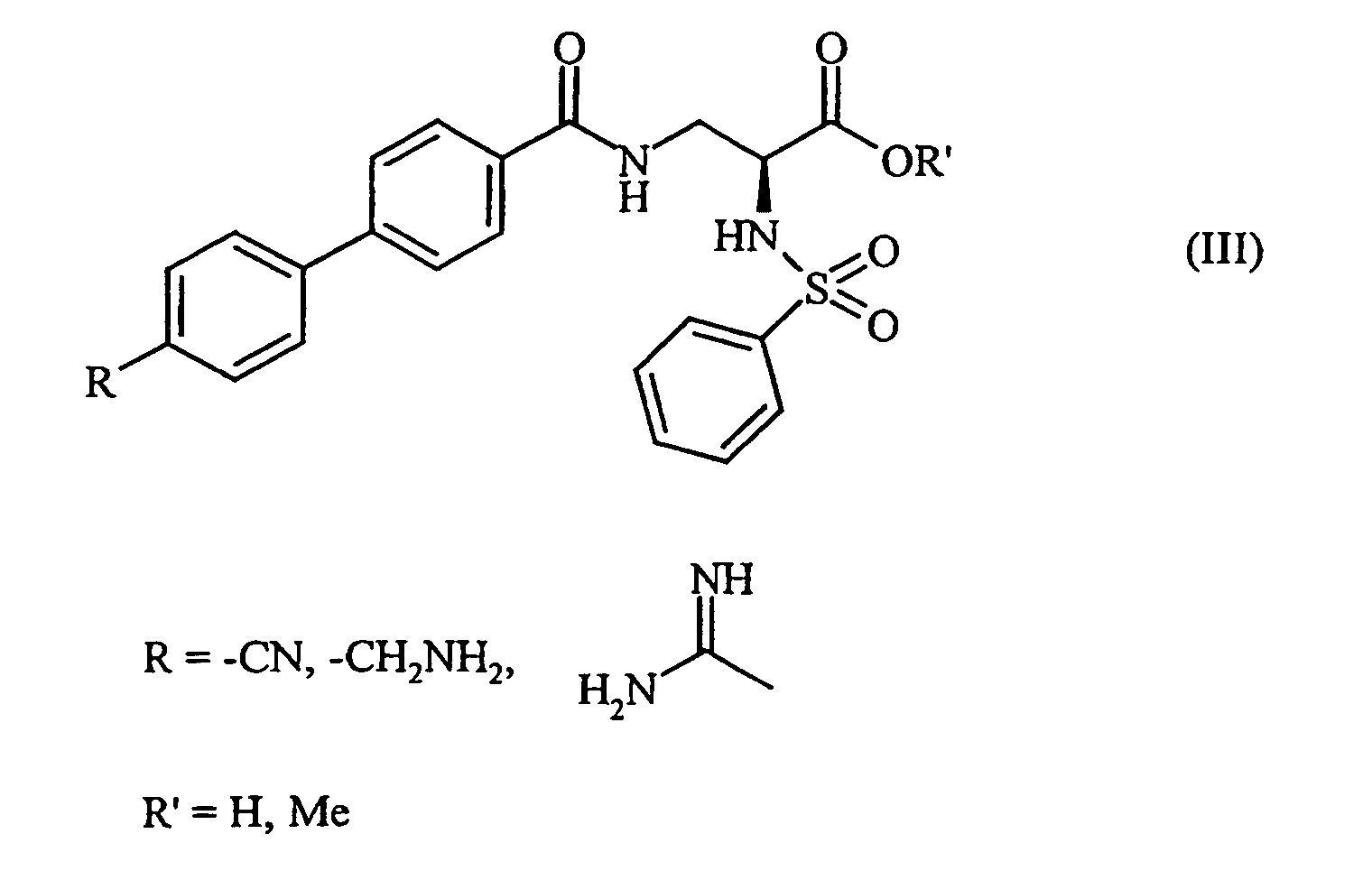
- The biphenyl compounds such as (IV) prepared by B.R. Neustadt et al. exhibit activity as αvβ3 receptor antagonists which is far below that of known integrin antagonists, which is why they are not suitable lead structures according to this document (Bioorg. Med. Chem. Lett. 8, 2395, 1998, in particular p. 2398, second paragraph):

- It was the object of the present invention to develop compounds which exhibit a high activity as integrin antagonists and in particular against the αvβ3 and/or the αvβ5 receptor.
- The present object is achieved according to the invention by the substituted biphenyl compounds defined below. In particular, it has emerged that the biphenyl compounds according to the invention have a very high activity as integrin antagonists, especially against the αvβ3 and/or the αvβ5 receptor.
- The present invention relates to compounds of the general formula (1)wherein

- R1
- is hydrogen, methyl, ethyl, propyl, isopropyl, butyl, isobutyl, t-butyl, pentyl, isopentyl, neopentyl, hexyl, cyclopropyl, cyclopropylmethyl, cyclobutyl, cyclopentyl, cyclohexyl, phenyl, benzyl, tolyl or a substituted derivative thereof;
- R2
- is hydrogen, methyl, ethyl, propyl, isopropyl, butyl, isobutyl, t-butyl, pentyl, isopentyl, neopentyl, hexyl, cyclopropyl, cyclopropylmethyl, cyclobutyl, cyclopentyl, cyclohexyl, phenyl, benzyl, tolyl or a substituted derivative thereof, a saturated or unsaturated, optionally substituted heterocyclic residue of the group containing pyrrole, pyridine, tetrahydrofuran, furan, thiophene, tetrahydrothiophene, thiooxazole, benzofuran, quinoline, isoquinoline, pyrimidine, imidazole, thiazole, pyrazole, isoxazole and benzothiadiazole, an optionally substituted C2-C6-alkenyl residue, an optionally substituted alkinyl residue, -NR2'SO2R2", -NR2'COOR2',-NR2'CONR2' 2 or -NR2'CSNR2' 2;
- R2'
- is hydrogen, methyl, ethyl, propyl, isopropyl, butyl, isobutyl, t-butyl, pentyl, isopentyl, neopentyl, hexyl, cyclopropyl, cyclobutyl, cyclopentyl, cyclohexyl, phenyl, benzyl, tolyl or a substituted derivative thereof or a saturated or unsaturated, optionally substituted heterocyclic residue of the group containing pyrrole, pyridine, tetrahydrofuran, furan, thiophene, tetrahydrothiophene, thiooxazole, benzofuran, quinoline, isoquinoline, pyrimidine, imidazole, thiazole, pyrazole, isoxazole and benzothiadiazole;
- R2"
- is methyl, ethyl, propyl, isopropyl, butyl, isobutyl, t-butyl, pentyl, isopentyl, neopentyl, hexyl, C2-C6-alkenyl or cyclopropyl, cyclobutyl, cyclopentyl, cyclohexyl, phenyl, benzyl, tolyl or a substituted derivative thereof, or a saturated or unsaturated, optionally substituted heterocyclic residue of the group containing pyrrole, pyridine, tetrahydrofuran, furan, thiophene, tetrahydrothiophene, thiooxazole, benzofuran, quinoline, isoquinoline, pyrimidine, imidazole, thiazole, pyrazole, isoxazole and benzothiadiazole;
- U
- is a direct bond or a substituted or unsubstituted alkylene group;
- V
- is a substituted or unsubstituted alkylene group, -NR2'CO- or -NR2'SO2-;
- A and B
- are each independently of one another a 1,3- or 1,4-bridging phenylene group or a 2,4- or 2,5-bridging thienylene group each of which may optionally have additional substituents,
- W
- is a direct bond or a substituted or unsubstituted alkylene group;
- C
- is a direct bond or
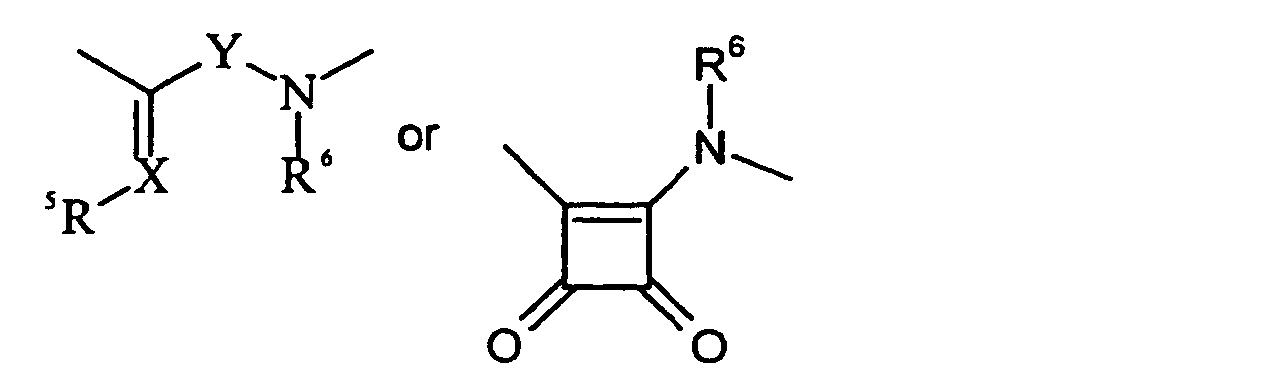
- R3
- is hydrogen, a substituted or unsubstituted alkyl or cycloalkyl residue, a substituted or unsubstituted aryl residue, a saturated or unsaturated, optionally substituted heterocyclic residue, an alkylamine residue, an alkylamide residue or is connected to one of R4, Y, R5 or R6, if present, with formation of an optionally substituted heterocyclic ring system which includes the nitrogen atom to which R3 is bonded, and can be saturated or unsaturated and/or can contain further heteroatoms;
- R4
- is hydrogen, a substituted or unsubstituted alkyl or cycloalkyl residue, a substituted or unsubstituted aryl residue, a saturated or unsaturated, optionally substituted heterocyclic residue, an alkylamine residue, an alkylamide residue or is connected to one of R3, Y, R5 or R6, if present, with formation of an optionally substituted heterocyclic ring system which includes the nitrogen atom to which R4 is bonded and can be saturated or unsaturated and/or can contain further heteroatoms;
- X
- is CHNO2, CHCN, O, N or S;
- Y
- is a direct bond or an optionally substituted alkylene or alkine group;
- R5
- is absent, or is hydrogen, a substituted or unsubstituted alkyl or cycloalkyl residue, -NO2, -CN, -COR5', -COOR5', or is connected to one of R3, Y, R4 or R6, if present, with formation of an optionally substituted carbocyclic or heterocyclic ring system which includes X and can be saturated or unsaturated and/or can contain further heteroatoms;
- R5'
- is hydrogen, a substituted or unsubstituted alkyl or cycloalkyl residue, a substituted or unsubstituted aryl residue or a saturated or unsaturated, optionally substituted heterocyclic residue which can be saturated or unsaturated and/or can contain further heteroatoms;
- R6
- is hydrogen, a substituted or unsubstituted alkyl or cycloalkyl residue, a substituted or unsubstituted aryl or arylcarbonyl residue, a saturated or unsaturated, optionally substituted heterocyclic residue, an alkylamine residue, an alkylamide residue or is connected to one of R3, R4, Y or R5, if present, with formation of an optionally substituted heterocyclic ring system which includes the nitrogen atom to which R6 is bonded and can be saturated or unsaturated and/or can contain further heteroatoms;
- If a certain variable substituent is present more than once in a general formula (e.g. R2' in -NR2'COOR2') the meaning for each substituent may be chosen independently from the others out of the list given in the respective definition.
- According to a preferred embodiment, the present invention relates to compounds of the general formula (1), where
- R1
- is hydrogen, methyl, ethyl, propyl, isopropyl, butyl, isobutyl, t-butyl, pentyl, isopentyl, neopentyl, hexyl, cyclopropyl, cyclopropylmethyl, cyclobutyl, cyclopentyl, cyclohexyl, phenyl, benzyl, tolyl or a substituted derivative thereof;
- R2
- is hydrogen, methyl, ethyl, propyl, isopropyl, butyl, isobutyl, t-butyl, pentyl, isopentyl, neopentyl, hexyl, cyclopropyl, cyclobutyl, cyclopentyl, cyclohexyl, phenyl, benzyl, tolyl or a substituted derivative thereof, an optionally substituted alkenyl residue, an optionally substituted alkinyl residue, -NR2'SO2R2", -NR2'COOR2', -NR2'COR2', -NR2'CONR2' 2 or -NR2'CSNR2' 2;
- R2'
- is hydrogen, methyl, ethyl, propyl, isopropyl, butyl, isobutyl, t-butyl, pentyl, isopentyl, neopentyl, hexyl, cyclopropyl, cyclobutyl, cyclpentyl, cyclohexyl, phenyl, benzyl, tolyl or a substituted derivative thereof as, for example, 2-chlorophenyl, 2-methoxyphenyl, 2,4,6-trimethylphenyl, 4-methoxyphenyl, 4-t-butylphenyl, 2,5-dichlorophenyl, 3-chlorophenyl, 4-chlorophenyl, 4-trifluoromethyl phenyl;
- R2"
- is methyl, ethyl, propyl, isopropyl, butyl, isobutyl, t-butyl, pentyl,
isopentyl, neopentyl, hexyl, 1,1,1-trifluorobutyl, allyl, cyclopropyl,
cyclobutyl, cyclopentyl, cyclohexyl, phenyl, benzyl, tolyl or a
substituted derivative thereof, 4-ethylphenyl, -C6H2(CH3)3, 2-chlorophenyl,
4-chlorophenyl, 2,5-dichlorophenyl, 4-trifluoromethylphenyl,
campher-10-yl, 4-methoxyphenyl, 4-t-butylphenyl, 2,5-dimethylphenyl,
3-chlorophenyl, 2-methoxy-5-methylphenyl, 2,3,5,6-tetramethylphenyl,
2,3-dichlorophenyl, 2,4-dichlorophenyl, 2,6-dichlorophenyl,
2-naphthyl, 3-trifluoromethylphenyl, 4-fluorophenyl, 2,4-difluorophenyl,
2-chloro-6-methylphenyl, 2-chloro-4-fluorophenyl,
2,5-dimethoxyphenyl, 3,4-dimethoxyphenyl, 3-chloro-6-methoxyphenyl,
2-trifluoromethylphenyl, 2-alkylsulfonylphenyl, 2-arylsulfonylphenyl,
3-(N-acetyl-6-methoxy)anilino, 2-methoxycarbonylphenyl,
4-N-acetylphenyl, 4-ethylphenyl, 3-chloro-4-fluorphenyl, 2-fluorophenyl,
3-fluorophenyl, 2,4-difluorophenyl, 2,6-difluorophenyl,
3,4-difluorophenyl, 1-naphthyl, 4-trifluoromethoxyphenyl, 2-trifluoromethoxyphenyl,
4-chloro-2-trifluoro-phenyl, 2-trifluoromethoxy-4-bromo-phenyl,
2-fluoro-4-trifluoromethylphenyl, 8-quinolinyl or
a group of the formula
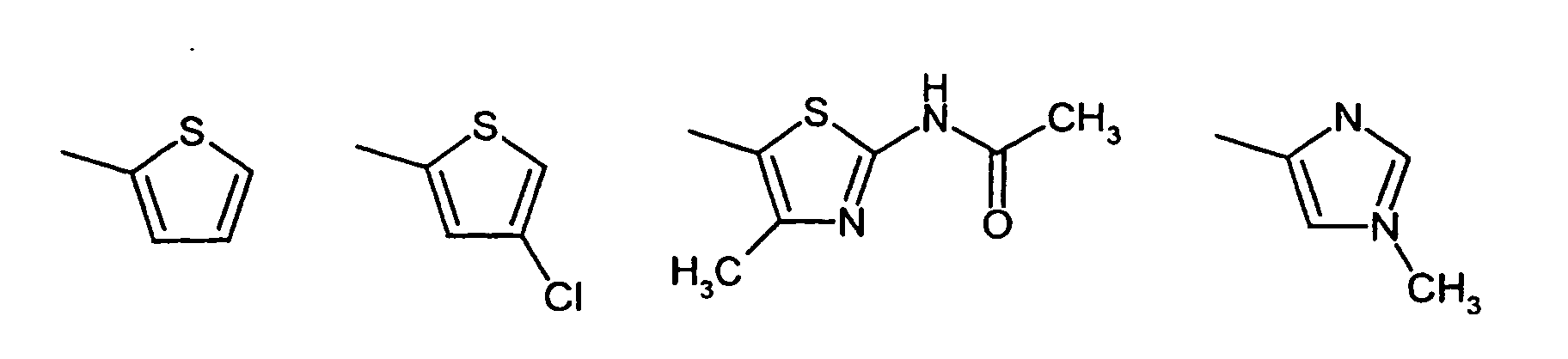

- U
- is a direct bond,
- V
- is an optionally substituted C1-5-alkylene group;
- A
- is a 1,3- or 1,4-bridging phenylene group which is unsubstituted or carries at least one alkoxy or halogeno residue;
- B
- is a 1,3- or 1,4-bridging phenylene group which is unsubstituted or carries at least one alkyl residue;
- W
- is a direct bond or an optionally substituted C1-4-alkylene group;
- C
- is a direct bond or

- R3
- is hydrogen, methyl, ethyl, propyl, isopropyl, butyl, 1-methylpropyl,
isobutyl, t-butyl, pentyl, 2-methylbutyl, isopentyl, neopentyl, hexyl,
C1-4-perfluoroalkyl, cyclopropyl, cyclopropylmethyl, cyclobutyl,
cyclopentyl, cyclohexyl, cycloheptyl, 4-methylcyclohexyl, 3,3,5-trimethylcyclohexyl,
5-methyl-2-hexyl, allyl, propinyl, phenyl, benzyl,
tolyl, benzoyl or a substituted derivative thereof, C1-4-alkylamino-C1-4-alkyl,
C1-4-dialkylamino-C1-4-alkyl, amino-C1-4-alkyl, C1-4-alkyloxy-C1-4-alkyl,
dialkylamino-C1-4-alkyl, amino-C1-4-alkyl, C1-4-alkyloxy-C1-4-alkyl,
C1-2-perfluoroalkyl-C1-4-alkyl,
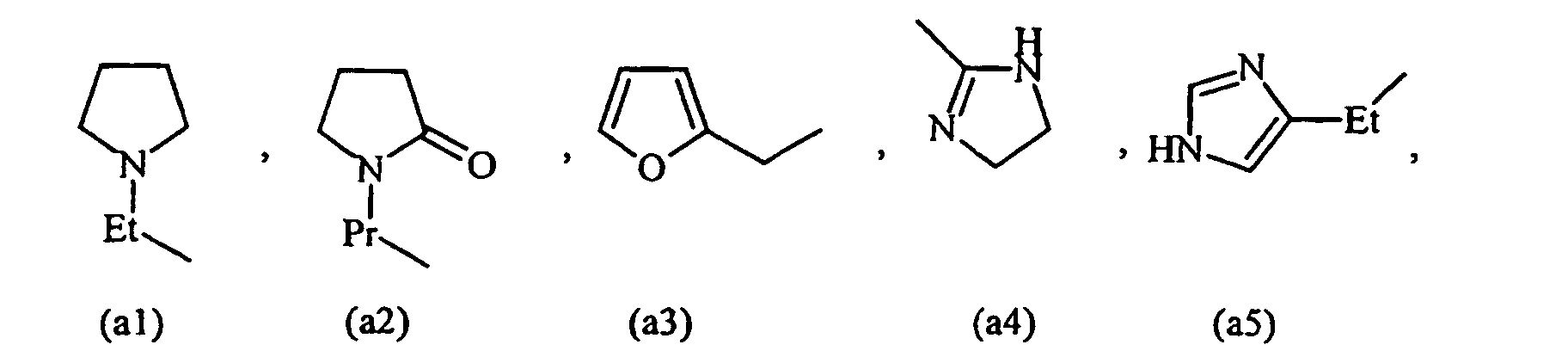
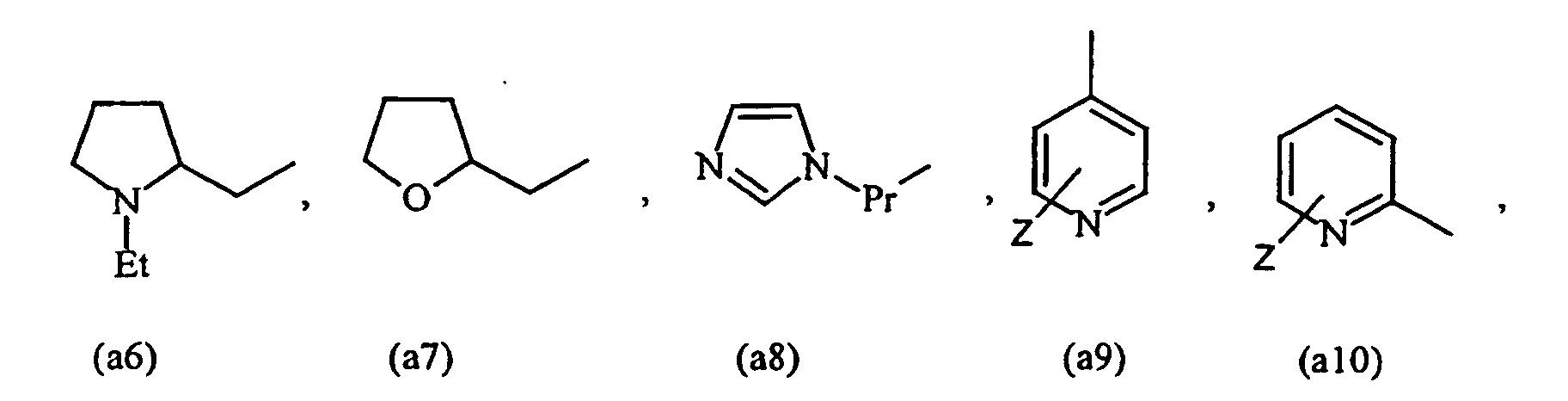




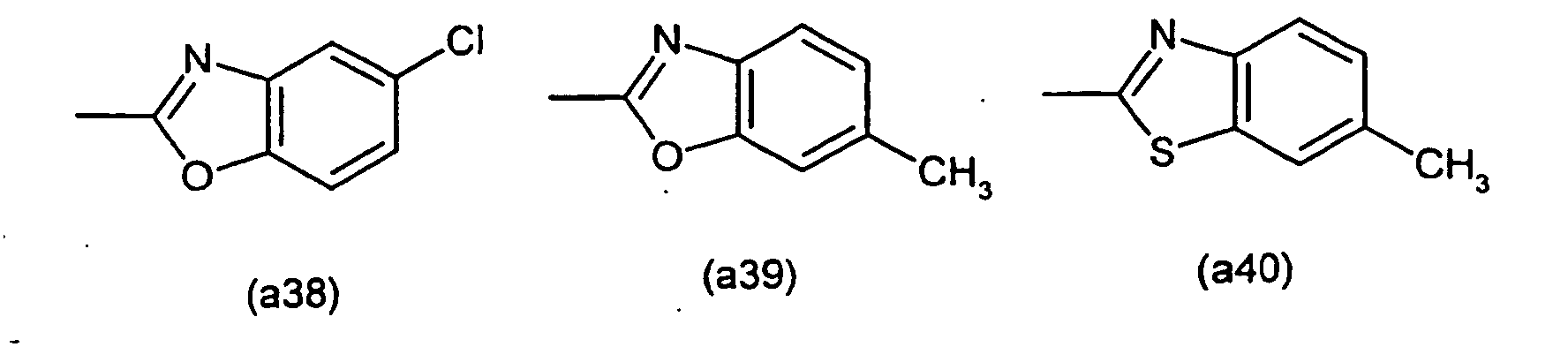

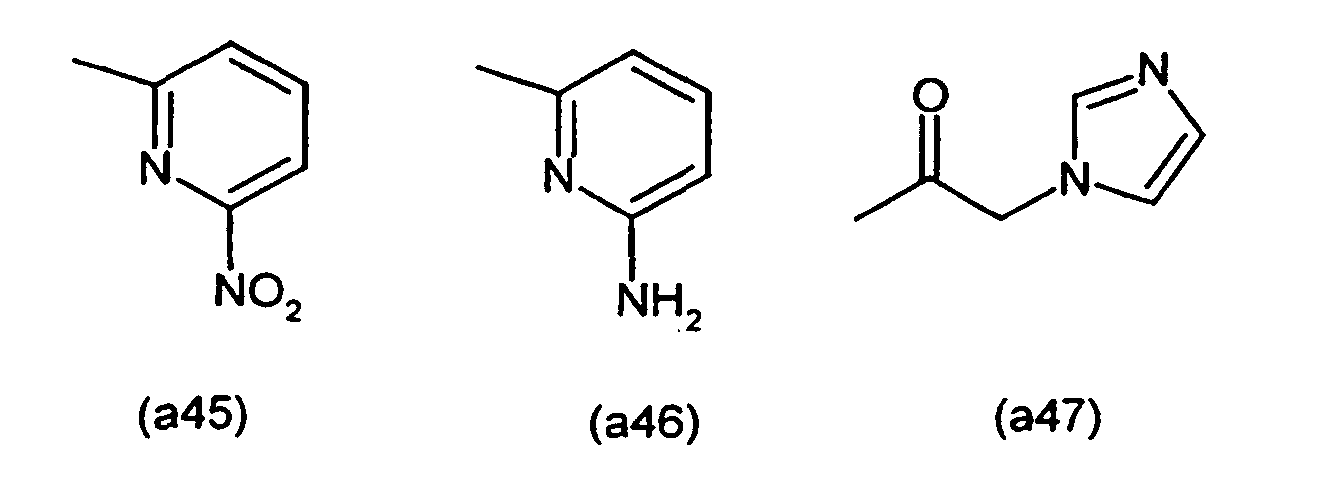
 wherein Z is hydrogen, CH3, -NO2 or NH2,
or R3 is connected to one of R4, Y, R5 or R6, if present, with formation of an optionally substituted heterocyclic 4- to 6-membered ring system which includes the nitrogen atom to which R3 is bonded and can be saturated or unsaturated and/or can contain further heteroatoms;- R4
- is hydrogen, methyl, ethyl, propyl, isopropyl, butyl, 1-methyl-propyl, isobutyl, t-butyl, pentyl, 2-methyl-butyl, isopentyl, neopentyl, hexyl, C1-4-perfluoralkyl, cyclopropyl, cyclopropylmethyl, cyclobutyl, cyclopentyl, cyclohexyl, cycloheptyl, 4-methylcyclohexyl, 3,3,5-trimethylcyclohexyl, 5-methyl-2-hexyl, allyl, prdpinyl, phenyl, benzyl, tolyl, benzoyl or a substituted derivative thereof, C1-4-alkylarnino-C1-4-alkyl, C1-4-dialkylamino-C1-4-alkyl, amino-C1-4-alkyl, C1-4-alkyloxy-C1-4-alkyl, C1-2-perfluoralkyl-C1-4-alkyl, one of the residues (a1) to (a51) or is connected to one of R3, Y, R5 or R6, if present, with formation of an optionally substituted heterocyclic 4- to 6-membered ring system which includes the nitrogen atom to which R4 is bonded and can be saturated or unsaturated and/or can contain further heteroatoms;
- X
- is CHNO2, CHCN, O, N or S;
- Y
- is a direct bond or a substituted or unsubstituted methylene or methine group;
- R5
- is absent, or is hydrogen, methyl, ethyl, propyl, isopropyl, butyl, isobutyl, t-butyl, pentyl, isopentyl, neopentyl, hexyl, cyclopropyl, cyclopropylmethyl, cyclobutyl, cyclopentyl, cyclohexyl, -NO2, -CN, -COR5', -COOR5' or is connected to one of R3, Y, R4 or R6, if present, with formation of an optionally substituted carbocyclic or heterocyclic 4- to 6-membered ring system which includes X and can be saturated or unsaturated and/or can contain further heteroatoms;
- R5'
- is hydrogen, methyl, ethyl, propyl, isopropyl, butyl, isobutyl, t-butyl, pentyl, isopentyl, neopentyl, hexyl, cyclopropyl, cyclobutyl, cyclopentyl, cyclohexyl, phenyl, benzyl, tolyl or a substituted derivative thereof;
- R6
- is hydrogen, methyl, ethyl, propyl, isopropyl, butyl, 1-methylpropyl, isobutyl, t-butyl, pentyl, isopentyl, 2-methylbutyl, neopentyl, hexyl, C1-4-perfluoroalkyl, cyclopropyl, cyclopropylmethyl, cyclobutyl, cyclopentyl, cyclohexyl, cycloheptyl, 4-methylcyclohexyl, 3,3,5-trimethylcyclohexyl, 5-methyl-2-hexyl, allyl, propinyl, phenyl, benzyl, tolyl, benzoyl or a substituted derivative thereof, C1-4-alkylamino-C1-4-alkyl, C1-4-dialkylamino-C1-4-alkyl, amino-C1-4-alkyl, C1-4-alkyloxy-C1-4-alkyl, C1-2-perfluoroalkyl-C1-4-alkyl, one of the residues (a1) to (a51) or is connected to one of R3, Y, R4 or R5, if present, with formation of an optionally substituted heterocyclic 4- to 6-membered ring system which includes the nitrogen atom to which R6 is bonded and can be saturated or unsaturated and/or can contain further heteroatoms.
- Particularly preferred compounds of the general formula (I) according to this embodiment are those in which
- R2
- is -NR2'SO2R2", -NR2'COOR2', -NR2'COR2', -NR2'CONR2' 2 or -NR2'CSNR2' 2;
- R2'
- is hydrogen, methyl, ethyl, propyl, isopropyl, butyl, isobutyl, t-butyl, pentyl, isopentyl, neopentyl, hexyl, cyclopropyl, cyclobutyl, cyclopentyl, cyclohexyl, phenyl, benzyl, tolyl or a substituted derivative thereof as, for example, 2-chlorophenyl, 2-methoxyphenyl, 2,4,6-trimethylphenyl, 4-methoxyphenyl, 4-t-butylphenyl, 2,5-dichlorophenyl, 3-chlorophenyl, 4-chlorophenyl, 4-trifluoromethyl phenyl;
- R2"
- is methyl, ethyl, propyl, isopropyl, butyl, isobutyl, t-butyl, pentyl,
isopentyl, neopentyl, hexyl, 1,1,1-trifluorobutyl, allyl, cyclopropyl,
cyclobutyl, cyclopentyl, cyclohexyl, phenyl, benzyl, tolyl or a
substituted derivative thereof, 4-ethylphenyl, -C6H2(CH3)3, 2-chlorophenyl,
4-chlorophenyl, 2,5-dichlorophenyl, 4-trifluoromethylphenyl,
campher-10-yl, 4-methoxyphenyl, 4-t-butylphenyl, 2,5-dimethylphenyl,
3-chlorophenyl, 2-methoxy-5-methylphenyl, 2,3,5,6-tetramethylphenyl,
2,3-dichlorophenyl, 2,4-dichlorophenyl, 2,6-dichlorophenyl,
2-naphthyl, 3-trifluoromethylphenyl, 4-fluorophenyl, 2,4-difluorophenyl,
2-chloro-6-methylphenyl, 2-chloro-4-fluorophenyl,
2,5-dimethoxyphenyl, 3,4-dimethoxyphenyl, 3-chloro-6-methoxyphenyl,
2-trifluoromethylphenyl, 2-alkylsulfonylphenyl, 2-arylsulfonylphenyl,
3-(N-acetyl-6-methoxy)anilino, 2-methoxycarbonylphenyl,
4-N-acetylphenyl, 4-ethylphenyl, 3-chloro-4-fluorphenyl, 2-fluorophenyl,
3-fluorophenyl, 2,4-difluorophenyl, 2,6-difluorophenyl,
3,4-difluorophenyl, 1-naphthyl, 4-trifluoromethoxyphenyl, 2-trifluoromethoxyphenyl,
4-chloro-2-trifluoro-phenyl, 2-trifluoromethoxy-4-bromo-phenyl,
2-fluoro-4-trifluoromethylphenyl, 8-quinolinyl or
a group of the formula


- Particularly preferred compounds of the formula (1) are in this case those in which
- R2
- is -NR2'SO2R2" or -NR2'COOR2';
- R2'
- is hydrogen, methyl, ethyl, propyl, isopropyl, butyl, isobutyl, t-butyl, pentyl, isopentyl, neopentyl, hexyl, cyclopropyl, cyclobutyl, cyclopentyl, cyclohexyl, phenyl, benzyl, tolyl or a substituted derivative thereof as, for example, 2-chlorophenyl, 2-methoxyphenyl, 2,4,6-trimethylphenyl, 4-methoxyphenyl, 4-t-butylphenyl, 2,5-dichlorophenyl, 3-chlorophenyl, 4-chlorophenyl, 4-trifluoromethyl phenyl;
- R2"
- is methyl, ethyl, propyl, isopropyl, butyl, isobutyl, t-butyl, pentyl,
isopentyl, neopentyl, hexyl, 1,1,1-trifluorobutyl, allyl, cyclopropyl,
cyclobutyl, cyclopentyl, cyclohexyl, phenyl, benzyl, tolyl or a
substituted derivative thereof, 4-ethylphenyl, -C6H2(CH3)3, 2-chlorophenyl,
4-chlorophenyl, 2,5-dichlorophenyl, 4-trifluoromethylphenyl,
campher-10-yl, 4-methoxyphenyl, 4-t-butylphenyl, 2,5-dimethylphenyl,
3-chlorophenyl, 2-methoxy-5-methylphenyl, 2,3,5,6-tetramethylphenyl,
2,3-dichlorophenyl, 2,4-dichlorophenyl, 2,6-dichlorophenyl,
2-naphthyl, 3-trifluoromethylphenyl, 4-fluorophenyl, 2,4-difluorophenyl,
2-chloro-6-methylphenyl, 2-chloro-4-fluorophenyl,
2,5-dimethoxyphenyl, 3,4-dimethoxyphenyl, 3-chloro-6-methoxyphenyl,
2-trifluoromethylphenyl, 2-alkylsulfonylphenyl, 2-arylsulfonylphenyl,
3-(N-acetyl-6-methoxy)anilino, 2-methoxycarbonylphenyl,
4-N-acetylphenyl, 4-ethylphenyl, 3-chloro-4-fluorphenyl, 2-fluorophenyl,
3-fluorophenyl, 2,4-difluorophenyl, 2,6-difluorophenyl, 3,4-difluorophenyl,
1-naphthyl, 4-trifluoromethoxyphenyl, 2-trifluoromethoxyphenyl,
4-chloro-2-trifluorphenyl, 2-trifluoromethoxy-4-bromophenyl,
2-fluoro-4-trifluoromethylpbenyl, 8-quinolinyl,
a group of the formula

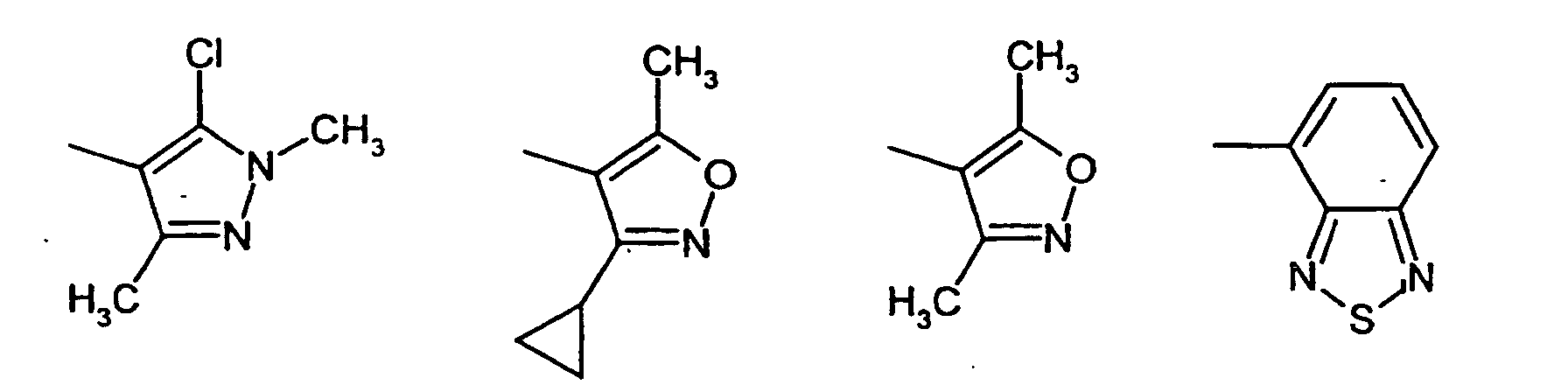
- A
- is a 1,3- or 1,4-bridging phenylene group optionally substituted with a methoxy or up to 2 fluororesidues;
- B
- is an optionally methyl-substituted 1,3- or 1,4-bridging phenylene group;
- C
- is a direct bond or
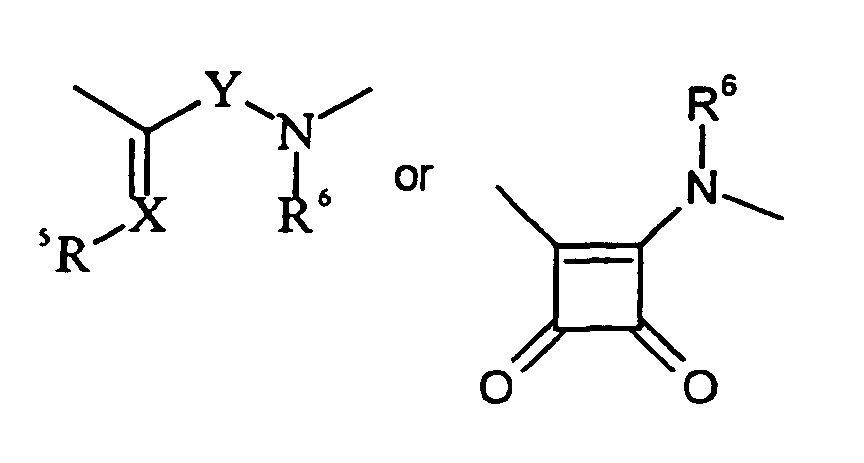
- R5
- is absent, -NO2, -CN, or is connected to one of R3, Y, R4 or R6, if present, with formation of an optionally substituted carbocyclic or heterocyclic 4- to 6-membered ring system which includes X and can be saturated or unsaturated and/or can contain further heteroatoms;
- Additionally preferred compounds of the general formula (1) according to the present embodiment are those in which
- R2
- is hydrogen, methyl, ethyl, propyl, isopropyl, butyl, isobutyl, t-butyl, pentyl, isopentyl, neopentyl, hexyl, cyclopropyl, cyclobutyl, cyclopentyl, cyclohexyl, phenyl, benzyl, tolyl or a substituted derivative thereof, an optionally substituted alkenyl residue, an optionally substituted alkinyl residue,
- U
- is a direct bond,
- V
- is -CHR7- or -CHR7(CH2)1-4-;
- R7
- is -NR7'SO2R7", -NR7'COOR7', -NR7'COR7', -NR7'CONR7' 2 or -NR7'CSNR7' 2;
- R7'
- is hydrogen, methyl, ethyl, propyl, isopropyl, butyl, isobutyl, t-butyl, pentyl, isopentyl, neopentyl, hexyl, cyclopropyl, cyclobutyl, cyclopentyl, cyclohexyl, phenyl, benzyl, tolyl or a substituted derivative thereof as, for example, 2-chlorophenyl, 2-methoxyphenyl, 2,4,6-trimethylphenyl, 4-methoxyphenyl, 4-t-butylphenyl, 2,5-dichlorophenyl, 3-chlorophenyl, 4-chlorophenyl, 4-trifluoromethyl phenyl;
- R7"
- is methyl, ethyl, propyl, isopropyl, butyl, isobutyl, t-butyl, pentyl, isopentyl, neopentyl, hexyl, cyclopropyl, cyclobutyl, cyclopentyl, cyclohexyl, phenyl, benzyl, tolyl or a substituted derivative thereof, -C6H2(CH3)3, 2-chlorophenyl, 4-chlorophenyl, 2,5-dichlorophenyl, 4-trifluoromethylphenyl, campher-10-yl, 4-methoxyphenyl, 4-t-butylphenyl, 2,5-dimethylphenyl, 2,6-dimethylphenyl, 3-chlorophenyl, 2-methoxy-5-methylphenyl, 2,3,5,6-tetramethylphenyl, 2,3-dichlorophenyl, 2,6-dichlorophenyl, 2-naphthyl, 3-trifluoromethylphenyl, 4-fluorophenyl, 2,4difluorophenyl, 2-chloro-6-methylphenyl, 2-chloro-4-fluorophenyl, 2,5-dimethoxyphenyl, 3,4-dimethoxyphenyl, 3-chloro-6-methoxyphenyl, 2-trifluoromethylphenyl, 2-alkylsulfonylphenyl, 2-arylsulfonylphenyl, 3-(N-acetyl-6-methoxy)anilino, 2-methoxycarbonylphenyl, 4-N-acetylphenyl, 4-ethylphenyl, 3-chloro-4-fluorphenyl, 2-fluorophenyl, 3-fluorophenyl, 2,4-difluorophenyl, 2,6-difluorophenyl, 3,4-difluorophenyl, 1-naphthyl, 4-trifluoromethoxyphenyl, 2-trifluoromethoxyphenyl, or 8-quinolinyl,
- Particularly preferred compounds of the general formula (1) in this case are those in which
- R2
- is hydrogen, methyl, ethyl, propyl, isopropyl, butyl, isobutyl, t-butyl, pentyl, isopentyl, neopentyl, hexyl, cyclopropyl, cyclobutyl, cyclopentyl, cyclohexyl, phenyl, benzyl, tolyl or a substituted derivative thereof, an optionally substituted alkenyl residue, an optionally substituted alkinyl residue,
- U
- is a direct bond;
- V
- is -CHR7-;
- R7
- is -NR7'SO2R7" or -NR7'COOR7";
- R7'
- is hydrogen, methyl, ethyl, propyl, isopropyl, butyl, isobutyl, t-butyl, pentyl, isopentyl, neopentyl, hexyl, cyclopropyl, cyclobutyl, cyclopentyl, cyclohexyl, phenyl, benzyl, tolyl or a substituted derivative thereof as, for example, 2-chlorophenyl, 2-methoxyphenyl, 2,4,6-trimethylphenyl, 4-methoxyphenyl, 4-t-butylphenyl, 2,5-dichlorophenyl, 3-chlorophenyl, 4-chlorophenyl, 4-trifluoromethyl phenyl;
- R7"
- is methyl, ethyl, propyl, isopropyl, butyl, isobutyl, t-butyl, pentyl, isopentyl, neopentyl, hexyl, cyclopropyl, cyclobutyl, cyclopentyl, cyclohexyl, phenyl, benzyl, tolyl or a substituted derivative thereof, -C6H2(CH3)3, 2-chlorophenyl, 4-chlorophenyl, 2,5-dichlorophenyl, 4-trifluoromethylphenyl, campher-10-yl, 4-methoxyphenyl, 4-t-butyphenyl, 2,5-dimethylphenyl, 2,6-dimethylphenyl, 3-chlorophenyl, 2-methoxy-5-methylphenyl, 2,3,5,6-tetramethylphenyl, 2,3-dichlorophenyl, 2,6-dichlorophenyl, 2-naphthyl, 3-trifluoromethylphenyl, 4-fluorophenyl, 2,4-difluorophenyl, 2-chloro-6-methylphenyl, 2-chloro-4-fluorophenyl, 2,5-dimethoxyphenyl, 3,4-dimethoxyphenyl, 3-chloro-6-methoxyphenyl, 2-trifluoromethylphenyl, 2-alkylsulfonylphenyl, 2-arylsulfonylphenyl, 3-(N-acetyl-6-methoxy)anilino, 2-methoxycarbonylphenyl, 4-N-acetylphenyl, 4-ethylphenyl, 3-chloro-4-fluorphenyl, 2-fluorophenyl, 3-fluorophenyl, 2,4-difluorophenyl, 2,6-difluorophenyl, 3,4-difluorophenyl, 1-naphthyl, 4-trifluoromethoxyphenyl, 2-trifluoromethoxyphenyl, or 8-quinolinyl,
- A
- is a 1,3- or 1,4-bridging phenylene group optionally substituted with a methoxy or up to 2 fluoro residnes;
- B
- is an optionally methyl-substituted 1,3- or 1,4-bridging phenylene group;
- C
- is a direct bond or

- W
- is a direct bond or a -CH2-group
- X
- is O or S;
- Y
- is a direct bond
- R5
- is absent
- Additionally preferred compounds of the general formula (1) according to the present embodiment are those in which
- R2
- is hydrogen, methyl, ethyl, propyl, isopropyl, butyl, isobutyl, t-butyl, pentyl, isopentyl, neopentyl, hexyl, cyclopropyl, cyclobutyl, cyclopentyl, cyclohexyl, phenyl, benzyl, tolyl or a substituted derivative thereof, an optionally substituted alkenyl residue, an optionally substituted alkinyl residue,
- U
- is a direct bond,
- V
- is a C1-5-alkylene group which is optionally substituted by one or more residues R7 which are selected from the group consisting of hydrogen, methyl, ethyl, propyl, isopropyl, butyl, isobutyl, t-butyl, pentyl, isopentyl, neopentyl, hexyl, cyclopropyl, cyclobutyl, cyclopentyl, cyclohexyl, phenyl, benzyl, tolyl, a substituted derivative or a saturated or unsaturated, optionally substituted heterocyclic analog thereof, an optionally substituted alkenyl residue or an optionally substituted alkinyl residue;
- Particularly preferred compounds of the general formula (1) in this case are those in which
- R2
- is hydrogen, methyl, ethyl, propyl, isopropyl, butyl, isobutyl, t-butyl, pentyl, isopentyl, neopentyl, hexyl, cyclopropyl, cyclobutyl, cyclopentyl, cyclohexyl, phenyl, benzyl, tolyl or a substituted derivative thereof, an optionally substituted alkenyl residue, an optionally substituted alkinyl residue,
- U
- is a direct bond,
- V
- is -CHR7-;
- R7
- is hydrogen, methyl, ethyl, propyl, isopropyl, butyl, isobutyl, t-butyl, pentyl, isopentyl, neopentyl, hexyl, cyclopropyl, cyclobutyl, cyclopentyl, cyclohexyl, phenyl, benzyl, tolyl or a substituted derivative thereof, an optionally substituted alkenyl residue, an optionally substituted alkinyl residue,
- A
- is a 1,3- or 1,4-bridging phenylene group optionally substituted with a methoxy or up to 2 fluoro residues
- B
- is an optionally methyl-substituted 1,3- or 1,4-bridging phenylene group;
- C
- is a direct bond or
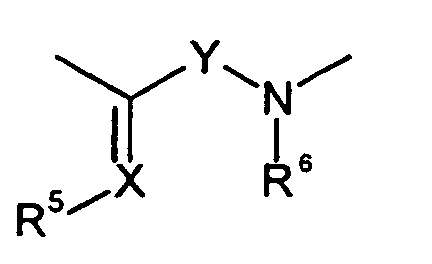
- W
- is a direct bond or a -CH2-group
- X
- ist O or S;
- Y
- is a direct bond
- R5
- is absent
- According to yet another preferred embodiment, the present invention relates to compounds of the general formula (1), in which
- R1
- is hydrogen, methyl, ethyl, propyl, isopropyl, butyl, isobutyl, t-butyl, pentyl, isopentyl, neopentyl, hexyl, cyclopropyl, cyclopropylmethyl, cyclobutyl, cyclopentyl, cyclohexyl, phenyl, benzyl, tolyl or a substituted derivative thereof;
- R2
- is hydrogen, methyl, ethyl, propyl, isopropyl, butyl, isobutyl, t-butyl, pentyl, isopentyl, neopentyl, hexyl, cyclopropyl, cyclobutyl, cyclopentyl, cyclohexyl, phenyl, benzyl, tolyl, phenylethyl, a substituted derivative or a saturated or unsaturated, optionally substituted heterocyclic analog thereof, an optionally substituted alkenyl residue, an optionally substituted alkinyl residue;
- U
- is a direct bond or an optionally substituted C1-3-alkylene group;
- V
- is -NR8CO- or -NR8SO2-;
- R8
- is hydrogen, methyl, ethyl, propyl, isopropyl, butyl, isobutyl, t-butyl, pentyl, isopentyl, neopentyl, hexyl, cyclopropyl, cyclopropylmethyl, cyclobutyl, cyclopentyl, cyclohexyl, phenyl, benzyl, tolyl, phenylethyl, phenylpropyl, phenoxyethyl or a substituted derivative thereof;
- A
- is a 1,3- or 1,4-bridging phenylene group or a 2,4- or 2,5-bridging thienylene group which are unsubstituted or have at least one alkoxy or halogeno residue;
- B
- is a 1,3- or 1,4-bridging phenylene group which is unsubstituted or has at least one alkyl residue;
- W
- is a direct bond or an optionally substituted C1-3-alkylene group;
- C
- is
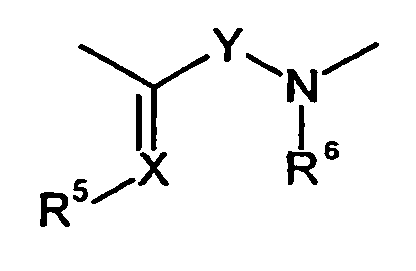
- R3
- is hydrogen, methyl, ethyl, propyl, isopropyl, butyl, 1-methylpropyl, isobutyl, t-butyl, pentyl, 2-methylbutyl, isopentyl, neopentyl, hexyl, C1-4-perfluoroalkyl, cyclopropyl, cyclopropylmethyl, cyclobutyl, cyclopentyl, cyclohexyl, cycloheptyl, 4-methylcyclohexyl, 3,3,5-trimethylcyclohexyl, 5-methyl-2-hexyl, allyl, propinyl, phenyl, benzyl, tolyl, benzoyl or a substituted derivative thereof, C1-4-alkylamino-C1-4-alkyl, C1-4-dialkylamino-C1-4-alkyl, amino-C1-4-alkyl, C1-4-alkyloxy-C1-4-alkyl, C1-2-perfluoroalkyl-C1-4-alkyl, one of the residues (a1) to (a51) or is connected to one of R4, Y or R6, if present, with formation of an optionally substituted heterocyclic 4- to 6-membered ring system which includes the nitrogen atom to which R3 is bonded and can be saturated or unsaturated and/or can contain further heteroatoms;
- R4
- is hydrogen, methyl, ethyl, propyl, isopropyl, butyl, 1-methyl-propyl, isobutyl, t-butyl, pentyl, 2-methyl-butyl, isopentyl, neopentyl, hexyl, C1-4-perfluoralkyl, cyclopropyl, cyclopropylmethyl, cyclobutyl, cyclopentyl, cyclohexyl, cycloheptyl, 4-methylcyclohexyl, 3,3,5-trimethylcyclohexyl, 5-methyl-2-hexyl, allyl, propinyl, phenyl, benzyl, tolyl, benzoyl or a substituted derivative thereof, C1-4-alkylamino-C1-4-alkyl, C1-4-dialkylamino-C1-4-alkyl, amino-C1-4-alkyl, C1-4-alkyloxy-C1-4-alkyl, C1-2-perfluoralkyl-C1-4-alkyl, one of the residues (a1) to (a51) or is connected to one of R3, Y or R6, if present, with formation of an optionally substituted heterocyclic 4- to 6-membered ring system which includes the nitrogen atom to which R4 is bonded and can be saturated or unsaturated and/or can contain further heteroatoms;
- X
- is CHNO2, CHCN, O or S;
- Y
- is a direct bond or a substituted or unsubstituted methylene or methine group;
- R5
- is absent;
- R6
- is hydrogen, methyl, ethyl, propyl, isopropyl, butyl, 1-methylpropyl, isobutyl, t-butyl, pentyl, isopentyl, 2-methylbutyl, neopentyl, hexyl, C1-4-perfluoroalkyl, cyclopropyl, cyclopropylmethyl, cyclobutyl, cyclopentyl, cyclohexyl, cycloheptyl, 4-methylcyclohexyl, 3,3,5-trimethylcyclohexyl, 5-methyl-2-hexyl, allyl, propinyl, phenyl, benzyl, tolyl, benzoyl or a substituted derivative thereof, C1-4-alkylamino-C1-4-alkyl, C1-4-dialkylamino-C1-4-alkyl, amino-C1-4-alkyl, C1-4-alkyloxy-C1-4-alkyl, C1-2-perfluoroalkyl-C1-4-alkyl, one of the residues (a1) to (a51) or is connected to one of R3, Y or R4, if present, with formation of an optionally substituted heterocyclic 4- to 6-membered ring system which includes the nitrogen atom to which R6 is bonded and can be saturated or unsaturated and/or can contain further heteroatoms.
- Particularly preferred compounds of the general formula (1) according to this embodiment are those in which
- U
- is a direct bond or -CHR7-;
- R7
- is hydrogen, methyl, ethyl, propyl, isopropyl, butyl, isobutyl, t-butyl, pentyl, isopentyl, neopentyl, hexyl, cyclopropyl, cyclobutyl, cyclopentyl, cyclohexyl, phenyl, benzyl, tolyl or a substituted derivative thereof, an optionally substituted alkenyl residue, an optionally substituted alkinyl residue or pyridyl;
- A
- is a 1,3- or 1,4-bridging phenylene group optionally substituted with a methoxy group or up to 2 fluoro residues;
- B
- is an optionally methyl-substituted 1,3- or 1,4-bridging phenylene group;
- W
- is a direct bond or a -CH2-group;
- C
- is
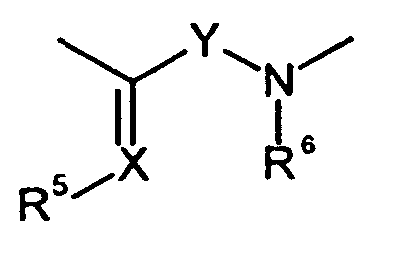
- X
- ist O or S;
- Y
- is a direct bond
- R5
- is absent
- Another group of particularly preferred coumpounds of the general formula (1) according to this embodiment are those in which
- A
- is a 2,4- or 2,5-bridging thienylene group which ist unsubstituted or has at least one alkoxy residue and the other substituents are as defined above.
- Further embodiments of the invention are described below.
- The present invention futhermore relates to compounds of the general formula (1)wherein
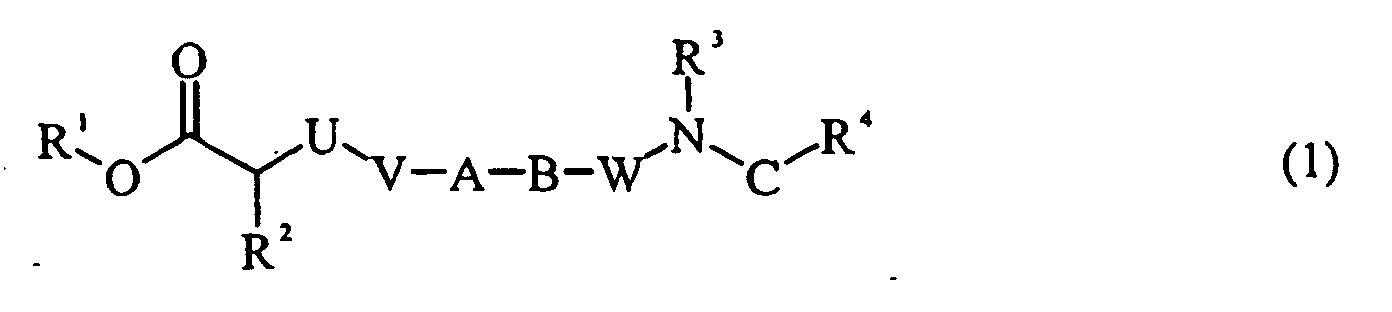
- R1
- is hydrogen, a substituted or unsubstituted alkyl or cycloalkyl residue, a substituted or unsubstituted aryl residue or a saturated or unsaturated, optionally substituted heterocyclic residue;
- R2
- is hydrogen, a substituted or unsubstituted alkyl or cycloalkyl residue, a substituted or unsubstituted aryl residue, a saturated or unsaturated, optionally substituted heterocyclic residue, an optionally substituted alkenyl residue, an optionally substituted alkinyl residue, -NR2'SO2R2", -NR2'COOR2", -NR2'COR2', -NR2'CONR2' 2 or -NR2'CSNR2' 2;
- R2'
- is hydrogen, a substituted or unsubstituted alkyl or cycloalkyl residue, a substituted or unsubstituted aryl residue or a saturated or unsaturated, optionally substituted heterocyclic residue;
- R2"
- is a substituted or unsubstituted alkyl or cycloalkyl residue, a substituted or unsubstituted aryl residue or a saturated or unsaturated, optionally substituted heterocyclic residue;
- U
- is a direct bond or a substituted or unsubstituted alkylene group;
- V
- is a substituted or unsubstituted alkylene group, -NR2'CO- or -NR2'SO2-;
- A and B
- are each independently of one another a 1,3- or 1,4-bridging, optionally additionally substituted phenylene group;
- W
- is a direct bond or a substituted or unsubstituted alkylene group;
- C
- is a direct bond or
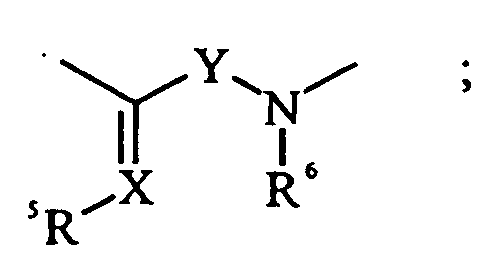
- R3
- is hydrogen, a substituted or unsubstituted alkyl or cycloalkyl residue, a substituted or unsubstituted aryl residue, a saturated or unsaturated, optionally substituted heterocyclic residue, an alkylamine residue, an alkylamide residue or is connected to one of R4, Y, R5 or R6, if present, with formation of an optionally substituted heterocyclic ring system which includes the nitrogen atom to which R3 is bonded, and can be saturated or unsaturated and/or can contain further heteroatoms;
- R4
- is hydrogen, a substituted or unsubstituted alkyl or cycloalkyl residue, a substituted or unsubstituted aryl residue, a saturated or unsaturated, optionally substituted heterocyclic residue, an alkylamine residue, an alkylamide residue or is connected to one of R3, Y, R5 or R6, if present, with formation of an optionally substituted heterocyclic ring system which includes the nitrogen atom to which R4 is bonded and can be saturated or unsaturated and/or can contain further heteroatoms;
- X
- is CHNO2, CHCN, O, N or S;
- Y
- is a direct bond or an optionally substituted alkylene or alkine group;
- R5
- is absent, or is hydrogen, a substituted or unsubstituted alkyl or cycloalkyl residue, -NO2, -CN, -COR5', -COOR5', or is connected to one of R3, Y, R4 or R6, if present, with formation of an optionally substituted carbocyclic or heterocyclic ring system which includes X and can be saturated or unsaturated and/or can contain further heteroatoms;
- R5'
- is hydrogen, a substituted or unsubstituted alkyl or cycloalkyl residue, a substituted or unsubstituted aryl residue or a saturated or unsaturated, optionally substituted heterocyclic residue which can be saturated or unsaturated and/or can contain further heteroatoms;
- R6
- is hydrogen, a substituted or unsubstituted alkyl or cycloalkyl residue, a substituted or unsubstituted aryl residue, a saturated or unsaturated, optionally substituted heterocyclic residue, an alkylamine residue, an alkylamide residue or is connected to one of R3, R4, Y or R5, if present, with formation of an optionally substituted heterocyclic ring system which includes the nitrogen atom to which R6 is bonded and can be saturated or unsaturated and/or can contain further heteroatoms;
- According to a preferred embodiment, the present invention relates to compounds of the general formula (1), where
- R1
- is hydrogen, methyl, ethyl, propyl, isopropyl, butyl, isobutyl, t-butyl, pentyl, isopentyl, neopentyl, hexyl, cyclopropyl, cyclopropylmethyl, cyclobutyl, cyclopentyl, cyclohexyl, phenyl, benzyl, tolyl or a substituted derivative thereof;
- R2
- is hydrogen, methyl, ethyl, propyl, isopropyl, butyl, isobutyl, t-butyl, pentyl, isopentyl, neopentyl, hexyl, cyclopropyl, cyclobutyl, cyclopentyl, cyclohexyl, phenyl, benzyl, tolyl or a substituted derivative thereof, an optionally substituted alkenyl residue, an optionally substituted alkinyl residue, -NR2'SO2R2'', -NR2'COOR2'', -NR2'COR2', -NR2'CONR2' 2 or -NR2'CSNR2' 2;
- R2'
- is hydrogen, methyl, ethyl, propyl, isopropyl, butyl, isobutyl, t-butyl, pentyl, isopentyl, neopentyl, hexyl, cyclopropyl, cyclobutyl, cyclpentyl, cyclohexyl, phenyl, benzyl, tolyl or a substituted derivative thereof as, for example, 2-chlorophenyl, 2-methoxyphenyl, 2,4,6-trimethylphenyl, 4-methoxyphenyl, 4-t-butylphenyl, 2,5-dichlorophenyl, 3-chlorophenyl, 4-chlorophenyl, 4-trifluoromethyl phenyl;
- R2"
- is methyl, ethyl, propyl, isopropyl, butyl, isobutyl, t-butyl, pentyl, isopentyl, neopentyl, hexyl, cyclopropyl, cyclobutyl, cyclopentyl, cyclohexyl, phenyl, benzyl, tolyl or a substituted derivative thereof, -C6H2(CH3)3, 2-chlorophenyl, 4-chlorophenyl, 2,5-dichlorophenyl, 4-trifluoromethylphenyl, campher-10-yl, 4-methoxyphenyl, 4-t-butylphenyl, 2,5-dimethylphenyl, 3-chlorophenyl, 2-methoxy-5-methylphenyl, 2,3,5,6-tetramethylphenyl, 2,3-dichlorophenyl, 2,6-dichlorophenyl, 2-naphthyl, 3-trifluoromethylphenyl, 4-fluorophenyl, 2,4-difluorophenyl, 2-chloro-6-methylphenyl, 2-chloro-4-fluorophenyl, 2,5-dimethoxyphenyl, 3,4-dimethoxyphenyl, 3-chloro-6-methoxyphenyl, 2-trifluoromethylphenyl, 2-alkylsulfonylphenyl, 2-arylsulfonylphenyl, 3-(N-acetyl-6-methoxy)anilino, 2-methoxycarbonylphenyl, 4-N-acetylphenyl, 4-ethylphenyl, 3-chloro-4-fluorphenyl, 2-fluorophenyl, 3-fluorophenyl, 2,4-difluorophenyl, 2,6-difluorophenyl, 3,4-difluorophenyl, 1-naphthyl, 4-trifluoromethoxyphenyl, 2-trifluoromethoxyphenyl, or 8-quinolinyl,
- U
- is a direct bond,
- V
- is an optionally substituted C1-5-alkylene group;
- A
- is a 1,3- or 1,4-bridging phenylene group which is unsubstituted or carries at least one alkoxy residue;
- B
- is a 1,3- or 1,4-bridging phenylene group which is unsubstituted or carries at least one alkyl residue;
- W
- is a direct bond or an optionally substituted C1-4-alkylene group;
- C
- is a direct bond or

- R3
- is hydrogen, methyl, ethyl, propyl, isopropyl, butyl, isobutyl, t-butyl,
pentyl, isopentyl, neopentyl, hexyl, cyclopropyl, cyclopropylmethyl,
cyclobutyl, cyclopentyl, cyclohexyl, 4-methylcyclohexyl, 3,3,5-trimethylcyclohexyl,
5-methyl-2-hexyl, phenyl, benzyl, tolyl or a
substituted derivative thereof, C1-4-alkylamino-C1-4-alkyl, C1-4-dialkylamino-C1-4-alkyl,
amino-C1-4-alkyl, C1-4-alkyloxy-C1-4-alkyl,
dialkylamino-C1-4-alkyl, amino-C1-4-alkyl, C1-4-alkyloxy-C1-4-alkyl,
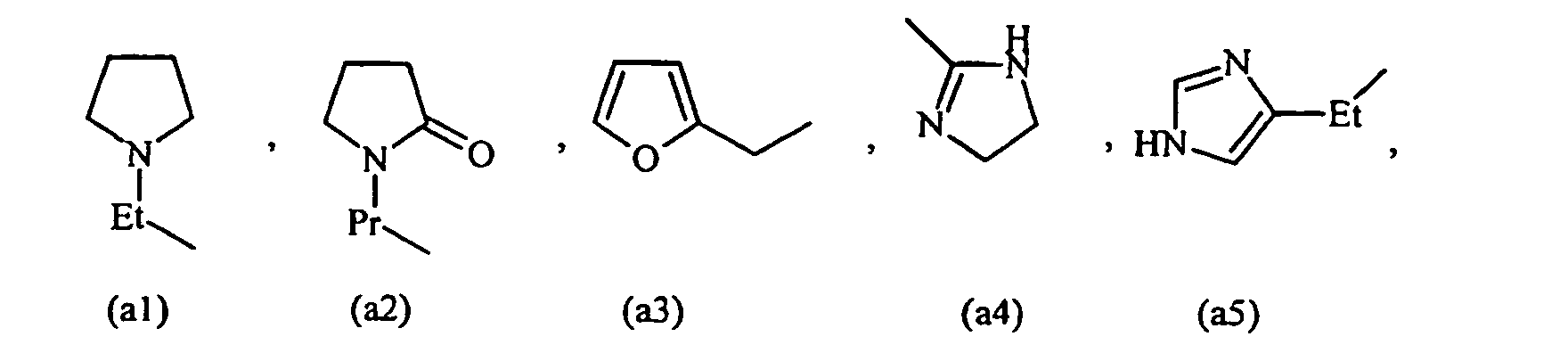
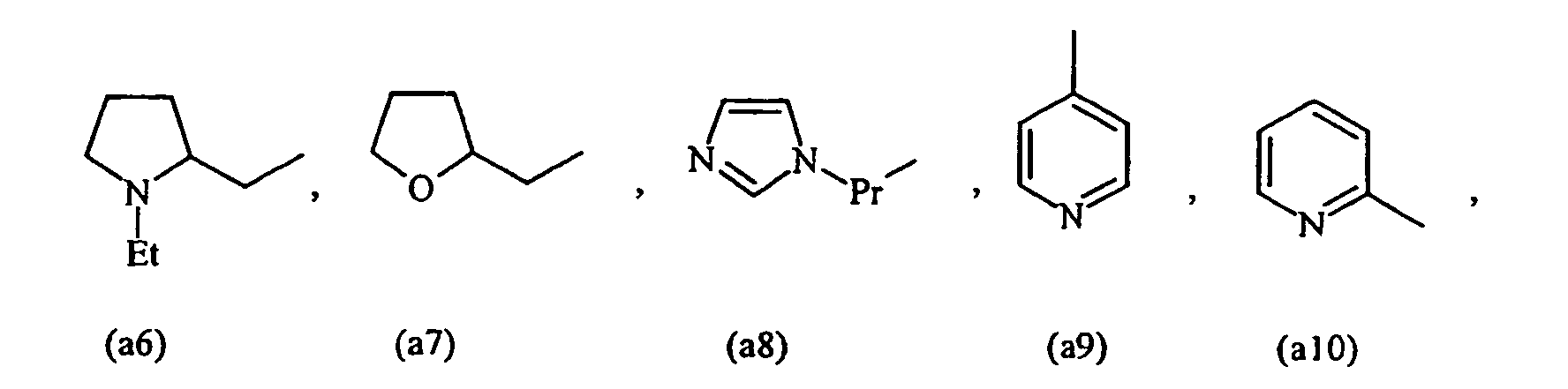


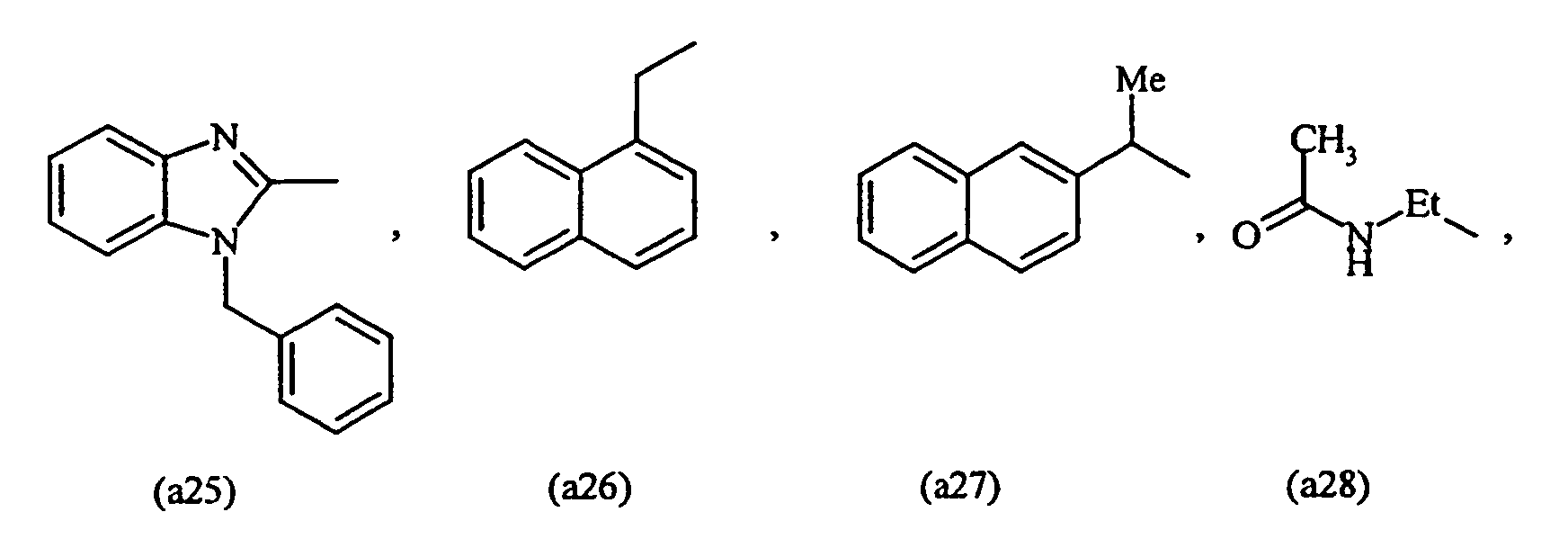 or is connected to one of R4, Y, R5 or R6, if present, with formation of an optionally substituted heterocyclic 4- to 6-membered ring system which includes the nitrogen atom to which R3 is bonded and can be saturated or unsaturated and/or can contain further heteroatoms;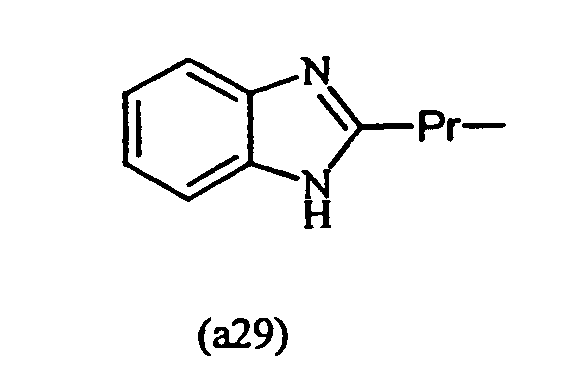
- R4
- is hydrogen, methyl, ethyl, propyl, isopropyl, butyl, isobutyl, t-butyl, pentyl, isopentyl, neopentyl, hexyl, cyclopropyl, cyclopropylmethyl, cyclobutyl, cyclopentyl, cyclohexyl, 4-methylcyclohexyl, 3,3,5-trimethylcyclohexyl, 5-methyl-2-hexyl, phenyl, benzyl, tolyl or a substituted derivative thereof, C1-4-alkylamino-C1-4-alkyl, C1-4-dialkylamino-C1-4-alkyl, amino-C1-4-alkyl, C1-4-alkyloxy-C1-4-alkyl, one of the residues (a1) to (a29) or is connected to one of R3, Y, R5 or R6, if present, with formation of an optionally substituted heterocyclic 4- to 6-membered ring system which includes the nitrogen atom to which R4 is bonded and can be saturated or unsaturated and/or can contain further heteroatoms;
- X
- is CHNO2, CHCN, O, N or S;
- Y
- is a direct bond or a substituted or unsubstituted methylene or methine group;
- R5
- is absent, or is hydrogen, methyl, ethyl, propyl, isopropyl, butyl, isobutyl, t-butyl, pentyl, isopentyl, neopentyl, hexyl, cyclopropyl, cyclopropylmethyl, cyclobutyl, cyclopentyl, cyclohexyl, -NO2, -CN, -COR5', -COOR5' or is connected to one of R3, Y, R4 or R6, if present, with formation of an optionally substituted carbocyclic or heterocyclic 4- to 6-membered ring system which includes X and can be saturated or unsaturated and/or can contain further heteroatoms;
- R5'
- is hydrogen, methyl, ethyl, propyl, isopropyl, butyl, isobutyl, t-butyl, pentyl, isopentyl, neopentyl, hexyl, cyclopropyl, cyclobutyl, cyclopentyl, cyclohexyl, phenyl, benzyl, tolyl or a substituted derivative thereof;
- R6
- is hydrogen, methyl, ethyl, propyl, isopropyl, butyl, isobutyl, t-butyl, pentyl, isopentyl, neopentyl, hexyl, cyclopropyl, cyclopropylmethyl, cyclobutyl, cyclopentyl, cyclohexyl, 4-methylcyclohexyl, 3,3,5-trimethylcyclohexyl, 5-methyl-2-hexyl, phenyl, benzyl, tolyl or a substituted derivative thereof, C1-4-alkylamino-C1-4-alkyl, C1-4-dialkylamino-C1-4-alkyl, amino-C1-4-alkyl, C1-4-alkyloxy-C1-4-alkyl, one of the residues (a1) to (a29) or is connected to one of R3, Y, R4 or R5, if present, with formation of an optionally substituted heterocyclic 4- to 6-membered ring system which includes the nitrogen atom to which R6 is bonded and can be saturated or unsaturated and/or can contain further heteroatoms.
- Particularly preferred compounds of the general formula (I) according to this embodiment are those in which
- R2
- is -NR2'SO2R2", -NR2'COOR2", -NR2'COR2', -NR2'CONR2' 2 or -NR2'CSNR2' 2;
- R2'
- is hydrogen, methyl, ethyl, propyl, isopropyl, butyl, isobutyl, t-butyl, pentyl, isopentyl, neopentyl, hexyl, cyclopropyl, cyclobutyl, cyclopentyl, cyclohexyl, phenyl, benzyl, tolyl or a substituted derivative thereof as, for example, 2-chlorophenyl, 2-methoxyphenyl, 2,4,6-trimethylphenyl, 4-methoxyphenyl, 4-t-butylphenyl, 2,5-dichlorophenyl, 3-chlorophenyl, 4-chlorophenyl, 4-trifluoromethyl phenyl;
- R2"
- is methyl, ethyl, propyl, isopropyl, butyl, isobutyl, t-butyl, pentyl, isopentyl, neopentyl, hexyl, cyclopropyl, cyclobutyl, cyclopentyl, cyclohexyl, phenyl, benzyl, tolyl or a substituted derivative thereof, -C6H2(CH3)3, 2-chlorophenyl, 4-chlorophenyl, 2,5-dichlorophenyl, 4-trifluoromethylphenyl, campher-10-yl, 4-methoxyphenyl, 4-t-butylphenyl, 2,5-dimethylphenyl, 3-chlorophenyl, 2-methoxy-5-methylphenyl, 2,3,5,6-tetramethylphenyl, 2,3-dichlorophenyl, 2,6-dichlorophenyl, 2-naphthyl, 3-trifluoromethylphenyl, 4-fluorophenyl, 2,4-difluorophenyl, 2-chloro-6-methylphenyl, 2-chloro-4-fluorophenyl, 2,5-dimethoxyphenyl, 3,4-dimethoxyphenyl, 3-chloro-6-methoxyphenyl, 2-trifluoromethylphenyl, 2-alkylsulfonylphenyl, 2-arylsulfonylphenyl, 3-(N-acetyl-6-methoxy)anilino, 2-methoxycarbonylphenyl, 4-N-acetylphenyl, 4-ethylphenyl, 3-chloro-4-fluorphenyl, 2-fluorophenyl, 3-fluorophenyl, 2,4-difluorophenyl, 2,6-difluorophenyl, 3,4-difluorophenyl, 1-naphthyl, 4-trifluoromethoxyphenyl, 2-trifluoromethoxyphenyl, or 8-quinolinyl,
- Particularly preferred compounds of the formula (1) are in this case those in which
- R2
- is -NR2'SO2R2" or -NR2'COOR2";
- R2'
- is hydrogen, methyl, ethyl, propyl, isopropyl, butyl, isobutyl, t-butyl, pentyl, isopentyl, neopentyl, hexyl, cyclopropyl, cyclobutyl, cyclopentyl, cyclohexyl, phenyl, benzyl, tolyl or a substituted derivative thereof as, for example, 2-chlorophenyl, 2-methoxyphenyl, 2,4,6-trimethylphenyl, 4-methoxyphenyl, 4-t-butylphenyl, 2,5-dichlorophenyl, 3-chlorophenyl, 4-chlorophenyl, 4-trifluoromethyl phenyl;
- R2"
- is methyl, ethyl, propyl, isopropyl, butyl, isobutyl, t-butyl, pentyl, isopentyl, neopentyl, hexyl, cyclopropyl, cyclobutyl, cyclopentyl, cyclohexyl, phenyl, benzyl, tolyl or a substituted derivative thereof, -C6H2(CH3)3, 2-chlorophenyl, 4-chlorophenyl, 2,5-dichlorophenyl, 4-trifluoromethylphenyl, campher-10-yl, 4-methoxyphenyl, 4-t-butylphenyl, 2,5-dimethylphenyl, 3-chlorophenyl, 2-methoxy-5-methylphenyl, 2,3,5,6-tetramethylphenyl, 2,3-dichlorophenyl, 2,6-dichlorophenyl, 2-naphthyl, 3-trifluoromethylphenyl, 4-fluorophenyl, 2,4-difluorophenyl, 2-chloro-6-methylphenyl, 2-chloro-4-fluorophenyl, 2,5-dimethoxyphenyl, 3,4-dimethoxyphenyl, 3-chloro-6-methoxyphenyl, 2-trifluoromethylphenyl, 2-alkylsulfonylphenyl, 2-arylsulfonylphenyl, 3-(N-acetyl-6-methoxy)anilino, 2-methoxycarbonylphenyl, 4-N-acetylphenyl, 4-ethylphenyl, 3-chloro-4-fluorphenyl, 2-fluorophenyl, 3-fluorophenyl, 2,4-difluorophenyl, 2,6-difluorophenyl, 3,4-difluorophenyl, 1-naphthyl, 4-trifluoromethoxyphenyl, 2-trifluoromethoxyphenyl, or 8-quinolinyl,
- A
- is an optionally methoxy-substituted 1,3- or 1,4-bridging phenylene group;
- B
- is an optionally methyl-substituted 1,3- or 1,4-bridging phenylene group;
- C
- is

- W
- is a direct bond;
- X
- is O or S;
- Y
- is a direct bond;
- R5
- is absent;
- Additionally preferred compounds of the general formula (1) according to the present embodiment are those in which
- R2
- is hydrogen, methyl, ethyl, propyl, isopropyl, butyl, isobutyl, t-butyl, pentyl, isopentyl, neopentyl, hexyl, cyclopropyl, cyclobutyl, cyclopentyl, cyclohexyl, phenyl, benzyl, tolyl or a substituted derivative thereof, an optionally substituted alkenyl residue, an optionally substituted alkinyl residue,
- U
- is a direct bond,
- V
- is -CHR7- or -CHR7(CH2)1-4-;
- R7
- is -NR7'SO2R7", -NR7'COOR7'', -NR7'COR7', -NR7'CONR7' 2 or -NR7'CSNR7' 2;
- R7'
- is hydrogen, methyl, ethyl, propyl, isopropyl, butyl, isobutyl, t-butyl, pentyl, isopentyl, neopentyl, hexyl, cyclopropyl, cyclobutyl, cyclopentyl, cyclohexyl, phenyl, benzyl, tolyl or a substituted derivative thereof as, for example, 2-chlorophenyl, 2-methoxyphenyl, 2,4,6-trimethylphenyl, 4-methoxyphenyl, 4-t-butylphenyl, 2,5-dichlorophenyl, 3-chlorophenyl, 4-chlorophenyl, 4-trifluoromethyl phenyl;
- R7"
- is methyl, ethyl, propyl, isopropyl, butyl, isobutyl, t-butyl, pentyl, isopentyl, neopentyl, hexyl, cyclopropyl, cyclobutyl, cyclopentyl, cyclohexyl, phenyl, benzyl, tolyl or a substituted derivative thereof, -C6H2(CH3)3, 2-chlorophenyl, 4-chlorophenyl, 2,5-dichlorophenyl, 4-trifluoromethylphenyl, campher-10-yl, 4-methoxyphenyl, 4-t-butylphenyl, 2,5-dimethylphenyl, 3-chlorophenyl, 2-methoxy-5-methylphenyl, 2,3,5,6-tetramethylphenyl, 2,3-dichlorophenyl, 2,6-dichlorophenyl, 2-naphthyl, 3-trifluoromethylphenyl, 4-fluorophenyl, 2,4-difluorophenyl, 2-chloro-6-methylphenyl, 2-chloro-4-fluorophenyl, 2,5-dimethoxyphenyl, 3,4-dimethoxyphenyl, 3-chloro-6-methoxyphenyl, 2-trifluoromethylphenyl, 2-alkylsulfonylphenyl, 2-arylsulfonylphenyl, 3-(N-acetyl-6-methoxy)anilino, 2-methoxycarbonylphenyl, 4-N-acetylphenyl, 4-ethylphenyl, 3-chloro-4-fluorphenyl, 2-fluorophenyl, 3-fluorophenyl, 2,4-difluorophenyl, 2,6-difluorophenyl, 3,4-difluorophenyl, 1-naphthyl, 4-trifluoromethoxyphenyl, 2-trifluoromethoxyphenyl, or 8-quinolinyl,
- Particularly preferred compounds of the general formula (1) in this case are those in which
- R2
- is hydrogen, methyl, ethyl, propyl, isopropyl, butyl, isobutyl, t-butyl, pentyl, isopentyl, neopentyl, hexyl, cyclopropyl, cyclobutyl, cyclopentyl, cyclohexyl, phenyl, benzyl, tolyl or a substituted derivative thereof, an optionally substituted alkenyl residue, an optionally substituted alkinyl residue,
- U
- is a direct bond;
- V
- is -CHR7-;
- R7
- is -NR7'SO2R7" or -NR7'COOR7";
- R7'
- is hydrogen, methyl, ethyl, propyl, isopropyl, butyl, isobutyl, t-butyl, pentyl, isopentyl, neopentyl, hexyl, cyclopropyl, cyclobutyl, cyclopentyl, cyclohexyl, phenyl, benzyl, tolyl or a substituted derivative thereof as, for example, 2-chlorophenyl, 2-methoxyphenyl, 2,4,6-trimethylphenyl, 4-methoxyphenyl, 4-t-butylphenyl, 2,5-dichlorophenyl, 3-chlorophenyl, 4-chlorophenyl, 4-trifluoromethyl phenyl;
- R7''
- is methyl, ethyl, propyl, isopropyl, butyl, isobutyl, t-butyl, pentyl, isopentyl, neopentyl, hexyl, cyclopropyl, cyclobutyl, cyclopentyl, cyclohexyl, phenyl, benzyl, tolyl or a substituted derivative thereof, -C6H2(CH3)3, 2-chlorophenyl, 4-chlorophenyl, 2,5-dichlorophenyl, 4-trifluoromethylphenyl, campher-10-yl, 4-methoxyphenyl, 4-t-butyphenyl, 2,5-dimethylphenyl, 3-chlorophenyl, 2-methoxy-5-methylphenyl, 2,3,5,6-tetramethylphenyl, 2,3-dichlorophenyl, 2,6-dichlorophenyl, 2-naphthyl, 3-trifluoromethylphenyl, 4-fluorophenyl, 2,4-difluorophenyl, 2-chloro-6-methylphenyl, 2-chloro-4-fluorophenyl, 2,5-dimethoxyphenyl, 3,4-dimethoxyphenyl, 3-chloro-6-methoxyphenyl, 2-trifluoromethylphenyl, 2-alkylsulfonylphenyl, 2-arylsulfonylphenyl, 3-(N-acetyl-6-methoxy)anilino, 2-methoxycarbonylphenyl, 4-N-acetylphenyl, 4-ethylphenyl, 3-chloro-4-fluorphenyl, 2-fluorophenyl, 3-fluorophenyl, 2,4-difluorophenyl, 2,6-difluorophenyl, 3,4-difluorophenyl, 1-naphthyl, 4-trifluoromethoxyphenyl, 2-trifluoromethoxyphenyl, or 8-quinolinyl,
- A
- is an optionally methoxy-substituted 1,3- or 1,4-bridging phenylene group;
- B
- is an optionally methyl-substituted 1,3- or 1,4-bridging phenylene group;
- C
- is
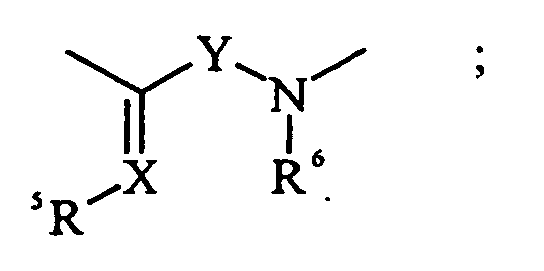
- W
- is a direct bond;
- X
- is O or S;
- Y
- is a direct bond;
- R5
- is absent;
- Additionally preferred compounds of the general formula (1) according to the present embodiment are those in which
- R2
- is hydrogen, methyl, ethyl, propyl, isopropyl, butyl, isobutyl, t-butyl, pentyl, isopentyl, neopentyl, hexyl, cyclopropyl, cyclobutyl, cyclopentyl, cyclohexyl, phenyl, benzyl, tolyl or a substituted derivative thereof, an optionally substituted alkenyl residue, an optionally substituted alkinyl residue,
- U
- is a direct bond,
- V
- is a C1-5-alkylene group which is optionally substituted by one or more residues R7 which are selected from the group consisting of hydrogen, methyl, ethyl, propyl, isopropyl, butyl, isobutyl, t-butyl, pentyl, isopentyl, neopentyl, hexyl, cyclopropyl, cyclobutyl, cyclopentyl, cyclohexyl, phenyl, benzyl, tolyl, a substituted derivative or a saturated or unsaturated, optionally substituted heterocyclic analog thereof, an optionally substituted alkenyl residue or an optionally substituted alkinyl residue;
- Particularly preferred compounds of the general formula (1) in this case are those in which
- R2
- is hydrogen, methyl, ethyl, propyl, isopropyl, butyl, isobutyl, t-butyl, pentyl, isopentyl, neopentyl, hexyl, cyclopropyl, cyclobutyl, cyclopentyl, cyclohexyl, phenyl, benzyl, tolyl or a substituted derivative thereof, an optionally substituted alkenyl residue, an optionally substituted alkinyl residue,
- U
- is a direct bond,
- V
- is -CHR7-;
- R7
- is hydrogen, methyl, ethyl, propyl, isopropyl, butyl, isobutyl, t-butyl, pentyl, isopentyl, neopentyl, hexyl, cyclopropyl, cyclobutyl, cyclopentyl, cyclohexyl, phenyl, benzyl, tolyl or a substituted derivative thereof, an optionally substituted alkenyl residue, an optionally substituted alkinyl residue,
- A
- is an optionally methoxy-substituted 1,3- or 1,4-bridging phenylene group;
- B
- is an optionally methyl-substituted 1,3- or 1,4-bridging phenylene group;
- C
- is

- W
- is a direct bond;
- X
- is O or S;
- Y
- is a direct bond;
- R5
- is absent;
- According to yet another preferred embodiment, the present invention relates to compounds of the general formula (1), in which
- R1
- is hydrogen, methyl, ethyl, propyl, isopropyl, butyl, isobutyl, t-butyl, pentyl, isopentyl, neopentyl, hexyl, cyclopropyl, cyclopropylmethyl, cyclobutyl, cyclopentyl, cyclohexyl, phenyl, benzyl, tolyl or a substituted derivative thereof;
- R2
- is hydrogen, methyl, ethyl, propyl, isopropyl, butyl, isobutyl, t-butyl, pentyl, isopentyl, neopentyl, hexyl, cyclopropyl, cyclobutyl, cyclopentyl, cyclohexyl, phenyl, benzyl, tolyl, phenylethyl, a substituted derivative or a saturated or unsaturated, optionally substituted heterocyclic analog thereof, an optionally substituted alkenyl residue, an optionally substituted alkinyl residue;
- U
- is a direct bond or an optionally substituted C1-3-alkylene group;
- V
- is -NR8CO- or -NR8SO2-;
- R8
- is hydrogen, methyl, ethyl, propyl, isopropyl, butyl, isobutyl, t-butyl, pentyl, isopentyl, neopentyl, hexyl, cyclopropyl, cyclopropylmethyl, cyclobutyl, cyclopentyl, cyclohexyl, phenyl, benzyl, tolyl, phenylethyl, phenylpropyl, phenoxyethyl or a substituted derivative thereof;
- A
- is a 1,3- or 1,4-bridging phenylene group which is unsubstituted or has at least one alkoxy residue;
- B
- is a 1,3- or 1,4-bridging phenylene group which is unsubstituted or has at least one alkyl residue;
- W
- is a direct bond or an optionally substituted C1-3-alkylene group;
- C
- is

- R3
- is hydrogen, methyl, ethyl, propyl, isopropyl, butyl, isobutyl, t-butyl, pentyl, isopentyl, neopentyl, hexyl, cyclopropyl, cyclopropylmethyl, cyclobutyl, cyclopentyl, cyclohexyl, 4-methylcyclohexyl, 3,3,5-trimethylcyclohexyl, 5-methyl-2-hexyl, phenyl, benzyl, tolyl or a substituted derivative thereof, C1-4-alkylamino-C1-4-alkyl, C1-4-dialkylamino-C1-4-alkyl, amino-C1-4-alkyl, C1-4-alkyloxy-C1-4-alkyl, one of the residues (a1) to (a29) or is connected to one of R4, Y or R6, if present, with formation of an optionally substituted heterocyclic 4- to 6-membered ring system which includes the nitrogen atom to which R3 is bonded and can be saturated or unsaturated and/or can contain further heteroatoms;
- R4
- is hydrogen, methyl, ethyl, propyl, isopropyl, butyl, isobutyl, t-butyl, pentyl, isopentyl, neopentyl, hexyl, cyclopropyl, cyclopropylmethyl, cyclobutyl, cyclopentyl, cyclohexyl, 4-methylcyclohexyl, 3,3,5-trimethylcyclohexyl, 5-methyl-2-hexyl, phenyl, benzyl, tolyl or a substituted derivative thereof, C1-4-alkylamino-C1-4-alkyl, C1-4-dialkylamino-C1-4-alkyl, amino-C1-4-alkyl, C1-4-alkyloxy-C1-4-alkyl, one of the residues (a1) to (a29) or is connected to one of R3, Y or R6, if present, with formation of an optionally substituted heterocyclic 4- to 6-membered ring system which includes the nitrogen atom to which R4 is bonded and can be saturated or unsaturated and/or can contain further heteroatoms;
- X
- is CHNO2, CHCN, O or S;
- Y
- is a direct bond or a substituted or unsubstituted methylene or methine group;
- R5
- is absent;
- R6
- is hydrogen, methyl, ethyl, propyl, isopropyl, butyl, isobutyl, t-butyl, pentyl, isopentyl, neopentyl, hexyl, cyclopropyl, cyclopropylmethyl, cyclobutyl, cyclopentyl, cyclohexyl, 4-methylcyclohexyl, 3,3,5-trimethylcyclohexyl, 5-methyl-2-hexyl, phenyl, benzyl, tolyl or a substituted derivative thereof, C1-4-alkylamino-C1-4-alkyl, C1-4-dialkylamino-C1-4-alkyl, amino-C1-4-alkyl, C1-4-alkyloxy-C1-4-alkyl, one of the residues (a1) to (a29) or is connected to one of R3, Y or R4, if present, with formation of an optionally substituted heterocyclic 4- to 6-membered ring system which includes the nitrogen atom to which R6 is bonded, and can be saturated or unsaturated and/or can contain further heteroatoms.
- Particularly preferred compounds of the general formula (1) according to this embodiment are those in which
- U
- is a direct bond or -CHR7-;
- R7
- is hydrogen, methyl, ethyl, propyl, isopropyl, butyl, isobutyl, t-butyl, pentyl, isopentyl, neopentyl, hexyl, cyclopropyl, cyclobutyl, cyclopentyl, cyclohexyl, phenyl, benzyl, tolyl or a substituted derivative thereof, an optionally substituted alkenyl residue, an optionally substituted alkinyl residue;
- A
- is an optionally methoxy-substituted 1,3- or 1,4-bridging phenylene group;
- B
- is an optionally methyl-substituted 1,3- or 1,4-bridging phenylene group;
- W
- is a direct bond;
- Y
- is a direct bond;
- The present invention furthermore relates to a process for the preparation of the above-mentioned compounds having the general formula (1),which comprises the steps

- a) reaction of a carboxylic acid derivative of the formula (2)
wherein
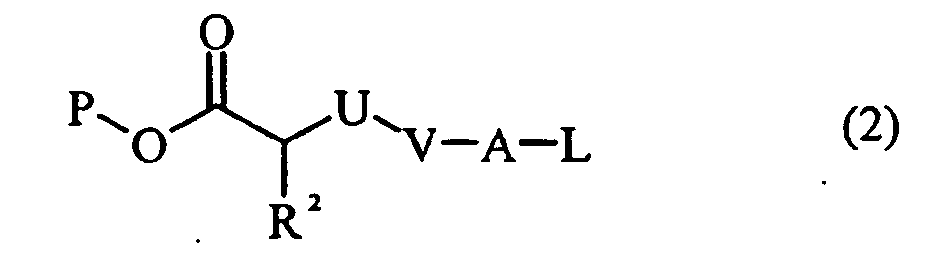
- P
- is a conventional protective group, a solid phase used for carrying out a solid-phase reaction or R1 is as defined in claim 1;
- A
- is a phenylene group which is 1,3- or 1,4-substituted or a thienylene group which is 2,4- or 2,5-substituted with respect to V and L and optionally has additional residues;
- L
- is -H, -F, -Cl, -Br, -I, -SCN, -N2 + or an organometallic residue; and the other residues are as defined above;
- M
- is -H, -I, -N2 +, -COOCOBNO2 or an organometallic residue;
- B
- is a phenylene group which is 1,3- or 1,4-substituted with respect to M and W-D and optionally has additional residues;
- W
- is as defined in claim 1;
- D
- is -NO2, -NH2 or -CHO;
where the residues are as defined above;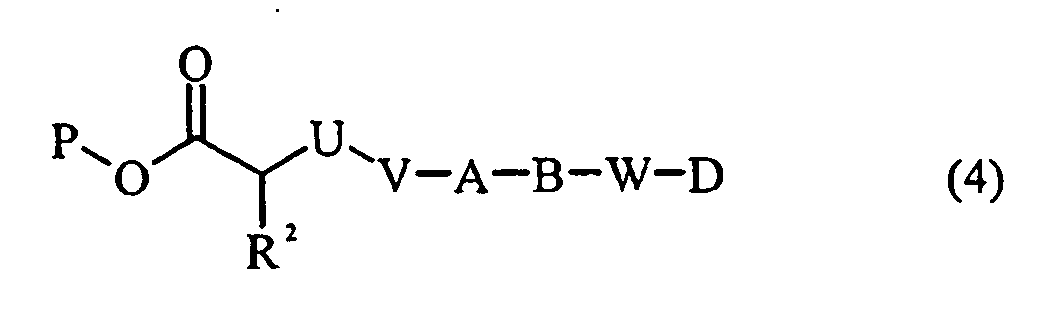
- b) conversion of the residue D into the corresponding amino group, if D is not -NH2; and
- c) if appropriate, derivatization of nitrogen atoms present at preferred times within the preparation process and/or the conversion of the compound obtained into the free acid and/or the conversion of the compound obtained into one of its physiologically acceptable salts by reaction with an inorganic or organic base or acid.
-
- In the process according to the invention all steps can be carried out during the bonding of the carboxylic acid derivative of the formula (2) to a solid phase.
- Furthermore, according to a preferred embodiment of the process according to the invention a carboxylic acid derivative of the formula (2), in which
- L
- is -F, -Cl, -Br or -I
- M
- is an organometallic residue;
- Preferably, in the above process according to the invention a carboxylic acid derivative of the formula (2) is employed which contains a sulfonamide or carbamate group which was formed by reaction of an amino group of the corresponding precursor of the carboxylic acid derivative of the formula (2) with a sulfonyl halide or a carbamoyl halide.
- It is furthermore preferred that in the above process according to the invention, in the case in which D is -NO2 in the compound of the formula (4), the conversion of D into an amino group is carried out in the presence of a tin(II) compound.
It is furthermore preferred that in the above process according to the invention, in the case in which D is -CHO in the compound of the formula (4), the conversion of D into an amino group by reaction with an amine is carried out under reducing conditions. - It is moreover preferred that the compound of the formula (4) in which D is an amino group is converted into a urea or thiourea unit by a reaction of this amino group with a carbonic acid derivative or thiocarbonic acid derivative and a subsequent reaction with an amine of the formula NHR4R6, where R4 and R6 are as defined above.
- The present invention furthermore relates to a pharmaceutical composition which contains at least one of the compounds defined above.
- The present invention also relates to the use of the compounds described above for the production of pharmaceutical compositions having integrin-antagonistic action.
- The present invention furthermore relates to the use of compounds of the general formula (1)wherein

- R1
- is hydrogen, a substituted or unsubstituted alkyl or cycloalkyl residue, a substituted or unsubstituted aryl residue or a saturated or unsaturated, optionally substituted heterocyclic residue;
- R2
- is hydrogen, a substituted or unsubstituted alkyl or cycloalkyl residue, a substituted or unsubstituted aryl residue, a saturated or unsaturated, optionally substituted heterocyclic residue, an optionally substituted alkenyl residue, an optionally substituted alkinyl residue, -NR2'SO2R2", -NR2'COOR2', -NR2'COR2', -NR2'CONR2' 2 or -NR2'CSNR2' 2;
- R2'
- is hydrogen, a substituted or unsubstituted alkyl or cycloalkyl residue, a substituted or unsubstituted aryl residue or a saturated or unsaturated, optionally substituted heterocyclic residue;
- R2"
- is a substituted or unsubstituted alkyl, alkenyl or cycloalkyl residue, a substituted or unsubstituted aryl residue or a saturated or unsaturated, optionally substituted heterocyclic residue;
- U
- is a direct bond or a substituted or unsubstituted alkylene group;
- V
- is a substituted or unsubstituted alkylene group, -NR2'CO- or -NR2'SO2-;
- A and B
- are each independently of one another a 1,3- or 1,4-bridging phenylene group or a 2,4- or 2,5-bridging thienylene group each of which may optionally have additional substituents,
- W
- is a direct bond or a substituted or unsubstituted alkylene group;
- C
- is a direct bond or

- R3
- is hydrogen, a substituted or unsubstituted alkyl or cycloalkyl residue, a substituted or unsubstituted aryl residue, a saturated or unsaturated, optionally substituted heterocyclic residue, an alkylamine residue, an alkylamide residue or is connected to one of R4, Y, R5 or R6, if present, with formation of an optionally substituted heterocyclic ring system which includes the nitrogen atom to which R3 is bonded, and can be saturated or unsaturated and/or can contain further heteroatoms;
- R4
- is hydrogen, a substituted or unsubstituted alkyl or cycloalkyl residue, a substituted or unsubstituted aryl residue, a saturated or unsaturated, optionally substituted heterocyclic residue, an alkylamine residue, an alkylamide residue or is connected to one of R3, Y, R5 or R6, if present, with formation of an optionally substituted heterocyclic ring system which includes the nitrogen atom to which R4 is bonded and can be saturated or unsaturated and/or can contain further heteroatoms;
- X
- is CHNO2, CHCN, O, N or S;
- Y
- is a direct bond or an optionally substituted alkylene or alkine group;
- R5
- is absent, or is hydrogen, a substituted or unsubstituted alkyl or cycloalkyl residue, -NO2, -CN, -COR5', -COOR5', or is connected to one of R3, Y, R4 or R6, if present, with formation of an optionally substituted carbocyclic or heterocyclic ring system which includes X and can be saturated or unsaturated and/or can contain further heteroatoms;
- R5'
- is hydrogen, a substituted or unsubstituted alkyl or cycloalkyl residue, a substituted or unsubstituted aryl residue or a saturated or unsaturated, optionally substituted heterocyclic residue which can be saturated or unsaturated and/or can contain further heteroatoms;
- R6
- is hydrogen, a substituted or unsubstituted alkyl or cycloalkyl residue, a substituted or unsubstituted aryl or arylcarbonyl residue, a saturated or unsaturated, optionally substituted heterocyclic residue, an alkylamine residue, an alkylamide residue or is connected to one of R3, R4, Y or R5, if present, with formation of an optionally substituted heterocyclic ring system which includes the nitrogen atom to which R6 is bonded and can be saturated or unsaturated and/or can contain further heteroatoms;
- The invention is illustrated more in detail below with reference to preferred embodiments, to which, however, it is not restricted in any way. In the description below, bivalent substituents are indicated such that their respective left end is connected to the indicated group left of the corresponding substituent in formula (1) and their respective right end is connected to the indicated group right of the corresponding substituent in formula (1). If in formula (1), for example, the residue V is -NR8SO2-, the nitrogen atom is connected to the residue U and the sulfur atom to the residue A.
- The compounds according to the invention comprise, as a main structural element, a biphenyl nucleus which bridges a residue having a terminal carboxyl group with a residue including at least one nitrogen atom in the main chain, which is a constituent of an amino group, amide group, urea group, thioamide group, thiourea group, amidine group, enamine group or guanidine group which is optionally incorporated into a cyclic ring system. In the biphenyl nucleus the phenyl ring A which is located nearer to the terminal carboxyl group may optionally be replaced by a thiophene ring. In addition to one of the abovementioned residues, the biphenyl nucleus can moreover carry further substituents.
- The terminal carboxyl unit can be present as a free carboxylic acid or as an ester. In the case in which the terminal carboxyl unit is esterified, in principle all carboxylic acid esters which are obtainable according to conventional processes and can be metabolized in the human body into the free carboxylic acid, such as the corresponding alkyl esters, cycloalkyl esters, aryl esters and heterocyclic analogs thereof, can be used according to the invention, wherein alkyl esters, cycloalkyl esters and aryl esters are preferred and the alcoholic residue can carry further substituents. C1-6-Alkyl esters such as the methyl ester, ethyl ester, propyl ester, isopropyl ester, butyl ester, isobutyl ester, t-butyl ester, pentyl ester, isopentyl ester, neopentyl ester, hexyl ester, cyclopropyl ester, cyclopropylmethyl ester, cyclobutyl ester, cyclopentyl ester, cyclohexyl ester, or aryl esters such as the phenyl ester, benzyl ester or tolyl ester are particularly preferred.
- The abovementioned esters can be employed as prodrugs for the inhibition of angiogenesis and/or the treatment of the diseases mentioned at the beginning, such as cancer, osteoporosis, arteriosclerosis, restenosis, rheumatoid arthritis or ophthalmia, since they are easily converted into the corresponding carboxylic acid in animals and humans. However, for the treatment of the abovementioned disorders the compounds of the general formula (1) according to the invention are preferably used in a form in which the terminal carboxyl unit is present as a free carboxylic acid.
- For medicinal use, the compounds of the general formula (1) according to the invention can also be employed in the form of their physiologically acceptable salts. According to the invention, physiologically acceptable salts are understood as meaning nontoxic salts which in general are accessible by reaction of the compounds of the general formula (1) according to the invention with an inorganic or organic base or acid conventionally used for this purpose. Examples of preferred salts of the compounds of the general formula (1) according to the invention are the corresponding alkali metal salt, e.g. lithium, potassium or sodium salt, the corresponding alkaline earth metal salt such as the magnesium or calcium salt, a quaternary ammonium salt such as, for example, the triethylammonium salt, acetate, benzenesulfonate, benzoate, dicarbonate, disulfate, ditartrate, borate, bromide, carbonate, chloride, citrate, dihydrochloride, fumarate, gluconate, glutamate, hexylresorcinate, hydrobromide, hydrochloride, hydroxynaphthoate, iodide, isothionate, lactate, laurate, malate, maleate, mandelate, mesylate, methylbromide, methylnitrate, methylsulfate, nitrate, oleate, oxalate, palmitate, pantothenate, phosphate, diphosphate, polygalacturonate, salicylate, stearate, sulfate, succinate, tartrate, tosylate and valerate, and other salts used for medicinal purposes.
- The terminal carboxyl unit is connected to the biphenyl nucleus or thiophene-phenyl-nucleus by means of an alkylene chain which can optionally carry further substituents. Within certain limits, it is possible to control the biological activity of the compounds according to the invention against integrin receptors such as, in particular, the αvβ3 or αvβ5 receptor, by means of the distance between the terminal carboxyl unit and the nitrogen atom of an amino group, amide group, urea group, thioamide group, thiourea group, amidine group, enamine group or guanidine group which is located in the main chain of the residue linked to the phenyl ring B of the biphenyl nucleus or thiophene-phenyl-nucleus, where in the case in which more than one nitrogen atom is present in the main chain of the respective residue, the nitrogen atom located nearer to the phenyl ring B of the nucleus is decisive. In addition to the biphenyl nucleus or thiophene-phenyl-nucleus, preferably not more than 6 atoms should be located in the main chain between these two structural elements. However, compounds in which, additionally to the biphenyl nucleus or thiophene-phenyl-nucleus, less than 6 additional atoms are located in the main chain between the terminal carboxyl unit and the nitrogen atom of the amino group, amide group, urea group, thioamide group, thiourea group, amidine group, enamine group or guanidine group which is located in the main chain of the residue linked to the phenyl ring B of the biphenyl nucleus or thiophene-phenyl-nucleus, are more preferred. According to the present invention, particularly preferred compounds are those in which the abovementioned nitrogen atom of the amino group, amide group, urea group, thioamide group, thiourea group, amidine group, enamine group or guanidine group is bonded directly or via a -CH2-group to the phenyl ring B of the biphenyl nucleus or thiophene-phenyl-nucleus and, at the same time, the terminal carboxyl unit is separated from the phenyl ring A of the biphenyl nucleus or thiophene-phenyl-nucleus by two to four atoms in the main chain.
- The alkylene chain which connects the terminal carboxyl group to the phenyl ring A of the biphenyl nucleus or thiophene-phenyl-nucleus can alternatively carry additional substituents on any of the carbon atoms forming the alkylene chain. These substituents can be selected from the group which consists of hydrogen, a substituted or unsubstituted alkyl or cycloalkyl residue, a substituted or unsubstituted aryl residue, a saturated or unsaturated, optionally substituted heterocyclic residue, an optionally substituted alkenyl residue, an optionally substituted alkinyl residue, -NR2'SO2R2", -NR2'COOR2', -NR2'COR2', -NR2'CONR2' 2 or -NR2'CSNR2' 2, wherein R2' can be hydrogen, a substituted or unsubstituted alkyl, alkenyl or cycloalkyl residue, a substituted or unsubstituted aryl residue or a saturated or unsaturated, optionally substituted heterocyclic residue and R2" can be a substituted or unsubstituted alkyl, alkenyl or cycloalkyl residue, a substituted or unsubstituted aryl residue or a saturated or unsaturated, optionally substituted heterocyclic residue. The alkyl residue can preferably be a C1-6-alkyl such as, for example, methyl, ethyl, propyl, isopropyl, butyl, isobutyl, t-butyl, pentyl, isopentyl, neopentyl or hexyl. The alkenyl residue can preferably be a C2-C6-alkenyl having one or two double bonds such as, for example vinyl, allyl, prop-1-en-yl, isopropenyl, but-1-enyl, buta-1,3-dienyl. The cycloalkyl residue can preferably be a C3-7-cycloalkyl such as, for example, cyclopropyl, cyclopropylmethyl, cyclobutyl, cyclopentyl or cyclohexyl. The aryl residue can preferably be phenyl, benzyl or tolyl. As an example for substituted aryl p-fluorobenzyl may be mentioned. The heterocyclic residue can preferably be pyrrole, pyridine, tetrahydrofuran, furan, thiophene, tetrahydrothiophene, thiooxazole, benzofuran, quinoline, isoquinoline, pyrimidine, imidazole, thiazole, pyrazole, isoxazole and benzothiadiazole. The alkenyl residue can be a terminal or internal E- or Z-alkene unit. The abovementioned residues can alternatively carry one or more C1-6-alkyl residues such as methyl, ethyl, propyl, isopropyl, butyl, isobutyl, t-butyl, pentyl, isopentyl, neopentyl or hexyl, C3-7-cycloalkyl residues such as cyclopropyl, cyclopropylmethyl, cyclobutyl, cyclopentyl, cyclohexyl or cycloheptyl, aryl residues such as phenyl, benzyl, tolyl, naphthyl, heterocyclic residues such as pyrrole, pyridine, tetrahydrofuran, furan, thiophene, tetrahydrothiophene, oxazole, thiazole, thiooxazole, benzofuran, benzoxazole, benzothiazole, quinoline, isoquinoline, or functional groups such as a double bond to a heteroatom such as oxygen, sulfur or nitrogen, an optionally substituted amino group, a nitro group, a halogeno group, a trifluoromethyl group, a hydroxyl group, an ether group, a sulfide group, a mercaptan group, a cyano group, an isonitrile group, an alkenyl group, an alkinyl group, an aldehyde group, a keto group, a carboxyl group, an ester group, an amide group, a sulfoxide group or a sulfone group. Furthermore, one or more saturated or unsaturated additional rings can be fused to the abovementioned cyclic residues with formation of, for example, a naphthyl, benzofuranyl, benzoxazolyl, benzothiazolyl, quinolinyl or isoquinolinyl unit or a partially or completely hydrogenated analog thereof.
- Preferred substituents among those optionally located at the alkylene chain connecting the terminal carboxyl group to the phenyl ring A of the biphenyl nucleus or thiophene-phenyl-nucleus are -NR2'SO2R2", -NR2'COOR2', -NR2'COR2', -NR2'CONR2' 2 or -NR2'CSNR2' 2, wherein R2' can be hydrogen, a substituted or unsubstituted alkyl, alkenyl or cycloalkyl residue, a substituted or unsubstituted aryl residue or a saturated or unsaturated, optionally substituted heterocyclic residue and R2" can be a substituted or unsubstituted alkyl, alkenyl or cycloalkyl residue, a substituted or unsubstituted aryl residue or a saturated or unsaturated, optionally substituted heterocyclic residue. R2' is preferably selected from the group which consists of hydrogen, a C1-6-alkyl such as, for example, methyl, ethyl, propyl, isopropyl, butyl, isobutyl, t-butyl, pentyl, isopentyl, neopentyl, hexyl, a C3-7-cycloalkyl such as, for example, cyclopropyl, cyclobutyl, cyclopentyl, cyclohexyl, phenyl, benzyl, tolyl or a substituted derivative thereof as, for example, 2-chlorophenyl, 2-methoxyphenyl, 2,4,6-trimethylphenyl, 4-methoxyphenyl, 4-t-butylphenyl, 2,5-dichlorophenyl, 3-chlorophenyl, 4-chlorophenyl, 4-trifluoromethyl phenyl, while R2" is preferably selected from the group which consists of a C1-6-alkyl such as, for example, methyl, ethyl, propyl, isopropyl, butyl, isobutyl, t-butyl, pentyl, isopentyl, neopentyl, hexyl, a substituted C1-6-alkyl such as for example 1,1,1-trifluoro-n-but-4-yl, a C2-6-alkenyl having one double bond such as, for example allyl, a C3-7-cycloalkyl such as, for example, cyclopropyl, cyclobutyl, cyclopentyl, cyclohexyl, phenyl, benzyl, tolyl or a substituted derivative thereof, such as p-fluorobenzyl, 4-ethylphenyl, -C6H2(CH3)3, 2-chlorophenyl, 4-chlorophenyl, 2,5-dichlorophenyl, 4-trifluoromethylphenyl, campher-10-yl, 4-methoxyphenyl, 4-t-butylphenyl, 2,5-dimethylphenyl, 3-chlorophenyl, 2-methoxy-5-methylphenyl, 2,3,5,6-tetramethylphenyl, 2,3-dichlorophenyl, 2,4-dichlorophenyl, 2,6-dichlorophenyl, 2-naphthyl, 3-trifluoromethylphenyl, 4-fluorophenyl, 2,4-difluorophenyl, 2-chloro-6-methylphenyl, 2-chloro-4-fluorophenyl, 2,5-dimethoxyphenyl, 3,4-dimethoxyphenyl, 3-chloro-6-methoxyphenyl, 2-trifluoromethylphenyl, 2-alkylsulfonylphenyl, 2-arylsulfonylphenyl, 3-(N-acetyl-6-methoxy)anilino, 2-methoxycarbonylphenyl, 4-N-acetylphenyl, 4-ethylphenyl, 3-chloro-4-fluorphenyl, 2-fluorophenyl, 3-fluorophenyl, 2,4-difluorophenyl, 2,6-difluorophenyl, 3,4-difluorophenyl, 1-naphthyl, 4-trifluoromethoxyphenyl, 2-trifluoromethoxyphenyl, 4-chloro-2-trifluorophenyl, 2-trifluoromethoxy-4-bromophenyl, 2-fluoro-4-trifluoromethylphenyl, 8-quinolinyl, a group of the formula


- According to the invention, particularly preferred compounds of the general formula (1) are those in which a sulfonamide or carbamate group is located at the alkylene chain which connects the terminal carboxyl group to the phenyl ring A of the biphenyl nucleus or thiophene-phenyl-nucleus. The sulfonamide or carbamate group is preferably located in the α- or β-position to the terminal carboxyl group. However, more than 2 carbon atoms can also be located between the carboxyl carbon of the terminal carboxyl group and the nitrogen atom of the sulfonamide or carbamate unit. According to the present invention, the sulfonamide group, if present, particularly preferably carries a residue R2" on the sulfur atom, which is selected from the group consisting of phenyl, benzyl, tolyl or a substituted derivative thereof, such as p-fluorobenzyl, -C6H2(CH3)3, 2-chlorophenyl, 4-chlorophenyl, 2,4-dichlorophenyl, 2,5-dichlorophenyl, 4-trifluoromethylphenyl, campher-10-yl, 4-methoxyphenyl, 4-t-butylphenyl, 2,5-dimethylphenyl, 3-chlorophenyl, 2-methoxy-5-methylphenyl, 2,3,5,6-tetramethylphenyl, 2,3-dichlorophenyl, 2,6-dichlorophenyl, 2-naphthyl, 3-trifluoromethylphenyl, 4-fluorophenyl, 2,4-difluorophenyl, 2-chloro-6-methylphenyl, 2-chloro-4-fluorophenyl, 2,5-dimethoxyphenyl, 3,4-dimethoxyphenyl, 3-chloro-6-methoxyphenyl, 2-trifluoromethylphenyl, 2-alkylsulfonylphenyl, 2-arylsulfonylphenyl, 3-(N-acetyl-6-methoxy)anilino, 2-methoxycarbonylphenyl, 4-N-acetylphenyl, 4-ethylphenyl, 3-chloro-4-fluorphenyl, 2-fluorophenyl, 3-fluorophenyl, 2,4-difluorophenyl, 2,6-difluorophenyl, 3,4-difluorophenyl, 1-naphthyl, 4-trifluoromethoxyphenyl, 2-trifluoromethoxyphenyl, 8-quinolinyl or a group of the formula
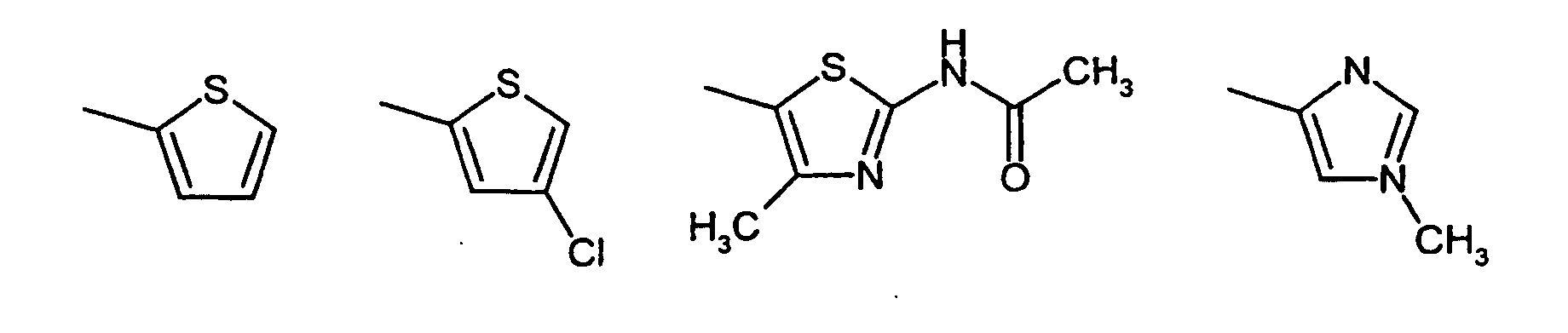

- If present, the carbamate group particularly preferably carries a residue R2' as an alcoholic component which is selected from the group consisting of a C1-6-alkyl residue such as methyl, ethyl, propyl, isopropyl, butyl, isobutyl, t-butyl, pentyl, isopentyl, neopentyl or hexyl, a C3-7-cycloalkyl residue such as cyclopropyl, cyclopropylmethyl, cyclobutyl, cyclopentyl, cyclohexyl or cycloheptyl, phenyl, benzyl, tolyl or a substituted derivative thereof as, for example, 2-chlorophenyl, 2-methoxyphenyl, 2,4,6-trimethylphenyl, 4-methoxyphenyl, 4-t-butylphenyl, 2,5-dichlorophenyl, 3-chlorophenyl, 4-chlorophenyl, 4-trifluoromethyl phenyl, and which is particularly preferably a benzyl residue.
- According to a further aspect, the present invention relates to compounds of the general formula (1) in which the terminal carboxyl group is bonded to the phenyl/thienyl ring A of the biphenyl nucleus or thienyl-phenyl nucleus by means of an alkylenesulfonamide unit or an alkylenamide unit, i.e. an -NRSO2- or -NR-CO-group is inserted between the alkylene chain and the phenyl/thienyl ring A of the nucleus, the phenyl/thienyl ring A of the nucleus being bonded to the sulfur atom of the sulfonamide unit or the carboxyl carbon atom of the amide unit. In accordance with the above details, the alkylene chain between the terminal carboxyl group and the sulfonamide or amide unit can in this case optionally carry further substituents, where a C1-6-alkyl such as, for example, methyl, ethyl, propyl, isopropyl, butyl, isobutyl, t-butyl, pentyl, isopentyl, neopentyl or hexyl, a C3-7-cycloalkyl such as, for example, cyclopropyl, cyclopropylmethyl, cyclobutyl, cyclopentyl or cyclohexyl, an aryl such as, for example, phenyl, benzyl, phenylethyl or tolyl, a heterocyclic residue such as pyrrole, pyridine, tetrahydrofuran, furan, thiophene, tetrahydrothiophene, thiooxazole, benzofuran, quinoline, isoquinoline or pyrimidine, or a terminal or internal E- or Z-alkene unit are preferred, which can alternatively carry one or more C1-6-alkyl residues such as methyl, ethyl, propyl, isopropyl, butyl, isobutyl, t-butyl, pentyl, isopentyl, neopentyl or hexyl, C3-7-cycloalkyl residues such as cyclopropyl, cyclopropylmethyl, cyclobutyl, cyclopentyl or cyclohexyl, aryl residues such as phenyl, benzyl, tolyl, naphthyl, heterocyclic residues such as pyrrole, pyridine, tetrahydrofuran, furan, thiophene, tetrahydrothiophene, thiooxazole, benzofuran, quinoline, isoquinoline or pyrimidine, or functional groups such as a double bond to a heteroatom such as oxygen, sulfur or nitrogen, an optionally substituted amino group, a nitro group, a halogeno, a hydroxyl group, an ether group, a sulfide group, a mercaptan group, a cyano group, an isonitrile group, an alkenyl group, an alkinyl group, an aldehyde group, a keto group, a carboxyl group, an ester group, an amide group, a sulfoxide group or a sulfone group. Furthermore, one or more saturated or unsaturated additional rings can be fused to the abovementioned cyclic residues with formation of, for example, a naphthyl, benzofuranyl, benzoxazolyl, benzothiazolyl, quinolinyl or isoquinolinyl unit or a partially or completely hydrogenated analog thereof.
- Particularly preferred compounds according to this embodiment are those in which the alkylene chain which connects the terminal carboxyl group and the bridging sulfonamide or amide unit has a phenyl, aminophenyl, benzyl or pyridyl residue in the α- or β-position to the terminal carboxyl unit.
- In the compounds of this aspect in which a sulfonamide or amide unit is inserted between the corresonding alkylene chain and the phenyl/thienyl ring A of the nucleus, the alkylene chain between the terminal carboxyl group and the bridging sulfonamide or amide unit should preferably comprise not more than two carbon atoms in its main chain in order that, as mentioned above, in addition to the biphenyl nucleus or thiophene-phenyl-nucleus preferably not more than 6 atoms are present between the terminal carboxyl group and the nitrogen atom of the amino group, amide group, urea group, thioamide group, thiourea group, amidine group, enamine group or guanidine group which is nearest to the phenyl ring B in the main chain of the residue linked to the phenyl ring B of the biphenyl or thienyl-phenyl nucleus.
- The nitrogen atom of the bridging sulfonamide or amide unit can optionally carry a residue which is selected from the group consisting of hydrogen, a C1-6-alkyl such as, for example, methyl, ethyl, propyl, isopropyl, butyl, isobutyl, t-butyl, pentyl, isopentyl, neopentyl, hexyl, a C3-7-cycloalkyl such as, for example, cyclopropyl, cyclopropylmethyl, cyclobutyl, cyclopentyl, cyclohexyl, an aryl such as, for example, phenyl, benzyl, tolyl or a substituted derivative thereof such as, for example, phenylethyl, phenylpropyl or phenoxyethyl.
- The biphenyl or thienyl-phenyl nucleus is the central structural element of the compounds according to the invention. It bridges the residue at the phenyl/thienyl ring A including the terminal carboxyl group with the residue at the phenyl ring B which comprises at least one nitrogen atom of an amino group, amide group, urea group, thioamide group, thiourea group, amidine group, enamine group or guanidine group in its main chain. Preferably, it moreover carries no further substituents. Each of the two phenyl/thienyl rings, however, can carry additional substituents. Preferably the phenyl/thienyl ring A, i.e. the ring connected directly to the residue including the terminal carboxyl group, carries one or more additional C1-6-alkyl residues such as, for example, methyl or ethyl, halogeno residues such as, for example fluoro, chloro, bromo, iodo, preferably one or two fluoro residues, alkoxy residues, preferably a C1-6-alkoxy residue such as methoxy, ethoxy, propoxy, butoxy, pentoxy or hexoxy, particularly preferably one or more methoxy residues, and the phenyl ring B, i.e. the ring to which the residue including at least one nitrogen atom of an amino group, amide group, urea group, thioamide group, thiourea group, amidine group , enamine group or guanidine group in its main chain is bonded, carries one or more alkyl residues, preferably a C1-6-alkyl residue such as methyl, ethyl, propyl, isopropyl, butyl, isobutyl, t-butyl, pentyl, isopentyl, neopentyl, hexyl, a C3-7-cycloalkyl residue such as cyclopropyl, cyclobutyl, cyclopentyl, cyclohexyl, and particularly preferably one or more methyl groups. In this case, the rings A and B can independently of one another carry one or more of the abovementioned additional substituents.
- The two phenyl rings can be linked 1,3 or 1,4 to one another and to the residue including the terminal carboxyl group and to the residue including at least one nitrogen atom of an amino group, amide group, urea group, thioamide group, thiourea group, amidine group, enamine group or guanidine group in its main chain, i.e. the residue including the terminal carboxyl group and the phenyl ring B can be substituted in the meta- or para-position to one another at the phenyl ring A, and at the same time the phenyl ring A and the residue including at least one nitrogen atom of an amino group, amide group, urea group, thioamide group, thiourea group, amidine group, enamine group or guanidine group in its main chain can be substituted in the meta- or para-position to one another at the phenyl ring B, each combination of the abovementioned substitution patterns being possible for the biphenyl nucleus of the compounds according to the invention. In case A is a thiophene ring it can accordingly be linked 2,5 or 2,4 to ring B and to the residue including to terminal carboxy group. According to the present invention, compounds are particularly preferred whose biphenyl nucleus according to the above definition consists of a p-substituted phenyl ring A and a p-substituted phenyl ring B, a p-substituted phenyl ring A and an m-substituted phenyl ring B, an m-substituted phenyl ring A and a p-substituted phenyl ring B, or an m-substituted phenyl ring A and an m-substituted phenyl ring B. According to the present invention, compounds are particularly preferred whose biphenyl nucleus according to the above definition consists of a p-substituted phenyl ring A and an m-substituted phenyl ring B. According to another particularly preferred embodiment the nucleus consists of a 2,5-substituted thienyl ring A and a m-substituted or p-substituted phenyl ring B.
- As a third structural element, in addition to the biphenyl or thienyl-phenyl nucleus and the residue including a terminal carboxyl group, the compounds according to the invention have a group which in its main chain comprises at least one nitrogen atom of an amino group, amide group, urea group, thioamide group, thiourea group, amidine group, enamine group or guanidine group. This nitrogen atom can be bonded to the phenyl ring B of the biphenyl or thienyl-phenyl nucleus directly or via an alkylene chain. This alkylene chain preferably consists of at most 4 carbon atoms in the main chain, wherein from the abovementioned considerations, in addition to the biphenyl nucleus between the terminal carboxyl group and the nitrogen atom of the amino group, amide group, urea group, thioamide group, thiourea group, amidine group, enamine group or guanidine group which is located nearest to the phenyl ring B, not more than 6 further atoms should be present. As preferred example ring B and the nitrogen atom of the amino, amide, urea, thioamide, thiourea, amidine, enamine or guanidine group are connected via a -CH2-group or via a direct bond. Alternatively, this alkylene chain can carry further substituents which are selected from the group consisting of hydrogen, a C1-6-alkyl such as, for example, methyl, ethyl, propyl, isopropyl, butyl, isobutyl, t-butyl, pentyl, isopentyl, neopentyl or hexyl, a C3-7-cycloalkyl such as, for example, cyclopropyl, cyclopropylmethyl, cyclobutyl, cyclopentyl or cyclohexyl, an aryl such as, for example, phenyl, benzyl or tolyl, a heterocyclic residue such as pyrrole, pyrrolidine, pyridine, tetrahydrofuran, furan, thiophene, tetrahydrothiophene, thiooxazole, benzofuran, quinoline, isoquinoline or pyrimidine, or a terminal or internal E- or Z-alkene unit, and can alternatively carry one or more C1-6-alkyl residues such as methyl, ethyl, propyl, isopropyl, butyl, isobutyl, t-butyl, pentyl, isopentyl, neopentyl or hexyl, cycloalkyl residues such as cyclopropyl, cyclopropylmethyl, cyclobutyl, cyclopentyl or cyclohexyl, aryl residues such as phenyl, benzyl, tolyl, naphthyl, indolyl, heterocyclic residues such as pyrrole, pyrrolidine, pyridine, tetrahydrofuran, furan, thiophene, tetrahydrothiophene, thiooxazole, benzofuran, quinoline, isoquinoline or pyrimidine, or functional groups such as a double bond to a heteroatom such as oxygen, sulfur or nitrogen, an optionally substituted amino group, a nitro group, a halogeno, a hydroxyl group, an ether group, a sulfide group, a mercaptan group, a cyano group, an isonitrile group, an alkenyl group, an alkinyl group, an aldehyde group, a keto group, a carboxyl group, an ester group, an amide group, a sulfoxide group or a sulfone group. Furthermore, one or more saturated or unsaturated additional rings can be fused to the abovementioned cyclic residues with formation of, for example, a naphthyl, indolyl, benzofuranyl, benzoxazolyl, benzothiazolyl, benzimidazolyl, quinolinyl or isoquinolinyl unit or a partially or completely hydrogenated analog thereof.
- The nitrogen atom located in the main chain of the residue bonded to the phenyl ring B of the biphenyl or thienyl-phenyl nucleus, which lies nearest to the phenyl ring B, can either be a constituent of an optionally substituted amino group or can be located in direct vicinity to a -C=O unit, -CONR2 unit, -C=S unit, -CSNR2 unit, -C=NR unit, -C=CHNO2 unit, C=CHCN unit or a -CNRNR2 unit and can thus be a constituent of an amide group, urea group, thioamide group, thiourea group, amidine group, enamine group or guanidine group.
- In the case in which the nitrogen atom located in the main chain of the residue bonded to the phenyl ring B of the biphenyl nucleus, which lies nearest to the phenyl ring B, is a constituent of an amino group, it can be unsubstituted or can carry one or two substituents, i.e. can be a constituent of a primary, secondary or tertiary amino group. These substituents can be independent of one another or simultaneously hydrogen, a substituted or unsubstituted alkyl or cycloalkyl residue, a substituted or unsubstituted aryl residue, a saturated or unsaturated, optionally substituted heterocyclic residue, an alkylamine residue, an alkylamide residue or can be bonded to one another and thus, together with the nitrogen atom to which they are bonded, form a heterocyclic ring system. In this case, substituents are preferred which are selected from the group consisting of hydrogen, a C1-6-alkyl such as, for example, methyl, ethyl, propyl, isopropyl, butyl, 1-methylpropyl, isobutyl, t-butyl, pentyl, 2-methylbutyl, isopentyl, neopentyl or hexyl, a C1-4-perfluoroalkyl such as, for example CF3, a C3-7-cycloalkyl such as, for example, cyclopropyl, cyclopropylmethyl, cyclobutyl, cyclopentyl, cyclohexyl or cycloheptyl, an aryl such as, for example, phenyl, benzyl or tolyl, an arylcarbonyl such as for example benzoyl, a heterocyclic residue such as, for example, pyrrolidine, piperidine, piperazine, pyrrole, pyridine, tetrahydrofuran, furan, thiophene, tetrahydrothiophene, imidazolidine, imidazole, oxazolidine, oxazole, thiazolidine, thiazole, thiooxazole, benzofuran, benzoxazole, benzothiazole, benzimidazole, quinoline, isoquinoline, tetrahydroquinoline, tetrahydroisoquinoline, triazole, tetrazole, pyrimidine, purine, cytosine, thymine, uracil, adenine, guanine or xanthine, or a terminal or internal E- or Z-alkene unit, and can alternatively carry one or more C1-6-alkyl residues such as methyl, ethyl, propyl, isopropyl, butyl, isobutyl, t-butyl, pentyl, isopentyl, neopentyl or hexyl, a C1-4-perfluoroalkyl such as for example CF3, C3-7-cycloalkyl residues such as cyclopropyl, cyclopropylmethyl, cyclobutyl, cyclopentyl, cyclohexyl or cycloheptyl, aryl residues such as phenyl, benzyl, tolyl, naphthyl, indolyl, heterocyclic residues such as pyrrolidine, piperidine, piperazine, pyrrole, pyridine, tetrahydrofuran, furan, thiophene, tetrahydrothiophene, imidazolidine, imidazole, oxazolidine, oxazole, thiazolidine, thiazole, thiooxazole, benzofuran, benzoxazole, benzothiazole, benzimidazole, quinoline, isoquinoline, tetrahydroquinoline, tetrahydroisoquinoline, triazole, tetrazole, pyrimidine, purine, cytosine, thymine, uracil, adenine, guanine or xanthine, or functional groups such as a double bond to a heteroatom such as oxygen, sulfur or nitrogen, an optionally substituted amino group, a nitro group, a halogeno, a hydroxyl group, an ether group, a sulfide group, a mercaptan group, a cyano group, an isonitrile group, an alkenyl group, an alkinyl group, an aldehyde group, a keto group, a carboxyl group, an ester group, an amide group, a sulfoxide group or a sulfone group. Furthermore, one or more saturated or unsaturated additional rings can be fused to the abovementioned cyclic residues with formation of, for example, a naphthyl, indolyl, benzofuranyl, benzoxazolyl, benzothiazolyl, benzimidazolyl, quinolinyl or isoquinolinyl unit or a partially or completely hydrogenated analog thereof. Particularly preferred substituents are those such as hydrogen, methyl, ethyl, propyl, isopropyl, 1-methylpropyl, butyl, isobutyl, t-butyl, 2-methylbutyl pentyl, isopentyl, neopentyl, hexyl, C1-4-perfluoroalkyl, cyclopropyl, cyclopropylmethyl, cyclobutyl, cyclopentyl, cyclohexyl, cycloheptyl, 4-methylcyclohexyl, 3,3,5-trimethylcyclohexyl, 5-methyl-2-hexyl, phenyl, benzyl, tolyl, benzoyl or a substituted derivative thereof, C1-4-alkylamino-C1-4-alkyl, C1-4-dialkylamino-C1-4-alkyl, amino-C1-4-alkyl, C1-4-alkyloxy-C1-4-alkyl, C1-2-perfluoroalkyl-C1-4-alkyl,

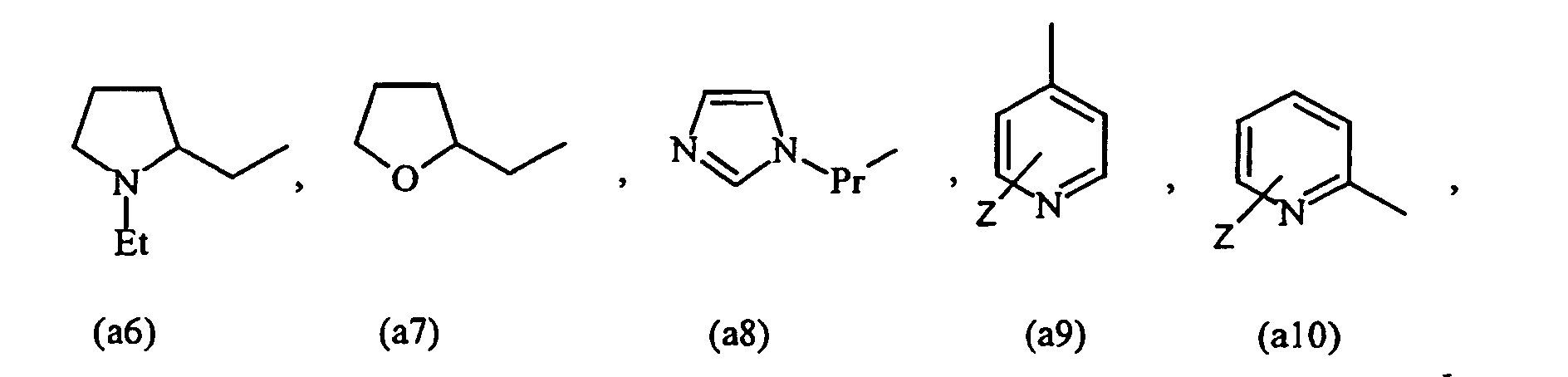
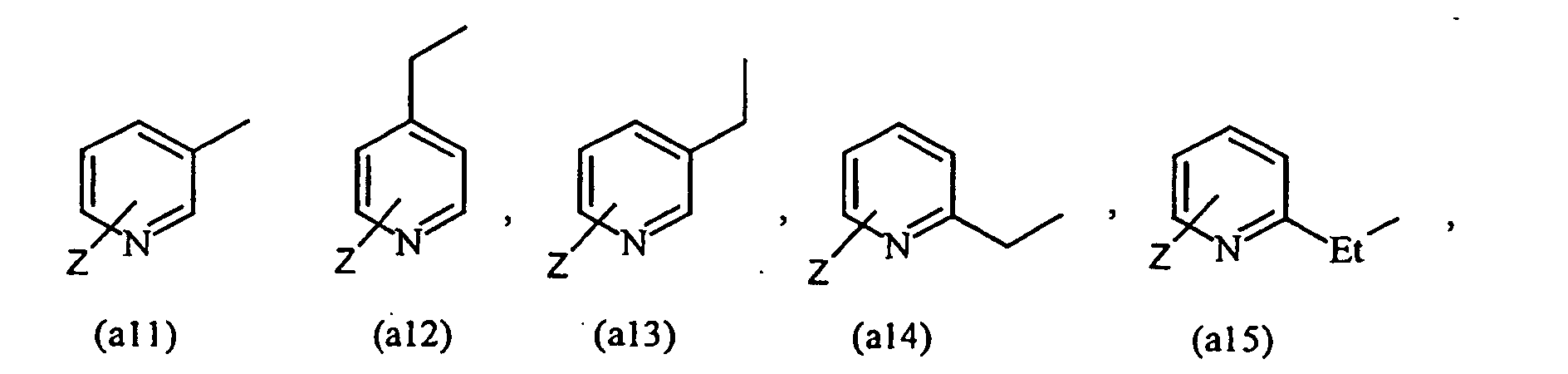

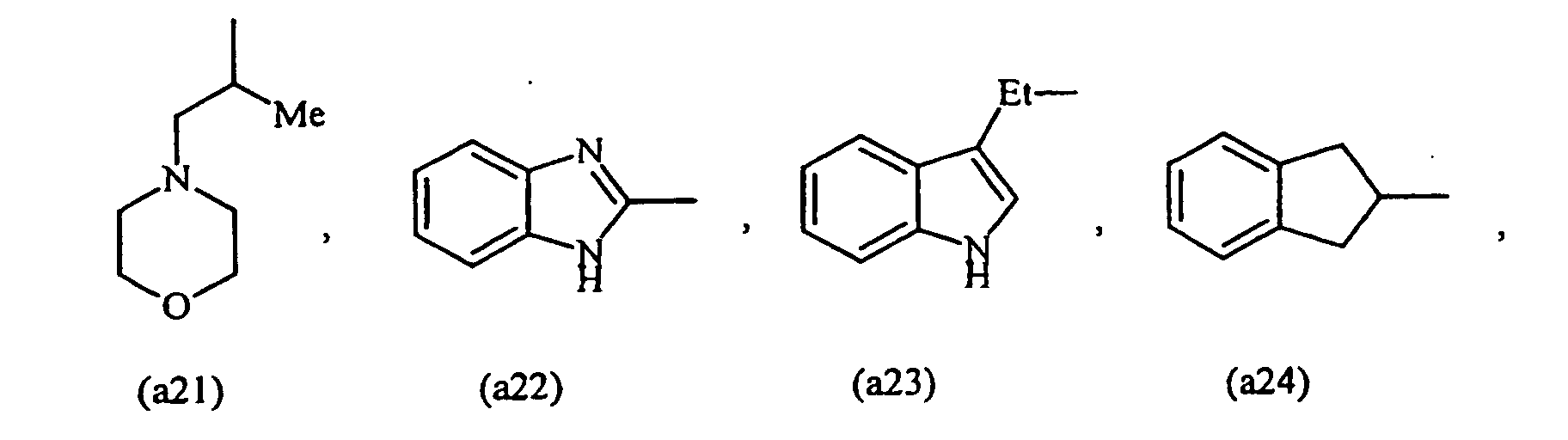
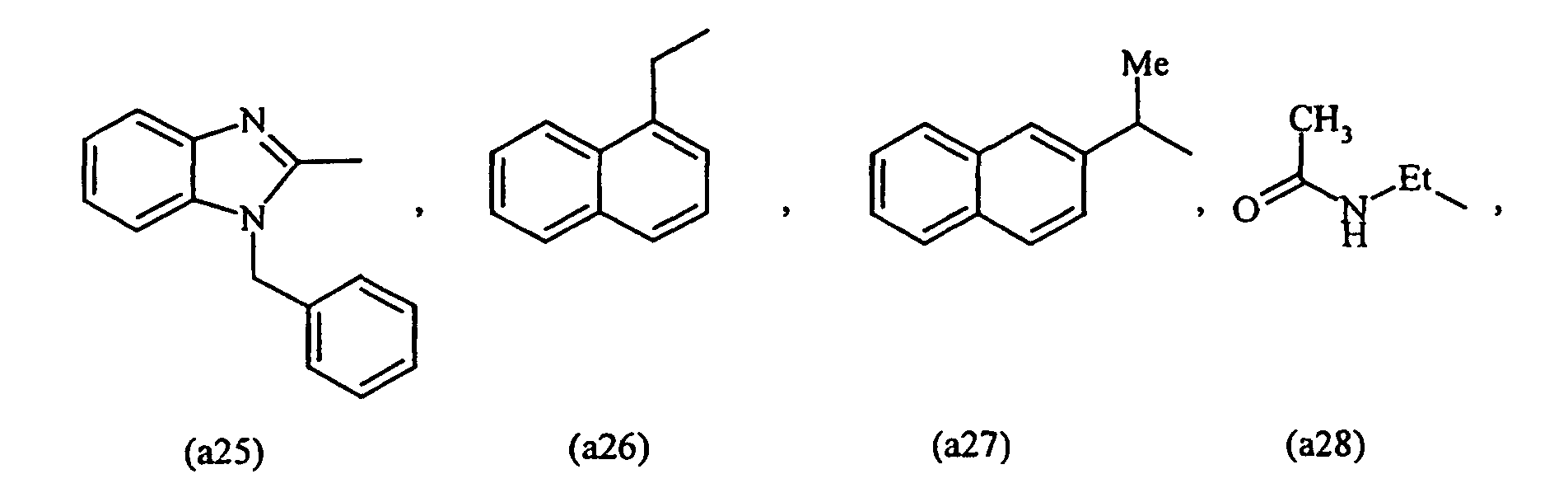

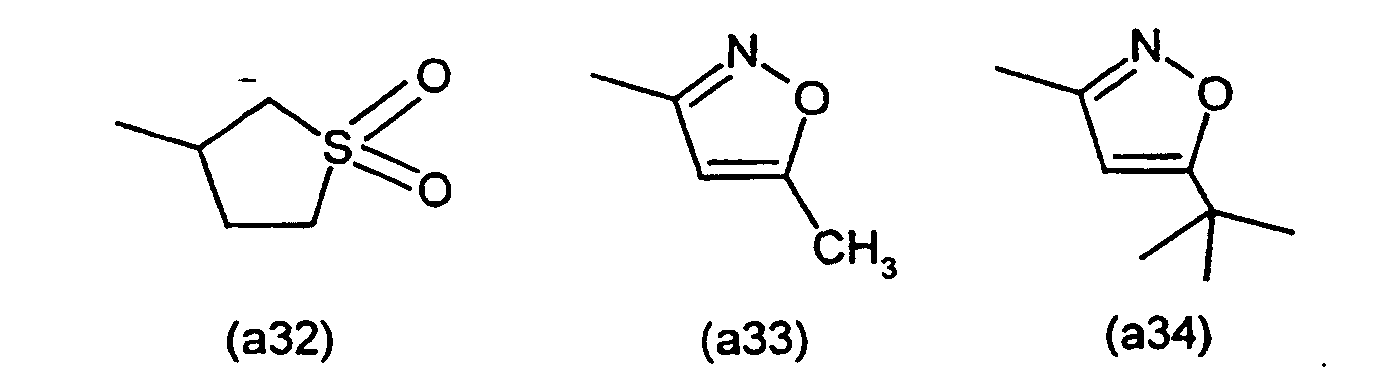
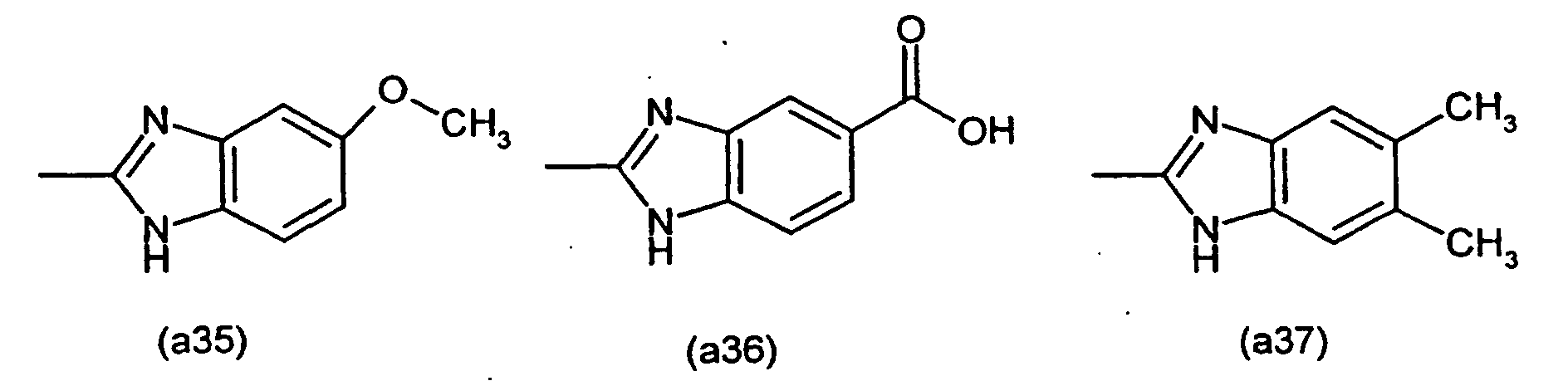

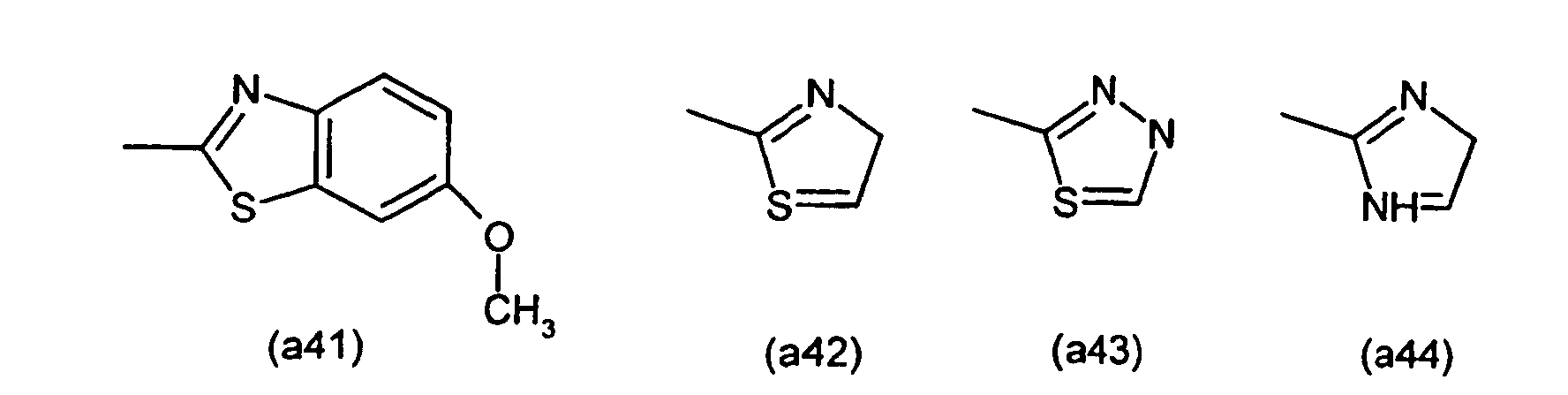

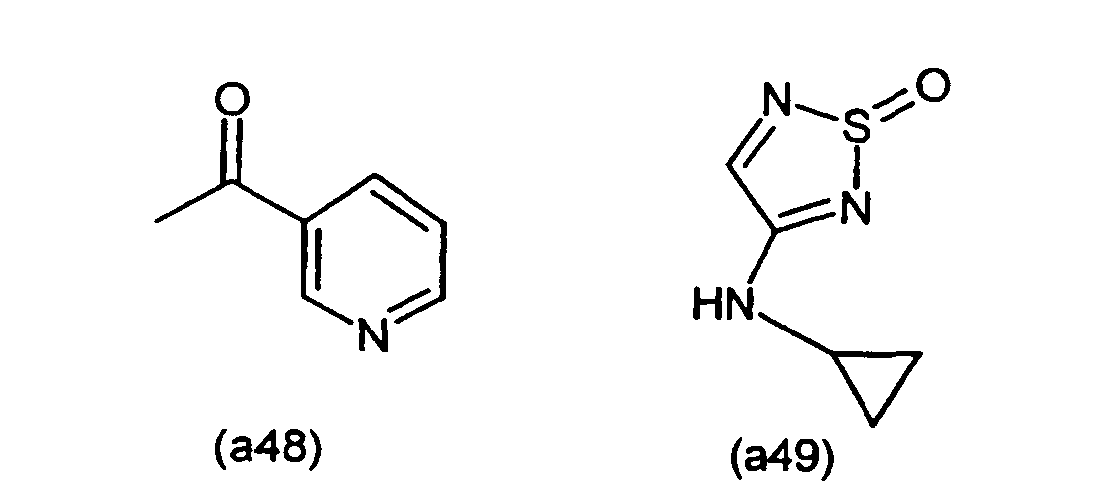 wherein Z is hydrogen, CH3, -NO2 or -NH2.
- In the case in which the two substituents at the nitrogen atom which lies nearest to the phenyl ring B are connected to one another and thus form a heterocyclic system with the nitrogen atom, the heterocyclic system formed can be selected, for example, from the following, nonexclusive list:
 where the ring systems shown can carry one or more residues which are selected from the group consisting of hydrogen, a C1-6-alkyl such as, for example, methyl, ethyl, propyl, isopropyl, butyl, isobutyl, t-butyl, pentyl, isopentyl, neopentyl or hexyl, a C3-7-cycloalkyl such as, for example, cyclopropyl, cyclopropylmethyl, cyclobutyl, cyclopentyl or cyclohexyl, an aryl such as, for example, phenyl, benzyl or tolyl, a heterocyclic residue such as, for example, pyrrolidine, piperidine, piperazine, pyrrole, pyridine, tetrahydrofuran, furan, thiophene, tetrahydrothiophene, imidazolidine, imidazole, oxazolidine, oxazole, thiazolidine, thiazole, thiooxazole, benzofuran, benzoxazole, benzothiazole, benzimidazole, quinoline, isoquinoline, tetrahydroquinoline, tetrahydroisoquinoline, triazole, tetrazole, pyrimidine, purine, cytosine, thymine, uracil, adenine, guanine or xanthine, or a terminal or internal E- or Z-alkene unit, and can alternatively carry one or more C1-6-alkyl residues such as methyl, ethyl, propyl, isopropyl, butyl, isobutyl, t-butyl, pentyl, isopentyl, neopentyl or hexyl, C3-7-cycloalkyl residues such as cyclopropyl, cyclopropylmethyl, cyclobutyl, cyclopentyl or cyclohexyl, aryl residues such as phenyl, benzyl, tolyl, naphthyl, indolyl, heterocyclic residues such as pyrrolidine, piperidine, piperazine, pyrrole, pyridine, tetrahydrofuran, furan, thiophene, tetrahydrothiophene, imidazolidine, imidazole, oxazolidine, oxazole, thiazolidine, thiazole, thiooxazole, benzofuran, benzoxazole, benzothiazole, benzimidazole, quinoline, isoquinoline, tetrahydroquinoline, tetrahydroisoquinoline, triazole, tetrazole, pyrimidine, purine, cytosine, thymine, uracil, adenine, guanine or xanthine, or functional groups such as a double bond to a heteroatom such as oxygen, sulfur or nitrogen, an optionally substituted amino group, a nitro group, a halogeno, a hydroxyl group, an ether group in particular a C1-6-alkoxy group such as for example, a methoxy gruop, a sulfide group, a mercaptan group, a cyano group, an isonitrile group, an alkenyl group, an alkinyl group, an aldehyde group, a keto group, a carboxyl group, an ester group, an amide group, a sulfoxide group or a sulfone group. Furthermore, one or more saturated or unsaturated additional rings can be fused to the abovementioned cyclic residues with formation of, for example, a naphthyl, indolyl, benzofuranyl, benzoxazolyl, benzothiazolyl, benzimidazolyl, quinolinyl or isoquinolinyl unit or a partially or completely hydrogenated analog thereof.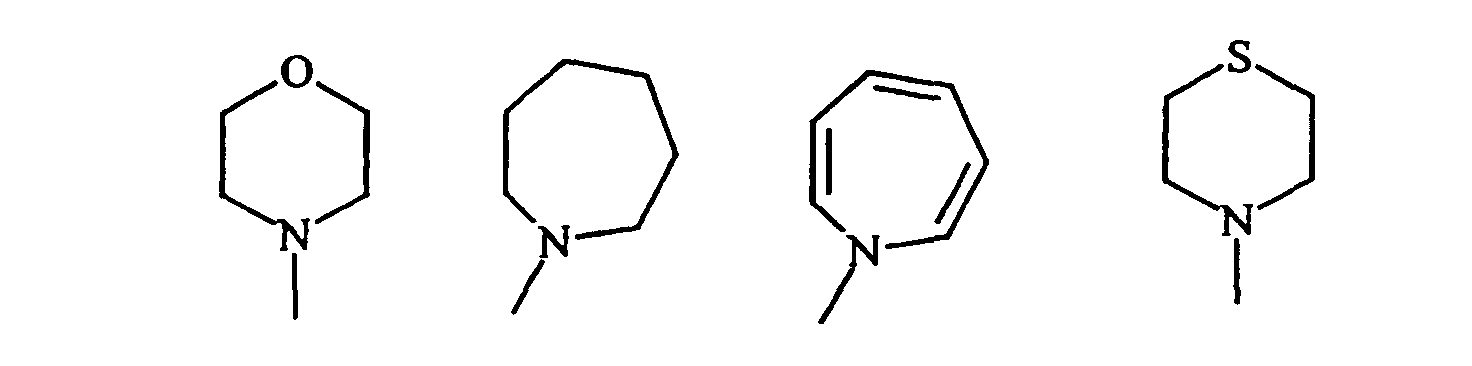
- Of the ring systems shown above, the four- to six-membered ring systems are preferred.
- As mentioned above, the nitrogen atom in the main chain of the residue bonded to the phenyl ring B of the biphenyl or thienyl-phenyl nucleus, which lies nearest to the phenyl ring B, can also be a constituent of one of the following preferred functional units:
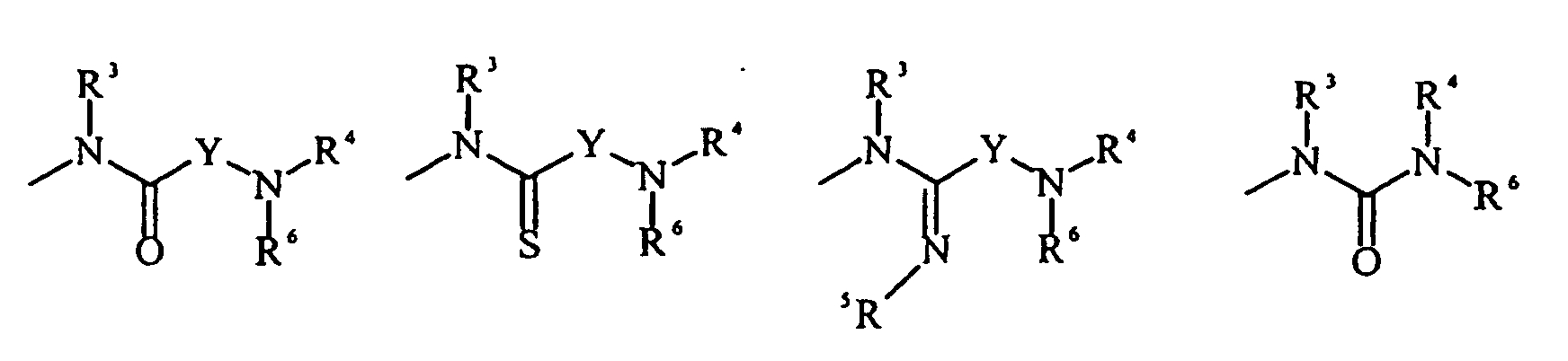


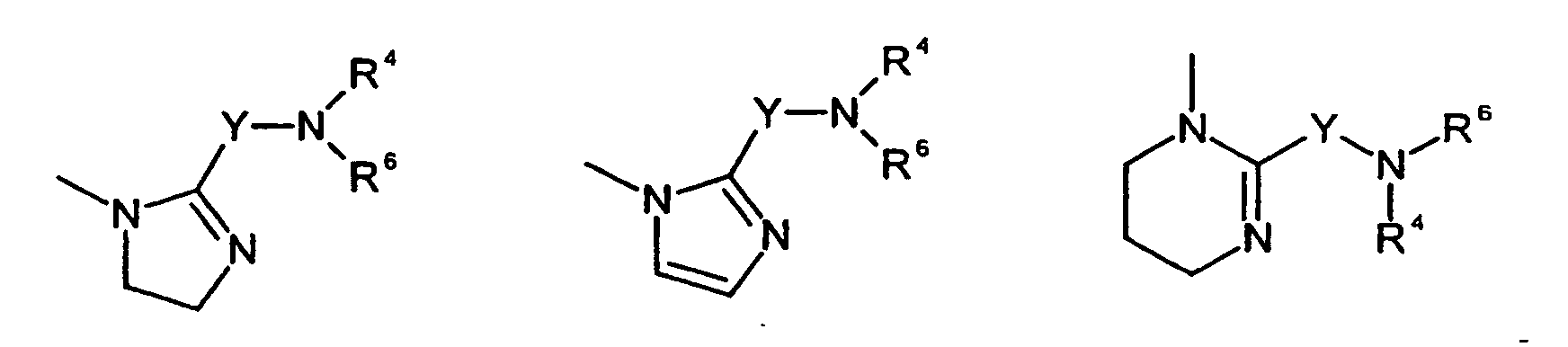
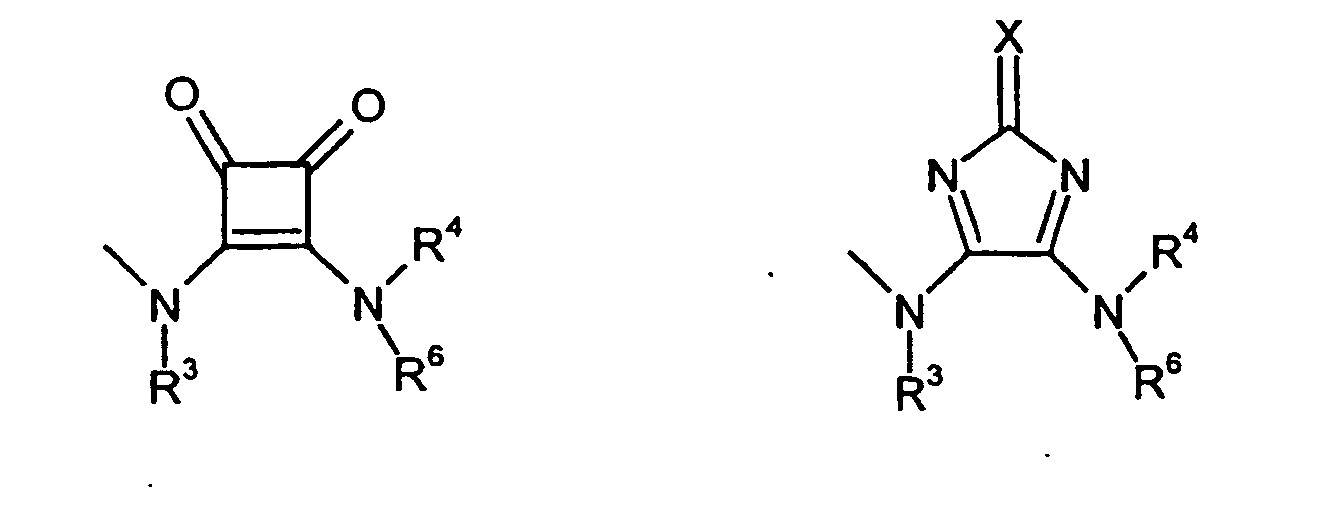
 where the above list is not a conclusive enumeration of all possible structural units.
- According to the invention, additionally to the abovementioned preferred structural units, analogs thereof are also included in which one or more 4- to 6-membered ring systems are fused to the heterocycle, such as, for example, the corresponding benzo-fused analogs of the above structural units.
- In the structural units shown above, R3, R4 and R6 can each be hydrogen, a C1-6-alkyl such as, for example, methyl, ethyl, propyl, isopropyl, butyl, 1-methylpropyl, isobutyl, t-butyl, pentyl, 2-methylbutyl, isopentyl, neopentyl or hexyl, a C1-4-perfluoroalkyl such as, for example CF3, a C3-7-cycloalkyl such as, for example, cyclopropyl, cyclopropylmethyl, cyclobutyl, cyclopentyl or cyclohexyl or cycloheptyl, an aryl such as, for example, phenyl, benzyl or tolyl, a C6-10-arylcarbonyl such as, for example, benzoyl, a heterocyclic residue such as, for example, pyrrolidine, piperidine, piperazine, pyrrole, pyridine, tetrahydrofuran, furan, thiophene, tetrahydrothiophene, imidazolidine, imidazole, oxazolidine, oxazole, thiazolidine, thiazole, thiooxazole, benzofuran, benzoxazole, benzothiazole, benzimidazole, quinoline, isoquinoline, tetrahydroquinoline, tetrahydroisoquinoline, triazole, tetrzole, pyrimidine, purine, cytosine, thymine, uracil, adenine, guanine or xanthine, or a terminal or internal E- or Z-alkene unit and can alternatively carry one or more C1-6-alkyl residues such as methyl, ethyl, propyl, isopropyl, butyl, isobutyl, t-butyl, pentyl, isopentyl, neopentyl or hexyl, a C1-4-perfluoroalkyl such as for example, CF3, C3-7-cycloalkyl residues such as cyclopropyl, cyclopropylmethyl, cyclobutyl, cyclopentyl or cyclohexyl, aryl residues such as phenyl, benzyl, tolyl, naphthyl, indolyl, heterocyclic residues such as pyrrolidine, piperidine, piperazine, pyrrole, pyridine, tetrahydrofuran, furan, thiophene, tetrahydrothiophene, imidazolidine, imidazole, oxazolidine, oxazole, thiazolidine, thiazole, thiooxazole, benzofuran, benzoxazole, benzothiazole, benzimidazole, quinoline, isoquinoline, tetrahydroquinoline, tetrahydroisoquinoline, triazole, tetrazole, pyrimidine, purine, cytosine, thymine, uracil, adenine, guanine or xanthine, or functional groups such as a double bond to a heteroatom such as oxygen, sulfur or nitrogen, an optionally substituted amino group, a nitro group, a halogeno, a hydroxyl group, an ether group in particular a C1-6-alkoxy group such as for example, a methoxy group, a sulfide group, a mercaptan group, a cyano group, an isonitrile group, an alkenyl group, an alkinyl group, an aldehyde group, a keto group, a carboxyl group, an ester group, an amide group, a sulfoxide group or a sulfone group. Particularly preferred substituents are those such as hydrogen, methyl, ethyl, propyl, isopropyl, butyl, isobutyl, t-butyl, pentyl, isopentyl, neopentyl, hexyl, cyclopropyl, cyclopropylmethyl, cyclobutyl, cyclopentyl, cyclohexyl, 4-methylcyclohexyl, 3,3,5-trimethylcyclohexyl, 5-methyl-2-hexyl, phenyl, benzyl, tolyl or a substituted derivative thereof, C1-4-alkylamino-C1-4-alkyl, C1-4-dialkylamino-C1-4-alkyl, amino-C1-4-alkyl, C1-4-alkyloxy-C1-4-alkyl, or one of the abovementioned residues (a1) to (a51).
- In the above structural units, R4 and R6, however, can also be bonded to one another and can form a heterocyclic ring system with the nitrogen atom to which they are bonded. Examples of these rings which can be mentioned are:
 wherein the above enumeration is nonconclusive and the ring systems formed from the connection of R4 and R6 can carry one or more residues which are selected from the group consisting of hydrogen, a C1-6-alkyl such as, for example, methyl, ethyl, propyl, isopropyl, butyl, isobutyl, t-butyl, pentyl, isopentyl, neopentyl or hexyl, a C3-7-cycloalkyl such as, for example, cyclopropyl, cyclopropylmethyl, cyclobutyl, cyclopentyl or cyclohexyl, an aryl such as, for example, phenyl, benzyl or tolyl, a heterocyclic residue such as, for example, pyrrolidine, piperidine, piperazine, pyrrole, pyridine, tetrahydrofuran, furan, thiophene, tetrahydrothiophene, imidazolidine, imidazole, oxazolidine, oxazole, thiazolidine, thiazole, thiooxazole, benzofuran, benzoxazole, benzothiazole, benzimidazole, quinoline, isoquinoline, tetrahydroquinoline, tetrahydroisoquinoline, triazole, tetrazole, pyrimidine, purine, cytosine, thymine, uracil, adenine, guanine or xanthine, or a terminal or internal E- or Z-alkene unit, and can alternatively carry one or more C1-6-alkyl residues such as methyl, ethyl, propyl, isopropyl, butyl, isobutyl, t-butyl, pentyl, isopentyl, neopentyl or hexyl, C3-7-cycloalkyl residues such as cyclopropyl, cyclopropylmethyl, cyclobutyl, cyclopentyl or cyclohexyl, an aryl residue such as phenyl, benzyl, tolyl, naphthyl, indolyl, heterocyclic residues such as pyrrolidine, piperidine, piperazine, pyrrole, pyridine, tetrahydrofuran, furan, thiophene, tetrahydrothiophene, imidazolidine, imidazole, oxazolidine, oxazole, thiazolidine, thiazole, thiooxazole, benzofuran, benzoxazole, benzothiazole, benzimidazole, quinoline, isoquinoline, tetrahydroquinoline, tetrahydroisoquinoline, triazole, tetrazole, pyrimidine, purine, cytosine, thymine, uracil, adenine, guanine or xanthine, or functional groups such as a double bond to a heteroatom such as oxygen, sulfur or nitrogen, an optionally substituted amino group, a nitro group, a halogeno, a hydroxyl group, an ether group, a sulfide group, a mercaptan group, a cyano group, an isonitrile group, an alkenyl group, an alkinyl group, an aldehyde group, a keto group, a carboxyl group, an ester group, an amide group, a sulfoxide group or a sulfone group. Furthermore, one or more saturated or unsaturated additional rings can be fused to the abovementioned cyclic residues with formation of, for example, a naphthyl, indolyl, benzofuranyl, benzoxazolyl, benzothiazolyl, benzimidazolyl, quinolinyl, isoquinolinyl unit or a partially or completely hydrogenated analog thereof. Of the ring systems formed from the connection of R4 and R6, the four- to six-membered ring systems are preferred. According to the invention, compounds wherein at least one of the residues R3, R4 or R6 is H are particularly preferred.
- Furthermore, in the above structural units R5 can be hydrogen, a C1-6-alkyl residue such as methyl, ethyl, propyl, isopropyl, butyl, isobutyl, t-butyl, pentyl, isopentyl, neopentyl or hexyl, a C3-7-cycloalkyl residue such as cyclopropyl, cyclopropylmethyl, cyclobutyl, cyclopentyl or cyclohexyl, -NO2, -CN, -COR5' or -COOR5', wherein R5' can be a substituted or unsubstituted alkyl or cycloalkyl residue, a substituted or unsubstituted aryl residue or a saturated or unsaturated, optionally substituted heterocyclic residue, which can be saturated or unsaturated and/or can contain further heteroatoms, and is preferably a C1-6-alkyl such as, for example, methyl, ethyl, propyl, isopropyl, butyl, isobutyl, t-butyl, pentyl, isopentyl, neopentyl, hexyl, a C3-7-cycloalkyl such as, for example, cyclopropyl, cyclobutyl, cyclopentyl, cyclohexyl, an aryl such as, for example, phenyl, benzyl, tolyl or a substituted derivative thereof. Moreover, R5 can be connected to one of R3, Y, R4 or R6, if present, with formation of an optionally substituted carbocyclic or heterocyclic 4- to 6-membered ring system which includes the atom X to which R5 is bonded and can be saturated or unsaturated and/or can contain further heteroatoms.
- Furthermore, in the above structural units Y can be absent or can be an alkylene or alkine unit which carries 1 to 5 carbon atoms in its main chain. According to the invention, Y, if present, preferably has a main chain consisting of one carbon atom. Y can moreover carry one or more residues which are selected from the group consisting of hydrogen, a C1-6-alkyl such as, for example, methyl, ethyl, propyl, isopropyl, butyl, isobutyl, t-butyl, pentyl, isopentyl, neopentyl or hexyl, a C3-7-cycloalkyl such as, for example, cyclopropyl, cyclopropylmethyl, cyclobutyl, cyclopentyl or cyclohexyl, an aryl such as, for example, phenyl, benzyl or tolyl, a heterocyclic residue such as, for example, pyrrolidine, piperidine, piperazine, pyrrole, pyridine, tetrahydrofuran, furan, thiophene, tetrahydrothiophene, imidazolidine, imidazole, oxazolidine, oxazole, thiazolidine, thiazole, thiooxazole, benzofuran, benzoxazole, benzothiazole, benzimidazole, quinoline, isoquinoline, tetrahydroquinoline, tetrahydroisoquinoline, triazole, tetrazole, pyrimidine, purine, cytosine, thymine, uracil, adenine, guanine or xanthine, or a terminal or internal E- or Z-alkene unit, and can alternatively carry one or more C1-6-alkyl residues such as methyl, ethyl, propyl, isopropyl, butyl, isobutyl, t-butyl, pentyl, isopentyl, neopentyl or hexyl, C3-7-cycloalkyl residues such as cyclopropyl, cyclopropylmethyl, cyclobutyl, cyclopentyl or cyclohexyl, aryl residues such as phenyl, benzyl, tolyl, naphthyl, indolyl, heterocyclic residues such as pyrrolidine, piperidine, piperazine, pyrrole, pyridine, tetrahydrofuran, furan, thiophene, tetrahydrothiophene, imidazolidine, imidazole, oxazolidine, oxazole, thiazolidine, thiazole, thiooxazole, benzofuran, benzoxazole, benzothiazole, benzimidazole, quinoline, isoquinoline, tetrahydroquinoline, tetrahydroisoquinoline, triazole, tetrazole, pyrimidine, purine, cytosine, thymine, uracil, adenine, guanine or xanthine, or functional groups such as a double bond to a heteroatom such as oxygen, sulfur or nitrogen, an optionally substituted amino group, a nitro group, a halogeno, a hydroxyl group, an ether group, a sulfide group, a mercaptan group, a cyano group, an isonitrile group, an alkenyl group, an alkinyl group, an aldehyde group, a keto group, a carboxyl group, an ester group, an amide group, a sulfoxide group or a sulfone group. Furthermore, one or more saturated or unsaturated additional rings can be fused to the abovementioned cyclic residues with formation of, for example, a naphthyl, indolyl, benzofuranyl, benzoxazolyl, benzothiazolyl, benzimidazolyl, quinolinyl or isoquinolinyl unit or a partially or completely hydrogenated analog thereof. Moreover Y can be connected to one of R3, R4, R5 or R6, if present, with formation of an optionally substituted carbocyclic or heterocyclic 4- to 6-membered ring system which can be saturated or unsaturated and/or can contain further hetero atoms.
- According to the invention, particularly preferred compounds of the general formula (1) are those in which the nitrogen atom located in the main chain of the residue bonded to the phenyl ring B, which lies nearest to the phenyl ring B, is a constituent of a urea or thiourea unit. In this case, particularly preferred compounds of the general formula (1) are those in which a urea or thiourea unit is bonded directly to the phenyl ring B of the biphenyl nucleus.
- Furthermore particularly preferred compounds of the general formula (1) are those in which the nitrogen atom located in the main chain of the residue bonded to the phenyl ring B, which lies nearest to the phenyl ring B is a constituent of an amino group which is bonded via a methylene group to ring B. The amino group can preferably be substituted by one of the residues (a1) to (a51).
- The present invention comprises both the individual enantiomers or diastereomers and the corresponding racemates, diastereomer mixtures and salts of the compounds defined in claim 1. In addition, all possible tautomeric forms of the compounds described above are also included according to the present invention. The present invention furthermore comprises both the pure E and Z isomers of the compounds of the general formula (1) and their E/Z mixtures in all ratios. The diastereomer mixtures or E/Z mixtures can be separated into the individual isomers by chromatographic procedures. The racemates can be separated into the respective enantiomers by chromatographic procedures on chiral phases or by resolution of racemates.
- The compounds described above can be prepared from commercially available starting compounds. The essential steps of the preparation process according to the invention are the reaction of a carboxylic acid, whose carboxyl group is protected and which has at least one aryl or thienyl group provided with a residue accessible to an aryl-aryl coupling reaction, with a phenyl compound having at least one residue accessible to an aryl-aryl coupling reaction, which furthermore has a residue D which is an amino group or can be converted into an amino group in a simple manner, and the conversion of the residue D into the corresponding amino group if it is not already an amino group. The derivatization of nitrogen atoms present in the molecule at preferred times within the preparation process and/or the conversion of the compound obtained into the free acid and/or the conversion of the compound obtained into one of its physiologically acceptable salts by reaction with an inorganic or organic acid or base can be included as further process steps.
- The carboxylic acids to be employed as starting compounds are either commercially available or are easily accessible by standard chemical processes, such as are known to any person skilled in the art and are described in standard textbooks such as Houben-Weyl, Methoden der organischen Chemie [Methods of Organic Chemistry], Georg Thieme-Verlag, Stuttgart.
- According to a preferred embodiment, starting materials used in the process according to the invention for the preparation of compounds of the general formula (1) are the following carboxylic acid derivatives:
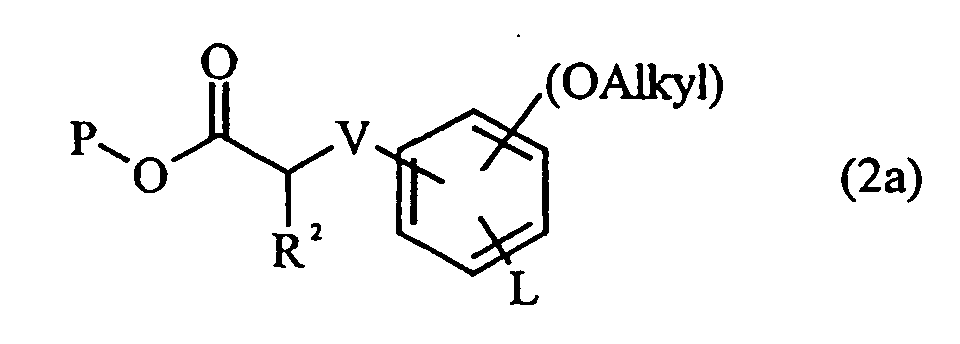
- Analogously for the thienyl-phenyl compounds, the corresponding thienyl-derivative ist used.
For the preparation process according to the invention, the carboxyl group is in this case blocked by a conventional protective group P. Protective groups of this type are known to the person skilled in the art and do not have to be expressly mentioned here. The carboxyl group is particularly preferably esterified, P being a C1-6-alkyl such as, for example, methyl, ethyl, propyl, isopropyl, butyl, isobutyl, t-butyl, pentyl, isopentyl, neopentyl, hexyl, a C3-7-cycloalkyl such as, for example, cyclopropyl, cyclopropylmethyl, cyclobutyl, cyclopentyl, cyclohexyl, an aryl such as, for example, phenyl, benzyl, tolyl or a substituted derivative thereof. The preparation process according to the invention for the compounds of the general formula (1) can be carried out on a solid phase in order to achieve a process implementation which is as economical as possible. In this case, the carboxyl residue can be bonded to any solid phase conventionally used for reactions of this type. According to the invention, the solid phase used is particularly preferably a polystyrene resin and in particular a commercially available Wang polystyrene resin. According to the present preferred embodiment, R2 can be as described above and V can be an optionally substituted C1-5-alkylene group. Thus the starting compounds of this preferred embodiment can be interpreted as derivatives of propanoic acid, butanoic acid, pentanoic acid, hexanoic acid or heptanoic acid. In the α-position to the carboxyl group, these carboxylic acid derivatives can have a substituent such as, for example, hydrogen, a C1-6-alkyl such as, for example, methyl, ethyl, propyl, isopropyl, butyl, isobutyl, t-butyl, pentyl, isopentyl, neopentyl, hexyl, a C3-7-cycloalkyl such as, for example, cyclopropyl, cyclobutyl, cyclopentyl, cyclohexyl, an aryl such as, for example, phenyl, benzyl, tolyl or a substituted derivative thereof, an optionally substituted alkenyl residue, an optionally substituted alkinyl residue, -NR2'SO2R2", -NR2'COOR2", -NR2'COR2', -NR2'CONR2' 2 or -NR2'CSNR2' 2. The alkyl and cycloalkyl residues and the benzyl residue can be introduced by reaction of the ester of the starting compounds with the appropriate alkyl, cycloalkyl or benzyl halides in basic medium, if the corresponding derivatives are not commercially available. The alkinyl residue can be introduced, for example, by reaction of the α-bromo ester of the present starting compound with an appropriate acetylide anion. In the case of the phenyl residue, of the alkenyl residue and of the nitrogen-containing substituents, the starting materials used are preferably the corresponding α-phenyl- or α-aminocarboxylic acid derivatives and, if necessary, the other substituents at the α-C atom to the terminal carboxyl group are introduced via the appropriate alkyl halide. The above reactions and their implementation are well known to the person skilled in the art and are described in detail in standard textbooks such as, for example, Houben-Weyl, Methoden der organischen Chemie [Methods of Organic Chemistry], Georg Thieme Verlag, Stuttgart. - For the introduction of a substituent into the β-position relative to the carboxyl group, the possibility that suggests itself, for example, is to start from the corresponding α,β-unsaturated carboxylic acid derivatives and to react these with the respective alkyl or cycloalkyl cuprates in the sense of a Michael addition. β-substituted derivatives are also accesible via the condensation of a derivative of malonic acid with an aldehyde or a keton. Subsequently, if desired, another substituent can be introduced into the α-position relative to the carboxyl group as described above. These reactions and their implementation are also well known to the person skilled in the art and are described in detail in standard textbooks such as, for example, Houben-Weyl, Methoden der organischen Chemie [Methods of Organic Chemistry], Georg Thieme Verlag, Stuttgart.
- The residues -NR2'SO2R2", -NR2'COOR2', -NR2'COR2', -NR2'CONR2' 2 or -NR2'CSNR2' 2 preferably found in the α- or β-position relative to the carboxyl group are preferably prepared from the respective α- or β-amino acid. The α-amino acids used according to the invention are commercially available, for example, from Novabiochem or Bachem. The β-amino acids can in some cases likewise be obtained from these companies or can be prepared according to the procedures of T.B. Johnson, Journal of the American Chemical Society, 1936, 58, or of V.A. Soloshonok, Tetrahedron Assymetry, 1995, 1601. These amino acids can be converted into the desired carboxyl-protected amino acid derivative, for example, by protection of the amino group, subsequent protection of the carboxylic acid unit and subsequent deprotection of the amino group. Protective groups which can be used in this case for the amino group are all groups known for this purpose. According to the invention, the use of a 9-fluorenylmethoxycarbonyl group (FMOC) as a protective group for the amino unit is particularly preferred. The carboxylic acid group is protected or derivatized as described above. The carboxyl-protected α- or β-amino acids thus accessible are reacted with a suitable sulfonating, carbamoylating or acylating reagent in order to obtain the corresponding sulfonamide, carbamate or amide derivatives. The sulfonating reagent is preferably a sulfonyl chloride of the formula R2"-SO2Cl or a chloroformiate of the formula R2'-OCOCl, wherein R2' is preferably selected from the group which consists of hydrogen, a C1-6-alkyl such as, for example, methyl, ethyl, propyl, isopropyl, butyl, isobutyl, t-butyl, pentyl, isopentyl, neopentyl, hexyl, a C3-7-cycloalkyl such as, for example, cyclopropyl, cyclobutyl, cyclopentyl, cyclohexyl, phenyl, benzyl, tolyl or a substituted derivative thereof as, for example, 2-chlorophenyl, 2-methoxyphenyl, 2,4,6-trimethylphenyl, 4-methoxyphenyl, 4-t-butylphenyl, 2,5-dichlorophenyl, 3-chlorophenyl, 4-chlorophenyl, 4-trifluoromethyl phenyl, while R2" is a C1-10-alkyl such as methyl, ethyl, propyl, isopropyl, butyl, isobutyl, t-butyl, pentyl, isopentyl, neopentyl, hexyl, heptyl, octyl, nonyl, decyl, cyclopropyl, cyclobutyl, cyclopentyl, cyclohexyl or campher-10-yl, an aryl such as phenyl, benzyl, tolyl, mesityl or substituted derivatives of these such as 2-chlorophenyl, 4-chlorophenyl, 2,5-dichlorophenyl, 4-trifluoromethylphenyl, campher-10-yl, 4-methoxyphenyl, 4-t-butylphenyl, 2,5-dimethylphenyl, 3-chlorophenyl, 2-methoxy-5-methylphenyl, 2,3,5,6-tetramethylphenyl, 2,3-dichlorophenyl, 2,6-dichlorophenyl, 2-naphthyl, 3-trifluoromethylphenyl, 4-fluorophenyl, 2,4-difluorophenyl, 2-chloro-6-methylphenyl, 2-chloro-4-fluorophenyl, 2,5-dimethoxyphenyl, 3,4-dimethoxyphenyl, 3-chloro-6-methoxyphenyl, 2-trifluoromethylphenyl, 2-alkylsulfonylphenyl, 2-arylsulfonylphenyl, 3-(N-acetyl-6-methoxy)anilino, 2-methoxycarbonylphenyl, 4-N-acetylphenyl, 4-ethylphenyl, 3-chloro-4-fluorphenyl, 2-fluorophenyl, 3-fluorophenyl, 2,4-difluorophenyl, 2,6-difluorophenyl, 3,4-difluorophenyl, 1-naphthyl, 4-trifluoromethoxyphenyl, 2-trifluoromethoxyphenyl, or 8-quinolinyl, or a heterocyclic analog of the abovementioned cyclic residues. Particularly preferably, R2" is a mesityl residue, a benzyl residue, a 2-chlorophenyl residue, a 4-chlorophenyl residue, a 2,5-dichlorophenyl residue, a 2,6-dichlorophenyl residue, a 4-trifluoromethylphenyl residue, a campher-10-yl residue or a group of the formula

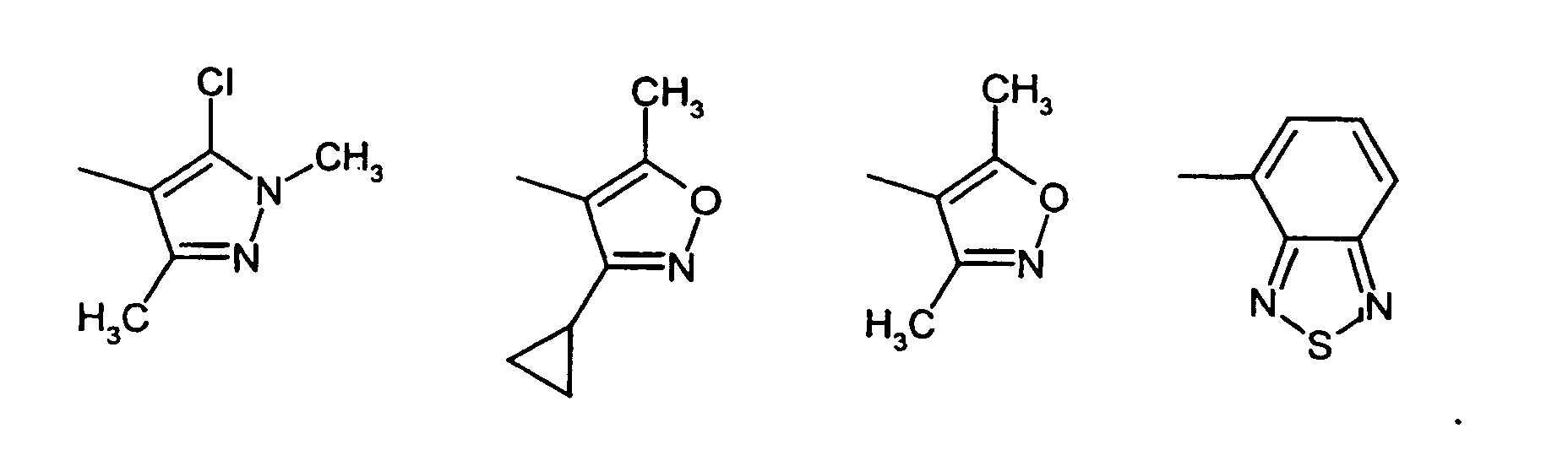
- Instead of the abovementioned sulfonyl or carbamoyl chlorides, the corresponding fluorides, bromides or iodides can also be employed. As an acylating reagent, the appropriate carboxylic acid halides or carboxylic acid anhydrides are reacted with the amino group, the appropriate C1-6-alkyl- such as methyl-, ethyl-, propyl-, isopropyl-, butyl-, isobutyl-, t-butyl-, pentyl-, isopentyl-, neopentyl-, hexyl-, C3-7-cycloalkyl- such as cyclopropyl-, cyclobutyl-, cyclopentyl-, cyclohexyl-, aryl- such as phenyl-, benzyl- or tolylcarboxylic acid chlorides or substituted derivatives thereof being preferred according to the invention. For the preparation of the urea or thiourea residues, the amino group is preferably first reacted with a carbonic acid or thiocarbonic acid derivative such as a chloroformic acid ester or thiophosgene and then with a suitable amine NHR2' 2. The above reactions and their implementation are well known to the person skilled in the art and are described in detail in standard textbooks such as, for example, Houben-Weyl, Methoden der organischen Chemie [Methods of Organic Chemistry], Georg Thieme Verlag, Stuttgart.
- The starting compounds to be employed according to the above preferred embodiment have a terminal phenyl unit which must carry at least one substituent L. This substituent L must be substitutable by another phenyl group by means of one of the known aryl-aryl coupling procedures. According to the present invention, L can be -H, -F, -Cl, -Br, -I, -SCN, -N2 + or an organometalllic residue. Preferred organometallic residues which may be mentioned are, for example, a magnesium, copper, boron, tin, lithium or lithium cuprate residue.
- Additionally to the residues V and L, the terminal phenyl unit can have one or more further substituents, preferably one or more alkoxy residues, particularly preferably one or more methoxy residues.
- If the corresponding starting compounds are not commercially available, the terminal phenyl unit can be connected to the appropriate carboxylic acid derivative by standard processes such as, for example, a Friedel-Crafts alkylation, Friedel-Crafts acylation or by organometallic synthesis procedures such as, for example, a palladium-assisted coupling, after which, if appropriate, further derivatization steps follow which are known to the person skilled in the art and described in detail in standard textbooks such as, for example, Houben-Weyl, Methoden der organischen Chemie [Methods of Organic Chemistry], Georg Thieme Verlag, Stuttgart.
- The terminal phenyl unit can be 1,3- or 1,4-substituted with respect to the residues V and L. Each of these isomers, if not commercially available, is accessible in a manner known to the person skilled in the art.
- According to a further preferred embodiment, starting materials used in the process according to the invention for the preparation of compounds of the general formula (1) are the following carboxylic acid derivatives:

- For the preparation of the thienyl-phenyl-compounds the corresponding thienyl-derivatives are used as stating materials.
- In this case, P and R2 are as described above and can be introduced in the manner explained above if they are not already contained in the commercial starting compound. U represents an optionally substituted alkylene group and preferably an optionally substituted C1-3-alkylene group. With respect to the possible substituents at U, reference is made to the above explanations for the compounds according to the invention.
- For example, in the case in which U is an optionally substituted methylene group, the optionally additionally substituted 3-aminopropanoic acid is used as a starting material for the preparation of the compound shown above and this is reacted with an arylsulfonyl halide, preferably an arylsulfonyl chloride. The arylsulfonyl chloride is selected in accordance with the desired presence and position of the residues L and OAlk, L having the same meaning as described above and OAlk representing one or more alkoxy residues, preferably one or more methoxy residues. The arylsulfonyl halides preferred according to the invention are commercially available or can be prepared by standard reactions familiar to the person skilled in the art. The above reactions and their implementation are well known to the person skilled in the art and are described in detail in standard textbooks such as, for example, Houben-Weyl, Methoden der organischen Chemie [Methods of Organic Chemistry], Georg Thieme Verlag, Stuttgart.
- In all embodiments according to the invention, the biphenyl or thienyl-phenyl nucleus is generated by means of an aryl-aryl coupling. Formally, in this case the residue L at the terminal phenyl/thienyl group of the carboxylic acid derivative serving as a starting compound is replaced by a phenyl compound of the following formula
- M
- is -H, -I, -N2 +, -COOCOBNO2 or an organometallic residue;
- B
- is a phenylene group which is 1,3- or 1,4-substituted with respect to M and W-D and optionally has additional residues;
- W
- is as defined in claim 1;
- D
- is -NO2, -NH2 or -CHO;
- Possible coupling reactions are, for example, the reaction of two unsubstituted phenyl groups (i.e. L and M are hydrogen) in the presence of AlCl3 and an acid (Scholl reaction), the coupling of the two phenyl iodides in the presence of copper (Ullmann reaction), the reaction of the unsubstituted carboxylic acid derivative with a phenyldiazonium compound under basic conditions (Gomberg-Bachmann reaction) or coupling with participation of organometallic reagents. In this connection, the coupling of two phenyl Grignard compounds in the presence of thallium bromide, the coupling of two organoboron compounds in the presence of silver nitrate and sodium hydroxide, the reaction of a diphenyllithium cuprate in the presence of oxygen and palladium-assisted couplings of a phenyl halide with an organometallic phenyl compound deserve mention. The implementation of these reactions is described in detail in standard textbooks such as Houben-Weyl, Methoden der organischen Chemie [Methods of Organic Chemistry], Georg Thieme Verlag, Stuttgart. The choice of the coupling reaction depends on the presence of possibly interfering or sensitive substituents in the reactants. For the preferred compounds according to the invention, however, it has proven particularly advantageous to generate the biphenyl nucleus by coupling of a phenyl halide with an organometallic phenyl compound in the presence of a palladium compound, for example a Pd(0), a Pd(II) or a Pd(IV) compound, and of a phosphane such as triphenylphosphane.
- The thienyl-phenyl compounds can be prepared in analogous manner according to the methods described above.
- The phenyl/thienyl halide used in this case can be the corresponding phenyl/thienyl fluoride, chloride, bromide or iodide, the corresponding bromide being particularly preferred. The organometallic phenyl compound used is preferably a substance in which a metallic element such as, for example, zinc, magnesium, boron, lithium, copper, tin or another element conventionally used for this purpose is bonded directly to the aryl ring. According to the invention, organoboron compounds are particularly preferred. Further substituents can be bonded to the aryl ring additionally to the residue -W-D and the metallic element. Preferably, these substituents are one or more alkyl residues, preferably a C1-6-alkyl residue such as methyl, ethyl, propyl, isopropyl, butyl, isobutyl, t-butyl, pentyl, isopentyl, neopentyl, hexyl, a C3-7-cycloalkyl residue such as cyclopropyl, cyclobutyl, cyclopentyl, cyclohexyl, and particularly preferably one or more methyl groups. If W is present, i.e. the residue D is bonded to the phenyl ring B via an optionally substituted alkylene group, the length of the main chain of this alkylene group must be selected for reasons described above such that no more than 6 atoms additionally to the biphenyl or thienyl-phenyl nucleus are present in the resulting compound of the formula (4) between the terminal carboxyl unit and the residue D.
- Particularly preferred aryl reagents according to the invention are 3-nitrobenzeneboronic acid, 3-formylbenzeneboronic acid or 3-aminobenzeneboronic acid.
- The residue D thus introduced into the compound, if it is not already an amino group, is converted into an amino group. In the case in which D is a nitro group, this is reduced to the corresponding amino group by conventional teductancts such as, for example, tin chloride. In the case in which D is an aldehyde group, the conversion into the amino group is carried out by reaction with an amine under reducing conditions, for example in the presence of an ortho ester and of a reductant such as a metal hydride, for example a boron hydride. The amino group thus formed can subsequently be derivatized, for example by reaction with, for example, alkyl or cycloalkyl halides. With respect to the preferred substituents on the nitrogen atom which can be introduced in this way, reference is made to the above description of the compounds according to the invention.
- The amines can be converted into the squaric acid monoamides which in turn can be functionalised to the corresponding squaric acid diamides by treating with amines.
The amines can further be converted into the 1,1-diaminonitroethylenes by treatment with an appropriate alkylating agent, preferrabyl 1,1-dithiomethyl-2-nitroethylene and subsequent conversion with another amine.
The amines can further be converted into the 2,3-diaminothiadiazoles by treatment with an appropriate alkylating agent, preferrabyl 3,4-bismethythio-1,2,5 thiadiazole-1oxide and subsequent conversion with another amine.
Finally the amines can be transformed into the diamino-cyanoguanidines by treatment with an appropriate alkylating agent, preferrably cyanimidodithiocarbonate dimethyl ester and subsequent conversion with another amine - The thioureas can be converted to heterocycles such as benzimidazoles by cyclisation of a suited thiourea with a desulfurizing agent such as HgO.
Thiazoles can be generated by alkylation with suitable alkylating agents preferrably 1,2-dichloroethylethylether, or 2-chloro-1,1-bisethoxyethane. The imidazoles can be obtained from the thioureas by alkylating with methyl iodide, followed by treatment with 1,1-diethoxy-2aminoethane and subsequent acid-mediated ring closure. - According to a preferred embodiment of the present invention, the synthesis of the compounds according to the invention is carried out on a solid phase such as a polystyrene resin, particularly preferably a commercially available Wang polystyrene resin. In this case, the resin is first swollen in a solvent such as dimethylformamide (DMF). The carboxylic acid serving as a starting compound is then bonded to the resin by standard procedures. For example, the bonding of the carboxylic acid to the resin can be carried out in the presence of a base such as pyridine and a reagent activating the carboxyl unit, such as an acid halide, for example dichlorobenzoyl chloride, in a solvent such as dimethylformamide (DMF). However, other reagents conventionally used for this purpose can also be employed. The reaction mixture is stirred at room temperature and normal pressure for at least 2 hours, preferably 12 hours, particularly preferably approximately 24 hours, the carboxylic acid being employed in an excess, preferably in a two- to three-fold excess, with respect to the loading of the solid phase.
- After removal of possibly unreacted reagents, if desired, a derivatization of the carboxylic acid bonded to the resin can be carried out without this needing to be separated from the resin beforehand. According to a preferred embodiment according to the invention, an amino acid whose amino group is protected is bonded to the solid phase, for example as described above, and after liberation of the amino group a substituent is then introduced onto the latter. Preferably, the amino group is sulfonylated or carbamoylated. For this purpose, the amino acid bonded to the solid phase is treated with an excess of a solution of the appropriate sulfonylating or carbamoylating agent, preferably a two- to four-fold excess, particularly preferably an approximately three-fold excess, in a solvent such as, for example, tetrahydrofuran (THF) in the presence of an auxiliary base such as diisopropylethylamine and the reaction mixture is stirred at room temperature and normal pressure for at least 2 hours, preferably 12 hours, particularly preferably approximately 24 hours. The sulfonamide or carbamate obtained does not have to be removed from the resin, but can be immediately reacted further after removal of unreacted reactants which may possibly be present.
- The aryl-aryl coupling is preferably carried out according to the invention by treating the carboxylic acid bonded to the solid phase, which is optionally derivatized, for example sulfonylated or carbamoylated as described above, in aqueous medium in the presence of a base such as sodium carbonate with the appropriate aryl coupling reagent of the formula (3) and a catalyst conventionally used for this purpose, for example a palladium(II) salt, preferably bis-(triphenylphosphane)-palladium(II) chloride in combination with triphenylphosphane. An approximately 3- to 8-fold, preferably an approximately 4- to 6-fold, excess of the aryl coupling agent, which according to the invention is in particular 3-nitrobenzeneboronic acid, 3-formylbenzeneboronic acid or 3-aminobenzenboronic acid, and catalytically active amounts of the palladium compound, for example approximately 10 times lower than the amount of the carboxylic acid, is preferably employed in this case and, after stirring briefly at room temperature, for example for 5 to 10 minutes, the reaction mixture is heated for approximately 2 - 24 hours, preferably 6 - 24 hours and particularly preferably 12 - 24 hours, to a temperature in the range from 40 to 110°C, preferably 50 to 100°C and particularly preferably 60 to 90°C. The biphenyl compound obtained can immediately be reacted further without purification after unreacted reactants which may be present are removed by washing with an acidic solution, for example a hydrochloric acid solution.
- If the residue D is a nitro group, its conversion into an amino group is preferably carried out according to the invention by addition of a customary reductant such as tin(II) chloride to the intermediate bonded to the solid phase and obtained as above, if appropriate in the presence of solvents such as N-methylpyrrolidone (NMP), by stirring the reaction mixture at room temperature and normal pressure for at least 2 hours, preferably 12 hours, particularly preferably approximately 24 hours.
- If the residue D is an aldehyde group, its conversion into an amino group is carried out by reductive amination. For this purpose, the intermediate bonded to the solid phase and obtained as above is treated with an approximately 3- to 6-fold, preferably approximately 4- to 5-fold, excess of an amine, optionally in the presence of diisopropylethylamine, and of an approximately 6- to 10-fold excess of ortho ester. After stirring at room temperature for several hours, preferably 1 to 3 hours, an approximately 3- to 6-fold, preferably 4- to 5-fold, excess of an acetic acid solution of a metal hydride such as, for example, tetrabutylammonium borohydride is added to the reaction mixture and it is stirred again for several hours, preferably 12 - 24 hours, at room temperature.
- The product obtained above can optionally be reacted further by derivatization of the residue D of the compound of the formula (4) representing an amino group or an introduction of further substituents onto nitrogen atoms present in the molecule or directly removed from the resin. Removal from the resin is carried out in a conventional manner in acidic medium. After removal of solvent which may be present, the product separated off from the resin can be purified by known purification procedures such as, for example, chromatographic procedures.
- The residue D of the compound of the formula (4) representing an amino group can furthermore be converted into an amide group, urea group, thioamide group, thiourea group, amidine group, enamine group or guanidine group. These structural units can be prepared by the standard reactions familiar to the person skilled in the art, such as are described, for example, in Houben-Weyl, Methoden der organischen Chemie [Methods of Organic Chemistry], Georg Thieme Verlag, Stuttgart.
- It is particularly preferred according to the invention to convert the residue D of the compound of the formula (4) representing an amino group into a urea or thiourea unit. For this purpose, the above amino group of the carboxylic acid bonded to the solid phase is first preferably reacted with a 2- to 5-fold, preferably 3- to 4-fold, excess of a carbonic acid ester or thiocarbonic acid ester derivative in an inert solvent such as tetrahydrofuran (THF), dichloromethane or a mixture of the two (preferably a 1:1 mixture) at room temperature and with stirring for approximately 1 hour, preferably approximately 45 minutes. The carbonic acid ester or thiocarbonic acid ester derivative employed is preferably phosgene, triphosgene, thiophosgene or chloroformic acid esters, commercially obtainable chloroformic acid esters being preferred for the preparation of the urea derivatives and thiophosgene for the preparation of the thiourea derivatives.
- The carbamates or isothiocyanates formed in this way are convertible into the corresponding urea and thiourea derivatives by reaction with suitable amines. Amines which can be used are substances of the formula HNRR', wherein R and R' independently of one another or simultaneously are hydrogen, a substituted or unsubstituted alkyl or cycloalkyl residue, a substituted or unsubstituted aryl residue, a saturated or unsaturated, optionally substituted heterocyclic residue, an alkylamine residue, an alkylamide residue or are connected to one another and together with the nitrogen atom can form an optionally substituted heterocyclic ring system which can be saturated or unsaturated and/or can contain further heteroatoms. With respect to the preferred residues at the amine, reference is made to the above description of the compounds according to the invention. According to the invention, the carbamate or isothiocyanate bonded to a solid phase is preferably reacted with a distinct excess of amine, preferably a 3- to 10-fold excess and particularly preferably a 5- to 10-fold excess, at room temperature with stirring for approximately 1 to 5 hours, preferably aproximately 2 to 3 hours, in the presence of an auxiliary base such as diisopropylethylamine in an inert solvent such as dimethylformamide (DMF).
- According to another preferred embodiment of the present invention, the synthesis of the compounds according to the invention is carried out with a commercially available amino functionalized ester serving as a protected carboxylic starting compound. Preferably, the amino group is sulfonylated or carbamoylated. For this purpose, the amino ester and the appropriate sulfonylating or carbamoylating agent are dissolved in a solvent such as, for example, dichloromethane and an auxiliary base such as pyridine or triethylamin is added at 0°C. The mixture is stirred at 0°C for I hour and then at room temperature overnight. The reaction mixture is washed with an aqueous acid such as, for example, aq 1N HCl, brine and water and dried. The concentrated organic solutions are recrystallized in a solvent such as, for example, acetic acid ethyl ester/petroleum ether or if necessary are purified by chromatography over silica, using cyclohexane/ethyl acetate as the solvent.
- The aryl-aryl coupling is preferably carried out according to the invention by treating the ester, wich is optionally derivatized, for example sulfonylated or carbamoylated as described above, in an appropriate solvent such as, for example, 1,2 dimethoxyethane in the present of a base such as aqueous sodium carbonate with the appropriate aryl coupling reagent of the formula (3) such as, for example, 3-aminobenzeneboronic acid or 3-formylbenzeneboronic acid and a catalyst conventionally used for this purpose, for example a palladium(II) salt, preferably bis-(triphenylphosphane)-palladium(II) chloride. The mixture is heated to reflux for 3 hours and then cooled to room temperature. After dilution with ethyl acetate, the mixture is successiveley washed with 5% aqueous sodium dihydrogenphosphate, water and brine and dried. After removal of the solvent the crude product is purified over silica, using cyclohexane/ethyl acetate as the solvent.
- If the residue D is an aldehyde group, its conversion into an amino group is carried out by reductive amination. For this purpose, the intermediate obtained as above is treated with an amine in the presence of acetic acid and methanol. After stirring at room temperature for 5 hours a metal hydride such as, for example, sodium cyanoborohydride is added. The mixture is stirred overnight and then treated with aqueous 2M hydrochloric acid. After removal of most of the solvent the residue is neutralized with 2M aqueous sodium hydroxide and extracted with ethyl acetate. The organic layer is washed with brine and dried. The solvent is removed and the crude product is purified over silica with dichloromethane/ethyl acetate as the solvent.
- According to another preferred embodiment of the present invention the residue D of the compound of the formula (4) representing an amino group is converted into the squaric acid monoamide which in turn can be functionalised to the corresponding squaric acid diamides by treating with amines. The amino group can further be converted into the 1,1-diaminonitroethylenes by treatment with an appropriate alkylating agent, preferrabyl 1,1-dithiomethyl-2-nitroethylene and subsequent conversion with another amine. The amino group can further be converted into the 2,3-diaminothiadiazoles by treatment with an appropriate alkylating agent, preferrabyl 3,4-bismethythio-1,2,5-thiadiazole-1-oxide and subsequent conversion with another amine. The amino group can be transformed into the diaminocyano-guanidines by treatment with an appropriate alkylating agent, preferrably cyanimidodithiocarbonate dimethyl ester and subsequent conversion with another amine. The thioureas can be converted into heterocycles such as benzimidazoles by cyclisation of a suited thiourea with a desulfurizing agent such as HgO. Thiazoles can be generated by alkylation with suitable alkylating agents preferrably 1,2-dichloroethylethylether, or 2-chloro-1,1-bisethoxyethane. The imidazoles can be obtained from the thioureas by alkylating with iodomethane, followed by treatment with 1,1-diethoxy-2-aminoethane and subsequent acid mediated ring closure.
- The compounds obtained according to the procedures explained above can furthermore be derivatized by continuing substitution of nitrogen atoms present at preferred positions in the preparation procedure and/or conversion of the compound obtained into the free acid and/or its physiologically acceptable salts. Suitable alkylating agents in this step are reagents conventionally used for this purpose, with which, for example, a substituted or unsubstituted alkyl or cycloalkyl residue, a substituted or unsubstituted aryl residue or a saturated or unsaturated, optionally substituted heterocyclic residue can be bonded to the appropriate nitrogen atom. With respect to the substituents preferably bonded to the respective nitrogen atoms, reference is made to the above description of the compounds according to the invention. The above reactions and their implementation are well known to the person skilled in the art and are described in detail in standard textbooks such as, for example, Houben-Weyl, Methoden der organischen Chemie [Methods of Organic Chemistry], Georg Thieme Verlag, Stuttgart.
- The ester derivatives according to the invention can be converted into the corresponding free carboxylic acids in a conventional manner, such as, for example, by basic hydrolysis with a solution of aqueous sodium hydroxide or lithium hydroxide in tetrahydrofuran (THF) or dimethoxyethane and following acidification with acetic acid or aqueous HCl.
- If desired, the compounds according to the invention can be converted into their physiologically acceptable salts. This can be carried out either by reaction with an organic or inorganic base such as, for example, an alkali metal hydroxide or alkaline earth metal hydroxide such as KOH, NaOH, LiOH, Mg(OH)2 or Ca(OH)2, by means of which the terminal carboxyl group is deprotonated and the corresponding carboxylate is formed, or by reaction with an organic or inorganic acid such as, for example, hydrochloric acid, sulfuric acid, phosphoric acid, mandelic acid, oleic acid, linoleic acid or p-toluenesulfonic acid, by means of which one or more of the nitrogen atoms present are protonated.
- The steps of the preparation process according to the invention described above can be carried out in a normal atmosphere, i.e. in air, and without the use of absolute, i.e. essentially anhydrous, solvents.
- The compounds according to the invention exhibit a very good antagonistic action against integrin receptors, in particular the αvβ3 receptor or the αvβ5 receptor. This makes them suitable for use in pharmaceutical compositions, in particular for the treatment and prophylaxis of arteriosclerosis, restenosis, osteolytic disorders such as osteoporosis, cancer and ophthalmic diseases. Furthermore they are suitable for the reduction and inhibition of angiogenesis and consequently they are suitable for the prophylaxis and treatment of conditions and diseases such as cancer or rheumatoid arthritis.
- The compounds according to the invention can be used as active compound components for the production of pharmaceutical compositions against the abovementioned diseases. For this purpose, they can be converted into the customary formulations such as tablets, coated tablets, aerosols, pills, granules, syrups, emulsions, suspensions and solutions using inert, nontoxic, pharmaceutically suitable excipients or solvents. Preferably, the compounds according to the invention are in this case used in such an amount that their concentration in the total mixture is approximately 0.5 to approximately 90% by weight, the concentration being dependent, inter alia, on the corresponding indication of the pharmaceutical composition.
- The abovementioned formulations are prepared, for example, by extending the active compounds with solvents and/or excipients having the above properties, where, if appropriate, emulsifier or dispersant and, in the case of water as a solvent, alternatively an organic solvent additionally has to be added.
- The pharmaceutical compositions according to the invention can be administered in a customary manner.
- The present invention is illustrated below by means of nonrestrictive examples and comparison examples.
- In the examples below, all quantitative data, if not stated otherwise, relate to percentages by weight.
- All retention times are indicated in minutes and were determined by high-performance liquid chromatography (HPLC) on an RP column (Eurospher 100, C18, ID 4 mm) by means of UV absorption. An eluent mixture of 0.1% strength acetonitrile/water was used with the following method: 0 min = 10% acetonitrile, 13 min = 80% acetonitrile, 15 min = 80% acetonitrile, 17 min = 10% acetonitrile.
- The mass determinations were carried out by high-performance liquid chromatography-mass spectrometry (HPLC-MS) using the electron spray ionization (ESI) method.
-

-
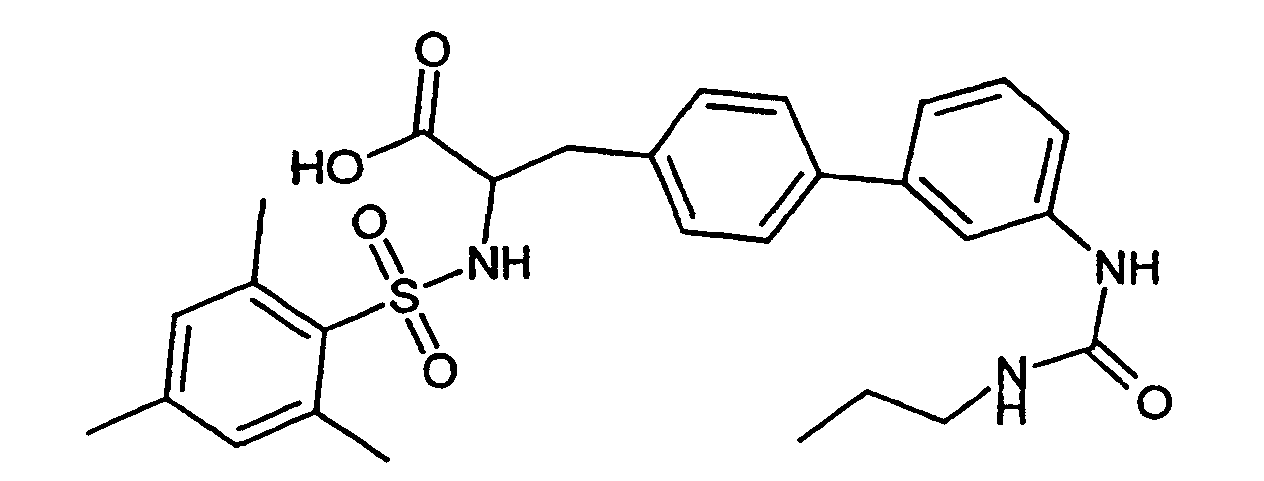
- 1.2 g of Wang polystyrene resin (Rapp-Polymere, Tübingen; loading 1.08 mmol/g) are swollen in dimethylformamide (DMF). The solvent is filtered off with suction and a solution of 1.088 g of (2R,S)-3-(4-bromophenyl)-2-(9-fluorenylmethoxycarbonylamino)-propanoic acid (acid reagent) in 20 ml of dimethylformamide (DMF) is added. After shaking at room temperature for 15 minutes, the suspension is treated with 345 µl of pyridine and 543 mg of 2,6-dichlorobenzoyl chloride. It is shaken overnight at room temperature. The resin is then washed with dimethylformamide (DMF), methanol and dichloromethane.
- The resin is treated with 15 ml of a 20% piperidine solution in dimethylformamide (DMF) and shaken at room temperature for 10 min. It is then washed 3 times with dimethylformamide (DMF) and a further 15 ml of a 20% strength piperidine solution in dimethylformamide (DMF) are added. After shaking for 20 min, it is washed with dimethylformamide (DMF) and tetrahydrofuran (THF). The resin is treated with a solution of 1.2 ml of diisopropylethylamine in 10 ml of tetrahydrofuran (THF) and a solution of 1.53 g of 2,4,6-trimethylbenzenesulfonyl chloride (sulfonylating reagent) in 10 ml of tetrahydrofuran (THF). It is shaken overnight at room temperature. The resin is then washed with dimethylformamide (DMF), methanol and tetrahydrofuran (THF).
- The resin is suspended in 7 ml of xylene, treated with 1.08 g of 3-nitrobenzeneboronic acid (boronic acid reagent) and a solution of 1.37 g of sodium carbonate in 6 ml of water and shaken for 5 min at room temperature. 227 mg of bis-(triphenylphosphane)-palladium(II) chloride and 170 mg of triphenylphosphane are then added and the mixture is stirred overnight at 85°C. The resin is then washed with tetrahydrofuran (THF)/water 1:1, 0.25 M aqueous hydrochloric acid, water, dimethylformamid (DMF), methanol, tetrahydrofuran (THF) and dichloromethane. The resin is treated with a solution of 5.4 g of tin(II) chloride dihydrate in 12 ml of N-methylpyrrolidone (NMP) and shaken overnight at room temperature. The resin is then washed with N-methylpyrrolidone (NMP), methanol, tetrahydrofuran (THF) and dichloromethane.
- The resin is then treated with a solution of 564 µl of diisopropylethylamine in 13 ml of tetrahydrofuran (THF)/dichloromethane (1:1) and a solution of 3.13 g of 4-nitrophenylchloroformic acid ester in 13 ml of tetrahydrofuran (THF)/dichloromethane 1:1. After shaking at room temperature for 45 min, it is washed with tetrahydrofuran (THF) and dimethylformamide (DMF) and a solution of 1.07 g of propylamine (amine reagent) and 3.16 ml of diisopropylethylamine in 23 ml of dimethylformamide (DMF) is added. After shaking for 2 h, the resin is washed with dimethylformamide (DMF), methanol, tetrahydrofuran (THF) and dichloromethane. To remove the product, the resin is shaken with 10 ml of trifluoroacetic acid (TFA)/dichloromethane for 1 h, filtered off, and the filtrate is concentrated in vacuo and purified on silica gel. 210 mg of the title compound are obtained.
Mass spectrometry (ESI): 524.
Retention time (HPLC): Rt = 10.4.
1H-NMR (400 MHz, methanol) δ = 7.67 (s, 1H), 7.32 - 7.22 (m, 4H), 7.17 (d, 1H), 7.04 (d, 2H), 6.77 (s, 2H), 3.93 (dd, 1H, J = 4.6 Hz, J = 10.0 Hz, H-2), 3.18 (t, 2H, J = 7.0 Hz), 3.09 (dd, 1H, J = 4.6 Hz, J = 13.6 Hz, H-3a), 2.79 (dd, 1H, J = 10.0 Hz, J = 13.8 Hz, H-3b), 2.44 (s, 6H), 2.03 (s, 3H), 1.57 (tq, 2H, J = 7.2 Hz), 0.97 (t, 3H, J = 7.2 Hz). -
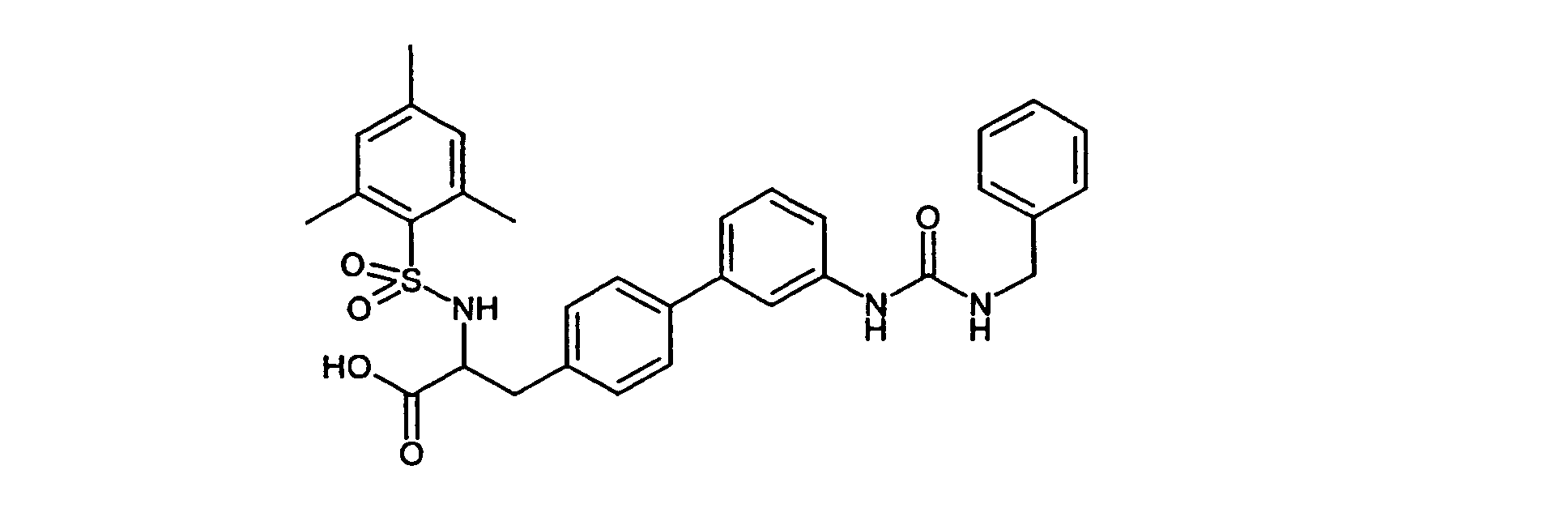
- (2R,S)-3-[3'-(3-Benzylureido)-biphenyl-4-yl]-2-[2,4,6-trimethylbenzenesulfonylamino]-propanoic acid is prepared according to the procedure of example 1.1, with the exception that benzylamine is used as an amine reagent instead of propylamine.
Mass spectrometry (ESI): 572.
Retention time (HPLC): Rt = 11.0. -

- (2R,S)-3-[3'-(3-(2-Pyrrolidin-1-yl-ethyl)-ureido)-biphenyl-4-yl]-2-[2,4,6-trimethylbenzenesulfonylamino]-propanoic acid is prepared according to the procedure of example 1.1, with the exception that 2-pyrrolidin-1-yl-ethylamine is used as an amine reagent instead of propylamine.
Mass spectrometry (ESI): 579.
Retention time (HPLC): Rt = 8.3. -

- (2R,S)-3-[3'-(3-(Pyridin-2-yl-methylureido)-biphenyl-4-yl]-2-[2,4,6-trimethylbenzenesulfonylamino]-propanoic acid is prepared according to the procedure of example 1.1, with the exception that 2-aminomethylpyridine is used as an amine reagent instead of propylamine.
Mass spectrometry (ESI): 573.
Retention time (HPLC): Rt = 8.0. -
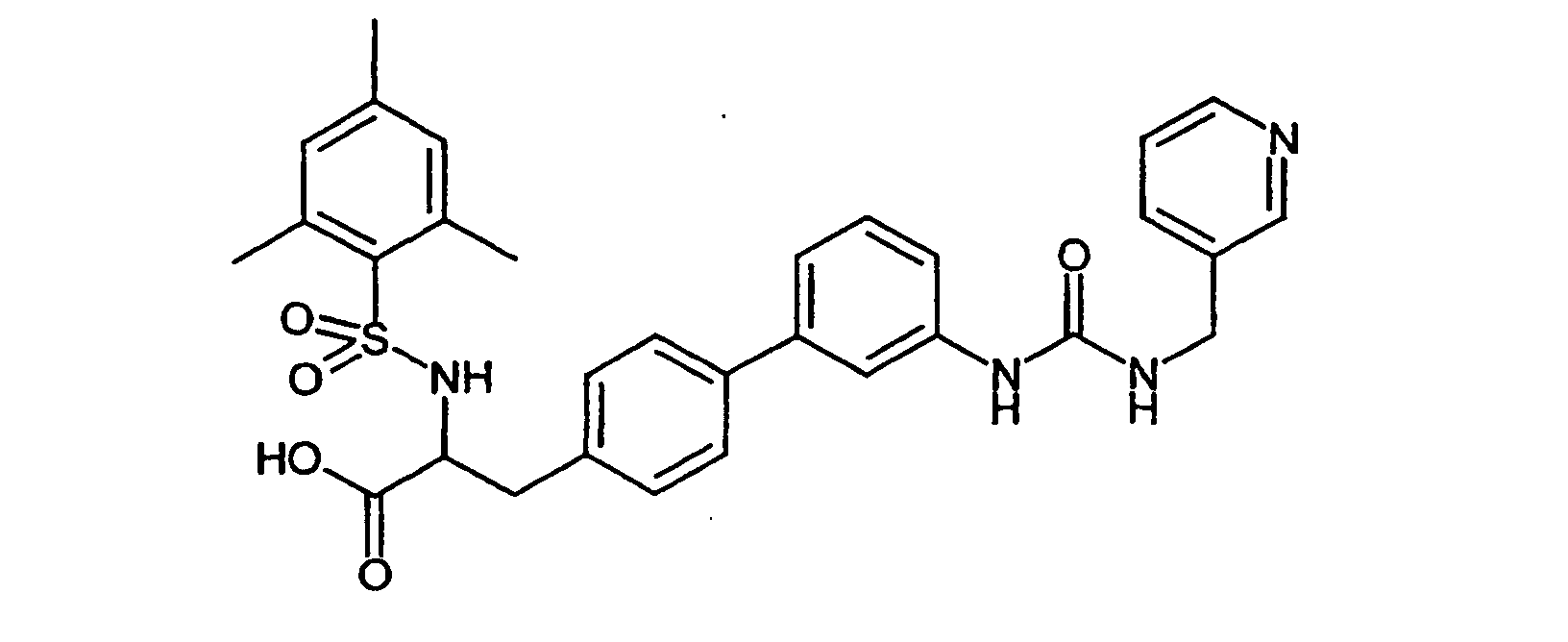
- (2R,S)-3-[3'-(3-(Pyridin-3-yl-methylureido)-biphenyl-4-yl]-2-[2,4,6-trimethylbenzenesulfonylamino]-propanoic acid is prepared according to the procedure of example 1.1, with the exception that 3-aminomethylpyridine is used as an amine reagent instead of propylamine.
Mass spectrometry (ESI): 573.
Retention time (HPLC): Rt = 7.9.
1H-NMR (400 MHz, methanol) δ = 8.75 (s, 1H), 8.65 (s, 1H), 8.37 (d, 1H), 7.84 (m, 1H), 7.71 (s, 1H), 7.38 - 7.25 (m, 4H), 7.22 (d, 1H), 7.06 (d, 2H), 6.77 (s, 2H), 4.57 (s, 2H), 3.92 (dd, 1H, J = 4.6 Hz, J = 10.2 Hz, H-2), 3.09 (dd, 1H, J = 4.6 Hz, J = 13.8 Hz, H-3a), 2.79 (dd, 1H, J = 10.2 Hz, J = 13.8 Hz, H-3b), 2.43 (s, 6H), 2.02 (s, 3H). -

- (2R,S)-3-[3'-(3-Methylureido)-biphenyl-4-yl]-2-[2,4,6-trimethylbenzenesulfonylamino]-propanoic acid is prepared according to the procedure of example 1.1, with the exception that methylamine is used as an amine reagent instead of propylamine.
Mass spectrometry (ESI): 496.
Retention time (HPLC): Rt = 9.4. -
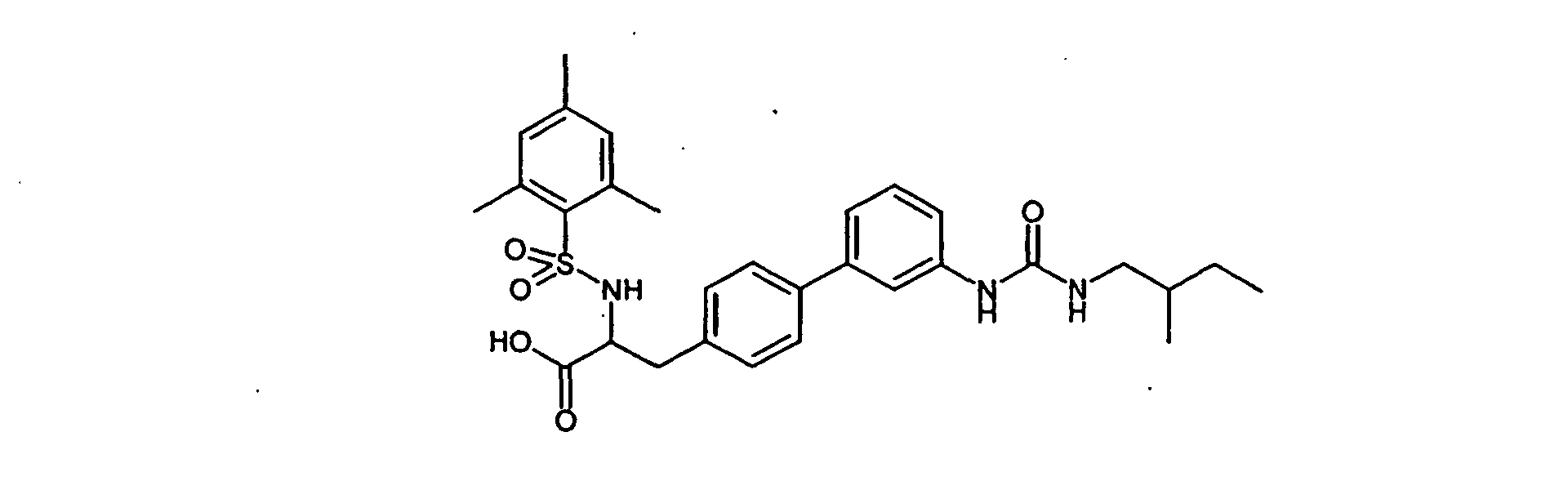
- (2R,S)-3-[3'-(3-(2-Methyl-butyl)ureido)-biphenyl-4-yl]-2-[2,4,6-trimethylbenzenesulfonylamino]-propanoic acid is prepared according to the procedure of example 1.1, with the exception that 2-methylbutylamine is used as an amine reagent instead of propylamine.
Mass spectrometry (ESI): 552.
Retention time (HPLC): Rt = 11.5. -
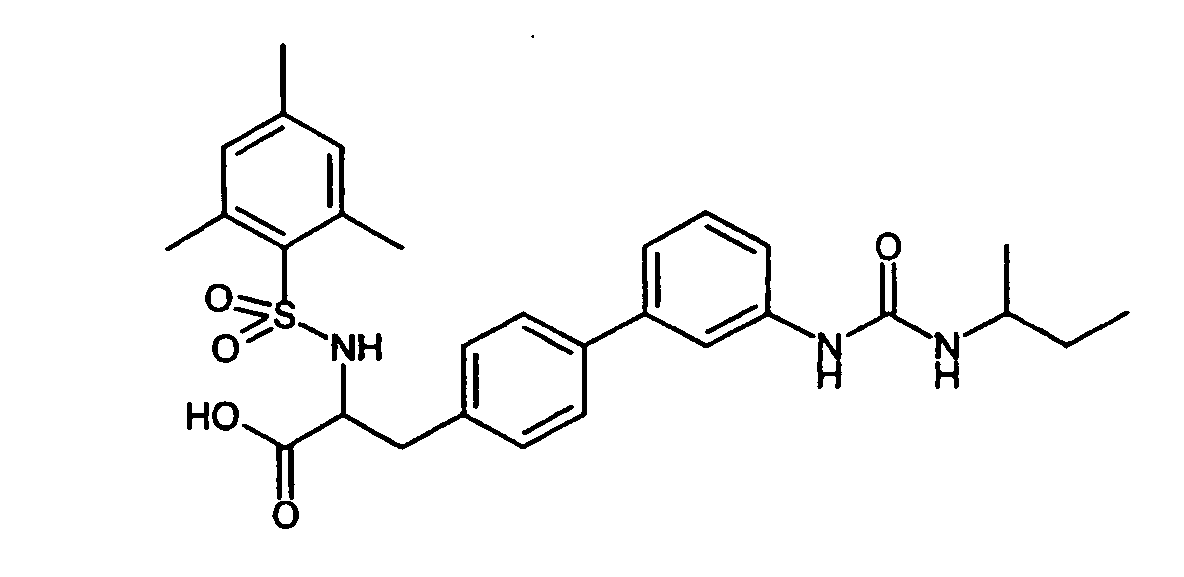
- (2R,S)-3-[3'-(3-sec-Butylureido)-biphenyl-4-yl]-2-[2,4,6-trimethylbenzenesulfonylamino]-propanoic acid is prepared according to the procedure of example 1.1, with the exception that sec-butylamine is used as an amine reagent instead of propylamine.
Mass spectrometry (ESI): 538.
Retention time (HPLC): Rt = 10.9.
1H-NMR (400 MHz, MeOH) δ = 7,68 (s, 1H), 7,31 (d, 3H), 7,25 (d, 1H), 7,18 (d, 1H), 7,04 (d, 2H), 6,77 (s, 2H), 3,92 (dd, 1H, J = 4,6 Hz, J = 10,4 Hz, H-2), 3,74 (dq, 1H, J = 6,6 Hz), 3,09 (dd, 1H, J = 4,6 Hz, J = 13,6 Hz, H-3a), 2,79 (dd, 1H, J = 10,2 Hz, J = 13,8 Hz, H-3b), 2,42 (s, 6H), 2,03 (s, 3H), 1,52 (m, 2H), 1,17 (d, 3H, J = 6,6 Hz), 0,97 (t, 3H, J = 7,4 Hz). -

- (2R,S)-3-[3'-(3-iso-Butyl-ureido)-biphenyl-4-yl]-2-(2,4,6-trimethyl-benzenesulfonylamino)-propanoic acid is prepared according to the procedure of example 1.1, with the exception that isobutylamine is used as an amine reagent instead of propylamine.
Mass spectrometry (ESI): 538.
Retention time (HPLC): Rt = 11.0. -
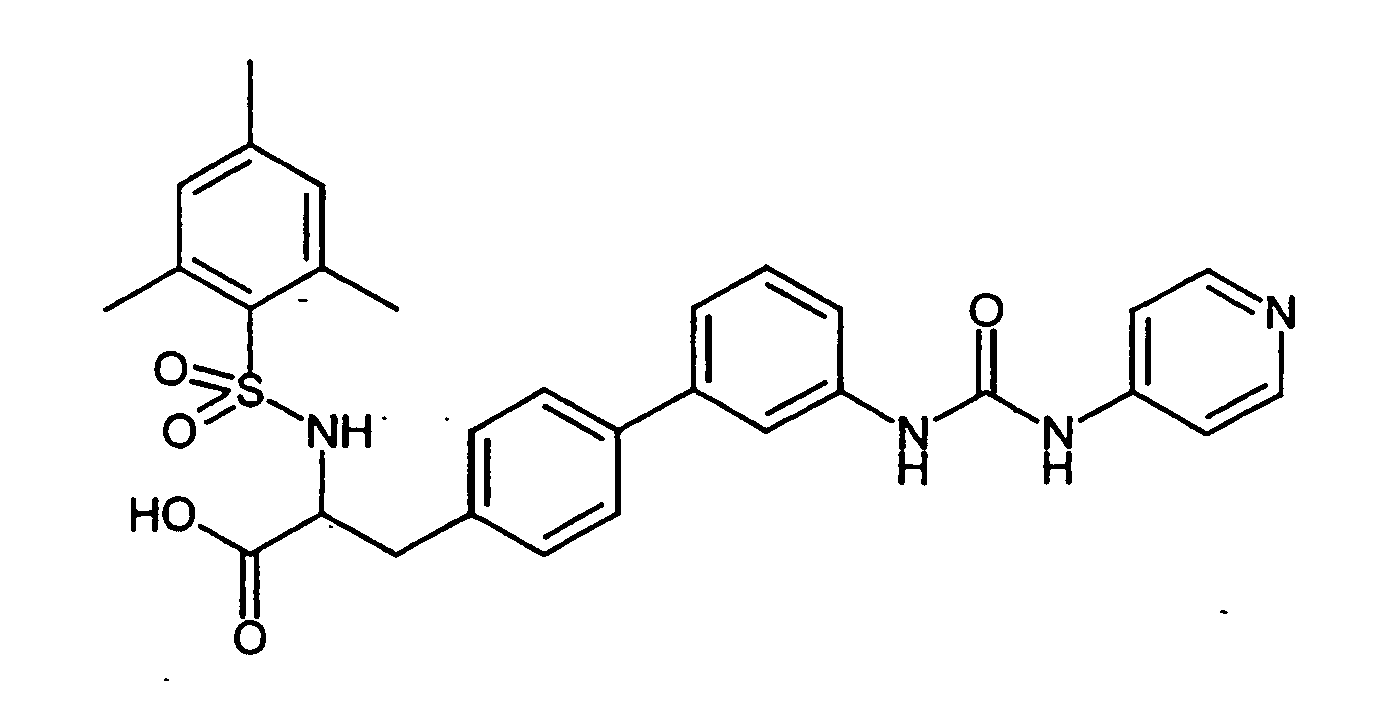
- (2R,S)-3-[3'-(3-Pyridin-4-yl-ureido)-biphenyl-4-yl]-2-(2,4,6-trimethyl-benzenesulfonylamino)-propanoic acid is prepared according to the procedure of example 1.1, with the exception that 4-aminopyridine is used as an amine reagent instead of propylamine.
Mass spectrometry (ESI): 559.
Retention time (HPLC): Rt = 8.6.
1H-NMR (400 MHz, methanol) δ = 8.48 (d, 2H), 7.98 (d, 2H), 7.82 (s, 1H), 7.42 (d, 2H), 7.33 (d, 3H), 7.09 (d, 2H), 6.79 (s, 2H), 3.93 (dd, 1H, J = 4.6 Hz, J = 10.0 Hz, H-2), 3.11 (dd, 1H, J = 4.6 Hz, J = 13.6 Hz, H-3a), 2.81 (dd, 1H, J = 10.0 Hz, J = 13.8 Hz, H-3b), 2.44 (s, 6H), 2.04 (s, 3H). -
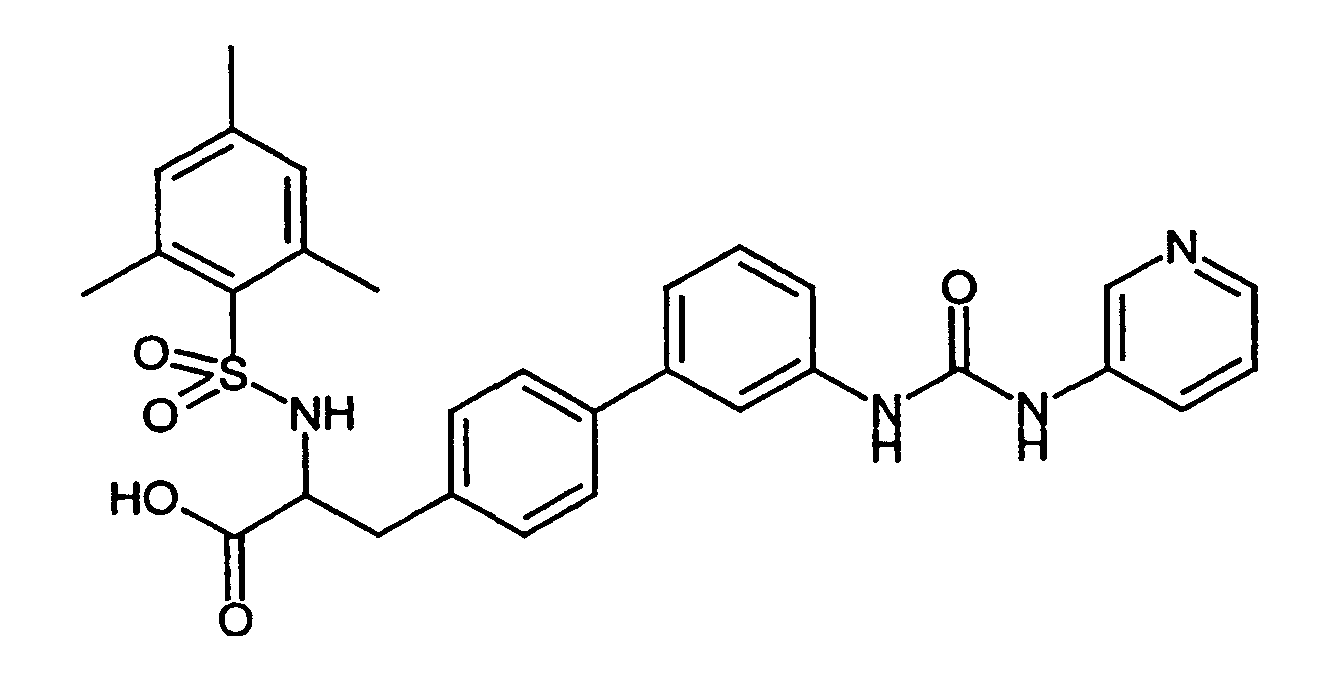
- (2R,S)-3-[3'-(3-Pyridin-3-yl-ureido)-biphenyl-4-yl]-2-(2,4,6-trimethyl-benzenesulfonylamino)-propanoic acid is prepared according to the procedure of example 1.1, with the exception that 3-aminopyridine is used as an amine reagent instead of propylamine.
Mass spectrometry (ESI): 559.
Retention time (HPLC): Rt = 8.4.
1H-NMR (400 MHz, methanol) δ = 8.37 (m, 2H), 7.83 (m, 2H), 7.42 - 7.26 (m, 6H), 7.07 (d, 2H), 6.78 (s, 2H), 3.94 (dd, 1H, J = 4.6 Hz, J = 10.2 Hz, H-2), 3.11 (dd, 1H, J = 4.6 Hz, J = 13.6 Hz, H-3a), 2.80 (dd, 1H, J = 10.2 Hz, J = 13.6 Hz, H-3b), 2.43 (s, 6H), 2.03 (s, 3H). -
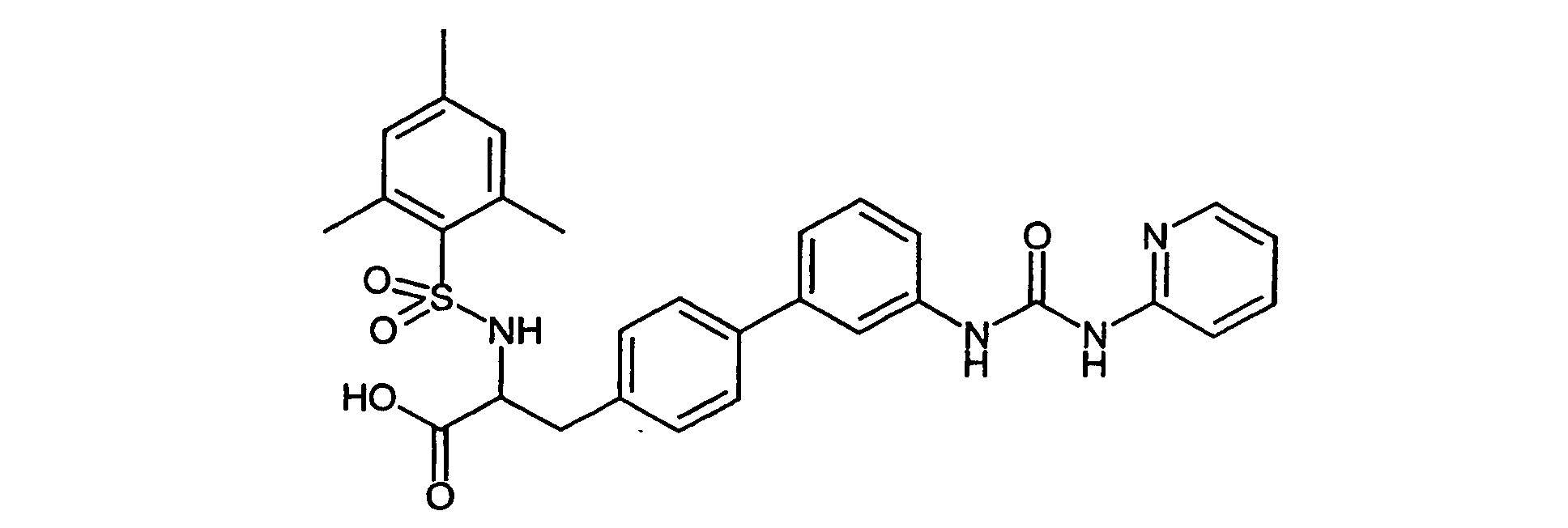
- (2R,S)-3-[3'-(3-Pyridin-2-yl-ureido)-biphenyl-4-yl]-2-(2,4,6-trimethyl-benzenesulfonylamino)-propanoic acid is prepared according to the procedure of example 1.1, with the exception that 2-aminopyridine is used as an amine reagent instead of propylamine.
Mass spectrometry (ESI): 559.
Retention time (HPLC): Rt = 9.4.
1H-NMR (400 MHz, methanol) δ = 8.31 (d, 1H), 8.05 (dd, 1H), 7.86 (s, 1H), 7.43 (m, 2H), 7.33 (m, 4H), 7.26 (m, 1H), 7.07 (d, 2H), 6.68 (s, 2H), 3.94 (dd, 1H, J = 4.8 Hz, J = 10.4 Hz, H-2), 3.11 (dd, 1H, J = 4.8 Hz, J = 14.0 Hz, H-3a), 2.81 (dd, 1H, J = 10.2 Hz, J = 14.0 Hz, H-3b), 2.43 (s, 6H), 2.02 (s, 3H). -

- (2S)-3-[3'-(3-Cyclopropyl-ureido)-biphenyl-4-yl]-2-(2,4,6-trimethyl-benzenesulfonylamino)-propanoic acid is prepared according to the procedure of example 1.1, with the exception that (2S)-3-(4-bromophenyl)-2-(9-fluorenylmethoxycarbonylamino)-propanoic acid is used as an acid reagent instead of (2R,S)-3-(4-bromophenyl)-2-(9-fluorenylmethoxycarbonylamino)-propanoic acid and cyclopropylamine is used as an amine reagent instead of propylamine.
Mass spectrometry (ESI): 522.
Retention time (HPLC): Rt = 10.4.
1H-NMR (400 MHz, methanol) δ = 7.72 (s, 1H), 7.30 (m, 4H), 7.19 (d, 1H), 7.06 (d, 2H), 6.78 (s, 2H), 3.92 (dd, 1H, J = 4.8 Hz. J = 10.0 Hz, H-2), 3.10 (dd, 1H, J = 4.6 Hz, J = 14.0 Hz, H-3a), 2.80 (dd, 1H, J = 10.0 Hz, J = 14.0 Hz, H-3b), 2.62 (m, 1H), 2.47 (s, 6H), 2.04 (s, 3H), 0.76 (m, 2H), 0.54 (m, 2H). -

- (2R,S)-3-(3'-{3-[2-(1H-Imidazol-4-yl)-ethyl]-ureido}-biphenyl-4-yl)-2-(2-chlorobenzenesulfonylamino)-propanoic acid is prepared according to the procedure of example 1.1, with the exception that 2-chlorobenzenesulfonyl chloride is used as a sulfonylating reagent instead of 2,4,6-trimethylbenzenesulfonyl chloride and 2-(imidazol-4-yl)-ethylamine is used as an amine reagent instead of propylamine.
Mass spectrometry (ESI): 569.
Retention time (HPLC): Rt = 7.0. -
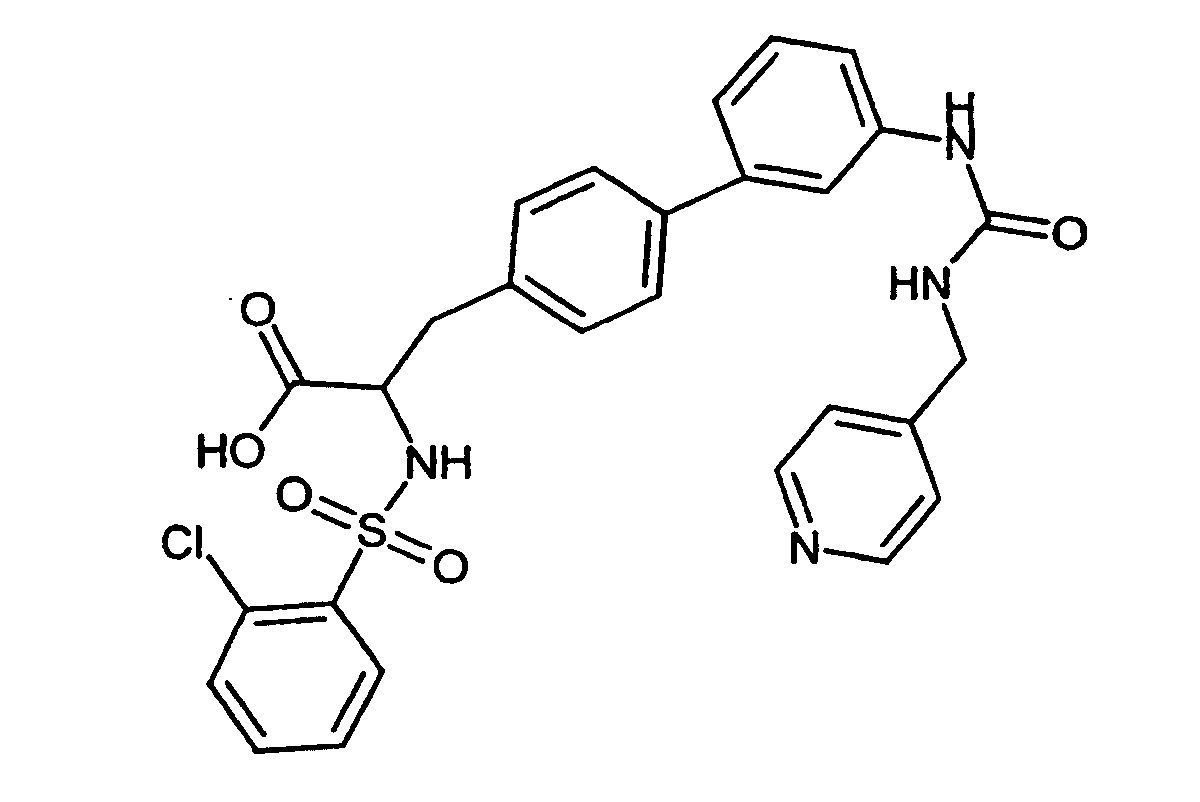
- (2R,S)-3-[3'-(3-Pyridin-4-ylmethyl-ureido)-biphenyl-4-yl]-2-(2-chloro-benzenesulfonylamino)-propanoic acid is prepared according to the procedure of example 1.1, with the exception that 2-chlorobenzenesulfonyl chloride is used as a sulfonylating reagent instead of 2,4,6-trimethylbenzenesulfonyl chloride and 4-aminomethylpyridine is used as an amine reagent instead of propylamine.
Mass spectrometry (ESI): 566.
Retention time (HPLC): Rt = 7.0. -

- (2R,S)-3-[3'-(3-Pyridin-2-ylmethyl-ureido)-biphenyl-4-yl]-2-(2-chloro-benzenesulfonylamino)-propanoic acid is prepared according to the procedure of example 1.1, with the exception that 2-chlorobenzenesulfonyl chloride is used as a sulfonylating reagent instead of 2,4,6-trimethylbenzenesulfonyl chloride and 2-aminomethylpyridine is used as an amine reagent instead of propylamine.
Mass spectrometry (ESI): 566.
Retention time (HPLC): Rt = 7.0.
1H-NMR (400 MHz, methanol) δ = 8.67 (d, 1H), 8.37 (dd, 1H), 7.92 (d, 1H), 7.82 - 7.74 (m, 2H), 7.70 (s, 1H), 7.37 - 7.23 (m, 7H), 7.20 (d, 1H), 7.14 (d, 2H), 4.70 (s, 2H), 4.10 (dd, 1H, J = 4.6 Hz, J = 10.0 Hz, H-2), 3.15 (dd, 1H, J = 4.6 Hz, J = 14.0 Hz, H-3a), 2.86 (dd, 1H, J = 10.0 Hz, J = 14.0 Hz, H-3b). -

- (2R,S)-3-[3'-(3-Pyridin-4-yl-ureido)-biphenyl-4-yl]-2-(2-chloro-benzenesulfonylamino)-propanoic acid is prepared according to the procedure of example 1.1, with the exception that 2-chlorobenzenesulfonyl chloride is used as a sulfonylating reagent instead of 2,4,6-trimethylbenzenesulfonyl chloride and 4-aminopyridine is used as an amine reagent instead of propylamine.
Mass spectrometry (ESI): 552.
Retention time (HPLC): Rt = 7.7. -
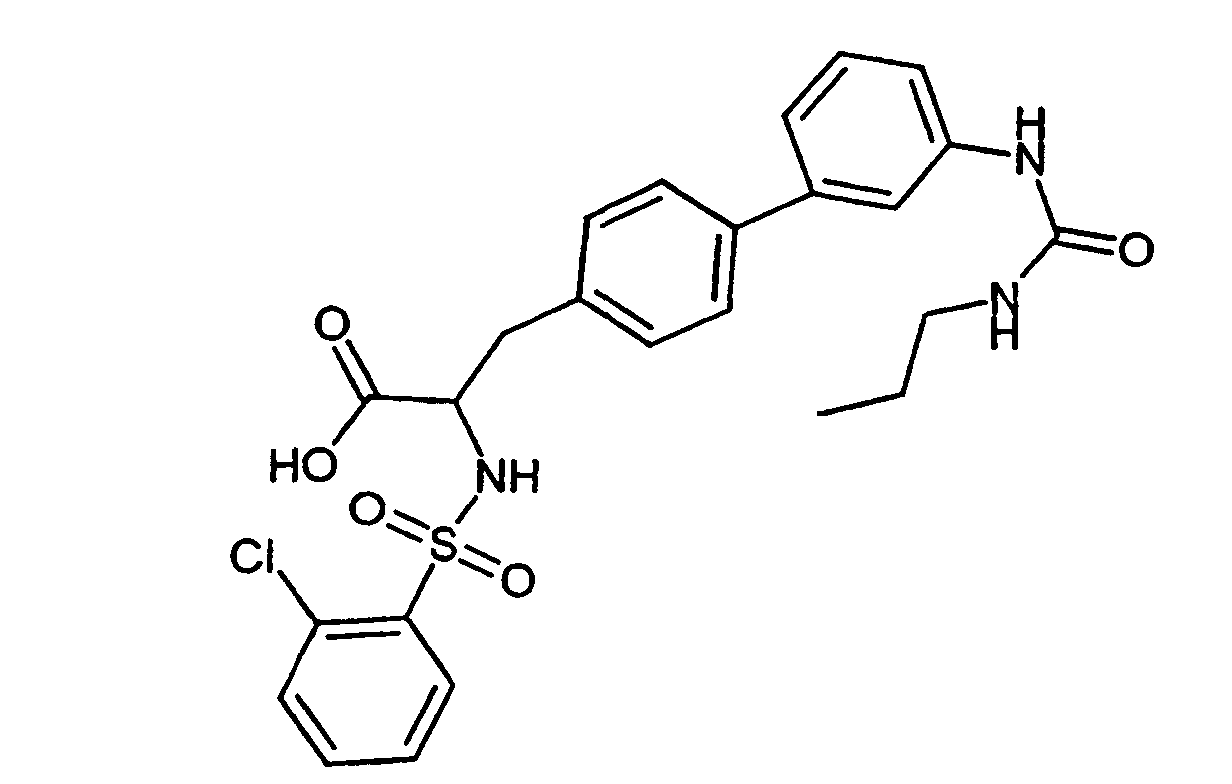
- (2R,S)-3-[3'-(3-Propyl-ureido)-biphenyl-4-yl]-2-(2-chloro-benzenesulfonylamino)-propanoic acid is prepared according to the procedure of example 1.1, with the exception that 2-chlorobenzenesulfonyl chloride is used as a sulfonylating reagent instead of 2,4,6-trimethylbenzenesulfonyl chloride.
Mass spectrometry (ESI): 517.
Retention time (HPLC): Rt = 9.5. -
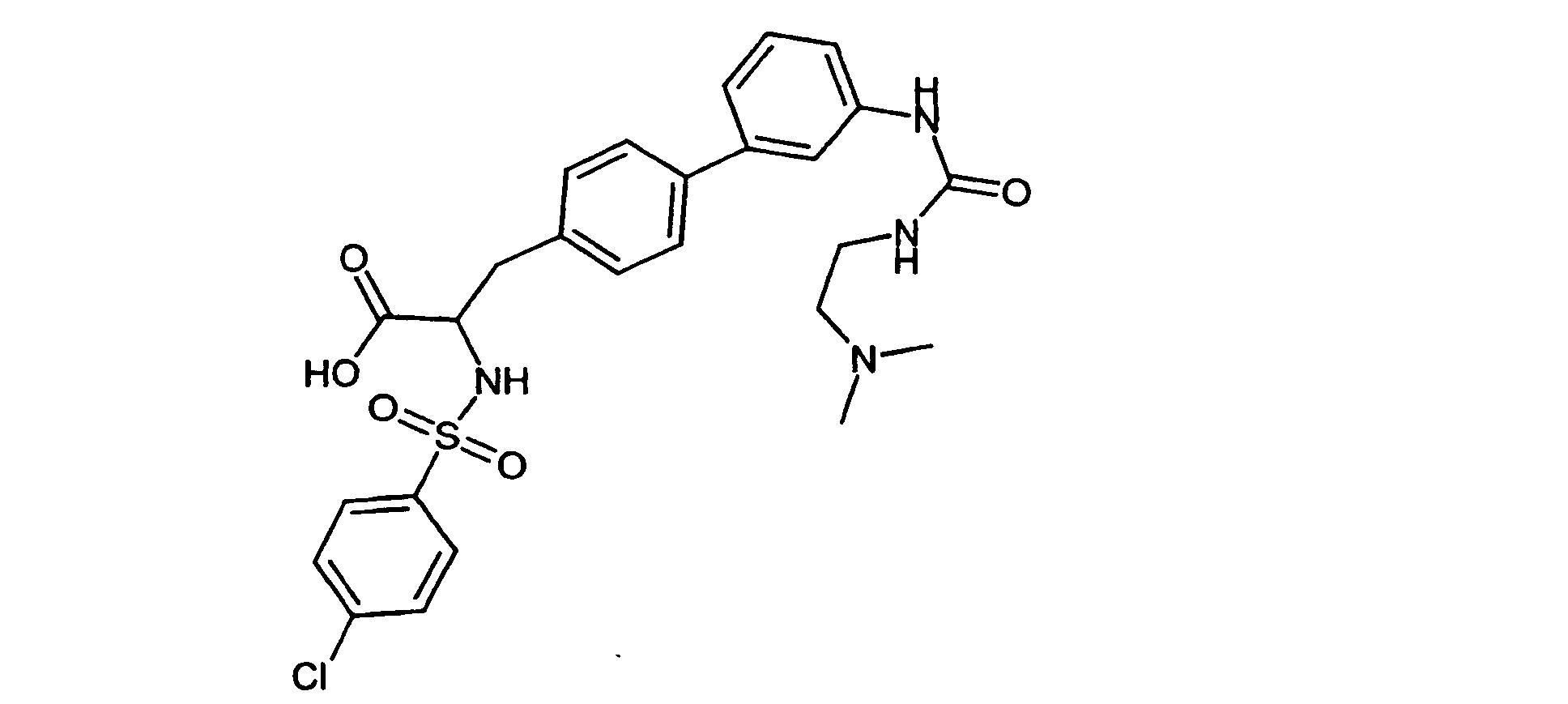
- (2R,S)-3-{3'-[3-(2-Dimethylamino-ethyl)-ureido]-biphenyl-4-yl}-2-(4-chloro-benzenesulfonylamino)-propanoic acid is prepared according to the procedure of example 1.1, with the exception that 4-chlorobenzenesulfonyl chloride is used as a sulfonylating reagent instead of 2,4,6-trimethylbenzenesulfonyl chloride and N,N-dimethyl-ethylenediamine is used as an amine reagent instead of propylamine.
Mass spectrometry (ESI): 546.
Retention time (HPLC): Rt = 7.3. -

- (2R,S)-3-{3'-[3-(2-Pyridin-2-yl-ethyl)-ureido]-biphenyl-4-yl}-2-(4-chloro-benzenesulfonylamino)-propanoic acid is prepared according to the procedure of example 1.1, with the exception that 4-chlorobenzenesulfonyl chloride is used as a sulfonylating reagent instead of 2,4,6-trimethylbenzenesulfonyl chloride and 2-(pyridin-4-yl)-ethylamine is used as an amine reagent instead of propylamine.
Mass spectrometry (ESI): 580.
Retention time (HPLC): Rt = 7.3.
1H-NMR (400 MHz, methanol) δ = 8.70 (d, 1H), 8.41 (dd, 1H), 7.93 (d, 1H), 7.84 (dd, 1H), 7.58 (m, 3H), 7.41 (d, 2H), 7.33 (d, 2H), 7.29 (d, 1H), 7.22 (m, 4H), 4.08 (dd, 1H, J = 5.0 Hz, J = 9.6 Hz, H-2), 3.67 (t, 2H, J = 6.8 Hz), 3.25 (t, 2H, J = 6.8 Hz), 3.13 (dd, 1H, J = 5.0 Hz, J = 14.0 Hz, H-3a), 2.85 (dd, 1H, J = 9.6 Hz, J = 14.0 Hz, H-3b). -

- (2R,S)-3-[3'-(3-Pyridin-4-ylmethyl-ureido)-biphenyl-4-yl]-2-(4-chlor-benzenesulfonylamino)-propanoic acid is prepared according to the procedure of example 1.1, with the exception that 4-chlombenzenesulfonyl chloride is used as a sulfonylating reagent instead of 2,4,6-trimethylbenzenesulfonyl chloride and 4-aminomethylpyridine is used as an amine reagent instead of propylamine.
Mass spectrometry (ESI): 566.
Retention time (HPLC): Rt = 7.3. -

- (2R,S)-3-[3'-(3-Pyridin-3-ylmethyl-ureido)-biphenyl-4-yl]-2-(4-chloro-benzenesulfonylamino)-propanoic acid is prepared according to the procedure of example 1.1, with the exception that 4-chlorobenzenesulfonyl chloride is used as a sulfonylating reagent instead of 2,4,6-trimethylbenzenesulfonyl chloride and 3-aminomethylpyridine is used as an amine reagent instead of propylamine.
Mass spectrometry (ESI): 566.
Retention time (HPLC): Rt = 7.2. -
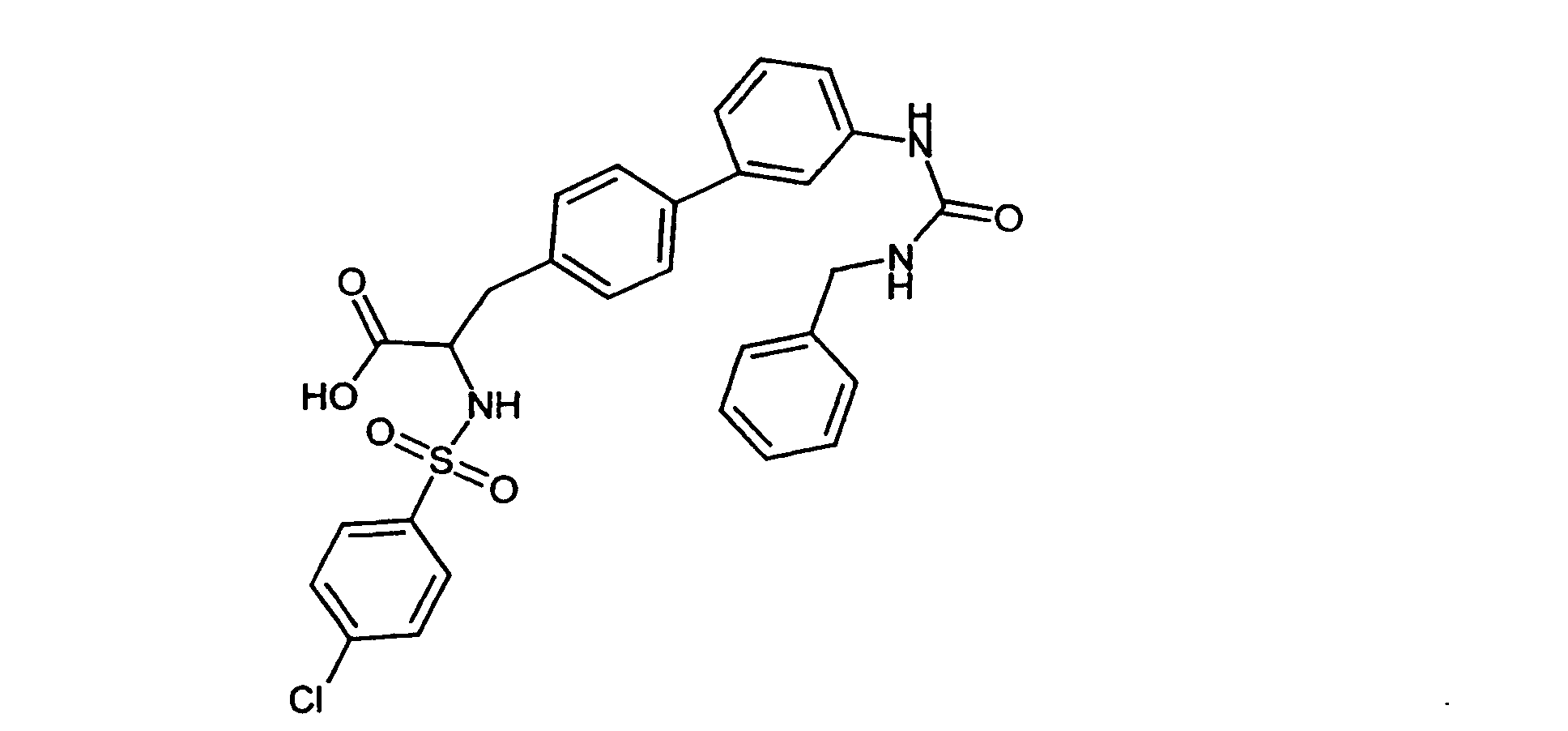
- (2R,S)-3-[3'-(3-Benzyl-ureido)-biphenyl-4-yl]-2-(4-chloro-benzenesulfonylamino)-propanoic acid is prepared according to the procedure of example 1.1, with the exception that 4-chlorobenzenesulfonyl chloride is used as a sulfonylating reagent instead of 2,4,6-trimethylbenzenesulfonyl chloride and benzylamine is used as an amine reagent instead of propylamine.
Mass spectrometry (ESI): 565.
Retention time (HPLC): Rt = 10.4. -

- (2S)-3-[3'-(3-Propyl-ureido)-biphenyl-4-yl]-2-(2,5-dichloro-benzenesulfonylamino)-propanoic acid is prepared according to the procedure of example 1.1, with the exception that (2S)-3-(4-bromophenyl)-2-(9-fluorenylmethoxycarbonylamino)-propanoic acid is used as an acid reagent instead of (2R,S)-3-(4-bromophenyl)-2-(9-fluorenylmethoxycarbonylamino)-propanoic acid and 2,5-dichlorobenzenesulfonyl chloride is used as a sulfonylating reagent instead of 2,4,6-trimethylbenzenesulfonyl chloride.
Mass spectrometry (ESI): 551.
Retention time (HPLC): Rt = 10.2.
1H-NMR (400 MHz, methanol) δ = 7.77 (s, 1H), 7.67 (s, 1H), 7.37-7.11 (m, 9H), 4.16 (dd, 1H, J = 4.4 Hz, J = 10.4 Hz, H-2), 3.19 (t, 2H, J = 7.0 Hz), 3.18 (dd, 1H, J = 4.4 Hz, J = 13.4 Hz, H-3a), 2.84 (dd, 1H, J = 10.6 Hz, J = 14.0 Hz, H-3b), 1.58 (tq, 2H, J = 7.2 Hz), 0.98 (t, 3H, J = 7.6 Hz). -

- (2R,S)-3-[3'-(3-Pyridin-2-ylmethyl-ureido)-biphenyl-4-yl]-2-benzyloxycarbonylamino-propanoic acid is prepared according to the procedure of example 1.1, with the exception that benzyl chloroformate is used as a carbamoylating reagent instead of 2,4,6-trimethylbenzenesulfonyl chloride as a sulfonylating reagent and 2-aminomethylpyridine is used as an amine reagent instead of propylamine.
Mass spectrometry (ESI): 525.
Retention time (HPLC): Rt = 7.6. -

- (2R,S)-3-{3'-[3-(1H-Benzoimidazol-2-yl)-ureido]-biphenyl-4-yl}-2-benzyloxycarbonylamino-propanoic acid is prepared according to the procedure of example 1.1, with the exception that benzyl chloroformate is used as a carbamoylating reagent instead of 2,4,6-trimethylbenzenesulfonyl chloride as a sulfonylating reagent and 2-aminobenzimidazole is used as an amine reagent instead of propylamine.
Mass spectrometry (ESI): 550.
Retention time (HPLC): Rt = 9.3. -
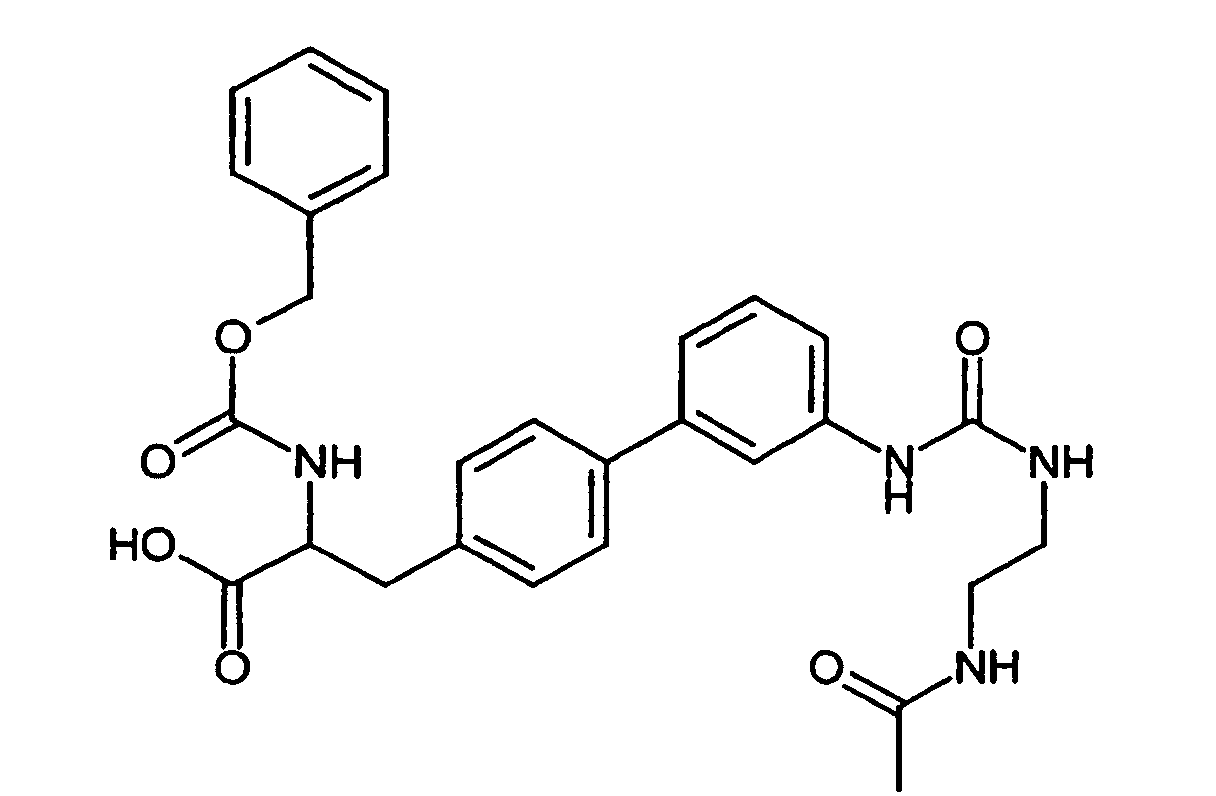
- (2R,S)-3-{3'-[3-(2-Acetylamino-ethyl)-ureido]-biphenyl-4-yl}-2-benzyloxycarbonylamino-propanoic acid is prepared according to the procedure of example 1.1, with the exception that benzyl chloroformate is used as a carbamoylating reagent instead of 2,4,6-trimethylbenzenesulfonyl chloride as a sulfonylating reagent and N-acetylethylenediamine is used as an amine reagent instead of propylamine.
Mass spectrometry (ESI): 519.
Retention time (HPLC): Rt = 8.1. -
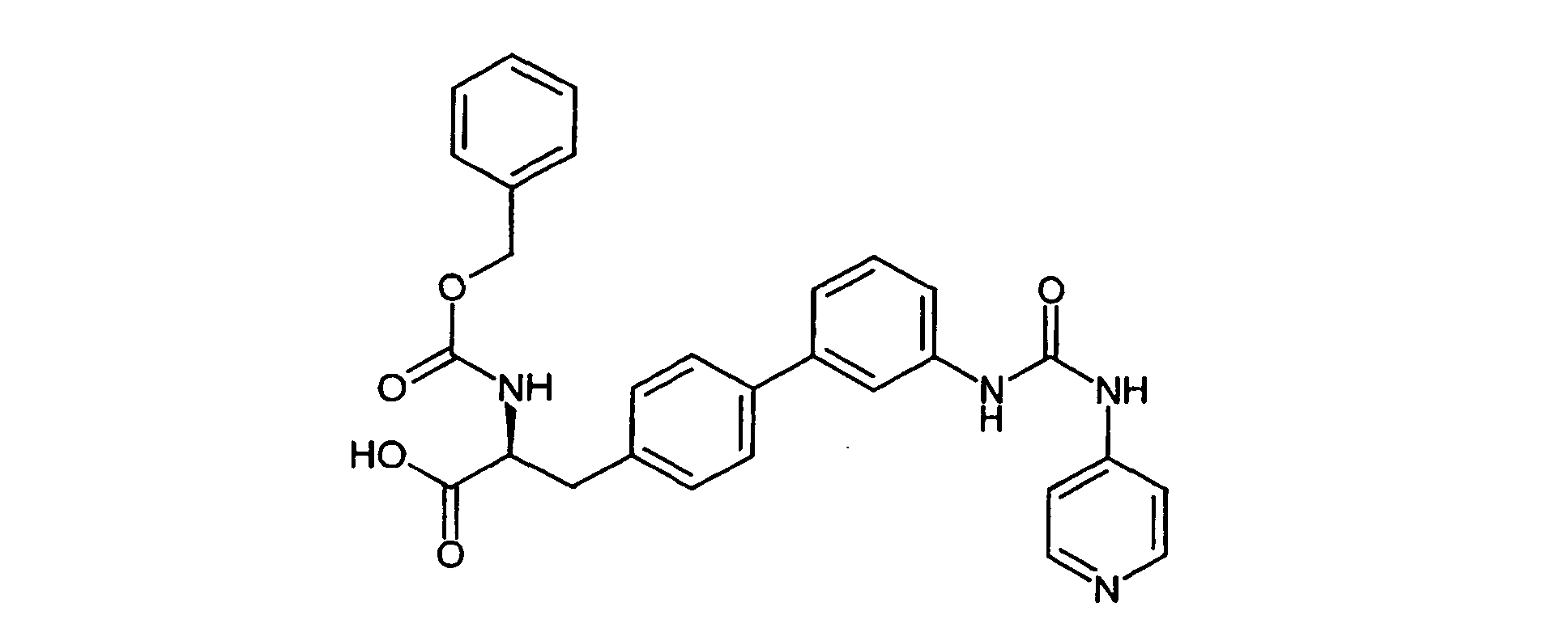
- (2S)-3-[3'-(3-Pyridin-4-yl-ureido)-biphenyl-4-yl]-2-benzyloxycarbonylamino-propanoic acid is prepared according to the procedure of example 1.1, with the exception that (2S)-3-(4-bromophenyl)-2-(9-fluorenylmethoxycarbonylamino)-propanoic acid is used as an acid reagent instead of (2R,S)-3-(4-bromophenyl)-2-(9-fluorenylmethoxycarbonylamino)-propanoic acid, benzyl chloroformate is used as a carbamoylating reagent instead of 2,4,6-trimethylbenzenesulfonyl chloride as a sulfonylating reagent and 4-aminopyridine is used as an amine reagent instead of propylamine.
Mass spectrometry (ESI): 511.
Retention time (HPLC): Rt = 8.6.
1H-NMR (400 MHz, methanol) δ = 8.48 (d, 2H), 8.03 (d, 2H), 7.80 (s, 1H), 7.52 (d, 2H), 7.48 - 7.20 (m, 12H), 5.07 (d, 1H, J = 12.6 Hz9, 5.01 (d, 1H, J = 12.6 Hz), 4.46 (dd, 1H, J = 4.8 Hz, J = 9.4 Hz, H-2), 3.26 (dd, 1H, J = 4.8 Hz, J = 14.0 Hz, H-3a), 2.98 (dd, 1H, J = 9.6 Hz, J = 14.0 Hz, H-3b). -

- (2S)-3-[3'-(3-Cyclopropyl-ureido)-biphenyl-4-yl]-2-[(S)-campher-10-yl-sulfonylamino]-propanoic acid is prepared according to the procedure of example 1.1, with the exception that (2S)-3-(4-bromophenyl)-2-(9-fluorenylmethoxycarbonylamino)-propanoic acid is used as an acid reagent instead of (2R,S)-3-(4-bromophenyl)-2-(9-fluorenylmethoxycarbonylamino)-propanoic acid, (S)-(+)-campher-10-sulfonyl chloride is used as a sulfonylating reagent instead of 2,4,6-trimethylbenzenesulfonyl chloride and cyclopropylamine is used as an amine reagent instead of propylamine.
Mass spectrometry (ESI): 554.
Retention time (HPLC): Rt = 9.1.
1H-NMR (400 MHz, methanol) δ = 7.78-7.18 (m, 8H), 4.32 (dd, 1H, J = 4.6 Hz, J = 9.2 Hz, H-2), 3.24 (dd, 1H, J = 4.8 Hz, J = 14.0 Hz, H-3a), 3.03 (m, 1H, J = 15.2 Hz), 2.94 (dd, 1H, J = 9.6 Hz, J = 14.0 Hz, H-3b), 2.65 (d, 1H, J = 15.2 Hz), 2.59 (m, 1H), 2.28 (m, 1H, J = 18.2 Hz), 2.20 (m, 1H, J = 14.0 Hz), 2.03 (m, J = 7.8 Hz, J = 15.4 Hz), 1.97 (m, 1H), 1.84 (d, 1H, J = 19.0 Hz), 1.58 (ddd, 1H, J = 4.8 Hz, J = 9.6 Hz, J = 14.4 Hz), 1.37 (m, 1H), 0.91 (s, 3H), 0.74 (m, 2H), 0.66 (s, 3H), 0.52 (m, 2H). -

- (2S)-3-[3'-(3-Propyl-ureido)-biphenyl-4-yl]-2-[(S)-campher-10-yl-sulfonylamino]-propanoic acid is prepared according to the procedure of example 1.1, with the exception that (2S)-3-(4-bromophenyl)-2-(9-fluorenylmethoxycarbonylamino)-propanoic acid is used as an acid reagent instead of (2R,S)-3-(4-bromophenyl)-2-(9-fluorenylmethoxycarbonylamino)-propanoic acid and (S)-(+)-campher-10-sulfonyl chloride is used as a sulfonylating reagent instead of 2,4,6-trimethylbenzenesulfonyl chloride.
Mass spectrometry (ESI): 556.
Retention time (HPLC): Rt = 9.6.
1H-NMR (400 MHz, methanol) δ = 7.63-7.18 (m, 8H), 4.31 (dd, 1H, J = 4.6 Hz, J = 9.2 Hz, H-2), 3.24 (dd, 1H, J = 4.8 Hz, J = 14.0 Hz, H-3a), 3.16 (t, 2H, J = 7.0 Hz), 3.02 (m, 1H, J = 15.2 Hz), 2.93 (dd, 1H, J = 9.6 Hz, J = 14.0 Hz, H-3b), 2.65 (d, 1H, J = 15.2 Hz), 2.28 (m, 1H, J = 18.2 Hz), 2.20 (m, 1H, J = 14.0 Hz), 2.03 (m, J = 7.8 Hz, J = 15.4 Hz), 1.96 (m, 1H), 1.84 (d, 1H, J = 19.0 Hz), 1.58 (ddd, 1H, J = 4.8 Hz, J = 9.6 Hz, J = 14.4 Hz), 1.55 (tq, 2H, J = 7.8 Hz, J = 7.4 Hz), 1.37 (m, 1H), 0.95 (t, 3H, J = 7.8 Hz), 0.91 (s, 3H), 0.67 (s, 3H). -

- (2S)-3-[3'-(3-Pyridin-3-ylmethyl-ureido)-biphenyl-4-yl]-2-(2-chloro-benzensulfonylamino)-propanoic acid is prepared according to the procedure of example 1.1, with the exception that (2S)-3-(4-bromophenyl)-2-(9-fluorenylmethoxycarbonylamino)-propanoic acid is used as an acid reagent instead of (2R,S)-3-(4-bromophenyl)-2-(9-fluorenylmethoxycarbonylamino)-propanoic acid, 2-chlorobenzenesulfonyl chloride is used as a sulfonylating reagent instead of 2,4,6-trimethylbenzenesulfonyl chloride and 3-aminomethylpyridine is used as an amine reagent instead of propylamine.
Mass spectrometry (ESI): 566.
Retention time (HPLC): Rt = 7.6.
1H-NMR (400 MHz, methanol) δ = 8.72 (s, 1H), 8.63 (d, 1H), 8.31 (d, 1H), 7.80 (m, 2H), 7.70 (s, 1H), 7.39-7.26 (M, 7H), 7.19 (d, 1H), 7.16 (d, 2H), 4.56 (s, 2H), 4.10 (dd, 1H, J = 5.0 Hz, J = 10.0 Hz, H-2), 3.15 (dd, 1H, J = 5.0 Hz, J = 13.5 Hz, H-3a), 2.87 (dd, 1H, J = 10.0 Hz, J = 13.6 Hz, H-3b). -
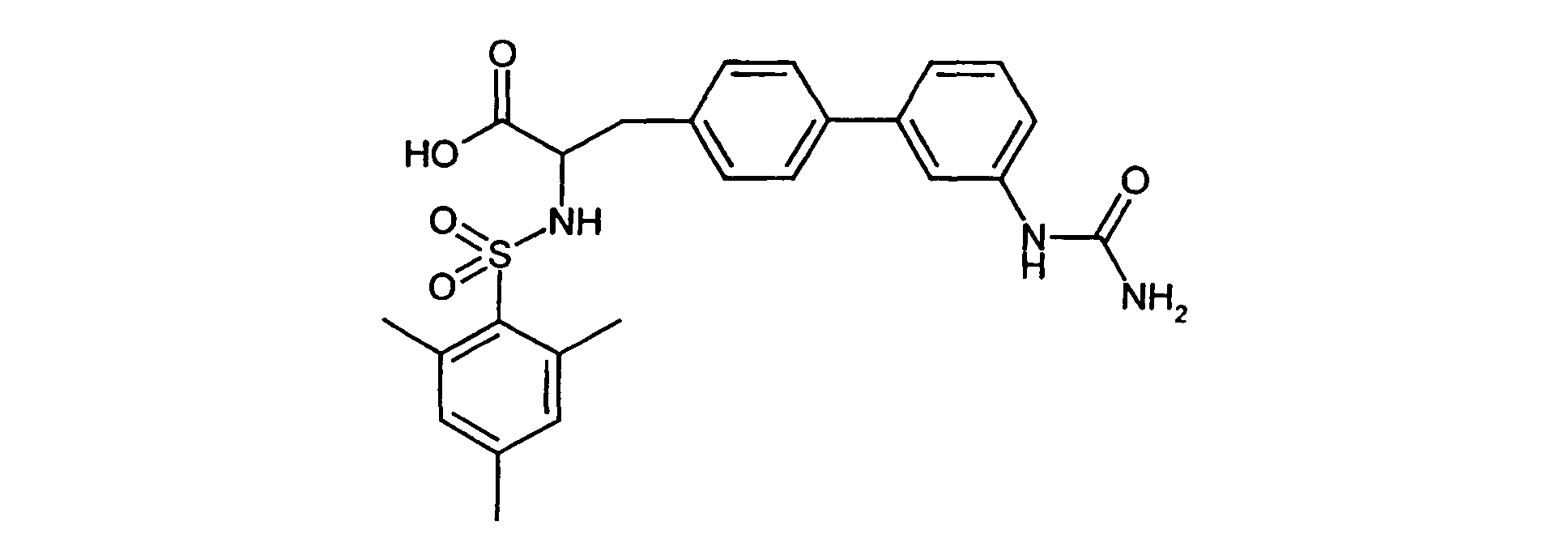
- (2R,S)-3-(3'-ureido-biphenyl-4-yl)-2-(2-chloro-benzensulfonylamino)-propanoic acid is prepared according to the procedure of example 1.1, with the exception 2,4-dimethoxy-benzylamine is used as an amine reagent instead of propylamine.
Mass spectrometry (ESI): 482.
Retention time (HPLC): Rt = 8.8.
1H-NMR (400 Mhz, MeOH) δ = 7,63 (s, 1H), 7,30 (m, 4H), 7,21 (m, 1H), 7,09 (d, 2H), 6,79 (s, 2H), 3,87 (dd, 1H, J = 4,2 Hz, J = 8,8 Hz, H-2), 3,09 (dd, 1H, J = 4,4 Hz, J = 13,8 Hz, H-3a), 2,83 (dd, 1H, J = 13,8 Hz, J = 8,8 Hz, H-3b), 2,47 (s, 6H), 2,06 (s, 3H). -

- (3R,S)-3-[3'-(3-Pyridin-3-ylmethyl-ureido)-biphenyl-3-yl]-3-(4-toluenesulfonylamino)-propanoic acid is prepared according to the procedure of example 1.1, with the exception that (3R,S)-3-(4-bromophenyl)-3-(9-fluorenylmethoxycarbonylamino)-propanoic acid is used as an acid reagent instead of (2R,S)-3-(4-bromophenyl)-2-(9-fluorenylmethoxycarbonylamino)-propanoic acid, 4-toluenesulfonyl chloride is used as a sulfonylating reagent instead of 2,4,6-trimethylbenzenesulfonyl chloride and 3-aminomethylpyridine is used as an amine reagent instead of propylamine.
Mass spectrometry (ESI): 545.
Retention time (HPLC): Rt = 6.9.
1H-NMR (400 Mhz, MeOH) δ = 8,83 (s, 1H), 8,73 (s, 1H), 8,58 (d, 1H), 8,02 (dd, 1H), 7,60 (s, 1H), 7,43 (d, 2H), 7,34 (d, 1H), 7,31 (d, 1H), 7,27 (d, 1H), 7,20 (m, 2H), 7,12 (d, 2H), 7,04 (d, 2H), 4,80 (dd, 1H, J = 7,6 Hz, H-3), 4,60 (s, 2H), 2,79 (dd, 1H, J = 7,6 Hz, J = 15,8 Hz, H-2a), 2,70 (dd, 1H, J = 7,6 Hz, J = 15,6 Hz, H-2b), 2,18 (s, 3H). -

- (2R,S)-3-[3'-(3-iso-Propyl-ureido)-biphenyl-3-yl]-2-(2,4,6-trimethyl-benzenesulfonylamino)-propanoic acid is prepared according to the procedure of example 1.1, with the exception that iso-propylamine is used as an amine reagent instead of propylamine.
Mass spectrometry (ESI): 524.
Retention time (HPLC): Rt = 10,5.
1H-NMR (400 MHz, methanol) δ = 7,68 (s, 1H), 7,30 (d, 3H), 7,23 (d, 1H), 7,18 (d, 1H), 7,05 (d, 2H), 6,78 (d, 2H), 3,92 (m, 2H), 3,10 (dd, 1H, J = 4,8 Hz, J = 14,0 Hz, H-3a), 2,79 (dd, 1H, J = 10,4 Hz, J = 14,0 Hz, H-3b), 2,44 (s, 6H), 2,04 (s, 3H), 1,20 (d, 6H). -
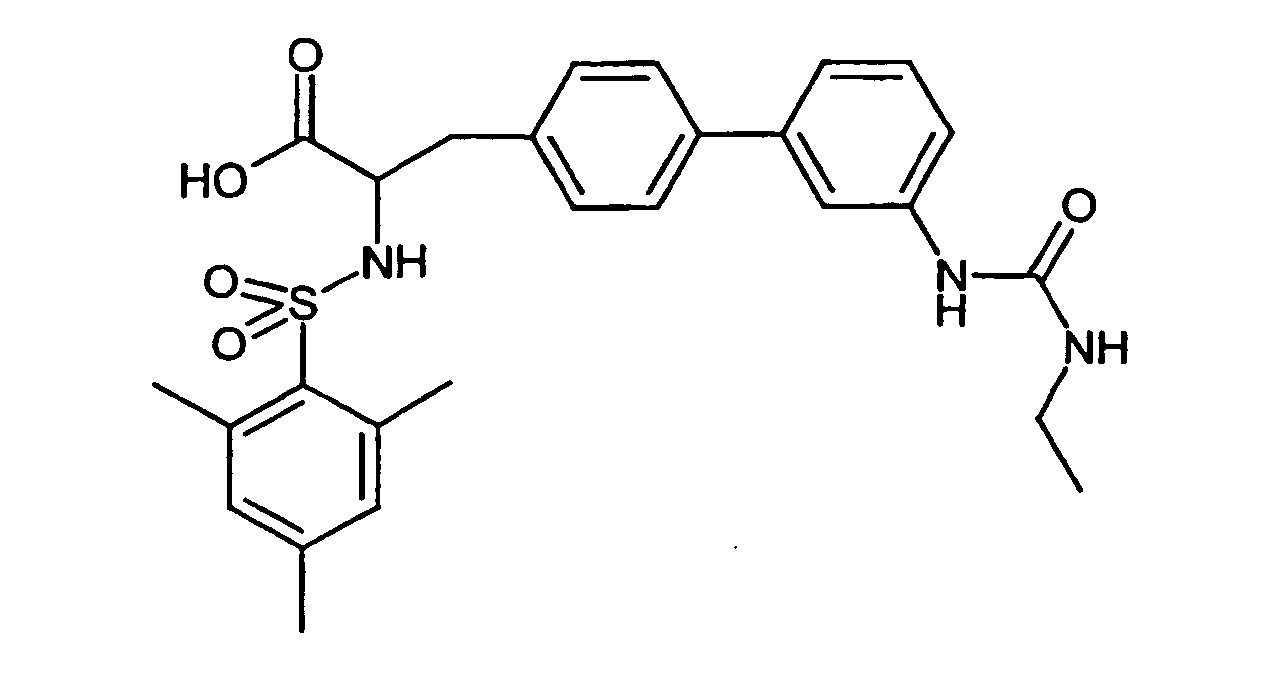
- (2R,S)-3-[3'-(3-Ethylureido)-biphenyl-4-yl]-2-(2,4,6-trimethyl-benzenesulfonylamino)-propanoic acid is prepared according to the procedure of example 1.1, with the exception that ethylamine is used as an amine reagent instead of propylamine.
Mass spectrometry (ESI): 510.
Retention time (HPLC): Rt = 9,8.
1H-NMR (400 MHz, methanol) δ = 7,69 (s, 1H), 7,30 (m, 3H), 7,26 (d, 1H), 7,18 (d, 1H), 7,05 (d, 2H), 6,78 (s, 2H), 3,92 (dd, 1H, J = 4,6 Hz, J = 10,2 Hz, H-2), 3,25 (q, 2H, J = 7,2 Hz), 3,09 (dd, 1H, J = 4,6 Hz, J = 14,0 Hz, H-3a), 2,79 (dd, 1H, J = 10,2 Hz, J = 14,0 Hz, H-3b), 2,42 (s, 6H), 2,04 (s, 3H), 1,17 (t, 3H, J = 7,2 Hz). -

- (2R,S)-3-[3'-(3-Cyclopropylureido)-4'-methyl-biphenyl-4-yl]-2-(2,4,6-trimethyl-benzenesulfonylamino)-propanoic acid is prepared according to the procedure of example 1.1, with the exception that 4-methyl-3-nitrobenzeneboronic acid is used as a boronic acid reagent instead of 3-nitrobenzeneboronic acid and ethylamine is used as an amine reagent instead of propylamine.
Mass spectrometry (ESI): 536.
Retention time (HPLC): Rt = 10,3.
1H-NMR (400 MHz, methanol) δ = 7,79 - 7,20 (m, 5H), 7,03 (d, 2H), 6,78 (s, 2H), 3,92 (dd, 1H, H-2), 3,08 (dd, 1H, H-3a), 2,78 (dd, 1H, H-3b), 2,62 (m, 1H), 2,43 (s, 6H), 2,29 (s, 3H), 2,08 (s, 3H), 0,78 (m, 2H), 0,56 (m, 2H). -
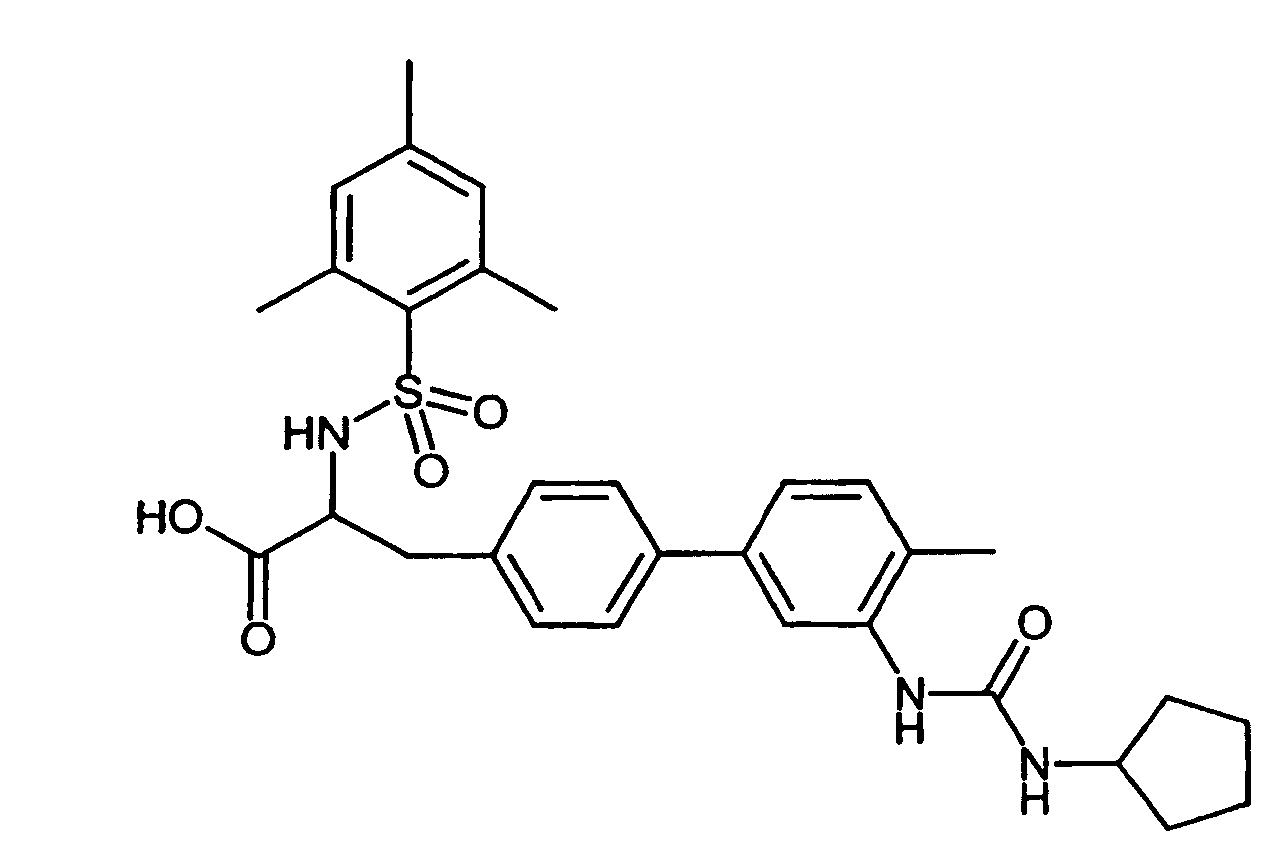
- (2R,S)-3-[3'-(3-Cyclopentylureido)-4'-methyl-biphenyl-4-yl]-2-(2,4,6-trimethyl-benzenesulfonylamino)-propanoic acid is prepared according to the procedure of example 1.1, with the exception that 4-methyl-3-nitrobenzeneboronic acid is used as a boronic acid reagent instead of 3-nitrobenzeneboronic acid and cyclopentylamine is used as an amine reagent instead of propylamine.
Mass spectrometry (ESI): 564.
Retention time (HPLC): Rt = 11,3
1H-NMR (400 MHz, methanol) δ = 7,93 (s, 1H), 7,32 (d, 2H), 7,23 (d, 1H), 7,18 (d, 1H), 7,03 (d, 2H), 6,78 (s, 2H), 4,09 (m; 1H), 3,91 (dd, 1H, J = 4,8 Hz, J = 10,4 Hz, H-2), 3,08 (dd, 1H, J = 4,8 Hz, J = 14,0 Hz, H-3a), 2,78 (dd, 1H, J = 10,4 Hz, J = 14,0 Hz, H-3b), 2,42 (s, 6H), 2,28 (s, 3H), 2,07 (s, 3H), 1,99 (m, 2H), 1,75 (m, 2H), 1,64 (m, 2H), 1,49 (m, 2H). -

- (2R,S)-3-[3'-(3-Propylureido)-4'-methyl-biphenyl-4-yl]-2-(2,4,6-trimethyl-benzenesulfonylamino)-propanoic acid is prepared according to the procedure of example 1.1, with the exception that 4-methyl-3-nitrobenzeneboronic acid is used as a boronic acid reagent instead of 3-nitrobenzeneboronic acid.
Mass spectrometry (ESI): 538.
Retention time (HPLC): Rt = 10,6
1H-NMR (400 MHz, methanol) δ = 7,87 (s, 1H), 7,32 (d, 2H), 7,23 (d, 1H), 7,21 (d, 1H), 7,03 (d, 2H), 6,78 (s, 2H), 3,91 (dd, 1H, J = 4,6 Hz, J = 10,0 Hz, H-2), 3,19 (t, 2H, J = 7,2 Hz), 3,08 (dd, 1H, J = 4,6 Hz, J = 14,0 Hz, H-3a), 2,78 (dd, 1H, J = 10,2 Hz, J = 14,0 Hz, H-3b), 2,42 (s, 6H), 2,29 (s, 3H), 2,07 (s, 3H), 1,58 (dq, 2H, J = 7,2 Hz), 0,99 (t, 3H, J = 7,6 Hz, J = 7,6 Hz). -
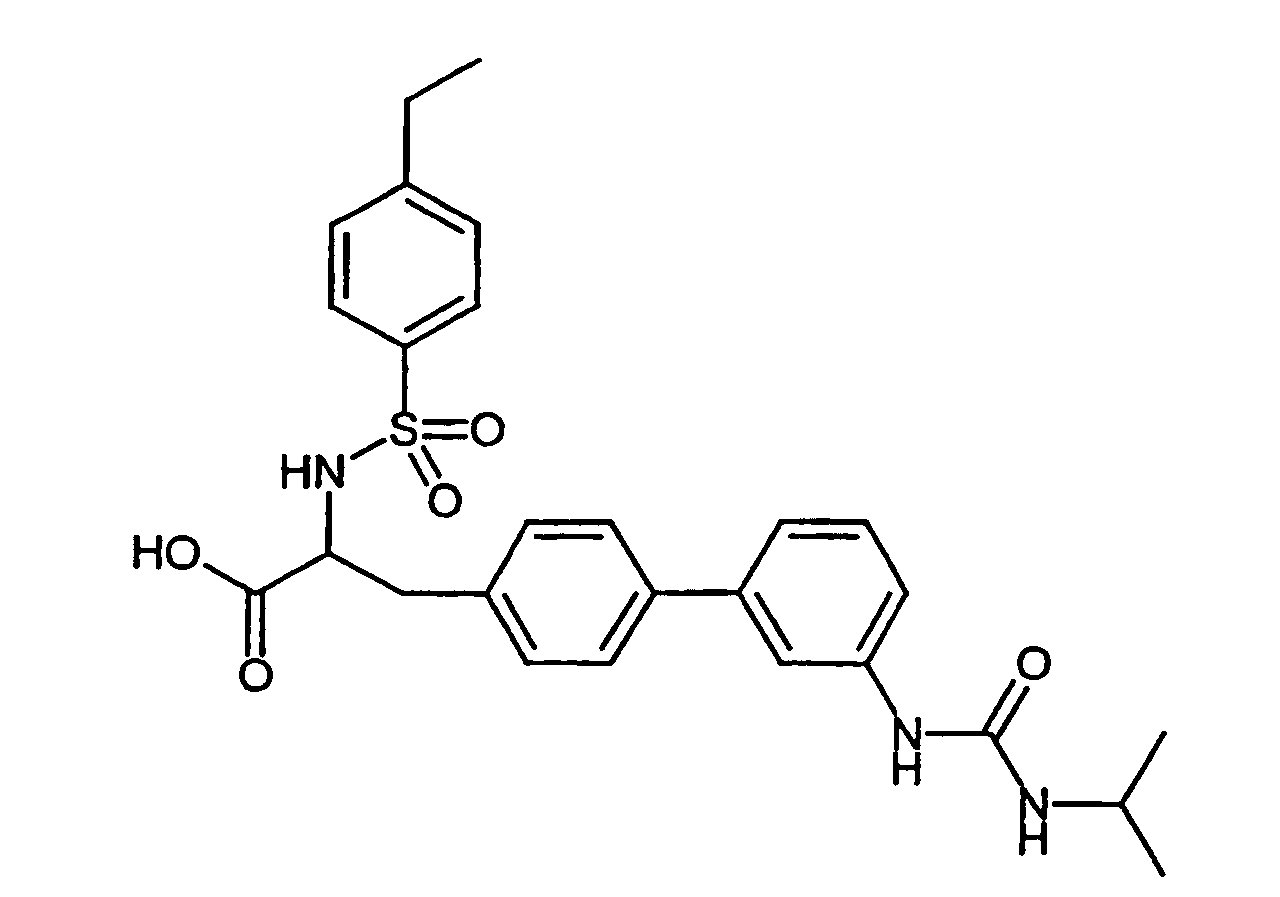
- (2R,S)-3-[3'-(3-iso-Propyl-ureido)-biphenyl-3-yl]-2-(4-ethyl-benzenesulfonyl-amino)-propanoic acid is prepared according to the procedure of example 1.1, with the exception that 4-methylbenzenesulfonyl chloride is used as a sulfonylating reagent instead of 2,4,6-trimethylbenzenesulfonyl chloride and isopropylamine is used as an amine reagent instead of propylamine.
Mass spectrometry (ESI): 510.
Retention time (HPLC): Rt = 10,1
1H-NMR (400 MHz, methanol) δ = 7,97 - 7,12 (m, 12H), 4,03 (dd, 1H, J = 5,2 Hz, J = 9,2 Hz, H-2), 3,91 (m, 1H, J = 6,8 Hz), 3,09 (dd, 1H, J = 5,0 Hz, J = 13,8 Hz, H-3a), 2,85 (dd, 1H, J = 9,2 Hz, J = 13,8 Hz, H-3b), 2,54 (q, 2H, J = 7,8 Hz), 1,19 (d, 6H, J = 6,6 Hz), 1,12 (t, 3H, J = 7,8 Hz). -

- (2R,S)-3-[3'-(3-Pyridin-4-yl-ureido)-4'-methyl-biphenyl-4-yl]-2-(2-chloro-benzenesulfonylamino)-propanoic acid is prepared according to the procedure of example 1.1, with the exception that 2-chlorobenzenesulfonyl chloride is used as a sulfonylating reagent instead of 2,4,6-trimethylbenzenesulfonyl chloride, 4-methyl-3-nitrobenzeneboronic acid is used as a boronic acid reagent instead of 3-nitrobenzeneboronic acid and 4-aminopyridine is used as an amine reagent instead of propylamine.
Mass spectrometry (ESI): 566.
Retention time (HPLC): Rt = 7,9
1H-NMR (400 MHz, methanol) δ = 8,48 (d, 2H), 7,96 (m, 3H), 7,82 (d, 1H), 7,33 - 7,27 (m, 7H), 7,17 (d, 2H), 4,09 (dd, 1H, J = 4,6 Hz, J = 9,8 Hz, H-2), 3,15 (dd, 1H, J = 4,6 Hz, J = 14,0 Hz, H-3a), 2,87 (dd, 1H, J = 9,8 Hz, J = 14,0 Hz, H-3b), 2,38 (s, 3H). -

- (2R,S)-3-[3'-(3-Pyridin-3-yl-ureido)-4'-methyl-biphenyl-4-yl]-2-(2,4,6-trimethyl-benzenesulfonylamino)-propanoic acid is prepared according to the procedure of example 1.1, with the exception that 4-methyl-3-nitrobenzeneboronic acid is used as a boronic acid reagent instead of 3-nitrobenzeneboronic acid and 3-aminopyridine is used as an amine reagent instead of propylamine.
Mass spectrometry (ESI): 573.
Retention time (HPLC): Rt = 8,6
1H-NMR (400 MHz, methanol) δ = 9,22 (s, 1H), 8,41 (s, 1H), 8,30 (d, 1H), 7,97 (s, 1H), 7,84 (m, 1H), 7,32 (m, 4H), 7,06 (d, 2H), 6,80 (s, 2H), 3,92 (dd, 1H, J = 4,6 Hz, J = 10,2 Hz, H-2), 3,10 (dd, 1H, J = 4,6 Hz, J = 14,0 Hz, H-3a), 2,79 (dd, 1H, J = 10,2 Hz, J = 14,0 Hz, H-3b), 2,42 (s, 6H), 2,37 (s; 3H), 2,07 (s, 3H). -

- (2R,S)-3-[3'-(3-Pyridin-3-ylmethyl-ureido)-4'-methyl-biphenyl-4-yl]-2-(2-chloro-benzenesulfonylamino)-propanoic acid is prepared according to the procedure of example 1.1, with the exception that 2-chlorobenzenesulfonyl chloride is used as a sulfonylating reagent instead of 2,4,6-trimethylbenzenesulfonyl chloride, 4-methyl-3-nitrobenzeneboronic acid is used as a boronic acid reagent instead of 3-nitrobenzeneboronic acid and 3-aminomethylpyridine is used as an amine reagent instead of propylamine.
Mass spectrometry (ESI): 580.
Retention time (HPLC): Rt = 7,4
1H-NMR (400 MHz, methanol) δ = 8,73 (s, 1H), 8,62 (s, 1H), 8,37 (d, 1H), 7,87 (m, 1H), 7,82 (m, 2H), 7,38 - 7,22 (m, 7H), 7,13 (d, 2H), 4,58 (s, 2H), 4,09 (dd, 1H, J = 4,6 Hz, J = 9,8 Hz, H-2), 3,14 (dd, 1H, J = 4,6 Hz, J = 14,0 Hz, H-3a), 2,86 (dd, 1H, J = 9,8 Hz, J = 14,0 Hz, H-3b), 2,29 (s, 3H). -
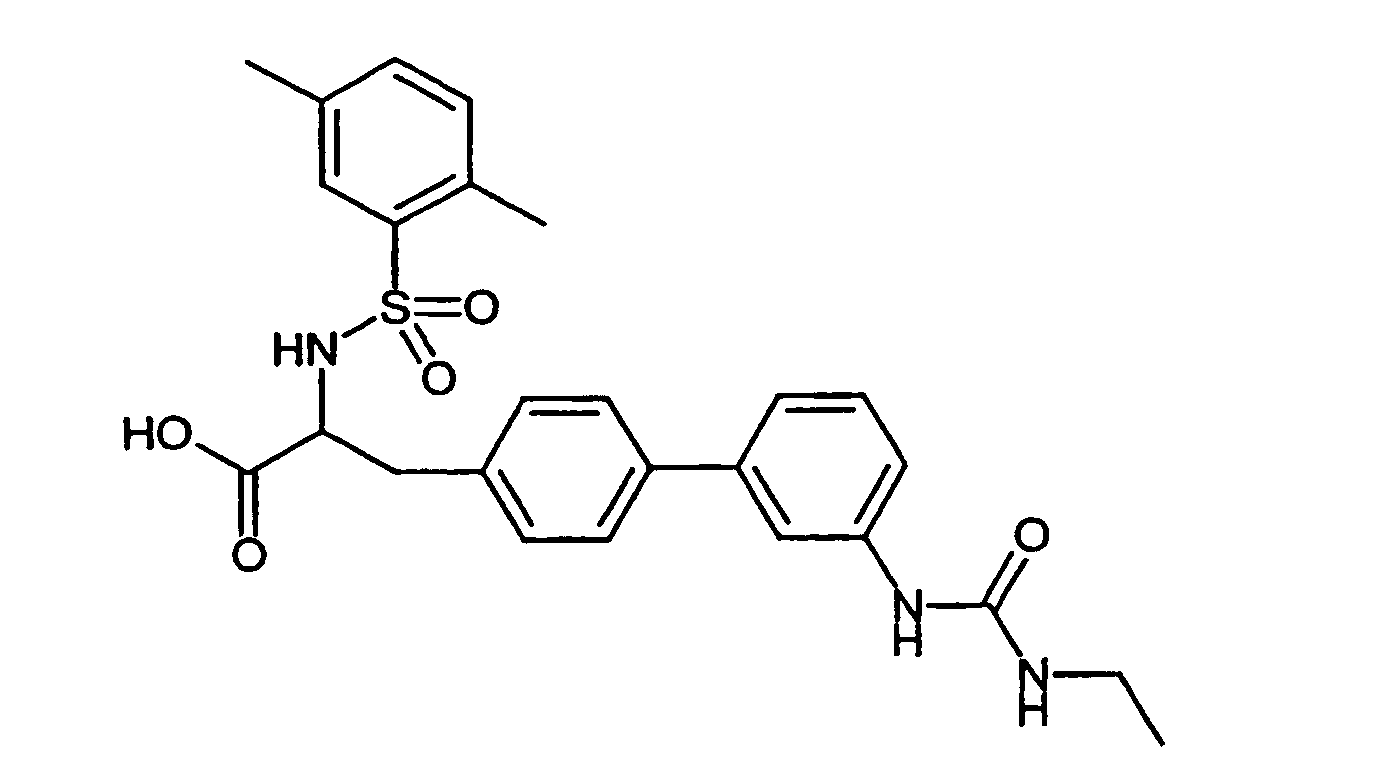
- (2R,S)-3-[3'-(3-Ethyl-ureido)-biphenyl-3-yl]-2-(2,5-dimethyl-benzenesulfonylamino)-propanoic acid is prepared according to the procedure of example 1.1, with the exception that 2,5-dimethylbenzenesulfonyl chloride is used as a sulfonylating reagent instead of 2,4,6-trimethylbenzenesulfonyl chloride and ethylamine is used as an amine reagent instead of propylamine.
Mass spectrometry (ESI): 496.
Retention time (HPLC): Rt = 9,4
1H-NMR (400 MHz, methanol) δ = 7,70 - 6,95 (m, 11H), 3,95 (dd, 1H, J = 4,8 Hz, J = 10,0 Hz, H-2), 3,25 (q, 2H, J = 7,4 Hz), 3,09 (dd, 1H, J = 4,8 Hz, J = 14,0 Hz, H-3a), 2,82 (dd, 1H, J = 10,0 Hz, J = 13,8 Hz, H-3b), 2,30 (s, 3H), 2,29 (s, 3H), 1,17 (t, 3H, J = 7,4 Hz). -
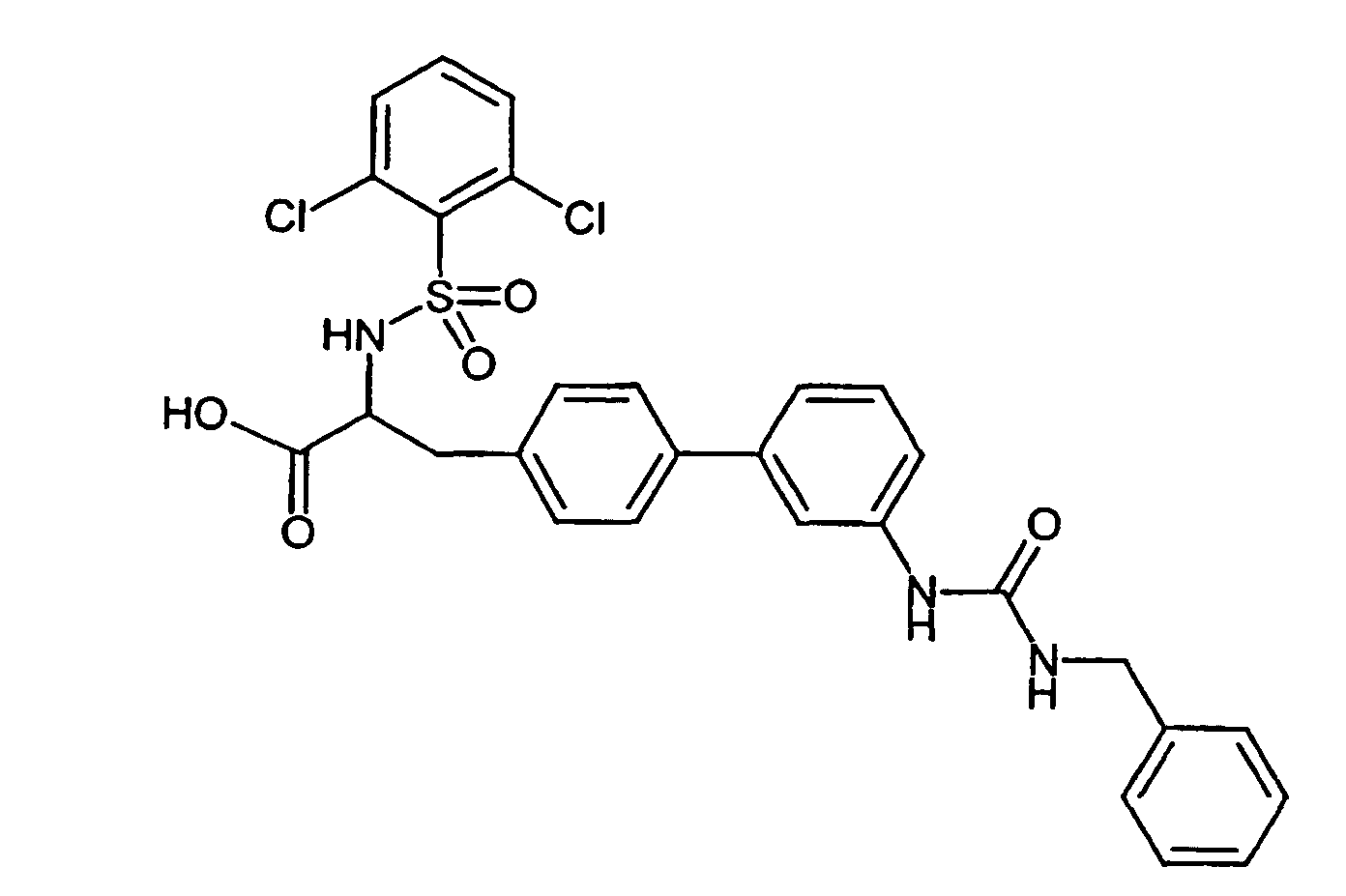
- (2R,S)-3-[3'-(3-Benzyl-weido)-biphenyl-3-yl]-2-(2,6-dichloro-benzenesulfonylamino)-propanoic acid is prepared according to the procedure of example 1.1, with the exception that 2,6-dichlorobenzenesulfonyl chloride is used as a sulfonylating reagent instead of 2,4,6-trimethylbenzenesulfonyl chloride and benzylamine is used as an amine reagent instead of propylamine.
Mass spectrometry (ESI): 599.
Retention time (HPLC): Rt = 10,5
1H-NMR (400 MHz, methanol) δ = 7,69 - 7,07 (m, 16H), 4,42 (s, 2H), 4,28 (dd, 1H, J = 4,2 Hz, J = 10,8 Hz, H-2), 3,20 (dd, 1H, J = 4,2 Hz, J = 14,0 Hz, H-3a), 2,83 (dd, 1H, J = 10,8 Hz, J = 14,9 Hz, H-3b). -
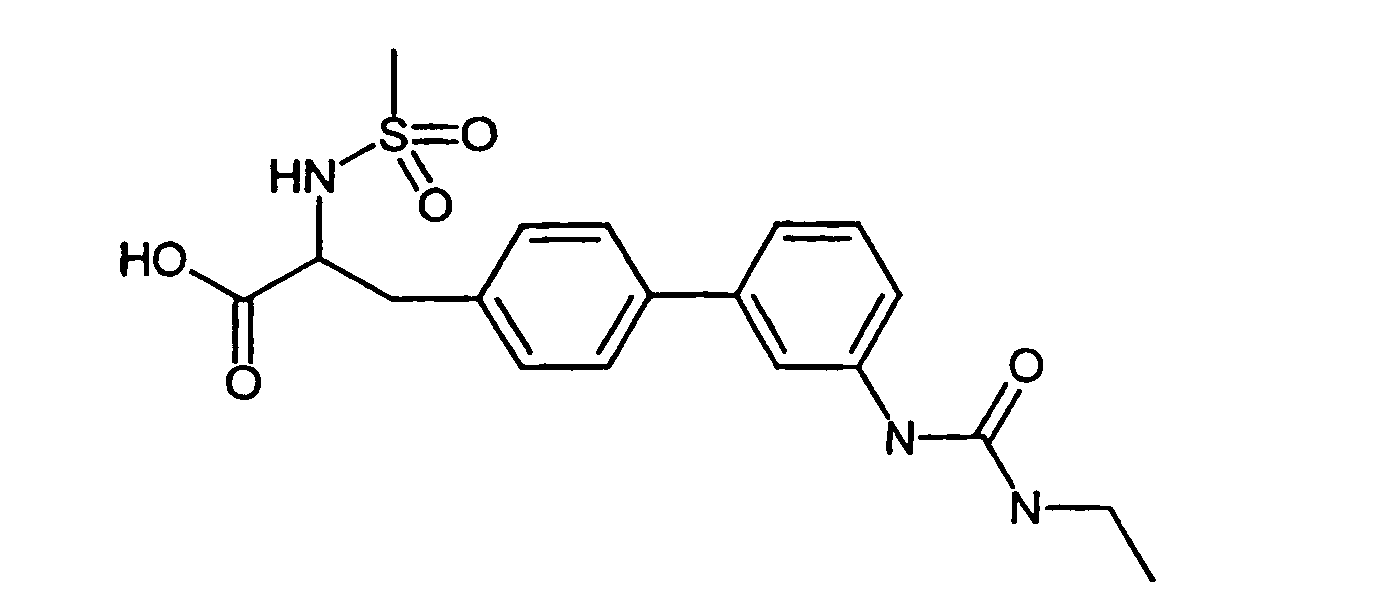
- (2R,S)-3-[3'-(3-Ethyl-ureido)-biphenyl-3-yl]-2-methylsulfonylamino-propanoic acid is prepared according to the procedure of example 1.1, with the exception that methylsulfonyl chloride is used as a sulfonylating reagent instead of 2,4,6-trimethylbenzenesulfonyl chloride and ethylamine is used as an amine reagent instead of propylamine.
Mass spectrometry (ESI): 406.
Retention time (HPLC): Rt = 6,8
1H-NMR (400 MHz, methanol) δ = 7,67 (s, 1H), 7,56 (d, 2H), 7,35 (d, 2H), 7,28 (m, 2H), 7,20 (d, 1H), 4,27 (dd, 1H, J = 5,0 Hz, J = 8,8 Hz, H-2), 3,23 (q, 2H, J = 7,4 Hz), 3,21 (dd, 1H, J = 5,0 Hz, J = 14,0 Hz, H-3a), 2,96 (dd, 1H, J = 9,0 Hz, J = 14,0 z, H-3b), 1,16 (t, 3H, J = 7,0 Hz). -

- (2R,S)-3-{3'-[3-(2-Methyl-butyl)-ureido]-biphenyl-4-yl}-2-(2,6-dichloro-benzenesulfonylamino)-propanoic acid is prepared according to the procedure of example 1.1, with the exception that 2,6-dichlorobenzenesulfonyl chloride is used as a sulfonylating reagent instead of 2,4,6-trimethylbenzenesulfonyl chloride and 2-methylbutylamine is used as an amine reagent instead of propylamine.
Mass spectrometry (ESI):
Retention time (HPLC): Rt= 10,9
1H-NMR (400 MHz, methanol) δ = 7,64 (s, 1H), 7,35 - 7,09 (m, 10H), 4,29 (dd, 1H, J = 4,2 Hz, J = 10,8 Hz, H-2), 3,20 (dd, 1H, J = 4,4 Hz, J = 14,0 Hz, H-3a), 3,18 (dd, 1H, J = 6,2 Hz, J = 15,4 Hz), 3,05 (dd, 1H, J = 7,0 Hz, J = 15,4 Hz), 2,84 (dd, 1H, J = 10,8 Hz, J = 14,0 Hz, H-3b), 1,58 (m, 1H), 1,48 (m, 1H), 1,21 (m, 1H), 0,96 (t, 3H, J = 7,4 Hz), 0,96 (d, 3H, J = 6,8 Hz). -

- (2S)-3-[3'-(3-Pyridin-4-yl-ureido)-biphenyl-4-yl]-2-[(S)-campher-10-yl-sulfonylamino]-propanoic acid is prepared according to the procedure of example 1.1, with the exception that (2S)-3-(4-bromophenyl)-2-(9-fluorenylmethoxycarbonylamino)-propanoic acid is used as an acid reagent instead of (2R,S)-3-(4-bromophenyl)-2-(9-fluorenylmethoxycarbonylamino)-propanoic acid, (S)-(+)-campher-10-sulfonyl chloride is used as a sulfonylating reagent instead of 2,4,6-trimethylbenzenesulfonyl chloride and 4-aminopyridine is used as an amine reagent instead of propylamine.
Mass spectrometry (ESI): 577.
Retention time (HPLC): Rt = 7,9
1H-NMR (400 MHz, methanol) δ = 7,49 (d, 2H), 8,03 (d, 2H), 7,81 (s, 1H), 7,59 (d, 2H), 7,48 - 7,32 (m, 5H), 4,33 (dd, 1H, J = 4,8 Hz, J = 9,4 Hz, H-2), 3,26 (dd, 1H, J = 4,8 Hz, H-3a), 3,06 (d, 1H, J = 15,2 Hz), 2,95 (dd, 1H, J = 9,4 Hz, J = 14,0 Hz, H-3b), 2,68 (d, 1H, J = 15,2 Hz), 2,29 (m, 1H), 2,22 (m, 1H), 1,98 (m, 2H), 1,85 (d, 1H, J = 18,8 Hz), 1,60 (m, 1H), 1,36 (m, 1H), 0,93 (s, 3H), 0,68 (s, 3H). -
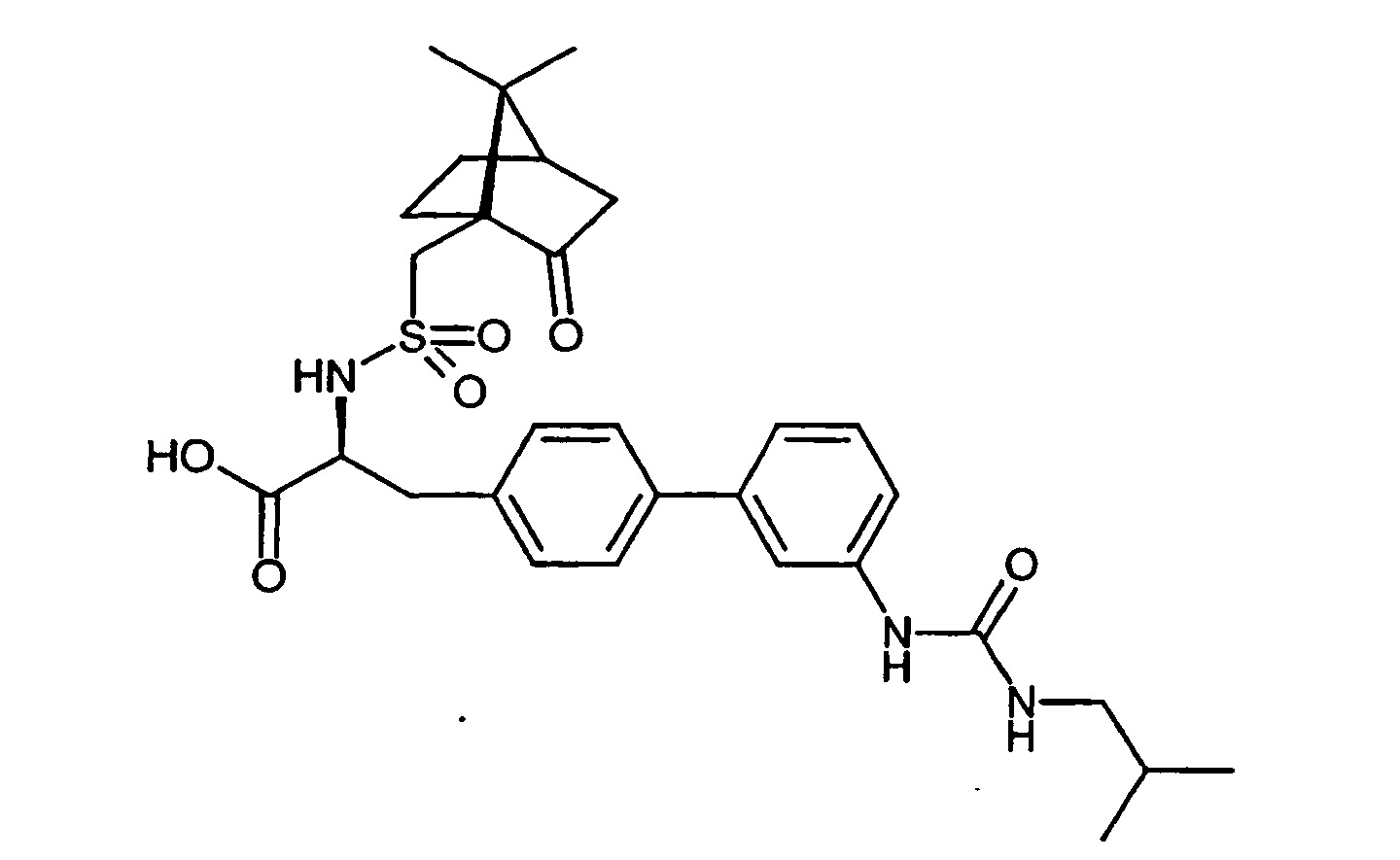
- (2S)-3-[3'-(3-iso-Butyl-ureido)-biphenyl-4-yl]-2-[(S)-campher-10-yl-sulfonylamino]-propanoic acid is prepared according to the procedure of example 1.1, with the exception that (2S)-3-(4-bromophenyl)-2-(9-fluorenylmethoxycarbonylamino)-propanoic acid is used as an acid reagent instead of (2R,S)-3-(4-bromophenyl)-2-(9-fluorenylmethoxycarbonylamino)-propanoic acid, (S)-(+)-campher-10-sulfonyl chloride is used as a sulfonylating reagent instead of 2,4,6-trimethylbenzenesulfonyl chloride and iso-butylamine is used as an amine reagent instead of propylamine.
Mass spectrometry (ESI): 570.
Retention time (HPLC): Rt = 10,0
1H-NMR (400 MHz, methanol) δ = 7,64 (s, 1H,1H'), 7,56 (d, 2H, 2H'), 7,38 (d, 2H, 2H'), 7,29 (m, 2H, 2H'), 7,20 (m, 1H, 1H'), 4,33 (dd, 1H), 4,30 (dd, 1H'), 3,24 (d, 1H), 3,23 (d, 1H'), 3,15 (d, 1H), 3,05 (d, 1H'), 3,03 (d, 2H, 2H'), 2,95 (dd, 1H), 2,93 (dd, 1H'), 2,66 (d, 1H), 2,46 (d, 1H'), 2,25 (m, 2H, 2H'), 1,97 (m, 2H, 2H'), 1,84 (d, 1H), 1,83 (d, 1H'), 1,78 (m, 1H, 1H'), 1,59 (m, 1H), 1,50 (m, 1H'), 1,35 (m, 2H, 2H'), 0,95 (d, 6H, 6H'), 0,94 (s, 3H), 0,92 (s, 3H'), 0,67 (s, 3H), 0,64 (s, 3H'). -
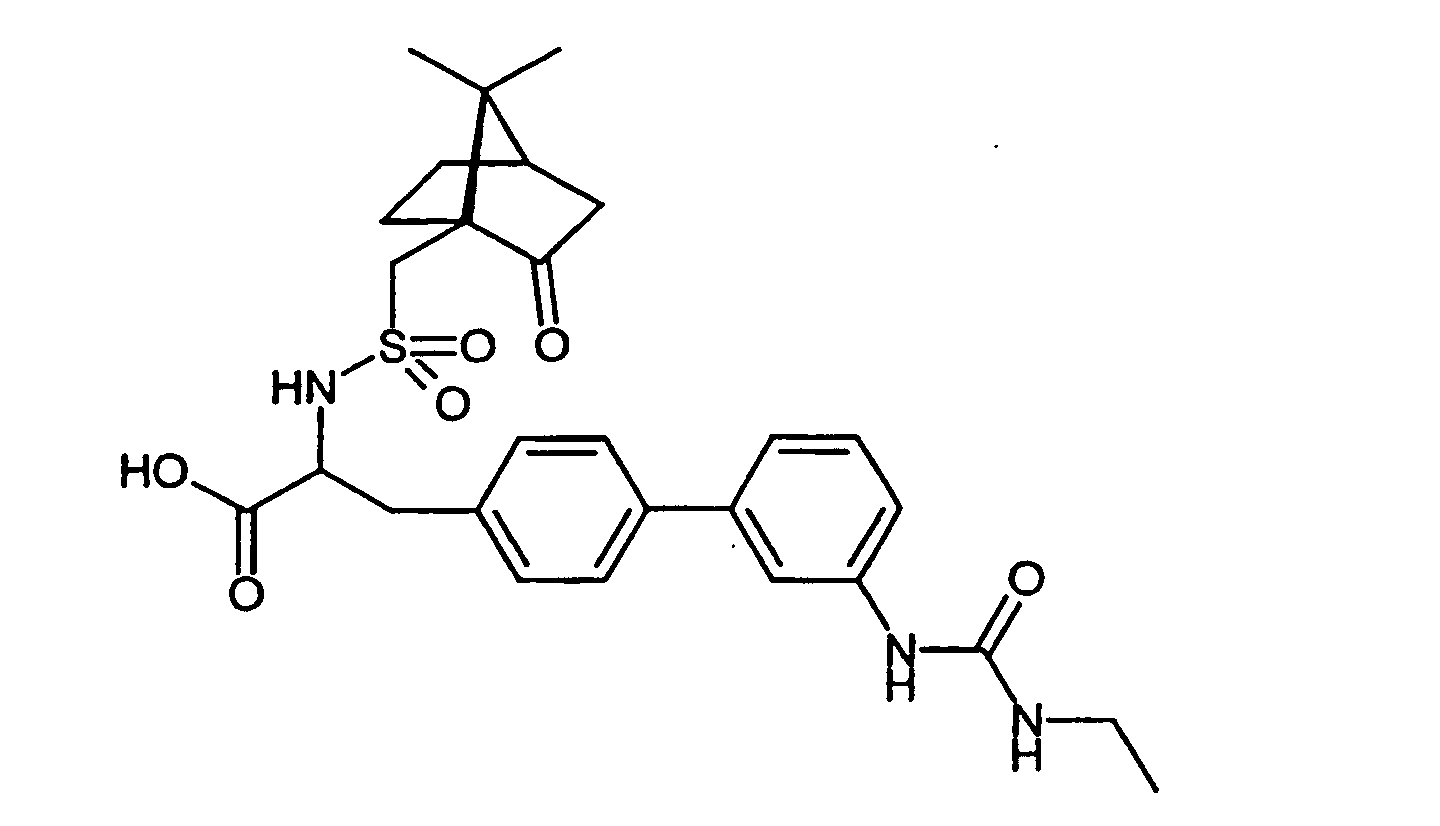
- (2R,S)-3-[3'-(3-Ethyl-ureido)-biphenyl-4-yl]-2-[(S)-campher-10-yl-sulfonylamino]-propanoic acid is prepared according to the procedure of example 1.1, with the exception that (S)-(+)-campher-10-sulfonyl chloride is used as a sulfonylating reagent instead of 2,4,6-trimethylbenzenesulfonyl chloride and ethylamine is used as an amine reagent instead of propylamine.
Mass spectrometry (ESI): 542.
Retention time (HPLC): Rt = 8,9
1H-NMR (400 MHz, methanol) δ = 7,64 (s, 1H, 1H'), 7,56 (d, 2H, 2H'), 7,38 (d, 2H, 2H'), 7,29 (d, 2H, 2H'), 7,20 (m, 1H, 1H'), 4,32 (dd, 1H), 4,31 (dd, 1H'), 3,23 (m, 3H, 3H'), 3,15 (d, 1H), 3,04 (d, 1H'), 2,95 (dd, 1H), 2,92 (d, 1H'), 2,66 (d, 1H), 2,47 (d, 1H'), 2,25 (m, 2H, 2H'), 1,97 (m, 2H, 2H'), 1,84 (d, 1H), 1,83 (d, 1H'), 1,60 (m, 1H), 1,50 (m, 1H'), 1,34 (m, 1H, 1H'), 1,15 (t, 3H, 3H'), 0,94 (s, 3H), 0,92 (s, 3H'), 0,67 (s, 3H), 0,64 (s, 3H'). -

- (2R,S)-3-[3'-(3-Pyridin-4-yl-ureido)-biphenyl-4-yl]-2-ethyloxycarbonylamino-propanoic acid is prepared according to the procedure of example 1.1, with the exception that ethyl chloroformate is used as a carbamoylating reagent instead of 2,4,6-trimethylbenzenesulfonyl chloride as a sulfonylating reagent and 4-aminopyridine is used as an amine reagent instead of propylamine.
Mass spectrometry (ESI): 449. Rt = 6,4
1H-NMR (400 MHz, methanol) δ = 8,47 (d, 2H), 7,92 (d, 2H), 7,77 (s, 1H), 7,55 (d, 2H), 7,45 (m, 1H), 7,40 (dd, 1H), 7,35 (m, 1H), 7,33 (d, 2H), 4,43 (dd, 1H, J = 4,8 Hz, J = 9,0 Hz, H-2), 4,03 (q, 2H, J = 7,0 Hz), 3,24 (dd, 1H, J = 4,8 Hz, J = 14,0 Hz, H-3a), 2,98 (dd, 1H, J = 9,0 Hz, J = 14,0 Hz, H-3b), 1,19 (t, 3H, J = 7,0 Hz). -

- (2S)-3-[3'-(3-Propyl-ureido)-biphenyl-4-yl]-2-ureido-propanoic acid is prepared according to the procedure of example 1.1, with the exception that 4-nitrophenyl chloroformate and 2,4-dimethoxybenzylamine were used as urea forming reagent instead of 2,4,6-trimethylbenzenesulfonyl chloride as a sulfonylating reagent.
Mass spectrometry (ESI): 385.
Retention time (HPLC): Rt = 6,4
1H-NMR (400 MHz, methanol) δ = 7,63 (s, 1H), 7,53 (d, 2H), 7,30 (m, 4H), 7,21 (m, 1H), 4,54 (m, 1H, H-2), 3,19 (t, 2H, J = 7,2 Hz), 3,16 (m, 1H, H-3a), 3,06 (dd, 1H, J = 7,0 Hz, J = 13,8 Hz, H-3b), 1,58 (m, 2H), 0,98 (t, 3H, 7,0 Hz). -
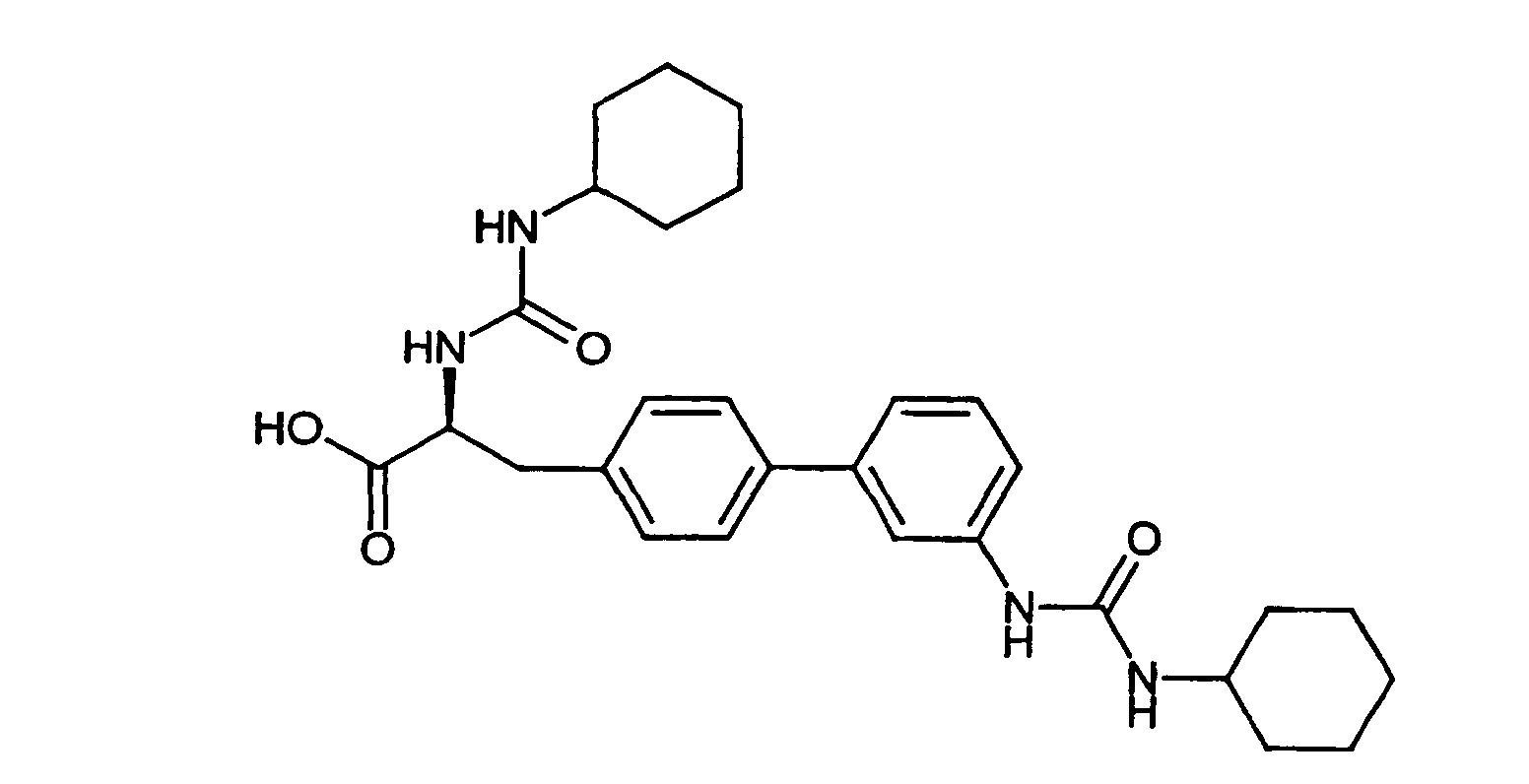
- (2R,S)-3-[3'-(3-Cyclohexyl-ureido)-biphenyl-4-yl]-2-(3-cyclohexyl-ureido)-propanoic acid is prepared according to the procedure of example 1.1, with the exception that 4-nitrophenyl chloroformate and cylohexylamine were used as urea forming reagent instead of 2,4,6-trimethylbenzenesulfonyl chloride as a sulfonylating reagent and cyclohexylamine is used as an amine reagent instead of propylamine.
Mass spectrometry (ESI): 507.
Retention time (HPLC): Rt = 10,6
1H-NMR (400 MHz, methanol) δ = 7,65 (s, 1H), 7,52 (d, 2H), 7,27 (m, 4H), 7,19 (m, 1H), 4,58 (dd, 1H, J = 5,0 Hz, J = 7,4 Hz, H-2), 3,58 (m, 1H), 3,42 (m, 1H), 3,17 (dd, 1H, J = 5,0 Hz, J = 14,0 Hz, H-3a), 3,02 (dd, 1H, J = 7,4 Hz, J = 14,0 Hz, H-3b), 2,02 - 1,05 (m, 20H). -
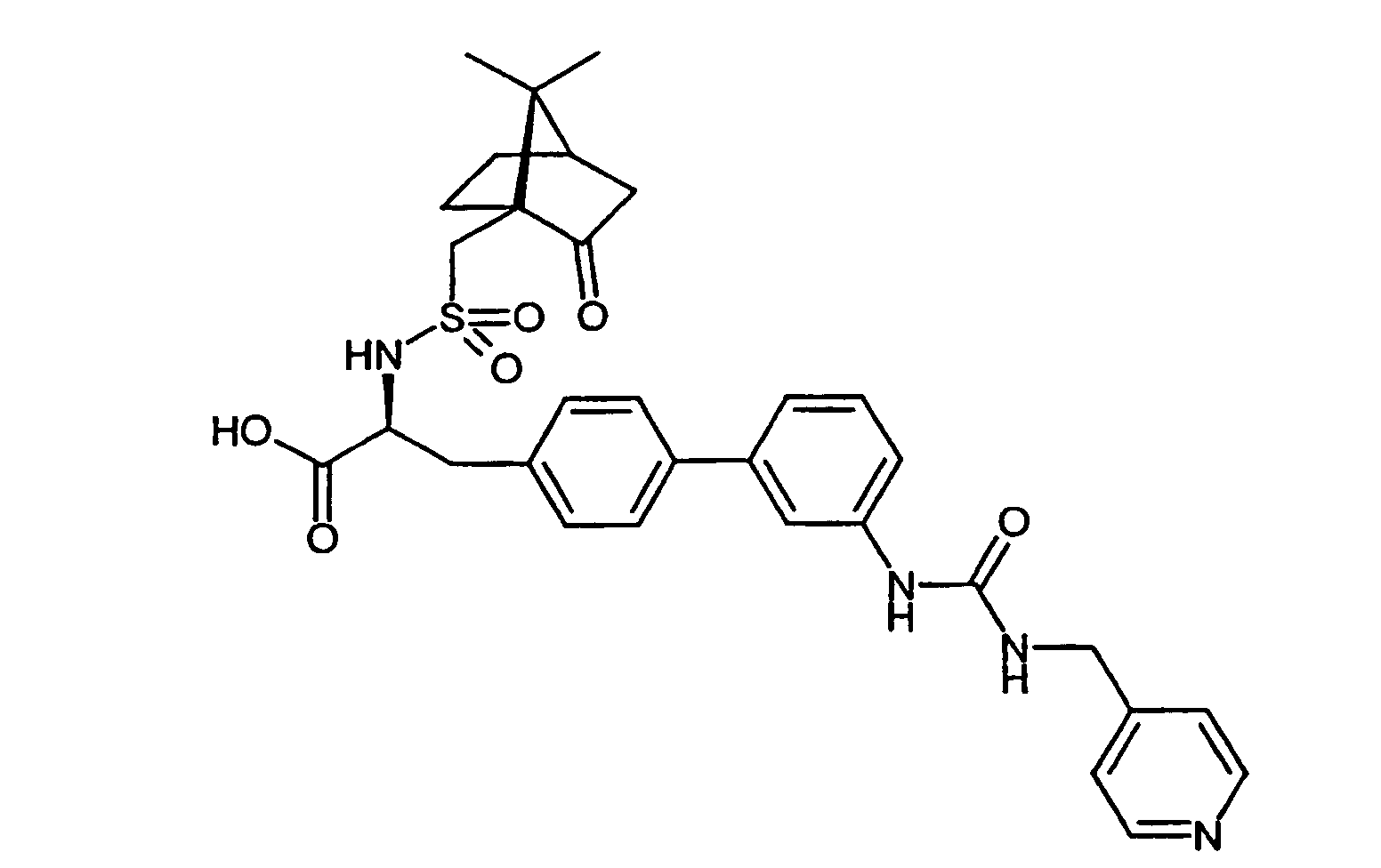
- (2S)-3-[3'-(3-Pyridin-4-ylmethyl-ureido)-biphenyl-4-yl]-2-[(S)-campher-10-yl-sulfonylamino]-propanoic acid acid is prepared according to the procedure of example 1.1, with the exception that (2S)-3-(4-bromophenyl)-2-(9-fluorenylmethoxycarbonylamino)-propanoic acid is used as an acid reagent instead of (2R,S)-3-(4-bromophenyl)-2-(9-fluorenylmethoxycarbonylamino)-propanoic acid, (S)-(+)-campher-10-sulfonyl chloride is used as a sulfonylating reagent instead of 2,4,6-trimethylbenzenesulfonyl chloride and 4-aminomethylpyridine is used as an amine reagent instead of propylamine.
Mass spectrometry (ESI): 605.
Retention time (HPLC): Rt = 7,0
1H-NMR (400 MHz, methanol) δ = 8,74 (d, 2H), 8,02 (d, 2H), 7,69 (s, 1H), 7,57 (d, 2H), 7,39 (d, 2H), 7,31 (m, 2H), 7,25 (m, 1H), 4,68 (s, 2H), 4,32 (dd, 1H, H-2), 3,22 (dd, 1H, H-3a), 3,06 (d, 1H), 2,93 (dd, 1H, H-3b), 2,69 (d, 1H), 2,28 (m, 1H), 2,20 (m, 1H), 2,01 (m, 1H), 1,95 (m, 1H), 1,83 (d, 1H), 1,59 (ddd, 1H), 1,39 (m, 1H), 0,92 (s, 3H), 0,68 (s, 3H). -

- (2S)-3-[3'-(3-Pyridin-2-yl-ureido)-biphenyl-4-yl]-2-[(S)-campher-10-yl-sulfonylamino]-propanoic acid is prepared according to the procedure of example 1.1, with the exception that (2S)-3-(4-bromophenyl)-2-(9-fluorenylmethoxycarbonylamino)-propanoic acid is used as an acid reagent instead of (2R,S)-3-(4-bromophenyl)-2-(9-fluorenylmethoxycarbonylamino)-propanoic acid, (S)-(+)-campher-10-sulfonyl chloride is used as a sulfonylating reagent instead of 2,4,6-trimethylbenzenesulfonyl chloride and 2-aminopyridine is used as an amine reagent instead of propylamine.
Mass spectrometry (ESI): 591.
Retention time (HPLC): Rt = 8,2
1H-NMR (400 MHz, methanol) δ = 8,29 (d, 1H), 8,03 (dd, 1H), 7,82 (s, 1H), 7,61 (d, 2H), 7,49 (m, 1H), 7,42 - 7,29 (m, 5H), 7,22 (dd, 1H), 4,32 (dd, 1H, H-2), 3,26 (dd, 1H, H-3a), 3,06 (d, 1H), 2,93 (dd, 1H, H-3b), 2,68 (d, 1H), 2,28 (m, 1H), 2,22 (m, 1H), 2,01 (m, 1H), 1,94 (m, 1H), 1,83 (d, 1H), 1,59 (ddd, 1H), 1,36 (m, 1H), 0,93 (s, 3H), 0,68 (s, 3H). -

- (2S)-3-[3'-(3-Methyl-ureido)-biphenyl-4-yl]-2-[(S)-campher-10-yl-sulfonylamino]-propanoic acid is prepared according to the procedure of example 1.1, with the exception that (2S)-3-(4-bromophenyl)-2-(9-fluorenylmethoxycarbonylamino)-propanoic acid is used as an acid reagent instead of (2R,S)-3-(4-bromophenyl)-2-(9-fluorenylmethoxycarbonylamino)-propanoic acid, (S)-(+)-campher-10-sulfonyl chloride is used as a sulfonylating reagent instead of 2,4,6-trimethylbenzenesulfonyl chloride and methylamine is used as an amine reagent instead of propylamine.
Mass spectrometry (ESI): 528.
Retention time (HPLC): Rt = 8,3
1H-NMR (400 MHz, methanol) δ = 7,63 (s, 1H), 7,57 (d, 2H), 7,38 (d, 2H), 7,29 (m, 2H), 7,20 (m, 1H), 4,32 (dd, 1H, H-2), 3,23 (dd, 1H, H-3a), 3,06 (d, 1H), 2,93 (dd, 1H, H-3b), 2,77 (s, 3H), 2,67 (d, 1H), 2,29 (m, 1H), 2,21 (m, 1H), 2,02 (m, 1H), 1,95 (m, 1H), 1,85 (d, 1H), 1,60 (ddd, 1H), 1,35 (m, 1H), 0,92 (s, 3H), 0,67 (s, 3H). -

- (2R,S)-3-[3'-(3-Phenyl-ureido)-biphenyl-4-yl]-2-[(S)-campher-10-yl-sulfonylamino]-propanoic acid is prepared according to the procedure of example 1.1, with the exception that (S)-(+)-campher-10-sulfonyl chloride is used as a sulfonylating reagent instead of 2,4,6-trimethylbenzenesulfonyl chloride and anilin is used as an amine reagent instead of propylamine.
Mass spectrometry (ESI): 590.
Retention time (HPLC): Rt = 10,5
1H-NMR (400 MHz, methanol) δ = 7,72 (s, 1H, 1H'), 7,59 (d, 2H, 2H'), 7,47 - 7,22 (m, 9H, 9H'), 7,01 (m, 1H, 1H'), 4,33 (dd, 1 H, H-2), 4,32 (dd, 1H', H'-2), 3,23 (dd, 1H, H-3a), 3,22 (dd, 1H', H'-3a), 3,16 (d, 1H), 3,05 (d, 1H'), 2,97 (dd, 1H, H-3b), 1,94 (dd, 1H', H'-3b), 2,67 (d, 1H), 2,48 (d, 1H'), 2,29 (m, 1H, 1H'), 2,21 (m, 1H, 1H'), 2,00 (m, 1H, 1H'), 1,94 (m, 1H, 1H'), 1,85 (d, 1H), 1,84 (d, 1H'), 1,60 (ddd, 1H), 1,50 (ddd, 1H'), 1,37 (m, 1H, 1H'), 0,93 (s, 3H), 0,91 (s, 3H'), 0,68 (s, 3H), 0,66 (s, 3H'). -
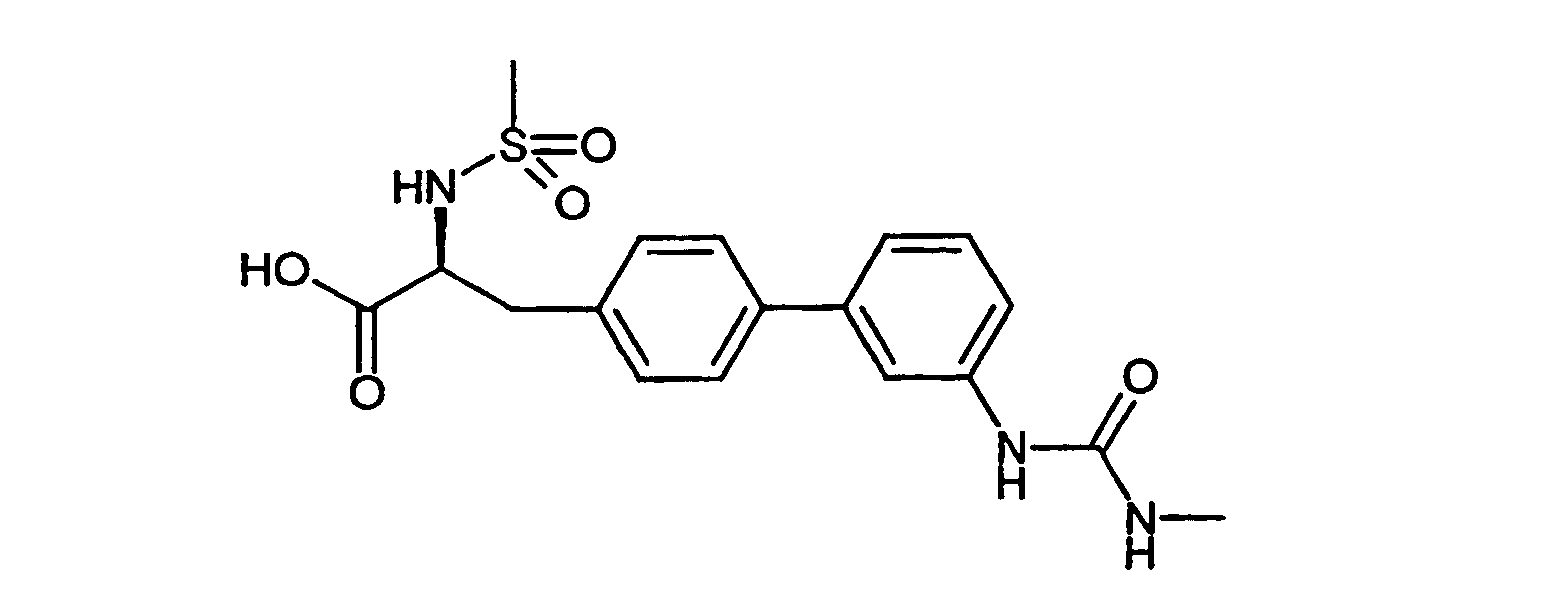
- (2S)-3-[3'-(3-Methyl-ureido)-biphenyl-4-yl]-2-methylsulfonylamino-propanoic acid is prepared according to the procedure of example 1.1, with the exception that (2S)-3-(4-bromophenyl)-2-(9-fluorenylmethoxycarbonylamino)-propanoic acid is used as an acid reagent instead of (2R,S)-3-(4-bromophenyl)-2-(9-fluorenylmethoxycarbonylamino)-propanoic acid, methylsulfonyl chloride is used as a sulfonylating reagent instead of 2,4,6-trimethylbenzenesulfonyl chloride and methylamine is used as an amine reagent instead of propylamine.
Mass spectrometry (ESI): 392.
Retention time (HPLC): Rt = 5,8
1H-NMR (400 MHz, methanol) δ = 7,68 (s, 1H), 7,57 (d, 2H), 7,36 (d, 2H), 7,28 (m, 2H), 7,20 (m, 1H), 4,28 (dd, 1H, H-2), 3,21 (dd, 1H, H-3a), 2,97 (dd, 1H, H-3b), 2,78 (s, 3H), 2,68 (s, 3H). -
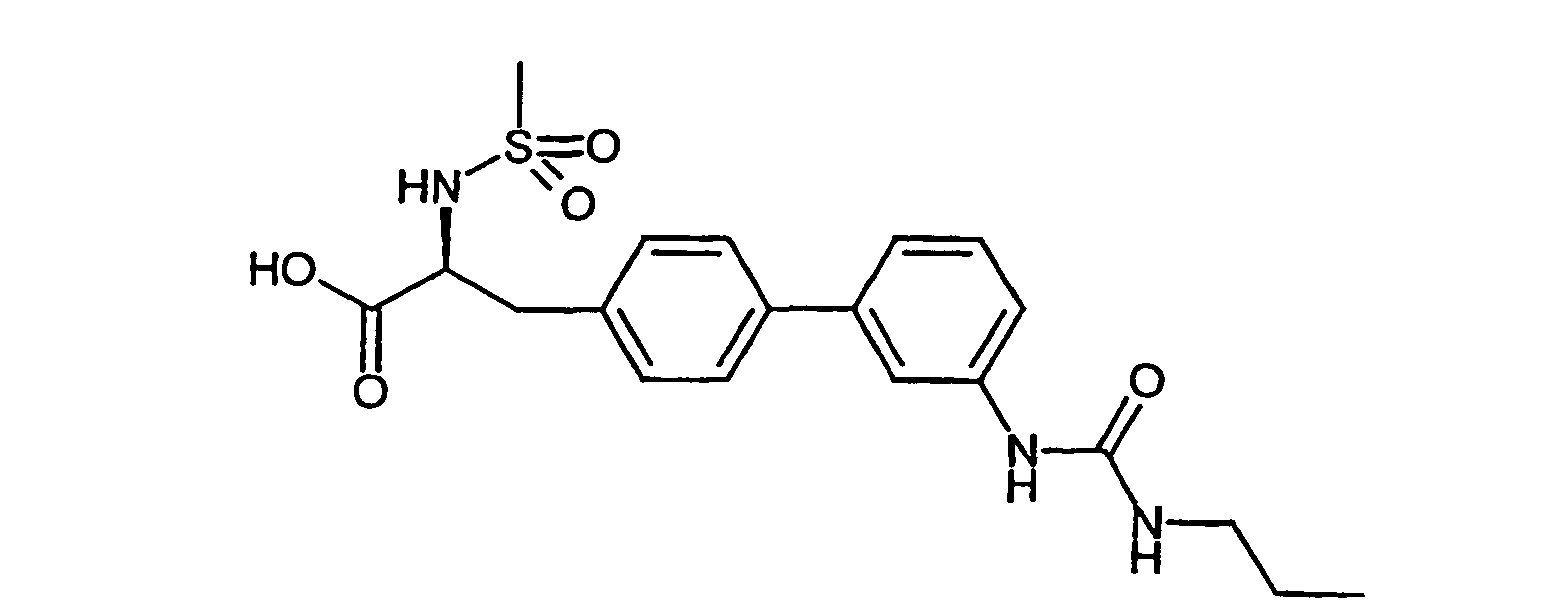
- (2S)-3-[3'-(3-Propyl-ureido)-biphenyl-4-yl]-2-methylsulfonylamino-propanoic acid is prepared according to the procedure of example 1.1, with the exception that (2S)-3-(4-bromophenyl)-2-(9-fluorenylmethoxycarbonylamino)-propanoic acid is used as an acid reagent instead of (2R,S)-3-(4-bromophenyl)-2-(9-fluorenylmethoxycarbonylamino)-propanoic acid, methylsulfonyl chloride is used as a sulfonylating reagent instead of 2,4,6-trimethylbenzenesulfonyl chloride.
Mass spectrometry (ESI): 420.
Retention time (HPLC): Rt = 7,1
1H-NMR (400 MHz, methanol) δ = 7,68 (s, 1H), 7,57 (d, 2H), 7,36 (d, 2H), 7,28 (m, 2H), 7,20 (m, 1H), 4,28 (dd, 1H, H-2), 3,21 (dd, 1H, H-3a), 3,17 (t, 2H), 2,97 (dd, 1H, H-3b), 2,68 (s, 3H), 1,56 (m, 2H), 0,97 (t, 3H). -
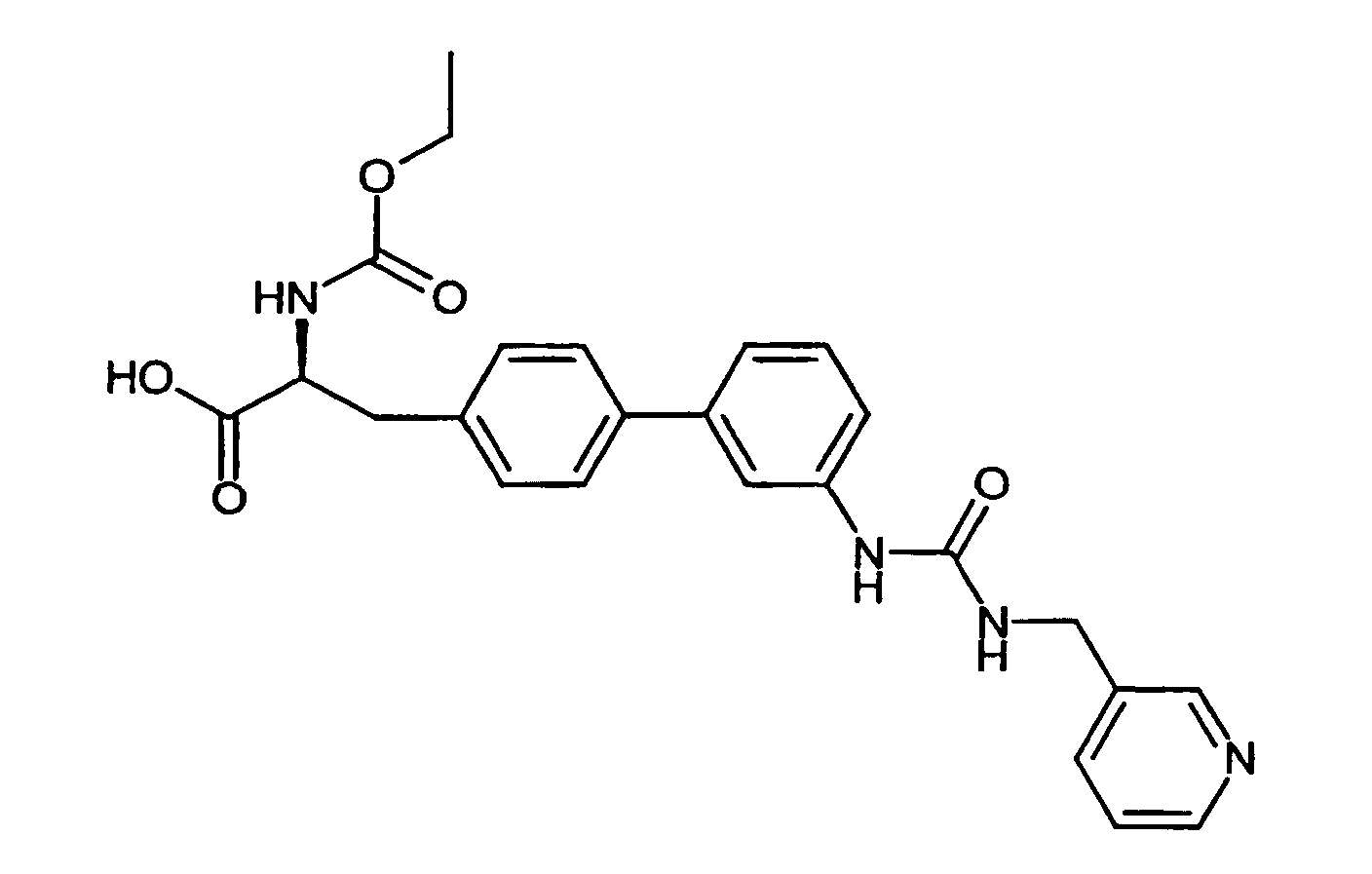
- (2S)-3-[3'-(3-Pyridin-3-ylmethyl-ureido)-biphenyl-4-yl]-2-ethyloxycarbonylamino-propanoic acid is prepared according to the procedure of example 1.1, with the exception that (2S)-3-(4-bromophenyl)-2-(9-fluorenylmethoxycarbonylamino)-propanoic acid is used as an acid reagent instead of (2R,S)-3-(4-bromophenyl)-2-(9-fluorenylmethoxycarbonylamino)-propanoic acid, ethyl chloroformate is used as a carbamoylating reagent instead of 2,4,6-trimethylbenzenesulfonyl chloride as a sulfonylating reagent and 3-aminomethylpyridine is used as an amine reagent instead of propylamine.
Mass spectrometry (ESI): 449.
Retention time (HPLC): Rt = 6,0
1H-NMR (400 MHz, methanol) δ = 8,78 (s, 1H), 8,67 (s, 1H), 8,48 (d, 1H), 7,96 (m, 1H), 7,68 (s, 1H), 7,52 (d, 2H), 7,30 (m, 4H), 7,23 (m, 1H), 4,57 (s, 2H), 4,41 (dd, 1H, H-2), 4,02 (q, 2H), 3,3 (dd, 1H, H-3a), 2,96 (dd, 1H, H-3b), 1,18 (t, 3H). -
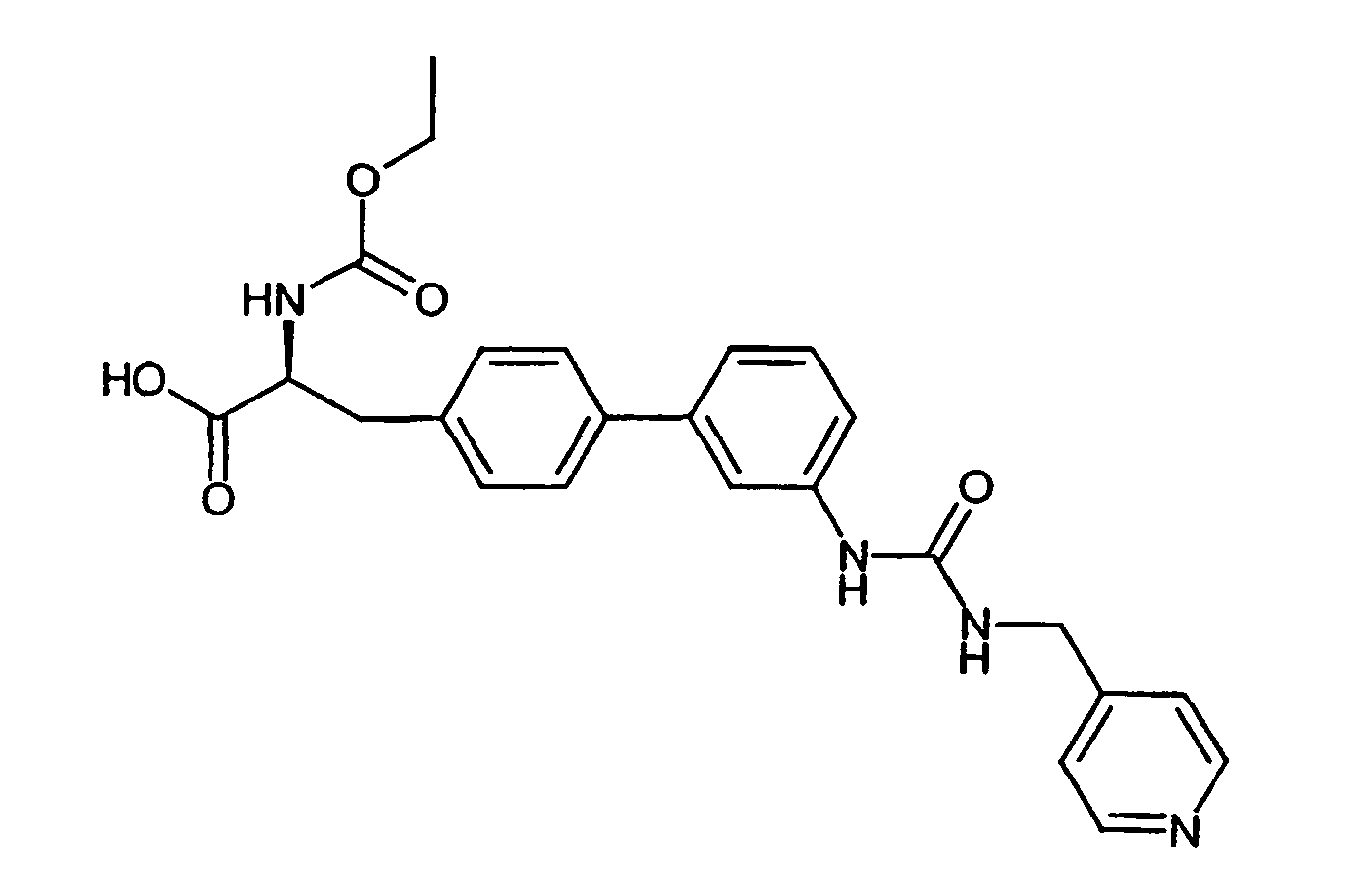
- (2S)-3-[3'-(3-Pyridin-4-ylmethyl-ureido)-biphenyl-4-yl]-2-ethyloxycarbonylamino-propanoic acid is prepared according to the procedure of example 1.1, with the exception that (2S)-3-(4-bromophenyl)-2-(9-fluorenylmethoxycarbonylamino)-propanoic acid is used as an acid reagent instead of (2R,S)-3-(4-bromophenyl)-2-(9-fluorenylmethoxycarbonylamino)-propanoic acid, ethyl chloroformate is used as a carbamoylating reagent instead of 2,4,6-trimethylbenzenesulfonyl chloride as a sulfonylating reagent and 4-aminomethylpyridine is used as an amine reagent instead of propylamine.
Mass spectrometry (ESI): 449.
Retention time (HPLC): Rt = 5,3
1H-NMR (400 MHz, methanol) δ = 8,72 (d, 2H), 7,95 (d, 2H), 7,67 (s, 1H), 7,50 (d, 2H), 7,34 - 7,21 (m, 5H), 4,64 (s, 2H), 4,42 (dd, 1H, H-2), 4,02 (q, 2H), 3,21 (dd, 1H, H-3a), 2,96 (dd, 1H, H-3b), 1,20 (t, 3H). -

- (2S)-3-[3'-(3-Propyl-ureido)-biphenyl-4-yl]-2-ethyloxycarbonylamino-propanoic acid is prepared according to the procedure of example 1.1, with the exception that (2S)-3-(4-bromophenyl)-2-(9-fluorenylmethoxycarbonylamino)-propanoic acid is used as an acid reagent instead of (2R,S)-3-(4-bromophenyl)-2-(9-fluorenylmethoxycarbonylamino)-propanoic acid and ethyl chloroformate is used as a carbamoylating reagent instead of 2,4,6-trimethylbenzenesulfonyl chloride as a sulfonylating reagent.
Mass spectrometry (ESI): 414.
Retention time (HPLC): Rt = 8,5
1H-NMR (400 MHz, methanol) δ = 7,65 (s, 1H), 7,54 (d, 2H), 7,31 (m, 4H), 7,20 (m, 1H), 4,42 (dd, 1H, H-2), 4,03 (q, 2H), 3,21 (dd, 1H, H-3a), 3,17 (t, 2H), 2,97 (dd, 1H, H-3b), 2,57 (m, 2H), 1,18 (t, 3H), 0,96 (t, 3H). -

- (2S)-3-[3'-(3-Methyl-ureido)-biphenyl-4-yl]-2-ethyloxycarbonylamino-propanoic acid is prepared according to the procedure of example 1.1, with the exception that (2S)-3-(4-bromophenyl)-2-(9-fluorenylmethoxycarbonylamino)-propanoic acid is used as an acid reagent instead of (2R,S)-3-(4-bromophenyl)-2-(9-fluorenylmethoxycarbonylamino)-propanoic acid, ethyl chloroformate is used as a carbamoylating reagent instead of 2,4,6-trimethylbenzenesulfonyl chloride as a sulfonylating reagent and methylamine is used as an amine reagent instead of propylamine.
Mass spectrometry (ESI): 386.
Retention time (HPLC): Rt = 6,7
1H-NMR (400 MHz, methanol) δ = 7,65 (s, 1H), 7,52 (d, 2H), 7,30 (m, 4H), 7,21 (m, 1H), 4,42 (dd, 1H, H-2), 4,02 (q, 2H), 3,21 (dd, 1H, H-3a), 3,17 (t, 2H), 2,96 (dd, 1H, H-3b), 2,78 (s, 3H), 1,18 (t, 3H). -
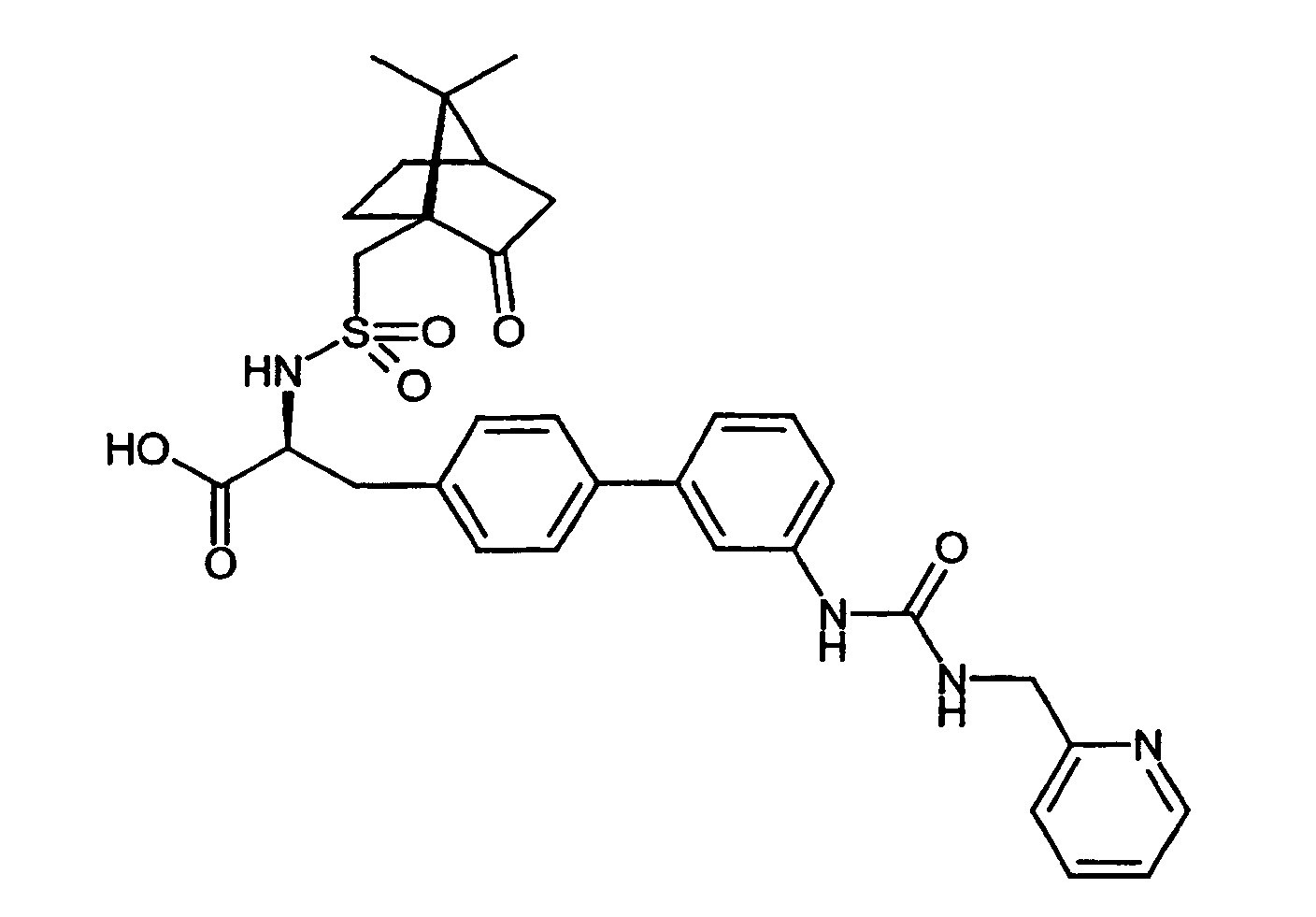
- (2S)-3-[3'-(3-Pyridin-2-yl-methyl-ureido)-biphenyl-4-yl]-2-[(S)-campher-10-yl-sulfonylamino]-propanoic acid is prepared according to the procedure of example 1.1, with the exception that (2S)-3-(4-bromophenyl)-2-(9-fluorenylmethoxycarbonylamino)-propanoic acid is used as an acid reagent instead of (2R,S)-3-(4-bromophenyl)-2-(9-fluorenylmethoxycarbonylamino)-propanoic acid, (S)-(+)-campher-10-sulfonyl chloride is used as a sulfonylating reagent instead of 2,4,6-trimethylbenzenesulfonyl chloride and 2-aminomethylpyridine is used as an amine reagent instead of propylamine.
Mass spectrometry (ESI): 605.
Retention time (HPLC): Rt = 6,9
1H-NMR (400 MHz, methanol) δ = 8,78 (s, 1H), 8,69 (s, 1H), 8,45 (d, 1H), 7,92 (dd, 1H), 7,67 (s, 1H), 7,54 (d, 2H), 7,38 (d, 2H), 7,29 (m, 2H), 7,23 (m, 1H), 4,58 (s, 2H), 4,32 (dd, 1H, H-2), 3,23 (dd, 1H, H-3a), 3,08 (d, 1H), 2,94 (dd, 1H, H-3b), 2,68 (d, 1H), 2,28 (m, 1H), 2,21 (m, 1H), 2,01 (m, 1H), 1,95 (m, 1H), 1,83 (d, 1H), 1,59 (ddd, 1H), 1,38 (m, 1H), 0,93 (s, 3H), 0,67 (s, 3H). -

- (2S)-3-[3'-(3-Pyridin-3-yl-methyl-ureido)-biphenyl-4-yl]-2-[(S)-campher-10-yl-sulfonylamino]-propanoic acid is prepared according to the procedure of example 1.1, with the exception that (2S)-3-(4-bromophenyl)-2-(9-fluorenylmethoxycarbonylamino)-propanoic acid is used as an acid reagent instead of (2R,S)-3-(4-bromophenyl)-2-(9-fluorenylmethoxycarbonylamino)-propanoic acid, (S)-(+)-campher-10-sulfonyl chloride is used as a sulfonylating reagent instead of 2,4,6-trimethylbenzenesulfonyl chloride and 3-aminomethylpyridine is used as an amine reagent instead of propylamine.
Mass spectrometry (ESI): 605.
Retention time (HPLC): Rt = 6,7
1H-NMR (400 MHz, methanol) δ = 8,67 (d, 1H), 8,38 (d, 1H), 7,90 (d, 1H), 7,78 (dd, 1H), 7,69 (s, 1H), 7,54 (d, 2H), 7,38 (d, 2H), 7,31 (m, 2H), 7,23 (m, 1H), 4,69 (s, 2H), 4,32 (dd, 1H, H-2), 3,23 (dd, 1H, H-3a), 3,08 (d, 1H), 2,94 (dd, 1H, H-3b), 2,68 (d, 1H), 2,28 (m, 1H), 2,21 (m, 1H), 2,01 (m, 1H), 1,95 (m, 1H), 1,83 (d, 1H), 1,59 (ddd, 1H), 1,38 (ddd, 1H), 0,93 (s, 3H), 0,67 (s, 3H). -

- (2S)-3-[3'-(3-Pyridin-4-yl-ureido)-biphenyl-4-yl]-2-ethyloxycarbonylamino-propanoic acid is prepared according to the procedure of example 1.1, with the exception that (2S)-3-(4-bromophenyl)-2-(9-fluorenylmethoxycarbonylamino)-propanoic acid is used as an acid reagent instead of (2R,S)-3-(4-bromophenyl)-2-(9-fluorenylmethoxycarbonylamino)-propanoic acid, ethyl chloroformate is used as a carbamoylating reagent instead of 2,4,6-trimethylbenzenesulfonyl chloride as a sulfonylating reagent and 4-aminopyridine is used as an amine reagent instead of propylamine.
Mass spectrometry (ESI): 449.
Retention time (HPLC): Rt = 6,0
1H-NMR (400 MHz, methanol) δ = 8,49 (d, 2H), 8,00 (d, 2H), 7,79 (s, 1H), 7,55 (d, 2H), 7,48 - 7,31 (m, 5H), 4,43 (dd, 1H, H-2), 4,01 (q, 2H), 3,23 (dd, 1H, H-3a), 2,95 (dd, 1H, H-3b), 1,19 (t, 3H). -

- (2S)-3-[3'-(3-Pyridin-3-yl-ureido)-biphenyl-4-yl]-2-ethyloxycarbonylamino-propanoic acid is prepared according to the procedure of example 1.1, with the exception that (2S)-3-(4-bromophenyl)-2-(9-fluorenylmethoxycarbonylamino)-propanoic acid is used as an acid reagent instead of (2R,S)-3-(4-bromophenyl)-2-(9-fluorenylmethoxycarbonylamino)-propanoic acid, ethyl chloroformate is used as a carbamoylating reagent instead of 2,4,6-trimethylbenzenesulfonyl chloride as a sulfonylating reagent and 3-aminopyridine is used as an amine reagent instead of propylamine.
Mass spectrometry (ESI): 449.
Retention time (HPLC): Rt = 6,0
1H-NMR (400 MHz, methanol) δ = 9,18 (s, 1H), 8,39 (m, 1H), 8,30 (d, 1H), 7,85 (m, 1H), 7,77 (s, 1H), 7,57 (d, 2H), 7,45 - 7,29 (m, 5H), 4,42 (dd, 1H, H-2), 4,03 (q, 2H), 3,26 (dd, 1H, H-3a), 2,97 (dd, 1H, H-3b), 1,18 (t, 3H). -
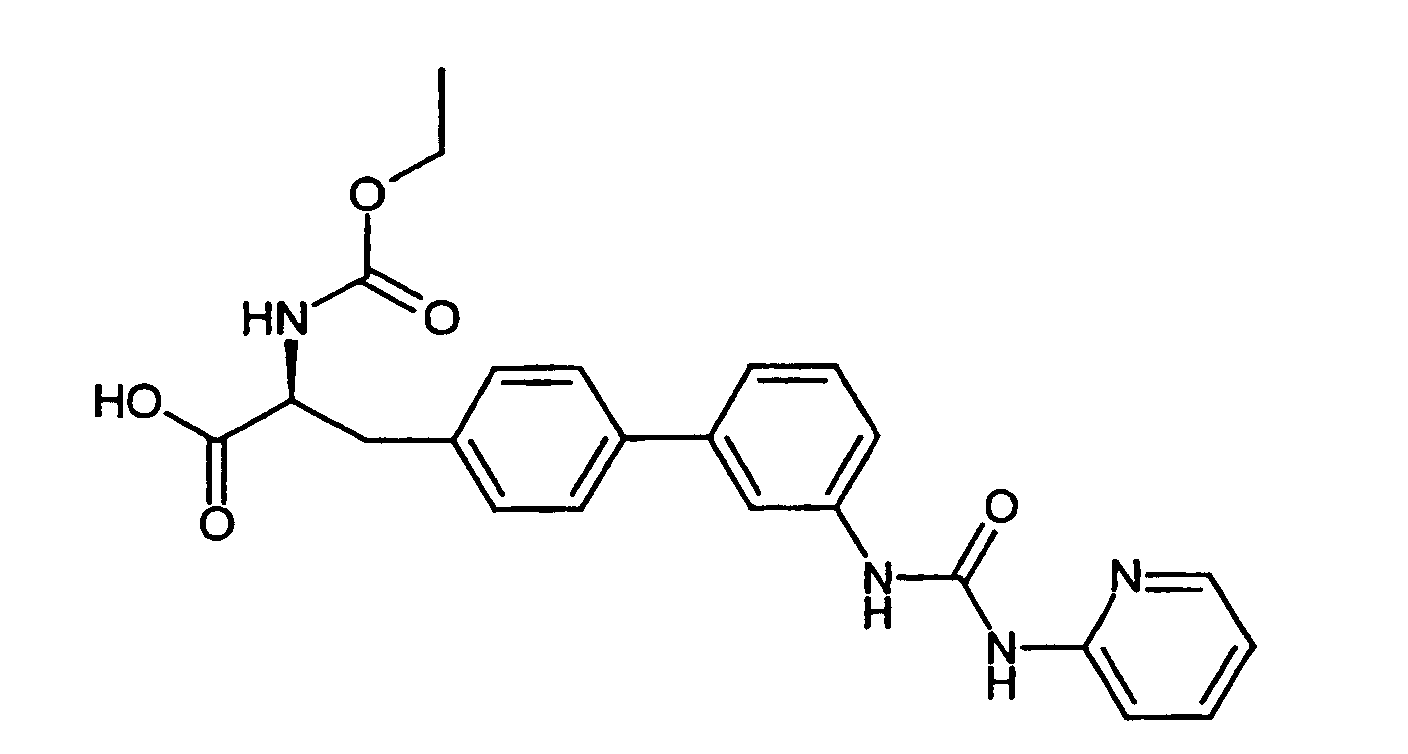
- (2S)-3-[3'-(3-Pyridin-2-yl-ureido)-biphenyl-4-yl]-2-ethyloxycarbonylamino-propanoic acid is prepared according to the procedure of example 1.1, with the exception that (2S)-3-(4-bromophenyl)-2-(9-fluorenylmethoxycarbonylamino)-propanoic acid is used as an acid reagent instead of (2R,S)-3-(4-bromophenyl)-2-(9-fluorenylmethoxycarbonylamino)-propanoic acid, ethyl chloroformate is used as a carbamoylating reagent instead of 2,4,6-trimethylbenzenesulfonyl chloride as a sulfonylating reagent and 2-aminopyridine is used as an amine reagent instead of propylamine.
Mass spectrometry (ESI): 449.
Retention time (HPLC): Rt = 6,6
1H-NMR (400 MHz, methanol) δ = 8,31 (d, 1H), 8,06 (dd, 1H), 7,82 (s, 1H), 7,57 (d, 2H), 7,48 (d, 1H), 7,43 - 7,28 (m, 5H), 7,25 (dd, 1H), 4,42 (dd, 1H, H-2), 4,02 (q, 2H), 3,24 (dd, 1H, H-3a), 2,97 (dd, 1H, H-3b), 1,19 (t, 3H). -

- (2S)-3-[3'-(3-Pyridin-2-yl-methyl-ureido)-biphenyl-4-yl]-2-ethyloxycarbonylamino-propanoic acid is prepared according to the procedure of example 1.1, with the exception that (2S)-3-(4-bromophenyl)-2-(9-fluorenylmethoxycarbonylamino)-propanoic acid is used as an acid reagent instead of (2R,S)-3-(4-bromophenyl)-2-(9-fluorenylmethoxycarbonylamino)-propanoic acid, ethyl chloroformate is used as a carbamoylating reagent instead of 2,4,6-trimethylbenzenesulfonyl chloride as a sulfonylating reagent and 2-aminomethylpyridine is used as an amine reagent instead of propylamine.
Mass spectrometry (ESI):
Retention time (HPLC): Rt = 6,1
1H-NMR (400 MHz, methanol) δ = 8,68 (d, 1H), 8,40 (dd, 1H), 7,92 (d, 1H), 7,78 (dd, 1H), 7,68 (s, 1H), 7,52 (d, 2H), 7,33 - 7,22 (m, 5H), 4,70 (s, 2H), 4,41 (dd, 1H, H-2), 4,02 (q, 2H), 3,23 (dd, 1H, H-3a), 2,95 (dd, 1H, H-3b), 1,19 (t, 3H). -
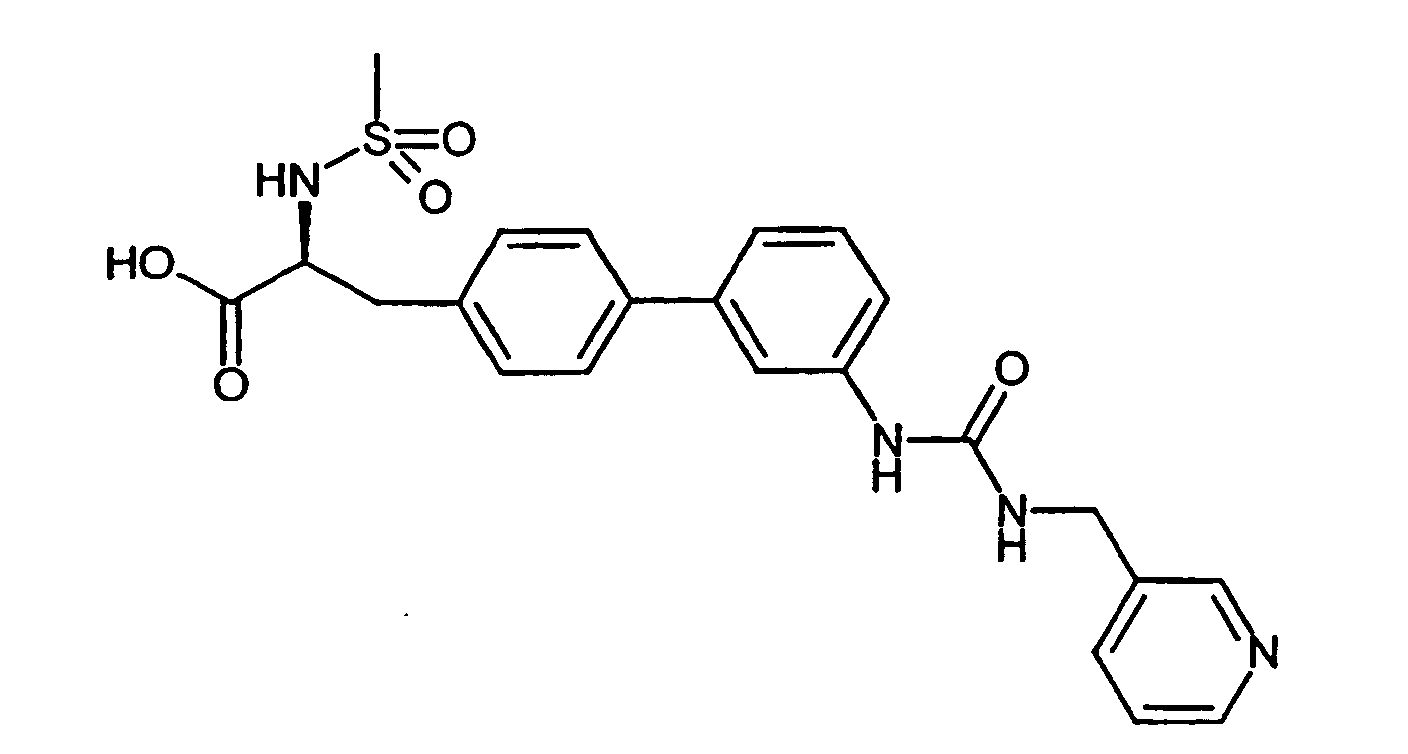
- (2S)-3-[3'-(3-Pyridin-3-yl-methyl-ureido)-biphenyl-4-yl]-2-methylsulfonylamino-propanoic acid is prepared according to the procedure of example 1.1, with the exception that (2S)-3-(4-bromophenyl)-2-(9-fluorenylmethoxycarbonylamino)-propanoic acid is used as an acid reagent instead of (2R,S)-3-(4-bromophenyl)-2-(9-fluorenylmethoxycarbonylamino)-propanoic acid, methylsulfonyl chloride is used as a sulfonylating reagent instead of 2,4,6-trimethylbenzenesulfonyl chloride and 3-aminomethylpyridine is used as an amine reagent instead of propylamine.
Mass spectrometry (ESI): 469.
Retention time (HPLC): Rt = 4,5
1H-NMR (400 MHz, methanol) δ = 8,79 (s, 1H), 8,70 (s, 1H), 8,50 (d, 1H), 7,96 (dd, 1H), 7,68 (s, 1H), 7,54 (d, 2H), 7,38 - 7,22 (m, 5H), 4,58 (s, 2H), 4,27 (dd, 1H, H-2), 3,22 (dd, 1H, H-3a), 2,96 (dd, 1H, H-3b), 2,70 (s, 3H). -

- (2S)-3-[3'-(3-Pyridin-2-yl-methyl-ureido)-biphenyl-4-yl]-2-methylsulfonylamino-propanoic acid is prepared according to the procedure of example 1.1, with the exception that (2S)-3-(4-bromophenyl)-2-(9-fluorenylmethoxycarbonylamino)-propanoic acid is used as an acid reagent instead of (2R,S)-3-(4-bromophenyl)-2-(9-fluorenylmethoxycarbonylamino)-propanoic acid, methylsulfonyl chloride is used as a sulfonylating reagent instead of 2,4,6-trimethylbenzenesulfonyl chloride and 2-aminomethylpyridine is used as an amine reagent instead of propylamine.
Mass spectrometry (ESI): 469.
Retention time (HPLC): Rt = 4,6
1H-NMR (400 MHz, methanol) δ = 8,69 (d, 1H), 8,42 (dd, 1H), 7,93 (d, 1H), 7,81 (dd, 1H), 7,69 (s, 1H), 7,53 (d, 2H), 7,37 - 7,22 (m, 5H), 4,70 (s, 2H), 4,26 (dd, 1H, H-2), 3,21 (dd, 1H, H-3a), 2,95 (dd, 1H, H-3b), 2,69 (s, 3H). -

- (2S)-3-[3'-(3-Pyridin-3-yl-ureido)-biphenyl-4-yl]-2-methylsulfonylamino-propanoic acid is prepared according to the procedure of example 1.1, with the exception that (2S)-3-(4-bromophenyl)-2-(9-fluorenylmethoxycarbonylamino)-propanoic acid is used as an acid reagent instead of (2R,S)-3-(4-bromophenyl)-2-(9-fluorenylmethoxycarbonylamino)-propanoic acid, methylsulfonyl chloride is used as a sulfonylating reagent instead of 2,4,6-trimethylbenzenesulfonyl chloride and 3-aminopyridine is used as an amine reagent instead of propylamine.
Mass spectrometry (ESI): 455.
Retention time (HPLC): Rt = 5,0
1H-NMR (400 MHz, methanol) δ = 9,08 (s, 1H), 8,37 (s, 1H), 8,23 (d, 1H), 7,78 (s, 2H), 7,58 (d, 2H), 7,42 - 7,30 (m, 5H), 4,29 (dd, 1H, H-2), 3,23 (dd, 1H, H-3a), 2,98 (dd, 1H, H-3b), 2,70 (s, 3H). -

- (2S)-3-[3'-(3-Pyridin-2-yl-ureido)-biphenyl-4-yl]-2-methylsulfonylamino-propanoic acid is prepared according to the procedure of example 1.1, with the exception that (2S)-3-(4-bromophenyl)-2-(9-fluorenylmethoxycarbonylamino)-propanoic acid is used as an acid reagent instead of (2R,S)-3-(4-bromophenyl)-2-(9-fluorenylmethoxycarbonylamino)-propanoic acid, methylsulfonyl chloride is used as a sulfonylating reagent instead of 2,4,6-trimethylbenzenesulfonyl chloride and 2-aminopyridine is used as an amine reagent instead of propylamine.
Mass spectrometry (ESI): 455.
Retention time (HPLC): Rt = 5,9
1H-NMR (400 MHz, methanol) δ = 8,31 (d, 1H), 7,85 (s, 1H), 7,60 (d, 2H), 7,47 (d, 1H), 7,42 - 7,23 (m, 6H), 7,12 (s, 1H), 4,28 (dd, 1H, H-2), 3,23 (dd, 1H, H-3a), 2,98 (dd, 1H, H-3b), 2,70 (s, 3H). -

- (2S)-3-[3'-(3-Pyridin-3-yl-ureido)-biphenyl-4-yl]-2-[(S)-campher- 10-yl-sulfonylamino]-propanoic acid is prepared according to the procedure of example 1.1, with the exception that (2S)-3-(4-bromophenyl)-2-(9-fluorenylmethoxycarbonylamino)-propanoic acid is used as an acid reagent instead of (2R,S)-3-(4-bromophenyl)-2-(9-fluorenylmethoxycarbonylamino)-propanoic acid, (S)-(+)-campher-10-sulfonyl chloride is used as a sulfonylating reagent instead of 2,4,6-trimethylbenzenesulfonyl chloride and 3-aminopyridine is used as an amine reagent instead of propylamine.
Mass spectrometry (ESI): 591.
Retention time (HPLC): Rt = 7,1
1H-NMR (400 MHz, methanol) δ = 9,21 (s, 1H), 8,40 (d, 1H), 8,30 (d, 1H), 7,87 (dd, 1H), 7,78 (s, 1H), 7,59 (d, 2H), 7,42 - 7,31 (m, 5H), 4,33 (dd, 1H, H-2), 3,26 (dd, 1H, H-3a), 3,07 (d, 1H), 2,96 (dd, 1H, H-3b), 2,69 (d, 1H), 2,29 (m, 1H), 2,22 (m, 1H), 2,00 (m, 1H), 1,96 (m, 1H), 1,84 (d, 1H), 1,60 (ddd, 1H), 1,39 (m, 1H), 0,93 (s, 3H), 0,69 (s, 3H). -
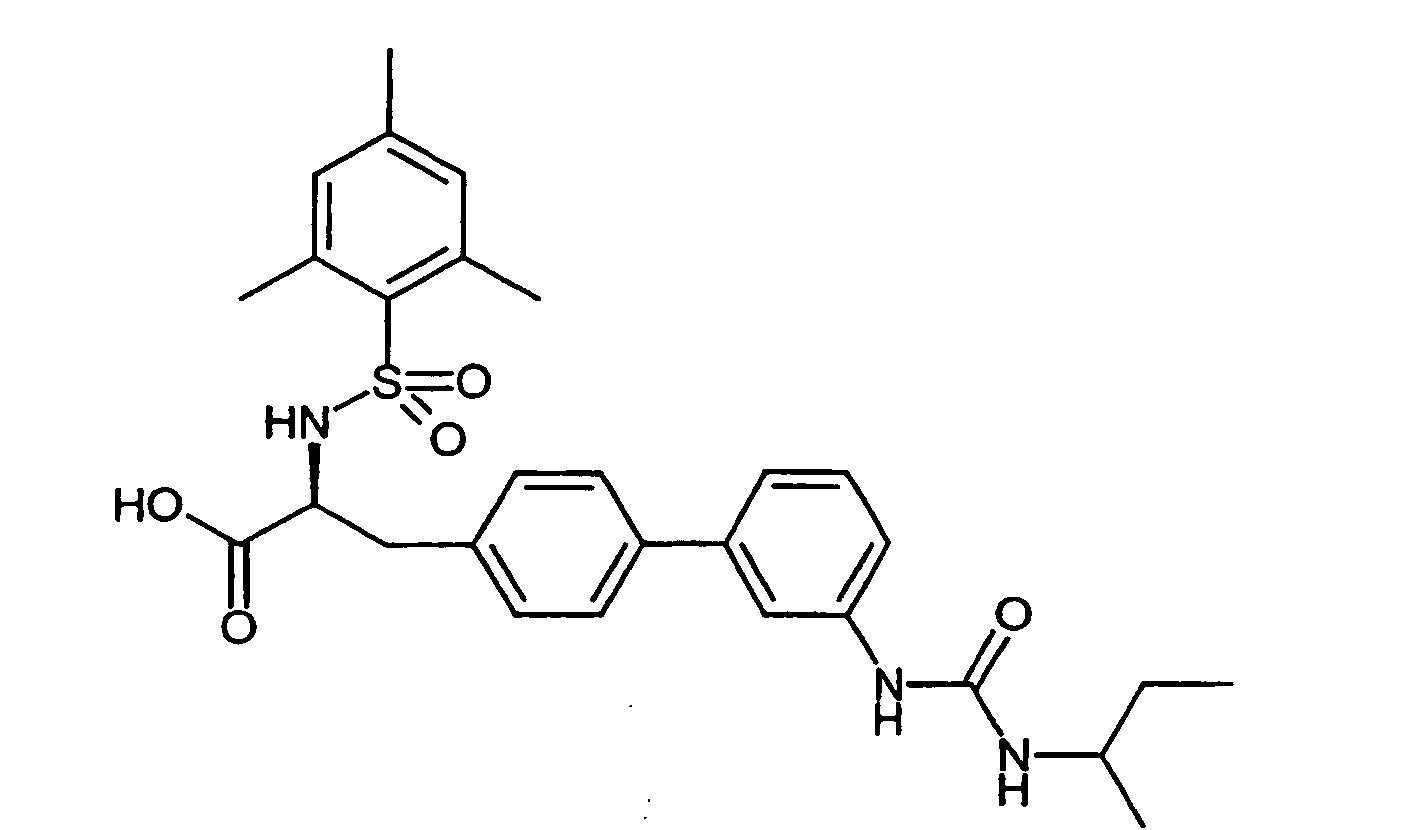
- (2S)-3-[3'-(3-iso-Butyl-ureido)-biphenyl-4-yl]-2-(2,4,6-trimethylbenzensulfonylamino)-propanoic acid is prepared according to the procedure of example 1.1, with the exception that (2S)-3-(4-bromophenyl)-2-(9-fluorenylmethoxycarbonylamino)-propanoic acid is used as an acid reagent instead of (2R,S)-3-(4-bromophenyl)-2-(9-fluorenylmethoxycarbonylamino)-propanoic acid and sec-butylamine is used as an amine reagent instead of propylamine.
Mass spectrometry (ESI): 538.
Retention time (HPLC): Rt = 10,6
1H-NMR (400 MHz, methanol) δ = 7,67 (s, 1H), 7,32 (m, 3H), 7,25 (d, 1H), 7,18 (d, 1H), 7,05 (d, 2H); 6,77 (s, 2H), 3,92 (dd, 1H, H-2), 3,74 (m, 1H), 3,08 (dd, 1H, H-3a), 2,79 (dd, 1H, H-3b), 2,43 (s, 6H), 2,05 (s, 3H), 1,52 (m, 2H), 1,17 (d, 3H), 0,97 (s, 3H). -
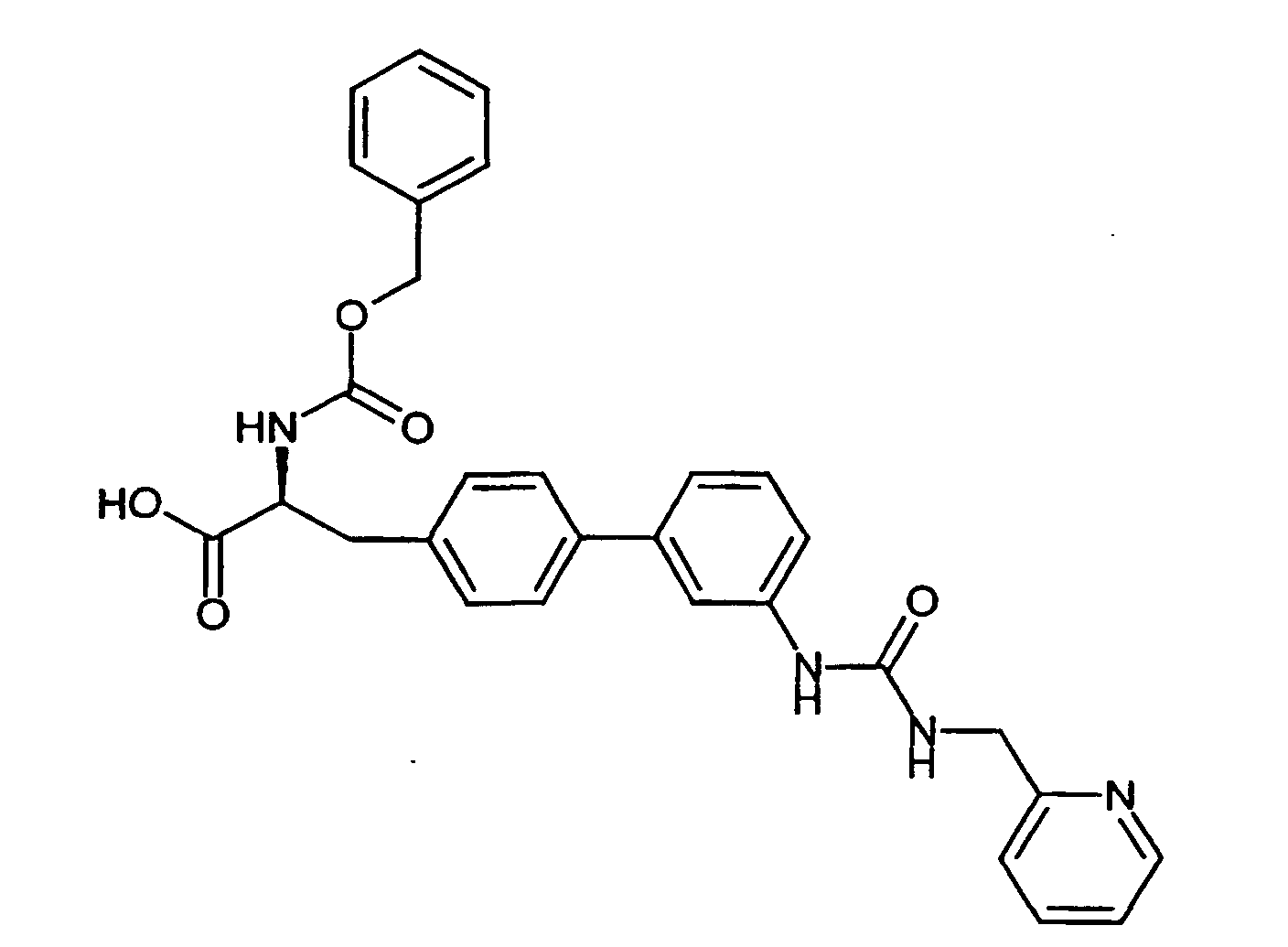
- (2S)-3-[3'-(3-Pyridin-2-yl-methyl-ureido)-biphenyl-4-yl]-2-benzyloxycarbonylamino-propanoic acid acid is prepared according to the procedure of example 1.1, with the exception that (2S)-3-(4-bromophenyl)-2-(9-fluorenylmethoxycarbonylamino)-propanoic acid is used as an acid reagent instead of (2R,S)-3-(4-bromophenyl)-2-(9-fluorenylmethoxycarbonylamino)-propanoic acid, benzyl chloroformate is used as a carbamoylating reagent instead of 2,4,6-trimethylbenzenesulfonyl chloride as a sulfonylating reagent and 2-aminomethylpyridine is used as an amine reagent instead of propylamine.
Mass spectrometry (ESI): 525.
Retention time (HPLC): Rt = 6,9
1H-NMR (400 MHz, methanol) δ = 8,49 (d, 1H), 7,84- 7,18 (m, 16H), 5,07 (d, 1H), 4,99 (d, 1H), 4,53 (s, 2H), 4,32 (m, 1H, H-2), 3,25 (dd, 1H, H-3a), 2,96 (dd, 1H, H-3b). -
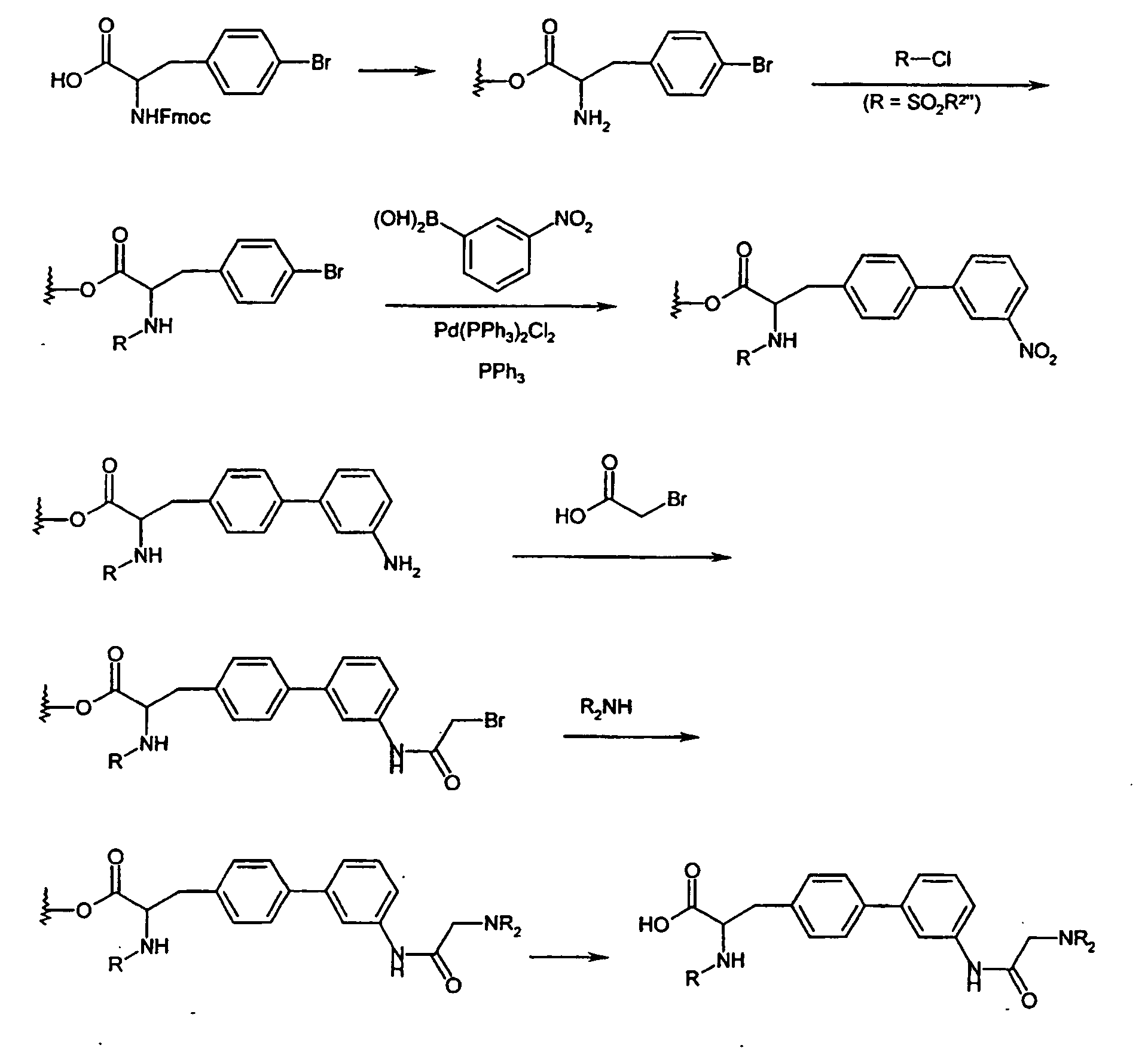
-
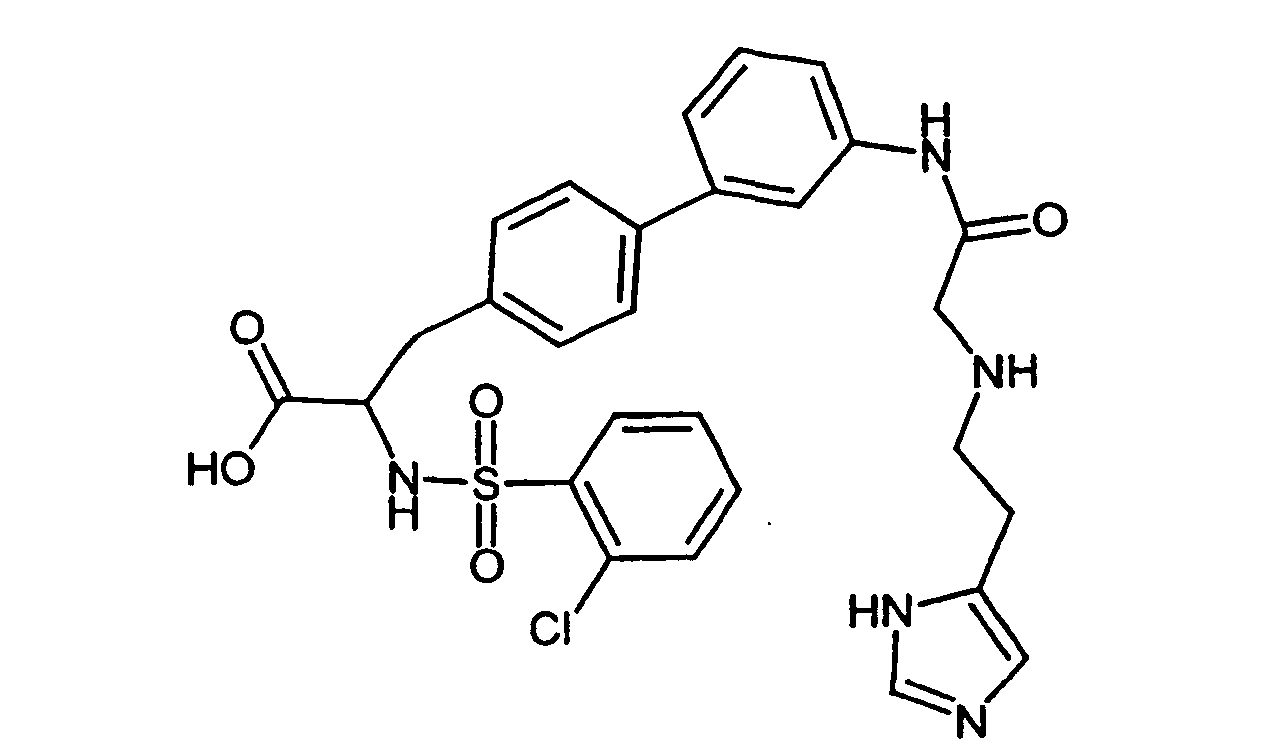
- 1.2 g of Wang polystyrene resin (Rapp-Polymere, Tübingen; loading 1.08 mmol/g) are swollen in dimethylformamide (DMF). The solvent is filtered off with suction and a solution of 1.088 g of (2R,S)-3-(4-bromophenyl)-2-(9-fluorenymethoxycarbonylamino)-propanoic acid (acid reagent) in 20 ml of dimethylformamide (DMF) is added. After shaking at room temperature for 15 min, the suspension is treated with 345 µl of pyridine and 543 mg of 2,6-dichlorobenzoyl chloride. It is shaken overnight at room temperature. The resin is then washed with dimethylformamide (DMF), methanol and dichloromethane.
- The resin is treated with 15 ml of a 20% strength piperidine solution in dimethylformamide (DMF) and shaken at room temperature for 10 min. It is then washed 3 times with dimethylformamide (DMF) and a further 15 ml of a 20% strength piperidine solution in dimethylformamide (DMF) are added. After shaking for 20 min it is washed with dimethylformamide (DMF) and tetrahydrofuran (THF). The resin is treated with a solution of 1.2 ml of diisopropylethylamine in 10 ml of tetrahydrofuran (THF) and a solution of 1.48 g of 2-chlorobenzenesulfonyl chloride (sulfonylation/carbamoylating reagent) in 10 ml of tetrahydrofuran (THF). It is shaken overnight at room temperature. The resin is then washed with dimethylformamide (DMF), methanol and tetrahydrofuran (THF).
- The resin is suspended in 7 ml of xylene, treated with 1.08 g of 3-nitrobenzeneboronic acid and a solution of 1.37 g of sodium carbonate in 6 ml of water and shaken for 5 min at room temperature. 227 mg of bis-(triphenylphosphane)-palladium(II) chloride and 170 mg of triphenylphosphane are then added and the mixture is stirred overnight at 85°C. The resin is then washed with tetrahydrofuran (THF)/water 1:1, 0.25 M aqueous hydrochloric acid, water, dimethylformamide (DMF), methanol, tetrahydrofuran (THF) and dichloromethane. The resin is treated with a solution of 5.4 g of tin(II) chloride dihydrate in 12 ml of N-methylpyrrolidone (NMP) and shaken overnight at room temperature. The resin is then washed with N-methylpyrrolidone (NMP), methanol, tetrahydrofuran (THF) and dichloromethane.
- The resin is treated with a solution of 1.80 g of bromoacetic acid in 20 ml of dimethylformamide (DMF) and a solution of 2.12 g of diisopropylcarbodiimide (DIC) in 5 ml of dimethylformamide (DMF). It is shaken at room temperature for 3 h and then filtered off with suction and washed with dimethylformamide (DMF). The resin is again treated with a solution of 1.80 g of bromoacetic acid in 20 ml of dimethylformamide (DMF) and a solution of 2.12 g of diisopropylcarbodiimide (DIC) in 5 ml of dimethylformamide (DMF) and shaken at room temperature for 3 h. It is then filtered off with suction and washed with dimethylformamide (DMF), methanol and dichloromethane. The resin is then treated with a solution of 2.02 g of 2-(imidazol-5-yl)-ethylamine (amine reagent) and 1.13 ml of diisopropylethylamine in 18 ml of dimethylformamide (DMF). It is stirred overnight and then washed with dimethylformamide (DMF), methanol and dichloromethane. For removal of the product, the resin is shaken with 10 ml of trifluoroacetic acid (TFA)/dichloromethane 1:1 for 1 h, filtered off, and the filtrate is concentrated in vacuo and purified on silica gel. 210 mg of the title compound are obtained.
Mass spectrometry (ESI): 583.
Retention time (HPLC): Rt = 6.1. - (2R,S)-3-{3'-[2-(2-Pyridin-2-yl-ethylamino)-acetylamino]-biphenyl-4-yl}-2-(4-trifluormethyl-benzenesulfonylamino)-propanoic acid acid is prepared according to the procedure of example 2.1, with the exception that 4-trifluoromethylbenzenesulfonyl chloride is used as a sulfonylating reagent instead of 2-chlorobenzenesulfonyl chloride and 2-(pyridin-2-yl)-ethylamine is used as an amine reagent instead of 2-(imidazol-5-yl)-ethylamine.

Mass spectrometry (ESI): 627.
Retention time (HPLC): Rt = 7.3. -
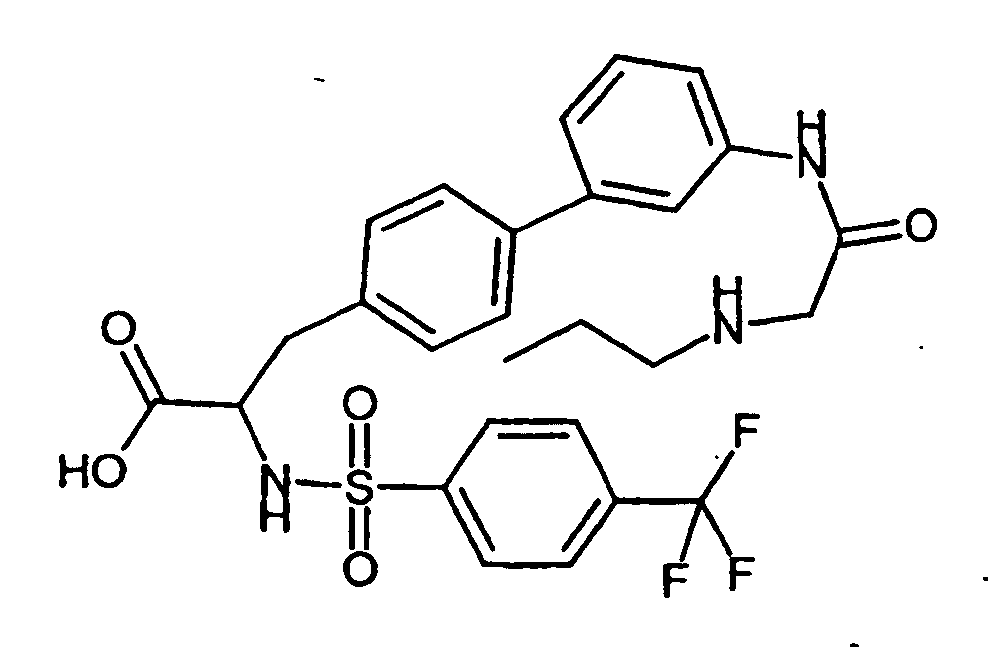
- (2R,S)-3-[3'-(2-Propylamino-acetylamino)-biphenyl-4-yl]-2-(4-trifluormethylbenzenesulfonylamino)-propanoic acid is prepared according to the procedure of example 2.1, with the exception that 4-trifluoromethylbenzenesulfonyl chloride is used as a sulfonylating agent instead of 2-chlorobenzenesulfonyl chloride .
Mass spectrometry (ESI): 564.
Retention time (HPLC): Rt = 8.2.
1H-NMR (400 MHz, methanol) δ = 7.88 (s,1H), 7.80 (d, 2H), 7.65 (d, 2H), 7.52 (d, 1H), 7.48 - 7.35 (m, 4H), 7.22 (d, 2H), 4.14 (dd, 1H, J = 4.8 Hz, J = 9.6 Hz, H-2), 4.00 (s, 2H), 3.16 (dd, 1H, J = 5.0 Hz, J = 14.0 Hz, H-3a), 3.08 (t, 2H, J = 7.8 Hz), 2.87 (dd, 1H, J = 9.6 Hz, J = 14.0 Hz, H-3b), 1.78 (tq, 2H, J = 7.8 Hz), 1.06 (t, 3H, J = 7.6 Hz). -

- (2R,S)-3-[3'-(2-Cyclopropylamino-acetylamino)-biphenyl-4-yl]-2-benzyloxycarbonylamino-propanoic acid is prepared according to the procedure of example 2.1, with the exception that benzyl chloroformate is used as a carbamoylating reagent instead of 2-chlorobenzenesulfonyl chloride as a sulfonylating reagent and cyclopropylamine is used as an amine reagent instead of 2-(imidazol-5-yl)-ethylamine.
Mass spectrometry (ESI): 488.
Retention time (HPLC): Rt = 7.6. -

- (2R,S)-3-[3'-(2-Pyrrolidin-1-yl-acetylamino)-biphenyl-4-yl]-2-benzyloxycarbonylamino-propanoic acid is prepared according to the procedure of example 2.1, with the exception that benzyl chloroformate is used as a carbamoylating reagent instead of 2-chlorobenzenesulfonyl chloride as a sulfonylating reagent and pyrrolidine is used as an amine reagent instead of 2-(imidazol-5-yl)-ethylamine.
Mass spectrometry (ESI): 502.
Retention time (HPLC): Rt = 7.7. -
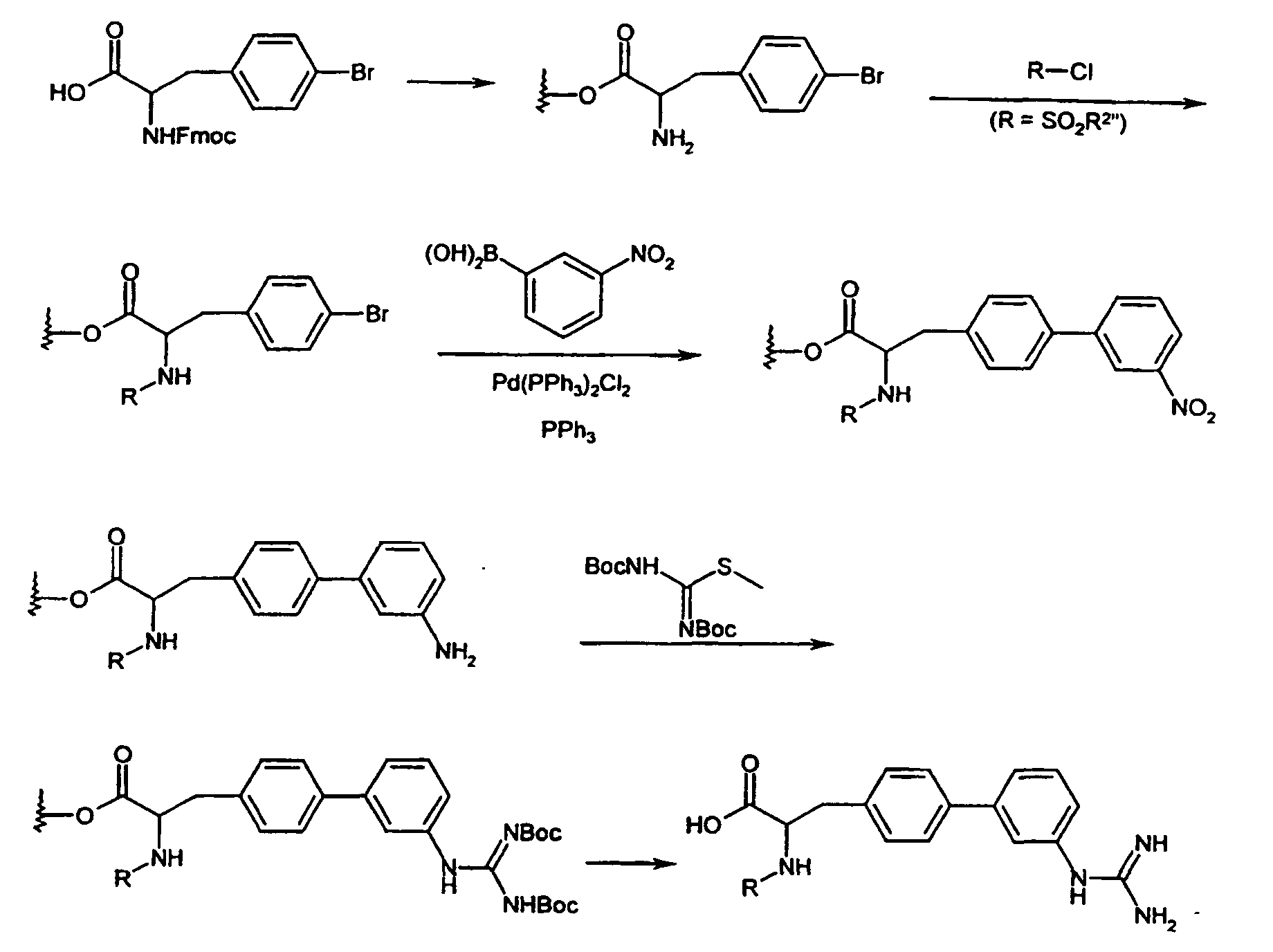
-
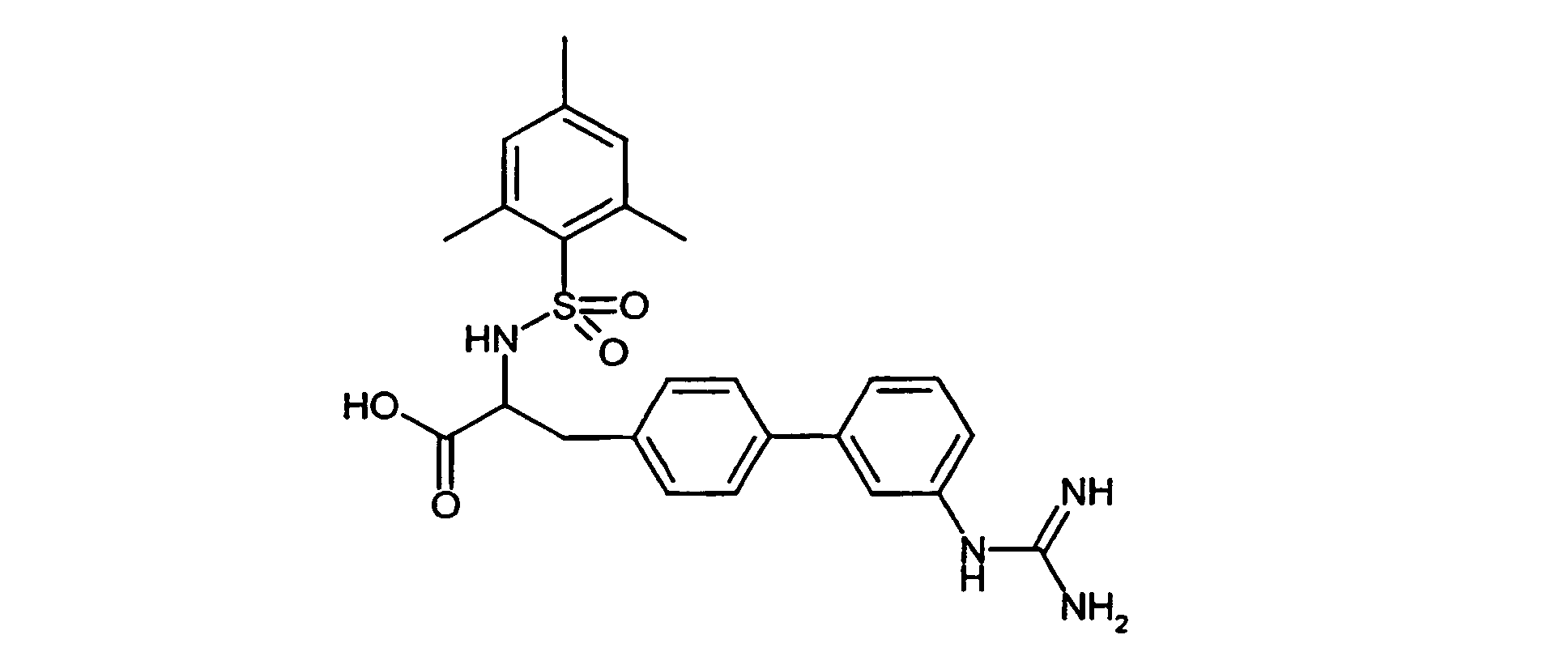
- 1.2 g of Wang polystyrene resin (Rapp-Polymere, Tübingen; loading 1.08 mmol/g) are swollen in dimethylformamide (DMF). The solvent is filtered off with suction and a solution of 1.088 g of (2R,S)-3-(4-bromophenyl)-2-(9-fluorenylmethoxycarbonylamino)-propanoic acid in 20 ml of dimethylformamide (DMF) is added. After shaking at room temperature for 15 min, the suspension is treated with 345 µl of pyridine and 543 mg of 2,6-dichlorobenzoyl chloride. It is shaken overnight at room temperature. The resin is then washed with dimethylformamide (DMF), methanol and dichloromethane.
- The resin is treated with 15 ml of a 20% strength piperidine solution in dimethylformamide (DMF) and shaken at room temperature for 10 min. It is then washed 3 times with dimethylformamide (DMF) and a further 15 ml of a 20% strength piperidine solution in dimethylformamide (DMF) are added. After shaking for 20 min, it is washed with dimethylformamide (DMF) and tetrahydrofuran (THF). The resin is treated with a solution of 1.2 ml of diisopropylethylamine in 10 ml of tetrahydrofuran (THF) and a solution of 1.53 g of 2,4,6-trimethylbenzenesulfonyl chloride (sulfonylation/carbamoylating reagent) in 10 ml of tetrahydrofuran (THF). It is shaken overnight at room temperature. The resin is then washed with dimethylformamide (DMF), methanol and tetrahydrofuran (THF).
- The resin is suspended in 7 ml of xylene, treated with 1.08 g of 3-nitrobenzeneboronic acid and a solution of 1.37 g of sodium carbonate in 6 ml of water and shaken for 5 min at room temperature. 227 mg of bis-(triphenylphosphane)-palladium(II) chloride and 170 mg of triphenylphosphane are then added and the mixture is stirred overnight at 85°C. The resin is then washed with tetrahydrofuran (THF)/water 1:1, 0.25 M aqueous hydrochloric acid, water, dimethylformamide (DMF), methanol, tetrahydrofuran (THF) and dichloromethane. The resin is treated with a solution of 5.4 g of tin(II) chloride dihydrate in 12 ml of N-methylpyrrolidone (NMP) and shaken overnight at room temperature. The resin is then washed with N-methylpyrrolidone (NMP), methanol, tetrahydrofuran (THF) and dichloromethane.
- The resin is treated with a solution of 900 µl of diisopropylethylamine in 9 ml of dimethylformamide (DMF), 1.5 g of 1,3-bis-(tert-butoxycarbonyl)-2-methyl-2-thio-pseudourea in 15 ml of dimethylformamide (DMF) and 1.77 g of mercury(II) chloride. The mixture is shaken overnight and the resin is then washed with dimethylformamide (DMF), methanol, tetrahydrofuran (THF) and dichloromethane. For removal of the product, the resin is shaken with 10 ml of trifluoroacetic acid (TFA)/dichloromethane for 1 h, filtered off, and thed filtrate is concentrated in vacuo and purified on silica gel. 52 mg of the title compound are obtained.
Mass spectrometry (ESI): 481.
Retention time (HPLC): Rt = 7.6. -

- Compounds wherein A is a thienyl ring can be prepared in analogy to the above synthesis scheme for method 4 but with 5-bromothienyl-2-sulfonylchloride instead of 3-bromobenzenesulfonylchloride as starting material.
-
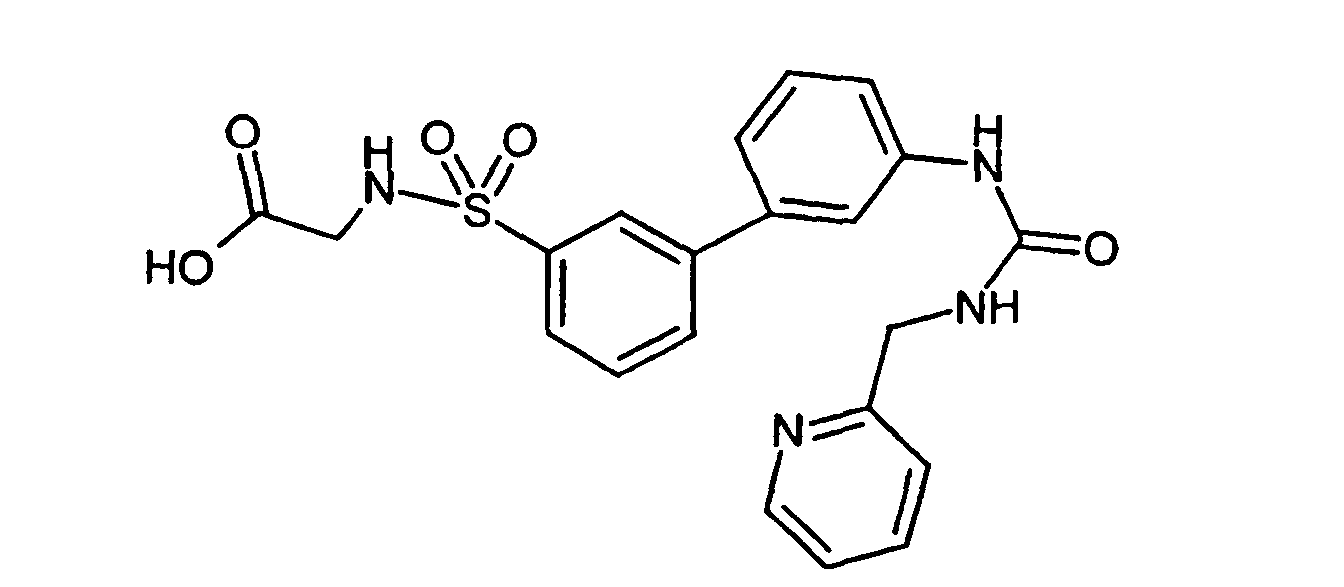
- 1.2 g of Wang polystyrene resin (Rapp-Polymere, Tübingen; loading 1.08 mmol/g) are swollen in dimethylformamide (DMF). The solvent is filtered off with suction and a solution of 771 mg of Fmoc-glycine (amino acid reagent) in 10 ml of dimethylformamide (DMF) is added. After shaking at room temperature for 15 min, the suspension is treated with 345 µl of pyridine and 543 mg of 2,6-dichlorobenzoyl chloride. It is shaken overnight at room temperature. The resin is then washed with dimethylformamide (DMF), methanol and dichloromethane.
- The resin is treated with 15 ml of a 20% strength piperidine solution dimethylformamide (DMF) and shaken at room temperature for 10 min. It is then washed 3 times with dimethylformamide (DMF) and a further 15 ml of a 20% strength piperidine solution in dimethylformamide (DMF) are added. After shaking for 20 min, it is washed with dimethylformamide (DMF) and tetrahydrofuran (THF). The resin is treated with a solution of 452 ml of diisopropylethylamine in 5 ml of tetrahydrofuran (THF) and a solution of 431 mg of 3-bromobenzenesulfonyl chloride in 5 ml of tetrahydrofuran (THF). It is shaken overnight at room temperature. The resin is then washed with dimethylformamide (DMF), methanol and tetrahydrofuran (THF).
- The resin is suspended in 7 ml of xylene, treated with 1.08 g of 3-nitrobenzeneboronic acid and a solution of 1.37 g of sodium carbonate in 6 ml of water and shaken for 5 min at room temperature. 227 mg of bis-(triphenylphosphane)-palladium(II) chloride and 170 mg of triphenylphosphane are then added and the mixture is stirred overnight at 85°C. The resin is then washed with tetrahydrofuran (THF)/water 1:1, 0.25 M aqueous hydrochloric acid, water, dimethylformamide (DMF), methanol, tetrahydrofuran (THF) and dichloromethane. The resin is treated with a solution of 5.4 g of tin(II) chloride dihydrate in 12 ml of N-methylpyrrolidone (NMP) and shaken overnight at room temperature. The resin is then washed with N-methylpyrrolidone (NMP), methanol, tetrahydrofuran (THF) and dichloromethane.
- The resin is treated with a solution of 564 µl of diisopropylethylamine in 13 ml of tetrahydrofuran (THF)/dichloromethane 1:1 and a solution of 3.13 g of 4-nitrophenyl chloroformate in 13 ml of tetrahydrofuran (THF)/dichloromethane 1:1. After shaking at room temperature for 45 min, it is washed with tetrahydrofuran (THF) and dimethylformamide (DMF) and a solution of 1.96 g of 2-aminomethylpyridine (amine reagent) and 3.16 ml of diisopropylethylamine in 23 ml of dimethylformamide (DMF) is added. After shaking for 2 h, the resin is washed with dimethylformamide (DMF), methanol, tetrahydrofuran (THF) and dichloromethane. For removal of the product, the resin is shaken with 10 ml of trifluoroacetic acid (TFA)/dichloromethane for 1 h, filtered off, and the filtrate is concentrated in vacuo and purified on silica gel. 210 mg of the title compound are obtained.
Mass spectrometry (ESI): 441.
Retention time (HPLC): Rt = 5.3.
1H-NMR (400 MHz, methanol) δ = 8.59 (s, 1H), 8.14 (dd, 1H); 8.08 (s, 1H), 7.84 (m, 2H), 7.78 (s, 1H), 7.72 (d, 1H), 7.61 (d, 1H), 7.59 (m, 1H), 7.41 (m, 2H), 7.32 (m, 1H), 4.62 (s, 2H), 3.74 (s, 2H). -
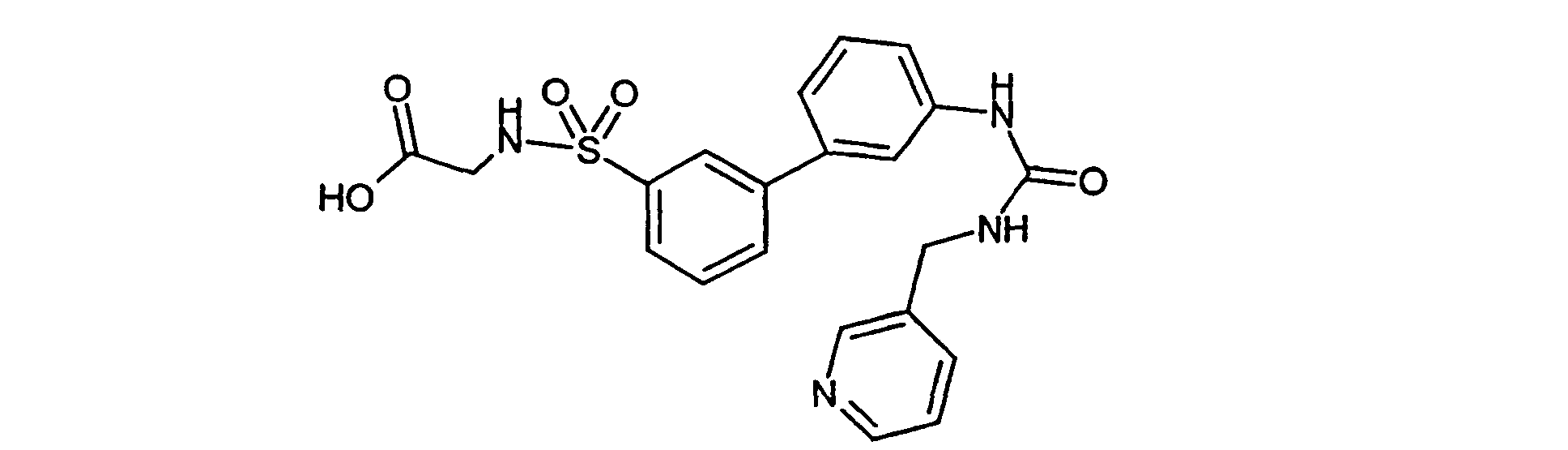
- [3'-(3-Pyridin-3-ylmethyl-ureido)-biphenyl-3-sulfonylamino]-acetic acid is prepared according to the procedure of example 4.1, with the exception that 3-aminomethylpyridine is used as an amine reagent instead of 3-aminomethylpyridine.
Mass spectrometry (ESI): 441.
Retention time (HPLC): Rt = 5.3.
1H-NMR (400 Mhz, methanol) δ = 8.65 (s, 1H), 8.54 (d, 1H), 8.08 (m, 2H), 7.84 (m, 2H), 7.77 (s, 1H), 7.62 (m, 2H), 7.37 (m, 2H), 7.32 (m, 1H), 4.50 (s, 2H), 3.74 (s, 2H). -
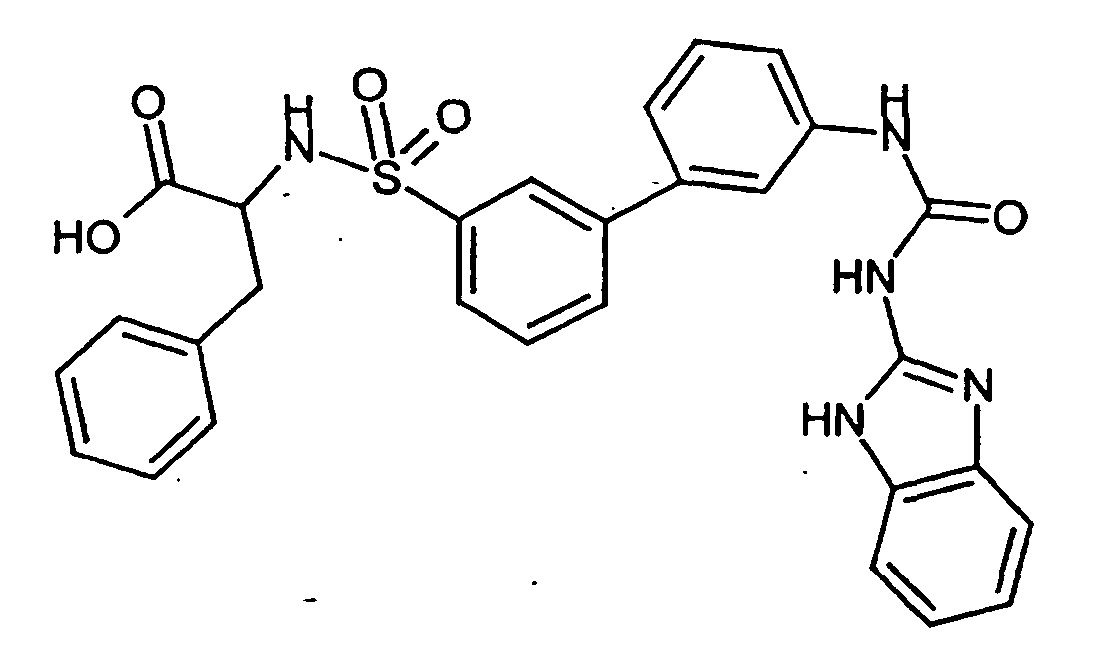
- (2R,S)-2-{3'-[3-(1H-Benzoimidazol-2-yl)-ureido]-biphenyl-3-sulfonylamino}-3-phenyl-propanoic acid is prepared according to the procedure of example 4.1, with the exception that D,L-Fmoc-phenylalanine is used as an amino acid reagent instead of Fmoc-glycine and 2-aminobenzimidazole is used as an amine reagent instead of 2-aminomethylpyridine.
Mass spectrometry (ESI): 556.
Retention time (HPLC): Rt = 8.9. -
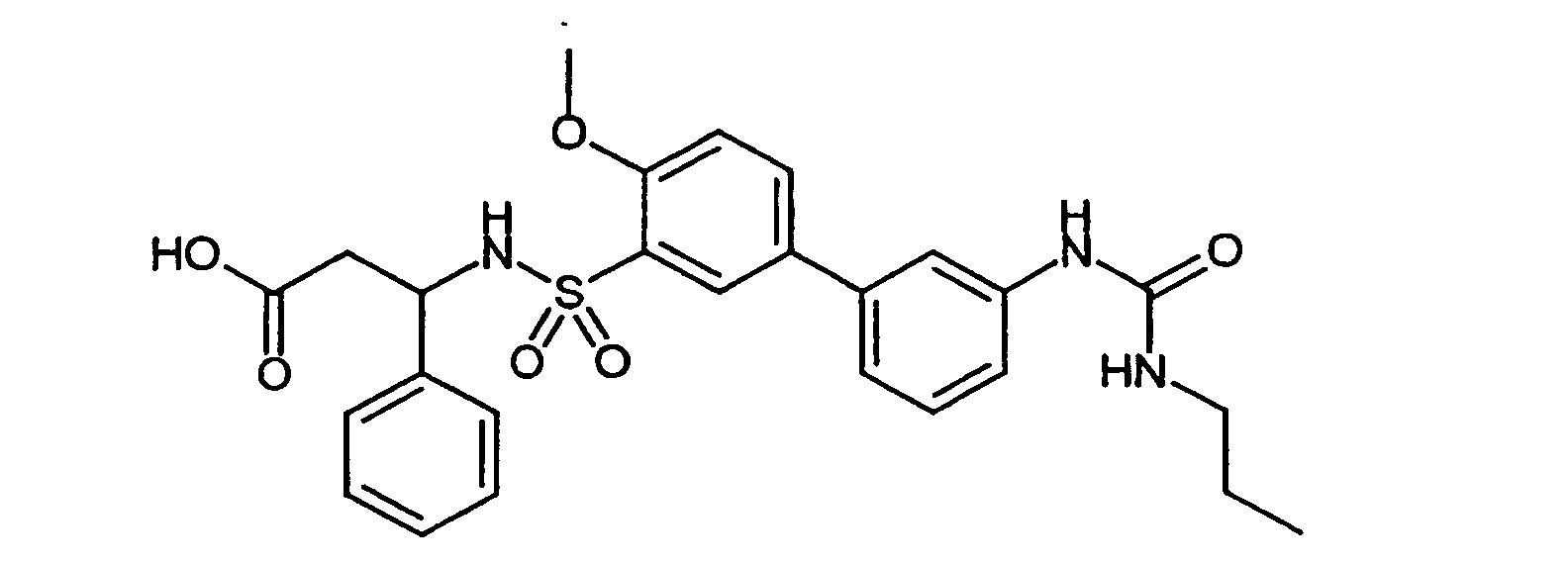
- (3R,S)-3-[4-Methoxy-3'-(3-propyl-ureido)-biphenyl-3-sulfonylamino]-3-phenyl-propanoic acid is prepared according to the procedure of example 4.1, with the exception that D,L-Fmoc-phenylalanine is used as an amino acid reagent instead of Fmoc-glycine, 5-bromo-2-methoxy-benienesulfonylchloride is used as sulfonylation reagent instead of 3-bromobenzenesulfonyl chloride and propylamine is used as an amine reagent instead of 2-aminomethylpyridine.
Mass spectrometry (ESI): 512.
Retention time (HPLC): Rt = 8.7.
1H-NMR (400 Mhz, MeOH) δ = 7,83 (s, 1H), 7,59 (m, 2H), 7,32 (d, 2H), 7,13 (m, 1H), 7,03 (m, 5H), 6,84 (d, 1H), 4,72 (dd, 1H, J = 7,4 Hz, J = 7,4 Hz, H-3), 3,78 (s, 3H), 3,18 (t, 2H, J = 7,0 Hz), 2,89 (dd, 1H, J = 7,2 Hz, J = 15,8 Hz, H-2a), 2,73 (dd, 1H, J = 7,6 Hz, J = 15,8 Hz, H-2b), 1,57 (dq, 2H, J = 7,2 Hz), 0,97 (t, 3H, J = 7,6 Hz). -

- (3R,S)-3-{3'-[3-(1H-Benzoimidazol-2-yl)-ureido]-biphenyl-3-sulfonylamino}-3-phenyl-propanoic acid is prepared according to the procedure of example 4.1, with the exception that D,L-Fmoc-β-phenylalanine is used as an amino acid reagent instead of Fmoc-glycine and 1H-Benzoimidazol-2-yl-amine is used as an amine reagent instead of 2-aminomethylpyridine.
Mass spectrometry (ESI): 556.
Retention time (HPLC): Rt = 8.4.
1H-NMR (400 Mhz, MeOH) δ = 7,88 - 7,00 (m, 17H), 4,83 (dd, 1H, J = 7,6 Hz, H-3), 2,79 (dd, 1H, J = 7,4 Hz, J = 15,6 Hz, H-2a), 2,68 (dd, 1H, J =7,6 Hz, J = 15,6 Hz, H-2b). -

- (3R,S)-3-{3'-[3-(1H-Benzoimidazol-2-yl)-ureido]-biphenyl-4-sulfonylamino}-3-phenyl-propanoic acid is prepared according to the procedure of example 4.1, with the exception that D,L-Fmoc-β-phenylalanine is used as an amino acid reagent instead of Fmoc-glycine, 4-bromobenzenesulfonyl chloride is used as sulfonylation reagent instead of 3-bromobenzenesulfonyl chloride and 1H-Benzoimidazol-2-yl-amine is used as an amine reagent instead of 2-aminomethylpyridine.
Mass spectrometry (ESI): 556.
Retention time (HPLC): Rt = 8.4.
1H-NMR (400 Mhz, MeOH) δ = 7,78 - 7,06 (m, 17H), 4,81 (dd, 1H, J = 7,4 Hz, H-3), 2,80 (dd, 1H, J = 7,4 Hz, J = 15,6 Hz, H-2a), 2,69 (dd, 1H, J = 7,6 Hz, J = 15,6 Hz, H-2b). -

- (3R,S)-3-[3'-(3-propyl-ureido)-biphenyl-4-sulfonylamino]-3-phenyl-propanoic acid is prepared according to the procedure of example 4.1, with the exception that D,L-Fmoc-β-phenylalanine is used as an amino acid reagent instead of Fmoc-glycine, 4-bromobenzenesulfonyl chloride is used as sulfonylation reagent instead of 3-bromobenzenesulfonyl chloride and propylamine is used as an amine reagent instead of 2-aminomethylpyridine.
Mass spectrometry (ESI): 482.
Retention time (HPLC): Rt = 8.7.
1H-NMR (400 Mhz, MeOH) δ = 7,68 (s, 1H), 7,62 (d, 2H), 7,50 (d, 2H), 7,32 (m, 2H), 7,19 (d, 1H), 7,09 (s, 5H), 4,79 (dd, 1H, J = 7,4 Hz, H-3), 3,18 (t, 2H, J = 7,0 Hz), 2,79 (dd, 1H, J = 7,4 Hz, J = 15,4 Hz, H-2a), 2,67 (dd, 1H, J = 7,6 Hz, J = 15,4 Hz, H-2b), 1,57 (tq, 2H, J = 7,2 Hz), 0,97 (t, 3H, J = 7,6 Hz). -

- (2R,S)-2-{4-Methoxy-3'-[3-(1H-Benzoimidazol-2-yl)-ureido]-biphenyl-3-sulfonylamino}-3-phenyl-propanoic acid is prepared according to the procedure of example 4.1, with the exception that D,L-Fmoc-phenylalanine is used as an amino acid reagent instead of Fmoc-glycine, 5-bromo-2-methoxy-benzenesulfonyl chloride is used as sulfonylation reagent instead of 3-bromobenzenesulfonyl chloride and 1H-Benzoimidazol-2-yl-amine is used as an amine reagent instead of 2-aminomethylpyridine.
Mass spectrometry (ESI): 586.
Retention time (HPLC): Rt = 8.6.
1H-NMR (400 Mhz, MeOH) δ = 8,00 - 7,10 (m, 16H), 4,19 (dd, 1H, J = 5,6 Hz, J = 8,0 Hz, H-2), 3,10 (dd, 1H, J = 5,8 Hz, J = 14,0 Hz, H-3a), 2,96 (dd, 1H, J = 8,0 Hz, J = 15,0 Hz, H-3b). -
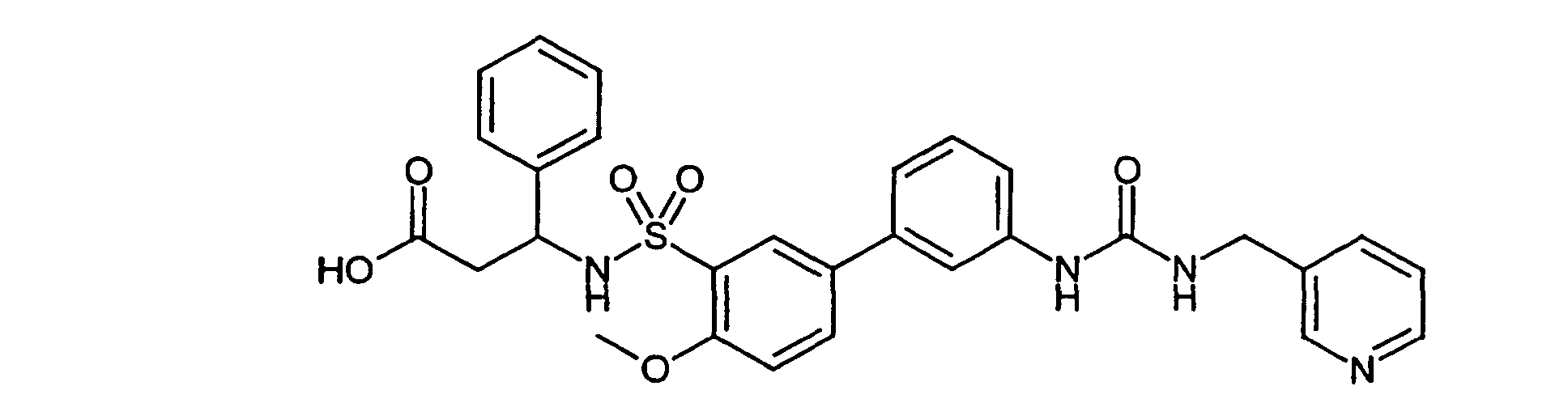
- (2R,S)-2-[4-Methoxy-3'-(3-Pyridin-3-ylmethyl-ureido)-biphenyl-3-sulfonylamino]-3-phenyl-propanoic acid is prepared according to the procedure of example 4.1, with the exception that D,L-Fmoc-β-phenylalanine is used as an amino acid reagent instead of Fmoc-glycine, 4-bromobenzenesulfonyl chloride is used as sulfonylation reagent instead of 5-bromo-2-methoxybenzenesulfonyl chloride and 3-aminomethylpyridine is used as an amine reagent instead of 2-aminomethylpyridine.
Mass spectrometry (ESI): 561.
Retention time (HPLC): Rt = 6,5.
1H-NMR (400 MHz, methanol) δ = 8,74 (s, 1H), 8,64 (s, 1H), 8,37(d, 1H), 7,84 (s, 2H), 7,61 (m, 2H), 7,33 (m, 2H), 7,18 (m, 1H), 7,03 (s, 5H), 6,86 (d, 1H), 4,71 (dd, 1H, J = 7,4 Hz, J = 7,4 Hz, H-3), 4,56 (s, 2H), 3,78 (s, 3H), 2,89 (dd, 1H, J = 7,2 Hz, J = 16,0 Hz, H-2a), 2,73 (dd, 1H, J = 7,6 Hz, J = 16,0 Hz, H-2b). -
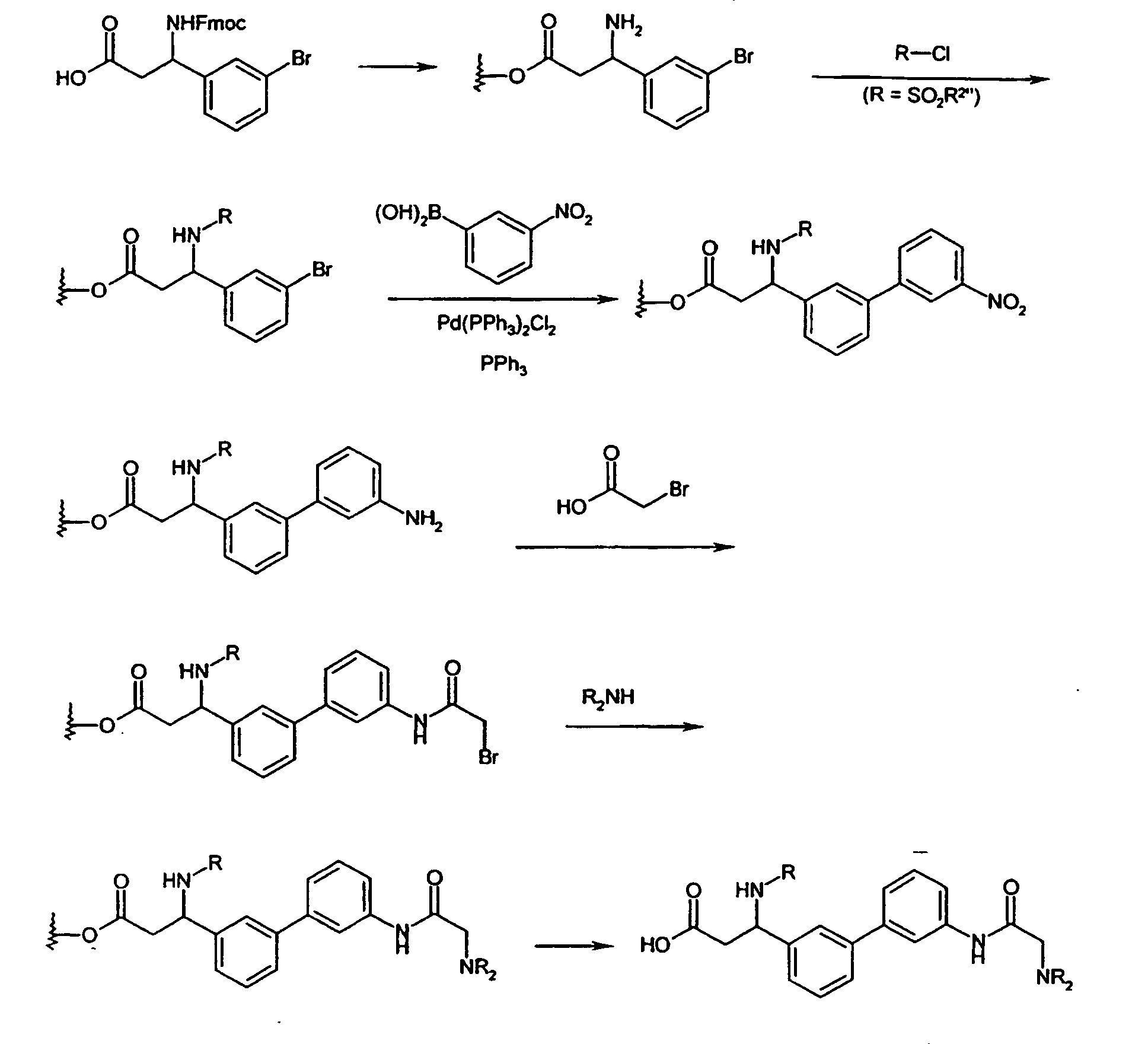
-

- 1.2 g of Wang polystyrene resin (Rapp-Polymere, Tübingen; loading 1.08 mmol/g) are swollen in dimethylformamide (DMF). The solvent is filtered off with suction and a solution of 1.088 g of (3R,S)-3-(4-bromophenyl)-3-(9-fluorenylmethoxycarbonylamino)-propanoic acid in 20 ml of dimethylformamide (DMF) is added. After shaking at room temperature for 15 minutes, the suspension is treated with 345 µl of pyridine and 543 mg of 2,6-dichlorobenzoyl chloride. It is shaken overnight at room temperature. The resin is then washed with dimethylformamide (DMF), methanol and dichloromethane.
- The resin is treated with 15 ml of a 20% strength piperidine solution in dimethylformamide (DMF) and shaken at room temperature for 10 min. It is then washed 3 times with dimethylformamide (DMF) and a further 15 ml of a 20% strength piperidine solution in dimethylformamide (DMF) are added. After shaking for 20 min, it is washed with dimethylformamide (DMF) and tetrahydrofuran (THF).The resin is treated with a solution of 1.2 ml of diisopropylethylamine in 10 ml of tetrahydrofuran (THF) and a solution of 1.53 g of 2,4,6-trimethylbenzenesulfonyl chloride (sulfonylating/carbamoylating reagent) in 10 ml of tetrahydrofuran (THF). It is shaken overnight at room temperature. The resin is then washed with dimethylformamide (DMF), methanol and tetrahydrofuran (THF).
- The resin is suspended in 7 ml of xylene, treated with 1.08 g of 3-nitrobenzeneboronic acid and a solution of 1.37 g of sodium carbonate in 6 ml of water and shaken for 5 min at room temperature. 227 mg of bis-(triphenylphosphane)-palladium(II) chloride and 170 mg of triphenylphosphane are then added and the mixture is stirred overnight at 85°C. The resin is then washed with tetrahydrofuran (THF)/water 1:1, 0.25 M aqueous hydrochloric acid, water, dimethylformamide (DMF), methanol, tetrahydrofuran (THF) and dichloromethane. The resin is treated with a solution of 5.4 g of tin(II) chloride dihydrate in 12 ml of N-methylpyrrolidone (NMP) and shaken overnight at room temperature. The resin is then washed with N-methylpyrrolidone (NMP), methanol, tetrahydrofuran (THF) and dichloromethane.
- The resin is treated with a solution of 1.80 g of bromoacetic acid in 20 ml of dimethylformamide (DMF) and a solution of 2.12 g of diisopropylcarbodiimide in 5 ml of dimethylformamide (DMF). It is shaken at room temperature for 3 h and then filtered off with suction and washed with dimethylformamide (DMF). The resin is again treated with a solution of 1.80 g of bromoacetic acid in 20 ml of dimethylformamide (DMF) and a solution of 2.12 g of diisopropylcarbodiimide in 5 ml of dimethylformamide (DMF) and shaken at room temperature for 3 h. It is then filtered off with suction and washed with dimethylformamide (DMF), methanol and dichloromethane. The resin is then treated with a solution of 1.24 g of imidazole and 1.13 ml of diisopropylethylamine in 18 ml of dimethylformamide (DMF). It is stirred overnight and then washed with dimethylformamide (DMF), methanol and dichloromethane. For removal of the product, the resin is shaken with 10 ml of trifluoroacetic acid (TFA)/dichloromethane 1:1 for 1 h, filtered off, and the filtrate is concentrated in vacuo and purified on silica gel. 210 mg of the title compound are obtained.
Mass spectrometry(ESI): 547.
Retention time (HPLC): Rt = 7.8. -

-

- 1.2 g of Wang polystyrene resin (Rapp-Polymere, Tübingen; loading 1.08 mmol/g) are swollen in dimethylformamide (DMF). The solvent is filtered off with suction and a solution of 360 mg of bromoacetic acid (acid reagent) in 8 ml of dimethylformamide (DMF) is added. After shaking at room temperature for 15 min, the suspension is treated with 345 µl of pyridine and 543 mg of 2,6-dichlorobenzoyl chloride. It is shaken at room temperature for 2 h. It is then filtered off with suction and the resin is washed with dimethylformamide (DMF). A further 360 mg of bromoacetic acid (acid reagent) in 8 ml of dimethylformamide (DMF) are added, the mixture is shaken for 15 min, and the suspension is treated with 345 µl of pyridine and 543 mg of 2,6-dichlorobenzoyl chloride and shaken overnight at room temperature. The resin is then washed with dimethylformamide (DMF), methanol and dichloromethane.
- The resin is treated with a solution of 2.24 g of 1-phenyl-3-butylamine (amine reagent) in 7.5 ml of dimethyl sulfoxide (DMSO) and shaken overnight. The resin is then washed with dimethylformamide (DMF), methanol, tetrahydrofuran (THF) and dichloromethane.
- The resin is treated with a solution of 2.6 ml of diisopropylcarbodiimide in 5 ml of dimethylformamide (DMF) and a solution of 2.79 g of 3-bromo-4-methylbenzoic acid (acylating/sulfonylating reagent) in 18 ml of dimethylformamide (DMF). It is shaken at room temperature for 3 h. The resin is then filtered off with suction, washed with dimethylformamide (DMF) and again treated with a solution of 2.6 ml of diisopropylcarbodiimide in 5 ml of dimethylformamide (DMF) and a solution of 2.79 g of 3-bromo-4-methylbenzoic acid in 18 ml of dimethylformamide (DMF). After shaking at room temperature for 3 h, the resin is washed with dimethylformamide (DMF), methanol and dichloromethane.
- The resin is suspended in 8 ml xylene, treated with 1.73 g of 3-nitrobenzeneboronic acid (boronic acid reagent) and a solution of 2.2 g of sodium carbonate in 9 ml of water and shaken for 5 min at room temperature. 227 mg of bis-(triphenylphosphane)-palladium(II) chloride and 170 mg of triphenylphosphane are then added and the mixture is stirred overnight at 85°C. The resin is then washed with tetrahydrofuran (THF)/water 1:1, 0.25 M aqueous hydrochloric acid, water, dimethylformamide (DMF), methanol, tetrahydrofuran (THF) and dichloromethane. The resin is treated with a solution of 5.4 g of tin(II) chloride dihydrate in 12 ml of N-methylpyrrolidone (NMP) and shaken overnight at room temperature. The resin is then washed with N-methylpyrrolidone (NMP), methanol, tetrahydrofuran (THF) and dichloromethane.
- The resin is treated with a solution of 564 µl of diisopropylethylamine in 13 ml of tetrahydrofuran (THF)/dichloromethane 1:1 and a solution of 3.13 g of 4-nitrophenyl chloroformate in 13 ml of tetrahydrofuran (THF)/dichloromethane 1:1. After shaking at room temperature for 45 min, it is washed with tetrahydrofuran (THF) and dimethylformamide (DMF) and a solution of 1.17 g of 2-methoxyethylamine (amine reagent for urea formation) and 2.7 ml of diisopropylethylamine in 20 ml of dimethylformamide (DMF) are added. After shaking for 2 h, the resin is washed with dimethylformamide (DMF), methanol, tetrahydrofuran (THF) and dichloromethane. For removal of the product, the resin is shaken with 10 ml of trifluoroacetic acid (TFA)/dichloromethane for 1 h, filtered off, and the filtrate is concentrated in vacuo and purified on silica gel. 200 mg of the title compound are obtained.
Mass spectrometry (ESI): 518.
Retention time (HPLC): Rt = 7.8. -
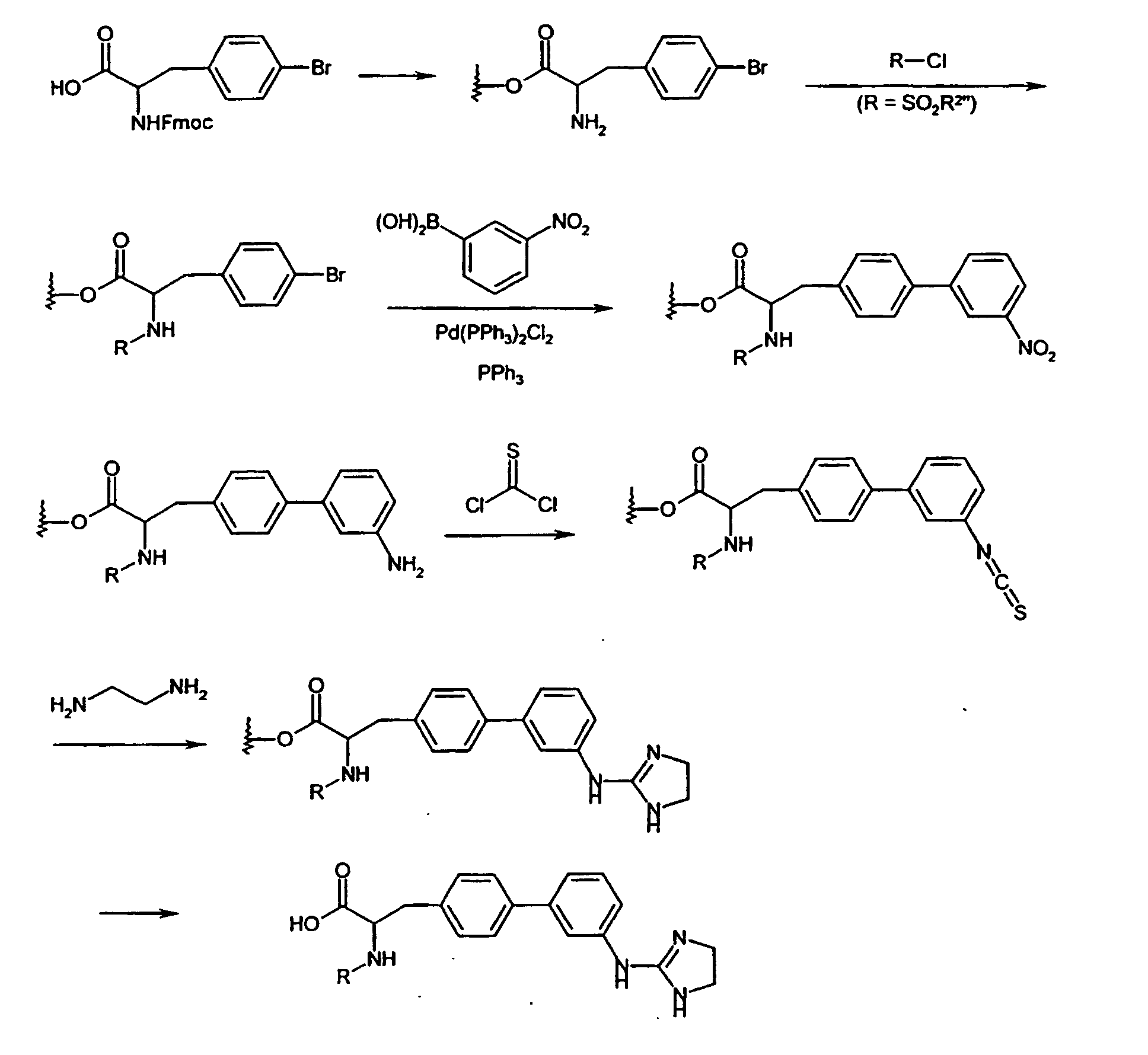
-
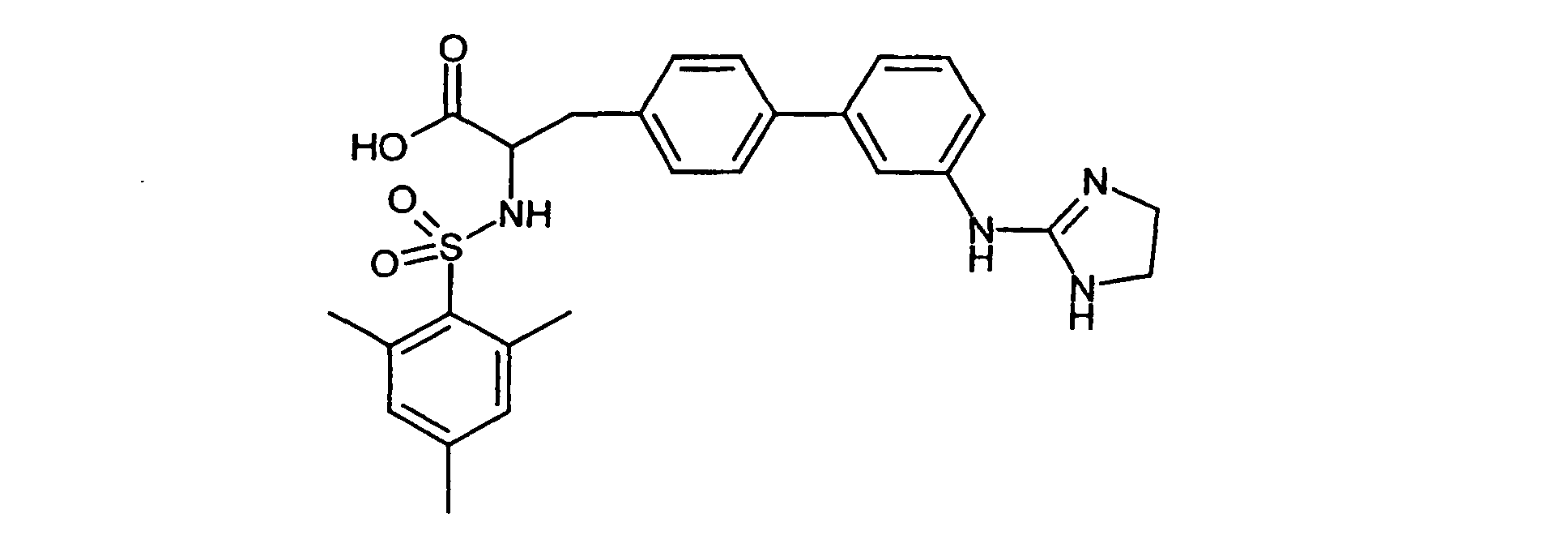
- 1.2 g of Wang polystyrene resin (Rapp-Polymere, Tübingen; loading 1.08 mmol/g) are swollen in dimethylformamide (DMF). The solvent is filtered off with suction and a solution of 1.088 g of (2R,S)-3-(4-bromophenyl)-2-(9-fluorenylmethoxycarbonylamino)-propanoic acid (acid reagent) in 20 ml of dimethylformamide (DMF) is added. After shaking at room temperature for 15 min, the suspension is treated with 345 µl of pyridine and 543 mg of 2,6-dichlorobenzoyl chloride. It is shaken overnight at room temperature. The resin is then washed with dimethylformamide (DMF), methanol and dichloromethane.
- The resin is treated with 15 ml of a 20% strength piperidine solution in dimethylformamide (DMF) and shaken at room temperature for 10 min. It is then washed 3 times with dimethylformamide (DMF) and a further 15 ml of a 20% strength piperidine solution in dimethylformamide (DMF) are added. After shaking for 20 min, it is washed with dimethylformamide (DMF) and tetrahydrofuran (THF). The resin is treated with a solution of 1.2 ml of diisopropylethylamine in 10 ml of tetrahydrofuran (THF) and a solution of 1.53 g of 2,4,6-trimethylbenzenesulfonyl chloride (sulfonylating/carbamoylating reagent) in 10 ml of tetrahydrofuran (THF). It is shaken overnight at room temperature. The resin is then washed with dimethylformamide (DMF), methanol and tetrahydrofuran (THF).
- The resin is suspended in 7 ml of xylene, treated with 1.08 g of 3-nitrobenzeneboronic acid and a solution of 1.37 g of sodium carbonate in 6 ml of water and shaken for 5 min at room temperature. 227 mg of bis-(triphenylphosphane)-palladium(II) chloride and 170 mg of triphenylphosphane are then added and the mixture is stirred overnight at 85°C. The resin is then washed with tetrahydrofuran (THF)/water (1:1), 0.25 M aqueous hydrochloric acid. water, dimethylformamide (DMF), methanol, tetrahydrofuran (THF) and dichloromethane. The resin is treated with a solution of 5.4 g of tin(II) chloride dihydrate in 12 ml of N-methylpyrrolidone (NMP) and shaken overnight at room temperature. The resin is then washed with N-methylpyrrolidone (NMP), methanol, tetrahydrofuran (THF) and dichloromethane.
- The resin is treated with a solution of 1.13 ml of diisopropylethylamine in 10 ml of tetrahydrofuran (THF) and a solution of 400 µl of thiophosgene in 10 ml of tetrahydrofuran (THF) and shaken at room temperature for 2 h. The resin is then filtered off with suction, washed with tetrahydrofuran (THF), a solution of 1.5 ml of ethanol in 14 ml of dioxane is added and the mixture is stirred for 4 h at 70°C. The resin is then filtered off with suction, washed with dimethylformamide (DMF) and treated with a solution of 1.17 g of ethylenediamine in 20 ml of dimethylformamide (DMF). The suspension is stirred overnight at 70°C. The resin is then washed with dimethylformamide (DMF), methanol, tetrahydrofuran (THF) and dichloromethane. For removal of the product, the resin is shaken with 10 ml of trifluoroacetic acid (TFA)/dichloromethane for 1 h, filtered off, and the filtrate is concentrated in vacuo and purified on silica gel. 70 mg of the title compound are obtained.
Mass spectrometry (ESI): 507.
Retention time (HPLC): Rt = 8.0. -
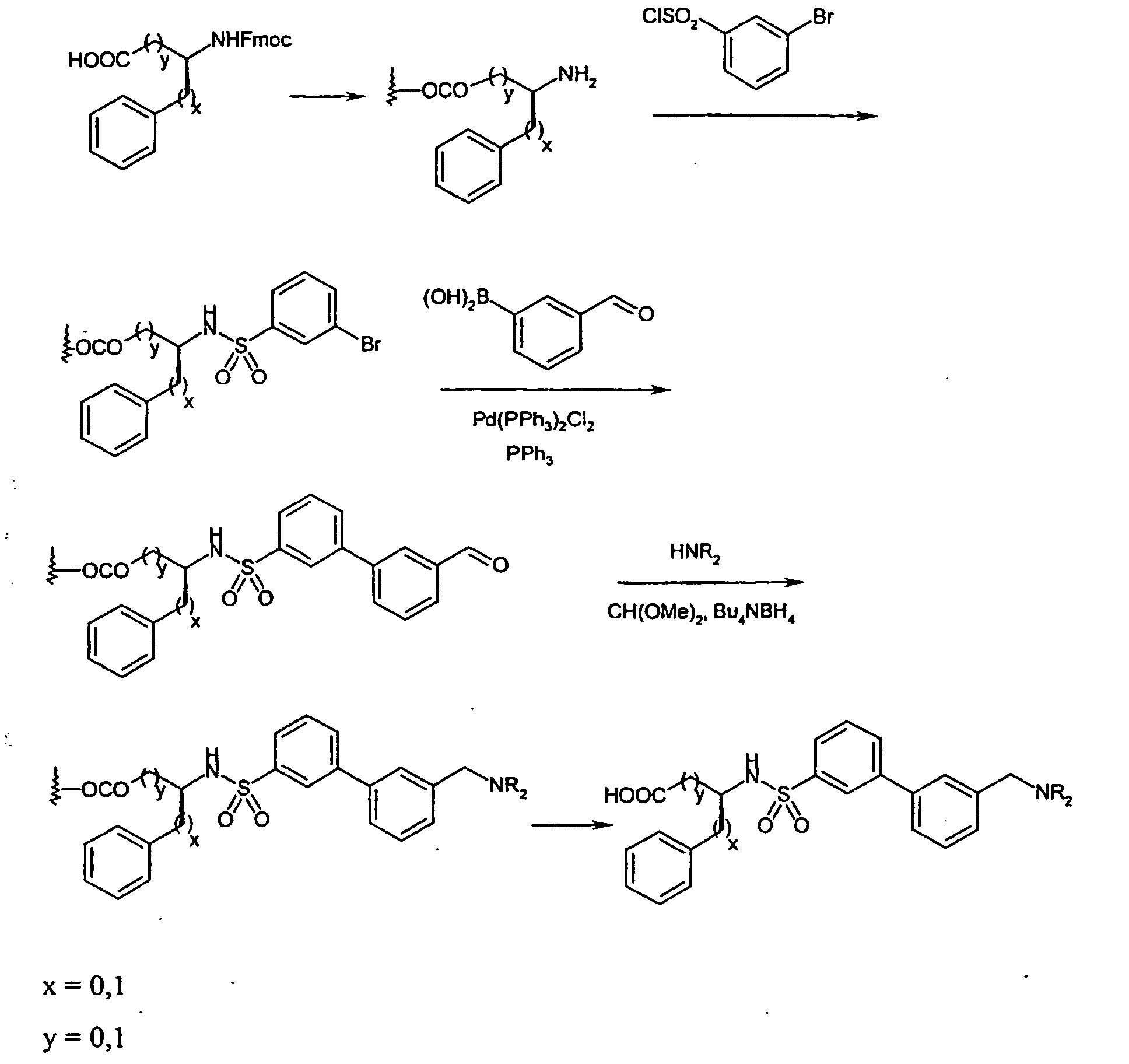
-

- 1.2 g of polystyrene Wang resin (Rapp-Polymere, Tübingen; loading 1.08 mmol/g) are swollen in dimethylformamide (DMF). The solvent is filtered off with suction and a solution of 904 mg of (3R,S)-3-(9-fluorenylmethoxycarbonylamino)-3-phenyl-propanoic acid (amino acid reagent) in 9 ml of dimethylformamide (DMF) is added. After shaking at room temperature for 15 min, the suspension is treated with 345 µl of pyridine and 543 mg of 2,6-dichlorobenzoyl chloride. It is shaken overnight at room temperature. The resin is then washed with dimethylformamide (DMF), methanol and dichloromethane.
- The resin is treated with 15 ml of a 20% strength piperidine solution in dimethylformamide (DMF) and shaken at room temperature for 10 min. It is then washed 3 times with dimethylformamide (DMF) and a further 15 ml of a 20% strength piperidine solution in dimethylformamide (DMF) are added. After shaking for 20 min, it is washed with dimethylformamide (DMF) and tetrahydrofuran (THF). The resin is treated with a solution of 452 ml of diisopropylethylamine in 5 ml of tetrahydrofuran (THF) and a solution of 431 mg of 3-bromobenzenesulfonyl chloride in 5 ml of tetrahydrofuran (THF). It is shaken overnight at room temperature. The resin is then washed with dimethylformamide (DMF), methanol and tetrahydrofuran (THF).
- The resin is suspended in 9 ml of xylene, treated with 1.55 g of 3-formylbenzeneboronic acid (boronic acid reagent) and a solution of 2.2 g of sodium carbonate in 9 ml of water and shaken for 5 min at room temperature. 227 mg of bis-(triphenylphosphane)-palladium(II) chloride and 170 mg of triphenylphosphane are then added and the mixture is stirred overnight at 85°C. The resin is then washed with tetrahydrofuran (THF)/water 1:1, 0.25 M aqueous hydrochloric acid, is then washed with water, dimethylformamide (DMF), methanol, tetrahydrofuran (THF) and dichloromethane.
- The resin is treated with a solution of 2.16 g of 2-aminomethylbenzimidazole dihydrochloride (amine reagent), 5.1 ml of diisopropylethylamine (for neutralization) and 2.68 ml of trimethyl orthoformate in 8 ml of dimethylformamide (DMF). After shaking at room temperature for 2 h, a solution of 3.14 g of tetrabutylammonium borohydride and 2.8 ml of acetic acid in 18 ml of dimethylformamide (DMF) is added. The mixture is shaken at room temperature overnight. The resin is then filtered off with suction and washed with dimethylformamide (DMF), methanol, tetrahydrofuran (THF) and dichloromethane. For removal of the product, the resin is shaken with 10 ml of trifluoroacetic acid (TFA)/dichloromethane for 1 h, filtered off, and the filtrate is concentrated in vacuo and purified on silica gel. 190 mg of the title compound are obtained.
Mass spectrometry (ESI): 541.
Retention time (HPLC): Rt = 7.1. -

- (3R,S)-3-(3'-{[(Tetrahydro-furan-2-ylmethyl)-amino]-methyl}-biphenyl-3-sulfonylamino)-3-phenyl-propanoic acid is prepared according to the procedure of example 8.1, with the exception that 2-aminomethyltetrahydrofuran is used as amine reagent instead of 2-aminomethylbenzimidazole dihydrochloride.
Mass spectrometry (ESI): 495.
Retention time (HPLC): Rt = 7.0. -

- (3R,S)-3-(4'-{[(1H-Benzoimidazol-2-ylmethyl)-amino]-methyl}-biphenyl-3-sulfonylamino)-3-phenyl-propanoic acid is prepared according to the procedure of example 8.1, with the exception that 4-formylbenzeneboronic acid is used as a boronic acid reagent instead of 3-formylbenzeneboronic acid.
Mass spectrometry (ESI): 451.
Retention time (HPLC): Rt = 6.9. -
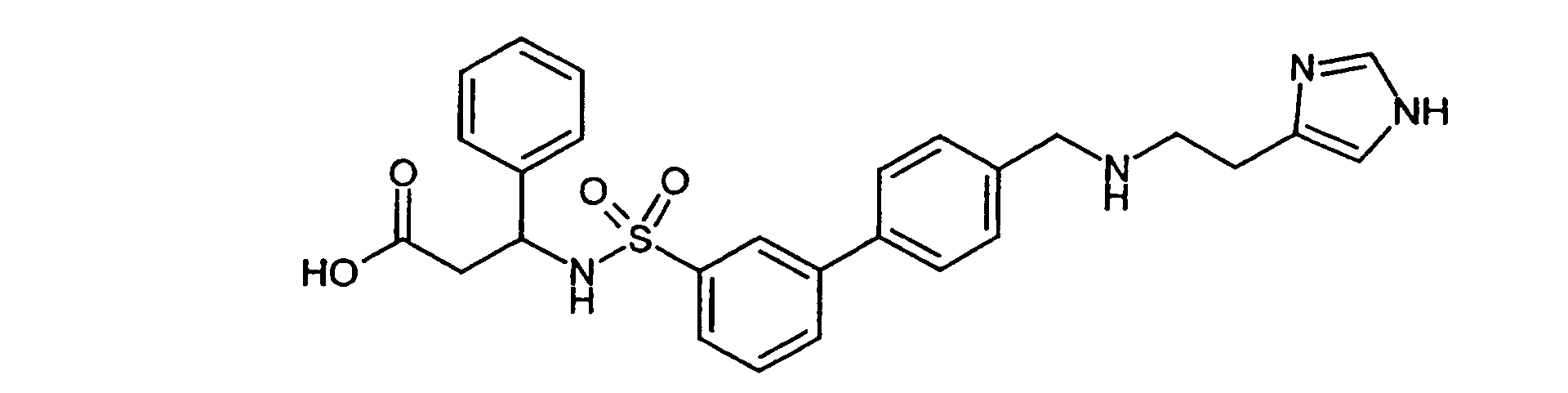
- (3R,S)-3-[4'-({[2-(1H-Imidazol-4-yl)-ethyl]-amino}-methyl)-biphenyl-3-sulfonylamino]-3-phenyl-propanoic acid is prepared according to the procedure of example 8.1, with the exception that 4-formylbenzeneboronic acid is used as a boronic acid reagent instead of 3-formylbenzeneboronic acid and 2-(imidazol-5-yl)-ethylamine is used as an amine reagent instead of 2-aminomethylbenzimidazole dihydrochloride.
Mass spectrometry (ESI): 505.
Retention time (HPLC): Rt = 5.4. -
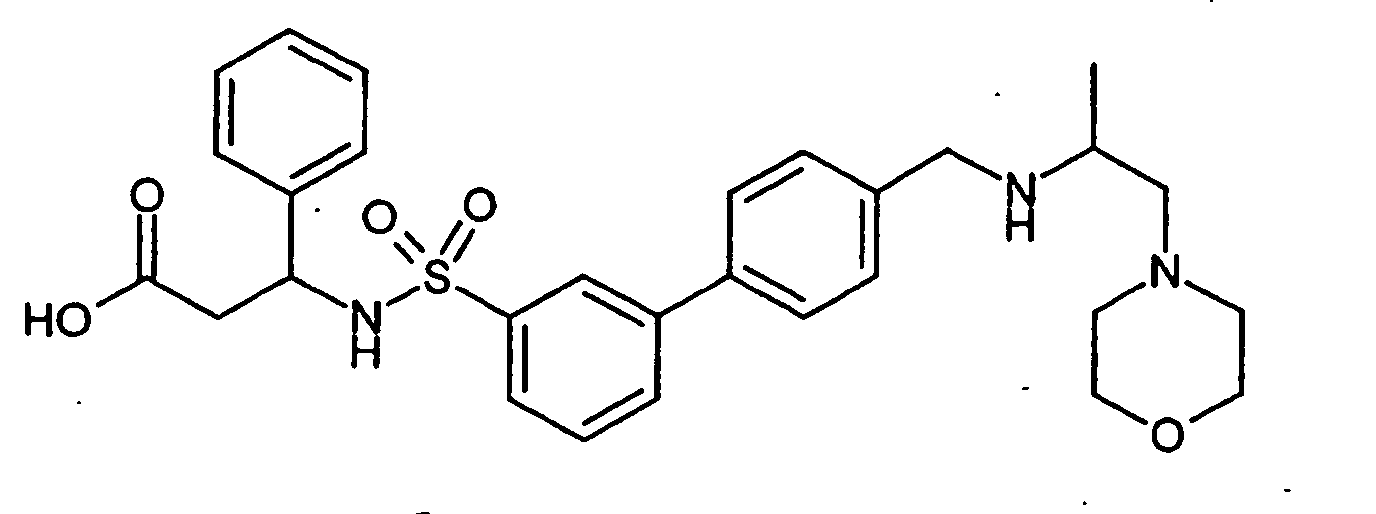
- (3R,S)-3-(4'-{[(1-methyl-2-morpholin-4-yl-ethyl)-amino]-methyl}-biphenyl-3-sulfonylamino)-3-phenyl-propanoic acid is prepared according to the procedure of example 8.1, with the exception that 4-formylbenzeneboronic acid is used as a boronic acid reagent instead of 3-formylbenzeneboronic acid and 1-morpholino-2-propylamine is used as an amine reagent instead of 2-aminomethylbenzimidazole dihydrochloride.
Mass spectrometry (ESI): 538.
Retention time (HPLC): Rt = 5.9. -
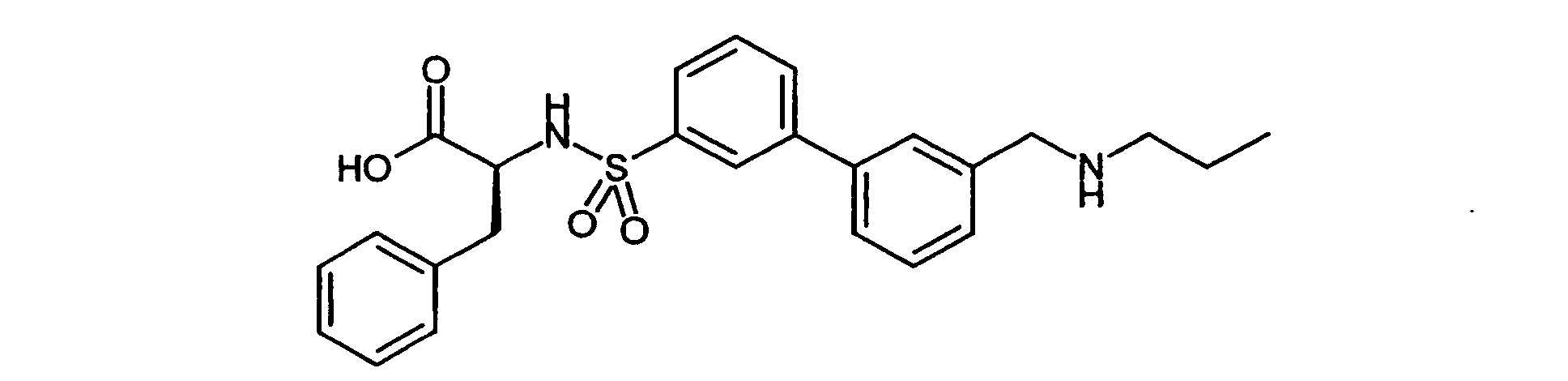
- (2R,S)-2-(3'-Propylaminomethyl-biphenyl-3-sulfonylamino)-3-phenyl-propanoic acid is prepared according to the procedure of example 8.1, with the exception that Fmoc-phenylalanine is used as an amino acid reagent instead of (3R,S)-3-(9-fluorenylmethoxycarbonylamino)-3-phenyl-propanoic acid and propylamine is used as an amine reagent instead of 2-aminomethylbenzimidazole dihydrochloride.
Mass spectrometry (ESI): 453.
Retention time (HPLC): Rt = 7,6.
1H-NMR (400 MHz, methanol) δ = 8,04 (s, 1H), 7,89 (s, 1H), 7,80 (m, 2H), 7,74 (d, 1H), 7,57 (m, 2H), 7,45 (d, 1H), 7,28 - 7,13 (m, 5H), 3,97 (dd, 1H, H-2), 3,03 (m, 4H), 1,74 (m, 2H), 1,02 (t, 3H). -
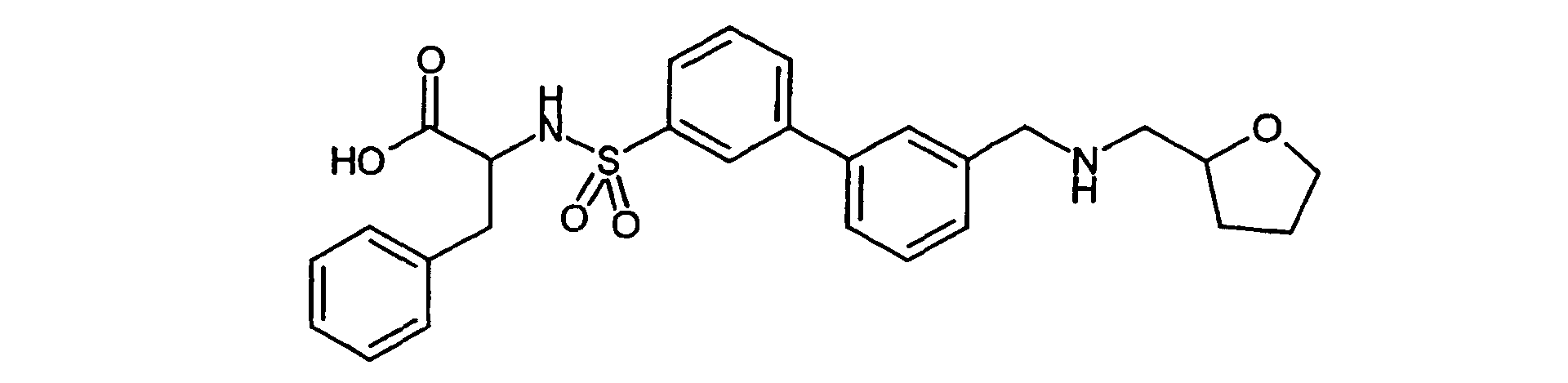
- (2R,S)-2-(3'-{[(Tetrahydrofuran-2-yl-methyl)-amino]-methyl}-biphenyl-3-sulfonylamino)-3-phenyl-propanoic acid is prepared according to the procedure of example 8.1, with the exception that D,L-Fmoc-phenylalanine is used as an amio acid reagent instead of (3R,S)-3-(9-fluorenylmethoxycarbonylamino)-3-phenyl-propanoic acid and 2-aminomethyltetrahydrofuran is used as an amine reagent instead of 2-aminomethylbenzimidazole dihydrochloride.
Mass spectrometry (ESI): 495.
Retention time (HPLC): Rt = 7,6.
1H-NMR (400 MHz, methanol) δ = 7,97 (s, 1H), 7,83 (d, 1H), 7,77 (s, 1H), 7,73 (d, 1H), 7,68 (d, 1H), 7,60 (dd, 1H), 7,52 (m, 2H), 7,12 (m, 5H), 4,35 (d, 1H, J = 13,0 Hz), 4,31 (d, 1H, J = 13,0 Hz), 4,18 (dddd, 1H, J = 2,8 Hz, J = 7,0 Hz, J = 7,0 Hz, J = 10,0 Hz), 4,10 (dd, 1H, J = 5,6 Hz, J = 8,4 Hz, H-2), 3,92 (dd, 1H, J = 7,0 Hz, J = 15,2 Hz), 3,83 (dd, 1H, J = 7,0 Hz, J = 15,2 Hz), 3,20 (dd, 1H, J = 4,8 Hz, 12,8 Hz), 3,06 (dd, 1H, J = 5,6 Hz, J = 14,0 Hz, H-3a), 3,01 (dd, 1H, J = 10,0 Hz, J = 12,8 Hz), 2,87 (dd, 1H, J = 8,6 Hz, J = 14,0 Hz, H-3b), 2,12 (m, 1H), 1,96 (m, 2H), 1,61 (m, 1H). -

-
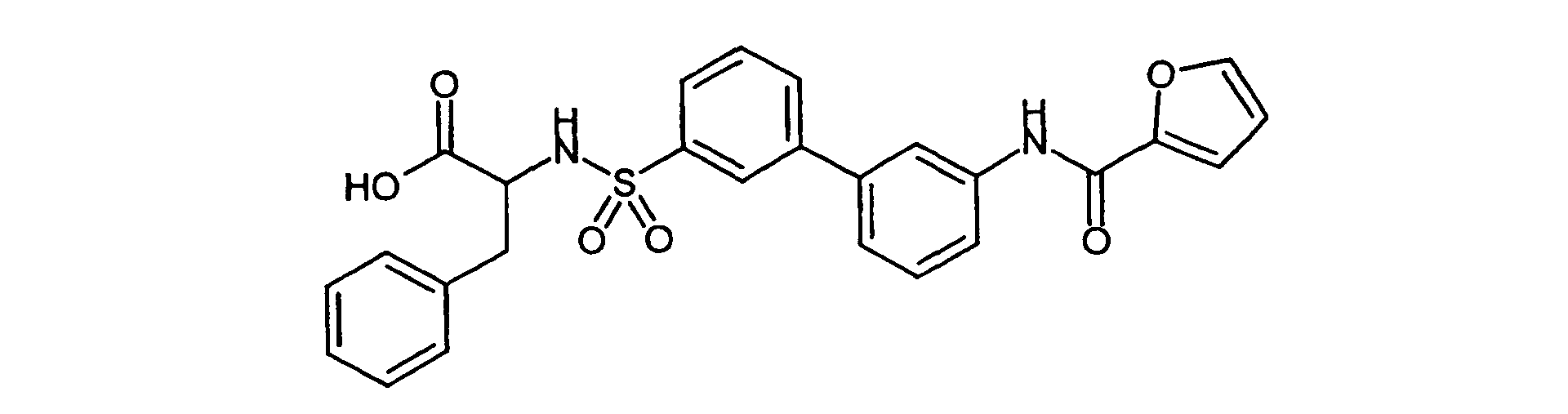
- 1.2 g of Wang polystyrene resin (Rapp-Polymere, Tübingen; loading 1.08 mmol/g) are swollen in dimethylformamide (DMF). The solvent is filtered off with suction and a solution of 1005 mg of Fmoc-phenylalanine (amino acid reagent) in 10 ml of dimethylformamide (DMF) is added. After shaking at room temperature for 15 min, the suspension is treated with 345 µl of pyridine and 543 mg of 2,6-dichlorobenzoyl chloride. It is shaken overnight at room temperature. The resin is then washed with dimethylformamide (DMF), methanol and dichloromethane.
- The resin is treated with 15 ml of a 20% strength piperidine solution dimethylformamide (DMF) and shaken at room temperature for 10 min. It is then washed 3 times with dimethylformamide (DMF) and a further 15 ml of a 20% strength piperidine solution in dimethylformamide (DMF) are added. After shaking for 20 min, it is washed with dimethylformamide (DMF) and tetrahydrofuran (THF). The resin is treated with a solution of 452 ml of diisopropylethylamine in 5 ml of tetrahydrofuran (THF) and a solution of 431 mg of 3-bromobenzenesulfonyl chloride in 5 ml of tetrahydrofuran (THF). It is shaken overnight at room temperature. The resin is then washed with dimethylformamide (DMF), methanol and tetrahydrofuran (THF).
- The resin is suspended in 7 ml of xylene, treated with 1.08 g of 3-nitrobenzeneboronic acid and a solution of 1.37 g of sodium carbonate in 6 ml of water and shaken for 5 min at room temperature. 227 mg of bis-(triphenylphosphane)-palladium(II) chloride and 170 mg of triphenylphosphane are then added and the mixture is stirred overnight at 85°C. The resin is then washed with tetrahydrofuran (THF)/water 1:1, 0.25 M aqueous hydrochloric acid, water, dimethylformamide (DMF), methanol, tetrahydrofuran (THF) and dichloromethane. The resin is treated with a solution of 5.4 g of tin(II) chloride dihydrate in 12 ml of N-methylpyrrolidone (NMP) and shaken overnight at room temperature. The resin is then washed with N-methylpyrrolidone (NMP), methanol, tetrahydrofuran (THF) and dichloromethane.
- The resin is treated with a solution of 1.45 g 2-furanyl-carboxylic acid (acid reagent) in 20 ml dimethylformamide (DMF). After shaking for 1 minute a solution of 2.64 ml diisopropylcarbodiimide in 5 ml dimethylformamide (DMF) is added and the mixture is shaken for 3 hours at room temperature. The resin is then washed with dimethylformamide (DMF) and is treated with 1.45 g 2-furanyl-carboxylic acid in 20 ml dimethylformamide (DMF) and 2.64 ml diisopropylcarbodiimide in 5 ml dimethylformamide (DMF) again. After shaking for 3 hours the resin is washed with dimethylformamide (DMF), methanol, tetrahydrofurane (THF) and dichloromethane.
- For removal of the product, the resin is shaken with 10 ml of trifluoroacetic acid (TFA)/dichloromethane 1:1 for 1 hour, filtered off. The filtrate is concentrated in vacuo and purified on silica gel. 201 mg of the title compound are obtained.
Mass spectrometry (ESI): 491.
Retention time (HPLC): Rt = 9,6.
1H-NMR (400 MHz, methanol) δ = 7,99 (s, 1H), 7,91 (s, 1H), 7,81 (d, 1H), 7,75 (m, 2H), 7,66 (m, 1H), 7,52 - 7,43 (m, 2H), 7,41 (d, 1H), 7,29 (d, 1H), 7,11 (s, 5H), 7,68 (m, 1H), 4,10 (dd, 1H, J =5,6 Hz, J = 10,8 Hz, H-2), 3,06 (dd, 1H, J = 5,6 Hz, J = 13,8 Hz, H-3a), 2,85 (dd, 1H, J = 10,8 Hz, J = 13,8 Hz, H-3b). -
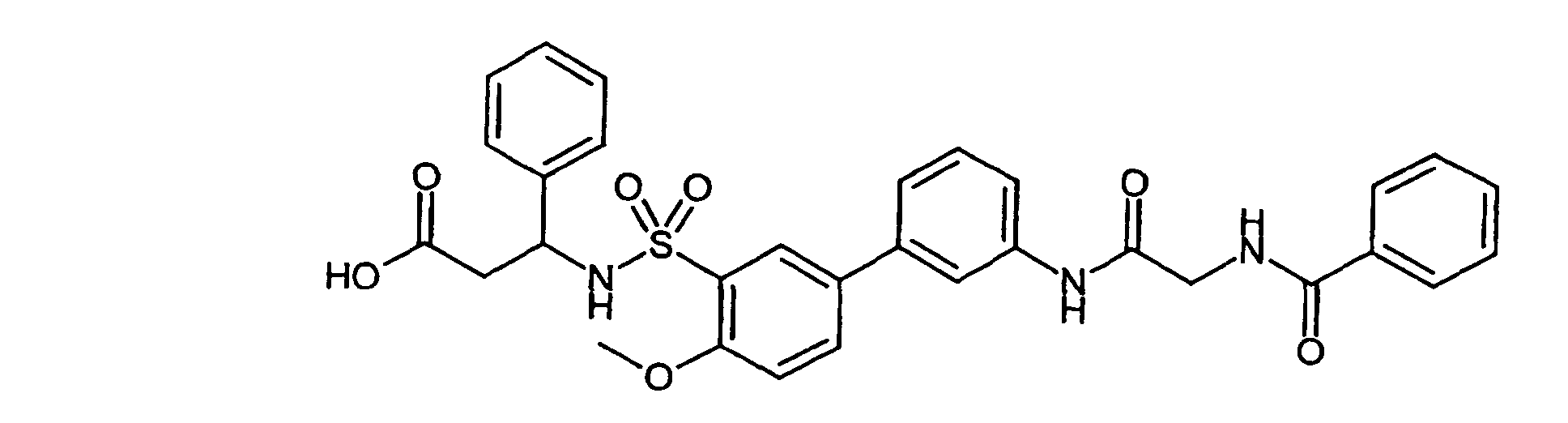
- (3R,S)-3-[3'-(2-Benzamido-acetylamino)-4-methoxy-biphenyl-3-sulfonylamino]-3-phenyl-propanoic acid is prepared according to the procedure of example 9.1, with the exception that D,L-Fmoc-β-phenylalanine is used as an amino acid reagent instead of Fmoc-phenylalanine and benzoic acid is used as an acid reagent instead of 2-furanyl-carboxylic acid.
Mass spectrometry (ESI): 588.
Retention time (HPLC): Rt = 8,6.
1H-NMR (400 MHz, methanol) δ = 7,91 (d, 2H), 7,85 (s, 1H), 7,80 (s, 1H), 7,63 - 7,53 (m, 3H), 7,49 (m, 2H), 7,40 (dd, 1H), 7,28 (d, 1H), 7,05 (s, 5H), 6,87 (d, 1H), 4,72 (dd, 1H, J = 7,4 Hz, J = 7,4 Hz, H-3), 4,23 (s, 2H), 3,78 (s, 3H), 2,89 (dd, 1H, J = 7,2 Hz, J = 15,6 Hz, H-2a), 2,73 (dd, 1H, J = 7,6 Hz, J = 15,6 Hz, H-2b). -
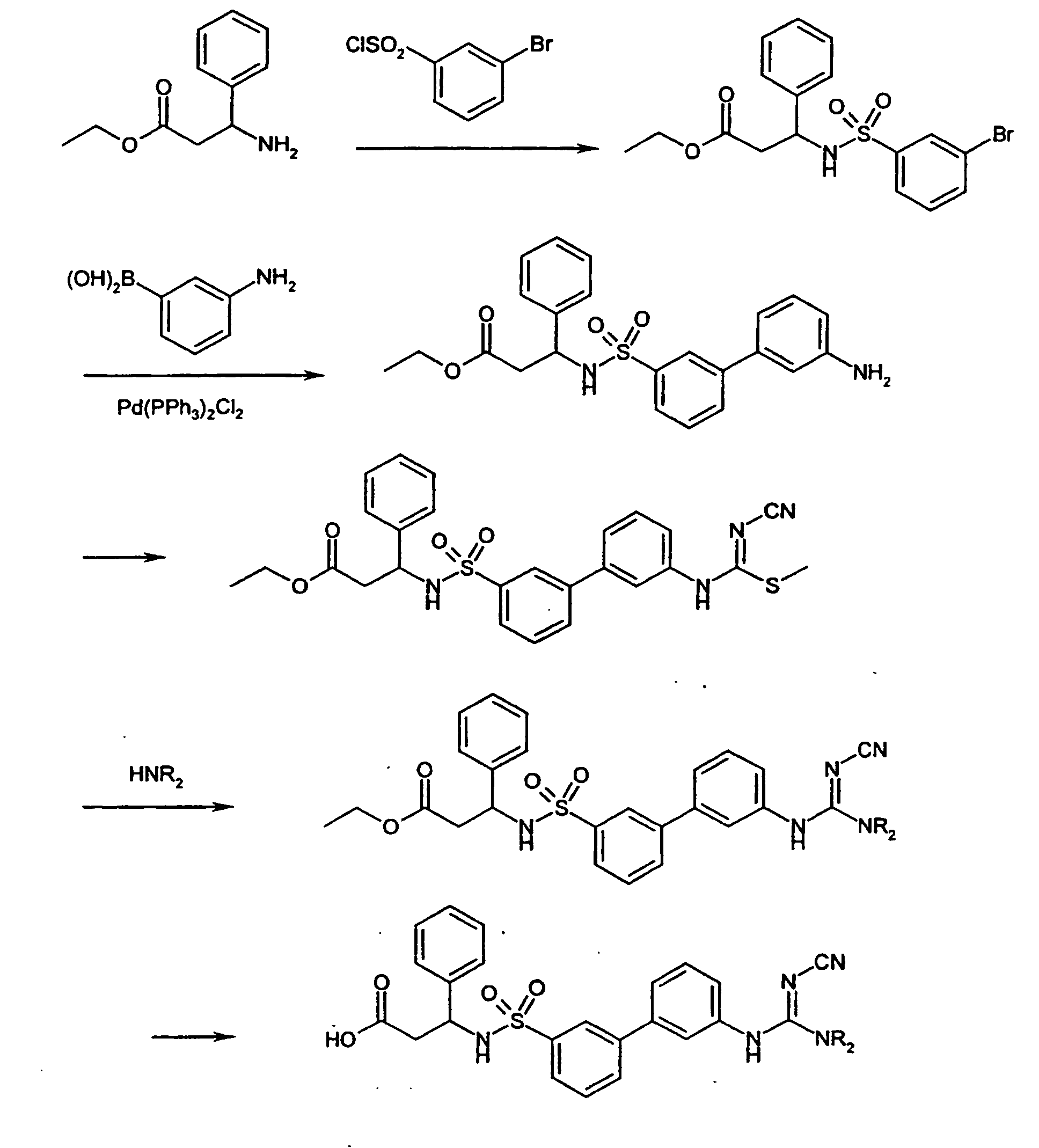
-

- Ethyl 3-Amino-3-phenyl-propanoate (27g, 117 mmol) and 3-bromobenzensulfonylchloride (33 g,129 mmol) were dissolved in dichloromethane (660 ml) at 0°C and 65 ml triethylamin were added. The mixture was stirred at 0°c for 1 h and at room temperature overnight. The reaction mixture was washed with aq 1N HCl, brine and water and dried (MgSO4). The concentrated organic solutions were recrystallized (acetic acid ethyl ester/petroleum ether) to yield 33g (68%) of the title material.
Mass spectrometry (ESI): 412.
Retention time (TLC): Rf= 0.6; (dichloromethane/methanol 10+1) -
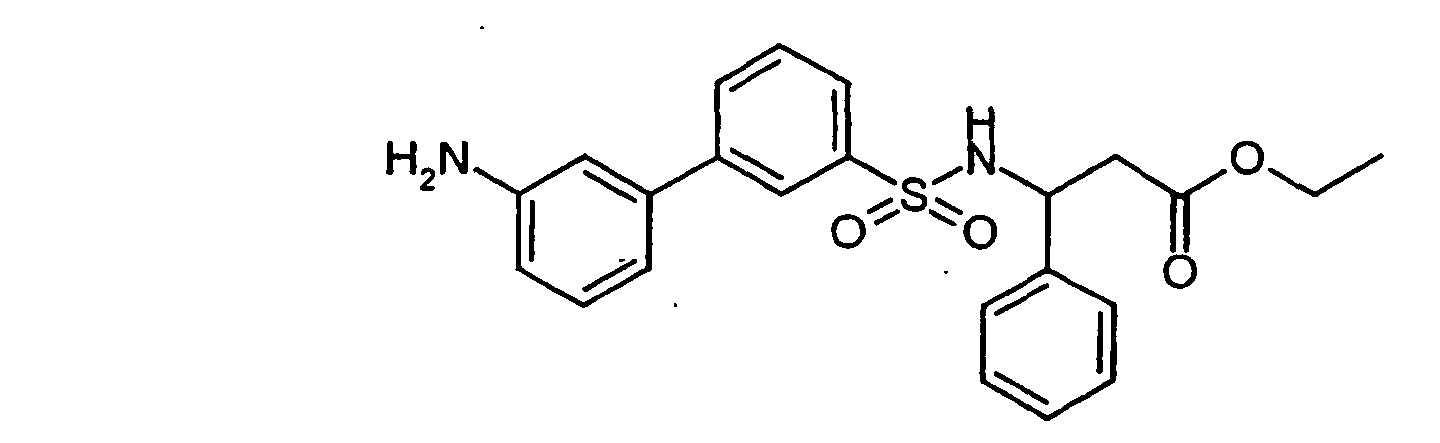
- 23.5 g (57 mmol) of ethyl 3-{[(3-bromophenyl)sulfonyl]amino}-3-phenyl-propanoate 10.1.1 were dissolved in 1,2 dimethoxyethane (270 ml) and 12.72 g (68 mmol) of 3-aminobenzeneboronic acid hemisulfate were added along with 63 ml of 2N sodium carbonate solution and 1.2 g of bis(triphenylphosphine)palladiumdichloride. The mixture is refluxed for 2h at room temperature. Diluted with acetic acid ethyl ester and washed with brine. The organic layer is dried, concentrated and purified via twofold flash chromatography (dichloromethane/acetic acid ethyl ester 10+1; petroleum ether/acetic acid ethyl ester 2+1).
Mass spectrometry (ESI): 424.
Retention time (HPLC): 7.46 min ((Kromasil C18; H3PO4 acetonitrile gradient) -
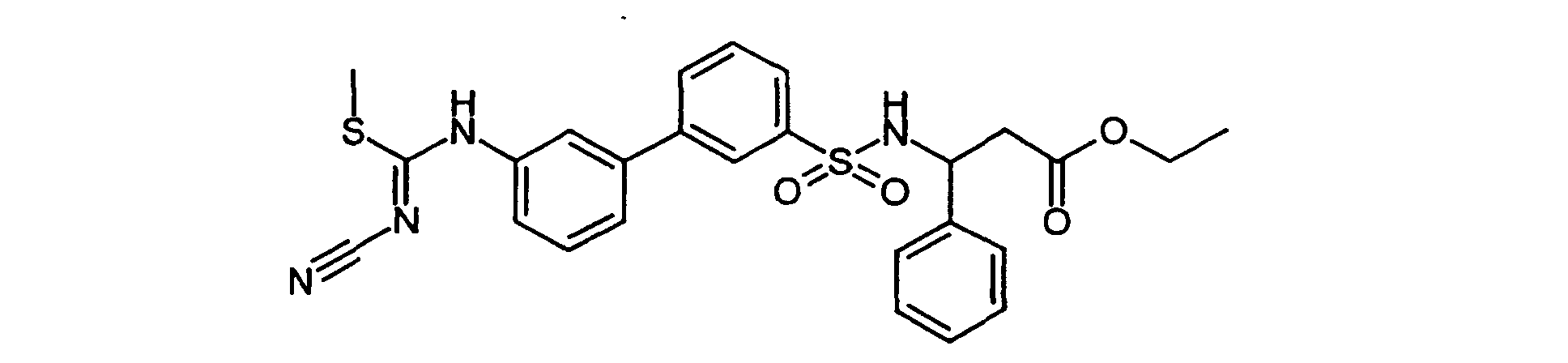
- 1.5 g of ethyl 3-{[(3'-amino[1,1'-biphenyl]-3-yl)sulfonyl]amino}-3-phenyl-propanoate 10.1.2 were dissolved in 20 ml ethanol and 5.17 g of cyanimidodithiocarbonate dimethyl ester were added. After 72h of reflux, the reaction mixture was separated by flash chromatography (dichloromethane/methanol 50+1) and subsequently median pressure liquid chromatography (MPLC) (dichloromethane/acetic acid ethyl ester 2+1). 1g (54.2%) of the title compound were obtained.
Retention time (TLC): Rf= 0.6 (dichloromethane/methanol 10+1). -

- 0.3 g (0.57 mmol) Ethyl 3-{[(3'-{[(cyanoimino)(methylsulfanyl)methyl]amino}[1,1'-biphenyl]-3-yl)sulfonyl]amino}-3-phenyl-propanoate 10.1.3 were dissolved in 10 ml ethanol and 0.37g (3.4 mmol) benzylamine (amine reagent) was added. The mixture was refluxed for 20h, concentrated, and purified via flash chromatography (dichloromethane/acetic acid ethyl ester 5+1). 0.296 g (80%) were obtained.
Mass spectrometry (ESI): 582
Retention time (TLC): Rf = 0.3 (dichloromethane/acetic acid ethyl ester 4+1).
m.p.: 80°C. -
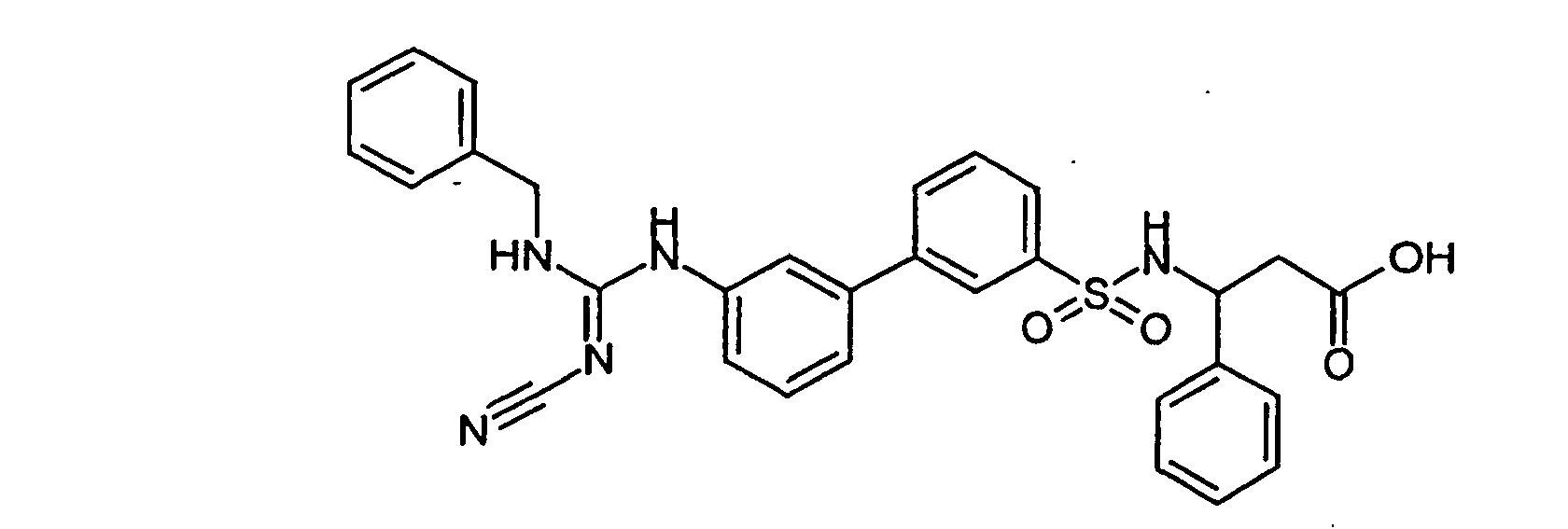
- 0.21 g (0.36 mmol) of Ethyl 3-[(3'-{[(benzylamino)(cyanoimino)methyl]amino}[1,1'-biphenyl]-3-yl)sulfonylamino]-3-phenyl-propanoate 10.1.4 were dissolved in 4 ml 1,2-dimethoxyethane and 2 ml water. 0.21 g Lithium hydroxyde were added and the reaction mixture was stirred for 2h at rt. The reaction being complete (tlc control), it was extracted with ether (2x20 ml) and the water phase was acidified (acetic acid) and extracted with 3x50 ml acetic acid ethyl ester. The resulting crude material was solidified with ether.
Mass spectrometry (ESI): 553
Retention time (TLC): 0.4 (dichloromethane/methanol 4+1)
m.p.: 90°C -
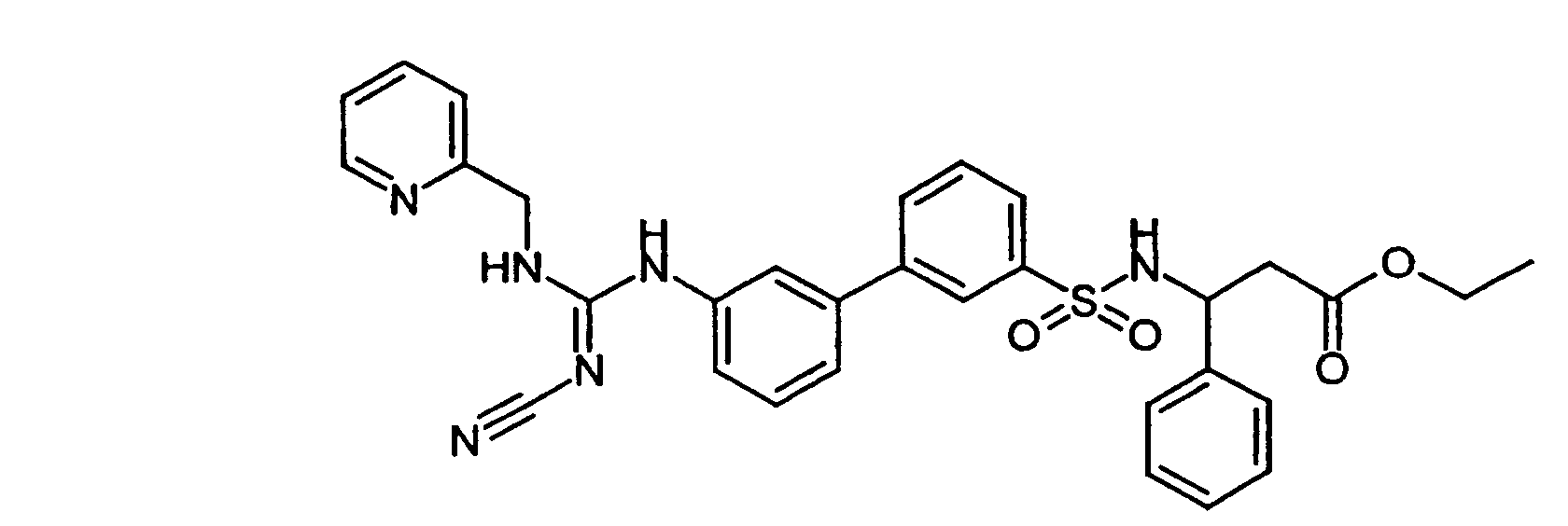
- Ethyl 3-[(3'-{[(o-pyridylmethlamino)(cyanoimino)methyl]amino}[1,1'-biphenyl]-3-yl)sulfonylamino]-3-phenyl-propanoate is prepared according to the procedure of example 10.1.4 with the exception that 2-aminomethylpyridine is used as an amine reagent instead of benzylamine.
Mass spectrometry (ESI): 583
m.p.: 82°C -

- 3-[(3'-{[(o-Pyridylmethlamino)(cyanoimino)methyl]amino}[1,1'-biphenyl]-3-yl)sulfonylamino]-3-phenyl-propanoic acid is prepared from example 10.2.4 according to the procedure of example 10.1.5.
Mass spectrometry (ESI): 555
m.p.: 90°C -

- Ethyl 3-[(3'-{[(cyclopropylamino)(cyanoimino)methyl]amino}[1,1'-biphenyl]-3-yl)-sulfonylamino]-3-phenyl-propanoate is prepared according to the procedure of example 10.1.4 with the exception that cyclopropylamine is used as an amine reagent instead of benzylamine.
Mass spectrometry (ESI): 532
m.p.: 82°C -

- 3-[(3'-{[(cyclopropylamino)(cyanoimino)methyl]amino}[1,1'-biphenyl]-3-yl)sulfonylamino]-3-phenyl-propanoic acid is prepared from example 10.3.4 according to the procedure of example 10.1.5.
Mass spectrometry (ESI): 504
m.p.: 120°C -

-

- 31.84 g (75 mmol) ethyl 3-{[(3'-amino[1,1'-biphenyl]-3-yl)sulfonyl]amino}-3-phenyl-propanoate 10.1.2 were dissolved in 600 ml toluene and 8.62 g thiophosgene were added. The mixture was refluxed for 2h, evaporated and the residue dissolved in 200 ml toluene. This solution was added dropwise to a solution of o-phenylendiamine (12.2 g 113 mmol) in 500 ml tetrahydrofurane/toluene (1/1) at 40°C. The mixture was stirred for 12h at room temperature, concentrated and purified (flash chromatography: dichloromethane/acetic acid ethyl ester10+1) to yield 43 g (100%).
Mass spectrometry (ESI): 574.
Retention time (HPLC): Rt = 7.08 min (Kromasil C18, aqHClO4 (1 proz.) in acetonitrile Gradient, flux: 0.5 ml/min, 210 nm). -

- 43 g (75mmol) of Ethyl 3-{[(3'-{[(2-aminoanilino)carbothioyl]amino}[1,1'-biphenyl]-3-yl)sulfonyl]amino}-3-phenyl-propanoate 11.1.1 and 16.24 g (75 mmol) of yellow mercury oxide were mixed with 1.51 CHCl3 and refluxed for 6h. The resulting material was purified via flash chromatography (dichloromethane/acetic acid ethyl ester 3+1). Recrystallization from acetic acid ethyl ester led to 27.8 g (68%).
m.p.: 83°C. -
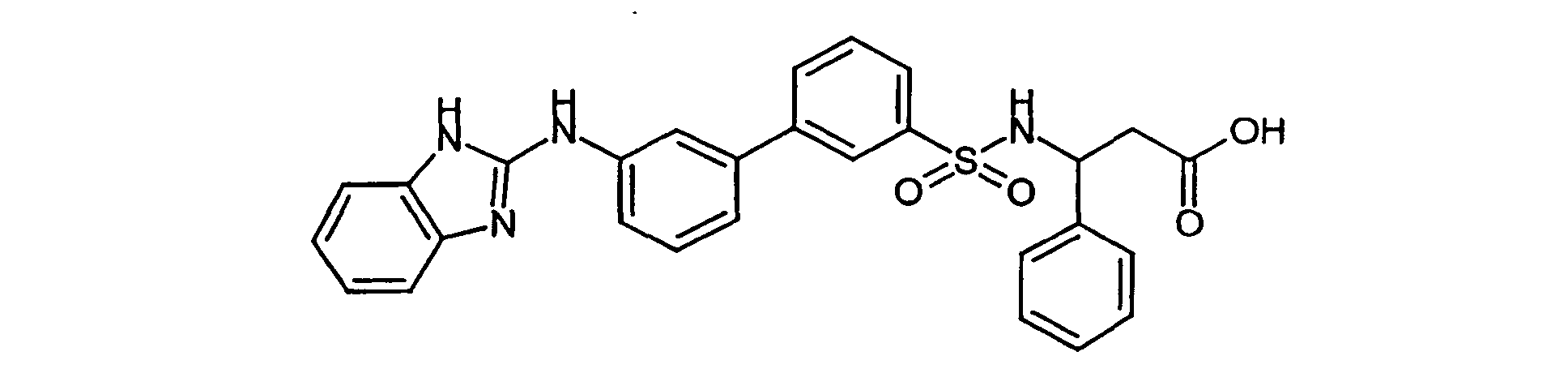
- 200 mg (0.37 mmol) Ethyl 3-{[3'-(1H-benzimidazol-2-ylamino)[1,1'-biphenyl]-3-yl]sulfonylamino}-3-phenyl-propanoate 11.1.2 were dissovled in 20 ml 12,dimethoxyethane and 18 ml water. 0.2g LiOH were added and after 2h at room temperature, the solution was extracted with ether and the aqueous phase was acidified with acetic acid. The precipitate was collected and washed with water and ether. 0.163 mg (86%).
Mass spectrometry (ESI): 512.
m.p.: 180° -

-

- At 0°C, 9.35 g (42.77 mmol, 1.05 equiv.) mesitylenesulfonyl chloride (sulfonylating reagent) is added to a solution of 12.0 g (40.47 mmol, 1.0 equiv.) methyl (2S)-3-(4-bromophenyl)-2-aminopropanoate hydrochloride in 100 ml dry pyridine. The cooling bath is removed and the mixture is stirred at room temperature over night. Then, the pyridine is evaporated under reduced pressure and the semi-solid crude product is partitioned between 2-molar aqueous hydrochloric acid and ethyl acetate. The organic layer is successively washed with 2-molar aqueous hydrochloric acid, water and brine. Dried over unhydrous sodium sulfate. The product is filtered over a pad of silica, using cyclohexane/ethyl acetate 2:1 as the solvent. 15.5 g (35.20 mmol, 86% yield) are obtained as a white, crystalline solid.
Mass spectrometry (ESI): 462/464 (M+Na+), 440/442 (M+H+).
Retention time (TLC): Rf = 0.70 (cyclohexane/ethyl acetate, 1:2).
1H-NMR (400 MHz, dimethylsulfoxide-d6): δ = 8.31 (1H, d), 7.28 (2H, d), 7.00 (2H, d), 6.87 (2H, s), 3.82 (1H, m), 3.42 (3H, s), 2.90 (1H, dd), 2.72 (1H, dd), 2.39 (6H, s), 2.27 (3H, s). -
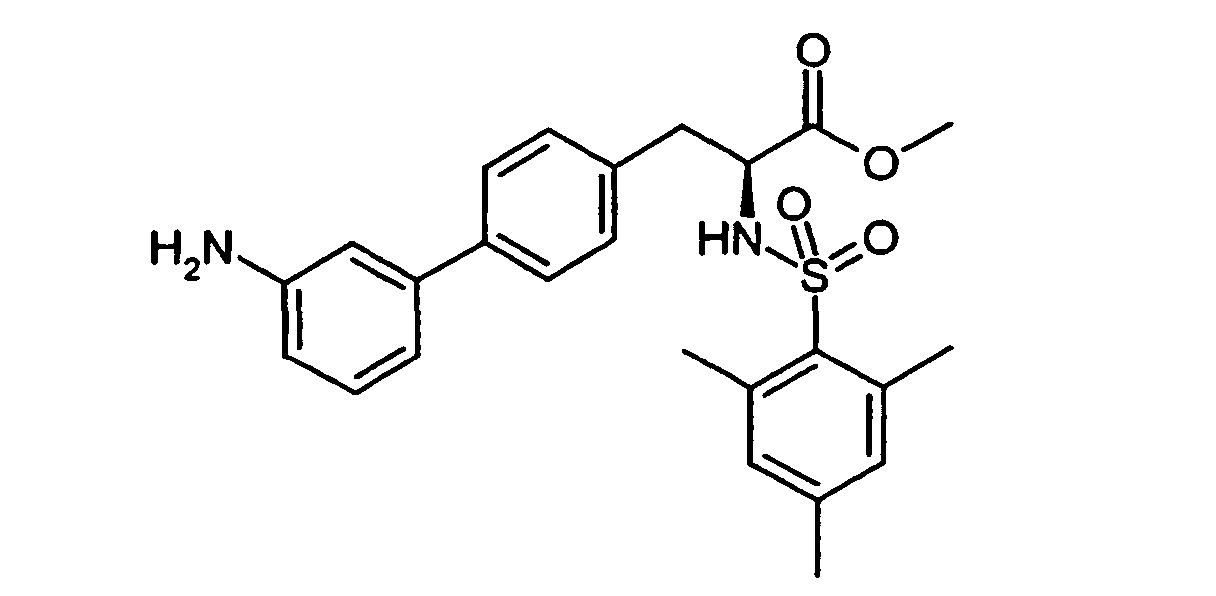
- Under an atmosphere of argon, a vigorously stirred suspension of 25.0 g (56.77 mmol, 1.0 equiv.) methyl (2S)-3-(4-bromophenyl)-2-mesitylsulfonylamino-propanoate 12.1.1, 12.67 g (34.06 mmol, 1,2 equiv.) 3-aminophenylboronic acid hemisulfate and 1.2 g (1.70 mmol, 0.03 equiv.) dichlorobis(triphenylphosphino)-palladium in 350 ml dimethoxy ethane is treated with 62.5 ml (125 mmol) of a 2-molar solution of sodium carbonate in water. The mixture is heated to reflux. After three hours, the reaction is completed and the reaction mixture is cooled to room temperature. After dilution with ethyl acetate, the mixture is successiveley washed with 5% aqueous sodium dihydrogenphosphate, water and brine. Dried over anhydrous sodium sulfate. After removal of the solvent, the crude product is purified by suction filtration over silica using cyclohexane/ethyl acetate 2:1 as the solvent. 20.65 g (45.63 mmol, 80% yield) of a white amorphous solid are obtained.
Mass spaectrometry (ESI): 905 (2M+H+), 453 (M+H+)
Retention time (TLC): Rf= 0.45 (cyclohexane/ethyl acetate, 1:2)
1H-NMR (300 MHz, dimethylsulfoxide-d6): δ = 8.29 (1H, d), 7.30 (2H, d), 7.08 (1H, t), 7.07 (2H, d), 6.84 (2H, s), 6.80 (1H, s), 6.72 (1H, d), 6.55 (1H, d), 5.10 (2H, s), 3.87 (1H, m), 3.40 (3H, s), 2.95 (1H, dd), 2.80 (1H, dd), 2.42 (6H, s), 2.10 (3H, s). -
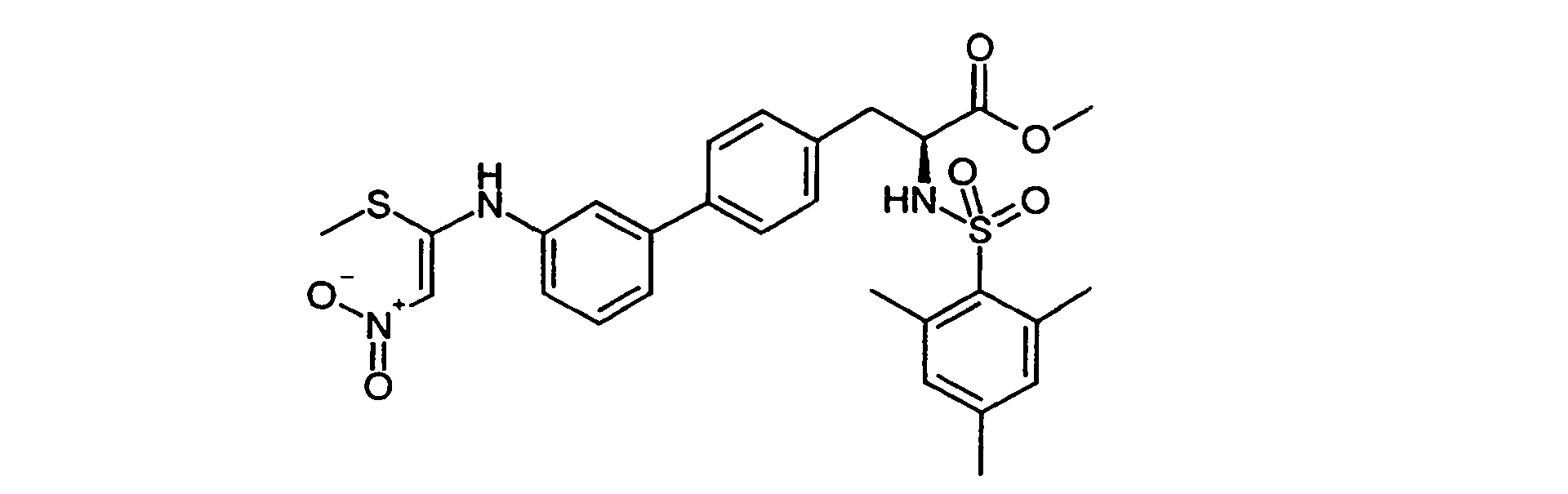
- 9.13g (55.24 mmol) of 2-nitro-1,1-di(thiomethyl)ethylene and 2.50g (5.52 mmol) of methyl (2S)-3-(3'-amino[1,1'-biphenyl]-4-yl)-2-mesitylsulfonylamino-propanoate 12.1.2 were refluxed in 450 ml n-propanol for 4h. The reaction mixture was concentrated and purified via flash chromatography (dichloromethane/acetic acid ethyl ester 5+1). The product crystallized from dichloromethane/Ether to furnish 2.85 g (91 %).
Mass spectrometry (ESI): 569.
Retention time (HPLC): Rt = 9.77 min (Kromasil C18, H3PO4 in acetonitrile Gradient, flux: 0.5 ml/min, 210 nm).
Retention time (TLC): Rf = 0.60 (dichloromethane/acetic acid ethyl ester = 10+1). -

- 2.5 g (4.38 mmol) Methyl (2S)-2-mesitylsulfonylamino-3-(3'-{[(Z)-1-(methylsulfanyl)-2-nitroethenyl]amino}[1,1'-biphenyl]-4-yl)-propanoate 12.1.3 were dissolved in 60 ml propanol and 0.75g cyclopropylamine (amine reagent) were added. The mixture was refluxed for 1h concentrated and purified via flash chromatography (dichloromethane/methanol 10+1) to give 2.2g (86%).
Mass spectrometry (ESI): 578.
Retetion time (HPLC): Rt = 8.67 min (Kromasil C18, H3PO4 in acetonitrile Gradient, flux: 0.5 ml/min, 210 nm). -

- 2 g (3.456 mmol) Methyl (2S)-3-(3'-{[(E)-1-(cyclopropylamino)-2-nitroethenyl]-amino}[1,1'-biphenyl]-4-yl)-2-mesitylsulfonylamino-propanoate 12.1.4 were dissolved in 90 ml 1,2 dimethoxymethane and 80 ml water. Then 2g LiOH were added and the solution was stirred over night at rt. The mixture was extracted twice with ether and the residing aqueous phase was acidified (acetic acid). The precipitate was recristallized from dichloromethane/methanol to yield 1.3g (66.6%)
Mass spectrometry (ESI): 564.
Retention time (HPLC): Rt = 7.82min (Kromasil C18, H3PO4 in acetonitrile Gradient, flux: 0.5 ml/min, 210 nm).
m.p.: 149°C. -

- Methyl (2S)-2-[((S)-campher-10-yl-sulfonyl)amino]-3-(3'-{[(Z)-1-(methylsulfanyl)-2-nitroethenyl]amino}[1,1'-biphenyl]-4-yl)-propanoate is prepared according to the procedure of example 12.1.1-12.1.3, with the exception that (S)-(+)-campher-10-sulfonyl chloride is used as a sulfonylating reagent instead of mesitylenesulfonyl chloride.
-

- Methyl (2S)-3-(3'-{[(E)-1-(cyclopropylamino)-2-nitroethenyl]amino}[1,1'-biphenyl]-4-yl)- 2-[((S)-campher-10-yl-sulfonyl)amino]-propanoate is prepared from example 12.2.3 according to the procedure of example 12.1.4.
-
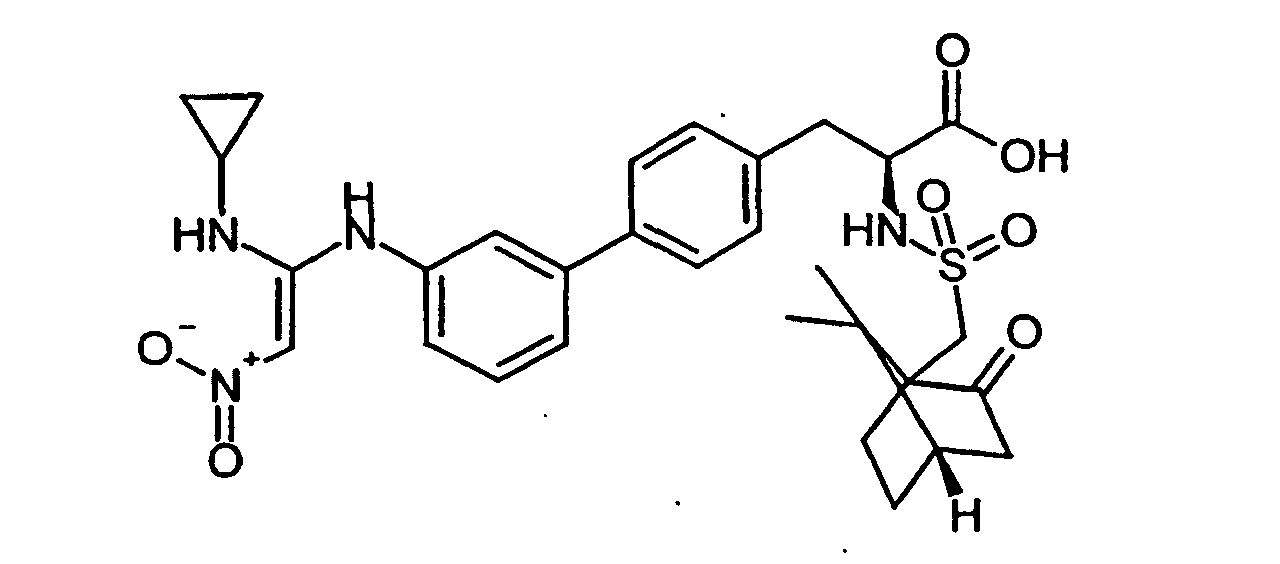
- 0.25 g Methyl (2S)-3-(3'-{[(E)-1-(cyclopropylamino)-2-nitroethenyl]amino}[1,1'-biphenyl]-4-yl)- 2-[((S)-campher-10-yl-sulfonyl)amino]-propanoate 12.2.4 were saponified with LiOH as described above to yield 0.175g (71 %).
Mass spectrometry (ESI): 597.
Retention time (HPLC): Rt = 7.42 min (Kromasil C18, H3PO4 in acetonitrile Gradient, flux: 0.5 ml/min, 210 nM).
Retention time (TLC): Rf = 0.4 (dichloromethane/methanol 4+1). -

-

- 2 g of Methyl (2S)-3-(3'-amino[1,1'-biphenyl]-4-yl)-2-mesitylsulfonylamino-propanoate 12.1.2 were mixed with 0.75 g 3,4-diethoxy-3-cyclobuten-1,2-dion in 40 ml 1 propanol and refluxed for 20h. Purification by flash chromatography (dichloromethane/acetic acid ethyl ester 10+1) yielded 1,5 g of the title compound.
-
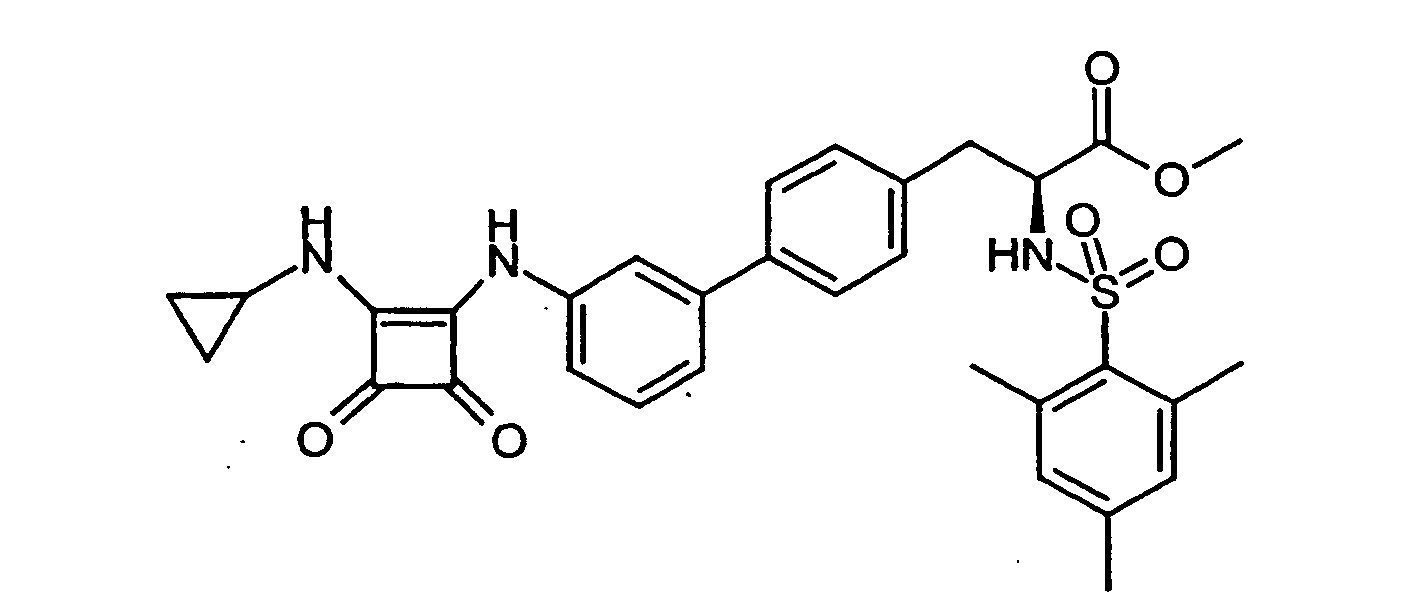
- 0.2 g methyl Methyl (2S)-3-{3'-[(2-ethoxy-3,4-dioxo-1-cyclobuten-1-yl)amino][1,1'-biphenyl]-4-yl}-2-mesitylsulfonylamino-propanoate 13.1.1 were dissolved in 10 ml iso-propanol and 0.24 ml cyclopropylamine were added. The mixture was refluxed for 2h concentrated an purified via flash chromatography (dichloromethane/methanol 10+1) to obtain 0.2 g of the title material.
-

- 70 mg Methyl (2S)-3-(3'-{[2-(cyclopropylamino)-3,4-dioxo-1-cyclobuten-1-yl]-amino}[1,1'-biphenyl]-4-yl)-2-[(mesitylsulfonyl)amino]-propanoate 13.1.2 were dissolved in 1.6 ml dimethoxyethane and 0.8 ml water and 70 mg LiOH were added. The precipitate obtained after acidification was collected and purified by flash chromatography (dichloromethane/methanol 25+1) to yield 50 mg.
Mass spectrometry (ESI): 573.
Retention time (TLC): Rf = 0.3 (dichloromethane/methanol 4+1).
Retention time (HPLC): Rt = 7.27 min ((Kromasil C18, HClO4 in acetonitrile Gradient, flux: 0.5 ml/min, 210 nm).
m.p.: 164°C. -
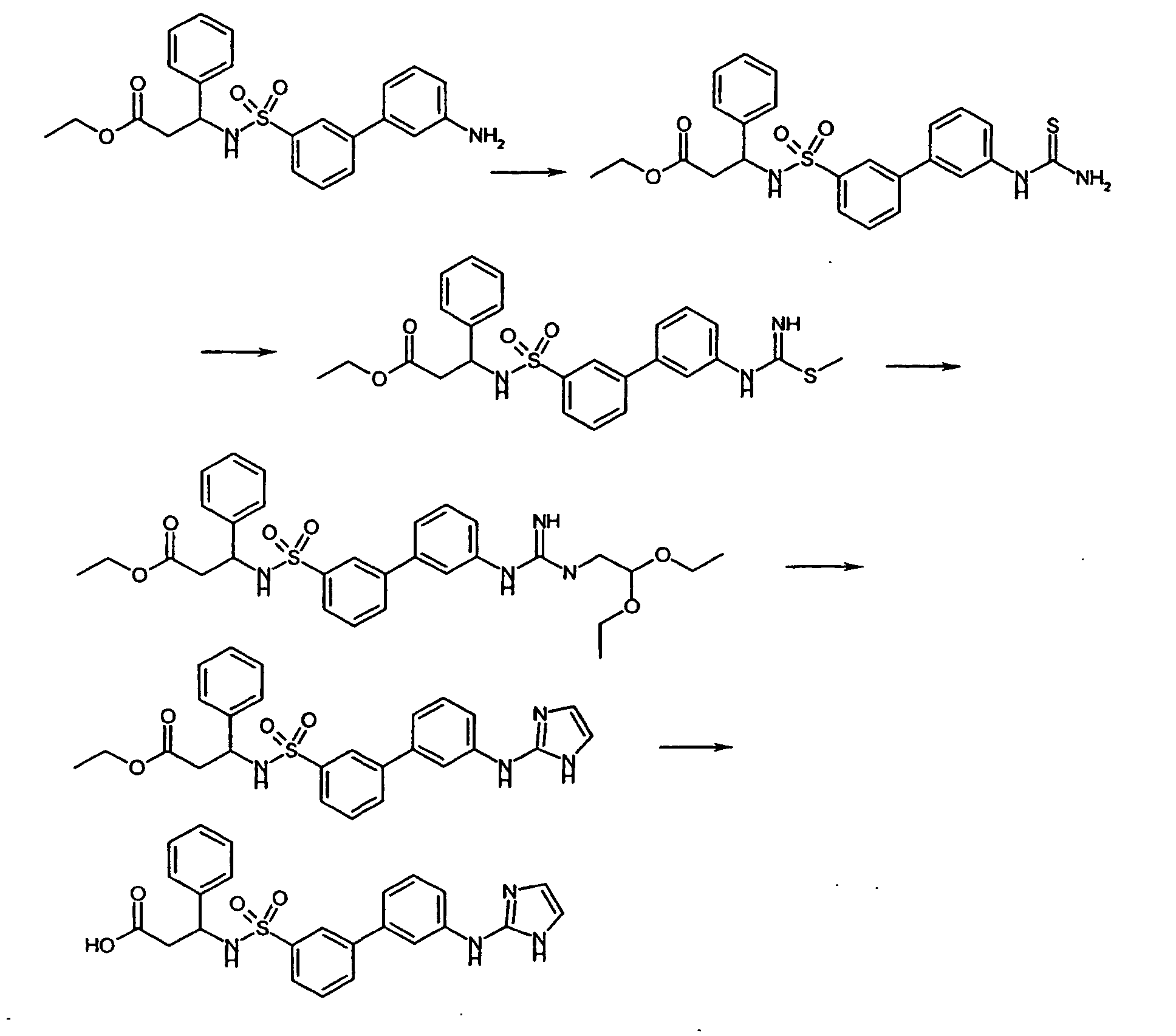
-
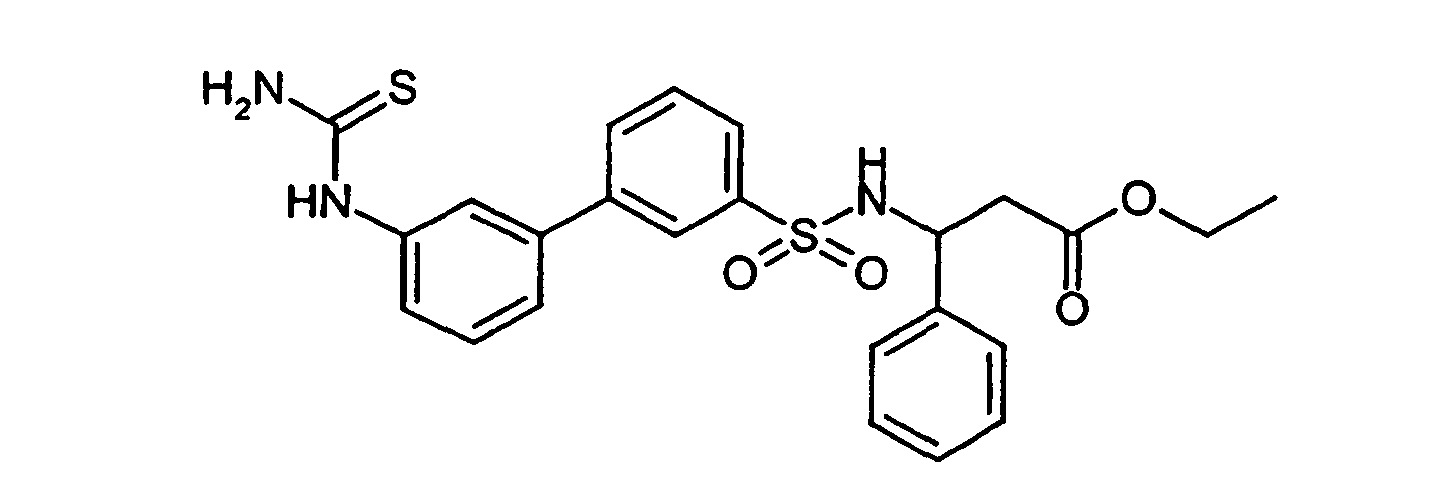
- 4.25 g of Ethyl 3-{[(3'-amino[1,1'-biphenyl]-3-yl)sulfonyl]amino}-3-phenyl-propanoate 10. 1.2 and 1.26 g thiophosgene were disolved in 50 ml toluene refluxed for 1.5 h. The reaction mixture was concentrated and 50 ml tetrahydrofurane were added. NH3 was bubbled into the solution for 30 min. Purification via flash chromatography (petrolium ether/acetic acid ethyl ester 1+1) and crystalisation (dichloromethane) gave 3.9 g of the title material.
-
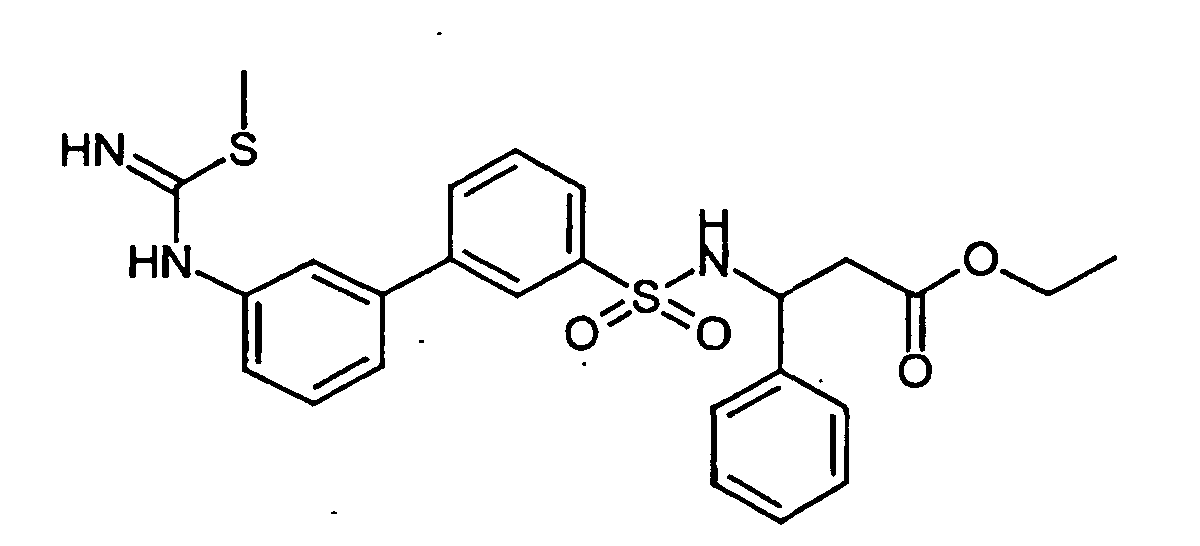
- 2.42 g of Ethyl 3-[({3'-[(aminocarbothioyl)amino][1,1'-biphenyl]-3-yl)sulfonyl)-amino]-3-phenylpropanoate 14.1.1 were dissolved in 80 ml methanol and 0.89 g Iodomethan were added. After reflux for 2h, the reaction mixture was concentrated and crystalized from ether to obtain 3.1 g.
-

- 1.25 g Ethyl 3-{[(3'-{[imino(methylsulfanyl)methyl]amino}[1,1'-biphenyl]-3-yl)-sulfonyl]amino}-3-phenyl-propanoate 14.1.2 were dissolved in 20 ml n-propanol and 0.32 g aminoacetaldehyde-diethylacetal were added dropwise to the boiling solution within 6h. flash chromatography (dichloromethane/acetic acid ethyl ester4+1) yielded 1.1g.
- and
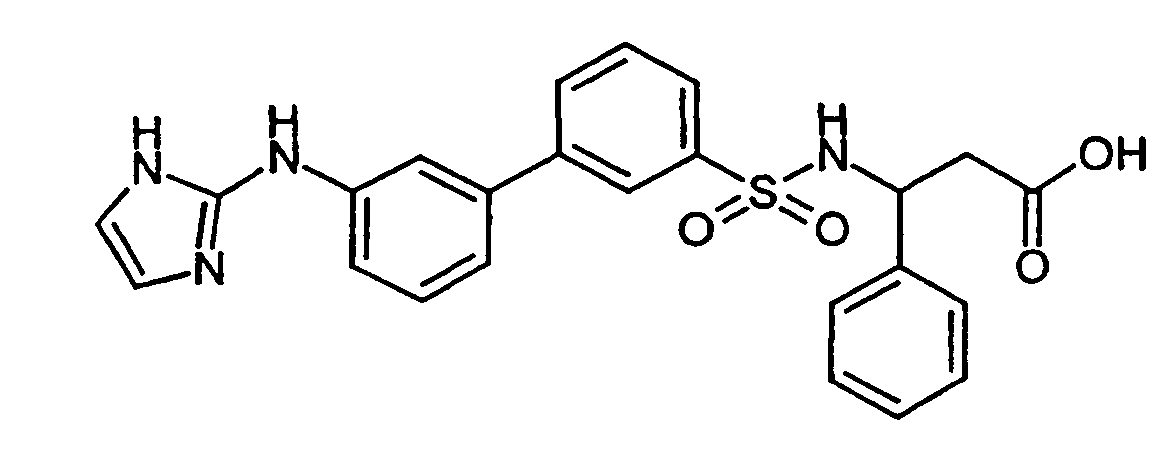

- 1 g Ethyl 3-[(3'-{[[(2,2-diethoxyethyl)amino](imino)methyl]amino}[1,1'-biphenyl]-3-yl)sulfonylamino]-3-phenyl-propanoate 14.1.3 was stirred in 100 ml 6N aq HCl at reflux for 1h. Afterwards, the solution was made basic (NaOH), extracted with dichloromethane and acidified (acetic acid). The separated crystalline material (230 mg) was separated via HPLC to yield 94 mg 3-{[3'-(1H-imidazol-2-ylamino)[1,1'-biphenyl]-3-yl]sulfonyl}-3-phenyl-propanoic acid 14.1.4:
Retention time (HPLC): Rt = 7.09 min; Kromasil C18, H3PO4 in acetonitrile Gradient, flux: 0.5 ml/min, 210 nm)
and 38 mg 3-{[3'-(2-amino-1H-imidazol-1-yl)[1,1'-biphenyl]-3-yl]sulfonyl}-3-phenyl-propanoic acid 14.1.5:
Retention time (HPLC): Rt = 8.77 min; Kromasil C18, H3PO4 in acetonitrile Gradient, flux: 0.5 ml/min, 210 nm). -

-
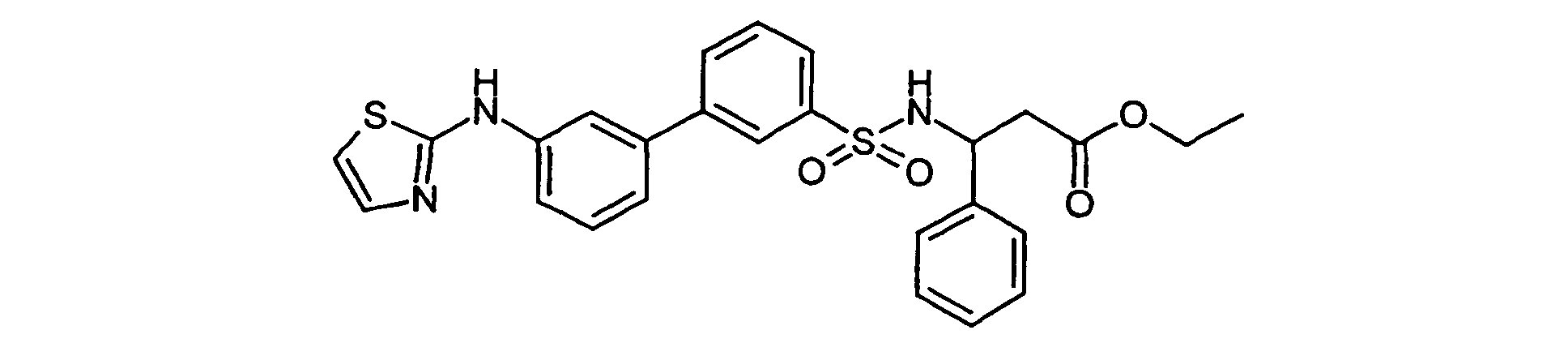
- 0.97 g of Ethyl 3-[({3'-[(aminocarbothioyl)amino][1,1'-biphenyl]-3-yl}sulfonyl)-amino]-3-phenyl-propanoate 14.1.1 and 0.48 g of 1,2-dichloroethylether were heated in water and i-propanol was added such that a clear solution resulted. After 1 h an additional 100 mg of 1,2 dichloroethylether were added and reflux was continued for 1h.
After aqueous work-up and flash chromatography, 0.62 g of the title compound resulted. -
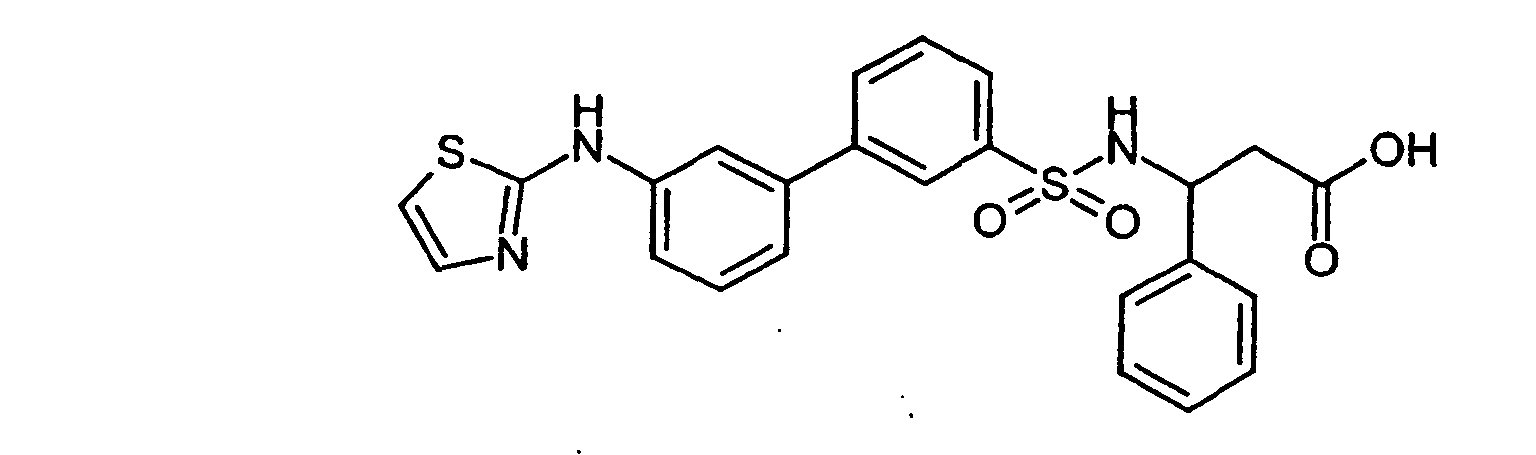
- 0.2 g of Ethyl 3-phenyl-3-{[3'-(1,3-thiazol-2-ylamino)[1,1'-biphenyl]-3-yl]sulfonylamino}-propanoate 15.1.1 were saponified in 15 ml dimethoxyethane 12ml water and 0.2 g LiOH. After aqueos work-up and flash chromatography (dichloromethane/methanol 10 + 1) 65 mg were obtained.
Mass spectrometry (ESI): 480.
m.p: 130°C (decomposition). -
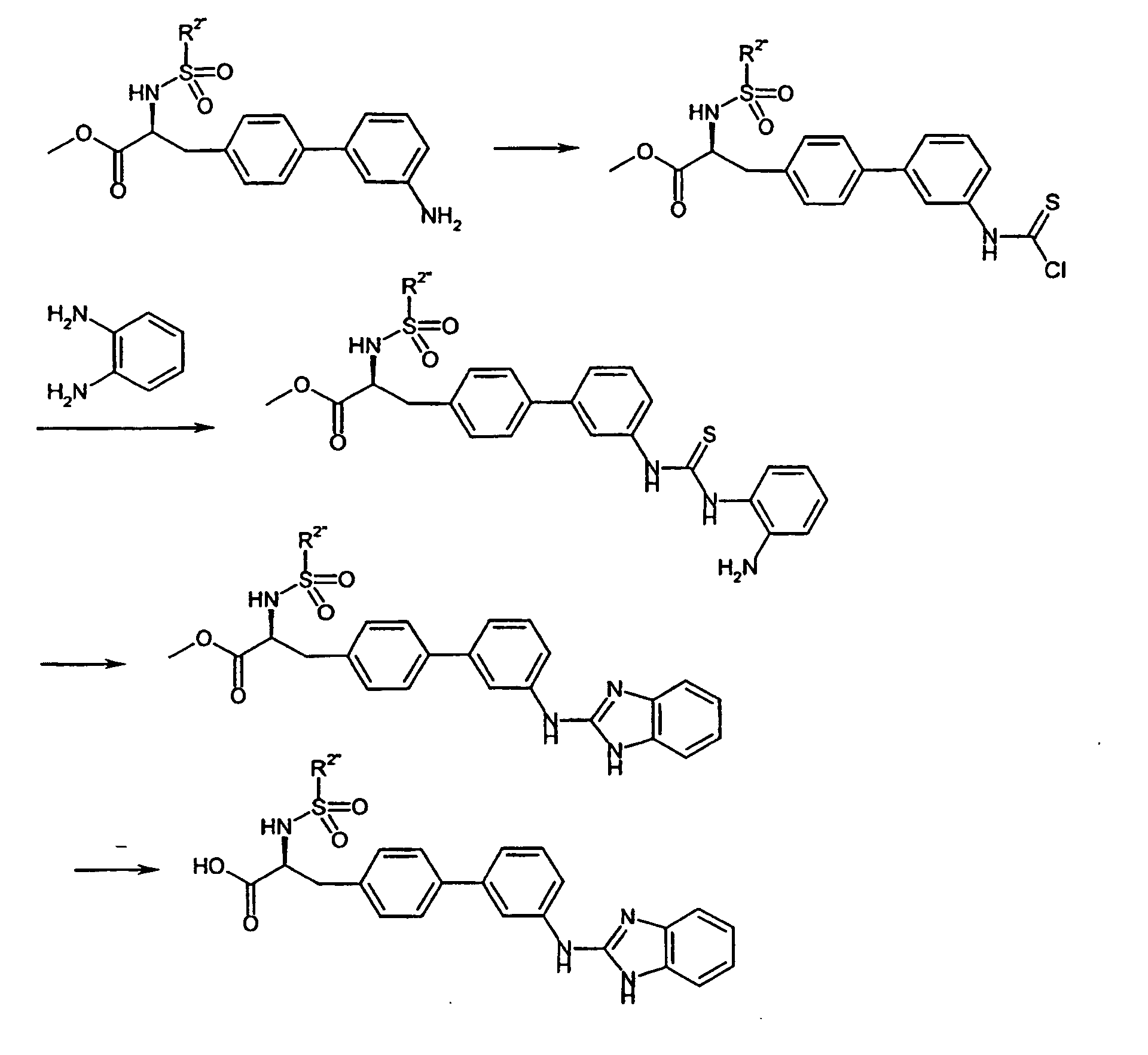
-

- 0.91 g of Methyl (2S)-3-(3'-amino[1,1'-biphenyl]-4-yl)-2-[(mesitylsulfonyl)amino]-propanoate 12.1.2 were dissolved in 20 ml toluene and 0.23 g thiophsogene were added. The reaction mixture was refluxed for 2h, concentrated, redissolved in 20 ml toluene and added dropwise to a solution of o-phenylendiamine in toluene at 40°C. Stirring for 2h resulted in a precipitate that was collected to yield 0.73 g of the title compound.
-
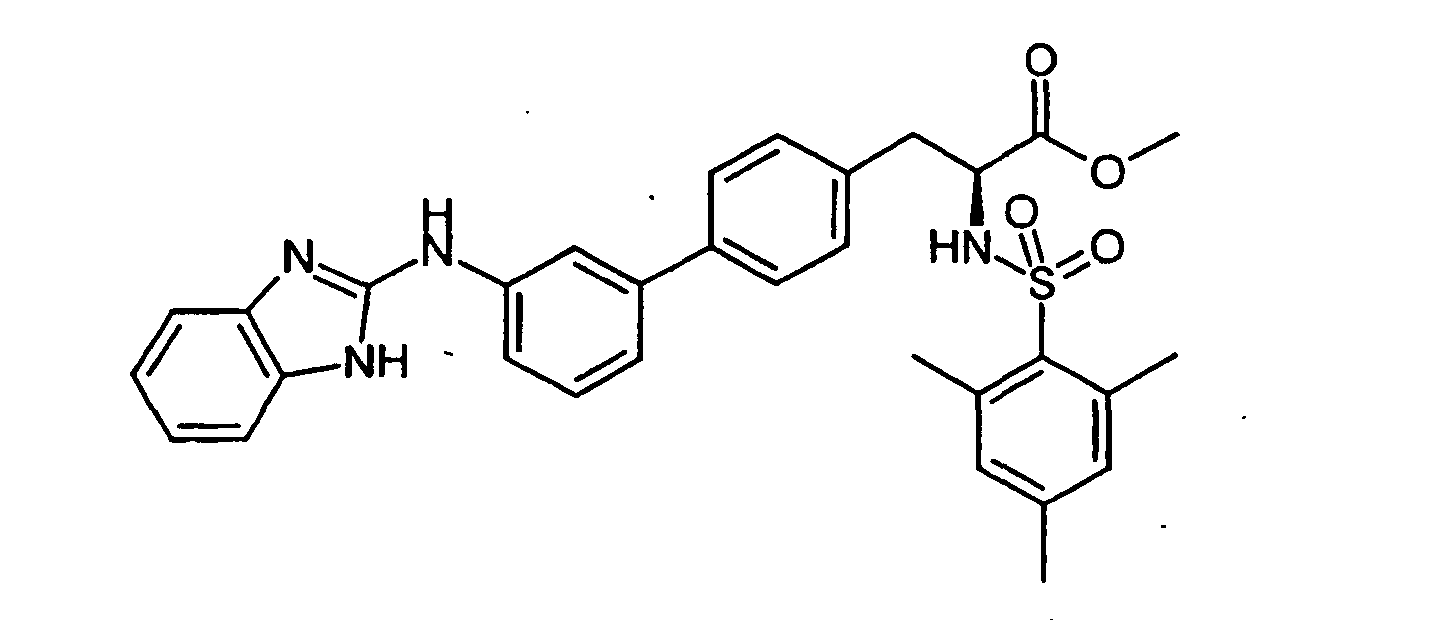
- 0.4 g of Methyl (2S)-3-(3'-{[(2-aminoanilino)carbothioyl]amino}[1,1'-biphenyl]-4-yl)-2-[(mesitylsulfonyl)amino]-propanoate 16.1.1 were dissolved in CHCl3 (30 ml) and yellow HgO (0.14g) were added. After 8h of reflux, purification by flash chromatography (dichloromethane/acetic acid ethyl ester 10+1) yielded 336 mg of the title compound.
-

- 0.19 g Methyl (2S)-3-(3'-{[(2-aminoanilino)carbothioyl]amino}[1,1'-biphenyl]-4-yl)-2-[(mesitylsulfonyl)amino]-propanoate 16.1.2 were saponified in 15 ml dimethoxyethane 12 ml water and 0.19 g LiOH. Aqueous workup and recrystallization (methanol) yielded 0.13 g.
Mass spectrometry (ESI): 554
Retention time (HPLC): Rt = 7.1 min (Kromasil C18, H3PO4 in acetonitrile Gradient, flux: 0.5 ml/min, 210 nm).
m.p.: 190°C (decomp). -

-

- 0.50 g of Methyl (2S)-3-(3'-amino[1,1'-biphenyl]-4-yl)-2-[(mesitylsulfonyl)amino]-propanoate 12.1.2 and 0.64 g of 3,4-bis(methylthio)-1,2,5-thiadiazole-1-oxide (J.Am.Chem.Soc. 1982, 1375-80) were dissolved in 10 ml n-propanol and refluxed over night. Purification by flash chromatography (dichloromethane/acetic acid ethyl ester = 10+1) yielded 0.258 g of the title compound.
-
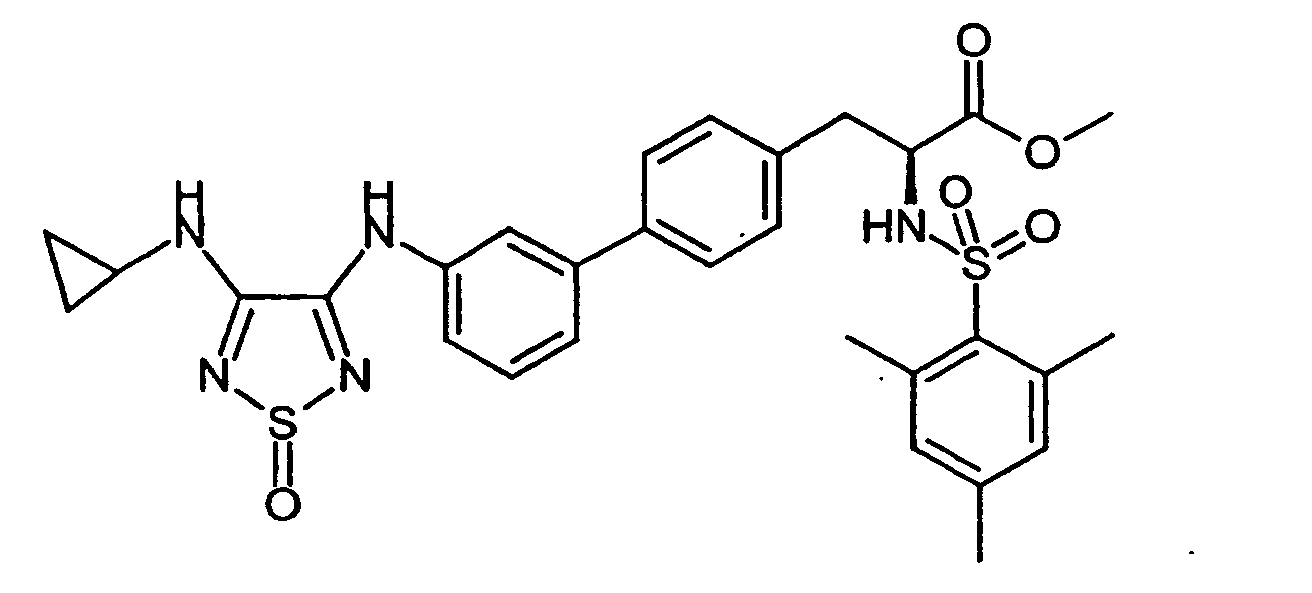
- 0.24 g of Methyl (2S)-2-[(mesitylsulfonyl)amino]-3-(3'-{[4-(methylsulfanyl)-1-oxo-1H-1[lambda]4,2,5-thiadiazol-3-yl]amino}[1,1'-biphenyl]-4-yl)-propanoate 17.1.1 were dissolved in n-propanol and heated to 50° together with 0.23 g cyclopropylamine for 2h. flash chromatography (dichloromethane/acetic acid ethyl ester) yielded 214 mg of the title compound.
-

- 190 mg of Methyl (2S)-2-[(mesitylsulfonyl)amino]-3-(3'-{[4-(cyclopropylamino)-1-oxo-1H-1[lambda]4,2,5-thiadiazol-3-yl]amino}[1,1'-biphenyl]-4-yl)-propanoate 17.1.2 were saponified in 20 ml dimethoxyethane and 20 ml water. By addition of 0.19 mg LiOH Acidification (acetic acid) and crystallisation (acetic acid ethyl ester) yielded 97 mg of yellow crystals.
Mass spectrometry: 594.
m.p. 180°C (decomposition). -
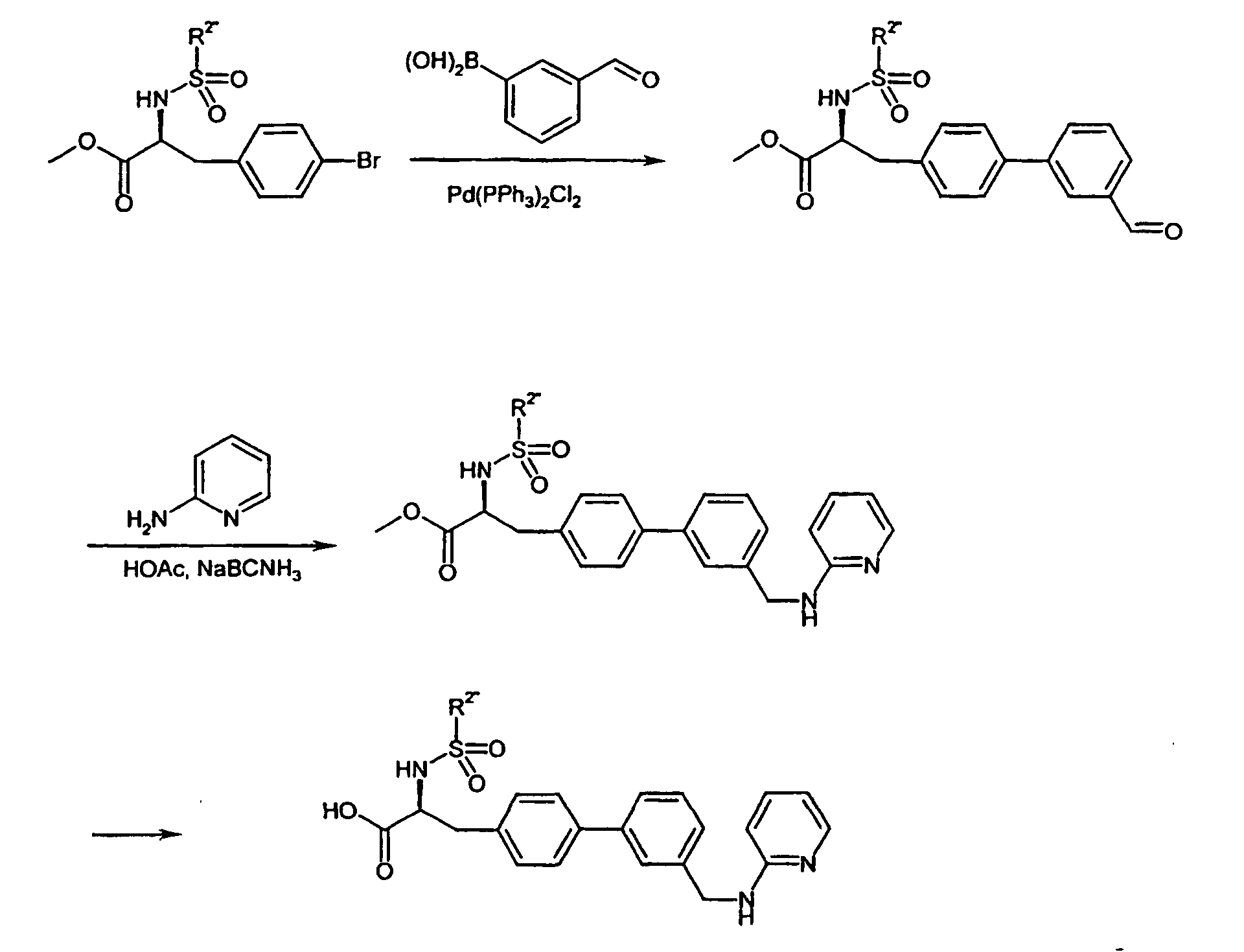
-

- Under an atmosphere of argon, a vigorously stirred suspension of 10.0 g (22.71 mmol, 1.0 equiv.) methyl (2S)-3-(4-bromophenyl)-2-mesitylsulfonylamino-propanoate 12.1.1, 3.75 g (24.98 mmol, 1,1 equiv.) 3-formyl phenyl boronic acid and 0.48 g (0.68 mmol, 0.03 equiv.) dichlorobis(triphenylphosphino)palladium in 120 ml dimethoxy ethane is treated with 13.67 ml (27.34 mmol, 1.2 equiv.) of a 2-molar solution of sodium carbonate in water. The mixture is heated to reflux. After five hours, the reaction is completed and the reaction mixture is cooled to room temperature. After dilution with ethyl acetate, the mixture is successiveley washed with 5% aqueous sodium dihydrogenphosphate, water and brine. Dried over anhydrous sodium sulfate. After removal of the solvent, the crude product is purified by suction filtration over silica using cyclohexane/ethyl acetate 4:1 as the solvent. 9.6 g (20.62 mmol, 91 % yield) of a colorless glass-like solid.
Mass spectrometry (ESI): 488 (M+Na+), 466 (M+H+).
Retention time (TLC): Rf= 0.20 (cyclohexane/ethyl acetate, 4:1)
1H-NMR (300 MHz, dimethylsuffoxide-d6): δ = 10.11 (1H, s); 8.32 (1H, d), 8.15 (1H, pseudo-t), 7.98 (1H, pseudo-td), 7.89 (1H, pseudo-td), 7.69 (1H, pseudo-t), 7.50 (2H, d), 7.18 (2H, d), 6.81 (2H, s), 3.91 (1H, m), 3.42 (3H, s), 3.00 (1H, dd), 2.82 (1H, dd), 2.41 (6H, s), 2.03 (3H, s). -

- A solution of 9.20 g (19.76 mmol, 1.0 equiv.) methyl (2S)-3-(3'-formyl[1,1'-biphenyl]-4-yl)-2-mesitylsulfonylamino-propanoate 18.1.1 and 3.72 g (39.52 mmol, 2.0 equiv.) 2-aminopyridine in a mixture of 18 ml acetic acid and 250 ml methanol is stirred at room temperature. After five hours, 4.97 g (79.04 mmol, 4.0 equiv.) sodium cyanoborohydride are added and the mixture is kept stirring for over night. With caution (HCN !), 100 ml aqueous 2-molar hydrochloric acid are added. Most of the solvent is removed on a rotary evaporator at 80°C. The residue is neutralized with 2-molar aqueous sodium hydroxide. The product is beeing extracted with ethyl acetate. The organic layer is washed with brine and dried over unhydrous sodium sulfate. After evaporation of the solvent, the crude product is purified by suction filtration over silica with dichloromethane/ethyl acetate 4:1 as the solvent. The product thus obtained is further purified by recrystallization from diethyl ether with a minimum amount of ethyl acetate. 5.4 g (9.93 mmol, 50% yield) of an off-white solid are obtained.
Mass spectrometry (DCI/NH3): 544 (M+H+)
Retention time (TLC): Rf = 0.11 (dichloromethane/ethyl acetate, 5:1)
1H-NMR (300 MHz, dimethylsulfoxide-d6): δ = 8.30 (1H, d), 7.96 (1H, dd), 7.58 (1H, s), 7.44 (1H, d), 7.41-7.29 (5H, m), 7.11 (2H, d), 7.04 (1H, t), 6.78 (2H, s), 6.53 (1H, d), 6.47 (1H, dd), 4.54 (2H, d), 3.88 (1H, m), 3.42 (3H, s), 2.97 (1H, dd), 2.79 (1H, dd), 2.38 (6H, s), 2.01 (3H, s). -

- A solution of 100 mg (0.184 mmol) methyl (2S)-2-mesitylsulfonylamino-3-{3'-[(2-pyridinylamino)methyl][1,1'-biphenyl]-4-yl}-propanoate 18.1.2 in a mixture of 5 ml tetrahydrofurane and 2-molar aqueous sodium hydroxide is stirred at room temperature. After 20 hours, diluted hydrochloric acid is added until the pH reaches 3-4. The product precipitates and is collected by filtration and washed with water tetrahydrofurane. 86 mg (0.162 mmol, 88% yield) of a white solid are obtained.
Mass spectrometry (ESI): 530 (M+H+)
Retention time (TLC): Rf = 0.20 (ethyl acetate/methanol, 4:1)
1H-NMR (300 MHz, dimethylsulfoxide-d6): δ = 7.97 (1H, dd), 7.57 (1H, s), 7.43 (1H, d), 7.40-7.27 (6H, m), 7.12 (2H, d), 7.02 (1H, t), 6.81 (2H, s), 6.53 (1H, d), 6.47 (1H, dd), 4.53 (2H, d), 3.52 (1H, m), 2.97-2.82 (2H, m), 2.43 (6H, s), 2.06 (3H, s). -

- A solution of 500 mg (1.074 mmol, 1.0 equiv.) methyl (2S)-3-(3'-formyl[1,1'-biphenyl]-4-yl)-2-[(mesitylsulfonyl)amino]-propanoate 18.1.1 118.3 mg (1.181 mmol, 1.1 equiv.) 2-aminothiazole and 100 mg piperidine in 5 ml tetrahydrofurane is warmed to 90°C in an oil bath. Upon reaching this temperature, the solvent is carefully removed under vacuo (14 Torr) and the reaction mixture is kept for four hours at 90°C and 14 Torr. After cooling to room temperature, the material is dissolved in 50 ml methanol and 675 mg (10.74 mmol, 10.0 equiv.) sodium cyanoborohydride are added. The mixture is stirred at room temperature over night. Then, the solvent is removed on a rotatory evaporator and the residue is taken up with ethyl acetate and successively washed with 5% aqueous sodium dihydrogenphosphate and brine. Dried over unhydrous sodium sulfate. The crude product is purified by flash chromatography (silica, cyclohexane/ethyl acetate 1:1). 240 mg (0.437 mmol, 41 % yield) of a white solid are obtained.
Mass spectrometry (ESI): 550 (M+H+)
Retention time (TLC): Rf = 0.20 (dichloromethane/ethyl acetate, 7:3)
1H-NMR (300 MHz, dimethylsulfoxide-d6): δ = 8.29 (1H, d), 8.07 (1H, t), 7.60 (1H, s), 7.48 (1H, d), 7.41 (1H, t), 7.38 (2H, d), 7.32 (1H, d), 7.11 (2H, d), 7.01 (1H, d), 6.79 (2H, s), 6.61 (1H, d), 4.52 (2H, d), 3.88 (1H, m), 3.42 (3H, s), 2.97 (1H, dd), 2.79 (1H, dd), 2.40 (6H, s), 2.02 (3H, s). -
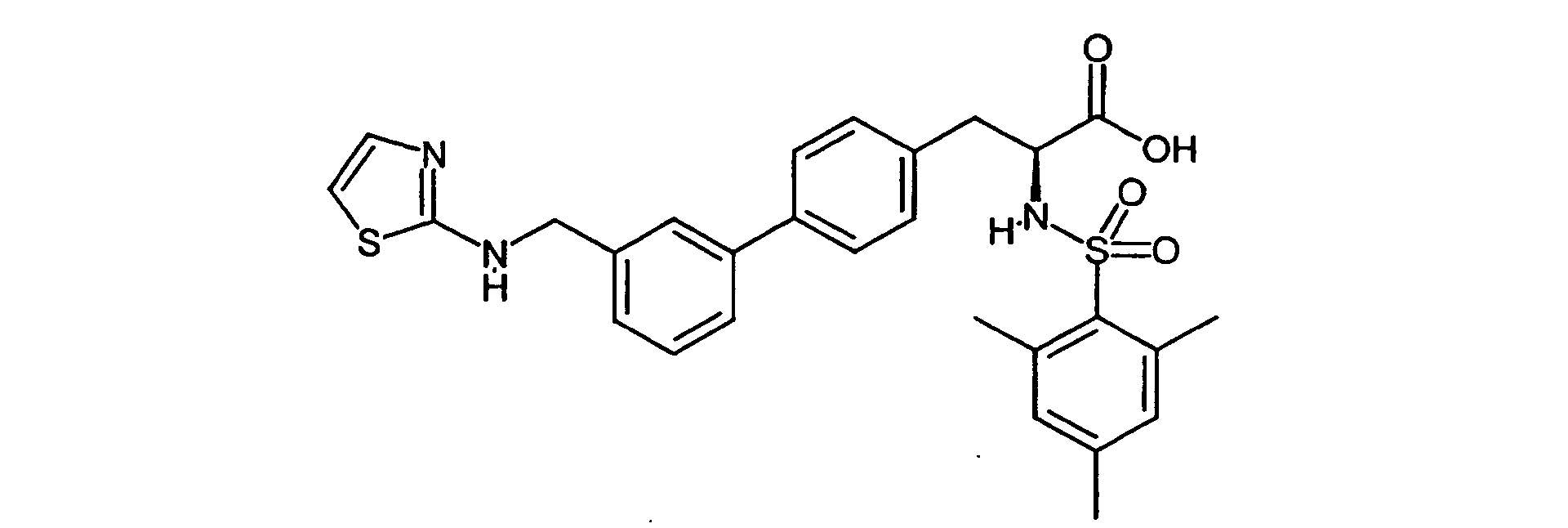
- To a solution of 125 mg (0.227 mmol) methyl (2S)-2-mesitylsulfonylamino-3-{3'-[(1,3-thiazol-2-ylamino)methyl][1,1'-biphenyl]-4-yl}-propanoate 18.2.2 in 8 ml tetrahydrofurane is added 8 ml aqueous 2-molar sodium hydroxide. The mixture is vigorously stirred over night at room temperature. Then, the pH is adjusted to 3 by addition of 6-molar aqueous hydrochloric acid. The precipitated product is isolated by filtration and washed with water and a small amount of tetrahydrofurane. 110 mg (0.205 mmol, 90% yield) of a white solid are obtained.
Mass spectrometry (ESI): 536 (M+H+), 558 (M+Na+)
Retention time (TLC): Rf = 0.16 (ethyl acetate/methanol, 3:1)
1H-NMR (300 MHz, dimethylsulfoxide-d6): δ = 8.04 (1H, t), 7.59 (1H, s), 7.48 (1H, d), 7.39 (1H, t), 7.37 (2H, d), 7.30 (1H, d), 7.17 (2H, d), 7.01 (1H, d), 6.92 (2H, s), 6.89 (1H, broad), 6.60 (1H, d), 4.51 (2H, d), 3.30 (1H, m, obscured by the water signal), 3.02 (1H, dd), 2.92 (1H, dd), 2.51 (6H, s, obscured by the dimethylsulfoxide signal), 2.16 (3H, s) -
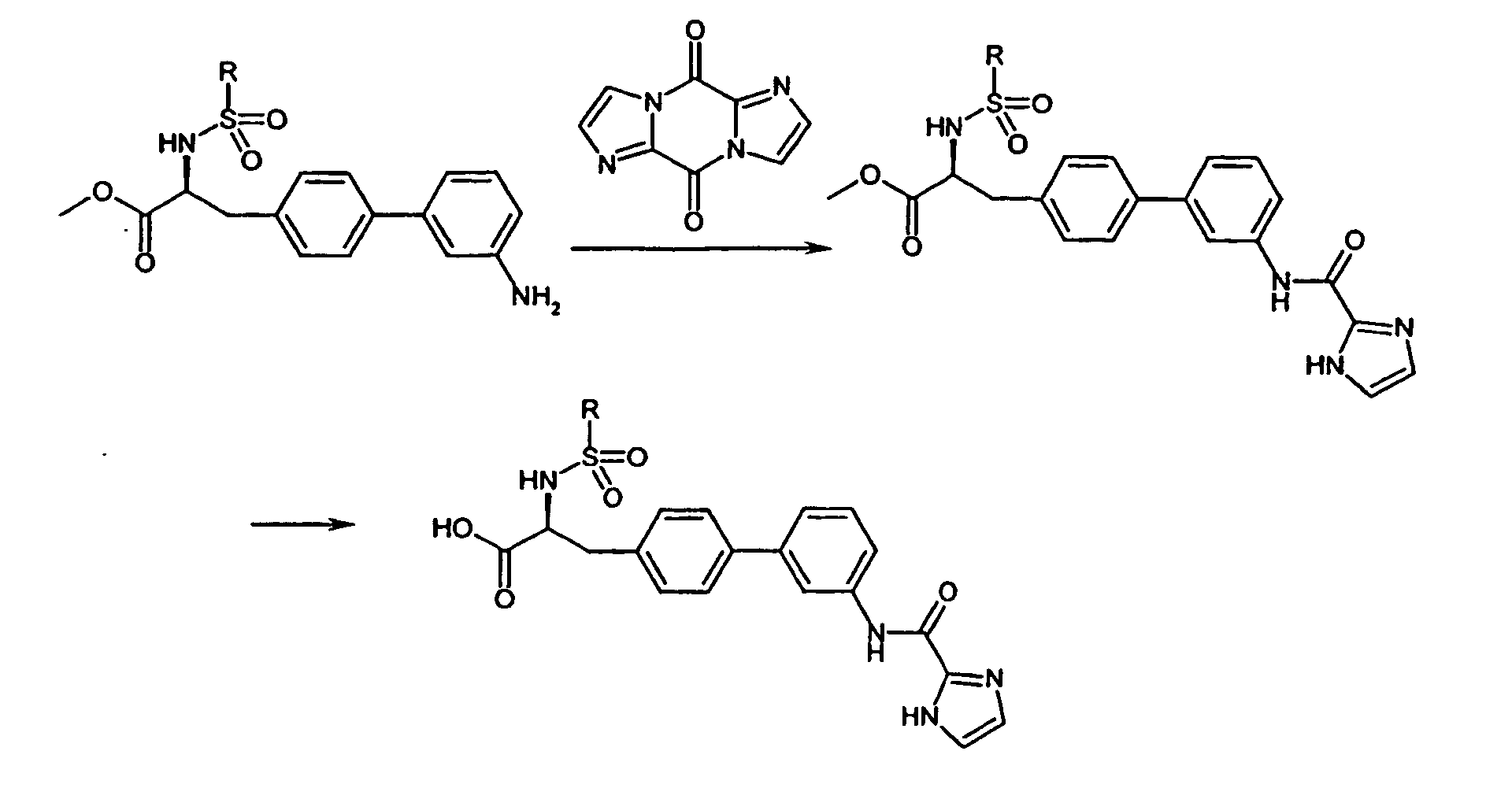
-
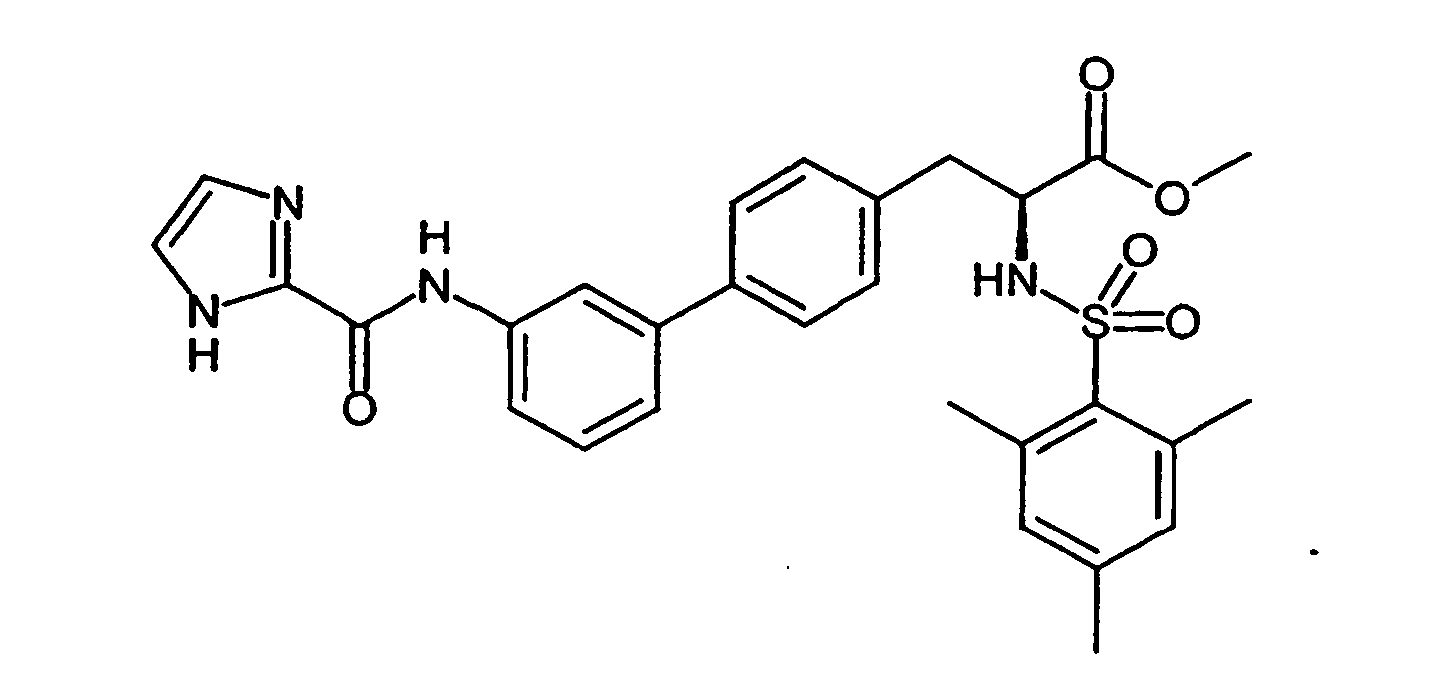
- To a solution of 200 mg (0.44 mmol, 1.0 equiv.) methyl (2S)-3-(3'-amino[1,1'-biphenyl]-4-yl)-2-mesitylsulfonylamino-propanoate 12.1.2 in 10 ml dry tetrahydrofurane are added 140 µl (1.77 mmol, 4.0 equiv.) pyridine and a suspension of 46 mg (0.24 mmol, 1.1 equiv.) 5H,10H-diimidazo[1,2-a:1,2-d]pyrazine-5,10-dione in a mixture of 5 ml tetrahydrofurane and 1ml N,N-dimethyl formamide. The resulting suspension is stirred at room temperature for 72 hours. The reaction mixture is concentrated in vacuo and then taken up in ethyl acetate. The organic layer is successively washed with 5% aqueous sodium dihydrogenphosphate, water and brine. Dried over unhydrous sodium sulfate. The crude product is purified by flash chromatography (silica, cyclohexane/erthyl acetate, 1:1). 181 mg (0.33 mmol, 74% yield) of an off-white solid are obtained.
Mass spectrometry (ESI): 1093 (2M+H+), 547 (M+H+)
Retention time (TLC): Rf = 0.53 (cyclohexane/ethyl acetate, 1:2)
1H-NMR (300 MHz, dimethylsulfoxide-d6): δ = 13.21 (1H, s broad), 10.40 (1H, s), 8.32 (1H, d), 8.13 (1H, s), 7.88 (1H, d), 7.45-7.32 (5H, m), 7.16 (2H, d), 7.11 (1H, s), 6.82 (2H, s), 3.89 (1H, m), 3.44 (3H, s), 2.98 (1H, dd), 2.81 (1H, dd), 2.42 (6H, s), 2.03 (3H, s). -
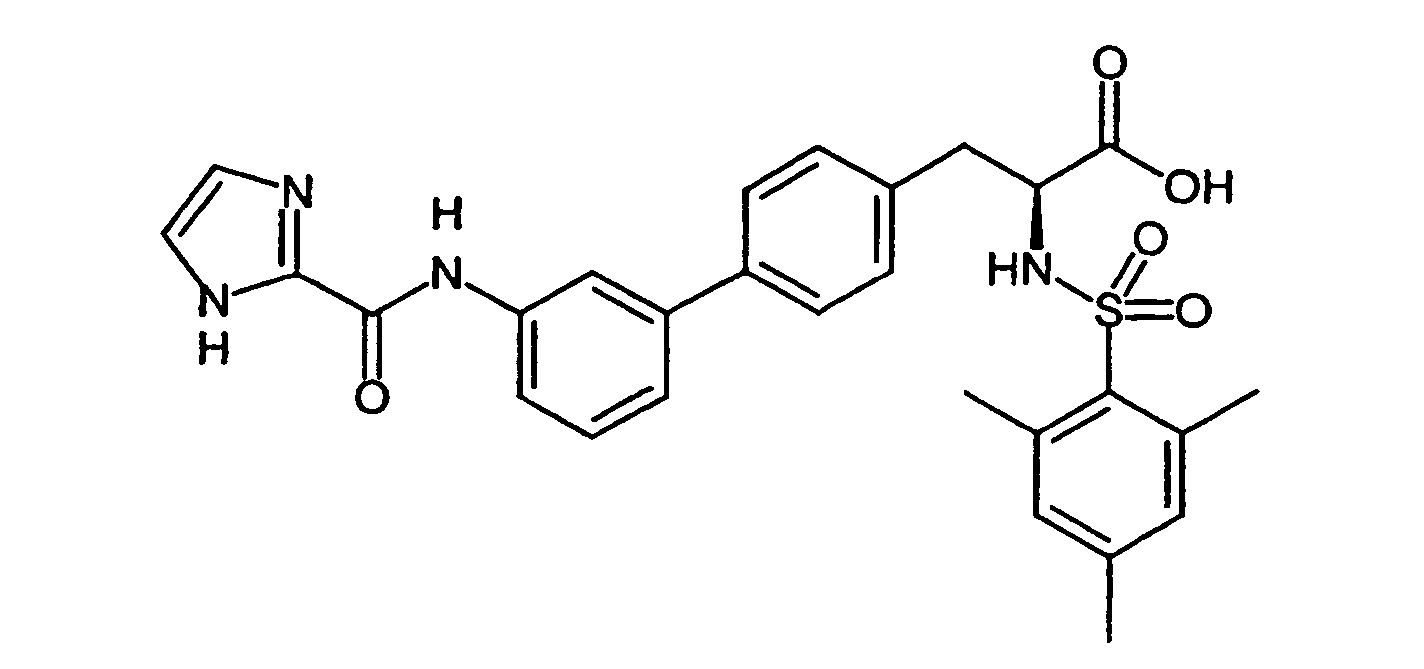
- 8 ml 2-molar aqueous sodium hydroxide are added to a solution of 130 mg (0.24 mmol) methyl (2S)-3-{3'-[(1H-imidazol-2-ylcarbonyl)amino][1,1'-biphenyl]-4-yl}-2-mesitylsulfonylamino-propanoate 19.1.1 in 8 ml tetrahydrofurane. After stirring at room temperature for 20 hours, the mixture is concentrated under reduced pressure. The pH is adjusted to 5 by the addition of 2-molar aqueous hydrochloric acid. The product precipitates upon acidification and is filtered off. It is washed with water and a small amount of tetrahydrofurane. 101 mg (0.19 mmol, 80% yield) of an off-white solid are obtained.
Mass spectrometry (ESI): 533 (M+H+).
Retention time (TLC): Rf = 0.10 (dichloromethane/methanol, 10:1)
1H-NMR (300 MHz, dimethylsulfoxide-d6): δ = 13.27 (1H, s broad), 12.70 (1H, very broad), 10.47 (1H, s), 8.15 (1H, s), 8.13 (1H, d), 7.88 (1H, d), 7.45-7.32 (5H, m), 7.17 (1H, s), 7.11 (2H, d), 6.78 (2H, s), 3.79 (1H, m), 2.98 (1H, dd), 2.73 (1H, dd), 2.40 (6H, s), 1.98 (3H, s). -
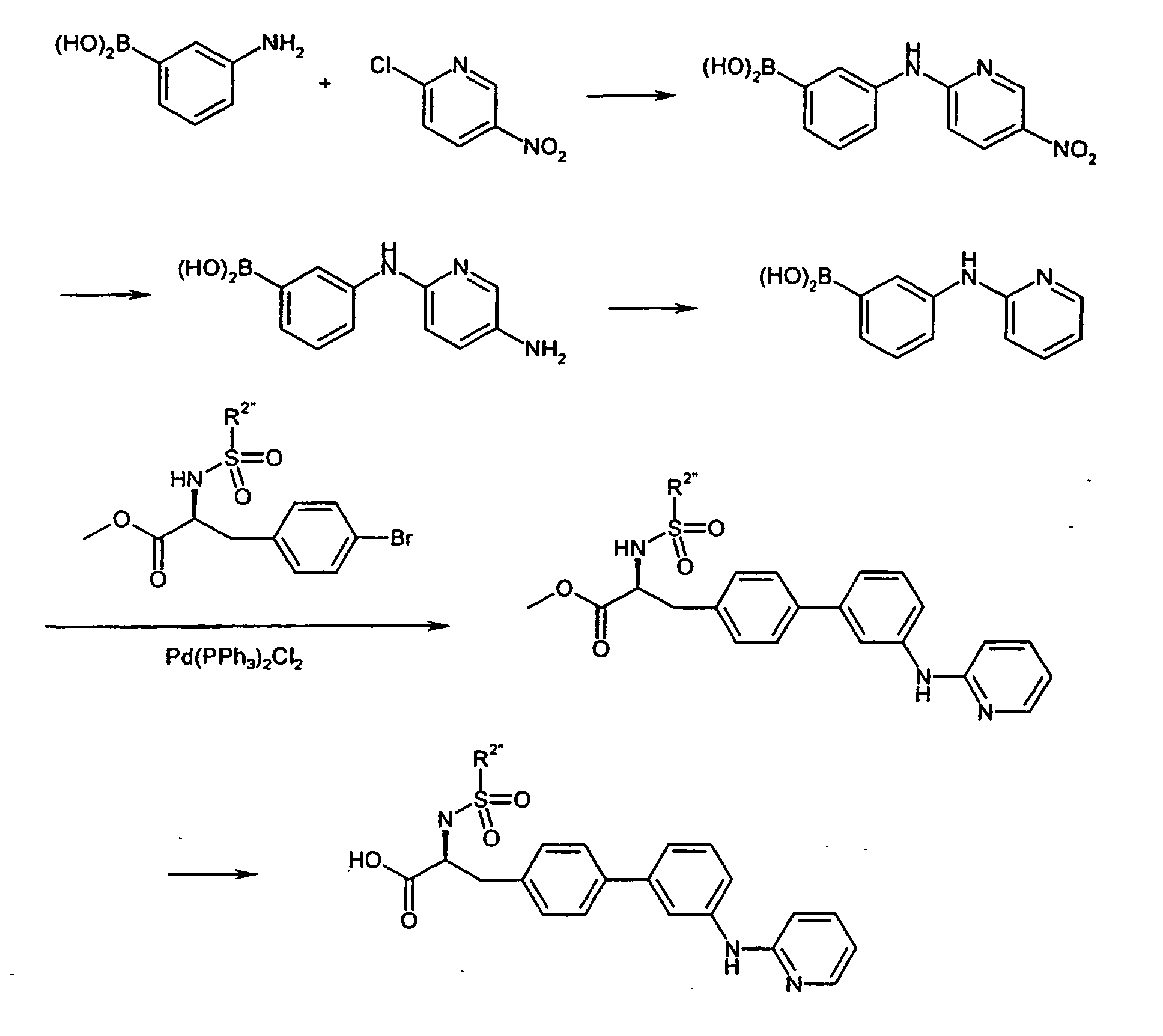
-

- A mixture of 2.0 g (5.377 mmol, 1.0 equiv.) 3-aminophenylboronic acid hemisulfate, 1.7 g (10.75 mmol, 1.0 equiv.) 2-chloro-5-nitropyridine and 2.28 g (21.51 mmol) sodium carbonate in 20 ml dry N-methyl pyrrolidinone is heated to 100°C under an atmosphere of argon. After 5 hours, the mixture is allowed to cool to room temperature. 5% aqueous sodium dihydrogenphosphate and ether are added and the heterogeneous mixture is stirred for a while. The product precipitates and is collected by filtration. It is washed with water and ether. 2.0 g (7.721 mmol, 72% yield) of a yellow solid is obtained which is about 90% pure and used for the next step without further purification.
Retention time (TLC): Rf = 0.24 (dichloromethane/methanol, 100:5)
1H-NMR (300 MHz, dimethylsulfoxide-d6): δ 10.05 (1H, s), 9.02 (1H, d), 8.27 (1H, dd), 8.02 (2H, s broad), 7.87 (1H, s), 7.83 (1H, d), 7.53 (1H, d), 7.34 (1H, t), 6.89 (1H, d). -
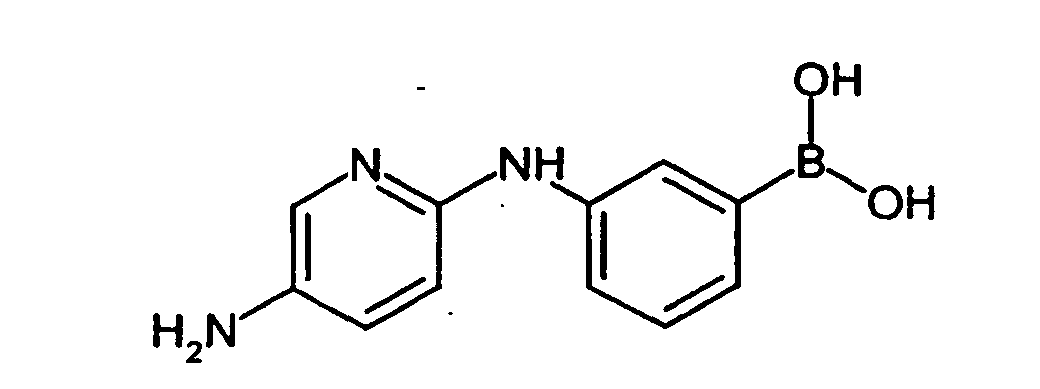
- A solution of 1.50 g (5.791 mmol) 3-[(5-nitro-2-pyridinyl)amino]-phenylboronic acid 20.1.1 in 50 ml ethanol is hydrogenated at room temperature and ambient pressure in the presence of 70 mg palladium on charcoal (10%). After 20 hours, the mixture is filtered over a pad of cellite and the solution is concentrated to dryness. The product is purified by flash chromatography (silica, ethyl acetate/methanol, 9:1) to afford 0.85 g (3.711 mmol, 64% yield) of an off-white solid.
Retention time (TLC): Rf= 0.30 (ethyl acetate/methanol, 9:1)
1H-NMR (300 MHz, dimethylsulfoxide-d6): δ = 8.21 (1H, s), 7.80 (2H, s), 7.66 (1H, dd), 7.63 (1H, s), 7.60 (1H, d), 7.19 (1H, d), 7.12 (1H, t), 6.93 (1H, dd), 6.67 (1H, d), 4.61 (2H, s broad). -

- A solution of 219 mg (3.165 mmol, 1.45 equiv.) sodium nitrite in 5 ml water is added dropwise to a solution of 500 mg 3-[(5-amino-2-pyridinyl)amino]-phenylboronic acid 20.1.2 in 10 ml 18% aqueous hydrochloric acid at 0°C. After 15 minutes at 0°C, 10 ml phosphinic acid are added and stirring is continued at 0°C for another 30 minutes. Then, the pH of the mixture is adjusted to 5-6 by the addition of 45% aqueous sodium hydroxide. The product is extracted with ethyl acetate. The organic layer is washed with brine and dried over unhydrous sodium sulfate. After removal of the solvent, the product is purified by crystallization from ether with a minimum amount of ethyl acetate. 165 mg (0.771 mmol, 35% yield) of a white solid are obtained.
Retention time (TLC): Rf= 0.57 (ethyl acetate/methanol, 4:1)
1H-NMR (300 MHz, dimethylsulfoxide-d6): δ = 8.85 (1H, s), 8.11 (1H, dd), 7.88 (2H, s), 7.83 (1H, d), 7.80 (1H, s), 7.52 (1H, dt), 7.33 (1H, d), 7.22 (1H, t), 6.82 (1H, d), 6.69 (1H, dd). -
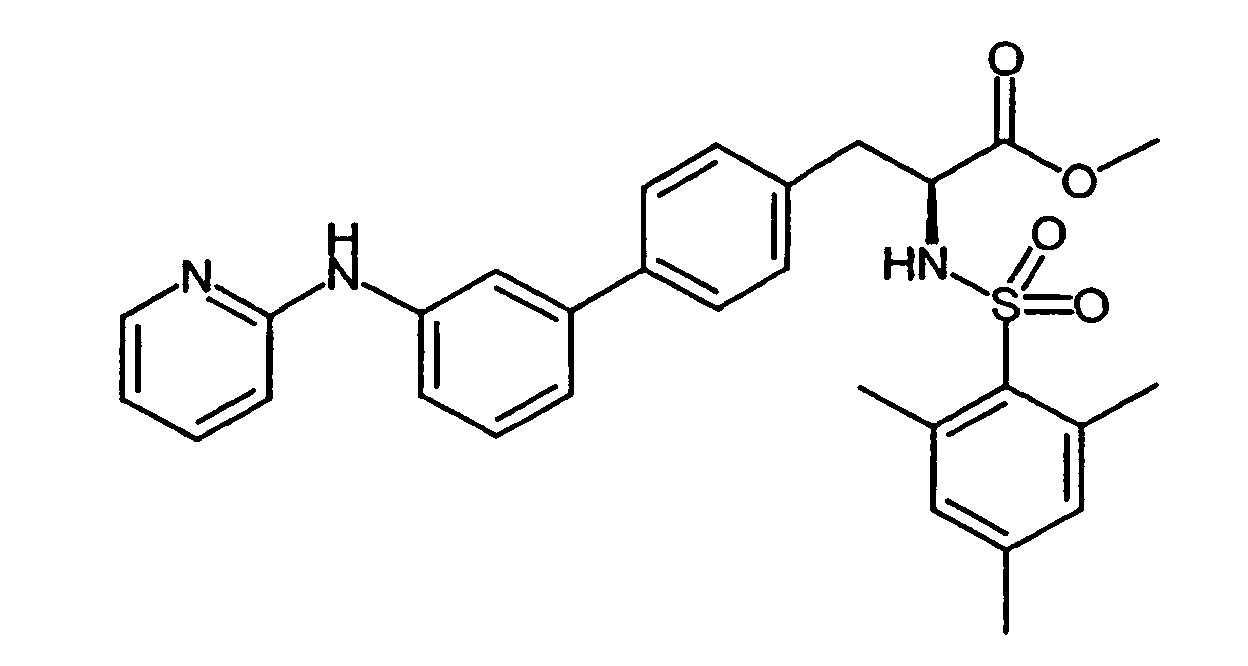
- Under an atmosphere of argon, a vigorously stirred suspension of 417 mg (0.946 mmol, 1.0 equiv.) methyl (2S)-3-(4-bromophenyl)-2-[(mesitylsulfonyl)amino]-propanoate 20.1.3, 243 mg (1.135 mmol, 1,2 equiv.) 3-(2-pyridinylamino)phenylboronic acid and 33 mg (0.047 mmol, 0.05 equiv.) dichlorobis(triphenylphosphino)palladium in 15 ml dimethoxy ethane is treated with 0.62 ml (1.25 mmol) of a 2-molar solution of sodium carbonate in water. The mixture is heated to reflux. After six hours, the reaction is completed and the reaction mixture is cooled to room temperature. After dilution with ethyl acetate, the mixture is successively washed with 5% aqueous sodium dihydrogenphosphate, water and brine. Dried over anhydrous sodium sulfate. After removal of the solvent, the crude product is purified by flash chromatography (silica, cyclohexane/ethyl acetate, 3:1). 84 mg (0.159 mmol, 14% yield) of a yellowish solid are obtained.
Mass spectrometry (ESI): 530 (M+H+)
Retention time (TLC): Rf = 0.54 (ethyl acetate/methanol, 4:1)
1H-NMR (300 MHz, dimethylsulfoxide-d6): 9.06 (1H, s), 8.30 (1H, d), 8.17 (1H, dd), 7.94 (1H, s), 7.67 (1H, d), 7.58 (1H, dt), 7.37 (2H, d), 7.33 (1H, t), 7.12 (2H, d), 7.11 (1H, d), 6.87 (1H, d), 6.83 (2H, s), 6.74 (1H, dd), 3.89 (1H, m), 3.42 (3H, s), 2.98 (1H, dd), 2.81 (1H, dd), 2.42 (6H, s), 2.04 (3H, s) -
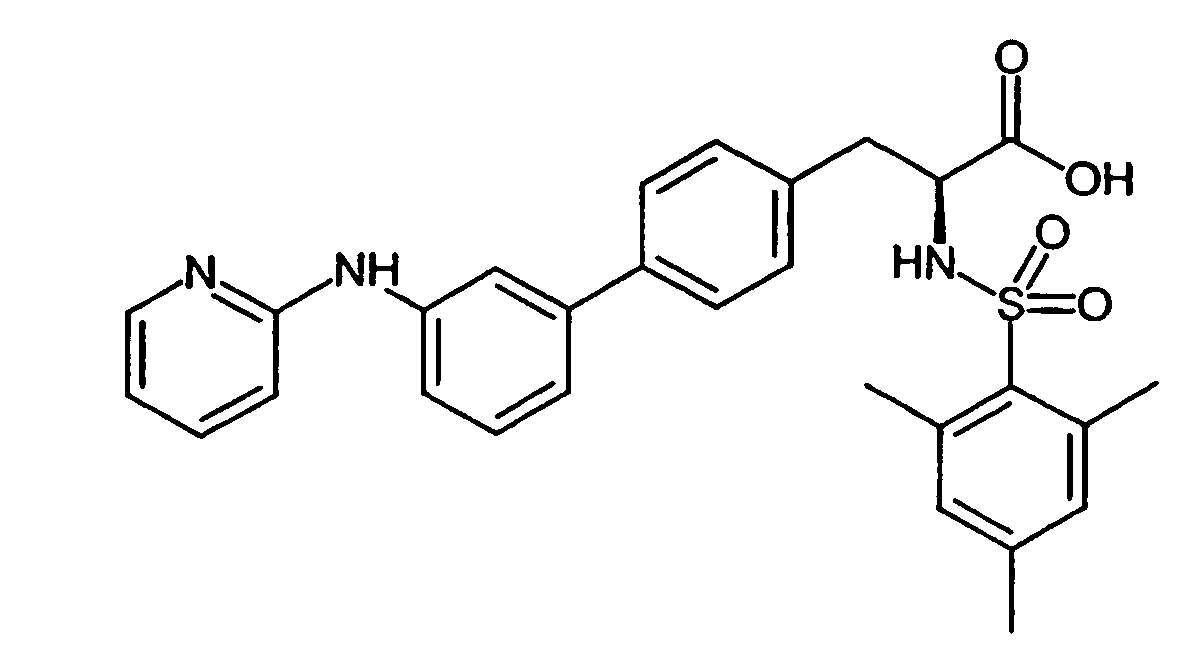
- A solution of 84 mg (0.159 mmol) methyl (2S)-2-[(mesitylsulfonyl)amino]-3-[3'-(2-pyridinylamino)[1,1'-biphenyl]-4-yl]-propanoate 20.1.4 in a mixture of 3.5 ml tetrahydrofurane and 3.5 ml 2-molar aqueous sodium hydroxide is stirred at room temperature. After 20 hours, the mixture is acidified with hydrochloric acid to pH 4-5. The product precipitates and is isolated by filtration. It is washed with water and tetrahydrofuran. A pale yellowish solid is obtained: 53 mg (0.103 mmol, 65% yield).
Mass spectrometry (ESI): 516 (M+H+)
Retention time (TLC): Rf = 0.20 (ethyl acetate/methanol, 4:1)
1H-NMR (300 MHz, dimethylsulfoxide-d6): δ 12.70 (1H, s broad), 9.07 (1H, s), 8.18 (1H, d), 8.07 (1H, d), 7.93 (1H, s); 7.67 (1H, d), 7.58 (1H, dt), 7.32 (1H, t), 7.31 (2H, d), 7.10 (2H, d), 6.87 (1H, d), 6.80 (2H, s), 6.75 (1H, dd), 3.80 (1H, m), 2.98 (1H, dd), 2.76 (1H, dd), 2.41 (6H, s), 2.00 (3H, s). -
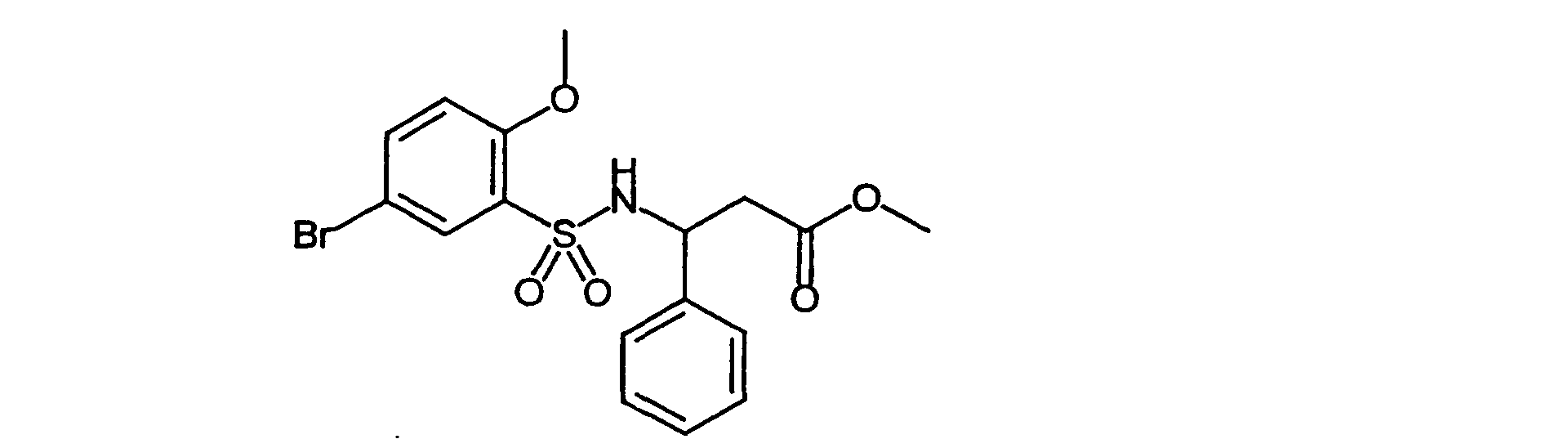
- At 0°C, a solution of 10.73 g (37.59 mmol, 1.0 equiv.) (5-bromo-2-methoxyphenyl)sulfonyl chloride in 20 ml dry tetrahydrofurane is added to a solution of 8.51 g (39.47 mmol, 1.05 equiv.) methyl 3-amino-3-phenylpropionate hydrochloride and 30.4 ml (375.9 mmol, 10 equiv.) pyridine in 40 ml dry tetrahydrofurane. After the addition is completed, the cooling bath is removed and stirring continued over night. A white precipitate is formed. Most of the solvent and the pyridine is removed on a rotatory evaporator. The residue is acidified with dilute hydrochloric acid and the product is extracted with dichloromethane. The organic layer is successively washed with water and brine. Dried over unhydrous sodium sulfate. The crude product is purified by crystallization from ethyl acetate to afford 13.33 g (31.12 mmol, 78% yield) as a white solid.
Mass spectrometry (DCI/NH3): 445/447 (M+NH4 +)
Retention time (TLC): Rf = 0.48 (dichloromethane/methanol, 100:2)
1H-NMR (400 MHz, dimethylsulfoxide-d6): δ = 8.15 (1H, d), 7.57 (1H, d), 7.53 (1H, dd), 7.09 (5H, m), 6.81 (1H, d), 4.62 (1H, quart), 3.71 (3H, s), 3.48 (3H, s), 2.87 (1H, dd), 2.68 (1H, dd). -

- A mixture of 2.0 g (11.53 mmol, 1.0 equiv.) 3-aminophenylboronic acid hydrochloride, 1.83 g (11.53 mmol, 1.0 equiv.) 2-chloro-3-nitropyridine and 2.44 g (23.07 mmol, 2.0 equiv.) sodium carbonate in 20 ml of dry N-methylpyrrolidinone is heated to 100°C under an atmosphere of argon. After five hours, the reaction is completed and the mixture is allowed to cool to room temperature. It is poured in a mixture of diethyl ether and 5% aqueous sodium dihydrogenphosphate. The product precipitates and is collected by filtration. It is washed with small amounts of water and ether. 2.25 g (8.686 mmol, 75% yield) of a yellow solid is obtained which is of about 90% purity and is used for the next step as such.
Retention time (TLC): Rf = 0.39 (dichloromethane/methanol, 100:5)
1H-NMR (300 MHz, dimethylsulfoxide-d6): δ = 9.96 (1H, s), 8.55-8.50 (2H, m), 8.03 (2H, s), 7.87 (1H, s), 7.79 (1H, d), 7.58 (1H, d), 7.35 (1H, t), 6.98 (1H, dd). -

- Under an atmosphere of argon, a vigorously stirred suspension of 100 mg (0.386 mmol, 1.0 equiv.) 3-[(3-nitro-2-pyridinyl)amino]-phenylboronic acid 20.2.2, 165 mg (0.386 mmol, 1.0 equiv.) methyl 3-{[(5-bromo-2-methoxyphenyl)sulfonyl]amino}-3-phenylpropanoate 20.2.1 and 14 mg (0.019 mmol, 0.05 equiv.) dichlorobis-(triphenylphosphino)palladium in 5 ml dimethoxy ethane is treated with 0.24 ml (0.48 mmol) of a 2-molar solution of sodium carbonate in water. The mixture is heated to reflux. After four hours, the reaction is completed and the reaction mixture is cooled to room temperature. After dilution with ethyl acetate, the mixture is successively washed with 5% aqueous sodium dihydrogenphosphate, water and brine. Dried over anhydrous sodium sulfate. After removal of the solvent, the crude product is used for the next step without further purification. 85 mg (0.151 mmol, 39% yield) yellow solid.
Mass spectrometry (ESI): 585 (M+Na+), 563 (M+H+)
Retention time (TLC): Rf= 0.47 (cyclohexane/ethyl acetate, 1:2)
1H-NMR (300 MHz, dimethylsulfoxide-d6): δ 10.04 (1H, s), 8.57-8.51 (2H, m), 7.98 (1H, d), 7.81 (1H, s), 7.80 (1H, d), 7.71-7.66 (2H, m), 7.45 (1H, t), 7.31 (1H, d), 7.12-7.00 (6H, m), 6.92 (1H, d), 4.68 (1H, quart), 3.77 (3H, s), 3.47 (3H, s), 2.89 (1H, dd), 2.70 (1H, dd). -
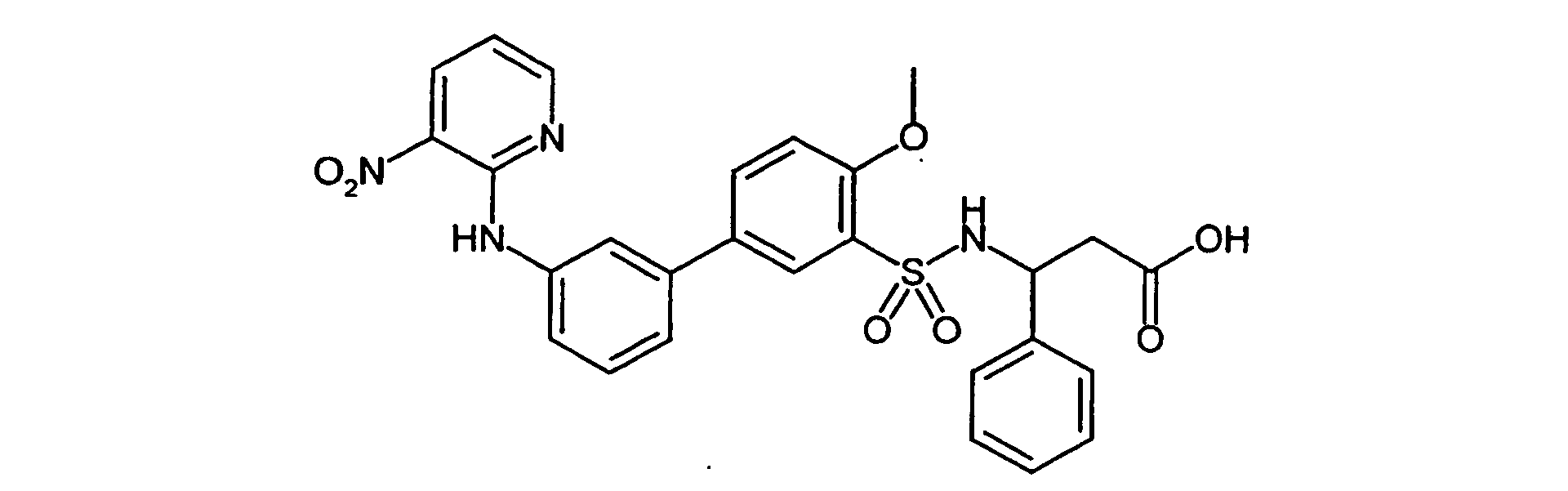
- A solution of 75 mg (0.133 mmol) methyl 3-[({4-methoxy-3'-[(3-nitro-2-pyridinyl)-amino][1,1'-biphenyl]-3-yl}sulfonyl)amino]-3-phenylpropanoate 20.2.3 in a mixture of 5 ml tetrahydrofurane and 5 ml 2-molar aqueous sodium hydroxide is stirred at room temperature for 20 hours. Diluted hydrochloric acid is added until pH 3-4 is reached. The product precipitates and is isolated by filtration. Washed with water and a small amount of tetrahydrofurane. 40 mg (0.073 mmol, 52% yield) of a pale yellowish solid are obtained.
Mass spectrometry (DCI/NH3): 549 (M+H+)
1H-NMR (300 MHz, dimethylsulfoxide-d6): δ = 12.15 (1H, s broad), 10.02 (1H, s), 8.56-8.50 (2H, m), 7.92 (1H, d), 7.81 (1H, s), 7.79 (1H, d), 7.70-7.61 (2H, m), 7.49 (1H, t), 7.31 (1H, d), 7.11-7.00 (6H, m), 6.91 (1H, d), 4.63 (1H, quart), 3.77 (3H, s), 2.79 (1H, dd), 2.61 (1H, dd). - According to the various methods described above the following further examples can be prepared:
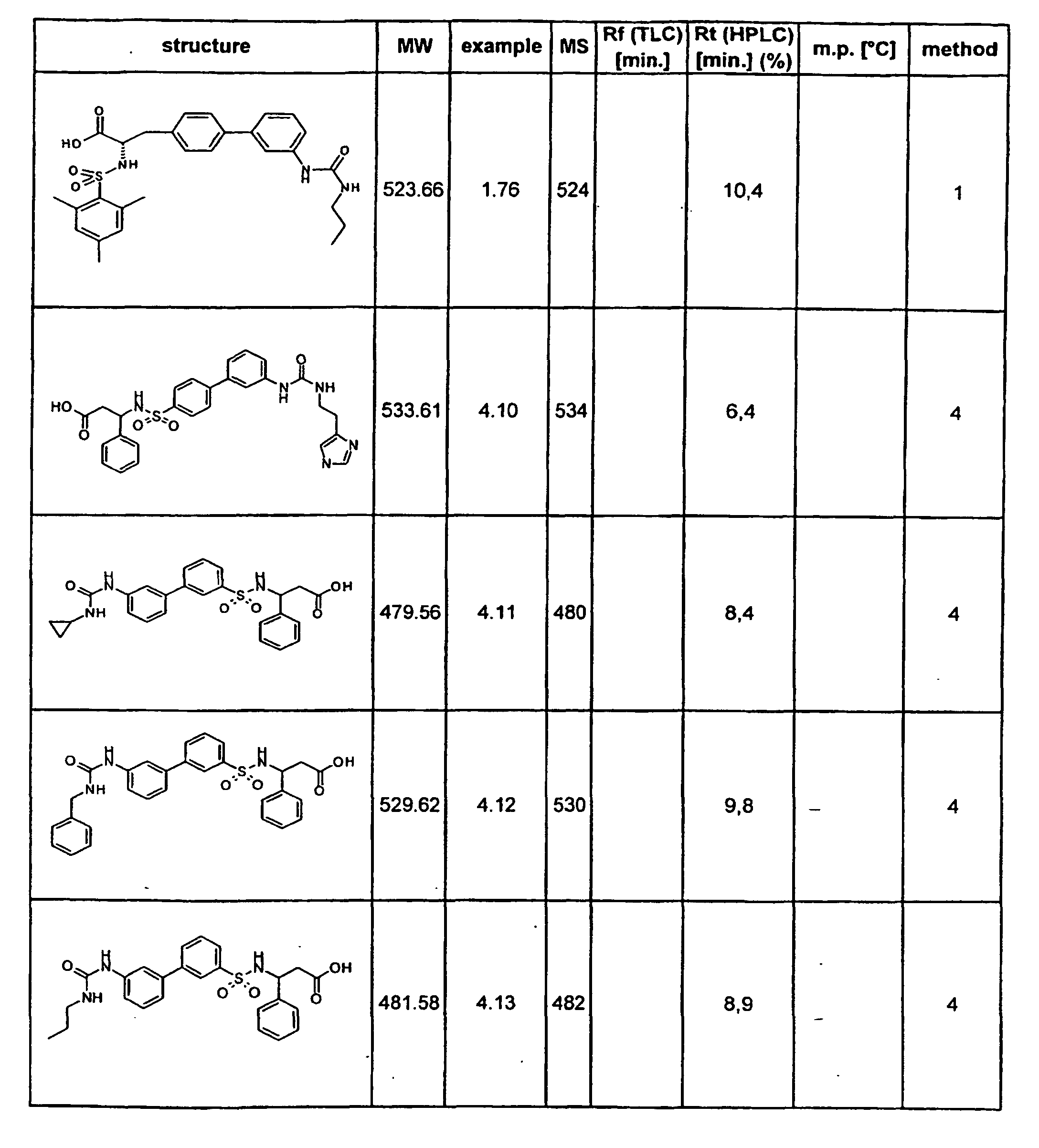

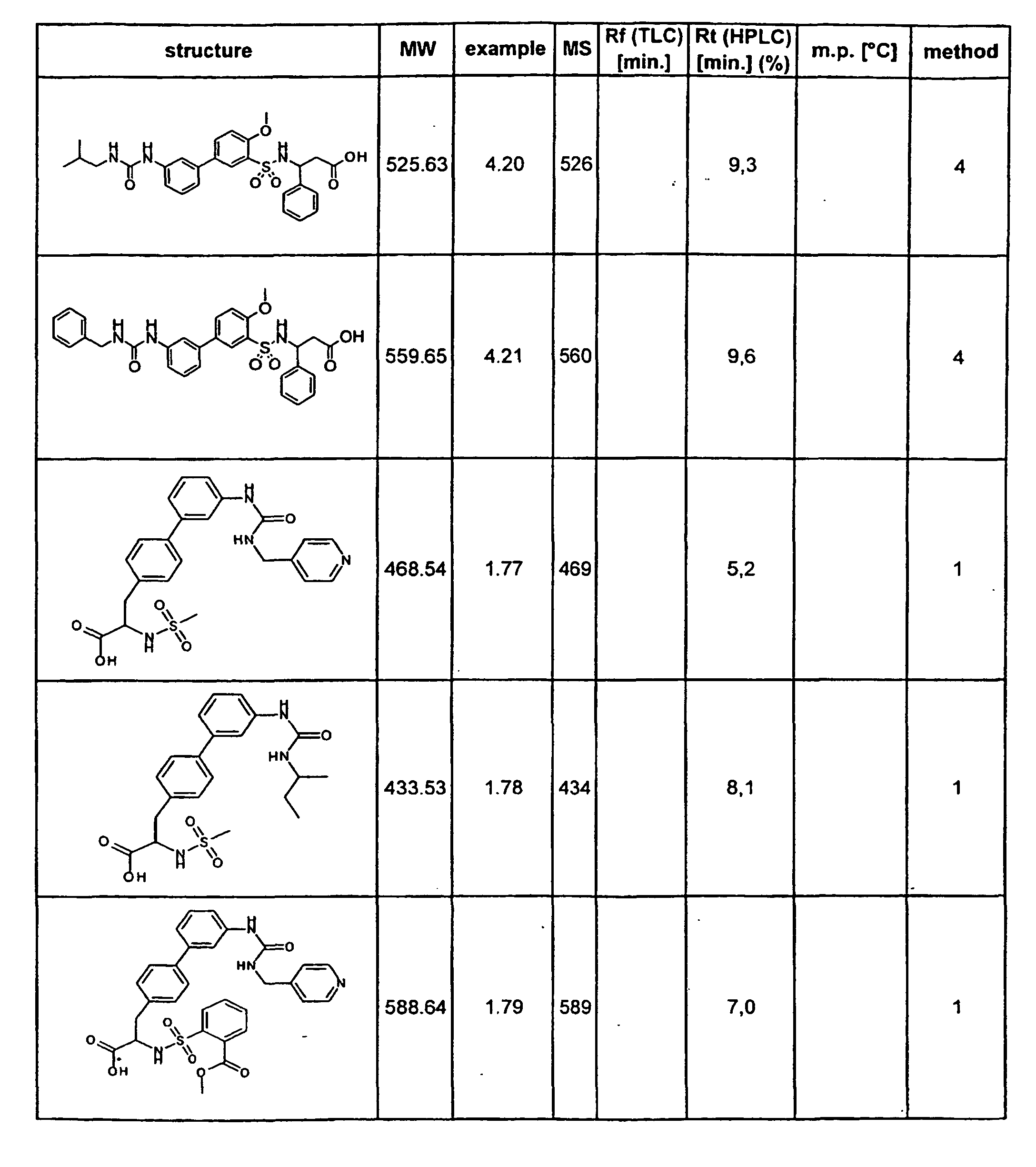
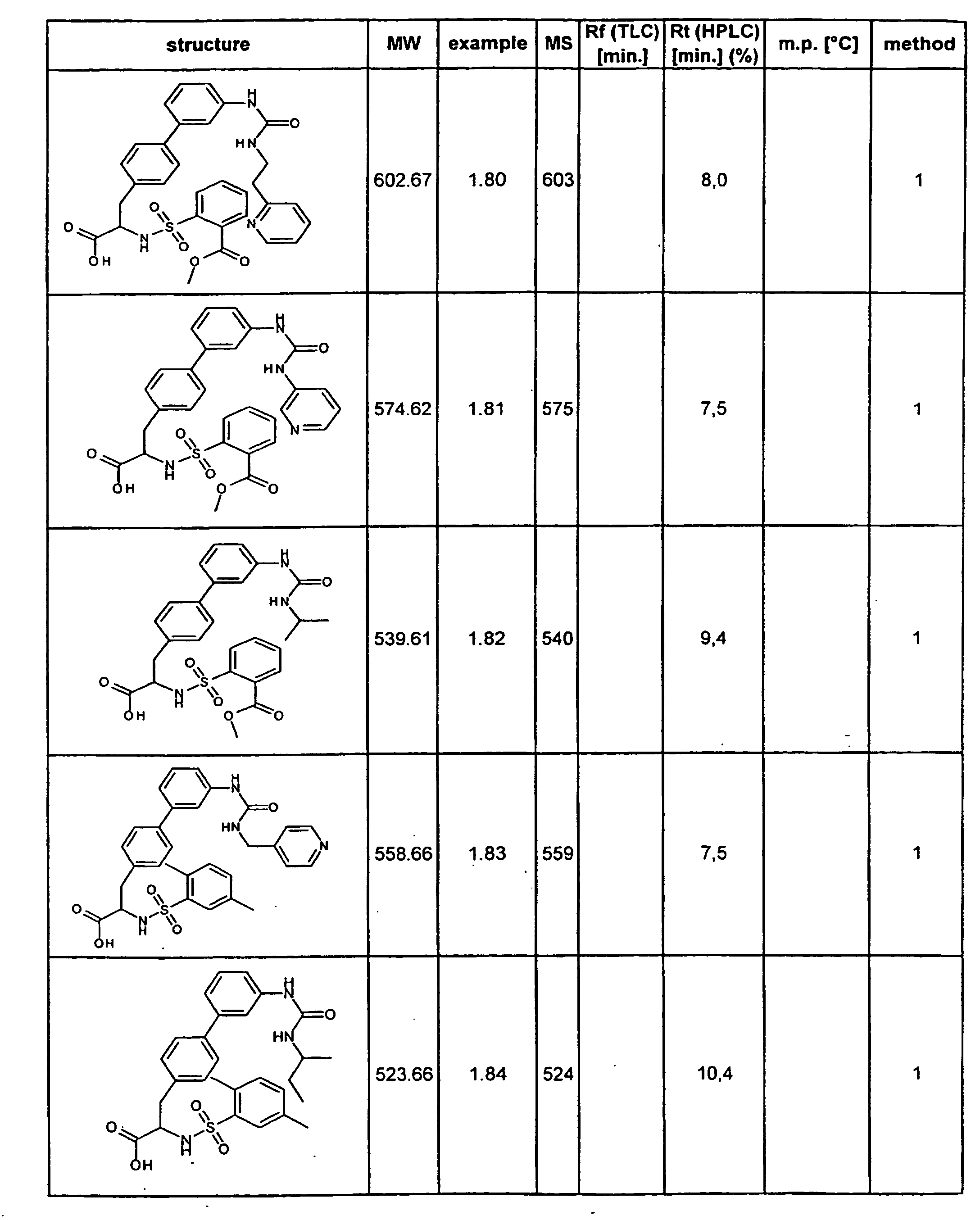


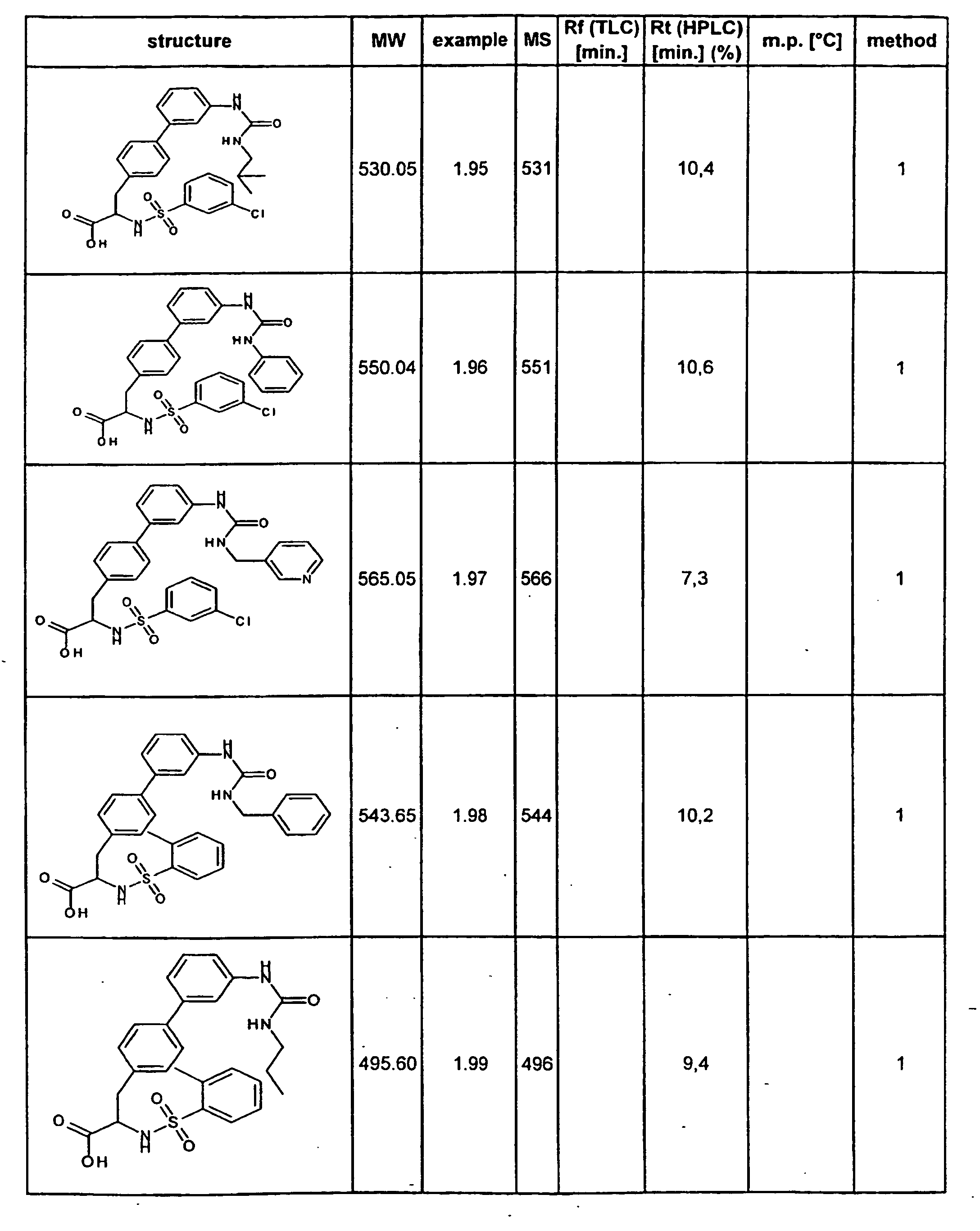

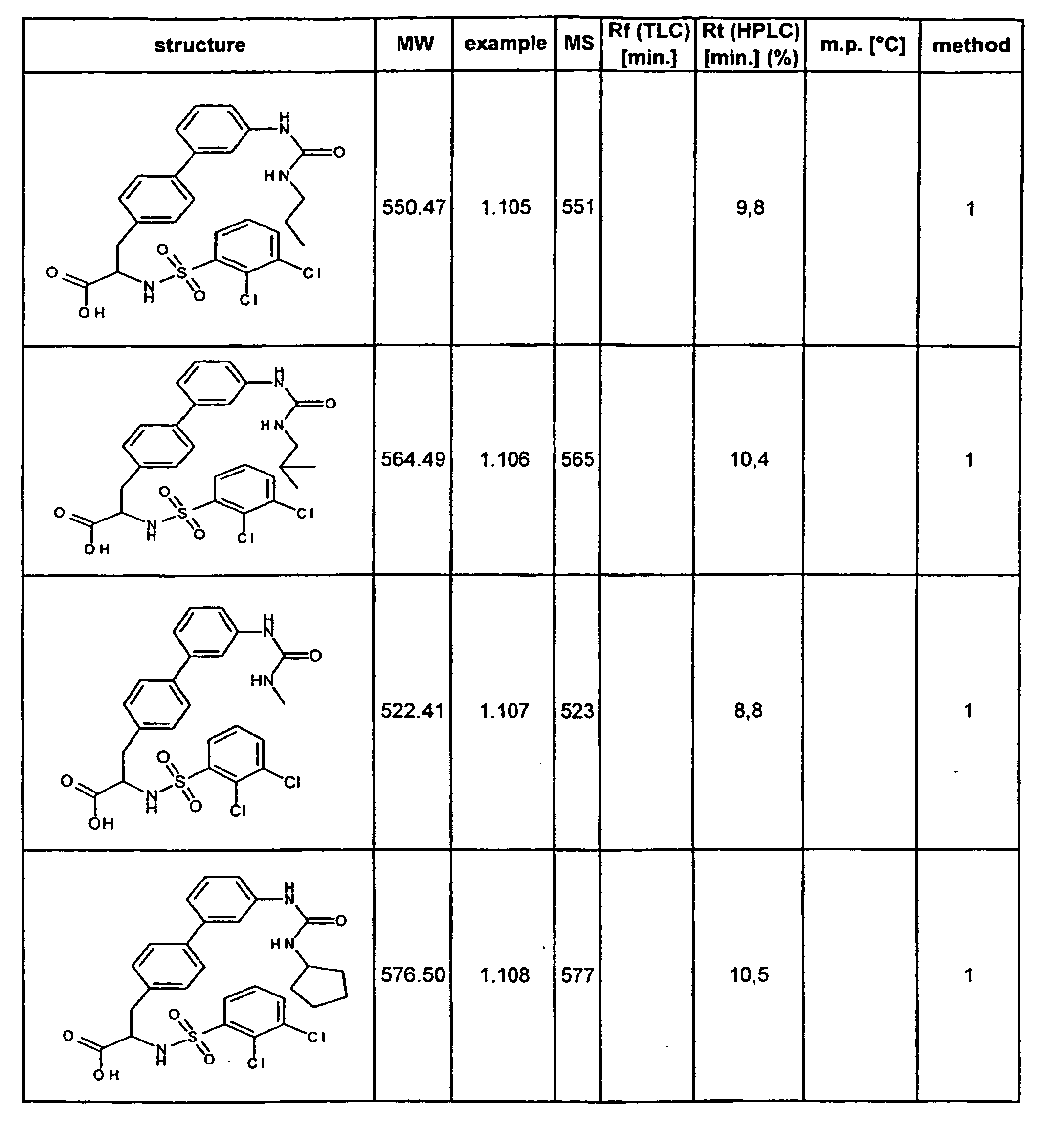


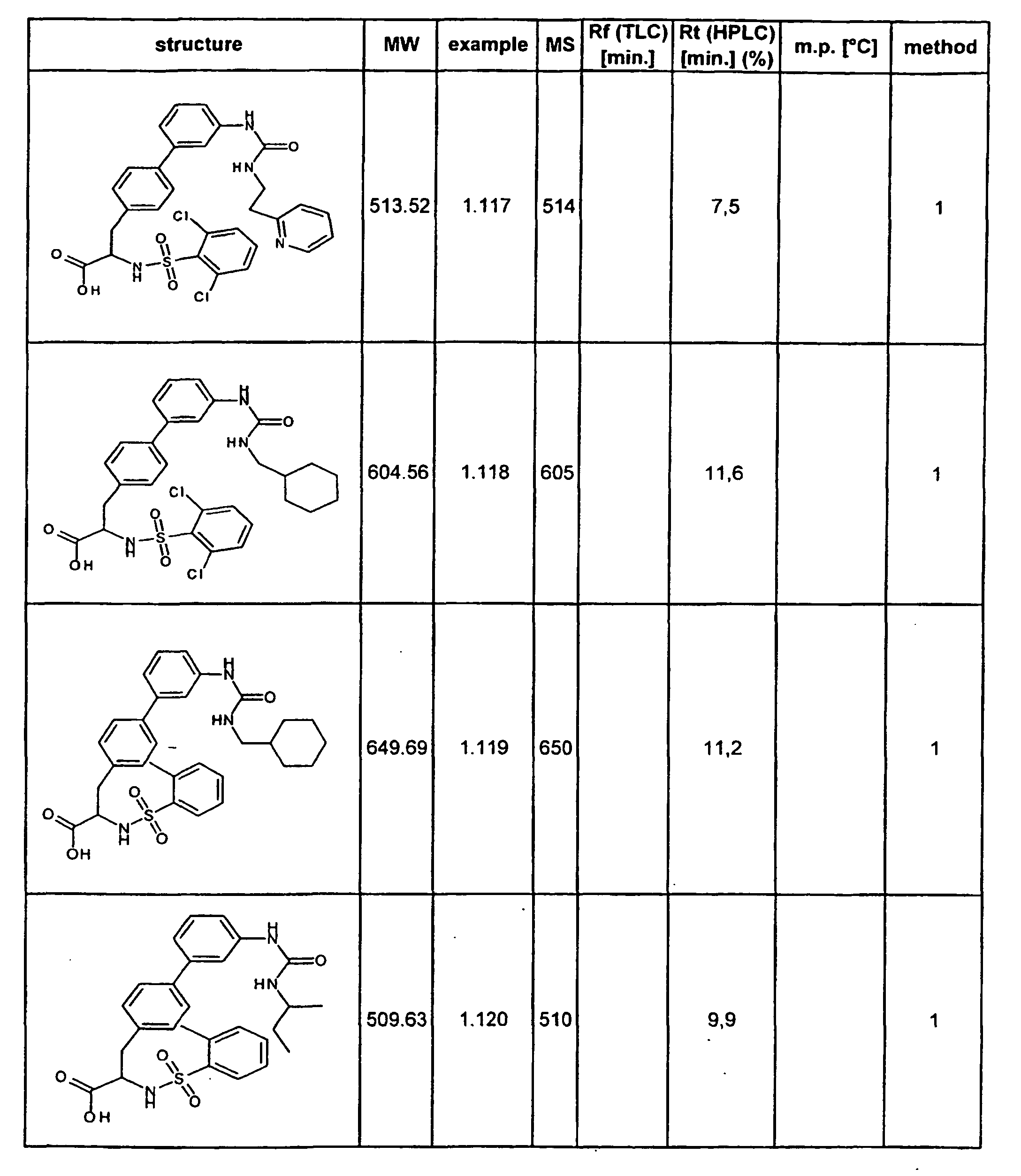


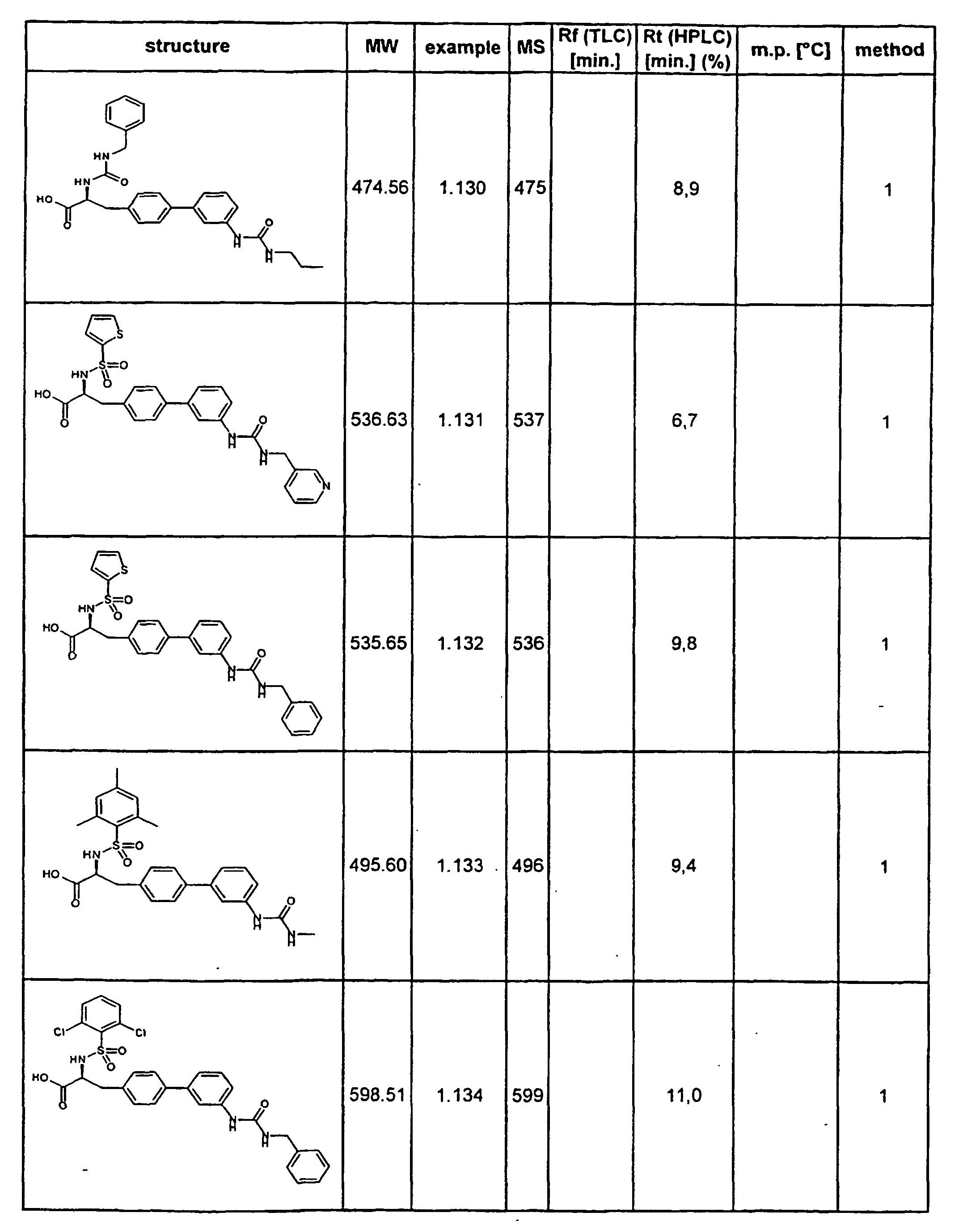
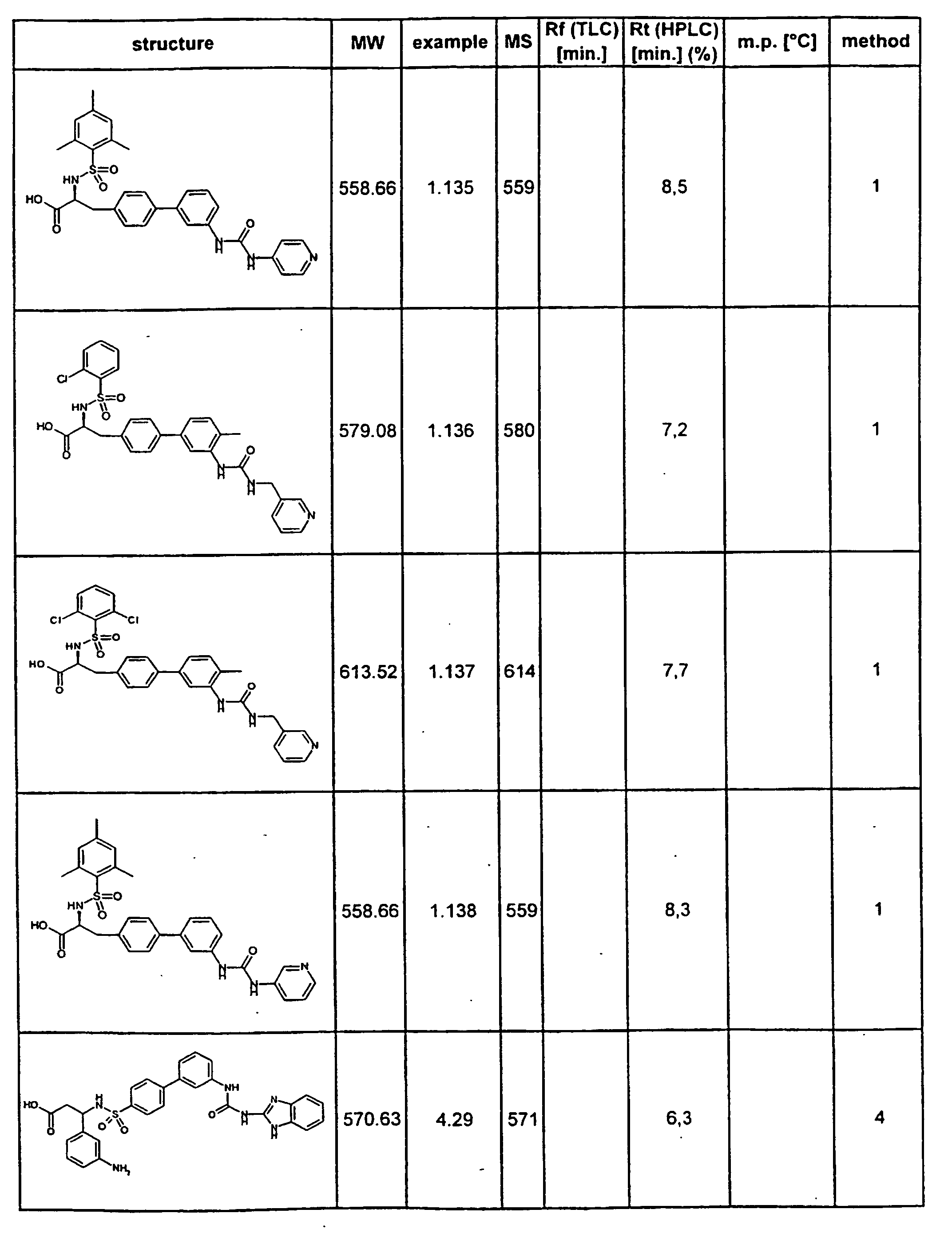

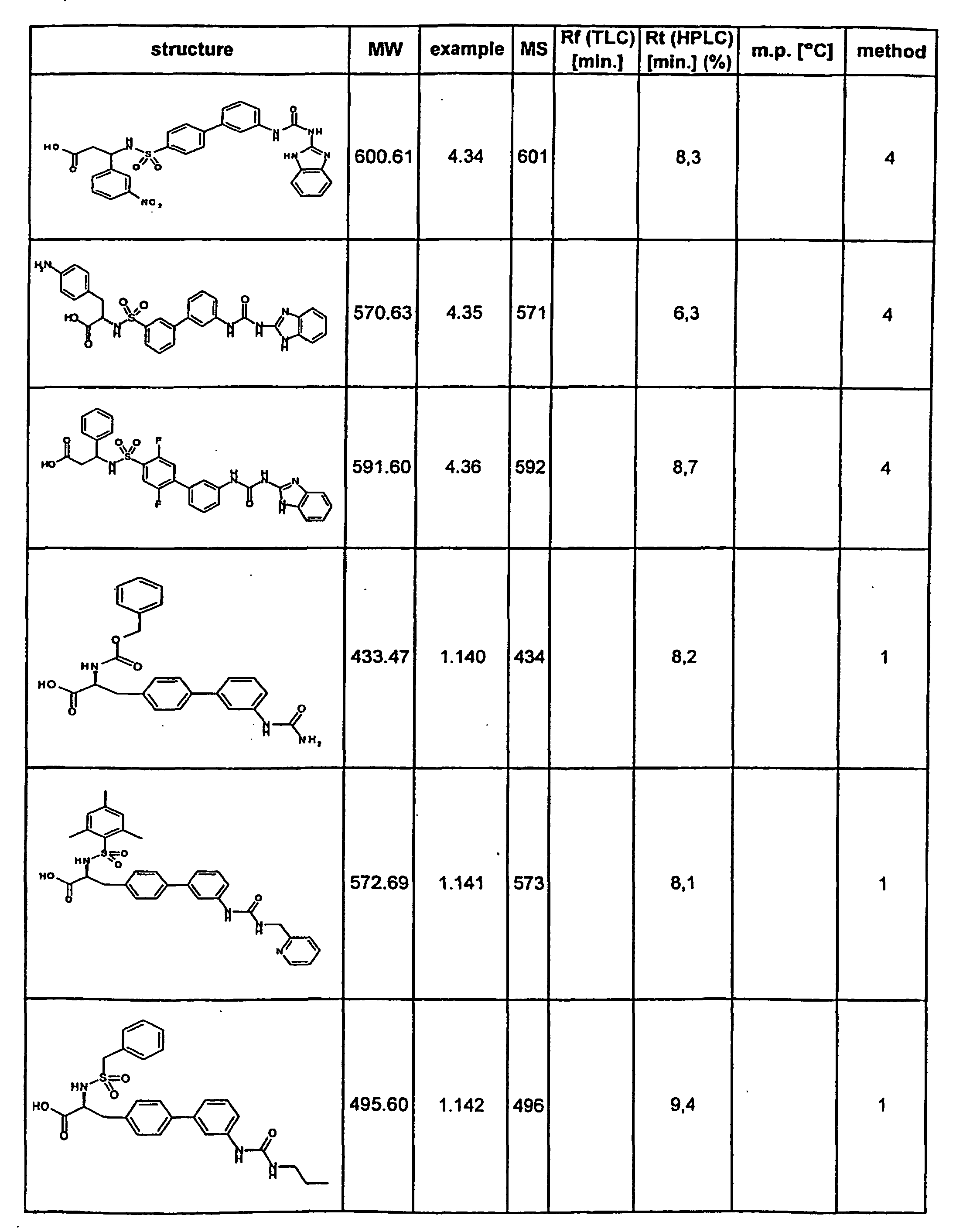
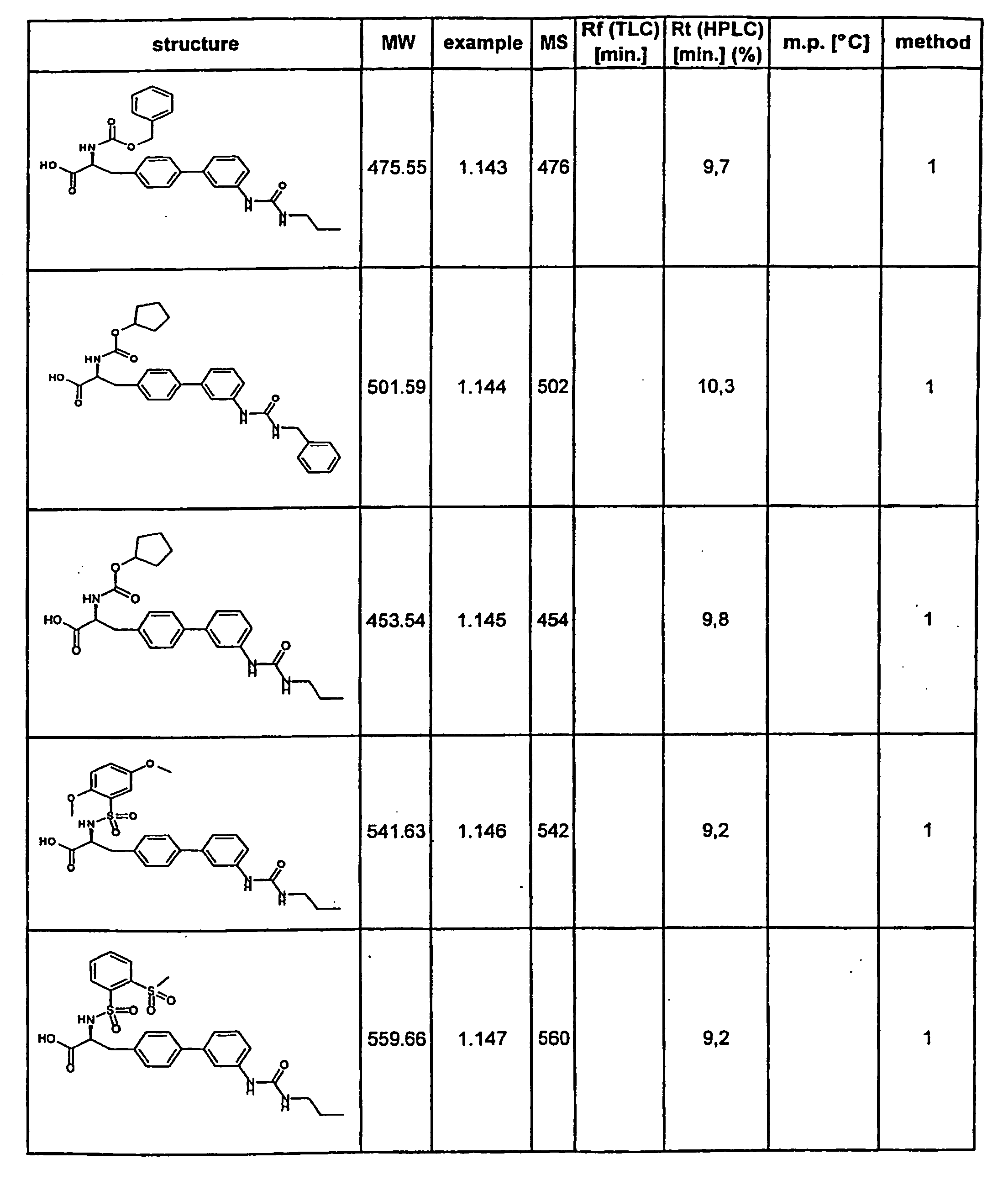
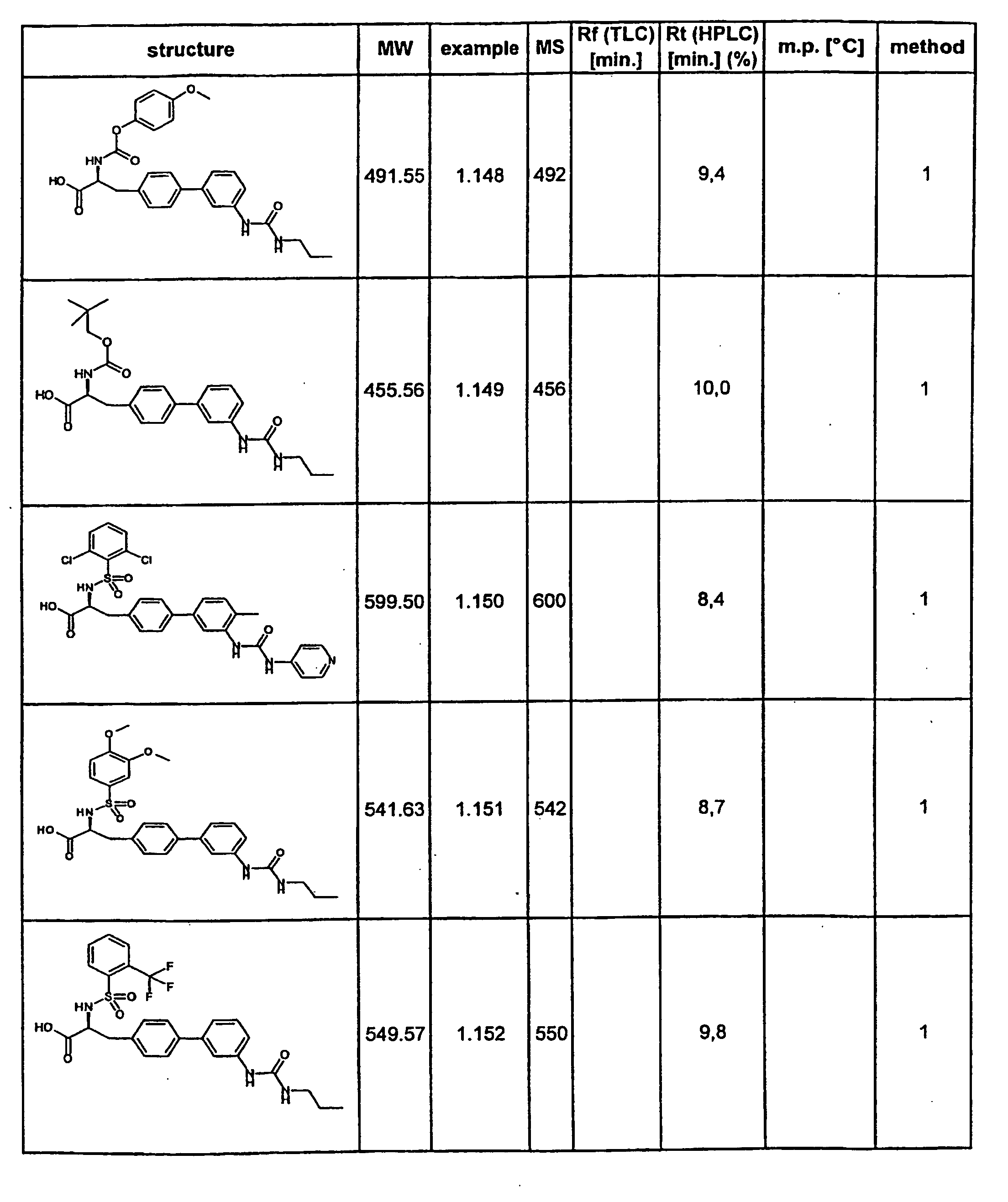
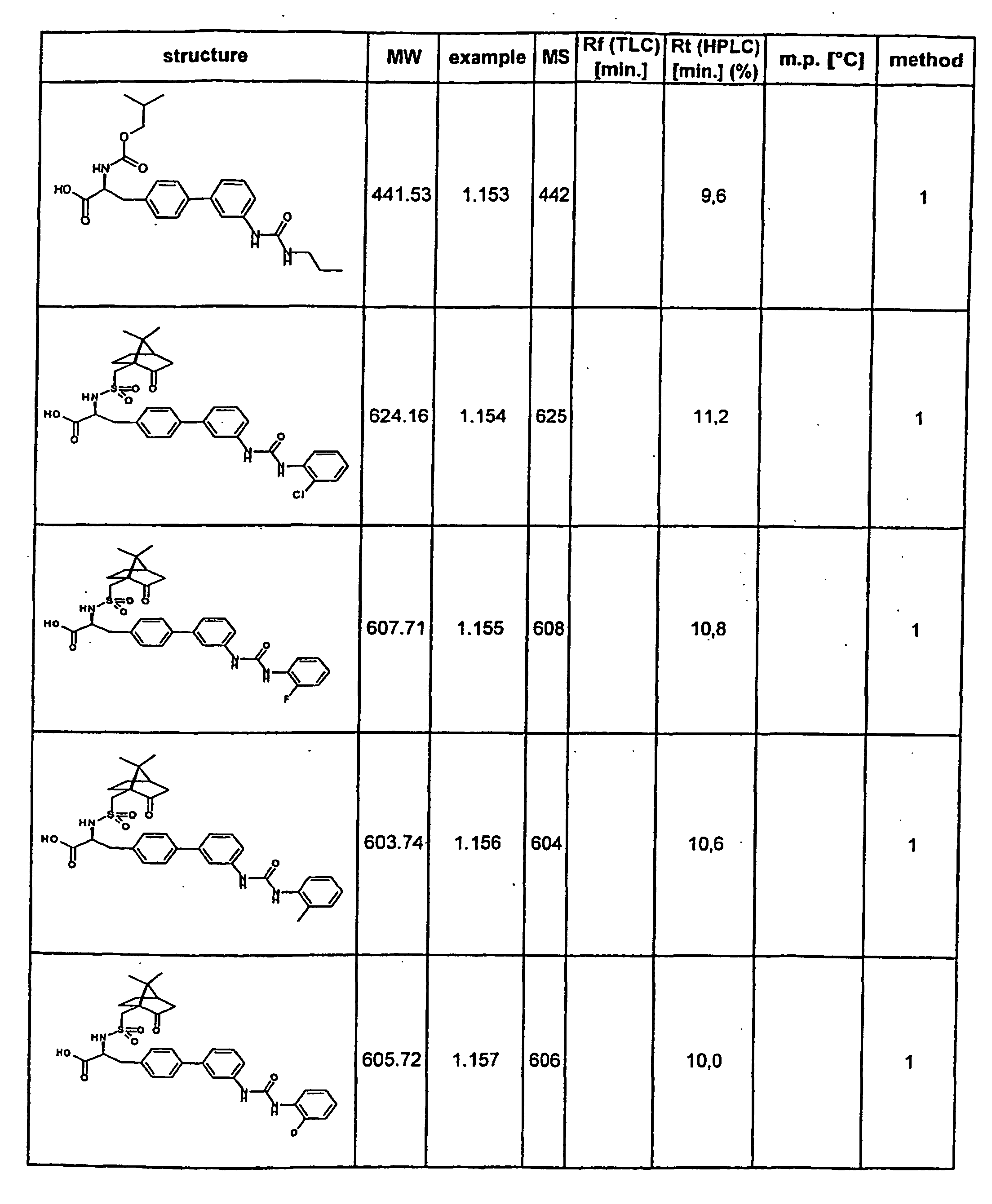


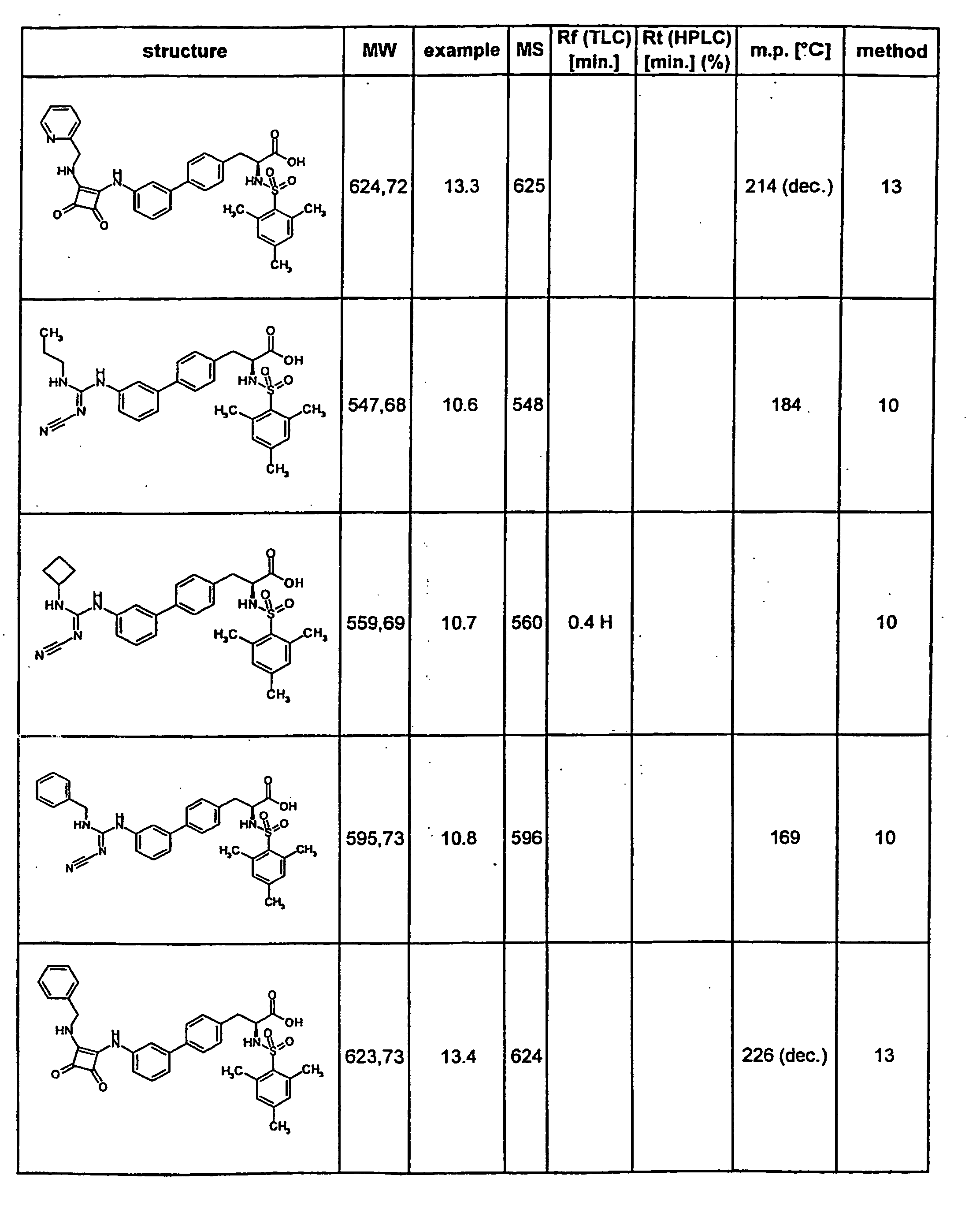
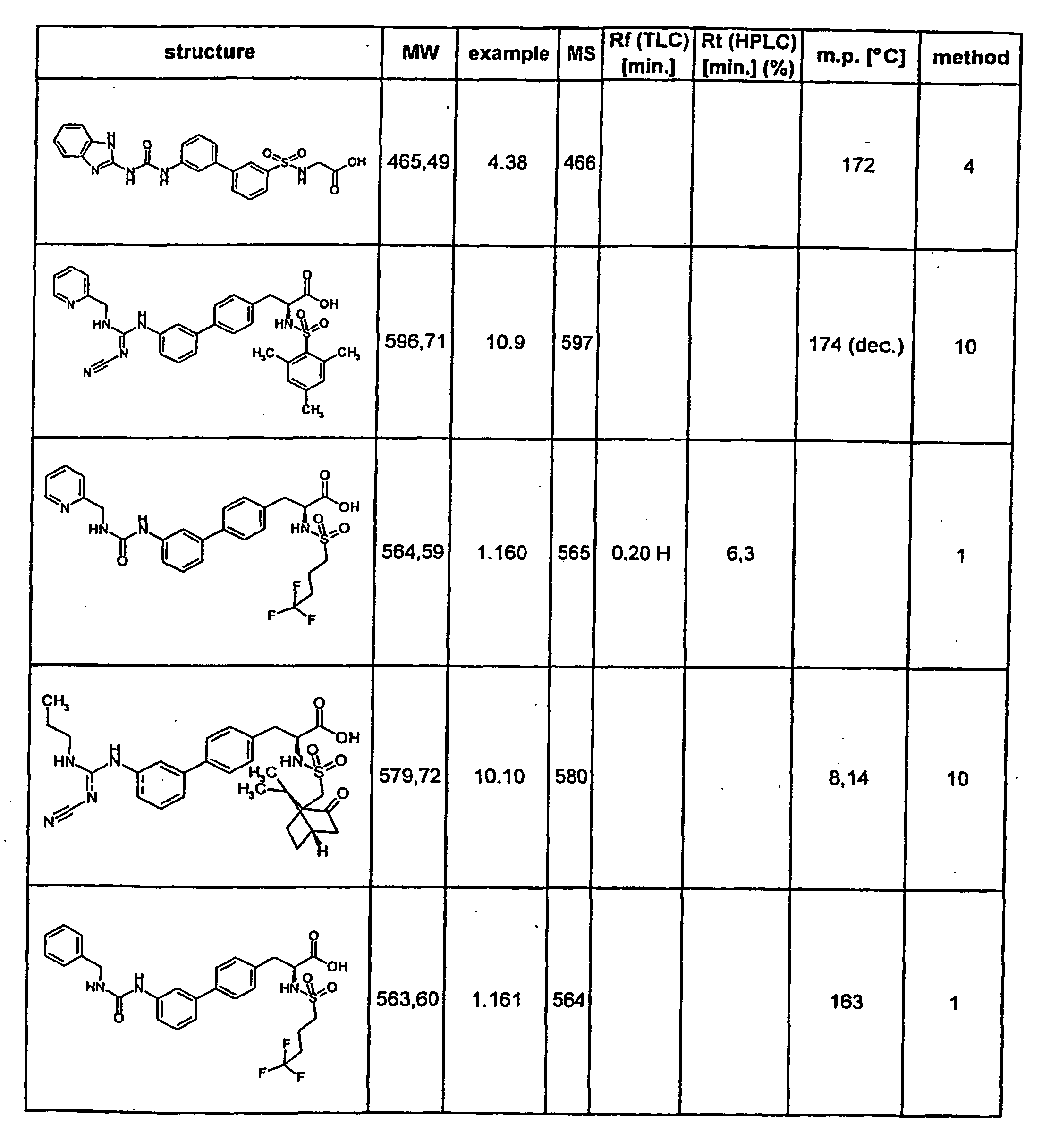


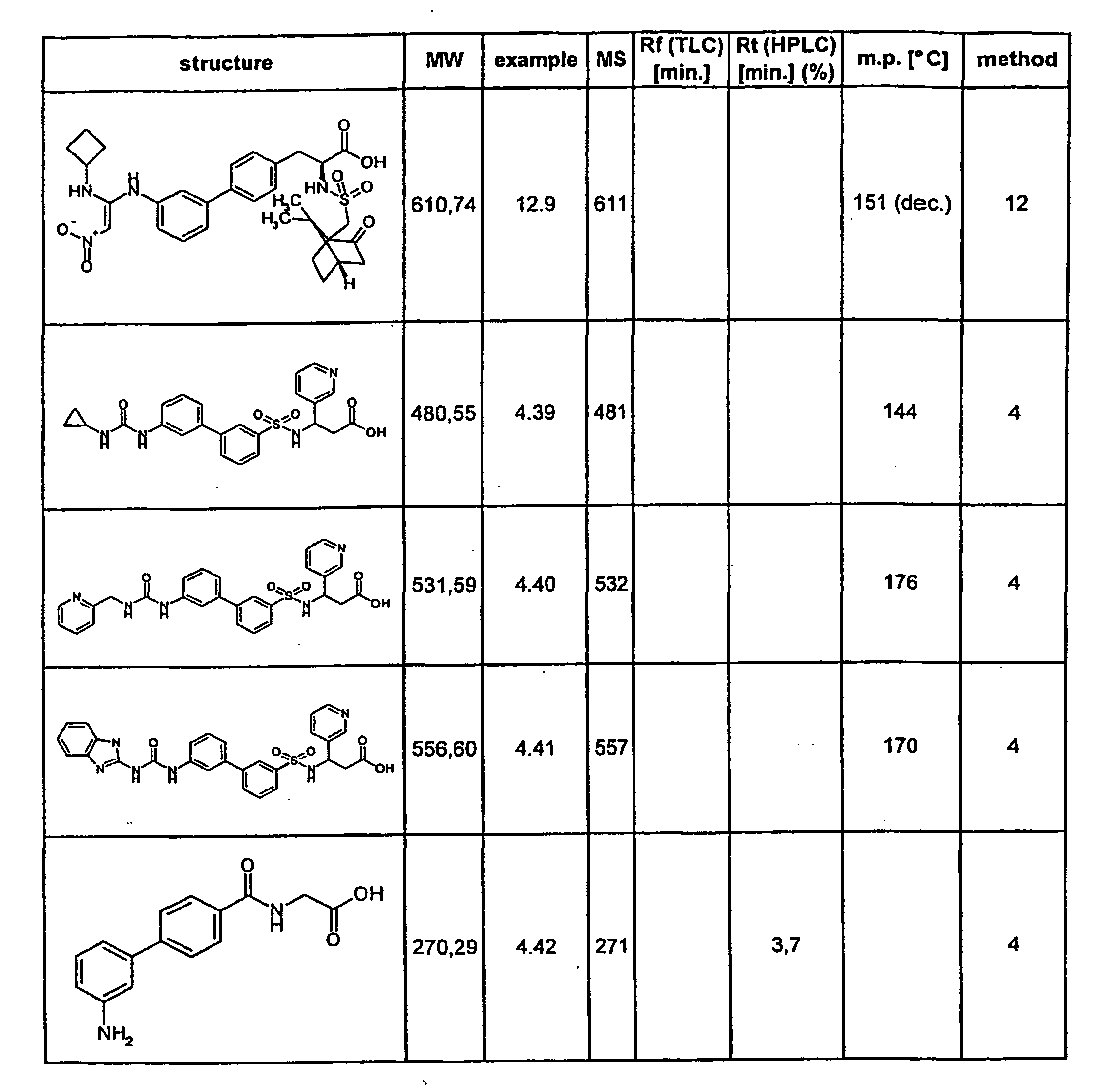

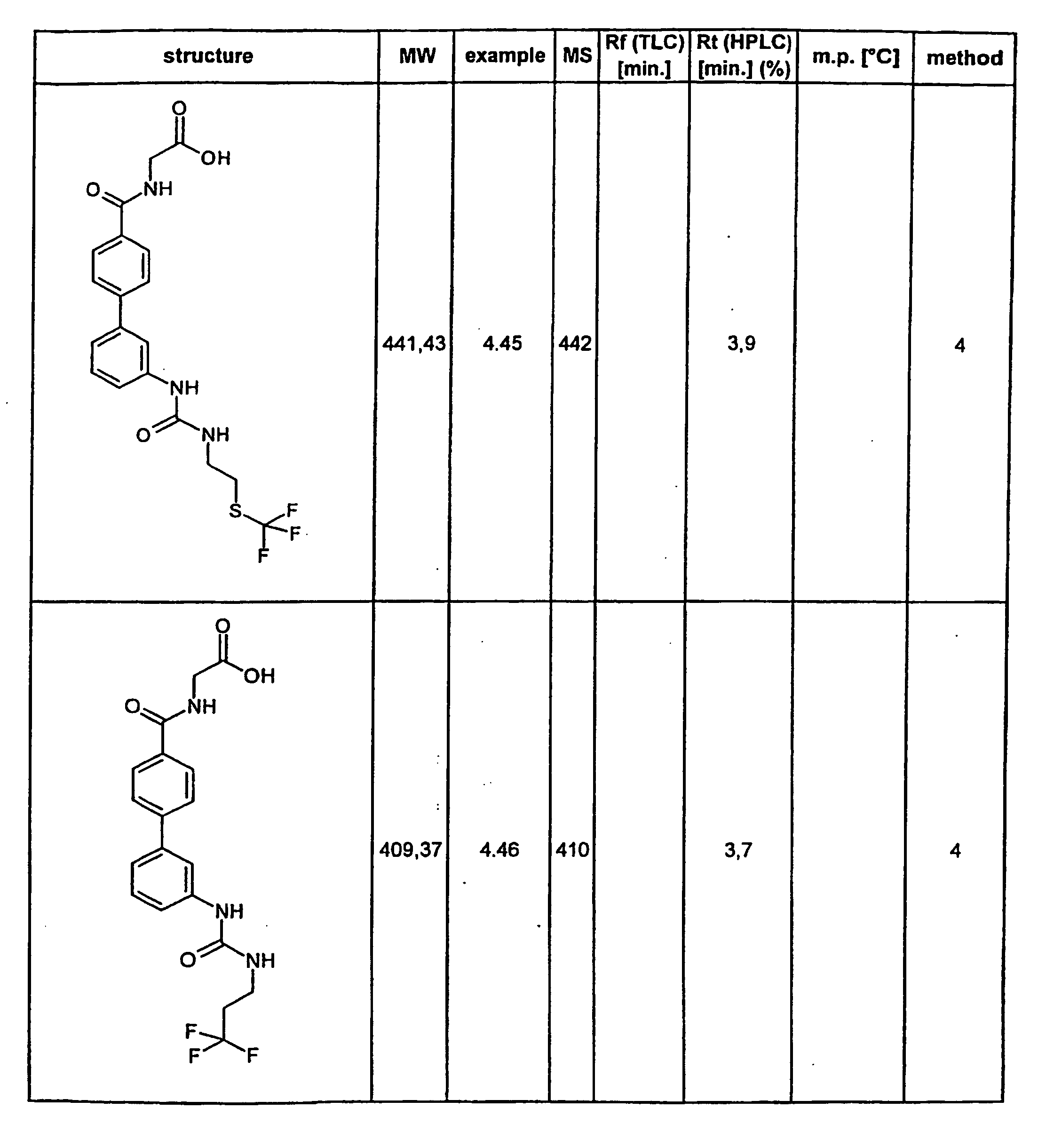
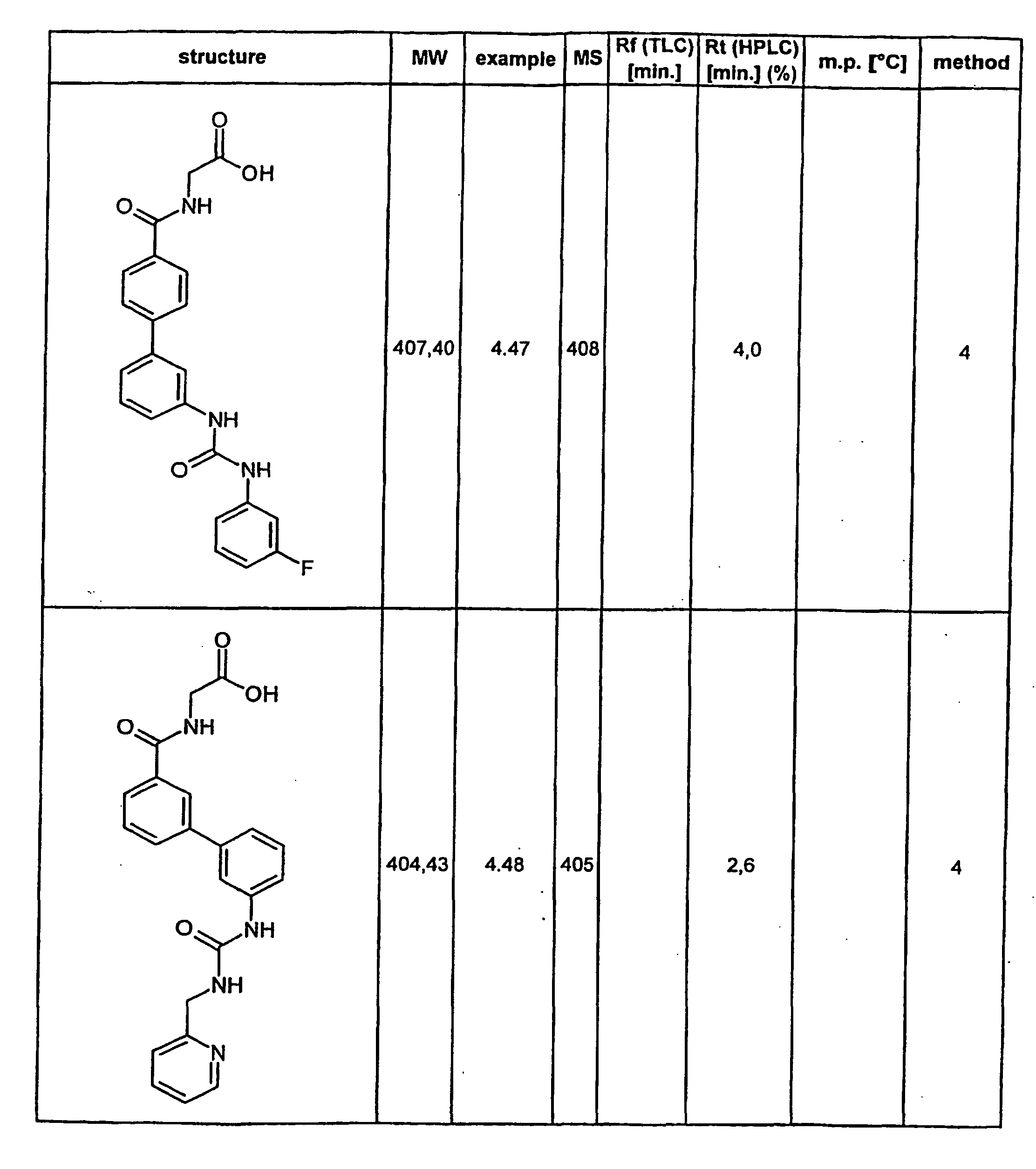

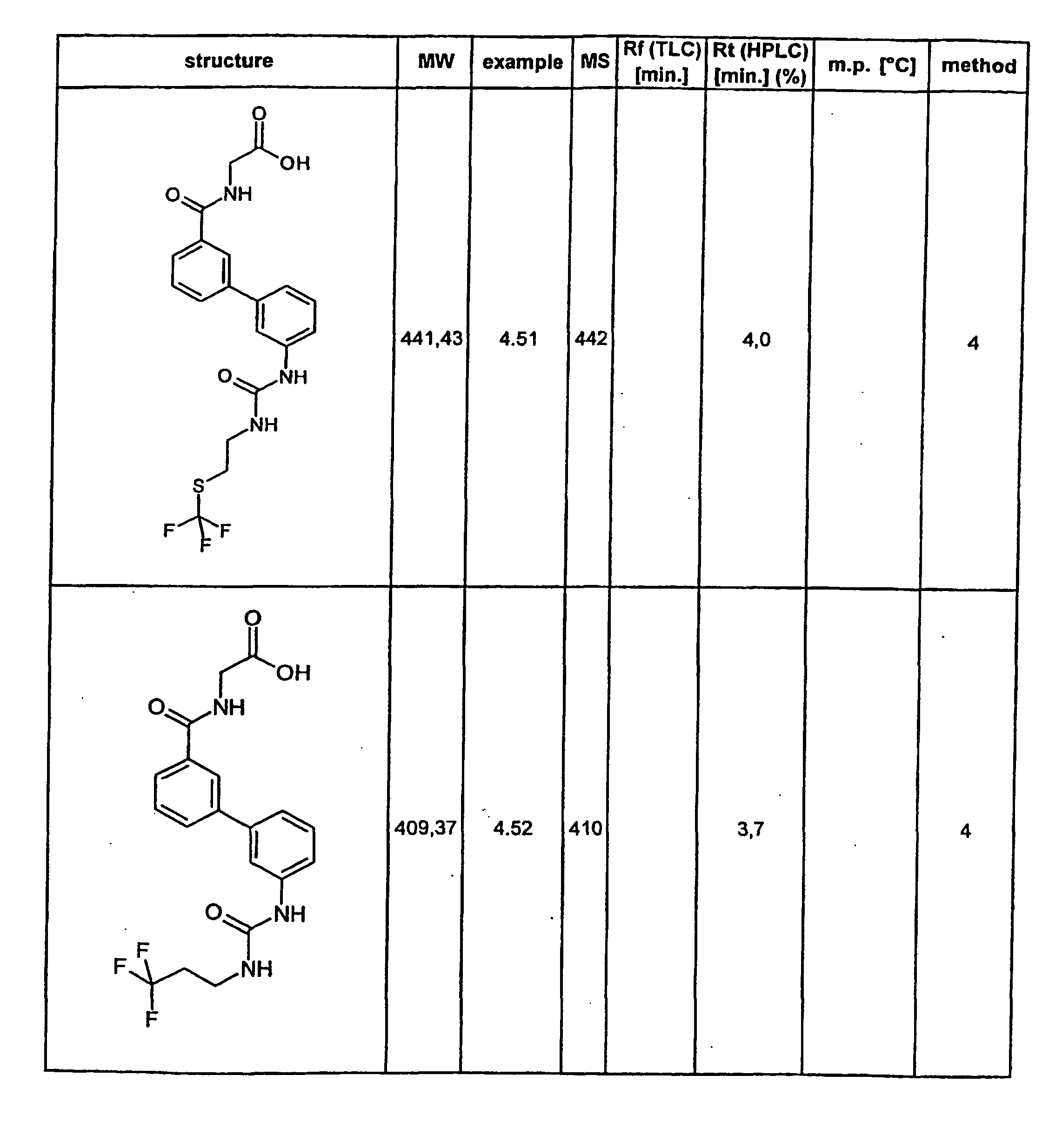
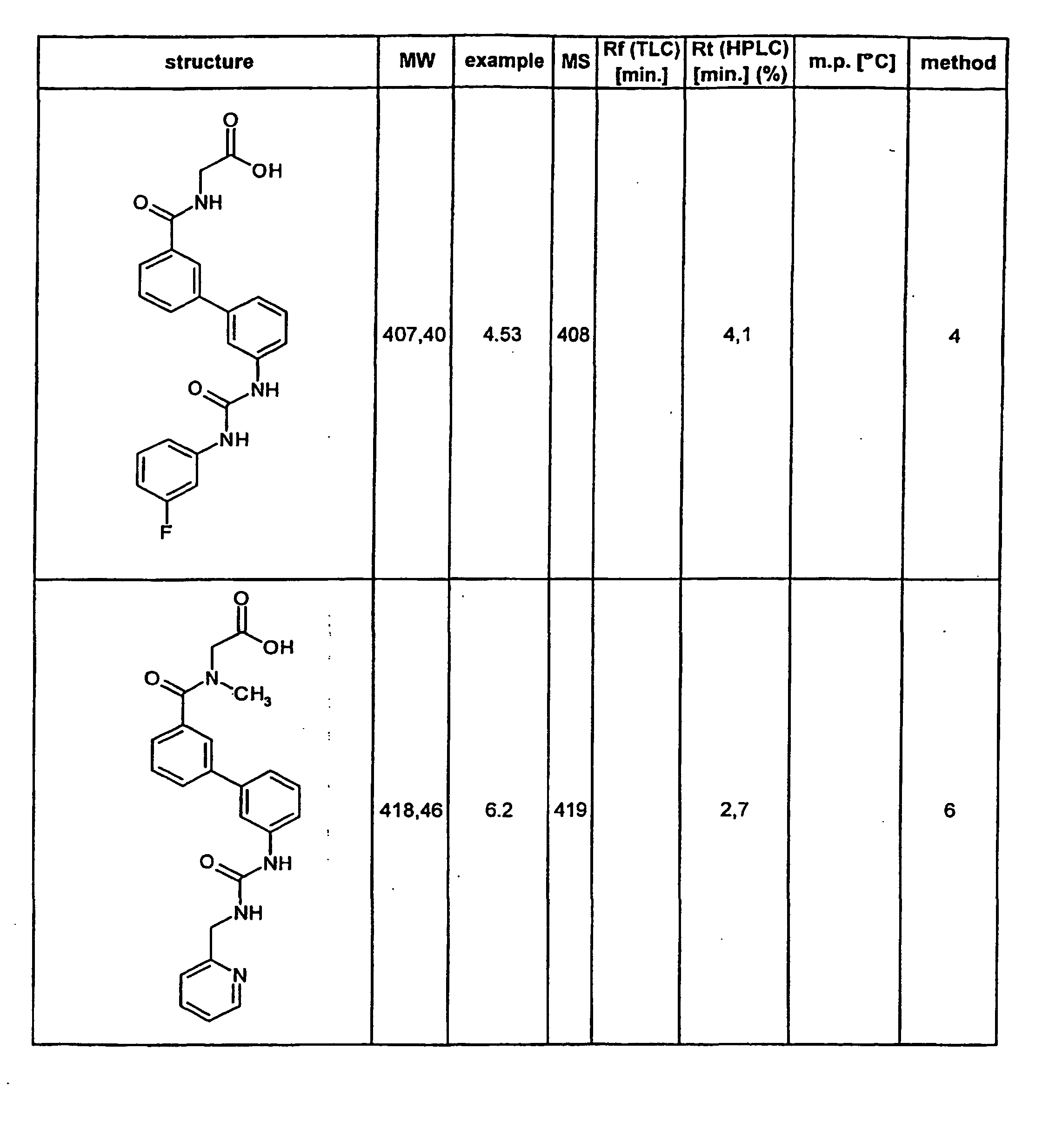
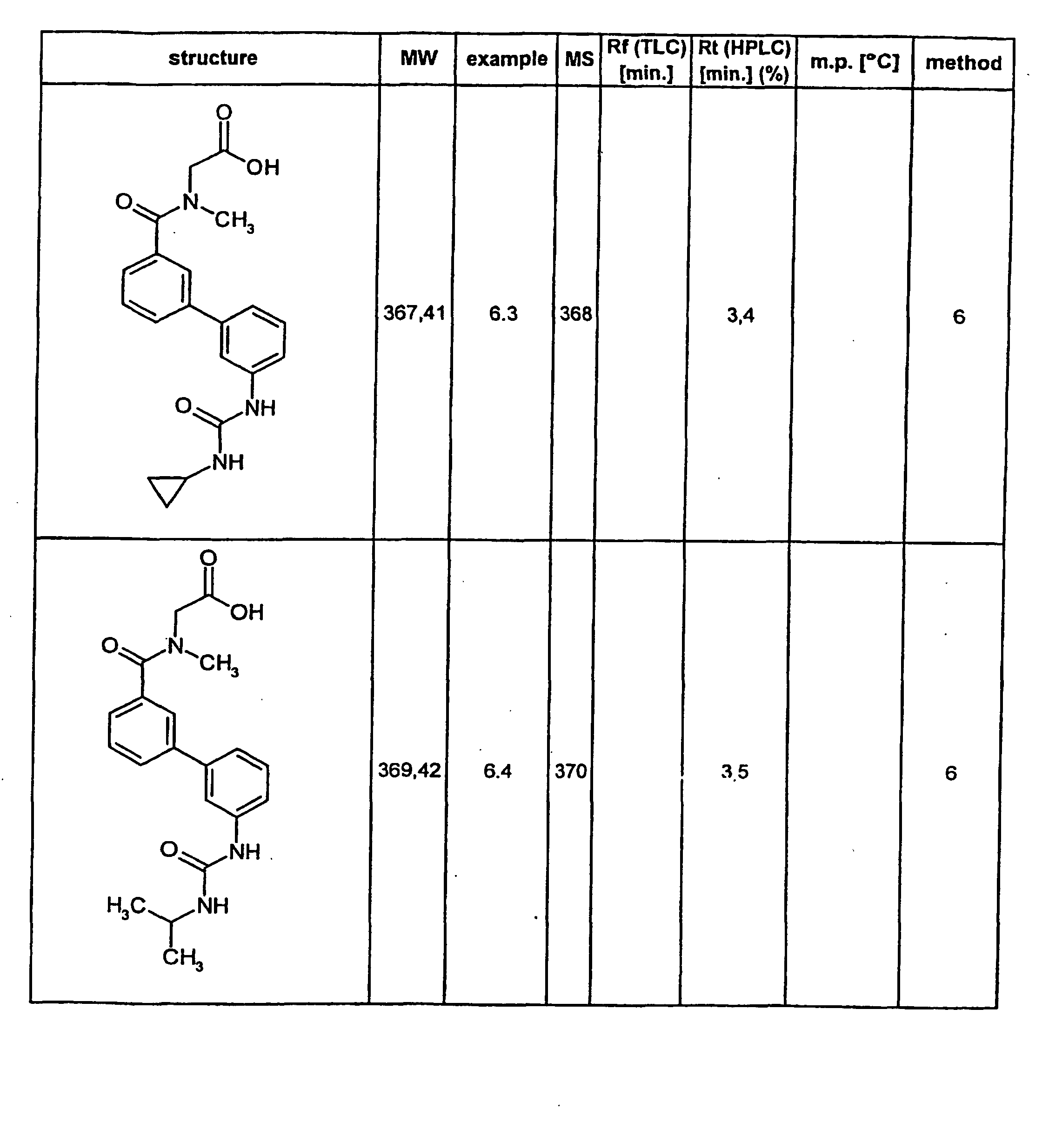


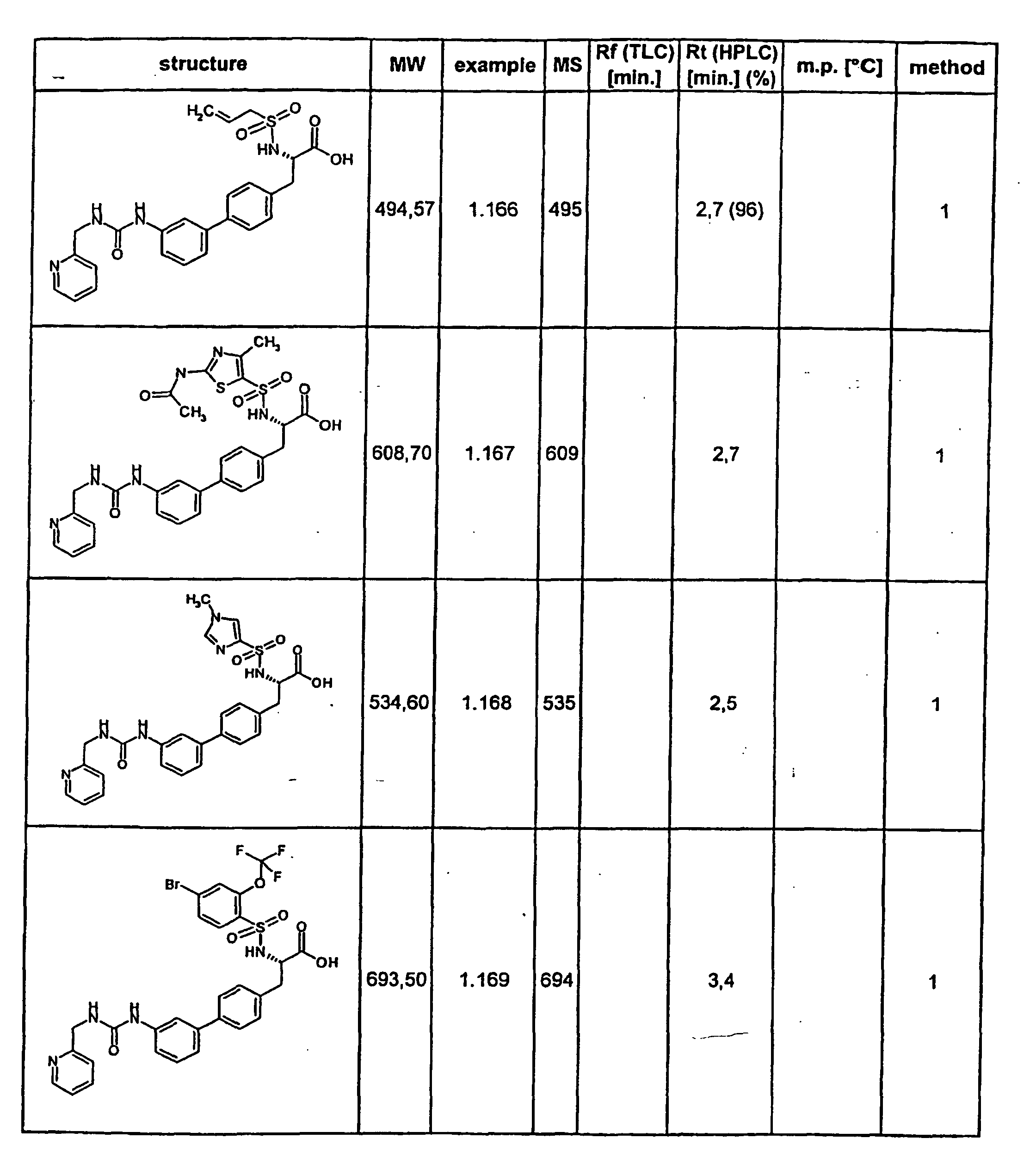

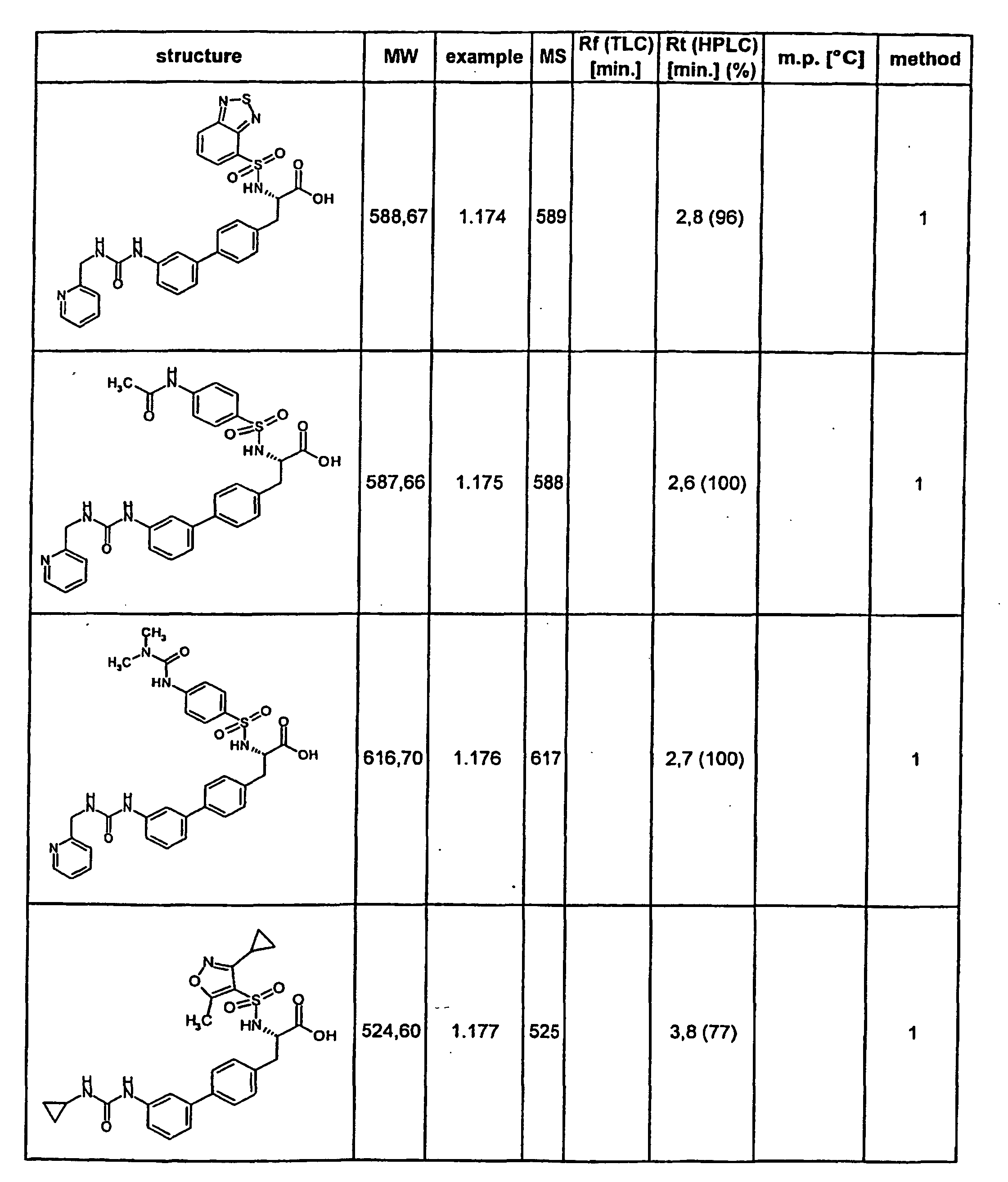


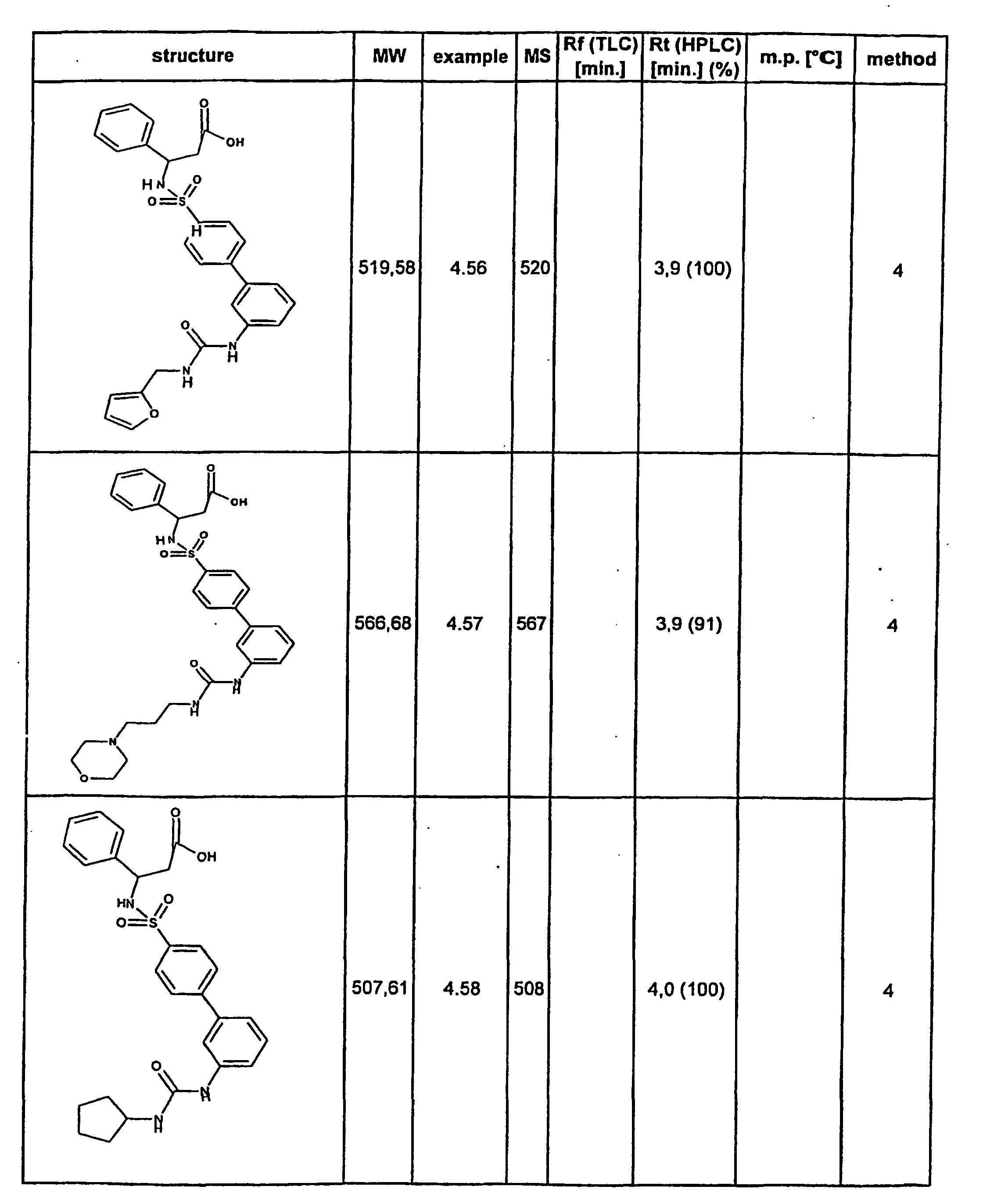


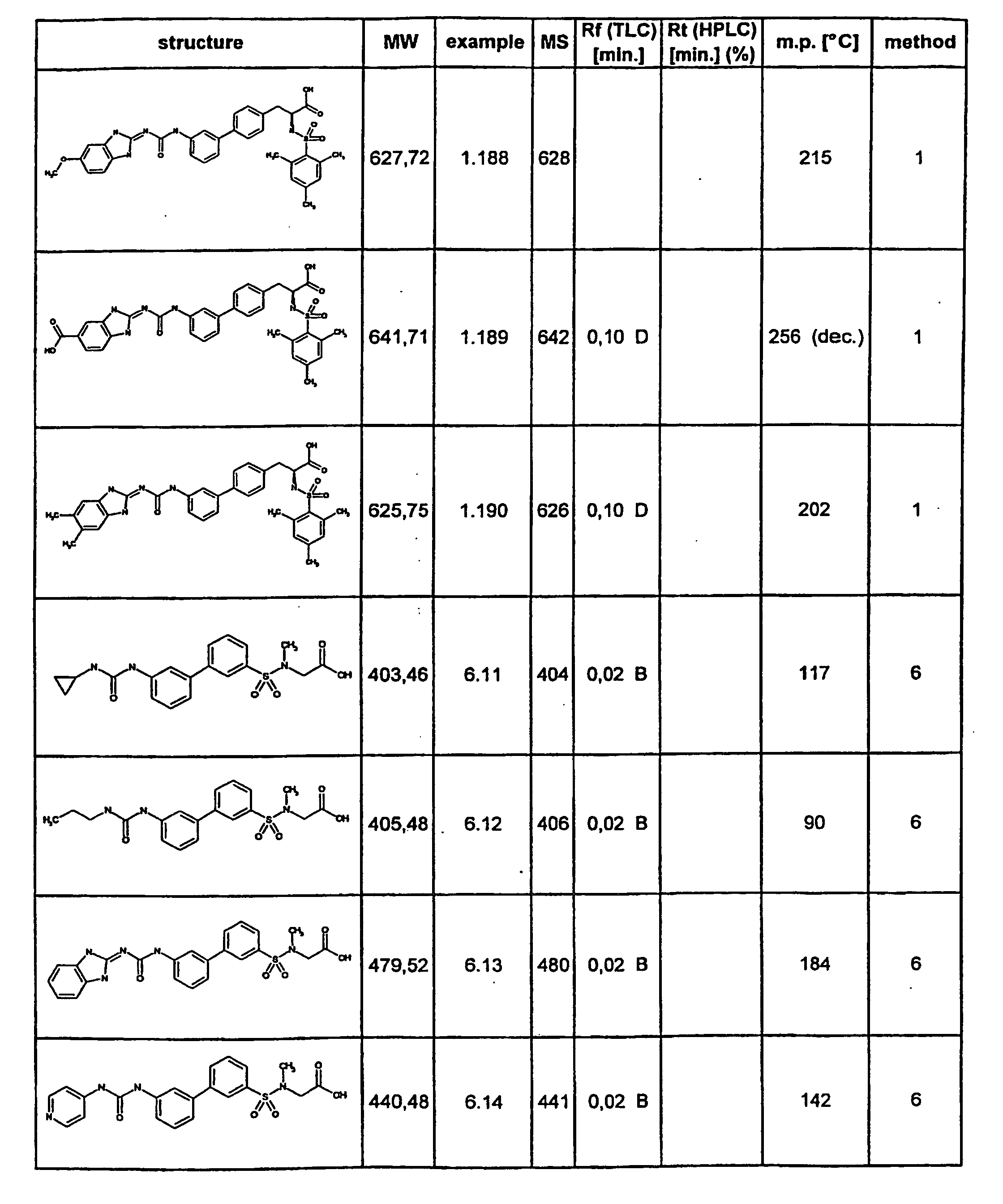
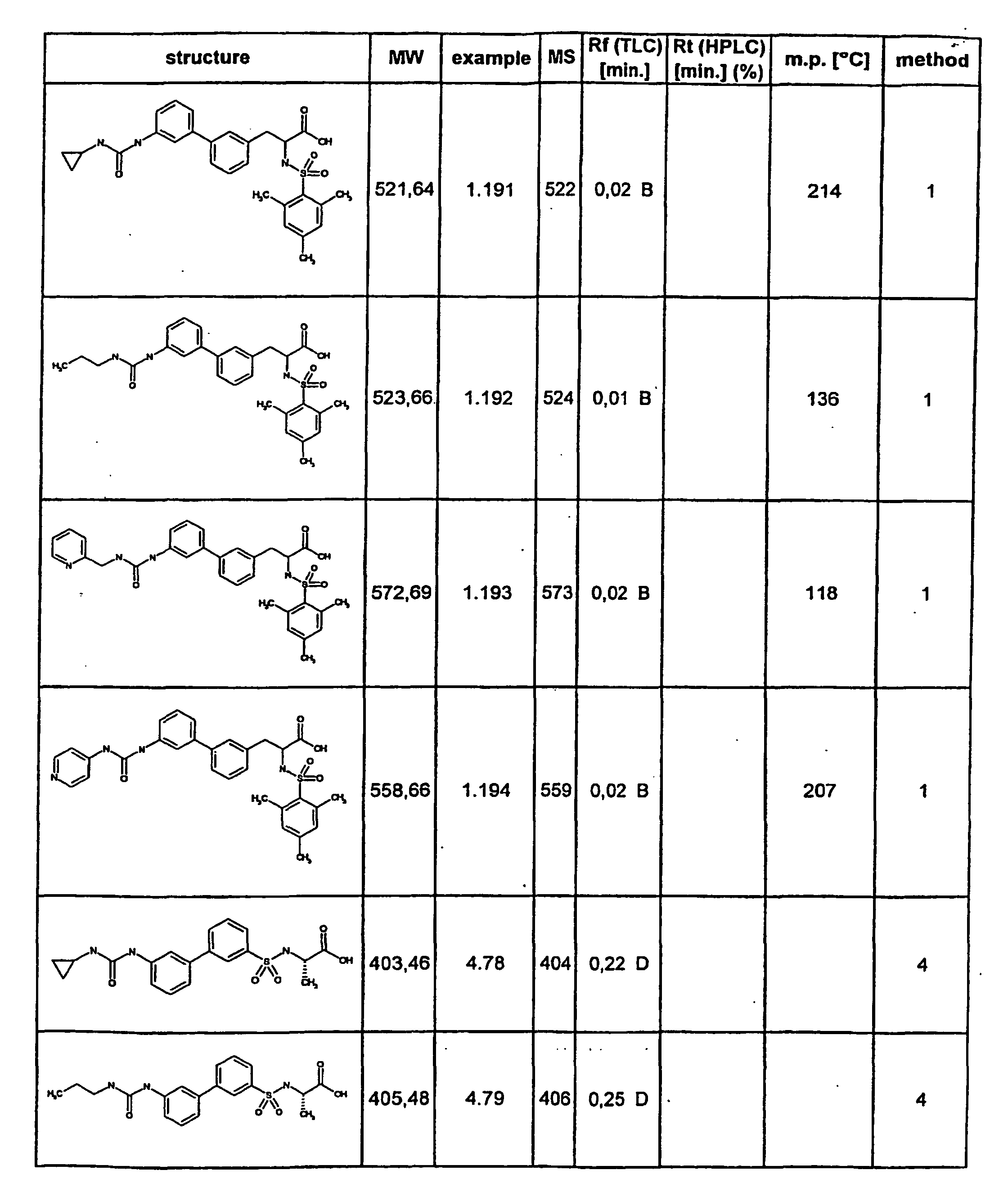
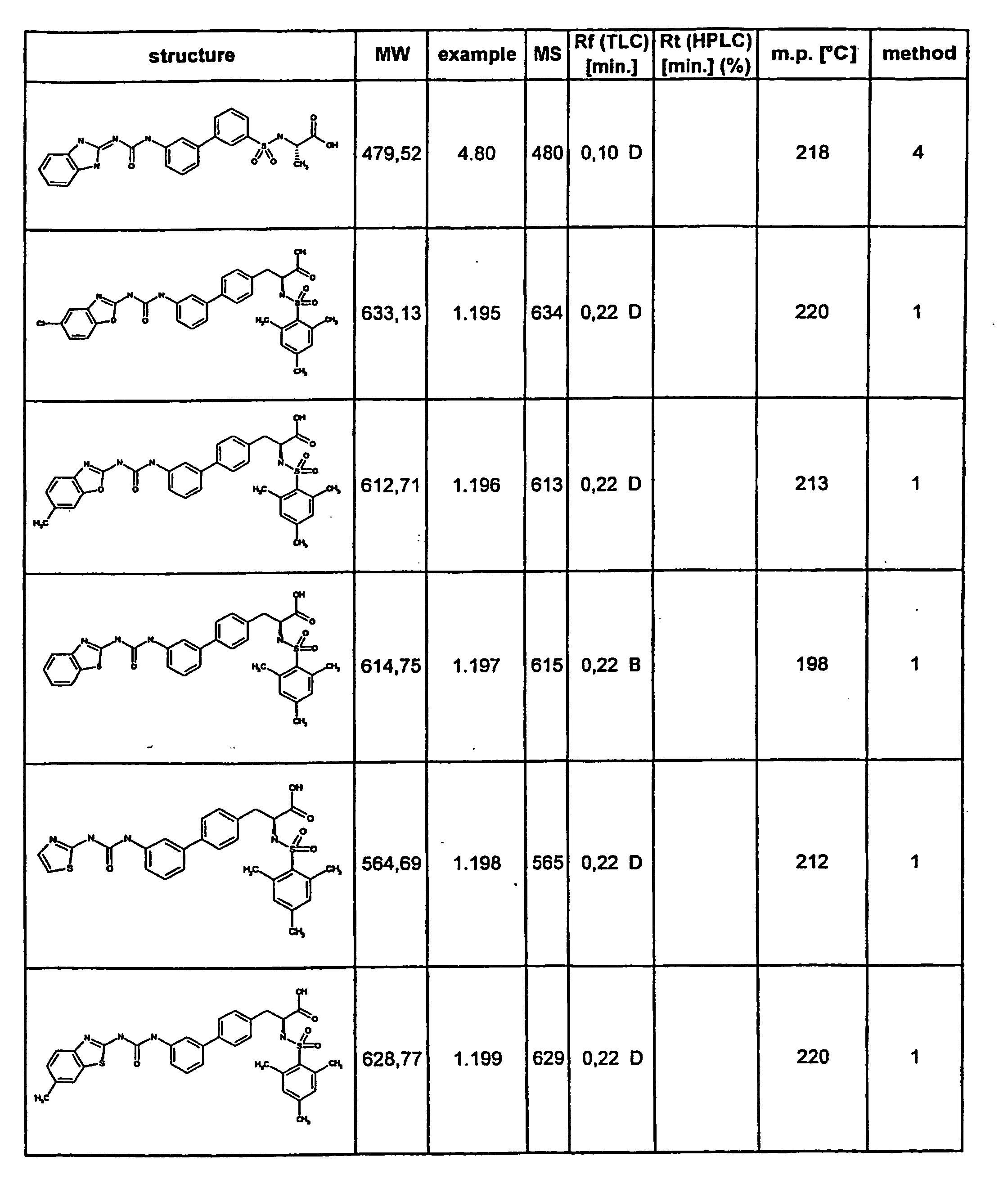


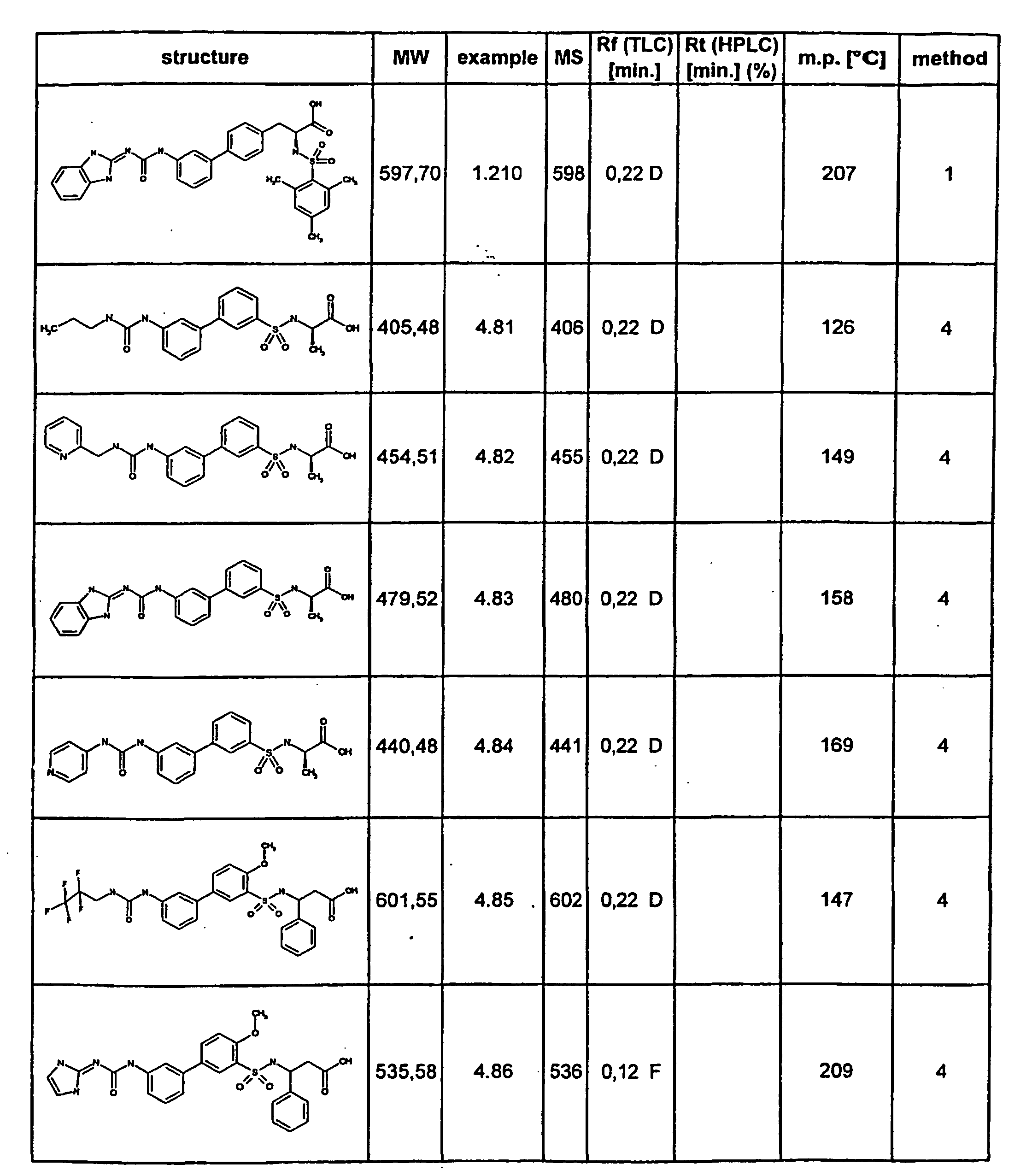
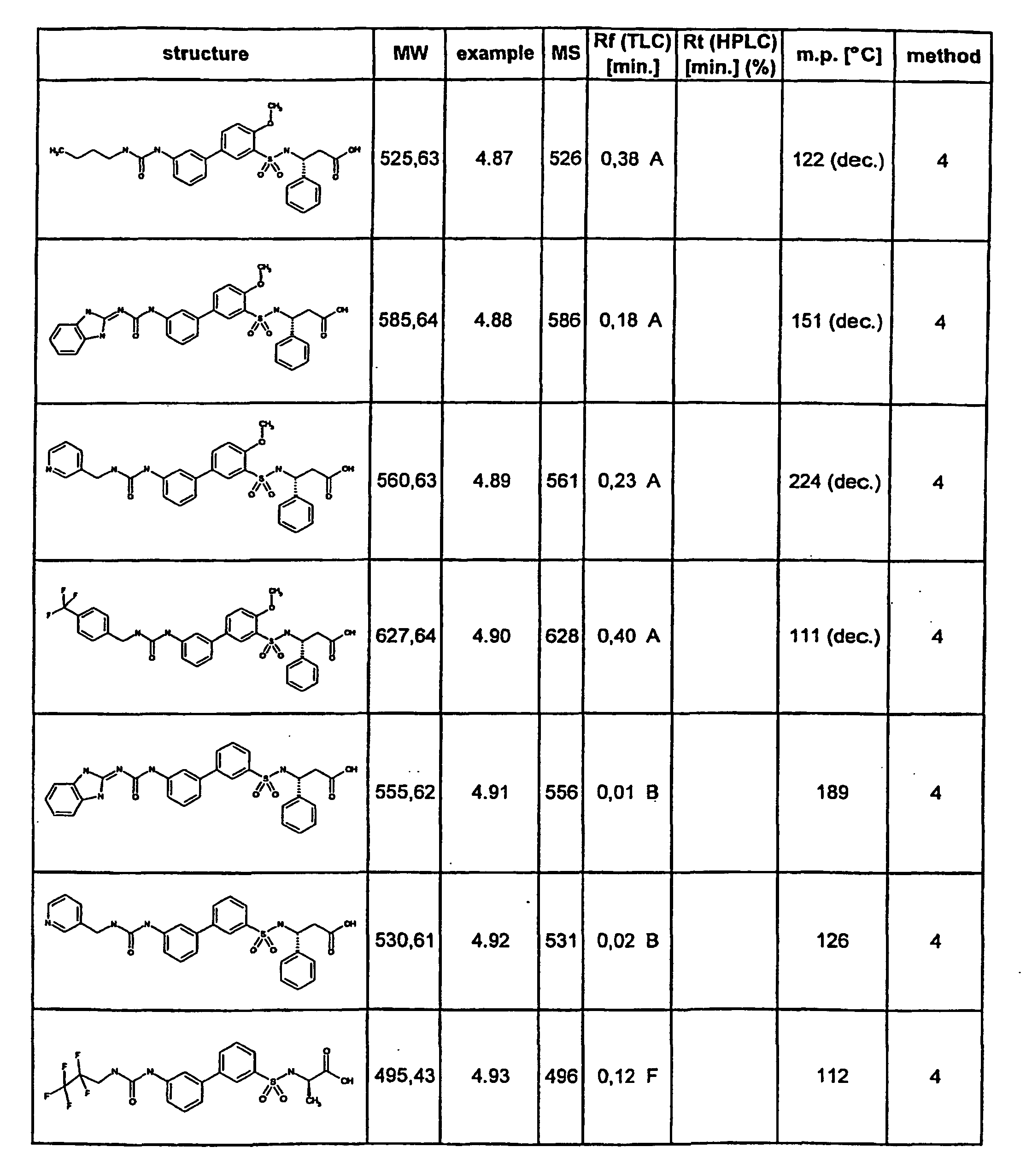
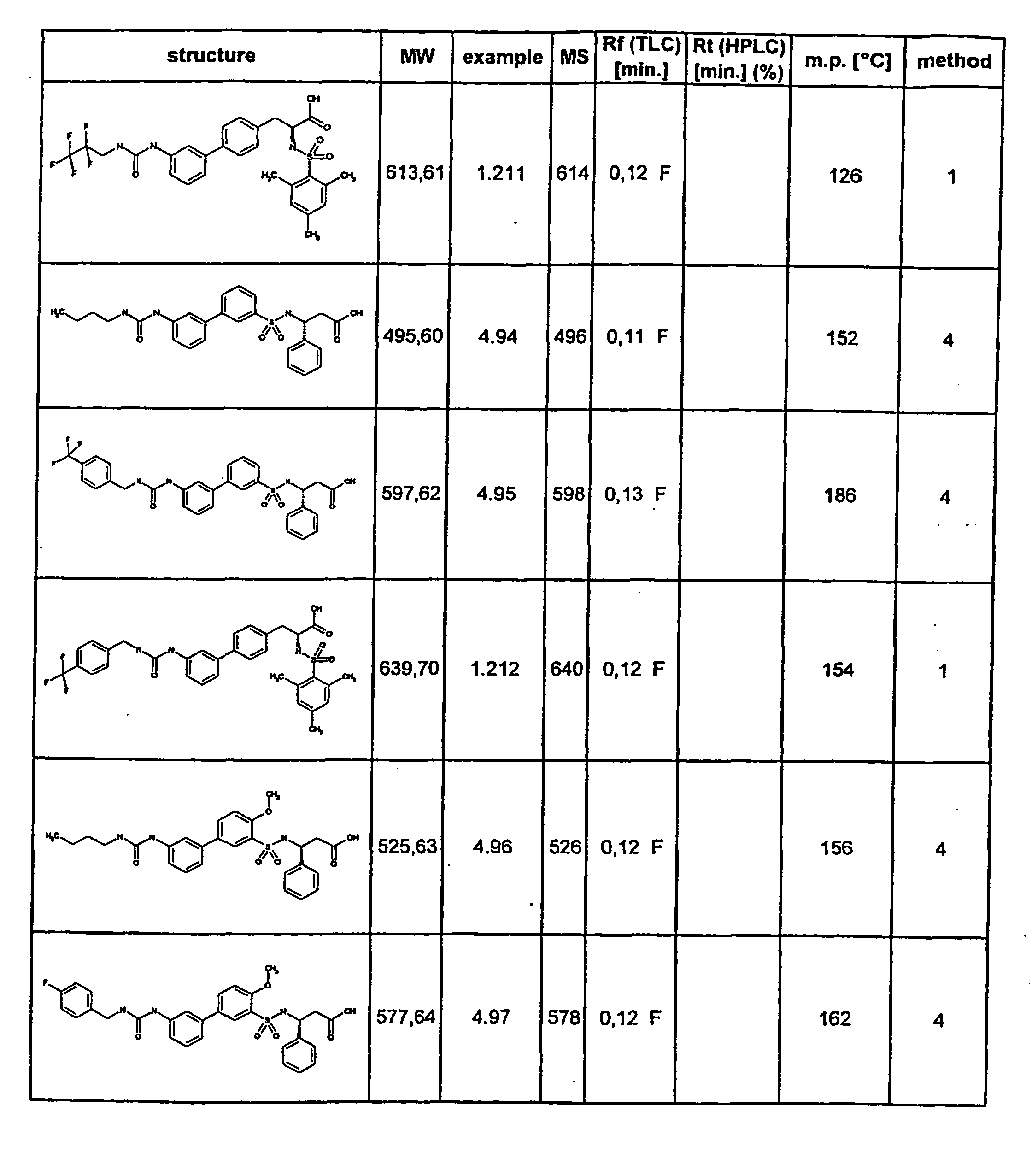


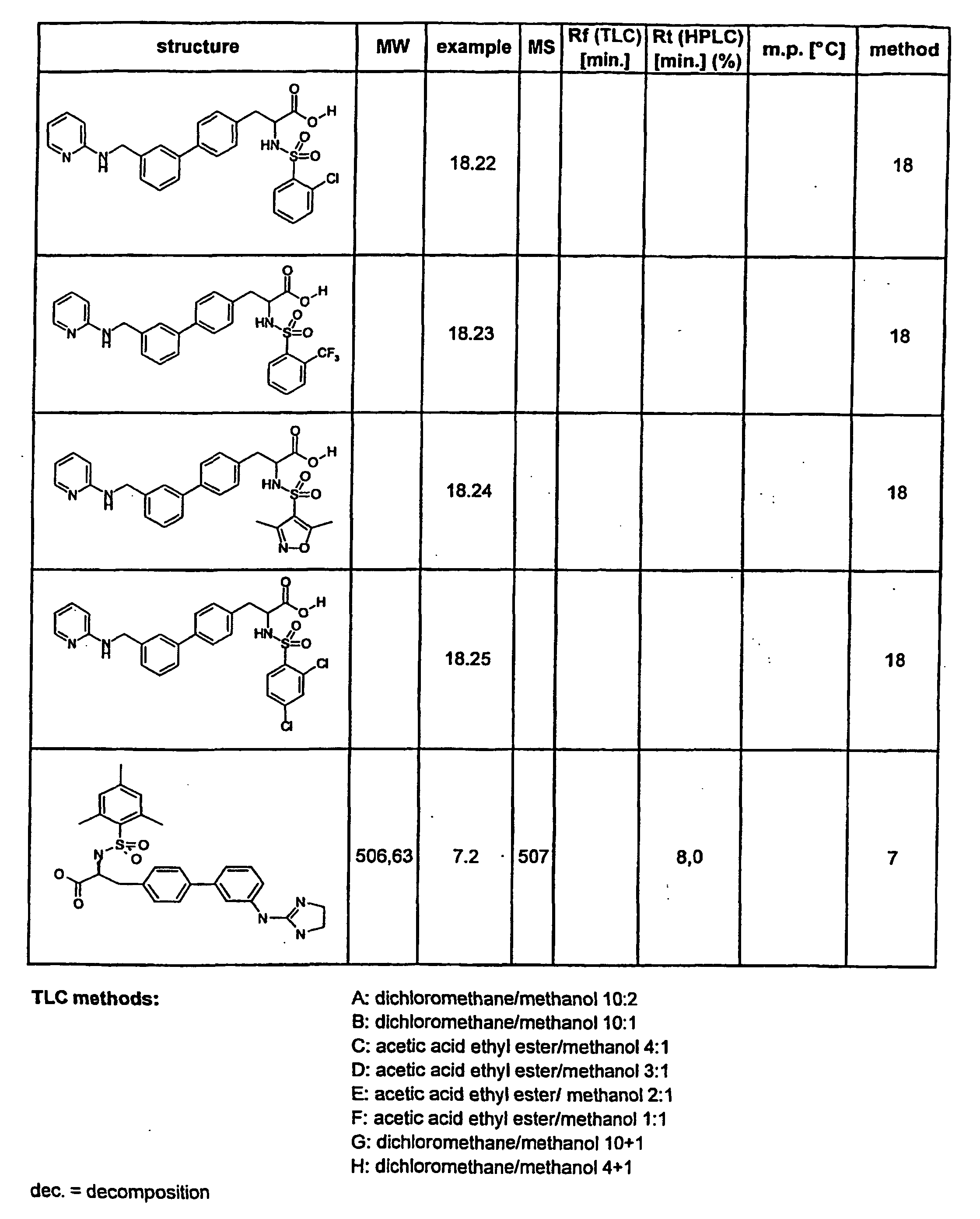
- αvβ3 from human A375 cells were purified according to a procedure described by Wong et al. (Molecular Pharmacology, 50, 529-537, 1996). 10 µl αvβ3 (5 ng) in TBS pH 7.6, 2 mM CaCl2, 1mM MgCl2, 1% n/octylglucopyranoside; 10 µl of the substance to be tested in TBS pH 7.6, 0.1 % dimethylsulfoxide (DMSO), and 45 µl TBS pH 7.6, 2 mM CaCl2, 1 mM MgCl2, 1 mM MnCl2 were each incubated for 1 h at room temperature. Subsequently 25 µl WGA SPA beads (Amersham, 4 mg/ml) and 10 µl echistatin (0.1 µCi, Amersahm, marked with chloroamine-T per well were added. After 16 h at room temperature the probes were measured with the aid of a scintillation measurement device (Wallac 1450). The test results of a selection of compounds are shown in Table 1 below.
- Smooth muscle cells from humans or rats were used. The migration of the cells was determined in a horizontal measuring arrangement (Falcon).
- The horizontal migration was determined in 6-well plates coated with vitronectin (1 µg/cm2). The cells were suspended in a medium (DMEM:F12/0, 12% BSA-rat smooth muscle cells or MCDB 131 with 0.2% BSA-human smooth muscle cells), inoculated and allowed to grow to confluence. Half of the smooth muscle cell lawn was then scraped off, and the cells were treated with different concentrations of the test compounds. The mixtures were incubated for 24 hours at 37°C in the presence of 5% CO2. After the incubation, the smooth muscle cell migration was determined by measurement of the migration distance and the cell density of the migrated cells. The test results of a selection of compounds are shown in Table 1 below.
- The right common carotid and external carotid artery of anaesthetized male Wistar rats are surgically exposed. After arteriotomy a 2F Fogarty embolectomy catheter is introduced via the external carotid into the common carotid artery and advanced to the aortic arch. The balloon is inflated with physiologic saline and withdrawn with gentle resistance to remove the endothelium. After repeating this procedure three times, the balloon catheter is removed, the external carotid artery is ligated, blood flow in the common carotid artery is restored, and the neck wound is surgically closed. Animals are allowed to recover until sacrifice which is usually 14 days after injury. During this period animals are treated with test compounds orally, subcutaneously or intraperitoneally as single injections or as intraperitoneal infusion via osmotic minipumps. At sacrifice the injured vessels are excised and histologically processed for morphometric evaluation of lumen, neointima and media. The primary parameter is the cross-sectional neointimal area. (Lit.: C. Gerdes, V. Faber-Steinfeld, Ö. Yalkinoglu, S. Wohlfeil, Arteriosclerosis, Thrombosis, and Vascular Biology Vol 16, No 10, 1996, 1306-1311). The tests results of a selection of compounds are shown in Table 1 below.
Example avb3 IC 50 SMC IC 50 1.5 5 nM 480 nM 1.13 1.2 nM 390 nM 4.1 33 nM 300 nM 7.1 1.2 nM 8.1 48 nM 300 nM 1.73 2 nM 3-40 nM 18.1.3 9 nM 35-80 nM 19.1.2 1 nM 80 nM
is reacted with a phenyl compound of the formula (3), in which
in the presence of a palladium compound and of a phosphane.
Claims (22)
- A compound of the general formula (1)wherein

- R1
- is hydrogen, methyl, ethyl, propyl, isopropyl, butyl, isobutyl, t-butyl, pentyl, isopentyl, neopentyl, hexyl, cyclopropyl, cyclopropylmethyl, cyclobutyl, cyclopentyl, cyclohexyl, phenyl, benzyl, tolyl or a substituted derivative thereof;
- R2
- is hydrogen, methyl, ethyl, propyl, isopropyl, butyl, isobutyl, t-butyl, pentyl, isopentyl, neopentyl, hexyl, cyclopropyl, cyclopropylmethyl, cyclobutyl, cyclopentyl, cyclohexyl, phenyl, benzyl, tolyl or a substituted derivative thereof, a saturated or unsaturated, optionally substituted heterocyclic residue of the group containing pyrrole, pyridine, tetrahydrofuran, furan, thiophene, tetrahydrothiophene, thiooxazole, benzofuran, quinoline, isoquinoline, pyrimidine, imidazole, thiazole, pyrazole, isoxazole and benzothiadiazole, an optionally substituted C2-C6-alkenyl residue, an optionally substituted alkinyl residue, -NR2'SO2R2", -NR2'COOR2',-NR2'CONR2' 2 or -NR2'CSNR2' 2;
- R2'
- is hydrogen,methyl, ethyl, propyl, isopropyl, butyl, isobutyl, t-butyl, pentyl, isopentyl, neopentyl, hexyl, cyclopropyl, cyclobutyl, cyclopentyl, cyclohexyl, phenyl, benzyl, tolyl or a substituted derivative thereof, or a saturated or unsaturated, optionally substituted heterocyclic residue of the group containing pyrrole, pyridine, tetrahydrofuran, furan, thiophene, tetrahydrothiophene, thiooxazole, benzofuran, quinoline, isoquinoline, pyrimidine, imidazole, thiazole, pyrazole, isoxazole and benzothiadiazole;
- R2"
- ismethyl, ethyl, propyl, isopropyl, butyl, isobutyl, t-butyl, pentyl, isopentyl, neopentyl, hexyl, C2-C6-alkenyl, cyclopropyl, cyclobutyl, cyclopentyl, cyclohexyl, phenyl, benzyl, tolyl or a substituted derivative thereof, or a saturated or unsaturated, optionally substituted heterocyclic residue of the group containing pyrrole, pyridine, tetrahydrofuran, furan, thiophene, tetrahydrothiophene, thiooxazole, benzofuran, quinoline, isoquinoline, pyrimidine, imidazole, thiazole, pyrazole, isoxazole and benzothiadiazole;
- U
- is a direct bond or a substituted or unsubstituted alkylene group;
- V
- is a substituted or unsubstituted alkylene group, -NR2'CO- or -NR2'SO2-;
- A and B
- are each independently of one another a 1,3- or 1,4-bridging phenylene group or a 2,4- or 2,5-bridging thienylene group each of which may optionally have additional substituents,
- W
- is a direct bond or a substituted or unsubstituted alkylene group;
- C
- is a direct bond or
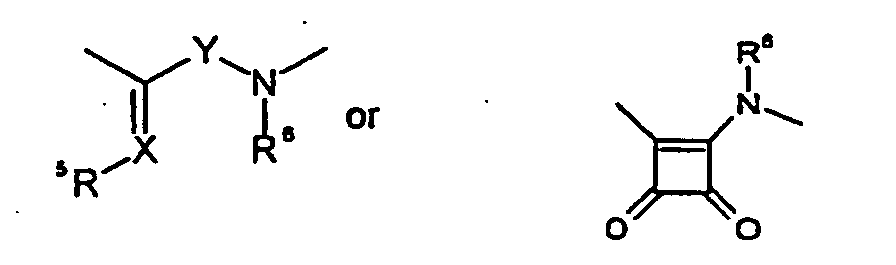
- R3
- is hydrogen, a substituted or unsubstituted alkyl or cycloalkyl residue, a substituted or unsubstituted aryl residue, a saturated or unsaturated, optionally substituted heterocyclic residue, an alkylamine residue, an alkylamide residue or is connected to one of R4, Y, R5 or R6, if present, with formation of an optionally substituted heterocyclic ring system which includes the nitrogen atom to which R3 is bonded, and can be saturated or unsaturated and/or can contain further heteroatoms;
- R4
- is hydrogen, a substituted or unsubstituted alkyl or cycloalkyl residue, a substituted or unsubstituted aryl residue, a saturated or unsaturated, optionally substituted heterocyclic residue, an alkylamine residue, an alkylamide residue or is connected to one of R3, Y, R5 or R6, if present, with formation of an optionally substituted heterocyclic ring system which includes the nitrogen atom to which R4 is bonded and can be saturated or unsaturated and/or can contain further heteroatoms;
- X
- is CHNO2, CHCN, O, N or S;
- Y
- is a direct bond or an optionally substituted alkylene or alkine group;
- R5
- is absent, or is hydrogen, a substituted or unsubstituted alkyl or cycloalkyl residue, -NO2, -CN, -COR5', -COOR5', or is connected to one of R3, Y, R4 or R6, if present, with formation of an optionally substituted carbocyclic or heterocyclic ring system which includes X and can be saturated or unsaturated and/or can contain further heteroatoms;
- R5'
- is hydrogen, a substituted or unsubstituted alkyl or cycloalkyl residue, a substituted or unsubstituted aryl residue or a saturated or unsaturated, optionally substituted heterocyclic residue which can be saturated or unsaturated and/or can contain further heteroatoms;
- R6
- is hydrogen, a substituted or unsubstituted alkyl or cycloalkyl residue, a substituted or unsubstituted aryl or arylcarbonyl residue, a saturated or unsaturated, optionally substituted heterocyclic residue, an alkylamine residue, an alkylamide residue or is connected to one of R3, R4, Y or R5, if present, with formation of an optionally substituted heterocyclic ring system which includes the nitrogen atom to which R6 is bonded and can be saturated or unsaturated and/or can contain further heteroatoms;
- A compound as claimed in claim 1,
wherein- R1
- is hydrogen, methyl, ethyl, propyl, isopropyl, butyl, isobutyl, t-butyl, pentyl, isopentyl, neopentyl, hexyl, cyclopropyl, cyclopropylmethyl, cyclobutyl, cyclopentyl, cyclohexyl, phenyl, benzyl, tolyl or a substituted derivative thereof;
- R2
- is hydrogen, methyl, ethyl, propyl, isopropyl, butyl, isobutyl, t-butyl, pentyl, isopentyl, neopentyl, hexyl, cyclopropyl, cyclobutyl, cyclopentyl, cyclohexyl, phenyl, benzyl, tolyl or a substituted derivative thereof, an optionally substituted alkenyl residue, an optionally substituted alkinyl residue, -NR2'SO2R2", -NR2'COOR2', -NR2'COR2', -NR2'CONR2' 2 or -NR2'CSNR2' 2;
- R2'
- is hydrogen, methyl, ethyl, propyl, isopropyl, butyl, isobutyl, t-butyl, pentyl, isopentyl, neopentyl, hexyl, cyclopropyl, cyclobutyl, cyclpentyl, cyclohexyl, phenyl, benzyl, tolyl or a substituted derivative thereof as, for example, 2-chlorophenyl, 2-methoxyphenyl, 2,4,6-trimethylphenyl, 4-methoxyphenyl, 4-t-butylphenyl, 2,5-dichlorophenyl, 3-chlorophenyl, 4-chlorophenyl, 4-trifluoromethyl phenyl;
- R2"
- is methyl, ethyl, propyl, isopropyl, butyl, isobutyl, t-butyl, pentyl,
isopentyl, neopentyl, hexyl, 1,1,1-trifluorobutyl, allyl, cyclopropyl,
cyclobutyl, cyclopentyl, cyclohexyl, phenyl, benzyl, tolyl or a
substituted derivative thereof, 4-ethylphenyl, -C6H2(CH3)3, 2-chlorophenyl,
4-chlorophenyl, 2,5-dichlorophenyl, 4-trifluoromethylphenyl,
campher-10-yl, 4-methoxyphenyl, 4-t-butylphenyl, 2,5-dimethylphenyl,
3-chlorophenyl, 2-methoxy-5-methylphenyl, 2,3,5,6-tetramethylphenyl,
2,3-dichlorophenyl, 2,4-dichlorophenyl, 2,6-dichlorophenyl,
2-naphthyl, 3-trifluoromethylphenyl, 4-fluorophenyl, 2,4-difluorophenyl,
2-chloro-6-methylphenyl, 2-chloro-4-fluorophenyl,
2,5-dimethoxyphenyl, 3,4-dimethoxyphenyl, 3-chloro-6-methoxyphenyl,
2-trifluoromethylphenyl, 2-alkylsulfonylphenyl, 2-arylsulfonylphenyl,
3-(N-acetyl-6-methoxy)anilino, 2-methoxycarbonylphenyl,
4-N-acetylphenyl, 4-ethylphenyl, 3-chloro-4-fluorphenyl, 2-fluorophenyl,
3-fluorophenyl, 2,4-difluorophenyl, 2,6-difluorophenyl,
3,4-difluorophenyl, 1-naphthyl, 4-trifluoromethoxyphenyl, 2-trifluoromethoxyphenyl,
4-chloro-2-trifluoro-phenyl, 2-trifluoromethoxy-4-bromo-phenyl,
2-fluoro-4-trifluoromethylphenyl, 8-quinolinyl or
a group of the formula
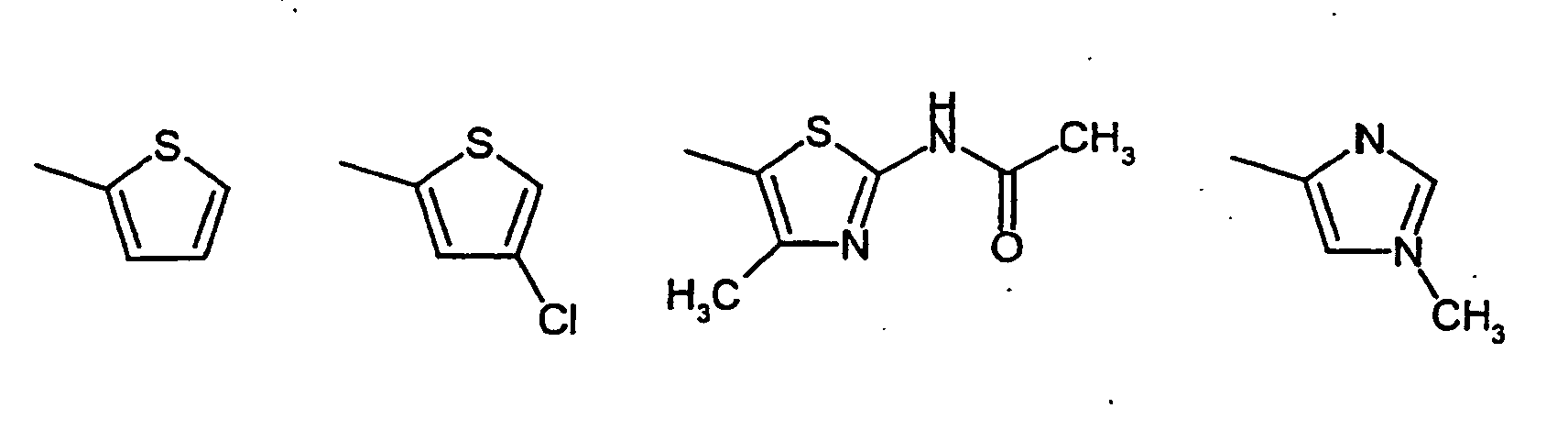
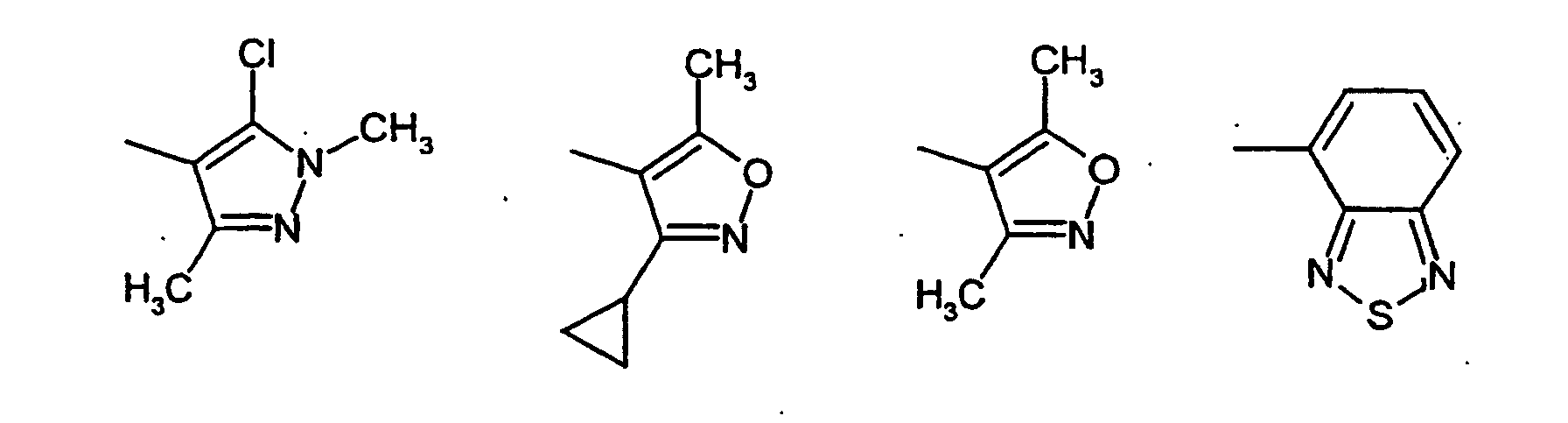
- U
- is a direct bond,
- V
- is an optionally substituted C1-5-alkylene group;
- A
- is a 1,3- or 1,4-bridging phenylene group which is unsubstituted or carries at least one alkoxy or halogeno residue;
- B
- is a 1,3- or 1,4-bridging phenylene group which is unsubstituted or carries at least one alkyl residue;
- W
- is a direct bond or an optionally substituted C1-4-alkylene group;
- C
- is a direct bond or
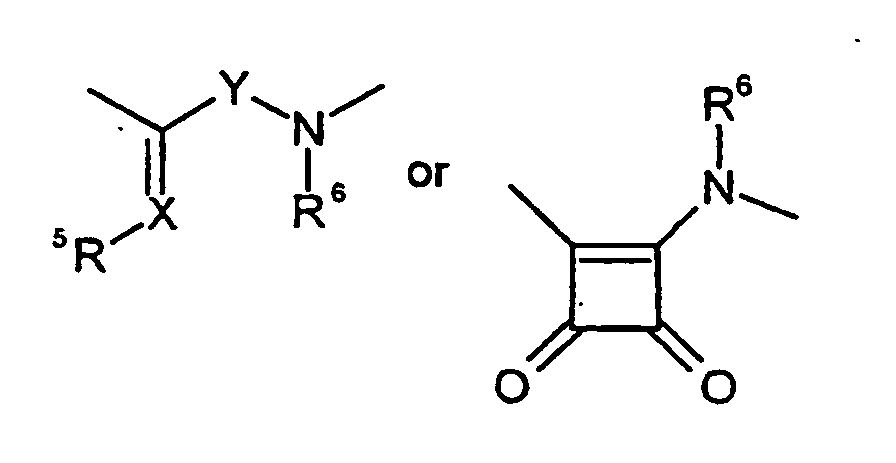
- R3
- is hydrogen, methyl, ethyl, propyl, isopropyl, butyl, 1-methylpropyl,
isobutyl, t-butyl, pentyl, 2-methylbutyl, isopentyl, neopentyl, hexyl,
C1-4-perfluoroalkyl, cyclopropyl, cyclopropylmethyl, cyclobutyl,
cyclopentyl, cyclohexyl, cycloheptyl, 4-methylcyclohexyl, 3,3,5-trimethylcyclohexyl,
5-methyl-2-hexyl, allyl, propinyl, phenyl, benzyl,
tolyl, benzoyl or a substituted derivative thereof, C1-4-alkylamino-C1-4-alkyl,
C1-4-dialkylamino-C1-4-alkyl, amino-C1-4-alkyl, C1-4-alkyloxyC1-4-alkyl,
dialkylamino-C1-4-alkyl, amino-C1-4-alkyl, C1-4-alkyloxyC1-4-alkyl,
C1-2-perfluoroalkyl-C1-4-alkyl,
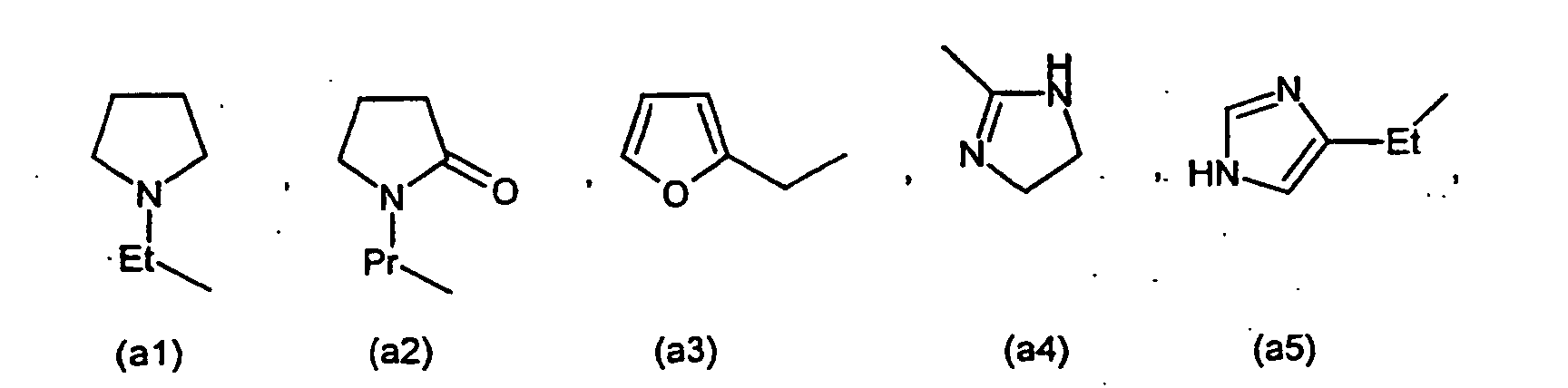
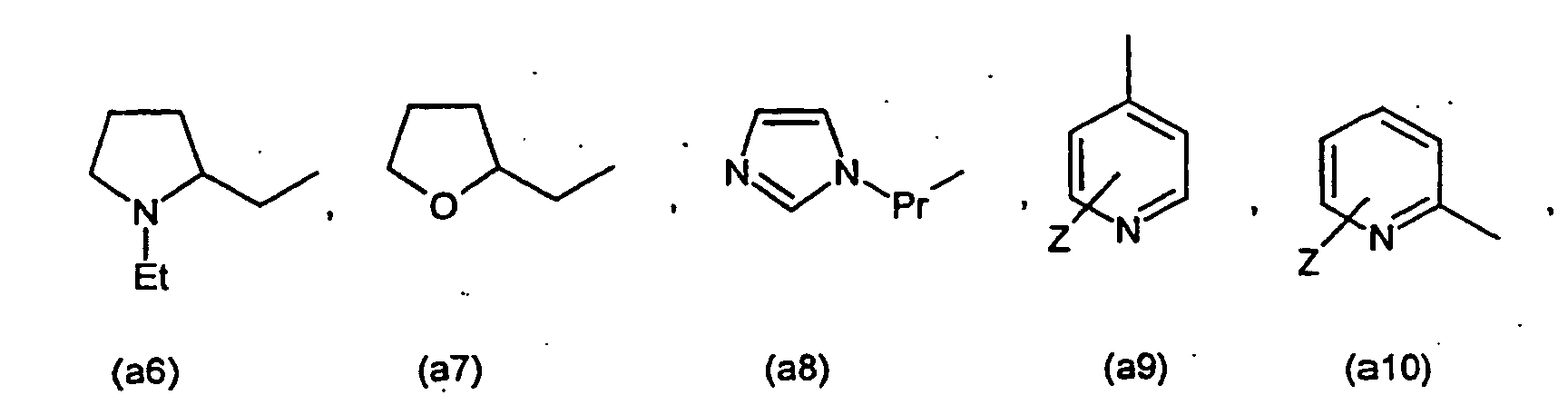
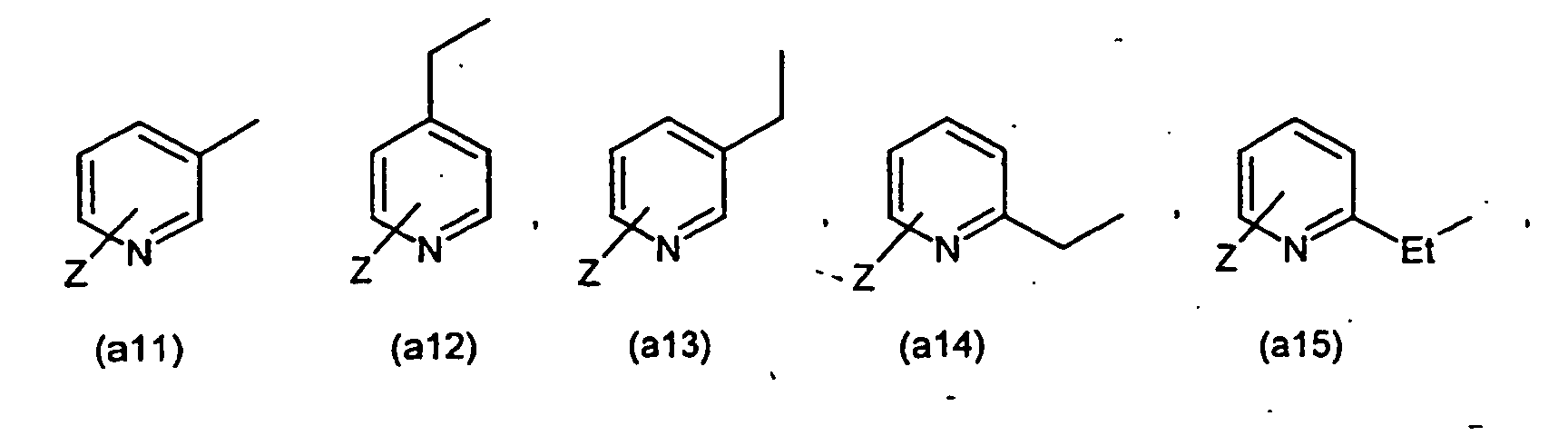


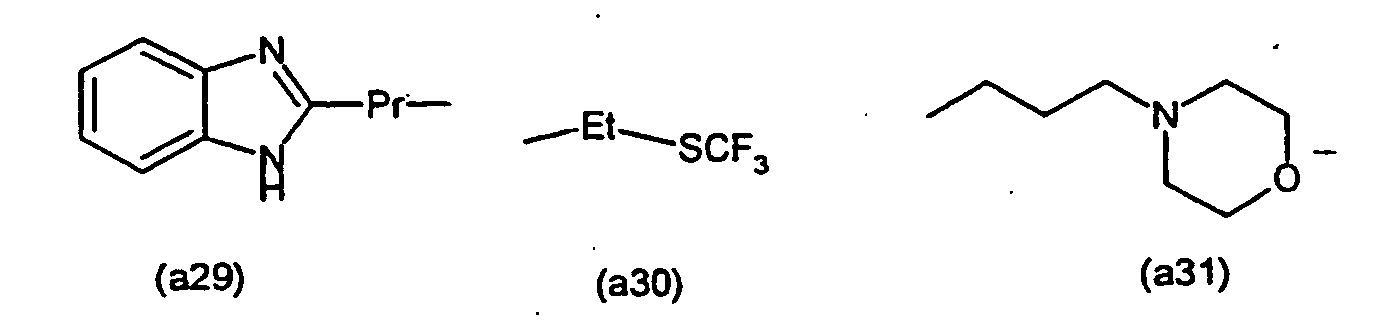
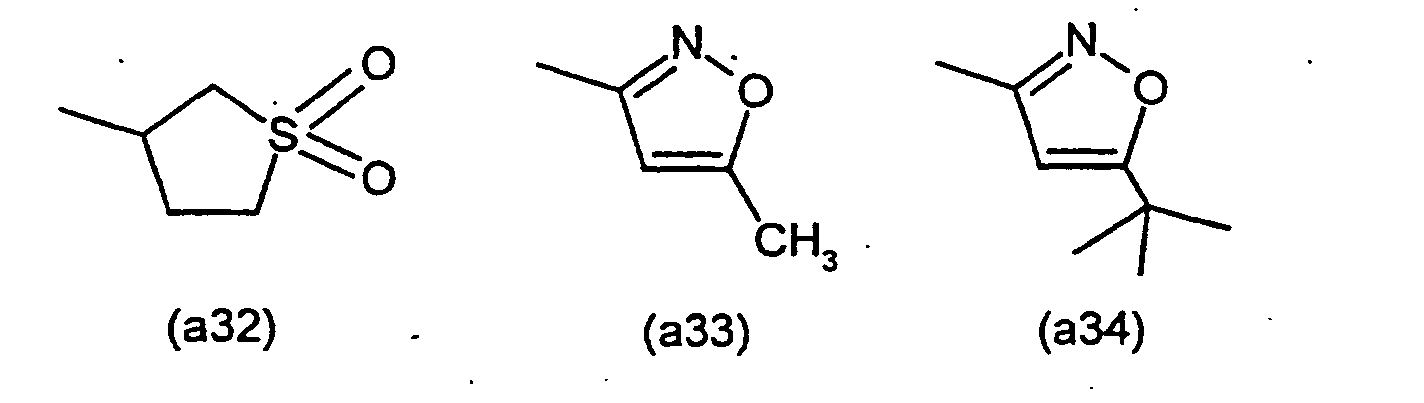
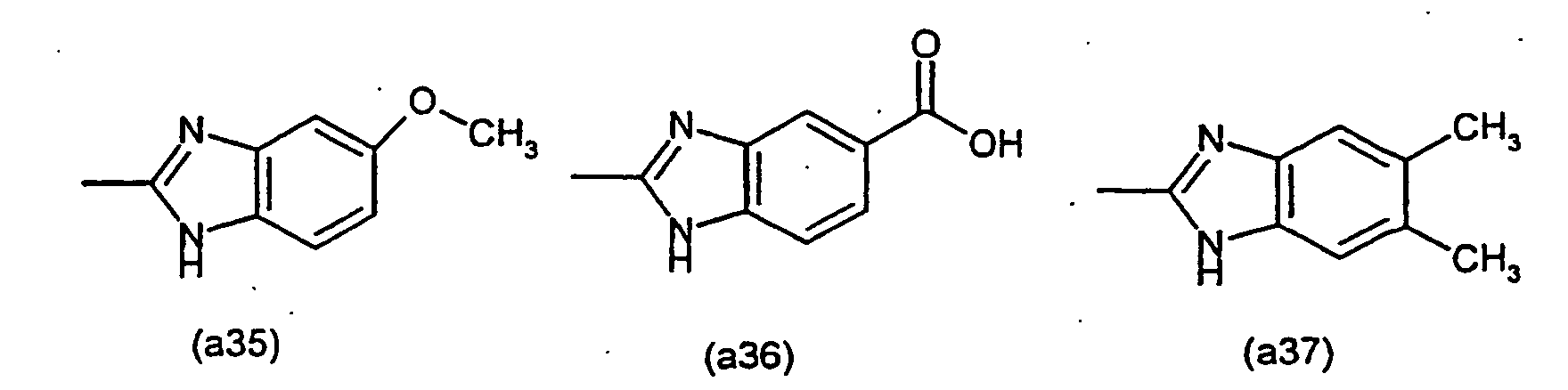


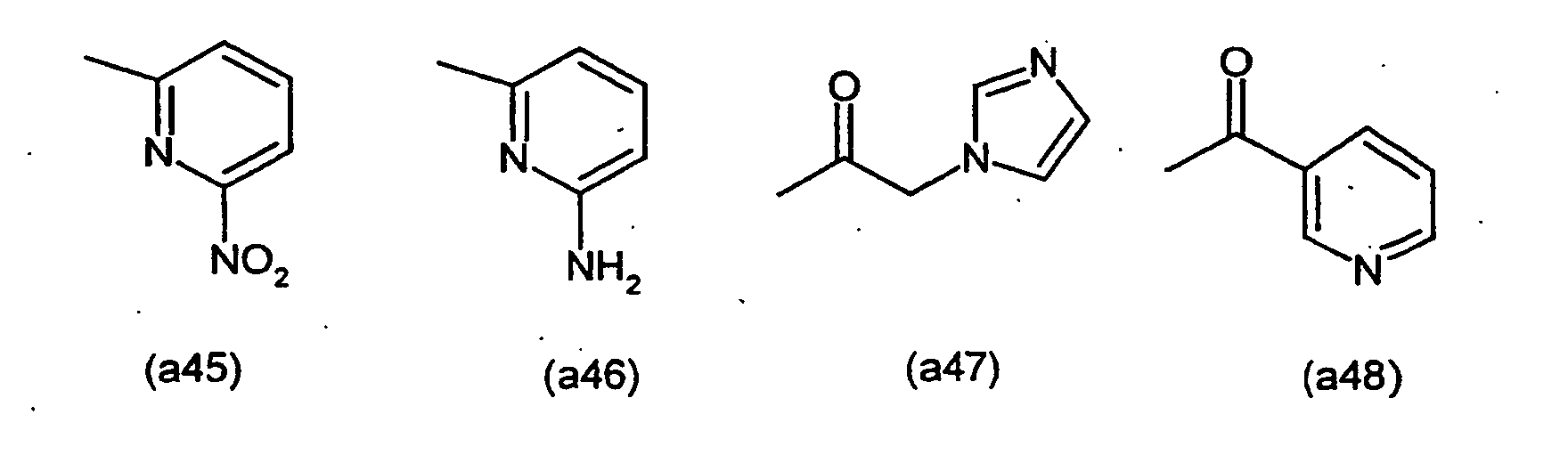
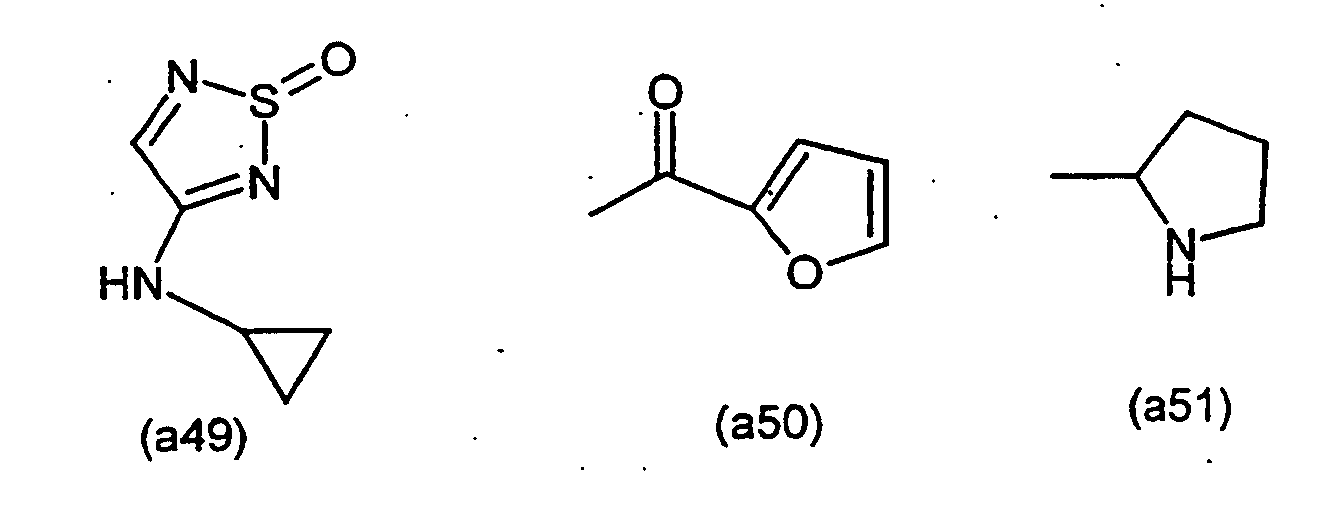
- Z
- is hydrogen, -NO2 or NH2,
or - R3
- is connected to one of R4, Y, R5 or R6, if present, with formation of an optionally substituted heterocyclic 4- to 6-membered ring system which includes the nitrogen atom to which R3 is bonded and can be saturated or unsaturated and/or can contain further heteroatoms;
- R4
- is hydrogen, methyl, ethyl, propyl, isopropyl, butyl, 1-methyl-propyl, isobutyl, t-butyl, pentyl, 2-methyl-butyl, isopentyl, neopentyl, hexyl, C1-4-perfluoralkyl, cyclopropyl, cyclopropylmethyl, cyclobutyl, cyclopentyl, cyclohexyl, cycloheptyl, 4-methylcyclohexyl, 3,3,5-trimethylcyclohexyl, 5-methyl-2-hexyl, allyl, propinyl, phenyl, benzyl, tolyl, benzoyl or a substituted derivative thereof, C1-4-alkylamino-C1-4-alkyl, C1-4-dialkylamino-C1-4-alkyl, amino-C1-4-alkyl, C1-4-alkyloxy-C1-4-alkyl, C1-2-perfluoralkyl-C1-4-alkyl, one of the residues (a1) to (a51) or is connected to one of R3, Y, R5 or R6, if present, with formation of an optionally substituted heterocyclic 4- to 6-membered ring system which includes the nitrogen atom to which R4 is bonded and can be saturated or unsaturated and/or can contain further heteroatoms;
- X
- is CHNO2, CHCN, O, N or S;
- Y
- is a direct bond or a substituted or unsubstituted methylene or methine group;
- R5
- is absent, or is hydrogen, methyl, ethyl, propyl, isopropyl, butyl, isobutyl, t-butyl, pentyl, isopentyl, neopentyl, hexyl, cyclopropyl, cyclopropylmethyl, cyclobutyl, cyclopentyl, cyclohexyl, -NO2, -CN, -COR5', -COOR5' or is connected to one of R3, Y, R4 or R6, if present, with formation of an optionally substituted carbocyclic or heterocyclic 4- to 6-membered ring system which includes X and can be saturated or unsaturated and/or can contain further heteroatoms;
- R5'
- is hydrogen, methyl, ethyl, propyl, isopropyl, butyl, isobutyl, t-butyl, pentyl, isopentyl, neopentyl, hexyl, cyclopropyl, cyclobutyl, cyclopentyl, cyclohexyl, phenyl, benzyl, tolyl or a substituted derivative thereof;
- R6
- is hydrogen, methyl, ethyl, propyl, isopropyl, butyl, 1-methylpropyl, isobutyl, t-butyl, pentyl, isopentyl, 2-methylbutyl, neopentyl, hexyl, C1-4-perfluoroalkyl, cyclopropyl, cyclopropylmethyl, cyclobutyl, cyclopentyl, cyclohexyl, cycloheptyl, 4-methylcyclohexyl, 3,3,5-trimethylcyclohexyl, 5-methyl-2-hexyl, allyl, propinyl, phenyl, benzyl, tolyl, benzoyl or a substituted derivative thereof, C1-4-alkylamino-C1-4-alkyl, C1-4-dialkylamino-C1-4-alkyl, amino-C1-4-alkyl, C1-4-alkyloxy-C1-4-alkyl, C1-2-perfluoroalkyl-C1-4-alkyl, one of the residues (a1) to (a51) or is connected to one of R3, Y, R4 or R5, if present, with formation of an optionally substituted heterocyclic 4- to 6-membered ring system which includes the nitrogen atom to which R6 is bonded and can be saturated or unsaturated and/or can contain further heteroatoms.
- A compound as claimed in claim 2,
wherein- R2
- is -NR2'SO2R2'', -NR2'COOR2', -NR2'COR2', -NR2'CONR2' 2 or -NR2'CSNR2' 2;
- R2'
- is hydrogen, methyl, ethyl, propyl, isopropyl, butyl, isobutyl, t-butyl, pentyl, isopentyl, neopentyl, hexyl, cyclopropyl, cyclobutyl, cyclopentyl, cyclohexyl, phenyl, benzyl, tolyl or a substituted derivative thereof as, for example, 2-chlorophenyl, 2-methoxyphenyl, 2,4,6-trimethylphenyl, 4-methoxyphenyl, 4-t-butylphenyl, 2,5-dichlorophenyl, 3-chlorophenyl, 4-chlorophenyl, 4-trifluoromethyl phenyl;
- R2"
- is methyl, ethyl, propyl, isopropyl, butyl, isobutyl, t-butyl, pentyl,
isopentyl, neopentyl, hexyl, 1,1,1-trifluorobutyl, allyl, cyclopropyl,
cyclobutyl, cyclopentyl, cyclohexyl, phenyl, benzyl, tolyl or a
substituted derivative thereof, 4-ethylphenyl, -C6H2(CH3)3, 2-chlorophenyl,
4-chlorophenyl, 2,5-dichlorophenyl, 4-trifluoromethylphenyl,
campher-10-yl, 4-methoxyphenyl, 4-t-butylphenyl, 2,5-dimethylphenyl,
3-chlorophenyl, 2-methoxy-5-methylphenyl, 2,3,5,6-tetramethylphenyl,
2,3-dichlorophenyl, 2,4-dichlorophenyl, 2,6-dichlorophenyl,
2-naphthyl, 3-trifluoromethylphenyl, 4-fluorophenyl, 2,4-difluorophenyl,
2-chloro-6-methylphenyl, 2-chloro-4-fluorophenyl,
2,5-dimethoxyphenyl, 3,4-dimethoxyphenyl, 3-chloro-6-methoxyphenyl,
2-trifluoromethylphenyl, 2-alkylsulfonylphenyl, 2-arylsulfonylphenyl,
3-(N-acetyl-6-methoxy)anilino, 2-methoxycarbonylphenyl,
4-N-acetylphenyl, 4-ethylphenyl, 3-chloro-4-fluorphenyl, 2-fluorophenyl,
3-fluorophenyl, 2,4-difluorophenyl, 2,6-difluorophenyl,
3,4-difluorophenyl, 1-naphthyl, 4-trifluoromethoxyphenyl, 2-trifluoromethoxyphenyl,
4-chloro-2-trifluoro-phenyl, 2-trifluoromethoxy-4-bromo-phenyl,
2-fluoro-4-trifluoromethylphenyl, 8-quinolinyl or
a group of the formula
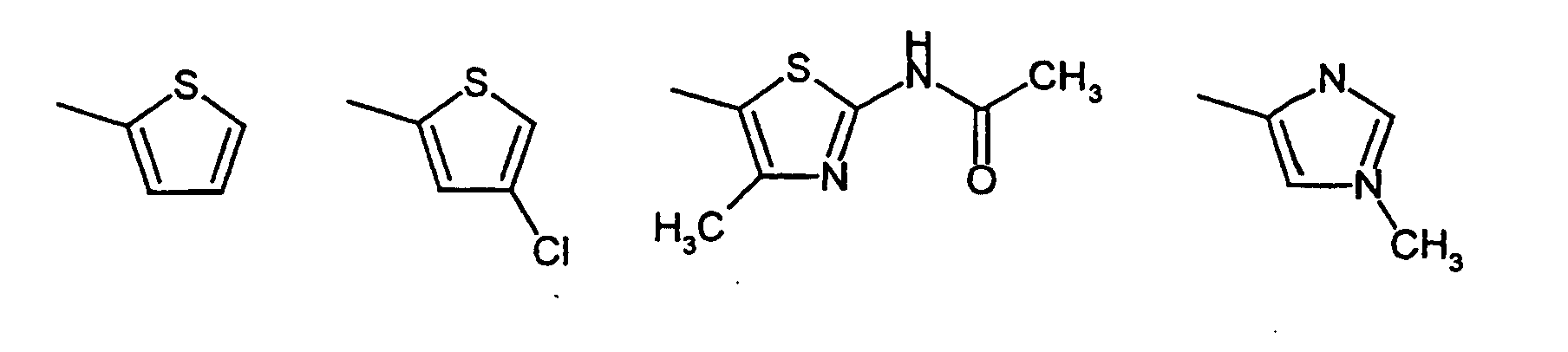

- A compound as claimed in claim 2,
wherein,- R2
- is -NR2'SO2R2" or -NR2'COOR2';
- R2'
- is hydrogen, methyl, ethyl, propyl, isopropyl, butyl, isobutyl, t-butyl, pentyl, isopentyl, neopentyl, hexyl, cyclopropyl, cyclobutyl, cyclopentyl, cyclohexyl, phenyl, benzyl, tolyl or a substituted derivative thereof as, for example, 2-chlorophenyl, 2-methoxyphenyl, 2,4,6-trimethylphenyl, 4-methoxyphenyl, 4-t-butylphenyl, 2,5-dichlorophenyl, 3-chlorophenyl, 4-chlorophenyl, 4-trifluoromethyl phenyl;
- R2"
- is methyl, ethyl, propyl, isopropyl, butyl, isobutyl, t-butyl, pentyl,
isopentyl, neopentyl, hexyl, 1,1,1-trifluorobutyl, allyl, cyclopropyl,
cyclobutyl, cyclopentyl, cyclohexyl, phenyl, benzyl, tolyl or a
substituted derivative thereof, 4-ethylphenyl, -C6H2(CH3)3, 2-chlorophenyl,
4-chlorophenyl, 2,5-dichlorophenyl, 4-trifluoromethylphenyl,
campher-10-yl, 4-methoxyphenyl, 4-t-butylphenyl, 2,5-dimethylphenyl,
3-chlorophenyl, 2-methoxy-5-methylphenyl, 2,3,5,6-tetramethylphenyl,
2,3-dichlorophenyl, 2,4-dichlorophenyl, 2,6-dichlorophenyl,
2-naphthyl, 3-trifluoromethylphenyl, 4-fluorophenyl, 2.4-difluorophenyl,
2-chloro-6-methylphenyl, 2-chloro-4-fluorophenyl,
2,5-dimethoxyphenyl, 3,4-dimethoxyphenyl, 3-chloro-6-methoxyphenyl,
2-trifluoromethylphenyl, 2-alkylsulfonylphenyl, 2-arylsulfonylphenyl,
3-(N-acetyl-6-methoxy)anilino, 2-methoxycarbonylphenyl,
4-N-acetylphenyl, 4-ethylphenyl, 3-chloro-4-fluorphenyl, 2-fluorophenyl,
3-fluorophenyl, 2,4-difluorophenyl, 2,6-difluorophenyl, 3,4-difluorophenyl,
1-naphthyl, 4-trifluoromethoxyphenyl, 2-trifluoromethoxyphenyl,
4-chloro-2-trifluorphenyl, 2-trifluoromethoxy-4-bromophenyl,
2-fluoro-4-trifluoromethylphenyl, 8-quinolinyl,
a group of the formula
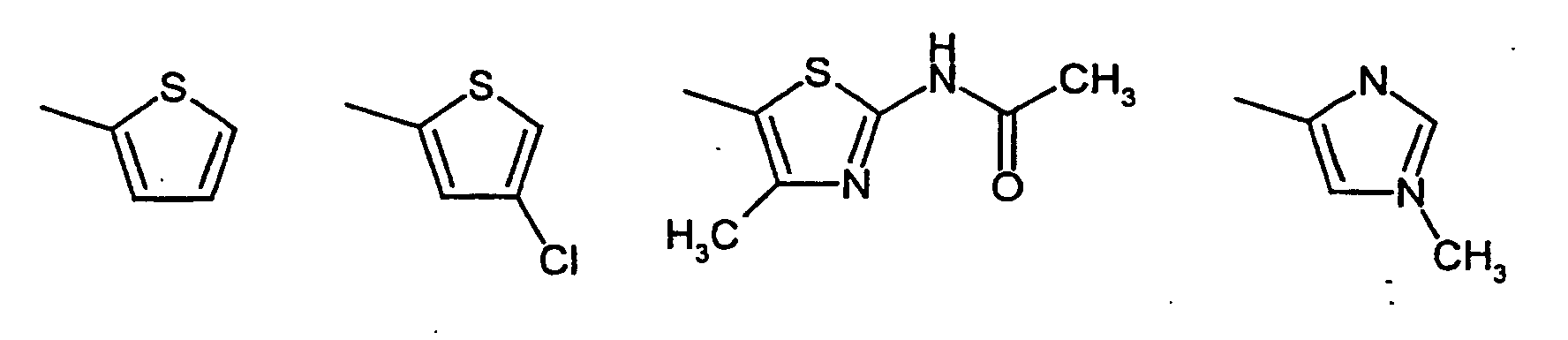
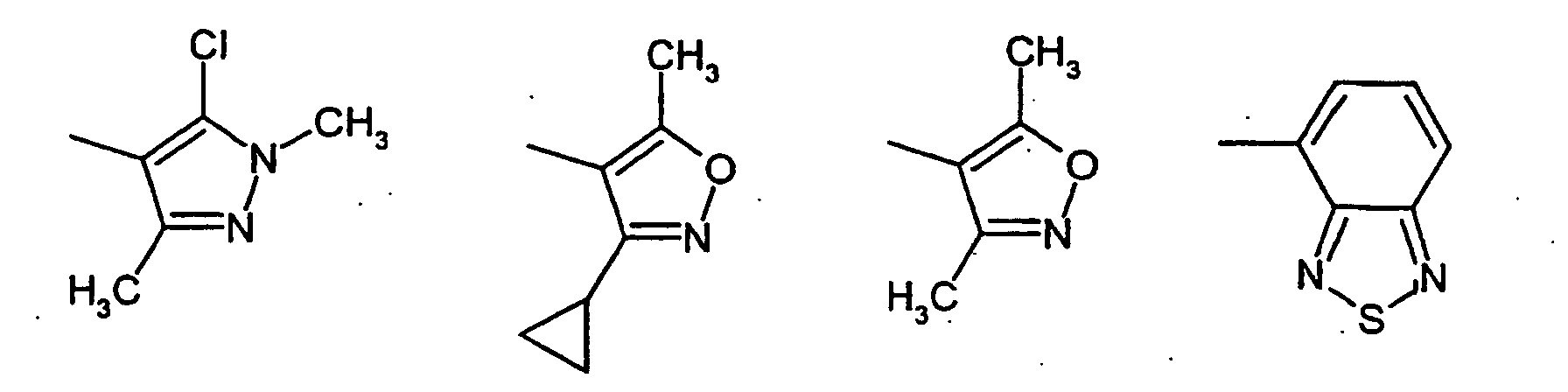
- A
- is a 1,3- or 1,4-bridging phenylene group optionally substituted with a methoxy or up to 2 fluororesidues;
- B
- is an optionally methyl-substituted 1,3- or 1,4-bridging phenylene group;
- C
- is a direct bond or
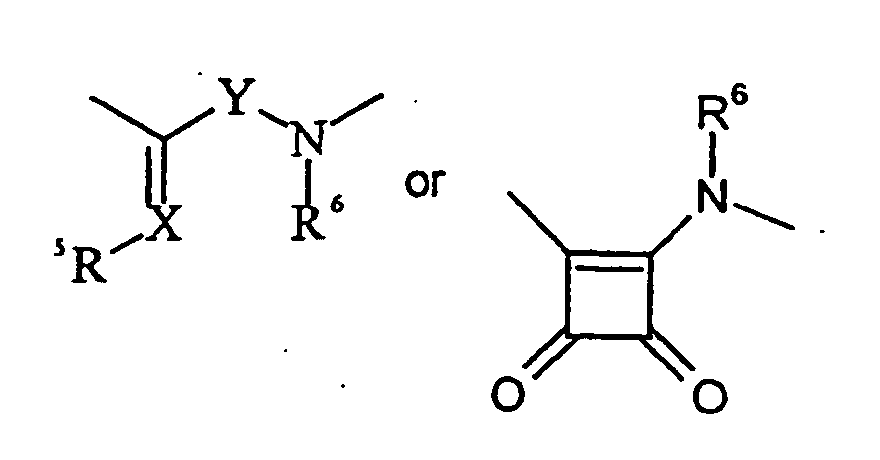
- R5
- is absent, -NO2, -CN, or is connected to one of R3, Y, R4 or R6, if present, with formation of an optionally substituted carbocyclic or heterocyclic 4- to 6-membered ring system which includes X and can be saturated or unsaturated and/or can contain further heteroatoms;
- A compound as claimed in claim 2,
wherein- R2
- is hydrogen, methyl, ethyl, propyl, isopropyl, butyl, isobutyl, t-butyl, pentyl, isopentyl, neopentyl, hexyl, cyclopropyl, cyclobutyl, cyclopentyl, cyclohexyl, phenyl, benzyl, tolyl or a substituted derivative thereof, an optionally substituted alkenyl residue, an optionally substituted alkinyl residue,
- U
- is a direct bond,
- V
- is -CHR7- or -CHR7(CH2)1-4-;
- R7
- is -NR7'SO2R7", -NR7'COOR7', -NR7'COR7', -NR7'CONR7' 2 or -NR7'CSNR7' 2;
- R7'
- is hydrogen, methyl, ethyl, propyl, isopropyl, butyl, isobutyl, t-butyl, pentyl, isopentyl, neopentyl, hexyl, cyclopropyl, cyclobutyl, cyclopentyl, cyclohexyl, phenyl, benzyl, tolyl or a substituted derivative thereof as, for example, 2-chlorophenyl, 2-methoxyphenyl, 2,4,6-trimethylphenyl, 4-methoxyphenyl, 4-t-butylphenyl, 2,5-dichlorophenyl, 3-chlorophenyl, 4-chlorophenyl, 4-trifluoromethyl phenyl;
- R7"
- is methyl, ethyl, propyl, isopropyl, butyl, isobutyl, t-butyl, pentyl, isopentyl, neopentyl, hexyl, cyclopropyl, cyclobutyl, cyclopentyl, cyclohexyl, phenyl, benzyl, tolyl or a substituted derivative thereof, -C6H2(CH3)3, 2-chlorophenyl, 4-chlorophenyl, 2,5-dichlorophenyl, 4-trifluoromethylphenyl, campher-10-yl, 4-methoxyphenyl, 4-t-butylphenyl, 2,5-dimethylphenyl, 2,6-dimethylphenyl, 3-chlorophenyl, 2-methoxy-5-methylphenyl, 2,3,5,6-tetramethylphenyl, 2,3-dichlorophenyl, 2,6-dichlorophenyl, 2-naphthyl, 3-trifluoromethylphenyl, 4-fluorophenyl, 2,4difluorophenyl, 2-chloro-6-methylphenyl, 2-chloro-4-fluorophenyl, 2,5-dimethoxyphenyl, 3,4-dimethoxyphenyl, 3-chloro-6-methoxyphenyl, 2-trifluoromethylphenyl, 2-alkylsulfonylphenyl, 2-arylsulfonylphenyl, 3-(N-acetyl-6-methoxy)anilino, 2-methoxycarbonylphenyl, 4-N-acetylphenyl, 4-ethylphenyl, 3-chloro-4-fluorphenyl, 2-fluorophenyl, 3-fluorophenyl, 2,4-difluorophenyl, 2,6-difluorophenyl, 3,4-difluorophenyl, 1-naphthyl, 4-trifluoromethoxyphenyl, 2-trifluoromethoxyphenyl, or 8-quinolinyl,
- A compound as claimed in claim 2,
wherein- R2
- is hydrogen, methyl, ethyl, propyl, isopropyl, butyl, isobutyl, t-butyl, pentyl, isopentyl, neopentyl, hexyl, cyclopropyl, cyclobutyl, cyclopentyl, cyclohexyl, phenyl, benzyl, tolyl or a substituted derivative thereof, an optionally substituted alkenyl residue, an optionally substituted alkinyl residue,
- U
- is a direct bond;
- V
- is -CHR7-;
- R7
- is -NR7'SO2R7" or -NR7'COOR7';
- R7'
- is hydrogen, methyl, ethyl, propyl, isopropyl, butyl, isobutyl, t-butyl, pentyl, isopentyl, neopentyl, hexyl, cyclopropyl, cyclobutyl, cyclopentyl, cyclohexyl, phenyl, benzyl, tolyl or a substituted derivative thereof as, for example, 2-chlorophenyl, 2-methoxyphenyl, 2,4,6-trimethylphenyl, 4-methoxyphenyl, 4-t-butylphenyl, 2,5-dichlorophenyl, 3-chlorophenyl, 4-chlorophenyl, 4-trifluoromethyl phenyl;
- R7"
- is methyl, ethyl, propyl, isopropyl, butyl, isobutyl, t-butyl, pentyl, isopentyl, neopentyl, hexyl, cyclopropyl, cyclobutyl, cyclopentyl, cyclohexyl, phenyl, benzyl, tolyl or a substituted derivative thereof, -C6H2(CH3)3, 2-chlorophenyl, 4-chlorophenyl, 2,5-dichlorophenyl, 4-trifluoromethylphenyl, campher-10-yl, 4-methoxyphenyl, 4-t-butyphenyl, 2,5-dimethylphenyl, 2,6-dimethylphenyl, 3-chlorophenyl, 2-methoxy-5-methylphenyl, 2,3,5,6-tetramethylphenyl, 2,3-dichlorophenyl, 2,6-dichlorophenyl, 2-naphthyl, 3-trifluoromethylphenyl, 4-fluorophenyl, 2,4-difluorophenyl, 2-chloro-6-methylphenyl, 2-chloro-4-fluorophenyl, 2,5-dimethoxyphenyl, 3,4-dimethoxyphenyl, 3-chloro-6-methoxyphenyl, 2-trifluoromethylphenyl, 2-alkylsulfonylphenyl, 2-arylsulfonylphenyl, 3-(N-acetyl-6-methoxy)anilino, 2-methoxycarbonylphenyl, 4-N-acetylphenyl, 4-ethylphenyl, 3-chloro-4-fluorphenyl, 2-fluorophenyl, 3-fluorophenyl, 2,4-difluorophenyl, 2,6-difluorophenyl, 3,4-difluorophenyl, 1-naphthyl, 4-trifluoromethoxyphenyl, 2-trifluoromethoxyphenyl, or 8-quinolinyl,
- A
- is a 1,3- or 1,4-bridging phenylene group optionally substituted with a methoxy or upto 2 fluoro residnes;
- B
- is an optionally methyl-substituted 1,3- or 1,4-bridging phenylene group;
- C
- is a direct bond or
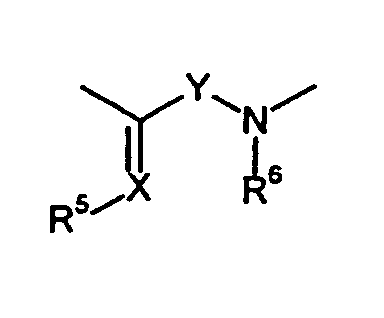
- W
- is direct bond or a -CH2-group
- X
- is O or S
- Y
- is a direct bond
- R5
- is absent
- A compound as claimed in claim 2,
wherein- R2
- is hydrogen, methyl, ethyl, propyl, isopropyl, butyl, isobutyl, t-butyl, pentyl, isopentyl, neopentyl, hexyl, cyclopropyl, cyclobutyl, cyclopentyl, cyclohexyl, phenyl, benzyl, tolyl or a substituted derivative thereof, an optionally substituted alkenyl residue, an optionally substituted alkinyl residue,
- U
- is a direct bond,
- V
- is a C1-5-alkylene group which is optionally substituted by one or more residues R7 which are selected from the group consisting of hydrogen, methyl, ethyl, propyl, isopropyl, butyl, isobutyl, t-butyl, pentyl, isopentyl, neopentyl, hexyl, cyclopropyl, cyclobutyl, cyclopentyl, cyclohexyl, phenyl, benzyl, tolyl, a substituted derivative or a saturated or unsaturated, optionally substituted heterocyclic analog thereof, an optionally substituted alkenyl residue or an optionally substituted alkinyl residue;
- A compound as claimed in claim 2,
wherein- R2
- is hydrogen, methyl, ethyl, propyl, isopropyl, butyl, isobutyl, t-butyl, pentyl, isopentyl, neopentyl, hexyl, cyclopropyl, cyclobutyl, cyclopentyl, cyclohexyl, phenyl, benzyl, tolyl or a substituted derivative thereof, an optionally substituted alkenyl residue, an optionally substituted alkinyl residue,
- U
- is a direct bond,
- V
- is -CHR7-;
- R7
- is hydrogen, methyl, ethyl, propyl, isopropyl, butyl, isobutyl, t-butyl, pentyl, isopentyl, neopentyl, hexyl, cyclopropyl, cyclobutyl, cyclopentyl, cyclohexyl, phenyl, benzyl, tolyl or a substituted derivative thereof, an optionally substituted alkenyl residue, an optionally substituted alkinyl residue,
- A
- is a 1,3- or 1,4-bridging phenylene group optionally substituted with a methoxy or up to 2 fluoro residues
- B
- is an optionally methyl-substituted 1,3- or 1,4-bridging phenylene group;
- C
- is a direct bond or

- W
- is a direct bond or a -CH2-group
- X
- ist O or S;
- Y
- is a direct bond
- R5
- is absent
- A compound as claimed in claim 1,
wherein- R1
- is hydrogen, methyl, ethyl, propyl, isopropyl, butyl, isobutyl, t-butyl, pentyl, isopentyl, neopentyl, hexyl, cyclopropyl, cyclopropylmethyl, cyclobutyl, cyclopentyl, cyclohexyl, phenyl, benzyl, tolyl or a substituted derivative thereof;
- R2
- is hydrogen, methyl, ethyl, propyl, isopropyl, butyl, isobutyl, t-butyl, pentyl, isopentyl, neopentyl, hexyl, cyclopropyl, cyclobutyl, cyclopentyl, cyclohexyl, phenyl, benzyl, tolyl, phenylethyl, a substituted derivative or a saturated or unsaturated, optionally substituted heterocyclic analog thereof, an optionally substituted alkenyl residue, an optionally substituted alkinyl residue;
- U
- is a direct bond or an optionally substituted C1-3-alkylene group;
- V
- is -NR8CO- or -NR8SO2-;
- R8
- is hydrogen, methyl, ethyl, propyl, isopropyl, butyl, isobutyl, t-butyl, pentyl, isopentyl, neopentyl, hexyl, cyclopropyl, cyclopropylmethyl, cyclobutyl, cyclopentyl, cyclohexyl, phenyl, benzyl, tolyl, phenylethyl, phenylpropyl, phenoxyethyl or a substituted derivative thereof;
- A
- is a 1,3- or 1,4-bridging phenylene group or a 2,4- or 2,5-bridging thienylene group which are unsubstituted or have at least one alkoxy or halogeno residue;
- B
- is a 1,3- or 1,4-bridging phenylene group which is unsubstituted or has at least one alkyl residue;
- W
- is a direct bond or an optionally substituted C1-3-alkylene group;
- C
- is
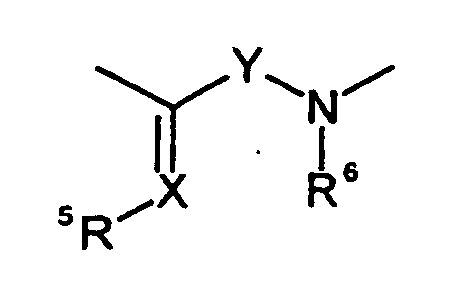
- R3
- is hydrogen, methyl, ethyl, propyl, isopropyl, butyl, 1-methylpropyl, isobutyl, t-butyl, pentyl, 2-methylbutyl, isopentyl, neopentyl, hexyl, C1-4-perfluoroalkyl, cyclopropyl, cyclopropylmethyl, cyclobutyl, cyclopentyl, cyclohexyl, cycloheptyl, 4-methylcyclohexyl, 3,3,5-trimethylcyclohexyl, 5-methyl-2-hexyl, allyl, propinyl, phenyl, benzyl, tolyl, benzoyl or a substituted derivative thereof, C1-4-alkylamino-C1-4-alkyl, C1-4-dialkylamino-C1-4-alkyl, amino-C1-4-alkyl, C1-4-alkyloxy-C1-4-alkyl, C1-2-perfluoroalkyl-C1-4-alkyl, one of the residues (a1) to (a51) or is connected to one of R4, Y or R6, if present, with formation of an optionally substituted heterocyclic 4- to 6-membered ring system which includes the nitrogen atom to which R3 is bonded and can be saturated or unsaturated and/or can contain further heteroatoms;
- R4
- is hydrogen, methyl, ethyl, propyl, isopropyl, butyl, 1-methyl-propyl, isobutyl, t-butyl, pentyl, 2-methyl-butyl, isopentyl, neopentyl, hexyl, C1-4-perfluoralkyl, cyclopropyl, cyclopropylmethyl, cyclobutyl, cyclopentyl, cyclohexyl, cycloheptyl, 4-methylcyclohexyl, 3,3,5-trimethylcyclohexyl, 5-methyl-2-hexyl, allyl, propinyl, phenyl, benzyl, tolyl, benzoyl or a substituted derivative thereof, C1-4-alkylamino-C1-4-alkyl, C1-4-dialkylamino-C1-4-alkyl, amino-C1-4-alkyl, C1-4-alkyloxy-C1-4-alkyl, C1-2-perfluoralkyl-C1-4-alkyl, one of the residues (a1) to (a51) or is connected to one of R3, Y or R6, if present, with formation of an optionally substituted heterocyclic 4- to 6-membered ring system which includes the nitrogen atom to which R4 is bonded and can be saturated or unsaturated and/or can contain further heteroatoms;
- X
- is CHNO2, CHCN, O or S;
- Y
- is a direct bond or a substituted or unsubstituted methylene or methine group;
- R5
- is absent;
- R6
- is hydrogen, methyl, ethyl, propyl, isopropyl, butyl, 1-methylpropyl, isobutyl, t-butyl, pentyl, isopentyl, 2-methylbutyl, neopentyl, hexyl, C1-4-perfluoroalkyl, cyclopropyl, cyclopropylmethyl, cyclobutyl, cyclopentyl, cyclohexyl, cycloheptyl, 4-methylcyclohexyl, 3,3,5-trimethylcyclohexyl, 5-methyl-2-hexyl, allyl, propinyl, phenyl, benzyl, tolyl, benzoyl or a substituted derivative thereof, C1-4-alkylamino-C1-4-alkyl, C1-4-dialkylamino-C1-4-alkyl, amino-C1-4-alkyl, C1-4-alkyloxy-C1-4-alkyl, C1-2-perfluoroalkyl-C1-4-alkyl, one of the residues (a1) to (a51) or is connected to one of R3, Y, R4, if present, with formation of an optionally substituted heterocyclic 4- to 6-membered ring system which includes the nitrogen atom to which R6 is bonded and can be saturated or unsaturated and/or can contain further heteroatoms.
- A compound as claimed in claim 9,
- U
- is a direct bond or -CHR7-;
- R7
- is hydrogen, methyl, ethyl, propyl, isopropyl, butyl, isobutyl, t-butyl, pentyl, isopentyl, neopentyl, hexyl, cyclopropyl, cyclobutyl, cyclopentyl, cyclohexyl, phenyl, benzyl, tolyl or a substituted derivative thereof, an optionally substituted alkenyl residue, an optionally substituted alkinyl residue or pyridyl;
- A
- is a 1,3- or 1,4-bridging phenylene group optionally substituted with a methoxy group or up to 2 fluoro residues;
- B
- is an optionally methyl-substituted 1,3- or 1,4-bridging phenylene group;
- W
- is a direct bond or a -CH2-group;
- C
- is

- X
- is O or S
- Y
- is a direct bond
- R5
- is absent
- A compound as claimed in claim 9,
wherein- A
- is a 2,4- or 2,5-bridging thienylene groups which is unsubstituted or has at least one alkoxy residue
- A process for the preparation of compounds as claimed in claim 1 having the general formula (1)which comprises
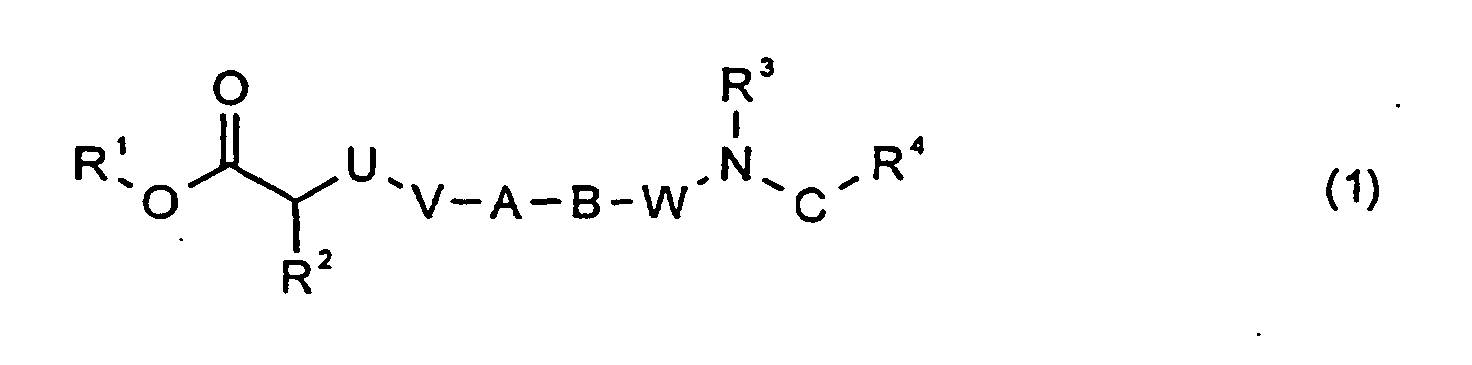
the stepsa) reaction of a carboxylic acid derivative of the formula (2)where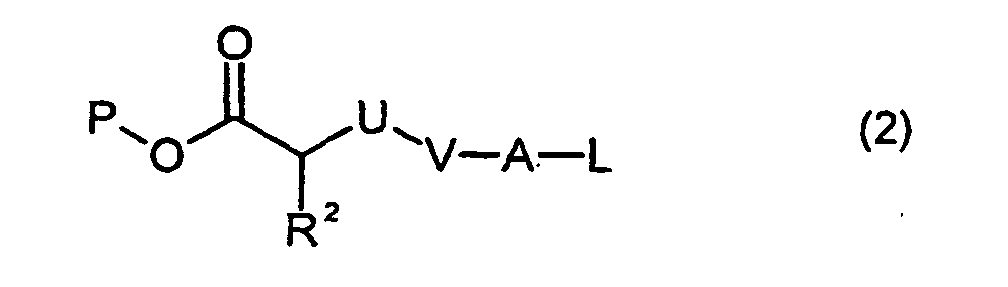
- P
- is a conventional protective group, a solid phase used for carrying out a solid-phase reaction or R1 is as defined in claim 1;
- A
- is a phenylene group which is 1,3- or 1,4-substituted or a thienylene group which is 2,4- or 2,5-substituted with respect to V and L and optionally has additional residues;
- L
- is -H, -F, -Cl, -Br, -I, -SCN, -N2 + or an organometallic residue; and the other residues are as defined in claim 1;
- M
- is -H, -I, -N2 +, -COOCOBNO2 or an organometallic residue;
- B
- is a phenylene group which is 1,3- or 1,4-substituted with respect to M and W-D and optionally has additional residues;
- W
- is as defined in claim 1;
- D
- is -NO2, -NH2 or -CHO;
where the residues are as defined above;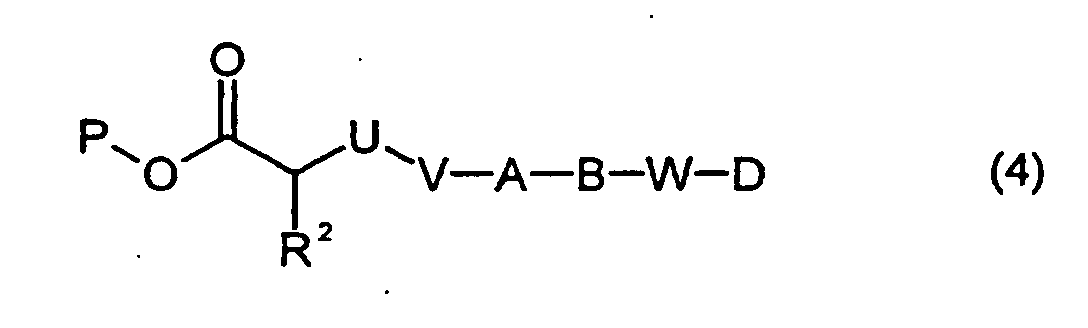 b) conversion of the residue D into the corresponding amino group, if D is not -NH2; andc) if appropriate, derivatization of nitrogen atoms present at preferred times within the preparation process and/or the conversion of the compound obtained into the free acid and/or the conversion of the compound obtained into one of its physiologically acceptable salts by reaction with an inorganic or organic base or acid.
 - The process as claimed in claim 12,
wherein
all steps during the bonding of the carboxylic acid derivative of the formula (2) are carried out on a solid phase. - The process as claimed in claim 12,
wherein
a carboxylic acid derivative of the formula (2), in which- L
- is -F, -Cl, -Br or -I
is reacted with a phenyl compound of the formula (3), in which- M
- is an organometallic residue;
in the presence of a palladium compound and of a phosphane. - The process as claimed in claim 12,
wherein
the carboxylic acid derivative of the formula (2) contains a sulfonamide or carbamate group which was formed by reaction of an amino group of the corresponding precursor of the carboxylic acid derivative of the formula (2) with a sulfonyl halide or a carbamoyl halide. - The process as claimed in claim 12,
wherein
if D is -NO2 in the compound of the formula (4), the conversion of D into an amino group is carried out in the presence of a tin-(II) compound. - The process as claimed in claim 12,
wherein
if D is -CHO in the compound of the formula (4), the conversion of D into an amino group is carried out by reaction with an amine under reducing conditions. - The process as claimed in claim 12,
wherein
the compound of the formula (4) in which D is an amino group is converted into a urea or thiourea unit, where R4 and R6 are as defined in claim 12, by a reaction of this amino group with a carbonic acid derivative or thiocarbonic acid derivative and a subsequent reaction to this with an amine of the formula NHR4R6. - A pharmaceutical composition comprising at least one of the compounds as claimed in one of claims 1 to 11.
- The use of compounds as claimed in one of claims 1 to 11 for the production of pharmaceutical compositions having integrin-antagonistic action.
- The use of compounds of the general formula (1)where
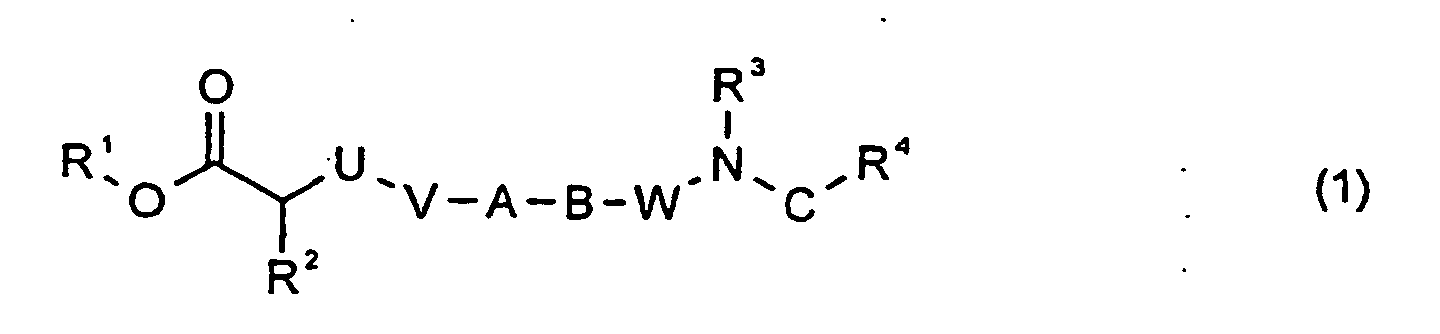
- R1
- is hydrogen, a substituted or unsubstituted alkyl or cycloalkyl residue, a substituted or unsubstituted aryl residue or a saturated or unsaturated, optionally substituted heterocyclic residue;
- R2
- is hydrogen, a substituted or unsubstituted alkyl or cycloalkyl residue, a substituted or unsubstituted aryl residue, a saturated or unsaturated, optionally substituted heterocyclic residue, an optionally substituted alkenyl residue, an optionally substituted alkinyl residue, -NR2'SO2R2", NR2'COOR2', -NR2'COR2', -NR2'CONR2' 2 or -NR2'CSNR2' 2;
- R2'
- is hydrogen, a substituted or unsubstituted alkyl or cycloalkyl residue, a substituted or unsubstituted aryl residue or a saturated or unsaturated, optionally substituted heterocyclic residue;
- R2"
- is a substituted or unsubstituted alkyl, alkenyl or cycloalkyl residue, a substituted or unsubstituted aryl residue or a saturated or unsaturated, optionally substituted heterocyclic residue;
- U
- is a direct bond or a substituted or unsubstituted alkylene group;
- V
- is a substituted or unsubstituted alkylene group, -NR2'CO- or -NR2'SO2-;
- A and B
- are each independently of one another a 1,3- or 1,4-bridging phenylene group or a 2,4- or 2,5-bridging thienylene group each of which may optionally have additionall substituents,
- W
- is a direct bond or a substituted or unsubstituted alkylene group;
- C
- is a direct bond or
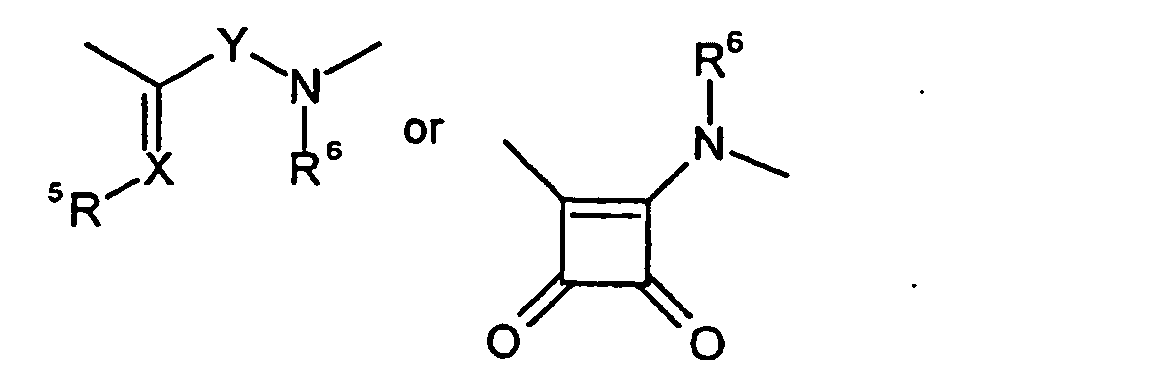
- R3
- is hydrogen, a substituted or unsubstituted alkyl or cycloalkyl residue, a substituted or unsubstituted aryl residue, a saturated or unsaturated, optionally substituted heterocyclic residue, an alkylamine residue, an alkylamide residue or is connected to one of R4, Y, R5 or R6, if present, with formation of an optionally substituted heterocyclic ring system which includes the nitrogen atom to which R3 is bonded, and can be saturated or unsaturated and/or can contain further heteroatoms;
- R4
- is hydrogen, a substituted or unsubstituted alkyl or cycloalkyl residue, a substituted or unsubstituted aryl residue, a saturated or unsaturated, optionally substituted heterocyclic residue, an alkylamine residue, an alkylamide residue or is connected to one of R3, Y, R5 or R6, if present, with formation of an optionally substituted heterocyclic ring system which includes the nitrogen atom to which R4 is bonded and can be saturated or unsaturated and/or can contain further heteroatoms;
- X
- is CHNO2, CHCN, O, N or S;
- Y
- is a direct bond or an optionally substituted alkylene or alkine group;
- R5
- is absent, or is hydrogen, a substituted or unsubstituted alkyl or cycloalkyl residue, -NO2, -CN, -COR5', -COOR5', or is connected to one of R3, Y, R4 or R6, if present, with formation of an optionally substituted carbocyclic or heterocyclic ring system which includes X and can be saturated or unsaturated and/or can contain further heteroatoms;
- R5'
- is hydrogen, a substituted or unsubstituted alkyl or cycloalkyl residue, a substituted or unsubstituted aryl residue or a saturated or unsaturated, optionally substituted heterocyclic residue which can be saturated or unsaturated and/or can contain further heteroatoms;
- R6
- is hydrogen, a substituted or unsubstituted alkyl or cycloalkyl residue, a substituted or unsubstituted aryl or aroyl residue, a saturated or unsaturated, optionally substituted heterocyclic residue, an alkylamine residue, an alkylamide residue or is connected to one of R3, R4, Y or R5, if present, with formation of an optionally substituted heterocyclic ring system which includes the nitrogen atom to which R6 is bonded and can be saturated or unsaturated and/or can contain further heteroatoms;
- The use as claimed in claim 21,
wherein
a compound as claimed in one of claims 1 to 11 is employed for the production of a pharmaceutical composition for the inhibition of angiogenesis and/or for the therapy and prophylaxis of cancer, osteolytic diseases such as osteoporosis, arteriosclerosis, restenosis and ophthalmic disorders.
Applications Claiming Priority (3)
| Application Number | Priority Date | Filing Date | Title |
|---|---|---|---|
| US213381 | 1988-06-30 | ||
| US21338198A | 1998-12-16 | 1998-12-16 | |
| PCT/EP1999/009843 WO2000035864A1 (en) | 1998-12-16 | 1999-12-13 | New biphenyl and biphenyl-analogous compounds as integrin antagonists |
Publications (2)
| Publication Number | Publication Date |
|---|---|
| EP1140809A1 EP1140809A1 (en) | 2001-10-10 |
| EP1140809B1 true EP1140809B1 (en) | 2005-08-31 |
Family
ID=22794904
Family Applications (1)
| Application Number | Title | Priority Date | Filing Date |
|---|---|---|---|
| EP99967934A Expired - Lifetime EP1140809B1 (en) | 1998-12-16 | 1999-12-13 | New biphenyl and biphenyl-analogous compounds as integrin antagonists |
Country Status (24)
| Country | Link |
|---|---|
| EP (1) | EP1140809B1 (en) |
| JP (1) | JP2002532465A (en) |
| KR (1) | KR20010086112A (en) |
| CN (1) | CN1334801A (en) |
| AT (1) | ATE303359T1 (en) |
| AU (1) | AU761407B2 (en) |
| BG (1) | BG105574A (en) |
| BR (1) | BR9916367A (en) |
| CA (1) | CA2355161A1 (en) |
| CZ (1) | CZ20012185A3 (en) |
| DE (1) | DE69927050T2 (en) |
| EE (1) | EE200100317A (en) |
| ES (1) | ES2249059T3 (en) |
| HR (1) | HRP20010531A2 (en) |
| HU (1) | HUP0105432A3 (en) |
| ID (1) | ID30235A (en) |
| IL (1) | IL143484A0 (en) |
| MA (1) | MA25331A1 (en) |
| NO (1) | NO20012975L (en) |
| NZ (1) | NZ512339A (en) |
| PL (1) | PL348260A1 (en) |
| SK (1) | SK8432001A3 (en) |
| WO (1) | WO2000035864A1 (en) |
| ZA (1) | ZA200114432B (en) |
Families Citing this family (44)
| Publication number | Priority date | Publication date | Assignee | Title |
|---|---|---|---|---|
| FR2809396B1 (en) | 2000-05-24 | 2005-10-14 | Centre Nat Rech Scient | NOVEL MOLECULES HAVING CALCIMIMETIC ACTIVITY AND THEIR METHOD OF PREPARATION |
| GB2367817A (en) * | 2000-10-09 | 2002-04-17 | Bayer Ag | Cyclic carboxylic acids as integrin antagonists |
| ES2200617B1 (en) * | 2001-01-19 | 2005-05-01 | Almirall Prodesfarma, S.A. | DERIVATIVES OF UREA AS ANTAGONISTS OF INTEGRINAS ALPHA 4. |
| IL156793A0 (en) * | 2001-02-02 | 2004-02-08 | Schering Corp | 3,4-di-substituted cyclobutene-1,2-diones as cxc chemokine receptor antagonists |
| US7132445B2 (en) | 2001-04-16 | 2006-11-07 | Schering Corporation | 3,4-Di-substituted cyclobutene-1,2-diones as CXC-chemokine receptor ligands |
| RU2344123C9 (en) * | 2001-04-16 | 2009-05-20 | Шеринг Корпорейшн | 3,4-disubstituted cyclobutene-1,2-diones as ligands of cxc-chemokine receptor |
| US20040106794A1 (en) | 2001-04-16 | 2004-06-03 | Schering Corporation | 3,4-Di-substituted cyclobutene-1,2-diones as CXC-chemokine receptor ligands |
| DE10135315A1 (en) * | 2001-07-19 | 2003-01-30 | Bayer Ag | stents |
| MXPA04003439A (en) | 2001-10-12 | 2004-07-08 | Schering Corp | 3,4-di-substituted maleimide compounds as cxc-chemokine receptor antagonists. |
| WO2003042190A1 (en) | 2001-11-12 | 2003-05-22 | Pfizer Products Inc. | N-alkyl-adamantyl derivatives as p2x7-receptor antagonists |
| PA8557501A1 (en) | 2001-11-12 | 2003-06-30 | Pfizer Prod Inc | BENZAMIDA, HETEROARILAMIDA AND INVESTED AMIDAS |
| US6878709B2 (en) | 2002-01-04 | 2005-04-12 | Schering Corporation | 3,4-di-substituted pyridazinediones as CXC chemokine receptor antagonists |
| EP1485089B1 (en) | 2002-03-18 | 2013-04-17 | Merck Sharp & Dohme Corp. | Combination treatments for chemokine-mediated diseases |
| US7122580B2 (en) | 2002-08-09 | 2006-10-17 | Transtech Pharma, Inc. | Aryl and heteroaryl compounds and methods to modulate coagulation |
| PE20040570A1 (en) | 2002-10-09 | 2004-08-30 | Pharmacopeia Drug Discovery | THIADIAZOLDIOXIDES AND THIADIAZOLOXIDES AS LIGANDS OF THE CXC- AND CC-CHEMOKIN RECEPTOR |
| WO2004046091A2 (en) | 2002-11-19 | 2004-06-03 | Galderma Research & Development, S.N.C. | Biaromatic compounds which activate ppar-gama type receptors, and use thereof in cosmetic or pharmaceutical compositions |
| CN1738797A (en) | 2002-11-19 | 2006-02-22 | 阿基里昂药品公司 | Substituted aryl thioureas and related compounds, inhibitors of viral replication |
| FR2847251B1 (en) * | 2002-11-19 | 2006-11-17 | NOVEL BI-AROMATIC ACTIVATED PPARy RECEPTOR-ACTIVE COMPOUNDS AND THEIR USE IN COSMETIC OR PHARMACEUTICAL COMPOSITIONS | |
| PA8591801A1 (en) | 2002-12-31 | 2004-07-26 | Pfizer Prod Inc | BENZAMID INHIBITORS OF THE P2X7 RECEIVER. |
| US7071223B1 (en) | 2002-12-31 | 2006-07-04 | Pfizer, Inc. | Benzamide inhibitors of the P2X7 receptor |
| ES2281801T3 (en) | 2003-05-12 | 2007-10-01 | Pfizer Products Inc. | BENZAMIDE INHIBITORS OF THE P2X7 RECEIVER. |
| US7208601B2 (en) | 2003-08-08 | 2007-04-24 | Mjalli Adnan M M | Aryl and heteroaryl compounds, compositions, and methods of use |
| US7501538B2 (en) | 2003-08-08 | 2009-03-10 | Transtech Pharma, Inc. | Aryl and heteroaryl compounds, compositions and methods of use |
| WO2005014533A2 (en) * | 2003-08-08 | 2005-02-17 | Transtech Pharma, Inc. | Aryl and heteroaryl compounds, compositions, and methods of use |
| US7504401B2 (en) | 2003-08-29 | 2009-03-17 | Locus Pharmaceuticals, Inc. | Anti-cancer agents and uses thereof |
| EP1694659B8 (en) | 2003-12-19 | 2008-10-08 | Schering Corporation | Thiadiazoles as cxc- and cc- chemokine receptor ligands |
| CA2550540A1 (en) | 2003-12-22 | 2005-07-28 | Schering Corporation | Isothiazole dioxides as cxc- and cc- chemokine receptor ligands |
| TW200600492A (en) | 2004-05-18 | 2006-01-01 | Achillion Pharmaceuticals Inc | Substituted aryl acylthioureas and related compounds; inhibitors of viral replication |
| BRPI0512781A (en) | 2004-06-29 | 2008-04-08 | Pfizer Prod Inc | Method for preparing 5- {4- (2-hydroxy-propyl) -3,5-dioxo-4,5-dihydro-3h- [1,2,4] triazin-2-yl} -benzamide derivatives by of the unprotection of hydroxyl protector precursors |
| ES2327840T3 (en) | 2004-12-23 | 2009-11-04 | Gpc Biotech Ag | DERIVATIVES OF ESCUARIC ACID WITH ANTIPROLIFERATIVE ACTIVITY. |
| MX2008000366A (en) | 2005-06-29 | 2008-03-07 | Schering Corp | Di-substituted oxadiazoles as cxc-chemokine receptor ligands. |
| WO2007005403A1 (en) | 2005-06-29 | 2007-01-11 | Schering Corporation | 5,6-di-substituted oxadiazolopyrazines and thiadiazolopyrazines as cxc-chemokine receptor ligands |
| JP2009505962A (en) * | 2005-07-29 | 2009-02-12 | バイエル・ヘルスケア・エルエルシー | Production and use of biphenyl amino acid derivatives for the treatment of obesity |
| EA019879B1 (en) | 2005-12-29 | 2014-07-30 | Лексикон Фармасьютикалз, Инк. | Multicyclic amino acid derivatives, pharmaceutical composition containing them and method of treatment using these derivatives |
| AR060901A1 (en) * | 2006-05-12 | 2008-07-23 | Jerini Ag | HETEROCICLICAL COMPOUNDS FOR THE INHIBITION OF INTEGRINS AND USE OF THESE |
| US8450348B2 (en) | 2007-02-21 | 2013-05-28 | Forma Tm, Llc | Derivatives of squaric acid with anti-proliferative activity |
| AU2008268409B2 (en) | 2007-06-26 | 2013-12-05 | Lexicon Pharmaceuticals, Inc. | Compositions comprising tryptophan hydroxylase inhibitors |
| FR2921657A1 (en) * | 2007-09-28 | 2009-04-03 | Sanofi Aventis Sa | New nicotinamide derivatives useful for the preparation of a medicament for the treatment or prevention of cancer |
| CN101591332B (en) * | 2008-05-30 | 2014-04-16 | 莱西肯医药有限公司 | Compounds based on 4-phenyl-6-(2,2,2-trifluoro-1-phenylethoxy)pyrimidine and methods of application thereof |
| MX2010014310A (en) | 2008-06-24 | 2011-02-15 | Topotarget As | Squaric acid derivatives as inhibitors of the nicotinamide. |
| CN102702135B (en) * | 2012-06-15 | 2014-05-28 | 中国农业大学 | Benzoyl thiourea compound with benzothiazole structure and preparation method and application of compound |
| WO2014124302A1 (en) * | 2013-02-07 | 2014-08-14 | Scifluor Life Sciences, Llc | Fluorinated integrin antagonists |
| JP7475635B2 (en) * | 2020-01-30 | 2024-04-30 | 公立大学法人大阪 | Nitrogen-containing compound, its production method, and optically functional material containing said nitrogen-containing compound |
| US11596612B1 (en) | 2022-03-08 | 2023-03-07 | PTC Innovations, LLC | Topical anesthetics |
Family Cites Families (4)
| Publication number | Priority date | Publication date | Assignee | Title |
|---|---|---|---|---|
| DE19548709A1 (en) * | 1995-12-23 | 1997-07-03 | Merck Patent Gmbh | Tyrosine derivatives |
| PT891325E (en) * | 1996-03-29 | 2002-07-31 | Searle & Co | DERIVATIVES OF PHENYLPROPANOIC ACID PARA-SUBSTITUTED AS ANTAGONISTS OF INTEGRINA |
| CA2259224A1 (en) * | 1996-06-28 | 1998-01-08 | Merck Patent Gesellschaft Mit Beschraenkter Haftung | Phenylalamine derivatives as integrin inhibitors |
| MY153569A (en) * | 1998-01-20 | 2015-02-27 | Mitsubishi Tanabe Pharma Corp | Inhibitors of ?4 mediated cell adhesion |
-
1999
- 1999-12-13 NZ NZ512339A patent/NZ512339A/en unknown
- 1999-12-13 EP EP99967934A patent/EP1140809B1/en not_active Expired - Lifetime
- 1999-12-13 IL IL14348499A patent/IL143484A0/en unknown
- 1999-12-13 HR HR20010531A patent/HRP20010531A2/en not_active Application Discontinuation
- 1999-12-13 CN CN99816127A patent/CN1334801A/en active Pending
- 1999-12-13 DE DE69927050T patent/DE69927050T2/en not_active Expired - Fee Related
- 1999-12-13 ID IDW00200101362A patent/ID30235A/en unknown
- 1999-12-13 KR KR1020017007518A patent/KR20010086112A/en not_active Withdrawn
- 1999-12-13 AT AT99967934T patent/ATE303359T1/en not_active IP Right Cessation
- 1999-12-13 EE EEP200100317A patent/EE200100317A/en unknown
- 1999-12-13 JP JP2000588126A patent/JP2002532465A/en active Pending
- 1999-12-13 ES ES99967934T patent/ES2249059T3/en not_active Expired - Lifetime
- 1999-12-13 AU AU24312/00A patent/AU761407B2/en not_active Ceased
- 1999-12-13 BR BR9916367-5A patent/BR9916367A/en not_active IP Right Cessation
- 1999-12-13 CZ CZ20012185A patent/CZ20012185A3/en unknown
- 1999-12-13 PL PL99348260A patent/PL348260A1/en not_active Application Discontinuation
- 1999-12-13 WO PCT/EP1999/009843 patent/WO2000035864A1/en not_active Ceased
- 1999-12-13 SK SK843-2001A patent/SK8432001A3/en unknown
- 1999-12-13 HU HU0105432A patent/HUP0105432A3/en unknown
- 1999-12-13 CA CA002355161A patent/CA2355161A1/en not_active Abandoned
-
2001
- 2001-05-30 ZA ZA200114432A patent/ZA200114432B/en unknown
- 2001-06-07 BG BG105574A patent/BG105574A/en unknown
- 2001-06-13 MA MA26235A patent/MA25331A1/en unknown
- 2001-06-15 NO NO20012975A patent/NO20012975L/en not_active Application Discontinuation
Also Published As
| Publication number | Publication date |
|---|---|
| HUP0105432A2 (en) | 2002-05-29 |
| ID30235A (en) | 2001-11-15 |
| EE200100317A (en) | 2002-08-15 |
| JP2002532465A (en) | 2002-10-02 |
| CA2355161A1 (en) | 2000-06-22 |
| EP1140809A1 (en) | 2001-10-10 |
| DE69927050D1 (en) | 2005-10-06 |
| WO2000035864A1 (en) | 2000-06-22 |
| AU761407B2 (en) | 2003-06-05 |
| NZ512339A (en) | 2003-03-28 |
| ES2249059T3 (en) | 2006-03-16 |
| CZ20012185A3 (en) | 2001-10-17 |
| CN1334801A (en) | 2002-02-06 |
| KR20010086112A (en) | 2001-09-07 |
| ATE303359T1 (en) | 2005-09-15 |
| BR9916367A (en) | 2001-10-30 |
| NO20012975L (en) | 2001-08-13 |
| MA25331A1 (en) | 2001-12-31 |
| ZA200114432B (en) | 2002-05-30 |
| HRP20010531A2 (en) | 2002-08-31 |
| DE69927050T2 (en) | 2006-06-29 |
| AU2431200A (en) | 2000-07-03 |
| HUP0105432A3 (en) | 2002-12-28 |
| SK8432001A3 (en) | 2001-12-03 |
| NO20012975D0 (en) | 2001-06-15 |
| PL348260A1 (en) | 2002-05-20 |
| BG105574A (en) | 2002-01-31 |
| IL143484A0 (en) | 2002-04-21 |
Similar Documents
| Publication | Publication Date | Title |
|---|---|---|
| US6677360B2 (en) | Biphenyl and biphenyl-analogous compounds as integrin antagonists | |
| US6420396B1 (en) | Biphenyl and biphenyl-analogous compounds as integrin antagonists | |
| AU761407B2 (en) | New biphenyl and biphenyl-analogous compounds as integrin antagonists | |
| US6455502B1 (en) | Compounds and compositions as protease inhibitors | |
| EP1303483B1 (en) | Novel thiourea derivatives and the pharmaceutical compositions containing the same | |
| US20030153596A1 (en) | Novel thiourea derivatives and the pharmaceutical compositions containing the same | |
| CA2230209A1 (en) | Meta-guanidine, urea, thiourea or azacyclic amino benzoic acid derivatives as integrin antagonists | |
| CA2396257A1 (en) | Novel compounds and compositions as protease inhibitors | |
| US6589972B2 (en) | β-phenylalanine derivatives as integrin antagonists | |
| JP2002519377A (en) | Angiogenesis inhibitor | |
| JP2004035522A (en) | Method for producing N-methylureas | |
| HK1044755B (en) | N-cyanomethyl amides as protease inhibitors | |
| MXPA01003006A (en) | Novel n-(iminomethyl)amine derivatives, their preparation, their use as medicines and compositions containing them | |
| MXPA01009241A (en) | Novel compounds and compositions as protease inhibitors |
Legal Events
| Date | Code | Title | Description |
|---|---|---|---|
| PUAI | Public reference made under article 153(3) epc to a published international application that has entered the european phase |
Free format text: ORIGINAL CODE: 0009012 |
|
| 17P | Request for examination filed |
Effective date: 20010716 |
|
| AK | Designated contracting states |
Kind code of ref document: A1 Designated state(s): AT BE CH CY DE DK ES FI FR GB GR IE IT LI LU MC NL PT SE |
|
| AX | Request for extension of the european patent |
Free format text: AL;LT PAYMENT 20010716;LV PAYMENT 20010716;MK;RO PAYMENT 20010716;SI PAYMENT 20010716 |
|
| 17Q | First examination report despatched |
Effective date: 20030211 |
|
| RAP1 | Party data changed (applicant data changed or rights of an application transferred) |
Owner name: BAYER HEALTHCARE AG |
|
| GRAP | Despatch of communication of intention to grant a patent |
Free format text: ORIGINAL CODE: EPIDOSNIGR1 |
|
| GRAP | Despatch of communication of intention to grant a patent |
Free format text: ORIGINAL CODE: EPIDOSNIGR1 |
|
| GRAS | Grant fee paid |
Free format text: ORIGINAL CODE: EPIDOSNIGR3 |
|
| GRAA | (expected) grant |
Free format text: ORIGINAL CODE: 0009210 |
|
| AK | Designated contracting states |
Kind code of ref document: B1 Designated state(s): AT BE CH CY DE DK ES FI FR GB GR IE IT LI LU MC NL PT SE |
|
| AX | Request for extension of the european patent |
Extension state: LT LV RO SI |
|
| PG25 | Lapsed in a contracting state [announced via postgrant information from national office to epo] |
Ref country code: NL Free format text: LAPSE BECAUSE OF FAILURE TO SUBMIT A TRANSLATION OF THE DESCRIPTION OR TO PAY THE FEE WITHIN THE PRESCRIBED TIME-LIMIT Effective date: 20050831 Ref country code: LI Free format text: LAPSE BECAUSE OF FAILURE TO SUBMIT A TRANSLATION OF THE DESCRIPTION OR TO PAY THE FEE WITHIN THE PRESCRIBED TIME-LIMIT Effective date: 20050831 Ref country code: FI Free format text: LAPSE BECAUSE OF FAILURE TO SUBMIT A TRANSLATION OF THE DESCRIPTION OR TO PAY THE FEE WITHIN THE PRESCRIBED TIME-LIMIT Effective date: 20050831 Ref country code: CH Free format text: LAPSE BECAUSE OF FAILURE TO SUBMIT A TRANSLATION OF THE DESCRIPTION OR TO PAY THE FEE WITHIN THE PRESCRIBED TIME-LIMIT Effective date: 20050831 Ref country code: BE Free format text: LAPSE BECAUSE OF FAILURE TO SUBMIT A TRANSLATION OF THE DESCRIPTION OR TO PAY THE FEE WITHIN THE PRESCRIBED TIME-LIMIT Effective date: 20050831 Ref country code: AT Free format text: LAPSE BECAUSE OF FAILURE TO SUBMIT A TRANSLATION OF THE DESCRIPTION OR TO PAY THE FEE WITHIN THE PRESCRIBED TIME-LIMIT Effective date: 20050831 |
|
| REG | Reference to a national code |
Ref country code: GB Ref legal event code: FG4D Ref country code: CH Ref legal event code: EP |
|
| REG | Reference to a national code |
Ref country code: IE Ref legal event code: FG4D |
|
| REF | Corresponds to: |
Ref document number: 69927050 Country of ref document: DE Date of ref document: 20051006 Kind code of ref document: P |
|
| PG25 | Lapsed in a contracting state [announced via postgrant information from national office to epo] |
Ref country code: SE Free format text: LAPSE BECAUSE OF FAILURE TO SUBMIT A TRANSLATION OF THE DESCRIPTION OR TO PAY THE FEE WITHIN THE PRESCRIBED TIME-LIMIT Effective date: 20051130 Ref country code: GR Free format text: LAPSE BECAUSE OF FAILURE TO SUBMIT A TRANSLATION OF THE DESCRIPTION OR TO PAY THE FEE WITHIN THE PRESCRIBED TIME-LIMIT Effective date: 20051130 Ref country code: DK Free format text: LAPSE BECAUSE OF FAILURE TO SUBMIT A TRANSLATION OF THE DESCRIPTION OR TO PAY THE FEE WITHIN THE PRESCRIBED TIME-LIMIT Effective date: 20051130 |
|
| PG25 | Lapsed in a contracting state [announced via postgrant information from national office to epo] |
Ref country code: IE Free format text: LAPSE BECAUSE OF NON-PAYMENT OF DUE FEES Effective date: 20051213 Ref country code: CY Free format text: LAPSE BECAUSE OF FAILURE TO SUBMIT A TRANSLATION OF THE DESCRIPTION OR TO PAY THE FEE WITHIN THE PRESCRIBED TIME-LIMIT Effective date: 20051213 |
|
| PG25 | Lapsed in a contracting state [announced via postgrant information from national office to epo] |
Ref country code: MC Free format text: LAPSE BECAUSE OF NON-PAYMENT OF DUE FEES Effective date: 20051231 Ref country code: LU Free format text: LAPSE BECAUSE OF NON-PAYMENT OF DUE FEES Effective date: 20051231 |
|
| PG25 | Lapsed in a contracting state [announced via postgrant information from national office to epo] |
Ref country code: PT Free format text: LAPSE BECAUSE OF FAILURE TO SUBMIT A TRANSLATION OF THE DESCRIPTION OR TO PAY THE FEE WITHIN THE PRESCRIBED TIME-LIMIT Effective date: 20060222 |
|
| LTIE | Lt: invalidation of european patent or patent extension |
Effective date: 20050831 |
|
| NLV1 | Nl: lapsed or annulled due to failure to fulfill the requirements of art. 29p and 29m of the patents act | ||
| REG | Reference to a national code |
Ref country code: CH Ref legal event code: PL |
|
| REG | Reference to a national code |
Ref country code: ES Ref legal event code: FG2A Ref document number: 2249059 Country of ref document: ES Kind code of ref document: T3 |
|
| ET | Fr: translation filed | ||
| PLBE | No opposition filed within time limit |
Free format text: ORIGINAL CODE: 0009261 |
|
| STAA | Information on the status of an ep patent application or granted ep patent |
Free format text: STATUS: NO OPPOSITION FILED WITHIN TIME LIMIT |
|
| 26N | No opposition filed |
Effective date: 20060601 |
|
| REG | Reference to a national code |
Ref country code: IE Ref legal event code: MM4A |
|
| PGFP | Annual fee paid to national office [announced via postgrant information from national office to epo] |
Ref country code: IT Payment date: 20081224 Year of fee payment: 10 |
|
| PGFP | Annual fee paid to national office [announced via postgrant information from national office to epo] |
Ref country code: FR Payment date: 20081212 Year of fee payment: 10 Ref country code: ES Payment date: 20090120 Year of fee payment: 10 |
|
| PGFP | Annual fee paid to national office [announced via postgrant information from national office to epo] |
Ref country code: DE Payment date: 20081219 Year of fee payment: 10 |
|
| PGFP | Annual fee paid to national office [announced via postgrant information from national office to epo] |
Ref country code: GB Payment date: 20081210 Year of fee payment: 10 |
|
| REG | Reference to a national code |
Ref country code: FR Ref legal event code: TP |
|
| GBPC | Gb: european patent ceased through non-payment of renewal fee |
Effective date: 20091213 |
|
| REG | Reference to a national code |
Ref country code: FR Ref legal event code: ST Effective date: 20100831 |
|
| PG25 | Lapsed in a contracting state [announced via postgrant information from national office to epo] |
Ref country code: FR Free format text: LAPSE BECAUSE OF NON-PAYMENT OF DUE FEES Effective date: 20091231 |
|
| PG25 | Lapsed in a contracting state [announced via postgrant information from national office to epo] |
Ref country code: DE Free format text: LAPSE BECAUSE OF NON-PAYMENT OF DUE FEES Effective date: 20100701 |
|
| PG25 | Lapsed in a contracting state [announced via postgrant information from national office to epo] |
Ref country code: GB Free format text: LAPSE BECAUSE OF NON-PAYMENT OF DUE FEES Effective date: 20091213 |
|
| PG25 | Lapsed in a contracting state [announced via postgrant information from national office to epo] |
Ref country code: IT Free format text: LAPSE BECAUSE OF NON-PAYMENT OF DUE FEES Effective date: 20091213 |
|
| REG | Reference to a national code |
Ref country code: ES Ref legal event code: FD2A Effective date: 20110408 |
|
| PG25 | Lapsed in a contracting state [announced via postgrant information from national office to epo] |
Ref country code: ES Free format text: LAPSE BECAUSE OF NON-PAYMENT OF DUE FEES Effective date: 20110324 |
|
| PG25 | Lapsed in a contracting state [announced via postgrant information from national office to epo] |
Ref country code: ES Free format text: LAPSE BECAUSE OF NON-PAYMENT OF DUE FEES Effective date: 20091214 |