EP1140743B1 - Catalytic process for the preparation of light olefins from methanol in a fluidised bed reactor - Google Patents
Catalytic process for the preparation of light olefins from methanol in a fluidised bed reactor Download PDFInfo
- Publication number
- EP1140743B1 EP1140743B1 EP99901254A EP99901254A EP1140743B1 EP 1140743 B1 EP1140743 B1 EP 1140743B1 EP 99901254 A EP99901254 A EP 99901254A EP 99901254 A EP99901254 A EP 99901254A EP 1140743 B1 EP1140743 B1 EP 1140743B1
- Authority
- EP
- European Patent Office
- Prior art keywords
- catalyst
- methanol
- zeolite
- sapo
- reactor
- Prior art date
- Legal status (The legal status is an assumption and is not a legal conclusion. Google has not performed a legal analysis and makes no representation as to the accuracy of the status listed.)
- Revoked
Links
- OKKJLVBELUTLKV-UHFFFAOYSA-N Methanol Chemical compound OC OKKJLVBELUTLKV-UHFFFAOYSA-N 0.000 title claims abstract description 103
- 150000001336 alkenes Chemical class 0.000 title claims abstract description 22
- 238000000034 method Methods 0.000 title claims description 24
- 238000002360 preparation method Methods 0.000 title claims description 3
- 230000008569 process Effects 0.000 title description 11
- 230000003197 catalytic effect Effects 0.000 title description 2
- 239000003054 catalyst Substances 0.000 claims abstract description 63
- 238000006243 chemical reaction Methods 0.000 claims abstract description 30
- 239000010457 zeolite Substances 0.000 claims abstract description 30
- 229910021536 Zeolite Inorganic materials 0.000 claims abstract description 25
- HNPSIPDUKPIQMN-UHFFFAOYSA-N dioxosilane;oxo(oxoalumanyloxy)alumane Chemical compound O=[Si]=O.O=[Al]O[Al]=O HNPSIPDUKPIQMN-UHFFFAOYSA-N 0.000 claims abstract description 25
- 238000011069 regeneration method Methods 0.000 claims abstract description 12
- VYPSYNLAJGMNEJ-UHFFFAOYSA-N Silicium dioxide Chemical compound O=[Si]=O VYPSYNLAJGMNEJ-UHFFFAOYSA-N 0.000 claims description 16
- ZMANZCXQSJIPKH-UHFFFAOYSA-N Triethylamine Chemical compound CCN(CC)CC ZMANZCXQSJIPKH-UHFFFAOYSA-N 0.000 claims description 12
- 230000008929 regeneration Effects 0.000 claims description 11
- 239000000377 silicon dioxide Substances 0.000 claims description 8
- PNEYBMLMFCGWSK-UHFFFAOYSA-N aluminium oxide Inorganic materials [O-2].[O-2].[O-2].[Al+3].[Al+3] PNEYBMLMFCGWSK-UHFFFAOYSA-N 0.000 claims description 6
- 238000001354 calcination Methods 0.000 claims description 5
- 239000000203 mixture Substances 0.000 claims description 5
- NBIIXXVUZAFLBC-UHFFFAOYSA-N Phosphoric acid Chemical compound OP(O)(O)=O NBIIXXVUZAFLBC-UHFFFAOYSA-N 0.000 claims description 4
- RDHPKYGYEGBMSE-UHFFFAOYSA-N bromoethane Chemical compound CCBr RDHPKYGYEGBMSE-UHFFFAOYSA-N 0.000 claims description 4
- AJPPAKACCOFNEN-UHFFFAOYSA-K tetraethylazanium;phosphate Chemical compound [O-]P([O-])([O-])=O.CC[N+](CC)(CC)CC.CC[N+](CC)(CC)CC.CC[N+](CC)(CC)CC AJPPAKACCOFNEN-UHFFFAOYSA-K 0.000 claims description 4
- 239000007788 liquid Substances 0.000 claims description 3
- 239000004005 microsphere Substances 0.000 claims description 3
- 229910000147 aluminium phosphate Inorganic materials 0.000 claims description 2
- 230000000694 effects Effects 0.000 claims description 2
- 238000010335 hydrothermal treatment Methods 0.000 claims description 2
- 230000001172 regenerating effect Effects 0.000 claims description 2
- 239000005977 Ethylene Substances 0.000 abstract description 11
- VGGSQFUCUMXWEO-UHFFFAOYSA-N Ethene Chemical compound C=C VGGSQFUCUMXWEO-UHFFFAOYSA-N 0.000 abstract description 9
- QQONPFPTGQHPMA-UHFFFAOYSA-N propylene Natural products CC=C QQONPFPTGQHPMA-UHFFFAOYSA-N 0.000 abstract description 9
- 125000004805 propylene group Chemical group [H]C([H])([H])C([H])([*:1])C([H])([H])[*:2] 0.000 abstract description 8
- HQQADJVZYDDRJT-UHFFFAOYSA-N ethene;prop-1-ene Chemical group C=C.CC=C HQQADJVZYDDRJT-UHFFFAOYSA-N 0.000 abstract description 4
- 230000004048 modification Effects 0.000 abstract description 4
- 238000012986 modification Methods 0.000 abstract description 4
- 230000009466 transformation Effects 0.000 abstract description 2
- QGZKDVFQNNGYKY-UHFFFAOYSA-N Ammonia Chemical compound N QGZKDVFQNNGYKY-UHFFFAOYSA-N 0.000 description 8
- LCGLNKUTAGEVQW-UHFFFAOYSA-N Dimethyl ether Chemical compound COC LCGLNKUTAGEVQW-UHFFFAOYSA-N 0.000 description 7
- IJGRMHOSHXDMSA-UHFFFAOYSA-N Atomic nitrogen Chemical compound N#N IJGRMHOSHXDMSA-UHFFFAOYSA-N 0.000 description 6
- 229930195733 hydrocarbon Natural products 0.000 description 6
- 150000002430 hydrocarbons Chemical class 0.000 description 6
- 239000002994 raw material Substances 0.000 description 6
- 239000000725 suspension Substances 0.000 description 6
- 229910052799 carbon Inorganic materials 0.000 description 5
- 239000007795 chemical reaction product Substances 0.000 description 5
- 239000000571 coke Substances 0.000 description 5
- 238000004519 manufacturing process Methods 0.000 description 5
- VNWKTOKETHGBQD-UHFFFAOYSA-N methane Chemical compound C VNWKTOKETHGBQD-UHFFFAOYSA-N 0.000 description 5
- RMAQACBXLXPBSY-UHFFFAOYSA-N silicic acid Chemical compound O[Si](O)(O)O RMAQACBXLXPBSY-UHFFFAOYSA-N 0.000 description 5
- XLYOFNOQVPJJNP-UHFFFAOYSA-N water Substances O XLYOFNOQVPJJNP-UHFFFAOYSA-N 0.000 description 5
- 241000269350 Anura Species 0.000 description 4
- OKTJSMMVPCPJKN-UHFFFAOYSA-N Carbon Chemical compound [C] OKTJSMMVPCPJKN-UHFFFAOYSA-N 0.000 description 4
- QVGXLLKOCUKJST-UHFFFAOYSA-N atomic oxygen Chemical compound [O] QVGXLLKOCUKJST-UHFFFAOYSA-N 0.000 description 4
- 230000015572 biosynthetic process Effects 0.000 description 4
- 229910052681 coesite Inorganic materials 0.000 description 4
- 229910052906 cristobalite Inorganic materials 0.000 description 4
- 239000001301 oxygen Substances 0.000 description 4
- 229910052760 oxygen Inorganic materials 0.000 description 4
- 238000000926 separation method Methods 0.000 description 4
- 229910052682 stishovite Inorganic materials 0.000 description 4
- 229910052905 tridymite Inorganic materials 0.000 description 4
- HEMHJVSKTPXQMS-UHFFFAOYSA-M Sodium hydroxide Chemical compound [OH-].[Na+] HEMHJVSKTPXQMS-UHFFFAOYSA-M 0.000 description 3
- 229910021529 ammonia Inorganic materials 0.000 description 3
- 238000001816 cooling Methods 0.000 description 3
- 238000010790 dilution Methods 0.000 description 3
- 239000012895 dilution Substances 0.000 description 3
- ATUOYWHBWRKTHZ-UHFFFAOYSA-N dimethylmethane Natural products CCC ATUOYWHBWRKTHZ-UHFFFAOYSA-N 0.000 description 3
- 238000005516 engineering process Methods 0.000 description 3
- VXNZUUAINFGPBY-UHFFFAOYSA-N ethyl ethylene Natural products CCC=C VXNZUUAINFGPBY-UHFFFAOYSA-N 0.000 description 3
- 239000012530 fluid Substances 0.000 description 3
- 239000007789 gas Substances 0.000 description 3
- VQTUBCCKSQIDNK-UHFFFAOYSA-N iso-butene Natural products CC(C)=C VQTUBCCKSQIDNK-UHFFFAOYSA-N 0.000 description 3
- 229910052757 nitrogen Inorganic materials 0.000 description 3
- 238000001228 spectrum Methods 0.000 description 3
- 238000003786 synthesis reaction Methods 0.000 description 3
- 239000004215 Carbon black (E152) Substances 0.000 description 2
- ABLZXFCXXLZCGV-UHFFFAOYSA-N Phosphorous acid Chemical compound OP(O)=O ABLZXFCXXLZCGV-UHFFFAOYSA-N 0.000 description 2
- 229910052782 aluminium Inorganic materials 0.000 description 2
- 239000004411 aluminium Substances 0.000 description 2
- XAGFODPZIPBFFR-UHFFFAOYSA-N aluminium Chemical compound [Al] XAGFODPZIPBFFR-UHFFFAOYSA-N 0.000 description 2
- 238000004458 analytical method Methods 0.000 description 2
- 229910001680 bayerite Inorganic materials 0.000 description 2
- 235000013844 butane Nutrition 0.000 description 2
- 238000006555 catalytic reaction Methods 0.000 description 2
- 229910052593 corundum Inorganic materials 0.000 description 2
- 230000004907 flux Effects 0.000 description 2
- 238000005469 granulation Methods 0.000 description 2
- 230000003179 granulation Effects 0.000 description 2
- 239000001257 hydrogen Substances 0.000 description 2
- 229910052739 hydrogen Inorganic materials 0.000 description 2
- 125000004435 hydrogen atom Chemical class [H]* 0.000 description 2
- 238000005342 ion exchange Methods 0.000 description 2
- 239000007791 liquid phase Substances 0.000 description 2
- 239000000463 material Substances 0.000 description 2
- 229910000069 nitrogen hydride Inorganic materials 0.000 description 2
- 239000012074 organic phase Substances 0.000 description 2
- 239000003208 petroleum Substances 0.000 description 2
- 239000000047 product Substances 0.000 description 2
- 239000001294 propane Substances 0.000 description 2
- 238000010926 purge Methods 0.000 description 2
- 230000000630 rising effect Effects 0.000 description 2
- 238000005406 washing Methods 0.000 description 2
- 229910001845 yogo sapphire Inorganic materials 0.000 description 2
- QGZKDVFQNNGYKY-UHFFFAOYSA-O Ammonium Chemical group [NH4+] QGZKDVFQNNGYKY-UHFFFAOYSA-O 0.000 description 1
- 239000002028 Biomass Substances 0.000 description 1
- OTMSDBZUPAUEDD-UHFFFAOYSA-N Ethane Chemical compound CC OTMSDBZUPAUEDD-UHFFFAOYSA-N 0.000 description 1
- AFCARXCZXQIEQB-UHFFFAOYSA-N N-[3-oxo-3-(2,4,6,7-tetrahydrotriazolo[4,5-c]pyridin-5-yl)propyl]-2-[[3-(trifluoromethoxy)phenyl]methylamino]pyrimidine-5-carboxamide Chemical compound O=C(CCNC(=O)C=1C=NC(=NC=1)NCC1=CC(=CC=C1)OC(F)(F)F)N1CC2=C(CC1)NN=N2 AFCARXCZXQIEQB-UHFFFAOYSA-N 0.000 description 1
- GRYLNZFGIOXLOG-UHFFFAOYSA-N Nitric acid Chemical compound O[N+]([O-])=O GRYLNZFGIOXLOG-UHFFFAOYSA-N 0.000 description 1
- 241000220317 Rosa Species 0.000 description 1
- -1 SAPO - 34 Chemical compound 0.000 description 1
- 238000007605 air drying Methods 0.000 description 1
- 229910000323 aluminium silicate Inorganic materials 0.000 description 1
- 239000007864 aqueous solution Substances 0.000 description 1
- 238000000889 atomisation Methods 0.000 description 1
- 229910052788 barium Inorganic materials 0.000 description 1
- IAQRGUVFOMOMEM-UHFFFAOYSA-N but-2-ene Chemical class CC=CC IAQRGUVFOMOMEM-UHFFFAOYSA-N 0.000 description 1
- 229910052792 caesium Inorganic materials 0.000 description 1
- 239000007809 chemical reaction catalyst Substances 0.000 description 1
- 238000004939 coking Methods 0.000 description 1
- 230000008094 contradictory effect Effects 0.000 description 1
- 239000002826 coolant Substances 0.000 description 1
- 239000013078 crystal Substances 0.000 description 1
- 238000002425 crystallisation Methods 0.000 description 1
- 230000008025 crystallization Effects 0.000 description 1
- 230000009849 deactivation Effects 0.000 description 1
- 230000007423 decrease Effects 0.000 description 1
- 238000004821 distillation Methods 0.000 description 1
- 238000000605 extraction Methods 0.000 description 1
- 238000001914 filtration Methods 0.000 description 1
- 238000005243 fluidization Methods 0.000 description 1
- 125000002485 formyl group Chemical class [H]C(*)=O 0.000 description 1
- 229910052735 hafnium Inorganic materials 0.000 description 1
- 238000010438 heat treatment Methods 0.000 description 1
- XLYOFNOQVPJJNP-UHFFFAOYSA-M hydroxide Chemical compound [OH-] XLYOFNOQVPJJNP-UHFFFAOYSA-M 0.000 description 1
- 238000005470 impregnation Methods 0.000 description 1
- 238000011065 in-situ storage Methods 0.000 description 1
- 238000002347 injection Methods 0.000 description 1
- 239000007924 injection Substances 0.000 description 1
- 238000009434 installation Methods 0.000 description 1
- 230000002427 irreversible effect Effects 0.000 description 1
- 229910052745 lead Inorganic materials 0.000 description 1
- 230000014759 maintenance of location Effects 0.000 description 1
- 239000011159 matrix material Substances 0.000 description 1
- 229910052680 mordenite Inorganic materials 0.000 description 1
- IJDNQMDRQITEOD-UHFFFAOYSA-N n-butane Chemical class CCCC IJDNQMDRQITEOD-UHFFFAOYSA-N 0.000 description 1
- 239000003345 natural gas Substances 0.000 description 1
- 238000006386 neutralization reaction Methods 0.000 description 1
- 229910017604 nitric acid Inorganic materials 0.000 description 1
- 239000012071 phase Substances 0.000 description 1
- 229920000642 polymer Polymers 0.000 description 1
- 239000011541 reaction mixture Substances 0.000 description 1
- 230000035484 reaction time Effects 0.000 description 1
- 230000009467 reduction Effects 0.000 description 1
- 230000001105 regulatory effect Effects 0.000 description 1
- 238000011160 research Methods 0.000 description 1
- 239000007787 solid Substances 0.000 description 1
- 239000000243 solution Substances 0.000 description 1
- 238000004230 steam cracking Methods 0.000 description 1
- 238000003756 stirring Methods 0.000 description 1
- CBXCPBUEXACCNR-UHFFFAOYSA-N tetraethylammonium Chemical compound CC[N+](CC)(CC)CC CBXCPBUEXACCNR-UHFFFAOYSA-N 0.000 description 1
- 229910052716 thallium Inorganic materials 0.000 description 1
- 238000002076 thermal analysis method Methods 0.000 description 1
- 238000011282 treatment Methods 0.000 description 1
- 229910052726 zirconium Inorganic materials 0.000 description 1
Images


Classifications
-
- C—CHEMISTRY; METALLURGY
- C10—PETROLEUM, GAS OR COKE INDUSTRIES; TECHNICAL GASES CONTAINING CARBON MONOXIDE; FUELS; LUBRICANTS; PEAT
- C10G—CRACKING HYDROCARBON OILS; PRODUCTION OF LIQUID HYDROCARBON MIXTURES, e.g. BY DESTRUCTIVE HYDROGENATION, OLIGOMERISATION, POLYMERISATION; RECOVERY OF HYDROCARBON OILS FROM OIL-SHALE, OIL-SAND, OR GASES; REFINING MIXTURES MAINLY CONSISTING OF HYDROCARBONS; REFORMING OF NAPHTHA; MINERAL WAXES
- C10G3/00—Production of liquid hydrocarbon mixtures from oxygen-containing organic materials, e.g. fatty oils, fatty acids
- C10G3/54—Production of liquid hydrocarbon mixtures from oxygen-containing organic materials, e.g. fatty oils, fatty acids characterised by the catalytic bed
- C10G3/55—Production of liquid hydrocarbon mixtures from oxygen-containing organic materials, e.g. fatty oils, fatty acids characterised by the catalytic bed with moving solid particles, e.g. moving beds
- C10G3/57—Production of liquid hydrocarbon mixtures from oxygen-containing organic materials, e.g. fatty oils, fatty acids characterised by the catalytic bed with moving solid particles, e.g. moving beds according to the fluidised bed technique
-
- B—PERFORMING OPERATIONS; TRANSPORTING
- B01—PHYSICAL OR CHEMICAL PROCESSES OR APPARATUS IN GENERAL
- B01J—CHEMICAL OR PHYSICAL PROCESSES, e.g. CATALYSIS OR COLLOID CHEMISTRY; THEIR RELEVANT APPARATUS
- B01J29/00—Catalysts comprising molecular sieves
- B01J29/90—Regeneration or reactivation
-
- C—CHEMISTRY; METALLURGY
- C07—ORGANIC CHEMISTRY
- C07C—ACYCLIC OR CARBOCYCLIC COMPOUNDS
- C07C1/00—Preparation of hydrocarbons from one or more compounds, none of them being a hydrocarbon
- C07C1/20—Preparation of hydrocarbons from one or more compounds, none of them being a hydrocarbon starting from organic compounds containing only oxygen atoms as heteroatoms
-
- C—CHEMISTRY; METALLURGY
- C10—PETROLEUM, GAS OR COKE INDUSTRIES; TECHNICAL GASES CONTAINING CARBON MONOXIDE; FUELS; LUBRICANTS; PEAT
- C10G—CRACKING HYDROCARBON OILS; PRODUCTION OF LIQUID HYDROCARBON MIXTURES, e.g. BY DESTRUCTIVE HYDROGENATION, OLIGOMERISATION, POLYMERISATION; RECOVERY OF HYDROCARBON OILS FROM OIL-SHALE, OIL-SAND, OR GASES; REFINING MIXTURES MAINLY CONSISTING OF HYDROCARBONS; REFORMING OF NAPHTHA; MINERAL WAXES
- C10G3/00—Production of liquid hydrocarbon mixtures from oxygen-containing organic materials, e.g. fatty oils, fatty acids
- C10G3/42—Catalytic treatment
- C10G3/44—Catalytic treatment characterised by the catalyst used
- C10G3/48—Catalytic treatment characterised by the catalyst used further characterised by the catalyst support
- C10G3/49—Catalytic treatment characterised by the catalyst used further characterised by the catalyst support containing crystalline aluminosilicates, e.g. molecular sieves
-
- C—CHEMISTRY; METALLURGY
- C10—PETROLEUM, GAS OR COKE INDUSTRIES; TECHNICAL GASES CONTAINING CARBON MONOXIDE; FUELS; LUBRICANTS; PEAT
- C10G—CRACKING HYDROCARBON OILS; PRODUCTION OF LIQUID HYDROCARBON MIXTURES, e.g. BY DESTRUCTIVE HYDROGENATION, OLIGOMERISATION, POLYMERISATION; RECOVERY OF HYDROCARBON OILS FROM OIL-SHALE, OIL-SAND, OR GASES; REFINING MIXTURES MAINLY CONSISTING OF HYDROCARBONS; REFORMING OF NAPHTHA; MINERAL WAXES
- C10G3/00—Production of liquid hydrocarbon mixtures from oxygen-containing organic materials, e.g. fatty oils, fatty acids
- C10G3/62—Catalyst regeneration
-
- B—PERFORMING OPERATIONS; TRANSPORTING
- B01—PHYSICAL OR CHEMICAL PROCESSES OR APPARATUS IN GENERAL
- B01J—CHEMICAL OR PHYSICAL PROCESSES, e.g. CATALYSIS OR COLLOID CHEMISTRY; THEIR RELEVANT APPARATUS
- B01J29/00—Catalysts comprising molecular sieves
- B01J29/82—Phosphates
- B01J29/84—Aluminophosphates containing other elements, e.g. metals, boron
- B01J29/85—Silicoaluminophosphates [SAPO compounds]
-
- C—CHEMISTRY; METALLURGY
- C07—ORGANIC CHEMISTRY
- C07C—ACYCLIC OR CARBOCYCLIC COMPOUNDS
- C07C2529/00—Catalysts comprising molecular sieves
- C07C2529/82—Phosphates
- C07C2529/84—Aluminophosphates containing other elements, e.g. metals, boron
- C07C2529/85—Silicoaluminophosphates (SAPO compounds)
-
- C—CHEMISTRY; METALLURGY
- C10—PETROLEUM, GAS OR COKE INDUSTRIES; TECHNICAL GASES CONTAINING CARBON MONOXIDE; FUELS; LUBRICANTS; PEAT
- C10G—CRACKING HYDROCARBON OILS; PRODUCTION OF LIQUID HYDROCARBON MIXTURES, e.g. BY DESTRUCTIVE HYDROGENATION, OLIGOMERISATION, POLYMERISATION; RECOVERY OF HYDROCARBON OILS FROM OIL-SHALE, OIL-SAND, OR GASES; REFINING MIXTURES MAINLY CONSISTING OF HYDROCARBONS; REFORMING OF NAPHTHA; MINERAL WAXES
- C10G2300/00—Aspects relating to hydrocarbon processing covered by groups C10G1/00 - C10G99/00
- C10G2300/40—Characteristics of the process deviating from typical ways of processing
- C10G2300/4006—Temperature
-
- C—CHEMISTRY; METALLURGY
- C10—PETROLEUM, GAS OR COKE INDUSTRIES; TECHNICAL GASES CONTAINING CARBON MONOXIDE; FUELS; LUBRICANTS; PEAT
- C10G—CRACKING HYDROCARBON OILS; PRODUCTION OF LIQUID HYDROCARBON MIXTURES, e.g. BY DESTRUCTIVE HYDROGENATION, OLIGOMERISATION, POLYMERISATION; RECOVERY OF HYDROCARBON OILS FROM OIL-SHALE, OIL-SAND, OR GASES; REFINING MIXTURES MAINLY CONSISTING OF HYDROCARBONS; REFORMING OF NAPHTHA; MINERAL WAXES
- C10G2300/00—Aspects relating to hydrocarbon processing covered by groups C10G1/00 - C10G99/00
- C10G2300/40—Characteristics of the process deviating from typical ways of processing
- C10G2300/4018—Spatial velocity, e.g. LHSV, WHSV
-
- C—CHEMISTRY; METALLURGY
- C10—PETROLEUM, GAS OR COKE INDUSTRIES; TECHNICAL GASES CONTAINING CARBON MONOXIDE; FUELS; LUBRICANTS; PEAT
- C10G—CRACKING HYDROCARBON OILS; PRODUCTION OF LIQUID HYDROCARBON MIXTURES, e.g. BY DESTRUCTIVE HYDROGENATION, OLIGOMERISATION, POLYMERISATION; RECOVERY OF HYDROCARBON OILS FROM OIL-SHALE, OIL-SAND, OR GASES; REFINING MIXTURES MAINLY CONSISTING OF HYDROCARBONS; REFORMING OF NAPHTHA; MINERAL WAXES
- C10G2300/00—Aspects relating to hydrocarbon processing covered by groups C10G1/00 - C10G99/00
- C10G2300/70—Catalyst aspects
- C10G2300/703—Activation
-
- C—CHEMISTRY; METALLURGY
- C10—PETROLEUM, GAS OR COKE INDUSTRIES; TECHNICAL GASES CONTAINING CARBON MONOXIDE; FUELS; LUBRICANTS; PEAT
- C10G—CRACKING HYDROCARBON OILS; PRODUCTION OF LIQUID HYDROCARBON MIXTURES, e.g. BY DESTRUCTIVE HYDROGENATION, OLIGOMERISATION, POLYMERISATION; RECOVERY OF HYDROCARBON OILS FROM OIL-SHALE, OIL-SAND, OR GASES; REFINING MIXTURES MAINLY CONSISTING OF HYDROCARBONS; REFORMING OF NAPHTHA; MINERAL WAXES
- C10G2400/00—Products obtained by processes covered by groups C10G9/00 - C10G69/14
- C10G2400/20—C2-C4 olefins
-
- Y—GENERAL TAGGING OF NEW TECHNOLOGICAL DEVELOPMENTS; GENERAL TAGGING OF CROSS-SECTIONAL TECHNOLOGIES SPANNING OVER SEVERAL SECTIONS OF THE IPC; TECHNICAL SUBJECTS COVERED BY FORMER USPC CROSS-REFERENCE ART COLLECTIONS [XRACs] AND DIGESTS
- Y02—TECHNOLOGIES OR APPLICATIONS FOR MITIGATION OR ADAPTATION AGAINST CLIMATE CHANGE
- Y02P—CLIMATE CHANGE MITIGATION TECHNOLOGIES IN THE PRODUCTION OR PROCESSING OF GOODS
- Y02P20/00—Technologies relating to chemical industry
- Y02P20/50—Improvements relating to the production of bulk chemicals
- Y02P20/584—Recycling of catalysts
-
- Y—GENERAL TAGGING OF NEW TECHNOLOGICAL DEVELOPMENTS; GENERAL TAGGING OF CROSS-SECTIONAL TECHNOLOGIES SPANNING OVER SEVERAL SECTIONS OF THE IPC; TECHNICAL SUBJECTS COVERED BY FORMER USPC CROSS-REFERENCE ART COLLECTIONS [XRACs] AND DIGESTS
- Y02—TECHNOLOGIES OR APPLICATIONS FOR MITIGATION OR ADAPTATION AGAINST CLIMATE CHANGE
- Y02P—CLIMATE CHANGE MITIGATION TECHNOLOGIES IN THE PRODUCTION OR PROCESSING OF GOODS
- Y02P30/00—Technologies relating to oil refining and petrochemical industry
- Y02P30/20—Technologies relating to oil refining and petrochemical industry using bio-feedstock
-
- Y—GENERAL TAGGING OF NEW TECHNOLOGICAL DEVELOPMENTS; GENERAL TAGGING OF CROSS-SECTIONAL TECHNOLOGIES SPANNING OVER SEVERAL SECTIONS OF THE IPC; TECHNICAL SUBJECTS COVERED BY FORMER USPC CROSS-REFERENCE ART COLLECTIONS [XRACs] AND DIGESTS
- Y02—TECHNOLOGIES OR APPLICATIONS FOR MITIGATION OR ADAPTATION AGAINST CLIMATE CHANGE
- Y02P—CLIMATE CHANGE MITIGATION TECHNOLOGIES IN THE PRODUCTION OR PROCESSING OF GOODS
- Y02P30/00—Technologies relating to oil refining and petrochemical industry
- Y02P30/40—Ethylene production
Definitions
- This invention relates to a process for conversion of methanol to olefins using SAPO-34 zeolite in fluidized bed reactor with continuous regeneration of catalyst.
- Light olefins namely ethylene and propylene, are important raw materials for polymers production.
- One of the more attractive method for C 2 -C 4 olefins production is based on catalytic conversion of methanol because methanol is manufactured in advanced technologies with very high capacity till 800,000 mt/year a single line and has wide raw materials availability like natural gases including methane, coals and renewable biomass.
- Methanol conversion into light olefins with industrial accepted yields was possible only after the synthesis of high silica zeolite ZSM-5 by Mobil Oil's researchers (U.S. Patent 3.702.886). After this many other types of zeolites were tested in the reaction of methanol to olefins like ZSM-34 (US Patent 4079096), Mordenite (Ro Patent 87685, US Patent 3244766), Offretite (US Patent 4079096) arseno-silicates (Ger. Off. 2830830), boro-silicates (Ger. Off. 2830787). Methanol conversion to olefins is claimed also in many patents based on synthtetic alumino-silicates like US Patents 4062905, 3979472, 3911041 and Ger. Off. 2755299,2615150.
- SAPO - 34 catalyst is hydrothermally treated 3 - 50 hours, in air or steam, at 650 - 775°C, the catalyst acidity decreases from about 5.2 meq. NH 3 / cc to 1.8 meq.NH 3 / cc and selectivity to C 2 + C 3 olefines in methanol conversion increase from 63 to 80%.
- US 4873390 uses a selective cocking of the SAPO - 34 zeolite till 5 - 30% cocke in the catalyst to improve the methanol transformation in ethylene from 6.04% to 46.65% and in propylene from 15.43% to 50.60%. Maximum ethylene + propylene selectivity obtained is 83.7%.
- SAPO-zeolites US Patents 4310440, 4440871
- MTO-process The synthesis by Union Carbide Corporation's researchers of Si-Al-P zeolites.
- SAPO-zeolites US Patents 4310440, 4440871
- methanol conversion to olefins MTO-process.
- the Chinese researchers have demonstrated for the first time onto SAPO-34 zeolite it obtained till 89% C 2 -C 4 olefins at practical total conversion of methanol 57-59% being ethylene and ethylene/propylene molar ratio 2.24-2.31 (Applied Catalysis, Vol. 40, Nr. 1-2, 1988, p.316). Due to the catalyst coking active cycle is only 1-2 hours.
- SAPO-34 zeolite synthesised as in US Patent 4440871 rose contradictory literature data concerning the thermal and steam stability and olefins selectivity. It must be also underlined that the sythesis of the zeolite is made with expensive materials like aluminium isopropoxyde, tetraethylammmonium hydroxide or quinuclydine. Neutralization of the reaction mixture with NaOH has complicated the technology for SAPO-34 manufacture due to the necessity of ammonium ion exchange and supplementary calcination step.
- MTO - process was materialized in tubular reactors with fixed bed catalyst (US Patent 4590320) and in fluidized bed reactors with catalyst regeneration in fluidized bed. Vaporized methanol feed mixed with the zeolite catalyst is charged to the bottom of the riser contact zone to form a suspension for flow up wardly through the riser (U.S. Patent 4328384).
- the reactors with fixed bed catalyst have many desadvantages in methanol reaction to olefins because the remove of the reaction heat is dificult and frequent catalyst regeneration diminishes production capacity. The increasing the coke deposits on the catalyst in the active cycle changes continuous the reaction products composition.
- Fluidized bed reactors and continuous regeneration of the catalyst eliminate these desadvantages but in a riser reactor the optimal raction conditions can't be realized.
- the Invention eliminates these difficulties since the catalyst is obtained from cheap raw materials like industrial alumina and aqueous silica sol and the template, tetraethylammonium phosphate is "in situ" preparated: by ethylbromide and triethylamine.
- the methanol conversion and continuous catalyst regeneration are conducted in fluidized bed reactors, without riser, methanol feed being injected in dense bed catalyst.
- the catalyst synthesis made only with cheap, industrial raw material namely triethylamine, ethyl bromide, concentrated phosphonic acid, more than 70 weight %, hydrated alumina and silica sol, all with very low, under 0,01% Na content. Concentrated silica sol can be stabilized with ammonia.
- the active, H form of SAPO-34 zeolite in relatively short zeolitization time. After the calcination at 350-580 °C for remove the organic template, the obtained zeolite is used as catalyst.
- the zeolite is atomized at 400-450 °C in a silica matrix as microspheres.
- the process of methanol conversion to light olefins mainly ethylene and propylene is realized in fluidized bed, including a reactor - regenerator system, with continuous circulation of the coked catalyst from reactor to regenerator and the regenerated catalyst form regenator to reactor.
- the methanol feed and regeneration air are injected in the dense bed of the catalyst. This system assures constant temperature in the catalyst beds and contact time of about two seconds.
- the reactor and regenerator risers only hinder the fluxes reversing. By steam or nitrogen purging in the risers, the catalyst is purified by the methanol and hydrocarbons adsorbed in reactor and oxygen adsorbed in regenerator. So the loss of methanol by burning in regenerator is avoided.
- the reactor and regenerator have interior devices for taking-over the heat reactions of methanol conversion and coke burning.
- the crystallite dimensions are between 1 and 3 micrometer (Figure 1).
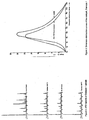
- the zeolite is stable by calcination and in air and steam, as is shown in Figure 2.
- the humid paste of zeolite is mixed with 28% SiO 2 Silica sol stabilized with ammonia in weight ratio zeolite: SiO 2 60-40, fixed at pH 6.3 with nitric acid 40% and atomized under pressure with 400-450 °C hot air at entrance and 175-180 °C at exit. Injection pressure is 4-4.5 bars and the productivity of atomizer 50 kg/hour dry catalyst.
- Finaly the catalyst is calcined with a heating rate of 100 °C/min. at two constant level, three hours at 350-400 °C and ten hours at 580 °C. The cooling time of the catalyst is 4 hours. All the raw material used for catalyst preparation have a Na content under 0,01%.
- the microspherical catalyst obtained has good flow preperty and granulation curve showed in Figure 3.
- FIG 4 is a schematic flow chart of the reaction - regeneration with fluid bed catalyst system for methanol conversion to olefins, MTO process, part of invention.
- the reactor R1 is filled with 100 I catalyst and the regnerator R2 with 30 I catalyst.
- By fluidization is taked form the dense fluid bed catalyst 2-2' and upper interface 3-3'.
- the temperature of dense fluid bed catalyst in R1 is fixed at 440 °C and in R2 at 480-610 °C.
- the temperatures in R1 and R2 are controlled by circulating heatin - cooling agent in interior heat exchangers 9-9'.
- Methanol and regenerating air are fed through connection 5-5' and sieves 4-4' with 100 l/hour respectively 1000 Nl/hour.
- the circulation of the catalyst between reactor and regenerator is realized by nitrogen as lift gas through transfer lines 12-12'.
- Automatic control level of catalyst bed in R1 and R2 is made by keep constant the pressure drops with regulators 11-11', which act the catalyst flow rate regulating valves 10-10'.
- Reaction products and catalyst entrained are evacuated at the top of R1 and R2 and separated in cyclone systems 6-7 and 6'-7'.
- Through the conduits 8-8' the entrained catalyst is recycled in the reactor-regenerator reaction zone.
- About 2 kg catalyst is withdrwn from the bottom of separation cyclone 7 or 7' in each 48 hours and is replaced with the same quantity of fresh catalyst through the charge device 15 or 15'. So the irreversible desactivation of the catalyst is compensated.
- the coked catalyst in the conduite 13 has 4.3 wt.% coke and the regenerated catalyst in conduite 13' has a coke retention level of 1.7 wt.%.
- Reaction products after the exit from cyclone 7 are cooled in heat exchanger 14 and separated in the separation vessel 16 into a noncondensed hydrocarbon fraction and a liquid fraction wich contains the process water, dimethylether and unconverted methanol.
- the gaseous hydrocarbon fraction is sent to a conventional olefins separation unit. From liquid fraction is separated by distillation dimethyleter and methanol wich are recycled to the reactors R 1 .
- Regeneration gases after cooling in heat exchanger 16' and washing in the column 14' are evacuated in the atmosphere.
Landscapes
- Chemical & Material Sciences (AREA)
- Organic Chemistry (AREA)
- Oil, Petroleum & Natural Gas (AREA)
- Engineering & Computer Science (AREA)
- Chemical Kinetics & Catalysis (AREA)
- General Chemical & Material Sciences (AREA)
- Crystallography & Structural Chemistry (AREA)
- Materials Engineering (AREA)
- Organic Low-Molecular-Weight Compounds And Preparation Thereof (AREA)
- Catalysts (AREA)
- Low-Molecular Organic Synthesis Reactions Using Catalysts (AREA)
- Silicates, Zeolites, And Molecular Sieves (AREA)
Abstract
Description
- This invention relates to a process for conversion of methanol to olefins using SAPO-34 zeolite in fluidized bed reactor with continuous regeneration of catalyst.
- Light olefins, namely ethylene and propylene, are important raw materials for polymers production.
- Industrial, ethylene and propylene are obtained by steam cracking of C2-C4 paraffins and petroleum fractions in so called hydrocarbons pyrolisis process. The continuous rising of olefins requirnent with the oil reserve shortage in the future make interesting the researches for new olefins manufacture technologies from non petroleum raw materials.
- One of the more attractive method for C2-C4 olefins production is based on catalytic conversion of methanol because methanol is manufactured in advanced technologies with very high capacity till 800,000 mt/year a single line and has wide raw materials availability like natural gases including methane, coals and renewable biomass.
- Methanol conversion into light olefins with industrial accepted yields was possible only after the synthesis of high silica zeolite ZSM-5 by Mobil Oil's researchers (U.S. Patent 3.702.886). After this many other types of zeolites were tested in the reaction of methanol to olefins like ZSM-34 (US Patent 4079096), Mordenite (Ro Patent 87685, US Patent 3244766), Offretite (US Patent 4079096) arseno-silicates (Ger. Off. 2830830), boro-silicates (Ger. Off. 2830787). Methanol conversion to olefins is claimed also in many patents based on synthtetic alumino-silicates like US Patents 4062905, 3979472, 3911041 and Ger. Off. 2755299,2615150.
- These catalysts exhibit low selectivities in olefins and must be periodically regenerated with air at 470-570 °C.
- Numerous methods for modification of zeolites and reaction conditions were elaborated for olefins selectivity rising and increasing the active cycle of the catalysts. Interesting results were obtained by zeolite silification (US Patent 4100219, 4145315), increasing Si/Al atomic ratio by aluminium extraction (US Patent 4447669, Ger. Off. 2935863), ionic exchange or impregnation with Cs, Ba, Pb, Tl (US Patent 4066714), B, Mg (US Patent 4049573, Ger. Off. 3300892), Hf, Zr (US Patent 4481376, Ger. Off. 3300982), dilution of the catalyst with inert materials (US Patent 4025572), partial deactivation with steam (UK Patent 2127036) or HF (US Patent 4486617). Good results have given complex treatments with Mg-Mg or Mg-Sb (RO Patent 87413). Some reaction parameters were also modified, for instance under atmospheric pressure utilization (US Patent 4025575), steam dilution of feed (US Patent 4083889) or dilution with air (US Patent 4433189), oxygen (US Patent 4049735) and aldehyde (US Patent 4374295).
- All as synthesized zeolite including SAPO - 34, have low selectivity in methanol conversion to olefines. By zeolite modifications its selectivity can be increased. For example PCT/US96/19673 teaches a process in which a SAPO - 34 zeolite is modified by ion exchange with Ni and then give a catalyst with 30% more selective in methanol conversion into ethylene + propylene.
- In US 5095163 SAPO - 34 catalyst is hydrothermally treated 3 - 50 hours, in air or steam, at 650 - 775°C, the catalyst acidity decreases from about 5.2 meq. NH3 / cc to 1.8 meq.NH3 / cc and selectivity to C2 + C3 olefines in methanol conversion increase from 63 to 80%. US 4873390 uses a selective cocking of the SAPO - 34 zeolite till 5 - 30% cocke in the catalyst to improve the methanol transformation in ethylene from 6.04% to 46.65% and in propylene from 15.43% to 50.60%. Maximum ethylene + propylene selectivity obtained is 83.7%.
- The synthesis by Union Carbide Corporation's researchers of Si-Al-P zeolites named SAPO-zeolites (US Patents 4310440, 4440871) has opened new perspectives for methanol conversion to olefins, MTO-process. As the Chinese researchers have demonstrated for the first time onto SAPO-34 zeolite it obtained till 89% C2-C4 olefins at practical total conversion of methanol 57-59% being ethylene and ethylene/propylene molar ratio 2.24-2.31 (Applied Catalysis, Vol. 40, Nr. 1-2, 1988, p.316). Due to the catalyst coking active cycle is only 1-2 hours.
- The use of SAPO-34 zeolite synthesised as in US Patent 4440871 rose contradictory literature data concerning the thermal and steam stability and olefins selectivity. It must be also underlined that the sythesis of the zeolite is made with expensive materials like aluminium isopropoxyde, tetraethylammmonium hydroxide or quinuclydine. Neutralization of the reaction mixture with NaOH has complicated the technology for SAPO-34 manufacture due to the necessity of ammonium ion exchange and supplementary calcination step.
- Thermal analysis (Gr.Pop et al., Progress in Catalysis, Bucharest, 1, 1993, p.1) showed that a good thermal and steam stability have SAPO-34 zeolites with crystals smaller than 4 micrometer.
- MTO - process was materialized in tubular reactors with fixed bed catalyst (US Patent 4590320) and in fluidized bed reactors with catalyst regeneration in fluidized bed. Vaporized methanol feed mixed with the zeolite catalyst is charged to the bottom of the riser contact zone to form a suspension for flow up wardly through the riser (U.S. Patent 4328384). The reactors with fixed bed catalyst have many desadvantages in methanol reaction to olefins because the remove of the reaction heat is dificult and frequent catalyst regeneration diminishes production capacity. The increasing the coke deposits on the catalyst in the active cycle changes continuous the reaction products composition.
- Fluidized bed reactors and continuous regeneration of the catalyst eliminate these desadvantages but in a riser reactor the optimal raction conditions can't be realized.
- Kinetic studies in fluidized bed reaction have shown the maximum ethylene formation at short reaction time of about two seconds. (C. Tsakiris et al., Proc. IFAC Symposium DYCORD 92 College Park, Maryland, April 1992), which is not obtainable in a riser reactor. In a riser type reactor two important reaction paramiters, contact time and temperature, determining product selectivites can't be well controlled.
- The Invention eliminates these difficulties since the catalyst is obtained from cheap raw materials like industrial alumina and aqueous silica sol and the template, tetraethylammonium phosphate is "in situ" preparated: by ethylbromide and triethylamine. The methanol conversion and continuous catalyst regeneration are conducted in fluidized bed reactors, without riser, methanol feed being injected in dense bed catalyst.
- The catalyst synthesis made only with cheap, industrial raw material namely triethylamine, ethyl bromide, concentrated phosphonic acid, more than 70 weight %, hydrated alumina and silica sol, all with very low, under 0,01% Na content. Concentrated silica sol can be stabilized with ammonia. In the condition of the patent, by hydrothermal treatment of Si-Al-P amorphous gel is obtained the active, H form of SAPO-34 zeolite, in relatively short zeolitization time. After the calcination at 350-580 °C for remove the organic template, the obtained zeolite is used as catalyst. The zeolite is atomized at 400-450 °C in a silica matrix as microspheres. The compozition of amorphous gel and the reaction condition in the crystallization, calcination and atomization steps assure to obtain an active and selective catalyst for methanol conversion to olefins, with a granulation curve suitable in a fluidized bed process and with good thermal and mechanical resistance.
- The process of methanol conversion to light olefins mainly ethylene and propylene, is realized in fluidized bed, including a reactor - regenerator system, with continuous circulation of the coked catalyst from reactor to regenerator and the regenerated catalyst form regenator to reactor. The methanol feed and regeneration air are injected in the dense bed of the catalyst. This system assures constant temperature in the catalyst beds and contact time of about two seconds. The reactor and regenerator risers only hinder the fluxes reversing. By steam or nitrogen purging in the risers, the catalyst is purified by the methanol and hydrocarbons adsorbed in reactor and oxygen adsorbed in regenerator. So the loss of methanol by burning in regenerator is avoided. Also is avoided the burning of the methanol in the reactor by the oxygen adsorbed on the catalyst in regenerator. The purging of the catalyst assures a very low carbon oxydes in the reaction products with a supplementary reduction of the costs for olefins separation. To keep constant the catalyst activity a small amount is removed from reactor or regenerator in parallel with adding an equal quantity of fresch catalyst. The reactor and regenerator have interior devices for taking-over the heat reactions of methanol conversion and coke burning.
- The following examples illustrate, but not limit, the present invention.
- By known method is prepared a tetraethylammonium phospate, aqueous solution 25%, from triethylamine, ethylbromide and phosphoric acid 73%.
- Hydrated alumina 65% Al2O3 with 40% bayerite, is suspended in demineralized water and is charged, under stirring in a 3500 I autoclave over tetraethylammonium phosphate solution and then is added the 28% SiO2 silica sol stabilized wih ammonia. Th pH of resulted suspension is fixed at 6,3-6,5 with phosphonic acid.
- Molar ratio of the component in the suspension is:
- P2O5: Al2O3: SiO2: TEAOH 1:1.5:0.37:1.1.
- Zeolitization is made in six succesive steps: the first step of the cristallization begins with 15% of the whole suspension at 198-205 °C. After 20 hours the autoclave is cooled at 30-40°C and a new quantity of suspension is added. The zeolitization process is resumed in the same conditions. The operation is repeated five times. The entire zeolitization process, including intersteps cooling, is about 100 hours.
- Analytical control, by XRD technique, of the product obtained shows more than 90% SAPO-34 zeolite and about 7% unreacted bayerite.
-
- In Table 1 are shown the characteristic bands in the XRD - spectrum of the SAPO-34 zeolite obtained, and SAPO-34 spectrum reported in U.S. Patent No. 4440871, for comparison.
Characteristic bands in XRD-spectrum (Cu lamp, Cu kα = 1.5418) U.S.Patent No.4440871 Sample, Example 1 2 d, Å 100 Xi/Io 2 d, Å 100 Xi/Io 9.45-9.65 9.36-9.17 81-100 9.63 9.18 100 12.8-13.05 6.92-6.78 8-20 12.87 6.88 18 13.95-14.20 6.35-6.24 8-23 14.17 6.25 21 16.0-16.2 5.54-5.47 25-54 16.16 5.4 47 17.85-18.15 4.97-4.89 11-26 18.3 4.89 22 19 4.67 0-2 - - - 20.55-20.9 4.32-4.25 44-100 20.67 4.3 97 22.05-22.50 4.03-3.95 0-5 22.33 3.98 4 23.0-23.15 3.87-3.84 2-10 23.15 3.84 8 24.95-25.4 3.57-3.51 12-87 25.38 3.52 26 25.8-26.0 3.45-3.43 14-24 25.97 3.43 17 27.5-27.7 3.243-3.220 1-4 27.68 3.22 4 28.05-28.4 3.181-3.143 1-12 28.4 3.14 4 29.2-29.6 3.058-3.018 3-9 29.15 3.06 4 30.5-30.7 2.931-2.912 19-75 30.67 2.91 29 31.05-31.4 2.880-2.849 15-28 31.25 2.86 22 32.2-32.4 2.780-2.763 1-5 32.42 2.76 3 33.4-33.85 2.683-2.648 0-6 33.66 2.66 4 34.35-34.65 2.611-2.589 4-15 34.48 2.6 7 36.0-36.5 2.495-2.462 2-11 36.33 2.47 4 38.8-38.9 2.321-2.315 0-2 38.8 2.32 2 39.6-39.7 2.276-2.070 2-4 39.76 2.27 5 - The crystallite dimensions are between 1 and 3 micrometer (Figure 1). The zeolite is stable by calcination and in air and steam, as is shown in Figure 2.
- In the zeolitization phase results a zeolite suspension with 16.7% solid wich is separated with 6.7 l/m2 hours filtration rate. After washing with demineralized water and air drying results a paste of zeolite with 57% humidity.
- The humid paste of zeolite is mixed with 28% SiO2 Silica sol stabilized with ammonia in weight ratio zeolite: SiO2 60-40, fixed at pH 6.3 with nitric acid 40% and atomized under pressure with 400-450 °C hot air at entrance and 175-180 °C at exit. Injection pressure is 4-4.5 bars and the productivity of atomizer 50 kg/hour dry catalyst. Finaly the catalyst is calcined with a heating rate of 100 °C/min. at two constant level, three hours at 350-400 °C and ten hours at 580 °C. The cooling time of the catalyst is 4 hours. All the raw material used for catalyst preparation have a Na content under 0,01%. The microspherical catalyst obtained has good flow preperty and granulation curve showed in Figure 3.
- Figure 4 is a schematic flow chart of the reaction - regeneration with fluid bed catalyst system for methanol conversion to olefins, MTO process, part of invention. With reference to Figure 4, the reactor R1 is filled with 100 I catalyst and the regnerator R2 with 30 I catalyst. By fluidization is taked form the dense fluid bed catalyst 2-2' and upper interface 3-3'. The temperature of dense fluid bed catalyst in R1 is fixed at 440 °C and in R2 at 480-610 °C. The temperatures in R1 and R2 are controlled by circulating heatin - cooling agent in interior heat exchangers 9-9'. Methanol and regenerating air are fed through connection 5-5' and sieves 4-4' with 100 l/hour respectively 1000 Nl/hour.
- The circulation of the catalyst between reactor and regenerator is realized by nitrogen as lift gas through transfer lines 12-12'. Automatic control level of catalyst bed in R1 and R2 is made by keep constant the pressure drops with regulators 11-11', which act the catalyst flow rate regulating valves 10-10'. Reaction products and catalyst entrained are evacuated at the top of R1 and R2 and separated in cyclone systems 6-7 and 6'-7'. Through the conduits 8-8' the entrained catalyst is recycled in the reactor-regenerator reaction zone. About 2 kg catalyst is withdrwn from the bottom of separation cyclone 7 or 7' in each 48 hours and is replaced with the same quantity of fresh catalyst through the
charge device 15 or 15'. So the irreversible desactivation of the catalyst is compensated. - The coked catalyst in the
conduite 13 has 4.3 wt.% coke and the regenerated catalyst in conduite 13' has a coke retention level of 1.7 wt.%. Reaction products after the exit from cyclone 7 are cooled in heat exchanger 14 and separated in theseparation vessel 16 into a noncondensed hydrocarbon fraction and a liquid fraction wich contains the process water, dimethylether and unconverted methanol. The gaseous hydrocarbon fraction is sent to a conventional olefins separation unit. From liquid fraction is separated by distillation dimethyleter and methanol wich are recycled to the reactors R1. - Regeneration gases after cooling in heat exchanger 16' and washing in the column 14' are evacuated in the atmosphere.
- The composition of the fluxes are shown in Table 2.
Effluent composition obtained in Example 1. Component Uncondensed organic phase vessel 16 wt.%Liquid phase vessel 16 wt.%Regeneration gases,exit cyclone 7' wt.% Oxygen - - 1,5 Nitrogen - - 82.7 Carbon monoxyde - - 4.3 Carbon dioxyde - - 11 Hydrogen 0.2 - 0.5 Methane 1.6 - - Ethane 0.3 - - Ethylene 46.8 - - Propane 2.5 - - Propylene 40 - - Butanes 0.53 - - 1-Butene 1.74 - - iso-Butene 0.71 - - 2-Butenes 4.04 - - C5 + hydrocarbons 1.58 - - Methanol - 0.5 - Dimethylether - - - Water - 99.5 - - Using the catalyst and installation of Exemple 1 by temperature and space velocity modification the ethylene/propylene ratio is changed in relatively large limits of 0.69-1.29.
- Some illustrating results are shown in Table 3.
Reaction products compositions, in different reaction conditions. Experience number 1 2 3 4 5 6 a. Reaction conditions Temperature, °C 400 405 410 435 470 490 LHSV, h-1 1.1 0.6 1 1.9 1.5 2.7 b. Uncondensed organic phase analysis, wt. % Hydrogen 0.08 0.23 0.13 0.12 0.71 0.1 Carbon oxydes - - - 0.14 0.21 - Methane 0.62 1.78 0.81 1.12 2.42 0.91 Ethane 0.26 0.9 0.42 0.64 - - Ethylene 28.3 48.5 34.1 43 42.45 36.8 Propane 2.3 5.3 2.4 2.43 5.9 2.27 Propylene 41.2 35.7 42.9 42 32.95 45.4 Butanes 0.9 0.88 0.8 0.68 0.8 0.72 1-Butene 1.94 1.19 1.75 1.63 1.94 1.7 iso-Butene 0.77 1.23 0.75 0.44 1.04 0.2 2-Butenes 7.22 2.56 6.68 4.87 7.13 5.2 -
- 1. Brent M.Lok, Celeste M. Messina, Robert L. Pation, Richard T. Gajek, Thomas R. Cannan, Edith M. Flanigen (Union Carbide Corporation), U.S. Patent No. 4440871 (April 3, 1984), Int. Cl. B01 j 27/14; U.S. Cl 502/241.
- 2. Ajit V. Sapre (Mobil Oil Corporation), U.S. Patent No.4590320 (May 20, 1986), Int. Cl. Co7C1/20; U.S. Cl.585/324; 585/315
- 3. Nicholas Davidiuk, James Haddad (Mobil Oil Corporation) U.S. Patent No. 4328384 (May 4, 1982), Int. Cl. C 97c1/20, U.S. CI. 585/469; 585/639; 585/733.
-
| Experience number | 1 | 2 | 3 | 4 | 5 | 6 |
| C5 +Hydrocarbons | 2.41 | 0.95 | 2.84 | 1.58 | 4.45 | 1.75 |
| Dimethylether | 14 | 0.78 | 6.42 | 1.35 | - | 4.95 |
| c. Liquid phase analysis, wt.% | ||||||
| Dimethylether | 1.5 | - | 0.5 | - | - | - |
| |
12 | 3 | 9 | 1.5 | 0.1 | 1.5 |
| Water | 86.5 | 97 | 90.5 | 98.5 | 99.9 | 98.5 |
| d. Coke deposits on the catalyst, wt.% | ||||||
| Reactor R1 exist | 4.9 | 5 | 4.8 | 4.5 | 4.6 | 4.7 |
| Regenerator R2 exit | 1.2 | 2.8 | 0.6 | 0.9 | 1.2 | 1.9 |
| e. Ethylene / propylene ratio | 0.69 | 1.36 | 0.79 | 1.02 | 1.29 | 0.81 |
| f. Methanol conversion | 93.3 | 98.3 | 95 | 99,2 | 100 | 99.2 |
Claims (7)
- A method for the preparation of light olefins from methanol conversion using a microspherical catalyst comprising SAPO-34 zeolite, the method comprising the step of contacting methanol with a fluidized bed of said catalyst and being characterized in preparing said SAPO-34 zeolite by hydrothermal treatment from alumina, silica and a preformed template tetraethylammonium phosphate.
- A method according to claim 1 comprising the further steps of:continuously regenerating the catalyst of said bed with air, andsubstituting a portion of used catalyst with fresh catalyst in order to keep constant the activity and selectivity of the catalyst.
- A method according to claim 2, in which the regeneration with air is performed at 480-610°C.
- A method according to claim 2 or claim 3, in which the contacting and the regeneration steps are performed in a reactor and regenerator respectively with continuous circulation of the catalyst between said reactor and said regenerator.
- A method according to anyone of preceding claims, in which methanol is contacted with said catalyst at a temperature of 400-490°C and liquid space velocities of 0.6 to 2.7 h-1.
- A method according to claim 1, in which the preformed template tetraethylammonium phosphate is prepared from triethylamine, ethylbromide and phosphoric acid.
- A method according to claim 1, in which the microspherical catalyst is obtained by the steps of:atomizing a mixture of said SAPO-34 zeolite and silica under pressure and at 400-450°C to form microspheres,calcinating said microspheres at 350-580°C to remove the template obtaining said microspherical catalyst.
Applications Claiming Priority (2)
| Application Number | Priority Date | Filing Date | Title |
|---|---|---|---|
| RO97-01829A RO114524B1 (en) | 1997-10-02 | 1997-10-02 | Process for producing olefins with low molecular mass by fluidized bed catalytic conversion of methanol |
| PCT/RO1999/000001 WO2000041986A1 (en) | 1997-10-02 | 1999-01-11 | Catalytic process for the preparation of light olefins from methanol in a fluidised bed reactor |
Publications (2)
| Publication Number | Publication Date |
|---|---|
| EP1140743A1 EP1140743A1 (en) | 2001-10-10 |
| EP1140743B1 true EP1140743B1 (en) | 2005-10-05 |
Family
ID=26653545
Family Applications (1)
| Application Number | Title | Priority Date | Filing Date |
|---|---|---|---|
| EP99901254A Revoked EP1140743B1 (en) | 1997-10-02 | 1999-01-11 | Catalytic process for the preparation of light olefins from methanol in a fluidised bed reactor |
Country Status (17)
| Country | Link |
|---|---|
| US (1) | US6710218B1 (en) |
| EP (1) | EP1140743B1 (en) |
| JP (1) | JP2002534487A (en) |
| CN (1) | CN1163458C (en) |
| AT (1) | ATE305912T1 (en) |
| AU (1) | AU768633B2 (en) |
| BR (1) | BR9916757A (en) |
| CA (1) | CA2359501C (en) |
| DE (1) | DE69927604T2 (en) |
| EA (1) | EA005667B1 (en) |
| ES (1) | ES2259470T3 (en) |
| NO (1) | NO20013401D0 (en) |
| NZ (1) | NZ512738A (en) |
| PL (1) | PL193075B1 (en) |
| RO (1) | RO114524B1 (en) |
| TR (1) | TR200102007T2 (en) |
| WO (1) | WO2000041986A1 (en) |
Cited By (5)
| Publication number | Priority date | Publication date | Assignee | Title |
|---|---|---|---|---|
| CN103878016A (en) * | 2013-09-30 | 2014-06-25 | 洛阳市科创石化科技开发有限公司 | Composite molecular sieve catalyst for MTP (methanol to propylene) as well as application thereof |
| CN104437614A (en) * | 2013-09-24 | 2015-03-25 | 中国石油化工股份有限公司 | Binder-free ZSM-5/beta co-crystallized molecular sieve catalyst and preparation method and use thereof |
| CN104437611A (en) * | 2013-09-24 | 2015-03-25 | 中国石油化工股份有限公司 | Binderless nano ZSM-5/beta symbiotic zeolite molecular sieve catalyst |
| CN104437610A (en) * | 2013-09-24 | 2015-03-25 | 中国石油化工股份有限公司 | Binderless nano ZSM-5/beta symbiotic molecular sieve catalyst |
| CN105126903A (en) * | 2015-07-29 | 2015-12-09 | 太原大成环能化工技术有限公司 | Recycle method of catalyst fine powder obtained by preparation of olefin from waste and old methanol |
Families Citing this family (39)
| Publication number | Priority date | Publication date | Assignee | Title |
|---|---|---|---|---|
| US6166282A (en) * | 1999-08-20 | 2000-12-26 | Uop Llc | Fast-fluidized bed reactor for MTO process |
| WO2001025150A1 (en) * | 1999-10-01 | 2001-04-12 | Pop, Grigore | Process for the synthesis of silicoaluminophosphate molecular sieves |
| EP1233928A1 (en) * | 1999-11-18 | 2002-08-28 | Exxon Chemical Patents Inc. | Method for the synthesis of molecular sieves |
| JP2002191980A (en) * | 2000-12-11 | 2002-07-10 | Uop Llc | Metalloaluminophosphate molecular sieve with cubic crystal morphology and methanol to olefin process using the sieve |
| EP1214974B1 (en) * | 2000-12-13 | 2008-07-02 | Uop Llc | Metallo aluminophosphate molecular sieve with cubic crystal morphology and methanol to olefin process using the sieve |
| ES2192923B1 (en) * | 2001-01-30 | 2004-10-01 | Universidad Politecnica De Valencia | MICROPOROUS CRYSTAL MATERIAL (ITQ-19) WITH LAMINARY CHARACTERISTICS, ITS PREPARATION PROCEDURE AND ITS USE AS A CATALYST IN CATALYTIC CONVERSION PROCESSES OF ORGANIC COMPOUNDS. |
| US6812372B2 (en) * | 2001-03-01 | 2004-11-02 | Exxonmobil Chemical Patents Inc. | Silicoaluminophosphate molecular sieve |
| CA2442399A1 (en) * | 2001-03-22 | 2002-10-03 | Uop Llc | Metallo aluminophosphate molecular sieve with cubic crystal morphology and methanol to olefin process using the sieve |
| US7084319B2 (en) | 2003-12-05 | 2006-08-01 | Exxonmobil Chemical Patents Inc. | Catalyst fluidization in oxygenate to olefin reaction systems |
| US7371915B1 (en) * | 2004-06-25 | 2008-05-13 | Uop Llc | Conversion of oxygenate to propylene using moving bed technology |
| US7208649B2 (en) * | 2004-11-01 | 2007-04-24 | Uop Llc | External second stage cyclones in olefin production process |
| US7408092B2 (en) * | 2004-11-12 | 2008-08-05 | Uop Llc | Selective conversion of oxygenate to propylene using moving bed technology and a hydrothermally stabilized dual-function catalyst |
| US7829030B2 (en) | 2004-12-30 | 2010-11-09 | Exxonmobil Chemical Patents Inc. | Fluidizing a population of catalyst particles having a low catalyst fines content |
| US7829750B2 (en) | 2004-12-30 | 2010-11-09 | Exxonmobil Chemical Patents Inc. | Fluidizing a population of catalyst particles having a low catalyst fines content |
| US7550403B2 (en) * | 2005-06-30 | 2009-06-23 | Uop Llc | Methods for recovering activity of molecular sieve catalysts |
| US20070059236A1 (en) * | 2005-09-09 | 2007-03-15 | Broach Robert W | Molecular sieves with high selectivity towards light olefins in methanol to olefin conversion |
| EP2004776A1 (en) | 2006-03-31 | 2008-12-24 | ExxonMobil Chemical Patents Inc. | Product recovery in gas-solids reactors |
| US7744746B2 (en) | 2006-03-31 | 2010-06-29 | Exxonmobil Research And Engineering Company | FCC catalyst stripper configuration |
| ITMI20061231A1 (en) * | 2006-06-26 | 2007-12-27 | Eni Spa | PROXCESS AND ZEOLITHIC MATERIALS FOR GAS SEPARATION |
| CN101130469B (en) * | 2006-08-23 | 2011-04-13 | 中国科学院大连化学物理研究所 | Method for recovering reactivation heat in process of preparing low carbon olefinic hydrocarbon with methanol |
| JP5050466B2 (en) * | 2006-09-21 | 2012-10-17 | 三菱化学株式会社 | Propylene production method |
| CN101239873B (en) * | 2007-02-07 | 2011-07-13 | 中国石油化工股份有限公司 | Method for converting oxygen-containing compound to low-carbon olefins |
| CN101157593B (en) | 2007-03-07 | 2010-09-22 | 中国科学院大连化学物理研究所 | Method for producing light olefins from methanol or/and dimethyl ether |
| US20080260631A1 (en) | 2007-04-18 | 2008-10-23 | H2Gen Innovations, Inc. | Hydrogen production process |
| FR2917424B1 (en) * | 2007-06-12 | 2012-10-19 | Inst Francais Du Petrole | PRODUCTION OF HIGH PERFORMANCE VAPOCRABAGE FILLERS IN ETHYLENE, PROPYLENE AND POLYMERS RESULTING FROM VEGETABLE OIL HYDROTREATMENT |
| EP2022565A1 (en) * | 2007-07-06 | 2009-02-11 | Casale Chemicals S.A. | Process for preparing silicoaluminoposphate (SAPO) molecular sieves, catalysts containing said sieves and catalytic dehydration processes using said catalysts |
| CN101229921B (en) * | 2007-11-16 | 2010-09-01 | 南开大学 | Method for synthesizing SAPO-46 silicoaluminophosphate molecular sieve |
| CN101225013B (en) * | 2008-01-31 | 2010-12-29 | 中国天辰工程有限公司 | Separation device and method for producing light olefin gas products by conversion of methanol and dimethyl ether |
| FR2951160B1 (en) * | 2009-10-13 | 2012-09-28 | Total Raffinage Marketing | PROCESS FOR PRODUCING DISTILLATE FROM HETEROATOMIC ORGANIC COMPOUNDS |
| CN101943689B (en) * | 2010-07-09 | 2012-11-28 | 神华集团有限责任公司 | Optimized device for forming catalyst hydro-thermal treatment and fixed fluidized bed catalyst evaluation |
| US8419835B2 (en) | 2010-08-10 | 2013-04-16 | Uop Llc | Apparatuses and methods for gas-solid separations using cyclones |
| RU2505356C2 (en) * | 2011-12-27 | 2014-01-27 | Федеральное государственное бюджетное учреждение науки Ордена Трудового Красного Знамени Институт нефтехимического синтеза им. А.В. Топчиева Российской академии наук (ИНХС РАН) | Method of obtaining catalyst and method of synthesis of c2-c4 olefins in presence of catalyst obtained thereof |
| CN103288570B (en) * | 2013-04-28 | 2015-01-21 | 神华集团有限责任公司 | Apparatus and method for preparing olefin from methanol |
| WO2015081494A1 (en) * | 2013-12-03 | 2015-06-11 | 中国科学院大连化学物理研究所 | Reaction device for preparing light olefins from methanol and/or dimethyl ether |
| WO2016094171A1 (en) * | 2014-12-11 | 2016-06-16 | Uop Llc | Elevated pressure 'high value' mto process for improved sapo performance |
| WO2020227849A1 (en) | 2019-05-10 | 2020-11-19 | 中国科学院大连化学物理研究所 | Method for partially regenerating catalyst for methanol and/or dimethyl ether-to-olefin and method for methanol and/or dimethyl ether-to-olefin |
| CN111974462A (en) * | 2020-09-01 | 2020-11-24 | 大唐国际化工技术研究院有限公司 | Method for recycling waste MTP catalyst |
| US12296324B2 (en) | 2020-10-16 | 2025-05-13 | Dalian Institute Of Chemical Physics, Chinese Academy Of Sciences | Regeneration device, device for preparing low-carbon olefins, and use thereof |
| CN114602547B (en) * | 2020-12-08 | 2023-08-15 | 中国科学院大连化学物理研究所 | Composite catalyst and preparation method and application thereof |
Family Cites Families (76)
| Publication number | Priority date | Publication date | Assignee | Title |
|---|---|---|---|---|
| US3244766A (en) | 1961-06-06 | 1966-04-05 | Norton Co | Catalytic production of olefins |
| US3702886A (en) | 1969-10-10 | 1972-11-14 | Mobil Oil Corp | Crystalline zeolite zsm-5 and method of preparing the same |
| US3911041A (en) | 1974-09-23 | 1975-10-07 | Mobil Oil Corp | Conversion of methanol and dimethyl ether |
| US3979472A (en) | 1975-03-28 | 1976-09-07 | Mobil Oil Corporation | Process for manufacturing hydrocarbons |
| US4025576A (en) | 1975-04-08 | 1977-05-24 | Mobil Oil Corporation | Process for manufacturing olefins |
| US4025575A (en) | 1975-04-08 | 1977-05-24 | Mobil Oil Corporation | Process for manufacturing olefins |
| US4066714A (en) | 1975-12-08 | 1978-01-03 | Mobil Oil Corporation | Manufacture of light olefins |
| US4049573A (en) | 1976-02-05 | 1977-09-20 | Mobil Oil Corporation | Zeolite catalyst containing oxide of boron or magnesium |
| US4100219A (en) | 1976-03-31 | 1978-07-11 | Mobil Oil Corporation | Silica-modified zeolite catalyst and conversion therewith |
| US4025572A (en) | 1976-05-12 | 1977-05-24 | Mobil Oil Corporation | Manufacture of hydrocarbons |
| US4062905A (en) | 1976-08-02 | 1977-12-13 | Mobil Oil Corporation | Manufacture of light olefins |
| US4079096A (en) | 1976-11-04 | 1978-03-14 | Mobil Oil Corporation | Manufacture of light olefins |
| US4049735A (en) | 1976-12-09 | 1977-09-20 | Mobil Oil Corporation | Use of elemental oxygen to inhibit elution of antimony from an antimony-ZSM-5 catalyst |
| DE2755299A1 (en) | 1976-12-20 | 1978-06-22 | Asea Ab | CYLINDER-SHAPED LONG EXTENDED FURNACE FOR TREATMENT OF MATERIAL UNDER HIGH TEMPERATURE AND PRESSURE |
| US4145315A (en) | 1976-12-23 | 1979-03-20 | Mobil Oil Corporation | Silica-modified zeolite catalyst |
| US4083889A (en) | 1977-05-26 | 1978-04-11 | Mobil Oil Corporation | Process for manufacturing ethylene |
| DE2830787B2 (en) | 1978-07-13 | 1981-02-19 | Basf Ag, 6700 Ludwigshafen | Process for the production of nitrogen-containing crystalline metal silicates with a zeolite structure |
| DE2830830A1 (en) | 1978-07-13 | 1980-01-31 | Basf Ag | Crystalline arsenic silicate zeolite useful as catalyst - e.g. in methanol conversion to olefin cpd., is produced by hydrothermal synthesis from silica and arsenic tri:oxide |
| NZ191302A (en) | 1978-09-05 | 1981-10-19 | Mobil Oil Corp | Producing hydrocarbon mixture from alcohol feed using crystalline aluminosilicate zeolite catalyst |
| US4328384A (en) | 1979-10-30 | 1982-05-04 | Mobil Oil Corporation | Fluid zeolite catalyst conversion of alcohols and oxygenated derivatives to hydrocarbons by controlling exothermic reaction heat |
| DE3024536A1 (en) | 1980-06-28 | 1982-02-04 | Hoechst Ag, 6000 Frankfurt | ALUMINUM SILICATE CATALYST |
| US4310440A (en) | 1980-07-07 | 1982-01-12 | Union Carbide Corporation | Crystalline metallophosphate compositions |
| FR2519335B1 (en) | 1982-01-04 | 1986-05-02 | Azote & Prod Chim | PRODUCTION OF HYDROCARBONS FROM METHANOL IN THE PRESENCE OF ZEOLITE TYPE CATALYSTS |
| US4433189A (en) | 1982-03-18 | 1984-02-21 | Mobil Oil Corporation | Catalytic conversion of methanol to light olefins |
| US4374295A (en) | 1982-04-15 | 1983-02-15 | Mobil Oil Corporation | Catalytic conversion of methanol to light olefins |
| US4440871A (en) | 1982-07-26 | 1984-04-03 | Union Carbide Corporation | Crystalline silicoaluminophosphates |
| US4480145A (en) | 1982-09-16 | 1984-10-30 | Mobil Oil Corporation | Catalysts for the conversion of methanol to ethylene plus gasoline |
| US4677243A (en) | 1982-10-04 | 1987-06-30 | Union Carbide Corporation | Production of light olefins from aliphatic hetero compounds |
| US4499327A (en) | 1982-10-04 | 1985-02-12 | Union Carbide Corporation | Production of light olefins |
| DE3243520A1 (en) | 1982-11-25 | 1984-05-30 | Basf Ag, 6700 Ludwigshafen | METHOD FOR PRODUCING C (DOWN ARROW) 2 (DOWN ARROW) TO C (DOWN ARROW) 4 (DOWN ARROW) -OLEFINES FROM METHANOL / DIMETHYL ETHER |
| DE3300892A1 (en) | 1983-01-13 | 1984-07-19 | Claudius Peters Ag, 2000 Hamburg | Hammer for a hammer mill |
| US4499315A (en) | 1983-11-15 | 1985-02-12 | Union Carbide Corporation | Conversion of certain hydrocarbons using silicoaluminophosphate catalysts |
| US4590320A (en) | 1984-08-31 | 1986-05-20 | Mobil Oil Corporation | Conversion of methanol to olefins in a tubular reactor with light olefin co-feeding |
| CN1007991B (en) | 1984-12-18 | 1990-05-16 | 联合碳化公司 | Hydrocracking Process Using Aluminum-Si-Phosphate Molecular Sieve Catalyst |
| US4752651A (en) | 1986-06-16 | 1988-06-21 | Union Carbide Corporation | Production of light olefins |
| US4814541A (en) | 1987-07-07 | 1989-03-21 | Uop | Chemical conversion process |
| US4861938A (en) | 1987-07-07 | 1989-08-29 | Uop | Chemical conversion process |
| US4873390A (en) * | 1987-07-07 | 1989-10-10 | Uop | Chemical conversion process |
| US4973792A (en) | 1987-07-07 | 1990-11-27 | Uop | Chemical conversion process |
| US4849575A (en) | 1987-11-25 | 1989-07-18 | Uop | Production of olefins |
| US5095163A (en) * | 1991-02-28 | 1992-03-10 | Uop | Methanol conversion process using SAPO catalysts |
| DE4137013A1 (en) | 1991-11-11 | 1993-05-13 | Basf Ag | METHOD FOR PRODUCING AMINES BY REDUCTIVE AMINATION |
| US5126308A (en) | 1991-11-13 | 1992-06-30 | Uop | Metal aluminophosphate catalyst for converting methanol to light olefins |
| NO174341B1 (en) | 1991-12-23 | 1994-04-21 | Polymers Holding As | Prepare foremost crystalline microporosis SiAl phosphates with controlled Si content, crystalline microporosis SiAl phosphates with improved stability against deactivation and use thereof in the preparation of olefins from methanol |
| SG48118A1 (en) | 1992-05-27 | 1998-04-17 | Exxon Chemical Patents Inc | Production of high purity olefins |
| WO1993024430A1 (en) | 1992-05-27 | 1993-12-09 | Exxon Chemical Patents Inc. | Use of acid extracted molecular sieve catalysts in oxygenate conversion |
| US5744680A (en) | 1995-08-10 | 1998-04-28 | Uop | Process for producing light olefins |
| US5817906A (en) | 1995-08-10 | 1998-10-06 | Uop Llc | Process for producing light olefins using reaction with distillation as an intermediate step |
| US5888921A (en) | 1995-10-25 | 1999-03-30 | Abb Lummus Global Inc. | Binary molecular sieves having a core and shell of different structures and compositions |
| US5962762A (en) | 1995-12-13 | 1999-10-05 | Sun; Hsian-Ning | Use of transition metal containing small pore molecular sieve catalysts in oxygenate conversion |
| US6040264A (en) | 1996-04-04 | 2000-03-21 | Exxon Chemical Patents Inc. | Use of alkaline earth metal containing small pore non-zeolitic molecular sieve catalysts in oxygenate conversion |
| KR20000016111A (en) | 1996-05-29 | 2000-03-25 | 엑손 케미칼 패턴츠 인코포레이티드 | Hydrocarbon conversion catalyst and use thereof |
| US5952538A (en) | 1996-12-31 | 1999-09-14 | Exxon Chemical Patents Inc. | Use of short contact time in oxygenate conversion |
| US5925586A (en) | 1996-12-31 | 1999-07-20 | Exxon Chemical Patents, Inc. | Phosphorus modified small pore molecular sieve catalysts, and their use in the production of light olefins |
| US5925800A (en) | 1996-12-31 | 1999-07-20 | Exxon Chemical Patents Inc. | Conversion of oxygenates to hydrocarbons with monolith supported non-zeolitic molecular sieve catalysts |
| TW412510B (en) | 1996-12-31 | 2000-11-21 | Exxon Chemical Patents Inc | Oxygenate conversions using small pore non-zeolitic molecular sieve catalysts |
| US6051746A (en) | 1997-06-18 | 2000-04-18 | Exxon Chemical Patents Inc. | Oxygenate conversions using modified small pore molecular sieve catalysts |
| US5914433A (en) | 1997-07-22 | 1999-06-22 | Uop Lll | Process for producing polymer grade olefins |
| TWI234556B (en) * | 1997-07-23 | 2005-06-21 | Mitsubishi Gas Chemical Co | Catalysts for methanol conversion reactions |
| US6455749B1 (en) | 1997-10-03 | 2002-09-24 | Exxonmobil Chemical Patents, Inc. | Method for increasing light olefin yield by conversion of a heavy hydrocarbon fraction of a product to light olefins |
| US6137022A (en) | 1997-12-03 | 2000-10-24 | Exxon Chemical Patents Inc | Process for increasing the selectivity of a reaction to convert oxygenates to olefins |
| US6005155A (en) | 1997-12-03 | 1999-12-21 | Exxon Chemicals Patents Inc. | Modification of molecular sieve catalyst for reduced methane production during conversion of oxygenates to olefins |
| US6207872B1 (en) | 1997-12-09 | 2001-03-27 | Uop Llc | Metallo aluminophosphate molecular sieve with cubic crystal morphology and methanol to olefin process using the sieve |
| US5912393A (en) | 1997-12-09 | 1999-06-15 | Uop Llc | Metallo aluminophosphate molecular sieve with novel crystal morphology and methanol to olefin process using the sieve |
| US6046373A (en) | 1998-04-29 | 2000-04-04 | Exxon Chemical Patents Inc. | Catalytic conversion of oxygenates to olefins |
| US6429348B1 (en) | 1998-05-05 | 2002-08-06 | Exxonmobil Chemical Patents, Inc. | Method for selectively producing propylene by catalytically cracking an olefinic hydrocarbon feedstock |
| EP1019342A4 (en) | 1998-07-02 | 2001-10-17 | Dijk Technology L L C Van | Modified catalyst and a method of using same for conversion of methanol into olefins |
| US6482999B2 (en) | 1999-02-17 | 2002-11-19 | Exxonmobil Chemical Patents, Inc. | Method for improving light olefin selectivity in an oxygenate conversion reaction |
| US6051745A (en) | 1999-03-04 | 2000-04-18 | Phillips Petroleum Company | Silicoaluminophosphate material, a method of making such improved material and the use thereof in the conversion of oxygenated hydrocarbons to olefins |
| US6472569B1 (en) | 1999-04-16 | 2002-10-29 | Phillips Petroleum Company | Silicoaluminophosphate material, a method of making such improved material and the use thereof in the conversion of oxygenated hydrocarbons to an olefin and/or an ether |
| US6046371A (en) | 1999-05-05 | 2000-04-04 | Phillips Petroleum Company | Silicoaluminophosphate material, a method of making such improved material and the use thereof in the conversion of oxygenated hydrocarbons to olefins |
| US6316683B1 (en) | 1999-06-07 | 2001-11-13 | Exxonmobil Chemical Patents Inc. | Protecting catalytic activity of a SAPO molecular sieve |
| US6395674B1 (en) | 1999-06-07 | 2002-05-28 | Exxon Mobil Chemical Patents, Inc. | Heat treating a molecular sieve and catalyst |
| US6225254B1 (en) | 1999-06-07 | 2001-05-01 | Exxon Mobil Chemical Patents Inc. | Maintaining acid catalyst sites in sapo molecular sieves |
| US6166282A (en) | 1999-08-20 | 2000-12-26 | Uop Llc | Fast-fluidized bed reactor for MTO process |
| WO2001025150A1 (en) | 1999-10-01 | 2001-04-12 | Pop, Grigore | Process for the synthesis of silicoaluminophosphate molecular sieves |
-
1997
- 1997-10-02 RO RO97-01829A patent/RO114524B1/en unknown
-
1999
- 1999-01-11 AT AT99901254T patent/ATE305912T1/en not_active IP Right Cessation
- 1999-01-11 US US09/869,974 patent/US6710218B1/en not_active Expired - Lifetime
- 1999-01-11 JP JP2000593556A patent/JP2002534487A/en not_active Ceased
- 1999-01-11 BR BR9916757-3A patent/BR9916757A/en not_active Application Discontinuation
- 1999-01-11 ES ES99901254T patent/ES2259470T3/en not_active Expired - Lifetime
- 1999-01-11 TR TR2001/02007T patent/TR200102007T2/en unknown
- 1999-01-11 DE DE69927604T patent/DE69927604T2/en not_active Revoked
- 1999-01-11 PL PL349783A patent/PL193075B1/en unknown
- 1999-01-11 AU AU20792/99A patent/AU768633B2/en not_active Expired
- 1999-01-11 CA CA002359501A patent/CA2359501C/en not_active Expired - Lifetime
- 1999-01-11 WO PCT/RO1999/000001 patent/WO2000041986A1/en not_active Ceased
- 1999-01-11 NZ NZ512738A patent/NZ512738A/en not_active IP Right Cessation
- 1999-01-11 EA EA200100727A patent/EA005667B1/en not_active IP Right Cessation
- 1999-01-11 EP EP99901254A patent/EP1140743B1/en not_active Revoked
- 1999-01-11 CN CNB998154512A patent/CN1163458C/en not_active Expired - Lifetime
-
2001
- 2001-07-09 NO NO20013401A patent/NO20013401D0/en not_active Application Discontinuation
Cited By (6)
| Publication number | Priority date | Publication date | Assignee | Title |
|---|---|---|---|---|
| CN104437614A (en) * | 2013-09-24 | 2015-03-25 | 中国石油化工股份有限公司 | Binder-free ZSM-5/beta co-crystallized molecular sieve catalyst and preparation method and use thereof |
| CN104437611A (en) * | 2013-09-24 | 2015-03-25 | 中国石油化工股份有限公司 | Binderless nano ZSM-5/beta symbiotic zeolite molecular sieve catalyst |
| CN104437610A (en) * | 2013-09-24 | 2015-03-25 | 中国石油化工股份有限公司 | Binderless nano ZSM-5/beta symbiotic molecular sieve catalyst |
| CN103878016A (en) * | 2013-09-30 | 2014-06-25 | 洛阳市科创石化科技开发有限公司 | Composite molecular sieve catalyst for MTP (methanol to propylene) as well as application thereof |
| CN103878016B (en) * | 2013-09-30 | 2017-01-18 | 洛阳市科创石化科技开发有限公司 | Composite molecular sieve catalyst for MTP (methanol to propylene) as well as application thereof |
| CN105126903A (en) * | 2015-07-29 | 2015-12-09 | 太原大成环能化工技术有限公司 | Recycle method of catalyst fine powder obtained by preparation of olefin from waste and old methanol |
Also Published As
| Publication number | Publication date |
|---|---|
| TR200102007T2 (en) | 2001-12-21 |
| PL349783A1 (en) | 2002-09-09 |
| DE69927604D1 (en) | 2006-02-16 |
| WO2000041986A1 (en) | 2000-07-20 |
| EP1140743A1 (en) | 2001-10-10 |
| CA2359501A1 (en) | 2000-07-20 |
| US6710218B1 (en) | 2004-03-23 |
| DE69927604T2 (en) | 2006-07-13 |
| RO114524B1 (en) | 1999-05-28 |
| NZ512738A (en) | 2003-08-29 |
| CN1333737A (en) | 2002-01-30 |
| BR9916757A (en) | 2001-09-25 |
| AU2079299A (en) | 2000-08-01 |
| NO20013401L (en) | 2001-07-09 |
| JP2002534487A (en) | 2002-10-15 |
| NO20013401D0 (en) | 2001-07-09 |
| ATE305912T1 (en) | 2005-10-15 |
| EA200100727A1 (en) | 2002-06-27 |
| ES2259470T3 (en) | 2006-10-01 |
| AU768633B2 (en) | 2003-12-18 |
| EA005667B1 (en) | 2005-04-28 |
| CN1163458C (en) | 2004-08-25 |
| CA2359501C (en) | 2008-10-07 |
| PL193075B1 (en) | 2007-01-31 |
Similar Documents
| Publication | Publication Date | Title |
|---|---|---|
| US6710218B1 (en) | Catalytic process for the preparation of light olefins from methanol in fluidized bed reactor | |
| EP1011860B1 (en) | Process for converting oxygenates to olefins using molecular sieve catalysts comprising desirable carbonaceous deposits | |
| US9573860B2 (en) | Process to make olefins from oxygenates | |
| US9573859B2 (en) | Process to make olefins and aromatics from organics | |
| EP2300396B1 (en) | Process to make olefins from oxygenates | |
| US9556082B2 (en) | Process to make olefins from organics | |
| KR100598270B1 (en) | Process for preparing light olefins from methanol in a fluidized bed reactor | |
| US12319880B2 (en) | Process for converting olefins to distillate fuels with regeneration | |
| US20250206682A1 (en) | Process for converting oxygenates to distillate fuels | |
| MXPA01007053A (en) | Catalytic process for the preparation of light olefins from methanol in a fluidised bed reactor |
Legal Events
| Date | Code | Title | Description |
|---|---|---|---|
| PUAI | Public reference made under article 153(3) epc to a published international application that has entered the european phase |
Free format text: ORIGINAL CODE: 0009012 |
|
| 17P | Request for examination filed |
Effective date: 20010725 |
|
| AK | Designated contracting states |
Kind code of ref document: A1 Designated state(s): AT DE ES FI FR GB IT SE |
|
| 17Q | First examination report despatched |
Effective date: 20031223 |
|
| RAP1 | Party data changed (applicant data changed or rights of an application transferred) |
Owner name: CASALE CHEMICALS S.A. |
|
| GRAP | Despatch of communication of intention to grant a patent |
Free format text: ORIGINAL CODE: EPIDOSNIGR1 |
|
| RIN1 | Information on inventor provided before grant (corrected) |
Inventor name: BIRJEGA, RUXANDRA; Inventor name: BOERU, RODICA; Inventor name: IGNATESCU, GHEORGHE; Inventor name: IVANESCU, DOINA Inventor name: GANEA, RODICA Inventor name: POP, GRIGORE; |
|
| GRAS | Grant fee paid |
Free format text: ORIGINAL CODE: EPIDOSNIGR3 |
|
| GRAA | (expected) grant |
Free format text: ORIGINAL CODE: 0009210 |
|
| AK | Designated contracting states |
Kind code of ref document: B1 Designated state(s): AT DE ES FI FR GB IT SE |
|
| REG | Reference to a national code |
Ref country code: GB Ref legal event code: FG4D |
|
| REG | Reference to a national code |
Ref country code: SE Ref legal event code: TRGR |
|
| REF | Corresponds to: |
Ref document number: 69927604 Country of ref document: DE Date of ref document: 20060216 Kind code of ref document: P |
|
| ET | Fr: translation filed | ||
| PLBI | Opposition filed |
Free format text: ORIGINAL CODE: 0009260 |
|
| 26 | Opposition filed |
Opponent name: UOP LLC P.O. BOX 5017 Effective date: 20060705 |
|
| PLAX | Notice of opposition and request to file observation + time limit sent |
Free format text: ORIGINAL CODE: EPIDOSNOBS2 |
|
| REG | Reference to a national code |
Ref country code: ES Ref legal event code: FG2A Ref document number: 2259470 Country of ref document: ES Kind code of ref document: T3 |
|
| PLAF | Information modified related to communication of a notice of opposition and request to file observations + time limit |
Free format text: ORIGINAL CODE: EPIDOSCOBS2 |
|
| PLBB | Reply of patent proprietor to notice(s) of opposition received |
Free format text: ORIGINAL CODE: EPIDOSNOBS3 |
|
| RDAF | Communication despatched that patent is revoked |
Free format text: ORIGINAL CODE: EPIDOSNREV1 |
|
| PGFP | Annual fee paid to national office [announced via postgrant information from national office to epo] |
Ref country code: FI Payment date: 20081229 Year of fee payment: 11 |
|
| PGFP | Annual fee paid to national office [announced via postgrant information from national office to epo] |
Ref country code: ES Payment date: 20090113 Year of fee payment: 11 Ref country code: AT Payment date: 20081229 Year of fee payment: 11 |
|
| PGFP | Annual fee paid to national office [announced via postgrant information from national office to epo] |
Ref country code: DE Payment date: 20090129 Year of fee payment: 11 |
|
| PLAB | Opposition data, opponent's data or that of the opponent's representative modified |
Free format text: ORIGINAL CODE: 0009299OPPO |
|
| RDAG | Patent revoked |
Free format text: ORIGINAL CODE: 0009271 |
|
| STAA | Information on the status of an ep patent application or granted ep patent |
Free format text: STATUS: PATENT REVOKED |
|
| PGFP | Annual fee paid to national office [announced via postgrant information from national office to epo] |
Ref country code: GB Payment date: 20081229 Year of fee payment: 11 |
|
| 27W | Patent revoked |
Effective date: 20090121 |
|
| GBPR | Gb: patent revoked under art. 102 of the ep convention designating the uk as contracting state |
Effective date: 20090121 |
|
| PGFP | Annual fee paid to national office [announced via postgrant information from national office to epo] |
Ref country code: SE Payment date: 20081229 Year of fee payment: 11 Ref country code: IT Payment date: 20090117 Year of fee payment: 11 |
|
| PGFP | Annual fee paid to national office [announced via postgrant information from national office to epo] |
Ref country code: FR Payment date: 20090128 Year of fee payment: 11 |
|
| REG | Reference to a national code |
Ref country code: SE Ref legal event code: ECNC |