EP1139625A2 - Reduction of the peak-to-average power ratio of multicarrier signals - Google Patents
Reduction of the peak-to-average power ratio of multicarrier signals Download PDFInfo
- Publication number
- EP1139625A2 EP1139625A2 EP01106385A EP01106385A EP1139625A2 EP 1139625 A2 EP1139625 A2 EP 1139625A2 EP 01106385 A EP01106385 A EP 01106385A EP 01106385 A EP01106385 A EP 01106385A EP 1139625 A2 EP1139625 A2 EP 1139625A2
- Authority
- EP
- European Patent Office
- Prior art keywords
- further including
- sequence
- clusters
- pap
- inversion
- Prior art date
- Legal status (The legal status is an assumption and is not a legal conclusion. Google has not performed a legal analysis and makes no representation as to the accuracy of the status listed.)
- Withdrawn
Links
Images

Classifications
-
- H—ELECTRICITY
- H04—ELECTRIC COMMUNICATION TECHNIQUE
- H04L—TRANSMISSION OF DIGITAL INFORMATION, e.g. TELEGRAPHIC COMMUNICATION
- H04L27/00—Modulated-carrier systems
- H04L27/26—Systems using multi-frequency codes
- H04L27/2601—Multicarrier modulation systems
- H04L27/2626—Arrangements specific to the transmitter only
-
- H—ELECTRICITY
- H04—ELECTRIC COMMUNICATION TECHNIQUE
- H04B—TRANSMISSION
- H04B1/00—Details of transmission systems, not covered by a single one of groups H04B3/00 - H04B13/00; Details of transmission systems not characterised by the medium used for transmission
- H04B1/06—Receivers
-
- H—ELECTRICITY
- H04—ELECTRIC COMMUNICATION TECHNIQUE
- H04L—TRANSMISSION OF DIGITAL INFORMATION, e.g. TELEGRAPHIC COMMUNICATION
- H04L27/00—Modulated-carrier systems
- H04L27/26—Systems using multi-frequency codes
- H04L27/2601—Multicarrier modulation systems
-
- H—ELECTRICITY
- H04—ELECTRIC COMMUNICATION TECHNIQUE
- H04L—TRANSMISSION OF DIGITAL INFORMATION, e.g. TELEGRAPHIC COMMUNICATION
- H04L27/00—Modulated-carrier systems
- H04L27/26—Systems using multi-frequency codes
- H04L27/2601—Multicarrier modulation systems
- H04L27/2614—Peak power aspects
- H04L27/2615—Reduction thereof using coding
-
- H—ELECTRICITY
- H04—ELECTRIC COMMUNICATION TECHNIQUE
- H04L—TRANSMISSION OF DIGITAL INFORMATION, e.g. TELEGRAPHIC COMMUNICATION
- H04L27/00—Modulated-carrier systems
- H04L27/26—Systems using multi-frequency codes
- H04L27/2601—Multicarrier modulation systems
- H04L27/2614—Peak power aspects
- H04L27/2621—Reduction thereof using phase offsets between subcarriers
-
- H—ELECTRICITY
- H04—ELECTRIC COMMUNICATION TECHNIQUE
- H04L—TRANSMISSION OF DIGITAL INFORMATION, e.g. TELEGRAPHIC COMMUNICATION
- H04L27/00—Modulated-carrier systems
- H04L27/26—Systems using multi-frequency codes
- H04L27/2601—Multicarrier modulation systems
- H04L27/2647—Arrangements specific to the receiver only
Definitions
- the present invention relates generally to communication systems and, more particularly, to Orthogonal Frequency Division Multiplexing (OFDM) wireless communication systems.
- OFDM Orthogonal Frequency Division Multiplexing
- Orthogonal frequency division multiplexing (OFDM) wireless communication systems have desirable characteristics for high-bit-rate transmission in a radio environment. For example, by dividing the total bandwidth into many narrow subchannels, which are transmitted in parallel, the effects of multipath delay spread can be minimized. OFDM systems have been adopted or proposed for Digital Audio Broadcasting, Digital Terrestrial Television Broadcasting, wireless LANs, and highspeed cellular data.
- PAP peak-to-average power ratio
- Another attempt to reduce the PAP includes deliberately clipping the OFDM signal before amplification to improve the PAP at the expense of some performance degradation.
- Another technique uses nonlinear block coding, where the desired data sequence is embedded in a larger sequence and only a subset of all the possible sequences are used, specifically those with low peak powers. Using this approach, a 3 dB PAP can be achieved with a relatively small bandwidth penalty.
- large look-up tables are required at the transmitter and the receiver, thereby limiting its usefulness to applications with a small number of subchannels.
- SLM selective mapping
- PTS partial transmit sequence
- the present invention provides an OFDM system that embeds PAP-reducing inversion sequence information in the transmitted signal with no additional overhead. With this arrangement, the PAP ratio of the transmitted signals is reduced with little or no impact on the overall system efficiency. While the invention is primarily shown and described in conjunction with an OFDM system, it is understood that the invention is applicable to other systems in which it is desirable to detect embedded sequence information.
- a block of symbols is partitioned into a predetermined number of clusters.
- a respective phase factor is generated for each cluster to form an inversion sequence that reduces the PAP of the transmitted signals.
- a variety of techniques can be used to generate the inversion sequence including suboptimal iterative algorithms and optimum approximations, which can correspond to Walsh sequences for example.
- the inversion sequence is embedded onto the transmitted data by rotating selected ones of the tones in a cluster based upon whether the cluster phase factor rotates the cluster.
- binary phase factors i.e., plus/minus one, are used. If the inversion sequence does not rotate the cluster, i.e., the cluster phase factor is plus one, then none of the tones in the cluster are rotated. If the inversion sequence does rotate the cluster, i.e., the cluster phase factor is minus one, then every other tone in the cluster is rotated by a predetermined amount, e.g., ⁇ /4 radians.
- the receiver To detect the inversion sequence, the receiver first removes the data modulation. A test statistic is then generated for each cluster.
- the test statistics can be used to make decisions in a variety of ways including quantizing the test statistic and making independent decisions for each cluster, quantizing the test statistics and decoding the entire sequence by nearest Hamming distance, and decoding the sequence by nearest Euclidean distance.
- the present invention provides a technique for achieving high-bit-rate wireless data transmission in an orthogonal frequency division muliplexing (OFDM) system with a relatively low peak-to-average power ratio (PAP).
- OFDM orthogonal frequency division muliplexing
- PAP peak-to-average power ratio
- the system utilizes partial transmit sequences for providing favorable PAP statistics with combining sequence information embedded in the transmitted data. With this arrangement, no overhead is required to provide the combining sequence information to the receiver.
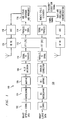
- FIG. 1 shows an exemplary OFDM system 100 having sequence data embedded in the transmitted data in accordance with the present invention.
- the system 100 includes components for transmission and reception of data.
- a coding subsystem 102 encodes binary data from a data source.
- the coded data is interleaved by an interleaving subsystem 104 and then mapped onto multi-amplitude multi-phase constellation symbols by a mapping subsystem 106.
- the multi-amplitude multi-phase constellation symbols include quadrature phase shift keying (QPSK) symbols. Pilot signals can then be inserted by a pilot insertion subsystem 108 to estimate the channel at the remote subscriber unit receivers.
- a serial-to-parallel conversion subsystem 110 converts the serial data stream to a parallel data stream that is provided to an inverse fast fourier transform (IFFT) subsystem 112.
- IFFT inverse fast fourier transform
- the transformed data is converted to serial data stream by a parallel-to-serial converter 114.
- Cyclic extension and windowing can be added by a subsystem 116 prior to digital-to-analog conversion by a DAC 118 and transmission by an antenna 120 system.
- a receive portion 130 of the OFDM system includes corresponding components for extracting the data from the received OFDM signal.
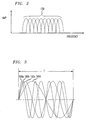
- the OFDM system 100 utilizes an overlapping orthogonal multicarrier modulation technique having a plurality of subcarriers 150.
- FIG. 3 shows the orthogonal relationship of the subcarriers. More particularly, each of four subcarriers 160a-160d of one OFDM data symbol has an integral number of cycles in the interval T. The number of cycles between adjacent subcarriers differs by one.
- FIG. 4 shows a portion of an OFDM system 200 that embeds PAP-reducing inversion sequence information within the transmitted data with no overhead in accordance with the present invention.
- the need to dedicate reference subcarriers, e.g., one for each cluster, to transmit phase factor information is eliminated.
- the OFDM system 200 includes a data source 202 generating a data stream X that is converted from a serial stream to a plurality of parallel data streams X 1 -X M and partitioned by a subsystem 204 as described below.
- the partitioned data streams are transformed by respective inverse fast Fourier transform systems 206 1 -206 M , in a conventional manner
- the clusters of transformed data are rotated by respective phase factors b 1 -b m , which are embedded into the transmitted data, as described below in detail.
- An optimizer subsystem 208 can facilitate selection of the phase factors that reduce the PAP ration of the transmitted OFDM signals.
- Equation 1 The PAP of the transmitted signal from Equation (1) can be defined as shown in Equation (2) below:
- the input data block is partitioned into disjoint sub-blocks or clusters by subsystem 204 which are combined to minimize the PAP.
- the vector x m which is referred to as the partial transmit sequence, is the Inverse Fast Fourier Transform (IFFT) of vector X m .
- IFFT Inverse Fast Fourier Transform
- the phase factors b m are chosen to minimize the PAP of x', as described below.
- phase factors can be generated in a variety of ways to minimize the PAP of the transmitted OFDM signals, including optimization, iteration, and random generation. For example, a predetermined number of Walsh sequences can be generated.
- the phase factors b m are binary phase factors, i.e., ⁇ 1.
- the phase factors include ⁇ 1 and ⁇ j.
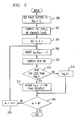
- FIG. 5 shows an exemplary sequence of steps for determining binary phase factors for the partial transmit sequence.
- the phase factors b m are set to be one for all m and in step 302 the PAP (PAP 0 ) of the combined signal with all phase factors set to one is computed.
- the phase factor index m is set to 1.
- the index value M is examined and in step 318 the index value is incremented until each phase factor is determined to be a one or a minus one.
- a predetermined number of random sequences which can be Walsh sequences, are selected.
- the information sequence is multiplied by a predetermined number of the sequences.
- the result providing the best PAP characteristics is then selected.
- This approach approximates an optimum PAP as described in L.J. Cimini. Jr. and N.R. Sollenberger, "Peak-to-Average Power Ration Reduction of an OFDM Signal Using Partial Transmit Sequences," IEEE Commun . Letts., Vol. 4, No. 3, March 2000, pp. 390-393, which is incorporated herein by reference.
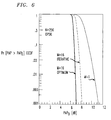
- FIG. 6 shows the PAP versus CCDF simulated results for an OFDM system having 256 subcarriers with the transmitted signal oversampled by a factor of four.
- the unmodified OFDM signal has a PAP that exceeds 10.4 dB for less than 1% of the blocks.
- the 1% PAP reduces to 6.8 dB. While a degradation of about 1 dB is encountered using the suboptimal approach, the optimization process has been reduced to 16 sets of 16 additions, a significant savings as compared to finding the optimum set of phase factors.
- the OFDM system receiver determines the inversion sequence that was embedded in the transmitted signals.
- an OFDM system in accordance with the present invention embeds a marker onto the transmitted data that can be used to uniquely identify the inversion sequence at the receiver. The detection of the inversion sequence should be sufficiently reliable so as not to have a significant effect on the overall system performance.
- the OFDM system embeds markers on the transmitted signals.
- This arrangement is equivalent to using two signal constellations for the data symbols in a cluster: one for the unrotated clusters and another, rotated by ⁇ /4, for the modified clusters.
- This algorithm puts an embedded marker on rotated clusters that can be reliably detected even in the presence of noise and multipath fading with a minimal impact on the overall system performance.
- the data modulation must first be removed.
- the frequency symbols are raised to the fourth power, which is a standard approach for removing QPSK modulation.
- Higher-order PSK modulations can be removed in a similar fashion, as is well known to one of ordinary skill in the art.
- the data symbols in the frequency domain
- the data symbols can be differentially detected by computing, for each cluster, a test statistic as set forth below in Equation 5: where Y j,m represents the jth tone in the mth cluster and * denotes conjugation.
- Y j,m represents the jth tone in the mth cluster and * denotes conjugation.
- test statistic is quantized to ⁇ 1 and decisions are made independently for each cluster. While this approach is relatively simple, there is no straightforward mechanism for correcting errors.
- detection performance is improved by quantizing the individual test statistics Z m and then decoding the entire sequence to the nearest sequence, e.g., Walsh sequence.
- the system then chooses the Walsh sequence of length M that is closest, in Hamming distance, to the resulting sequence. This technique provides error correction since the received sequence is mapped into one of only M possible Walsh sequences.
- the performance of an OFDM system in accordance with the present invention was simulated.
- QPSK is used to modulate the tones.
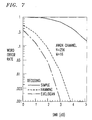
- Performance is measured by the word error rate (WER), where word corresponds to one OFDM block or, equivalently, the length of one inversion sequence. Initially, results on the detection performance are based upon the probability that the inversion sequence is received in error.
- WER word error rate
- FIG.7 shows the probability of error in detecting the inversion sequence as a function of the signal-to-noise ratio (SNR) in an additive, white, Gaussian noise (AWGN) environment.
- SNR signal-to-noise ratio
- AWGN additive, white, Gaussian noise
- the present invention provides an OFDM system that provides enhanced PAP statistics with minimal loss in efficiency.
- the system embeds combining or inversion sequence information without additional overhead.
- the embedded inversion sequence can be reliably detected by the receiver. Performance can be further improved by increasing the number of tones per cluster.
Landscapes
- Engineering & Computer Science (AREA)
- Computer Networks & Wireless Communication (AREA)
- Signal Processing (AREA)
- Error Detection And Correction (AREA)
- Digital Transmission Methods That Use Modulated Carrier Waves (AREA)
- Stereo-Broadcasting Methods (AREA)
- Detection And Prevention Of Errors In Transmission (AREA)
Abstract
Description


Claims (19)
- A method for reducing the PAP ratio in an OFDM system, comprising:dividing a data block into a plurality of clusters;determining a respective phase factor for each of the plurality of clusters to form an inversion sequence for reducing the PAP ratio of transmitted data corresponding to the plurality of clusters; andembedding the inversion sequence onto the transmitted data.
- The method according to claim 1, further including rotating at least one tone in a first one of the plurality of clusters when the corresponding phase factor rotates the first one of the plurality of clusters.
- The method according to claim 2, further including rotating every other tone in the first one of the plurality of clusters.
- The method according to claim 1, wherein the phase factors are binary phase factors.
- The method according to claim 1, further including detecting the inversion sequence.
- The method according to claim 5, further including computing a test statistic for each of the plurality of clusters to determine the inversion sequence.
- The method according to claim 5, further including quantizing the test statistics.
- The method according to claim 7, further including decoding the inversion sequence to a nearest Walsh sequence.
- The method according to claim 7, further including decoding the inversion sequence to a nearest Walsh sequence based upon Hamming distance.
- The method according to claim 7, further including decoding the inversion sequence to a nearest Walsh sequence based upon Euclidean distance.
- A method of embedding PAP-reducing inversion sequences onto transmitted data, comprising:determining an initial PAP value for a block of symbols;partitioning the block of symbols into a predetermined number of clusters;selecting a respective phase factor for each of the clusters so as to form an inversion sequence that reduces a PAP of transmitted data corresponding to the block of symbols; andembedding the inversion sequence onto the transmitted data by rotating selected tones in each of the clusters based upon a value of the associated phase factor.
- The method according to claim 11, further including employing an iterative process to determine the phase factors.
- The method according to claim 11, further including approximating an optimal inversion sequence.
- The method according to claim 11, further including selecting the inversion sequence from predetermined Walsh sequences.
- The method according to claim 11, wherein the phase factors are binary.
- The method according to claim 11, further including rotating every other tone in each cluster having an associated phase factor that rotates the cluster.
- The method according to claim 11, further including detecting the inversion sequence.
- The method according to claim 17, further including computing a test statistic for each cluster.
- The method according to claim 18, further including selecting the inversion sequence from a nearest one of predetermined Walsh sequences.
Applications Claiming Priority (4)
| Application Number | Priority Date | Filing Date | Title |
|---|---|---|---|
| US19270800P | 2000-03-28 | 2000-03-28 | |
| US192708P | 2000-03-28 | ||
| US09/778,254 US6928084B2 (en) | 2000-03-28 | 2001-02-07 | OFDM communication system and method having a reduced peak-to-average power ratio |
| US778254P | 2001-02-07 |
Publications (2)
| Publication Number | Publication Date |
|---|---|
| EP1139625A2 true EP1139625A2 (en) | 2001-10-04 |
| EP1139625A3 EP1139625A3 (en) | 2004-01-02 |
Family
ID=26888298
Family Applications (1)
| Application Number | Title | Priority Date | Filing Date |
|---|---|---|---|
| EP01106385A Withdrawn EP1139625A3 (en) | 2000-03-28 | 2001-03-19 | Reduction of the peak-to-average power ratio of multicarrier signals |
Country Status (2)
| Country | Link |
|---|---|
| US (7) | US6928084B2 (en) |
| EP (1) | EP1139625A3 (en) |
Cited By (8)
| Publication number | Priority date | Publication date | Assignee | Title |
|---|---|---|---|---|
| WO2004002100A1 (en) * | 2002-06-20 | 2003-12-31 | Nokia Corporation | Processing of an ofdm signal |
| KR100441989B1 (en) * | 2001-11-16 | 2004-07-30 | 한국전자통신연구원 | The method of Phase Factor Establishment for Partial Transmit Sequence OFDM |
| KR100478932B1 (en) * | 2002-06-11 | 2005-03-28 | 한국전자통신연구원 | Code allocation/search apparatus on multicarrier communication, and code management system and method thereof |
| KR100685867B1 (en) * | 2003-12-30 | 2007-02-23 | 엘지노텔 주식회사 | Data processing method of base station transmission system |
| WO2007066973A2 (en) | 2005-12-06 | 2007-06-14 | Lg Electronics Inc. | Apparatus and method for transmitting data using a plurality of carriers |
| KR100933115B1 (en) * | 2003-09-09 | 2009-12-21 | 삼성전자주식회사 | Apparatus and method for reducing peak to average power ratio in a orthogonal frequency division multiplexing communication system |
| KR100949965B1 (en) * | 2005-12-06 | 2010-03-29 | 엘지전자 주식회사 | Apparatus and method for transmitting data using multiple carriers |
| US10064179B2 (en) | 2003-02-18 | 2018-08-28 | Qualcomm Incorporated | Carrier assignment for multi-carrier modulation in wireless communication |
Families Citing this family (56)
| Publication number | Priority date | Publication date | Assignee | Title |
|---|---|---|---|---|
| US6928084B2 (en) | 2000-03-28 | 2005-08-09 | At & T Corp. | OFDM communication system and method having a reduced peak-to-average power ratio |
| US6904269B1 (en) * | 2000-06-02 | 2005-06-07 | Tektronix, Inc. | Signal type identification |
| US7127005B2 (en) * | 2001-03-23 | 2006-10-24 | James Stuart Wight | Computational circuits and methods for processing modulated signals having non-constant envelopes |
| US20020159532A1 (en) * | 2001-03-23 | 2002-10-31 | Icefyre Semiconductor Corporation | Computational circuits and methods for signal deconstruction/reconstruction in wireless transceivers |
| US20030086363A1 (en) * | 2001-05-31 | 2003-05-08 | David Hernandez | System and apparatus for block segmentation procedure for reduction of peak-to- average power ratio effects in orthogonal frequency-division multiplexing modulation |
| WO2003075500A2 (en) * | 2002-03-07 | 2003-09-12 | Alvarion Ltd. | Hierarchical preamble constructions for ofdma based on complementary sequences |
| JP2003283460A (en) * | 2002-03-26 | 2003-10-03 | Matsushita Electric Ind Co Ltd | Multicarrier transmission apparatus and multicarrier transmission method |
| KR100754721B1 (en) * | 2002-04-26 | 2007-09-03 | 삼성전자주식회사 | Multiplexed Data Transceiver and Method in Orthogonal Frequency Division Multiplexed Communication System |
| KR20040005175A (en) * | 2002-07-08 | 2004-01-16 | 삼성전자주식회사 | Apparatus and method for transmitting and receiving side information of selective mapping in orthogonal frequency division multiplexing communication system |
| US7139322B1 (en) | 2002-07-15 | 2006-11-21 | National Semiconductor Corporation | Method for reducing peak-to-average power ratios in a multi-carrier transmission system |
| KR100548319B1 (en) * | 2002-12-27 | 2006-02-02 | 엘지전자 주식회사 | Method for Searching Minimum PA Series in Orthogonal Multiple Access System |
| US7505522B1 (en) * | 2003-10-06 | 2009-03-17 | Staccato Communications, Inc. | Spectral shaping in multiband OFDM transmitter with clipping |
| US7995967B2 (en) | 2004-03-09 | 2011-08-09 | Neocific, Inc | Methods and apparatus for random access in multi-carrier communication systems |
| KR100713528B1 (en) * | 2004-03-12 | 2007-05-02 | 삼성전자주식회사 | Apparatus and method for transmitting sub-channel signal in a communication system using orthogonal frequency division multiple access scheme |
| US7519123B1 (en) | 2004-04-08 | 2009-04-14 | Staccato Communications, Inc. | Spectral shaping for multiband OFDM transmitters with time spreading |
| US7342978B2 (en) * | 2004-06-02 | 2008-03-11 | Industrial Technology Research Institute | Method and apparatus for PAPR reduction of an OFDM signal |
| KR100739511B1 (en) * | 2004-06-25 | 2007-07-13 | 삼성전자주식회사 | Apparatus and method for transmitting/receiving pilot signal in a communication system using orthogonal frequency division multiplexing scheme |
| JP2006314081A (en) * | 2005-04-08 | 2006-11-16 | Matsushita Electric Ind Co Ltd | Communication apparatus and communication method |
| DE102006010900C5 (en) * | 2005-05-11 | 2015-05-28 | Sew-Eurodrive Gmbh & Co Kg | System for the contactless transmission of information |
| US7792200B2 (en) * | 2005-11-14 | 2010-09-07 | Telefonaltiebolaget Lm Ericsson (Publ) | Peak-to-average power reduction |
| US20070110177A1 (en) * | 2005-11-14 | 2007-05-17 | Telefonaktiebolaget Lm Ericsson | RF power distribution in the frequency domain |
| US7860147B2 (en) | 2006-08-16 | 2010-12-28 | Harris Corporation | Method of communicating and associated transmitter using coded orthogonal frequency division multiplexing (COFDM) |
| US7649951B2 (en) * | 2006-08-16 | 2010-01-19 | Harris Corporation | System and method for communicating data using symbol-based randomized orthogonal frequency division multiplexing (OFDM) with applied frequency domain spreading |
| US7751488B2 (en) * | 2006-08-16 | 2010-07-06 | Harris Corporation | System and method for communicating data using symbol-based randomized orthogonal frequency division multiplexing (OFDM) |
| US7903749B2 (en) * | 2006-08-16 | 2011-03-08 | Harris Corporation | System and method for applying frequency domain spreading to multi-carrier communications signals |
| US7813433B2 (en) * | 2006-08-16 | 2010-10-12 | Harris Corporation | System and method for communicating data using symbol-based randomized orthogonal frequency division multiplexing (OFDM) with selected subcarriers turned on or off |
| WO2008095334A1 (en) * | 2007-02-02 | 2008-08-14 | Huawei Technologies Co., Ltd. | Peak to average power ratio reduction in multi- carrier systems |
| KR101314254B1 (en) | 2007-02-16 | 2013-10-02 | 삼성전자주식회사 | OFDM transmitting and receiving systems and methods thereof |
| US7986738B2 (en) * | 2007-10-19 | 2011-07-26 | Redpine Signals, Inc | Peak to average power ratio reduction apparatus and method for a wireless OFDM transmitter |
| CN101420404B (en) * | 2007-10-26 | 2011-06-01 | 华为技术有限公司 | Peak eliminating method, peak eliminating device and reference peak eliminating signal generating device |
| US8229009B2 (en) | 2008-04-01 | 2012-07-24 | Harris Corporation | System and method for communicating data using efficient fast fourier transform (FFT) for orthogonal frequency division multiplexing (OFDM) modulation |
| US8238454B2 (en) * | 2008-04-01 | 2012-08-07 | Harris Corporation | System and method for communicating data using efficient fast fourier transform (FFT) for orthogonal frequency division multiplexing (OFDM) demodulation |
| US8274921B2 (en) * | 2008-04-01 | 2012-09-25 | Harris Corporation | System and method for communicating data using efficient fast fourier transform (FFT) for orthogonal frequency division multiplexing (OFDM) |
| WO2010042885A1 (en) * | 2008-10-10 | 2010-04-15 | Powerwave Technologies, Inc. | Crest factor reduction for ofdm communications systems by transmitting phase shifted resource blocks |
| KR101067644B1 (en) | 2009-03-10 | 2011-09-27 | 서울대학교산학협력단 | Reduction Method of Maximum Power to Average Power of Orthogonal Frequency Division Multiplexing System Using Partial Bit Inversion Selection Mapping Technique |
| CN102223337B (en) * | 2010-04-16 | 2014-04-16 | 华为技术有限公司 | Method and device for generating reference canceling signals |
| CN101984615A (en) * | 2010-11-19 | 2011-03-09 | 京信通信系统(中国)有限公司 | Device for reducing peak-to-average power ratio and method and application thereof |
| TWI456955B (en) * | 2012-01-18 | 2014-10-11 | Univ Nat Sun Yat Sen | A method for reduction of papr based on ofdm system |
| US8675769B1 (en) | 2012-06-20 | 2014-03-18 | MagnaCom Ltd. | Constellation map optimization for highly spectrally efficient communications |
| US9438457B2 (en) | 2013-03-25 | 2016-09-06 | Maxlinear, Inc. | Peak to average power ratio suppression |
| US9094269B2 (en) * | 2013-03-25 | 2015-07-28 | Maxlinear, Inc. | Peak to average power ratio suppression |
| CN105393468B (en) | 2013-08-29 | 2019-11-29 | 华为技术有限公司 | Method and node in wireless communication network |
| US9118519B2 (en) | 2013-11-01 | 2015-08-25 | MagnaCom Ltd. | Reception of inter-symbol-correlated signals using symbol-by-symbol soft-output demodulator |
| US9496900B2 (en) | 2014-05-06 | 2016-11-15 | MagnaCom Ltd. | Signal acquisition in a multimode environment |
| PL3143820T3 (en) | 2014-06-12 | 2022-11-14 | Huawei Technologies Co., Ltd. | Apparatus and method for ofdma tone allocation in next generation wi-fi networks |
| US9246523B1 (en) | 2014-08-27 | 2016-01-26 | MagnaCom Ltd. | Transmitter signal shaping |
| CN104702555A (en) * | 2015-04-03 | 2015-06-10 | 临沂大学 | Method for restraining peak-to-average ratio of DCO-OFDM system |
| CN104753848A (en) * | 2015-04-17 | 2015-07-01 | 临沂大学 | Low-complexity peak-to-average ratio restraining method for optical communication DCO-OFDM (direct current-biased optical-orthogonal frequency division multiplexing) system |
| CN104780135A (en) * | 2015-05-05 | 2015-07-15 | 临沂大学 | DFT-GCS-based visible light DCO-OFDM system peak-to-average ratio restraining method |
| CN106506425B (en) * | 2016-09-27 | 2019-10-18 | 哈尔滨工程大学 | A Partial Transmission Sequence Peak-to-Average Ratio Suppression Algorithm Based on Bit Error Accumulation Detection in Underwater Acoustic OFDM Communication System |
| CN111200571B (en) * | 2018-11-19 | 2021-10-01 | 华为技术有限公司 | A kind of signal transmission method and device |
| CN111865858B (en) * | 2019-04-30 | 2022-01-11 | 华为技术有限公司 | Side information transmission method and device based on partial transmission sequence technology |
| JP2022184007A (en) * | 2021-05-31 | 2022-12-13 | 地方独立行政法人東京都健康長寿医療センター | Mitochondrial supercomplex formation promoter, composition for maintaining or improving muscular strength, therapeutic or preventative pharmaceutical composition for diseases which cause deterioration of mitochondrial or muscular function, and screening method for substances which contribute to formation of mitochondrial supercomplex |
| US11765011B2 (en) | 2021-07-06 | 2023-09-19 | Huawei Technologies Co., Ltd. | Method and apparatus for transmitting and receiving data |
| TWI792954B (en) * | 2022-03-23 | 2023-02-11 | 瑞昱半導體股份有限公司 | Communication device and method of handling papr |
| US12057985B2 (en) * | 2022-12-09 | 2024-08-06 | Qualcomm Incorporated | Techniques for partial transmit sequence transmission using multi-mode index modulation |
Family Cites Families (31)
| Publication number | Priority date | Publication date | Assignee | Title |
|---|---|---|---|---|
| US4346384A (en) * | 1980-06-30 | 1982-08-24 | The Austin Company | Remote object position and orientation locator |
| CA2015318C (en) * | 1990-04-24 | 1994-02-08 | Jack E. Bridges | Power sources for downhole electrical heating |
| US4984219A (en) * | 1989-12-26 | 1991-01-08 | Motorola, Inc. | Method and apparatus for decoding of frequency inversion based scramblers |
| US5995539A (en) * | 1993-03-17 | 1999-11-30 | Miller; William J. | Method and apparatus for signal transmission and reception |
| SG52170A1 (en) * | 1994-02-17 | 1998-09-28 | Micrilor Inc | A high-data-rate wireless local-area network |
| US6334219B1 (en) * | 1994-09-26 | 2001-12-25 | Adc Telecommunications Inc. | Channel selection for a hybrid fiber coax network |
| EP0735731B1 (en) * | 1995-03-31 | 2004-05-12 | Victor Company Of Japan, Limited | Multicarrier modulator demodulator, with arrangements for reducing peak power |
| US6850497B1 (en) * | 1995-09-19 | 2005-02-01 | Mobile Satellite Ventures, Lp | Satellite trunked radio service system |
| US5914933A (en) * | 1996-03-08 | 1999-06-22 | Lucent Technologies Inc. | Clustered OFDM communication system |
| DE19635813A1 (en) * | 1996-09-04 | 1998-03-05 | Johannes Prof Dr Ing Huber | Process for reducing the peak value factor in digital transmission processes |
| US6584144B2 (en) * | 1997-02-24 | 2003-06-24 | At&T Wireless Services, Inc. | Vertical adaptive antenna array for a discrete multitone spread spectrum communications system |
| US6005840A (en) * | 1997-04-01 | 1999-12-21 | Lucent Technologies Inc. | Complementary encoding and modulation system for use in an orthogonal frequency division multiplexing transmitter system and method thereof |
| US6044103A (en) * | 1997-06-17 | 2000-03-28 | Qualcomm Inc. | Reduced peak-to-average amplitude dual channel link |
| US6549512B2 (en) * | 1997-06-25 | 2003-04-15 | Texas Instruments Incorporated | MDSL DMT architecture |
| US6175551B1 (en) * | 1997-07-31 | 2001-01-16 | Lucent Technologies, Inc. | Transmission system and method employing peak cancellation to reduce the peak-to-average power ratio |
| US5995551A (en) * | 1997-08-15 | 1999-11-30 | Sicom, Inc. | Rotationally invariant pragmatic trellis coded digital communication system and method therefor |
| US7280607B2 (en) * | 1997-12-12 | 2007-10-09 | Freescale Semiconductor, Inc. | Ultra wide bandwidth communications method and system |
| US6366555B1 (en) * | 1998-02-03 | 2002-04-02 | Texas Instruments Incorporated | Method and device for controlling signal clipping in a discrete multi-tone communications system |
| US5955992A (en) * | 1998-02-12 | 1999-09-21 | Shattil; Steve J. | Frequency-shifted feedback cavity used as a phased array antenna controller and carrier interference multiple access spread-spectrum transmitter |
| US6301268B1 (en) * | 1998-03-10 | 2001-10-09 | Lucent Technologies Inc. | Communication method for frequency division multiplexing signalling systems with reduced average power requirements |
| US6314146B1 (en) * | 1998-06-05 | 2001-11-06 | The Board Of Trustees Of The Leland Stanford Junior University | Peak to average power ratio reduction |
| US7548787B2 (en) * | 2005-08-03 | 2009-06-16 | Kamilo Feher | Medical diagnostic and communication system |
| US6501747B1 (en) * | 1998-08-20 | 2002-12-31 | Metawave Communications Corporation | Manifold assisted channel estimation and demodulation for CDMA systems in fast fading environments |
| US6268824B1 (en) * | 1998-09-18 | 2001-07-31 | Topcon Positioning Systems, Inc. | Methods and apparatuses of positioning a mobile user in a system of satellite differential navigation |
| US6721349B1 (en) * | 1999-01-28 | 2004-04-13 | Qualcomm Incorporated | Method and apparatus for reducing peak-to-average ratio in a CDMA communication system |
| US6556557B1 (en) * | 1999-06-02 | 2003-04-29 | At&T Corp. | Method and system for reducing of peak-to-average power ratio of transmission signals comprising overlapping waveforms |
| US6363060B1 (en) * | 1999-06-30 | 2002-03-26 | Qualcomm Incorporated | Method and apparatus for fast WCDMA acquisition |
| US6633614B1 (en) * | 1999-09-15 | 2003-10-14 | Telcordia Technologies, Inc. | Multicarrier personal access communication system |
| US6985432B1 (en) * | 2000-01-28 | 2006-01-10 | Zion Hadad | OFDM communication channel |
| US6928084B2 (en) | 2000-03-28 | 2005-08-09 | At & T Corp. | OFDM communication system and method having a reduced peak-to-average power ratio |
| WO2002009298A2 (en) * | 2000-07-24 | 2002-01-31 | Runcom Communications Ltd. | Wireless interactive system and method |
-
2001
- 2001-02-07 US US09/778,254 patent/US6928084B2/en not_active Expired - Lifetime
- 2001-03-19 EP EP01106385A patent/EP1139625A3/en not_active Withdrawn
-
2005
- 2005-07-26 US US11/190,308 patent/US7206317B2/en not_active Expired - Lifetime
-
2007
- 2007-03-12 US US11/685,028 patent/US7558282B2/en not_active Expired - Fee Related
-
2009
- 2009-06-23 US US12/490,050 patent/US7995602B2/en not_active Expired - Fee Related
-
2011
- 2011-08-08 US US13/205,231 patent/US8335225B2/en not_active Expired - Fee Related
-
2012
- 2012-12-05 US US13/706,054 patent/US8761191B2/en not_active Expired - Fee Related
-
2014
- 2014-06-23 US US14/312,252 patent/US9628312B2/en not_active Expired - Fee Related
Cited By (20)
| Publication number | Priority date | Publication date | Assignee | Title |
|---|---|---|---|---|
| KR100441989B1 (en) * | 2001-11-16 | 2004-07-30 | 한국전자통신연구원 | The method of Phase Factor Establishment for Partial Transmit Sequence OFDM |
| US7352689B2 (en) | 2001-11-16 | 2008-04-01 | Electronics And Telecommunications Research Institute | Method for optimizing phase factor of sub-block signal in partial transmit sequence orthogonal frequency division multiplexing system |
| KR100478932B1 (en) * | 2002-06-11 | 2005-03-28 | 한국전자통신연구원 | Code allocation/search apparatus on multicarrier communication, and code management system and method thereof |
| WO2004002100A1 (en) * | 2002-06-20 | 2003-12-31 | Nokia Corporation | Processing of an ofdm signal |
| US7346041B2 (en) | 2002-06-20 | 2008-03-18 | Nokia Corporation | Processing of an OFDM signal |
| US10064179B2 (en) | 2003-02-18 | 2018-08-28 | Qualcomm Incorporated | Carrier assignment for multi-carrier modulation in wireless communication |
| KR100933115B1 (en) * | 2003-09-09 | 2009-12-21 | 삼성전자주식회사 | Apparatus and method for reducing peak to average power ratio in a orthogonal frequency division multiplexing communication system |
| KR100685867B1 (en) * | 2003-12-30 | 2007-02-23 | 엘지노텔 주식회사 | Data processing method of base station transmission system |
| US8059738B2 (en) | 2005-12-06 | 2011-11-15 | Lg Electronics Inc. | Apparatus and method for transmitting data using a plurality of carriers |
| KR100949965B1 (en) * | 2005-12-06 | 2010-03-29 | 엘지전자 주식회사 | Apparatus and method for transmitting data using multiple carriers |
| WO2007066973A3 (en) * | 2005-12-06 | 2007-11-01 | Lg Electronics Inc | Apparatus and method for transmitting data using a plurality of carriers |
| US8340203B2 (en) | 2005-12-06 | 2012-12-25 | Lg Electronics Inc. | Apparatus and method for transmitting data using a plurality of carriers |
| TWI427985B (en) * | 2005-12-06 | 2014-02-21 | Lg Electronics Inc | Apparatus and method for transmitting data using a plurality of carriers |
| EP1958408A4 (en) * | 2005-12-06 | 2014-03-26 | Lg Electronics Inc | DEVICE AND METHOD FOR SENDING DATA USING MULTIPLE SUPPORTS |
| US8873658B2 (en) | 2005-12-06 | 2014-10-28 | Lg Electronics Inc. | Apparatus and method for transmitting data using a plurality of carriers |
| US9130809B2 (en) | 2005-12-06 | 2015-09-08 | Lg Electronics Inc. | Apparatus and method for transmitting data using a plurality of carriers |
| US9246732B2 (en) | 2005-12-06 | 2016-01-26 | Lg Electronics Inc. | Apparatus and method for transmitting data using a plurality of carriers |
| US9906387B2 (en) | 2005-12-06 | 2018-02-27 | Lg Electronics Inc. | Apparatus and method for transmitting data using a plurality of carriers |
| WO2007066973A2 (en) | 2005-12-06 | 2007-06-14 | Lg Electronics Inc. | Apparatus and method for transmitting data using a plurality of carriers |
| US10374854B2 (en) | 2005-12-06 | 2019-08-06 | Microsoft Technology Licensing, Llc | Apparatus and method for transmitting data using a plurality of carriers |
Also Published As
| Publication number | Publication date |
|---|---|
| US20050259569A1 (en) | 2005-11-24 |
| US7995602B2 (en) | 2011-08-09 |
| US9628312B2 (en) | 2017-04-18 |
| US20130094614A1 (en) | 2013-04-18 |
| US8761191B2 (en) | 2014-06-24 |
| US7206317B2 (en) | 2007-04-17 |
| US8335225B2 (en) | 2012-12-18 |
| US7558282B2 (en) | 2009-07-07 |
| US20090257443A1 (en) | 2009-10-15 |
| US20070153932A1 (en) | 2007-07-05 |
| EP1139625A3 (en) | 2004-01-02 |
| US6928084B2 (en) | 2005-08-09 |
| US20010036151A1 (en) | 2001-11-01 |
| US20110292985A1 (en) | 2011-12-01 |
| US20140314187A1 (en) | 2014-10-23 |
Similar Documents
| Publication | Publication Date | Title |
|---|---|---|
| US6928084B2 (en) | OFDM communication system and method having a reduced peak-to-average power ratio | |
| Cimini et al. | Peak-to-average power ratio reduction of an OFDM signal using partial transmit sequences with embedded side information | |
| CN1849761B (en) | Apparatus and method for reducing peak-to-average power ratio in OFDM communication system | |
| US7376074B2 (en) | Apparatus and method for transmitting and receiving side information of a partial transmit sequence in an OFDM communication system | |
| US7321629B2 (en) | Method and apparatus for protecting and transmitting the side information related to peak-to-average power ratio reduction in a multicarrier system | |
| US7496028B2 (en) | Apparatus and method for minimizing PAPR in an OFDM communication system | |
| US20140192924A1 (en) | Method and system for reduction of peak-to-average power ratio of transmission signals comprising overlapping waveforms | |
| EP1381196A1 (en) | Apparatus and method for transmitting and receiving side information about selective mapping in an orthogonal frequency division multiplexing communication system | |
| WO2008046163A1 (en) | Method of reducing papr in ofdm signals | |
| Jayalath et al. | Peak-to-average power ratio of IEEE 802.11 a PHY layer signals | |
| Sathananthan et al. | Novel adaptive modulation scheme to reduce both PAR and ICI of an OFDM signal | |
| Muta et al. | A peak power reduction scheme with phase-control of clustered parity-carriers for a systematic block-coded OFDM signal | |
| Jamieson et al. | SPCp1-04: Bit Mapping and Error Insertion for FEC Based PAPR Reduction in OFDM Signals | |
| Sathananthan et al. | Reducing PAR and PICR of an OFDM Signal | |
| Reisi et al. | Embedded SI partial transmit sequence with improved bit error rate | |
| Muta | A subcarrier-phase control based peak power reduction method for coded space division multiplexed OFDM systems | |
| Pisek et al. | Novel dithering-based peak-to-average power ratio reduction system |
Legal Events
| Date | Code | Title | Description |
|---|---|---|---|
| PUAI | Public reference made under article 153(3) epc to a published international application that has entered the european phase |
Free format text: ORIGINAL CODE: 0009012 |
|
| AK | Designated contracting states |
Kind code of ref document: A2 Designated state(s): AT BE CH CY DE DK ES FI FR GB GR IE IT LI LU MC NL PT SE TR |
|
| AX | Request for extension of the european patent |
Free format text: AL;LT;LV;MK;RO;SI |
|
| PUAL | Search report despatched |
Free format text: ORIGINAL CODE: 0009013 |
|
| AK | Designated contracting states |
Kind code of ref document: A3 Designated state(s): AT BE CH CY DE DK ES FI FR GB GR IE IT LI LU MC NL PT SE TR |
|
| AX | Request for extension of the european patent |
Extension state: AL LT LV MK RO SI |
|
| STAA | Information on the status of an ep patent application or granted ep patent |
Free format text: STATUS: THE APPLICATION IS DEEMED TO BE WITHDRAWN |
|
| 18D | Application deemed to be withdrawn |
Effective date: 20031001 |