EP1138819A2 - Fiber product treating agents - Google Patents
Fiber product treating agents Download PDFInfo
- Publication number
- EP1138819A2 EP1138819A2 EP01107728A EP01107728A EP1138819A2 EP 1138819 A2 EP1138819 A2 EP 1138819A2 EP 01107728 A EP01107728 A EP 01107728A EP 01107728 A EP01107728 A EP 01107728A EP 1138819 A2 EP1138819 A2 EP 1138819A2
- Authority
- EP
- European Patent Office
- Prior art keywords
- treating agent
- mass
- acid
- fabric
- hours
- Prior art date
- Legal status (The legal status is an assumption and is not a legal conclusion. Google has not performed a legal analysis and makes no representation as to the accuracy of the status listed.)
- Granted
Links
- 239000003795 chemical substances by application Substances 0.000 title claims abstract description 87
- 239000000835 fiber Substances 0.000 title claims abstract description 60
- XLYOFNOQVPJJNP-UHFFFAOYSA-N water Substances O XLYOFNOQVPJJNP-UHFFFAOYSA-N 0.000 claims abstract description 60
- 238000010438 heat treatment Methods 0.000 claims abstract description 41
- 150000001875 compounds Chemical class 0.000 claims abstract description 32
- 238000011282 treatment Methods 0.000 claims abstract description 30
- 230000037303 wrinkles Effects 0.000 claims abstract description 8
- 239000000178 monomer Substances 0.000 claims description 105
- 239000004744 fabric Substances 0.000 claims description 61
- 229920002554 vinyl polymer Polymers 0.000 claims description 51
- 125000003178 carboxy group Chemical group [H]OC(*)=O 0.000 claims description 36
- 125000002887 hydroxy group Chemical group [H]O* 0.000 claims description 35
- 229920000642 polymer Polymers 0.000 claims description 33
- 238000000034 method Methods 0.000 claims description 22
- 125000000391 vinyl group Chemical group [H]C([*])=C([H])[H] 0.000 claims description 21
- 239000007864 aqueous solution Substances 0.000 claims description 18
- 239000008367 deionised water Substances 0.000 claims description 17
- 229910021641 deionized water Inorganic materials 0.000 claims description 17
- 238000001035 drying Methods 0.000 claims description 15
- 229910017053 inorganic salt Inorganic materials 0.000 claims description 13
- 229920001296 polysiloxane Polymers 0.000 claims description 12
- 229920000728 polyester Polymers 0.000 claims description 8
- 239000012141 concentrate Substances 0.000 claims description 7
- 239000000470 constituent Substances 0.000 claims description 7
- 238000007865 diluting Methods 0.000 claims description 3
- XEEYBQQBJWHFJM-UHFFFAOYSA-N Iron Chemical compound [Fe] XEEYBQQBJWHFJM-UHFFFAOYSA-N 0.000 abstract description 20
- 230000000694 effects Effects 0.000 abstract description 16
- 229910052742 iron Inorganic materials 0.000 abstract description 10
- 238000005406 washing Methods 0.000 abstract description 6
- IJGRMHOSHXDMSA-UHFFFAOYSA-N Atomic nitrogen Chemical compound N#N IJGRMHOSHXDMSA-UHFFFAOYSA-N 0.000 description 100
- 230000015572 biosynthetic process Effects 0.000 description 78
- 238000003786 synthesis reaction Methods 0.000 description 76
- 239000000243 solution Substances 0.000 description 55
- 229910052757 nitrogen Inorganic materials 0.000 description 50
- HEMHJVSKTPXQMS-UHFFFAOYSA-M sodium hydroxide Inorganic materials [OH-].[Na+] HEMHJVSKTPXQMS-UHFFFAOYSA-M 0.000 description 50
- MHAJPDPJQMAIIY-UHFFFAOYSA-N Hydrogen peroxide Chemical compound OO MHAJPDPJQMAIIY-UHFFFAOYSA-N 0.000 description 32
- 229920001223 polyethylene glycol Polymers 0.000 description 31
- 229920006163 vinyl copolymer Polymers 0.000 description 28
- ATVJXMYDOSMEPO-UHFFFAOYSA-N 3-prop-2-enoxyprop-1-ene Chemical compound C=CCOCC=C ATVJXMYDOSMEPO-UHFFFAOYSA-N 0.000 description 26
- 238000001816 cooling Methods 0.000 description 26
- 229920001577 copolymer Polymers 0.000 description 25
- 239000003999 initiator Substances 0.000 description 25
- -1 hydrogen compound Chemical class 0.000 description 22
- LCPVQAHEFVXVKT-UHFFFAOYSA-N 2-(2,4-difluorophenoxy)pyridin-3-amine Chemical compound NC1=CC=CN=C1OC1=CC=C(F)C=C1F LCPVQAHEFVXVKT-UHFFFAOYSA-N 0.000 description 20
- CHQMHPLRPQMAMX-UHFFFAOYSA-L sodium persulfate Substances [Na+].[Na+].[O-]S(=O)(=O)OOS([O-])(=O)=O CHQMHPLRPQMAMX-UHFFFAOYSA-L 0.000 description 20
- FPYJFEHAWHCUMM-UHFFFAOYSA-N maleic anhydride Chemical compound O=C1OC(=O)C=C1 FPYJFEHAWHCUMM-UHFFFAOYSA-N 0.000 description 17
- 150000003839 salts Chemical class 0.000 description 15
- NIXOWILDQLNWCW-UHFFFAOYSA-M Acrylate Chemical compound [O-]C(=O)C=C NIXOWILDQLNWCW-UHFFFAOYSA-M 0.000 description 14
- 239000002253 acid Substances 0.000 description 14
- 239000001913 cellulose Substances 0.000 description 12
- 229920002678 cellulose Polymers 0.000 description 12
- 239000003921 oil Substances 0.000 description 12
- SMZOUWXMTYCWNB-UHFFFAOYSA-N 2-(2-methoxy-5-methylphenyl)ethanamine Chemical compound COC1=CC=C(C)C=C1CCN SMZOUWXMTYCWNB-UHFFFAOYSA-N 0.000 description 11
- NIXOWILDQLNWCW-UHFFFAOYSA-N 2-Propenoic acid Natural products OC(=O)C=C NIXOWILDQLNWCW-UHFFFAOYSA-N 0.000 description 11
- HRPVXLWXLXDGHG-UHFFFAOYSA-N Acrylamide Chemical compound NC(=O)C=C HRPVXLWXLXDGHG-UHFFFAOYSA-N 0.000 description 11
- 125000004432 carbon atom Chemical group C* 0.000 description 11
- 239000004205 dimethyl polysiloxane Substances 0.000 description 11
- 235000013870 dimethyl polysiloxane Nutrition 0.000 description 11
- 229920000435 poly(dimethylsiloxane) Polymers 0.000 description 11
- 238000005507 spraying Methods 0.000 description 11
- VZCYOOQTPOCHFL-UHFFFAOYSA-N trans-butenedioic acid Natural products OC(=O)C=CC(O)=O VZCYOOQTPOCHFL-UHFFFAOYSA-N 0.000 description 11
- 239000012298 atmosphere Substances 0.000 description 10
- CERQOIWHTDAKMF-UHFFFAOYSA-N Methacrylic acid Chemical compound CC(=C)C(O)=O CERQOIWHTDAKMF-UHFFFAOYSA-N 0.000 description 9
- OFOBLEOULBTSOW-UHFFFAOYSA-N Propanedioic acid Natural products OC(=O)CC(O)=O OFOBLEOULBTSOW-UHFFFAOYSA-N 0.000 description 9
- 235000014113 dietary fatty acids Nutrition 0.000 description 9
- 239000000194 fatty acid Substances 0.000 description 9
- 229930195729 fatty acid Natural products 0.000 description 9
- 150000004665 fatty acids Chemical class 0.000 description 9
- 239000000203 mixture Substances 0.000 description 9
- RTZKZFJDLAIYFH-UHFFFAOYSA-N Diethyl ether Chemical compound CCOCC RTZKZFJDLAIYFH-UHFFFAOYSA-N 0.000 description 8
- 125000000217 alkyl group Chemical group 0.000 description 8
- 229920006318 anionic polymer Polymers 0.000 description 8
- 238000006243 chemical reaction Methods 0.000 description 8
- VZCYOOQTPOCHFL-UPHRSURJSA-N maleic acid Chemical compound OC(=O)\C=C/C(O)=O VZCYOOQTPOCHFL-UPHRSURJSA-N 0.000 description 8
- 239000011976 maleic acid Substances 0.000 description 8
- 150000001732 carboxylic acid derivatives Chemical class 0.000 description 7
- 210000002268 wool Anatomy 0.000 description 7
- JAHNSTQSQJOJLO-UHFFFAOYSA-N 2-(3-fluorophenyl)-1h-imidazole Chemical compound FC1=CC=CC(C=2NC=CN=2)=C1 JAHNSTQSQJOJLO-UHFFFAOYSA-N 0.000 description 6
- OMIGHNLMNHATMP-UHFFFAOYSA-N 2-hydroxyethyl prop-2-enoate Chemical compound OCCOC(=O)C=C OMIGHNLMNHATMP-UHFFFAOYSA-N 0.000 description 6
- KWSLGOVYXMQPPX-UHFFFAOYSA-N 5-[3-(trifluoromethyl)phenyl]-2h-tetrazole Chemical compound FC(F)(F)C1=CC=CC(C2=NNN=N2)=C1 KWSLGOVYXMQPPX-UHFFFAOYSA-N 0.000 description 6
- VZCYOOQTPOCHFL-OWOJBTEDSA-N Fumaric acid Chemical compound OC(=O)\C=C\C(O)=O VZCYOOQTPOCHFL-OWOJBTEDSA-N 0.000 description 6
- DGAQECJNVWCQMB-PUAWFVPOSA-M Ilexoside XXIX Chemical compound C[C@@H]1CC[C@@]2(CC[C@@]3(C(=CC[C@H]4[C@]3(CC[C@@H]5[C@@]4(CC[C@@H](C5(C)C)OS(=O)(=O)[O-])C)C)[C@@H]2[C@]1(C)O)C)C(=O)O[C@H]6[C@@H]([C@H]([C@@H]([C@H](O6)CO)O)O)O.[Na+] DGAQECJNVWCQMB-PUAWFVPOSA-M 0.000 description 6
- 150000007513 acids Chemical class 0.000 description 6
- KRKNYBCHXYNGOX-UHFFFAOYSA-N citric acid Chemical compound OC(=O)CC(O)(C(O)=O)CC(O)=O KRKNYBCHXYNGOX-UHFFFAOYSA-N 0.000 description 6
- 150000002148 esters Chemical class 0.000 description 6
- LVHBHZANLOWSRM-UHFFFAOYSA-N methylenebutanedioic acid Natural products OC(=O)CC(=C)C(O)=O LVHBHZANLOWSRM-UHFFFAOYSA-N 0.000 description 6
- 229940088644 n,n-dimethylacrylamide Drugs 0.000 description 6
- YLGYACDQVQQZSW-UHFFFAOYSA-N n,n-dimethylprop-2-enamide Chemical compound CN(C)C(=O)C=C YLGYACDQVQQZSW-UHFFFAOYSA-N 0.000 description 6
- 239000002736 nonionic surfactant Substances 0.000 description 6
- 229910001379 sodium hypophosphite Inorganic materials 0.000 description 6
- 150000008065 acid anhydrides Chemical class 0.000 description 5
- 125000000129 anionic group Chemical group 0.000 description 5
- 125000004435 hydrogen atom Chemical group [H]* 0.000 description 5
- 238000010409 ironing Methods 0.000 description 5
- 229920001451 polypropylene glycol Polymers 0.000 description 5
- 229920002545 silicone oil Polymers 0.000 description 5
- 239000011734 sodium Substances 0.000 description 5
- 239000000126 substance Substances 0.000 description 5
- 150000005846 sugar alcohols Polymers 0.000 description 5
- 229920000742 Cotton Polymers 0.000 description 4
- 239000004593 Epoxy Substances 0.000 description 4
- 241000219146 Gossypium Species 0.000 description 4
- NBIIXXVUZAFLBC-UHFFFAOYSA-N Phosphoric acid Chemical compound OP(O)(O)=O NBIIXXVUZAFLBC-UHFFFAOYSA-N 0.000 description 4
- 229920003171 Poly (ethylene oxide) Polymers 0.000 description 4
- QAOWNCQODCNURD-UHFFFAOYSA-N Sulfuric acid Chemical compound OS(O)(=O)=O QAOWNCQODCNURD-UHFFFAOYSA-N 0.000 description 4
- 229910052783 alkali metal Inorganic materials 0.000 description 4
- 239000003599 detergent Substances 0.000 description 4
- 238000005259 measurement Methods 0.000 description 4
- 229910052708 sodium Inorganic materials 0.000 description 4
- 239000004094 surface-active agent Substances 0.000 description 4
- WEVYAHXRMPXWCK-UHFFFAOYSA-N Acetonitrile Chemical compound CC#N WEVYAHXRMPXWCK-UHFFFAOYSA-N 0.000 description 3
- QGZKDVFQNNGYKY-UHFFFAOYSA-N Ammonia Chemical compound N QGZKDVFQNNGYKY-UHFFFAOYSA-N 0.000 description 3
- LFQSCWFLJHTTHZ-UHFFFAOYSA-N Ethanol Chemical compound CCO LFQSCWFLJHTTHZ-UHFFFAOYSA-N 0.000 description 3
- PEDCQBHIVMGVHV-UHFFFAOYSA-N Glycerine Chemical compound OCC(O)CO PEDCQBHIVMGVHV-UHFFFAOYSA-N 0.000 description 3
- KFZMGEQAYNKOFK-UHFFFAOYSA-N Isopropanol Chemical compound CC(C)O KFZMGEQAYNKOFK-UHFFFAOYSA-N 0.000 description 3
- 239000004721 Polyphenylene oxide Chemical group 0.000 description 3
- ZLMJMSJWJFRBEC-UHFFFAOYSA-N Potassium Chemical compound [K] ZLMJMSJWJFRBEC-UHFFFAOYSA-N 0.000 description 3
- KWYUFKZDYYNOTN-UHFFFAOYSA-M Potassium hydroxide Chemical compound [OH-].[K+] KWYUFKZDYYNOTN-UHFFFAOYSA-M 0.000 description 3
- 229920002472 Starch Polymers 0.000 description 3
- 229910052784 alkaline earth metal Inorganic materials 0.000 description 3
- 150000001346 alkyl aryl ethers Chemical class 0.000 description 3
- 150000001412 amines Chemical class 0.000 description 3
- 125000003277 amino group Chemical group 0.000 description 3
- 238000011088 calibration curve Methods 0.000 description 3
- 239000011248 coating agent Substances 0.000 description 3
- 238000000576 coating method Methods 0.000 description 3
- ASJCSAKCMTWGAH-UHFFFAOYSA-N cyclopentane-1,2-dicarboxylic acid Chemical compound OC(=O)C1CCCC1C(O)=O ASJCSAKCMTWGAH-UHFFFAOYSA-N 0.000 description 3
- 230000018044 dehydration Effects 0.000 description 3
- 238000006297 dehydration reaction Methods 0.000 description 3
- 239000003995 emulsifying agent Substances 0.000 description 3
- 239000000839 emulsion Substances 0.000 description 3
- 239000001530 fumaric acid Substances 0.000 description 3
- 238000005227 gel permeation chromatography Methods 0.000 description 3
- UUORTJUPDJJXST-UHFFFAOYSA-N n-(2-hydroxyethyl)prop-2-enamide Chemical compound OCCNC(=O)C=C UUORTJUPDJJXST-UHFFFAOYSA-N 0.000 description 3
- ZEMHQYNMVKDBFJ-UHFFFAOYSA-N n-(3-hydroxypropyl)prop-2-enamide Chemical compound OCCCNC(=O)C=C ZEMHQYNMVKDBFJ-UHFFFAOYSA-N 0.000 description 3
- 229920000570 polyether Chemical group 0.000 description 3
- 230000000379 polymerizing effect Effects 0.000 description 3
- 229910052700 potassium Inorganic materials 0.000 description 3
- 239000011591 potassium Substances 0.000 description 3
- 239000008107 starch Substances 0.000 description 3
- 238000003756 stirring Methods 0.000 description 3
- BJEPYKJPYRNKOW-REOHCLBHSA-N (S)-malic acid Chemical compound OC(=O)[C@@H](O)CC(O)=O BJEPYKJPYRNKOW-REOHCLBHSA-N 0.000 description 2
- DZSVIVLGBJKQAP-UHFFFAOYSA-N 1-(2-methyl-5-propan-2-ylcyclohex-2-en-1-yl)propan-1-one Chemical compound CCC(=O)C1CC(C(C)C)CC=C1C DZSVIVLGBJKQAP-UHFFFAOYSA-N 0.000 description 2
- UZKWTJUDCOPSNM-UHFFFAOYSA-N 1-ethenoxybutane Chemical compound CCCCOC=C UZKWTJUDCOPSNM-UHFFFAOYSA-N 0.000 description 2
- HZAXFHJVJLSVMW-UHFFFAOYSA-N 2-Aminoethan-1-ol Chemical compound NCCO HZAXFHJVJLSVMW-UHFFFAOYSA-N 0.000 description 2
- 125000000954 2-hydroxyethyl group Chemical group [H]C([*])([H])C([H])([H])O[H] 0.000 description 2
- AGBXYHCHUYARJY-UHFFFAOYSA-N 2-phenylethenesulfonic acid Chemical compound OS(=O)(=O)C=CC1=CC=CC=C1 AGBXYHCHUYARJY-UHFFFAOYSA-N 0.000 description 2
- QOXOZONBQWIKDA-UHFFFAOYSA-N 3-hydroxypropyl Chemical group [CH2]CCO QOXOZONBQWIKDA-UHFFFAOYSA-N 0.000 description 2
- 229920002134 Carboxymethyl cellulose Polymers 0.000 description 2
- FEWJPZIEWOKRBE-JCYAYHJZSA-N Dextrotartaric acid Chemical compound OC(=O)[C@H](O)[C@@H](O)C(O)=O FEWJPZIEWOKRBE-JCYAYHJZSA-N 0.000 description 2
- VEXZGXHMUGYJMC-UHFFFAOYSA-N Hydrochloric acid Chemical compound Cl VEXZGXHMUGYJMC-UHFFFAOYSA-N 0.000 description 2
- 229910019142 PO4 Inorganic materials 0.000 description 2
- OAICVXFJPJFONN-UHFFFAOYSA-N Phosphorus Chemical compound [P] OAICVXFJPJFONN-UHFFFAOYSA-N 0.000 description 2
- 239000002202 Polyethylene glycol Substances 0.000 description 2
- PPBRXRYQALVLMV-UHFFFAOYSA-N Styrene Chemical compound C=CC1=CC=CC=C1 PPBRXRYQALVLMV-UHFFFAOYSA-N 0.000 description 2
- KDYFGRWQOYBRFD-UHFFFAOYSA-N Succinic acid Natural products OC(=O)CCC(O)=O KDYFGRWQOYBRFD-UHFFFAOYSA-N 0.000 description 2
- FEWJPZIEWOKRBE-UHFFFAOYSA-N Tartaric acid Natural products [H+].[H+].[O-]C(=O)C(O)C(O)C([O-])=O FEWJPZIEWOKRBE-UHFFFAOYSA-N 0.000 description 2
- GSEJCLTVZPLZKY-UHFFFAOYSA-N Triethanolamine Chemical compound OCCN(CCO)CCO GSEJCLTVZPLZKY-UHFFFAOYSA-N 0.000 description 2
- 150000001340 alkali metals Chemical class 0.000 description 2
- 150000001342 alkaline earth metals Chemical class 0.000 description 2
- 125000002947 alkylene group Chemical group 0.000 description 2
- XXROGKLTLUQVRX-UHFFFAOYSA-N allyl alcohol Chemical compound OCC=C XXROGKLTLUQVRX-UHFFFAOYSA-N 0.000 description 2
- BJEPYKJPYRNKOW-UHFFFAOYSA-N alpha-hydroxysuccinic acid Natural products OC(=O)C(O)CC(O)=O BJEPYKJPYRNKOW-UHFFFAOYSA-N 0.000 description 2
- 229910000147 aluminium phosphate Inorganic materials 0.000 description 2
- 125000003368 amide group Chemical group 0.000 description 2
- KDYFGRWQOYBRFD-NUQCWPJISA-N butanedioic acid Chemical compound O[14C](=O)CC[14C](O)=O KDYFGRWQOYBRFD-NUQCWPJISA-N 0.000 description 2
- 239000001768 carboxy methyl cellulose Substances 0.000 description 2
- 235000010948 carboxy methyl cellulose Nutrition 0.000 description 2
- 239000008112 carboxymethyl-cellulose Substances 0.000 description 2
- 229940105329 carboxymethylcellulose Drugs 0.000 description 2
- 235000015165 citric acid Nutrition 0.000 description 2
- 238000004132 cross linking Methods 0.000 description 2
- LDHQCZJRKDOVOX-NSCUHMNNSA-N crotonic acid Chemical compound C\C=C\C(O)=O LDHQCZJRKDOVOX-NSCUHMNNSA-N 0.000 description 2
- QSAWQNUELGIYBC-UHFFFAOYSA-N cyclohexane-1,2-dicarboxylic acid Chemical compound OC(=O)C1CCCCC1C(O)=O QSAWQNUELGIYBC-UHFFFAOYSA-N 0.000 description 2
- STZIXLPVKZUAMV-UHFFFAOYSA-N cyclopentane-1,1,2,2-tetracarboxylic acid Chemical compound OC(=O)C1(C(O)=O)CCCC1(C(O)=O)C(O)=O STZIXLPVKZUAMV-UHFFFAOYSA-N 0.000 description 2
- ZBCBWPMODOFKDW-UHFFFAOYSA-N diethanolamine Chemical compound OCCNCCO ZBCBWPMODOFKDW-UHFFFAOYSA-N 0.000 description 2
- 239000003480 eluent Substances 0.000 description 2
- 238000011156 evaluation Methods 0.000 description 2
- 238000009472 formulation Methods 0.000 description 2
- 125000002768 hydroxyalkyl group Chemical group 0.000 description 2
- 239000007788 liquid Substances 0.000 description 2
- 239000001630 malic acid Substances 0.000 description 2
- 235000011090 malic acid Nutrition 0.000 description 2
- 238000002156 mixing Methods 0.000 description 2
- 229910000402 monopotassium phosphate Inorganic materials 0.000 description 2
- 235000019796 monopotassium phosphate Nutrition 0.000 description 2
- 150000007524 organic acids Chemical class 0.000 description 2
- 125000000962 organic group Chemical group 0.000 description 2
- WXZMFSXDPGVJKK-UHFFFAOYSA-N pentaerythritol Chemical compound OCC(CO)(CO)CO WXZMFSXDPGVJKK-UHFFFAOYSA-N 0.000 description 2
- NBIIXXVUZAFLBC-UHFFFAOYSA-K phosphate Chemical compound [O-]P([O-])([O-])=O NBIIXXVUZAFLBC-UHFFFAOYSA-K 0.000 description 2
- 239000010452 phosphate Substances 0.000 description 2
- PJNZPQUBCPKICU-UHFFFAOYSA-N phosphoric acid;potassium Chemical compound [K].OP(O)(O)=O PJNZPQUBCPKICU-UHFFFAOYSA-N 0.000 description 2
- 229910052698 phosphorus Inorganic materials 0.000 description 2
- 239000011574 phosphorus Substances 0.000 description 2
- 238000002360 preparation method Methods 0.000 description 2
- 238000003825 pressing Methods 0.000 description 2
- UIIIBRHUICCMAI-UHFFFAOYSA-N prop-2-ene-1-sulfonic acid Chemical compound OS(=O)(=O)CC=C UIIIBRHUICCMAI-UHFFFAOYSA-N 0.000 description 2
- 150000003254 radicals Chemical class 0.000 description 2
- 229910052938 sodium sulfate Inorganic materials 0.000 description 2
- GEHJYWRUCIMESM-UHFFFAOYSA-L sodium sulfite Chemical compound [Na+].[Na+].[O-]S([O-])=O GEHJYWRUCIMESM-UHFFFAOYSA-L 0.000 description 2
- 235000011152 sodium sulphate Nutrition 0.000 description 2
- 239000007921 spray Substances 0.000 description 2
- 239000011550 stock solution Substances 0.000 description 2
- 239000011975 tartaric acid Substances 0.000 description 2
- 235000002906 tartaric acid Nutrition 0.000 description 2
- 239000004753 textile Substances 0.000 description 2
- LDHQCZJRKDOVOX-UHFFFAOYSA-N trans-crotonic acid Natural products CC=CC(O)=O LDHQCZJRKDOVOX-UHFFFAOYSA-N 0.000 description 2
- ARCGXLSVLAOJQL-UHFFFAOYSA-N trimellitic acid Chemical compound OC(=O)C1=CC=C(C(O)=O)C(C(O)=O)=C1 ARCGXLSVLAOJQL-UHFFFAOYSA-N 0.000 description 2
- NLVXSWCKKBEXTG-UHFFFAOYSA-N vinylsulfonic acid Chemical compound OS(=O)(=O)C=C NLVXSWCKKBEXTG-UHFFFAOYSA-N 0.000 description 2
- MSPJNHHBNOLHOC-ZXZARUISSA-N (1s,2r)-3,3-dimethylcyclopropane-1,2-dicarboxylic acid Chemical compound CC1(C)[C@H](C(O)=O)[C@@H]1C(O)=O MSPJNHHBNOLHOC-ZXZARUISSA-N 0.000 description 1
- JNYAEWCLZODPBN-JGWLITMVSA-N (2r,3r,4s)-2-[(1r)-1,2-dihydroxyethyl]oxolane-3,4-diol Chemical compound OC[C@@H](O)[C@H]1OC[C@H](O)[C@H]1O JNYAEWCLZODPBN-JGWLITMVSA-N 0.000 description 1
- NAWXUBYGYWOOIX-SFHVURJKSA-N (2s)-2-[[4-[2-(2,4-diaminoquinazolin-6-yl)ethyl]benzoyl]amino]-4-methylidenepentanedioic acid Chemical compound C1=CC2=NC(N)=NC(N)=C2C=C1CCC1=CC=C(C(=O)N[C@@H](CC(=C)C(O)=O)C(O)=O)C=C1 NAWXUBYGYWOOIX-SFHVURJKSA-N 0.000 description 1
- GGAUUQHSCNMCAU-ZXZARUISSA-N (2s,3r)-butane-1,2,3,4-tetracarboxylic acid Chemical compound OC(=O)C[C@H](C(O)=O)[C@H](C(O)=O)CC(O)=O GGAUUQHSCNMCAU-ZXZARUISSA-N 0.000 description 1
- 239000001124 (E)-prop-1-ene-1,2,3-tricarboxylic acid Substances 0.000 description 1
- UWFRVQVNYNPBEF-UHFFFAOYSA-N 1-(2,4-dimethylphenyl)propan-1-one Chemical compound CCC(=O)C1=CC=C(C)C=C1C UWFRVQVNYNPBEF-UHFFFAOYSA-N 0.000 description 1
- CDPPYCZVWYZBJH-UHFFFAOYSA-N 2,2,3,3-tetramethylbutanedioic acid Chemical compound OC(=O)C(C)(C)C(C)(C)C(O)=O CDPPYCZVWYZBJH-UHFFFAOYSA-N 0.000 description 1
- KJXMXCRSMLOXBM-UHFFFAOYSA-N 2,3-diethylbutanedioic acid Chemical compound CCC(C(O)=O)C(CC)C(O)=O KJXMXCRSMLOXBM-UHFFFAOYSA-N 0.000 description 1
- KLZYRCVPDWTZLH-UHFFFAOYSA-N 2,3-dimethylsuccinic acid Chemical compound OC(=O)C(C)C(C)C(O)=O KLZYRCVPDWTZLH-UHFFFAOYSA-N 0.000 description 1
- NCJIQZHBJMQVHD-UHFFFAOYSA-N 2,3-ditert-butylbutanedioic acid Chemical compound CC(C)(C)C(C(O)=O)C(C(O)=O)C(C)(C)C NCJIQZHBJMQVHD-UHFFFAOYSA-N 0.000 description 1
- FALRKNHUBBKYCC-UHFFFAOYSA-N 2-(chloromethyl)pyridine-3-carbonitrile Chemical compound ClCC1=NC=CC=C1C#N FALRKNHUBBKYCC-UHFFFAOYSA-N 0.000 description 1
- HDPLHDGYGLENEI-UHFFFAOYSA-N 2-[1-(oxiran-2-ylmethoxy)propan-2-yloxymethyl]oxirane Chemical compound C1OC1COC(C)COCC1CO1 HDPLHDGYGLENEI-UHFFFAOYSA-N 0.000 description 1
- VUIWJRYTWUGOOF-UHFFFAOYSA-N 2-ethenoxyethanol Chemical compound OCCOC=C VUIWJRYTWUGOOF-UHFFFAOYSA-N 0.000 description 1
- CLJUPSQCFBYRDR-UHFFFAOYSA-N 2-ethyl-3-methylbutanedioic acid Chemical compound CCC(C(O)=O)C(C)C(O)=O CLJUPSQCFBYRDR-UHFFFAOYSA-N 0.000 description 1
- FEWFXBUNENSNBQ-UHFFFAOYSA-N 2-hydroxyacrylic acid Chemical compound OC(=C)C(O)=O FEWFXBUNENSNBQ-UHFFFAOYSA-N 0.000 description 1
- XEEYSDHEOQHCDA-UHFFFAOYSA-N 2-methylprop-2-ene-1-sulfonic acid Chemical compound CC(=C)CS(O)(=O)=O XEEYSDHEOQHCDA-UHFFFAOYSA-N 0.000 description 1
- LVFFZQQWIZURIO-UHFFFAOYSA-N 2-phenylbutanedioic acid Chemical compound OC(=O)CC(C(O)=O)C1=CC=CC=C1 LVFFZQQWIZURIO-UHFFFAOYSA-N 0.000 description 1
- QZPSOSOOLFHYRR-UHFFFAOYSA-N 3-hydroxypropyl prop-2-enoate Chemical compound OCCCOC(=O)C=C QZPSOSOOLFHYRR-UHFFFAOYSA-N 0.000 description 1
- OFNISBHGPNMTMS-UHFFFAOYSA-N 3-methylideneoxolane-2,5-dione Chemical compound C=C1CC(=O)OC1=O OFNISBHGPNMTMS-UHFFFAOYSA-N 0.000 description 1
- HMBNQNDUEFFFNZ-UHFFFAOYSA-N 4-ethenoxybutan-1-ol Chemical compound OCCCCOC=C HMBNQNDUEFFFNZ-UHFFFAOYSA-N 0.000 description 1
- SXIFAEWFOJETOA-UHFFFAOYSA-N 4-hydroxy-butyl Chemical group [CH2]CCCO SXIFAEWFOJETOA-UHFFFAOYSA-N 0.000 description 1
- QGZKDVFQNNGYKY-UHFFFAOYSA-O Ammonium Chemical compound [NH4+] QGZKDVFQNNGYKY-UHFFFAOYSA-O 0.000 description 1
- ZOXJGFHDIHLPTG-UHFFFAOYSA-N Boron Chemical compound [B] ZOXJGFHDIHLPTG-UHFFFAOYSA-N 0.000 description 1
- FBPFZTCFMRRESA-FSIIMWSLSA-N D-Glucitol Natural products OC[C@H](O)[C@H](O)[C@@H](O)[C@H](O)CO FBPFZTCFMRRESA-FSIIMWSLSA-N 0.000 description 1
- VGGSQFUCUMXWEO-UHFFFAOYSA-N Ethene Chemical compound C=C VGGSQFUCUMXWEO-UHFFFAOYSA-N 0.000 description 1
- 239000005977 Ethylene Substances 0.000 description 1
- WHXSMMKQMYFTQS-UHFFFAOYSA-N Lithium Chemical compound [Li] WHXSMMKQMYFTQS-UHFFFAOYSA-N 0.000 description 1
- VVQNEPGJFQJSBK-UHFFFAOYSA-N Methyl methacrylate Chemical compound COC(=O)C(C)=C VVQNEPGJFQJSBK-UHFFFAOYSA-N 0.000 description 1
- ABLZXFCXXLZCGV-UHFFFAOYSA-N Phosphorous acid Chemical group OP(O)=O ABLZXFCXXLZCGV-UHFFFAOYSA-N 0.000 description 1
- 239000004698 Polyethylene Substances 0.000 description 1
- 239000005819 Potassium phosphonate Substances 0.000 description 1
- GOOHAUXETOMSMM-UHFFFAOYSA-N Propylene oxide Chemical group CC1CO1 GOOHAUXETOMSMM-UHFFFAOYSA-N 0.000 description 1
- VYPSYNLAJGMNEJ-UHFFFAOYSA-N Silicium dioxide Chemical compound O=[Si]=O VYPSYNLAJGMNEJ-UHFFFAOYSA-N 0.000 description 1
- XUIMIQQOPSSXEZ-UHFFFAOYSA-N Silicon Chemical compound [Si] XUIMIQQOPSSXEZ-UHFFFAOYSA-N 0.000 description 1
- PMZURENOXWZQFD-UHFFFAOYSA-L Sodium Sulfate Chemical compound [Na+].[Na+].[O-]S([O-])(=O)=O PMZURENOXWZQFD-UHFFFAOYSA-L 0.000 description 1
- 229930006000 Sucrose Natural products 0.000 description 1
- CZMRCDWAGMRECN-UGDNZRGBSA-N Sucrose Chemical compound O[C@H]1[C@H](O)[C@@H](CO)O[C@@]1(CO)O[C@@H]1[C@H](O)[C@@H](O)[C@H](O)[C@@H](CO)O1 CZMRCDWAGMRECN-UGDNZRGBSA-N 0.000 description 1
- NINIDFKCEFEMDL-UHFFFAOYSA-N Sulfur Chemical compound [S] NINIDFKCEFEMDL-UHFFFAOYSA-N 0.000 description 1
- LSNNMFCWUKXFEE-UHFFFAOYSA-N Sulfurous acid Chemical compound OS(O)=O LSNNMFCWUKXFEE-UHFFFAOYSA-N 0.000 description 1
- WYGWHHGCAGTUCH-ISLYRVAYSA-N V-65 Substances CC(C)CC(C)(C#N)\N=N\C(C)(C#N)CC(C)C WYGWHHGCAGTUCH-ISLYRVAYSA-N 0.000 description 1
- QYKIQEUNHZKYBP-UHFFFAOYSA-N Vinyl ether Chemical class C=COC=C QYKIQEUNHZKYBP-UHFFFAOYSA-N 0.000 description 1
- 229940091181 aconitic acid Drugs 0.000 description 1
- 150000003926 acrylamides Chemical class 0.000 description 1
- 239000000443 aerosol Substances 0.000 description 1
- 239000000783 alginic acid Substances 0.000 description 1
- 229920000615 alginic acid Polymers 0.000 description 1
- 235000010443 alginic acid Nutrition 0.000 description 1
- 229960001126 alginic acid Drugs 0.000 description 1
- 150000004781 alginic acids Chemical class 0.000 description 1
- 239000003513 alkali Substances 0.000 description 1
- 150000003973 alkyl amines Chemical class 0.000 description 1
- 150000005215 alkyl ethers Chemical class 0.000 description 1
- CLJUPSQCFBYRDR-UHNVWZDZSA-N alpha-ethyl beta-methyl succinic acid Natural products CC[C@H](C(O)=O)[C@@H](C)C(O)=O CLJUPSQCFBYRDR-UHNVWZDZSA-N 0.000 description 1
- 239000002280 amphoteric surfactant Substances 0.000 description 1
- 239000003945 anionic surfactant Substances 0.000 description 1
- 239000003242 anti bacterial agent Substances 0.000 description 1
- 238000003287 bathing Methods 0.000 description 1
- KGBXLFKZBHKPEV-UHFFFAOYSA-N boric acid Chemical compound OB(O)O KGBXLFKZBHKPEV-UHFFFAOYSA-N 0.000 description 1
- 239000004327 boric acid Substances 0.000 description 1
- 229910052796 boron Inorganic materials 0.000 description 1
- 150000001735 carboxylic acids Chemical class 0.000 description 1
- 239000003054 catalyst Substances 0.000 description 1
- 239000003093 cationic surfactant Substances 0.000 description 1
- 239000003153 chemical reaction reagent Substances 0.000 description 1
- GTZCVFVGUGFEME-IWQZZHSRSA-N cis-aconitic acid Chemical compound OC(=O)C\C(C(O)=O)=C\C(O)=O GTZCVFVGUGFEME-IWQZZHSRSA-N 0.000 description 1
- HNEGQIOMVPPMNR-IHWYPQMZSA-N citraconic acid Chemical compound OC(=O)C(/C)=C\C(O)=O HNEGQIOMVPPMNR-IHWYPQMZSA-N 0.000 description 1
- 229940018557 citraconic acid Drugs 0.000 description 1
- 230000000052 comparative effect Effects 0.000 description 1
- 238000007334 copolymerization reaction Methods 0.000 description 1
- 239000003431 cross linking reagent Substances 0.000 description 1
- SUSAGCZZQKACKE-UHFFFAOYSA-N cyclobutane-1,2-dicarboxylic acid Chemical compound OC(=O)C1CCC1C(O)=O SUSAGCZZQKACKE-UHFFFAOYSA-N 0.000 description 1
- PTKFWXSRNGLQIH-UHFFFAOYSA-N cycloheptane-1,2-dicarboxylic acid Chemical compound OC(=O)C1CCCCCC1C(O)=O PTKFWXSRNGLQIH-UHFFFAOYSA-N 0.000 description 1
- WTNDADANUZETTI-UHFFFAOYSA-N cyclohexane-1,2,4-tricarboxylic acid Chemical compound OC(=O)C1CCC(C(O)=O)C(C(O)=O)C1 WTNDADANUZETTI-UHFFFAOYSA-N 0.000 description 1
- 230000003247 decreasing effect Effects 0.000 description 1
- 239000002274 desiccant Substances 0.000 description 1
- GPLRAVKSCUXZTP-UHFFFAOYSA-N diglycerol Chemical compound OCC(O)COCC(O)CO GPLRAVKSCUXZTP-UHFFFAOYSA-N 0.000 description 1
- IJKVHSBPTUYDLN-UHFFFAOYSA-N dihydroxy(oxo)silane Chemical compound O[Si](O)=O IJKVHSBPTUYDLN-UHFFFAOYSA-N 0.000 description 1
- ZPWVASYFFYYZEW-UHFFFAOYSA-L dipotassium hydrogen phosphate Chemical compound [K+].[K+].OP([O-])([O-])=O ZPWVASYFFYYZEW-UHFFFAOYSA-L 0.000 description 1
- 235000019797 dipotassium phosphate Nutrition 0.000 description 1
- 229910000396 dipotassium phosphate Inorganic materials 0.000 description 1
- YXXXKCDYKKSZHL-UHFFFAOYSA-M dipotassium;dioxido(oxo)phosphanium Chemical compound [K+].[K+].[O-][P+]([O-])=O YXXXKCDYKKSZHL-UHFFFAOYSA-M 0.000 description 1
- 238000002845 discoloration Methods 0.000 description 1
- BNIILDVGGAEEIG-UHFFFAOYSA-L disodium hydrogen phosphate Chemical compound [Na+].[Na+].OP([O-])([O-])=O BNIILDVGGAEEIG-UHFFFAOYSA-L 0.000 description 1
- 239000011363 dried mixture Substances 0.000 description 1
- 238000003379 elimination reaction Methods 0.000 description 1
- 125000003700 epoxy group Chemical group 0.000 description 1
- 125000001495 ethyl group Chemical group [H]C([H])([H])C([H])([H])* 0.000 description 1
- 238000001704 evaporation Methods 0.000 description 1
- 230000008020 evaporation Effects 0.000 description 1
- 238000013213 extrapolation Methods 0.000 description 1
- 239000002657 fibrous material Substances 0.000 description 1
- 235000011087 fumaric acid Nutrition 0.000 description 1
- 230000000855 fungicidal effect Effects 0.000 description 1
- 239000000417 fungicide Substances 0.000 description 1
- 230000002070 germicidal effect Effects 0.000 description 1
- 239000003292 glue Substances 0.000 description 1
- 229930195733 hydrocarbon Natural products 0.000 description 1
- 150000002430 hydrocarbons Chemical class 0.000 description 1
- 229910052739 hydrogen Inorganic materials 0.000 description 1
- 239000001257 hydrogen Substances 0.000 description 1
- 150000002466 imines Chemical group 0.000 description 1
- 238000002347 injection Methods 0.000 description 1
- 239000007924 injection Substances 0.000 description 1
- 238000004900 laundering Methods 0.000 description 1
- 229910052744 lithium Inorganic materials 0.000 description 1
- 239000000463 material Substances 0.000 description 1
- 125000005641 methacryl group Chemical group 0.000 description 1
- WSFSSNUMVMOOMR-NJFSPNSNSA-N methanone Chemical compound O=[14CH2] WSFSSNUMVMOOMR-NJFSPNSNSA-N 0.000 description 1
- 125000002496 methyl group Chemical group [H]C([H])([H])* 0.000 description 1
- XJRBAMWJDBPFIM-UHFFFAOYSA-N methyl vinyl ether Chemical compound COC=C XJRBAMWJDBPFIM-UHFFFAOYSA-N 0.000 description 1
- 239000003595 mist Substances 0.000 description 1
- 229910000403 monosodium phosphate Inorganic materials 0.000 description 1
- 235000019799 monosodium phosphate Nutrition 0.000 description 1
- OVHHHVAVHBHXAK-UHFFFAOYSA-N n,n-diethylprop-2-enamide Chemical compound CCN(CC)C(=O)C=C OVHHHVAVHBHXAK-UHFFFAOYSA-N 0.000 description 1
- QNILTEGFHQSKFF-UHFFFAOYSA-N n-propan-2-ylprop-2-enamide Chemical compound CC(C)NC(=O)C=C QNILTEGFHQSKFF-UHFFFAOYSA-N 0.000 description 1
- XFHJDMUEHUHAJW-UHFFFAOYSA-N n-tert-butylprop-2-enamide Chemical compound CC(C)(C)NC(=O)C=C XFHJDMUEHUHAJW-UHFFFAOYSA-N 0.000 description 1
- VGTPKLINSHNZRD-UHFFFAOYSA-N oxoborinic acid Chemical compound OB=O VGTPKLINSHNZRD-UHFFFAOYSA-N 0.000 description 1
- UFOIOXZLTXNHQH-UHFFFAOYSA-N oxolane-2,3,4,5-tetracarboxylic acid Chemical compound OC(=O)C1OC(C(O)=O)C(C(O)=O)C1C(O)=O UFOIOXZLTXNHQH-UHFFFAOYSA-N 0.000 description 1
- 125000006353 oxyethylene group Chemical group 0.000 description 1
- 239000003002 pH adjusting agent Substances 0.000 description 1
- 230000000149 penetrating effect Effects 0.000 description 1
- 239000002304 perfume Substances 0.000 description 1
- 125000002467 phosphate group Chemical group [H]OP(=O)(O[H])O[*] 0.000 description 1
- ACVYVLVWPXVTIT-UHFFFAOYSA-M phosphinate Chemical compound [O-][PH2]=O ACVYVLVWPXVTIT-UHFFFAOYSA-M 0.000 description 1
- ACVYVLVWPXVTIT-UHFFFAOYSA-N phosphinic acid Chemical compound O[PH2]=O ACVYVLVWPXVTIT-UHFFFAOYSA-N 0.000 description 1
- 229920000573 polyethylene Polymers 0.000 description 1
- 238000006116 polymerization reaction Methods 0.000 description 1
- 229920005862 polyol Polymers 0.000 description 1
- 150000003077 polyols Chemical class 0.000 description 1
- 229920000137 polyphosphoric acid Polymers 0.000 description 1
- 229920001282 polysaccharide Polymers 0.000 description 1
- 239000005017 polysaccharide Substances 0.000 description 1
- 150000004804 polysaccharides Chemical class 0.000 description 1
- 125000002924 primary amino group Chemical group [H]N([H])* 0.000 description 1
- QQONPFPTGQHPMA-UHFFFAOYSA-N propylene Natural products CC=C QQONPFPTGQHPMA-UHFFFAOYSA-N 0.000 description 1
- 125000004805 propylene group Chemical group [H]C([H])([H])C([H])([*:1])C([H])([H])[*:2] 0.000 description 1
- 238000010992 reflux Methods 0.000 description 1
- 230000001105 regulatory effect Effects 0.000 description 1
- 230000003014 reinforcing effect Effects 0.000 description 1
- 239000000741 silica gel Substances 0.000 description 1
- 229910002027 silica gel Inorganic materials 0.000 description 1
- RMAQACBXLXPBSY-UHFFFAOYSA-N silicic acid Chemical compound O[Si](O)(O)O RMAQACBXLXPBSY-UHFFFAOYSA-N 0.000 description 1
- 239000010703 silicon Substances 0.000 description 1
- 229910052710 silicon Inorganic materials 0.000 description 1
- 235000012239 silicon dioxide Nutrition 0.000 description 1
- 239000001488 sodium phosphate Substances 0.000 description 1
- 229910000162 sodium phosphate Inorganic materials 0.000 description 1
- 235000011008 sodium phosphates Nutrition 0.000 description 1
- 235000010265 sodium sulphite Nutrition 0.000 description 1
- AKHNMLFCWUSKQB-UHFFFAOYSA-L sodium thiosulfate Chemical compound [Na+].[Na+].[O-]S([O-])(=O)=S AKHNMLFCWUSKQB-UHFFFAOYSA-L 0.000 description 1
- 235000019345 sodium thiosulphate Nutrition 0.000 description 1
- MNCGMVDMOKPCSQ-UHFFFAOYSA-M sodium;2-phenylethenesulfonate Chemical compound [Na+].[O-]S(=O)(=O)C=CC1=CC=CC=C1 MNCGMVDMOKPCSQ-UHFFFAOYSA-M 0.000 description 1
- 239000007787 solid Substances 0.000 description 1
- 239000000600 sorbitol Substances 0.000 description 1
- 238000009987 spinning Methods 0.000 description 1
- 235000019698 starch Nutrition 0.000 description 1
- 238000003860 storage Methods 0.000 description 1
- 150000003440 styrenes Chemical class 0.000 description 1
- 239000000758 substrate Substances 0.000 description 1
- 229940014800 succinic anhydride Drugs 0.000 description 1
- 239000005720 sucrose Substances 0.000 description 1
- QAOWNCQODCNURD-UHFFFAOYSA-L sulfate group Chemical group S(=O)(=O)([O-])[O-] QAOWNCQODCNURD-UHFFFAOYSA-L 0.000 description 1
- 125000001273 sulfonato group Chemical group [O-]S(*)(=O)=O 0.000 description 1
- 125000000542 sulfonic acid group Chemical group 0.000 description 1
- 229910052717 sulfur Inorganic materials 0.000 description 1
- 239000011593 sulfur Substances 0.000 description 1
- DHCDFWKWKRSZHF-UHFFFAOYSA-N sulfurothioic S-acid Chemical compound OS(O)(=O)=S DHCDFWKWKRSZHF-UHFFFAOYSA-N 0.000 description 1
- 230000002194 synthesizing effect Effects 0.000 description 1
- ISIJQEHRDSCQIU-UHFFFAOYSA-N tert-butyl 2,7-diazaspiro[4.5]decane-7-carboxylate Chemical compound C1N(C(=O)OC(C)(C)C)CCCC11CNCC1 ISIJQEHRDSCQIU-UHFFFAOYSA-N 0.000 description 1
- JYKSTGLAIMQDRA-UHFFFAOYSA-N tetraglycerol Chemical compound OCC(O)CO.OCC(O)CO.OCC(O)CO.OCC(O)CO JYKSTGLAIMQDRA-UHFFFAOYSA-N 0.000 description 1
- GTZCVFVGUGFEME-UHFFFAOYSA-N trans-aconitic acid Natural products OC(=O)CC(C(O)=O)=CC(O)=O GTZCVFVGUGFEME-UHFFFAOYSA-N 0.000 description 1
- RYFMWSXOAZQYPI-UHFFFAOYSA-K trisodium phosphate Chemical compound [Na+].[Na+].[Na+].[O-]P([O-])([O-])=O RYFMWSXOAZQYPI-UHFFFAOYSA-K 0.000 description 1
- NCPXQVVMIXIKTN-UHFFFAOYSA-N trisodium;phosphite Chemical compound [Na+].[Na+].[Na+].[O-]P([O-])[O-] NCPXQVVMIXIKTN-UHFFFAOYSA-N 0.000 description 1
- 238000009736 wetting Methods 0.000 description 1
- 230000002087 whitening effect Effects 0.000 description 1
Classifications
-
- D—TEXTILES; PAPER
- D06—TREATMENT OF TEXTILES OR THE LIKE; LAUNDERING; FLEXIBLE MATERIALS NOT OTHERWISE PROVIDED FOR
- D06M—TREATMENT, NOT PROVIDED FOR ELSEWHERE IN CLASS D06, OF FIBRES, THREADS, YARNS, FABRICS, FEATHERS OR FIBROUS GOODS MADE FROM SUCH MATERIALS
- D06M15/00—Treating fibres, threads, yarns, fabrics, or fibrous goods made from such materials, with macromolecular compounds; Such treatment combined with mechanical treatment
- D06M15/19—Treating fibres, threads, yarns, fabrics, or fibrous goods made from such materials, with macromolecular compounds; Such treatment combined with mechanical treatment with synthetic macromolecular compounds
- D06M15/37—Macromolecular compounds obtained otherwise than by reactions only involving carbon-to-carbon unsaturated bonds
- D06M15/643—Macromolecular compounds obtained otherwise than by reactions only involving carbon-to-carbon unsaturated bonds containing silicon in the main chain
-
- D—TEXTILES; PAPER
- D06—TREATMENT OF TEXTILES OR THE LIKE; LAUNDERING; FLEXIBLE MATERIALS NOT OTHERWISE PROVIDED FOR
- D06M—TREATMENT, NOT PROVIDED FOR ELSEWHERE IN CLASS D06, OF FIBRES, THREADS, YARNS, FABRICS, FEATHERS OR FIBROUS GOODS MADE FROM SUCH MATERIALS
- D06M15/00—Treating fibres, threads, yarns, fabrics, or fibrous goods made from such materials, with macromolecular compounds; Such treatment combined with mechanical treatment
- D06M15/19—Treating fibres, threads, yarns, fabrics, or fibrous goods made from such materials, with macromolecular compounds; Such treatment combined with mechanical treatment with synthetic macromolecular compounds
- D06M15/21—Macromolecular compounds obtained by reactions only involving carbon-to-carbon unsaturated bonds
- D06M15/263—Macromolecular compounds obtained by reactions only involving carbon-to-carbon unsaturated bonds of unsaturated carboxylic acids; Salts or esters thereof
-
- D—TEXTILES; PAPER
- D06—TREATMENT OF TEXTILES OR THE LIKE; LAUNDERING; FLEXIBLE MATERIALS NOT OTHERWISE PROVIDED FOR
- D06M—TREATMENT, NOT PROVIDED FOR ELSEWHERE IN CLASS D06, OF FIBRES, THREADS, YARNS, FABRICS, FEATHERS OR FIBROUS GOODS MADE FROM SUCH MATERIALS
- D06M15/00—Treating fibres, threads, yarns, fabrics, or fibrous goods made from such materials, with macromolecular compounds; Such treatment combined with mechanical treatment
- D06M15/19—Treating fibres, threads, yarns, fabrics, or fibrous goods made from such materials, with macromolecular compounds; Such treatment combined with mechanical treatment with synthetic macromolecular compounds
- D06M15/21—Macromolecular compounds obtained by reactions only involving carbon-to-carbon unsaturated bonds
- D06M15/285—Macromolecular compounds obtained by reactions only involving carbon-to-carbon unsaturated bonds of unsaturated carboxylic acid amides or imides
-
- D—TEXTILES; PAPER
- D06—TREATMENT OF TEXTILES OR THE LIKE; LAUNDERING; FLEXIBLE MATERIALS NOT OTHERWISE PROVIDED FOR
- D06M—TREATMENT, NOT PROVIDED FOR ELSEWHERE IN CLASS D06, OF FIBRES, THREADS, YARNS, FABRICS, FEATHERS OR FIBROUS GOODS MADE FROM SUCH MATERIALS
- D06M15/00—Treating fibres, threads, yarns, fabrics, or fibrous goods made from such materials, with macromolecular compounds; Such treatment combined with mechanical treatment
- D06M15/19—Treating fibres, threads, yarns, fabrics, or fibrous goods made from such materials, with macromolecular compounds; Such treatment combined with mechanical treatment with synthetic macromolecular compounds
- D06M15/21—Macromolecular compounds obtained by reactions only involving carbon-to-carbon unsaturated bonds
- D06M15/285—Macromolecular compounds obtained by reactions only involving carbon-to-carbon unsaturated bonds of unsaturated carboxylic acid amides or imides
- D06M15/29—Macromolecular compounds obtained by reactions only involving carbon-to-carbon unsaturated bonds of unsaturated carboxylic acid amides or imides containing a N-methylol group or an etherified N-methylol group; containing a N-aminomethylene group; containing a N-sulfidomethylene group
-
- D—TEXTILES; PAPER
- D06—TREATMENT OF TEXTILES OR THE LIKE; LAUNDERING; FLEXIBLE MATERIALS NOT OTHERWISE PROVIDED FOR
- D06M—TREATMENT, NOT PROVIDED FOR ELSEWHERE IN CLASS D06, OF FIBRES, THREADS, YARNS, FABRICS, FEATHERS OR FIBROUS GOODS MADE FROM SUCH MATERIALS
- D06M15/00—Treating fibres, threads, yarns, fabrics, or fibrous goods made from such materials, with macromolecular compounds; Such treatment combined with mechanical treatment
- D06M15/19—Treating fibres, threads, yarns, fabrics, or fibrous goods made from such materials, with macromolecular compounds; Such treatment combined with mechanical treatment with synthetic macromolecular compounds
- D06M15/21—Macromolecular compounds obtained by reactions only involving carbon-to-carbon unsaturated bonds
- D06M15/327—Macromolecular compounds obtained by reactions only involving carbon-to-carbon unsaturated bonds of unsaturated alcohols or esters thereof
-
- D—TEXTILES; PAPER
- D06—TREATMENT OF TEXTILES OR THE LIKE; LAUNDERING; FLEXIBLE MATERIALS NOT OTHERWISE PROVIDED FOR
- D06M—TREATMENT, NOT PROVIDED FOR ELSEWHERE IN CLASS D06, OF FIBRES, THREADS, YARNS, FABRICS, FEATHERS OR FIBROUS GOODS MADE FROM SUCH MATERIALS
- D06M15/00—Treating fibres, threads, yarns, fabrics, or fibrous goods made from such materials, with macromolecular compounds; Such treatment combined with mechanical treatment
- D06M15/19—Treating fibres, threads, yarns, fabrics, or fibrous goods made from such materials, with macromolecular compounds; Such treatment combined with mechanical treatment with synthetic macromolecular compounds
- D06M15/21—Macromolecular compounds obtained by reactions only involving carbon-to-carbon unsaturated bonds
- D06M15/327—Macromolecular compounds obtained by reactions only involving carbon-to-carbon unsaturated bonds of unsaturated alcohols or esters thereof
- D06M15/333—Macromolecular compounds obtained by reactions only involving carbon-to-carbon unsaturated bonds of unsaturated alcohols or esters thereof of vinyl acetate; Polyvinylalcohol
-
- D—TEXTILES; PAPER
- D06—TREATMENT OF TEXTILES OR THE LIKE; LAUNDERING; FLEXIBLE MATERIALS NOT OTHERWISE PROVIDED FOR
- D06M—TREATMENT, NOT PROVIDED FOR ELSEWHERE IN CLASS D06, OF FIBRES, THREADS, YARNS, FABRICS, FEATHERS OR FIBROUS GOODS MADE FROM SUCH MATERIALS
- D06M15/00—Treating fibres, threads, yarns, fabrics, or fibrous goods made from such materials, with macromolecular compounds; Such treatment combined with mechanical treatment
- D06M15/19—Treating fibres, threads, yarns, fabrics, or fibrous goods made from such materials, with macromolecular compounds; Such treatment combined with mechanical treatment with synthetic macromolecular compounds
- D06M15/21—Macromolecular compounds obtained by reactions only involving carbon-to-carbon unsaturated bonds
- D06M15/347—Macromolecular compounds obtained by reactions only involving carbon-to-carbon unsaturated bonds of unsaturated ethers, acetals, hemiacetals, ketones or aldehydes
-
- D—TEXTILES; PAPER
- D06—TREATMENT OF TEXTILES OR THE LIKE; LAUNDERING; FLEXIBLE MATERIALS NOT OTHERWISE PROVIDED FOR
- D06M—TREATMENT, NOT PROVIDED FOR ELSEWHERE IN CLASS D06, OF FIBRES, THREADS, YARNS, FABRICS, FEATHERS OR FIBROUS GOODS MADE FROM SUCH MATERIALS
- D06M2200/00—Functionality of the treatment composition and/or properties imparted to the textile material
- D06M2200/20—Treatment influencing the crease behaviour, the wrinkle resistance, the crease recovery or the ironing ease
Definitions
- the present invention relates to a fiber product-treating agent for imparting (conferring or giving) an excellent durable press configuration such as a wrinkle-resistant effect and a durable press effect on the fiber product by a heating treatment with e.g. an iron after an application thereof.
- JP-B 7-26321 discloses a method for esterifying a polycarboxylic acid and cellulose and crosslinking the resultant ester by impregnating fibrous cellulose materials with a treatment solution containing a specific polycarboxylic acid and a specific curing catalyst and then heating them.
- JP-A 7-189131 discloses a method for reinforcing a cellulose substrate containing a polyacid having at least two carboxy groups, a phosphorus-containing promoter (or accelerator) and an active hydrogen compound.
- JP-A 11 - 158773 discloses a method for imparting a durable press configuration on a cellulose fabric with an aqueous solution comprising a specific water-soluble vinyl copolymer and an inorganic salt.
- any effect of these methods is obtained by an ester-crosslink between a carboxylic acid and a hydroxyl group of cellulose.
- these are techniques useful for only fabrics and clothes (referred to collectively as cloths) having a high content of cellulose and no effect is recognized for cloths made of cellulose-free chemical fibers or wools or there is the problem that insufficient effect can be obtained for cloths having a low content of cellulose.
- the invention relates to a fiber product-treating agent for imparting a durable press configuration by heating, which comprises 0.01 to 20 percent by mass of at least one of (i) two or more compounds forming mutually a crosslinked structure by heating and (ii) a compound forming a self-crosslinked structure by heating, and water, wherein the content of a nonvolatile matter is 0.01 to 30 %.
- the agent of the invention may include the balance of water.
- the invention may include a concentrate of the above shown agent, which can be used by diluting it with water.
- the agent of the invention can be used by applying it to a fiber product, for example by spraying, impregnating, immersing or bathing, and heating the product while imparting a configuration to effect the crosslinking with heat and obtain a durable press configuration.
- the heating may be conducted with an iron, a presser for trousers or a pressing machine.
- the present invention relates to a fiber product-treating agent for imparting a durable press configuration by a heating treatment, which comprises 0.01 to 20 percent by mass of a vinyl polymer containing a monomer unit selected from the following monomer units (A), (B) and (C) (provided that if the monomer unit (C) is not selected, both of the monomer units (A) and (B) are selected), wherein the ratio of a sum of the monomer units (A), (B) and (C) is 50 to 100 mol-% of the total constituent monomer units, and the content of a nonvolatile matter is 0.01 to 30 %:
- the present invention includes the fiber product-treating agent which comprises 0.01 to 20 percent by mass of a vinyl polymer containing a monomer unit selected from the above-mentioned monomer units (A), (B) and (C) (provided that if the monomer unit (C) is not selected, both of the monomer units (A) and (B) are selected), wherein the ratio of a sum of the monomer units (A), (B) and (C) is 50 to 100 mol-% of the total constituent monomer units and whose pH value at 20°C is 3.0 to 7.5.
- self-crosslink refers to a phenomenon in which the same kinds of a compound form a three-dimensional structure without a crosslinking agent and the terms “self-crosslinked structure” refers to a structure formed by the self-crosslink.
- the same kinds refers to a combination of identical constitutional monomers in the polymer.
- the crosslink in the present invention refers to a crosslink based on a covalent bond formed by mainly heating and then the crosslink makes a contribution to the durable press configuration. It is thinkable in the present invention that a crosslink formed by merely an evaporation of water makes no contribution practically to the durable press configuration.
- the durable press configuration can be obtained by forming a crosslinked structure of not only chemical fibers, wools and the like but also cellulose-containing fibers in the same way.
- the compound forming a self-crosslinked structure by heating includes the above-described vinyl polymer having a carboxy group and a hydroxyl group in one molecule.
- such polymers can form an intramolecular or intermolecular self-crosslinked structure and can further form a crosslink with a cellulose molecule.
- the durable press configuration by the self-crosslink can be obtained even with a fiber product made of e.g. a cellulose-free chemical fiber or wool, while, with regard to a cellulose-containing fiber product, the higher durable press configuration can be obtained because of forming both of the self-crosslink and a crosslink with cellulose.
- the treating agent of the present invention can be used in order to obtain the durable press configuration regardless of the type of fibers even on a blended fabric or a mixed fiber spinning.
- the invention provides a method of imparting a durable press configuration to a fiber product, which comprises applying, to the fiber product, the treating agent as defined above and heating it while imparting a configuration to impart the durable press configuration.
- the durable press configuration may have a resistance to wrinkles, shrinks or creases or a smooth drying property. Alternatively it means a wash-wear property.
- the smooth drying property is to obtain a dried fiber product being flat without wrinkles, shrinks or creases.
- the wash-wear property is wash and wear, that is, to obtain a fiber product such as clothing to wear without further heating, after washing and drying.
- the invention can be applied to a fiber product such as a clothing product, yarns, fabrics, textile and a fiber article.
- the invention provides a method of treating the fiber product with the treating agent as above defined.
- the invention can impart a durable press configuration to a fiber product, a clothing product, a yarn product, soft goods or a textile product.
- At least one constituting the above-mentioned (i) or (ii) is preferably a polymer having a weight average molecular weight of 1,000 to 1,000,000.
- a monomer unit having at least one hydroxyl or carboxy group occupies preferably from 50 to 100 mol-% of the total monomer units .
- (ii) preferably contains a polymer having both of a hydroxyl group and a carboxy group.
- the equivalent ratio of the carboxy group and the hydroxyl group, namely the carboxy group : the hydroxyl group, in the polymer at the case (ii) is preferably from 9 : 1 to 1 : 9.
- the treating agent of the present invention preferably comprises 0.005 to 10 percent by mass of a water-soluble inorganic salt.
- the treating agent of the present invention preferably comprises 0.005 to 7.5 percent by mass of a silicone compound.
- (i) or (ii) is one which preferably satisfies both of the following requirements (I) and (II):
- a cloth made of a 100-% polyester wherein the mass of pieces cut into 2.0cm ⁇ 5.0 cm is 1.0 to 3.0g per 100 cm 2 , is used as a test-cloth. It is more than enough that any polyester fabric in this range satisfies the present requirements.
- a jersey cloth made of a 100-% polyester available from SENSHOKU SHIZAI COMPANY, LTD. (TANIGASHIRA SHOTEN)) cut into 2.0 cm ⁇ 5.0 cm pieces was used as the fabric satisfying these requirements in the measurement.
- the masses of the all test-cloths are measured after regulating the humidity thereof for 12 hours or more under the conditions of 20 °C and 65 % R.H. Further, they are heated at 180°C and dried at 60 °C in a thermostatic oven (with the temperature set at 180 ⁇ 5 °C and 60 ⁇ 5 °C respectively).
- Two or more compounds forming mutually a crosslinked structure by heating include preferably polymers.
- a combination of an anionic polymer and a multifunctional epoxy compound is exemplified.
- the anionic polymer in this combination is a polymer containing a constituent unit having an anionic group such as carboxy group, sulfonate group, sulfate group, phosphate group and phosphonate group.
- the anionic polymer may be any of a polymer obtained by polymerizing anionic group-containing monomers, a polymer to which anionic groups are introduced by e.g. addition, and a polymer existing naturally.
- anionic group-containing monomers include acrylic acid, methacrylic acid, itaconic acid, crotonic acid, maleic acid, fumaric acid, styrenesulfonic acid, 2-acrylamide-2-methylpropanesulfonic acid, allyl sulfonic acid, vinyl sulfonic acid, methallyl sulfonic acid and mono-10-methacryloyloxydecyl phosphate as well as a salt thereof.
- the anionic polymer is obtained by polymerizing one or more members of these monomers and/or the other monomer.
- anionic polymer formed by e.g. adding anionic groups to a polymer includes carboxymethyl-starch, carboxymethyl-cellulose and a salt thereof. Furthermore, there can also be used alginic acid existing naturally, a salt thereof, etc.
- the multifunctional epoxy compound used in combination with the anionic polymer includes a fatty polyhydric alcohol polyglycidyl ether such as (poly)ethylene glycol diglycidyl ether, (poly)propylene glycol diglycidyl ether, diglycerol triglycidyl ether, tetraglycerol tetraglycidyl ether and pentaerythritol polyglycidyl ether.
- a fatty polyhydric alcohol polyglycidyl ether such as (poly)ethylene glycol diglycidyl ether, (poly)propylene glycol diglycidyl ether, diglycerol triglycidyl ether, tetraglycerol tetraglycidyl ether and pentaerythritol polyglycidyl ether.
- the ratio between the both members is preferably from 50000/1 to 10/1, more preferably from 10000/1 to 20/1 and most preferably from 1000/1 to 50/1 by mass.
- the compound (ii) forming a self-crosslinked structure by heating is preferably a polymer.
- this polymer there is exemplified a polymer having both of a hydroxyl group and a carboxy group.
- a vinyl polymer comprising a vinyl monomer unit having a carboxy group and a vinyl monomer unit having a hydroxyl group is preferable.
- This vinyl polymer includes a vinyl polymer comprising a monomer unit selected from the following monomer units (A), (B) and (C) (provided that if the monomer unit (C) is not selected, both of the monomer units (A) and (B) are selected), wherein the ratio of a sum of the constituent monomer units (A), (B) and (C) is 50 to 100 mol-%:
- Examples of the vinyl monomer (A) for obtaining the monomer unit (A) having a carboxy group include one or more members selected from the compounds represented by the following formula (1) to (3): wherein R 1 and R 2 are the same or different and each thereof represents a hydrogen atom and an alkyl group having 1 to 3 carbon atoms or CH 2 COOM 5 , in which M 5 is a hydrogen atom, an alkali metal, an alkaline earth metal, NH 4 or an organic amine; M 1 , M 2 , M 3 and M 4 are the same or different and each thereof represents a hydrogen atom, an alkali metal, an alkaline earth metal, NH 4 or an organic amine, whereupon the organic amine includes monoethanolamine, diethanolamine and triethanolamine.
- R 1 and R 2 are the same or different and each thereof represents a hydrogen atom and an alkyl group having 1 to 3 carbon atoms or CH 2 COOM 5 , in which M 5 is a hydrogen atom, an alkali metal, an alkaline earth
- Specific examples represented by the formulae (1), (2) and (3) include acrylic acid, methacrylic acid, itaconic acid, crotonic acid, maleic acid and fumaric acid as well as a salt thereof.
- the salts include those with sodium, potassium, lithium, ammonium, monoethanolamine, diethanolamine and triethanolamine.
- Itaconic acid or maleic acid may be an acid anhydride represented by formulae (4) and (5) below. The acid anhydride is hydrolyzed into a monomer unit constituting the polymer of the present invention.
- acrylic acid methacrylic acid, maleic acid or itaconic acid or a salt thereof with sodium or potassium.
- a dicarboxylic acid such as maleic acid, a salt thereof with sodium or potassium, or a maleic or itaconic anhydride.
- Examples of the vinyl monomer (B) used for obtaining the monomer unit (B) having a hydroxyl group, used for obtaining the vinyl polymer of the present invention include one or more compounds represented by the following formulae (6), (7), (8), (9), (10) and (11): wherein R 3 , R 5 , R 7 , R 9 , R 11 and R 13 are the same or different and each thereof represents a hydrogen atom or an alkyl group having 1 to 100 carbon atoms; R 4 , R 6 , R 8 , R 10 , R 12 and R 14 are the same or different and each thereof represents an alkylene group having 2 to 6 carbon atoms; and m is an average number of added moles and represents a number selected from 2 to 100.
- Specific examples represented by the formula (6) include a C 2-6 hydroxyalkyl (meth) acrylamide such as N-(2-hydroxyethyl) (meth)acrylamide, N-(3-hydroxypropyl) (meth)acrylamide, N-(2-hydroxypropyl) (meth)acrylamide, N-(4-hydroxybutyl) (meth)acrylamide and N-(6-hydroxyhexyl) (meth)acrylamide.
- the term "(meth)acryl” means acryl or methacryl.
- Specific examples represented by the formula (7) include hydroxyethyl vinyl ether and hydroxybutyl vinyl ether.
- Specific examples represented by the formula (8) include a polyoxyalkylene adduct to (meth)acrylamide which is obtained by using one or more members of e.g. oxyethylene (referred to hereinafter as EO) and oxypropylene (referred to hereinafter as PO) such as polyoxyethylene (meth)acrylamide and polyoxypropylene (meth)acrylamide.
- Specific examples represented by the formula (9) include a polyoxyalkylene adduct to (meth)allyl ether which is obtained by using one or more members of e.g. EO and PO such as polyoxyethylene (meth)allyl ether and polyoxypropylene (meth)allyl ether.
- Specific examples represented by the formula (10) include a C 2-6 hydroxyalkyl (meth)acrylate such as 2-hydroxyethyl (meth)acrylate, 3-hydroxypropyl (meth)acrylate, 2-hydroxypropyl (meth)acrylate, 4-hydroxybutyl (meth)acrylate and 6-hydroxyhexyl (meth)acrylate.
- Specific examples represented by the formula (11) include a polyoxyalkylene adduct to (meth)acrylic acid which is obtained by using one or more members of e.g. EO and PO such as polyoxyethylene (meth)acrylate and polyoxypropylene (meth)acrylate.
- R 3 , R 5 , R 7 , R 9 , R 11 or R 13 in formulae (6), (7), (8), (9), (10) and (11) is an alkyl group
- the number of carbon atoms therein is preferably 1 to 22 and more preferably 1 to 5.
- the average number m of added moles of polyoxyalkylene is preferably 2 to 50.
- the monomer unit (C) having both of a carboxy group and a hydroxyl group may or may not be coexistent with the monomer unit (A) and/or (B).
- the equivalent ratio of the carboxy group to the hydroxyl group therein is calculated in consideration of that, when the monomer unit (C) has both of a carboxy group and a hydroxyl group, each of the groups is present in 1 equivalent.
- Specific examples of the vinyl monomer (C) used for obtaining such monomer unit (C) include ⁇ -hydroxyacrylic acid.
- the vinyl polymer of the present invention may have a monomer unit (D) other than the monomer units (A), (B) and (C).
- Specific examples of the vinyl monomer (D) for obtaining such monomer unit (D) include a (meth)acrylic acid derivative such as methyl (meth)acrylate and ethyl (meth)acrylate, a N-substituted (meth)acrylamide derivative such as N,N-dimethyl acrylamide, N,N-diethyl acrylamide, isopropyl acrylamide and tert-butyl acrylamide, a monoalkyl ether of a polyoxyalkylene adduct to (meth)acrylic acid represented by the formula (12), a monoalkyl ether of a polyoxyalkylene adduct to (meth)acrylic acid amides represented by the formula (13), and a monoalkyl ether of a polyoxyalkylene adduct of (meth)allyl alcohol represented by
- R 15 , R 17 , R 18 , R 20 , R 21 or R 23 in the formulae (12), (13) and (14) is an alkyl group
- the number of carbon atoms therein is preferably 1 to 22.
- the average number m of added moles of polyoxyalkylene is preferably 2 to 50.
- the vinyl monomer (D) includes vinyl ethers such as methyl vinyl ether and butyl vinyl ether, styrene, a styrene derivative such as styrenesulfonic acid and a salt thereof, olefinic hydrocarbons such as ethylene and propylene, sulfonic acid group-containing vinyl monomers such as vinyl sulfonic acid and allyl sulfonic acid, or a salt thereof.
- vinyl ethers such as methyl vinyl ether and butyl vinyl ether
- styrene a styrene derivative such as styrenesulfonic acid and a salt thereof
- olefinic hydrocarbons such as ethylene and propylene
- sulfonic acid group-containing vinyl monomers such as vinyl sulfonic acid and allyl sulfonic acid, or a salt thereof.
- preferable salts are the same as used in the formulae (1), (2) and (3).
- the sum of the monomer units (A), (B) and (C) is 50 to 100 mol-%, preferably 60 to 100 mol-% and more preferably 70 to 100 mol-% of the total constituent monomer units.
- the equivalent ratio of the carboxy group and the hydroxyl group, namely the carboxy group : the hydroxyl group, in the said vinyl polymer is preferably from 9 : 1 to 1 : 9, more preferably from 8 : 2 to 1 : 9 and most preferably from 7 : 3 to 2 : 8.
- the acid anhydride represented by the formulae (4) and (5) is made to have the carboxyl group in 2 equivalents. This ratio may be one determined from the ratio of the vinyl monomers by amount used in polymerization (the molar ratio of the charged monomers).
- the monomer unit (A) represented by the formulae (1), (2), (3), (4) and (5) is preferably 5 to 50 mol-% and more preferably 5 to 45 mol-% in the polymer. In this range, intramolecular or intermolecular crosslink of the vinyl polymer is formed more efficiently to obtain a higher durable press configuration without regard to the type of fibers.
- the method of synthesizing the vinyl polymer used in the present invention there can be applied a method as described in JP-A 6-206750 for example. Specifically, it is obtained by radical copolymerization of each of the above-described monomers at a predetermined molar ratio in the presence of a radical initiator.
- the weight average molecular weight of the vinyl polymer thus obtained is preferably in the range of from 1,000 to 1,000,000 [determined by a gel permeation chromatography (referred to hereinafter as GPC) with a liquid carrier converted to a polyethylene glycol (referred to hereinafter as PEG) basis] to be used. In particular, it is more preferably in the range of from 5,000 to 800,000 and most preferably 10,000 to 500,000.
- the above-described vinyl polymers having two or more different compositions or different weight average molecular weights can also be used in combination.
- the treating agent of the present invention means a treating agent just for applying to fabrics.
- a stock solution is directly used in a treatment by spraying, coating or immersing
- the stock solution is the treating agent
- the diluted solution is the treating agent.
- the treating agent of the present invention may comprise both of (i) and (ii) described above. On the other hand, it may comprise both of one or more compounds constituting (i) and (ii). That is, when (i) is the compounds X and Y, either X or Y and (ii) can be used in combination.
- the above-mentioned (i) and/or (ii) [where is (i) in total] is comprised in an amount of 0.01 to 20 percent by mass, preferably 0.1 to 15 percent by mass and more preferably 0.5 to 10 percent by mass. In this range, the high durable press configuration is obtained.
- the vinyl polymer further another compound forming a self-crosslinked structure by heating and/or two or more compounds forming mutually a crosslinked structure by heating are comprised in an amount of 0.01 to 20 percent by mass, preferably 0.1 to 15 percent by mass and more preferably 0.5 to 10 percent by mass of the treating agent. In this range, the high durable press configuration is obtained.
- the treating agent of the present invention comprises (i) or (ii) besides a water-soluble inorganic salt, a silicone, a surfactant, a low-molecular polyhydric carboxylic acid, wherein the content of a nonvolatile matter is 0.01 to 30 %, preferably 0.1 to 25 % and more preferably 0.5 to 15 %.
- the content of a nonvolatile matter is the value based on the treating agent before heating.
- the vinyl polymer further another compound forming a self-crosslinked structure by heating, two or more compounds forming mutually a crosslinked structure by heating, besides a water-insoluble inorganic salt, a silicone, a surfactant, a low-molecular polyhydric carboxylic acid are comprised, wherein the content of a nonvolatile matter is 0.01 to 30 %, preferably 0.1 to 25 % and more preferably 0.5 to 15 %.
- the content of a nonvolatile matter is measured in the following method.
- the treating agent of the present invention at 20°C has pH of 3.0 to 7.5 and is adjusted to have preferably 3.5 to 7.0 and more preferably 4.0 to 6.5. In this range, fibers don't deteriorate in strength and have a good durable press configuration.
- the pH may be adjusted by an acid or alkali agent which is publicly known and used for e.g. a fiber-treating agent or by a water-insoluble inorganic salt described below.
- Water-soluble inorganic salt refers to have solubility of at least 0.1 g per 100 g of water at 20°C. Specific examples thereof are alkali metal salts , alkaline earth salts or amine salts with an acid selected from phosphorus-containing acids such as phosphorous acid, hypophosphorous acid, phosphoric acid and polyphosphoric acid, boron-containing acids such as boric acid and metaboric acid, silicon-containing acids such as silicic acid and metasilicic acid, and sulfur-containing acids such as sulfuric acid, sulfurous acid and thiosulfuric acid.
- phosphorus-containing acids such as phosphorous acid, hypophosphorous acid, phosphoric acid and polyphosphoric acid
- boron-containing acids such as boric acid and metaboric acid
- silicon-containing acids such as silicic acid and metasilicic acid
- sulfur-containing acids such as sulfuric acid, sulfurous acid and thiosulfuric acid.
- the treating agent of the present invention comprises the water-soluble inorganic salt in an amount of preferably 0.005 to 10 percent by mass, more preferably 0.05 to 7.5 percent by mass and most preferably 0.1 to 5 percent by mass.
- the ratio by mass of the water-soluble inorganic salt to the total amount of (i) and/or (ii) described above, particularly the vinyl polymer described above, namely [the total amount of (i) and/or (ii) described above, particularly the vinyl polymer] : the water-soluble inorganic salt is preferably from 1 : 0 to 1 : 1, more preferably from 1 : 0.05 to 1 : 0.5 and most preferably from 1 : 0.1 to 1 : 0.3 in view of improving the durable press configuration.
- the mass of the water-soluble inorganic salt doesn't exceed the total amount of (i) and/or (ii) described above, particularly the mass of the vinyl polymer described above.
- the treating agent of the present invention is further blended preferably with a silicone compound to improve the durable press configuration.
- a silicone compound to improve the durable press configuration.
- Specific examples thereof include dimethyl polysiloxane oil, dimethyl polysiloxane oil having a hydroxyl group at a part of a side-chain or a terminal thereof, and modified silicone oil having an organic group introduced into dimethyl polysiloxane oil or hydroxyl group-containing dimethyl polysiloxane oil.
- the organic group introduced for obtaining the modified silicone oil includes amino group, amide group, polyether group, epoxy group, carboxy group, alkyl group and poly(N-acylalkylene imine) chain.
- the silicone compound can be emulsified with an emulsifier to be used.
- an emulsifier an arbitrary combination of one or more nonionic surfactants, anionic surfactants, cationic surfactants and amphoteric surfactants is preferably used.
- silicone oil may be self-emulsified without an emulsifier by introducing a hydrophilic modifying group such as polyether group into silicone oil to be used.
- the silicone compound described above is available one as it is or an emulsified silicone preparation.
- BY22-029 or the like is available as a dimethyl polysiloxane emulsion from Toray Dow Corning Silicone.
- SM8704C is available from Toray Dow Corning Silicone as hydroxyl group-containing dimethyl polysiloxane oil to which an amino group is introduced.
- X-61-689 is available from Shin-Etsu Chemical Industry Co., Ltd. as dimethyl polysiloxane oil to which an amino group and a polyether group are introduced.
- the treating agent of the present invention comprises the silicone compound in an amount of preferably 0.005 to 7.5 percent by mass, more preferably 0.01 to 5 percent by mass and most preferably 0.05 to 2.5 percent by mass.
- the treating agent of the present invention comprises a low-molecular polyhydric carboxylic acid and a nonionic surfactant in order to further improve the durable press configuration.
- the low-molecular polyhydric carboxylic acid is an organic acid having at least two carboxy groups in one molecule thereof or a salt thereof. It is preferably an organic acid having at least two carboxy groups bound respectively to adjacent (neighboring or vicinal) carbon atoms or a salt thereof.
- the molecular weight of such acid is 116 to 1,000, preferably 116 to 800 and more preferably 116 to 500.
- This compound includes succinic acid, maleic acid, citric acid, fumaric acid, tartaric acid, malic acid, citraconic acid, aconitic acid, itaconic acid, 1,2-cyclopentanedicarboxylic acid, phenylsuccinic acid, 1,2-cyclohexanedicarboxylic acid, 1,2-cyclopentanedicarboxylic acid, 1,2-cycloctanedicarboxylic acid, 1,2-cycloheptanedicarboxylic acid, 1,2-cyclobutanedicarboxylic acid, 2, 3-dimethylsuccinic acid, 2,3-diethylsuccinic acid, 2-ethyl-3-methylsuccinic acid, tetramethylsuccinic acid, 3,3-dimethyl-cis-1,2-cyclopropanedicarboxylic acid, 2,3-di-tert-butylsuccinic acid, trimellitic acid, 1,2,4-cyclohexanetricarbox
- the polyhydric carboxylic acid having a surface-activity includes an alkenylsuccinic acid having 8 to 18 carbon atoms.
- these acids there can be used not only as alkali metal salts or alkaline earth metal salts of a part thereof but also as acid anhydrides such as maleic anhydride and succinic anhydride. Further, two or more members of the acids and the acid anhydrides can be used in combination.
- citric acid citric acid, maleic acid, tartaric acid, succinic acid, malic acid, 1,2-cyclopentanedicarboxylic acid, 1,2-cyclohexanedicarboxylic acid, cyclopentanetetracarboxylic acid or a salt thereof are particularly preferable in view of improving the durable press configuration.
- the treating agent of the present invention comprise such a low-molecular polyhydric carboxylic acid in an amount of preferably 0.01 to 20 percent by mass, more preferably 0.1 to 10 percent by mass and most preferably 0.1 to 5 percent by mass as an acid.
- Such surfactant preferably includes a polyethylene glycol-based nonionic surfactant such as a polyoxyalkylene (referred to hereinafter as POA) adduct to a C 6-18 alcohol, a POA adduct to a C 6-18 alkyl phenol, a POA adduct to a C 6-18 fatty acid, a POA adduct to an ester of a polyhydric alcohol with a C 6-18 fatty acid, a POA adduct to a C 6-18 alkylamine, a POA adduct to a C 6-18 fatty acid amide, a POA adduct to a fat and/or oil, and a POA adduct to polypropylene glycol.
- POA is preferably polyoxyethylene or polyoxypropylene wherein the average number of moles added therein is
- a polyhydric alcohol-based nonionic surfactant such as an ester of glycerol with a C 6-18 fatty acid, an ester of pentaerythritol with a C 6-18 fatty acid, an ester of sorbitol and/or sorbitan with a C 6- 18 fatty acid, an ester of sucrose with a C 6-18 fatty acid, a C 6-18 alkyl ether of a polyhydric alcohol and a C 6-18 fatty acid amide of alkanolamines.
- a polyhydric alcohol-based nonionic surfactant such as an ester of glycerol with a C 6-18 fatty acid, an ester of pentaerythritol with a C 6-18 fatty acid, an ester of sorbitol and/or sorbitan with a C 6- 18 fatty acid, an ester of sucrose with a C 6-18 fatty acid, a C 6-18 alkyl ether of a polyhydric
- the alcohol, the alkyl group and the fatty acid may be linear or branched.
- the number of the carbon atoms therein may be a mixture.
- the treating agent of the present invention preferably comprises the nonionic surfactant in an amount of 0.001 to 5 percent by mass and particularly 0.01 to 2.5 percent by mass.
- the content of the total surfactants in the fiber product-treating agent of the present invention is preferably 5 percent by mass or less.
- the treating agent of the present invention can be arbitrarily blended as necessary with components, used in a publicly known glue by being sprayed for a cloth, such as wax or its emulsion in order to improve decreasing a friction during ironing; a germicide, an antibacterial agent or a fungicide so as to improve the storage stability; an alcohol or a polyol; or a perfume for making a feeling good at use.
- the treating agent can comprise 0 to 15 percent by mass of these components.
- the balance of the treating agent of the present invention is water which is comprised in amount of preferably 55 to 99.9 percent by mass, more preferably 65 to 99.5 percent by mass and most preferably 75 to 99.5 percent by mass.
- the mode at use of the treating agent of the present invention comprises impregnating a fiber product in the treating agent and subsequently treating by heating in order to impart the durable press configuration on the fiber product.
- the methods of the treatments by impregnating and heating are not particularly limited but the impregnating treatment includes a spraying treatment, a coating treatment and an immersing treatment.
- the content of a nonvolatile matter in a treating solution is 0.01 to 30 %, preferably 0.1 to 25 % and more preferably 0.5 to 15 % at the time of conducting the treatment.
- the heating treatment there can be used an iron, a presser for trousers, a pressing machine, etc.
- it is easy and preferable that a fiber product is impregnated by the spraying treatment with the treating agent and then heated by an ironing treatment.
- a sprayer such as an aerosol sprayer, a manual-trigger sprayer and a manual-pump sprayer.
- the manual-trigger sprayer or manual-pump sprayer is preferable and the manual-trigger sprayer is particularly preferable.
- the constitution of these sprayers is not particularly limited but one spraying 0.1 to 1.5 g, preferably 0.2 to 1.0 g and more preferably 0.25 to 0.8 g of the treating agent by one-time spraying is good.
- the vessel is preferable to make the treating agent adhere onto an area of 50 to 800 cm 2 and preferably 100 to 600 cm 2 of a fiber product when the agent is sprayed once from a place apart by 15cm from a fiber product.
- the pressure-keeping-type trigger as disclosed in JP-U 4-37554 or JP-A 9-122547 is used.
- (i) and/or (ii), particularly the vinyl polymer described above is made in an amount of 0.01 to 20 g, preferably 0.1 to 15 g and more preferably 0.5 to 10 g on average to uniformly adhere to 100 g of a fiber product by the spraying treatment described above.
- a fiber product is treated by impregnating itself with the treating agent and then treated by heating at 60 to 300°C in order to obtain the durable press configuration.
- the heating treatment can be conducted generally by a widespread means such as an iron, a presser for trousers or a dryer with hot air.
- the iron and the presser for trousers are preferable because they can simultaneously conduct the heating treat and a configuration-imparting treatment such as a wrinkle-elimination and a plait- (or pleat-) formation, and the iron is particularly preferable because of easy operation.
- the temperature of the iron set is a temperature suitable for fiber materials, preferably 120 to 220°C and more preferably 140 to 200°C.
- the time of ironing 100cm 2 of a fiber product is preferably 1 to 90 seconds and more preferably 2 to 60 seconds.
- the treating agent prepared may be used in the impregnating treatment described above as it is.
- the product configuration may be a concentrate for preparing the treating agent of the present invention by diluting it with water.
- a specific example for preparing the treating agent of the present invention from such a concentrate there is a method in which water is filled in a vessel such as a laundering receptacle and a washbowl capable of immersing a fiber product therein, then a proper amount of the concentrate measured using e.g. a cap of a vessel accommodating the concentrate is added thereto and mixed therewith to prepare the treating agent of the present invention with which a fiber product is then impregnated, for instance.
- a proper amount of the concentrate and water are added to such a vessel equipped with the sprayer as describe above and mixed to spray this mixture.
- the most preferable method of using the treating agent is a treating method which comprises impregnating a fiber product by a spraying treatment with the treating agent and then conducting a configuration-imparting treatment by heating with an ironing treatment.
- liquid treating agent comprising
- the fiber product-treating agent can be used for any fiber product if the fiber product can be treated by heating and are actually free of damage with water.
- a fiber product-treating agent which can easily impart an excellent durable press configuration, namely a wrinkle-resistant effect and a durable press effect on the fiber product, with regard to kinds of fibers in a home not only during wearing but also after washing.
- aqueous initiator solution comprising 65.92 g of a 35-% aqueous hydrogen peroxide and 6.93 g of sodium persulfate was added dropwise to the above-mentioned reaction-flask for 6 hours and the temperature of the inside in the flask was further kept at 98 °C for 4 hours.
- the weight average molecular weight (converted to a PEG basis) of the obtained copolymer was 21,000 as measured in the following method.
- the molecular weight converted to PEG was calculated using a calibration curve obtained from the above-mentioned standard sample. For a sample having a molecular weight outside of this range in the calibration curve, its converted molecular weight was calculated by extrapolation of the calibration curve.
- aqueous initiator solution comprising 42.74 g of a 35-% aqueous hydrogen peroxide and 4.76 g of sodium persulfate was added dropwise to the above-mentioned reaction-flask for 6 hours and the temperature of the inside in the flask was further kept at 98 °C for 4 hours.
- the weight average molecular weight (converted to a PEG basis) of the obtained copolymer was 20,000 as measured by the manner described in Synthesis Example 1.
- aqueous initiator solution comprising 85.49 g of a 35-% aqueous hydrogen peroxide and 9.53 g of sodium persulfate was added dropwise to the above-mentioned reaction-flask for 6 hours and the temperature of the inside in the flask was further kept at 98 °C for 4 hours.
- the weight average molecular weight (converted to a PEG basis) of the obtained copolymer was 15,000 as measured by the manner described in Synthesis Example 1.
- aqueous initiator solution comprising 85.49 g of a 35-% aqueous hydrogen peroxide and 9.53 g of sodium persulfate was added dropwise to the above-mentioned reaction-flask for 6 hours and the temperature of the inside in the flask was further kept at 98 °C for 4 hours.
- the weight average molecular weight (converted to a PEG basis) of the obtained copolymer was 18,000 as measured by the manner described in Synthesis Example 1.
- aqueous initiator solution comprising 85.49 g of a 35-% aqueous hydrogen peroxide and 9.53 g of sodium persulfate was added dropwise to the above-mentioned reaction-flask for 6 hours and the temperature of the inside in the flask was further kept at 98 °C for 4 hours.
- the weight average molecular weight (converted to a PEG basis) of the obtained copolymer was 18,000 as measured by the manner described in Synthesis Example 1.
- the inside in the flask was purged with nitrogen and then heated to 98 °C.
- a monomer solution comprising 12.44 g of 2-acrylamide-2-methylpropanesulfonic acid and 50.00 g of water and an aqueous initiator solution comprising 94.23 g of a 35-% aqueous hydrogen peroxide and 9.24 g of sodium persulfate were simultaneously added dropwise to the above-mentioned reaction-flask for 6 hours and the temperature of the inside in the flask was further kept at 98°C for 4 hours.
- the weight average molecular weight (converted to a PEG basis) of the obtained copolymer was 18,000 as measured by the manner described in Synthesis Example 1.
- the inside in the flask was purged with nitrogen and then heated to 98 °C.
- An aqueous initiator solution comprising 116.57 g of a 35-% aqueous hydrogen peroxide and 9.53 g of sodium persulfate was added dropwise to the above-mentioned reaction-flask for 6 hours and the temperature of the inside in the flask was further kept at 98 °C for 4 hours .
- the weight average molecular weight (converted to a PEG basis) of the obtained copolymer was 15,000 as measured by the manner described in Synthesis Example 1.
- a monomer solution comprising 46.04 g of N-(2-hydroxyethyl) acrylamide and an aqueous initiator solution comprising 116.57 g of a 35-% aqueous hydrogen peroxide and 9.53 g of sodium persulfate were simultaneously added dropwise to the above-mentioned reaction-flask for 6 hours and the temperature of the inside in the flask was further kept at 98°C for 4 hours.
- the weight average molecular weight (converted to a PEG basis) of the obtained copolymer was 35,000 as measured by the manner described in Synthesis Example 1.
- a monomer solution comprising 138.12 g of N-(2-hydroxyethyl) acrylamide and an aqueous initiator solution comprising 116.57 g of a 35-% aqueous hydrogen peroxide and 9.53 g of sodium persulfate were simultaneously added dropwise to the above-mentioned reaction-flask for 6 hours and the temperature of the inside in the flask was further kept at 98°C for 4 hours.
- the weight average molecular weight (converted to a PEG basis) of the obtained copolymer was 30,000 as measured by the manner described in Synthesis Example 1.
- aqueous monomer solution comprising 57.67 g of acrylic acid and 53.33 g of a 48-% aqueous solution of sodium hydroxide and an aqueous initiator solution comprising 116.57 g of a 35-% aqueous hydrogen peroxide and 9.53 g of sodium persulfate were simultaneously added dropwise to the above-mentioned reaction-flask for 6 hours and the temperature of the inside in the flask was further kept at 98°C for 4 hours.
- the weight average molecular weight (converted to a PEG basis) of the obtained copolymer was 40,000 as measured by the manner described in Synthesis Example 1.
- a monomer solution comprising 57.67 g of acrylic acid, 53.33 g of a 48-% aqueous solution of sodium hydroxide and 9.91 g of N,N-dimethylacrylamide and an aqueous initiator solution comprising 116.57 g of a 35-% aqueous hydrogen peroxide and 9.53 g of sodium persulfate were simultaneously added dropwise to the above-mentioned reaction-flask for 6 hours and the temperature of the inside in the flask was further kept at 98°C for 4 hours.
- the weight average molecular weight (converted to a PEG basis) of the obtained copolymer was 40,000 as measured by the manner described in Synthesis Example 1.
- IPA isopropyl alcohol
- a monomer solution comprising 64.88 g of acrylic acid and 143.00 g of N-(3-hydroxypropyl) acrylamide and an aqueous initiator solution comprising 0.95 g of sodium persulfate and 50.00 g of water were simultaneously added dropwise thereto for 2 hours and the temperature of the inside in the flask was kept at 75 °C for 4 hours to be further polymerized.
- the obtained reaction solution was concentrated at 75°C under a reduced pressure (10,600 to 13,300 Pa) until no further IPA was distilled away, whereby an aqueous polymer solution having a transparent appearance was obtained.
- the weight average molecular weight (converted to a PEG basis) of the obtained copolymer was 120,000 as measured by the manner described in Synthesis Example 1.
- the inside of the flask was heated to the temperature of 80 °C, a monomer comprising 45.28 g of 2-hydroxyethyl acrylate and an aqueous initiator solution comprising 85.49 g of a 35-% aqueous hydrogen peroxide were respectively added dropwise to the above-mentioned reaction-flask for 6 hours, and the inside in the flask was further kept at 80°C for 4 hours.
- the weight average molecular weight (converted to a PEG basis) of the obtained copolymer was 35,000 as measured by the manner described in Synthesis Example 1.
- the inside of the flask was heated to the temperature of 80 °C, a monomer comprising 158.48 g of 2-hydroxyethyl acrylate and an aqueous initiator solution comprising 19.42 g of a 35-% aqueous hydrogen peroxide, 4.76 g of sodium persulfate and 30.0 g of water were respectively added dropwise to the above-mentioned reaction-flask for 6 hours, and the inside in the flask was further kept at 80°C for 4 hours.
- the weight average molecular weight (converted to a PEG basis) of the obtained copolymer was 41,000 as measured by the manner described in Synthesis Example 1.
- the inside of the flask was heated to the temperature of 80°C, and monomers comprising 43.02 g of 2-hydroxyethyl acrylate and 9.91 g of N,N-dimethylacrylamide and an aqueous initiator solution comprising 97.14 g of a 35-% aqueous hydrogen peroxide, 10.62 g of sodium hypophosphite ⁇ 1H 2 O and 50.00 g of deionized water were respectively added dropwise to the above-mentioned reaction-flask for 6 hours, and the inside in the flask was further kept at 80°C for 4 hours.
- the weight average molecular weight (converted to a PEG basis) of the obtained copolymer was 48,000 as measured by the manner described in Synthesis Example 1.
- the inside of the flask was heated to the temperature of 98 °C, and a monomer comprising 336.09 g of a polyoxyethylene-added acrylate (wherein the number of moles of EO added is about 6) and an aqueous initiator solution comprising 85.49 g of a 35-% aqueous hydrogen peroxide, 10.62 g of sodium hypophosphite ⁇ 1H 2 O and 50.00 g of deionized water were respectively added dropwise to the above-mentioned reaction-flask for 6 hours, and the inside in the flask was further kept at 80°C for 4 hours.
- the weight average molecular weight (converted to a PEG basis) of the obtained copolymer was 58,000 as measured by the manner described in Synthesis Example 1.
- the obtained reaction solution was concentrated at 75 °C under a reduced pressure (10,600 to 13,300 Pa) until no further IPA was distilled away, whereby an aqueous polymer solution was obtained.
- the weight average molecular weight (converted to a PEG basis) of the obtained copolymer was 53,000 as measured by the manner described in Synthesis Example 1.
- the inside of the flask was heated to the temperature of 98 °C, and a monomer comprising 178.08 g of 3-hydroxypropyl acrylate and an aqueous initiator solution comprising 42.75 g of a 35-% aqueous hydrogen peroxide were respectively added dropwise to the above-mentioned reaction-flask for 6 hours, and the inside in the flask was further kept at the reflux temperature for 4 hours.
- the weight average molecular weight (converted to a PEG basis) of the obtained copolymer was 52,000 as measured by the manner described in Synthesis Example 1.
- the obtained reaction solution was concentrated at 75 °C under a reduced pressure (10,600 to 13,300 Pa) until no further IPA was distilled away, whereby an aqueous polymer solution was obtained.
- the weight average molecular weight (converted to a PEG basis) of the obtained copolymer was 175,000 as measured by the manner described in Synthesis Example 1.
- the obtained reaction solution was concentrated at 75 °C under a reduced pressure (10,600 to 13,300 Pa) until no further IPA was distilled away, whereby an aqueous polymer solution was obtained.
- the weight average molecular weight (converted to a PEG basis) of the obtained copolymer was 150,000 as measured by the manner described in Synthesis Example 1.
- the obtained reaction solution was concentrated at 75 °C under a reduced pressure (10,600 to 13,300 Pa) until no further IPA was distilled away, whereby an aqueous polymer solution was obtained.
- the weight average molecular weight (converted to a PEG basis ) of the obtained copolymer was 175,000 as measured by the manner described in Synthesis Example 1.
- IPA IPA-dimethyl sulfoxide
- a stirrer 500.00 g of IPA were added to a 1-L five-necked flask equipped with a stirrer, a nitrogen inlet pipe, a cooling device and a thermometer. Further, an inside of the flask was heated to a temperature of 75 °C under an atmosphere of nitrogen.
- a monomer solution comprising 39.00 g of N-(3-hydroxypropyl) acrylamide, 36.05 g of acrylic acid and 118.96 g of N,N-dimethylacrylamide and an aqueous initiator solution comprising 0.95 g of sodium persulfate and 50.00 g of water were simultaneously added dropwise thereto for 2 hours , and the temperature of the inside in the flask was kept at 75°C for 4 hours to be further polymerized.
- the obtained reaction solution was concentrated at 75°C under a reduced pressure (10,600 to 13,300 Pa) until no further IPA was distilled away, whereby an aqueous polymer solution was obtained.
- the weight average molecular weight (converted to a PEG basis) of the obtained copolymer was 145,000 as measured by the manner described in Synthesis Example 1.
- Formulation Examples c-1, c-2, c-3, c-4, c-5 and c-6 for blending the vinyl polymers obtained in Synthesis Examples described above are shown in Table 2.
- Tables 3 and 4 vinyl polymers were blended with the compositions of Formulation Examples in Table 2 so as to obtain the treating agents shown in Tables 3 and 4.
- the obtained treating agents were used to evaluate the durable press configuration in the following manner.
- Tables 3 and 4. Table 3 shows the products of the present invention and Table 4 shows the comparative products.
- the treating agent in Table 3 or 4 was uniformly sprayed on the test-cloth all over by using a spray vial (No. 6, supplied from Maruemn Corporation) so that the treating agent may be 100 % o.w.f. (on the weight of fabrics, the mass of the composition as compared with the mass of fabrics). Then, the test-cloth was doubled (or overlapped) with itself at the almost middle in the longer side and rapidly ironed for 60 seconds with a domestic iron (NI-A55 automatic iron, supplied from Matsushita Electric Industrial Co., Ltd.) set for cottons, when the test-cloth was made of cotton, or for wools, when the test-cloth was made of wools . Further, the back of the doubled cloth was subsequently ironed for 60 seconds.
- a domestic iron NI-A55 automatic iron, supplied from Matsushita Electric Industrial Co., Ltd.
- One treating agent treated 3 cloths in the same manner.
- the treated cloth thus obtained was spread.
- it was the cotton test-cloth it was laundered by washing for 12 minutes, rinsing twice with stored water, and dehydration for 40 seconds , with a standard amount used of the cloth detergent AttackTM in an automatic laundry machine (NA-F50K1, supplied from Matsushita Electric Industrial Co., Ltd.) with a high water level. And then, it was spread and naturally dried with a flat condition as the spread state.
- test-cloths after drying and the untreated test-cloths i.e. which were sprayed with water only and ironed at the same temperature and for the same time as above
- Each of the results in the relative evaluation of the wrinkle-resistant effect and the durable press effect was statistically processed by Scheffe's paired comparison method and expressed under the following criteria:
- the vinyl copolymers shown in Table 5 were measured for r 1 and r 2 in the requirements (I) and (II) in the method described above.
- the test-cloth used was a piece cut into 2.0 cm x 5.0 cm form a jersey cloth made of a 100-% polyester (available from SENSHOKU SHIZAI COMPANY, LTD. (TANIGASHIRA SHOTEN)), which was humidified at 20°C under 65 % R.H. for 12 hours or more.
- the heating at 180°C and drying at 60°C in the requirements (I) and (II) were carried out in a thermostatic drier (with the temperature set at 180°C ⁇ 5°C and 60°C ⁇ 5°C respectively).
- the results are shown in Table 5.
Landscapes
- Chemical & Material Sciences (AREA)
- Chemical Kinetics & Catalysis (AREA)
- Engineering & Computer Science (AREA)
- Textile Engineering (AREA)
- Treatments For Attaching Organic Compounds To Fibrous Goods (AREA)
Abstract
Description


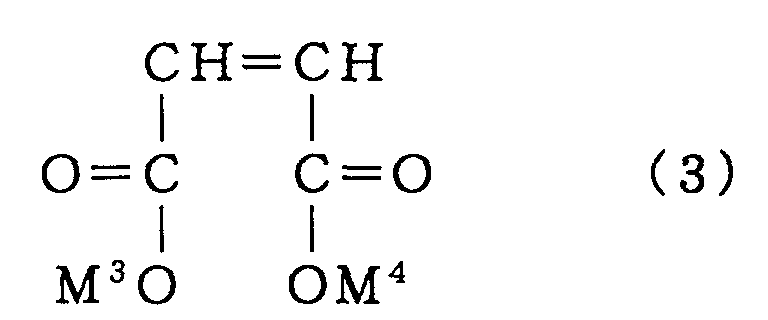
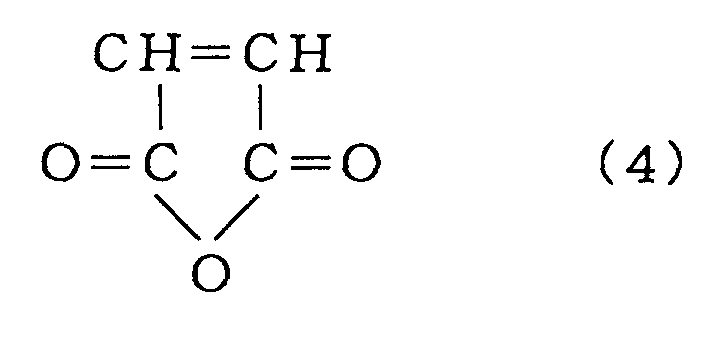

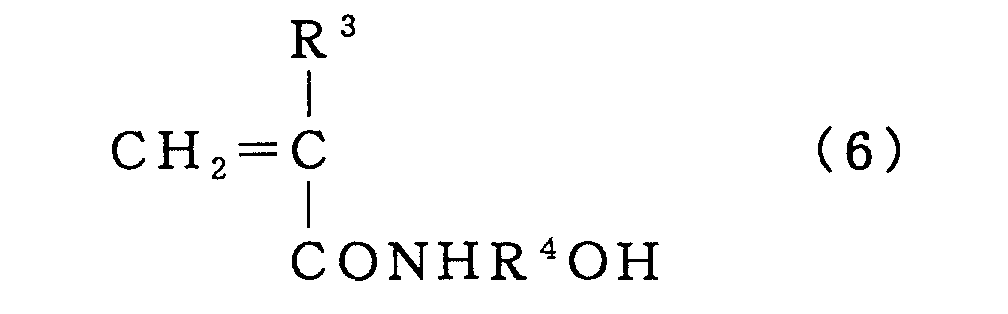


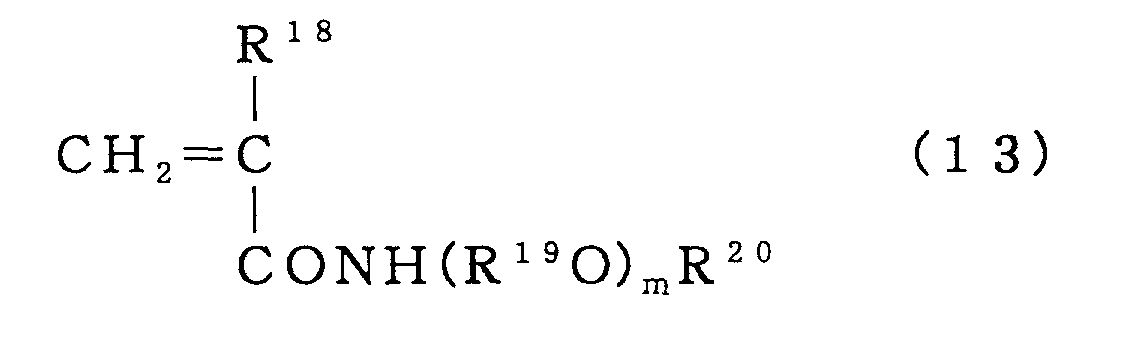

the balance (for 100 percent by mass in total) of water, which has pH of 4.0 to 6.5 at 20°C. Further, there is mentioned an article of the fiber product-treating agent, comprising the treating agent filled into a vessel equipped with a trigger-type sprayer.
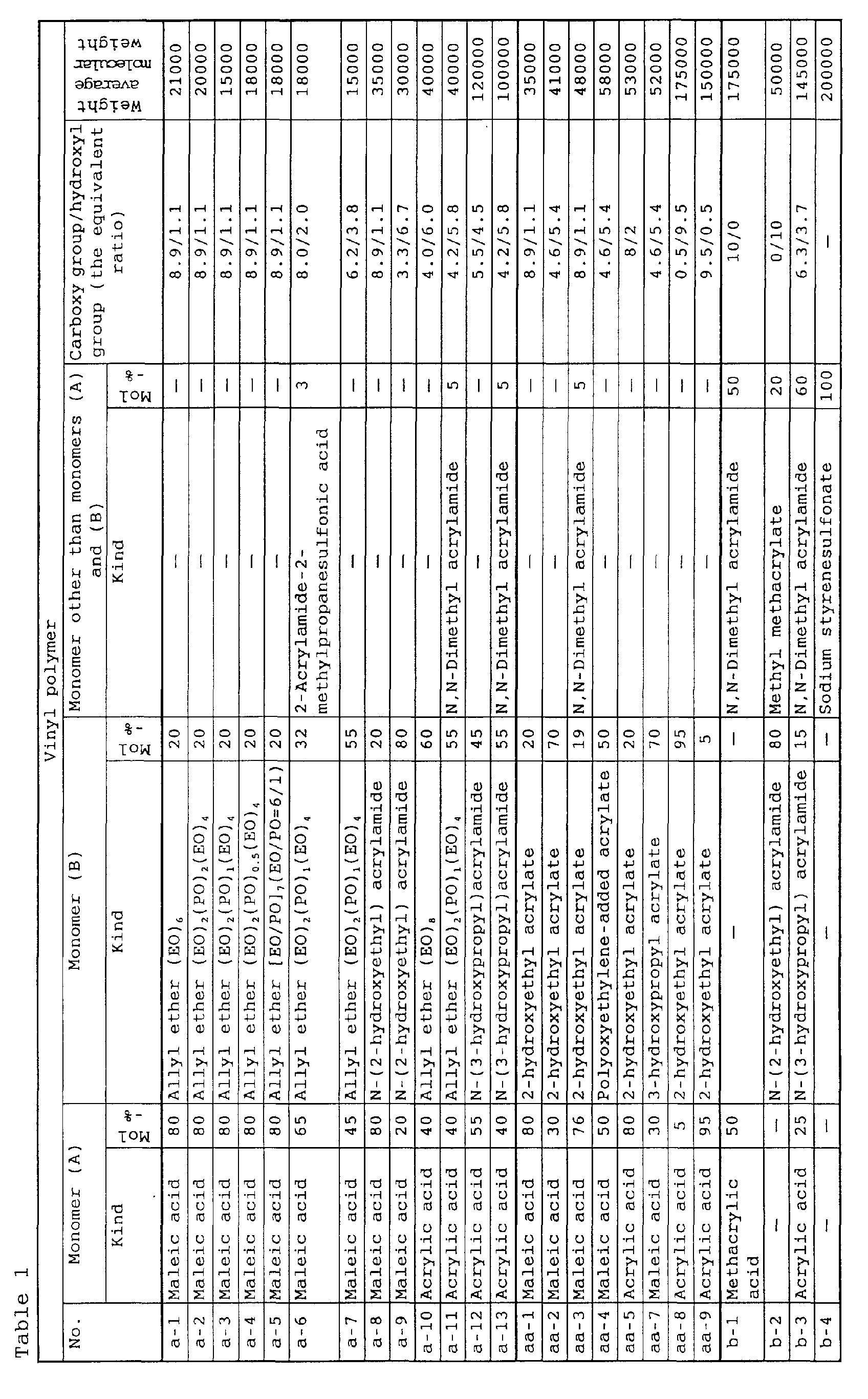

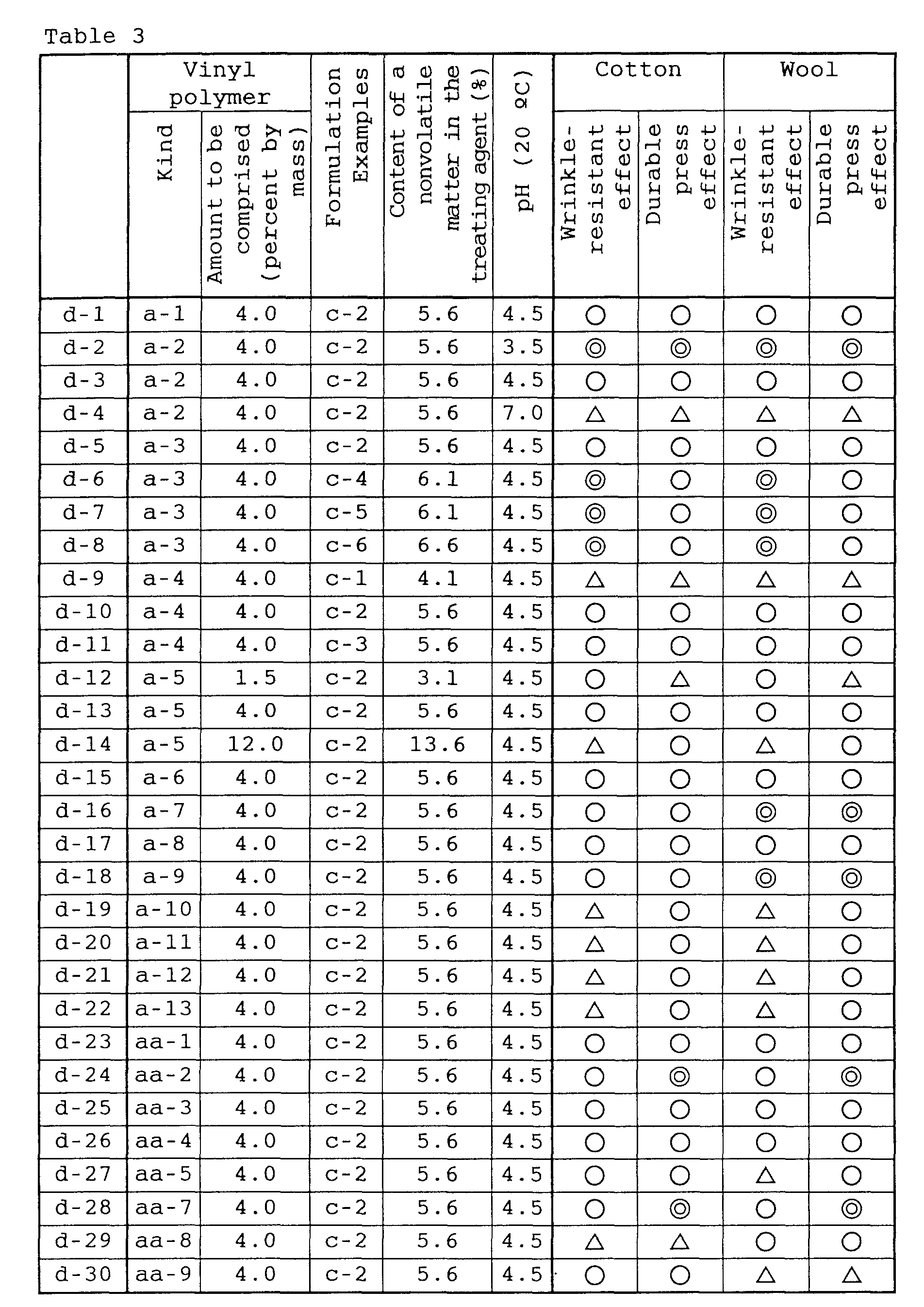

| Vinyl polymer | Requirement (I) | Requirement (II) |
| r1 (%) | r2 (%) | |
| a-1 | 64 | 10 |
| a-2 | 74 | 8 |
| a-7 | 70 | 12 |
| aa-1 | 59 | 13 |
| b-1 | 2 | 15 |
| b-4 | 1 | 11 |
Claims (18)
- A fiber product-treating agent for imparting a durable press configuration by heating, which comprises 0.01 to 20 percent by mass of at least one of (i) two or more compounds forming mutually a crosslinked structure by heating and (ii) a compound forming a self-crosslinked structure by heating, and water, wherein the content of a nonvolatile matter is 0.01 to 30 %.
- The treating agent as claimed in the claim 1, wherein (i) or (ii) satisfies both of the following requirements (I) and (II):the requirement (I): a value r1 (%) determined by (M2/M1) × 100 is in the range of 40 to 100 % for a fabric made of polyester fibers, wherein M1 is made as an increase in mass of the fabric as compared with the untreated fabric after a 30 mass-percent aqueous solution of (i) or (ii) is applied onto the fabrics and heated at 180°C for 10 minutes and M2 is made as an increase in mass of the fabric as compared with the untreated fabric after the above-mentioned heated fabric is immersed in deionized water for 2 hours and then dried at 60°C for 2 hours; andthe requirement (II): a value r2 (%) determined by (M4/M3) x 100 is less than 20 % for a fabric made of polyester fibers, wherein M3 is made as an increase in mass of the fabric as compared with the untreated fabrics after a 30 mass-percent aqueous solution of (i) or (ii) is applied onto the fabric and calmly left-dried at 20°C for 48 hours and M4 is made as an increase in mass of the fabric as compared with the untreated fabric after the above-mentioned calmly left-dried fabric is immersed in deionized water for 2 hours and then dried at 60°C for 2 hours.
- The treating agent as claimed in the claim 1 or 2, whose pH at 20°C is 3.0 to 7.5.
- The treating agent as claimed in any one of the claims 1 to 3, wherein at least one of compounds constituting (i) or (ii) is a polymer having a weight average molecular weight of 1,000 to 1,000,000.
- The treating agent as claimed in any one of the claims 1 to 4, wherein (ii) is a polymer having both of a hydroxyl group and a carboxy group.
- The treating agent as claimed in the claim 5, wherein, among the monomer units constituting the polymer, the monomer units having at least one hydroxyl or carboxy group occupy 50 to 100 mol-% of the total monomer units.
- The treating agent as claimed in the claim 5 or 6, wherein an equivalent ratio of the carboxy group and the hydroxyl group, namely carboxy group : hydroxyl group, in the polymer is from 9 : 1 to 1 : 9.
- The treating agent as claimed in any one of the claims 1 to 7, which comprises 0.005 to 10 percent by mass of a water-soluble inorganic salt.
- The treating agent as claimed in any one of the claims 1 to 8, which comprises 0.005 to 7.5 percent by mass of a silicone compound.
- A treating agent for imparting a durable press configuration on a fiber product by a heating treatment, which comprises 0.01 to 20 percent by mass of a vinyl polymer containing a monomer unit selected from the following monomer units (A), (B) and (C) (provided that if the monomer unit (C) is not selected, both of the monomer units (A) and (B) are selected) , wherein the ratio of a sum of the monomer units (A), (B) and (C) is 50 to 100 mol-% of the total constituent monomer units, and the content of a nonvolatile matter is 0.01 to 30 %:the monomer unit (A): a vinyl monomer unit having a carboxy group,the monomer unit (B): a vinyl monomer unit having a hydroxyl group, andthe monomer unit (C): a vinyl monomer unit having a carboxy group and a hydroxyl group.
- The treating agent as claimed in the claim 10, whose pH at 20°C is 3.0 to 7.5.
- The treating agent as claimed in the claim 10, wherein the vinyl polymer is a polymer capable of forming a self-crosslinked structure by heating.
- The treating agent as claimed in the claim 10, wherein an equivalent ratio of the carboxy group and the hydroxyl group, namely carboxy group : hydroxyl group, in the vinyl polymer is from 9 : 1 to 1 : 9.
- The treating agent as claimed in any one of the claims 10 to 13, which comprises 0.005 to 10 percent by mass of a water-soluble inorganic salt.
- The treating agent as claimed in any one of the claims 10 to 14, which comprises 0.005 to 7.5 percent by mass of a silicone compound.
- A concentrate for preparing the treating agent defined in the claim 1 or 10 by diluting it with water.
- A method of imparting a durable press configuration to a fiber product, which comprises applying, to the fiber product, the treating agent as defined in the claim 1 or 10 and heating the product while imparting a configuration to impart the durable press configuration.
- The method as claimed in the claim 17, in which the durable press configuration has a resistance to wrinkles, shrinks or creases or a smooth drying property.
Applications Claiming Priority (2)
| Application Number | Priority Date | Filing Date | Title |
|---|---|---|---|
| JP2000097642 | 2000-03-31 | ||
| JP2000097642 | 2000-03-31 |
Publications (3)
| Publication Number | Publication Date |
|---|---|
| EP1138819A2 true EP1138819A2 (en) | 2001-10-04 |
| EP1138819A3 EP1138819A3 (en) | 2003-03-26 |
| EP1138819B1 EP1138819B1 (en) | 2007-09-12 |
Family
ID=18612234
Family Applications (1)
| Application Number | Title | Priority Date | Filing Date |
|---|---|---|---|
| EP01107728A Expired - Lifetime EP1138819B1 (en) | 2000-03-31 | 2001-03-30 | Fiber product treating agents |
Country Status (3)
| Country | Link |
|---|---|
| US (1) | US6660044B2 (en) |
| EP (1) | EP1138819B1 (en) |
| DE (1) | DE60130391T2 (en) |
Cited By (2)
| Publication number | Priority date | Publication date | Assignee | Title |
|---|---|---|---|---|
| WO2004018762A1 (en) * | 2002-08-21 | 2004-03-04 | Koninklijke Philips Electronics N.V. | Composition for improving wrinkle resistance in fabrics, wrinkle-reducing active ingredient as used in such a composition, and cartridge containing such composition |
| WO2005047589A3 (en) * | 2003-11-13 | 2005-10-27 | Koninkl Philips Electronics Nv | Compound and method of improving wrinkle resistance in fabrics, and device for containing such a compound |
Families Citing this family (5)
| Publication number | Priority date | Publication date | Assignee | Title |
|---|---|---|---|---|
| CN1172053C (en) * | 2001-02-09 | 2004-10-20 | 广东溢达纺织有限公司 | Technology for knitting washing-resistant cotton fabric without ironing |
| JP3388450B1 (en) * | 2002-01-11 | 2003-03-24 | 株式会社メンテック | Stain inhibitor for paper machine and method of preventing stain using the same |
| US7141626B2 (en) * | 2002-10-29 | 2006-11-28 | National Starch And Chemical Investment Holding Corporation | Fiberglass non-woven catalyst |
| US9359721B2 (en) * | 2013-03-13 | 2016-06-07 | WestPoint Home LLC | Soft feel printed fabric and method of producing same |
| US11937653B2 (en) | 2020-07-09 | 2024-03-26 | Vitiprints, LLC | Smart mask |
Family Cites Families (10)
| Publication number | Priority date | Publication date | Assignee | Title |
|---|---|---|---|---|
| BE515900A (en) | 1951-12-01 | |||
| US4076870A (en) * | 1975-10-01 | 1978-02-28 | Daido-Maruta Finishing Co. Ltd. | Process for treating fibrous products containing cellulosic fibers |
| JPS60239566A (en) | 1984-05-14 | 1985-11-28 | 花王株式会社 | Fiber treating agent and fiber treatment using the same |
| US5137963A (en) | 1987-12-15 | 1992-08-11 | Union Oil Company Of California | Fast cure, zero formaldehyde binder for cellulose |
| JPH01168971A (en) * | 1987-12-23 | 1989-07-04 | Nisshin Kagaku Kogyo Kk | Elasticity processing agent and texture improver for fibers |
| US4936865A (en) | 1988-06-16 | 1990-06-26 | The United States Of America As Represented By The Secretary Of Agriculture | Catalysts and processes for formaldehyde-free durable press finishing of cotton textiles with polycarboxylic acids |
| JP2590646B2 (en) | 1991-08-30 | 1997-03-12 | 日本ゼオン株式会社 | Antibacterial fiber products |
| JPH0726321A (en) | 1993-07-10 | 1995-01-27 | Mazda Motor Corp | Method for manufacturing sliding member having excellent wear resistance |
| US5427587A (en) | 1993-10-22 | 1995-06-27 | Rohm And Haas Company | Method for strengthening cellulosic substrates |
| JPH11158773A (en) | 1997-11-27 | 1999-06-15 | Takemoto Oil & Fat Co Ltd | Method for imparting morphological stability to cellulosic fiber fabric |
-
2001
- 2001-03-30 DE DE60130391T patent/DE60130391T2/en not_active Expired - Lifetime
- 2001-03-30 EP EP01107728A patent/EP1138819B1/en not_active Expired - Lifetime
- 2001-03-30 US US09/820,992 patent/US6660044B2/en not_active Expired - Lifetime
Cited By (2)
| Publication number | Priority date | Publication date | Assignee | Title |
|---|---|---|---|---|
| WO2004018762A1 (en) * | 2002-08-21 | 2004-03-04 | Koninklijke Philips Electronics N.V. | Composition for improving wrinkle resistance in fabrics, wrinkle-reducing active ingredient as used in such a composition, and cartridge containing such composition |
| WO2005047589A3 (en) * | 2003-11-13 | 2005-10-27 | Koninkl Philips Electronics Nv | Compound and method of improving wrinkle resistance in fabrics, and device for containing such a compound |
Also Published As
| Publication number | Publication date |
|---|---|
| US20010037529A1 (en) | 2001-11-08 |
| DE60130391T2 (en) | 2008-06-12 |
| EP1138819A3 (en) | 2003-03-26 |
| US6660044B2 (en) | 2003-12-09 |
| DE60130391D1 (en) | 2007-10-25 |
| EP1138819B1 (en) | 2007-09-12 |
Similar Documents
| Publication | Publication Date | Title |
|---|---|---|
| KR100508051B1 (en) | Copolymers and Oil- and Water-Repellent Compositions Containing Them | |
| AU739160B2 (en) | Hydrophilic finish for textiles | |
| US6074436A (en) | Carpet treatment composition comprising polycarboxylate salts | |
| JP2001508139A (en) | Crosslinking agent for cellulosic fibers | |
| MXPA02007024A (en) | Crease resistant finishing of cellulose containing textiles, and laundry post treatment agents. | |
| US6989035B2 (en) | Textile finishing composition and methods for using same | |
| EP1138819B1 (en) | Fiber product treating agents | |
| US5744201A (en) | Method for treating carpet using PH adjustment | |
| KR19990029799A (en) | Crosslinkable Fabric Protective Composition | |
| JP4562936B2 (en) | Textile treatment agent | |
| JP4514921B2 (en) | Textile treatment agent | |
| US6046120A (en) | Hydrophilic finish for textiles | |
| JP2003089977A (en) | Paste composition | |
| EP1448838B1 (en) | Durable press treatment of fabric | |
| JP4519264B2 (en) | Textile treatment agent | |
| JP4562965B2 (en) | Spray paste | |
| US20030199419A1 (en) | Amine copolymers for textile and fabric protection | |
| JP2001348779A (en) | Textile treatment agent for spray | |
| JP5433467B2 (en) | Wrinkle remover composition | |
| JP2001234474A (en) | Textile treatment agent for spray |
Legal Events
| Date | Code | Title | Description |
|---|---|---|---|
| PUAI | Public reference made under article 153(3) epc to a published international application that has entered the european phase |
Free format text: ORIGINAL CODE: 0009012 |
|
| AK | Designated contracting states |
Kind code of ref document: A2 Designated state(s): AT BE CH CY DE DK ES FI FR GB GR IE IT LI LU MC NL PT SE TR |
|
| AX | Request for extension of the european patent |
Free format text: AL;LT;LV;MK;RO;SI |
|
| PUAL | Search report despatched |
Free format text: ORIGINAL CODE: 0009013 |
|
| AK | Designated contracting states |
Designated state(s): AT BE CH CY DE DK ES FI FR GB GR IE IT LI LU MC NL PT SE TR Kind code of ref document: A3 Designated state(s): AT BE CH CY DE DK ES FI FR GB GR IE IT LI LU MC NL PT SE TR |
|
| AX | Request for extension of the european patent |
Extension state: AL LT LV MK RO SI |
|
| RIC1 | Information provided on ipc code assigned before grant |
Ipc: 7D 06M 15/273 B Ipc: 7C 08L 63/00 B Ipc: 7D 06M 15/263 A Ipc: 7C 08L 33/00 B Ipc: 7D 06M 13/11 B |
|
| 17P | Request for examination filed |
Effective date: 20030514 |
|
| AKX | Designation fees paid |
Designated state(s): DE FR GB |
|
| 17Q | First examination report despatched |
Effective date: 20041112 |
|
| GRAP | Despatch of communication of intention to grant a patent |
Free format text: ORIGINAL CODE: EPIDOSNIGR1 |
|
| GRAS | Grant fee paid |
Free format text: ORIGINAL CODE: EPIDOSNIGR3 |
|
| GRAA | (expected) grant |
Free format text: ORIGINAL CODE: 0009210 |
|
| AK | Designated contracting states |
Kind code of ref document: B1 Designated state(s): DE FR GB |
|
| REG | Reference to a national code |
Ref country code: GB Ref legal event code: FG4D |
|
| REF | Corresponds to: |
Ref document number: 60130391 Country of ref document: DE Date of ref document: 20071025 Kind code of ref document: P |
|
| ET | Fr: translation filed | ||
| PLBE | No opposition filed within time limit |
Free format text: ORIGINAL CODE: 0009261 |
|
| STAA | Information on the status of an ep patent application or granted ep patent |
Free format text: STATUS: NO OPPOSITION FILED WITHIN TIME LIMIT |
|
| 26N | No opposition filed |
Effective date: 20080613 |
|
| REG | Reference to a national code |
Ref country code: FR Ref legal event code: PLFP Year of fee payment: 15 |
|
| REG | Reference to a national code |
Ref country code: FR Ref legal event code: PLFP Year of fee payment: 16 |
|
| PGFP | Annual fee paid to national office [announced via postgrant information from national office to epo] |
Ref country code: DE Payment date: 20160322 Year of fee payment: 16 |
|
| PGFP | Annual fee paid to national office [announced via postgrant information from national office to epo] |
Ref country code: FR Payment date: 20160208 Year of fee payment: 16 Ref country code: GB Payment date: 20160330 Year of fee payment: 16 |
|
| REG | Reference to a national code |
Ref country code: DE Ref legal event code: R119 Ref document number: 60130391 Country of ref document: DE |
|
| GBPC | Gb: european patent ceased through non-payment of renewal fee |
Effective date: 20170330 |
|
| REG | Reference to a national code |
Ref country code: FR Ref legal event code: ST Effective date: 20171130 |
|
| PG25 | Lapsed in a contracting state [announced via postgrant information from national office to epo] |
Ref country code: DE Free format text: LAPSE BECAUSE OF NON-PAYMENT OF DUE FEES Effective date: 20171003 Ref country code: FR Free format text: LAPSE BECAUSE OF NON-PAYMENT OF DUE FEES Effective date: 20170331 |
|
| PG25 | Lapsed in a contracting state [announced via postgrant information from national office to epo] |
Ref country code: GB Free format text: LAPSE BECAUSE OF NON-PAYMENT OF DUE FEES Effective date: 20170330 |