EP1138714A2 - Polycarbonate resin and optical article used the same - Google Patents
Polycarbonate resin and optical article used the same Download PDFInfo
- Publication number
- EP1138714A2 EP1138714A2 EP01107479A EP01107479A EP1138714A2 EP 1138714 A2 EP1138714 A2 EP 1138714A2 EP 01107479 A EP01107479 A EP 01107479A EP 01107479 A EP01107479 A EP 01107479A EP 1138714 A2 EP1138714 A2 EP 1138714A2
- Authority
- EP
- European Patent Office
- Prior art keywords
- carbon atoms
- group
- polycarbonate resin
- general formula
- compound represented
- Prior art date
- Legal status (The legal status is an assumption and is not a legal conclusion. Google has not performed a legal analysis and makes no representation as to the accuracy of the status listed.)
- Granted
Links
Classifications
-
- C—CHEMISTRY; METALLURGY
- C08—ORGANIC MACROMOLECULAR COMPOUNDS; THEIR PREPARATION OR CHEMICAL WORKING-UP; COMPOSITIONS BASED THEREON
- C08G—MACROMOLECULAR COMPOUNDS OBTAINED OTHERWISE THAN BY REACTIONS ONLY INVOLVING UNSATURATED CARBON-TO-CARBON BONDS
- C08G64/00—Macromolecular compounds obtained by reactions forming a carbonic ester link in the main chain of the macromolecule
- C08G64/04—Aromatic polycarbonates
- C08G64/06—Aromatic polycarbonates not containing aliphatic unsaturation
- C08G64/08—Aromatic polycarbonates not containing aliphatic unsaturation containing atoms other than carbon, hydrogen or oxygen
- C08G64/085—Aromatic polycarbonates not containing aliphatic unsaturation containing atoms other than carbon, hydrogen or oxygen containing silicon
-
- C—CHEMISTRY; METALLURGY
- C08—ORGANIC MACROMOLECULAR COMPOUNDS; THEIR PREPARATION OR CHEMICAL WORKING-UP; COMPOSITIONS BASED THEREON
- C08G—MACROMOLECULAR COMPOUNDS OBTAINED OTHERWISE THAN BY REACTIONS ONLY INVOLVING UNSATURATED CARBON-TO-CARBON BONDS
- C08G77/00—Macromolecular compounds obtained by reactions forming a linkage containing silicon with or without sulfur, nitrogen, oxygen or carbon in the main chain of the macromolecule
- C08G77/42—Block-or graft-polymers containing polysiloxane sequences
- C08G77/448—Block-or graft-polymers containing polysiloxane sequences containing polycarbonate sequences
Definitions
- the present invention relates to a polycarbonate resin with a remarkably reduced oblique incidence birefringence, excellent moldability, excellent transcription and good transparency and an optical article used the same.
- the polycarbonate resin is applicable to uses of general molding of various materials such as medical instrument parts, food vessels, drinking bottles, photoreceptors for electrophotography, toner transfer belts, binders for dye and pigment, gas permeation membranes, toys, materials for window and building, safeguarding materials, OA apparatuses and portable telephones and boxes, and particularly, suitable to the production of optical articles such as optical discs including compact disc, laser disc, optical card, MO disc, digital versatile disc and near field recording optical disc, optical lenses including pick-up lens, spectacle lens and camera lens, optical films and optical sheets including cover layer for near field recording medium and optical filter, optical information transmission media including optical fiber and optical waveguide and photoconductive boards.
- a bisphenol A type polycarbonate resin has been widely used as optical materials such as optical disc materials by utilizing its transparency, heat resistance, hydrolysis resistance and dimension stability.
- use of a polycarbonate resin as optical materials caused some problems.
- birefringence to change properties of incidence light caused the most important problem.
- An object of the present invention is to provide a polycarbonate resin with a remarkably reduced oblique incidence birefringence, excellent moldability, excellent transcription and good transparency and an optical article used the same.
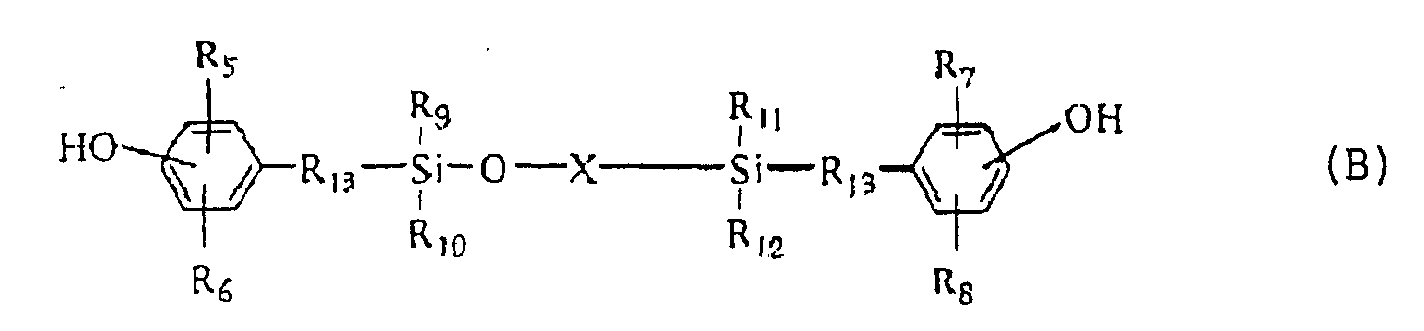
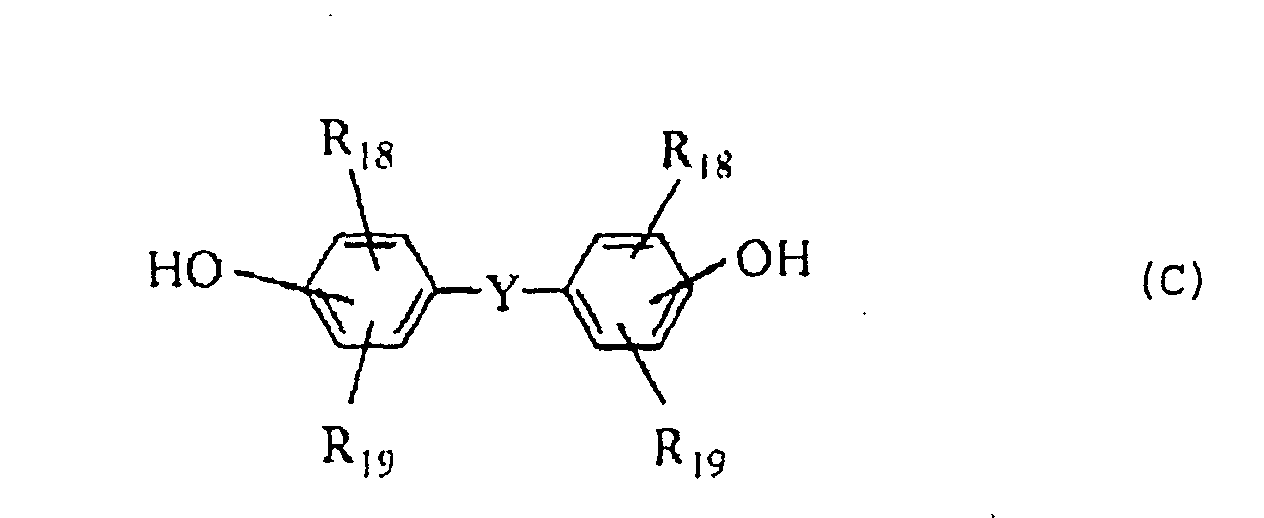
- the present invention provides a polycarbonate resin obtained by reaction of a compound represented by the following general formula (A), a compound represented by the following general,formula (B), a compound represented by the following general formula (C) and a carbonic acid ester-forming compound, wherein an amount of a compound represented by the general formula (A) is 30 to 80 % by weight to total amount of a compound represented by the general formula (A) and a compound represented by the general formula (B) and a compound represented by the general formula (C) is 1 to 80 % by weight to total amount of a compound represented by the general formula (A), a compound represented by the general formula (B) and a compound represented by the general formula (C) and an intrinsic viscosity of said polycarbonate resin is 0.2 to 1.0 dl/g ; wherein R 1 , R 2 , R 3 and R 4 are, each independently, hydrogen, an alkyl group having 1 to 5 carbon atoms, an aryl group having 6 to 12 carbon atoms, an al
- Examples of the carbonic acid ester-forming compound include phosgene and bisaryl carbonates such as diphenyl carbonate, di-p-tolyl carbonate, phenyl-p-tolyl carbonate, di-p-chlorophenyl carbonate and dinaphthyl carbonate and a combination of two species of the compounds thereof or above.
- the polycarbonate resin of the present invention can be produced by reaction of the compound represented by above-mentioned general formula (A) (hereinafter, " compound of formula (A)” ) , the compound represented by above-mentioned general formula (B) (hereinafter, “compound of formula (B)” ), the compound represented by above-mentioned general formula (C) (hereinafter, “ compound of formula (C)) and a carbonic acid ester-forming compound.
- a process for producing a polycarbonate resin to be derived from bisphenol A e.g., a process comprising a direct reaction between bisphenols and phosgene (phosgene process) or a process comprising transesterification between bisphenol and a bisaryl carbonate (transesterification process) can be applied.
- phosgene process phosgene process
- transesterification process a process comprising transesterification between bisphenol and a bisaryl carbonate
- the phosgene process and the transesterification process it is preferable to apply the phosgene process, considering reactivity between the compound of formula (A) and the compound of formula (B).
- the reaction of the compound of formula (A) , the compound of formula (B) , the compound of formula (C) and phosgene is performed usually in the presence of an acid bonding agent and a solvent.
- Examples of the acid bonding agent include pyridine and alkali metal hydroxides including sodium hydroxide and potassium hydroxide.
- solvent examples include methylene chloride, chloroform, chlorobenzene and xylene.
- a catalyst including tertiary amines such as triethylamine is added.
- monofunctional compounds including phenol, p-t-butyl phenol and p-cumyl phenol alkyl-substituted phenols, hydroxy benzoic acid alkyls, and alkyl oxy phenols are added as molecular weight modifier.
- antioxidants including sodium sulfite and hydrosulfite and a small amount of branching agents including phloroglucine, isatin bisphenol, 1,1,1-tris(4-hydroxyphenyl) ethane and ⁇ , ⁇ ', ⁇ "-tris(4-hydroxyphenyl)-1,3, 5-triisopropyl benzene may be added.
- the reaction temperature is usually in the range of 0 to 150 °C and preferably in the range of 5 to 40 °C.
- the reaction time is usually 0.5 minutes to 10 hours and preferably 1 minute to 2 hours, depending on the reaction temperature. It is preferable to maintain pH of the reaction system to 10 or above during the reaction.
- a mixture of the compound of formula (A), the compound of formula (B), the compound of formula (C) and bisaryl carbonate is reacted under a reduced pressure at a high temperature.
- a monofunctional compound(s) including p-t-butyl phenol, p-cumyl phenol alkyl-substituted phenols, hydroxy benzoic acid alkyls and alkyl oxy phenols may be added as molecular weight modifier.
- the reaction is performed usually at a temperature of 150 to 350 °C and preferably 200 to 300 °C. Phenols by-produced by transesterification and derived from bisaryl carbonate are distilled off preferably under a final reduced pressure degree of 1 mmHg or below outside the reaction system.
- the reaction time is usually about 1 to 10 hours, depending on the reaction temperature or the reduced pressure degree. It is preferable to perform the reaction under the atmosphere of an inert gas such as nitrogen, argon, etc. If necessary, an antioxidant(s) and a branching agent(s) may be added.
- Examples of the compound of formula (A) include 9,9-bis(4-hydroxy-2-methylphenyl) fluorene, 9,9-bis (4-hydroxy-3-methylphenyl) fluorene, 9,9-bis(4-hydroxyphenyl) fluorene, 3,6-dimethyl-9,9-bis(4-hydroxyphenyl) fluorene, 9,9-bis(3-methoxy-4-hydroxyphenyl) fluorene, 9,9-bis(3-ethoxy-4-hydroxyphenyl) fluorene, 9,9-bis(3-ethyl-4-hydroxyphenyl) fluorene, 4,5-dimethyl-9,9-bis (4-hydroxyphenyl) fluorene, 9,9-bis (3-phenyl-4-hydroxyphenyl) fluorene, 3,6-dimethyl-9,9-bis(3-methyl-4-hydroxyphenyl) fluorene and 3,6-diphenyl-9,9-bis(4-hydroxyphenyl)fluorene.
- 9,9-bis(4-hydroxyphenyl)fluorene, 9,9-bis(4-hydroxy-3-methylphenyl) fluorene and 9,9-bis(4-hydroxy-2-methylphenyl) fluorene are preferable.
- a combination of two species of the compounds thereof or above may be used.
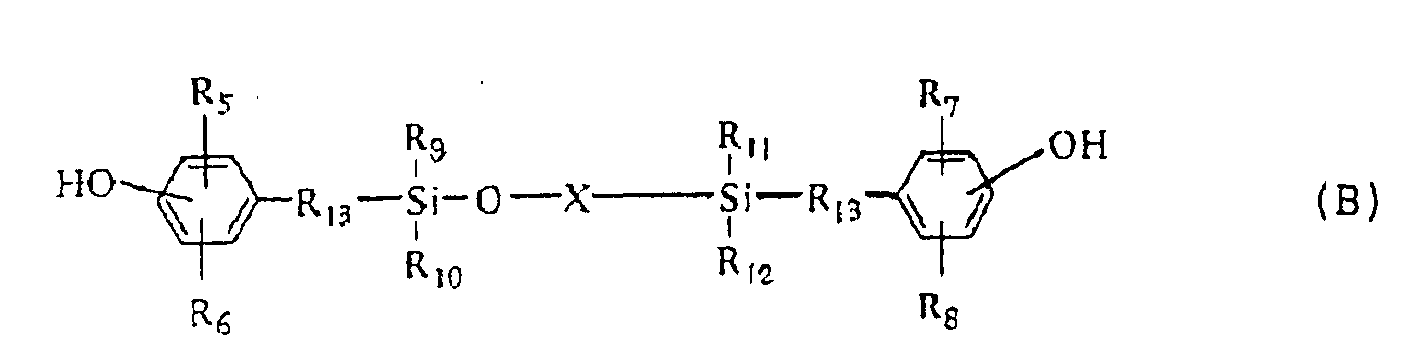
- Examples of the compound of the formula (B) include the compounds represented by the below structural formulas and a combination of two species of the compounds thereof or above.
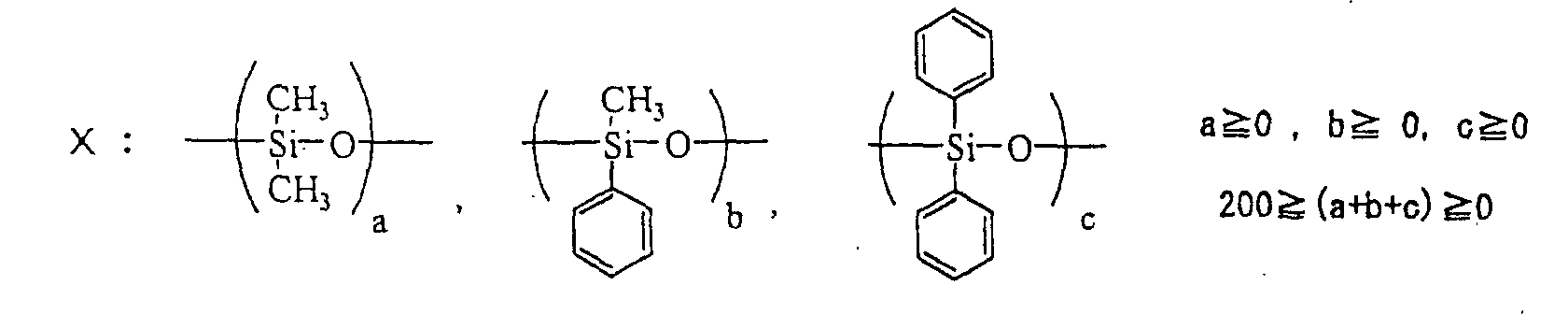
- X contains 1 to 100 dimethylsiloxanes or 1 to 100 diphenylsiloxanes and is a random copolymer thereof.
- ⁇ , ⁇ -bis[3-(o-hydroxyphenyl) propyl] polydimethyldiphenyl random copolymer siloxane and ⁇ , ⁇ -bis[3-(o-hydroxyphenyl) propyl] polydimethylsiloxane are preferable.
- Examples of the compound of formula (C) include 4,4'-biphenyl diol, bis(4-hydroxyphenyl) methane, bis(4-hydroxyphenyl) ether, bis (4-hydroxyphenyl) sulfone, bis(4-hydroxy-3-methylphenyl) sulfone, bis(4-hydroxyphenyl) sulfoxide, bis(4-hydroxyphenyl) sulfide, bis(4-hydroxyphenyl) ketone, 1,1-bis (4-hydroxyphenyl) ethane, 2,2-bis (4-hydroxyphenyl) propane (bisphenol A;BPA), 2,2-bis(4-hydroxyphenyl) butane, 1,1-bis(4-hydroxyphenyl) cyclohexane (bisphenol Z;BPZ), 2,2-bis(4-hydroxy-3-methylphenyl) propane (dimethyl bisphenol A), 2,2-bis(4-hydroxy-3,5-dimethylphenyl) propane, 1,1-bis(4-hydroxyphenyl
- tetraammonium salt examples include tetramethylammonium chloride, trimethylbenzylammonium chloride, triethylbenzylammonium chloride, tetraethylammonium bromide and tetra-n-butylammonium iodide, among which trimethylbenzylammonium chloride and triethylbenzylammonium chloride are preferable. It is preferable that the amount of tetraammonium salt is usually 0.0005 to 5 mol% to total amount of bisphenols to be used.
- mohydric phenol is preferable.
- the molecular weight modifier include phenol, alkyl-substituted phenols including butyl phenol, octyl phenol, nonyl phenol, decanyl phenol, tetradecanyl phenol, heptadecanyl phenol and octadecanyl phenol ; alkyl hydroxy benzoates including butyl hydroxy benzoate, octyl hydroxy benzoate, nonyl hydroxy benzoate, decanyl hydroxy benzoate and heptadecanyl hydroxy benzoate ; alkyl oxy phenols including butoxy phenol, octyl oxy phenol, nonyl oxy phenol, decanyl oxy phenol, tetradecanyl oxy phenol, heptadecanyl oxy phenol and octadecanyl oxy
- the polycarbonate resin thus synthesized can be molded by known molding methods including extrusion molding, injection molding, blow molding, compression molding and wet molding. It is preferable that the intrinsic viscosity [ ⁇ ] of the polycarbonate resin is in the range of 0.2 to 1.0 dl/g since it is desirable that it can be readily extrusion-molded or injection-molded as an optical material to mold an optical article. Particularly, when a high cycle molding is required, it is preferable that it is in the range of 0.2 to 0.6 dl/g.
- the amount of the compound of formula (A) is 30 to 80 % by weight to total amount of the compound of formula (A) and the compound of formula (B), considering curvature, strength and low birefringence of the mold article.
- the amount of the compound of formula (A) is below 30 % by weight, curvature of the disc molded article becomes large, whereas above 80 % by weight strength is decreased and crack occurs during disc molding.
- the amount of the compound of formula (C) is 1 to 80 % by weight to total mount of the compound of formula (A), the compound of formula (B) and the compound of formula (C), considering a resin replacement in a molder, transparency and low birefringence of the molded article.
- the amount of the compound of formula (C) is below 1 % by weight, remarkable white turbidity occurs in a blend with a conventional bisphenol A type polycarbonate. Consequently, in case of production apparatus of other sorts to use the material in a molder in which a conventional bisphenol A type polycarbonate is usually used, necessity to disjoint and wash the apparatus occurs, so that operation efficiency of the apparatus is lowered and a return after cleaning of the apparatus is delayed.
- the polycarbonate resin of the present invention When the polycarbonate resin of the present invention is extrusion molded or injection molded, too large or too small flowability causes problems in molding. It is preferable that the polycarbonate resin of the present invention for extrusion molding has the range of flow rate 1 ⁇ 10 -2 to 15 ⁇ 10 -2 cc/sec measured with a flow tester (nozzle diameter 1 mm, length 10 mm) at 280 °C under 160 kgf/cm 2 . When the flow rate is outside the range of 1 ⁇ 10 -2 to 15 ⁇ 10 -2 cc/sec, a dimension precision of the molded article is deteriorated.
- the polycarbonate resin of the present invention for injection molding has the range of flow rate 3 ⁇ 10 -2 to 90 ⁇ 10 -2 cc/sec measured by above-mentioned measuring flow tester and conditions.
- flow rate 3 ⁇ 10 -2 cc/sec
- flowability is deteriorated, so that failure filling into a mold and a flow mark sometimes occur.
- the flow rate is above 90 ⁇ 10 -2 cc/sec, failure releasing from a mold and curvature readily occur.
- the molding temperature in extrusion molding and injection molding of the polycarbonate resin is, respectively, 230 to 320 °C and 240 to 380 °C.
- the polycarboante resin is highly purified in the same manner as in conventional polycarbonate for optical disc.
- it is purified so as to satisfy as much as possible criterions including dusts of diameter 50 ⁇ m or above: substantially undetected, dusts of diameter 0.5 to 50 ⁇ m: 3 ⁇ 10 4 or below, inorganic and organic residual chloride: 2 ppm or below, residual alkali metal: 2 ppm or below, residual hydroxyl group: 200 ppm or below, residual nitrogen content: 5 ppm or below and residual monomer : 20 ppm or below.
- Post treatments such as extraction for removal of low molecular weight substances and removal of a solvent are sometimes performed.
- antioxidants such as hindered phenols and phosphites ; lubricants and mold releasing agents including silicons, fatty acid esters, fatty acids, fatty acid glycerides and natural fats and oils including bees wax ; light stabilizers such as benzotriazoles, benzophenones, dibenzoyl methane and salicylates and antistatic agents such as polyalkylene glycols and fatty acid glycerides may be used together with the polycarbonate resin.
- a mixture of the polycarbonate resin with an ordinary polycarbonate resin(s) other than the polycarbonate resin may optionally be used within the range not to impair performances.
- the range not to impair performances is different depending on purposes to be used, in addition to above-mentioned properties as a molding material, it is preferable to satisfy at least one and preferably at least two conditions of a 30 degree oblique incidence light birefringence of below 110 nm, a photoelastic sensitivity of below 70 ⁇ 10 -22 m 2 /N and total light transmissivity of 80 % or above of a molded article of thickness 3 mm.
- the measurement was performed for an injection molded optical disc substrate of a polycarbonate resin sample with auto-Ellipsometer, manufactured by k.k., Mizojiri Kogaku Kogyo, in Japan by a light of 30 degree oblique incidence angle and wave length 632.8 nm.
- a cast film of thickness 50 ⁇ m was prepared from a polycarbonate resin powder sample. The measurement was performed for the cast film with auto-Elliposometer, manufactured by k.k., Mizojiri Kogaku Kogyo, in Japan under a load of 300 to 1100 g in a wave length of 632.8 nm.
- the measurement was performed for an injection molded optical disc substrate of a polycarbonate resin sample with an atomic force microscope NV2100, manufactured by Olympus Co.
- Intrinsic viscosity [ ⁇ ] [dl/g] was measured for a polycarbonate resin solution of 0.5 g/dl concentration in methylene chloride solvent at Huggins's constant of 0.45 at a temperature of 20 °C.
- Total light transmissivity (%) and haze (%) were measured for an injection molded board article of a polycarbonate resin sample with HM-100, manufactured by Murakami Color Technology Research Laboratory in Japan by a transmission light of 1.9 mm ⁇ .
- BCFL 9,9-bis(4-hydroxy-3-methylphenyl) fluorene
- BPA 2,2-bis(4-hydroxyphenyl) propane
- 20 g of sodium dithionite were dissolved in 49 L of 8.8 (w/v) sodium hydroxide aqueous solution.
- 36 L of methylene chloride was added thereto and then 1.462 kg of phosgene was injected at the rate of 0.12 kg/min while maintaining 15 °C.
- PTBP p-t-butyl phenol
- the polymer liquid was separated into an aqueous phase and an organic phase.
- the organic phase was neutralized with phosphoric acid.
- Water washing was repeated until an electrical conductivity of the washed liquid became 10 ⁇ S/cm or below, thus obtaining a purified resin liquid.
- the purified resin liquid thus obtained was slowly added in drop wise to hot water maintained to 60 °C under intense stirring, and the polymer was solidified while removing the solvent.
- the solid substance thus obtained was filtered and dried, whereby a white powdery polymer was obtained.
- the intrinsic viscosity [ ⁇ ] of the polymer was 0.25 dl/g.
- the polymer was analyzed by infrared absorption spectrum. Absorption due to carbonyl group near 1770 cm -1 and absorption due to ether bond near 1240 cm -1 were detected. It was confirmed that the polymer had carbonate bond. Absorption due to hydroxyl group at the position of 3650 to 3200 cm -1 was almost never detected.
- Monomers in the polymer were determined by GPC analysis. Each content of each monomer was 20 ppm or below.
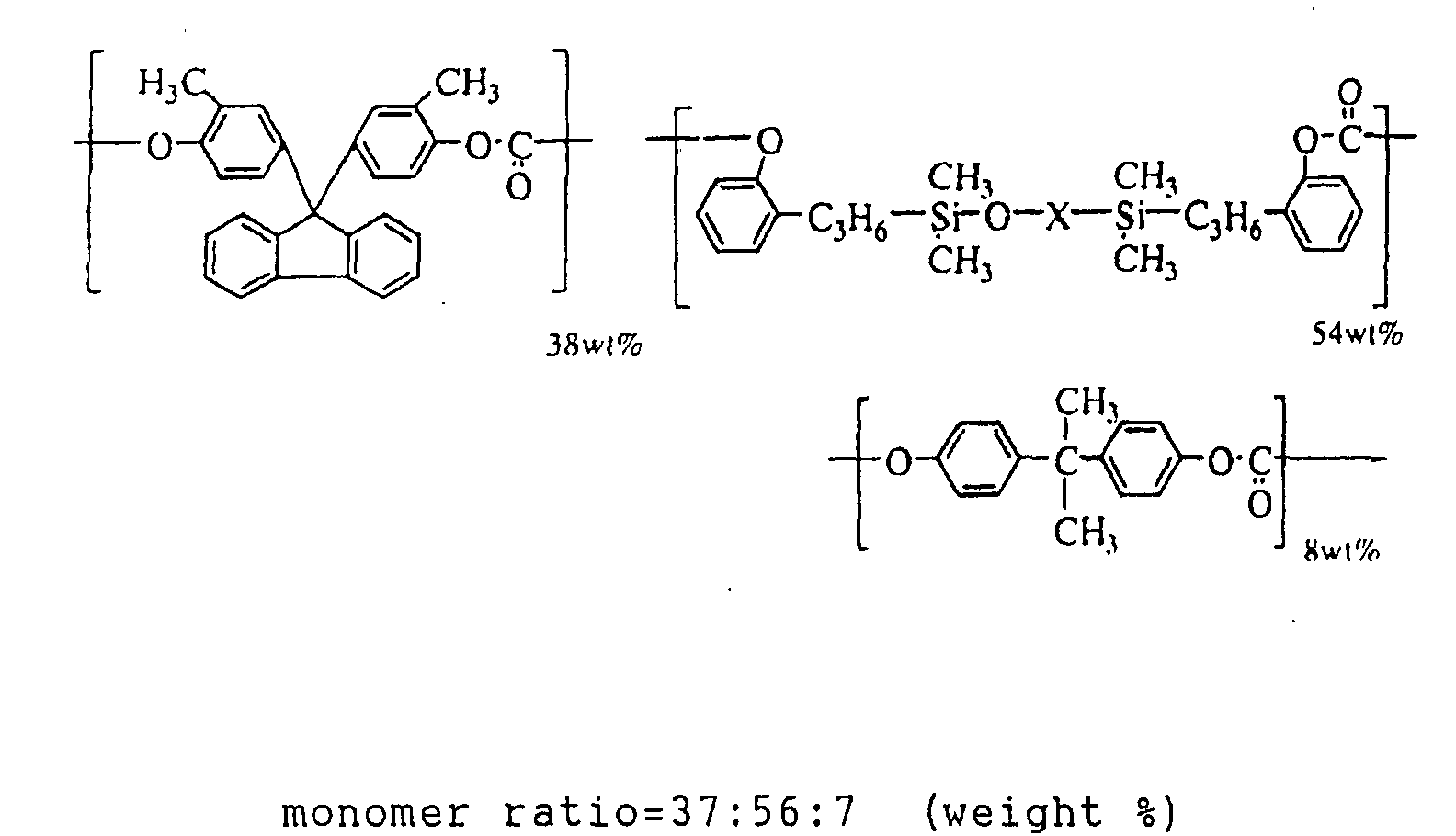
- the polymer was a polycarbonate having the below structural units.
- Example 2 The experiment was performed in the same manner as in Example 1 except that the amount of BCFL was changed to 3.906 kg ; the amount of Si was changed to 2.604 kg ; the amount of phosgene was changed to 1.933 kg and amount of PTBP was changed to 87.9 g.
- the intrinsic viscosity [ ⁇ ] of the polymer thus obtained was 0.25 dl/g. It was confirmed that the polymer had a polycarbonate structure identical to that of Example 1 except the polymerization ratio of monomer by infrared absorption spectrum. The results of measurement of properties were shown in Tables 1 and 2.
- the experiment was performed in the same manner as in Example 1 except that the amount of BCFL was changed to 5.208 kg ; the amount of Si was changed to 1.302 kg ; the amount of phosgene was changed to 2.405 kg and amount of PTBP was changed to 110 g.
- the intrinsic viscosity [ ⁇ ] was 0.25 dl/g. It was confirmed that the polymer had a polycarbonate structure identical to that of Example 1 except the polymerization ratio of monomer. The results of measurement of properties were shown in Tables 1 and 2.
- the polycarbonate powder was obtained in the same manner as in Example 1 except that the amount of BCFL was changed to 4.158 kg ; the amount of Si was changed to 2.772 kg ; the amount of BPA was changed to 0.070 kg ; the amount of phosgene was changed to 1.780 kg and the amount of PTBP was changed to 80 g.
- the intrinsic viscosity [ ⁇ ] of the polycarbonate powder thus obtained was 0.25 dl/g. It was confirmed that the polymer had a polycarbonate structure identical to that of Example 1 except the polymerization ratio of monomer by infrared absorption spectrum.
- the polycarbonate powder was obtained in the same manner as in Example 1 except that the amount of BCFL was changed to 2.520 kg ; the amount of Si was changed to 1.680 kg ; the amount of BPA was changed to 2.800 kg ; the amount of phosgene was changed to 2.865 kg and the amount of PTBP was changed to 223 g.
- the intrinsic viscosity [ ⁇ ] of the polycarbonate powder was 0.25 dl/g. It was confirmed that the polymer had a polycarbonate structure identical to that of Example 1 except the polymerization ratio of monomer by infrared absorption spectrum.
- the intrinsic viscosity [ ⁇ ] of melt pellets of the mixture was 0.32 dl/g.
- the pellets thus obtained were molded in the same manner as in Example 1 and evaluated.
- the results of measurement of properties were shown in Tables 1 and 2.
- the polycarbonate powder was obtained in the same manner as in Example 1 except that the amount of BCFL was changed to 1.26 kg ; the amount of Si was changed to 0.840 kg ; the amount of BPA was changed to 4.900 kg ; the amount of phosgene was changed to 3.216 kg and the amount of PTBP was changed to 388 g.
- the intrinsic viscosity [ ⁇ ] of the polycarbonate powder was 0.25 dl/g. It was confirmed that the polymer had a polycarbonate structure identical to that of Example 1 except the polymerization ratio of monomer by infrared absorption spectrum.
- the intrinsic viscosity [ ⁇ ] of melt pellets of the mixture was 0.28 dl/g.
- the pellets thus obtained were molded in the same manner as in Example 1 and evaluated.
- the results of measurement of properties were shown in Tables 1 and 2.
- the experiment was performed in the same manner as in Example 1 except that the amount of BCFL was changed to 1.823 kg ; the amount of Si was changed to 4.687 kg ; the amount of phosgene was changed to 1.226 kg and the amount of PTBP was changed to 56 g.
- the intrinsic viscosity [ ⁇ ] of the polymer thus obtained was 0.24 dl/g. It was confirmed that the polymer had a polycarbonate structure identical to that of Example 1 except the polymerization ratio of monomer by infrared absorption spectrum. The results of measurement of properties shown in Tables 1 and 2.
- the experiment was performed in the same manner as in Example 1 except that the amount of BCFL was changed to 5.859 kg ; the amount of Si was changed to 0.651 kg ; the amount of phosgene was changed to 2.640 kg and the amount of PTBP was changed to 120.0 g.
- the intrinsic viscosity [ ⁇ ] was 0.24 dl/g. It was confirmed that the polymer had a polycarbonate structure identical to that of Example 1 except the polymerization ratio of monomer. The results of measurement of properties were shown in Tables 1 and 2.
- the polycarbonate powder was obtained in the same manner as in Example 1 except that the amount of BCFL was changed to 4.200 kg ; the amount of Si was changed to 2.800 kg ; the amount of BPA was changed to 0 kg ; the amount of phosgene was changed to 1.735 kg and the amount of PTBP was changed to 79 g.
- the intrinsic viscosity [ ⁇ ] of the polycarbonate powder was 0.25 dl/g. It was confirmed that the polymer had a polycarbonate structure identical to that of Example 1 except the polymerization ratio of monomer by infrared absorption spectrum.
- the intrinsic viscosity [ ⁇ ] of melt pellets of the mixture was 0.33 dl/g.
- the polycarbonate powder was obtained in the same manner as in Example 1 except that the amount of BCFL was changed to 0.420 kg ; the amount of Si was changed to 0.280 kg ; the amount of BPA was changed to 6.300 kg ; the amount of phosgene was changed to 3.421 kg and the amount of PTBP was changed to 475 g.
- the intrinsic viscosity [ ⁇ ] of the polycarbonate powder was 0.25 dl/g. It was confirmed that the polymer had a polycarbonate structure identical to that of Example 1 except the polymerization ratio of monomer by infrared absorption spectrum. The results of measurement of properties were shown in Tables 1 and 2.
- a polycarbonate resin with a remarkably reduced oblique incidence birefringence, excellent moldability, excellent transcription and good transparency can be provided.
- the polycarbonate resin is suitable to the production of optical articles such as optical discs including compact disc, laser disc, optical card, MO disc, digital versatile disc and near field recording disc, optical lenses including pick-up lens, spectacle lens and camera lens, optical films and optical sheets including cover layer for near field recording medium and optical filter, optical information transmission media including optical fiber and optical waveguide and photoconductive boards in which low birefringence is required.
Landscapes
- Chemical & Material Sciences (AREA)
- Health & Medical Sciences (AREA)
- Chemical Kinetics & Catalysis (AREA)
- Medicinal Chemistry (AREA)
- Polymers & Plastics (AREA)
- Organic Chemistry (AREA)
- Polyesters Or Polycarbonates (AREA)
- Optical Record Carriers And Manufacture Thereof (AREA)
- Manufacture Of Macromolecular Shaped Articles (AREA)
- Compositions Of Macromolecular Compounds (AREA)
Abstract
Description







Claims (11)
- A polycarbonate resin obtained by reaction of a compound represented by the following general formula (A), a compound represented by the following general formula (B), a compound represented by the following general formula (C) and a carbonic acid ester-forming compound, wherein an amount of a compound represented by the general formula (A) is 30 to 80 % by weight to total amount of a compound represented by the general formula (A) and a compound represented by the general formula (B), and a compound represented by the general formula (C) is 1 to 80 % by weight to total amount of a compound represented by the general formula (A), a compound represented by the general formula (B) and a compound represented by the general formula (C), and an intrinsic viscosity of said polycarbonate resin is 0.2 to 1.0 dl/g ;wherein R1, R2, R3 and R4 are, each independently, hydrogen, an alkyl group having 1 to 5 carbon atoms, an aryl group having 6 to 12 carbon atoms, an alkenyl group having 2 to 5 carbon atoms, an alkoxy group having 1 to 5 carbon atoms, an aralkyl group having 7 to 17 carbon atoms and when said group has carbon atom, said group can have an alkyl group having 1 to 5 carbon atoms, an alkenyl group having 2 to 5 carbon atoms or an alkoxy group having 1 to 5 carbon atoms as a substituent(s) ;
 wherein R5, R6, R7 and R8 are, each independently, hydrogen, an alkyl group having 1 to 5 carbon atoms, an aryl group having 6 to 12 carbon atoms, an alkenyl group having 2 to 5 carbon atoms, an alkoxy group having 1 to 5 carbon atoms, an aralkyl group having 7 to 17 carbon atoms and when said group has carbon atom, said group can have an alkyl group having 1 to 5 carbon atoms, an alkenyl group having 2 to 5 carbon atoms or an alkoxy group having 1 to 5 carbon atoms as a substituent(s) ; R9, R10, R11 and R12 are, each independently, hydrogen, an alkyl group having 1 to 5 carbon atoms, an aryl group having 6 to 12 carbon atoms, an alkenyl group having 2 to 5 carbon atoms, an alkoxy group having 1 to 5 carbon atoms, an aralkyl group having 7 to 17 carbon atoms and when said group has carbon atom, said group can have an alkyl group having 1 to 5 carbon atoms, an alkenyl group having 2 to 5 carbon atoms or an alkoxy group having 1 to 5 carbon atoms as a substituent(s) ; R13 is an aliphatic group having 1 to 6 carbon atoms or absent ; X is -SiO(R14)(R15)-, -SiO(R16)(R17)-, a homopolymer of - SiO(R14)(R15)- or -SiO(R16)(R17)- having an average polymerization degree of more than 0 and 200 or below or a random copolymer of -SiO(R14)(R15)- and -SiO(R16)(R17) - having an average polymerization degree of more than 0 and 200 or below ; R14, R15, R16 and R17 are, each independently, hydrogen, an alkyl group having 1 to 5 carbon atoms, an aryl group having 6 to 12 carbon atoms, an alkenyl group having 2 to 5 carbon atoms, an alkoxy group having 1 to 5 carbon atoms, an aralkyl group having 7 to 17 carbon atoms and when said group has carbon atom, said group can have an alkyl group having 1 to 5 carbon atoms, an alkenyl group having 2 to 5 carbon atoms or an alkoxy group having 1 to 5 carbon atoms as a substituent(s);
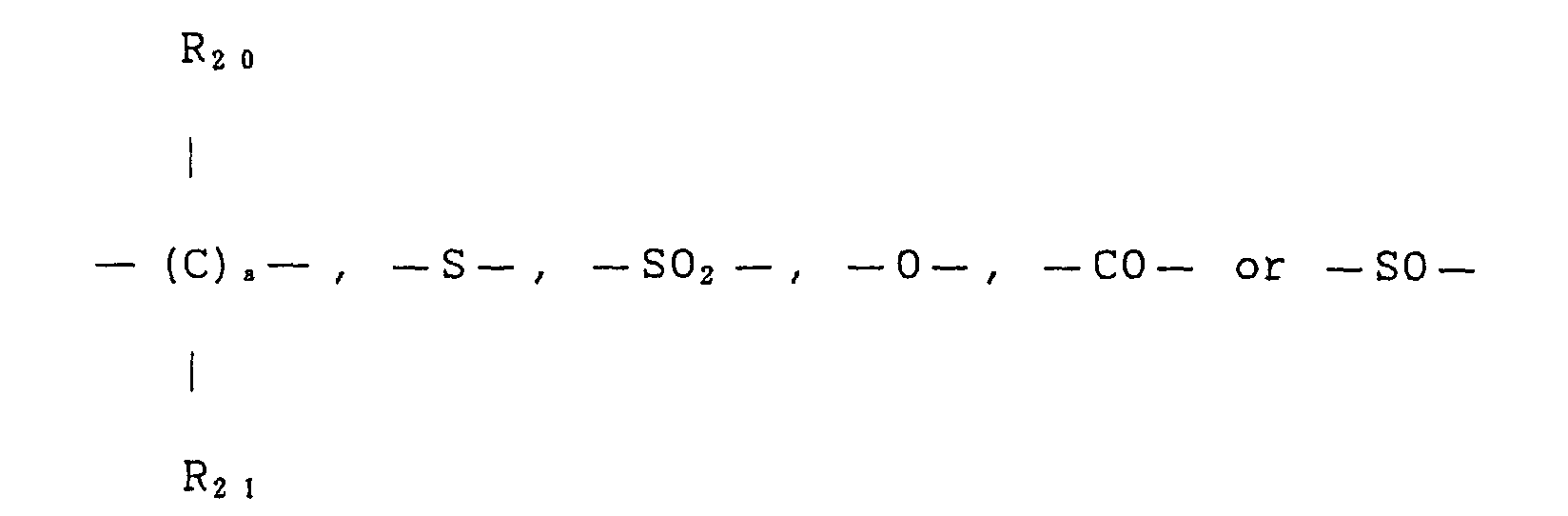
 wherein R18 and R19 are, each independently, hydrogen, an alkyl group having 1 to 10 carbon atoms, an aryl group having 6 to 12 carbon atoms, an alkenyl group having 2 to 5 carbon atoms, an alkoxy group having 1 to 5 carbon atoms, an aralkyl group having 7 to 17 carbon atoms and when said group has carbon atom, said group can have an alkyl group having 1 to 5 carbon atoms, an alkenyl group having 2 to 5 carbon atoms or an alkoxy group having 1 to 5 carbon atoms as a substituent(s); Y is ;
 wherein R20 and R21 are, each independently, hydrogen, an alkyl group having 1 to 10 carbon atoms, an alkenyl group having 2 to 10 carbon atoms, an alkoxy group having 1 to 10 carbon atoms or an aryl group having 6 to 12 carbon atoms, or an aliphatic ring or a heterocycle in combination of R20 and R21 and when said group has carbon atom, said group can have an alkyl group having 1 to 5 carbon atoms, an alkenyl group having 2 to 5 carbon atoms or an alkoxy group having 1 to 5 carbon atoms as a substituent(s) and a is an integer of 0 to 20.
- A polycarbonate resin according to claim 1, wherein said compound represented by the general formula
(A) is at least one selected from the group consisting of 9,9-bis (4-hydroxyphenyl) fluorene, 9,9-bis (4-hydroxy-3-methylphenyl) fluorene and 9,9-bis(4-hydroxy-2-methylphenyl) fluorene. - A polycarbonate resin according to claim 1 or 2, wherein said carbonic acid ester-forming compound is phosgene.
- A polycarbonate resin according to any of claims 1 to 3, wherein each said R9, R10, R11 and R12 in the compound represented by the general formula (B) are at least one group selected from the group consisting of methyl group and phenyl group.
- A polycarbonate resin according to any of claims 1 to 4, wherein said compound represented by the general formula (B) is at least one compound selected from the group consisting of a random copolymer of dimethylsiloxane and diphenylsiloxane having 3-(o-hydroxyphenyl)propyl group at α , ω positions and α , ω -bis [3-(o-hydroxyphenyl) propyl]polydimethylsiloxane.
- A polycarbonate resin according to any of claims 1 to 5, wherein said compound represented by the general formula (C) is 2,2-bis (4-hydroxyphenyl)propane.
- A polycarbonate resin composition comprising a mixture of the polycarbonate resin according to any of the claims 1 to 6 and a polycarbonate resin derived from 2,2-bis(4-hydroxyphenyl)propane.
- An optical article comprising the polycarbonate resin according to any of claims 1 to 7, having a 30 degree oblique incidence birefringence of below 110 nm.
- An optical article comprising the polycarbonate resin according to any of claims 1 to 7, having a photoelastic sensitivity of below 70 x 10-22 m2/N.
- An optical article' comprising the polycarbonate resin according to any of claims 1 to 7, having a total light transmissivity of 80 % or above in a molded article of 3 mm.
- Use of the polycarbonate according to any of claims 1 to 7 for the preparation of an optical article according to any of claims 8 to 10.
Applications Claiming Priority (4)
| Application Number | Priority Date | Filing Date | Title |
|---|---|---|---|
| JP2000090094 | 2000-03-29 | ||
| JP2000090094 | 2000-03-29 | ||
| JP2000383918A JP4525881B2 (en) | 2000-03-29 | 2000-12-18 | Polycarbonate resin and optical member |
| JP2000383918 | 2000-12-18 |
Publications (3)
| Publication Number | Publication Date |
|---|---|
| EP1138714A2 true EP1138714A2 (en) | 2001-10-04 |
| EP1138714A3 EP1138714A3 (en) | 2003-04-23 |
| EP1138714B1 EP1138714B1 (en) | 2005-02-23 |
Family
ID=26588643
Family Applications (1)
| Application Number | Title | Priority Date | Filing Date |
|---|---|---|---|
| EP01107479A Expired - Lifetime EP1138714B1 (en) | 2000-03-29 | 2001-03-28 | Polycarbonate resin and optical article used the same |
Country Status (5)
| Country | Link |
|---|---|
| US (1) | US6340737B2 (en) |
| EP (1) | EP1138714B1 (en) |
| JP (1) | JP4525881B2 (en) |
| DE (1) | DE60108992T2 (en) |
| TW (1) | TW572933B (en) |
Cited By (5)
| Publication number | Priority date | Publication date | Assignee | Title |
|---|---|---|---|---|
| EP1223184A1 (en) * | 2001-01-16 | 2002-07-17 | Mitsubishi Gas Chemical Company, Inc. | Polycarbonate resin |
| EP1235872A1 (en) * | 2000-07-10 | 2002-09-04 | General Electric Company | Substantially single phase silicone copolycarbonates, methods, and optical articles made therefrom |
| EP1471092A1 (en) * | 2003-04-25 | 2004-10-27 | Ricoh Company, Ltd. | Binder for granulation molding of powder particles and granulated moldings |
| WO2016044695A1 (en) * | 2014-09-18 | 2016-03-24 | Momentive Performance Materials Inc. | Polysiloxane co-or terpolymers and polymers made therefrom |
| CN111171546A (en) * | 2020-02-18 | 2020-05-19 | 江苏博云塑业股份有限公司 | PC/ABS laser etching composite material and preparation method thereof |
Families Citing this family (21)
| Publication number | Priority date | Publication date | Assignee | Title |
|---|---|---|---|---|
| JP4492774B2 (en) * | 2001-04-19 | 2010-06-30 | 三菱瓦斯化学株式会社 | Cover layer film for optical information recording media |
| JP4484131B2 (en) * | 2001-04-24 | 2010-06-16 | 三菱瓦斯化学株式会社 | Film for flat panel display |
| CN1435823A (en) * | 2002-02-01 | 2003-08-13 | 日本胜利株式会社 | Optical disk |
| EP1489123B1 (en) * | 2002-03-28 | 2009-09-23 | Teijin Chemicals, Ltd. | Copolycarbonate and heat-resistant part comprising the copolymer |
| JP2005060628A (en) * | 2003-08-20 | 2005-03-10 | Teijin Chem Ltd | Polycarbonate resin with excellent reflow resistance |
| US20050048252A1 (en) * | 2003-08-26 | 2005-03-03 | Irene Dris | Substrate and storage media for data prepared therefrom |
| WO2005113638A1 (en) | 2004-05-20 | 2005-12-01 | Idemitsu Kosan Co., Ltd. | Polycarbonate resin and electrophotographic photosensitive member using same |
| JP2006023707A (en) * | 2004-06-08 | 2006-01-26 | Canon Inc | Transfer material carrying member, intermediate transfer member, and image forming apparatus using the same |
| CN100412718C (en) * | 2004-06-08 | 2008-08-20 | 佳能株式会社 | Transfer material carrying member, intermediate transfer member, and image forming apparatus using the same |
| JP4810099B2 (en) * | 2005-01-20 | 2011-11-09 | 株式会社メニコン | Transparent gel and contact lens comprising the same |
| TWI512002B (en) * | 2006-10-18 | 2015-12-11 | Idemitsu Kosan Co | Polycarbonate copolymer, a method for producing the same, a molded body, an optical material, and an electrophotographic photoreceptor |
| JP5337365B2 (en) * | 2007-10-18 | 2013-11-06 | 出光興産株式会社 | Aromatic polycarbonate resin composition for resin stamper, method for producing resin stamper, and resin stamper |
| WO2011013846A1 (en) * | 2009-07-29 | 2011-02-03 | 帝人化成株式会社 | Polycarbonate/polydiorganosiloxane copolymer |
| JP6026946B2 (en) * | 2013-04-19 | 2016-11-16 | 出光興産株式会社 | Polycarbonate resin composition and molded article |
| KR101636128B1 (en) * | 2013-07-01 | 2016-07-04 | 주식회사 엘지화학 | Polycarbonate resin composition |
| WO2015002427A1 (en) | 2013-07-01 | 2015-01-08 | (주) 엘지화학 | Polyorganosiloxane compound, method for preparing same, and copolycarbonate resin comprising same |
| CN105392823A (en) * | 2013-07-24 | 2016-03-09 | 沙特基础全球技术有限公司 | Phenolic compounds as end-capping agents for polysiloxanes in polycarbonate-polysiloxane block copolymers |
| CN104777544B (en) * | 2015-04-29 | 2017-08-11 | 深圳市华星光电技术有限公司 | Polaroid and preparation method thereof, liquid crystal panel |
| US12428557B2 (en) * | 2019-07-03 | 2025-09-30 | Idemitsu Kosan Co., Ltd. | Molded body including polycarbonate-based resin composition |
| US12528915B2 (en) * | 2019-07-03 | 2026-01-20 | Idemitsu Kosan Co.,Ltd. | Polycarbonate resin composition |
| WO2024237238A1 (en) * | 2023-05-18 | 2024-11-21 | 三菱瓦斯化学株式会社 | Thermoplastic resin composition production method and thermoplastic resin composition |
Family Cites Families (18)
| Publication number | Priority date | Publication date | Assignee | Title |
|---|---|---|---|---|
| ATE41435T1 (en) | 1984-01-27 | 1989-04-15 | Ici Plc | FIBER REINFORCED PRODUCT AND METHOD OF MANUFACTURE. |
| JPH0628871B2 (en) | 1986-02-05 | 1994-04-20 | 三菱化成株式会社 | Method for producing molded article having excellent optical properties |
| KR970002664B1 (en) * | 1989-07-07 | 1997-03-07 | 이데미쓰 세끼유 가가꾸 가부시끼가이샤 | Polycarbonate-Polydimethylsiloxane Interpolymer and Method for Producing the Same |
| DE3928097A1 (en) | 1989-08-25 | 1991-02-28 | Bayer Ag | POLYORGANOSILOXANE-POLYCARBONATE BLOCK COPOLYMERS AND THEIR USE FOR THE PRODUCTION OF OPTICAL DATA STORAGE |
| JP3254029B2 (en) * | 1993-01-26 | 2002-02-04 | 出光興産株式会社 | Electrophotographic photoreceptor using polycarbonate copolymer |
| JPH06329781A (en) * | 1993-03-25 | 1994-11-29 | Idemitsu Petrochem Co Ltd | Polycarbonate-polyorganosiloxane copolymer and resin composition |
| JP3263486B2 (en) * | 1993-05-27 | 2002-03-04 | 出光興産株式会社 | Polycarbonate copolymer and method for producing the same |
| ES2126064T3 (en) * | 1993-07-09 | 1999-03-16 | Gen Electric | COMPOSITIONS OF TERPOLYMERS OF BLOCKS OF SILOXANE AND POLYESTERCARBONATE AND POLYCARBONATES RESISTANT TO HEAT. |
| DE4416325C2 (en) * | 1993-09-22 | 1996-09-19 | Bayer Ag | Special polycarbonates and their use in the manufacture of optical articles |
| US5616674A (en) * | 1994-05-10 | 1997-04-01 | General Electric Company | Method of preparing polycarbonate-polysiloxane block copolymers |
| US5530083A (en) * | 1994-07-21 | 1996-06-25 | General Electric Company | Silicone-polycarbonate block copolymers and polycarbonate blends having reduced haze, and method for making |
| JP3486989B2 (en) | 1994-11-14 | 2004-01-13 | 三菱瓦斯化学株式会社 | Molding material for optical recording media |
| US5504177A (en) * | 1995-03-02 | 1996-04-02 | General Electric Company | Method for preparation of block copolysiloxanecarbonates |
| JP3106931B2 (en) | 1995-10-24 | 2000-11-06 | 財団法人シップ・アンド・オーシャン財団 | Spiral lithium battery and method of manufacturing the same |
| US5859833A (en) * | 1997-09-02 | 1999-01-12 | General Electric Company | Optical disk grade copolyestercarbonates derived from hydroxyphenylindanols |
| JP3775911B2 (en) * | 1998-01-14 | 2006-05-17 | 大阪瓦斯株式会社 | Polycarbonate polymer and method for producing the same |
| JP4021542B2 (en) * | 1998-02-27 | 2007-12-12 | 出光興産株式会社 | Polycarbonate resin, process for producing the same and electrophotographic photosensitive member |
| JP4286417B2 (en) * | 2000-01-26 | 2009-07-01 | 出光興産株式会社 | Electrophotographic photoreceptor |
-
2000
- 2000-12-18 JP JP2000383918A patent/JP4525881B2/en not_active Expired - Fee Related
-
2001
- 2001-03-23 TW TW90106898A patent/TW572933B/en not_active IP Right Cessation
- 2001-03-28 DE DE60108992T patent/DE60108992T2/en not_active Expired - Lifetime
- 2001-03-28 EP EP01107479A patent/EP1138714B1/en not_active Expired - Lifetime
- 2001-03-29 US US09/819,614 patent/US6340737B2/en not_active Expired - Lifetime
Cited By (9)
| Publication number | Priority date | Publication date | Assignee | Title |
|---|---|---|---|---|
| EP1235872A1 (en) * | 2000-07-10 | 2002-09-04 | General Electric Company | Substantially single phase silicone copolycarbonates, methods, and optical articles made therefrom |
| EP1223184A1 (en) * | 2001-01-16 | 2002-07-17 | Mitsubishi Gas Chemical Company, Inc. | Polycarbonate resin |
| US6630562B2 (en) | 2001-01-16 | 2003-10-07 | Mitsubishi Gas Chemical Company, Inc. | Polycarbonate resin |
| EP1471092A1 (en) * | 2003-04-25 | 2004-10-27 | Ricoh Company, Ltd. | Binder for granulation molding of powder particles and granulated moldings |
| WO2016044695A1 (en) * | 2014-09-18 | 2016-03-24 | Momentive Performance Materials Inc. | Polysiloxane co-or terpolymers and polymers made therefrom |
| US9434820B2 (en) | 2014-09-18 | 2016-09-06 | Momentive Performance Material Inc. | Polysiloxane co- or terpolymers and polymers made therefrom |
| CN107075121A (en) * | 2014-09-18 | 2017-08-18 | 莫门蒂夫性能材料股份有限公司 | Polysiloxane copolymer or terpolymer and by its obtained polymer |
| CN107075121B (en) * | 2014-09-18 | 2021-01-22 | 莫门蒂夫性能材料股份有限公司 | Polysiloxane copolymers or terpolymers and polymers made therefrom |
| CN111171546A (en) * | 2020-02-18 | 2020-05-19 | 江苏博云塑业股份有限公司 | PC/ABS laser etching composite material and preparation method thereof |
Also Published As
| Publication number | Publication date |
|---|---|
| US20010039313A1 (en) | 2001-11-08 |
| US6340737B2 (en) | 2002-01-22 |
| EP1138714A3 (en) | 2003-04-23 |
| JP4525881B2 (en) | 2010-08-18 |
| EP1138714B1 (en) | 2005-02-23 |
| TW572933B (en) | 2004-01-21 |
| JP2001342247A (en) | 2001-12-11 |
| DE60108992D1 (en) | 2005-03-31 |
| DE60108992T2 (en) | 2006-04-13 |
Similar Documents
| Publication | Publication Date | Title |
|---|---|---|
| US6340737B2 (en) | Polycarbonate resin and optical article used the same | |
| EP1302785B1 (en) | Plastic lens | |
| CN101679623B (en) | Polycarbonate resin and method for producing the same | |
| JP2001055435A (en) | Molding material for optical recording media | |
| WO2020138050A1 (en) | Thermoplastic resin composition and optical member using same | |
| EP1223184B1 (en) | Polycarbonate resin | |
| JP3856115B2 (en) | Polycarbonate resin | |
| CN103354820B (en) | Polycarbonate resin and process for production thereof | |
| JP3486989B2 (en) | Molding material for optical recording media | |
| US6436503B1 (en) | Data storage medium containing polyestercarbonate | |
| TW202041566A (en) | Polycarbonate resin composition and optical lens using the same | |
| US6576735B2 (en) | Polycarbonate resin | |
| JP3525963B2 (en) | Molding material for optical recording media | |
| JP4492774B2 (en) | Cover layer film for optical information recording media | |
| EP1097956B1 (en) | Polycarbonat resin | |
| JP4314695B2 (en) | Molding material for optical recording media | |
| JP2002030140A (en) | Polycarbonate resin and method for producing the same | |
| JPH03106931A (en) | Polyorganosiloxane-polycarbonate block copolymer | |
| JP2005206699A (en) | Contact lens material | |
| JP2001055436A (en) | Molding material for optical recording media | |
| JP4207309B2 (en) | Molding material for optical recording media | |
| JP4484131B2 (en) | Film for flat panel display | |
| JP2000306267A (en) | Molding material for optical recording media | |
| JP2000302856A (en) | Molding material for optical recording media | |
| JP2000302859A (en) | Molding material for optical recording media |
Legal Events
| Date | Code | Title | Description |
|---|---|---|---|
| PUAI | Public reference made under article 153(3) epc to a published international application that has entered the european phase |
Free format text: ORIGINAL CODE: 0009012 |
|
| AK | Designated contracting states |
Kind code of ref document: A2 Designated state(s): AT BE CH CY DE DK ES FI FR GB GR IE IT LI LU MC NL PT SE TR |
|
| AX | Request for extension of the european patent |
Free format text: AL;LT;LV;MK;RO;SI |
|
| PUAL | Search report despatched |
Free format text: ORIGINAL CODE: 0009013 |
|
| RIC1 | Information provided on ipc code assigned before grant |
Ipc: 7C 08G 64/08 A Ipc: 7C 08G 64/18 B Ipc: 7G 02B 21/04 B Ipc: 7C 08G 77/448 B Ipc: 7C 08L 69/00 B |
|
| AK | Designated contracting states |
Designated state(s): AT BE CH CY DE DK ES FI FR GB GR IE IT LI LU MC NL PT SE TR |
|
| AX | Request for extension of the european patent |
Extension state: AL LT LV MK RO SI |
|
| 17P | Request for examination filed |
Effective date: 20030912 |
|
| 17Q | First examination report despatched |
Effective date: 20031119 |
|
| AKX | Designation fees paid |
Designated state(s): DE FR GB |
|
| GRAP | Despatch of communication of intention to grant a patent |
Free format text: ORIGINAL CODE: EPIDOSNIGR1 |
|
| GRAS | Grant fee paid |
Free format text: ORIGINAL CODE: EPIDOSNIGR3 |
|
| GRAA | (expected) grant |
Free format text: ORIGINAL CODE: 0009210 |
|
| AK | Designated contracting states |
Kind code of ref document: B1 Designated state(s): DE FR GB |
|
| REG | Reference to a national code |
Ref country code: GB Ref legal event code: FG4D |
|
| REG | Reference to a national code |
Ref country code: IE Ref legal event code: FG4D |
|
| REF | Corresponds to: |
Ref document number: 60108992 Country of ref document: DE Date of ref document: 20050331 Kind code of ref document: P |
|
| ET | Fr: translation filed | ||
| PLBE | No opposition filed within time limit |
Free format text: ORIGINAL CODE: 0009261 |
|
| STAA | Information on the status of an ep patent application or granted ep patent |
Free format text: STATUS: NO OPPOSITION FILED WITHIN TIME LIMIT |
|
| 26N | No opposition filed |
Effective date: 20051124 |
|
| PGFP | Annual fee paid to national office [announced via postgrant information from national office to epo] |
Ref country code: GB Payment date: 20090325 Year of fee payment: 9 |
|
| PGFP | Annual fee paid to national office [announced via postgrant information from national office to epo] |
Ref country code: FR Payment date: 20090316 Year of fee payment: 9 |
|
| GBPC | Gb: european patent ceased through non-payment of renewal fee |
Effective date: 20100328 |
|
| REG | Reference to a national code |
Ref country code: FR Ref legal event code: ST Effective date: 20101130 |
|
| PG25 | Lapsed in a contracting state [announced via postgrant information from national office to epo] |
Ref country code: FR Free format text: LAPSE BECAUSE OF NON-PAYMENT OF DUE FEES Effective date: 20100331 |
|
| PG25 | Lapsed in a contracting state [announced via postgrant information from national office to epo] |
Ref country code: GB Free format text: LAPSE BECAUSE OF NON-PAYMENT OF DUE FEES Effective date: 20100328 |
|
| PGFP | Annual fee paid to national office [announced via postgrant information from national office to epo] |
Ref country code: DE Payment date: 20160322 Year of fee payment: 16 |
|
| REG | Reference to a national code |
Ref country code: DE Ref legal event code: R119 Ref document number: 60108992 Country of ref document: DE |
|
| PG25 | Lapsed in a contracting state [announced via postgrant information from national office to epo] |
Ref country code: DE Free format text: LAPSE BECAUSE OF NON-PAYMENT OF DUE FEES Effective date: 20171003 |