EP1138668A2 - Amidine compounds and their use as pesticides - Google Patents
Amidine compounds and their use as pesticides Download PDFInfo
- Publication number
- EP1138668A2 EP1138668A2 EP01107453A EP01107453A EP1138668A2 EP 1138668 A2 EP1138668 A2 EP 1138668A2 EP 01107453 A EP01107453 A EP 01107453A EP 01107453 A EP01107453 A EP 01107453A EP 1138668 A2 EP1138668 A2 EP 1138668A2
- Authority
- EP
- European Patent Office
- Prior art keywords
- spp
- compound
- ppm
- alkyl
- nmr
- Prior art date
- Legal status (The legal status is an assumption and is not a legal conclusion. Google has not performed a legal analysis and makes no representation as to the accuracy of the status listed.)
- Withdrawn
Links
- 0 *c1cc(*)c(*)c(*)c1 Chemical compound *c1cc(*)c(*)c(*)c1 0.000 description 6
- QCDNXBKDJNOFLM-UHFFFAOYSA-N CC(N/C(/C(C(F)(F)F)(F)F)=N\c(c(Cl)cc(C(F)(F)F)c1)c1Cl)=O Chemical compound CC(N/C(/C(C(F)(F)F)(F)F)=N\c(c(Cl)cc(C(F)(F)F)c1)c1Cl)=O QCDNXBKDJNOFLM-UHFFFAOYSA-N 0.000 description 1
- VGGDOAYQFVYLDM-AQHIEDMUSA-N CN(C)/C(/C(C(F)(F)F)(F)F)=N\c(c(Cl)cc(C(F)(F)F)c1)c1Cl Chemical compound CN(C)/C(/C(C(F)(F)F)(F)F)=N\c(c(Cl)cc(C(F)(F)F)c1)c1Cl VGGDOAYQFVYLDM-AQHIEDMUSA-N 0.000 description 1
- MPTCEBRDFJANOL-UHFFFAOYSA-N N/C(/C(F)(F)F)=N\c(c(F)cc(C(F)(F)F)c1)c1Cl Chemical compound N/C(/C(F)(F)F)=N\c(c(F)cc(C(F)(F)F)c1)c1Cl MPTCEBRDFJANOL-UHFFFAOYSA-N 0.000 description 1
Classifications
-
- A—HUMAN NECESSITIES
- A01—AGRICULTURE; FORESTRY; ANIMAL HUSBANDRY; HUNTING; TRAPPING; FISHING
- A01N—PRESERVATION OF BODIES OF HUMANS OR ANIMALS OR PLANTS OR PARTS THEREOF; BIOCIDES, e.g. AS DISINFECTANTS, AS PESTICIDES OR AS HERBICIDES; PEST REPELLANTS OR ATTRACTANTS; PLANT GROWTH REGULATORS
- A01N37/00—Biocides, pest repellants or attractants, or plant growth regulators containing organic compounds containing a carbon atom having three bonds to hetero atoms with at the most two bonds to halogen, e.g. carboxylic acids
- A01N37/52—Biocides, pest repellants or attractants, or plant growth regulators containing organic compounds containing a carbon atom having three bonds to hetero atoms with at the most two bonds to halogen, e.g. carboxylic acids containing groups, e.g. carboxylic acid amidines
-
- A—HUMAN NECESSITIES
- A01—AGRICULTURE; FORESTRY; ANIMAL HUSBANDRY; HUNTING; TRAPPING; FISHING
- A01N—PRESERVATION OF BODIES OF HUMANS OR ANIMALS OR PLANTS OR PARTS THEREOF; BIOCIDES, e.g. AS DISINFECTANTS, AS PESTICIDES OR AS HERBICIDES; PEST REPELLANTS OR ATTRACTANTS; PLANT GROWTH REGULATORS
- A01N47/00—Biocides, pest repellants or attractants, or plant growth regulators containing organic compounds containing a carbon atom not being member of a ring and having no bond to a carbon or hydrogen atom, e.g. derivatives of carbonic acid
- A01N47/08—Biocides, pest repellants or attractants, or plant growth regulators containing organic compounds containing a carbon atom not being member of a ring and having no bond to a carbon or hydrogen atom, e.g. derivatives of carbonic acid the carbon atom having one or more single bonds to nitrogen atoms
- A01N47/10—Carbamic acid derivatives, i.e. containing the group —O—CO—N<; Thio analogues thereof
- A01N47/12—Carbamic acid derivatives, i.e. containing the group —O—CO—N<; Thio analogues thereof containing a —O—CO—N< group, or a thio analogue thereof, neither directly attached to a ring nor the nitrogen atom being a member of a heterocyclic ring
-
- C—CHEMISTRY; METALLURGY
- C07—ORGANIC CHEMISTRY
- C07C—ACYCLIC OR CARBOCYCLIC COMPOUNDS
- C07C257/00—Compounds containing carboxyl groups, the doubly-bound oxygen atom of a carboxyl group being replaced by a doubly-bound nitrogen atom, this nitrogen atom not being further bound to an oxygen atom, e.g. imino-ethers, amidines
- C07C257/10—Compounds containing carboxyl groups, the doubly-bound oxygen atom of a carboxyl group being replaced by a doubly-bound nitrogen atom, this nitrogen atom not being further bound to an oxygen atom, e.g. imino-ethers, amidines with replacement of the other oxygen atom of the carboxyl group by nitrogen atoms, e.g. amidines
- C07C257/14—Compounds containing carboxyl groups, the doubly-bound oxygen atom of a carboxyl group being replaced by a doubly-bound nitrogen atom, this nitrogen atom not being further bound to an oxygen atom, e.g. imino-ethers, amidines with replacement of the other oxygen atom of the carboxyl group by nitrogen atoms, e.g. amidines having carbon atoms of amidino groups bound to acyclic carbon atoms
-
- C—CHEMISTRY; METALLURGY
- C07—ORGANIC CHEMISTRY
- C07C—ACYCLIC OR CARBOCYCLIC COMPOUNDS
- C07C257/00—Compounds containing carboxyl groups, the doubly-bound oxygen atom of a carboxyl group being replaced by a doubly-bound nitrogen atom, this nitrogen atom not being further bound to an oxygen atom, e.g. imino-ethers, amidines
- C07C257/10—Compounds containing carboxyl groups, the doubly-bound oxygen atom of a carboxyl group being replaced by a doubly-bound nitrogen atom, this nitrogen atom not being further bound to an oxygen atom, e.g. imino-ethers, amidines with replacement of the other oxygen atom of the carboxyl group by nitrogen atoms, e.g. amidines
- C07C257/20—Compounds containing carboxyl groups, the doubly-bound oxygen atom of a carboxyl group being replaced by a doubly-bound nitrogen atom, this nitrogen atom not being further bound to an oxygen atom, e.g. imino-ethers, amidines with replacement of the other oxygen atom of the carboxyl group by nitrogen atoms, e.g. amidines having nitrogen atoms of amidino groups acylated
-
- C—CHEMISTRY; METALLURGY
- C07—ORGANIC CHEMISTRY
- C07C—ACYCLIC OR CARBOCYCLIC COMPOUNDS
- C07C271/00—Derivatives of carbamic acids, i.e. compounds containing any of the groups, the nitrogen atom not being part of nitro or nitroso groups
- C07C271/62—Compounds containing any of the groups, X being a hetero atom, Y being any atom, e.g. N-acylcarbamates
- C07C271/64—Y being a hydrogen or a carbon atom, e.g. benzoylcarbamates
-
- C—CHEMISTRY; METALLURGY
- C07—ORGANIC CHEMISTRY
- C07C—ACYCLIC OR CARBOCYCLIC COMPOUNDS
- C07C323/00—Thiols, sulfides, hydropolysulfides or polysulfides substituted by halogen, oxygen or nitrogen atoms, or by sulfur atoms not being part of thio groups
- C07C323/50—Thiols, sulfides, hydropolysulfides or polysulfides substituted by halogen, oxygen or nitrogen atoms, or by sulfur atoms not being part of thio groups containing thio groups and carboxyl groups bound to the same carbon skeleton
- C07C323/51—Thiols, sulfides, hydropolysulfides or polysulfides substituted by halogen, oxygen or nitrogen atoms, or by sulfur atoms not being part of thio groups containing thio groups and carboxyl groups bound to the same carbon skeleton having the sulfur atoms of the thio groups bound to acyclic carbon atoms of the carbon skeleton
- C07C323/60—Thiols, sulfides, hydropolysulfides or polysulfides substituted by halogen, oxygen or nitrogen atoms, or by sulfur atoms not being part of thio groups containing thio groups and carboxyl groups bound to the same carbon skeleton having the sulfur atoms of the thio groups bound to acyclic carbon atoms of the carbon skeleton with the carbon atom of at least one of the carboxyl groups bound to nitrogen atoms
Definitions
- the present invention relates to amidine compounds and their use as pesticides.
- An object of the present invention is to provide novel compounds having insecticidal, acaricidal, and nematocidal activity, as well as novel pesticides containing these compounds as active agents.
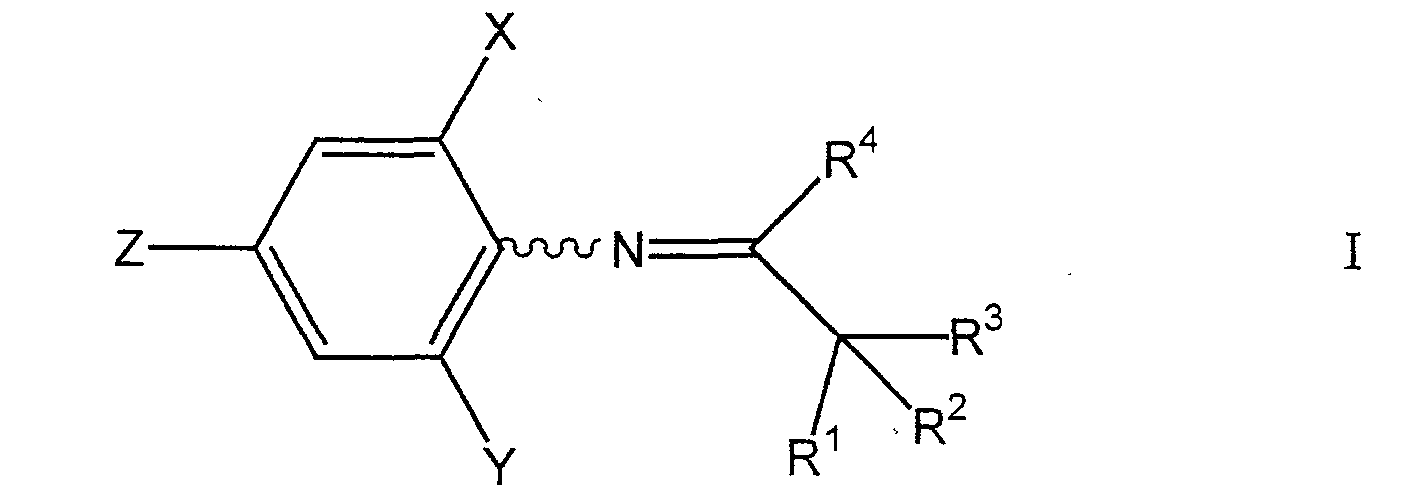
- amidine compounds of formula I as depicted below have excellent pesticidal effects, i.e., insecticidal, acaricidal, and nematocidal activity.
- the "halogen” may include fluorine, chlorine, and bromine atoms.
- C 1 -C 6 alkyl may include methyl, ethyl, propyl, isopropyl, butyl, isobutyl, sec-butyl, tert-butyl, pentyl, neopentyl, and hexyl groups.
- C 1 -C 6 haloalkyl may include trifluoromethyl, pentafluoroethyl, heptafluoropropyl, nonafluorobutyl, difluoromethyl, chlorodifluoromethyl, dichlorofluoromethyl, bromodifluoromethyl, dibromofluoromethyl, chlorofluoromethyl, bromofluoromethyl, dichloromethyl, 2-chlorotetrafluoroethyl, 2-bromotetrafluoroethyl, and 2,2,2-trifluoroethyl groups.
- C 1 -C 6 haloalkoxy may include trifluoromethoxy, pentafluoroethoxy, and difluoromethoxy groups.
- the "(C 1 -C 6 alkoxy)carbonyl” may include methoxycarbonyl and ethoxycarbonyl groups.
- the "(C 1 -C 6 alkoxy) C 1 -C 6 alkyl” may include methoxymethyl, ethoxymethyl, propoxymethyl, isopropoxymethyl, butoxymethyl, isobutoxymethyl, 2-methoxyethyl, 1-methoxy-2,2-dimethylpropyl, 1-ethoxy-2,2-dimethylpropyl, 1-methoxy-1,2,2-trimethylpropyl and 1-ethoxy-1,2,2-trimethylpropyl groups.
- C 2 -C 6 acyl referring also to (C 1 -C 5 alkyl)carbonyl, may include acetyl, propanoyl, butanoyl, 3-methylbutanoyl, 2-methylpropanoyl, and pentanoyl groups.
- the "C 1 -C 6 alkoxy” may include methoxy, ethoxy, propoxy, isopropoxy, butoxy, isobutoxy, sec-butoxy, and tert-butoxy groups.
- di(C 1 -C 6 alkyl)amino may include dimethylamino, ethyl(methyl)amino, diethylamino, and dipropylamino groups.
- Preferred substituents in the present compounds from the viewpoints of high insecticidal and acaricidal activity are as follows:
- the present compounds can be produced, for example, by one of production processes 1 to 5 as described below.
- R 4 is a group of formula: NR 6 R 7
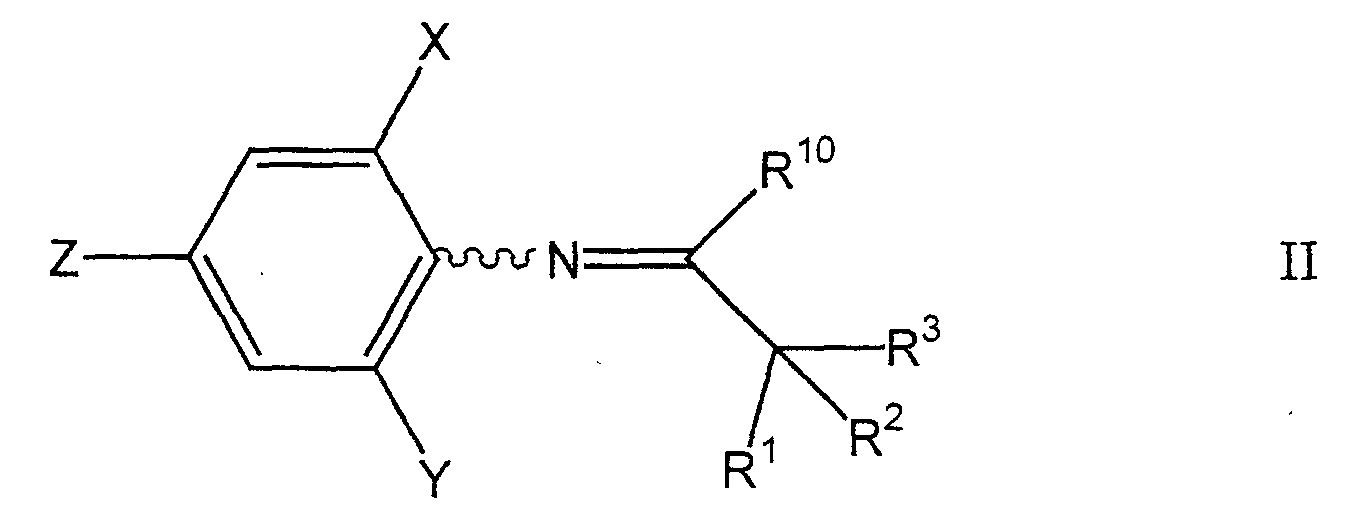
- NR 6 R 7 can be produced by reacting a compound of formula II: wherein X, Y, Z, R 1 , R 2 , and R 3 are as defined above; and R 10 is halogen (e.g ., chlorine, bromine, iodine), with a compound of formula III: wherein R 6 and R 7 are as defined above, or a salt thereof in the presence of a base without any solvent or in a solvent.
- the reaction is usually carried out at a temperature of about -5°C to 150°C for 1 minute to 24 hours.
- the amounts of reagents to be used in the reaction are usually 1 to 10 moles of compound III or a salt thereof and 1 to 10 moles of a base, relative to 1 mole of compound II.
- compound III When compound III is allowed to act by itself as a base, this compound may be used in an amount of 2 mole to an excessive amount.
- the base may include inorganic bases such as sodium hydride, potassium hydride, sodium hydroxide, potassium hydroxide, sodium carbonate, and potassium carbonate; alkali metal alkoxides such as sodium methoxide and sodium ethoxide; and tertiary amines such as triethylamine.
- inorganic bases such as sodium hydride, potassium hydride, sodium hydroxide, potassium hydroxide, sodium carbonate, and potassium carbonate
- alkali metal alkoxides such as sodium methoxide and sodium ethoxide
- tertiary amines such as triethylamine.
- the solvent which can be used in the reaction may include aliphatic hydrocarbons such as hexane, heptane, ligroin, and petroleum ether; aromatic hydrocarbons such as toluene; halogenated hydrocarbons such as dichloroethane, chlorobenzene, and dichlorobenzene; ethers such as diisopropyl ether, dioxane, tetrahydrofuran, and ethylene glycol dimethyl ether; ketones such as acetone, methyl ethyl ketone, methyl isobutyl ketone, isophorone, and cyclohexanone; esters such as ethyl acetate and butyl acetate; nitriles such as acetonitrile and isobutyronitrile; nitro compounds such as nitroethane and nitrobenzene; acid amides such as formamide, N,N-dimethylformamide, and N,N-dimethyl
- reaction mixture is poured into water, followed by post-treatment including, for example, extraction with an organic solvent and evaporation of the organic layer, to give a product of the desired present compound.
- post-treatment including, for example, extraction with an organic solvent and evaporation of the organic layer, to give a product of the desired present compound.
- the product may be purified by chromatography, recrystallization, or any other technique.
- Compound II can be produced by reacting a compound of formula IV: wherein X, Y, Z, R 1 , R 2 , and R 3 are as defined above, with a halogenating agent according to the known methods (see, e.g ., JP-A 8-295663).
- the halogenating agent may include phosphorus pentachloride, phosphorus oxychloride, and triphenylphosphine-carbon tetrachloride.
- the reaction is usually carried out at a temperature of about -5°C to 150°C for 1 to 24 hours.
- the amounts of reagents to be used in the reaction are 1 mole to an excessive amount of a halogenating agent, relative to 1 mole of compound IV.
- the solvent which can be used in the reaction may include aliphatic hydrocarbons such as hexane, heptane, ligroin, and petroleum ether; aromatic hydrocarbons such as toluene; halogenated hydrocarbons such as dichloroethane, chlorobenzene, and dichlorobenzene; ethers such as diisopropyl ether, dioxane, tetrahydrofuran, ethylene glycol dimethyl ether; acid amides such as N,N-dimethylformamide and N,N-dimethylacetamide; sulfur compounds such as dimethylsulfoxide and sulforane; and mixtures thereof.
- aliphatic hydrocarbons such as hexane, heptane, ligroin, and petroleum ether
- aromatic hydrocarbons such as toluene
- halogenated hydrocarbons such as dichloroethane, chlorobenzene, and dichlorobenzene
- reaction mixture is poured into water, followed by post-treatment including, for example, extraction with an organic solvent and evaporation of the organic layer, to give a product of the desired compound II.
- the product may be purified by chromatography, recrystallization, or any other technique.
- Compound IV can be produced as shown in the following scheme: wherein X, Y, Z, R 1 , R 2 , R 3 , and R 10 are as defined above; and R 11 is C 1 -C 6 alkyl.
- Ester compound VI can be produced from carboxylic acid compound V according to the known methods (see, e.g., J. Org. Chem. 55, 812 (1990); Tetrahedron 52, 157 (1996)).
- Amide compound VII can be produced from ester compound VI according to the known methods (see, e.g ., J. Org. Chem. 51, 332 (1986); Tetrahedron Lett. 34, 7195 (1993)).
- Acid halide VIII can be produced from carboxylic acid compound I according to the known methods (see, e.g. , J. Org. Chem. 54, 6096 (1989); J. Fluorine Chem. 75, 35 (1995)).
- Amide compound III can be produced from acid halide IV according to the known methods (see, e . g ., J. Org. Chem. 60, 1319 (1995); J. Fluorine Chem. 84, 135 (1997)).
- Compound IV can be produced by reacting acid halide VIII with a compound of formula X: wherein X, Y, and Z are as defined above, according to the known methods (see, e.g ., Shin-Jikken Kagaku Koza (Maruzen), vol. 14 [II], pp. 1142-1145).
- Compound IV can be produced by reacting acid anhydride IX with compound X according to the known methods (see, e.g ., JP-A 8-295663).
- Compound IV can also be produced by reacting amide compound VII with a compound of formula XI: wherein X, Y, and Z are as defined above; and R 12 is a leaving group or atom (e.g ., fluorine, chlorine, bromine, iodine, methoxy, trifluoromethylsulfonyloxy, methanesulfonyloxy), usually in the presence of a base in a solvent, and if necessary, in the presence of a catalyst.
- a leaving group or atom e.g ., fluorine, chlorine, bromine, iodine, methoxy, trifluoromethylsulfonyloxy, methanesulfonyloxy
- the reaction is usually carried out at a temperature of about -5°C to 150°C for 10 minutes to 24 hours.
- the amounts of reagents to be used in the reaction are usually 1 to 10 moles of amide compound VII and 1 mole to a large excess of a base, relative to 1 mole of compound XI.
- the base may include inorganic bases such as sodium hydride, potassium hydride, sodium hydroxide, potassium hydroxide, sodium carbonate, and potassium carbonate; alkali metal alkoxides such as sodium methoxide and sodium ethoxide; and tertiary amines such as triethylamine, pyridine, 4-dimethylaminopyridine, and N,N-dimethylaniline.
- inorganic bases such as sodium hydride, potassium hydride, sodium hydroxide, potassium hydroxide, sodium carbonate, and potassium carbonate
- alkali metal alkoxides such as sodium methoxide and sodium ethoxide
- tertiary amines such as triethylamine, pyridine, 4-dimethylaminopyridine, and N,N-dimethylaniline.
- the solvent may include aliphatic hydrocarbons such as hexane, heptane, ligroin, and petroleum ether; aromatic hydrocarbons such as toluene; halogenated hydrocarbons such as dichloroethane, chlorobenzene, and dichlorobenzene; ethers such as diisopropyl ether, dioxane, tetrahydrofuran, and ethylene glycol dimethyl ether; ketones such as acetone, methyl ethyl ketone, methyl isobutyl ketone, isophorone, and cyclohexanone; esters such as ethyl acetate and butyl acetate; nitriles such as acetonitrile and isobutyronitrile; nitro compounds such as nitroethane and nitrobenzene; acid amides such as formamide, N,N-dimethylformamide, and N,N-dimethylacetamide; sulfur compounds such
- the catalyst which is used, if necessary, may include crown ethers and potassium fluoride.
- reaction mixture is poured into water, followed by post-treatment including, for example, extraction with an organic solvent and evaporation of the organic layer, to give a product of the desired compound IV.
- the product may be purified by chromatography, recrystallization, or any other technique.
- R 4 is amino
- a compound of formula XII with a compound of formula XII: wherein R 1 , R 2 , and R 3 are as defined above, usually in the presence of a base in a solvent, and if necessary, in the presence of a catalyst.
- the reaction is usually carried out at a temperature of -5°C to 150°C for 10 minutes to 24 hours.
- the amounts of reagents to be used in the reaction are usually 1 to 10 moles of compound XII and 1 mole to a large excess of a base, relative to 1 mole of compound XI.
- the base may include inorganic bases such as sodium hydride, potassium hydride, sodium hydroxide, potassium hydroxide, sodium carbonate, and potassium carbonate; alkali metal alkoxides such as sodium methoxide and sodium ethoxide; and tertiary amines such as triethylamine, pyridine, 4-dimethylaminopyridine, and N,N-dimethylaniline.
- inorganic bases such as sodium hydride, potassium hydride, sodium hydroxide, potassium hydroxide, sodium carbonate, and potassium carbonate
- alkali metal alkoxides such as sodium methoxide and sodium ethoxide
- tertiary amines such as triethylamine, pyridine, 4-dimethylaminopyridine, and N,N-dimethylaniline.
- the solvent may include aliphatic hydrocarbons such as hexane, heptane, ligroin, and petroleum ether; aromatic hydrocarbons such as toluene; halogenated hydrocarbons such as dichloroethane, chlorobenzene, and dichlorobenzene; ethers such as diisopropyl ether, dioxane, tetrahydrofuran, and ethylene glycol dimethyl ether; ketones such as acetone, methyl ethyl ketone, methyl isobutyl ketone, isophorone, and cyclohexanone; esters such as ethyl acetate and butyl acetate; nitriles such as acetonitrile and isobutyronitrile; nitro compounds such as nitroethane and nitrobenzene; acid amides such as formamide, N,N-dimethylformamide, and N,N-dimethylacetamide; sulfur compounds such
- the catalyst which is used, if necessary, may include crown ethers and potassium fluoride.
- reaction mixture is poured into water, followed by post-treatment including, for example, extraction with an organic solvent and evaporation of the organic layer, to give a product of the desired present compound.
- post-treatment including, for example, extraction with an organic solvent and evaporation of the organic layer, to give a product of the desired present compound.
- the product may be purified by chromatography, recrystallization, or any other technique.
- Compound XII can be produced according to the known methods (see, e.g ., J. Org. Chem. 30, 3729 (1965)).
- R 4 is a group of formula: NHR 13 or N(R 13 ) 2 and R 13 is C 1 -C 6 alkyl, (C 1 -C 6 alkoxy)carbonyl, (C 1 -C 6 alkoxy) C 1 -C 6 alkyl, or C 2 -C 6 acyl
- R 4 is amino (hereinafter referred to as compound A) with a compound of formula XIII: R 13 -R 14 wherein R 13 is as defined above and R 14 is a leaving group or atom ( e.g ., chlorine, bromine, iodine, trifluoromethylsulfonyloxy, methanesulfonyloxy), usually in the presence of a base in a solvent.
- the reaction is usually carried out at a temperature of -5°C to 150°C for 1 to 24 hours.
- the amounts of reagents to be used in the reaction are usually 0.8 to 1 mole of compound XIII and 0.8 to 10 moles of a base, relative to 1 mole of compound A.
- the amounts of reagents to be used in the reaction are usually 2 to 10 mole of compound XIII and 2 to 10 moles of a base, relative to 1 mole of compound A.
- the base may include inorganic bases such as sodium hydride, potassium hydride, sodium hydroxide, potassium hydroxide, sodium carbonate, and potassium carbonate; alkali metal alkoxides such as sodium methoxide and sodium ethoxide; and tertiary amines such as triethylamine, pyridine, 4-dimethylaminopyridine, and N,N-dimethylaniline.
- inorganic bases such as sodium hydride, potassium hydride, sodium hydroxide, potassium hydroxide, sodium carbonate, and potassium carbonate
- alkali metal alkoxides such as sodium methoxide and sodium ethoxide
- tertiary amines such as triethylamine, pyridine, 4-dimethylaminopyridine, and N,N-dimethylaniline.
- the solvent which can be used in the reaction may include aliphatic hydrocarbons such as hexane, heptane, ligroin, and petroleum ether; aromatic hydrocarbons such as toluene; halogenated hydrocarbons such as dichloroethane, chlorobenzene, and dichlorobenzene; ethers such as diisopropyl ether, dioxane, tetrahydrofuran, and ethylene glycol dimethyl ether; ketones such as acetone, methyl ethyl ketone, methyl isobutyl ketone, isophorone, and cyclohexanone; esters such as ethyl acetate and butyl acetate; nitriles such as acetonitrile and isobutyronitrile; nitro compounds such as nitroethane and nitrobenzene; acid amides such as formamide, N,N-dimethylformamide, and N,N-dimethyl
- reaction mixture is poured into water, followed by post-treatment including, for example, extraction with an organic solvent and evaporation of the organic layer, to give a product of the desired present compound.
- post-treatment including, for example, extraction with an organic solvent and evaporation of the organic layer, to give a product of the desired present compound.
- the product may be purified by chromatography, recrystallization, or any other technique.
- R 4 is a group of formula: NR 13 R 15 , R 13 is as defined above, and R 15 is C 1 -C 6 alkyl, (C 1 -C 6 alkoxy)carbonyl, (C 1 -C 6 alkoxy) C 1 -C 6 alkyl, or C 2 -C 6 acyl
- R 4 is a group of formula: NHR 13 (hereinafter referred to as compound B) with a compound of formula XIV: R 15 -R 14 wherein R 14 and R 15 are as defined above, usually in the presence of a base in a solvent.
- the reaction is usually carried out at a temperature of -5°C to 150°C for 1 to 24 hours.
- the amounts of reagents to be used in the reaction are usually 1 to 10 moles of compound XIV and 1 to 10 moles of a base, relative to 1 mole of compound B.
- the base may include inorganic bases such as sodium hydride, potassium hydride, sodium hydroxide, potassium hydroxide, sodium carbonate, and potassium carbonate; alkali metal alkoxides such as sodium methoxide and sodium ethoxide; and tertiary amines such as triethylamine, pyridine, 4-dimethylaminopyridine, and N,N-dimethylaniline.
- inorganic bases such as sodium hydride, potassium hydride, sodium hydroxide, potassium hydroxide, sodium carbonate, and potassium carbonate
- alkali metal alkoxides such as sodium methoxide and sodium ethoxide
- tertiary amines such as triethylamine, pyridine, 4-dimethylaminopyridine, and N,N-dimethylaniline.
- the solvent which can be used in the reaction may include aliphatic hydrocarbons such as hexane, heptane, ligroin, and petroleum ether; aromatic hydrocarbons such as toluene; halogenated hydrocarbons such as dichloroethane, chlorobenzene, and dichlorobenzene; ethers such as diisopropyl ether, dioxane, tetrahydrofuran, and ethylene glycol dimethyl ether; ketones such as acetone, methyl ethyl ketone, methyl isobutyl ketone, isophorone, and cyclohexanone; esters such as ethyl acetate and butyl acetate; nitriles such as acetonitrile and isobutyronitrile; nitro compounds such as nitroethane and nitrobenzene; acid amides such as formamide, N,N-dimethylformamide, and N,N-dimethyl
- reaction mixture is poured into water, followed by post-treatment including, for example, extraction with an organic solvent and evaporation of the organic layer, to give a product of the desired present compound.
- post-treatment including, for example, extraction with an organic solvent and evaporation of the organic layer, to give a product of the desired present compound.
- the product may be purified by chromatography, recrystallization, or any other technique.
- the reaction is usually carried out at a temperature of -5°C to 150°C for 1 to 24 hours.
- the amounts of reagents to be used in the reaction are usually 1 to 10 moles of compound XV or XVI and 0.01 to 1 mole of an acid catalyst, relative to 1 mole of compound A.
- the acid catalyst may include inorganic acids such as hydrochloric acid and sulfuric acid; organic acids such as acetic acid and p-toluenesulfonic acid; and aprotic acids such as boron trifluoride.
- the solvent which can be used in the reaction may include aliphatic hydrocarbons such as hexane, heptane, ligroin, and petroleum ether; aromatic hydrocarbons such as toluene; halogenated hydrocarbons such as dichloroethane, chlorobenzene, and dichlorobenzene; ethers such as diisopropyl ether, dioxane, tetrahydrofuran, and ethylene glycol dimethyl ether; ketones such as acetone, methyl ethyl ketone, methyl isobutyl ketone, isophorone, and cyclohexanone; esters such as ethyl acetate and butyl acetate; nitriles such as acetonitrile and isobutyronitrile; nitro compounds such as nitroethane and nitrobenzene; acid amides such as formamide, N,N-dimethylformamide, and N,N-dimethyl
- reaction mixture is poured into water, followed by post-treatment including, for example, extraction with an organic solvent and evaporation of the organic layer, to give a product of the desired present compound.
- post-treatment including, for example, extraction with an organic solvent and evaporation of the organic layer, to give a product of the desired present compound.
- the product may be purified by chromatography, recrystallization, or any other technique.
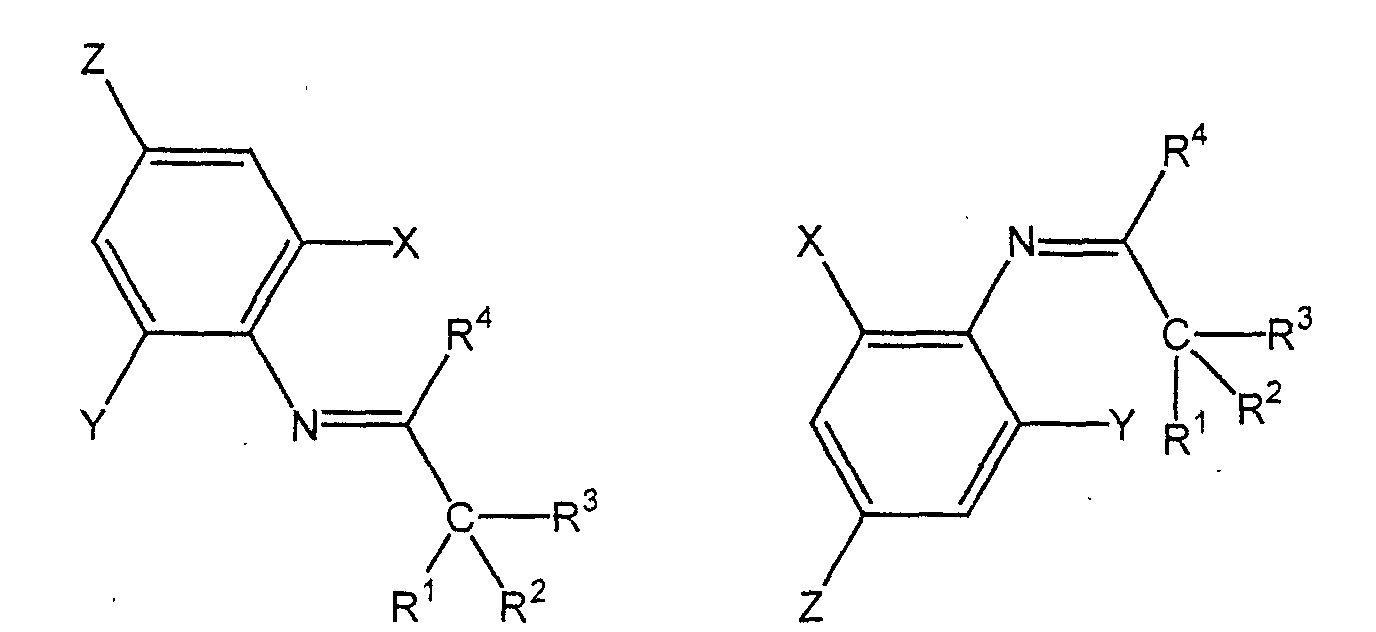
- the present compounds may have structural isomers with respect to the double bond as depicted below, and both isomers are embraced by the present invention.
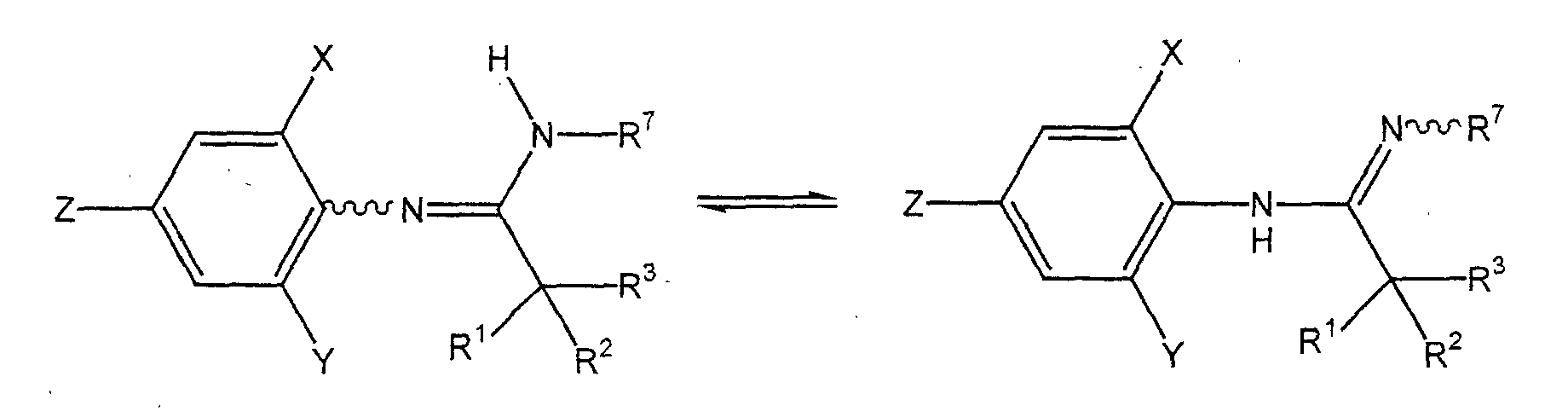
- R 4 is a group of formula: NR 6 R 7 and R 6 is hydrogen may have tautomers as depicted below, and these tautomers are embraced by the present invention.
- the present compounds can exhibit controlling activity against pests including harmful arthropods (e.g., harmful insects and acarines) and harmful nematodes.
- harmful arthropods e.g., harmful insects and acarines
- harmful nematodes e.g., harmful insects and acarines
- Specific examples of the pests are as follows:
- the present compounds can also be used for the effective control of pests having improved resistance to the conventional pesticides.
- the present compounds When used as the active ingredients of pesticides, they may be used as such or in the form of salts (agrochemically acceptable salts with inorganic acids such as hydrochloric acid and sulfuric acid or organic acids such as p-toluenesulfonic acid) without addition of any other ingredients.
- salts agrochemically acceptable salts with inorganic acids such as hydrochloric acid and sulfuric acid or organic acids such as p-toluenesulfonic acid
- the present compounds are usually mixed with solid carriers, liquid carriers, gaseous carriers or baits, or absorbed in base materials such as porous ceramic plates or nonwoven fabrics, followed by addition of surfactants and other auxiliaries, if necessary, and they are then formulated into various forms, such as oil sprays, emulsifiable concentrates, wettable powders, flowables, granules, dusts, aerosols, fumigants ( e.g ., foggings), vaporizable formulations, smoking formulations, poison baits, anti-acarine sheets, or resin formulations.
- Each of these formulations may usually contain at least one of the present compounds as an active ingredient in an amount of 0.01% to 95% by weight.
- the solid carrier which can be used in the formulation may include fine powder or granules of clay materials such as kaolin clay, diatomaceous earth, synthetic hydrated silicon oxide, bentonite, Fubasami clay, and acid clay; various kinds of talc, ceramics, and other inorganic minerals such as sericite, quartz, sulfur, activated carbon, calcium carbonate, and hydrated silica; and chemical fertilizers such as ammonium sulfate, ammonium phosphate, ammonium nitrate, urea, and ammonium chloride.
- clay materials such as kaolin clay, diatomaceous earth, synthetic hydrated silicon oxide, bentonite, Fubasami clay, and acid clay
- various kinds of talc, ceramics, and other inorganic minerals such as sericite, quartz, sulfur, activated carbon, calcium carbonate, and hydrated silica
- chemical fertilizers such as ammonium sulfate, ammonium phosphate, ammonium nitrate, urea, and ammoni
- the liquid carrier may include water; alcohols such as methanol and ethanol; ketones such as acetone and methyl ethyl ketone; aromatic hydrocarbons such as benzene, toluene, xylene, ethylbenzene, and methylnaphthalene; aliphatic hydrocarbons such as hexane, cyclohexane, kerosene, and light oil; esters such as ethyl acetate and butyl acetate; nitriles such as acetonitrile and isobutyronitrile; ethers such as diisopropyl ether and dioxane; acid amides such as N,N-dimethylformamide and N,N-dimethylacetamide; halogenated hydrocarbons such as dichloromethane, trichloroethane, and carbon tetrachloride; dimethyl sulfoxide; and vegetable oils such as soybean oil and cottonseed oil.
- the gaseous carrier or propellant may include Freon gas, butane gas, LPG (liquefied petroleum gas), dimethyl ether, and carbon dioxide.
- the base material for used in poison baits may include bait materials such as grain powder, vegetable oils, sugars, and crystalline cellulose; antioxidants such as dibutylhydroxytoluene and nordihydroguaiaretic acid; preservatives such as dehydroacetic acid; substances for preventing erroneous eating, such as red pepper powder; and attractant flavors such as cheese flavor and onion flavor.
- bait materials such as grain powder, vegetable oils, sugars, and crystalline cellulose
- antioxidants such as dibutylhydroxytoluene and nordihydroguaiaretic acid
- preservatives such as dehydroacetic acid
- substances for preventing erroneous eating such as red pepper powder
- attractant flavors such as cheese flavor and onion flavor.
- the surfactant may include alkyl sulfates, alkyl sulfonates, alkyl arylsulfonates, alkyl aryl ethers and their polyoxyethylene derivatives, polyethylene glycol ethers, polyhydric alcohol esters, and sugar alcohol derivatives.
- auxiliaries such as adhesive agents or dispersants may include casein, gelatin; polysaccharides such as starch, gum arabic, cellulose derivatives, and alginic acid; lignin derivatives, bentonite, sugars, and synthetic water-soluble polymers such as polyvinyl alcohol, polyvinyl pyrrolidone, and polyacrylic acid.
- the stabilizing agent may include PAP (isopropyl acid phosphate), BHT (2,6-di-tert-butyl-4-methylphenol), BHA (mixtures of 2-tert-butyl-4-methoxyphenol and 3-tert-butyl-4-methoxyphenol), vegetable oils, mineral oils, surfactants, fatty acids and their esters.
- PAP isopropyl acid phosphate
- BHT 2,6-di-tert-butyl-4-methylphenol
- BHA mixturetures of 2-tert-butyl-4-methoxyphenol and 3-tert-butyl-4-methoxyphenol
- vegetable oils mineral oils
- surfactants fatty acids and their esters.
- the amounts for their application are usually in the range of 0.1 to 100 g per 10 ares.
- concentrations for their application usually in the range of 1 to 10,000 ppm.
- the application of granules, dusts, or other similar formulations is carried out as such formulations without dilution.
- the present compounds When used as insecticides, acaricides, or nematocides for epidemic prevention, they are applied after dilution with water to concentrations of 0.1 to 500 ppm in the case of emulsifiable concentrates, wettable powders, flowable, or other similar formulations, or they are applied as such in the case of oil sprays, aerosols, fumigants, poisonous baits, anti-acarine sheets, or other similar formulations. These application amounts or concentrations may vary depending upon types of formulations, times, places, and methods of application, kinds of pests, degree of damage, and other factors; they can therefore be increased or decreased without limitation to the above ranges.
- compositions When used as insecticides or acaricides for the control of ectoparasites on domestic animals such as cattle and pigs or pets such as cats and dogs, they or their salts may be applied by the known veterinary methods, for example, tablets, capsules, immersion solutions, boli, feed incorporation, suppositories, or injection ( e.g., intramuscular, subcutaneous, intravenous, intraperitoneal) for systemic control; or spray, pour-on or spot-on treatment with oily or aqueous solutions, or using articles formed from resin formulations into appropriate shapes such as collars and ear tags for non-systemic control. In these cases, the present compounds are usually applied in their own amounts of 0.01 mg to 100 mg per kg of a host animal.
- the present compounds can be used in admixture with, or separately but simultaneously with, other insecticides, nematocides, acaricides, bactericides, fungicides, herbicides, plant growth regulators, synergists, fertilizers, soil conditioners and/or animal feeds.
- the insecticide, nematocide and/or acaricide which can be used may include organophosphorus compounds such as Fenitrothion [O,O-dimethyl O-(3-methyl-4-nitrophenyl) phosphorothioate], Fenthion [O,O-dimethyl O-(3-methyl-4-(methylthio)phenyl) phophorothioate], Diazinon [O,O-diethyl O-(2-isopropyl-6-methylpyrimidin-4-yl) phosphorothioate], Chlorpyriphos [O,O-diethyl O-(3,5,6-trichloro-2-pyridyl) phosphorothioate], Acephate [O,S-dimethyl acetylphosphoramidothioate], Methidathion [S-((2,3-dihydro-5-methoxy-2-oxo-1,3,4-thiadiazol-3-yl)methyl) O,O-
- An aerosol vessel is filled with a mixture of 0.2 part of each of present compounds 1 to 61, 0.1 part of d-allethrin, 0.2 part of d-phenothrin, 5 parts of xylene, 3.4 parts of deodorized kerosine, and 1 part of an emulsifier (ATMOS 300 available from Atlas Chemical Co.); and 50 parts of pure water.
- the vessel is then equipped with a valve, through which 40 parts of a propellant (liquefied petroleum gas) is charged under increased pressure to give a water-based aerosol of each compound.
- a propellant liquefied petroleum gas
- each of present compounds 1 to 61 is mixed with 0.3 g of d-allethrin, which is dissolved in 20 ml of acetone.
- the solution is then uniformly mixed with 99.4 g of a carrier for mosquito-coils (prepared by mixing Tabu powder, pyrethrum marc powder and wood flour in the ratio of 4 : 3 : 3) under stirring.
- the mixture is well kneaded with the addition of 120 ml of water, followed by molding and drying to give a mosquito-coil of each compound.
- each of present compounds 1 to 61, 0.4 part of d-alle-thrin, and 0.4 g of pipenyl butoxide are dissolved in acetone to have a total volume of 10 ml. Then, 0.5 ml of the solution is uniformly absorbed in a substrate for electric mosquito-mats having a size of 2.5 cm x 1.5 cm and a thickness of 0.3 cm (prepared by forming a fibrillated mixture of cotton linter and pulp into a sheet) to give an electric mosquito-mat of each compound.
- Each of present compounds 1 to 61 is diluted with acetone, and the dilution is absorbed in a nonwoven fabric by dropping so that the ratio comes to 1 g per square meter.
- the acetone is then removed by air drying to give an anti-acarine sheet of each compound.
- Each of present compounds 1 to 61 is diluted with acetone, and the dilution is absorbed in a filter paper by dropping so that the ratio comes to 1 g per square meter.
- the acetone is then removed by air drying to give an anti-acarine sheet of each compound.
- test examples are provided for demonstrating that the present compounds are useful as active ingredients of pesticides.
- the present compounds are designated by their compound numbers as described above.
- a filter paper of the same size On the bottom of a polyethylene cup of 5.5 cm in diameter was placed a filter paper of the same size, to which a water dilution (500 ppm) of each of the formulations obtained from present compounds 1, 2, 3, 4, 5, 6, 7, 8, 9, 10, 11, 12, 13, 14, 15, 16, 17, 18, 19, 20, 21, 25, 26, 27, 28, 29, 30, 32, 33, 34, 35, 36, 37, 38, 39, 40, 41, 42, 43, 44, 45, 47, 49, 50, 51, 52, 53, 54, 55, 56, 57, 58, 59, 60, and 61 according to Formulation Example 1 was added dropwise in an amount of 0.7 ml, and the cup was uniformly charged with 30 mg of sucrose as a bait.
- a water dilution 500 ppm
- a filter paper of the same size On the bottom of a polyethylene cup of 5.5 cm in diameter was placed a filter paper of the same size, to which a water dilution (500 ppm) of each of the formulations obtained from present compounds 1, 2, 3, 4, 5, 6, 7, 8, 9, 10, 11, 12, 13, 14, 15, 16, 17, 18, 19, 20, 21, 25, 26, 27, 28, 29, 32, 33, 34, 35, 36, 37, 38, 39, 40, 41, 42, 43, 44, 45, 47, 51, 52, 53, 54, 55, 60, and 61 according to Formulation Example 1 was added dropwise in an amount of 0.7 ml, and the cup was uniformly charged with about 30 mg of sucrose as a bait. Ten female adults of house fly ( Musca domestica ) were set free in each cup, which was then kept covered.
Landscapes
- Organic Chemistry (AREA)
- Chemical & Material Sciences (AREA)
- Life Sciences & Earth Sciences (AREA)
- Dentistry (AREA)
- Health & Medical Sciences (AREA)
- Engineering & Computer Science (AREA)
- Plant Pathology (AREA)
- General Health & Medical Sciences (AREA)
- Wood Science & Technology (AREA)
- Zoology (AREA)
- Environmental Sciences (AREA)
- Pest Control & Pesticides (AREA)
- Agronomy & Crop Science (AREA)
- Agricultural Chemicals And Associated Chemicals (AREA)
- Organic Low-Molecular-Weight Compounds And Preparation Thereof (AREA)
Abstract
Description





| X | Y | Z | CR1R2R3 | R4 |
| Cl | Cl | CF3 | CF3 | NH2 |
| NO2 | NO2 | CF3 | CF3 | NH2 |
| Cl | NO2 | CF3 | CF3 | NH2 |
| Cl | F | CF3 | CF3 | NH2 |
| Cl | CN | CF3 | CF3 | NH2 |
| Cl | Br | CF3 | CF3 | NH2 |
| Cl | Me | CF3 | CF3 | NH2 |
| Cl | Et | CF3 | CF3 | NH2 |
| NO2 | F | CF3 | CF3 | NH2 |
| NO2 | CN | CF3 | CF3 | NH2 |
| NO2 | Br | CF3 | CF3 | NH2 |
| NO2 | Me | CF3 | CF3 | NH2 |
| NO2 | Et | CF3 | CF3 | NH2 |
| F | F | CF3 | CF3 | NH2 |
| F | CN | CF3 | CF3 | NH2 |
| F | Br | CF3 | CF3 | NH2 |
| F | Me | CF3 | CF3 | NH2 |
| F | Et | CF3 | CF3 | NH2 |
| CN | CN | CF3 | CF3 | NH2 |
| CN | Br | CF3 | CF3 | NH2 |
| CN | Me | CF3 | CF3 | NH2 |
| CN | Et | CF3 | CF3 | NH2 |
| Br | Br | CF3 | CF3 | NH2 |
| X | Y | Z | CR1R2R3 | R4 |
| Br | Me | CF3 | CF3 | NH2 |
| Br | Et | CF3 | CF3 | NH2 |
| Me | Me | CF3 | CF3 | NH2 |
| Me | Et | CF3 | CF3 | NH2 |
| Et | Et | CF3 | CF3 | NH2 |
| Cl | Cl | CF3 | C2 F5 | NH2 |
| NO2 | NO2 | CF3 | C2 F5 | NH2 |
| Cl | NO2 | CF3 | C2 F5 | NH2 |
| Cl | F | CF3 | C2 F5 | NH2 |
| Cl | CN | CF3 | C2 F5 | NH2 |
| Cl | Br | CF3 | C2 F5 | NH2 |
| Cl | Me | CF3 | C2 F5 | NH2 |
| Cl | Et | CF3 | C2 F5 | NH2 |
| NO2 | F | CF3 | C2 F5 | NH2 |
| NO2 | CN | CF3 | C2 F5 | NH2 |
| NO2 | Br | CF3 | C2 F5 | NH2 |
| NO2 | Me | CF3 | C2 F5 | NH2 |
| NO2 | Et | CF3 | C2 F5 | NH2 |
| F | F | CF3 | C2 F5 | NH2 |
| F | CN | CF3 | C2 F5 | NH2 |
| F | Br | CF3 | C2 F5 | NH2 |
| F | Me | CF3 | C2 F5 | NH2 |
| F | Et | CF3 | C2 F5 | NH2 |
| X | Y | Z | CR1R2R3 | R4 |
| CN | CN | CF3 | C2 F5 | NH2 |
| CN | Br | CF3 | C2 F5 | NH2 |
| CN | Me | CF3 | C2 F5 | NH2 |
| CN | Et | CF3 | C2 F5 | NH2 |
| Br | Br | CF3 | C2 F5 | NH2 |
| Br | Me | CF3 | C2 F5 | NH2 |
| Br | Et | CF3 | C2 F5 | NH2 |
| Me | Me | CF3 | C2 F5 | NH2 |
| Me | Et | CF3 | C2 F5 | NH2 |
| Et | Et | CF3 | C2 F5 | NH2 |
| Cl | Cl | CF3 | CClF2 | NH2 |
| NO2 | NO2 | CF3 | CClF2 | NH2 |
| Cl | Cl | CF3 | CCl2 F | NH2 |
| NO2 | NO2 | CF3 | CCl2 F | NH2 |
| Cl | Cl | CF3 | C3 F7 | NH2 |
| NO2 | NO2 | CF3 | C3 F7 | NH2 |
| Cl | Cl | CF3 | C4 F9 | NH2 |
| NO2 | NO2 | CF3 | C4 F9 | NH2 |
| Cl | Cl | CF3 | C5 F11 | NH2 |
| NO2 | NO2 | CF3 | C5 F11 | NH2 |
| Cl | Cl | CF3 | C6F13 | NH2 |
| NO2 | NO2 | CF3 | C6F13 | NH2 |
| Cl | Cl | CF3 | CBrF2 | NH2 |
| X | Y | Z | CR1R2R3 | R4 |
| NO2 | NO2 | CF3 | CBrF2 | NH2 |
| Cl | Cl | CF3 | CBr2 F | NH2 |
| NO2 | NO2 | CF3 | CBr2 F | NH2 |
| Cl | Cl | CF3 | CCl3 | NH2 |
| NO2 | NO2 | CF3 | CCl3 | NH2 |
| Cl | Cl | CF3 | CBr3 | NH2 |
| NO2 | NO2 | CF3 | CBr3 | NH2 |
| Cl | Cl | CF3 | CF2 H | NH2 |
| NO2 | NO2 | CF3 | CF2 H | NH2 |
| Cl | Cl | CF3 | CCl2 H | NH2 |
| NO2 | NO2 | CF3 | CCl2 H | NH2 |
| Cl | Cl | CF3 | CBr2 H | NH2 |
| NO2 | NO2 | CF3 | CBr2 H | NH2 |
| Cl | Cl | CF3 | CClFH | NH2 |
| NO2 | NO2 | CF3 | CClFH | NH2 |
| Cl | Cl | CF3 | CBrClH | NH2 |
| NO2 | NO2 | CF3 | CBrClH | NH2 |
| Cl | Cl | CF3 | CBrFH | NH2 |
| NO2 | NO2 | CF3 | CBrFH | NH2 |
| Cl | Cl | CF3 | CF2 CH3 | NH2 |
| NO2 | NO2 | CF3 | CF2 CH3 | NH2 |
| Cl | Cl | CF3 | CF2 CF2H | NH2 |
| NO2 | NO2 | CF3 | CF2 CF2 H | NH2 |
| X | Y | Z | CR1R2R3 | R4 |
| Cl | Cl | CF3 | (CF2)3H | NH2 |
| NO2 | NO2 | CF3 | (CF2)3H | NH2 |
| Cl | Cl | CF3 | CF2 CF2 Cl | NH2 |
| NO2 | NO2 | CF3 | CF2 CF2 Cl | NH2 |
| Cl | Cl | CF3 | CF2 CF2 Br | NH2 |
| NO2 | NO2 | CF3 | CF2 CF2 Br | NH2 |
| Cl | Cl | CF3 | CFClCF3 | NH2 |
| NO2 | NO2 | CF3 | CFClCF3 | NH2 |
| Cl | Cl | CF3 | CFBrCF3 | NH2 |
| NO2 | NO2 | CF3 | CFBrCF3 | NH2 |
| Cl | Cl | CF3 | CH(CF3)2 | NH2 |
| NO2 | NO2 | CF3 | CH(CF3)2 | NH2 |
| Cl | Cl | CF3 | CF2CHFCF3 | NH2 |
| NO2 | NO2 | CF3 | CF2CHFCF3 | NH2 |
| Cl | Cl | CF3 | CF(OCH3)CF3 | NH2 |
| NO2 | NO2 | CF3 | CF(OCH3)CF3 | NH2 |
| Cl | Cl | CF3 | CF2CCl2F | NH2 |
| NO2 | NO2 | CF3 | CF2CCl2F | NH2 |
| Cl | Cl | CF3 | CF2CBr2F | NH2 |
| NO2 | NO2 | CF3 | CF2CBr2F | NH2 |
| Cl | Cl | CF3 | CFClCBrF2 | NH2 |
| NO2 | NO2 | CF3 | CFClCBrF2 | NH2 |
| X | Y | Z | CR1R2R3 | R4 |
| Cl | Cl | CF3 | CF2CClFCClF2 | NH2 |
| NO2 | NO2 | CF3 | CF2CClFCClF2 | NH2 |
| Cl | Cl | CF3 | CF2CBrFH | NH2 |
| NO2 | NO2 | CF3 | CF2CBrFH | NH2 |
| Cl | Cl | CF3 | CF2CClFH | NH2 |
| NO2 | NO2 | CF3 | CF2CClFH | NH2 |
| Cl | Cl | CF3 | (CF2)4H | NH2 |
| NO2 | NO2 | CF3 | (CF2)4H | NH2 |
| Cl | Cl | CF3 | CF2 SCH3 | NH2 |
| NO2 | NO2 | CF3 | CF2 SCH3 | NH2 |
| Cl | Cl | CF3 | CF2S(O)CH3 | NH2 |
| NO2 | NO2 | CF3 | CF2 S(O)CH3 | NH2 |
| Cl | Cl | CF3 | CF2S(O)2CH3 | NH2 |
| NO2 | NO2 | CF3 | CF2S(O)2CH3 | NH2 |
| Cl | Cl | CF3 | CF2SCH2CH3 | NH2 |
| NO2 | NO2 | CF3 | CF2SCH2CH3 | NH2 |
| Cl | Cl | CF3 | CF2 SCF3 | NH2 |
| NO2 | NO2 | CF3 | CF2 SCF3 | NH2 |
| Cl | Cl | CF3 | CF2CF(CF3)2 | NH2 |
| NO2 | NO2 | CF3 | CF2CF(CF3)2 | NH2 |
| Cl | Cl | OCF3 | CF3 | NH2 |
| NO2 | NO2 | OCF3 | CF3 | NH2 |
| Cl | Cl | OCF3 | C2F5 | NH2 |
| X | Y | Z | CR1R2R3 | R4 |
| NO2 | NO2 | OCF3 | C2 F5 | NH2 |
| Cl | Cl | OCF3 | CClF2 | NH2 |
| NO2 | NO2 | OCF3 | CClF2 | NH2 |
| Cl | Cl | C2 F5 | CF3 | NH2 |
| NO2 | NO2 | C2 F5 | CF3 | NH2 |
| Cl | Cl | C2 F5 | C2 F5 | NH2 |
| NO2 | NO2 | C2 F5 | C2 F5 | NH2 |
| Cl | Cl | C2 F5 | CClF2 | NH2 |
| NO2 | NO2 | C2 F5 | CClF2 | NH2 |
| Cl | Cl | OC2 F5 | CF3 | NH2 |
| NO2 | NO2 | OC2 F5 | CF3 | NH2 |
| Cl | Cl | OC2 F5 | C2 F5 | NH2 |
| NO2 | NO2 | OC2 F5 | C2 F5 | NH2 |
| Cl | Cl | OC2 F5 | CClF2 | NH2 |
| NO2 | NO2 | OC2 F5 | CClF2 | NH2 |
| Cl | Cl | CF3 | CF3 | NHCH3 |
| NO2 | NO2 | CF3 | CF3 | NHCH3 |
| Cl | Cl | CF3 | C2 F5 | NHCH3 |
| NO2 | NO2 | CF3 | C2 F5 | NHCH3 |
| Cl | Cl | CF3 | CClF2 | NHCH3 |
| NO2 | NO2 | CF3 | CClF2 | NHCH3 |
| Cl | Cl | CF3 | CF3 | N(CH3)2 |
| NO2 | NO2 | CF3 | CF3 | N(CH3)2 |
| X | Y | Z | CR1R2R3 | R4 |
| Cl | Cl | CF3 | C2 F5 | N(CH3)2 |
| NO2 | NO2 | CF3 | C2 F5 | N(CH3)2 |
| Cl | Cl | CF3 | CClF2 | N(CH3)2 |
| NO2 | NO2 | CF3 | CClF2 | N(CH3)2 |
| Cl | Cl | CF3 | CF3 | NHCH2 CH3 |
| NO2 | NO2 | CF3 | CF3 | NHCH2 CH3 |
| Cl | Cl | CF3 | C2 F5 | NHCH2 CH3 |
| NO2 | NO2 | CF3 | C2 F5 | NHCH2 CH3 |
| Cl | Cl | CF3 | CClF2 | NHCH2 CH3 |
| NO2 | NO2 | CF3 | CClF2 | NHCH2 CH3 |
| Cl | Cl | CF3 | CF3 | N(CH2 CH3)2 |
| NO2 | NO2 | CF3 | CF3 | N(CH2 CH3)2 |
| Cl | Cl | CF3 | C2 F5 | N(CH2 CH3)2 |
| NO2 | NO2 | CF3 | C2 F5 | N(CH2 CH3)2 |
| Cl | Cl | CF3 | CClF2 | N(CH2 CH3)2 |
| NO2 | NO2 | CF3 | CClF2 | N(CH2 CH3)2 |
| Cl | Cl | CF3 | CF3 | N(CH2 CH2 CH3)2 |
| NO2 | NO2 | CF3 | CF3 | N(CH2 CH2 CH3)2 |
| Cl | Cl | CF3 | C2 F5 | N(CH2 CH2 CH3)2 |
| NO2 | NO2 | CF3 | C2 F5 | N(CH2 CH2 CH3)2 |
| Cl | Cl | CF3 | CClF2 | N(CH2 CH2 CH3)2 |
| NO2 | NO2 | CF3 | CClF2 | N(CH2 CH2 CH3)2 |
| Cl | Cl | CF3 | CF3 | NHCOCH3 |
| X | Y | Z | CR1R2R3 | R4 |
| NO2 | NO2 | CF3 | CF3 | NHCOCH3 |
| Cl | Cl | CF3 | C2 F5 | NHCOCH3 |
| NO2 | NO2 | CF3 | C2 F5 | NHCOCH3 |
| Cl | Cl | CF3 | CClF2 | NHCOCH3 |
| NO2 | NO2 | CF3 | CClF2 | NHCOCH3 |
| Cl | Cl | CF3 | CF3 | N(COCH3)2 |
| NO2 | NO2 | CF3 | CF3 | N(COCH3)2 |
| Cl | Cl | CF3 | C2 F5 | N(COCH3)2 |
| NO2 | NO2 | CF3 | C2 F5 | N(COCH3)2 |
| Cl | Cl | CF3 | CClF2 | N(COCH3)2 |
| NO2 | NO2 | CF3 | CClF2 | N(COCH3)2 |
| Cl | Cl | CF3 | CF3 | NHCO2 CH3 |
| NO2 | NO2 | CF3 | CF3 | NHCO2 CH3 |
| Cl | Cl | CF3 | C2 F5 | NHCO2 CH3 |
| NO2 | NO2 | CF3 | C2 F5 | NHCO2 CH3 |
| Cl | Cl | CF3 | CClF2 | NHCO2 CH3 |
| NO2 | NO2 | CF3 | CClF2 | NHCO2 CH3 |
| Cl | Cl | CF3 | CF3 | N(CO2 CH3)2 |
| NO2 | NO2 | CF3 | CF3 | N(CO2 CH3)2 |
| Cl | Cl | CF3 | C2 F5 | N(CO2 CH3)2 |
| NO2 | NO2 | CF3 | C2 F5 | N(CO2 CH3)2 |
| Cl | Cl | CF3 | CClF2 | N(CO2 CH3)2 |
| NO2 | NO2 | CF3 | CClF2 | N(CO2 CH3)2 |
| X | Y | Z | CR1R2R3 | R4 |
| Cl | Cl | CF3 | CF3 | NHCH2 OCH3 |
| NO2 | NO2 | CF3 | CF3 | NHCH2 OCH3 |
| Cl | Cl | CF3 | C2 F5 | NHCH2 OCH3 |
| NO2 | NO2 | CF3 | C2 F5 | NHCH2 OCH3 |
| Cl | Cl | CF3 | CClF2 | NHCH2 OCH3 |
| NO2 | NO2 | CF3 | CClF2 | NHCH2 OCH3 |
| Cl | Cl | CF3 | CF3 | NCH3 (COCH3) |
| NO2 | NO2 | CF3 | CF3 | NCH3 (COCH3) |
| Cl | Cl | CF3 | C2 F5 | NCH3 (COCH3) |
| NO2 | NO2 | CF3 | C2 F5 | NCH3 (COCH3) |
| Cl | Cl | CF3 | CClF2 | NCH3 (COCH3) |
| NO2 | NO2 | CF3 | CClF2 | NCH3 (COCH3) |
| Cl | Cl | CF3 | CF3 | NCH3 (CO2 CH3) |
| NO2 | NO2 | CF3 | CF3 | NCH3 (CO2 CH3) |
| Cl | Cl | CF3 | C2 F5 | NCH3 (CO2 CH3) |
| NO2 | NO2 | CF3 | C2 F5 | NCH3 (CO2 CH3) |
| Cl | Cl | CF3 | CClF2 | NCH3 (CO2 CH3) |
| NO2 | NO2 | CF3 | CClF2 | NCH3 (CO2 CH3) |
| Cl | Cl | CF3 | CF3 | NCH3 (CH2 OCH3) |
| NO2 | NO2 | CF3 | CF3 | NCH3 (CH2 OCH3) |
| Cl | Cl | CF3 | C2 F5 | NCH3 (CH2 OCH3) |
| NO2 | NO2 | CF3 | C2 F5 | NCH3 (CH2 OCH3) |
| Cl | Cl | CF3 | CClF2 | NCH3 (CH2 OCH3) |
| NO2 | NO2 | CF3 | CClF2 | NCH3 (CH2 OCH3) |
| X | Y | Z | CR1R2R3 | R4 |
| Cl | Cl | CF3 | CF3 | NCOCH3 (CO2 CH3) |
| NO2 | NO2 | CF3 | CF3 | NCOCH3 (CO2 CH3) |
| Cl | Cl | CF3 | C2 F5 | NCOCH3 (CO2 CH3) |
| NO2 | NO2 | CF3 | C2 F5 | NCOCH3 (CO2 CH3) |
| Cl | Cl | CF3 | CClF2 | NCOCH3 (CO2 CH3) |
| NO2 | NO2 | CF3 | CClF2 | NCOCH3 (CO2 CH3) |
| Cl | Cl | CF3 | CF3 | NCOCH3 (CH2 OCH3) |
| NO2 | NO2 | CF3 | CF3 | NCOCH3 (CH2 OCH3) |
| Cl | Cl | CF3 | C2 F5 | NCOCH3 (CH2 OCH3) |
| NO2 | NO2 | CF3 | C2 F5 | NCOCH3 (CH2 OCH3) |
| Cl | Cl | CF3 | CClF2 | NCOCH3 (CH2 OCH3) |
| NO2 | NO2 | CF3 | CClF2 | NCOCH3 (CH2 OCH3) |
| Cl | Cl | CF3 | CF3 | NCO2 CH3 (CH2 OCH3) |
| NO2 | NO2 | CF3 | CF3 | NCO2 CH3 (CH2 OCH3) |
| Cl | Cl | CF3 | C2 F5 | NCO2 CH3 (CH2 OCH3) |
| NO2 | NO2 | CF3 | C2 F5 | NCO2 CH3 (CH2 OCH3) |
| Cl | Cl | CF3 | CClF2 | NCO2 CH3 (CH2 OCH3) |
| NO2 | NO2 | CF3 | CClF2 | NCO2 CH3 (CH2 OCH3) |
| Cl | Cl | CF3 | CF3 | N=CH(OCH3) |
| NO2 | NO2 | CF3 | CF3 | N=CH(OCH3) |
| Cl | Cl | CF3 | C2 F5 | N=CH(OCH3) |
| NO2 | NO2 | CF3 | C2 F5 | N=CH(OCH3) |
| Cl | Cl | CF3 | CClF2 | N=CH(OCH3) |
| NO2 | NO2 | CF3 | CClF2 | N=CH(OCH3) |
| X | Y | Z | CR1R2R3 | R4 |
| Cl | Cl | CF3 | CF3 | N=CCH3 (OCH3) |
| NO2 | NO2 | CF3 | CF3 | N=CCH3 (OCH3) |
| Cl | Cl | CF3 | C2 F5 | N=CCH3 (OCH3) |
| NO2 | NO2 | CF3 | C2 F5 | N=CCH3 (OCH3) |
| Cl | Cl | CF3 | CClF2 | N=CCH3 (OCH3) |
| NO2 | NO2 | CF3 | CClF2 | N=CCH3 (OCH3) |
| Cl | Cl | CF3 | CF3 | N=CHCH3 |
| NO2 | NO2 | CF3 | CF3 | N=CHCH3 |
| Cl | Cl | CF3 | C2 F5 | N=CHCH3 |
| NO2 | NO2 | CF3 | C2 F5 | N=CHCH3 |
| Cl | Cl | CF3 | CClF2 | N=CHCH3 |
| NO2 | NO2 | CF3 | CClF2 | N=CHCH3 |
| Cl | Cl | CF3 | CF3 | N=C(CH3)2 |
| NO2 | NO2 | CF3 | CF3 | N=C(CH3)2 |
| Cl | Cl | CF3 | C2 F5 | N=C(CH3)2 |
| NO2 | NO2 | CF3 | C2 F5 | N=C(CH3)2 |
| Cl | Cl | CF3 | CClF2 | N=C(CH3)2 |
| NO2 | NO2 | CF3 | CClF2 | N=C(CH3)2 |
| Cl | Cl | CF3 | CF3 | N=CHN(CH3)2 |
| NO2 | NO2 | CF3 | CF3 | N=CHN(CH3)2 |
| Cl | Cl | CF3 | C2 F5 | N=CHN(CH3)2 |
| NO2 | NO2 | CF3 | C2 F5 | N=CHN(CH3)2 |
| Cl | Cl | CF3 | CClF2 | N=CHN(CH3)2 |
| NO2 | NO2 | CF3 | CClF2 | N=CHN(CH3)2 |
| X | Y | Z | CR1R2R3 | R4 |
| Cl | Cl | CF3 | CF3 | N=CCH3 [N(CH3)2] |
| NO2 | NO2 | CF3 | CF3 | N=CCH3 [N(CH3)2] |
| Cl | Cl | CF3 | C2 F5 | N=CCH3 [N(CH3)2] |
| NO2 | NO2 | CF3 | C2 F5 | N=CCH3 [N(CH3)2] |
| Cl | Cl | CF3 | CClF2 | N=CCH3 [N(CH3)2] |
| NO2 | NO2 | CF3 | CClF2 | N=CCH3 [N(CH3)2] |
Oniscus asellus, Armadillidium vulgare, Porcellio scaber, etc.;
Blanilus guttulatus etc.;
Geophilus carpophagus, Scutigera spp., Scolopendra subspinipes, Thereunema spp., etc.;
Scutigerella immaculata etc.;
Ctenolepisma villosa, Lepisma saccharina, etc.;
Trogium pulsatorium etc.;
Onychiurus armatus etc.;
Mastotermitidae; Termopsidae such as Zootermopsis, Archotermopsis, Hodotermopsis (e.g., Hodotermopsis japonica), and Porotetmes; Kalotermitidae such as Kalotermes, Neotermes (e.g., Neotermes koshuensis), Cryptotermes (e.g., Cryptotermes domesticus), Incisitermes (e.g., Incisitermes minor), and Glyptotermes (e.g., Glyptotermes satsumaensis, G. nakajimai, G. fuscus); Hodotermitidae such as Hodotermes, Microhodotermes, and Anacanthotermes; Rhinotermitidae such as Reticulitermes (e.g., Retitulitermes speratus, R. sp, R. flaviceps, R. miyatakei), Heterotermes, Coptotermes (e.g., Coptotermes formosanus), and Schedolinotermes; Serritermitidae; Termitidae such as Amitermes, Drepanotermes, Hopitalitermes, Trinervitermes, Macrotermes, Odontotermes (e.g., Odontotermes formosanus), Microtermes, Nasutitermes (Nasutitermes takasagoensis), Pericapritermes (e.g., Pericapritermes nitobei), and Anoplotermes, etc.;
Blatta orientalis, Periplaneta americana, P. fuliginosa, Leucophaea maderae, Blattella germanica, etc.;
Gryllotalpa spp., Acheta domesticus, Teleogryllus emma, Locusta migratoria, Melanoplus differentialis, Schistocerca gregaria, etc.;
Labidura riparia, Forficula auricularia, etc.;
Phthirus pubis, Pediculus humanus, Haematopinus suls, Haematopinus eurysternus, Damalinia ovis, Linognathus spp., Solenopotes spp., etc.;
Trichodectes spp., Tromenopon spp., Bovicola spp., Felicola spp., etc.;
Frankliniella intonsa, Thrips tabaci, T. palmi, etc.;
Nezara spp., Eurygaster spp., Dysdercus intermedius, Cimex lectularius, Thiatoma spp., Rhodnius prolixus, Nezara antennata, Cletus punetiger, etc.;
Aleurocanthus spiniferus, Bemisia tabaci, Trialeurodes vaporariorum, Aphis gossypii, Brevocoryne brassicae, Cryptomyzus ribis, Aphis fabae, Macrosiphum euphorbiae, Myzus persicae, Phorodon humuli, Empoasca spp., Nephotettix cincticeps, Lecanium corni, Saissetia oleae, Laodelphax striatellus, Nilaparvata lugens, Aonidiella aurantii, Aspidiotus hederae, Pseudococcus spp., Psylla spp., Phylloxera vastatrix, etc.;
Pectinophora gossypiella, Lithocolletis blancardella, Plutella xylostella, Malacosoma neustria, Euproctis subflava, Lymantria dispar, Bucculatrix pyrivorella, Phyllocnistis citrella, Agrotis spp., Euxoa spp., Earias insulana, Heliothis spp., Spodoptera exigua, S. litura, Spodoptera spp., Mamestra brassicae, Trichoplusia ni, Carpocapsa pomonella, Pieris spp., Chilo spp., Pyrausta nubilalis, Ephestia kuehniella, Galleria mellonella, Tineola bisselliella, Tenea translucens, Homona magnanima, Tortrix viridana, etc.;
Anobium punctatum, Rhizopertha dominica, Acanthoscelides obtectus, Agelastica alni, Leptinotarsa decemlineata, Phaedon cochleariae, Diabrotica spp., Psylliodes angusticollis, Phyllotreta striolata, Epilachna spp., Atomaria spp., Oryzaephilus surinamensis, Anthonomus spp., Sitophilus spp., Otiorhynchus sulcatus, Cosmopolites sordidus, Ceuthorhyncidius albosuturalis, Hypera postica, Dermestes spp., Trogoderma spp., Attagenus unicolor; Lyctridae such as Lyctus dentatum, L. planicollis, L. sinensis, L. linearis, L. brunneus, and L. africanus; Meligethes aeneus, Ptinus spp., Gib bium psylloides, Tribolium spp., Tenebrio molitor, Agriotes spp., Melolontha mololontha; Scolytidae such as Xyleborus and Scolytoplatypus; Cerambycidae such as Monochamus, Hylotrupes, Hesperophanus, Chlorophorus, Palaeocallidium, Semanotus, Purpuricenus, and Stromatium; Platypodidae such as Crossotarsus and Platypus; Bostrychidae such as Dinoderus, Bostrychus, and Sinoderus; Anobiidae such as Ernobius, Anobium, Xyletinus, Xestobium, Ptilinus, Nicobium, and Ptilineurus; Buprestidae, etc.;
Diprion spp., Hoplocampa spp., Lasius spp., Formica japonica, Vespa spp.; Siricidae such as Urocerus and Sirex, etc.;
Aedes spp., Anopheles spp., Culex spp., Drosophila melanogaster, Musca domestica, Fannia spp., Calliphora spp., Lucilia spp., Chrysomya spp., Cuterebra spp., Gastrophilus spp., Stomoxys spp., Oestrus spp., Hypoderma spp., Tabanus spp., Bibio hortulanus, Pegomyia hyoscyami, Ceratitis capitata, Dacus dorsalis, Tipula paludosa, Simulium spp., Eusimulium spp., Phlebotomus spp., Culicoides spp., Chrysops spp., Haematopota spp., Braula spp., Morellia spp., Glossina spp., Wohlfahrtia spp., Sarcophaga spp., Lipoptena spp., Melophagus spp., Muscina spp., etc.;
Xenopsylla cheopis, Ctenocephalides felis, Ctenocephalides canis, Ceratophyllus spp., Pulex spp., etc.;
Scorpio maurus, Latrodectus mactans, Chiracanthium spp., etc.;
Otodectes spp., Acarus siro, Argas spp., Ornithodoros spp., Ornithonyssus spp., Dermanyssus spp., Eriophyes spp., Haemaphyxalis longicornis, Boophilus microplus, Rhipicephalus spp., Chelacaropsis moorei, Dermato phagoides spp., Hyalomma spp., Ixodes ovatus, Ixodes persulcatus, Psoroptes equi, Chorioptes spp., Sarcoptes spp., Tarsonemus spp., Bryobia praetiosa, Panonychus spp., Tetranychus spp., Dermacentor spp., Haemaphysalis spp., Raillietia spp., Pneumonyssus spp., Sternostorma spp., Acarapis spp., Cheyletiella spp., Myobia spp., Psorergates spp., Demodex spp., Trombicula spp., Listrophorus spp., Tyrophagus spp., Sarcoptes spp., Notoedres spp., Cytodides spp., Laminosioptes spp., etc.;
Pratylenchus spp., Grobodera spp., Heterodera spp., Meloidogyne spp., Aphelenchoides spp., Notylenchus spp., Bursaphelenchus lignicolus, etc.


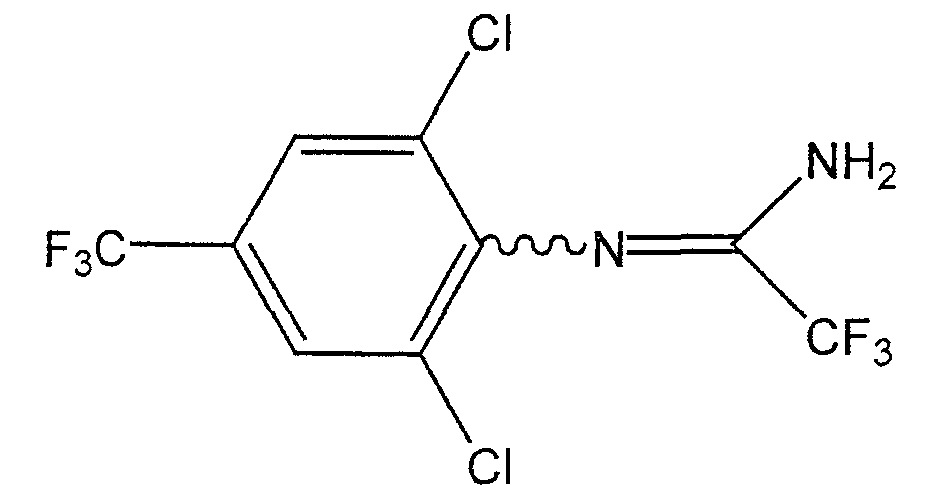
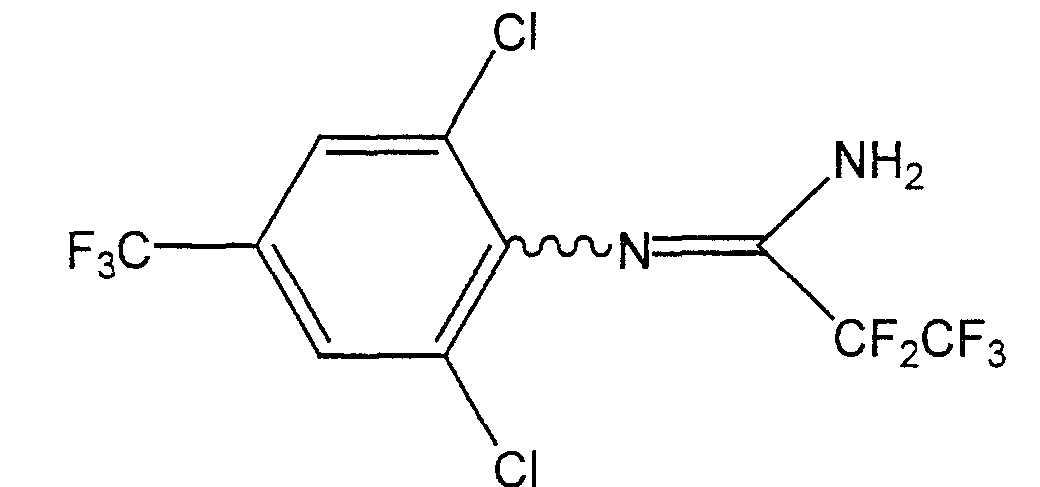


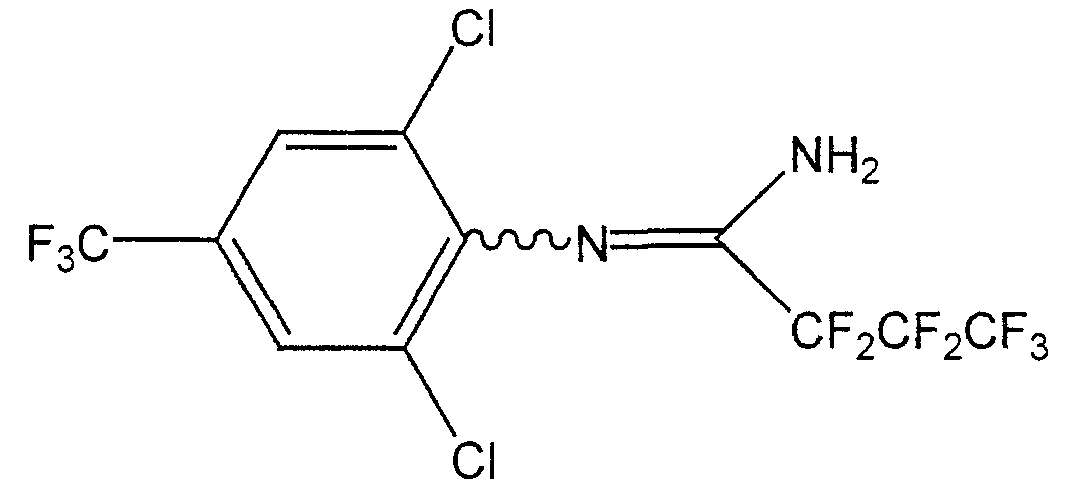


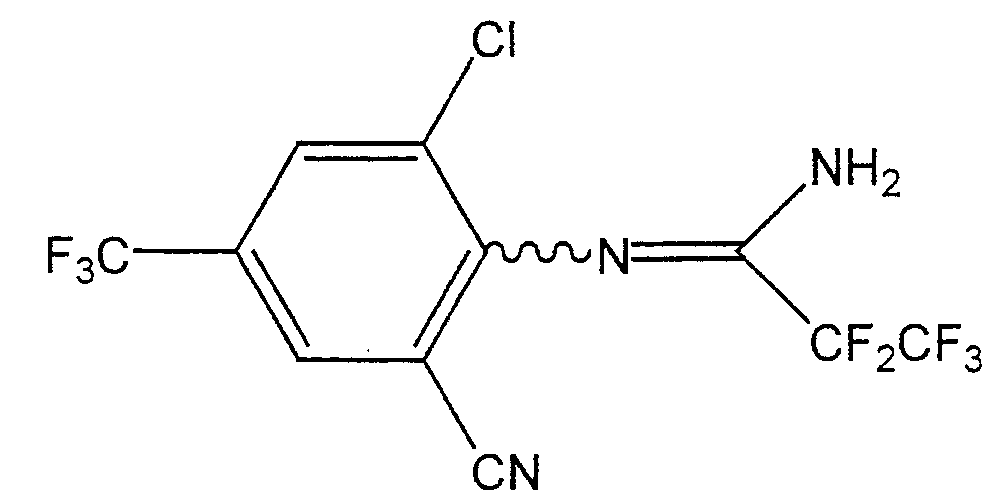


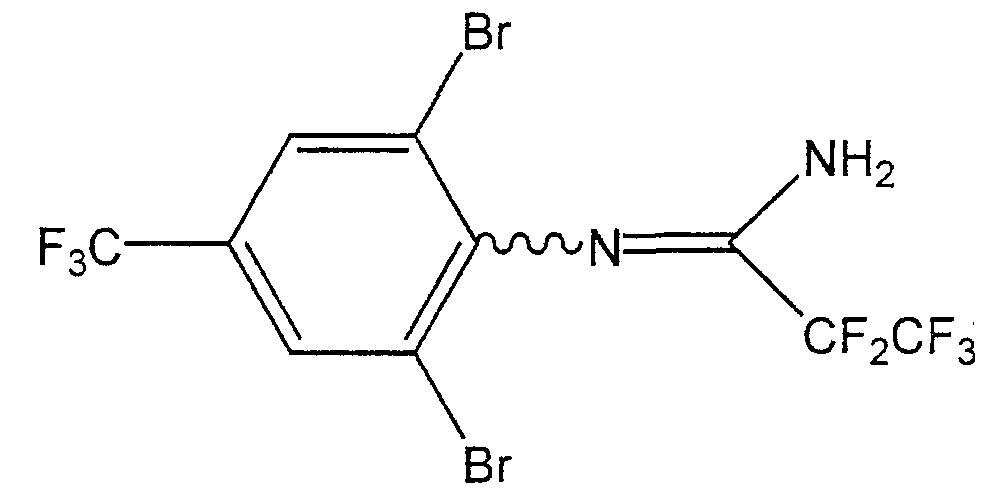
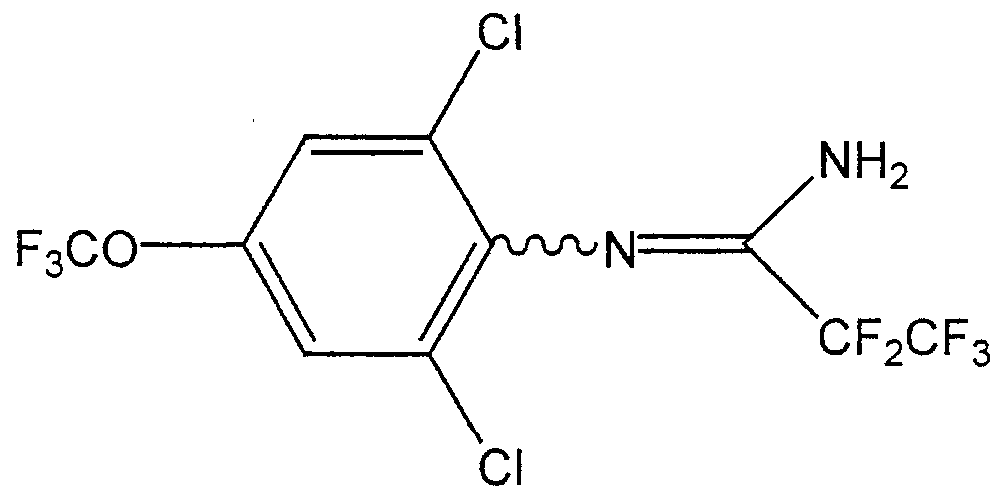
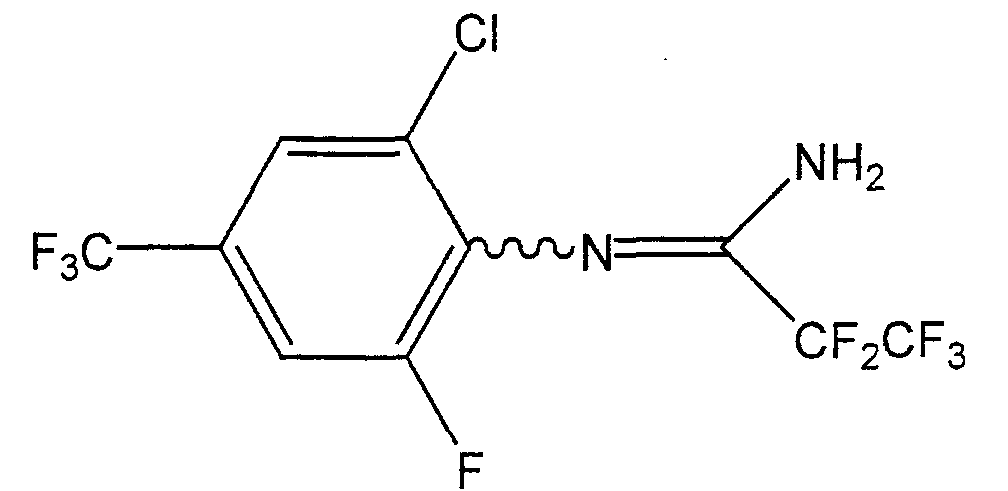
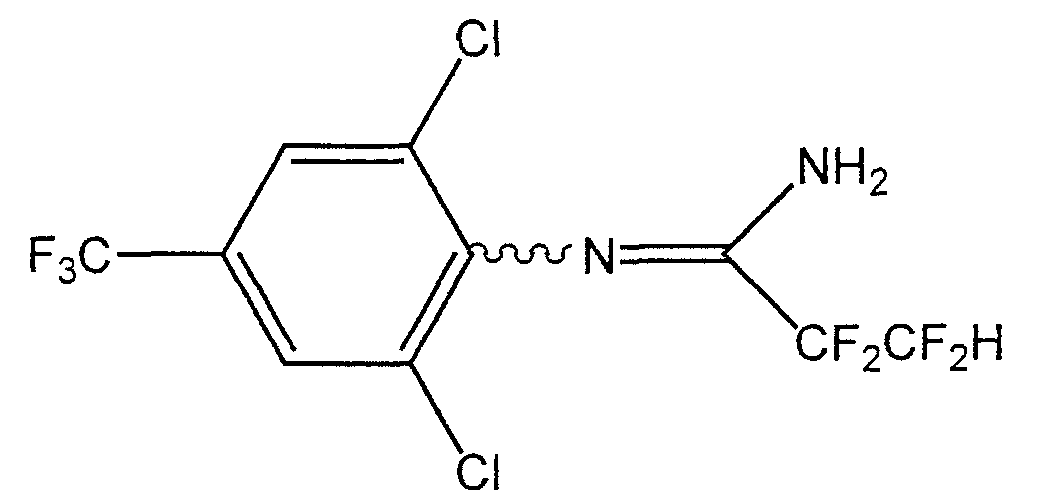


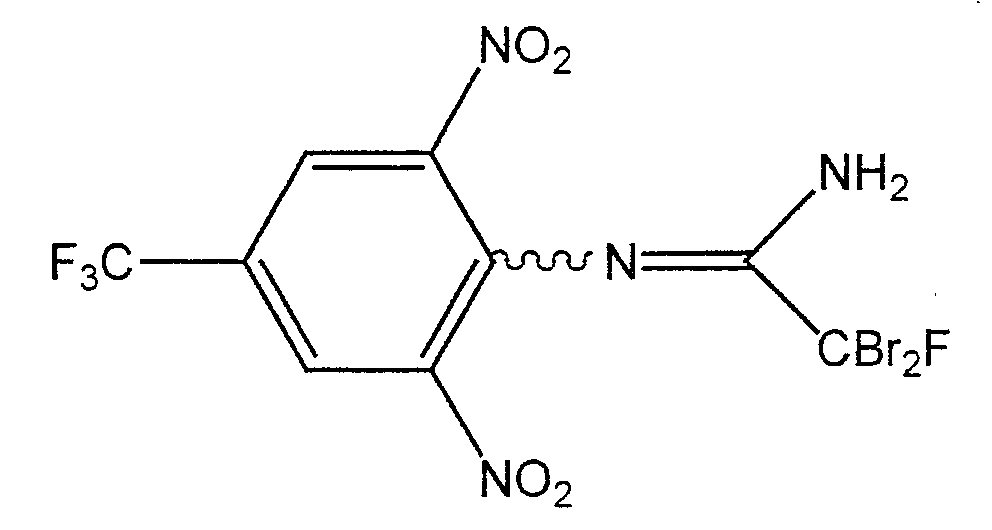

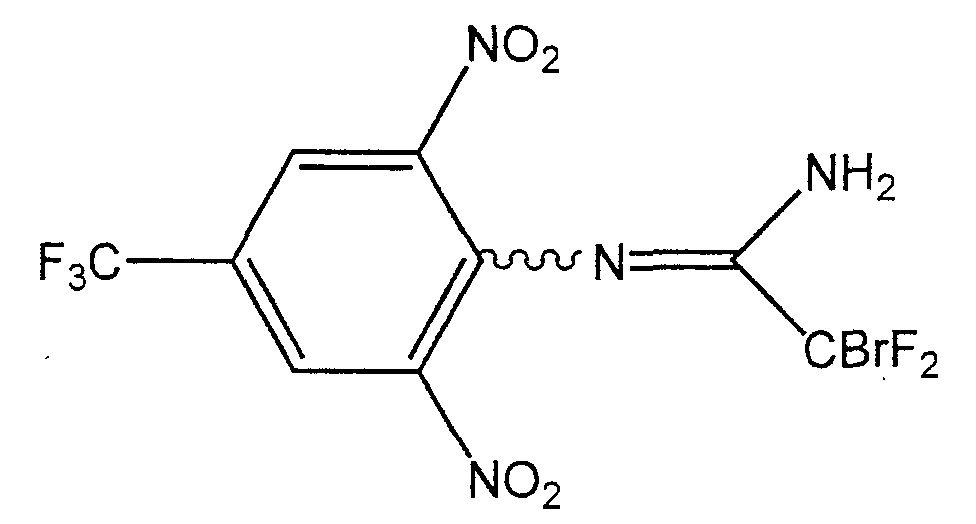
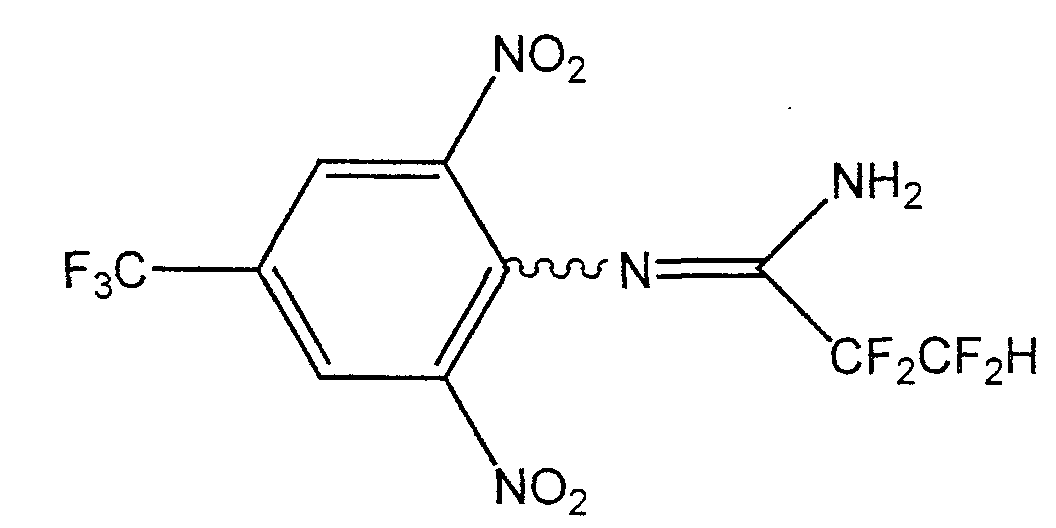
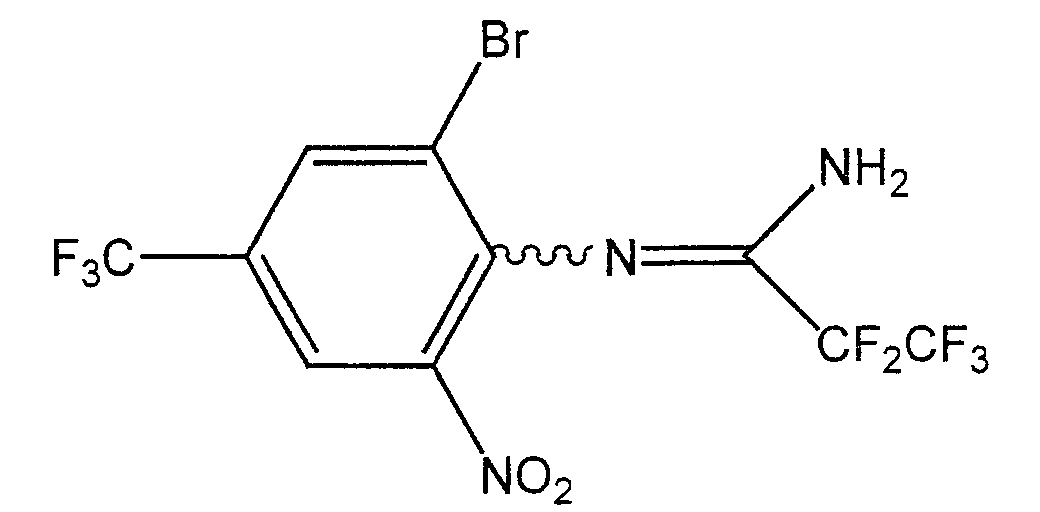

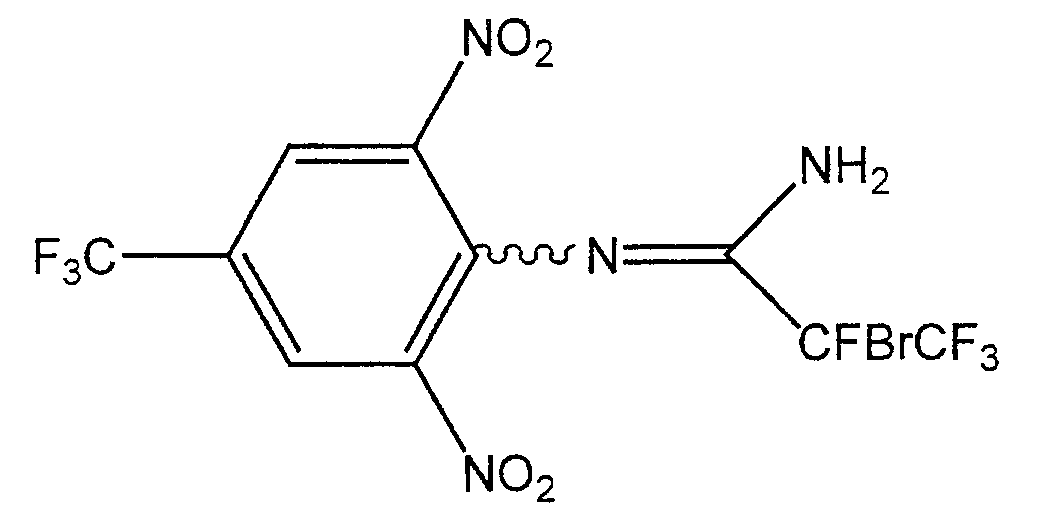
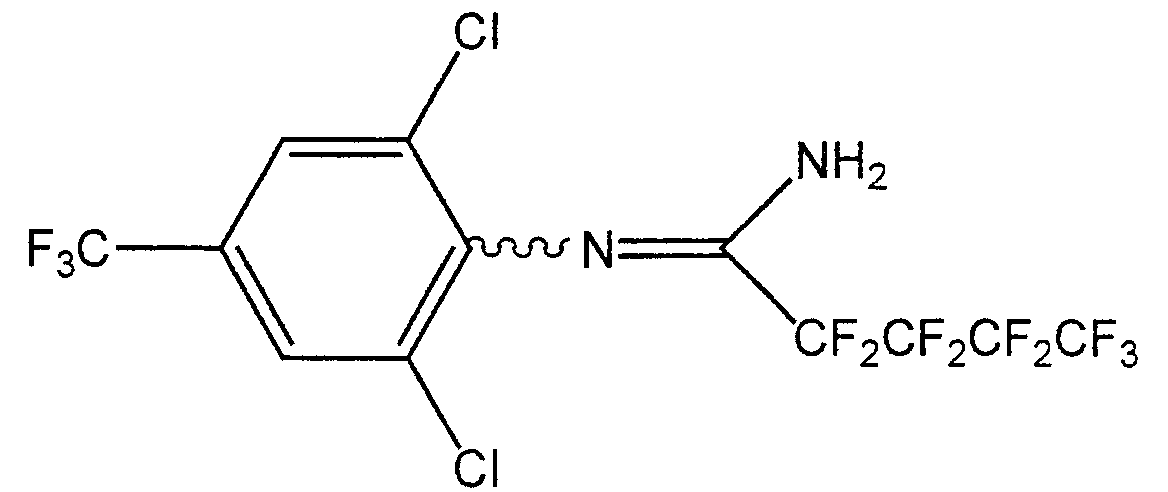
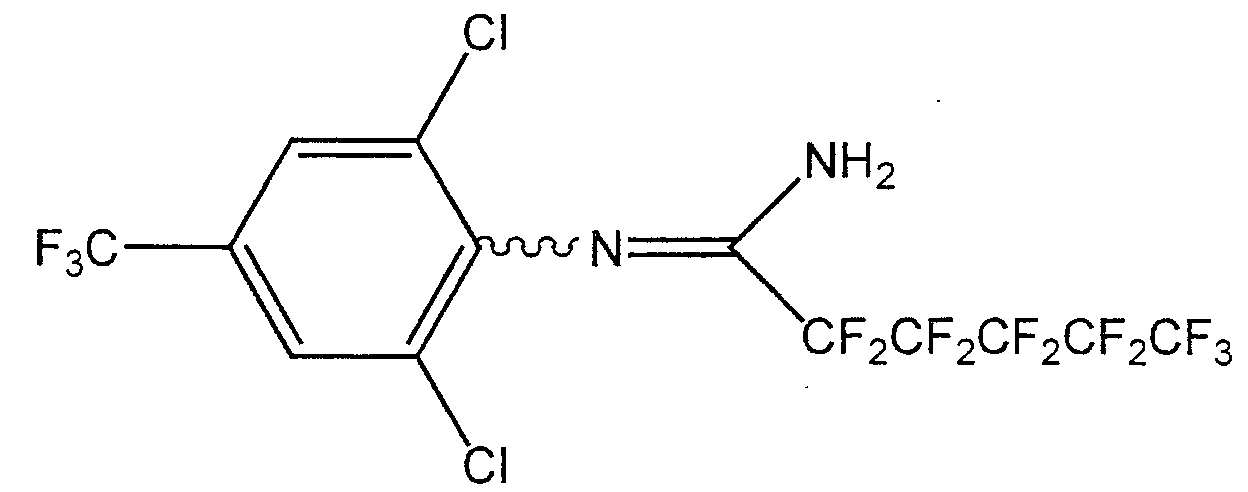
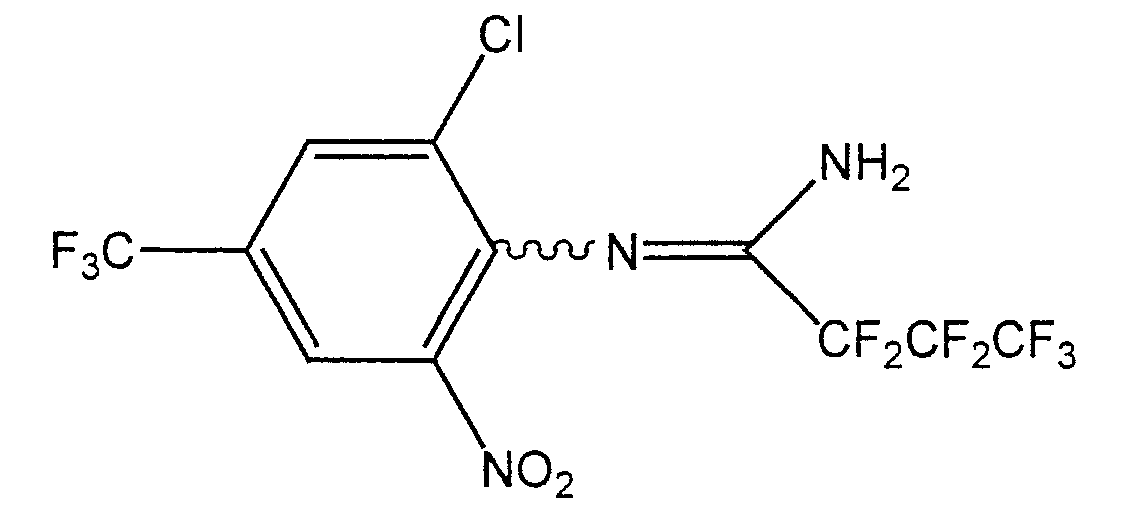


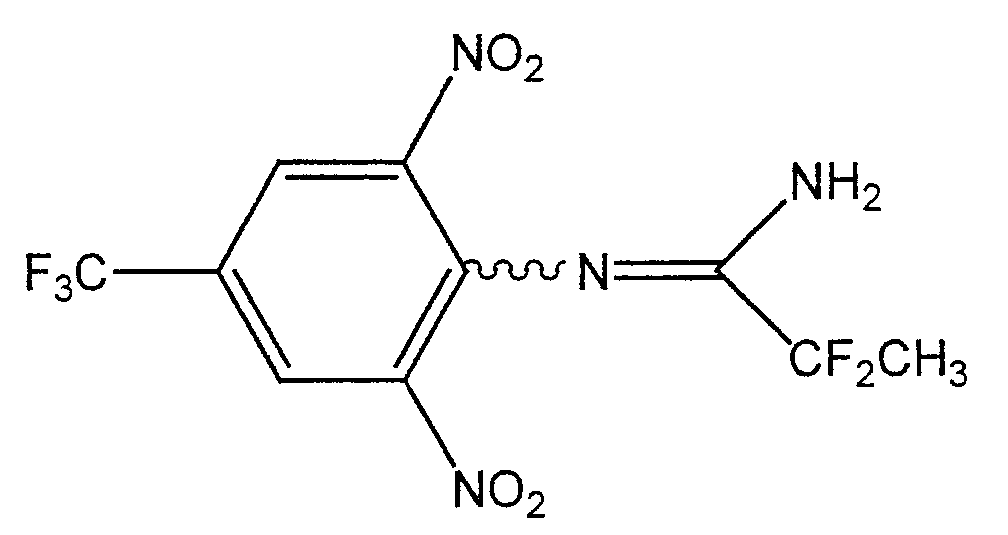
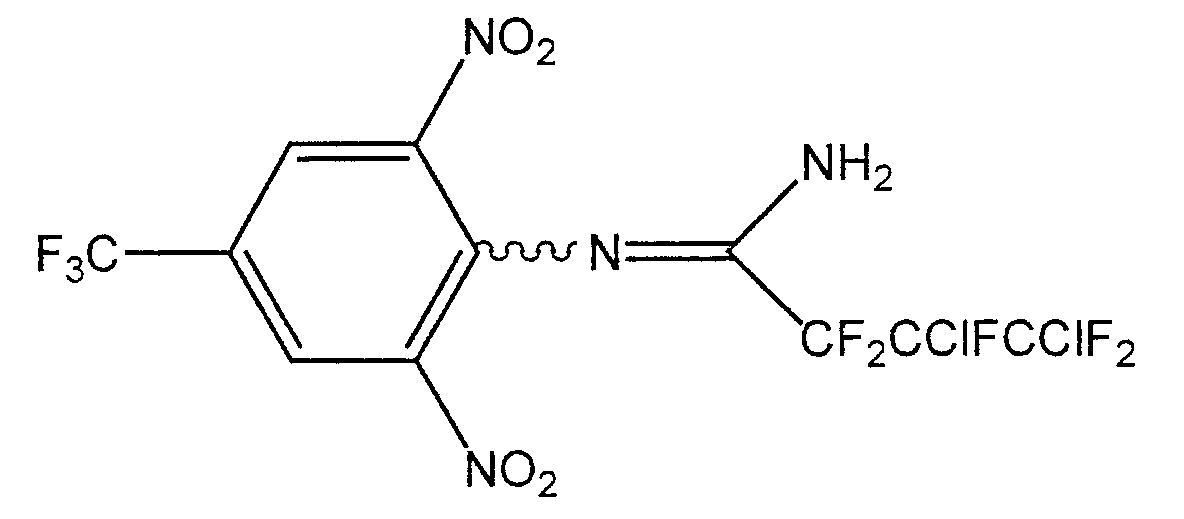
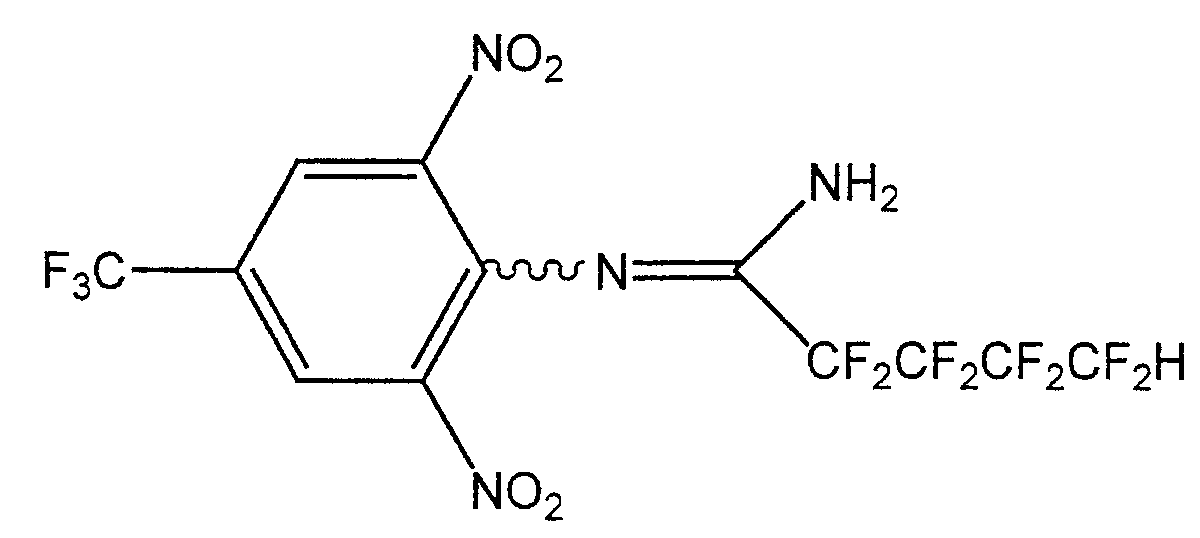
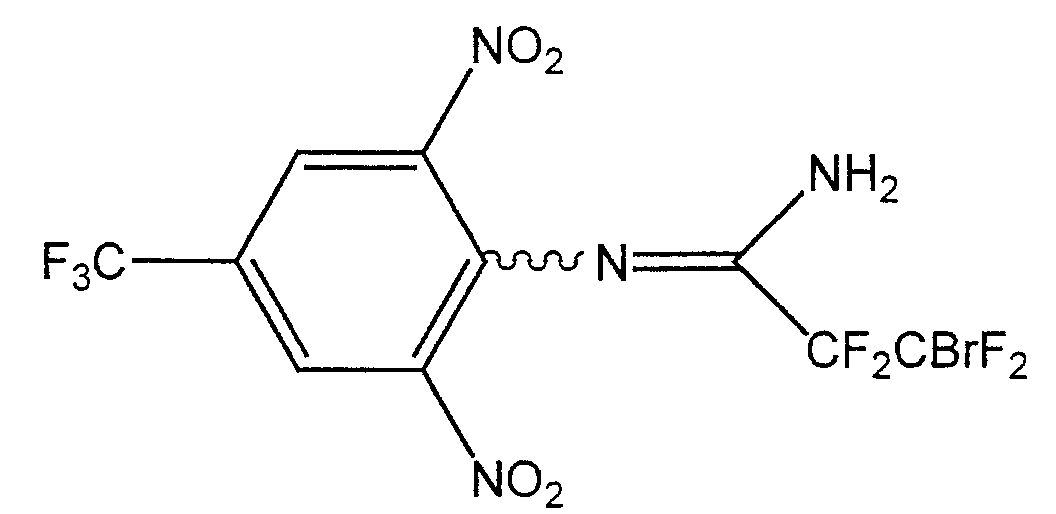

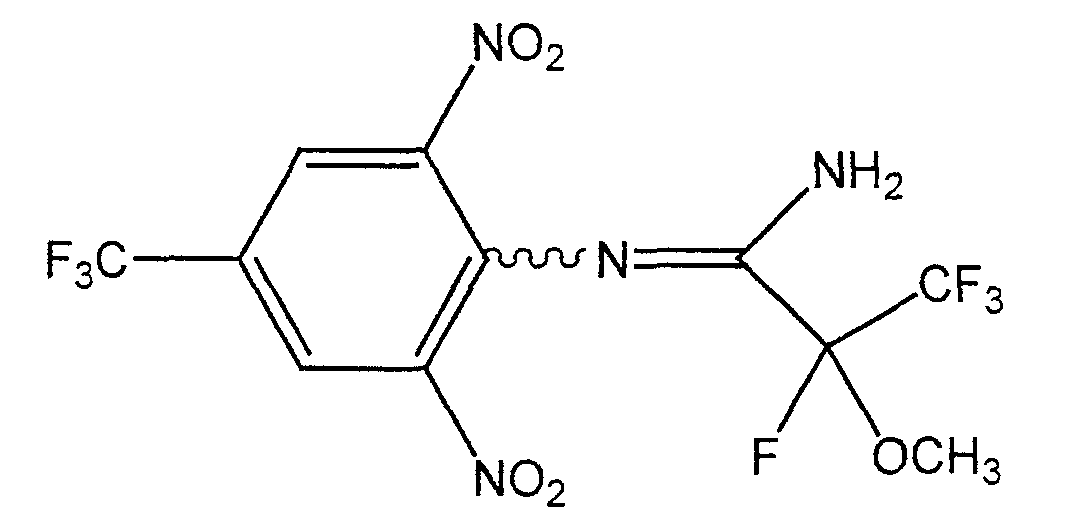


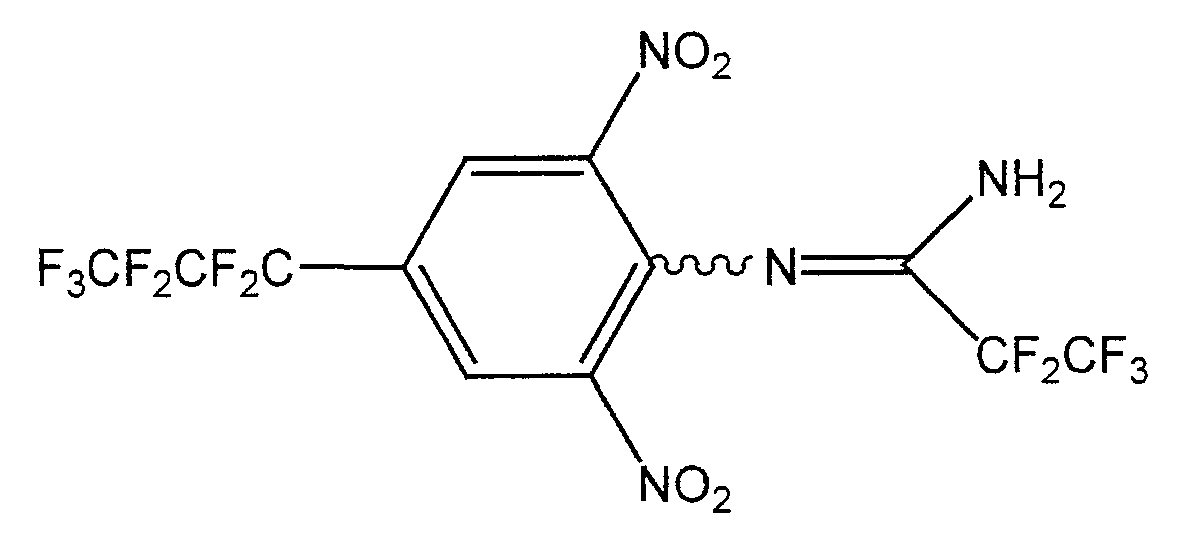

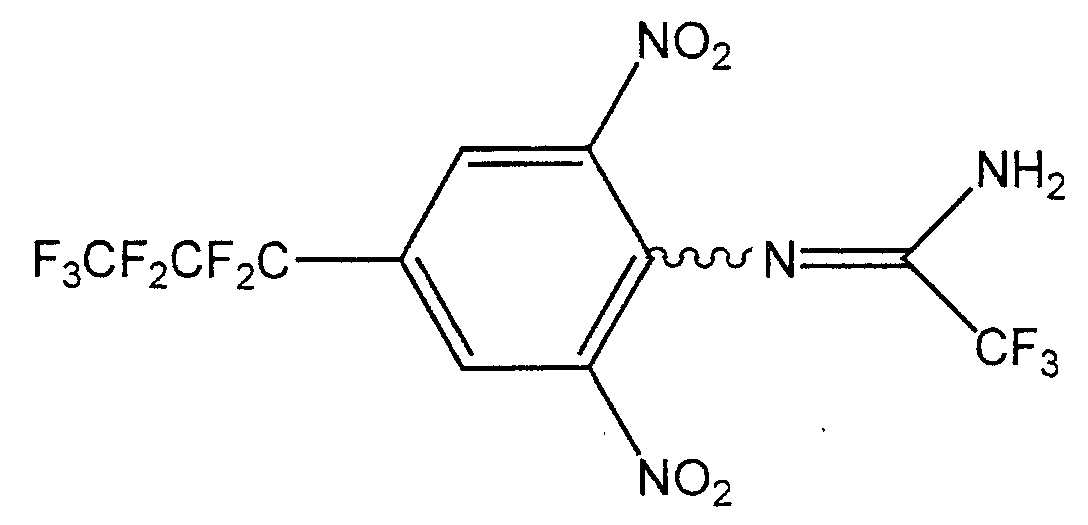

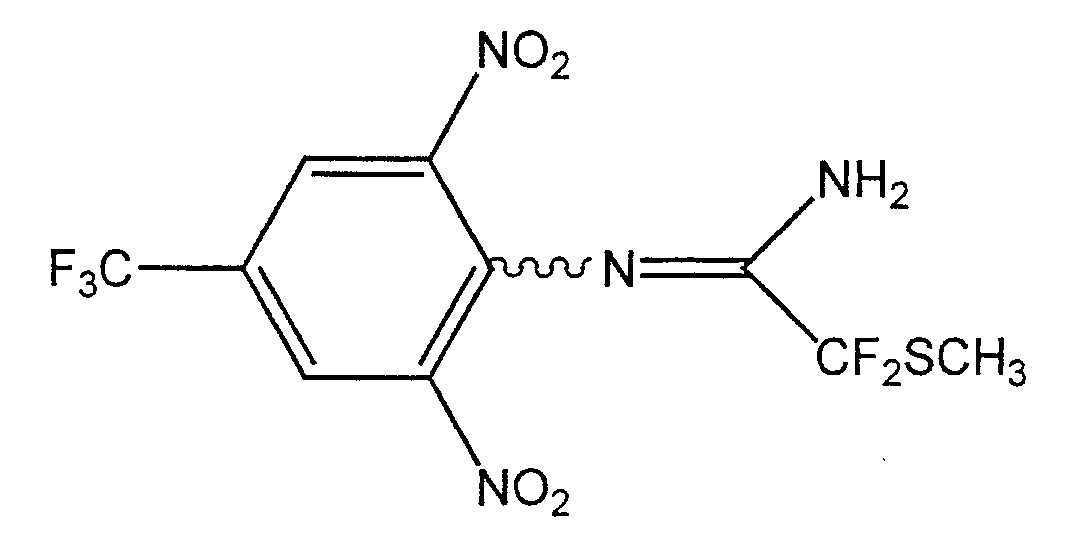
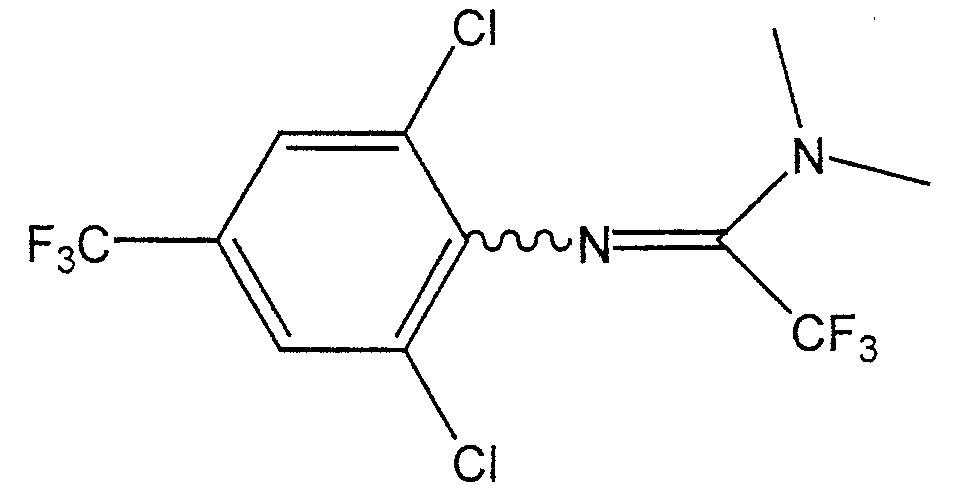


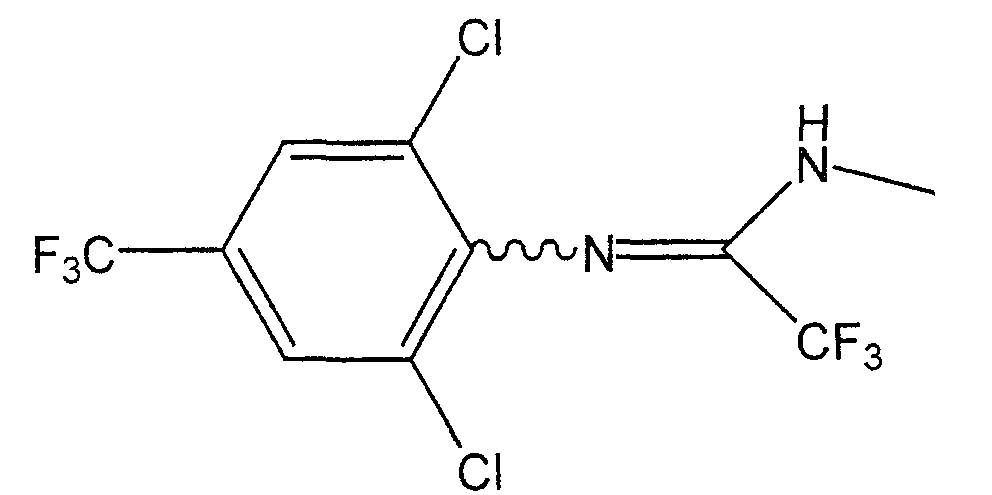
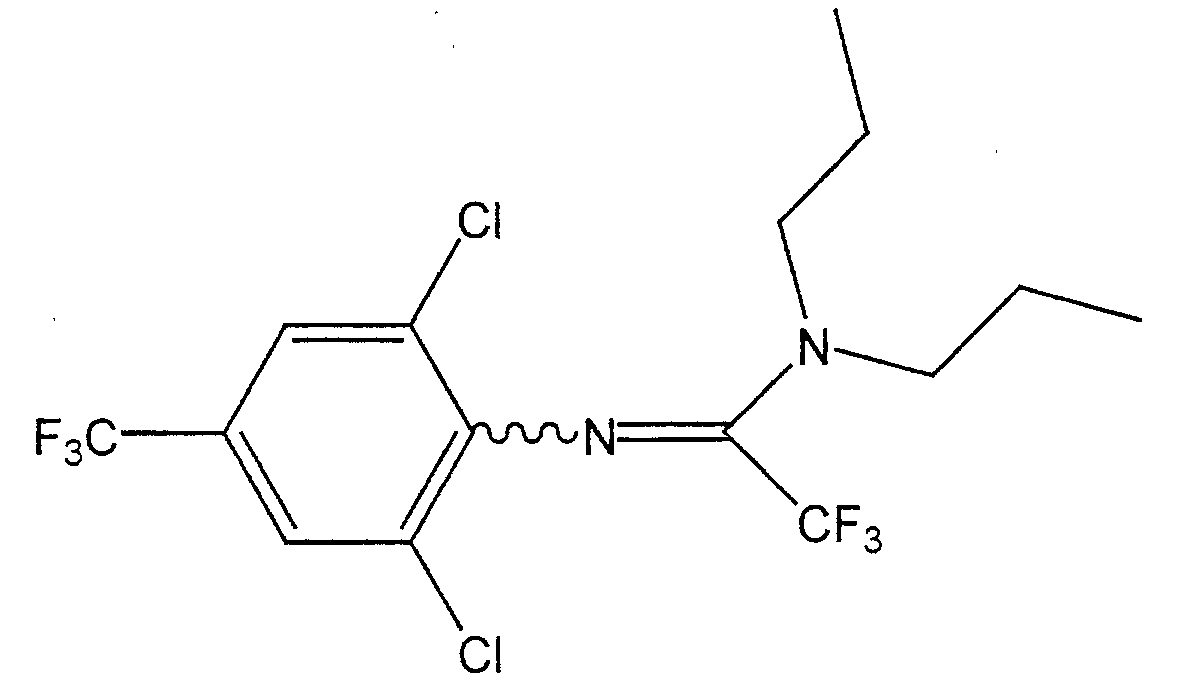
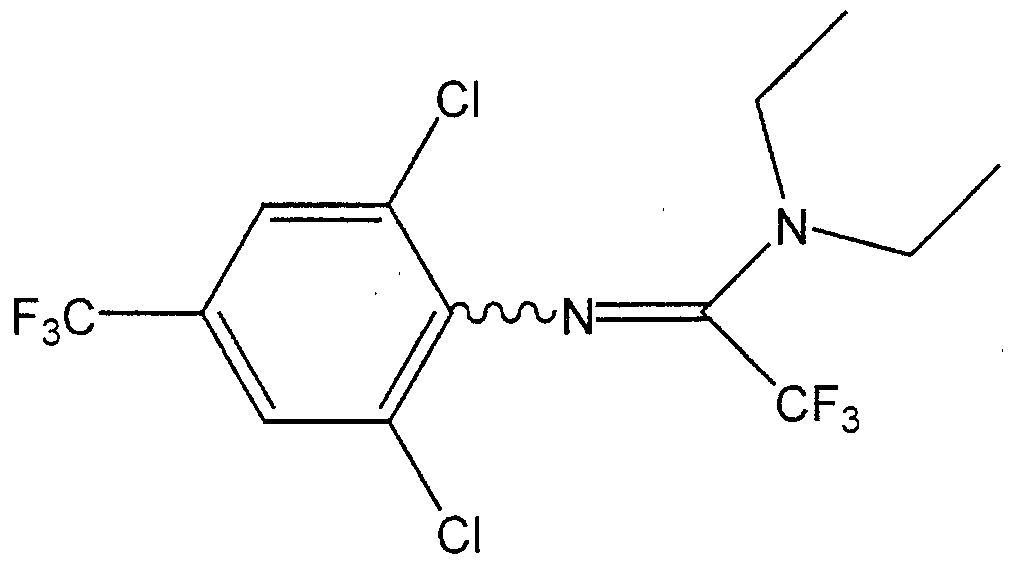


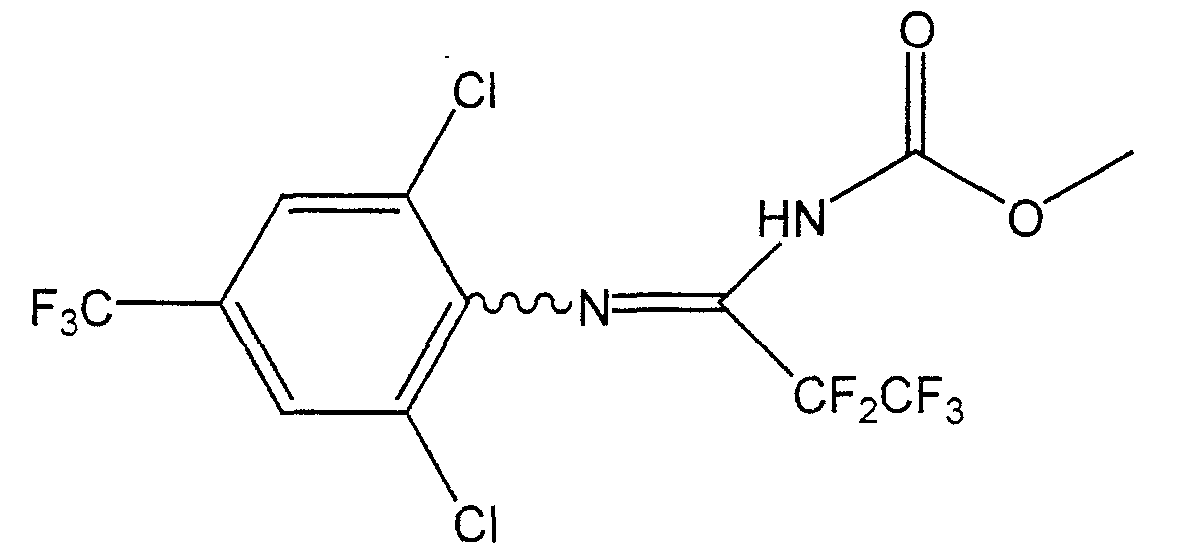
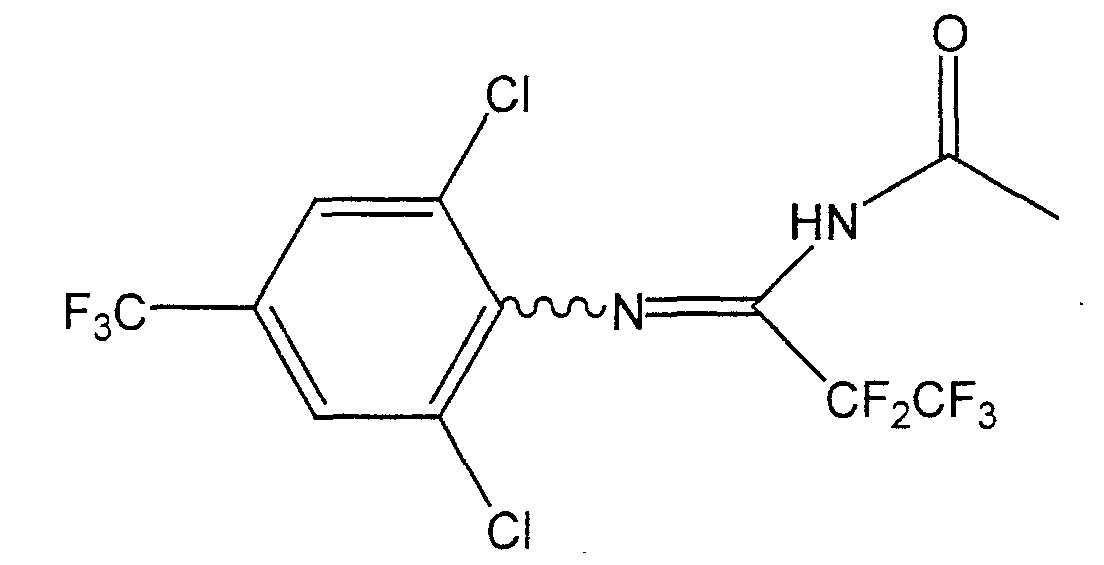
1H-NMR (250 MHz, CDCl3/TMS): δ (ppm) = 5.80 (br s, 1H), 5.36-5.06 (m, 1H)
1H-NMR (250 MHz, CDCl3/TMS): δ (ppm) = 6.40 (br s, 2H)
1H-NMR (300 MHz, CDCl3/TMS): δ (ppm) = 6.20 (br s, 1H), 5.76 (br s, 1H), 2.38 (s, 3H)
1H-NMR (250 MHz, CDCl3/TMS): δ (ppm) = 7.80 (br s, 1H), 7.72 (s, 2H)
1H-NMR (300 MHz, CDCl3/TMS): δ (ppm) = 10.60 (br s, 1H), 8.66 (s, 2H)
1H-NMR (300 MHz, CDCl3/TMS): δ (ppm) = 8.26 (s, 2H), 4.15 (s, 3H)
1H-NMR (250 MHz, CDCl3/TMS): δ (ppm) = 8.63 (s, 2H)
1H-NMR (300 MHz, CDCl3/TMS): δ (ppm) = 8.68 (s, 2H)
1H-NMR (300 MHz, CDCl3/TMS): δ (ppm) = 7.67 (s, 2H)
1H-NMR (300 MHz, CDCl3/TMS): δ (ppm) = 7.65 (s, 2H), 6.38 (t, J = 54.1 Hz, 1H)
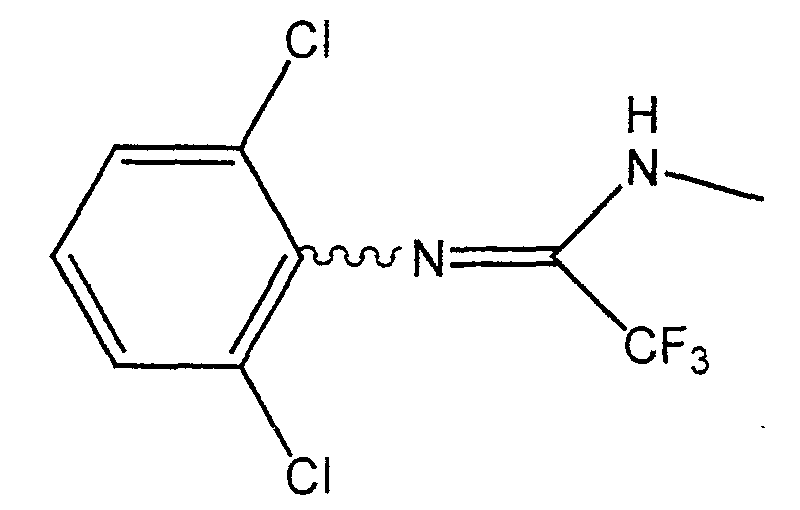

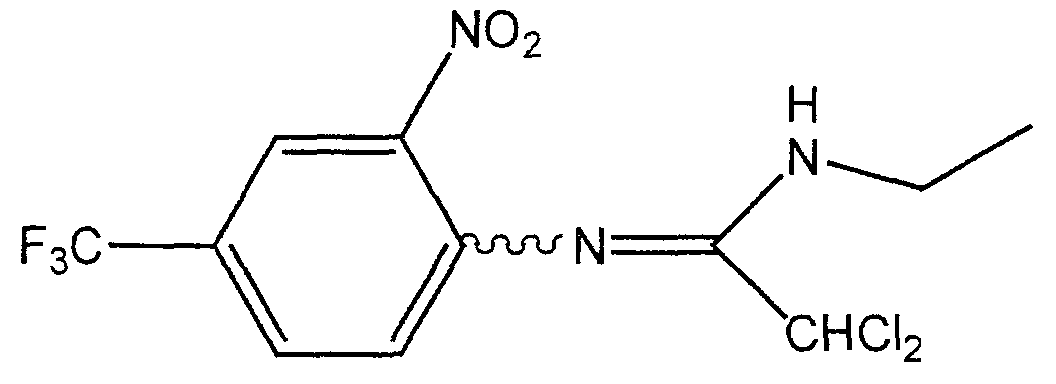
Claims (9)
- An amidine compound of formula I:wherein X and Y are the same or different and are independently halogen, nitro, cyano, or C1-C6 alkyl; Z is C1-C6 haloalkyl or C1-C6 haloalkoxy; R1 is hydrogen, halogen, C1-C6 alkyl, C1-C6 haloalkyl, C1-C6 alkoxy, C1-C6 haloalkoxy, or a group of formula: S(O)n-R5 (wherein R5 is C1-C6 alkyl or C1-C6 haloalkyl; and n is 0, 1, or 2); R2 and R3 are the same or different and are independently halogen or C1-C6 haloalkyl; and R4 is a group of formula: NR6R7 or N=CR8R9 (wherein R6 is hydrogen, C1-C6 alkyl, (C1-C6 alkoxy)carbonyl, (C1-C6 alkoxy) C1-C6 alkyl, or C2-C6 acyl; R7 is hydrogen, C1-C6 alkyl, (C1-C6 alkoxy)carbonyl, or C2-C6 acyl; R8 is C1-C6 alkyl or hydrogen; and R9 is C1-C6 alkoxy, C1-C6 alkyl, or di(C1-C6 alkyl)amino).

- The amidine compound according to claim 1, wherein R4 is amino.
- The amidine compound according to claim 1, wherein R1 is C1-C6 haloalkyl, R2 and R3 are the same or different and are independently halogen.
- The amidine compound according to claim 1, wherein R1 is C1-C6 haloalkyl, R2 and R3 are the same or different and are independently halogen, and R4 is amino.
- The amidine compound according to claim 1, wherein R1 is C1-C6 haloalkyl; R2 and R3 are the same or different and are independently halogen; R4 is amino; X and Y are the same or different and are independently halogen or nitro.
- The amidine compound according to claim 5, wherein Z is trifluoromethyl.
- A pesticide comprising an amidine compound according to any of claims 1 to 6 as an active ingredient and a carrier.
- A method for the control of pests, which comprises applying a pesticidally effective amount of an amidine compound according to any of claims 1 to 6 to pests or their habitats.
- Use of an amidine compound according to any of claims 1 to 6 as a pesticide.
Applications Claiming Priority (2)
| Application Number | Priority Date | Filing Date | Title |
|---|---|---|---|
| JP2000088789 | 2000-03-28 | ||
| JP2000088789 | 2000-03-28 |
Publications (2)
| Publication Number | Publication Date |
|---|---|
| EP1138668A2 true EP1138668A2 (en) | 2001-10-04 |
| EP1138668A3 EP1138668A3 (en) | 2003-03-05 |
Family
ID=18604617
Family Applications (1)
| Application Number | Title | Priority Date | Filing Date |
|---|---|---|---|
| EP01107453A Withdrawn EP1138668A3 (en) | 2000-03-28 | 2001-03-27 | Amidine compounds and their use as pesticides |
Country Status (7)
| Country | Link |
|---|---|
| US (1) | US6376710B2 (en) |
| EP (1) | EP1138668A3 (en) |
| KR (1) | KR20010100838A (en) |
| CN (1) | CN1323784A (en) |
| AR (1) | AR030692A1 (en) |
| AU (1) | AU2811501A (en) |
| BR (1) | BR0101209A (en) |
Families Citing this family (7)
| Publication number | Priority date | Publication date | Assignee | Title |
|---|---|---|---|---|
| US7279522B2 (en) * | 2001-09-05 | 2007-10-09 | 3M Innovative Properties Company | Fluoropolymer dispersions containing no or little low molecular weight fluorinated surfactant |
| US20030109187A1 (en) * | 2001-12-10 | 2003-06-12 | Cantrell Larry J. | Treated fabric and method and apparatus for producing same |
| US20070015937A1 (en) * | 2005-07-15 | 2007-01-18 | 3M Innovative Properties Company | Process for recovery of fluorinated carboxylic acid surfactants from exhaust gas |
| US20080015304A1 (en) | 2006-07-13 | 2008-01-17 | Klaus Hintzer | Aqueous emulsion polymerization process for producing fluoropolymers |
| GB0525978D0 (en) * | 2005-12-21 | 2006-02-01 | 3M Innovative Properties Co | Fluorinated Surfactants For Making Fluoropolymers |
| CN108640857B (en) * | 2018-06-07 | 2021-03-30 | 烟台新秀化学科技股份有限公司 | A kind of synthesis technique of N-(ethoxycarbonyl phenyl)-N'-methyl-N'-phenylamidine |
| CN109535033A (en) * | 2018-12-28 | 2019-03-29 | 天津阿尔塔科技有限公司 | A kind of synthetic method of fluorine bacterium azoles metabolin FM-6-1 |
Family Cites Families (8)
| Publication number | Priority date | Publication date | Assignee | Title |
|---|---|---|---|---|
| US3867448A (en) * | 1962-03-08 | 1975-02-18 | Ciba Geigy Ag | Trifluoromethylphenyl-formamadines and acetamidines |
| US4093655A (en) * | 1970-04-13 | 1978-06-06 | Rohm And Haas Company | Amidine rice herbicides |
| IL44905A (en) * | 1973-06-25 | 1977-03-31 | Ciba Geigy Ag | N-alkyl-n-(n-alkylformimidoyl)-n'-phenylformamidine derivatives their preparation and use in pest control |
| US4163056A (en) * | 1977-09-29 | 1979-07-31 | Ciba-Geigy Corporation | Pesticidal triazapentadienes |
| US4670593A (en) * | 1979-11-06 | 1987-06-02 | Stauffer Chemical Co. | Haloacetamidines and the herbicidal use thereof |
| JPS5857357A (en) * | 1981-09-30 | 1983-04-05 | Daikin Ind Ltd | Fluorine-containing amidine and its preparation |
| JPH03264557A (en) | 1990-03-13 | 1991-11-25 | Nissan Chem Ind Ltd | Fluorine-containing compound |
| GB9425701D0 (en) | 1994-12-20 | 1995-02-22 | Wellcome Found | Enzyme inhibitors |
-
2001
- 2001-03-19 AU AU28115/01A patent/AU2811501A/en not_active Abandoned
- 2001-03-23 KR KR1020010015236A patent/KR20010100838A/en not_active Withdrawn
- 2001-03-27 AR ARP010101437A patent/AR030692A1/en unknown
- 2001-03-27 EP EP01107453A patent/EP1138668A3/en not_active Withdrawn
- 2001-03-28 CN CN01119669A patent/CN1323784A/en active Pending
- 2001-03-28 US US09/818,789 patent/US6376710B2/en not_active Expired - Fee Related
- 2001-03-28 BR BR0101209-6A patent/BR0101209A/en not_active Application Discontinuation
Also Published As
| Publication number | Publication date |
|---|---|
| KR20010100838A (en) | 2001-11-14 |
| AU2811501A (en) | 2001-10-04 |
| BR0101209A (en) | 2001-10-30 |
| EP1138668A3 (en) | 2003-03-05 |
| AR030692A1 (en) | 2003-09-03 |
| US20010041740A1 (en) | 2001-11-15 |
| US6376710B2 (en) | 2002-04-23 |
| CN1323784A (en) | 2001-11-28 |
Similar Documents
| Publication | Publication Date | Title |
|---|---|---|
| JP3847336B2 (en) | 2- (2,4,6-Trimethylphenyl) -cyclopentane-1,3-dione derivative | |
| JP5156178B2 (en) | Cis-alkoxy substituted spiro ring-1H-pyrrolidine-2,4-dione derivatives as pest control agents | |
| JP3847335B2 (en) | 2-Arylcyclopentane-1,3-dione derivatives | |
| JP3651897B2 (en) | Alkoxy-alkyl-substituted 1-H-3-aryl-pyrrolidine-2,4-diones for use as herbicides and pest control agents | |
| JP3404747B2 (en) | Substituted arylketo-enol type heterocyclic compounds | |
| KR100461460B1 (en) | Oxymethoxy-3-aryl-pyron Derivatives | |
| JP4115523B2 (en) | Cyclopentane-1,3-dione derivative | |
| JP2003510308A (en) | Trifluoromethyl-substituted spirocyclic ketoenols | |
| JPH11511442A (en) | Acylaminosalicylic amides and their use as pesticides | |
| US5969147A (en) | Substituted biphenyloxazolines | |
| KR19990077064A (en) | Acylated 5-amino-1,2,4-thiadiazoles as pesticides and fungicides | |
| JP2004527451A (en) | Phenyl-substituted 4-hydroxytetrahydropyridone | |
| US6376710B2 (en) | Amidine compounds and their use as pesticides | |
| JP2000515520A (en) | Glyoxylic acid derivative | |
| JP2000500755A (en) | Biphenyl ether oxazoline and its use as a pesticide | |
| KR19990014864A (en) | Method for preparing 5,6-dihydro-1,3-oxazine | |
| KR100377188B1 (en) | Substituted diphenyloxazoline | |
| JP2001342170A (en) | Amidine compounds and uses thereof | |
| JP2005501045A (en) | Tetrahydropyridazine derivatives and their use as pesticides | |
| JP2000239262A (en) | Triazole compounds and uses thereof | |
| KR100374496B1 (en) | Substituted biphenyloxazolines | |
| KR100350518B1 (en) | Substituted Benzimidazoles For Pest Control | |
| KR19990036369A (en) | Fluorobutene Acid Hydrazide | |
| JP2000212169A (en) | Triazole compounds and uses thereof | |
| JP2000501088A (en) | Aminocarboxylic acid fluorobutenyl ester |
Legal Events
| Date | Code | Title | Description |
|---|---|---|---|
| PUAI | Public reference made under article 153(3) epc to a published international application that has entered the european phase |
Free format text: ORIGINAL CODE: 0009012 |
|
| AK | Designated contracting states |
Kind code of ref document: A2 Designated state(s): AT BE CH CY DE DK ES FI FR GB GR IE IT LI LU MC NL PT SE TR |
|
| AX | Request for extension of the european patent |
Free format text: AL;LT;LV;MK;RO;SI |
|
| PUAL | Search report despatched |
Free format text: ORIGINAL CODE: 0009013 |
|
| AK | Designated contracting states |
Kind code of ref document: A3 Designated state(s): AT BE CH CY DE DK ES FI FR GB GR IE IT LI LU MC NL PT SE TR Designated state(s): AT BE CH CY DE DK ES FI FR GB GR IE IT LI LU MC NL PT SE TR |
|
| AX | Request for extension of the european patent |
Extension state: AL LT LV MK RO SI |
|
| RIC1 | Information provided on ipc code assigned before grant |
Ipc: 7A 01N 37/52 B Ipc: 7C 07C 257/20 B Ipc: 7C 07C 271/64 B Ipc: 7C 07C 323/52 B Ipc: 7C 07C 257/14 A |
|
| AKX | Designation fees paid |
Designated state(s): DE ES FR GB IT NL |
|
| RBV | Designated contracting states (corrected) |
Designated state(s): AT BE CH CY DE DK ES FI FR GB GR IE IT LI LU MC NL PT SE TR |
|
| STAA | Information on the status of an ep patent application or granted ep patent |
Free format text: STATUS: THE APPLICATION IS DEEMED TO BE WITHDRAWN |
|
| 18D | Application deemed to be withdrawn |
Effective date: 20030906 |