BACKGROUND OF THE INVENTION
-
This invention relates to electrophilic reactions and reactants, and more
particularly to a process for generating useful electrophiles, E+, from common anions, E-.
-
Electrophilic addition/substitution of aromatic systems is a field of chemistry that
has been widely studied (1-4). Specific examples of reactions having electrophilic
mechanisms include halogenation, thiocyanation and nitration.
-
Reagents for electrophilic halogenation are available in numerous forms ranging
from the diatomic element to some fairly exotic halogen delivery reagents (1-5). Most of
these reagents are necessarily prepared in advance of halogenation, but some are
generated in situ. Reagents specific for electrophilic halogenation include but are not
limited to N-chlorosuccinimide (6-12) (NCS), N-chloroammonium salts (13),
tert-butylhypochlorite (14), sodium chlorite/(salen)Mn(III) complex (15), chlorine
trifluoromethanesulfonate (16), and triethylammonium trichloride (17), for chlorination,
N-bromosuccinimide (8-12) and alkylammonium tribromide (18) for bromination,
N-iodosuccinimide (19), iodine(I) triflate (20), and dichlorohypoiodite salts (21) for
iodination, and various -NF, -XeF, and -OF agents for fluorination (6, 22).
-
Reagents which are known to deliver electrophilic thiocyanogen include
thiocyanogen (23, 24), cyanogen chloride (25-28), and metal thiocyanates mediated by
aryliodite (29), NCS (30, 31), and NBS (31, 32).
-
Electrophilic nitration can be accomplished using a variety of techniques (1). In
particular, reagents available include nitronium salts (33-37), methyl nitrate (38), and
sodium nitrite mediated by trifluoroacetic acid (39).
-
Zupan et al. (40) discloses an electrophilic fluorination agent functioning as a
mediator in affecting electrophilic reactions. In this reference, mixtures of anisole,
Selectfluor™ (i.e., 1-chloromethyl-4-fluoro-1,4-diazoniabicyclo[2.2.2]octane-bis(tetrafluoroborate),
hereinafter referred to as F-TEDA-BF4) and I2, KI, Me3Sil, or Mel
in solution were shown to produce iodo anisole derivatives regioselectively. This result
is not surprising, however, since it has been established that F-TEDA-BF4 readily and
immediately oxidizes iodide to iodine in solution (39).
-
There is a general need for effective methodologies for introducing various
functional groups into aromatic systems. In particular, electrophilic methodologies find
widespread applications since these reactions are very well understood and the product
distribution is generally predictable. Despite the importance of synthetic methods for
introducing electrophiles into aromatic systems, relatively few reagents are available to
accomplish such transformations, and moreover, the reagents themselves can be
difficult to prepare and use.
-
Accordingly, it would be desirable to provide an easily employed and generally
applicable method for introducing electrophilic groups, E+, into a variety of aromatic
systems.
-
All references cited herein are incorporated herein by reference in their entireties.
BRIEF SUMMARY OF THE INVENTION
-
The present invention provides a process for substituting a substituent on
a substrate. The process comprises reacting a salt of an anionic form of the substituent
with an electrophilic fluorination agent to provide an electrophile comprising a cationic
form of the substituent. The electrophile is then electrophilically substituted on the
substrate.
BRIEF DESCRIPTION OF SEVERAL VIEWS OF THE DRAWINGS
-
Not applicable.
DETAILED DESCRIPTION OF THE INVENTION
-
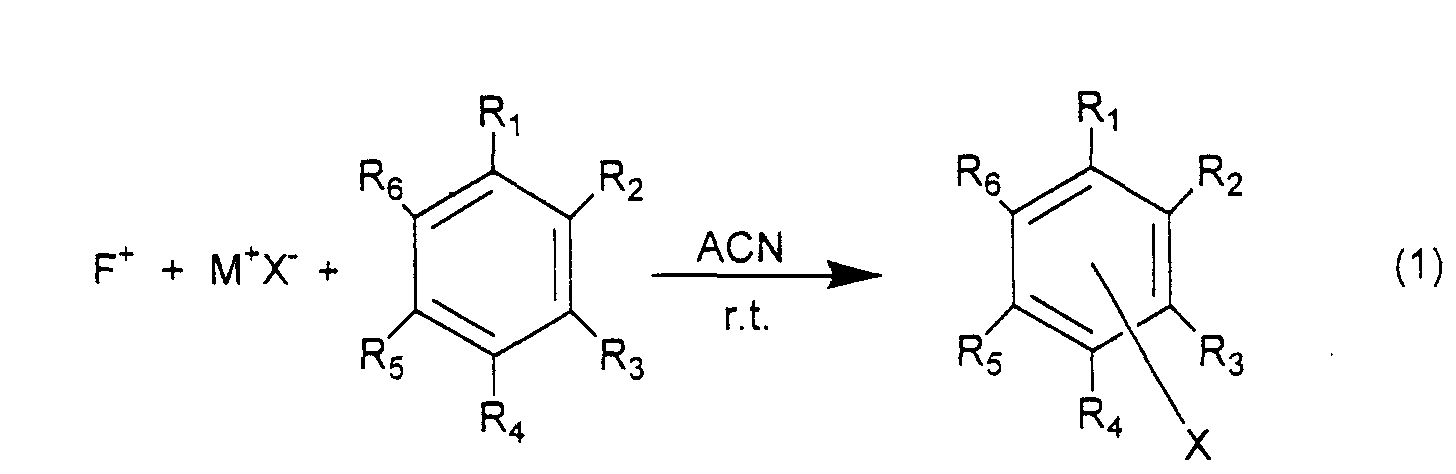
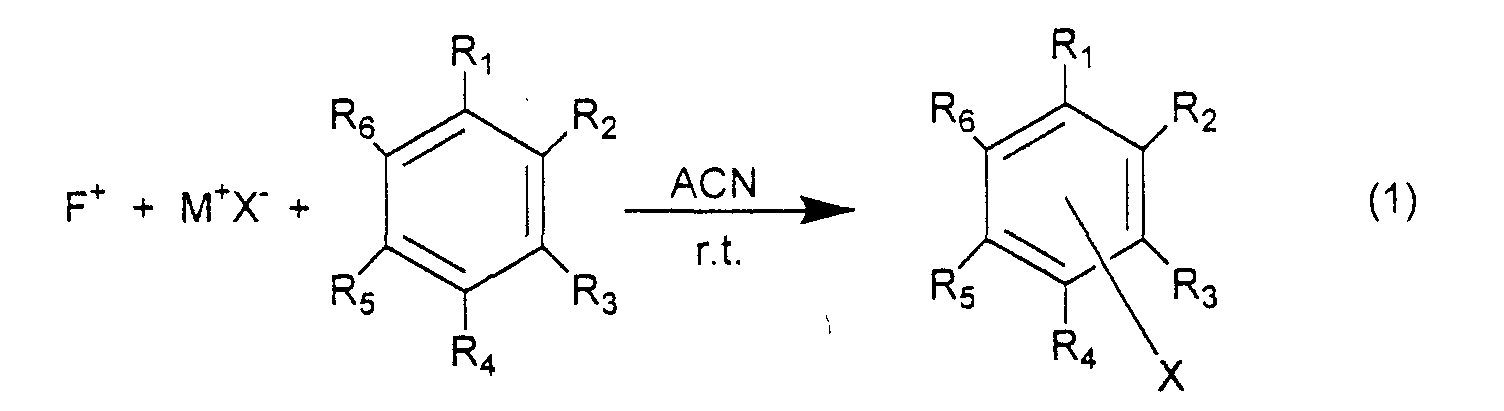
The present invention relates to a new process for achieving
regioselective electrophilic aromatic substitution of an electrophile, E
+, from mixtures of
an electrophilic fluorination agent and a salt of the electrophile in a solvent. This process
can be described in general terms by Equation 1, below, wherein F
+ represents the
electrophilic fluorination agent, M
+X
- represents a salt (e.g., an ammonium or sodium
salt) of chloride (Cl
-), bromide (Br
-), thiocyanate (SCN
-), nitrite (NO
2 -), acetate (CH
3COO
-), or trifluoroacetate (CF
3COO
-), and R
1-6 each independently represent a strongly
deactivating to strongly activating substituent selected from the group consisting of H, F,
Cl, CH
3, COOH, C(O)CH
3, NO
2, OR' and NR'R", where R' and R" are H, C(O)CH
3 or
CH
3.
From this reaction, electrophiles Cl
+, Br
+, SCN
+ and NO
2 + are generated from their
respective sodium or ammonium salts by reaction with F-TEDA-BF
4 in acetonitrile
solution at ambient temperature and pressure. The said generated electrophiles are then
reacted directly
in situ with various aromatic substrates, including anisole, toluene, p-xylene,
phenol, benzene, acetanilide, dimethylaniline, 2-chloro-p-xylene, 2-fluoroanisole,
4-fluoroanisole, 1,3-dimethyluracil, nitrophenol, benzoic acid, or 4'-methoxyacetophenone
to give the corresponding addition/substitution products in high yield and purity. In many
cases, the yield is quantitative.
-
In embodiments, the said generated electrophiles can be reacted in situ with any
electrophilic addition process, e.g., non-aromatic substrates. Examples of non-armoatic
substrates useful in the present invention include 1,3-dimethyluracil and cis-cyclooctene.
-
The electrophilic fluorination agent is preferably 1-fluoro-4-hydroxy-1,4-diazoniabicyclo[2.2.2]octane-bis(tetrafluoroborate)
(hereinafter NFTh). A
particularly preferred form of NFTh is Accufluor™ (AlliedSignal Inc., Morristown, NJ). A
particularly preferred electrophilic fluorination agent is
1-chloromethyl-4-fluoro-1,4-diazoniabicyclo[2.2.2]octane-bis(tetrafluoroborate)
(hereinafter F-TEDA-BF4). A particularly preferred form of F-TEDA-BF4 is Selectfluor™
(Air Products and Chemicals, Allentown, PA).
-
In embodiments, other bicyclo electrophilic fluorination agents that possess
sufficient oxidizing power to effect the transformation of E- to E+ are suitable for use in this
process. For example, 1-fluoro-4-methyl-1,4-diazoniabicyclo[2.2.2]octane-bis(tetrafluoroborate),
is a preferred bicyclo electrophilic fluorination agent. A particularly
preferred form of 1-fluoro-4-methyl-1,4-diazoniabicyclo[22.2]octane-bis(tetrafluoroborate)
is Selectfluor(II)™ (Air Products and Chemicals, Allentown, PA).
-
In further embodiments, other N-F fluorination agents are also suitable for use in
the present process as electrophilic fluorination agents, for example, N-fluoro-bipyridyl
salts, such as N,N'-difluoro-2,2' bipyridinium bis(tetrafluoroborate). A particularly
preferred form of N,N'-difluoro-2,2' bipyridinium bis(tetrafluoroborate) is SynFluor™
(SynQuest Laboratories, Inc., Alachua, Fla.).
-
Although acetonitrile is the most preferred solvent for use in the invention, other
nitrile-containing solvents are acceptable, such as, e.g., proprionitrile. Furthermore,
amide containing solvents such as, e.g., dimethylformamide (herenafter DMF) could also
be used. Solvent mixtures are also suitable, for example in certain embodiments, a
mixture of acetonitrile and DMF, or a 50:50 (v/v) mixture of water and acetonitrile is used.
-
The invention will be illustrated in more detail with reference to the following
examples, but it should be understood that the present invention is not deemed to be
limited thereto.
Example 1: Thiocyanation of Anisole
-
7.1 g (20 mmol) of F-TEDA-BF
4 fluorination agent, 1.6 g (20 mmol) of NaSCN,
and 200 mL of acetonitrile were added to a 500-mL round bottom flask containing a
magnetic stir bar and stirring was commenced. Anisole was then added in an amount of
2.2 g (20 mmol) and the contents of the flask were stirred under nitrogen and sampled
periodically. After 20 hours of stirring at room temperature, analysis by gas
chromatography (GC) and gas chromatography - mass spectrometry (GC-MS) indicated
that about 67% conversion of the anisole starting material had been achieved with a
product distribution of 1% and 62% 2- and 4-methoxyphenylthiocyanate, respectively. At
this point, the solvent was removed under vacuum on a Rotavap. To the resulting
residue was added to 200 mL of de-ionized water. This aqueous mixture was extracted
with 2 x 100 mL portions of methylene chloride. The methylene chloride extracts were
combined, dried with MgSO
4, and evaporated to a product residue. The resulting residue
was purified by chromatography on silica gel using a mixture of 5% ethyl acetate and
95% hexane. A product fraction was collected, evaporated to a residue, and then
analyzed by NMR spectroscopy, GC-MS, and gas chromatography-infrared spectroscopy
(GC-IR) and shown to be a mixture of 2- and 4-methoxyphenylthiocyanate, but
predominately the 4-isomer.
- 4-methoxyphenylthiocyanate
- NMR (CDCl3) Results:
- δ(1H) 3.76 ppm (s, 3H), 6.89 ppm (d, 2H, J = 8.9 Hz), 7.44 ppm (d, 2H, J = 8.8
Hz);
- 13C{1H}: 55.26 ppm (s, 1C), 111.39 ppm (s, 1C), 113.41 ppm (s, 1C), 115.59 ppm
(s, 2C), 133.49 ppm (s, 2C), 161.02 ppm (s, 1C).
- MS (El) Results:
- m/e (relative intensity): 165 (M+, 100), 150 (74), 122 (48), 63 (18).
-
Example 2: Thiocyanation of p-xylene
-
3.5 g (10 mmol) of F-TEDA-BF
4 fluorination agent, 0.82 g (10 mmol) of NaSCN,
and 100 mL of acetonitrile were added to a 250-mL round bottom flask containing a
magnetic stir bar and stirring was commenced. Added to this was 1.1 g (10 mmol) of 1,4-dimethylbenzene
(p-xylene) and the contents of the flask were stirred under nitrogen and
sampled periodically. After 147 hours of stirring at room temperature, analysis by GC
and GC-MS indicated that about 56% conversion of the p-xylene starting material had
been achieved with a product distribution of 21% and 26% dimethylphenylthiocyanate
derivatives. At this point, the solvent was removed under vacuum on a Rotavap. To the
resulting residue was added 200 mL of de-ionized water. This aqueous mixture was
extracted with 2 x 100 mL portions of methylene chloride. The methylene chloride
extracts were combined, dried with MgSO
4, and evaporated to a product residue. The
resulting residue was purified by chromatography on silica gel using a mixture of 5% ethyl
acetate and 95% hexane. Two product fractions were collected, evaporated to residues,
and then analyzed separately by NMR spectroscopy and GC-MS. The analysis was
consistent with 4-methylbenzylthiocyanate and 2,5-dimethylphenylthiocyanate.
- 4-methylbenzylthiocyanate
- NMR (CDCl3):
- (1H) 2.34 ppm (s, 3H), 4.13 ppm (s, 2H), 7.20 ppm (m, 4H);
- 13C{1H}: 21.23 ppm (s, 1C), 38.29 ppm (s, 1C), 112.14 ppm (s, 1C), 128.91 ppm
(s, 2C), 129.83 ppm (s, 2C), 131.25 ppm (s, 1C), 138.93 ppm (s, 1C);
- MS (El):
- m/e (relative intensity): 163 (M+, 3), 105 (100), 77 (13).
- 2,5-dimethylphenylthiocyanate
- NMR (CDCl3):
- (1H) 2.32 ppm (s, 3H), 2.40 ppm (s, 3H), 7.13-7.41 ppm (m, 3H);
- 13C{1H}: 19.80 ppm (s, 1C), 20.72 ppm (s, 1C), 110.61 ppm (s, 1C), 123.05 ppm
(s, 1C), 130.95 ppm (s, 1C), 131.16 ppm (s, 1C), 132.20 ppm (s, 1C), 135.99 ppm (s,
1C), 137.69 ppm (s, 1C);
- MS m/e (relative intensity):
- 163 (M+, 100), 135 (85), 105 (21), 77 (33).
-
Example 3: Nitration of Anisole
-
3.5 g (10 mmol) of F-TEDA-BF
4 fluorination agent, 0.69 g (10 mmol) of NaNO
2,
and 100 mL of acetonitrile were added to a 250-mL round bottom flask containing a
magnetic stir bar and stirring was commenced. Added to this was 1.1 g (10 mmol) of
anisole and the contents of the flask were stirred under nitrogen and sampled
periodically. After 120 hours of stirring at room temperature, analysis by GC and GC-MS
indicated that about 43% conversion of the anisole starting material had been achieved
with a product distribution of 2% 2-nitroanisole and 4% 4-nitroanisole as nitrated
products. The reaction products were purified from the solvent and analyzed as in
Example 2. The analysis was consistent with 2-nitroanisole and 4-nitroanisole.
- 2-Nitroanisole
- NMR (CDCl3):
- (1H) 3.94 ppm (s, 3H), 7.05 ppm (m, 2H), 7.52 ppm (m, 1H);
- 13C{1H}: 56.45 ppm (s, 1C), 113.44 ppm (s, 1C), 120.25 ppm (s, 1C), 125.71 ppm
(s, 2C), 134.2 ppm (s, 1C), 139.7 ppm (s, 1C), 153.0 ppm (s, 1C);
- MS (El):
- m/e (relative intensity) 153 (M+, 57), 123 (32), 106 (93), 92 (67), 77 (100).
- 4-Nitroanisole.
- NMR (CDCl3):
- (1H) 3.89 ppm (s, 3H), 6.94 ppm (d, 2H, J = 9.2 Hz), 8.19 ppm (d, 2H, J = 9.2 Hz);
- 13C{1H}: 55.94 ppm (s, 1C), 113.99 ppm (s, 2C), 125.91 ppm (s, 2C), 141.9 ppm
(s, 1C), 164.56 ppm (s, 1C);
- MS (El):
- m/e (relative intensity) 153 (M+, 100), 123 (71), 92 (58), 77 (53).
-
Example 4: Nitration of Phenol
-
3.5 g (10 mmol) of F-TEDA-BF
4 fluorination agent, 1.0 g (15 mmol) of NaNO
2, and
80 mL of acetonitrile were added to a 100-mL round bottom flask containing a magnetic
stir bar and stirring was commenced. Added to this was 1.0 g (10 mmol) of phenol and
the contents of the flask were stirred under nitrogen and sampled periodically. After 68
hours of stirring at room temperature, analysis by GC and GC-MS indicated that about
98% conversion of the phenol starting material had been achieved with a product
distribution which included 79% 4-nitrophenol as the major nitrated product. At this point,
the solvent was removed under vacuum on a Rotavap. To the resulting residue was
added 200 mL of de-ionized water. This aqueous mixture was extracted with 2 x 100 mL
portions of methylene chloride. The methylene chloride extracts were combined, dried
with MgSO
4, and evaporated to a product residue. The resulting residue was purified by
chromatography on silica gel using a mixture of 50% ethyl acetate and 50% hexane. A
single product fraction was collected, evaporated to a residue, and then analyzed by
NMR spectroscopy and GC-MS. The analysis was consistent with 4-nitrophenol.
- 4-Nitrophenol
- NMR (CDCl3):
- (1H) 6.90 ppm (d, 2H, J = 9.1 Hz), 8.14 ppm (d, 2H, J = 9.1 Hz);
- 13C{1H}: 115.66 ppm (s, 2C), 126.23 ppm (s, 2C), 140.1 ppm (s, 1C), 161.9 ppm
(s, 1C);
- MS (El):
- m/e (relative intensity) 139 (M+, 100), 122 (5), 93 (10), 81 (36).
-
Example 5: Bromination of Phenol
-
3.5 g (10 mmol) of F-TEDA-BF
4 fluorination agent, 1.9 g (19 mmol) of NaBr, and
80 mL of acetonitrile were added to a 100-mL round bottom flask containing a magnetic
stir bar and stirring was commenced. Added to this was 1.0 g (10 mmol) of phenol and
the contents of the flask were stirred under nitrogen and sampled periodically. After 3
hours of stirring at room temperature, analysis by GC and GC-MS indicated that greater
than 98% conversion of the phenol starting material had been achieved and with a
product distribution which included mono- and dibromophenol as the major brominated
products. At this point, the solvent was removed under vacuum on a Rotavap. To the
resulting residue was added to 200 mL of de-ionized water. This aqueous mixture was
extracted with 2 x 100 mL portions of methylene chloride. The methylene chloride
extracts were combined, dried with MgSO
4, and evaporated to a product residue. The
resulting residue was purified by chromatography on silica gel using a mixture of 20%
ethyl acetate and 80% hexane. Three product fractions were collected, evaporated to
solid residues, and then analyzed separately by NMR spectroscopy and GC-MS. The
analyses were consistent with 2- and 4-bromophenol and 2,6-dibromophenol.
- 2-bromophenol
- NMR (CDCl3):
(1H) 6.7 ppm (m, 1H), 7.0 ppm (m, 1H), 7.3 ppm (m, 1H), 7.5 ppm (m, 1H);
- 13C{1H}: 110.04 ppm (s, 1C), 117.16 ppm (s, 1C), 121.81 ppm (s, 1C), 128.95
ppm (s, 1C), 132.27 ppm (s, 1C), 154.49 ppm (s, 1C);
- MS (El):
- m/e (relative intensity) 174 (99), 172 (M+, 100), 93 (16).
- 4-bromophenol
- NMR (CDCl3):
- (1H) 6.78 ppm (d, 2H), 7.31 ppm (d, 2H);
- 13C{1H}: 112.47 ppm (s, 1C), 117.13 ppm (s, 2C), 132.24 ppm (s, 2C), 154.56 ppm
(s, 1C);
- MS (El):
- m/e (relative intensity) 174 (103), 172 (M+, 100), 93 (30).
- 2,6-dibromophenol.
- NMR (CDCl3):
- (1H) 6.68 ppm (t, 1H, J = 8.0 Hz), 7.43 ppm (d, 2H, J = 8.0 Hz);
- 13C{1H}:
- 110.0 ppm (s, 2C), 122.0 ppm (s, 1C), 132.0 ppm (s, 2C);
- MS (El):
- m/e (relative intensity) 254 (100), 252 (189), 250 (M+, 100), 172 (18).
-
Example 6: Bromination of Anisole
-
3.5 g (10 mmol) of F-TEDA-BF4 fluorination agent, 1.1 g (11 mmol) of NaBr, and
100 mL of acetonitrile were added to a 100-mL round bottom flask containing a magnetic
stir bar and stirring was commenced. To this was added 1.1 g (10 mmol) of anisole and
the contents of the flask were stirred under nitrogen and sampled periodically. After 75
hours of stirring at room temperature, analysis by GC and GC-MS indicated that about
90% conversion of the anisole starting material had been achieved with a product
distribution which included 4-bromoanisole as the major brominated product in about 90%
yield.
-
No further analyses were done.
Example 7: Thiocyanation of N,N-Dimethyaniline
-
3.5 g (10 mmol) of F-TEDA-BF
4 fluorination agent, 1.0 g (12 mmol) of NaSCN,
and 40 mL of acetonitrile were added to a 100-mL round bottom flask containing a
magnetic stir bar and stirring was commenced. To this was added 1.2 g (10 mmol) of
N,N-dimethylaniline and the contents of the flask were stirred under nitrogen and
sampled periodically. After 27.5 hours of stirring at room temperature, analysis by GC-MS
indicated that about 98% conversion of the dimethylaniline starting material had been
achieved and with a single dominant product. At this point, the solvent was removed
under vacuum on a Rotavap. To the resulting residue was added 200 mL of de-ionized
water. This aqueous mixture was extracted with 2 x 100 mL portions of methylene
chloride; the methylene chloride extracts were combined, dried with MgSO
4, and
evaporated to a product residue. The resulting residue was purified by chromatography
on silica gel using a mixture of 40% ethyl acetate and 60% hexane. A single product
fraction was collected, evaporated to a yellow oily residue, and then analyzed separately
by NMR spectroscopy and GC-MS. The analysis was consistent with N,N-dimethylaniline-4-thiocyanate.
- N,N-dimethylaniline-4-thiocyanate
- NMR (CDCl3):
- (1H) 3.00 ppm (s, 6H), 6.65 ppm (d, 2H), 7.41 ppm (d, 2H);
- 13C{1H}: 40.11 ppm (s, 2C), 106.40 ppm (s, 1C), 110.03 ppm (s, 1C), 113.07
ppm (s, 2C), 134.50 ppm (s, 2C), 151.25 ppm (s, 1C);
- MS (El):
- m/e (relative intensity): 178 (M+, 100), 163 (12), 152 (25), 134(9), 120(4).
-
Example 8: Nitration of Acetanililde
-
3.5 g (10 mmol) of F-TEDA-BF
4 fluorination agent, 1.36 g (20 mmol) of NaNO
2,
and 40 mL of acetonitrile were added to a 100-mL round bottom flask containing a
magnetic stir bar and stirring was commenced. To this was added 1.35 g (10 mmol) of
acetanilide and the contents of the flask were stirred under nitrogen and sampled
periodically. After 26.5 hours of stirring at room temperature, analysis by GC and GC-MS
indicated that about 10% conversion of the acetanilide starting material had been
achieved and with a product distribution which included 4-nitroacetanilide as the major
nitrated product. At this point, the solvent was removed under vacuum on a Rotavap. To
the resulting residue was added 200 mL of de-ionized water. This aqueous mixture was
extracted with 2 x 100 mL portions of methylene chloride. The methylene chloride
extracts were combined, dried with MgSO
4, and evaporated to a product residue. The
resulting residue was purified by chromatography on silica gel using a mixture of 50%
ethyl acetate and 50% hexane. A mixed product fraction was collected, evaporated to a
residue, and then analyzed by GC-MS. The fraction contained 2-fluoroacetanilide (26%),
acetanilide (27%) and 4-nitro- acetanilide (47%).
- 4-Nitroacetanilide
- MS (EI):
- m/e (relative intensity) 180 (M+, 14), 138 (100), 134 (11).
-
Example 9: Bromination of Acetanilide
-
3.5 g (10 mmol) of F-TEDA-BF
4 fluorination agent, 1.95 g (19 mmol) of NaBr, and
40 mL of acetonitrile were added to a 100-mL round bottom flask containing a magnetic
stir bar and stirring was commenced. To this was added 1.35 g (10 mmol) of acetanilide
and the contents of the flask were stirred under nitrogen and sampled periodically. After
3.5 hours of stirring at room temperature, analysis by GC and GC-MS indicated that
greater than 98% conversion of the acetanilide starting material had been achieved and
with a product distribution which includes 2- monobrominated products. At this point, the
solvent was removed under vacuum on a Rotavap. To the resulting residue was added
100 mL of de-ionized water. This aqueous mixture was extracted with 2 x 100 mL
portions of methylene chloride. The methylene chloride extracts were combined, dried
with MgSO
4, and evaporated to a product residue. The resulting residue was purified by
chromatography on silica gel using a mixture of 60% ethyl acetate and 40% hexane. A
product fraction was collected and evaporated to a white solid residue. This residue was
analyzed by NMR spectroscopy and GC-MS. The analysis of this white solid fraction was
consistent with 4-bromoacetanilide.
- 4-bromoacetanilide
- NMR (CDCl3):
- (1H) 2.14 ppm (s, 3H), 7.0 - 7.5 ppm (m, 4H);
- 13C{1H}: 14.3 ppm (s, 1C), 117.1 ppm (s, 1C), 121.3 ppm (s, 2C), 131.9 ppm
(s, 2C), 138.5 ppm (s, 1C), 168.3 ppm (s, 1C);
- MS (El):
- m/e (relative intensity) 213 (M+, 20), 171 (100).
-
Example 10: Bromination of Toluene
-
3.5 g (10 mmol) of F-TEDA-BF4 fluorination agent, 1.03 g (10 mmol) of NaBr, and
100 mL of acetonitrile were added to a 100-mL round bottom flask containing a magnetic
stir bar and stirring was commenced. To this was added 0.92 g (10 mmol) of toluene and
the contents of the flask were stirred under nitrogen and sampled periodically. After 93.5
hours of stirring at room temperature, analysis by GC and GC-MS indicated that about
35% conversion of the toluene starting material had been achieved with a product
distribution which included 2- and 4-bromotoluene and bromomethylbenzene. No further
analyses were done.
Example 11: Chlorination of Toluene
-
3.5 g (10 mmol) of F-TEDA-BF4 fluorination agent, 0.60 g (10 mmol) of NaCl, and
100 mL of acetonitrile were added to a 100-mL round bottom flask containing a magnetic
stir bar and stirring was commenced. To this was added 0.92 g (10 mmol) of toluene and
the contents of the flask were stirred at reflux under nitrogen and sampled periodically.
After 47 hours of stirring at reflux, analysis by GC and GC-MS indicated that about 75%
conversion of the toluene starting material had been achieved with a product distribution
which included 2-chlorotoluene (63%), 4-chlorotoluene (32%), chlocomethylbenzene
(1%), and fluorotoluene (4%) as the major species. No further analyses were done.
Example 12: Chlorination of Acetanilide
-
3.5 g (10 mmol) of F-TEDA-BF
4 fluorination agent, 0.60 g (10 mmol) of NaCl, and
100 mL of acetonitrile were added to a 250-mL round bottom flask containing a magnetic
stir bar and stirring was commenced. To this was added 1.35 g (10 mmol) of acetanilide
and the contents of the flask are stirred under nitrogen and sampled periodically. After
22.5 hours of stirring at room temperature, analysis by GC and GC-MS indicated that
approximately 53% conversion of the acetanilide starting material had been achieved and
with a product distribution which include 2-chloroacetanilide (42.7%) and 4-chloroacetanilide
(30.0%) as the major chlorinated products. Also observed was
chlorofluoroacetanilide (4.9%), fluoroacetanilide (21.9%) and difluoroacetanilide (0.2%).
- 2-chloroacetanilide
- MS (El): m/e (relative intensity) 169 (M+, 11), 134 (33), 127(100).
- chlorofluoroacetanilide
- MS (El): m/e (relative intensity) 187 (M+, 12), 145 (100), 127(3), 110(4).
fluoroacetanilide
- MS (EI): m/e (relative intensity) 153 (M+, 17), 111 (100).
-
Example 13: Chlorination of Acetanilide
-
This is a repeat of Example 12 with the exception of using an excess of F-TEDA-BF
4
in order to get complete conversion of the acetanilide starting material. In this
experiment, 15.0 g (42 mmol) of F-TEDA-BF
4 fluorination agent, 1.17g (20 mmol) of
NaCI, and 200 mL of acetonitrile were added to a 500-mL round bottom flask containing a
magnetic stir bar and stirring was commenced. To this was added 2.70 g (20 mmol) of
acetanilide and the contents of the flask were stirred under nitrogen and sampled
periodically. After 90 hours of stirring at room temperature, analysis by GC and GC-MS
indicated that complete conversion of the acetanilide starting material had been achieved.
At this point, the solvent was removed under vacuum on a Rotavap. To the resulting
residue was added 100 mL of de-ionized water. This aqueous mixture was extracted with
3 x 100 mL portions of chloroform. The chloroform extracts were combined, dried with
MgSO
4, and evaporated to a product residue which weighed 3.49 g. A portion of this
residue was dissolved in acetonitrile and analyzed by GC-MS. Analysis indicated a
product distribution which included 2-chloroacetanilide (46.3%) and 4-chloroacetanilide
(16.2%) as the major chlorinated products. Also observed was chlorofluoroacetanilide
(6.6%), fluoroacetanilide (16.2%) and dichloroacetanilide (14.7%).
- 2-chloroacetanilide
- MS (El): m/e (relative intensity) 169 (M+, 15), 134 (35), 127(100).
chlorofluoroacetanilide
- MS (El): m/e (relative intensity) 187 (M+, 17), 145 (100).
fluoroacetanilide
- MS (El):
- m/e (relative intensity) 153 (M+, 17), 111 (100).
- 2,4-dichloroacetanilide
- MS (El):
- m/e (relative intensity) 203 (M+, 15), 168 (14), 161(100), 133(6).
-
Example 14: Chlorination of p-xylene
-
15.0 g (42 mmol) of F-TEDA-BF
4 fluorination agent, 1.17g (20 mmol) of NaCI, and
200 mL of acetonitrile were added to a 500-mL round bottom flask containing a magnetic
stir bar and stirring was commenced. To this was added 2.13 g (20 mmol) of p-xylene
and the contents of the flask are stirred under nitrogen. After 93 hours of stirring at room
temperature, analysis by GC and GC-MS indicated that complete conversion of the
p-xylene starting material had been achieved. At this point, the solvent was removed
under vacuum on a Rotavap. To the resulting residue was added 100 mL of de-ionized
water. This aqueous mixture was extracted with 3 x 100 mL portions of chloroform. The
chloroform extracts were combined, dried with MgSO
4, and evaporated to a product
residue which weighed 2.02 g. A portion of this residue was dissolved in acetonitrile and
analyzed by GC-MS and shown to contain primarily 2-chloro-1,4-dimethylbenzene as well
as some dichlorinated and fluorinated products. The product residue was purified by
chromatography on silica gel using hexane as the eluent. Two product fractions were
collected, evaporated to residues, and then analyzed separately by NMR spectroscopy
and GC-MS. The analysis were consistent with 2-chloro-1,4-dimethylbenzene as the
primary product in each fraction.
- 2-chloro-1,4-dimethylbenzene
- NMR (CDCl3):
- (1H) 2.31 ppm (s, 3H), 2.36 ppm (s, 3H), 6.94 -7.18 ppm (m, 3H);
- 13C{1H}: 19.41 ppm (s, 1C), 20.62 ppm (s, 1C), 127.32 ppm (s, 1C), 129.62
ppm (s, 1C), 130.66 ppm (s, 1C), 132.79 ppm (s, 1C), 134.25 ppm (s, 1C), 136.93(s,
1C);
- MS (El):
- m/e (relative intensity):
- 140 (M+, 42), 125 (10), 105 (100).
-
Example 15: Chlorination of Anisole
-
15.0 g (42 mmol) of F-TEDA-BF
4 fluorination agent, 1.17g (20 mmol) of NaCI, and
200 mL of acetonitrile were added to a 500-mL round bottom flask containing a magnetic
stir bar and stirring was commenced. To this was added 2.16 g (20 mmol) of anisole and
the contents of the flask were stirred under nitrogen. After 98 hours of stirring at room
temperature, analysis by GC and GC-MS indicated that complete conversion of the
anisole starting material had been achieved. At this point, the solvent was removed
under vacuum on a Rotavap. To the resulting residue was added 100 mL of de-ionized
water. This aqueous mixture was extracted with 3 x 100 mL portions of chloroform. The
chloroform extracts were combined, dried with MgSO
4, and evaporated to a product
residue which weighed 2.40 g. A portion of this residue was dissolved in acetonitrile and
analyzed by GC-MS and shown to contain primarily 2-chloroanisole (27%) and
4-chloroanisole (18%) as the major chlorinated species, but also contained
dichloroanisole (24%), fluoroanisole (18%), chlorofluoroanisole (12%), difluoroanisole
(1%), and chlorodifluoroanisole (0.2%) as minor components.
- 2-chloroanisole
- MS (El):
- m/e (relative intensity) 142 (M+, 100), 127(51).
4-chloroanisole
- MS (El):
- m/e (relative intensity) 142 (M+, 100), 127(43).
- 2,4-dichloroanisole
- MS (El):
- m/e (relative intensity) 176 (M+, 100), 161(80), 126(4).
chlorofluoroacetanilide
- MS (El):
- m/e (relative intensity) 187 (M+, 12), 145 (100), 127(3), 110(4).
fluoroacetanilide
- MS (El):
- m/e (relative intensity) 153 (M+, 17), 111(100).
-
Example 16: Chlorination of 2-Fluoroanisole
-
15.0 g (42 mmol) of F-TEDA-BF
4 fluorination agent, 1.17g (20 mmol) of NaCl, and
200 mL of acetonitrile were added to a 500-mL round bottom flask containing a magnetic
stir bar and stirring was commenced. To this was added 2.52 g (20 mmol) of 2-fluoroanisole
and the contents of the flask were stirred under nitrogen. After 26 hours of
stirring at room temperature, analysis by (GC) indicated that approximately 52%
conversion of the 2-fluoroanisole starting material had been achieved. At this point, the
solvent was removed under vacuum on a Rotavap. To the resulting residue was added
100 mL of de-ionized water. This aqueous mixture was extracted with 3 x 100 mL
portions of chloroform. The chloroform extracts were combined, dried with MgSO
4, and
evaporated to a product residue which weighed 2.31 g. A portion of this residue was
dissolved in acetone and analyzed by GC-MS and shown to contain chloro-2-fluoroanisole
(50%) as the primary chlorinated species, but also contained minor amounts
of difluoroanisole (1%) and chloroanisole (1%).
- chloro-2-fluoroanisole
- MS (El):
- m/e (relative intensity) 160 (M+, 100), 145(89).
- difluoroanisole
- MS (El):
- m/e (relative intensity) 144 (M+, 100), 129 (90), 113(6).
-
Example 17: Chlorination of 4-Fluoroanisole
-
15.0 g (42 mmol) of F-TEDA-BF
4 fluorination agent, 1.18g (20 mmol) of NaCl, and
200 mL of acetonitrile were added to a 500-mL round bottom flask containing a magnetic
stir bar and stirring was commenced. To this was added 2.53 g (20 mmol) of 4-fluoroanisole
and the contents of the flask were stirred under nitrogen. After 26 hours of
stirring at room temperature, analysis by GC indicated that approximately 53%
conversion of the 4-fluoroanisole starting material had been achieved. At this point, the
solvent was removed under vacuum on a Rotavap. To the resulting residue was added
100 mL of de-ionized water. This aqueous mixture was extracted with 3 x 100 mL
portions of chloroform. The chloroform extracts were combined, dried with MgSO
4, and
evaporated to a product residue which weighed 2.06 g. A portion of this residue was
dissolved in acetone and analyzed by GC-MS and shown to contain 2-chloro-4-fluoroanisole
(48%) as the primary chlorinated species, but also contained minor amounts
of difluoroanisole (3.3%) and chlorofluorophenol derivatives.
- 2-chloro-4-fluoroanisole
- MS (El):
- m/e (relative intensity) 160 (M+, 100), 145 (95).
-
Example 18: Chlorination of 2-Chloro-p-Xylene
-
15.0 g (42 mmol) of F-TEDA-BF4 fluorination agent, 1.18g (20 mmol) of NaCI, and
200 mL of acetonitrile were added to a 500-mL round bottom flask containing a magnetic
stir bar and stirring was commenced. To this was added 2.81 g (20 mmol) of 2-chloro-p-xylene
and the contents of the flask are stirred under nitrogen. After 24 hours of stirring
at room temperature, analysis by GC indicated that approximately 58% conversion of the
2-chloro-p-xylene starting material had been achieved. At this point, the solvent was
removed under vacuum on a Rotavap. To the resulting residue was added 100 mL of de-ionized
water. This aqueous mixture was extracted with 3 x 100 mL portions of
chloroform. The chloroform extracts were combined, dried with MgSO4, and evaporated
to a product residue which weighed 2.20 g. A portion of this residue was dissolved in
acetone and analyzed by GC-MS and shown to contain dichloro-p-xylene (55%) as the
primary chlorinated species, but also contained minor amounts (<1%) of chlorofluoro-p-xylene
and fluorodichloro-p-xylene.
Example 19: Chlorination of Phenol
-
3.5 g (10 mmol) of F-TEDA-BF
4 fluorination agent, 1.0 g (17 mmol) of NaCl, and
80 mL of acetonitrile were added to a 100-mL round bottom flask containing a magnetic
stir bar and stirring was commenced. To this was added 1.0 g (10 mmol) of phenol and
the contents of the flask are stirred under nitrogen and sampled periodically. Although
the analysis did not change much after the initial sample taken at 21 hours of reaction
time, the mixture was allowed to stir for an additional 120 hours. After 141 hours of
stirring at room temperature, analysis by GC and GC-MS indicated that about 64%
conversion of the phenol starting material had been achieved with a product distribution
which included 2-chlorophenol (56%) as the major chlorinated product and 2-fluorophenol
(44%) as the other major product. Very small amounts of 4-chloro and 4-fluorophenol
were also observed.
- 2-chlorophenol
- MS (El):
- m/e (relative intensity) 128 (M+, 100), 92(13).
- 2-fluorophenol
- MS (El):
- m/e (relative intensity) 112 (M+, 100), 92 (22).
-
Example 20: Thiocyanation of Phenol
-
3.5 g (10 mmol) of F-TEDA-BF
4 fluorination agent, 1.22 g (15 mmol) of NaSCN,
and 80 mL of acetonitrile were added to a 100-mL round bottom flask containing a
magnetic stir bar and stirring was commenced. To this was added 1.0 g (10 mmol) of
phenol and the contents of the flask were stirred under nitrogen and sampled periodically.
After 93 hours of stirring at room temperature, analysis by GC-MS indicated that about
21% conversion of the phenol starting material had been achieved. GC-MS analysis
showed that ortho-phenolthiocyanate (1%) and para-phenolthiocyanate (20%) were the
predominant products.
- 2-phenolthiocyanate
- MS (EI):
- m/e (relative intensity) 151 (M+, 100), 124 (7).
- 4-phenolthiocyanate
- MS (El):
- m/e (relative intensity) 151 (M+, 100), 123 (19).
-
Example 21: Acetylation of p-Xylene
-
3.5 g (10 mmol) of F-TEDA-BF
4 fluorination agent, 0.77 g (10 mmol) of ammonium
acetate, NH
4 + CH
3COO
-, and 80 mL of acetonitrile were added to a 100-mL round bottom
flask containing a magnetic stir bar and stirring was commenced. To this was added 1.1
g (10 mmol) of p-xylene and the contents of the flask were stirred under nitrogen and
sampled periodically. After 70 hours of stirring at room temperature, analysis by GC-MS
indicated that about 3% conversion of the p-xylene starting material had been achieved.
GC-MS analysis showed a trace amount of the expected ortho substituted product, 2,5-dimethylphenyl
acetate.
- 2,5-dimethylphenyl acetate
- MS (El):
- m/e (relative intensity) 164 (M+, 12), 122 (100).
-
Example 22: Chlorination of Benzene
-
3.54 g (10 mmol) of F-TEDA-BF
4 fluorination agent, 0.5891 g (10 mmol) of NaCl,
and 80 mL of acetonitrile were added to a 100-mL round bottom flask containing a
magnetic stir bar and stirring was commenced. To this was added 0.78 g (10 mmol) of
benzene and the contents of the flask were stirred under nitrogen and sampled
periodically. After 72 hours of stirring at room temperature, analysis by GC-MS indicated
that complete conversion of the benzene starting material had been achieved. GC-MS
analysis showed a single product which was identified as chlorobenzene.
- chlorobenzene
- MS (El):
- m/e (relative intensity) 112 (M+, 100), 77 (51).
-
Example 23: Bromination of Benzene
-
3.54 g (10 mmol) of F-TEDA-BF
4 fluorination agent, 1.0834 g (11 mmol) of NaBr,
and 80 mL of acetonitrile were added to a 100-mL round bottom flask containing a
magnetic stir bar and stirring was commenced. To this was added 0.78 g (10 mmol) of
benzene and the contents of the flask were stirred under nitrogen and sampled
periodically. After 72 hours of stirring at room temperature, analysis by GC-MS indicated
that complete conversion of the benzene starting material had been achieved. GC-MS
analysis showed a single product which was identified as bromobenzene.
- bromobenzene
- MS (El):
- m/e (relative intensity) 156 (M+, 59), 77 (100).
-
Example 24: Nitration of Benzene
-
In a typical experiment 3.54 g (10 mmol) of F-TEDA-BF
4 fluorination agent, 0.7248
g (11 mmol) of NaNO
2, and 80 mL of acetonitrile were added to a 100-mL round bottom
flask containing a magnetic stir bar and stirring was commenced. To this was added 0.78
g (10 mmol) of benzene and the contents of the flask were stirred under nitrogen and
sampled periodically. After 72 hours of stirring at room temperature, analysis by GC-MS
indicated that complete conversion of the benzene starting material had been achieved.
GC-MS analysis showed a single product which was identified as nitrobenzene.
- nitrobenzene
- MS (El):
- m/e (relative intensity) 123 (M+, 46), 77 (100).
-
Example 25: Chlorination of 1,3-Dimethyluracil
-
3.54 g (10 mmol) of F-TEDA-BF
4 fluorination agent, 0.58 g (10 mmol) of NaCI,
and 80 mL of acetonitrile were added to a 100-mL round bottom flask containing a
magnetic stir bar and stirring was commenced. To this was added 0.82 g (6 mmol) of
1,3-dimethyluracil and the contents of the flask were stirred under nitrogen and sampled
periodically. After 94 hours of stirring at room temperature, analysis by GC-MS indicated
that complete conversion of the 1,3-dimethyluracil starting material had been achieved.
GC-MS analysis showed a product distribution which included 5-chloro-6-fluoro-1,3-dimethyluracil
(41%) and 5-chloro-1,3-dimethyluracil (24%) as major products.
- 5-chloro-6-fluoro-1,3-dimethyluracil
- MS (El):
- m/e (relative intensity) 193 (M+, 100), 174 (1), 158 (8).
- 5-chloro-1,3-dimethyluracil
- MS (El):
- m/e (relative intensity) 174 (M+, 100).
-
Example 26: Chlorination of Anisole with Varying Amounts of F-TEDA-BF4
-
In this experiment, 20, 10, 5, and 1 mmol of F-TEDA-BF
4 fluorination agent were
weighed, respectively, into 4 individual 250-mL flasks, and to each flask was added 1.17g
(20 mmol) of NaCl, 200 mL of acetonitrile, and 2.2 g (20 mmol) of anisole. A magnetic
stir bar was added to each and the contents of the flasks were stirred under nitrogen.
Samples from each flask were taken after 46.5 hours and analyzed by GC. The main
chlorinated products were 2- and 4-chloroanisole. The results are summarized in Table
EG-26 below.
| Amount F-TEDA-BF4 | Anisole Conversion | % 2-chloroanisole | % 4-chloroanisole |
| 1 mmol | 0% | 0% | 0% |
| 5 mmol | 1% | 0.4% | 0.1% |
| 10 mmol | 42% | 24% | 10% |
| 20 mmol | 75% | 41% | 15% |
Example 27: Chlorination of Anisole Using NFTh Fluorination Agent
-
In this experiment, the ability of NFTh fluorination agent to accomplish the novel
generation of electrophilic chlorine from chloride ion was assessed and was compared
directly to the same reaction using an equivalent amount of F-TEDA-BF
4. Thus, in two
separate flasks was weighed 0.58 g NaCI (10 mmol), 1.1 g anisole (10 mmol), and 100
mL acetonitrile. To flask 1 was added 3.5 g (10 mmol) of F-TEDA-BF
4 and to the second
flask were added 3.2 g (10 mmol) of NFTh. Stirring was commenced and the contents
were monitored periodically by GC. After 117 hours the reactions were deemed complete
and in Table EG-27 below is an assay of each reaction mixture.
| | Anisole Conversion | % 2-chloroanisole | % 4-chloroanisole |
| F-TEDA-BF4 | ≈84% | 60% | 20% |
| NFTh | ≈76% | 48% | 15% |
Example 28: Chlorination of p-Xylene Using NFTh Fluorination Agent
-
In this experiment, the ability of NFTh fluorination agent to accomplish the novel
generation of electrophilic chlorine from chloride ion was assessed and was compared
directly to the same reaction using an equivalent amount of F-TEDA-BF
4. Thus, in two
separate flasks were weighed 0.58 g NaCI (10 mmol), 1.1 g p-xylene (10 mmol), and 100
mL acetonitrile. To flask 1 was added 3.5 g (10 mmol) of F-TEDA-BF
4 and to the second
flask was added 3.2 g (10 mmol) of NFTh. Stirring was commenced and the contents
were monitored periodically by GC. After 121 hours the reactions were deemed complete
and the results are shown in Table EG-28 below.
| | p-xylene Conversion | % 2-chloro-p-xylene | % dichloro-p-xylene |
| F-TEDA-BF4 | ≈74% | 78% | 14% |
| NFTh | ≈54% | 90% | 6% |
Example 29: Chlorination of Toluene Using NFTh Fluorination Agent
-
In this experiment, the ability of NFTh fluorination agent to accomplish the novel
generation of electrophilic chlorine from chloride ion was assessed and was compared
directly to the same reaction using an equivalent amount of F-TEDA-BF
4. Thus, in two
separate flasks were weighed 0.58 g NaCI (10 mmol), 0.92 g toluene (10 mmol), and 100
mL acetonitrile. To flask 1 was added 3.5 g (10 mmol) of F-TEDA-BF
4 and to the second
flask was added 3.2 g (10 mmol) of NFTh. Stirring was commenced and the contents
were monitored periodically by GC. After 47.5 hours the reactions were deemed
complete. The results are shown in Table EG-29 below.
| | toluene Conversion | % 2-chlorotoluene | % 4-chlorotoluene |
| F-TEDA-BF4 | ≈75% | 56% | 43% |
| NFTh | ≈5% | 58% | 42% |
Example 30: Chlorination of p-Xylene Using F-TEDA-BF4 in Different Solvents
-
In this experiment, the ability of F-TEDA-BF
4 fluorination agent to accomplish the
novel generation of electrophilic chlorine from chloride ion was assessed in solvents other
than acetonitrile. Thus, in three separate flasks were weighed 0.58 g NaCI (10 mmol), 1.1
g p-xylene (10 mmol), and 3.5 g (10 mmol) of F-TEDA-BF
4. To the first flask was added
100 mL methanol, to the second 100 mL dimethyformamide (DMF), and to the third flask
was added 50 mL water and 50 mL acetonitrile. Stirring was commenced and the
contents were monitored periodically by GC. After 47.5 hours the reactions were
terminated. The results are shown in Table EG-30 below.
| solvent | p-xylene Conversion | % 2-chloro-p-xylene | % dichloro-p-xylene |
| methanol | 0% | 0% | 0% |
| DMF | ≈25% | 100% | 0% |
| 50:50 water/ACN | ≈5% | 100% | 0% |
Example 31: Chlorination of Anisole Using F-TEDA-BF4 in Different Solvents
-
In this experiment, the ability of F-TEDA-BF
4 fluorination agent to
accomplish the novel generation of electrophilic chlorine from chloride ion was
assessed in solvents other than acetonitrile. Thus, in three separate flasks was
weighed 0.58 g NaCI (10 mmol), 1.1 g anisole (10 mmol), and 3.5 g (10 mmol) of
F-TEDA-BF
4. To the first flask was added 100 mL methanol, to the second 100 mL
dimethyformamide (DMF), and to the third flask was added 50 mL water and 50 mL
acetonitrile. Stirring was commenced and the contents were monitored periodically by
GC. After 46 hours the reactions were terminated. The results are shown in Table EG-31
below.
| solvent | anisole Conversion | % chloroanisole | % fluoroanisole |
| methanol | 0% | 0% | 0% |
| DMF | ≈94% | 100% | 0% |
| 50:50 water/ACN | ≈69% | ≈17% | ≈53% |
Example 32: Thiocyanation of Various Substrates Using F-TEDA-BF4 in DMF
-
In this experiment, the ability of F-TEDA-BF
4 fluorination agent to accomplish the
novel generation of electrophilic SCN
+ from thiocyanate ion was assessed for various
aromatic substrates in DMF solvent. Thus, in three separate flasks were weighed 0.82 g
NaSCN (10 mmol), 3.5 g (10 mmol) of F-TEDA-BF
4, and 100 mL dimethyformamide
(DMF). To the first flask was added 1.1 g (10 mmol) of anisole, to the second flask was
added 0.92 g (10 mmol) toluene, and to the third flask was added 1.1 g (10 mmol) p-xylene.
Stirring was commenced and the contents were monitored periodically by GC.
After 70 hours the reactions were terminated. The results are shown in Table EG-32
below.
| substrate | substrate Conversion | % SCN product |
| anisole | ≈6% | 100% |
| toluene | 0% | 0% |
| p-xylene | 0% | 0% |
Example 33: Nitration of Various Substrates Using F-TEDA-BF4 in DMF
-
In this experiment, the ability of F-TEDA-BF
4 fluorination agent to accomplish the
novel generation of electrophilic NO
2 + from nitrite ion was assessed for various aromatic
substrates in DMF solvent. Thus, in three separate flasks were weighed 0.69 g NaNO
2
(10 mmol), 3.5 g (10 mmol) of F-TEDA-BF
4, and 100 mL dimethyformamide (DMF). To
the first flask was added 1.1 g (10 mmol) of anisole, to the second flask was added 0.92
g (10 mmol) toluene, and to the third flask was added 1.1 g (10 mmol) p-xylene. Stirring
was commenced and the contents were monitored periodically by GC. After 95 hours the
reactions were terminated and in the Table below is an assay of each reaction mixture.
| substrate | substrate conversion | % NO2 product |
| anisole | 0% | 0% |
| toluene | 0% | 0% |
| p-xylene | 0% | 0% |
Example 34: Bromination of Various Substrates Using F-TEDA-BF4 in DMF
-
In this experiment, the ability of F-TEDA-BF
4 fluorination agent to accomplish the
novel generation of electrophilic Br
+ from bromide ion was assessed for various aromatic
substrates in DMF solvent. Thus, in three separate flasks were weighed 1.02 g NaBr (10
mmol), 3.5 g (10 mmol) of F-TEDA-BF
4, and 100 mL dimethyformamide (DMF). To the
first flask was added 1.1 g (10 mmol) of anisole, to the second flask was added 0.92 g
(10 mmol) toluene, and to the third flask was added 1.1 g (10 mmol) p-xylene. Stirring
was commenced and the contents were monitored periodically by GC. After 45 hours the
reactions were terminated. The results are shown in Table EG-34 below.
| substrate | substrate conversion | % Bromo product |
| anisole | 95% | 100% |
| toluene | 100% | 100% |
| p-xylene | 100% | 95% |
Example 35: Bromination of 4'-Methoxyacetophenone
-
3.5 g (10 mmol) of F-TEDA-BF
4 fluorination agent, 1.03 g (10 mmol) of NaBr, and
80 mL of acetonitrile were added to a 100-mL round-bottomed flask containing a
magnetic stir bar and stirring was commenced. To this was added 1.50 g (10 mmol) of
4'-methoxyacetophenone and the contents of the flask were stirred under nitrogen and
sampled periodically. After 95 hours of stirring at room temperature, analysis by GC-MS
indicated that about 89% conversion of the 4'-methoxyacetophenone starting material
had been achieved, with a product distribution of 3'-bromo-4'-methoxyacetophenone
(97%), 2,4-dibromo-1-methoxybenzene (2%), and 1-bromo-4-methoxybenzene (1%) as
the brominated products. At this point, the solvent was removed under vacuum on a
Rotavap. The resulting crude product was treated with 50 mL each of distilled water and
saturated sodium bicarbonate. This aqueous mixture was extracted with 2 x 200 mL
portions of dichloromethane. The dichloromethane extracts were combined, dried with
MgSO
4, and evaporated to a product residue. This residue was subsequently treated
with hexane and ethyl acetate and placed in a freezer to facilitate crystal formation. The
resulting crystals were analyzed by NMR spectroscopy and GC-MS. The analyses were
consistent with 3'-bromo-4'-methoxyacetophenone.
- 3'-bromo-4'-methoxyacetophenone
- NMR (CDCl3):
- (1H) 2.53 ppm (s, 3H), 3.95 ppm (s, 3H), 6.91 ppm (d, 1H, J = 8.6 Hz), 7.89 ppm
(m, 1H, 1J = 8.5 Hz, 2J = 2.1 Hz), 8.14 ppm (d, 1H, J = 2.1 Hz);
- 13C{1H}: 26.30 ppm (s, 1C), 56.46 ppm (s, 1C), 111.04 ppm (s, 1C), 111.82 ppm
(s, 1C), 129.46 ppm (s, 1C), 131.20 ppm (s, 1C), 133.83 ppm (s, 1C), 159.54 ppm (s,
1C), 195.61 ppm (s, 1C);
- MS (El):
- m/z (relative intensity) 230 (39), 228 (M+, 43), 215 (99), 213 (100), 187 (10), 185
(11).
-
Example 36: Thiocyanation of 4'-Methoxyacetophenone
-
3.5 g (10 mmol) of F-TEDA-BF
4 fluorination agent, 0.81 g (10 mmol) of NaSCN,
and 80 mL of acetonitrile were added to a 100-mL round-bottomed flask containing a
magnetic stir bar and stirring was commenced. To this was added 1.50 g (10 mmol) of
4'-methoxyacetophenone and the contents of the flask were stirred under nitrogen and
sampled periodically. After 95 hours of stirring at room temperature, analysis by GC-MS
indicated that about 47% conversion of the 4'-methoxyacetophenone starting material
had been achieved, with 4'-methoxy-3'-thiocyanatoacetophenone as the single product.
At this point, the solvent was removed under vacuum on a Rotavap. The crude product
was treated with 50 mL each of distilled water and saturated sodium bicarbonate. This
aqueous mixture was extracted with 2 x 200 mL portions of dichloromethane. The
dichloromethane extracts were combined, dried with MgSO
4, and evaporated to a product
residue. The resulting residue was purified by chromatography on silica gel using a
mixture of 40% ethyl acetate and 60% hexane. Eight product fractions were collected
and combined. The solvent was evaporated and the resulting product was analyzed by
NMR spectroscopy and GC-MS. The analyses were consistent with 4'-methoxy-3'-thiocyanatoacetophenone.
- 4'-methoxy-3'-thiocyanatoacetophenone
- NMR (CDCl3):
- (1H) 2.57 ppm (s, 3H), 3.99 ppm (s, 3H), 6.98 ppm (d, 1H, J = 8.7 Hz), 8.00 ppm
(m, 1H, 1J = 8.6 Hz, 2J = 2.1 Hz), 8.15 ppm (d, 1H, J = 2.1 Hz);
- 13C{1H}: 26.36 ppm (s, 1C), 56.66 ppm (s, 1C), 109.70 ppm (s, 1C), 110.94 ppm
(s, 1C), 113.93 ppm (s, 1C), 130.87 ppm (s, 1C), 131.44 ppm (s, 1C), 131.48 ppm (s,
1C), 159.98 ppm (s, 1C), 195.34 ppm (s, 1C);
- MS (El):
- m/z (relative intensity) 209 (2), 208 (5), 207 (M+, 37), 193 (12), 192 (100), 164 (4),
151(1), 149(2).
-
Example 37: Chlorination of 4'-Methoxyacetophenone
-
3.5 g (10 mmol) of F-TEDA-BF
4 fluorination agent, 0.58 g (10 mmol) of NaCI, and
80 mL of acetonitrile were added to a 100-mL round-bottomed flask containing a
magnetic stir bar and stirring was commenced. To this was added 1.50 g (10 mmol) of
4'-methoxyacetophenone and the contents of the flask were stirred under nitrogen and
sampled periodically. After 95 hours of stirring at room temperature, analysis by GC-MS
indicated that about 73% conversion of the 4'-methoxyacetophenone starting material
had been achieved, with a product distribution which included 3'-chloro-4'-methoxyacetophenone
(97%), 1-chloro-4-methoxybenzene (1%), and 1,3-dichloro-2-methoxybenzene
(1%) as chlorinated products. At this point, the solvent was removed
under vacuum on a Rotavap. The crude product was treated with 50 mL each of distilled
water and saturated sodium bicarbonate. This aqueous mixture was extracted with 2 x
200 mL portions of dichloromethane. The dichloromethane extracts were combined,
dried with MgSO
4, and evaporated to a product residue. The resulting residue was
dissolved in a mixture of ethyl acetate and hexane and placed in a freezer to promote
crystallization. The resulting crystals were analyzed by NMR spectroscopy and GC-MS
and the results were consistent with 4'-methoxy-3'-thiocyanatoacetophenone as the
product.
- 3'-chloro-4'-methoxyacetophenone
- NMR (CDCl3):
- (1H) 2.54 ppm (s, 3H), 3.95 ppm (s, 3H), 6.95 ppm (d, 1H, J = 8.6 Hz), 7.85 ppm
(m, 1H, 1J = 8.5 Hz, 2J = 2.2 Hz), 7.97 ppm (d, 1H, J = 2.2 Hz);
- 13C{1H}: 26.31 ppm (s, 1C), 56.36 ppm (s, 1C), 111.21 ppm (s, 1C), 112.00 ppm
(s, 1C), 128.75 ppm (s, 1C), 130.65 ppm (s, 1C), 130.77 ppm (s, 1C), 158.73 ppm (s,
1C), 195.75 ppm (s, 1C);
- MS (El):
- m/z (relative intensity) 186 (13), 184 (M+, 39), 171 (31), 169 (100), 154 (1), 141
(13).
-
Example 38: Nitration of 4-Nitrophenol
-
3.5 g (10 mmol) of F-TEDA-BF
4 fluorination agent, 0.69 g (10 mmol) of NaNO
2,
and 80 mL of acetonitrile were added to a 100-mL round-bottomed flask containing a
magnetic stir bar and stirring was commenced. To this was added 1.40 g (10 mmol) of 4-nitrophenol
and the contents of the flask were stirred under nitrogen and sampled
periodically. After 20 hours of stirring at room temperature, analysis by GC-MS indicated
near complete conversion of the 4-nitrophenol starting material had been achieved, with
2,4-dinitrophenol as the single product. The reaction solution was treated with distilled
water and filtered to remove solids. NMR and GC-MS analysis of the resulting solution
were consistent with 2,4-dinitrophenol as the product.
- 2,4-dinitrophenol
- MS (El):
- m/z (relative intensity) 184 (M+, 100), 154 (38), 138 (2).
-
Example 39: Bromination of Benzoic Acid
-
3.6 g (10 mmol) of F-TEDA-BF
4 fluorination agent, 1.01 g (10 mmol) of NaBr, and
80 mL of acetonitrile were added to a 100-mL round-bottomed flask containing a
magnetic stir bar and stirring was commenced. To this was added 1.20 g (10 mmol) of
benzoic acid and the contents of the flask were stirred under nitrogen and sampled
periodically. After 142 hours of stirring at room temperature, analysis by GC-MS
indicated about 8% conversion of the benzoic acid starting material had been achieved,
with bromobenzene as the single brominated product.
- bromobenzene
- MS (El):
- m/z (relative intensity) 158 (54), 156 (M+, 57), 77 (100).
-
Example 40: Chlorination of Anisole using SynFluor™
-
3.7 g (10 mmol) of SynFluor™ fluorination agent, 0.59 g (10 mmol) of NaCI, and
80 mL of acetonitrile were added to a 100-mL round-bottomed flask containing a
magnetic stir bar and stirring was commenced. To this was added 1.08 g (10 mmol) of
anisole and the contents of the flask were stirred under nitrogen and sampled
periodically. After 163 hours of stirring at room temperature, analysis by GC-MS
indicated that about 71% conversion of the anisole starting material had been achieved,
yielding a product distribution including 1-chloro-4-methoxybenzene (53%) and 1-chloro-2-methoxybenzene
(<1%) as chlorinated products.
Example 41: Bromination of Anisole using SynFluor™
-
3.7 g (10 mmol) of SynFluor™ fluorination agent, 1.03 g (10 mmol) of NaBr, and
80 mL of acetonitrile were added to a 100-mL round-bottomed flask containing a
magnetic stir bar and stirring was commenced. To this was added 1.07 g (10 mmol) of
anisole and the contents of the flask were stirred under nitrogen and sampled
periodically. After 24 hours of stirring at room temperature, analysis by GC-MS indicated
that near complete conversion of the anisole starting material had been achieved,
yielding a product distribution including 1-bromo-4-methoxybenzene (70%), 1-bromo-2-methoxybenzene
(6%), and 24-dibromo-1-methoxybenzene (6%), as brominated
products.
Example 42: Nitration of Anisole using SynFluor™
-
3.7 g (10 mmol) of SynFluor™ fluorination agent, 0.69 g (10 mmol) of NaNO2, and
80 mL of acetonitrile were added to a 100-mL round-bottomed flask containing a
magnetic stir bar and stirring was commenced. To this was added 1.09 g (10 mmol) of
anisole and the contents of the flask were stirred under nitrogen and sampled
periodically. After 164 hours of stirring at room temperature, analysis by GC-MS
indicated that a small amount of the anisole starting material had been converted to a
mixture of 1-methoxy-2-nitrobenzene and 1-methoxy-4-nitrobenzene.
Example 43: Thiocyanation of Anisole using SynFluor™
-
3.7 g (10 mmol) of SynFluor™ fluorination agent, 0.81 g (10 mmol) of NaSCN, and
80 mL of acetonitrile were added to a 100-mL round-bottomed flask containing a
magnetic stir bar and stirring was commenced. To this was added 1.10 g (10 mmol) of
anisole and the contents of the flask were stirred under nitrogen and sampled
periodically. After 119 hours of stirring at room temperature, analysis by GC-MS
indicated that about 47% conversion of the anisole starting material had been achieved,
yielding a product distribution which included 4-methoxyphenylthiocyanate (37%) as the
only thiocyanated product.
Example 44: Chlorination of p-Xylene using SynFluor™
-
3.7 g (10 mmol) of SynFluor™ fluorination agent, 0.58 g (10 mmol) of NaCI, and
80 mL of acetonitrile were added to a 100-mL round-bottomed flask containing a
magnetic stir bar and stirring was commenced. To this was added 1.06 g (10 mmol) of p-xylene
and the contents of the flask were stirred under nitrogen and sampled periodically.
After 113 hours of stirring at room temperature, analysis by GC-MS indicated that about
28% conversion of the p-xylene starting material had been achieved, yielding a product
distribution which included 2-chloro-1,4-dimethylbenzene (37%) as the only chlorinated
product.
Example 45: Bromination of p-Xylene using SynFluor™
-
3.7 g (10 mmol) of SynFluor™ fluorination agent, 1.02 g (10 mmol) of NaBr, and
80 mL of acetonitrile were added to a 100-mL round-bottomed flask containing a
magnetic stir bar and stirring was commenced. To this was added 1.06 g (10 mmol) of p-xylene
and the contents of the flask were stirred under nitrogen and sampled periodically.
After 45 hours of stirring at room temperature, analysis by GC-MS indicated that about
95% conversion of the p-xylene starting material had been achieved, yielding a product
distribution which included 2-bromo-1,4-dimethylbenzene (39%) and 1-(bromomethyl)-4-methylbenzene
(28%) as the main brominated products.
Example 46: Trifluoroacetylation of p-Xylene
-
3.5 g (10 mmol) of F-TEDA-BF
4 fluorination agent, 1.4 g (10 mmol) of
Na
+ -OC(O)CF
3, and 80 mL of acetonitrile were added to a 100-mL round-bottomed flask
containing a magnetic stir bar and stirring was commenced. To this was added 1.1 g (10
mmol) of
p-xylene and the contents of the flask were stirred under nitrogen and sampled
periodically. After 67 hours of stirring at room temperature, analysis by GC-MS indicated
that a small amount of the p-xylene starting material had been converted, yielding a
product distribution which included 1,4-dimethyl-2-phenyltrifluoroacetate (1%) single
trifluoroacetylated product.
- 1,4-dimethyl-2-phenyltrifluoroacetate
- MS (El):
- m/z (relative intensity) 218 (M+, 19), 203 (1), 105 (100).
-
Example 47: Chlorination of Anisole in Proprionitrile Solvent
-
3.5 g (10 mmol) of F-TEDA-BF4 fluorination agent, 0.6 g (10 mmol) of NaCI, and
100 mL of proprionitrile were added to a 100-mL round-bottomed flask containing a
magnetic stir bar and stirring was commenced. To this was added 1.1 g (10 mmol) of
anisole and the contents of the flask were stirred under nitrogen and sampled
periodically. After 115 hours of stirring at room temperature, analysis by GC-MS
indicated that a small amount of the anisole starting material had been converted;
yielding a product distribution which included 1-chloro-2-methoxybenzene (2%) and 1-chloro-4-methoxybenzene
(1%) as the main chlorinated products.
Example 48: Chlorination of cis-Cyclooctene
-
3.5 g (10 mmol) of F-TEDA-BF
4 fluorination agent, 0.6 g (10 mmol) of NaCI, and
80 mL of acetonitrile were added to a 100-mL round-bottomed flask containing a
magnetic stir bar and stirring was commenced. To this was added 1.1 g (10 mmol) of cis-cyclooctene
and the contents of the flask were stirred under nitrogen and sampled
periodically. After 94 hours of stirring at room temperature, analysis by GC-MS indicated
nearly complete conversion of the cis-cyclooctene starting material, yielding a product
distribution which included chlorocyclooctene (1%) as the main chlorine addition product.
- chlorocyclooctene
- MS (El):
- m/z (relative intensity) 146 (3), 144 (M+, 10), 109 (19).
-
-
While the invention has been described in detail and with reference to specific
examples thereof, it will be apparent to one skilled in the art that various changes and
modifications can be made therein without departing from the spirit and scope thereof.
REFERENCES CITED
-
- 1. March, J. Advanced Organic Chemistry; Wiley: New York, 1985; pp 447-511;
and references therein.
- 2. De La Mare, P.B.D.; Ridd, J.H. Aromatic Substitution; Butterworths: London,
1959; and references therein.
- 3. De La Mare, P.B.D. Electrophilic Halogenation; Cambridge University Press:
London, 1976; and references therein.
- 4. Buehler, C.A.; Pearson, D.E. Survey of Organic Synthesis; Wiley: New York,
1970; and references therein.
- 5. Lal, G.S.; Pez, G.P.; Syvret, R.G. Chem. Rev. 1996, 96(5), 1737.
- 6. Abushanab, E.; Bindra, A.P.; Lee, D.-Y. J. Org. Chem. 1975, 40(23) 3373.
- 7. Bonesi, S.M.; Erra-Balsells, R. J. Heterocyclic Chem. 1997, 34, 877.
- 8. Araki, S.; Butsugan, Y. Tetrahedron Lett. 1984, 25(4), 441.
- 9. Goldberg, Y.; Alper, H. J. Org. Chem. 1993, 58, 3072.
- 10. Lambert, F.L.; Ellis, W.D.; Parry, R.J. J. Org. Chem. 1965, 30, 304.
- 11. Cookson, R.F.; Richards, A.C. J. Chem. Soc., Chem. Commun. 1974, 585.
- 12. Gershon, H.; McNeil, M.W. J. Org. Chem. 1972, 37(25), 4078.
- 13. Lindsay-Smith, J.R.; McKeer, L.C. Tetrahedron Lett. 1983, 24(30), 3117.
- 14. Lengyel, I.; Cesare, V.; Stephani, R. Synth. Commun. 1998, 28(10), 1891.
- 15. Hirano, M.; Yakabe, S.; Monobe, H.; Morimoto, T. Can. J. Chem. 1997, 75,
1905.
- 16. Effenberger, F.; Kussmaul, U.; Huthmacher, K. Chem. Ber. 1979, 112, 1677.
- 17. Schlama, T.; Gabriel, K.; Gouverneur, V.; Mioskowski, C. Angew. Chem. Int.
Ed. Engl. 1997, 36(21), 2342.
- 18. Kakinami, S.; Moriwaki, M.; Tanaka, T.; Fujisaki, S.; Kakinami, T.; Okamoto,
T. J. Chem. Soc., Perkin Trans. 1, 1990, 897.
- 19. Carreño, M.C.; Ruano, G.; Sanz, G.; Toledo, M.; Urbano, A. Tetrahedron Lett.
1996, 37(23), 4081.
- 20. Olah, G.A.; Wang, Q.; Sandford, G.; Prakash, G.K.S. J. Org. Chem. 1993, 58,
3194.
- 21. Kajigaeshi, S.; Kakinami, S.; Yamasaki, H.; Fujisaki, S.; Kondo, M.; Okamoto,
T. Chem. Lett. 1987, 2109.
- 22. New Fluorinating Agents in Organic Synthesis; German, L.; Zemskov, S.,
Eds.; Springer-Verlag: Berlin, 1989; and references therein.
- 23. Fieser and Fieser in Reagents for Organic Synthesis; Wiley: New York, Vol
1, pg. 1152, 1967.
- 24Tamura, Y.; Kwon, S.; Chun, M.W.; Ikeda, M. J. Heterocycl. Chem., 1978, 15,
425.
- 25. Fieser and Fieser in Reagents for Organic Synthesis; Wiley: New York, Vol
1, pg. 1153, 1967.
- 26. Angus, A.B.; Bacon, R.G.R. J. Chem. Soc., 1958, 774.
- 27. Bacon, R.G.R.; Guy, R.G. J. Chem. Soc., 1960, 318.
- 28. Nagamachi, T.; Fourrey, J-L.; Torrence, P.F.; Waters, J.A.; Witkop, B. J. Med.
Chem. 1974, 17(4), 403.
- 29. Bruno, M.; Margarita, R.; Parlanti, L.; Piancatelli, G.; Trifoni, M. Tetrahedron
Lett. 1998, 39, 3847.
- 30. Takagi, K.; Takachi, H.; Hayama, N. Chem. Lett. 1992, 509.
- 31. Takagi, K.; Takachi, H.; Sasaki, K. J. Org. Chem. 1995, 60, 6552.
- 32. Li, A.L. Chinese Chem. Lett. 1991, 2(9), 675.
- 33. Olah, G.A.; Kuhn, S.J.; Flood, S.H. J. Am. Chem. Soc. 1961, 83, 4571.
- 34. Olah, G.A.; Kuhn, S.J.; Flood, S.H. J. Am. Chem. Soc. 1961, 83, 4581.
- 35. Olah, G.A.; Kuhn, S.J. J. Am. Chem. Soc. 1962, 84, 3684.
- 36. Olah, G.A.; Kuhn, S.J.; Flood, S.H.; Evans, J.C. J. Am. Chem. Soc. 1962, 84,
3687.
- 37. Kuhn, S.J.; Olah, G.A. J. Am. Chem. Soc. 1961, 83, 4564.
- 38. Olah, G.A.; Lin, H.C. Synthesis, 1973, 488.
- 39. Uemura, S.; Toshimitsu, A.; Okano, M. J. Chem. Soc., Perkin Trans. 1, 1978,
1076.
- 40. Zupan, M.; Iskra, J.; Stavber, S. Tetrahedron Lett. 1997, 38(35), 6305.
- 41. Gilicinski, A.G.; Pez, G.P.; Syvret, R.G.; Lal, G.S. J. Fluorine Chem. 1992, 59,
157.
-