EP1138299A2 - Topsheet for an absorbent article and process for making the same - Google Patents
Topsheet for an absorbent article and process for making the same Download PDFInfo
- Publication number
- EP1138299A2 EP1138299A2 EP01302855A EP01302855A EP1138299A2 EP 1138299 A2 EP1138299 A2 EP 1138299A2 EP 01302855 A EP01302855 A EP 01302855A EP 01302855 A EP01302855 A EP 01302855A EP 1138299 A2 EP1138299 A2 EP 1138299A2
- Authority
- EP
- European Patent Office
- Prior art keywords
- composite sheet
- nozzles
- film
- portions
- tooth
- Prior art date
- Legal status (The legal status is an assumption and is not a legal conclusion. Google has not performed a legal analysis and makes no representation as to the accuracy of the status listed.)
- Granted
Links
- 239000002250 absorbent Substances 0.000 title claims description 8
- 238000000034 method Methods 0.000 title claims description 8
- 230000002745 absorbent Effects 0.000 title claims description 6
- 239000002131 composite material Substances 0.000 claims abstract description 65
- 229920001169 thermoplastic Polymers 0.000 claims description 11
- 239000004416 thermosoftening plastic Substances 0.000 claims description 11
- 238000003491 array Methods 0.000 claims description 10
- 239000000835 fiber Substances 0.000 claims description 9
- 229920003002 synthetic resin Polymers 0.000 claims description 9
- 239000000057 synthetic resin Substances 0.000 claims description 9
- 210000001124 body fluid Anatomy 0.000 claims description 7
- 239000010839 body fluid Substances 0.000 claims description 7
- 239000012530 fluid Substances 0.000 claims description 5
- XLYOFNOQVPJJNP-UHFFFAOYSA-N water Substances O XLYOFNOQVPJJNP-UHFFFAOYSA-N 0.000 claims description 5
- 230000000630 rising effect Effects 0.000 claims description 2
- 230000002093 peripheral effect Effects 0.000 description 6
- 239000004745 nonwoven fabric Substances 0.000 description 4
- 239000002985 plastic film Substances 0.000 description 4
- 239000000463 material Substances 0.000 description 3
- TZCXTZWJZNENPQ-UHFFFAOYSA-L barium sulfate Chemical compound [Ba+2].[O-]S([O-])(=O)=O TZCXTZWJZNENPQ-UHFFFAOYSA-L 0.000 description 2
- 230000001788 irregular Effects 0.000 description 2
- 239000012209 synthetic fiber Substances 0.000 description 2
- 229920002994 synthetic fiber Polymers 0.000 description 2
- 208000019901 Anxiety disease Diseases 0.000 description 1
- GWEVSGVZZGPLCZ-UHFFFAOYSA-N Titan oxide Chemical compound O=[Ti]=O GWEVSGVZZGPLCZ-UHFFFAOYSA-N 0.000 description 1
- 230000036506 anxiety Effects 0.000 description 1
- 230000001419 dependent effect Effects 0.000 description 1
- 230000000694 effects Effects 0.000 description 1
- 239000004744 fabric Substances 0.000 description 1
- 239000000945 filler Substances 0.000 description 1
- 229920002457 flexible plastic Polymers 0.000 description 1
- 230000002209 hydrophobic effect Effects 0.000 description 1
- 239000004750 melt-blown nonwoven Substances 0.000 description 1
- 239000000126 substance Substances 0.000 description 1
- 229910000349 titanium oxysulfate Inorganic materials 0.000 description 1
Images


Classifications
-
- A—HUMAN NECESSITIES
- A61—MEDICAL OR VETERINARY SCIENCE; HYGIENE
- A61F—FILTERS IMPLANTABLE INTO BLOOD VESSELS; PROSTHESES; DEVICES PROVIDING PATENCY TO, OR PREVENTING COLLAPSING OF, TUBULAR STRUCTURES OF THE BODY, e.g. STENTS; ORTHOPAEDIC, NURSING OR CONTRACEPTIVE DEVICES; FOMENTATION; TREATMENT OR PROTECTION OF EYES OR EARS; BANDAGES, DRESSINGS OR ABSORBENT PADS; FIRST-AID KITS
- A61F13/00—Bandages or dressings; Absorbent pads
- A61F13/15—Absorbent pads, e.g. sanitary towels, swabs or tampons for external or internal application to the body; Supporting or fastening means therefor; Tampon applicators
- A61F13/15577—Apparatus or processes for manufacturing
- A61F13/15707—Mechanical treatment, e.g. notching, twisting, compressing, shaping
-
- A—HUMAN NECESSITIES
- A61—MEDICAL OR VETERINARY SCIENCE; HYGIENE
- A61F—FILTERS IMPLANTABLE INTO BLOOD VESSELS; PROSTHESES; DEVICES PROVIDING PATENCY TO, OR PREVENTING COLLAPSING OF, TUBULAR STRUCTURES OF THE BODY, e.g. STENTS; ORTHOPAEDIC, NURSING OR CONTRACEPTIVE DEVICES; FOMENTATION; TREATMENT OR PROTECTION OF EYES OR EARS; BANDAGES, DRESSINGS OR ABSORBENT PADS; FIRST-AID KITS
- A61F13/00—Bandages or dressings; Absorbent pads
- A61F13/15—Absorbent pads, e.g. sanitary towels, swabs or tampons for external or internal application to the body; Supporting or fastening means therefor; Tampon applicators
- A61F13/51—Absorbent pads, e.g. sanitary towels, swabs or tampons for external or internal application to the body; Supporting or fastening means therefor; Tampon applicators characterised by the outer layers of the pads
-
- A—HUMAN NECESSITIES
- A61—MEDICAL OR VETERINARY SCIENCE; HYGIENE
- A61F—FILTERS IMPLANTABLE INTO BLOOD VESSELS; PROSTHESES; DEVICES PROVIDING PATENCY TO, OR PREVENTING COLLAPSING OF, TUBULAR STRUCTURES OF THE BODY, e.g. STENTS; ORTHOPAEDIC, NURSING OR CONTRACEPTIVE DEVICES; FOMENTATION; TREATMENT OR PROTECTION OF EYES OR EARS; BANDAGES, DRESSINGS OR ABSORBENT PADS; FIRST-AID KITS
- A61F13/00—Bandages or dressings; Absorbent pads
- A61F13/15—Absorbent pads, e.g. sanitary towels, swabs or tampons for external or internal application to the body; Supporting or fastening means therefor; Tampon applicators
- A61F13/51—Absorbent pads, e.g. sanitary towels, swabs or tampons for external or internal application to the body; Supporting or fastening means therefor; Tampon applicators characterised by the outer layers of the pads
- A61F13/511—Topsheet, i.e. the permeable cover or layer facing the skin
- A61F13/5116—Topsheet, i.e. the permeable cover or layer facing the skin being formed of multiple layers
-
- A—HUMAN NECESSITIES
- A61—MEDICAL OR VETERINARY SCIENCE; HYGIENE
- A61F—FILTERS IMPLANTABLE INTO BLOOD VESSELS; PROSTHESES; DEVICES PROVIDING PATENCY TO, OR PREVENTING COLLAPSING OF, TUBULAR STRUCTURES OF THE BODY, e.g. STENTS; ORTHOPAEDIC, NURSING OR CONTRACEPTIVE DEVICES; FOMENTATION; TREATMENT OR PROTECTION OF EYES OR EARS; BANDAGES, DRESSINGS OR ABSORBENT PADS; FIRST-AID KITS
- A61F13/00—Bandages or dressings; Absorbent pads
- A61F13/15—Absorbent pads, e.g. sanitary towels, swabs or tampons for external or internal application to the body; Supporting or fastening means therefor; Tampon applicators
- A61F13/51—Absorbent pads, e.g. sanitary towels, swabs or tampons for external or internal application to the body; Supporting or fastening means therefor; Tampon applicators characterised by the outer layers of the pads
- A61F13/511—Topsheet, i.e. the permeable cover or layer facing the skin
- A61F13/512—Topsheet, i.e. the permeable cover or layer facing the skin characterised by its apertures, e.g. perforations
- A61F13/5123—Topsheet, i.e. the permeable cover or layer facing the skin characterised by its apertures, e.g. perforations the apertures being formed on a multilayer top sheet
-
- A—HUMAN NECESSITIES
- A61—MEDICAL OR VETERINARY SCIENCE; HYGIENE
- A61F—FILTERS IMPLANTABLE INTO BLOOD VESSELS; PROSTHESES; DEVICES PROVIDING PATENCY TO, OR PREVENTING COLLAPSING OF, TUBULAR STRUCTURES OF THE BODY, e.g. STENTS; ORTHOPAEDIC, NURSING OR CONTRACEPTIVE DEVICES; FOMENTATION; TREATMENT OR PROTECTION OF EYES OR EARS; BANDAGES, DRESSINGS OR ABSORBENT PADS; FIRST-AID KITS
- A61F13/00—Bandages or dressings; Absorbent pads
- A61F13/15—Absorbent pads, e.g. sanitary towels, swabs or tampons for external or internal application to the body; Supporting or fastening means therefor; Tampon applicators
- A61F13/51—Absorbent pads, e.g. sanitary towels, swabs or tampons for external or internal application to the body; Supporting or fastening means therefor; Tampon applicators characterised by the outer layers of the pads
- A61F13/511—Topsheet, i.e. the permeable cover or layer facing the skin
- A61F13/513—Topsheet, i.e. the permeable cover or layer facing the skin characterised by its function or properties, e.g. stretchability, breathability, rewet, visual effect; having areas of different permeability
-
- Y—GENERAL TAGGING OF NEW TECHNOLOGICAL DEVELOPMENTS; GENERAL TAGGING OF CROSS-SECTIONAL TECHNOLOGIES SPANNING OVER SEVERAL SECTIONS OF THE IPC; TECHNICAL SUBJECTS COVERED BY FORMER USPC CROSS-REFERENCE ART COLLECTIONS [XRACs] AND DIGESTS
- Y10—TECHNICAL SUBJECTS COVERED BY FORMER USPC
- Y10T—TECHNICAL SUBJECTS COVERED BY FORMER US CLASSIFICATION
- Y10T428/00—Stock material or miscellaneous articles
- Y10T428/24—Structurally defined web or sheet [e.g., overall dimension, etc.]
- Y10T428/24058—Structurally defined web or sheet [e.g., overall dimension, etc.] including grain, strips, or filamentary elements in respective layers or components in angular relation
-
- Y—GENERAL TAGGING OF NEW TECHNOLOGICAL DEVELOPMENTS; GENERAL TAGGING OF CROSS-SECTIONAL TECHNOLOGIES SPANNING OVER SEVERAL SECTIONS OF THE IPC; TECHNICAL SUBJECTS COVERED BY FORMER USPC CROSS-REFERENCE ART COLLECTIONS [XRACs] AND DIGESTS
- Y10—TECHNICAL SUBJECTS COVERED BY FORMER USPC
- Y10T—TECHNICAL SUBJECTS COVERED BY FORMER US CLASSIFICATION
- Y10T428/00—Stock material or miscellaneous articles
- Y10T428/24—Structurally defined web or sheet [e.g., overall dimension, etc.]
- Y10T428/24174—Structurally defined web or sheet [e.g., overall dimension, etc.] including sheet or component perpendicular to plane of web or sheet
-
- Y—GENERAL TAGGING OF NEW TECHNOLOGICAL DEVELOPMENTS; GENERAL TAGGING OF CROSS-SECTIONAL TECHNOLOGIES SPANNING OVER SEVERAL SECTIONS OF THE IPC; TECHNICAL SUBJECTS COVERED BY FORMER USPC CROSS-REFERENCE ART COLLECTIONS [XRACs] AND DIGESTS
- Y10—TECHNICAL SUBJECTS COVERED BY FORMER USPC
- Y10T—TECHNICAL SUBJECTS COVERED BY FORMER US CLASSIFICATION
- Y10T428/00—Stock material or miscellaneous articles
- Y10T428/24—Structurally defined web or sheet [e.g., overall dimension, etc.]
- Y10T428/24273—Structurally defined web or sheet [e.g., overall dimension, etc.] including aperture
-
- Y—GENERAL TAGGING OF NEW TECHNOLOGICAL DEVELOPMENTS; GENERAL TAGGING OF CROSS-SECTIONAL TECHNOLOGIES SPANNING OVER SEVERAL SECTIONS OF THE IPC; TECHNICAL SUBJECTS COVERED BY FORMER USPC CROSS-REFERENCE ART COLLECTIONS [XRACs] AND DIGESTS
- Y10—TECHNICAL SUBJECTS COVERED BY FORMER USPC
- Y10T—TECHNICAL SUBJECTS COVERED BY FORMER US CLASSIFICATION
- Y10T428/00—Stock material or miscellaneous articles
- Y10T428/24—Structurally defined web or sheet [e.g., overall dimension, etc.]
- Y10T428/24273—Structurally defined web or sheet [e.g., overall dimension, etc.] including aperture
- Y10T428/24322—Composite web or sheet
-
- Y—GENERAL TAGGING OF NEW TECHNOLOGICAL DEVELOPMENTS; GENERAL TAGGING OF CROSS-SECTIONAL TECHNOLOGIES SPANNING OVER SEVERAL SECTIONS OF THE IPC; TECHNICAL SUBJECTS COVERED BY FORMER USPC CROSS-REFERENCE ART COLLECTIONS [XRACs] AND DIGESTS
- Y10—TECHNICAL SUBJECTS COVERED BY FORMER USPC
- Y10T—TECHNICAL SUBJECTS COVERED BY FORMER US CLASSIFICATION
- Y10T428/00—Stock material or miscellaneous articles
- Y10T428/24—Structurally defined web or sheet [e.g., overall dimension, etc.]
- Y10T428/24273—Structurally defined web or sheet [e.g., overall dimension, etc.] including aperture
- Y10T428/24322—Composite web or sheet
- Y10T428/24331—Composite web or sheet including nonapertured component
-
- Y—GENERAL TAGGING OF NEW TECHNOLOGICAL DEVELOPMENTS; GENERAL TAGGING OF CROSS-SECTIONAL TECHNOLOGIES SPANNING OVER SEVERAL SECTIONS OF THE IPC; TECHNICAL SUBJECTS COVERED BY FORMER USPC CROSS-REFERENCE ART COLLECTIONS [XRACs] AND DIGESTS
- Y10—TECHNICAL SUBJECTS COVERED BY FORMER USPC
- Y10T—TECHNICAL SUBJECTS COVERED BY FORMER US CLASSIFICATION
- Y10T428/00—Stock material or miscellaneous articles
- Y10T428/24—Structurally defined web or sheet [e.g., overall dimension, etc.]
- Y10T428/24802—Discontinuous or differential coating, impregnation or bond [e.g., artwork, printing, retouched photograph, etc.]
- Y10T428/2481—Discontinuous or differential coating, impregnation or bond [e.g., artwork, printing, retouched photograph, etc.] including layer of mechanically interengaged strands, strand-portions or strand-like strips
-
- Y—GENERAL TAGGING OF NEW TECHNOLOGICAL DEVELOPMENTS; GENERAL TAGGING OF CROSS-SECTIONAL TECHNOLOGIES SPANNING OVER SEVERAL SECTIONS OF THE IPC; TECHNICAL SUBJECTS COVERED BY FORMER USPC CROSS-REFERENCE ART COLLECTIONS [XRACs] AND DIGESTS
- Y10—TECHNICAL SUBJECTS COVERED BY FORMER USPC
- Y10T—TECHNICAL SUBJECTS COVERED BY FORMER US CLASSIFICATION
- Y10T83/00—Cutting
- Y10T83/04—Processes
- Y10T83/0591—Cutting by direct application of fluent pressure to work
-
- Y—GENERAL TAGGING OF NEW TECHNOLOGICAL DEVELOPMENTS; GENERAL TAGGING OF CROSS-SECTIONAL TECHNOLOGIES SPANNING OVER SEVERAL SECTIONS OF THE IPC; TECHNICAL SUBJECTS COVERED BY FORMER USPC CROSS-REFERENCE ART COLLECTIONS [XRACs] AND DIGESTS
- Y10—TECHNICAL SUBJECTS COVERED BY FORMER USPC
- Y10T—TECHNICAL SUBJECTS COVERED BY FORMER US CLASSIFICATION
- Y10T83/00—Cutting
- Y10T83/364—By fluid blast and/or suction
Definitions
- This invention relates to a flexible composite sheet suitable for use as a topsheet in a disposable body fluid absorbent sanitary article such as a disposable diaper, a sanitary napkin or the like.
- Japanese Patent Application Publication No. 1999-217453A describes a flexible composite sheet comprising a flexible plastic sheet layer and a fibrous layer bonded to a lower surface of the plastic sheet layer.
- the plastic sheet layer is provided with a plurality of opening arrays each having a plurality of openings arranged intermittently in one direction.
- a plane region of plastic sheet is defined between each pair of the adjacent opening arrays and a plurality of tooth-like portions extend upward from the upper surface of the plane region along edges of the peripheries defining the respective openings, the edges extending in the one direction, so that the tooth-like portions may undulate in the one direction in the form of an irregular wave.
- a composite sheet comprising a sheet-like fibrous assembly having upper and lower surfaces and a film of thermoplastic synthetic resin being intermittently arranged on and bonded to the upper surface of the sheet-like fibrous assembly so that the upper surface is exposed in a plurality of regions.
- the composite sheet further comprises the fibrous assembly being formed with fibers having a fineness of 0.5 ⁇ 20 dtex and a basis weight of 5 ⁇ 60 g/m 2 and the film being formed by a plurality of narrow strips, each having a thickness of 1 ⁇ 50 ⁇ m, intermittently arranged so as to be spaced one from another by a distance of 30 ⁇ 1000 ⁇ m in a first direction and in a second direction intersecting the first direction of the fibrous assembly wherein each of the narrow strips is defined by sides extending in the first and second directions, respectively, along which the narrow strip is formed with a plurality of tooth-like portions rising in a direction from the lower surface toward the upper surface and have proximal ends lying along the sides and distal ends so that the tooth-like portions are tapered from the proximal ends toward the distal ends.
- a process for making a flexible composite sheet by subjecting a composite web comprising a continuous fibrous web having upper and lower surfaces and a continuous film of thermoplastic synthetic resin bonded to the upper surface to the steps of:
- Fig. 1 is a perspective view of the composite sheet 1 and Fig. 2 is a sectional view taken along line II - II in Fig. 1.
- the composite sheet 1 comprises a sheet-like fibrous assembly 2 having upper and lower surfaces 6, 7 and a plurality of narrow strips 3 of thermoplastic synthetic resin bonded to the upper surface 6.
- the fibrous assembly 2 comprises fibers 8 such as thermoplastic synthetic fibers, chemical fibers or natural fibers and has a basis weight of 5 ⁇ 200 g/m 2 .
- the fibers 8 are fused together or mechanically entangled together to maintain the assembly 2 in a sheet-like configuration.
- the fibers 8 preferably have a fineness of 0.5 ⁇ 20 dtex so far as these fibers 8 are of thermoplastic synthetic fibers.
- Examples of the fibrous assembly 2 include a spun bond nonwoven fabric, an air-through nonwoven fabric, a point bond nonwoven fabric, a melt blown nonwoven fabric and a spun lace nonwoven fabric.
- the fibrous assembly 2 preferably has a breathing-resistance lower than 0.2 kPa ⁇ s/m.
- the narrow strips 3 of the thermoplastic synthetic resin have a thickness of 1 ⁇ 50 ⁇ m and are arranged on the fibrous assembly 2 intermittently in a first direction X and in a second direction Y which is orthogonal to the first direction X.
- Each pair of the narrow strips being adjacent in the first direction X and in the second direction Y are spaced apart from each other by a distance of 30 ⁇ 1000 ⁇ m so that the upper surface 6 of the fibrous assembly 2 may be exposed between each pair of the adjacent narrow strips 3.
- each of the narrow strips 3 is preferably shaped substantially in a quadrilateral, as in the embodiment depicted, defined by first and second sides 11, 12 extending parallel to each other in the first direction X and third and fourth sides 13, 14 extending parallel to each other in the second direction Y.
- Each of these sides 11 ⁇ 14 preferably has a length of 0.1 ⁇ 5 mm and each pair of the adjacent sides 11 ⁇ 14 preferably intersect each other at an angle of 20 ⁇ 160° .
- Each side 11 ⁇ 14 of the narrow strip 3 are formed with a plurality of tooth-like portions 17 extending upward from its upper surface 16.
- the tooth-like portion 17 is made of the same material as the narrow strip 3 and has a thickness same as or less than a thickness of the narrow strip itself.
- the tooth-like portion 17 has a proximal end 18 extending along the peripheral edge of the narrow strip 3 and a distal end 19 toward which the tooth-like portion 17 is tapered.
- These tooth-like portions 17 are arranged in the first direction X as well as in the second direction Y so as to surround the respective narrow strips 3.
- a height of the tooth-like portions 17 as measured from its proximal end 18 to its distal end 19 is preferably less than 1.5 mm.
- each pair of the adjacent narrow strips 3 may be connected by means of a bridge 21.
- the bridge 21 is made of the same material as the narrow strip 3 and has a proximal end extending along the peripheral edge of the narrow strip 3. The bridge 21 upward curves so as to described a circular arc.
- the composite sheet 1 is useful as a liquid-pervious topsheet covering a liquid-absorbent core in a disposable diaper, a sanitary napkin.
- the composite sheet 1 preferably uses the hydrophilic fibers 8 and the hydrophilic or hydrophobic narrow strips 3.
- Body fluids discharged onto the upper surface of the composite sheet 1 are guided down between each pair of the adjacent narrow strips 3, 3 toward the bottom of the fibrous assembly 2 and absorbed by the absorbent core underlying the lower surface 7 of the assembly 2.
- the body fluids having been absorbed by the absorbent core are concealed by the narrow strips 3 and the tooth-like portions 17 and there is practically no anxiety that the absorbent core soiled with body fluids might be seen through when the diaper or the napkin is thrown away after it has been used.
- the narrow strips 3 may be formed from thermoplastic synthetic resin containing suitable filler such as titanium oxide or barium sulfate by 1 ⁇ 30 wt%.
- suitable filler such as titanium oxide or barium sulfate by 1 ⁇ 30 wt%.
- the tooth-like portions 17 shake and diffusively reflecting the light incident thereupon and thereby serve to conceal the core stained with body fluids.
- a plurality of the tooth-like portions 17 are preferably formed along the respective sides 11 ⁇ 14.
- the tooth-like portions 17 are flexibly deformed and thereby give a wearer's skin a velvet-like soft touch as the surface of the composite sheet 1 comes in contact with a wearer's skin. More specifically, the tooth-like portions 17 lying along the third and fourth sides 13, 14 are collapsed in the first direction X to give a wearer's skin the soft touch as a wearer's skin moves in the first direction X and rubs the composite sheet 1. Similarly, the tooth-like portions 17 lying along the first and second sides 11, 12 are collapsed in the second direction Y to give the wearer's skin said soft touch as the wearer's skin moves in the second direction Y and rubs the composite sheet 1. In this manner, the composite sheet 1 is flexible equally in both directions X, Y and the soft touch offered by the composite sheet 1 is not dependent on the direction. Thus, the composite sheet 1 can be used without caring about the anisotropy of flexibility.
- a basis weight of the assembly 2 and a distance by which each pair of the adjacent narrow strips 3 are spaced apart from each other are preferably selected so that a breathing-resistance in the direction from the narrow strips 3 to the fibrous assembly 2 may be lower than 0.5 kPa ⁇ s/m.
- Fig. 3 is a fragmentary side view illustrating a process for making the composite sheet
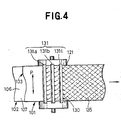
- Fig. 4 is a fragmentary plan view depicting a part of Fig. 3.
- composite web 101 comprising fibrous web 102 and thermoplastic synthetic resin film 103 fused with or bonded to upper surface 106 of the fibrous web 102 is continuously fed from the left hand.
- the composite web 101 is brought from above into contact with a first rotary drum 121 provided around its peripheral surface with a plurality of water-pervious holes (not shown).
- the composite web 101 is subjected to high pressure columnar water streams ejected from a plurality of nozzles 130 belonging to a first group of nozzles 131 arranged above the first rotary drum 121.
- the first group of nozzles 131 comprises a plurality of nozzle arrays 131a, 131b, 131c extending transversely of the direction in which the composite web 101 is fed. These arrays respectively have a plurality of nozzles 130 adapted to repeat reciprocation over a desired dimension in a direction P orthogonal to the direction. in which the composite web 101 is fed.
- the film 103 has been broken in accordance with movement loci of the respective nozzles 130 and consequently formed with a plurality openings 135.
- the composite web 101 formed with a plurality of openings 135 in this manner is then fed to a second rotary drum 122 provided around its peripheral surface with a plurality of liquid-pervious holes (not shown).
- the film 103 of the composite web 101 is brought from below into contact with the second rotary drum 122 and now a plurality of nozzles 133 belonging to a second group of nozzles 132 arranged below the second rotary drum 122 eject high pressure columnar water streams against lower surface 107 of the fibrous web 102.
- the second group of nozzles 132 also comprises a plurality of nozzle arrays 132a, 132b, 132c extending transversely of the direction in which the composite web 101 is fed. These arrays respectively have a plurality of nozzles 133 adapted to repeat reciprocation over a desired dimension in a direction P orthogonal to the direction in which the composite web 101 is fed.
- the first and second groups of nozzles 131, 132 are substantially similar to each other with respect to the arrangement as well as to the manner in which these nozzles repeat reciprocation in the direction P.
- the high pressure columnar water streams ejected from the second group of nozzles 132 serve to widen and to lengthen the already formed openings 135 of the film 103.
- the water streams serve to orient portions of the broken film remaining along the peripheral edges of the respective openings 135 so as to rise on the film 103.
- the portions having been oriented in this manner are depicted to form the tooth-like portions 17 and the bridges 21 depicted in Figs. 1 and 2.
- Portions extending between each pair of the adjacent lengthened openings 135 are destined to form the narrow strips 3 depicted in Figs. 1 and 2.
- the composite web 101 leaving the second rotary drum 122 toward the right passes through a dryer chamber 136 and is taken up into a roll of the composite sheet 1 depicted by Fig. 1.
- the composite sheet 1 obtained in this manner offers a comfortable touch and reliably conceals the liquid-absorbent core stained with body fluids.
- the composite sheet according to this invention is suitable for use as the liquid-pervious topsheet of a disposable diaper or a sanitary napkin.
- This composite sheet is suitable also as the stock material for a disposable gown used in a medical field from a viewpoint of its comfortable touch and high breathability.
- the narrow strips partially defining the surface of the sheet are formed along the entire peripheral edges thereof with a plurality of tooth-like portions.
Landscapes
- Health & Medical Sciences (AREA)
- Engineering & Computer Science (AREA)
- Life Sciences & Earth Sciences (AREA)
- Animal Behavior & Ethology (AREA)
- Epidemiology (AREA)
- Biomedical Technology (AREA)
- Heart & Thoracic Surgery (AREA)
- Vascular Medicine (AREA)
- Veterinary Medicine (AREA)
- Public Health (AREA)
- General Health & Medical Sciences (AREA)
- Manufacturing & Machinery (AREA)
- Mechanical Engineering (AREA)
- Absorbent Articles And Supports Therefor (AREA)
- Laminated Bodies (AREA)
- Orthopedics, Nursing, And Contraception (AREA)
- Nonwoven Fabrics (AREA)
- Diaphragms For Electromechanical Transducers (AREA)
Abstract
Description
Claims (9)
- A flexible composite sheet comprising a sheet-like fibrous assembly having upper and lower surfaces and film of thermoplastic synthetic resin placed upon and bonded to said upper surface of said fibrous assembly so that said upper surface is exposed at a plurality of regions,said flexible composite sheet further comprising:said fibrous assembly by formed with fibers having a fineness of 0.5 ∼ 20 dtex and a basis weight of 5 ∼ 60 g/m2; andsaid film being formed by a plurality of narrow strips, each having a thickness of 1 ∼ 50 µm, intermittently arranged so as to be spaced one from another by a distance of 30 ∼ 1000 µm in a first direction and in a second direction intersecting said first direction of said fibrous assembly wherein each of said narrow strips is defined by sides extending in said first and second directions, respectively, along which said narrow strip is formed with a plurality of tooth-like portions rising in a direction from said lower surface toward said upper surface and have proximal ends lying along said sides and distal ends so that said tooth-like portions are tapered from said proximal ends toward said distal ends.
- The composite sheet according to Claim 1, wherein said composite sheet has a breathing-resistance lower than 0.5 kPa . s/m as measured in a direction from said narrow strips toward said fibrous assembly.
- The composite sheet according to Claim 1, wherein said tooth-like portions have a height less than 1.5 mm as measured from said proximal ends.
- The composite sheet according to Claim 1, wherein said tooth-like portions line up in said first and second directions so that the respective narrow strips are surrounded by a plurality of said tooth-like portions.
- The composite sheet according to Claim 4, wherein each pair of said narrow strips being adjacent in any one of said first direction and said second direction is connected to each other by a bridge-like portion made of said thermoplastic synthetic resin and curving to describe a convexity directed upward.
- The composite sheet according to Claim 1, wherein said film is used to define a skin contacting surface of a disposable body fluid absorbent sanitary article.
- A process for making a flexible composite sheet by subjecting a composite web comprising a continuous fibrous web having upper and lower surfaces and a continuous film of thermoplastic synthetic resin bonded to said upper surface to the steps of:a. continuously feeding said composite web in one direction;b. reciprocating a first group of nozzles in a direction transversely of said one direction, said first group having a plurality of nozzles linearly arranged transversely of said one direction, wherein columnar fluid streams are ejected from said nozzles against said film of said composite web so that said film is broken in accordance with loci of said nozzles being reciprocated; andc. reciprocating a second group of nozzles in a direction transversely of said one direction, said second group having a plurality of nozzles linearly arranged transversely of said one direction, wherein columnar fluid streams are ejected from said nozzles against said lower surface of said fibrous web so that broken regions of said film are widened and lengthened and portions of said film remaining along said broken regions are oriented so as to rise in a direction from said lower surface toward said upper surface of said fibrous web.
- The process according to Claim 7, wherein said first and second groups of nozzles respectively comprise a plurality of nozzle arrays extending parallel one to another.
- The process according to Claim 7, wherein said fluid streams comprise water streams.
Applications Claiming Priority (2)
| Application Number | Priority Date | Filing Date | Title |
|---|---|---|---|
| JP2000096978A JP3533359B2 (en) | 2000-03-31 | 2000-03-31 | Flexible composite sheet and method for producing the same |
| JP2000096978 | 2000-03-31 |
Publications (3)
| Publication Number | Publication Date |
|---|---|
| EP1138299A2 true EP1138299A2 (en) | 2001-10-04 |
| EP1138299A3 EP1138299A3 (en) | 2004-01-21 |
| EP1138299B1 EP1138299B1 (en) | 2006-03-22 |
Family
ID=18611665
Family Applications (1)
| Application Number | Title | Priority Date | Filing Date |
|---|---|---|---|
| EP01302855A Expired - Lifetime EP1138299B1 (en) | 2000-03-31 | 2001-03-27 | Topsheet for an absorbent article and process for making the same |
Country Status (14)
| Country | Link |
|---|---|
| US (2) | US6503597B2 (en) |
| EP (1) | EP1138299B1 (en) |
| JP (1) | JP3533359B2 (en) |
| KR (1) | KR100666971B1 (en) |
| CN (1) | CN1168426C (en) |
| AT (1) | ATE320783T1 (en) |
| AU (1) | AU770589B2 (en) |
| BR (1) | BR0101748B1 (en) |
| CA (1) | CA2340904C (en) |
| DE (1) | DE60118111T2 (en) |
| ES (1) | ES2256171T3 (en) |
| MY (1) | MY127085A (en) |
| SG (1) | SG94787A1 (en) |
| TW (1) | TW476636B (en) |
Cited By (4)
| Publication number | Priority date | Publication date | Assignee | Title |
|---|---|---|---|---|
| US6852475B2 (en) | 2002-12-20 | 2005-02-08 | The Procter & Gamble Company | Method for making a forming structure |
| US7303861B2 (en) | 2002-12-20 | 2007-12-04 | The Procter & Gamble Company | Apparatus and method for making a forming structure |
| US7402723B2 (en) | 2002-12-20 | 2008-07-22 | The Procter & Gamble Company | Polymeric web exhibiting a soft and silky tactile impression |
| US7655176B2 (en) | 2002-12-20 | 2010-02-02 | The Procter & Gamble Company | Method of making a polymeric web exhibiting a soft and silky tactile impression |
Families Citing this family (11)
| Publication number | Priority date | Publication date | Assignee | Title |
|---|---|---|---|---|
| US9545744B2 (en) | 2002-12-20 | 2017-01-17 | The Procter & Gamble Company | Apparatus for making polymeric web exhibiting a soft and silky tactile impression |
| US7947864B2 (en) * | 2004-01-07 | 2011-05-24 | Kimberly-Clark Worldwide, Inc. | Low profile absorbent pantiliner |
| WO2008072631A1 (en) * | 2006-12-12 | 2008-06-19 | Uni-Charm Corporation | Composite sheet and absorbent article using the composite sheet |
| JP5111952B2 (en) | 2007-06-22 | 2013-01-09 | 株式会社リブドゥコーポレーション | Absorbent articles |
| JP2011062227A (en) * | 2009-09-15 | 2011-03-31 | Kochi Prefecture | Absorptive article |
| CN102423925A (en) * | 2011-09-30 | 2012-04-25 | 苏州凯威达制衣有限责任公司 | Waterproof elastic fabric |
| JP6189394B2 (en) * | 2015-10-16 | 2017-08-30 | ユニ・チャーム株式会社 | Manufacturing method of nonwoven fabric with uneven pattern |
| CN114214789A (en) * | 2016-06-10 | 2022-03-22 | 飞特适薄膜产品有限责任公司 | Hydroformed expanded spunbond nonwoven web and hydroformed composite, and methods of making same |
| US12084797B2 (en) | 2016-06-10 | 2024-09-10 | Fitesa Film Products Llc | Method for making a composite material |
| JP6371363B2 (en) | 2016-11-30 | 2018-08-08 | 花王株式会社 | Absorbent articles |
| CN116919726B (en) * | 2022-03-31 | 2026-03-24 | 江苏锦琪昶新材料有限公司 | A soft, dry, double-layer composite material and its preparation apparatus, method, and hygiene products |
Family Cites Families (17)
| Publication number | Priority date | Publication date | Assignee | Title |
|---|---|---|---|---|
| US3214819A (en) * | 1961-01-10 | 1965-11-02 | Method of forming hydrauligally loomed fibrous material | |
| US3489148A (en) * | 1966-12-20 | 1970-01-13 | Procter & Gamble | Topsheet for disposable diapers |
| US3769659A (en) * | 1970-03-24 | 1973-11-06 | Johnson & Johnson | Method and apparatus (continuous imperforate portions on backing means of open sandwich) |
| US3950587A (en) * | 1971-01-12 | 1976-04-13 | Breveteam, S.A. | Non-woven textile fiber products having a relief-like structure |
| US3873225A (en) * | 1972-09-05 | 1975-03-25 | Karna Jakobsen | Paving stones |
| US4146663A (en) * | 1976-08-23 | 1979-03-27 | Asahi Kasei Kogyo Kabushiki Kaisha | Composite fabric combining entangled fabric of microfibers and knitted or woven fabric and process for producing same |
| US4183987A (en) * | 1978-07-07 | 1980-01-15 | United States Gypsum Company | Kerfed edge gypsum board having improved edge strength |
| US4246838A (en) * | 1979-04-09 | 1981-01-27 | Velten & Pulver, Inc. | Multi-row dough slitting apparatus |
| GB8700805D0 (en) * | 1987-01-15 | 1987-02-18 | Dunlop Ltd | Carbon fibre materials |
| US5397625A (en) * | 1990-12-20 | 1995-03-14 | Kimberly-Clark Corporation | Duo-functional nonwoven material |
| EP0626868A1 (en) * | 1992-02-19 | 1994-12-07 | EBERLIN, Jean-Luc | Collagen- and fibrin adhesive-based graft for osteocartilaginous reconstruction, and preparation method therefor |
| US5505747A (en) * | 1994-01-13 | 1996-04-09 | Minnesota Mining And Manufacturing Company | Method of making an abrasive article |
| US5607760A (en) * | 1995-08-03 | 1997-03-04 | The Procter & Gamble Company | Disposable absorbent article having a lotioned topsheet containing an emollient and a polyol polyester immobilizing agent |
| US20020061396A1 (en) * | 1997-11-17 | 2002-05-23 | Susan M White | Aerogel loaded tile composite material |
| JP3628883B2 (en) * | 1997-11-26 | 2005-03-16 | ユニ・チャーム株式会社 | Flexible sheet used for disposable wearing article and method for producing the same |
| JP3467428B2 (en) * | 1999-06-03 | 2003-11-17 | ユニ・チャーム株式会社 | Liquid-permeable topsheet for body fluid-absorbing article and method for producing the same |
| JP3432176B2 (en) * | 1999-06-29 | 2003-08-04 | ユニ・チャーム株式会社 | Plastic composite sheet and method for producing the same |
-
2000
- 2000-03-31 JP JP2000096978A patent/JP3533359B2/en not_active Expired - Fee Related
-
2001
- 2001-03-14 CA CA002340904A patent/CA2340904C/en not_active Expired - Fee Related
- 2001-03-16 SG SG200101646A patent/SG94787A1/en unknown
- 2001-03-16 MY MYPI20011253A patent/MY127085A/en unknown
- 2001-03-19 AU AU28111/01A patent/AU770589B2/en not_active Ceased
- 2001-03-20 US US09/813,222 patent/US6503597B2/en not_active Expired - Fee Related
- 2001-03-27 AT AT01302855T patent/ATE320783T1/en not_active IP Right Cessation
- 2001-03-27 DE DE60118111T patent/DE60118111T2/en not_active Expired - Lifetime
- 2001-03-27 EP EP01302855A patent/EP1138299B1/en not_active Expired - Lifetime
- 2001-03-27 ES ES01302855T patent/ES2256171T3/en not_active Expired - Lifetime
- 2001-03-28 TW TW090107387A patent/TW476636B/en not_active IP Right Cessation
- 2001-03-29 BR BRPI0101748-9A patent/BR0101748B1/en not_active IP Right Cessation
- 2001-03-30 CN CNB011196963A patent/CN1168426C/en not_active Expired - Fee Related
- 2001-03-30 KR KR1020010016723A patent/KR100666971B1/en not_active Expired - Fee Related
-
2002
- 2002-11-18 US US10/298,985 patent/US6705189B2/en not_active Expired - Fee Related
Cited By (9)
| Publication number | Priority date | Publication date | Assignee | Title |
|---|---|---|---|---|
| US6852475B2 (en) | 2002-12-20 | 2005-02-08 | The Procter & Gamble Company | Method for making a forming structure |
| US7303861B2 (en) | 2002-12-20 | 2007-12-04 | The Procter & Gamble Company | Apparatus and method for making a forming structure |
| US7402723B2 (en) | 2002-12-20 | 2008-07-22 | The Procter & Gamble Company | Polymeric web exhibiting a soft and silky tactile impression |
| US7521588B2 (en) | 2002-12-20 | 2009-04-21 | The Procter & Gamble Company | Polymeric web exhibiting a soft and silky tactile impression |
| US7655176B2 (en) | 2002-12-20 | 2010-02-02 | The Procter & Gamble Company | Method of making a polymeric web exhibiting a soft and silky tactile impression |
| US7713683B2 (en) | 2002-12-20 | 2010-05-11 | The Procter & Gamble Company | Apparatus and method for making a forming structure |
| US8057729B2 (en) | 2002-12-20 | 2011-11-15 | The Procter & Gamble Company | Method for making a forming structure |
| US8105526B2 (en) | 2002-12-20 | 2012-01-31 | The Procter & Gamble Company | Method for making a forming structure |
| US8287800B2 (en) | 2002-12-20 | 2012-10-16 | The Procter And Gamble Company | Method for making a polymeric web exhibiting a soft and silky tactile impression |
Also Published As
| Publication number | Publication date |
|---|---|
| KR20010095129A (en) | 2001-11-03 |
| US20030068467A1 (en) | 2003-04-10 |
| ES2256171T3 (en) | 2006-07-16 |
| US6503597B2 (en) | 2003-01-07 |
| CN1318355A (en) | 2001-10-24 |
| EP1138299A3 (en) | 2004-01-21 |
| SG94787A1 (en) | 2003-03-18 |
| JP3533359B2 (en) | 2004-05-31 |
| BR0101748A (en) | 2001-12-04 |
| TW476636B (en) | 2002-02-21 |
| AU2811101A (en) | 2001-10-04 |
| KR100666971B1 (en) | 2007-01-12 |
| JP2001277392A (en) | 2001-10-09 |
| US20010026858A1 (en) | 2001-10-04 |
| CA2340904A1 (en) | 2001-09-30 |
| US6705189B2 (en) | 2004-03-16 |
| CN1168426C (en) | 2004-09-29 |
| CA2340904C (en) | 2006-09-05 |
| AU770589B2 (en) | 2004-02-26 |
| EP1138299B1 (en) | 2006-03-22 |
| MY127085A (en) | 2006-11-30 |
| ATE320783T1 (en) | 2006-04-15 |
| BR0101748B1 (en) | 2009-05-05 |
| DE60118111D1 (en) | 2006-05-11 |
| DE60118111T2 (en) | 2006-11-09 |
Similar Documents
| Publication | Publication Date | Title |
|---|---|---|
| KR100669120B1 (en) | Flexible sheet of disposable wear articles | |
| EP1138299B1 (en) | Topsheet for an absorbent article and process for making the same | |
| CA2297869C (en) | Flexible sheet for disposable garment | |
| KR101228713B1 (en) | Panty-type disposable wearing articles | |
| CA2323758C (en) | Flexible composite sheet for disposable garment | |
| JP3432176B2 (en) | Plastic composite sheet and method for producing the same | |
| KR100671856B1 (en) | Liquid-permeable surface sheet of a body fluid absorbent article, and a manufacturing method therefor | |
| JP3744759B2 (en) | Flexible sheet used for disposable wearing articles | |
| JP3751182B2 (en) | Flexible composite sheet | |
| JP3564246B2 (en) | Surface layer of disposable body fluid absorbent article | |
| JP2001187087A (en) | Liquid permeable composite sheet for disposable humor absorptive article and method for manufacturing the same |
Legal Events
| Date | Code | Title | Description |
|---|---|---|---|
| PUAI | Public reference made under article 153(3) epc to a published international application that has entered the european phase |
Free format text: ORIGINAL CODE: 0009012 |
|
| AK | Designated contracting states |
Kind code of ref document: A2 Designated state(s): AT BE CH CY DE DK ES FI FR GB GR IE IT LI LU MC NL PT SE TR |
|
| AX | Request for extension of the european patent |
Free format text: AL;LT;LV;MK;RO;SI |
|
| PUAL | Search report despatched |
Free format text: ORIGINAL CODE: 0009013 |
|
| AK | Designated contracting states |
Kind code of ref document: A3 Designated state(s): AT BE CH CY DE DK ES FI FR GB GR IE IT LI LU MC NL PT SE TR |
|
| AX | Request for extension of the european patent |
Extension state: AL LT LV MK RO SI |
|
| RIC1 | Information provided on ipc code assigned before grant |
Ipc: 7A 61F 13/512 A Ipc: 7A 61F 13/15 B |
|
| RAP1 | Party data changed (applicant data changed or rights of an application transferred) |
Owner name: UNI-CHARM CORPORATION |
|
| 17P | Request for examination filed |
Effective date: 20040503 |
|
| AKX | Designation fees paid |
Designated state(s): AT BE CH CY DE DK ES FI FR GB GR IE IT LI LU MC NL PT SE TR |
|
| 17Q | First examination report despatched |
Effective date: 20050420 |
|
| GRAP | Despatch of communication of intention to grant a patent |
Free format text: ORIGINAL CODE: EPIDOSNIGR1 |
|
| GRAS | Grant fee paid |
Free format text: ORIGINAL CODE: EPIDOSNIGR3 |
|
| GRAA | (expected) grant |
Free format text: ORIGINAL CODE: 0009210 |
|
| AK | Designated contracting states |
Kind code of ref document: B1 Designated state(s): AT BE CH CY DE DK ES FI FR GB GR IE IT LI LU MC NL PT SE TR |
|
| PG25 | Lapsed in a contracting state [announced via postgrant information from national office to epo] |
Ref country code: AT Free format text: LAPSE BECAUSE OF FAILURE TO SUBMIT A TRANSLATION OF THE DESCRIPTION OR TO PAY THE FEE WITHIN THE PRESCRIBED TIME-LIMIT Effective date: 20060322 Ref country code: CH Free format text: LAPSE BECAUSE OF FAILURE TO SUBMIT A TRANSLATION OF THE DESCRIPTION OR TO PAY THE FEE WITHIN THE PRESCRIBED TIME-LIMIT Effective date: 20060322 Ref country code: LI Free format text: LAPSE BECAUSE OF FAILURE TO SUBMIT A TRANSLATION OF THE DESCRIPTION OR TO PAY THE FEE WITHIN THE PRESCRIBED TIME-LIMIT Effective date: 20060322 |
|
| REG | Reference to a national code |
Ref country code: GB Ref legal event code: FG4D |
|
| PG25 | Lapsed in a contracting state [announced via postgrant information from national office to epo] |
Ref country code: IE Free format text: LAPSE BECAUSE OF NON-PAYMENT OF DUE FEES Effective date: 20060327 |
|
| PG25 | Lapsed in a contracting state [announced via postgrant information from national office to epo] |
Ref country code: MC Free format text: LAPSE BECAUSE OF NON-PAYMENT OF DUE FEES Effective date: 20060331 |
|
| REG | Reference to a national code |
Ref country code: CH Ref legal event code: EP |
|
| REG | Reference to a national code |
Ref country code: IE Ref legal event code: FG4D |
|
| REF | Corresponds to: |
Ref document number: 60118111 Country of ref document: DE Date of ref document: 20060511 Kind code of ref document: P |
|
| REG | Reference to a national code |
Ref country code: SE Ref legal event code: TRGR |
|
| PG25 | Lapsed in a contracting state [announced via postgrant information from national office to epo] |
Ref country code: DK Free format text: LAPSE BECAUSE OF FAILURE TO SUBMIT A TRANSLATION OF THE DESCRIPTION OR TO PAY THE FEE WITHIN THE PRESCRIBED TIME-LIMIT Effective date: 20060622 |
|
| REG | Reference to a national code |
Ref country code: ES Ref legal event code: FG2A Ref document number: 2256171 Country of ref document: ES Kind code of ref document: T3 |
|
| PG25 | Lapsed in a contracting state [announced via postgrant information from national office to epo] |
Ref country code: PT Free format text: LAPSE BECAUSE OF FAILURE TO SUBMIT A TRANSLATION OF THE DESCRIPTION OR TO PAY THE FEE WITHIN THE PRESCRIBED TIME-LIMIT Effective date: 20060822 |
|
| REG | Reference to a national code |
Ref country code: CH Ref legal event code: PL |
|
| ET | Fr: translation filed | ||
| PLBE | No opposition filed within time limit |
Free format text: ORIGINAL CODE: 0009261 |
|
| STAA | Information on the status of an ep patent application or granted ep patent |
Free format text: STATUS: NO OPPOSITION FILED WITHIN TIME LIMIT |
|
| 26N | No opposition filed |
Effective date: 20061227 |
|
| PG25 | Lapsed in a contracting state [announced via postgrant information from national office to epo] |
Ref country code: GR Free format text: LAPSE BECAUSE OF FAILURE TO SUBMIT A TRANSLATION OF THE DESCRIPTION OR TO PAY THE FEE WITHIN THE PRESCRIBED TIME-LIMIT Effective date: 20060623 |
|
| PG25 | Lapsed in a contracting state [announced via postgrant information from national office to epo] |
Ref country code: FI Free format text: LAPSE BECAUSE OF FAILURE TO SUBMIT A TRANSLATION OF THE DESCRIPTION OR TO PAY THE FEE WITHIN THE PRESCRIBED TIME-LIMIT Effective date: 20060322 |
|
| PG25 | Lapsed in a contracting state [announced via postgrant information from national office to epo] |
Ref country code: TR Free format text: LAPSE BECAUSE OF FAILURE TO SUBMIT A TRANSLATION OF THE DESCRIPTION OR TO PAY THE FEE WITHIN THE PRESCRIBED TIME-LIMIT Effective date: 20060322 Ref country code: LU Free format text: LAPSE BECAUSE OF NON-PAYMENT OF DUE FEES Effective date: 20060327 |
|
| PG25 | Lapsed in a contracting state [announced via postgrant information from national office to epo] |
Ref country code: CY Free format text: LAPSE BECAUSE OF FAILURE TO SUBMIT A TRANSLATION OF THE DESCRIPTION OR TO PAY THE FEE WITHIN THE PRESCRIBED TIME-LIMIT Effective date: 20060322 |
|
| PGFP | Annual fee paid to national office [announced via postgrant information from national office to epo] |
Ref country code: IT Payment date: 20120321 Year of fee payment: 12 |
|
| PGFP | Annual fee paid to national office [announced via postgrant information from national office to epo] |
Ref country code: DE Payment date: 20130320 Year of fee payment: 13 Ref country code: ES Payment date: 20130314 Year of fee payment: 13 Ref country code: FR Payment date: 20130325 Year of fee payment: 13 Ref country code: GB Payment date: 20130327 Year of fee payment: 13 Ref country code: SE Payment date: 20130312 Year of fee payment: 13 |
|
| PGFP | Annual fee paid to national office [announced via postgrant information from national office to epo] |
Ref country code: BE Payment date: 20130312 Year of fee payment: 13 |
|
| PGFP | Annual fee paid to national office [announced via postgrant information from national office to epo] |
Ref country code: NL Payment date: 20130316 Year of fee payment: 13 |
|
| REG | Reference to a national code |
Ref country code: DE Ref legal event code: R119 Ref document number: 60118111 Country of ref document: DE |
|
| REG | Reference to a national code |
Ref country code: NL Ref legal event code: V1 Effective date: 20141001 |
|
| REG | Reference to a national code |
Ref country code: SE Ref legal event code: EUG |
|
| GBPC | Gb: european patent ceased through non-payment of renewal fee |
Effective date: 20140327 |
|
| PG25 | Lapsed in a contracting state [announced via postgrant information from national office to epo] |
Ref country code: SE Free format text: LAPSE BECAUSE OF NON-PAYMENT OF DUE FEES Effective date: 20140328 |
|
| REG | Reference to a national code |
Ref country code: FR Ref legal event code: ST Effective date: 20141128 |
|
| REG | Reference to a national code |
Ref country code: DE Ref legal event code: R119 Ref document number: 60118111 Country of ref document: DE Effective date: 20141001 |
|
| PG25 | Lapsed in a contracting state [announced via postgrant information from national office to epo] |
Ref country code: GB Free format text: LAPSE BECAUSE OF NON-PAYMENT OF DUE FEES Effective date: 20140327 Ref country code: FR Free format text: LAPSE BECAUSE OF NON-PAYMENT OF DUE FEES Effective date: 20140331 Ref country code: DE Free format text: LAPSE BECAUSE OF NON-PAYMENT OF DUE FEES Effective date: 20141001 |
|
| PG25 | Lapsed in a contracting state [announced via postgrant information from national office to epo] |
Ref country code: NL Free format text: LAPSE BECAUSE OF NON-PAYMENT OF DUE FEES Effective date: 20141001 |
|
| PG25 | Lapsed in a contracting state [announced via postgrant information from national office to epo] |
Ref country code: IT Free format text: LAPSE BECAUSE OF NON-PAYMENT OF DUE FEES Effective date: 20140327 |
|
| REG | Reference to a national code |
Ref country code: ES Ref legal event code: FD2A Effective date: 20150427 |
|
| PG25 | Lapsed in a contracting state [announced via postgrant information from national office to epo] |
Ref country code: ES Free format text: LAPSE BECAUSE OF NON-PAYMENT OF DUE FEES Effective date: 20140328 |
|
| PG25 | Lapsed in a contracting state [announced via postgrant information from national office to epo] |
Ref country code: BE Free format text: LAPSE BECAUSE OF NON-PAYMENT OF DUE FEES Effective date: 20140331 |