EP1137542B1 - Microencapsulation method and recording sheet - Google Patents
Microencapsulation method and recording sheet Download PDFInfo
- Publication number
- EP1137542B1 EP1137542B1 EP99935702A EP99935702A EP1137542B1 EP 1137542 B1 EP1137542 B1 EP 1137542B1 EP 99935702 A EP99935702 A EP 99935702A EP 99935702 A EP99935702 A EP 99935702A EP 1137542 B1 EP1137542 B1 EP 1137542B1
- Authority
- EP
- European Patent Office
- Prior art keywords
- microcapsules
- diluent
- derivatives
- solution
- color former
- Prior art date
- Legal status (The legal status is an assumption and is not a legal conclusion. Google has not performed a legal analysis and makes no representation as to the accuracy of the status listed.)
- Revoked
Links
- 238000000034 method Methods 0.000 title claims abstract description 25
- 239000003085 diluting agent Substances 0.000 claims abstract description 68
- 239000003094 microcapsule Substances 0.000 claims abstract description 54
- 239000002904 solvent Substances 0.000 claims abstract description 44
- 230000008569 process Effects 0.000 claims abstract description 16
- 239000000758 substrate Substances 0.000 claims abstract description 7
- 239000007903 gelatin capsule Substances 0.000 claims abstract description 5
- 230000001804 emulsifying effect Effects 0.000 claims abstract description 4
- 239000000243 solution Substances 0.000 claims description 30
- 239000002775 capsule Substances 0.000 claims description 24
- 239000000203 mixture Substances 0.000 claims description 19
- 239000000839 emulsion Substances 0.000 claims description 12
- FWQHNLCNFPYBCA-UHFFFAOYSA-N fluoran Chemical class C12=CC=CC=C2OC2=CC=CC=C2C11OC(=O)C2=CC=CC=C21 FWQHNLCNFPYBCA-UHFFFAOYSA-N 0.000 claims description 8
- WNZQDUSMALZDQF-UHFFFAOYSA-N 2-benzofuran-1(3H)-one Chemical class C1=CC=C2C(=O)OCC2=C1 WNZQDUSMALZDQF-UHFFFAOYSA-N 0.000 claims description 6
- 108010010803 Gelatin Proteins 0.000 claims description 5
- 239000008273 gelatin Substances 0.000 claims description 5
- 229920000159 gelatin Polymers 0.000 claims description 5
- 235000019322 gelatine Nutrition 0.000 claims description 5
- 235000011852 gelatine desserts Nutrition 0.000 claims description 5
- 239000008199 coating composition Substances 0.000 claims description 4
- 229920000084 Gum arabic Polymers 0.000 claims description 3
- 229920000877 Melamine resin Polymers 0.000 claims description 3
- 229920002396 Polyurea Polymers 0.000 claims description 3
- 241000978776 Senegalia senegal Species 0.000 claims description 3
- 239000000205 acacia gum Substances 0.000 claims description 3
- 235000010489 acacia gum Nutrition 0.000 claims description 3
- 229930195733 hydrocarbon Natural products 0.000 claims description 3
- 150000002430 hydrocarbons Chemical class 0.000 claims description 3
- 150000002596 lactones Chemical class 0.000 claims description 3
- 229920002635 polyurethane Polymers 0.000 claims description 3
- 239000004814 polyurethane Substances 0.000 claims description 3
- 239000007864 aqueous solution Substances 0.000 claims description 2
- 239000006185 dispersion Substances 0.000 claims description 2
- 239000004215 Carbon black (E152) Substances 0.000 claims 2
- 150000001338 aliphatic hydrocarbons Chemical class 0.000 claims 2
- 229940054021 anxiolytics diphenylmethane derivative Drugs 0.000 claims 2
- CZZYITDELCSZES-UHFFFAOYSA-N diphenylmethane Chemical class C=1C=CC=CC=1CC1=CC=CC=C1 CZZYITDELCSZES-UHFFFAOYSA-N 0.000 claims 2
- 150000004961 triphenylmethanes Chemical class 0.000 claims 2
- IVJISJACKSSFGE-UHFFFAOYSA-N formaldehyde;1,3,5-triazine-2,4,6-triamine Chemical compound O=C.NC1=NC(N)=NC(N)=N1 IVJISJACKSSFGE-UHFFFAOYSA-N 0.000 claims 1
- 239000002243 precursor Substances 0.000 abstract description 3
- 239000000463 material Substances 0.000 description 15
- 238000003384 imaging method Methods 0.000 description 13
- 239000003995 emulsifying agent Substances 0.000 description 12
- 238000000576 coating method Methods 0.000 description 11
- 230000003134 recirculating effect Effects 0.000 description 11
- 238000004891 communication Methods 0.000 description 10
- 239000011248 coating agent Substances 0.000 description 9
- 150000001875 compounds Chemical class 0.000 description 9
- 238000011161 development Methods 0.000 description 8
- 238000005538 encapsulation Methods 0.000 description 8
- 238000004945 emulsification Methods 0.000 description 7
- -1 alkyl naphthalenes Chemical class 0.000 description 4
- 238000002425 crystallisation Methods 0.000 description 4
- 230000008025 crystallization Effects 0.000 description 4
- 239000003208 petroleum Substances 0.000 description 4
- 238000012546 transfer Methods 0.000 description 4
- YXFVVABEGXRONW-UHFFFAOYSA-N Toluene Chemical compound CC1=CC=CC=C1 YXFVVABEGXRONW-UHFFFAOYSA-N 0.000 description 3
- 230000008901 benefit Effects 0.000 description 3
- 230000015572 biosynthetic process Effects 0.000 description 3
- 238000006243 chemical reaction Methods 0.000 description 3
- 230000007423 decrease Effects 0.000 description 3
- 238000010586 diagram Methods 0.000 description 3
- 150000003951 lactams Chemical class 0.000 description 3
- 238000004519 manufacturing process Methods 0.000 description 3
- 230000035699 permeability Effects 0.000 description 3
- IRIAEXORFWYRCZ-UHFFFAOYSA-N Butylbenzyl phthalate Chemical compound CCCCOC(=O)C1=CC=CC=C1C(=O)OCC1=CC=CC=C1 IRIAEXORFWYRCZ-UHFFFAOYSA-N 0.000 description 2
- RGSFGYAAUTVSQA-UHFFFAOYSA-N Cyclopentane Chemical compound C1CCCC1 RGSFGYAAUTVSQA-UHFFFAOYSA-N 0.000 description 2
- RTZKZFJDLAIYFH-UHFFFAOYSA-N Diethyl ether Chemical compound CCOCC RTZKZFJDLAIYFH-UHFFFAOYSA-N 0.000 description 2
- 125000001931 aliphatic group Chemical group 0.000 description 2
- 239000003849 aromatic solvent Substances 0.000 description 2
- 125000003118 aryl group Chemical group 0.000 description 2
- JPIYZTWMUGTEHX-UHFFFAOYSA-N auramine O free base Chemical compound C1=CC(N(C)C)=CC=C1C(=N)C1=CC=C(N(C)C)C=C1 JPIYZTWMUGTEHX-UHFFFAOYSA-N 0.000 description 2
- 125000004432 carbon atom Chemical group C* 0.000 description 2
- 150000008280 chlorinated hydrocarbons Chemical class 0.000 description 2
- DOIRQSBPFJWKBE-UHFFFAOYSA-N dibutyl phthalate Chemical compound CCCCOC(=O)C1=CC=CC=C1C(=O)OCCCC DOIRQSBPFJWKBE-UHFFFAOYSA-N 0.000 description 2
- 239000007789 gas Substances 0.000 description 2
- 230000013011 mating Effects 0.000 description 2
- VNWKTOKETHGBQD-UHFFFAOYSA-N methane Chemical compound C VNWKTOKETHGBQD-UHFFFAOYSA-N 0.000 description 2
- 239000000376 reactant Substances 0.000 description 2
- GHMLBKRAJCXXBS-UHFFFAOYSA-N resorcinol Chemical compound OC1=CC=CC(O)=C1 GHMLBKRAJCXXBS-UHFFFAOYSA-N 0.000 description 2
- 150000003839 salts Chemical class 0.000 description 2
- 239000002002 slurry Substances 0.000 description 2
- LIZLYZVAYZQVPG-UHFFFAOYSA-N (3-bromo-2-fluorophenyl)methanol Chemical compound OCC1=CC=CC(Br)=C1F LIZLYZVAYZQVPG-UHFFFAOYSA-N 0.000 description 1
- DGXAGETVRDOQFP-UHFFFAOYSA-N 2,6-dihydroxybenzaldehyde Chemical compound OC1=CC=CC(O)=C1C=O DGXAGETVRDOQFP-UHFFFAOYSA-N 0.000 description 1
- KXGFMDJXCMQABM-UHFFFAOYSA-N 2-methoxy-6-methylphenol Chemical compound [CH]OC1=CC=CC([CH])=C1O KXGFMDJXCMQABM-UHFFFAOYSA-N 0.000 description 1
- ABJAMKKUHBSXDS-UHFFFAOYSA-N 3,3-bis(6-amino-1,4-dimethylcyclohexa-2,4-dien-1-yl)-2-benzofuran-1-one Chemical compound C1=CC(C)=CC(N)C1(C)C1(C2(C)C(C=C(C)C=C2)N)C2=CC=CC=C2C(=O)O1 ABJAMKKUHBSXDS-UHFFFAOYSA-N 0.000 description 1
- MQJTWPAGXWPEKU-UHFFFAOYSA-N 3-[4-(dimethylamino)phenyl]-3-(1,2-dimethylindol-3-yl)-2-benzofuran-1-one Chemical compound C1=CC(N(C)C)=CC=C1C1(C=2C3=CC=CC=C3N(C)C=2C)C2=CC=CC=C2C(=O)O1 MQJTWPAGXWPEKU-UHFFFAOYSA-N 0.000 description 1
- RNRINRUTVAFUCG-UHFFFAOYSA-N 5-(dimethylamino)-3,3-bis(1,2-dimethylindol-3-yl)-2-benzofuran-1-one Chemical compound C1=CC=C2C(C3(C=4C5=CC=CC=C5N(C)C=4C)OC(=O)C4=CC=C(C=C43)N(C)C)=C(C)N(C)C2=C1 RNRINRUTVAFUCG-UHFFFAOYSA-N 0.000 description 1
- KJFCMURGEOJJFA-UHFFFAOYSA-N 5-(dimethylamino)-3,3-bis(9-ethylcarbazol-3-yl)-2-benzofuran-1-one Chemical compound C1=CC=C2C3=CC(C4(C5=CC(=CC=C5C(=O)O4)N(C)C)C=4C=C5C6=CC=CC=C6N(C5=CC=4)CC)=CC=C3N(CC)C2=C1 KJFCMURGEOJJFA-UHFFFAOYSA-N 0.000 description 1
- WYWMJBFBHMNECA-UHFFFAOYSA-N 6-(dimethylamino)-3,3-bis(1,2-dimethylindol-3-yl)-2-benzofuran-1-one Chemical compound C1=CC=C2C(C3(C=4C5=CC=CC=C5N(C)C=4C)OC(=O)C=4C3=CC=C(C=4)N(C)C)=C(C)N(C)C2=C1 WYWMJBFBHMNECA-UHFFFAOYSA-N 0.000 description 1
- 229920002134 Carboxymethyl cellulose Polymers 0.000 description 1
- XDTMQSROBMDMFD-UHFFFAOYSA-N Cyclohexane Chemical compound C1CCCCC1 XDTMQSROBMDMFD-UHFFFAOYSA-N 0.000 description 1
- 229920002153 Hydroxypropyl cellulose Polymers 0.000 description 1
- 238000012695 Interfacial polymerization Methods 0.000 description 1
- UFWIBTONFRDIAS-UHFFFAOYSA-N Naphthalene Chemical compound C1=CC=CC2=CC=CC=C21 UFWIBTONFRDIAS-UHFFFAOYSA-N 0.000 description 1
- 239000004372 Polyvinyl alcohol Substances 0.000 description 1
- 229920001807 Urea-formaldehyde Polymers 0.000 description 1
- ZKURGBYDCVNWKH-UHFFFAOYSA-N [3,7-bis(dimethylamino)phenothiazin-10-yl]-phenylmethanone Chemical compound C12=CC=C(N(C)C)C=C2SC2=CC(N(C)C)=CC=C2N1C(=O)C1=CC=CC=C1 ZKURGBYDCVNWKH-UHFFFAOYSA-N 0.000 description 1
- 238000010521 absorption reaction Methods 0.000 description 1
- 239000002253 acid Substances 0.000 description 1
- 230000002411 adverse Effects 0.000 description 1
- 150000004996 alkyl benzenes Chemical class 0.000 description 1
- 125000000217 alkyl group Chemical group 0.000 description 1
- 125000003368 amide group Chemical group 0.000 description 1
- 239000011230 binding agent Substances 0.000 description 1
- 235000010290 biphenyl Nutrition 0.000 description 1
- 239000001768 carboxy methyl cellulose Substances 0.000 description 1
- 235000010948 carboxy methyl cellulose Nutrition 0.000 description 1
- 239000008112 carboxymethyl-cellulose Substances 0.000 description 1
- 239000003795 chemical substances by application Substances 0.000 description 1
- 239000004927 clay Substances 0.000 description 1
- 238000005354 coacervation Methods 0.000 description 1
- 238000007906 compression Methods 0.000 description 1
- 230000006835 compression Effects 0.000 description 1
- 239000000470 constituent Substances 0.000 description 1
- 238000001816 cooling Methods 0.000 description 1
- 125000000753 cycloalkyl group Chemical group 0.000 description 1
- MHDVGSVTJDSBDK-UHFFFAOYSA-N dibenzyl ether Chemical compound C=1C=CC=CC=1COCC1=CC=CC=C1 MHDVGSVTJDSBDK-UHFFFAOYSA-N 0.000 description 1
- 229960002380 dibutyl phthalate Drugs 0.000 description 1
- 238000004821 distillation Methods 0.000 description 1
- 230000000694 effects Effects 0.000 description 1
- 150000002148 esters Chemical group 0.000 description 1
- 238000009472 formulation Methods 0.000 description 1
- 238000004508 fractional distillation Methods 0.000 description 1
- 229910001385 heavy metal Inorganic materials 0.000 description 1
- DMEGYFMYUHOHGS-UHFFFAOYSA-N heptamethylene Natural products C1CCCCCC1 DMEGYFMYUHOHGS-UHFFFAOYSA-N 0.000 description 1
- 238000007757 hot melt coating Methods 0.000 description 1
- 239000001863 hydroxypropyl cellulose Substances 0.000 description 1
- 235000010977 hydroxypropyl cellulose Nutrition 0.000 description 1
- 230000003116 impacting effect Effects 0.000 description 1
- 230000006872 improvement Effects 0.000 description 1
- 239000012948 isocyanate Substances 0.000 description 1
- 150000002513 isocyanates Chemical class 0.000 description 1
- 239000003350 kerosene Substances 0.000 description 1
- 229940107698 malachite green Drugs 0.000 description 1
- 238000002844 melting Methods 0.000 description 1
- 230000008018 melting Effects 0.000 description 1
- 229910052751 metal Inorganic materials 0.000 description 1
- 239000002184 metal Substances 0.000 description 1
- 238000002156 mixing Methods 0.000 description 1
- 238000012986 modification Methods 0.000 description 1
- 230000004048 modification Effects 0.000 description 1
- 239000000178 monomer Substances 0.000 description 1
- 239000003345 natural gas Substances 0.000 description 1
- 150000002894 organic compounds Chemical class 0.000 description 1
- 239000012188 paraffin wax Substances 0.000 description 1
- 239000002245 particle Substances 0.000 description 1
- 229920001568 phenolic resin Polymers 0.000 description 1
- 239000005011 phenolic resin Substances 0.000 description 1
- 238000006116 polymerization reaction Methods 0.000 description 1
- ODGAOXROABLFNM-UHFFFAOYSA-N polynoxylin Chemical compound O=C.NC(N)=O ODGAOXROABLFNM-UHFFFAOYSA-N 0.000 description 1
- 229920002451 polyvinyl alcohol Polymers 0.000 description 1
- 235000019422 polyvinyl alcohol Nutrition 0.000 description 1
- 239000002244 precipitate Substances 0.000 description 1
- 230000002028 premature Effects 0.000 description 1
- 238000012545 processing Methods 0.000 description 1
- 239000000047 product Substances 0.000 description 1
- 150000003872 salicylic acid derivatives Chemical class 0.000 description 1
- 229920006395 saturated elastomer Polymers 0.000 description 1
- 239000000126 substance Substances 0.000 description 1
- 150000008053 sultones Chemical class 0.000 description 1
- 239000000725 suspension Substances 0.000 description 1
- 150000004897 thiazines Chemical class 0.000 description 1
- 125000001834 xanthenyl group Chemical class C1=CC=CC=2OC3=CC=CC=C3C(C12)* 0.000 description 1
- 239000008096 xylene Substances 0.000 description 1
- 150000003738 xylenes Chemical class 0.000 description 1
- 239000004711 α-olefin Substances 0.000 description 1
Images
Classifications
-
- B—PERFORMING OPERATIONS; TRANSPORTING
- B01—PHYSICAL OR CHEMICAL PROCESSES OR APPARATUS IN GENERAL
- B01J—CHEMICAL OR PHYSICAL PROCESSES, e.g. CATALYSIS OR COLLOID CHEMISTRY; THEIR RELEVANT APPARATUS
- B01J13/00—Colloid chemistry, e.g. the production of colloidal materials or their solutions, not otherwise provided for; Making microcapsules or microballoons
- B01J13/02—Making microcapsules or microballoons
-
- B—PERFORMING OPERATIONS; TRANSPORTING
- B41—PRINTING; LINING MACHINES; TYPEWRITERS; STAMPS
- B41M—PRINTING, DUPLICATING, MARKING, OR COPYING PROCESSES; COLOUR PRINTING
- B41M5/00—Duplicating or marking methods; Sheet materials for use therein
- B41M5/124—Duplicating or marking methods; Sheet materials for use therein using pressure to make a masked colour visible, e.g. to make a coloured support visible, to create an opaque or transparent pattern, or to form colour by uniting colour-forming components
- B41M5/165—Duplicating or marking methods; Sheet materials for use therein using pressure to make a masked colour visible, e.g. to make a coloured support visible, to create an opaque or transparent pattern, or to form colour by uniting colour-forming components characterised by the use of microcapsules; Special solvents for incorporating the ingredients
-
- Y—GENERAL TAGGING OF NEW TECHNOLOGICAL DEVELOPMENTS; GENERAL TAGGING OF CROSS-SECTIONAL TECHNOLOGIES SPANNING OVER SEVERAL SECTIONS OF THE IPC; TECHNICAL SUBJECTS COVERED BY FORMER USPC CROSS-REFERENCE ART COLLECTIONS [XRACs] AND DIGESTS
- Y10—TECHNICAL SUBJECTS COVERED BY FORMER USPC
- Y10T—TECHNICAL SUBJECTS COVERED BY FORMER US CLASSIFICATION
- Y10T428/00—Stock material or miscellaneous articles
- Y10T428/29—Coated or structually defined flake, particle, cell, strand, strand portion, rod, filament, macroscopic fiber or mass thereof
- Y10T428/2982—Particulate matter [e.g., sphere, flake, etc.]
- Y10T428/2984—Microcapsule with fluid core [includes liposome]
-
- Y—GENERAL TAGGING OF NEW TECHNOLOGICAL DEVELOPMENTS; GENERAL TAGGING OF CROSS-SECTIONAL TECHNOLOGIES SPANNING OVER SEVERAL SECTIONS OF THE IPC; TECHNICAL SUBJECTS COVERED BY FORMER USPC CROSS-REFERENCE ART COLLECTIONS [XRACs] AND DIGESTS
- Y10—TECHNICAL SUBJECTS COVERED BY FORMER USPC
- Y10T—TECHNICAL SUBJECTS COVERED BY FORMER US CLASSIFICATION
- Y10T428/00—Stock material or miscellaneous articles
- Y10T428/29—Coated or structually defined flake, particle, cell, strand, strand portion, rod, filament, macroscopic fiber or mass thereof
- Y10T428/2982—Particulate matter [e.g., sphere, flake, etc.]
- Y10T428/2984—Microcapsule with fluid core [includes liposome]
- Y10T428/2985—Solid-walled microcapsule from synthetic polymer
Definitions
- the present invention relates to an improvement in microencapsulated imaging systems, and more particularly, to a method for improving image speed and intensity, while lowering cost.
- Encapsulated imaging systems frequently employ diluents in conjunction with the typical color formers and solvents found in the internal phase of microcapsules.
- Diluents are used because they are less expensive than solvents and they enable the manufacturer to provide an imaging system having acceptable image speed and intensity at a reduced cost.
- High diluent concentrations can create supersaturated solutions of the color former which are prone to crystallization or "drop out" of the color former from solution. The crystallized color former does not efficiently transfer to the co-reactive compound or sheet and, as a result, there is a corresponding decrease in the speed of image development and overall image intensity.
- U.S. Patent No. 4,636,818 to Jerabek discloses a carbonless copying system including two types of microcapsules.
- the first type of microcapsule contains either a solution or suspension of one of the two mark forming components of the carbonless system.
- the second type of microcapsule encapsulates only solvent.
- the solvent-only microcapsules disclosed in Jerabek enhance imaging capability without an increase in usage of dye precursors. However, the additional solvent usage increases the cost of the microcapsules. It would be desirable to achieve the same effect with less expensive diluent.
- an imaging system wherein a high concentration of diluent can be incorporated into a microencapsulated imaging system to improve speed of image development and image intensity.
- the present invention provides a microcapsule composition
- a microcapsule composition comprising first and second microcapsules wherein the first microcapsules contain a solution of a color former and a solvent and the second microcapsules contain a diluent.
- the microcapsule walls are selected to minimize smudge and permeability.
- the first and second microcapsules can be prepared using the same or different wall formers using integrated or independent encapsulation processes.
- the first and second microcapsules are gelatin microcapsule clusters as described below.
- the present invention also provides a recording sheet in which a paper or film substrate is coated with a layer of the aforementioned microcapsule composition.
- the present invention provides a method for producing a microencapsulated system with improved imaging capabilities.
- the method comprises the steps of: a) providing a solution of a color former in a solvent as a first internal phase; b) providing a diluent as a second internal phase; c) providing an external phase; d) emulsifying said first and second internal phases in said external phase to produce discrete droplets of each of said first and second internal phases; and e) encapsulating said droplets in a wall former.
- the first internal phase containing the mark-forming component in solvent is first emulsified, followed by emulsification of the second phase containing only diluent.
- the emulsions are then encapsulated to form capsules with discrete color former/solvent and diluent droplets.
- the first and second phases can be emulsified separately and then combined.
- the two droplet types can then be encapsulated as described above.
- the color former solution and the diluent can be microencapsulated separately and then mixed.
- Emulsification can be accomplished either by the continuous, in-line method or by the re-circulating, batch method in a manner known in the art.
- polynuclear gelatin capsule clusters of color former solution containing and diluent containing microcapsules are formed.
- Reference to clusters of microcapsules, as described herein, is meant to describe not only microcapsules formed around a group of color former solution containing and diluent containing microcapsules but also microcapsules formed around groups of discrete droplets of color former solution and diluent. Both types of clusters are within the scope of the present invention.
- the formation of capsule clusters depends on the wall forming material and the encapsulation conditions. Non-gelatin capsules are not typically clustered. In this case the diluent capsules and the color former solution capsules are usually mixed without actually being bound together as a cluster.
- Providing the diluent in a separate capsule or in a separate chamber of a capsule cluster from the color former solution can provide several advantages. It provides the benefits associated with using a diluent, such as, lower cost and improved speed of development, but avoids a super-saturated condition that results in crystallization or kick out of the color former.
- the diluent and color former/solvent instantaneously mix when the capsules are subjected to an imaging force, transfer to the CF sheet and create an image upon reaction with the co-reactant.
- the presence of the diluent improves mass transfer generating a quicker, more intense image.
- the diluent also wets out the CF surface making it more receptive for image development.
- an improved encapsulated composition generating an image that is faster developing and more intense is produced by providing for discrete color former/solvent and diluent encapsulated phases.
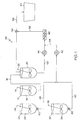
- To produce the encapsulated composition two internal phase solutions and one external phase solution are used and the interrelationship of these three phases is shown in FIG. 1 for one embodiment of the invention.
- tank 12 having stirrer 14 contains external phase 16.
- External phase 16 typically contains an aqueous solution of gelatin and gum arabic.
- recirculating tank 20 having stirrer 22 In communication with tank 12 through pipe 18 is recirculating tank 20 having stirrer 22.
- Tank 24 having stirrer 26 contains first internal phase 28, typically a solution of color former in solvent.
- Tank 30 having stirrer 32 contains second internal phase 34, typically a diluent.
- Tanks 24 and 30 are in communication with recirculating system 36 through pipes 38 and 40 respectively, and metering pump 42 and pipe 44.
- Recirculating system 36 consists of recirculating tank 20, metering pump 46, emulsifier 48 and pipes 50 and 52.
- Recirculating system 36 is in communication with reactor 54 through pipe 56 connected to T-valve 58.
- tank 12 is filled with external phase 16
- tank 24 is filled with first internal phase 28
- tank 30 is filled with second internal phase 34.
- External phase 16 is pumped through pipe 18 to recirculating tank 20.
- Recirculating metering pump 46 and emulsifier 48 are switched on to recirculate external phase 16 through recirculating system 36.
- Emulsifier 48 is set to low shear or low RPM to avoid producing an emulsion in which the particle size is too small until both internal phases have been added.
- First internal phase 28 is added next by opening valve 60 and turning on metering pump 42.
- First internal phase 28 passes through pipes 38 and 44 to enter recirculating system 36.
- Second internal phase 34 is then added by closing valve 60 and opening valve 62.
- Second internal phase 34 passes through pipes 40 and 44 to enter recirculating system 36.
- Second internal phase 34 could be emulsified first, followed by emulsification of first internal phase 28.
- emulsifier 48 After adding all components to recirculating system 36, the speed of emulsifier 48 is increased until the desired emulsion size is reached. The emulsion containing discrete droplets of each internal phase is then pumped through pipe 56 to reactor 54 for clustering and encapsulation.
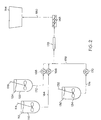
- tank 112 having stirrer 114 contains external phase 116.
- metering pump 166 In communication with tank 112 through pipe 164 is metering pump 166.
- Tank 124 having stirrer 126 contains first internal phase 128, typically a solution of color former in solvent.
- Tank 130 having stirrer 132 contains second internal phase 134, typically a diluent.
- Tanks 124 and 130 are in communication with metering pumps 168 and 170 through pipes 172 and 174, respectively.
- Metering pumps 166, 168 and 170 feed material to common pipe 176 connected to pre-mixer 178.
- Pre- mixer 178 discharges material into emulsifier 148 which is in communication with reactor 154 through pipe 180.
- tank 112 is filled with external phase 116
- tank 124 is filled with first internal phase 128
- tank 130 is filled with second internal phase 134.
- Metering pumps 168 and 166 are set to deliver a predetermined flow of material of first internal phase 128 and external phase 116 into common pipe 176. This pre-emulsion mix of first internal phase and external phase is then passed through pre-mixer 178 into emulsifier 148 and finally delivered to reactor 154. After first internal phase 128 is consumed, metering pump 168 is switched off and metering pump 170 is turned on and set to deliver a predetermined flow of second internal phase 134 into common pipe 176.
- Metering pump 166 remains on and may be adjusted to deliver the appropriate amount of external phase 116 to correspond to the amount of second internal phase 134 being processed.
- This pre-emulsion mix of second internal phase and external phase is then passed through pre-mixer 178 into emulsifier 148 and finally delivered to reactor 154.
- the emulsion undergoes clustering and encapsulation in reactor 154.
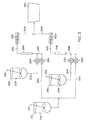
- the emulsification of the two internal phases may be conducted by a parallel emulsification method.
- tank 212 having stirrer 214 contains external phase 216.
- metering pumps 284 and 286, respectively In communication with tank 212 through pipes 280 and 282 are metering pumps 284 and 286, respectively.
- Tank 224 having stirrer 226 contains first internal phase 228 and is in communication with metering pump 268 through pipe 272.
- Tank 230 having stirrer 232 contains second internal phase 234 and is in communication with metering pump 270 through pipe 274.
- Metering pumps 268 and 284 are connected to premixer 288 through pipe 290.
- Premixer 288 feeds material into emulsifier 292 through pipe 294.
- metering pumps 270 and 286 are connected to premixer 296 through pipe 298.
- Premixer 296 feeds material into emulsifier 300 through pipe 302.
- Emulsifiers 292 and 300 are in communication with reactor 254 through pipes 304 and 306, respectively.
- tank 212 is filled with external phase 216
- tank 224 is filled with first internal phase 228
- tank 230 is filled with second internal phase 234.
- Metering pumps 284 and 286 are set to deliver a predetermined flow of external phase 216 from tank 212 to pipes 290 and 298, respectively.
- Metering pumps 268 and 270 are set to deliver a predetermined flow of first internal phase 228 from tank 224 and second internal phase 234 from tank 230 to pipes 290 and 298, respectively.
- the pre-emulsion mix of first internal phase and external phase is then passed through pre-mixer 288 into emulsifier 292 and finally delivered to reactor 254.
- the pre-emulsion mix of second internal phase and external phase is passed through pre-mixer 296 into emulsifier 300 and delivered to reactor 254.
- the emulsion undergoes clustering and encapsulation in reactor 254.
- the color former microcapsules can also be prepared independently of the diluent microcapsules and the two microcapsules can be mixed to form a coating composition which can be applied to a substrate to prepare a recording sheet in a conventional manner.
- the solvents used in the present invention include those conventionally used in microencapsulated imaging systems.
- Reference to "solvents" within the scope of the invention indicates those solvents capable of dissolving the color former to yield a satisfactorily concentrated and encapsulatable solution.
- Representative examples of such solvents include aromatic solvents and chlorinated hydrocarbons.
- the aromatic solvents more particularly include benzyl butyl phthalate, dibutyl phthalate, toluene, various xylenes, alkyl benzenes, alkyl naphthalenes, alkyl biphenyls and mixtures thereof.
- Chlorinated hydrocarbons include chlorinated paraffins and chlorinated alpha-olefins (see U.S. Patent 4,743,579 to Fetters).
- a particularly useful solvent is Nisseki SAS-310.
- the diluents used in the present invention include any of a number of non-solvents in which the color formers are not soluble to a significant degree that have been employed as diluents in the carbonless paper industry.
- Diluents are typically non-aromatic and relatively inexpensive compared to solvents.
- Diluents more particularly include aliphatic and cycloaliphatic compounds.
- Particularly useful in the present invention are aliphatic and cycloaliphatic petroleum constituents, including those present in the second main fraction of petroleum undergoing fractional distillation, containing paraffin hydrocarbons with 9 to approximately 20 carbon atoms, namely raw gasoline or its partial fractions in the form of petroleum ether, light gasoline, ligroin, heavy naphtha, kerosene, etc.
- Gas oil compounds as the third main fraction of the distillation and formed from paraffins with 12 to 19 carbon atoms are also useful.
- Natural gasoline is also suitable and represents the gasoline gas fractions present in natural gas and is removed from the latter by compression or absorption in oil.
- Petroleums formed from up to 80% from cyclic hydrocarbons can also be used. Naphthene fractions can also be advantageously used for the present invention. Particularly useful are cyclopentane, cyclohexane and their alkyl derivatives. Furthermore, it is possible to use petroleum fractions which occupy a middle position between "paraffinic” and "naphthenic" petroleums.
- Exxsol D110 Exxsol D 100, Exxsol D 80, Exxsol D 180/210, Exxsol D 140-170, Isopar L, Isopar M, Shellsol TD, Shellsol K, and Flavex oil 909.
- the color formers used in the present invention include those chromogenic materials which have previously been taught for use in microencapsulated imaging systems. In general, these materials are colorless electron donating type dry former compounds which react with a developer compound to generate a dye.
- Representative examples of such color formers include substantially colorless compounds having in their partial skeleton a lactone, a lactam, a sultone, a spiropyran, an ester or an amido structure.
- triarylmethane compounds bisphenylmethane compounds, xanthene compounds, thiazine compounds, spiropyran compounds and the like.
- Typical examples of them include Crystal Violet lactone, benzoyl leuco methylene blue, Malachite Green Lactone, p-nitrobenzoyl leuco methylene blue, 3-dialkylamino-7-dialkylamino-fluoran, 3-methyl-2,2'-spirobi(benzo-f-chrome), 3,3-bis(p-dimethylaminophenyl)phthalide, 3-(p-dimethylaminophenyl)-3-(1,2dimethylindole-3-yl)phthalide, 3-(p-dimethylammophenyl)-3-(2-methylindole-3-yl)phthalide,3-(p-dimethylaminophenyl)-3-(2-phenylindole-3-yl)phthalide, 3,3-bis(1,2-dimethylindole-3-yl)-5-dimethylaminophthalide, 3,3-bis-(1,2-dimethylindole-3-yl)6-d
- color formers can be used if desired.
- fluoran color formers disclosed in U.S. Pat. No. 3,920,510.
- organic compounds capable of reacting with heavy metal salts to give colored metal complexes, chelates or salts can be adapted for use in the present invention.
- the color former is incorporated in the first internal phase in an amount sufficient to produce a visible image of the desired density upon reaction with the developer.
- these amounts range from approximately 0.5 to about 20.0 percent based on the weight of the first internal phase solution containing the chromogen.
- a preferred range is from about 5 percent to about 20 percent, with a more preferred range being from about 10 percent to about 20 percent.
- the amount of the chromogenic material required to obtain suitable images depends on the nature of the chromogen, the nature of the internal phase, and the type of imaging system. Higher concentrations of chromogenic materials are possible with the present invention than with typical microencapsulated imaging systems.
- Concentrations of chromogenic materials that would tend to crystallize out of an internal phase solution based on a solvent/diluent mixture can be formed in a stable manner with the discrete solvent/color former and diluent capsule encapsulated phases of the present invention.
- Wall-forming materials which may be useful in the present invention include gelatin (see U.S. Pat. No. 2,730,456 and 2,800,457 to Green et al) including gum arabic, polyvinyl alcohol, carboxymethyl cellulose; resorcinol-formaldehyde (see U.S. Pat. No. 3,755,190 to Hart et al), isocyanate (see U.S. Pat. No. 3,914,511 to Vassiliades), polyurethane (see U.S. Pat. No.
- ureaformaldehyde wall-formers and more particularly urea-resorcinol-formaldehyde wall formers (in which oleophilicity is enhanced by the addition of resorcinol)
- melamine-formaldehyde resin melamine-formaldehyde resin, hydroxypropyl cellulose (see U.S. Pat. No. 4,025,455 to Shackle) and polyurea (U.S. Pat. No. 5,643,506 to Rourke).
- Other wall formers are described in U.S. Pat. No.
- Microencapsulation has been accomplished by a variety of known techniques including coacervation, interfacial polymerization, polymerization of one or more monomers in an oil, as well as various melting, dispersing and cooling methods.
- the choice of wall-forming material depends on the diluent to be encapsulated. Permeability of the diluent through the capsule wall material must be relatively low. In other words, the capsule must be capable of containing the diluent without excessive leakage or exudation through the capsule wall. Furthermore, the wall-material and diluent combination must be selected to optimize smudge characteristics.
- the diluent capsules, as well as the color former/solvent capsules, must be able to withstand normal handling and processing forces without rupturing. Premature release of encapsulated components results in undesirable blushing or smudge as well as deleteriously impacting final image intensity.
- the mean size of the capsules used in the present invention may vary over a broad range but generally ranges from approximately 1 to 25 ⁇ m. As a general rule, image resolution improves as the capsule size decreases with the caveat that if the capsule size is too small, the capsule may sit within incongruities in the support and the support may screen the capsules from exposure. Very small capsules may also fail to rupture upon the application of pressure. In view of the foregoing, it has been found that a preferred mean capsule size range is approximately 3 to 15 ⁇ m and particularly approximately 5 to 12 ⁇ m.
- the ratio of solvent and diluent should be optimized to achieve the best combination of cost, intensity, images speed, smudge, and permeability. While the invention has been described with references to a first internal phase containing a solvent and a color former, those skilled in the art will recognize that the benefits of the invention could still be obtained to some degree even if some amount of diluent is included in the first internal phase. It has been found that the first internal phase can be modified to include up to 30% by weight diluent based on the combined amount by weight of the solvent and diluent.
- microcapsules of the present invention can be used in a variety of image forming systems. Image formation can be initiated by application of pressure, as with typical carbonless paper, or by application of heat, as with heat sensitive recording paper.
- the microcapsules can be incorporated into a press applied hot melt coating dispersion for use in producing pressure sensitive carbonless transfer sheets as described in U.S. Patent No. 4,137,343.
- the microcapsule slurry containing solvent/color former is compounded into a coating capable of being transferred to a substrate.
- the slurry will also contain the diluent capsules.
- This coating is referred to as the CB coating and the substrate carrying the coating is the CB sheet.
- the CB coating is applied to the back surface of the top ply in a form set. Image formation is achieved by mating the CB coating with a CF coating containing a co-reactant such as a phenolic resin, acid activated clay or a salicylic acid derivative which reacts with the color former to generate an image.
- the CF (coated front) coating is typically applied to the top surface of the sheet adjacent to the CB coating in the formset.
- Sheets which contain both CB and CF coatings are referred to as CFB sheets and are typically used as the intermediate plies in a formset.
- the CFB has a top coated CF surface for reacting with the CB from the adjacent top sheet and a back coated CB surface for reacting with the CF on the adjacent bottom sheet of the formset.
- An image generating force typically pressure, is applied to the formset causing the CB microcapsules to rupture and release the encapsulated contents to the surface of the CF sheet where the color forming reaction occurs.
- the components of the CB and CF coatings can also be applied to the same surface of a sheet to yield a self contained sheet.
- An image can be formed on a self contained sheet by simply applying an imaging force; a mating sheet is not required.
- Microcapsules were prepared in accordance with the present invention and compared to microcapsules prepared using a single internal phase containing both solvent and diluent. Capsules were prepared using both blue and black image dye combinations. Exxsol D 110 was used as the diluent and Nisseki SAS-310 was used as the solvent. Each microcapsule formulation was made up into a coating composition by adding stilting agent and binder. The finished CB coating compositions were coated at 1.3 ⁇ 0.5 #/ream using laboratory drawdown equipment. The coated sheets were imaged and tested for speed of image development. Image intensity was measured at various points in time with a reflectance meter. The lower the reflectance number, the better or more intense the image.
- Examples 1-10 The speed of image development results for Examples 1-10 are shown below.
- Examples 1-4 represent control samples for black image CB prepared according to prior art methods wherein the solvent and diluent are admixed along with the color formers in a single internal phase solution. The ratio of solvent to diluent is limited because of the limited solubility of the dye formers in the diluent.
- Examples 5 and 6 represent samples prepared in accordance with the present invention. The use of two internal phases and the creation of two discrete types of droplets allows for increasing levels of diluent without compromising speed of image development. Although, the diluent level in samples 5 and 6 was increased to 40%, the results for speed of image development and final intensity are comparable to those obtained with the control samples at lower concentrations of diluent.
- samples 7 and 8 represent blue image CB control samples and samples 9 and 10 represent samples prepared in accordance with the present invention.
- the use of discrete droplets containing only diluent has allowed the use of higher levels of diluent without a decrease in performance.
Landscapes
- Chemical & Material Sciences (AREA)
- Organic Chemistry (AREA)
- Dispersion Chemistry (AREA)
- Chemical Kinetics & Catalysis (AREA)
- Color Printing (AREA)
- Packaging For Recording Disks (AREA)
- Manufacturing Of Micro-Capsules (AREA)
Abstract
Description
| Example | Image Color | Discrete diluent droplets? | Solvent /diluent | Image speed (intensity) Time (minutes) | |||||
| 0.5 | 1 | 2 | 5 | 10 | |||||
| 1 | Black | No | 75/25 | 64.71 | 58.03 | 53.52 | 50.15 | 49.31 | |
| 2 | Black | No | 75/25 | 58.11 | 52.09 | 49.32 | 46.94 | 45.58 | |
| 3 | Black | No | 70/30 | 66.24 | 58.58 | 53.97 | 51.17 | 49.62 | |
| 4 | Black | No | 70/30 | 63.82 | 55.50 | 52.67 | 49.65 | 48.86 | |
| 5 | | Yes | 60/40 | 63.50 | 55.93 | 52.18 | 49.65 | 48.84 | |
| 6 | | Yes | 60/40 | 64.43 | 57.25 | 53.71 | 51.83 | 50.96 | |
| 7 | Blue | No | 70/30 | 52.43 | 46.65 | 43.35 | 41.93 | 40.52 | |
| 8 | Blue | No | 70/30 | 49.58 | 44.53 | 41.72 | 40.53 | 39.60 | |
| 9 | | Yes | 60/40 | 51.70 | 45.10 | 41.85 | 39.99 | 38.51 | |
| 10 | | Yes | 60/40 | 49.92 | 45.93 | 43.38 | 41.67 | 42.22 |
Claims (21)
- A process for producing a dispersion of microcapsules comprising the steps of:(a) emulsifying a first and a second internal phase in an external phase to produce discrete droplets of each of said first and second internal phases; and(b) encapsulating said droplets in a capsule wall former wherein said first internal phase is a solution of a color former in a solvent and said second internal phase is a diluent, said diluent being a non-solvent for the colour former.
- The process of claim 1 wherein said step of encapsulating said droplets is conducted such that microcapsules containing a cluster of encapsulated droplets of said first and said second internal phase are formed.
- The process of claim 1 or claim 2 wherein said color former is selected from the group consisting of lactone derivatives, fluoran derivatives, phthalide derivatives, diphenylmethane derivatives, triphenylmethane derivatives, spiropyran derivatives and mixtures thereof.
- The process of any of claims 1 to 3 wherein said diluent is selected from the group consisting of aliphatic hydrocarbon solvents, cycloaliphatic hydrocarbon solvents and mixtures thereof.
- The process as claimed in any preceding claim wherein said external phase is an aqueous solution of gelatin and gum arabic and said wall former is gelatin.
- The process as claimed in any preceding claim wherein said first and second internal phases are emulsified sequentially in said external phase to produce said discrete droplets.
- The process of claim 6 wherein said discrete droplets are further emulsified as a batch to a desired emulsion size.
- The process of claim 6 wherein said discrete droplets are emulsified inline to a desired emulsion size.
- The process of any of claims 1 to 6 wherein said first and second internal phases are simultaneously emulsified in said external phase.
- The process of any preceding claim, wherein the concentration of said color former in said solution is 0.5 to 20%.
- The process of claim 10 wherein said concentration is 10 to 20%.
- The process of claim 1 wherein said wall former is a polyurea, a polyurethane or a melamine-formaldehyde resin.
- A coating composition containing microcapsules obtainable by the process of any one of claims 1 to 12.
- A recording sheet comprising a substrate and a layer of microcapsules on the surface of said substrate, said microcapsules including a plurality of first microcapsules and a plurality of second microcapsules; said first microcapsules encapsulating a solution of colorformer and a solvent; and said second microcapsules encapsulating a diluent.
- The recording sheet of claim 14 wherein said color former is selected from the group consisting of lactone derivatives, fluoran derivatives, phthalide derivatives, diphenylmethane derivatives, triphenylmethane derivatives, spiropyran derivatives and mixtures thereof.
- The recording sheet of claim 14 or claim 15 wherein said diluent is selected from the group consisting of aliphatic hydrocarbon solvents, cycloaliphatic hydrocarbon solvents and mixtures thereof.
- The recording sheet of claim 16 wherein the concentration of said color former in said solution is 0.5 to 20%.
- The recording sheet of claim 17 wherein said concentration is 10 to 20%.
- The recording sheet as claimed in any of claims 14 to 18 wherein said microcapsules are clusters of gelatin capsules containing a solution of said color former and gelatin capsules containing diluent.
- The recording sheet as claimed in any of claims 14 to 18 wherein said microcapsules are formed from polyurethane, a polyurea or a melamine-formaldehyde wall former.
- A microcapsule composition comprising first and second microcapsules wherein said first microcapsules contain a solution of a color former and a solvent and said second microcapsules contain a diluent.
Applications Claiming Priority (3)
| Application Number | Priority Date | Filing Date | Title |
|---|---|---|---|
| US198296 | 1980-10-20 | ||
| US09/198,296 US6103378A (en) | 1998-11-23 | 1998-11-23 | Capsules having discrete solvent/color former and diluent capsule encapsulated phases |
| PCT/US1999/016320 WO2000030860A1 (en) | 1998-11-23 | 1999-07-19 | Microencapsulation method and recording sheet |
Publications (2)
| Publication Number | Publication Date |
|---|---|
| EP1137542A1 EP1137542A1 (en) | 2001-10-04 |
| EP1137542B1 true EP1137542B1 (en) | 2002-12-18 |
Family
ID=22732786
Family Applications (1)
| Application Number | Title | Priority Date | Filing Date |
|---|---|---|---|
| EP99935702A Revoked EP1137542B1 (en) | 1998-11-23 | 1999-07-19 | Microencapsulation method and recording sheet |
Country Status (7)
| Country | Link |
|---|---|
| US (1) | US6103378A (en) |
| EP (1) | EP1137542B1 (en) |
| AT (1) | ATE229885T1 (en) |
| AU (1) | AU5112799A (en) |
| CA (1) | CA2351861A1 (en) |
| DE (1) | DE69904648T2 (en) |
| WO (1) | WO2000030860A1 (en) |
Families Citing this family (30)
| Publication number | Priority date | Publication date | Assignee | Title |
|---|---|---|---|---|
| US6974592B2 (en) * | 2002-04-11 | 2005-12-13 | Ocean Nutrition Canada Limited | Encapsulated agglomeration of microcapsules and method for the preparation thereof |
| EP1539340B8 (en) * | 2002-09-20 | 2007-11-07 | Papierfabrik August Koehler AG | Method for encapsulating dissolved color reaction partners of color reaction systems, the capsules obtained according thereto, and their use in color reaction papers |
| BRPI0315977B8 (en) * | 2002-11-04 | 2021-05-25 | Dsm Nutritional Products Ag | microcapsules having multiple shells and method for preparing these |
| US8034450B2 (en) * | 2005-01-21 | 2011-10-11 | Ocean Nutrition Canada Limited | Microcapsules and emulsions containing low bloom gelatin and methods of making and using thereof |
| US6969530B1 (en) | 2005-01-21 | 2005-11-29 | Ocean Nutrition Canada Ltd. | Microcapsules and emulsions containing low bloom gelatin and methods of making and using thereof |
| CA2596023A1 (en) * | 2005-01-27 | 2006-11-09 | Ocean Nutrition Canada Ltd. | Fatty acid-benzenediol derivatives and methods of making and using thereof |
| EP1848729A2 (en) * | 2005-01-27 | 2007-10-31 | Ocean Nutrition Canada Limited | Chromium-fatty acid compounds and methods of making and using thereof |
| US9968120B2 (en) * | 2006-05-17 | 2018-05-15 | Dsm Nutritional Products Ag | Homogenized formulations containing microcapsules and methods of making and using thereof |
| US7485609B2 (en) * | 2005-09-29 | 2009-02-03 | Kimberly-Clark Worldwide, Inc. | Encapsulated liquid cleanser |
| MX292905B (en) * | 2006-04-07 | 2011-12-01 | Ocean Nutrition Canada Ltd | Emulsions and microcapsules with substances having low interfacial tension, methods of making and using thereof. |
| KR20090046773A (en) * | 2006-06-05 | 2009-05-11 | 오션 뉴트리션 캐나다 리미티드 | Microcapsules with Improved Shells |
| US10166196B2 (en) | 2007-01-10 | 2019-01-01 | Dsm Nutritional Products Ag | Vegetarian microcapsules |
| US7718325B2 (en) * | 2007-06-13 | 2010-05-18 | Xerox Corporation | Photochromic material, inkless reimageable printing paper, and methods |
| US7582398B2 (en) * | 2007-06-13 | 2009-09-01 | Xerox Corporation | Inkless reimageable printing paper and method |
| US7867672B2 (en) * | 2007-06-13 | 2011-01-11 | Xerox Corporation | Reimageable paper protected against UV light |
| US7572560B2 (en) * | 2007-06-13 | 2009-08-11 | Xerox Corporation | Inkless reimageable printing paper and method |
| US7852366B2 (en) * | 2007-06-13 | 2010-12-14 | Xerox Corporation | System and method for printing reimageable transient documents |
| US7541119B2 (en) * | 2007-06-13 | 2009-06-02 | Xerox Corporation | Inkless reimageable printing paper and method |
| US7645558B2 (en) * | 2007-06-13 | 2010-01-12 | Xerox Corporation | Inkless reimageable printing paper and method |
| US7572569B2 (en) * | 2007-06-13 | 2009-08-11 | Xerox Corporation | Inkless printing paper and method |
| US20080311493A1 (en) * | 2007-06-13 | 2008-12-18 | Xerox Corporation | Inkless reimageable printing paper and method |
| US7588878B2 (en) * | 2007-06-13 | 2009-09-15 | Xerox Corporation | Inkless printing paper and method |
| US7655366B2 (en) * | 2007-06-13 | 2010-02-02 | Xerox Corporation | Inkless reimageable printing paper and method |
| US7553603B2 (en) * | 2007-06-13 | 2009-06-30 | Xerox Corporation | Inkless printing paper and method |
| US7569316B2 (en) * | 2007-06-13 | 2009-08-04 | Xerox Corporation | Inkless reimageable printing paper and method |
| US7666558B2 (en) * | 2007-06-13 | 2010-02-23 | Xerox Corporation | Inkless reimageable printing paper and method |
| US7645560B1 (en) | 2008-09-08 | 2010-01-12 | Xerox Corporation | Inkless reimageable printing paper and method |
| CN101554573B (en) * | 2009-04-22 | 2011-05-18 | 东南大学 | Polyurea-melamin resin double-wall material cetane microcapsule and preparation method thereof |
| CN101712862B (en) * | 2009-11-27 | 2012-07-25 | 东南大学 | Heat-conducting fluid for reducing internal temperature rise of mass concrete and preparation method thereof |
| CN107072960A (en) * | 2014-08-19 | 2017-08-18 | 国际香料和香精公司 | Method for preparing multiple capsules |
Family Cites Families (19)
| Publication number | Priority date | Publication date | Assignee | Title |
|---|---|---|---|---|
| US24899A (en) * | 1859-07-26 | Edwabd f | ||
| NL95043C (en) | 1953-06-30 | |||
| US2730456A (en) * | 1953-06-30 | 1956-01-10 | Ncr Co | Manifold record material |
| US2800457A (en) * | 1953-06-30 | 1957-07-23 | Ncr Co | Oil-containing microscopic capsules and method of making them |
| US3432327A (en) * | 1964-03-13 | 1969-03-11 | Pilot Pen Co Ltd | Pressure sensitive copying sheet and the production thereof |
| DE2120050C3 (en) * | 1971-04-23 | 1974-09-26 | Peter 8222 Ruhpolding Schacht | Device for displaying carpet samples |
| US3755190A (en) * | 1971-11-09 | 1973-08-28 | Ncr | Capsule manufacture |
| US3914511A (en) * | 1973-10-18 | 1975-10-21 | Champion Int Corp | Spot printing of color-forming microcapsules and co-reactant therefor |
| CA1040018A (en) * | 1974-06-19 | 1978-10-10 | Dale R. Shackle | Cross-linked hydroxypropylcellulose microcapsules and process for making |
| US4001140A (en) * | 1974-07-10 | 1977-01-04 | Ncr Corporation | Capsule manufacture |
| US4170483A (en) * | 1975-08-28 | 1979-10-09 | The Mead Corporation | Process for the production of self-contained carbonless copy record sheets and coating composition for use therein |
| US4143890A (en) * | 1976-05-07 | 1979-03-13 | The Mead Corporation | Pressure-sensitive carbonless transfer sheets using hot melt systems |
| JPS6010918B2 (en) * | 1977-02-28 | 1985-03-20 | トツパン・ム−ア株式会社 | pressure sensitive copy paper |
| DE3442268C1 (en) * | 1984-03-09 | 1990-08-02 | Papierfabrik August Koehler AG, 7602 Oberkirch | Process for encapsulating dissolved reactants of color reaction systems, the capsules that are then available and their use in color reaction papers |
| US4636818A (en) * | 1985-06-05 | 1987-01-13 | Moore Business Forms, Inc. | Carbonless system including solvent-only microcapsules |
| US4743579A (en) * | 1987-03-18 | 1988-05-10 | The Mead Corporation | Recording sheet having a chlorinated alpha-olefin solvent |
| CN1042015A (en) * | 1988-10-11 | 1990-05-09 | 米德公司 | The concentration of phase is made the method for encapsulate photosensitive composition in changing in the encapsulation process |
| US5340680A (en) * | 1992-09-10 | 1994-08-23 | Appleton Papers Inc. | Desensitizable record material |
| US5643506A (en) * | 1995-02-03 | 1997-07-01 | The Mead Corporation | Continuous production of Emulsions and microcapsules of uniform particle size |
-
1998
- 1998-11-23 US US09/198,296 patent/US6103378A/en not_active Expired - Fee Related
-
1999
- 1999-07-19 DE DE69904648T patent/DE69904648T2/en not_active Expired - Fee Related
- 1999-07-19 WO PCT/US1999/016320 patent/WO2000030860A1/en not_active Ceased
- 1999-07-19 AU AU51127/99A patent/AU5112799A/en not_active Abandoned
- 1999-07-19 EP EP99935702A patent/EP1137542B1/en not_active Revoked
- 1999-07-19 AT AT99935702T patent/ATE229885T1/en not_active IP Right Cessation
- 1999-07-19 CA CA002351861A patent/CA2351861A1/en not_active Abandoned
Also Published As
| Publication number | Publication date |
|---|---|
| AU5112799A (en) | 2000-06-13 |
| WO2000030860A1 (en) | 2000-06-02 |
| ATE229885T1 (en) | 2003-01-15 |
| DE69904648D1 (en) | 2003-01-30 |
| EP1137542A1 (en) | 2001-10-04 |
| CA2351861A1 (en) | 2000-06-02 |
| DE69904648T2 (en) | 2003-10-23 |
| US6103378A (en) | 2000-08-15 |
Similar Documents
| Publication | Publication Date | Title |
|---|---|---|
| US6103378A (en) | Capsules having discrete solvent/color former and diluent capsule encapsulated phases | |
| US3886085A (en) | Process for producing fine oil-containing microcapsules having strong protective shells and microcapsules produced thereby | |
| US6586107B2 (en) | Microcapsules having polyurea walls | |
| US4668580A (en) | Continuous production of microcapsule dispersions | |
| DE3241672A1 (en) | IMAGE SYSTEM | |
| US3936573A (en) | Microcapsule having hydrophilic wall material and containing water soluble core material | |
| US6620571B2 (en) | Method for producing microcapsules having improved wall characteristics | |
| US4696863A (en) | Biocapsule | |
| US4222891A (en) | Method of making oil-containing microcapsules | |
| US4219439A (en) | Method of making oil-containing microcapsules | |
| EP0023613B1 (en) | Chemical carbon paper | |
| US4209188A (en) | Microcapsules, method of making same, and carbonless copying system including said microcapsules | |
| EP1438126B1 (en) | Process for the preparation of microcapsules | |
| DE2142173A1 (en) | Self-adhesive recording paper | |
| US4071469A (en) | Solvent composition for use in carbonless copy systems | |
| US4631204A (en) | Process of producing color developer sheet for pressure-sensitive recording | |
| JPS6137975B2 (en) | ||
| US4181328A (en) | Recording element | |
| EP0364251B1 (en) | Encapsulated photosensitive compositions | |
| JPS6226320B2 (en) | ||
| US3859229A (en) | Production of pressure-rupturable hydrophilic-walled microcapsules having water-soluble color-forming reactant material in solution in the core | |
| ES2277101T3 (en) | PROCEDURE FOR ENCAPSULATING DISSOLVED COLORED CORREACTANTS OF CHROMATIC REACTION SYSTEMS, THE CAPSULES OBTAINED AFTER, AS WELL AS THEIR USE IN CHROMATIC REACTION PAPERS. | |
| AU641846B2 (en) | In-situ polymerization process for producing epoxy microcapsules | |
| US4743579A (en) | Recording sheet having a chlorinated alpha-olefin solvent | |
| EP0134114A2 (en) | Microcapsules with reduced permeability |
Legal Events
| Date | Code | Title | Description |
|---|---|---|---|
| PUAI | Public reference made under article 153(3) epc to a published international application that has entered the european phase |
Free format text: ORIGINAL CODE: 0009012 |
|
| 17P | Request for examination filed |
Effective date: 20010621 |
|
| AK | Designated contracting states |
Kind code of ref document: A1 Designated state(s): AT BE CH CY DE DK ES FI FR GB GR IE IT LI LU MC NL PT SE |
|
| AX | Request for extension of the european patent |
Free format text: AL;LT;LV;MK;RO;SI |
|
| GRAG | Despatch of communication of intention to grant |
Free format text: ORIGINAL CODE: EPIDOS AGRA |
|
| 17Q | First examination report despatched |
Effective date: 20020306 |
|
| GRAG | Despatch of communication of intention to grant |
Free format text: ORIGINAL CODE: EPIDOS AGRA |
|
| GRAH | Despatch of communication of intention to grant a patent |
Free format text: ORIGINAL CODE: EPIDOS IGRA |
|
| GRAH | Despatch of communication of intention to grant a patent |
Free format text: ORIGINAL CODE: EPIDOS IGRA |
|
| GRAA | (expected) grant |
Free format text: ORIGINAL CODE: 0009210 |
|
| AK | Designated contracting states |
Kind code of ref document: B1 Designated state(s): AT BE CH CY DE DK ES FI FR GB GR IE IT LI LU MC NL PT SE |
|
| PG25 | Lapsed in a contracting state [announced via postgrant information from national office to epo] |
Ref country code: LI Free format text: LAPSE BECAUSE OF FAILURE TO SUBMIT A TRANSLATION OF THE DESCRIPTION OR TO PAY THE FEE WITHIN THE PRESCRIBED TIME-LIMIT Effective date: 20021218 Ref country code: GR Free format text: LAPSE BECAUSE OF FAILURE TO SUBMIT A TRANSLATION OF THE DESCRIPTION OR TO PAY THE FEE WITHIN THE PRESCRIBED TIME-LIMIT Effective date: 20021218 Ref country code: CH Free format text: LAPSE BECAUSE OF FAILURE TO SUBMIT A TRANSLATION OF THE DESCRIPTION OR TO PAY THE FEE WITHIN THE PRESCRIBED TIME-LIMIT Effective date: 20021218 Ref country code: AT Free format text: LAPSE BECAUSE OF FAILURE TO SUBMIT A TRANSLATION OF THE DESCRIPTION OR TO PAY THE FEE WITHIN THE PRESCRIBED TIME-LIMIT Effective date: 20021218 |
|
| REF | Corresponds to: |
Ref document number: 229885 Country of ref document: AT Date of ref document: 20030115 Kind code of ref document: T |
|
| REG | Reference to a national code |
Ref country code: GB Ref legal event code: FG4D |
|
| REG | Reference to a national code |
Ref country code: CH Ref legal event code: EP |
|
| REG | Reference to a national code |
Ref country code: IE Ref legal event code: FG4D |
|
| REF | Corresponds to: |
Ref document number: 69904648 Country of ref document: DE Date of ref document: 20030130 Kind code of ref document: P Ref document number: 69904648 Country of ref document: DE Date of ref document: 20030130 |
|
| PG25 | Lapsed in a contracting state [announced via postgrant information from national office to epo] |
Ref country code: PT Free format text: LAPSE BECAUSE OF FAILURE TO SUBMIT A TRANSLATION OF THE DESCRIPTION OR TO PAY THE FEE WITHIN THE PRESCRIBED TIME-LIMIT Effective date: 20030318 Ref country code: DK Free format text: LAPSE BECAUSE OF FAILURE TO SUBMIT A TRANSLATION OF THE DESCRIPTION OR TO PAY THE FEE WITHIN THE PRESCRIBED TIME-LIMIT Effective date: 20030318 |
|
| REG | Reference to a national code |
Ref country code: SE Ref legal event code: TRGR |
|
| PLBQ | Unpublished change to opponent data |
Free format text: ORIGINAL CODE: EPIDOS OPPO |
|
| PLBI | Opposition filed |
Free format text: ORIGINAL CODE: 0009260 |
|
| PLBQ | Unpublished change to opponent data |
Free format text: ORIGINAL CODE: EPIDOS OPPO |
|
| PLAB | Opposition data, opponent's data or that of the opponent's representative modified |
Free format text: ORIGINAL CODE: 0009299OPPO |
|
| LTIE | Lt: invalidation of european patent or patent extension |
Effective date: 20021218 |
|
| 26 | Opposition filed |
Opponent name: ARJO WIGGINS LIMITED Effective date: 20030404 |
|
| R26 | Opposition filed (corrected) |
Opponent name: ARJO WIGGINS LIMITED Effective date: 20030404 |
|
| PG25 | Lapsed in a contracting state [announced via postgrant information from national office to epo] |
Ref country code: ES Free format text: LAPSE BECAUSE OF FAILURE TO SUBMIT A TRANSLATION OF THE DESCRIPTION OR TO PAY THE FEE WITHIN THE PRESCRIBED TIME-LIMIT Effective date: 20030627 |
|
| REG | Reference to a national code |
Ref country code: CH Ref legal event code: PL |
|
| PG25 | Lapsed in a contracting state [announced via postgrant information from national office to epo] |
Ref country code: LU Free format text: LAPSE BECAUSE OF NON-PAYMENT OF DUE FEES Effective date: 20030719 Ref country code: CY Free format text: LAPSE BECAUSE OF FAILURE TO SUBMIT A TRANSLATION OF THE DESCRIPTION OR TO PAY THE FEE WITHIN THE PRESCRIBED TIME-LIMIT Effective date: 20030719 |
|
| PG25 | Lapsed in a contracting state [announced via postgrant information from national office to epo] |
Ref country code: IE Free format text: LAPSE BECAUSE OF NON-PAYMENT OF DUE FEES Effective date: 20030721 |
|
| PG25 | Lapsed in a contracting state [announced via postgrant information from national office to epo] |
Ref country code: MC Free format text: LAPSE BECAUSE OF NON-PAYMENT OF DUE FEES Effective date: 20030731 |
|
| NLR1 | Nl: opposition has been filed with the epo |
Opponent name: ARJO WIGGINS LIMITED |
|
| ET | Fr: translation filed | ||
| PGFP | Annual fee paid to national office [announced via postgrant information from national office to epo] |
Ref country code: SE Payment date: 20030905 Year of fee payment: 5 Ref country code: GB Payment date: 20030905 Year of fee payment: 5 |
|
| PGFP | Annual fee paid to national office [announced via postgrant information from national office to epo] |
Ref country code: FR Payment date: 20030910 Year of fee payment: 5 |
|
| PGFP | Annual fee paid to national office [announced via postgrant information from national office to epo] |
Ref country code: FI Payment date: 20030916 Year of fee payment: 5 |
|
| PGFP | Annual fee paid to national office [announced via postgrant information from national office to epo] |
Ref country code: BE Payment date: 20030917 Year of fee payment: 5 |
|
| PGFP | Annual fee paid to national office [announced via postgrant information from national office to epo] |
Ref country code: DE Payment date: 20030926 Year of fee payment: 5 |
|
| PGFP | Annual fee paid to national office [announced via postgrant information from national office to epo] |
Ref country code: NL Payment date: 20030929 Year of fee payment: 5 |
|
| PLAX | Notice of opposition and request to file observation + time limit sent |
Free format text: ORIGINAL CODE: EPIDOSNOBS2 |
|
| REG | Reference to a national code |
Ref country code: IE Ref legal event code: MM4A |
|
| PG25 | Lapsed in a contracting state [announced via postgrant information from national office to epo] |
Ref country code: GB Free format text: LAPSE BECAUSE OF NON-PAYMENT OF DUE FEES Effective date: 20040719 Ref country code: FI Free format text: LAPSE BECAUSE OF NON-PAYMENT OF DUE FEES Effective date: 20040719 |
|
| PG25 | Lapsed in a contracting state [announced via postgrant information from national office to epo] |
Ref country code: SE Free format text: LAPSE BECAUSE OF NON-PAYMENT OF DUE FEES Effective date: 20040720 |
|
| PG25 | Lapsed in a contracting state [announced via postgrant information from national office to epo] |
Ref country code: BE Free format text: LAPSE BECAUSE OF NON-PAYMENT OF DUE FEES Effective date: 20040731 |
|
| PLBB | Reply of patent proprietor to notice(s) of opposition received |
Free format text: ORIGINAL CODE: EPIDOSNOBS3 |
|
| RDAF | Communication despatched that patent is revoked |
Free format text: ORIGINAL CODE: EPIDOSNREV1 |
|
| BERE | Be: lapsed |
Owner name: THE *MEAD CORP. Effective date: 20040731 |
|
| PG25 | Lapsed in a contracting state [announced via postgrant information from national office to epo] |
Ref country code: NL Free format text: LAPSE BECAUSE OF NON-PAYMENT OF DUE FEES Effective date: 20050201 Ref country code: DE Free format text: LAPSE BECAUSE OF NON-PAYMENT OF DUE FEES Effective date: 20050201 |
|
| EUG | Se: european patent has lapsed | ||
| GBPC | Gb: european patent ceased through non-payment of renewal fee |
Effective date: 20040719 |
|
| NLV4 | Nl: lapsed or anulled due to non-payment of the annual fee |
Effective date: 20050201 |
|
| REG | Reference to a national code |
Ref country code: FR Ref legal event code: ST |
|
| RDAG | Patent revoked |
Free format text: ORIGINAL CODE: 0009271 |
|
| STAA | Information on the status of an ep patent application or granted ep patent |
Free format text: STATUS: PATENT REVOKED |
|
| 27W | Patent revoked |
Effective date: 20050205 |
|
| BERE | Be: lapsed |
Owner name: THE *MEAD CORP. Effective date: 20040731 |