EP1137148A2 - System for the production and controlled distribution of electric energy in isolated areas - Google Patents
System for the production and controlled distribution of electric energy in isolated areas Download PDFInfo
- Publication number
- EP1137148A2 EP1137148A2 EP01106963A EP01106963A EP1137148A2 EP 1137148 A2 EP1137148 A2 EP 1137148A2 EP 01106963 A EP01106963 A EP 01106963A EP 01106963 A EP01106963 A EP 01106963A EP 1137148 A2 EP1137148 A2 EP 1137148A2
- Authority
- EP
- European Patent Office
- Prior art keywords
- electric energy
- electric
- generator
- user
- switching node
- Prior art date
- Legal status (The legal status is an assumption and is not a legal conclusion. Google has not performed a legal analysis and makes no representation as to the accuracy of the status listed.)
- Granted
Links
Images

Classifications
-
- H—ELECTRICITY
- H02—GENERATION; CONVERSION OR DISTRIBUTION OF ELECTRIC POWER
- H02J—ELECTRIC POWER NETWORKS; CIRCUIT ARRANGEMENTS OR SYSTEMS FOR SUPPLYING OR DISTRIBUTING ELECTRIC POWER; SYSTEMS FOR STORING ELECTRIC ENERGY
- H02J3/00—Circuit arrangements for AC mains or AC distribution networks
- H02J3/12—Arrangements for adjusting voltage in AC networks by changing a characteristic of the network load
- H02J3/14—Arrangements for adjusting voltage in AC networks by changing a characteristic of the network load by switching loads on to, or off from, the networks, e.g. progressively balanced loading
-
- H—ELECTRICITY
- H02—GENERATION; CONVERSION OR DISTRIBUTION OF ELECTRIC POWER
- H02J—ELECTRIC POWER NETWORKS; CIRCUIT ARRANGEMENTS OR SYSTEMS FOR SUPPLYING OR DISTRIBUTING ELECTRIC POWER; SYSTEMS FOR STORING ELECTRIC ENERGY
- H02J2105/00—Networks for supplying or distributing electric power characterised by their spatial reach or by the load
- H02J2105/50—Networks for supplying or distributing electric power characterised by their spatial reach or by the load for selectively controlling the operation of the loads
- H02J2105/54—Networks for supplying or distributing electric power characterised by their spatial reach or by the load for selectively controlling the operation of the loads according to a non-electrical condition, e.g. temperature
- H02J2105/55—Networks for supplying or distributing electric power characterised by their spatial reach or by the load for selectively controlling the operation of the loads according to a non-electrical condition, e.g. temperature according to an economic condition, e.g. tariff-based load management
-
- Y—GENERAL TAGGING OF NEW TECHNOLOGICAL DEVELOPMENTS; GENERAL TAGGING OF CROSS-SECTIONAL TECHNOLOGIES SPANNING OVER SEVERAL SECTIONS OF THE IPC; TECHNICAL SUBJECTS COVERED BY FORMER USPC CROSS-REFERENCE ART COLLECTIONS [XRACs] AND DIGESTS
- Y02—TECHNOLOGIES OR APPLICATIONS FOR MITIGATION OR ADAPTATION AGAINST CLIMATE CHANGE
- Y02B—CLIMATE CHANGE MITIGATION TECHNOLOGIES RELATED TO BUILDINGS, e.g. HOUSING, HOUSE APPLIANCES OR RELATED END-USER APPLICATIONS
- Y02B70/00—Technologies for an efficient end-user side electric power management and consumption
- Y02B70/30—Systems integrating technologies related to power network operation and communication or information technologies for improving the carbon footprint of the management of residential or tertiary loads, i.e. smart grids as climate change mitigation technology in the buildings sector, including also the last stages of power distribution and the control, monitoring or operating management systems at local level
- Y02B70/3225—Demand response systems, e.g. load shedding, peak shaving
-
- Y—GENERAL TAGGING OF NEW TECHNOLOGICAL DEVELOPMENTS; GENERAL TAGGING OF CROSS-SECTIONAL TECHNOLOGIES SPANNING OVER SEVERAL SECTIONS OF THE IPC; TECHNICAL SUBJECTS COVERED BY FORMER USPC CROSS-REFERENCE ART COLLECTIONS [XRACs] AND DIGESTS
- Y04—INFORMATION OR COMMUNICATION TECHNOLOGIES HAVING AN IMPACT ON OTHER TECHNOLOGY AREAS
- Y04S—SYSTEMS INTEGRATING TECHNOLOGIES RELATED TO POWER NETWORK OPERATION, COMMUNICATION OR INFORMATION TECHNOLOGIES FOR IMPROVING THE ELECTRICAL POWER GENERATION, TRANSMISSION, DISTRIBUTION, MANAGEMENT OR USAGE, i.e. SMART GRIDS
- Y04S20/00—Management or operation of end-user stationary applications or the last stages of power distribution; Controlling, monitoring or operating thereof
- Y04S20/20—End-user application control systems
- Y04S20/222—Demand response systems, e.g. load shedding, peak shaving
-
- Y—GENERAL TAGGING OF NEW TECHNOLOGICAL DEVELOPMENTS; GENERAL TAGGING OF CROSS-SECTIONAL TECHNOLOGIES SPANNING OVER SEVERAL SECTIONS OF THE IPC; TECHNICAL SUBJECTS COVERED BY FORMER USPC CROSS-REFERENCE ART COLLECTIONS [XRACs] AND DIGESTS
- Y04—INFORMATION OR COMMUNICATION TECHNOLOGIES HAVING AN IMPACT ON OTHER TECHNOLOGY AREAS
- Y04S—SYSTEMS INTEGRATING TECHNOLOGIES RELATED TO POWER NETWORK OPERATION, COMMUNICATION OR INFORMATION TECHNOLOGIES FOR IMPROVING THE ELECTRICAL POWER GENERATION, TRANSMISSION, DISTRIBUTION, MANAGEMENT OR USAGE, i.e. SMART GRIDS
- Y04S50/00—Market activities related to the operation of systems integrating technologies related to power network operation or related to communication or information technologies
- Y04S50/10—Energy trading, including energy flowing from end-user application to grid
Definitions
- the present invention relates to a system for the production and controlled distribution of electric energy in isolated areas.
- Currently used generator sets comprise a synchronous electric generator; an internal combustion drive unit (normally a diesel engine) for driving the electric generator; and a control unit for starting and so controlling the drive unit as to operate the electric generator at a constant predetermined rotation speed depending on the frequency of the electricity mains replaced.
- the rotary electric generator is normally installed in parallel with discontinuous electric energy sources, so as to supply users, as required, with electric energy in conjunction with or in lieu of the discontinuous electric energy sources.
- a system for the production and controlled distribution of electric energy in isolated areas comprising a rotary electric generator for producing electric energy, and an internal combustion engine for powering said electric generator; said system being characterized by comprising an energy switching node to which at least one electric energy user is connectable electrically; said energy switching node having electric power draw measuring means for determining, instant by instant, the electric power drawn by said electric energy user, and electric energy supply cutoff means for cutting off, on command, electric energy supply to said electric energy user; said system also comprising electric energy supply control means for controlling electric energy supply to users, and which meter the consumption of said electric energy user instant by instant on the basis of the findings of the electric power draw measuring means, and activate the electric energy supply cutoff means to cut off energy supply when the consumption credit of said electric energy user runs out.
- Number 1 in Figure 1 indicates as a whole a system for the production and controlled distribution of electric energy, and which is especially suitable for use in rural or isolated areas possibly also equipped with discontinuous electric energy sources, such as solar panels, wind generators, small hydraulic turbines, or even an electricity mains unable to ensure continuous electric energy supply.
- discontinuous electric energy sources such as solar panels, wind generators, small hydraulic turbines, or even an electricity mains unable to ensure continuous electric energy supply.
- the electricity mains supplying electric energy discontinuously with a mains frequency f is indicated 2
- the other discontinuous electric energy sources i.e. alternative electric energy sources such as solar panels, wind generators, small hydraulic turbines, etc., are indicated as a whole by 3.
- system 1 is interposed between the discontinuous electric energy sources - i.e. electricity mains 2, if any, and alternative electric energy sources 3 - and one or more electric energy users 4.
- discontinuous electric energy sources - i.e. electricity mains 2, if any
- alternative electric energy sources 3 - one or more electric energy users 4.
- System 1 comprises a known rotary electric generator 5 for producing electric energy with a mains frequency varying according to the rotation speed of the generator; an internal combustion engine 6 for rotating the shaft of electric generator 5 at a speed variable in any manner to produce electric energy; and an energy switching node 7 to which electricity mains 2, if any, and the three electric energy users 4 are connected directly.
- System 1 also comprises an electric energy storage battery 8; a two-way electric energy static conversion unit 9 connecting electric energy storage battery 8 to electric generator 5 and energy switching node 7; and one or more one-way electric energy static conversion units 10 connecting electric energy source/s 3 to electric energy storage battery 8.
- Static conversion unit 9 controls electric energy supply to and from electric generator 5 and energy switching node 7; and static conversion unit/s 10 control electric energy supply from electric energy source/s 3 to electric energy storage battery 8.
- System 1 also comprises a control unit 11 for controlling static conversion unit 9, static conversion unit/s 10, internal combustion engine 6 and energy switching node 7 according to a predetermined logic and as a function of various detected operating parameters, so as make the best use of available resources and maximize the overall efficiency of system 1.
- electricity mains 2 is a three-phase type with a mains frequency f; the three electric energy users 4 draw three-phase electric energy; electric generator 5 is a three-phase asynchronous motor-generator; and internal combustion engine 6 is a diesel engine. Electric generator 5 may, obviously, also be defined by a known synchronous generator.
- Electric energy storage battery 8 is capable of storing electric energy in another form (e.g. kinetic or chemical energy) and is defined, in the example shown, by a series of known rechargeable lead-acid batteries.
- energy switching node 7 controls the electric connections between electricity mains 2 and static conversion unit 9 to allow each electric energy user 4 to draw electric energy with mains frequency f, regardless of the presence or not of electric energy in electricity mains 2. Again under the control of control unit 11, energy switching node 7 also monitors electric energy supply to each electric energy user 4, and, on command, cuts off the electric connection between electric energy user 4 and the currently operating electric energy source, be it electricity mains 2 or static conversion unit 9.
- energy switching node 7 comprises, for each electric energy user 4, a controlled electric switch 12 for selectively connecting electric energy user 4 electrically to electricity mains 2 and static conversion unit 9; and an electric power measuring device 13 located in series with controlled electric switch 12, and which provides for determining, instant by instant, the amount of electric energy drawn per unit of time by electric energy user 4, and for communicating the findings to control unit 11.
- energy switching node 7 has known directional safeguards for selectively isolating electricity mains 2 from static conversion unit 9 when electricity mains 2 is unable to supply electric energy and electric energy users 4 are supplied with electric energy by static conversion unit 9.
- static conversion unit 9 comprises two known impressed-voltage conversion bridges, a first of which, indicated 15, connects electric energy storage battery 8 to electric generator 5 and permits electric energy supply to and from electric generator 5, and a second of which, indicated 16, connects electric energy storage battery 8 to energy switching node 7 and permits electric energy supply to and from energy switching node 7.
- Conversion bridges 15 and 16, which are three-phase in the example shown, are controlled by control unit 11 and preferably, though not necessarily, operate in PWM (Pulse Width Modulation) mode.
- conversion bridge 15 is capable of both converting electric energy with any mains frequency into direct electric energy to permit electric energy supply from electric generator 5 to electric energy storage battery 8, and converting direct electric energy into electric energy with any mains frequency to permit electric energy supply from electric energy storage battery 8 to electric generator 5.
- electric generator 5 performs its main function, which is that of producing electric energy for supply to electric energy storage battery 8; and, in the second case, electric generator 5 is used as a starting motor to start internal combustion engine 6, which, as is known, has zero starting torque.
- conversion bridge 16 is capable of both converting direct electric energy into electric energy with mains frequency f to permit electric energy supply from electric energy storage battery 8 to energy switching node 7, and converting the electric energy with mains frequency f from electricity mains 2 into direct electric energy to permit electric energy supply from energy switching node 7 to electric energy storage battery 8.
- the or each static conversion unit 10 is defined by a conversion bridge capable of converting the electric energy produced by electric energy source 3 - be it direct or alternating with a fixed or variable frequency - into direct electric energy to permit electric energy supply from electric energy source 3 to electric energy storage battery 8.
- the characteristics of the conversion bridge depend on the type of electric energy produced by electric energy source 3.
- control unit 11 comprises an electronic central control unit 18 for real-time controlling conversion bridges 15 and 16; an electronic central control unit 19 for real-time controlling static conversion unit/s 10; an electronic central monitoring unit 20 for monitoring and coordinating the electric energy supplies produced by electronic central control units 18 and 19; an electronic central control unit 21 for controlling internal combustion engine 6; and a main electronic central control unit 22 for overall control of system 1 as a function of signals from a number of sensors (not shown) distributed throughout system 1 and for detecting, for example, the voltages of electricity mains 2, energy switching node 7 and electric energy sources 3, the electric energy to and from energy switching node 7 per unit of time, the rotation speed of internal combustion engine 6, i.e. of electric generator 5, and the amount of electric energy stored in electric energy storage battery 8.
- Control unit 11 also comprises an electronic central control unit 23 for controlling energy switching node 7 and electric energy supply to users, and which receives the signals from the various electric power measuring devices 13, meters instant by instant the consumption of each electric energy user 4, and disconnects the user from energy switching node 7 upon consumption exceeding a predetermined prepaid amount, i.e. when the prepaid consumption credit of electric energy user 4 runs out. Electric energy user 4 is obviously disconnected by opening the corresponding controlled electric switch 12.
- control unit 11 is also provided with one or more credit terminals 24 located close to system 1 and in the immediate vicinity of electric energy user/s 4 to enable any user connected to system 1 to take out further prepaid consumption credit.
- credit terminal 24 may be defined by a known cellular telephone.
- Credit terminals 24 are obviously connected to electronic central control unit 23 to transmit to it in real time the particulars of the electric energy user 4 taking out further prepaid consumption credit and the amount of credit taken out, and comprise collecting means for receiving and verifying paper money, credit cards and similar.
- control unit 11 also comprises a known chronological event recorder 25 for sequentially storing, for a given length of time, the signals from the sensors (not shown) and electronic central control units 18, 19, 20, 21, 21, to immediately detect any malfunctions.
- Control unit 11 also comprises an operator control panel 26 for directly controlling electronic central control unit 22 and, hence, system 1; and a known communications network 27 by which electronic central control unit 22 communicates with an external control station even a considerable distance from the system.
- Communications network 27 may also be used to connect the control units 11, and so permit parallel operation, of a number of systems similar to system 1.
- Electronic central control unit 22 controls the production and supply of electric energy according to various criteria, including the amount and cost of electric energy available from electricity mains 2, the electric energy available from alternative electric energy sources 3, electric energy demand by electric energy users 4, and the cost of producing electric energy by means of electric generator 5.
- electronic central control unit 22 controls energy switching node 7 to appropriately connect electricity mains 2, electric energy users 4 and conversion unit 9, and also controls start-up and the speed of internal combustion engine 6 as a function of electric energy production requirements.
- electronic central control unit 22 may control electric energy supply to supply electric energy users 4 with electric energy from electric generator 5 and/or electric energy storage battery 8, when no electric energy is available from electricity mains 2 (if present) or alternative electric energy sources 3; or may control electric energy supply to supply electric energy users 4 with electric energy from one or more alternative electric energy sources 3 and possibly also from electric energy storage battery 8, when no electric energy is available from electricity mains 2 (if present) and operating electric generator 5 is uneconomical.
- electronic central control unit 22 is capable of controlling and balancing electric energy supply to and from electric energy storage battery 8 to avoid overloading the battery.
- electronic central control unit 22 can use the electric energy from electricity mains 2 to both supply electric energy users 4 and recharge electric energy storage battery 8.
- System 1 for the production and controlled distribution of electric energy in isolated areas, as described above, has numerous advantages: first and foremost is undoubtedly the flexibility with which the system caters to the energy requirements of each electric energy user 4. Using system 1, the consumption of each electric energy user 4 can be programmed, in terms of when and how much, according to personal finances.
- system 1 has the high degree of overall efficiency by employing at any time the cheapest source of electric energy, be it electricity mains 2, electric generator 5, or any of alternative electric energy sources 3; and the high degree of flexibility in the operation of the system which enables it to adapt in real time to the electric energy requirements of electric energy users 4.
- a further advantage of system 1 is the possibility of employing the electric energy from electricity mains 2 (if present), from alternative electric energy sources 3, from electric generator 5 and from electric energy storage battery 8 jointly to meet any peak demand by electric energy users 4.
- a major advantage of using an asynchronous motor-generator such as electric generator 5 is that of eliminating the need for a starting motor for internal combustion engine 6.
Landscapes
- Engineering & Computer Science (AREA)
- Power Engineering (AREA)
- Supply And Distribution Of Alternating Current (AREA)
- Control Of Eletrric Generators (AREA)
- Hydroponics (AREA)
- Management, Administration, Business Operations System, And Electronic Commerce (AREA)
- Charge And Discharge Circuits For Batteries Or The Like (AREA)
Abstract
Description
- The present invention relates to a system for the production and controlled distribution of electric energy in isolated areas.
- As is known, in recent years, a considerable increase has been recorded in the demand for small- and medium-power generator sets for supplying - in parallel with discontinuous electric energy sources, such as solar panels or wind generators - rural areas that cannot be serviced by conventional electricity mains. It is far more economical, in fact, to produce electric energy locally using conventional fuel than to construct long power lines connecting major power plants to isolated communities.
- Currently used generator sets comprise a synchronous electric generator; an internal combustion drive unit (normally a diesel engine) for driving the electric generator; and a control unit for starting and so controlling the drive unit as to operate the electric generator at a constant predetermined rotation speed depending on the frequency of the electricity mains replaced. The rotary electric generator is normally installed in parallel with discontinuous electric energy sources, so as to supply users, as required, with electric energy in conjunction with or in lieu of the discontinuous electric energy sources.
- Given the high cost of generator sets and the fact that they are normally used in developing countries with limited funds, increased demand has also led to the setting up of numerous companies, which purchase and install generator sets - possibly together with other discontinuous electric energy sources - close to and for marketing electric energy to populated areas not serviced by conventional electricity mains.
- Known generator sets, however, are unsuitable for this purpose by failing to control, instant by instant, how much electric energy is and/or has been supplied to each user, who is therefore billed periodically by the company for a lump sum which often bears no relation to actual consumption. In many cases, in fact, the user may be billed so disproportionately as to revert to alternative makeshift solutions.
- Known generator sets also have the major drawback of not being integratable with other electric energy sources to optimize production and distribution of the electric energy available.
- It is an object of the present invention to provide a system for the production and controlled distribution of electric energy in isolated areas, designed to eliminate the drawbacks of conventional generator sets, and which, at the same time, is flexible, reliable and cheap to run.
- According to the present invention, there is provided a system for the production and controlled distribution of electric energy in isolated areas, comprising a rotary electric generator for producing electric energy, and an internal combustion engine for powering said electric generator; said system being characterized by comprising an energy switching node to which at least one electric energy user is connectable electrically; said energy switching node having electric power draw measuring means for determining, instant by instant, the electric power drawn by said electric energy user, and electric energy supply cutoff means for cutting off, on command, electric energy supply to said electric energy user; said system also comprising electric energy supply control means for controlling electric energy supply to users, and which meter the consumption of said electric energy user instant by instant on the basis of the findings of the electric power draw measuring means, and activate the electric energy supply cutoff means to cut off energy supply when the consumption credit of said electric energy user runs out.
- A non-limiting embodiment of the present invention will be described by way of example with reference to the accompanying drawings, in which:
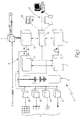
- Figure 1 shows schematically a system for the production and controlled distribution of electric energy in isolated areas, in accordance with the teachings of the present invention;
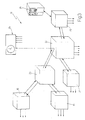
- Figures 2 and 3 show two schematic details of the Figure 1 system.
-
- Number 1 in Figure 1 indicates as a whole a system for the production and controlled distribution of electric energy, and which is especially suitable for use in rural or isolated areas possibly also equipped with discontinuous electric energy sources, such as solar panels, wind generators, small hydraulic turbines, or even an electricity mains unable to ensure continuous electric energy supply.
- In the following description, the electricity mains supplying electric energy discontinuously with a mains frequency f is indicated 2, and the other discontinuous electric energy sources, i.e. alternative electric energy sources such as solar panels, wind generators, small hydraulic turbines, etc., are indicated as a whole by 3.
- With reference to Figure 1, system 1 is interposed between the discontinuous electric energy sources -
i.e. electricity mains 2, if any, and alternative electric energy sources 3 - and one or moreelectric energy users 4. In the example shown, reference is made to threeelectric energy users 4. - System 1 comprises a known rotary
electric generator 5 for producing electric energy with a mains frequency varying according to the rotation speed of the generator; aninternal combustion engine 6 for rotating the shaft ofelectric generator 5 at a speed variable in any manner to produce electric energy; and anenergy switching node 7 to whichelectricity mains 2, if any, and the threeelectric energy users 4 are connected directly. - System 1 also comprises an electric
energy storage battery 8; a two-way electric energy static conversion unit 9 connecting electricenergy storage battery 8 toelectric generator 5 andenergy switching node 7; and one or more one-way electric energystatic conversion units 10 connecting electric energy source/s 3 to electricenergy storage battery 8. - Static conversion unit 9 controls electric energy supply to and from
electric generator 5 andenergy switching node 7; and static conversion unit/s 10 control electric energy supply from electric energy source/s 3 to electricenergy storage battery 8. - System 1 also comprises a
control unit 11 for controlling static conversion unit 9, static conversion unit/s 10,internal combustion engine 6 andenergy switching node 7 according to a predetermined logic and as a function of various detected operating parameters, so as make the best use of available resources and maximize the overall efficiency of system 1. - In the example shown,
electricity mains 2 is a three-phase type with a mains frequency f; the threeelectric energy users 4 draw three-phase electric energy;electric generator 5 is a three-phase asynchronous motor-generator; andinternal combustion engine 6 is a diesel engine.Electric generator 5 may, obviously, also be defined by a known synchronous generator. - Electric
energy storage battery 8 is capable of storing electric energy in another form (e.g. kinetic or chemical energy) and is defined, in the example shown, by a series of known rechargeable lead-acid batteries. - Under the control of
control unit 11,energy switching node 7 controls the electric connections betweenelectricity mains 2 and static conversion unit 9 to allow eachelectric energy user 4 to draw electric energy with mains frequency f, regardless of the presence or not of electric energy inelectricity mains 2. Again under the control ofcontrol unit 11,energy switching node 7 also monitors electric energy supply to eachelectric energy user 4, and, on command, cuts off the electric connection betweenelectric energy user 4 and the currently operating electric energy source, be itelectricity mains 2 or static conversion unit 9. - With reference to Figure 2,
energy switching node 7 comprises, for eachelectric energy user 4, a controlledelectric switch 12 for selectively connectingelectric energy user 4 electrically toelectricity mains 2 and static conversion unit 9; and an electricpower measuring device 13 located in series with controlledelectric switch 12, and which provides for determining, instant by instant, the amount of electric energy drawn per unit of time byelectric energy user 4, and for communicating the findings to controlunit 11. - Preferably, though not necessarily,
energy switching node 7 has known directional safeguards for selectively isolatingelectricity mains 2 from static conversion unit 9 whenelectricity mains 2 is unable to supply electric energy andelectric energy users 4 are supplied with electric energy by static conversion unit 9. - With reference to Figure 1, static conversion unit 9 comprises two known impressed-voltage conversion bridges, a first of which, indicated 15, connects electric
energy storage battery 8 toelectric generator 5 and permits electric energy supply to and fromelectric generator 5, and a second of which, indicated 16, connects electricenergy storage battery 8 toenergy switching node 7 and permits electric energy supply to and fromenergy switching node 7.Conversion bridges control unit 11 and preferably, though not necessarily, operate in PWM (Pulse Width Modulation) mode. - More specifically,
conversion bridge 15 is capable of both converting electric energy with any mains frequency into direct electric energy to permit electric energy supply fromelectric generator 5 to electricenergy storage battery 8, and converting direct electric energy into electric energy with any mains frequency to permit electric energy supply from electricenergy storage battery 8 toelectric generator 5. In the first case,electric generator 5 performs its main function, which is that of producing electric energy for supply to electricenergy storage battery 8; and, in the second case,electric generator 5 is used as a starting motor to startinternal combustion engine 6, which, as is known, has zero starting torque. - Similarly,
conversion bridge 16 is capable of both converting direct electric energy into electric energy with mains frequency f to permit electric energy supply from electricenergy storage battery 8 toenergy switching node 7, and converting the electric energy with mains frequency f fromelectricity mains 2 into direct electric energy to permit electric energy supply fromenergy switching node 7 to electricenergy storage battery 8. - The or each
static conversion unit 10 is defined by a conversion bridge capable of converting the electric energy produced by electric energy source 3 - be it direct or alternating with a fixed or variable frequency - into direct electric energy to permit electric energy supply fromelectric energy source 3 to electricenergy storage battery 8. Obviously, the characteristics of the conversion bridge depend on the type of electric energy produced byelectric energy source 3. - With reference to Figures 1 and 3,
control unit 11 comprises an electroniccentral control unit 18 for real-time controllingconversion bridges central control unit 19 for real-time controlling static conversion unit/s 10; an electroniccentral monitoring unit 20 for monitoring and coordinating the electric energy supplies produced by electroniccentral control units central control unit 21 for controllinginternal combustion engine 6; and a main electroniccentral control unit 22 for overall control of system 1 as a function of signals from a number of sensors (not shown) distributed throughout system 1 and for detecting, for example, the voltages ofelectricity mains 2,energy switching node 7 andelectric energy sources 3, the electric energy to and fromenergy switching node 7 per unit of time, the rotation speed ofinternal combustion engine 6, i.e. ofelectric generator 5, and the amount of electric energy stored in electricenergy storage battery 8. -
Control unit 11 also comprises an electroniccentral control unit 23 for controllingenergy switching node 7 and electric energy supply to users, and which receives the signals from the various electricpower measuring devices 13, meters instant by instant the consumption of eachelectric energy user 4, and disconnects the user fromenergy switching node 7 upon consumption exceeding a predetermined prepaid amount, i.e. when the prepaid consumption credit ofelectric energy user 4 runs out.Electric energy user 4 is obviously disconnected by opening the corresponding controlledelectric switch 12. - To simplify consumption control,
control unit 11 is also provided with one ormore credit terminals 24 located close to system 1 and in the immediate vicinity of electric energy user/s 4 to enable any user connected to system 1 to take out further prepaid consumption credit. In a further embodiment,credit terminal 24 may be defined by a known cellular telephone. -
Credit terminals 24 are obviously connected to electroniccentral control unit 23 to transmit to it in real time the particulars of theelectric energy user 4 taking out further prepaid consumption credit and the amount of credit taken out, and comprise collecting means for receiving and verifying paper money, credit cards and similar. - In the example shown,
control unit 11 also comprises a knownchronological event recorder 25 for sequentially storing, for a given length of time, the signals from the sensors (not shown) and electroniccentral control units -
Control unit 11 also comprises anoperator control panel 26 for directly controlling electroniccentral control unit 22 and, hence, system 1; and aknown communications network 27 by which electroniccentral control unit 22 communicates with an external control station even a considerable distance from the system.Communications network 27 may also be used to connect thecontrol units 11, and so permit parallel operation, of a number of systems similar to system 1. - Electronic
central control unit 22 controls the production and supply of electric energy according to various criteria, including the amount and cost of electric energy available fromelectricity mains 2, the electric energy available from alternativeelectric energy sources 3, electric energy demand byelectric energy users 4, and the cost of producing electric energy by means ofelectric generator 5. - More specifically, electronic
central control unit 22 controlsenergy switching node 7 to appropriately connectelectricity mains 2,electric energy users 4 and conversion unit 9, and also controls start-up and the speed ofinternal combustion engine 6 as a function of electric energy production requirements. - More specifically, electronic
central control unit 22 may control electric energy supply to supplyelectric energy users 4 with electric energy fromelectric generator 5 and/or electricenergy storage battery 8, when no electric energy is available from electricity mains 2 (if present) or alternativeelectric energy sources 3; or may control electric energy supply to supplyelectric energy users 4 with electric energy from one or more alternativeelectric energy sources 3 and possibly also from electricenergy storage battery 8, when no electric energy is available from electricity mains 2 (if present) and operatingelectric generator 5 is uneconomical. - Other operating combinations are obviously possible, depending on the electric energy sources available and the energy demand of
users 4. - It should be pointed out that, when electric
energy storage battery 8 is fully charged, electroniccentral control unit 22 is capable of controlling and balancing electric energy supply to and from electricenergy storage battery 8 to avoid overloading the battery. - When necessary, electronic
central control unit 22 can use the electric energy fromelectricity mains 2 to both supplyelectric energy users 4 and recharge electricenergy storage battery 8. - Operation of system 1 is easily deducible from the above description with no further explanation required.
- It should be pointed out, however, that operation of the assembly defined by
electric generator 5 andinternal combustion engine 6 differs from that of known no-break systems by the speed ofinternal combustion engine 6, i.e. ofelectric generator 5, varying as a function of electric energy demand per unit of time, as opposed to being determined as a function of the frequency of the electric energy supplied, i.e. mains frequency f. - System 1 for the production and controlled distribution of electric energy in isolated areas, as described above, has numerous advantages: first and foremost is undoubtedly the flexibility with which the system caters to the energy requirements of each
electric energy user 4. Using system 1, the consumption of eachelectric energy user 4 can be programmed, in terms of when and how much, according to personal finances. - Other major advantages of system 1 are the high degree of overall efficiency by employing at any time the cheapest source of electric energy, be it
electricity mains 2,electric generator 5, or any of alternativeelectric energy sources 3; and the high degree of flexibility in the operation of the system which enables it to adapt in real time to the electric energy requirements ofelectric energy users 4. - A further advantage of system 1 is the possibility of employing the electric energy from electricity mains 2 (if present), from alternative
electric energy sources 3, fromelectric generator 5 and from electricenergy storage battery 8 jointly to meet any peak demand byelectric energy users 4. - A major advantage of using an asynchronous motor-generator such as
electric generator 5 is that of eliminating the need for a starting motor forinternal combustion engine 6. - Clearly, changes may be made to system 1 for the production and controlled distribution of electric energy in isolated areas, as described and illustrated herein, without, however, departing from the scope of the present invention.
Claims (12)
- A system (1) for the production and controlled distribution of electric energy in isolated areas, comprising a rotary electric generator (5) for producing electric energy, and an internal combustion engine (6) for powering said electric generator (5); said system (1) being characterized by comprising an energy switching node (7) to which at least one electric energy user (4) is connectable electrically; said energy switching node (7) having electric power draw measuring means (12) for determining, instant by instant, the electric power drawn by said electric energy user (4), and electric energy supply cutoff means (13) for cutting off, on command, electric energy supply to said electric energy user (4); said system (1) also comprising electric energy supply control means (23) for controlling electric energy supply to users, and which meter the consumption of said electric energy user (4) instant by instant on the basis of the findings of the electric power draw measuring means (12), and activate the electric energy supply cutoff means (13) to cut off energy supply when the consumption credit of said electric energy user (4) runs out.
- A system as claimed in Claim 1, characterized by comprising at least one credit terminal (24) permitting said at least one electric energy user (4) to purchase further consumption credit; said at least one credit terminal (24) being connected to said electric energy supply control means (23).
- A system as claimed in Claim 1 or 2, characterized in that said electric energy supply cutoff means (13) comprise at least one controlled electric switch (13) upstream from said electric energy user (4).
- A system as claimed in Claim 3, characterized in that said electric power draw measuring means (12) comprise at least one electric power measuring device (12) in series with said controlled electric switch (13).
- A system as claimed in any one of the foregoing Claims, characterized by comprising an electric energy storage battery (8), and a first static electric energy conversion unit (9) connecting the electric energy storage battery (8) to the electric generator (5) and to said energy switching node (7); said first static electric energy conversion unit (9) controlling electric energy supply to and from the electric generator (5) and the energy switching node (7).
- A system as claimed in Claim 5, characterized by comprising at least one discontinuous electric energy source (2, 3), and at least one second static electric energy conversion unit (10) connecting said discontinuous electric energy source (3) to said electric energy storage battery (8); said second static electric energy conversion unit (10) controlling electric energy supply from the discontinuous electric energy source (2, 3) to the electric energy storage battery (8).
- A system as claimed in Claim 6, characterized by comprising a control unit (11) for controlling, according to a predetermined logic, said first static electric energy conversion unit (9), said second static electric energy conversion unit (10), the internal combustion engine (6) and the energy switching node (7) as a function of various detected operating parameters, so as to make the best use of the various resources available and maximize overall efficiency of the system (1).
- A system as claimed in Claim 7, characterized in that said first static electric energy conversion unit (9) is two-way and comprises two conversion bridges (15, 16), a first of which connects the electric energy storage battery (8) to the electric generator (5) and permits electric energy supply to and from the electric generator (5), and a second of which connects the electric energy storage battery (8) to the energy switching node (7) and permits electric energy supply to and from the energy switching node (7).
- A system as claimed in Claim 8, characterized in that said second static electric energy conversion unit (10) is one-way and defined by a conversion bridge for converting the electric energy produced by the discontinuous electric energy source (2, 3) into electric energy suitable for the electric energy storage battery (8), so as to permit electric energy supply from said discontinuous electric energy source (2, 3) to said electric energy storage battery (8).
- A system as claimed in any one of Claims 5 to 9, characterized in that said at least one discontinuous electric energy source (2, 3) comprises an electricity mains (2) supplying electric energy discontinuously at a constant mains frequency (f); said electricity mains (2) being connected directly to said energy switching node (7).
- A system as claimed in any one of the foregoing Claims, characterized in that said electric generator (5) is an asynchronous motor-generator.
- A system as claimed in any one of Claims 6 to 11, characterized in that said control unit (11) comprises a communications network (27) by which a main electronic central control unit (22) communicates with an external control station.
Applications Claiming Priority (3)
| Application Number | Priority Date | Filing Date | Title |
|---|---|---|---|
| ITBO000152 | 2000-03-21 | ||
| IT2000BO000152A IT1321155B1 (en) | 2000-03-21 | 2000-03-21 | PLANT FOR THE PRODUCTION AND CONTROLLED DISTRIBUTION OF ELECTRICITY IN ISOLATED AREAS. |
| ITBO200152 | 2000-03-21 |
Publications (4)
| Publication Number | Publication Date |
|---|---|
| EP1137148A2 true EP1137148A2 (en) | 2001-09-26 |
| EP1137148A8 EP1137148A8 (en) | 2002-02-27 |
| EP1137148A3 EP1137148A3 (en) | 2002-05-29 |
| EP1137148B1 EP1137148B1 (en) | 2013-03-06 |
Family
ID=11438342
Family Applications (1)
| Application Number | Title | Priority Date | Filing Date |
|---|---|---|---|
| EP01106963A Expired - Lifetime EP1137148B1 (en) | 2000-03-21 | 2001-03-20 | System for the production and controlled distribution of electric energy in isolated areas |
Country Status (3)
| Country | Link |
|---|---|
| EP (1) | EP1137148B1 (en) |
| BR (1) | BR0101247A (en) |
| IT (1) | IT1321155B1 (en) |
Cited By (2)
| Publication number | Priority date | Publication date | Assignee | Title |
|---|---|---|---|---|
| CN100362739C (en) * | 2005-09-30 | 2008-01-16 | 武汉大学 | Method and device for generating arbitrary mechanical characteristics of electric motor based on PWM technology |
| WO2012165986A3 (en) * | 2011-06-03 | 2013-01-24 | Pulsar Da Energia - Energias Globais, Lda. | "energy management equipment" |
Families Citing this family (1)
| Publication number | Priority date | Publication date | Assignee | Title |
|---|---|---|---|---|
| WO2012174145A2 (en) | 2011-06-13 | 2012-12-20 | Demand Energy Networks, Inc. | Energy systems and energy supply methods |
Citations (2)
| Publication number | Priority date | Publication date | Assignee | Title |
|---|---|---|---|---|
| DE4232516A1 (en) | 1992-09-22 | 1993-03-04 | Hans Peter Beck | AUTONOMOUS MODULAR ENERGY SUPPLY SYSTEM FOR ISLAND NETWORKS |
| FR2753016A1 (en) | 1996-08-29 | 1998-03-06 | Schneider Electric Sa | Prepaid electricity supplies for low-income consumers |
Family Cites Families (4)
| Publication number | Priority date | Publication date | Assignee | Title |
|---|---|---|---|---|
| DE3115795A1 (en) * | 1981-04-18 | 1982-11-04 | Licentia Patent-Verwaltungs-Gmbh, 6000 Frankfurt | Device for a protected continuous DC or AC supply of loads |
| WO1995020836A1 (en) * | 1994-01-26 | 1995-08-03 | Onan Corporation | Generator power system and method |
| US5572438A (en) * | 1995-01-05 | 1996-11-05 | Teco Energy Management Services | Engery management and building automation system |
| DE20002237U1 (en) * | 1999-09-30 | 2000-07-13 | Sma Regelsysteme Gmbh | Modular battery converter for power supply in stand-alone grids |
-
2000
- 2000-03-21 IT IT2000BO000152A patent/IT1321155B1/en active
-
2001
- 2001-03-20 BR BR0101247-9A patent/BR0101247A/en not_active Application Discontinuation
- 2001-03-20 EP EP01106963A patent/EP1137148B1/en not_active Expired - Lifetime
Patent Citations (2)
| Publication number | Priority date | Publication date | Assignee | Title |
|---|---|---|---|---|
| DE4232516A1 (en) | 1992-09-22 | 1993-03-04 | Hans Peter Beck | AUTONOMOUS MODULAR ENERGY SUPPLY SYSTEM FOR ISLAND NETWORKS |
| FR2753016A1 (en) | 1996-08-29 | 1998-03-06 | Schneider Electric Sa | Prepaid electricity supplies for low-income consumers |
Cited By (2)
| Publication number | Priority date | Publication date | Assignee | Title |
|---|---|---|---|---|
| CN100362739C (en) * | 2005-09-30 | 2008-01-16 | 武汉大学 | Method and device for generating arbitrary mechanical characteristics of electric motor based on PWM technology |
| WO2012165986A3 (en) * | 2011-06-03 | 2013-01-24 | Pulsar Da Energia - Energias Globais, Lda. | "energy management equipment" |
Also Published As
| Publication number | Publication date |
|---|---|
| IT1321155B1 (en) | 2003-12-30 |
| EP1137148B1 (en) | 2013-03-06 |
| BR0101247A (en) | 2001-11-06 |
| EP1137148A8 (en) | 2002-02-27 |
| EP1137148A3 (en) | 2002-05-29 |
| ITBO20000152A1 (en) | 2001-09-21 |
Similar Documents
| Publication | Publication Date | Title |
|---|---|---|
| US10596919B2 (en) | Fuel cell system with grid independent operation and DC microgrid capability | |
| EP3472920B1 (en) | Power supply system | |
| US8508058B2 (en) | Energy systems, energy devices, energy utilization methods, and energy transfer methods | |
| KR100993224B1 (en) | Charging equipment of hybrid generating system | |
| EP2439099A2 (en) | Vehicle charging system with charging efficiency control and providing adaptive charging service | |
| US20040155527A1 (en) | Distributed power generation, conversion, and storage system | |
| CN113078733B (en) | An aircraft statically variable power supply with integrated energy management | |
| CN212195155U (en) | Light storage type charging station | |
| US20060022524A1 (en) | Distributed power generation, conversion, and storage system | |
| EP1137148A2 (en) | System for the production and controlled distribution of electric energy in isolated areas | |
| US20030102752A1 (en) | Self-sufficient electric power system for a building | |
| CN219893200U (en) | Combined new energy emergency power supply | |
| US20240195330A1 (en) | A cycle power generation device | |
| CN110212634A (en) | A kind of natural energy conversion, storage and power supply system | |
| CN1098479A (en) | A kind of digital-controlled wind power oil pumping unit | |
| US20230211688A1 (en) | Charging pole | |
| CN111355264A (en) | New energy control system | |
| KR20180099980A (en) | Vehicle generation system using solar panel installable to vehicle | |
| CN119154346A (en) | Energy allocation system based on vehicle-mounted battery | |
| CN2171701Y (en) | Numerical control wind-power beam-pumping unit | |
| EP4348803A1 (en) | A portable power unit | |
| RU105689U1 (en) | WIND AND PNEUMOGENERATOR INSTALLATION FOR CONTINUOUS POWER SUPPLY OF THE AUTONOMOUS CONSUMER | |
| KR20170062284A (en) | Power management apparatus for renewable energy | |
| Müller | Sustainable operation experience in PV-Hybrid systems—Some success factors and data analysis | |
| KR20230056290A (en) | Trailer type hybrid power generation system |
Legal Events
| Date | Code | Title | Description |
|---|---|---|---|
| PUAI | Public reference made under article 153(3) epc to a published international application that has entered the european phase |
Free format text: ORIGINAL CODE: 0009012 |
|
| AK | Designated contracting states |
Kind code of ref document: A2 Designated state(s): AT BE CH CY DE DK ES FI FR GB GR IE IT LI LU MC NL PT SE TR |
|
| AX | Request for extension of the european patent |
Free format text: AL;LT;LV;MK;RO;SI |
|
| RIN1 | Information on inventor provided before grant (corrected) |
Inventor name: ZANARINI, SERGIO |
|
| PUAL | Search report despatched |
Free format text: ORIGINAL CODE: 0009013 |
|
| AX | Request for extension of the european patent |
Free format text: AL;LT;LV;MK;RO;SI |
|
| RIC1 | Information provided on ipc code assigned before grant |
Free format text: 7H 02J 3/14 A, 7G 07F 15/00 B, 7H 02J 9/08 B |
|
| 17P | Request for examination filed |
Effective date: 20021126 |
|
| AKX | Designation fees paid |
Designated state(s): DE TR |
|
| 17Q | First examination report despatched |
Effective date: 20040519 |
|
| RAP1 | Party data changed (applicant data changed or rights of an application transferred) |
Owner name: ZANARINI, SERGIO Owner name: BUSI IMPIANTI S.P.A. |
|
| RAP1 | Party data changed (applicant data changed or rights of an application transferred) |
Owner name: ZANARINI, SERGIO Owner name: ENERGIFERA S.R.L. |
|
| GRAP | Despatch of communication of intention to grant a patent |
Free format text: ORIGINAL CODE: EPIDOSNIGR1 |
|
| GRAS | Grant fee paid |
Free format text: ORIGINAL CODE: EPIDOSNIGR3 |
|
| GRAA | (expected) grant |
Free format text: ORIGINAL CODE: 0009210 |
|
| AK | Designated contracting states |
Kind code of ref document: B1 Designated state(s): DE TR |
|
| REG | Reference to a national code |
Ref country code: DE Ref legal event code: R096 Ref document number: 60147720 Country of ref document: DE Effective date: 20130502 |
|
| PLBE | No opposition filed within time limit |
Free format text: ORIGINAL CODE: 0009261 |
|
| STAA | Information on the status of an ep patent application or granted ep patent |
Free format text: STATUS: NO OPPOSITION FILED WITHIN TIME LIMIT |
|
| 26N | No opposition filed |
Effective date: 20131209 |
|
| REG | Reference to a national code |
Ref country code: DE Ref legal event code: R097 Ref document number: 60147720 Country of ref document: DE Effective date: 20131209 |
|
| PGFP | Annual fee paid to national office [announced via postgrant information from national office to epo] |
Ref country code: DE Payment date: 20150317 Year of fee payment: 15 |
|
| PGFP | Annual fee paid to national office [announced via postgrant information from national office to epo] |
Ref country code: TR Payment date: 20150313 Year of fee payment: 15 |
|
| REG | Reference to a national code |
Ref country code: DE Ref legal event code: R119 Ref document number: 60147720 Country of ref document: DE |
|
| PG25 | Lapsed in a contracting state [announced via postgrant information from national office to epo] |
Ref country code: DE Free format text: LAPSE BECAUSE OF NON-PAYMENT OF DUE FEES Effective date: 20161001 |
|
| PG25 | Lapsed in a contracting state [announced via postgrant information from national office to epo] |
Ref country code: TR Free format text: LAPSE BECAUSE OF NON-PAYMENT OF DUE FEES Effective date: 20160320 |