EP1136912A2 - Probalistic diagnosis, in particular for embedded and remote applications - Google Patents
Probalistic diagnosis, in particular for embedded and remote applications Download PDFInfo
- Publication number
- EP1136912A2 EP1136912A2 EP01101044A EP01101044A EP1136912A2 EP 1136912 A2 EP1136912 A2 EP 1136912A2 EP 01101044 A EP01101044 A EP 01101044A EP 01101044 A EP01101044 A EP 01101044A EP 1136912 A2 EP1136912 A2 EP 1136912A2
- Authority
- EP
- European Patent Office
- Prior art keywords
- components
- particular set
- tests
- bad
- computing
- Prior art date
- Legal status (The legal status is an assumption and is not a legal conclusion. Google has not performed a legal analysis and makes no representation as to the accuracy of the status listed.)
- Granted
Links
Images



Classifications
-
- G—PHYSICS
- G06—COMPUTING OR CALCULATING; COUNTING
- G06F—ELECTRIC DIGITAL DATA PROCESSING
- G06F11/00—Error detection; Error correction; Monitoring
- G06F11/22—Detection or location of defective computer hardware by testing during standby operation or during idle time, e.g. start-up testing
- G06F11/2257—Detection or location of defective computer hardware by testing during standby operation or during idle time, e.g. start-up testing using expert systems
-
- G—PHYSICS
- G01—MEASURING; TESTING
- G01R—MEASURING ELECTRIC VARIABLES; MEASURING MAGNETIC VARIABLES
- G01R31/00—Arrangements for testing electric properties; Arrangements for locating electric faults; Arrangements for electrical testing characterised by what is being tested not provided for elsewhere
- G01R31/28—Testing of electronic circuits, e.g. by signal tracer
- G01R31/317—Testing of digital circuits
- G01R31/3181—Functional testing
Definitions
- the present invention relates to monitoring, detecting, and isolating failures in a system, and in particular to tools applied for analyzing the system.
- To diagnose means to determine why a malfunctioning device is behaving incorrectly. More formally, to diagnose is to select a subset of a predetermined set of causes responsible for the incorrect behavior. A diagnosis must both explain the incorrect behavior and optimize some objective function, such as probability of correctness or cost of incorrect diagnosis. The need to diagnose is a common reason to measure or to test.
- Prior diagnostic systems for determining likely failed components in a system under test include model-based diagnostic systems.
- a model-based diagnostic system may be defined as a diagnostic system that renders conclusions about the state of the SUT using actual SUT responses from applied tests and an appropriate model of correct or incorrect SUT behavior as inputs to the diagnostic system.
- Such a diagnostic system is usually based upon computer-generated models of the SUT and its components and the diagnostic process.
- Model-based diagnostic systems are known e.g. from W. Hamscher, L. Console, J. de Kleer, in 'Readings in system model-based diagnosis', Morgan Kauffman, 1992.
- a test-based system model is used by the Hewlett-Packard HP Fault Detective (HPFD) and described in HP Fault Detective User's Guide, Hewlett-Packard Co., 1996.
- US-A-5,922,079 (Booth et al.) discloses an automated analysis and troubleshooting system that identifies potential problems with the test suite (ability of the model to detect and discriminate among potential faults), and also identifies probable modeling errors based on incorrect diagnoses.
- EP-A-887733 discloses a model-based diagnostic system that provides automated tools that enable a selection of one or more next tests to apply to a device under test from among the tests not yet applied based upon a manageable model of the device under test.
- a diagnostic engine combines the system-model-based and probabilistic approaches to diagnostics. It takes the results of a suite of tests and computes - based on the system model of the SUT - the most likely to be failed components.
- the diagnostic engine can be used with applications where a failing device is to be debugged using a pre-determined set of test and measurement equipment to perform tests from a pre-designed set of tests. Using test results received from actual tests executed on the SUT and the system model determined for the SUT, the diagnostic engine computes a list of fault candidates for the components of the SUT. Starting, e.g., from a priori failure probabilities of the components, these probabilities may then be weighted with the model information accordingly if a test passes or fails. At least one test has to fail, otherwise the SUT is assumed to be good.
- An embedded processor is a microprocessor or other digital computing circuit which is severely limited in computing power and/or memory size because it is embedded (i.e., built in to) another product.
- Examples of products typically containing embedded processors include automobiles, trucks, major home appliances, and server class computers (which often contain an embedded maintenance processor in addition to the Central Processing Unit(s).
- Embedded processors typically have available several orders of magnitude less memory and an order of magnitude or two less computing power than a desktop personal computer. For example, a megabyte of memory would be a large amount for a home appliance. It is desirable to enable such an embedded processor in such a product to diagnose failures of the product.
- a diagnosis engine providing such a capability shall be called an embedded diagnosis engine.
- Monte Carlo simulation Another method for solving the problem is Monte Carlo simulation.
- the Monte Carlo simulation method can be made arbitrarily accurate (by increasing the number of simulations), the simulation results must be stored in a database that the diagnosis engine later reads. It has been shown that, even when stored in a space-efficient binary format, this database requires 2-6 megabytes for typical applications. This is too much for embedded application and would be a burden on distributed application where the database might have to be uploaded on a computer network for each diagnosis.
- a Bayesian network is a directed acyclic graph. Each node in the graph represents a random variable. An edge in the graph represents a probabilistic dependence between two random variables.
- a source (a node with no in-edges) is independent of all the other random variables and is tagged with its a priori probability.
- a non-source node is tagged with tables that give probabilities for the value of the node's random variable conditioned on all of the random variables upon which it is dependent.
- Bayesian networks of most use in diagnosis is called belief revision.
- a belief revision algorithm computes the most likely probabilities for all the unobserved random variables given the observed ones.
- Belief revision is NP-hard (cf. M. R. Garey and D. S. Johnson: “Computers and Intractability: A guide to the theory of NP-completeness", W. H. Freeman and Co., 1979), and so all known algorithms have a worst-case computation time exponential in the number of random variables in the graph.
- Bayesian networks used for diagnosis are constructed with random variables and their dependencies representing arbitrary cause-and-effect relationships among observables such as test results, unobservable state of the device under diagnosis and its components, and failure hypotheses.
- the graph can grow very large and have arbitrary topology.
- an experimental Bayesian network used by Hewlett-Packard for printer diagnosis has over 2,000 nodes. The complexity of such networks creates two difficulties:
- the present invention provides a diagnosis engine: a tool that provides automatic assistance e.g. to a technician at each stage of a debugging process by identifying components which are most likely to have failed.
- the major advantage of the invention over other diagnosis engines is that it can be provided with a small memory footprint: both code and runtime memory requirements are small, growing only linearly with the model size.
- the invention is preferably written entirely in Java (cf. e.g. James Gosling, Bill Joy, and Guy Steel: The Java Language Specification, Addison Wesley, 1996) and preferably uses only a few classes from the Java standard language library packages. These features make the invention in particular well suited to embedded and distributed applications.
- a test is a procedure performed on a device.
- a test has a finite number of possible outcomes. Many tests have two outcomes: pass and fail.
- a test for repairing a computer may involve checking to see if a power supply voltage is between 4.9 and 5.1 volts. If it is, the test passes. If it isn't, the test fails. Tests may have additional outcomes, called failure modes. For example, a test may involve trying to start an automobile. If it starts, the test passes. Failure modes might include:
- the set of all tests available for debugging a particular device is called that device's test suite. Many applications fit these definitions of debugging and of tests. Examples are:
- the invention allows handling multiple component failures. No distinction is made between single and multiple faults.
- the invention combines the model-based (cf. W. Hamscher, L. Console, and J. de Kleer: Readings in model-based diagnosis, Morgan Kauffman, 1992) and probabilistic approaches to diagnostics.
- the invention uses the same test-based model as by the aforementioned HP Fault Detective or in US-A-5,808,919 (Preist et al.).
- This model describes probabilistic relationships between tests and the components that they test in a manner intended to be accessible to engineers who write tests.
- This model can be preferably:
- Models can be created e.g.:
- the model together with the rules of mathematical logic, enables to compute the probability that a test will fail if a particular component is known to be bad. More details about these models and the model-building process are disclosed in the co-pending US patent application (Applicant's internal reference number: US 20-99-0042) by the same applicant and in US-A-5,922,079 (Booth et al.). The teaching of the former document with respect to the description of the model and the model-building process are incorporated herein by reference.
- the invention allows computing the probability of a test's failure when given any pattern of components known to be good or bad.
- the logic formula known as Bayes' Theorem allows running this computation in reverse: given a particular test result, the invention can calculate the probability of occurrence of some particular pattern of component faults and non-faults. The invention, then, enumerates all the possible patterns of component faults/non-faults, evaluating the probability of each pattern given the test result. The pattern with highest probability is selected as the diagnosis.
- the algorithm iterates over combinations of failed components and computes the conditional likelihood of each combination given passed and failed tests.
- this method can require enormous amounts of computation as it explores all combinations of shared function outcomes for all combinations of faults.
- Any model as used by the invention can be represented by a Bayesian network.
- the resulting graph is tripartite, consisting solely of sources, sinks, and one level of internal nodes (as shown later). There is one source for each component. There is one sink for each test. Each shared function is represented by one internal node.
- the so-called "Noisy-or” (defined and described in detail in chapter 3 of Finn V. Jensen: “Bayesian Networks", Springer Verlag, 1997) construction must be used.
- the form of test coverage information is such that the memory-saving technique of divorcing (again, see Chapter 3 of Jensen) cannot be used.
- This means that the Bayesian network will require an amount of memory exponential in the number of components covered by any test. Even small models exhaust the memory of desktop PC workstations. Clearly this approach is not well suited to embedded or distributed application.
- the class of models as applied by the invention can be viewed as a subclass of the Bayesian networks.
- the invention diagnosis algorithm can be considered an efficient algorithm for belief revision over this subclass.
- the high accuracy rate of successful diagnosis with the invention suggests that this subclass is sufficiently powerful to represent practical diagnosis problems.
- the relatively structured nature of a model in accordance with the present invention may be an advantage when building and supporting a model when compared with free-form construction of a Bayesian network.
- the invention computes the component failure likelihoods exactly. Heuristic methods and Monte Carlo simulation compute approximate likelihoods.
- the runtime performance of the invention is good in practice. It runs about as fast as the aforementioned HP Fault Detective on the same diagnosis problems.
- Assumption 1 is used to compute the probability of any particular set of components being bad and all others being good.
- Assumption 2 is used to compute the probability of any particular set of shared functions being failed and another particular set of shared functions being passed given that a particular set of components are bad.
- Assumption 3 is used to compute the probability of any particular set of tests being failed and another particular set of shared functions being passed given that a particular set of components are bad (and the rest are good) and a particular set of shared functions are failed (and the rest are passed).
- the invention provides:
- the invention thus allows construction of a diagnosis engine which will require an amount of memory less than the amount of memory required to store the model and the amount of memory required to store the output multiplied by a small factor which is a constant independent of the model and output sizes. This makes such a diagnosis engine well suited to use as an embedded diagnosis engine.
- Table 1 shows the notation for items from the coverage-based model, such as components, tests, and shared functions and gives formal definitions for coverage and shared function variability.
- the components ⁇ are random variables that can have the states ⁇ good, bad ⁇ .
- the prior probabilities P (c bad) for c ⁇ ⁇ are given in the model.
- Component failures are assumed to be independent as defined in Equation (0.1).
- Shared functions are used to express probabilistic dependencies between tests. Shared functions may be thought of as expressing the fact that some functionality is checked by different tests in exactly the same way.
- the shared functions ⁇ are random variables with the states ⁇ pass, fail ⁇ .
- a shared function s is dependent on the states of the components ⁇ as shown in Equation (0.2), where the shared function coverages sfcov(s, c) is given in the model.
- the shared functions are conditionally independent of one another as given in Equation (1).
- a shared function fails if it has coverage on a bad spot in any component on which the shared function has coverage.
- the probability of a shared function s failing dependent on the states of all components is defined by Equations (2) and (3).
- Equation (3) means that the computation can be performed while iterating through a sparse representation of sfcov.
- Each shared function s has a variability, sfvar(s) between 0 and 1.
- variability of a shared function says how correlated are the failures of the tests that use the shared function when the shared function is failed.
- a variability of 0 means that all tests that use the shared function will fail if the shared function fails.
- a variability of 1 means that tests that use the shared function may fail independently of each other if the shared function fails. In this case, the shared function is being used as a modeling convenience.
- the notion of shared function variability will be formalized below.
- the tests ⁇ are random variables with the states ⁇ pass, fail ⁇ . Generally, only some of the tests are performed. Let ⁇ be the passed tests. Let ⁇ be the failed tests. A test is dependent on both components and shared functions. The coverages P are defined by Equation (3.1) and given in the model. The shared functions used by a test sfused(t) ⁇ ⁇ is also given in the model. Tests are conditionally independent of one another given the states of all components and shared functions as shown in Equation (4).
- Equation 6 means that the computation can be performed by iterating through a sparse representation of cov.
- Equation (6.1) The conditional probability of test success is then given in Equation (7) and the conditional probability of test failure is its complement as shown by Equation (8).
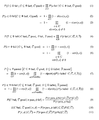
- Equation (17) If there are shared functions, then use the law of total probability of Equation (17), where the first factor in the summand is in turn a product of factors computed according to Equations (7) and (8) as given in Equation (18).
- conditional probabilities of the shared function states are computed exactly like the test result probabilities of Equation (11) as given in Equations (19)-(21).
- Diagnosis could be performed by straightforward evaluation of Equations (10) through (17) for each possible state of the components and shared functions. However, that approach would take O (2
- Equation 17 may be summed over the much smaller power set of Equation (21.1), where ⁇ and is the active shared function set as defined in Equation (22), which uses the provisional active shared function set, which is defined as in Equation (22.1).
- Equation (22.2) is invariant for the pair, and the sum of Equation (22.3) yields the probability of the other components of the state. So summing the pairs causes s to drop out of for the purposes of Equation (17).
- Equation (20) As for the restriction of ⁇ and, consider Equation (20). If a shared function s ⁇ ⁇ has no coverage on any presumed faulty component c ⁇ C, then sfcov(s, c) is uniformly zero, implying that the innermost product in Equation (20) is 1 for that s. This forces a factor of zero in the outermost product, making Equation (22.4). That result backs through Equation (19) into Equation (17), making the whole term zero. Thus, no state term need be evaluated which posits failure for such a shared function. And again, if a state posits that the shared function succeed, it will simply cause a "1" to be factored into the product of Equation (21). So there is no reason to include that shared function in the state over which Equation (17) is summed.
- the provisional active shared function set can be quickly computed once at the beginning of the diagnosis, since it depends only on the tests which have been conducted. If the conducted tests are few relative to the available tests, this can effect a considerable reduction in the number of shared functions under consideration.
- Table 2 Some examples with the number of active shared functions for different models are shown in Table 2. The first four columns of the table give the name of the model, and the number of components, tests, and shared functions in the model. Column 5 shows the maximum number of active shared functions for which the state has been observed to be expanded. That many active shared functions are not always encountered. Column 7 gives the average size of the power set over which Equation 17 is expanded, which is the average of 2 #active SFs .
- the first product of Equation (18) can be zero if a passed test with 100% coverage clears an assumed bad component. It is actually bad form for a model to claim 100% coverage, so it may not be worthwhile to check for this. A more interesting case is that a term of the second product is zero. This means that no assumed-bad component could have caused one of the failed tests to fail. It is worth checking for this condition to avoid needless processing.
- Equation (17) its first factor expands according to Equation (18), of which the first product is computed according to Equation (7).
- a diagnosis engine constructed according to the present invention will require an amount of memory less than the amount of memory required to store the model and the amount of memory required to store the output multiplied by a small factor which is a constant independent of the model and output sizes. This makes such a diagnosis engine well suited to use as an embedded diagnosis engine.
- Equation 10 contains values that must be computed from Equation 17 (which in turn uses Equation 18, which in turn uses Equations 19, 20, and 21) and the independence equation (0.1).
- Equation 17 which contains values that must be computed from Equation 17 (which in turn uses Equation 18, which in turn uses Equations 19, 20, and 21) and the independence equation (0.1).
- Equation 17 which contains values that must be computed from Equation 17 (which in turn uses Equation 18, which in turn uses Equations 19, 20, and 21) and the independence equation (0.1).
- the content of those equations can be expressed also by other equations without departing from the scope of the present invention.
- the invention allows that little memory is needed to compute the diagnosis in addition to that needed to store the model and the output. For better illustration, it shall be identified what additional memory is needed to compute the diagnosis. The effect of low memory consumption comes from the features that use that additional memory.
- the Active Shared Functions (Equation 22) can be applied. This, however, increases the amount of memory needed in order to compute and store the Active Shared Functions. There are two objects that must be stored in memory: the Provisional Active Shared Functions and the Active Shared Functions.
- the Provisional Active Shared Functions are normally computed once, typically before the computation is started.
- the Provisional Active Shared Functions are a subset of the Shared Functions.
- One way to store the Provisional Active Shared Functions is as an array of integers, where each integer in the array gives the index of a Shared Function that is a Provisional Active Shared Function. So, the Provisional Active Shared Functions can be stored in p integer sized memory locations, where p is the number of Provisional Active Shared Functions, which is less than the number of Shared Functions.
- the Active Shared Functions change during the course of the diagnosis computation. However, there is only one set of Active Shared Functions at any one time.
- the Active Shared Functions are a subset of the Provisional Active Shared Functions. So, the Active Shared Functions can be stored in no more integer memory locations than the number of Shared Functions.
- the invention thus minimizes the amount of storage required because it does a depth-first search.
- the invention can apply a breadth-first search (corresponding an application of shared functions) in that it "looks at the tree” and finds that "most of the boughs are dead and barren of leaves and fruit", so it doesn't bother traversing them. And once it is up in the tree, it keeps avoiding dead branches, and ignoring grafted-on branches from orange trees.
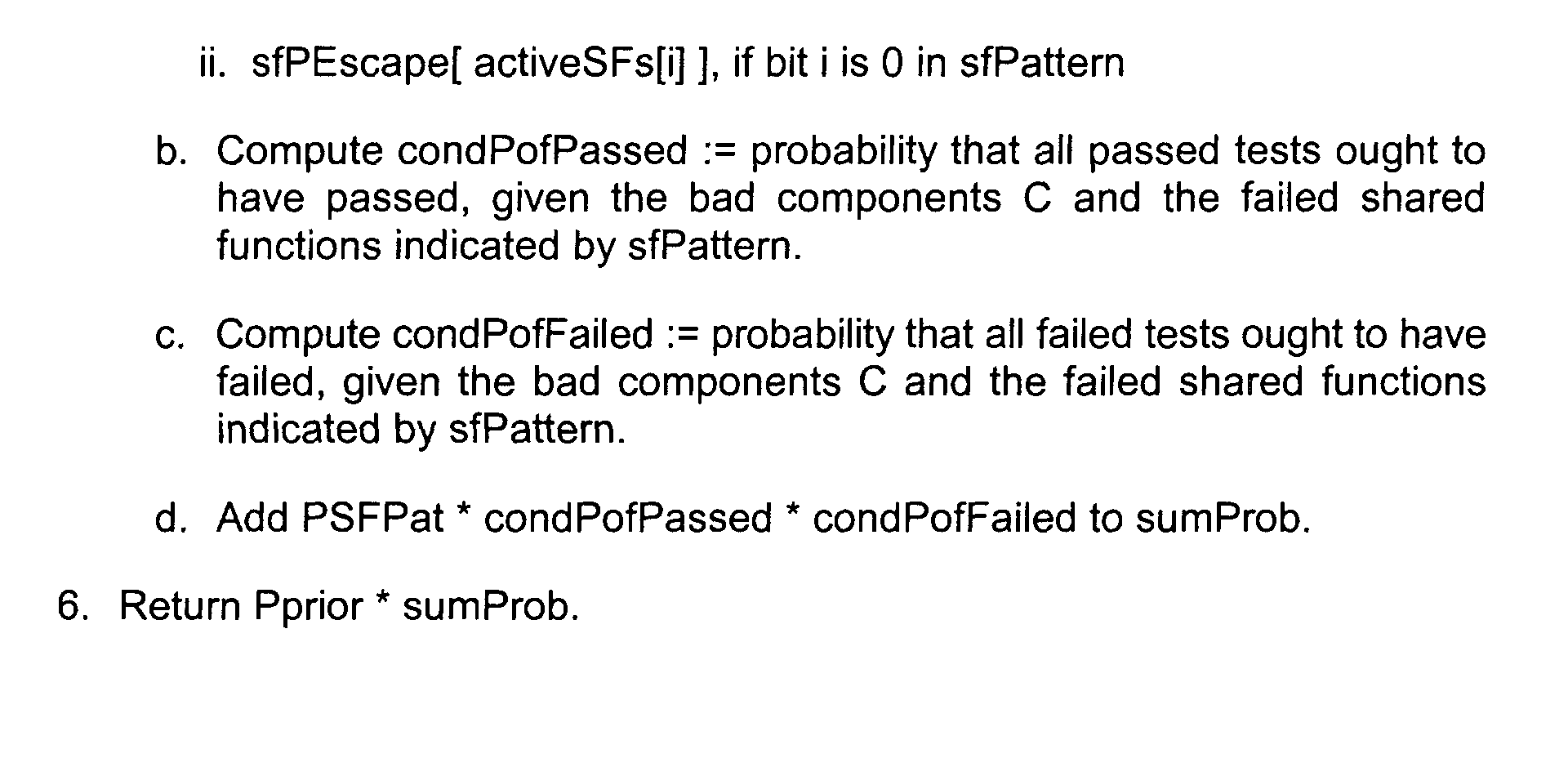
- the three procedures in the attachments outline in words examples of computer code that could be used to implement the present invention.
- the first Procedure Diagnose of Attachment (a) gives the method for computing the likelihood of component failures using the speed improvements described in a) and b) of the section 'Improving Computation Time'.
- Procedure evalDiagnosis of Attachment (b) and Procedure findSfPEsc of Attachment (c) are used by the Procedure Diagnose.
Landscapes
- Engineering & Computer Science (AREA)
- General Engineering & Computer Science (AREA)
- Physics & Mathematics (AREA)
- General Physics & Mathematics (AREA)
- Theoretical Computer Science (AREA)
- Computer Hardware Design (AREA)
- Quality & Reliability (AREA)
- Test And Diagnosis Of Digital Computers (AREA)
- Debugging And Monitoring (AREA)
- Complex Calculations (AREA)
- Testing Of Engines (AREA)
Abstract
Description
- all of the conditional probabilities for non-source nodes must be obtained or estimated, and
- local changes to topology or conditional probabilities may have difficult-to-understand global effects on diagnostic accuracy.
- the lights go dim when the key is turned, and there is no noise from under the hood,
- the lights stay bright when the key is turned, and there is the noise of a single click,
- the lights stay bright when the key is turned, there is a click, and the starter motor turns, but the engine doesn't turn over, and so forth.
- computer and electronics service and manufacturing rework,
- servicing products such as automobiles and home appliances, and
- telephone support fits the model, if we broaden the idea of "test" to include obtaining answers to verbal questions.
- a set of tests on a physical object (e.g.,
Test 1 = pass,Test 2 = fail,Test 3 = pass, etc.) where at least one test has failed, and - a model giving the coverage of the tests on the components (e.g., field replaceable units) of the object and information describing probabilistic dependencies between tests,
- a list of one or more components, and
- the likelihood or probability that those components are the bad components. (Likelihood is un-normalized probability. That is, probabilities must sum to one but likelihoods need not.)
- a two-level part-whole hierarchy: names of components (field-replaceable units) and of their sub-components,
- estimates of a priori failure probabilities of the components,
- the names of the tests in the test suite,
- an estimate of the coverage that each test has on each component, i.e., the proportion of the functionality of the component that is exercised by the test, or more formally, the conditional probability that the test will fail given that the component is bad,
- shared coverages of tests, which are a way of modeling tests that are dependent because they test the functionality of some components in exactly the same way (for example, two tests that access a certain component through a common cable have shared coverage on the cable), and
- a way of specifying failure modes for tests in addition to pass and fail. Failure modes have a name, and two lists of components or sub-components. The first list, called the acquit list, names the components or sub-components that must have some operable functionality in order for the failure mode to occur. The second list, called the indict list, names the components or sub-components that may be bad if the failure mode occurs. Each entry in the acquit and indict lists also contains an estimate of the amount of functionality of the component that the failure mode exercises.
- Using a model-building graphical user interface (GUI) that comes e.g. with the aforementioned HP Fault Detective. The HP Fault Detective model is read by a program that translates it into a simpler form used internally by the invention, which can be saved as an ASCII file. The invention can load such a file from a file system, from a URL, or from local memory.
- By writing ASCII test Fault Detective Model (.fdm) files, or
- Through a model creation application programming interface (API) in Java.
- the computation is exact (to within small floating point computation error); and
- the amount of memory required to perform the computation is preferably only a constant amount larger than the memory required to store the inputs and the outputs. ("A constant amount larger" shall mean an increased amount that is the same independent of the model size and N.)
- in human-readable form, or
- as computer data available for further automatic processing.
- reducing the number of candidate diagnoses, i.e., of component states (C,
C ) for which posteriori likelihood Equation (10) is computed, and - reducing the time required to evaluate Equation (17) by eliminating states of the shared function power set which do not affect the sum.


- a floating point register or memory location to accumulate the sum in Equation 17,
- a floating point register or memory location to accumulate the products in
Equation 18, - two floating point registers or memory locations to accumulate the products
in
Equation 20, - one floating point register of memory location to accumulate the products in
Equation 21.



Claims (14)
- A diagnosis engine for diagnosing a device with a plurality of components, wherein:the diagnosis engine receiving:states of the components are assumed to be probabilistically independent, for computing the probability of any particular set of components being bad and all others being good,states of shared functions, applicable for testing the functionality of some components in the same way, are assumed to be probabilistically independent given component states, for computing the probability of any particular set of shared functions being failed and another particular set of shared functions being passed given that a particular set of components are bad, andstates of tests applicable on the device are assumed to be probabilistically independent given component and shared function states, for computing the probability of any particular set of tests being failed and another particular set of shared functions being passed given that a particular set of components are bad, and the rest are good, and a particular set of shared functions are failed, and the rest are passed;the diagnosis engine comprising:test results of a set of tests on the device where at least one test has failed, anda model giving the coverage of the tests on the components of the device and information describing probabilistic dependencies between the tests; andmeans for setting or specifying a number N of components which may be simultaneously bad, andcomputing means for computing the likelihood that each of subsets of the components with size less than or equal to N are the bad components, whereby the computation is substantially exact within floating point computation errors.
- A diagnosis engine for diagnosing a device with a plurality of components, wherein:the diagnosis engine comprising:states of the components are assumed to be probabilistically independent, for computing the probability of any particular set of components being bad and all others being good,states of shared functions, applicable for testing the functionality of some components in the same way, are assumed to be probabilistically independent given component states, for computing the probability of any particular set of shared functions being failed and another particular set of shared functions being passed given that a particular set of components are bad, andstates of tests applicable on the device are assumed to be probabilistically independent given component and shared function states, for computing the probability of any particular set of tests being failed and another particular set of shared functions being passed given that a particular set of components are bad, and the rest are good, and a particular set of shared functions are failed, and the rest are passed;means for specifying the component prior probabilities, coverages, and shared function coverages,means for specifying which tests have passed or failed or which were not performed,means for setting or specifying a number N of components which may be simultaneously bad, andcomputing means for computing the likelihood that each of subsets of the components with size less than or equal to N are the bad components, whereby the computation is substantially exact within floating point computation errors.
- The diagnosis engine of claim 1 or 2, further comprising:
means of outputting for one or more of the components the likelihood that the component is bad. - The diagnosis engine of claim 1 or 2, further comprising:
means for setting a default value for the number N of components which may be simultaneously bad, whereby the default value preferably is 1 or 2. - The diagnosis engine of claim 1 or 2, wherein the state of each component is either good or bad, and/or the state of each shared function is either passed or failed, and/or the state of each test is passed or failed.
- The diagnosis engine of claim 1 or 2, wherein the amount of memory required by the engine during the course of a diagnosis is less than the amount of memory needed to store the model and the amount of memory needed to store the output through multiplication by a constant factor.
- The diagnosis engine of claim 1 or 2, wherein the computing means computes the failure likelihood based on Equation (10) in combination with Equations (17) to (21).
- The diagnosis engine of claim 7, comprising:a floating point register or memory location to accumulate the sum in Equation (17),a floating point register or memory location to accumulate the products in Equation (18),two floating point registers or memory locations to accumulate the products in Equation (20), andone floating point register of memory location to accumulate the products in Equation (21).
- The diagnosis engine of claim 1 or 2, further comprising means for computing shared functions, preferably Provisional Active Shared Functions and the Active Shared Functions.
- The diagnosis engine of claim 9, wherein the means for computing shared functions compute the shared functions based on Equation (22).
- A method for diagnosing a device with a plurality of components, whereby:the method comprising the steps of:states of the components are assumed to be probabilistically independent, for computing the probability of any particular set of components being bad and all others being good,states of shared functions, applicable for testing the functionality of some components in the same way, are assumed to be probabilistically independent given component states, for computing the probability of any particular set of shared functions being failed and another particular set of shared functions being passed given that a particular set of components are bad, andstates of tests applicable on the device are assumed to be probabilistically independent given component and shared function states, for computing the probability of any particular set of tests being failed and another particular set of shared functions being passed given that a particular set of components are bad, and the rest are good, and a particular set of shared functions are failed, and the rest are passed;receiving test results of a set of tests on the device where at least one test has failed, andreceiving a model giving the coverage of the tests on the components of the device and information describing probabilistic dependencies between the tests,setting or specifying a number N of components which may be simultaneously bad, andcomputing the likelihood that each of subsets of the components with size less than or equal to N are the bad components, whereby the computation is substantially exact within floating point computation errors.
- A software product, preferably stored on a data carrier, for executing the method of claim 10 when run on a data processing system such as a computer.
- A software program, adapted to be stored on or otherwise provided by any kind of data carrier, for executing the steps of the method of claim 10 when run in or by any suitable data processing unit.
- A diagnosis engine for diagnosing a device with a plurality of components, wherein:the diagnosis engine receiving:states of the components are assumed to be probabilistically independent, for computing the probability of any particular set of components being bad and all others being good, andstates of tests applicable on the device are assumed to be probabilistically independent given component states, for computing the probability of any particular set of tests being failed given that a particular set of components are bad, and the rest are good,;the diagnosis engine comprising:test results of a set of tests on the device where at least one test has failed, anda model giving the coverage of the tests on the components of the device and information describing probabilistic dependencies between the tests; andmeans for setting or specifying a number N of components which may be simultaneously bad, andcomputing means for computing the likelihood that each of subsets of the components with size less than or equal to N are the bad components, whereby the computation is substantially exact within floating point computation errors.
Applications Claiming Priority (2)
| Application Number | Priority Date | Filing Date | Title |
|---|---|---|---|
| US533115 | 1995-09-25 | ||
| US09/533,115 US6691249B1 (en) | 2000-03-22 | 2000-03-22 | Probabilistic diagnosis, in particular for embedded and remote applications |
Publications (3)
| Publication Number | Publication Date |
|---|---|
| EP1136912A2 true EP1136912A2 (en) | 2001-09-26 |
| EP1136912A3 EP1136912A3 (en) | 2002-09-18 |
| EP1136912B1 EP1136912B1 (en) | 2004-11-03 |
Family
ID=24124544
Family Applications (1)
| Application Number | Title | Priority Date | Filing Date |
|---|---|---|---|
| EP01101044A Expired - Lifetime EP1136912B1 (en) | 2000-03-22 | 2001-01-18 | Probalistic diagnosis, in particular for embedded and remote applications |
Country Status (4)
| Country | Link |
|---|---|
| US (1) | US6691249B1 (en) |
| EP (1) | EP1136912B1 (en) |
| JP (1) | JP2001318804A (en) |
| DE (1) | DE60106799T2 (en) |
Cited By (13)
| Publication number | Priority date | Publication date | Assignee | Title |
|---|---|---|---|---|
| EP1329734A1 (en) * | 2002-01-18 | 2003-07-23 | Agilent Technologies, Inc. | Diagnostic test system |
| WO2004008165A3 (en) * | 2002-07-11 | 2004-04-08 | Ericsson Telefon Ab L M | Method and system for testing electronic equipment during manufacturing and during normal operation |
| US7149510B2 (en) | 2002-09-23 | 2006-12-12 | Telefonaktiebolaget Lm Ericsson (Publ) | Security access manager in middleware |
| EP1526459A3 (en) * | 2003-10-23 | 2007-06-06 | Agilent Technologies, Inc. | Improved method for diagnosing complex system faults |
| WO2007126471A1 (en) * | 2006-03-31 | 2007-11-08 | Emc Corporation | Managing system components |
| US7350211B2 (en) | 2002-09-23 | 2008-03-25 | Telefonaktiebolaget Lm Ericsson (Publ) | Middleware application environment |
| US7415270B2 (en) | 2002-02-15 | 2008-08-19 | Telefonaktiebolaget L M Ericsson (Publ) | Middleware services layer for platform system for mobile terminals |
| US7478395B2 (en) | 2002-09-23 | 2009-01-13 | Telefonaktiebolaget L M Ericsson (Publ) | Middleware application message/event model |
| US7536181B2 (en) | 2002-02-15 | 2009-05-19 | Telefonaktiebolaget L M Ericsson (Publ) | Platform system for mobile terminals |
| EP1870808A3 (en) * | 2006-06-22 | 2010-03-10 | Scania CV AB (PUBL) | Fault diagnosis |
| EP1881408A3 (en) * | 2006-06-22 | 2010-03-10 | Scania CV AB | Fault diagnosis |
| US7860682B2 (en) | 2003-10-31 | 2010-12-28 | Seebyte, Ltd. | Intelligent integrated diagnostics |
| US8079015B2 (en) | 2002-02-15 | 2011-12-13 | Telefonaktiebolaget L M Ericsson (Publ) | Layered architecture for mobile terminals |
Families Citing this family (34)
| Publication number | Priority date | Publication date | Assignee | Title |
|---|---|---|---|---|
| US7113988B2 (en) * | 2000-06-29 | 2006-09-26 | International Business Machines Corporation | Proactive on-line diagnostics in a manageable network |
| JP3579834B2 (en) * | 2001-06-29 | 2004-10-20 | インターナショナル・ビジネス・マシーンズ・コーポレーション | Proactive online diagnostics in manageable networks |
| FR2841340B1 (en) * | 2002-06-19 | 2005-05-20 | Eurocopter France | DEVICE FOR ASSISTING THE LOCATION OF FAILURE OF A COMPLEX SYSTEM |
| DE10243856B4 (en) * | 2002-09-20 | 2004-09-30 | Siemens Ag | Regulator and method for operating a regulator |
| DE10244131B4 (en) * | 2002-09-23 | 2006-11-30 | Siemens Ag | Method for supporting identification of a defective functional unit in a technical installation |
| US6996500B2 (en) * | 2002-10-30 | 2006-02-07 | Hewlett-Packard Development Company, L.P. | Method for communicating diagnostic data |
| US7181376B2 (en) * | 2003-06-03 | 2007-02-20 | International Business Machines Corporation | Apparatus and method for coverage directed test |
| US7650272B2 (en) * | 2003-10-23 | 2010-01-19 | Hrl Laboratories, Llc | Evaluation of Bayesian network models for decision support |
| US7392295B2 (en) * | 2004-02-19 | 2008-06-24 | Microsoft Corporation | Method and system for collecting information from computer systems based on a trusted relationship |
| US7584382B2 (en) * | 2004-02-19 | 2009-09-01 | Microsoft Corporation | Method and system for troubleshooting a misconfiguration of a computer system based on configurations of other computer systems |
| US20050210311A1 (en) * | 2004-03-08 | 2005-09-22 | Rodeheffer Thomas L | Method and system for probabilistic defect isolation |
| US7249283B2 (en) * | 2004-03-22 | 2007-07-24 | Xerox Corporation | Dynamic control system diagnostics for modular architectures |
| US7373552B2 (en) * | 2004-09-30 | 2008-05-13 | Siemens Aktiengesellschaft | Model based diagnosis and repair for event logs |
| US20060149519A1 (en) * | 2004-11-15 | 2006-07-06 | Keller Jesse P | Hybrid vehicle parameters data collection and analysis for failure prediction and pre-emptive maintenance |
| US7856100B2 (en) * | 2005-12-19 | 2010-12-21 | Microsoft Corporation | Privacy-preserving data aggregation using homomorphic encryption |
| US7743123B2 (en) * | 2005-12-19 | 2010-06-22 | Microsoft Corporation | Aggregating information from a cluster of peers |
| US7584182B2 (en) * | 2005-12-19 | 2009-09-01 | Microsoft Corporation | Determining cardinality of a parameter using hash values |
| JP4711077B2 (en) * | 2006-06-09 | 2011-06-29 | 富士ゼロックス株式会社 | Fault diagnosis system, image forming apparatus, and fault diagnosis program |
| EP2041919B1 (en) * | 2006-06-30 | 2017-06-28 | Telecom Italia S.p.A. | Fault location in telecommunications networks using bayesian networks |
| EP1895377B1 (en) | 2006-08-22 | 2008-12-10 | Scania CV AB | Fault diagnosis |
| JP4752755B2 (en) * | 2006-12-20 | 2011-08-17 | 富士ゼロックス株式会社 | Failure diagnosis device, failure diagnosis system, and failure diagnosis program |
| US8443074B2 (en) * | 2007-03-06 | 2013-05-14 | Microsoft Corporation | Constructing an inference graph for a network |
| US8015139B2 (en) * | 2007-03-06 | 2011-09-06 | Microsoft Corporation | Inferring candidates that are potentially responsible for user-perceptible network problems |
| US8463641B2 (en) * | 2007-10-05 | 2013-06-11 | The Boeing Company | Method and system using linear programming for estimating test costs for bayesian diagnostic models |
| US8447719B2 (en) * | 2008-01-14 | 2013-05-21 | Hewlett-Packard Development Company, L.P. | Compilation of causal rules into continuations |
| US8180723B2 (en) * | 2008-01-14 | 2012-05-15 | Hewlett-Packard Development Company, L.P. | Root cause analysis in a system having a plurality of inter-related elements |
| US8180718B2 (en) * | 2008-01-14 | 2012-05-15 | Hewlett-Packard Development Company, L.P. | Engine for performing root cause and effect analysis |
| US9618037B2 (en) * | 2008-08-01 | 2017-04-11 | Honeywell International Inc. | Apparatus and method for identifying health indicators for rolling element bearings |
| US9098555B2 (en) * | 2008-11-25 | 2015-08-04 | Dell Products L.P. | Method and system for health scoring information systems, users, and updates |
| US8620622B2 (en) * | 2009-04-02 | 2013-12-31 | Honeywell International Inc. | System and method for determining health indicators for impellers |
| EP2381367A1 (en) * | 2010-04-20 | 2011-10-26 | Siemens Aktiengesellschaft | Method and apparatus for the performing unit testing of software modules in software systems |
| US8473252B2 (en) * | 2010-06-09 | 2013-06-25 | Honeywell International Inc. | System and method for conflict resolution to support simultaneous monitoring of multiple subsystems |
| DE102018217728B4 (en) * | 2018-10-17 | 2022-01-05 | Volkswagen Aktiengesellschaft | Method and apparatus for estimating at least one performance indicator of a system |
| DE102018217729B4 (en) * | 2018-10-17 | 2020-07-09 | Volkswagen Aktiengesellschaft | Method and device for estimating at least one performance indicator of a system |
Family Cites Families (16)
| Publication number | Priority date | Publication date | Assignee | Title |
|---|---|---|---|---|
| EP0306244B1 (en) | 1987-09-04 | 1995-06-21 | Digital Equipment Corporation | Fault tolerant computer system with fault isolation |
| US5159685A (en) * | 1989-12-06 | 1992-10-27 | Racal Data Communications Inc. | Expert system for communications network |
| US5133046A (en) * | 1991-01-03 | 1992-07-21 | Pickard, Lowe And Carrick (Plc) | Computer-based diagnostic expert system organized according to Bayesian theory |
| US5375126B1 (en) * | 1991-04-09 | 1999-06-22 | Hekimian Laboratories Inc | Integrated logical and physical fault diagnosis in data transmission systems |
| US5448722A (en) * | 1993-03-10 | 1995-09-05 | International Business Machines Corporation | Method and system for data processing system error diagnosis utilizing hierarchical blackboard diagnostic sessions |
| US5475695A (en) * | 1993-03-19 | 1995-12-12 | Semiconductor Diagnosis & Test Corporation | Automatic failure analysis system |
| US5808919A (en) | 1993-11-23 | 1998-09-15 | Hewlett-Packard Company | Diagnostic system |
| US5544308A (en) * | 1994-08-02 | 1996-08-06 | Giordano Automation Corp. | Method for automating the development and execution of diagnostic reasoning software in products and processes |
| US5655074A (en) * | 1995-07-06 | 1997-08-05 | Bell Communications Research, Inc. | Method and system for conducting statistical quality analysis of a complex system |
| EP0794495A3 (en) * | 1996-03-08 | 1998-07-22 | Hewlett-Packard Company | Automated analysis of a model-based diagnostic system |
| US5737520A (en) * | 1996-09-03 | 1998-04-07 | Hewlett-Packard Co. | Method and apparatus for correlating logic analyzer state capture data with associated application data structures |
| JP2982741B2 (en) * | 1997-05-13 | 1999-11-29 | 日本電気株式会社 | Fault diagnosis device for integrated circuit and recording medium therefor |
| US6167352A (en) | 1997-06-26 | 2000-12-26 | Agilent Technologies, Inc. | Model-based diagnostic system with automated procedures for next test selection |
| US6035420A (en) * | 1997-10-01 | 2000-03-07 | Micron Electronics, Inc. | Method of performing an extensive diagnostic test in conjunction with a bios test routine |
| US6430708B1 (en) * | 1998-04-17 | 2002-08-06 | Visa International Service Association | Method and apparatus for testing job control language (JCL) members |
| US6237114B1 (en) * | 1998-05-13 | 2001-05-22 | Sun Microsystems, Inc. | System and method for evaluating monitored computer systems |
-
2000
- 2000-03-22 US US09/533,115 patent/US6691249B1/en not_active Expired - Fee Related
-
2001
- 2001-01-18 DE DE60106799T patent/DE60106799T2/en not_active Expired - Fee Related
- 2001-01-18 EP EP01101044A patent/EP1136912B1/en not_active Expired - Lifetime
- 2001-03-22 JP JP2001083806A patent/JP2001318804A/en active Pending
Cited By (18)
| Publication number | Priority date | Publication date | Assignee | Title |
|---|---|---|---|---|
| US7139676B2 (en) | 2002-01-18 | 2006-11-21 | Agilent Technologies, Inc | Revising a test suite using diagnostic efficacy evaluation |
| EP1329734A1 (en) * | 2002-01-18 | 2003-07-23 | Agilent Technologies, Inc. | Diagnostic test system |
| US8079015B2 (en) | 2002-02-15 | 2011-12-13 | Telefonaktiebolaget L M Ericsson (Publ) | Layered architecture for mobile terminals |
| US7363033B2 (en) | 2002-02-15 | 2008-04-22 | Telefonaktiebolaget Lm Ericsson (Publ) | Method of and system for testing equipment during manufacturing |
| US7415270B2 (en) | 2002-02-15 | 2008-08-19 | Telefonaktiebolaget L M Ericsson (Publ) | Middleware services layer for platform system for mobile terminals |
| US7536181B2 (en) | 2002-02-15 | 2009-05-19 | Telefonaktiebolaget L M Ericsson (Publ) | Platform system for mobile terminals |
| WO2004008165A3 (en) * | 2002-07-11 | 2004-04-08 | Ericsson Telefon Ab L M | Method and system for testing electronic equipment during manufacturing and during normal operation |
| US7584471B2 (en) | 2002-09-23 | 2009-09-01 | Telefonaktiebolaget L M Ericsson (Publ) | Plug-in model |
| US7149510B2 (en) | 2002-09-23 | 2006-12-12 | Telefonaktiebolaget Lm Ericsson (Publ) | Security access manager in middleware |
| US7350211B2 (en) | 2002-09-23 | 2008-03-25 | Telefonaktiebolaget Lm Ericsson (Publ) | Middleware application environment |
| US7478395B2 (en) | 2002-09-23 | 2009-01-13 | Telefonaktiebolaget L M Ericsson (Publ) | Middleware application message/event model |
| EP1526459A3 (en) * | 2003-10-23 | 2007-06-06 | Agilent Technologies, Inc. | Improved method for diagnosing complex system faults |
| US7860682B2 (en) | 2003-10-31 | 2010-12-28 | Seebyte, Ltd. | Intelligent integrated diagnostics |
| US8086423B2 (en) | 2003-10-31 | 2011-12-27 | Seebyte, Ltd. | Intelligent integrated diagnostics |
| US7676694B2 (en) | 2006-03-31 | 2010-03-09 | Emc Corporation | Managing system components |
| WO2007126471A1 (en) * | 2006-03-31 | 2007-11-08 | Emc Corporation | Managing system components |
| EP1870808A3 (en) * | 2006-06-22 | 2010-03-10 | Scania CV AB (PUBL) | Fault diagnosis |
| EP1881408A3 (en) * | 2006-06-22 | 2010-03-10 | Scania CV AB | Fault diagnosis |
Also Published As
| Publication number | Publication date |
|---|---|
| EP1136912A3 (en) | 2002-09-18 |
| DE60106799T2 (en) | 2005-04-28 |
| DE60106799D1 (en) | 2004-12-09 |
| EP1136912B1 (en) | 2004-11-03 |
| US6691249B1 (en) | 2004-02-10 |
| JP2001318804A (en) | 2001-11-16 |
Similar Documents
| Publication | Publication Date | Title |
|---|---|---|
| EP1136912B1 (en) | Probalistic diagnosis, in particular for embedded and remote applications | |
| US7139676B2 (en) | Revising a test suite using diagnostic efficacy evaluation | |
| EP1117044B1 (en) | System model determination for failure detection and isolation in particular in computer systems | |
| US7650272B2 (en) | Evaluation of Bayesian network models for decision support | |
| US11361248B2 (en) | Multi-stage machine learning-based chain diagnosis | |
| US12306247B2 (en) | System and method for optimizing fault coverage based on optimized test point insertion determinations for logical circuits | |
| US5500941A (en) | Optimum functional test method to determine the quality of a software system embedded in a large electronic system | |
| Scanniello et al. | Class level fault prediction using software clustering | |
| US10592625B1 (en) | Cell-aware root cause deconvolution for defect diagnosis and yield analysis | |
| Elmishali et al. | Data-augmented software diagnosis | |
| Ang et al. | Revisiting the practical use of automated software fault localization techniques | |
| US11249888B1 (en) | System and method for generating counterexample tests of incidental invariants | |
| Lu et al. | Machine learning methodologies to predict the results of simulation-based fault injection | |
| US8402421B2 (en) | Method and system for subnet defect diagnostics through fault compositing | |
| US11227091B1 (en) | Physical failure analysis-oriented diagnosis resolution prediction | |
| Mateis et al. | Model-based debugging of Java programs | |
| Calvagna et al. | A formal logic approach to constrained combinatorial testing | |
| US7315973B1 (en) | Method and apparatus for choosing tests for simulation and associated algorithms and hierarchical bipartite graph data structure | |
| US6792581B2 (en) | Method and apparatus for cut-point frontier selection and for counter-example generation in formal equivalence verification | |
| Howe et al. | Understanding planner behavior | |
| US7673210B2 (en) | Methods and apparatus for diagnosing a degree of interference between a plurality of faults in a system under test | |
| Sheppard et al. | Improving the accuracy of diagnostics provided by fault dictionaries | |
| Rodler | Sound, complete, linear-space, best-first diagnosis search | |
| JPH07200341A (en) | Diagnostic device | |
| Belli et al. | Coverage-oriented, prioritized testing–a fuzzy clustering approach and case study |
Legal Events
| Date | Code | Title | Description |
|---|---|---|---|
| PUAI | Public reference made under article 153(3) epc to a published international application that has entered the european phase |
Free format text: ORIGINAL CODE: 0009012 |
|
| AK | Designated contracting states |
Kind code of ref document: A2 Designated state(s): AT BE CH CY DE DK ES FI FR GB GR IE IT LI LU MC NL PT SE TR |
|
| AX | Request for extension of the european patent |
Free format text: AL;LT;LV;MK;RO;SI |
|
| RAP1 | Party data changed (applicant data changed or rights of an application transferred) |
Owner name: AGILENT TECHNOLOGIES, INC. (A DELAWARE CORPORATION |
|
| PUAL | Search report despatched |
Free format text: ORIGINAL CODE: 0009013 |
|
| AK | Designated contracting states |
Kind code of ref document: A3 Designated state(s): AT BE CH CY DE DK ES FI FR GB GR IE IT LI LU MC NL PT SE TR |
|
| AX | Request for extension of the european patent |
Free format text: AL;LT;LV;MK;RO;SI |
|
| 17P | Request for examination filed |
Effective date: 20020808 |
|
| 17Q | First examination report despatched |
Effective date: 20030108 |
|
| AKX | Designation fees paid |
Designated state(s): DE FR GB |
|
| GRAP | Despatch of communication of intention to grant a patent |
Free format text: ORIGINAL CODE: EPIDOSNIGR1 |
|
| GRAS | Grant fee paid |
Free format text: ORIGINAL CODE: EPIDOSNIGR3 |
|
| GRAA | (expected) grant |
Free format text: ORIGINAL CODE: 0009210 |
|
| AK | Designated contracting states |
Kind code of ref document: B1 Designated state(s): DE FR GB |
|
| PG25 | Lapsed in a contracting state [announced via postgrant information from national office to epo] |
Ref country code: FR Free format text: LAPSE BECAUSE OF FAILURE TO SUBMIT A TRANSLATION OF THE DESCRIPTION OR TO PAY THE FEE WITHIN THE PRESCRIBED TIME-LIMIT Effective date: 20041103 |
|
| REG | Reference to a national code |
Ref country code: GB Ref legal event code: FG4D |
|
| REF | Corresponds to: |
Ref document number: 60106799 Country of ref document: DE Date of ref document: 20041209 Kind code of ref document: P |
|
| REG | Reference to a national code |
Ref country code: IE Ref legal event code: FG4D |
|
| PLBE | No opposition filed within time limit |
Free format text: ORIGINAL CODE: 0009261 |
|
| STAA | Information on the status of an ep patent application or granted ep patent |
Free format text: STATUS: NO OPPOSITION FILED WITHIN TIME LIMIT |
|
| 26N | No opposition filed |
Effective date: 20050804 |
|
| EN | Fr: translation not filed | ||
| PGFP | Annual fee paid to national office [announced via postgrant information from national office to epo] |
Ref country code: DE Payment date: 20060228 Year of fee payment: 6 |
|
| PG25 | Lapsed in a contracting state [announced via postgrant information from national office to epo] |
Ref country code: DE Free format text: LAPSE BECAUSE OF NON-PAYMENT OF DUE FEES Effective date: 20070801 |
|
| PGFP | Annual fee paid to national office [announced via postgrant information from national office to epo] |
Ref country code: GB Payment date: 20080312 Year of fee payment: 8 |
|
| GBPC | Gb: european patent ceased through non-payment of renewal fee |
Effective date: 20090118 |
|
| PG25 | Lapsed in a contracting state [announced via postgrant information from national office to epo] |
Ref country code: GB Free format text: LAPSE BECAUSE OF NON-PAYMENT OF DUE FEES Effective date: 20090118 |