EP1136515A2 - Siloxane-containing oil compositions with good spreading properties - Google Patents
Siloxane-containing oil compositions with good spreading properties Download PDFInfo
- Publication number
- EP1136515A2 EP1136515A2 EP01106095A EP01106095A EP1136515A2 EP 1136515 A2 EP1136515 A2 EP 1136515A2 EP 01106095 A EP01106095 A EP 01106095A EP 01106095 A EP01106095 A EP 01106095A EP 1136515 A2 EP1136515 A2 EP 1136515A2
- Authority
- EP
- European Patent Office
- Prior art keywords
- equals
- carbon atoms
- alkyl
- methyl
- composition
- Prior art date
- Legal status (The legal status is an assumption and is not a legal conclusion. Google has not performed a legal analysis and makes no representation as to the accuracy of the status listed.)
- Granted
Links
Classifications
-
- A—HUMAN NECESSITIES
- A61—MEDICAL OR VETERINARY SCIENCE; HYGIENE
- A61Q—SPECIFIC USE OF COSMETICS OR SIMILAR TOILETRY PREPARATIONS
- A61Q19/00—Preparations for care of the skin
-
- A—HUMAN NECESSITIES
- A61—MEDICAL OR VETERINARY SCIENCE; HYGIENE
- A61K—PREPARATIONS FOR MEDICAL, DENTAL OR TOILETRY PURPOSES
- A61K8/00—Cosmetics or similar toiletry preparations
- A61K8/18—Cosmetics or similar toiletry preparations characterised by the composition
- A61K8/72—Cosmetics or similar toiletry preparations characterised by the composition containing organic macromolecular compounds
- A61K8/84—Cosmetics or similar toiletry preparations characterised by the composition containing organic macromolecular compounds obtained by reactions otherwise than those involving only carbon-carbon unsaturated bonds
- A61K8/89—Polysiloxanes
- A61K8/891—Polysiloxanes saturated, e.g. dimethicone, phenyl trimethicone, C24-C28 methicone or stearyl dimethicone
- A61K8/894—Polysiloxanes saturated, e.g. dimethicone, phenyl trimethicone, C24-C28 methicone or stearyl dimethicone modified by a polyoxyalkylene group, e.g. cetyl dimethicone copolyol
-
- C—CHEMISTRY; METALLURGY
- C08—ORGANIC MACROMOLECULAR COMPOUNDS; THEIR PREPARATION OR CHEMICAL WORKING-UP; COMPOSITIONS BASED THEREON
- C08G—MACROMOLECULAR COMPOUNDS OBTAINED OTHERWISE THAN BY REACTIONS ONLY INVOLVING UNSATURATED CARBON-TO-CARBON BONDS
- C08G77/00—Macromolecular compounds obtained by reactions forming a linkage containing silicon with or without sulfur, nitrogen, oxygen or carbon in the main chain of the macromolecule
- C08G77/42—Block-or graft-polymers containing polysiloxane sequences
- C08G77/46—Block-or graft-polymers containing polysiloxane sequences containing polyether sequences
-
- C—CHEMISTRY; METALLURGY
- C08—ORGANIC MACROMOLECULAR COMPOUNDS; THEIR PREPARATION OR CHEMICAL WORKING-UP; COMPOSITIONS BASED THEREON
- C08L—COMPOSITIONS OF MACROMOLECULAR COMPOUNDS
- C08L83/00—Compositions of macromolecular compounds obtained by reactions forming in the main chain of the macromolecule a linkage containing silicon with or without sulfur, nitrogen, oxygen or carbon only; Compositions of derivatives of such polymers
- C08L83/04—Polysiloxanes
- C08L83/06—Polysiloxanes containing silicon bound to oxygen-containing groups
-
- C—CHEMISTRY; METALLURGY
- C08—ORGANIC MACROMOLECULAR COMPOUNDS; THEIR PREPARATION OR CHEMICAL WORKING-UP; COMPOSITIONS BASED THEREON
- C08L—COMPOSITIONS OF MACROMOLECULAR COMPOUNDS
- C08L83/00—Compositions of macromolecular compounds obtained by reactions forming in the main chain of the macromolecule a linkage containing silicon with or without sulfur, nitrogen, oxygen or carbon only; Compositions of derivatives of such polymers
- C08L83/10—Block- or graft-copolymers containing polysiloxane sequences
- C08L83/12—Block- or graft-copolymers containing polysiloxane sequences containing polyether sequences
Definitions
- This invention relates to asymmetrical, substituted polysiloxanes which show good compatibility in a variety of oils and improve the spreading behavior of oil-based formulations, to a process for preparing these asymmetrical polysiloxanes and to oil formulations containing said asymmetrical polysiloxanes.
- the asymmetrical polysiloxanes of this invention are used in herbicidal and pesticidal compositions, in cosmetic and pharmaceutical preparations as well as in industrial applications.
- polysiloxanes can improve the spreading of oils on the surfaces of, for example, human skin, the waxy leaf cuticle of plants, and plastics. This class of compounds achieves this result by reducing the bulk surface tension of the preparation so that the oil-based formulation can spread over hydrophobic surfaces.
- Oils are generally used in the preparation of creams and lotions in cosmetic and pharmaceutical preparations. Oils also have utility in the field of tribology. Oils are also used as pesticides, herbicides adjuvants for spray mixes, or carriers for herbicides.
- oils used in the present compositions can also function as insecticides in their own right. Petroleum and vegetable oils are used to control infestations of insects and mite. These oils act as suffocants which interfere with the respiratory process of the arthropod. The oils exert this activity by clogging the spiracles of the insect or mite.
- the spreading ability of an oil-based preparation can be increased even further by adding adjuvants which modify the surface tension of the oil.
- Schaefer in an article titled "Tenside Surfactants Detergents" in the Journal for Theory, Technology and Application of Surfactants, April 1994 describes the use of silicone waxes to reduce the surface tension of mineral oil. These silicone waxes lower the surface tension of the organic system by reducing the surface tension of mineral oils, thereby improving the ability of the preparations to spread.
- the spreading ability of mixtures of oils and silicone waxes is only slightly better than that of pure oils.
- polysiloxanes are also used as agents to improve the spreading abilities of oils.
- the disadvantage of the use of these agents is the generally poor compatibility (solubility) of the polysiloxane with the oil especially when long segments consisting only of polydimethylsiloxane units are present since the solubility of the polysiloxane in the oil decreases as the number of dimethylsiloxy units increases.
- This invention is concerned with organopolysiloxanes which exhibit good solubility in organic oils and have the ability to improve the ability of the oils to spread on a variety of surfaces including human skin, plants, metals, plastics and chitin.
- silicone waxes are known to enhance the spreading properties of cosmetic emollients, oils and waxes as described by Floyd, Sarnecki and Macpherson in Soaps, Perfumeries and Cosmetics, vol. 69, p 26 (March 1996).
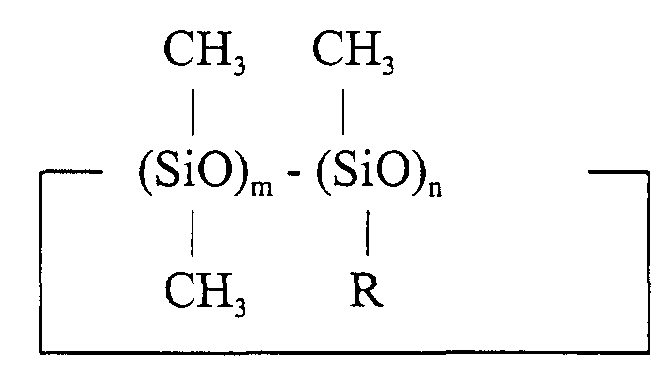
- Murphy, et al. in U.S. Patent No. 5,561,009 disclose that one can increase the spreading properties of oil-containing composition by adding to the composition a linear alkylsilicone of the formula or a cyclic alkylsilicone compound where x is an integer form 0 to 20, m is an integer from 0 to 4, n is from 1 to 5 provided that m + n is from 3 to 5, and R is an alkyl group.
- Those alkylsilicone compounds are used as adjuvants in preparing agricultural formulations which contain mineral or vegetable oils.
- U.S. Patent No. 5,658,851 also to Murphy, et al., discloses lipophilic siloxanes which decrease the surface tension of oils.
- Those siloxanes have the following general formula R a Me 3-a Si-[OSiMe 2 ] x -[OSiMeR] y -OSiMe 3-a R a
- R is a lipophilic group selected from the group consisting of aryl, substituted aryl, aralkyl, alkyl phenyl ether, substituted phenylether, or alkyl alkyleneoxide groups; a is 0 or 1; x and y is 0 to 4 depending upon a, provided that the sum of x and y is greater than or equal to 6.
- Those siloxanes are taught to be adjuvants in oil-based herbicidal, fungicidal, or insecticidal compositions.
- An object of this invention is, therefore, to develop a new class of organopolysiloxanes with improved compatability with a wide range of natural and synthetic oils, a process to prepare these compounds and their use.
- Another object of this invention is the preparation of compositions comprising natural or synthetic oils and this new class of organopolysiloxanes, optionally with additional organo-modified silicone copolymers, which possess enhanced spreading properties relative to the oil itself, and their use.
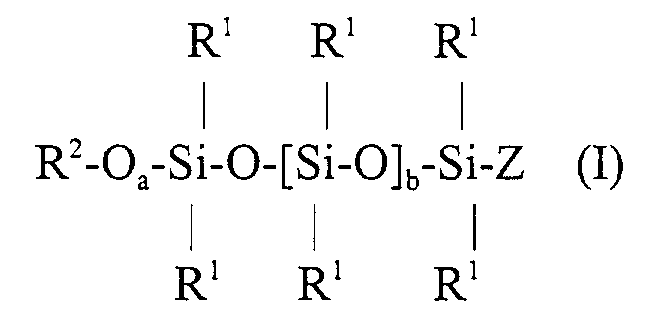
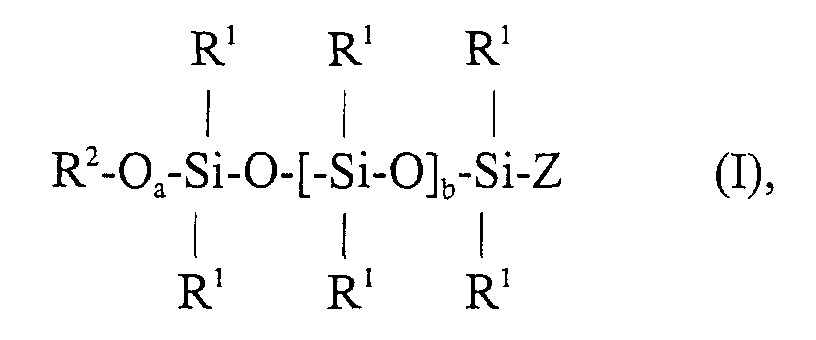
- This invention relates to asymmetrically substituted polysiloxanes of the formula wherein
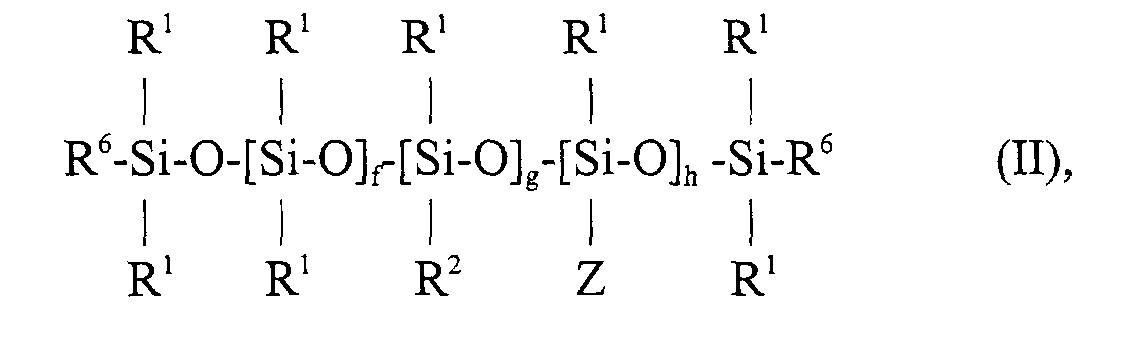
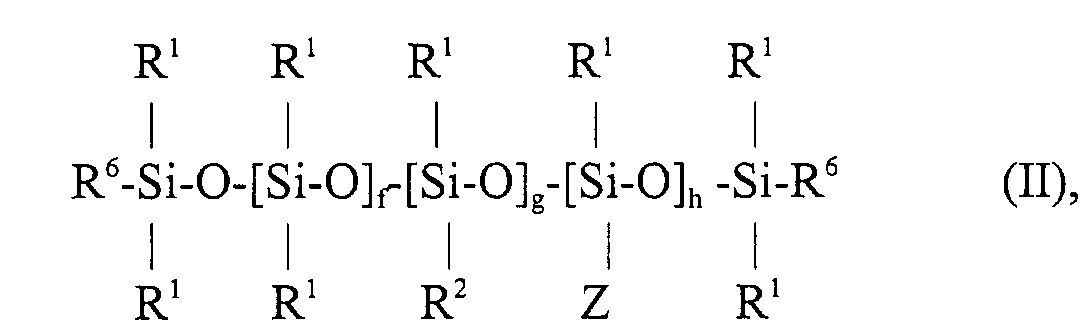
- This invention also provides for oil-based compositions having improved spreading properties and compatability which comprise 99.9% to 50% by weight of one or several oils; and 0.01% to 50% of an organosilicone composition comprising asymmetrically substituted polysiloxanes according to formula (I) and optionally one or several symmetrical polysiloxanes according to the formula (II) wherein R 1 , R 2 and Z assume the meaning mentioned above, R 6 assumes the meaning of R 1 ,-O a -R 2 or that of Z, f, g and h can be 0 to 200, a can be 0 or 1, and which may optionally contain branching units of the structure [R 6 SiO 3/2 ].
- the residues R 1 , R 2 and Z in the siloxanes (II) can be the same or different as the residues R 1 , R 2 and Z in the asymmetrical siloxanes (I).
- This invention also relates to oil compositions containing the asymmetrically substituted organosilicones described in this invention for use in personal care, pharmaceutical, agricultural and in industrial applications, or as processing aids in the paper, plastics and metallurgical industry.
- Preferred residues R 1 are alkyl groups with 1 to 4 carbon atoms or phenyl, especially preferred is methyl.
- Preferred residues R 2 are same or different, linear or branched alkyl groups with 6 to 24 carbon atoms, for example linear or branched hexyl, octyl, decyl, nonyl, undecyl, dodecyl, tetradecyl, hexadecyl or octadecyl groups, alkyl substituted aryl groups like nonyl phenyl, arylsubstituted alkyl groups like phenylethyl.
- alkyl groups with 10 to 18 carbon atoms are especially preferred.
- Residue R 5 represents hydrogen and/or same or different, linear or branched alkyl, aryl or acyl radicals with 1 to 30 carbon atoms, preferred 1 to 12 carbon atoms, which may be substituted with hydroxy groups, halogens, or alkyl, aryl, alkyloxy or aryloxy groups with 1 to 24 carbon atoms which are unsubstituted or substituted, for example with halogen, alkyl, aryl, alkoxy, alkylamino groups.
- Preferred residues Z are same or different polyalkylene oxides wherein R 3 represents bivalent alkyl radicals with 2 or 3 carbon atoms, k and 1 equals 1, m equals 0 or 1, n equals 2, o equals 5 to 100, R 4 is from the group of hydrogen, methyl, ethyl or phenyl, R 5 represents hydrogen, methyl, C 1 -C 18 acyl, or alkylsubstituted phenyl.
- Especially preferred residues Z are polymers of ethylene oxide, propylene oxide or mixtures thereof, wherein R 3 is propyl, R 4 is hydrogen or methyl, 1 equals 1, m equals 0 or 1, n equals 2, o equals 8 to 60 and R 5 is hydrogen, methyl, acetyl, octylphenyl or nonylphenyl groups.
- the polysiloxanes of formula (I) can be prepared by reacting a cyclic siloxane, e.g. hexamethyltrisiloxane with an organometallic compound, e.g. an alkyllithium compound R 2 Li, and subsequently reacting the product thus formed with dimethylchlorosilane to form an asymmetrical siloxane with one terminal alkyl and one terminal Si-H group, followed by hydrosilylation with an unsaturated polyalkylene oxide derivative.
- organometallic compound e.g. an alkyllithium compound R 2 Li
- the anionic ring-opening polymerisations of cyclic siloxanes with alkyllithium compounds is well known in the state of the art, as is the reaction of the intermediate anion with dimethylchlorosilane.
- Asymmetrical siloxanes having only one terminal SiH group, have been synthesized and hydrosilylated, for example, with allyl and vinyl phenols, as described in US 5,025,074 or US 5,204,438, or with vinyl silanes, as described in US 5,075,349.
- alkyllithium reagents for this reaction are well known to one skilled in this art. These reagents are either commercially available or are prepared using various processes according to the state of the art, including metal-halogen exchange, reacting the appropriate alkyl halide with the lithium metal.
- metal-halogen exchange reacting the appropriate alkyl halide with the lithium metal.
- Unsaturated polyoxyalkylene derivatives can, for example, have the structure (V) A-O l (C n H 2n-m R 4 m O) o R 5 wherein R 4 , R 5 , l, m, n and o have the meaning defined above and A is an unsaturated carbon radical with two to 30 carbon atoms, for example unsaturated alkyl groups with terminal double or triple bonds, like vinyl or allyl.
- unsaturated polyethers wherein A is allyl, R 4 is hydrogen or methyl, 1 equals 1, m equals 0 or 1, n equals 2, o equals 8 to 60 and R 5 is hydrogen, methyl, acetyl, octylphenyl or nonylphenyl group.
- the asymmetrical polysiloxanes show improved compatability with a wide variety of natural and synthetic oils.
- This invention also relates to oil-based formulations comprising an oil composition having improved spreading properties.
- This oil composition comprises 99.9% to 50% by weight of one or several oil and 0.01% to 50% of an organosilicone composition comprising asymmetrically substituted polysiloxanes according to formula (I) and, optionally, one or several symmetrical polysiloxanes of formula (II).
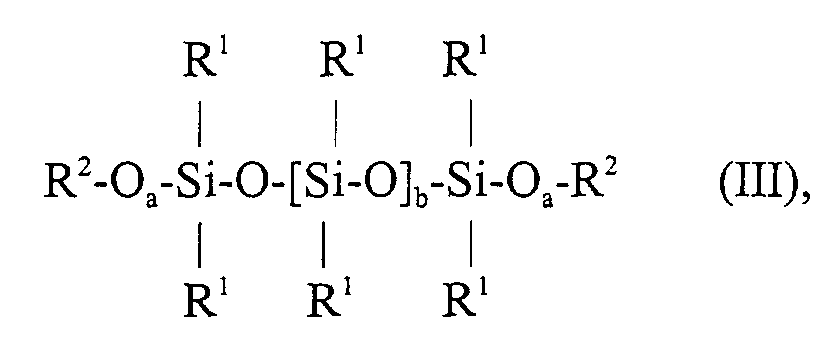
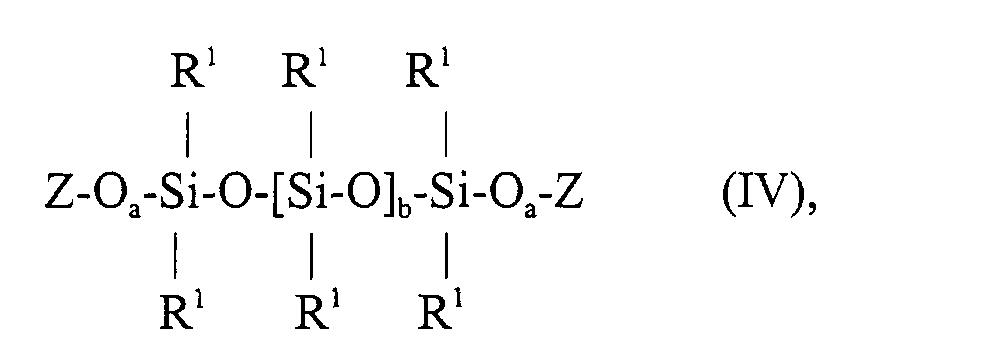
- Preferred compounds of formula (II) are symmetrical siloxanes of the structure: and wherein R 1 , R 2 , Z, a and b are as defined above.
- a preferred compound of the structure (IV) is one wherein b has a value of 5 to 80 and Z represents a radical with the structure R 9 -(C 6 H 4 )-O-(C 2 H 4 O-) d (C 3 H 6 O) e - wherein R 9 -(C 6 H 4 ) are alkyl phenyl groups with R 9 representing octyl or nonyl, d is 0 and e is 5 to 80.
- the organosilicone composition does not contain more than 40 % by weight, especially preferred no more than 30 % by weight, of each of the symmetrical polysiloxanes (II).
- compositions comprising 90% to 99.9% by weight of oil and 0.1% to 10% of the organosilicone composition.
- organosilicone compositions which contain 30% to 100% by weight of the asymmetrical polysiloxane of formula (I) and 0% to 70% of one or several symmetrical polysiloxanes of formula (II), the organosilicone composition preferably not containing more than 40% of each single component of formula (II).
- organosiloxane compositions which contain 50% to 100% of the asymmetrical polysiloxane of formula (I) and 0% to 50% of symmetrical polysiloxanes of formula (II), the organosilicone composition preferably not containing more than 30% of each single component of formula (II).
- organosiloxane compositions which contain 90% to 100% of the asymmetrical polysiloxane of formula (I) and 0% to 10% of symmetrical polysiloxanes of formula (II).
- asymmetrical polysiloxanes can be seen even in organosiloxane compositions according to this invention which comprise 50% by weight of an asymmetrical siloxane (I), and 50% of a mixture of symmetrical siloxanes (III) and (IV).
- organosiloxane compositions according to this invention which comprise 50% by weight of an asymmetrical siloxane (I), and 50% of a mixture of symmetrical siloxanes (III) and (IV).
- These mixtures have significantly improved properties compared to simple mixtures of (III) and (IV) alone.
- They can be prepared, for example, by sequential or simultaneous hydrosilylation of an ⁇ , ⁇ -SiH functional siloxane with an ⁇ -olefin and an unsaturated polyoxyalkylene compound, e.g.
- Equilibration catalysts comprise, for example basic catalysts like alkali metal or tetraalkyl ammonium hydroxides or alkoxides, acidic or Lewis acidic catalysts like organic or inorganic acids such as sulfuric acid, sulfonic acids, solid-phase catalysts like minerals, clays or ion exchanger resins, or phosphornitrile chlorides and its derivatives.
- Symmetrical organo-modified siloxanes (II) are well known in the art, and have been used in cosmetic or defoamer compositions, for example, see WO 99/18784 to Carr et al., EP 596304 to Grüning et al., US 5,271,868 to Azechi et al., US 5,059,704 to Petroff et al., US 5,244,599 to Terae et al., US 4,514,319 to Kulkarni et al., U.S. 5,658,852 to Murphy et al. However, with respect to spreading properties and compatibility they are inferior to the compositions containing asymmetrical siloxanes of formula (I).
- oils contemplated by this invention are the commonly accepted paraffinic or aromatic-based mineral, animal or vegetable oils used in the cosmetic, pharmaceutical or agriculture arts. Especially preferred are methylated vegetable oils. Specific examples of oils include paraffinic, isoparaffinic and cycloparaffinic mineral oils, plant oils like soybean oil, canola oil, castor oil, palm oil, olive oil, corn oil, cottonseed oil, sesame seed oil and the like. In addition, methylated oils, such as methylated soybean oil, methyl palmitate, methyl oleate, and the like are also suitable carrier oils. Mixtures of mineral, vegetable and/or methylated oils may also be employed.
- the carrier oil may itself be an active ingredient, e.g., a pesticide.
- Exemplary mineral oils are those marketed under the trade names EXXOL® , ISOPAR® , NORPAR® and ORCHEX® from Exxon Chemical (Houston, TX).
- Methylated oils from reacting oils with methanol
- methylated soybean oil are available from Henkel, Canada, under the product name "Emery 2235, Distilled Methylsoyate.”
- the inventive compositions can be used in herbicidal, pesticidal, cosmetic and pharmaceutical preparations in order to produce oil-based preparations which possess enhanced spreading properties.
- the cosmetic, industrial or pharmaceutical preparations can be used in the form of oils containing the asymmetrical polysiloxane of formula (I) and, optionally, symmetrical polysiloxane of formula (II), in the form of solutions or emulsions.
- the emulsions can be either creams or lotions and are present in the form of O/W or W/O emulsions. It is also possible to use these oils as carriers for active ingredients.
- active ingredients are pigments, sunscreens, fragrances, cosmetically and/or pharmaceutically active substances such as vitamin E or esters of nicotinic acid.
- Other active ingredients can be, for example, extreme pressure additives, corrosion inhibitors, inorganic particles like silica or TiO 2 , waxes and others.
- Such preparations can optionally include auxiliaries like foam control agents, thickeners, emulsifiers and inert carriers which are customary in the cosmetic and pharmaceutical arts.
- auxiliaries like foam control agents, thickeners, emulsifiers and inert carriers which are customary in the cosmetic and pharmaceutical arts.
- the amount of active ingredient in these preparations is well known to a practitioner of this art.
- the term “herbicide” means any compound which is used to destroy unwanted plant growth.
- pesticide means any compound which destroys fungus, insects and rodents and the like.
- the term “pesticide” specifically includes oily materials which are otherwise not toxic but are used as suffocants in the destruction of aphids, mites and other insects.
- the amount of pesticide employed in compositions of the invention varies with the type of herbicide or pesticide employed and the specific amount and application rate is well known to the practice. However, such compositions generally contain about 1 to 99% of herbicide or pesticide although more or less active ingredients may be used.
- the following are representative, but nonlimiting examples of pesticide compounds that can be used in the compositions of the invention:
- the herbicidal and pesticidal preparations optionally contain the auxiliaries and inert carriers which are customary in the art.
- auxiliaries and inert carriers are well-known to the practitioner of the art, and include, for example, mineral oils, organic solvents or vegetable oils. Application and dosage rates are well known to the practitioner of this art.
- Hexadecyllithium is prepared by reaction of 1-bromohexadecane with lithium metal. Anionic polymerization of cyclohexamethyltrisiloxane with the alkyllithium and the subsequent conversion with ClSiMe 2 H to give the ⁇ , ⁇ -monoalkylmonohydrogensiloxane is performed as described in US 5,204,438.
- the reaction mixture is stirred at 120°C and the reaction is monitored via the decrease of siloxane-bound hydrogen.
- the batch is kept at this temperature until the conversion is complete (3 hrs).
- the polysiloxane is mixed with Penreco Mineral Oil (Drakeol 10B LT 14109 K 9014) at a concentration of 5% w/w to give a clear oil composition with a dynamic surface tension of 24.0 dynes/cm.
- Example 2 Synthesis of a siloxane composition containing asymmetrical siloxanes
- Example 3 Synthesis of a siloxane composition containing asymmetrical siloxanes
- Example 8 Two-step synthesis of a siloxane composition containing asymmetrical siloxanes
- Example 9 Oil compositions containing asymmetrical and/or symmetrical organopolysiloxanes
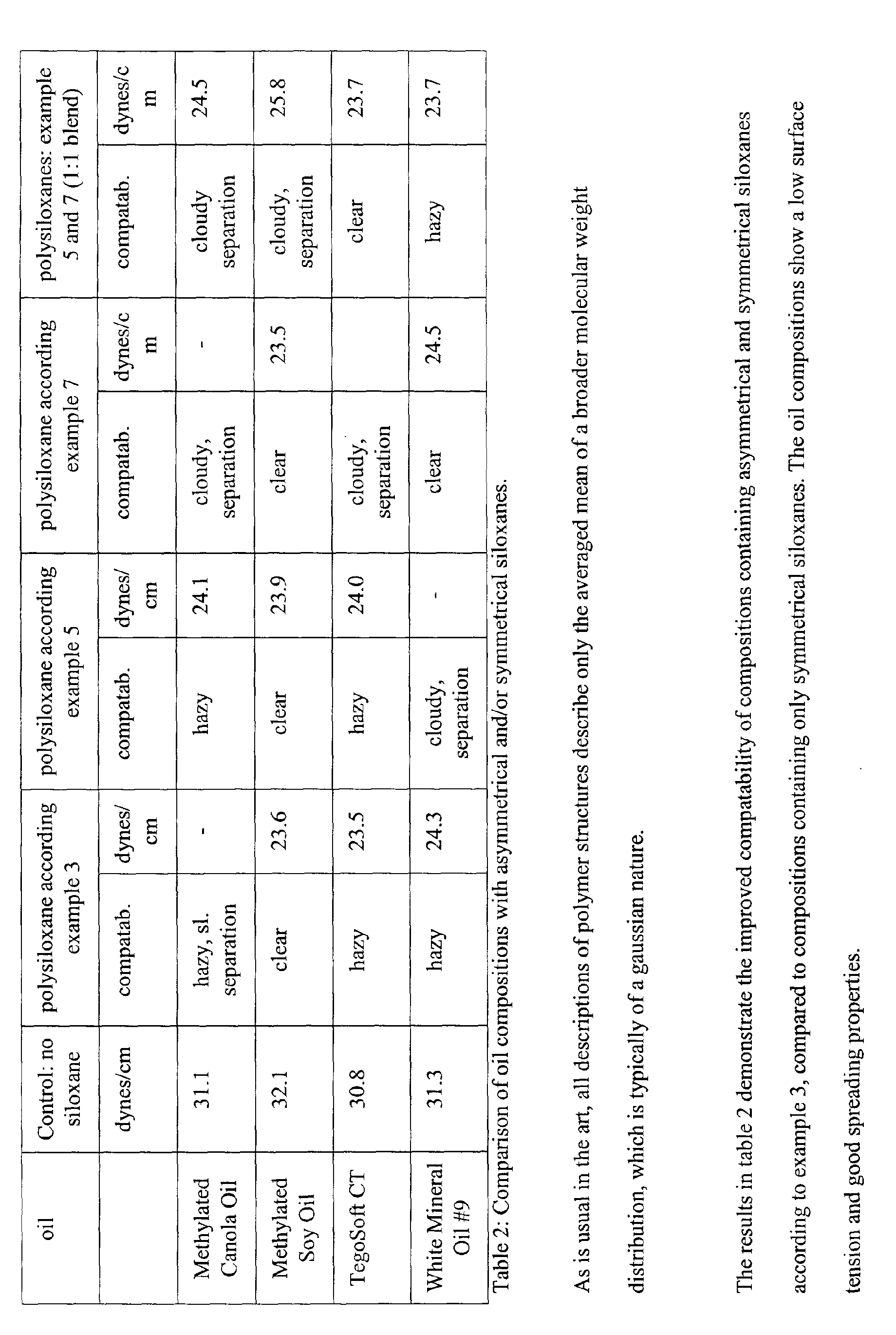
- the polysiloxane or polysiloxane blend was mixed with the oil at a concentration of 5% w/w.
- the compatibility was evaluated visually after 24 hours at room temperature.
Landscapes
- Health & Medical Sciences (AREA)
- Chemical & Material Sciences (AREA)
- Chemical Kinetics & Catalysis (AREA)
- Medicinal Chemistry (AREA)
- Polymers & Plastics (AREA)
- Organic Chemistry (AREA)
- Life Sciences & Earth Sciences (AREA)
- Veterinary Medicine (AREA)
- Animal Behavior & Ethology (AREA)
- General Health & Medical Sciences (AREA)
- Public Health (AREA)
- Epidemiology (AREA)
- Birds (AREA)
- Dermatology (AREA)
- Agricultural Chemicals And Associated Chemicals (AREA)
- Compositions Of Macromolecular Compounds (AREA)
- Lubricants (AREA)
- Cosmetics (AREA)
Abstract
Description

- R1 and R2
- are same or different and represent linear or branched, substituted or unsubstituted, saturated or unsaturated alkyl or aryl groups with 1 to 32 carbon atoms which may be interrupted by oxygen atoms in the hydrocarbon chains,
- Z
- is a polyoxyalkylene radical of the structure
- R3
- represents the same or different bivalent alkyl or aryl radicals with 1 to 30 carbon atoms,
- R4
- represents hydrogen and/or the same or different alkyl or aryl radicals with 1 to 30 carbon atoms,
- R5
- represents hydrogen and/or same or different, linear or branched alkyl, aryl
or acyl radicals with 1 to 30 carbon atoms, which may be substituted with
hydroxy groups, halogens, unsubstituted or substituted alkyl, aryl, alkyloxy
or aryloxy groups with 1 to 24 carbon atoms,
- k
- equals 0 or 1, 1 equals 0 or 1,
- m
- equals 0 or 1,
- n
- equals 2 or 4,
- o
- equals values from 1 to 100;
- a
- equals 0 or 1, and
- b
- equals 0 to 200;

Claims (20)
- Asymmetrically substituted polysiloxanes, having the formula (I)wherein
- R1 and R2
- are same or different and represent same or different linear or branched, substituted or unsubstituted, saturated or unsaturated alkyl or aryl groups with 1 to 32 carbon atoms which may be interrupted by oxygen atoms in the hydrocarbon chains;
- Z
- is a polyoxyalkylene radical of the structure
- R3
- represents the same or different bivalent alkyl or aryl radicals with 1 to 30 carbon atoms,
- R4
- represents hydrogen and/or the same or different alkyl or aryl radicals with 1 to 30 carbon atoms,
- R5
- represents hydrogen and/or same or different, linear or branched alkyl, aryl or acyl
radicals with 1 to 30 carbon atoms, which may be substituted with hydroxy groups,
halogens, unsubstituted or substituted alkyl, aryl, alkyloxy or aryloxy groups with 1 to
24 carbon atoms,
- k
- equals 0 or 1,
- l
- equals 0 or 1,
- m
- equals 0 or 1,
- n
- equals 2 or 4,
- o
- equals values from 1 to 100;
- a
- equals 0 or 1, and
- b
- equals 0 to 200.
- Asymmetrically substituted polysiloxanes according to claim 1, wherein a equals 0.
- Asymmetrically substituted polysiloxanes according to claim 1, wherein residue R1 is methyl.
- Asymmetrically substituted polysiloxanes according to claim 1, wherein R3 represents bivalent alkyl radicals with 2 or 3 carbon atoms, k and 1 equals 1, m equals 0 or 1, n equals 2, o equals 5 to 100, R4 is selected from the group consisting of hydrogen, methyl, ethyl or phenyl, residue R5 represents hydrogen, methyl, C1-C18 acyl, or alkylsubstituted phenyl.
- Asymmetrically substituted polysiloxanes according to claim 1, wherein R1 is methyl, a equals 0 and b equals 10 to 100, R2 are same or different alkyl groups with 10 to 18 carbon atoms, R3 represents bivalent alkyl radicals with 3 carbon atoms, k equals 1, l equals 1, m equals 0 or 1, n equals 2, o equals 5 to 100, R4 is selected from the group consisting of hydrogen, methyl, ethyl or phenyl, and residues R5 are from the group of hydrogen, methyl, acetyl or alkylsubstituted phenyl.
- A process for preparing asymmetrically substituted polysiloxanes according to claim 5 which comprises reacting cyclic hexamethyltrisiloxane with alkyllithium and reacting the product in a second step with dimethylchlorosilane, followed by hydrosilylation with unsaturated polyalkylene oxide derivatives.
- A method of improving the spreading of oil compositions which comprises the addition of asymmetrically substituted polysiloxanes according to claim 1.
- An oil composition having improved spreading properties which comprises 99.9% to 50% by weight of one or several oils; and 0.01% to 50% of an organosilicone composition comprising asymmetrically substituted polysiloxanes according to formula (I)wherein

- R1 and R2
- are same or different and represent same or different linear or branched, substituted or
unsubstituted, saturated or unsaturated alkyl or aryl groups with 1 to 32 carbon atoms
which may be interrupted by oxygen atoms in the hydrocarbon chains;
- Z
- is a polyoxyalkylene radical of the structure
- R3
- represents the same or different bivalent alkyl or aryl radicals with 1 to 30 carbon atoms,
- R4
- represents hydrogen and/or the same or different alkyl or aryl radicals with 1 to 30 carbon atoms,
- R5
- represents hydrogen and/or same or different, linear or branched alkyl, aryl or acyl
radicals with 1 to 30 carbon atoms, which may be substituted with hydroxy groups,
halogens,
unsubstituted or halogensubstituted alkyl, aryl, alkyloxy or aryloxy groups with 1 to 24 carbon atoms,- k
- equals 0 or 1,
- l
- equals 0 or 1,
- m
- equals 0 or 1,
- n
- equals 2 or 4, o equals values from 1 to 100;
- a
- equals 0 or 1, and
- b
- equals 0 to 200;
wherein R1, R2 and Z assume the meaning defined above, R6 assumes the meaning of R2 or that of Z, f, g and h can be 0 to 200, and which may optionally contain branching units of the structure
- A composition according to claim 8, wherein R1 is methyl, a equals 0 and b equals 10 to 100, R2 are same or different alkyl groups with 10 to 18 carbon atoms, R3 represents propyl, k equals 1, l equals 1, m equals 0 or 1, n equals 2, o equals 5 to 100, R4 is from the group of hydrogen, methyl, ethyl or phenyl, residues R5 are from the group of hydrogen, methyl, acetyl or alkylsubstituted phenyl, R6 assumes the meaning of R2 or Z, f equals 5 to 80 and g and h are 0.
- A composition according to claim 8, wherein the oil is a vegetable oil or a methylated vegetable oil.
- A composition according to claim 8, where the organosilicone composition does not contain more than 40% by weight of each single symmetrical polysiloxane of formula (II).
- A composition according to claim 8 which comprises 99.9% to 90% by weight of one or several oils; and 0.01% to 10% of an organosilicone composition comprising 30% to 100% by weight of asymmetrically substituted polysiloxanes; and 0% to 70% of symmetrical organosiloxanes of formula (II).
- A composition according to claim 8 which comprises 99.9% to 90% by weight of one or several oils; and 0.01% to 10% of an organosilicone composition comprising 90% to 100% by weight of asymmetrically substituted polysiloxanes; and 0% to 10% of one or several organosiloxanes of formula (II).
- A composition according to claim 8 which comprises 99.9% to 90% by weight of one or several oils; and 0.01% to 10% of an organosilicone composition comprising 40% to 60% by weight of asymmetrically substituted polysiloxanes; and 60% to 40% of organosiloxanes of formula (II).
- A herbicidal composition exhibiting improved spreading properties which comprises a composition according to claim 8 and an effective amount of a herbicide.
- A composition according to claim 15 in which the herbicide is glyphosate.
- A pesticidal composition exhibiting improved spreading properties which comprises a composition according to claim 8 and an effective amount of a pesticide.
- A method of combatting pests which comprises administering an effective amount of oil compositions according to claim 8 to the pests.
- A preparation for use in personal care or pharmaceutical applications which comprises a composition according to claim 8 and effective amounts of pharmaceutically or cosmetically active ingredients.
- A preparation for use in agricultural and in industrial applications, or as surface-active agents in the paper, plastics and metallurgical industry which comprises a composition according to claim 8 and effective amounts of active ingredients.
Applications Claiming Priority (2)
| Application Number | Priority Date | Filing Date | Title |
|---|---|---|---|
| US53618600A | 2000-03-24 | 2000-03-24 | |
| US536186 | 2000-03-24 |
Publications (3)
| Publication Number | Publication Date |
|---|---|
| EP1136515A2 true EP1136515A2 (en) | 2001-09-26 |
| EP1136515A3 EP1136515A3 (en) | 2002-12-18 |
| EP1136515B1 EP1136515B1 (en) | 2005-12-14 |
Family
ID=24137507
Family Applications (1)
| Application Number | Title | Priority Date | Filing Date |
|---|---|---|---|
| EP01106095A Expired - Lifetime EP1136515B1 (en) | 2000-03-24 | 2001-03-13 | Siloxane-containing oil compositions with good spreading properties |
Country Status (8)
| Country | Link |
|---|---|
| US (1) | US6669949B2 (en) |
| EP (1) | EP1136515B1 (en) |
| AT (1) | ATE312869T1 (en) |
| AU (1) | AU2309601A (en) |
| BR (1) | BR0101153B1 (en) |
| DE (1) | DE60115744T2 (en) |
| ES (1) | ES2252100T3 (en) |
| NZ (1) | NZ509436A (en) |
Cited By (6)
| Publication number | Priority date | Publication date | Assignee | Title |
|---|---|---|---|---|
| WO2007089330A3 (en) * | 2005-12-13 | 2007-11-08 | Gen Electric | Extreme environment surfactant compositions comprising hydrolysis resistant organomodified disiloxane surfactants |
| WO2007070469A3 (en) * | 2005-12-13 | 2007-11-15 | Gen Electric | Extreme environmental surfactant compositions comprising hydrolysis resistant organomodified disiloxane surfactants |
| US7605219B2 (en) | 2006-07-13 | 2009-10-20 | Momentive Performance Materials | Selective hydrosilylation method with alcohol or epoxide reactant and product |
| US7652072B2 (en) | 2005-10-13 | 2010-01-26 | Momentive Performance Materials Inc. | Hydrolysis resistant organomodified disiloxane surfactants |
| EP2311843A3 (en) * | 2006-04-21 | 2011-07-13 | Momentive Performance Materials Inc. | Hydrolysis resistant organomodified silylated surfactants |
| EP2153889A3 (en) * | 2008-08-15 | 2014-08-13 | Evonik Degussa GmbH | Nano-emulsions and method of producing them, and their use as formulations for plant protection and/or to fight pests and/or cosmetic preparations |
Families Citing this family (14)
| Publication number | Priority date | Publication date | Assignee | Title |
|---|---|---|---|---|
| JP4965033B2 (en) * | 2001-06-29 | 2012-07-04 | 東レ・ダウコーニング株式会社 | Liquid alkoxysilyl functional silicone resin, method for producing the same, and curable silicone resin composition |
| WO2005041661A1 (en) * | 2003-10-21 | 2005-05-12 | Caltex Australia Petroleum Pty Ltd | Composition for use as an adjuvant, and method of preparing the composition |
| US20080033136A1 (en) * | 2006-07-13 | 2008-02-07 | Rinard Chauncey J | Selective hydrosilylation conditions |
| US20080014166A1 (en) * | 2006-07-14 | 2008-01-17 | Clariant International, Ltd. | Cosmetic or pharmaceutical compositions comprising modified polyorganosiloxanes |
| CN101511963B (en) | 2006-08-04 | 2014-03-12 | 阿奎坦技术有限公司 | Protective surface film for liquid |
| US7964552B2 (en) | 2006-12-15 | 2011-06-21 | E. I. Du Pont De Nemours And Company | Fluorosurfactant with disproportionate effect |
| US7723414B2 (en) | 2006-12-22 | 2010-05-25 | E. I. Du Pont De Nemours And Company | Antistatic system for polymers |
| DK2337452T3 (en) | 2008-07-03 | 2014-12-15 | Monsanto Technology Llc | COMBINATION OF derivatized SACCHARIDSURFAKTANTER AND ETHERAMINOXIDSURFAKTANTER AS HERBICIDADJUVANTER |
| BRPI0920125B1 (en) * | 2008-10-17 | 2017-03-28 | Evonik Degussa Gmbh | agrochemical oily composition comprising high character silicone alkyl polysiloxane auxiliaries, and method for controlling unwanted weeds or treating plants against pests |
| GB2496643B (en) | 2011-11-17 | 2016-08-17 | Rotam Agrochem Int Co Ltd | Herbicidal suspension concentrate |
| RU2744612C2 (en) | 2016-03-16 | 2021-03-11 | Констракшн Рисерч Энд Текнолоджи Гмбх | Surface-applied corrosion inhibitor |
| CN111212859B (en) * | 2017-11-27 | 2023-06-06 | 三菱化学株式会社 | Rubber-containing graft polymer, resin composition containing rubber-containing graft polymer, and molded article thereof |
| US11166456B2 (en) * | 2018-10-04 | 2021-11-09 | Momentive Performance Materials Inc. | Agricultural fluid deposition aid |
| CN115968256A (en) * | 2020-04-03 | 2023-04-14 | 迈图高新材料公司 | Agricultural fluid deposition aids |
Family Cites Families (19)
| Publication number | Priority date | Publication date | Assignee | Title |
|---|---|---|---|---|
| US4514319A (en) | 1983-03-25 | 1985-04-30 | Union Carbide Corporation | Antifoam composition containing hydrocarbon-silicon copolymer, hydrophobic filler and hydrocarbon oil |
| US5132047A (en) * | 1988-02-09 | 1992-07-21 | Shin-Etsu Chemical Co., Ltd. | Organopolysiloxane emulsion composition |
| US4990175A (en) | 1989-06-13 | 1991-02-05 | Dow Corning Corporation | Foliar applied herbicidal compositions containing a silicone glycolsilicone alkane terpolymer adjuvant |
| JPH0790128B2 (en) | 1989-11-08 | 1995-10-04 | ダウコーニングアジア株式会社 | Silicone antifoam composition |
| JPH03157106A (en) | 1989-11-16 | 1991-07-05 | Shin Etsu Chem Co Ltd | Antifoam composition |
| US5204438A (en) | 1989-12-22 | 1993-04-20 | General Electric Company | Silicone macromers and thermoplastic flame retardant silicone-polyphenylene ether graft copolymers obtained therefrom |
| DE4009889C1 (en) * | 1990-03-28 | 1991-06-13 | Th. Goldschmidt Ag, 4300 Essen, De | |
| US5025074A (en) | 1990-08-27 | 1991-06-18 | General Electric Company | Flame retardant organopolysiloxane-polycarbonate triblock copolymers |
| JP2865466B2 (en) | 1990-12-27 | 1999-03-08 | 信越化学工業株式会社 | Foam inhibitor composition |
| DE4219070A1 (en) * | 1992-06-11 | 1993-12-16 | Goldschmidt Ag Th | Process for the preparation of polyether siloxanes |
| US5558806A (en) * | 1992-07-23 | 1996-09-24 | Osi Specialties, Inc. | Surfactant blend of a polyalkleneoxide polysiloxane and an organic compound having a short chain hydrophobic moiety |
| DE59308338D1 (en) * | 1992-10-31 | 1998-05-07 | Goldschmidt Ag Th | Cosmetic or pharmaceutical preparations |
| US5484950A (en) | 1992-12-21 | 1996-01-16 | Polyset Company, Inc. | Process for selective monoaddition to silanes containing two silicon-hydrogen bonds and products thereof |
| US5658851A (en) | 1993-10-13 | 1997-08-19 | Osi Specialties, Inc. | Lipophilic siloxanes as adjuvants for agriculture |
| US5561099A (en) | 1993-10-13 | 1996-10-01 | Osi Specialties, Inc. | Alkylsiloxanes as adjuvants for agriculture |
| EP0892602B1 (en) * | 1996-03-06 | 2003-02-19 | Corporation Crompton | Organoamine siloxane alkoxylate surfactants |
| US5691392A (en) | 1997-02-05 | 1997-11-25 | Ppg Industries, Inc. | Stable particulate dispersions |
| US5831110A (en) | 1997-10-23 | 1998-11-03 | Chisso Corporation | Fluorine-containing siloxane compound and process for production thereof |
| JP3705954B2 (en) * | 1999-05-19 | 2005-10-12 | 信越化学工業株式会社 | Agrochemical spreading agent |
-
2001
- 2001-01-17 NZ NZ509436A patent/NZ509436A/en not_active IP Right Cessation
- 2001-02-19 AU AU23096/01A patent/AU2309601A/en not_active Abandoned
- 2001-03-13 EP EP01106095A patent/EP1136515B1/en not_active Expired - Lifetime
- 2001-03-13 AT AT01106095T patent/ATE312869T1/en not_active IP Right Cessation
- 2001-03-13 ES ES01106095T patent/ES2252100T3/en not_active Expired - Lifetime
- 2001-03-13 DE DE60115744T patent/DE60115744T2/en not_active Expired - Lifetime
- 2001-03-23 BR BRPI0101153-7A patent/BR0101153B1/en not_active IP Right Cessation
- 2001-06-14 US US09/881,340 patent/US6669949B2/en not_active Expired - Fee Related
Cited By (20)
| Publication number | Priority date | Publication date | Assignee | Title |
|---|---|---|---|---|
| US7652072B2 (en) | 2005-10-13 | 2010-01-26 | Momentive Performance Materials Inc. | Hydrolysis resistant organomodified disiloxane surfactants |
| US8008231B2 (en) | 2005-10-13 | 2011-08-30 | Momentive Performance Materials Inc. | Extreme environment surfactant compositions comprising hydrolysis resistant organomodified disiloxane surfactants |
| WO2007089330A3 (en) * | 2005-12-13 | 2007-11-08 | Gen Electric | Extreme environment surfactant compositions comprising hydrolysis resistant organomodified disiloxane surfactants |
| WO2007070469A3 (en) * | 2005-12-13 | 2007-11-15 | Gen Electric | Extreme environmental surfactant compositions comprising hydrolysis resistant organomodified disiloxane surfactants |
| CN101370378B (en) * | 2005-12-13 | 2015-03-11 | 莫门蒂夫性能材料股份有限公司 | Extreme environment surfactant compositions comprising hydrolysis resistant organomodified disiloxane surfactants |
| US7645720B2 (en) | 2005-12-13 | 2010-01-12 | Momentive Performance Materials Inc. | Extreme environment surfactant compositions comprising hydrolysis resistant organomodified disiloxane surfactants |
| CN101370379B (en) * | 2005-12-13 | 2014-02-19 | 莫门蒂夫性能材料股份有限公司 | Extreme environment surfactant compositions comprising hydrolysis resistant organomodified disiloxane surfactants |
| US8491876B2 (en) | 2005-12-13 | 2013-07-23 | Momentive Performance Materials Inc. | Cosmetic compositions comprising hydrolysis resistant organomodified disiloxane surfactants |
| US8183317B2 (en) | 2005-12-13 | 2012-05-22 | Momentive Performance Materials Inc. | Coating compositions comprising hydrolysis resistant organomodified disiloxane surfactants |
| RU2436301C2 (en) * | 2005-12-13 | 2011-12-20 | Моментив Перформанс Матириалз Инк. | Surfactant compositions for media with extreme conditions, containing hydrolysis-resistant organically modified disiloxane surfactants |
| EP2311843A3 (en) * | 2006-04-21 | 2011-07-13 | Momentive Performance Materials Inc. | Hydrolysis resistant organomodified silylated surfactants |
| US7968666B2 (en) | 2006-07-13 | 2011-06-28 | Momentive Performance Materials Inc. | Incorporating an asymmetrical siloxane into a composition in need of hydrolysis resistance |
| US7947798B2 (en) | 2006-07-13 | 2011-05-24 | Momentive Performance Materials Inc. | Asymmetrical siloxane |
| US7897713B2 (en) | 2006-07-13 | 2011-03-01 | Momentive Performance Materials Inc. | Hydrosilylating an isolated monohydridosiloxane |
| US8217129B2 (en) | 2006-07-13 | 2012-07-10 | Momentive Performance Materials | Polyalkylene oxide asymmetric siloxane |
| US7834118B2 (en) | 2006-07-13 | 2010-11-16 | Momentive Performance Materials Inc | Selective hydrosilylation method with rhodium catalyst |
| US7829734B2 (en) | 2006-07-13 | 2010-11-09 | Momentive Performance Materials Inc | Tetramethyl siloxane reaction |
| US7605219B2 (en) | 2006-07-13 | 2009-10-20 | Momentive Performance Materials | Selective hydrosilylation method with alcohol or epoxide reactant and product |
| EP2153889A3 (en) * | 2008-08-15 | 2014-08-13 | Evonik Degussa GmbH | Nano-emulsions and method of producing them, and their use as formulations for plant protection and/or to fight pests and/or cosmetic preparations |
| US9126163B2 (en) | 2008-08-15 | 2015-09-08 | Evonik Degussa Gmbh | Nanoemulsions and processes for their preparation, and their use as formulations of plant protection agents and/or pesticides and/or cosmetic preparations |
Also Published As
| Publication number | Publication date |
|---|---|
| AU2309601A (en) | 2001-09-27 |
| BR0101153B1 (en) | 2011-11-01 |
| ATE312869T1 (en) | 2005-12-15 |
| NZ509436A (en) | 2002-05-31 |
| BR0101153A (en) | 2001-11-20 |
| US20010039321A1 (en) | 2001-11-08 |
| ES2252100T3 (en) | 2006-05-16 |
| EP1136515A3 (en) | 2002-12-18 |
| DE60115744D1 (en) | 2006-01-19 |
| DE60115744T2 (en) | 2006-07-27 |
| EP1136515B1 (en) | 2005-12-14 |
| US6669949B2 (en) | 2003-12-30 |
Similar Documents
| Publication | Publication Date | Title |
|---|---|---|
| EP1136515B1 (en) | Siloxane-containing oil compositions with good spreading properties | |
| US5561099A (en) | Alkylsiloxanes as adjuvants for agriculture | |
| AU2007268267B2 (en) | Use of hydrolysis resistant organomodified silylated surfactants | |
| AU2007243599B2 (en) | Hydrolysis resistant organomodified silylated surfactants | |
| US20110184074A1 (en) | Hydrolysis resistant organomodified trisiloxane surfactants | |
| AU2006302235A1 (en) | Hydrolysis resistant organomodified disiloxane surfactants | |
| BRPI0721421A2 (en) | hydrolysis resistant organomodified trisiloxane surfactants | |
| US20110251067A1 (en) | Hydrolysis Resistant Organomodified Trisiloxane Surfactants | |
| NZ286364A (en) | Agricultural spray carrier containing a lipophilically modified silicone carrier oil mixture | |
| AU2006302363A1 (en) | Hydrolysis resistant organomodified disiloxane surfactants | |
| CN101657489B (en) | Hydrolysis resistant organomodified trisiloxane surfactants | |
| ZA200208846B (en) | Organosiloxane containing modified groups in agricultural compositions. | |
| JP3331348B2 (en) | Composition containing low polymerizable fluoroalkylsiloxanes and method of using the composition | |
| CN101100514A (en) | Oil composition containing siloxane with good spreading property | |
| HK1151431A (en) | Use of hydrolysis resistant organomodified silylated surfactants | |
| AU2013206177A1 (en) | Hydrolysis resistant organomodified silylated surfactants | |
| HK1128145A (en) | Extreme environmental surfactant compositions comprising hydrolysis resistant organomodified disiloxane surfactants | |
| HK1128146B (en) | Extreme environment surfactant compositions comprising hydrolysis resistant organomodified disiloxane surfactants | |
| HK1128146A1 (en) | Extreme environment surfactant compositions comprising hydrolysis resistant organomodified disiloxane surfactants | |
| HK1149177B (en) | Hydrolysis resistant organomodified silylated surfactants |
Legal Events
| Date | Code | Title | Description |
|---|---|---|---|
| PUAI | Public reference made under article 153(3) epc to a published international application that has entered the european phase |
Free format text: ORIGINAL CODE: 0009012 |
|
| 17P | Request for examination filed |
Effective date: 20010316 |
|
| AK | Designated contracting states |
Kind code of ref document: A2 Designated state(s): AT BE CH CY DE DK ES FI FR GB GR IE IT LI LU MC NL PT SE TR |
|
| AX | Request for extension of the european patent |
Free format text: AL;LT;LV;MK;RO;SI |
|
| PUAL | Search report despatched |
Free format text: ORIGINAL CODE: 0009013 |
|
| AK | Designated contracting states |
Kind code of ref document: A3 Designated state(s): AT BE CH CY DE DK ES FI FR GB GR IE IT LI LU MC NL PT SE TR |
|
| AX | Request for extension of the european patent |
Free format text: AL;LT;LV;MK;RO;SI |
|
| RIC1 | Information provided on ipc code assigned before grant |
Free format text: 7C 08G 77/46 A, 7C 08G 77/00 B, 7C 08G 77/42 B, 7C 08L 83/00 B, 7C 08L 83/06 B, 7C 08L 83/12 B, 7B 01F 17/00 B |
|
| AKX | Designation fees paid |
Designated state(s): AT BE CH CY DE DK ES FI FR GB GR IE IT LI LU MC NL PT SE TR |
|
| 17Q | First examination report despatched |
Effective date: 20030822 |
|
| RAP1 | Party data changed (applicant data changed or rights of an application transferred) |
Owner name: GOLDSCHMIDT GMBH |
|
| GRAP | Despatch of communication of intention to grant a patent |
Free format text: ORIGINAL CODE: EPIDOSNIGR1 |
|
| GRAS | Grant fee paid |
Free format text: ORIGINAL CODE: EPIDOSNIGR3 |
|
| GRAA | (expected) grant |
Free format text: ORIGINAL CODE: 0009210 |
|
| AK | Designated contracting states |
Kind code of ref document: B1 Designated state(s): AT BE CH CY DE DK ES FI FR GB GR IE IT LI LU MC NL PT SE TR |
|
| PG25 | Lapsed in a contracting state [announced via postgrant information from national office to epo] |
Ref country code: FI Free format text: LAPSE BECAUSE OF FAILURE TO SUBMIT A TRANSLATION OF THE DESCRIPTION OR TO PAY THE FEE WITHIN THE PRESCRIBED TIME-LIMIT Effective date: 20051214 Ref country code: AT Free format text: LAPSE BECAUSE OF FAILURE TO SUBMIT A TRANSLATION OF THE DESCRIPTION OR TO PAY THE FEE WITHIN THE PRESCRIBED TIME-LIMIT Effective date: 20051214 Ref country code: CH Free format text: LAPSE BECAUSE OF FAILURE TO SUBMIT A TRANSLATION OF THE DESCRIPTION OR TO PAY THE FEE WITHIN THE PRESCRIBED TIME-LIMIT Effective date: 20051214 Ref country code: LI Free format text: LAPSE BECAUSE OF FAILURE TO SUBMIT A TRANSLATION OF THE DESCRIPTION OR TO PAY THE FEE WITHIN THE PRESCRIBED TIME-LIMIT Effective date: 20051214 |
|
| REG | Reference to a national code |
Ref country code: GB Ref legal event code: FG4D |
|
| REG | Reference to a national code |
Ref country code: CH Ref legal event code: EP |
|
| REG | Reference to a national code |
Ref country code: IE Ref legal event code: FG4D |
|
| REF | Corresponds to: |
Ref document number: 60115744 Country of ref document: DE Date of ref document: 20060119 Kind code of ref document: P |
|
| PG25 | Lapsed in a contracting state [announced via postgrant information from national office to epo] |
Ref country code: IE Free format text: LAPSE BECAUSE OF NON-PAYMENT OF DUE FEES Effective date: 20060313 |
|
| PG25 | Lapsed in a contracting state [announced via postgrant information from national office to epo] |
Ref country code: SE Free format text: LAPSE BECAUSE OF FAILURE TO SUBMIT A TRANSLATION OF THE DESCRIPTION OR TO PAY THE FEE WITHIN THE PRESCRIBED TIME-LIMIT Effective date: 20060314 Ref country code: GR Free format text: LAPSE BECAUSE OF FAILURE TO SUBMIT A TRANSLATION OF THE DESCRIPTION OR TO PAY THE FEE WITHIN THE PRESCRIBED TIME-LIMIT Effective date: 20060314 Ref country code: DK Free format text: LAPSE BECAUSE OF FAILURE TO SUBMIT A TRANSLATION OF THE DESCRIPTION OR TO PAY THE FEE WITHIN THE PRESCRIBED TIME-LIMIT Effective date: 20060314 |
|
| PG25 | Lapsed in a contracting state [announced via postgrant information from national office to epo] |
Ref country code: MC Free format text: LAPSE BECAUSE OF NON-PAYMENT OF DUE FEES Effective date: 20060331 Ref country code: LU Free format text: LAPSE BECAUSE OF NON-PAYMENT OF DUE FEES Effective date: 20060331 |
|
| REG | Reference to a national code |
Ref country code: ES Ref legal event code: FG2A Ref document number: 2252100 Country of ref document: ES Kind code of ref document: T3 |
|
| REG | Reference to a national code |
Ref country code: CH Ref legal event code: PL |
|
| ET | Fr: translation filed | ||
| PLBE | No opposition filed within time limit |
Free format text: ORIGINAL CODE: 0009261 |
|
| STAA | Information on the status of an ep patent application or granted ep patent |
Free format text: STATUS: NO OPPOSITION FILED WITHIN TIME LIMIT |
|
| 26N | No opposition filed |
Effective date: 20060915 |
|
| REG | Reference to a national code |
Ref country code: IE Ref legal event code: MM4A |
|
| PG25 | Lapsed in a contracting state [announced via postgrant information from national office to epo] |
Ref country code: TR Free format text: LAPSE BECAUSE OF FAILURE TO SUBMIT A TRANSLATION OF THE DESCRIPTION OR TO PAY THE FEE WITHIN THE PRESCRIBED TIME-LIMIT Effective date: 20051214 |
|
| PG25 | Lapsed in a contracting state [announced via postgrant information from national office to epo] |
Ref country code: CY Free format text: LAPSE BECAUSE OF FAILURE TO SUBMIT A TRANSLATION OF THE DESCRIPTION OR TO PAY THE FEE WITHIN THE PRESCRIBED TIME-LIMIT Effective date: 20051214 |
|
| NLT1 | Nl: modifications of names registered in virtue of documents presented to the patent office pursuant to art. 16 a, paragraph 1 |
Owner name: EVONIK GOLDSCHMIDT GMBH |
|
| REG | Reference to a national code |
Ref country code: FR Ref legal event code: CD |
|
| PGFP | Annual fee paid to national office [announced via postgrant information from national office to epo] |
Ref country code: IT Payment date: 20120330 Year of fee payment: 12 |
|
| PGFP | Annual fee paid to national office [announced via postgrant information from national office to epo] |
Ref country code: FR Payment date: 20130408 Year of fee payment: 13 Ref country code: DE Payment date: 20130321 Year of fee payment: 13 Ref country code: GB Payment date: 20130321 Year of fee payment: 13 Ref country code: ES Payment date: 20130326 Year of fee payment: 13 |
|
| PGFP | Annual fee paid to national office [announced via postgrant information from national office to epo] |
Ref country code: NL Payment date: 20130320 Year of fee payment: 13 |
|
| PGFP | Annual fee paid to national office [announced via postgrant information from national office to epo] |
Ref country code: PT Payment date: 20130305 Year of fee payment: 13 |
|
| PGFP | Annual fee paid to national office [announced via postgrant information from national office to epo] |
Ref country code: BE Payment date: 20130320 Year of fee payment: 13 |
|
| REG | Reference to a national code |
Ref country code: PT Ref legal event code: MM4A Free format text: LAPSE DUE TO NON-PAYMENT OF FEES Effective date: 20140915 |
|
| REG | Reference to a national code |
Ref country code: DE Ref legal event code: R119 Ref document number: 60115744 Country of ref document: DE |
|
| REG | Reference to a national code |
Ref country code: NL Ref legal event code: V1 Effective date: 20141001 |
|
| GBPC | Gb: european patent ceased through non-payment of renewal fee |
Effective date: 20140313 |
|
| REG | Reference to a national code |
Ref country code: FR Ref legal event code: ST Effective date: 20141128 |
|
| PG25 | Lapsed in a contracting state [announced via postgrant information from national office to epo] |
Ref country code: PT Free format text: LAPSE BECAUSE OF NON-PAYMENT OF DUE FEES Effective date: 20140915 |
|
| REG | Reference to a national code |
Ref country code: DE Ref legal event code: R119 Ref document number: 60115744 Country of ref document: DE Effective date: 20141001 |
|
| PG25 | Lapsed in a contracting state [announced via postgrant information from national office to epo] |
Ref country code: FR Free format text: LAPSE BECAUSE OF NON-PAYMENT OF DUE FEES Effective date: 20140331 Ref country code: DE Free format text: LAPSE BECAUSE OF NON-PAYMENT OF DUE FEES Effective date: 20141001 Ref country code: GB Free format text: LAPSE BECAUSE OF NON-PAYMENT OF DUE FEES Effective date: 20140313 |
|
| PG25 | Lapsed in a contracting state [announced via postgrant information from national office to epo] |
Ref country code: NL Free format text: LAPSE BECAUSE OF NON-PAYMENT OF DUE FEES Effective date: 20141001 |
|
| PG25 | Lapsed in a contracting state [announced via postgrant information from national office to epo] |
Ref country code: IT Free format text: LAPSE BECAUSE OF NON-PAYMENT OF DUE FEES Effective date: 20140313 |
|
| REG | Reference to a national code |
Ref country code: ES Ref legal event code: FD2A Effective date: 20150430 |
|
| PG25 | Lapsed in a contracting state [announced via postgrant information from national office to epo] |
Ref country code: ES Free format text: LAPSE BECAUSE OF NON-PAYMENT OF DUE FEES Effective date: 20140314 |
|
| PG25 | Lapsed in a contracting state [announced via postgrant information from national office to epo] |
Ref country code: BE Free format text: LAPSE BECAUSE OF NON-PAYMENT OF DUE FEES Effective date: 20140331 |