EP1136304A2 - Acceleration monitor for vehicle - Google Patents
Acceleration monitor for vehicle Download PDFInfo
- Publication number
- EP1136304A2 EP1136304A2 EP01302352A EP01302352A EP1136304A2 EP 1136304 A2 EP1136304 A2 EP 1136304A2 EP 01302352 A EP01302352 A EP 01302352A EP 01302352 A EP01302352 A EP 01302352A EP 1136304 A2 EP1136304 A2 EP 1136304A2
- Authority
- EP
- European Patent Office
- Prior art keywords
- acceleration
- vehicle
- sensor
- vehicle acceleration
- actual
- Prior art date
- Legal status (The legal status is an assumption and is not a legal conclusion. Google has not performed a legal analysis and makes no representation as to the accuracy of the status listed.)
- Withdrawn
Links
Images



Classifications
-
- B—PERFORMING OPERATIONS; TRANSPORTING
- B60—VEHICLES IN GENERAL
- B60K—ARRANGEMENT OR MOUNTING OF PROPULSION UNITS OR OF TRANSMISSIONS IN VEHICLES; ARRANGEMENT OR MOUNTING OF PLURAL DIVERSE PRIME-MOVERS IN VEHICLES; AUXILIARY DRIVES FOR VEHICLES; INSTRUMENTATION OR DASHBOARDS FOR VEHICLES; ARRANGEMENTS IN CONNECTION WITH COOLING, AIR INTAKE, GAS EXHAUST OR FUEL SUPPLY OF PROPULSION UNITS IN VEHICLES
- B60K6/00—Arrangement or mounting of plural diverse prime-movers for mutual or common propulsion, e.g. hybrid propulsion systems comprising electric motors and internal combustion engines
- B60K6/20—Arrangement or mounting of plural diverse prime-movers for mutual or common propulsion, e.g. hybrid propulsion systems comprising electric motors and internal combustion engines the prime-movers consisting of electric motors and internal combustion engines, e.g. HEVs
- B60K6/42—Arrangement or mounting of plural diverse prime-movers for mutual or common propulsion, e.g. hybrid propulsion systems comprising electric motors and internal combustion engines the prime-movers consisting of electric motors and internal combustion engines, e.g. HEVs characterised by the architecture of the hybrid electric vehicle
- B60K6/48—Parallel type
-
- B—PERFORMING OPERATIONS; TRANSPORTING
- B60—VEHICLES IN GENERAL
- B60W—CONJOINT CONTROL OF VEHICLE SUB-UNITS OF DIFFERENT TYPE OR DIFFERENT FUNCTION; CONTROL SYSTEMS SPECIALLY ADAPTED FOR HYBRID VEHICLES; ROAD VEHICLE DRIVE CONTROL SYSTEMS FOR PURPOSES NOT RELATED TO THE CONTROL OF A PARTICULAR SUB-UNIT
- B60W20/00—Control systems specially adapted for hybrid vehicles
- B60W20/10—Controlling the power contribution of each of the prime movers to meet required power demand
- B60W20/11—Controlling the power contribution of each of the prime movers to meet required power demand using model predictive control [MPC] strategies, i.e. control methods based on models predicting performance
-
- B—PERFORMING OPERATIONS; TRANSPORTING
- B60—VEHICLES IN GENERAL
- B60K—ARRANGEMENT OR MOUNTING OF PROPULSION UNITS OR OF TRANSMISSIONS IN VEHICLES; ARRANGEMENT OR MOUNTING OF PLURAL DIVERSE PRIME-MOVERS IN VEHICLES; AUXILIARY DRIVES FOR VEHICLES; INSTRUMENTATION OR DASHBOARDS FOR VEHICLES; ARRANGEMENTS IN CONNECTION WITH COOLING, AIR INTAKE, GAS EXHAUST OR FUEL SUPPLY OF PROPULSION UNITS IN VEHICLES
- B60K31/00—Vehicle fittings, acting on a single sub-unit only, for automatically controlling vehicle speed, i.e. preventing speed from exceeding an arbitrarily established velocity or maintaining speed at a particular velocity, as selected by the vehicle operator
- B60K31/02—Vehicle fittings, acting on a single sub-unit only, for automatically controlling vehicle speed, i.e. preventing speed from exceeding an arbitrarily established velocity or maintaining speed at a particular velocity, as selected by the vehicle operator including electrically actuated servomechanism
- B60K31/04—Vehicle fittings, acting on a single sub-unit only, for automatically controlling vehicle speed, i.e. preventing speed from exceeding an arbitrarily established velocity or maintaining speed at a particular velocity, as selected by the vehicle operator including electrically actuated servomechanism and means for comparing one electrical quantity, e.g. voltage, pulse, waveform, flux, or the like, with another quantity of a like kind, which comparison means is involved in the development of an electrical signal which is fed into the controlling means
- B60K31/042—Vehicle fittings, acting on a single sub-unit only, for automatically controlling vehicle speed, i.e. preventing speed from exceeding an arbitrarily established velocity or maintaining speed at a particular velocity, as selected by the vehicle operator including electrically actuated servomechanism and means for comparing one electrical quantity, e.g. voltage, pulse, waveform, flux, or the like, with another quantity of a like kind, which comparison means is involved in the development of an electrical signal which is fed into the controlling means where at least one electrical quantity is set by the vehicle operator
- B60K31/045—Vehicle fittings, acting on a single sub-unit only, for automatically controlling vehicle speed, i.e. preventing speed from exceeding an arbitrarily established velocity or maintaining speed at a particular velocity, as selected by the vehicle operator including electrically actuated servomechanism and means for comparing one electrical quantity, e.g. voltage, pulse, waveform, flux, or the like, with another quantity of a like kind, which comparison means is involved in the development of an electrical signal which is fed into the controlling means where at least one electrical quantity is set by the vehicle operator in a memory, e.g. a capacitor
- B60K31/047—Vehicle fittings, acting on a single sub-unit only, for automatically controlling vehicle speed, i.e. preventing speed from exceeding an arbitrarily established velocity or maintaining speed at a particular velocity, as selected by the vehicle operator including electrically actuated servomechanism and means for comparing one electrical quantity, e.g. voltage, pulse, waveform, flux, or the like, with another quantity of a like kind, which comparison means is involved in the development of an electrical signal which is fed into the controlling means where at least one electrical quantity is set by the vehicle operator in a memory, e.g. a capacitor the memory being digital
-
- B—PERFORMING OPERATIONS; TRANSPORTING
- B60—VEHICLES IN GENERAL
- B60K—ARRANGEMENT OR MOUNTING OF PROPULSION UNITS OR OF TRANSMISSIONS IN VEHICLES; ARRANGEMENT OR MOUNTING OF PLURAL DIVERSE PRIME-MOVERS IN VEHICLES; AUXILIARY DRIVES FOR VEHICLES; INSTRUMENTATION OR DASHBOARDS FOR VEHICLES; ARRANGEMENTS IN CONNECTION WITH COOLING, AIR INTAKE, GAS EXHAUST OR FUEL SUPPLY OF PROPULSION UNITS IN VEHICLES
- B60K6/00—Arrangement or mounting of plural diverse prime-movers for mutual or common propulsion, e.g. hybrid propulsion systems comprising electric motors and internal combustion engines
- B60K6/20—Arrangement or mounting of plural diverse prime-movers for mutual or common propulsion, e.g. hybrid propulsion systems comprising electric motors and internal combustion engines the prime-movers consisting of electric motors and internal combustion engines, e.g. HEVs
- B60K6/50—Architecture of the driveline characterised by arrangement or kind of transmission units
- B60K6/52—Driving a plurality of drive axles, e.g. four-wheel drive
-
- B—PERFORMING OPERATIONS; TRANSPORTING
- B60—VEHICLES IN GENERAL
- B60W—CONJOINT CONTROL OF VEHICLE SUB-UNITS OF DIFFERENT TYPE OR DIFFERENT FUNCTION; CONTROL SYSTEMS SPECIALLY ADAPTED FOR HYBRID VEHICLES; ROAD VEHICLE DRIVE CONTROL SYSTEMS FOR PURPOSES NOT RELATED TO THE CONTROL OF A PARTICULAR SUB-UNIT
- B60W10/00—Conjoint control of vehicle sub-units of different type or different function
- B60W10/04—Conjoint control of vehicle sub-units of different type or different function including control of propulsion units
- B60W10/06—Conjoint control of vehicle sub-units of different type or different function including control of propulsion units including control of combustion engines
-
- B—PERFORMING OPERATIONS; TRANSPORTING
- B60—VEHICLES IN GENERAL
- B60W—CONJOINT CONTROL OF VEHICLE SUB-UNITS OF DIFFERENT TYPE OR DIFFERENT FUNCTION; CONTROL SYSTEMS SPECIALLY ADAPTED FOR HYBRID VEHICLES; ROAD VEHICLE DRIVE CONTROL SYSTEMS FOR PURPOSES NOT RELATED TO THE CONTROL OF A PARTICULAR SUB-UNIT
- B60W10/00—Conjoint control of vehicle sub-units of different type or different function
- B60W10/04—Conjoint control of vehicle sub-units of different type or different function including control of propulsion units
- B60W10/08—Conjoint control of vehicle sub-units of different type or different function including control of propulsion units including control of electric propulsion units, e.g. motors or generators
-
- B—PERFORMING OPERATIONS; TRANSPORTING
- B60—VEHICLES IN GENERAL
- B60W—CONJOINT CONTROL OF VEHICLE SUB-UNITS OF DIFFERENT TYPE OR DIFFERENT FUNCTION; CONTROL SYSTEMS SPECIALLY ADAPTED FOR HYBRID VEHICLES; ROAD VEHICLE DRIVE CONTROL SYSTEMS FOR PURPOSES NOT RELATED TO THE CONTROL OF A PARTICULAR SUB-UNIT
- B60W10/00—Conjoint control of vehicle sub-units of different type or different function
- B60W10/10—Conjoint control of vehicle sub-units of different type or different function including control of change-speed gearings
-
- B—PERFORMING OPERATIONS; TRANSPORTING
- B60—VEHICLES IN GENERAL
- B60W—CONJOINT CONTROL OF VEHICLE SUB-UNITS OF DIFFERENT TYPE OR DIFFERENT FUNCTION; CONTROL SYSTEMS SPECIALLY ADAPTED FOR HYBRID VEHICLES; ROAD VEHICLE DRIVE CONTROL SYSTEMS FOR PURPOSES NOT RELATED TO THE CONTROL OF A PARTICULAR SUB-UNIT
- B60W20/00—Control systems specially adapted for hybrid vehicles
-
- B—PERFORMING OPERATIONS; TRANSPORTING
- B60—VEHICLES IN GENERAL
- B60R—VEHICLES, VEHICLE FITTINGS, OR VEHICLE PARTS, NOT OTHERWISE PROVIDED FOR
- B60R21/00—Arrangements or fittings on vehicles for protecting or preventing injuries to occupants or pedestrians in case of accidents or other traffic risks
- B60R21/01—Electrical circuits for triggering passive safety arrangements, e.g. airbags, safety belt tighteners, in case of vehicle accidents or impending vehicle accidents
- B60R21/013—Electrical circuits for triggering passive safety arrangements, e.g. airbags, safety belt tighteners, in case of vehicle accidents or impending vehicle accidents including means for detecting collisions, impending collisions or roll-over
-
- B—PERFORMING OPERATIONS; TRANSPORTING
- B60—VEHICLES IN GENERAL
- B60W—CONJOINT CONTROL OF VEHICLE SUB-UNITS OF DIFFERENT TYPE OR DIFFERENT FUNCTION; CONTROL SYSTEMS SPECIALLY ADAPTED FOR HYBRID VEHICLES; ROAD VEHICLE DRIVE CONTROL SYSTEMS FOR PURPOSES NOT RELATED TO THE CONTROL OF A PARTICULAR SUB-UNIT
- B60W50/00—Details of control systems for road vehicle drive control not related to the control of a particular sub-unit, e.g. process diagnostic or vehicle driver interfaces
- B60W2050/0001—Details of the control system
- B60W2050/0019—Control system elements or transfer functions
- B60W2050/0022—Gains, weighting coefficients or weighting functions
-
- B—PERFORMING OPERATIONS; TRANSPORTING
- B60—VEHICLES IN GENERAL
- B60W—CONJOINT CONTROL OF VEHICLE SUB-UNITS OF DIFFERENT TYPE OR DIFFERENT FUNCTION; CONTROL SYSTEMS SPECIALLY ADAPTED FOR HYBRID VEHICLES; ROAD VEHICLE DRIVE CONTROL SYSTEMS FOR PURPOSES NOT RELATED TO THE CONTROL OF A PARTICULAR SUB-UNIT
- B60W2520/00—Input parameters relating to overall vehicle dynamics
- B60W2520/10—Longitudinal speed
- B60W2520/105—Longitudinal acceleration
-
- B—PERFORMING OPERATIONS; TRANSPORTING
- B60—VEHICLES IN GENERAL
- B60W—CONJOINT CONTROL OF VEHICLE SUB-UNITS OF DIFFERENT TYPE OR DIFFERENT FUNCTION; CONTROL SYSTEMS SPECIALLY ADAPTED FOR HYBRID VEHICLES; ROAD VEHICLE DRIVE CONTROL SYSTEMS FOR PURPOSES NOT RELATED TO THE CONTROL OF A PARTICULAR SUB-UNIT
- B60W2720/00—Output or target parameters relating to overall vehicle dynamics
- B60W2720/10—Longitudinal speed
- B60W2720/106—Longitudinal acceleration
-
- Y—GENERAL TAGGING OF NEW TECHNOLOGICAL DEVELOPMENTS; GENERAL TAGGING OF CROSS-SECTIONAL TECHNOLOGIES SPANNING OVER SEVERAL SECTIONS OF THE IPC; TECHNICAL SUBJECTS COVERED BY FORMER USPC CROSS-REFERENCE ART COLLECTIONS [XRACs] AND DIGESTS
- Y02—TECHNOLOGIES OR APPLICATIONS FOR MITIGATION OR ADAPTATION AGAINST CLIMATE CHANGE
- Y02T—CLIMATE CHANGE MITIGATION TECHNOLOGIES RELATED TO TRANSPORTATION
- Y02T10/00—Road transport of goods or passengers
- Y02T10/60—Other road transportation technologies with climate change mitigation effect
- Y02T10/62—Hybrid vehicles
-
- Y—GENERAL TAGGING OF NEW TECHNOLOGICAL DEVELOPMENTS; GENERAL TAGGING OF CROSS-SECTIONAL TECHNOLOGIES SPANNING OVER SEVERAL SECTIONS OF THE IPC; TECHNICAL SUBJECTS COVERED BY FORMER USPC CROSS-REFERENCE ART COLLECTIONS [XRACs] AND DIGESTS
- Y10—TECHNICAL SUBJECTS COVERED BY FORMER USPC
- Y10S—TECHNICAL SUBJECTS COVERED BY FORMER USPC CROSS-REFERENCE ART COLLECTIONS [XRACs] AND DIGESTS
- Y10S903/00—Hybrid electric vehicles, HEVS
- Y10S903/902—Prime movers comprising electrical and internal combustion motors
- Y10S903/903—Prime movers comprising electrical and internal combustion motors having energy storing means, e.g. battery, capacitor
- Y10S903/904—Component specially adapted for hev
- Y10S903/915—Specific drive or transmission adapted for hev
- Y10S903/916—Specific drive or transmission adapted for hev with plurality of drive axles
-
- Y—GENERAL TAGGING OF NEW TECHNOLOGICAL DEVELOPMENTS; GENERAL TAGGING OF CROSS-SECTIONAL TECHNOLOGIES SPANNING OVER SEVERAL SECTIONS OF THE IPC; TECHNICAL SUBJECTS COVERED BY FORMER USPC CROSS-REFERENCE ART COLLECTIONS [XRACs] AND DIGESTS
- Y10—TECHNICAL SUBJECTS COVERED BY FORMER USPC
- Y10S—TECHNICAL SUBJECTS COVERED BY FORMER USPC CROSS-REFERENCE ART COLLECTIONS [XRACs] AND DIGESTS
- Y10S903/00—Hybrid electric vehicles, HEVS
- Y10S903/902—Prime movers comprising electrical and internal combustion motors
- Y10S903/903—Prime movers comprising electrical and internal combustion motors having energy storing means, e.g. battery, capacitor
- Y10S903/945—Characterized by control of gearing, e.g. control of transmission ratio
Definitions
- the present invention relates to monitoring of electronically controlled drive units in vehicles.
- an electronically controlled throttle is used for improved performance.
- engines also may be controlled using engine output, or torque control where the actual engine torque is controlled to a desired engine torque through an output adjusting device, such as with the electronic throttle, ignition timing, air-fuel ratio, or various other devices.
- One method to monitor engine control systems determines if actual engine torque is greater than desired engine torque. Actual engine torque is determined in accordance with engine airflow and/or injected fuel amount, and various other factors. Such a method is described U.S. Patent 5,692,472.
- the inventors herein have recognised a disadvantage of the above approach.
- a method when such a method is utilised with vehicles having multiple torque sources, such as hybrid electric vehicles, several different torque values can be considered.
- torque produced by an electric motor and torque produced by an internal combustion engine can both contribute to overall drive torque.
- additional variables may be used to account for various torque sources.
- Each of these additional variables can then have redundancy.
- monitoring using the above structure may result in additional cost and/or complexity.
- the present invention provides a method for monitoring and controlling a vehicle drive system, the method comprises determining a preselected vehicle acceleration, calculating an actual vehicle acceleration based on an accelerometer coupled to the vehicle, and initiating a reaction when said actual vehicle acceleration is greater than said preselected vehicle acceleration.
- An advantage of the above aspect of the present invention is a potential for reduced system complexity and/or cost.
- a method and system embodying the present invention provide a mutually beneficial monitoring and control approach for use with vehicles having a single power source or multiple power sources.
- the present invention provides a system for a vehicle having an electronically controlled drive unit, the system comprising: a first controller that determines a desired acceleration based on an operator command and adjusts a drive unit operating parameter to achieve said desired acceleration; and a second controller that determines a preselected acceleration of the vehicle based on said desired acceleration, determines an actual vehicle acceleration based on a sensor coupled to the vehicle, and initiates a reaction when said actual vehicle acceleration is greater than said preselected acceleration.
- An advantage of the above aspect of the present invention is a potential for reduced system complexity and/or cost.
- Engine 10 and motor 11 of a vehicle are shown coupled to transmission 14.
- Engine 10 and motor 11 can be coupled in various ways known to those skilled in the art, such, for example, in a parallel fashion, a series fashion, or any combination thereof.
- Motor 11 can be an electric motor capable of supplying power to or receiving power from transmission 14.
- motor 11 can be used to provide regenerative braking or to provide the vehicle tractive force from batteries (not shown) that store energy.
- Transmission 14 is coupled to a first set of drive wheels 20.
- transmission 14 can also be coupled to a second set of drive wheels 22.
- Transmission 14 can be a combined gear set and torque converter, a continuously variable transmission, or any other power transfer unit known to those skilled in the art and suggested by this disclosure.
- accelerator pedal 40 is shown communicating with the driver's foot 42. Accelerator pedal position (PP) is measured by pedal position sensor 134 and sent to controller 12.
- PP Accelerator pedal position
- Controller 12 receives various signals from sensors coupled to engine 10, motor 11, and the vehicle, in addition to those signals previously discussed, including: first measurement of vehicle speed (VS1) of wheel 20 from sensor 30, second measurement of vehicle speed (VS2) of wheel 22 from sensor 32, measurement of vehicle acceleration (SIGNAL1) from accelerometer 50, and various other signals from sensors 52. These other signals include engine coolant temperature (ECT), and air charge temperature (ACT). Also, controller 12 sends signals to actuators 72.
- Accelerometer 50 can also be coupled to airbag system 60.
- a single sensor can be used for both an airbag system and a vehicle monitoring system.
- accelerometer 50 is capable of outputting a signal representative of vehicle acceleration at all vehicle speeds, including zero vehicle speed. In other words, determining vehicle acceleration from a vehicle speed sensor may provide degraded performance at low vehicle speeds. This is because the pickup, sometimes magnetic, which generates a signal when a certain point of the vehicle wheel rotates past the pickup. If the vehicle wheel is not rotating, no signal is produced and determinations of vehicle speed and/or vehicle acceleration are degraded.
- the accelerometer is capable of outputting a signal independent of vehicle speed, and thus the present invention can monitor even at low vehicle speeds.
- controller 12 is a conventional microcomputer including: microprocessor unit 102, input/output ports 104, electronic memory chip 106, which is an electronically programmable memory in this particular example, random access memory 108, and a conventional data bus.
- engine 10 is electronically controlled by an electronic throttle control system (not shown).
- the drive unit which in this case is engine 10, motor 11, and transmission 14, is controlled to produce a desired vehicle acceleration.
- controller 12 provides a speed control function wherein vehicle speed is controlled to a desired speed set by the vehicle driver.
- step 200 a determination is made as to whether speed control is active.
- step 210 desired acceleration (desrate, or acc_dd_req) is determined based in part on a function (f1) of pedal position (PP) and vehicle speed (VS1) as described later herein.
- desired acceleration desrate, or acc_dd_req
- desired acceleration can also be adjusted based on actuation of the brake pedal.
- desired acceleration can also be adjusted based on the position of a gear selector.
- the level that selects P,R,N,D,L,1 (park, reverse, neutral, drive, low, low 1, etc.) is taken into account in determining desired acceleration.
- desired acceleration can be modified depending on whether a switch is set to a "sport" mode or a "fuel economy” mode. Then, in step 220, actual vehicle acceleration (actualrate) is determined as described later herein with particular reference to Figure 3.
- step 230 a determination is made as to whether actual acceleration (actualrate) is greater than the desired acceleration plus a first calibratable threshold (T1).
- timer is reset to zero in step 240. Otherwise, timer is incremented by the computer loop time (looptime) in step 250.
- step 260 a determination is made as to whether actual acceleration (actualrate) is greater than the desired acceleration plus a second calibratable threshold (T2) or timer is greater than third calibratable threshold (T3).
- threshold T2 is greater than threshold T1.
- a reaction is initiated in step 270.
- This reaction is in a preferable embodiment, decreasing engine torque.
- Engine torque can be decreased in a variety of methods, including decreasing fuel amount, decreasing air amount, retarding ignition timing, deactivating cylinders, or any other method known to those skilled in the art in view of this disclosure to reduce engine torque.
- a reaction can be changing a transmission gear ratio to produce less wheel torque or engaging ancillary devices to consume engine torque.
- a reaction may be to reduce motor torque or cause motor 11 to act as a generator, thereby absorbing energy and reducing wheel torque.
- a reaction may be to reduce vehicle acceleration by any method listed above herein.
- step 310 the routine determines a first temporary acceleration (tempratel) based on acceleration sensor 50.
- step 320 the routine determines a second temporary acceleration (temprate2) based on first vehicle speed signal (VS1).
- a derivative of vehicle speed is used.
- a lead lag filter is used to approximate a derivative and also reduce noise.
- step 330 the routine determines a third temporary acceleration (temprate3) based on second vehicle speed signal (VS2). Again, a lead lag filter can be used to approximate a derivative and also reduce noise.
- step 340 actual acceleration (actualrate) used for monitoring is determined based on a maximum of the first through third temporary accelerations.
- all three acceleration measurements are used.
- various combination of these can be used, such as, for example, the maximum of tempratel and temprate2.
- a single measurement alone can be used.
- Desired acceleration from the driver or driver demanded acceleration (acc_dd_req) is determined based on pedal position (PP) and vehicle speed (VS), with modifications for barometric pressure (BP) and engine and air temperatures (ECT, ACT) in block 410. Then, the difference between driver demanded acceleration and "droop" control output (accl_droop) is compared with desired acceleration from speed control (accl_spd_req). In particular, a maximum of these two values is determined as a arbitrated desired acceleration (accl_arb_req) from block 412. "Droop" control is described later herein with particular reference to Figure 5.
- desired acceleration from speed control is determined based on a vehicle speed error between a set speed and an actual vehicle speed.
- the vehicle speed error is used in conjunction with a non-linear gain function to produce (accl_spd_req).
- accl_spd_req is linearly related to speed error.
- the speed error limits may be, plus and minus 3 MPH, for example. Outside these speed error limits, desired acceleration may be limited to a fixed value, such as 1.5 MPH/sec, for example.
- this first arbitrated acceleration, accl_arb_req, and vehicle speed (VS) are used to control vehicle acceleration in block 414 as described with particular reference to Figure 6.
- the output of the acceleration control is a desired wheel torque value (tqw_arb_req) and a closed loop control torque (tqw_arb_cl).
- a desired wheel torque from traction control (trc_tqw_req), a desired wheel torque from vehicle speed limiting (vslim_tqw_req), and acceleration control desired wheel torque (tqw_arb_req) are compared in block 416.
- desired wheel torque from traction control is a desired wheel torque to prevent wheel slippage while desired wheel torque from vehicle speed limiting is a desired wheel torque to prevent vehicle speed (VS) from exceeding a limit value.
- the output of block 416 (tqw_arb_lim), which is the minimum of trc_tqw_req, vslim_tqw_req, and tqw_arb_req, is then converted to engine torque via the effective gear ratio (including torque converter multiplication) in block 417 to produce (tqe_arb_lim).
- a maximum allowed torque acceptable from transmission 14 (tqe_lim_tran), a desired engine torque from engine speed limiting (tqe_lim_rpm), and tqe_arb_lim are fed to block 418.
- tqw_arb_req (after being converted by effective gear ratio into engine torque) is fed to block 418.
- the output of block 418 the requested engine brake torque (tqe_brk_req), is the minimum of the inputs to block 418.
- This requested engine brake torque (tqe_brk_req) is then converted to a desired airflow (tqe_des_am) in block 420 and a desired torque ratio (tr_desired) in block 422. Then, the desired airflow is used to control the electronic throttle using methods known to those skilled in the art in view of this disclosure.
- Closed loop control torque (tqw_arb_cl) is multiplied by first gain K1 in block 510 and by second gain K2 in block 512, where K2 represents vehicle mass and wheel diameter.
- K1 is a function of speed error and saturates outside a linear region. Also, this function can be different depending on the sign of the error to give expected drive feel both up and down hills.
- the output of blocks 510 and 512 are multiplied in block 514. The output is accl_droop, whose use is described above herein.
- arbitrated desired acceleration is fed to a low pass filter with first filter coefficient (t1) in block 610.
- vehicle speed (VS) is fed to a filter representing an approximate derivative with second and third filter coefficients (t2,t3) in block 612.
- the output of blocks 610 and 612 are fed to select block 614.
- Select block 614 selects one of the two inputs.
- select block 614 prevents integrator wind up by providing zero error when integrator output reaches a preselected value, or when the desired acceleration is arbitrated out later on in the control system, such as, for example, based on some other control system.
- the output of block 614 is fed to block 616, which represents an integrator.
- feedforward control torque (tqw_arb_cl) is determined from a table based on arbitrated desired acceleration (accl_arb_req) and vehicle speed (VS) in block 618. In an alternative embodiment, this can be calculated based on vehicle mass, wheel diameter, and running losses.
- pedal position (PP) and vehicle speed (VS) are used to look-up a value of intended vehicle acceleration.
- the table is structured with pedal position (PP) in rows and vehicle speed (VS) in columns. It is calibrated, first, by placing an acceleration value of 0 at each intersection of pedal position and vehicle speed where steady state operation is desired. Increasingly positive values of acceleration would be added upward and decreasingly negative values downward for each column to obtain the desired throttle tip-in feel at that speed. A smoothing operation should be done across each row to assure smooth convergence onto the steady state speed under constant pedal position input.
- the output of this table is modified with multipliers for barometric pressure and operating temperature.
- the resulting driver demand requested acceleration modified to simulate droop is arbitrated against an acceleration request from vehicle speed control.
- the arbitration is based on the maximum of the two requesters. If vehicle speed control is not active, a sufficiently large negative request is issued to prevent it from interfering with the driver demand. If vehicle speed control is active and the driver attempts to override the system with the pedal, this will be done once the pedal input produces an acceleration that exceeds that of the speed control. Vehicle speed control will automatically be limited to maximum positive and negative accelerations specified in the driver demand tables.
- Acceleration control is responsible for converting desired acceleration into a wheel torque request and consists of the following sub-tasks:
Landscapes
- Engineering & Computer Science (AREA)
- Chemical & Material Sciences (AREA)
- Combustion & Propulsion (AREA)
- Transportation (AREA)
- Mechanical Engineering (AREA)
- Automation & Control Theory (AREA)
- Control Of Vehicle Engines Or Engines For Specific Uses (AREA)
- Control Of Driving Devices And Active Controlling Of Vehicle (AREA)
Abstract
A method for monitoring an electronically controlled
drive unit of a vehicle uses actual vehicle acceleration and
a preselected vehicle acceleration. Actual acceleration is
determined from any of an acceleration sensor (50) or
vehicle speed sensors (30,32). When actual acceleration is
greater than the preselected acceleration, a reaction is
initiated to reduce vehicle acceleration.
Description
- The present invention relates to monitoring of electronically controlled drive units in vehicles.
- In some engines, an electronically controlled throttle is used for improved performance. In addition, engines also may be controlled using engine output, or torque control where the actual engine torque is controlled to a desired engine torque through an output adjusting device, such as with the electronic throttle, ignition timing, air-fuel ratio, or various other devices.
- One method to monitor engine control systems determines if actual engine torque is greater than desired engine torque. Actual engine torque is determined in accordance with engine airflow and/or injected fuel amount, and various other factors. Such a method is described U.S. Patent 5,692,472.
- The inventors herein have recognised a disadvantage of the above approach. In particular, when such a method is utilised with vehicles having multiple torque sources, such as hybrid electric vehicles, several different torque values can be considered. For example, torque produced by an electric motor and torque produced by an internal combustion engine can both contribute to overall drive torque. Thus, additional variables may be used to account for various torque sources. Each of these additional variables can then have redundancy. In the end, monitoring using the above structure may result in additional cost and/or complexity.
- The present invention provides a method for monitoring and controlling a vehicle drive system, the method comprises determining a preselected vehicle acceleration, calculating an actual vehicle acceleration based on an accelerometer coupled to the vehicle, and initiating a reaction when said actual vehicle acceleration is greater than said preselected vehicle acceleration.
- By utilising the end result of vehicle acceleration, a simple structure is achieved that can be applied to various vehicle drive unit configurations. In addition, by using an accelerometer, monitoring can be performed at all vehicle speeds.
- An advantage of the above aspect of the present invention is a potential for reduced system complexity and/or cost.
- A method and system embodying the present invention provide a mutually beneficial monitoring and control approach for use with vehicles having a single power source or multiple power sources.
- Further the present invention provides a system for a vehicle having an electronically controlled drive unit, the system comprising: a first controller that determines a desired acceleration based on an operator command and adjusts a drive unit operating parameter to achieve said desired acceleration; and a second controller that determines a preselected acceleration of the vehicle based on said desired acceleration, determines an actual vehicle acceleration based on a sensor coupled to the vehicle, and initiates a reaction when said actual vehicle acceleration is greater than said preselected acceleration.
- By utilising the end result of vehicle acceleration, a simple structure is achieved that can be applied to various vehicle drive unit configurations. Further, by structuring the vehicle control around desired acceleration, both the monitoring and control complement one another and a simple structure is achieved.
- An advantage of the above aspect of the present invention is a potential for reduced system complexity and/or cost.
- The present invention will now be described further, by way of example, with reference to the accompanying drawings, in which:
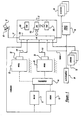
- Figure 1 is a block diagram of a vehicle illustrating various components related to the present invention;
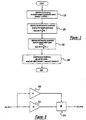
- Figures 2-6 are block diagrams of embodiments in which the invention is used to advantage; and
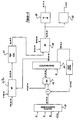
- Figure 7 is a block diagram illustrating an alternative embodiment of the present invention.
-
- Referring to Figure 1,
internal combustion engine 10 andmotor 11 of a vehicle (not shown) are shown coupled to transmission 14.Engine 10 andmotor 11 can be coupled in various ways known to those skilled in the art, such, for example, in a parallel fashion, a series fashion, or any combination thereof. Motor 11 can be an electric motor capable of supplying power to or receiving power from transmission 14. For example,motor 11 can be used to provide regenerative braking or to provide the vehicle tractive force from batteries (not shown) that store energy. Transmission 14 is coupled to a first set ofdrive wheels 20. In addition, to provide all wheel drive, transmission 14 can also be coupled to a second set ofdrive wheels 22. Transmission 14 can be a combined gear set and torque converter, a continuously variable transmission, or any other power transfer unit known to those skilled in the art and suggested by this disclosure. - Continuing with Figure 1,
accelerator pedal 40 is shown communicating with the driver's foot 42. Accelerator pedal position (PP) is measured by pedal position sensor 134 and sent to controller 12. - Controller 12 receives various signals from sensors coupled to
engine 10,motor 11, and the vehicle, in addition to those signals previously discussed, including: first measurement of vehicle speed (VS1) ofwheel 20 fromsensor 30, second measurement of vehicle speed (VS2) ofwheel 22 fromsensor 32, measurement of vehicle acceleration (SIGNAL1) fromaccelerometer 50, and various other signals fromsensors 52. These other signals include engine coolant temperature (ECT), and air charge temperature (ACT). Also, controller 12 sends signals to actuators 72. - Accelerometer 50 can also be coupled to
airbag system 60. Thus, according to the present invention, a single sensor can be used for both an airbag system and a vehicle monitoring system. In addition,accelerometer 50 is capable of outputting a signal representative of vehicle acceleration at all vehicle speeds, including zero vehicle speed. In other words, determining vehicle acceleration from a vehicle speed sensor may provide degraded performance at low vehicle speeds. This is because the pickup, sometimes magnetic, which generates a signal when a certain point of the vehicle wheel rotates past the pickup. If the vehicle wheel is not rotating, no signal is produced and determinations of vehicle speed and/or vehicle acceleration are degraded. However, the accelerometer is capable of outputting a signal independent of vehicle speed, and thus the present invention can monitor even at low vehicle speeds. - In the embodiment described herein, controller 12 is a conventional microcomputer including:
microprocessor unit 102, input/output ports 104,electronic memory chip 106, which is an electronically programmable memory in this particular example,random access memory 108, and a conventional data bus. - In the embodiment described herein,
engine 10 is electronically controlled by an electronic throttle control system (not shown). In such a system, the drive unit, which in this case isengine 10,motor 11, and transmission 14, is controlled to produce a desired vehicle acceleration. Such an acceleration control system is described later herein with particular reference to Figures 4-6. Also, controller 12 provides a speed control function wherein vehicle speed is controlled to a desired speed set by the vehicle driver. - Referring now to Figure 2, a routine is described for monitoring the electronically controlled drive units in the vehicle. First, in
step 200, a determination is made as to whether speed control is active. When the answer tostep 200 is NO, the routine continues to step 210. Instep 210, desired acceleration (desrate, or acc_dd_req) is determined based in part on a function (f1) of pedal position (PP) and vehicle speed (VS1) as described later herein. In an alternative embodiment, desired acceleration (desrate, or acc_dd_req) can also be adjusted based on actuation of the brake pedal. In addition, in still another embodiment, desired acceleration (desrate, or acc_dd_req) can also be adjusted based on the position of a gear selector. For example, in automatic transmissions, the level that selects P,R,N,D,L,1 (park, reverse, neutral, drive, low, low 1, etc.) is taken into account in determining desired acceleration. In still another embodiment, desired acceleration can be modified depending on whether a switch is set to a "sport" mode or a "fuel economy" mode. Then, instep 220, actual vehicle acceleration (actualrate) is determined as described later herein with particular reference to Figure 3. - Continuing with Figure 2, in
step 230, a determination is made as to whether actual acceleration (actualrate) is greater than the desired acceleration plus a first calibratable threshold (T1). When the answer tostep 230 is NO, timer is reset to zero instep 240. Otherwise, timer is incremented by the computer loop time (looptime) instep 250. Next, instep 260, a determination is made as to whether actual acceleration (actualrate) is greater than the desired acceleration plus a second calibratable threshold (T2) or timer is greater than third calibratable threshold (T3). In one embodiment, threshold T2 is greater than threshold T1. - When the answer to
step 260 is YES, a reaction is initiated instep 270. This reaction is in a preferable embodiment, decreasing engine torque. Engine torque can be decreased in a variety of methods, including decreasing fuel amount, decreasing air amount, retarding ignition timing, deactivating cylinders, or any other method known to those skilled in the art in view of this disclosure to reduce engine torque. Also, a reaction can be changing a transmission gear ratio to produce less wheel torque or engaging ancillary devices to consume engine torque. Further, a reaction may be to reduce motor torque or causemotor 11 to act as a generator, thereby absorbing energy and reducing wheel torque. Further still, a reaction may be to reduce vehicle acceleration by any method listed above herein. - Referring now to Figure 3, a routine is described for determining actual vehicle acceleration. First, in
step 310, the routine determines a first temporary acceleration (tempratel) based onacceleration sensor 50. Then, instep 320, the routine determines a second temporary acceleration (temprate2) based on first vehicle speed signal (VS1). In particular, a derivative of vehicle speed is used. In one embodiment, a lead lag filter is used to approximate a derivative and also reduce noise. Then, instep 330, the routine determines a third temporary acceleration (temprate3) based on second vehicle speed signal (VS2). Again, a lead lag filter can be used to approximate a derivative and also reduce noise. Finally, instep 340, actual acceleration (actualrate) used for monitoring is determined based on a maximum of the first through third temporary accelerations. - In the above embodiment, all three acceleration measurements are used. In alternative embodiments, various combination of these can be used, such as, for example, the maximum of tempratel and temprate2. Also, a single measurement alone can be used.
- Referring now to Figure 4, a control system is described for controlling the engine and electronic throttle. Desired acceleration from the driver, or driver demanded acceleration (acc_dd_req), is determined based on pedal position (PP) and vehicle speed (VS), with modifications for barometric pressure (BP) and engine and air temperatures (ECT, ACT) in
block 410. Then, the difference between driver demanded acceleration and "droop" control output (accl_droop) is compared with desired acceleration from speed control (accl_spd_req). In particular, a maximum of these two values is determined as a arbitrated desired acceleration (accl_arb_req) fromblock 412. "Droop" control is described later herein with particular reference to Figure 5. Also, desired acceleration from speed control (accl_spd_req) is determined based on a vehicle speed error between a set speed and an actual vehicle speed. In one embodiment, the vehicle speed error is used in conjunction with a non-linear gain function to produce (accl_spd_req). For example, when speed error is between first and second speed error limits, accl_spd_req is linearly related to speed error. The speed error limits may be, plus andminus 3 MPH, for example. Outside these speed error limits, desired acceleration may be limited to a fixed value, such as 1.5 MPH/sec, for example. - Then, this first arbitrated acceleration, accl_arb_req, and vehicle speed (VS) are used to control vehicle acceleration in
block 414 as described with particular reference to Figure 6. The output of the acceleration control is a desired wheel torque value (tqw_arb_req) and a closed loop control torque (tqw_arb_cl). - Continuing with Figure 4, a desired wheel torque from traction control (trc_tqw_req), a desired wheel torque from vehicle speed limiting (vslim_tqw_req), and acceleration control desired wheel torque (tqw_arb_req) are compared in
block 416. In particular, desired wheel torque from traction control is a desired wheel torque to prevent wheel slippage while desired wheel torque from vehicle speed limiting is a desired wheel torque to prevent vehicle speed (VS) from exceeding a limit value. The output of block 416 (tqw_arb_lim), which is the minimum of trc_tqw_req, vslim_tqw_req, and tqw_arb_req, is then converted to engine torque via the effective gear ratio (including torque converter multiplication) inblock 417 to produce (tqe_arb_lim). Next, a maximum allowed torque acceptable from transmission 14 (tqe_lim_tran), a desired engine torque from engine speed limiting (tqe_lim_rpm), and tqe_arb_lim are fed to block 418. Further, tqw_arb_req (after being converted by effective gear ratio into engine torque) is fed to block 418. The output ofblock 418, the requested engine brake torque (tqe_brk_req), is the minimum of the inputs to block 418. This requested engine brake torque (tqe_brk_req) is then converted to a desired airflow (tqe_des_am) inblock 420 and a desired torque ratio (tr_desired) inblock 422. Then, the desired airflow is used to control the electronic throttle using methods known to those skilled in the art in view of this disclosure. - Referring now to Figure 5, droop control is described. Closed loop control torque (tqw_arb_cl) is multiplied by first gain K1 in
block 510 and by second gain K2 inblock 512, where K2 represents vehicle mass and wheel diameter.
In an alternative embodiment, gain K1 is a function of speed error and saturates outside a linear region. Also, this function can be different depending on the sign of the error to give expected drive feel both up and down hills. Then, the output ofblocks block 514. The output is accl_droop, whose use is described above herein. - Referring now acceleration control to Figure 6, arbitrated desired acceleration (accl_arb_req) is fed to a low pass filter with first filter coefficient (t1) in
block 610. Also, vehicle speed (VS) is fed to a filter representing an approximate derivative with second and third filter coefficients (t2,t3) inblock 612. The output ofblocks block 614.Select block 614 selects one of the two inputs. In particular,select block 614 prevents integrator wind up by providing zero error when integrator output reaches a preselected value, or when the desired acceleration is arbitrated out later on in the control system, such as, for example, based on some other control system. The output ofblock 614 is fed to block 616, which represents an integrator. The difference between the output ofblock 616 and vehicle speed (VS) represents closed loop control torque (tqw_arb_cl). This is then added to feedforward control torque (tqw_arb_ff) and produces tqw_arb_req. Feedforward control torque (tqw_arb_ff) is determined from a table based on arbitrated desired acceleration (accl_arb_req) and vehicle speed (VS) inblock 618. In an alternative embodiment, this can be calculated based on vehicle mass, wheel diameter, and running losses. - Summarising Figures 4-6, pedal position (PP) and vehicle speed (VS) are used to look-up a value of intended vehicle acceleration. The table is structured with pedal position (PP) in rows and vehicle speed (VS) in columns. It is calibrated, first, by placing an acceleration value of 0 at each intersection of pedal position and vehicle speed where steady state operation is desired. Increasingly positive values of acceleration would be added upward and decreasingly negative values downward for each column to obtain the desired throttle tip-in feel at that speed. A smoothing operation should be done across each row to assure smooth convergence onto the steady state speed under constant pedal position input. The output of this table is modified with multipliers for barometric pressure and operating temperature.
- The resulting driver demand requested acceleration modified to simulate droop is arbitrated against an acceleration request from vehicle speed control. The arbitration is based on the maximum of the two requesters. If vehicle speed control is not active, a sufficiently large negative request is issued to prevent it from interfering with the driver demand. If vehicle speed control is active and the driver attempts to override the system with the pedal, this will be done once the pedal input produces an acceleration that exceeds that of the speed control.
Vehicle speed control will automatically be limited to maximum positive and negative accelerations specified in the driver demand tables. - Acceleration control is responsible for converting desired acceleration into a wheel torque request and consists of the following sub-tasks:
- A feed-forward term represents the driver demand or speed control response to acceleration input for nominal level road conditions. It operates by converting the requested acceleration and current vehicle speed into a wheel torque by using conversions based on vehicle mass and running loss coefficients, respectively. Because no integration or filtering is involved, the response to input is immediate.
- A closed-loop term is calculated by first integrating desired acceleration into a target vehicle speed. The error between this target speed and actual vehicle speed multiplied by a gain and becomes the closed-loop term. Because the feed-forward term responds immediately with a level road response, any deviation between target and actual speeds is due to road and/or vehicle load variations. If the vehicle is operating under nominal mass and running losses on a level road, this term will be zero.
- A simulated droop (droop control) is achieved by taking the closed-loop term and feeding it backward through the vehicle mass term used in the Feed-forward Term. This resulting droop acceleration term is then subtracted from the driver demanded value of desired acceleration before it feeds into the speed control arbitration scheme. This would essentially negate the action of the Closed-loop Term, so this droop acceleration term is multiplied by a calibration coefficient that specifies how much compensation is desired for specific conditions (K1). A value of 0 would indicate no droop and the system would provide full-time speed control under driver demand. A value of 1 would indicate full droop and the system would provide no closed loop compensation. In one embodiment, a value of 0 would be used for downhill conditions and approximately .5 for uphill. This would provide full compensation downhill while restricting the amount of droop on an uphill to half what it normally would be.
- An advantage of the above structure is that a monitoring structure is provided that is applicable to many different drive unit configurations since the end result of vehicle acceleration is used. Further, since the arbitration between cruise control and driver demand uses acceleration, disadvantages of torque arbitration schemes are overcome. In particular, with prior art torque arbitration schemes, the maximum of driver demanded torque and cruise control torque was selected. However, if negative torque is needed to control vehicle speed during cruise operation, such as down a hill, such control is not available since zero torque is typically the minimum torque allowed when the driver is not actuating the pedal. Alternatively, If negative torques are used in the driver demand table, then tip-out performance, or foot off pedal performance, and coasting driveability are sacrificed on level roads. Driveability is sacrificed in level roads since the negative torque requests may cause downshifts on some tip-outs. Such transmission shifting can degrade drive feel on level roads. The prior art torque arbitration approach does not suggest how to resolve this conflict.
- In the above described embodiment, acceleration control
and monitoring are both within a single microprocessor 12.
An alternative embodiment is described in Figure 7, where
acceleration control is conducted in
controller 1 and acceleration monitoring is conducted incontroller 2. In such an approach, the routines described in Figures 2-3 would be performed incontroller 2 while the control described in Figures 4-6 would be performed incontroller 1. -
Claims (13)
- A method for monitoring and controlling a vehicle drive system, the method comprising:determining a preselected vehicle acceleration;calculating an actual vehicle acceleration based on an accelerometer (50) coupled to the vehicle; andinitiating a reaction when said actual vehicle acceleration is greater than said preselected vehicle acceleration.
- A method as claimed in Claim 1, wherein said accelerometer is capable of outputting a signal representative of vehicle acceleration at all vehicle speeds.
- A method as claimed in Claim 2, wherein said sensor is an accelerometer coupled to an airbag system.
- A method as claimed in Claim 1, wherein said step of initiating said reaction reduces vehicle acceleration engine output or wheel torque.
- A method as claimed in Claim 1, wherein said preselected acceleration is based on one of a driver command and a cruise control command.
- A method as claimed in Claim 1, wherein said step of determining an actual vehicle acceleration further comprises selecting a maximum of a first measured acceleration based on said sensor and a second measured acceleration based on a second sensor.
- A method as claimed in Claim 8, wherein said second sensor is a vehicle speed sensor.
- A system for a vehicle having an electronically controlled drive unit, the system comprising:a first controller (12) that determines a desired acceleration based on an operator command and adjusts a drive unit operating parameter to achieve said desired acceleration;a second controller (12) that determines a preselected acceleration of the vehicle based on said desired acceleration, determines an actual vehicle acceleration based on a sensor (50,52) coupled to the vehicle, and initiates a reaction when said actual vehicle acceleration is greater than said preselected acceleration.
- A system as claimed in Claim 8 further comprising a airbag module coupled to said sensor.
- A system as claimed in Claim 8, wherein said second controller further determines said actual vehicle acceleration based on a maximum of a first acceleration from said sensor and a second acceleration from a second sensor coupled to the vehicle.
- A system as claimed in Claim 10, wherein said second sensor is a vehicle speed sensor.
- A system as claimed in Claim 10, wherein said second controller further discontinues said reaction when speed control is active.
- A method for monitoring and controlling a vehicle drive system, the method comprising:determining a first reference vehicle acceleration based on a driver command;determining a second reference vehicle acceleration based on an automatic cruise control system;controlling the vehicle drive system based on one of said first reference vehicle acceleration and said second reference vehicle acceleration;calculating an actual vehicle acceleration based on a sensor coupled to the vehicle; andinitiating a reaction when said actual vehicle acceleration is greater than said one of said first and second reference vehicle acceleration.
Applications Claiming Priority (2)
| Application Number | Priority Date | Filing Date | Title |
|---|---|---|---|
| US09/532,685 US6304809B1 (en) | 2000-03-21 | 2000-03-21 | Engine control monitor for vehicle equipped with engine and transmission |
| US532685 | 2000-03-21 |
Publications (1)
| Publication Number | Publication Date |
|---|---|
| EP1136304A2 true EP1136304A2 (en) | 2001-09-26 |
Family
ID=24122746
Family Applications (1)
| Application Number | Title | Priority Date | Filing Date |
|---|---|---|---|
| EP01302352A Withdrawn EP1136304A2 (en) | 2000-03-21 | 2001-03-14 | Acceleration monitor for vehicle |
Country Status (2)
| Country | Link |
|---|---|
| US (2) | US6304809B1 (en) |
| EP (1) | EP1136304A2 (en) |
Cited By (3)
| Publication number | Priority date | Publication date | Assignee | Title |
|---|---|---|---|---|
| CN100394005C (en) * | 2003-10-06 | 2008-06-11 | 日野自动车株式会社 | acceleration control device |
| EP2070799A3 (en) * | 2007-11-05 | 2012-03-28 | GM Global Technology Operations LLC | Method for predicting an operator torque request of a hybrid powertrain system |
| DE102005022294B4 (en) * | 2004-05-14 | 2016-02-18 | General Motors Corp. (N.D.Ges.D. Staates Delaware) | Acceleration limit for a vehicle |
Families Citing this family (68)
| Publication number | Priority date | Publication date | Assignee | Title |
|---|---|---|---|---|
| US6814173B2 (en) * | 2000-07-31 | 2004-11-09 | Dynamotive, Llc | System and method for minimizing injury after a loss of control event |
| US6554091B2 (en) | 2000-09-08 | 2003-04-29 | Visteon Global Technologies, Inc. | Engine output controller |
| US6347680B1 (en) * | 2000-09-08 | 2002-02-19 | Visteon Global Technologies, Inc. | Engine output controller |
| US6945910B1 (en) | 2000-09-26 | 2005-09-20 | Ford Global Technologies, Llc | Vehicle trajectory control system |
| US6543565B1 (en) * | 2000-11-10 | 2003-04-08 | Ford Motor Company | Method and system for collecting regenerative braking energy in a parallel hybrid electric vehicle |
| US6411882B1 (en) * | 2000-12-02 | 2002-06-25 | Ford Global Technologies, Inc. | Drive-by-wire vehicle engine output control system |
| US6535808B1 (en) * | 2001-12-19 | 2003-03-18 | Delphi Technologies, Inc. | Deceleration control for automatic automotive speed control apparatus |
| US20040084237A1 (en) * | 2002-05-30 | 2004-05-06 | Petrie Alfred E. | Vehicle cruise control system |
| JP3977701B2 (en) * | 2002-07-17 | 2007-09-19 | 日野自動車株式会社 | Accelerator control device |
| ES2353872T3 (en) * | 2003-01-28 | 2011-03-07 | Thomson Licensing | DIFFUSION SPACED IN ROBUST MODE. |
| JP3982445B2 (en) * | 2003-04-10 | 2007-09-26 | 株式会社デンソー | Starting device for vehicle occupant protection device |
| DE10337002A1 (en) * | 2003-08-12 | 2005-03-17 | Zf Friedrichshafen Ag | Method for controlling the drive power distribution in a motor vehicle with hybrid drive |
| WO2005047048A1 (en) * | 2003-11-14 | 2005-05-26 | Continental Teves Ag & Co.Ohg | Method for reducing the fuel consumption of a motor vehicle |
| JP2005193811A (en) * | 2004-01-08 | 2005-07-21 | Toyota Motor Corp | Integrated control system for vehicles |
| US7580786B2 (en) * | 2004-02-26 | 2009-08-25 | Ford Global Technologies, Llc | Vehicle and nonlinear control method for vehicle |
| FR2869997B1 (en) * | 2004-05-04 | 2006-06-23 | Commissariat Energie Atomique | LOOP ACCELEROMETER CLOSED WITH ERROR DETECTION |
| US9327726B2 (en) | 2004-10-05 | 2016-05-03 | Vision Works Ip Corporation | Absolute acceleration sensor for use within moving vehicles |
| US9878693B2 (en) | 2004-10-05 | 2018-01-30 | Vision Works Ip Corporation | Absolute acceleration sensor for use within moving vehicles |
| US8437935B2 (en) | 2004-10-05 | 2013-05-07 | Vision Works Ip Corporation | Absolute acceleration sensor for use within moving vehicles |
| ITBO20050025A1 (en) * | 2005-01-19 | 2006-07-20 | Magneti Marelli Powertrain Spa | METHOD AND DEVICE FOR THE MANAGEMENT OF THE CRUISE OF A ROAD VEHICLE |
| JP2007038933A (en) * | 2005-08-04 | 2007-02-15 | Toyota Motor Corp | Vehicle travel control device |
| US7632212B2 (en) * | 2005-11-25 | 2009-12-15 | Toyota Jidosha Kabushiki Kaisha | Hybrid vehicle and control method of the same |
| US7603228B2 (en) * | 2006-05-25 | 2009-10-13 | Ford Global Technologies, Llc | Haptic apparatus and coaching method for improving vehicle fuel economy |
| JP2008043135A (en) * | 2006-08-09 | 2008-02-21 | Honda Motor Co Ltd | Control device for vehicle motor |
| US7490000B2 (en) | 2006-08-29 | 2009-02-10 | Ford Motor Company | Fuel economy control system and control strategy |
| JP4311451B2 (en) * | 2007-01-16 | 2009-08-12 | トヨタ自動車株式会社 | Vehicle and control method thereof |
| US7604076B2 (en) * | 2007-02-19 | 2009-10-20 | Chrysler Group Llc | System and method for reducing throttling losses during regenerative braking |
| US7801661B2 (en) * | 2007-06-08 | 2010-09-21 | Ford Global Technologies | Power boost system and method |
| JP4931714B2 (en) * | 2007-07-11 | 2012-05-16 | 株式会社デンソー | Vehicle speed control device and vehicle speed control program |
| US8108136B2 (en) * | 2007-08-09 | 2012-01-31 | Ford Global Technologies, Llc. | Driver advisory system for fuel economy improvement of a hybrid electric vehicle |
| US9726088B2 (en) * | 2007-10-30 | 2017-08-08 | Ford Global Technologies, Llc | System and method for obtaining an adjustable accelerator pedal response in a vehicle powertrain |
| US7699129B2 (en) * | 2007-10-31 | 2010-04-20 | Ford Global Technologies, Llc | Method and system for alerting a driver that a motive power system is about to be activated |
| US9604526B2 (en) * | 2008-12-05 | 2017-03-28 | Ford Global Technologies, Llc | Method for providing improved driveability for a vehicle |
| US9834198B2 (en) * | 2009-07-14 | 2017-12-05 | Ford Global Technologies, Llc | Generator power control |
| IT1396698B1 (en) * | 2009-11-11 | 2012-12-14 | Nilfisk Advance Spa | PERFECT VEHICLE FOR THE TREATMENT AND CLEANING OF FLOORS AND SOILS |
| US9255529B2 (en) | 2010-02-23 | 2016-02-09 | Honda Motor Co., Ltd. | Longitudinal G adjusted throttle response |
| US20110307130A1 (en) * | 2010-05-13 | 2011-12-15 | Coda Automotive, Inc. | Selectable driving modes |
| US9099948B2 (en) * | 2010-07-13 | 2015-08-04 | Remy Technologies, Llc | Alternator assembly with opportunistic voltage regulation system |
| US8392084B2 (en) | 2010-09-03 | 2013-03-05 | Honda Motor Co., Ltd | Increasing all-wheel drive system calibration efficiency through hardware-in-the-loop simulation techniques |
| US9187100B2 (en) * | 2010-12-20 | 2015-11-17 | Cummins Inc. | Hybrid power train flexible control integration |
| US8666577B2 (en) * | 2012-04-26 | 2014-03-04 | Ford Global Technologies, Llc | Economic cruise control |
| US9416743B2 (en) | 2012-10-03 | 2016-08-16 | GM Global Technology Operations LLC | Cylinder activation/deactivation sequence control systems and methods |
| US9382853B2 (en) | 2013-01-22 | 2016-07-05 | GM Global Technology Operations LLC | Cylinder control systems and methods for discouraging resonant frequency operation |
| US9638121B2 (en) | 2012-08-24 | 2017-05-02 | GM Global Technology Operations LLC | System and method for deactivating a cylinder of an engine and reactivating the cylinder based on an estimated trapped air mass |
| US9376973B2 (en) | 2012-09-10 | 2016-06-28 | GM Global Technology Operations LLC | Volumetric efficiency determination systems and methods |
| US9458780B2 (en) | 2012-09-10 | 2016-10-04 | GM Global Technology Operations LLC | Systems and methods for controlling cylinder deactivation periods and patterns |
| US9458778B2 (en) | 2012-08-24 | 2016-10-04 | GM Global Technology Operations LLC | Cylinder activation and deactivation control systems and methods |
| US9534550B2 (en) | 2012-09-10 | 2017-01-03 | GM Global Technology Operations LLC | Air per cylinder determination systems and methods |
| US9458779B2 (en) | 2013-01-07 | 2016-10-04 | GM Global Technology Operations LLC | Intake runner temperature determination systems and methods |
| US9650978B2 (en) | 2013-01-07 | 2017-05-16 | GM Global Technology Operations LLC | System and method for randomly adjusting a firing frequency of an engine to reduce vibration when cylinders of the engine are deactivated |
| US9719439B2 (en) * | 2012-08-24 | 2017-08-01 | GM Global Technology Operations LLC | System and method for controlling spark timing when cylinders of an engine are deactivated to reduce noise and vibration |
| US9726139B2 (en) | 2012-09-10 | 2017-08-08 | GM Global Technology Operations LLC | System and method for controlling a firing sequence of an engine to reduce vibration when cylinders of the engine are deactivated |
| US10227939B2 (en) | 2012-08-24 | 2019-03-12 | GM Global Technology Operations LLC | Cylinder deactivation pattern matching |
| JP2014104846A (en) * | 2012-11-27 | 2014-06-09 | Toyota Motor Corp | Hybrid vehicle control device |
| US10570839B2 (en) * | 2012-11-29 | 2020-02-25 | Ford Global Technologies, Llc | System and method for improving vehicle performance |
| US9494092B2 (en) | 2013-03-13 | 2016-11-15 | GM Global Technology Operations LLC | System and method for predicting parameters associated with airflow through an engine |
| CN105722735B (en) * | 2013-06-03 | 2018-01-30 | E-Aam 传动系统公司 | Method for determining vehicle speed parameters |
| US9371002B2 (en) | 2013-08-28 | 2016-06-21 | Vision Works Ip Corporation | Absolute acceleration sensor for use within moving vehicles |
| US9441550B2 (en) | 2014-06-10 | 2016-09-13 | GM Global Technology Operations LLC | Cylinder firing fraction determination and control systems and methods |
| US9341128B2 (en) | 2014-06-12 | 2016-05-17 | GM Global Technology Operations LLC | Fuel consumption based cylinder activation and deactivation control systems and methods |
| US9556811B2 (en) | 2014-06-20 | 2017-01-31 | GM Global Technology Operations LLC | Firing pattern management for improved transient vibration in variable cylinder deactivation mode |
| US9248745B1 (en) | 2014-09-16 | 2016-02-02 | Robert Bosch Gmbh | Wheel stability control based on the moment of an electrical motor |
| US9599047B2 (en) | 2014-11-20 | 2017-03-21 | GM Global Technology Operations LLC | Combination cylinder state and transmission gear control systems and methods |
| US10337441B2 (en) | 2015-06-09 | 2019-07-02 | GM Global Technology Operations LLC | Air per cylinder determination systems and methods |
| US9555706B1 (en) | 2015-11-12 | 2017-01-31 | Caterpillar Inc. | Traction control system and process for a machine having a work implement |
| CN109070745B (en) | 2016-03-25 | 2021-09-03 | 康明斯有限公司 | System and method for adjusting vehicle operating parameters based on vehicle duty cycle |
| US20190256094A1 (en) * | 2018-02-22 | 2019-08-22 | GM Global Technology Operations LLC | Architecture and methodology for target states determination of performance vehicle motion control |
| KR20250089319A (en) * | 2023-12-11 | 2025-06-18 | 현대자동차주식회사 | Apparatus for controlling autonomous driving and method thereof |
Citations (1)
| Publication number | Priority date | Publication date | Assignee | Title |
|---|---|---|---|---|
| US5692472A (en) | 1995-09-28 | 1997-12-02 | Robert Bosch Gmbh | Method and arrangement for controlling the drive unit of a motor vehicle |
Family Cites Families (30)
| Publication number | Priority date | Publication date | Assignee | Title |
|---|---|---|---|---|
| US4232835A (en) * | 1979-07-12 | 1980-11-11 | E. I. Du Pont De Nemours And Company | Bobbin chuck |
| DE3721605A1 (en) | 1986-07-01 | 1988-01-14 | Mazda Motor | CONTROL SYSTEM FOR COMBUSTION ENGINES |
| US4854283A (en) | 1986-11-28 | 1989-08-08 | Nippondenso Co., Ltd. | Throttle valve control apparatus |
| JPH086611B2 (en) | 1987-03-26 | 1996-01-29 | 日産自動車株式会社 | In-vehicle engine control device |
| GB8707754D0 (en) * | 1987-04-01 | 1987-05-07 | Inertia Switch Ltd | Acceleration responsive device |
| US5137104A (en) * | 1987-10-06 | 1992-08-11 | Nissan Motor Company, Limited | System and method for automatically controlling vehicle speed to desired cruise speed |
| DE3915840C2 (en) * | 1988-05-19 | 1996-12-19 | Volkswagen Ag | Procedure to avoid accidental acceleration |
| KR930004603B1 (en) | 1988-05-20 | 1993-06-01 | 미쯔비시 지도샤 고교 가부시끼가이샤 | Vehicle Engine Control |
| JP2768710B2 (en) * | 1988-09-17 | 1998-06-25 | ローベルト・ボッシュ・ゲゼルシャフト・ミット・ベシュレンクテル・ハフツング | A device that activates a protection device that protects a vehicle occupant |
| JP2764959B2 (en) | 1988-11-14 | 1998-06-11 | 三菱自動車工業株式会社 | Automatic cruise control system for vehicles |
| US5233530A (en) | 1988-11-28 | 1993-08-03 | Mitsubishi Jidosha Kogyo Kabushiki Kaisha | Engine controlling system which reduces the engine output upon detection of an abnormal condition |
| US5078109A (en) | 1989-01-31 | 1992-01-07 | Mitsubishi Jidosha Kogyo Kabushiki Kaisha | Engine output controlling method |
| US5400865A (en) | 1989-01-31 | 1995-03-28 | Mitsubishi Jidosha Kogyo Kabushiki Kaisha | Engine output control apparatus |
| US5019939A (en) | 1989-10-24 | 1991-05-28 | Ag Communication Systems Corp. | Thermal management plate |
| DE69101500T2 (en) * | 1990-01-25 | 1994-08-18 | Mitsubishi Motors Corp | Control system for the drive power of motor vehicles. |
| JP2964622B2 (en) * | 1990-11-13 | 1999-10-18 | 日産自動車株式会社 | Front and rear wheel torque distribution control device for four-wheel drive vehicles |
| JPH04203250A (en) | 1990-11-29 | 1992-07-23 | Mitsubishi Motors Corp | Drive-by-wire type vehicle with travelling load compensating system speed control section |
| DE4111023C2 (en) | 1991-04-05 | 2003-11-20 | Bosch Gmbh Robert | Electronic system for a vehicle |
| JP3139811B2 (en) * | 1992-02-28 | 2001-03-05 | 株式会社日立製作所 | Engine control device |
| JP3301183B2 (en) * | 1993-11-24 | 2002-07-15 | 日産自動車株式会社 | Driving force distribution control device between front and rear wheels of vehicle |
| JP3204840B2 (en) * | 1994-05-26 | 2001-09-04 | 株式会社デンソー | Constant speed cruise control device for vehicles |
| JP3539696B2 (en) | 1995-02-10 | 2004-07-07 | 富士重工業株式会社 | Constant-speed running control device for electric vehicles |
| JP3341554B2 (en) * | 1995-04-27 | 2002-11-05 | 日産自動車株式会社 | Constant speed cruise control device for vehicles |
| US5625588A (en) | 1995-06-06 | 1997-04-29 | Micron Technology, Inc. | Single-ended sensing using global bit lines for DRAM |
| US5673668A (en) | 1996-08-05 | 1997-10-07 | Ford Global Technologies, Inc. | Method and apparatus for electronic throttle monitoring |
| DE19704313C2 (en) | 1997-02-05 | 2003-07-03 | Siemens Ag | Method and device for controlling an internal combustion engine |
| US6021370A (en) * | 1997-08-05 | 2000-02-01 | Cummins Engine Company, Inc. | Vehicle/engine acceleration rate management system |
| US6138071A (en) * | 1997-09-16 | 2000-10-24 | Honda Giken Kogyo Kabushiki Kaisha | Cruising control apparatus |
| US6078860A (en) * | 1998-05-14 | 2000-06-20 | Ford Global Technologies, Inc. | Method and system for controlling the speed of a vehicle |
| US6134499A (en) * | 1998-05-29 | 2000-10-17 | Cummins Engine Company, Inc. | System for controlling road speed of a vehicle driven by an internal combustion engine |
-
2000
- 2000-03-21 US US09/532,685 patent/US6304809B1/en not_active Expired - Lifetime
- 2000-06-26 US US09/606,802 patent/US6295500B1/en not_active Expired - Fee Related
-
2001
- 2001-03-14 EP EP01302352A patent/EP1136304A2/en not_active Withdrawn
Patent Citations (1)
| Publication number | Priority date | Publication date | Assignee | Title |
|---|---|---|---|---|
| US5692472A (en) | 1995-09-28 | 1997-12-02 | Robert Bosch Gmbh | Method and arrangement for controlling the drive unit of a motor vehicle |
Cited By (3)
| Publication number | Priority date | Publication date | Assignee | Title |
|---|---|---|---|---|
| CN100394005C (en) * | 2003-10-06 | 2008-06-11 | 日野自动车株式会社 | acceleration control device |
| DE102005022294B4 (en) * | 2004-05-14 | 2016-02-18 | General Motors Corp. (N.D.Ges.D. Staates Delaware) | Acceleration limit for a vehicle |
| EP2070799A3 (en) * | 2007-11-05 | 2012-03-28 | GM Global Technology Operations LLC | Method for predicting an operator torque request of a hybrid powertrain system |
Also Published As
| Publication number | Publication date |
|---|---|
| US6304809B1 (en) | 2001-10-16 |
| US6295500B1 (en) | 2001-09-25 |
Similar Documents
| Publication | Publication Date | Title |
|---|---|---|
| US6304809B1 (en) | Engine control monitor for vehicle equipped with engine and transmission | |
| US7236871B2 (en) | Acceleration limiting for a vehicle | |
| US7131708B2 (en) | Coordinated regenerative and engine retard braking for a hybrid vehicle | |
| EP1970240B1 (en) | Engine start control system for hybrid vehicle | |
| US8437938B2 (en) | Axle torque based cruise control | |
| US7163487B2 (en) | Engine retard operation scheduling and management in a hybrid vehicle | |
| US6405587B1 (en) | System and method of controlling the coastdown of a vehicle | |
| US5558178A (en) | Method and arrangement for controlling a motor vehicle | |
| EP1186462A2 (en) | Engine output and gear transmission ratio controller | |
| US8630778B2 (en) | Controlling a throttle for fuel cut acquisition | |
| EP0933246A2 (en) | Control system for hybrid vehicle | |
| US20120309585A1 (en) | Method and apparatus for executing a transmission shift in a powertrain system including a torque machine and an engine | |
| JP2006160238A (en) | Vehicle and control method thereof | |
| US6842686B2 (en) | Method and device for controlling the drive unit of a vehicle | |
| US7222012B2 (en) | Axle torque based powertrain braking with range selection for coordinated torque control (CTC) | |
| US7774108B2 (en) | Front and rear wheel drive vehicle | |
| US6182002B1 (en) | Vehicle acceleration based traction control | |
| CN115703453B (en) | Shaft torque response system and method | |
| JP4167805B2 (en) | Automobile driveline management method and apparatus for implementing the same | |
| JP2002518233A5 (en) | ||
| KR20020087465A (en) | Method and device for controlling the drive unit of a vehicle | |
| JP2019206956A (en) | Vehicle system | |
| US8019524B2 (en) | Control apparatus for driving source | |
| JP3551772B2 (en) | Vehicle driving force control device | |
| JP2009196454A (en) | Vehicle, drive device, and vehicle control method |
Legal Events
| Date | Code | Title | Description |
|---|---|---|---|
| PUAI | Public reference made under article 153(3) epc to a published international application that has entered the european phase |
Free format text: ORIGINAL CODE: 0009012 |
|
| AK | Designated contracting states |
Kind code of ref document: A2 Designated state(s): AT BE CH CY DE DK ES FI FR GB GR IE IT LI LU MC NL PT SE TR |
|
| AX | Request for extension of the european patent |
Free format text: AL;LT;LV;MK;RO;SI |
|
| STAA | Information on the status of an ep patent application or granted ep patent |
Free format text: STATUS: THE APPLICATION HAS BEEN WITHDRAWN |
|
| 18W | Application withdrawn |
Effective date: 20041109 |