EP1135481B1 - New oligomeric conjugates liable to transfer biological molecules into cells - Google Patents
New oligomeric conjugates liable to transfer biological molecules into cells Download PDFInfo
- Publication number
- EP1135481B1 EP1135481B1 EP99959296A EP99959296A EP1135481B1 EP 1135481 B1 EP1135481 B1 EP 1135481B1 EP 99959296 A EP99959296 A EP 99959296A EP 99959296 A EP99959296 A EP 99959296A EP 1135481 B1 EP1135481 B1 EP 1135481B1
- Authority
- EP
- European Patent Office
- Prior art keywords
- integer
- cells
- transfer
- flu
- oligomeric conjugate
- Prior art date
- Legal status (The legal status is an assumption and is not a legal conclusion. Google has not performed a legal analysis and makes no representation as to the accuracy of the status listed.)
- Expired - Lifetime
Links
- 238000012546 transfer Methods 0.000 title claims abstract description 62
- 108091034117 Oligonucleotide Proteins 0.000 claims abstract description 67
- 108090000765 processed proteins & peptides Proteins 0.000 claims abstract description 48
- JLCPHMBAVCMARE-UHFFFAOYSA-N [3-[[3-[[3-[[3-[[3-[[3-[[3-[[3-[[3-[[3-[[3-[[5-(2-amino-6-oxo-1H-purin-9-yl)-3-[[3-[[3-[[3-[[3-[[3-[[5-(2-amino-6-oxo-1H-purin-9-yl)-3-[[5-(2-amino-6-oxo-1H-purin-9-yl)-3-hydroxyoxolan-2-yl]methoxy-hydroxyphosphoryl]oxyoxolan-2-yl]methoxy-hydroxyphosphoryl]oxy-5-(5-methyl-2,4-dioxopyrimidin-1-yl)oxolan-2-yl]methoxy-hydroxyphosphoryl]oxy-5-(6-aminopurin-9-yl)oxolan-2-yl]methoxy-hydroxyphosphoryl]oxy-5-(6-aminopurin-9-yl)oxolan-2-yl]methoxy-hydroxyphosphoryl]oxy-5-(6-aminopurin-9-yl)oxolan-2-yl]methoxy-hydroxyphosphoryl]oxy-5-(6-aminopurin-9-yl)oxolan-2-yl]methoxy-hydroxyphosphoryl]oxyoxolan-2-yl]methoxy-hydroxyphosphoryl]oxy-5-(5-methyl-2,4-dioxopyrimidin-1-yl)oxolan-2-yl]methoxy-hydroxyphosphoryl]oxy-5-(4-amino-2-oxopyrimidin-1-yl)oxolan-2-yl]methoxy-hydroxyphosphoryl]oxy-5-(5-methyl-2,4-dioxopyrimidin-1-yl)oxolan-2-yl]methoxy-hydroxyphosphoryl]oxy-5-(5-methyl-2,4-dioxopyrimidin-1-yl)oxolan-2-yl]methoxy-hydroxyphosphoryl]oxy-5-(6-aminopurin-9-yl)oxolan-2-yl]methoxy-hydroxyphosphoryl]oxy-5-(6-aminopurin-9-yl)oxolan-2-yl]methoxy-hydroxyphosphoryl]oxy-5-(4-amino-2-oxopyrimidin-1-yl)oxolan-2-yl]methoxy-hydroxyphosphoryl]oxy-5-(4-amino-2-oxopyrimidin-1-yl)oxolan-2-yl]methoxy-hydroxyphosphoryl]oxy-5-(4-amino-2-oxopyrimidin-1-yl)oxolan-2-yl]methoxy-hydroxyphosphoryl]oxy-5-(6-aminopurin-9-yl)oxolan-2-yl]methoxy-hydroxyphosphoryl]oxy-5-(4-amino-2-oxopyrimidin-1-yl)oxolan-2-yl]methyl [5-(6-aminopurin-9-yl)-2-(hydroxymethyl)oxolan-3-yl] hydrogen phosphate Polymers Cc1cn(C2CC(OP(O)(=O)OCC3OC(CC3OP(O)(=O)OCC3OC(CC3O)n3cnc4c3nc(N)[nH]c4=O)n3cnc4c3nc(N)[nH]c4=O)C(COP(O)(=O)OC3CC(OC3COP(O)(=O)OC3CC(OC3COP(O)(=O)OC3CC(OC3COP(O)(=O)OC3CC(OC3COP(O)(=O)OC3CC(OC3COP(O)(=O)OC3CC(OC3COP(O)(=O)OC3CC(OC3COP(O)(=O)OC3CC(OC3COP(O)(=O)OC3CC(OC3COP(O)(=O)OC3CC(OC3COP(O)(=O)OC3CC(OC3COP(O)(=O)OC3CC(OC3COP(O)(=O)OC3CC(OC3COP(O)(=O)OC3CC(OC3COP(O)(=O)OC3CC(OC3COP(O)(=O)OC3CC(OC3COP(O)(=O)OC3CC(OC3CO)n3cnc4c(N)ncnc34)n3ccc(N)nc3=O)n3cnc4c(N)ncnc34)n3ccc(N)nc3=O)n3ccc(N)nc3=O)n3ccc(N)nc3=O)n3cnc4c(N)ncnc34)n3cnc4c(N)ncnc34)n3cc(C)c(=O)[nH]c3=O)n3cc(C)c(=O)[nH]c3=O)n3ccc(N)nc3=O)n3cc(C)c(=O)[nH]c3=O)n3cnc4c3nc(N)[nH]c4=O)n3cnc4c(N)ncnc34)n3cnc4c(N)ncnc34)n3cnc4c(N)ncnc34)n3cnc4c(N)ncnc34)O2)c(=O)[nH]c1=O JLCPHMBAVCMARE-UHFFFAOYSA-N 0.000 claims abstract description 21
- 238000006116 polymerization reaction Methods 0.000 claims abstract description 21
- 210000004027 cell Anatomy 0.000 claims description 82
- 239000000203 mixture Substances 0.000 claims description 48
- 210000000172 cytosol Anatomy 0.000 claims description 40
- 238000002360 preparation method Methods 0.000 claims description 33
- 239000012528 membrane Substances 0.000 claims description 32
- RAXXELZNTBOGNW-UHFFFAOYSA-N imidazole Natural products C1=CNC=N1 RAXXELZNTBOGNW-UHFFFAOYSA-N 0.000 claims description 30
- 230000001413 cellular effect Effects 0.000 claims description 25
- 230000001687 destabilization Effects 0.000 claims description 25
- 239000002609 medium Substances 0.000 claims description 24
- 210000003855 cell nucleus Anatomy 0.000 claims description 22
- 230000014509 gene expression Effects 0.000 claims description 18
- 125000002883 imidazolyl group Chemical group 0.000 claims description 18
- 125000002496 methyl group Chemical group [H]C([H])([H])* 0.000 claims description 17
- 238000000338 in vitro Methods 0.000 claims description 16
- 238000000034 method Methods 0.000 claims description 16
- 210000002540 macrophage Anatomy 0.000 claims description 13
- 108020004414 DNA Proteins 0.000 claims description 11
- 239000002253 acid Substances 0.000 claims description 11
- 230000003834 intracellular effect Effects 0.000 claims description 11
- 108090000623 proteins and genes Proteins 0.000 claims description 10
- 230000005764 inhibitory process Effects 0.000 claims description 9
- 238000001727 in vivo Methods 0.000 claims description 8
- 210000004940 nucleus Anatomy 0.000 claims description 8
- 108091032973 (ribonucleotides)n+m Proteins 0.000 claims description 7
- 210000000612 antigen-presenting cell Anatomy 0.000 claims description 7
- 230000000890 antigenic effect Effects 0.000 claims description 7
- 230000015572 biosynthetic process Effects 0.000 claims description 7
- 108020004999 messenger RNA Proteins 0.000 claims description 7
- 239000000178 monomer Substances 0.000 claims description 7
- 238000006467 substitution reaction Methods 0.000 claims description 7
- 239000003153 chemical reaction reagent Substances 0.000 claims description 6
- 230000000295 complement effect Effects 0.000 claims description 6
- 210000004443 dendritic cell Anatomy 0.000 claims description 6
- 229940079593 drug Drugs 0.000 claims description 6
- 239000003814 drug Substances 0.000 claims description 6
- INDBQLZJXZLFIT-UHFFFAOYSA-N primaquine Chemical compound N1=CC=CC2=CC(OC)=CC(NC(C)CCCN)=C21 INDBQLZJXZLFIT-UHFFFAOYSA-N 0.000 claims description 6
- XXLFLUJXWKXUGS-UHFFFAOYSA-N 6-methoxyquinoline-4-carboxylic acid Chemical compound N1=CC=C(C(O)=O)C2=CC(OC)=CC=C21 XXLFLUJXWKXUGS-UHFFFAOYSA-N 0.000 claims description 4
- QUSNBJAOOMFDIB-UHFFFAOYSA-N Ethylamine Chemical compound CCN QUSNBJAOOMFDIB-UHFFFAOYSA-N 0.000 claims description 4
- NTYJJOPFIAHURM-UHFFFAOYSA-N Histamine Chemical compound NCCC1=CN=CN1 NTYJJOPFIAHURM-UHFFFAOYSA-N 0.000 claims description 4
- 206010028980 Neoplasm Diseases 0.000 claims description 4
- PVNIIMVLHYAWGP-UHFFFAOYSA-N Niacin Chemical compound OC(=O)C1=CC=CN=C1 PVNIIMVLHYAWGP-UHFFFAOYSA-N 0.000 claims description 4
- SMWDFEZZVXVKRB-UHFFFAOYSA-N Quinoline Chemical class N1=CC=CC2=CC=CC=C21 SMWDFEZZVXVKRB-UHFFFAOYSA-N 0.000 claims description 4
- 239000012190 activator Substances 0.000 claims description 4
- 239000013543 active substance Substances 0.000 claims description 4
- 230000002730 additional effect Effects 0.000 claims description 4
- 239000000074 antisense oligonucleotide Substances 0.000 claims description 4
- 238000012230 antisense oligonucleotides Methods 0.000 claims description 4
- 125000002091 cationic group Chemical group 0.000 claims description 4
- 150000001875 compounds Chemical class 0.000 claims description 4
- HNDVDQJCIGZPNO-UHFFFAOYSA-N histidine Natural products OC(=O)C(N)CC1=CN=CN1 HNDVDQJCIGZPNO-UHFFFAOYSA-N 0.000 claims description 4
- PRJKNHOMHKJCEJ-UHFFFAOYSA-N imidazole-4-acetic acid Natural products OC(=O)CC1=CN=CN1 PRJKNHOMHKJCEJ-UHFFFAOYSA-N 0.000 claims description 4
- 102000006240 membrane receptors Human genes 0.000 claims description 4
- 108020004084 membrane receptors Proteins 0.000 claims description 4
- 102000005962 receptors Human genes 0.000 claims description 4
- 108020003175 receptors Proteins 0.000 claims description 4
- 230000009467 reduction Effects 0.000 claims description 4
- 210000003719 b-lymphocyte Anatomy 0.000 claims description 3
- 230000000903 blocking effect Effects 0.000 claims description 3
- 210000000130 stem cell Anatomy 0.000 claims description 3
- 230000004936 stimulating effect Effects 0.000 claims description 3
- JODLANKMQFEABK-UHFFFAOYSA-N 1-(7-chloroquinolin-4-yl)-1-pentan-2-ylhydrazine Chemical compound ClC1=CC=C2C(N(N)C(C)CCC)=CC=NC2=C1 JODLANKMQFEABK-UHFFFAOYSA-N 0.000 claims description 2
- KYWMCFOWDYFYLV-UHFFFAOYSA-N 1h-imidazole-2-carboxylic acid Chemical compound OC(=O)C1=NC=CN1 KYWMCFOWDYFYLV-UHFFFAOYSA-N 0.000 claims description 2
- GYEDIFVVTRKXHP-UHFFFAOYSA-N 4-n-(7-chloroquinolin-4-yl)pentane-1,4-diamine Chemical compound ClC1=CC=C2C(NC(CCCN)C)=CC=NC2=C1 GYEDIFVVTRKXHP-UHFFFAOYSA-N 0.000 claims description 2
- QRYRORQUOLYVBU-VBKZILBWSA-N Carnosic acid Natural products CC([C@@H]1CC2)(C)CCC[C@]1(C(O)=O)C1=C2C=C(C(C)C)C(O)=C1O QRYRORQUOLYVBU-VBKZILBWSA-N 0.000 claims description 2
- 108010087806 Carnosine Proteins 0.000 claims description 2
- 102000053642 Catalytic RNA Human genes 0.000 claims description 2
- 108090000994 Catalytic RNA Proteins 0.000 claims description 2
- 208000035473 Communicable disease Diseases 0.000 claims description 2
- 206010020751 Hypersensitivity Diseases 0.000 claims description 2
- HNDVDQJCIGZPNO-YFKPBYRVSA-N L-histidine Chemical compound OC(=O)[C@@H](N)CC1=CN=CN1 HNDVDQJCIGZPNO-YFKPBYRVSA-N 0.000 claims description 2
- JDHILDINMRGULE-LURJTMIESA-N N(pros)-methyl-L-histidine Chemical compound CN1C=NC=C1C[C@H](N)C(O)=O JDHILDINMRGULE-LURJTMIESA-N 0.000 claims description 2
- BRMWTNUJHUMWMS-LURJTMIESA-N N(tele)-methyl-L-histidine Chemical compound CN1C=NC(C[C@H](N)C(O)=O)=C1 BRMWTNUJHUMWMS-LURJTMIESA-N 0.000 claims description 2
- FHQDWPCFSJMNCT-UHFFFAOYSA-N N(tele)-methylhistamine Chemical compound CN1C=NC(CCN)=C1 FHQDWPCFSJMNCT-UHFFFAOYSA-N 0.000 claims description 2
- CQOVPNPJLQNMDC-UHFFFAOYSA-N N-beta-alanyl-L-histidine Natural products NCCC(=O)NC(C(O)=O)CC1=CN=CN1 CQOVPNPJLQNMDC-UHFFFAOYSA-N 0.000 claims description 2
- 238000005481 NMR spectroscopy Methods 0.000 claims description 2
- 108091028043 Nucleic acid sequence Proteins 0.000 claims description 2
- 206010052779 Transplant rejections Diseases 0.000 claims description 2
- 125000000738 acetamido group Chemical group [H]C([H])([H])C(=O)N([H])[*] 0.000 claims description 2
- 208000026935 allergic disease Diseases 0.000 claims description 2
- 230000007815 allergy Effects 0.000 claims description 2
- 239000012736 aqueous medium Substances 0.000 claims description 2
- 230000005784 autoimmunity Effects 0.000 claims description 2
- 230000001580 bacterial effect Effects 0.000 claims description 2
- 201000011510 cancer Diseases 0.000 claims description 2
- 125000004432 carbon atom Chemical group C* 0.000 claims description 2
- 229940044199 carnosine Drugs 0.000 claims description 2
- 230000001419 dependent effect Effects 0.000 claims description 2
- 201000010099 disease Diseases 0.000 claims description 2
- 208000037265 diseases, disorders, signs and symptoms Diseases 0.000 claims description 2
- 230000003511 endothelial effect Effects 0.000 claims description 2
- 210000002950 fibroblast Anatomy 0.000 claims description 2
- 230000006870 function Effects 0.000 claims description 2
- 125000000524 functional group Chemical group 0.000 claims description 2
- 210000003714 granulocyte Anatomy 0.000 claims description 2
- 229960001340 histamine Drugs 0.000 claims description 2
- 230000000043 immunodepressive effect Effects 0.000 claims description 2
- 230000002757 inflammatory effect Effects 0.000 claims description 2
- 210000000265 leukocyte Anatomy 0.000 claims description 2
- 210000001616 monocyte Anatomy 0.000 claims description 2
- 230000003387 muscular Effects 0.000 claims description 2
- 210000000066 myeloid cell Anatomy 0.000 claims description 2
- 210000002569 neuron Anatomy 0.000 claims description 2
- 230000007935 neutral effect Effects 0.000 claims description 2
- 229960003512 nicotinic acid Drugs 0.000 claims description 2
- 235000001968 nicotinic acid Nutrition 0.000 claims description 2
- 239000011664 nicotinic acid Substances 0.000 claims description 2
- 125000004433 nitrogen atom Chemical group N* 0.000 claims description 2
- 210000000963 osteoblast Anatomy 0.000 claims description 2
- 239000008194 pharmaceutical composition Substances 0.000 claims description 2
- 229960005179 primaquine Drugs 0.000 claims description 2
- LOAUVZALPPNFOQ-UHFFFAOYSA-N quinaldic acid Chemical compound C1=CC=CC2=NC(C(=O)O)=CC=C21 LOAUVZALPPNFOQ-UHFFFAOYSA-N 0.000 claims description 2
- GJAWHXHKYYXBSV-UHFFFAOYSA-N quinolinic acid Chemical compound OC(=O)C1=CC=CN=C1C(O)=O GJAWHXHKYYXBSV-UHFFFAOYSA-N 0.000 claims description 2
- 102000037983 regulatory factors Human genes 0.000 claims description 2
- 108091008025 regulatory factors Proteins 0.000 claims description 2
- 230000003252 repetitive effect Effects 0.000 claims description 2
- 108091092562 ribozyme Proteins 0.000 claims description 2
- 210000004927 skin cell Anatomy 0.000 claims description 2
- 102000004196 processed proteins & peptides Human genes 0.000 abstract description 9
- KFZMGEQAYNKOFK-UHFFFAOYSA-N Isopropanol Chemical compound CC(C)O KFZMGEQAYNKOFK-UHFFFAOYSA-N 0.000 description 30
- 125000000487 histidyl group Chemical group [H]N([H])C(C(=O)O*)C([H])([H])C1=C([H])N([H])C([H])=N1 0.000 description 26
- 125000000325 methylidene group Chemical group [H]C([H])=* 0.000 description 20
- XLYOFNOQVPJJNP-UHFFFAOYSA-N water Substances O XLYOFNOQVPJJNP-UHFFFAOYSA-N 0.000 description 18
- DTQVDTLACAAQTR-UHFFFAOYSA-N Trifluoroacetic acid Chemical compound OC(=O)C(F)(F)F DTQVDTLACAAQTR-UHFFFAOYSA-N 0.000 description 16
- 206010022000 influenza Diseases 0.000 description 16
- PEDCQBHIVMGVHV-UHFFFAOYSA-N Glycerine Chemical compound OCC(O)CO PEDCQBHIVMGVHV-UHFFFAOYSA-N 0.000 description 15
- KDXKERNSBIXSRK-UHFFFAOYSA-N Lysine Natural products NCCCCC(N)C(O)=O KDXKERNSBIXSRK-UHFFFAOYSA-N 0.000 description 15
- 238000005119 centrifugation Methods 0.000 description 12
- 125000003588 lysine group Chemical group [H]N([H])C([H])([H])C([H])([H])C([H])([H])C([H])([H])C([H])(N([H])[H])C(*)=O 0.000 description 11
- MZOFCQQQCNRIBI-VMXHOPILSA-N (3s)-4-[[(2s)-1-[[(2s)-1-[[(1s)-1-carboxy-2-hydroxyethyl]amino]-4-methyl-1-oxopentan-2-yl]amino]-5-(diaminomethylideneamino)-1-oxopentan-2-yl]amino]-3-[[2-[[(2s)-2,6-diaminohexanoyl]amino]acetyl]amino]-4-oxobutanoic acid Chemical compound OC[C@@H](C(O)=O)NC(=O)[C@H](CC(C)C)NC(=O)[C@H](CCCN=C(N)N)NC(=O)[C@H](CC(O)=O)NC(=O)CNC(=O)[C@@H](N)CCCCN MZOFCQQQCNRIBI-VMXHOPILSA-N 0.000 description 10
- JGFZNNIVVJXRND-UHFFFAOYSA-N N,N-Diisopropylethylamine (DIPEA) Chemical compound CCN(C(C)C)C(C)C JGFZNNIVVJXRND-UHFFFAOYSA-N 0.000 description 10
- 108060008682 Tumor Necrosis Factor Proteins 0.000 description 10
- 102000000852 Tumor Necrosis Factor-alpha Human genes 0.000 description 10
- IMNIMPAHZVJRPE-UHFFFAOYSA-N triethylenediamine Chemical compound C1CN2CCN1CC2 IMNIMPAHZVJRPE-UHFFFAOYSA-N 0.000 description 10
- 108010039918 Polylysine Proteins 0.000 description 9
- 230000000694 effects Effects 0.000 description 9
- 229920000656 polylysine Polymers 0.000 description 9
- 102000015271 Intercellular Adhesion Molecule-1 Human genes 0.000 description 8
- 108010064593 Intercellular Adhesion Molecule-1 Proteins 0.000 description 8
- -1 alkyl radical Chemical class 0.000 description 8
- 108060001084 Luciferase Proteins 0.000 description 7
- 239000012153 distilled water Substances 0.000 description 7
- 210000002966 serum Anatomy 0.000 description 7
- WFDIJRYMOXRFFG-UHFFFAOYSA-N Acetic anhydride Chemical compound CC(=O)OC(C)=O WFDIJRYMOXRFFG-UHFFFAOYSA-N 0.000 description 6
- IAZDPXIOMUYVGZ-UHFFFAOYSA-N Dimethylsulphoxide Chemical compound CS(C)=O IAZDPXIOMUYVGZ-UHFFFAOYSA-N 0.000 description 6
- 239000005089 Luciferase Substances 0.000 description 6
- 238000002835 absorbance Methods 0.000 description 6
- 230000002378 acidificating effect Effects 0.000 description 6
- 150000001413 amino acids Chemical group 0.000 description 6
- 108020004707 nucleic acids Proteins 0.000 description 6
- 102000039446 nucleic acids Human genes 0.000 description 6
- 150000007523 nucleic acids Chemical class 0.000 description 6
- 239000006228 supernatant Substances 0.000 description 6
- 238000001890 transfection Methods 0.000 description 6
- MTLZEBXFKNNOHO-UHFFFAOYSA-N 1-[5-[[[2-[[[2-[[[2-[[[2-[[[2-[[[2-[[[5-(2-amino-6-oxo-1h-purin-9-yl)-2-[[[5-(4-amino-2-oxopyrimidin-1-yl)-2-[[[2-[[[5-(4-amino-2-oxopyrimidin-1-yl)-2-[[[2-[[[5-(4-amino-2-oxopyrimidin-1-yl)-2-(hydroxymethyl)oxolan-3-yl]oxy-hydroxyphosphinothioyl]oxymethy Chemical compound O=C1NC(=O)C(C)=CN1C1OC(COP(O)(=S)OC2C(OC(C2)N2C(N=C(N)C=C2)=O)COP(O)(=S)OC2C(OC(C2)N2C(NC(=O)C(C)=C2)=O)COP(O)(=S)OC2C(OC(C2)N2C(NC(=O)C(C)=C2)=O)COP(O)(=S)OC2C(OC(C2)N2C(N=C(N)C=C2)=O)COP(O)(=S)OC2C(OC(C2)N2C(N=C(N)C=C2)=O)COP(O)(=S)OC2C(OC(C2)N2C(NC(=O)C(C)=C2)=O)COP(O)(=S)OC2C(OC(C2)N2C(N=C(N)C=C2)=O)COP(O)(=S)OC2C(OC(C2)N2C(NC(=O)C(C)=C2)=O)COP(O)(=S)OC2C(OC(C2)N2C(N=C(N)C=C2)=O)COP(O)(=S)OC2C(OC(C2)N2C(NC(=O)C(C)=C2)=O)COP(O)(=S)OC2C(OC(C2)N2C(N=C(N)C=C2)=O)COP(O)(=S)OC2C(OC(C2)N2C(NC(=O)C(C)=C2)=O)COP(O)(=S)OC2C(OC(C2)N2C3=NC=NC(N)=C3N=C2)COP(O)(=S)OC2C(OC(C2)N2C(N=C(N)C=C2)=O)COP(O)(=S)OC2C(OC(C2)N2C(N=C(N)C=C2)=O)COP(O)(=S)OC2C(OC(C2)N2C(N=C(N)C=C2)=O)COP(O)(=S)OC2C(OC(C2)N2C3=NC=NC(N)=C3N=C2)COP(O)(=S)OC2C(OC(C2)N2C(N=C(N)C=C2)=O)COP(O)(=S)OC2C(OC(C2)N2C3=C(C(NC(N)=N3)=O)N=C2)COP(S)(=O)OC2C(OC(C2)N2C(N=C(N)C=C2)=O)COP(O)(=S)OC2C(OC(C2)N2C(NC(=O)C(C)=C2)=O)COP(O)(=S)OC2C(OC(C2)N2C(N=C(N)C=C2)=O)COP(O)(=S)OC2C(OC(C2)N2C(NC(=O)C(C)=C2)=O)COP(O)(=S)OC2C(OC(C2)N2C(N=C(N)C=C2)=O)CO)C(O)C1 MTLZEBXFKNNOHO-UHFFFAOYSA-N 0.000 description 5
- 238000005160 1H NMR spectroscopy Methods 0.000 description 5
- 125000000129 anionic group Chemical group 0.000 description 5
- 239000003795 chemical substances by application Substances 0.000 description 5
- 239000012973 diazabicyclooctane Substances 0.000 description 5
- 238000003384 imaging method Methods 0.000 description 5
- JOXIMZWYDAKGHI-UHFFFAOYSA-N toluene-4-sulfonic acid Chemical compound CC1=CC=C(S(O)(=O)=O)C=C1 JOXIMZWYDAKGHI-UHFFFAOYSA-N 0.000 description 5
- ABEXEQSGABRUHS-UHFFFAOYSA-N 16-methylheptadecyl 16-methylheptadecanoate Chemical compound CC(C)CCCCCCCCCCCCCCCOC(=O)CCCCCCCCCCCCCCC(C)C ABEXEQSGABRUHS-UHFFFAOYSA-N 0.000 description 4
- 101710150620 Anionic peptide Proteins 0.000 description 4
- 241000764238 Isis Species 0.000 description 4
- RJURFGZVJUQBHK-UHFFFAOYSA-N actinomycin D Natural products CC1OC(=O)C(C(C)C)N(C)C(=O)CN(C)C(=O)C2CCCN2C(=O)C(C(C)C)NC(=O)C1NC(=O)C1=C(N)C(=O)C(C)=C2OC(C(C)=CC=C3C(=O)NC4C(=O)NC(C(N5CCCC5C(=O)N(C)CC(=O)N(C)C(C(C)C)C(=O)OC4C)=O)C(C)C)=C3N=C21 RJURFGZVJUQBHK-UHFFFAOYSA-N 0.000 description 4
- 230000004913 activation Effects 0.000 description 4
- 230000001472 cytotoxic effect Effects 0.000 description 4
- 230000003013 cytotoxicity Effects 0.000 description 4
- 231100000135 cytotoxicity Toxicity 0.000 description 4
- 238000005417 image-selected in vivo spectroscopy Methods 0.000 description 4
- 238000012739 integrated shape imaging system Methods 0.000 description 4
- 230000010354 integration Effects 0.000 description 4
- 239000002502 liposome Substances 0.000 description 4
- 238000012544 monitoring process Methods 0.000 description 4
- 229920000867 polyelectrolyte Polymers 0.000 description 4
- 229940115272 polyinosinic:polycytidylic acid Drugs 0.000 description 4
- 239000011347 resin Substances 0.000 description 4
- 229920005989 resin Polymers 0.000 description 4
- 239000000243 solution Substances 0.000 description 4
- RYYWUUFWQRZTIU-UHFFFAOYSA-K thiophosphate Chemical compound [O-]P([O-])([O-])=S RYYWUUFWQRZTIU-UHFFFAOYSA-K 0.000 description 4
- 125000003088 (fluoren-9-ylmethoxy)carbonyl group Chemical group 0.000 description 3
- 0 CNC(CC1N=C*C1)*N Chemical compound CNC(CC1N=C*C1)*N 0.000 description 3
- 108020004705 Codon Proteins 0.000 description 3
- 102000004127 Cytokines Human genes 0.000 description 3
- 108090000695 Cytokines Proteins 0.000 description 3
- 229920002307 Dextran Polymers 0.000 description 3
- 239000006144 Dulbecco’s modified Eagle's medium Substances 0.000 description 3
- 102000043129 MHC class I family Human genes 0.000 description 3
- 108091054437 MHC class I family Proteins 0.000 description 3
- ZMXDDKWLCZADIW-UHFFFAOYSA-N N,N-Dimethylformamide Chemical compound CN(C)C=O ZMXDDKWLCZADIW-UHFFFAOYSA-N 0.000 description 3
- 102000007066 Prostate-Specific Antigen Human genes 0.000 description 3
- 108010072866 Prostate-Specific Antigen Proteins 0.000 description 3
- 239000012979 RPMI medium Substances 0.000 description 3
- 125000002777 acetyl group Chemical group [H]C([H])([H])C(*)=O 0.000 description 3
- 230000001086 cytosolic effect Effects 0.000 description 3
- 231100000433 cytotoxic Toxicity 0.000 description 3
- 230000004927 fusion Effects 0.000 description 3
- 230000028993 immune response Effects 0.000 description 3
- 238000011534 incubation Methods 0.000 description 3
- 230000002401 inhibitory effect Effects 0.000 description 3
- 125000001909 leucine group Chemical group [H]N(*)C(C(*)=O)C([H])([H])C(C([H])([H])[H])C([H])([H])[H] 0.000 description 3
- 239000003446 ligand Substances 0.000 description 3
- 230000034217 membrane fusion Effects 0.000 description 3
- 125000000896 monocarboxylic acid group Chemical group 0.000 description 3
- 239000008188 pellet Substances 0.000 description 3
- 239000002861 polymer material Substances 0.000 description 3
- 238000010186 staining Methods 0.000 description 3
- 238000003786 synthesis reaction Methods 0.000 description 3
- 239000003981 vehicle Substances 0.000 description 3
- SNKAWJBJQDLSFF-NVKMUCNASA-N 1,2-dioleoyl-sn-glycero-3-phosphocholine Chemical compound CCCCCCCC\C=C/CCCCCCCC(=O)OC[C@H](COP([O-])(=O)OCC[N+](C)(C)C)OC(=O)CCCCCCC\C=C/CCCCCCCC SNKAWJBJQDLSFF-NVKMUCNASA-N 0.000 description 2
- HNXQXTQTPAJEJL-UHFFFAOYSA-N 2-aminopteridin-4-ol Chemical compound C1=CN=C2NC(N)=NC(=O)C2=N1 HNXQXTQTPAJEJL-UHFFFAOYSA-N 0.000 description 2
- 108010092160 Dactinomycin Proteins 0.000 description 2
- RTZKZFJDLAIYFH-UHFFFAOYSA-N Diethyl ether Chemical compound CCOCC RTZKZFJDLAIYFH-UHFFFAOYSA-N 0.000 description 2
- LFQSCWFLJHTTHZ-UHFFFAOYSA-N Ethanol Chemical compound CCO LFQSCWFLJHTTHZ-UHFFFAOYSA-N 0.000 description 2
- 241000725303 Human immunodeficiency virus Species 0.000 description 2
- 241000713772 Human immunodeficiency virus 1 Species 0.000 description 2
- 239000004472 Lysine Substances 0.000 description 2
- 101710135898 Myc proto-oncogene protein Proteins 0.000 description 2
- 102100038895 Myc proto-oncogene protein Human genes 0.000 description 2
- 108091092724 Noncoding DNA Proteins 0.000 description 2
- 108010038807 Oligopeptides Proteins 0.000 description 2
- 102000015636 Oligopeptides Human genes 0.000 description 2
- 229930040373 Paraformaldehyde Natural products 0.000 description 2
- 108091093037 Peptide nucleic acid Proteins 0.000 description 2
- 108091036414 Polyinosinic:polycytidylic acid Proteins 0.000 description 2
- 101710150448 Transcriptional regulator Myc Proteins 0.000 description 2
- 241000700605 Viruses Species 0.000 description 2
- PQLVXDKIJBQVDF-UHFFFAOYSA-N acetic acid;hydrate Chemical compound O.CC(O)=O PQLVXDKIJBQVDF-UHFFFAOYSA-N 0.000 description 2
- RJURFGZVJUQBHK-IIXSONLDSA-N actinomycin D Chemical compound C[C@H]1OC(=O)[C@H](C(C)C)N(C)C(=O)CN(C)C(=O)[C@@H]2CCCN2C(=O)[C@@H](C(C)C)NC(=O)[C@H]1NC(=O)C1=C(N)C(=O)C(C)=C2OC(C(C)=CC=C3C(=O)N[C@@H]4C(=O)N[C@@H](C(N5CCC[C@H]5C(=O)N(C)CC(=O)N(C)[C@@H](C(C)C)C(=O)O[C@@H]4C)=O)C(C)C)=C3N=C21 RJURFGZVJUQBHK-IIXSONLDSA-N 0.000 description 2
- 230000001464 adherent effect Effects 0.000 description 2
- 230000000692 anti-sense effect Effects 0.000 description 2
- 239000000427 antigen Substances 0.000 description 2
- 102000036639 antigens Human genes 0.000 description 2
- 108091007433 antigens Proteins 0.000 description 2
- 230000008901 benefit Effects 0.000 description 2
- 125000004057 biotinyl group Chemical group [H]N1C(=O)N([H])[C@]2([H])[C@@]([H])(SC([H])([H])[C@]12[H])C([H])([H])C([H])([H])C([H])([H])C([H])([H])C(*)=O 0.000 description 2
- 229910052796 boron Inorganic materials 0.000 description 2
- 239000012228 culture supernatant Substances 0.000 description 2
- 210000000805 cytoplasm Anatomy 0.000 description 2
- 229960000640 dactinomycin Drugs 0.000 description 2
- 239000012895 dilution Substances 0.000 description 2
- 238000010790 dilution Methods 0.000 description 2
- 238000002474 experimental method Methods 0.000 description 2
- 239000001963 growth medium Substances 0.000 description 2
- 210000005260 human cell Anatomy 0.000 description 2
- 229910052739 hydrogen Inorganic materials 0.000 description 2
- 230000001939 inductive effect Effects 0.000 description 2
- 230000003993 interaction Effects 0.000 description 2
- 238000004020 luminiscence type Methods 0.000 description 2
- 210000003712 lysosome Anatomy 0.000 description 2
- 230000001868 lysosomic effect Effects 0.000 description 2
- 239000000463 material Substances 0.000 description 2
- 125000000956 methoxy group Chemical group [H]C([H])([H])O* 0.000 description 2
- 229910052760 oxygen Inorganic materials 0.000 description 2
- 229920002866 paraformaldehyde Polymers 0.000 description 2
- 230000035699 permeability Effects 0.000 description 2
- 229920000642 polymer Polymers 0.000 description 2
- 239000001397 quillaja saponaria molina bark Substances 0.000 description 2
- 238000002165 resonance energy transfer Methods 0.000 description 2
- PYWVYCXTNDRMGF-UHFFFAOYSA-N rhodamine B Chemical compound [Cl-].C=12C=CC(=[N+](CC)CC)C=C2OC2=CC(N(CC)CC)=CC=C2C=1C1=CC=CC=C1C(O)=O PYWVYCXTNDRMGF-UHFFFAOYSA-N 0.000 description 2
- 229930182490 saponin Natural products 0.000 description 2
- 150000007949 saponins Chemical class 0.000 description 2
- 230000000638 stimulation Effects 0.000 description 2
- 229910052717 sulfur Inorganic materials 0.000 description 2
- 230000002476 tumorcidal effect Effects 0.000 description 2
- AZKSAVLVSZKNRD-UHFFFAOYSA-M 3-(4,5-dimethylthiazol-2-yl)-2,5-diphenyltetrazolium bromide Chemical group [Br-].S1C(C)=C(C)N=C1[N+]1=NC(C=2C=CC=CC=2)=NN1C1=CC=CC=C1 AZKSAVLVSZKNRD-UHFFFAOYSA-M 0.000 description 1
- 108020000948 Antisense Oligonucleotides Proteins 0.000 description 1
- 235000011330 Armoracia rusticana Nutrition 0.000 description 1
- 240000003291 Armoracia rusticana Species 0.000 description 1
- CPELXLSAUQHCOX-UHFFFAOYSA-M Bromide Chemical compound [Br-] CPELXLSAUQHCOX-UHFFFAOYSA-M 0.000 description 1
- MQWCXKGKQLNYQG-UHFFFAOYSA-N CC(CC1)CCC1O Chemical compound CC(CC1)CCC1O MQWCXKGKQLNYQG-UHFFFAOYSA-N 0.000 description 1
- AHLFJIALFLSDAQ-UHFFFAOYSA-N CCCCCNCC(O)=O Chemical compound CCCCCNCC(O)=O AHLFJIALFLSDAQ-UHFFFAOYSA-N 0.000 description 1
- 206010057248 Cell death Diseases 0.000 description 1
- 101710163595 Chaperone protein DnaK Proteins 0.000 description 1
- PHOQVHQSTUBQQK-SQOUGZDYSA-N D-glucono-1,5-lactone Chemical compound OC[C@H]1OC(=O)[C@H](O)[C@@H](O)[C@@H]1O PHOQVHQSTUBQQK-SQOUGZDYSA-N 0.000 description 1
- AEMOLEFTQBMNLQ-AQKNRBDQSA-N D-glucopyranuronic acid Chemical compound OC1O[C@H](C(O)=O)[C@@H](O)[C@H](O)[C@H]1O AEMOLEFTQBMNLQ-AQKNRBDQSA-N 0.000 description 1
- 238000002965 ELISA Methods 0.000 description 1
- 101710178376 Heat shock 70 kDa protein Proteins 0.000 description 1
- 101710152018 Heat shock cognate 70 kDa protein Proteins 0.000 description 1
- 101710113864 Heat shock protein 90 Proteins 0.000 description 1
- 102100034051 Heat shock protein HSP 90-alpha Human genes 0.000 description 1
- 102000002812 Heat-Shock Proteins Human genes 0.000 description 1
- 108010004889 Heat-Shock Proteins Proteins 0.000 description 1
- 101710154606 Hemagglutinin Proteins 0.000 description 1
- 108700020134 Human immunodeficiency virus 1 nef Proteins 0.000 description 1
- KZSNJWFQEVHDMF-BYPYZUCNSA-N L-valine Chemical compound CC(C)[C@H](N)C(O)=O KZSNJWFQEVHDMF-BYPYZUCNSA-N 0.000 description 1
- 102000043131 MHC class II family Human genes 0.000 description 1
- 108091054438 MHC class II family Proteins 0.000 description 1
- 231100000002 MTT assay Toxicity 0.000 description 1
- 238000000134 MTT assay Methods 0.000 description 1
- 241000283973 Oryctolagus cuniculus Species 0.000 description 1
- 101710093908 Outer capsid protein VP4 Proteins 0.000 description 1
- 101710135467 Outer capsid protein sigma-1 Proteins 0.000 description 1
- 102000011755 Phosphoglycerate Kinase Human genes 0.000 description 1
- 101710176177 Protein A56 Proteins 0.000 description 1
- MTCFGRXMJLQNBG-UHFFFAOYSA-N Serine Natural products OCC(N)C(O)=O MTCFGRXMJLQNBG-UHFFFAOYSA-N 0.000 description 1
- DBMJMQXJHONAFJ-UHFFFAOYSA-M Sodium laurylsulphate Chemical compound [Na+].CCCCCCCCCCCCOS([O-])(=O)=O DBMJMQXJHONAFJ-UHFFFAOYSA-M 0.000 description 1
- QAOWNCQODCNURD-UHFFFAOYSA-N Sulfuric acid Chemical compound OS(O)(=O)=O QAOWNCQODCNURD-UHFFFAOYSA-N 0.000 description 1
- 101001099217 Thermotoga maritima (strain ATCC 43589 / DSM 3109 / JCM 10099 / NBRC 100826 / MSB8) Triosephosphate isomerase Proteins 0.000 description 1
- KZSNJWFQEVHDMF-UHFFFAOYSA-N Valine Natural products CC(C)C(N)C(O)=O KZSNJWFQEVHDMF-UHFFFAOYSA-N 0.000 description 1
- 238000009825 accumulation Methods 0.000 description 1
- 239000000556 agonist Substances 0.000 description 1
- 238000005349 anion exchange Methods 0.000 description 1
- 239000005557 antagonist Substances 0.000 description 1
- 230000030741 antigen processing and presentation Effects 0.000 description 1
- 238000003556 assay Methods 0.000 description 1
- RIIWUGSYXOBDMC-UHFFFAOYSA-N benzene-1,2-diamine;hydron;dichloride Chemical compound Cl.Cl.NC1=CC=CC=C1N RIIWUGSYXOBDMC-UHFFFAOYSA-N 0.000 description 1
- AEMOLEFTQBMNLQ-UHFFFAOYSA-N beta-D-galactopyranuronic acid Natural products OC1OC(C(O)=O)C(O)C(O)C1O AEMOLEFTQBMNLQ-UHFFFAOYSA-N 0.000 description 1
- 230000004071 biological effect Effects 0.000 description 1
- 210000004899 c-terminal region Anatomy 0.000 description 1
- 229920006317 cationic polymer Polymers 0.000 description 1
- 239000013592 cell lysate Substances 0.000 description 1
- 230000006037 cell lysis Effects 0.000 description 1
- 210000000170 cell membrane Anatomy 0.000 description 1
- 238000006243 chemical reaction Methods 0.000 description 1
- 239000011248 coating agent Substances 0.000 description 1
- 238000000576 coating method Methods 0.000 description 1
- 238000010835 comparative analysis Methods 0.000 description 1
- 239000013078 crystal Substances 0.000 description 1
- 230000009089 cytolysis Effects 0.000 description 1
- 210000001151 cytotoxic T lymphocyte Anatomy 0.000 description 1
- 230000007123 defense Effects 0.000 description 1
- 239000000975 dye Substances 0.000 description 1
- 239000012636 effector Substances 0.000 description 1
- 230000009881 electrostatic interaction Effects 0.000 description 1
- 238000005538 encapsulation Methods 0.000 description 1
- 210000001163 endosome Anatomy 0.000 description 1
- 210000002889 endothelial cell Anatomy 0.000 description 1
- 210000002919 epithelial cell Anatomy 0.000 description 1
- 238000011156 evaluation Methods 0.000 description 1
- 230000005284 excitation Effects 0.000 description 1
- 238000000684 flow cytometry Methods 0.000 description 1
- 239000007850 fluorescent dye Substances 0.000 description 1
- WSFSSNUMVMOOMR-UHFFFAOYSA-N formaldehyde Substances O=C WSFSSNUMVMOOMR-UHFFFAOYSA-N 0.000 description 1
- 239000012634 fragment Substances 0.000 description 1
- 239000012737 fresh medium Substances 0.000 description 1
- 102000034356 gene-regulatory proteins Human genes 0.000 description 1
- 108091006104 gene-regulatory proteins Proteins 0.000 description 1
- 229960003681 gluconolactone Drugs 0.000 description 1
- 239000000185 hemagglutinin Substances 0.000 description 1
- 229920001477 hydrophilic polymer Polymers 0.000 description 1
- CBOIHMRHGLHBPB-UHFFFAOYSA-N hydroxymethyl Chemical compound O[CH2] CBOIHMRHGLHBPB-UHFFFAOYSA-N 0.000 description 1
- 150000002460 imidazoles Chemical class 0.000 description 1
- 239000003999 initiator Substances 0.000 description 1
- 230000000977 initiatory effect Effects 0.000 description 1
- 125000001449 isopropyl group Chemical group [H]C([H])([H])C([H])(*)C([H])([H])[H] 0.000 description 1
- 150000002632 lipids Chemical class 0.000 description 1
- 230000004807 localization Effects 0.000 description 1
- 210000004698 lymphocyte Anatomy 0.000 description 1
- 230000001404 mediated effect Effects 0.000 description 1
- 230000004048 modification Effects 0.000 description 1
- 238000012986 modification Methods 0.000 description 1
- 230000001537 neural effect Effects 0.000 description 1
- 238000012758 nuclear staining Methods 0.000 description 1
- SYXUBXTYGFJFEH-UHFFFAOYSA-N oat triterpenoid saponin Chemical compound CNC1=CC=CC=C1C(=O)OC1C(C=O)(C)CC2C3(C(O3)CC3C4(CCC5C(C)(CO)C(OC6C(C(O)C(OC7C(C(O)C(O)C(CO)O7)O)CO6)OC6C(C(O)C(O)C(CO)O6)O)CCC53C)C)C4(C)CC(O)C2(C)C1 SYXUBXTYGFJFEH-UHFFFAOYSA-N 0.000 description 1
- 229920001542 oligosaccharide Polymers 0.000 description 1
- 150000002482 oligosaccharides Chemical class 0.000 description 1
- 210000003024 peritoneal macrophage Anatomy 0.000 description 1
- 239000013612 plasmid Substances 0.000 description 1
- 229920000729 poly(L-lysine) polymer Polymers 0.000 description 1
- 229920001467 poly(styrenesulfonates) Polymers 0.000 description 1
- 229920000768 polyamine Polymers 0.000 description 1
- 108091033319 polynucleotide Proteins 0.000 description 1
- 102000040430 polynucleotide Human genes 0.000 description 1
- 239000002157 polynucleotide Substances 0.000 description 1
- 125000002924 primary amino group Chemical group [H]N([H])* 0.000 description 1
- 230000008569 process Effects 0.000 description 1
- 238000012545 processing Methods 0.000 description 1
- 239000000047 product Substances 0.000 description 1
- 230000001681 protective effect Effects 0.000 description 1
- 229920005604 random copolymer Polymers 0.000 description 1
- 230000001105 regulatory effect Effects 0.000 description 1
- BOLDJAUMGUJJKM-LSDHHAIUSA-N renifolin D Natural products CC(=C)[C@@H]1Cc2c(O)c(O)ccc2[C@H]1CC(=O)c3ccc(O)cc3O BOLDJAUMGUJJKM-LSDHHAIUSA-N 0.000 description 1
- 230000010076 replication Effects 0.000 description 1
- 239000000523 sample Substances 0.000 description 1
- 238000001338 self-assembly Methods 0.000 description 1
- 238000000926 separation method Methods 0.000 description 1
- 239000012679 serum free medium Substances 0.000 description 1
- 210000000329 smooth muscle myocyte Anatomy 0.000 description 1
- 230000003019 stabilising effect Effects 0.000 description 1
- 239000000758 substrate Substances 0.000 description 1
- 229920001059 synthetic polymer Polymers 0.000 description 1
- 239000008399 tap water Substances 0.000 description 1
- 235000020679 tap water Nutrition 0.000 description 1
- 238000012360 testing method Methods 0.000 description 1
- 230000001225 therapeutic effect Effects 0.000 description 1
- 229940071127 thioglycolate Drugs 0.000 description 1
- CWERGRDVMFNCDR-UHFFFAOYSA-M thioglycolate(1-) Chemical compound [O-]C(=O)CS CWERGRDVMFNCDR-UHFFFAOYSA-M 0.000 description 1
- 230000001988 toxicity Effects 0.000 description 1
- 231100000419 toxicity Toxicity 0.000 description 1
- 210000004881 tumor cell Anatomy 0.000 description 1
- 241000712461 unidentified influenza virus Species 0.000 description 1
- 239000004474 valine Substances 0.000 description 1
Images


Classifications
-
- A—HUMAN NECESSITIES
- A61—MEDICAL OR VETERINARY SCIENCE; HYGIENE
- A61K—PREPARATIONS FOR MEDICAL, DENTAL OR TOILETRY PURPOSES
- A61K48/00—Medicinal preparations containing genetic material which is inserted into cells of the living body to treat genetic diseases; Gene therapy
-
- A—HUMAN NECESSITIES
- A61—MEDICAL OR VETERINARY SCIENCE; HYGIENE
- A61K—PREPARATIONS FOR MEDICAL, DENTAL OR TOILETRY PURPOSES
- A61K47/00—Medicinal preparations characterised by the non-active ingredients used, e.g. carriers or inert additives; Targeting or modifying agents chemically bound to the active ingredient
- A61K47/50—Medicinal preparations characterised by the non-active ingredients used, e.g. carriers or inert additives; Targeting or modifying agents chemically bound to the active ingredient the non-active ingredient being chemically bound to the active ingredient, e.g. polymer-drug conjugates
- A61K47/51—Medicinal preparations characterised by the non-active ingredients used, e.g. carriers or inert additives; Targeting or modifying agents chemically bound to the active ingredient the non-active ingredient being chemically bound to the active ingredient, e.g. polymer-drug conjugates the non-active ingredient being a modifying agent
- A61K47/62—Medicinal preparations characterised by the non-active ingredients used, e.g. carriers or inert additives; Targeting or modifying agents chemically bound to the active ingredient the non-active ingredient being chemically bound to the active ingredient, e.g. polymer-drug conjugates the non-active ingredient being a modifying agent the modifying agent being a protein, peptide or polyamino acid
- A61K47/64—Drug-peptide, drug-protein or drug-polyamino acid conjugates, i.e. the modifying agent being a peptide, protein or polyamino acid which is covalently bonded or complexed to a therapeutically active agent
- A61K47/645—Polycationic or polyanionic oligopeptides, polypeptides or polyamino acids, e.g. polylysine, polyarginine, polyglutamic acid or peptide TAT
-
- A—HUMAN NECESSITIES
- A61—MEDICAL OR VETERINARY SCIENCE; HYGIENE
- A61K—PREPARATIONS FOR MEDICAL, DENTAL OR TOILETRY PURPOSES
- A61K47/00—Medicinal preparations characterised by the non-active ingredients used, e.g. carriers or inert additives; Targeting or modifying agents chemically bound to the active ingredient
- A61K47/50—Medicinal preparations characterised by the non-active ingredients used, e.g. carriers or inert additives; Targeting or modifying agents chemically bound to the active ingredient the non-active ingredient being chemically bound to the active ingredient, e.g. polymer-drug conjugates
- A61K47/51—Medicinal preparations characterised by the non-active ingredients used, e.g. carriers or inert additives; Targeting or modifying agents chemically bound to the active ingredient the non-active ingredient being chemically bound to the active ingredient, e.g. polymer-drug conjugates the non-active ingredient being a modifying agent
- A61K47/62—Medicinal preparations characterised by the non-active ingredients used, e.g. carriers or inert additives; Targeting or modifying agents chemically bound to the active ingredient the non-active ingredient being chemically bound to the active ingredient, e.g. polymer-drug conjugates the non-active ingredient being a modifying agent the modifying agent being a protein, peptide or polyamino acid
- A61K47/64—Drug-peptide, drug-protein or drug-polyamino acid conjugates, i.e. the modifying agent being a peptide, protein or polyamino acid which is covalently bonded or complexed to a therapeutically active agent
- A61K47/645—Polycationic or polyanionic oligopeptides, polypeptides or polyamino acids, e.g. polylysine, polyarginine, polyglutamic acid or peptide TAT
- A61K47/6455—Polycationic oligopeptides, polypeptides or polyamino acids, e.g. for complexing nucleic acids
-
- A—HUMAN NECESSITIES
- A61—MEDICAL OR VETERINARY SCIENCE; HYGIENE
- A61P—SPECIFIC THERAPEUTIC ACTIVITY OF CHEMICAL COMPOUNDS OR MEDICINAL PREPARATIONS
- A61P29/00—Non-central analgesic, antipyretic or antiinflammatory agents, e.g. antirheumatic agents; Non-steroidal antiinflammatory drugs [NSAID]
-
- A—HUMAN NECESSITIES
- A61—MEDICAL OR VETERINARY SCIENCE; HYGIENE
- A61P—SPECIFIC THERAPEUTIC ACTIVITY OF CHEMICAL COMPOUNDS OR MEDICINAL PREPARATIONS
- A61P31/00—Antiinfectives, i.e. antibiotics, antiseptics, chemotherapeutics
- A61P31/12—Antivirals
-
- A—HUMAN NECESSITIES
- A61—MEDICAL OR VETERINARY SCIENCE; HYGIENE
- A61P—SPECIFIC THERAPEUTIC ACTIVITY OF CHEMICAL COMPOUNDS OR MEDICINAL PREPARATIONS
- A61P35/00—Antineoplastic agents
-
- A—HUMAN NECESSITIES
- A61—MEDICAL OR VETERINARY SCIENCE; HYGIENE
- A61P—SPECIFIC THERAPEUTIC ACTIVITY OF CHEMICAL COMPOUNDS OR MEDICINAL PREPARATIONS
- A61P37/00—Drugs for immunological or allergic disorders
-
- A—HUMAN NECESSITIES
- A61—MEDICAL OR VETERINARY SCIENCE; HYGIENE
- A61P—SPECIFIC THERAPEUTIC ACTIVITY OF CHEMICAL COMPOUNDS OR MEDICINAL PREPARATIONS
- A61P37/00—Drugs for immunological or allergic disorders
- A61P37/02—Immunomodulators
- A61P37/06—Immunosuppressants, e.g. drugs for graft rejection
-
- A—HUMAN NECESSITIES
- A61—MEDICAL OR VETERINARY SCIENCE; HYGIENE
- A61P—SPECIFIC THERAPEUTIC ACTIVITY OF CHEMICAL COMPOUNDS OR MEDICINAL PREPARATIONS
- A61P37/00—Drugs for immunological or allergic disorders
- A61P37/08—Antiallergic agents
Definitions
- the invention relates to new oligomeric conjugates liable to favor the transfer of biological molecules such as oligonucleotides, peptides and oligosides into cells.
- ODN Antisense oligonucleotides
- TFO triplex forming oligonucleotides
- Peptides from tumors and viruses are also attractive molecules in stimulating or elicitating a cell defense involving cytotoxic T lymphocytes against tumor and viruses after presentation by antigen presenting cells (APCs) such as dendritic cells, macrophages and B cells.
- APCs antigen presenting cells
- oligonucleotides are confined inside vesicles once taken up and only a small amount succeeds in reaching their RNA and DNA targets in the cytosol and in the cell nucleus.
- the oligonucleotides Because once in the cytosol, the oligonucleotides penetrate rapidly into the nucleus, the enhancement of the delivery of oligonucleotides into the cytosol upon cell uptake, is expected to increase their biological activity.
- Oligonucleotide encapsulation into liposomes increases their delivery into the cytosol but efficiency is drastically reduced in the presence of serum.
- Antigenic peptides can bind to MHC Class I molecules and be presented at the cell surface of APCs, upon their processing via proteasomes located in the cytosol.
- peptides are taken up by APCs inside vesicles and delivered to lysosomes where they are either degraded or processed for an MHC Class II molecules presentation. Restricted MHC Class I molecules presentation by APCs requires that peptides must be introduced into the cytosol.
- histidylated polylysine complexed with a nucleic acid is a system for cell transfection.
- the nucleic acid has a 10 6 to 10 8 of molecular weight.
- Polylysine is substituted at least 10% advantageously from 15% to 35% with molecules inducing membrane destabilization at acidic pH (mainly histidyl residues), and polylysine has a degree of polymerization of 15 to 900, particularly 200.
- the document WO 98/19710 relates to a method of constructing a synthetic polymer-based carrier vehicle for delivery of nucleic acid material to target cells in biological systems, said method comprising the sequential steps of (a) bringing the nucleic acid material into association with cationic polyelectrolyte polymer material to form by self-assembly therebetween a polyelectrolyte complex which provides a nucleic acid containing cationic polymer core for said carrier vehicle, and (b) reacting said polyelectrolyte complex with reactive hydrophilic polymer material so that the latter bonds to said complex and forms a hydrophilic coating that provides an outer protective steric shield and assists in stabilising the complex.
- the cationic polyelectrolyte polymer material is particularly composed of polyamine molecules and preferably of polylysine.
- This document also describes the synthesis of a polylysine partially substituted with histidine, in which the degree of substitution of the polylysine is comprised between 5% and 30%. The method described in this document allows the transfer of DNA, but it is not efficient for the transfer of oligonucleotides.
- the document EP 0 727 223 relates to a poly-amino acidic oligonucleotide carrier comprising a poly-lysine:serine random copolymer. This document does not mention an histidylated polylysine oligomer.
- the document Midoux et al. (Bioconjugate Chemistry, 1998, 9(2): 260-267) relates to a peptide that permeabilizes cell membrane at a slightly acidic pH.
- This peptide is analogous to the N-terminal segment of the HA-2 subunit of the influenza virus hemagglutinin, in which the amino acids in position 4, 8, 11, 15 and 19 have been replaced by histidyl residues and the amino acid in position 17 has been replaced by a leucyl residue.
- This peptide is not positively charged at a neutral pH and it does not form complexes with oligonucleotides. Thus, it is not efficient for the transfer of oligonucleotides.
- One aim of the invention is to provide new positively charged oligomeric conjugates enabling the transmembrane passage of water soluble oligomers such as oligonucleotides, peptides and oligosides into the cytosol.
- An other aim of the invention is to provide new oligomeric conjugates of substituted oligolysine liable to allow the transfer of oligonucleotides, peptides and oligosides into cells.
- One advantage of the invention is that the formation of a complex between new oligomeric conjugates and oligoanions such as oligonucleotides, anionic peptides or anionic oligosides, is not required to allow their transfer into the cytosol and/or the cell nucleus.
- Another advantage of the invention is that, although it is not excluded, the transfer of oligoanions such as oligonucleotides, anionic peptides, anionic oligosides (i.e. sulphated, phosphorylated, succinylated or sialytaded oligosides) or a mixture thereof, does not require the formation of electrostatic complexes with the new positively charged oligomeric conjugates.
- oligoanions such as oligonucleotides, anionic peptides, anionic oligosides (i.e. sulphated, phosphorylated, succinylated or sialytaded oligosides) or a mixture thereof, does not require the formation of electrostatic complexes with the new positively charged oligomeric conjugates.
- Another aim of the invention is to provide an in vitro, ex vivo and in vivo transfer process.
- Another aim of the invention is to provide defined oligmeric compounds in which the nature of the monomeric compounds can be different from each other.
- the invention in one of its most general definitions, concerns a positively charged oligomeric conjugate containing an oligomer with a polymerization degree (PD) from 5 to 50, preferably 10 to 40 and more preferably 20, formed from monomeric components having free NH 3 + in a number equal to or higher than 50 % of the polymerization degree, said oligomer being as follows :
- the first proviso corresponds to m ⁇ i/2 and the second proviso corresponds to u ⁇ i/2.
- Said oligomeric conjugate of the invention leads to the destabilization of the membranes and allows the transfer of the above-mentioned biomolecules in the cytosol and/or the nucleus of the cells.
- the oligomeric conjugates of the invention allow the transfer of ODN into the cytosol and the nucleus, without allowing the transfection of cells by DNA.
- the originality of the invention lies in the fact that the oligomer of the invention must be substituted to a level of more than 50 % with molecules inducing a membrane destabilization at acidic pH (amongst such molecules are histidyl residues) because oligomeric conjugates substituted at a level lower than 50 % are cytotoxic (see table 1, hereafter). Moreover, the toxicity of oligomeric conjugates substituted at a level lower than 50 % increases with the number of free NH 3 + of the unsubstituted lysyl residues.
- the destabilization of membranes means a modification of membranes which leads either to the increase of their permeability with respect to low molecular weight (and possibly high molecular weight) molecules in solution, or the fusion with another membrane.
- the membrane permeability can be measured as follows :
- Cells are incubated at 37°C for 30 min in DMEM medium without serum in the presence of 0.5 mg/ml fluorescein-labelled dextran (Mw 4000) and in the absence or in the presence of an oligomeric conjugate. Cells are then washed and incubated for 30 min at 37°C in culture medium containing 10% serum. Cells are fixed for 5 min in PBS containing 4 % paraformaldehyde and the cell fluorescence localization is analysed under a fluorescent confocal microscope.
- Mw 4000 fluorescein-labelled dextran
- the fusion of membrane can be measured as follows :
- the fusion of membrane can be measured by using liposomes according to Struck et al ., (Use of resonance energy transfer to membrane fusion. 1981 Biochemistry 20: 4093-4099).
- DOPC Dioleoylphosphatidylcholine
- NBD-PE N-(7-nitrobenz-2-oxa-1,3-diazol-4-yl)-1,2-dihexadecanoyl-sn-glycero-3-phosphoethanolamine
- R18 octadecylrhodamine
- Membrane fusion is evidenced by a decrease of the rhodamine fluorescence emission at 585 nm upon excitation at 470 nm, as a consequence of a decrease of the resonance energy transfer between NBD and rhodamine when the average spatial separation induced by membrane fusion increases.
- weak acid medium designates a medium the pH of which is lower than that of plasma or serum, i.e. a pH lower than 7.4.
- Said medium can be either the extracellular medium or the lumen of intracellular compartments such as endosomes or lysosomes.
- Said medium can be naturally acid or be acidified.
- the pH of said medium can be in the range of about 5 to about 7, in particular 5.5 to 6.5.
- Transfer of the above-mentioned biomolecules into the cytosol and/or the cell nucleus requires that both the oligomeric conjugate leading to the membrane destabilization and the above-mentioned biomolecules are present in the said medium.
- the oligomeric conjugates and the above-mentioned biomolecules can be free or complexed.
- Said positively charged oligomeric conjugate of the invention is liable to form a complex with at least one negatively charged oligoanion, the association between the oligoanion and the oligomeric conjugate being electrostatic in nature.
- a molecule or a molecular complex is active as a recognition signal when it can be selectively recognized by a receptor, that is to say plays the role of a ligand, of an agonist, or of an antagonist.
- recognition signal recognized by a cellular membrane receptor one designates a ligand (molecule or molecular complexes) liable to be selectively recognized by said receptor.
- the invention relates to a oligomeric conjugate, wherein the protonable residues leading to a destabilization of cellular membranes, present the additional properties :
- the protonable residues leading to a destabilization of cellular membranes present the additional properties :
- the protonable residues leading to a destabilization of the cellular membranes are :
- the protonable residues leading to a destabilization of cellular membranes are chosen from :
- the oligomeric conjugate of the invention contains an oligomer of the following formula : wherein
- the oligomeric conjugate of the invention contains an oligomer of the following formula : wherein
- the invention also relates to a composition containing a mixture of at least one oligomeric conjugate as defined above, with at least a peptide, an oligoside or an oligonucleotide derivative, or a mixture thereof.
- the oligomeric conjugates can be associated with a biological molecule, in particular an oligoanion, such as an oligonucleotide, an anionic peptide or an anionic oligoside, via electrostatic interactions.
- a biological molecule in particular an oligoanion, such as an oligonucleotide, an anionic peptide or an anionic oligoside, via electrostatic interactions.
- An anionic oligoside can be a sulfated oligoside, succinylated oligoside, phosphorylated oligoside, sialylated oligoside or an oligoside containing pyruvilidenyl groups.
- the invention also relates to a combined preparation containing as active substance the following individual components, in the form of a kit-of-parts :
- the invention also relates to a complex between at least one oligoanion which can be an anionic peptide, an anionic oligoside or an oligonucleotide or a mixture thereof, a mixture of at least one non negatively charged biological molecule and of at least one oligoanion, and at least one positively charged oligomeric conjugate as defined above, the association between the oligoanion and the oligomeric conjugate being electrostatic in nature.
- the biological molecule is chosen among oligonucleotides, peptides, oligosaccharides or a mixture thereof.
- An oligonucleotide used in the invention can be of the following formula : wherein i varies from 10 to 30, X represents O or S, B is a nucleic base U, A, T, G, C or a modified form such as a biotinyl or fluorescent labelled base which can be in ⁇ or ⁇ anomeric position, R1 and R2 represent independently from each other H, OH, (CH 2 )n-A, [(CH 2 ) 2 -O] n -CH 2 -CH 2 -A, A being H, OH, NH 2 , COOH, , n being an integer from 1 to 6,
- E represents H, OH, OCH 3 , OCH 2 CH 3 , O(CH 2 ) 2 CH 3 , O(CH 2 ) 3 CH 3 , O(CH 2 ) 4 CH 3 , O-CH 2 -CH 2 -O-CH 3
- oligonuclotides As example of oligonuclotides, one may cite the following :
- a mixture of an oligonucleotide and a peptide is defined as an oligonucleotide linked to a peptide
- a mixture of an oligonucleotide and an oligoside is defined as an oligonucleotide linked to an oligoside.
- a mixture of an oligoside and a peptide is defined as an oligoside linked to a peptide.
- a mixture of an oligonucleotide and a peptide or a mixture of an oligonucleotide and an oligoside used in the invention can have the following formulae : wherein i varies from 10 to 30, X represents O or S, B is a nucleic base U, A, T, G, C or a modified form such as a biotinyl or fluorescent labelled base which can be in ⁇ or ⁇ anomeric position, R1 and R2 represent independently from each other H, OH, (CH 2 )n-A, [(CH 2 ) 2 -O] n -CH 2 -CH 2 -A, A being H, OH, NH 2 , COOH, , n being an integer from 1 to 6, or a peptide or an oligoside,
- E represents H, OH, OCH 3 , OCH 2 CH 3 , O(CH 2 ) 2 CH 3 , O(CH 2 ) 3 CH 3 , O(CH 2 ) 4 CH 3 , O-CH 2 -CH 2 -O-CH 3
- the mixed oligoanion is a peptido-oligonucleotide
- the mixed oligoanion represents a glyco-oligonucleotide
- oligonucleotide is a peptide nucleic acid (PNA) represented by the following formula : wherein - R1 and R2 represent independently from each other H, OH, (CH 2 )n-A, [(CH 2 ) 2 -O] n -CH 2 -CH 2 -A, A being H, OH, NH 2 , COOH, , n being an integer from 1 to 6, - i is an integer varying from 10 to 30.
- PNA peptide nucleic acid
- the oligonucleotide in the composition of the invention, can be single or double stranded, or can form a triplex (three strands) or a quadruplex (4 strands).
- the invention also relates to the use of an oligomer conjugate as defined above, for the intracellular transfer of biological molecules into the cytosol or/and into the cell nucleus in vitro or ex vivo.
- the invention also relates to the use of an oligomeric conjugate as defined above or of a composition as defined above, or of a combined preparation as defined above, for the preparation of a drug, for the intracellular in vitro, ex vivo or in vivo transfer of a peptide, an oligoside or an oligonucleotide, or a mixture thereof, into the cytosol or/and in to the cell nucleus of cells.
- the invention also relates to the use of an oligomeric conjugate as defined above or of a composition as defined above, or of a combined preparation as defined above, wherein the cells are chosen among muscular, epithelial, endothelial, or myeloid cells such as monocytes, macrophages, fibroblasts, leukocytes and granulocytes, osteoblasts, as well as dendritic, stem, neuronal, or dermal cells, wherein the stem cells are not of human embryonic origin.
- the invention also relates to a method for the in vitro or the ex vivo transfer of an oligonucleotide, wherein an oligonucleotide and an oligomeric conjugate as defined above, or of a composition as defined above, or of a combined preparation as defined above, are(is) contacted with a medium containing cells to be transferred, under conditions such that there is:
- the invention also relates to a method for the in vivo, the in vitro or the ex vivo transfer of an oligonucleotide, wherein an oligonucleotide and an oligomeric conjugate as defined above, or of a composition as defined above, or of a combined preparation as defined above, are(is) contacted with a medium containing cells to be transferred, under conditions such that there is :
- TFO polypurine track
- the transfer of the oligonucleotide as activator of the immune response can be carried out as follows :
- RNA polyinosinic-polycytidylic acid (poly I:C) for the increase of the tumoricidal activity of macrophages or for the stimulation of natural killer lymphocyte cytotoxicity.
- Polyinosinic-polycytidylic acid (poly I:C) is known to increase the tumoricidal activity of macrophages via a TNF- ⁇ mediated cytolysis.
- Thioglycolate-elicited peritoneal macrophages (2.5 x 10 5 ) are plated in 16 mm diameter well multiwell plates in serum free RPMI medium. Upon 2 h incubation at 37°C, non-adherent cells are discarded. Adherent cells are cultured in 0.5 ml of serum free RPMI medium in the absence or the presence of polyI:C and in the absence or the presence of histidylated oligolysine. Culture supernatants are collected after 24 h incubation at 37°C. Before testing, supernatants are rendered cell-free by centrifugation at 2000 g for 10 minutes.
- the cytotoxic activity of macrophage culture supernatants is determined by using L929 cells pretreated for 2 h at 37°C with 2 ⁇ g/ml actinomycin D. Actinomycin D pretreated L929 cells are seeded in 96-wells microplates (4 x 10 4 cells in 0.05 ml serum free RPMI medium per well). After 3-4 h at 37°C, diluted supernatants from stimulated macrophages are added (0.05 ml) and the cells are incubated at 37°C for 18-20 h. Microplates are washed with PBS and the percentage of cell lysis is determined after staining the cells with 0.05 ml of crystal violet (0.2% in 2 % ethanol).
- the plates are washed with tap water and the dye is solubilized by adding 0.06 ml per well of 0.3 % sodium dodecyl sulfate. Absorbance of each well is read at 570 nm. The % cytotoxicity is calculated according to (A NS - A S )/A NS x 100 where A NS and A S are the absorbances of wells containing target cells incubated with supernatant dilutions of non stimulated and stimulated macrophages, respectively.
- the invention also relates to a method for the in vivo, the in vitro or the ex vivo transfer of peptide, wherein a peptide and an oligomeric conjugate as defined above, or of a composition as defined above, or of a combined preparation as defined above, are(is) contacted with a medium containing cells to be transferred, under conditions such that there is a transfer of said peptide into the cytosol.
- fixation of a peptide to intracellular cofactor can be carried as described in the following example:
- An oligopeptide corresponding to a prostate specific antigen (PSA) epitope mixed to the oligomeric conjugate is transferred into the cytoplasm of macrophages.
- PSA prostate specific antigen
- the oligopeptide is fixed there to heat shock proteins (HSP90, HSP70) to form HSP-peptide complexes which are then re-expressed at the surface of macrophages.
- HSP90, HSP70 heat shock proteins
- This complex formed with the HSP cofactor stimulate macrophages and enhance the immune response to the PSA antigen.
- the invention also relates to a method for the in vivo, the in vitro or the ex vivo transfer of peptide, wherein a peptide and an oligomeric conjugate as defined above, or a composition as defined above, or a combined preparation as defined above, in particular wherein the peptide is an antigenic peptide, are(is) contacted with a medium containing cells to be transferred, under conditions such that there is a transfer of said antigenic peptide in the cytosol of antigen presenting cells (macrophages, dendritic cells and B cells) where they are processed in proteosomes in order to bind to MHCI molecules, allowing the presentation of the antigenic epitope fixed on MHCI.
- a medium containing cells to be transferred under conditions such that there is a transfer of said antigenic peptide in the cytosol of antigen presenting cells (macrophages, dendritic cells and B cells) where they are processed in proteosomes in order to bind to MHCI molecules,
- Dentritic cells were incubated for 4 h at 37°C with the nonadecapeptide (185-203) from the C-terminal part of the HIV-1 Nef protein containing the nonapeptide (190-198) (AFHHVAREL) in the absence or in the presence of an histidylated oligolysine. Cells are washed and further incubated for 24 h at 37°C in the absence of peptide and histidylated oligolysine. MHC class I presentation of peptide antigen was evaluated by Cr 51 cytotoxic assay by using a CTL clone sensible to the peptide.
- DCs were labelled with Cr 51 (target cells : T) and then incubated at 37°C for 4 h in the presence of the CTL clone (effector cells : E) at E/T ratios ranged from 1 to 100.
- the supernatants are collected and the radioactivity in the supernatant was recorded.
- the % of specific Cr 51 release is calculated according to (A NS - A S )/A NS x 100 where A NS and A S are the radioactivity in supernatant dilutions of dentritic cells incubated in the absence and the presence of CTL cells, respectively.
- the invention also relates to a method for the in vitro or the ex vivo transfer of a oligoside, wherein an oligoside and an oligomeric conjugate as defined above, or a composition as defined above, or a combined preparation as defined above, are(is) contacted with a medium containing cells to be transferred, under conditions such that there is a transfer of said oligoside into the cytosol and/or the cell nucleus.
- Cells are incubated for 4 h at 37°C with 0.5 mg/ml fluoresein-labelled dextrans (either Mw 4000 or Mw 70000) in the absence or in the presence of an oligomeric conjugate.
- Cells are washed with PBS, fixed with 2 % of p-formaldehyde, washed and mounted on slides in a PBS/glycerol mixture (1:1 v/v) containing 10 mg/ml DABCO (1,4 diazobicyclo-(2,2,2)-octane) as antifading agent.
- Cells are analyzed with a confocal microscope imaging system (MRC-1024, Bio-Rad) equipped with a Nikon Optiphot epifluorescence microscope (Nikon, Tokyo, Japan) and a planapo objective (numerical aperture 1.4).
- Cells are incubated for 4 h at 37°C with 0.5 mg/ml fluoresein-labelled polyanionic dextrans (either Mw 3000 or Mw 70000) in the absence or in the presence of an oligomeric conjugate.
- Cells are washed with PBS, fixed with 2 % of p-formaldehyde, washed and mounted on slides in a PBS/glycerol mixture (1:1 v/v) containing 10 mg/ml DABCO (1,4 diazobicyclo-(2,2,2)-octane) as antifading agent.
- Cells are analyzed with a confocal microscope imaging system (MRC-1024, Bio-Rad) equipped with a Nikon Optiphot epifluorescence microscope (Nikon, Tokyo, Japan) and a planapo objective (numerical aperture 1.4).
- An oligoanion with silicated saccharidic components complexed according to the invention is transported into the cytoplasm of human cells where it binds to intracellular cofactors or second messengers such as NF kappa B. This binding causes nuclear transfer of the cofactor which derepress or stimulates genes coding for cytokines (such IL1, TNF- ⁇ , IL-12).
- cytokines such as IL1, TNF- ⁇ , IL-12
- the invention also relates to a pharmaceutical composition, comprising as active substance at least an oligomeric conjugate as defined above, or a composition as defined above, or a combined preparation as defined above, or in association with a pharmaceutically acceptable vehicle.
- the invention also relates to the use of an oligomeric conjugate as defined above, or of a composition as defined above, or of a combined preparation as defined above, or for the preparation of a drug for use in the treatment of cancer, inflammatory or immunology diseases (such as graft rejection, allergy, auto-immunity) or infectious diseases.
- inflammatory or immunology diseases such as graft rejection, allergy, auto-immunity
- the invention also relates to a kit or case containing :
- Figure 1 shows the activity of GEM-91, an antisense phosphorothioate oligonucleotide (PS-ODN) (CTC TCG CAC CCA TCT CTC TCC TTC T) complementary to the AUG initiation site of gag HIV-1 gene.
- PS-ODN antisense phosphorothioate oligonucleotide
- CTC TCG CAC CCA TCT CTC TCC TTC T complementary to the AUG initiation site of gag HIV-1 gene.
- pRET-Luc cells a rabbit smooth muscle cell line. These cells produce endogenous luciferase under the control of the human phosphoglycerate kinase promoter and the luciferase gene sequence around the AUG codon was replaced by the initiator AUG codon and several downstream codons of gagHIV-1 gene.
- pRET-Luc cells seeded onto 24-well plates (2 x10 5 cells/well), were treated for 4 h at 37°C in DMEM supplemented with 2 % FBS containing various concentrations of GEM-91, ( ⁇ ) in the absence of histidylated oligolysine, ( ⁇ ) in the presence of 20 ⁇ M HoK2 or ( ⁇ ) in the presence of 20 ⁇ M HoK3.
- HoK2 and HoK3 are histidylated oligolysines prepared as described in the following text. Then, FBS was raised to 6 % and cells were further incubated for 18 h. Luciferase gene expression was measured by recording luminescence for 4 s.
- the percentage of luciferase inhibition was calculated by using , [(RLU ODN -RLU)/RLU] x 100 where RLU ODN and RLU were the luciferase activity into cell lysates of cells incubated in the absence and in the presence of ODN, respectively. Results shown typical of experiments carried out in triplicate and repeated at least twice. Data are means ⁇ standard deviation.
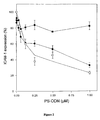
- FIG. 2 shows the inhibitory effect of TNF- ⁇ induced ICAM-1 expression by ISIS 1939 (CCCCCACCACTTCCCCTCT), an antisense phosphorothioate oligonucleotide (PS-ODN) targeted to the 3' non-coding region of ICAM-1 mRNA.
- ISIS 1939 CCCCACCACTTCCCCTCT
- PS-ODN antisense phosphorothioate oligonucleotide
- A549 cells (ATCC CCL 185, ATCC Rockville, MD) were plated onto 96-wells microtiter plates (10 4 cells /well). The day after, culture medium was removed and cells were washed. Cells were incubated at 37°C for 4 h in 100 ⁇ l DMEM serum-free medium containing ISIS 1939 ODN either in the absence ( ⁇ ) or in the presence of 20 ⁇ M ( ⁇ ) HoK1 or ( ⁇ ) HoK2.
- HoK1 and HoK2 are histidylated oligolysines prepared as described in the following text.
- ICAM-1 expression was quantified by ELISA using anti-ICAM-1 antibodies.
- Cells were washed 3 times with 200 ⁇ l of PBS and fixed for 20 min at room temperature in PBS containing 20 mg/ml paraformaldehyde. Then, cells were incubated for 90 min at 37°C with anti-ICAM 1 mouse antibody (Becton Dickinson) diluted 20 times in PBS containing 20 mg/ml BSA.
- the percentage of TNF- ⁇ -induced expression of ICAM-1 was calculated as follows : [(A TNF- ⁇ ODN - A 0 ) / (A TNF- ⁇ -A 0 )] x 100 where A TNF- ⁇ ODN was the absorbance of ODN treated and cytokine-induced cells, A 0 the absorbance of cells incubated without ODN and TNF- ⁇ , and A TNF- ⁇ the absorbance of cytokine-induced cells incubated without ODN. Results shown are typical of experiments carried out in triplicate and repeated at least twice. Data are means ⁇ standard deviation of the percentage of control ICAM-1 expression induced by TNF- ⁇ .
- Figure 3 shows that histidylated oligolysines induced cytosolic and nuclear delivery of ODN.
- HoK1 Fig 3-b
- HoK2 Fig 3-c
- HoK1, HoK2 and HoK3 are histidylated oligolysines prepared as described in the following text.
- vesicles appeared bigger and the cytosol and the nucleus were also labelled while vesicles were smaller and neither the cytosol and the nuclear were staining in the absence of histidylated oligolysine (Fig 3-a).
- the cytosolic and nuclear staining was greater in the presence of HoK2 than in the presence of HoK1, probably because HoK2 contained more histidyl residues than HoK1 (15 versus 12).
- the cell associated fluorescence was low in the presence of HoK3 suggesting that interactions between ODN and HoK1 and HoK2 might favor the ODN uptake (Fig 3-d).
- A549 cells (ATCC CCL 185, ATCC Rockville, MD) were seeded onto sterile coverslips in 20-mm wells (2 x 10 5 cells/ well) and allowed to adhere. Cells were incubated in the presence of 0.125 ⁇ M fluorescein-labelled PS-ODN for 4 h at 37°C (a) in the absence or in the presence of 20 ⁇ M (b) HoK1, (c) HoK2, (d) HoK3 or (e) Plk (Oligolysine containing 19 lysyl residues and non substituted by histidine used as control).
- Cells were fixed with 2 % of p-formaldehyde, washed and mounted on slides in a PBS/glycerol mixture (1:1 v/v) containing 10 mg/ml DABCO (1,4 diazobicyclo-(2,2,2)-octane) as antifading agent.
- Cells were analyzed with a confocal microscope imaging system (MRC-1024, Bio-Rad) equipped with a Nikon Optiphot epifluorescence microscope (Nikon, Tokyo, Japan) and a planapo objective (numerical apErture 1.4).
- Oligolysine (Poly-L-lysine, HBr ; average molecular weight of 3950 ; average degree of polymerization of 19) (Bachem Feinchemikalien, Bubendorf, Switzerland) (1 g in 200 ml H 2 O) was passed through an anion exchange column (Dowex 2 x 8, - OH form, 20-50 mesh) in order to remove bromide ions. The eluate was neutralized with a 10 % p-toluene sulfonic acid solution in water and freezed-dried.
- Oligolysine p -toluene sulfonate salt (50 mg ; 8.6 ⁇ mol) in 2 ml dimethylsulfoxide (Aldrich, France) in the presence of diisopropylethylamine (50 ⁇ l ; 344 ⁇ mol) (Aldrich) was reacted for 20 h at 20°C with (Boc)His(Boc)-OH (64 mg ; 146 ⁇ mol) (Novabiochem, Bad Soden, Germany) in the presence of benzotriazol-1-yl-oxy-tris-(dimethylamino) phosphonium hexafluorophosphate (BOP) (Richelieu Biotechnologies, Saint Hyacinthe, Canada) (159mg ; 358 ⁇ mol).
- ⁇ -amino groups of oligolysine was then substituted with gluconoyl residues (GlcA) : ⁇ -gluconolactone (86mg ; 48 ⁇ mol) (Aldrich) and diisopropylethylamine (134 ⁇ l; 921 ⁇ mol) were added and the solution was stirred for 20h at 20°C.
- the N -protecting Boc groups were removed by acidic treatment by adding 10 volumes of a H 2 O/trifluoroacetic acid mixture (1:1 ; v/v) for 24h at 20°C. Water and trifluoroacetic acid were removed under reduced pressure.
- h 8.7 was the value of the integration of the signal at 8.7 ppm corresponding to the proton (1H C 12 ) of histidyl residues, h Lys that in the range from 1.3 to 1.9 ppm corresponding to the 6 methylene protons (C 3 , C 4 and C 5 ) of lysyl residues and DP the degree of polymerization of oligolysine.
- the number of histidyl residues bound per oligolysine molecule was 12.
- h G was the value of the integration in the range 3.6 to 3.9 ppm of the 4 protons (1H C 10 , 1H C 11 and 2H C 12 ) of gluconoyl residues, h Lys that in the range of 1.3 to 1.9 ppm of the 6 methylene protons (C 3 , C 4 and C 5 ) of lysyl residues and DP the degree of polymerization of pLK.
- the number of gluconoyl residues bound per oligolysine molecule was 3.
- the number of free ⁇ -amino groups per oligolysine molecule was 4.
- Oligolysine p -toluene sulfonate salt (80 mg ; 13.7 ⁇ mol) in 3 ml dimethylsulfoxide in the presence of diisopropylethylamine (90 ⁇ l; 620 ⁇ mol) was reacted for 6 h at 20°C with the N-hydroxysuccinimidyl derivative of (Boc)His(Boc)-OH (92 mg ; 204 ⁇ mol) (Bachem Feinchemikalien).
- ⁇ -amino groups of oligolysine was then acetylated (Ac) : acetic anhydride (13 ⁇ l ; 109 ⁇ mol) (Aldrich) and diisopropylethylamine (5 ⁇ l; 35 ⁇ mol) were added and the solution was stirred for 30 min at 20°C.
- the N -protecting Boc groups were removed by acidic treatment by adding 10 volumes of a H 2 O/trifluoroacetic acid mixture (1 : 1 ; v/v) for 2 h at 20°C. Water and trifluoroacetic acid were removed under reduced pressure.
- h 8.7 was the value of the integration of the signal at 8.7 ppm corresponding to the proton (1H C 12 ) of histidyl residues, h Lys that in the range from 1.3 to 1.9 ppm corresponding to the 6 methylene protons (C 3 , C 4 and C 5 ) of lysyl residues and DP the degree of polymerization of oligolysine.
- the number of histidyl residues bound per oligolysine molecule was 15.
- h A was the value of the integration at 2.04 ppm of the 3 protons of acetyl residues, h Lys that in the range of 1.3 to 1.9 ppm of the 6 methylene protons (C 3 , C 4 and C 5 ) of lysyl residues and DP the degree of polymerization of pLK.
- the number of acetyl residues bound per oligolysine molecule was 3.
- the number of free ⁇ -amino groups per oligolysinemolecule was 1.
- Oligolysine p -toluene sulfonate salt (85 mg ; 14.6 ⁇ mol) in 3 ml dimethylsulfoxide in the presence of diisopropylethylamine (80 ⁇ l; 555 ⁇ mol) was reacted for 20 h at 20°C with N-acetyl-His-OH (288 mg ; 307 ⁇ mol) (Sigma) in the presence of BOP (265 mg ; 597 ⁇ mol).
- BOP 265 mg ; 597 ⁇ mol
- HoK3 was precipitated by adding 10 volumes of isopropanol and spun down by centrifugation (1800 g for 15 min). The pellet was washed with isopropanol, collected by centrifugation (1800 g for 15 min), solubilized in distilled water and freezed-dried.
- the average number of histidyl residues bound per oligolysine molecule was determined by 1 H-NMR spectroscopy as describe The number of histidyl residues bound per oligolysine molecule was 15. The number of free ⁇ -amino groups per oligolysine molecule was 1.
- a HoK containing exactly 20 lysyl residues and 20 histidyl residues can be entirely synthetised by using the above Lys (His) synthon. Briefly, 20 Lys(His) synthon are successively assembled on a Applied Biosystems 433A synthesizer with conductimetric monitoring by using Fmoc-protected amino acids. Lys(His) synthons are coupled by the HBTU activation method. HoK are cleaved from the resin and side chain protecting Boc groups are removed with a trifluoroacetic acid/water mixture (50% : 50% ; v/v) for 3 h at room temperature. Crude HoK is precipitated with isopropanol and collected by centrifugation. HoK is washed three times with isopropanol, resuspended in distilled water and freezed-dried.
- Oligomers made of exactly 17 lysyl residues substituted with 17 histidyl residues and 3 leucyl residues insert anywhere in the Lys(His) sequence can be entirely synthetised by using the above Lys (His) synthon and Fmoc-Leu on a Applied Biosystems 433A synthesizer with conductimetric monitoring by using Fmoc-protected amino acids. Lys(His) synthons and Leu were coupled by the HBTU activation method. Oligomers are cleaved from the resin and side chain protecting Boc groups are removed with a trifluoroacetic acid/water mixture (50% : 50% ; v/v) for 3 h at room temperature. Oligomers are precipitated with isopropanol and collected by centrifugation. Oligomers are washed three times with isopropanol, resuspended in distilled water and freezed-dried.
- An oligomer (K(His)-K(His)-L) 7 can be entirely synthetised by using the above Lys (His) synthon and Fmoc Leu on a Applied Biosystems 433A synthesizer with conductimetric monitoring by using Fmoc-protected amino acids. Lys(His) synthons and Leu are coupled by the HBTU activation method.
- the oligomer (K(His)-K(His)-L) 7 is cleaved from the resin and side chain protecting Boc groups are removed with a trifluoroacetic acid/water mixture (50% : 50% ; v/v) for 3 h at room temperature. The polymer is precipitated with isopropanol and collected by centrifugation. The oligomer is washed three times with isopropanol, resuspended in distilled water and freezed-dried.
- a oligomer (K(His)-L-K(His)) 7 can be entirely synthetised by using the above Lys (His) synthon and Fmoc Leu on a Applied Biosystems 433A synthesizer with conductimetric monitoring by using Fmoc-protected amino acids. Lys(His) synthons and Leu are coupled by the HBTU activation method. The oligomer is cleaved from the resin and side chain protecting Boc groups are removed with a trifluoroacetic acid/water mixture (50% : 50% ; v/v) for 3 h at room temperature. The oligomer is precipitated with isopropanol and collected by centrifugation. The oligomer is washed three times with isopropanol, resuspended in distilled water and freezed-dried.
- Table I shows that oligolysine having a DP of either 190, 72 or 36 substituted with less that 45% of histidyl residues, do not allow the transfer of small nucleic acid, particularly oligonucleotides. Indeed, it is necessary to adapt the size of histidylated oligolysines. Conversely, small histidylated oligolysines (DP of 36 or 19) substituted by more than 50% of histidyl residues do not allow efficient gene transfer by histidylated oligolysine/plasmid complexes (Table I). In addition oligolysines substituted with less than 50% histidyl residues are cytotoxic.
- DP is the oligolysine degree of polymerization.
- DNA corresponds to transfection by using histidylated oligolysine/pCMVLUC. The transfection efficiency is scored on a 0 to 100 scale. The transfection efficiency is determined from the luciferase activity in cells measured by luminescence.
Landscapes
- Health & Medical Sciences (AREA)
- Life Sciences & Earth Sciences (AREA)
- Chemical & Material Sciences (AREA)
- Animal Behavior & Ethology (AREA)
- Pharmacology & Pharmacy (AREA)
- Engineering & Computer Science (AREA)
- Veterinary Medicine (AREA)
- Medicinal Chemistry (AREA)
- Public Health (AREA)
- General Health & Medical Sciences (AREA)
- Bioinformatics & Cheminformatics (AREA)
- Organic Chemistry (AREA)
- Nuclear Medicine, Radiotherapy & Molecular Imaging (AREA)
- General Chemical & Material Sciences (AREA)
- Chemical Kinetics & Catalysis (AREA)
- Immunology (AREA)
- Proteomics, Peptides & Aminoacids (AREA)
- Epidemiology (AREA)
- Molecular Biology (AREA)
- Rheumatology (AREA)
- Genetics & Genomics (AREA)
- Biochemistry (AREA)
- Pulmonology (AREA)
- Communicable Diseases (AREA)
- Virology (AREA)
- Transplantation (AREA)
- Pain & Pain Management (AREA)
- Biotechnology (AREA)
- Oncology (AREA)
- Medicinal Preparation (AREA)
- Peptides Or Proteins (AREA)
- Pharmaceuticals Containing Other Organic And Inorganic Compounds (AREA)
- Immobilizing And Processing Of Enzymes And Microorganisms (AREA)
- Medicines That Contain Protein Lipid Enzymes And Other Medicines (AREA)
- Polyamides (AREA)
Abstract
Description
said oligomer being as follows :
- the free NH3 + of the above-mentioned components are substituted in a ratio of at least 50 %, advantageously from 60 % to 95 %, particularly 80 to 90 % (this ratio being determined by nuclear magnetic resonance), by protonable residues in a weak acid medium, leading in such weak acid medium to a destabilization of cellular membranes,
- the above-mentioned protonable residues possess in addition the following
properties :
- they contain a functional group enabling them to be linked to the above-mentioned oligomer,
- they do not correspond to a recognition signal recognized by a cellular membrane receptor,
- they can comprise at least one free NH3 + group,
- the free NH3 + of the above-mentioned monomers can be also substituted by an uncharged residue leading to a reduction of the number of positive charges in comparison to the same oligomeric conjugate, before substitution,
- molecules constituting a recognition signal recognized by a membrane
cellular receptor may be present :
- either by substitution of some of the free NH3 + of the above-mentioned monomers,
- either on some of the uncharged residues leading to a reduction of the number of charges,
- either on some of the above-mentioned protonable residues leading to a destabilization of the cellular membranes,
- or by substitution of the free NH3 + (if it is present) of the above-mentioned protonable residues leading to a destabilization of the cellular membrane,
- 1) the total number of the non substituted NH3 + is of at least 50 % of the polymerization degree,
- 2) the number of monomers initially carrying free NH3 + is substituted in a ratio of at least 50 % of the polymerization degree by residues leading to a destabilization of the cellular membrane.
- there must be at least 10 free NH3 +, which come from the α-NH3 + and/or ε -NH3 +,
- there are at least 10 histidyl residues, and even up to 20 histidyl residues carried by the side chain of the lysine residues which means, in the latter case, that the minimum amount of free NH3 + required, i.e. "at least" 10 free NH3 + come only from the α-NH3 + functions of the histidyl residues.
- they are weak bases, the pK of which in aqueous medium is lower than 8, so that a proportion higher than 50 % of these bases linked to a cationic oligomer is not protonated at pH 7.4.
- they belong to the group of compounds comprising an imidazole ring,
- they belong to the group of quinolins,
- they belong to the group of pterins,
- they belong to the group of pyridins.


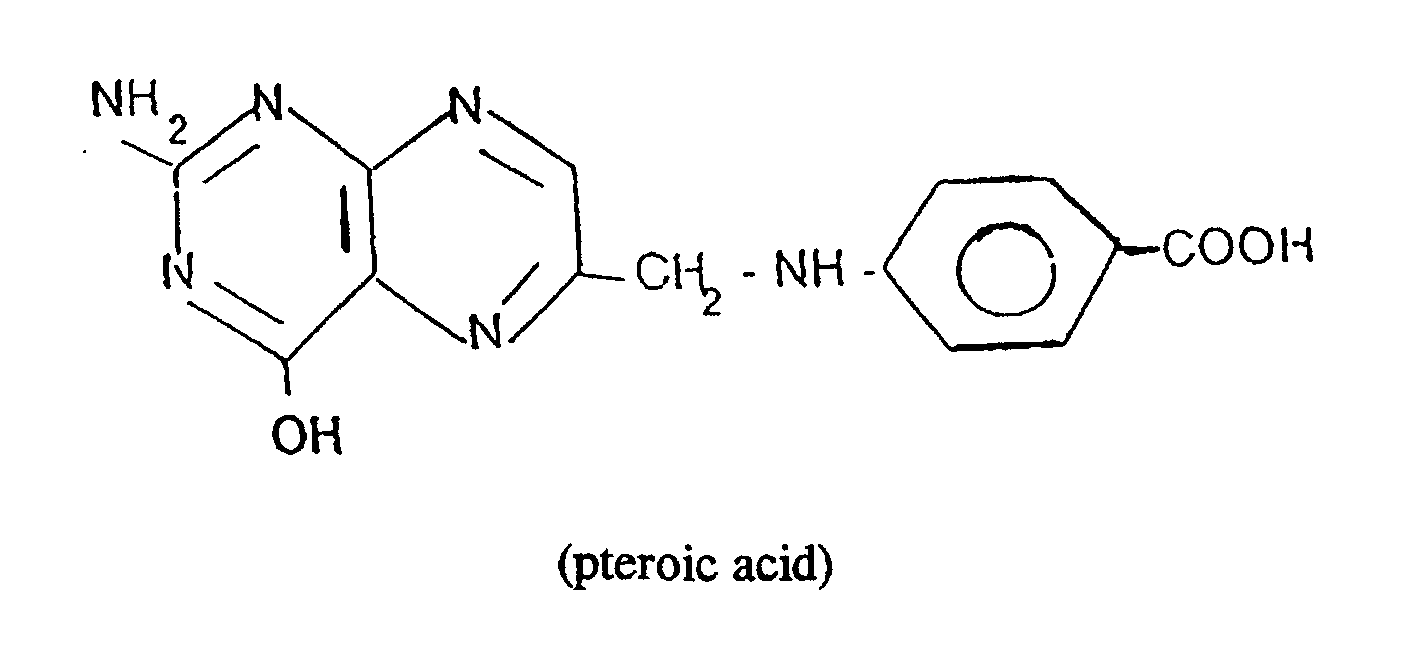

- alkylimidazoles in which the alkyl radical comprises from 1 to 10, particularly from 2 to 6 carbon atoms, and in which only one of the nitrogen atoms of the imidazole ring is substituted.

- ai is an integer varying from 0 to 10,
- bi is an integer varying from 0 to 10,
- i = degree of polymerization from 5 to 50, and particularly 10 to 40, and preferably 20,
- n = is an integer varying from 1 to 6, and preferably 4,
- R represents in a ratio of 50 % to 100 % (corresponding to a
number u)
or
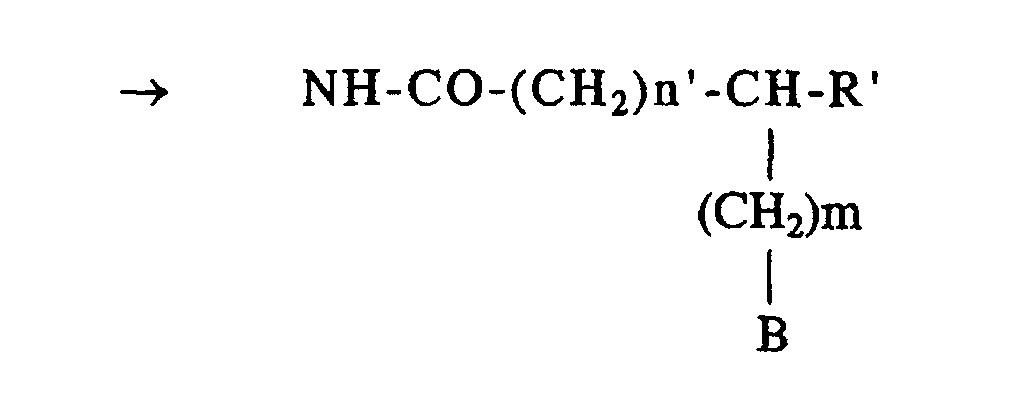 or
or

- m
- is an integer varying from 1 to 6,
- n'
- is an integer varying from 0 to 6,
- n"
- is an integer varying from 0 to 6,
- B
- is a weak base as defined above,
- R'
- represents NH3 + (corresponding to a number p),
-CO-CH3
-CO-(CHOH)rH r being from 1 to 15 preferably 2 to 7
-CO-(CH2)s-(CHOH)rH r being from 1 to 15 preferably 1 to 7 and s being from 1 to 6 preferably 4-SO2-Flu
- CO-Flu
- CS-NH-Flu
Flu being a fluorescent molecule - R represents in a ratio of 0 % to 50 % (corresponding to f : 0 < f ≤ u)
- NH3 + (corresponding to a number j),
- NH (corresponding to a number k), substituted by
- CO-CH3
- CO-(CHOH)rH r being from 1 to 15 preferably 1 to 7
-CO-(CH2)s-(CHOH)rH r being from 1 to 15 preferably 1 to 7 and s being from 1 to 6 preferably 4-SO2-Flu
- CO-Flu
-CS-NH-Flu
Flu being a fluorescent molecule - H (corresponding to a number h)
- (CH2) nH, n being an integer from 1 to 6 (corresponding to a number h)
- (CH2) n-OH n being an integer from 1 to 6 (corresponding to a number h)
- (CH2) n-SA' A' = H , CH3 or

with- i=u+j+k+h
- total number of α NH3 + = p = u-q
- total number of ω NH3 + = j = f-(k + h)
- total number of NH3 + = m = p + j + 1
- 1) u ≥ i/2
- 2) m ≥ i/2

- i = degree of polymerization from 5 to 50, and particularly 10 to 40, and preferably 20,
- n = is an integer varying from 1 to 6, and preferably 4,
- R represents in a ratio of 50 % to 100 % (corresponding to u)
or
 or
or

- m
- is an integer varying from 1 to 6,
- n'
- is an integer varying from 0 to 6,
- n"
- is an integer varying from 0 to 6,
- B
- is a weak base as defined above,
- R'
- represents NH3 + (corresponding to a number p),
-CO-CH3
- CO-(CHOH)rH r being from 1 to 15 preferably 1 to 7
- CO-(CH2)s-(CHOH)rH r being from 1 to 15 preferably 1 to 7 and s being from 1 to 6 and preferably 4- SO2-Flu
- CO-Flu
- CS-NH-Flu
Flu being a fluorescent molecule - R represents in a ratio of 0 % to 50 % (corresponding to f : 0 < f ≤ 1)
- NH3 + (corresponding to a number j),
- NH (corresponding to a number k), substituted by
- CO-CH3
- CO-(CHOH)rH r being from 1 to 15 preferably 1 to 7
- CO-(CH2)s-(CHOH)rH r and s being from 1 to 15 preferably 1 to 7 and s being from 1 to 6 and preferably 4- SO2-Flu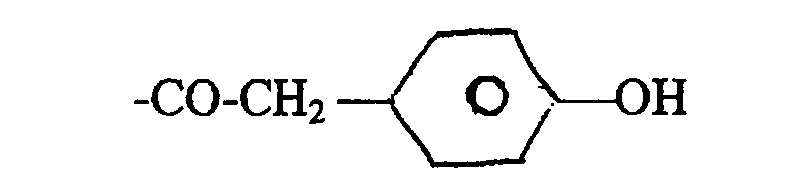
- CO-Flu
- CS-NH-Flu
Flu being a fluorescent molecule - H (corresponding to a number h)
- (CH2)nH, n being an integer from 1 to 6 (corresponding to a number h)
- (CH2)n-OH n being an integer from 1 to 6 (corresponding to a number h)
- (CH2)n-SA' A' = H, CH3 or
n being integer from 1 to- 6 (corresponding to a number h)
with- i = u + j + k + h
- total number of α NH3 + = p = u-q
- total number of ω NH3 + = j = f-(k + h)
- total number of NH3 + = m = p + j + 1
- 1) u ≥ i/2
- 2) m ≥ i/2.
i = 19 n = 4


- (f) R
- = NH+ 3
- u
- = 12
- j
- = 7
i = 19 n = 4

- n' = n" = 0
- R' = NH+ 3
- m = 1
- B = imidazole
- R =

- (f) R
- = NH+ 3
- u
- = 16
- j
- = 3
i = 19 n = 4

- n' = n" = 0
- R' = NH+ 3
- m = 1
- B = imidazole
- R =

- (f) R
- = NH+ 3
- u
- = 19
- j
- = 0
i = 19 n = 4

- n' = n"=0
- R' = NH+ 3
- m = 1
- B = imidazole
- R =

- (f) R
- = CO-CH3
- u
- = 11
- k
- = 8
i = 19 n = 4

- n' = n" = 0
- R' = NH+ 3
- m = 1
- B = imidazole
- R =

- (f) R
- = CO-CH3
- u
- = 15
- k
- = 4
i = 19 n = 4
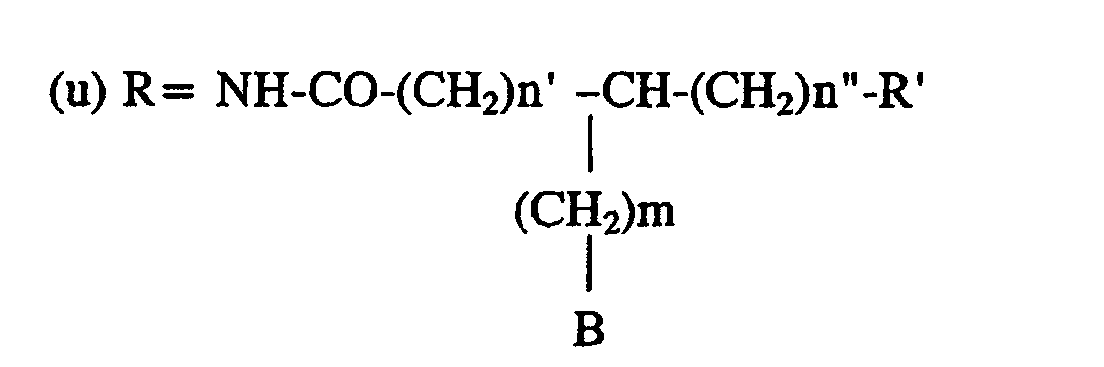
- n' = n" = 0
- R' = NH+ 3
- m = 1
- B = imidazole
- R =

- (f) R
- = CO-(CHOH)rH
- r
- = 5
- u
- = 12
- k
- = 3
i = 19 n = 4
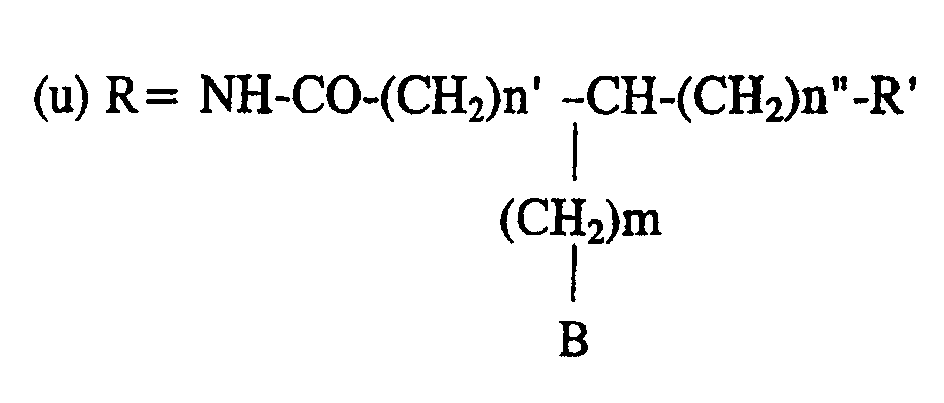
- n' = n" = 0
- (q) R' = NH-CO-CH3
- m = 1
- B = imidazole
- R =

- (f) R
- = NH+ 3
- u
- = 16
- f
- = 4
- k
- = 3


- at least an oligomeric conjugate as defined above,
- at least as a peptide, an oligoside or an oligonucleotide, or a mixture thereof,
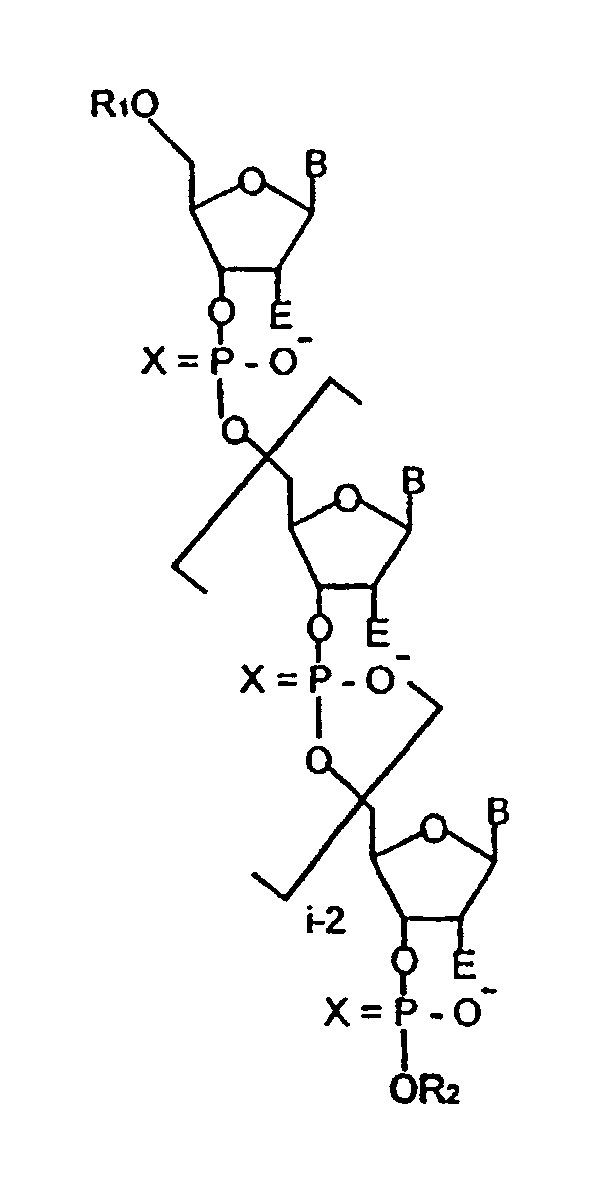
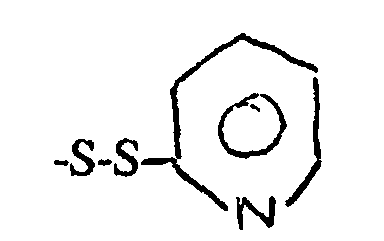
phosphorothioate (X = S) oligonucleotide i = 25

phosphorothioate (X = S) oligonucleotide i = 19


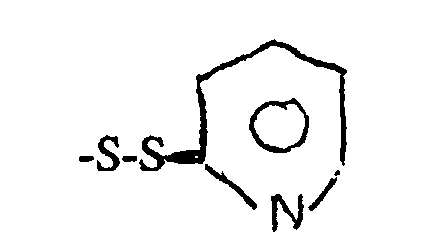
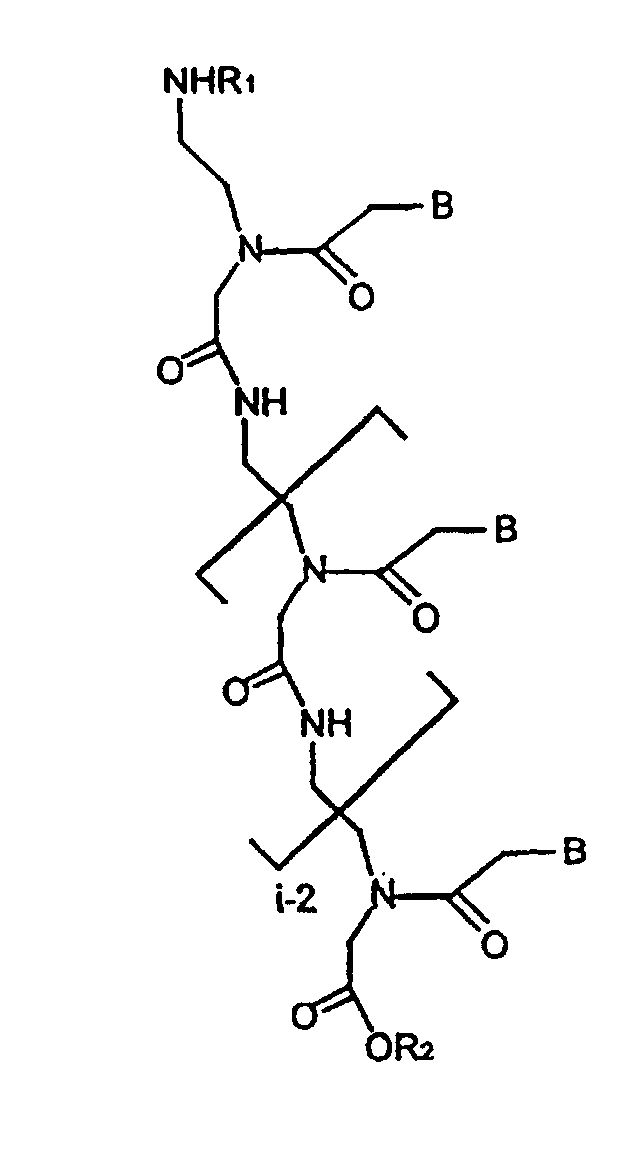
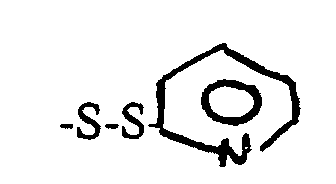
- i is an integer varying from 10 to 30.
- transfer of an antisense oligonucleotide in the cytosol and/or the cell nucleus where it binds and blocks the complementary mRNA sequence,
- transfer of an oligonucleotide as activator into the cytosol where it depresses or activates a second messenger in the cytosol, or the corresponding gene in the nucleus,
- transfer into the cytosol and/or the cell nucleus of oligonucleotides corresponding to a repetitive bacterial type DNA sequence with stimulating or immunodepressive activity.
- transfer into the cytosol and/or the cell nucleus of RNA or DNA oligonucleotide acting as decoys which inhibit gene expression by blocking the binding of regulatory factors to the authentic DNA region such as short RNA oligonucleotides corresponding to the HIV-TAR sequence inhibiting HIV expression and replication by blocking the binding of the HIV regulatory protein at Tat to the TAR region,
- transfer into the cytosol and/or the cell nucleus of ribozymes (RNA oligonucleotides) which inhibit gene expression by cleaving the mRNA.
- an oligomeric conjugate as defined above, substituted by a protonable residue leading in a weak acid medium to a destabilization of cellular membranes, this oligomeric conjugate being able to comprise a recognition signal, which is previously fixed or not on the above-said conjugate, said recognition signal being dependent upon the cell to target,
- at least one biological molecule to transfer,
- optionally reagents enabling the possible binding of the recognition signal on the above-said oligomeric conjugate,
- optionally reagents enabling the formation of a composition as defined above, or of a combined preparation as defined above,
- reagents enabling the transfer of the biological molecule in the cytosol and/or the cell nucleus.
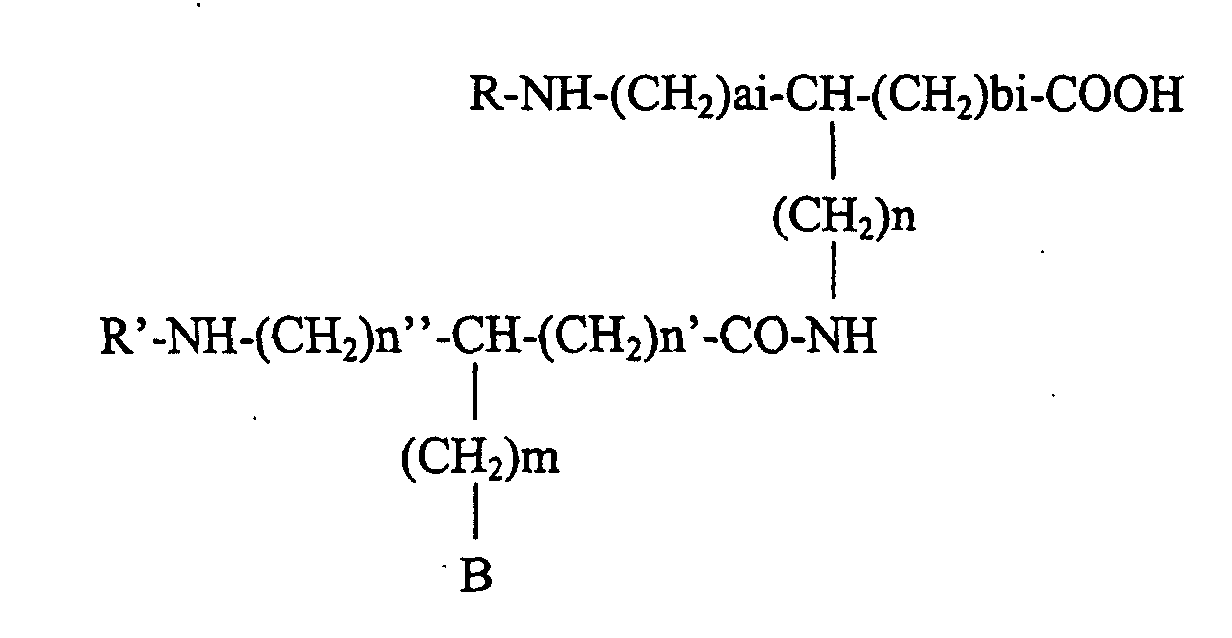
wherein
| comparative evaluation of gene transfer and oligonucleotide transfer by using histidylated polylysine. | ||||
| DP | His (%) | DNA | ODN | Cytotoxicity (%) |
| 190 | 35 | 100 | 0 | 24 |
| 190 | 45 | 110 | 0 | 21 |
| 72 | 23 | 87-96 | 0 | 24 |
| 36 | 22 | 61-100 | 0 | 25 |
| 36 | 53 | 0-10 | 20 | 4 |
| 19 | 25 | 15-26 | 0 | 49 |
| 19 | 45 | 9 | 0 | 40 |
| 19 | 60 | | 100 | 26 |
| 19 | 80 | | 100 | 0 |
| 19 | 100 | | 100 | 0 |
Claims (19)
- Oligomeric conjugate positively charged, containing an oligomer with a polymerization degree (PD) from 5 to 50, preferably 10 to 40 and more preferably 20, formed from monomeric components having free NH3 + in a number equal to or higher than 50 % of the polymerization degree,
said oligomer being as follows:provided that:the free NH3 + of the above-mentioned components are substituted in a ratio of at least 50 %, advantageously from 60 % to 95 %, particularly 80 to 90 % (this ratio being determined by nuclear magnetic resonance), by protonable residues in a weak acid medium, the pH of which is lower than 7.4, leading in such a weak acid medium to a destabilization of cellular membranes,the above-mentioned protonable residues possess in addition the following properties:they contain a functional group enabling them to be linked to the above-mentioned oligomer,they do not correspond to a recognition signal recognized by a cellular membrane receptor,they can comprise at least one free NH3 + group,the free NH3 + of the above-mentioned monomers can be also substituted by an uncharged residues leading to a reduction of the number of positive charges in comparison to the same oligomeric before substitution,molecules constituting a recognition signal recognized by a membrane cellular receptor may be present:either by substitution of some of the free NH3 + of the above-mentioned monomers,either on some of the uncharged residues leading to a reduction of the number of charges,either on some of the above-mentioned protonable residues leading to a destabilization of the cellular membranes,or by substitution of the free NH3 + (if it is present) of the above-mentioned protonable residues leading to a destabilization of the cellular membrane,1) the total number of the non substituted NH3 + functions is of at least 50 % of the polymerization degree,2) the number of monomers initially carrying free NH3 + is substituted in a ratio of at least 50 % of the polymerization degree by residues leading to a destabilization of the cellular membrane. - Oligomeric conjugate according to claim 1, wherein the protonable residues leading to a destabilization of cellular membranes, present the additional properties:they are weak bases the pK of which in aqueous medium is lower than 8, so that a proportion higher than 50% of these bases linked to a cationic oligomer is not protonated in a neutral medium of pH 7.4.
- Oligomeric conjugate complex according to claim 1, wherein the protonable residues leading to a destabilization of cellular membranes, present the additional properties:they belong to the group of compounds comprising an imidazole ring,they belong to the group of quinolins,they belong to the group ofpterins,they belong to the group of pyridins.
- Oligomeric conjugate according to anyone of claims 1 to 3, wherein the protonable residues leading to a destabilization of the cellular membranes are:alkylimidazoles in which the alkyl radical comprises from 1 to 10, particularly from 2 to 6 carbon atoms, and in which only one of the nitrogen atoms of the imidazole ring is substituted.
- Oligomeric conjugate according to anyone of claims 1 to 4, wherein the protonable residues leading to a destabilization of cellular membranes are chosen from:histidine, 4-carboxymethyl-imidazole,3-(1-methyl-imidazol-4yl)-alanine, 3-(3-methyl-imidazol-4yl)-alanine,2-carboxy-imidazole, histamine, 3-imidazol-4yl)-L-lactic acid,2-(1-methyl-imidazol-4yl)ethylamine, 2-(3-metyl-limidazol-4yl)ethylamine,β-alanyl-histidine-(carnosine), 7-chloro-4(amino-1-methylbutylamino)-quinoline,N4-(7-chloro-4-quinolinyl)-1,4-pentanediamine,8-(4-amino-1-methylbutylamino)-6-methoxy-quinoline (primaquine),N4-(6-methoxy-8-quinolinyl)1,4-pentanediamine, quininic acid,quinoline carboxylic acid, pteroïc acid, nicotinic acid, quinolinic acid.
- Oligomeric conjugate according to anyone of claims 1 to 5, wherein the oligomeric conjugate contains an oligomer of the following formula:wherein
 ai is an integer varying from 0 to 10,bi is an integer varying from 0 to 10,i = degree of polymerization from 5 to 50, and particularly 10 to 40, and preferably 20,n is an integer varying from 1 to 6, and preferably 4,R represents in a ratio of 50 % to 100 % (corresponding to a number u)or
 or
or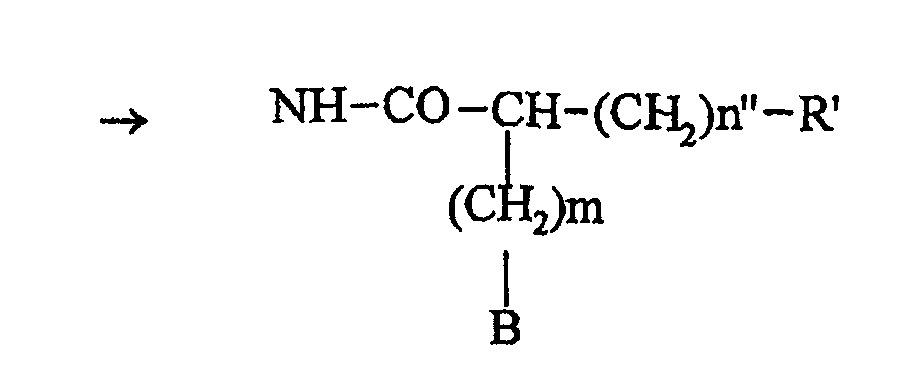

- m
- is an integer varying from 1 to 6,
- n'
- is an integer varying from 0 to 6,
- n"
- is an integer varying from 0 to 6,
- B
- is a weak base as defined according to anyone of claims 2 to 4,
- R'
- represents NH3 + (corresponding to a number p),
-CO-CH3
- CO-(CHOH)rH r being an integer from 1 to 15, and preferably 1 to 7
- CO-(CH2)s-(CHOH)rH r being an integer from 1 to 15, and preferably 1 to 7, and s being an integer from 1 to 6, and preferably 6-SO2-Flu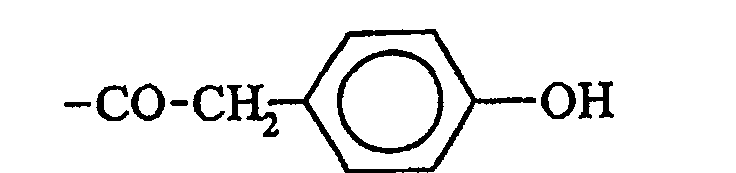
- CO-Flu
-CS-NH-Flu
Flu being a fluorescent moleculeR represents in a ratio of 0 % to 50 % (corresponding to f: 0 < f ≤ u)withNH3 + (corresponding to a number j),NH (corresponding to a number k), substituted by
-CO-CH3
- CO-(CHOH)rH r being an integer from 1 to 15, and preferably 1 to 7
- CO-(CH2)s-(CHOH)rH r being an integer from 1 to 15, and preferably 1 to 7, and s being an integer from 1 to 6, and preferably 6-SO2-Flu
- CO-Flu
- CS-NH-Flu
Flu being a fluorescent moleculeH (corresponding to a number h)(CH2) nH, n being an integer from 1 to 6 (corresponding to a number h)(CH2) n-OH n being an integer from 1 to 6 (corresponding to a number h)(CH2) n-SA' A' = H, CH3 or(corresponding to a number h) n being integer from 1 to 6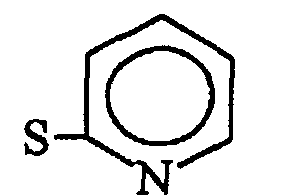 with the proviso that:i = u + j + k + htotal number of α NH3 + = p = u-qtotal number of ω NH3 + = j = f-(k + h)total number of NH3 + = m = p + j+11) u ≥ i/22)m≥i/2
 - Oligomeric conjugate according to anyone of claims 1 to 6, wherein the oligomeric conjugate contains an oligomer of the following formula:wherein
 i = degree of polymerization from 5 to 50, and particularly 10 to 40, and preferably 20,n is an integer varying from 1 to 6, and preferably 4,R represents in a ratio of 50 % to 100 % (corresponding to u)or
 or
or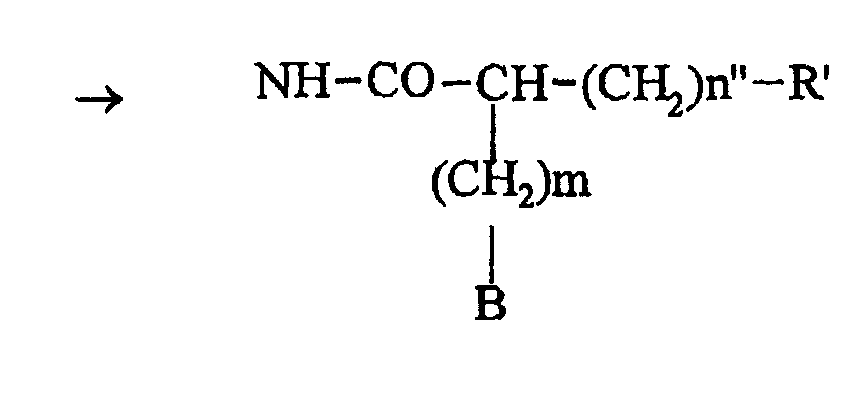
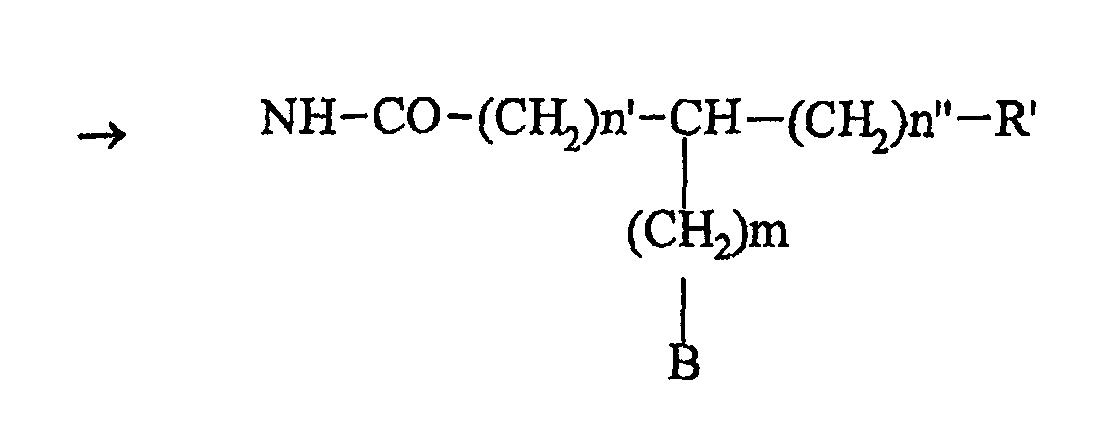
- m
- is an integer varying from 1 to 6,
- n'
- is an integer varying from 0 to 6, .
- n"
- is an integer varying from 0 to 6,
- B
- is a weak base as defined according to anyone of claims 2 to 4,
- R'
- represents NH3 + (corresponding to a number p),
-CO-CH3
- CO-(CHOH)rH r being an integer from 1 to 15, and preferably 1 to 7
- CO-(CH2)s-(CHOH)rH r being an integer from 1 to 15, and preferably 1 to 7, and s being an integer from 1 to 6, and preferably 6-SO2-Flu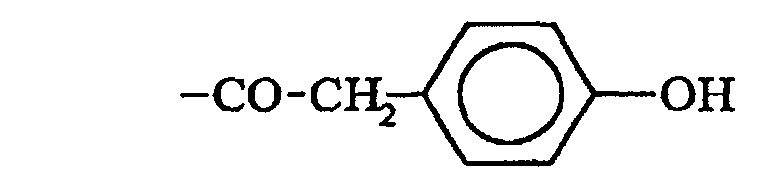
- CO-Flu
- CS-NH-Flu
Flu being a fluorescent moleculeR represents in a ratio of 0% to 50% (corresponding to f: 0<f≤1)withNH3 + (corresponding to a number j),NH (corresponding to a number k), substituted by
-CO-CH3
- CO-(CHOH)rH r being an integer from 1 to 15, and preferably 1 to 7
- CO-(CH2)s-(CHOH)rH r being an integer from 1 to 15, and preferably 1 to 7, and s being an integer from 1 to 6, and preferably 6-SO2-Flu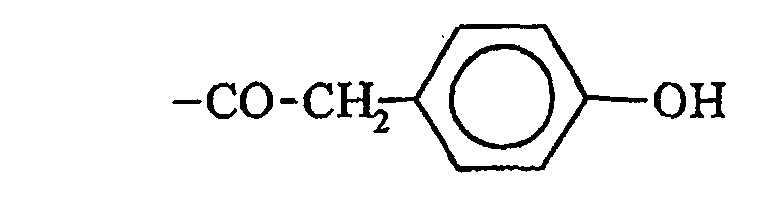
-CO-Flu
-CS-NH-Flu
Flu being a fluorescent moleculeH (corresponding to a number h)(CH2)nH, n being an integer from 1 to 6
(corresponding to a number h)(CH2)n-OH n being an integer from 1 to 6
(corresponding to a number h)(CH2)n-SA' A' = H, CH3 or(corresponding to a number h) n being integer from 1 to 6 with the proviso that:i=u+j+k+htotal number of α NH3 + = p = u-qtotal number of ω NH3 + = j = f-(k + h)total number of NH3 + = m = p + j + 11)u ≥ i/22)m ≥ i/2
 - Oligomeric conjugate according to anyone of claims 1 to 7, wherein the oligomeric conjugate contains an oligomer of the formula according to claim 7, wherein
i = 19 n = 4wherein n' = n" = 0R' = NH3 +m = 1B = imidazoleR =
- (f) R
- = NH+ 3
- u
- = 12
- j
- = 7
i = 19 n = 4wherein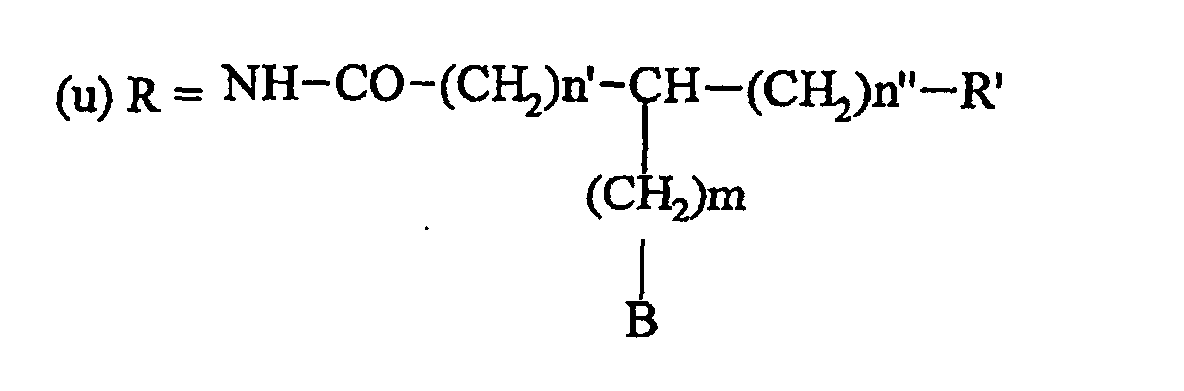 n' = n" = 0R' = NH3 +m = 1B = imidazoleR =
- (f) R
- = NH3 +
- u
- = 16
- j
- = 3
wherein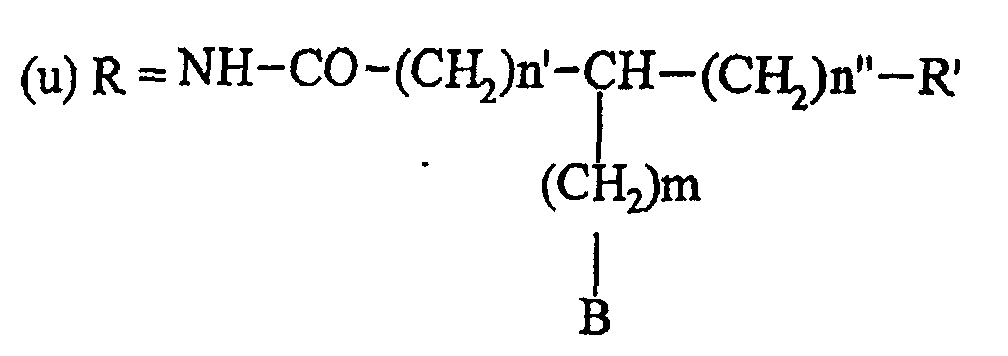 n' - n" = 0R' = NH3 +m = 1B = imidazoleR =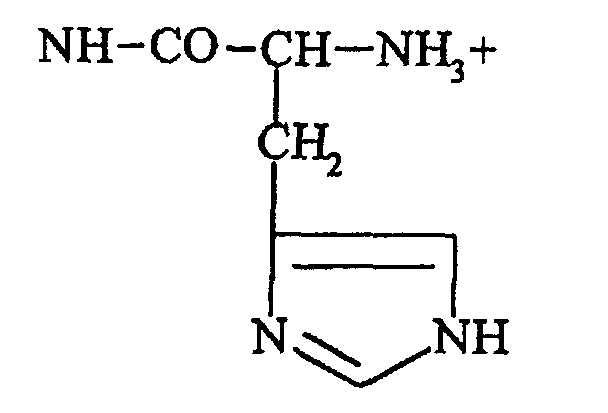
- (f) R
- = NH3 +
- u
- = 19
- j
- = 0
i = 19 n = 4wherein n' = n" = 0R' = NH3 +m = 1B = imidazoleR =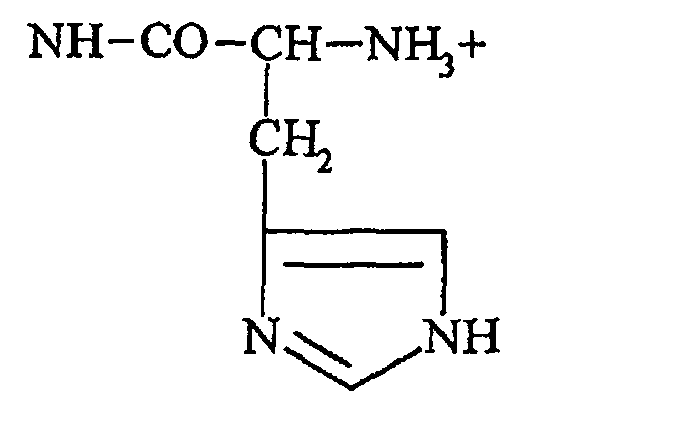
- (f) R
- = CO-CH3
- u
- = 11
- k
- = 8
i = 19 n = 4wherein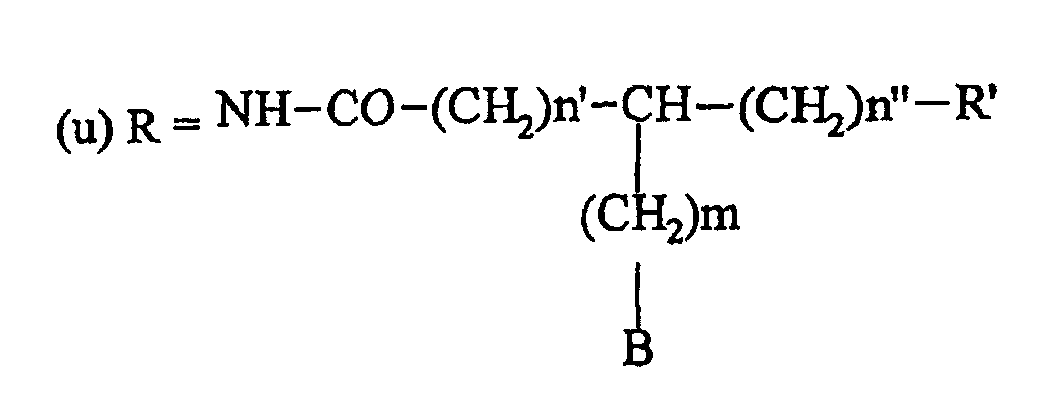 n' = n" = 0R' = NH3 +m = 1B = imidazoleR =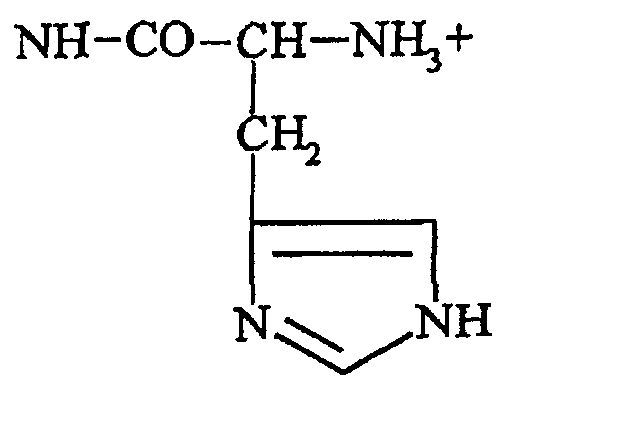
- (f) R
- = CO-CH3
- u
- = 15
- k
- = 4
i = 19 n = 4wherein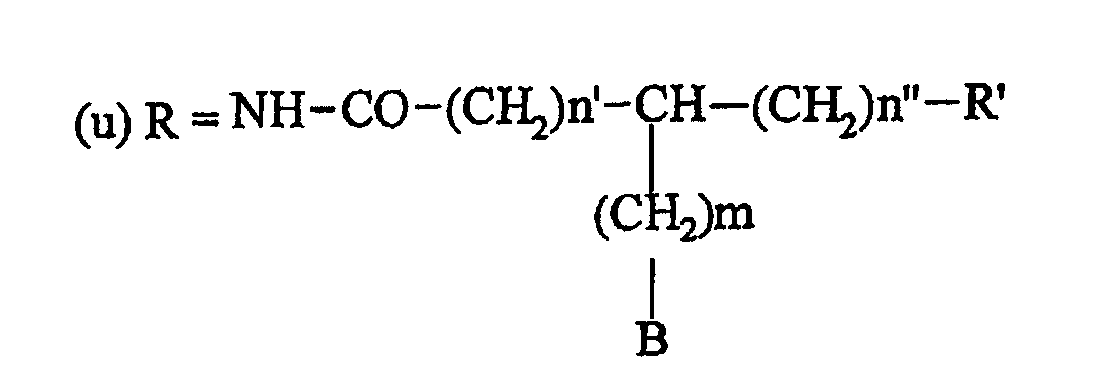 n' = n" = 0R' = NH3 +m = 1B = imidazoleR =
- (f) R
- = CO-(CHOH)rH
- r
- = 5
- u
- = 12
- k
- = 3
i = 19 n = 4wherein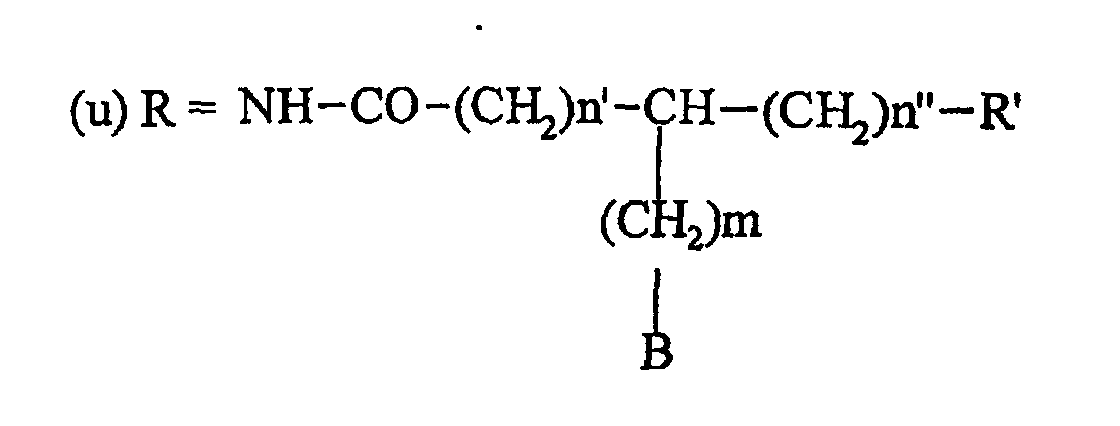 (q) n' = n" = 20R' = NH-CO-CH3m = 1B = imidazoleR =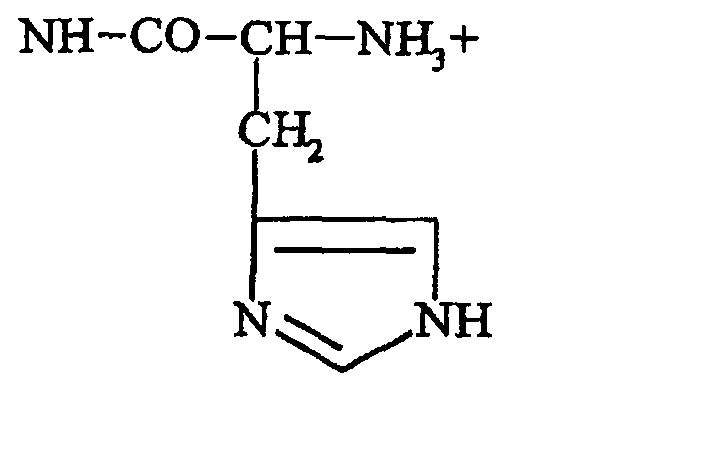
- (f) R
- = NH3 +
- u
- = 16
- f
- = 4
- k
- = 3
- Composition containing at least one oligomeric conjugate according to anyone of claims 1 to 8, in association with at least a peptide, an oligoside or an oligonucleotide, or a mixture thereof.
- Combined preparation containing as active substance the following individual components, in the form of a kit-of-parts:for the simultaneous, separate or sequential use, for the in vitro, the in vivo or the ex vivo transfer of said biological molecules into the cytosol and/or cell nucleus.an oligomeric conjugate according to anyone of claims 1 to 8,at least one oligomeric conjugate according to anyone of claims 1 to 8, in association with at least a peptide, an oligoside or an oligonucleotide, or a mixture thereof,
- Use of an oligomeric conjugate according to anyone of claims 1 to 8, for the preparation of a drug intended for the in vitro, the ex vivo or the in vivo intracellular transfer of a peptide, an oligoside or an oligonucleotide, into the cytosol and/or in the cell nucleus.
- Use of an oligomeric conjugate according to anyone of claims 1 to 8 or of a composition according to claim 9, or of a combined preparation according to claim 10, for the preparation of a drug intended for the in vitro, the ex vivo or the in vivo intracellular transfer of a peptide, an oligoside or an oligonucleotide, or a mixture thereof, into the cytosol or/and in the cell nucleus.
- Use according to claim 11 or 12, wherein the cells are chosen among muscular, epithelial, endothelial, myeloid cells such as monocytes, macrophages and fibroblasts, leukocytes and granulocytes, osteoblasts as well as dendritic cells, stem cells which are not of human embryonic origin, neuronal cells, or dermal cells.
- Method for the in vitro or the ex vivo transfer of an oligonucleotide, wherein an oligonucleotide and an oligomeric conjugate according to anyone of claims 1 to 8 or of a composition according to claim 9, or of a combined preparation according to claim 10, are(is) contacted with a medium containing cells to be transferred, under conditions such that there is:transfer of an antisense oligonucleotide in the cytosol and/or the cell nucleus where it binds and blocks the complementary mRNA sequence,or transfer of an oligonucleotide as activator into the cytosol where it depresses or activates a second messenger in the cytosol, or the corresponding gene in the nucleus,or transfer into the cytosol and/or the cell nucleus of oligonucleotides corresponding to a repetitive bacterial type DNA sequence with stimulating or immunodepressive activity,or transfer of an oligonucleotide in the cell nucleus where it binds to DNA and forms a triple helix leading to the inhibition of gene expression,or transfer into the cytosol and/or the cell nucleus of RNA oligonucleotide acting as decoys which inhibit gene expression by blocking the binding of regulatory factors to the authentic DNA region,or transfer into the cytosol and/or the cell nucleus of ribozymes (RNA oligonucleotides) which inhibit gene expression by cleaving the mRNA.
- Method for the in vitro or the ex vivo transfer of peptide, wherein a peptide and an oligomeric conjugate according to anyone of claims 1 to 8 or of a composition according to claim 9, or of a combined preparation according to claim 10, in particular wherein the peptide is an antigenic peptide, are(is) contacted with a medium containing cells to be transferred, under conditions such that there is a transfer of said antigenic peptide in the cytosol of antigen presenting cells (macrophages, dendritic cells and B cells) where they are processed in proteosomes in order to bind to MHCI molecules, allowing the presentation of the antigenic epitope fixed on MHCI.
- Method for the in vitro or the ex vivo transfer of an oligoside, wherein an oligoside and an oligomeric conjugate according to anyone of claims 1 to 8 or of a composition according to claim 9, or of a combined preparation according to claim 10, are(is) contacted with a medium containing cells to be transferred, under conditions such that there is a transfer of said oligoside into the cytosol and/or the cell nucleus.
- Pharmaceutical composition, comprising as active substance a composition according to claim 9, or a combined preparation according to claim 10, in association with a pharmaceutically acceptable vehicle.
- Use of a composition according to claim 9, or of a combined preparation according to claim 10, for the preparation of a drug for use in the treatment of cancer, inflammatory or immunology diseases (such as graft rejection, allergy, auto-immunity) or infectious diseases.
- Kit or case containing:an oligomeric conjugate according to anyone of claims 1 to 8, substituted by a protonable residue leading in a weak acid medium, the pH of which is lower than 7.4, to a destabilization of cellular membranes, this oligomeric conjugate being able to comprise a recognition signal, which is previously fixed or not on the above-said conjugate, said recognition signal being dependent upon the cell to target,at least one peptide, one oligoside or one oligonucleotide to transfer,optionally reagents enabling the possible binding of the recognition signal on the above-said oligomeric conjugate,optionally reagents enabling the formation of a composition according to claim 9, or of a combined preparation according to claim 10,reagents enabling the transfer of the peptide, the oligoside or the oligonucleotide in the cytosol and/or the cell nucleus.
Priority Applications (1)
| Application Number | Priority Date | Filing Date | Title |
|---|---|---|---|
| EP99959296A EP1135481B1 (en) | 1998-12-02 | 1999-11-22 | New oligomeric conjugates liable to transfer biological molecules into cells |
Applications Claiming Priority (4)
| Application Number | Priority Date | Filing Date | Title |
|---|---|---|---|
| EP98403015 | 1998-12-02 | ||
| EP98403015 | 1998-12-02 | ||
| EP99959296A EP1135481B1 (en) | 1998-12-02 | 1999-11-22 | New oligomeric conjugates liable to transfer biological molecules into cells |
| PCT/EP1999/008980 WO2000032764A1 (en) | 1998-12-02 | 1999-11-22 | New oligomeric conjugates liable to transfer biological molecules into cells |
Publications (2)
| Publication Number | Publication Date |
|---|---|
| EP1135481A1 EP1135481A1 (en) | 2001-09-26 |
| EP1135481B1 true EP1135481B1 (en) | 2004-02-25 |
Family
ID=8235574
Family Applications (1)
| Application Number | Title | Priority Date | Filing Date |
|---|---|---|---|
| EP99959296A Expired - Lifetime EP1135481B1 (en) | 1998-12-02 | 1999-11-22 | New oligomeric conjugates liable to transfer biological molecules into cells |
Country Status (8)
| Country | Link |
|---|---|
| EP (1) | EP1135481B1 (en) |
| JP (1) | JP2002532388A (en) |
| AT (1) | ATE260337T1 (en) |
| AU (1) | AU770963B2 (en) |
| CA (1) | CA2348823A1 (en) |
| DE (1) | DE69915103T2 (en) |
| ES (1) | ES2213397T3 (en) |
| WO (1) | WO2000032764A1 (en) |
Cited By (1)
| Publication number | Priority date | Publication date | Assignee | Title |
|---|---|---|---|---|
| US8658150B2 (en) | 2008-03-05 | 2014-02-25 | Centre National De La Recherche Scientifique | Polymer derived from linear polyethylenimine for gene transfer |
Families Citing this family (13)
| Publication number | Priority date | Publication date | Assignee | Title |
|---|---|---|---|---|
| US7070807B2 (en) | 1999-12-29 | 2006-07-04 | Mixson A James | Branched histidine copolymers and methods for using same |
| CA2394758A1 (en) | 1999-12-29 | 2001-07-05 | A. James Mixson | Histidine-containing copolymers enhance pharmaceutical agent delivery |
| US20040220100A1 (en) * | 2000-07-21 | 2004-11-04 | Essentia Biosystems, Inc. | Multi-component biological transport systems |
| DK1301213T3 (en) * | 2000-07-21 | 2017-03-27 | Revance Therapeutics Inc | MULTI-COMPONENT SYSTEMS FOR BIOLOGICAL TRANSPORT |
| WO2003066054A1 (en) * | 2002-02-01 | 2003-08-14 | Intradigm Corporation | Cationic polymers for use in therapeutic agent delivery |
| US7465708B2 (en) | 2002-11-25 | 2008-12-16 | Mixson A James | Branched cationic copolymers and methods for antimicrobial use |
| US9211248B2 (en) | 2004-03-03 | 2015-12-15 | Revance Therapeutics, Inc. | Compositions and methods for topical application and transdermal delivery of botulinum toxins |
| BRPI0508440A (en) | 2004-03-03 | 2007-07-24 | Revance Therapeutics Inc | compositions and methods for topical diagnosis and therapeutic transport |
| ES2362301T3 (en) | 2005-03-03 | 2011-07-01 | Revance Therapeutics, Inc. | COMPOSITIONS AND PROCEDURES FOR TOPICAL APPLICATIONS AND TRANSDERMAL RELEASE OF AN OLIGOPEPTIDE. |
| KR20070110402A (en) | 2005-03-03 | 2007-11-16 | 레반스 테라퓨틱스 | Compositions and Methods for Topical Application and Transdermal Delivery of Botulinum Toxin |
| CA2889044A1 (en) | 2012-11-15 | 2014-05-22 | Roche Innovation Center Copenhagen A/S | Anti apob antisense conjugate compounds |
| WO2015078995A1 (en) * | 2013-11-28 | 2015-06-04 | Institut National de la Santé et de la Recherche Médicale | Agents for treating cystic fibrosis |
| CN114716518A (en) * | 2021-01-06 | 2022-07-08 | 圣诺制药公司 | Molecular structure capable of inhibiting expression of PCSK9 and pharmaceutical composition |
Family Cites Families (6)
| Publication number | Priority date | Publication date | Assignee | Title |
|---|---|---|---|---|
| US5627270A (en) * | 1991-12-13 | 1997-05-06 | Trustees Of Princeton University | Glycosylated steroid derivatives for transport across biological membranes and process for making and using same |
| WO1994001550A1 (en) * | 1992-07-02 | 1994-01-20 | Hybridon, Inc. | Self-stabilized oligonucleotides as therapeutic agents |
| US5656609A (en) * | 1992-09-24 | 1997-08-12 | University Of Connecticut | Method of enhancing and/or prolonging expression of gene introduced into a cell using colchicine |
| KR100324257B1 (en) * | 1993-09-28 | 2002-08-27 | 히사미쓰 세이야꾸 가부시키가이샤 | Polyamino Acid Oligonucleotides |
| GB9623051D0 (en) * | 1996-11-06 | 1997-01-08 | Schacht Etienne H | Delivery of DNA to target cells in biological systems |
| FR2755976B1 (en) * | 1996-11-15 | 1999-01-15 | Idm Immuno Designed Molecules | NOVEL COMPLEXES OF NUCLEIC ACIDS AND POLYMER SUBSTITUTED BY RESIDUES CAUSING THE DESTABILIZATION OF CELL MEMBRANES |
-
1999
- 1999-11-22 ES ES99959296T patent/ES2213397T3/en not_active Expired - Lifetime
- 1999-11-22 DE DE69915103T patent/DE69915103T2/en not_active Expired - Fee Related
- 1999-11-22 AT AT99959296T patent/ATE260337T1/en not_active IP Right Cessation
- 1999-11-22 AU AU16526/00A patent/AU770963B2/en not_active Ceased
- 1999-11-22 CA CA002348823A patent/CA2348823A1/en not_active Abandoned
- 1999-11-22 WO PCT/EP1999/008980 patent/WO2000032764A1/en not_active Ceased
- 1999-11-22 EP EP99959296A patent/EP1135481B1/en not_active Expired - Lifetime
- 1999-11-22 JP JP2000585395A patent/JP2002532388A/en active Pending
Cited By (1)
| Publication number | Priority date | Publication date | Assignee | Title |
|---|---|---|---|---|
| US8658150B2 (en) | 2008-03-05 | 2014-02-25 | Centre National De La Recherche Scientifique | Polymer derived from linear polyethylenimine for gene transfer |
Also Published As
| Publication number | Publication date |
|---|---|
| AU1652600A (en) | 2000-06-19 |
| ES2213397T3 (en) | 2004-08-16 |
| JP2002532388A (en) | 2002-10-02 |
| WO2000032764A1 (en) | 2000-06-08 |
| DE69915103T2 (en) | 2004-12-09 |
| EP1135481A1 (en) | 2001-09-26 |
| DE69915103D1 (en) | 2004-04-01 |
| ATE260337T1 (en) | 2004-03-15 |
| CA2348823A1 (en) | 2000-06-08 |
| AU770963B2 (en) | 2004-03-11 |
Similar Documents
| Publication | Publication Date | Title |
|---|---|---|
| US8324365B2 (en) | Conjugate for gene transfer comprising oligonucleotide and hydrophilic polymer, polyelectrolyte complex micelles formed from the conjugate, and methods for preparation thereof | |
| AU770963B2 (en) | New oligomeric conjugates liable to transfer biological molecules into cells | |
| US7060498B1 (en) | Polycationic water soluble copolymer and method for transferring polyanionic macromolecules across biological barriers | |
| US20240033364A1 (en) | Castration resistant prostate cancer | |
| US10961263B2 (en) | Cell-penetrating, guanidinium-rich oligophosphotriesters for drug and probe delivery | |
| JP6797415B2 (en) | Carriers for drug delivery and compositions containing them | |
| US20150297750A1 (en) | Therapeutic and vaccine polyelectrolyte nanoparticle compositions | |
| AU5100899A (en) | Polyester analogue of poly-l-lysine as a soluble, biodegradable gene delivery carrier | |
| EP1200481A1 (en) | A biodegradable polycation composition for delivery of an anionic macromolecule | |
| WO2011097384A2 (en) | Tumor targeted delivery of immunomodulators by nanoplymers | |
| IL128912A (en) | Complexes of nucleic acids with polymers substituted by residues which enable transfection of cells | |
| US6821948B1 (en) | Conjugate for mediating cell, compartment or membrane-specific transport of active substances | |
| Nan et al. | Water-soluble polymers for targeted drug delivery to human squamous carcinoma of head and neck | |
| Bonfils et al. | Uptake by macrophages of a biotinylated oligo-. alpha.-deoxythymidylate by using mannosylated streptavidin | |
| CA2247432A1 (en) | Targeting macromolecular prodrugs to t lymphocytes | |
| JP2023545401A (en) | Highly cell-permeable peptide carrier | |
| KR100718077B1 (en) | Mannosed Chitosan Derivatives and Gene Carriers Using the Same | |
| AU2017242657A1 (en) | Synthetic compound for improving efficiency of transfection | |
| RU2377247C2 (en) | Molecular conjugate on basis of synthetic analogues of luliberin and application thereof as dna delivery system to cells of hormone-sensitive tumours (versions) | |
| Ljubimova et al. | Biodegradable multitargeting nanoconjugates for drug delivery | |
| Midoux et al. | Glycofectins: Synthetic Vectors for a Sugar Specific Gene Targeting | |
| Khatri et al. | Recent Applications of Nucleic Acid Therapy |
Legal Events
| Date | Code | Title | Description |
|---|---|---|---|
| PUAI | Public reference made under article 153(3) epc to a published international application that has entered the european phase |
Free format text: ORIGINAL CODE: 0009012 |
|
| 17P | Request for examination filed |
Effective date: 20010411 |
|
| AK | Designated contracting states |
Kind code of ref document: A1 Designated state(s): AT BE CH CY DE DK ES FI FR GB GR IE IT LI LU MC NL PT SE |
|
| AX | Request for extension of the european patent |
Free format text: AL;LT;LV;MK;RO;SI |
|
| 17Q | First examination report despatched |
Effective date: 20020306 |
|
| RIC1 | Information provided on ipc code assigned before grant |
Free format text: 7C 12N 15/11 A, 7A 61K 47/48 B, 7A 61K 48/00 B, 7A 61P 35/00 B, 7A 61P 37/00 B |
|
| GRAH | Despatch of communication of intention to grant a patent |
Free format text: ORIGINAL CODE: EPIDOS IGRA |
|
| GRAH | Despatch of communication of intention to grant a patent |
Free format text: ORIGINAL CODE: EPIDOS IGRA |
|
| GRAA | (expected) grant |
Free format text: ORIGINAL CODE: 0009210 |
|
| AK | Designated contracting states |
Kind code of ref document: B1 Designated state(s): AT BE CH CY DE DK ES FI FR GB GR IE IT LI LU MC NL PT SE |
|
| PG25 | Lapsed in a contracting state [announced via postgrant information from national office to epo] |
Ref country code: FI Free format text: LAPSE BECAUSE OF FAILURE TO SUBMIT A TRANSLATION OF THE DESCRIPTION OR TO PAY THE FEE WITHIN THE PRESCRIBED TIME-LIMIT Effective date: 20040225 Ref country code: CY Free format text: LAPSE BECAUSE OF FAILURE TO SUBMIT A TRANSLATION OF THE DESCRIPTION OR TO PAY THE FEE WITHIN THE PRESCRIBED TIME-LIMIT Effective date: 20040225 Ref country code: AT Free format text: LAPSE BECAUSE OF FAILURE TO SUBMIT A TRANSLATION OF THE DESCRIPTION OR TO PAY THE FEE WITHIN THE PRESCRIBED TIME-LIMIT Effective date: 20040225 |
|
| REG | Reference to a national code |
Ref country code: GB Ref legal event code: FG4D |
|
| RIN1 | Information on inventor provided before grant (corrected) |
Inventor name: MONSIGNY, MICHEL Inventor name: BELLO-ROUFAI, MAHAJOUB Inventor name: PICHON, CHANTAL Inventor name: MIDOUX, PATRICK |
|
| REG | Reference to a national code |
Ref country code: CH Ref legal event code: NV Representative=s name: ABREMA AGENCE BREVETS ET MARQUES GANGUILLET & HUMP Ref country code: CH Ref legal event code: EP |
|
| REG | Reference to a national code |
Ref country code: IE Ref legal event code: FG4D |
|
| REF | Corresponds to: |
Ref document number: 69915103 Country of ref document: DE Date of ref document: 20040401 Kind code of ref document: P |
|
| PG25 | Lapsed in a contracting state [announced via postgrant information from national office to epo] |
Ref country code: SE Free format text: LAPSE BECAUSE OF FAILURE TO SUBMIT A TRANSLATION OF THE DESCRIPTION OR TO PAY THE FEE WITHIN THE PRESCRIBED TIME-LIMIT Effective date: 20040525 Ref country code: GR Free format text: LAPSE BECAUSE OF FAILURE TO SUBMIT A TRANSLATION OF THE DESCRIPTION OR TO PAY THE FEE WITHIN THE PRESCRIBED TIME-LIMIT Effective date: 20040525 Ref country code: DK Free format text: LAPSE BECAUSE OF FAILURE TO SUBMIT A TRANSLATION OF THE DESCRIPTION OR TO PAY THE FEE WITHIN THE PRESCRIBED TIME-LIMIT Effective date: 20040525 |
|
| REG | Reference to a national code |
Ref country code: ES Ref legal event code: FG2A Ref document number: 2213397 Country of ref document: ES Kind code of ref document: T3 |
|
| LTIE | Lt: invalidation of european patent or patent extension |
Effective date: 20040225 |
|
| ET | Fr: translation filed | ||
| PG25 | Lapsed in a contracting state [announced via postgrant information from national office to epo] |
Ref country code: LU Free format text: LAPSE BECAUSE OF NON-PAYMENT OF DUE FEES Effective date: 20041122 Ref country code: IE Free format text: LAPSE BECAUSE OF NON-PAYMENT OF DUE FEES Effective date: 20041122 |
|
| PG25 | Lapsed in a contracting state [announced via postgrant information from national office to epo] |
Ref country code: MC Free format text: LAPSE BECAUSE OF NON-PAYMENT OF DUE FEES Effective date: 20041130 |
|
| PLBE | No opposition filed within time limit |
Free format text: ORIGINAL CODE: 0009261 |
|
| STAA | Information on the status of an ep patent application or granted ep patent |
Free format text: STATUS: NO OPPOSITION FILED WITHIN TIME LIMIT |
|
| 26N | No opposition filed |
Effective date: 20041126 |
|
| REG | Reference to a national code |
Ref country code: IE Ref legal event code: MM4A |
|
| PGFP | Annual fee paid to national office [announced via postgrant information from national office to epo] |
Ref country code: ES Payment date: 20051004 Year of fee payment: 7 |
|
| PGFP | Annual fee paid to national office [announced via postgrant information from national office to epo] |
Ref country code: BE Payment date: 20051021 Year of fee payment: 7 |
|
| PGFP | Annual fee paid to national office [announced via postgrant information from national office to epo] |
Ref country code: NL Payment date: 20051031 Year of fee payment: 7 |
|
| PGFP | Annual fee paid to national office [announced via postgrant information from national office to epo] |
Ref country code: GB Payment date: 20051116 Year of fee payment: 7 |
|
| PGFP | Annual fee paid to national office [announced via postgrant information from national office to epo] |
Ref country code: CH Payment date: 20051123 Year of fee payment: 7 |
|
| PGFP | Annual fee paid to national office [announced via postgrant information from national office to epo] |
Ref country code: FR Payment date: 20051129 Year of fee payment: 7 |
|
| PGFP | Annual fee paid to national office [announced via postgrant information from national office to epo] |
Ref country code: DE Payment date: 20051227 Year of fee payment: 7 |
|
| PG25 | Lapsed in a contracting state [announced via postgrant information from national office to epo] |
Ref country code: LI Free format text: LAPSE BECAUSE OF NON-PAYMENT OF DUE FEES Effective date: 20061130 Ref country code: CH Free format text: LAPSE BECAUSE OF NON-PAYMENT OF DUE FEES Effective date: 20061130 Ref country code: BE Free format text: LAPSE BECAUSE OF NON-PAYMENT OF DUE FEES Effective date: 20061130 |
|
| PGFP | Annual fee paid to national office [announced via postgrant information from national office to epo] |
Ref country code: IT Payment date: 20061130 Year of fee payment: 8 |
|
| PG25 | Lapsed in a contracting state [announced via postgrant information from national office to epo] |
Ref country code: NL Free format text: LAPSE BECAUSE OF NON-PAYMENT OF DUE FEES Effective date: 20070601 Ref country code: DE Free format text: LAPSE BECAUSE OF NON-PAYMENT OF DUE FEES Effective date: 20070601 |
|
| REG | Reference to a national code |
Ref country code: CH Ref legal event code: PL |
|
| GBPC | Gb: european patent ceased through non-payment of renewal fee |
Effective date: 20061122 |
|
| NLV4 | Nl: lapsed or anulled due to non-payment of the annual fee |
Effective date: 20070601 |
|
| REG | Reference to a national code |
Ref country code: FR Ref legal event code: ST Effective date: 20070731 |
|
| PG25 | Lapsed in a contracting state [announced via postgrant information from national office to epo] |
Ref country code: GB Free format text: LAPSE BECAUSE OF NON-PAYMENT OF DUE FEES Effective date: 20061122 |
|
| BERE | Be: lapsed |
Owner name: IMMUNO-DESIGNED MOLECULES *IDM Effective date: 20061130 |
|
| PG25 | Lapsed in a contracting state [announced via postgrant information from national office to epo] |
Ref country code: PT Free format text: LAPSE BECAUSE OF NON-PAYMENT OF DUE FEES Effective date: 20040725 |
|
| REG | Reference to a national code |
Ref country code: ES Ref legal event code: FD2A Effective date: 20061123 |
|
| PG25 | Lapsed in a contracting state [announced via postgrant information from national office to epo] |
Ref country code: FR Free format text: LAPSE BECAUSE OF NON-PAYMENT OF DUE FEES Effective date: 20061130 Ref country code: ES Free format text: LAPSE BECAUSE OF NON-PAYMENT OF DUE FEES Effective date: 20061123 |
|
| PG25 | Lapsed in a contracting state [announced via postgrant information from national office to epo] |
Ref country code: IT Free format text: LAPSE BECAUSE OF NON-PAYMENT OF DUE FEES Effective date: 20071122 |