EP1134984A2 - Object region data generating method, object region data generating apparatus, approximation polygon generating method, and approximation polygon generating apparatus - Google Patents
Object region data generating method, object region data generating apparatus, approximation polygon generating method, and approximation polygon generating apparatus Download PDFInfo
- Publication number
- EP1134984A2 EP1134984A2 EP01302458A EP01302458A EP1134984A2 EP 1134984 A2 EP1134984 A2 EP 1134984A2 EP 01302458 A EP01302458 A EP 01302458A EP 01302458 A EP01302458 A EP 01302458A EP 1134984 A2 EP1134984 A2 EP 1134984A2
- Authority
- EP
- European Patent Office
- Prior art keywords
- vertexes
- polygon
- frames
- frame
- object region
- Prior art date
- Legal status (The legal status is an assumption and is not a legal conclusion. Google has not performed a legal analysis and makes no representation as to the accuracy of the status listed.)
- Granted
Links
Images


Classifications
-
- G—PHYSICS
- G06—COMPUTING OR CALCULATING; COUNTING
- G06T—IMAGE DATA PROCESSING OR GENERATION, IN GENERAL
- G06T7/00—Image analysis
- G06T7/20—Analysis of motion
-
- G—PHYSICS
- G06—COMPUTING OR CALCULATING; COUNTING
- G06T—IMAGE DATA PROCESSING OR GENERATION, IN GENERAL
- G06T9/00—Image coding
-
- G—PHYSICS
- G06—COMPUTING OR CALCULATING; COUNTING
- G06T—IMAGE DATA PROCESSING OR GENERATION, IN GENERAL
- G06T2207/00—Indexing scheme for image analysis or image enhancement
- G06T2207/30—Subject of image; Context of image processing
- G06T2207/30241—Trajectory
Definitions
- the present invention relates an object region data generating method and apparatus for generating data that indicates a region of an object in a moving picture.
- the present invention relates to an approximation polygon generating method and apparatus for generating an approximation polygon having an arbitrary object region approximated in one frame of a moving picture or a still picture.
- polygon approximation is excellent as compared with alpha map or bounding box or the like from the aspect of data amount or expression of the position, size, and shape of the object for the reason similar to that in still picture.
- polygon approximation if a time-series variation of an object is expressed by polygon approximation, the movement of each vertex that is polygon approximated is described.
- polygon approximation in order to serially record a position of the vertex of each frame, there is a problem that a large amount of data is required, which is inconvenient.
- an object of the present invention to provide an object region data generating method and apparatus generating a trajectory of a vertex of an approximation polygon that expresses a region of a desired object in a moving picture with high speed and high precision.
- a method of generating object region data relating to object regions in frames of moving picture, the frames lined up in a time-series variation comprising:
- Another method of generating object region data relating to an object region in moving picture data having a plurality of frames comprising:
- a further method of generating a polygon that approximates an object region in an image comprising:
- an apparatus for generating object region data relating to object regions in frames of moving picture, the frames lined up in a time-series variation comprising:
- another apparatus for generating object region data relating to an object region in moving picture data having a plurality of frames comprising:
- a still another apparatus for generating a polygon that approximates an object region in an image comprising:
- an article of manufacture comprising a computer usable medium having computer readable program code means embodied therein, the computer readable program code means comprising:
- a still another article of manufacture comprising a computer usable medium having computer readable program code means embodied therein, the computer readable program code means comprising:
- the size, shape, movement, and deformation of a region for a desired object in a moving picture is approximated by a polygon with high precision and high speed.
- a region for a desired object in a moving picture is described with a small amount of data, making it possible to facilitate such generation and data processing.
- the present invention is efficiently used for object recognition, classification or search and the like.
- FIG. 1 shows a configuration example of an object region data generating apparatus according to the first embodiment of the present invention.
- this object region data generating apparatus comprises an image storage device 100, a polygon generator 101, a vertex association unit 102, a function approximation unit 103, and an object region data storage device 104.
- the image storage device 100 stores image data such as moving picture data or still picture data, and comprises a hard disk or optical disk and a semiconductor memory or the like.
- the polygon generator 101 generates a polygon that represents a region of an object to be extracted from among moving picture data with respect to each frame at which such object exists.
- object used here denotes, for example, a specific person or animal in an image or any other creatures or manufactures or structural materials such as car or building (or parts of these materials including human head, car chassis, or gate of building).
- An object is specified by an operator or an object extracting algorithm, such as used for a stereoscopic display.
- a polygon representing an area for an object is called an approximation polygon.
- An approximation polygon is represented by the coordinate (X-Y coordinate group) of each vertex of such polygon.
- the vertex association unit 102 associates corresponding vertexes of approximation polygons between adjacent frames in a linked manner with regard to the vertexes of approximation polygons generated over a plurality of frames with regard to each object, and generates a trajectory of the vertexes of the approximation polygons over a plurality of frames with regard to each object. That is, this vertex association processing is performed for each object to be extracted from moving picture data from a frame in which such each object appears over a frame in which it disappears.
- a distance between the vertex in one frame and the associated vertex of the adjacent frame may be determined so as to be minimum.
- two polygons may be aligned with each other so that their centers of gravity coincides with each other.
- a position of a vertex of the adjacent frame is estimated from a trajectory of the already associated vertex so that a distance between the estimated vertex and a vertex in the adjacent frame may be determined so as to be minimum.
- the characteristic quantity in vertexes of a polygon is calculated so that a vertex having its closest characteristic quantity in the adjacent frame may be associated with another vertex.
- the function approximation unit 103 performs function approximation for each object with regard to the trajectory of each vertex in an approximation polygon (a series of the coordinates of the corresponding vertexes over a plurality of frames from a frame in which an object appears to a frame in which an object disappears).
- a trajectory of a vertex is expressed as a function of a frame number "f" or a time stamp "t" assigned to a moving picture for each of the X and Y coordinates.
- Function approximation methods include approximation using a straight line or approximation using a spline curve and the like.
- the result of function approximation is expressed by a parameter value such as a polynomial coefficient of an approximation function, for example.
- a parameter value such as a polynomial coefficient of an approximation function, for example.
- the object region data storage device 104 stores in accordance with a predetermined format, object region data generated by the function approximation unit 103, the data containing data obtained by expressing a time series trajectory of each coordinate of each vertex of the approximation polygon of each object in a function approximation manner (for example, parameter value such as polynomial coefficient of approximation function).
- the object region data storage device 104 also comprises a hard disk or optical disk, a semiconductor memory and the like, for example.
- the object region data generated with respect to each object is used when an object is recognized or classified in a moving picture database or a supervisory system and the like.
- the image storage device 100 and the object region data storage device 104 may comprise different storage devices or identical storage devices.
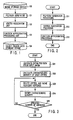
- FIG. 2 is a flow chart showing an example of the flow of processing using an object region data generating apparatus according to the present embodiment.
- a variety of processing procedures include:
- the object region data generating apparatus can be implemented using software, of course.
- a program may be executed on a computer by creating the program in accordance with the flow chart shown in FIG. 2, for example, and installing it in the computer.
- FIG. 3 shows an example of processing procedures for generating an approximation polygon that indicates a region of an object from a frame in which an object exists.
- step S21 an initial polygon precisely indicating a region of an object with a plurality of vertexes is generated.
- bit map image (alpha map) in which a region in which an object exists is defined as "1" or a region in which an object does not exist is defined as "0"; an edge image obtained by removing a sharp edge from the image; or any other format image as long as a region in which an object exists or a region in which an object does not exist can be identified from each other.
- An example of input image is shown in an image 301 shown in FIG. 4.
- One point on an object contour is searched from the input image, and that point is defined as a vertex of an initial polygon.
- this vertex is defined as a start point
- the vertex on the contour is defined as a vertex, and is sequentially added to the initial polygon.
- a polygon approximation error for example, difference between an area for an actual object region and an area for the approximation polygon or a value obtained by dividing this difference by the area for the actual object region or the area for the approximation polygon
- An example of the initial polygon obtained by the input image 301 is shown in an image 302 shown in FIG. 4. In this case, a large amount of data is required, and then, processing for reducing such amount of data is performed.
- a characteristic quantity is calculated with regard to each vertex of the obtained initial polygon.
- the characteristic quantity estimates how much polygon approximation error increases when such vertex is deleted.
- the characteristic quantity may be an angle formed at such vertex and two vertexes adjacent thereto or an area for a triangle formed at such vertex and two vertexes adjacent thereto.
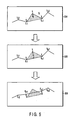
- An example of a relationship between a vertex and its characteristic quantity is shown in an image 304 shown in FIG. 5.
- an angle formed at a vertex t i and two vertex adjacent thereto is defined as ⁇ i
- an area for a triangle formed at the vertex t i and two vertex adjacent thereto is defined as s i .
- one vertex at which the smallest polygon approximation error occurs when the vertex is deleted (that is, a vertex having its minimum characteristic quantity s i ) is selected from the characteristic quantity obtained at step S22, and such vertex is deleted.
- a deleted point corresponds to a protrusion portion of a polygon
- the approximation error produced by deleting a vertex corresponds to an error produced by a polygon entering the inside of an object.
- the two vertexes adjacent to the deleted vertex are moved to the outside of the polygon, thereby reducing an approximation error to the minimum.
- a movement vector of the adjacent vertexes may be arbitrary, if the movement quantity is too large, the approximation error increases conversely. Because of this, for example, this vector may be determined from a polygon approximation error or its peripheral vertex coordinates.
- the best movement vector is searched for (for example, a movement vector with its minimum error is adopted).
- a movement vector v i of an adjacent vertexes t i-1 and t i+1 is determined as a vector vertical to a straight line connecting a vertex t i+1 to a vertex t i-1 , the vector having a length that is half of a distance between the straight line connecting the vertex t i+1 to the vertex t i-1 and a vertex t i .
- v i ⁇ a i - (a i ⁇ b i /
- 2 ) ⁇ b i denotes a positive projection of a i and b i .
- FIG. 5 An example of a movement vector of the adjacent vertex when a vertex is deleted is shown in an image 305 shown in FIG. 5, and an example when the adjacent vertexes are moved by movement vector is shown in an image 306 shown in FIG. 5.
- the vertexes are deleted, and the adjacent vertexes are moved, whereby there is a need to update the characteristic quantity of a vertex.
- the characteristic quantity of a vertex to be updated is re-calculated.
- the vertex to be updated is a vertex moved at step S23 (vertexes t i-1 and t i+1 shown an example shown in FIG. 5) and the adjacent vertexes thereto (t i-2 and t i+2 in an example shown in FIG. 5).
- step S25 it is determined whether or not termination conditions are met.
- a termination condition as to whether the number of vertexes in an approximation polygon is many more than a specified number. In this case, if the polygon includes the specified number of vertexes or less as a result of deletion of vertexes, processing is terminated. If vertexes equal to or greater than the specified number of vertexes still remains, it returns to step S23 at which steps S23 to S25 are repeated until the polygon includes the specified number of vertexes or less.
- a method for specifying a termination condition according to whether or not a polygon approximation error exceeds a threshold apart from a method of judgment according to whether or not a polygon includes a specified number of vertexes or less, for example, there is a method for specifying a termination condition according to whether or not a polygon approximation error exceeds a threshold. In this case, if the polygon approximation error exceeds such threshold, processing terminates.
- function approximation is performed using the function approximation unit 103
- An example of an approximation polygon that represents a region of an object obtained by this processing is shown in an image 303 shown in FIG. 4.
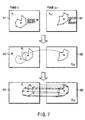
- vertex association processing in the adjacent frames using the vertex association unit 102 will be described with reference to FIG. 6 and FIG. 7.
- FIG. 6 shows an example of processing procedures for associating each vertex of an approximation polygon that represents a region for each object extracted for each frame.
- step S71 when an approximation polygon representing a region of an object in a frame is defined as P i , and an approximation polygon in a next frame (adjacent frame) of such frame is defined as P i+1 , the centers of gravity of these polygons Pi and P i+1 are obtained. Examples of the approximation polygons Pi and P i+1 , and the center of gravity obtained therefor are shown in the images 311 and 321 in FIG. 7.
- an approximation polygon having its center of gravity that is the shortest in distance among them is defined as an approximation polygon P i+1 that corresponds to the object.
- the approximation polygons may be associated with each other using one variation of another method.
- the center of gravity of the approximation polygon P i may be defined as P' i without causing movement such that the center of gravity of the approximation polygon P i coincides with that of the approximation polygon P i+1 .
- each vertex of the polygon P' i is associated with each vertex of P i+1 .
- An example in which these vertexes are associated with each other is shown in images 313 and 323 shown in FIG. 7.
- Method 1 Method for determining based on distance between vertexes
- a distance between a vertex and each vertex of the approximation polygon P i+1 in the adjacent frame is obtained for each polygon P' i which has been moved to a position at which the center of gravity thereof coincides with that of the approximation polygon P i+1 , and a vertex of the polygon P i+1 with its shortest distance is defined as a vertex corresponding to such vertex.
- Method 2 Method for determining association based on the shape of a polygon
- the characteristic quantity of each vertex of an approximation polygon in each frame is obtained, and the vertexes with their close characteristic quantities are associated with each other.
- the characteristic quantities include an area or a vertex angle of a triangle produced at the vertex and the adjacent two vertexes thereto.
- Method 3 Method for estimating a vertex position of a frame to be associated based on the trajectory of vertex
- the trajectory of j-th vertex of the vertexes of polygons P 1 , ..., P i associated in frames is approximated by a time function Tj(t); a vertex position in the frame i+1 is estimated based on the function T j (t); and a vertex that is the closest to the estimated vertex position, of the vertexes of the polygon P i+1 in the frame, is defined as a vertex that corresponds to the j-th vertex.
- the sequence of vertexes in a polygon P' i is equal to that of a polygon P i+1
- the sequence of vertexes is limited to association in a predetermined order such as the clockwise sequence, for example, there is obtained a shortest distance between each of the vertexes of the polygon P' i and each of those of the polygon P i+1
- the vertex of the polygon P' i is associated with the vertex of the polygon P' i+1
- the right adjacent vertex of the associated vertex of the polygon P' i is associated with the right adjacent vertex of the associated vertex of the polygon P i+1
- such association may be repeated similarly in the clockwise direction.
- the following processing is performed so that the above case can be processed in a manner similar to a case in which the number of vertexes in the polygon P' i is equal to that in the polygon P i+1 .
- the number of vertexes for obtaining a trajectory i.e., the number of vertexes of an approximation polygon that represents a region for an object is defined as "s"
- the number of vertexes in the approximation polygon in each frame is equal to or smaller than "s”.
- the number of vertexes for obtaining a trajectory i.e., the number of vertexes of an approximation polygon that represents a region for an object is defined as "s"
- the number of vertexes in the approximation polygon in each frame is larger than "s”.
- the above processing may be selectively performed in accordance with whether or not the number of vertexes of the approximation polygon in the frame is equal to or smaller than "s" or exceeds "s".
- FIG. 8A and FIG. 8B are views each illustrating in more detail an outline of processing for approximating the trajectory of a vertex in an approximation polygon using the function approximation unit 103.
- reference numeral 331 designates one frame in a moving picture targeted for processing.
- Reference numeral 332 denotes each vertex when a region for an object is approximated by a polygon.
- approximation is assumed to be done by a rectangle (four vertexes) in a series of frames for clarify.
- a description will be given, assuming that a spline function is used for function approximation.
- a trajectory obtained when each vertex of an approximation polygon that represents each object is arranged in time series is approximated based on a spline function for each of the X and Y coordinates.
- the spline function in the X and Y coordinates is required for each of the four vertexes that are vertexes of an approximation polygon.
- a total of eight spline functions are generated.
- Processing using the function approximation unit 103 include: a method for performing processing every time the coordinate value of the vertex of the approximation polygon in each frame concerning a region for the object is obtained (for example, a method for performing approximation every time the coordinate value of the vertex in each frame is obtained, and obtaining an approximation error, and then, properly setting an approximation interval, i.e., a frame interval so that such approximation error is lowered within a predetermined range); or a method for performing processing after the coordinate values of vertexes with regard to all frames concerning a region for the object are obtained.
- a trajectory of vertexes over all frames from a frame in which a region for the object appears to a frame in which it disappears is obtained (for example, a case in which the number of vertexes of the association polygon is equal over all the frames, and a vertex is associated with another vertex by one-to-one among all adjacent frames); and a case in which a trajectory of a vertex existing only at an interval in some of all the frames from a frame in which a region for the object appears to a frame in which it disappears (for example, a case in which the number of vertexes in an approximation polygon is different depending on the frames, and the trajectory of certain vertexes in a frame with a small number of vertexes is interrupted; or a case in which the trajectory of certain vertexes in such frame is interrupted because the corresponding vertexes in a frame correspond to each other by
- reference numeral 333 represents an approximated spline function in a three-dimensional manner.
- Data indicating the thus obtained approximation function is recorded in the object region data storage device 104 in accordance with a predetermined data format.
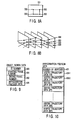
- FIG. 9 shows an example of the data format of object region data for recording a spline function that represents a region of an object in a moving picture.
- ID number 400 is an identification number assigned to each object.
- a starting frame number 401 and an ending frame number 402 are first and last frame numbers that define the existence of an object given by the ID number. Specifically, these numbers correspond to the numbers of frames in which an object appears and disappear in a moving picture. However, instead of the numbers of frames in which an object appears and disappears in a moving picture in reality, for example, an arbitrary frame number later than that assigned when an object appears in a moving picture may be assigned as a starting frame number. Similarly, an arbitrary frame number later than the starting frame number and earlier than that assigned when an object disappear in a moving picture may be assigned as an ending frame number.
- the starting/ending frame numbers can be substituted by the starting/ending time stamps.
- Approximation polygon data 403 is trajectory data on vertexes for expressing an approximation polygon (for example, parameter for spline function or the like). Where one object is formed in a plurality of object regions, the approximation polygon data 403 is provided in plurality.
- FIG. 10 shows an example of a data structure of approximation polygon data 403.
- the number of vertexes 431 indicates the number of vertexes for expressing an approximation polygon.
- a pair of vertex trajectory data 432-1 and 432-2 are data regions concerning a spline function for expressing a trajectory of points representative of an approximation polygon.
- the spline function data on the X and Y coordinates is required for one vertex. Therefore, the vertex trajectory data for specifying such spline function exists by vertex number M x 2.
- the sequence of vertexes to be recorded may be a predetermined sequence such as a sequential order of the vertexes, for example.
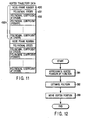
- FIG. 11 shows an example of a data structure of vertex trajectory data 432-1 and 432-2.
- a node frame number 4320 represents a node of a spline function. This number indicates that polynomial data 4323 is effective up to this node.
- the number of polynomial coefficient data varies depending on the maximum order of the spline function. If the maximum order is defined as K, the number of coefficient data is defined as K + 1. Thus, reference is made to a polynomial order 4321.
- the polynomial order 4321 is followed by polynomial coefficient data 4322 in number that corresponds to K + 1.
- a spline function is expressed by a polynomial between each of adjacent nodes, thus requiring polynomials in number that corresponds to the number of nodes. Therefore, data 4323 containing a node frame number 4320, polynomial coefficient 4322 or the like is repeatedly described in plurality. Where a node frame number is equal to a last frame, it means that the data 4323 is the last polynomial coefficient data. Thus, it is found that trajectory data ends.
- a variety of other items of data may be added to the object region data shown in FIG. 9.
- attribute data associated with an object of the ID number or data (such as file name, URL or any other address) indicating a method of access to associated information data associated with an object of the ID number.
- Associated information data may be characters, voices, still pictures, moving pictures or a combination thereof; or data describing programs or computer activities.
- the coordinate value of each vertex of an approximation graphics in each frame may be recorded as it is in approximation polygon data 403 contained in the object region data shown in FIG. 9.
- object region data created by the processing according to the present embodiment is provided for a user, it is required to provide object region data by using any method from a creator to a user.
- the data is provided in a variety of modes as exemplified below.
- the above modes are associated with a case in which the data are mainly provided by a recording medium. Otherwise, there can be provided a mode in which part of whole of the data is provided via a communication medium.
- an object region data generating method and apparatus for generating object region data that describes data concerning a region for an arbitrary object in moving picture data, wherein the region for the object in the moving picture data is approximated by using an approximation polygon with regard to each of the plural frames, each of plural vertexes of the approximation polygon in a preceding frame is approximated with a vertex of the approximation polygon in the current frame having a shortest distance between vertexes after the approximation polygon in the current frame is move to make the centers of gravity of both approximation polygons coincide with each other, whereby a trajectory of the associated vertexes is obtained by arranging the vertexes along the sequence of the frames.
- the object region data is generated based on the trajectory of the obtained plural vertexes.
- an object region data generating method and apparatus for generating object region data that describes data concerning a region for an arbitrary object in moving picture data, wherein the region for the object in the moving picture data is approximated by using an approximation polygon with regard to each of the plural frames, each of plural vertexes of the approximation polygon in a preceding frame is approximated with a vertex of the approximation polygon in the current frame which is closest to an estimated position of the vertex based on a trajectory of the associated vertexes, whereby a trajectory of the associated vertexes is obtained by arranging the vertexes along the sequence of the frames.
- the object region data is generated based on the trajectory of the obtained plural vertexes.
- an object region data generating method and apparatus for generating object region data that describes data concerning a region for an arbitrary object in moving picture data, wherein the region for the object in the moving picture data is approximated by using an approximation polygon with regard to each of the plural frames, each of plural vertexes of the approximation polygon in a preceding frame is approximated with a vertex of the approximation polygon in the current frame having a closest characteristic quantity, whereby a trajectory of the associated vertexes is obtained by arranging the vertexes along the sequence of the frames.
- the object region data is generated based on the trajectory of the obtained plural vertexes.
- a vertex association may be limited to a one-to-one association or such an association that the sequence of vertexes is not changed.
- an approximation polygon generating method and apparatus for generating an approximation polygon that approximates a region of an arbitrary object in one frame of a moving picture or an image, wherein a contour of a region of the object in one frame of a moving picture or a still picture is extracted; an initial polygon representing a region of the object is generated based on the extracted contour; a vertex to be deleted is selected based on the characteristic quantity of each vertex of a polygon at that time; the thus selected vertex is deleted; vertexes adjacent to the deleted vertex are moved; and the characteristic quantity of each vertex of the polygon is updated, and the processing is performed until a predetermined ending condition has been met, thereby generating an approximation polygon that approximates the region for the object in the frame.
- the characteristic quantity there may be used an area for a triangle produced by the deleted vertex and the adjacent two vertexes thereto or an angle produced by the above deleted vertex and the adjacent two vertexes thereto.
- the ending condition there may be used whether or not the number of vertexes in a polygon becomes smaller than a specified value or whether or not the approximation error value of the approximation polygon and the actual object is greater than the value.
- an object in a moving picture is represented as a trajectory of vertexes in an approximation polygon as follows.
- a region in which an object exists in each frame is first detected, and an initial polygon is generated from a contour of such region.
- a vertex less affected by deletion is searched for in a polygon based on the characteristic quantity of each vertex, and is deleted.
- an increase of an error caused by vertex deletion is reduced by moving the adjacent vertexes. This processing is repeated until the ending condition has been met, thereby producing a polygon that represents object region data with a smaller number of vertexes.
- this algorithm Since a point on an object contour is searched for with a large amount of calculation only when an initial polygon is produced, this algorithm operates at a higher speed than a conventional algorithm. In addition, there is an advantage that an approximation error is small because a polygon is produced while an vertex is dynamically changed.
- Region data with regard to each frame is generated, and vertexes are associated with each other between the adjacent frames, whereby a time-series variation of object is described as a trajectory of vertexes. For example, association is performed so that a distance between the corresponding vertexes is minimized. Then, the trajectory of each vertex is approximated by function, whereby an amount of data is reduced.
- the object region data on a frame to be generated is estimated based on the object region data on the already created frame, and the estimated object region data is deformed according to an object, whereby the trajectory of a vertex is produced.
- this approximated polygon is used for object recognition, classification, search or the like.
- preferable function approximation is performed even if there is a possibility that the number of vertexes is different depending on each frame or there is a high possibility that vertexes between frames are associated with each other by object deformation or movement.
- preferable function approximation is performed even if there is a possibility that the number of vertexes is different depending on each frame or there is a plural possibilities that the vertexes between frames are associated with each other due to an object deformation or movement.
- the region for the object in the moving picture is described as a parameter for a curve that approximates a time series trajectory (trajectory of the coordinate of vertexes at which a frame number or a time stamp is defined as a variable).
- the region of the object in the moving picture is expressed by a function parameter, and thus, there can be produced object region data in a small amount of data, the data being easily processed.
- an approximation polygon is easily generated from the parameter for the approximation parameter.
- the present embodiment is basically similar to the first embodiment. Hereinafter, differences from the first embodiment will be mainly described.
- vertexes of an approximation polygon is obtained from a region of the object in each frame, and then, a correspondence of the vertexes of the approximation polygon is obtained in the adjacent two frames.
- each of the corresponding vertexes of an approximation polygon in a targeted frame is obtained by using the trajectory of each of the corresponding vertexes of the approximation polygon in the already obtained preceding frames. For example, this embodiment is efficient in a case in which processing is performed while a moving picture is inputted in a stream moving picture.
- a configuration example of an object region data generating apparatus according to the present embodiment is similar to that shown in FIG. 1.
- an example of processing flow using the object region data generating apparatus is similar to that shown in FIG. 2.
- the polygon generation processing at step S11 is performed only for the first frame in which an object appears.
- a correspondence of a vertex of an approximation polygon of the current frame and that over a plurality of frames may be obtained in accordance with the processing at steps S11 and S12 in the first embodiment.
- the vertexes of the approximation polygon in the subsequent frames are obtained one after another in accordance with the processing at step S12 in the present embodiment.
- the trajectory of each vertex of an approximation polygons in a plurality of already generated frames is approximated as a time-series function, as designated by reference numeral 601 shown in FIG. 13.
- This function approximation may be performed by using any approximation technique such as linear approximation, quadric approximation or spline approximation.
- step S82 the vertex position in a frame to be processed is estimated based on an approximated function, thereby generating a vertex (vertexes) of a polygon estimated in the frame to be processed.
- An example of the estimated approximation polygon is designated by reference numeral 602 shown in FIG. 13.
- a vertex (vertexes) of an approximation polygon in the closest frame is (are) employed intact as a vertex (vertexes) of an estimated polygon without performing function approximation.
- the center of gravity of the approximation polygon in a frame to be generated is estimated from that of each of the approximation polygons in a plurality of the already generated frames, and then, a polygon obtained by moving an approximation polygon in the closest frame so that its center of gravity coincides with the estimated center of gravity may be used as an estimated approximation polygon.
- the processing at steps S81 and S82 may be performed by a small number of such frames.
- an approximation polygon in the immediately preceding frame may be used as an estimated polygon without performing approximation at step S81.
- an approximation polygon is first obtained for only one frame or a small number of frames, an approximation in the immediately preceding frame may be used as an estimated polygon without performing approximation at step S81.
- step S83 an object region for a frame to be processed is read, and each vertex of the estimated approximation polygon is moved in accordance with such object region.
- An example of the object region for a inputted frame to be processed is designated by reference numeral 603 shown in FIG. 13.
- moving methods including moving an object to a position on an object contour that is the closest from such estimated position for each vertex or moving an object by using a parameter optimizing method such as gradient approach or Newton approach so as to minimize an approximation error.
- an object region determined to be associated with an object in the targeted frame is used.
- the present embodiment is similar to the first embodiment in function approximation processing using the function approximation unit 103.
- an object region data generating method and apparatus for generating object region data that describes data concerning a region of an arbitrary object in moving picture data over a plurality of continuous frames, wherein, based on data indicating a trajectory of position data on a plurality of vertexes of an approximation polygon that approximates the region for the object from the already generated starting frame over the immediately preceding frame, position data on a plurality of vertexes of the approximation polygon that approximates the region for the object in the frame to be processed is estimated, and is modified so as to be associated with a region for the object in the frame to be processed, whereby processing is performed for generating data indicating a trajectory of position data on a plurality of vertexes of an approximation polygon that approximates a region for the object from the starting frame to the target frame, and the object region data is generated based on a trajectory of the plurality of vertexes obtained by repeatedly performing such processing over the plurality of frames
- the trajectory of position data on vertexes of the approximation polygon over a plurality of already generated frames is approximated by function so as to estimate the position data on vertexes of the approximation polygon in the already generated closest frame.
- the position data on the vertex of the approximation polygon in the already generated closest frame may be used.
- the position of the center of gravity of the frame may be estimated from the center of gravity of the approximation polygon over a plurality of the already generated frames so as to use the position data on the vertexes of the approximation polygon when the approximation polygon in the already generated closest frame is moved to the positional center of gravity.
- the present invention it is possible to approximate the size, shape, movement, or deformation and the like, of a region of a desired object in a moving picture, as a polygon, with high precision and high speed.
- the region for the desired object in the moving picture is described in a small amount of data, making it possible to facilitate object generation or data processing.
- the approximated polygon is used for object recognition, classification, search or the like.
- preferable function approximation is performed even if there is a possibility that the number of vertexes differs depending on each frame or there is a high possibility that vertexes between frames are associated with each other by object deformation and movement or the like.
- the present invention according to the apparatus is established as that according to the method, and vice versa.
- the present invention can be implemented as a computer readable recording medium that records a program for causing a computer to executing predetermined program codes (or causing a computer to function as predetermined means or causing a computer to implement a predetermined function).
Landscapes
- Engineering & Computer Science (AREA)
- Multimedia (AREA)
- Physics & Mathematics (AREA)
- General Physics & Mathematics (AREA)
- Theoretical Computer Science (AREA)
- Computer Vision & Pattern Recognition (AREA)
- Image Analysis (AREA)
- Image Generation (AREA)
- Processing Or Creating Images (AREA)
Abstract
Description
Claims (21)
- A method of generating object region data relating to object regions in frames of moving picture, the frames lined up in a time-series variation, characterized by comprising:approximating (S11) the object region in each of the frames with a polygon, the polygon having vertexes;associating (S12) the vertexes in each of the frames with the respective vertexes in an adjacent frame of each of the frames;obtaining (S13) trajectories linked the vertexes associated together based on the time-series variation of the frames; andgenerating (S13) the object region data based on the trajectories.
- The method according to claim 1, characterized in that the vertexes in each of the frames are associated with the respective vertexes in the adjacent frame such that a distance between the vertexes in each of the frames and the respective vertexes in the adjacent frame is minimum.
- The method according to claim 1 or 2, characterized in that the distance between the vertexes in each of frames and the respective vertexes in the adjacent frame is calculated after a center of gravity of the polygon in the each of the frames coincides with a center of gravity of the polygon in the adjacent frame.
- A method according to claim 1, characterized in that the associating the vertexes with the respective vertexes comprises estimating vertexes in the adjacent frame based on the vertexes in the frames preceding to the adjacent frame, and selecting the vertexes in the adjacent frame, that are closest to the estimated vertexes.
- The method according to claim 1, characterized in that the vertexes in each of frames have a characteristic quantity, the characteristic quantity of the vertexes in each of frames is the closest to the characteristic quantity of the respective vertexes in the adjacent frame.
- A method of generating object region data relating to an object region in moving picture data having a plurality of frames, characterized by comprising:approximately (S81) the object region in each of the plurality of frames with a polygon;estimating (S82) a plurality of vertexes of the polygon in a given frame based on trajectory data indicating vertexes of the polygon from a first frame to an immediately preceding frame of the given frame;modifying (S83) the plurality of vertexes estimated so as to be associated with the object region in the given frame;obtaining (S83) trajectory data indicating vertexes of the polygon from the first frame to the given frame; andgenerating (S83) the object region data based on the trajectory data indicating vertexes of the polygon from the first frame to the given frame.
- The method according to any one of the preceding claims, characterized in that each of the trajectories is approximated by a predetermined function, and the object region data is generated by using a parameter for the function.
- The method according to any one of the preceding claims, characterized in that the object region data includes position data of the vertexes of each of the frames and association data indicting correspondence of the vertexes between the frames.
- A method of generating a polygon that approximates an object region in an image,
characterised by comprising:extracting (S21) a contour of the object region to generate an initial polygon;obtaining (S22) a characteristic quantity of each of vertexes of the initial polygon;selecting (S23) the vertex to be deleted based on the characteristic quantity;deleting (S23) the selected vertex;correcting (S24) a position of vertexes adjacent to the deleted vertex, thereby performing processing for updating the polygon; andrepeatedly performing (S25) the processing until a predetermined ending condition has been met, thereby generating the polygon that approximates the object region. - An apparatus for generating object region data relating to object regions in frames of moving picture, the frames lined up in a time-series variation, the apparatus comprising:an approximation unit (101) configured to approximate the object region in each of the frames with a polygon, the polygon having vertexes;an association unit (102) configured to associate the vertexes in each of the frames with the respective vertexes in an adjacent frame of each of the frames;a trajectory unit (103) configured to obtain trajectories linked the vertexes associated together based on the time-series variation of the frames; anda data generation unit (103) configured to generate the object region data based on the trajectories.
- The apparatus according to claim 10, characterized in that the association unit associates the vertexes in each of the frames with the respective vertexes in the adjacent frame such that a distance between the vertexes in each of the frames and the respective vertexes in the adjacent frame is minimum.
- The apparatus according to claim 10 or 11, characterized in that the association unit comprises an estimation unit configured to estimate vertexes in the adjacent frame based on the vertexes in the frames preceding to the adjacent frame, and a selector configured to select the vertexes in the adjacent frame, that are closest to the estimated vertexes.
- The apparatus according to claim 10, 11 or 12, characterized in that the vertexes in each of frames have a characteristic quantity, the characteristic quantity of the vertexes in each of frames is the closest to the characteristic quantity of the respective vertexes in the adjacent frame.
- An apparatus for generating object region data relating to an object region in moving picture data having a plurality of frames, the apparatus comprising:an approximation unit (S81) configured to approximate the object region in each of the plurality of frames with a polygon;an estimation unit (S82) configured to estimate a plurality of vertexes of the polygon in a given frame based on trajectory data indicating vertexes of the polygon from a first frame to an immediately preceding frame of the given frame;a modifying unit (S83) configured to modify the plurality of vertexes estimated so as to be associated with the object region in the given frame;a trajectory unit (S83) configured to obtain trajectory data indicating vertexes of the polygon from the first frame to the given frame; anda data generation unit (S83) configured to generate the object region data based on the trajectory data indicating vertexes of the polygon from the first frame to the given frame.
- An apparatus for generating a polygon that approximates an object region in an image, the apparatus comprising:an extraction unit (S21) configured to extract a contour of the object region to generate an initial polygon;a characteristic quantity unit (S22) configured to obtain a characteristic quantity of each of vertexes of the initial polygon;a selector (S23) configured to select the vertex to be deleted based on the characteristic quantity;a deletion unit (S23) configured to delete the selected vertex;a correction unit (S24) configured to correct a position of vertexes adjacent to the deleted vertex, thereby performing processing for updating the polygon; anda controller (S25) configured to repeatedly perform the processing until a predetermined ending condition has been met, thereby generating the polygon that approximates the object region.
- An article of manufacture comprising a computer usable medium having computer readable program code means embodied therein, the computer readable program code means comprising:first computer readable program code means (S11) for causing a computer to approximate the object region in each of the frames with a polygon, the polygon having vertexes;second computer readable program code means (S12) for causing a computer to associate the vertexes in each of the frames with the respective vertexes in an adjacent frame of each of the frames;third computer readable program code means (S13) for causing a computer to obtain trajectories linked the vertexes associated together based on the time-series variation of the frames; andfourth computer readable program code means (S13) for causing a computer to generate the object region data based on the trajectories.
- The article of manufacture according to claim 16, characterized in that the second computer readable program code means causes a computer to associate vertexes in each of the frames with the respective vertexes in the adjacent frame such that a distance between the vertexes in each of the frames and the respective vertexes in the adjacent frame is minimum.
- The article of manufacture according to claim 16, characterized in that the second computer readable program code means causes a computer to estimate vertexes in the adjacent frame based on the vertexes in the frames preceding to the adjacent frame, and select the vertexes in the adjacent frame, that are closest to the estimated vertexes.
- The article of manufacture according to claim 16, characterized in that the vertexes in each of frames have a characteristic quantity, and the second computer readable program code means causes a computer to associate the vertexes such that the characteristic quantity of the vertexes in each of frames is the closest to the characteristic quantity of the respective vertexes in the adjacent frame.
- An article of manufacture comprising a computer usable medium having computer readable program code means embodied therein, the computer readable program code means comprising:first computer readable program code means (S81) for causing a computer to approximate the object region in each of the plurality of frames with a polygon;second computer readable program code means (S82) for causing a computer to estimate a plurality of vertexes of the polygon in a given frame based on trajectory data indicating vertexes of the polygon from a first frame to an immediately preceding frame of the given frame;third computer readable program code means (S83) for causing a computer to modify the plurality of vertexes estimated so as to be associated with the object region in the given frame;fourth computer readable program code means (S83) for causing a computer to obtain trajectory data indicating vertexes of the polygon from the first frame to the given frame; andfifth computer readable program code means (S83) for causing a computer to generate the object region data based on the trajectory data indicating vertexes of the polygon from the first frame to the given frame.
- An article of manufacture comprising a computer usable medium having computer readable program code means embodied therein, the computer readable program code means comprising:first computer readable program code means (S21) for causing a computer to extract a contour of the object region to generate an initial polygon;second computer readable program code means (S22) for causing a computer to obtain a characteristic quantity of each of vertexes of the initial polygon;third computer readable program code means (S23) for causing a computer to select the vertex to be deleted based on the characteristic quantity;fourth computer readable program code means (S23) for causing a computer to delete the selected vertex;fifth computer readable program code means (S24) for causing a computer to correct a position of vertexes adjacent to the deleted vertex, thereby performing processing for updating the polygon; andsixth computer readable program code means (S25) for causing a computer to repeatedly perform the processing until a predetermined ending condition has been met, thereby generating the polygon that approximates the object region.
Applications Claiming Priority (2)
| Application Number | Priority Date | Filing Date | Title |
|---|---|---|---|
| JP2000077161 | 2000-03-17 | ||
| JP2000077161A JP2001266159A (en) | 2000-03-17 | 2000-03-17 | Object region information generating method, object region information generating device, approximate polygon generating method, and approximate polygon generating device |
Publications (3)
| Publication Number | Publication Date |
|---|---|
| EP1134984A2 true EP1134984A2 (en) | 2001-09-19 |
| EP1134984A3 EP1134984A3 (en) | 2003-10-22 |
| EP1134984B1 EP1134984B1 (en) | 2007-12-12 |
Family
ID=18594775
Family Applications (1)
| Application Number | Title | Priority Date | Filing Date |
|---|---|---|---|
| EP20010302458 Expired - Lifetime EP1134984B1 (en) | 2000-03-17 | 2001-03-16 | Object region data generating method, object region data generating apparatus, approximation polygon generating method, and approximation polygon generating apparatus |
Country Status (6)
| Country | Link |
|---|---|
| US (1) | US20010025298A1 (en) |
| EP (1) | EP1134984B1 (en) |
| JP (1) | JP2001266159A (en) |
| KR (1) | KR100427879B1 (en) |
| CN (1) | CN1227624C (en) |
| DE (1) | DE60131796T2 (en) |
Families Citing this family (15)
| Publication number | Priority date | Publication date | Assignee | Title |
|---|---|---|---|---|
| JP4226730B2 (en) * | 1999-01-28 | 2009-02-18 | 株式会社東芝 | Object region information generation method, object region information generation device, video information processing method, and information processing device |
| EP1418546A1 (en) * | 2002-11-07 | 2004-05-12 | Mitsubishi Electric Information Technology Centre Europe B.V. | Method and apparatus for representing moving objects in a sequence of images |
| JP4836065B2 (en) * | 2005-03-31 | 2011-12-14 | 株式会社国際電気通信基礎技術研究所 | Edge tracking method and computer program therefor |
| TWI280061B (en) | 2005-04-27 | 2007-04-21 | Novatek Microelectronics Corp | Image processing method and device thereof |
| JP5326910B2 (en) * | 2009-01-20 | 2013-10-30 | ソニー株式会社 | Information processing apparatus, information processing method, and program |
| KR101009379B1 (en) * | 2009-05-27 | 2011-01-19 | 주식회사 매크로그래프 | How to construct a micropolygon using internal parameters of REVES algorithm |
| JP5423286B2 (en) * | 2009-09-29 | 2014-02-19 | 凸版印刷株式会社 | Pattern data conversion method |
| JP6086188B2 (en) * | 2012-09-04 | 2017-03-01 | ソニー株式会社 | SOUND EFFECT ADJUSTING DEVICE AND METHOD, AND PROGRAM |
| JP6098286B2 (en) * | 2013-03-28 | 2017-03-22 | 大日本印刷株式会社 | Corresponding point determination device, corresponding point determination method, and program |
| JP6261190B2 (en) * | 2013-05-31 | 2018-01-17 | キヤノン株式会社 | Setting device and setting method |
| GB2518897A (en) * | 2013-10-07 | 2015-04-08 | Univ Newcastle | Test for distinguishing between a human and a computer program |
| TW201519161A (en) * | 2013-11-07 | 2015-05-16 | Inst Information Industry | Electronic device and video object motion trajectory modification method thereof |
| TWI570666B (en) * | 2013-11-15 | 2017-02-11 | 財團法人資訊工業策進會 | Electronic device and video object tracking method thereof |
| CN115082514A (en) * | 2021-03-15 | 2022-09-20 | 北京字跳网络技术有限公司 | Target tracking method, device, equipment and medium |
| CN117077501B (en) * | 2023-10-17 | 2024-01-09 | 中南大学 | Heterogeneous steel slag concrete permeability coefficient calculation method |
Family Cites Families (26)
| Publication number | Priority date | Publication date | Assignee | Title |
|---|---|---|---|---|
| JPH04184575A (en) * | 1990-11-20 | 1992-07-01 | Fujitsu Ltd | Method and device for making outlines of time sequential pictures to correspond to each other |
| JPH0746595A (en) * | 1993-05-21 | 1995-02-14 | Nippon Telegr & Teleph Corp <Ntt> | Video encoder and decoder |
| JPH07210688A (en) * | 1994-01-26 | 1995-08-11 | Fuji Photo Film Co Ltd | Device for calculating polygon area |
| JP3738456B2 (en) * | 1994-11-14 | 2006-01-25 | マツダ株式会社 | Article position detection method and apparatus |
| KR100235345B1 (en) * | 1994-12-29 | 1999-12-15 | 전주범 | Moving picture estimation apparatus and method in divided region |
| US5799109A (en) * | 1994-12-29 | 1998-08-25 | Hyundai Electronics Industries Co., Ltd. | Object-by shape information compression apparatus and method and coding method between motion picture compensation frames |
| KR100235343B1 (en) * | 1994-12-29 | 1999-12-15 | 전주범 | Apparatus for calculating motion vector in encoder using segmentation method |
| US5691769A (en) * | 1995-09-07 | 1997-11-25 | Daewoo Electronics Co, Ltd. | Apparatus for encoding a contour of an object |
| US5995670A (en) * | 1995-10-05 | 1999-11-30 | Microsoft Corporation | Simplified chain encoding |
| US5970504A (en) * | 1996-01-31 | 1999-10-19 | Mitsubishi Denki Kabushiki Kaisha | Moving image anchoring apparatus and hypermedia apparatus which estimate the movement of an anchor based on the movement of the object with which the anchor is associated |
| US5778098A (en) * | 1996-03-22 | 1998-07-07 | Microsoft Corporation | Sprite coding |
| JP3750184B2 (en) * | 1996-04-03 | 2006-03-01 | 松下電器産業株式会社 | Moving object extraction apparatus and extraction method |
| KR100203656B1 (en) * | 1996-04-09 | 1999-06-15 | 전주범 | Contour image signal encoding device |
| US5982909A (en) * | 1996-04-23 | 1999-11-09 | Eastman Kodak Company | Method for region tracking in an image sequence using a two-dimensional mesh |
| KR100249029B1 (en) * | 1996-06-12 | 2000-03-15 | 전주범 | Method and apparatus for coding contour of video signals in image coding system |
| EP0831654B1 (en) * | 1996-09-23 | 2002-07-24 | Daewoo Electronics Co., Ltd | Method and apparatus for encoding a contour image of an object in a video signal |
| US5883977A (en) * | 1996-12-30 | 1999-03-16 | Daewoo Electronics Co., Ltd. | Method and apparatus for encoding a video signal of a contour of an object |
| US5978510A (en) * | 1997-03-20 | 1999-11-02 | Hyundai Electronics Industries Co., Ltd. | Method and apparatus for predictively coding contour of video signal |
| KR100229544B1 (en) * | 1997-04-11 | 1999-11-15 | 전주범 | Contour Coding Device Using Motion Estimation |
| KR100229546B1 (en) * | 1997-04-11 | 1999-11-15 | 전주범 | Method and apparatus for coding contour of video signals |
| KR100244769B1 (en) * | 1997-06-26 | 2000-02-15 | 전주범 | Inter contour coding method and apparatus |
| JP3735187B2 (en) * | 1997-08-27 | 2006-01-18 | 富士通株式会社 | Data conversion apparatus and method for encoding and editing time-series data |
| EP1086412A4 (en) * | 1998-06-08 | 2008-05-07 | Microsoft Corp | Compression of time-dependent geometry |
| JP4226730B2 (en) * | 1999-01-28 | 2009-02-18 | 株式会社東芝 | Object region information generation method, object region information generation device, video information processing method, and information processing device |
| JP2000251086A (en) * | 1999-02-26 | 2000-09-14 | Sony Corp | Curve generating apparatus and method, and program providing medium |
| KR100415266B1 (en) * | 2000-05-11 | 2004-01-16 | 가부시끼가이샤 도시바 | Object region information description method, object region information generating device and recording medium |
-
2000
- 2000-03-17 JP JP2000077161A patent/JP2001266159A/en not_active Abandoned
-
2001
- 2001-03-16 EP EP20010302458 patent/EP1134984B1/en not_active Expired - Lifetime
- 2001-03-16 DE DE2001631796 patent/DE60131796T2/en not_active Expired - Fee Related
- 2001-03-16 CN CNB011192933A patent/CN1227624C/en not_active Expired - Fee Related
- 2001-03-16 US US09/808,988 patent/US20010025298A1/en not_active Abandoned
- 2001-03-16 KR KR10-2001-0013613A patent/KR100427879B1/en not_active Expired - Fee Related
Also Published As
| Publication number | Publication date |
|---|---|
| JP2001266159A (en) | 2001-09-28 |
| DE60131796D1 (en) | 2008-01-24 |
| CN1227624C (en) | 2005-11-16 |
| EP1134984A3 (en) | 2003-10-22 |
| KR20010090466A (en) | 2001-10-18 |
| DE60131796T2 (en) | 2008-12-04 |
| KR100427879B1 (en) | 2004-04-27 |
| CN1318815A (en) | 2001-10-24 |
| US20010025298A1 (en) | 2001-09-27 |
| EP1134984B1 (en) | 2007-12-12 |
Similar Documents
| Publication | Publication Date | Title |
|---|---|---|
| EP1134984B1 (en) | Object region data generating method, object region data generating apparatus, approximation polygon generating method, and approximation polygon generating apparatus | |
| JP4226730B2 (en) | Object region information generation method, object region information generation device, video information processing method, and information processing device | |
| KR100459893B1 (en) | Method and apparatus for color-based object tracking in video sequences | |
| CN101689394B (en) | Method and system for video indexing and video synopsis | |
| KR100957888B1 (en) | Method and apparatus for representing and retrieving objects in an image | |
| EP1131789B1 (en) | Method for building a three-dimensional scene model by analysing a sequence of images | |
| US6937760B2 (en) | Interactive frame segmentation with dynamic programming | |
| CN115546221B (en) | Reinforcing steel bar counting method, device, equipment and storage medium | |
| KR100741300B1 (en) | Automatic Extraction Method of Video Sequence Structure | |
| CN116095363A (en) | Mobile terminal short video highlight moment editing method based on key behavior recognition | |
| CN114066933A (en) | Multi-target tracking method, system and related equipment | |
| KR20040068987A (en) | Method for efficiently storing the trajectory of tracked objects in video | |
| JP6934402B2 (en) | Editing system | |
| KR101506812B1 (en) | Head pose estimation method using random forests and binary pattern run length matrix | |
| CN116071511A (en) | A dynamic SLAM method and system for lightweight real-time semantic mapping | |
| CN115132370A (en) | Flow adjustment auxiliary method and device based on machine vision and deep learning | |
| CN120912887A (en) | Label generation method based on multi-frame depth information fusion and bird's eye view semantic segmentation | |
| JP3907344B2 (en) | Movie anchor setting device | |
| JP3763279B2 (en) | Object extraction system, object extraction method, and object extraction program | |
| CN115457448A (en) | A video key frame intelligent extraction system | |
| JP2002216166A (en) | 3D model search system | |
| JP2009048657A (en) | Feature selecting program method and apparatus for picture description system | |
| CN119229036A (en) | Three-dimensional mapping method, device and storage medium | |
| CN116543000A (en) | Remote sensing image road edge detection method and system | |
| Halder et al. | Design of an Automatic Cartoon Movie Builder (ACMB) System for Generation of a Cartoon Movie from a given story |
Legal Events
| Date | Code | Title | Description |
|---|---|---|---|
| PUAI | Public reference made under article 153(3) epc to a published international application that has entered the european phase |
Free format text: ORIGINAL CODE: 0009012 |
|
| 17P | Request for examination filed |
Effective date: 20010330 |
|
| AK | Designated contracting states |
Kind code of ref document: A2 Designated state(s): AT BE CH CY DE DK ES FI FR GB GR IE IT LI LU MC NL PT SE TR |
|
| AX | Request for extension of the european patent |
Free format text: AL;LT;LV;MK;RO;SI |
|
| RIC1 | Information provided on ipc code assigned before grant |
Ipc: 7H 04N 7/26 A Ipc: 7G 06T 9/20 B |
|
| PUAL | Search report despatched |
Free format text: ORIGINAL CODE: 0009013 |
|
| AK | Designated contracting states |
Kind code of ref document: A3 Designated state(s): AT BE CH CY DE DK ES FI FR GB GR IE IT LI LU MC NL PT SE TR |
|
| AX | Request for extension of the european patent |
Extension state: AL LT LV MK RO SI |
|
| 17Q | First examination report despatched |
Effective date: 20040302 |
|
| AKX | Designation fees paid |
Designated state(s): DE FR GB |
|
| 17Q | First examination report despatched |
Effective date: 20040302 |
|
| GRAP | Despatch of communication of intention to grant a patent |
Free format text: ORIGINAL CODE: EPIDOSNIGR1 |
|
| GRAS | Grant fee paid |
Free format text: ORIGINAL CODE: EPIDOSNIGR3 |
|
| GRAA | (expected) grant |
Free format text: ORIGINAL CODE: 0009210 |
|
| AK | Designated contracting states |
Kind code of ref document: B1 Designated state(s): DE FR GB |
|
| REG | Reference to a national code |
Ref country code: GB Ref legal event code: FG4D |
|
| REF | Corresponds to: |
Ref document number: 60131796 Country of ref document: DE Date of ref document: 20080124 Kind code of ref document: P |
|
| ET | Fr: translation filed | ||
| PLBE | No opposition filed within time limit |
Free format text: ORIGINAL CODE: 0009261 |
|
| STAA | Information on the status of an ep patent application or granted ep patent |
Free format text: STATUS: NO OPPOSITION FILED WITHIN TIME LIMIT |
|
| 26N | No opposition filed |
Effective date: 20080915 |
|
| PGFP | Annual fee paid to national office [announced via postgrant information from national office to epo] |
Ref country code: GB Payment date: 20090311 Year of fee payment: 9 |
|
| PGFP | Annual fee paid to national office [announced via postgrant information from national office to epo] |
Ref country code: DE Payment date: 20090313 Year of fee payment: 9 |
|
| PGFP | Annual fee paid to national office [announced via postgrant information from national office to epo] |
Ref country code: FR Payment date: 20090316 Year of fee payment: 9 |
|
| GBPC | Gb: european patent ceased through non-payment of renewal fee |
Effective date: 20100316 |
|
| REG | Reference to a national code |
Ref country code: FR Ref legal event code: ST Effective date: 20101130 |
|
| PG25 | Lapsed in a contracting state [announced via postgrant information from national office to epo] |
Ref country code: FR Free format text: LAPSE BECAUSE OF NON-PAYMENT OF DUE FEES Effective date: 20100331 |
|
| PG25 | Lapsed in a contracting state [announced via postgrant information from national office to epo] |
Ref country code: DE Free format text: LAPSE BECAUSE OF NON-PAYMENT OF DUE FEES Effective date: 20101001 |
|
| PG25 | Lapsed in a contracting state [announced via postgrant information from national office to epo] |
Ref country code: GB Free format text: LAPSE BECAUSE OF NON-PAYMENT OF DUE FEES Effective date: 20100316 |